Transcriber’s Notes — GOOD HEALTH AND HOW WE WON IT
Obvious typographical errors have been silently corrected. Variations
in hyphenation have been standardised but all other spelling and
punctuation remains unchanged.
The cover was prepared by the transciber and is placed in the public domain.
GOOD HEALTH AND
HOW WE WON IT
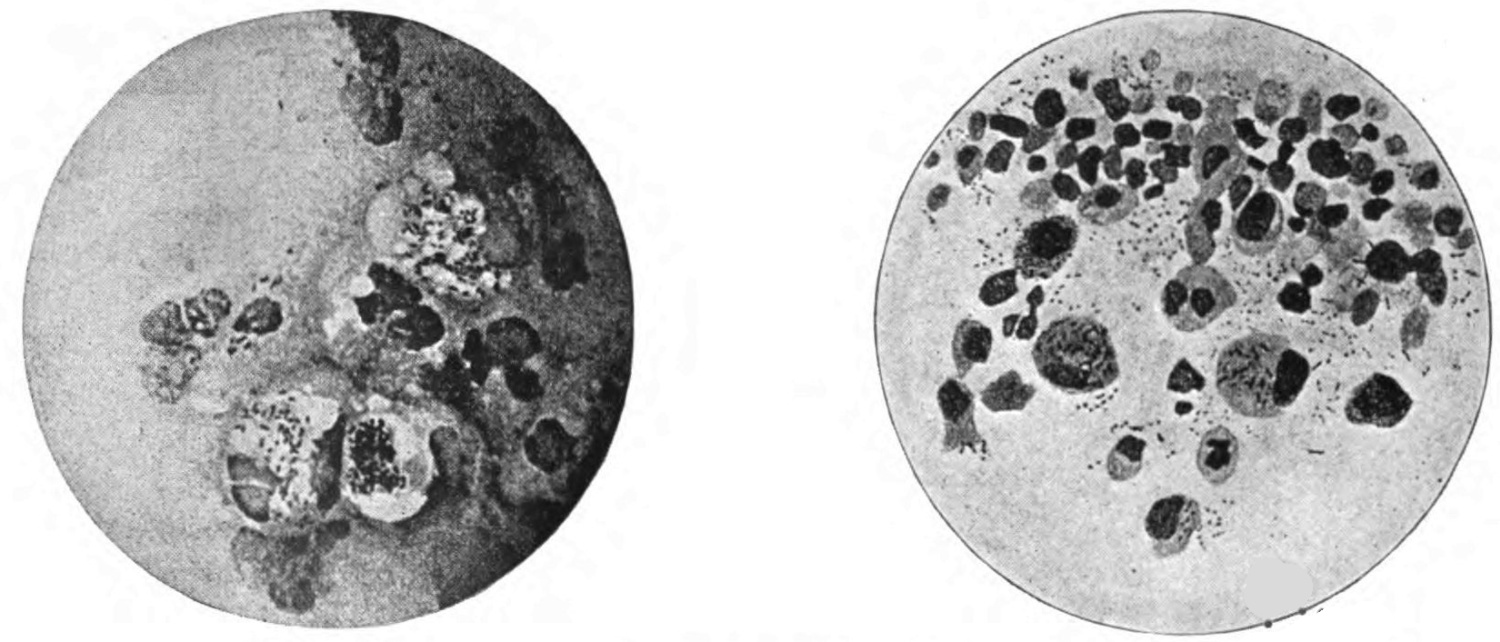
Fig. A.Fig. B.
“The Battle of the Blood”
Micro-photograph of leucocytes (white and grayish bodies) in conflict with Germs (black
dots and bodies). In Fig. A the germ is that of influenza, in
Fig. B that of plague.
WITH AN ACCOUNT OF THE NEW HYGIENE
BY
UPTON SINCLAIR
AND
MICHAEL WILLIAMS
WITH SIXTEEN FULL-PAGE ILLUSTRATIONS
FROM PHOTOGRAPHS
NEW YORK
FREDERICK A. STOKES COMPANY
PUBLISHERS
Copyright, 1909,
By FREDERICK A. STOKES COMPANY All rights reserved
Ten years ago, when I was a student at
college, I fell a victim to a new and fashionable
ailment called “la grippe.” I recollect the
date very well, because it was the first time I
had been sick in fourteen years—the last difficulty
having been the whooping-cough.
I have many times had occasion to recall
the interview with the last physician I went to
see. I made a proposition, which might have
changed the whole course of my future life,
had he only been capable of understanding it.
I said: “Doctor, it has occurred to me that I
would like to have someone who knows about
the body examine me thoroughly and tell me
how to live.”
I can recollect his look of perplexity.
“Was there anything the matter with you before
this attack?” he asked.
“Nothing that I know of,” I answered;
“but I have often reflected that the way I
am living cannot be perfect; and I want to
get as much out of my body and mind as I
can. I should like to know, for instance, just
what are proper things for me to eat——”
“Nonsense,” he interrupted. “You go
right on and live as you have been living, and
don’t get to thinking about your health.”
And so I went away and dismissed the idea.
It was one that I had broached with a great
deal of diffidence; so far as I knew, it was
entirely original, and I was not sure how a
doctor would receive it. All doctors that I
had ever heard of were people who cured you
when you were sick; to ask one to take you
when you were well and help you to stay well,
was to take an unfair advantage of the profession.
So I went on to “live as I had been living.”
I ate my food in cheap restaurants and boarding-houses,
or in hall bedrooms, as students
will. I invariably took a book to the table, and
ate very rapidly, even then; frequently I forgot
to eat at all in the ardor of my work. I
was a worshiper of the ideal of health, and
never used any sort of stimulant; but I made
it a practice to work sixteen hours a day, and
quite often I worked for long periods under
very great nervous strain. And four years
later I went back to my friend the physician.
“You have indigestion,” he said, when I
had told him my troubles. “I will give you
some medicine.”
So every day after meals I took a teaspoonful
of some red liquor which magically relieved
the distressing symptoms incidental to
doing hard brain-work after eating. But
only for a year or two more, for then I found
that the artificially digested food was not being
eliminated from my system as regularly
as necessary, and I had to visit the doctor
again. He gave my ailment another name, and
gave me another kind of medicine; and I went
on, working harder than ever—being just then
at an important crisis in my life.
Gradually, however, to my great annoyance,
I was forced to realize that I was losing that
fine robustness which enabled me to say that
I had not had a day’s sickness in fourteen
years. I found that I caught cold very easily—though
I always attributed it to some unwonted
draught or exposure. I found that I
was in for tonsilitis once or twice every winter.
And now and then, after some particularly
exhausting labor, I would find it hard to get
to sleep. Also I had to visit the dentist more
frequently, and I noticed, to my great perplexity,
that my hair was falling out. So I
went on, until at last I was on the verge of
a nervous breakdown, and had to drop everything
and go away and try to rest.
That was my situation when I stumbled
upon an article in the Contemporary Review,
telling about the experiments of a gentleman
named Horace Fletcher. Mr. Fletcher’s idea
was, in brief, that by thorough and careful
chewing of the food, one extracted from it the
maximum of nutriment, and could get along
upon a much smaller quantity, thus saving
a great strain upon the bodily processes.
This article came to me as one of the great
discoveries of my life. Here was a man who
was doing for himself exactly what I had
asked my physician to do for me so many years
previously; who was working, not to cure disease,
but to live so that disease would be
powerless to attack him.
I went at the new problem in a fine glow
of enthusiasm, but blindly, and without guidance.
I lived upon a few handfuls of rice
and fruit—with the result that I lost fourteen
pounds in as many days. At the same
time I met a young writer, Michael Williams,
and passed the Fletcher books on to him—and
with precisely the same results. He, like myself,
came near killing himself with the new
weapon of health.
But in spite of discouragements and
failures, we went on with our experiments.
We met Mr. Fletcher himself, and talked over
our problems with him. We followed the
course of the experiments at Yale, in which
the soundness of his thorough mastication and
“low proteid” arguments were definitely
proven. We read the books of Metchnikoff,
Chittenden, Haig and Kellogg, and followed
the work of Pawlow of St. Petersburg, Masson
of Geneva, Fisher of Yale, and others of
the pioneers of the new hygiene. We went to
Battle Creek, Michigan, where we found a million-dollar
institution, equipped with every resource
of modern science, and with more than
a thousand nurses, physicians and helpers, all
devoting their time to the teaching of the new
art of keeping well. And thus, little by little,
with backslidings, mistakes, and many disappointments,
we worked out our problems, and
found the road to permanent health. We do
not say that we have entirely got over the ill
effects of a lifetime of bad living; but we do
say that we are getting rid of them very rapidly;
we say that we have positive knowledge of
the principles of right living, and of the causes
of our former ailments, where before we had
only ignorance.
In the beginning, all this was simply a matter
of our own digestions, and of the weal
and woe of our immediate families. But as
time went on we began to realize the meaning
of this new knowledge to all mankind. We
had found in our own persons freedom from
pain and worry; we had noticeably increased
our powers of working, and our mastery over
all the circumstances of our lives. It seemed
to us that we had come upon the discovery of
a new virtue—the virtue of good eating—fully
as important as any which moralists and
prophets have ever preached. And so our interest
in these reforms became part of our
dream of the new humanity. It was not
enough for us to have found the way to health
for ourselves and our families; it seemed to
us that we ought not to drop the subject until
we had put into print the results of our experiments,
so that others might avoid our mistakes
and profit by our successes.
Historians agree that all known civilizations,
empire after empire, republic after republic,
from the dawn of recorded time down
to the present age, have decayed and died,
through causes generated by civilization itself.
In each such case the current of human progress
has been restored by a fresh influx of
savage peoples from beyond the frontiers of
civilization. So it was with Assyria, Egypt
and Persia; so Greece became the wellspring
of art and the graces of life, and then died out;
so Rome conquered the world, built up a marvellous
structure of law, and then died out.
As Edward Carpenter and others have shown
us, history can paint pictures of many races
that have attained the luxuries and seeming
securities of civilization, but history has yet
to record for us the tale of a nation passing
safely through civilization, of a nation which
has not been eventually destroyed by the civilization
it so arduously won.
And why? Because when ancient races
emerged out of barbarism into civilization,
they changed all the habits of living of the
human race. They adopted new customs of
eating; they clothed themselves; they lived under
roofs; they came together in towns; they
devised ways of avoiding exposure to the sun
and wind and rain—but they never succeeded
in devising ways of living that would keep
them in health in their new environment.
The old struggle against the forces of nature
once relaxed, men grew effeminate and
women weak; diseases increased; physical fibre
softened and atrophied and withered away;
moral fibre went the same path to destruction;
dry rot attacked the foundations of society,
and eventually the whole fabric toppled over,
or was swept aside, to be built up again by
some conquering horde of barbarians, which
in its turn grew civilized, and in its turn succumbed
to the virulent poison that seemed inherent
in the very nature of civilization, and
for which there seemed to be no antidote.
So much for the past. As to the present,
there do not lack learned and authoritative observers
and thinkers who declare that our own
civilization is also dying out. They point out
that while in many directions we have bettered
our physical condition, improved our surroundings,
and stamped out many virulent diseases
(smallpox, the plague and yellow fever,
for instance), and have reduced average mortality,
nevertheless we have but exchanged one
set of evils for another and perhaps more serious,
because more debilitating and degenerating
set: namely, those manifold and race-destroying
evils known as nervous troubles,
and those other evils resulting from malnutrition,
which are lumped together vaguely
under the name of dyspepsia, or indigestion—the
peculiar curse of America, the land of
the frying-pan.
It is also plain, say the critics of our civilization,
that society to-day cannot be regenerated
by barbarians. To-day the whole world is
practically one great civilization, with a scattering
of degraded and dying little tribes here
and there. Modern civilization seems to have
foreseen the danger of being overrun some day
as the ancient civilizations were, and to have
forestalled the danger by the inventions of
gunpowder and rum, syphilis and tuberculosis.
Are these critics right? I believe that they
are, as far as they go; I believe that to-day our
civilization is rapidly degenerating; but also I
believe that it contains within itself two forces
of regeneration which were lacking in old societies,
and which are destined ultimately to
prevail in our own. The first of these forces
is democracy, and the second is science.
To whatever department of human activity
one turns at the present day, he finds men
engaged in combating the age-long evils of
human life with the new weapon of exact
knowledge; and their discoveries no longer remain
the secrets of a few—by the agencies of
the public school and the press they are spreading
throughout the whole world. Thus, a new
science of economics having been worked out,
and the causes of poverty and exploitation set
forth, we see a world-wide and universal movement
for the abolition of these evils. And
hand in hand with this goes a movement of
moral regeneration, manifesting itself in a
thousand different forms, but all having for
their aim the teaching of self-mastery—the
replacing of the old natural process of the
elimination of the unfit by a conscious effort
on the part of each individual to eliminate his
own unfitness. We see this movement in literature
and art; we see it in the new religions
which are springing up—in Christian Science,
and the so-called “New Thought” movements;
we see it in the great health movement
which is the theme of this book, and which
claims for its leaders some of the finest spirits
of our times.
In the state of nature man had to hunt his
own food, so he was hungry when he sat down
to eat. But having conquered nature, and accumulated
goods, he is able to think of enjoyments,
and invents cooks and the art of cookery—which
is simply the tickling of his palate
with all kinds of stomach-destroying concoctions.
And now the time has come when he
wishes to escape from the miseries thus
brought upon him; and, as before, the weapon
is that of exact science. He must ascertain
what food elements his body needs, and in what
form he may best take them; and in accordance
with this new knowledge he must shape his
habits of life. In the same way he has to
examine and correct his habits of sleeping and
dressing and bathing and exercising, in accordance
with the real necessities of his body.
This is the work which the leaders of the
new movement are engaged upon. To quote
a single instance: while I was “living as I had
been living” and eating the preparations of
ignorant cooks in boarding-houses and restaurants,
Dr. Kellogg of Battle Creek was bringing
all the resources of modern chemistry and
bacteriology to bear upon the problem of the
nutrition of man; taking all the foods used by
human beings, and analyzing them and testing
them in elaborate experiments; determining
the amount of their available nutriment and
their actual effect upon the system in all stages
of sickness and health; the various ways of
preparing them and combining them, and the
effect of these processes upon their palatability
and ease of digestion. Every day for nine
years, so Kellogg told me, he sat down to an
experimental meal designed by himself and
prepared by his wife; and the result is a new
dietary—that in use at the Battle Creek Sanitarium—which
awaits only the spread of
knowledge to change the ways of eating of
civilized man.
This new health knowledge has been amassed
by many workers and, as in all cases of new
knowledge, there is much chaff with the grain.
There are faddists as well as scientists; there
are traders as well as humanitarians. It
seemed to us that there was urgently needed
a book which should gather this new knowledge,
and present it in a form in which it could
be used by the average man. There have been
many books written upon this; but they are
either the work of propagandists with one
idea—containing, as we have proved to our
cost, much dangerous error; or else the work
of physicians and specialists, whose vocabulary
is not easily to be comprehended by the average
man or woman. What we have tried to write
is a book which sets forth what has been proved
by investigators in many and widely-scattered
fields; which is simple, so that a person of ordinary
intelligence can comprehend it; which
is brief, so that a busy person may quickly get
the gist of it; and which is practical, giving its
information from the point of view of the
man who wishes to apply these new ideas to
his own case.
Michael Williams was recently persuaded
to give a semi-public talk on the subject before
an audience of several hundred professional
and business people. He was compelled
to spend the rest of the evening in answering
the questions of his audience; and listening to
these questions, I was made to realize the tremendous
interest of the public in the practical
demonstration which Mr. Horace Fletcher has
given of the idea of Metchnikoff, that men and
women to-day grow old before they ought to
do so, and that the prime of life should be
from the age of fifty to eighty. A broken-down
invalid at forty-five, Mr. Fletcher was
at fifty-four a marvel of strength—and at
fifty-eight he showed an improvement of one
hundred per cent. over his tests at the age of
fifty-four; thus proving that progressive recuperation
in the so-called “decline of life”
might be effected by followers of the new art
of health.
As a result of this address, Williams was invited
by the president of one of the largest
industrial concerns in the country to lecture to
his many thousands of employees on the new
hygiene; his idea being to place at their disposal
the knowledge of this new method
of increasing their physical and mental efficiency.
For business men and women, indeed, for
workers of all kinds, good health is capital;
and the story of the new hygiene is the story
of the throwing open of hitherto unsuspected
reserve-stores of energy and endurance for the
use of all.
In writing upon this subject, the experiences
most prominent in our minds have naturally
been those of ourselves, of our wives and
children, and of friends who have followed in
our path. As the setting forth of an actual
case is always more convincing than a general
statement, we have frequently referred to
these experiences, and what they have taught
us. We have done this frankly and simply,
and we trust that the reader will not misinterpret
the spirit in which we have done it.
Mr. Horace Fletcher has set the noble example
in this matter, and has been the means of helping
tens of thousands of his fellow men and women.
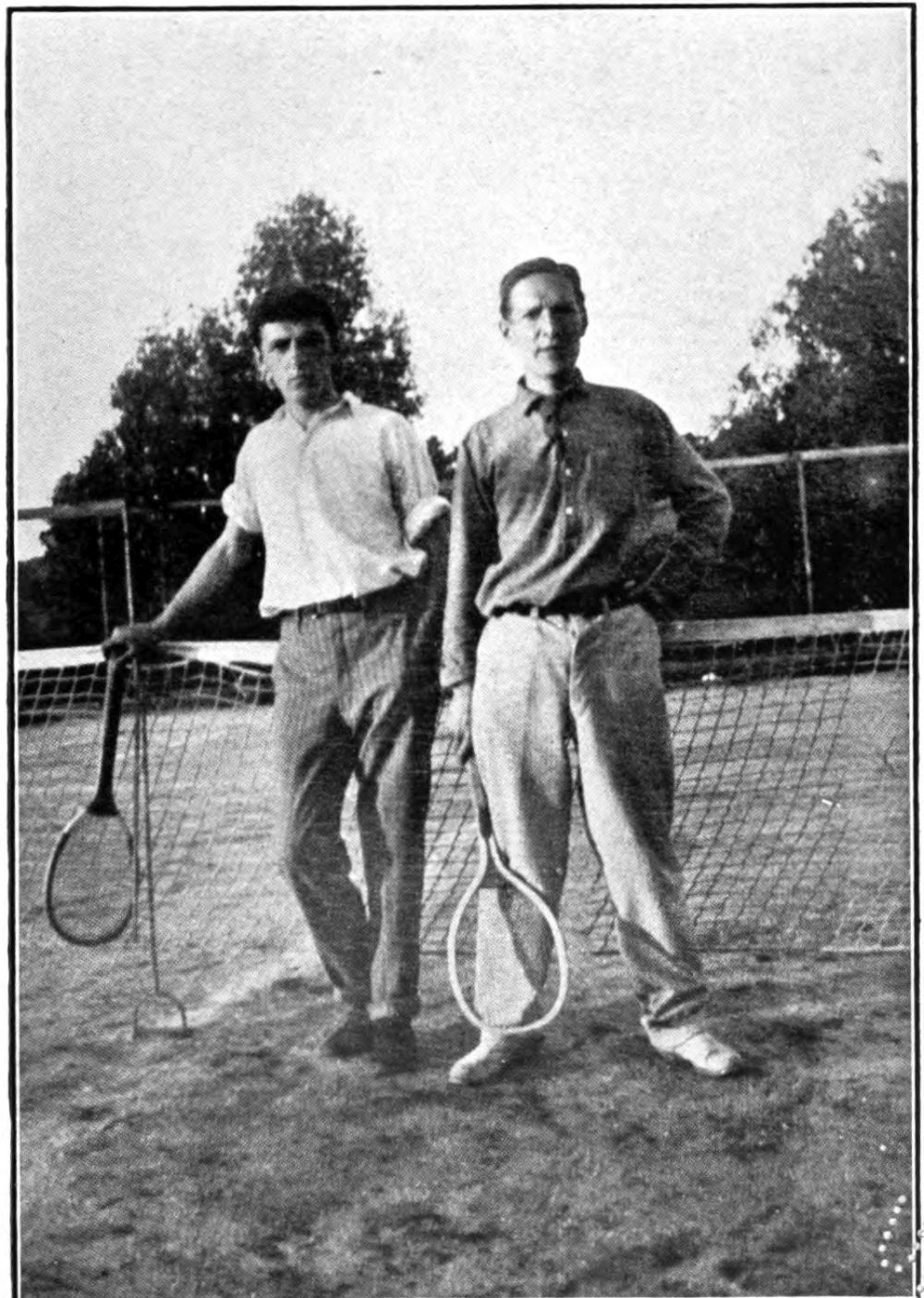
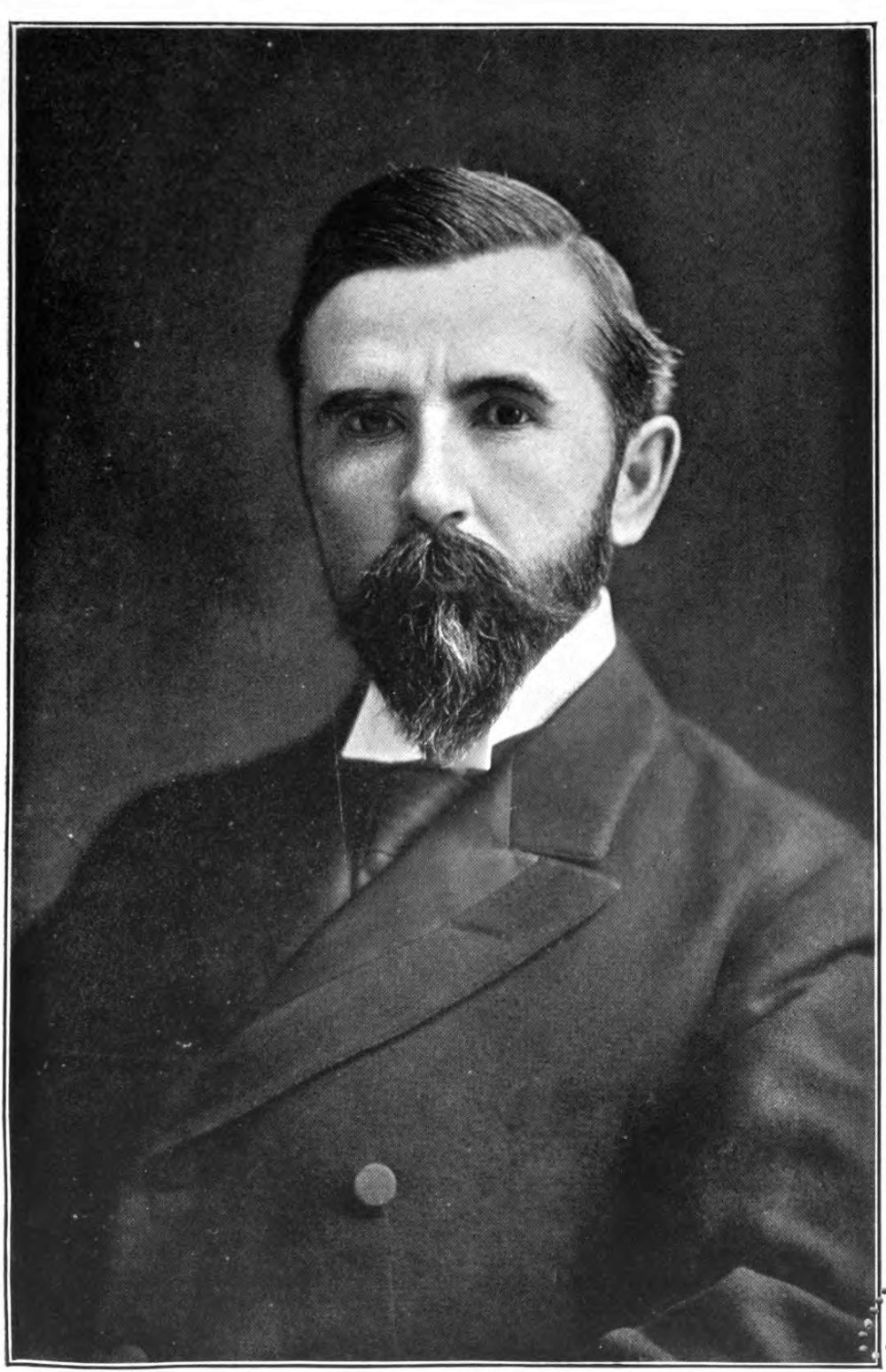
Mr. Upton Sinclair and Mr. Michael Williams
Resting from their favorite exercise.
I have sketched the path by which I was
led into these studies; there remains to outline
the story of my collaborator. Williams is the
son of a line of sailors, and inherited a robust
constitution; but as a boy and youth he
was employed in warehouses and department
stores, and when he was twenty he went to
North Carolina as a tuberculosis patient. Returning
after two years, much benefited by
outdoor life, he entered newspaper work in
Boston, New York, and elsewhere, and kept at
it until four years ago, when again he fled
South to do battle with tuberculosis, which
had attacked a new place in his lungs. After
a second partial recuperation, he went to San
Francisco. At the time of the earthquake he
held a responsible executive position, and his
health suffered from the worry and the labors
of that period. A year later there came the
shock and exposure consequent upon the burning
of Helicon Hall. Williams found himself
hovering upon the brink of another breakdown,
this time in nervous energy as well as
in lung power. A trip to sea failed to bring
much benefit; and matters were seeming pretty
black to him, when it chanced that a leading
magazine sent him to New Haven to study the
diet experiments being conducted at Yale University
by Professors Chittenden, Mendel and
Fisher. He found that these experiments
were based upon the case of Horace Fletcher,
and had resulted in supporting his claims.
This circumstance interested him, suggesting
as it did that he himself might have been to
blame for his failure with Mr. Fletcher’s system.
So he renewed the study of Fletcherism,
and later on the same magazine sent him to
Dr. Kellogg’s institution at Battle Creek, with
the result that he became a complete convert
to the new ideas. Like a great many newspaper
men, he had been a free user of coffee,
and also of alcohol. As one of the results of
his adoption of the “low proteid” diet, and
of the open-air life, he was able to break off
the use of all these things without grave difficulty.
A bacteriological examination recently
disclosed the fact that his lungs had
entirely healed; while tests on the spirometer
showed that his breathing capacity was far
beyond that of the average man of his weight
and size. In less than three months, while at
the Battle Creek Sanitarium, tests showed a
great gain in the cell count of his blood, and in
its general quality. Also, his general physical
strength was increased from 4635 units to
5025, which latter figure is well above the
average for his height, 68.2 inches.
In conclusion, we wish jointly to express our
obligation to Mr. Horace Fletcher, to Dr. J.
H. Kellogg, to Professor Russell H. Chittenden,
to Professor Lafayette B. Mendel,
and to Professor Irving Fisher for advice,
criticism and generous help afforded in
the preparation of some of the chapters of this
book. The authority of these scientists, physicians
and investigators, and of others like
Metchnikoff, Pawlow, Cannon, Curtis, Sager,
Higgins and Gulick, whose works we have
studied, is the foundation upon which we
rest on all questions of fact or scientific statement.
They are the pathbreakers and the
roadbuilders,—we claim to be simply guides
and companions along the journey to the fair
land of health. The journey is not long, and
the road is a highway open to all.
I THE BATTLE OF THE BLOOD — THE DEFENSES OF THE BODY — HEALTHY BODIES ARE GERM-PROOF — THE WHITE CELLS ON GUARD — HOW THE WHITE CELLS DO THEIR WORK — THE PROBLEM OF HEALTH — HEALTH, LIKE DISEASE, IS CATCHING — OUR FOOD IS THE CHIEF FACTOR
The new ideas of living which are the
subject of this book have proceeded
from investigation of the human body with
the high-power microscope. The discoveries
made, which have to do, not so much with
the body itself as with the countless billions
of minute organisms which inhabit the body,
may be best set forth by a description of the
blood. “The blood is the life,” says Exodus,
and modern science has confirmed this statement.
From the blood proceeds the life of all
the body, and in its health is the body’s health.
If you should prick your finger and extract
a drop of your own blood, and examine it under
a microscope, you would make the fascinating
discovery that it is the home of living
creatures, each having a separate and independent
existence of its own. In a single
ounce of blood there are more of these organisms
than there are human beings upon the
face of the globe. These organisms are of
many kinds, but they divide themselves into
two main groups, known as the red corpuscles
and the white.
The red corpuscles are the smaller of the
two. The body of an average man contains
something like thirty million of millions of
these corpuscles; a number exceeding the
population of New York and London are
born in the body every second. They are the
oxygen conveyers of the body; the process of
life is one of chemical combustion, and these
corpuscles feed the fire. No remotest portion
of the body escapes their visitation. They
carry oxygen from the lungs and they bring
back the carbon dioxide and other waste products
of the body’s activities. They have been
compared to men who carry into a laundry
buckets of pure water, and carry out the dirty
water resulting from the washing process.
The other variety of organisms are the white
cells or leucocytes, and it is concerning them
that the most important discoveries of modern
investigators have been made. The leucocytes
vary in number according to the physical condition
of the individual, and according to their
locality in the body. Their function is to defend
the body against the encroachments of
hostile organisms.
We shall take it for granted that the reader
does not require to have proven to him the so-called
“germ theory” of disease. The phrase,
which was once accurate, is now misleading,
for the germ “theory” is part of the definite
achievement of science. Not only have we
succeeded in isolating the specific germ whose
introduction into the body is responsible for
different diseases, but in many cases, by studying
the history and behavior of the germ, we
have been able to find methods of checking its
inroads, and so have delivered men from
scourges like yellow fever and the bubonic
plague.
An experiment that is often tried in operating
rooms furnishes a vivid illustration of the
omnipresence of these invisible, yet potent,
foes of life. In order to impress upon young
surgeons the importance of maintaining antiseptic
conditions, they are instructed to thoroughly
wash their hands and arms in antiseptic
soap and water; then they are told to leave
their arms exposed for a few minutes, after
which a microscopic examination of the bared
skin will result in exposing the presence of
myriads of germs. Many of these are, of
course, harmless; some are even “friendly”—since
they make war upon the dangerous
kinds. But others are the deadly organisms
which find lodgment in the lungs and cause
pneumonia and tuberculosis; or the thirty odd
varieties of bacilli which cause the various
kinds of grippe and influenza and “colds,”
which plague the civilized man; or others
which, finding entrance into the digestive tract,
are the cause of typhoid and other deadly
fevers.
So it appears that we live within our bodies
somewhat in the same fashion as isolated barons
lived in their castles in the Dark Ages, beleaguered
constantly by hordes of enemies
that are bent upon our destruction—these being
billions upon billions of disease germs.
Every portion of the body has its defenses to
protect it against these swarms. The skin is
germ-tight in health; and each of the gateways
to the interior of the body has its own
peculiar guard—tears, wax, mucous membrane,
etc. As Dr. Edward A. Ayers points
out,—“Many of these entrances are lined with
out-sweeping brooms—fine hairs similar to the
‘nap’ or ‘pile’ of carpet or plush—which constantly
sweep back and forth like wheat stalks
waving in the breeze. You cannot see them
with the low-powered eye, but neither can you
see the germs. They sweep the mucous from
lungs and throat, and try to keep the ventilators
free from dust and germs. Behind the
scurf wall and the broom brigade of the mucous
membranes, the soldier corpuscles of the
blood march around the entire fortress every
twenty-eight seconds” (the time occupied by
the blood in its circulation through the body).
And again (to quote another authority, Dr.
Sadler), “All the fluids and secretions of the
body are more or less germicidal. The saliva,
being alkaline, discourages the growth of
germs requiring an acid medium. The normal
gastric juice of a healthy stomach is a sure
germ-killer. In the early part of digestion,
lactic acid is present, and there soon appears
the powerful hydrochloric acid, which is a most
efficient germicide....
“The living, healthy tissues of the body are
all more or less germicidal; that is, they are
endowed with certain protective properties
against germs and disease. This is true of
many of the other special secretions, like those
found in the eye and elsewhere in the body,
when they are normal. The blood and lymph,
the two great circulating fluids of the body,
are likewise germicidal. In some conditions
of disease, there may be found various substances
in the blood which can destroy germs.”
And this definitely brings us to the other
kind of inhabitants of the human blood, the
leucocytes, or white blood corpuscles,—and so
to the germ theory of health, which science is
showing to be no less true than the germ theory
of disease. In their natural state these cells
are transparent, spherical forms of the consistency
of jelly drops, which float in the bloodstreams
or creep along the inner surface of the
vessel. Their function was for a long time
not understood; the discovery of the real facts,
perhaps the most epoch-making discovery ever
made concerning the human body, the world
owes to the genius of Metchnikoff, the head
of the Pasteur Institute of Paris. These cells
are the last reserves of the body in its defense
against the assault of disease. Whenever, in
spite of all opposition, the hostile germs find
access either to the blood or to the tissue, the
white cells rush to the spot, and fall upon them
and devour them.
In their fight against the hordes of evil bacteria
that invade the blood, where the battles
are waged, the body’s defenders have four
main ways of battling. Again we quote from
Dr. Ayers: “The blood covers some germs
with a sticky paste, and makes them adhere
to one another, thereby anchoring them so that
they become as helpless as flies on fly paper.
The paste comes from the liquid of the blood,
the plasma. Another blood-weapon (the ‘lysins’)
dissolves the germs as lye does. A
third means of defense is the ability of the
white blood corpuscles to envelop and digest
the living germs. One white cell can digest
dozens of germs, but it may mean death to
the devouring cells.
The fourth and recently discovered weapon,
or ammunition, of the blood is the opsonins.
Wright and Douglas in London in 1903 coined
the word, which comes from the Latin opsono:
“I cook for the table,” “I prepare pabulum
for.” This is precisely what the opsonins do
in the blood. They manifest this beneficial
activity when invading disease germs appear.
They attract white blood cells to the germs
and make the bacteria more eatable for the
cells. They are appetizers for the white blood
cells; or sauces, which help the white blood
cells to eat more of the bacteria than they
could do without this spur to their hunger.
Wright and Douglas demonstrated beyond
peradventure the ability of the white blood
cells to eat a larger number of bacteria when
the latter are soaked in opsonins. They also
showed that this opsonic sauce, or appetizer,
which stimulates the blessed hunger of the
white blood cells for disease bacteria, could be
artificially produced, and hypodermically introduced
into a patient’s blood, thus increasing
that blood’s power of defense by raising the
quantity of opsonins. They also worked out
a practical laboratory technique by means of
which the opsonins can be measured, or
counted, with a considerable degree of exactitude,
thereby making it possible to estimate
within limits of accuracy any one’s ability to
resist bacterial invasions. If the blood is rich
in opsonins, its power to fight disease is strong.
Opsonins are now inoculated into the blood at
several institutions, notably McGill University
in Montreal, and at the Battle Creek Sanitarium.
The process by which the white cells fight
for us may be watched in the transparent tissue
of a frog’s foot or the wing of a bat. If
a few disease germs are introduced into this
tissue, the white cells may be seen to accumulate
on the wall of the blood vessel just opposite
where the germs have entered. “Each
cell begins to push out a minute thread of its
tissue,” writes Dr. Kellogg, in describing the
process, “thrusting it through the wall of its
own blood vessel. Little by little the farther
end of this delicate filament which has been
pushed through the wall grows larger and
larger, while the portion of the cell within the
vessel lessens, and after a little time each cell
is found outside the vessel, and yet no openings
are left behind. Just how they accomplish
this without leaving a gap behind them
is one of the mysteries for which Science has
for many years in vain sought a solution. The
vessel wall remains as perfect as it was before.
Apparently, each cell has made a minute
opening and has then tucked itself
through, as one might tuck a pocket handkerchief
through a ring, invisibly closing up behind
itself the opening made. Once outside
the vessel, these wonderful body-defenders,
moving here and there, quickly discover the
germs and proceed at once to swallow them.
If the germs are few in number, they may
be in this way destroyed, for the white cells
not only swallow germs, but digest them. If
the number is very great, however, the cells
sacrifice themselves in the effort to destroy the
germs, taking in a larger number than they
are able to digest and destroy. When this
occurs, the germs continue to grow; more
white cells make their way out of the blood
vessels, and a fierce and often long-continued
battle is waged between the living blood cells
and the invading germs.”
Now, it must be understood that this description
is not the product of any one’s imagination,
but is a definitely established fact which
has been studied by scientists all over the
world. Because of the importance of the discovery,
and of the new views of health to
which it leads, we have placed a picture of this
“battle of the blood” at the front of this
book. It shows the leucocytes of the human
body in conflict with the germs of influenza:
the black dots being the germs, and the larger
grayish bodies the leucocytes. We have chosen
a photograph rather than a drawing, so that
the reader may realize that he is seeing something
which actually has existence. We request
him to study the picture and fix it upon
his mind, for it is not too much to say that
from it is derived every principle of health
which is set forth in the course of this book.
The human body is a complex and intricate
organism, in some wonderful and entirely incomprehensible
way integrating the activities
of all these billions of other living organisms.
Each and every one of these latter has its
function to fulfill, and the life of the individual
body is a life of health so long as the
unity of all its organisms is maintained. Outside
of the body are millions of hostile organisms
assaulting it continuously; and the problem
of health is the problem of enabling it to
make headway against its enemies for as long
a period as possible. Every act of a human
being has its effect upon this battle; at every
moment of your life you are either strengthening
the power of your own organism or
strengthening your enemies. Once the organism
is unable to beat back its enemies, health
begins to fail and death and complete disintegration
is the ultimate result.
It must be understood that the peril of these
hostile germs is not merely that they devour
the substance upon which the body’s own organisms
have to be nourished. If that were
all, they might remain in the body as parasites,
and by taking additional nourishment a man
might sustain life in spite of them. Nor is it
even that they multiply with such enormous
rapidity; the peril is that they throw off as
the products of their own activity a number of
poisons, which are as deadly to the human body
as any known. These poisons are produced
much more rapidly than they can be eliminated
from the system, and so they fill the blood,
and death ensues.
Thus the problem becomes clear. In the
first place, what can we do to keep disease
germs from securing entrance to the body;
and second, what can we do to strengthen the
body’s army of defense so that the fate of any
which do find entrance may be immediate destruction?
In actual practice it is found that the second
problem is by far the more important one.
Some germs we can avoid. If we boil all the
water that we drink we will not be very apt
to have typhoid. If we exterminate rats and
mosquitoes and flies and fleas, we will not have
yellow fever, or malaria, or plague. But we
cannot hope to do this at present in the case
of such diseases as, for instance, consumption,
grippe, and influenza. If we live in a city, we
take into our lungs and throat millions of the
germs of these diseases every day. Therefore
the one hope that is left is to keep ourselves
in such a condition of health that the army
of our bodies shall be able to destroy these
germs. When the blood is in a healthy condition,
the white cells are numerous, powerful,
and active, but when the blood flows stagnantly,
or when it is impoverished, then the
white cells are few and the forces of disease
obtain a foothold.
Healthy men can go through many epidemics
with impunity. Because the Japanese
army was an army of healthy men, its death
rate from those diseases which usually follow
in the wake of all armies was lower than the
world had ever known before. Robert Ingersoll
once said that if he had been God and had
made the world, he would have made health
“catching,” and not disease. As a matter of
fact, health is catching. It abounds in the
very air we breathe, in the water we drink, in
the movements of every muscle and the play
of every fibre and nerve of the body; it comes
from and is nourished by each and every one
of the bodily actions and functions; while disease
is only secured by persistent transgressions
of the proper way of living, and by injurious
habits and customs that result in lowering
the “vital resistance.”
This vital resistance is the innate power of
the body to keep itself strong; its very lifeforce.
This is what we mean when we say that
this or that person has “a good constitution,”
or has “a weak constitution.” This is the capital
in the bank of each individual life, placed
there by Nature at the birth of that life, and
increased or diminished by each and every action
of our bodies, and also of our minds. As
Rokitansky, the eminent German scientist,
said, “Nature heals. This is the first and
greatest law of therapeutics—one which we
must never forget. Nature creates and maintains,
therefore she must be able to heal.”
Many of the most notable discoveries and
experiments of modern science concur in
demonstrating that the natural and innate healing
power of the body is man’s greatest resource
in combating disease and maintaining
health. It is the body itself which cures the
sick man; his own vitality, and not the drug
or medicants which he may take. These may
assist the healing process, but they do not set
going the healing processes themselves. More
often, indeed, they are distinct detriments.
They stamp out or banish the distressing
symptoms of ailments, and thus in effect they
silence the signal bells of danger which the
body rings at the approach of disease.
Modern science has turned its forces upon
this question of maintaining at its highest potentiality
the ability of the body to resist disease.
All the habits of the human race have
been investigated in the light of this idea, and
some have been found to be wise and others
to be unwise. These conclusions, with the
evidence therefor, are the subjects of our book.
It has been found that the most important
problems connected with health are those of
nutrition—the questions of what and when
and how and how much food we ought
to eat.
Every language under the sun contains a
prayer somewhat similar to that which we have
in the Anglo-Saxon tongue, “Give us this
day our daily bread.” If we stop to think for
a moment, we realize that next to the air we
breathe, and the water we drink, our food is
the most important consideration in the maintenance
of life. All this is the veriest commonplace;
yet the fact remains that it is very
rarely indeed that we do stop to think upon the
subject of our food. It is something that we
take for granted, like life itself. In the regular
routine of our days our meals become fixed
habits, and the taking of food an almost involuntary
custom. It requires some extraordinary
event to arouse us to a just appreciation
of the importance of knowledge on this
subject. Or else the coming of one of the
myriad forms of digestive diseases will serve
the purpose of introducing the subject to our
notice.
Our blood is made directly from what we
eat, and that old Saxon proverb is true which
says that every man has lain in his own
trencher. Man is his food. Each human body
is made by chemical action from its food. All
our actions and all our thoughts come from
what we eat, even as the movements of machinery
proceed from the coal fed into the
boilers of the engine which operate the machine.
If we eat the right food, namely, the
food which contains the elements our bodies
require in the proper proportions, we repair
all waste, replace broken down tissue and supply
ourselves with physical and mental energy
for our toils and joys in life; while if we eat
the wrong foods we quickly injure our delicate
though powerful physical and mental machinery.
All this would seem to be obvious; yet most
people would grant that they have still much
to learn concerning what really constitutes the
best foods, and about the best ways of preparing,
or making, or using those foods. Few
of us possess anything more definite to guide
us in our eating than the habits we acquired as
children, or habits picked up in later life from
following the example of our friends, or the
food fashions of the day—for there are such
things as fashions in foods and in the eating
of foods, even as there are fashions in clothes
and the making and wearing thereof. In this
place it is proposed to study the subject of
food from one standpoint, namely, its effect
upon the Battle of the Blood; its relation to
the vital resistance of the body whereby health
is maintained.
II HOW TO EAT: THE GOSPEL OF DIETETICS ACCORDING TO HORACE FLETCHER — THE STORY OF HORACE FLETCHER — HOW A STRONG MAN BROKE DOWN — FIGHTING FOR LIFE — MR. FLETCHER’S DISCOVERY — THE MAGIC OF MASTICATION — DR. ANDERSON’S REPORT — FLETCHERISM — HOW CHEWING STIMULATES DIGESTION — THE “FOOD FILTER”
We shall first of all see what modern
science has to tell us concerning the
question of how we ought to eat.
It may not seem possible that anything essential
remains to be said at this late day on
the subject of one of the commonest and decidedly
most necessary of all human acts.
That there should be knowledge of the utmost
importance to learn regarding the actions and
movements of the tongue, the teeth, and the
jaws, may come with as much surprise to the
majority of our readers as it did to us when
we first hit upon this disturbing, but illuminating,
fact.
The act of eating is the starting point of
the long series of processes whereby our
bodies are nourished. It is the only act of
them all which lies within our control. We
can directly supervise the work of our mouths;
we can watch over the action of the teeth, and
tongue, and palate; but we can not supervise
the work of the stomach, or of the intestinal
tube. Once we have swallowed our food, our
mastery over it has ceased—except for some
hit-or-miss participation in the further processes
of its digestion by means of pills or
potions. Realizing this, we come to recognize
the basic importance of knowing the right way
of eating.
This knowledge the world owes to Horace
Fletcher, the American business man who has
made many of the greatest physiologists of our
times embark upon years-long series of experiments
and inquiries into the problems of
man’s nutrition. As a result, the text-books
of physiology are now being rewritten; and
as a further result, tens of thousands of men
and women, among them some of the best
known authors, physicians, clergymen, military
men, and business men of both Europe
and America, have been restored to health by
the knowledge of how to eat their food.
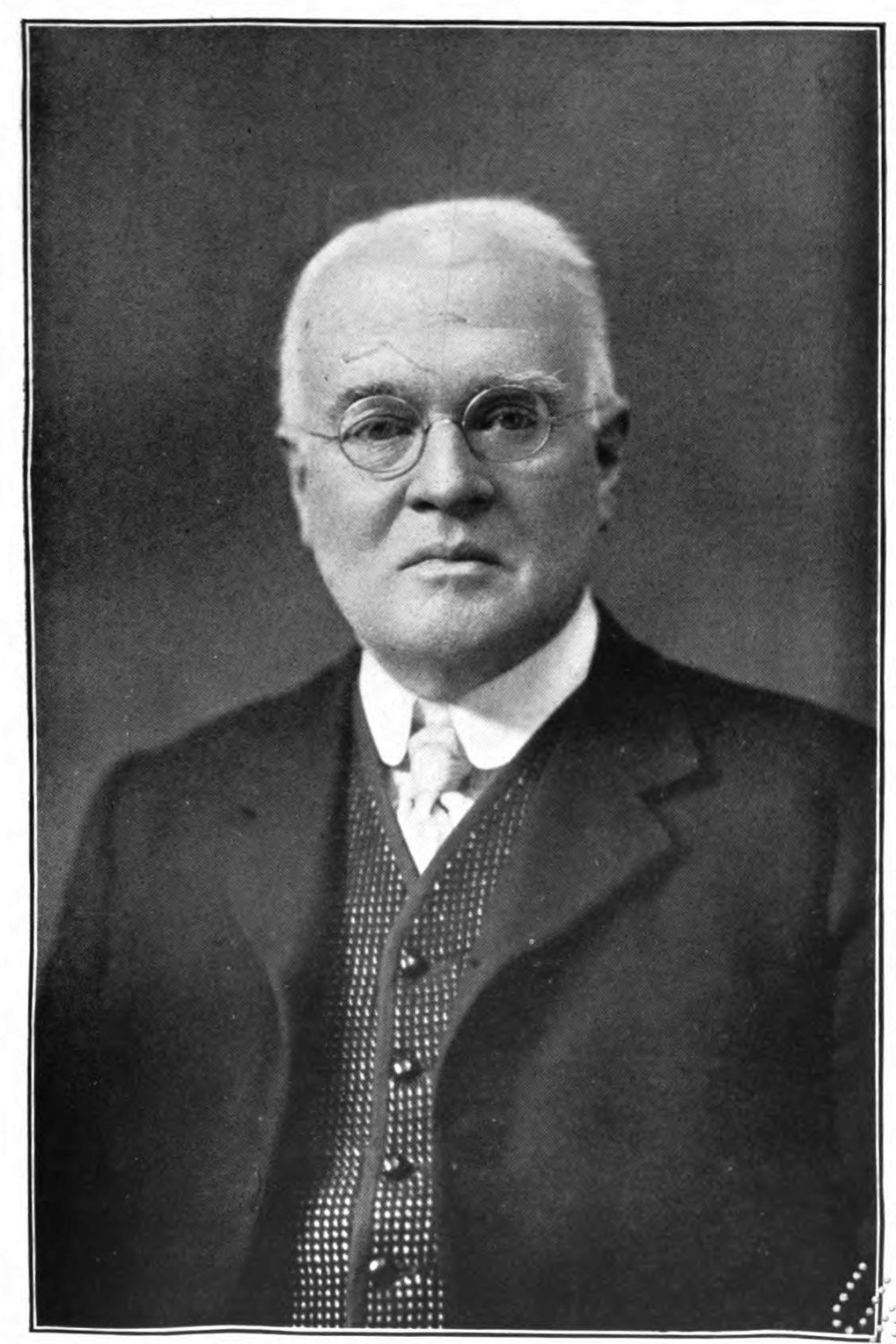
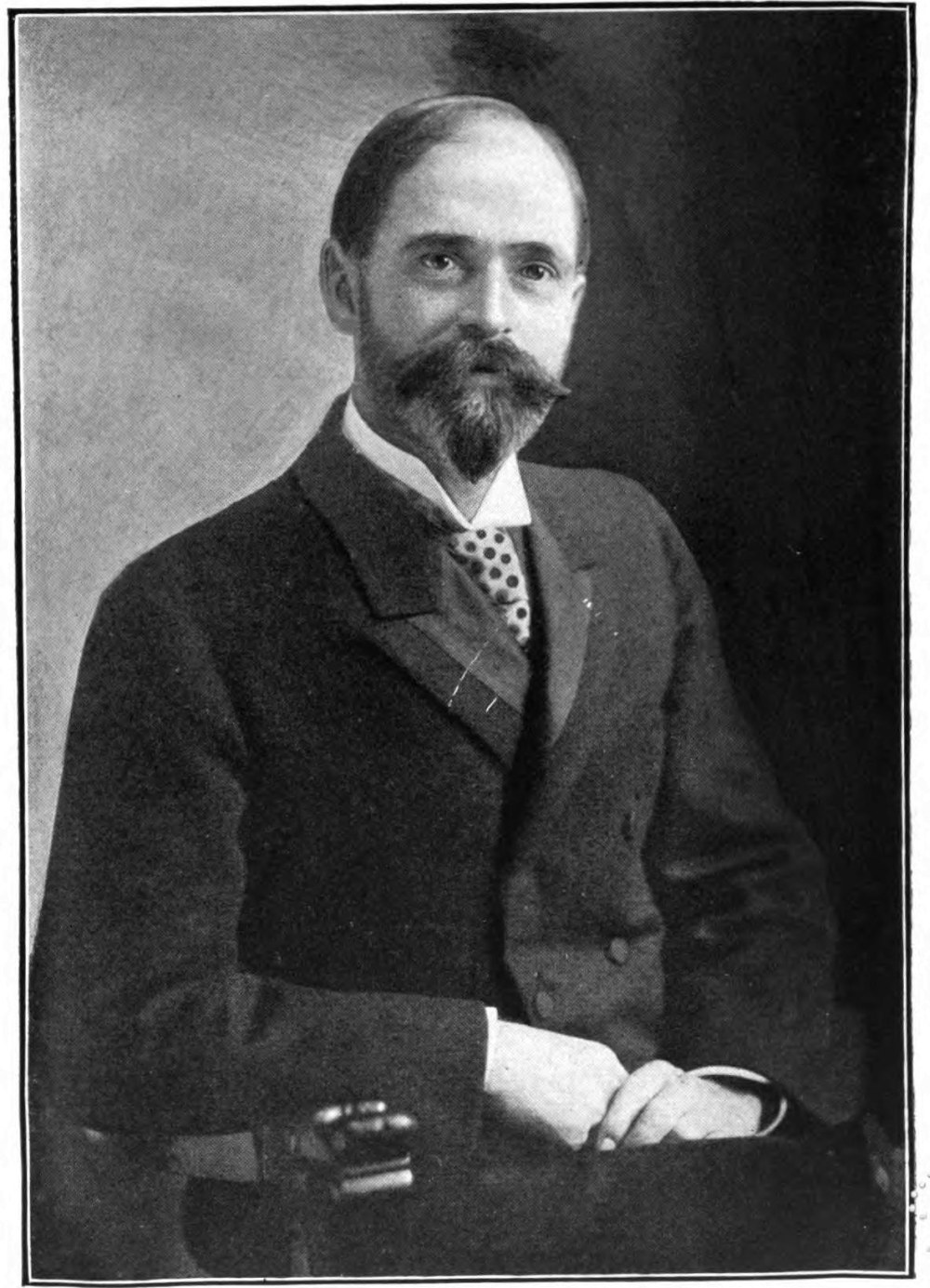
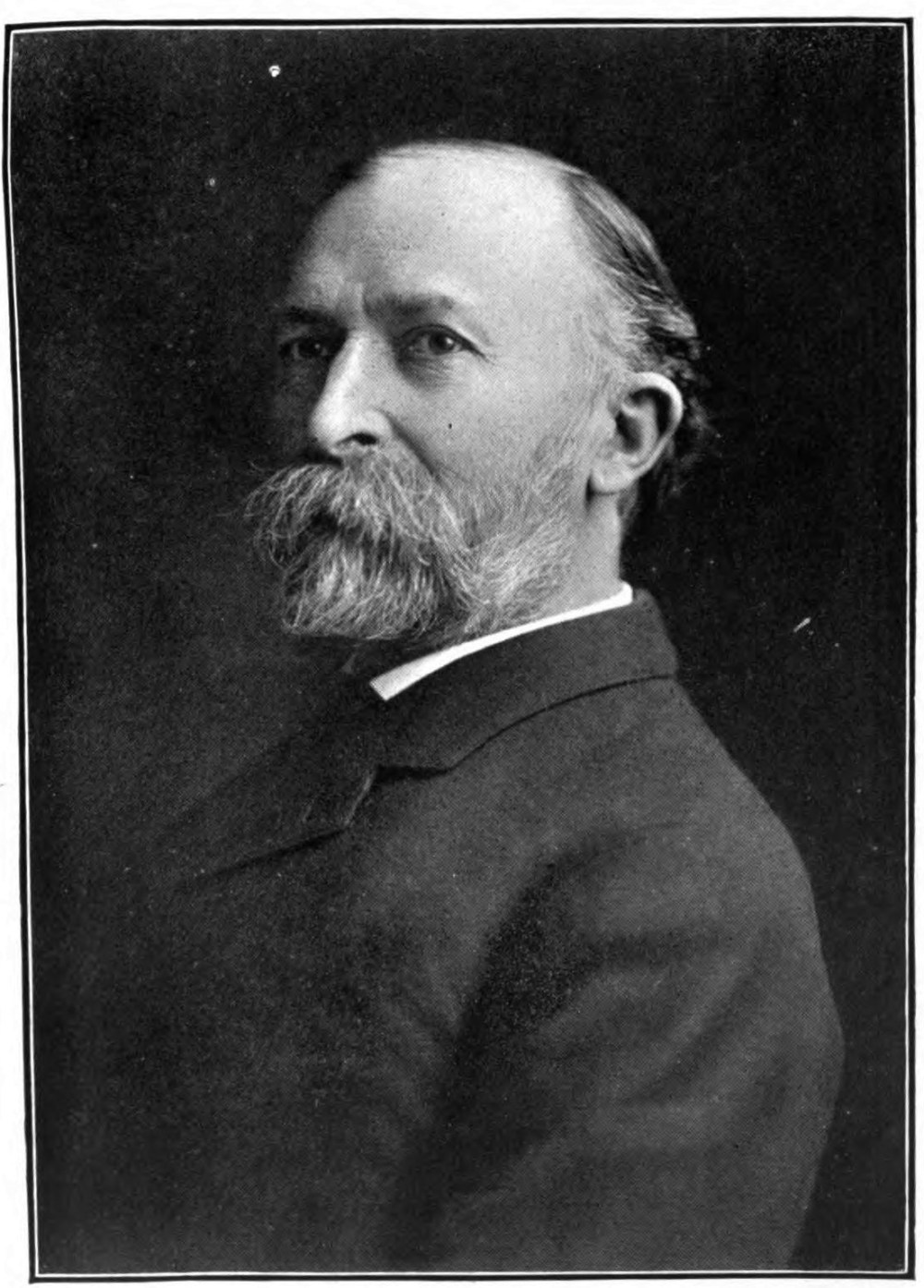
Mr. Horace Fletcher,
Whose books on dietetics and good health were the forerunners
of the present movement.
This knowledge Mr. Fletcher gained at the
very door of death, and in no more interesting
and striking fashion could the importance of
it be shown than by the relation of his remarkable
case.
At the age of forty-five, after a varied and
adventurous career, as miner, and explorer,
and sailor, and hunter, Mr. Fletcher had won
wealth, and retired from his business in order
to devote himself to long-cherished interests
in art and philosophy. He was still comparatively
young, he was a member of many clubs,
he had warm friends in all the capitals and
countrysides of the world (Mr. Fletcher being
one of the most untiring of globe-trotters),
and in all ways except one he was equipped
and ready for a long life of ease and enjoyment.
The one way in which he was not equipped
was—in health.
Once he had been a man of robust physique,
a champion gymnast and athlete; he had been
president of the far-famed Olympic Club in
San Francisco (which he founded, and where
the pugilist Corbett was discovered), and had
won plaudits even from famous professionals
for his prowess with the gloves.
But he had overdrawn his account at the
bank of life. He had expended more vital
resistance than he had stored up; to such an
extent, indeed, that when Mr. Fletcher went
to the insurance companies at the time he retired
from business he was rejected by them
all; he was obese; he was suffering from three
chronic diseases, and he was dying fast. Such
was the verdict given by the skilled and experienced
medical examiners of the life insurance
companies. And instead of entering
upon a long life of ease and enjoyment, he was
thus condemned, seemingly, to a short life of
invalidism and suffering.
But Mr. Fletcher declined to accept any
such decision as that. He decided that he
would regain his health—not that he would try
to regain his health, but that he would regain
his health.
He first turned to the physicians. Possessed
of wealth, he was able to secure the services
of many of the most able specialists of the
world. He visited the most celebrated “cures”
and “springs” and sanitariums of Europe
and America. Nothing availed. He found
passing relief now and then, but no permanent
good. He gained no health, in other words,
but obtained merely temporary abatement of
this or of that disease.
Then he turned to himself. He began the
study of his own case. As he attributed most
of his bodily woes to faulty habits of eating,
the subject of nutrition became uppermost in
his studies. He was, coincidentally, deeply immersed
and interested in the study of practical
philosophy; and in a very remarkable
fashion these two subjects, these two interests,
nutrition and practical philosophy, became
fused into one subject, supplementing and
completing each other and jointly forming
the burden of the message of Hope, of the
tidings of great joy, which it became the mission
of Horace Fletcher to deliver to mankind.
He discovered, or rather rediscovered, and
applied, two great and simple truths:
First, that the complete chewing of all food,
both liquid and solid, whereby a process of involuntary
swallowing is established, foods being
selected in accordance with individual
tastes, is by far the most important and most
necessary part of human nutrition. It is the
key that unlocks the door of health, and opens
the way to the real hygienic life.
Second, that nothing poisons the body, and
aids the forces of disease, more than worry—which
Mr. Fletcher has named Fearthought.
It is our nature to look forward, to anticipate.
We can anticipate in two ways—anticipate
evil, or anticipate good. The first way is to
use fearthought; the second way is to use forethought.
Forethought will produce cheerfulness
and health, even as unspoiled rose seeds
will produce roses. Fearthought will produce
disease and trouble, even as the germs of putrefaction
will produce sickness and death.
So great an authority in philosophy and
psychology as William James has given the
sanction of his use to Mr. Fletcher’s phrases;
and has also named him as a shining example
of those exceptional men who find in some
mental idea a key to unlock reservoirs of hidden
and unsuspected energy. While there is
no doubting the fact that Horace Fletcher is
decidedly an exceptional man, yet the records
prove that his key is not merely for the use
of exceptional people, but that it is one susceptible
of being used by everybody possessing
willpower enough to enable them to say
“yes” when offered something good.
Like other great discoveries, Mr. Fletcher’s
discovery of the right way to eat came partly
as an accident. Happening to be in Chicago
at a time when his friends were all away, and
being forced to stay in the city, he took to
lingering over his meals in order to pass away
the time. He began to taste every spoonful
of soup, to sip every mouthful of anything
liquid, with great deliberation, noting the different
tastes and searching out new flavors.
He chewed each morsel of meat or bread or
fruit or vegetable until, instead of being
gulped down, it was drawn in easily by the
throat. And in this manner did he stumble
upon his pathway to deliverance. He had not
been “toying” with his food—as he then considered
he was doing—for more than a few
weeks before he noticed that he was losing a
great deal of superfluous fat, that he was eating
less, but with far greater enjoyment, than
ever before in his life, that his taste for simpler
foods increased as his taste for highly
seasoned and complex dishes decreased, and
that he was feeling better both physically and
mentally than he had felt in many years.
What did these things mean? Some hidden
virtue in the food he was eating? Some
hitherto quite unsuspected tonic in the smoke
of Chicago? Or a lesson in health furnished
by the “how” of his eating? At this point
there flashed through Mr. Fletcher’s memory
the story of Gladstone’s advice to his children
to chew each morsel of food thirty-two times
(once for each tooth in their heads) if they
would preserve their health. In that moment,
Mr. Fletcher began his investigation of the
many processes that go to make up the simple
act of mastication, an investigation which has
now been going on for more than ten years,
and which has resulted in directing public attention
to the supremely important subject
of nutrition with more emphasis, and in the
arousing of more general interest and the production
of more telling effect than any other
circumstance or event has done in the history
of physiologic science. The word “Fletcherizing”
was first applied by Dr. J. H. Kellogg,
of Battle Creek, after the analogy of “pasteurizing,”
in describing the act of mastication
as recommended by Mr. Fletcher. “Fletcherism,”
as Mr. Fletcher’s system of mental
science and of physical culture through mastication
has come to be known, after first being
for years a stock jest of the newspaper funnyman,
has now been recognized, even by those
scientists who detest all “isms,” as a most valuable
bridge from the land of bad food habits
and disease to the land of good food habits
and health.
The bridge certainly afforded its builder a
passage from one region to the other. Following
a constant improvement in his general
condition, beginning almost simultaneously
with the adoption of his new way of life, Mr.
Fletcher is to-day one of the strongest and
most enduring men alive. Tests of his
strength and endurance made at the Yale
gymnasium at different times prove beyond a
doubt that this is so. The following is a
quotation from the report of Dr. William G.
Anderson, director of the Yale Gymnasium:
“In February, 1903, I gave to Mr. Horace
Fletcher the exercises used by the ‘Varsity’
crew. He went through these movements with
ease and showed no ill effects afterwards. At
that time Mr. Fletcher weighed 157½ pounds,
and was in his fifty-fifth year. On June 11,
1907, Mr. Fletcher again visited the Yale
Gymnasium and underwent a test on Professor
Fisher’s dynamometer. This device is
made to test the endurance of the calf muscles.
“The subject makes a dead lift of a prescribed
weight as many times as possible. In
order to select a definite weight, the subject
first ascertains his strength on the Kellogg
mercurial dynamometer by one strong, steady
contraction of the muscles named—and then
he finds his endurance by lifting three-fourths
of this weight on the Fisher dynamometer as
many times as possible at two or three second
intervals. One leg only is used in the lift, and
as indicated, the right is usually chosen.
“Mr. Fletcher’s actual strength as indicated
on the Kellogg machine was not quite
four hundred pounds, ascertained by three
trials. In his endurance test on the Fisher machine
he raised three hundred pounds three
hundred and fifty times and then did not reach
the limit of his power.
“Previous to this time, Dr. Frank Born, the
medical assistant at the Gymnasium, had collected
data from eighteen Yale students, most
of whom were trained athletes or gymnasts.
The average record of these men was 87.4
lifts, the extremes being 33 and 175 lifts.
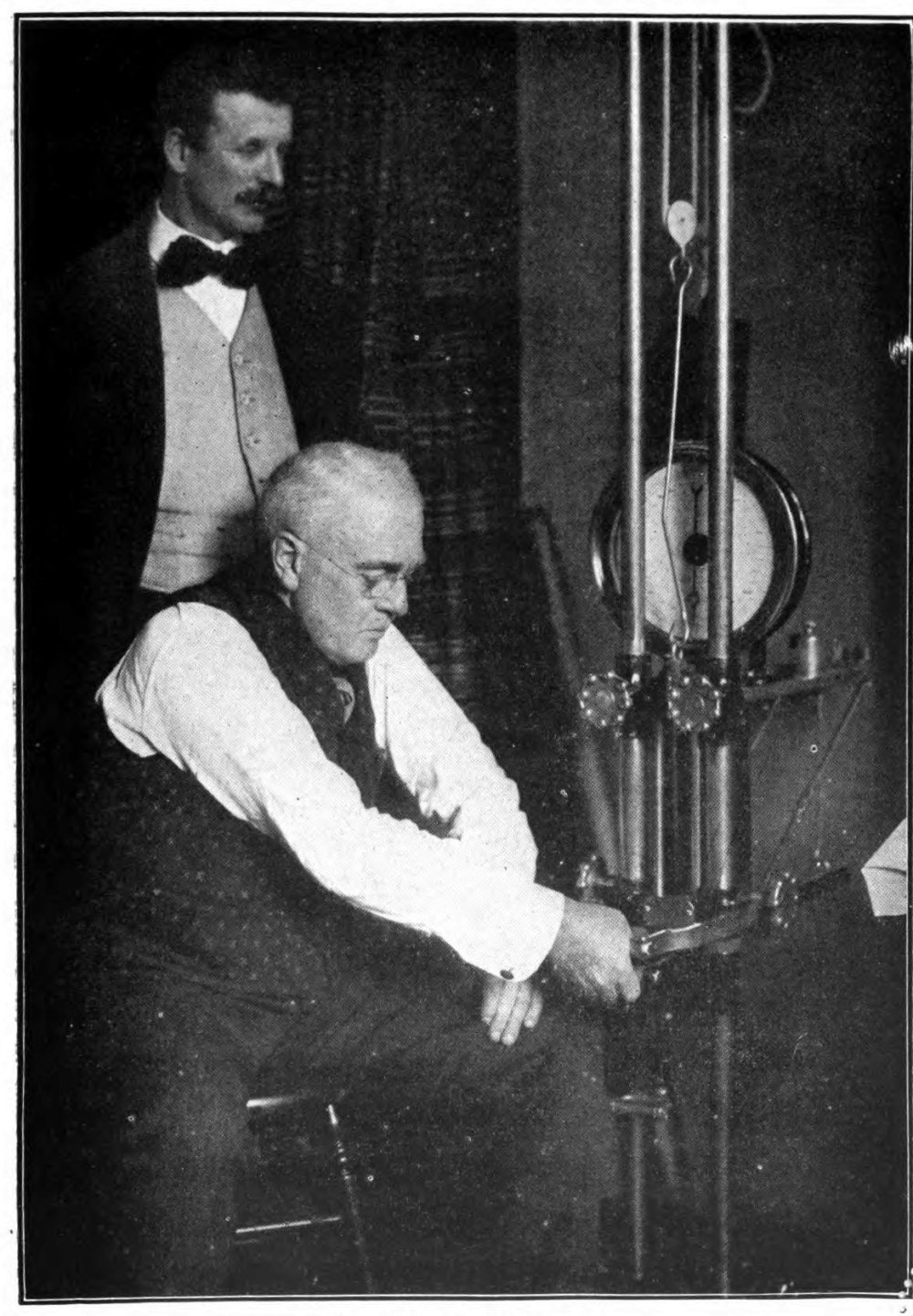
Mr. Horace Fletcher
Making a World’s Record on the Dynamometer without previous
training. Dr. William G. Anderson, Director of the
Yale Gymnasium, in the Background.
“You will notice that Mr. Fletcher doubled
the best record made previous to his feat, and
numerous subsequent tests failed to increase
the average of Mr. Fletcher’s competitors. Mr.
Fletcher informs me that he had done no training
nor had he taken any strenuous exercise
since February, 1907. On two occasions only
during the past year he reports having done
hard work in emergencies; once while following
Major-General Wood in the Philippines in
climbing a volcanic mountain through a tropical
jungle on an island near Mindanao for
nine hours; and once wading through deep
snow in the Himalayan Mountains, some
three miles one day and seven miles the
next day, in about as many hours. This
last emergency experience came through
being caught in a blizzard near Murree, in
Northern India, at 8500 feet elevation, on the
way to the vale of Kashmir. These two trials
represented climatic extremes, and Mr. Fletcher
states that neither the heat nor the cold
gave him discomfort, a significant fact in estimating
physical condition.
“Before the trial on the Fisher machine, the
subject’s pulse was normal (about 72); afterwards
it ran 120 beats to the minute. Five
minutes later it had fallen to 112. No
later reading was taken that day.
“The hands did not tremble more than usual
under resting conditions, as Mr. Fletcher was
able to hold in either hand immediately after
the test a glass brimming with water without
spilling a drop. The face was flushed, perspiration
moderate, heart action regular and
control of the right foot and leg used in the
test normal immediately following the feat.
I consider this a remarkable showing for a
man in his fifty-ninth year; 5 feet, 6½ inches
in height, weighing 177½ pounds and not in
training.”
In order to make a more thorough test of
Mr. Fletcher’s power of endurance under
varying degrees of physical strain, he underwent
on the 17th, 18th, 19th, 21st and 22nd of
June, 1907, a number of other exceedingly
severe tests, of which Dr. Anderson says:
“After each test the respiration and heart action,
while active, were healthy, and, under
such conditions, normal.
“There was not the slightest evidence of
soreness, stiffness or muscular fatigue either
during or after the six days of the trials. Mr.
Fletcher made no apparent effort to conceal
any evidence of strain or overwork and did
not show any. He informs me that he felt
no distress whatever at any time. Should any
one wish to become more familiar with the
strenuousness of the movements selected, let
him try them. The effort will be more convincing
than any report.
“During the thirty-five years of my own
experience in physical training and teaching,
I have never tested a man who equalled Mr.
Fletcher’s record.
“The later tests, given in June, 1907, were
more taxing than those given in 1903, but Mr.
Fletcher underwent the trials with more apparent
ease than he did four years ago.
“What seems to me to be the most remarkable
feature of Mr. Fletcher’s test is that a
man nearing sixty years of age should show
progressive improvement of muscular quality
merely as the result of dietetic care and with
no systematic physical training. The method
of dietetic care, too, as given by Mr. Fletcher,
is so unusual that the results seem all the more
extraordinary. He tells me that during the
four and a half years intervening between the
first and the recent examinations he has been
guided in his choice of foods and in the quality
also, entirely by his appetite, avoiding as much
as possible any preconceived ideas as to the
values of different foods or the proportions of
the chemical constituents of the nourishment
taken.
“During this four year period he has more
than ever catered to his body nourishment in
subservience to instinctive demand. He has
especially avoided eating until appetite has
strongly demanded food, and has abstained
from eating whenever he could not do so in
comfort and enjoyment. Mastication of solid
food and sipping of liquids having taste to the
point of involuntary swallowing, according to
his well-known theory of thoroughness in this
regard, has also been faithfully followed.
“There is a pretty good evidence that taking
food as Mr. Fletcher practices and recommends
limits the amount ingested to the bodily
need of the moment and of the day, leaving
little or no excess material to be disposed of
by bacterial agency. This might account for
the absence of toxic products in the circulation
to depress the tissue.
“The possible immunity from lasting
fatigue and from any muscular soreness, resulting
from the unaccustomed use, and even
the severe use, of untrained muscles is of utmost
importance to physical efficiency.
“My own personal observance and trial of
Mr. Fletcher’s method of attaining his surprising
efficiency, strengthened by my observation
of the test-subjects of Professors Chittenden
and Fisher who have come under my care
meantime, lead me to endorse the method as
not only practical but agreeable. As Mr.
Fletcher states, both the mental and mechanical
factors in selecting and ingesting food are
important, the natural result of the care being
a wealth of energy for expression in physical
exercise.”
So much for Horace Fletcher’s own case.
Yet when he first announced his discovery,
his own family laughed at him, and the medical
world called him crank. But by quiet,
sane, persistent work—by applying to the
propaganda of his idea the same methods that
had brought him success in business, he succeeded
in impressing the scientific world with
the value of his method.
An extensive literature has grown up around
Mr. Fletcher’s own books. The most important
medical bodies in Europe and America
have invited him to lecture before them. Hospitals
in larger cities have printed his own
code of the rules of mastication for distribution.
And no large sheet of paper was required,
for the whole system could be printed
on a postal card, and room would be left for
a picture of its author.
Why is complete mastication the best way
of eating? Why does its practice lead to recovery
of lost health, or increase of health; to
increase of strength, to increase of endurance.
Is it not a very tedious method, and thus of
more trouble than its promised benefits are
worth? Does it not waste time? Does it not
lead to loss of enjoyment of food?
These are a few of the questions which a
discussion of Fletcherism invariably arouses.
We speak with a deep conviction of truth when
we say that Fletcherism leads to saving of
time, instead of loss of time; that it brings
increase of sensuous enjoyment of food instead
of decrease of it; and that if it is tedious
or a bore, then it is not Fletcherizing. The
very essence of Fletcherism is the dropping
of worry, the elimination of stress and strain.
If you do as Fletcher says, instead of doing
as somebody says that Fletcher says, you will
chew for taste, and not for time; you will take
a crust of bread, or a morsel of potato, for instance,
into your mouth and roll it with your
tongue, and press it against the roof of your
mouth, and pass it to and fro, and crunch it,
and crush it; and all the while you will not be
counting the chews, nor even thinking about
chewing, but on the contrary you will be thinking
of the taste of the morsel, and seeking that
taste—and finding it.
Yes, finding it, even in a crust of bread or
in a morsel of potato, in those humble foods
which the most of us seem to take more as
matters of habit; for by giving the saliva in
the mouth a chance to fulfill the work for
which it is put in our mouths by nature, we
find that the starch in the bread and in the
potato is turned into a sweet, toothsome and
partly digested morsel of sugar.
Here is a point that answers another of the
questions which arose a paragraph or so back.
This turning of the starch in bread into sugar
by the action of saliva is only one of the numerous
acts of digestion which is accomplished
in the mouth by the teeth, the tongue, the
palate, and the various kinds of juices, or
saliva, which are in the mouth. Horace
Fletcher pointed out, and medical science now
confirms his assertions, that many of the most
important parts of the digestive process are
meant by nature to be carried out in the first
three inches of the alimentary canal. And
this is the only place in all the thirty feet or so
of the alimentary canal where digestion is in
our own control. If we bolt or insufficiently
masticate our food, these mouth processes of
digestion are simply not accomplished; and for
this the whole system suffers sooner or later.
The stomach and the intestines are called on to
do a great deal of extra work, and much of
this extra work is of a kind which they are unable
to do. Consequently, what food can not
be digested must decompose in the intestines,
with the consequent production of poisonous
fluids and gases which permeate the body.
The whole machinery of digestion is thrown
out of gear. All the various germs of disease
race to be first to enter the disarranged
mechanism, as criminals rush to a city that is
in disorder. The blood not being as well
nourished as it should be, the white army of
the soldiers of the body begin to weaken and
to die, and the forces of disease penetrate
through their warding lines and attack the
fort of life from many sides, or else concentrate
their strength in the form of some virulent
sickness.
Thorough mastication, on the other hand,
means the reverse of these conditions. Almost
incredible seem the hundreds of stories which
we personally know to be true of men and
women who have used Mr. Fletcher’s method
as a means to enter the land of good health.
In the opinion of Dr. Kellogg of Battle Creek,
“There is no doubt that thorough mastication
of food solves more therapeutic problems than
any other thing that can be mentioned. It
solves the whole question of the right combination
of foods; solves the question of the quantity
of foods, and the quality of foods, after
one has got his appetite trained, his natural instinct
trained; and when it comes to certain
diseases like acidity of the stomach, hyper-acidity
or hypo-acidity, dilation of the stomach
or cirrhosis of the liver, or any other trouble
with the digestive organs, if it does not effect
a radical cure it makes it possible to tolerate
a condition which otherwise would be deadly
in a short time. It makes it possible for a
patient to live a long time, enjoying comfortable
health, where otherwise he would be crippled
so that he could not live long at all.”
Although we insist upon the fact that
Fletcherism is simple, and easy, too, once you
have really begun its proper use, yet we also
know that there are many difficulties which the
average man or woman has to face at the outset.
Professor Fisher encountered these difficulties
when experimenting with his students
at Yale, and we are indebted to him for
enumerating some of them. And these difficulties,
like the habit of hasty eating itself,
are products of our civilization.
We mean such difficulties as, first, conventionality,
or the desire to eat what others eat,
and the unwillingness to appear different;
politeness, the desire to please one’s host, or
hostess, and eat “what’s set before you,” or to
eat something which you know you don’t want
or which you know is bad for you, because you
fear to offend somebody or other who has
cooked it, or bought it for you; food notions,
or the opinion that certain foods are “wholesome,”
and that certain foods should be
avoided as injurious even if delicious to the
taste; narrowness of choice, as at a boarding
house table (and a great number of home
tables!) which often supplies what is not
wanted and withholds what is; and, lastly,
habit, by which the particular kinds and
amounts of food which have become customary
through the action and interaction of the
causes previously named, are repeated day
after day, without thought.
“Habit hunger” is another of our handicaps.
Habit hunger is said by Mr. Fletcher
to be responsible for a vast deal of overeating.
He refers to the fact that when we are children
we eat at least one-third more proteid or tissue-building
foods, in proportion to our size, than
we require as adults, for the reason that our
growing frames must then be nourished and
upbuilt; but when we reach the adult stage
we are apt to maintain this excessive consumption
of proteid food—and proteid, as we shall
see later on, is the chief source of dietary ills.
These are some of the difficulties to be encountered
by the person who sets out upon the
road to health. But they are very slight barriers,
indeed, to the person possessed of willpower,
and when the benefits and pleasures to
be gained are so enormously in excess of the
few initiatory troubles, it is not to be wondered
at that more than a million persons in England
and America are already following Horace
Fletcher’s system in whole or in part.
Certain remarkable experiments conducted
by Rogers, Metchnikoff, and Pawlow in
Europe, and by Cannon and Kellogg in
America, have thrown a new and interesting
light upon the ideas of Fletcher; proving that
the act of chewing the food gives to the nerves
that control the digestive fluids an opportunity
to assay the food, to test it and select for it the
particular kind of digestive fluid which that
particular kind of food requires. It appears
that there are many different kinds of saliva,
and each one of these kinds has a particular
kind of work to do, which no other kind is able
to do. Metchnikoff has shown that if one
takes cane sugar into the mouth with or without
other food, there is manufactured by the
salivary glands a certain peculiar fluid which
digests cane sugar. If the cane sugar is not
taken into the mouth, then that substance is
not made. The saliva that flows into the
mouth when there is food there but no cane
sugar with the food, will not digest cane sugar.
So it readily can be seen that if cane sugar
should be hastily swallowed, it is much less
likely to be properly digested. And this holds
good with nearly all other kinds of food.
“But how is a person to know when he has
chewed a mouthful long enough?” the reader
asks. Mr. Fletcher answers that nature has
provided us with a food filter—an automatic
safety device. Professor Hubert Higgins,
formerly demonstrator of anatomy at Cambridge
University in England, and Professor
Hasheby of Brussels, Belgium, have lately
conducted a series of experiments which throw
light on this question on its scientific side. At
the back of the tongue there are a number of
little knobs, which are really taste buds, or apparatus
for the tasting of food. During the
time that mastication is going on, the mouth
is closed and is completely air tight, and germproof.
This fact one can readily demonstrate
by filling out the lips with air. The mouth is
full of air, yet one can breathe behind this
curtain of air, showing that the mouth is thoroughly
cut off. This is what happens during
mastication, for of course one should masticate
with the lips closed. Now, when the
food has become sufficiently ensalivated, or
mixed up, the circumvallate papillæ at the
back of the throat, where the taste buds are,
relax, and behind that the soft palate forms a
negative pressure. This soft palate is muscled
just as it is in the horse—which is an animal
that masticates, but is not found in the dog,
which is an animal that bolts its food. Whenever
the food is ready for the body, the soft
palate relaxes, and is sucked back, and the
swallowing of a mouthful of the prepared
food takes place involuntarily.
The body is thus supplied with as perfect a
protection as could be devised, and perfectly
automatic; all that is necessary being that one
should masticate the food until it naturally
disappears. One must not attempt to keep
the food too long in the mouth, but let it have
its own course. There are some sorts of food
which, when one has chewed them three or four
times, are sucked up, showing that they have
received all the mouth treatment that nature
requires they should. With other foods one
can masticate up to one hundred and fifty
times, and still they are not sucked up.
This food filter is a perfectly instinctive apparatus;
but as people have acquired the habit
of flavoring foods with artificial sauces and
relishes, most of them have spoiled this protective
device. In the words of Mr. Fletcher
himself: “This is a gift of Nature to man
which we have been neglecting. It is not a
gift which has been given to me and a few
others alone. I think everybody could acquire
the use of it if they would give Nature
a chance by eating slowly, by eating with a
sense of enjoyment, and by never eating save
when they are really hungry and in a mood to
enjoy the food.”
III THE YALE EXPERIMENTS — FLETCHER’S CLAIMS SUPPORTED — CHITTENDEN’S EXPERIMENTS ON HIMSELF — THE OTHER CHITTENDEN TESTS — PROFESSOR CHITTENDEN’S CONCLUSIONS — HOW TO INCREASE ENDURANCE — VICTORY FOR THE LOW PROTEID DIET — THE RESULT OF THE MASTICATION TEST — ANYBODY CAN APPLY THE NEW KNOWLEDGE
At Yale University, Professor Russell H.
Chittenden, Director of the Sheffield
Scientific School, Lafayette B. Mendel, Professor
of Physiological Chemistry, and Irving
Fisher, Professor of Political Economy,
have carried on a long series of experiments,
begun six years ago as a test of the
claims made by Fletcher. The net results of
these experiments up to date (for they are still
in progress) may be put into a nutshell. The
following statement was drawn up by one of
the writers of this book and submitted to Professors
Chittenden and Fisher, who have accepted
it as a summary of their present views:
“The commonly accepted standards which
claim to tell the quantity of food needed each
day by the average man are based upon many
careful observations of what men actually do
eat.
“We challenge these standards, however, as
the exact science of to-day cannot accept as
authority common customs and habits in any
attempt to ascertain the right principles of
man’s nutrition, since experiments have
demonstrated how readily one set of habits
may be substituted for another and how easily
wrong habits become hardened into laws. The
evidence presented by observers of common
customs, while they must be duly considered,
cannot, therefore, be taken as proof that these
habits and customs are in accord with the true
physiological needs of the body.
“We believe that the following propositions
have been demonstrated as truths by the experiments
we have made at Yale.
“People in general eat and drink too much.
“Especially do they eat too much meat, fish
and eggs.
“This is so because meat, fish and eggs are
the principal proteid-containing foodstuffs.
Prof. Russell H. Chittenden, Ph.D., LL.D., Sc.D.,
Director Sheffield Scientific School, Yale University. He has
conducted many dietary experiments from the
physiologist’s point of view.
“Proteid is an essential food element, absolutely
necessary for the upbuilding of
tissue, for the maintenance of life. It is one
of three main elements into which all foodstuffs
may be divided—the others being Carbohydrates
(the sugars and starches) and Fat.
While it is indispensable, it is also the element
which the body machinery finds most difficult
to dispose of. Proteid is ‘nitrogenous.’ Nitrogen
is never wholly consumed in the body
furnace as fats, sugars and starches are.
There is always solid matter left unconsumed,
like clinkers in a furnace; which clinkers the
kidneys and liver have to labor to dispose of.
If the clinkers are produced in excess of the
ability of these organs to handle them without
undue wear and tear, damage of a serious, and
sometimes permanent, nature follows. The
ideal amount of proteid is the amount which
will give the body all of that substance which
it needs without entailing excessive work upon
the body machinery.
“Excessive consumption of proteid foodstuffs—like
meat, fish and eggs—is the greatest
evil affecting man’s nutrition. The excess
of proteid not only remains unburned in
the bodily furnace, but this waste matter very
often decays in the body, forming a culture
bed for germs which effect the whole system,
a condition scientifically known as autointoxication,
or self-poisoning of the body through
the action of the germs of putrefaction, and
of other germs, which are bred in the colon,
or large intestine. The researches of Metchnikoff,
Bouchard, Tissier, Combe, and other
eminent scientists, have shown that autointoxication
is the source of a great number of the
most serious chronic diseases which afflict mankind.
“We say, then, that the existing dietary
standards place in all cases the minimum of
proteid necessary for the average man’s daily
consumption at far too high a figure. It may
be safely said that it is placed twice as high
as careful and repeated experiments show to
be really necessary.
“There can be little doubt that the habit
of excessive eating and drinking, combined
with the habit of too hasty eating and drinking,
especially of meat, fish and eggs, are probably
the most prolific sources of many bodily
disabilities affecting men and women, and are
consequently the greatest deterrents to the attaining
by men and women of a high grade
of efficiency in work, of better health, of
greater happiness, and of longer life.
“We believe that it has been demonstrated
as a fact that health can be bettered, endurance
increased, and life lengthened, by cutting
down the commonly accepted standards of
how much meat, eggs, fish and other proteid
food we should eat and drink by about one-half.”
After Horace Fletcher had attracted the
notice of the scientific world in 1902, Professor
Chittenden invited him to become the subject
of a series of experiments at Yale, where
the Sheffield Scientific School possessed an
equipment suitable for an elaborate inquiry of
this kind much superior to any to be found in
Europe.
Professor Chittenden first made certain, by
experiments which precluded any chance of
error, that Horace Fletcher’s claims were
justified so far as Horace Fletcher himself
was concerned. But this, of course, by no
means solved the problem. Mr. Fletcher
might simply be a physiological curiosity—a
digestive freak—of whom there are many
known cases. He lived and thrived on an
amount of proteid food startlingly less than
was deemed necessary by all existing standards,
but this could not be taken as proof that
people in general could do likewise. Only an
exhaustive series of tests on a large number
of people of varying ages and conditions of
life could prove this. Professor Chittenden
resolved to make these tests.
At the very outset, however, he faced this
difficulty. If Mr. Fletcher’s was merely a
freak case, there would be a grave danger in
putting other men upon his dietary. Mr.
Fletcher was flourishing on a daily consumption
of proteid foodstuffs amounting to an
average of only 45 grams, and the fat, sugar
and starch consumed by him were in quantities
only sufficient to bring the total food value of
the daily food up to a little more than 1600
“calories,” or units of fuel energy. The Voit
standard—which is the typical one, the one
most commonly accepted, and which is based
upon thousands of studies of what men and
women actually eat—demands that the average
man shall eat at least 118 grams of proteid,
with a total fuel value of 3000 large
“calories” for the daily ration.
To make clear to the non-scientific reader
just what quantity of foodstuffs is represented
by 50 grams of proteid, which is 5 grams more
than that consumed daily by Mr. Fletcher in
his tests, and is approximately the amount consumed
daily by other men in the Yale experiments,
it may be said that 50 grams is about
equal to 772 grains, which are equal to about
1¾ ounces. This quantity would be represented
by the proteid contents of 9½ ounces of
lean meat, or 7 eggs, or 27 ounces of white
bread. Nine and one-half ounces of meat
(using comparisons furnished by Dr. Edward
Curtis) is about the weight of a slice measuring
7 by 3 inches and cut ¼ of an inch thick.
Twenty-seven ounces of bread represent
somewhat less than two loaves, the standard
loaf weighing one pound (16 ounces). Of
course, few people ever eat 7 eggs, or 2 loaves
of bread in a day; but the vast majority of
people in America do eat a great deal more
proteid than would be represented by 7 eggs,
or 2 loaves of bread or a slice of meat of the
size named, since proteid is found in a great
number of other foodstuffs besides those mentioned.
Professor Chittenden realized that to ask a
number of men to subsist on a ration similar
to that which nourished Mr. Fletcher might
possibly result in seriously weakening their
constitutions. This is the problem which has
often confronted other scientists, and Professor
Chittenden solved it in a way characteristic
of the true scientist—the devoted warrior in
humanity’s cause who wages warfare against
the forces of evil. He began his experiments
upon himself.
The result rewarded his self-sacrificing
spirit; for within a few months a severe case
of muscular rheumatism (which had plagued
him for years, refusing to yield to treatment)
disappeared; and with it went a recurrent
bilious headache. And it may be stated that
these have never returned. Professor Chittenden
has adopted as a habit of life the
dietary which he began as an experiment five
years ago. At that time he was a hearty eater
of three meals a day, meals rich in meat and
other proteid foodstuffs.
Professor Chittenden then began experiments
with a group of university professors
and instructors, with a group of thirteen enlisted
men of the army, and a group of eight
college athletes in training. All three of these
groups of men were subjected to careful
laboratory observations for continuous periods
of many months, during which the proteid
ration was reduced from one-half to one-third
what had been customary. The professors
and athletes followed their customary vocations
during the period of observations, while
to the ordinary drills of the soldiers were added
severe gymnasium work under the supervision
of Dr. Anderson.
Results were as follows: The subjects usually
lost some weight, especially such as were
fat. But it was found that having got down
to a new standard, they held this steadily.
They all maintained muscular and nervous
vigor. Careful tests determined that the
soldiers and athletes positively gained in muscular
strength. All kept in good health; and
many got rid of illnesses with which they had
been suffering in the beginning. Appetite
was thoroughly satisfied; and quite a number
of the subjects permanently adopted the new
method of living. Nine of the soldiers went
in a body to a new station, and from thence
they afterwards wrote, through one of their
number, to Professor Chittenden, saying:
“The men are in first-class condition as regards
their physical condition, and all of them
feeling well. We eat little meat now as a rule
and would willingly go on another test.”
At the beginning of the experiments these
soldiers were subsisting on a daily ration which
allows one and one-quarter pounds of meat
per day apiece; and toward the end of the experiments
they were subsisting and increasing
their strength on a daily ration of
meat equivalent to about one small chop or
less!
These experiments constituted the first series
made by Professor Chittenden. He later
carried through a series with dogs: prior experiments
having supported the view that the
dog, a typical high proteid-consuming animal,
declined or died when forced to subsist on
quantities of proteid less than the amount
ordinarily consumed. Professor Chittenden,
however, challenged here the methods, as well
as the results, of previous investigators. In
previous experiments with dogs the animals
had been invariably handicapped by being confined
in dark and dismal quarters, too cramped
to permit of exercise, and at times unsanitary
in condition. He reversed these conditions—and
reversed the results. His dogs lived and
thrived on a diet far less rich in proteid than
former investigators deemed necessary.
Summing up the conclusions reached by him
after arduous years of experiment and study,
Professor Chittenden declares that 60 grams
of proteid (about the quantity which a single
small chop would supply) are all that are required
by the average man of 150 pounds
body weight. This is one-half the Voit standard,
and far below the common practices of
the majority of mankind in Europe and
America.
“But there should be no practical use of
the terms ‘standard diets’ and ‘normal diets’
by people in general,” says Professor Chittenden.
“What is needed to-day is not so much
an acceptance of the view that man needs so
many grams of proteid per kilogram of body
weight, as a full appreciation of the general
principle that the requirements of the body for
proteid food are far less than the common customs
of mankind, and that there are both economy
and gain in following this principle in
practice.”
The most broadly interesting of these Yale
food experiments are those having to do with
the question of endurance. The vast majority
of people are not ambitious to excel as athletes;
they find better and more enjoyable forms of
work in life than putting up big dumb-bells,
or breaking records on the athletic field. Of
course, everybody wants to be strong, and to
have well-trained and active muscles; but on
the whole, what the majority of people need
is physical and mental stick-to-itiveness—the
ability to work without deterioration, without
running down like worn-out machinery. Professional
men, day laborers, students and
athletes, all need this invaluable quality of endurance—this
quality that is the true capital
in the bank of life to be at their command day
in and day out, with a reserve ready to be
drawn upon whenever an emergency arises.
And it is precisely here that the new art of
health bestows its benefits upon those who follow
it.
It was to ascertain the relation between diet
and endurance in the light of the new knowledge
shed upon the subject by Professor Chittenden’s
experiments, that Professor Irving
Fisher inaugurated his own experiments at
Yale University. He conducted two series of
tests, as follows:
First, to ascertain the effect of thorough
mastication on endurance, following the rules
laid down by Horace Fletcher, with the help
of nine healthy students.
Second, to ascertain the influence of flesh
eating on endurance as compared with the effect
of abstinence from flesh, with a group
of forty-nine persons, splitting the group as
follows,—first, athletes accustomed to a flesh,
or high proteid dietary; second, athletes accustomed
to a low proteid, or non-flesh dietary;
third, sedentary persons accustomed to a low
proteid, or non-flesh dietary.
Prof. Irving Fisher, Ph.D.,
Professor of Economics at Yale University. His investigations have
had to do largely with the cost of necessary food.
The flesh-eaters were Yale men, including
some of the best known athletes of the university.
The abstainers were nurses and physicians
attached to the Battle Creek Sanitarium.
Professor Fisher’s interest in the subject
was that of a political economist. Meats, as
a general rule, are the most expensive part of
the national diet, and it is apparent that if a
fleshless, or low proteid, diet will increase endurance,
it will also increase the national earning
capacity, and thus add to the national
wealth. When Professor Fisher began his experiments
he encountered a singular fact,
which was that the science of physiology had
given very little attention to the study of endurance.
“That strength and endurance are
not identical, is only partly recognized,” he
writes. “The strength of the muscle is
measured by the utmost force that it can exert
once; its endurance, by the number of times
it can repeat any exertion within its strength.
The repetition of such exertion, if not stopped
by the refusal of the will, is finally stopped by
the reduction of the strength of the muscle till
it is unable to perform further. Thus endurance
may be expressed in terms of loss of
strength. It is related to fatigue, and it is
only through the study of fatigue and fatigue
poisons, made by Mosso and others, that light
has been thrown on the nature of endurance.”
When these tests were held Professor Fisher
had not then invented the machine for registering
endurance which is now in use in the Yale
gymnasium; therefore, three simple tests were
employed: first, holding the arms horizontal as
long as possible; second, deep knee bending;
third, leg raising with the subject lying on his
back.
The results of the competitive tests were all
in favor of the flesh-abstaining athletes. In
the first test, which was holding the arms horizontal,
only two of the fifteen flesh-eaters succeeded
in holding their arms out over a quarter
of an hour; whereas twenty-two of the
thirty-two abstainers surpassed that limit.
None of the flesh-eaters reached half an hour,
but fifteen of the thirty-two abstainers exceeded
that limit. Of these, nine exceeded
one hour, four exceeded two hours, and one
exceeded three hours, the last going exactly
two hundred minutes, or three hours and
twenty minutes.
In the leg raising test the record showed
little difference. None of the abstainers
reached their absolute limits. The highest
record for the abstainers was one thousand
times. A flesh-eater reached one thousand,
three hundred and two, but did so after the
one-thousand mark had already been set for
him by an abstainer, and he went into the test
with the expressed intention of defeating his
rival. Professor Fisher states that it was evident
from his fatigue at the end of the test
that he could not have repeated the performance
on the next day, as did his flesh-abstaining
rival.
In respect to deep-knee bending, Professor
Fisher pointed out that of the nine flesh-eaters
who went into this contest, only three went
above three hundred and twenty-five times,
while of the abstainers, seventeen surpassed
this figure. Only nine of the flesh-eaters
reached one thousand, as against six of the
twenty-two abstainers. None of the flesh-eaters
surpassed two thousand, while two of
the abstainers did. One abstainer, an athlete,
S. A. Oberg, did two thousand and four hundred
dips or deep knee bends, almost doubling
the highest figure set by the flesh-eating
athlete, which was one thousand, two hundred
and ninety-two. Most of the Yale flesh-eating
athletes were so severely crippled by their
efforts in this particular set of movements that
Professor Fisher resolved not to employ them
again, and went to work on his device for
mechanically registering endurance. One of
the Yale athletes, who in the deep-knee bending
test had reached five hundred times, fainted.
Several had to be carried down the gymnasium
stairs, and others were made so stiff and sore
that for days they could not walk up and down
stairs with comfort, while in the case of the
abstainers from flesh foods there were comparatively
little painful after-effects. Two of
the abstainers, one a Yale athlete, were almost
free from physical after-effects. The Yale
man ran on the track of the gymnasium after
his performance, and took a long walk afterward;
while the other athlete, Oberg, a Sanitarium
nurse, who made the highest record of
all, two thousand four hundred times, continued
his duties and found little annoyance
from stiffness or soreness. (Another flesh-abstaining
athlete, John E. Granger, of Battle
Creek Sanitarium, has since made a new record
of five thousand and two dips in two hours and
nineteen minutes.)
Professor Fisher tried many means to
stimulate the flesh-eating athletes to do their
very best. He called upon their “Yale
spirit” to rally to their aid, and he states that
the advantage of rivalry as between the flesh-eaters
and the abstainers was decidedly upon
the side of the flesh-eaters, for their tests, with
two exceptions, came after all the records of
the abstainers had been completed. The Yale
men felt that their tests would go on record as
tests of Yale athletes, and Professor Fisher
states that the “Yale spirit” which aided them
appeared to be as great a stimulus as any
“vegetarian” spirit could possibly be.
As to the experiment with the nine healthy
students, Professor Fisher says:
“The results of the experiment demonstrated
so great an increase of endurance as to
seem at first incredible. It certainly was a
surprise, both to the men and to me. But
statistics which I have been collecting during
the last two years have prepared me to find
great differences and changes in endurance.
The special result of the present experiment
is to show that diet is an important factor in
producing such alterations. The fact that endurance,
even among persons free from disease,
is one of the most variable of human
faculties—far more variable than strength,
for instance—is evident to any one who has
made even a superficial examination. Some
persons are tired by climbing a flight of stairs,
whereas the Swiss guides, throughout the summer
season, day after day spend their entire
time in climbing the Matterhorn and other
peaks; some persons are “winded” by running
a block for a street car, whereas a Chinese
coolie will run for hours on end; in mental
work, some persons are unable to apply themselves
more than an hour at a time, whereas
others, like Humboldt, can work almost continuously
through eighteen hours of the day.
Mr. John E. Granger Breaking the World’s Record for Deep Knee Bending.
The spectator at the extreme right is Mr. Alonzo A. Stagg, coach of the Chicago University
football team. Mr. Michael Williams is between the two.
“It is, to say the least, remarkable that
hitherto so little effort has been directed toward
discovering the factors which explain
such differences in endurance. That exercise
is one of the most and perhaps the most important
factor has long been recognized. A correspondent
assures me that by means of moderate
regular exercise he succeeded in increasing
his endurance between 100 and 200% in
three weeks as measured by leg-raising and
“dipping.” The influence of diet has always
been regarded as small or negligible, and the
opinion has almost been universal, until recently,
that a diet rich in proteid promotes endurance.
Even among those whose researches
have led them to the opposite conclusion, there
is very little conception of the extent to which
diet is correlated with endurance. Such a person,
a medical friend of the writer, stated,
when the present experiment was planned,
that he did not think the dietetic factor strong
enough compared with others to produce any
marked effect. We have all heard, of course,
of the enthusiastic reports of vegetarians as to
their increased endurance, but these we have
discounted as exaggerations. The result of
the present experiment, however, would seem
to indicate that one’s improvement in endurance
is usually not less, but greater, than he
himself is aware of. Probably it is also true
that we may lose a large fraction of our working
power before we are distinctly conscious
of the fact.
“While the results of the present experiment
lean toward ‘vegetarianism,’ they are
only incidentally related to that propaganda.
Meat was by no means excluded; on the contrary,
the subjects were urged to eat it if their
appetite distinctly preferred it to other foods.
“The sudden and complete exclusion of
meat is not always desirable, unless more skill
and knowledge in food matters are employed
than most persons possess. On the contrary,
disaster has repeatedly overtaken many who
have made this attempt. Pawlow has shown
that meat is one of the most, and perhaps the
most, ‘peptogenic’ of foods. Whether the
stimulus it gives to the stomach is natural, or
in the nature of an improper goad or whip,
certain it is that stomachs which are accustomed
to this daily whip have failed, for a
time at least, to act when it was withdrawn.
“Nor is it necessary that meat should be
permanently abjured, even when it ceases to
become a daily necessity. The safer course,
at least, is to indulge the craving whenever one
is ‘meat hungry,’ even if, as in many cases,
this be not oftener than once in several months.
The rule of selection employed in the experiment
was merely to give the benefit of the
doubt to the non-flesh food; but even a slight
preference for flesh foods was to be followed.
“Under flesh foods are included all meat
and ‘stock’ soups. It has been shown that
although these extracts of meat contain a large
amount of nitrogen, it is not in the form of
proteid which can be utilized, but only of waste
nitrogen which must be excreted. Apparently
the sole virtue of such soups is that they
supply the ‘peptogenic’ stimulus above referred
to.
“The practical value of the experiment consists
in the fact that any layman can apply it,
with or without a knowledge of food values,
though with more advantage if he possess
than if he lack such knowledge. If the dietetic
rules of the present experiment are followed,
no self-denial as to foods is required.
It is, however, absolutely necessary that there
should be self-control enough to break up the
habit of hurried eating to which modern civilization
has brought us—habituating us, as it
were, to eat against time.
“Experience indicates that appetite does
not lead to a diet fixed in amount or constituents,
but moves in undulating waves or cycles.
The men who took part in the experiment were
encouraged, after any of the symptoms which
seemed to be associated with high proteid (such
as heaviness, sleepiness, stiffness, or soreness
after exercise, or catching cold), to cut down
on their proteid and substitute fat to restrain
the gastric juice. This advice was intended
to make application of the theories of Folin
that we usually carry a reservoir of proteid,
enough to supply our needs for body-building
for a fortnight. If this reservoir is exhausted,
proteid starvation occurs and the body
feeds on itself; if it is filled too far it overflows
and causes the evils of excessive proteid.
If this theory is correct, the art of eating may
consist largely in maintaining a golden mean,
such that the proteid reservoir is neither empty
nor overflowing much. Many persons fear to
reduce their proteid to the Chittenden minimum
for fear of proteid starvation; but the
experience of those who have tried it would
seem to show that this fear is groundless, provided
no violence is done to natural appetite.
This may be trusted, so it would appear, to
raise a warning in the form of ‘nitrogen hunger,’
before the danger point is reached.” In
other words, the body will ask in the language
of hunger for proteid food, if you are not
eating as much as you should. Professor
Fisher considers that an amount of meat equivalent
to about one small chop will supply all
the proteid necessary in the daily ration, since
proteid is also consumed in bread, potatoes and
nearly all other foods.
It might be added that one of the writers
has found the remedy for continual bilious
headaches in the rigid exclusion from his diet
of all foods that are rich in proteids, including
meat, fish, eggs, milk, cheese, peas and beans;
and maintains weight and working efficiency
upon such amount of proteid as he derives
from ordinary breadstuffs. He has found
that the craving for high proteid foods soon
disappears if it is not gratified; and that the
quantity of bread, potatoes, etc., which the
average person would eat at dinner and supper
supplies all the nitrogen which his system needs,
without leaving any to cause autointoxication.
IV HOW DIGESTION IS ACCOMPLISHED — THE WORK OF THE STOMACH — THE ELEMENTS OF FOOD — THE WORK OF THE DIGESTIVE JUICES — HOW MUCH SHOULD WE EAT — PRACTICAL APPLICATION OF DIETARY RULES
In order not to interrupt the narrative of
the Yale experiments, we have foregone
defining certain of the technical terms which
it was necessary to use. It will be well, before
going further, to give a simple description
of the manner in which the food we eat is
transformed in the body into tissue building
material and energy: a process the many parts
of which are grouped by physiologists under
the name of Metabolism.
When you take a mouthful of food it enters
on a journey through the body in which
it traverses more than thirty feet of the intestinal
tube before that part of it which the
body cannot use is ejected; the process of
metabolism begins the moment the lips touch
it. The six salivary glands which are located
in the mouth manufacture saliva, which flows
out through numerous openings, and mixes
with food as it is chewed. The saliva not only
moistens the food, thus allowing it to be more
easily swallowed, but it also has a most important
chemical office, converting all starchy
food matter into sugar, and thus performing
the first and one of the most essential steps in
the process of digestion.
After the food has been masticated and saturated
with saliva, it passes down the throat
through the gullet, which performs a peculiar
muscular contraction, thrusting downward the
particles of food. The conversion of the
starch in food into sugar, or glucose, which is
begun by the saliva in the mouth, is continued
as the food passes into and down the gullet,
but stops almost completely when the food
once reaches the stomach.
It is in the stomach, on the other hand, that
most of the work of digesting the albuminoids,
or proteids, of food is performed by the gastric
juice. The stomach is a pear-shaped bag,
that holds about three pints of material, or
three-quarters of an ounce for every inch of
the individual’s height. Food enters it through
the gullet on the upper left hand side, just
below the heart. Myriads of glands in the
walls of the stomach are active in the formation
of either pepsin, or an acid fluid which, when
combined with pepsin, forms the gastric juice.
At the back of the stomach, partly overlapping
it, lies the liver, which discharges a liquid
called the bile into the alimentary canal just
below the stomach. Behind the stomach, lies
a large gland called the pancreas, which discharges
a remarkable fluid, named pancreatic
juice, into the intestine through the same opening
which the liver uses for its bile. Connected
with the stomach is the small intestine, which
is the narrow portion of the alimentary canal,
and the largest and most important of all the
digestive organs. It is some twenty-five feet
in length, and its walls are everywhere covered
with glands which secrete and exude mucous
and other fluids.
At the lower end of the intestine is the colon
or large intestine which is not a digestive organ
in itself, but is a reservoir in which the
food is stored up for a short time, to allow opportunity
for complete absorption of the digested
portions.
Although there may be thousands of different
dishes, and combinations of foodstuffs,
fundamentally they are all closely akin, and
can be all resolved into a few quite simple elements:
Proteid, Carbohydrate, Fat or Mineral
Salts, or combinations of these; the Proteid
class having many subdivisions, and the Carbohydrates
being made up of the various sugars
and starches.
We also know definitely just what use the
body makes of these various substances. The
Proteid is the up-builder of tissue, the essential
foodstuff without which life cannot exist.
If we compare the human body to an engine,
as nearly all physiologists seem bound to do,
we may say that Proteid is like the brass, or
other metal, of which the structure is composed.
The various Carbohydrates and the
Fats are the fuels from which are derived the
energy which animates and operates the mechanism.
The Mineral Salts are used to supply
various important bodily needs, such as elements
required by the bones, or the delicate tissue
in the eyes, the enamel for the teeth, and
so forth.
As there are five main food elements,
namely, proteid, starch, sugars, fats, and salts,
so also there are five main digestive fluids,
the saliva, the gastric juice, the bile, the pancreatic
juice, and the intestinal juice.
The saliva is an alkaline fluid that digests
starch. Its work is checked by the presence
of acid substances; which explains why the digestive
action of saliva ceases soon after it
enters the stomach. Hence the importance of
giving the saliva ample opportunity to perform
its function, by complete mastication, is
obvious.
The gastric juice, of which about seventy
ounces is formed by the stomach daily, contains
in addition to hydrochloric acid, a quantity
of pepsin, which with the acid dissolves
all sorts of proteids or albuminous substances,
like meat and eggs; and it also contains rennet,
which coagulates milk. The gastric juice
digests proteids by converting them into pepsin,
an exceedingly soluble substance which
passes readily into the blood.
The bile manufactured by the liver has the
function of digesting fats. Fats are not
changed chemically, as are starches and proteids.
They are only broken up into particles
so small that the cells of the mucous membrane
can take them up and effect their removal
into the blood stream.
The pancreatic juice is able to perform the
work of all the three digestive fluids which
we have already named. In fact, it is even
more powerful than saliva in the digestion of
starch, since it is able to digest raw as well
as cooked starch, which the saliva cannot do.
It is also able to convert proteid into peptone,
as does the gastric juice; and it emulsifies fats,
as does the bile.
The intestinal juice digests cane sugar, and
is supposed to have a digestive influence upon
all the other food elements.
The mineral salts which are taken into the
body are dissolved by all the digestive fluids
which we have named, some by the saliva and
the juices of the intestinal tube, and others,
which require acids for their solution, by the
gastric juice.
Nearly all these digestive fluids are also
powerful antiseptics and are able to destroy
germs when the health of the body as a whole
is good. The gastric juice, for instance, acts
as an antiseptic, preserving the stomach contents
from putrefaction during the digestive
process. It is a remarkable fact that the gastric
juice, although it is so essential to life,
is a deadly poison, which, when introduced
into the blood produces insensibility and death.
These digestive juices and organs are able
completely to dispose of all the food elements
which are introduced into the body, save proteid
alone. The sugars and starches are either
completely absorbed and oxidized, or stored up
in the form of surplus fat. The oxidation or
burning up of proteid, however, is never complete.
There is always a certain amount of
unburnable substance left behind from the
processes of metabolism, which the liver and
kidneys of the body have to dispose of. If
only as much proteid as is needed by the body
for the upbuilding of its tissue, and the repair
of waste, is taken, the body can very readily
handle it; but an excess of proteid is highly
disadvantageous. Professor Chittenden, in his
great work, “The Nutrition of Man,” has set
forth in elaborate detail the process of the assimilation
of proteid. It appears that there are
many kinds of proteid; the proteid of eggs is
different from that of meat, and that again
from the proteid of beans, and so on; and human
proteid is different from all. Consequently,
the body is obliged to transform every
kind of proteid which is brought to it. This
proteid is then absorbed by the blood, and carried
to the tissues, which are kept perpetually
bathed in a supply of nutritive material. The
taking of more proteid than is needed would
not be so dangerous if it were simply passed on
without being digested; nor even if it were digested
and transformed, and then promptly
eliminated. But what actually happens is that
the new proteid taken in is passed through all
the stages of assimilation, and drives out in
front of it, so to speak, the proteid which has
already been prepared, but has not yet been
used. And the result is, of course, to throw a
double strain upon the liver and the kidneys,
the organs of elimination.
Professor Chittenden also points out the
common blunder which is made in assuming
that persons who are doing hard work need an
additional amount of proteid substance. One
commonly hears the phrase that laborers and
athletes can eat meat in large quantities, and
“work it off.” As we have seen, one can
“work off” sugars and starches and fats
completely; but one cannot “work off” proteid
completely. Professor Chittenden is now
recognized as the leading authority of the
world upon this particular question; and he
sets forth clearly in his book the fact that the
quantity of proteid needed is not increased by
muscular activity. One may work as hard as
he pleases, but his body will use no more nitrogen,
save only in the case where a sufficiency of
other food elements is not supplied. Only
as a last resort will the system undertake the
labor of burning up proteid to make energy.
When foodstuffs are taken into the body,
digested, assimilated, and used up, they produce
the same amount of heat and other forms
of energy as if burned outside of the body;
and hence it follows that the number of calories,
or units of heat, represented in a given
foodstuff, is taken by scientists as a common
measure of its food value.
A calory is a heat unit, which has been
adopted as a means of estimating the nutritive
value of foodstuffs. It represents the
amount of energy required to raise the temperature
of four pounds of water one degree
Fahrenheit. The number of calories contained
in food is obtained by burning the food and
measuring the heat produced by means of a
calorimeter.
It has been calculated that the normal, average
person needs from one hundred and sixty
to two hundred and forty calories of proteids
every day, in order to build blood and tissues.
He needs daily from five hundred to nine hundred
calories of fats, which supply heat.
He needs of carbohydrates, which are the
starches and sugars, and which the body uses
to produce energy for work and heat, from one
thousand to one thousand four hundred calories
daily. It is declared by Chittenden and Kellogg,
whose work has overset the old notions,
that the total number of calories, or food units,
should rarely exceed two thousand.
Two thousand calories are furnished respectively
by twenty-eight ounces of bread, or
ninety-six ounces of milk, or sixty-two ounces
of potatoes, or nine ounces of butter. One
quarter of each of these, or any other fractions
which together equal unity, will make
up a ration containing two thousand calories.
It is quite impossible, however, to make a
hard and fast rule in this matter. Every individual
differs from others in his requirements.
Moreover, the weather, the season of
the year, the amount and kind of work done,
are all factors in the situation. Hard physical
work and exposure to cold demands the largest
food supply. A person who naturally perspires
freely needs more food than a person
who does not, because of the large amount of
heat carried off from his body by the evaporation
of sweat from the skin. Adults require
food chiefly to repair waste and losses. Growing
children require in addition to food to repair
waste and losses, material for tissue building.
According to the best authorities upon
the diet of children, a growing infant utilizes
fully one-third of its total intake of food in
tissue building. When an adult becomes
emaciated he requires more tissue building material
than the normal adult, his need for it
being practically the same as that of a growing
child.
We give below a table showing the average
number of food units or calories required daily
by people of various heights and weights. This
table is one drawn up by Dr. J. H. Kellogg,
Superintendent of the Battle Creek Sanitarium.
In calculating the number of calories
required in a given case, the estimate should
be based not upon the actual weight of the
individual, but upon the weight of the average
person of his height.
“Persons who are in good health,” says Dr.
Kellogg, “and find their weight somewhat
greater than the figures given in the table,
should not necessarily consider themselves
obese. While above the average in weight,
their condition is probably natural, and no attempt
should be made to reduce the weight to
any considerable amount, as injury may result.
The average for adults applies especially to
healthy adults between twenty and thirty years
of age. Most people who are above forty years
of age have a natural tendency to increase of
flesh, which requires no attention unless it becomes
excessive. Any reduction in foods made
by an obese person should be in carbohydrates
rather than in proteids or fats, unless these
latter have been taken in excess.”
Table No. 1
Showing for different ages the average height, weight,
and the number of food units or calories required daily.
Boys
Age
Height in Inches
Weight in Pounds
Calories or Food Units
5
41.57
41.09
816.2
7
45.74
49.07
912.4
9
49.69
59.23
1,043.7
11
53.33
70.18
1,178.2
13
57.21
84.85
1,352.6
Girls
Age
Height in Inches
Weight in Pounds
Calories or Food Units
5
41.29
39.66
784.5
7
45.52
47.46
881.7
9
49.37
57.07
1,018.5
11
53.42
68.84
1,148.5
Men
Calories or Food Units
Height in Inches
Weight in Pounds
Proteids
Fats
Carbo- hydrates
Total
62
110.0
165
495
890
1650
64
121.0
181
543
1086
1810
66
132.0
198
594
1188
1980
68
143.0
215
645
1290
2150
70
154.0
231
693
1386
2310
72
165.0
247
741
1482
2470
74
176.0
264
792
1584
2640
Women
Calories or Food Units
Height in Inches
Weight in Pounds
Proteids
Fats
Carbo- hydrates
Total
57
78.4
118
344
688
1180
59
88.8
132
396
792
1320
61
99.2
149
447
894
1490
63
109.3
163
489
978
1630
65
120.2
180
540
1080
1800
67
130.7
195
585
1170
1950
69
143.0
215
645
1290
2150
71
155.0
232
696
1392
2320
While dieticians have ascertained the number
of food units daily required by the average
person, yet on no point do they reach more
thorough agreement than in saying that the
average person should not establish any hard
and fast rules as to the quantity and kinds of
food he consumes. It is really only an invalid,
one who is in a physician’s care, who needs to
have his food regulated in this precise fashion.
The average person should be careful to practice
thorough mastication, and should see to it
that the proteid part of his meals is not excessive,
but he should avoid worrying about his
food habits. Any person who fusses and
fumes about the kind of foodstuffs and the
number of calories they contain, will be apt
to cause himself harm; for science has proved
by laboratory experiments, which we shall describe
later on, that worry, in fact any of the
unpleasant emotions, exercises a prohibitive
effect upon the flow of digestive juices.
The really important thing to do is to follow
a simple dietary, which at the same time
is well balanced in its food elements, well
cooked, and tastefully served. The housewife
will see to it that the foodstuffs she chooses
represent more of carbohydrates and fats than
of proteids; her guiding rule in this matter
being that the proportion of proteids to the
other food elements be ten per cent. The
United States Department of Agriculture
has prepared a list of foodstuffs, comprising
all those in common use, which shows
the proportion of their constituents, and their
total energy value, in calories, per pound of
material.
This is “Bulletin No. 28, Revised Edition,”
the work of two of the leading physiological
chemists of America, W. O. Atwater and A. P.
Bryant; and may be had on sending five cents
to the Department. We have inserted in the
Appendix a selected list of foodstuffs taken
from this publication; and we give here a rough
classification of foods, from which one can see
at a glance their leading elements:
Foodstuffs which are Rich in Proteids
Eggs
White of Egg
Skimmed Milk
Buttermilk
Yogurt
Cottage Cheese
Nut Products
Foodstuffs which are Rich in Fats
Butter
Nut Oils
Olive Oil
Cream
Olives
Nuts (except chestnuts)
Egg Yolks
Foodstuffs which are Rich in Carbohydrates
Potato
Rice
Breads
Cereal Preparations
Pure Carbohydrates
Fruits (raw and cooked)
Fruit Juices
Fruit Jellies
Honey
Malt Honey
Marmalades
Foodstuffs which are Rich in Proteids and Fats
Nuts
Nut Butters
Eggs
Cheese
Nut Products
Foodstuffs which are Rich in Proteids and
Carbohydrates
Peas
Beans
Lentils
Chestnuts
Skimmed Milk
Gluten Preparations.
Foodstuffs which contain all the Food Elements
in Fairly Good Proportion
Crackers
Batter Breads
Pastry
Malted Nuts
Custards
Puddings
Salads
Sandwiches
Soups (other than meat or fish soups).
V HOW FOODS POISON THE BODY — THE INVESTIGATIONS OF METCHNIKOFF — HOW TO PREVENT DEGENERATION OF TISSUE — HOW TO ENLIST THE SERVICES OF FRIENDLY GERMS
In our survey of the processes and organs
of digestion, we saw that after food has
traversed the stomach and small intestine
it passes into the colon, where it must remain
for some considerable time, while the absorption
of its digested elements is completed.
And this brings us to the most important of
the discoveries of the new hygiene. It has been
found that some of the foods which human
beings eat are loaded with injurious bacteria,
and with the poisons which these bacteria produce.
And others of them are indigestible,
and when they reach the colon, become a
source of incubation for countless billions of
other bacteria. It was demonstrated by Metchnikoff
that these poisons are absorbed into the
system, and are the cause of manifold evils.
This is the process which is called “autointoxication.”
It would not be regarded as an exaggeration
by the leading physiologists of the world
to-day to speak of autointoxication as the primary
source of nine-tenths of the afflictions
from which humanity suffers. Any one would
be prepared to admit that the banquet he had
attended on the previous night was responsible
for the headache which he has on the present
morning; but the investigations of bacteriologists
have revealed that the food habits of
which banquets are typical are responsible for
a chronic ailment, of which such diseases as
gout, rheumatism, Bright’s disease, consumption,
and pneumonia are merely symptoms.
Elie Metchnikoff, sub-director of the Pasteur
Institute of Paris, is a philosopher, as well
as a physiologist; a philosopher who brings to
the support of his speculations the exact
methods of the laboratory. He, with the other
great leaders of the new art of health, is at
last removing from science the reproach leveled
at it by Metchnikoff’s great fellow-country-man
and friend, Tolstoi, who said that science
was useless to man, since it did not direct its
attention to the problems which mean most
to humanity, such as the great questions of
life and death, but confined its efforts to investigating
useless birds and butterflies.
M. Elie Metchnikoff, of the Pasteur Institute of Paris.
His researches have thrown great light on autointoxication. He believes that the normal
life should be over 125 years long.
The books in which Metchnikoff has recorded
the results of the investigations which
for many years he has been making into the
problems of old age and death, have caused a
profound sensation in the scientific world. In
these books, the great Russian emphatically
and definitely ranks himself with the optimists.
He states that scientific study of the constitution
of man, and of the workings of man’s
nature, and of his environment in the world,
do not support the view that man is born unto
sorrow as the sparks fly upward—to quote the
words of the Psalmist—but can really be fitted
to live a useful and happy life, ending in a
calm and peaceful old age—if man will but
turn his attention to the knowledge by which
he can really live in harmony with his environment.
Metchnikoff has arrived at the conclusions
that man and woman would live to be at
least one hundred years old, if they could enable
their bodies to eliminate those deadly toxins
which are the product of the activities of
the bacteria which inhabit the human body,
as well as of the body’s own organic processes.
Age is not always to be computed in years.
As a common saying puts the case, “A man
is as old as he feels, a woman as old as she
looks.” A famous French physiologist has
altered this to read, “A man is as old as his
arteries.” The primary change produced by
the coming of old age is the hardening and
withering of the arteries. As the result of
this withering process, a large number of the
smaller arteries disappear, so that the blood
supply of the muscles, brain, heart, and other
important organs, is cut off. This is the
change that is technically known as “arterio-sclerosis.”
It is quite often found in persons
of less than fifty years of age. On the other
hand, Harvey, the famous discoverer of the
circulation of the blood, declared that in the
post-mortem examination made of Old Parr,
the celebrated Englishman who died at the age
of one hundred and fifty-two years and nine
months, he found not a trace of this degenerative
change.
In the United States the average length of
life is about forty-two years; but a large and
growing school of modern scientists (comparative
anatomists) declare that the natural age
of the human family cannot be much less than
from one hundred, to one hundred and twenty-five
years. Any death that comes at least before
one hundred years, is not a natural death
but accidental or violent. From the point of
view of science, death through disease is just
as accidental and violent as the extinguishment
of life in a railway wreck or by drowning in
the sea; and the fact that the average life of
man is to-day only about one-third of that
which nature designed for him is due to the
operation of autointoxication more than to any
other cause.
Natural death in man is therefore more a
possibility than an actual occurrence. Nevertheless,
instances have been recorded of the
actual appearance of the instinct in aged people,
where the wished-for death came not because
life was burdensome, not because of
poverty, disease, or loneliness, but seemed to
arrive as naturally as sleep to a younger person,
or the wish for more extended life which
all of us possess. Metchnikoff states that
instances of veritable cases showing an instinct
of death are extremely rare, yet this instinct
really does seem to lie deep in the constitution
of man. And if the cycle of human life followed
an ideal course, he concluded men and
women after living a healthy and useful life
extending over at least a century, with their
usefulness and satisfaction in life at maximum
during the latter portion of that period, would
then give themselves up calmly and gracefully
to the arms of death, as to the arms of a friend
laying them down to earned and wished-for
rest. Old age would have no terrors, and death
no victory.
It has been, perhaps, Metchnikoff’s crowning
discovery, that the immediate cause of old
age is not merely the accumulation of poisonous
wastes, but is due to a destruction of the
tiny cells which make up the tissues by certain
cells of the body, which he describes as macrophages.
These are of an especial kind, which
wander through the body and devote their
energies to the destruction of waste particles
and organic débris—particles of material
which are not used in the building up of tissue,
just as particles of brick and wood might
be left on the ground after the erection of a
house. These macrophages enact the part of
scavengers, very much like the turkey buzzards,
which in southern cities eat up the refuse
from the back alleys. Just so long as these
wandering cells confine themselves to this useful
and necessary work, all goes well; but when
the vigor of the body cells has been lowered
by the accumulation of tissue poisons, these
scavenger cells turn traitor to the cause of the
body and attack the very cells which they
formerly guarded. They have been photographed
in the very act of devouring nerve
cells in the brains of old people.
It can readily be seen that if the pernicious
activity of these macrophages can be prevented,
the coming on of degenerative changes
in the body tissue will be much delayed. The
practical question, which Metchnikoff therefore
asked himself was, How may this revolt
of the macrophages, this rebellion of the body’s
army, be prevented?
It is not possible to attack the macrophages
themselves without at the same time doing
damage to the body. For these wandering
cells are more hardy and vigorous than the
higher cells by which the bodily functions are
performed, and which they attack, so whatever
might be done to weaken the attack of the
wandering cells would to a greater degree
damage the higher cells of the body. The conclusion
that Metchnikoff reached was that the
only direction in which we can hope for success
in the attempt to prolong human life, lies
in giving attention to the predisposing causes
which weaken the vitality of the higher body
cells and thus expose them to the successful
attacks of the scavenger cells. In other words,
if we are to prolong human life, we must make
the conditions of life such that the premature
accumulation of body wastes or poisons shall
be prevented.
One of the first steps to take to affect that
end is, obviously, the avoidance of the introduction
of poisons, and poison-forming foods,
into the body. Out of all proportion to all
other causes which lead to the formation of
body poisons, is the production of toxins in
the colon or large intestine. Metchnikoff’s
studies show beyond a doubt that there is a
close connection between the size of the colon
and the duration of life in various birds and
animals. Where the colon is used, and has attained
large proportions, as in man, in the
horse, and many other animals, life is comparatively
short, and death is premature.
Where the colon is rudimentary, or where only
such foods are eaten as do not decay or ferment
in the colon, then life is long.
Thus the most important problem, according
to Metchnikoff, is how to prevent the development
of poisons in the colon. He believes
that the colon, indeed, is quite superfluous,
and that man would be better off without
it. He quotes several curious cases in which
the colon has been removed from the body, and
the subjects of the operations have recovered
impaired health and lived for long periods
afterwards. Since the colon cannot be generally
removed from the body, however, the
practical problem comes down to this: How
may we avoid the evils which result from the
fermentative and putrefactive processes which
go on in this organ?
If the large intestine is kept clean, if only
those foods which are antitoxic are eaten, then
there will be very few poisons generated in the
colon, and the health of the body will be maintained
in a higher degree and for a much
longer period than can be possible when toxic
foods are freely partaken of. It is here that
the great argument for vegetarianism on its
scientific side arises. All meats and fish are
not only “toxic” foods in themselves, but
they are quite likely to contain parasites of
various kinds.
Ordinary bread has been shown to contain
a sufficient amount of proteid to supply all
the body needs, as do also rice and other cereals
and potatoes. Nuts and dried peas and beans
are exceedingly rich in proteid, like meat, and
therefore should be eaten sparingly. The best
foods in the order of excellence are given by
Dr. Kellogg, as follows—the antitoxic foods
being in italics: fresh ripe fruits, cooked fresh
fruits, cooked dried fruits, nuts, cooked cereals,
rice, zweibach, toasted corn flakes, potato, cauliflower,
and other fresh vegetables, honey,
malted nuts, yogurt, or buttermilk, sterilized
milk, and cream, peas, beans, lentils, raised
bread, and sterilized butter.
Since the poisons which are produced in the
colon are due to the growth and cultivation of
germs, the remedy which naturally suggested
itself to a bacteriological specialist like Metchnikoff
was to find some harmless or comparatively
harmless germ with which the poison-forming
germs might be fought—or, in other
words, to introduce into the body an extra
battalion of soldiers to assist the warrior cells
in the battle of the blood.
After years of study and research, Metchnikoff
found this beneficient germ in various
lactic acid forming microbes, particularly an
especial microbe known by the name of Bulgarian
bacillus, or Yogurt. This bacillus
grows in milk, and in growing it produces
large quantities of pure lactic acid. It does
not decompose fats, nor does it produce alcohol,
as do other lactic forming germs, such as
those found in kumyss, matzoon, and kephir.
Milk is first sterilized by boiling for a few
minutes, then allowed to cool and a quantity
of the ferment is added. In a few hours a
sour taste which is pleasant to all whose palates
relish mild buttermilk, is developed. Metchnikoff
advises that a pint or a pint and a half
of this sour milk be taken daily. By this means
large quantities of the acid forming and beneficient
germs are taken into the intestine, and
by degrees the poison producing germs are
killed or driven out. Thus the work required
of the kidneys, the liver, the skin, and other
excretory organs is lessened, and the vigor of
the living cells is maintained so that the macrophages
do not attack and destroy them.
In Bulgaria where Yogurt is a staple article
of food, there are more centenarians, and more
vigorous old people to be found than anywhere
else on earth. Not only are the Bulgarians
and the Hungarians the longest lived races in
Europe, but they show a remarkable freedom
from appendicitis, colitis, and other diseases
due to intestinal infections, circumstances
which called the attention of European physicians
to a study of the milk ferment which
produced Yogurt, and led to the scientific investigations,
first by Masson of Geneva and
later and more completely by Metchnikoff and
Kellogg, which have placed its use both as a
curative and a preventive agent upon a thoroughly
scientific basis.
Its use is bound to supersede that of kumyss,
kephir, matzoon, and other lactic acid ferments
on account of the fact that these ferments are
able to live only in the small intestine, while
Yogurt bacillus thrives in the colon, where it
may be found weeks after the administration
of Yogurt has ceased. The importance of
this fact will be seen at once when it is recalled
that the colon is the chief seat of the anaerobic
infection and poison production which are the
causes of intestinal autointoxication. Thus the
last word of modern science on this subject
would seem after all to be but the confirmation
of a means for reaching natural old age which
has been known for hundreds of years. But
to-day we are learning to use means for the
prolongation of life by the light of knowledge;
no longer blunderingly, handicapped by evil
habits which nullify the value of the small
fraction of hygienic truth which we possess.
To-day, Hygeia, while it holds out to our lips
an elixir of life, insists that if it is to have its
maximum power, we must also breathe rightly,
sleep rightly, and eat and drink rightly.
VI SOME IMPORTANT FOOD FACTS — WHAT COOKING DOES FOR GRAINS — ABOLISH THE FRYING PAN! — DAIRY PRODUCTS NEED ATTENTION
The importance of avoiding constipation
will be obvious to those who have followed
this account of the process of autointoxication;
one should see that his daily bill
of fare contains a generous supply of laxative
foodstuffs, such as sweet fruits, ripe figs and
prunes, acid fruits and fruits juices, fresh
vegetables, fats and all grain preparations. It
is of the utmost importance that the bowels
should move regularly once a day. There is
another reason for eating food in the shape of
fruits or salads, which is that the body may
have a sufficient supply of mineral salts.
Nuts and fruits are a splendid combination,
since the fat of the nuts and the sugar of the
fruits supply the energy and heat producing
substances. Fruit sugar indeed is merely a digested
form of starch—the digestive process
having been accomplished by the heat of the
sun in the ripening of the fruit. Fruits contain
no fat and practically no starch, and with
the exception of the fig, the banana, and a few
others, they contain so small an amount of
proteid that that element may be considered
practically missing. Fruits are used for the
sugar, the acids, and the water they contain.
Nuts and fruits may be eaten and digested
raw by persons who have sound teeth, and who
will thoroughly masticate these foods.
Bananas should never be eaten until they
are completely ripe, this condition being
shown by the appearance of black or dark
brown spots on the skin. When in this condition
they are usually thrown into the garbage
can by the fruit dealer.
Before eating them, one should scrape off
the outside fluff, which is next to the skin, as
experiments have shown this to be highly indigestible.
Eaten when ripe no fruit is more
nutritious or delightful than the banana. The
only way in which unripe bananas should be
used is baked, the same as apples, when they
make a succulent and nutritious dish.
Sweet apples will digest more quickly than
any other raw fruit substance; but if eaten
raw, apples should be thoroughly ripened, and
most thoroughly masticated, else hard pieces
of apple will enter the stomach and give rise
to fermentation. A mealy apple is considered
by physiologists as a food substance almost
completely predigested, and ready for absorption.
If such an apple is reduced to a smooth
pulp by chewing, it will pass out of the stomach
within an hour. Baked, sweet apples are digested
by persons whose stomachs will not tolerate
any other fruit.
The acid of sour apples is an excellent corrective
for foul conditions of the stomach, such
as exist in biliousness. The germs of typhoid,
of cholera, and others likely to produce acute
disease, are quickly killed by solutions of citric
and malic acids, the acids of the lemon or the
apple. The juice of a lemon added to an
ounce of water will render that water sterile
within half an hour, even though it may contain
the germs of typhoid fever and cholera.
The antiseptic properties of fruit juice render
it exceedingly valuable as a means of killing
the germs in the stomach and the alimentary
canal; a fact which explains the benefits
derived from various “fruit cures,” which
have been for many years practiced in Europe,
and more recently have been employed in various
parts of the United States.
The indigestion which many people complain
of as arising from the use of fruit comes
not from fruit in itself, but from its improper
use in combination with other foods with which
it does not agree. It is sometimes supposed,
for instance, that fruits conduce to bowel disorders;
but the truth is that an exclusive diet
of fruit is one of the best known remedies for
chronic bowel disorders. Care should be taken,
however, to avoid fruit juices which contain a
large amount of cane sugar; only the juices
of sweet fruits should be employed, or else a
mixture of sour and sweet fruit juices without
sugar. Raisins, figs, prunes, sweet apples and
sweet pears may be mixed with sour fruits.
Fruit that is sweetened with sugar to a large
extent is indigestible, since cane sugar often
proves an irritant: while the combination of
cream and sugar which is so often used with
many fruits is a very bad one. Fruits should
be eaten with vegetables only if both are thoroughly
masticated, for the reason that the cellulose
in vegetables takes a long time to digest,
while fruit takes a very short time, and is held
in the stomach and ferments. Fruit combines
well with cereal foods, breads, and the like,
and with nuts.
Cooking does for grains what the sun does
for fruit; it performs a preliminary digestion.
In undergoing digestion the starch in food
passes through five stages: first, it is converted
into amylodextrin, or soluble starch; second,
erythrod extrin; third, achroödextrin; fourth,
maltose; and fifth, levulose, or fruit sugar.
Cooking can carry the starch through the first
three of these processes, rendering it ready for
almost instant conversion into maltose, on coming
into contact with the saliva in mouth and
stomach. In the intestine maltose is converted
into levulose or fruit sugar and the process of
digestion is completed. Modern science has
shown by experiments that the preliminary
digestive work done by cooking varies greatly
with the method of cooking adopted. There
are practically three methods used in the cooking
of cereals, kettle cooking (that is, boiling
and steaming), over cooking, or roasting, and
toasting, or dry cooking. Kettle cooking
changes the raw starch into soluble starch; in
other words, it carries the starch through the
first step of the digestive process. Baking, or
very prolonged kettle cooking, will convert the
starch into erythrodextrin, the second stage of
starch digestion. Toasting, or dry cooking, in
which the starch is exposed to a temperature
of about 300 Fahrenheit, advances the starch
one step farther, yet.
One important thing to remember in connection
with cooking is that fried foods, the
use of which is so prevalent in America is an
unmitigated evil. “Of all dietic abominations
for which bad cooking is responsible,
fried dishes are the most pernicious,” says Dr.
Kellogg. “Meat fried, fricasseed, or otherwise
cooked in fat, fried bread, fried vegetables,
doughnuts, griddle cakes, and all similar
combinations of melted fat or other elements
of food are most difficult articles of
digestion. None but the most stalwart stomach
can master such indigestibles. The gastric
juice has little more action upon fats than
water. Hence a portion of meat or other food
saturated with fat is as completely protected
from the action of gastric juice as is a foot
within a well-oiled boot from the snow and
water outside.”
This same reason explains why rich cake,
shortened pie crust and pastry generally, as
well as warm bread and butter disagree with
sick stomachs and are the cause of many diseases.
Not only does the interfering with the
digestion of the food by its covering of fat
set up fermentation, but the chemical changes
occasioned in the fat itself develop exceedingly
injurious acids which irritate the mucous
membrane of the stomach, causing congestion
and sometimes even inflammation. The
frying-pan is an implement that should be
banished from every kitchen in the land.
For many years past America has been
deluged with various breakfast foods, the virtues
of which have been loudly trumpeted.
Yet in the ordinary process of cooking these
breakfast foods, oatmeal, cracked wheat, etc.,
it is seldom that more than half the starch
completes even the first stage of conversion.
Hence it cannot be acted upon at all by the
saliva, which does not begin the process of digestion
with raw starch. The use of imperfectly
cooked cereals is without doubt responsible
for a great share of the dyspepsia prevailing
among Americans. Oatmeal porridge,
and similar preparations, unless most thoroughly
cooked, are not wholesome foods, and
when cream and sugar are added, there is a
combination calculated to create a marked
form of dyspepsia. Cereals must be cooked
dry in order to be thoroughly cooked, and when
prepared by dry cooking or toasting, they are
well adapted to the human stomach, are easily
digested and in combination with fruits and
nuts, constitute a good dietary. Cereals must
not only be cooked dry in order to be promptly
digested, but they should also be eaten dry.
Experiments show that an ounce of dry, well
cooked cereal food when well masticated will
produce two ounces of saliva; whereas mush,
gruel, and other moist cereal foods cause the
secretion of only a very small quantity of saliva,
less than one quarter of the amount produced
by the same food in a dry state.
In connection with the cooking of cereals, it
is well to remember that the chief vegetable
proteid, gluten, is also rendered very much
more easily digested by thorough cooking. On
the other hand, the digestibility of animal proteids,
in the form of both meat and eggs, is
greatly diminished by cooking.
The potato is another important foodstuff;
when it is well cooked it is one of the most
nutritious and wholesome of all foods. The
starch of the potato is more easily digested
than that of cereals, as has been shown by
numerous experiments conducted of late in
Germany and in America. A good way of
preparing potatoes so as to increase their digestibility
is to cut them into slices after cooking
and then place in an oven until slightly
browned; but the admixture of fat of any sort
should be avoided.
On the other hand, cabbage is one of those
vegetables which is less likely to create stomach
trouble when eaten raw than if cooked. The
food value of cabbage, however, is so small
that it is hardly worth eating, save as a relish.
The same remark may be made as to such
other foods as celery, spinach, and greens of all
sorts. They are only valuable for the sake of
the small quantity of mineral salts they contain,
and for the sake of adding another taste to
the bill of fare. Onions have a higher nutritive
value, but this is offset by their containing
an irritating volatile oil, which when onions are
used too freely may harm the mucous membrane.
The onion plays its best part in cookery
when used as a flavoring substance.
The mushroom is another article of food,
popular among those who can afford it,
which modern science shows to be practically
unfit for human use. Paradoxically enough,
although chemical analysis of mushrooms
show them to be so rich in proteids as to earn
for them the name of vegetable beefsteak, yet
researches have shown that these proteids are
not available by the body, and hence that
mushrooms have no nutritive value whatsoever.
Milk is commonly considered a wholesome
and easily digested food, but this is true only
in a modified sense. Thousands of infants die
annually because of indigestion set up by the
use of cows’ milk, and hundreds of adults are
more or less injured by the too free use of
unsterilized cows’ milk, which produces biliousness,
sick headache, inactive bowels and a
variety of other disturbances. These are not
alone due to the toughness of the curds which
are formed by milk, and which set up fermentative
and putrefactive processes in the stomach
unless the milk is thoroughly cooked beforehand.
Federal departments at Washington were,
not long ago, almost crippled by the prevalence
of typhoid fever among the employees;
and the public health service under Surgeon-General
Walter Wyman traced more than ten
per cent. of the cases to the milk supply. Professor
Lafayette B. Mendel of the Sheffield
Scientific School of Yale University, told one
of the writers of this book that he went to a
certain city that had suffered an epidemic of
typhoid, and made a map showing each house
that had contained a case of typhoid fever.
He made a similar map showing the houses
where certain milkmen stopped—and the two
maps were almost completely identical. It
has also been established beyond a doubt that
tuberculosis is communicated from the cow
to the human being, and in certain sections of
the world it is believed that milk from tubercular
cows is the chief channel of infection.
It has been shown that even if the udder of a
cow be healthy, a tubercular cow may give infected
milk, and that the presence of a single
tubercular cow in a herd may be responsible
for the infection of the milk of healthy animals.
Several international medical congresses
have lately declared that all milk should
be boiled in order to kill the germs.
Prof. Lafayette B. Mendel, Ph.D., Yale University,
Who has carried on researches in conjunction with Prof. Chittenden.
The United States Department of Agriculture
issued in Circular No. 111 of the Bureau
of Animal Industry, and in Circular No. 114,
the recommendations made by a conference of
some twenty of the foremost scientists of the
United States, and few more important documents
concerning the public health have ever
been issued by a government. In brief, these
recommendations may be thus stated: Raw
milk is highly dangerous. Boiling or pasteurizing
kills the disease germs and makes the
milk safe without seriously impairing the taste
or digestibility. Milk produced under the most
ideal conditions, such as “certified” milk, is
only relatively safe. Pasteurization, when
properly done, makes the milk absolutely safe.
Butter, of course, is subject to all the arguments
that can be advanced against milk, with
the additional one that it is even more subject
to infection with germs than milk itself, since
the time that elapses between its manufacture
and its consumption is usually far longer than
the time that elapses between the drawing of
milk from the cow and its use. Only butter
that is made from sterilized cream should be
used.
Cheese, of course, is open to all the objections
urged against unsterilized milk and butter,
and in addition has a disagreeable quality
all its own. The cheese eater may at any time
swallow a serious or even a fatal dose of
“cheese poisons,” which are substances produced
in cheese by the action of germs. These
are not ordinarily present in sufficient quantity
to render their presence apparent; nevertheless,
a great number of cases of cheese poisoning are
annually reported by various boards of health
all over the country. Cheese made from sterilized
milk is less open to these objections. A
delicious cottage cheese may be made from Yogurt
milk.
The too free use of sugar at the table and
in cooking, not only in its pure form, but in
the shape of preserves, syrups and sweet beverages,
has been shown to be a most prolific
source of injury to the stomach. Sorghum,
maple sugar, and maple syrup are essentially
the same as cane sugar and molasses. It has
been shown that if we eat freely of fruits we
will obtain all the sugar our system requires
in a form that is easily digestible.
The constitution needs quite a good deal of
fat; wholesome fats are contained in nuts, and
in cereals, and are also provided liberally by
ripe olives and olive oil. Emulsified fats are
those in which the minute particles are broken
up; and these are far more readily absorbed
by the tissues of the body. The fat in ripe
olives is emulsified fat—as likewise is olive oil
when used in mayonnaise dressing. It should
not be mixed with vinegar, however, as vinegar
is an irritating substance that works harm,
when used freely, to the mucous membrane of
the stomach. Lemon juice is not only much
safer, but makes a much more delicious dressing.
The objection which applies to vinegar,
applies also to pepper, mustard, and other condiments
and spices.
The too free use of salt, of which nearly
everyone is guilty, is another habit upon which
modern physiologists frown. While salt is
essential, it is contained as an element in many
foods, and there is no more reason why it
should be sprinkled upon each and every article
of food that is taken than we should
have castors containing all the other kinds of
inorganic salts, that the system needs, and
which are supplied to it in fresh foods. Salt
using is merely a habit, and a disastrous one,
since it has been shown to be one of the factors
in the causation of kidney troubles, such
as Bright’s disease.
The large use of glucose in the form of
candy, syrups, adulterated honey, and various
sweets which are in common use, is said by
physiologists to be responsible for a large number
of cases of diabetes, a disease which is
rapidly increasing in America. There is now
produced a malt sugar, called malt honey or
“meltose,” which can be used freely for all
the purposes that cane sugar is used.
The case of food reform against fish would
merely lead to the relating of the arguments
against meat. Fish contains nearly seven per
cent. of uric acid. It is exposed like meat to
the presence of tape worms and other parasites.
Even when fresh out of the water its
flesh is filled with fatigue poisons, the result
of its struggles to escape from the net or the
hook; and Mosso of Turin and other authorities
have shown that these fatigue toxins have
a bad effect upon the body. No food will so
quickly decompose and putrefy as fish, and
unless perfectly fresh it will always be found
full of the putrefactive bacteria which are the
active agents in causing autointoxication.
It may be stated, however, that the person
who follows that careful and helpful mode of
eating recommended and practiced with such
marked benefits by Horace Fletcher and his
converts, will assuredly minimize the dangers
that lurk unsuspected by the uninformed in
many of our commonly used foods, and will
derive a greater benefit from all food than it
is possible for those to gain who eat in the
hasty and careless fashion characteristic of
most Americans.
VII HOW OFTEN SHOULD WE EAT? — TWO MEALS A DAY THE BEST — DON’T EAT BEFORE SLEEPING — DRINKING AT MEALS — HOW THE BODY PRODUCES “APPETITE JUICE”
WE have discussed the question how to
eat and what to eat; there remains
the question of when to eat. English people,
as a rule, eat four meals a day. The French
are practically a two meal a day nation, eating
a very light breakfast.
Of late years there has been a strong tendency
on the part of American dieticians to
advocate a reduction in the number of daily
meals, the ideal aimed at being the establishing
of the custom of two meals a day, with
at least six hours intervening between them.
It may be asked whether appetite is not a
safe guide to follow, and whether it is not the
part of wisdom to follow personal inclination
in the choice and quantity and number of
meals. Does not a study of dietetic customs
and habits definitely decide the essential rules
of dietetics? While it is true that habits and
customs are very strong factors in everybody’s
life, yet it is also true that they are very unreliable
guides. We are constantly acquiring
new habits, and sloughing off old ones; and
even the most deeply impressed of habits may
be changed for others. And while the common
customs of mankind would seem to indicate
that three or four meals a day is the rule,
at least among civilized nations, yet the facts
are that the most primitive people take one
meal a day, and the great majority of people
in the world, as a rule, eat certainly less than
three.
Physiological facts argue for the two meal
plan, or else for very light and easily digested
food, if an extra meal be taken.
Healthy digestion requires at least five hours
for its completion, and one hour for rest before
another meal is taken. This makes six
hours necessary for the disposal of each meal.
If food is taken at shorter intervals than this,
when ordinary food is eaten, the stomach will
be allowed no time for rest. Again, if a meal
is taken before the preceding meal has been
digested and has left the stomach, a portion
remaining, one is likely to undergo fermentation,
in spite of the preserving influence of the
gastric juice; thus the whole mass of food will
be rendered less fit for the nutrition of the
body, and the stomach itself will be likely to
suffer injury from the acids developed.
Mr. Upton Sinclair’s Children,
Well nourished on two meals a day.
These facts make it plain why eating between
meals is a gross breach of the requirements
of good digestion. The habit of nibbling
at confectionery, fruit, nuts, and other
things between meals, is a positive cause of
dyspepsia. No stomach can long endure such
usage. There is a continual irritation of the
mucous membrane of the stomach, and a continual
excitation of the glands, which, in the
long run, work great harm.
The same reasons which are advanced
against the habit of eating between meals fit
the case of irregularity of meals. Those who
have regular duties, regular hours of work,
should have regular meal hours. The human
system is continually forming habits, and
seems in a great degree dependent upon the
performance of its functions in accordance
with the habits that are formed. This fact is
especially observed in respect to digestion.
When meals are taken at regular times the
stomach becomes accustomed to receiving food
at those times, and is prepared for it. If meals
are taken irregularly, the stomach is taken by
surprise, so to speak, and is never in that state
of rest in which it should be for the prompt
and perfect performance of its functions. The
habit which many business and professional
men form, in the stress of their occupations, of
allowing their meal hours to be intruded upon,
at times depriving themselves of a meal,
will undermine the best digestion in the
long run. There is no physiologist who would
not endorse the following words of Kellogg:
“Every individual ought to consider the hour
for meals a sacred one, not to be intruded upon
under any ordinary circumstances. Eating
is a matter of too momentous importance to
be interrupted or delayed by ordinary matters
of business or convenience. The habit of regularity
in eating should be cultivated.”
The meal which most people would find it
advantageous either to drop altogether, or to
reduce in quantity, is supper. The physiological
law which is now come to be recognized is,
that the brain must be active to insure good
digestion; and that the stomach must be empty
to insure good sleep. That sense of drowsiness
which so often follows a hearty meal is
not a physiological condition; it is not evidence
of a naturally sedative effect in eating; but
is really an evidence of indigestion. Those
who practice eating before retiring often sleep
soundly until an hour or two after midnight,
then awake, and find difficulty in getting to
sleep again. This is due to irritation of the
solar plexus set up by the labor of digesting
under unfavorable conditions. The lack of
appetite for breakfast after a late supper is
evidence of the exhausted state of the stomach.
Fruits and cereals are the ideal supper
rather than the ideal breakfast—though good
at any time!
It is nearly always the case that a hasty or
over-hearty eater is also in the habit of drinking
copiously of water or other fluids at his
meals. He “washes his food down” instead
of legitimately drinking. The body, of course,
needs liquid, but, as a rule, meal times are
not the times for the taking of this liquid
supply; except for what is contained in the
food itself. The hasty eater thus associates
two great evils.
Liquid of any kind in large quantity is
inimical to digestion, because it delays the action
of the gastric juice, and weakens its digestive
qualities, and also checks the secretion
of saliva. In case the fluid taken is very hot,
as tea, coffee, cocoa, or a considerable quantity
of soup—it relaxes and weakens the stomach.
On the other hand if it is very cold, it
checks digestion by cooling the contents of
the stomach, and reducing its temperature to
a degree at which digestion cannot proceed.
Even a small quantity of cold water, ice cream,
or other very cold substance will create a serious
disturbance if taken into a stomach where
food is undergoing digestion. The process of
digestion cannot be carried on at a temperature
that is less than the body, which is about
one hundred.
The old notions about the processes of digestion
were chiefly drawn from the experiments
of Dr. Beaumont made nearly a hundred
years ago up in Northern Michigan,
around Mackinac; with a Canadian hunter,
Alexis St. Martin, as the subject. Most people
have probably read of St. Martin and
Beaumont in the physiologies they studied in
their school days. Beaumont was a very capable
physician, and a man of the truest scientific
spirit. It happened that through an accident
he was given an opportunity to make
the most valuable contribution to the study of
the stomach of man that so far had been furnished
by any investigator. The hunter, St.
Martin, had suffered a gunshot wound in his
stomach, and Beaumont kept him alive for
years with the wound open so that he might
study the movements of the man’s interior organs.
For the first time, here was a human
body with a window in it, so to speak, and
through this window the scientist patiently
watched and studied for years. Of course,
however, the window gave only a limited view
of what was going on inside this particular
house of life, and a great number of Beaumont’s
ideas and theories have been proven
erroneous; nevertheless, he obtained much important
knowledge. When Dr. Beaumont
peered through that curious window which he
made in the stomach of Alexis St. Martin, he
noticed that when the latter drank a glassful
of water at the usual temperature of freshly
drawn well water, the temperature of the food
undergoing digestion fell immediately to 70.
The process of digestion was checked absolutely
and did not resume until the body had
regained its proper temperature, which it did
not do for more than half an hour.
Another way in which drinking at meals
proves harmful is because of the fact that particles
of food not thoroughly masticated are
washed from the mouth into the stomach. If
any drink at meals is taken at all, it should
be a few minutes before eating. Of course,
sipping of a little water will not be harmful,
if care is taken not to sip at the time when
food is in the mouth. It will be found, however,
that unless the meal is composed of very
dry foods, there will be little inclination to
drink at meals. When, however, the food is
rendered either fiery or irritating with spices,
and other stimulating condiments, it is small
wonder that there is an imperious demand for
water or liquid of any kind to allay the irritation.
He who is really hungry, however, has no
need of condiments, and usually small relish
for them.
The old saying that hunger is the best sauce
is one of those proverbs of the people which
modern science is proving to be firmly established
on truth. No sauce can equal appetite.
Experiments by Professor Pawlow of St.
Petersburg, Director of Department of Experimental
Physiology in the Imperial Literary
School of Medicine, have shown that there
is a real “appetite juice” formed by the body
when it is hungry.
Appetite, and hunger, are not synonymous
terms with the mere habit-craving for food
which most people consider to be either appetite
or hunger. Real hunger, or appetite,
only comes to the body when the body has
earned it. There must be an expenditure of
tissue, which the body requires to be repaired;
or there must be a real need for energy to
carry on work before the body will manifest
its need for energy-supplying material. In
other words, the body cares nothing about our
likes or dislikes, our whims or our fancies, in
the nature of food, save when it has a real
need for food. Professor Chittenden demonstrated
that most people simply eat the entire
round of meals from mere habit. The disturbance
when for any reason they miss one or
two meals from the accustomed routine is
simply the outcry of a habit and not the outcry
of a real need. While Dr. Kellogg advises
that no meal be missed, yet he also
strongly advises us not to eat unless really hungry,
merely drinking a little fruit juice or
something of the kind at the meal hour in order
to keep up the normal action of the digestive
organs.
The digestive juice which is manufactured
by the body when it is really hungry and food
has been given to it has been shown by Pawlow
and Hanecke to be the most important
element in digestion. The chemical juices
produced in the stomach and intestines while
food is in them is of small importance and
value compared with the juices that are formed
while food is being chewed when the body has
a good appetite or is really hungry.
This juice begins to flow at the very sight
of food, and continues to from three to five
minutes after beginning mastication. The
production of juice in the stomach is stimulated
by the contact of food with the mouth,
and only during that contact; so it is obvious
that the longer the food is held in the mouth,
if it is held there in enjoyment, and the more
completely it is chewed, so long as chewing is
accompanied by taste, the more thoroughly are
the flavors set free by the act of chewing, and
the higher becomes the stimulating effect of
these flavors upon the psychic centers which
cause the appetite juice to flow into the
stomach.
These facts prove the dependence of gastric
digestion, or stomach digestion, upon mastication.
Pawlow was experimenting with
gastric juice when he hit upon this demonstration;
and he has concluded that we cannot have
gastric digestion at all well without thorough
mouth digestion; that the complete mastication
of food, in other words, is the thing necessary
to prepare the stomach to receive the
food. Thus, if you chew your food well, the
food will be predigested in the mouth, and
when it enters the stomach it will find already
there waiting for it not only enough gastric
juice to digest it, but just the particular kind
of gastric juice that is needed.
Pawlow turned this discovery of his to a
very practical use. He has a dozen or more
healthy dogs which he calls his Dog Dairy.
From these dogs he collects daily a quart or
more of gastric juice, or appetite juice; and
the dogs produce this large quantity without
taking a particle of food into their stomachs.
The juice is carefully filtered, and bottled and
shipped all over the world to those physicians
who are in touch with Pawlow and his work,
and by them are administered to human
patients. It is given to those patients who are
deficient in gastric juice, and is used in very
obstinate cases of indigestion.
Pawlow collects his juice by having openings
made in the throat and in the stomachs
of the dogs. When the dogs are hungry they
are given food of kinds which they particularly
like, and they are allowed to smell the odor
and to become excited over the prospect of
eating it before they are actually allowed to
have it. With the first sight and odor of this
food, the dogs begin to secrete the appetite
juice, which flows from the opening made in
their stomachs through tubes into receptacles.
Then when they begin to eat their food, the
food does not reach the stomach at all, but
simply passes through the openings in the
throat into a receptacle before the dog, and
the dog can go on eating the same meal over
and over again. They thus enjoy themselves
thoroughly for a long time. When the appetite
juice ceases to flow, the process of feeding
them in this manner stops, and they are
given a real meal.
VIII HEALTH AND THE MIND
This account of Professor Pawlow’s
experiment leads directly to the all important
subject of the influence of mental
states upon digestion and assimilation. Dr.
Saleeby has published a book called “Worry,
the Disease of the Age”—the very title of
which shows the attitude of physicians upon
this question; and the bad opinion which mankind
has always entertained of such states of
mind as “the blues” has now been scientifically
justified. The effects of pain and pleasure
upon digestion have been demonstrated by actual
experiments in the laboratory of the St.
Petersburg professor.
A vivid account of these experiments has
been given to the writers by Dr. J. H. Kellogg,
who witnessed them about a year ago. Dr.
Kellogg writes:
“Professor Pawlow took Professor Benedict
and myself into a quiet corner of his
laboratory, and there we found a dog that had
his salivary glands or ducts arranged so that
by means of little tubes passing through the
skin all the saliva, instead of passing down his
throat, passed out through the tubes and could
be collected in small glass bottles suspended
beside his neck.
“The dog had been prepared beforehand
by the attendant. Little empty bottles were
attached to the collecting tubes, and as soon
as the dog saw Pawlow, he seemed to be very
happy, and wagged his tail, and his eyes gave
evidence of satisfaction; but there was no flow
of saliva until Professor Pawlow brought near
to his nose a bottle containing some powdered
meat. He took out the cork in the presence
of the dog, turned out a little of it in his hand,
shook it in the bottle and brought it near to
the dog’s nose. The dog began to sniff it,
licked his chops, snapped his jaws, reached out
after it, and in less than two minutes the saliva
began to flow very profusely, and it was not
more than fifteen or twenty seconds before the
saliva was pouring down into the bottles.
“Professor Pawlow, then, after holding the
bottle out before the dog for about thirty seconds,
put the stopper into it, and put it behind
him out of sight, and in a very few seconds the
saliva ceased to flow. Then he brought it back
again, showed it to the dog, brought it near his
nose, allowed him to smell it but kept it just
out of his reach all the time, and the saliva
poured out again freely. He continued this
until the dog finally made up his mind he was
not going to get any meat, and when the
powder was brought near to him he paid no
attention to it, but turned his head around and
looked very disappointed and very ugly, and
at that point, the saliva ceased to flow.
“That was a very remarkable thing to me.
The meat was right there, he could smell it,
but he knew he was not going to get it, so he
was angry, and as his state of mind changed,
the secretion of saliva was wholly arrested. I
was very much surprised. Of course, I believe
thoroughly in the importance of being
in a happy state of mind when eating, but I
really did not appreciate thoroughly the importance
of those things; I did not fully appreciate
how positive an inhibitor of the activity
of the salivary glands an unhappy state
might be.
“But a common experiment made in India
shows the same idea. When an Anglo-Indian
has lost anything of value, he has his
whole family of servants brought to him to
find out which one has stolen it. A common
test is to stand them all up in a row, and then
to give each one a morsel of dry rice to chew.
They must chew this rice for five minutes, and
then the master goes around and examines
each man’s mouth. The mouth which is dry
is the mouth of the culprit, and the state of
that man’s mind has the effect of arresting
the flow of saliva. Pawlow has shown that
this is a positive physiologic law and operates
upon the dogs as well as upon human beings.
“Another experiment astonished me even
more than this. We followed Pawlow down
through a long narrow hall and upstairs into
a room which was small and secluded, in a very
quiet part of the laboratory, remote from any
noisy occupation, and there we found a brown
dog standing on a high table. It was a delicate
and very intelligent looking animal. The
attendant sat near by, and the dog was prepared
as the other had been. As we came in,
the Professor beckoned to us to sit down on
a little bench beside the wall and indicated that
we should be quiet. He stepped up to the
dog, looked at him, and the dog recognized
him with a smile in the dog’s way of smiling!—and
presently the saliva began to flow.
“Professor Pawlow was very much surprised.
We had come into the room and he
had offered the dog nothing, but the saliva was
flowing. That was contrary to his expectation.
He looked with considerable astonishment at
the attendant. The attendant quietly said,
‘You have been feeding meat to the other dog,
and he smells the meat on your hands.’
“The dog had such a keen sense of smell
that the odor of meat on Pawlow’s hands even
at a distance of several feet was sufficient to
cause the saliva to flow. So he went out,
washed his hands and came back. At this
time, not a drop of saliva was flowing. The
arrangement was such that every particle secreted
must come outside of the mouth into
these bottles. While we were waiting in
silence, watching the dog quietly, suddenly the
attendant pressed his foot without making any
motion of the body at all, upon a little lever
beneath his toe and the result was the causing
of a high musical note to be sounded, a very
high pitched tone.
“Instantly, in less than three seconds, the
saliva was flowing into the tube. We waited
a little while until the saliva ceased to flow,
then the note was sounded again. Instantly
the saliva began to flow.
“Professor Pawlow has been experimenting
upon this line for a long time. Other experiments
were made. One interesting experiment
was with a large number of dogs. He
had upon one counter a long row of dogs,
about a dozen, which had their stomachs fixed
in such a way, and their throats fixed also in
such a way, that upon the secretion of the gastric
juice in the stomach the juice would flow
out into a flask.
“The dogs were suspended in a sort of harness.
They had had their throats fixed so that
food instead of going into the stomach came
out at the throat. So as the dog ate the food,
the food fell back into the plate and the dog
continued eating the same breakfast over and
over. These dogs had been eating the same
breakfast for four hours, from six to ten
o’clock in the morning, and they were still eating,
and just as hungry as ever because there
was no food entering their stomachs at all and
their appetites were growing keener every
moment, and they were having a wonderfully
good time. I thought that some people I have
met might enjoy such an arrangement. This
really has the same effect without having your
throat cut.
“I noticed that if these dogs got disgruntled,
or tired, or dissatisfied, then the gastric
juice would cease to flow. Sometimes the
food, having been chewed a very long time,
lost its flavor, and the dogs secreted no more
juice; then the attendant would come along
and put a little fresh food into the plate and
the dogs would seize this with great avidity,
and the gastric juice would begin to flow again
in a perfect stream.
“These experiments have demonstrated in
the most positive manner the definite connection
there is between psychic conditions and
the process of digestion, and have shown us
that the food must be palatable, that it must
address the olfactory sense agreeably, and that
the mind must be in a happy state in order
that the digestive process may proceed.”
And then Dr. Kellogg goes on to tell of the
work of Professor Cannon, of Harvard University,
who actually has made visible the
digestive processes in the stomach by means of
the X-ray. By feeding cats food colored with
certain substances which are impervious to the
X-rays, he was enabled to photograph all the
actual movements of the organs concerned in
the acts of digestion. It was demonstrated
that certain emotions, such as anger and fear,
positively stopped the whole process of digestion.
Depressing thought will affect injuriously
the circulation of the blood; it will also affect
the breathing. The mere attitude of the body
assumed by the despondent person has its bad
influence. The head droops in a melancholy
fashion—and this very attitude prevents normal
action of the lungs and the blood veins.
Depressing thoughts destroy the appetite;
and when the body does not receive its proper
nourishment, the blood becomes impoverished.
“Any severe anger or grief is almost certain
to be succeeded by fever in certain parts
of Africa,” says Sir Samuel Baker, in the
British and Foreign Medico Chirurgical Review.
“In many cases, I have seen reasons
for believing that cancer had its origin in prolonged
anxiety,” says Sir George Paget, in his
“Lectures.” “The vast majority of the cases
of cancer, especially of breast or uterine cancer,
are probably due to mental anxiety,” says
Dr. Snow, in the London Lancet. “Diabetes
from a sudden mental shock is a true, pure
type of physical malady of mental origin,”
says Sir B. W. Richardson in “Discourses.”
“I have been surprised how often patients
with primary cancer of the liver lay the cause
of this ill health to protracted grief or anxiety.
The cases have been far too numerous to be
accounted for as mere coincidences,” says
Murchison.
“Eruptions on the skin will follow excessive
mental strain. In all these and in cancer,
epilepsy and mania from mental causes there
is a predisposition. It is remarkable how little
the question of physical disease from mental
influence has been studied,” says Sir B. W.
Richardson.
“My experiments show that irascible, malevolent
and depressing emotions generate in
the system injurious compounds, some of
which are extremely poisonous; also that agreeable,
happy emotions generate chemical compounds
of nutritious value, which stimulate
the cells to manufacture energy,” says Elmer
Gates, the celebrated American scientist.
Gates’ experiments show with minute exactitude
just how it is that one’s impalpable
thoughts and emotions affect the battle of the
blood, and his work makes it easier for one to
understand and appreciate the portion of truth
underlying such manifestations as the New
Thought and Christian Science movement.
There can be no doubt that men and women
have practically remolded their bodies and
changed the whole course of their lives by using
the impalpable yet potent force of their
wills. Sometimes these have been men and
women seemingly without a vestige of will;
and yet, by comprehending the necessity for
will, they took the first steps towards attaining
possession of it. Many very remarkable
stories could be told illustrating this point.
Professor William James, of Harvard, introduced
one of the writers to a man who had
been afflicted with what had seemed a helpless
case of mental trouble, accompanied by physical
ailments which were rapidly breaking him
down; and this man had affected a complete
cure through his own unaided efforts. He resolved
that he could be cured, and cured he
was.
We remember another instance; this time of
a consumptive; a man who was so far gone
that all the physicians gave up his case as hopeless.
To all intents and purposes he was already
a dead man, when there came to him the
light of a new hope. He had spent a great
deal of money in taking various “treatments”
for tuberculosis, without deriving permanent
benefit, and then had come to believe utterly
that in only one way was there hope for the
consumptive, namely, by living entirely in the
open air. When seemingly at his last gasp he
arrived at a branch of the Battle Creek Sanitarium
at Boulder Creek, Colorado. In certain
photographs of this establishment you
may see on a bare hillside that stands back of
the building, a narrow foot-path. This path
has many turnings and windings in its lower
course, but towards the top of the hill it aspires
upward in a straight line. That trail
was made by the consumptive who had determined
that he would live, crawling on his hands
and knees up the side of the hill. He positively
refused to go under a roof for any
consideration whatsoever. His meals were
brought to him where he lay on the road side.
At first he was so weak that he could only go
a few feet in the course of a day, and had to
drag himself along in a wavering line. But
he began to improve—he went on improving—until,
finally, along the track on which he had
crawled he was running at top speed.
And a little while ago this man was one of
the athletes who took part in Professor Irving
Fisher’s endurance competition between flesh-eating
athletes and vegetarians; and he proved
to be best of them all! He doubled the best
record made by any Yale man in the deep-knee
bending contest. The most enduring Yale
man was able to make the deep-knee bend—which
is a very severe test of physical endurance—twelve
hundred times. The consumptive
who had cured himself went twenty-four
hundred times. He thinks nothing of a ten
or fifteen mile ran before breakfast in the
morning.
It is important to apply these truths to the
question of nutrition. It is positively harmful
to eat food when one is gloomy or low
spirited or worried or angry.
You may object to this that you cannot at
will make an optimist of yourself at meal
times, and turn on a flow of good humor as
you draw water from a tap. But you can at
least refrain from eating, and if you do you
will discover that the real hunger which is
bound to develop is a very strong emotion. It
will drive away any ordinary attack of the
blues very quickly; and will call up pleasant
anticipations of the joy of food to assist the
digestive processes.
IX THE CASE AS TO MEAT — THE BELGIAN EXPERIMENTS — DR. TURCK’S INVESTIGATIONS — THE DANGER OF INFECTION FROM MEAT — THE NUMBER OF GERMS WE EAT — CANCER AND MEAT EATING — INVESTIGATIONS IN NEW YORK — THE PROTEID ARGUMENT
“I wish there was a science of nutrition
worthy of the name,” writes Bernard
Shaw in a private letter. “The mass of
special pleading on behalf of meat eating
on the one side and vegetarianism on the other,
which calls itself the science of metabolism to-day,
seems to me to be so corrupt as to be
worthless.” The fact that Shaw himself is a
perfervid vegetarian lends additional significance
to this statement. Until quite recently
the advocacy of either dietary has been based
upon considerations the opposite of physiologic.
It has been the sentimental aspects of
the controversy—vegetable versus animal
foods—which have received most emphasis.
The vegetarian supported his position on the
ethical ground that the eating of animal food,
involving as it does the taking of life, is wrong.
On the other hand, the advocate of meat eating
based his arguments on the support given
to it by common custom, and a belief that a
meat diet is that which supplies vigor and
manly force. As Dr. Woods Hutchinson, the
most prominent of the champions of meat eating,
puts the case: “Vegetarianism is the diet
of the enslaved, stagnant, and conquered races,
and a diet rich in meat is that of the progressing,
the dominant and the conquering strains.
The rise of any nation in civilization is invariably
accompanied by an increasing abundance
in food supplies from all possible sources, both
vegetable and animal.”
At the same time, even Dr. Hutchinson admits
that human life can be maintained upon
a vegetarian diet. “Nearly one-half of the
human race,” he writes, “has been compelled
from sheer necessity to prove that thesis in its
actual experience; but we find absolutely no
jot of evidence in support of the contention
that there is any advantage or superiority in
the vegetable diet as such—no more than that
there is any inherent superiority in a pure animal
diet as such.... There is no valid or
necessary ground, so far as we have been able
to discover, for the exclusion of any known
article of food, whether vegetable or animal,
from our diet list in health.”
Dr. Hutchinson’s views were printed in a
popular magazine, and have been very widely
quoted, but he seems to have written without
paying attention to a number of scientific investigations
which suggest ample grounds for
the radical reduction of the meat portion of
the ordinary diet. Among these are the experiments
of Dr. Horter of New York, Professors
Mendel, Chittenden and Fisher of
Yale, Dr. Fenton B. Turck, and such world-known
physiologists as Combe of Lausanne,
and Metchnikoff, Gautier, and Tissier of
Paris. The elaborate researches of Dr. Kellogg
of Battle Creek are dismissed by Woods
Hutchinson, because of the fact that Dr. Kellogg
not only upholds the exclusion of meat
from the diet for purely scientific reasons, but
also on ethical grounds. The writers of this
book, however, have discarded meat from their
dietary for scientific reasons, paying as little
attention to the ethical side of the question as
Dr. Hutchinson could desire. They will give
in this place a brief summary of these scientific
reasons.
We have already told of the experiments
whereby Professor Fisher of Yale proved the
superior endurance of vegetarians over meat-eaters.
It happens that experiments of the
same nature were carried on at about the same
time by two women scientists in Belgium, Dr.
J. Ioteyko, head of the laboratory at the University
of Brussels, and Mlle. Varia Kipiani.
They studied the question of vegetarianism by
several methods, and became convinced that the
vegetarian régime is a more rational one.
Their experiments were for the most part
comparisons of strength and endurance between
men and women subsisting on the usual
high proteid, or flesh diet, and men and women
who for longer or shorter periods had abstained
entirely from meat. The results tally
remarkably with those obtained by Professor
Fisher. So far as strength was concerned,
very little difference was discovered between
vegetarians and “carnivores.” In endurance,
on the other hand (and it is endurance that
most people need) a very remarkable difference
was found, the vegetarians surpassing the
carnivores from 50 to 200%. The Brussels
investigators found also that the vegetarians
recuperated from fatigue far more quickly
than the meat eaters, a discovery which was
one of the most remarkable features of the
Yale experiments.
Mr. Sinclair’s Children,
Brought up according to good health principles.
In commenting upon the Belgian experiments,
Professor Fisher writes:
It is possible that flesh-eating, as ordinarily
practiced, is injurious both because of excessive
proteid and because meat, as such, contains
poisonous elements. It is well known that
Liebig came to repudiate the idea that the extractives
of meat were nutritious, and that investigation
has shown them to be poisonous.
Professor Fisher also points out that Dr. F.
B. Turck has found that dogs, mice, and rats
fed on meat extractives exhibit symptoms of
poisoning and often die. The poisonous effect
is aggravated by intestinal bacteria, which
find in these extractives an excellent culture
medium. Dr. Turck concludes:
“(1) It is clearly evident from these experiments,
which correspond to the investigations
of others, that the injurious effects of
meat are due not so much to the muscle proteid,
myosin, as to the extractives.
“(2) That the injurious effects of the extractives
are increased through the action of
intestinal bacteria.”
Dr. Turck does not find any evidence that
the extractives in small quantities are injurious.
Dr. Turck therefore concludes that the
“high liver” who uses much flesh and also an
excess of starch and sugar is a “bad risk” for
life insurance companies. He recommends, if
meat is to be used, that the extractives first be
removed by special processes, which he explains.
These investigations, with those of Combe
of Lausanne, Metchnikoff and Tissier, of
Paris, as well as Herter and others in the
United States, seem gradually to be demonstrating
that the fancied strength from meat
is, like the fancied strength from alcohol, an
illusion. The “beef and ale of England” are
largely sources of weakness, not strength.
It has always been conceded that by eating
raw or underdone beef or pork one may acquire
tape worms; and that in eating raw or
underdone pork one runs the same risk of contracting
that uncurable malady, trichinosis.
The danger from these sources, however, is
comparatively slight, since most people eat
their meat well cooked; but in the view of
many modern scientists all meat eaters are open
to a particular form of germ infection which
involves all kinds of meat, fish, flesh and fowl,
cooked as well as uncooked.
Everybody knows how readily meats of all
kinds, and particularly seafood, such as fish,
oysters and clams, undergo putrefaction. The
processes of decay in fish and animals begin
within an hour or two after death, under the
influence of putrefactive bacteria, which are
always present in the colon, or large intestine
of animals, upon the skin and in the atmosphere
about them. Ordinary cooking does not
destroy them, for they are able to stand
the ordinary cooking temperature. Salt and
smoked fish, and other meats have these germs
present in vast multitudes; and beef and game
that is “hung” for a long time in order to
become “tender,” are so far advanced in decay
before they are brought to the table that
every minute particle of them is alive with
these germs.
These facts are granted by all; but the
physiologist who favors the use of meat, says
that unless excessive quantities are consumed,
the healthy person undergoes little risk. The
argument is, that when the germs are swallowed
into the stomach they are there destroyed
by the action of the gastric juice, which is
germicidal; but experiments have lately proved
that some of these germs escape destruction
by the gastric juice, and find their way to the
colon, where they continue to multiply in the
mucous which covers the intestinal wall, and
thus maintain constant and active putrefactive
processes in that part of the body.
Dr. Kellogg of Battle Creek has lately made
public the results of a carefully conducted
series of observations made by Dr. A. W. Nelson,
bacteriologist of the clinical laboratory
of the Battle Creek Sanitarium. Various
specimens of meat were purchased in the ordinary
way in the market, wrapped in clean
paper, and immediately taken to the laboratory,
where samples were removed for observation
under the microscope. The meat was
then taken to the diet kitchen and well cooked,
after which cultures were again made.
The germs found in meat are classed as
aerobes and anaerobes. The aerobes are for
the most part acid-forming germs, and comparatively
harmless. But the anaerobes are
poison-forming germs, and are the agents of
putrefaction and of various diseases. They
are to-day considered as the most potent
causes of many chronic maladies, and especially
of that most common of diseases, intestinal
autointoxication.
Dr. Nelson found that in one specimen of
raw beef, there were present per moist gram
of material 105,000 aerobes and 90,000 anaerobes.
On the outside of the beef after it had
been fried, there were no germs present, but
on the inside of the fried beef, he found 3000
aerobes and 2000 anaerobes per gram. With
three other specimens of beef, that were
broiled, and boiled, and roasted, respectively,
the results were generally similar. Of all
modes of cooking, roasting seems to have least
effect upon the bacteria, for in specimen No.
3, while there were fewer bacteria than in specimen
No. 1 before cooking, there were found
after it had been well roasted 150,000 aerobes
and 160,000 anaerobes.
In fresh fish raw there were found 870,000
anaerobes per gram; in sardines in oil, 14,000,000;
while in codfish that had been soaked to
remove the salt, there were found 47,600,000.
In another experiment specimens of meat were
secured such as were served on the dining tables
of one of the prominent city hotels, and taken
at once to the laboratory, where without delay
bacterial cultures were made. A specimen of
sirloin steak was found to contain 378,000,000
anaerobes per gram of moist material.
An interesting experiment which showed the
increase of anaerobes or poison-forming germs
in dead flesh, was that made with two chickens
of equal size, one of which was drawn, and the
other undrawn. Both were placed under the
same conditions in a room the temperature of
which was maintained at 70° Fahrenheit. Bacterial
cultures were made at frequent intervals,
with results as given in the following
table, the figures showing the number of bacteria
per gram of moist material.
No. 11 Aerobes
Drawn Anaerobes
No. 12 Aerobes
Not Drawn Anaerobes
3 hrs after death
4,500
5,650
5,000
6,500
2d day
8,500
9,000
10,000
12,000
3d day
17,000
16,000
60,000
20,000
It must be remembered that these chickens
were freshly killed, and that the anaerobes had
no such opportunity to increase as in ordinary
market beefs.
Specimens of several other kinds of meat
were purchased in the market, and at once
taken to the laboratory for study. Cultures
were made immediately on reaching the laboratory,
and again after the meat had been allowed
to stand (covered) at room temperature
for twenty hours. The following table shows
the results of the bacterial counts:
Bacteria Per Gram (Moist)
Immediately after purchase
Specimen
Aerobes
Anaerobes
No. 13 Large sausage
560,000,000
420,000,000
No. 14 Small sausage
834,400,000
663,000,000
No. 15 Round steak
420,000,000
560,000,000
No. 16 Roast beef
252,000,000
560,000,000
No. 17 Smoked ham
47,320,000
43,120,000
No. 18 Hamburger steak
138,000,000
129,000,000
No. 19 Pork
635,600,000
126,040,000
No. 20 Porterhouse steak
31,920,000
30,800,000
After being kept at room temperature for twenty hours.
Specimen
Aerobes
Anaerobes
No. 13 Large sausage
770,000,000
490,000,000
No. 14 Small sausage
770,000,000
640,400,000
No. 15 Round steak
750,000,000
840,000,000
No. 16 Roast beef
728,000,000
750,000,000
No. 17 Smoked ham
616,000,000
750,000,000
No. 18 Hamburger steak
784,000,000
700,000,000
No. 19 Pork
952,000,000
1,036,000,000
No. 20 Porterhouse steak
336,000,000
700,000,000
These experiments were made in the winter
time, when, because of the diminished amount
of dust in the air, germs are less abundant.
Even in the winter time, however, certain
meat products simply swarm with germs. A
specimen of raw liver examined in January
was found to contain 269,800,000 bacteria per
ounce or gram. Raw sausage contained 48,280,000
bacteria per ounce or gram.
“A food which introduces these deadly organisms,
the anaerobes, at the rate of ten to
twenty-five billions to the ounce, as do pork,
beef and sausage, must certainly be classed as
unclean,” said Dr. Kellogg, in summing up
the report on his experiments. “When thousands
are daily indulging themselves in this
dietary, what wonder that Bright’s disease, enteritis,
and other maladies due to germs and
germ poisons are so rife and so rapidly increasing?
It is quite as important to keep the inside
of the body in a sweet, clean and wholesome
condition as to maintain a wholesome
state of the external portion of the body.”
That nothing could seem more definite than
the connection between cancer and the practice
of eating inferior meat, is the conclusion
reached by Dr. G. Cook Adams, who made a
series of statistical studies under the direction
of the Chicago Board of Health. “There
cannot be the slightest doubt,” says this expert,
“that the great increase in cancer among
the foreign born of Chicago over the prevalence
of that disease in their native countries, is
due to the increased consumption of animal
foods, particularly those derived from diseased
animals.” This conclusion substantiates
the original deductions made by Dr. Adams
from investigations carried on over a number
of years in Australia and London.
Dr. Woods Hutchinson stated that the rise
of any nation in civilization is invariably accompanied
by an increased abundance in food
supply; and the rise of these foreign born in
Chicago in civilization substantiates Dr.
Woods Hutchinson’s views. Receiving more
wages than in their native homes, where their
diet was simple, they are enabled to indulge in
a meat diet denied them in Europe. The result
is an increase in the death rate from cancer
between the years 1856 and 1866 of 680%,
while from 1866 to 1905 the increase was
232%.
In 1905 cancer was responsible for one in
every twenty-three deaths, while in 1906 one
death in every 21.8 was due to this horrible disease.
The Italians and the Chinese were the
only two of all the races represented in
Chicago that do not show a far greater death
rate from cancer than in their own homes.
The Italians keep up the use of macaroni and
spaghetti, while the Chinese adhere to their
native diet of rice. The nations showing the
higher mortality consume large quantities of
canned, preserved, dried and pickled meats,
sausages, etc. It was also shown that the bulk
of the fresh meat prepared at the plant of a
slaughtering company was stock condemned
by official inspectors, and this was the meat
eaten by the poor.
Dr. W. H. Guilfoy, of the New York
Health Department, recently published the results
of investigations of the death rate among
foreigners in New York, and showed that cancer,
heart disease and chronic Bright’s disease
have increased alarmingly in recent years, and
his statistics show that foreigners of flesh eating
nations reveal the highest rates for the
three diseases mentioned, in marked contrast
with nations that consume from 50 to 400%
less meat per capita. The following list shows
the exact comparison:
Deaths per 100,000 among Flesh-eating Foreigners
Cancer.
Heart Disease.
Chronic Bright’s Disease.
Irish
166.6
381.2
410
German
151.9
231.5
212
English
140
207
209
Bohemian
246
237.4
255.7
Deaths per 100,000 among Nationalities noted for
Small Consumption of Meat
Cancer.
Heart Disease.
Chronic Bright’s Disease.
Austro-Hungarian
151.5
190.7
131.2
Swedish
84.7
69.7
99.6
Polish
130
170
121
Italian
63.7
161
107.7
Another argument which the opponents of
meat-eating bring forward, is based upon the
fact that in eating flesh which contains blood,
we consume a great deal of waste material and
poisons from the body of the animal. When
the blood flows from the heart outward to each
organ of the body it is a life-stream containing
life-giving oxygen and particles of fresh
food material for the use of the tissues, but
when it flows back it is freighted with the elements
of disease and death, with poisonous
substances which are the bi-products of organic
activity, and which, if retained in the body for
any length of time invariably cause disease.
The rapidity with which the blood becomes impure
and poisonous may be easily noted by
winding a string about the finger, when the
flesh will quickly turn a blue color. Animals
die as men and women die, with their ailments
within them, and if you eat of them you eat
the products of their disease process. Tuberculosis
is known to be one of the maladies sometimes
transmitted by the use of flesh. Numerous
epidemics of typhoid fever have been
traced to the use of oysters.
It had generally been assumed by physiologists
that the great virtue of meat lay in the
greater digestibility of its proteid matter. Recent
experiment investigations, however, have
shown that the vegetable proteids are as a rule
not less digestible than those from animal
sources. The vegetable proteids are often
packed away and enveloped in cellulose or
other material difficult of digestion, or are permeated
with fats, as in some of the nuts; but
modern methods of preparing grains for the
market, and also the thorough cooking of
them, remove this difficulty.
The deficiency of ordinary vegetable dietaries
in proteids has been a ground for criticism
by the opponents of this regimen. Since,
however, the researches of Chittenden, Mendel,
Metchnikoff, Dr. Folin, and others have
shown us that we need much less proteid than
the elder school of physiologists so long supposed,
this objection loses its weight. And,
furthermore, there are many nut foods which
are even richer in proteids than cooked meats.
Cooked meat contains 25% of proteids, while
peanut butter contains 29%. The edible portion
of walnuts contains 27%, and the edible
portion of pine nuts 35%.
To sum up the argument in this matter it
is our belief that modern science has demonstrated
that excessive meat eating is dangerous,
because of its high proteid content and its
liability to germ infection; and, also, that we
can obtain all the elements which meat contains
from other kinds of food which are not open
to the objections fairly to be made against the
use of meat. Nevertheless, here, as elsewhere,
it may be said that “Fletcherism,”—complete
mastication—is again the key that unlocks the
solution of this problem for many. Thorough
mastication leads to the use of less meat; it
also gives the germicidal saliva a chance to kill
harmful germs; and it aids the digestive organs
very materially. Eat meat—says the
rational physiologist—if you feel you must, or
if it is difficult to abandon its use, but be careful
to chew it well.
It is true, to be sure, that the digestion of
proteid is accomplished not by saliva, but by
stomach juices, which would seem to be an
argument in favor of bolting meat (as the dog
does), but the mere maceration of the meat by
the teeth, if nothing more, is a help to the
stomach in its work of digestion.
X THE CASE AGAINST STIMULANTS — TEA AND COFFEE
The dominant note of the discussion that
for years has been waged in scientific
and medical circles as to the effect of alcohol
on the human constitution has been, to
the puzzled layman at any rate, the insistent,
reiterated cry of the fundamental “mystery”
of alcohol. Alcohol is poison! cries one school.
It is not anything of the sort, being, as a matter
of fact, a food! retorts the opposing school.
Its use in health or its administration to patients
sick of any ailment is hardly short of a
crime, declares one leading physician. Tut!
tut! alcohol in moderation does no harm, and
it is invaluable in the treatment of many diseases!
replies another. And so the arguments
proceeded.
Summing up his views of the deliberations
of the British Association for the Advancement
of Science, recently held at Leicester,
England, and which formed a storm center for
the great alcohol debate, a noted chemist in
London “Science,” said that we know how far
the sun is, and can tell the weight of the earth,
predict when the next comet may be expected,
and give true answers to many other important
questions, but we do not know “anything
to speak of” on the subject of alcohol. As to
the discussions that have waged at Leicester
and elsewhere on the question of the medical
use of alcohol, the general impression left on
the world of laymen is that they all (the noted
authorities) disagreed with one another more
or less, and that nobody can declare with any
scientific authority whether alcoholic liquor is
good for us or bad for us.
We propose here to describe the work of one
scientist who has made experiments which enable
him to declare with authority that alcohol
is injurious. This investigator is Charles E.
Stewart, M. D., of the Battle Creek Sanitarium.
He has closely studied the work of
Sir Edward Wright, London, the discoverer
of “Opsonins”; and his experiments were suggested
by those of Wright. They led him to
the discovery that alcohol has a harmful effect
on the blood by lowering its supply of opsonins.
It has been demonstrated to the satisfaction
of most students of Wright and Metchnikoff,
and their allies, that the opsonins form one
of the most valuable of the body’s defences
against disease. And if Dr. Stewart has
demonstrated that alcohol poisons the opsonins,
it must be admitted that at last a positive
and tangible proof has been brought forward
of alcohol’s harmful qualities. What nourishes
and strengthens the blood, helps the lifeforce
within us; what weakens or poisons the
blood, is an attack upon the very citadel of
vitality. Alcohol, says Dr. Stewart, is such an
enemy.
In such diseases as pneumonia and tuberculosis,
the white cells, according to Wright,
cannot effectually combat the germs unless
there are plenty of opsonins present to aid
them. Now, in treating pneumonia and tuberculosis,
many practitioners encourage the use
of alcohol. Dr. Stewart believed that alcohol
was injurious. Having heard Sir W. Edward
Wright’s lectures, he asked himself the question:
“Can the evil effects of alcohol be due to
its lowering of the opsonic power of the
blood?”
He instituted a series of experiments to
determine, if possible, the facts in the case.
He first of all administered to four persons
who all their lives had been total abstainers,
two ounces each of port wine. The normal
opsonic power of each of these individuals had
been determined as being 75 or above—that
is to say, it was well above the point at which
the opsonic power must be maintained in order
that the white cell may do effective fighting.
At the time when the subjects took the port
wine, the first subject had a normal amount of
opsonic power to resist the germ of tuberculosis
which may be expressed by the term
1.13., and a normal power of resistance to
the pus germ, which infects wounds, of 1.06.
After drinking the wine, both those powers of
resistance were lowered most perceptibly; the
first to .85, and the second to .67. Similar results,
in greater or less degree, followed in all
other cases. The port wine decreased the
power of the blood to make opsonic sauce for
the white cells.
In a second series of experiments, two
ounces of Scotch whisky were taken an hour
apart; that is, the normal index was taken, and
immediately afterwards an ounce of the Scotch
whisky was taken, an hour later another
ounce, and an hour after this the index was
taken again. The results here were similar.
For the germs of tuberculosis it was discovered
that the opsonic power had dropped 10% and
for the streptococci (or pus-forming) germs
about 8%.
In another experiment where two ounces of
sherry wine were used, the opsonic power for
the germs of tuberculosis dropped 11% and
for the streptococci 5%.
In another experiment where four ounces
of champagne were taken, the opsonic power
dropped 9% for the germs of tuberculosis and
19% for the streptococci germ. Many other
experiments were performed, but they gave
practically the same results. The opsonic
power decreased in proportion to the amount
of alcohol contained in the liquor.
Dr. Stewart carried on his experiments in
the laboratory of the Battle Creek Sanitarium,
with the assistance of Dr. A. W. Nelson. He
reported his results to the American Society
for the Study of Alcohol and Drug Neuroses:
“I realize that there are a great number of
factors which influence the opsonic power of
the blood, and that there is considerable variation
in even what may be considered normal
cases, but, notwithstanding these variations,
there is a sufficient uniformity to enable us to
make some very valuable deductions. I feel
justified in concluding that alcohol has a
marked influence in reducing the vital forces
of the body, thereby greatly interfering with
the natural power of the body to remedy ailments.
Since Wright has shown that out of
all comparison the most valuable asset in medicine
lies in raising the anti-bacterial power of
the blood, the adminstration of alcohol, which
according to these experiments, is pro-bacterial,
and as such a strong liability instead of an
asset, should be eliminated from our therapeutics,
at least so far as internal administration
in infectious diseases is concerned.
“While only a comparatively few experiments
have been made, the results obtained
have been uniform, and justify, I believe, the
preliminary report of it given to the medical
profession and the public with the hope that
it may encourage others to pursue the work
further in this direction.
“Heretofore, when any statement was made
to the effect that alcohol caused this or the
other disease, or ailment, or harmful effect of
any sort on the human constitution, the reply
could be and was made that the case could not
be proven; that there were always circumstances
which might be construed as showing
that other factors besides alcohol influenced
the situation. Now, however, I believe that
we have opened up a line of investigation
which will place the proofs against alcohol on
a solid scientific basis by demonstrating its injurious
effect on the blood, which is the life.”
In the same laboratory where Dr. Stewart
placed his case against alcohol, experiments
are being made which show in the same direct
way that such drinks as tea and coffee also
lower the opsonic power of the blood. Into
the United States alone are imported more
than one billion pounds, or five hundred thousand
tons of tea and coffee each year. It is
estimated that tea and coffee contain from
three to six per cent. of poison. Therefore,
more than fifteen thousand tons of poison, “so
deadly that twenty grains might produce fatal
results if administered to a full-grown man in
a single dose”—in all more than ten billion
deadly doses of poison, or, “fully six times as
much as would be required to kill every man,
woman and child on the face of the earth,” are
brought into this country every year, as component
parts of substances which are commonly
regarded as pleasant foodstuffs.
This is the case stated against coffee and tea
in its broadest and most emphatic form. The
opponents of the use of tea drinking term
both tea and coffee “drugs.” What is commonly
thought to be the pleasantest property
of both tea and coffee, namely, their ability
to banish one’s sense of fatigue, is regarded by
the critics of the tea and coffee drinking habits
as perhaps the most sufficient evidence of their
poisonous character.
“No one would doubt for a moment,” says
one such critic, “the poisonous nature of a
drug capable of producing irresistible drowsiness
in a person who is not weary, as morphine
would, for instance. Vice versa, the power of
a drug to produce wakefulness in a person
strongly inclined to sleep as the result of
fatigue is equal evidence of its poisonous
character. The sallow complexion common
among women of the higher classes who have
reached middle life, the almost universal nervousness
among American women, and many
common digestive disorders, and the increasing
prevalence of nervous or sick headaches, afford
to the experienced physician ample evidence of
the toxic or poisonous character of tea and
coffee.”
Tea and coffee contain (in addition to
caffeine) tannic acid, and various other volatile
poisons, each of which produces characteristic
harmful effects. The volatile oils give rise to
nervous excitability, and after a time provoke
serious nervous disorders. Caffeine is a narcotic,
which has been shown to diminish the activity
of the peptic glands—and thus seriously
to interfere with the normal operation of the
organs of digestion. The eminent physiologist,
Wolfe, showed by experiments that three
grains of caffeine—an amount that might
easily be imbibed in an ordinary cup of tea or
coffee—very substantially impairs the quality
of the gastric juices, lessening their total
acidity. Roberts’ experiments showed that tea
and coffee interfere with the action of the
saliva upon the starch of the food, and at times
may even wholly destroy its effect.
XI DIET REFORM IN THE FAMILY
The reader is now familiar with the new
ideas upon the subject of human nutrition.
It is obvious, of course, that if
these ideas should ever come into general acceptance,
there would be enormous changes in
the every-day habits of human beings. And
we can well imagine that a person might be
fully convinced of the soundness of all the
arguments which have been advanced in this
book, and yet shrink in dismay from the complications
incidental to applying them.
We ourselves have faced these difficulties in
many forms. We have wished to have two
meals, and yet felt obliged to have three, because
all our friends had them, and we did
not wish to be hermits. We have wished to
avoid meat, and yet have eaten it, because it
was on the table, and we did not like to startle
our hostess—and perhaps find ourselves involved
in an argument about vegetarianism, in
the course of which we had either to permit a
good cause to go down into defeat, or else to
tell facts about meat which would take away
every one’s appetite for meat, and for vegetables
as well. But in the end, the desire for
health has conquered all other motives with us,
and we have broken with every trace of the old
ways. It seemed to us that we would help
and interest others if we gave some account of
how the new ideas have worked out in practice,
and the daily regimen of a family which adopts
them.
This book is written in Bermuda, where the
writers have been living in co-operation, along
the lines worked out at Helicon Hall, only
upon a much smaller scale. Their party consists
of eight adults and three children—this
including two governesses, a secretary, and a
servant. They live in an isolated neighborhood,
upon the waterfront. Most of the party
sleep out of doors on the broad verandas of the
house, while the wide doors and windows of
the other rooms afford ample ventilation.
Daily sea-bathing is the habit of all of the
group.
The married women of the party assume in
turn the direction of our dietaries; that is to
say, they choose the menus, and attend to the
ordering of the food supplies. We eat but
twice a day, and the menus are made up entirely
of fruits, grains, nuts and vegetables,
with the occasional use of eggs. We obtain
from the Battle Creek Sanitarium a great
number of the foods we use, availing ourselves
of its splendidly managed food-department.
The children eat three times a day, but their
breakfasts are very light, consisting of orange
juice and a fig or two, or perhaps a banana.
The children have this light breakfast immediately
after arising. At ten o’clock comes
the principal meal of the day for the whole
household. An effort is made to make this
meal “well balanced”; that is to say, to have
the proportion of proteids, carbohydrates and
fats. There are usually not more than two, or
at the most, three cooked dishes. Sometimes
the main dish is a soup; sometimes it is baked
or boiled macaroni with tomato dressing;
sometimes it is bean or pea croquettes; sometimes
it is scrambled eggs, or the yolks of hard
boiled eggs.
We have a constant supply of fresh vegetables,
the justly celebrated Bermuda onion;
beets, turnips, egg plant, raw cabbage, potatoes,
white and sweet, rice, hominy, green peas,
tomatoes, and lettuce.
We have corn pones, corn bread, brown
bread containing oatmeal, ordinary white
bread, and oven toast—that is to say, slices of
bread baked in the oven until it is brown all the
way through. From Battle Creek we have
malt honey, malted nuts, ripe olives, olive oil,
fig and prune marmalades made without cane
sugar, various crackers and grain preparations,
and several other nut products. The Sanitarium
health-chocolate, a sweet made without
the use of cane sugar, and with chocolate divested
of its caffeine, also appears on our table.
We have eliminated dessert at dinner, having
learned not only at Battle Creek, but in the
sore school of experience, that the heterogeneous
mixtures of cream or milk and cane
sugar and various mushy stuffs, along with
butter or lard, in the shape of pies and puddings
and cakes, are extremely undesirable
foods. We find the sweet, pure taste of malt
honey an adequate and highly satisfactory substitute.
The Daily Swim
Fruits rarely appear on the table at dinner,
since we do not wish to mix them with vegetables.
They make their appearance in great
abundance at supper, which we have at five
o’clock. At this meal we have various cooked
fruits, such as prunes or apricots or baked or
stewed apples; and of uncooked fruits,
oranges, apples, figs, bananas, grapes, and
whatever else the market affords. With these
we have zweibach and common bread or
crackers. At both meals appears Yogurt, an
acidulous and agreeable beverage which gratefully
checks thirst and in itself nourishes, and
is also the vehicle whereby millions of beneficial
germs are introduced into the body.
The work of preparing and serving these
two meals is done by one person—and that person
has time left to play tennis and go in
swimming with the rest of us. The total cost
of the food is less than thirty dollars a week;
cooked and served, its cost is about three dollars
and a quarter a week per person. In this
connection it should be explained that Bermuda
prices, for even the commonest things,
are in excess of prices in New York. We pay
five cents each for eggs and twelve cents a
quart for milk. We have oranges by the
barrel, but they come from California, or from
Jamaica by way of New York. We have
olive oil at four dollars a gallon, and sterilized
butter at fifty cents a pound. And in addition
the figures quoted include expressage and
steamer charges, and ten per cent. duty as well.
We mention these things for the light they
throw upon the relative costs of the vegetarian
and carnivorous life.
The reader will also wish to know about the
health of a family living in this manner.
When we came here all our children were half-sick
from too long contact with cities, and we
were not used to the climate, and so one of
them caught a severe cold. With this exception
there has not been a day’s sickness among
them, nor the remotest trace of an ailment. If
we were to describe their looks the reader
might attribute it to parental blindness, and
so the proper plan seems to us to insert a picture
of them, and let the reader come to his own
conclusions.
For the guidance of any housewife who
may wish to try our regimen, we give a few
typical menus, and also recipes for some of
the favorite dishes of our family. We are all
hungry when mealtime comes in our household,
and we enjoy the surprises of the menu with
all the zest that we ever welcomed roast turkey
and pumpkin pies in the old days. And this
seems in some magical way to be true, not
only of ourselves, but also of such guests as
happen along. It is worth noting that three
different persons, who have never before
known or thought anything about vegetarianism,
have stayed with us for periods of several
months; and all of them have fallen into the
ways of our household, have been well and
strong, and untroubled by craving for meat—and
in two cases have found, to their great dismay,
that they were gaining in weight upon
two “low proteid” meals a day!
The first of the tables which follow contains
a typical menu for a week; and the second
gives an extra list of dinners. The third
shows what we do upon some special occasion;
it was the banquet which we prepared for
Mark Twain—only, alas, his physician had
ordered him to be home by sundown, and he
couldn’t stay to partake of it.
Inasmuch as all people cannot change their
meal hours in accordance with those we have
suggested, we give these menus upon the basis
of three meals a day, with the various food
elements properly balanced. We have also
included simple desserts, for the benefit of
those who do not care to dispense with this
feature. The menus in our own home are
similar to these, with the exclusion of the
breakfasts and the dessert.[1]
[1] Very good vegetarian cook books are those entitled
“Science in the Kitchen,” and “Healthful Cookery,” both of
them by Mrs. E. E. Kellogg, the wife of the superintendent
of the Battle Creek Sanitarium. Some of the books which
are listed in another place as being those which a student of
the new art of health may read will also furnish many good
recipes. The “Art of Living in Good Health,” by Dr. Daniel
S. Sager, will be found especially helpful in this regard. We
give in the Appendix three simple menus of the Battle Creek
Sanitarium. These menus have the food values indicated, and
will be found very useful in giving a rough idea of the number
of calories contained in ordinary foods.
Monday
Breakfast
Oranges
Poached eggs
Graham gems
Dinner
Lima beans, dried or fresh
Baked potatoes
Mixed nuts
Whole wheat bread
Lettuce salad
Tapioca pudding
Supper
Oven toast brown bread
Cottage cheese
Apple sauce
Almond cream
Figs
Bananas
Tuesday Breakfast
Grape fruit
Corn meal mush with cream
Buttered toast
Dinner
Baked macaroni
Mixed nuts
Brown bread
Tomato salad with mayonnaise dressing
Indian meal pudding
Supper
Zweibach
Brown bread
Ripe olives
Stewed prunes
Dates
Bananas
Hot malted nuts
Wednesday Breakfast
Baked apples and cream
Omelet
Pop overs
Dinner
Peas patties with tomato sauce
Baked sweet potatoes
White bread
Boiled onions
Baked custard
Supper
Oven toast
Whole wheat bread
Nut butter
Stewed fruit
Cottage cheese
Apples
Bananas
Thursday Breakfast
Oranges
Hominy with cream
Currant puffs
Dinner
Bean and nut croquettes with cream sauce
Baked egg plant
Graham bread
Boiled rice
Dates with whipped cream
Supper
Oven toast
Graham bread
Honey
Ripe olives
Apple sauce
Grapes
Bananas
Friday Breakfast
Grapes
Scrambled eggs
Whole wheat gems
Dinner
Vegetable soup
Assorted nuts
Beet and lettuce salad with mayonnaise dressing
Corn pones
Cottage pudding
Supper
Golden maize crackers
Graham bread
Nut butter
Canned fruit
Bananas and apples
Saturday Breakfast
Grape fruit
Toasted corn flakes with cream
Buttered toast
Marmalade
Dinner
Baked beans
Cabbage slaw
Baked potatoes
Mashed turnips
Brown bread
Baked apples with cream
Supper
Oven toast
Brown bread
Cottage cheese
Sliced pineapple
Bananas
Figs
Sunday Breakfast
Grapes
Soft boiled eggs
Corn meal gems
Orange marmalade
Dinner
Pea and tomato soup
Succotash
Corn bread
Potato salad
Baked bananas
Mixed nuts and raisins
Supper
Zweibach
Oatmeal bread
Malted nuts
Ripe olives
Canned fruits
Bananas
Dates
Extra Dinners
Yolks hard boiled eggs
Baked potatoes
Beets
Prune pudding
Vegetable soup
Cabbage salad
Corn bread
Baked custard
Scrambled eggs
Baked lyonnaise potatoes
Beet and lettuce salad
Dates with whipped cream
Macaroni with tomato sauce
Whole wheat gems
Egg salad
Apple tapioca pudding
Baked beans
Tomato, chili sauce
Mashed turnips
Lettuce with French dressing
Lemon jelly
Pea soup
Corn pones
Potato and onion salad
Cabinet pudding
Peas patties with tomato sauce
Mashed potatoes
Carrots with butter sauce
Baked nuttolene with cream sauce
Baked sweet potatoes
Stewed tomatoes
Baked apples and cream
Lima beans (fresh or dried)
Baked sweet potatoes
Lettuce
Corn pones
Stuffed dates
Baked beans
Lettuce
Corn (canned or sweet)
Nuts and raisins
Recipes
Vegetable soup: Cut in dice three turnips, three carrots,
three onions, three potatoes. Cover with water
and simmer for thirty minutes. Cook one can of
tomatoes, or one quart of fresh tomatoes, strain and
thicken a little with flour. Add to vegetables and
cook thirty minutes. Add butter and sprinkle with
parsley.
Corn pones: Three cups corn meal, 1 heaping teaspoon
salt, 1 tablespoon sugar, 1 heaping tablespoon butter.
Add boiling water until meal is scalded, pat it into flat,
thin cakes and bake three-quarters of an hour.
Mayonnaise dressing: Yolk of egg; add 1½ cups olive
oil, drop by drop, stirring in one direction. Juice of
two small lemons, 1 teaspoon salt.
Macaroni with tomatoes: Half package macaroni; drop
into a kettle of boiling water. Boil vigorously for
thirty minutes. To one can tomatoes add two onions
chopped fine. Simmer until onions are done, then
strain and thicken with flour. Put macaroni into
colander and rinse with cold water. Add the tomato
sauce and simmer gently for fifteen minutes. It is
well to do this in double boiler to prevent burning.
Bean or pea soup without meat or pork: Soak two
cups of split peas over night. In the morning slice
and add two large onions and simmer for several
hours. Strain.
Beans baked without pork: Use butter or nut butter
instead.
Bean and nut croquettes: Cook dried beans until soft.
Strain through colander to remove all skins. Add
equal parts of walnut meat ground in chopper; season
with salt and a little sage. Mix with beaten egg.
Form into croquettes and bake until dry and nicely
browned. Serve with tomato or cream sauce.
Baked egg plant: Boil egg plant until tender; pare
and mash; mix with bread crumbs and eggs, and bake
until nicely browned. A little finely chopped onions
may be added if desired.
Peas cutlets: One cup pea pulp, one cup steamed rice,
one grated onion, one-half teaspoon sage, one-half cup
tomato juice, one-third cup browned flour. Mix together
and mold in cakes two-thirds of an inch thick.
Bake half an hour. Serve with tomato or cream
sauce.
XII BREATHING AND EXERCISE — THE INDISPENSABILITY OF OXYGEN — HOW TO CALCULATE ROOM VENTILATION — TUBERCULOSIS POINTS THE MORAL — HOW BREATHING AIDS THE BATTLE OF THE BLOOD — HAVE FRESH AIR AT NIGHT — HOW EXERCISE AIDS THE BATTLE OF THE BLOOD — EXERCISES MAKE NEW BLOOD — EXERCISES WHICH RETARD AUTO-INTOXICATION — EXERCISES WHICH PROMOTE DEEP BREATHING
We have devoted most of our space to
the problems of nutrition, since nutrition
is the most important factor in the
question of how to keep in health. We wish
now to speak of other matters, of great importance
in the art of keeping well; these are
breathing, bathing, and exercise.
Many people have lived for more than a
month without food. You can go for days
without water. But if you are deprived of air
for but a few minutes, your death is certain.
Sixteen to eighteen times a minute the normal
person respires, one breath being taken for
every four beats of the heart, the central engine
of life. Each time you breathe, the
amount of air which passes into the lungs is
about twenty-five cubic inches; which represent,
however, but a small part of the actual
capacity of the lungs. The average man can
take into the lungs with an ordinary inspiration
one hundred or more cubic inches, and is
able to force out an equal amount with an ordinary
expiration. If you have striven your utmost
to expel all the air possible from your
lungs, there will still remain about one hundred
cubic inches of air within them. The
total lung capacity of the average man is about
three hundred and twenty-five cubic inches, or
nearly one and a half gallons of air.
Sunlight is the basis of all life. It is sunlight
which plants absorb, and which they
transform into materials which go to make up
the living tissues of all things. The place of
breathing in the process of life is manifold.
But its primary function is to make available
for the body’s uses the sunlight, or energy,
which is stored up in the food we eat. It does
this by means of the oxygen which it contains,
and the purpose of breathing is to obtain from
the air an adequate supply of oxygen. Oxygen
is one of the essential materials required
for the support of life. Without oxygen the
whole life process would come to an end.
From every breath that is taken into the body,
about one and a quarter cubic inches of oxygen
must be obtained by the body, to keep up the
fire of life within us. You cannot burn a
match, or your reading lamp in the evening,
unless there is an adequate supply of oxygen;
and even so does the body require this indispensable
and all powerful element in order to
maintain itself.
Fresh Air in Bermuda
We have noted the fact that of the myriads
upon myriads of swarming cells which the
blood contains, a large proportion are the oxygen-conveyers.
When you take air into your
lungs, these cells absorb the precious element,
and rush with it to all parts of the body.
After distributing the oxygen wherever it is
needed, they pick up for the return journey to
the lungs all manner of débris and gases—the
poisons which are produced by the organs of
the body as they carry on their work. As
Metchnikoff has shown us, it is the accumulation
of poisons produced by the activity of our
various organs which, unless properly disposed
of, or kept below excessive quantities, bring
about premature old age, the majority of all
diseases, and early death. The amount of
poisons which the average person throws off
from the body with a single breath, as has been
shown by delicate laboratory experiments, is
enough to contaminate and render unfit for
breathing three cubic feet or three-quarters of
a barrel of air. Assuming an average of
twenty breaths per minute, which is the normal
rate for breathing for adults, the amount of
air each person contaminates per minute
will be sixty cubic feet, or one cubic foot a
second.
If you hold your breath for a minute, you
will be conscious of an extremely unpleasant
feeling, which is the way in which the body
manifests its urgent need for oxygen. The
need of ventilation is not merely the need of
oxygen, however. There may be plenty of
oxygen in the air of a room which has been
closed for some time, and which has been
breathed in and out of the lungs of the people
in the room; the trouble is that this oxygen is
unfit for breathing, being full of impurities
thrown off by the bodies of these people.
Dr. Kellogg has supplied some exceedingly
useful calculations of the degree of ventilation
needed in rooms of various sizes. “Every
one,” he says, “should become intelligent in
relation to the matter of ventilation, and should
appreciate its importance. Vast and sometimes
irreparable injury frequently results
from the confinement of several scores or hundreds
of people in a school room, church or lecture
room, without adequate means of removing
the impurities thrown off from their lungs
and bodies. The same air being breathed over
and over becomes intensely charged with poisons
which render the blood impure, lessen resistance
and induce susceptibility to taking
cold and to infection with germs of pneumonia,
consumption and other infectious diseases
which are always present in a very
crowded audience room.
“Suppose, for example, a thousand persons
are seated in a room forty feet in width, sixty
in length, and fifteen in height; how long a
time would elapse before the air of such a room
would become unfit for further respiration?
Remembering that each person spoils one foot
of air every second, it is clear that one thousand
cubic feet of air will be contaminated for
every second that the room is occupied. To
ascertain the number of seconds which would
elapse before the entire air contained in the
room will be contaminated, so that it is unfit
for further breathing, we have only to divide
the cubic contents of the room by one thousand.
Multiplying, we have 60 × 40 × 15 equals
36,000, the number of cubic feet. This,
divided by one thousand, gives thirty-six as the
number of seconds. Thus it appears that with
closed doors and windows breath poisoning of
the audience would begin at the end of thirty-six
seconds, or less than one minute. The condition
of the air in such a room at the end of
an hour cannot be adequately pictured in
words, and yet hundreds of audiences are daily
subjected to just such inhumane treatment
through the ignorance or stupidity of architects,
or the carelessness of janitors, or the
criminal negligence of both.”
No circumstance has been more successful in
impressing the great importance of fresh air
and adequate ventilation upon the public mind
than the success which has attended the open
air cure for consumption. This is a mode of
treatment of comparatively recent adoption in
America, but it is by this time generally recognized
as really the only possible cure for
tuberculosis. The mortality from this disease
is greater than any except pneumonia; another
disease that proper breathing habits will do
much to avert. In America one person in
every nine dies of tuberculosis; and of the
deaths which occur between the ages of fifteen
and thirty-five, one-third are due to the great
white plague. We give these figures on the
authority of Professor Irving Fisher of Yale,
who is Secretary of the New Haven AntiTuberculosis
Association. His interest in this
disease is that of one who has had it, and who
has cured it by the open air treatment. Of
the authors of this book, one has had an experience
similar to Professor Fisher. There is
nothing academic about this insistence on the
need of fresh air and proper breathing habits;
literally, and in the fullest degree, it is a question
of life and death whether you shall breathe
properly, and have good air to breathe, or
whether you shall not.
To return for a moment to the processes of
breathing, we find that the act of inflating the
lungs is a blood-pumping process as well.
This blood-pumping process has a great effect
upon the struggle of the white soldiers of the
blood to maintain the body against the inroads
of disease. Each time that the wall of the chest
is elevated after the lungs have been emptied,
a suction force is exerted upon the large veins
which enter the chest, especially those which
come in through the abdominal cavity. “At
the same moment,” to quote Dr. Kellogg
again, “the downward pressure of the diaphragm
by which the liver, stomach, and other
abdominal organs are compressed against the
muscular walls of the abdomen, serves to force
the blood from below upward, emptying the
venous blood of the abdominal cavity into the
chest, thus helping it toward the heart. The
more tense and well developed the muscles of
the abdominal wall and the stronger the muscles
of respiration, the stronger will be this
upward movement of the blood. When the
abdominal muscles are weakened by improper
dress, by corsets, tight lacing, or by wearing
of belts or bands or by sedentary habits, especially
sitting in a stooped position, the
weakened muscles yield to the downward pressure
of the diaphragm, thus neutralizing to a
large degree the beneficial influence of this
action. This condition is unquestionably a
cause of chronic disease of the liver and stomach,
inactive bowels, and possibly lays the
foundation of cirrhosis of the liver, spleen,
and other grave disorders of the abdominal
region.”
It is very obvious how deep breathing will
thus influence the vigor of the blood’s army
of cells. Deep breathing forces the blood
to rush into the lungs, there to be charged
with oxygen. Without this oxygen the white
cells die. Vigorous breathing also directly aids
digestion, and promotes the absorption of food
materials. Those who have slow digestion
will find that breathing exercises will be of
especial benefit. In ordinary breathing of a
quiet person, the movements of the chest are
so slight as to be scarcely noticeable, but
when vigorous breathing is indulged in, the
diaphragm as it moves up and down kneads
the stomach and its contents and, very materially,
assists the digestive organs.
During sleeping hours the breathing movements
are slighter and slower than when one is
awake and active. It is necessary that the activity
of the body should be lessened in order
that rest may be secured; and yet the work
of the liver, kidneys, and other organs which
are engaged in throwing off poisons goes on
continually; as does also the repairing work
of the living cells, which are forever building
up the parts of the body broken down by work
or sickness. For some six to nine hours the
body is thus occupied in resting and repairing
itself, in order that on the next day it may
respond like a living machine to the demand
of the conscious mind. We should do all in
our power to help on this recuperative process;
and no way will be more effective than
to sleep, out of doors, or with the head at
a window, or at least in a well-ventilated
room.
There are a great number of breathing exercises
described in various books on the subject,
but the best breathing exercise is natural
breathing. If the head is kept erect, and the
shoulders low so that the chest is upright; if
breathing is carried on through the nostrils,
and the habit of deep breathing carefully
cultivated—there will be no need for special
exercises, save in the case of invalids. The
most effective of all breathing exercises is to
run or walk rapidly, or walk up a hill, or up
stairs, if these be in the open air, with the
head well back. This exercise heightens the
action of the lungs, and all parts of the body
are flooded with fresh air.
The question of breathing properly is intimately
bound up with the question of exercise.
The best of all exercise is play. All games in
the open air which a person takes part in for
the love of them far surpass the cleverest and
most scientific sets of rules which physiologists
have ever evolved. Unconscious performance
of all the functions of the body is the ideal of
hygiene. Exercise aids the battle of life within
us in a direct manner. Exercise breaks down
worn out tissue, making room for new and
healthy tissue. It increases the rate of oxidation
or burning up of fuel within us, and this
in its turn enables the body to get rid of waste
of material. Exercise also increases the
strength and endurance of the muscles and
fibres.
When muscles become weak, they relax and
allow various portions of the body to drop
into positions which are not only ungraceful,
but are decidedly injurious. When the muscles
are not used and become flabby, the shoulders
get rounded and drop forward through
the weakness of the muscles which are intended
to hold them back in position. The ribs
which form the framework of the chest not being
properly sustained by the muscles attached
to them, gradually fall inward, thus flattening
the chest, and compressing the lungs.
There is a very close connection between
gracefulness of carriage and sound bodily
health.
The person who lounges, or slouches, be it
ever so picturesquely, does so at the expense
of the body. Proper exercise will prevent
these physical defects, and will remedy them
in most persons who have not yet attained
middle age. Even in advanced years, say the
physiologists, much may be done to correct
these physical deformities by properly directed
and systematic exercises.
Exercise has another most important task in
supplying an adequate amount of blood to the
bones of the body, in order that these bones
may carry on their work of manufacturing
fresh blood for the use of the body. Unless
these bones are bathed with the already existing
blood of the body, which carries to them
oxygen and nourishment, the process of manufacturing
new blood, which goes on within
the marrow of the bones, would quickly cease.
It has been demonstrated by science that muscular
activity increases the blood flow through
the muscles as many as six times.
Here, then, lies perhaps the first hope for
supplying new blood to any body which has
begun to deteriorate through the accumulation
of poisons emanating from the large intestine,
or from the other organs. Exercise will supply
the blood-producing bone marrow with
six times as much raw material to make new
blood as a sedentary mode of life would produce,
and at the same time this six-times-strengthened
flood will wash out of the crevices
of the bones and muscles and fibres the
stored up poisons. For these purposes, the
exercises which move the large muscle masses
are the most helpful. Dr. Benton A. Colver,
of the Battle Creek Sanitarium, to whom we
are indebted for assistance in preparing this
chapter, names the following exercises as being
beneficial for this purpose:
Low knee bending, stretching and heel sinking,
and heel raising; lying on the floor with
the weight supported by toes and hands, and
lowering and raising the body; raising the body
by the arms, holding to a bar above the head;
walking with a vigorous stride, and running
and swimming.
Of all these exercises, swimming is theoretically
the best, for the reason that it exercises
equally all the muscle masses in the body, and
requires the best balanced of all movements.
Walking and running come next in the order
of excellence, simply for the reason that they
can be carried on best in the open air and
without the bother that may accompany the
performance of more formal exercises.
Another way in which exercise directly helps
the battle of the blood within us, is by assisting
such organs of body-poison elimination as
the spleen, the liver, and the portal system of
veins. It is in these organs that the exhausted
blood is broken up and cast off. The blood in
these organs is loaded with broken down tissue
and other waste material from the body,
and is contaminated with gases and poisons.
In the body of the person who leads a sedentary
life a great volume of blood settles in
these organs and is prematurely put out of
use.
Proper exercises will empty this great tank
of stagnant blood as easily as a sponge is
emptied by the pressure of the hand. This
passive blood, having access to all the organs
of digestion, is largely responsible for the supply
of inferior digestive juices, and thus is a
leading factor in indigestion, loss of appetite,
and such diseases as catarrh of the stomach
and bowels. If, however, this blood is pumped
on as it should be to the heart and lungs, there
to be cleansed, the fresh blood rushes in to
fill its place, armed by the activity of the
lungs with its life-giving ammunition of
oxygen.
By persistently keeping up this emptying
and filling of the portal veins, and of the
spleen and liver, the old cinders left from the
oxidation of food are washed away, new digestive
juices are formed, and the whole tone
of the body is improved. For such purposes
such exercises as the following are extremely
valuable:
Stand erect and, with the hands on hips,
bend the trunk forward, backward, and sideward,
keeping the legs stiff. Trunk rotation,
performed by bending forward and then describing
as large a circle as possible with the
head thrown first to the right and then to the
left, and bending the trunk backward as far
as possible when that segment of the arc is
reached; lying on the back and raising first
the head, second the feet, with bent knees, and
third, the feet with straight legs. These exercises
stretch the diaphragm against the liver
and portal vein, and thus squeeze out the blood
from these organs and send it back to the
heart and lungs.
A third manner in which exercise directly
assists the battle of the blood is by increasing
heart action and deep breathing. Exercises
which accomplish these functions insure an
abundant supply of oxygen to the blood and
the tissues. In this manner, more heat will
be produced in the active tissues, and the
blood current will carry this beneficial glow
of heat to the most distant parts. This toning
up of the “heating system” will be evidenced
by the appearance of perspiration. When
skin and lung activity are thus increased, the
accumulated wastes of the body are quickly
eliminated.
Outdoor Exercise.
The person who takes vigorous exercise in
the open air such as playing games like tennis
or golf, or who walks vigorously, will have
no need for formal breathing exercises. For
those, however, who cannot readily obtain outdoor
exercises the natural way, the following
chest movements and breathing exercises are
recommended. They should be taken with the
body free from tight clothing, and either in
the open air or a well-ventilated room. First,
raise the hands above the head as far as they
can reach, and then bring them forward and
upward several times, and then upward and
downward on the side of the head, inhaling on
the uplifting of the arms, exhaling on the
sinking of the arms. When the arms are
lifted above the head, opportunity is given for
the air inhaled to reach the upper part of the
lungs, parts which in the sedentary person are
very rarely used, and where usually the germs
of tuberculosis begin their evil work. Arm
extension forward, breathing deeply with arms
carried sideward and backward, at shoulder
height. If those who exercise in their rooms
will be careful to breathe only through the
nose and will keep the head erect, they will
find that the performance of almost any set
of exercises will serve also as breathing exercises,
since they will increase lung activity.
XIII BATHING AND CLEANLINESS — THE VALUE OF BATHING — HOW COLD BATHING AIDS NUTRITION — THE CARE OF THE TEETH — “THE VESTIBULE OF LIFE” — HOW MOUTH INFECTION SPREADS
The soldiers of the body which carry on
for us the battle against disease, old
age, and death, have as great and as constant
a need of water as do the human soldiers, part
of whose equipment is always the indispensable
canteen. Water is needed by the body in many
ways, but it is especially required by the blood.
Water is the solvent in which float the white
and red corpuscles of the blood, and the many
nutritive elements which the blood carries
through the body, and the particles of waste
material which it bears to the lungs to be burnt
up, or to the other excretory organs to be
ejected. By the aid of water, the minute particles
of food which are broken up and transformed
by the chemical processes of the body
are conveyed to the most distant fibre of the
intricate human mechanism, wherever repair
or new growth is required. No other element
of nature could so well carry on this function
as water. It is so limpid and mobile that it
can move through the most delicate and intricate
network of veins, and can find its way
by osmosis or percolation into such parts as
are inaccessible by openings.
The human body is constantly throwing off
water. A large portion is lost by evaporation
from the skin, upon which it is poured out by
millions of what might be termed little sewer
pipes or sweat ducts, for the purpose of washing
away impurities from the system. The
kidneys remove a considerable quantity, bearing
with it poisonous elements in solution, the
product of various vital activities. In other
ways water is removed from the body, to the
amount of about five pints in twenty-four
hours. This loss must be made good in order
that the requisite fluidity of the blood shall
be maintained; and the need of the body is
expressed by thirst. Beverages which contain
other substances, as flavor, or as part of some
mixed drink, are useful as thirst quenchers just
in proportion to the amount of water which
they contain.
Physiologists point to the evaporation of
water from the surface of the human body as
being one of the most perfect adaptations of
means to ends exhibited in the whole circle of
life. The vital activities of the body occasion
the constant production of heat. At times the
heat is greater than is needed, and would destroy
the vitality of certain tissues if it were
not speedily conducted away, just as too much
heat in a stove would melt the iron of the
stove. The evaporation of water from the
skin accomplishes this heat dispersal. When
external heat is great, perspiration in the normal,
healthy person is more active than when
external heat is less than that in the body, and,
by this provision of Nature, the temperature
of the body is maintained at about 100° Fahrenheit
under all circumstances, and thus man
is enabled to exist under such great extremes
of heat and cold as are found in nature.
There are numerous other ways in which
water is essential to the process of life within
us. The free drinking of water greatly favors
the elimination from the system of the products
of waste. It hastens tissue change, and
encourages the assimilation of food. And
apart from its use internally, it has also a
very great value as a means of applying heat
to or abstracting it from the body for remedial
purposes, to say nothing of the functions it
performs as a cleansing agent. Of late years
the value of water in therapeutics has become
generally recognized by the medical profession,
and all over the world its use as an active
agent has increased. Indeed, in the view of
some physiologists, ordinary pure cold water
is by far the most powerful and useful of all
known healing agencies. It heals not by any
strange or occult power, but by co-operating
with the natural forces of the body, by aiding
to the utmost those physiological processes by
means of which the body sustains itself in
health, and resists the encroachments of disease
by the means of its bodyguard of blood
cells, and by maintaining at its high pitch its
innate vital resistance. When the Austrian
Priessnitz first began the use of water in his
mountain village a century ago, the world believed
that the wonderful cures he wrought
were accomplished by mystical charms or incantations
by which he was supposed to communicate
to the water its healing power.
Modern science, however, has revealed the secret
of water’s potency as a curative agent,
and hydrotherapy, or curing by water, is now
as well recognized as almost any other branch
of medical science.
The daily cold bath is one of the best ways
of keeping the doctor at a distance. Cold
water has the property of increasing vital
work of all kinds. When it is applied to the
skin “impulses are sent inward that awaken
every organ of the body,” says Kellogg. Let
us see what takes place: when a person dips
his body into cold water, as in sea bathing, or
when he steps into the bath at home, the first
thing he does, which in fact he finds himself
doing involuntarily, is to draw in a deep
breath.
“Oooh-h-h!” he says, but he says it with an
indrawing breath. The lungs swell out, the
heart begins to pound away with unusually
increased vigor and strength, and every part
of the system is stimulated. Cold bathing and
deep breathing are two valuable things which
go inseparably together. The deep breathing
increases lung activity, and the lungs bring in
more oxygen; the heart circulates the blood
with greater force, and hence more and better
blood is carried to every tissue of the body.
The result is a stirring up of the bodily forces,
and a distribution throughout the system of a
larger amount of highly vitalized and oxygenated
blood.
It has been shown definitely that cold bathing
increases enormously the number of white
blood corpuscles in the blood. Whether this
result is accomplished by the birth of new cells,
or by the calling forward of cells from remote
parts of the body into the general stream of
the blood, is not generally known; but the fact
remains that counts of the blood cells taken
just before and just after the body has
been stimulated by cold water show a decided
increase in the army of the warrior
cells.
The benefit of sea bathing comes not from
the salt in the air or in the water, as some
people suppose, but simply from the cold
water. The reaction from the dip into the
cold water, which is brought about by the
blood rushing to the surface to supply the heat
which has been taken from it by the application
of the water, is one of the most valuable
of all curative processes. It is this reaction
that sends the blood cells scurrying actively
throughout the whole fortress of the body.
Another way in which the application of cold
water promotes the functions of life is by the
stimulation of the secretion of gastric juice
which it accomplishes. It thus helps on actively
the digestive processes by which food is
absorbed and taken into the blood. The liver
and the salivary glands are stimulated in the
same way.
When applied to the face, cold water stirs
up the flagging energies of the brain, by invigorating
the blood. A dash of cold water upon
the chest produces a stimulation of all the
bodily forces, which a tired person will find
more valuable than any pick-me-up or tonic
or cup of tea, or nip of whisky or other alleged
stimulant could possibly be. Applied
over the heart, this organ is made to beat with
greater steadiness and vigor. Application to
the stomach causes increased production of
pepsin and acid or gastric juices. Over the
bowels it stimulates intestinal activity; over
the loins it increases the action of the kidneys.
A cold compress, or a douch over the liver will
cause increased liver activity. Every organ in
the interior of the body may be thus aroused
to increased activity by a simple application of
cold water upon the skin overlying the organ,
for thus a rush of blood will be caused to that
particular portion. It is necessary that the
application should be brief, three or four seconds
to as many minutes. These short cold
applications of water to the skin will increase
immediately the activity of any sluggish part,
or of any organ whose function we wish to
increase as a means of aiding the body in its
battle against the causes of disease.
The whole nervous system derives benefit
from the stimulation of brief cold baths. This
is one of the most valuable functions of water.
Hydrotherapy has come to be a most valuable
adjunct to the treatment of all nervous diseases.
A slow stomach may be wakened up
and set to doing effective work by a general
cold bath taken daily, or by a local application
of cold water. A cold water bag over the
stomach for half an hour just before meal
time is a wonderful appetite awakener, which
may be used by persons whose circumstances
preclude them from the general cold bath and
the exercises which cause a natural desire for
food.
The best of all prescriptions for cold feet
is to stand in very cold water a half inch deep
and rub one foot with the other in alternation
for five minutes. Hydrotherapy is the principal
curative agent employed in the great
Battle Creek Sanitarium, and its branches
throughout the world, and in his book “Rational
Hydrotherapy,” Dr. Kellogg has presented
in a shape that makes the knowledge
available to everybody the modes of treatment
which may be employed at home. “A good
way,” says Dr. Kellogg, upon whom we draw
for information in the preparation of this
chapter, “is to stand in the bath tub with the
cold water faucet open and the plug out.” It
will not be long before the feet will be red and
will fairly burn with the afflux of fresh, warm
blood which will rush to the feet.
Hot water can be used in conjunction with
cold water, since heat tends to lessen vital
work, and so heat may be employed when it
is desired to diminish organic activity. Pain
is one direct evidence of excessive activity.
Heat is nature’s great remedy for internal
pain. Heat cuts off the influence of cold and
at the same time diverts the blood to the surface
of the body. Cold, on the contrary,
usually increases pain when the seat of it is
some internal organ. Sometimes heat and cold
are applied at the same time, as for a toothache,
for instance, when a hot fomentation is
applied to the cheek and an ice bag to the neck
under the jaw. Pain in the pelvis is almost always
relieved by a very hot foot bath or leg
bath, which relieves the congestion by diverting
the blood into the legs, and thus removes
the condition which was responsible for the
pain.
It appears to be a fact that in the United
States the profession of dentistry, both mechanical
and medical, has been carried to
its highest point. No doubt Americans will
cheerfully assure themselves that American
brains and “bustle” are responsible for this
condition. But the truth can not be quite so
comforting; the great development of dentistry
in this country must be due to the demand
for it; and the demand for it evidences a state
of affairs that is far from reassuring.
So rapid has been the increase of degeneration
of the teeth in modern times, that many
physiologists have seriously asked the question,
“Will the American race become toothless?”
To-day, while artificial teeth are manufactured
from such a variety of substances and sold at
such a variety of prices, it would seem that
Americans are becoming a race of “store
teeth” men and women.
As with all other branches of hygiene, dentistry
is now beginning to discover the ideal
of prevention; recognizing that the sanitary
care of the mouth is a more important object
that the most cunning imitation of teeth, or
the most ingenious masterpieces in bridge and
crown work. Under the leadership of a man
who will be recognized in the future as a
pioneer in the cause of health, Dr. D. D.
Smith, of Philadelphia, a large and rapidly
growing body of dentists have formed what is
termed the Prophylactic School, the development
of which will result not merely in the prevention
of a great deal of disease of the teeth
and mouth, but of all the body. Physicians
in general, and even most dentists, have only
begun to recognize the part which the mouth
plays in the causation of diseases.
At the present time, there are, roughly speaking,
about 14,000 dentists in the United States,
who annually extract twenty million teeth,
manufacture and insert three million artificial
teeth, and hammer into the cavities of diseased
teeth at least three tons of pure gold, to say
nothing about the many tons of mercury, tin,
and other metals employed in fillings. When
the principles of the Prophylactic School
spread, it is safe to say that while the importance
of the dentist will become even more
generally recognized than it is to-day, nevertheless
he will pull fewer teeth, and use less
gold and other metals. The principle upon
which Dr. Smith, and his rapidly growing
band of followers, build their work, is an intelligent
recognition of the fact that there are
in the human mouth to-day, as has been the
condition through all the centuries, highly malignant
features of general infection and
causes of numerous diseases which until now
have been wholly unperceived and neglected.
The ordinary physician tells his patient to poke
out his tongue, when he looks for an index to
that patient’s general condition of health, but
he does not look above or below or around or
about the tongue, where, in a great number of
cases he might find not merely the symptoms
but the cause of his patient’s ailment.
To show some of the common mouth conditions
that make it almost an ideal medium
for bacterial culture, we quote the following
paragraph from Dr. Smith, adding the fact
that his statement is one with which all up-to-date
physicians concur:
“The mouth, with its large extent of dentate
surface, becomes quickly infested and infected
with all manner of bacterial formations,
decomposing particles of food, stagnant, septic
matter from saliva, mucous and sputum,
not infrequently with pus exudations from irritated
and inflamed gum margins, gaseous
emanations from decaying teeth and putrescent
pulp tissue, salivary calculus (tartar),
nicotine, and the chemical toxins, or poisons,
of decomposition which result from a mixing
of mouth secretions, excretions and food remains
in a temperature constantly maintained
at the high normal of ninety-eight degrees
Fahrenheit. While this may seem a formidable
array, it fails to prevent any of the sources of
infection connected with untreated teeth; and
incredible as it may appear, these conditions
are found not in the lower classes alone, but
in general mouth conditions in high and
low born, fastidious and boor, king and
peasant.”
“Try to estimate the amount of poisonous
products that would be generated if such a
surface were smeared over with the various
foods from the dining table, and these allowed
to decompose,” says Dr. Alfred C. Fones,[2]
“and a fair idea may be obtained of the
amount of decomposition that is taking place
in unsanitary mouths. Nor is this simile forceful
enough, for the food in the mouth is in
one of the most favorable environments known
for the activity and virulency of germ life,
so that the products generated would be far
more numerous, more poisonous and irritating
in every action, than such products from food
decomposing in the open air.”
[2] In his essay “Clean Methods, The First Law of Hygiene.”
Mouth infection, due to the teeth, sees its
most critical period during that of childhood
and early youth, a period in which the mouth
under present conditions is almost entirely
without intelligent care. Children’s mouths,
says Dr. Smith, are frequently veritable crucibles
in which are generated chemical agents and
compounds highly detrimental to the teeth
themselves, and not less to the general health
of the child. The poisons arising from decaying
food particles and decaying teeth
themselves, vitiated salivary and mucous secretions,
germ life upon the teeth and gums,
and breaths loaded with emanations from
stagnant septic material, all with the high
temperature of ninety-eight degrees, insinuate
into the general circulation of the blood
a constantly increasing infection, which will
later on find expression in many diseased
conditions, and often in chronic and fatal disorders.
It may appear, as it commonly does,
in stomach or kidneys, in lungs or nervous system,
in heart, brain, or skin, in any organ or
tissue, indeed, to which mouth toxins are directly
or indirectly conveyed. Experience has
shown that it is not only possible, but entirely
practicable to arrest and prevent teeth diseases
in the mouths of children, and at the same
time to keep the mouth aseptic or free from
germ life.
Not only does an infected mouth work havoc
to the body of which it is the vestibule, but it
spreads disease about it. The original experiments
of Koninger have shown that in a room
where there is no current of air perceptible, a
person coughing or sneezing can scatter germs
to a distance of more than twenty-two feet.
They are conveyed through the air by means
of little droplets of saliva. These globules
are microscopic balloons, having a bubble of
air in the center, and remain in suspension but
a short time. Ordinary breathing will scatter
these droplets to a considerable distance, but,
of course, their germ-carrying capabilities are
most marked during coughing and sneezing.
The more microbes the mouth contains the
greater the danger of infection. Washing the
mouth has the effect of decreasing the microbes
of such diseases as diphtheria and consumption,
and other bacilli susceptible of being
scattered abroad in these salivary droplets.
Placing the hand or a handkerchief over the
mouth prevents the emanation of droplets
charged with bacilli. So well is this fact of
droplet germ infection recognized, that in
many operating rooms no one present is allowed
to speak during operations. Chronic
headaches, neurasthenia, constipation, coughs
and colds, and many other grave troubles, have
all been helped and many times cured by “oral
prophylaxsis” or proper mouth treatment.
The practical application of the discoveries
and recommendations of the new school of
dentists can be expressed very simply and
briefly, and if followed out, will undoubtedly
prove of tremendous service to the white cells
in the battle of the blood. It must be remembered
that proper mastication of food, which
we have seen to be a leading principle of the
new hygiene, cannot be carried out unless you
have a good and healthy mouth. Five brushings
a day at home is the ideal and proper care
for every mouth, for those who eat through
the ordinary routine of three meals a day. The
first thing in the morning the teeth should be
thoroughly brushed with tepid water to remove
the decomposed mucous and saliva produced
in the mouth during sleep. After eating the
teeth should be cleansed with the help of a
dentifrice. The thorough removal of grease
is a chemical process, not to be accomplished
by mere brushing, and therefore requires a
solvent such as is contained in a good dentifrice.
Such duties soon become habits; and if
they are based upon common-sense, the health
which they will bring will more than compensate
for the trouble involved.
XIV A UNIVERSITY OF HEALTH
There have been frequent references in
this book to the Battle Creek Sanitarium,
and to Dr. J. H. Kellogg, its superintendent.
We have written here of the art of staying
well, but many people are sick, and are in
need of special advice and assistance; to such
we believe that we can do no greater service
than to tell them of this Sanitarium and its
work.
The institution is not a commercial one; its
founder is one of the great humanitarians of
the time, as well as one of the great scientists.
None of its thousand odd men and women
workers receive more than a bare living for
their services, and the institution is legally so
constituted that all its profits must be turned
into the work. Therefore, we hold it to be a
public duty to spread as widely as possible the
facts relating to it. Mr. Horace Fletcher
has called Battle Creek the “Mecca of
Health.” More aptly still, the Sanitarium has
been named a “University of Health”; and
no image could be more essentially true.
Dr. J. H. Kellogg,
Of the Battle Creek Sanitarium.
For, while the people at Battle Creek realize
that the record of the institution for more than
forty years in curing sick people is one to
which they may point with pride, yet in their
view this good work is but a trivial thing in
comparison with their principal object, which
is the conversion of those who come to them
to be cured, into home teachers and missionaries
of the truths of right living. It is wonderful
to observe to what a great extent success
has already rewarded their efforts, to see
the signs which indicate the growth of public
interest in their work.
Dr. Kellogg took charge of the institution
which is now known as The Battle Creek Sanitarium
thirty-two years ago. The institution
at that time was a small two-story building,
known as a water-cure or health institute, with
three or four cottages and twelve patients.
With the changing of the name and management,
and the application of scientific methods,
a new era of prosperity began, and the work
has steadily progressed ever since.
The Battle Creek Sanitarium was the first
attempt to assemble in one place all rational
means of treating disease in combination with
the regulation of diet and habits of life, and
giving special emphasis to physiologic or natural
methods of cure. The institution has for
many years been recognized as the leading establishment
of the sort in the world.
From the beginning, the Sanitarium has
been non-sectarian in character. Although a
deeply religious spirit pervades the place, the
institution is not and never has been under the
control of any denomination. For many years
it was closely affiliated with the Seventh-day
Adventist denomination, because of the preponderance
of persons belonging to this
denomination among its managers and employees.
For years, however, this affiliation
has ceased to exist.
The institution is non-dividend paying.
That is, it is a strictly altruistic or philanthropic
enterprise. The charter which it received
from the State requires that its earnings shall
be devoted to the development of the enterprise
and the maintenance of its charities. Dr.
Kellogg receives no compensation for his
labors in connection with the institution, and
the thirty or forty physicians and business
managers who are associated with him in his
work likewise accept very meager compensation
for their labors. Dr. Kellogg has for
many years received a liberal income from the
sale of his books, foods, and from his various
inventions, but the income from these sources,
as well as from the institution itself, has been
devoted to the carrying forward of the humanitarian
work to which he has devoted his life.
The Haskell Home for Orphans, The Bethesda
Rescue Home, the Life Boat Mission
in Chicago, The American Medical Missionary
College, and other charitable and philanthropic
enterprises are allied enterprises which have
grown out of the work which began at the
Battle Creek Sanitarium.
The institution has never been endowed, and
therefore, if the work was to grow, it was necessary
to make money. The authors of this
book have seen and read the legal documents
by which Dr. Kellogg turned over to the
American Missionary Association nearly everything
of which he was possessed. The value
of his work as a surgeon, estimated at prevailing
rates for such work, would be at least
fifty to sixty thousand dollars yearly. He
touches not a cent of this money, nor
does he touch his salary as superintendent—which
he himself placed at the figure
of twelve hundred dollars. There are many
other physicians connected with the institution
who, as specialists in New York or
Chicago, would be in receipt of large incomes,
but they are as content as is Dr. Kellogg to accept
a bare pittance, finding their joy in the
work they are doing.[3]
[3] The reader must be warned that there are many charlatans
and shrewd business men who have taken advantage of the
work of Dr. Kellogg and of the prestige of the name “Battle
Creek.”
The energy displayed by the faculty and
staff of the University of Health in carrying
on their work is nothing less than astonishing.
During one week when the writers were at
the Sanitarium, there were more than a thousand
patients all told, including the non-paying
ones. There are many days when Dr. Kellogg
operates from early in the morning until
late at night, having very many highly difficult
and dangerous operations to perform, for
he is well known as a surgeon. After such
a long day in the operating room, without a
break for food or rest, he will give one of his
lectures to the patients, or go the rounds of the
wards, winding up the day by attending to a
mass of business or writing or studying in his
laboratories. He works continually, day in and
day out, for eighteen hours a day; and this he
has done for the past thirty-five years or so.
He wrote one bulky book containing much
technical and scientific matter in ten days, using
three or four stenographers, and working
in stretches of twenty hours at a time. He has
never taken a holiday. All of his many journeys
abroad or in this country are on matters
connected with his mission in life; and while on
his journeys he is continually writing or studying,
and carrying on the direction of his multitudinous
affairs by letter or telegraph. Yet
to-day, at the age of fifty-five, he shows no
signs of diminution of energy; no signs of
nervous breakdown, or of the ailments which
bring thousands of business men and women
to him for treatment.
He himself thinks that there is nothing very
remarkable in all this. He attributes it to his
abstention from meat, from tea and coffee,
alcohol and tobacco. He never eats more than
one “hearty” meal a day; his second meal,
when he takes one, consisting of a little fruit.
His sole regret is that during the first fourteen
or fifteen years of his life he ate meat.
He believes that any child, if it begin right,
can, when it grows up, do all that he is doing.
“I was,” he said to a friend, “a puny, undersized,
ailing child; born when my father was
more than fifty. It was the accepted opinion
that I would not live to be a man which I fully
believed. I had an appetite for knowledge
and resolved that since I was to die early I
must study and work very hard in order to
accomplish a little something before I died. So
I would study until one to three o’clock in the
morning; then rise at six. From the age of
ten I have fully supported myself. All this
deliberate stealing of time from sleep resulted
in a permanent stunting of my growth. And
as I went on in life, I kept up the same habits
of night work. And yet, I have only once
been troubled by an illness; which came
upon me a few years ago as a result of overwork.
But which I got rid of; and now I am
in better bodily condition than I was twenty-five
years ago. But I was not handicapped
by a great number of things that are bars to
other workers, over which they stumble. I
have slept when I could in the open air; I have
drawn from air, water, light, heat, and proper
exercise, the benefits that inhere in them; and
I have nourished my body on wholesome foods.
I mention these points with insistence—these
points that seem so freakish to many people—simply
because to me they are fundamental
points in the physiologic, or natural, way of
healing and of living.”
Dr. Kellogg publishes a big magazine of
large circulation named Good Health; and in
this he teaches that health is not a mere negation
of ailments—a state of being free from rheumatism,
or consumption, or biliousness, or any
other of the “thousand natural shocks that
flesh is heir to”—but that it is being wholesome,
happy, sane, complete, a unit—a man or
woman eating, drinking, sleeping, working,
playing, functioning in all parts as naturally,
as inevitably, as easily and as unconsciously, as
a flower grows.
One of the writers has told of his experience
many years ago, when he went to a physician
and requested to be helped in keeping well.
He went to Battle Creek Sanitarium on account
of the illness of his wife, and when one
of the physicians proposed to him that he himself
undergo the treatments, he answered (having
in mind this earlier experience, and of the
doubts it had bred in him), “There is nothing
the matter with me at present that I know of.”
The answer of the Sanitarium physician was,
“The less there is the matter with you the better,
from our point of view.” And so he
realized that at last he had found a place where
his own idea of health-preservation was understood.
He accepted joyfully the offer to assist him
in getting a scientific understanding of his
own bodily condition. A drop of his blood
was taken and analyzed, microscopically and
chemically. He went to the diet table, and for
three days ate precisely measured quantities
of specified foods; during the period all his
excretions were weighed and analyzed and examined
under the microscope. A thorough
physical examination was made, and also a
series of tests, upon a machine invented by
Dr. Kellogg, to register the strength of each
group of muscles of the body. The results of
all these examinations were presented to him
in an elaborate set of reports and charts, together
with a prescription for treatments, diet
and exercise. He had stated that there was
nothing the matter with him, so far as he knew.
He found that anaerobes—the dangerous bacterial
inhabitants of the intestinal tract—numbered
something over four billion to the gram
of intestinal contents—a gram being about a
thirtieth part of an ounce. During the six
weeks of his stay at the Sanitarium the more
important of these tests were repeated weekly;
and when he left, the number of anaerobes
had been reduced nearly ninety per cent.
Dr. Kellogg terms the system of treatment
employed by the Sanitarium the Physiologic
Method, and he writes of it as follows:
“The Physiologic Method consists in the
treatment of the sick by natural, physical, or
physiologic means scientifically applied.
“The haphazard or empirical use of water,
electricity, Swedish movements, and allied
measures is not the Physiologic Method. It
is no method at all. It is empiricism, at best;
at its worst, it is quackery. The application
of the Physiologic Method requires much more
than simply a knowledge of the technique of
baths, electricity, movements, etc. It requires
a thorough knowledge of physiology, and an
intelligent grasp of all the resources of modern
medical science. For, while the Physiologic
Method depends for its curative effects
upon those natural agencies which are the
means of preserving health, and which may be
relied upon to prevent disease as well as to cure,
it recognizes and employs as supplementary
remedies, all rational means which have by experience
been proved to be effective.
“The Physiologic Method concerns itself
first of all with causes. In the case of chronic
maladies, these will generally be found in erroneous
habits of life, which, through long
operation, have resulted in depreciating the
vital forces of the body and so deranging the
bodily functions that the natural defenses have
been finally broken down and morbid conditions
have been established.
“Chronic disease is like a fire in the walls of
a house which has slowly worked its way from
the foundation upward, until the flames have
burst out through the roof. The appearance
of the flame is the first outward indication of
the mischief which has been going on; but it is
not the beginning. It is rather the end of the
destructive process.
“The Physiologic Method does not undertake
to cure disease, but people who are diseased.
It recognizes the disease process as an
effort on the part of the body to recover normal
conditions,—a struggle on the part of the
vital forces to maintain life under abnormal
conditions and to restore vital equilibrium.
“At the outset of his course of treatment,
the patient is instructed that his recovery will
depend very largely upon himself; that the
curative power does not reside in the doctor
or in the treatment, but is a vital force operating
within the patient himself. The Physiologic
Method is based upon this fact.
A Group at the Battle Creek Sanitarium (Dr. Kellogg on the Right).
“So the treatment of a patient consists, first
of all, in the exact regulation of all his habits
of life, and the establishment of wholesome
conditions. The simple life and return to Nature
are the ideals constantly held up before
him. He must work out his own salvation;
he must ‘cease to do evil and learn to do
well’; he must cease to sow seeds of disease,
and by every means in his power cultivate
health.”
XV HEALTH REFORM AND THE COMMITTEE OF ONE HUNDRED — “THE NEGLECT OF HEALTH A NATIONAL EVIL”
We have set forth the underlying principles
of the new art of health; and
we have shown how these principles may be
applied by individuals, and how they have
been formulated and taught at the great
University of Health at Battle Creek. It
remains to give an account of a great national
movement which has for its aim the spreading
of a knowledge of the new hygiene in a semi-political
way, a circumstance which to our
minds proves that not only this nation but the
whole of modern civilization is on the eve of a
great revolution in its habits of living, and that
this revolution will have for its rallying cry
the word “Knowledge.” And more especially,
“Knowledge of Our Bodies, and of How to
Care for Them.”
The state of ignorance of the majority of
people concerning the workings of their own
bodies and the way to take care of them is to-day
one of the greatest barriers to human progress.
Few people realize that they ought to
care for their bodies; or that they ought to
know about their bodies until they are actually
broken down. Men use their intelligence more
aptly elsewhere; but all progress in other directions,
in the arts and crafts and the labors
of modern industry, will go for nothing if we
do not learn to apply our intelligence to the
matter of health.
More and more does the need for knowledge
press home upon us. It is impossible for the
race to survive unless that knowledge is spread.
Our ancestors, it is true, knew less of their
bodily make-up and bodily care than we do,
but our ancestors did not need it so much.
They were country dwellers, and people of the
open air; they were not slaves of machinery
and of office routine.
Dr. J. Pease Norton, Assistant Professor
of Political Economy at Yale University, recently
read before the American Association
for the Advancement of Science, a paper
which vividly summed up the situation which
confronts us. He said:
“There are four great wastes to-day, the
more lamentable because they are unnecessary.
They are preventable death, preventable sickness,
preventable conditions of low physical
and mental efficiency, and preventable ignorance.
The magnitude of these wastes is testified
to by experts competent to judge. They
fall like the shades of night over the whole
human race, blotting out its fairest years of
happiness.
“The facts are cold and bare—one million,
five hundred thousand persons must die in the
United States during the next twelve months;
equivalent to four million, two hundred thousand
persons will be constantly sick; over five
million homes, consisting of twenty-five million
persons, will be made more or less wretched
by mortality and morbidity.
“We look with horror on the black pages of
the Middle Ages. The black waste was but a
passing cloud compared with the white waste
visitation. Of people living to-day, over eight
million will die of tuberculosis, and the federal
government does not raise a hand to help them.
“The Department of Agriculture spends
seven million dollars on plant health and animal
health every year, but, with the exception
of the splendid work done by Doctors Wiley,
Atwater, and Benedict, Congress does not directly
appropriate one cent for promoting the
physical well-being of babies. Thousands have
been expended in stamping out cholera among
swine, but not one dollar was ever voted for
eradicating pneumonia among human beings.
Hundreds of thousands are consumed in saving
the lives of elm trees from the attacks of
beetles; in warning farmers against blights affecting
potato plants; the importing Sicilian
bugs to fertilize fig blossoms in California; in
ostracizing various species of weeds from the
ranks of the useful plants, and in exterminating
parasitic growths that prey on fruit trees.
In fact, the Department of Agriculture has
expended during the last ten years over forty-sixmillions of dollars. But not a wheel of the
official machinery at Washington was ever set
in motion for the alleviation or cure of diseases
of the heart or kidneys, which will carry
off over six millions of our entire population.
Eight millions will perish of pneumonia, and
the entire event is accepted by the American
people with a resignation equal to that of the
Hindoo, who, in the midst of indescribable
filth, calmly awaits the day of cholera.
“During the next census period more than
six million infants under two years of age will
end their little spans of life while mothers sit
by and watch in utter helplessness. And yet
this number could probably be decreased by
as much as half. But nothing is done.
“In the United States alone, of the eighty
millions living to-day, all must die, after having
lived, say a little more than three billion,
two hundred million years of life, on the average
slightly more than twoscore years. Of
these years, one billion, six hundred million,
represent the unproductive years of childhood
and training.
“Consider that the burden of the unproductive
years on the productive years is 20-20, or
say 100 per cent. Could the average length of
life be increased to sixty years, say to forty-eight
billion years lived by eighty millions of
people, the burden of the unproductive years
would fall to 50 per cent. In the judgment
of men competent to hold opinions, this is not
impossible.”
It was the reading of this paper, which led
to the formation of the Committee of One
Hundred on National Health, of which Professor
Irving Fisher of Yale is president, and
which includes among its members such men
and women as Ex-President Eliot of Harvard,
Dr. Lyman Abbott, Miss Jane Addams, Luther
Burbank, Horace Fletcher, Professor
Chittenden, Dr. Kellogg, and Dr. Trudeau.
The primary and immediate purpose of the
Committee’s work is to promote the idea of a
national Bureau of Health; but the field open
to the committee includes the whole subject
of public sanitation and hygiene. President
Roosevelt has formally endorsed the work, in
a letter from which the following is an extract:
“Our national health is physically our
greatest national asset. To prevent any possible
deterioration of the American stock
should be a national ambition. We cannot too
strongly insist on the necessity of proper ideals
for the family, for simple life and for those
habits and tastes which produce vigor and
make more capable of strenuous service to
our country. The preservation of national
vigor should be a matter of patriotism....
Federal activity in these matters has already
developed greatly, until it now includes quarantine,
meat inspection, pure food administration,
and federal investigation of the conditions
of child labor. It is my hope that these
important activities may be still further developed.”
And in his notable message to the country,
rather than to Congress, which he issued in
December, 1907, President Roosevelt wrote:
“There is a constantly growing interest in
this country in the question of public health.
At least, the public mind is awake to the fact
that many diseases, notably tuberculosis, are
national scourges. The work of the State and
City Boards of Health should be supplemented
by the constantly increasing interest
on the part of the national government. The
Congress has already provided a Bureau of
Public Health, and has provided for an hygienic
report. There are other valuable laws
relating to the public health connected with
the various departments. This whole branch
of the government should be strengthened
and aided in every way.”
As somebody said before, these things are
no more true because a President has said
them; but the fact that President Roosevelt
has said them, has given wide publicity to them,
and impressed them upon the public consciousness.
The knowledge that economic conditions;—the
way in which men and women live because
they have to so live in order to earn a living,
is the fundamental factor in the case of public
health, is something that is bound to become
recognized as the growth of knowledge goes
on. It will only be a question of time before
men and women will see that in order to have
health, it will be necessary to organize all the
affairs of life with a view to the well-being
of humanity as a whole.
In order to make effective the work of the
Committee of One Hundred, its President, Irving
Fisher, assisted by Professor Norton, organized
the American Health League, which
has absorbed the Public Health Defense
League, an organization formed for the purpose
of fighting the patent medicine evil, and
awakening public interest in matters of hygiene.
The Health League already numbers
nine or ten thousand citizens, who are pledged
to give financial and moral support to the work
of the Committee of One Hundred in its efforts
to establish a national Bureau of Health.
The League is rapidly increasing in membership,
for a spirit of interest in hygiene is
abroad in the land. Local advisory committees
have already been formed in more than
two hundred cities and towns, and it is planned
to prosecute the work of multiplying these
branch committees until every town in the
United States shall be represented in the membership.
The Committee of One Hundred
publishes the magazine American Health as
its official organ, and all American men and
women who are interested in the spread of the
new hygiene are invited by the Committee to
correspond with its Executive Secretary,
Drawer 30, New Haven, Conn.
Connected with the advisory and other subcommittees,
are committees of writers, editors,
and newspaper men, numbering many of our
most prominent penmen and pressmen, and the
power of molding public opinion through this
channel alone is very great. There is now being
organized a Council on Co-operation, to
consist of the leading officers of American
religions, fraternal, learned, secret, and educational
organizations; and also a Council of
Research, to consist of leading investigators
interested in original research along public
health lines.
In other words, the Committee of One Hundred
has grown to a compact, well-organized,
rapidly-spreading, national Army of Health.
It has grown within a wonderfully short
period, simply because there was a great and
pressing need for it.
Professor William H. Welch, a member of
the Committee of One Hundred, and Professor
of Pathology at Johns Hopkins University,
has put himself on record as saying that
if the nation were to apply in practice the existing
knowledge of hygiene, the nation’s
death rate would be cut in two. In commenting
on this statement, Irving Fisher said:
“The greatest asset of all, the physical
health of our citizens, is still neglected. Professor
Nicholson, an economist of Scotland,
has estimated that the living capital of Great
Britain is worth five times the physical capital.
That is, if we capitalize each man’s working
capacity and add together this capitalization
throughout the whole realm of Great Britain,
the value of the population so obtained
is five times the value of all the land and all
the railroads and all the buildings, and all the
iron mines and all the other capital which is
ordinarily called wealth. If we could make
this human capital within the United States
double its present worth (it is already five
times that of the inanimate capital), it is evident
what an enormous improvement would
ensue as compared with the possible improvements
in saving arid lands, and other physical
resources. Our health has much more than
a money value. But these calculations show
that even on the most materialistic method of
reckoning, there is truth in Emerson’s statement,
“the first wealth is health.”