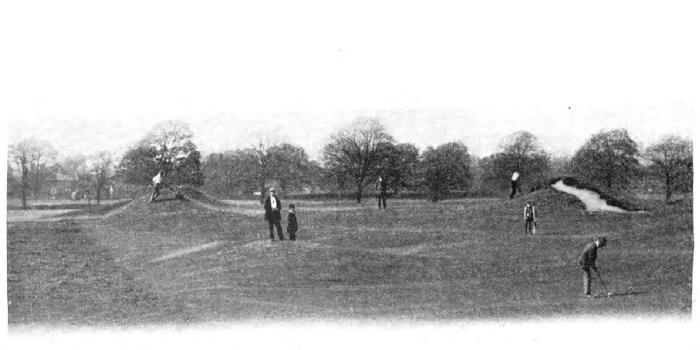
Economy in course construction consists
in obtaining the best possible results at a
minimum of cost. The more one sees of
golf courses, the more one realises the
importance of doing construction work
really well, so that it is likely to be of
a permanent character. It is impossible
to lay too much stress on the importance
of finality.
Every golfer knows examples of courses
which have been constructed and rearranged
over and over again, and the
fact that all over the country thousands
of pounds are frittered away in doing
bad work which will ultimately have to
be scrapped is particularly distressful to
a true economist. As an example of
unnecessary labour and expense, the writer
has in mind a green which has been
entirely relaid on four different occasions.
In the first instance, it was of the ridge
and furrow type; the turf was then
lifted and it was made dead flat. A new
secretary was appointed, and he made
it a more pronounced ridge and furrow
than ever; it was then relaid and made
flat again, and has now been entirely
reconstructed with undulations of a more
natural outline and appearance.
In discussing the question of finality,
it is well to inquire if there are any really
first-class courses in existence which have
been unaltered for a considerable number
of years and still remain, not only a
good test of golf, but a source of pleasure
to all classes of players. Is there any
existing course which not even the rubber
cored ball has spoilt? And, if so, what
is the cause of its abiding popularity?
The only one I know of is one which has
been described as “a much-abused old
course at a little place called St. Andrews,
in the Kingdom of Fife.” This (as well
as some of the other championship courses
to a lesser extent) still retains its popularity
among all classes of amateurs. In
fact, it is characteristic of all the best
courses that they are just as pleasurable
(possibly even more so) to the long handicap
man as to the player of championship
rank. This fact knocks on the head
the argument which is often used that
the modern expert tries to spoil the
pleasure of the player by making courses
too difficult.
The successful negotiation of difficulties
is a source of pleasure to all classes of
players.
It may be asked, “Who originally
constructed St. Andrews?” Its origin
appears to be shrouded in mystery:
like Topsy, in Uncle Tom’s Cabin, it
simply “growed.” But the fact of the
matter is that St. Andrews differs from
others in that it has always been deemed
a sacrilege to interfere with its natural
beauties, and it has been left almost untouched
for centuries. No green-keeper has
ever dared to shave down its natural undulations.
Most of the bunkers have been left
where nature placed them, and others have
originated from the winds and the rains
enlarging divot marks left by the players,
and some of them possibly by the green-keepers
converting those hollows where
most players congregated, into bunkers,
owing to the difficulty of keeping them
free from divot marks. The bunkers at
St. Andrews are thus placed in positions
where players are most likely to go—in
fact, in the precise positions which the
ordinary Green Committee would suggest
should be filled up. This is a significant
fact, and tends to show that many of
our existing ideas in regard to hazards
have been erroneous. Mr. John L. Low
pointed out years ago that no hazard
is unfair wherever it is placed, and this
particularly applies if the hazard is visible,
as it should be obvious that if a player
sees a hazard in front of him and promptly
planks his ball into it he has chosen the
wrong spot.
I once heard a Yorkshire tale of
an old farmer finding a man in his
coal-house during a recent coal strike.
He put his head through the window
and said, “Now I’ve copped you picking
out all the big lumps.” A voice from
the darkness came, “You’re a liar, I’m
taking them as they come.”
On the old type of course like St.
Andrews, the players have to take the
hazards as they come, and do their best
to avoid them.
There is nothing new about the ideas
of the so-called Golf Architect: he simply
wishes to reproduce the old ideas as
exemplified in the old natural courses
like St. Andrews, those courses which
were played on before over-zealous green
committees demolished the natural undulations
of the fairways and greens,
and made greens like lawns for croquet,
tennis, or anything else except golf, and
erected eyesores in the shape of straight
lines of cop bunkers, instead of emphasising
the natural curves of the
links.
In the old view of golf, there was no
main thoroughfare to the hole: the player
had to use his own judgment without
the aid of guide posts, or other adventitious
means of finding his way. St.
Andrews still retains the old traditions
of golf. For example, I have frequently
seen four individuals playing the long hole
(the fourteenth), and deliberately attacking
it in four different ways, and three out
of the four were probably right in playing
it in the ways they selected.
At St. Andrews “it needs a heid to
play gowf,” as the caddie said to the
professor.
As the truest economy consists in finality,
it is interesting to consider the essential
features of an ideal golf course. Some of
them are suggested now:
1. The course, where possible, should
be arranged in two loops of nine holes.
2. There should be a large proportion
of good two-shot holes, two or three
drive-and-pitch holes, and at least four
one-shot holes.
3. There should be little walking between
the greens and tees, and the course
should be arranged so that in the first
instance there is always a slight walk
forwards, from the green to the next tee;
then the holes are sufficiently elastic to
be lengthened in the future if necessary.
4. The greens and fairways should be
sufficiently undulating, but there should
be no hill climbing.
5. Every hole should have a different
character.
6. There should be a minimum of blindness
for the approach shots.
7. The course should have beautiful
surroundings, and all the artificial features
should have so natural an appearance
that a stranger is unable to distinguish
them from nature itself.
8. There should be a sufficient number
of heroic carries from the tee, but the
course should be arranged so that the
weaker player with the loss of a stroke
or portion of a stroke shall always
have an alternative route open to him.
9. There should be infinite variety in
the strokes required to play the various
holes—viz., interesting brassy shots, iron
shots, pitch and run-up shots.
10. There should be a complete absence
of the annoyance and irritation caused
by the necessity of searching for lost
balls.
11. The course should be so interesting
that even the plus man is constantly
stimulated to improve his game in attempting
shots he has hitherto been unable
to play.
12. The course should be so arranged
that the long handicap player, or even
the absolute beginner, should be able
to enjoy his round in spite of the fact
that he is piling up a big score.
13. The course should be equally good
during winter and summer, the texture
of the greens and fairways should be
perfect, and the approaches should have
the same consistency as the greens.
In regard to the first three principles,
there can be little difference of opinion.
It is a considerable advantage that a course
should be arranged in two loops of nine
holes, as on a busy day players can
commence at either the first or tenth tee.
In regard to the fourth principle. It
used to be a common fallacy that greens
should be made dead flat. Even on some
of the best golf courses at the present
day you find them made like croquet
lawns. There has been somewhat of a
reaction lately against undulating greens,
but this, I believe, is entirely due to
the fact that the undulations have been
made of a wrong character, either
composed of finicky little humps or of
the ridge and furrow type. Natural undulations
are the exact opposite to the
artificial ridge and furrow. The latter
has a narrow hollow, and a broad ridge,
whereas the former has a large, bold,
sweeping hollow, and a narrow ridge.
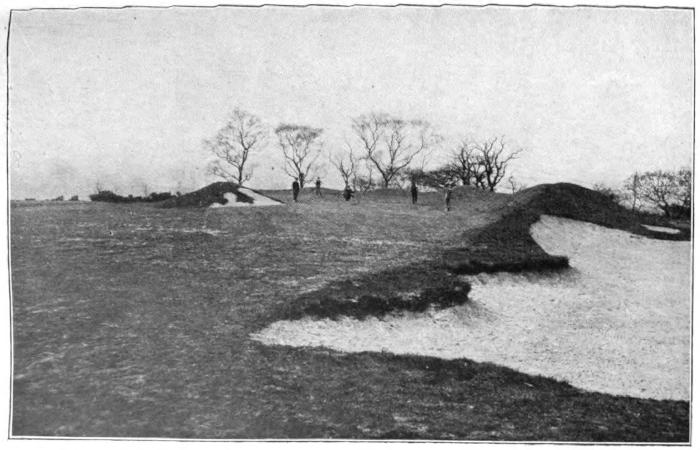
The sixteenth green at Headingley, Leeds—approximate
cost £50: an entirely artificial hole; the site was originally on a
severe downhill slope and had to be cut out of rock.
The most interesting putting the writer
has ever seen is on the Ladies’ Putting
Course at St. Andrews. Even first-class
golfers consider it a privilege to be
invited there, and are to be found putting
with the greatest enthusiasm from
early morn till late at night. There the
undulations are of the boldest possible
type, large sweeping hollows rising abruptly
four or five feet up to small plateaus.
A modern golf architect who dared to
produce the boldness of these St. Andrews’
undulations could hardly hope to escape
hostile criticism.
In constructing natural-looking undulations
one should attempt to study the
manner in which those among the sand-dunes
are formed. These are fashioned by
the wind blowing up the sand in the form
of waves, which become gradually turfed
over in the course of time. Natural undulations
are, therefore, of a similar shape
to the waves one sees by the seashore,
and are of all kinds of shapes and sizes,
but are characterised by the fact that
the hollows between the waves are broader
than the waves themselves.
If undulations are made of this kind,
then there are always plenty of comparatively
flat places where the green-keeper
can put the flag, and there should
never be any necessity to cut the hole
on a slope.
A test of a good undulation is that it
should be easy to use the mowing machine
over it.
If undulations are made of the kind I
describe, it is hardly possible to make
them too large or too bold.
Perhaps the most aggravating type
of undulation is the finicky little hump
or side-slope which you don’t see until
after you have missed your putt, and
then begin to wonder why it has not gone
in the hole.
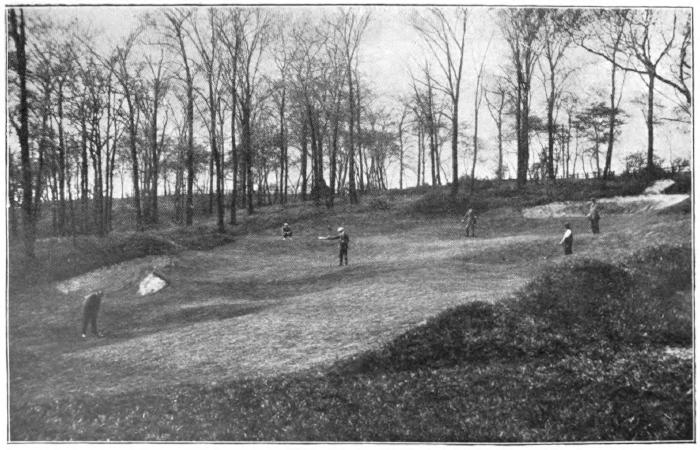
The home green at Sitwell Park: An undulating
green with a wide choice of places for the hole in the hollows or on the
flat.
An almost equally common delusion
is that fairways should be flat. I quite
agree that there is nothing worse than
a fairway on a severe side-slope, but,
on the other hand, there are few things
more monotonous than playing every
shot from a dead flat fairway. The
unobservant player never seems to realise
that one of the chief charms of the best
seaside links is the undulating fairways,
such as those near the club-house at
Deal, part of Sandwich, and most of the
old course at St. Andrews, where the
ground is a continual roll from the first
tee to the last green, and where one never
has the same shot to play twice; on these
fairways one hardly ever has a level
stance or a level lie. It is this that makes
the variety of a seaside course, and variety
is everything in golf.
If one considers St. Andrews hole by
hole, it is surprising to find at how many
of them the dominating and important
incident is associated with an insignificant-looking
hollow or bank, often running
obliquely to the line of your approach.
In constructing undulations of this kind
on inland courses, it is well to make them
with as much variety as possible, and in
the direction you wish the player to
go to keep the fairway comparatively
flat, so as to encourage players to place
their shots, and thus get in a favourable
position for their next.
In this connection plasticine is frequently
used for making models of undulations.
Plasticine is useful to teach
the green-keeper points in construction
he would not otherwise understand—in
fact, I believe, I was the first designer
of golf courses to use it for this purpose.
The 14th green at Alwoodley, which was
the first one made there, was constructed
from a model in plasticine. It has its
disadvantages, however, as a course constructed
entirely from models in plasticine
has always an artificial appearance,
and can never be done as cheaply as
one in which the green-keeper is allowed
a comparatively free hand in modelling
the undulations in such a manner that
not only do they harmonise with their
surroundings, but are constructed according
to the various changes in the subsoil
discovered whilst doing the work.
In regard to the fifth principle that
every hole should have a different character.
A common mistake is to follow
prevailing fashions. At first we had
the artificial cop bunkers extending in
a dead straight line from the rough on
one side to the rough on the other; in
modern course architecture these are fortunately
extinct. Secondly, we had the
fashion of pot bunkers running down each
side of the course. This was, if anything,
an even more objectionable type of golf
than the last. Thirdly, we have had
what has been called the alpinisation
of golf courses.
In this connection I would point out
that green-keepers should be careful not
to make hillocks so high in the direct
line to the hole that they block out
the view: a little to one side of the bee
line they may be made as high as one
pleases, but in the direct line hollows
should, as a rule, take the place of hillocks.
This is the exact opposite to what is
found on many golf courses, where the
hollows are at the sides and the banks
in the middle.
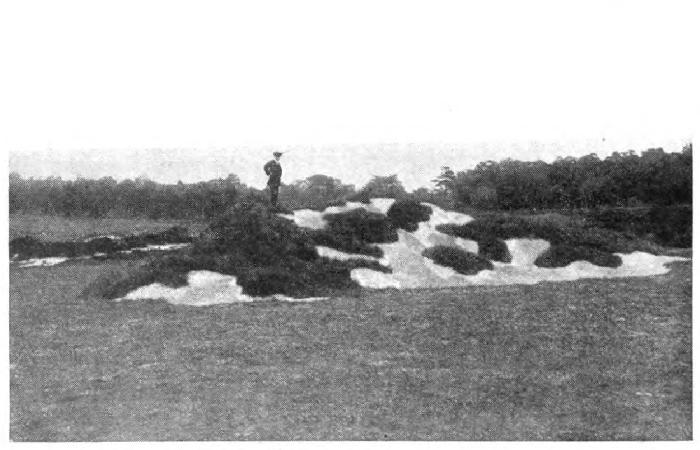
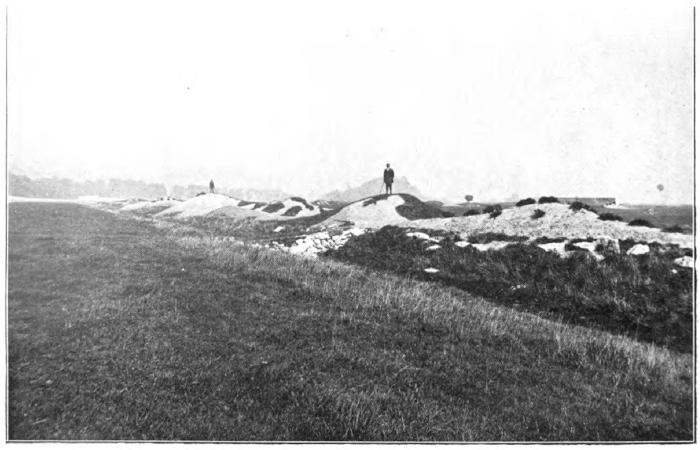
Artificial hummock at Moortown, constructed from the
stones removed from the fairway.
The great thing in constructing golf
courses is to ensure variety and make everything
look natural. The greatest compliment
that can be paid to a green-keeper
is for players to think his artificial work
is natural. On Alwoodley and Moortown
practically every green and every hummock
has been artificially made, and yet
it is difficult to convince the stranger
that this is so. I remember a chairman
of the Green Committee of one of the
best-known clubs in the North telling
me that it would be impossible to make
their course anything like Alwoodley, as
there we had such a wealth of natural
hillocks, hollows, and undulations. It was
only with great difficulty that I was able
to persuade him that, to use an Irishism,
these natural features which he so much
admired had all been artificially created.
I have even heard one of the members of
our own Green Committee telling a well-known
writer on golf that the hummocks
surrounding one of our greens had always
been there: he himself had forgotten
that he had been present when the site
for them had been pegged out.
It is not nearly as common an error
to make blind holes as formerly. A blind
tee shot may be forgiven, or a full shot
to the green on a seaside course, when the
greens can usually be located accurately
by the position of the surrounding hummocks,
but an approach shot should
never be blind, as this prevents an
expert player, except by a fluke, from
placing his approach so near the hole that
he gets down in one putt.
Blind holes on an inland course where
there are no surrounding sandhills to
locate the green should never be permitted,
but an even more annoying form
of blindness is that which is so frequent
on inland courses—that is, when the
flag is visible but the surface of the
green cannot be seen. On a green
of this description no one can possibly
tell whether the flag is at the back,
middle, or front of the green, and it is
particularly aggravating to play your shot
expecting to find it dead, and to discover
that your ball is at least twenty yards
short.
On a seaside course there may be a
certain amount of pleasurable excitement
in running up to the top of a hillock
in the hope of seeing your ball near the
flag, but this is a kind of thing one gets
rather tired of as one grows older.
Another common erroneous idea is that
beauty does not matter on a golf course.
One often hears players say that they
don’t care a “tinker’s cuss” about their
surroundings: what they want is good golf.
One of the best-known writers on golf has
recently been jeering at golf architects
for attempting to make beautiful bunkers.
If he prefers ugly bunkers, ugly greens,
and ugly surroundings generally he is
welcome to them, but I don’t think for
an instant that he believes what he is
writing about, for at the same time he talks
about the beauties of natural courses. The
chief object of every golf architect or green-keeper
worth his salt is to imitate the
beauties of nature so closely as to make
his work indistinguishable from nature
itself.
I haven’t the smallest hesitation in
saying that beauty means a great deal
on a golf course; even the man who
emphatically states he does not care a
hang for beauty is subconsciously influenced
by his surroundings. A beautiful hole
not only appeals to the short handicap
player but also to the long, and there
are few first-rate holes which are not at
the same time, either in the grandeur of
their undulations and hazards, or the
character of their surroundings, beautiful
holes.
It is not suggested that we should all
play round the links after the manner of
the curate playing with the deaf old
Scotsman.
The curate was audibly expressing his
admiration of the scenery, the greens,
and things in general, until they finally
arrived at a green surrounded by a rookery.
The curate remarked, “Isn’t it delightful
to hear the rooks?” The deaf old Scotsman
said, “What’s that?” The curate
again remarked, “Isn’t it delightful to
hear the rooks?” The old Scotsman
replied, “I can’t hear a word you’re
saying for those damned crows.”
The finest courses in existence are
natural ones. Such courses as St. Andrews,
and the championship courses
generally, are admitted to provide a
fine test of golf. It is by virtue of
their natural formation that they do so.
The beauty of gold courses has suffered
in the past from the creations of ugly
and unimaginative design. Square, flat
greens and geometrical bunkers have not
only been an eyesore upon the whole
landscape, but have detracted from the
infinite variety of play which is the heritage
of the game.
My reputation in the past has been
based on the fact that I have endeavoured
to conserve existing natural features, and
where these are lacking to create formations
in the spirit of nature herself.
In other words, while always keeping
uppermost the provision of a splendid
test of golf, I have striven to achieve
beauty.
It may at first appear unreasonable
that the question of æsthetics should
enter into golf-course design; however,
on deeper analysis, it becomes clear that
the great courses, and in detail all the
famous holes and greens, are fascinating
to the golfer by reason of their shape,
their situation, and the character of their
modelling. When these elements obey
the fundamental laws of balance, of harmony,
and fine proportion they give rise
to what we call beauty. This excellence
of design is more felt than fully realised
by the player, but nevertheless it is
constantly exercising a subconscious influence
upon him, and in course of time
he grows to admire such a course as all
works of beauty are eventually felt and
admired.
Most of the remaining principles depend
on the proper disposition of hazards,
and I have a rather wider definition of
hazards than is given by the rules of
Golf Committee. As a minor kind of
hazard undulating ground, hummocks,
hollows, etc., might be included.
Most golfers have an entirely erroneous
view of the real object of hazards. The
majority of them simply look upon hazards
as a means of punishing a bad shot, when
their real object is to make the game interesting.
The attitude of the ordinary golfer
towards hazards may be illustrated by
the following tale which I have frequently
told before, but which will bear repeating:
A player visiting a Scotch course asked
his caddie what the members thought
of a stream which was winding in and out
between several of the holes. The caddie
replied, “Weel, we’ve got an old Scotch
major here. When he gets it ower he
says, ‘Weel ower the bonnie wee burn,
ma laddie’; but when he gets in he
says, ‘Pick ma ball oot o’ that domned
sewer.’”
The writer was recently playing with
his brother, who was home on leave
from abroad. He was clearly enjoying
his game, but at Alwoodley we have
one solitary pond into which he topped
three balls. On arriving at the club-house
he was asked how he liked the course;
he simply remarked, “There were too many
ruddy ponds about.”
It is much too large a subject to go
into the question of the placing of
hazards, but I would like to emphasise a
fundamental principle. It is that, as already
pointed out, no hazard is unfair
wherever it is placed.
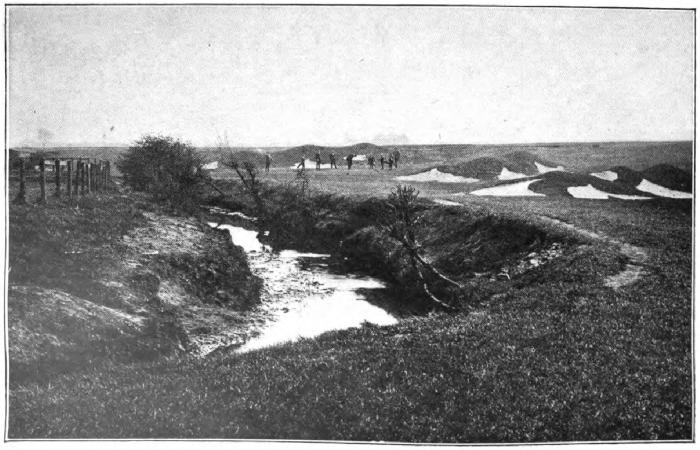
The fifteenth hole on the City of Newcastle
course: constructed on flat, featureless clay land.
A hazard placed in the exact position
where a player would naturally go is
frequently the most interesting situation,
as then a special effort is needed to get
over or avoid it.
One of the objects in placing hazards
is to give the players as much pleasurable
excitement as possible. On many inland
courses there is not a thrill on the
whole round, and yet on some of the championship
courses one rarely takes a club
out of the bag without having an interesting
shot to play. This particularly applies
to the old course at St. Andrews, and is
one of the reasons why it always retains
its popularity with all classes of players.
It is quite true that even this course is
condemned by some, but this may be
due to the fact that they have not brains
enough, or have not played on it long
enough, to appreciate its many virtues.
There are some leading players who
honestly dislike the dramatic element in
golf. They hate anything that is likely
to interfere with a constant succession
of threes and fours. They look upon
everything in the “card and pencil”
spirit. The average club member on the
other hand is a keen sportsman, he looks
upon golf in the “spirit of adventure,”
and that is why St. Andrews and courses
modelled on similar ideals appeal to him.
No one would pretend that the old
course at St. Andrews is perfect: it
has its disadvantages, particularly in the
absence of long carries from the tee, and
in its blind bunkers, but no links in
the world grows upon all classes of players
in the same manner. The longer one
plays there the keener one gets, and this
is a much truer test of a good course than
one which pleases at first and is boring
later on.
A good golf course is like good music
or good anything else; it is not necessarily
a course which appeals the first time one
plays over it, but one which grows on the
player the more frequently he visits it.
St. Andrews is a standing example of
the possibility of making a course which
is pleasurable to all classes of golfers,
not only to the thirty handicap players,
but to the plus fourteen man, if there ever
was or will be such a person.
It is an interesting fact that few hazards
are of any interest which are out of what
is known among medical men as the direct
field of vision. This does not extend
much farther than ten to twenty yards
on either side of the direct line to the
hole. Hazards placed outside this limit
are usually of little interest, but simply
act as a source of irritation.
Hazards should be placed with an object,
and none should be made which has not
some influence on the line of play to the
hole.
On many courses there are far too many
bunkers: the sides of the fairways are
riddled with them, and many of these
courses would be equally interesting if
half of the bunkers were turfed over as
grassy hollows.
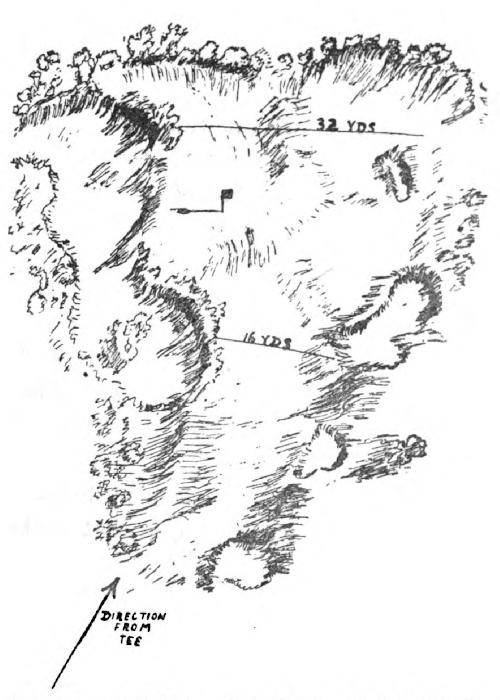
It is often possible to make a hole
sufficiently interesting with one or two
bunkers at the most. For example:
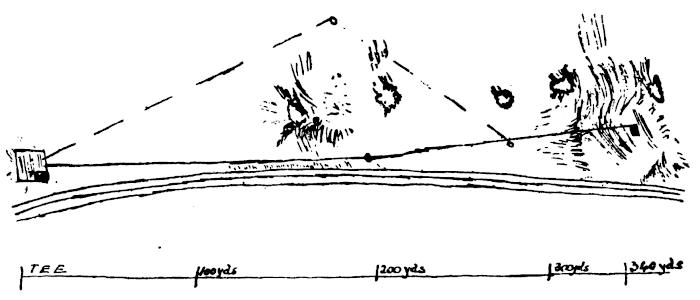
It is obvious from the diagram that
the green-guarding bunker B has a considerable
influence on the line of play
to the hole.
The longer the carry a player achieves
over the stream the easier his second
shot becomes.
If it were not for this bunker not only
the approach but the tee shot would be
uninteresting, as there would be no object
in essaying the long carry over the stream.
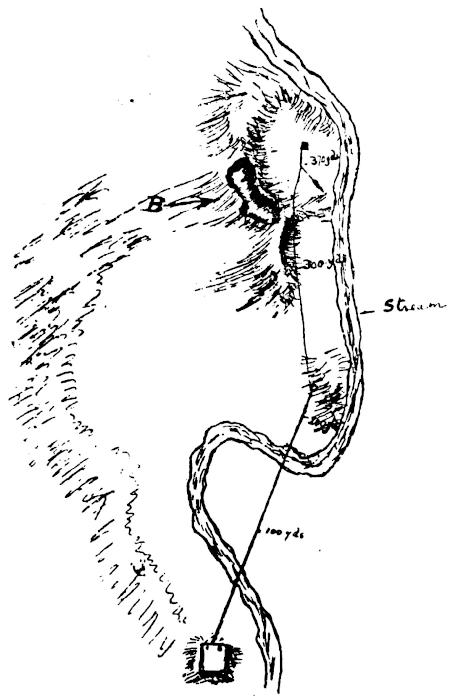
Diagram of hole of 370 yards, illustrating the value
of one bunker, B. Any additional bunker for the tee shot or across
the approach to the green would materially lessen the interest of the
hole. The moral is “Few bunkers placed in interesting positions!”
Many poor golf courses are made in
a futile attempt to eliminate the element
of luck. You can no more eliminate luck
in golf than in cricket, and in neither
case is it possible to punish every bad
shot. If you succeeded you would only
make both games uninteresting.
There are many points of resemblance
between cricket and golf: the fielders
in cricket correspond to the hazards at
golf. The fielders are placed in the
positions where the majority of shots
go, and it should obviously be easier
with a stationary ball to avoid the
hazards than to avoid the fielders at
cricket.
In both games it is only a proportion
of bad shots that get punished, but
notwithstanding this the man who is playing
the best game almost invariably comes
out on top.
It is an important thing in golf to make
holes look much more difficult than they
really are. People get more pleasure in
doing a hole which looks almost impossible,
and yet is not so difficult as it
appears.
In this connection it may be pointed
out that rough grass is of little interest
as a hazard. It is frequently much more
difficult than a fearsome-looking bunker
or belt of whins or rushes, but it causes
considerable annoyance in lost balls, and
no one ever gets the same thrills in driving
over a stretch of rough as over a
fearsome-looking bunker, which in reality
may not be so severe.
Narrow fairways bordered by long grass
make bad golfers. They do so by destroying
the harmony and continuity of the
game, and in causing a stilted and cramped
style by destroying all freedom of play.
There is no defined line between the
fairways in the great schools of golf like
St. Andrews or Hoylake.
It is a common error to cut the
rough in straight lines. It should be cut
in irregular, natural-looking curves. The
fairways should gradually widen out where
a long drive goes; in this way a long
driver is given a little more latitude in
pulling and slicing.
Moreover irregular curves assist a
player in locating the exact position of
a ball which has left the fairway and
entered the rough.
Hummocks and hollows should be made
of all sorts of different shapes and sizes,
and should have a natural appearance,
with plenty of slope at the bottom like
large waves. Most of the hummocks and
hollows should be made so smooth that
the mowing machine can be used over
them. The glorified mole-hills one sees
on many courses should be avoided.
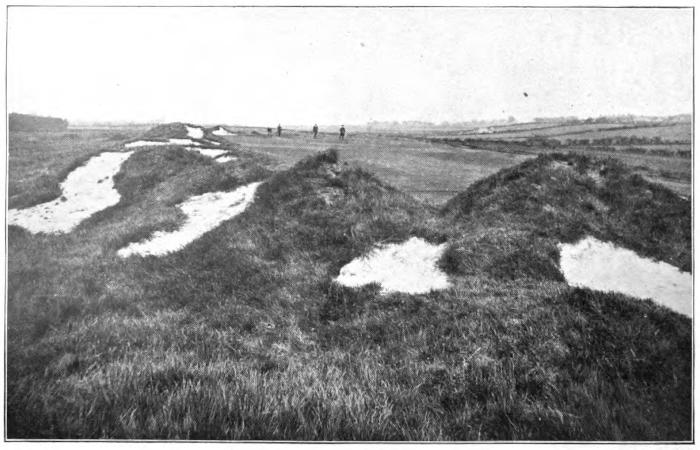
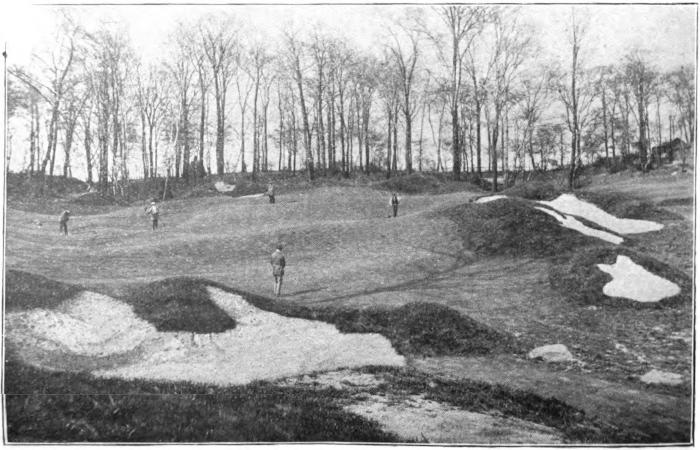
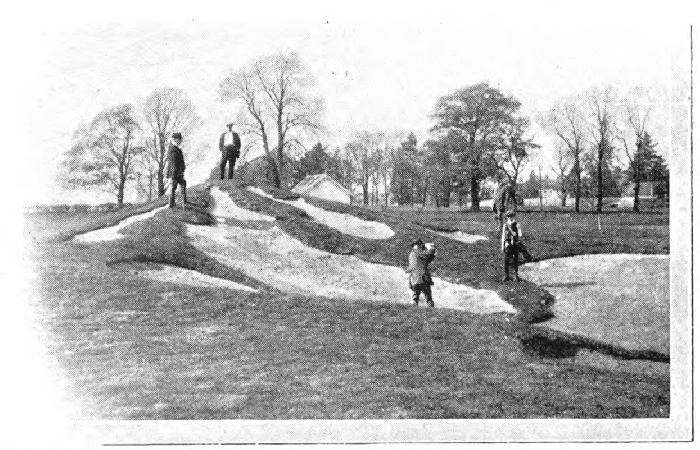
The artificial hummocks guarding the fifth green at
Alwoodley: approximate cost, £8.
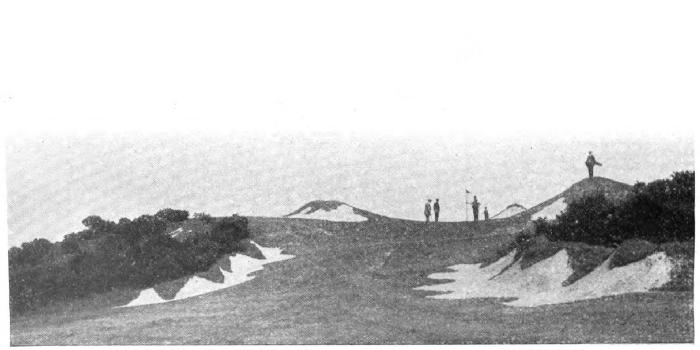
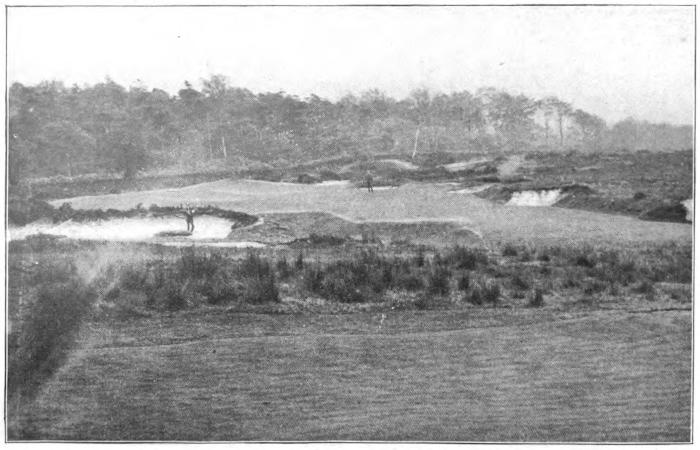
The best way of combining sand and hummocks, with the sand on the slope
of the hazard above the ground level.
Bunkers on an inland course should,
as a rule, be made in the opposite way to
what is customary. At the present time
most bunkers have the hollows sanded and
the banks turfed. It is suggested that
you get a much more natural appearance
if the hollows are partly turfed over and
the hummocks sanded, as in the photographs
in these pages. This has the following
advantages: the appearance is
much more like a seaside course; the
sand being above the level of the ground,
always remains dry. The contrast between
white or yellow sand and the grass
helps one to judge distances much more
accurately, and enables the ball to be
found more easily, and the great disadvantage
and expense of scything the long
grass on the hummocks to prevent lost
balls is done away with.
Ordinary bunkers are, as a rule, made
in quite the wrong way. The face is
usually too upright and the ball gets into
an unplayable position under the face.
The bottom of the bank of a bunker
should have a considerable slope, so that
a ball always rolls to the middle; the
top of a bunker may, as it usually does
in nature, be made to overhang a little
so as to prevent a topped ball running
through it.
Experience gained in the imitation of
natural slopes in bunker-making was ultimately
responsible for saving tens of
thousands of pounds in revetting material
in the great war.
Trenches with the sides made like a
bank of a stream with a considerable
slope at the bottom remained standing
without any revetting material.
Before this principle was pointed out
soldiers invariably dug their trenches with
a slope at the top, and as they got farther
down the sides became more vertical and
sometimes were even undercut. A trench
of this kind invariably fell in, whereas
those made vertical at the top with the
slope at the bottom did not do so.
Hazards are usually placed too far
away from the greens they are intended
to guard; they should be placed immediately
on the edge of the greens, and
then (particularly if they are in the form
of smooth hillocks and hollows) the player
who is wide of them has an extremely
difficult pitch, and is frequently worse
off than the man who is in them.
A bunker eating into a green is by far
the most equitable way of giving a golfer
full advantage for accurate play. It not
only penalises the man who is in it, but
every one who is wide of it. For example,
a player who is in the road bunker at
the seventeenth at St. Andrews may
with a good dunch shot get out and lie
dead, but few can pitch over it so accurately
that they do so. A bunker, similarly
placed to the road bunker, may be made
to accentuate this distinction; it may
be constructed with so much slope that
on occasions it can be putted out of.
Hummocks on the edge of greens are
often constructed so that they assist the
man who has opened up the hole correctly;
they act as a hazard only to those who
have failed to do this.
Perhaps the most serious mistake made
by a golf committee is the fallacy that
they will save money by neglecting to
obtain expert advice in regard to fresh
construction work.
Except where the course has been designed
and the construction work supervised
by the modern golf architect, there
is hardly a golf club of any size which has
not frittered away hundreds of pounds in
doing bad work, all for the want of the
best advice in the first instance.
There can be little doubt that the
poorer the club the more important it
is for it not to waste its small funds
in doing the wrong kind of work, but
to get the best possible advice from its
inception.
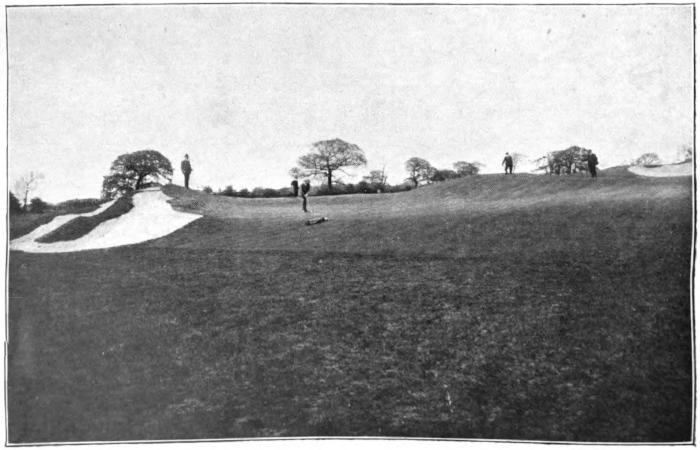
The seventeenth green at Harrogate: approximate cost
£180: an entirely artificial plateau green constructed on flat land.
The comparatively heavy cost is due to the character of the subsoil—heavy
clay.
I notice a well-known club, in forming
a golf course, state that the committee
have decided to lay it out themselves,
as they are afraid of a golf architect
making it too difficult for the average
player. Now this is precisely what the
modern golf architect does not do; he
in particular adopts a most sympathetic
attitude to the beginner and long handicap
player, but at the same time attempts
to make the course interesting to all
sorts and conditions of players. It is
characteristic of the modern architect
that he always leaves a broad and pleasurable
road that leads to destruction—that
is, sixes and sevens on the card of the
long handicap player—but a straight and
narrow path which leads to salvation—that
is, threes and fours for the plus
man.
The writer has just returned from a
most delightful sand-dune country which
he chose for his holiday in great part
owing to the fact that he had seen it before
and had also seen Mr. Colt’s plan for the
constructing of what should have been
the finest eighteen-hole course in England.
On arrival he found the secretary or
the committee had, through motives of
false economy, refrained from getting Mr.
Colt to supervise the work and had done
it themselves. The outcome was an expenditure
of three or four times as much
money as Mr. Colt would have needed,
the destruction of many of the beautiful
natural undulations and features which
were the making of Mr. Colt’s scheme,
the conversion of magnificent visible
greens into semi-blind ones, banked up
like croquet lawns, and a complete absence
of turf owing to wrong treatment, and
alterations in the placing of the tees,
bunkers, and greens, and a total disregard
of the beginner and the long handicap
player. On a seaside course in particular
little construction work is necessary; the
important thing is to make the fullest
possible use of existing features. £500
in labour expended under expert supervision
is better than £10,000 injudiciously
expended.
Surely in the case of a golf club it
is more important to have an architect
for the course, and any new work on the
course, than for the club-house. Much
greater mistakes are made in constructing
the former than in building the latter.
One can readily imagine what would
be the ultimate result of a course laid out
by an average committee composed of
scratch, three, four, and eight handicap
men. They are, most of them (probably
subconsciously), prejudiced against any
hazard being constructed which they are
likely to get into themselves, but they
are all unanimous in thinking that the
poor devil with a twenty-four handicap
should be left out of consideration altogether.
The final result is neither fish,
flesh, fowl, nor even good red herring.
The expert in golf architecture has to
be intimately conversant with the theory
of playing the game, but this has no
connection with the physical skill in
playing it. An ideal golf expert should
not only have a knowledge of botany,
geology, and particularly agricultural
chemistry, but should also have what
might be termed an artistic temperament
and vivid imagination. We all know that
there is nothing so fatal in playing golf
as to have a vivid imagination, but this
and a sufficient knowledge of psychology
to enable one to determine what is likely
to give the greatest pleasure to the greatest
number are eminently desirable in a
golf architect. The training of the expert
should be mental, not physical.
My last principle is one which particularly
affects the green-keeper:—the
course should be perfect all the year
round.
It is quite a prevalent idea that courses
on a clay subsoil can never be made into
good winter links. It does not matter
so much as might be expected, what
the subsoil is like, provided it is well
drained and the turf on the top is of the
right texture. Muddy courses are entirely
due to insufficient drainage, worms,
and the wrong kind of turf.
Worms can be got rid of and the right
kind of turf encouraged by adopting
modern methods of green-keeping. Many
examples of what can be done in converting
really bad winter courses into good
ones can be seen in the North. Surface
drainage, such as mole draining, gets rid
of worms by making the land so dry that
they cannot work.
A common mistake in green-keeping is
to imagine that because one form of
treatment benefits one course that it
will necessarily benefit another.
The green-keeper should have sufficient
knowledge of chemistry and botany to
be able to tell exactly what form of
treatment is most likely to benefit his
greens.
For example, the ordinary artificial
manure sold by some seeds merchants
for golf courses consists of a mixture of
three parts of superphosphate of lime,
one part each sulphate of ammonia
and sulphate of potash, and one-tenth
part of sulphate of iron. If no weeds
are present, the sulphate of iron may be
omitted from the mixture; if daisies are
present, the sulphate of ammonia should
be increased; if clover is present, the
potash and lime should be lessened in
quantity; if the turf is sour, or if sorrel
is present, the sulphate of ammonia should
be lessened, and lime used as a separate
dressing.
Farmyard manure should not, as a rule,
be used as a surface dressing on golf
courses: it is much too likely to encourage
weeds and worms.
Something of the nature of Peruvian
guano, fish guano, meat guano, malt
culms, or dried blood, together with artificials,
should be used in its place. If
humus is necessary, it may be added in
the form of peat moss litter, minced
seaweed, etc., and the box should seldom
be used on the mowing machines.
It must be borne in mind that the turf
required on a golf course is entirely
different to that required from a farming
point of view.
It is now an absolutely exploded fallacy
that worms are of any use on a golf
course; they should be got rid of by the
use of charcoal obtained from steel furnaces:
ordinary wood charcoal is almost
useless. Charcoal in this form acts mechanically,
owing to the small sharp pieces
of steel attached to it: it scratches the
worms and prevents them getting through.
Worm-killers, especially those consisting
of Mowrah Meal, are of great value in destroying
worms.
It is a mistake to consider that worm-killers,
unless mixed with an artificial
manure, have any manurial value. The
green-keeper will tell you that after the
application the grass has come up much
greener. That is due to the fact that
the worms are no longer discolouring
it by crawling over it with their slimy
bodies.
A common mistake is not to mow
greens during the winter months. I have
not the slightest doubt that mowing greens
during the winter months is beneficial
to them: it keeps the grass from becoming
coarse.
On those Scotch courses where the greens
are so good all through the winter, are
not the rabbits mowing the greens all
through the winter months?
Are the knives of the mowing machine
any more likely to do the grass harm than
the teeth of the rabbits?
It is a common mistake in sowing a
green not to use a sufficient quantity of
seed. The ground should always be
thoroughly prepared and manured according
to the chemical composition of
the soil; then as much as five or six
bushels of seed per green can be sown to
advantage.
Mixtures of grass seeds may be sold
consisting of a considerable proportion
of seeds which do not germinate, and are
not likely to do so, on ordinary soils.
Unscrupulous seeds merchants may undercut
the more honest ones in this way. Three
bushels of the best seeds will go further
than six containing a large proportion
of varieties which are not likely to germinate.
In concluding this chapter on General
Principles, it may be pointed out that,
although many of these ideas may appear
revolutionary, the reader may be assured
that their success under varying conditions
has been proved in practice.
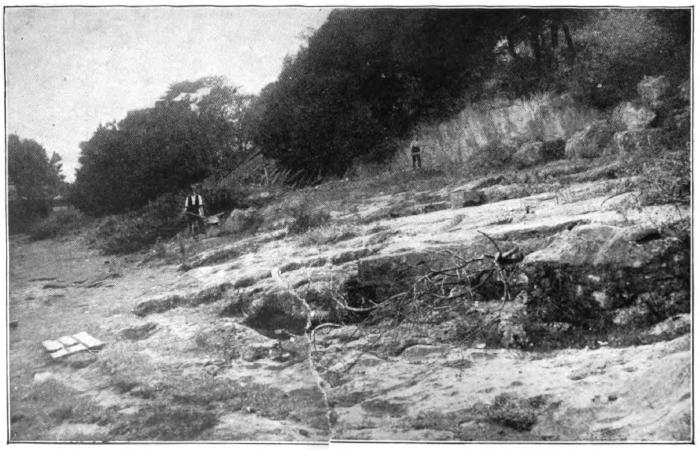
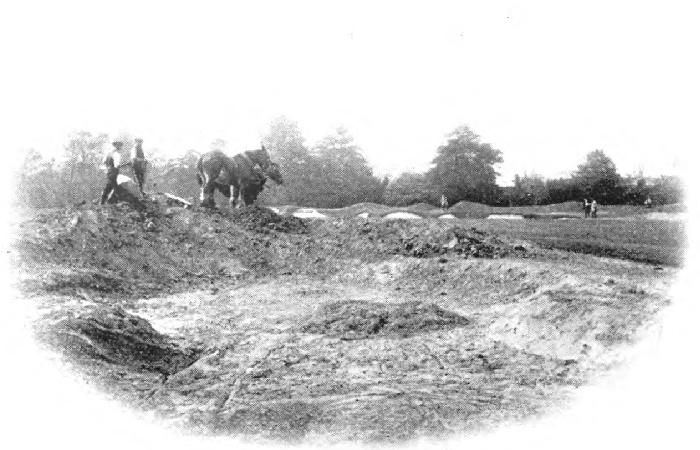
Grange-over-Sands: the site of one of the greens
on the rocks near the boundary of the course—work just beginning.
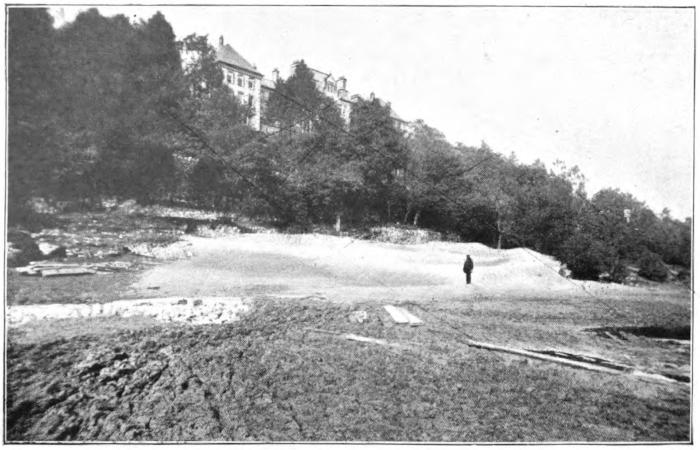
Grange-over-Sands: ready for turfing—a green
constructed on rocks.