Life at the front is not organized like a business office, with sharply
defined duties for each worker. War is raw and chaotic, and you take
hold wherever you can lock your grip. We women that joined the Belgian
army and spent a year at the front, did duty as ambulance riders, "dirty
nurses," in a Red Cross rescue station at the Yser trenches, in relief
work for refugees, and in the commissariat department. We tended wounded
soldiers, sick soldiers, sick peasants, wounded peasants, mothers,
babies, and colonies of refugees.
This war gave women one more chance to prove themselves. For the first
time in history, a few of us were allowed through the lines to the front
trenches. We needed a man's costume, steady masculine nerves, physical
strength. But the work itself became the ancient work of woman—nursing
suffering, making a home for lonely, hungry, dirty men. This new thrust
of womanhood carried her to the heart of war. But, once arriving there,
she resumed her old job, and became the nurse and cook and mother to
men. Woman has been rebelling against being put into her place by man.
But the minute she wins her freedom in the new dramatic setting, she
finds expression in the old ways as caretaker and home-maker. Her
rebellion ceases as soon as she is allowed to share the danger. She is
willing to make the fires, carry the water, and do the washing, because
she believes the men are in the right, and her labor frees them for
putting through their work.
It all began for me in Paris. I was studying music, and living in the
American Art Students' Club, in the summer of 1914. That war was
declared meant nothing to me. There was I in a comfortable room with a
delightful garden, the Luxembourg, just over the way. That was the first
flash of war. I went down to the Louvre to see the Venus, and found the
building "Fermé." I went over to the Luxembourg Galleries—"Fermé,"
again—and the Catacombs. Then it came into my consciousness that all
Paris was closed to me. The treasures had been taken away from me. The
things planned couldn't be done. War had snatched something from me
personally.
Next, I took solace in the streets. I had to walk. Paris went mad with
official speed—commandeered motors flashed officers down the boulevards
under martial law. They must get a nation ready, and Paris was the
capital. War made itself felt, still more, because we had to go through
endless lines,—permis de sejours at little police stations—standing
on line all day, dismissed without your paper, returning next morning.
Friends began to leave Paris for New York. I was considered queer for
wishing to stay on. The chance to study in Paris was the dream of a
lifetime. But, now, the sound of the piano was forbidden in the city,
and that made the desolation complete. Work and recreation had been
taken away, and only war was left. And when Marie, our favorite maid in
the club, sent her husband, our doorkeeper, to the front, that brought
war inside our household.
As the Germans drew near Paris, many of the club girls thought that they
would be endangered. Every one was talking about the French Revolution.
People expected the horrors of the Revolution to be repeated. Jaures had
just been shot, the syndicalists were wrecking German milk shops, and at
night the streets had noisy mobs. People were fearing revolution inside
Paris, more than the enemy outside the city gates. War was going to let
loose that terrible thing which we believed to be subliminal in the
French nature.
Women had to be off the streets before nine o'clock. By day we went up
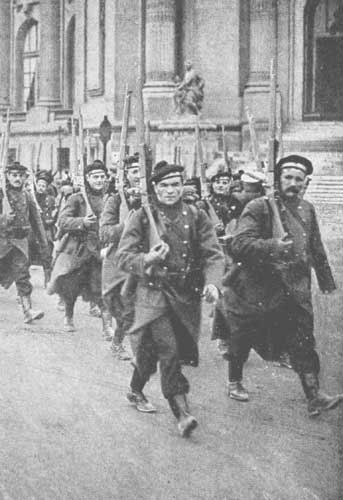
the block to the Boulevard, and there were the troops—a band, the
tricolor, the officers, the men in sky blue. Their sweethearts, their
wives and children went marching hand in hand with them, all singing the
"Marseillaise." In a time like that, where there is song, there is
weeping. The marching, singing women were sometimes sobbing without
knowing it, and we that were watching them in the street crowd were
moved like them.
When I crossed to England, I found that I wanted to go back and have
more of the wonder of war, which I had tasted in Paris. The wonder was
the sparkle of equipment. It was plain curiosity to see troops line up,
to watch the military pageant. There I had been seeing great handsome
horses, men in shining helmets with the horsehair tail of the casque
flowing from crest to shoulder, the scarlet breeches, the glistening
boots with spurs. It was pictures of childhood coming true. I had hardly
ever seen a man in military uniform, and nothing so startling as those
French cuirassiers. And I knew that gay vivid thing was not a passing
street parade, but an array that was going into action. What would the
action be? It is what makes me fond of moving pictures—variety, color,
motion, and mystery. The story was just beginning. How would the plot
come out?
Those pictures of troops and guns, grouping and dissolving, during all
the twelve months in Flanders, never failed to grip. But rarely again
did I see that display of fine feathers. For the fighting men with whom
I lived became mud-covered. Theirs was a dug-in and blown-out existence,
with the spatterings of storm and black nights on them. Their clothing
took on the soberer colors and weather-worn aspect of the life itself
which was no sunny boulevard affair, but an enduring of wet trenches and
slimy roads. Those people in Paris needed that high key to send them
out, and the early brilliance lifted them to a level which was able to
endure the monotony.
I went to the war because those whom I loved were in the war. I wished
to go where they were.
Finally, there was real appeal in that a little unprotected lot of
people were being trampled.
I crossed in late September to Ostend as a member of the Hector Munro
Ambulance Corps. With us were two women, Elsie Knocker, an English
trained nurse, and Mairi Chisholm Gooden-Chisholm, a Scotch girl. There
were a round dozen of us, doctors, chauffeurs, stretcher bearers. Our
idea of what was to be required of women at the front was vague. We
thought that we ought to know how to ride horseback, so that we could
catch the first loose horse that galloped by and climb on him. What we
were to do with the wounded wasn't clear, even in our own minds. We
bought funny little tents and had tent practice in a vacant yard. The
motor drive from Ostend to Ghent was through autumn sunshine and beauty
of field flowers. It was like a dream, and the dream continued in Ghent,
where we were tumbled into the Flandria Palace Hotel with a suite of
rooms and bath, and two convalescing soldiers to care for us. We looked
at ourselves and smiled and wondered if this was war. My first work was
the commissariat for our corps.
Then came the English Naval Reserves and Marines en route to Antwerp.
They had been herded into the cars for twelve hours. They were happy to
have great hunks of hot meat, bread, and cigarettes. Just across the
platform, a Belgian Red Cross train pulled in—nine hundred wounded men,
bandaged heads with only the eyes showing, stumps of arms flapping a
welcome. The Belgians had been shot to pieces, holding the line. And,
now, here were the English come to save them.
This looked more like war to us. From the Palace windows we hung out
over the balcony to see the Taubes. I knew that at last we were on the
fringes of war. Later, we were to be at the heart of it. It was at Melle
that I learned I was on the front lines.
We went up the road from Ghent to Melle in blithe ignorance, we three
women. The day before, the enemy had held the corner with a machine gun.
"Let's go on foot, and see where the Germans were," suggested "Scotch."
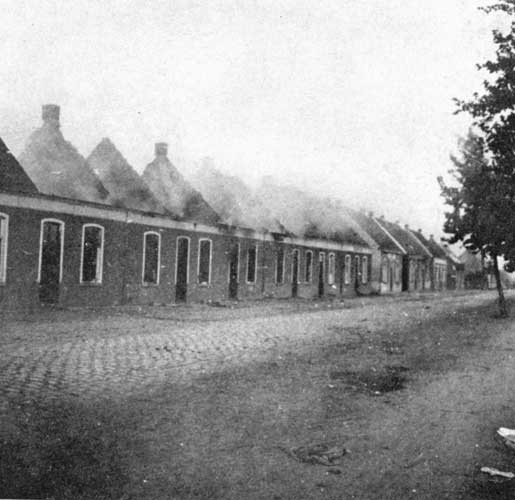
We came to burned peasants' houses. Inside the wreckage, soldiers
crouched with rifles ready at the peek-holes. A Reckitt's bluing factory
was burning, and across the field were the Germans. The cottages without
doors and windows were like toothless old women. Piles of used
cartridges were strewed around. There stood a gray motor-car, a wounded
German in the back seat, his hands riddled, the car shot through, with
blood in the bottom from two dead Germans. I realized the power of the
bullet, which had penetrated the driver, the padded seat, the sheet
metal and splintered the wood of the tonneau. We saw a puff of white
smoke over the field from a shrapnel. That was the first shell I had
seen close. It meant nothing to me. In those early days, the hum of a
shell seemed no more than the chattering of sparrows. That was the way
with all my impressions of war—first a flash, a spectacle; later a
realization, and experience.
I went into Alost during a mild bombardment. The crashing of timbers was
fascinating. It is in human nature to enjoy destruction. I used to love
to jump on strawberry boxes in the woodshed and hear them crackle. And
with the plunge of the shells, something echoed back to the delight of
my childhood. I enjoyed the crash, for something barbaric stirred. There
was no connection in my mind between the rumble and wounded men. The
curiosity of ignorance wanted to see a large crash. Shell-fire to me was
a noise.
I still had no idea of war. Of course I knew that there would be hideous
things which I didn't have in home life. I knew I could stand up to
dirty monotonous work, but I was afraid I should faint if I saw blood.
When very young, I had seen a dog run over, and I had seen a boy
playmate mutilate a turtle. I was sickened. Years later, I came on a
little child crying, holding up its hand. The wrist was bent back
double, and the blood spurting till the little one was drenched. Those
shocks had left a horror in me of seeing blood. But this thing that I
feared most turned out not to have much importance. I found that the man
who bled most heavily lay quiet. It was not the bloodshed that unnerved
me. It was the writhing and moaning of men that communicated their pain
to me. I seemed to see those whom I loved lying there. I transferred the
wound to the ones I love. Sometimes soldiers gave me the address of wife
and mother, to have me write that they were well. Then when the wounded
came in, I thought of these wives and mothers. I knew how they felt,
because I felt so. I knew, as the Belgian and French women know, that
the war must be waged without wavering, and yet I always see war as
hideous. There was no glory in those stricken men. I had no fear of
dying, but I had a fear of being mangled.
One evening I walked into the Convent Hospital where the wounded lay so
thickly that I had to step over the stretcher loads. The beds were full,
the floor blocked, only one door open. There was a smell of foul blood,
medicines, the stench of trench clothes. It came on an empty stomach, at
the end of a tired day.
"Sister, will you hold this lamp?" a nurse said to me.
I held it over a man with a yawning hole in his abdomen. He lay
unmurmuring. When the doctor pressed, the muscles twitched. I asked some
one to hold the lamp. I went into the courtyard, and fainted. Hard work
would have saved me.
One other time, there had been a persistent fire all day. A boy of
nineteen was brought in screaming. He wanted water and he wanted his
mother. In our dressing station room were crowded two doctors, three
women, two stretcher bearers, a chauffeur, and ten soldiers. They cut
away his uniform and boots. His legs were jelly, with red mouths of
wounds. His leg gave at the knee, like a piece of limp twine. I went
into the next room, and recovered myself. Then I returned, and stayed
with the wounded. The greatest comfort was a doctor, who said it was a
matter of stomach, not of nerve. A sound woman doesn't faint at the
sight of blood any quicker than a man does. Those two experiences were
the only times when the horror was too much for me. I saw terrible
things and was able to see them. With the dead it seems different. They
are at peace. It is motion in the wounded that transfers suffering to
oneself. A red quiver is worse than a red calm.
Antwerp fell. The retreating Belgian army swarmed around us, passed us.
In the excitement every one lost her kit and before two days of actual
warfare were over we had completely forgotten those little tents that we
had practised pitching so carefully, and that we had meant to sleep in
at night. Little, dirty, unkempt, broken-hearted men came shuffling in
the dust of the road by day, shambling along the road at night.
Thousands of them passed. No sound, save the fall of footsteps. No
contrast, save where a huddle of refugees passed, their children beside
them, their household goods, or their old people, on their backs. We
picked up the wounded. There was no time for the dead. In and out and
among that army of ants, retreating to the edge of Belgium and the sea,
we went. There seemed nothing but to return to England.
The war minister of Belgium saw us. He placed his son, Lieutenant Robert
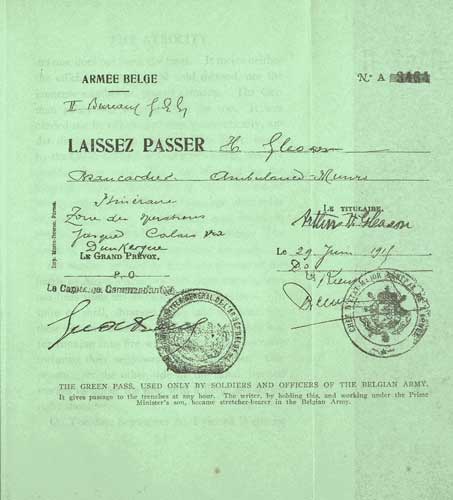
de Broqueville, in military command of us. We had access to every line,
all the way to the trench and battlefield. We became a part of the
Belgian army. We made our headquarters at Furnes. Luckily, a physician's
house had been deserted, with china and silver on the table, apples,
jellies and wines in the cellar. We commandeered it.
Winter came. The soldiers needed a dressing station somewhere along the
front from Nieuport to Dixmude. Mrs. Knocker established one thirty
yards behind the front line of trenches at Pervyse. Miss Chisholm and I
joined her. In its cellar we found a rough bedstead of two pieces of
unplaned lumber, with clean straw for a mattress, awaiting us. Any
Englishwoman is respected in the Belgian lines. The two soldiers who had
been living in our room had given it up cheerily. They had searched the
village for a clean sheet, and showed it to us with pride. They lumped
the straw for our pillows, and stood outside through the night,
guarding our home with fixed bayonets. It was the most moving courtesy
we had in the twelve months of war. The air in the little room was both
foul and chilly. We took off our boots, and that was the extent of our
undressing.
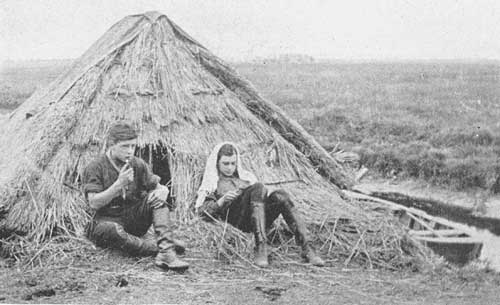
Disguised as a haystack, this shelter stands out in a field within easy
shell fire of the enemy. A concealed battery, in which these boys are
gunners, is near by. In their spare time they smoke, read, swim, carve
rings out of shrapnel, play cards and forget the strain of war.
The dreariness of war never came on us till we went out there to live
behind the trenches. To me it was getting up before dawn, and washing in
ice-cold water, no time to comb the hair, always carrying a feeling of
personal mussiness, with an adjustment to dirt. It is hard to sleep in
one's clothes, week after week, to look at hands that have become
permanently filthy. One morning our chauffeur woke up, feeling grumpy.
He had slept with a visiting doctor. He said the doctor's revolver had
poked him all night long in the back. The doctor had worn his entire
equipment for warmth, like the rest of us. I suffered from cold wet
feet. I hated it that there was never a moment I could be alone. The
toothbrush was the one article of decency clung to. I seemed never to go
into the back garden to clean my teeth without bringing on shell-fire. I
got a sense of there being a connection between brushing the teeth and
the enemy's guns. You find in roughing it that a coating of dirt seems
to keep out chill. We women suffered, but we knew that the boys in
tennis shoes suffered more in that wet season, and the soldiers without
socks, just the bare feet in boots.
In the late fall, we rooted around in the deserted barns for potatoes.
Once, creeping into a farm, which was islanded by water, "Jane Pervyse,"
our homeless dog, led us up to the wrecked bedroom. A bonnet and best
dress were in the cupboard. A soldier put on the bonnet and grimaced.
Always after that, in passing the house, "Jane Pervyse" trembled and
whined as if it had been her home till the destruction came.
In our house, we cleaned vegetables. There was nothing romantic about
our work in these first days. It was mostly cooking, peeling hundreds of
potatoes, slicing bushels of onions, cutting up chunks of meat, until
our arms were aching. These bits were boiled together in great black
pots. Our job, when it wasn't to cook the stew, was to take buckets of
it to the trenches. Here we ladled it out to each soldier. Always we
went early, while mist still hung over the ground, for we could see the
Germans on clear days. It was an adventure, tramping in the freezing
cold of night to the outposts and in early morning to the trenches, back
to the house to refill the buckets, back to the trenches. The mornings
were bitterly cold. Very early in my career as a nurse, I rid myself of
skirts. Boots, covered with rubber boots to the knees in wet weather, or
bound with puttees in warm; breeches; a leather coat and as many jerseys
as I could walk in—these were my clothes. But, as I slept in them, they
didn't keep me very warm in the early morning.
We had one real luxury in the dressing station—a piano. While we cooked
and scrubbed and pared potatoes, men from the lines played for us.
There were other things, necessities, that we lacked. Water, except for
the stagnant green liquid that lay in the ditches where dead men and
dead horses rotted, we went without—once for as long as three days.
During that time we boiled the ditch water and made tea of it. Even
then, it was a deep purplish black and tasted bitter.
All we could do to help the wounded was to wash off mud and apply the
simplest of first-aids, iodine and bandages. We burned bloody clothing
and scoured mackintoshes and scrubbed floors. The odors were bad, a
mixture of decaying matter and raw flesh and cooking food and
disinfectant.
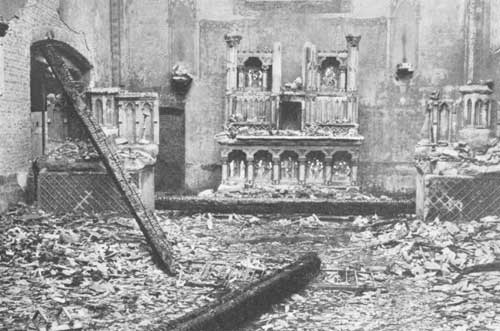
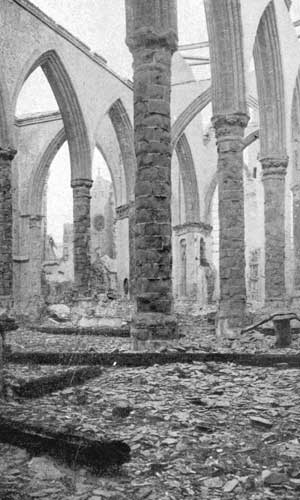
Pervyse was one more dear little Flemish village, with yawning holes in
the houses, and through the holes you saw into the home, the precious
intimate things which revealed how the household lived—the pump,
muffled for winter, the furniture placed for occupancy, a home lately
inhabited. In the burgomaster's house, there were two old mahogany
frames with rare prints, his store of medicines, the excellent piano
which cheered us, in his attic a skeleton. So you saw him in his home
life as a quiet, scholarly man of taste and education. You entered
another gaping house, with two or three bits of inherited
mahogany—clearly, the heirlooms of an old family. Another house
revealed bran new commonplace trinkets. Always the status of the family
was plain to see—their mental life, their tastes, and ambitions. You
would peek in through a broken front and see a cupboard with crotched
mahogany trimmings, one door splintered, the other perfect. You would
catch a glimpse of a round center table with shapely legs, a sofa drawn
up in front of a fireplace. When we went, Pervyse was still partly
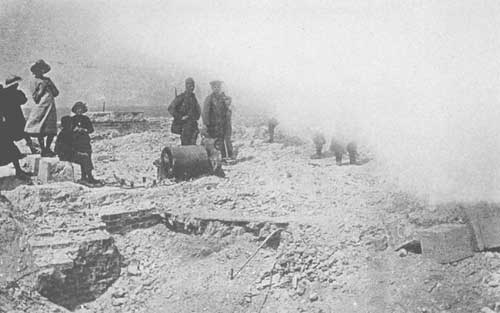
upstanding, but the steady shelling of the winter months slowly
flattened it into a wreck. It is the sense of sight through which war
makes its strongest impression on me.
The year falls into a series of pictures, evenings of song when a boy
soldier would improvise verses to our head nurse; a fight between a
Belgian corporal and an English nurse with seltzer bottles; the night
when our soldiers were short of ammunition and we sat up till dawn
awaiting the attack that might send us running for our lives; the black
nights when some spy back of our lines flashed electric messages to the
enemy and directed their fire on our ammunition wagons.
And deeper than those pictures is the consciousness of how adaptable is
the human spirit. Human nature insists on creating something. Under
hunger and danger, it develops a wealth of resource—in art and music,
and carving, making finger-rings of shrapnel, playing songs of the
Yser. Something artistic and playful comes to the rescue. Instead of war
getting us as Andreieff's "Red Laugh" says it does, making regiments of
men mad, we "got" war, and remained sane. If we hadn't conquered it by
spells of laughing relief, we shouldn't have had nerve when the time
came. Too much strain would break down the bravest Belgian and the
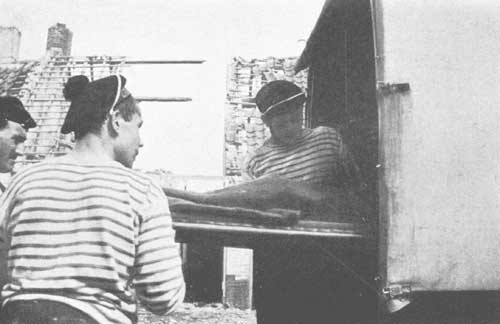
gayest Fusilier Marin.
I came to feel I would rather get "pinked" in Pervyse than retire to
Furnes, seven miles back of the trenches. Pervyse seemed home, because
we belonged there with necessary work to do. Then, too, there was a
certain regularity in the German gun-fire. If they started shelling from
the Château de Vicoigne, they were likely to continue shelling from that
point. So we lived that day in the front bedroom. If they shelled from
Ramscappelle, the back kitchen became the better room, for we had a
house in between. We were so near their guns, that we could plot the arc
of flight. Pervyse seemed to visitors full of death, simply because it
received a daily dose of shell-fire, like a little child sitting up and
gulping its medicine. With what unconcern in those days we went out by
ambulance to some tight angle, and waited for something to happen.
"We're right by a battery." But the battery was interesting.
"If this is danger, all right. It's great to be in danger." I have sat
all day writing letters by our artillery. Every time a gun went off my
pencil slid. The shock was so sudden, my nerves never took it on. Yet I
was able to sleep a few yards in front of a battery. It would pound
through the night, and I never heard it. The nervous equipment of an
American would ravel out, if it were not for sound sleep. If shells came
no nearer than four hundred yards, we considered it a quiet day.
One day I learned the full meaning of fear. We had had several quiet
safe hours. Night was coming on, and we were putting up the shutters,
when a shell fell close by in the trench. Next, our floor was covered
with dripping men, five of them unbandaged. Shells and wounds were
connected in my mind by that close succession.
No one was secure in that wrecked village of Pervyse. Along the streets,
homeless dogs prowled, pigeons circled, hungry cats howled. Behind the
trenches, the men had buried their dead and had left great mounds where
they had tried to bury the horses. Shells dropped every day, some days
all day. I have seen men running along the streets, flattening
themselves against a house whenever they heard the whirr of a shell.
It is not easy to eat, and sleep, and live together in close quarters,
sometimes with rush work, sometimes through severer hours of aimless
waiting. Again and again, we became weary of one another, impatient over
trifles.
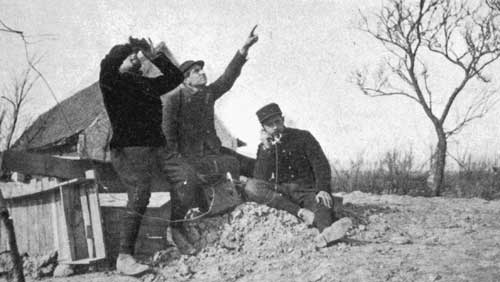
These lookout posts for observing and directing gun fire carry a
portable telephone, adapted to sudden changes of position.
What war does is to reveal human nature. It does not alter it. It
heightens the brutality and the heroism. Selfishness shines out nakedly
and kindliness is seen clearer than in routine peace days. War brings
out what is inside the person. Sentimental pacifists sit around three
thousand miles away and say, "War brutalizes men," and when I hear them
I think of the English Tommies giving me their little stock of
cigarettes for the Belgian soldiers. Then I read the militarists and
they say, "Be hard. Live dangerously. War is beneficent," and I see the
wrecked villages of Belgium, with the homeless peasants and the orphaned
babies. War ennobles some men by sacrifice, by heroism. It debases other
men by handing over the weak to them for torture and murder. What is in
the man comes out under the supreme test, where there are no courts of
appeal, no public opinion, no social restraint; only the soldier alone
with helpless victims.
You can't share the chances of life and death with people, without
feeling a something in common with them, that you do not have even with
life-long friends. The high officer and the cockney Tommy have that
linking up. There was one person whom I couldn't grow to like. But with
him I have shared a ticklish time, and there is that cord of connection.
Then, too, one is glad of a record of oneself. There is some one to
verify what you say. You have passed through an unbelievable thing
together, and you have a witness.
Henri, our Belgian orderly, has that feeling for us, and we for him. It
isn't respect, nor fondness, alone. Companionship meant for him new
shirts, dry boots, more chocolate, a daily supply of cigarettes. It
meant our seeing the picture of wife and child in Liège, hearing about
his home. It was the sharing of danger, the facing together of the
horror that underlies life, and which we try to forget in soft peace
days. The friendships of war are based on a more fundamental thing than
the friendships of safe living. In the supreme experience of motherhood,
the woman goes down alone into the place of suffering, leaving the man,
however dear, far away. But in this supreme experience of facing death
to save life, you go together. The little Belgian soldier is at your
side. Together you sit tight under fire, put the bandages on the
wounded, and speed back to a safer place.
Once I went to the farthest outpost. A Belgian soldier stepped out of
the darkness.
"Come along, miss, I've a good gun. I'll take you."
Walking up the road, not in the middle where machine guns could rake us,
but huddled up by the trees at the siding, we went. It will be a
different thing to meet him one day in Antwerp, than it will be to greet
again the desk-clerk of the La Salle Hotel in Chicago. It lies deeper
than doing you favors, and assigning a sunny room.
The men are not impersonal units in an army machine. They become
individuals to us, with sharply marked traits. It is impossible to see
them as cases. Out of the individuals, we built our types—we
constructed our Belgian soldier, out of the hundreds who had told us of
their work and home.
"You must have met so many you never came to know their stories."
It was the opposite. Paul Collaer, who played beautifully; Gilson, the
mystic; Henri of Liège; the son of Ysaye, they were all clear to us.
There was a splendid fat doctor who felt physical fear, but never
shirked his job. He used to go and hide behind the barn, with his pipe,
till there was work for him. His wasn't the fear that spreads disaster
through a crowd. He was fat and funny. A fat man is comfortable to have
around, at any time, even when he is unhappy. No one lost respect for
this man. Every one enjoyed him thoroughly.
Commandant Gilson of the Belgian army was one of our firm friends. My
introduction to him was when I heard a bit of a Liszt rhapsody floating
into the kitchen from our piano, the fingers rapid and fluent, and long
nails audible on the keys. I remember the first meal with him, a
luncheon of fried sardines, fruit cake, bread and cheese. The doctor
across the way had sent a bottle of champagne. After luncheon he
received word of an attack. He kissed the hand of each of us, said
good-by, and went out to clean his gun. We did not think we should see
him again. He retook the outpost and had many more meals with us. He
would rise from broken English into swift French—stories of the Congo,
one night till 2 a.m. Always smoking a cigarette—his mustache sometimes
singed from the fire of the diminishing butt. For orderly, he had a
black fat Congo boy, in dark blue Belgian uniform, flat-nosed, with
wrinkles down the forehead. He was Gilson's man, never looking at him in
speaking, and using an open vowel dialect. Before one of the attacks, a
soldier came to Gilson with his wife's picture, watch, ring, and money,
and his home address.
"I'm not going to come out," said the soldier.
It happened so.
The Commandant's pockets were heavy with these mementoes of the
predestined—the letters of boys to their mothers. He had that
tenderness and agreeable sentiment which seem to go with bravery. He
filled his uniform with souvenirs of pleasant times, a china
slipper—our dinner favor to him—a roadside weed, a paper napkin from a
happy luncheon—a score or more little pieces of sentimental value. When
he went into dangerous action, he never ordered any one to follow him.
He called for volunteers, and was grieved that it was the lads of
sixteen and seventeen years that were always the first to offer.
We had grown to care for these men. From the first, soldiers of France
and Belgium had given us courtesy. In Paris, it was a soldier who stood
in line for me, and got the paper. It was a soldier who shared his food
and wine on the fourteen-hour trip from Paris to Dieppe—four hours in
peace days, fourteen hours in mobilization. It was a soldier who left
the car and found out the change of train and the hour—always a soldier
who did the helpful thing. It did not require war to create their
quality of friendliness and unselfish courtesy.
How could Red Cross work be impersonal? No one would go over to be shot
at on an impersonal errand of mercy. You risk yourself for individual
men, for men in whose cause you believe. Surely, the loyal brave German
women feel as we felt. Red Cross work is not only a service to suffering
flesh. It is work to remake a soldier, who will make right prevail. The
Red Cross worker is aiming her rifle at the enemy by every bandage she
ties on wounded Belgians. She is rebuilding the army. She is as
efficient and as deadly as the workman that makes the powder, the
chauffeur that drives it to the trench in transports, and the gunner
that shoots it into the hostile line. The mother does not extend her
motherliness to the destroyer of her family. There is no hater like the
mother when she faces that which violates her brood. The same mother
instinct makes you take care of your own, and fight for your own. We all
of us would go for a Belgian first, and tend to a Belgian first. We
would take one of our own by the roadside in preference, if there was
room only for one. But if you brought in a German, wounded, he became an
individual in need of help. There was a high pride in doing well by him.
We would show them of what stuff the Allies were made. Clear of hate and
bitterness, we had nothing but good will for the gallant little German
boys, who smiled at us from their cots in Furnes hospital. And who could
be anything but kindly for the patient German fathers of middle age, who
lay in pain and showed pictures of "Frau" and the home country, where
some of them would never return. Two or three times, the Queen of the
Belgians stopped at our base hospital. She talked with the wounded
Germans exactly as she talked to her own Belgians—the same modest
courtesy and gift of personal caring.
I think the key to our experience was the mother instinct in the three
women. What we tried to do was to make a home out of an emergency
station at the heart of war. We took hold of a room knee-high with
battered furniture and wet plaster, cleaned it, spread army blankets on
springs, found a bowl and jug, and made a den for the chauffeur. In our
own room, we arranged an old lamp, then a shade to soften the light. On
a mantel, were puttees, cold cream and a couple of books; in the wall,
nails for coats and scarfs. The soldiers, entering, said it was
homelike. It was a rest after the dreariness of the trench. We brought
glass from Furnes, and patched the windows. We dined, slept, lived, and
tended wounded men in the one room. In another room, a shell had sprayed
the ceiling, so we had to pull the plaster down to the bare lathing. We
commandeered a stove from a ruined house. Night after night, we carried
a sick man there and had a fire for him. We treated him for a bad
throat, and put him to bed. A man dripping from the inundations, we
dried out. For a soldier with bruised feet, we prepared a pail of hot
water, and gave a thorough soaking.
In the early morning we took down the shutters, carried our own coal,
built our own fires, brought water from a ditch, scrubbed table tops
and swept the floor, prepared tincture of iodine, the bandages, and
cotton wool. We went up the road around 8.30, for the Germans had a
habit of shelling at 9 o'clock. Sometimes they broke their rule, and
began lopping them in at half-past eight. Then we had to wait till ten.
We kept water hot for sterilizing instruments. We sat around, reading,
thinking, chatting, letter-writing, waiting for something to happen.
There would be long days of waiting. There were days when there was no
shelling. Besides the wounded, we had visits from important
personages—the Mayor of Paris, the Queen of the Belgians, officers from
headquarters, Maxine Elliott. For a very special supper, we would jug a
Belgian hare or cook curry and rice, and add beer, jam, and black army
bread. An officer gave us an order for one hundred kilos of meat, and we
could send daily for it. On Christmas Day, 1914, for eight of us, we had
plum puddings, a bottle of port, a bottle of champagne, a tiny pheasant
and a small chicken, and a box of candies. We had a steady stream of
shells, and a few wounded. It was a day of sunshine on a light fall of
snow.
I learned in the Pervyse work that an up-to-date skirt is no good for a
man's work. With rain five days out of seven, rubber boots, breeches,
raincoat, two pairs of stockings, and three jerseys are the correct
costume. We were criticized for going to Dunkirk in breeches. So I put
on a skirt one time when I went there for supplies. I fell in alighting
from the motor-car, collecting a bigger crowd by sprawling than any of
us had collected by our uniform. Later, again in a skirt, I jumped on a
military motor-car, and couldn't climb the side. I had to pull my skirt
up, and climb over as a man climbs. If women are doing the work of a
man, they must have the dress of a man.
That way of dressing and of living released me from the sense of
possession, once and for all. When I first went to Belgium with a pair
of fleece-lined gloves, I was sure, if I ever lost that pair, that they
were irreplaceable. I lost them. I lost article after article, and was
freed from the clinging. I lost a pin for the bodice. I left my laundry
with a washerwoman. Her village was bombarded, and we had to move on. I
lost my kit. A woman has a tie-in with those material things, and the
new life brought freedom from that.
I put on a skirt to return to London for a rest. I found there people
dressed modishly, and it looked uncomfortable. Styles had been changing:
women were in funny shoes and hats. I went wondering that they could
dress like that.
And then an overpowering desire for pretty things came on me—for a
piece of old lace, a pink ribbon. After sleeping by night in the clothes
worn through the day, wearing the same two shirts for four months, no
pajamas, no sheets, with spots of grease and blood on all the costume, I
had a longing for frivolous things, such as a pink tea gown. Old
slippers and a bath and shampoo seemed good. I had a wholesome delight
in a modest clean blouse and in buying a new frock.
I returned to Pervyse. The Germans changed their range: an evening, a
morning and an afternoon—three separate bombardments with heavy
shells. The wounded were brought in. Nearly every one died. We piled
them together, anywhere that they wouldn't be tripped over. To the back
kitchen we carried the bodies of two boys. One of the orderlies knew
them. He went in with us to remove the trinkets from their necks. Every
now and then, he went back again, to look at them. They were very
beautiful, young, healthy, lying there together in the back kitchen. It
was a quiet half hour for us, after luncheon. The doctors and nurses
were reading or smoking. I was writing a letter.
A shell drove itself through the back kitchen wall and exploded over the
dead boys, bringing rafters and splintered glass and bricks down on
them. My pencil slid diagonally across the sheet, and I got up. Our two
orderlies and three soldiers rushed in, holding their eyes from the blue
fumes of the explosion. When one shell comes, the chances are that it
will be followed by three more, aimed at the same place. It had always
been my philosophy that it is better to be "pinked" in the house than on
the road, but not on this particular day. An army ambulance was standing
opposite our door, with its nose turned toward the trenches. The
Belgian driver rushed for the door, slammed it shut because of the
shells, opened it again. He ran to the car, cranked it, turned it
around. We stood in the doorway and waited, watching the shells dropping
with a wail, tearing up the road here, then there. After that we moved
back to La Panne.
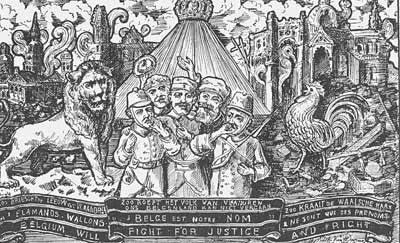
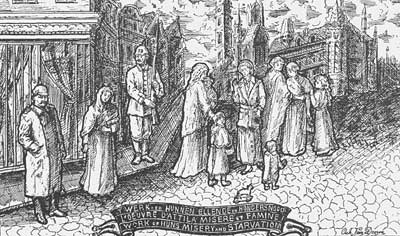
Belgium suffering, but united, is the idea he brings out in his work.
There I stayed on with Miss Georgie Fyfe, who is doing such excellent
work among the Belgian refugees. She is chief of the evacuation of
civilians who still remain in the bombarded villages and farms. She
brings the old and the sick and the children out of shell fire and finds
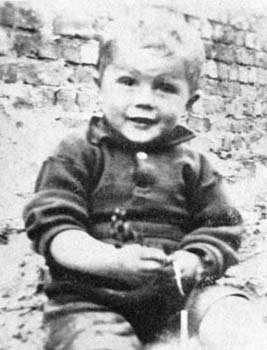
them safe homes. To the Refugee House she takes the little ones to be
cared for till there are fifty. Then she sends them to Switzerland,
where brothers and sisters are kept unseparated in family groups until
the war is over. The Queen busies herself with these children. For the
newest generation of Belgians Miss Fyfe has established a Maternity
Hospital. Nearly one hundred babies have come to live there.
It was my work to keep track of clothes and supplies. On a flying trip
to Paris, I told the American Relief Committee the story of this work,
and Geoffrey Dodge sent thirty complete layettes, bran-new, four big
cases, four gunny-sack bags, full of clothing for men, women, and
children, special brands of milk for young mothers in our maternity
hospital. Later, he sent four more sacks and four great wooden cases.
We used to tramp through many fields, over a single plank bridging the
ditches, to reach the lonely shelled farm, and persuade the stubborn,
unimaginative Flemish parents to give up their children for a safe home.
One mother had a yoke around her neck, and two heavy pails.
"When can I send my child?" she asked.
She had already sent two and had received happy letters from them. Other
mothers are suspicious of us, and flatly refuse, keeping their children
in the danger zone till death comes. During a shelling, the curé would
telephone for our ambulance. He would collect the little ones and sick
old people. Miss Fyfe could persuade them to come more easily when the
shells were falling. At the moment of parting, everybody cries. The
children are dressed. The one best thing they own is put on—a pair of
shoes from the attic, stiff new shoes, worked on the little feet unused
to shoes. Out of a family of ten children we would win perhaps three.
Back across the fields they trooped to our car, clean faces, matted
dirty hair, their wee bundle tied up in a colored handkerchief, no hats,
under the loose dark shirt a tiny Catholic charm. We lifted the little
people into the big yellow ambulance—big brother and sister, sitting at
the end to pin them in. We carried crackers and chocolate. They are soon
happy with the sweets, chattering, enjoying their first motor-car ride,
and eager for the new life.