CHAPTER I.
THE GREAT ENGINE.
Larry Kendall leaped out of bed and dressed with more than his
customary haste. His father's voice had called him upon this morning,
which was a most uncommon circumstance, for Mr. Kendall was usually off
to his work before his son had finished his morning dreams.
"Must be that something is the matter," reasoned Larry, as he hurried
down stairs.
He found his father seated at the breakfast table, but it was evident
that he had eaten nothing.
His mother, sitting opposite in her accustomed place, looked paler
than usual, and there were dark circles under her eyes that indicated a
sleepless night.
She did not look at Larry as the latter came in; but Mr. Kendall did
so, in a resolute way that showed his mind to have been thoroughly made
up to an important course.
"I wish you to run the engine for me at the iron works for a few
days," were Mr. Kendall's first words, and they were enough to make
Larry's heart beat quick in anticipation.
"I shall like that," he replied.
Then, seeing none of his own enthusiasm reflected in the sad face of
his mother, he added:
"Are you ill, father, or hurt?"
"I am well," Mr. Kendall answered, and then was silent, making a
pretense of beginning to eat.
"Your father thinks of going on a journey," Mrs. Kendall said, in
response to her son's puzzled look.
Larry was keen enough to observe that, whatever the trouble might be,
it was something which they did not wish to discuss before him; and,
while he was naturally curious to learn the cause of his father's sudden
journey, he was too discreet to ask any questions about the matter.
"Did you speak to Mr. Gardner about my running the engine?" he asked,
as he took his seat at the table.
"No; that wasn't necessary. You have taken my place several times
within a year, when I have been away or ill, and you are always with me
when your school isn't keeping. I have told him more than once that you
knew about the engine as well as I did; and you know I have always taken
pains to explain everything, and to have you do all of the work at
times, when I was there to show you how."
Larry's heart swelled with pride under these frankly spoken words.
His father was not much given to praising any one, and the boy had often
felt hurt that no word of acknowledgment ever came as a reward when he
had successfully done some difficult work.
This made the praise which came now all the more inspiring. Mr.
Gardner, the superintendent, had frequently given his shoulder an
approving tap, and Joe Cuttle, the fireman, often said that "the lad
could run the engine as well as any man." But Mr. Kendall, who ought to
have been the first to observe and appreciate his son's success, seemed
scarcely to have given it a thought.
"He may reason that I'll try harder if I think I'm not perfect than I
would if he praised me more," Larry often told himself, and now the
long-wished-for expression of confidence had come.
With so much to think about, Larry could eat but little breakfast,
and his appetite was not improved by the manifest distress of his mother
and the taciturnity of his father.
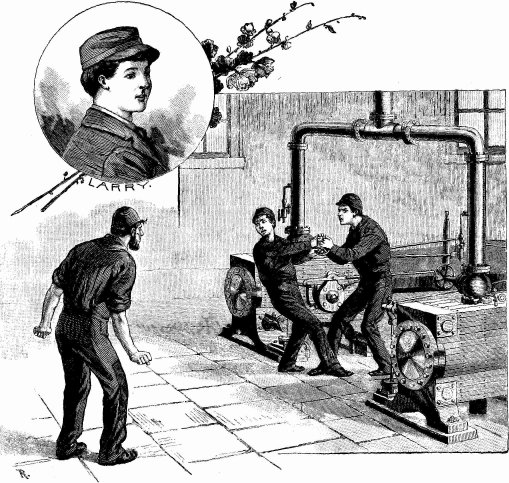
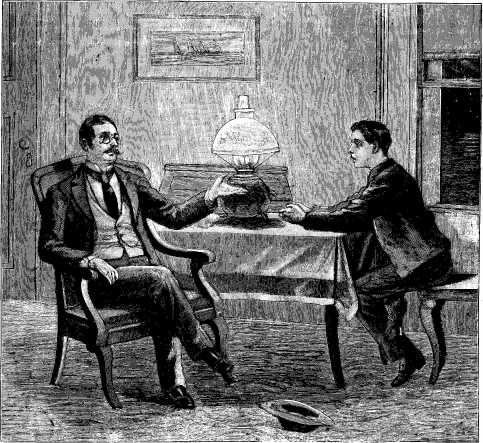
"I WANT YOU TO TAKE THIS FELLOW AWAY FROM THE ENGINE
BEFORE WE'RE ALL BLOWN OUT OF THE BUILDING TO PAY FOR HIS
CARELESSNESS."
"It is nearly six, Larry," reminded the latter, breaking the
silence.
"Yes, sir. I will go right along."
He flung on his cap and buttoned up his coat, lingering at the door
for a parting word from his father. But none came.
"What shall I say to Mr. Gardner?" Larry asked, unable to go without
breaking the silence.
"You needn't say anything."
"But he may ask why you didn't come. He always does, unless you give
notice the night before."
"Your mother told you I was going away, and that is enough for you to
tell him. You needn't let it trouble you, anyway; just attend to your
duties and say nothing to anybody. Remember that it is a responsible
business to have full charge of a thousand-hose-power engine and nine
boilers, and something that not many boys of seventeen are trusted to
run even for a day or two at a time."
"I know that, father, and that is why I wanted to know what to say to
the superintendent."
"I have told you all you need to say, and more, unless you are
asked."
"All right, sir. I—I hope you will have good luck, father,
and—good-by."
Mr. Kendall seemed not to have heard the parting wish of his son; he
certainly did not return the good-by. And mingled with the feeling of
satisfaction at being intrusted with the care of the great engine was a
sensation of vague uneasiness on account of his father's singular
behavior.
The fireman was there before him, waiting to be let into the
boiler-room, for the engineer always kept the keys.
He was a big, brawny Yorkshire Englishman, with a scar across one
cheek, and, to add to the ugliness of his face, he had only one good
eye. Over the other he always wore a green patch.
"Hi, my lad, is thy feyther sick?" was Joe Cuttle's salutation as
Larry unlocked the door, and they went into the long boiler-room.
"No, sir," was the reply, remembering his father's wish that he say,
nothing about the matter except to the superintendent.
"I'm a little late," he continued, as he glanced at the steam gauges;
"so you will have to put on the draught and get up steam fast as you
can."
"All right, Larry. I was waiting for thee this ten minutes," said
Cuttle.
He clanged his shovel on the hard stone floor and rattled the furnace
doors, while Larry tried the steam-cocks and then let the water into the
glass gauges, as he had done many times before.
Then he unlocked the door into the engine-room and left Joe to shovel
in the coal and regulate the draughts.
The engine—or engines, for there were two of the same power
whose pistons turned the same great fly-wheel—glistened a welcome
to Larry, and it seemed to him that they looked brighter even than usual
upon this clear September morning.
He began wiping them off with a handful of cotton waste, adding, if
possible, to the polished brightness of the powerful arms and cylinders;
but, before he had finished the work, a gruff voice caused him to look
up.
"You, is it?" the voice questioned.
The speaker was a young man of twenty-three, who was employed in the
works. Larry had seen him a great many times, for he was always
loitering about in the boiler and engine rooms when his father was
away.
This was contrary to rules, yet Larry, being so much younger,
disliked to order the young man out. But as he saw him standing in the
doorway, then it occurred to him that, if his father was to be absent
several days, it might be better to put a stop to intrusion at once.
"Yes, I'm on duty," Larry answered, resuming his work.
Steve Croly coolly ascended the two or three steps to the floor of
the engine-room, and, picking up a piece of waste, began to rub the
polished cylinder-head which was nearest.
Larry saw that the rag which Croly was using was making streaks on
the polished surface.
"See what you're doing, Steve!" he cried, pointing at the oily
smutch.
"Why don't you have some clean waste round here, then?" Croly
retorted. "When I used to run an engine, I had something to clean it
with, instead of using waste after it was soaked full of oil."
"You're not running this engine," said Larry, quietly.
His heart was heating fast; so he was silent a moment before he spoke
again, as he did not wish to speak in an angry tone.
"I think I could manage it about as well as any boy of your age,"
said Croly. "It's mighty foolish to trust such an engine as this to a
boy. I heard some of the men talking about it with the super the last
time your old man was off, and I fancy he don't like it very well."
"Perhaps you heard them say something about giving you the job,"
Larry responded, with a faint smile.
"It would look more sensible if they did," replied Croly, who had too
much self-conceit to see the point of a joke that was aimed at him.
"Still," Larry answered, with more dignity, "since I am
allowed to run the engine, I shall have to ask you to obey the rules
against coming in here, after this."
"You mean that I can't come in to see the engine?"
"Not without leave. My father wouldn't let you, and you know it.
Hereafter I wish you to keep out when I'm in charge."
Steve Croly's cheeks flushed with anger.
At that moment the hoarse roar of the whistle shook the air, telling
everybody in the busy town that it was time to go to work.
It was not yet time to start the engine, but Croly sprang to the
valve-gear to let on the steam.
CHAPTER II.
THE ONE-EYED FIREMAN.
Larry divined the young man's purpose, and he needed no better
evidence that Steve Croly knew very little about an engine than this
thoughtless act.
The youth reached the valve-gear at the same time, and the hands of
both grasped the wheel.
"What are you going to do?" cried Larry, holding on with all his
strength, for the other was trying to turn the wheel.
"I'm going to start the engine. Didn't you hear the whistle? What are
you waiting for?" snapped Croly.
"That was the quarter-whistle; it isn't time to start up yet. And if
it was, you would blow out a couple of cylinder-heads for me by letting
on the steam in that style!"
Larry's face was pale, partly because he thought that the other would
have succeeded in doing the mischief in spite of him. But the determined
face of the boy, coupled with his words, made Croly pause, although he
still allowed his hand to rest on the valve-gear of the great
engine.
"You think I don't know enough to start this machine, I suppose," he
said.
"I think if you did know, you wouldn't try to blow out the
cylinder-heads to start with," Larry rejoined.
"You're trying to bluff me now, but you ain't quite old enough to do
it. Just wait till the five-minute whistle blows, and see if I can't
start the machine. I know enough to know that if you let the steam into
the cylinder, she's got to start."
"Something would start, that's certain," said Larry, drily. "But," he
continued, "I don't think you will let the steam on this time. Now, let
go!"
"You're a pretty heavy man to put in as boss of this plant," replied
Steve.
He let go of the valve-wheel, but did not step back. Larry divined
that the fellow intended to wait until he was momentarily away from the
gear, and then persist in his attempt to start the engine.
"I told you to go out," he said, pointing at the door.
"I'm going after the engine is started, and not before," persisted
Croly.
"You know you have no right in this part of the works. They wouldn't
have me loafing in your department, and you must keep out of this!"
"I don't try to send anybody away from my department."
"You would if you had charge of it. In yours there is a foreman and
fifty or sixty men; in this there is only the fireman, under the
engineer, but the engineer is just as much a foreman as the boss of your
department is there."
"You're a boy," sneered Croly, "and when the Tioga Iron Works has
boys put in as bosses, they'll have to turn off the men and run the
whole business with boys. That's all there is to it."
"Would you come here if my father was in charge?"
"It isn't likely I should."
"Then you admit that you have no right here?"
Croly was silent. It was plain enough to Larry what the matter was
with the young man. The truth was he had at some time been temporarily
in charge of a small portable or "donkey" engine, such as are used for
hoisting purposes in stone quarries and in other out-of-door work, and
he was incapable of recognizing the difference between the simple
construction of such a machine and the complicated work in the great
motive-power of the Tioga Iron Works.
Larry was a slow-spoken boy, and correspondingly slow in making a
decision. But when his mind was really made up, he was equally slow to
change it.
He looked at the clock, and then at his own watch. In one minute the
next whistle would blow, and then the engine must be started.
The door leading to the boiler-room had been left open by Croly, and
it had glass panels, through which Joe Cuttle could be seen hard at
work, feeding the hungry furnaces.
Larry dared not wait another moment. He stepped quickly to the door
and called out:
"Joe, come here a moment!"
"Yes, my lad."
The furnace door closed with a clang. The fireman paused to pull at
an iron rod that was suspended against the wall, and the short, quick
roar of the five-minute whistle sounded.
Larry had wheeled about the instant he saw Joe start in obedience to
his call, and he was in time to see Croly again in the act of seizing
the valve-gear.
Without an instant's hesitation, he took hold of the wheel, and held
it firmly, at the same time calling:
"Quick, Joe!"
The big fireman appeared, and his single eye looked from the face of
the boy to that of Croly.
"Did'st thee want me, lad?" he asked, in his gruff tones.
"I want you to take this fellow away from the engine before we're all
blown out of the building to pay for his carelessness," Larry
answered.
Cuttle's one eye glared upon Steve Croly, and the latter retreated,
with a look of grim defiance.
"He's away from the engine, lad," said Joe; "and, noo, what else
would'st have me do wi' him? A'll frowd him oot, if thou'd give the
wud."
"If he will go out without help, all right; if not, you may boost him
a little, if you wish to, Joe," said Larry, who had resolved to get rid
of the dangerous loiterer, this time for good, if possible.
"Git owd wi' thee!" ordered the big fireman, making a sudden and
furious feint of seizing the intruder.
This was more than Steve Croly had bargained for. It was very well to
come in and attempt to defy a boy, of whom he was envious, but quite
another thing to face the powerful fireman, whose bare, brown arms and
single gleaming eye lent him a most formidable aspect.
And so, without waiting to see how Larry went to work to set the
great engine in motion, Steve hurried down the steps and across the
boiler-room, not even looking back while he heard the fireman's heavy
boots clumping along the stone floor.
Joe did not attempt to follow the other outside. He turned back, with
a grimace which was intended for a smile, but which made his face look
uglier than ever; and a moment after the whistle sent forth its final
roar, which was the signal for every man and boy in the vast works to be
in his place and to begin work.
Then, with the same silent mirth distorting his features, the fireman
thrust his head into the engine-room and said:
"He tho't he'd go, lad; and A doon't think he'll coom back in a
hurry."
Larry had started the great engine, and the silent, powerful strokes
told him that his father had left it in its accustomed perfect
order.
The young engineer was still agitated from his encounter with Croly,
and he well knew that this was not likely to be the end of it; but he
could not help but smile in response to Joe Cuttle's evident enjoyment
of the affair.
"He didn't fancy having you put your grip onto him," said Larry, for
the big fireman relished a bit of flattery as well as any one.
"Hi, but didn't he shuffle oot, though, when he heard me after him! A
thought ee'd jump oot his shoes the way he went."
"He won't be likely to come here again, unless he is certain you are
out of the way."
"Mayhap he'll bother thee again, though, when A's gone home. Thou'lt
do well to keep an eye on him."
"I shall take care that he doesn't get in here again, and then I
won't have to be to the trouble to put him out."
Joe Cuttle indulged in another of his silent fits of laughter and
then returned to his furnaces, which he had to feed pretty constantly
while the great engine was using the steam.
The forenoon passed without further incident, and Larry was somewhat
relieved that he had not yet seen the superintendent.
He feared that the latter might ask some questions about his father's
absence which it would be embarrassing not to answer.
"Perhaps mother will tell me something about it when I get home," was
his thought, as he hurried along the narrow street which led to his
dwelling.
But again he was disappointed. His dinner was ready when he came in,
but Mrs. Kendall only sat at the table in silence and attended to his
wants.
Larry felt as though he could not restrain the growing feeling of
apprehension caused by his mother's looks and strange reticence. They
were so unlike her usual cheerfulness when he came home from school or
the shop, and he could see that she had grown yet paler than when he
left her at the breakfast table in the morning.
He had only a few minutes before he must return to the shop. Yet he
lingered at the door, cap in hand.
"Mother, what is it?" he pleaded, as she glanced toward him.
"Don't ask me now, Larry," she answered.
Yet there was an irresolute quiver in her voice that told him that
she longed to give him her confidence.
"I ought to know," he persisted. "I'm old enough to run the engine at
the works. Surely you and father ought to trust me to know what troubles
you. Father has gone?"
"Yes, Larry."
"When is he coming back?"
"I don't know. He doesn't know himself. But I hope it will not be
long before we see him again."
"The superintendent will ask me about it, and I don't like to act as
if my folks didn't trust me. If you can't trust me, he won't wish
to."
"Your father told you what to answer if you are questioned."
"Mr. Gardner may be satisfied with that for a day or two, but if he
stays away longer than that—"
"Well, well!" Mrs. Kendall interrupted, so impatiently that Larry was
silenced. "If he stays more than a day or two, and they want to know
more about it we'll see what can be done. Now hurry along, dear, and
don't worry."
She reached up her lips and kissed him—for he was much the
taller—and then he hurried back to the shop with a heavy
heart.
As he entered the yard, he noticed a knot of the workmen near the
entrance, holding what appeared to be a very secret conference.
CHAPTER III.
LARRY IN A QUANDARY.
What lent the air of secrecy to the conference of the workmen was the
fact that they suddenly dispersed with significant winks and nods as
Larry approached.
Another suspicious circumstance was the fact that all, or nearly all,
were hands who had been employed in the works only a few months.
Early in the previous spring fifty or sixty of the Tioga Iron
Company's hands had gone out on a strike, and were promptly discharged,
and a new gang that appeared in town rather opportunely, as it seemed,
were hired to take their places.
The most of those who were talking together so secretly were members
of this gang; and quite prominent among them was Steve Croly.
Joe Cuttle was firing up, the red glare from the glowing furnaces
lighting up his homely face.
"What were those men talking about out by the entrance just now?"
Larry asked, as Joe looked up.
"What men, lad?"
And the single eye was expressionless as it met the questioning
glance of the young engineer.
"Steve Croly was one; most of them were the new hands."
"He might be telling of them how he coom oot of here when A toald him
to goo," said the fireman, with his hideous grin.
"Not very likely, Joe," Larry replied, as he passed on into the
engine-room.
The boy was troubled and mystified now from a new cause.
Joe Cuttle was one of the new men, and, although he had been
uniformly faithful, Larry was sure that he was standing in the doorway
of the fire-room when he first came inside the gates, and that Joe must
have seen those who were only a few yards distant conversing so
mysteriously.
If he saw them, why did he try to evade the fact?
It was this more than any other circumstance that made Larry uneasy.
He did not think the difficulty bore any relation to his encounter with
Steve Croly in the morning, for of course Joe would not try to withhold
any knowledge of that affair.
Not until late in the afternoon did the superintendent visit the
engine-room.
He was a short, brisk man, with small, alert eyes that had a faculty
of seeing more in one minute than most men could take in in half an
hour. His face was dark almost to swarthiness and his cheeks and chin
were smoothly shaven.
He popped his head into the engine-room and called out:
"Hi, there, Kendall! What's the word to-day? Eh, so it's the boy!
Well, come here."
Larry came forward promptly; he knew this brisk gentleman liked him,
and, but for the mysterious trouble at home, he would have rather seen
him than not.
"Your father under the weather to-day, Larry?" was his first
question, while his quick eye noted that the polished floor of the
engine-room had been freshly washed and that the engine itself was doing
its ponderous work with its accustomed silence. Even his ear would have
detected a wrong note in the click and whir of the mechanism, though he
would not have known how to repair the difficulty.
"No," said Larry, in his slow manner. "Father was called away this
morning. I don't think he had time to send you any notice."
"So he sent you, which is the next best thing."
"Yes, sir, thank you."
"I didn't know but he was here till I just looked in. So it appears
that you have kept the machinery running. By-the-way," and Mr. Gardner
stepped up the ascent from the boiler-room and closed the door between,
"does that one-eyed Joe stick to his post?"
The superintendent pursed his lips half humorously as he asked the
question, but Larry felt sure that there was a serious purpose behind
his words.
"Yes, sir. He was here before I was this morning."
"And does he mind your orders just the same as he does when your
father is here?"
"He has so far, sir."
"That is right. Only you know some men don't fancy having a boy put
in as boss over them; and he is one of the new hands, and I didn't know
but he was cranky. Some of them are."
Mr. Gardner pursed his smooth-shaven lips again and was gone.
The moment the door closed after him, Larry wished he had told him of
the strange actions of the group of new hands whom he had seen outside
the entrance that noon.
"But he may know more about it than I do. His eyes see about all
there is to see," the boy reasoned.
And he gave the matter scarce another thought until the great whistle
delivered its parting roar that night.
Although the six o'clock whistle was the signal for stopping the
machinery and for the workmen to go to their homes, the engineer had to
stay half an hour longer to see that the engine and boilers were left in
proper shape for the night; then, when the night watchman came at
half-past six, Larry could go home.
But to-night, after firing up for the last time and blowing the
whistle, Joe Cuttle did not go directly home.
Instead, he went out into the yard and sauntered out toward the
further end of the extensive works where the foundry was located.
Larry, still distrustful, noticed this, and he wished then that he
had mentioned what he had seen that noon to the superintendent.
He stood in the doorway and furtively watched Joe until the latter
disappeared beyond an angle of the building. Then he went in and
meditatively drew the water from the glass gauges, tested the safety
valve, wiped off the engine and finally locked the door of the
engine-room.
His work was done for the day. It yet lacked ten minutes of the
half-hour, which would bring the night watchman, and he waited with his
feeling of uneasiness growing stronger every moment until the time was
up; and the watchman had not come.
"He is usually ahead of time, instead of behindhand," Larry
thought.
He went to the door, and nearly collided with some one who was on the
point of entering at the same time.
"How d' do, Larry?" was the off-hand salutation of the newcomer, who
was a short, stout man whom the boy recognized as Gideon Stark, a former
watchman in the works, who had of late been employed as a helper in the
moulding department.
"Where is Jake?" Larry asked.
"Sick," was the sententious reply.
"And you're going to take his place to-night?"
"I'm going to try."
"Does Mr. Gardner know about it?"
"I suppose so. Jake said he sent him word."
"All right, then, if he knows. Only," and Larry looked at the man,
sharply, "you know the engineer can't leave till the watchman comes, and
you're not the watchman unless you're regularly hired."
The short man scowled, and then, as though suddenly thinking a frown
was not the best passport for gaining good-will, he smiled, at the same
time taking out the big bunch of keys which the watchman usually
carried.
"I couldn't get them from anybody but Jake, could I?"
"I suppose not."
"Well, if your father has a right to send you to take his place when
he can't come, I think Jake can hire me to take his place when
he's sick. That's about the size of it, my boy. But if you ain't
satisfied, you better go up and see the super. You know the kind of row
he makes when the hands follow him home to ask questions. He always
says, if a man can't think of enough to pester him about in the ten or
twelve hours he's around the works, they needn't try to follow him home
with their complaints."
"I will go to supper, Gid," said Larry, quietly.
But the man followed him to the door.
"Your father sick?" he asked.
"No."
"Gone away?"
"Yes."
"Coming back in the morning?"
"I don't know."
Gid snapped his fingers and forgot himself so far again as to
scowl.
"Well, you're cross to-night; I'll say that for you, Larry," he
declared, bluntly, and then turned back into the boiler-room and shut
the door.
"There is something wrong, and no mistake about it," was Larry's
conviction as he hurried home.
He was not too deeply worried to eat—a healthy boy seldom is.
His mother was more cheerful than she had been at dinner-time; or, at
least, she made an effort to appear so.
"Has everything gone well to-day, Larry?" she asked, as he rose from
the table.
"As well as I could expect. There are one or two annoying fellows at
the works, and they're envious because the super lets me run the big
engine. They think I'm too young."
"It is a responsible position, Larry, and it makes me proud of you to
feel that you fill it so well."
"It isn't hard to do; only I have to keep my wits about me. It
wouldn't do to forget anything; and you know they say a boy will
forget."
"All boys are not alike, Larry, and your father would not trust you
unless he felt sure you would always be careful."
Larry could not rest at ease until he had assured himself that it was
all right to leave Gid in charge of the works for the night; and,
without telling his mother what his errand was, he went out to find Mr.
Gardner, the superintendent.
The gentleman's house was half a mile distant and fully a mile from
the shops.
Larry hurried thither. To his surprise, Belle, the superintendent's
daughter, came to the door. She was a sweet-faced girl, a year or two
older than Larry, although they had been in school together.
"I was just going out," she said, after greeting him, "and so I
answered your ring. Did you wish to see my father?"
"Yes, if you please," Larry answered.
"Then you will have to wait, and I don't know how long. It was time
for him to be here an hour ago, and he is usually punctual; but he
hasn't come."
She noticed, the troubled look on his face, and asked, a trifle
anxiously:
"Anything the matter, Larry?"
"I—I think not; but if he comes, you may tell him my errand.
And I will go back, and perhaps I may meet him."
Larry explained about the watchman's absence, and then, with a
deepening foreboding at his heart, he hurried back toward the immense
buildings of the Tioga Iron Company.
[TO BE CONTINUED.]
BY ANTONY E. ANDERSON.
It was Saturday evening, and the slender hands of the clock in the
village schoolhouse were just crossing each other in their eager haste
to tell the Berryville Literary Society that it was nearly ten o'clock,
and time to put out the lights.
The girls had taken the hint when the clock struck the quarter-hour,
and they were chattering like a group of magpies in the darkest corner
of the room as they helped each other with their cloaks and wraps.
The boys had already drawn their overcoat collars up to their ears.
They stood, solemnly and silently, near the door, each one ready to
frame the momentous question, "May I have the pleasure of seeing you
home?" when the girl of his choice should pass. Some of them looked
nervous; others had assumed an air of indifference, which deceived no
one.
John Hampden stroked his cap, wishing that girls weren't so slow
about getting ready. But he forgot the girls in a moment, and began to
repeat, under his breath, a few lines of the poem they had been reading
that evening:
"Some village Hampden, that with dauntless
breast,
The little tyrant of his fields withstood."
He wondered who Hampden was, and what he had done to make him famous
enough to be mentioned in such a poem as Gray's Elegy. Probably a great
general, John decided, who had led vast armies to victory.
John smiled to himself. There surely could not have been two persons
with the same name more utterly unlike, he thought, than the John
Hampden of the poem and John Hampden, the druggist's clerk—"a
youth to Fortune and to Fame unknown."
Just then two girls stopped before him, and John woke from his dreams
to find that the schoolhouse was almost deserted, and that the janitor's
yawning little son had begun to put out the lights.
The girls, no doubt, thought he had smiled at them, and John had
presence of mind enough left to accept the situation. He had meant to
walk home with Matilda Haines, but Matilda had disappeared.
John felt that he hardly knew Margaret Shirley, she had been away in
Boston so long, and he hadn't even been introduced to the young girl
beside her.
"Allow me to present Mr. Hampden, Celia—Mr. John Hampden," said
Margaret, as if in answer to his thought. "My cousin, Miss Kirke, from
Boston, Mr. Hampden."
John felt a trifle afraid of Miss Kirke, she took the introduction so
smilingly and easily. John himself blushed and stammered, and felt more
uncomfortable than ever, when she said, laughingly:
"How delightful to have one of Gray's heroes escort one home, right
after reading his poem! Of course, you are a direct descendant of
this famous John Hampden?"
"I don't know," said John, awkwardly; "I'm afraid not. I don't even
know what he did. Mr. Carr didn't explain that passage very fully."
"Oh, nobody pretends to know all about the allusions in
poetry. He lived somewhere in England, in the dark ages, didn't
he—and refused to pay taxes, or something? I forget exactly
what."
John smiled. He had recovered a little from his embarrassment.
"Why, old Mr. Hunt refuses to pay his taxes every year; but they make
him do it, just the same."
The girls laughed.
"Oh, but John Hampden protested against a great act of tyranny," said
Margaret. "He must have been very brave to do it, or Gray wouldn't have
put him in his poem."
"Such a lovely poem!" sighed Miss Kirke. "I've heard that the author
was seven years writing it."
"Seven years!" John echoed. "Well!"
"He kept pruning it, and re-writing some of the verses," Margaret
explained. "He wanted to make it a perfect poem."
"It's very fine," said John. Then he added, blushingly, "If I had any
fields to keep tyrants away from, I'd like to be a village Hampden
myself, even if I couldn't become famous like the other one."
"Oh, I don't think one need take that line of the poem literally,"
said Margaret. "I like to have poetry suggest things to me that are not
found in the mere words. That is why I'm so fond of Shakespeare—he
admits of so many interpretations. Perhaps," she went on, softly and
timidly, "if we keep the little tyrants of selfishness and wickedness
away from our hearts, we can all become village Hampdens. Such things
are often harder to drive away than human tyrants—don't you think
so?"
"Yes," replied John, gravely, "I'm sure it is true—though I've
had no contests with human tyrants."
"I know what my greatest tyrant is," said Celia Kirke, who had
grown serious with the others; "and whenever I see him trying to get
into my fields," she added, more lightly, "I shall 'off with his head'
with scant ceremony."
As John walked home alone in the frosty night, he vowed half aloud to
the silent, listening stars that he would be a "village Hampden,"
that the tyrant within him should be laid low for all time.
John had no need to mention the tyrant by name—he knew very
well that it was Carelessness with a capital C. How often had this
little tyrant brought him into trouble, and how often had his employer
warned him to break his bad habit before it was too late.
What a pleasant, sensible girl Margaret Shirley was—not a bit
spoiled by her studies in Boston!
Matilda Haines would have laughed more and talked more, but she would
never have given a second thought to the poem they had just read. John
was rather glad she had walked home with some one else that
evening—even though his old tyrant of Carelessness had brought
about this result.
John Hampden saw a good deal of Margaret Shirley and her cousin that
winter at the meetings of the literary society, at choir practice, and
in Margaret's own home, where they often discussed the poems and essays
they were reading.
Youth has a frank and sometimes harsh way of passing judgment upon
people. John had decided the first evening he met her that Celia Kirke
was a frivolous girl, but when he got to know her better, he found that
she could be as sensible as Margaret herself when occasion required
it.
They had confessed to one another what each one's particular tyrant
was, and had agreed to help each other to suppress him. Of course they
had a good deal of fun about it, but under it all there was a general
feeling that it was a serious matter they had undertaken.
John really began to feel that he was getting to be master of his own
fields at last. He attended to his duties at the drug store with such
punctilious care that his employer, Mr. Wyatt, nodded approval more than
once.
After all, John might become a safe druggist yet, if he didn't suffer
himself to lapse into his old ways. He did not stop to dream, as
formerly, when compounding pills, and he washed all his dingy bottles so
thoroughly that they began to shine like cut glass.
"He would be a credit to the business," said old Mr. Wyatt, who
always spoke of his business as if it were spelled with a capital B, and
thought it the very finest business in the world for a man to be in.
One afternoon in March Doctor Pratt came hurriedly into the store and
said to Mr. Wyatt:
"Put up half a dozen of these powders, will you, Wyatt? Here's the
full prescription. Squire Shirley has got one of his acute attacks of
neuralgia again, and my medicine-chest was empty. I'll call for them in
fifteen minutes."
Then the overworked little doctor jumped into his gig, and was off
like a flash.
"You'd better do it, John," said Mr. Wyatt. "I can't see in this poor
light."
"Very well, sir," said John.
And, as he began to neatly fold the white slips of paper, he wondered
if the squire were really as ill as Doctor Pratt pretended he was.
The good doctor was fond of making a fuss about trifles, to add to
his own importance.
Margaret and Celia had been out driving that afternoon, for John had
seen them from the drug-store windows.
If they had come home, they were probably rushing distracted about
the house, trying all the possible and impossible remedies they had ever
heard of to relieve him. John hoped they were not feeling too unhappy
about it—the squire would doubtless be all right in a few
hours.
John lived with his aunt, not far from Squire Shirley's, and, as he
passed the large brick mansion, he noticed that there were many lights
there that night.
Usually there was a light only in the library so late as this. None
of the curtains had been drawn, which was certainly an unusual state of
affairs.
A broad flood of light streamed from one of the front windows toward
the gate. A girlish, uncovered head was leaning dejectedly against the
cold, icy gate-post, and the light turned the fluffy blonde hair into a
shining aureole.
"Miss Kirke!" John exclaimed, in amazement. "What is the matter?
Is—is Squire Shirley worse?"
"Noth—nothing is the matter," faltered Celia, making a few
ineffectual dabs at her tear-swollen eyes with her handkerchief. "That
is—everything is the matter. They have given my uncle an over-dose
of opium. There was too much in the powders, the doctor says—a
great deal more than the prescription calls for. Doctor Pratt is with
him now, and they are trying to keep him awake. If he is allowed to go
to sleep, he will die. They are walking him back and forth, though he
implores them to let him sleep. I couldn't bear to see it any longer, it
was too, too dreadful! Oh, how can people be so criminally
careless?"
John turned pale and leaned against the gate for support. Celia's
face became a mere blur before his eyes. What had he done—what
had he done? For, at that moment, the conviction came with
terrible force upon him that he, and he alone, would be responsible for
Squire Shirley's death.
He might blame the poor light—Doctor Pratt's miserable scrawl;
but these were but cowardly subterfuges. John knew that he had
been able to decipher Doctor Pratt's handwriting well enough, but that
he had been thinking of something else while putting up the powders, and
so had put too much opium into them.
Celia looked at his agitated face in wonder. Then she uttered a
little cry.
"You—you did it! It is your fault," she said. "And he
was your friend, and always spoke so well of you."
Then she turned and walked swiftly toward the house.
It was true he and Squire Shirley had become excellent friends that
winter, and the squire had only a few days before asked him if he
thought he should like law better than the drug business.
He expected a vacancy in his office soon; in the meantime he had
offered to read a little law with John in the evenings. John had been
more than pleased, for circumstances had placed him in the drug store,
not his own inclinations.
And now he had blotted out all his hopes for the future, and perhaps
killed his friend and benefactor at the same time, all because he had
lacked manliness enough to cure himself of his small and odious
besetting sin.
John wandered like one distraught through the freezing slush and mud
of the country roads that night, feeling no fatigue and no discomfort.
His brain was on fire with horror and self-condemnation.
It never occurred to him to ask himself how the law would look upon
his carelessness; he only knew that he was ruined and disgraced, and
that he had brought a crushing sorrow upon those who had trusted him and
treated him as a good and welcome friend.
When daylight dawned upon John Hampden's haggard eyes he found
himself upon his own doorstep, his clothes smeared with frozen mud, his
body shivering and quaking in the grip of a dreadful chill.
He had walked for hours at a breakneck pace, and he was so exhausted
that he could hardly lift his hand to fumble at the door-knob.
His aunt opened the door for him. Her eyes were red, as if she had
been crying. She had been kneeling by a chair in the corner of the
kitchen.
"John, John!" she cried, opening her arms wide.
"Don't touch me!" said John, in a hoarse voice. "You don't know what
I am—what I have done, Aunt Martha."
"I know it all, John," said Aunt Martha, the tears gushing from her
pitying eyes. "How you must have suffered, my dear, dear boy! The
squire's daughter and niece were here at three o'clock this morning.
They thought you might be worried a good deal about it. The squire will
be all right in a few days."
Without a word, John laid his tired head on Aunt Martha's motherly
bosom and wept like a child. So pillowed, he fell asleep, as he had done
so many a time in years gone by.
John Hampden learned a lesson that night which he never forgot. He is
twice eighteen years old now, and his life has brought him much honor
and prosperity.
If he has one fault, people say, it is that he is almost too
inflexibly exact in all his dealings—almost too conscientious and
fearful lest he should make a mistake, and so do another an injury,
however slight. But, they add, the world would be a happier place if
more people were like him in this respect.
—For several years a pair of storks built their nest annually
in the park of the Castle Ruheleben, in Berlin. A few years ago one of
the servants placed a ring, with the name of the place and date, on the
leg of the male bird, in order to be certain that the same bird returned
each year. Last spring the stork came back to its customary place, the
bearer of two rings. The second one bore the inscription: "India sends
greetings to Germany."
BY W. J. GORDON.
Though steam is now the pride of the ocean, there are a few points in
which its advantages over sail have not been great enough to crowd out
the clippers, and in long voyages the sailing ship is far from
obsolete.
A drawing of one of these clippers affords an opportunity for saying
something about a ship's rigging, and thereby meeting the wishes of a
large number of amateur sailors.
Let it be clearly understood, however, that we are dealing with one
particular class of ship, and that all ships are not rigged exactly
alike.
There is a general notion that a full-rigged ship is of the same
pattern all the world over, and this notion has been supported by the
diagrams usually published which have taken a war ship as an
example.
Now a man-of-war has an enormous crew compared to a merchant vessel,
and her rigging is set up accordingly. The things that are done on a
man-of-war in spar-drill make a merchant sailor's hair stand on end.
The rigging of a merchantman is designed for a much smaller crew to
get along with, and in many respects differs from that of a full-rigged
man-of-war.
Complicated as a ship's rigging may look, it becomes intelligible
enough when attacked in detail. There are three masts and the bowsprit,
which is simply the old bowmast that has gradually increased its angle
until it is now almost horizontal.
These four spars are built into the ship, and all the other spars and
the rigging and sails are fixed on to them.
The three masts, known also as the lower masts, are the foremast,
mainmast and mizzenmast, and each of these carries two masts by way of
continuations. Thus we have foretopmast, maintopmast and mizzentopmast,
and over them foretopgallantmast, maintopgallantmast and
mizzentopgallantmast.
The part of the topgallantmast above the topgallant-rigging is called
the royal-mast or royal-pole, and the continuation above the
royal-rigging, if any, is the skysail-pole. Answering to the topmasts on
the three masts is the jibboom on the bowsprit, and in continuation of
that the flying-jibboom.
The jibboom and flying-jibboom are generally in one spar, as are the
topgallantmast, royal-pole and skysail-pole, but sometimes they are
fitted into each other on much the same principle as a fishing-rod, and
in some of the newer ships, bowsprit, jibboom and flying-jibboom are all
one steel spar.
Crossing the masts are the yards. On the mainmast we have, beginning
below, main-yard, lower maintopsail-yard, upper maintopsail-yard, lower
maintopgallantsail-yard, upper maintopgallantsail-yard, main royal-yard
and skysail-yard; on the foremast we have the fore-yard, then the
topsail-yards, topgallantsail-yards and royal; and on the mizzenmast we
have a similar series of yards, beginning with the mizzen or
crossjack.
Up to the close of the last century, in very old ships, there was no
sail hung on this lower yard of the mizzenmast, it having been
introduced only for setting the mizzen topsail; and instead of the gaff
spanker we now have there was a huge lateen sail which extended some
distance forward of the mast and worked under this yard.
This lateen was the crossjack. When the gaff came in, the projecting
corner of the lateen disappeared so as to make room for the sail hanging
from this lower yard, and the yard took the name of the old lateen
boom.
As representing, then, the after half of this huge boom, we have the
modern gaff, set at the same angle as the boom used to be; and at the
foot of the sail hung on this gaff, now called a spencer or spanker,
from the original inventor, we have the spanker boom, the same sort of
thing as we should call the mainboom were the vessel a fore-and-aft
yacht.
Each mast is held in its place by stays and backstays. The stays
reach from the mastheads to the centre line of the ship forward; and the
backstays come down to the sides of the ship, just behind the masts.
The stays and backstays are named from the mast-head from which they
descend. Thus the forestay comes from the foremast-head to the bows; the
foretopmast-stay from the foretopmast-head to the bowsprit-head; the
foretopgallant-stay from the foretopgallant-rigging to the jibboom-head;
and the foreroyal-stay from the top of the royal mast to the end of the
flying-jibboom.
From the bowsprit-head to the vessel's cutwater runs the bobstay,
generally of chain, which takes the pull of the foretopmast-stay; and
from the bowsprit-head there hangs the spar known as the
dolphin-striker, to give the purchase for continuing the pull of the
foretopgallant and foreroyal stays round to the cutwater; so that really
all the staying starts from the hull, as does the backstay-staying.
Round the lower mastheads are platforms called tops; and round the
topmast-heads are skeleton platforms called crosstrees. These platforms
are required not only to take the lower ends of the topmast and
topgallant rigging, but also to enable the crew to strike and get up the
masts and yards and work the sails. The crosstrees are fitted with
outriggers pointing outward aft to enable the topgallant-backstays to
give a better support to the topgallantmast than they otherwise would
do.
Besides stays and backstays, the masts have "shrouds" to strengthen
them. The topgallant shrouds come from the head of the
topgallant-rigging to the crosstrees, the topmast shrouds come from the
hounds just under the crosstrees to the top, and the main, fore or
mizzen shrouds, as the case may be, come from just under the tops to the
vessel's side.
To take the pull off the tops, the shrouds are continued round to the
mast as "futtock" shrouds, on the same principle as the foretopmast-stay
finds its continuation in the bobstay.
The shrouds are "rattled down;" that is to say, thin lines are
fastened across them to make a ladder for the men to go aloft. These
lines are the "rattle-lines" or "ratlines." The foremost shroud of the
lower rigging has only a "catch ratline;" that is, one ratline in about
six continued to the shroud that lies furthest forward.
And this is one of the signs by which you can tell a man-of-war from
a merchantman, for in war-ships the catch ratline is on the aftermost
shroud instead of on the foremost. In a man-of-war, too, the
topgallant-rigging is never rattled down, as a Jacob's ladder leads from
the topgallantmast-head down to the crosstrees; but this Jacob's ladder
arrangement is found in many clippers.
Another detail in which a man-of-war differs from a merchantman is in
the rigging of the bowsprit, the man-of-war generally having whiskers,
and the merchantman taking the pull of the shroud direct from the
forecastle along the catheads, the whiskers being the spars across the
bowsprit, which take the purchase of the bowsprit shrouds as the
dolphin-striker takes the purchase of the stays.
On each mast the lower yard, lower topsail-yard, and lower
topgallantsail-yard do not hoist up and down; the others do. The "lifts"
by which the yard is hung and "topped" run from the yardarms—the
ends of the yards—to the head of the mast which the yard
crosses.
From the yardarms also come the "braces," by means of which the yards
are swung so as to set the sails at the proper angle. These braces come
down to the ship's sides, or to the heads of the masts fore and aft of
those on which the yard is swung; all the mizzen-braces working on the
mainmast; the maintopgallant, mainroyal and skysail braces working on
the mizzenmast; and the foretopgallant and foreroyal braces working on
the mainmast, as is clearly shown in our illustration. The yards and
jibboom and flying-jibboom are fitted with foot-ropes for the men to
stand on.
The sails on the lower yards are the foresail, mainsail and
crossjack, or, as they are often called, fore-course, main-course and
mizzen-course—the course being the sail, just as a sheet is a rope
and not a piece of canvas. Above the courses come the lower topsails,
above them the upper topsails, above them the lower topgallant-sails,
then the upper topgallant-sails, then the royals, and, on the mainmast,
the skysail, though sometimes there are skysails to all masts, and over
the main skysail comes a "scraper" or moon-raker. On the outer edges of
the plain-sails come the studding-sails spread on booms.
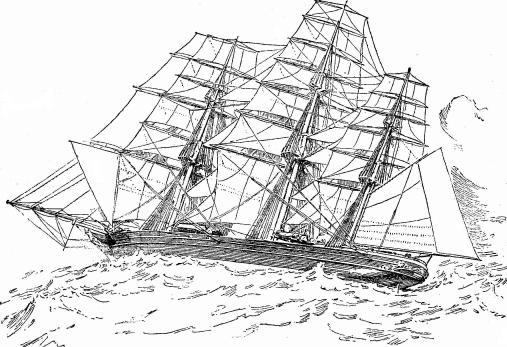
A FULL-RIGGED SHIP.
In our illustration the vessel has set her fore studding-sail, her
fore-topmast studding-sail and her fore-topgallant
studding-sail—studding-sail being pronounced stu'nsail, just as
topgallant-sail is telescoped into topgantsail.
A man-of-war sets her stu'nsails abaft the sail at their side; a
merchantman sets hers "before all"—that is, in front of the
adjacent sail, as shown in our illustration.
That part of a square sail which is secured to the yard is the
"head," the lower part is the "foot," the outer edge is the "leech," the
two lower corners are the "clews," the middle of the sail when furled is
the "bunt." The "sheet" pulls the sail out to its full extent down to
the yard below, the clewlines and buntlines bring it up under the yard
for furling.
The courses, having no yards below them, have both "tack" and
"sheet," the tack enabling the clew of the sail to be taken forward, and
the sheet enabling it to be taken aft. The clewlines for these sails are
double, and are called "clew-garnets." A glance at the picture will show
the clew-garnets and clewlines coming down to the corners and the
buntlines coming straight down the sails.
The sails along the centre line of the ship are the fore-and-aft
sails; these are the triangular jibs, staysails and trysails, and the
trapezoidal spanker we have already mentioned, which sometimes has a
gaff topsail over it and a "ringtail" behind it, as shown in our
figure.
"Watersails," by the way, are not carried now; they used to be set
below the lower booms, but, as we have seen, there are now no lower
booms, the lower stu'nsails being triangular, like the staysails.
These staysails take their names from the stays on which they run.
Working from the deck upward, the clipper we show is flying her mizzen
staysail, her mizzen topmast staysail, her mizzen topgallantmast
staysail and her mizzen royal staysail; and she has a similar series off
the main. But on the fore we have the head-sails. The extreme outer one
we cannot see; it comes down from the fore-royal and ends half-way down,
being a mere "kite;" it is called the "jib topsail." The outer one we
can see is the "flying-jib," on the flying-jibboom. Then come the "outer
jib" and the "inner jib" and the "foretopmast staysail."
The "trysails" are gaff or jib-headed sails sometimes carried on the
fore and main, as the spanker is carried on the mizzen. The gaff is held
up by the throat and peak halliards, and kept in position by "vangs,"
which come down to the rail as shown. The spanker is sheeted home not by
a sheet, but by an "outhaul," and kept in position not by a "brace," but
by the "sheet," and thereby differs from the square sails.
It will be noticed how neat and clean the ship is. There is nothing
outside to catch the wash of the sea or check the speed. The boat's
davits and the dead-eyes of the lower rigging are all inside the
bulwarks. The cables have been unshackled and stowed in the lockers
below, and the hawse-pipes are all plugged; the anchors are all inboard,
and everything that could possibly act as a brake on her is removed.
Several large vessels now have four masts, in which case they are
called "four-masters." When all the masts are square-rigged, the names
are bowmast, foremast, main and mizzen. If the aftermost mast is not
square-rigged, the order is foremast, main, mizzen and jigger. In some
four-masters the masts are named fore, first-main, second-main and
mizzen.
Should the vessel be three-masted, and have yards only on the two
front masts, she is a "bark;" and, by-the-way, the spanker of a bark is
her "mizzen." Should she have yards only, as the foremast, she is a
"barkentine;" should she be a two-master, and have yards on both, she is
a "brig;" should she have yards on the foremast only, she is a
"brigantine."
With regard to this, however, a few words of explanation are
necessary. A century or so ago, a favorite rig was the "snow,"
pronounced so as to rhyme to "now." The snow was a bark with a lateen
mizzen, or rather a brig with the "driver," a lateen one, on a jigger
mast, just a little abaft the mainmast.
When this jigger was abolished the sail retained its lateen shape,
got on to the mainmast, and became what we may call a main crossjack,
thereby rendering a square mainsail impossible.
When the crossjack was replaced by a gaff, the larger vessels started
the square mainsail, and became "brigs," while the smaller kept the
spanker as their mainsail, and became "brigantines," so that a genuine
old brigantine is a brig without a square mainsail.
Soon, however, vessels appeared with no yards at all on their
mainmasts, and these were called "hermaphrodite brigs," and were found
to be so handy that they crowded the old brigantines off the sea and
took their name.
But here a qualification must come in. Perhaps you have seen a
two-masted vessel with yards on her foremast and none on her main. She
is a "topsail-schooner." In what does she differ from the brigantine?
The brigantine has a foremast of three spars from the old snow, and a
mainmast of two from the hermaphrodite; the topsail-schooner has both
foremast and mainmast of two spars, and the foresail on a gaff instead
of on a yard, and in other ways is different, but a glance at the
foremast is enough to distinguish her from a brigantine.
A "three-masted schooner" has only lower masts and topmasts, and each
mast is rigged for fore-and-aft sails, but more often than not these
vessels carry yards at the fore and sometimes at the main.
With the "ketch" begins what has been called the mast-and-a-half
division of sailing vessels. The tall mast is the mainmast, the short
mast is the mizzen; some ketches carry square sails on the main, some
carry a topsail on the mizzen—the distinctive mark of the ketch
being that the mizzen is a pole-mast and stepped in front of the
stern-post. If the mizzen be stepped abaft the stern-post the vessel
becomes a "dandy" or "yawl."
In the cutter the mizzen is dispensed with, and in a sloop of the old
rig the difference between the two is that the cutter has two headsails,
the jib and foresail, while the sloop has but one, the foresail.
Sometimes the sloop has a standing bowsprit, while the cutter has a
running one; but this distinction is not essential. Indeed, the words
cutter and sloop have begun to be used indiscriminately, except,
perhaps, that a cutter is for pleasure and a sloop for trade.
In a spritsail rig the gaff is at the head of the sail, and works on
the mast in cheeks; the sprit runs diagonally across the sail, and is
hung on to the mast in what is practically a loop and lashing.
This has also what looks like a mizzen, but it is fixed on to the
rudder and is known as a "jigger." Sometimes the jigger is triangular,
like the yawl's mizzen, but the shape makes no difference in the
name.
The lug is the old sail of the Norsemen. There are two kinds of lugs,
"dipping" and "standing."
The dipping lug has a great part of the sail beyond the mast, so that
when a tack has to be made the sail has to be lowered, dipped round the
mast and rehoisted.
The standing lug projects very little beyond this mast and does not
require to be lowered when tacking.
Fishing boats are nearly all rigged with a dipping lug for the
mainsail and a standing lug for the mizzen, and they have also a jib,
while some of them carry topsails over the lugs.
Luggers may carry any number of masts, but as a rule they have two;
some have a gaff mizzen. When the foot of the lug is lashed to a boom it
is said to be "balanced."
BY ANNA J. M'KEAG.
When Mary Anne Smith returned for her second year at Mrs. Hosmer's
Seminary, both teachers and pupils were astonished at the change in her
appearance and manners which a summer at the seashore had produced.
The previous year she had been plain Mary Anne Smith, an energetic,
impulsive girl, whose most serious fault was a tendency to soiled
collars and buttonless shoes, but who was, on the whole, very
good-hearted and sincere.
She had returned to school as Marie Antoinette Smythe, a fashionable
young lady. She discontinued her old, romping, laughing ways and became
as sedate as the gravest Senior.
Even her old love for midnight "spreads" seemed to have departed. She
became fastidious about her personal appearance and exclusive in her
friendships.
At first Mrs. Hosmer considered it a good thing that Marie was
"toning down," but before long she felt that it was really not a change
for the better.
The schoolgirls were not slow in commenting about it. At the October
meeting of the Browning Circle—an association of a dozen girls,
originally instituted for purposes of literary improvement, but which
had lately degenerated into a "fancy-work society"—Marie was
discussed until her ears must have burned, if there is any truth in the
old saying.
"Do you know, girls, that Marie Smith scarcely deigns to speak to me any
more," said Stella Gard.
"Oh, that's nothing, Stella. I was her room-mate last year, and she
has conversed with me on just two occasions since she came back,"
supplemented Anna Fergus.
"What is the matter with her?" asked a "new girl."
"Is it possible, my dear young friend," rejoined Anna, with mock
gravity, "that you don't know we have been sacrificed to the North
Avenue Archingtons?"
The new girl looked bewildered, and Anna went on to explain:
"It seems that last summer certain blue-blooded Archingtons, with
malice aforethought, left their patrician heights on North Avenue, on
which they had hitherto dwelt in solitary grandeur, and went to Cape
May. There they boarded at the same hotel with the Smith family, and
deigned to bestow a few smiles upon them. This so lifted up the heart of
Marie Smythe, formerly Mary Smith, that she no longer regards her humble
class-mates as fit associates for her. Hinc illae lacrymae, which
means, all you who don't know Latin, 'that's why I'm using my
handkerchief.'"
"She told me," said little Zoe Binnex, interrupting Anna's nonsense,
"that Mrs. Archington had invited her mother to visit her."
"I wish some of you were doomed to sit at the same table with her, as
I am," Anna went on, "and then you would wish the Archingtons at the
bottom of the sea. The way poor, patient Miss Sedgwick has to suffer!
Marie sits next her, you know, and while Miss Sedgwick ladles out the
soup, Marie ladles out the Archingtons. We have Papa North Avenue, with
his four millions, at breakfast; Mamma Archington, with her diamonds, at
dinner, and all the young Archingtons for supper."
The ringing of the study-bell dispersed the members of the Browning
Circle. As Anna and Zoe passed Marie's door, they overheard a servant
requesting that young lady to go down to Mrs. Hosmer's study.
"Perhaps Mrs. Hosmer thinks it is time to choke off some of those
Archingtons," whispered Anna.
But Mrs. Hosmer had sent for Marie for a different purpose.
A new pupil was coming, and, as Marie had no room-mate, was to be put
with her.
"Oh, Mrs. Hosmer," protested Marie, "I'd much rather room alone."
"I should be glad to gratify you," said her preceptress, "but it is
impossible. Yours is the only vacancy on the second floor, and, as she
is a delicate girl, I do not want to send her to the third."
"Who is she?" Marie asked, seeing that she must yield to the
inevitable.
"Her name is Esther Jones. She is a very quiet little girl, inclined
to be nervous. I hope you will do all you can to make her happy and to
keep her from being homesick. She will come to-night."
Marie was much vexed at the intrusion, as she chose to consider it.
It was so much nicer to room alone.
How provoking that just as she was "getting into" a better circle,
and had succeeded in dropping her commonplace room-mate of last year,
she should have this nervous little Esther Jones forced upon her.
The new girl was as plain as her name. She wore a woolen dress, heavy
shoes and an ordinary sailor hat.
"Very countrified," was Marie's mental verdict, as she watched her
unpacking her trunk.
She did not offer to assist the little stranger, who seemed much in
awe of her.
A new girl who enters a boarding-school a month after the term has
begun is always to be pitied.
The other girls all have their homesickness over by that time, and
are not apt to be so sympathetic with the newcomer as they would have
been earlier. They have formed their little coteries, and the new girl
feels herself "outside."
With Esther this was especially true. Marie neglected her utterly,
and she had not confidence in herself to try to make other friends. She
went about with a dejected, homesick look that moved Mrs. Hosmer's
heart.
"I must make some other arrangement after Christmas," she thought.
"Esther doesn't seem happy where she is."
If she had known how much of Esther's unhappiness was due to Marie's
unkindness, her indignation would have made itself felt. Marie meantime
poured forth her heart on cream note-paper to her friend Marguerite
Archington, bewailing the cruel fate which separated them, and doomed
her to the companionship of Esther Jones.
Esther's natural timidity was increased by Marie's treatment. At
first she made feeble efforts to converse, but finding herself
continually repressed, gradually ceased from her endeavors to make
friends with Marie.
Not only her timidity, but her nervousness, as well, grew on her. She
began to be startled at every sudden sound.
Now Marie was a girl without "nerves," in the ordinary sense of the
word, and could not understand or sympathize with those who are
constituted differently. She really believed poor Esther's nervousness
to be affectation, and had no patience with it.
"She's been coddled all her life, evidently," she reflected, "until
now she expects every one to pet her on account of her foolish nervous
tricks. She needs a process of hardening."
If Marie had not really believed this, I do not think she would have
put into execution a plan which suggested itself to her the week before
Thanksgiving.
It was a cruel scheme, and even though she assured herself that it
was really for Esther's good and that it would cure the nervousness, I
think she was at heart a little ashamed of herself all the time.
|
At the western end of the third floor there was a stairway leading up to
a room at the top of the building, which was occasionally used as an
observatory.
A telescope was mounted there, but, as it was not very powerful, the
astronomy classes generally used one at the private residence of their
professor instead.
|
The room, being so seldom used, had become a receptacle for old
lumber of all sorts. Girls are so fond of exercising their imagination
that it is not strange that they gradually invested the garret-like room
at the top of the house with the reputation of being "haunted."
The ghost, who was said to walk up and down the old stairway and over
the creaking floor of the observatory, was thought to be that of a
certain Madame Leverrier, who had been teacher of French and astronomy
many years before, and had died in the school.
It was said that at midnight the tall, white figure of the
Frenchwoman might be seen, peering through the telescope at the stars
she had loved so well.
To-be-sure, no girl ever said she herself, had seen this sight, but
she had "heard about it from a last year's girl."
So the girls got in the habit of walking very rapidly when they had
occasion to go past the stairway, which led up from a region occupied by
"trunk-rooms," and of avoiding that part of the house altogether after
night.
Marie told Esther the story of the ghost, with many embellishments.
She did not confine herself to one telling, but continually referred to
it, with the desire of keeping the matter ever present in Esther's
mind.
She noticed that her quiet little room-mate, although she avowed her
non-belief in ghosts, looked frightened whenever the subject was
mentioned.
One evening, toward the end of November, the two were seated by their
study-table, preparing the next day's lessons, when Marie suddenly
exclaimed that she had mislaid her astronomy.
"Won't you go after it for me, Esther?" she said, in a kinder tone
than usual.
"Certainly, Marie," replied Esther, glad to be called on for a
service. "Where do you think you left it?"
"I know now exactly where it is. It's up in the observatory on the
table at the farther end of the room. I left it there last night when
Professor Gaskell took us up in study-hour. It was dreadfully stupid in
me."
"I'd better take the lamp, hadn't I?" queried Esther, inwardly
dismayed at the prospect of ascending alone to those awful regions, and
yet unwilling to refuse so small a service.
"Yes, take the lamp. You know there's no light in that end of the
hall. You're not afraid, are you?"
"N-no, not really. I can't help thinking of those foolish stories the
girls tell, though I know there's nothing in them."
Esther took up the lamp and started. She did not wish to appear
cowardly before her room-mate, though she really dreaded the short
journey.
As she walked past the dark trunk-rooms and up the uncarpeted stairs,
her heart beat fast at the "swish" of her own skirts on the boards.
When she opened the observatory door, she couldn't help noticing how
very dark the room was, and how feebly the rays from her lamp
illuminated it.
Instinctively she glanced toward the telescope to see that there was
no white figure behind it, and breathed a little more freely when she
saw that there was not.
She searched a long time for the book, standing with her back to the
door. At last she found it under a pile of others.
Glad to have accomplished her task, and inwardly peopling all the
shadowy corners of the room with ghostly visitants, she turned round to
begin her return journey, when—
What was that by the telescope? A white, tall figure stood by the
instrument.
In vain reason told her it was a fanciful delusion. Her nervous
organization was no longer under the control of reason. Esther gave a
quick scream, and fell to the floor, fainting.
In an instant a white sheet was thrown from the shoulders of the
figure by the telescope.
"Esther, Esther! It's only I—Marie!" she cried. "I followed you
up stairs just to frighten you for fun. Do speak to me. Tell me I
haven't scared you to death!"
After a little Esther regained consciousness, shuddering as she
opened her eyes and remembered where she was.
"Take me away—take me away!" she begged, recognizing Marie.
"I will have to bring help."
"No, no; don't leave me alone a minute. I can walk if you will help
me. And bring the lamp. I can't go down those stairs in the dark. Don't
go away or that dreadful thing may come back."
She shivered as she glanced toward the telescope. Marie was weeping
penitently.
"Dear Esther," she said, "don't you see that it was only I. There is
the sheet on the floor. I didn't know it would make you faint. Only say
you forgive me, and I'll take any punishment Mrs. Hosmer chooses to give
me."
"Oh, Marie, I know you didn't mean it, but I can never forget that
awful feeling when I felt myself falling. But help me away from this
ghostly place."
Marie, frightened at the result of her heartless trick and really
deeply touched by Esther's distress, helped her to their room.
Then, notwithstanding Esther's magnanimous offer to keep the whole
matter a secret, to Marie's credit be it said that she sent for Mrs.
Hosmer and confessed the whole thing.
"Give me the hardest punishment you can, short of expulsion," said
she.
"You have done a great wrong," replied Mrs. Hosmer. "You deserve
severe punishment, but I shall not decide about that now. For the next
few days you may show your penitence by doing all you can to make up to
this dear child for your past great unkindness. She must stay in bed for
a day or two, and I shall have the doctor in shortly."
Esther was ill for a week, during which time Marie nursed her
devotedly. She saw now her past conduct in its true light—her
petty vanity, her thoughtlessness and heartlessness.
She fairly hated her old self, when, as the girls came in from time
to time, Esther uttered no word of complaint against her, nor alluded to
the cause of her illness in any way.
But in some way or other a part of the story leaked out, and Marie
was the recipient of many an indignant glance, but she felt it was only
what she deserved.
Mrs. Hosmer never said anything further about a punishment; probably
she saw that the girl was already sufficiently punished. Nevertheless a
most humiliating punishment did come, in a way most unexpected.
The third evening after her fright, Esther was sitting up for the
first time since her illness. It was the night before Thanksgiving, and
she was feeling a little homesick in spite of Marie's efforts to
entertain her.
"What will you give me for a piece of good news, my little girl?"
said Mrs. Hosmer, entering the room, and looking at Esther's pale cheeks
disapprovingly.
"Oh, Mrs. Hosmer, is it anybody from home?" asked Esther,
longingly.
"Here, Marie, read her the name on this card, and see if she says she
is at home to visitors," replied Mrs. Hosmer, playfully.
Marie took the card, and a moment after dropped it as though it had
been red-hot.
This was what met her eyes:
"Mrs. James Archington,
"44 North Avenue."
"Grandma—it's grandma," cried Esther, delightedly.
At the December meeting of the Browning Circle the girls discussed Marie
Smythe once more.
"It was the queerest thing," reported Anna Fergus, who knew the whole
story. "You see this Mrs. Archington is Esther's grandmother, and Marie
never knew it. She said so little to the poor girl that Esther had never
chanced to tell her. Talk about retributive justice, this is the most
direct piece of retribution I ever heard of. And the queerest part of it
is that Esther's grandmother is the real North Avenue
Archingtons, while Marie's Cape May friends are a newly-rich family, who
happen to live on the same street with the others, but are not related
to them at all."
"But, girls," said Zoe Binnix, "it's been a splendid thing for Marie,
even if it has been humiliating. I never saw a more completely changed
girl. She's quite dropped her fine-lady airs and subsided into a
sensible being. She's so good now that Esther doesn't want to change her
room, though Mrs. Hosmer told her she might."
The girls were right in their opinion of Marie's change of character.
She grew up to be a sensible woman, singularly devoid of pretense or
affectation.
In after years she used to say that the one thing which had kept her
from growing up silly and affected was her experience with the North
Avenue Archingtons.
[This story began in No. 42]
OR,
 TRY A CAKE OF IT AND JUDGE FOR YOURSELVES.