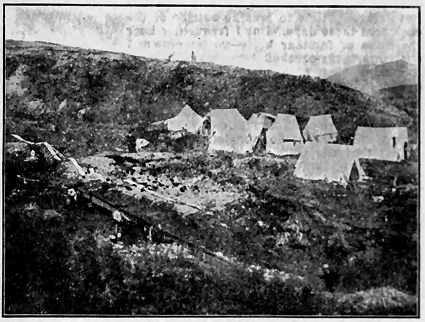
W
WE ARE a company of twenty men
bound for Kotzebue Sound, Alaska.
It is needless to say we are gold-hunters.
In this year of our Lord 1898, men are
flying northward like geese in the springtime.
That not more than one of us has
ever set eyes on a real, live nugget passes
for nothing; we shall naturally recognize
"the yellow" when we see it. It is our intention
to ransack Mother Nature's store-houses,
provided we can unlock or pry open
the doors without losing our lingers by
freezing.
Why we have selected Kotzebue Sound as
the field of our maneuvers it would be difficult
to give a rational reason. It may be
nothing more nor less than the universal rush
to the gold fields of Alaska, which rush, being
infectious, attacks all grades and conditions
of men. That all grades and conditions
are represented in our company will
be demonstrated later on, I believe.
The instigator of the Long Beach and
Alaska Mining and Trading Company is an
undertaker by trade, a sometime preacher
by profession and practice when not otherwise
engaged. His character is not at all
in keeping with his trade; he is a rollicking
fellow and given to much mirth.
We have also a doctor, as protection
against contingencies. His name is Coffin.
He and the undertaker have been bosom
friends for years. The combined influences
of these are sufficient to insure proper termination
to our trip, if not a propitious journey.
The eldest of our company is rising
fifty, the youngest twenty-one. The oldest
has lived long enough to be convinced that
gold is the key that unlocks all earthly
treasures; his sole object is the key hidden
somewhere in the pockets of the great
Arctic. The youngest cares little for the
gold, being more concerned about certain
rare birds which may cross his devious path.
The most of us have never met before, but
are now an incorporated mining company,
like hundreds of ship's crews this year.
Each intends to do his share of work and to
claim his portion of the profits, if profits
come.
We have a two years' outfit of every comfort
possible to store away on a little
schooner seventy-two by eighteen feet. Her
name is "Penelope;" you can read it in
plain type half a mile away. She was built
for Japan waters and has never set keel in
Arctic seas. There are numerous prophecies
concerning her: "She will never reach her
destination;" "Impossible that she is built
for a stormy coast;" "You may as well
make your wills before you embark." And
many other cheering benedictions are tossed
to the deck by friends on shore who watch
us loading the freight into her hold.
We make no retort. Of what would be the
use? Our hearts, our hopes, ourselves, are
on board of her for better or for worse. We
wave our handkerchiefs in a last "good-by."
They are the only white handkerchiefs in
our possession, brought and shaken out to
the winds for this very purpose. From
henceforth the bandana reigns on occasions
when any is required. Old Glory floats
above us; the "Penelope" is bright with
new paint and trimmings and masts; she is
towed out of San Pedro Harbor, and heads
for San Francisco for more supplies.
Out of San Pedro Harbor! The very same
of which R. H. Dana wrote in 1840 as a
"most desolate looking place," frequented
by coyotes and Indians, but "altogether the
best harbor on all the coast."
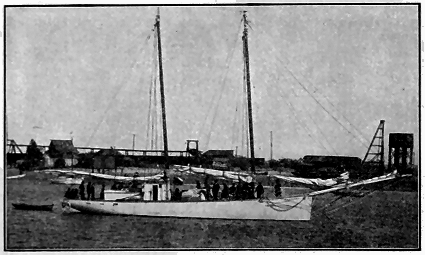
"Penelope" at Anchor in San Pedro Harbor
We have a copy of his "Two Years Before
the Mast" on board, and shall be complimented
by what he says about the Englishmen
and Americans whom he met. "If the
California fever (laziness) spares the first
generation, it always attacks the second."
Did Dana mean the crew of the "Penelope"?
We shall see.
Having made a dutiful promise to my
mother to "keep a faithful diary" of our
cruise, which, in event of disaster, shall be
duly corked in a large bottle and sent adrift,
I now enter my first date since April 8,
1898, the day on which we set sail from
San Pedro. California.
North Pacific Ocean, June 5.—We are seventeen
days out from San Francisco, and
have made a little over twelve hundred
miles: that is, in a direct line on our course
to Unamak Pass through the Aleutian
Islands, for we have had many unfavorable
winds against which we were compelled to
tack. We have sailed two thousand miles,
counting full distance. We have experienced
two storms which, put together, as the captain
says, makes "a good half a gale."
While the "Penelope" rides the highest billows
like a duck, at times she pitches and
rolls in a terrific fashion. Her movements
are short and jerky, unlike those of a
steamer or larger vessel. When the wind
blows hard on her quarter, the rail is often
under water. This
makes locomotion difficult, especially if the
waves are rolling high,
and everything is
bouncing about on
deck. It is my duty to
carry "grub" from the
galley to the cabins,
and I can never handle
more than one thing at
a time, as I am obliged
to keep one hand free.
I wait for my opportunity, else a heavy sea
starts at the same time
and we go down together, "grub" and all.
However, I have had
few accidents. Once I
landed a big platter of
mush upside down on
the deck, and at another time a gust of wind took all the biscuits
overboard, while a big sea filled the
milk pitcher with salt water. This was not
so bad as Dana's experience with the
"scouse," which "precious stuff" came
down all over him at the bottom of the
hatchway. "Whatever your feelings may
be, you must make a joke of everything at
sea," he wrote just after he had found
himself lying at full length on the slippery
deck with his tea-pot empty and sliding to
the far side. We are better off than the
crew of the "Pilgrim" in 1840, for there is
plenty more, if half the breakfast goes to
feed the fishes.
Down in the cabin there is the most fun.
The table is bordered by a deep rail, and
several slats are fastened crosswise over the
surface to hold the dishes, besides holes and
racks for cups; yet when things are inclined
at an angle of thirty-five degrees it is almost
impossible, without somebody's hand on
each separate dish, to keep the meal in sight.
We have some trouble in cooking at times,
but the stove has an iron frame with cross
pieces on top to keep the kettles from sliding,
which, in rough weather, can never be
filled more than half. We usually get up
very good meals; that is, for such of the
crew as have an appetite. For breakfast,
rolled oats mush, baking-powder biscuit,
boiled eggs or potatoes, and ham. For dinner,
light bread or milk toast, beans or
canned corn, salt-horse, creamed potatoes,
and often soup with crackers. For supper,
canned fruit, muffins or corn bread, boiled
ham and baked potatoes. Of course tea or
coffee with each meal. The cook makes fine
yeast bread, ten loaves a day. There are
twenty-three men on board. Including the
hired sailors who are not of the company,
and even with five in the hospital we make
way with a good deal of food.
Our fare differs somewhat from that of
the crew of the "Pilgrim." whose regular
diet, Dana wrote, was "salt beef and biscuit,"
with "an occasional potato." But it
must be remembered that we had several
articles, such as eggs and ham and fresh potatoes,
the first days of our cruise, which we
never saw later on when we were confined
to bacon and beans for staple supplies, with
dessicated vegetables and some canned
goods for extras.
We left San Francisco May 10, after taking
on board the parts of a river boat, to be
put together when needed, and much more
Arctic clothing than we can possibly use in
two or even four years. The Sea was very
rough. Our captain had not been on board
ship for two years, and the result was that
he, with every one of the party except the
sailors, was very sea-sick. The doctor was
pretty well in a couple of days, but the undertaker
fared not so well, he stayed on
deck and sang and jumped about and did his
best to keep jolly as long as nature could
hold out. Presently one could tell that he
was feeling rather uneasy about something,
when all of a sudden quietness reigned and
only an ominous sound from over the rail
gave indication of what was passing.
We have some fine singing. "The Penelope
Quartette" has been formed and practices
every evening, making voluminous
noise, but there is no fear of disturbing
adjoining meetings or concerts. The quartette
is composed of Reynolds (the undertaker). Foote, Wilson and Miller. There are
other singers of less renown. We have a
"yell." which is frequently to be heard, especially
at getting-up time in the morning.
It is "Penelope, Penelope, zip, boom, bah!
Going up to Kotzebue! rah! rah! rah!"
We are very much crowded and have
many discomforts, as anyone can imagine
we should have in so close quarters; but we
are a congenial crowd. I was sea-sick for a
week, but am all right now and capable of
eating more than anyone else, a symptom
which the doctor fears may continue, as I
make it a rule to eat up all there is left at
both tables. There are eleven men in the
after cabin and twelve in the forward cabin,
including the forecastle, and each set have
meals served in their respective cabins.
Having been chosen as "cook's assistant," I
have ample opportunities.
We have seen but few things of interest
outside the boat, and that makes us more
interesting to one another. We have sighted
no vessels for two weeks. I saw two fur
seals. They stuck their heads above the
water just behind us, eying us curiously for
a few minutes, and then vanished. We have
seen one shark, but no whales. Petrels, or
Mother Cary's Chickens, are almost always
to be seen flitting over the waves. Black-footed
albatrosses, or "goonies." as the sailors
call them, are common, following the
boat and eating all kinds of scraps thrown
to them. We caught two with a fish-hook,
but let them go, as there is now no suitable
place to put the skins. One of the albatrosses
measured seven feet three inches
from tip to tip of the outstretched wings.
We fastened upon his back a piece of canvas,
giving the "Penelope," with the date
and longitude and latitude. I wonder if he
will ever be seen again, and, if seen, if this
will be the only news of us the world will
ever receive!
There are several "goonies" which seem
to follow us constantly. We have named
them Jim. Tom and Hannah. They know
when meal time arrives, and then come close
alongside within a few feet.
Tuesday, June 7.—The past two days have
been stormy, but we have made good time
and are only four hundred and sixty-seven
miles from Unamak Pass. We saw several
pieces of kelp this morning, which gives evidence
of land not far off. This morning the
sun came out several times, and every one
is feeling quite jolly, which makes even the
sea-sick ones better. One of the most popular
songs on deck these cloudy days has
been the familiar one. "Let a little sunshine
in." Everyone was singing it to-day, when
suddenly the
clouds broke as if
by impulse and the
warm sunshine
flooded the damp
decks.
The sun doesn't
set now till nearly
nine o'clock, and
the whole night
long it is scarcely
dark at all.
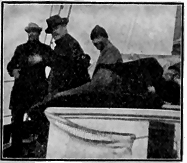
To-day Clyde took the pictures of the
party in groups, or "unions." There is the
"Sailors' Union" (six of the boys besides
the regular
sailors, who go
to the watch
along with
them and take
their tricks at
the wheel),
the "Dishwashers'
Union," the
"Doctors'
Union" (Dr.
Coffin, and
Jett, who is a druggist), the "Cooks' Union"
(Shafer and myself), and the "Crips' Union"
(the cripples, or those who are sea-sick, and
do no work; they are Fancher, Wyse. McCullough.
Wilson, Reynolds and Shaul). If
the winds are favorable we expect to rest in
Dutch Harbor for a few days, as we are no
doubt too early to get into Kotzebue. From
all accounts we cannot hope to reach the
Sound until July 14.
This sort of experience is, so new to me.
I thought I knew something of life on a
schooner, during the trip to San Clemente
and San Nicholas last year, but this is more
and better. Nearly everyone save myself is
longing for land, and they watch our course
each day as it is traced on the chart with
more interest than anything else. Just now
I am sitting alone on a bench in the little
galley, watching the potatoes and salt-horse
boiling. The sun has come out and everyone
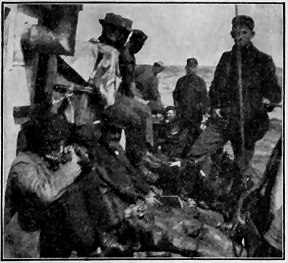
is on deck, the "crips" lying against
the stern rail or along the side of the cabin.
By orders of the doctor all the bedding is
airing on the deck and rails amidships, and
some of the boys are taking advantage of
the fair weather to do their washing. I did
my own yesterday, although it was raining,
and, as I have a "pull" with the cook, I
dried the clothes in the galley at night. Of
course all washing has to be done in salt
water and it is scarcely satisfactory, to say
the least. This necessary laundry work of
ours is destined to occupy a good deal of
our time and patience, and I suspect that
before our cruise is over we shall long for a
glimpse of a good, faithful washerwoman
with her suds, and her arms akimbo, and her
open smile.

Cooks' Union.
|
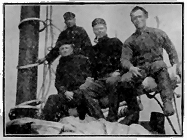
Sailors' Union.
|
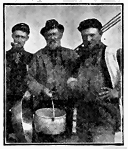
Dishwashers' Union.
|
Crips' Union.
|
June 12.—We are in Bering Sea and all's
well. It is partly clear, but cold, with a
sharp wind. We went through Unamak
Pass in the night. The captain thought it
dangerous as well as delaying, to stop at
Dutch Harbor, so we gave it up with disappointment.
After beating for several hours,
we are now well on our way straight northward
to St. Lawrence Island. There is no
ice in sight, but we can smell it distinctly.
As we went through the Pass it was raining.
and we could see but indistinctly the precipitous
shores. The Pass is not usually
taken by sailing vessels, as it is quite narrow,
but our captain brought us through all
right in spite of fog and storm. He has not
slept for forty-eight hours. The shortest
time ever made by a sailing vessel from San
Francisco to Unamak Pass, 2,100 miles, was
eighteen days; and we made it with the
"Penelope" in twenty-three days. Hurrah
for the "Penelope"!
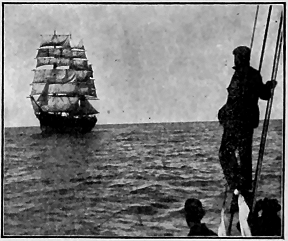
This morning we
passed within hailing
distance of the ship
"Sintram," of San
Francisco. She had
taken a cargo to St.
Michaels and was on
her way back. Her
captain promised to report
us, and he also
told us that the ice
was yet packed north
of St. Michaels and that several ships were
waiting. Clyde took a snap shot of the
"Sintram."
There are
plenty of
birds to be
seen now. If
I had faith
enough to
warrant my
walking on
the water I
would go
shooting. Our
small boats
are all lashed
to the dock of the "Penelope," but the captain
says that in a few days we can put a
skiff overboard if it is calm, and then ho!
for murre pot-pie! Everyone is hungry for
fresh meat. We try fishing with no luck.
Saw a fur seal to-day, the first in two weeks.
A Sunbath on Deck.
June 19. Bering Sea, latitude 63 degrees,
longitude 172 degrees, 38 minutes.—For the
past few days we made good time, one hundred
miles to the day, but on this date we
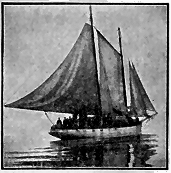
are becalmed. Clyde has gone out in the
boat to catch a snap shot of us. He need
not hurry, for never was mouse more still
than the "Penelope" at this moment. The
thermometer registers 38 degrees on deck.
We have sighted no ice yet, and hope the
Bering Straits are open.
I am sitting in the galley, as my fingers get
too cold to write outside. We have just
cleared off supper, and the boys are pacing
the deck for exercise. Some of them are below,
where an oil stove in each cabin takes
the chill and dampness from the air. It is
seldom that the galley is not crammed full,
but just now the cook and the others have
gone below for a game of whist, so I embrace
the opportunity to write. My diary is
always written after I have finished my
daily bird notes, which I make as copious as
possible. I have some good records already.
We were becalmed three days in sight of the
Prybiloff Islands, and at the time were so
close to St. Paul Island that we could hear
the barking of thousands of seals, and, by
the aid of a field glass, could see them on
the beaches. A few were seen about the
"Penelope," and one came so near to the
boat that it was touched with an oar. We
unlashed the smallest boat and rowed out
with her during the calmest days, so we had
some much-needed exercise. Frequent fogs
kept us near the "Penelope's" side, as we
should easily become lost. We saw no ducks
or geese, but we had murres in plenty and
pot-pie for several days. For a change they
were served up in roasts, being first boiled,
and were finer than any duck I have tasted,
though some of the squeamish crew composing
the "Crips' Union" declared they were
"fishy."
Of course I improve every opportunity during
pleasant days to collect, and the result is
thirteen first-class bird skins. These sea
birds are almost all fat and the grease clings
to and grows into the skin so firmly that it
is almost impossible to put them up. Among
the good things which I have secured are
the crested auklet, red phalarope, pallas,
murre and horned puffin, but it will be difficult
to preserve the skins in this damp climate.
Dr. Coffin is becoming interested already,
and talks of putting in his spare
time collecting with me. He has been taking
lessons in skinning, and so far has put
up two specimens. We have rigged up a
cracker-box for our bird-skins and try to
keep it in the dryest place, though it is so
crowded on shipboard that a convenient
place for any particular thing is scarce.
Speaking the "Sintram."
The currents in Bering Sea are quite
strong, tending northward toward the
straits, so that even when the wind fails
us we are drifting towards our destination
at the rate of fifteen to twenty miles a day.
On board we are all happy and in good
spirits, notwithstanding the fact that some
have never before known a hardship, and
their eight hours watch per day on deck,
especially when it is stormy, is calculated
to make them think longingly of their pleasant
homes. Besides, many of the boys have
salt water sores on their hands and chilblains
on their feet.
Yesterday the sea was choppy and several
were sea-sick again. Even I felt that
peculiar indescribable sensation, but I ate a
hearty dinner of beans and salt pork and
felt better. C. C. is suffering from what he
declares is "indigestion" a
weakness to which he has always
been subject. He feels
a reluctance to owning that he
has the common ailment.
"C. C." is our abbreviation for
Reynolds, the undertaker and
sometime preacher. He makes
so much fun for other people
that we cannot help amusing
ourselves at his expense sometimes.
We passed St. Matthew
Island and caught a glimpse of
its rugged shores through the
thick fog. We can generally
tell the proximity of land by
the increased number of sea-birds. It is not
often that the sun appears now, but occasionally
it shows itself long enough for the
captain to take his observations. It is light
all night and seems like a dream of childhood
to have to go to bed before the lamps
are lighted.
I must pay a compliment to our captain.
Besides knowing his business thoroughly, he
Is a jolly, agreeable man, always cutting
jokes except during a storm. He has been
created the "Penelope's" laureate, and has
written a couple of poems that would make
good his rank anywhere.
There was one day when we all had an
attack of the poetic fever and wrote
verses. They will be found in the ship's log.
To-day is Sunday, and as usual we all attended
services, which consist of songs and
a short talk from C. C. The rest of the day
is like any other.
Becalmed in Bering Sea.
Last night an exhausted sandpiper flew on
board and was caught. I was asleep and
the boys came and laid it on my breast. He
Is now safely wrapped in cotton wadding
and laid to rest in the aforementioned
cracker-box. The boys declared they would
whip me for not letting him go, and yet
when they get a chance they shoot at birds
from the boat for "sport," with no other
purpose in view. I am doing my best to
educate them in bird lore, but whenever I
get off the long Latin names they give me
the "ha-ha." By this time and after many
lessons the most of them know a murre by
sight, and a fork-tailed petrel, and a kittiwake;
but when it comes to distinguishing
the different species of anklets at a distance
they think I am fooling them, and laugh at
me until I show them the bird at close
range. I never realized before the vastness
of the sea as when a solitary little bird dips
his wings and flies skyward.