In the April of 1862, Victoria, British Columbia, was slowly recovering
from what her inhabitants described as a serious "set back."
From the position of a small Hudson Bay station she had suddenly risen
in '58 to the importance of a city of 17,000 inhabitants, from which
high estate she had fallen again with such rapidity, that in 1861 there
were only 5000 left in her to mourn the golden days of the "Frazer River
humbug."
In '48 the gold fever broke out in California, and for ten years, in the
words of an eye-witness, 50,000 adventurers of every hue, language, and
clime were drifting up and down the slopes of the Great Sierra, in
search of gold, ready to rush this way or that at the first rumour of a
fresh find.
In '58 California's neighbour, British Columbia, took the fever. The cry
of "Gold, gold!" was raised upon the Frazer, and the wharves of San
Francisco groaned beneath the burden of those who sought to take ship
for this fresh Eldorado.
In a year most of these pilgrims had returned from the new shrine,
poorer by one year of their short lives, beaten back by the grim canyons
of the Frazer river, or cheated of their reward by those late floods,
which kept the golden sands hidden from their view. In '58 and '59 the
miner cursed Victoria as a city of hopes unfulfilled, and left her to
dream on undisturbed of the greater days to come.
She looked as if, on this April day of '62, her dreams were of the
fairest. The air, saturated with spring sunshine, was almost too soft
and sweet to be wholesome for man. There was a languor in it which
dulled the appetite for work; merely to live was happiness enough;
effort seemed folly, and if a man could have been found with energy
enough to pray, he would have prayed only that no change might come to
him, that the gleam of the blue waters of the straits and the diamond
brightness of the distant snow-peaks might remain his for ever, balanced
by the soft green of the island pine-woods: that the hollow drumming of
the mating grouse and the song of the meadow lark, and the hum of waking
nature might continue to caress his ear, while only the scent of the
fresh-sawn lumber suggested to him that labour was the lot of man.
And yet, in spite of this seeming dreaminess in nature, the old earth
was busy fashioning new things out of the old, and the hearts of men all
along the Pacific slope were waking and thrilling in answer to the new
message of Mammon—"Gold! gold by the ton, to be had for the gathering
in Cariboo!" The reports which had come down from Quesnel, of the
fortunes made in '61 upon such creeks as Antler and Williams, had
restored heart to the Victorians, and even to those Californian miners
who still sojourned in their midst, so that quite half the people in the
town, old residents as well as new-comers, were only waiting for the
snows to melt, ere they rushed away to the mining district beyond the
Bald Mountains.
But the snows tarry long in the high places of British Columbia, and the
days went on in spite of the men and their desire, and bread had to be
earned even in such an Elysium as Vancouver Island, with all the gold
which a man could want, as folks said, within a few weeks' march of
them; so that hands and brains were busy, in spite of the temptations of
Hope and the spring sunshine. Moreover, there were dull dogs even then
in Victoria, who believed more in the virtue of steady toil than in
gold-mining up at Cariboo.
Thus it happened, then, that a big, yellow-headed axeman, and a ray of
evening sunlight, looking in together through an open doorway upon Wharf
Street, found a man within in his shirt sleeves, still busily engaged
upon his daily task.
"Hullo, Corbett, how goes it? Come right in and take a smoke."
The voice, a cheery one with a genuine welcome in it, came from the
inside of the house, and in answer the axeman heaved his great shoulder
up from the door-post and loafed in.
In every movement of this man there was a suggestion of healthy
weariness, that most luxurious and delightful sensation which comes over
him who has used his muscles throughout the day in some one of those
outdoor forms of labour which earn an appetite, even if they do not gain
a fortune.
As he stood in the little room looking quizzically at his friend's
work, Ned Corbett, in his old blue shirt and overalls, with the axe
lying across one bare brown forearm, might have served an artist as a
model for Labour; but the artist into whose studio he had come had no
need for such models. There was no money in painting such subjects, and
Steve Chance painted for dollars, and for dollars only. Round the room
at the height of a man's shoulder was stretched a long, long strip of
muslin (not canvas, canvas would cost six bits a picture), and this
strip had been sized and washed over with colour. When Corbett entered,
Chance had just slapped on the last patch of this preliminary coat of
paint, so that now there was nothing more to be done until the morrow.
"Well, Steve, how many works of art have you knocked off to-day?" asked
Corbett.
"Works of art be hanged!" replied his friend. "I've covered about twenty
feet of muslin, and that at five dollars a picture isn't a bad day's
work. What have you done?"
"Let me see, I've cut down a tree or two and earned an appetite,
and—oh, yes, a couple of dollars to satisfy the same. Isn't that
enough?"
"All depends upon the way you look at things. I call it fooling your
time away."
"And I call this work of yours a waste of talent worse, fifty times
worse, than my waste of time. Look at that thing, for instance;" and Ned
pointed to a large canvas, bright with all the colours of the rainbow.
"That! Well, you needn't look as if the thing might bite, Ned. That is
the new map of Ophir, a land brimming 'ophir'—forgive the joke—with
coarse gold, and, what is more important, bonded by those immaculate
knights of the curbstone, Messrs. Dewd and Cruickshank."
"An advertisement, is it? Well, it is ugly enough even for that. How
much lower do you mean to drag your hapless art, you vandal? 'Auctioning
pictures,' as you call it, is bad enough, but this is simple
sign-painting!"
"Well, and why not, if sign-painting pays? You take my advice, Ned; get
the 'sugar' first, the fame will come at its leisure. Sign-painting is
honest anyway, and more remunerative than felling trees, you bet."
"That may be," replied the younger man, balancing his axe in his strong
hands, "and more intellectual, I suppose; but, by George, there's a
pleasure in every ringing blow with the axe, and the scent of the fresh
pine-wood is sweeter than the smell of your oil-paints."
"Pot-paints, Ned, two bits a pot. We don't run to tube-paints in this
outfit."
"Well, pot-paints if you like; but even so you are not making a fortune.
We can't always sell those panoramas of yours, you know, even at a
dollar a foot."
"That's your fault, Ned; you've no eye for the latent merits of my
pictures, and therefore make a shocking mess of the auctioneer's
department. However, I am not wedded to my art. If lumbering and
painting don't pay, what do you say to real estate?" and as he spoke,
Chance put his "fixins" together and proceeded to lock up the studio for
the night.
"Real estate! Why, fifty per cent of the inhabitants of the Queen City
are real estate agents professionally, and most of the others are
amateurs. Be a little original, outside your art anyway, old fellow. I
don't want anything to do with real estate, except in acre blocks
beyond the city limits, and a jolly long way beyond at that!"
"Is that so?" asked a mellow voice from behind the last speaker. "Then,
my dear sir, Messrs. Dewd and Cruickshank can fix you right away. What
do you say to a little farm on the gorge, fairly swarming with game, and
admirably suited for either stock raising or grain growing?"
"Viticulture, market-gardening, or a gentleman's park! Better go the
whole hog at once, Cruickshank," laughed Chance, turning round to greet
the new-comer, a dark, stout man with an unlit cigar stuck in the corner
of his mouth.
"You must have your joke, Mr. Chance; but the farm is really a gem for
all that, and with the certainty of a large advance in price this
summer, a man could not do better than buy."
"What, is the farm better than a claim in Ophir?" laughed Chance.
"Ah, well, that is another matter!" said Cruickshank. "The farm is a
gilt-edged investment. There is, of course, just a suspicion of
speculation in all gold-mining operations, though I can't see where the
risk is in such claims as those you mention. By the way, have you
finished the map?"
"Yes, here it is," replied the artist, producing a roll from under his
arm, and partly opening it to show it to his questioner. "I call it
rather a neat thing in sign-boards, don't you? I know I've used up all
my brightest colours upon it."
"Yes, it will do; and though I don't suppose Williams Creek is quite
that colour," laughed Cruickshank, "I am happy to say that our reports
are not over-coloured, even if our map is. Do you know the Duke of
Kent, Mr. Corbett?"
"No. Who is the Duke of Kent? I'd no idea that we had any aristocrats
out here."
"Oh, the duke's is only a fancy title; most titles are that way in the
far west."
"My sentiments exactly, Colonel Cruickshank," replied Corbett; and
anyone inclined to quarrel with him might have thought that Corbett
dwelt just a thought too long upon the "colonel."
But Cruickshank was not inclined to quarrel with a man who stood six
feet two, and girthed probably forty inches round the chest, and who was
reported, moreover, to be master of quite a snug little sum in good
English gold.
"The Duke of Kent has a claim alongside those which we bonded last fall,
and he tells me that he has already refused a hundred thousand dollars
for a half share in it."
"A hundred thousand dollars for a half share! Great Cæsar's ghost, why,
you could buy half Victoria for the money!" cried Chance.
"Well, not quite, but a good deal of it, and yet I've no doubt but that
we have quite as rich claims amongst those we offer for sale. How can it
be otherwise? They lie side by side on the same stream."
"Have you seen any of these claims yourself, colonel?" asked Corbett.
"Every one of them, my good sir. My clients are for the most part my own
countrymen, and you may bet that I won't let them be done by any beastly
Yank."
"Civil to you, Steve," laughed Corbett.
"I beg your pardon, Mr. Chance, but there are Americans and Americans;
and you can understand that a man who has spent the best years of his
life wearing the Queen's uniform feels hotly about some of the frauds
practised upon tender-feet by Californian bilks."
"Why, certainly; don't apologize. I suppose there are a few honest men
and a good many rogues in every nation. Did you say you had seen the
claims yourself? I thought you were in Victoria in the fall."
"No; Dewd and I were up together. I came down and he stayed there. There
is big money in them. Change your minds, gentlemen, and give up art for
gold-mining."
"No, thanks; I think not," replied Corbett.
"No! Well, you know best. Good-day to you. You won't take a drink, will
you?"
"No, I won't spoil my appetite even for a cock-tail."
"So long, then!" and with a flourish of his gold-headed cane, which was
meant to represent a military salute, the somewhat florid warrior dived
through a swing-door, over which was written in letters of gold, "The
Fashion Bar."
"Say, Corbett," remarked Chance as Cruickshank disappeared, "don't you
make yourself so deuced disagreeable to my best customers. Cruickshank's
orders keep our firm in bread and cheese, and I can see you want to kick
the fellow all the time he is in your company."
"All right, old chap; but I didn't say anything rude, did I? If he would
only drop the 'British army' and 'we English' I wouldn't even want to be
rude. What the deuce does he care whether he gets his dollars from a
Britisher or a Yank?"
"Not much, you bet! But here we are. Hullo, Phon, have you got the
muck-a-muck ready?"
"You bet you! Soup all ready. Muck-a-muck heap good to-day you see;"
and laughing and chattering Phon dived into the tent, and rattled about
the tin plates and clucked as if he were calling chickens to be fed.
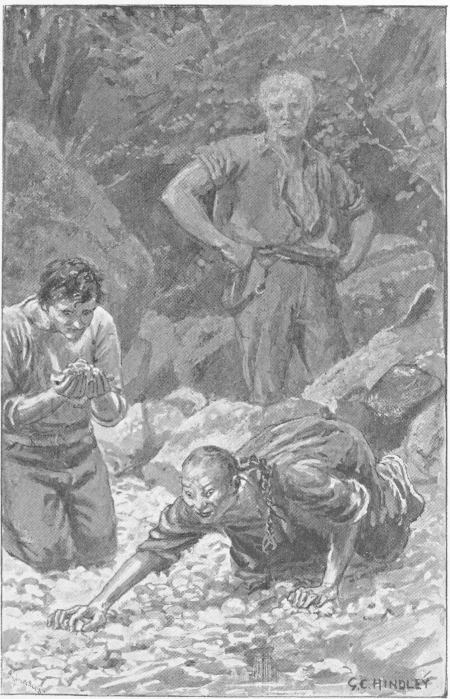
Phon was a character in his way, and a good one at that; a little wizen,
yellow body, with an especially long pig-tail coiled up on his head like
a turban; eyes and tongue which were in perpetual motion, and a great
affection for the two white men, who treated him with the familiarity of
old friendship.
"What are you in such a deuce of a hurry for to-night, Phon?" asked
Corbett a little later, when the Chinaman rushed in to take away the
remains of dinner.
"S'pose I tell you, you no let me go?" replied the fellow, half
interrogatively.
"Go! of course I'll let you go. I couldn't help myself, I suppose. Where
are you going to—the hee-hee house?"
"No, no. Hee-hee house no good. No makee money there. Pay all the time.
Me go gamble."
"Gamble, you idiot! What, and lose all your pay for a month?"
"'Halo' (anglice not) lose. Debbil come to me last night; debbil say,
'Phon, you go gamble, you win one hundred dollars.' I go win, you see."
"Please yourself. You'll see as much of that hundred dollars as you did
of the devil. Who's that calling?"
Phon went out of the tent for a moment and then returned, and holding up
the tent flap for someone to enter, said:
"Colonel Cruickshank want to see you. Me go now?"
"All right! go to blazes, only don't expect us to pay you any more wages
if you lose. Come in, colonel."
"Won't you come out instead, Mr. Corbett? It's better lying on the
grass outside than in to-night."
"Guess he is right, Ned. Come along, you lazy old beggar!" cried Chance.
And the three men in another minute were all lying prone on a blanket by
the embers of a camp-fire, smoking their pipes and chatting lazily.
Corbett's tent—a marvel of London make, convertible into anything from
a Turkish bath to a suit of clothes, and having every merit except the
essential one of portability—stood upon the very edge of the
encampment, commanding a view of the sea and the Olympic Range on the
farther shore.
The encampment itself was a kind of annexe of the town of Victoria,
standing where James Bay suburb now stands, although what is to-day
covered with villas and threatened by an extension of the electric
tramway was in '62 a place of willows and wild rosebushes.
Here lived part of the floating population of Victoria, miners en
route to Cariboo, remittance-men sent away from home to go to the dogs
out of sight of their affectionate relatives, and a good many other
noisy good-fellows who liked to live in their shirt sleeves in the open
air.
Corbett and Chance were the aristocrats of this quarter, thanks to the
magnificence of their abode and the general "tonyness" of their outfit.
In their own hearts they knew that they were victims to their
outfitter—that they were living where they were instead of in a house
merely out of regard for their tent, and for those mysterious camp
appliances which all fitted into one another like Chinese puzzles.
That was where the shoe pinched. In a moment of pride they had pitched
their tent (according to written instructions) and unpacked their
"kitchen outfits," and they had never been able to repack them.
It was all very well to advertise the things as packing compactly into a
case two feet by one foot six inches, but it required an expert to pack
them; and so, unless they were minded to abandon their "fixings," they
had to stay by them. Therefore they stayed, and said they preferred the
open air, even when it rained, as it sometimes does even on Vancouver
Island.
Later on they learnt better, and were consoled for their losses by the
sight of the hundred and one "indispensable requisites of a camp life"
cast away by weary pilgrims all along the Frazer river road. It is a
pity that the gentlemen who sell camp outfits cannot be compelled to
pass one year in prospecting before they enter upon their trade.
But an April evening by the Straits of Fuca, with a freshly-lit pipe
between your teeth, will put you in charity even with a London
outfitter. The warm air was full of the scent of the sea and the sweet
smoke of the camp-fires, while the chorus of the bull-frogs sounded like
nature's protest against the advent of man.
As the darkness grew the forest seemed to close in round the intruding
houses, and for a while even the estate agent was silent, oppressed by
the majesty of night and nature.
It was Corbett who broke the silence at last.
"Do you know that long, blue valley, Steve—you can hardly see it
now,—the one that goes winding away back into the mountains from the
gate of the Angels?"
Steve nodded. He was too lazy to answer.
"That valley is my worst tempter. I know I ought to settle here and
work: keep a store and grow up with the country; but I can't do it. That
valley haunts me with longings to follow it through the blue mists to—"
"To the place where the gold comes from—eh, Ned? To the place where it
lies in lumps still, not worn into dust by its long journey down stream
from the heart of its parent mountain. Old Sobersides, you have been
reading your Colonist too much lately."
Ned smiled, and knocking the ashes out of his pipe, began to refill it.
"How much of all these yarns about gold up at Antler and Williams Creek
do you believe, colonel?" he asked, turning to Cruickshank. "Do you
really think anyone ever took out fifty ounces in a day with a rocker?"
"I know it, my good sir. I have seen it. When Antler was found in 1860
the bed-rock was paved with gold, and you could not wash a shovelful of
dirt that had not from five to fifty dollars' worth of dust in it."
"Oh, there's gold up in Cariboo, Ned, but it wants finding. You've only
got to go into the saloons to know that there is plenty of dust for the
lucky ones. Fellows pay with pinches of dust for liquors whose names
they did not know a year ago."
"Paid, you mean, Chance," corrected Cruickshank. "They are all pretty
near stone-broke by now. But are you longing to go and bail up gold in
your silk hat, Mr. Corbett?"
"I am longing to be doing something new, colonel. I've taken the
prevalent fever, I think, and want to make one in this scrimmage. I
can't sit still and see band after band of hard-fists going north any
longer. Town life may be more profitable, perhaps, but I want to be
with the men."
"Bully for you, Ned! English solidity of intellect for ever! Why, you
villain, you're as bad a gambler as Yankee Chance."
"Worse, I expect, Mr. Chance," remarked Cruickshank, eyeing the two
young men critically. "You would play to win, he would play for the mere
fun of playing."
"Which would give me the advantage," retorted Corbett; "because in that
case I should stop when I was tired of the game."
"Never mind the argument," broke in Chance; "gambler or no gambler, if
you go I go. I'm sick of that picture of the pines and the waterfall,
anyway."
"So is Victoria. 'Bloomin' red clothes'-props and a mill-race,' one chap
called the last copy I tried to sell," muttered Corbett.
"Well, why not buy a couple of those claims of mine?" suggested
Cruickshank. "I always like to do a fellow-countryman a good turn, and
it would really be a genuine pleasure to me to put you two into a good
thing."
"How many have you left, Colonel Cruickshank?" He could not help it for
the life of him, but the moment Cruickshank became more than ordinarily
affectionate and open-hearted Corbett put on the colonel, and, as it
were, came on guard. He was angry with himself directly afterwards for
doing so, but he could no more help it than a man can help pulling
himself together when he hears the warning of the rattlesnake.
"Only three, Mr. Corbett; and I doubt whether I can hold those till
to-morrow morning. I am to meet a man in town at nine about them."
"What do you want for the three?"
"As a mere matter of curiosity?" put in Chance.
"Well, let me see. They are '100-foot' claims, right alongside the
places where the big hauls were made last year; but they are the last,
and as you are an Englishman and a friend—"
"Oh, please be good enough to treat this as a purely business matter,"
ejaculated Corbett, blushing up to the temples, whilst anyone looking at
Cruickshank might for the moment have thought that his speech had had
exactly the effect he intended it to have.
"Well, say two thousand dollars apiece; that is cheap and fair."
"Two thousand dollars apiece! What a chap you are to chaff,
Cruickshank!" cried Chance, breaking in. "Do you take us for
millionaires?"
"In embryo if you buy my shares, certainly, my dear sir."
"Perhaps. But look here, say a thousand dollars apiece, half cash, and
half when we make our pile."
"Can't do it; but I'll knock off a hundred dollars from each claim, as
we are friends."
"The market value is two thousand dollars, you say, Colonel Cruickshank
(my dear Chance, do leave this to me), and you have yourself inspected
these claims?"
"Certainly."
"And they are good workable claims, adjoining those you spoke of?"
"Undoubtedly, that gives them their principal value."
"Very well then, I'll buy the three. Here is a hundred dollars to bind
our bargain. We'll settle the rest to-morrow. Now, let me give you a
drink."
"Thank you. Are the claims to stand in your name?"
"In Chance's, Phon's, and mine. How will that do, Steve?"
"Settle it your own way; if you have gone crazy I suppose I must humour
you. But there is a good deal owing to our firm from yours, colonel,
isn't there?"
"Of course. That can be set off against a part of the sum due as payment
for the claims. Good-night, Mr. Corbett. Thank you for the confidence
you show in me. Treat a gentleman like a gentleman, and an honest man
like an honest man, say I."
"And a thief or a business man like a thief or a business man," muttered
Chance, as Cruickshank walked away. "Oh, Ned, Ned! What a lot nature
wasted on your muscles which she had much better have put into your head!"