NOTE: — GODEY'S LADY'S BOOK. PHILADELPHIA, JUNE, 1854. — THE PYRAMID TALMA. — THE SCARF VOLANT. — THE PALACE WALTZ. — TABLE OF CONTENTS — EMBELLISHMENTS, &c. — EVERYDAY ACTUALITIES.—NO. XX. — PRESERVATION OF FOOD. — THE PEDESTRIAN TOUR. — LETTERS LEFT AT THE PASTRY-COOK'S: — THE SIXTH LETTER LEFT. — A SONG. — GODEY'S COURSE OF LESSONS IN DRAWING. — LESSON VI. — CELESTIAL PHENOMENA.—JUNE. — LEGEND OF LONG-POND; OR, LAKE OF THE GOLDEN CROSS.
The Table of Contents and Embellishments, &c. tables have been harvested from the January edition.
The cover page and music files have been created by the transcriber from this book and placed in the public domain.
[From the establishment of G. BRODIE, No. 51 Canal Street, New York. Drawn by L. T. VOIGT, from actual articles
of costume.]
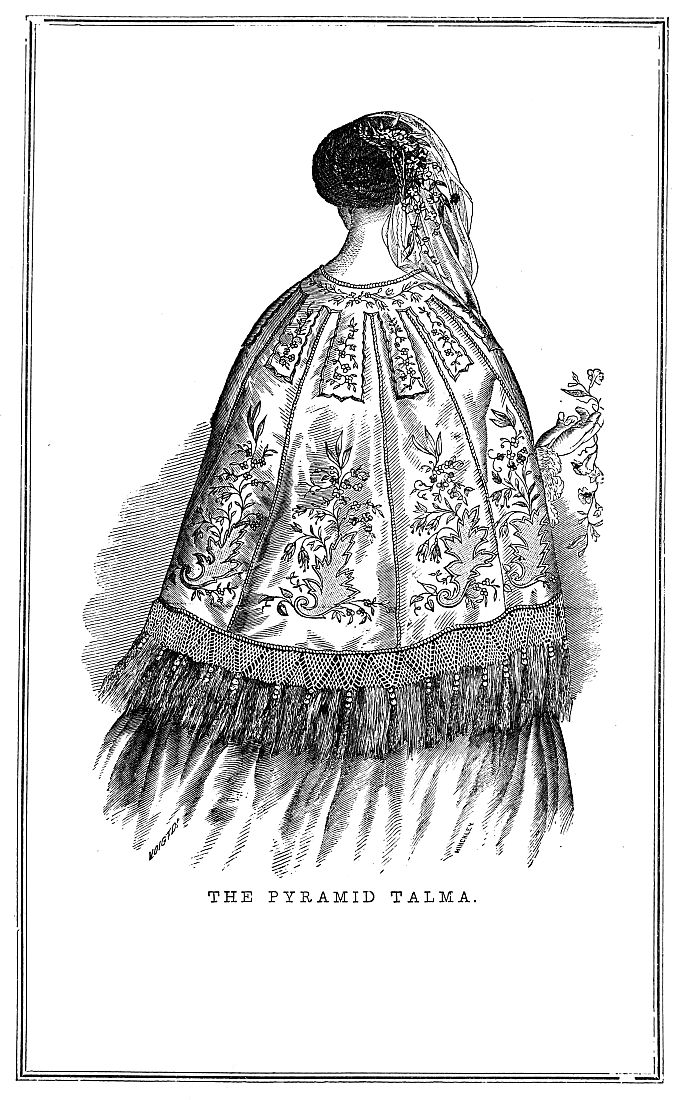
THE Talma we select for illustration is peculiarly becoming, especially for the richest toilet. Its material is white
poult de soie. It is constructed of nine pieces cut in gores or pyramidal form, joined together, the seams being hidden
by a fancy braid trimming. Nine tabs, widening at the bottom, and placed at distances equal to their width,
descending about one-third of the depth of the garment, constitute the form of this novel garment. It is exquisitely
adorned in needlework, and beautified by an elegant netted fringe. By an oversight in the drawing, fringe,
which should also border the tabs that form the upper portion of the dress, was omitted.
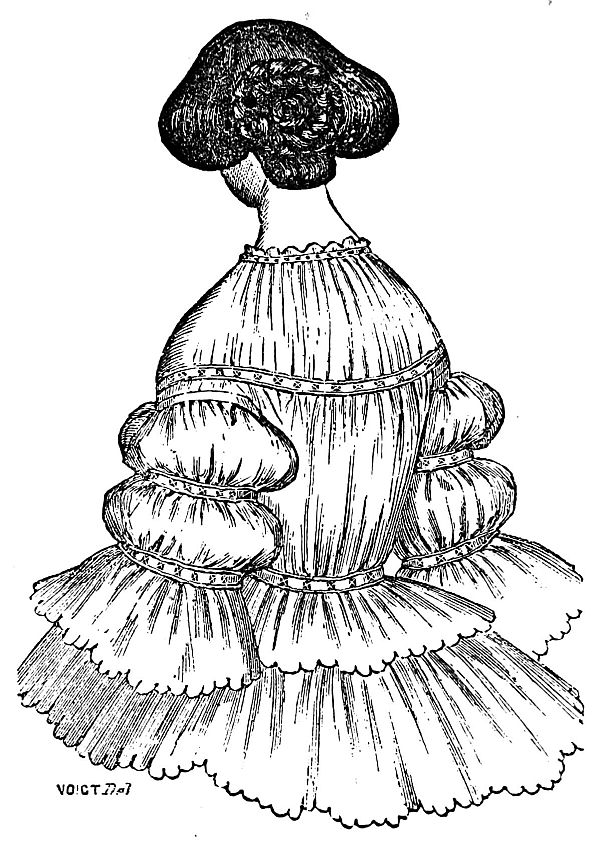
[From the establishment of G. BRODIE, No. 51 Canal Street, New York. Drawn by L. T. VOIGT, from actual articles
of costume.]
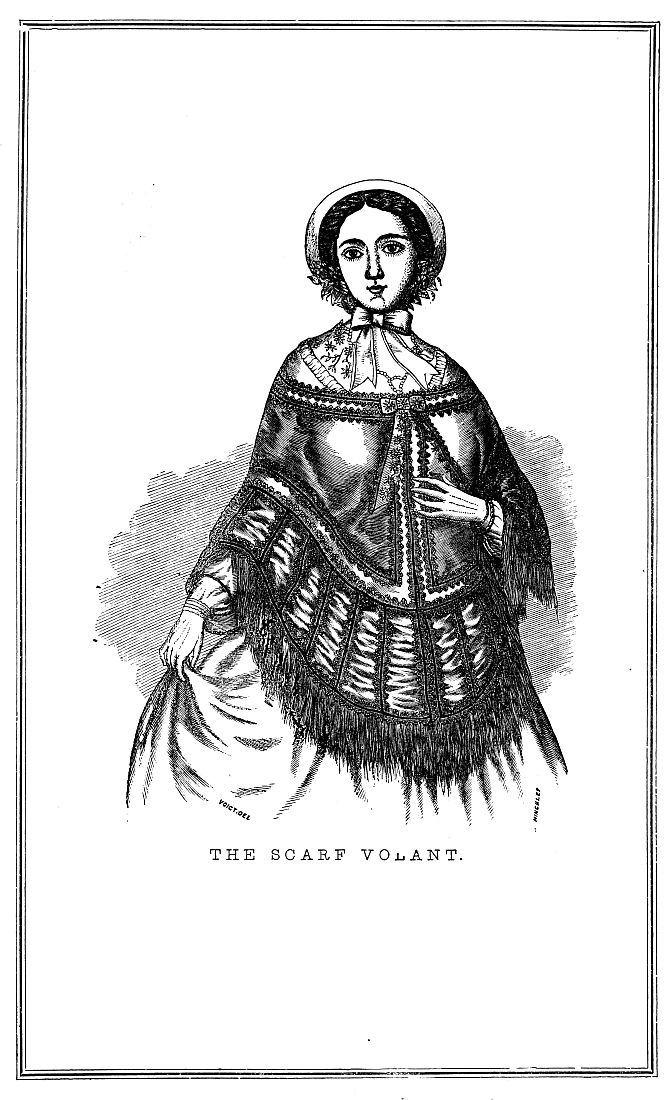
THIS is a novel and peculiarly dressy-looking garment, the distinctive features being a closed square front (which
is confined by a bow of a rare fancy ribbon), and in the character of the flounce: this is gathered or fulled in divisions,
giving it the appearance somewhat of a series of festoons. The separate compartments are strongly pronounced
by transverse bands of black velvet and narrow black lace; a similar trimming of which outlines the whole scarf,
and, with the piquant air of the garment, renders it an exceedingly beautiful production. The color may be made
to taste. Those of lavender glacé silks, the drabs, and of black taffeta, especially are very beautiful.
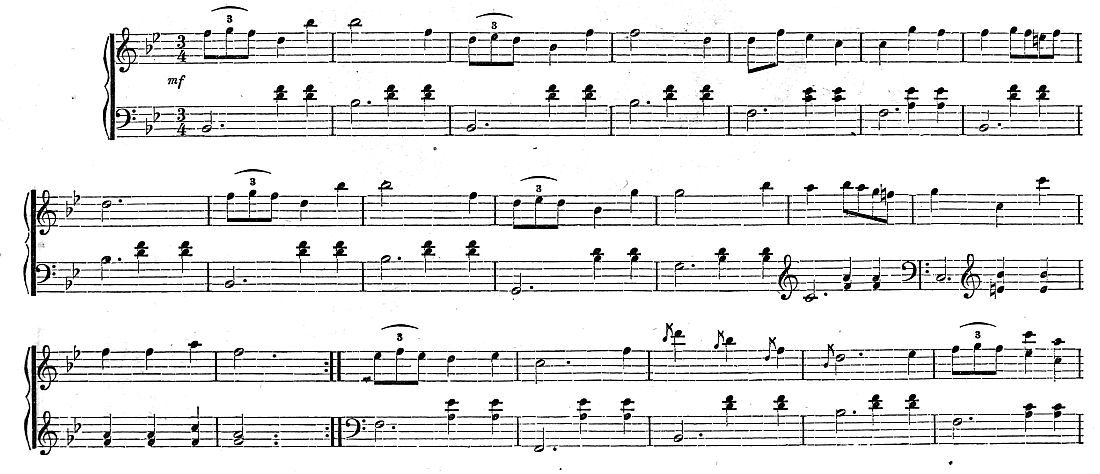
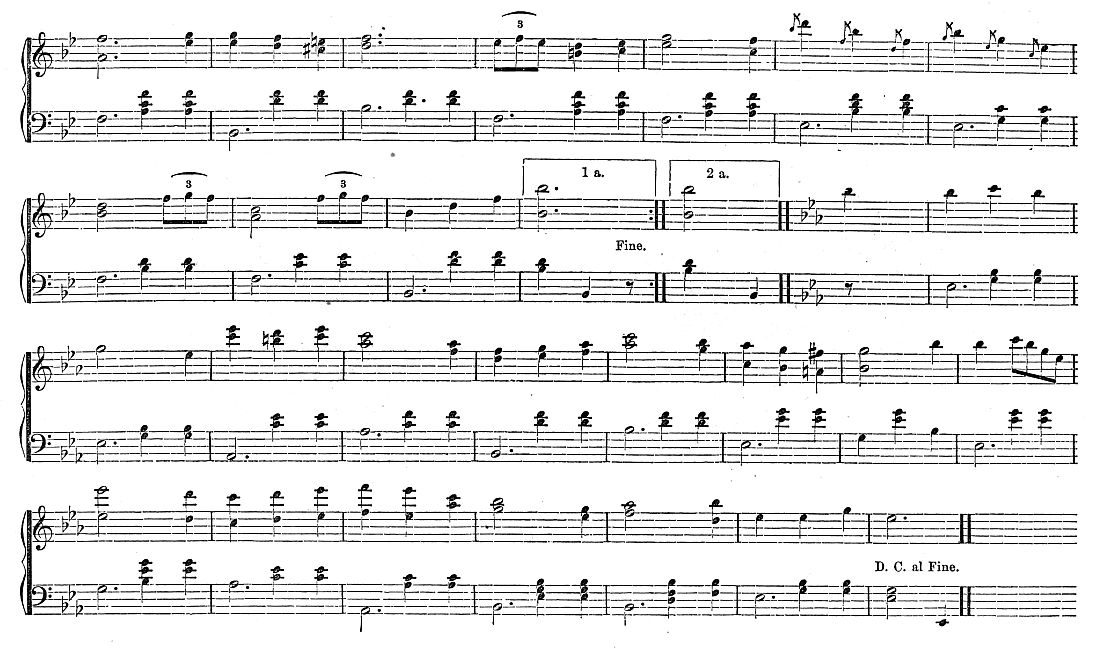
BY A YOUNG AMERICAN COMPOSER.
Published by T. C. ANDREWS, 66 Spring Garden St., Phila.
Entered according to Act of Congress in the year 1853, by T. C. ANDREWS, in the Clerk's Office of the District Court of the Eastern District of Pennsylvania.
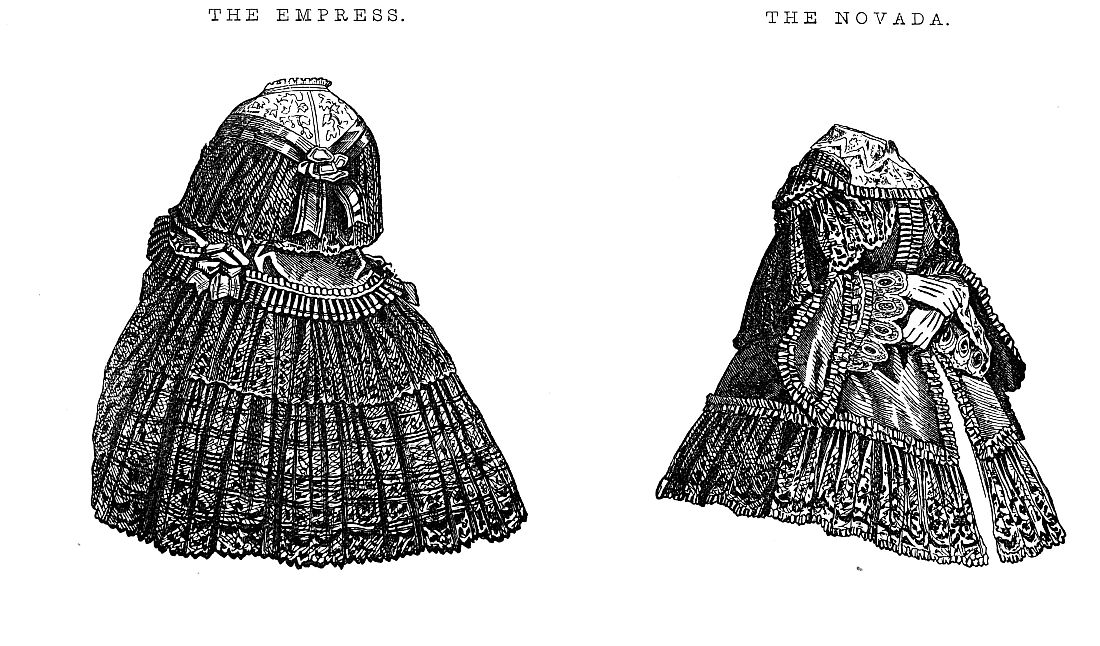
THE EMPRESS. THE NOVADA.
A pattern of either of these will be sent on receipt of 62½ cents. Post-office stamps received in payment. These patterns are exact counterparts of the original, with trimmings, etc.
THE EMPRESS.—A silk mantelet, cut low in the neck. Two hollow plaits forming a fichu are trimmed with a bow in the middle of the back. The
bottom is bordered by a wide ribbon plaited with bows at each side of the arm. Two rows of lace complete it.
THE NOVADA.—Pelisse, cut low and square. A wide revers forms the sleeve. All the edges are trimmed with ribbon, silk with gold fillets. Two
rows of lace fall on the back, one narrow between two plaited ribbons; the other wider, which begins square in front and widens in the back: a deep
lace runs along the bottom. The back is plain, and falls in flutes from the second row of ribbons.
THE various organic substances furnished by
the animal and vegetable kingdoms, which constitute
the food of man, are, from the nature of
their chemical structure, liable to change and
decay; they are also irregular in their supply;
hence arises the necessity of storing up the
abundance of one season to meet the deficiencies
of another. The art of preserving food as much
as possible in its original state is therefore of
great importance; it has been improved by
gradual steps, depending, in great measure, as
in so many other cases, on chemical discovery
and the diffusion of chemical knowledge among
persons engaged in the useful arts; so that, at
the present time, the deprivations suffered by
our forefathers may be prevented; the commonest
articles of food may be enjoyed at all seasons;
and even the delicious fruits of our gardens may
be made to contribute to our health and refreshment
at a season when the trees which produced
them are covered with snow. The mariner, too,
is not now necessarily confined to salt meats;
he may, on the longest voyage, and in the severest
clime, as easily enjoy fresh meat and
vegetables as when he is in port.
The necessity for adopting means for the preservation
of articles of food arises from the
complicated structure of organic compounds, and
their tendency to resolve themselves into simpler
or inorganic compounds. Although the comprehensive
history of the animal and vegetable
kingdoms is written with a very brief alphabet;
although the elements which enter into the
composition of organic bodies are only carbon,
hydrogen, and oxygen—often, but not always,
nitrogen—and occasionally minute portions of
sulphur and phosphorus; yet their extraordinary
powers of combination are such that there appears
to be no limit to the number of definite
substances which they are capable of producing,
each substance having a character peculiar to
itself, and often a crystalline form. It is very
different with the fifty-eight other members of
the list of elements; the compounds which they
assist in forming are inorganic, and they are
formed by the union of pairs of elements, or
pairs of binary compounds.
It is a consequence of this complicated structure
that organic compounds are unstable in
their character, and liable to decomposition, or,
in other words, to resolve themselves into simpler
compounds. An inorganic substance, on
the contrary, however complex its formula may
appear, is actually built up of binary compounds,
the simplest that can be formed. But in the
organic substance the carbon and hydrogen have
a strong tendency to form carbonic acid; the
hydrogen and oxygen to form water; the hydrogen
and nitrogen to form ammonia; or, the hydrogen
and the sulphur to form sulphuretted
hydrogen, &c. In popular language, these
changes are expressed by such terms as decay
and putrefaction. Liebig, however, has given
precision to them by limiting the term decay to
the decomposition of moist organic matter freely
exposed to the air, the oxygen of which gradually
burns and destroys it without sensible elevation
of temperature.[1] The term putrefaction is
limited to changes which occur in and beneath
the surface of water, the effect being a mere
transposition of elements or metamorphosis of
the organic body.[2] The conversion of sugar
into alcohol and carbonic acid is a simple illustration
of the term. The contact of oxygen is,
however, first necessary to the change, which,
when once begun, is continued without the aid
of any other external substance, except perhaps
water, or its elements. Every instance of putrefaction
begins with decay; and if the decay,
or its cause, viz., the absorption of oxygen, be
prevented, no putrefaction occurs. In short, if
the access of oxygen be prevented, there is no
decay; if the access of water be prevented, there
is no putrefaction. The exclusion of air and
moisture forms the basis of some of the best
methods of preserving food.
There are certain substances named Antiseptics
(from ἀντὶ, against, and σήπομαι, to putrefy),
from their property (exerted, however, very
unequally) of preventing the putrefaction of
organic substances. Thus, alcohol, and common
salt in certain proportions, check all putrefaction
and all the processes of fermentation by depriving
the putrefying body of water. Nitre, vinegar,
spices, and sugar are also antiseptics. The
antiseptic effect of a very low temperature is
caused by the solidification of the water and
other juices, which, in their usual fluid state,
allow the molecules to move freely on one
another.
We will first notice the various methods of
preserving animal food. These are: 1, by drying;
2, by cold; 3, by salting and by sugar; 4, by
smoking; 5, by vinegar; 6, by parboiling and
excluding air; 7, by potting; 8, by alcohol.
1. A familiar example of the first method is
afforded in common glue, which in its hard and
dry state may be kept for any length of time.
So also may white of egg, if prepared by pouring
the white of a number of eggs into a large flat
dish, and exposing this for twelve or fourteen
hours to heat in front of the fire. As the water
evaporates, the albumen forms into a yellow,
transparent, hard, shining, brittle mass, which
scales off at the least touch—a test that it is properly
done. These two substances, gelatine and
albumen, are two of the constituents of flesh;
fibrin or fleshy fibre, which is the third, dries
equally well, and is not liable to putrefaction in
that state. Gelatine, after being dried, may be
softened by the action of hot water. Albumen
coagulated by heat cannot be softened again by
water; but if dried at about 140° without being
coagulated, it may be dissolved in cold water,
retaining all its valuable properties. Hence, in
preserving meat by drying, too high a temperature
must be carefully avoided, or the albumen
will become coagulated, and the meat be made
insoluble.
The dried flesh of the bison, of the buffalo,
and of the deer, forms pemmican, the preparation
of which is thus described in Captain Back's
Journal:—
"While meat remains in a thick piece, it is
impossible to get the middle dried before putrefaction
commences; but if the meat be cut into
slices, its desiccation may be easily effected.
The fleshy parts of the hind quarters are cut into
very thin slices, dried in the sun, or before the
fire, and pounded. Two parts of the pounded
meat are then mixed with one of melted fat, and
packed into a bag formed of the hide of the animal.
A bag weighing ninety pounds is called a
taureau by the Canadian voyageurs; and, in fact,
only one bag of pemmican is generally made from
each bison cow. Two pounds of this kind of
food are sufficient for the daily support of a
laboring man; though, when the voyageurs first
commence upon pemmican, they each consume
three pounds or more. In the spring, they
generally boil the young shoots of Epilobium
angustifolium with it, and some Scotchmen in
the service of the Hudson's Bay Company add
flour or oatmeal, thus rendering it more palatable.
The best pemmican is made of finely-pounded
meat mixed with marrow, and further
improved by the addition of dried berries or currants.
If kept from the air, it may be preserved
sound for several years, and being very portable,
it might be used with great advantage in provisioning
troops that have to make forced
marches. It may be eaten raw, or mixed with
a little water and boiled; and although not
much relished by those who taste it for the first
time, the voyageur, with the single addition of
the luxury of tea, requires nothing else for
breakfast, dinner, and supper."
In the West Indies, and in South America,
jerked beef is prepared by cutting the meat into
slices, dipping them into sea-water or brine, and
then drying them in the sun. The flesh of wild
cattle is thus preserved at Buenos Ayres.
Sometimes this dried meat is pounded in a mortar,
into a uniform paste, which is pressed into
jars, and if intended to supply the wants of the
traveller, it is beaten up with maize meal and
packed closely in leather bags. It is eaten in
this state without further cooking. Drying meat
in the air is said, however, to injure its flavor,
and to dissipate a great portion of the nutritious
juices.
Some kinds of fish are preserved by slitting
them down the middle, and drying them in the
air to evaporate the moisture. Small cod, haddock,
and stock fish, prepared in this way, will,
if kept dry, remain good for a great length of
time.
Portable soup is prepared by processes similar
to those used in the manufacture of glue. The
gelatine of meat is dissolved by boiling water,
and the water being evaporated, the gelatine is
left in a solid state. Any fresh lean meat, with
the fat cut away, will answer the purpose.
Bones are also used for the purpose, the gelatine
being extracted by means of a digester. In the
French manufacture of gelatine brut fin, one
hundred pounds of bones yield about twenty-five
of gelatine, which is dried, cut up into dice, and
used for making soup.
2. The effect of cold in the preservation of
animal substances received a remarkable illustration
in the discovery made by Pallas, in the
year 1779, on the shores of the Frozen Ocean,
near the mouth of the river Lena, of an animal
of immense size, imbedded in ice, which, as it
melted gradually, exposed it to the air and furnished
food for the hungry wolves and other
animals of those regions. It was the opinion
of Cuvier that this animal differed from every
known species of elephant, and was antediluvian,
preserved from the remote period of the deluge
in the mass of ice which enveloped it. Some
of the hair of this animal may be seen in the
museum of the Royal College of Surgeons, in
Lincoln's Inn Fields, England.
In Russia, Canada, Hudson's Bay, and other
countries where the frost is sufficiently steady,
meat preserved in this way is a common article
of commerce. Travellers speak with admiration
of the frozen markets of Russia, supplied as they
are from distant places with provisions solidified
by the cold. Thus, in the market at Petersburg,
Mr. Kohl noticed partridges from Saratoff, swans
from Finland, heathcocks and grouse from Livonia
and Esthuria, while the wide Steppes
furnished the trapp-geese which flutter over
their endless plains, where the Cossack hunts
them on horseback, and kills them with his
formidable whip. All these birds, as soon as
the life-blood has flown, are apparently converted
into stone by the frost, and, packed in
huge chests, are sent for sale to the capital. So
rapid are the effects of frost in that country, that
the snow-white hares, which are brought in
sledge-loads to the market, are usually frozen in
the attitude of flight, with their ears pointed and
their legs stretched out, just as they were at the
moment of death. Another curious sight in
these markets is a frozen reindeer, its knees
doubled under its body, its hairy snout stretched
forth upon the ground, and its antlers rising
majestically in the air; or a mighty elk, disappearing
piece by piece, as the action of the saw
and the axe separates it for distribution among
the several customers.
When provisions have been frozen, great care
is required in thawing them; for, if this be done
suddenly, putrefaction soon sets in, and although
cooked immediately, they are hard and deficient
in flavor. They must be thawed by immersion
in cold water.
The London markets are supplied with salmon
packed in ice from many of the northern rivers
that flow to the eastern coasts of Britain. Every
salmon fishery is now provided with an ice-house,
and a stock of ice collected during the
winter. The salmon is packed in large oblong
wooden boxes, with pounded ice between, and
the fish is received in London as fresh as when
it was taken out of the water. It is not, however,
frozen. Most fishmongers are furnished
with ice-houses or cellars for the preservation of
their fish in tubs of ice; and we do not see why
English butchers should not be provided with larders
cooled by the same means. In many parts of
the United States every housekeeper has a small
ice-safe, in which, through the warm season, all
kinds of perishable provisions are kept. Public
ice-houses are also maintained by the butchers,
so that, under the burning climate of South
Carolina, there is less loss in the way of butcher's
meat, fish, game, &c., than in the comparatively
temperate summer of London. The meat is sent
to the ice-house, near the market, every evening,
and is cooled down to near the freezing-point
during the night; when exposed on the stalls
next day, it retains its low temperature for a long
time. Such a plan, adopted in London, would
prevent the immense waste of meat during every
summer, which is said to amount to at least
two thousand tons in London alone. It is true
that, when meat has been once frozen, its flavor
is injured, but the reduction of meat to 32° or
thereabouts, and the solidification of its juices,
are very different things; and it would be easy
to regulate the temperature within a range of
several degrees.
3. Various kinds of salt are used in the preservation
of food. Saltpetre and sal prunella
(which is saltpetre deprived of its water of
crystallization by heat) are also used for the
purpose. The action of these alkaline salts upon
animal substances is, as already noticed, to abstract
the water in the juices of the meat, and,
being dissolved therein, the salts enter the pores
of the animal substance; the albumen of the
meat, which is more liable to putrefaction than
the gelatine and fibrine, is thus rendered less so.
There are two methods of salting, dry salting
and pickling. In dry salting, the meat is packed
in dry salt, or in some cases the surface is rubbed
all over with salt. In pickling, the meat is kept
immersed in a solution (sometimes saturated)
of common salt dissolved in water. This method
does not render the meat so salt as dry rubbing,
and is probably less injurious to its nutritious
qualities, but it will not keep the meat so well.
Bacon is cured by salting and drying, for which
latter purpose it is often hung up in the wide
chimneys of farm-house kitchens; cod is also
salted and dried for the large demand of the
Peninsula; in England, it is used in a green
state; that is, instead of being split quite open,
it is only opened down to the navel, then salted,
and laid in brine or strong pickle, and put into
casks without drying. Haddock, cod, or ling,
are cured by splitting the fish and removing the
backbone; they are then salted for two or three
days, with equal parts of salt and sugar, or with
salt alone; they are next stretched on sticks,
and laid on the beach to dry in the sun, or they
are arranged on stages, or hung up in an inclosed
space warmed by a stove. Herrings are salted,
or pickled, and smoked.
Sugar, like salt, takes away the water from
animal substances, and thus prevents putrefaction.
By immersing meat in molasses, it has
been preserved fresh for months. Fish is sometimes
preserved by cutting it open, rubbing in
sugar, and leaving it for a few days; it is then
dried in the air, taking care to turn it frequently.
For a salmon of six pounds weight, a table-spoonful
of brown sugar is sufficient; but, if
hardness be required, a teaspoonful of saltpetre
is to be added.
4. The efficacy of smoking, or smoke-drying,
arises not only from the heat of the smoke, but
from certain chemical products disengaged during
the combustion of the wood fuel used for the
purpose. Pyroligneous acid vapor and creasote
are both produced, and the latter substance possesses
the remarkable property of coagulating
albumen. Hence, those chimneys only are fit
for the purpose where the fire below is wood or
peat, not coal. The kind of wood burnt is also
of importance, the smoke from beech and oak
being preferable to that from fir or larch. Smoke
from the twigs of juniper, rosemary, peppermint,
&c., impart to the meat a portion of their aromatic
flavor. Westphalia hams owe some of
their excellence to being smoked by juniper.
Slow smoking is preferable to rapid, as it penetrates
completely into the interior of the meat.
In some parts of the country, the drying and
smoking of hams are a separate trade. In such
cases, a smoking-house or hut is erected, about
twelve feet square, and the walls seven feet
high, with a hole in the roof; joists are laid
across inside, to hang the flitches on, and the
floor is covered five or six inches deep with sawdust,
which, being kindled, produces much smoke
and little flame.
5. Vinegar and some other acids preserve both
animal and vegetable substances by coagulating
their albumen, which, as already stated, is peculiarly
liable to putrefactive fermentation.
6. In the year 1810, M. Appert received a
reward of 12,000 francs from the French Government
for his method of parboiling provisions,
and inclosing them in earthenware vessels in
such a manner as to exclude the air. Many
vegetables, fruits, &c., can be kept fresh for a
great length of time, by shutting them up closely
in a vessel, having previously filled up the interstices
with sand or other loose substance that
will exclude nearly all the air. Fresh walnuts
may be preserved in this way in a jar, packed
with sand and closely covered over; grapes
packed in sawdust are imported into this country.
Meat cannot be preserved in this way, but
by exposing it to the heat of boiling water, the
albumen, in which putrefaction first commences,
coagulates; and as coagulated albumen is somewhat
slow in decomposing, we thus have a
reason for the common observation that cooked
meat will keep longer than raw. It will not,
however, keep many days, unless the air be
perfectly excluded, not only from the external,
but from the internal parts. The air in the
interior may be expelled by boiling, and the exterior
air may be kept away by inclosing the
substance in an air-tight vessel. If these conditions
be carefully observed, food may be preserved
for any length of time. Appert's method
consists in applying heat to the substances to
be preserved, so as to coagulate their fermentable
juices, and then to place them in such a situation
as to deprive them of contact with air. The
vessel in which the meat is prepared is plunged
for some time into boiling water before it is
finally sealed, in order to drive out the last portions
of the air; for, if a small portion of oxygen
gas were present, this would be sufficient to
commence the process of fermentation, and when
once begun it would be continued.
M. Appert's process may be described as follows:—
The meat to be preserved is first parboiled, or
somewhat more, and freed from the bones. It
is then put, together with vegetables, if required,
into tin cases or canisters, which are filled quite
up with a rich gravy; a tin cover, with a small
aperture in it, is then carefully fixed on to each
canister by solder, and while the vessel is perfectly
full, it is placed in boiling water, or in a
saline bath, heated above the boiling point of
water, and kept therein until the air has been
expelled as completely as possible by the steam
generated within the canister. The small hole
in the cover is completely closed up with a little
solder while the contents are yet hot, the issue
of the steam being stopped for a moment by
means of a damp sponge. The canister, with its
ingredients, is now allowed to cool, in consequence
of which these contract, and the sides of
the vessel are forced slightly inwards by the
pressure of the atmosphere, and become a little
concave. As a precautionary measure, however,
the tins are placed in the testing-room, which is
heated to above 100° Fahr. Should putrefaction
take place in consequence of a minute portion
of oxygen left in the case, and not combined
with the animal or vegetable matter, the generated
gases will burst the canisters; those,
however, which withstand this test will preserve
the provisions for many years; for as each
vessel is hermetically sealed, and all access of
air prevented, it may be sent into any climate
without fear of putrefaction, and the most delicate
food of one country be thus eaten in its
original perfection in a distant region, many
months, or even years after its preparation. In
this manner may all kinds of alimentary substances
be preserved; beef, mutton, veal, and
poultry; fish and game; soups, broths, and
vegetables; creams and custards. Of a quantity
taken by Captain Nash to India, not one canister
was spoiled; and one which he brought back
contained, after two years, beef in the highest
state of perfection and preservation, and after
having been carried upwards of 35,000 miles, in
the warmest climates. This method has been
adopted by the commissioners for victualling the
English Navy, who, having examined some
meat so preserved for four years, during voyages
in the Mediterranean, found it as sound, sweet,
and fresh, as if it had been boiled only the day
before. Captain Basil Hall bears similar testimony.
It was stated, however, by the officers
in the Antarctic voyage, that they gradually got
very tired of preserved meats, but not of preserved
vegetables, and that there was an insipidity
in them which they did not find in fresh
food. There is, however, no doubt that, if the
articles be selected with care, and the process be
properly conducted, M. Appert's method of preserving
food is a valuable invention. If the
contractor be careless or dishonest, the most
fearful consequences might ensue to the crews
of ships victualled with preserved meats. It
appears, from a recent examination of several
thousand canisters of the preserved meat of the
Navy at Portsmouth, England, that their contents
were masses of putrefaction, consisting of
meat, &c., which, even in a fresh state, ought
never to be used as food. It is stated that this
preserved meat was supplied from Galatz, in
Moldavia.
In 1842, M. Appert's method was made the
subject of a further patent, granted to Mr. Bevan,
whose process consisted in expelling air from
the cases containing the food, by placing such
cases in connection with a vacuum chamber, or
other exhausting apparatus, and also with a
vessel containing gelatine or other suitable fluid
material, in such a manner that, by opening the
communications, the air escapes into the exhausting
apparatus and the gelatine takes its
place. By this method the high temperature
previously used in preserving food was not required;
it could, on the contrary, be cooked at
very low temperatures, and in a space almost
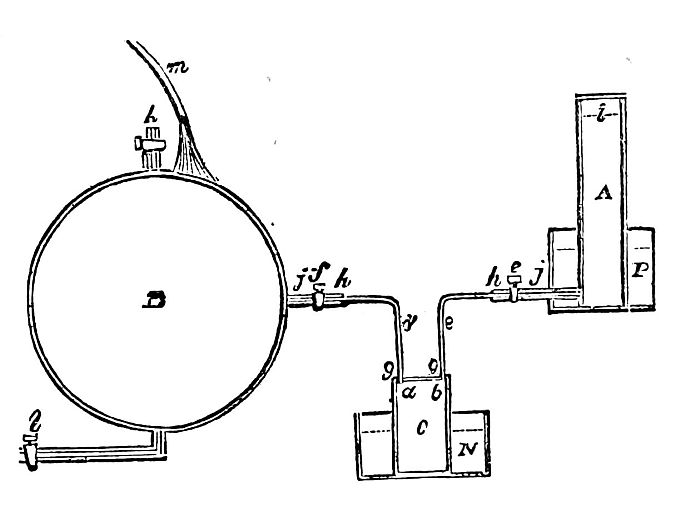
void of air. The apparatus used is shown in
section, in the following figure: A is a vessel
open at the top, and filled to the line i with fluid
gelatine, having a pipe j, and a stopcock e firmly
attached to it. B is a sphere of metal in which
a vacuum is produced by blowing steam through
it by the pipe l out through k; l and k are then
closed, and a jet of water at m, applied to the
outside of the sphere, condenses the steam and
leaves a vacuum within it. The substance to
be preserved is inclosed within a cylindrical tin
vessel C, the top of which is then soldered on,
and two small metal pipes d and c passed into it
air-tight, as far as a b; the other ends being secure
to the pipes j j at h h. The case is next
immersed in a water-bath N, at a temperature
of about 120°, and by turning the cock f, the
greater portion of the air in the case C rushes
into B; the article of food, animal or vegetable,
in the case, being thus relieved of atmospheric
pressure, the heat of 120° is sufficient to cook
it, and to expel the air from it. A fowl is cooked
in this way in about fifteen minutes. The cock
e is then opened, and the gelatine, kept fluid by
the warm bath P, enters by the pipes j and c,
into the case C, and drives the small portion of
air left therein into the vacuum chamber B. The
case C is then hermetically sealed by nipping the
tubes d and c at the points g g. The case is then
submitted for a few minutes to the action of
boiling water (thirty minutes for a fowl), and
when cool, the process is complete.
A concentrated form of food, called meat biscuit,
excited a considerable degree of attention
in the Great Exhibition. It is formed by boiling
down the fresh beef of Texas, and mixing into
the strong beef-tea thus formed a certain proportion
of the finest flour. The biscuit formed
from these materials is so nutritive, that less
than four ounces a day (mixed with warm water
or not, according to circumstances) is sufficient
food for a man in active service. It is very
light and portable, and keeps perfectly well
without change; hence it is admirably adapted
to the provisioning of troops, ships, and overland
expeditions. The manufacture is also of
great importance to those countries in which
cattle are superabundant, and are killed merely
for the sake of their skins for the tanner, or
their bones for the farmer, the flesh being actually
thrown away. In some places, animals
which we are accustomed to regard as valuable
are so numerous that they are drowned by hundreds,
merely to get rid of them, neither their
skin, bones, nor flesh serving as a pretext for
the wholesale slaughter.
Milk has been preserved in the following
manner: Fresh milk is reduced by boiling to
one-half, and beaten up with yolk of eggs, in
the proportion of eight eggs to every ten and a
half quarts of milk. The whole is then placed
on the fire for half an hour, and skimmed frequently;
it is next strained and heated in a water-bath
for two hours. It is stated that this
milk will keep good for two years, and, if
churned, would afford good butter. Cream may
be preserved by boiling five measures down to
four; then, after cooling and skimming, it is
put into a bottle, corked down, luted, and kept
in the boiling heat of a water-bath for half an
hour. This, it is said, will keep two years.
A much better method of preserving milk is
that first pointed out by M. Dirchoff, the Russian
chemist; namely, to solidify it by driving
off the aqueous portion by a gentle heat. Specimens
of consolidated milk were shown in the
Great Exhibition; and it was stated that, after
being dissolved in boiling water, and reproduced
in the form of milk, the solution will keep pure
for four or five days. As milk contains 873
parts of water in every 1000, it follows that 1000
parts of milk will yield by evaporation only 127
parts.
7. Potting is only another contrivance for excluding
animal substances from contact with air.
Lean meat should be selected, cooked, and then
reduced to a pulp by being beaten in a mortar,
salt and spices being incorporated. The pulp is
then rammed into jars, and preserved from the
air by a thick coating of melted butter or lard
poured over it.
In the preservation of fruits and vegetables,
some are dried, as in the case of nuts, raisins,
sweet herbs, &c.; others are preserved by sugar,
such as many of the fruits, whose delicate juices
would be dissipated in the process of drying.
Some are preserved in vinegar, as in the case of
pickles; a few by salting, as French beans; and
others are preserved in spirits.
Appert's method applies to vegetables and
fruits of all kinds; they need not, however, be
parboiled. The dry and fresh-gathered fruits
are put into strong, wide-mouthed glass bottles,
carefully corked, and luted with a cement of
lime and soft cheese, and bound down with wire.
The bottles are then inclosed separately in canvas
bags, and put into a kettle of water, which
is gradually heated until it boils; the bottles are
kept in this condition until the fruits are boiled
in their own juice. The whole is then left to
cool; after which the bottles are examined separately,
and put away for store.
Many kinds of vegetables may be preserved
by being spread out on the floor of a kiln, and
dried by a gentle heat: the thicker kinds of
roots, such as carrots, turnips, potatoes, &c., are
to be sliced, and thoroughly well dried; after
which they must be packed up in paper or very
dry boxes, and put into casks.[3]
A method of preserving vegetables by drying
and pressure, recently invented by M. Masson,
was brought into prominent notice at the Great
Exhibition. Cabbage, sliced turnips, apples, or
whatever vegetable be selected, are dried in an
oven at a certain temperature, so as to drive off
from seven to eight per cent. of water: the drying
must not be conducted too slowly nor too
rapidly, but at a medium rate. After the drying,
the vegetables are packed into a very small
compass by the intense pressure of an hydraulic
press; then squared and trimmed with a knife,
packed up in tinfoil, and lastly, stored in boxes.
A short time ago, we examined some red cabbage
preserved in this way, which had been exposed
in the Great Exhibition all the time it was
open, and had been slowly absorbing moisture,
and yet it appeared to be perfectly good. By
this method, from 15,000 to 18,000 rations, of a
quarter pound each, can be stowed into a cubic
yard. We also saw some dried plantains from
Mexico (a vegetable of very considerable nutritious
value), which had been lying in a warehouse
at Woolwich ever since the year 1835,
and had undergone no change. It was stated
that the method of preparing them is cheap and
easy, and that the dried plant can be sent in any
quantities to Europe, at six cents per pound,
with a considerable profit to the importer.
Some kinds of vegetables, such as French
beans, artichokes, olives, samphire, and barberries,
are preserved by salt, a strong brine being
made by the addition of four pounds of salt to
a gallon of water; the vegetables are put into
this, and quite covered with it. In Holland and
Germany, kidney beans are sliced by a machine
something like a turnip-cutter, and put into a
cask in layers with salt between; a weight is
then put on, and pressure is kept up until a
slight fermentation takes place; the salt liquor
is then poured off; the cask is covered up, and
put into the cellar as store. Before being cooked,
the beans are steeped in fresh water.
Sauer Kraut is prepared somewhat in the
same manner. The following recipe for making
it is given by Parmentier:—
The heads of white winter-cabbages, after removing
the outer leaves, are to be cut into fine
shreds, and spread out upon a cloth in the shade.
A cask which has had vinegar in it is to be selected,
or, if that cannot be had, the inside
should be rubbed over with vinegar or sauerkraut
liquor. A layer of salt is to be put in the
bottom of the cask, caraway-seeds are to be
mixed with shreds of cabbage, and they are to
be packed in the cask to the depth of four or six
inches; and layers of this kind, with salt between
each layer, are added till the cask is full,
stamping them down with a wooden stamper as
they are put in, to half their original bulk;
some mix a little pepper and salad oil with the
salt. Some salt is to be put on the top, and
some of the outside leaves of the cabbages.
About two pounds of salt suffice for twenty
middle-sized cabbages. The head of the barrel
is to be placed upon the cabbage-leaves, and
must be loaded with heavy stones. A common
method is for a man, with clean wooden shoes
on, to tread the cabbage down in the cask. Fermentation
will take place, and some juice will
be given out, which is green, muddy, and fetid;
this rises to the surface, and is to be replaced
with fresh brine. When the fermentation is
over, the casks are closed up. Cabbages are
preferred, but any other vegetables may be
treated in the same manner.
When vegetables are preserved in vinegar,
they form pickles. When sugar is the preserving
medium, they are variously named according
to the mode of preparation. Fruits, flowers,
herbs, roots, and juices, boiled with sugar or
syrup, and employed in pharmacy, as well as
for sweetmeats, are called confections (Latin,
conficere, to make up). Liquid confects consist
of fruits, either whole or in pieces, preserved by
immersion in fluid transparent syrup: apricots,
green citrons, and some foreign fruits, are treated
in this way. Dry confects are prepared by boiling
in syrup those parts of vegetables adapted to
this method, such as citron and orange-peel, &c.;
they are then taken out and dried in an oven.
Marmalades, jams, and pastes are soft compounds
made of the pulp of fruits, or other vegetable
substances, beaten up with sugar or honey;
oranges, apricots, pears, &c., are treated in this
way. Jellies are the juices of fruits—currants,
gooseberries, apples, &c.—boiled with sugar to
such a consistence as, on cooling, to form a
trembling jelly. Conserves are dry confects,
made by beating up flowers, fruits, &c. with
sugar not dissolved. Candies are fruits candied
over with sugar, after having been boiled in the
syrup.
The best syrup for preserving fruits is made
by dissolving two parts of double-refined sugar
in one part of water, boiling a little, skimming,
and filtering through a cloth. This gives a good
smooth syrup, which does not readily ferment
nor crystallize.
The specimens of preserved food in the Great
Exhibition were exceedingly numerous; they
included animal and vegetable productions,
fruits, &c. One interesting specimen was a
canister containing boiled mutton, prepared by
the exhibitor, Mr. Gamble, for the Arctic Expedition
in 1824. A large number of these canisters
were landed from the ship Fury, on the
beach where the ship was wrecked in Prince
Regent's Inlet, and were found by Captain Sir
John Ross in August, 1833, in a state of perfect
preservation, although annually exposed to a
temperature of 92° below, and 80° above zero.
Had it not been for the large store of provisions
left by Parry near the spot where the Fury was
wrecked, Ross's expedition must have perished.
BY PAULINE FORSYTH.
BETWEEN the projecting a scheme in the
mind and its actual accomplishing, the difference
is as great as that between the appearance of
some Eastern city seen from a distance in the
moonlight, with its picturesque domes and minarets
silvered by the rays that throw over the
darkest spots an unreal glamour of purity and
brightness, and the same place viewed in the
broad daylight, while standing in the midst of
its narrow and dirty streets. It is as if we had
devised some airy palace, beautiful and complete
in its smallest details, and found ourselves, when
going about to build it, with no materials ready
but a little clay and a few stones and sticks, and
those of the most crooked and unpliable materials.
Few persons realize, before they are
twenty-five, the resolutely prosaic actualities of
the world as it is. Almost every one in his
early youth is fully persuaded that he is about
to perform an important part in some deeply interesting
drama, and it is a hard lesson that disenchants
him, and shows that he has been acting
the part of Don Quixote with the world for
Sancho Panzo.
Frederic Lanier was a young man of nineteen.
His early life had been passed in the country;
but when he was fifteen he had been sent to
New York to complete his education, and to reside
in the mean time with his uncle, Mr. Lawrence.
The very day after his arrival in the
city had been marked by an important event.
He had seen Adelaide Marshall, and had fallen
in love with her. This love had accompanied
him during the one year he had spent at the
High School, and his three succeeding ones at
the college. The lady was six years older than
himself, but that was an additional attraction.
Her stately and graceful movements, her majestic
presence, and the calm and regular beauty
of her face, never lost their charm to him. He
was too much in love to observe that in the
light of her blue eyes there was no warmth, but
a cold and critical scrutiny, and that her mouth
closed with a severe and slightly satirical expression.
She was to him a perfect Helen.
About soon to be elevated to the rank of a
Senior, he had begun to think himself in a position
to show his passion more openly than he
had hitherto ventured to do. He little suspected
that the lofty Adelaide had divined his feelings
from the first, and had received his timid
attentions with sensations of gratified pride and
amusement that, unmingled with any softer
feeling, promised little for the success of his
suit. The lady, accustomed to admiration, considered
all homage as her due; and, looking on
Frederick Lanier as a mere boy, she talked to
him familiarly when she so inclined, and made
use of him in a gracious and royal manner without
the slightest tender consideration for his
feelings, or fear of the consequences. She had
known many men and boys to fall in love with
her, and, when they had found out that she did
not and would not reciprocate their affection,
the worst that had ever happened was that they
had married somebody else; and this she calmly
contemplated as the probable termination of
Frederick Lanier's passion, while he was internally
vowing a lifelong devotion to the lady
of his heart.
He had discovered that she was to pass two
or three weeks at the White Mountains during
the month of July. He decided to arrange his
summer wanderings so as to be there at the same
time. Meantime, a vague desire to be alone, to
feed on his own thoughts free from the importunate
interruptions of even the members of his
own family, induced him to follow the example
of several of his college companions, and undertake
a pedestrian tour.
This proposal was not received with any approbation
by his uncle's family.
"Now, Fred," said his cousin Emily, "this
is too bad. We were going to have such a pleasant
time at Lake George this summer, and had
relied upon you to go with us. Father will
have to be away a great deal, and I am sure I
don't know what we shall do without you to go
about with us. I have asked Bessie Graham to
accompany us, too, and I particularly wanted
you to become better acquainted with her."
"Bessie Graham! Why, she is a little girl."
"She is nearly seventeen," replied Emily.
"Well, she is a very small specimen of womankind,
and I have no particular admiration
for little women; besides, she is somewhat of a
chatter-box, is she not?"
"She talks a little, but not too much," was
the reply.
"And laughs a great deal. I like dignified
manners better."
"For instance, Miss Adelaide Marshall's,"
said Emily, with a little irritation in her tone.
"You are going to the White Mountains, you
say?"
"Yes."
"And I heard Miss Marshall say, the other
day, that she intended to pass two or three weeks
there; so that accounts for your plan. It is a
most absurd fancy of yours to fall in love with
that iceberg. I have as much expectation of
seeing you return with Mount Washington in
your pocket, as with Miss Marshall on your
arm."
Frederick Lanier grew red even to the tips of
his ears with embarrassed indignation at thus
having the most cherished secret of his heart
rudely laid bare to the light of common day.
He became only the more determined to escape,
where he could dwell in peace on the one idea
that engrossed all his thoughts.
"When do you think of leaving?" asked
Emily.
"To-morrow," he replied.
"And Bessie comes the day after. And when
will you return?"
"Perhaps by the last week in August."
"And Bessie will be gone by that time. It is
too bad!"
"I do not understand what Bessie Graham
has to do with my movements. I might change
my plans to suit you, Emily, but not a little
chattering thing like your friend."
Emily said nothing; she had had schemes of
her own, and Frederick had completely destroyed
them, but she deigned no explanation.
"I think of going along the Hudson River
until I reach the northern extremity of the State,
when I shall cross over to the Green Mountains
in Vermont, and go through that State into New
Hampshire. I hope to find myself at the foot
of the White Mountains by the middle of July."
"The very time Miss Marshall expects to arrive
there. She is going on horseback with her
brother. Her mother and sister are to accompany
them in the carriage."
"Ah!" said Frederick, endeavoring, in a
most transparently artful manner, to appear
ignorant and indifferent.
"If you are going so soon," said his aunt,
"we had better see if your wardrobe is in a fit
state for so long an absence."
"I shall need very little," replied Frederick;
"the less the better, as I intend to carry it myself."
"I have a little light valise I can lend you,"
said a cousin of his, John Williams, who happened
to be passing the evening there.
The offer was accepted, and the rest of the
time was passed in discussing the many delightful
and romantic adventures that pedestrian
tourists have met with both in Europe and
America.
With a heart full of hope and joyous expectation,
Frederick took his valise and a stout stick,
with which all prudent pedestrians provide
themselves, and saw with delight the dusty
pavements merging into the dustier road, and
the houses becoming more and more widely
separated.
He had intended to choose the byways rather
than the main road, and to make it convenient
to stop at farm-houses instead of the country
taverns along his route, thinking by this means
to be able to see more of the people, and to gain
a little insight into habits and customs with
which he felt as though he ought to be somewhat
more familiar. He had anticipated a great deal
of pleasure from the variety of character and
mode of life which would thus be brought under
his notice; but his first attempt proved so unsatisfactory,
that he gave up all farther idea of
intruding on the privacy of those who were unprepared
for receiving strangers.
He had stopped at a farm-house, and asked if
he could be lodged for the night just at eight
o'clock. He found the occupants preparing to
retire, and, though they made him welcome, and
entertained him hospitably, yet he could not
help perceiving that he gave them additional
trouble; and, when he found that they would
not receive payment for it, he decided that it
was a false position in which he had placed himself,
and that nothing but necessity should induce
him to adopt the same course again. He
lacked the cheerful assurance with which some
men can make themselves at home anywhere,
without a suspicion that others are not equally
pleased with their society.
The next morning, feeling rather footsore and
unrefreshed, after his unusual exertions of the
day before, Frederick took advantage of a stage
that was going in the same direction with himself,
and rode to the village in which he had decided
to pass the night. Here he amused himself
by wandering about the beautiful and romantic
country around, and returning when he
was weary to the country inn. This he found
so much easier and pleasanter a mode of travelling
than the fatiguing one of walking, that he
went almost to the foot of the Green Mountains
before he thought of resuming it. Then, ashamed
of his faint-heartedness, he left the stage, and,
shouldering his valise again, he walked for some
hours quite vigorously.
He entered the little village of Hillsdale just
as the moon was rising, and, after a supper such
as none but a pedestrian could eat, he strolled
out to enjoy the loveliness of the summer evening
and his own meditations, by the banks of a
clear and rapid stream, the beauty of which had
attracted his notice as he was entering the village.
He walked for some distance up its banks,
and then, throwing himself down on a grassy
mound, he lay in a sort of musing trance, watching
the moonlight shimmering on the flashing
waters, and listening to the tinkling music of
their flow, while his imagination was busily engaged
in inventing deeds of heroism and chivalric
daring, by which he fancied himself proving
to the lady of his love that he was worthy of
one so noble and high-souled.
Midnight stole unawares upon him while thus
engaged, and, with reluctant steps, he sought
the Eagle Hotel, where he had decided to pass
the night. A decision not difficult to arrive at,
as there was no other public house in the place.
The next morning he discovered, to his great
annoyance, that he had lost his purse in his
evening ramble. He sought for it in vain; and
when the landlord, conjecturing from his movements
that he was about to depart, asked him if
he would like his bill, he could not help a guilty
conscious feeling stealing over him as he tried
to answer, in an off-hand way, that he intended
to pass a few days in Hillsdale.
If Frederick Lanier had not been so unaccustomed
to the ways of the world, he would have
stated his situation frankly to the landlord, and
then have made himself easy until he could receive
remittances from home. But, as it was,
he kept his affairs to himself; and, while waiting
for an answer to the letter he had written
home, he went in and out, took his meals, read
the paper, and did his best to pass the time away
without addressing a remark to any one.
It struck him that he had never been among
people quite so rural and primitive, and he was
right. But, as the arrival of a stranger was a
rare event among them, so he was of proportionate
importance. And they were also gifted
with the usual sociability of the New Englanders;
and a young man that did not seem inclined to
tell who he was, and where he came from, and
where he was going to, and seemed to have nothing
to do but to go regularly to the post-office,
and then with his fishing-rod to the river, from
which he always returned empty-handed, was
an object of wonder and suspicion.
Frederick Lanier, unconscious of the speculations
of which he was the object, began to be
greatly worried and perplexed by not receiving
the letter for which he was anxiously waiting.
He grew daily more restless and uneasy.
"He's got a bad conscience, depend upon it,"
said the landlord, oracularly, as he sat in the
midst of his satellites and customers listening to
the hasty strides with which Frederick Lanier
was pacing up and down the room over their
heads.
At length a paragraph in a newspaper brought
their suspicions to an open expression.
"That's him, depend upon it," said the landlord.
"James Wilson. J. W.; them's the
very letters on his portmantle. Five hundred
dollars reward. That will be doin' a pretty
good business for one day."
"Are you going to take him up, Squire?"
asked one of the men in the bar-room.
"Certingly. Think I am going to let such a
chance slip through my fingers? It's him—it's
as like him as two peas. Read that, friend,"
continued the landlord, addressing himself to
Frederick as he was going hastily through the
room, and planting himself so that the young
man could not pass him.
Frederick took the paper, and read an advertisement
offering a reward of five hundred dollars
for the apprehension of a clerk in a bank of
a neighboring town, who had absconded with
two or three thousand dollars. As Frederick
glanced over the description of the runaway, it
struck him that James Wilson must have been
rather an ill-looking fellow. A broad-shouldered,
down-looking, dark-haired, swarthy-complexioned
man would be rather an unpleasant
person to meet in a lonely place, he thought.
He returned the paper to the landlord, saying,
carelessly—
"Do you think there is any probability that
the thief will be taken?"
"Well, I guess so, if we look sharp."
Something in the landlord's tone struck Frederick
disagreeably. He glanced around, and the
distrustful, watchful expression on the countenances
of those about him revealed at once the
nature of the suspicions against him.
"You surely do not suspect me of being this
James Wilson?" asked he, in surprise.
"I guess you'll have hard work to prove that
you are anything else. What is your name?"
"Frederick Lanier."
"And what business do you follow?"
"I am a student in New York city. My
uncle, with whom I reside there, is Mr. Oliver
Lawrence. You may have heard of him?"
But no. Well known as Mr. Lawrence was
in Wall Street, his reputation did not extend to
Hillsdale. Frederick saw that the mention of
his uncle's name produced no effect. He glanced
again over the description of the defaulter.
"I surely am neither swarthy nor down-looking,"
said he, catching at a straw.
"Wall, I don't think you be 'ither," said a
young man, who seemed to look with some compassion
on Frederick in his painful position.
"Asa Cutting, who asked your opinion?"
said the landlord, magisterially. "Young man,"
continued he to Frederick, "I hain't once seen
the color of your eyes sence you've ben in my
house."
He must have seen them at that moment, for
they were bent on him full of flashing indignation.
But he went on.
"If you are a college-larnt young man, you
can read Greek most likely?"
"Yes."
"Wall, I've got a Greek book here that I
would like to have you read out of."
And, after some searching, a small book
bound in paper was handed to Frederick. He
took it readily, hoping to prove by his scholarship
the truth of his assertions. To his disappointment,
it was a little Chinese or Japanese pamphlet
that had found its way to this remote place.
"This is not Greek; it is Chinese," said he.
"Hum!" said the landlord, in a tone of contempt;
"that jest shows how much you know
about it. If that ain't Greek, I would like to
know what is. Do you ever see paper like that
nowadays? That's Greek paper; it was invented
ages before Chiny was ever heard of."
"Wall," said Asa Cutting, "I always have
thought that them scratches in that book that
pass for letters were jest like the scratches on
the tea-chists in my store."
"Asa Cutting, what you think is nothin' to
nobody, and what you say had better be the
same. Young man, sence Greek is unbeknown
to you, may be you'll have better luck with
Latin."
"I can read Latin," said Frederick, modestly.
"Do you see them letters on my sign? You
can read them out of the window here."
"You mean the motto, 'E pluribus unum,' I
suppose?" said Frederick.
"Yes," said the landlord. "What do they
stand for now?"
"'One of many,'" said Frederick.
"I thought how it would be," exclaimed the
landlord, triumphantly. "'One of many!'
What, in the name of common sense, does that
mean? No, young man; don't you see they
are put under the eagle, and they mean, 'The
eagle's flight is out of sight?'"
"I think you are mistaken, Square," said the
pertinacious Asa; "I am sure the stranger is
right."
"Capen Cutting, you are like a sheep's head,
all jaw," said the landlord, with some irritation.
"You think you've got more sense than any
one about here; but I guess you'll find yourself
mistaken. Leftenant Davis, of the United
States Army, told me what them words stood
for, not more than a year ago, and it's likely
he'd know. Young man, I'm afraid you are
in a bad way."
Frederick began to think so himself.
"I assure you," he said, "that I am not
James Wilson."
"Young man, you be," said the landlord,
sternly. "What have you got J. W. on your
portmantle for, I'd like to know?"
"That is a valise that was lent to me by my
cousin, John Williams," said Frederick. "If
you will wait till I can write to New York and
receive an answer, I can satisfy you that you
are mistaken in the person."
"I think, Square, you might allow the young
man that chance," said Asa Cutting.
"Wall, I'd be willin' to do it," said the landlord,
"if I only knew where to keep him; but
the jail hasn't been mended sence that nigger
took the roof off with his head and got out, two
months ago; and there ain't a room in my house
but the cellar that ain't about as onsafe as out
doors."
Meantime, as people were dropping into the
bar-room, the landlord, for greater privacy and
safety, took his captive, with a small train of
advisers and lookers-on, into the parlor, and
there continued the discussion as to the proper
course to be pursued. Frederick offered to
give his word not to attempt an escape; but
that proposal the landlord put aside with great
contempt, and, disdaining any farther parley,
Frederick listened in angry silence to the different
plans suggested by the landlord to insure
the safe keeping of the prisoner, and the consequent
obtaining of the reward.
There was a slight bustle in front of the
tavern, but the debate was so interesting that it
passed almost unnoticed. Soon after, the parlor
door was thrown open, and Adelaide Marshall
entered, followed by her brother. Frederick
thought he had never seen her look so
magnificently beautiful. Her long riding-habit
showed her figure to great advantage; her cheeks
were flushed, and her eyes sparkling with the
light and color of vigorous health and animation,
and the mountain breeze had arranged her
blonde hair with a most picturesque negligence
around her fair open forehead.
"Why, Mr. Lanier," said she, with gracious
cordiality, "this is an unexpected pleasure."
"Fred, I am delighted to meet you," exclaimed
Henry Marshall.
An expression of disappointment passed over
the landlord's face.
"Do you know this young man?" asked he.
"Certainly," replied Mr. Marshall, with some
surprise; "he is an old friend of mine."
"Wall, Square," said Asa Cutting, "I told
you you'd better take care what you was about.
I kinder thought all along the young man didn't
look like a thief."
"That's complimentary," said Miss Marshall.
"You seem to have been in some trouble. I am
glad we came in time to relieve you from such
suspicions."
Frederick could not echo her expressions of
pleasure. A week or two in jail, or even a temporary
confinement in the landlord's cellar,
would have been a light trouble compared with
the mortification of being seen by Miss Marshall
in such a position. He explained, with an attempt
at indifference, the circumstances which
had conspired against him, and Adelaide found
them highly amusing. She laughed heartily
over the advertisement, dwelling with malicious
pleasure over each unflattering epithet. She
listened to Asa Cutting's circumstantial account
of the whole affair with an interest that led him
insensibly to make it as long as possible; and,
when he came to the landlord's suggestion of
confining the suspected man in the cellar, she
seemed so very much amused that Frederick
could hardly endure it with becoming patience.
Even after they were alone, she recurred again
and again to the same theme, and always contrived
to hit upon the very points that jarred
most on Frederick's sensitive nature. When
her mother and sister arrived, Miss Marshall repeated
the story to them, dwelling and expatiating
upon it until Frederick could no longer conceal
his annoyance.
He declined coldly the invitation urged upon
him by the whole family to join them in their
tour—an invitation he would gladly have accepted
a few days before; and it was with real
pleasure that he saw the cavalcade set out the
next morning to continue their journey, Miss
Marshall looking back, after she had said
"Good-by," to "hope that Mr. James Wilson
would enjoy the solitary fishing excursions he
seemed to like so well."
The long-looked-for letter came that day;
some accident had delayed it on the road. With
the remittance it contained he paid his bill, and
left the village of Hillsdale with no very pleasant
feelings. He was somewhat puzzled what
course to take. His liking for travelling on foot
had not stood the test of experience, and just
then he would have directed his course to any
other part of the Union more willingly than to
the White Mountains. He wisely decided to
return to New York, and, by taking the speediest
conveyances, he managed to reach his uncle's
house just two weeks after he had left it.
He was warmly welcomed by his aunt and
cousins, and Bessie Graham's bright face looked
brighter as she greeted him.
"You have come just in time, Fred," said
Emily; "we are going to Lake George to-morrow.
But how did you happen to get back
so soon? I am afraid your 'predestinarian
tower,' as that old lady out West called it, has
not been so delightful as you expected."
Frederick acknowledged that it had not; and,
after tea, he told the whole story to an audience
more sympathizing than the former one had
been.
"I thought you had a very crestfallen look
as you came in," said Emily.
"I hope," said Mrs. Lawrence, "that you
made the people understand who you were before
you left."
Bessie said nothing; but Frederick was struck
by the spirit in which she had listened to his
misadventures, so different from the one that
Miss Marshall had displayed. The one he had
always thought a grave and serious character,
and the other a light and childish one. But
Miss Marshall seemed to find an endless source
of amusement in the mortification of other people's
vanity, while Bessie was so occupied with
the painful position in which he had been placed
that she could hardly smile, easily as her smiles
generally came, at Frederick's imitation of the
pompous and ignorant landlord.
"Bessie is a sweet little girl," said he to
Emily, at the close of the evening.
"I knew you would like her," was Emily's
pleased reply.
The pleasant weeks the party spent at Lake
George served to confirm Frederick's opinion,
and the liking that commenced that first evening
after his return went on increasing, until in
a few years it ended, as most stories and novels
do, in a wedding.
BEING THE CLANDESTINE CORRESPONDENCE BETWEEN KITTY CLOVER AT SCHOOL, AND HER "DEAR,
DEAR FRIEND" IN TOWN.
EDITED BY HORACE MAYHEW.
(Dated April the 9th.)
SHOWING WHAT HAPPENED ON A VERY IMPORTANT
DAY, AND WHAT KITTY THOUGHT
OF SOME OF HER MASTERS.
TO-DAY, dearest Nelly, is the 14th of February.
Not a girl, I believe, in the whole school, slept
a wink last night; ever since sunrise, there has
been such a humming and buzzing, exactly as
you hear at church when the service is just over.
I believe all the girls are mad. No one seems to
care for fines or forfeits. What is twopence or
sixpence, or a hundred lines of the "History of
England," so long as a dear sweet valentine is
smuggled into the college? and it requires all the
art which a woman has of smuggling, to pass a
letter through the examination of this place. I
declare it's worse than the custom-house, when
you land from Boulogne. Every one who comes
in has his pockets searched, and the Lady Principal
stands on the staircase all day, watching
for the postman. She little knows, however,
that he has been bribed (with half a dozenSILVER THIMBLES)
to slip all the letters under the
door without that tell-tale "tat-tat;" or that
Susan has earned in one day more ribbons and
handkerchiefs than a year's wages would buy
her, simply by having a little human feeling.
Snapp and the Lady Principal were never fluttered
with such hopes, I'll be bound, when they
were young, although it is so long ago they may
well be excused for forgetting it.
But it does not matter, Nelly, their locking us
up in a state of siege. Rosy May has got a beauty
sent round her bottle of strengthening mixture
by the doctor's handsome young man; and Lucy
Wilde found such a duck tucked in her stockings
from the wash. And those impudent fellows
next door have pelted us over the garden
wall with half a dozen all tied on to a piece of
string precisely as if it were the tail of a kite
that had got entangled in the trees.
And then, Nelly (mind, this is a secret), there
came a new Sunday dress for me (a beautiful
shot silk, with all kinds of colors, just like mother-o'-pearl);
and what do you think? There,
inside it, hid up the sleeve, was such a love of
a valentine for your dear, happy, happy Kitty!
Oh gracious! when I opened it, I saw two sweet
little doves, as white as bride-cake, caged in a net
of beautiful silver paper, hovering over a large
heart, smothered, dear, in the sweetest roses! It
was so pretty, you can't tell; and I was so happy
I could have gone to bed and have cried the rest
of the afternoon. How kind of him to think of
me on such a day! Bless him! How foolishly I
love him to be sure, and I should be very wicked
if I didn't; for it was only yesterday I flung the
paring of an apple three times round my head,
and when it had fallen on the ground, there it
was in the form of the dear letter "S!" You
understand, dearest; but not a word.
Snapp had one. It was inside an orange that
was thrown at her from over the wall. Those
impudent boys again! She tore it up most indignantly,
and flung the bits away with a burst
of eloquence about "the vulgar ribaldry of such
ignorant, witless insults." We picked up the
bits afterwards, and, putting them together,
found they formed the ugliest picture that ever
was seen, of an old witch riding on a birch-broom,
with a big bottle in her hand. It was too
bad, but we have pasted the pieces on a sheet of
paper, and intend to keep it by us to spite her
with some day, if she is unkind to us.
The fact is, the whole house is crazy. If it
was breaking-up day, there couldn't be more fun
and less discipline. Even that long piece of dryness,
Miss Twigg, has been caught laughing several
times, and the servants have been giggling
up and down stairs, and all over the house, and
running every minute to the door, until at last
Mrs. Rodwell has put the chain up, and says
she'll answer the door herself. She's in such a
passion that I shouldn't like to be one of those
poor girls who hav'n't paid for their last half
year, and to be taken up before her!
Even that curious old Mr. Penn has become
touched with the infection. He has been setting
us the drollest copies, about "Faint Heart
ne'er won Fair Lady," and "Though Lost to
Sight, to Memory Dear," and such like; exceeding
even his usual eccentricities.
He is the funniest little specimen you ever
saw, Nelly, and ought to sit to have his portrait
taken in China. He would make a capital Dresden
ornament, for he is a very great curiosity;
but in his present shape he is much more curious
than ornamental. He is our writing-master;
but his accomplishments go far beyond pot-hooks
and hangers; for he teaches us, also, arithmetic,
mathematics (much we understand about them!),
and Latin (we all like "Amo, I love"—I think
of Sidney as I conjugate it), and elocution; besides
drawing to the juniors. Poor Penn! His
is a sad life, Nell. He was brought up with
expectations of having a large fortune. Those
expectations are all gone now; for you cannot
read the slightest hope in his care-worn face.
His whole appearance implies a struggle to live.
Every article of his dress speaks of a long fight
with poverty. His coat looks so thin that you
imagine, if it were brushed, it would be swept
clean away like so much dust. It is buttoned
close up to his throat, and what you see of his
linen is clean, though rough and jagged at the
edges, like the leaves of a book that's been badly
cut. His boots are patched to that extent that,
when it has been raining very hard, he doesn't
like drying them at the fire, for fear of our
laughing at the numerous patches about them.
His hat—but never mind about his dress, Nelly;
for I feel a sort of shame in counting the darns
and stitches about this poor fellow's appearance.
Suffice it to say, he always looks the gentleman
in the midst of his shabbiness, and that he wins
the respect of us giddy little girls, even in spite
of his bad clothes. The latter, I can tell you,
is no small recommendation in a girl's school.
He is clever, and I would sooner learn of him
than of that ponderous Professor Drudge, whose
explanations are so high-flown that we never
can see what they mean, even by standing on tip-toe.
At first, all manner of tricks were played
upon old Penn. He never could find his spectacles—his
knife was always mislaid—his quills
were always stolen—but he never grumbled or
made the slightest complaint. Last winter he
used repeatedly to leave the room. We could
not fancy why or where he went, until one day
he dropped his pocket-handkerchief. It was nothing
but holes and rags—almost as bad as the
handkerchief I have seen the clown in a pantomime
wipe his eyes with when he has pretended
to be crying. He had been ashamed to withdraw
it in our presence; and well he might, for on my
word, without meaning any harm, we should all
have burst out laughing, if he had. We could
not have helped it, Nelly. You never saw such
a thing, dear! "It was not a pocket-handkerchief,"
said that great stupid Meggy Sharpe, "so
much as a Penn-wiper!"
Well! as we were all laughing at its poverty
and comical appearance—you must have laughed
yourself, Nelly—who should come in but Blight?
In a few strong words she made us ashamed of
our unfeeling mirth, and brought the color still
more to our tingling cheeks by running up stairs
and bringing down one of her own pocket-handkerchiefs,
which she bade us slip unperceived
into poor old Penn's coat pocket. We watched
him from the window. The old gentleman pulled
out his handkerchief as soon as he left the
house, but, perceiving the substitution, his head
dropped, poor fellow, and we saw him with the
handkerchief held up to his eyes until he turned
the corner.
Ever since then, no more tricks have been
played with our writing-master. His poverty,
unlike with most men, has been his friend—and
a very good friend, too. Contributions have
been dropped in the same poor-box for his relief,
until the old gentleman has grown comparatively
quite a dandy; one of Noble's black satin aprons
has found him in stocks for months, and Blight
is always knitting comfortable muffetees, slippers,
and chest-protectors for him in the winter.
We picture to ourselves the old man emptying
his pockets when he gets home, and his surprise
at finding the little gifts (and cake sometimes)
they contain. We are happy in the pleasure we
know we give him. He never says a word, but
merely looks his thanks. We feel his gratitude
in the increased kindness we receive from him.
He calls us his "angels," and we know directly
what he means; if he said more, O Lord! how
we should all cry, and he, perhaps, more than
any of us.
He is here, Nelly, mostly all day long; but
doesn't dine with us. The Lady Principal sends
him out a plateful, heaped up with almost insulting
profusion, as if she were sending it out to a
beggar. Perhaps she isn't wrong, however, for
it is all eaten. He carries down the tray himself,
that none may see how clean his plate has
been polished.
I need not tell you, Nell, dear, that we all are
fond of poor Penn. He is so kind, so gentlemanly,
so patient, acting to us more like a parent
than a teacher. Besides, he sets us the strangest
copies, the oddest problems—things never heard
of in a school before—but reconciling us to our
tasks by making us laugh, and interesting the
dullest pupil. You won't credit it; but that conceited
thing Twigg fancies him in love with her.
She dresses out her ringlets as long as spaniel's
ears, and puts on cherry neck-ribbons when he
comes. All day long is she pestering him to
mend her pen, and to explain away difficulties
about x in algebra; just as if a man could be
bothered into love! Penn takes it all very good-temperedly;
but I imagine it would bring his wig
prematurely to the grave, if he was told that he
was going to marry Twigg.
None of us can tell what pittance the Princesses'
College gives for the life-service of such
a man. Not a tenth, I dare say, of what they
give to Herr Hullabullützer. Such fuss, dear, as
is made for the Herr's reception! The room is
heated to a certain degree of nicety, the light is
subdued, sherry and biscuits are ready for his
refreshment, tea and cake (our cake) brought in
afterwards, and the young ladies kept waiting in
succession every quarter of an hour, so as not to
lose a moment of his valuable time. And you
should only see him lounging in the arm-chair;
his little fourpenny-piece of a watch placed before
him, as if the object of his visit was to follow
its hands, and not our fingers. Why, he
looks, dear, the handsomest personification of
contentment, hair-oil, and conceit, that a foreigner
ever bamboozled people with in this
country. His shirt is light pink, and perforated
like an open-work jam tart. His wristbands are
turned back nearly as much as the sheet on the
pillow of a bed. His head would make a beautiful
block for a French hair-dresser's window;
and he has sufficient chains and miniature pistols,
donkeys, cannons, and dogs dangling round
his neck to start in business a Jew peddler. He
dozes one-half the time; but then it is a reverie—the
meditation of genius. The other half he
plays with his glossy curls or his whitey-brown
moustache, so he may well be excused if he
doesn't know exactly to a minute what air his
pupil is playing. It's true, he scarcely gives
himself the trouble to correct us when we are
wrong; but then he teaches the young princesses!
and so we should not expect him to be over patient
with little chits of school-girls. He is an
artist: poor Penn is only a man of intellect. He
goes to the palace three times a week; poor
Penn has only been to college; so the two are
not to be compared.
Once, however, when your dearest Kitty was
making more noise over the "Battle of Prague"
than has ever been made over the battle of Waterloo,
the ringleted Herr caught up her hand,
and said, in a voice that melted with the sweetness
of barley sugar, "I can-not perr-mit such
soft litt-tle fin-gerrs to murr-derr har-mo-nie;"
and—and, dearest, I think Kitty's hand felt the
smallest possible baby's-touch of a squeeze.
I had on your pretty turquoise ring at the time,
and since then every girl has wished me to lend
it her for her music lesson. Just as if it was the
ring that!!!——
Fraulein Pinchinhertz is quite sentimental
over the handsome Herr. She sits in the room
during the lessons, looking and listening with
all her soul in her eyes, and talking German in
the softest manner. But the Herr admires his
boots infinitely more than he does her.
But, bother take it, there's the bell for tea.
Good-bye, my darling Nelly, and do not forget
the toffee you promised to send to—
Your fondest KITTY CLOVER.
P. S. I will show you the valentine when I
come home. Tell me, have you had any? Pray,
how many?
P. S. It is very strange—some one sang under
our windows last night, "Wilt thou love me
then as now?" I wonder if it was him?
P. S. I have had this more than three weeks
in my pocket, waiting for an opportunity to post
it.
BY CHARLES STEWART.
As fancy breathes her gentlest gale
O'er memory's shallop, bright with flowers,
And up the stream of Time you sail
To visit childhood's fairy bowers—
As early scenes bring to your mind
The day gone by of youthful greeting—
The joys and pleasures left behind,
As bright, as transient, and as fleeting
As sunshine on a summer's day—
One moment bright, but ere the hour
Hath passed, the landscape wears a frown,
And then 'tis darkened by a shower:
Oh, cherish, as in other days,
One passing thought, one precious tear,
When o'er the past thy vision strays,
For him who writes this tribute here!
And may thy dreams, so glad in youth,
As Time with tireless pinions fly,
Unfold in happiness and truth,
And sit amid a cloudless sky!
FIGURE AND OBJECT DRAWING.
IN executing the copies here given, and, indeed,
in all other drawings which are to be
shaded, the outlines must first be put in before
any attempt to shade is made. The pupil should
endeavor to produce the proper degree of shade
at one operation, without having occasion to go
over or darken it afterwards. This retouching
spoils the effect of clearness and spirit which
shading at one operation is calculated to give,
and which all drawings should have. The
drawings in Figs. 1 and 2 will be very easily put
in. The outline of Fig. 3 should be drawn in
the manner heretofore explained, the shading
put in by bold strokes from top to bottom, because
if done at two operations a shadow would
result, by which the effect would be spoiled; a
few cross-strokes may be next put in, which
will give a little roundness to the sketch. In
Fig. 4, the nearest part of the oval is to be drawn
considerably stronger, so as to bring it forward.
Figs. 5 and 6 are examples in which the ellipse
is distinguishable. In copying Fig. 7, a nice
broken outline should first be obtained; the
shading being simple needs no explanation.
The outline of Fig. 8 is to be drawn as formerly;
the indented parts of the leaf to be put in slightly,
and afterwards the stronger shadow, which
throws forward the curled edge of the leaf. In
copying the annexed sketch of a grindstone, to
get the outline correctly the framework should
be drawn first, carefully observing the relative
proportions of the parts, in order to give an idea
of perspective.[4] Having done this, an ellipse
may be drawn to represent the stone, part of
this to be rubbed out afterwards; in shading the
drawing, the nearer parts should be made darker
than those distant; this causes the latter to recede,
having the appearance of distance. In
Fig. 10, we give the representation of an old
gate; it is so simple that it needs no explanation.
Fig. 11, which is the representation
of a familiar object, is treated
under a very simple effect of light and
shade, the shaded parts bringing forward
the light ones; this effect is called relief.
It is of the utmost importance that the
pupil should have a clear knowledge of
the mode of producing this effect. We
would recommend her to try the experiment
of placing simple objects so as to
relieve each other, and to sketch them in
this manner; this will enable her very
speedily to understand the method of attaining
the effect. In Fig. 12, the same
effect is displayed, only reversed; a
mixture of light and shade throwing
back the other end, which is in half
tint. In Fig. 13, which is the representation
of a fuchsia-leaf, the outline
must be put in in the manner heretofore
explained; the shading is similar
to that in Fig. 8. After copying this,
we would recommend the pupil to get
a similar leaf, and place it in various
positions, so that the light and shade
will be variously disposed. This will
afford excellent practice, and will accustom
the pupil to draw or sketch
from nature. In Fig. 14, which is the
representation of a rural stile, the
pupil will find the principle of relief
shown in Figs. 11 and 12 again displayed; the
shading behind the stumps throwing the light
parts forward, and the shaded sides of these
causing the back part to recede.
BY D. W. BELISLE.
BOOTES.—This constellation is situated west
of Asterion Et Chara, and contains fifty-four
stars. It comes to the meridian the 9th of June.
Bootes may be readily distinguished by the position
and splendor of its principal star Arcturus,
which shines with a reddish lustre, much resembling
the planet Mars. This star is supposed to
be nearer the earth than any other star in the
northern hemisphere. Arcturus is referred to
in Young's "Paraphrase," where the Almighty
answers Job out of the whirlwind—
"Canst thou the skies' benevolence restrain,
And cause the Pleiades to shine in vain?
Or, when Orion sparkles from his sphere,
Thaw the cold season, and unbind the year?
Bid Mazzaroth his destined station know,
And teach the bright ARCTURUS where to glow?"
Arcturus is a star of the first magnitude, situated
in the left knee, and is twenty-six degrees
south-east of Cor-Coroli. Three small bright
stars curve down to the left foot, while three of
the same size, about nine degrees east, curve in
the same manner, and form the right leg. Three
stars curve upwards, forming the left arm, which
he holds aloft, while three still more minute
ones mark the neud of the leash which he holds
in his left hand, while his right one is marked
by four stars; three very minute ones mark the
club with which he urges on the hounds.
The ancient Greeks called this group Lycaon,
which signifies a wolf, asserting that it is Calisto
who was changed into a wolf by Juno.
"But now her son had fifteen summers told,
Fierce at the chase, and in the forest bold,
When, as he beat the woods in quest of prey,
He chanced to rouse his mother where she lay.
She knew her son, and kept him in her sight,
And fondly gazed; the boy was in a fright,
And aimed a pointed arrow at her breast,
And would have slain his mother in the beast;
But Jove forbade, and snatched her through the air
In whirlwinds up to heaven, and fixed her there."
The Egyptians claimed the origin of it likewise,
as also did the Hebrews. Its origin is probably
too ancient to be traced.
CENTAURUS.—This fabulous monster is
represented as having the head and shoulders of
a man, terminating in the body of a horse. It
occupies a considerable space in the southern
hemisphere, yet it is so low down that but little
of it can be traced in our latitude. It is situated
south of Spica Virginis, and contains
thirty-five stars, two of which are of the first
magnitude. Agena and Bengula are stars of
rare brilliancy, and mark the fore-feet of the
monster. These stars are never visible in our
latitude, but shine with greater lustre than any
that gild our own hemisphere.
It is supposed this constellation took its rise
from the simplicity of the shepherds of the earlier
ages, who, on seeing men on horses, supposed
them part of the animals they rode; so
the Spanish cavalry seemed to the Mexicans as
late as the year 1500.
The Centaurs were, in reality, a tribe of
Lapithæ, who resided near Mount Pelion, and
first invented the art of breaking horses. Virgil
says—
"The Lapithæ to chariots add the state
Of bits and bridles; taught the steed to bound,
To turn the ring, and trace the mazy ground,
To stop, to fly, the rules of war to know,
To obey the rider, and to dare the foe."
LUPUS.—This constellation is situated south
of Libra and east of the Centaur, and is so low
down that it cannot be traced in our latitude.
It contains twenty-four stars of a small magnitude.
This constellation, according to mythology, is
Lycaon, King of Arcadia, who lived 3,600 years
ago, and was changed into a wolf by Jupiter for
sacrificing human victims at the altar of Pan.
LIBRA.—When the sun enters the sign Libra,
the days and nights are of equal duration,
and seem to observe an equilibrium like a balance.
Libra contains fifty-one stars, and comes
to the meridian the 22d of June. It may be
known by its four principal stars forming a
quadrilateral figure, lying north-east and south-west,
and having its upper and lower indices
nearly in a straight line running north and
south. The two stars which form the south-west
side of the square are situated about six
degrees apart, and distinguish the southern
scale. The two which form the north-east side
are seven degrees apart, and mark the northern
scale.
The Libra of the Zodiac is found upon all the
hieroglyphics of Egypt, which is proof of its
great antiquity. In the Zodiacs of Estne and
Dendera, Virgo is represented as holding the
balance in her hand as an emblem of equal
justice to all.
The Greeks assert that the balance was placed
among the stars to perpetuate the memory of
Mochus, the inventor of weights and measures.
It is known, however, to have existed prior to
the Greek nation, and therefore the assumption
must be erroneous.
SERPENS.—This constellation is situated
chiefly between Libra and Corona Borealis.
Those stars that lie scattered along for about
twenty-five degrees, in a serpentine direction
between Libra and the Crown, mark the body
and head of the serpent; five of these, standing
in a cluster, form the head. They are about
ten degrees south of the crown.
"Vast as the starry serpent that, on high,
Tracks the clear ether and divides the sky,
And southward winding from the northern Wain,
Shoots to remoter spheres its glittering train."
Many nations have worshipped the Serpent,
among which are the Hivites and aborigines of
South America. Job says: "By his spirit He
hath garnished the heaven; his hand hath
formed the crooked Serpent."
CORONA BOREALIS.—Among the starry
hosts that deck the summer sky, there is no
group more beautiful than the northern Crown.
It is situated north of the Serpent, and may be
readily distinguished by its six principal stars
curving round into a wreath or crown. Alphacca,
its brightest star, is eleven degrees east of Mirac
in Bootes, and comes to the meridian the 30th
of June. This group contains twenty-one stars,
of which those that compose the wreath are
alone conspicuous. This beautiful cluster of
stars is said to have been placed in the heavens
to commemorate the crown presented to Ariadne,
Princess of Crete, by Bacchus.
We cannot discard the history connected with
the traditionary gods of the ancients as entirely
fabulous, for undoubtedly, in the fables of heathen
mythology, are transmitted to us records
of early times so far enveloped in the impenetrable
darkness that separates us from the earliest
records of the human species, that they
alone are all that remain to us of the habits
and pursuits of the patriarchs of the world. It
remains with us to sift these relics of the past
from the mystic web that a barbarous age threw
around them, and thus be enabled to transmit to
future ages glimpses of the habits and pursuits
of patriarchs of our race in all the purity of unadorned
truth.
MRS. CLARK'S EXPERIENCE AS A SERVANT. — TIME'S CHANGES; OR, FASHIONS IN THE OLDEN TIMES. — A STRANGE INCIDENT. — THE NEEDLE IN THE HAYMOW. — NIAGARA. — THE WILD FLOWERS OF THE MONTH. — PHYSICAL TRAINING. — PART I.
BY BELL.
"WHY is it, Mrs. Clark, that you always
take the part of servants? You speak as if you
thought them possessed of sensibilities as refined
as ours."
"Why should they not have such feelings?"
inquired Mrs. Clark.
"Their education is so different."
"Does education always give sensibility? Do
you not think it possible for those that must
work for a living to be possessed of it?"
"I should suppose they might do something
that would not expose them to the contempt
that is shown to such as are 'girls in the kitchen.'
Why, even the higher servants despise them."
"Would it not be better if all were considerate
enough not to contemn any one? Then
there would be no danger of wounding sensibilities
that are none the less acute because they
are found in the breast of a servant." Mrs.
Clark said this softly, and with a slight quiver,
perceptible only when you looked at her.
I was sitting by the window for the sake of
the light. Sarah Marshall, who was spending a
week with Isabel Clark, was chatting as usual
when Mrs. Clark came in with a neighbor, who
was telling of the impudence of a servant who,
when she was accused of falsehood, replied,
"There is none of my father's family that can
lie."
"Did she lie?" innocently inquired Sarah.
"No, it was found she told the truth; but
then, it was her independent manner that was so
offensive."
"Do you not think servants ought to have
independence enough to defend themselves from
an unjust accusation?" asked Mrs. Clark.
"Her saying so proved nothing; we found
out the truth ourselves. If she had waited, she
would not have lost her place. I am sorry for
her, I am sure. If you do not want her, I do
not know what will become of her. Her family
are quite destitute."
"Do you not need her help?"
"Oh, yes; but, then"——
"You are satisfied of her innocence, you say;
why not have her come back to you?"
"That would be too humiliating. I never
give my servants a chance to triumph over me
in that way."
The visitor departed, and the conversation
was continued, as at the commencement of the
story.
Mrs. Clark was a lady. It was not necessary
to inquire who her ancestors were, to be sure
of that; yet it was not her dress, or manner, or
voice, or sentiments, either of them, alone, but
harmony and appropriateness in everything she
said or did, that left with you that impression.
In her presence you never thought whether she
was handsome or well-dressed, but, on leaving
her, you would be more than ever in love with
moral beauty.
In the evening, we girls—I call myself one
of them, though so much older—were sitting
round the fireplace in the pleasant room; it was
just fit for dreaming or story-telling, at twilight,
when Sarah referred to the conversation of the
morning, wondering if Mrs. Hart had conquered
her pride, or poor Anna had found a place.
"I have always pitied servants," said she;
"it seems that they ought to know their place;
yet, if they are unjustly accused, it is hard if
they must lose a home when they defend themselves."
"For my part," said Isabel, "I like to see
ladies know their places, as well as servants.
What right has any one to charge another with
falsehood, and expect them to be silent under
the false charge, merely because they have
agreed to give them the labor of their hands for
a paltry sum counted out to them on Saturday
night? Anna was educated to thoughts and
habits of strict integrity, and I do not wonder at
her proud retort."
Isabel had been indignant all day, but had
controlled her lips till now; her eyes flashed as
she spoke, and, when she was done, she went
to the piano and played several spirited airs
with even more spirit than was necessary; then,
turning to us, said—
"Did mother ever tell you her history?"
"No," said Sarah.
"Nor you, Miss Bell?"
"Never."
"She wrote it out for me a year ago. I will
read it to you, if you wish."
Now, I had often wished to know her earlier
life, but did not think it right for Isabel to read
to us what was probably written for her alone;
so I ran up stairs, where Mrs. Clark was engaged
with the younger children, and told her
what Isabel proposed doing, inquiring if it met
her approbation.
"I wrote it," said she, pleasantly, "as a lesson
for my daughter; but I am willing others
should be benefited with her."
Feeling that I had wronged Isabel by supposing
she would do anything improper, I returned
to the parlor just as she was ready to read the
following:—
The first dream of my life was to be a school-teacher.
The first morning of my going to
school, the sweet lady who was teaching in our
district took me on her lap, and asked me if I
did not wish to become a school-teacher. I felt
that to be like her would be pleasant; and so,
from that time, it was the acme of my ambition
to become what Polly Frazier was—pleasant
name it is, even now—and I was careful about
this, and I learned that, because it was necessary
for a teacher to know such things. My parents
and instructors encouraged the idea, and it was
with me a settled purpose. I hardly know how
young I was when I learned that, to teach successfully,
I must govern well. I desired not to
rule merely, but to instruct; and, when my
teacher would let me hear the little ones read,
how tearfully happy I was if I succeeded in giving
them a new sound, or right pronunciation!
Thus time passed with me until I was twelve,
when my father came from an eastern State to
Pennsylvania. Soon after, by one of those great
wrongs, where no one is to blame, my father
lost the little property he brought with him to
this part of the country, and a family of eight
was dependent on what he could earn at his
trade. Money was scarce and provisions dear,
and you may judge of my feelings when my father
came home every day more and more tired,
and our resources became day by day more and
more reduced; for, though my mother was a
good manager, yet there are limits beyond which
it is impossible to manage at all.
If I could only do something! I thought it
over at night, but said nothing. I knew I was
not prepared to teach even children, or, at least,
no one would think I was, and that was all the
same, for all the good it would do me, and I
must give up the thought of it, at least for the
present.
I could not tell you all the day-dreams I had
about the one thing, how I could help my father.
At last I found a way to help myself, and
thus help him, by reducing the number of mouths
at home, and also adding something to a wardrobe
that was becoming quite scanty.
I became acquainted with a girl some years
older than myself, who was "working out."
She earned seventy-five cents a week. I had
done nearly all of the kinds of work at home
that were expected of her; why, then, could I
not obtain as much? I saw no reason why I
should not. True, girls of my own age had but
fifty cents, but then they never washed or ironed,
except coarse clothing, while I could do all, except
the finest.
"Where there is a will, there is a way;" so I
soon was from home trying my best. I need not
tell you how much I was disappointed in some
things; but, as yet, I saw no reason why my
main object could not be accomplished. I was
the more encouraged to hope this, as it was evident
the people were satisfied with my endeavors,
and said I "was as much help as those
who were four or five years older."
I had been there six weeks before anything
was said about my pay. The family sewing was
done for the winter, and they did not keep help
only at times, so I was not needed; and, as a matter
of ceremony, I was asked "what I expected a
week." I had all along thought they would not
hesitate to give me as much as older girls received,
inasmuch as they had often said I was
as much help. I even thought they would have
the delicacy to give me that amount without the
ceremony of asking how much I expected. The
manner of asking me, however, made me think
that perhaps I had over-estimated my services,
and I rather hesitatingly said five shillings
would do.
How they stared at me! I then found that,
for all I had done more than was expected of
my age, I had my pay in praise; something I
did not value, only as it helped me to forward
my main design. Still, fifty cents a week and
my board was better than doing nothing at
home, so I submitted to what was inevitable.
Thus passed the years until I was sixteen. In
the interval, I had managed to attend school three
months. I helped about house mornings and
evenings, and stayed at home Mondays to wash.
At some places I was permitted to read or study,
if I could get the usual work out of the way;
besides, I kept a book or paper by me, and thus
picked up and pondered over many thoughts
that would have escaped me, if I had had the
opportunity of reading as much as I wished;
for, during this time, I used to get as hungry for
mental food as ever woodcutter did for physical
aliment. The kind of reading I had made
me earnestly desire to attend school. Philosophical,
chemical, or botanical allusions were
often made, and I could only half understand
what I read, even with the help of the dictionary.
A change of employment offered, which I eagerly
accepted, as it brought back my old dreams
of the pleasure I should enjoy as a school-teacher.
An assistant was required in the village
school. I was too eager to get the place to
inquire about the remuneration, and I enjoyed
myself too well to think about it much; but I
took for granted that I should have a dollar a
week, and consequently should be able to attend
the academy the next winter. I was disappointed
when, at the close of the term, I
found I was to be allowed only seventy-five
cents, or what I was able to get as a "hired
girl," though I boarded at father's. I had some
time to study, or the disappointment would have
been even greater. By working for my board, I
found I could attend the district school.
The reputation I acquired as a teacher of the
lady I assisted, was the means of my being employed
in an adjoining district; but, as much as
I desired the situation, and as much as I loved
teaching, and wished to do my duty, I always
considered that school a failure. Not that any
one complained of me, for the pupils improved;
but everything became too mechanical, and,
while they learned their lessons well, their
minds seemed to rest, not expand, and I did not
know how to remedy the evil. Still, I loved my
school, and set myself to learn why I had failed.
As I studied myself, I was more than ever
conscious of my deficiencies in mental cultivation,
and of a hungering after mental food.
Every chance I had for study I improved. I
was too conscious of a want of preparation for
teaching to offer myself as a teacher, so I must
do what I could.
Just then an incident occurred that roused
more pride than I had supposed I possessed.
One Sabbath, in the interval between the morning
and afternoon service, a lady came to me,
and, in a manner intended to be very kind, said—
"Are you going to attend the examination of
teachers on Saturday?"
"I have not decided. I am not engaged as a
teacher."
"Well, never mind, go. If you cannot pass
examination so well as Samantha and the rest,
go; it will do you good."
Samantha was her daughter, and had always
been at school, and consequently ought to have
known more than she did; but opportunity does
not always make scholars any more than want
of opportunity prevents others from becoming
such. Now, I had been at school with Samantha,
and knew that, if she could bear examination
as fitted for a teacher, I could; and I resolved
to attend, and, if opportunity was given,
I also would be examined with the rest. And I
did, and have that certificate now.
No opportunity offered for teaching, however;
in fact, I hardly desired one, until I had more
chance for improvement myself. I made my arrangements,
as I thought, for attending school
the next winter; but winter came, and the next
summer passed, and still I was as far from what
I so earnestly desired as ever. I could not pay
my board, and I could not always get a place
where I could work mornings and evenings for
it; my clothes would be worn; so, with one
thing and another, it seemed impossible that I
should ever be anything but a drudge. Not that
my pride rebelled against doing the kind of work
I did, but so constant and ceaseless and unsympathizing
a round of duties left no time for
thinking except of what was just about me.
The elasticity of spirits that had sustained me
heretofore was failing me; for, worn with labor,
I felt my mind, as it were, contracting upon itself,
and felt, if I could not break from the bondage,
I should be miserable enough. For that I
could see no way. Now I had a dollar a week,
and I must earn it. My employers seemed to
consider it treason against them if I so much as
looked into a book. From early in the morning
until ten, eleven, and often until the "small
hours," I must labor; and, if I so much as
made myself a garment, I was charged for it, as
if it had been hired for me. I submitted to
many impositions rather than contend about
them, though I questioned with myself if it was
to last always. It did not last always. I will
relate one incident that occurred, and pass on to
pleasanter days.
A glass dish that was cracked about half way
across, I accidentally finished breaking. I went
immediately to the sitting-room, and explained
how it was done. Mrs. —— did not appear
displeased at what I had done; told me not to
mind; it was an old dish; she had expected for
some time it would come apart; there was
enough more; told me what one to use in place
of it. There was also considerable conversation
on the impropriety of fretting if anything was
accidentally broken; and she ended by saying,
"I make it a point never to reproach my girls if
an accident occurs."
I left the room, feeling grateful that such was
her practice, and thinking how pleasant it would
be if all could think so, not only about accidents,
but other things, and be careful not to "break
the bruised reed." I thought, too, that though
many persons did not seem to sympathize with
those who labor for them, it was more in seeming
than real. This incident showed me that
our feelings were regarded.
A few days after this, Mrs. —— came into
the kitchen to make some preparation for company,
and when she wanted a dish inquired
about that one. I thought it strange if she had
forgotten it, and reminded her of its being
broken.
"Yes, and I think very carelessly broken,
too."
A very expressive remark, I thought, after
her boasted forbearance, and it stung none the
less that the dart was unexpected.
My long-desired wish was gratified, and I was
spending the winter at the academy, and among
friends who took an interest in my welfare, and
assisted me whenever they could. The prospect
was fair before me of my being able to prepare
for what I had wished from childhood. Still,
envy and contempt had a shaft or two, but they
generally flew too high or too low, for I knew a
man would "be a man for a' that."
A little boy said to me one day, tauntingly:
"Mother says you can't be a schoolma'am anyhow;
anybody as has allus been a servant don't
know 'nough. I sha'n't go to school to you."
"Ah, you think you would not like to come
then?" said I, pleasantly.
"If mother would let me."
Then, looking up to me in a confiding way, he
asked: "Is it bad to be a servant?"
Heaven bless the child! thought I, as I kissed
his face, sweet now with gentle thoughts; why
must such hearts be poisoned with bitter and
contemptuous thoughts?
It was nearly spring when a party was made
by one of the principal families of the village.
Some of the pupils of the academy were to leave
before the term expired, and it was intended as
a compliment to them. Some of the villagers
had begun to think the habits of our village too
primitive, and that "hired girls," farmers' sons,
and apprentices, should no longer be invited to
the village gatherings. To this party I was
among the uninvited. I was too proud, too independent,
too much intent on my studies to
resent it, and intended not to notice it. One
does not like to be the subject of deliberate neglect;
but all I meant to do about it was to
prepare myself for the future, and I resolved
my future should be such that they and their
descendants would be proud to associate with
me.
A young gentleman, a favorite in the village,
boarding at the same place, asked permission to
attend me to the party. His favorite girl was
a particular friend of mine, and he had been
escort to both on a previous occasion, but now
she was out of the village. Without telling him
I could not go, and for what reason, I endeavored
to put him off to go alone, or find another lady,
saying, "I must learn my lessons; I did not
like to be out late."
He knew that, but had resolved I should go
this time, as I had successfully excused myself
before. He protested I was studying too much;
a social evening would do me good; said he
would come home as soon as I said, after nine
o'clock. Thus he endeavored to overrule all
my objections and excuses.
There was no real reason why I should not
go with him, only the one why I should not go
at all. I did not intend to tell him I had such
an one, but he gave me no peace until I told
him I could not go, and why.
"No invitation!" repeated he, in astonishment;
"how is that?"
"Excuse me; I must keep my suspicions to
myself."
He sat thoughtfully a few moments, then,
starting up as if a new thought occurred to him,
said—
"I understood they were not intending to
invite 'hired girls;' but why should they slight
you? You are as much a pupil at the academy
as any one there."
"Yes, but I work for my board, and next
summer I shall probably be 'hired girl' again."
"Well," said he, pleasantly, "we can have a
party here."
I protested against his staying on my account.
"Yes, yes, they made me promise to come,
but I insisted on qualifying it with 'providential,'
and I consider this I have learned quite in
that light. Nay, speak not, I command you. I
shall not go. I only wish Mary was at home.
However, we can have a pleasant evening here,
and no thanks to the 'codfish aristocracy.'"
The next day, inquiry was made after Mr.
——, and why he did not attend the party; but
he gave them no more satisfaction than they
were entitled to. Afterward I was invited
whenever there was a party; I did not care
about going always, though I was glad to have
my right to an invitation unquestioned, as, according
to my definition of respectable, a man
or woman either was so who could conscientiously
respect himself.
The next summer, and for years, until my
marriage, I had the satisfaction of knowing that
my schools were not failures. Though I had
anticipated so long, the enjoyment was equal to
the anticipation.
Here Mrs. Clark's history of her days of trial
ceased.
"Why did she not write more of her school-teaching
life?" I asked. "I should like to hear
her account of it; I am sure it would be interesting."
"It is," said Isabel; "she has related many
incidents to me that are very amusing, and some
pathetic. I will ask her to tell you about them
some time. This she wrote for me to correct
some very foolish notions I had acquired at Mrs.
W.'s school. Who would think, after seeing
mother, that work must necessarily degrade any
one? You know Burritt says: 'If a man
thinks at his work, his thoughts are strong,' and
mother exemplifies it; her thoughts are also
gentle."
Again Isabel resorted to the piano, but this
time it was accompanied by a gentle evening
hymn.
JULY, 1730.
Extracts from the Diary of my Greatgrand-mother.
Five o'clock.—Got up an hour before my usual
time to distil surfeit-water. Said my prayers.
Finished one of my father's new shirts. Mem.
To send to town for some currants, raisins, and
ratafia water.
Six.—Some poor women came for medicine to
my mother; gave out of the store-room several
doses, and a pint of sack. Mem. To carry two
shillings to Tom, the carpenter's wife, who is ill.
Seven.—Breakfasted. A card has come from
Mr. Jenkins, to let us know he will do himself
the pleasure of dining with us. The match debated
during breakfast. My father says, if he
finds him a man of good morals, he'll not differ
as to the settlements. I am ordered never to be
alone with Mr. J. until all the writings are
drawn.
Eight.—Read the Psalms and chapters for the
day. Taught little Jemmy his catechism. Mem.
Betsey has marked J. in her sampler to-day:
that stands for Jenkins.
Nine.—Darn some old point-lace tuckers. Do
some clear-starching and ironing for next week.
Ten.—Go see the carpenter's wife. Her family
in very great want. Give them a shilling
from my own pocket-money.
Eleven.—Sit down to my cross-stitch. A
shepherdess the subject, for an urn-rug.
Twelve.—My mother orders me to make a
custard-pudding, to show Mr. Jenkins what I
can do. Orders me to wear my best gown at
dinner, and only two patches. Mem. I mean
to appear in my new hoop and laced stomacher.
Mr. J. is a man of figure, so will look to my appearance.
One.—Too much ratafia water in the pudding.
Mr. J. praised some hare of my potting. I begin
to like him vastly well, but must not let him
perceive it. Mem. Our currant wine just out.
Mislaid the key of the corner-cupboard. Thinking
of Mr. J.
Two.—Miss T. and her lover stepped in to tea.
Promise her receipt for pickling mushrooms.
Mem. Mrs. Hart's receipt for burns very good.
Must have it in the house. Garlick syrup excellent
for coughs.
Eight.—Supper. My brother tells me Mr.
Jenkins is very wild. Mem. Never to see his
face again!
SATURDAY, MARCH, 1778.
Notes from my Grandmother's Pocket Diary.
Two o'clock.—Arrived this moment in town.
We have been three days coming from S——
in our own coach. Just put off my riding-dress,
and huddled on my green gown, to get to the
milliner's, mercer's, &c. Overjoyed to be in
town; so have no appetite for my dinner.
Four.—Going out with Miss Tendrill. She
tells me coque de perle necklace and ear-rings are
much in vogue. Mem. To teaze my mother
until she gets them for me. Arrive at Truefit's.
N. B. Truefit the first modeste in the world.
Ordered a cane hat, lined with cerulean blue Persian,
trimmed with blonde lace and ribbons, for
walking in the Park, and making morning calls.
Mem. Must bespeak two pairs of white leather
shoes, with red heels, and bindings to correspond.
Advised to have a Saint Teresa of sarsnet and
blonde lace, as 'tis the latest mode. Ordered it
at once. Mem. Blonde lace ruffles, with a
large slope, vastly genteel. Uneasy till I get
them.
Eight.—Go home, fearing I may miss Mr.
Cleveland. He advises, as my shoulders are
rather round, that my stays be made high behind.
He says 'tis quite the thing to have them so. I
have desired they should be cut low before, as it
shows the chest off to advantage.
Sunday. Eleven o'clock.—Had no rest last
night, anticipating the pleasure of the week to
come. Too late for church. I shall dress time
enough for a ride in the Park.
One.—Miss Wyndham has called for me. Go
to Mrs. Emerson, to engage her to matronize us
to an assembly to-morrow night. Mr. ——
walked up to speak to us. An acquaintance of
Miss Wyndham. A fine well-made man; improves
on better acquaintance. He took great
notice of me, and told Miss W. I was a prodigious
fine girl. Miss W. jealous, and anxious to
return home; he offered to escort us. Miss W.
complained of headache, and would not speak.
I improved the opportunity, by chatting away
merrily to Mr. —— all the way home. Mem.
To get a green Persian calash, same as Miss
Wyndham's. Mr. —— praised it, so I won't
be outdone.
Seven.—Mr. —— invited to dinner by my
mother. I engrossed all his attention. He is
very rich.
Eleven.—Desired Mary to waken me at two in
the morning, to have my hair dressed. It will
be done in about four hours.
Monday. Two in the morning.—Crumpe just
arrived. Read Damon and Ella, whilst my head
is being operated on. A sweet book!
Seven.—My hair finished. Mem. Crumpe the
first hair-dresser in Europe. Only 463 black
pins in it. No other could have accomplished it
with less than 470.
Eleven.—Out shopping with Mrs. Emerson.
Take the round of the fashionable milliners.
Bespeak a grenadier cap of blonde lace, with a
Mary Stuart peak. Saw a lovely clouded lute-string
at Ball and Campbell's. Resolved to have
it. 'Tis very much genteeler than Miss Wyndham's.
Twelve.—Had a glance at Mr. ——. They
say half the reigning belles are dying for love
of him. Charming creature! Mem. To dance
the first minuet with him to-night, if possible.
One.—Much fatigued from tumbling over
silks, &c. Tried on my new negligée. Mem.
Must not go to the assembly until ten. Country
hours will not do here.
Tuesday. One.—Paid so many visits yesterday
before the assembly, that I was tired and out of
sorts. Mr. —— danced with Miss Wyndham
half the night. Well, to be sure, what taste
some people have! She looked downright frightful.
Her fortune is a large one; that covers all
defects, I suppose. I am mortified, have a bad
headache, and wish our stay in town was at an
end. I have just heard that Mr. —— proposed
for Miss Wyndham last night. I shall cut her
acquaintance most certainly.
DECEMBER, 1820.
Leaves from my Mother's Journal.
Tuesday, Dec. 2.—The boxes containing my
trousseau have just arrived. My cousin Annie
and I busy unpacking them. Annie to be my
bridesmaid. How brilliant her color is to-day:
she looks very lovely, and will grace our wedding.
Of course, dear Edward is charmed with
her, for my sake. My wedding-dress is of white
lace, gored on the hips, and quite tight down to
the knee, where small flowers, headed with
thick wadded rolls of white satin, commence.
The body is just one finger deep in front, and a
little deeper behind. The dress is made low,
for the ball on the evening of the wedding; and
with it has come a white flowered satin spencer,
covered with small white tassels on the front,
and with a stiff standing collar, which looks very
stylish. My hat is composed of blonde and satin,
and has six full ostrich feathers in it, three at
each side, the two end ones being very long, so
as to fall gracefully on the shoulders. Madame
Lion has sent, amongst other things, a blue cloth
pelisse, trimmed with sable; the price of it is
thirty-five guineas. Edward made Annie try on
some of my things to see how he liked them.
Strange that it was not me he wished to see them
upon! Dear Edward, how thoughtful he is—he
made me retire to my room very early, saying I
looked fatigued. Annie did not follow me until
twelve o'clock, and seemed flushed and slightly
agitated on entering the room. She says I look
so pale I should wear a little rouge. 'Tis a
fashion I never yet adopted.
Wednesday, Dec. 3.—Papa and dear Edward
all day in the study, closeted with Mr. Grabb,
our attorney, arranging about settlements. To-morrow
I shall be the happy bride of him whom
I adore. Guests arriving all day. I saw Annie
coming out of the shrubbery with dear Edward,
before the dinner-bell rang. What could they
have gone there for? The hour late, too, for
walking, and the evening cold and damp.
Twelve o'clock.—Just retired to my room for
the night. Take one more peep at my wedding-dress,
laid on the sofa, and now retire to dream
of the happy morn fast approaching.
Here the manuscript ceases; for, when morn
came—that morn so longed for—Edward was
missing; and, stranger far, Annie was nowhere
to be found, and was sought for in vain. The
faithless pair had eloped together, and the following
day were united at Gretna Green. Long
did my poor mother pine and mourn her sad fate.
But at length brighter days arose for her; and in
my dear and honored father she found what she
had long searched for—a congenial, loving, and
honest heart.
M. E. H.
I HEARD the other day an anecdote which justifies
the remark that "truth is often stranger
than fiction." An old woman, a short time ago,
on her death-bed, called her nephew, who was
also her heir, and revealed to him that, eight
years before, she had gone to Paris to receive
some money which was due to her—a sum of
fourteen thousand francs received in bank-notes;
she wrapped them up in an old newspaper, and
placed them, with different other things, on the
mantle-piece of the room of the inn where she
was staying, while she sat down to write to her
husband, to tell him she had received the money.
The letter written, she determined that,
instead of trusting it to any one, she would put
it herself in the post; and accordingly left the
hotel for the purpose. On going out, she left
her key with her porter, with directions to light
a fire in her room at eight o'clock. Towards
half-past seven, whilst at the house of one of her
acquaintances, it suddenly occurred to her that
she had left her bank-notes on the mantle-piece
at the hotel. She immediately returned in search
of them, went up to her room, where the fire
was lighted according to her directions; but the
packet of bank-notes had disappeared. She
rang. A young girl answered the bell; of whom
she demanded who had lighted the fire. It was
the girl herself. The owner of the bank-notes
asked if she had seen them. She answered in
the negative. At last the master of the hotel
was called, and the affair related to him. It then
was proved that the only person who entered
the room was the girl who lighted the fire. The
master of the house had confidence in the girl's
honesty; but, as appearances were certainly
against her, the whole affair was placed in the
hands of the police, and the girl arrested. She
was condemned, on her trial, to three years' imprisonment;
but the money was not found after
the expiration of the three years. The girl came
to the house of the owner of the unlucky bank-notes,
reproached her as the cause of her ruin
and dishonor. The old lady was touched: it
occurred to her, suppose, after all, the woman
was innocent! Her guilt had never been satisfactorily
proved; nor had the strictest searches
been able to discover what she had done with
the money she was accused of taking. At the
time of her arrest she had been on the point of
marrying an honest workman; and now she
would have the greatest difficulty in placing herself
in service again. Instigated by the desire
to repair, as far as in her lay, the injury she
might have caused this young woman, the old
lady determined to take her into her service,
and try her; and never had she cause to regret
having done so. She now revealed all to the
nephew, and expressed her full belief in the
innocence of her servant, and desired them
always to retain her in the family, and not to
reveal her secret. The next day the old lady
died, leaving about two hundred thousand francs
to her nephew.
The nephew came a short time ago to Paris,
to pass a few months of the winter season; he
went to an hotel in the Rue du Helder, where he
established himself very comfortably. One evening,
after returning home, he heard, in the
room adjoining that in which he was, the sound
of voices and laughter; evidently his neighbors
were in high glee. Overhearing some words,
his curiosity was piqued, and he approached the
partition, in order to hear more distinctly; (and
yet there are some men who pretend to say that
it is only women who are curious!) In this
laudable attempt, our hero discovered that there
had formerly been a door of communication between
the room he occupied and that in which
his gay neighbors were enjoying themselves.
The hole where the lock had been was filled up
with sealing-wax, so that there was no chance
of seeing through that: but his curiosity was excited,
and in looking about he saw that there
had been a space at the top of the door, which
was stuffed up with old paper. He pulled it out,
and his curiosity was gratified with a view of
his next-door neighbors. His efforts being thus
crowned with success, he went to bed, and fell
asleep.
The next morning, wishing to remove the
proofs of his curiosity, he took the packet of
old newspapers, with the intention of replacing
them, when, in so doing, out fell the fourteen
billet de mille francs, evidently those of his aunt.
The master of the house was called. He remembered
perfectly the circumstance. The servant
was sent for; she recognized the room.
The young man offered to make public reparation,
and establish her innocence; but the poor
woman preferred letting all the affair rest in
oblivion. The story was forgotten, she said:
why revive it? The young man handed her
over the billets, which had been the cause of so
much sorrow to her. After all, they were hardly
earned.
A STORY FOR HOUSEKEEPERS.
BY H. D. R.
"YOU must have help, that is certain," said
Mr. Harding, as he laid a letter which he had
been reading upon the breakfast-table, and began
to sip his coffee. "With all this company upon
your hands, and warm weather coming on, it
would be madness for you to try to get along
alone."
"That is true," sighed Mrs. Harding; "but
the question is, where to get it. The whole
vicinity has been searched over and over, and
there is not a girl to be had."
"One must be had," replied her husband, in
a determined tone. "Eight or ten visitors, more
or less, for the summer, will kill you outright."
And he cast a troubled glance at the pale face
and slender form of his wife.
"Well, how shall we get help, then?" asked
Mrs. Harding, half laughing in the midst of her
vexation. "The days are gone by when girls
apply for places."
"Yes, there is no way but to go after them.
If my troublesome rheumatism would just leave
me for a few days, you should have two girls.
But as it is, wife, I see no way but for you to go
yourself with Walter for driver."
Mrs. Harding laughed to think how she would
look driving about the country for "help," and
would almost have preferred to try her hand
alone; but her husband's troubled countenance
and the necessities of the case decided her, and
she said—
"I have almost no faith in the undertaking,
but am willing to try, and if I fail I shall be no
worse off than now. But where shall I go?"
Mr. Harding thought a moment, and then
said—
"I have heard that there are girls enough on
Seccombe Plains."
"How far is that?"
"Only twelve or fifteen miles. It is only four
or five miles from Cousin Harriman's."
"Oh, that will be nice!" exclaimed Mrs.
Harding, well pleased with the suggestion. "I
will spend the night with Cousin Clarissa, and
start from there in the morning."
After dinner, the same day, Walter brought
the carriage round to the door, and Mrs. Harding
started off, infinitely amused with her errand,
though with no very sanguine hopes of success.
The next morning, Mrs. Harriman gave her
guests an early breakfast, and by seven o'clock
they were ready to commence their search. It
was a lovely morning in early June. The sun
had not been up long enough to kiss the glistening
dew from the grass, and the thousand songsters
of grove and forest had not quite finished
their matin song. Everything looked bright
with hope; and hope beat higher, a great deal
higher in Mrs. Harding's breast than it had done
the day before. The whole world looked so
beautiful that it seemed almost wicked to doubt,
and they rode on over the retired hills towards
Seccombe Plains, feeling almost as sure of the
"bird" as though they had her "in hand."
After riding two or three miles, they approached
a small unpainted cottage which stood
upon a very high bank upon the right. A single
glance showed them that two or three men were
at the back door, evidently just starting for the
fields.
"Stop when you get against the house, Walter;
I mean to inquire here," said Mrs. Harding,
as they drew near. But the next moment two
of the men disappeared round the corner of the
shed, while the third, a very oily-looking man,
with an enormous width of collar, came leisurely
along in front of the house.
"Do you know where I could find a girl to
do housework, sir?" asked Mrs. Harding, leaning
forward in her carriage, and addressing the
man.
"Wal, yes," said he of the broad collar; "I've
got a darter'd be glad to go; but she ain't to
home. She went to work to the Falls last week,
but she ain't a gwine to stay but three or four
weeks. If she was to home, she'd be glad to go."
"Do you know of any others who go out?"
said Mrs. Harding, who thought there was but
little prospect of getting his daughter Sally.
"Not as I knows on," said Mr. of the broad
collar. "You couldn't wait three or four weeks,
I s'pose."
"No," was the reply; and she laid her hand
upon Walter's arm, as a signal to drive on.
"We came pretty near getting a girl that
time," said Walter, laughing.
"Quite as near as was best for us. It is well
that Sally is gone, I dare say," replied his mother,
with a smile.
Patient toiling brought them at last up a long,
rugged hill, upon the other side of which spread
out Seccombe Plains.
"Here is a house; shall we inquire here?"
said Walter, pointing to a rude little house or
hovel which stood upon the hill-top, upon a
level spot which was covered with large granite
boulders and unsightly brush.
"Yes," said his mother, as she espied a man
coming round the corner of the house. "It can
do no harm to inquire."
"Can you tell me of any girls in the vicinity
who go out to work?" sang out Mrs. Harding
to the slovenly-looking man, who had no idea
of drawing nearer.
"What? I didn't hear."
The question was repeated, and the sound of
a stranger's voice brought three or four barefooted,
uncombed juveniles to the door, and the mother's
head to the window.
"Can you tell this woman where she can find
a gal to do housework?" said the man, addressing
his better half.
"Why, yes; there's gals enough, but I can't
seem to think on 'em," said the woman, with a
perplexed look. "P'raps she could get one of
Smithson's gals. He has got two that go out to
work."
"Would they make good help?" asked Mrs.
Harding.
"Fust rate. One on 'em worked for me a
spell last winter, and she did well."
Mrs. Harding thought that was no great recommendation;
but she simply thanked her, and
asked if she could tell of any others.
"Wal, I don't think of any; but there's
enough on 'em a leetle farther on, at Mapleton."
"How far is that?"
"Six miles beyond the Plains."
Mrs. Harding thanked her informer, and they
drove on down the long steep hill, at the foot
of which lay the insignificant village of Seccombe
Plains.
"We have heard of one girl, mother," said
Walter, looking very bright. "Perhaps she
will be just the one for us."
"Perhaps so," said Mrs. Harding, doubtfully.
"We shall feel pretty grand if we can carry
back a good girl."
Mrs. Harding laughed, and said something
about "counting chickens before they were
hatched;" but just then they found themselves
at the foot of the long hill, and directly opposite
a low farm-house, the mistress of which was
out, broom in hand, sweeping the little footpath
which led to the road.
Mrs. Harding inquired if she knew of any
girls for housework.
"Where do you want 'em to go?" asked the
woman, whose curiosity was at once awakened.
"Only about fifteen miles," was the evasive
reply.
"Well, I don't know of any," replied the
woman, looking a little disappointed. "I don't
think there's such a thing to be had anywhere
round here."
"I was told that Mr. Smithson has daughters
who go out to work."
"Well, you couldn't git 'em, I know. They
go a little right round here, but they wouldn't
go off so far. Their folks wouldn't hear a word
to 't," said the woman, with a flourish of her
broom.
"Will you have the kindness to tell me where
they live? I think I will try them."
"Oh, yes, I'll do that! You must go back
to the saddler's shop, and then turn square
round to your left, and it is the first house on
the right."
"How far is it?"
"I should say about a mile and a half, or
such a matter. It's the third house on the
right."
Mrs. Harding expressed her thanks, and old
Dobbin was whirled round the corner instanter,
and they were in full pursuit of the Smithsons.
"Here's the house, mother; this is the third,"
said Walter, as they came in sight of a comfortable-looking
farm-house, which stood upon quite
a bluff upon the right. Everything about the
premises looked very neat. The bright green
grass grew clear up to the front door of the cottage,
which, with the closed curtains in the
"foreroom," gave a particularly staid, go-to-meeting-like
aspect to the front. A narrow
footpath wound round to the back door, which
was evidently the only approved mode of entrance.
Mrs. Harding alighted and took the
well-worn path to the back door, and knocked.
"Come in," called out a shrill voice within.
Obeying the summons, she saw before her a
very tidy-looking matron, with a very white
bleached cotton cap upon her head, holding in
her hand a lace or muslin article of the same
sort, which she was spatting and pulling, evidently
with the intention of "doing it up." The
aspect of the kitchen was very inviting. The
morning work was all out of the way, and the
polished stove and very white unpainted floor
were really charming.
"I have called to see if one of your daughters
would go out to work," said Mrs. Harding, with
hope fast rising in her breast, for she felt that
she had at last come to the right place.
"Well, I don't know; they go out sometimes.
Where do you want them to go?" asked the woman,
with a glance of curiosity at the stranger.
Mrs. Harding mentioned the name of the town
and the distance, adding that she should have a
large family through the season, and wished
some one to cook and do general work.
"I don't know what they'd say to it. They
can do as they've a mind to. But they ain't
good for much, nohow," said the mother, who
continued to spat and pull her muslin vigorously.
"How old are they?"
"The oldest is seventeen this month, and
t'other is two years younger."
At this moment the door opened, and in
walked a coarse overgrown girl, munching a
piece of pie, and staring boldly at the stranger.
"Do you want to go out to work, Emmeline?
Here's a woman that wants you," said the mother,
the moment she made her appearance.
"Yes," said the girl, in coarse tones, without
relaxing her stare.
Mrs. Harding's heart sank within her. She
saw, at a glance, that the great, coarse, unmannered
girl would be more care than help. She
hardly knew how to make an honorable retreat
in the case; but after a slight cross-examination
of the capabilities of the girl, she expressed her
belief that she was too young for her hard work,
and bowed herself out, leaving both mother and
daughter looking quite disconcerted.
"Is she going?" whispered Walter, as his
mother approached the carriage.
A shake of the head answered him.
"Oh, dear, where shall we go now?"
"Straight before us, Walter; you must not
give up for trifles," said his mother, laughing
good-humoredly, notwithstanding the uneasiness
that was creeping upon her own heart.
"Where?" said Walter, still desponding.
"I don't know; we'll see. Don't you know
that we are out seeking our fortunes, Wally?"
They drove on, and soon met an elderly-looking
man in a rickety old wagon, drawn by a
limping gray horse.
"Can you tell me, sir," said Mrs. Harding,
laying her hand upon Walter's arm as a sign to
stop, "can you tell me where I can find a girl
to do housework?"
"That is a pretty difficult thing to find,
ma'am," replied the old man, in a respectful
tone. "Let me see," and he looked down for a
moment, thoughtfully. "Yes, there's Susan
Lovejoy you might get, and she would make
good help. She is a first rate girl."
"How old is she?" inquired Mrs. Harding,
as the vision of the coarse girl munching her
pie flitted before her.
"Oh, she's old enough," replied the man,
with a smile, "she's old enough. I should
think she might be thirty or thereabouts. They
call her one of the best."
Away they went over the hills, some three or
four miles, and at length old Dobbin was reined
up before Mr. Lovejoy's door. It was a substantial-looking
farm-house set in the midst of
a green field, surrounded by a stone wall, its
only opening being a formidable farm-yard gate,
fastened to a post by a piece of rope. The
premises were guarded by a noisy dog, who
rushed out the moment he heard the sound of
wheels, and ran barking towards the carriage.
Mrs. Harding, however, pushed open the gate,
and quickly made her way to the house. A
pale, fresh-looking matron was bustling about
the kitchen; and standing at a spinning-wheel,
near the door, was a girl in a tidy-looking dark
calico, whom she knew, at a glance, was the
object of her search.
She at once made known her errand.
"Oh, no," was the response of the girl; "I
couldn't possibly go. I don't see who ever
thought I would."
"I was recommended to come here," replied
Mrs. Harding, who liked the looks of the girl,
and was determined to plead her cause with all
her might. "I was told that you went out, and
very likely would go now."
"Who told you so?"
"An old gentleman whom I met three or four
miles back."
"With a gray limping horse?"
"Yes, I should think so."
"It must have been old Mr. Cartwright, mother;
I don't see what made him think so."
"Could I not induce you to go?" asked Mrs.
Harding, bringing her back to the main point,
and entering very fully into the circumstances
of the family. "I will give you good wages.
Two dollars a week, if you say so."
"Well, I couldn't go nohow. They can't
spare me."
"Could not you go for a few weeks?" asked
Mrs. Harding, anxiously. "Six or eight weeks
would do me a great deal of good. You shall be
well paid, if you will go. You may set your
own price."
"No, I couldn't possibly go," said the girl,
with a tantalizing smile. "I ain't obliged to
work out, and I can't go."
Mrs. Harding looked and felt disappointed,
but she made her way out, not knowing where
to go. She felt that she was on a hopeless errand,
and was half disposed to turn her face
homeward. But, on second thought, she concluded
to try a little longer, and they rode on,
making fruitless inquiries here and there. At
length she recollected that some one had told
her that there were plenty of girls in Mapleton.
In an instant, old Dobbin was headed that way,
despite Walter's sinking spirits, and they rode
along drinking in the perfume of a thousand
flowers, and charmed into something like hope
by the harmonies which float upon the breezes
of early summer.
"I will inquire here," said Mrs. Harding, as
they neared an old-fashioned house some two or
three miles beyond the Plains; and, suiting the
action to the word, she sprang lightly from the
carriage and ran up to the door and knocked.
After knocking till her fingers were sore, for
neither bell nor knocker graced the panel, she
heard steps of some one who came stubbing
leisurely along to the door. The face which
presented itself was coarse and greasy, and the
untidy dress of the owner strongly suggestive of
yellow snuff.
"Do you know of any girls for housework?"
said Mrs. Harding, hardly expecting any available
information.
"Don't b'l'eve there's such a thing to be
found in ten mile. Folks can't git gals when
they're sick, and dun no where well folks can
find 'em. S'pect they'll have to do their own
work; at any rate, they orto."
"But well people sometimes have more work
than they can do, and then they need help,"
returned Mrs. Harding, in a tone of remonstrance.
"Wal, gals round here won't go where they're
looked down on. They'd rather do sunthin'
else than work for folks that's too grand to eat
with them," said the woman, with a look which
indicated that she thought the stranger one of
the aristocracy.
"Then you cannot tell me of any one?" interrupted
Mrs. Harding, intending to cut short
the uncivil harangue.
"No; not unless Betty Symonds would go;
but, then, she wouldn't, I know," replied the
woman, who seemed a little softened, now that
she had given vent to her spleen against the
"grand folks."
"And where does she live?" asked Mrs.
Harding, who, like a "drowning man, caught at
every straw."
"Up't the next housen; but she won't go;
I know as well as I want to, eanamost."
Mrs. Harding was soon ushered into Betty
Symonds's best parlor. It was a long narrow
room, with two small windows, and partially
carpeted with bits of rag carpeting and large
braided mats of domestic manufacture. A white
homespun towel covered the stand between the
windows, upon which stood a cracked tea-pot,
over which straggled long branches of petunia,
which were under the necessity of lying down,
because there was nothing to hold them up.
Betty was soon heard approaching, and she
came in dressed in quite a striking manner.
Her gay, large-figured calico was decorated with
three deep flounces. Large gold ear-rings were
in her ears, and rings, which glowed with great
yellow and red stones, adorned the hands which
were damp with dish-water. To Mrs. Harding's
inquiry she replied, in loud tones—
"I don't kalkilate to work out. I ain't
obleeged teu. And I mean to go to Boston a
visiting soon as haying is over."
Great as were Mrs. Harding's necessities, she
felt little inclined to urge Betty Symonds to live
with her, and on they were soon jogging towards
Mapleton.
"Where are you going now, mother?" asked
Walter, looking quite blue.
"Oh, I don't know, Wally. I am almost discouraged."
"Do let us go home, mother; we shall not
find a good girl."
"We may; we will try a little longer," said
Mrs. Harding, trying to be cheerful.
As they rode into Mapleton village, they met
a man of whom Mrs. Harding ventured to inquire.
"Oh, there is girls enough," he replied, cheerfully.
"You've just come by a house where
there are three."
"How far back is it?" asked Mrs. Harding,
eagerly.
"Oh, a mile or so. You can see it from here,
just beyond that hemlock grove," said the man,
pointing back.
Dobbin was again turned, and put in rapid
motion towards the house. There she found a
great corpulent woman knitting quietly by the
window; but the girls were nowhere to be seen.
Mrs. Harding stated her errand briefly, but earnestly.
"My gals are gone," said the woman, coldly.
"One's gone to Lowell, and t'other went yesterday
to work at the Meadows."
"Have you not another that would go?"
"No," was the gruff reply of the woman, who
did not even deign to look up.
"It's just so everywhere," said Walter, as he
caught the hopeless expression of his mother's
face when she came out. "They are all just
gone or going, or else 'ain't obleeged to work
out.' I wish some of them had to."
"Oh no, that is wrong, Wally. I would not
have a domestic unless it would be for her interest
to serve me as well as for mine. But I do
believe these uncultivated girls sometimes stand
very much in their own light in refusing to go
where they might be learning something valuable,
and be really improving themselves, as
well as helping those who need."
"Well, I am sick of this," said Walter, half
laughing, and almost half crying. "I am tired
and hungry. Cannot we have some dinner?"
His mother assured him that they would stop
for dinner soon. In the mean time, they continued
their inquiries. One girl who, they were
assured, was at home spinning, and who intended
to engage out for the season, they found had
started the day before for Boston in search of a
place. At another house, a sweet-looking girl,
blue-eyed and fair, with her white arms bare
almost to the shoulders, had her trunk already
packed for Lowell. She "could not go." One
pale mother had three daughters, one of whom
was at the academy, a second in the paper-mill,
and the third she must keep to assist herself.
One stout, healthy girl, whom Mrs. Harding
urged to the very verge of decency, preferred to
stay at home to knit for the merchants at one
dollar per pound. And one woman, with very
yellow skin and snapping black eyes, wouldn't
"have her girls go where folks were so grand.
They were as good as anybody, and better than
some who sot themselves up to be so smart."
It was two hours past noon when our tired,
worn-out travellers drove up to a small tavern
to dine. As they sat at table, a new thought
struck Mrs. Harding. She would inquire of the
table-girl.
"No, ma'am," replied the girl to her question,
with a smile and a shake of the head. "We
can't get girls enough here to do our work.
Most all the girls here go to the factory. There
was a man along last week, who had been up
country to get a lot of girls, and he had engaged
sixteen hundred to go to a new factory in Lowell.
He pays them so much a head, and takes them
down by the lot, just like cattle to the market."
"Shall you go home now, mother?" asked
Walter, when the girl had left the room.
"Certainly I shall; and I can see no other
way but to do my own work at present."
It was a late hour in the evening when Mrs.
Harding and her son drove up to their own door.
Mr. Harding, notwithstanding his rheumatism,
laughed heartily as they rehearsed the incidents
of the day. He still insisted, however, that it
was because they had taken an unfortunate
direction, and that, if they should take a different
route, they would surely be more successful.
"No," said Mrs. Harding, laughing; "I can
assure you I have had enough of it. All I get
for my day's labor is the privilege of getting my
own supper. I can get along alone, and must."
"Ah, you will think differently, wife, when
the Wallaces and Pinkertons get here. It will
be no trifling affair to play the parts of lady and
housemaid, hostess and table-girl, with so many
visitors on your hands."
Mrs. Harding, however, kept up good courage.
The expected guests, some eight or ten, including
the babies, arrived. By making extra preparations
before their arrival, she managed to
get along comfortably for a few days; but the
cake and tarts could not always last where
there were so many mouths, the house would
not keep in order, and the care and labor of
meeting the wants of her large family pressed
every day, she thought, with greater weight
upon her.
"I can tell you, Ellen, I will not consent to
this another day," said Mr. Harding to his wife,
as he met her burning face one day in the kitchen,
just as dinner was ready for the table. "Why,
you look as if you had baked yourself as well as
the mutton," he added, laughing.
"Pray, how will you help it, my dear?" asked
Mrs. Harding.
"I will go myself for help. I do believe I
can find somebody who can tend the roast and
wash the dishes."
"Don't be too positive, Mr. Harding; remember
your good wife's experience," interposed
Mrs. Pinkerton, with an arch shake of the
finger and a roguish twinkle of the eye.
"Well, one thing is certain," replied Mr.
Harding, laughing, "I shall not come back till I
find one, extraordinaries excepted. So, when
you see me driving up, you will see some one
else."
Old Dobbin was duly harnessed next morning,
and Mr. Harding, full of hope, started off
"bright and early," while the whole family,
guests and all, ran down to the gate to wish him
success and a pleasant ride.
One, two, three days passed, but he did not
return, and Mrs. Harding began to cast uneasy
glances down the street, and to watch and listen
every time she heard carriage-wheels.
"He will be as good as his word, Ellen," said
her sister, Mrs. Pinkerton. "When he does
come, you will have help; that is a comfort."
"Perhaps," cried little Anna Pinkerton, "he
cannot find a girl, and then he will never come
back."
Just then, however, a step was heard in the
hall, and the next moment the parlor door was
darkened by his tall form. There he stood, but
alone.
"Where is your girl?" asked Mrs. Harding,
anxiously.
"I left her to come in the cars. She will be
here in three days."
"Oh, did you get one, then?" asked his wife
and two or three others, in a breath.
"To be sure I did; but I had hard enough
work to find her. My experience was almost as
romantic as yours, wife."
"Do give us your history," said Mrs. Pinkerton,
after Mr. Harding was settled, and quietly
sipping his tea.
"Well," said Mr. Harding, with a self-satisfied
air, for he had actually engaged a girl, "one
experiences wonderful alternations of hope and
fear in this business, I can assure you. I have
made as many as fifty calls, and inquiries without
number. I rode over frightful hills and
almost impassable roads, and met with many
discouraging receptions; but I was determined
to succeed, and I did."
Mr. Harding's history of his "girl hunt" kept
his family chatting, laughing, and wondering
till a late hour. But we spare the reader the
details of his ride.
The day that the new girl was expected was
damp and cloudy. The sun scarcely showed
itself all the morning, and, now and then, a
heavy mist or slow drizzling rain added to the
discomfort and gloom. Late in the morning, a
lumbering old stage-coach came rattling up to
Mr. Harding's door, and from it alighted a girl,
evidently somewhat over twenty years of age,
with a very dark, sallow complexion and large
coal-black eyes, which seemed made on purpose
to look everything through. Notwithstanding
the dull, uncomfortable morning, she was dressed
in a flounced lawn with a white ground. A
gold pencil dangled at her side, and she flaunted
the largest of gold hoops in her ears, and an
enormous piece of red glass in her breast-pin.
"Can that be the new girl?" asked Mrs.
Pinkerton, as the stranger whisked up the gravel-walk
and pulled the bell.
"The very one," answered Mr. Harding, who
caught a glimpse of her figure at the door.
Zilpah Ann Swain, for such was her euphonious
appellative, was soon ushered into the
kitchen, where Mrs. Harding was busy with the
dinner, and quietly seating herself at the window,
without offering her aid, she fixed her
staring black eyes upon Mrs. Harding's red,
weary face, and followed her through all the
evolutions of getting up dinner.
"I am very glad you have come to-day," said
Mrs. Harding, attempting to be a little social.
"I have friends with me, and need very much
some one to take care of the kitchen."
"Well, I thought I'd come a spell, jest to accommodate;
but I told Mr. Harding I wouldn't
be boun' to stay. I ain't obleeged to work out,
if I ain't a mind teu," replied Zilpah Ann, her
black eyes flashing with independence.
It was soon evident that Zilpah Ann came
simply as "help." She had not the slightest
idea of taking charge of the kitchen, or of relieving
her mistress by going on independently
in any department of the work. The morning
after her arrival, Mrs. Harding gave her special
directions about sweeping the front stairs and
hall, and the brick walk which led to the gate.
She was to go through a certain process every
morning. But her work was so badly done that
Mrs. Harding determined to speak to her about
it.
"Zilpah Ann," she said, as she passed through
the hall one morning, about one week after her
arrival, "I wish you to be particular to sweep
the corners of the stairs clean. You will find
the small brush better for that purpose."
"I guess I know how to sweep, Miss Harding,"
exclaimed the surprised Zilpah Ann, starting
up from her work and throwing the full fire
of her eyes upon Mrs. Harding's calm face. "I
don't want nobody to tell me how to sweep out
corners. I knows some things, if I hain't got
so much l'arnin' as some folks."
"Oh, yes, I presume you do know how. I
only wished to remind you of the corners; I
am very particular about having them swept
clean, and the walk, too. You will remember
that, Zilpah Ann."
"I didn't come here to be a nigger nor a
sarvent, Miss Harding, I'll let you know," exclaimed
Zilpah Ann, dropping her broom in a
passion and bolting to her room. Half an hour
afterwards, she appeared at the parlor door with
her bonnet on, and her bandbox in her hand,
and demanded to be carried to the depot. The
Hardings let her go without a word of remonstrance.
They had had "help" enough for one
week, and Mrs. Harding went about her work
alone again, with a feeling of positive relief.
"What do you think of girl-hunting now,
brother Harding?" asked Mrs. Pinkerton, as
they sat round the tea-table, making themselves
merry with the trials and helps of the week.
"Oh, I call it an unprofitable business," exclaimed
Mr. Harding, with a hearty laugh. "I
rode three days in a broiling sun after Zilpah
Ann, paid her fare fifty miles, bore with her
help for a week, and received nothing for my
pains. It is just like chasing your own shadow,
or 'hunting a needle in a haymow.'"
A RECENT tour to Niagara, in affording welcome
recreation, gave me opportunity to look
upon this stupendous curiosity. I had had
years ago a faint foresight in observing, at a
favorable season, Passaic Falls. The river at
these falls is forty yards wide, and one entire
sheet of water descends seventy feet. The cascade
presented a unique scene of beauty, and
has been regarded as the greatest curiosity in
"the State of the Broad Seal." But the Falls
of Niagara far outreach all comparison. They
are really stupendous, and challenge the world
to outvie them in grandeur. On first witnessing
them, your sensations are peculiar. Your
nature becomes suffused with a sublimity of
feeling. A fulmination of "the great and glorious"
strikes one to silent amazement. With a
"pleasing terror," akin to grandeur, you approach
the precipice, and gaze unweariedly upon
the wonderful cataract.
I proceeded without refreshing my memory
with any account of the wonder. Conversation
touching the falls, with all fulsome descriptions,
I had avoided. I beheld them from many points
of observation, at evening, in the morning, and
during the sunny day. I was sensible that the
great natural curiosity of the New World had
presented itself to my view. The sense of
grandeur augmented with repeated observations.
No description can adequately convey an idea
of their true sublimity.
Niagara has had many admirers. Some, in
their descriptions, have been borne very far by
fancy; others have given occasional circumstances
as the general. The precipice which
produces the cataract was said to be not less
than six hundred feet. This was an account of
an early tourist. It does not, in reality, exceed
one hundred and sixty feet. "The noise is
such," says Father Hennepin, "that people distant
from it several miles cannot hear each other
speak." At some seasons, and at particular
times, the roar of the cataract is very loud, and
is heard for many miles; but it would be exceeding
strange if found so deafening as indicated
by the above account. "As the traveller
advances," says Howison, "he is frightfully
stunned by the appalling noise, clouds of spray
sometimes envelop him, and suddenly check his
faltering steps; rattlesnakes start from the
cavities of the rocks; and the scream of eagles
soaring among the whirlwinds of the cataract,
at intervals, announce that the raging waters
have hurled some bewildered animal over the
precipice." These intervals, at present, are
very long.
When the red man gazed exclusively upon the
cataract, it is supposed it was of greater height
than now. Not only, indeed, of greater height,
but that it was differently located. The intelligent
geologist maintains that the falls were once
at Lewiston, and that they must eventually recede
to Lake Erie. Thus, any poetical apostrophe
to Niagara which sings, "As creation's
dawn beholdst," &c., loses its verity. As years
wind on, the falls must gradually become less
grand as their height decreases; and, "Lake Erie
being drained, they will sink to the wild beauty
and hoarse roar of the rapids." Accurate observation
proves that the falls wear backward a
trifle over a foot each year, having receded forty-two
feet in the last forty years. Many thousands
of years have gone by since the falls were
on the borders of the Ontario, and over another
hundred thousand years must pass ere they retire
to the sister lake.
At the efflux from Lake Erie, Niagara River
is three-quarters of a mile wide, and from forty
to sixty feet deep. Its current flows at the rate
of seven miles an hour. As it proceeds, the
river widens and imbosoms Grand and Navy
Islands, which terminate in points a mile and a
half above the falls.
Below these islands are rapids which extend
a mile to the precipice, in which space the river
descends fifty-seven feet. Down these rapids
the stream rushes, foaming and dashing, giving
to the beholder a wild scene of novel interest.
Goat Island divides the river into two courses.
A small island but a few yards from Goat Island
divides the channel on the American side. Between
the two is a beautiful cascade; and, from
the small island to the American side, the sheet
is broad, with a greater descent, though less
quantity of water, than at the other fall on the
Canada side. Much the greater body of water
passes through the course between Goat Island
and the Canada shore. This fall, from its
shape, has been named the Horse-shoe Fall.
The waters, as they wend their way over the
edge and downward, assume a white appearance,
save a streak eastward in the Horse-shoe Fall,
which streak is of a green color, like the water
of the river where it is deep and undisturbed.
In one spot, near "the Cave of the Winds," on
the American side, I saw a narrow cascade with
so thin a sheet that it assumed a pearl color, and
descended in congregated globules, or beads,
sparkling in their beauty, and altogether variable
from the heavier masses rolling over the
more central parts. Farther centreward, the
bounding waters assume a snowy appearance;
and, in gazing upon them, they seem large volumes,
or rather avalanches of foam, rolling
down into the trembling depths of the lower
river. A gentleman skilled in science, who has
measured the water above, below, and on the
brink of the falls, reports that three millions of
tons of water fall over the precipice every second.
The moving water below the falls creates
one vast mass of "liquid foam," which,
like pressed down, floats upon the surface of the
river. Here, amid the roar of the rumbling and
rushing waters, the spray rolls up in clouds,
like ascending smoke. Rainbows dawn amid
the dull-appearing mist, and we have, as a
whole, Niagara presented to us as she is, and as
no language can describe her. The grand view
remains fixed upon the mind, and a halo of happy
fancies takes hold of the conceptions.
The scenery around the falls is not without
its interest. Nature retains her roughest aspect,
and looks pleasingly rugged and wild. There
is, indeed, much that is romantic around Niagara.
Along the river, below the falls, there
are trees of many kinds and an abundance of
uncultured shrubbery. The impending cliffs
seem to vibrate with the rolling murmurs and
echoes of the cataract. Table Rock, a portion
of which fell some years since, and the remainder
recently, was on a level with the edge
of the cataract on the Canada side. It projected
beyond the cliffs that supported it, resembling
the leaf of a table, which circumstance
caused its name. Under this projecting rock I
passed, after descending a flight of stairs, and
approached the sheet of rolling water. The
spray here danced on the eddying currents of
the air, and ascended in clouds. The waters
plash and foam, the cataract sounds with a winnowing
roar, echo resounds amid the rocky hills,
and the beholder is thrilled with emotions of
awe.
A little way below the falls, where the river
loses its excessive agitation, and resumes an unexcited
course, a small "row-boat" plies to and
fro. In going over this ferry, your boat is
swayed with a turning motion by the force of
the current. While visited lightly by the fleeting
spray, the traveller looks towards the wonderful
fall. The cliffs on each side of the river
are lofty. The tides glide down in a rapid current
towards the distant whirlpool. Passing the
eye upward, and gazing upon the falls, they are
now presented in all their stupendous grandeur.
The waters roll over in huge bodies, never ceasing—rolling,
rolling, rolling. You see it, and
linger to see it. Echoes reverberate, and the
constant murmur and rumble, like a hundred
mill-races in a freshet, send a feeling which you
cannot forget. No one has inclination to speak
while viewing the falls. The luxury is to look
in silence at the picture here presented in lively
colors by Nature. 'Tis a pleasure to stand and
contemplate. You must; your soul ponders
upon the novelty and grandeur before the eye.
The memory has garnered a clear impression.
It will hold it forever.
Surrounding rugged and fossil exhibitions lead
the mind to the convulsions and changes through
which Nature has gone since the Creation.
Fancy retains Niagara long after it ceases to be
visible. The falls appear in both their pleasing
terror and dancing beauty. Nature, ceasing to
be unanimated, has exhibited at once her heavy
artillery and rainbow beauties. The soul recognizes
and does involuntary homage to the Grand
Master of the universe.
BY HARLAND COULTAS, PROFESSOR OF BOTANY IN PENN MEDICAL UNIVERSITY, PHILADELPHIA.
THE early spring flowers, whose lovely forms
were nurtured amidst the falling snows of February
and the rude cold winds of March, have
disappeared from the wild parterre of nature.
Flora's first offering, how welcome to the botanist!
The vernal sun now pours forth on the
cold damp earth floods of warm, life-giving
radiance. Vegetation is in full activity, and by
the forces of nature the earth and atmosphere
are being woven into green leaves and beautiful
flowers. Behold the rich feast which is provided
for the support of every living thing. There
is not an insect wantoning in the sunbeam, or a
bird singing sweetly amongst the branches, or a
poor worm crawling at your feet, for which ample
provision has not been fully made.
To those who are interested in botanical pursuits,
the country now possesses an especial attraction.
June is pre-eminently the month of
flowers. To describe them all would fill a volume.
We will, however, mention the following,
which are both abundant and beautiful, and
may be very easily procured:—
Fig. 1.
AQUILEGIA CANADENSIS (Wild Columbine).—This
beautiful plant may now be found growing
out of the crevices of the rocks on the west
bank of the Schuylkill, between Manayunk and
Columbia Bridge. It has biternate leaves, or
leaves which are twice three parted and deeply
toothed at their margin. Fig. 1 shows the foliage
and flower of the Columbine. The sepals
of the calyx and petals of the corolla are of the
same color, and so intermingled as to be not
easily distinguished from each other. The corolla
is composed of five horn-shaped petals, one
of which is shown detached at a. The petals
are curved at the upper end and form a sort of
coronet, terminating below in spurs or horns
which contain honey. The five oval and colored
sepals of the calyx alternate with them.
The stamens and styles are exerted, or hang below
the mouth of the corolla. The corolla and
calyx are of a beautiful scarlet or rather coral
color, and the whole plant, together with its
drooping, pendulous flowers, is really an ornament
to the barren rocks from which it springs.
How wonderful that so much beauty should
thus flourish in so unpromising a situation!
b Represents the appearance of the fruit after
the flowers have faded and fallen, which consists
of five carpels or follicles, many seeded and
acuneinated by the persistent style. c, A separate
follicle.
Fig. 2.
HOUSTONIA CŒRULEA (or Quaker Lady).—The
fresh green grass on every hill-side is now
adorned with the tufts of this beautiful wild
plant. It grows, however, most luxuriantly in
moist, shady situations. This plant is easily
recognized by its profusion of handsome bright
blue blossoms, fading to white, with a yellow
eye. Fig. 2 shows the form of its leaves and
flowers. Each little plant, when examined apart
from the rest, presents a few forked branches an
inch or two in length. The radical leaves are
spatulate, the corolla monopetalous and salverform.
It has four stamens and one pistil. a,
One of the anthers opening longitudinally. b,
Cross-section of that anther magnified. c, The
capsule enveloped by the persistent calyx.
d, e, Views of the dehiscence of the capsule.
MITCHELLA REPENS (Partridge-berry).—This
pretty little evergreen is now in flower in
moist, shady woods, about the roots of trees.
Its stem and branches trail along the ground,
bearing opposite ovate leaves, and pairs of white,
monopetalous, four cleft, and singularly villous
or downy-looking flowers. After flowering, a
bright scarlet berry is produced by the coalescence
or engraftment of the drupes or fruit
of each pair of flowers, which is crowned with
the calyx teeth of each of them. This plant
commemorates Dr. John Mitchell, an early correspondent
of Linnæus and an excellent botanist.
The berries remain over winter.
EPIGŒA REPENS (Trailing Arbutus).—This
is a favorite spring flower, especially with ladies.
It is very abundant in the woods on the
banks of the Wissahicon. It may be readily
distinguished by its prostrate stems, which bear
evergreen, reticulated, rounded, alternate leaves,
and axillary clusters of rose-colored flowers,
which are most delightfully fragrant. The stem
and stalks of the leaves are bristly with rusty
hairs. Name derived from [Greek: epi], upon, and [Greek: gê], the
earth. Ten stamens and one pistil will be found
within the floral envelops.
CLAYTONIA VIRGINICA (Spring Beauty).—This
plant is common in moist woods on the
banks of the Schuylkill. It is named in honor
of John Clayton, one of the earliest botanists of
this country. It sends up in early spring from
a small, deeply buried tuber, a simple stem bearing
two linear lanceolate, opposite leaves, and a
simple raceme of pale, rose-colored flowers.
Fig. 3 is a representation of this ornament of
the vernal woods. Sepals of the calyx, two,
ovate, free, green, and persistent; that is, they
remain after the corolla has faded as a protecting
envelop to the fruit. Stamens, five, adhering
to the claws of the petals. Style, three-lobed.
Capsule, three-valved, three to five-seeded.
a Shows the persistent two-leaved
calyx enveloping the capsule. b, A section of
the dehiscing or opening capsule, with the seeds
in its interior.
Fig. 3.
VIOLA PEDATA (Bird's-Foot Violet).—This
is the largest and handsomest of the wild violets,
and is exceedingly abundant in the sandy soil
of the pine-barrens in the neighborhood of Camden,
New Jersey. It is called bird's-foot violet,
from a fancied resemblance between its leaves
and the feet of birds. Its flowers are large, pale-blue,
and exceedingly showy. The beautiful
Phlox subulata, or moss pink, grows in the same
pine-barrens in company with this violet, and
cannot fail to be recognized.
The earth at this season is adorned with the
utmost profusion of flowers. Now is the time
to secure good specimens. We shall introduce
a few more of these beautiful strangers to your
notice in another article.
To most persons, probably, the words "Physical
Training" suggest ideas of the drill-sergeant,
or of gymnastic or other extraordinary exercises;
and, truly, such exercises may form a part of physical
training, but only a part, and that a small
one, of this most important department of human
education. We must endeavor to give our
readers wider and better views than are usually
entertained upon the subject.
Physical training in its proper sense involves:
1. The cultivation and preservation of physical
health. 2. The development of the physical
strength, powers, and mechanical capabilities of
the body to such a pitch as the individual requires
to perform well the duties of life. 3. The
cultivation, within certain limits, of the graces
and beauties of the body. 4. The cultivation
and development of the mind, through and by
means of the bodily powers and senses.
Thus, whatever the means employed, the chief
end of all physical training must be the perfect
working of a healthy mind, by means of a
healthy body, in the performance of life's duties,
the enjoyment of life's pleasures, and the avoidance,
as far as permitted, of life's pains.
In this life, God has linked together our bodies
and our minds, and man cannot with impunity
disregard their union or divide their interests;
act and react they will, and do, upon one another.
Their Creator has made the one the
instrument of the other; and as well might we
look for harmony from an unstrung harp, be the
player ever so skilful, as for perfect working
from a mind, however good and powerful,
through the means of a sickly body. True,
there have been many possessors of sickly bodies,
many sufferers from permanent "bad health,"
who have not only done much active good, but
who have worked well and successfully with
their minds; yet may we not justly suppose that,
had the same minds dwelt in healthy frames, had
they not been clogged and clouded by the frequent
"infirmities of the flesh," their good deeds
would have been still more widely spread, their
intellectual exertions still more powerfully manifested?
Even in the more ordinary business of
life, in the counting-house or in the work-shop,
how often is work too slowly or imperfectly executed,
because of minds hampered by bodies in
bad working order; because the physical training
of the body has been, and is, day by day
neglected! Few there are whose individual
experience cannot revert to hours, days, lost to
them, simply from derangements of health which
might have been avoided, and which, though
not amounting to illness, were yet sufficient to
render either duty or amusement a labor or a
"bore." How few are there who do not know
the difference between the irritability, the nervous
fears, the indolence and despondency of illness,
and that cheerful activity of good health
which laughs at trifles, looks forward with hope,
and finds work a pleasure! How strong the
reasons, then, for training the health and powers
of the body to their highest pitch, seeing that
upon their perfection depends the more or less
complete fulfilment of our duty to God, our
neighbors, and ourselves!
We return to the rule No. 1, of Physical
Training.—The cultivation and preservation of
physical health.
Health is a comprehensive term, including the
perfect and harmonious working of the organs
generally of which the body is composed; but
this perfect, this healthy working of many parts,
chiefly depends upon the integrity and health of
the one all-pervading fluid, the blood—the life.
In all physical training, the condition of the
blood must be the foundation—the centre point of
our thoughts and endeavors. This, to an unlearned
reader, may appear a somewhat startling
proposition; nevertheless, by means of it we
shall gain the simplest, most intelligible, and, at
the same time, most comprehensive views of our
subject. The condition of the blood depends,
first, on its nourishment; secondly, on its purification.
The effect of the blood upon the body
depends, thirdly, upon its circulation or distribution.
The first involves the nature, quantity,
and digestion of the food which nourishes; the
second, the ventilation, cleanliness, &c., which
purify; the third, the various exercises which
aid to distribute.
As the blood is continually being expended in
the nourishment of the body, so it must as constantly
be renovated by supplies from without—by
food. Evidently, then, this food must supply
to the blood every material required by the body;
otherwise there can be no proper nourishment.
Thus, if the diet be deficient in the bone-earths,
the bones—as they do in badly-nourished children—become
soft and yielding; if the diet is
too exclusively composed of such farinaceous articles
as rice, potatoes, &c., or with too much fat,
it is incapable of yielding the elements of muscular
flesh, and the strength declines; if vegetable
food is wanting, scurvy is the result. Here,
then, we have the first element of Physical
Training: the real supply of nourishment calculated
to afford every material required by the
body. This of course takes in a wider range of
subject—no less than that of diet generally—than
our space will permit us to enter into here.
Suffice it to remark that the diet of the infant
and growing child, of the youth and the adult
man, must, under a proper system of training,
be varied according to the constitution of the individual,
and accommodated not only to the climate,
but also to the changes of the seasons.
For instance, we will suppose two young children;
one is fair, light-haired, with delicate skin,
through which the blue veins show conspicuously,
but fat and plump withal; the other is a
ruddy-faced rogue, whose rich red blood seems
ready to start from his cheeks. Give these two
nurslings equal treatment in every way, the
same air, the same everything, and the same
food, consisting chiefly of milk and grain materials,
puddings, and the like, with perhaps a
little meat; the rosy face will lose none of its
healthy hue; the fair, fat child will become no
thinner, perhaps fatter, but, at the same time,
pale and puffy, or pasty-looking, and if the diet
be unchanged, finally unhealthy. Reverse matters;
let each have fresh animal food every day,
and what is the consequence? Our little pale
friend brightens up amazingly; there comes a
tinge of red in the cheek, the puffiness is gone,
and the flesh has become more solid—he is more
active and sprightly; but our other little fellow
is evidently not benefited; the healthy rose hue
looks more like a feverish flush, and suspicious
spots, that will soon break out into little pimples
or small boils, are perhaps showing themselves.
This will never do, so we keep the little fair one
to his beef and mutton, and reduce his companion,
who soon shows the benefit of the change, to his
milk-puddings and vegetables, and give him his
treat of meat only twice or thrice a week. This
one example—we might give many more—will
serve to show how many considerations are involved
in this first department of physical training—the
management of the food: how that
which gives health and strength to one will be
too little for another, and vice versâ. Then, again,
we might show how the variation of climate,
even such as takes place between winter and
summer in our land, requires variation in the
amount and kind of food; how also this should be
influenced by exercise. These minutiæ cannot
be separately discussed in the compass of a short
paper; but the information is such that no intelligent
man, either for his own sake or that of
others, should be entirely unfurnished with. As
a general rule, let it be kept in mind, especially
in the case of the young and growing, that the
habitual food ought to be calculated to yield the
requisite nourishment for every portion of the
frame; that it ought, while adapted to the constitution,
to be sufficient in quantity and quality.
Rarely, indeed, if food be wholesome, and at the
same time not calculated to tempt the appetite
artificially, can it be necessary, or even right, to
stint its allowance to young people? Lastly, as
far as possible, the application of a well-directed
cookery, by which the digestibility of food is
improved, ought not to be lost sight of, as an
important element in the physical training of
the young, or of the physical preservation of the
adult.
Thus, the first essential for the healthy condition
of the blood, and thence of the body, is its
nourishment. The second, is its purification.
Now, the blood is not only the nourishing, but it
is also the warming medium of the body. Each
moment of our lives, chemical changes and
interchanges are going on between the atoms,
throughout every portion of our frames: those
which have become unfit for the purposes of the
living, healthy body, are replaced by fresh ones,
by fresh nourishment, brought by the blood in
its never-ceasing current of circulation. At the
moment the change takes place, heat is given
out—the natural warmth of the living being.
But the fresh atoms of nourishment having displaced
the old ones, the latter necessarily pass
into the blood, and as necessarily render it impure,
altering its qualities, and converting it
from a bright red, life and vigor-supporting
agent, into a dark purple fluid, not only unfit to
sustain life, but unfit also either to impart energy
or proper nourishment to the frame, unless
it be perfectly purified by the agencies provided
for this purpose. These agencies are principally
four, viz., the lungs, the skin, the liver, the kidneys.
The first is directly connected with the
subject of pure air; the second, with pure air,
light, and personal cleanliness; the two last,
with food; and all with the last condition of
physical health, the blood circulation or distribution.
THE TRIALS OF A NEEDLEWOMAN. [9] — CHAPTER X. — HISTORY OF PEARLS, NATURAL AND ARTIFICIAL. — ILLUMINATED, OR VELLUM-PAINTING. — THE LAST KISS. — SECRET LOVE. — THE SCHOTTISCH PARTNER. — TWO MOTHERS? — A LOVING HEART. — EVENING THOUGHTS. — SONNET.—FLOWERS. — MY TULIPS. — THE DEAD TREE. — LET ME DIE! — LINES TO A BRONCHITIS BIRDIE. — L'ISOLEMENT. — TO A FRIEND ON THE DAY OF HIS MARRIAGE. — CAPS AND HEADDRESS. — JUVENILE FASHIONS — FASHIONABLE BONNETS AND CAPS. — CHINESE SAYINGS. — BRAID FOR CHILD'S DRESS. — WHY DON'T LADIES LEARN TO COOK? — A LACE BASQUE. — TRUTH. — LADY'S RIDING BOOTS. — LADY'S SLIPPER ON CLOTH.—SMYRNA EMBROIDERY. — BREAD-CLOTH. — EMBROIDERY.—DRESS COLLAR. — PATTERNS FOR EMBROIDERY. — DOMESTIC RECEIPTS. — Footnotes — T RANSCRIBER N OTES:
BY T. S. ARTHUR.
(Continued from page 440.)
WITHOUT venturing the remotest allusion to
her parting with her lover, Miss Ballantine
commenced her narrative by saying—
"When I left New York with my father, for
New Orleans, no voyage could have promised
fairer. Mild, sunny weather, with good breezes
and a noble ship, that scarcely seemed to feel
the deep swell of the ocean, bore us pleasantly
on towards the desired port. But, when only
five days out, an awful calamity befel us. One
night I was awakened from sleep by a terrific
crash; and in a little while the startling cry of
'the ship's on fire!' thrilled upon my ear, and
sent an icy shudder to my heart. I arose from
my berth, and put on my clothes hastily. By
this time my father had come, dreadfully agitated,
into the cabin; and while his own lips quivered,
and his own voice trembled, he endeavored to
quiet my fears, by telling me that there was no
danger; that the ship had been struck with
lightning; but that the fire occasioned thereby
would readily be put out.
"When I ascended to the deck, however, I
saw that we had little to hope for. While the
masts and rigging were all enveloped in flame,
a dense smoke was rising from the hold, indicating
that the electric fluid, in its descent
through the ship, had come in contact with
something in the cargo that was highly combustible.
Passengers and crew stood looking on
with pale, horror-stricken faces. But the captain,
a man of self-possession, aroused all from
their lethargy by ordering, in a loud, clear voice,
the masts and rigging to be cut away instantly.
This order was obeyed. Over went, crashing
and hissing, three noble masts, with their wealth
of canvas, all enveloped in flames, quenching
the heaven-enkindled fires in the ocean. Then
all was breathless and silent as the grave for
some moments, when a broad flash lit up the
air, and revealed, for an instant, the dismantled
deck upon which we stood, followed by a pealing
crash that made the ship tremble. The deep
silence that succeeded was broken by the voice
of the captain. His tones were cheerful and
confident.
"'All will now be well!' he cried. 'We are
saved from fire, and our good hull will bear us
safely up until we meet a passing ship.'
"'But there is fire below, captain,' said one.
"'It cannot burn without air,' he replied, in
the same tone of confidence. 'We will keep the
hatches closed and sealed; and it must go out.'
"This took a load from my bosom. I saw
that what he said was reasonable. But when
daylight came, it showed the smoke oozing out
through every crevice in the deck. The floors,
too, were hot to the feet, and indicated an advanced
state of the fire within. All was again
terror and confusion, but our captain still remained
self-possessed. He saw that every hope
of saving the ship was gone; and at once ordered
all the boats made ready, and well stored
with provisions. To the first and second mates,
with a portion of the crew, he assigned two of
the boats, and in the third and largest he embarked
himself with four stout men and the
passengers, twelve in all. The sky was still
overcast with clouds, and the sea rolled heavily
from the effects of the brief but severe storm
that had raged in the night. Pushing off from
the doomed vessel, we lingered near for a couple
of hours to see what her fate would be. At the
end of that time, the dense smoke which had
nearly hidden her from our view, suddenly became
one enveloping mass of flame. It was a
beautiful, yet appalling sight, to see that noble
vessel thus burning upon the breast of the sea!
For nearly an hour her form, sheeted in fire,
stood out distinctly against the face of the sky,
and then she went down, and left only a few
charred and mutilated fragments afloat upon the
surface to tell of her doom.
"During the night that followed, it stormed
terribly, and in it our boat was separated from
the other two. We never met again, and for all
I have ever learned to the contrary, those that
were saved in them from the burning ship
perished from hunger, or were overwhelmed by
some eager wave of the ocean.
"The four men of the ship's crew, with the
captain and the male passengers, labored alternately
at the oars, but with little effect. Heavy
seas, and continued stormy weather, rendered
of little avail all efforts to make much headway
towards any port. Our main hope was that of
meeting with some vessel. But this hope
mocked us day after day. No ship showed her
white sails upon the broad expanse of waters
that stretched, far as the eye could reach, in all
directions. Thus ten days passed, and our provisions
and water were nearly exhausted. Three
of the passengers had become already very ill,
and all of us were more or less sick from exposure
to the rain and sea. On the twelfth day,
two of our number died and were cast overboard.
Others became sick, and by the time we had
been floating about thus for the space of twenty
days, only four of the twelve remained. Most
of them died with a raging fever. The captain
was among the number, and there was now no
one to whom we could look with confidence.
My father still lived, though exceedingly ill.
Our companions were now reduced to a young
man and his sister.
"A bag of biscuit still remained, and a small
portion of water. Of this, none but myself could
eat. The rest were too sick. Three days more
passed, and I was alone with my father! The
brother and his sister died, and with my own
hands I had to consign them to their grave in
the sea. I need not attempt to give any true
idea of my feelings when I found myself thus
alone, with my father just on the brink of death,
afar in the midst of the ocean. He was unconscious;
and I felt that I was on the verge of
delirium. A strong fever made the blood rush
wildly through my veins, causing my temples
to throb as if they would burst. From about
this time consciousness forsook me. I can recollect
little more until I found myself lying in
a berth, on board of a strange vessel. I was
feeble as an infant. A man, with the aspect of
a foreigner, sat near me. He spoke to me, but
in a foreign tongue. I understood, and could
speak French, Spanish, and Italian; but I had
never studied German, and this man was a
Hollander. Of course, I understood but a word
here and there, and not sufficient to gain any
intelligence from what he said, or to make him
comprehend me, except when I asked for my
father. Then he understood me, and pointing
across the cabin, gave me to know that my father
was with me in the ship, though very sick.
"Small portions of nourishing food were now
offered at frequent intervals, and, as my appetite
came back keenly, and I took the scanty
supply that was allowed me, I gradually gained
strength. In a week I was able to leave my
berth, and to walk, with the assistance of the
captain of the vessel, for he it was whom I had
first seen on the restoration of consciousness, to
the state room in which my father lay. Oh!
how he had changed! I hardly recognized
him. His face had grown long and thin, his
eyes were sunken far back in his head, and his
hair, that had been scarcely touched with the
frosts of age when we left New York, was
white! He did not know me, although he
looked me feebly in the face. The sound of my
voice seemed to rouse him a little, but he only
looked at me with a more earnest gaze, and then
closed his eyes. From this time I was his constant
nurse, and was soon blessed with finding
him gradually recovering. But as health came
back to his body, it was too appallingly visible
that his reason had been shattered. He soon
came to know me, to speak to me, and to caress
me, with more than his usual fondness; but his
mind was—alas! too evidently—imbecile. As
this state of mental alienation showed itself more
and more distinctly, on his gradually acquiring
physical strength, it seemed as if the painful fact
would kill me. But we are formed to endure
great extremes of bodily and mental anguish.
The bow will bend far before it breaks.
"After I had recovered so as to leave my
berth entirely, and when, I suppose, the captain
thought it would be safe to question me, he
brought a map, and indicated plainly enough
that he wished me to point out the country I
was from. I laid my hand upon the United
States. He looked surprised. I glanced around
at the ship, and then pointed to the map with a
look of inquiry. He placed his finger near the
Island of St. Helena. It was now my turn to
look surprised. By signs I wished him to tell
me how we should get back; and he indicated,
plainly enough, that he would put us on board
of the first vessel he met that was returning
either to Europe or the United States, or else
would leave us at the Cape of Good Hope. But
day after day passed, and we met no returning
vessel. Before we reached the Cape, a most
terrific storm came on, which continued many
days, in which the ship lost two of her masts,
and was driven far south. It seemed to me as
if my father and I had been doomed to perish in
the ocean, and the sea would not, therefore, relinquish
its prey. It was ten or twelve days
before the storm had sufficiently abated to leave
the vessel manageable in the hands of the captain
and crew, and then the captain's reckoning
was gone. He could get his latitude correctly,
but not his longitude, except by a remote approximation.
His first observation, when the
sky gave an opportunity, showed us to be in
latitude forty-five degrees south. This he explained
to me, and also the impracticability of
now making the Cape, pointing out upon the
map the Swan River Settlement in Australia as
the point he should endeavor first to make. A
heavy ship, with but one mast, made but slow
progress. On the third day another storm overtook
us, and we were driven before the gale at a
furious rate. That night our vessel struck and
went to pieces. Six of us escaped, my father
among the rest, and the captain, in a boat, and
were thrown upon the shore of an uninhabited
island. In the morning there lay floating in a
little protected cove of the island barrels of provisions,
as pork, fish, bread, and flour, with
chests, and numerous fragments of the ship, and
portions of the cargo. The captain and sailors
at once set about securing all that could possibly
be rescued from the water, and succeeded in
getting provisions and clothing enough to last
all of us for many months, if, unfortunately, we
should not earlier be relieved from our dreadful
situation. My father had become strong enough
to go about and take care of himself, but his
mind was feebler, and he seemed more like an
old man in his second childhood than one in
the prime of life as he was. He was not troublesome
to any one, nor was there any fear of
trusting him by himself. He was only like an
imbecile old man—and such even the captain
thought him.
"A thing which I failed to mention in its
place, I might as well allude to here. On recovery
from that state of physical exhaustion in
which the humane captain of the Dutch East
Indiaman had found me, my hand rested accidentally
upon the pocket of my father's coat,
which hung up in the state room that had been
assigned to him. His pocket-book was there.
It instantly occurred to me to examine it, and
see how much money it contained, for I knew
that, unless we had money, before getting back,
we would be subjected to inconvenience, annoyance,
and great privation; and as my father
seemed to be so weak in mind, all the care of
providing for our comfort, I saw, would devolve
upon me. I instantly removed the pocket-book,
which was large. I found a purse in the same
pocket, and took that also. With these I retired
into my own state-room, and fastening the door
inside, commenced an examination of their contents.
The purse contained twenty eagles; and
in the apartments of the pocket-book were ten
eagles more, making three hundred dollars in
gold. In bank bills there were five of one
thousand dollars each, ten of one hundred dollars,
and about two hundred dollars in smaller
amounts, all of New York city banks. These I
took and carefully sewed up in one of my under
garments, and also did the same with the gold.
I mention this, as it bears with importance upon
our subsequent history.
"A temporary shelter was erected; a large
pole with a white flag fastened to it, as a signal
to any passing vessel, was set up; and the captain,
with two of his men, set out to explore the
island. They were gone for two days. On returning,
they reported no inhabitants, but plenty
of good game, if any way could be devised to
take it. No vessel appearing, after the lapse of
some twelve or fifteen days, the men set about
building for us a more comfortable place of
shelter. One of these had been a carpenter, and
as an axe and saw, and some few tools, had come
ashore on pieces of the wreck, and in chests, he
was enabled to put up a very comfortable tenement,
with an apartment for me partitioned off
from the main room.
"Here we remained for I can scarcely tell
how long. It was, I believe, for about a year
and a half: during which time two of the men
died, and our party was reduced to four. About
this period, when all of us began to feel sick
from hope deferred, and almost to wish that we
might die, a heavy storm came up, with wind
from the north-west, and blew heavily for three
or four days. On the morning of the fourth
day, when the wind had subsided, a vessel,
driven out of her course, was seen within a few
leagues of the land. Signals were instantly
made, and our eyes gladdened by the sight of a
boat which was put off from the ship. In this
we soon embarked, and, with a sensation of wild
delight, found ourselves once more treading the
deck of a good vessel. She was an English
merchantman, bound for Canton. We made a
quick passage to that port, where we found a
vessel just ready to sail for Liverpool. In this
I embarked, with my father, who still remained
in the same sad state of mental derangement.
No incident, worthy of referring to now, occurred
on our passage to Liverpool, whence we embarked
direct for New Orleans, at which place we
arrived, after having been absent from our
native land for the long space of nearly three
years! How different were my feelings, my
hopes, my heart, on the day I returned to that
city eight years from the time I left it as a gay
child, with the world all new and bright and
beautiful before me! I need not draw the contrast.
Your own thoughts can do that vividly
enough.
"You can scarcely imagine the eagerness with
which I looked forward to an arrival in my native
city. We had friends there, and a fortune,
and I fed my heart with the pleasing hope that
skilful physicians would awaken my father's
slumbering reason into renewed and healthy activity.
Arrived there at last, we took lodgings
at a hotel, where I wrote a brief note to my
father's partner, in whose hands all the business
had been, of course, during our absence,
stating a few facts as to our long absence and
asking him to attend upon us immediately.
After dispatching this note, I waited in almost
breathless expectation, looking every moment to
see Mr. Paralette enter. But hour after hour
passed, and no one came. Then I sent notes to
two or three of my father's friends, whom I recollected,
but met with no response during the
day. All this strange indifference was incomprehensible
to me. It was, in part, explained to
my mind on the next morning, when one of the
persons to whom I had written called, and was
shown up into our parlor by request. There
was a coldness and reserve about him, combined
with a too evident suspicion that it was not all
as I had said. That my father was not Mr.
Ballantine, nor I his daughter—but both, in fact,
impostors! And certain it is that the white-headed
imbecile old man bore but little resemblance
to the fine, manly, robust form, which
my father presented three years before. The
visitor questioned and cross-questioned me; and
failed not to hint at what seemed to him discrepancies,
and even impossibilities in my story. I
felt indignant at this, at the same time that my
heart sank at the suddenly flashing conviction
that, after all our sufferings and long weary
exile from our home, we should find ourselves
but strangers in the land of our birth—be even
repulsed from our own homestead.
"Our visitor retired after an interview of
about half an hour, giving me to understand
pretty plainly that he thought both my father
and myself impostors. His departure left me
faint and sick at heart. But from this state I
aroused myself, after a while, and determined to
go and see Mr. Paralette at once. A servant
called a carriage, and I ordered the driver to take
me to the store of Ballantine & Paralette.
"'There is no such a firm now, madam,' he
said; 'Mr. Ballantine was lost at sea some years
ago. It is Paralette & Co. now.'
"'Drive me there, then,' I said, in a choking
voice.
"In a few minutes the carriage stopped at the
place I had designated, and I entered the store
formerly kept by my father. Though I had been
absent for eight years, yet everything looked
familiar, and nothing more familiar than the face
of Mr. Paralette, my father's partner. I advanced
to meet him with a quick step, but his
look of unrecognition, and the instant remembrance
that he had not attended to my note, and
moreover that it had been plainly hinted to me
that I was an impostor, made me hesitate, and
my whole manner to become confused.
"'Eugenia Ballantine is my name,' said I, in
a quivering voice. 'I dropped you a note yesterday,
informing you that my father and I had
returned to the city.'
"He looked at me a moment with a calm,
severe, scrutinizing gaze, and then said—
"'Yes, I received your note, and have this
moment seen Mr. ——, who called upon you.
And he corroborates the instant suspicion I
had that your story could not be correct. He
tells me that the man whom you call your father
resembles Moses a great deal more than he does
the late Mr. Ballantine. So, you see, madam,
that your story won't go for anything here.'
"There was something cold and sneering in
the tone, manner, and expression of Mr. Paralette
that completely broke me down. I saw,
in an instant, that my case was hopeless, at
least for the time. I was a lone, weak woman,
and during an absence of eight years from my
native city, I had grown up from a slender girl
into a tall woman, and had, from suffering
and privation, been greatly changed, and my
countenance marred even since I had attained
the age of womanhood. Under these circumstances,
with my father changed so that no one
could recognize him, I felt that to make my
strange story believed would be impossible.
From the presence of Mr. Paralette I retired,
and went back to the hotel, feeling as if my
heart would break. Oh, it was dreadful to be
thus repulsed, and at home, too! I tried only
twice more to make my story believed; failing
in these efforts, I turned all my thoughts toward
the restoration of my father to mental health,
believing that, when this was done, he, as a man,
could reassume his own place and his true position.
I had over six thousand dollars of the
money I had taken from my father's pocket-book,
and which I had always kept so completely
concealed about my person, that no one had the
least suspicion of it. Five thousand of this I
deposited on interest, and with the residue took
a small house in the suburbs of the city, which
I furnished plainly, and removed into it with
my father. I then employed two of the most
skilful physicians in the city, and placed him in
their hands, studiously concealing from them
our real names and history. For eighteen
months he was under medical treatment, and for
at least six months of that time in a private insane
hospital. But all to no effect. Severe or
lenient treatment all ended in the same result.
He continued a simple, harmless old man, fond
of me as a child is of his mother, and looking
up to and confiding in me for everything.
"At the end of the period I have indicated, I
found my means had become reduced to about
three thousand dollars. This awoke in my bosom
a new cause of anxiety. If my father should not
recover his reason in two or three years, I
would have nothing upon which to support him,
and be compelled to see him taken to some public
institution for the insane, there to be treated
without that tenderness and regard which a
daughter can exercise toward her parent. This
fear haunted me terribly.
"It was near the end of the period I have
named, that I met with an account of the
Massachusetts Insane Hospital, situated in
Charlestown in this State. I was pleased with
the manner in which patients were represented
to be treated, and found that, by investing in
Boston the balance of my little property, the
income would be sufficient to pay for my father's
maintenance there. As for myself, I had no fear
but that with my needle, or in some other way,
I could easily earn enough to supply my own
limited wants. A long conference with one of
the physicians who had attended my father
raised my hopes greatly as to the benefits which
might result from his being placed in an institution
so well conducted.
"As soon as this idea had become fully formed
in my mind, I sold off all our little stock of furniture,
and with the meagre supply of clothing
to which I had limited myself, ventured once
more to try the perils of the sea. After a quick
passage, we arrived in Boston. My father I at
once had placed in the asylum, after having
invested nearly every dollar I had in bank stock,
the dividends from which were guaranteed to the
institution for his support, so long as he remained
one of its inmates. This was early in the last
fall. I had then but a few dollars left, and no
income. I was in a strange city, dependent entirely
upon my own resources. And what were
they? 'What am I to do? Where am I to go
for employment?' were questions I found hard
indeed to answer. Twenty dollars were all I
possessed in the world, and this sum, at a hotel,
would not last me, I knew, over two or three
weeks. I therefore sought out a private boarding-house,
where, under an assumed name, I got
a room and my board for two dollars a week.
The woman who kept the boarding-house, and
to whom I communicated my wish to get sewing,
gave me half a dozen plain shirts to make for her
husband, for which I received fifty cents each.
This was all the work I obtained during the first
two weeks I was in the house, and it yielded
me only three dollars, when my boarding cost
me four. I felt a good deal discouraged after
that. I knew no one to whom I could go for
work—and the woman with whom I boarded
could not recommend me to any place, except
to the clothing-stores: but they, she said, paid
so badly that she would not advise me to go
there, for I could not earn much over half what
it would cost me for my board. Still, she added,
'half a loaf is better than no bread.' I felt that
there was truth in this last remark, and, therefore,
after getting the direction of a clothing-store,
I went there and got a few pairs of coarse
trowsers. This kind of work was new to me.
In my ignorance, I made some portion of them
wrong, for which I received abuse from the
owner of the shop, and no money. He was not
going, he said, to pay for having his work
spoiled.
"Dreadfully disheartened, I returned to my
lodgings, and set myself to ponder over some
other means of support. I had been, while at
school, one of the best French and Spanish
scholars in the seminary. I had also given great
attention to music, and could have taught it as
skilfully as our musical professor. But five
years had passed since I touched the keys of a
piano or harp, and I had not, during that time,
spoken a dozen words in any language except
my native tongue. And, even if I had retained
all my former skill and proficiency, my appearance
was not such as to guarantee me, as a perfect
stranger, any favorable reception either
from private families or schools. So anxious
had I been to make the remnant of my father's
property, which a kind Providence had spared
to us, meet our extreme need, that I denied myself
everything that I could possibly do without.
Having no occasion to go into society, for no
one would recognize me as Eugenia Ballantine,
I had paid little regard to my external appearance,
so far as elegant and fashionable apparel
was concerned. I bought sparingly, and chose
only plain and cheap articles. My clothes were,
therefore, not of a kind, as you may yourself
see, to give me, so far as they were concerned, a
passport to consideration.
"As two dollars a week would, I knew, in a
very short time, exhaust my little stock of money,
I determined to try and rent a room somewhere,
at the lowest possible rate, and buy my
own food. I eat but a little, and felt sure that,
by making this arrangement, I could subsist on
one dollar a week instead of two, and this much
it seemed as if I must be able to earn at something
or other. On the day after I formed this
resolution I met, in my walks about the city for
the purpose, with the room where you found
me, for which I paid seventy-five cents a week.
There I removed, and managed to live on about
one dollar and a quarter a week, which sum, or,
at the worst, seventy-five cents or a dollar a
week, I have since earned at making fine shirts
for Mr. Berlaps at twenty-five cents each. I
could have done better than that, but every day
I visit my father, and this occupies from two to
three hours."
"And how is your father?" asked Mrs. Gaston,
wiping her tearful eyes, as Eugenia paused
on ending her narrative.
"He seems calmer, and much more serious
and apparently thoughtful since he has been in
this institution," Eugenia replied, with something
of cheerfulness in her tone. "He does
not greet my coming, as he did at first, with
childish pleasure, but looks at me gravely, yet
with tenderness, when I enter; and, when I go
away, he always asks if I will 'come again to-morrow.'
He did not do this at first."
"But have you not written to Mr. Perkins
since your return?" asked Mrs. Gaston.
Eugenia became instantly pale and agitated.
But, recovering herself with an effort, she simply
replied—
"How could I? To him I had, years before,
been lost in the sea. I could not exist in his
mind, except as one in the world of spirits.
And how did I, when I came back, or how do I
know now, that he has not found another to fill
that place in his heart which I once occupied?
On this subject I dared make no inquiry. And,
even if this were not the case, I am not as I was.
I had fortune and social standing when he wooed
and won me. Now I am in comparative indigence,
and branded as an impostor in my native
city. If none recognized and received us in our
own home, how could I expect him to do so?
And to have been spurned as a mere pretender
by him would have broken my heart at once."
Eugenia was greatly moved by this allusion
to her former lover and affianced husband. The
subject was one upon which she had never allowed
herself to think, except compulsorily, and
but for a few moments at a time. She could not
bear it. After a silence of some moments, Mrs.
Gaston said—
"I have not met with or heard of Mr. Perkins
for some years. He remained in Troy
about six months after you went away, and,
during that period, I saw him very frequently.
Your loss seemed, for a time, as if it would destroy
his reason. I never saw any one suffer
such keen mental distress as he did. The fearful
uncertainty that hung around your fate
racked his mind with the intensest anguish. At
the end of the time I have mentioned, he went
to New York, and, I was told, left that city a
year afterwards; but, whether it is so or not, I
never learned. Indeed, I am entirely ignorant
as to whether he is now alive or dead. For
years I have neither heard of him nor seen him."
Eugenia wept bitterly when Mrs. Gaston
ceased speaking. She did not reply, but sat for
a long time with her hand partly concealing her
face, her whole body trembling nervously, and
the tears falling fast from her eyes. From this
excitement and agitation, consequent upon a reference
to the past, she gradually recovered, and
then Mrs. Gaston related, in turn, her trials and
afflictions since their separation so many years
before. These we will not now record for the
reader, but hurry on to the conclusion of our
narrative.
By a union of their efforts, Mrs. Gaston and
Eugenia were enabled, though to do so required
them to toil with unremitting diligence, to secure
more comforts—to say nothing of the mutual
strength and consolation they received from
each other—than either could have possibly obtained
alone. The rent of a room, and the expense
of an extra light, were saved, and this was
important where every cent had to be laid out
with the most thoughtful economy. Eugenia no
longer went out, except to visit her father.
Mrs. Gaston brought home as much work from
the shop as both of them could do, and received
the money for it when it was done, which all
went into a common fund. Thus the time wore
on, Eugenia feeling happier than she had felt
for many weary years. Mrs. Gaston had been
a mother to her while she lived in Troy, and
Eugenia entertained for her a deep affection.
Their changed lot, hard and painful though it
was, drew them closer together, and united them
in a bond of mutual tenderness.
New Year's day at last came, and the mother,
who had looked forward so anxiously for its arrival,
that she might see her boy once more, felt
happier in the prospect of meeting him than she
had been for a long time. Since his departure,
she had not heard a single word from him, which
caused her to feel painfully anxious. But this day
was to put an end to her mind's prolonged and
painful suspense in regard to him. From about
nine o'clock in the morning, she began to look
momently for his arrival. But the time slowly
wore on, and yet he did not come. Ten, eleven,
twelve, one o'clock came and went, and the boy
was still absent from his mother, whose heart
yearned to see his fair face, and to hear his
voice, so pleasant to her ear, with unutterable
longings. But still the hours went by—two,
three, four, and then the dusky twilight began
to fall, bringing with it the heart-aching assurance
that her boy would not come home. The
tears, which she had restrained all day, now
flowed freely, and her over-excited feelings gave
way to a gush of bitter grief. The next day
came and went, and the next, and the next—but
there was no word from Henry. And thus the
days followed each other, until the severe month
of January passed away. So anxious and excited
did the poor mother now become, that she
could remain passive no longer. She must see
or hear from her child. Doctor R—— had obtained
him his place, and to him she repaired.
"But haven't you seen your little boy since
he went to Lexington?" the doctor asked, in
some surprise.
"Indeed, I have not; and Mr. Sharp promised
to bring him home on New Year's day,"
replied the mother.
"Mr. Sharp! Mr. Sharp!" ejaculated the
doctor, thoughtfully. "Is that the name of the
man who has your son?"
"Yes, sir. That is his name."
Doctor R—— arose and took two or three
turns across the floor at this, and, then resuming
his seat, said—
"You shall see your son to-morrow, Mrs.
Gaston. I will myself go to Lexington and
bring him home. I had no idea that the man
had not kept his promise with you. And, as I
got Henry the place, I must see that his master
is as good as his word in regard to him."
With this assurance, Mrs. Gaston returned
home, and with a lighter heart.
(To be concluded next month.)
PEARLS are a shelly secretion of a spherical
shape formed in a species of oyster, or pearl
mussel, and said to be produced by a malady in
the animal, which requires nearly seven years
for its full development, after which the oyster
dies. Small pearls which have been immersed
in acetous acids, and thus reduced to their membranous
constituents, have the appearance of
being formed of concentric coats of membrane
and carbonate of lime, thus resembling in composition
the mother-of-pearl with which oyster-shells
are lined. The precise origin of pearls is
unknown, but it appears probable that some
minute substance, such as a grain of sand, may
have found its way into the shell and produced
irritation, and that the animal, unable to expel
it, renders it less injurious by covering it with
calcareous matter. It is sometimes affirmed
that, to produce pearls, the oyster must have
received some external injury; and this is corroborated
by the fact that nearly all the shells
in which pearls are found are outwardly contorted,
and that a smooth regular shell is a pretty
sure sign of the absence of the pearl. It was
therefore suggested to the Swedish government,
by the celebrated Linnæus, to pierce small holes
in the shell of the freshly-caught pearl oyster,
and then restore it to its original bed. The experiment
was tried, but without success. A
somewhat similar plan is said to be adopted by
the Chinese, and with favorable results. These
ingenious people thread upon fine silk small
beads of mother-of-pearl, and fasten them within
the shells of pearl oysters, when they rise to
the surface of the water at the beginning of
summer. The animals are then restored to their
bed, where they soon cover the beads with calcareous
matter, and thus convert them into
pearls.
In whatever way produced, pearls of considerable
size, on account of their beauty and rarity,
have been valued at enormous prices in past
ages, and are still among the choicest objects of
the jeweller's art. Their delicate and silvery
lustre has been as widely celebrated as the brilliancy
of the diamond. The Hindoos poetically
describe them as drops of dew falling into the
shells when the fish rise to the surface of the
sea in the month of May, and becoming, by
some unexplained action of the sun's rays, transformed
into pearls.
Pearl fisheries exist in Ceylon, on the Coromandel
coast, and in the Persian Gulf, the last-named
being the most productive. Fisheries of
less importance also exist in Algiers, and in the
Zooloo Islands. Two thousand years ago, the
Romans found pearls in Britain, and within modern
times the rivers of Scotland have afforded
considerable quantities, though not of the best
quality. Several rivers of Saxony, Silesia, Bavaria,
and Bohemia afford pearls, and they are
also found in two or three Russian provinces.
There are also pearl fisheries in the western
hemisphere. The coast of Columbia and the
Bay of Panama have furnished considerable
quantities, but they are not considered equal to
the pearls of the East in shape or color. Detailed
accounts of the pearl fishery of Ceylon
have been given by the Count de Noé and others,
who have had ample means of watching the
operations of the pearl-divers during a residence
in that island. It appears that the pearl oysters
occur in banks at greater or less depth in the sea
on the western side of the island of Ceylon, the
average depth, however, being about twelve
fathoms, and the distance from the shore about
fifteen miles. The right to fish on these banks
is sold by the government every season, and a
single auction sale is generally made to one individual,
who afterwards disposes of shares in
the fishery to other parties. The biddings at
the auction are regulated by the produce of some
thousands of oysters taken from the beds at
hazard. If the average quality of pearls contained
in them be good, the competition is strong
in proportion.
The pearl fishery commences in April, and
lasts till towards the end of May. It attracts a
concourse of visitors not only from the interior
of the island, but from various parts of India,
whose diversities of language, dress, and manners
produce a striking effect. The sea-shore,
at other times solitary, is, on the eve of the
fishery, suddenly covered with innumerable huts,
composed of a few poles stuck in the ground,
interwoven with bamboo and covered with the
leaves of the cocoa-nut palm. These temporary
dwellings often shelter as many as 150,000 persons.
The signal for commencing the fishery is
given at daybreak by the firing of cannon, and
at that moment the several boats cast anchor in
the fishing-ground, for at midnight they had left
the shore in an extensive fleet, so as to be on
the spot at the desired moment. Each boat has
its own proper bounds, beyond which it is not
lawful to work, and government vessels are on
the spot to see that no infringement of contract
takes place. The boats each carry a captain, a
pilot, and twenty men, of whom ten are experienced
divers. Five divers descend at once, the
other five taking the plunge when the first
ascend. Thus a little time is allowed for regaining
strength. In order to descend as rapidly
as possible through the water, the diver places
his feet on a large stone made fast to one end
of a rope, the other end being secured to the
boat. He also takes another rope, to the end
of which is attached a net, or basket, to contain
the oysters. The upper extremity of this second
rope is held by two men in the boat. The
diver is also provided with a strong knife for
detaching the oysters, and as a means of defence
against sharks, which are very numerous in
those seas, but which do not often attack the
divers, being perhaps scared by the noise of the
assemblage, and the continual plunging of so
great a number of persons. The diver no sooner
reaches the ground than he gathers oysters with
all possible speed into his basket, and then letting
go the rope to which the stone is attached,
he pulls that which is held by the sailors, and
rapidly ascends to the surface. Some divers
make very dexterous use of their feet, holding
the net with one foot, clasping the stone with
the other, and thus leaving one hand free to
close the nostrils, while the other hand holds
the rope in descending.
The time during which the divers can remain
submerged is variously stated, and no doubt it
differs greatly according to the constitution of
the individual. Some observers declare that, in
their experience, it never exceeded fifty seconds;
but Captain Percival, in his work on Ceylon,
gives two minutes as the usual time of remaining
under water.[10] Serious effects are produced
by this employment, and the divers may frequently
be seen with blood issuing from their
mouth and nostrils. Yet this does not hinder
them from going down in their turn. They will
make from forty to fifty plunges in one day, and
bring up on each occasion about one hundred
oysters. Their day closes before noon; for, as
soon as the sea-breeze sets in, the signal is given
for the return of the boats to the shore. Their
owners, and a large assemblage of persons of all
classes, are eagerly looking out for the arrival
of the flotilla, and are soon busily employed in
examining and stowing away the cargoes.
Each owner has a shallow pit fenced round
and secured for his own use, in which his store
of oysters is deposited, and left open to the air.
This pit, or couttó, as it is called, is in the midst
of a group of huts belonging to the same owner,
so that it is under guard of his party. Here the
oysters are allowed to putrefy under a burning
sun, and a stench arises from them which would
seem enough to depopulate the shore of its thousands
of inhabitants. Yet such is not the case.
The health of the people does not appear to be
materially affected, and the oysters are allowed
to remain till dry, when they can be easily
opened and the pearls extracted. To open them
when fresh would require much greater force,
and would be likely to injure the pearls. When
the putrefaction is sufficiently advanced, the
oysters are taken from the couttó, and placed in
troughs made of the trunks of trees. Sea-water
is thrown over them: they are easily opened,
and render their pearls to the washing and
shaking of a number of men who stand all on
one side of the trough, while inspectors at each
end closely watch their proceedings, and other
inspectors examine the shells which are thrown
away, lest they should contain some of the precious
substance. The workmen engaged in
washing pearls dare not lift their hands to their
mouths under penalty of a flogging, yet a man
will sometimes contrive to swallow a pearl of
high price. After all the pearls are washed out,
the largest are carefully picked out from the
sand at the bottom of the troughs and washed
repeatedly in clean water: the next in size are
spread out on white napkins to dry in the sun.
The remainder are left to the care of women,
who pick them up and dry them. Pearls are
assorted by means of three sieves placed one
above another, the meshes in which are smaller
as the pearls descend. Thus the pearls which
will not pass through the uppermost sieve are
of the first class, and so on with the others.
Another assortment is made as to color, regularity
of form, &c., and here the tastes of different
nations have to be consulted. The Europeans
prefer pure white pearls, the Indians yellow
pearls, and the natives of Ceylon those which
are tinged with rose-color.
Besides the number of persons who arrive in
Ceylon in the fishing season for the purpose of
speculating in pearls, there are also numerous
Indian artisans who are very expert in piercing
and drilling pearls, and who practise their trade
on the spot on economical terms. A writer thus
describes their operations: "A machine made
of wood, and of a shape resembling an obtuse
inverted cone, about six inches in length and
four in breadth, is supported upon three feet, each
twelve inches long. In the upper flat surface
of this machine holes or pits are formed to receive
the larger pearls, the smaller ones being
beat in with a little wooden hammer. The
drilling instruments are spindles of various sizes,
according to that of the pearls; they are turned
round in a wooden head by means of a bow
handle, to which they are attached. The pearls
being placed in the pits which we have already
mentioned, and the point of the spindle adjusted
to them, the workman presses on the wooden
head of the machine with his left hand, while
his right is employed in turning round the bow
handle. During the process of drilling, he occasionally
moistens the pearl by dipping the little
finger of his right hand in a cocoa-nut filled
with water, which is placed by him for that purpose;
this he does with a dexterity and quickness
which scarcely impede the operation, and
can only be acquired by much practice. They
have also a variety of other instruments both for
cutting and drilling the pearls. To clean, round,
and polish them to that state in which we see
them, a powder, made of the pearls themselves,
is employed. These different operations in preparing
the pearls occupy a great number of the
black men in various parts of the island. In
the black town, or pettah of Columbo, in particular,
many of them may every day be seen at
this work, which is well worth the attention of
any European who is not already acquainted
with it."
MOTHER-OF-PEARL, or NACRE, is the hard,
silvery, internal layer of several kinds of shells,
especially oysters, the large varieties of which
in the Indian seas secrete this coat of sufficient
thickness to render the shell an object of manufacture.
The genus of shell-fish, Pentadinæ,
furnishes the finest pearls as well as mother-of-pearl:
it is found round the coasts of Ceylon,
near Ormus in the Persian Gulf, at Cape Comorin,
and in some of the Australian seas. The
dealers in pearl-shells consider the Chinese from
Manilla to be the best: they are fine, large, and
very brilliant, with yellow edges. Fine large
shells of a dead white are supplied by Singapore.
Common varieties come from Bombay and Valparaiso,
from the latter place with jet black
edges. South Sea pearl-shells are common, with
white edges. The beautiful dark-green pearl-shells
called ear-shells or sea-ears are more concave
than the others, and have small holes round
the margin: they are the coverings of the Haliotis,
which occurs in the Californian, South
African, and East Indian seas.
In the Indian collection of the Great Exhibition
in London, specimens of the finest pearl-shells
were shown, known in commerce as flat-shells,
ear-shells, green snail-shells, buffalo-shells,
Bombay shells. It is stated that the shores of
the Sooloo Islands afford the finest shells.
The beautiful tints of mother-of-pearl depend
upon its structure; the surface being covered
with a multitude of minute grooves, which
decompose the reflected light. Sir David Brewster,
who was the first to explain these chromatic
effects, discovered, on examining the surface
of mother-of-pearl with a microscope, "a grooved
structure, like the delicate texture of the skin at
the top of an infant's finger, or like the section
of the annual growths of wood as seen upon a
dressed plank of fir. These may sometimes be
seen by the naked eye; but they are often so
minute that 3,000 of them are contained in an
inch." It is remarkable that these iridescent
hues can be communicated to other surfaces as
a seal imparts its impress to wax. The colors
may be best seen by taking an impression of the
mother-of-pearl in black wax; but "a solution
of gum-arabic or of isinglass (white glue), when
allowed to indurate upon a surface of mother-of-pearl,
takes a most perfect impression from
it, and exhibits all the communicable colors in
the finest manner, when seen either by reflection
or transmission. By placing the isinglass between
two finely-polished surfaces of good specimens
of mother-of-pearl, we obtain a film of artificial
mother-of-pearl, which, when seen by single
lights, such as that of a candle, or by an aperture
in the window, will shine with the brightest
hues."
It is in consequence of this lamellar structure
that pearl-shells admit of being split into laminæ
for the handles of knives, for counters, and for
inlaying. Splitting, however, is liable to spoil
the shell, and is therefore avoided as much as
possible. The different parts of the shell are
selected as near as possible to suit the required
purposes, and the excess of thickness is got rid
of at the grindstone. In preparing the rough
pearl-shell, the square and angular pieces are
cut out with the ordinary brass-back saw, and
the circular pieces, such as those for buttons,
with the annular or crown-saw, fixed upon a
lathe-mandrel. The pieces are next ground
flat upon a wet grindstone, the edge of which is
turned with a number of grooves, the ridges of
which are less liable to be clogged than the entire
surface, and hence grind more quickly. If the
stone be wetted with soap and water, it is less
liable to be clogged. The pieces are finished on
the flat side of the stone, and are then ready for
inlaying, engraving, polishing, &c. Cylindrical
pieces are cut out of the thick part of the shell,
near the hinge, and are rounded on the grindstone
preparatory to being turned in the lathe.
Counters, silk-winders, &c., are smoothed with
Trent sand or pumice-stone and water on a buff-wheel
or hand-polisher, and are finished with
rotten-stone moistened with sulphuric acid,
which develops finely the striated structure of
the shell. For inlaid works, the surface is made
flat by filing and scraping; then pumice-stone
is used, and after this putty-powder, both on
buff-sticks with water; and the final polish is
given with rotten-stone and sulphuric acid, unless
tortoise-shell, or some other substance liable
to be injuriously affected by the acid, be present
in the inlay. In turned works, fine emery-paper,
rotten-stone and acid or oil are used.
The pearl handles for razors are slightly riveted
together in pairs, then scraped, sand-buffed on the
wheel with Trent sand and water; thirdly, gloss-buffed
on the wheel with rotten-stone and oil,
or sometimes with dry chalk rubbed on the same
wheel; and fourthly, they are handed up, or
polished with dry rotten-stone and the naked
hand.
ARTIFICIAL PEARLS.—The art of making
artificial pearls has been brought to such perfection
in Paris, that even jewellers and pawnbrokers
have occasionally had a difficulty in deciding
between the artificial and the real. The
origin of this successful imitation is given as
follows: A French bead-maker named Jaquin,
observing that when the small fish called ablette,
or bleak (Cyprinus alburnus), was washed, the
water was filled with fine silver-colored particles,
collected some of these for the purposes of
his trade. He found that the soft shining powder
thus obtained had, to a remarkable degree,
the lustre of pearls; hence, he called it essence
of pearl, or essence d'orient. He first made small
beads of gypsum and covered them with this
substance; they were greatly admired and eagerly
sought after; but it was found that this
pearly coat, when exposed to heat, separated itself
from the bead, and attached itself to the
skin of the wearer in a manner that was anything
but pleasant. The ladies themselves, it
is said, suggested to Jaquin the making of hollow
glass beads, and covering the inside with
essence of pearl. This he did, and established
a manufacture, of which some idea may be
gained by the following account. Slender tubes
of glass are first prepared, called girasols, a term
applied to opal, and sometimes to the stone
called cat's-eye, and given to these tubes because
the glass is of a peculiar bluish tint. From
these the artist blows minute globules, to the
extent of from two to six thousand per day, not
caring to make them all perfectly regular or free
from blemish, because the natural pearls are not
so. The pearl essence is then mixed with a
solution of isinglass, and is blown while hot into
each bead by means of a fine glass pipe. The
solution is spread equally over the whole internal
surface, by shaking the pearls in a vessel
placed over the table where the workman sits,
and to which he gives motion by his foot. When
the varnish is equally diffused and dry, the beads
are filled with white wax; this gives them the
necessary weight and solidity, and renders them
less fragile. They are then bored with a needle,
and threaded on strings for sale. The holes in
the finer sort are lined with thin paper, that the
thread may not adhere to the wax.
To produce one pound of scales no fewer
than 4,000 fishes are required; but this quantity
of scales only yields four ounces of pearl essence.
The fish are about four inches long; they are
sold at a cheap rate in the markets after being
deprived of their scales. The value of a pound
of washed scales in the Chalonnais is from fifteen
to twenty-five livres. The early manufacturers
suffered great inconvenience from not
knowing how to preserve the scales from putrefaction,
and consequently being obliged to use
the essence immediately it was obtained, lest it
should acquire the intolerable odor of decayed
fish. Attempts were made to preserve them in
spirit of wine or brandy, but those liquors wholly
destroyed their lustre. At length it was discovered
that these fishy particles can be kept for
a long time in solution of ammonia, and this
enables the manufacturers of artificial pearls to
carry on a considerable traffic with distant places
where the fish is plentiful, the supply from the
Seine, though abundant, being insufficient for
the purposes of the trade of Paris. Down to a
late period, the heirs of M. Jaquin continued to
manufacture pearls to a considerable extent, in
the Rue de Petit Lion, at Paris. An elaborate
account of this art is given by De Beost, in a
work entitled, "L'Art d'imiter les Perles fines,"
from which most English descriptions of this
manufacture have been obtained.
ARTIFICIAL PEARLS IN THE MUSSEL (MYA MARGARITIFERA).
In a recent number of the "Journal of the
Society of Arts," it was stated that an "oyster,
or rather a mussel, of the species known to
naturalists as the mya margaritifera, in which
the artificial pearls are formed by the Chinese,
had recently been sent to England. These pearls
are only obtained near Ning-po, and until lately
very little was known of the manner in which
they were formed; and the account first published
by Sir Joseph Banks was generally questioned.
The Hermes steamer, however, on a late
visit to that place, was able to obtain several
live ones, in which, on being opened, several
pearls, as many as eighteen or twenty, were
found in the course of formation. The one sent
only contains simple pearls adhering to the
shell. It appears they are formed by introducing
some pieces of wood or baked earth into the animal
while alive, which, irritating it, causes it to
cover the extraneous substance with a pearly
deposit. Little figures made of metal are frequently
introduced, and, when covered with the
deposit, are valued by the Chinese as charms.
These figures generally represent Buddha in the
sitting position, in which that image is most
frequently portrayed. Several specimens have,
it is said, been preserved alive in spirits, and
others slightly opened, so as to show the pearls."
AS it is the duty of a faithful journalist not
only to "hit the follies of the day," but to study
the tastes of the times, we have now ventured
to make a few remarks on an art which has of
late been revived, and which is now not only
much practised as an accomplishment, but
widely diffused as a means of general ornamentation.
A slight sketch of its history will
perhaps form a not unacceptable introduction to
our subject.
It would appear that the metallic portions,
and the general idea of illuminated painting,
have been familiar to Oriental nations for ages;
numberless traces of it, as applied to decorative
purposes, having been discovered among those
memorials now existing of the early Persian,
Arabian, and Moorish races. The Egyptians,
too, appear to have possessed the art of adding
burnished gold or silver to their paintings; but
whether they ever thus ornamented manuscripts
is not known to us—in all probability they did
not. Neither do the more ancient inhabitants
of Italy appear to have applied it to manuscripts,
for none of those discovered amid the ruins of
the buried cities of Herculaneum and Pompeii
are illuminated.
Many writers have surmised that manuscripts
were not thus decorated until they began to
assume something of the folio form; certainly,
we are not aware of any traces of illuminating
having been found in those rolled manuscripts
which have descended to us. "The Dioscorides"
in the Library of Vienna, and the celebrated
copy of "Virgil" in the Vatican at Rome—both
of which are supposed to date back so far as the
fourth century—are believed to be the oldest
examples of illuminated MSS. extant; and these
can scarcely claim to be termed illuminated, for
they only differ from ordinary manuscripts in
having colored capitals. It is not until the
seventh century that we find this art practised
in any part of Great Britain; and then, in its
earliest form, it simply consisted in staining the
vellum purple or rose color, or inscribing the
characters in gold. In the British Museum is a
splendid MS., termed the "Golden Gospels,"
supposed to date from about the eighth century;
its text is entirely of gold. There are some
beautiful decorations in this valuable and curious
relic of the patience, industry, and artistic
powers of our Anglo-Saxon ancestors. There
is another illuminated manuscript copy of the
Gospels in the Archiepiscopal Library at Lambeth
Palace, supposed to be nine hundred years
old, and to have been painted by Moelbrigid
Mac Durnan, Abbot of Derry, for Athelstan,
who presented it to the city of Canterbury.
In those early ages, illuminating was applied
only to religious and devotional MSS.; and it
was chiefly done by members of the religious
orders, for a very good reason—that they appear
to have been almost the sole depositories of
what learning and fine arts then existed. The
celebrated St. Dunstan is said to have been a
skilful illuminator, and is represented, in one
of the pictures of an old manuscript, as busily
at work decorating a missal.
The earlier specimens of illuminating which
have descended to us are mostly crude and
simple, consisting chiefly of colored capitals,
stained ground, and metallic letters. For several
ages the art does not appear to have made much
progress, except that the capital letters increase
in size, in ornament and beauty; and about the
twelfth century we find them assuming a gigantic
height, abounding in florid development,
gorgeous in hues, and often exquisite in execution.
In the early part of the fourteenth century
an alteration is perceptible—the MS. pages
assume an illuminated border, which at first
only passes down one side, but gradually extends
along the top and the bottom of the page; and,
after a lapse of years, constitutes a complete
frame to the text.
These borders at first consist simply of foliage
or scrolls; but, as the art improves, and doubtless
is more fostered and patronized, arabesques
are introduced, in which forms of marvellous
grace and beauty, linked in inextricable twinings,
shine forth in all the gorgeous hues of a brilliant
sunset; and these are, at a later period, gemmed
with medallions or miniature paintings, illustrative
of portfolios of the text. Indeed, several
of the most celebrated painters of those days did
not disdain to enrich MSS. for some high personage
with specimens of their artistic skill.
This continued until the middle of the sixteenth
century.
Subsequently, a progressive decline in the
excellence and artistic beauty of illuminated
painting becomes very evident. It is true that,
in the middle of the seventeenth century, it was
florid, gorgeous, and, to a certain degree, admirable,
but it was not the beauty of art; the rococo
taste was beginning to dawn—that strange exuberance
of fancy which heaped in one mass the
most incongruous details, and was often more
cumbrous and grotesque than graceful and harmonious.
Nor was it probably only to this
cause that the decline in the art may be attributed—the
introduction of printing, and its
gradual diffusion, had made manuscripts less
valuable. The Reformation also, doubtless, had
its share in depreciating illuminated painting,
which soon ceased to be practised to any extent—excepting
in Catholic countries—for the decoration
of missals.
Then comes a period of some hundred or
hundred and fifty years, during which the art
may almost be said to be extinct; nor is it until
within the last ten or twenty years that it has
received much attention. Then, when lithographic
printing, and various similar improvements,
facilitated the reproduction of an indefinite
number of copies of any given subject, and
the still further invention of color-printing and
chromo-lithography came into exercise, the
value of a study of illuminated painting was
perceived, and its applicability to all purposes
of literary ornamentation developed. The title-pages
of albums, of music, and of annuals; the
covers of magazines and books; the initial letters
of articles in periodicals; the decorations
on circulars, cards, labels, and numberless other
similar productions, whether printed, colored,
gilded, or stamped—all will be found more or
less derivable from the old style of illuminated
manuscripts; indeed, a person who has not
studied it can form little idea how largely its
principles enter into all this kind of decorations.
It has been said that this branch of the art of
painting is so mechanical as to be easily taught
in a few lessons to those who have no previous
knowledge of drawing. This we cannot fully
admit. It is true such persons may acquire a
smattering of the art—a crude, inartistic style
of working it; but, unless they have a correct
eye, good taste, and some judgment, they cannot
achieve anything that will not betray the amateur.
It is by no means an easy matter to give
practical written instructions for illuminated
painting on vellum; for it is not merely directions
as to what materials shall be used, and the
mode of employing them, that are required, but
principles for general guidance which have to be
inculcated. The desired effects cannot be produced
by a heterogeneous assemblage of forms
and colors, but only by careful and artistic
combinations of the appropriate and the harmonious.
In the matter of letters, allegorical letters,
suitable to the subject they are to commence,
may be obtained by arranging animals, fishes,
reptiles, &c. &c., into the requisite forms.
Fig. 1.
Fig. 1 represents an L adapted for a paper on
botany.
For those who may wish to paint from these
cuts, we state that the leaves are of sap-green,
shaded with Prussian green, and just touched at
the tips with gold; the small ones are more
delicately tinted than the others.
Fig. 2.
Fig. 2 is a T adapted for a paper on woods or
forest trees. It is painted in Vandyke brown,
and shaded with black, and the leaves and
ground are green.
In an old MS. at the British Museum, the
human form is most oddly contorted into grotesque
semblances of capital letters. An initial
for a paper on war may be composed of armor,
weapons, &c.
Fig. 3, an S, is suitable for a heroic poem, or
romantic tale of chivalry. For agriculture, we
form our initial of corn, or the implements of
husbandry, and such like; for music, of musical
instruments and characteristic ornaments.
The S in the annexed cut is of silver, burnished
and wrought (terms which we shall
presently explain); the flag is painted in ultramarine,
and striped and bordered with silver
the spear-headed staff is shaded with Vandyke
brown, and its decorations put in with silver.
Fig. 3.
Fig. 4.
Fig. 4 is not an allegorical letter, but simply
decorative, and adapted for a title-page, rather
than an initial. The darker and central parts
of the letter are of vermilion, shaded with carmine;
and the ornamentation of gold burnished
and wrought. The letter in Fig. 5 belongs to
the same class, and is only a modification of
style; the white ground is merely shaded up
with soft touches of carmine. The varieties of
letters which can be formed are endless, and
may be as quaint and as ideal as fancy can
devise, provided they are also appropriate, and
do not depart from the gracefully-curved line of
beauty.
Fig. 5.
For illuminated painting we use water-colors;
ultramarine, carmine, burnt carmine, burnt
sienna, gamboge, deep chrome, vermilion, red-lead,
emerald-green, sap-green, Vandyke-brown,
lamp-black, and Chinese-white, are those most
necessary. Persons who are not already provided
with colors will do well to purchase those
which are prepared expressly for illuminating,
as they are more brilliant. Pure gold, green
gold, and silver shells; fine sable hair-pencils,
some gum-water, a lead-pencil, H. H. H; some
tracing and some transferring paper; and an
agate burnisher, which consists of a piece of
polished agate, in the shape of a cut pencil, set
in a handle; a flat ruler and a tracing pen, are
the materials requisite; all of which should be
obtained at one of the first-rate artists' color
repositories.
Illuminated paintings may be made either on
vellum or fine Bristol-board; the vellum is prepared
expressly for the purpose, and not that
commonly sold; it must be mounted on, or
affixed to, a drawing-board (which has previously
been covered with cartridge-paper) with artists'
glue, before it can be painted on. Great care is
requisite in sketching or transferring the outlines
to its surface, for it is by no means easy to efface
any marks once made; bread is usually more
efficacious for this purpose than India-rubber;
but, as it must be stale, it can only be used with
caution, being likely to scratch or roughen the
surface.
Fig. 6.
In all illuminated drawings the background is
more or less ornamented; and this may be done
according to the fancy of the artist himself; the
leading characteristics of these fundamental
ornamentations are delicacy, simplicity, and
grace. In the different compartments of Fig. 6,
four of the most common patterns are given.
They are either put in with a darker shade of
the grounding tint, or wrought in gold or silver,
or painted in white or black. The straight lines
must be firm and even, and equidistant; the
curved lines flowing and graceful; the dots or
spots all equal in size, and at even distances
from the lines and from each other. The upper
and lower compartments of this cut are pure
gold and green gold, on a black and an ultramarine
ground; the right-hand side is grounded
with a light tint of emerald-green, and worked
over with ornamentation in sap-green; the left-hand
compartment is silver, on a delicate blue
ground.
Fig. 7.
This damask pattern (see Fig. 7), which may
be enlarged or diminished, is worked in carmine,
on a ground of red-lead, or a light tint of vermilion.
It is as well to observe that these
groundwork patterns are almost always very
minute and delicate; and, therefore, should
never be traced with a pencil, or the line will
show; but must be worked in with a fine sable-hair
brush, and the requisite tint, or with a very
fine pen, charged with diluted color; but the
brush is preferable.
Fig. 8. Fig. 9.
Such ornamentations as those in Figs. 8 and 9
may be worked in on the outer or metallic borders,
which frequently surround the chief border.
Our readers must not suppose that we profess
to give all, or half the forms of decoration used
for groundwork in illuminated drawings. We
only attempt to sketch those most frequently
met with, and which may serve as models of
style. Various threefold ornaments—originating,
doubtless, in the spirit of that class of men who
at first chiefly used this decoration for MSS.,
and symbolical of the triune nature of the Deity—are
frequently observed. In Fig. 10 are two
of the most common specimens; the third is a
spider-like ornament, also often introduced.
Fig. 11 is another simple and common decoration.
Fig. 10. Fig. 11.
BY JENNY A. M'EWAN.
THE last, the last! it lingers still,
Though weary days have fled,
Though summer's bloom
Is in the tomb,
And autumn's glory dead.
The last, the last! upon my brow
Thy seal of truth is pressed,
And in my heart
Love's echoes start;
Their music ne'er can rest.
The bright, blue heaven is clouded now,
And moans the wintry blast;
Fond memory sighs,
But hope replies,
"That kiss was not the last."
'Tis when I yield my wearied frame
To slumber's magic powers,
By thy dear side,
Thine own loved bride,
I rove through Dreamland's bowers.
Oh, dim are all my earthly joys
To those that greet me there,
And in my dream
It ne'er doth seem
That Heaven can be more fair.
Gray morning breaks o'er yonder hill;
My visions bright are past,
Yet ere they fly,
The spirits sigh,
"Thy dream-kiss was the last!"
When twilight's magic hour draws nigh,
And Thought is roaming free,
When evening's breeze
Sighs through the trees,
Thy spirit comes to me.
Oh, 'tis a holy presence then
That's stealing o'er my breast;
The magic power
Of that sweet hour
Lulls my sad heart to rest.
And on my brow I feel a touch,
A breathing touch of bliss;
The spirit-sigh
Is hovering nigh,
That touch, the spirit-kiss.
'Tis here, 'tis here! I feel it now—
Yes, o'er my heart 'tis cast,
And voices sweet
Once more repeat
"The spirit-kiss is last."
BY KATE HARRINGTON.
RAISE me gently—gently, sister, that my brow may catch the breeze
Softly gliding through the casement from yon grove of orange-trees;
That mine ear may drink the music gushing forth in mellow lays,
Made by song-birds sweetly warbling their evening hymns of praise;
That mine eye again may wander to the bosom of yon stream,
Where the ripples dance as lightly as young fairies in a dream.
Now bend your ear, my sister, for my life is ebbing fast,
And my heart must tell its secret before the dream is past;
It is all the grief I've cherished that thou hast never known,
For, save this, my thoughts have ever found an echo in thine own.
It were better not to tell thee, but my spirit spurns control,
And the words I would not utter seem escaping from my soul.
Dost thou remember, sister, how in sunny youth we played
On the margin of yon streamlet in the orange branches' shade?
Or, when the evening twilight threw its veil o'er stream and wood,
And we saw the stars grow dizzy and tremble where they stood,
How we twined the pure white blossoms in the ringlets of our hair,
And wondered if the dew-drops would come to nestle there?
When thy thoughts were just as joyous as wild birds on the wing,
When young Clarence stood beside thee, and the words he dared to speak
Made thy spirit leap for gladness and sent blushes to thy cheek?
I had worshipped him in secret; he knew not my distress,
And in secret I resigned him, but loved thee none the less.
In vain I tried to banish from my crushed and bleeding heart
The image it had cherished long as of itself a part;
My will was weak, for when I came to breathe a sad good-by,
I could not, could not smother on my lips the bursting sigh.
None knew the wild, deep anguish, the torturing pangs of grief,
That closed the fount of feeling and refused a tear's relief.
Thou hast often wondered, sister, why mine eye has lost its light,
Why I've spoken of existence as a gloomy, starless night;
Thou hast sat for days together, and, in accents low, hast told
How thy Clarence soon will hasten from the distant land of gold.
Whene'er his name was mentioned, I have felt a strange, wild thrill;
But I've learned long since, my sister, to suffer and be still.
Nay, weep not; for, believe me, ere awakes yon setting sun
Earth's struggles will be over, and life's conflicts will be done;
My disembodied spirit upon wings of love will rise
To roam with shining seraphs through the realms of Paradise.
My soul is only waiting till the silken cord is riven,
To burst its earthly fetters and soar away to Heaven.
Draw nearer to me, sister, on my bosom bow thy head,
And take my fervent blessing ere I'm numbered with the dead;
And Clarence, he must never know the words I've breathed to thee,
As a loving sister only let him learn to think of me.
Tell him I longed to see him, but could not wait his time,
For the angels came to waft me to a never-changing clime.
Thou wilt not forget me, sister, though long the parting seems,
Yet, oh, believe me, often will I come to thee in dreams;
And, if I gain permission of the true, unchanging Friend,
I will be thy guardian angel till He calls thee to ascend.
Then, as here on earth we've wandered, through fields of light we'll rove,
With our spirits joined together by the silken cord of love.
BY MOTTE HALL.
OH, I danced with him the schottisch!
'Twas the first time that we met;
He was such a dashing creature,
With orbs as black as jet.
And he wore a lovely diamond;
How it flashed into my eyes!
As he drew me closely to him
I saw its wondrous size.
Oh, at ball, and rout, and party,
I was his schottisch belle;
He said I danced so charmingly,
And knew the step so well.
And we grew so very loving,
As we stood upon the floor,
That people said the schottisch step
Would lead to Hymen's door.
But, though I schottisched every night,
I reached not Hymen's dwelling;
The god must live a long way off,
But where, there is no telling.
And, only think, one festal night,
The ungrateful, wicked Harry!
I heard my schottisch partner say—
"She'll do—but not to marry.
"She'll do to twirl in mazy dance,
She'll do for giddy pleasure;
She'll do to meet out Folly's gauds
With Fashion's line and measure;
"But she'll not do for sacred home,
A meek and gentle woman,
An angel in her purity,
But in her love a human."
BY MRS. S. F. JENNINGS.
A LITTLE dirty ragged boy, in the streets of New York,
selling penny songs, is asked by a gentleman if he has a
mother. "Neow don't—where's yourn? Does she know
you're out?" he says, with that impudent nonchalance
which is the more pitiful because so common among that
class. But the gentleman buys some of his songs, and that
act is the sesame to his heart. Upon a second putting of
the question, he is ready, though with the same reckless
air, to answer, "No; folks don't have two mothers, do they?
and mine's dead's long ago's I can remember."
Two mothers? Never, little one;
No merit brings such meed;
God gave thee one—if she be gone
God help thee feel thy need!
For a dangerous way, stormy and wild,
Thou goest, without thy mother, child.
The throbbing heart of this mighty town,
How beats its pulse for thee?
The tide of life swells up and down
The paths of this restless sea.
Will they dash thy bark on the surf away,
Like a straw or leaf on the ocean spray?
Poor boy! for thee how ruthless time
All tender ties hath riven!
Thy father's love—all seared with crime;
Thy mother—gone to Heaven.
No brother, sister, guards the shrine,
When God hath set his seal divine.
Thy mother dead? long, long ago?
No soft eye beams on thee?
No kindly voice says firmly "No,"
To bid thy tempter flee?
And snares are thick, and pitfalls deep,
And the upward way is rough and steep.
And thou heedest not, in thy soul's deep night,
That God hath so bereft thee;
And thou carest not for the trembling light
Dim in thy memory left thee.
God save thee from the world's sure blight!
God save thee from an endless night!
BY W. S. GAFFNEY.
SWEETER than the sweetest flower,
Brighter than the brightest gem,
Richer far than Flora's bower,
Art or nature's diadem—
Fairer, sweeter,
Purer, meeter,
Is a kind and loving heart!
Wealth may prove a toy caressing;
Beauty's charms a world of light;
But Affection is a blessing
From a soul serene and bright;
Kindest, purest,
Best and surest,
Is a faithful, loving heart!
BY H. MERRAN PARKE.
TWILIGHT deepens upon the lea,
And shadows come dancing in play with me;
Little brown birds have hurried away
To their nests in the tree-tops old and gray,
While here at my window I lean and gaze
Earnestly into the misty haze,
Watching the coming of one sweet star
Which thou'rt now seeking from me afar.
Absent and dearest, my spirit's life
Dost ever forget, 'mid the din and strife,
That one fond heart o'er the line of hills
Sighs for thy presence, yet bounds and fills
With measureless bliss when this sweet hour
Gathers around with its magic power.
Visions of brightness come and go
Like the falling and melting of winter snow;
But one, a presence like thine remains,
And winds my heart in its golden chains.
Then, sweet as the music in Assam's bowers,
When winds go singing among the flowers,
Or like the leaves of the lotus-tree
That touch each other in melody,
So sweetly a voice creeps into my soul
To woo my senses from earth's control,
And point to a world of rarer joy
Where pleasures are found that never cloy,
Where bliss supernal forever reigns,
And rapture gushes in seraph strains.
Oh, earth is darkly beautiful now,
With her garland of flowers upon her brow;
And the stars have come with their golden eyes
To light up the portals of Paradise;
The visions of sweetness have left my heart,
But the voice of music will never depart;
And when I look to the shining skies,
Where the bright pavilions of glory rise,
I'll think of the gardens of matchless flowers,
Where angels walk 'mid the wingless hours;
And, dearest, I'll think we'll sometimes go
The peace and rapture of heaven to know.
But, hark! the sound of ringing bells
Comes on the wind, and softly tells
Midnight—and earth doth sweetly rest,
With her beautiful children on her breast.
BY WM. ALEXANDER.
WINTER scarce o'er, as messenger of Spring,
Walks forth bright Snowdrop, clad in green and white,
Which simple beauties every eye delight,
Till Violet scents the gale and Bluebirds sing;
Come now the Windflower and the Tulip tall,
And Naiad Lily of the lowly vale,
The lover's flower, which is true passion pale;
Up, next, Narcissus springs, more fair than all,
Reflecting in the brook, that purls anigh,
Her image, and, like Echo, hastes to die;
Then the sweet lady Rose, at Zephyr's call,
Like nymph, comes forth to show her glowing breast,
While Flora holds her proudest carnival,
And yields the palm to her, as queen of all the rest.
BY H. S. D.
STERN old Janus shook his sceptre
Over a shivering land,
Yet spring, one day, with a warning came
And slipped it from his hand.
She brought him torrents from the skies,
And rivers down the street;
Melted his crown about his eyes,
And thawed his icy feet.
My tulip bulbs in goodly rows,
Scenting the loosened springs,
Shot up in haste to look around;
But ah, the silly things!
They did not know that when spring comes
In such a vapory way,
She only thinks to try her power,
And never means to stay.
So when the reckless sprouts had seen
Their fill of mist and mud,
Spring went away and left them e'en
To manage as they could.
Then winter rose in fearful rage,
And fumed and flurried round;
He shut the waters in a cage,
And closed the opening ground.
Like true philosophers, my plants,
Though sorely pinched and frayed,
Braved the old tyrant in his rants,
And stood there undismayed,
Till spring, with airs and sunny smile,
Came tripping o'er the ground,
Leading her orchestra, the while,
In many a tricksy sound.
And buds above, below, burst forth,
In tints of emerald dressed,
To see the wild spring gain the north,
My tulips with the rest.
When she'd subdued the rigid earth,
And conquered all the cold,
My plants, to grace her victory, donned
Their crimson and their gold.
Out flashed their flames, their feathers tossed
Upon the ambient air,
And nicest choice was dazed between
By bloemen and Bizarre.
But when the gentle sway of spring
Must yield to summer's pride,
My tulips fainted with regret,
And dropped their heads and died.
I SAW it with leafy honors crowned
By a crystal streamlet's side,
And its long, fair boughs in their graceful play
Stooped down to the gentle tide.
I lingered once beneath its shade
At the noon of a summer day;
When youth's high pulse through my temples beat
In its swift and burning way.
And many a thought of my questioning heart
Went out on restless wing,
To the unseen's far and shoreless waves,
Some tidings thence to bring.
Blest, blest and beautiful seemed all things,
Green earth and the holy sky,
And soul with its wondrous, fearful gifts,
And doom of mystery.
Years passed; from distant and stranger homes
I came with a colder brow;
But at nature's altars wreathed and pure,
My spirit still could bow.
The crystal stream on its winding way
My footsteps traced once more,
And a dim sweet thought of other days
Led softly on before,
To where a circling emerald wall
Caught the laughing waves to rest,
For a moment charmed and placidly
In its violet-scented breast.
And there, far down in the stillness glossed,
All riven, bleak, and gray,
Was a giant form that frowned above,
Though kissed by the summer ray.
Then a mist came over the sunbeam's light,
The breeze swept chillingly,
And something mourned within my heart,
But not for the blighted tree.
For a vision came with a lordly bow,
And stood beside me there,
With pride-wreathed lips and a clear dark eye—
Away—'twas a thing of air.
Yet a being like it on earth once dwelt,
With men thus high and cold;
But the valley's clods press heavily
And mute o'er the spoils they hold.
A deep pall covered the wasted corse,
A deeper the passing soul;
A name that stands like yon gray, sad tree,
Was the proud man's earthly goal.
BY S. M. MONTGOMERY.
OH! who would live on in this dreary world,
When the light of Hope has fled,
And the friends of old are changed and false,
And faith and trust are dead;
When the heart is crushed 'neath its weight of grief,
And the smile of joy is gone,
When "love's young dream" is past—all past,
Say, who would linger on?
Let me die! ay, lay me down to rest
In the dreamless sleep of death,
Where flowers send forth, at dewy eve,
Their pure and perfumed breath;
Where the bright sunshine will gently fall,
And soft winds murmuring by,
Will my requiem chant, in whispers low,
Through the green grass waving high.
A FRAGMENT.
BY N. W. BRIDGE.
NOW heed the counsel of a sage,
And closely keep in thy warm cage
This cold and dreary winter through;
See that ye shun the winds of March,
No April showers thy plumes unstarch,
Nor skies of May thy crest bedew.
And then, perchance, sweet airs of June
Will find our Birdie's throat in tune,
And ye through valleys green may rove,
And o'er the sunlit emerald hills,
Within the cool refreshing grove,
Along the marge of winding rills;
And gather flowers of varied hue,
'Mid grassy beds and moss-grown banks,
And on them smile, and kiss them, too,
While they will sweetly blush their thanks,
And drink thy health in drops of dew;
Inhale the blossom-scented breeze
Within thy oscillating zone,
And never cough, nor even sneeze,
So sound thy swan-like throat has grown.
Then will thy happy voice be heard
Amid sweet spring's melodious throng;
No other heavenly warbling bird
Will sing so joyous, oft, and long.
TRANSLATED FROM THE FRENCH OF ALPHONSE DE LAMARTINE,
BY WM. A. KENYON.
OFTEN, at sunset, on the mountain side,
Beneath an aged oak I take my seat,
My vision roaming o'er the plain spread wide,
Whose panorama opens at my feet.
Here scolds the river, thus in foam to break,
Then slow meanders down the dim afar,
Toward the spread waters of the sleeping lake,
Where smiles in azure the fair evening star.
To these crowned summits—dim old colonnades—
The gentle twilight still a last ray lends,
E'en while the cloud-car of the queen of shades
White o'er yon far horizon's verge ascends.
Spreading through all the air, with gothic swell,
Soft sounds of worship bid the ear attend;
The trav'ler stops to hear the distant bell
With day's last noises holy concerts blend.
But these fair tableaux have no charm for me;
My sight indifferent is o'er them led,
Like the fleet shadows that at noon I see:
Suns for the living cannot warm the dead.
From hill to hill in vain I turn my glance,
From south to north, from sunrise to his rest,
I search at every point this vast expanse;
Nowhere doth fortune wait on my behest.
What make these valleys and these homes? I cry;
Vain objects all; their charm for me has flown:
Rocks, rivers, forests, loved retreats, I sigh,
One being absent, every soul is gone.
What signifies the sun to rise or set?
And what a heaven sombre or serene?
Returning days no joy for me beget,
And still unmoved I gaze on every scene.
Round could I follow the sun's vast career,
My eyes would see but deserts wild and void;
Nothing he shines on can my bosom cheer:
I wish for nothing here below enjoyed.
Perchance beyond the borders of this earth,
Where the true sun looks down from other skies,
Could I but cast the slough of this world's birth,
What I so much have dreamed would meet my eyes.
There, filled from fountains whither thought aspires,
There might I find again, with hope and love,
This fair ideal every soul desires—
Find her who has no name save there above.
Borne on Aurora's car, why can I not,
Vague object of my vows, launch forth to thee?
Why on this earth of exile is my lot,
With nothing common between it and me?
Leaves in the prairie fall, with passage brief,
And evening breezes to some dale convey;
And I—am I not like a withered leaf?
Ye stormy north winds, bear me hence away!
A STORE of happiness to thee
This day auspicious brings,
And o'er the future fairy Hope
Her robe of promise flings.
Oh, fair is she whom thou hast won
To be thy gentle bride,
A fairer none could ever wish
"To grace a lover's side."
But well for thee thy chosen one
Hath charms that brighter shine,
And these by strong, though tiny cords,
Shall make her doubly thine.
Beneath the potent hand of Time
That graceful form must bow,
And age his furrowed lines shall trace
Upon that lovely brow.
And years of care shall dim those eyes
Sparkling with love's own light,
And 'mid those dark and glossy braids
Shall mingle threads of white.
But outward change shall only prove
That heart more true to thee,
And, though the eyes their lustre lose,
It will unaltered be.
And oh, when sorrow's storm shall come,
For come it surely will,
'Twill only bind that loving heart
To thee more closely still.
And now, though many friends are near,
Wishing thee perfect bliss,
Not one, I know, is more sincere
Than she who sends you this.—V.
AS it is impossible to describe the various
shades of trimming that are seen in the new
styles of caps and headdresses, we resort to cuts
to illustrate them.
Fig. 1 is a breakfast-cap for a young married
lady, of a very simple style; the foundation is
of a plain net; this is traversed by plaitings of
lace, through which is passed a flat plaid ribbon
of bright hues. Loops and bows in profusion at
each ear. It will be found a very stylish model.
Fig. 2.—A more complicated and less youthful
cap, composed of insertions and edgings, trimmed
with mantua ribbon of a good quality.
Fig. 3.—A graceful style of headdress for a
young person, when simplicity is to be preserved.
It is merely of full bandeaux, slightly waved;
the flowers, a light drooping spray, are arranged
in the bandeaux, instead of the back of the hair,
or across the brow. The back of the hair, as
seen in Fig. 4, is dressed in three puffs, and secured
by a low ornamental comb. We have
still newer designs of headdresses in preparation
to illustrate the topic of the coming month—dress
at watering-places.
WE are very much pleased—nor is it to be
wondered at—with the communications that
frequently reach us with regard to this especial
department.
"Indeed," writes a correspondent, whose
opinion is of value, "the good ideas you have
given me concerning children's dresses and many
other things, during the three months I have
received the 'Lady's Book,' I consider worth
the whole year's subscription."
Once, at least, every season we devote our
chitchat especially to the young people; and to
show they are not forgotten in the mean time,
select a design from Mrs. Suplee's large establishment—of
children's clothing, etc.—of a boy's
summer suit.
The plaited linen shirt, or chemisette, Fig. 1,
is sometimes worn by itself, buttoning to the
waistband of the trousers, Fig. 2, which are full,
and rather long. The over-jacket may be made
of Cashmere or any suitable material, and is
intended for the street. The peculiar style of
the sleeves and the square opening of the front
display the fine linen bosom and sleeves.
From the celebrated Establishment of Thomas White & Co., No. 41 South Second St., Philada.
No. 1. BOY'S HAT.—Material of Coburg straw.
No. 2. BONNET TIP.
No. 3. BONNET CROWN.
No. 4. WIRE BONNET FRAME.
Description of Cuts on page 481.
No. 1. INFANT'S TURBAN.
Material.—Embroidered French blonde and
gimp.
Trimming.—Bunches of white ribbons at the
sides, with quilling of blonde around the face.
No. 2. BOY'S JOCKEY CAPS.
A. Material.—Straw brilliant, edged and trimmed
around the front with Paris gimp.
B. Material.—Brilliant straw, inserted with
Paris gimp. Front edged with gimp.
No. 3. SUMMER BONNET.
Material.—Blonde lace, with quilling of ribbon.
Crown of silk, with lace fall to hang over
the cape.
Trimming.—Bouquets of wild flowers.
No. 4. ITALIAN LEGHORN.—Untrimmed.
SOME of the ordinary expressions of the
Chinese are sarcastic enough. A blustering
harmless fellow they call "a paper tiger."
When a man values himself overmuch, they
compare him to a "rat falling into a scale, and
weighing itself." Overdoing a thing they call
"a hunchback making a bow." A spendthrift
they compare to a rocket which goes off at once.
Those who expend their charity on remote objects,
but neglect their family, are said "to hang
their lantern on a pole, which is seen afar, but
gives no light below."
AMONG the common things to the teaching of
which public attention is now so strongly directed,
it is to be hoped that the art of cookery—one
of the commonest, and yet, apparently, one of
the most difficult and neglected of all—will not
be forgotten. The instruction of the female
peasantry in this useful art would be as advantageous
to themselves when settled on their own
hearths as to the families of the middle classes,
in which, before marriage, they officiate as domestic
servants. On all sides we hear complaints
of the difficulty of finding, and of retaining when
found, a cook who can roast a leg of mutton,
and make batter-pudding or pea-soup. In point
of fact, we have heard of ladies who have it in
serious contemplation to dispense with servants
altogether, as the least troublesome alternative.
Without wishing matters carried quite so far, we
are convinced that many of our fair friends would
lose nothing, either in point of respectability or
happiness, while they could add at least one-third
to the effective incomes of their husbands, if they
were to spend a little more time in their kitchens,
superintending the preparation of the family
dinner, instead of contenting themselves with
ordering it—if, indeed, they condescend to do
even that. Some forty years back, ladies were
driven to shoemaking as a fashionable way of
killing time. Why not try a little cooking?
Thanks to the modern stoves, with their nicely-arranged
skillets and stewpans, which science
and mechanical skill have substituted for the
blazing kitchen hearth of other days, young
ladies of the nineteenth century, just passing its
prime, may cook without soiling their fingers or
injuring their complexions. Were it not so, we
would not recommend them to cook. We would
rather live on bread and cheese all the days of
our lives.
It will be said, perhaps, that our notions with
regard to female education and employment are
too antiquated—that in these matters, as in
everything else, a new era has dawned, and the
solid course of instruction now given in colleges
for ladies will be triumphantly appealed to.
Ladies, however, who possess these solid acquirements—who,
like Lady Jane Grey, prefer Plato
to a picnic—will be least likely to neglect the
economy of the kitchen. They will thoroughly
understand the dignity of the employment, and
call to mind all the poetry of cooking. To say
nothing of the dinner which Milton describes
Eve as preparing when "on hospitable thoughts
intent," there are the Homeric banquets at which
kings literally "killed their own meat," and at
which queens and princesses turned the spit for
the roasting, or drew the water and chopped wood
for the boiling. Cooking is classical, and no
lady will disdain to take part in it who has read
of these feasts in the original Greek. Let it be
observed that it is the middle and working classes
on whom we wish to urge the importance of the
study. A gentleman's daughter can afford to be
so ignorant of common things as not to be able
to recognize chickens in a poultry-yard, because
they do not run about with a liver under one
wing and a gizzard under the other, though our
modern poultry shows, it must be confessed, will
tend much to dissipate this error. A knowledge,
however, of the art of cooking is of more importance
to the wives of the laboring population
than to those of the middle classes, because it
is the art, when properly cultivated, of making a
little go a great way.—Mark-lane Express.
Furnished from Madame Demorest's Emporium
of Fashions, 375 Broadway, New York.
THIS novel and graceful design is adapted for
black lace or any other thin material that fancy
may dictate, as will be seen by reference to the
engraving. It is gathered in a graceful fulness
to a band of insertion across the back, and also
to a similar band fitting closely to the form at
the waist, and falls in a rich double flounce over
the person. The corsage is made high in the
neck, gathered into a band same as the back.
The style of sleeve (which is so clearly illustrated
by the artist as not to need any further
description) harmonizes most beautifully with
the general design.
VOIGT Del
BY D. HARDY, JR.
AS stands the old oak when the tempest is raging,
While others less firm are upturned by the blast,
So Truth, though with Error a warfare is waging,
Is firm and unyielding, triumphant at last.
She stands as unmoved as the bold promontory,
Tow'ring so proud by the waves of the sea;
Her heart-gushing song and her soul-cheering story
Should bless and make glad every land that may be
Truth, mighty and noble, down came from the Maker,
The Sovereign Ruler of earth and of sky;
Then cling to her fondly and never forsake her,
Till death shall have closed thy now beaming eye;
Truth is so mighty, Superstition and Error,
All powerless and weak, must fall by her side;
Then, friends of the Right, do not falter in terror,
But nobly press onward with Truth for your guide.
WE are at pains to present our friends with
every recherché article that can contribute to
their welfare; for this purpose, we illustrate a
pair of riding boots for ladies, which, in addition
to their ostensible purpose, are admirable for
damp or muddy walking, especially in locations
where vegetation renders protection desirable.
These boots will effectually prevent the moisture
that is brushed off from proving detrimental.
They are made of patent leather, of a rich, lustrous
black hue, the upper portion of fancy colored
morocco, purple, maroon, green, or bronze,
and bordered with silk galloon, finished with
neat tassels. Excepting in their elegant proportions
and ornamental appearance, they are essentially
similar to the dress boots of the sterner
sex; and we are gratified to observe this move
in the right direction. This fashion is in accordance
with sound sense and comfort.
For the original of these beautiful and commendable
articles, we are indebted to Mr. E. A.
Brooks, Boot and Shoe Emporium, 575 Broadway,
New York, from whose large and varied
collection we propose affording frequent illustrations,
that our fair readers may be fully au fait
in this important department of their costume.
Fig. 1 represents two tables formed to fasten
together underneath. Fig. 2 is a Pembroke table with the leaves
raised.
LADY'S SLIPPER ON CLOTH.—REDUCED DESIGN.
Materials.—Any dark-colored cloth, black or dark claret
is the best. Silk or terry velvet of a color contrasting well
with that of the cloth. Purse twist, first size, either gold
color or the color of the velvet, but one shade or two lighter.
Draw your pattern on the cloth first; then on
the wrong side of the velvet; cut out the velvet
carefully, and gum well the wrong side of the
velvet. When cut out, apply on the cloth, press
it down gently, and let it dry; when perfectly
dry, work the outlines in chain stitch with the
purse twist.
If you can manage the tambour needle, the
chain stitch would be better done in tambour
work, also quicker and more easily.
This design, embroidered with black silk on
scarlet or blue merino, will also make an extremely
pretty baby's shoe.
THE LEAF OF THE SLIPPER IN ITS PROPER SIZE.
Materials.—Five reels crochet cotton, No. 24, with crochet-hook,
No. 18.
MAKE a chain of 160 stitches, and work on it
one row in dc.
2d row.—Begin with 1 chain, and work 2 dc
in each of the first two dc of last row. One dc
in each of the others, except the last two, in
both of which work 2, and end with a chain
stitch.
The remainder is to be worked from the design,
in ordinary square crochet; but, as there
is first an increase of a square at each end, and
afterwards a decrease to the same extent in
every row, the space in the centre only being
without either increase or diminution, we shall
describe the way in which the decrease is so
effected as to leave a regular edge; the increase
being always done as we have described in the
2d row. There are two close squares at each
end.
FOR THE DECREASE.—Slip on the first stitch,
sc on the next, sdc on the next, dc on the fourth,
do three more dc, 2 ch, which form the first
open square in the line. At the other extremity
reverse the process, working on the last four
stitches, 1 dc, 1 sdc, 1 sc, 1 slip.
In all the succeeding rows that are decreased,
make the slip stitch on the first dc stitch of the
previous row, at each end, thus shortening every
row by three stitches.
The edge being of two close squares, allows
for all the ends being worked in, which should
invariably be done.
Work one row of open square crochet all
round, with the dc stitches sufficiently close
at the corners to set flat, and in every square
knot a fringe of twelve or sixteen strands, and 2
inches deep.
(See Colored Plate in front of Book.)
Materials.—Embroidery cotton, No. 100.
Trace the pattern upon the muslin with a quill
pen and blue mixed with gum-water; make the
leaves, stems, and flowers in raised satin-stitch;
the circles in buttonhole-stitch, either making
them close or open, as may be preferred; if
close, a raised spot must be worked in the centre
of each. Work the edge in buttonhole-stitch.
"Man to man so oft unjust,
Is always so to woman."—BYRON.
SUCH is the testimony of a poet, and history, we are sorry
to say, would prove his assertion true. Yet a "better
time" is coming, has already begun, and, in our country,
seems making progress quite as rapidly as women are prepared
to receive and adjust themselves to the new and enlarged
duties which are opening before them. Education
is the grand lever to elevate society. When both sexes are
allowed equal privileges of instruction, the advancement
of the race will be accelerated in more than twofold proportion,
because the ignorance of one-half the species serves to
hinder greatly the influences of intelligence in the enlightened
portion. A small cloud can dim the sun.
Some important questions respecting female education
are yet unsettled; one of these concerns the prerogative of
their colleges. Are these institutions, when chartered by
legislative authority, to hold equal rank with male colleges?
When degrees are conferred on the female student,
shall she have an equal right to the honors these are supposed
to confer, as are claimed for her brother graduate?
Not long since, a lady was complimented by the Faculty
of one of the most eminent Female Colleges in our country
with "the Honorary degree of Mistress of Arts." While
acknowledging the compliment, the lady wrote—
"Allow me to inquire if, in thus conferring degrees on
women, you contemplate the assumption of the style similar
honors confer on men? Would you be pleased to see
that I added the M. A. to my name? Now, this is an
important question, and will, as I think, have much influence
on the future aspect of female education. If colleges
for women are invested with full power of conferring degrees,
and do confer them, why should not the same rules
be applied to these as are considered proper in regard to
colleges for your sex?
"If to append the sign of his degree to his name be for a
man an advantage, showing his acquirements have been
acknowledged and guaranteed by the competent authority,
why is not a similar course beneficial, under like circumstances,
for a woman?" &c.
The faculty of the college made reply by the president to
the effect that they did confer the degree in good faith, considering
it "one and the same held by the faculty," and
that the lady had an equal right with themselves to assume
the A. M. We were intending to invite attention to
this subject, gathering thus the results of discussion, when
the following article reached us, and we give it here to invite
others to write on this question:—
"TO THE EDITOR OF THE 'LADY'S BOOK:' Knowing that you
have very much at heart the advancement of learning and
the spread of useful knowledge, and that you do not think
woman's share an unproductive one, or her powers below
culture, I venture to ask why most of the stimulants to
generous ambition are neglected in her case? Is it because
men consider her nature too elevated to require the adventitious
helps they throw out to each other? It cannot be
that they fear on equal ground some odious comparisons
might be obvious.
"Milton says—
'Fame is the spur that the clear spirit does raise
To scorn delights and live laborious days.'
So sensible have mankind ever been of this, that, in all
ages, incentives have been offered to the ingenious and
distinguished, by titles, honors, and decorations distributed
to excellence. To excellence in men; for women, however
industrious their researches, however 'laborious' their
'days,' have little to expect but a limited fame, and the inward
consciousness of high motives. Why should this be?
Why might not woman have the satisfaction of feeling that
her deservings may entitle her to the marks of approbation
of the learned in her own sphere, and that her name may
acquire a general respectability from honors worthily
borne? In other words, why may not honorary degrees be
granted by literary and scientific institutions to all persons
who merit them? And why may not women publicly bear
such testimonials, by appending to their names the same
titles borne by men under similar circumstances? I know
that there is a large, worthy, and respectable class of men
who, as some shrink in undefinable horror from the sight
of a cat, feel nervous shudderings and morbid vexation
at the word strength of mind as applied to woman. To the
word; for I have, in essentials, found many of these nervous
gentlemen happy to avail themselves of the objectionable
quality when it was taken by them in a disguised
way. These might, at the first blush of the thing, begin
to wince at a lady being styled A. M., F. R. S., cum ceteris.
But, if they will, if they can consider the subject coolly,
they will see that there is nothing unfeminine, nothing the
finest womanly delicacy need fear in the matter. Would
the names of Maria Edgeworth or Hannah More have been
published with less propriety, had they been supported by
initials signifying that certain judges of literature approved
their efforts and sanctioned their pretensions? For
my part, I think it seems altogether more befitting a woman's
weakness to be ushered into public by the stamp of
masculine authority. I think even a weak-minded woman
could not disparage her charms by seeking in a signature
the protection of her superiors.
"Far be it from me, speaking in modern cant, to draw
woman out of her sphere. I would have every one do her
'duty in that sphere of life in which it has pleased God to
call her.' Let man rule in the court, the camp; let him
make laws and enforce them; let him plough the main;
let him defend his country; while woman soothes the bed
of sickness and instructs her children. Let her studies and
her efforts be to alleviate pain, to increase mental development,
and, above all, by precept and example, to watch
over morals and religion. These things she may do; these
things she daily does; but, though more patient, and more
spiritual than her brother man, she is not an angel. She
needs encouragement, praise, and rewards to cheer her
course. Why, then, deny her the harmless gratifications
that are her due, that she has won and should wear?"
WHAT SHALL BE DONE FOR THE INSANE?—The Report for
1853 of the Trustees of the Hospital for the Insane, in the
State of Maine, contains a remark equal to a conclusive
reason in favor of hereafter building every new insane
hospital for one sex only—a recommendation lately submitted
to the public by Medical Superintendents.
The Maine Trustees say, "It is very important the public
should have every possible assurance that patients of one
sex should not know, except by report, that there are those
of the other sex in the hospital." This testimony, so official
and experienced, is full of meaning, and it will be used
by many voices in a wise way to effect a reform.
Pecuniary economy alone has led, in most places, to the
present method of combining insane men and women in
the same building. One building of a determined size, it
has been argued, can be more cheaply supported than two,
having together a capacity to accommodate the same number
of patients as the larger one. But, whenever in any
population a new hospital must be erected for increasing
numbers, it will not be attended with an extra expense in
supporting it, to appropriate it to one sex, and to remove
into it the patients of this sex from the prior institution.
New ones ordered by a Legislature with an intention to
devote each to one sex, can, from their foundations, be so
arranged as to secure the attaining of many special advantages
relating to social parlors, amusement saloons, reading-rooms,
work-rooms, private rooms for interviews between
patients and their near relations, bath-rooms, &c.
The proper locations of the noisy, of the homicidal, and
of the dreadfully impulsive in various ways, so as to prevent
them from injuriously disturbing others, is a serious
problem of difficult solution in most hospitals now in operation.
At present, all of the same sex are in the same wing;
and therefore the timid are sometimes much distressed or
excited by the furious we have alluded to. The difficulty
of solving the problem will be almost removed in a hospital
for one sex, by placing the furious at the far end of one
wing, and those who would be hurtfully disturbed by them
in the other wing; thereby separating them through the
intervention of the centre building.
The proposed reform will enlarge the liberty and the
privileges of patients, both within the buildings, and outside
of them in walks, courts, or gardens. Females will be
exempt from a risk, to which they are now subject in the
best-conducted institutions, of being observed by male
patients and their attendants through windows overlooking
the grounds. Now, excited patients must often be secluded
in rooms, or limited to small courts for air and exercise, to
keep them from being seen by the other sex; whereas
these very patients may more than others need daily walks
with their attendants as the surest means of soothing their
fury.
Whenever the whole of one wing of a hospital is constructed
and organized for convalescent and timid patients,
they can and will be allowed, with scarcely any inconvenience
to the internal government, more frequent and
longer visits from sane and sensible conversers, than are
now allowable. They will then have the benefit of what
is much needed, a greater variety of sane companionship
and its healthful influences, than the household, together
with the ordinary restricted visiting, can ever possibly
supply. When these influences are of a wise quality, they
are mental medicines of heavenly value to the many who
need them and ought to have them.
MORAL COURAGE.—In an address, entitled Human Happiness—see
book notices—we find the following very
straightforward definition and advice:—
"What do I mean by moral courage? I mean the
energy and spirit to say and do what is right and true, in
a respectful and proper manner, though it be unpalatable to
some, or apparently against our own interest. I do not
intend you to suppose that I am advising you needlessly to
tell all you know concerning either yourselves or others,
but that you should avoid, as much as in you lies, doing or
saying anything which you would be ashamed to acknowledge,
if necessary to do so; and then when you have committed
errors and faults towards others, should not hesitate
to own and correct them. Young ladies, this would be moral
courage. Do not, I beseech you, forget what it is, and do
not hesitate to practise it, for it is a beautiful quality; it
will always promote your comfort, respectability, and
happiness, and very often your immediate and best interests."
FLOWERS AND THEIR INFLUENCE.—The people of France
pay much attention to flowers, and thus one of their best
writers on Education, M. Aimé Martin, describes the effect
of this taste:—
"In all countries women love flowers, in all countries
they form nosegays of them; but it is only in the bosom
of plenty that they conceive the idea of embellishing their
dwellings with them. The cultivation of flowers among
the peasantry indicates a revolution in all their feelings.
It is a delicate pleasure, which makes its way through
coarse organs; it is a creature, whose eyes are opened; it
is the sense of the beautiful, a faculty of the soul which is
awakened. Man, then, understands that there is in the
gifts of nature a something more than is necessary for
existence; color, forms, odors, are perceived for the first
time, and these charming objects have at last spectators.
Those who have travelled in the country can testify, that a
rose-tree under the window, a honeysuckle around the
door of a cottage, are always a good omen to the tired
traveller. The hand which cultivates flowers is not closed
against the supplications of the poor, or the wants of the
stranger."
CHRISTIAN ASSOCIATIONS OF YOUNG MEN.—These are becoming
the rule in our cities. We have before us the
"First Annual Report" of one formed in Boston a year or
two ago. Why might not similar associations be formed
among the young women? Many a girl from the country
has been lost, who might have lived virtuously, happily,
and usefully, had she, when coming to the city, known
friends of her own sex to whom she might have gone for
counsel in her loneliness and sorrows. But these efforts
to save young men will gladden the hearts of mothers and
sisters, whose brothers and sons are gone from the domestic
roof out into the dangers and temptations of the world.
We subjoin the opening remarks, or reasons for the association:—
"The wise and good men of Boston have, in times past,
mourned over many a youth of promise who, fresh from
his rural home, has yielded to the temptations of the city
life, whose dangers he knew not of, and perished. Individual
benevolence has done much to avert the evil; but no
adequate remedy was found till Christian young men were
banded together to receive their young brethren from the
country and guard them with Christlike sympathy until
they could securely walk amid the dangers of the city.
Such a band is our association."
WOMAN'S RIGHTS—as we have always maintained—entitle
her to equal advantages of education with her brother
man. Slowly, but surely, this idea is gaining favor in the
public mind, and men, noble-hearted and wise, are carrying
forward the work of founding institutions for the
daughters of our land. As yet, few of these schools are
endowed, none made equal in efficiency to the schools for
the other sex; but still we rejoice to record every attempt
to extend the benefits of instruction to those who are the
heaven-appointed educators of infancy and childhood.
Women must be fitted to educate men; we shall then have
goodness and wisdom united. In the "Female College to
be established at Petersburg, Virginia," we hope these
advantages will be provided for liberally. Every college
should be endowed.
BLEAK WORLD.—These two stanzas are worth preserving
from a poem which we have not room for; the author may
hope:—
There's not so bleak a place on earth
Where blossom not the wildwood flowers;
There's not so desolate a hearth
But hath its smiling, sunny hours.
Though dark and drear life's voyage may seem,
And man without a sun may grope,
Yet in its darkest hours we dream
There's smiling in the distance hope.
SLANDER.—We seldom meet with a fearless, out-spoken
rebuke of the sins of the tongue. Those who deal with evil-speaking
seem usually afraid of committing themselves to
the charge of an offence similar to that which they are rebuking.
Not so Rev. Henry Steel Clarke, whose "Discourse," of
which the following is a sample, goes straight to its mark
as an arrow from the bow of a strong hand. Our readers
will find pleasure as well as profit in these sentiments;
they are accustomed to the language of truth in our pages,
and will not feel the arrow pointed at any who are innocent.
And the guilty, if such there be around our "Table,"
will read to profit by the pictures presented, and
thank the good clergyman who, from the seclusion of his
study, has breathed words that will reach and interest the
inmates of thousands of homes in every section of our
country:—
"Who slanders his neighbor is a—what is he? The signification
of the term SLANDER, according to the best authority,
is to belie; to speak falsely of. Who, then, slanders
another, belies him—lies concerning him. Do not men forget
this when they go about to blacken and vilify the character
of their neighbors? And can they be justified in resorting
to it for revenge? Is not the command, 'Thou
shalt not bear false witness,' as binding as any of the ten?
The fact that they can have satisfaction in no other way,
offers no apology. To resort to it only increases their guilt.
They thus, to falsehood, add the indulgence of a wicked
spirit of retaliation. This, when God has said, 'Vengeance
is mine.' They are bound, by all that is sacred and good,
to submit in silence, rather than make such attempts to
punish the injurious.
"It is to be remarked here that slanderous reports
generally have an air of truth about them, which make
them more prejudicial and hurtful than if they went in
their own native garb. They seem ashamed of themselves.
If they can steal the livery of truth, they hold up their
heads and are sure of passing. Were every slanderous report
branded with its own name, and called, as it should
be, a lie, the evil done would be less. But, going forth
with the semblance of probability, under a more specious
garb than that of the direct and downright falsehood, the
injury done is often greater even than that intended by the
slanderer. Hence, only aggravated guilt. Men cannot be
too cautious how little they say, which is true against
others. Much less can they be too cautious how little they
say which is positively false. Who love to hear themselves
speak in this way will some time have abundant
cause to regret their loquacity. Who love to speak lies
may expect to gather fruit accordingly.
"There is another abuse of speech. It is not slander,
but very like it. It has much of its meanness, and partakes
of its guilt. They who indulge in it are the retailers
of scandal. Their business argues a very morbid and sickly
state of moral feeling. They are the snatchers up of inconsiderable
trifles, who deal them out with infinite relish.
They are traders in the small ware of slander, who magnify
the value of their wares until they come to believe them
real. The practice now referred to is that of reporting
whatever one hears, adding, perhaps, a gloss of one's own;
reporting it not perhaps upon the house-top—he might as
well—but in the ears of others, until it becomes a common
topic of conversation. What is peculiar to this is, that it is
generally something prejudicial to the reputation or interests
of his neighbor. To pry into that which is no concern
of mine is mean. To report what I thus see and hear
is contemptible. If this become general, no one is safe.
All men would turn spies and scandal-mongers. No one
will be safe, because no one's character will bear all kinds
of exposure.
"Every man has his faults. Add to this that every man
more quickly discovers his neighbor's than his own; then,
that he is in a measure blind to his own, when discovered
a beam is in his eye! and that this blindness is a magnifier
to his neighbor's, and you have a sum total of probabilities,
which renders it extremely likely that he who desires subjects
for scandal will have realized his most sanguine expectations.
Says the Latin fabulist, as I have some time
read, speaking of the faults of men, 'Jupiter gives to every
man two sacks: one with his own faults, to be carried on
his back; another, with his neighbor's, to hang upon his
breast'—
'On this account, man never can behold
His own, but can his neighbor's faults unfold.'
Phædrus knew men. His fable is not all a fable. If not a
fact, it casts the shadow of one. It is easier to unfold the
faults of others than our own. And, if all should delight
to do it, none would be safe.
"Then, what a disposition does such practice indicate!
How dark a spirit! What moral obliquity and depravity!
No good is intended, none secured. Should good result, it
would be a disappointment to the tale-bearer. No doubt
there is often the appearance of pity for the victim. Many
a story is told with rueful countenance, and protestations
of sorrow for the occurrence, when the teller is secretly exulting
in the injury it will do. 'How often does the reputation
of a helpless creature bleed by a report, which the
party, who is at pains to propagate it, beholds with much
pity and fellow-feeling, is heartily sorry for it, hopes in God
it is not true; however, as Archbishop Tillotson wittily remarks
upon it, is resolved, in the mean time, to give the
report her pass, that, at least, it may have fair play to take
its fortune in the world, to be believed or not, according to
the charity of those into whose hands it may fall.'[11] What
can be more contemptible or base!
"Then the injury that is done. How many reputations
are thus ruined—ruin for which no one is responsible—by
men and women, who deal their blows in the dark, who let
fly their Parthian arrows and retreat! How much mischief
is caused to families and neighborhoods by cowardly
people, who skulk behind 'I reckon,' or 'they say,' while
they protrude their venomed tongues covered with the poison
of asps! Nay, how are whole communities often kept
in a state of constant and feverish excitement by those
whose tongues should blister with their utterances! And
how soon would the fever be allayed, and the excitement
die, and the strife cease, if those 'who whet their tongue
like a sword, and bend their bows to shoot their arrows,
even bitter words,' would learn to use aright the power of
speech! And would this accomplish it? The Bible says it
would. 'Where there is no tale-bearer the strife ceaseth.'"
TO CORRESPONDENTS.—The following articles are accepted:
"The Match-Making Mother," "Leaves from the Journal"
(we shall use as we have room), "Going in Search of Impressions,"
"Imagination and Fancy among the Arabs,"
and "The Loss of the Hector."
"The Orphan Boy," a poem, that appeared in the February
number, was from the pen of Robert G. Allison, now
residing at Warrenton, N. C. His name was omitted by
mistake.
We have not room for these articles, yet some are well
worth publication: "The Prophecy," "Dreams," "Phædra,"
"To A——," "A Venetian Elopement," "Child's
Evening Prayer," "The Poet's Lament," "Sibylline," "All
Earth is Beautiful," "The Coquette," "Godey," "Lines,"
"Two Scenes in City Life," "Remien" (will be returned, if
the author requests), "Home," "Lost at Sea," "Sonnet,"
"The Dying Girl," "Scene in the Garden," "Fancies,"
"Maria," "Musings," "Adieu to my Bower," "Old Forest
Tree," "Ida Lofton," "Blossoms," "The dirge I hear,"
"The Bereaved," and "On the Death of two Children."
The above is a long list. We regret we cannot oblige all
our friends, but the "Book" has its limits. We have heretofore
alluded to the number of elegies and laments of the
bereaved sent us for publication, and given our reasons for
declining, generally, such poems. We think the newspaper
circulating most largely in the vicinity of the "loved and
lost," is the most suitable organ for these obituaries of the
heart; the merits of the poetry are of less consequence to
the reader who loves the memory of the dead. Elegiac
poetry, when written to express individual grief, should be
addressed to those who can sympathize with the bereaved,
not to the general public, who read to criticize. A number
of articles on hand are not yet examined.
BOOKS BY MAIL.—Now that the postage on printed matter
is so low, we offer our services to procure for our subscribers
or others any of the books that we notice. Information
touching books will be cheerfully given by inclosing a
stamp to pay return postage.
From J. S. REDFIELD, 110 and 112 Nassau Street, New
York, through W. B. ZIEBER, Philadelphia:—
MELLICHAMPE. A Legend of the Santee. By W. Gilmore
Simms, Esq., author of the "Partisan," "Yemassee,"
"Katharine Walton," "The Scout," etc. etc. This is another
handsomely printed volume, uniform with the new
and complete edition of the author's works, now in the
course of publication. Judgment has already been passed
upon the merits of this romance by many of the best literary
and historical critics of our country. Their decisions
have long since secured to the author, in connection with
the "Partisan," and other and similar productions, the
highest reputation among contemporary writers. It may
be justly said of Mr. Simms that no American author of
the same class has ever been truer to the leading facts of
history, or more faithful in the delineation of the original
characters of the actors he has introduced. None has
been more successful in blending the witchery of romance
with the patriotic, but often stern and cruel realities of
revolutionary warfare. We have had many romances
founded upon the events of the struggle which terminated
in the independence of the United States, too many of
which, we are sorry to say, have been characterized by inflation
of style and exaggerated portraitures—by improbable
and often impossible incidents, and a total departure
from the historic record. Under such extravagances and
perversions, we have not unfrequently seen persons elevated
to a heroic and virtuous distinction in the romance
of history, whom the truth of history had consigned to
execration and infamy. We have the comfortable assurance,
however, in perusing the pages of "Mellichampe,"
and similar works by the same author, that we have before
us the true characters of the persons intended to be
represented, and that the incidents have been faithfully
delineated, yet all admirably woven together in the web of
a fascinating romance.
THE DIVINE CHARACTER VINDICATED. A Review
of some of the principal features of Rev. Dr. E. Beecher's
recent work, entitled, "The Conflict of Ages; or, the Great
Debate on the Moral Relations of God and Man." By the
Rev. Moses Ballou. Persons fond of religious controversy,
and more particularly those who have read Dr. Beecher's
work, will no doubt take an interest in the "Vindication."
This work appears to have been written with great candor,
and equal explicitness, in regard to the religious views of
the author, which differ very materially from those of Dr.
B. What will be the amount of its influence in arresting
the "conflict of ages," can only be conjectured by the
effects produced by the controversies of the past. Theologians,
though with the best intentions towards the establishment
and preservation of peace, have been the great
combatants in the conflict which, for ages, has distracted
the human mind on speculative questions of religion, to
determine which there has been no appeal but to man's
fallible reason, to his prejudices, to his rashness, and to his
spirit of hatred and persecution—power and might, not
charity and good-will, being in most cases the arbiters.
"A better day is coming," no doubt, when the sad conflict
will cease forever. But that better day will have its dawn
in "another and a better world," the beauties of which
will be reserved for those who have kept aloof from the
uncharitable warfares of this; and, in saying this much,
we need not be brought into "conflict" with any one.
THE RUSSIAN SHORES OF THE BLACK SEA, IN THE
AUTUMN OF 1852: with a Voyage down the Volga, and a
Tour through the Country of the Don Cossacks. By Laurence
Oliphant, author of "A Journey to Nepaul." From the
third London edition. This is a very pleasant narrative,
containing a great deal that is interesting in regard to the
habits, customs, &c., of a portion of the inhabitants of Russia,
bordering on the Black Sea. The book will elicit attention
at this time, because it relates to a portion of the
empire which must become the theatre of great events,
should the war be prosecuted between it and the western
powers of Europe. It is not exactly the work, however,
for the statesman and politician, presenting but few statistics
or practical observations from which reliable conclusions
may be drawn.
THE POETICAL WORKS OF WILLIAM H. C. HOSMER.
The poems of Mr. Hosmer are presented to us in
two handsome volumes, respectively of 374 and 376 pages.
The greater portion of the first volume is devoted to poems
relating to Indians, the principal among which is "Yonnondio;
or, the Warriors of the Genesee: a Tale of the
Seventeenth Century." This poem was first published in
1844. Most of the shorter poems have, from time to time,
appeared in the magazines and newspapers of the day, and
evince not only the poetic taste and talent of the author,
but the soundness of his moral sentiments, and his natural
love of liberty and justice from his youth up.
MERRIMACK; OR, LIFE AT THE LOOM. A Tale. By
Day Kellogg Lee, author of "Summerfield; or, Life on a
Farm," and "Master Builder; or, Life at a Trade." Like
all the other works of this author, the volume now before
us, as a literary production, is quiet and unpretending;
but it is not the less true to nature, in its delineations of
the hopes, joys, labors, sufferings, and misfortunes of the
class he represents. Their habits, conversations, and reflections,
their moral and religious feelings, their friendships
and their loves, are all drawn in characters true to
the life, and with an easy, fluent power of description that
is not often excelled. In the peculiar line of writing our
author has chosen, there is a wide and interesting field before
him. No kind of knowledge will have a greater tendency
to cement the foundations of this republic than a
familiar acquaintance, and its consequent sympathy, with
the true life, characters, impulses, and labors of the various
classes who contribute to its support and defence. To
know one another is the best guaranty of union, and in
"union there is strength."
From LINDSAY & BLAKISTON, Philadelphia:—
THE SEPULCHRES OF OUR DEPARTED. By Rev. F.
R. Anspach, A. M., Hagerstown, Maryland. A pure and
happy Christian spirit pervades the pages of this volume,
which cannot fail to infuse its genial glow into the hearts
of all who will peruse it with the right dispositions. We
believe the work is calculated to do a great deal of good
wherever it may be read, and will unquestionably awaken
a proper attention to the burial-places of the dead, which,
as we know by experience, and by the complaints of newspaper
editors and their correspondents, are shamefully
neglected in various cities and towns of this Christian land.
From C. M. SAXTON, Agricultural Book Publisher, New
York, through E. C. & J. BIDDLE, Philadelphia:—
ELLIOTT'S FRUIT-BOOK: or, the American Fruit-Grower's
Guide in Orchard and Garden. Being a compend
of the history, modes of preparation, culture, &c., of fruit-trees
and shrubs, with descriptions of nearly all the varieties
of fruits cultivated in this country; notes of their
adaptation to localities and soils, and also a complete list
of fruits worthy of cultivation. By F. R. Elliott. The
price of this valuable work, a handsome volume of five
hundred pages, is only $1.50. The author is a practical
man, who, for more than ten years, has been patiently,
and, as he says, pleasantly engaged in the nurturing of
trees and noting their products. Such a book as he has presented
the public with will not fail to secure a ready and extensive
sale in every part of the country where the least
attention is paid to the cultivation of orchard fruits, or to
those of the garden; and we feel sure that, in no spot
where an "opening" or a "clearing" has been made, is the
cultivation of fruit in some form or other entirely neglected.
But, as it is important in the start to know the description
of fruit adapted to the peculiarities of soil and
climate by which the cultivator may happen to be surrounded,
we unhesitatingly recommend the book to his examination
and study.
From LIPPINCOTT, GRAMBO, & CO. (successors to Grigg &
Elliot), No. 14 North Fourth Street, Philadelphia:—
TRIALS AND CONFESSIONS OF AN AMERICAN
HOUSEKEEPER. Portions of this handsome volume have
been presented to the public in a different form; but, as a
work of amusement, as well as of wisdom, it will not be the
less acceptable on that account in its present shape, and
with its numerous appropriate illustrations. The trials
will be found full of instruction for the inexperienced, and
the confessions will probably induce others to examine
their consciences who now think themselves blameless.
The last two chapters contain admirable lessons in regard
to the treatment of servants, and the important duties of a
mother to her children.
LIFE AND ADVENTURES OF A COUNTRY MERCHANT.
A Narrative of his Exploits at Home, during his
Travels, and in the Cities. Designed to amuse and instruct.
By J. B. Jones, author of "Wild Western Scenes," "Adventures
of Colonel Vanderbomb," "The Monarchist," etc.
The design of the author has been admirably fulfilled. The
contents of his volume are truly amusing; and, with regard
to the peculiarities of mercantile life, and steamboat
travelling in the West, it presents the reader with numerous
instructive lessons and graphic sketches.
THE WINTER LODGE; or, a Vow Fulfilled. An Historical
Novel. By James Weir. This volume is the sequel
to "Simon Kenton." Its contents are highly interesting,
being animated descriptions of the early condition of the
western settlement, of the characters and habits of the people,
and of their bloody contests with the Indians.
From BESSEY & CO., Springfield, Mass., for sale by LIPPINCOTT,
GRAMBO, & CO., and T. B. PETERSON, Philadelphia:—
CUT FLOWERS: a Collection of Poems. By Mrs. D.
Ellen Goodman Shephard. Edited by J. G. Holland.
Many of the poetic effusions of the lamented author have
graced the pages of the "Lady's Book" and the columns of
"Arthur's Home Gazette." To the former work they were
always most acceptable, not so much on account of their
fastidious conformity to rhythmical rules, as for their happy
and beautiful metaphors, and for the instructive lessons
they contained; the former drawn from simple and natural
objects, and the latter founded upon the truths of holy Revelation.
We venture nothing by the assertion, that there
is not a poem in this collection that will not meet with the
kindest approval, and that there is not a sentiment expressed
that will not find a willing response in the sympathies
of the reader.
From HARPER & BROTHERS, New York, through LINDSAY &
BLAKISTON, Philadelphia:—
A CHILD'S HISTORY OF ENGLAND. By Charles
Dickens. Vol. 2. England from the reign of Henry the
Sixth to the Revolution of 1688. We have never seen the
first volume of this history; and, after a short examination
of the second, we think we may venture to say, with all
deference to the great literary reputation of Mr. Dickens,
that the style of his child's history is not very clear, and
not always appropriate to the dignity, the solemnity, or
the importance of the events related. In the effort to reach
the comprehension of children, in our opinion, it was not
necessary to relate deeds of injustice, murder, and rapine,
however frequent their recurrence, in an off-hand and
careless manner, in indifferent words, or to refer to them
by a sneer or a joke. Such writing may be called sprightly
and easy, but it is by no means calculated to leave a lasting
impression of the baseness and cruelty of the deeds recorded
upon the mind of the youthful reader, or a just detestation
of the characters of those by whom they were perpetrated.
From MILLER, ORTON, & MULLIGAN, Auburn & Buffalo,
through T. B. PETERSON, Philadelphia:—
MINNIE HERMAN; or, the Night and its Morning. A
Tale for the Times. By Thurlow W. Brown, author of
"Temperance Tales and Hearthstone Reveries." The evils
of intemperance, like the truths of Scripture and morality,
cannot be too frequently or too warmly insisted upon by
judicious and capable speakers and writers. They should
be "kept before the people" continually, as the politicians
say, in order, if possible, to awaken public opinion to a just
sense of their enormity. The interest and importance of
the subjects incidentally connected with the discussion are
in no danger of being exhausted at present, and therefore
not only the attention and patience of readers and hearers
may be relied on, but very probably the footsteps of many
will continue to be arrested, as they are starting upon the
downward path which leads to poverty, crime, and dishonor.
We are happy to recognize, in the author of the excellent
volume before us, the able editor of the "Cayuga
Chief," a popular newspaper published at Auburn, N. Y.
Mr. Brown is an ardent and consistent advocate of temperance,
and of the principles of the Maine Law, as his work
will abundantly testify. In his zealous detestation of intemperance,
he draws pictures of distress, misery, and
crime, which sensitive hearts will naturally turn from with
abhorrence, hoping, and even deeming it impossible that
such incidents could ever have occurred in the midst of
civilized society. But, alas! in those pictures, revolting
and painful as they are, those who are familiar with the
facts and the sad condition of its victims will recognize in
this work the ever-present and unquestionable results of
intemperance.
From D. APPLETON & CO., No. 200 Broadway, New York,
through C. G. HENDERSON & CO., corner of Fifth and Arch
Streets, Philadelphia:—
RUSSIA AS IT IS. By Count A. De Gurowski. As everything
connected with the history, power, and resources of
Russia will, most probably for some time to come, form
matters of deep interest and inquiry for the public mind,
we may reasonably anticipate a full supply of information,
and much speculation as to her rise, progress, and anticipated
destiny. In forming our own opinions, however, upon any
important question, it is not always safe to rely on the
arguments or representations of enthusiasts, whose imaginations
can easily figure out plausible results, because it is
the honest desire of their hearts that just such results
should happen. But, at the same time, we by no means
intend that this remark shall apply to the work under consideration,
for it is evidently from the pen of a statesman
and philosopher; and, although the author may be still
more or less of an enthusiast in regard to the destiny of
races and empires, his principles and views are evidently
the results of experience, reflection, and investigation. For
nearly thirty years, as he tells us, his existence has been
agitated by the political tempests overwhelming his native
land, as well as other parts of Europe. He appears at one
time to have been an admirer of the power and destiny of
Russia. But in his youth he took an active part in the
affairs of Poland, the land of his birth, and, in 1830-31, was
driven into exile because he had participated in the insurrection
of that period. His style is animated and attractive,
much more so than is common in similar works of
political inquiry.
CAT AND DOG; or, Memoirs of Puss and the Captain. An
amusing book for children, filled with pretty engravings.
A very interesting story, quite philosophical, too, and as
well calculated for the perusal of the elder branches of the
family as the younger.
From BLANCHARD & LEA, Philadelphia:—
HISTORY OF OLIVER CROMWELL AND THE ENGLISH
COMMONWEALTH, from the Execution of Charles
the First to the Death of Cromwell. By M. Guizot. Translated
by Andrew R. Scoble. In two volumes. This work
embraces a period of sixty-three years, the events of which
are the most exciting and remarkable in the history of
England. The appendix to each volume contains valuable
historical documents, which, being derived principally
from the French Foreign Office, and now first published,
add greatly to the interest of the work. A new character
is given to many of the actors in that bloody civil war
rendering the volumes more worthy and impartial than
many of the histories that have preceded them.
ORR'S CIRCLE OF THE SCIENCES. Nos. 1 and 2 of a
series of treatises on every branch of human knowledge.
No. 1 treats of the nature, connections, and uses of the
great departments of human knowledge, by the editor.
No. 2, the physiology of animal and vegetable life. With
numerous illustrations.
From WM. S. YOUNG, 173 Race Street, Philadelphia:—
ODD-FELLOWSHIP EXAMINED IN THE LIGHT OF
SCRIPTURE AND REASON. By Joseph T. Cooper, Pastor
of the Second Associate Presbyterian Church, Philadelphia.
With an introduction by the Rev. J. B. Dales, D. D. Second
edition. This work has been strongly recommended
by a number of clergymen belonging to the Presbyterian
church.
From GOULD & LINCOLN, Boston:—
THE PRIEST AND THE HUGUENOT; or, the Persecution
in the Age of Louis XV. From the French of L. Bungener.
In two volumes. The aim of the work is well defined
by its title. Monsieur Bungener, a minister of the
"Reformed Church of Geneva," and author of a very popular
work, "The Preacher and the King," has aimed to exhibit,
in a series, the principal religious aspects of France,
from the age of Louis Fourteenth to the close of the last
century. This "Priest and the Huguenot" is the second
work in the series, the "Preacher and the King" being the
first, and will be found very interesting to all who wish to
understand thoroughly the causes that have made and
keep France what she is—Roman Catholic and Imperial—when
her people seem made for civil and religious freedom.
The translator, a lady of New York, has accomplished her
difficult task with much success. The "characteristics of
the French style of thought and expression" seem well preserved.
THE RELIGIONS OF THE WORLD AND THEIR RELATIONS
TO CHRISTIANITY. By Frederick Dennison
Maurice, M. A., Professor of Divinity in King's College,
London. From the third revised London edition. This
work is a brief analysis of the influential religions of the
world, and of the relations of Christianity with the rest.
The author searches out the germ, that principle in each
belief which gives it vitality and power, and shows the
adaptation of that especial truth to the needs of the people
who embraced it, or of the time in which it prevailed. He
then shows how far Christianity can accomplish the same
purposes for all in a higher degree. This work is evidently
the result of much study and reflection, and is written in a
most liberal and comprehensive spirit.
THE CHRISTIAN WORLD UNMASKED. By John
Berridge, A. M., Vicar of Everton, &c. With a life of the
author, by the Rev. Thomas Guthrie, D. D. This is a reprint
of a work written long ago by a clergyman of the
Church of England, a worthy compeer of Whitfield and
Wesley. Its object is to test the sincerity of the followers
of Christ, and it is written in a plain and searching manner,
that leaves the formalist but little room to escape.
The style is animated and familiar, and, though sometimes
peculiar, is always forcible and effective. The sincerity of
the writer's belief and the strength of his mind are evident
in every page.
NOVELS, SERIALS, PAMPHLETS, &c.
From T. B. Peterson, 102 Chestnut Street, Philadelphia:
"The Fortune Hunter: a Novel of New York Society." By
Anna Cora Mowatt, author of the "Autobiography of an
Actress; or, Eight Years on the Stage," etc. This is a
cheap and very handsome reprint of a popular work, in
which some of the peculiarities of "good society" in New
York are freely delineated, leaving truthful and salutary
impressions upon the mind of the reader.
From De Witt & Davenport, New York: "The Secretary;
or, Circumstantial Evidence." By the author of
"Heads and Hearts." A very thrilling story, intended to
demonstrate the dangers of circumstantial evidence. Price
38 cents.
From D. Appleton & Co., 200 Broadway, New York,
through C. G. Henderson & Co., Philadelphia: "Memoirs,
Journal, and Correspondence of Thomas Moore." Edited
by the Right Hon. Lord John Russell, M. P. Parts 7 and
8. Price 25 cents.
From T. Elwood Chapman, Philadelphia: "Human Happiness:
an Address delivered before the Pupils of Sharon
Female Seminary." By John H. Bazley. We have given
an extract from this in our "Table," which shows our appreciation
of its merits.
From Beverly Tucker, Washington, D. C.: "Obituary
Addresses on the occasion of the Death of the Hon. William
R. King, of Alabama, Vice-President of the United States."
These papers, selected from the Message of the President
of the United States, and the speeches of eminent members
of both Houses of Congress, form a worthy testimonial of
the noble character of the man whose memory they honor.
There is a portrait, said to be a striking likeness of Mr.
King, beautifully engraved, adding to the interest of the
book.
OUR JUNE NUMBER.—END OF THE VOLUME.—No falling off
yet. We continue, as we commenced, the same number, or
rather more engravings, and one hundred pages; and so
we shall continue throughout the year.
BILL.—Webster devotes a column of his large dictionary
in explaining what this word means; but the only one
that we find applicable, after reading through the whole,
is the following: "Bill, an account of goods sold or delivered,
services rendered or work done, with the price or
value annexed to each article." In fact, the bill which
every owing subscriber will find in this number is a clearer
definition than even Webster can give. And now we shall
expect the ladies to stand our friends, as they always have
done, and give their husbands or parents no rest until the
same be liquidated.
GIFT LOTTERIES, or whatever they may call them. We
observe that some of these concerns are offering "Godey's
Lady's Book" among their prizes. (The rogues know that
the "Book" is a great inducement.) We now wish it understood
that we have nothing to do with these concerns,
and are adverse to having the "Lady's Book" mentioned in
their schemes; and we earnestly advise all persons to have
nothing to do with them. Don't purchase their tickets.
AN ARTIST AT FAULT.—The Philadelphia "Sun" says:
"'Godey' for April is on our table, filled with admirable
reading, useful receipts, and information for the ladies.
The embellishments are profuse, and all good but the 'Arrival
of the Lady's Book;' the women appear too insensible
of the treat the post-rider is bringing them. We must
treat Godey to a daguerreotype of our family when the
'Book' arrives; such a scrambling and nimble cutting of
leaves as take place on these occasions, would make a spirited
illustration for one of the numbers. Root shall do it
up some day, and then there will be a natural picture,
with some point in it."
And depend upon it, friend Wallace, we will publish the
picture.
TWENTY-FOUR years and six months, friend "Reveille,"
have we published the "Book." Six months more makes
our quarter of a century, then for "the silver wedding."
Thank you for your compliment!
WHITE'S BONNET ESTABLISHMENT.—We give in this number
nine patterns of bonnets and boys' caps from this extensive
establishment, and we can truly say that ladies
and wholesale merchants will find there fifty other different
styles. Brodie has also again laid us under obligations
to him for the beautiful styles of dress that we publish in
this number.
LONG-A-COMING.—Who does not remember this delightful
mosquito retreat in Jersey, so properly named?—for it is
so long after you leave the last watering-place before you
reach Long-a-coming. But this is not what we intended to
write about. We intended to say, Long a coming out;
that is, Harry Long and his brother have moved from that
dreadful dingy Ann Street store into a marble palace in
Nassau Street. This is a building worthy of this enterprising
house, and, when they get up that new sign, "Godey's
Lady's Book," it will be perfect. We are glad thus to
chronicle the prosperity of H. Long & Brother, which has
made it necessary for them to enlarge their business accommodations,
and to render their book establishment, No.
121 Nassau, one of the most splendid and extensive depots
of books now in the United States.
ANTI-MACASSAR.—The "Evansville Inquirer" says: "We
have learned what an Anti-Macassar is, and are therefore
wiser than all other men in town." That same term puzzled
us for a time, and probably an explanation would not
be amiss. It is the tidy that is put on the back of a chair
to prevent any grease from the head soiling the chair. It
is an English term, and no doubt the name was suggested
by Rowland, of London, the manufacturer of Macassar hair
oil, as a puff for his establishment.
THE SCHUYLKILL BOATS.—These boats have commenced
their delightful trips on the Schuylkill. There is no pleasanter
way of spending a couple of hours on a hot day than
to take a trip up this beautiful river as far as Manayunk.
Strangers should not neglect it; our citizens hardly need
urging. The boats are commodious, and the captains gentlemanly
and obliging.
SUMMER BEVERAGES.—Now is the time for our subscribers
to provide themselves with these excellent and temperance
receipts. See advertisement on cover.
"'ALONE.'—This is the title of a new book, a Virginia
book, written by a young Virginia lady, and treating chiefly
of Virginia, which will be brought out in the best style by
Mr. Morris, of this city. Lest the fact that it is a Virginia
book, and the authoress a Virginian, may induce the Virginia
public to lay aside this notice without reading farther,
we will state at once that the literary merits of the
fair young authoress have been approved beyond the waters,
and her productions, coming back with English and
French endorsement, will henceforth pass current, as a
matter of course, in American literary circles. Godey's
Lady's Book, speaking of a story which she had contributed
to its pages, says: 'It may be interesting to this lady to
know that the story of "Marrying Through Prudential
Motives" has been copied from the Lady's Book for
March, 1853, into two of the English magazines—recopied
into the New York Albion, that professes to give nothing
but the cream of the English magazines, and now,
being an English story, will no doubt be published by half
the papers in the United States.'"
We copy the above from the "Richmond Dispatch," and
our readers will remember that, in a late number, we published
the amende of the "Germantown Telegraph," who
also copied the story and credited it to an English magazine.
We have another story by the gifted authoress, the
first part of which will be published in our July number,
that will convince the most sceptical that she is one of the
most powerful writers of the day.
We have been favored with some of the early sheets of
"Alone," and we have been delighted with their perusal.
Our only regret was that we had not the whole book. We
predict a prominent place among the fair writers of America
to the authoress of "Alone." The paper and typographical
execution of the work are a credit to the publisher,
Mr. Morris.
OUR PATTERNS.—Ladies do not seem to be aware that
these patterns are fac-similes of the originals in color, trimming,
&c. At a distance, they would be taken for the garment
itself. They could be worn in a tableau without being
detected.
"PIONEER."—A new magazine from San Francisco. An
excellent work, well printed, and favored with the effusions
of Mr. Pipes, of Pipesville, a most humorous and excellent
writer. We exchange with pleasure.
MRS. SHEPARD'S POEMS.—The many friends and admirers
of the late Mrs. Shepard, of Springfield, will be glad to
learn that the collection of her poems, that have been for
some time in preparation, has been published by Bessey &
Co., under the attractive title of "CUT-FLOWERS," who now
offer it for sale at their counter, and through their agents.
The editor has presented a brief notice of her life, and an
estimate of her literary character, and, in his selections
from her large mass of printed and manuscript writings,
has presented those poems which bear that general character
which is necessary in a volume prepared for the public.
The work is well printed, and well got up every way, and
deserves an extended patronage.—Daily Republican, Springfield,
Mass.
We will answer for it that, if Bessey & Co. have anything
to do with it, it is well done, for theirs is an enterprising
firm.
THE third edition of "How to Make a Dress," and the
fifth edition of the "Book of the Toilet," are now ready.
We are also able to supply all orders for our "Gallery of
Engravings," at 50 cents each.
THE WORD "SELAH."—The translators of the Bible have
left the Hebrew word Selah, which occurs so often in the
Psalms, as they found it; and, of course, the English
reader often asks his minister, or some learned friend,
what it means. And the minister or learned friend has
most often been obliged to confess ignorance, because it is
a matter in regard to which the most learned have, by no
means, been of one mind. The Targums, and most of the
Jewish commentators, give to the word the meaning of
eternally forever. Rabbi Kimchi regards it as a sign to elevate
the voice. The authors of the Septuagint translation
appear to have regarded it as a musical or rhythmical note.
Herder regards it as indicating a change of tone; Matheson
as a musical note, equivalent, perhaps, to the word repeat.
According to Luther and others, it means silence. Gesenius
explains it to mean, "Let the instruments play and the
singer stop." Wocher regards it as equivalent to sursum
corda—up, my soul. Sommer, after examining all the
seventy-four passages in which the word occurs, recognizes
in every case "an actual appeal or summons to Jehovah."
They are calls for aid and prayers to be heard, expressed
either with entire directness, or, if not in the imperative,
"Hear, Jehovah!" or "Awake, Jehovah!" and the like,
still earnest addresses to God that he would remember and
hear, &c. The word itself he regards as indicating a blast
of trumpets by the priests. Selah, itself, he thinks an
abridged expression used for Higgaion Selah—Higgaion indicating
the sound of the stringed instruments, and Selah
a vigorous blast of trumpets.
WE never have "assisted" at one, as the French say; but,
from the description that follows, we should like very well
to join a "sugar party"—a sweet business:—
"MY DEAR GODEY: Did you ever attend an old-fashioned
sugar party in the woods? If you have not, you have
missed a pleasant hour, and the enjoyment of that open-hearted
hospitality for which our Eastern farmers are distinguished.
Imagine yourself in a forest of sturdy maples,
averaging from seventy-five to one hundred and twenty-five
feet in height, and from three to five feet in diameter.
Before you are two or three large kettles, hung on a pole,
and beneath them is a blazing fire. The kettles are half
full of the amber-colored syrup; and you, with dish and
spoon, together with some fifteen or twenty others, are
testing its quality. You enjoy it heartily, for the parties
are all in high spirits, and the woods echo to the songs that
are sung, and the jokes that are perpetrated on all sides.
Around you the violets and arbutus are blooming, and you
are induced to wander away along the paths that wind
through the woods in every direction in search of the flowers
that are springing up in their dim recesses. If you
have never attended one of those good old-fashioned sugar
parties, allow me to invite you to visit us another season;
and, if you have, you will be equally welcome.
"H. L. S."
LE CONTINENT EUROPEAN.—Mr. P. Beaugereau, aided by
several of his countrymen, has begun the publication in
our city of a French weekly newspaper. He looks for patronage
not only to the French residents in this section of
the country, but to foreigners and Americans who speak or
read French. We wish him a large share of success!
"MRS. HALE'S COOK-BOOK" we will furnish at $1.25, and
pay the postage. Mrs. Hale's "Household Book" on the
same terms.
BACK numbers of the "Lady's Book" can be supplied
from January, as the work is stereotyped.
WE have lost a friend in Philip G. Collins, a member of
the firm of T. K. & P. G. Collins, who print the "Lady's
Book." We have been acquainted with him for many
years, and had many opportunities of studying him closely.
Few men possessed a clearer mind, or could better express
themselves than Mr. Collins. His reading was very extensive,
and his retention wonderful. We copy the following
notice from the "North American" of this city, written
by one who knew him well:—
"PHILIP G. COLLINS.—The demise of Philip G. Collins, of
the well-known firm of T. K. & P. G. Collins, of this city,
has left a vacancy in the ranks of practical printers among
us, which few are competent to fill. His knowledge of his
art was equally intimate and exact. He was, we believe,
one of the founders of the Typographical Society, in the
welfare of which he manifested, to the day of his death,
a warm interest. His qualities of head and heart won the
esteem of all who knew him; and his loss will be deeply
regretted, not only by his immediate family, but by a large
circle of admiring acquaintances who partook of his friendship."
IN answer to our friend of the "West Philadelphia Reporter,"
we must say that we do not wonder that the mistake
is made. He will see that when our name is set in
capitals it does make LOUISA GODEY. But that portrait
will show them that we are not of the same gender as
Lingos dulcinea.
Amo amas, I love a lass,
As cedar tall and slender;
Sweet cowslip's grace is her nominative case,
And she's of the feminine gender.
"GODEY'S LADY'S BOOK.—We have received this beautiful
periodical from its polite and accomplished editor. It is
filled with reading matter of the highest order, and in
engravings it surpasses anything we have seen. In this
department it is far ahead of any other American Magazine.
Godey is particularly fortunate in catering for the literary
public, and especially does he please the ladies. In fact,
we believe that about three-fourths (and a little over) of his
fair subscribers have fallen in love with 'THAT LIKENESS.'
(We hope friend G. will not step out of his boots to be told
so.) No lady's table should be without the 'Book.'"—Tenn.
Christian Universalist.
No! not a bit! For that would detract from our height,
and we have nothing to spare in that respect. We are
only sorry that we published our likeness at that time. It
was taken at a season when few subscriptions are received.
Were it taken now, it would be quite a different-looking
affair. The great influx of subscribers for the last six
months has made us look at least ten years younger—and
of course brighter.
YES! that very thing has been bothering us, as our
friend of the "Salisbury Banner" says: "How any man
that has a wife can live at peace at home without subscribing
for the 'Lady's Book,' passes our comprehension."
And it does ours. We wish they could not.
WE did not think that our "Book" afforded so good a subject
for an alliteration. The "Genesee Flint Whig" says:—
"It is replete with attractions of every kind that a lady's
book ought to possess. Amusement and instruction, fine
arts and fashion, music and model cottages, nouvellettes
and needlework, drawing and domestic recipes, poetry and
patterns—are all interspersed with good taste and judicious
arrangement."
CASHMERE SHAWLS.—The great mart for the wool of which
these shawls are made is at Kilghet, which is said to be a
dependency of Ladak, and situated twenty days' journey
from the northern boundaries of Cashmere. There are two
kinds of it—that which can be readily dyed is white; the
other sort is an ashy color, which, being with difficulty
changed, or at least improved by art, is generally woven
of its natural hue. About two pounds of either are obtained
from a single goat once a year. After the down has
been carefully separated from the hairs, it is repeatedly
washed with rice starch. This process is reckoned important,
and it is to the quality of the water of their valley that
the Cashmerians attribute the peculiar and inimitable
fineness of the fabrics produced there. At Kilghet, the
best raw wool is sold for about one rupee a pound. By the
preparation and washing referred to, it loses one-half, and
the remainder being spun, three rupees' weight of the
thread is considered worth one rupee. Shawls are made
of various forms, size, and borders, which are wrought
separately, with the view of adapting them to the different
markets. Those sent to Turkey used to be of the softest
and most delicate texture. Carpets and counterpanes are
fabricated of the hair or coarser part of the wool.
"GODEY'S GALLERY OF STEEL ENGRAVINGS.—We are indebted
to the publisher of 'Godey's Lady's Book' for Nos. 1 and 2
of these Splendid Steel Engravings. Over thirty of the
finest are neatly done up in each number, and are furnished
for the low price of fifty cents per number—a very pretty
ornament for the parlor."—Litchfield Inquirer.
HOW TO MAKE DEAF PERSONS HEAR THE PIANO-FORTE.—The
instrument should be opened, and a rod of deal wood provided
about half an inch thick, three-quarters wide, and
long enough to reach from the bridge of the sounding-board
to the mouth of the deaf person. If one end of this rod be
made to rest firmly on the bridge, and the other end be
held between the teeth, the softest sounds will be distinctly
communicated.—Musical Transcript.
A DEFENCE OF STORY WRITERS.—The "Marysville Advocate"
says:—
"Godey's Lady's Book has been received; it contains
some excellent tales, that bear a moral on every page. We
are at issue with those who are opposed to this class of
reading. Whenever scenes are portrayed that resemble
such as are of frequent occurrence in the world, even should
the narrative be drawn entirely from the fertile imagination
of its author, we approve of its perusal. The reader
gleans a knowledge of events from it, that might otherwise
remain a sealed book. Who, for instance, would ever
dream (had they never witnessed them) of the sufferings
of widows and orphans in cities, so graphically and pathetically
depicted by that prince of writers, T. S. Arthur,
in his 'Trials of a Needlewoman'?
"'Letters left at the Pastry-Cook's' are written with great
naïveté, and display considerable familiarity with human
nature."
NEWS FOR THE LADIES.—An extraordinary custom prevails
among the Vizres, a tribe occupying an extensive district
in Cabul, among the mountains between Persia and India.
The women choose their husbands, not the husbands their
wives. If a woman be pleased with a man, she sends the
drummer of the camp to pin a handkerchief to his cap,
with the pin she uses to fasten her hair. The drummer
watches his opportunity and does this in public, naming
the woman; and the man is obliged to marry if he can pay
her price to her father.
THE "Covington Kentuckian" is responsible for the following:—
"Somebody says 'there ought to be in every well-regulated
family at least one baby, just for the fun of the
thing;' so we say of the 'Lady's Book;' every family ought
to have at least one copy, 'just for the fun of the thing.'"
TO writers in general, and for those of the "Lady's Book"
in particular. We regret that we cannot reply to all the
kind letters sending us articles for insertion, as our time
will not permit.
MARRY.—Jeremy Taylor says: "If you are for pleasure,
marry; if you prize rosy health, marry. A good wife is
Heaven's last best gift to man; his angel and minister of
graces innumerable; his gem of many virtues; his casket
of jewels; her voice is sweet music; her smiles, his brightest
day; her kiss, the guardian of his innocence; her arms,
the pale of his safety, the balm of his health, the balsam
of his life; her industry, his surest wealth; her economy,
his safest steward; her lips, his faithful counsellors; her
bosom, the softest pillow of his cares; and her prayers, the
ablest of Heaven's blessings on his head."
TWO charming women were discussing one day what it
is which constitutes beauty in the hand. They differed in
opinion as much as in the shape of the beautiful member
whose merits they were discussing. A gentleman friend
presented himself, and by common consent the questions
were referred to him. It was a delicate matter. He thought
of Paris and the three goddesses. Glancing from one to
the other of the beautiful white hands presented to him,
which, by the way, he had the cunning to hold for some
time in his own, for purposes of examination, he replied,
at last: "I give it up; the question is too hard for me;
but ask the poor, and they will tell you that the most
beautiful hand in the world is the hand that gives."
CURIOUS EFFECT OF THE CENSUS.—Punch, most ungallantly,
makes the following remarks: "One of the most remarkable
of the Results of the Census was its effect on the age of
that beautiful production of nature, familiarly known as
the British female. The census had, in fact, the same sort
of operation on the ages of women as a declaration of war
would have on the public funds. Our own cook, who had
been familiarly quoted in the house as upwards of fifty,
fell suddenly to thirty-eight, at which she has nominally
remained; but no settling day has been appointed, nor is
it likely that there will be any settling at such a clearly
ideal figure."
WE published some time since a statement that cranberries
were an excellent remedy for erysipelas. The "New
Haven Palladium" says:—
"We are able to record another case of the complete cure
of erysipelas by the simple application of the raw cranberries
pounded fine. The patient was a young lady, one side
of whose face had become so much swollen and inflamed
that the eye had become closed and the pain excessive. A
poultice of cranberries was applied, and after several
changes, the pain ceased, the inflammation subsided, and
in the course of a couple of days every vestige of the
disease had disappeared. The case occurred in the family
of one of the editors of the 'Palladium,' and we can therefore
vouch for its truth."
MISS LESLIE'S NEW RECEIPTS FOR COOKING.—T. B. Peterson
of this city is about to bring out a new edition of "Miss
Leslie's New Receipts for Cooking." A very excellent work.
PEACH-STONES.—We acknowledge the receipt of several
peach-stones from that celebrated tree, the fruit of which
we chronicled some time since. They were sent us by our
ever-attentive friend, Mr. Andrews, editor of that popular
paper, the "Macon Citizen."
THE following remarks were endorsed on an Augusta, Ga.,
bank note received a few days since, in payment for a subscription
to the "Lady's Book":—
"I give you very freely, although it is in payment of an
unjust debt. The cheerfulness with which I part with you
results from the fact that it will save me from innumerable
duns.
H. I. P."
"I part with this bill as cheerfully as did Mr. H. I. P. I
spend it for supper, lodgings, and breakfast, at the poorest
tavern on earth. I spend it cheerfully, because it enables
me to get away.
L. C. K."
"And I for hitching my horse to a fence in Pulaski,
Tenn.
W. O. W."
"And I part with you for the best magazine in the
world, 'Godey's Lady's Book.'
A. D. S."
The following was on a note, Bank of South Carolina,
received from the same person:—
"I part with you freely, as you go to pay for the best
magazine in America, 'Godey's Lady's Book.'
A. D. S."
YOUNG ladies had better try the following before they say
"Yes!"—
If a man waits patiently while a woman is "putting her
things on," or "shopping," he will make a good husband.
WE shall begin to make a stir by and by, about not
crediting articles taken from the "Lady's Book." We can't
prevent the English Magazines from copying without
crediting, but we shall certainly take the liberty of cutting
from our exchange any paper that we find doing it in this
country. A Boston paper recently published a story without
credit, and when informed that it was our article, they
made the amende; but in the same paper that contained
the apology was one of the very best articles we ever published,
"The Fountain very far Down," with the name of
the author, Mrs. Virginia F. Townsend, omitted, and no
credit given to the "Book." Look out, gentlemen, if ——
pay for stories and give you the privilege of copying them,
the least you can do is to give us credit for them.
BIZARRE.—A new volume of this interesting work is now
being published. We do not know who is the editor, but
he makes an excellent work. The publisher is G. A.
Correa, No. 232 Chestnut St. The price per annum is $2.
ORDERS for the new fashions continue to pour in upon
us. Every one is attended to and forwarded within two
days after its receipt. We have lately had three orders for
lady's wearing apparel, amounting to $275, and have sent
any number of White's bonnets and Mrs. Suplee's patterns.
SCIENTIFIC AGREEMENT.—A California paper tells the story
of a showman who delighted an "appreciating public" with
a view of the Mammoth Cave. It was his custom, as each
scene was exhibited, to explain it. When the great cave
came to view, he stepped forward and said: "Ladies and
gentlemen, this is a great phenomenon, indeed the greatest
in the world. The learned of all nations have visited it;
but none could agree as to the cause which had produced
it; they all came to this grand conclusion, that it was one
of the most tremendous holes in the ground they had ever
seen."
GERANIUMS.
(From Mrs. Hale's New Household Receipt-Book.)
THE shrubby kinds are commonly increased by cuttings,
which, if planted in June or July, and placed in the shade,
will take root in five weeks. They are the most tender, and
when placed out of doors, should be defended from strong
winds, and be so placed as to enjoy the sun until eleven
o'clock in the morning. As the shrubby kinds grow fast,
so as to fill the pots with their roots, and push them through
the opening at the bottom, they should be moved every two
or three weeks in summer, and the fresh roots cut off.
They should also be newly potted twice in the summer:
once about a month after they are placed abroad, and again
towards the end of August. When this is done, all the roots
outside the earth should be pared off, and as much of the
old earth removed as can be done without injuring the
plants. They should then be planted in a larger pot;
some fresh earth should first be laid at the bottom, and on
that the plant should be placed, so that the old earth adhering
to it may be about an inch below the rim of the pot;
it should next be filled up, and the pot slightly shaken; the
earth must then be gently pressed down at the top, leaving
a little space for water to be given without running over
the rim; finally, the plant should be liberally watered, and
the stem fastened to a stake, to prevent the wind displacing
the roots before they are newly fixed.
As the branches grow, and new leaves are formed at the
top of them, the lower ones may die, and should be plucked
off every week.
Geranium slips should be planted in May, June, or July,
taking only the last year's shoots, from which the leaves
must be stripped. When planted, give them water, and
place them in the shade: when they have taken root, let
them have the sun in the morning. The slips chosen for
cutting should not be such as bear flowers; and they should
be inserted about half their length in the earth.
Geraniums, except the shrubby kinds, require shelter
from frost only, and should have free air admitted to them,
when the weather is not very severe. In sultry weather,
they should all be watered liberally every morning, except
some few of a succulent nature, which must be watered
sparingly; the latter may be known by plucking a leaf
from them. Geraniums may be watered three times a week,
when not frosty, in winter.
DR. R. MONTGOMERY BIRD.—We have been favored with a
lithographic portrait of our lamented friend, and it is the
best likeness, we can safely say, that we ever saw of any
person. "It is his image as he lived." The drawing is by
Alfred Newsam; the printing by Duval.
WE found the following beautiful article in the "Rochester
Daily Democrat":—
A GRAVE IN THE DESERT.—The grave of JAMES F. DEWEY,
a brother of D. M. D., of this city, was recently visited by a
friend, who found it upon a knoll, on the bank of a stream,
near the village of Rag Town, the first station west of the
Great Desert. The resting-place of our young townsman
was inclosed with a novel description of paling. At this
point—the desert having been crossed, and El Dorado in
full prospect—the emigrants abandon and break up their
wagons, and throw aside all heavy lumber, going through
the remainder of the journey light. The wagon-tires that
are found there cast away were set up around the grave,
interlocked so as to form a fence, and about them were
twined trace chains, to render it more substantial and
slightly ornamental. In the silence of the plain, by the
side of running waters—the first that gladdens the eyes
and soothes the lips of the emigrant on the other side of
the Great American Desert—he sleeps well. His death
was caused by the bite of a scorpion.
PHILADELPHIA AGENCY.
A WORD FROM THE FASHION EDITOR.—We are desired by
this lady to mention one or two things to her patrons; the
first is, that sufficient time must be given her when orders
are received to have dresses made. A case in point has
just occurred. A gentleman brought an order to have
several dresses made up. He arrived on Wednesday; they
must positively be done on Saturday following, to be packed
with his goods here. Knowing the impossibility of having
the material and trimming purchased, and the dresses
made in that time, the articles and trimmings only were
purchased, and the patterns to make them by were sent.
Besides, there were books, mantle ornaments, &c., to procure.
They were all ready and packed on the day. The
gentleman did not call until thirteen days had elapsed, and
then we were desired to send them by express. The
dresses could have been made, if our Fashion Editor had
been allowed the thirteen days from the time the order was
received. There is one other matter she wishes us to express:
cheap as articles are in this city, she cannot procure
ten dollars' worth of any articles for five dollars.
Since writing the above, another case has occurred. A
lady sent on for materials for a dress, and the same to be
made up. The order and money were received on Monday.
On Wednesday, early in the morning, an order was received
to deliver the dress to the bearer. The people of Philadelphia
are pretty smart; but dressmakers—good ones—are
perfect autocrats. They are like what the lover said of
fathers: "they have flinty hearts; no tears can move them."
From one to two weeks is necessary to have a dress made.
LADIES all, do put the State your town is in when you
write.
"Mrs. M. E. C."—Sent apron pattern and music on 21st.
"Miss M. S. G."—Sent all your goods in one large box by
Adams's Express on 22d, and sent you receipt by mail.
"Mrs. J. H."—Sent patterns on 22d.
"Mrs. A. P."—Sent patterns on 22d.
"Mrs. B."—Sent patterns on 22d.
"Mrs. E. C."—Sent patterns on 23d.
"S. E. A."—Sent shawl by Adams's Express 24th.
"Eustatia A."—We have more of your No. 1 inquiry
than we can use in three years. In answer to question 2,
our own cotton has entirely superseded Evans's. Can furnish
you at 8 cents a spool. Remittance received and
"Book" sent.
"C. F. B."—Sent materials for dress by Adams & Co. on
25th.
"Mrs. S. J. F."—Sent patterns by mail on 25th.
"A. L. M."—Pronounced Gódey; accent on first syllable.
"N. W."—Sent bracelets by mail on 27th.
When information is asked, a stamp must be inclosed to
pay return postage.
"A Subscriber," at Fredericksburg, O.—Answer by Fashion
Editor: Only plain colors. Send $1.50, and I will send
you a pattern of a dress. The watch-pocket should be on
the left side; they are made plain, as they are on the inside
of the dress, and not seen.
"Miss R. W. T."—Sent patterns on the 27th.
"Miss A. L. O."—Sent brushes by Kinsley & Co. on the
28th.
"Miss A. P."—"Spectator," one volume $2.50, in six volumes
$9. Have nothing to do with eye-cups.
"Miss A. B. H."—Sent two parasols by Kinsley's Express
on 28th.
"Mrs. M."—Black velvet.
"Mrs. N. M. T."—Sent jewelry by mail 29th.
"Miss A. H."—Can get at White & Co. any kind of bonnet
you may want.
"J. W. L."—Sent patterns and Condor Pen by mail 28th.
"Mrs. J. C. T."—Sent patterns on the 28th.
"M. T."—Sent patterns on the 28th.
"S. E. D."—Sent patterns on the 28th.
"S. F."—Sent gold pen on the 28th.
"S. H. D."—Sent articles by mail on 30th.
"Mrs. J. B. B."—Sent patterns on the 1st.
"Miss S. F. L."—Sent patterns on the 1st.
"Mrs. L. L. G."—Sent box by Adams's Express on 1st.
"H. C. P."—Sent chart by mail on 4th.
"W. L. A."—The two bonnets delivered to Dr. A., April
4, '54.
"Mrs. S. H. A."—Sent bonnet by Adams & Co., April 4,
'54.
"J. C. W."—Sent box by Adams & Co. on 5th.
"Miss C. V. J."—Sent box by Adams & Co. on 5th.
"Miss J. H."—Sent needles on the 7th.
"H. E. G."—Sent pattern on the 7th.
"New Bedford."—We were obliged to paste your name
on the back of letter; could not make it out. It is not
pleasant, we know; but every lady should write her name
plain, and put before it Miss or Mrs., as the case may be.
"Mrs. C. B."—Sent patterns by Adams's Express on 8th.
"Mrs. T. S. S."—Sent patterns by mail on 11th.
"Mrs. J. C. C."—Sent patterns by mail on 11th.
"Mrs. S. W. B."—Sent patterns by mail on 12th.
"Mrs. D. E. H."—Sent blonde by mail on 12th.
"Mrs. M. T."—Sent patterns and cotton by mail on 13th.
"A. M. M."—Sent patterns by mail on 13th.
"Mrs. M. L. C."—Sent patterns by Adams & Co. on 13th.
"Mrs. J. B. H.," California.—Sent jewelry and patterns
by mail on 15th.
"An Old Subscriber," Detroit.—Can you inform us in or
about what number the crochet alphabet was published?
Perhaps we can supply you the numbers. Many thanks
for your good wishes.
"Ella H."—We will publish it in our July number.
"A. H. O."—Gold spectacles sent by mail 17th.
"Miss C. L. B."—To engrave and publish the diagram
you request will cost us $50, and we can send you a pattern
that will only cost you $1.25.
"Mrs. General P."—Sent patterns by mail on 17th.
No orders attended to unless the cash accompanies them.
All persons requiring answers by mail must send a post-office
stamp.
"The wicked borroweth and payeth not again."
THE "Southern Sentinel" says: "We do not see how the
ladies can do without this admirable work." They don't;
those who are not subscribers borrow. It is a fair calculation
to suppose that there are at least five persons who
read each number of the "Lady's Book." Now, as we have
only 80,000 subscribers, this would make 400,000 readers,
320,000 of whom borrow the "Book."
"GODEY AGAIN.—'Have you received the Lady's Book for
April?' says a lady friend to us. 'Really,' she continued.
'I do think that GODEY is the most enterprising and shrewd
publisher in the Union. He is always "ahead of time,"
and I can hardly wait even then! Will you lend it to me
as soon as it comes?' Of course, we wanted to accommodate
a friend—and especially awkward was it to say no to a lady;
but we told her that we wanted to keep them neat and
clean for binding, and gently hinted that for $3 she
could get it without being dependent upon the printer!
After second thought, however, we have concluded to lend
this incomparable number, making the borrower promise
to immediately subscribe."—Palmyra Sentinel.
THE "Lawrence Journal" says:—
"We want to raise a club of about one hundred in Newcastle;
so please hand in your names, with the cash, and
hereafter don't ask us, or our better half, to lend it when
you can get it for two dollars per annum."
THE "Manheim Sentinel" vows that he will not lend his
number. "We have been already asked by several to lend
ours, but our answer is, 'Ladies, we don't lend Godey.'"
THE "Newark Democrat" is positive. It says:—
"Remember, we can't lend our 'Book.' Godey has interdicted it expressly."
"GODEY FOR MARCH.—We came very near forgetting our
old friend and always welcome visitor, 'Godey's Lady's
Book.' Our apology is that the ladies—bless their precious
souls!—took possession of it instanter, and we have not
seen it since. But in subsequent discussions of matters of
feminine delicacy and taste, we have been reminded that
GODEY is the primum mobile of fashion, and the oracle of
parlor conversations. According to the ladies, he is a
'jewel'—with us, he is a 'trump.'"—Geo. Am. Union.
DECOMPOSITION OF WATER.—Take a grain of potassium,
wrap it up in a small piece of thin paper, and introduce it
into a test tube, or small phial, inverted under water, and
full of the same fluid. It immediately rises to the top, and,
combining with the oxygen of the water, an equivalent of
hydrogen gas is given off, which expels the water from
the tube or phial, and occupies its place. A lighted match
brought to the mouth of the tube will prove the presence
of the hydrogen.
THE ILLUMINATOR AND EXTINGUISHER.—Take three glass
jars, of equal heights, the first containing common air, the
second carbonic acid gas, and the third oxygen gas; plunge,
successively, a lighted candle into these jars, first into that
holding common air, then into the carbonic acid, and,
lastly, into the oxygen gas. In the jar containing atmospheric
air, the candle will burn with ordinary brightness;
in that filled with carbonic acid gas, the flame will be instantly
extinguished, but the glowing wick will be relighted
in the oxygen, and burn with increased brilliancy.
MINERAL CHAMELEON.—If one part of the oxide of manganese,
and three parts of the nitrate of potass, be heated to
redness in a crucible till no more oxygen gas be given off
(the heat must be very considerable), a friable green powder
is obtained, generally known by the name of mineral
chameleon, from its property of changing color during its
solution in water. If a small quantity of the powder be
put into a glass of water, it soon forms a green solution,
when it passes into a violet hue; and lastly it becomes of a
beautiful red color. If put into warm water, the changes
take place more rapidly, and are much more diversified.
Mineral chameleon is a manganate of potass, and it rapidly
absorbs oxygen from the atmosphere. The changes of color
that occur are owing to the different degrees of oxidizement
of the metal.
ANSWERS TO ENIGMAS IN MAY NUMBER.
16. Eternity. 17. Flea. 18. Prayer-book. 19. A bullet.
ENIGMAS.
20.
I COME from Nova Zembla's coast,
Greenland's realms of ice and frost,
Where the Arctic's waters white
Glisten in the moon's chill light;
Where the sunbeam's ardent ray
Burns but for a single day.
O'er the "living and the dead"
I my restless course have sped,
And many a work of woe, I ween,
Showeth where my flight hath been.
At a noble's dwelling, rich and high,
A beggar waited, with downcast eye;
His timeworn locks were silvery white,
And he prayed for shelter a single night;
But the haughty menials within the wall
Heeded not his weary call.
I breathed on him with my icy breath,
And lo! his limbs were stiff in death!
A pale young mother by want opprest
Clasped her babe to her aching breast;
I listened as in accents wild,
She prayed that God would save her child.
Then I swept along in the hurricane's play,
While skylit torches illumed my way.
With the shade of my measureless wing I embraced
That mother and child, and they both are at rest.
I hurried me on in the tempest's black car,
With the thunder to herald my coming afar;
I stayed not, nor stopped till I reached the broad main,
Where I lashed the bright waves till they maddened with pain.
I call to the clouds; at my voice they arise,
And ope, at my bidding, the gates of the skies.
No law have I but to work my will;
And where is the power that can bid me "Be still?"
LUCIA C. PENDLETON.
21.
OF brethren seven
The youngest by birth,
But, favored by heaven,
I'm chiefest on earth.
I'm regarded with love
By my friends good and wise,
And am honored above
Every crown 'neath the skies
There's a charm in my name,
All so radiant and pure,
That my canonized fame
With the world must endure.
Such a glory I shed
Upon each mundane scene—
On the dungeon of dread,
Or the court of the queen.
The fair landscape I gild
For contemplative eyes,
As all nature seems filled
With a radiance they prize.
My six brothers, in twin,
May bring riches and pleasure,
But in me you'll discern
That unparalleled treasure—
That alleviates care,
That reanimates labor,
And man's peace should repair
With his God and his neighbor.
22.
A WARRIOR and a man I am,
And gallant fame have I;
Yet my humanity's a sham,
For I neither live nor die.
EGGS AND OMELETTES.
TO CHOOSE EGGS.—In choosing eggs, hold them to the
light; if they are clear, they are fresh; if they are thick,
they are stale; if they have a black spot attached to the
shell, they are worthless. Eggs should be new, or not
more than twenty-four hours old, when they are stored,
else their flavor cannot be relied on. The safest mode of
choosing them is by holding them to the light of a candle.
Unless an egg is perfectly fresh, it is unfit for any purpose.
Bought eggs ought always to be suspected; therefore, let
an earthen pan be kept with charcoal or lime-water to put
them in. The longer they are kept in it the better they
will be, as these waters destroy must, and even corruption.
You may try the freshness of eggs by putting them in a
pan of cold water. Those that sink the soonest are the
freshest. Eggs may be preserved a short time by putting
them in a jar of salt or lime-water, with the small ends
downwards. The salt should not afterwards be used. They
may be preserved several months by greasing them all
over with melted mutton suet, and wedging them close
together in a box of bran. The small ends always downwards.
TO KEEP EGGS FOR WINTER USE.—Pour a full gallon of
boiling water on two quarts of quicklime and half a pound
of salt; when cold, mix it into an ounce of cream of tartar.
The day following put in the eggs. After the lime has been
stirred well into the boiling water, a large part of it will
settle at the bottom of the vessel, on which the eggs will
remain. Keep them covered with the liquor, and they
will keep for two years.
TO BOIL EGGS TO EAT IN THE SHELLS, OR FOR SALADS.—The
fresher laid the better; put them into boiling water; if you
like the white just set, about two minutes' boiling is long
enough; a new-laid egg will take a little longer; if you
wish the yolk to be set, it will take three, and to boil it
hard for a salad, ten minutes. A new-laid egg will require
boiling longer than a stale one, by half a minute.
POACHED EGGS.—The beauty of a poached egg is for the
yolk to be seen blushing through the white, which should
only be just sufficiently hardened to form a transparent
veil for the egg. Have some boiling water in a teakettle;
pass as much of it through a clean cloth as will half fill a
stewpan; break the egg into a cup, and when the water
boils, remove the stewpan from the stove, and gently slip
the egg into it; it must stand till the white is set; then
put it over a very moderate fire, and as soon as the water
boils, the egg is ready; take it up with a slice, and neatly
round off the raged edges of the white; send it to table on
bread toasted on one side only, with or without butter.
TO POACH EGGS IN THE FRYING-PAN.—Put very little butter,
oil, or top-pot into the frying-pan; break the eggs
gently into a deep cup, of the size the egg is to be of, sometimes
smaller, sometimes larger; with a quick slight turn
of the hand, turn the cup over with the egg into the pan,
and leave the cup upon it, and continue to turn over the
cups till all the eggs are put in; the fire must be very slow.
When the first egg has taken, raise the cup a little to
ascertain it. They must be done very slowly, otherwise
the under part will be overdone. Dress them over parsley,
spinach, or on toasted bread.
CUPPED EGGS.—Put a spoonful of very nice high-seasoned
brown gravy into each cup; set the cups in a saucepan of
boiling water, and, when the gravy heats, drop a fresh egg
into each cup; take off the saucepan, and cover it close
till the eggs are nicely and tenderly cooked; dredge them
with very fine mace, or nutmeg and salt. Serve them in a
hot-water plate, covered with a napkin.
ŒUFS BROUILLES.—Break four or six eggs; beat them and
put them into a saucepan with a piece of butter, a little
salt, and a spoonful of sauce or gravy, which makes the
eggs softer; stir them over the fire until sufficiently thick;
serve on a plate garnished with toasted bread. To eggs
dressed in this way, ham, mushrooms, &c., minced, may be
added. The difference between this and an omelette is,
that an omelette is compact and turns out smooth, whereas
œufs brouillés are less done, and are, therefore, broken.
In Ireland, where it is in general use, it is usually served
upon hot buttered toast, and is there called "buttered
eggs." It is also very common in France, where it is
usually served for breakfast.
Or: Butter a dish well, and sprinkle it with salt; then
break the eggs very carefully, so as not to disturb the yolk;
add a little more salt, and some white pepper; melt a small
quantity of butter, and pour it gently over, with one or two
spoonfuls of cream. Put the dish over a slow fire, and
finish the eggs by covering them with a red-hot shovel.
SOUFFLE FRANCAISE.—Put into a stewpan one ounce of
butter; when melted, add two table-spoonfuls of flour;
stir them well over the fire, so that the flour be thoroughly
cooked, but not colored; add by degrees a wineglass of
boiling cream, and four times that quantity of boiling
milk; work it quite smooth, take it off the fire, add four
yolks of eggs, sugar to palate, a grain of salt, and a table-spoonful
of orange-flower water; whip up strongly the
whites of eight eggs, mix them lightly in the batter, put
the whole into a soufflé-dish, and bake for an hour. The
flavor of this souffle may be varied according to fancy,
omitting the orange-flower water, and substituting either
vanilla, curacoa, noyeau, maraschino, chocolate, coffee, &c.
A COMMON OMELETTE.—From four to eight very fresh eggs
may be used for this, according to the sized dish required.
Half a dozen will generally be sufficient. Break them singly
and carefully; clear them, or, when they are sufficiently
whisked, pour them through a sieve, and resume the beating
until they are very light. Add to them from half to a
whole teaspoonful of salt, and a seasoning of pepper. Dissolve
in a small frying-pan a couple of ounces of butter;
pour in the eggs, and as soon as the omelette is well risen
and firm throughout, slide it on to a hot dish, fold it together
like a turnover, and serve it immediately. From
five to seven minutes will fry it.
A SWEET OMELETTE WITH PRESERVE.—Beat up four eggs
with a little salt; add sugar; fry the omelette in fresh
butter, make a half pound of preserve liquid by shaking
it in a little water over the fire; spread half upon the omelette,
double it up, and pour the remainder over the top.
FRENCH OMELETTE.—Beat up four eggs with a table-spoonful
of milk, a little salt and pepper; put two ounces of
fresh butter in the pan, and let it remain for five minutes;
beat the eggs for the same time; pour them into the pan,
and let them remain quiet for a few minutes, taking care
to separate the omelette gently from the bottom of the pan
with a fork; now shake it to keep it from burning at the
bottom. It will not take more than five minutes in cooking.
Chopped parsley, shallot, or grated ham may be added.
THE SICK ROOM AND NURSERY.
FAINTING.—In cases of fainting, apply to the nostrils and
temples some spirits of compound spirits of ammonia, and
give a few drops in a wineglass of water inwardly.
LINSEED TEA.—Pour a quart of boiling water on one
ounce of linseed, bruised, and half an ounce of sliced
liquorice-root; let it stand in a covered vessel near the fire
four or five hours; then strain.
CHILBLAIN LOTION.—Mix two ounces of sal-ammoniac with
a pint of water.
TO MAKE BARLEY-WATER.—Well wash two ounces of pearl
barley; boil it a few minutes in half a pint of water, which
is to be thrown away; then add four pints of boiling water;
keep it boiling till two only are left, and strain. A small
quantity of lemon-juice may be added.
WORM POWDER.—Take of rhubarb and jalap, each fifteen
grains, and mix with them four grains of calomel; take in
honey.
THE NAUSEOUS TASTE OF MEDICINE PREVENTED.—By chewing
aromatic substances, such as orange or lemon-peel,
cloves or other spice, before taking medicine, little or no
taste will be perceived. The mouth can also be thus prepared
beforehand by a peppermint lozenge, or even a lump
of sugar.
ALMOND PASTE.—Half a pound of bitter almonds; two
ounces of raisins, stoned and well pounded in a mortar till
they become quite a paste. Add a small wineglassful of
French brandy, and rather less than half a glass of fine
sweet oil. Beat it well, and put it in a pot for use.
LAVENDER WATER.—One pint of the best rectified spirits
of wine, one ounce of oil of lavender, one teaspoonful of
ambergris, and half an ounce of bergamot.
FOR CHAPPED HANDS.—Mix a quarter of a pound of unsalted
hog's lard, which has been washed in common and
then rose-water, with the yolks of two new-laid eggs and a
large spoonful of honey. Add as much fine oatmeal or
almond-paste as will work it into a proper consistence, and
rub in well before going to bed.
A GOOD DENTIFRICE is equal parts of powdered myrrh,
chalk, and orris-root.
THE black spots on the face are occasioned by obstructions
in the skin. Rubbing well with soap and flannel is
better than the application of spirit. Pressing on the spots
firmly with the spill of a watch-key will sometimes cause
the black marks to come out. Friction will prevent their
occurring, as they are occasioned by languid circulation
and a want of frequent scrubbing. In such a state of the
skin, frequent warm bathing would be beneficial.
MANAGEMENT OF THE FINGER NAILS.—According to European
fashion, they should be of an oval figure, transparent,
without specks or ridges of any kind; the semilunar
fold, or white half-circle, should be fully developed, and the
pellicle, or cuticle which forms the configuration around
the root of the nails, thin and well defined, and, when
properly arranged, should represent as nearly as possible
the shape of a half-filbert. The proper management of the
nails is to cut them of an oval shape, corresponding with
the form of the fingers; they should not be allowed to grow
too long, as it is difficult to keep them clean; nor too
short, as it allows the ends of the fingers to become flattened
and enlarged by being pressed upwards against the nails,
and gives them a clumsy appearance. The epidermis,
which forms the semicircle round the nail, and adheres to
it, requires particular attention, as it is frequently dragged
on with its growth, drawing the skin below the nail so
tense as to cause it to crack and separate into what are
called agnails. This is easily remedied by carefully separating
the skin from the nail by a blunt, half-round instrument.
Many persons are in the habit of continually
cutting this pellicle, in consequence of which it becomes
exceeding irregular, and often injurious to the growth of
the nail. They also frequently pick under the nails with
a pin, penknife, or the point of sharp scissors, with the
intention of keeping them clean, by doing which they often
loosen them, and occasion considerable injury. The nails
should be cleansed with a brush not too hard; and the
semicircular skin should not be cut away, but only loosened,
without touching the quick, the fingers being afterwards
dipped in tepid water, and the skin pushed back with a
towel. This method, which should be practised daily, will
keep the nails of a proper shape, prevent agnails, and the
pellicles from thickening or becoming rugged. When the
nails are naturally rugged or ill-formed, the longitudinal
ridges or fibres should be scraped and rubbed with lemon,
afterwards rinsed in water, and well dried with the towel;
but if the nails are very thin, no benefit will be derived by
scraping; on the contrary, it might cause them to split.
If the nails grow more to one side than the other, they
should be cut in such a manner as to make the point come
as nearly as possible in the centre of the end of the finger.
COSTLY CHINA.
HAVING seen much of primitive districts ourselves, where
"china" is known as crockery, and dinner sets are "dishes,"
we can tell how incredible it will seem to some of our more
remote readers, when we tell them there is a single set in
our city now on sale, at the price of two thousand dollars.
The cost of a small farm swallowed up in one set of dinner
dishes, liable to breakage, too—more liable than less precious
ware. We quite agree with a favorite handmaid, to
whom the advertisement was read—
"La, ma'am, I shouldn't like to have the washin' and
handlin' of 'em."
Imagine the ease with which the possessor of this treasure
would preside over his table, with his property at the
mercy of careless or hurried waiting-men; his most elegant
courtesies cut short by the imminent danger of a
soup-tureen, valued at fifty dollars; the point of his
choicest bon mot lost by the capsizing of a gravy-boat. Better
a dinner of herbs, from white stone ware, so far as
equanimity is concerned.
As a work of art—for only a true artist could design
these graceful shapes and trace the exquisite designs—the
set cannot be too highly valued, and the owners of the
palatial residences on Fifth Avenue, who have their billiard-rooms
and bowling-saloons, their picture-galleries, and
their stables grained in oak, might thank the good taste of
the importer, who has placed such a gem within their
reach. Rare china, in these luxurious days, is a fashion
and a taste which our fashionable circles are just beginning
to cultivate. Collecting it has long been a favorite pursuit
abroad with those whose wealth would permit so expensive
a hobby. What will be thought of a sale like this, which
we copy from an English print?—
"The chief attraction of the sale at Bedford Lodge, the
late residence of the Duchess of Bedford, was a collection
of rare old Sèvres, Dresden, and other porcelain, and some
magnificent specimens of the now almost obsolete Chelsea
ware, together with a number of very fine old marqueterie
cabinets. Among the more remarkable lots sold may be
instanced a set of three small toilet-cases of rare old Chelsea
ware (measuring only four or five inches square), mazarine
blue ground, richly embellished in gold, with birds and
flowers, which realized, after an active competition, two
hundred guineas; a pair of fine old Chelsea china vase-shaped
candelabras, painted in figures and flowers, on a
turquoise ground, sold for seventy guineas; a pair of elegant
small Sèvres vases, with handles, on white fluted
pedestals, forty-nine guineas; a cabinet of turquoise Sèvres,
consisting of plateau, a two-handled cup and saucer, and a
sugar-bowl and cover, delicately painted, with cupids, camaien
pink, fifty-five guineas; a superb Sèvres vase, with
handles, lapis blue ground, richly decorated with gold, and
painted with medallion portraits, in grisaille, and garlands
of flowers. This beautiful vase, which stands about thirteen
inches high, realized one hundred and fifty-six guineas;
two Dresden vases, with handles of elegant form, and
painted with flowers, forty guineas; a Palissey ware candelabra,
for four lights, and supported by néreides and
masks, sold for fourteen guineas; a sculptured hand, with
a bunch of grapes, in statuary marble, realized seventeen
guineas; a jewel casket, with ormolu enrichments and
Sèvres plaques on each side, painted with landscape and
figures of a female at a fountain, forty-two guineas; a fine
jewel casket, composed of plaques of rare Oriental enamelled
china painted, with ormolu, fifty-eight guineas; a
superb Sèvres écuelle, with cupids and bouquets of flowers,
delicately pencilled in camaien pink, seventeen guineas;
two fine old Dresden verrières, richly gilt borders, and
painted with birds, fifteen guineas; a large Dresden ink
tray, of the finest period, with scroll borderings, nineteen
guineas."
A CONSIDERATION.
"SERVANTS are such a trial!" is now the general complaint.
Mrs. A. has five cooks in one winter; Mrs. B.
changes her chambermaid every month; Mrs. C.'s nurse
neglects the baby; and Mrs. D.'s waiter is impertinent to
her mistress and cross to the children. To hear a knot of
ladies discuss their respective domestic grievances, one
would suppose that there was no honesty of purpose and
little ability left among "those of our own household."
And yet in the old times which we now look upon as dark
ages, in the days of our youth, when we should have been
learning better lessons than idleness and extravagance,
servants grew old and gray-haired in the employment of
one family.
It can not be all the fault of those in service. If those
who complain the most would spend half the time wasted
in talking over their trials, in gaining the interest, and enlightening
the ignorance of their servants, half their lamentations
would be spared. Many an indifferent cook
might be made capable and grateful with a little instruction,
and the impertinence and idling often come from a
spirit fretted by accumulated task-work, that should have
been arranged to a methodical routine.
There is a good lesson worth laying to heart in the memorable
last words of Justice Talfourd, the wise jurist and
elegant poet. It will be remembered that he died the past
spring, in the discharge of his judicial duties, in the midst
of an appeal from the bench for sympathy with those we
employ:—
"I am afraid we all keep too much aloof from those beneath
us, and whom we encourage to look upon us with
suspicion and dislike. Even to our servants, we think
perhaps that we fulfil our duty when we perform our contract
with them; when we pay them their wages and treat
them with the civility consistent with our habits and feelings;
when we curb our temper and use no violent expressions
towards them. But how painful is the thought that
there are men and women growing up around us, ministering
to our comforts and necessities, continually inmates
of our dwellings, with whose affections and natures we are
as much unacquainted as if they were the inhabitants of
some other sphere. This feeling, arising from that kind of
reserve peculiar to the English character, does, I think,
greatly tend to prevent that reciprocation of kind words
and gentle affections, gracious admonitions and kind inquiries,
which often, more than any book education, tend
to the culture of the affections of the heart, refinement and
elevation of the character of those to whom they are addressed."
EVERY LADY HER OWN DRESSMAKER.
A NICE time we should have of it, in the spring and fall,
if some ingenious "Singer" would invent a machine that
would cut and fit our own and our children's dresses. With
the aid of Godey's "How to Make a Dress," the agony of
weeks would be over in a few days, and wardrobes and
closets have their full supply of dresses, jackets, and aprons.
In the absence of this useful domestic aid, several parties
have done their best to simplify the process of measuring
and fitting that every one dreads to go through with,
whether they stand up to it themselves or exhaust entreaties
and commands to make the younger members of
the flock "keep still" under the trying ordeal of pins and
scissors.
Among the best of these methods, the simplest and most
expeditious that we have seen are the dress charts of Madame
Demorest, to whose establishment we have made frequent
allusion, for ladies and children. Three measures
only are taken, the pencil, chart, and paper put in requisition,
and the thing is done. Madame D. evidently "keeps
a poet," from the verses which we find on the back of her
circular. Listen to "the consummation devoutly to be
wished for" by all who dread fall and spring dressmaking:—
"Dressmakers made artists by this magical chart,
All flee from the old tedious and wearisome art;
A pleasure succeeds to what once was a task,
As they fashion the jacket, the bodice, and basque.
Each lady with skill now may cut her own dresses,
When she once the Excelsior Dress Model possesses;
Of good taste and model she only asks aid,
And a beautiful garment is speedily made.
"While sitting content in her snug sewing-chair,
We see the fond mother the dresses prepare.
She calls up her children and fits them so neatly
By the children's dress chart that has charmed her completely."
Even the old lady "that lived in a shoe" would find her
way out of the difficulties in which she is historically enveloped,
by the aid of this magic chart, if it effects half that
is promised for it.
ORNAMENTS.
AS many of our lady readers know, there is generally a
rage for some one stone, or style of setting, in jewelry. We
do not speak of costly sets, as pearl or diamonds, but of
those accessible to ordinary purchasers.
The topaz had its day, and was succeeded by turquoise;
for a time every one, without regard to complexion, wore
brooch and ear-rings of cerulean blue. Then garnets;
then enamel of blue or green; and now, with a proper
mixture of pearl, garnet and enamel, turquoise being entirely
out of date, coral ornaments seem to be the favorites.
We mentioned, in a late number, the costly sets found
at Ball & Black's, imitating flowers and fruit. When last
coral was in vogue, the carvings were more in the style of
cameo cuttings, as figures, heads, etc., in medallion, and of
the dark red hue generally seen in the necklaces of infants.
White and rose color are now the favorite shades.
There are many new designs in setting; a branch highly
polished, for instance, encircled in coils of gold; a single
blossom or fruit, as a pear or a fuchsia, set in the same
way, and forming the centre of the pin, or the drop of the
ear-ring. A very pretty brooch—we speak now of simple
ornaments—in this style costs from seven to twelve dollars.
Garnets are sometimes set on a glowing red or crimson
ground, which gives them a singular flashing, vivid color.
One of the favorite designs is in imitation of the section of
a branch or stem of a tree, encrusted with gold and garnets.
These are, of course, large and showy brooches. We
have seen a few encrusted with turquoise in the same
style. Enamelled ornaments are still worn, but are not so
much the rage as for a few years past. For mourning
brooches, see the fashion article of the present month.
Pearls are still in high favor with those whose purses
and whose complexions can afford them.
THE NURSERY-BASKET.
IT is as well to mention in our chat the reason of the
unavoidable delay of the promised volume on nursery
matters, announced some three months since. Its design
and scope were altered when the illustrations and much
of the text were prepared, which has delayed its appearance.
It is, however, now nearly ready, and will be forwarded
as early as possible to the numerous subscribers
who have sent us their orders. They will scarcely regret
the delay, when the volume in its present form reaches
them. If, however, there are any who are tired of waiting
"for the play to commence," they can have the price of
tickets refunded at the office—or, to speak plainly, we will
willingly return any moneys received in advance, if any desire
it, by sending post-office stamps to the amount. However,
our readers need not fear that their claims will be
forgotten as soon as the book is ready. It will be found
simple, practical, and reliable in its various directions for
the preparation of an infant's wardrobe, short clothes,
flannels, etc. etc.
TO CORRESPONDENTS.
WOOD-CUTTING is not so difficult as our correspondent,
"L.," seems to imagine, and seems to us especially adapted
to be an employment for females. It has been taught successfully
in the Philadelphia School of Design. She is
right in thinking it the first established. A history of its
commencement and progress has been already given in
the "Lady's Book." The designs for wood-cutting are
drawn on the block, usually of pear-tree wood, made as
smooth as satin letter-paper. The designer is not always,
or often the engraver.
"A BOARDER" will find it very convenient to make chintz
covers to her trunks, if she has no place to pack them.
They are very simple, and effectually disguise travelling
boxes, transforming them to ottomans and lounges. She
has only to purchase furniture chintz at twelve and a half
cents a yard, fit a piece to the top of the trunk, and run a
plain flounce the height of the sides around it. This will
leave one end seam to be closed. A binding of worsted or
cotton braid, some neat dark color, gives a finish to the
chintz, and is run on the top seam around the trunk, and
down the four corners. This gives it still more the appearance
of an ottoman or lounge, as their covers are made in
the same way. Many housekeepers have boxes made in
this way, to contain silver or bed linen, where closet room
is needed.
"MRS. N.," of Rose Hill, Ga.—A lambrequin is the fall or
top piece of a curtain; see any of Carryl's advertisements
in the "Lady's Book." It is generally of a heavy material,
as damask, satin laine, etc., finished with gimp, or cords
and tassels. In a summer country house, where heavy
curtains are not needed, a lambrequin depending from the
cornice gives a finish to lace or muslin draperies. We
should advise her to order them.
"MRS. GEO. P."—The appearance of the gum probably
was the result of injury from a hard substance, an ivory or
wooden plaything, possibly. Some children do not get any
teeth before they are a year old, though six months is usually
looked upon as the commencement of dentition. In
selecting a baby's toys, it is necessary to see that they are
not hard enough to hurt the mouth, or rough, so as to
scratch and inflame it, as a child naturally tries to bite
everything it can lay hands on. Common cheap toys are objectionable,
as the paint comes off on the mouth and face.
A plain ring of bone or ivory, tied by a broad string of tape
or ribbon to a child's waist, will amuse it for hours, and is
perfectly safe. Knit dolls are excellent, and the old style
"rag baby" is worth a dozen of wax or composition. If a
child has a plaything that will be likely to scratch its
mouth or put out its eyes, it should be held by the nurse
or mother, and never trusted to its powerless little hands.
"THE READING CIRCLE OF E., PA.," will find "Markland,"
by the author of "Margaret Maitland," and the "Memoir
of Mrs. Ware," added to their list. We think the plan an
excellent one; and, as the books are to be taken in turn
when read through, do not see how any ill feeling can
grow out of it. We should advise them to take "Household
Words," if they can afford but one English magazine.
"MRS. S."—Flannel will not answer the purpose. A
half handkerchief of oiled silk, bound with ribbon or flannel
binding. Nursery aprons of gingham or chintz, with
an oil-silk lining, are much used.
"A. L. S."—For grafting, we have seen the following
highly recommended in a paper read before a State agricultural
society: Two-thirds resin to one of common beeswax.
It will not melt or run.
"A YOUNG AUTHOR" has need of "good courage." In
presenting his MSS. to a publisher, send it by express or post,
prepaid, with a plain, sensible letter on the subject of the
book, and leave it to him or his editor to praise it. Never
say "that a partial friend, or friends, advise its publication."
If you wish it done, you need offer no excuse; if
not, keep it to yourself. Do not expect to make a fortune
on your first venture. If you can have it printed free of
expense, it is all you ought reasonably to expect. Many
are glad to do this. Remember that poems rarely pay for
print and binding at the present time, and no young
writer can be a finished and original essayist. The essay,
above all other forms of composition, needs purity of style,
original thought, acute observation, and wide experience.
"MRS. K.," of White Plains.—We would recommend
"Kane's Arctic Expedition," and "St. Herndon's Valley of
the Amazon;" they are the most popular recent books of
travel, and suitable for family reading.
"ALICE" will find we have attended to her request. Cambric
sets are still fashionable.
NOTICE TO LADY SUBSCRIBERS.
Having had frequent applications for the purchase of
jewelry, millinery, etc., by ladies living at a distance, the
Editress of the Fashion Department will hereafter execute
commissions for any who may desire it, with the charge
of a small percentage for the time and research required.
Bridal wardrobes, spring and autumn bonnets, dresses,
jewelry, bridal cards, cake-boxes, envelopes, etc. etc., will
be chosen with a view to economy, as well as taste; and
boxes or packages forwarded by express to any part of the
country. For the last, distinct directions must be given.
Orders, accompanied by checks for the proposed expenditure,
to be addressed to the care of L. A. Godey, Esq., who will
be responsible for the amount, and the early execution of commissions.
No order will be attended to unless the money is first received.
Instructions to be as minute as is possible, accompanied
by a note of the height, complexion, and general style of
the person, on which much depends in choice. Dress goods
from Levy's or Stewart's; cloaks, mantillas, or talmas, from
Brodie's, 51 Canal Street, New York; bonnets from Miss
Wharton's; jewelry from Bailey's or Warden's, Philadelphia,
or Tiffany's, New York, if requested.
DESCRIPTION OF FASHIONS FOR JUNE.
Fig. 1st.—Walking-dress of green taffeta, a skirt and
basque. The skirt is made on a band, very full, long, and
plain. The basque is close, and much sloped at the hip.
It will be noticed that it is very long, approaching the size
of the velvet street basques worn last summer. Sleeves
demi-long, and flowing, finished with three ruffles, pinked.
Large collar of cambric embroidery. Bonnet of drawn
taffeta, the same shade as the dress, a light plume at the
right. A simple full cap of blonde inside the brim. Rich
scarf, oriental style.
Fig. 2d.—A graceful and serviceable riding-dress, one of
the best styles we have had for several seasons, being at
once suited to the road and becoming to the figure. The
skirt is on a band, or under waist, the ordinary fulness and
length. The jacket, with its coat sleeves and rolling collar,
fits the figure easily, and rounds over the hips into a short
basque. A buff chemisette, in the fashion of a close vest,
finished by upright linen collar and small flat necktie.
Beaver hat and plume, the crown rather higher than has
been worn of late. The material may be either habit cloth,
cashmere, or merino. Habit cloth, being heavier, seems
more serviceable for the road, and keeps in place better.
CHITCHAT UPON NEW YORK AND PHILADELPHIA
FASHIONS FOR JUNE.
This is the favorite month in the year for the display of
light and airy styles in our Atlantic cities, the few who
have gone to their country houses in advance of the season
being replaced by the arrival of Southern and Western
belles, refitting at Stewart's, Levy's, Lawson's, Miss Wharton's,
and every other fashionable establishment, for the
summer campaign at Saratoga and Newport. Every resident
has her favorite spring walking-dress, in which to pay
her last round of calls, when she leaves her P. P. C., and is
"not at home," until autumn comes again, to her dear five
hundred friends.
These street dresses are mostly silks, varying from the
rich dark poplins and moir antique to the lighter glacé
stripes and plaids, or the India foulards, with their close
glossy folds. The heavier silks are usually entirely plain
in the skirt; even poult de soie, the heavy plain-colored silk
that comes next to a poplin in richness of effect, has usually
only a deep hem at the bottom of the skirt. The
basques and sleeves have all the novelties of style and decoration.
For these there are new galloons and ribbons
appearing daily, matching the silks in shade, or used as a
contrast, as taste may dictate. Velvet uncut, plain, and
embossed; moir antique, richly watered; brocaded and embroidered
ribbons, varying from one to three inches in
width, are used for these heavier stuffs, which are now
nearly out of season.
The lighter silks are in stripes and plaids of infinite variety.
Green and violet seem to be the favorite shades.
These are made with flounces, usually three, nearly the
same width, the top one measuring the same from the top
of the skirt. Fringe in alternate stripes, to correspond
with the silk, is used where much trimming is desired on
the edge of these flounces, or they may be simply bound or
pinked. Pinking is used more than of late, and, in every
establishment where it is done, there are a great variety of
patterns, many of them elaborate. We have seen a very
tasteful walking-dress, of violet and white plaid—a "quadrilled"
silk, the manufacturer calls it—made with three
flounces as above, the basque trimmed with fringe (alternate
white and violet, instead of being mixed, as was the
style) three inches deep. This was, in turn, headed by
violet satin ribbon an inch wide, box-plaited on, and continuing
around the front of the corsage. The sleeves were
flowing, with three rows of fringe much narrower, but exactly
corresponding, also headed by the plaiting, and fastened
on the inside by a knot of rich brocaded ribbon with
flowing ends. This, of course, had an exceedingly elegant
effect, and could only be worn by a tall, full figure. We
describe it to show how elaborate and costly the trimming
of dresses are made the present season, while the materials,
silks, tissues, barèges, etc., remain much the same as
the past year. Box-plaited ribbons, whether plain, pearl-edged
satin, brocaded, or plaided, are much used. It is
usual to allow twice and a half the desired length of the
trimming in purchasing them. Bows of broader and more
expensive ribbon are still used for the sleeves and front of
the corsage.
For thin materials, as barège, tissues, etc., in all the fanciful
names by which they are called, most of which are
manufactured by the importers' clerks, there is every variety
of trimming in the shape of gauze ribbons. They
have usually a coarse thread in the plain edge, by which
they can be drawn up into quillings, ruches, and even box-plaitings.
So many yards are used in a full trimming,
and it is so expensive, never less, and usually more than a
quarter of a dollar a yard, that the trimming and making
often cost as much, and even more than the original material.
No city dressmaker, with any pretence to a good style,
will undertake to make a dress for less than three dollars.
In the really fashionable shops, $4 75 is the charge for
making a basque waist, apart from the skirt—silk, buttons,
all trimmings charged separately in the bill; so that you
have from seven to nine, and even fifteen dollars, to add to
the cost of your two yards and a half of silk, the quantity
usually purchased for a basque.
We have seen no more tasteful bonnets at any establishment
than at Genin's bazaar, which, as most of our
readers know, has been elegantly fitted up, and so arranged
as to be nearly double the original size, thus leaving plenty
of room for a large millinery and dressmaking establishment,
carrying out more fully the first design of Mr.
Genin. The workwomen have two large and cheerful
apartments assigned to them, and the show-room adjoining
is always thronged. The nursery department has been removed
to this more spacious suite, and the space below the
dome is now filled by rows of industrious workers, with the
silks and muslins they are manufacturing for the juveniles
expressly.
Leghorn bonnets are still worn, though in July and August
more dress hats of silk, crape, and lace will be seen.
The Leghorns are in unusually good shapes, and trimmed
very simply, either with straw, marabout plumes, or plain
white ribbons. We speak of the prevailing styles; of
course, many tastes are to be suited, and some people
would flounce a moir antique with the same, if they thought
it would look more expensive, and for this class of community
ribbons and garlands cannot be too profuse even
on a Leghorn, which, if handsome, is generally considered,
like a rich silk, to "have no need of ornament." There is
a profusion of plain straws of every shape and cost. We
notice that they come close, or nearly so, under the chin,
and the whole bonnet is a gradual slope from the brim to
the crown. They are trimmed in every variety of style,
ruches of narrow ribbon box-plaited on, numerous flat
bows of ribbon an inch in width disposed as a wreath, etc.
etc. Ribbons, as a general thing, are much narrower than
the past season, and those long scarf-like strings are not
considered in good taste. We have before spoken of the
profusion of trimming inside the brim. Blonde caps—a
narrow edge of blonde usually sewn upon a broad or wash-blonde
lace—are usually almost invariably used to soften
the effect of the flowers and ribbon bows that encircle the
face. The flowers used are of the most delicate description,
made of crape, in strict imitation of nature. Flag flowers,
convolvulus, lilac sprays, field violets, and all the more
delicate blossoms, are exquisitely reproduced.
FASHION.
[1] Hence the term employed by Liebig and his followers,
eremacausis, or slow-burning.
[2] "The colorless, fresh-cut surfaces of a potato, of a turnip,
or of an apple, when exposed to the air, soon become
brown. In all such substances, the presence of a certain
quantity of water, by which the molecules are enabled to
move freely on one another, is a condition necessary to
the production, by temporary contact with air, of a change
in form and composition, a resolving of the original body
into new products, which continues uninterrupted till no
part of the original compound is left. This process has
been distinguished by the name of putrefaction."—Liebig.
[3] The flour and biscuit which are taken out to sea in the
British navy are packed in casks of wrought-iron. These
were formerly painted, to prevent rust, and also to make
them water-tight; but the paint was found to give a bad
taste to the flour, &c., and they are now coated outside
with a waterproof composition of caoutchouc, black resin,
and Venice turpentine.
[4] Hereafter the subject of Perspective will be fully
treated of; before Perspective can be mastered, it is absolutely
necessary that the pupil should be able to sketch by
the assistance of the eye.
[9] Entered according to Act of Congress, by T. B. PETERSON,
in the Clerk's Office of the District Court of the Eastern
District of Pennsylvania.
[10] Dr. Faraday found that, by first exhausting the lungs
by several deep exhalations, so as to expel the carbonic
acid, and then taking a deep inspiration of fresh air, he
was able to hold his breath for two minutes and a half.