Oil cements, as already explained, must be considered as
a variety of soaps insoluble in water, formed by the action
of drying oils or varnish upon various basic combinations.
The most important of this class is the cement used for
securing window-panes. Good glaziers’ putty is a product
of extraordinary durability, and, besides for puttying glass
and wood, can also be used for joining many other bodies.
Putty. This is prepared by mixing fine whiting with
linseed oil or linseed-oil varnish. The whiting should be
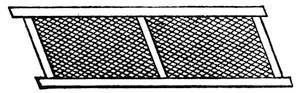
passed through a sieve of 42 meshes to the inch. It should
be perfectly dry before sifting, and be thoroughly incorporated
with the oil.
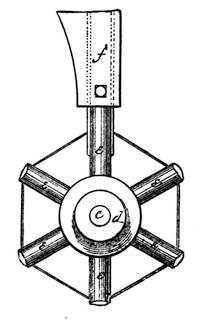
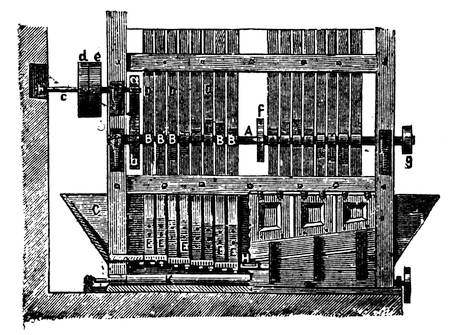
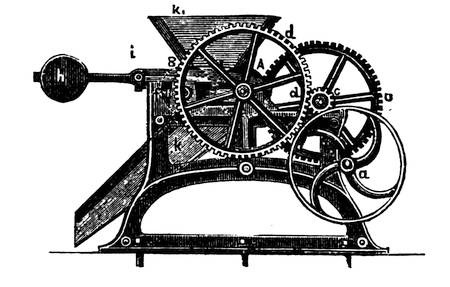
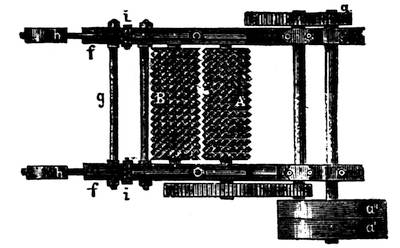
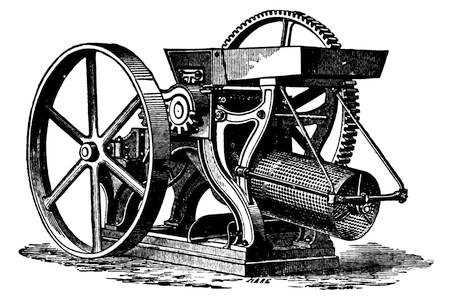
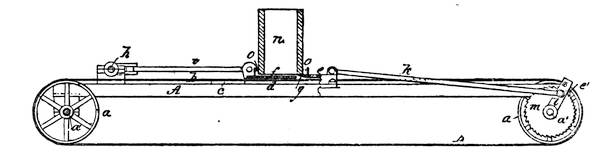
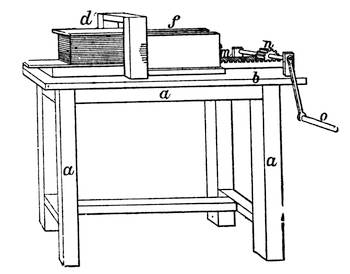
As the work of kneading large masses with the hands or
feet must be continued for a long time in order to obtain an
entirely uniform product, and is consequently very laborious,
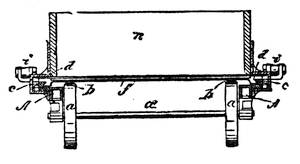
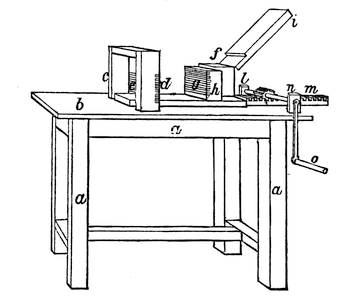
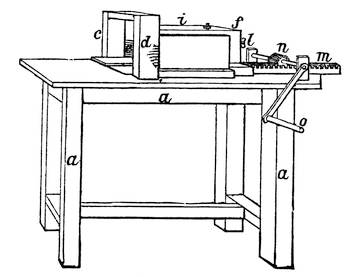
it is recommended to use the following contrivance:
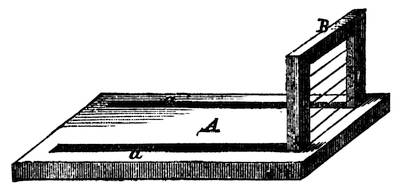
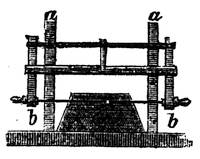
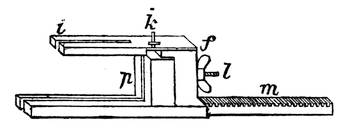
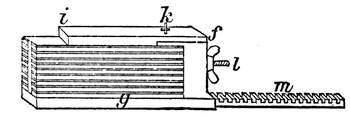
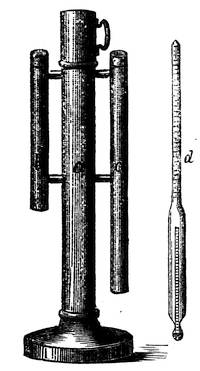
Two wooden rollers rest in a suitable frame, and can be
brought together or removed from each other by means of
two screws. When the mixture of whiting and linseed oil
is of sufficient consistency to allow kneading, it is fashioned
into a cylinder and rolled out between the above rollers to
a long, thin band, which is caught in a vessel. The band
is balled together, the ball reformed into a cylinder, and
the latter again passed through the rollers, the operation of
balling and rolling being continued until a uniform mass
is obtained.
The finished product should be kept in oiled paper or
under water. White lead is sometimes mixed with the
putty, and other pigments to give color as desired. Hard
putty may be softened by rolling between the hands.
French putty. Boil 7 lbs. of linseed oil with 4 lbs. of
burnt umber for 2 hours. Then add 10 lbs. of white lead
and 5½ lbs. of chalk.
Soft putty. Whiting 20 lbs., white lead 2 lbs., linseed
oil and olive oil 1 gill each.
Mix the whiting and the white lead with the necessary
quantity of linseed oil, to render the putty of the proper
consistence, the olive oil being added to the linseed oil before
kneading. The object of using olive oil is to prevent the
white lead from hardening, and it preserves the putty in a
state sufficiently soft to adhere at all times, and not, by getting
hard and cracking off, suffering the wet to enter, as is
often the case with ordinary hard putty.
Litharge cement. By mixing litharge reduced to a fine
powder with linseed oil, a yellow cement is obtained which
gradually solidifies to a mass as hard as stone.
Red lead cement is made by mixing red lead with linseed
oil to a paste. It is used for cementing the joints of metal
pipes.
Lead preparations furnish excellent cements, but have
the disadvantage of great weight and a high price. For
many purposes a part of the lead combination can be suitably
replaced by a substance of less weight, such as whiting,
or, still better, burned lime slacked with sufficient water to
convert it into a powder.
The quantity of the substitute added varies very much,
there being, for instance, many varieties of so-called red lead
oil cement, which contain only about 10 per cent. of red lead.
Cement for wash basins. Finely powdered glass (sifted) 2
parts, litharge 2 parts, linseed-oil varnish 1 part.
Wet the powders slightly with the oil, heat and gradually
add the rest. Do not use the basin for several days. Finely
powdered glass or glass meal may be made by heating glass,
throwing it in cold water, grinding the fractured pieces, and
washing by stirring up in water, and allowing the finer
particles to float off into a second vessel. Collect this fine
powder when sufficient has settled in the vessel and sift it
through a very fine sieve.
Zinc-white cement is prepared similar to putty or red-lead
cement. It may, however, be made as follows: Mastic 2
parts, dammar 4 parts, sandarac 6 parts, Venetian turpentine
8 parts, turpentine 10 parts, benzole 12 parts, zinc
white 14 parts.
The resins are powdered, while the Venetian turpentine,
ordinary turpentine, and benzole, are put in a bottle, and
then the powdered resins put in. The whole is shaken and
allowed to stand for the resins to dissolve. The solution is
filtered through cotton-wool and rubbed up with sufficient
zinc-white to form a cement. Dilute with benzine if
necessary.
Mastic cement, mastic or pierres de mastic. Under this
name masses are brought into commerce which are well
adapted for moulding ornaments, such as figures, columns,
etc., to be exposed to the weather. They are comparatively
cheap, and it is rather remarkable that they are not more
generally known and used for technical purposes.
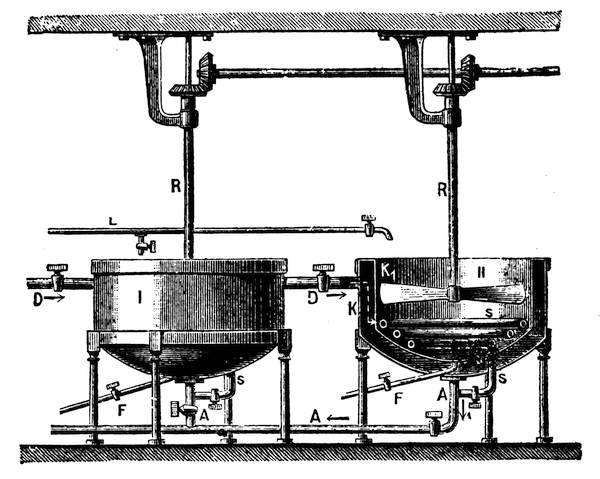
To prepare large quantities of this cement suitable mills
and mixing vessels are required, as the conversion of the
materials into a dust-like flour is an indispensable condition
of the success of the work. The materials most generally
used are fine quartz sand, finely ground calcareous sand,
and varying quantities of litharge or zinc oxides, besides as
small a quantity of linseed oil as possible.
The linseed oil combines with the litharge or zinc oxide
to an insoluble soap, which incloses the other material and
forms a mass acquiring the hardness of sandstone in thirty
to fifty hours.
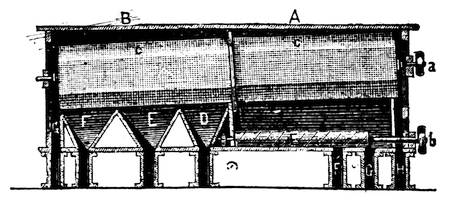
After converting the materials into a fine powder, the
mixing is accomplished in barrels filled about three-quarters
full and revolved by water-power. When a thorough mixture
has been effected the pulverulent mass is placed in
sheet-iron vessels and saturated with linseed oil, and then
moulded at once, as it solidifies in one or two days.
French mastic. Quartz sand 300 parts, pulverized limestone
100, litharge 50, linseed oil 35.
Paget’s mastic. Sand 315 parts, whiting 105, white lead
25, calcined red lead 10, lead acetate solution 45, linseed
oil 35.
The mastic may be colored by adding pigments.
Water-proof cement. A. Rubber 7 parts, oil of turpentine
140, linseed oil 40. B. Turpentine 100 parts, sulphuric
acid 3, zinc-white 10.
To prepare solution A, place the rubber in the oil of
turpentine in a bottle. It swells very much without
actually dissolving. After adding the linseed oil, reduce
the entire mass by boiling to one-half the volume originally
occupied by it.
Solution B is prepared by stirring the sulphuric acid into
the turpentine and allowing it to stand for twelve hours.
To remove the sulphuric acid, the thick mass which has
been formed is then kneaded in water in which the zinc
oxide has been distributed. After drying, the resulting
mass is dissolved in the warm fluid A.
Another formula is as follows: Linseed oil 8 parts, litharge
12, burnt lime 88.
Boil the linseed oil and litharge half an hour, then stir
the lime into the hot mass, and use the mixture hot. This
cement is excellent for filling in joints between stones, for
flat roofs, water reservoirs, etc. For a better adhesion of
the cement, apply a coat of linseed oil varnish to the surfaces
to be cemented. Porous stones are made water-proof
by heating the cement in a boiler and adding sufficient
linseed oil to form a mass which can be readily worked
with a smoothing board. Apply as hot as possible.
Serbat’s mastic. Pyrolusite 60 parts, sulphate of lead 60,
linseed oil 10.
After thoroughly drying the materials, mix the sulphate
of lead with the linseed oil, then add 20 parts of the pyrolusite
and, after mixing and working it thoroughly, add
gradually the rest of the pyrolusite in small portions and
kneading constantly.
Stephenson’s oil cement. Litharge 20 parts, unslaked lime
10 parts, sand 10 parts, hot linseed oil 3 parts.
Alum cement. Dissolve good hard soap, by heating in
rain water, dilute the thickly fluid mass and add saturated
alum solution as long as a precipitate is formed. Collect
the gelatinous precipitate of alumina soap thus formed
upon a cloth, and, after draining, pour rain water over it
ten to twelve times to remove the salts as much as possible.
After washing, dry the alumina soap, and rub it to a fine
powder.
To prepare cement rub a portion of the powder with
sufficient linseed-oil varnish to form a plastic dough, which
is used for filling in the joints.
This cement is water-proof, resists high temperatures
without being absolutely fire-proof, and, on account of its
light color, is well adapted for joining marble plates, etc.
Oil cement for glass. Litharge 30 parts, burnt lime 20,
pipe-clay 10, linseed-oil varnish 6.
Oil cement free from lead for steam pipes. Graphite 12
parts, heavy spar 16, slaked lime 6, boiled linseed oil 6.
Oil cements for steam pipes. I. Litharge 25 parts, air-slaked
lime 10, quartz sand 10.
Mix the ingredients quickly with the linseed oil and
work the mass thoroughly in a hot mortar. Coat the defective
places in the pipes with linseed-oil varnish, apply
the cement hot and when partially solid, make it still
tighter by heating.
II. Boil 60 parts of graphite, 50 of air-slaked lime, 60 of
elutriated heavy spar in 35 of linseed oil, stirring constantly.
Apply the mixture hot.
Oil cement for marble. Elutriated litharge 10 parts,
brick dust 100, linseed oil 20.
Prepare in the same manner as glaziers’ putty. For
various colors add zinc white for white, red lead for red,
pyrolusite for brown, etc. Previous to applying the cement
saturate the surfaces of the stones to be cemented with linseed-oil
varnish.
Oil cement for porcelain. Stir 20 parts of white lead and
12 of white pipe-clay into 10 of boiling linseed oil previously
boiled and knead the mass thoroughly. After cementing
let the articles stand quietly for several weeks.
Diamond cement. Litharge 30 parts, air-slaked lime 10,
whiting 20, graphite 100, linseed oil 40. Apply hot. This
is an excellent cement for metal.
Hager’s diamond cement. Whiting 16 parts, elutriated
graphite 50, litharge 16.
Mix the pulverized ingredients with sufficient old, thick
linseed oil to form a plastic dough.
Resinous cement for amber is obtained by melting mastic
in linseed oil. Volatile copal lacquer can also be advantageously
used for the purpose.
Cement for turners. Melt 1 lb. of rosin in a tin can over
the fire, and when melted add 4 ozs. of pitch; while these
are boiling add brick dust until, by dropping a little on a
cold stone, you think it is hard enough. In winter it may
be found necessary to add a little tallow.
By means of this cement a piece of wood may be fastened
to the chuck, which will hold when cool, and when the
work is finished, it may be removed by a smart blow with
the tool. All traces of the cement may be removed from
the work by repeated applications of benzine. To use this
cement, chip off as much as will cover the chuck to the
1/16th of an inch, spread it over the surface in small pieces,
mixing it with ⅛ of its bulk of gutta-percha, then heat an
iron to a dull red heat, and hold it over the chuck till the
mixture and gutta-percha are melted and liquid. Stir the
cement until it is homogeneous, chuck the work, lay on a
weight to enforce contact, leave it at rest 20 minutes.
The following cement is much employed and serviceable
for the use of turners and artisans in general.
Reduce 1 lb. of whiting to a fine powder, and heat to
redness so as to expel all the water. When cold this is
mixed with 1 lb. of black rosin and 1 oz. of beeswax previously
melted together, and the whole stirred till of uniform
consistence.
Cement for ivory and bone. Melt at a moderate heat equal
parts of white wax, rosin, and oil of turpentine to form
a thickly-fluid mass. For coloring the cement add elutriated
red lead, ultramarine, etc.
Cement for white enameled clock-faces. Dammar resin 100
parts, copal 100, Venice turpentine 110, zinc white 60,
ultramarine 3.
Apply hot and polish when cold and hard.
Cements for glass. 1. Melt carefully 60 parts of bleached
shellac and 10 of turpentine. If too thick, dilute with
turpentine.
2. Shellac 20 parts, elemi 5, turpentine 10. Prepare as
above.
Cement for glass upon glass. Shellac 10 parts, turpentine
2, pulverized pumice stone 10.
Cement for glass upon metal. Melt together 40 parts of
rosin, 20 of rouge, 10 of wax, and 10 of turpentine. Apply
hot to the surfaces to be cemented.
Cement for metal letters upon glass. Rosin 42 parts, turpentine
4, plaster of Paris 5.
Cement for wood. 100 parts of shellac and 45 of strong
spirit of wine.
This cement serves for joining wood, which, on account
of exposure to water, cannot be glued. Apply the cement
to the surface of one of the pieces, and after placing upon
it a piece of tissue paper press upon it the other piece of
wood previously coated with the cement.
Cement for knife handles. Melt together 20 parts of rosin,
5 of sulphur, and 8 of iron filings.
Pour some of the hot mixture into the handle, and then
push in the knife previously heated.
Cement for petroleum lamps. Boil 12 parts of rosin in 16
of strong lye until it is entirely dissolved and on cooling
forms a tenacious solid mass. Dilute this with 20 parts of
water, and carefully work into it 20 parts of plaster of
Paris. This cement is insoluble in petroleum, and is especially
adapted for cementing the glass parts of lamps to the
metal. It is also a good material for stoppers for petroleum
bottles.
Cement for porcelain. Rosin, 14 parts; elemi, 7; shellac,
7; mastic, 7; sulphur, 42; brick dust, 20.
Cement for porcelain which is to be heated. Heat carefully
10 parts of amber in a large spoon, stirring constantly, until
it evolves heavy vapors of a strong odor. Rub the melted
mass as finely as possible, and after placing the powder in a
bottle pour over it a mixture of bisulphide of carbon and
benzine. Close the bottle air-tight to prevent the evaporation
of the very volatile solvent. When the powder is dissolved
remove the cork and replace it by one provided with
a small brush. The application of the cement and pressing
together of the parts to be cemented must be effected as
quickly as possible. In articles properly cemented the
joint can only be detected by the closest examination.
This cement holds so well that cups and saucers, soup-tureens,
etc., mended with it can be used for years.
Cement to withstand the action of petroleum. Dissolve 5
parts of shellac, 1 of turpentine in 15 of petroleum. This
cement is quite elastic.
Cement for mica. A colored cement for joining sheets of
mica is prepared as follows: Soak clean gelatine in water,
and when swelled squeeze out the excess of water by pressure
between a cloth, then melt the gelatine by the heat of
a water-bath, and stir in just enough proof spirit to make it
fluid. To each part of this solution add, while stirring, ¼
oz. of gum ammoniac and 1½ ozs. of gum mastic dissolved
in 4 ozs. of rectified alcohol. Put the mixture into bottles,
and when required for use stand the bottle in hot water.
This cement resists cold water.
Cement for horn, whalebone and tortoise shell. Dissolve
gum mastic 10 parts and turpentine 4, in 12 of linseed oil.
Apply hot.
Cement for terra-cotta articles. Melt together 70 parts of
rosin, 70 of wax and 16 of sulphur, and stir into the mass 8
parts of hammer slag and 8 of quartz sand. Coat the fractured
surfaces with oil of turpentine, apply the cement as
quickly as possible, and press the surfaces together. It is
advisable to heat the terra cotta previously to 158° or 176°
F. After cementing the article, smooth the joint with a
heated knife and dust very fine terra-cotta powder through
a linen bag upon the soft cement in order to give it exactly
the same color as the article itself.
Mastic cement for glass. Gum mastic 15 parts, bleached
shellac 10, turpentine 5.
This mass sufficiently diluted with hot oil of turpentine
furnishes an excellent cement for fractured glass and gems.
Being colorless, the joint can scarcely be detected, provided
the cementing has been skilfully done.
To attach gems to glass of the same color, the cement is
colored with aniline colors dissolved in spirit of wine, care
being had to give it the same shade as the gem and the
glass.
Stick mastic cement. Melt together, at as low a temperature
as possible, 10 parts of mastic and one of turpentine,
and pour the mass into suitable moulds.
For use, heat the fractured surfaces of the article strongly,
so that the cement on being rubbed over them melts, then
press the surfaces together and continue the pressure until
the cement solidifies.
Sulphur cement for porcelain. White pitch 18 parts, sulphur
28, bleached shellac 4, gum mastic 8, elemi 8, glass
meal 28. Melt all together, except the glass meal and stir
the latter into the melted mass.
Insoluble cement for wooden vessels. Melt together 60 parts
of rosin, 20 of asphalt, and 40 of brick dust. Pour the hot
mixture into the joints. This cement resists the action of
lye, quick lime, sulphuric and hydrochloric acids.
These cements are very useful, but owing to the inflammable
nature of the components, great care should be taken
to guard against fire while preparing them. They should
never be made near a naked fire, as the benzine, carbon
disulphide or chloroform used to dissolve the rubber is very
volatile, and the vapor given off permeates the air until,
coming near a source of light, the whole air becomes one
vivid sheet of flame. Vessels which are used should be
closed, and if possible put out of doors. If heat is required
to assist the solvent action, use a sand or hot-water bath,
but on no account bring near a fire.
Cements for glass. I. Rubber 1 part, gum mastic 12,
dammar 4, chloroform 50, benzine 10.
II. Rubber 12 parts, chloroform 500, gum mastic 120.
This cement adheres immediately, and possesses a high
degree of elasticity. It may be used to advantage for joining
together the glass panes of hot-houses.
III. Dissolve, without application of heat, rubber 2 parts
and gum mastic 6, in 100 of chloroform. This cement is
perfectly transparent. It should be applied as quickly as
possible, as it sets in a very short time.
Soft rubber cement. Melt 10 parts of tallow in a brass pan
and gradually add 150 parts of rubber in small pieces, and
stir constantly until all the rubber is dissolved. Keep in
readiness a well-fitting lid to be able to extinguish the
flame immediately in case the rubber catches fire. When
all is melted stir in 10 parts of slaked lime.
This cement is especially adapted for sealing bottles containing
caustic substances, such as nitric acid, etc. It remains
always tenacious, being therefore suitable for cementing
bodies exposed to repeated shocks.
Hard rubber cement. Rubber, 150 parts; tallow, 10; red
lead, 10.
This cement is prepared in the same manner as the above.
The addition of red lead gives it a red color, and solidifies
it in a short time to a mass as hard as stone.
Elastic cement. Carbon disulphide, 8 ozs.; fine rubber,
1 oz.; isinglass, 4 drachms; gutta-percha, 1 oz. Dissolve
the solids in the fluid.
This cement is used for cementing leather and rubber.
For use the leather is roughened and a thin coat of the
cement applied and allowed to dry completely; then the
two surfaces to be joined are warmed and placed together
and allowed to dry.
Marine glue. This cement, which is only a glue in name,
is water-proof, and can be used to cement metal, wood, glass,
stone, pasteboard, etc., and is especially adapted for caulking
vessels.
Suspend 10 parts of rubber inclosed in a bag in a vessel
containing 120 parts of refined petroleum, so that only half
of the bag is immersed, and allow it to remain ten to fourteen
days in a warm place. Then melt 20 parts of asphalt
in an iron boiler and add the rubber solution in a thin jet,
and heat the mixture, while constantly stirring, until it is
perfectly homogeneous. Pour it into greased metallic
moulds, where it forms into dark-brown or black plates
difficult to break. In using it, it should be melted in a
kettle placed in boiling water to prevent its burning, which
it is very apt to do, as it is a bad conductor of heat. After
it has been liquefied remove the kettle from the water and
place it over a fire, where it can be heated, if necessary, to
make it more fluid, to 302° F., carefully stirring it to prevent
burning.
If possible, the surfaces to be glued together should be
heated to 212° F., as the glue can then be slowly applied.
The thinner the layer of glue in cementing together smooth
surfaces, the better will it adhere. But a somewhat thicker
layer is required for rough surfaces, for instance, boards not
planed, the excess of glue being forced out by strong pressure.
Generally speaking, it is best to subject all articles
cemented together with marine glue to as strong a pressure
as possible until the glue is congealed.
Repeated experiments have shown that with the aid of
this cement square vats perfectly water-tight can be constructed
of boards. Wooden pegs dipped in the compound
should be used for putting the vats together.
Jeffrey’s marine glue. Dissolve 1 part of rubber in benzine,
and mix the solution with 2 parts of shellac by the
assistance of heat.
Another formula is as follows: Coal naphtha 1 quart,
rubber cut in shreds 2 ozs. Macerate for 10 or 12 days and
then rub smooth with a spatula on a slab; add 2 parts by
weight of shellac to 1 part of this solution. To use the
compound melt it at about 240° F.
Marine glue for damp walls. Rubber 10 parts, whiting
10, oil of turpentine 20, carbon disulphide 10, rosin 5 and
asphalt 5. Dissolve the ingredients in a suitable vessel and
stand in a warm place, shaking it frequently.
Scrape the wall smooth and clean, and apply the glue
with a broad brush on the damp place and about 8 inches
higher than the line of dampness. Before the glue is dry
lay on plain paper which will adhere tightly. On this
plain paper the wall paper can be pasted in the usual manner.
If carefully done, the wall paper will always remain
dry.
Cement for leather. Gutta-percha 100 parts, pitch or
asphalt 100, oil of turpentine 15.
This cement should be used hot. It is suitable for
cementing all kinds of substances, but adheres particularly
well to leather.
Cement for hard rubber combs. A. Prepare a very thick
solution of bleached gutta-percha in bisulphide of carbon.
B. Dissolve sulphur in bisulphide of carbon.
The cementing is effected by applying solution A to the
fractured surfaces and pressing them together. When dry
brush solution B over the cemented place.
Elastic gutta-percha cement. Dissolve 10 parts of gutta-percha
in 100 of benzine, then pour the clear solution into
a bottle containing 100 parts of linseed-oil varnish and
unite both by shaking. This cement excels in elasticity,
and is especially suitable for attaching the soles of shoes, as
it is so elastic that it will not break, no matter how much it
is bent. To make it adhere tightly roughen the leather on
the side to be cemented.
Cement for horses’ hoofs. For filling cracks and fissures
in horses’ hoofs a cement is required which possesses great
resistance to the action of water combined with elasticity
and solidity. A mass answering all demands consists of 10
parts by weight of gum ammoniac and 20 to 25 of purified
gutta-percha. Heat the gutta-percha to between 194° and
212° F., and then work it with the finely powdered gum
ammoniac to a homogeneous mass. In using it, soften the
cement by heating, and after carefully cleansing the crack
in the hoof, apply it with a heated knife. The cement
solidifies immediately after cooling to the ordinary temperature,
and becomes soon so hard as to allow of nails being
driven into it.
Cement for crockery. Gutta-percha 1 part, shellac 1.
Place the two ingredients in an earthenware jar, and
melt the two together by standing this jar on a vessel of
boiling water, or else one filled with hot sand, the vessel
holding the water or sand being heated over a fire or gas
furnace. Stir the melted ingredients well together. The
resulting cement is one possessing great hardness and
toughness, which suits it admirably for mending crockery.
Warm the edges to be joined together, smear the cement on,
join together, and hold the article thus joined until cool.
Cement for leather. Mix 10 parts of carbon disulphide
with 1 part of turpentine, and then add sufficient gutta percha
to make a tough, thickly-fluid mass. Before using
this cement, free the surface to be joined from grease. To
effect this, sprinkle a little bicarbonate of soda, carbonate of
ammonia or borax on the surfaces to be joined, lay a cloth
over them, and then place a hot iron on top, and keep it
there a short time so as to cause the alkali to cut the grease,
then put the cement on both surfaces to be joined, put them
together and subject to pressure until they are cemented.
Gutta percha dissolved in carbon disulphide to the consistency
of syrup is also a good cement for joining leather.
The parts to be joined should be well covered with cement
so as to fill the pores of the leather, then the cement is
heated and the parts hammered until the cement is cold.
Preparation of pure caseine. Although the caseine contained
in old cheese can be used, the other constituents,
such as fat, salt, and free acid, exert an injurious influence
upon the solidity of the cement prepared with it. It is,
therefore, best to prepare pure caseine, which is easily
accomplished in the following manner:
Put milk in a cool place, and after taking off the cream
as long as any is formed, remove the skimmed milk to a
warm place to coagulate. After heating the curd, place it
upon a filter and wash the caseine remaining upon the
filter with rainwater until the water running off shows no
trace of acid.
To remove the last traces of fat tie the washed caseine in
a cloth and after boiling it in water, spread it upon blotting
paper in a warm place to dry. It will shrivel up to a
horny mass.
When thoroughly dried pure caseine will keep for a long
time without suffering alteration. To obtain the caseine in
a form suitable for preparing cements it is only necessary
to pour water over a corresponding quantity and allow it
to stand for some time. Caseine combines with lime to a
hard insoluble mass.
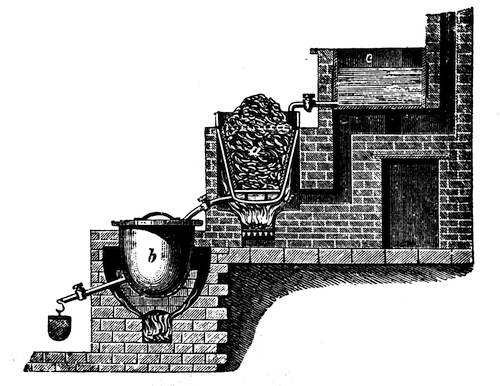
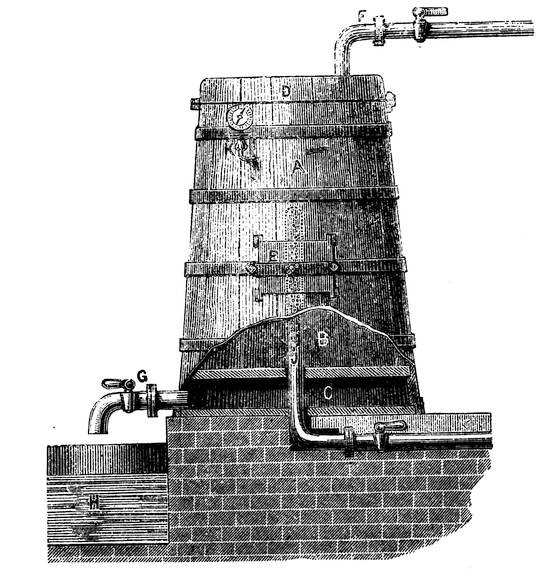
Ordinary technical caseine may be readily and cheaply
prepared as follows: Skim milk is heated in a copper boiler,
if necessary by the introduction of steam, to 122° F. Then
add for every 1000 quarts of milk, 3 quarts of crude hydrochloric
acid diluted with 5 to 6 times the quantity of water.
After coagulation, the whey is drained off, the curd spread
out upon an inclined table and allowed to cool. The curd
is then washed by pouring cold water over it through a
rose, or stirring it up with water in a barrel, allowing to
settle, and pouring off the supernatant water. The residue
is subjected to moderate pressure. The caseine while still
moist is comminuted in a curd-mill and packed in bags.
In this state it must be worked at once, as otherwise it
spoils readily and is attacked by worms. If it is to be kept
for a longer time, it has to be dried. This is effected by
spreading it out upon linen cloths and placing it in a drying
chamber.
In this manner 8.5 per cent. of moist, or 3.5 per cent. of
dry, caseine is obtained which is brought into commerce as
technical caseine or lactarine. It being insoluble in water,
10 per cent. of an alkali—soda, borax, or ammonia—has to
be added to effect solution. Water-soluble caseine is seldom
found in commerce, the consumer preparing it, as a rule,
himself.
A purer technical caseine is obtained according to John
A. Just’s method as follows: Dissolve, stirring constantly,
in 115 quarts of water heated to between 104° and 131° F.,
17 to 26 ozs. of bicarbonate of soda and 176 lbs. of moist, or
118 lbs. of dry, caseine, and dry the solution upon a heated
revolving metal cylinder. After each revolution of the
cylinder, the dry material is scraped off with brushes and
by being forced through a fine-meshed sieve yields soluble
caseine powder.
Caseine cement which can be kept for a long time. Convert
into powder, each by itself, 200 parts of caseine, 40 of
burned lime, and 1 of camphor. Mix the powders intimately
and keep the mixture in an air-tight bottle. For
use, mix some of the powder with the requisite quantity
of water and use the cement at once.
Cement for glass. Old dry cheese 100 parts, water 50,
slaked lime 20.
Free the cheese from rind, and rub it with the water
until a homogeneous mass drawing threads is formed.
Then stir in quickly the lime powder, and use the cement
at once. It unites not only glass to glass, but can also be
used for cementing metal to glass.
Cement for metals. Elutriated quartz sand, 10 parts;
caseine, 8; slaked lime, 10, and sufficient water to form a
cream-like mass.
Cement for porcelain. Caseine dissolves readily in solution
of water-glass, and forms then one of the best cements
for porcelain known. To prepare it, fill a bottle one-quarter
full with fresh caseine, and after filling the bottle
with solution of water-glass, effect the solution of the caseine
by frequent shaking.
Cement for meerschaum. Dissolve caseine in water-glass,
and after stirring quickly finely-pulverized calcined magnesia
into the mass, use it at once, as it solidifies very soon.
By adding, besides magnesia, genuine meerschaum finely
pulverized, a mass closely resembling meerschaum is obtained,
which can be used for manufacturing imitation
meerschaum.
Cement for wood, etc. Rub 10 parts of caseine and 5 of
borax to a thick, milky mass, and use it like glue. This
cement can be advantageously used for pasting labels upon
wine bottles, as it neither moulds nor becomes detached in
the cellar.
Another formula is as follows: Dissolve borax by boiling
in water, and pour the solution over fresh caseine. The
result will be a clear, thick mass of extraordinary power of
adhesion, which can be kept for any length of time without
suffering decomposition.
Applied to leather, paper, linen or cotton goods, it forms
a coat of beautiful lustre, and for this reason is much used
in the manufacture of fancy articles of paper and leather.
Cement for porcelain. Dissolve 10 parts of caseine in 60
of water-glass solution. Apply the cement quickly and dry
the cemented articles in the air.
Water-glass. Water-glass (silicate of soda or soluble
glass) is found in commerce as a thickly-fluid, tenacious
mass. It is generally prepared by fusing 15 parts of quartz
sand with 8 of carbonate of soda and 1 of charcoal. The
silicic acid combining with the soda disengages the carbonic
acid, the expulsion of which is facilitated by the presence
of charcoal, which converts it into carbonic oxide. It
dissolves readily in water. The solution has a strongly
alkaline taste, and possesses the property of being gradually
converted, on exposure to the air, to a gelatinous mass
which finally solidifies. For this reason water-glass should
be kept in bottles hermetically closed with corks. Glass
stoppers are of no use, as they are so firmly cemented to the
bottle that on attempting to open the latter the neck breaks
off.
By combining water-glass with cement or burned lime
the resulting mass solidifies quite rapidly to a mass as hard
as stone, and generally capable of resisting chemical action.
Water-glass by itself is only fit for cementing glass to
glass, but combined with other substances it furnishes very
durable and solid cements.
Cement for cracked bottles. Select a cork which will fit the
bottle air-tight and place it loosely upon the bottle, and heat
the latter gradually to at least 212° F. Then press the
cork down and apply a thick solution of water-glass to the
cracks. In cooling, the air in the bottle contracts strongly,
and the pressure of the exterior air drives the water-glass
with great force into the cracks closing them entirely so
that they cannot be detected.
Cement for glass and porcelain. Stir quickly together 10
parts of elutriated glass meal, 20 of powdered fluor spar,
and 60 of water-glass solution, and apply the homogeneous
paste at once. In a few days the cement will be so hard
that the cemented vessels can be heated without danger.
Cement for hydraulic works. Finely powdered cement, and
solution of water-glass. Mix the two bodies quickly together.
As this cement hardens very quickly, it should be used
fresh. It hardens under water, and is therefore excellent
for hydraulic works. The stones should be coated with
a solution of water-glass before applying the cement.
Cement for uniting metals. A strong cement, which
hardens rapidly, is made by stirring the finest whiting in a
solution of soda-glass of 33° B., made so as to form a plastic
mass. This can be readily colored to any desired shade.
The addition of sifted sulphide of antimony gives a black
cement, which by polishing acquires a metallic lustre; iron
filings render it grayish-black; zinc dust turns it green, but
after polishing, it appears like metallic zinc, and may be
employed for the permanent repair of zinc ornaments, etc.
Carbonate of copper imparts a light green shade. Other
additions may be made, as oxide of chrome for dark green,
cobalt blue for blue, red lead for orange, vermilion for
scarlet, carmine for violet, etc.
Cement for tightening joints of pipes exposed to a red heat.
Mix 80 parts of pyrolusite, 100 of zinc white, and 20 of
water-glass.
This cement fuses at a temperature not too high, and
then forms a glass-like mass which adheres very firmly and
closely.
Cement for marble and alabaster. The point of fracture of
articles cemented with the following mixture is difficult to
find, and the cemented place is much stronger than the
material itself. Mix 12 parts of Portland cement, 6 of
slaked lime, 6 of fine sand, and 1 of infusorial earth with
sufficient water-glass to form a thick paste. The article to
be cemented need not be heated. It hardens in twenty-four
hours.
Commercial glycerine is a yellowish or nearly colorless
and more or less viscid liquid having an intensely sweet
taste. In combination with lead oxide and intimately
worked into it, by heating and stamping, it furnishes very
strong and durable cements deserving general introduction,
though thus far they have been but little used.
For the manufacture of cements the use of pure odorless
glycerine is not required, the yellow crude article, which is
much cheaper, answering all purposes. The principal
point is to use very highly concentrated glycerine, as otherwise
the cements prepared with it solidify very slowly and
besides do not possess a proper degree of hardness and
solidity.
It is of especial importance to have the lead oxide free
from water. To accomplish this, heat it thoroughly and
mix it with the glycerine while still hot. Cement thus
prepared solidifies very quickly, and can be used for many
purposes. It is an excellent material for quickly joining
the stones of submarine works.
Glycerine and litharge cement. Moisten elutriated litharge
with glycerine so that a thin homogeneous paste is
formed. This cement is adapted for uniting the joints of
steam pipes, cementing wood, glass, porcelain, and also
glass upon metal, etc. It solidifies to a very hard mass in
a quarter to three-quarters of an hour. Before applying
the cement coat the surfaces to be joined with pure
glycerine.
Quick lime, slaked lime and chalk are used for this purpose.
Quick lime, which is obtained by burning limestone,
combines gradually with the fats to insoluble lime soaps.
Slaked lime, which consists of a combination of lime with
water, acts in the same manner.
For the preparation of cements the lime is slaked by
placing it in a dish and pouring as much water over it as
it will absorb. Good lime, technically called fat lime,
should eagerly combine with water, evolving much heat,
swelling greatly, and crumbling to a light white powder.
Quick lime exposed to the air until, by the absorption of
moisture and carbonic acid, it is converted into a powder is
called air-slaked.
Cements prepared with quick lime will, as a rule, solidify
more quickly than those prepared with air-slaked lime.
Chalk is a carbonate of lime consisting of the shells of
microscopic animals, and can be readily pulverized and
elutriated. In the latter state it is known as whiting. For
the preparation of entirely white cements the use of pure
white lime or chalk is absolutely necessary. Yellow or
reddish lime contains oxide of iron, and furnishes cements
of the same tinge.
Cement for glass. Litharge 30 parts, quick lime 20, linseed-oil
varnish 5.
Cement for joiners. A cement for filling up cracks and
holes is obtained by mixing slaked lime 50 parts, flour 100,
linseed-oil varnish 15.
Cement for cracked clay crucibles and porcelain. By applying
to the cracks a mixture of 10 parts of slaked lime, 10
of borax, and 5 of litharge in sufficient water to form a stiff
paste, and drying after heating the crucible, the cracked
places will be united so firmly that the crucible, when
thrown to the ground, will generally break in any other
place than the cemented one.
This cement can also be used for porcelain capable of
standing a strong heat.
Lime and glue cement. Stir air-slaked lime into hot glue.
This cement is especially suitable for attaching metal to
glass. It forms a very hard yellowish-brown mass.
Sulphate of lime in combination with water is met with
in nature, both in the form of transparent prisms of selenite,
and in opaque and semi-opaque masses, known as alabaster
and gypsum. By pulverizing the latter and heating to
about 302° F. it loses its water, and is converted into
anhydrous gypsum or plaster of Paris, which on mixing
with water recombines with it to form a mass of hydrated
sulphate of lime, the hardness of which nearly equals that
of the original gypsum. When the powder is mixed with
water to a cream and poured into a mould, the minute particles
of anhydrous sulphate of lime combine with the
water to reproduce the original gypsum, and this act of
combination is attended with a slight expansion which
forces the plaster into the finest lines of the mould.
By using a solution of alum instead of ordinary water, a
plaster is obtained which, although it takes much longer to
set than the ordinary kind, is much harder, and therefore
takes a good polish.
For preparing cements only perfectly white plaster of
Paris should be used, as the gray article possesses but little
adhesive power.
Cement for plaster of Paris statues. To repair plaster of
Paris statues so that the point of fracture cannot be detected,
proceed in the following manner:
Moisten the fractured surfaces with water by means of a
brush until they absorb no more and remain moist. Mix
plaster of Paris with water to a thin cream and stir until
the heat appearing at first has ceased, which will prevent
the conversion of the plaster into a solid coherent mass.
Apply quickly a thin layer of the plaster to one of the fractured
surfaces, press the other against it until the plaster
has set, and, when dry, carefully remove the excess by
scraping.
Cement for glass and porcelain. Mix quickly 50 parts of
plaster of Paris, 10 of quick lime, and 20 of white of egg.
Use at once, as the cement solidifies very rapidly.
Cement for iron and stone. A very useful cement for
securing iron railing in stone is obtained by mixing 30
parts of plaster of Paris, 10 of iron filings and 20 of vinegar.
Cements for porcelain. I. Mix plaster of Paris with saturated
solution of alum to a cream. After moistening the
fractured surfaces apply a thin layer of the cement, press
the surfaces together, wrap a wire or cord tightly around
them, and let the article stand quietly for a few weeks.
The cement is converted into a mass as hard as stone.
II. Mix plaster of Paris with a thick, clear solution of
gum arabic and cement the articles as soon as possible.
Although this cement adheres very tightly, porcelain vessels
cemented with it cannot be used for liquids.
Universal plaster of Paris cement. Mix 21 parts of plaster
of Paris, 3 of iron filings, 10 of water, and 4 of white of
egg. This cement is suitable for attaching metal to glass,
metal to stone, etc.
Heat-resisting cement. Clay 10 parts, iron filings 5, vinegar
2, water 3.
Water and steam-proof cement. Iron filings 100 parts, sal-ammoniac
2, water 10.
This cement rusts very much in a few days, and is converted
into an extremely solid mass which is perfectly
steam- and water-proof.
Cement for iron. Mix 65 parts of wrought-iron filings,
2.5 of sal ammoniac, and 1.5 of flowers of sulphur, and then
add 1 part of sulphuric acid diluted with sufficient water to
form a stiff paste. This cement solidifies in two to three
days, and rusts, with the parts of iron to be cemented, to an
extraordinarily durable mass.
Fire-proof cement for iron pipes. Wrought-iron filings 45
parts, clay 20, fire-clay 15, common salt solution 8.
Cements resisting high temperatures. 1. Iron filings 20
parts, clay powder 45, borax 5, common salt 5, pyrolusite
10.
Dissolve the borax and common salt in the water, add
and mix quickly the clay powder, pyrolusite, and iron
filings. Apply the cement at once. Exposed to a white
heat, it hardens to a tightly adhering, glassy mass.
2. Mix 52 parts of pyrolusite, 25 of zinc white, and 5 of
borax with solution of water-glass to a paste, and use at
once. This cement requires to be gradually dried. It will
stand the highest temperatures.
Cement for filling in defects in castings. Stir 100 parts of
iron filings free from rust with sufficient water to form a
thick paste, and press the mixture into the fissures, cracks,
etc. The cement becomes solid only after the iron filings
become strongly rusted. To free the ingredients from
adhering fat, wash them, before mixing, in liquid ammonia.
Cement for cracked stove plates, etc. Knead 20 parts of iron
filings, 12 of iron scale, 30 of plaster of Paris, and 10 of
common salt with blood to a stiff paste, and use at once.
Instead of blood, water-glass can be used, it having the advantage
of being odorless on strong heating, while blood
cement evolves a disagreeable odor.
Cement for iron water tanks. Knead iron filings with
vinegar to paste. Allow the mixture to stand until it turns
brown, and then force it into the joints by means of a
chisel.
Cement for cracked iron pots. Knead 10 parts of iron
filings and 60 of clay with linseed oil to a thick paste.
Before applying it add a little linseed oil, and allow it to
dry slowly. In a few weeks the cement will be so hard
that the vessels can be used without danger.
Black cement for stoves. Iron filings 10 parts, sand 12,
bone black 10, slaked lime 12, glue water 5.
Cements for iron stoves. 1. Pulverize as finely as possible
and mix intimately 4 to 5 parts of clay, 2 of iron filings
free from rust, 1 of pyrolusite, ½ of common salt, and ½ of
borax with water to a paste, and apply the cement quickly
to the places to be cemented and allow it to dry slowly.
This cement will stand a white heat, and resist the action
of boiling water.
2. Mix intimately and as quickly as possible 1 part of
pulverized pyrolusite, and 1 of zinc white with solution of
water-glass to a plastic mass, which solidifies quickly. The
power of resistance of this cement, it is claimed, is not inferior
to No. 1, though experiments have proved No. 1 to
be preferable.
Cements to be used for the above purpose must possess
various properties difficult to combine in one preparation.
They must be gas-proof, and capable of resisting the action
of different vapors and acid fluids. As regards resistance
to the action of chemical agents, there is nothing better
than caoutchouc, but unfortunately it can only be used for
tightening chemical apparatus not exposed to a high temperature.
In chemical laboratories bran of almonds, either by itself
or kneaded with water to a thick paste, is frequently used,
or rye or wheat bran mixed with a little flour and water.
These cements, though very suitable for cementing glass
distilling apparatus, are strongly acted upon by chlorine
and the vapors of nitric acid.
For small apparatus to be used for the development of
fluoric acid, plaster of Paris mixed with a little water can
be used as a cement. To make the joint entirely gas-tight,
paste a strip of paper over it. Although this cement does
not resist the action of fluoric acid for any length of time, it
suffices generally for the protection of the Workmen during
the time the development of the acid is in progress, as, for
instance, in chemical analyses, etc.
To cement chemical apparatus exposed to a temperature
not exceeding 86° to 104° F. paraffine does excellent service;
as it possesses the power of resisting the action of the
strongest acids and alkalies.
Below will be found a few receipts for cements which
have proved reliable.
Linseed oil and clay cement. Knead 10 parts of dry clay
with 1 of linseed oil to a homogeneous mass. This cement
will stand heating to the boiling-point of mercury.
Linseed oil, zinc and manganese cement. Knead 10 parts
of pyrolusite, 20 of zinc white, and 40 of clay with sufficient
boiled linseed oil (not exceeding 7 parts) to a plastic
mass. This cement will stand a somewhat higher temperature
than the preceding one.
Cements resisting very high temperatures. I. Clay 100
parts, powdered glass 2.
The glass melts on exposure to great heat and slags the
clay to a hard mass. The same effect is produced by adding
small quantities of soda and borax to the clay. An
admixture of chalk and boric acid, as in the following receipt,
also gives excellent results.
II. Clay 100 parts, chalk 2, boric acid 3.
Cement resisting acids. Melt rubber with double the
quantity of linseed oil, and then knead in sufficient bole to
form a paste. This cement resists the action of nitric and
hydrochloric acids, and can be advantageously used for
closing bottles containing them. As it solidifies very
slowly, it can readily be detached from the bottles, and
used again.
For cement which is to solidify quickly on exposure to
the air, add a few per cent. by weight of red lead or
litharge.
Rubber cement for chemical apparatus. Cut 8 parts of rubber
in small pieces and throw them gradually into a mixture
of 2 parts of tallow and 16 of linseed oil previously
strongly heated. After effecting an intimate mixture of
the constituents by vigorous and constant stirring, add 3
parts of white bole.
Although this cement does not stand a high temperature,
it possesses an extraordinary power of resisting the action
of acid vapors.
Scheibler’s cement for chemical apparatus. Melt together 1
part of wax and 3 of shellac, and work into the mixture 2
parts of gutta-percha cut up in very small pieces. This
cement will bear considerable heat without actually melting.
Cement for attaching metal letters to glass, marble, wood, etc.
Dissolve over a water-bath 5 parts of glue in a mixture of
15 parts of copal varnish, 5 parts of boiled linseed oil, 3
parts of crude oil of turpentine, and 2 parts of rectified oil
of turpentine, and add 10 parts of slaked lime to the
mixture.
Cement for joints of iron pipes. Mix 5 lbs. of coarsely
powdered iron borings, 2 ozs. of powdered sal ammoniac,
and 1 oz. of sulphur with sufficient water to form a paste.
This composition hardens rapidly, but if time can be
allowed it sets more firmly without the sulphur. It must
be used as soon as mixed, and rammed tightly into the
joint.
Another receipt is as follows:
Mix 2 ozs. of sal ammoniac, 1 oz. of sublimated sulphur
and 1 lb. of cast-iron filings or fine turnings in a mortar,
and keep the powder dry. When it is to be used, mix it
with 20 times its weight of clean iron turnings or filings
and grind the whole in a mortar; then wet it with water
until it becomes of convenient consistency, when it is to be
applied to the joint. After a time it becomes as hard and
strong as the metal.
Steam boiler cement. Mix 10 parts of finely-powdered
litharge with 1 part of fine sand and 1 part of air-slaked
lime. The mixture may be kept for any length of time
without deterioration. For use a portion of it is made into
a paste with linseed oil or, better, boiled linseed oil. In
this state it must be applied quickly, as it soon becomes
hard.
Cement for rubber. Powdered shellac is softened in 10
times its weight of strong water of ammonia, whereby a
transparent mass is obtained, which becomes fluid after
keeping some little time without the use of hot water. In
three to four weeks the mixture is perfectly liquid, and
when applied it will be found to soften the rubber. As
soon as the ammonia evaporates it hardens again, and thus
becomes impervious both to gases and to liquids. For
cementing sheet rubber, or rubber material in any shape,
to metal, glass, and other smooth surfaces, this cement is
highly recommended.
Cement for tires. 1. Isinglass 1 oz., gutta-percha 1 oz.,
rubber 2 ozs., carbon disulphide 8 fluid ozs. Mix and dissolve.
2. Shellac 4 ozs., gutta-percha 4 ozs., red lead and sulphur,
each ½ oz. Melt the shellac and gutta-percha, and
add with constant stirring the red lead and sulphur, melted.
Use while hot.
3. Crude rubber 1 oz., carbon disulphide 8 ozs. Macerate
24 hours, and then add a solution of:
Rosin 2 ozs., beeswax ½ oz., carbon disulphide 8 ozs.
4. Rubber 20 parts, rosin 10, Venetian red 10, tallow
5. Melt the rubber over a fire, then add the rosin and the
tallow and finally the Venetian red.
Cement for steam pipes, etc. A cement of specially valuable
properties for steam pipes, in filling up small leaks,
such as a blow-hole in a casting, without the necessity of
removing the injured piece, is composed of 5 lbs. Paris
white and 5 lbs. yellow ochre, 10 lbs. litharge, 5 lbs. red
lead and 4 lbs. black oxide of manganese. Mix the materials
thoroughly and make into a paste with a small quantity
of asbestos and boiled linseed oil. The composition, as
thus prepared, will harden in from 2 to 5 hours, and has
the advantage of not being subject to expansion and contraction
to such an extent as to cause a leakage afterwards,
and its efficiency in places difficult of access is of special
importance.
Cement for marble. Stir to a thick batter with silicate of
soda 12 parts of Portland cement, 6 of slaked lime, 6 of fine
white lead and 1 of infusorial earth. This is excellent for
marble and alabaster. The cemented objects need to be
heated. After 24 hours the fracture is firm, and the place
can scarcely be found.
Cement for attaching wood, glass, etc., to metal. Acetate of
lead 23 parts by weight, alum 23, gum arabic 38, wheat
flour 250.
Dissolve the acetate of lead and the alum in a little
water and separately dissolve the gum arabic in a fair
quantity of boiling water. Thus if the 250 parts of wheat
flour represent half a pound, the quantity of water needed
will be about a pint. The gum having dissolved, add the
flour, put the whole on the fire, stir well with a wooden
stick, then add the solution of lead acetate and alum. Continue
the stirring in order to avoid the formation of lumps,
then take it off the fire without allowing it to boil. This
cement is used cold, and will not scale. It is very useful
in making wood, glass, cardboard, etc., adhere to metal,
and is extremely strong.
Brushmakers’ cement. Rosin 5 lbs., rosin oil or spirit 1
quart.
Reduce the rosin to small pieces, run down in a pot, add
the other ingredient, and stir until mixed and syrupy, then
run out into tins. It is used for cementing the bristles in
the stocks, also for string binding on sash tools, etc.
Cement for electrical apparatus. Mix together 1 lb. of
beeswax added to 5 lbs. of rosin, 1 lb. of red ochre, and 2
tablespoonfuls of plaster of Paris. It will make an excellent
composition for electrical apparatus.
A cheaper composition for cementing voltaic plates into
wooden troughs is made with 6 lbs. of plaster of Paris and
¼ pint of linseed oil. The ochre and the plaster of Paris
should be well dried and added to the other ingredients
when these are in a melted state.
Jewelers’ cement. Dissolve over the water-bath 25 parts
of fish glue in a small quantity of strong spirits of wine,
add 2 parts of gum ammoniac; separately dissolve 1 part
of mastic in 5 of spirits of wine. Mix the two solutions
and keep them in well-stoppered bottles.
American cement for jewelers. Soak 4 ozs. of isinglass in
2 lbs. of water for 24 hours, then evaporate in the water-bath;
to 1 lb. add 1 lb. of rectified spirits of wine, and
strain. Then mix in a solution of 2 ozs. of mastic and 1
oz. of gum ammoniac in 16 ozs. of rectified spirit.
Cement for celluloid. Shellac 2 ozs., spirits of camphor 2,
90 per cent. alcohol 6 to 8.
Stratena. This well-known household cement is said to
be prepared as follows: Dissolve 12 parts of white glue in
16 of acetic acid, and then add this solution to one of 2
parts gelatine in 16 of water. After mixing add 2 parts
shellac varnish.
Cement for cloth. Gutta-percha 16 parts, rubber 4, pitch
2, shellac 1, linseed oil 2 pints. Dissolve the whole by
heat, stirring constantly.
It is unquestionably true that quite as much depends
upon the manner in which a cement is applied, as upon the
cement itself. The best cement that was ever compounded
would prove entirely worthless improperly applied. In
the foregoing a number of cements have been given which
answer every reasonable demand when properly prepared
and properly used. Good common glue will unite two
pieces of wood so firmly that the fibres will part from
each other rather than from the cementing material; two
pieces of glass can be so joined that they will part anywhere
rather than on the line of union; glass can be united
to metal, metal to metal, stone to stone, and all so strongly
that the joint will certainly not be the weakest part of the
resulting mass. What are the rules to be observed in
effecting these results?
The first point that demands attention is to bring the
cement itself into intimate contact with the surface to be
united. If glue is employed, the surface should be made
so warm that the melted glue will not be chilled before it
has time to effect a thorough adhesion. The same is more
eminently true in regard to cements that are used in a fused
state, such as mixtures of resins, shellac, and similar
materials. These matters will not adhere to any substance
unless the latter has been heated to nearly or quite the
fusing point of the cement used. This fact was quite
familiar to those who used sealing-wax in the olden days
of seals. When the seal was used, in succession, rapidly so
as to become heated, the sealing-wax stuck to it with a
firmness that was annoying, so much so that the impression
was generally destroyed, from the simple fact that the
sealing-wax would rather part in its own substance than at
the point of adhesion to the seal. Sealing-wax or ordinary
so-called electric cement is a very good agent for uniting
metal to glass or stone, provided the masses to be united
are made so hot as to fuse the cement; but if the cement is
applied to them while they are cold, it will not stick at all.
This fact is well known to those itinerant venders of cement
for uniting earthenware. By heating two pieces of delf so
that they will fuse shellac, they are able to smear them
with a little of this gum and join them so that they will
rather break at any other part than along the line of union.
But although people see the operation constantly performed
and buy liberally of the cement, it will be found that in
nine cases out of ten, the cement proves worthless in the
hands of the purchasers, simply because they do not know
how to use it. They are afraid to heat a delicate glass or
porcelain vessel to a sufficient degree, and they are apt to
use too much of the material, and the result is a failure.
The great obstacles to the junction of any two surfaces
are air and dirt. The former is universally present, while
the latter is due to accident or carelessness. All surfaces
are covered with a thin adhering layer of air, which it is
difficult to remove, and which, although it may at first
sight seem improbable, bears a relation to the outer surface
of most bodies different from that maintained by the air a
few lines away. The reality of the existence of this adhering
layer of air is well known to all who are familiar with
electrotype manipulation. It is also seen in the case of
highly polished metals which may be immersed in water
without becoming wet. Unless this adhering layer of air
is displaced, the cement cannot adhere to the surface to
which it is applied because it cannot come in contact with
it. The most efficient agent in displacing this air is heat.
Metals warmed to a point a little above 203° F. become
instantly and completely wet when immersed in water.
Hence, for cements that are used in a fused condition, heat
is the most efficient means of bringing them in contact with
the surfaces to which they are to be applied. Another very
important point is to use as little cement as possible.
When the surfaces are separated by a large mass of cement
we have to depend upon the strength of the cement itself
and not upon its adhesion to the surfaces which it is used
to join; and, in general, cements are comparatively brittle.
The cement forced out of the joint by pressing the surfaces
together should be removed while the cement is in a
fused state or liquid. This can generally be effected by
wiping the surplus off, while after solidification a certain
amount of force has to be used which may frequently break
the joint.
Oil cements, which generally solidify slowly, have the
advantage of being water-proof. In cementing with oil
cements, coat the surfaces to be joined with linseed oil, or,
still better, boiled linseed oil, but in working with resinous
cements apply oil of turpentine, spirit of wine, or a fluid
which will readily dissolve the cementing constituent of the
cement.
For cleansing the surfaces from grease and dirt place the
articles in strong lye and rinse off in clean water without
touching the surfaces with the hands. For painted porcelain
articles which cannot be placed in lye, it is recommended
to brush the surfaces several times with carbon
disulphide.
Preparation of paste. Ordinary paste is prepared either
from flour or starch, and according to the raw material
used in its preparation, may, therefore, be divided into
starch and flour paste.
Starch is an indispensable constituent of certain parts of
plants, and plays an important part in the nutrition of the
plant. It is chiefly manufactured from potatoes, Indian
corn and grain. Examined under the microscope, it is
seen to be composed of small granules consisting of layers
placed one above the other.
Starch paste. In stirring starch with water to a thin
paste and gradually heating it, it will be observed that at a
temperature between 140° and 158° F. a peculiar change
takes place; the thin milk-white liquid becomes transparent,
opalizes, and at the same time becomes thickly fluid,
in short, the starch is converted into paste. During this
process the separate layers of the starch granules become
detached somewhat in the same manner as an opening bud,
whereby they absorb water, and the peculiar mass, called
paste, is formed. That paste is not a solution is easily
proved by the fact that on attempting to filter starch-paste
only water drains off, while the starch remains upon the
filter and gradually dries to a horny mass.
Paste left to itself soon decomposes, especially during the
hot season of the year; it becomes sour through the formation
of lactic acid, butyric acid, acetic acid, and other substances,
and loses its adhesive power.
In preparing paste, the following rules must be especially
observed: Divide the starch in water by constant stirring
so as to form a homogeneous, rather thinly liquid fluid, and
then add boiling water in small portions, stirring constantly.
The conversion of the starch into paste is recognized by the
thickening of the entire mass and the appearance of opalescence,
when it is only necessary to add the required quantity
of water to give the paste the desired consistency.
If white lumps are observed, it is an indication that the
starch has not been thoroughly mixed with the water, and
that certain portions of it have remained dry. Paste containing
such lumps cannot be applied with any degree of
uniformity, and besides it possesses less adhesive power.
Nothing can be done to remedy the evil except diluting the
paste with a considerable quantity of water and boiling,
with constant stirring, until the mass is perfectly homogenous.
Starch paste prepared in a proper manner possesses great
adhesive power, and, when applied in a thin layer, dries to
an almost colorless coating. Pure starch paste is used for
many purposes. It serves not only for pasting paper, wall
paper, etc., but also for sizing tissues, such as paper-muslin,
linen, etc., in order to give them lustre, body, and, under
certain circumstances, greater weight. To increase the
weight of linen, white lead or heavy spar is frequently
mixed with the starch.
Flour paste. The principal constituent of flour, besides
starch, is gluten. It is obtained in a pure state by tying
flour in a linen bag and kneading it under water so long
as the latter is rendered turbid by particles of starch. The
gluten remaining in the bag is a light-brown, very tenacious
mass, drawing threads between the fingers, and, as regards
its chemical properties, is closely allied to albumen and
caseine. Gluten, like the last-mentioned substances, shows
a tendency to form combinations with lime which gradually
solidify, and it can therefore be used for preparing cements.
Like albumen and caseine, it speedily putrefies if exposed
to the air in a moist state, and in decomposing forms products
which have a very unpleasant odor.
Flour paste is prepared in precisely the same manner as
starch paste, but while the latter is white, flour paste, even
if prepared from the best wheat flour, has always a yellow-brown
color. As regards adhesive power it is superior to
starch paste, but is less durable.
There are many means to prevent the spoiling of paste.
With paste once dry and kept so, there is no danger of
spoiling, but if it is alternately exposed to dampness and
dryness, as for instance with wall-paper hung on walls not
entirely dry, decomposition will unavoidably take place,
and the wall paper will become spotted and fall off the wall.
Provided either starch or flour paste is protected against
drying in, it can be kept unchanged for a long time by the
addition of a small quantity of carbolic acid.
For hanging wall-paper an addition of alum is, generally
speaking, more suitable than carbolic acid.
In hanging wall-paper the wall is generally first sized
with glue water. By the alum coming in contact with glue
an insoluble leather-like combination is formed, which not
only resists decomposition, but by far surpasses ordinary
paste as regards adhesive power, so that when the paper is
to be removed from the wall it has to be scraped and torn
off in small pieces, while that hung without previous sizing
of the wall is readily removed in large pieces.
But alum cannot be used for preserving a glue solution,
as it would cause it to coagulate to a flaky mass. Carbolic
acid is, on the other hand, an excellent means for the purpose,
but to prevent its characteristic empyreumatic odor
from making itself too sensibly felt, no more than about
one two-thousandth of the weight of the glue solution should
be added.
Shoemakers’ paste. In addition to being cheap, no other
paste adheres as well to leather as the so-called shoemakers’
paste. With it leather can be secured not only to leather,
but also to woven materials, paper, etc. Though its preparation
is very simple, it is connected with some disagreeable
features consisting chiefly in the development of a truly
terrible stench.
The paste is prepared by stirring crushed barley with
hot water to a thick paste and adding small portions of hot
water, so that the temperature of the mass is kept at between
86° to 104° F. In a few days the mass commences to
develop gas, which shows at first no odor, but soon the
development of gas becomes stronger and an acid odor is
perceptible, which in a short time is replaced by a terrific
stench which, as before mentioned, affects the olfactory
organs in a most unpleasant manner.
In consequence of the acid and putrid fermentation the
pasty mass gradually loses its granular condition, and is
finally converted into a homogeneous, thickly fluid mass of
a brown color, which draws threads between the fingers,
and possesses great adhesive power. When this is the case,
decomposition, which otherwise would go on until nothing
remained but a watery and acid fluid, is interrupted by
lowering the temperature of the paste by ladling it from the
vat or by adding a small quantity of carbolic acid.
To render the stench developed during the fermentation
of the paste innoxious, the vat in which it is prepared
should be provided with a well-fitting cover, in which is
fitted a stovepipe passing into a chimney connected with a
kitchen range or furnace, in which a fire is frequently burnt.
By kneading shoemaker’s paste together with indifferent
substances it can be used as a cement for various purposes.
The substances best adapted for the purpose are burnt lime
slaked to a powder, whiting, zinc white, pipe clay, ochre, etc.
Gum arabic. This gum is an exudation from certain
tropical species of acacia, and consists essentially of arabine,
which has the composition C12H11O11. The best gum
arabic is that in the form of very pale-yellow, brittle pieces;
golden-yellow to brownish pieces are not valued as highly,
though they give a solution of considerable adhesive power.
Gum arabic dissolves in water, but not in alcohol, and
therefore can not be employed for cements in the preparation
of which solutions of resins in spirit of wine are to be
used.
There are other products of vegetable life, which are also
in commerce, called gums, but dissolve partly in spirit of
wine. To this class belongs the gum ammoniac mentioned
in some receipts for cements. As it is rather expensive, it
is seldom used by itself as a cement.
Dextrine is extensively used in place of gum arabic in
printing wall-papers, for stiffening and glazing cards and
paper, for thickening the colors of calico printers, in making
mucilages, etc. It is prepared by heating starch previously
moistened with nitric acid in an oven, and can also
be produced by heating paste with malt extract or very
dilute sulphuric acid. There is a current anecdote which
attributes the discovery of dextrine to a conflagration at a
starch factory where one of the workmen who assisted in
quenching the fire observed the gummy properties of the
water which had been thrown over the torrefied starch.
Commercial dextrine forms pale-yellow to dark-brown
masses. These masses dissolve readily in water, and form
solutions which, as regards adhesive power, compare favorably
with those prepared from gum arabic. The mucilage
is prepared by simply stirring the pulverized dextrine with
water to a thickly-fluid liquid.
To preserve mucilage unchanged for any length of time,
and to prevent the disagreeable formation of mould upon
its surface, it is recommended to dissolve some salicylic acid
in the water to be used for preparing the mucilage.
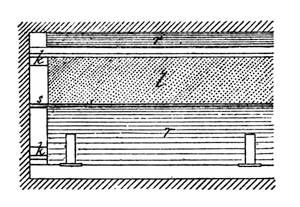
Dextrine is usually prepared on a large scale by moistening
10 parts of starch with 3 parts of water acidulated with 1/100
part of nitric acid. The mixture is allowed to dry, and is
then spread upon trays in layers about three-quarters of an
inch deep in an oven, where it is heated for about one hour
to 239° F. Sometimes large drums revolving over a fire
are used, or, in order to keep up a uniform temperature, the
starch is placed in a copper cylinder suspended in a vessel
with oil which is heated to 356° F. The object of the addition
of nitric acid is to allow the starch to be converted
into dextrine at a temperature which would be inadequate
to effect the transformation of starch alone.
Dextrine is also frequently prepared by allowing germinated
barley or malt to act upon starch. Heat 350 to 400
parts of water to about 77° F., and after adding 5 to 10
parts of dry malt, raise the temperature to 140° F. Then
add 100 parts of starch, and after mixing the whole thoroughly
together, raise the temperature to about 158° F. for
twenty minutes. The mass, which appears at first milky
and sticky, will gradually become as liquid as water by the
conversion of the starch into gum through the action of the
malt. To prevent the conversion of the gum into sugar by
the diastase of the malt, the fluid must be quickly brought
to the boiling-point, and, after cooling, filtered and evaporated
to the consistency of syrup. In cooling, the mass gelatinizes
to a jelly, which after drying is hard and brittle.
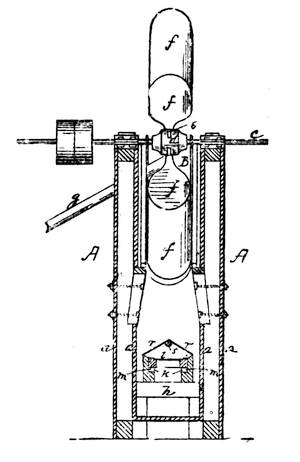
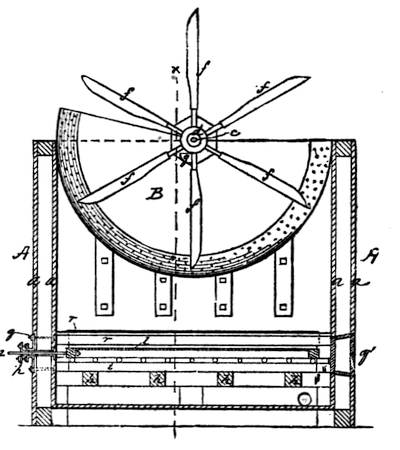
According to Blumenthal’s method, a drum which can
be hermetically closed, is filled two-thirds full with dry
starch flour by means of a funnel. A stirring apparatus is
then set in motion, and the acid which is contained in a
graduated cylinder is sprayed into the drum by means of a
special contrivance.
In a drum 5 feet long and 3¼ feet in diameter, 220 lbs.
of potato starch can be uniformly mixed in 5 minutes with
about 9 ozs. of nitric acid of 40° B., and the drum emptied
by opening the slide. Starch thus treated may be brought
into the oven without previous drying.
Heuzé gives the following method: Four and a half
pounds of nitric acid of 1.4 specific gravity together with
300 quarts of water are mixed with 2,200 lbs. of starch, and
boiled to form a mass which, when exposed to the air becomes
dry. It is sometimes effected at 177° F., but it
becomes a paste at 212° to 230° F. The starch changes
into dextrine in an hour or an hour and a half at the most;
it is white and soluble in water.
Tragacanth, or gum tragacanth, exudes from Astragalus
verus, a tree indigenous to Asia. The term gum is a misnomer,
as tragacanth does not actually dissolve in water
nor in spirit of wine, but merely swells up in water to a soft
gelatinous mass. Tragacanth consists of irregular pieces of
a pure white to yellowish color. It is chiefly used for confectioner’s
purposes, though sometimes as a paste for fancy
articles. This variety of gum is found, together with
arabine, in the gum which exudes from cherry, plum,
almond, and apricot trees, and gives the mucilaginous character
to the watery decoctions prepared from certain seeds,
such as linseed and quince-seed, and from the root of
marshmallow.
Starch paste. Corn starch 8 ozs., cold water ½ pint, boiling
water 1 gallon.
Beat up the starch in the cold water until reduced to a
creamy consistence, then pour the mixture into the boiling
water and stir briskly until the white, semi-opaque mass,
becomes transparent. Should it fail to do so, place it over
the fire, and boil until the desired result is obtained, stirring
constantly.
Flour paste. Wheat flour 4 lbs., cold water 2 quarts,
alum 2 ozs., hot water ½ pint, boiling water 2 gallons.
Work the wheat flour into a batter free from lumps with
the cold water. Dissolve the alum in the hot water. Then
stir the batter into the boiling water, and if necessary, continue
boiling until the paste thickens into a semi-transparent
mucilage, after which stir in the alum solution. This
makes a very fine paste for wall-paper.
Strong adhesive paste. Rye flour 2 lbs., cold water 1
quart, boiling water 3 quarts, pulverized rosin 1 oz.
Make the flour into a batter with the cold water, free
from lumps, and pour into the boiling water. Boil, if
necessary, and while hot stir in the pulverized rosin, a
little at a time. This paste is very strong, and will fasten
heavy wall-paper or thin leather. If too thick, thin with
hot water. Never thin paste with cold water.
Paste that will not sour. Allow 4 parts by weight of glue
to soften in 15 parts of cold water for some hours, and then
heat moderately till the solution becomes quite clear; then
add, while stirring, 65 parts of boiling water. In another
vessel stir up 30 parts of starch paste with 20 parts of cold
water, so that a thin, milky fluid without lumps is obtained.
Into this pour the boiling glue solution, stirring constantly,
and keep the whole at the boiling temperature. After cooling,
add 5 to 10 drops of carbolic acid to the paste. Preserve
the paste in closed bottles to prevent evaporation of
the water. It will thus keep good for years.
Venetian paste. White or fish glue 4 ozs., cold water ½
pint, Venice turpentine 2 fluid ozs., rye flour 1 lb., cold
water 1 pint, boiling water 2 quarts.
Soak the 4 ozs. of glue in the cold water for 4 hours.
Dissolve over a water-bath, and while hot stir in the Venice
turpentine. Make up the rye flour into a batter free from
lumps with the pint of water, and pour the latter into the
boiling water. Stir briskly, and finally add the glue solution.
This makes a very strong paste, and it will adhere
to a painted surface, owing to the Venice turpentine in its
composition.
Label paste. A good paste for attaching labels to bottles
may be made by soaking glue in strong vinegar, then heat
to boiling and add flour. This is very adhesive, and will
not decompose when kept in wide-mouthed bottles.
Elastic or pliable paste. Starch 4 ozs., white dextrine 2
ozs., cold water 10 fluid ozs., borax 1 oz., glycerine 3 fluid
ozs., boiling water 2 quarts.
Beat the starch and dextrine into paste with the cold
water. Dissolve the borax in the boiling water, then add
the glycerine, and pour the starch and dextrine mixture
into the borax solution. Stir until it becomes translucent.
This paste will not crack, and, being very pliable, is suitable
for paper, cloth, leather and other material where
flexibility is required.
Mucilage for labels. Macerate 5 parts of good glue in 20
parts of water for 24 hours, and to the liquid add 9 parts of
rock candy, and 3 parts of gum arabic. The mixture may
be brushed upon paper while lukewarm. It keeps well,
does not stick together and adheres firmly to bottles.
Mucilage. A strong aqueous solution of dextrine forms a
most adhesive and cheap mucilage. Dilute alcohol is
usually employed as the solvent where the mucilage is to
be used for gumming envelopes, postage stamps, etc., and in
order to facilitate the drying, acetic acid is added to increase
the mobility of the fluid. The strong aqueous solution
is more adhesive than that prepared with alcohol, for
the reason that it contains a greater proportion of dextrine.
To prepare this add an excess of dextrine to boiling
water, stir for a minute or two, allow to cool and settle, and
strain the liquid through a cloth. The addition of a little
powdered sugar increases the glossiness of the dried gum.
The sugar should be dissolved in the water before the dextrine
is added.
According to another formula, dextrine is mixed with hot
water until a syrupy liquid is obtained. Then add a few
drops of oil of cloves, and cool for use.
Another formula is as follows: Dextrine 120 parts, powdered
alum 6, sugar 30, carbolic acid 1, water 300. Mix gradually
the dextrine, alum and sugar with the water, boil to
effect solution, and when cold, add the carbolic acid.
The solubility of dextrine may be enhanced by the addition
of a calcium salt readily soluble in water, the resulting
mixture dissolving with ease in cold water. Calcium
nitrate has proved especially suitable for the purpose. By
pouring 1 quart of water over a mixture of 18 ozs. of dextrine
and 7 ozs. of calcium nitrate, a mass of great adhesive
power is immediately obtained.
Mucilage for postage stamps. Dextrine 2 parts, acetic acid
1, water 5, alcohol 1. Mix all together.
Caseine mucilage. Take the curd of skim milk, wash it
thoroughly, and dissolve it to saturation in a cold concentrated
solution of borax.
Tragacanth mucilage. Powdered tragacanth 2 drachms,
glycerine 12 drachms, water enough to make 20 ozs.
Put the tragacanth in a mortar with the glycerine, and
then add the water. This will produce at once a mucilage
of excellent quality.
Adhesive paste. Steep 4 ozs. of ordinary gelatine in
16 ozs. of water until it becomes soft, then dissolve it by the
heat of a water bath, and while still hot pour into a mixture
of 2 lbs. of good flour paste and 1 part of water. Heat
the whole to boiling and when thickened remove from the
fire. While cooling add 6 drachms of silicate of soda and
stir the mixture with a wooden spatula. This preparation
will keep good for an indefinite period, and is very adhesive.
The addition of 2 drachms of oil of cloves is an improvement.
Fluid pastes. I. Gum arabic 10 lbs., sugar 2 lbs., nitric
acid 1¾ ozs., water as required.
Dissolve the gum and sugar in the water, then add the
acid and heat to the boiling-point. The resulting paste is
liquid, does not mould, and dries to a transparent layer
upon paper. It is especially suitable for flaps of envelopes,
fine bookbinders’ work, etc.
II. Potato starch 10 lbs., water 5 quarts, nitric acid 8 ozs.
Mix the acid and water and pour it on the starch in an
earthenware basin, put the latter in a warm place, and
allow it to remain 24 hours, with occasional stirring. Then
boil it until it becomes thickly-fluid and very transparent.
If necessary it should be diluted with water and filtered
through a cloth.
Sugar and lime paste. Dissolve 12 parts of white sugar in
36 of water. Heat the solution to the boiling-point and
add 3 parts of slaked lime. Allow the liquid to stand in a
covered vessel for several days, stirring frequently and,
when settled, pour off the supernatant thick fluid from the
excess of lime.
The paste thus obtained has all the properties of gum
arabic solution and dries to a lustrous mass.
Liquid sugar and lime paste. Allow 3 parts of glue to
swell in 10 to 15 parts of the foregoing paste. Heat the
mixture to the boiling-point. The paste thus obtained does
not congeal on cooling and possesses considerable adhesive
power.
By reason of its caustic properties, due to the content of
lime, this paste should not be used for pasting colored
materials.
Pastes for paper and fine fancy articles. I. Dissolve, with
the assistance of heat, 100 parts of gilder’s glue in 200 of
water, and add a solution of 2 parts of bleached shellac in
10 of alcohol.
II. Dissolve, with the assistance of heat, 50 parts of dextrine
in 50 of water, stir solutions 1 and 2 together, strain
through a cloth into a flat prismatic mould, and allow it to
congeal. For use, melt a piece of corresponding size, and
dilute the liquid, if necessary, with water.
Albumen paste. This is a misnomer, as it contains no
albumen. It is partly decayed gluten from flour, washed
with water and then heated to 60° or 68° F., when it ferments
and becomes partly fluid. It is then dried at 77° to
86° F., and is claimed to keep any length of time in a dry
place. Dissolved in twice its weight of water it can be used
as a paste for all purposes.
Glycerine paste. Dissolve 2 ozs. of gum arabic and 4
drachms of glycerine in 6 ozs. of boiling water. This is a
good paste for office use.
Paste for fixing labels on machines. Make a paste of rye
flour and glue and add to every pound thereof ½ oz. each of
boiled linseed oil and turpentine. This paste resists damp
and thus prevents printed labels from falling off metallic
surfaces.
Paste for mounting maps. Stiff rye flour paste is best for
this purpose.
Paste for fastening paper on tin-foil. Make a paste by dissolving
rye flour in solution of caustic soda; dilute with
water, stirring all the time. Add to this paste a few drops
of Venice turpentine for each ½ lb. of flour.
Paste for paper bags. Add to 3 parts of starch 24 to 30
parts of cold water. Stir together to a homogeneous mass
of about the thickness of syrup. Pour over this, stirring
constantly, boiling water until the paste is of the required
consistency. Stir until nearly cold. Take a portion of the
paste and add to it 6 to 15 per cent. liquefied Venice turpentine;
rub together until a kind of emulsion is formed,
then mix the whole together and work thoroughly.
Caseine mucilage for photographer’s use. Separate the
caseine from milk by means of a little tartaric acid, and
treat the caseine while still warm with a solution of 6 parts
of borax to 100 parts water, and warm gently while stirring
which will cause the caseine to be dissolved. Of the borax
solution enough should be used to leave only a little undissolved
caseine behind.
Paste for scrap-books. Rice starch 1 oz., gelatine 3
drachms, water ½ pint.
Heat, stirring constantly, until the milky fluid becomes
thick and gluey. When the paste is nearly thick put in a
bottle closely corked. It is well to add a few drops of oil
of cloves to each bottle.
Paste for skins. Pour enough boiling water over 1 lb. of
rye flour in a basin to make a stiff paste, almost as stiff as
ordinary dough for puddings. Stir and beat up well with
a stick for three or four minutes, then cover up and let it
stand for two days before using, when it will be much softer
and stick better. Spread thinly and evenly on the back of
the skin with a stiff brush or pad. It will stick firmly and
not crack.
Strong mucilage capable of fastening wood or china and
glass together is made of 3½ ozs. of strong gum arabic solution,
to which a solution of 30 grains of sulphate of aluminium
dissolved in ⅔ oz. of water is added.
Dextrine mucilage. I. Dissolve with the assistance of heat
60 parts of borax in 420 parts of water, add 480 parts of
pale yellow dextrine and 50 parts of glucose, and heat carefully,
stirring constantly until solution is complete, replacing
the water lost by evaporation. Strain through flannel.
The resulting mucilage is quite clear, has great adhesive
power, and dries very quickly. In heating the mixture,
great care should be exercised not to exceed a temperature
of 194° F. and not to heat too long, otherwise the product
readily becomes brown and brittle.
II. Dextrine 120 parts, powdered alum 6, sugar 30, carbolic
acid 1, distilled water 300. Gradually mix the dextrine,
alum and sugar with the water, effect solution by
boiling and when the solution is cold, add the carbolic acid.
Paste for joining leather to pasteboard. Dissolve 50 parts
of strong glue with a little water at a gentle heat, then add
a small quantity of Venice turpentine, and next a thick
paste made with 100 parts of starch in water. Apply
quickly when cold.
Another formula for a similar paste is as follows: Rye
whisky 2 pints, water 1 pint, powdered starch 4¼ ozs., good
glue 1¼ ozs., Venice turpentine 1¼ ozs. Mix the whisky
and water together, then stir in the starch and make a thick
paste. Separately dissolve the glue in an equal weight of
water, and mix the Venice turpentine therein, mix thoroughly,
and then compound this mixture with the thick
paste by constantly stirring until all is well incorporated.
Paste for attaching labels to polished nickel. Dissolve 400
parts by weight of dextrine in 600 parts of water, and add
20 parts of glycerine and 10 parts of glucose. Heat the
mixture to 194° F.
Another formula is as follows: Mix 400 parts by weight
of dextrine with water, and add 200 parts of water together
with 20 parts of glucose and 10 parts of aluminium sulphate.
Mucilage for attaching labels to tin. I. Shellac 8 parts,
borax 4 parts, water 60 parts. Boil until the shellac is
dissolved.
II. To 2 parts of dammar varnish add 8 parts of tragacanth
mucilage.
III. An excellent mucilage for the purpose consists of
starch paste to which a small quantity of Venice turpentine
has been added.
IV. Make a paste of corrosive sublimate 2½ parts, wheat
flour 200, absinthe 100, tansy 50, water 3000. This mucilage
is useful for vessels kept in a damp place.
Mucilage for office use. Gum arabic 100 parts, aluminium
sulphate 6 parts, glycerine 10, dilute acetic acid 20, distilled
water 140. Dissolve, in a wide-mouthed glass bottle, the
gum arabic in cold distilled water, stirring frequently. Let
the solution stand 2 or 3 days, then add the glycerine, later
on the dilute acetic acid and finally the aluminium sulphate.
Strain through a hair sieve, allow to clarify, and
decant from the sediment.
Glycerine paste for office use. Dissolve 4 ozs. of gum arabic
and 8 drachms of glycerine in 12 ozs. of boiling water.
Clean and durable paste. Dissolve 5 ozs. of gum arabic in
4 quarts of warm water, and thicken to a paste with wheat
flour. Then add a solution of alum and sugar of lead,
3 ozs. of each in water. Heat the mixture and stir it until
it is about to boil, and then cool it. If too thick, add gum
solution.
Banknote or mouth glue. Dissolve by the aid of heat a
fine quality of glue or gelatine with about a quarter or one-third
of its weight of brown sugar, in as small a quantity of
water as possible. Then when perfectly liquid cast the
mixture into thin cakes on a flat surface very slightly oiled,
and when cold cut up into pieces of convenient size. When
required for use moisten one end. A piece of this glue
kept in the desk will be found very convenient for many
purposes.
Paste for cardboard. Dissolve 3½ ozs. of best French glue
in 6½ ozs. of water by soaking and heating. Then add a
solution of ½ drachm of shellac in 3½ drachms of alcohol
and stir as long as the solution is warm. Next dissolve 2
drachms of dextrine in 1¾ ozs. of alcohol and 14 drachms
of water, stir, and place the vessel in warm water until solution
is complete. Mix this solution with that of the glue,
and pour the whole into a suitable vessel, in which it may
solidify. When wanted for use cut off a small piece and
liquefy it by warming.
Paste for attaching cloth or leather to table tops. Wheat
flour 1 lb., powdered rosin 2 tablespoonfuls, powdered alum
1 tablespoonful. Heat and stir to a stiff consistency.
Caseine mucilage. Separate the caseine from milk with a
little tartaric acid, and treat the caseine while still warm
with a solution of 6 parts borax to 100 parts water and warm
gently while stirring, which will cause the caseine to be dissolved.
Of the borax solution enough should be used to
leave only a little undissolved caseine behind.
Very adhesive paste which may be used for wood and parchment.
Gum arabic 60 parts, fine wheat starch 45, sugar 15.
Dissolve the gum in as much water as is required for boiling
the quantity of paste to be made. Then add the starch
and sugar and boil it in a vessel suspended in boiling water
until the mixture is clear and has the consistency of liquid
tar. Keep in a well-closed vessel protected from mould by
the addition of a few drops of oil of cloves.
Paste for pads. Glue 4 parts by weight, glycerine 2, linseed
oil ½, sugar 4, aniline dye sufficient to color. Soften
the glue by soaking in cold water, then dissolve together
with the sugar in the glycerine by the aid of heat over the
water-bath, then add the dye and stir in the oil. Use the
paste hot.
Paste for fastening paper on tin-foil. Make a paste by dissolving
rye flour in a solution of caustic soda; dilute with
water, stirring constantly. Add to this paste a few drops
of Venice turpentine for each ½ lb. flour used. This paste
adheres to all kinds of metal, tin-foil, glass, etc.
Paste for attaching labels to glass, porcelain, and metal.
Gum arabic 15 parts, pulverized tragacanth 7½, glycerin
45, thymol 0.3, alcohol 3¾, water 120. Dissolve the gum
arabic in 15 parts of water and triturate the tragacanth
with 30 parts of water. Mix the two fluids and strain.
Then add the glycerine and finally the thymol dissolved in
the alcohol.
Preparation of arabol-gum. Mix intimately 44 lbs. of
wheat starch with 176 lbs. of water. Bring the mass into
a water-bath, mix it with a solution of 4.4 lbs. of oxalic
acid in 44 lbs. of water and heat for four hours at 194° F.,
stirring frequently. The conversion of the starch is as a
rule effected during this time, but should such not be the
case, continue heating, constantly replacing the evaporated
water, until the mass is clear and liquid. While still hot,
neutralize the mass with marble dust, allow to settle, filter,
and evaporate the clear solution in a water-bath to a solid
gum containing about 15 per cent. of water.
Preparation of an adhesive substance from desaccharized beet-root
slices (German patent 96316 f. G. Eichelbaum). The
insoluble metarabin contained in the slices is converted
into soluble arabin by treating the slices under pressure
with hot aqueous sulphurous acid or with aqueous solutions
of the bisulphites of the alkalies or alkaline earths.
According to a later patent (German patent 121422 f.
Fabrik Bettenhausen Marquart and Schulz), the insoluble
metarabin is converted into soluble arabin by heating the
desaccharized beet-root slices with phosphoric acid and
water. According to a supplement to this patent (122048),
conversion is effected by heating the slices with aqueous
solutions of organic acids and phenols, or the acid salts of
oxalic, tartaric or phosphoric acids.
- Acid calcium phosphate, 120
- —— —— —— crystallization of, 125, 126
- —— —— —— formation of, 121-124
- —— sodium sulphate, use of, in drying glue, 72, 73
- Acidity, determination of, in glue, 205, 206
- Acids, dilute, effect of, on glue solution, 7
- Adamson, Wm., method of, for removing hydrocarbons from substances which have been treated therewith, 84-86
- —— —— method of, for treating substances with hydro carbon vapor for the purpose of extracting oils, fats, etc., 79-82
- —— —— method of, for treating substances with liquid hydrocarbons for the purpose of extracting oils, fats, etc., 82-84
- —— —— and Simonis, Chas. F. A., apparatus of, for extracting bones with benzine, 76-79
- Adhesive paste, 264
- Adulterations of glue, determination of, 214, 215
- Agar-Agar, 12, 201, 202
- Air-bladders, 16, 41
- —— bleaching glue in the, 141
- —— drying the cakes of glue in the, 64
- Alabaster, 244
- —— cement for, 242
- Albumen paste, 265, 266
- —— —— use of, for clarifying glue liquor, 54
- Alum cement, 228
- —— —— effect of, on glue solution, 7
- —— —— use of, for clarifying glue liquor, 54
- —— —— —— —— preserving paste, 257
- Amber, resinous cement for, 229
- American cement for jewelers, 252
- American glue, analysis of, 207
- Ammonium sulphate, use of, in drying glue, 72, 73
- Animal charcoal, bleaching glue with, 142
- —— —— bones for the manufacture of, 107
- —— —— carbonization of bones for, 108-112
- —— —— decolorizing glue liquor with, 55
- —— —— manufacture of, 112, 113
- —— —— yield of, 113
- —— skin, constitution of, 17, 18
- Antiseptics for the preservation of glue-stock, 30
- Arabin, conversion of metarabin into, 271
- Arabol-gum, preparation of, 270
- Ash, burning bones to, 117-119
- Bacteriology, use of gelatine in, 194
- Banknote glue, 269
- Barium chloride, effect of, on glue solution, 7
- Basic calcium phosphate, 120
- Beet-root slices, desaccharized, preparation of an adhesive substance from, 270, 271
- Belgian retort-furnace for the carbonization of bones, 109-112
- Benzine, extracting fat from bones with, 76-92
- Billiard balls, compound for, 155, 156
- Bleaching glue, methods of, 141-145
- —— —— stock, 55, 56
- Blood, fresh, use of, for clarifying glue liquor, 54
- Blumenthal’s method of preparing dextrine, 260, 261
- Boiler for glue boiling, 44
- Boiling bones, 74, 75
- —— —— duration of, 45
- —— —— or cooking glue, 44-52
- Bone ash, composition of, 119
- —— —— conversion of, into a coarse powder, 119
- —— —— decomposition of, by sulphuric acid, 119-125
- —— —— kiln for, 117-119
- —— —— preparation of, 117-119
- —— —— yield of, 119
- —— cartilage, composition of, 32
- —— cement for, 230
- —— crusher, 36
- —— gelatine, 170-180
- —— —— modern process of preparing, 179, 180
- —— -glue, manufacture of, 74-116
- —— meal, glue and fat, simultaneous utilization of bones for, 104-113
- —— -mill, Crosskill, 36
- —— raw materials, 16
- —— size, 159, 160
- Bones, absorption of sulphurous acid by, 92
- —— Adamson and Simonis’ apparatus for extracting, 76-79
- —— and cartilages, 31-39
- —— apparatus for extracting the fat from, with benzine, 76-94
- —— Belgian retort-furnace for the carbonization of, 109-112
- —— boiling of, 74, 75
- —— burning of, to ash, 117-119
- —— buying of, 32
- —— carbonization of, 108-112
- —— constitution of, 32
- —— crushed, sorting of, 36, 37
- —— crushing or grinding of, 33-36
- —— extraction of, 76-94
- —— —— —— phosphates from, 115
- —— fatty matters in, 32
- —— for the manufacture of animal charcoal, 107
- —— honey-combed, 39
- —— Leuner’s apparatus for extracting, 90-92
- —— lime bath for, 37
- —— products obtained in the distillation of, 112
- —— Seltsam’s apparatus for extracting, 84-86
- —— —— apparatus for extracting, improved by Th. Richter, 88-90
- —— simultaneous utilization of, for fat, bone-meal and glue, 104-113
- —— —— utilization of, for fat, glue and calcium phosphate, 113-116
- —— sorting of, 32, 33, 104, 105
- —— sulphurous acid for extracting, 92-94
- —— treatment of, with high pressure steam, 105-107
- —— utilization of the liquor obtained in the treatment of, with hydrochloric acid, 125-127
- —— value of, 32
- —— waste of, from the preparation of tinned provisions, 19
- Bookbinder’s glue, 12
- —— size, 160
- Book isinglass, 197
- Boric acid, preservation of glue-stock with, 30
- Bottles, cracked, cement for, 240, 241
- Bouillon tablets, 12
- Brazilian isinglass, 199, 200
- Briers, D. J., process for the preparation of bone gelatine employed by, 171-179
- Brochette, 43
- Brushmaker’s cement, 251
- Bullock’s feet, 18
- —— hide, waste of, 18
- —— leather, 30
- Burning bones to ash, 117-119
- Cakes, cutting glue into, 57-64
- —— drying the, 64-73
- —— machines for cutting the jelly into, 60-64
- —— shape of, 57, 58
- —— tools for cutting the jelly into, 59
- Calcium chloride, 116
- —— metaphosphate, 120, 127
- —— phosphate, 115
- —— —— fat and glue, simultaneous utilization of bones for, 113-116
- Calf leather, 30
- —— skin waste, 18
- Calves’ feet, 30
- —— heads, 18, 30
- Carbolic acid, preservation of glue-stock with, 29
- —— —— use of, for preserving paste, 257, 258
- Carbon disulphide, use of, for extracting bones, 76
- Cardboard, paste for, 269
- Cartilage, 1
- —— conversion of, into glue, 94-104
- —— drying of, 114
- —— preservation of, 114
- —— treatment of, with high-pressure steam, 98
- —— yield of glue from, 115
- Cartilages and bones, 31-39
- Caseine cement which can be kept for a long time, 239
- —— cements, 237-240
- —— mucilage, 264
- —— —— for photographer’s use, 266
- —— ordinary technical, preparation of, 238, 239
- —— pure, preparation of, 237, 238
- Castings, cement for filling in defects in, 246
- Cattle, pieces of hide from the lower parts of the limbs of, 30
- Cayenne isinglass, 199, 200
- Cellular tissue, 1
- Celluloid, cement for, 252
- Cement resisting acids, 248
- —— —— —— very high temperatures, 248
- Cements, caseine, 237-240
- —— chemical nature of, 219
- —— classification of, 218-223
- —— for chemical apparatus, 247-249
- —— —— —— —— special purposes, 249-252
- —— glue and starch, 222, 223
- —— glycerine, 242
- —— gypsum, 244, 245
- —— how to use, 252-255
- —— iron, 245-247
- —— lime, 223, 243, 244
- —— oil, 219, 220, 224-229
- —— pastes and mucilages, preparation of, 224-271
- —— resinous, 220, 221, 229-233
- —— resisting high temperatures, 246
- —— rubber and gutta-percha, 222, 233-237
- —— water glass, 240-242
- Chalk, 243
- Charcoal, animal, bleaching glue with, 142
- —— —— bones for the manufacture of, 107
- —— —— carbonization of bones for, 108-112
- —— —— manufacture of, 112, 113
- —— —— yield of, 113
- —— mixing calcium phosphate with, 124
- Chemical apparatus, cements for, 247-249
- Chinese isinglass, 201, 202
- Chlorbarium, soaking hides in, 20
- Chloride of lime, bleaching glue-stock with, 55
- Chlorine, bleaching glue with, 141
- Chondrin, chemical composition of, 5, 6
- —— conversion of, into glutin, 6
- —— formation of, 3
- —— properties of, 5
- —— pure, preparation of, 5
- Chrome glue, 153
- Clarifying glue liquor, 52-56
- —— —— —— apparatus for, 98
- —— —— —— vats, 53
- Clay crucibles, cracked, cement for, 243
- Clearness of glue, definition of, 53
- Clock faces, white enameled, cement for, 230
- Cloth, cement for, 252
- —— paste for attaching, to table tops, 269
- Colle franche, 43
- Cologne glue, 148
- Color mixtures, glue for, 11
- —— of glue, definition of, 53
- Colored gelatine, 181, 182
- Coloring glue, 156
- —— matters for gelatine, 181, 182
- —— substances, removal of, from glue liquor, 54-56
- Combs, hard rubber, cement for, 236
- Common salt, effect of, on glue solution, 7
- Constitution of glue, 3-6
- Conversion of cartilage into glue, 94-104
- Cooking, duration of, 44
- —— or boiling glue, 44-52
- Cooling boxes, 100
- —— glue liquor, 100
- Corium, 1, 17
- Court-plaster, 12, 184, 185
- Cox, J. and G., process for the manufacture of gelatine patented by, 166, 167
- Crockery, cement for, 236, 237
- Crosskill bone mill, 36
- Crucibles, cement for, 243
- Crude glue, definition of, 3
- —— —— preparation of, 43
- Culinary purposes, glue for, 12-14
- Dark steam glue, 152
- Devoulx, cutting apparatus invented by, 62-64
- Dextrine mucilage, 267
- —— —— preparation of, 259-261
- Diamond cement, 229
- Distillation of crude phosphorus, 133-135
- —— —— phosphorus, 127-132
- Drying, acceleration of, 72, 73
- —— cakes of glue, 64-73
- —— galleries, 68-71
- —— house, modern, 71, 72
- Drying room, 65
- —— —— regulating the temperature of the, 67, 68
- East India isinglass, 199
- Elastic cement, 234
- —— gutta-percha cement, 236
- —— masses, glue for, 14
- —— paste, 263
- Electric furnace for the manufacture of phosphorus, 138-140
- Electrical apparatus, cement for, 251, 252
- Emery paper, use of glue in the manufacture of, 12
- Epidermis, 17
- Epsom salt, behavior of glue solution towards, 7
- —— —— use of, in drying glue, 72, 73
- Evaporating pan, open, 98-100
- —— pans, 124
- Evaporators, spiral, 100, 101
- Extraction of bones, 76-94
- Fabrics, water-proofing of, 161-163
- Fancy articles, fine, paste for, 265
- Fans, gelatine veneers for, 15
- Fat, bone meal and glue, simultaneous utilization of bones for, 104-113
- —— extraction of, with benzine, 76-92
- —— —— —— hydrocarbon vapors, 79-82
- —— —— —— liquid hydrocarbons, 82-84
- —— glue and calcium phosphate, simultaneous utilization of bones for, 113-116
- Fertilizers, utilization of liquors for, 116
- Fining, gelatine for, 182
- Fish bladders, 1
- —— —— glue, 202-204
- —— —— —— points to be observed in the manufacture of, 41, 42
- —— —— —— raw materials for, 41, 42
- —— scales, 16, 42
- —— —— preparation of glue from, 203
- Fleck’s kiln for burning bones, 118, 119
- —— process of accelerating the drying of glue, 72, 73
- Flour paste, 256-258, 261, 262
- Fluid pastes, 264, 265
- Foils, gelatine, 15, 185, 186
- Formaldehyde, preservation of glue-stock with, 29, 30
- Forming or moulding the glue, 56-64
- Formo-gelatine, 193, 194
- French mastic, 227
- —— putty, 225
- Friedberg’s apparatus for clarifying glue liquor, 98
- —- —— —— conversion of cartilage into glue, 94-97
- Furnace, electric, for the manufacture of phosphorus, 138-140
- Galley furnace, 128, 129
- Galvanized iron-wire netting, 66
- Gelatin, pure, preparation of, 4
- Gelatine and glycerine, compound of, 12
- —— and products prepared from it, manufacture of, 165-195
- —— artificial silk from, 195
- —— capsules, 14, 184
- —— colored, 181, 182
- —— constitution of, 165
- —— Cox’s process for the manufacture of, 166, 167
- —— foils, 15, 185, 186
- —— for fining purposes, 182
- —— for photographic printing and photographic purposes in general, 183, 184
- —— Jullion and Pirie’s process for the preparation of, 38
- —— Nelson’s process for the manufacture of, 166
- —— preparation of, from ordinary glue, 182, 183
- —— substitute for, 203, 204
- —— Swinborne’s improved patented process for the preparation of, 167
- —— testing of, 205-217
- —— veneers, 15, 186-193
- —— yielding tissues, 1
- German isinglass, 200
- Gilder’s glue, 150
- Glass, cement for, 230, 233, 239, 241, 243, 245
- —— —— for attaching metal letters to, 249
- —— —— —— —— —— to metal, 251
- —— mastic cement for, 232
- —— oil cement for, 228
- —— paper, use of glue in the manufacture of, 12
- —— paste for attaching labels to, 270
- —— plates, gelatinizing liquors upon, 58, 59
- —— upon glass, cement for, 230
- —— —— metal, cement for, 230
- Glauber’s salt, use of, in drying glue, 72, 73
- Gloves, waste from the manufacture of, 43
- Glue, acceleration of the drying of, 72, 73
- —— addition of mineral substances to, 149
- —— American, analysis of, 207
- —— and starch cements, 222, 223
- —— as a binding agent, 11
- —— —— —— joining medium, 10, 11
- —— banknote or mouth, 269
- —— boiler, Terne’s, 51, 52
- —— boiling, boiler for, 44
- —— —— convenient apparatus for, 46, 47
- —— —— in open jacketed pans, 49, 50
- —— —— or cooking, 44-52
- —— —— with steam, boiler for, 47-49
- —— chemical composition of, 8
- —— chrome, 153
- —— clearness of, 53
- —— Cologne, 148
- —— color of, 53
- —— coloring of, 156
- —— constitution of, 3-6
- —— conversion of cartilage into, 94-104
- —— cooking, process of, 51
- —— crude, definition of, 3
- —— —— preparation of, 43
- —— cutting the, into cakes, 57-64
- —— deduction of the quality of, from indirect properties, 207, 208
- —— determination of acidity in, 205, 206
- —— —— of adulterations of, 214, 215
- —— —— of glutin in, 206, 207
- —— —— of moisture in, 205
- —— different varieties of, and their preparation, 146-164
- —— drying cakes of, 64-73
- —— —— room for, 65
- —— factory, location of a, 21
- —— —— manner of carrying on the work in a, 26-30
- —— fat and bone-meal, simultaneous utilization of bones for, 104-113
- —— for attaching leather to metal, 153
- —— —— culinary and medicinal purposes, 12-14
- —— —— elastic masses and as a partial substitute for rubber, 14
- —— —— fancy articles, 14, 15
- Glue joints in leather driving belts, 163
- —— —— —— leather, paper, etc., 153, 154
- —— —— —— parchment paper in making sausage skins, 154, 155
- —— formation of, 6
- —— from various materials, external characteristics of, 6, 7
- —— gilder’s, 150
- —— holding power of, 147, 148
- —— how to make and use, 147
- —— in animal organism, 2
- —— —— sizing, 12
- —— inferior qualities of, 12
- —— joiner’s, 146
- —— Kissling’s results in testing, 215
- —— liquid, 151, 152
- —— liquor, apparatus for clarifying, 98
- —— —— clarifying the, 52-56
- —— —— concentration of, 50
- —— —— cooling of, 100
- —— —— decolorizing of, with animal charcoal, 55
- —— —— instrument for measuring the percentage of glue in, 103
- —— measuring the percentage of, in glue liquor, 103, 104
- —— methods of bleaching, 141-145
- —— moulding or forming of, 56-64
- —— nature of, 1-9
- —— nets for drying, 66, 67
- —— ordinary, preparation of gelatine from, 182, 183
- —— parchment, 150
- —— Paris, 150, 151
- —— patent, 150
- —— practical testing of, 215-217
- —— principal substances employed as raw material for, 16
- —— properties of, and its behavior towards other substances, 6-9
- —— raw materials and their preparation for the manufacture of, 16-38
- —— results obtained by comparative experiments in testing, 209, 210
- —— Russian, 149, 150
- —— size, 150
- —— solution, behavior of, towards salts, 7, 8
- —— steam, 152
- —— stock, bleaching of, 55, 56
- —— —— dry-limed, 19
- —— —— dry, uncured, or salted, 19
- —— —— green-limed, 19
- —— —— green-salted, 19
- —— —— influence of the age of animals on the product from, 20
- —— —— limed, washing of, 21-26
- —— —— notes in reference to judging, 19, 20
- —— —— preparation of, 21-38
- —— —— preservation of, 29
- —— —— sheds for, 26
- —— —— transformation in boiling the, 2
- —— —— washer, 22-26
- —— substitute for, 203, 204
- —— transition stages of, 2
- —— uses of, 10-15
- —— testing of, 205-217
- —— tungstic, 155
- —— water-proof, 160
- —— yield of, from cartilage, 115
- —— —— —— from tannery waste, 18
- —— -yielding substance, production of, 2
- —— —— tissues, 1
- Glutin, conversion of chondrin into, 6
- —— determination of, in glue, 206, 207
- —— formation of, 3
- —— properties of, 4, 5
- —— pure, preparation of, 4
- Glycerine and glycerine cements, 242
- —— —— litharge cement, 242
- —— paste, 266
- —— —— for office use, 268
- —— properties of, 242
- Glycocoll, 6
- Goat leather, 31
- Gray lime, 28
- Green waste, liming of, 26, 27
- Gum tragacanth, 261
- Gutta-percha and rubber cements, 222, 233-237
- Gypsum, 244
- Gypsum cements, 244, 245
- Hager’s diamond cement, 229
- Hard rubber cement, 234
- —— combs, cement for, 236
- Hare skins, 18, 31
- Hartshorn, 1
- Hayes, S. Dana, analysis of American glue by, 207
- Heat-resisting cement, 245
- Hectograph mass, 14, 163, 164
- Heuzé’s method of preparing dextrine, 261
- Hide, transformation in drying the, 2
- Hides for glue-stock, classification of, 30, 31
- —— soaking of, in chlorbarium, 20
- Hoeveller, W. A., apparatus for drying glue invented by, 68-71
- —— glue-stock washer of, 22-26
- Hog skins, 18
- Hollander, 39
- Horn, cement for, 232
- —— piths, 19
- Horses’ hoofs, cement for, 236
- Hudson Bay isinglass, 199
- Hydraulic works, cement for, 241
- Hydrocarbon vapors, extraction of fats, oils, etc., with, 79-82
- Hydrocarbons, liquid, extraction of fats, oils, etc., with, 82-84
- —— removal of, from substances, 84-86
- Hydrochloric acid, treatment of bones with, 37
- —— —— utilization of the liquor obtained in treating bones with, 125-127
- Ichthyocolle Française, 200, 201
- Irish moss, 202
- Iron and stone, cement for, 245
- —— cement for, 245, 246
- —— cements, 245-247
- —— pipes, fire-proof cement for, 246
- —— pots, cracked, cement for, 246
- —— water tanks, cement for, 246
- Isinglass, adulteration of, 196, 197
- —— and its substitutes, 196-204
- —— chemical composition of, 8
- —— preparation of, in Russia, 197, 198
- —— sources of, 196
- —— spurious, 196
- —— substitute for, 203, 204
- Isinglassine, 201
- Ivory, cement for, 230
- Jeffrey’s marine glue, 235
- Jelly, definition of, 3
- —— effect of tannin on, 8
- —— machines for cutting the, into cakes, 60-64
- —— properties of, 7
- —— tools for cutting the, into cakes, 59
- —— transformation in boiling the, 2
- Jennings’ method for the preparation of fish glue, 202, 203
- Jewelers, American cement for, 252
- —— cement, 252
- Joiners, cement for, 243
- —— glue, 146
- Jullion and Pirie’s process for the preparation of gelatine, 38
- Kid leather, waste from paring, 31
- Kiln for burning bones, 117-119
- Kissling’s results in testing glue, 215
- Knapsack leather, 31
- Knife handles, cement for, 231
- Label paste, 263
- Labels, mucilage for, 263
- —— paste for attaching, to glass, porcelain and metal, 270
- —— —— for attaching, to polished nickel, 268
- —— —— for attaching, to tin, 268
- Lamb leather, 31
- Leaf isinglass, 197
- Leather, cement for, 235, 237
- —— driving belts, glue for joints in, 163
- —— for glue-stock, classification of, 30, 31
- —— glue for, 153, 154
- —— —— —— attaching, to metal, 153
- —— paste for attaching, to table tops, 269
- —— —— —— joining, to pasteboard, 267, 268
- —— skins, actual, 17
- —— waste, 39-42
- —— —— comminution of, 39, 40
- Leucine, 6
- Leuner’s apparatus for extracting bones, 90-92
- Lime and glue cement, 244
- —— —— sugar paste, 265
- —— bath for bones, 37
- —— cements, 223, 243, 244
- —— milk of, preparation of, 26, 27
- —— precipitation of, by oxalic acid, 54
- —— slaked, effect of, on glue solution, 7
- —— testing of, 27, 28
- Limed glue-stock, washing of, 21-26
- Liming green waste, 26, 27
- —— waste, 20
- Linseed oil and clay cement, 248
- —— —— —— manganese cement, 248
- Lipowitz’s method of testing glue, 208, 209
- Liquid fining gelatine, 182
- —— glue, 151, 152
- —— sugar and lime paste, 265
- Litharge cement, 225
- Magnesium sulphate, 116
- Manufacture of bone-glue, 74-116
- —— —— gelatine, and products prepared from it, 165-195
- —— —— phosphorus, 117-140
- —— —— skin glue, 43-73
- Maps, paste for mounting, 266
- Marble, cement for, 242, 251
- —— —— for attaching metal letters to, 249
- —— oil cement for, 228, 229
- Marine glue, 234, 235
- Matches, use of glue in the manufacture of, 11
- Mastic, 226, 227
- —— cement, 226, 227
- Medicinal purposes, glue for, 12-14
- Meerschaum, cement for, 239
- Meta-gelatin, 7
- Metal, cement for attaching wood, glass, etc., to, 251
- —— glue for attaching leather to, 153
- —— letters upon glass, cement for, 230, 249
- —— paste for attaching labels to, 270
- Metals, cement for, 239
- —— —— for uniting, 241
- Metarabin, conversion of, into arabin, 271
- Mica, cement for, 231, 232
- Milk of lime, preparation of, 26, 27
- Moisture, determination of, in glue, 205
- Mother-of-pearl, glue imitations of, 15
- Moulding boxes, 56
- —— or forming the glue, 56-64
- —— refined phosphorus, 135-137
- Mouth glue, 269
- Mucilage, 263, 264
- —— caseine, 264
- —— —— for photographers’ use, 266
- —— dextrine, 267
- —— for attaching labels to tin, 268
- —— —— labels, 263
- —— —— office use, 268
- —— —— postage stamps, 264
- —— preservation of, 259, 260
- —— strong, 267
- —— tragacanth, 264
- Mucilages and pastes, 255-271
- —— —— —— for special purposes, 261-271
- —— —— pastes and cements, preparation of, 224-271
- Muratori and Landry’s method of water-proofing fabrics, 162, 163
- Muzmann and Krakowitzer’s method of water-proofing fabrics, 162, 163
- Nature of glue, 1-9
- Nelson, G., process of, for the manufacture of gelatine, 166
- Nets for drying glue, 66, 67
- Netting, metallic, 66
- —— twine, 66, 67
- Neutral potassium tartrate, behavior of glue solution towards, 7
- New York isinglass, 198
- Nickel, polished, paste for attaching labels to, 268
- North American isinglass, 198
- Office use, glycerine paste for, 268
- —— —— mucilage for, 268
- Oil cements, 219, 220, 224-229
- Oils, extraction of, with hydrocarbon vapors, 79-82
- —— —— —— with liquid hydrocarbons, 82-84
- Ornaments, indestructible mass for, 155
- Osseine, 1
- Oxalic acid, effect of, on glue solution, 7
- —— —— precipitation of lime by, 54
- Pads, paste for, 270
- Paget’s mastic, 227
- Pale steam glue, 152
- Pan, open evaporating, 98-100
- Pans, evaporating, 124
- —— open jacketed, 49, 50
- —— vacuum, 101-103
- Paper bags, paste for, 266
- —— colored, use of glue in the manufacture of, 11
- —— glue for, 153, 154
- —— hangings, glue in the manufacture of, 11
- —— paste for, 265
- —— —— —— fastening, on tin-foil, 266, 270
- Parchment glue, 150
- —— paper, glue for, in making sausage skins, 154, 155
- —— scraps, 18
- Paris glue, 150, 151
- Paste, adhesive, 264
- —— albumen, 265, 266
- —— clean and durable, 268, 269
- —— elastic or pliable, 263
- —— fluid, 264, 265
- —— for attaching cloth or leather to table tops, 269
- —— —— —— labels to glass, porcelain and metal, 270
- —— —— —— —— to polished nickel, 268
- —— —— cardboard, 269
- —— —— fastening paper on tin foil, 266, 270
- —— —— joining leather to pasteboard, 267, 268
- —— —— mounting maps, 266
- —— —— pads, 270
- —— —— paper and fine fancy articles, 265
- —— —— —— bags, 266
- —- —— scrap-books, 266, 267
- —— —— skins, 267
- —— glycerine, 266
- —— —— for office use, 268
- —— label, 263
- —— preparation of, 255
- —— preservatives for, 257
- —— rules to be observed in the preparation of, 256
- —— strong adhesive, 262
- —— sugar and lime, 265
- —— that will not sour, 262
- —— Venetian, 262
- Paste-board, paste for joining leather to, 267, 268
- Pastes and mucilages, 255-271
- —— —— —— for special purposes, 261-271
- —— mucilages and cements, preparation of, 224-271
- Patent glue, 150
- Patriarch isinglass, 197
- Permanent white, addition of, to glue, 149
- Petroleum, cement to withstand the action of, 231
- —— lamps, cement for, 231
- Phosphates, extraction of, from bones, 115
- Phosphorus, crude, composition of, 131, 132
- —— —— distillation of, 133-135
- —— —— purification of, 132
- —— distillation of, 127-132
- —— galley furnace for distilling, 128, 129
- —— loss of, 132
- —— manufacture of, 117-140
- —— —— of, with the assistance of electricity, 138-140
- —— operations in the preparation of, 117
- —— refined, moulding of, 135-137
- —— refining and purifying of, 132-135
- —— receivers for, 129
- —— removal of, from the receivers, 131
- —— residue in the manufacture of, 127
- —— sticks, mode of forming, 135-137
- —— storing of, 138
- Photographers, caseine mucilage for 266
- Photographic printing, gelatine for 183, 184
- Photo-lithography, use of glue in, 14
- Pierres de mastic, 226, 227
- Pipes exposed to a red heat, cement for tightening joints of, 241
- Plaster of Paris, 244
- —— —— —— cement, universal, 245
- —— —— —— statues, cement for, 244, 245
- Pliable paste, 263
- Porcelain, cement for, 231, 239, 240, 241, 243, 245
- —— oil cement for, 229
- —— paste for attaching labels to, 270
- —— sulphur cement for, 232, 233
- Postage stamps, mucilage for, 264
- Potassium carbonate, behavior of glue solution towards, 7
- Printing rollers, compositions for, 157
- Putty, 224, 225
- Quick lime, 243
- Rabbit skins, 18, 31
- Rag-engine, 39
- Raw materials and their preparation for the manufacture of glue, 16-38
- —— —— collection and buying of, 16
- —— —— division of, 16
- Receivers for collecting phosphorus, 129
- —— —— removal of phosphorus from the, 131
- Red lead cement, 225
- Resinous cements, 220, 221, 229-233
- Retort-furnace, Belgian, for the carbonization of bones, 109-112
- Retorts, 127, 128
- Rochelle salts, behavior of glue solution towards, 7
- Rubber and gutta-percha cements, 222, 233-237
- —— cement for, 250
- —— —— —— chemical apparatus, 248, 249
- —— glue as a partial substitute for, 14
- Russia, preparation of isinglass in, 197, 198
- Russian glue, 149, 150
- —— isinglass, 197, 198
- —— steam glue, 152
- Sahlstrom’s process for preparing a substitute for isinglass, gelatine and glue, 203, 204
- Sal ammoniac, effect of, on glue solution, 7
- Saltpetre, effect of, on glue solution, 7
- Salts, behavior of glue solution towards, 7, 8
- Samovey leaf isinglass, 197
- Sandpaper, use of glue in the manufacture of, 12
- Sausage skins, glue for parchment paper in making, 154, 155
- Scheibler’s cement for chemical apparatus, 249
- Schneible, J., machine for cutting the jelly into cakes invented by, 60-62
- Scrap-books, paste for, 266, 267
- Selenite, 244
- Seltsam’s apparatus for extracting bones, 84-86
- —— —— for extracting bones improved by Th. Richter, 88-90
- Serbat’s mastic, 227, 228
- Seubert’s apparatus for moulding phosphorus, 135, 136
- Sheds for glue-stock, 26
- Sheep leather, 31
- —— skin waste, 18
- Shell lime, 28
- Shoemakers’ paste, 258, 259
- Siberian purse isinglass, 197
- Sieve for sorting crushed bones, 36, 37
- Silicate of soda, 240
- Silk, artificial, from gelatine, 195
- Sinews, 1
- Size, 157-160
- —— glue, 150
- Sizing, glue in, 12
- Skin gelatine, 166-170
- —— —— modern process of preparing, 167-170
- —— glue, classification of operations in the manufacture of, 43
- —— —— manufacture of, 43-73
- —— -like raw materials, 16
- Skins, paste for, 267
- —— steeping of, 18
- —— used for packing, use of, for glue, 19
- Sodium carbonate, behavior of glue solution towards, 7
- Soft putty, 225
- —— rubber cement, 233, 234
- Sounds, 41
- Spiral evaporators, 100, 101
- Stamping mill for crushing bones, 34, 35
- Staple isinglass, 197
- Starch and glue cements, 222, 223
- —— paste, 255, 256, 261
- Steam, apparatus for boiling glue with, 47-49
- Steam boiler cement, 250
- —— glue, 152
- —— high-pressure, treatment of bones with, 105-107
- —— pipes, cement for, 250, 251
- —— —— oil cement free from lead for, 228
- —— —— —— cements for, 228
- Steaming bones, 75, 76
- Stephenson’s oil cement, 228
- Stick mastic cement, 232
- Stone lime, 28
- Stove plates, cracked, cement for, 246
- Stoves, black cement for, 246
- Stratena, 252
- Straw, use of, as a filter, 44
- Sugar and lime paste, 265
- Sulphate of alumina, use of, for clarifying glue liquor, 54
- —— —— baryta, addition of, to glue, 149
- Sulphuric acid, decomposition of bone ash by, 119-125
- Sulphurous acid, absorption of, by bones, 92
- —— —— bleaching glue with, 143-145
- —— —— glue-stock with, 55, 56
- —— —— dilute, treatment of bones with, 38
- —— —— generation of, 93, 94
- —— —— process for extracting bones, 92-94
- —— —— solution, apparatus for the production of, 143, 144
- Surrons, 31
- Swinborne’s improved patented process for the preparation of gelatine, 167
- Table tops, paste for attaching cloth or leather to, 269
- Tannery waste, yield of glue from, 18
- Tannin as a test for the presence of gelatine, 165
- —— effect of, on glue solution, 8
- —— removal of, from leather waste, 39-41
- Tendons, 1
- Terne’s apparatus for the generation of sulphurous acid, 94
- —— glue boiler, 51, 52
- Terra-cotta articles, cement for, 232
- Testing glue and gelatine, 205-217
- Tin foil, paste for fastening paper on, 266, 270
- Tin paste for attaching labels to, 268
- Tires, cement for, 250
- Tools for cutting the jelly into cakes, 59
- Tortoise shell, cement for, 232
- —— —— glue imitations of, 15
- Toys indestructible mass for, 155
- Tragacanth, 261
- —— mucilage, 264
- Transition stages of glue, 2, 3
- Tub-size, manufacture of, 158, 159
- Tungstic glue, 155
- Turners, cement for, 229, 230
- Twine netting, objections to, 66, 67
- Under skin, 17
- Uses of glue, 10-15
- Vacuum pans, 101-103
- Vasa lymphatica, 1
- Vats, clarifying, 53
- Veneers, gelatine, 15, 186-193
- Venetian paste, 262
- Walls, damp, marine glue for, 235
- Wash basins, cement for, 225, 226
- Washing drum, 22
- Waste, green, liming of, 26, 27
- —— liming of, 20
- —— putrefaction of, 20, 21
- Water-glass and water-glass cements, 240-242
- —— —— constitution of, 240
- Water-proof cement, 227
- —— —— glue, 160
- —— proofing fabrics, 161-163
- —— —— wrapping paper, 160, 161
- —— tanks, iron, cement for, 246
- Weavers’ looms, worn-out hinges from, 30
- Weidenbusch’s method of testing glue, 211-213
- Whalebone, cement for, 232
- Whale glue, 204
- Whip leather, 30
- White-lead, addition of, to glue, 149
- Wood, cement for, 230, 239, 240
- —— —— —— attaching metal letters to, 249
- —— —— —— —— to metal, 251
- Wooden vessels, insoluble cement for, 233
- Wrapping paper, water-proof, 160, 161
- Zinc plates, gelatinizing liquors upon, 58, 59
- —— white cement, 226
- —— addition of, to glue, 149