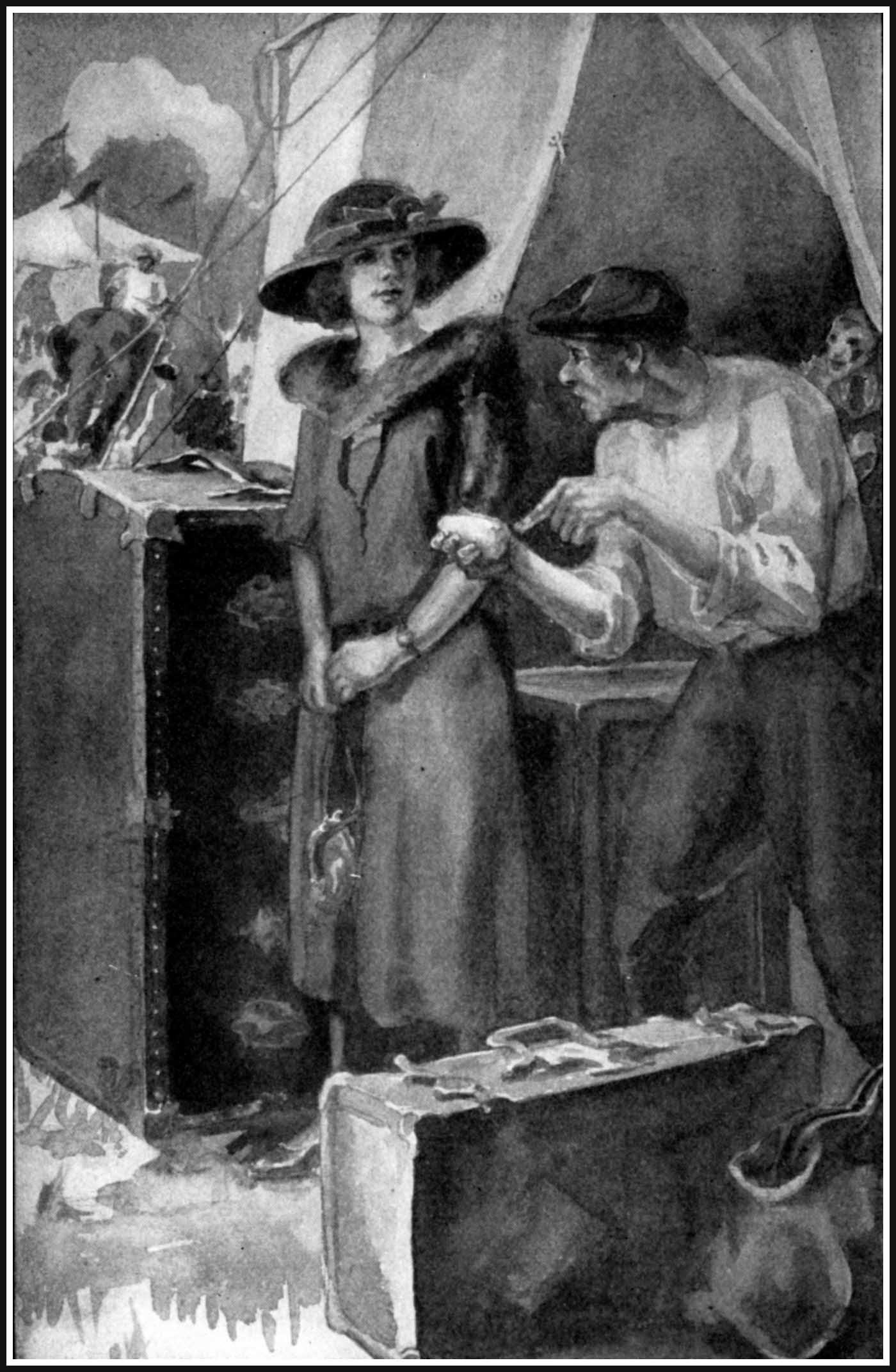
The dark haired girl, sitting on the cretonne
couch, chuckled.
“So this is boarding school!”
No one heard her, the little clock on the corner
shelf ticked away and never “let on,” for
new girls coming to that room were no novelty
to the clock. They came and went yearly, sometimes
oftener, and what difference did it make
that this one chuckled? Those who sighed, or
even those who wept, always got over it in time.
No doubt the dark haired girl would get over
her rather cynical defiance of Miss Alton’s rules
for lady-like deportment. Also, she might in
time learn to sit on a chair properly.
Gloria Doane really felt defiant. Boarding
school always represented restrictions to her inexperienced
reasoning, and restrictions were never
a part of her chosen schedule. A sense of freedom
was necessary to her happiness.
At her Barbend home she scarcely respected
the wildest coast storm, and often thought it a
lark to help life guards shoot out their boats or
rig up a buoy. But last year Gloria was “due”
to go to this exclusive school and she had not
done so. In fact, circumstances wove such a net
about her that the meshes represented a most unusual
story, told in the first volume of this series
called, “Gloria: A Girl and Her Dad.” But
now the net was flattened out, stretched to dry
on regulation lines, and Gloria had emerged like
a fairy mermaid, changed back to an earth maiden,
and was doing such ordinary things as going to
boarding school.
All this she pondered as voices roused her and
a step near her door threatened invasion.
“Trixy!” she called lightly. The step halted.
“Did you get your trunk? It’s downstairs
and you will want to change your dress before
dinner, or maybe it’s supper,” surmised Trixy
Travers, the girl from Sandford, who decided to
come to Altmount because Gloria begged her to
do so. Trixy was quite as fond of freedom as
was Gloria, so, ultimately, they both decided “it
wouldn’t kill them to try it for a year.” And
there they were, ready to put the test to their
resolve.
“Trunks,” murmured Gloria, indifferently. “I
saw one that looked like mine——”
“In the first hall? Get that bean pole they
call Sam, to lug it up for you before the others
come in. Then we can dress in our prettiest and
flabbergast the crowd.” A pulled face, quite unlike
Trixy’s usual countenance, put a period to
this threat.
“Brilliant idea. I’ll go straight for the bean
pole. Just hook up that gorgeous drapery and
our rooms will constitute a suite. So glad we are
together. If you were down the hall I’d surely
sit on your door mat like a faithful poodle. I just
couldn’t risk trying out this exciting life without
the protection and guidance of your wisdom. I
noticed Miss Alton herself paused in a speech
as you towered over her.”
“Glo, get your duds; you’ll feel better when
you are out of those dusty things,” interrupted
Trixy. “I’ll go down to that cute little room
where Miss Alton holds court, and see about a
telephone to mother. She will want to know we
got here safely.”
The next item of note was the entrance of the
bean pole, Sam, bearing a shiny new trunk.
“Just here,” directed Gloria. “I suppose I
can keep it in my room——”
“With a cover. Miss Alton she always likes
pretty covers over trunks.” Sam shifted the
little table to give more space. “There, I guess
that’ll be all right——”
“Oh, yes; thanks.” A half dollar was pressed
into his convenient hand, and Gloria did not hide
her impatience to be rid of the voluble Sam. He
went. Girls were calling for him and there might
be more tips.
Quickly Gloria fell to her trunk task but it did
not readily give in to her key.
“Queer, but I suppose it’s stiff, being new,”
she reasoned.
The rose colored dress, that which Jane insisted
was most becoming to Gloria’s dark hair
and dark eyes, would be found in the top tray
of the new trunk, and this was to be the “irresistible
gown” Trixy suggested as a flabbergaster
for the first evening’s appearance.
“There!” exclaimed Gloria, as a spring of the
lock indicated surrender. “Now I’ve got it.”
But raising the cover did not disclose the expected
rose voile dress.
“Of all things!” gasped Gloria. “Whatever
is—this?”
She was staring at a mass of glittering beads,
or spangles, that seemed to fill the trunk tray.
Just a hint of some material very green showed
beneath the glistening surface, but whatever the
article might be, it never had belonged to the girl
looking at it.
She picked up an end of the material and found
it heavy with spangles. Then she noticed an
envelope pinned to an edge. Scrutinizing this
she found the word “Precious” written across it,
also “with care,” was plainly inscribed upon the
little square. Realizing now that the trunk was
not hers, Gloria attempted to replace the glittering
stuff, but as she did so something red
and sparkling fell from the envelope into her
hand.
“Gems!” she exclaimed, gazing spellbound at
the deep red glow that seemed to absorb all the
light about it. The stone was about the size of
a small bean and was cut in facets.
Frightened lest she be found in possession of
another’s valuables, Gloria quickly dropped the
end of the spangled goods back into the trunk
tray, then slipped the big, red gem into the envelope
through the corner hole it had cut its way
out of. She had forgotten all about the rose
colored costume, and even that Trixy was due
back to dress for the first meeting with the girls
of Altmount.
“How ever could I have mistaken that trunk?”
Gloria worried. “Of course, it’s exactly like
mine, but where’s the tag?”
With the lid closed and the lock snapped back
she looked closer but found no tag to identify
the strange piece of baggage.
Then, shuffling in the hall and Sam’s characteristic
groaning indicated the coming of more
baggage, and quickly as the door was opened
Gloria welcomed her own special new trunk,
which had been purchased amid much discussion,
for Jane, the faithful, was insistent that a new
trunk be at once beautiful and useful, a combination
seemingly realized in the black enamelled
article, so easily mistaken for another. The
“popular trunk for young ladies” was, apparently,
very popular at Altmount.
“Made a mistake,” wheezed Sam. “T’other
girl had yourn. Jest a mite more work, but
that’s all right,” hinted the hopeful handy man.
“I’m in such a hurry,” retorted Gloria meaningly.
“Oh, yes, of course. But ’t warn’t my fault
exactly.”
“That’s perfectly all right. See, here’s my
name on this trunk. I hadn’t noticed the other.”
“They’re all the same to me,” chuckled Sam,
shuffling off without further reward.
When Trixy returned, Gloria was already
aglow in her rose colored gown.
“Lovely!” pronounced the admiring Trixy.
“If we don’t make an impression to-night it won’t
be the fault of clothes. Just look at this. Isn’t
it stunning?”
“Perfectly. Trix, you have such a modish way
about you——”
“Oh, I don’t know. You are no dowdy yourself.
You always look to me like Molly Dawn,
or Betty Bangle, or some other quaint character,
bound to smile and look darling.” An affectionate
little squeeze illustrated this compliment, and
presently both girls were being introduced to
their fellow students. Gloria in rose color that
heightened her sparkling dark beauty, and Trixy
in French blue that beckoned the glints of her
eyes.
It was a small school and boasted of the fact.
Also, that its clientele would stand the “Social
test,” whatever that uncertain measure is supposed
to be, was conspicuously stated in the prospectus.
Gloria was secretly happy to be sponsored by
the impressive Trixy. As a matter of fact, no
one could doubt the latter’s standing. She was
tall, a mellow blonde, the type softened with a
tawny brown glow, and her mannerisms! It
must have taken generations, thought Gloria
humbly, to develop that smooth, irresistible ease
and languid indifference toward irritating trifles.
But as a type Gloria, herself, was decidedly
more pronounced. She was dark, with eyes that
seemed to shoot sparks, with one dimple that always
apologized for any pout the rather boyish
mouth might affect, and withal Gloria had an
air of independence sometimes mistaken for defiance.
As various as the characters they represented
were the forms of greetings offered the new
girls by those familiar with Altmount. Some
“gushed,” impulsively generous in their squeezing
handshakes and ebullient chatter, others were
“stand off,” formal and “frozen,” as Gloria
secretly classed the most conservative.
Pat Halliday explained her name as coming
from the same Greek word Harriet was taken
from.
“Only Patricia is so much nicer and Pat is perfectly
jolly,” declared the Grecian descendant.
“I should abhor Harriet; though Harry isn’t so
bad.”
Gloria quickly found interest in Pat. She was
almost red headed and almost blue eyed, losing
out by a mere shade in each instance. She talked
a lot and laughed a lot, but plainly was no poser.
Taking a place beside Gloria at table, Pat kept
up a running fire of talk that saved the new girl
from any possible self consciousness. At another
table Trixy was trying to be pleasant with a girl
of very different personality. She (the other
girl) raised her eyebrows instead of uttering
replies, she shrugged her shoulders haughtily and
seemed insipidly affected.
“The girl without a smile,” Gloria was
promptly dubbing the ashen blonde. Trixy, sitting
near enough, was flashing secret messages
back to Gloria agreeing with the above. She was
not having a very good time with the smileless
girl, that was obvious.
Miss Alton sat at the head of the table, radiating
good will. It was so important that her girls
all become acquainted auspiciously. Although a
small school, Altmount claimed the distinction
of “finishing,” so that a sprinkling of high school
graduates, and a few who failed to win the honor,
were to be found among those present.
Both Trixy and Gloria were covertly taking
notice of as many girls as politeness afforded
glances at. There was, of course, a bevy of
“Gabbies” who scarcely paused to swallow, also,
like the girl without a smile, there were those
who held off, looked important and posed for
impressions. This might have been their honest
prerogative, but somehow it seemed to natural,
naïve Gloria, a bit affected.
“I do hope you’ll like it,” bubbled Pat. “We
need a few good sports and I’m sure you’re one.
There’s room for more fun here if we only have
the workers.”
“I like fun,” admitted Gloria. “And yes, I
guess I am used to it.” Her brown eyes sent out
a sparkling guarantee.
After tea the girls paired off and strolled about
the grounds. Pat “grabbed” Gloria, and both
being of the younger set their romping went unscrutinized.
Trixy, the imperturbable, seemed determined
to provoke something like a smile from
the reserved Mary Mears, but her good natured
and tactful attempts were far from being successful.
Mary Mears was wise, any one could see
that. Her experience stood out like a wall,
neither to be climbed over nor broken through.
She was pretty but her skin betrayed traces of
the applied arts, while her really wonderful violet
eyes worked like magnetos.
All this attracted
Trixy. Any one so totally different offered her
a working problem, something to find out, to analyze
and, mayhap, to conquer.
The September evening was quickening into
shadows when the students turned back to the
broad verandahs and cozy porch corners.
“Hear that?” Pat asked Gloria. “That’s
Jack Corday. She never stops talking and never
says a sensible thing. Flashy,” criticised the
jolly one. “Just notice her get up. But she’s
a dear.”
It was impossible not to notice it. The girl
called Jack (Gloria later heard Miss Alton give
her Jacquinot) did talk incessantly in a voice
that intruded everywhere, and as she promenaded
up and down, dragging along a timid new girl
called Ethel, the “get up” Pat mentioned was
equally intrusive. A glaring, tiger-lily red
baronet skirt, a black silk sweater and colorful
bobbed hair. Dangling from her neck was a
string of varied colored wooden beads with
which she toyed constantly.
The string of beads reminded Gloria of the mistaken
trunk.
“Is she a—stranger?” she asked Pat.
“Somewhat. That is, she comes and goes. I
wonder Miss Alton admits her. Jack never
settles down to anything serious. She makes me
think of a big butterfly.”
“The black and yellow kind.”
“Uh-huh!” conceded Pat.
A call to the opening chorus within the assembly
room was reluctantly obeyed. “Hail, Altmount,”
composed by a brilliant but unpopular girl of the
graduating class two years back, was murmured,
mumbled and otherwise abused. The faculty
chimed in with more enthusiasm than voice, and
eventually the wail ended.
“Oh, let’s sing the regular college songs,” proposed
Jack, slamming a yellow book on the piano
rack in front of demure Miss Taylor.
But the majority of the girls, the great majority,
deserted, and left few with Jack and timid Ethel
to “try” the regular college songs. No one
seemed to have a voice or there was something
seriously wrong with the tunes, for one after the
other they were “tried,” until the long suffering
Miss Taylor proposed a truce.
“Jack doesn’t seem to be very popular,” ventured
Gloria to the giggling Pat, when the trials
were all over.
“She isn’t exactly, but somehow she seems to
love opposition. I don’t know her well. This
is only my second term, I came last Spring, but
Jack Corday could climb a flag pole if she wanted
to. She’s a wiz at gym, but books! She has about
as much use for a book as an Indian has,” declared
the accommodating Pat. “Just the same I love
her.”
“My friend Trixy seems to have struck an iceberg,”
further commented Gloria. The “iceberg”
being the ashen blonde called Mary Mears.
“Oh, I don’t know her, she’s new,” replied Pat.
“But even icebergs melt finally. She’s rather
pretty, isn’t she?”
“Rather,” agreed Gloria just as Trixy joined
her group on the corner bench.
CHAPTER II TELLING TRIXY
By the merest chance Gloria did not tell Trixy
of the trunk incident. Not that she had any intention
of keeping from her friend such an interesting
possibility, but because—well, each time she
thought of it something intervened, until after
days and then more than a week passed, the tale
seemed too stale to be revived.
Pat proved delightfully amusing, Mary Mears
was mysterious and Jacquinot Corday so spectacular
that the first month at Altmount went
by without a dull day or even a lonely night for
Gloria.
Trixy Travers was at the finishing school
chiefly because Gloria Doane had inveigled her
into coming. As the fashionable and popular
girl at Sandford, where her father was an important
manufacturer, Trixy had enjoyed good
times unlimited, but as Gloria was due to attend
boarding school and she reasonably decided there
would be much more security from either boredom
or loneliness with Trixy to lean upon.
Few letters and fewer home visits were advised
by this, as by most boarding schools, during
the students’ first month or two, so that those
away from home for the first time might more
promptly become inured to their new surroundings;
so it happened Gloria had only received
and written two letters from and to Jane. Now,
Jane, the faithful, had for years stood sponsor
for Gloria, whose mother had died when Gloria
was but a tiny child. Jane kept house at Barbend,
the original home of Gloria and her father,
and when the young girl came into Sandford to
remain with her Aunt Harriet while her father
took a foreign commission from his firm, Jane
Morgan went to visit her own sister, she who
had so many children that the snapshot pictures
frequently sent Jane were apt to be misleading
in personalities. They all looked alike and
seemed too many for the camera.
Mr. Doane, Gloria’s father, had returned from
abroad during the previous late winter, only to
enter upon a longer trip to the Philippines. His
homecoming the Christmas before added the
final happy chapter to Gloria’s adventure as a
real estate expert, for with Mr. Doane had come
the young engineer, Sherry Graves, whose venture
in Echo Park proved disastrous, ruined his
hopes, and all but sent him adrift in despair.
Then, the natural enemy of the pretty little park,
an underground river vein, was accidentally discovered
by Gloria and promptly turned into a
harmless course by Sherry and his friend, Ben
Hardy.
The result was a boomerang credited to Gloria.
These home conditions explain the dearth of letters
coming or not coming to her just now, at
the new boarding school.
There had been one, however, from her father,
remailed at San Francisco, and also a characteristic
scrawl from Tommy Whitely, her childhood
friend at Barbend. Aunt Harriet had written,
of course, telling of her daughter Hazel’s wonderful
progress in voice culture. Hazel had spent
the previous year at Altmount, while Gloria submitted
meekly to a confused, if not unjust
plan, of giving this preference to the “artistic
cousin.”
Trixy’s letters were not quite so restricted, as
she was in the finishing class. Among the most
interesting was one from Sherry, who told of a
“perfectly thrilling plan” for the further development
of Gloria’s Echo Park.
“You’ll be rich, Glo, if Sherry keeps on. He
writes of perfectly fairy like castles on your
property.”
“I don’t want to be rich,” replied Gloria evenly,
“but I am glad that the poor mason and his family,
the one who at first lost so much in the work
there, are finally made happy and comfortable.
Of course it was Ben’s genius in engineering that
did it all.”
“Oh, I don’t know,” drawled Trixy. “It was
rather queer the genius couldn’t find that sneaky
little river vein, that almost turned the pretty
park on end. A mere girl, one Gloria Doane,
managed that.”
The two chums were spending the evening in
their connecting rooms, discussing the home news.
A letter to Trixy received on the late mail added
zest to the discussion.
“Really, how do you like it here, Glo?” asked
Trixy. She shot her feet out in front of her with
the question, and kicked over a useless little stool
in the process.
“Much better than I expected,” admitted
Gloria. “Pat’s always so jolly, then there’s the
haughty Mary Mears and the breezy Jack Corday
for variety. Who could complain with all
that?”
“Isn’t Pat a lark? She just bubbles over everything
and, as the boys say, gets away with it,”
replied Trixy. “But Mary really seems mysterious.
I haven’t been able to pry open the reserve
crust. Yet, it doesn’t seem at all natural
to me.”
“How about Jack?”
“The human pinwheel?”
“Pat says she is just about that.”
“How?”
“A wiz at gym.”
“Oh. Perhaps that accounts for her circus
clothes.”
“That reminds me, Trixy. I have been wanting
to tell you so often——”
“Whew! Sounds guilty!”
“Not quite. But I really have wanted to tell
you,” floundered Gloria.
“Go ahead!”
“Then please listen.”
“All ears.”
Gloria tossed her head up defiantly. “One
doesn’t peg confidences at another’s head,” she
pouted.
“Now, Glo, darling,” cooed Trixy. “I does
truly want to hear. Be a lamb and tell me.”
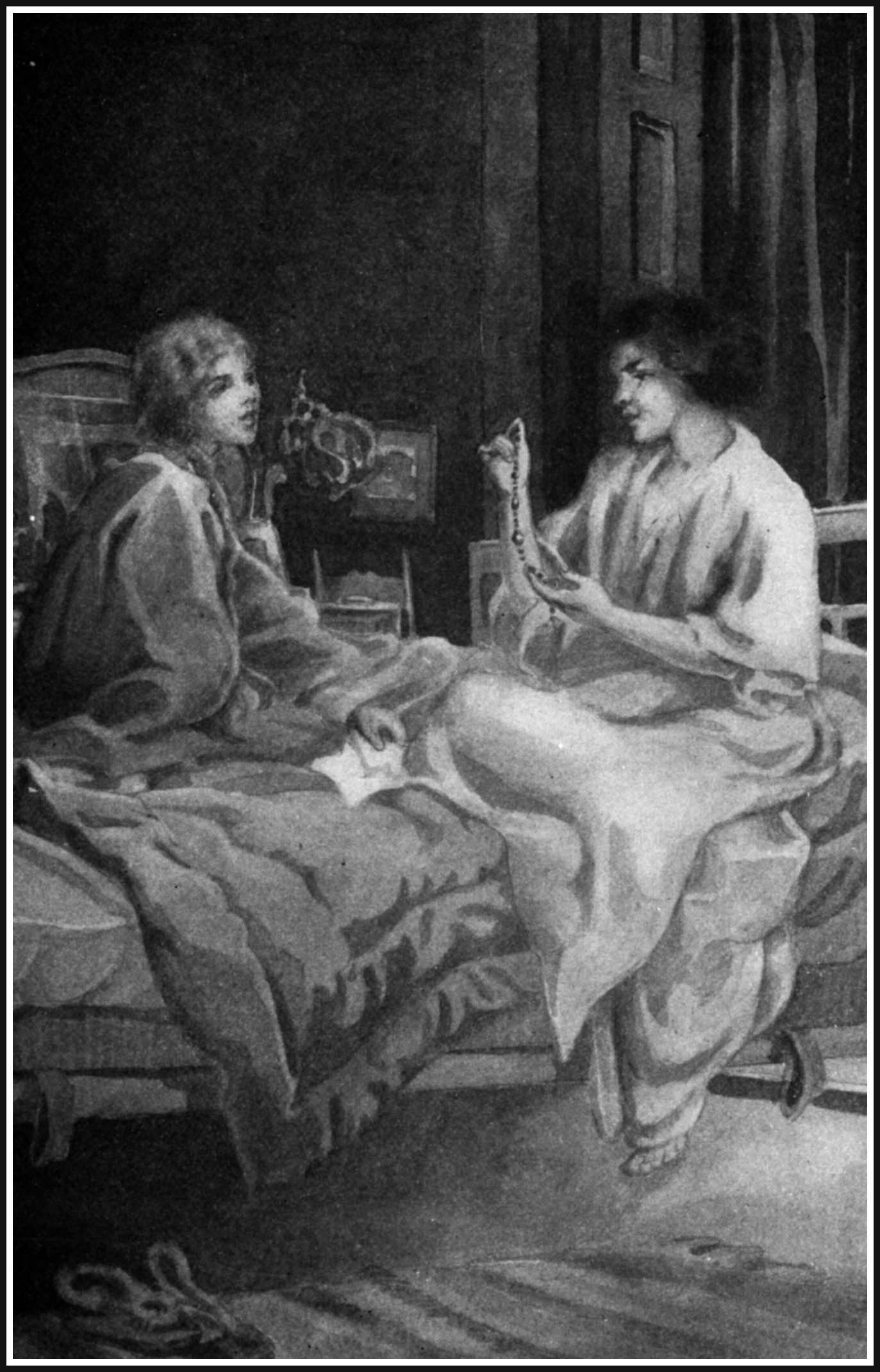
Settling anew Gloria began:
“It’s about trunks——”
“The portable, or athletic?”
“Now, Trixy!”
“But you do offer such bait for little fishes, pet,
I just can’t resist. I had trunks on my mind.
The basket ball squad is considering something
like them to pad out for rough play. But tell
me, like a pet, what about your trunks?”
Trixy was irresistible. She wore the simple uniform
of Altmount, the white shirtwaist and dark
blue skirt used by the older girls, and its very
simplicity set off more effectively her almost faultless
personality. With an arm around the pouting
Gloria, and lips in close proximity to a left ear,
she again cooed her request for the secret.
Gloria’s own lips lost their pout in a real surrendering
smile, as she again attempted the tale.
“You see, that afternoon we came here there
was so much confusion with baggage and so little
time to dress——”
“And I warned you to fix up your finest.”
“Exactly. Well, I tackled, what I took for my
own new, shiny, black trunk, and found it too hard
to unlock——”
“You called in the Bean Pole?”
“No. I struggled and conquered.”
“Being you, you would.”
“But when the lid finally decided to come up I
found the belongings within not mine.”
“Oh!” Trixy fell back a little and waited.
Her exclamation was merely a polite acquiescence.
“Yes,” continued Gloria, “the top of that trunk
was covered if not filled with the queerest materials——”
“Oh! Whoozy-boozy! How mysterious!
No skeletons?”
“Quite the opposite. A perfect glitter of
gems——”
“Gloria Doane! And you have never told me
we are harboring a pirate’s daughter! Gems!”
“At least they looked like gems,” went on the
imperturbable Gloria. “Of course, I was all a-flutter
and couldn’t possibly inspect,” (this with
an air of real importance) “but I did manage to
lay hold of an envelope.”
“Glo! An envelope! With the pirate’s address!”
“Are they so careless as to leave addresses
lying around loose like that? I thought they
always used secret codes, made with pieces of
string and rusty nails scattered in a long, long
trail.”
“Of course. How stupid of me. The envelope
was full of rusty spikes.”
Gloria twisted herself away with an air of
finality until Trixy seized her. “Go ahead,” she
implored. “Go right straight ahead. This
suspense is killing me. What was the glitter and
what did the envelope say about the secret?”
“You know, Trix, I really was a bit
scared.
You were off gallivanting, and there I was all
alone, with a strange trunk full of mysteriously
glittering stuff. How did I know who might
rush in and accuse me.”
“Exactly! How did you know?” Trixy’s
banter now toned down to real interest. “The
envelope, dear, what about that?”
“I had begun to realize I was trespassing, you
know, and I just glanced at the envelope. On
it was written the word ‘Precious.’”
“Precious?”
“Yes. That and ‘With Care.’ But just as
I attempted to put it back, I had taken it in my
hands of course, just as I went to put it back, a
stone fell out.”
“A gem?”
“It looked like one. A great red garnet or
some sort of stone that seemed bursting with
imprisoned glow.”
“How perfectly wonderful!”
“Yes, honestly, Trix, it made me creepy. I
got the fire-drop back in that envelope as quickly
as I could, you can believe me. It made me
think of an animal’s eye, not a serpent’s eye,
they’re green, but the eye of some sneaky little
beast——”
“Beastie, Glo. You must call the small ones,
beasties. But you are so, so graphic, you give
me the shivers. Are you sure there are none of
the beasties crawling around here now?”
“But I haven’t told you about the spangly
things,” persisted Gloria, ignoring the frivolity.
“They didn’t seem to be on gowns. I couldn’t,
in the moment, make out what the article was.
All I saw was glitter and sparkle.”
“What color was it?”
“Many colors, I thought; but red shone
through. You see, Sam came back just as I got
the trunk shut. I wouldn’t want to have been
discovered snooping into another girl’s stuff,”
declared Gloria.
“But whom could it have belonged to?”
“That’s an interesting question, don’t you
think so? Just imagine what sort of girl would
bring that here?”
“Exactly. But you watch little Trixy solve
the mystery of the trunk full of gems!”
“I’m quite willing to,” agreed Gloria, with a
weary little sigh.
CHAPTER III MEET MAGGIE
Two days later Maggie, who swept rooms and
talked a lot, also counted hairpins, picked from
the dust, and bewailed her own constant loss
insinuating a present need, this Maggie, with a
season’s new broom and last year’s dust pan, a
basket of dusters, brushes, and in the bottom
such articles as the girls donated on her rounds,
well, anyhow, she came in to clear up Gloria’s
room.
“This bein’ a double,” analyzed Maggie, “I’ll
have to have it free.”
“Free?” repeated Gloria.
“Yes. I could do it whilst you’re in class,
but I like to keep these new curtains well shook
and that makes considerable flare around. Ain’t
they pretty?”
“Very.”
“Then, jest pick up your precious stuff, I allus
calls the little things precious, and whilst you’re
out this afternoon—you will be out?”
“Yes.”
“Whilst you’re both out I clean. I allus
thinks this is the prettiest ‘sweet’ in the house.
Ain’t it now?”
Gloria was hurrying before the wavering
broom. Her “precious stuff” would be easily
gathered and then she might escape from Maggie’s
gossip.
“About the hairpins now, where shall I put
them?”
“Oh, keep them,” smiled Gloria. “You see
I never use any.”
“That’s so. Ain’t I stupid. Since the bobbs
came in it seems to me that hairpins is harder to
get. Stores even, don’t allus carry them.” She
retrieved a brown lock of hair that was trying
to get down her back. “And my hair’s such a
nuisance. You don’t wear nets either?”
“No.”
“What a comfort. I’ll put any baby pins and
such right—where should I put them?”
“You won’t be apt to find any,” said Gloria,
wondering what next Maggie might hint for.
“Well, I’m honest as the sun, Miss Alton says,
and what’s on the floor goes on the bureau, every
time.” The basket and contents were inadvertently
tipped over just then, and Maggie dove
after the things that flew.
“There, ain’t that a pretty waist? Miss
Davis, she’s the rich girl that has number ten,
she’s been here, land know how long, and I asked
her yesterday if this was her last year and she
didn’t know. She’s the loveliest girl, and so good-natured.
I jest said I loved blue and she gave
me the waist. I think it’ll fit me.” It was held
aloft midway between chin and waistline, and
Gloria said it looked all right.
Then she escaped.
And Maggie ostensibly swept the room, aired
the pillows and shook the curtains. Trixy’s room
had an unusually large mirror hung from the
wall, between two windows, and whether Maggie
posed in borrowed finery or merely spent time
in profitable meditation, is not relevant, for it
was her own time as well as her own work, and
Maggie managed to finish on schedule in spite of
all interruptions.
When Gloria ventured back, after first peeking
in from behind Trixy’s curtains, she found things
nicely slicked up.
“Good old Maggie!” she thought. “I am
sure she is quite as honest as she claims to be.”
Addressing the well dusted bureau with a few
more appropriate remarks, Gloria’s gaze fell
upon a strange object.
“What’s this?” she asked aloud, for a small,
glittering, bead-like stone instantly recalled the
other. That one she had replaced in the torn
envelope and put back in the strange trunk.
“A gem! A real garnet—or ruby——”
There was no question as to where it came
from. Maggie had found it upon the floor, perhaps
under the edge of the rug, and it must have
fallen there from the envelope marked “Precious.”
Gloria turned the stone over on her open palm.
She knew little of precious stones, but she easily
guessed that this was valuable.
“What shall I do with it?”
The thought that its owner would resent her
knowledge of so secret an affair as the opening
of a trunk, and the handling of its contents, was
disturbing.
“Oh, bother!” complained Gloria. “What
am I going to do about a thing like this, anyway?”
Trixy’s return was welcomed. And the discovered
treasure promptly and adequately discussed.
“Suppose you keep it for a day or two——”
“No indeed,” objected Gloria. “I have no
wish to be throttled by the pirate’s daughter.”
“But it has been here for days——”
“That’s why my head ached. This thing is
charmed. Maybe a drop of some one’s blood
is sealed within the crystal,” she flippantly suggested,
turning the stone over and over, smiling
fondly upon it and otherwise showing neither fear
nor distaste for the frozen “drop of blood.”
“I think it’s a garnet,” suggested Trixy.
“Why should a boarding school girl want to
lug such stuff around with her?”
“Why?” repeated Trixy. “No custom officers
to dodge.”
“But in that trunk! And not even in a strong
little box,” argued Gloria.
“Some girls are careless. Also some grown
ups. You know how very often real diamonds
are hidden in old shoes and retrieved by honest
cobblers, who become socialists after receiving
the dollar ninety-eight cents reward,” philosophised
Trixy. “Still, the girl who dropped them
in her trunk must have been in an awful hurry.”
“But why hasn’t the owner advertised on the
bulletin?” reasoned Gloria further.
“It is queer. Do you suppose Maggie
knows——”
“That’s so. I’ll have to give Maggie something.”
“Better thank her for finding your bead and
give her ten cents,” suggested the practical Trixy.
“Otherwise, you may not be able to make a satisfactory
accounting. Don’t let her suspect what
you suspect.”
“A good idea. Listen! I hear her plaintive
voice. Let’s have done with it. Lend me exactly
a dime.”
“First, put the pirate’s treasure in my jewel
box. I’ll be responsible for it and defy its evil
eye—until you find the owner,” agreed Trixy
affably. Gloria borrowed the dime and thrust
it upon the inarticulate Maggie. Money, it
seemed, always surprised her into speechlessness.
“And now,” decided Gloria, “I’ll take the ‘evil
eye’ down to the office——”
“Suppose it is a real secret, that the owner has
some worthy motive in hiding it.”
“Trix, you’re a regular Portia. I do hope
you decide to study law. How would you suggest
I get rid of the thing?”
“Post a notice, asking the loser of a small
red stone to call at this room. We might excite
less comment if we said ‘trinket’ instead of
‘stone.’”
“And have every one who lost a hair net, a
hairpin, or a
barrette,
calling,” objected Gloria.
“That’s so. But Maggie may see the notice
and recognize her find.”
“She won’t have time to read bulletins today.”
“No, I suppose not. Then just write a simple,
unsuspicious notice, and say small red stone.”
“Peachy!” exclaimed Gloria. “Then we’ll have
a chance to learn who really is the Pirate’s
Daughter.”
Trixy wrapped the vagrant stone in a piece of
tissue paper and then in a piece of tin foil from
her film package, meanwhile moaning weird incantations.
Then, after waving it in the air to
break the spell, she very gingerly dropped the
paper and tin foil packet into her little jewel
case.
Gloria wrote the “found notice” with directions
for reclaiming the “red stone” and was off
instantly to post it upon the bulletin.
“Thir-rill-ling!” she chanted. “Suppose it’s
Pat’s!”
“Or Jack’s?”
“Or just a red bead from the ten cent store?”
“I’d like to get a couple of dozen,” declared
Trixy.
“Well, here’s for the bill board. Better watch
out. Some one might kidnap me.”
With a parting laugh Gloria raced off and it
seemed she was back, out of breath, and out of
speech, before Trixy could close the drawer on
the jewel box.
“I feel like a thief!” she gasped. “Isn’t it
horrid to find a thing so long after?”
“As if you had been waiting for an offered
reward?” laughed Trixy. “We aren’t likely to
be suspected of anything like that, so don’t worry,
lamb. I’m just all a-quiver of anticipation.”
But after lunch the little note was missing
from its hook on the bulletin and in its place
was found a message sealed and addressed to
“Finder.” The girls read it in their own room
behind closed doors.
The note read: “Please drop into old brass
vase on teakwood stand in alcove of west sitting
room.” That was all.
“Oh,” moaned Gloria, in disappointment.
“Not even to say drop what.”
“How perfectly mean,” growled Trixy.
“Suppose we don’t. We might say that it
‘must be called for,’” suggested Gloria.
“But then,” mused Trixy, “there may be a real
reason.”
“Again, noble Portia, I salute thee,” mocked
Gloria. “In other words, just as you say. But
I’d hate to be fooled again. That old trunk
seems destined to add to my misery. Not that
there’s much more room for addition,” (another
groan and wild, agonizing rolling of eyes) “but
I suppose we may as well drop the ‘jool’ in the
vaase.”
“May as better,” amended Trixy.
“You do it and I’ll watch.”
“Foxy. Suppose some of the eagles see you.
How do we know this isn’t sort of an initiation?”
“We don’t. I never thought of that, little
Brightness. As you say, we had better follow
directions, and not be compelled to wear our waists
inside out, or parade two different colored stockings.
Here, give me the pesky thing. I’ll hie
me to the dump with it and so cast off the spell.”
Almost as quickly as she had posted the letter
did she “dump the thing and beat it,” in her own
inelegant language. She now stood before Trixy
making foolish faces.
“Ugh!” she exclaimed, brushing her hands to
shed the imagined pollution, “now it’s all over.
And we’ve lost trace of the Pirate’s Daughter.”
“There’s no telling,” presaged Trixy. “She
may remember you in her will.”
“And again she may not. Well, may all our
ill health go with it, as dear old Jane would say.
Trixy, when do we go out to see our anxious
friends?” (This meant the home folks.)
“I dunno. But let’s stick it out for a while
and then, when we do take a little trip to Sandford,
we won’t feel like a couple of hookey kids.
Not that I wouldn’t love to see my mommer right
now——”
“And my—da-da!”
Reflection brought gloom. Forgotten was the
frozen blood stone and the old brass vase. Two
girls sat glum, with heads down and knees up,
with chins pushed up into pouting lips, and naught
but an occasional groan or grunt giving sign of
articulation.
“I dunno,” said Gloria finally. “But there’s
Pat! Mum’s the word, dearie, about the pirate’s
watch guard or collar button or—paper weight.
Don’t let us whisper——”
“Not a whisper,” agreed Trixy.
So Pat never knew what she had missed, and
didn’t even guess that she had missed anything.
CHAPTER IV THE TALISMAN
“What was that?”
“What?”
“I heard something. I felt the door open.”
“You’re dreaming. It isn’t daylight yet. Turn
over and try the other side.”
“Honest, Trixy,” Gloria raised her voice a
trifle, “I did hear something. I am going to get
up and look around.”
She did. It was daylight but not yet very
bright, as the late fall morning was tardy in asserting
itself.
“The door is open!” exclaimed Gloria. “I am
sure I shut it.”
“I have always told you to lock it,” Trixy reminded
her.
“But I hate bolted doors. They make me feel
I’m being locked in a jail.” Gloria shut the
door almost noiselessly, and then turned on the
light.
“Nothing missing, that I can see——”
“Then, please, go back to bed,” begged Trixy
from the other side of the curtains. “I do hate to
lose the last half hour.”
“Sorry,” Gloria went to the window and looked
out at the early lights and shadows. Then she
quietly stole back to turn off the light that hung
over her dresser.
As she raised her hand her eye fell upon a
strange object. There was something, a small,
white paper packet on the pin tray.
“Trix!” she exclaimed excitedly. “There’s
something here——”
“What?”
“Get up. Let’s look. It has been slipped in
the door and left on the tray.”
There was no mistaking the seriousness of her
voice. Gloria meant what she was saying, so
Trixy tumbled out of bed and joined her before
the dresser.
“It’s heavy,” she said.
“Open it. You’re not afraid of it?”
“Of course not, but I am surprised. I hope it’s
no more blood stones——”
“Just that. From the Pirate’s Daughter, I’ll
bet! Hurry and let’s see! I’m quivering
with——”
“Come over on the bed and spread out something,”
suggested Gloria. “I don’t want the
jools to roll under the rug this time.”
They both sat under a carefully spread pink
coverlet, and then, very gingerly, Gloria opened
the little package.
“Maybe some trick,” she guessed, still delaying
inspection. “I hate to spoil our fun by finding
some pop-corn, maybe.”
“Oh, do give it to me,” begged Trixy impatiently.
“If it’s pop-corn I’m not going to
waste any more time over it.”
“A’w right,” agreed Gloria affably. “Half
the responsibility is yours, don’t forget that.”
The white tissue paper was carefully unfolded,
and then there was disclosed a little necklace,
made of some dark, queer beads.
“Oh-oo-ho!” squealed Gloria. “More queer
stones! And look! Here’s a note!”
Eagerly scanning what was written in back-hand
on a piece of plain white note paper, the
girls found this:
“To Gloria: I beg you to accept
this trinket. That which was found
was very precious to me. Won’t you
be generous enough to accept this without
question?
In Cog.”
They read it again. Gloria coiled the necklace
around on the palm of her hand until it
looked like a little black snake. Then she gave
it to Trixy.
Held up to the light Trixy thought it looked
like agate. Her father, she said, had a ring,
his grandfather gave every boy in the family a
moss agate stone each cut from the parent specimen,
and this little necklace had one stone at least
that looked like agate.
“But these,” pointed out Gloria, “they just
look like Egyptian beads I bought at our fair.
Don’t you know those you always liked? Black
pearls, or some imitation?”
“But these are each different?”
“Yes. Sort of home-made affair. Who ever
could have wished it on me?”
Both girls sat there thinking. Each turned
her head, this way and that, cocking ears up as
if some myth in the air might explain the mystery,
the necklace was passed back and forth automatically,
but neither offered to try it on. It was about
big enough to slip over the head, and the more
they scrutinized it the better they liked it.
“It’s so odd,” conceded Gloria.
“Not as odd as its circumstances,” said Trixy.
“Why in the world would a girl want to be so
mysterious? Seems to me sort of sensational.”
“And so wounds your social soul,” teased
Gloria. “Never mind, dearie, when I drag in
the Pirate’s Daughter from her den, it may be in
the attic here, you know, and when I tame her so
that she’ll eat out of my hands, I fix it up to include
you in our trip to her father’s cave. He
must be richer than old Captain Kidd to raise
such a crop of gems or illuminated spangles, as
I glimpsed in that trunk. Now, why couldn’t
In Cog have sent me a little jewelled apron or a
bedizened girdle to wear to the dingus? You
know we are invited?”
“Yes.” The “dingus” or regular social affair
exclusively for the pupils of Altmount, did not,
at the moment, offer distraction.
“It seems to me we ought to detect a queer
girl, easily. She is queer, of course, or she
couldn’t think this way. She had to follow her
own line of reasoning, and you’ve got to admit
that’s queer,” said Trixy, philosophically. “Therefore
she must be queer. Now, who is the
queerest?”
“Impossible to select,” joked Gloria, “they’re
all so queer. Pat’s funny, Jack’s funny, Jean’s
snippy, little Helen is just the kind of girl to get
an awful crush on one. She goes about with her
eyes and mouth at half mast, ready to weep or
laugh at the crack of a whip; but even at that
she’d never have sense enough to plan all this.
Well, Ixy-love, you may wear my jools whenever
thou wisheth, and be sure to note the effect.
They may give you chills or you might get a
fever, or even that black, squarish little stone
may exert a beneficent influence on the snippy
Jean and make her perlite, for once in her sour
life,” Gloria’s manner is not transferable to
words but it was flippantly funny. “Perhaps we
better start a new diary, the diary of the hoodooed
necklace,” she suggested, and would have
turned a somersault right then and there, had
not Trixy grabbed her left leg ‘on the wing.’
“And I guess we may as well crawl out and
get into a shower,” she continued, “before the
infants rub their sleepy little eyes into the early
sunlight. Though it looks like rain. I couldn’t
say anything pretty without sunlight. There’s
the seven-thirty bell. Would you ever believe
it was more than five A. M.?”
The necklace lay on the pink coverlet while the
two girls locked arms and swung back and forth
like a pair of solemn Arabs. Anent nothing, they
embraced always in that fashion, and the signal
to halt was usually the realization of urgent duty.
It was now time to dress.
“Scrum-bunctuous, anyhow,” decided Gloria.
“Just think of all that’s happened a-ready. I
cracked open a trunk, had a precious stone hid
under my rug for nearly a month, returned it by
way of a moldy old vase, got a note from an In
Cog and was the recipient of a coal miner’s
souvenir, the last strike settlement maybe; all this
and nothing more at Altmount, quoth the
raven.
Never-more! There! When it’s first worn by
either of us I fully expect a sensation.”
“Why don’t you put it right on and go down
to breakfast? If a girl should notice it you might
have just cause for suspicion.”
“You put it on, if you want to,” retorted Gloria.
“This isn’t my day for necklaces. I have already
decided to wear the ugly and uncomfortable
sailor’s noose, prescribed.”
But all the day and for sometime thereafter
both girls were ever on the alert to detect a clue
to the original owner of the little talisman.
Many strings of beads were significantly fingered
and admired, but without provoking a tell-tale
flush of admission, and as often as the opportunity
could be made, Gloria or Trixy talked about
foreign stones, especially dark ones with little light
streaks running through. But at the end of a
week both girls were forced to admit “no progress.”
“Tell you what we’ll do,” proposed Gloria.
“Just let’s forget it. Put it away and wait.
Some day the culprit will betray herself. Then,
if we are not parties to some dark plot that includes
hiding the queen’s jools, we’ll be lucky
kids.”
“Just as you say,” agreed Trixy. “But don’t
forget to-night is the night we are supposed to
celebrate. I hope you can express a note of interest
in this here Altmount without straining
your conscience. Me—I’m beginning to like
it.”
“It is picking up,” admitted Gloria. Both were
assuming facetiousness.
There was, however, plenty of interest, “without
straining consciences” at the dance. The fine
old assembly room was gay with colors of many
classes no longer otherwise represented, there was
a very creditable orchestra composed of seniors
and girls in the finishing classes, but more than
these mere details, the personalities of all those
present came out for the “acid test” according
to Trixy.
Friends paired off, and groups assembled.
Pretty gowns were praised with wordless glances
of approval, new dances were demonstrated and
various local peculiarities shown, even Pat declaring
that the new position was quite like the “old
fashioned way her mother had always insisted
was the only correct way,” and so on passed a
happy evening, at the boy-less dance, after which,
like the spreading of a map, the personalities of
students stood revealed.
No silly stunts nor traditional initiations were
countenanced at Altmount, not since that rather
disastrous event, still talked of, but no longer
risked. It was the night one girl got locked in a
closet and another climbed from the third floor
window on a rope of bed sheets. Both were “laid
up for repairs,” and a stringent rule against all
rough play or initiations was the outcome.
But there were even now some secret affairs held
in junior or soph quarters, usually followed the
next day by pronounced fits of absentmindedness
in class. Neither Gloria nor Trixy had been invited
to any of these. First years usually were
not, quite contrary to the regulation college
customs.
“That’s because they want a chance to find
out Who’s Who before taking one into their exclusive
circles, I suppose,” Gloria remarked to
Trixy, after listening for the best part of an hour
to a report given by Janice. She had been asked
by Jean’s contingent. She had the advantage of
belonging to a family whose ancestral trees were
knotted by colonial ties.
“But so far as I could gather,” scoffed Gloria,
“it was an amateur fudge party, and the fudge
got badly scorched, so I guess we didn’t miss
much.”
“And, whereas
it is against the rules to light
little stoves in rooms, and the perpetrators are
apt to be censured, I guess we are well out of it,”
also scoffed Trixy.
“But they have to break rules, that’s the main
idea,” Gloria explained. “Yet, it must have been
pathetic to see the dear things trying to get fun
out of the wicked pastime of making fudge on pin
trays. I’d love to have had a view from a convenient
distance.”
“We’ll see if we can’t hire the real kitchen, some
evening,” suggested Trixy. “We’ll ask the
faculty, invite them, I mean.”
“And all the kitchen staff,” added Gloria.
“That would be fun. And the fudge will run a
far greater chance of being fit to eat.”
This was held to be a brilliant idea and worth
working out. So it happened that the domestic
science class took on a new group of pupils unawares,
and not only did Gloria and Trixy hold
a fudge party in the kitchen a few afternoons later,
as their part in the new year’s activity but the
idea spread, until pop-corn drills and taffy pulls
in the kitchen became almost common. Then it
was that entertaining afterwards, in rooms, while
despoiled of the precious rule breaking, offered
real opportunities, and as a hostess Trixy became
decidedly popular, while Gloria and Pat achieved
marked success as floaters.
But such ordinary school happenings were mere
calendar incidents, and like the calendar, interesting
only to those who mark the days.
CHAPTER V JACK’S SUDDEN DEPARTURE
It was Pat who spread the news. A messenger
boy had come late in the night with a telegram
for Jack, and now, today, the day after the night
alarm, Jack was gone!
“Some one sick or a sudden death?” hazarded
Gloria. It was about time for a class and the
conversation was necessarily snatchy.
“Jack doesn’t seem to have folks, at least, no
one comes to see her,” explained the entertaining
Pat, catching her blue
barrette
in a clump of hair much beyond its capacity.
“We’ll miss her,” spoke up Trixy. “I like
Jack; she’s a positive cure for the blues.”
“Isn’t she? Jack is a lark, even if she does
dress like—a fire sale.”
Gloria didn’t smile. Pat should not be encouraged
in such criticism, especially now that
Jack was gone and could not defend herself.
But after the morning classes and just before
lunch, it was impossible for either Gloria or
Trixy not to overhear a little stronger criticism
than Pat’s harmless remark was intended to convey.
A group of girls behind a screen in the lavatory
were even more critical and less considerate.
“Did you hear the row?” asked one.
“Did I? Thought the house was afire,” from
another.
“Such a voice! That woman must be a perfect
tyrant. The way she shouted at poor Alty.”
Gloria coughed loudly and meaningly, but the
girls in the wash room rattled on.
“Couldn’t a’been her mother?”
“No—a Steppy, Jack calls her.”
“But why drag her away like that? In the
middle of the night.”
“Family affairs,” tittered a new voice. “Wasn’t
it dramatic?”
“Can’t say I think so, in an open hall and at
midnight,” some one grumbled.
“But she wired first.”
“She should have sent the fire department first.
Poor Alty was almost choked with indignation.”
Trixy slammed down the shoes she was attempting
to clean, but her warning was altogether misinterpreted,
for Jean Engle popped from behind
the screen and claimed both Trixy and Gloria as
additional debaters.
“We’re just talking about poor Jack,” gurgled
Jean. “Isn’t it a shame she had to go away?
She must perfectly dread her old ‘Steppy’—stepmother,
and now she’s dragged her off again.”
An uncertain sigh ended the pretended sympathy.
“Too bad she isn’t long distance eared,” joked
Trixy, with a shade of subtility. “I’m sure she
would be flattered with such championship.”
“I don’t care,” persisted Jean, not to be
quelled in her efforts at a little excitement. “Jack
never gets a chance to become interested in her
work, and I suppose if she
flunks
at exams there’ll
be no more mercy shown her than——”
“Hear! Hear!” broke in Arline Spragg.
“Can any one imagine our Jean casting such
precious bread upon the waters——”
Arline paused. A step outside gave warning
and all eyes turned toward the opening curtains
that divided the “lav” from a small rest room.
Mary Mears’ form was now framed in the
shadow. Her face was white, her deep set,
violet eyes seemed almost black, and there was
no mistaking her whole attitude as one of consternation.
Trixy was the first to find speech.
“Hello, Mary,” she said quite casually. “We
are enjoying the most popular indoor sport, backbiting.”
“Yes!” Eyebrows lifted and shoulders
shrugged.
“You know poor Jack is gone,” chimed in Jean
Engle. “Dragged away in the night by a horrid
Steppy——”
“Steppy!”
“Uh-huh. That’s what Jack calls her. We’ve
never, any of us, seen her, but have all heard her.
She’s that sort, vulgarly noisy——”
Poor Mary’s blonde head had gone higher and
the white face seemed a shade more pallid as Jean
gabbled on. Disgust, nothing less, except perhaps
a hidden fear, was expressed in her haughty
attitude, and somehow she reminded Gloria of a
handsome animal trapped by refined cruelty.
“I hate gossip,” Mary said, crisply.
“You do!” retorted Pat. “Well, it’s a necessary
evil here. We have to do something, why
not gossip?”
“When a girl’s back is turned?” Mary qualified.
“But it isn’t about Jack, it’s the old lady. She
must be a shrew. Can’t we say that about her
when she wakes us up in the dead of the night?”
Pat retorted.
“And we are really defending Jack.” This
from Jean.
Gloria, being a newcomer and also in the
“freshie” class, held back from the discussion.
Exchanging glances with Trixy, both had plainly
shown surprise that Mary should have appeared
so haggard. Even her usual studied calmness
was replaced by nervous little jerks, one of which
caused her to drop and shatter the drinking glass.
“Oh!” she gasped. “How stupid of me!”
“Let me pick it up,” offered Gloria kindly.
“Trixy says I can walk on glass, just because she
saw me walk over clam shells at home. Anybody
here ever bathe from a shelly beach? I have one
at my native dock.”
This sally mercifully changed the subject, and
beaches sandy, beaches rocky, or beaches shelly,
were soon being discussed from as many view
points as there were persons expressing them.
Mary beamed gratitude upon Gloria. It was
her first unbending, and perhaps because the approval
was not easy to obtain, Gloria appreciated
it more fully. She twinkled understandingly.
“I hate to be a nuisance,” Mary said rather
humbly, “but my hand must have been wet and the
glass slipped. Do you report damages to the
office?”
“Don’t you dare!” thundered Pat. She was
now all primped and pretty and ready for the walk
or hike, as she termed the proposed exercise
scheduled for the afternoon. “If you start anything
so honest as paying for a broken drinking
glass, I would feel absolutely bound to tell who
broke the glass dish——”
“Hush, Pat. You perpetual gabber. We all
hated the dish. It was too small for cookies——”
“All right, Becky dear. Don’t get excited.
I’m not on my way to the office.”
Gloria had gathered up the splints of glass and
skillfully dropped them into the marshmallow box
Mary held to receive them.
“You’re a dear,” murmured the pale girl.
“But I shouldn’t have let you do it.”
“You couldn’t have stopped me,” retorted
Gloria. “Don’t you know how stubborn I am?
When I take a notion——”
“Come along,” interrupted Trixy in an undertone.
“Going to hike, Mary?”
“I’m afraid not——”
“Oh, do,” begged Gloria. “There’s nothing
like it for nerves, and you have a headache,
haven’t you?”
“A little. I didn’t sleep well. Guess I’m not
quite fit for this quiet life——” she smiled
quizzically.
“Isn’t it awful?” interrupted Trixy. “I don’t
know whether to bless or blame Gloria for dragging
me here. But not being a quitter I suppose
I’ll stay.”
“If you don’t, I don’t,” declared Gloria. All
three had separated themselves from the others
and were now on the porch ready for the hike
and awaiting the leader.
“Really, don’t you like it here?” pressed Mary
gently. She might not have seemed so pale but
for her black satin dress. She always wore such
dark colors when the uniform was not required,
whereas then the other girls just melted into
color glory.
“We are rather spoiled, I’m afraid,” admitted
Trixy. “Little Glo has lately distinguished herself
as an engineer; that is, she discovered a river
the engineers had overlooked, and what hasn’t
happened in the way of good fortune since
that eventful day!” Trixy intoned reminiscently.
“How interesting!” Mary said politely.
“Since you’re telling tales, Trixy, I might
add——” drawled Gloria, “that the engineer, the
young, handsome and all that sort of thing young
fellow, is a special friend of yours. There is the
barest possibility she misses him——”
“Glo!”
“And he’s gone off again following my dear
dad! Way out Philippine way——”
“Just for that you shan’t see my letter!”
“A letter! From Sherry?”
“Sherwood, please. He has outgrown Sherry.
Want to see his stationery?”
The inscribed envelope (from Trixy’s pocket)
was passed around. Gloria read it backwards
and forwards, made fun of it and approved in the
same breath. Then it was handed over to Mary.
“Why!” she exclaimed, “that name seems
familiar. Was he abroad last year?”
“Yes. Were you?” asked Trixy simply.
“Yes, that is—yes,” floundered Mary, and a
hint of confused color touched up the pale cheeks.
“How jolly! Did you really know our noble
Sherry?” demanded Gloria quite enthused.
“Oh, I wouldn’t just say that,” Mary answered
with a return of her usual restraint. “One meets
others while travelling, and sometimes we see
names on the hotel lists——”
“But we must tell Sherry,” Gloria rattled on.
“Trixy, do you mind if I write?”
“I’ll put in a little censored note——”
“I’m sure he has never heard of me, of Mary
Mears,” declared Mary, just as Miss Alton, otherwise
“Alty” and little Miss Taylor, otherwise
“Whisper” appeared and marshalled forces for
the four mile hike.
There was opportunity for confidences along the
way, and Mary’s attitude was seriously discussed
by the two girls from Sandford.
“She’s high-spirited,” declared Trixy.
“And touchy,” added Gloria.
“I can’t just see why she acts so offish.”
“Seems to keep the brake on every minute.”
“Afraid of hills—sliding, I mean.”
“Into reality. I’ve thought of that.”
“She’s a splendid contrast to Jack, isn’t she?”
concluded Gloria, as the hikers halted at Van
Winkle’s Spring. Then Old Rip entertained most
royally.
CHAPTER VI SMOLDERING FIRES
“Altmount” was so named from the fact that
the Alton family had settled, built and managed
the mount for more than four generations. The
original homestead was now the smallest of the
three imposing structures that clung to the hillsides,
and was used to house the youngest pupils
of the select school, while in a splendid stone and
shingle structure recently built, and unquestionably
an important executive building for the seminary
proper, were domiciled Gloria and Trixy.
Gloria might have been relegated to No. 2
known as the Wigwam, from a curious Indian
legend attached to it, but somehow the influential
Trixy succeeded in keeping her friend with her.
Not quite sixteen, country life and natural fondness
for healthy exercise had developed Gloria
into the attractive personality termed “wholesome,”
but comparing this with the uncertain ages
and equally uncertain types about her, very often
the “sweet sixteen” was mistaken for seventeen or
even greater “teens.”
Now, Pat was seventeen, and she might have
been classed among the “little ones.” She was
small, round, dimplely and “bubblely.” It would
be hard to imagine Pat ever supporting with
dignity her real title, Patricia Halliday. Jean
Engle was tall and willowy, and wore brown braids
in a coronet about her head. She had rather a
sharp tongue, and unfortunately her friends
laughed at “her cuts.” The comparative isolation
of boarding school naturally drew out and
magnified each girl’s peculiar traits, so that what
might have seemed rude in Jean at home was
hailed as “good fun” at Altmount.
It was she who suddenly checked Gloria’s
laughter. The departure of Jack had not yet
ceased to be a subject for gossip, when a group of
the girls were squatted around the Sentinel Pine,
the only one tree upon the spacious grounds allowed
to foster from year to year the carpet of
pine needles about its roots. These were not
raked up because they formed so splendid a little
rest ground for the fortunate girls who “got there
first.”
“You’re not a bit like your cousin,” announced
Jean out of a clear sky, favoring Gloria with a
critical look at the same moment.
“You mean Hazel?” floundered Gloria, sensing
objection in Jean’s pert remark.
“Of course. Hazel seems so—oh, so sort of—well——”
“Do say it, Jean. Glo will forgive you,” broke
in Pat characteristically.
“Oh, you see,” interfered Trixy, “Hazel is temperamental.
She has a voice. See how short a
time she stayed here. Just a brief year——”
“Where is Hazel now?” asked Blanche Baldwin.
“She is at home when not at the conservatory,”
replied Gloria. “Hazel really has a promising
voice.”
“Ye-ah,” drawled Pat, with an uncertain smile
and an impolite gulp.
“But I meant that, somehow, you don’t seem a
bit like Hazel—in your ways,” came back Jean
without so much consideration as a direct address
with Gloria’s name to soften it.
Gloria bit her lip. Pat bit hers so hard it
dragged the dimple out of her chin. Trixy, as
usual, knew just what to say and she said it.
“Hazel has rather sophisticated ways for a girl
brought up in Sandford. But then, it has always
seemed to me, that big town folks are apt to
overdo it; like strangers trying on the Boston accent.”
Gloria smiled at Trixy’s adroitness. She had
deliberately turned the interests from Gloria’s possible
mannerisms to Hazel’s. Still, a suppressed
little twinge tugged at her consciousness. Was
she different from the other girls? Were her
tom-boyish, country ways rude or even rough?
More than once she had noticed surprised eyes
staring at her when impulsively she had said or
done something as she might have done at her
old Barbend home, when Tommy Whitely would
have shouted with glee or Mildred Graham
chuckled delightedly. But no such result was
achieved at Altmount. The girls there, with the
exception of Pat and perhaps one or two others,
all seemed bent upon outdoing their companions
in correct social behavior.
A sort of pairing off followed the discussion of
Hazel’s ways. That she had a wonderful voice
all were willing to concede, but just what Jean
meant by her comparison with Gloria was not
clear, at least not satisfactorily clear to Gloria,
or her special friends, including Pat.
The school cliques, inevitable, were again being
set in motion. Clubs or Sororities were forbidden,
as they had been the cause of more than one
bitter quarrel among the girls in past years, when
the faculty had tolerated the Bluejays, or the
Social Sixes or even the Gabfesters, but a girl like
Jean is sure to lead in a subtle way. Her pronounced
opinions are always easier to accept than
to combat, and just now she was “making up”
something quite “clicquey.”
“The deceitful thing,” murmured Pat, when
girl after girl slipped away from the pine needle
carpet to follow Jean’s unspoken suggestion.
“And she ate more of our pop-corn than any other
three eaters added up.”
“Was she a great friend of Hazel’s?” asked
Gloria. Her dark eyes were glinting under
rather fluttering lids, and a “set expression,” as
good old Jane would have described it, seemed to
have suddenly burned out Gloria’s happiness fuse.
“Jean is always pals with the
airified ones,”
said Pat, answering Gloria’s question. “The way
she eats them up makes me—suspicious.”
Trixy broke into a genuine laugh. Pat could
say the wisest things in the queerest way.
“But I notice she didn’t gobble you up,” went
on Pat to Trixy. “How come?”
“Do you suppose I am in the way?” Gloria
had not yet found a smile and was plainly pouting.
“Silly baby!” chided Trixy. “If you really
have saved me from anything like that——”
sweeping a hand toward the departing contingent,
“then indeed, I am more than grateful.”
“Oh, I have it,” exploded Pat. “Let’s get up
an opposition!”
“To what?” inquired Trixy.
“To—to Jean, of course.”
“I wouldn’t satisfy her to do anything of the
sort,” sniffed Gloria.
“But don’t you see they are planning something?”
asked Pat.
“Who cares?” retorted Gloria. “I’m getting
sort of homesick, I guess, but I just would like a
whole day away from—all this.” A suspicion of
tears dimmed her eyes.
“You have been a perfect lamb, Glo,” declared
Trixy, winding her arm about the younger girl’s
shoulders in sympathy. “Never made a mite of
trouble.”
“But you are sort of used to—to changing
about, aren’t you, Glo?” asked Pat, quite innocently.
“Why, Pat, what do you mean?” demanded
Gloria, sensing an undercurrent to the last remark.
“Oh, I don’t mean you have been to other
schools, or that sort of thing,” returned Pat,
brightening up in alarm at Gloria’s tone, “but
you see, Hazel was—talkative, and she told everybody
how you lived at her house, and about—your
mother being dead and all that.” There was
no mistaking Pat’s own sincerity.
“So that’s it!” A wave of understanding
flooded over Gloria. “They think I lived on
Hazel’s folks! Poor relation——” bitterly.
“Gloria Doane, I won’t have you getting such
foolish notions in your pretty head,” interrupted
Trixy. “If folks don’t know what you and your
dad have done for Hazel and her folks, it is only
because you are both too high principled to let it
be known.” Trix’s eyes were now flashing and
her open defense of Gloria was just what any one
knowing Beatrix Travers would have expected.
Gloria smiled cynically. “Just the same, Trix,
those girls have no use for the cousin Hazel has
told them all about. Not that I mind, really, for I
have all I care for, but somehow—Oh, what’s the
use?” she broke off sullenly.
“Rudeness is the meanest sort of cut, always,”
took up a new voice just as quiet Mary Mears
glided up to the little party, from behind the
hedge that outlined the path.
“Oh, hello, Mary!” greeted Pat. “Come along
and join the wake. You’re welcome,” and she
made a place on the big low cut stump.
“I always thought boarding school was composed
of sets, little clicques, you know,” continued
Mary, “now I’m sure of it. Of course, I’m on the
very outer rim——”
“Nothing of the sort,” spoke up Trixy with
spirit. “If we care to we may, very easily, have a
better, if not bigger, crowd than Jean Engle has.
I hate to start things, but as Pat says, there’s no
use standing still and applauding their efforts.
What do you say, Mary? Shall we organize?”
“I’d love to, but——”
“Now forget the ‘buts’ and let’s!” exclaimed
Pat joyfully. “I’ve been in the dumps since Jack
went. Never knew how much I depended upon
Jack for amusement,” her voice trailed off. “Poor
old Jack! I wonder where she is and—why?”
Gloria had not raised her head and therefore
could not see the swift change that swept over
Mary’s pale face. Trixy again intervened.
“If we organize what is to be our object?” she
asked.
“Fun,” snapped Pat.
“Of what sort?” persisted Trixy.
“Oh, every kind. We can’t exactly effect riots
in this retreat,” mocked Pat, “but we might get up
some highly interesting rows. There’s nothing
like a real, tip-top scrap to set the feathers flying.”
An anticipatory chuckle gave warning of Pat’s
active intentions.
“But really, Trix,” spoke up Gloria, “I have
no idea of making a martyr of you on my account.
You don’t belong in our baby class and we all
know perfectly well that the other girls are crazy
to get you in their set, but well, I don’t blame them
really, for not wanting to bother with me.”
A ripple of delicious laughter was Trixy’s reply.
“Oh, if you feel that way about it——” began
Pat merrily.
All this time Mary appeared to be listening
abstractedly. Gloria’s face was serious, with
quite an unusual expression for her, but Mary always
serious, now seemed actually depressed.
The late November day was warm and glowing as
any in October, and shadows shot through the
giant pine, making murky haloes about the heads
beneath. Altogether conditions conspired toward
plots and intrigue. It had taken just that
long for the usual hikes, lake pleasures, tennis
and such sports to lose their interest, and now
with the brisk, crisp air of winter’s foreshadow,
the pupils at Altmount, naturally, swung to more
original forms of recreations.
Pat had been doing most of the talking since
Jean so pointedly gathered her chums to other
stamping grounds. Of course, Trixy did her
best to banish Gloria’s ill humor, the result of that
remark from Jean concerning Hazel’s and Gloria’s
mannerisms, but the cloud was still there, just as
Mary’s moody aloofness was more pronounced
as she attempted to hide it.
“Then we’re to have a clan,” repeated Pat.
“We’ll ask all the girls who are not manacled to
Jean’s ankles.”
“Really, Pat, it wouldn’t be fair to take Trixy
from the seniors,” interrupted Gloria.
“Say, Glo!” in quick succession interrupted Pat.
“Whatever has come over you? Why the
martyr’s crown?”
Gloria swung her chin around and up high
in mock contempt. “I was never sure I’d like
boarding school,” she remarked evenly. “Now
I know I don’t,” she declared emphatically.
“Just because catty Jean Engle digs——”
“No, Pat, that isn’t it. It’s because I’m not the
sort that fits in.”
“You’re not the sort that follows the crowd,”
broke in Trixy, “but you do fit in, Gloria. Any
one can follow the band wagon,” declared Trixy
with unmistakable scorn.
“What made you jump so, Mary?” asked the
outspoken little Pat. “Do you hate band wagons
worse than ‘pizen’?”
“Yes,” said Mary quite helplessly, and even
Gloria stared in surprise.
“Seems to me we better adjourn, as the lawyers
say ‘sine die.’ We are having such a deplorable
time,” concluded Trixy. Even her good nature
could be tried too far.
Gloria got to her feet first and looked resolutely
at the big building on the hill top.
“Don’t go hating it,” cautioned Trixy, kindly
sensing her emotion.
“No, indeed. I’ll have to—conquer it now,”
replied Gloria bravely.
“I wish I could feel as you do,” remarked
Mary. She was the gloomiest of all.
“How do you feel?” demanded Pat.
“Like running away,” admitted Mary, her lips
drawn tight.
“But you wouldn’t! Mary, have you had a
sorrow?” asked Trixy impulsively in an undertone.
A quivering lip left words unnecessary.
Trixy linked her arm into Mary’s and the long
delayed confidence was under way.
“She’ll cut you out, first thing you know,”
warned Pat in Gloria’s nearest ear.
“For Trixy’s sake I hope she does,” declared
the sullen girl who even turned aside from Pat’s
good-natured arm.
This was the stage of boarding school life
usually classified as “the reaction,” and upon just
what course the girls would now take depended
much of the year’s pleasures or disappointments.
That Gloria and Mary were alike disappointed
was very evident, but the cause!
Gloria’s highly sensitive nature was feeling
keenly the slights aimed at her by Jean’s contingent,
but why Mary Mears should go from the
quiet stage to the actual melancholy was puzzling
every one.
Would she confide in Trixy?
Would Trixy ever choose any one in Gloria’s
place?
And above all, what was the reason that
Jacquinot Corday left school several times during
the term?
Inquisitive, carefree, little Pat seemed to thrive
on the possible replies to such questions, but
Gloria’s own heart was too heavy for speculation.
She longed for the freedom that lent personal
activity, she hated doing things because they
should be done, and she was unconsciously preparing
for an attack. The smoldering fire is sure to
blaze up sometime.
CHAPTER VII BRONCHO BILLY
“But it isn’t like you to mope, Gloria,”
reasoned Trixy, with a suspicion of reproof.
“I know, Trix, but I just feel I am—country!”
“If you mean natural, I’ll agree. The city has
a knack of artifice. But why you should let a
word from that feather brain, Jean, so affect
you?”
“It wasn’t that alone. I’ve felt ever since I
came that Hazel had branded me as the poor
relation, the little orphan Annie——”
“Oh, Hazel isn’t really mean——”
“No, but she’s so high and mighty that her very
compliments sting,” argued the miserable Gloria.
“Truly, Trix, I don’t care a rap for myself, but
I’ve been selfish about you. They didn’t ask
you to ride yesterday, I noticed.”
“I had a glorious canter before their old horses
were out of the stalls,” flung back Trixy. “I
hate riding in a crowd. It’s like travelling with
a party. Every move is subject to the schedule,
prearranged. Besides, I made a discovery while
out on my run, and if you are a good girl I’ll disclose
it to you.”
“Be a lamb and tell me the glad tidings,”
coaxed Gloria. “I’m just dying for something
new. Don’t you hate the rules and regulations
that put us asleep, wake us up, feed us, think for
us——”
“Gloria Doane! You little wild oriole, with
your black head and new sweater!” laughed Trixy.
“I’m afraid you really do need the Altmount
discipline. You have been such a free little
creature all your life.” Trixy looked absently
out the window over the wavering trees, some already
leafless, others gorgeously colorful. She
was remembering Gloria Doane at her seaside,
Barbend home, and again recalling the heroic
Gloria, who a few months ago, had fought her
way out of a flooded house, where with the little
boy, Marty, she had become imprisoned. This
was the great adventure related in “Gloria” and
comparing the girl of such adventures with the
one Trixy now confronted, it was not unreasonable
indeed to find her rebelling, straining at the
silken cords of Altmount’s restrictions. But
Trixy’s life had been very different. The child
of wealth is born to responsibilities, and they
scarcely ever include escapes from flooded cellars,
or the rescue of frightened children surrounding
helplessly sick mothers.
“You know, Gloria,” spoke Trixy again, “there
really is a lot to learn here. We couldn’t expect
to find everything rosy, that would mean deadly
monotony.”
“Oh, I know I’m horrid to grumble,” promptly
admitted Gloria, “but I do like to do things.
There seems so little to do here except follow
rules.”
“Why don’t you put on the charmed necklace?
That might precipitate an adventure,” suggested
Trixy.
“Put it on! No, indeedy. I’m glad it’s on
your side of the curtain,” declared Gloria, “for I
do get strange fancies concerning the thing.
The more I try to solve the mystery of the original
owner, the further I get from it. Do you
suppose there is some one here not really
a pupil——”
“Maggie?” mocked Trixy.
“No. Of course not Maggie. But there are
rather queer folks sauntering around. There’s
the official mender, for instance. That one who
wears a wig to hide her shaved head, according
to Pat. Now, she might really own a trunk, and
those home-made beads look rather like her.
Just imagine me wearing a gift from her.”
Trixy laughed uproariously at the possibility,
and she finally decided with Gloria, that the necklace
had better be kept in seclusion.
“But I had an adventure this morning,” again
promised Trixy.
“Tell me about it,” begged Gloria. “Was
there a nice woozy old tramp in it or, mayhap, a
plumed knight?”
“Neither. But let’s take our constitutional.
These walls—might have ears,” cautioned Trixy.
“So secret as that! Goody!” Gloria executed
a little skip over to the curtained closet, snatched
her cap off a hook and clapped it on her head.
“Every one seems late this morning,” she remarked.
“We can have the birch lane all to ourselves.
Hurry and give me the thrill. I’m
famished for it.”
But as they tried to slip out, more than one hail
from peekers in doorways demanded to know
whence and why, and evading the rebound of Pat,
who dashed into the “lav” and intended to dash
out again, was not altogether a simple matter.
In fact, the tower stairs were finally used as a
means of escape.
“Hurry!” whispered Trixy. “The side door
is open.”
“Tell me!” begged Gloria. “I’m fairly quivering
with expectancy.”
“It’s about Jack,” began Trixy, catching her
breath.
“Is she back?”
“She must be. I saw her before breakfast.”
“Where?”
“That’s my story, but you’re spoiling it all with
your unromantic questions. Please, as the witnesses
say, let me tell it in my own way.”
“Proceed,” ordered Gloria, with a flourish of
her free arm.
“You know I went out very early——”
“I do.”
“But I didn’t waken you. I heard you breathing
awake long before.”
“Yes, I was awake. Really, Trix, I’m afraid
I was a bit homesick. But never mind me.
Can’t you feel me tr-r-r-em-bell, awaiting your
story?”
“Walking at this pace is an absorbing occupation,”
objected Trixy. “Let’s sit down and talk
like civilized folks.”
A squat on the big rustic bench under the Twin
Oaks didn’t look very civilized, but it was better
for confidence than was racing.
“I was just turning in with ‘Whirlwind’ (he’s
a lovely little horse,) when I saw or rather heard
a party trotting along from the Sound Road,”
began Trixy. “They were on a regular trot and
coming like the wind. I pulled to one side to let
them pass, and that put me behind the line of low
cedars. They couldn’t see me but I faced
them——”
“Who?”
“I only recognized one. Jack. You should
have seen her! She looked like a poster girl.”
“Jack!”
“Yes. Her hair was loose, it must have fallen
from under her hat, a brown felt, and her habit!
It wasn’t a habit at all, but shirt and trousers like
a regular little Broncho Billy!”
“Our Jack——”
“Yes, indeed. I might not have believed my
eyes if my ears hadn’t helped. Just as her horse
swung into the lane she called to him. It was
certainly Jack’s voice,” declared Trixy, still mildly
excited over the unusual encounter.
“And who was with her? You said others——”
prompted Gloria, foreseeing an interesting escapade
in Jack’s assuming the rôle of a Broncho
Billy.
“Yes, there was a woman and she also was an
expert rider, besides—now get a good long breath,
Glo, you’ll need it,” warned Trixy. “The other
member of the wild rider’s troupe was a perfectly
stunning looking young fellow.”
“Oh, how delightful! Oh, how exciting,”
sighed Gloria. “How ever has Jack kept such a
plot all to herself?”
“Perhaps she hasn’t. You forget we are comparative
strangers.”
“And out of the confidence club,” a hint of
yesterday’s bitterness flashed through that remark.
“But what particularly struck me,” resumed
Trixy, ignoring the cynicism, “was the wonderful
mounts, the absolute expertness of those three
riders. They certainly are professionals,” she
insisted.
“Oh, I have it!” exclaimed Gloria. “My trunk
mystery! Jack belongs to—to a troupe!”
“A troupe!” For a moment Trixy was mystified.
“You know,” insisted Gloria, “the strange trunk
I opened? And all the—glittering stuff?”
“Oh, yes. Of course. You—we have never
solved that mystery——”
“And Jack is always so sort of spectacular!
Oh Trix, do you really think she might belong to
a circus?”
“A circus! How ever could a circus performer
get into Altmount?”
“That’s so. This is rather an exclusive place.
I recall that your mother had to vouch for me.”
“Gloria Doane! You are a perfect little
simpleton! No one had to vouch for you. Your
own mother attended one of the Alton schools
and her name was an excellent voucher. All my
mater had to do was to——”
“Say she knew me, and my dad, and all the rest
of the family!” Scorn mocked the words.
Trixy tossed her head back impatiently.
Gloria’s humility was plainly far from genuine,
but she swung quickly to her friend’s side and
threw an affectionate arm around her.
“Darling Trix,” she whispered. “I am getting
to be a horrid prig, I know it. Just plain
vanity, of course. But for mercy sakes, tell me
about Jack’s chariot race. We’ll have to go indoors
directly and I haven’t heard half.”
“There really isn’t any more to tell,” replied
Trixy. She smiled forgiveness into Gloria’s
eyes, however. “They had ridden a long distance,
that was evident, and I just wish you could
have seen what a raving beauty Jack looked.”
“War paint.”
“Strange I never thought of that, I do believe
she might have had some queer color on her
face——”
“What fun!” cried Gloria, springing to her
feet and threatening to dance. “Do you suppose
we’ll see her in all her togs? Which way did
she go? Didn’t you even shout at her?”
“No, to your last question but I couldn’t keep
track of the others. I was so surprised when I
recognized her I couldn’t even shout. Besides,
all three seemed very serious. I would not have
dared break in on them. Who, do you suppose,
the woman was?”
“Her Steppy, of course, stepmother, you know.
It is she, according to friend Pat, who drags Jack
away in the night. Perhaps she does, too, if she’s
a trouper,” reasoned Gloria.
“Well, at any rate, Glo, I guess we have discovered
something. I know you’ve been aching
for it, and I feel, somehow, a chunk, a good sized
chunk of your special brand of excitement has
actually arrived.”
“You don’t mean that Jack will come out and
declare herself!” exclaimed Gloria. “Perhaps
we won’t see or hear another word about it.”
That possibility brought gloom.
“But others saw her,” reasoned Trixy. They
were now retracing their steps and about to meet
a group of girls also returning from their early
morning exercise.
“Who saw her?” asked Gloria.
“I don’t know just who it was, but certainly
some very slim girl dodged me, as I walked back
from the stables. It looked a bit like Mary.”
“Oh, we’ll ask her,” declared Gloria. “At any
rate Mary’s getting so friendly it would be nice
to sort of take her in our confidence. Don’t you
think so?”
“Well——” Trixy paused. Then continued:
“Suppose we don’t say anything for a while and
just see what happens. I wouldn’t want her to
start anything sensational, you know.”
“Oh, of course. There, you see, I would have
blurted out the whole fantastic story and perhaps
made a mortal enemy of the picturesque Jack.
After all, Trixy, I am country and green, don’t
you think so?”
“Have it your own way,” replied Trixy with a
light laugh. “I don’t intend to go on forever telling
you what a darling you are.”
But she looked as if she might go on doing
so for quite a while longer.
CHAPTER VIII ALMOST A TRAGEDY
An unusual amount of school work filled the
day beyond possibility of moods, broods or other
tantrums. Gloria was not so temperamental as to
neglect her work for “blues,” whatever the cause
or however deep the shade. She was no baby,
and was too proud to do otherwise than very
well in any school records.
There were, reasonably enough, many spots
unfinished in her preparatory work, for Barbend,
like other country schools, embraced only such
work as seemed to afford the best opportunities
for the largest number, and few there were who
prepared for high class boarding schools. Thus
Gloria now found herself filling in many recreational
hours with special tutors in sheltered corners
of gloomy rooms. All of which added to
her growing uneasiness, for Gloria was the type
that loves to soar, like the butterfly, but a single
prick in a delicate wing is sure to bring down the
joy bird.
Yet Jack’s rough rider adventure promised a
thrill. Lessons would be disposed of as quickly
as their importance would allow, and then Gloria
would, first look for Pat and then, perhaps, they
both might look for the romantic rider of the
mountain trail.
The prospect whipped up Gloria’s lagging
spirits to the bubbling point. She sensed mystery,
she hoped for a real lark, somehow all the restraint
of Altmount seemed mere atmosphere in
the secret contemplation of that one, fearless girl,
with that handsome young man and the “Steppy,”
possibly with all the fairy tale attributes of horrid
gray hair, a witch’s face, a crone’s raspy
voice and everything! How perfectly delicious!
A story fit for any one, even the insatiable Pat.
So it was that all day, in spite of the extra drill
preparing for tests, Gloria involuntarily made
pictures of Jacquinot Corday, the girl bareback
rider, champion circus performer, etc.
“Just imagine Jean and her crowd actually associating
with a circus rider,” she ruminated.
“And wouldn’t Pat howl gleefully!”
She longed to talk it over with Trixy, but the
difference in their grades meant almost complete
separation of the chums during the school hours,
and even Pat must have been critically busy, for
not a glimpse of her red head broke the sombre
shadow of Gloria’s horizon all the long day.
Nor did Jack herself appear on the scene.
After lunch and before the second afternoon
period, Gloria deliberately sought out Pat. She
was discovered in a head-on collision with a large,
green covered book, whose make up indicated
helps for the helpless, “trots” for the weary, and
suggestions for those struggling in the tangled
ways of English Lit.
“Hello, yourself!” mumbled Pat, anticipating
a greeting. “Yes, I’m nearly dead, how do you
feel yourself?”
Gloria laughed outright. “Poor old Pat!” she
soothed. “What’s the worst thing in life just
now?”
“That old goggle-eyed dame that’s supposed
to teach us Lit., but really blasts our young dreams
with her crazy ideas of original work.” Scorn
fairly sizzed through the ill chosen words. “The
idea of giving us such a theme as ‘Modern
Cynicism! Its effect on Youth.’ Now, if you ask
me what is the effect of cynicism on youth, I
would just answer ‘Mary Mears.’ She’s the result
of that effect.”
“Oh, Pat, cheer up!” quoth Gloria. “Have
you seen Jack?”
“Seen Jack?” incredulously.
“Yes. She’s back, isn’t she?”
“She isn’t, is she?”
Gloria laughed. “I heard she was——”
“And I heard she wasn’t.”
“Honestly, Pat, joking aside, isn’t Jack back?”
“No joking to put aside. I hate to repeat,
considering the English Lit. and google-eyed
Rachel Sander’s hopes for real stuff, but choose a
new style, Glo, and come right out frank and
honest. Tell me what you mean by your bag full
of question marks. Who saw Jack and when?”
“Why——” The word was drawled to hide
rather than to disclose any meaning.
“Now you’re holding back,” declared the keen
witted Pat, deliberately folding over a half page
of the big book. “What do you know about
Jack? I am almost dead since she left. Jack
is a human blotter, wipes out all the day’s blots
with her dashing surprises. There, I almost went
literary that time, didn’t I? Although I could
see Jack making more blots
than
she obliterated.
Another good word,” with ready pencil noted,
“and I’ll stick in some place if I have to obliterate
Rachel with it,” declared Pat. “Meanwhile, Glo,
I’m waiting to hear the news.”
“That’s exactly what I came for,” flung back
Gloria, “and you haven’t even asked me to sit
down.”
“Do.”
“Where?”
“Oh, I’m rather crowded,” with a supercilious
glance at her untidy room. “You see, every one
comes in to help me and they eat my fudge, look
in my mirror, try my powder and Blanche Baldwin
tried my comb.”
“May I try your trunk?”
“Certainly. Help yourself, although that’s a
perfectly brand new trunk and it almost got lost
in the shuffle. Wait, I’ll fix the cover nice and
smooth. There,” and as she shook the Indian
blanket to replace it as a cover, Gloria saw a black
enamelled trunk, exactly like the one she had
opened by mistake!
“Your trunk—is just like mine,” she said, as
naturally as her surprise permitted.
“Really? I thought I was very much ahead in
trunks,” said Pat, easily. “Although I believe
the salesman did say the style was going merrily.
Glad my key is registered, if it did give me a lot
of trouble when I lost it by taking too good care
of it.”
“Registered?” Gloria repeated, recalling her
experience with the same key fitting the two
trunks.
“Yes. That’s a feature of this trunk, and if
yours is like it don’t lose your key. There is only
one of a kind made, a little difference in each lock,
I presume, so the owner is supposed to be key
proof. But why this digression? Do you think
I am interested in mechanics rather than in Jack?”
“No,” said Gloria, recovering her composure.
That trunk mystery seemed to be burying itself
deeper daily. Of course she never dreamed of
little Pat being a “pirate’s daughter,” but the
sudden view of a trunk apparently just like the one
in question, had startled her. Now, she must appease
Pat’s curiosity without divulging even a hint
of Trixy’s early morning adventure, and this
would be no simple matter, Gloria knew from experience.
“I’m scared to death of the exams,” she admitted,
by way of introduction. “It seems to me,
I have done nothing for weeks but try to patch
up holes in my prep. work. I wonder if I shall
ever be able to stand the college entrance exams?”
“Don’t try. Isn’t this hard enough?” The
“trot” book came in for a demonstrative slam.
“But I want to go in for science,” explained
Gloria. “You see my early training——”
“Oh, ye-ah, so early you’ll forget it before the
educational day is half over,” prophesied Pat.
“But about Jack. Let’s go hunt her up. I’ll bet
she’s got a wild story to relate, and a wild story
would just about save my life this very minute.”
“Don’t tempt Fate,” cautioned Gloria.
“Tempt Fate! I’d bribe the dear old thing
if I knew what she liked best. Come along,
Snooksy. Let’s hope for the best, or worst, if
you feel as I do about it.”
“But your English? Didn’t I interrupt——”
“A real mercy. When Patricia Halliday goes
in for cramming, I tell you, chile, she sure does
cram. Oh boy!” The chuckle that verified this
also repudiated it, as Pat said, according to one’s
viewpoint.
The search for Jack began with a little twittering
whistle along the corridor, leading up to
“fourteen” the number on a partly opened door.
“You’re right. The prodigal has returned,”
whispered Pat, dodging past Jean’s door and
actually bending double as she sprinted past Edna
Hobb’s. “Plugging away” for the quarterly
exams meant that rooms might hide the anxious
students in their safest corners.
But the open door proved a false alarm. Jack
was not found within.
“She has been here,” reasoned Gloria. “Here’s
her bag and there’s her hat.”
“Surest thing. She may be down telling it all
to Alty. Let’s peek,” suggested Pat.
Gloria’s critical eye swept the room. No sign
of rough-rider outfit was in sight. Instead, there
were the tweed top coat, the smart rainbow sport
hat, and a very much beaded one piece, brown silk
jersey dress. Jack was noted for showy clothes,
and they were always of a very good and costly
quality.
Beads suggested the trunk secret to Gloria’s
mind, and even the brown, slinking, silky gown,
that should have been put away in a box, and
wasn’t, hinted the iridescent grandeur that lay
so helplessly in the top of the strange trunk.
That, and the big gem labelled “Precious” in the
envelope, and the consequent necklace all were now
recalled.
“Yes,” she was deciding, “it surely must have
been Jack’s trunk. But what could the materials
have been used for? And if the stone in the envelope
really were precious why should it have
been left to the uncertain travel of ordinary baggage?”
In line with that secret reasoning Pat uncannily
remarked:
“You know, I have always thought Jack is just
hiding something with all her show off. I
wouldn’t wonder but she’s as deep as a well underneath
the surface.”
“Why should she hide anything?” Gloria asked.
They were on the second landing and now safe
from possible interruptions.
“The Steppy, you know. She surely is a queer
one. You just ought to hear her pass remarks,
about one o’clock A. M. in the lower hall with
the mezzanine floor lined with listening ladies!
What the girls don’t guess isn’t worth considering.
Guessing is their one strong line. But I like
Jack, you know, Gloria, and I’m not catty enough
to join in the slaughter.”
“I can’t see why girls are so—so snobbish,” returned
Gloria.
“Born that way, like
hare
lips,” said Pat, now
ready to “peek” in the office door, which, like
others, stood ajar.
“Oh!”
Both girls exclaimed, for instead of peeking in
the door they almost collided with demure little
Miss Taylor.
“Looking for Miss Alton?” she asked agreeably.
“Oh, no,” replied Pat. “The fact is, we are
trying to (whisper) dodge her. But have you
seen Jack Corday?”
“Why, no. She is away, is she not?”
“Was, but isn’t,” answered Pat. Gloria was
not yet so familiar even with the amiable Miss
Taylor as to join in the repartee.
“Oh, is she back?”
“That’s what we’re trying to find out,” Gloria
did say that. She felt obliged to say something,
and she smiled audibly to heighten the effect.
“When you ought to be poring over your
books. Well, I haven’t seen Jack and I’m in
charge of the office,” announced Miss Taylor.
“Oh, is Alty away?” squealed Pat.
“Tem-por-air-i-ly!” Miss Taylor was not much
more than a school girl herself.
“The berries!” cheered Pat. “Come along,
Glo, and continue the hunt. If Jack is in Altmount
we’ll find her! Let exams take care of
themselves for a while,” and she dragged the willing
Gloria along, out through the heavy doors,
down the deserted path making straight for the
gym.
“If she’s around she’ll surely be walking a
ceiling or resting up on double flips. She’s the
queerest girl. Hard work is her idea of loafing.”
All this increased Gloria’s suspicion. It
sounded too much like circus ability to be anything
else.
But no Jack was found in the gym, either walking
ceilings, or doing double flips.
“Well, perhaps she is in some corner of the
Wigwam, safe in the arms of the babes,” suggested
Pat, rather disconsolately. “Let’s give
up the hunt and go along the lake drive for a
change. I really must work hard to make up
some points, and perhaps a real lively walk will
tune me up.”
“I need one myself,” agreed Gloria. “How
is this pace?”
“Suits me. You do take lovely long steps for
such a little girl.”
“I’m not little. I expect to be tall and imposing
like Trix, some day,” announced Gloria.
“Isn’t the air wonderful?” Patricia Halliday
was getting a better complexion with every
stride.
“This is one fine feature of Altmount,” declared
Gloria. “Even Barbend of my fairy childhood
dreams, was not better supplied with beautiful
walks.”
At a rapid pace the two students confronted the
brisk November air. It was exhilarating, delightful.
Then suddenly both halted! Neither spoke
but gasped.
Upon the bank of the lake, in the narrow strip
of green that folded the path from the water
were—garments!
“Jack’s sweater!” gasped Pat.
“And her—tam!” added Gloria.
Startled they stooped over the glaring green
coat and hat.
“How could they come here?” breathed Gloria.
“She must have brought them. But where can
she be?”
Somehow a coat and hat by the side of a
lashing lake seemed ominous. No more joking
about Jack’s uncanny athletic ability. Neither
suggested she might be up a tree, or——
“Oh!” screamed Gloria. “I see a canoe
paddle. Pat, look!”
“Away out in the torrent!” gasped Pat. “Oh,
Gloria, if——”
“And see! There’s—the—canoe——!”
“Empty!” brave little Pat seemed suddenly
helpless and leaned, for a moment, on the terrified
Gloria. A rush of horror seized them.
What if Jack——
“Pat! What shall we do! Can you swim?”
cried Gloria.
“Swim! In that ice water?”
“But if we could reach the canoe! She might
be near it!”
“Gloria Doane! Don’t you dare think of such
a thing.”
“I’ve got to, Pat. I’m a safe swimmer, and the
canoe is not so far out. Here, help me out of my
things, I’ll bring the canoe back, at least.”
“Gloria!”
But the next moment there was a splash, then
the waving up and down of lithe, white arms, as
stroke after stroke took Gloria further from
land and nearer the drifting canoe.
The impetuous act had been prompted by an
irresistible impulse. Gloria Doane of Barbend,
the seaside town, knew well the price of a moment’s
delay against the water’s cruelty, and
neither the current nor the icy lake could restrain
her.
Pat watched the flashing arms and the small
dark head, fascinated. Then she screamed,
wildly, shrilly, until the terror in her voice penetrated
the hills and reached the very walls of Altmount.
Distracted she screamed again and called for
help, until presently answering voices bore down,
and girl after girl came racing to the lakeside.
All eyes focussed upon the speck in the water,
but now Gloria was beside the canoe and the girls
waited breathlessly.
To get into a canoe from the water is an expert’s
task, but Gloria was that. She placed
herself in direct line with the crescent bow, put
both hands up, one on either side, and slid in like
some humanized fish. What she then saw appalled
her.
A mute figure lay on the bottom of the boat!
And the white face of Jacquinot Corday seemed
frozen there in deathlike
immobility.
“Oh,” choked Gloria. “Jack! Dear Jack!”
But the drifting little bark still clipped the
waves playfully, innocent of the danger now so
fearful to Gloria.
“Oh!” she gasped, “what shall I do? No
paddle!” But water like fire must be met with
heroic measures, and with a strength surprising
to herself she managed to rip loose two slats
from the side of the canoe, then quickly she slipped
from Jack’s inert form a thin white skirt. Jabbing
each slat through this she constructed a
sail, and holding them in place above her, she felt
the wind take hold and drive them forward.
Not until she had veered the boat on its direct
course toward shore, did she have opportunity
to look critically upon Jack.
“Jack?” she called anxiously. Then she saw
one limp hand raised feebly. She peered down
closer but there was no further movement.
Jack was not dead but unconscious!
She must be revived, quickly. The girls upon
the bank were shouting, calling, but Gloria edged
up carefully. Then she cupped a handful of water
and splashed it upon the deathlike features.
Just a fluttering of the eyelids rewarded this
test. Then Gloria took
her sail in both hands,
held it bravely to the breeze and drove back to the
shore, where frantic companions awaited, helpless.
“Oh!” yelled Pat, “didn’t—you—see—”
“I have her! She’s here!” called back Gloria,
sailing in like some heroic war maiden, clad only
in her thin underslip, but unmindful of the dripping
water and the cutting frosty air.
“Gloria!” came a blend of voices.
“Be careful,” she answered. “I guess—she
has—fainted!”
GLORIA HELD HER “SAIL” WITH BOTH HANDS
Gloria at Boarding School. Page 95
CHAPTER IX FROM ICY WATERS
“Here, Gloria, get into this and run! We’ll
take care of Jack.”
Trixy gave this order, with it wrapping a heavy
coat around Gloria, who was still standing in that
pitiful little wet slip.
“I’m all right,” she declared, chattering.
But Pat was almost hysterical. “She’ll die!
She’ll get pneumonia! And Jack! Oh, Jack
must be dead——”
“Here, Pat, chase along with Gloria and don’t
let her stop, do you hear? Race her like a horse,
right up to the house. Keep her blood pumping——”
“All right,” agreed Pat, grasping Gloria’s hand
and starting off with her. Action was what she
needed.
Meanwhile Jack had opened her eyes, dazedly
and so unlike the happy, mocking girl she had been
in that time, now so hard to recall, but only a day
or two ago.
Quickly her companions made an emergency
chair of willing arms and carried her up the short
cut, directly to the side door of Altmount. Her
tawny head rested against Trixy’s shoulder, and
it was Mary Mears who held Trixy’s hand beneath
the helpless form. Mary’s face was alight
and eager, her manner was quickened into expert
generalship, and even the absorbing emergency
did not prevent Trixy from noting this startling
change. Then, there was jolly Pat gone off into
hysteria, blaming herself for not being able to do
anything else. Naturally Gloria had done the
rescuing. Her childhood training at the water’s
edge in Barbend gave her skill, while her own
instinctive courage provided the inspiration. The
other girls were shouting, wailing, gasping and
were otherwise “plain silly,” so useless, so confusing,
but Mary Mears, she was suddenly the
executive.
“We’ll have her around all right presently,”
she said calmly to Trixy. “Keep the girls back,
Norma, we’ll go straight up.”
Within the house they laid Jack down, very
flat, upon the floor, and again the girls were
banished, although the procession from the lakeside
was loathe to disband.
Little Miss Taylor was too frightened to do
more than approve of the efficiency shown by
Trixy and Mary, and even the cynical Jean Engle
looked on in unstinted admiration.
An hour later Jack lay on her own bed, blinking
painfully.
“Wasn’t I the goose——” she mumbled.
“No, indeed,” replied Mary. “You were uncannily
wise. If you hadn’t slipped down, like a
tired bird, into the safety of that nest when you
felt the dizziness coming, you most certainly
would have slipped overboard. But there’s
nothing to worry about now, you will be as fine
as ever in a day or two.”
“Mary,” she whispered, “could I just speak to
Gloria? I won’t talk—long.”
“Wouldn’t I do?” Mary’s voice was plaintive.
She seemed so eager for the sick girl’s confidence.
“If you don’t mind, Mary, I want Gloria—to
do something for me. She’s so——”
“Oh, all right, I know. Of course,” agreed
Mary. “But Miss Taylor insists upon quiet
until you have been looked over by the doctor.”
Jack turned wearily upon her pillow, and at
the mention of “doctor” a deep frown gathered
upon her still pale face.
“It really isn’t anything to be alarmed about,”
she sighed. “I was simply tired, went out for a
bracer in the strong air, and somehow——”
“We know, dear,” soothed Mary. “But with
Miss Alton away, of course, Miss Taylor must be
extra careful.”
Her voice droned down to a lull, for the
patient was dozing off as if from exhaustion.
While Mary and Trixy were attending to Jack,
another scene was being enacted down the corridor.
In Pat’s room, where she insisted Gloria be
taken, a rather noisy operation was being performed.
The “rub down” being administered
was vigorous to the point of violence.
“Leave me a hoof!” wailed Gloria. She was
trying to retrieve “the hoof” Edna was working
on.
“Think we ought to roll her?” suggested
Blanche who had taken part in the other features
of the reviving orgy.
“Just to show our appreciation,” inserted Jean.
The last of the pure alcohol was solemnly poured
over two refractory feet, the same being pinioned
by Patsy, who held a useless basin beneath.
“Oh, now, girls!” begged little Ethel. “No
fair! She’s tired and warm as toast. Look at
her cheeks!”
They were well worth looking at. As were
Gloria’s dark eyes, “shooting stars,” according
to a delighted little “freshie,” Naomie, who
managed to slip in during the excitement. And
Gloria’s head tied up in Pat’s best silk banner, the
red one, brother Tom sent from his school, gave
the prostrate but by no means quiescent Gloria,
a very spectacular appearance, indeed.
Finally, the alcohol exhausted and some of the
practitioner strength along with it, Pat, the leader,
called a halt. They had been rubbing, drying and
according to the patient, bouncing Gloria around
from pillow to cushion, and between times to the
floor, for fully an hour, so delighted were they
with the excitement, and determined to make a
good job out of it, and the result was now a case
of glow.
“Putting the ‘glow’ in Gloria,” chuckled Pat.
She was reacting from her frenzy of hysteria and
would be at “concert pitch” for days to come.
“Let me up! Help! Don’t smother me!
There! Where’s my own duds?” begged the girl
surrounded by “her admiring friends.”
“Oh let’s,” lisped Ethel. “Let’s put her in that
glorious red robe.”
“Say!” snapped Pat, “if you put any more glory
in this bird she’ll flutter off to paradise. I’m so
glad my name’s plain Pat.”
Nevertheless, the red robe was being applied.
Then, a pair of silly little satin mules, with gold
tassels, were put on Gloria’s feet, while an uncertain
throne was erected among cushions from many
adjacent rooms, and some further off down the
hall. Thereon was installed the heroine.
“If I live to be a hundred I’ll never forget it,”
declared Pat. “To see her come sailing in with
poor Jack’s petticoat at full mast——”
“Is she all right?” broke in Gloria. The surrounding
mirth only followed an assurance of
Jack’s favorable condition, and even now a scout
was kept busy running up and down the hall, reporting
snatches of words or indications, surreptitiously
gathered from the crack at Jack’s
door.
“Sleeping nicely,” announced the outpost, Janet
Thornton. “And the doctor’s about due. Mary
is still with her.”
“Mary?” repeated Gloria.
“Yes. One more strange thing that has developed
on top of the accident,” explained Jean,
who never missed the critical aspect of anything,
“is the evolution of Mary. She’s as wise as an
owl, as quick as a wink and——”
“As strong as a lion,” finished up Pat, smacking
her lips gleefully.
“I always thought she was posing——”
But Jean got no further. She was wilted by
the flash of the many condemning eyes.
“Be human, Jean,” whispered Maud Hunter.
“The idols are changing. Can’t you see Glo,
Trix and Mary are the new trio?” Maud was
just human enough herself to enjoy the dethronement
of Jean.
“What I can’t fathom,” returned Pat, who had
propped herself up on Gloria’s left and was now
licking a home-made lollypop, “is why you dashed
out, risking life and limb, after what seemed to be
an empty canoe? Why, I ask you?”
“Just the sailor’s instinct of rescuing anything
helpless on the water,” said Gloria quietly. “The
canoe seemed to be having a good time but it
couldn’t make shore——”
“Comes of being born a hero! A real, natural
hero,” interjected Edna. “I have always heard
that the——”
“Needle of a mariner’s compass always points
north,” paraphrased Janet. “Edna, we can’t exactly
build bon-fires and have parades until Jack
is able to tell her story, so save some ammunition.”
“Jack’s story!” repeated Edna excitedly. “Oh,
what a thrill that’ll be!”
“Why?” interrupted Pat, immediately on the
defensive. “Was there anything thrilling in going
faint in a canoe?”
“But why the canoe?” This was from Jean in
her most caustic tone.
“Why not the canoe?” flung back Gloria.
“In November?”
“Certainly, or in December if one cared to,”
Gloria slipped away from the most becoming
cushion as she defended Jack. “For my part, I
think water sports in the cooler weather lots more
fun than in the broiling summer time.”
“Uh-huh!” chanted Pat. “We see you do.
Has that cake of ice melted off your left biceps
yet?” A lunge at the biceps went after the answer.
“Gloria Doane, star swimmer of Lake
Manypeaks, champion rescuer of floating canoes,
and otherwise, notwithstanding and all the same,
a fairish sort of girl——”
“Here, Pat, get your breath!” ordered Gloria
forcibly, checking the flattering outburst. “We
haven’t any more alcohol, and you’re too lumpy
to rub easily.”
“Now, there,” choked Pat, “you spoiled my
speech. I was going to say——What on earth
was I going to say?”
“You said it,” retorted Jean. “We were discussing
the unusual procedure of canoeing in
winter. Gloria was for it, you know, but then,
Gloria is from a sea coast town, aren’t you?”
“If she hadn’t been, I just wonder when and
how we would have found poor Jack?” That
from Pat settled Jean’s attempt at the usual
“country girl” slur. Gloria turned her head up
regally, however, and a couple of sniffs from her
sympathisers were aimed directly at Jean. Somehow
Jean couldn’t stay good natured long enough
to even encourage the mood.
A commotion in the hall brought every girl up
alertly.
“The doctor’s come——” lisped Edna.
“Come? Just with Jack now?” asked Gloria.
“And gone,” continued Edna, without a break
in her voice.
“What did he say?”
“What’s the matter?”
“Is she all right?”
“Can’t we go in now?”
“Is Mary still on guard?”
“What’s Trixy doing?”
“Has Alty come back?”
“Oh, say,” protested Pat. “What is this, anyway?
A spelling bee? Go ahead, Neddie. Tell
us all you know and don’t strangle under it.”
“All I know is,” went on Edna, panting from
the importance of her message, “Mary came to
the door and told the kitchen girl——”
“Her name is Tillie, Edna,” volunteered Janet.
“All right. Mary told Tillie to fetch a hot
foot bath——”
“Oh, maybe it’s pneumonia.”
“Shut up, Ethel. Go ahead, Ned,” ordered Pat.
“I don’t think it’s pneumonia, for I heard Jack
laugh——”
“Oh, they do sometimes,” Gloria swallowed
her own chuckle. “A laugh really isn’t a serious
symptom.”
“Now, don’t tease Edna when she’s just panting
with sheer exertion and trying to answer your
silly questions,” interceded Blanche. “If some of
you had to duck in and out that hall, under doctor’s
bags, hot water bags, and steaming hot
baths——”
But Edna was through. She knew when she
was being teased and she hated it. Not another
word could any one, even Gloria, coax or cajole
out of her.
It was getting late, almost dark, and the excitement
was now momentarily subsiding. In
Jack’s room Miss Taylor, Trixy and Mary were
all trying to reconcile her to obey the doctor’s
orders.
“An overstrained heart,” the gray haired man
had pronounced the case, and “positive rest, no
physical activities, not even prolonged walking”
went with his directions.
Jack protested. She had had such spells before
and always rebounded in a day or two. Why
all the restriction?
When Trixy, over at a far end of the room,
inadvertently heard Dr. Briggs ask what special
effort had brought on the attack, she wondered
about that early morning wild ride, down from
Mount Major. But Jack had not admitted it, in
fact she replied to the doctor that nothing more
than just “a played-out feeling” could have been
responsible. And she had taken the canoe ride
to brace up, she felt the need of strong currents
of air, but they, evidently, were either too strong
or she was too exhausted to do otherwise than
“keel over.”
When the doctor had gone and it was possible
for her to get a word with Trixy, Jack managed
to repeat the request she had made to Mary.
“I must speak with Gloria,” she whispered,
while Trixy smoothed a pillow. “Won’t you fix
it—for me?”
And Trixy nodded an unmistakable assent.
CHAPTER X JACK’S STORY
As the real alarm subsided a tendency to withdraw
“within themselves and gloat over the whole
delicious thrill” (from Pat’s pronouncement,)
was shamefully evident.
Tests and exams furnished a reasonable excuse,
so far as loyalty to Jack and the now idolized
Gloria, was concerned, yet the interruptions imposed
by some of the most studious and dependable,
seemed to threaten traditions of Altmount
and possibly shift the honors.
Gloria was determined to come out first in the
English tests. Reading under her father’s guidance
from childhood, she had easily acquired an
advantage over the average student, and she felt
confident now that her essay would have a fair
chance of winning first.
To send it to dad! To have him read his
own thoughts, as he used to give them to me!
All his original ideas and his real pet theory of
woodland relations! She was working hour after
hour upon the theme, and it would be done in time.
The contest would close in two days more and
when tests were over there would still be time for
some extra polishing.
Then Jack’s accident interrupted.
And now, the evening after, Jack wanted to
talk to her “all alone,” Trixy said so.
“My own special thrill,” she replied to Trixy.
“But I do hope it will not be too secret to share
with you—and Pat.”
“And Mary,” added Trixy. “You have no
idea, Glo, what a girl Mary is. I’m going to
invite her out to Sandford with me after exams
are over. I believe we will have a week, and
they houseclean while we are gone.”
“Well, I’ll run along to Jack,” Gloria said.
“Somehow I sort of hate——”
“Oh, you needn’t worry that she’ll gush over
the heroic rescue,” interrupted Trixy. “Jack is
as sobered as if she had just dashed through the
rapids. There is, plainly, something worrying
her. I hope she won’t transfer the worry to you,
little girl,” affection warmed the sentence, “for
I’m just as proud and a bit more proud of you
than are any of the others. After all, you are my
own special little Gloria.” The flushed cheek was
pressed with Trixy’s eager lips and for a few
moments they became again the chums they used
to be, before Altmount, the fashionable boarding
school, had imposed its estranging influence.
“Trixy,” breathed Gloria, “you do love me—a
little?”
“A lot. Why shouldn’t I?”
“Oh, you know, I can’t forget Jean’s idea of a
country girl!”
“Queer you do forget mine.” Another frank
embrace from the “wonderful girl born to gentility”
was bestowed upon Gloria. “But run along
to Jack. We have posted signs to keep the coast
clear, so improve the shining moments. And oh,
Gloria,” as her little friend attempted to leave,
“be careful to agree with her if you possibly
can. The doctor was none too sure of her condition.”
“I’ll promise everything but my one chum,”
said Gloria, “and neither Jack nor Mary can
have her.”
“Nor my little Glo girl, either,” returned
Trixy, still beaming her affection. “Somehow,
I’ll be rather glad to have her all to myself for
a little vacation. But aren’t we ‘crushy’?”
laughed the older girl affecting a foolish pose.
“As if something threatened to separate us.”
“Run along before I weep——”
“This time sure.”
When the door closed Trixy went over to
Gloria’s dresser. As if reflecting, uncertainly,
she opened the drawer and drew out a little
Japanese basket. Removing the cover by its
beaded tassel, she gazed upon the largest and most
noticeable article within. It was the string of
jade beads, sent anonymously to Gloria and
which she had never worn.
“Could Jack have sent these?” she mused.
“And yet——” A pause as she fingered the dull
gray green necklace. “If they are really genuine
they must be very valuable,” she reflected. “And
they must have belonged with the glittering trunk
stuff that greeted Gloria’s arrival.”
She slipped the beads over her head and looked
in the mirror.
“I’m glad I’m here with the little girl now,”
she decided. “I’ve always heard that the chief
attraction at boarding school was the opportunity
of meeting girls from all parts of the country,
but now I’m inclined to think it is the opportunity
of meeting all kinds of girls! Heigh-o!” and
the beads were slid back into the black Japanese
basket with the coral beads and brass rings.
“There, I wonder if my little black beauty will
ever wear these?”
At Jack’s door Gloria was listening. Miss
Taylor was just about to leave and she greeted
Gloria pleasantly.
“It’s lovely of you to come and sit with her
for a few minutes,” she said, “because I know
you are working so hard on exams. I heard what
a fine outline you handed in to Miss Sanders.”
“Thanks,” said Gloria. “You know I love
English, so it’s a pleasure to work in Miss Sanders’
class.”
The little lady slipped away smiling. It was
very evident she had faith in the work Gloria was
doing, and her manner clearly implied it was
very good work indeed.
But Jack was waiting.
“Gloria!” exclaimed Jack, before the girl just
coming in had time to offer her own greeting.
“Gloria Doane, my rescuer!”
“Bosh!” flushed Gloria, hating the flame in her
cheeks. “I had the best swim ever. The best
I’ve had since I came up here.”
“Oh, I know. You’re sure to duck compliments;
all the same, you saved little Jack’s useless
life.”
“You would have drifted in——”
“Not possibly. The wind cut straight for the
falls, and queer thing—say, Glo,” she broke off,
“sit down, do. Right here beside the bed. I’m
all set for a lot of whispering.”
This was Jack. She smiled the twisted little
quirk that pinched from the corners of her mouth,
and her gray eyes showed some worth while
glints in spite of the doctor’s prescriptions.
“But a canoe is a safe floater, after all,” insisted
the modest Gloria. “You might even——”
“Have gone over the falls, and landed right
side up with care. Hardly. However, I knew
you were there, I almost knew you were coming,
that is, I could feel rescue, and who, other than
Gloria, would have come, so promptly?”
Gloria slipped into the chair with an air of passivity.
She was not pretending to be modest, she
felt foolish against the batter of a compliment as
if it pricked her sense of duty, for, she reasoned,
who would not have gone after that canoe just
as she had done, if they felt as secure in the water
as she always felt?
“And that icy cold!” again Jack recalled.
“I’ve often done it in winter, just to show off.”
Jack beamed. Her admiration was no more
pretense than was Gloria’s modesty. The buttercup
boudoir cap looked “sweet,” on Jack, and her
gray eyes were beginning to reflect the return of
strength.
“Fancy my going off like that,” she complained.
“But I have a long story to tell you, Glowie, so
I’d best brace up——”
“Don’t, please, if you feel the effort,” begged
Gloria, actually fearful. “They say hearts are
the trickiest things when they get on a rampage.”
“I know. But I’ve got to tell you some things,
Gloria. I just can’t have my stepmother come
here,” began Jack with a brave effort. “She’s
all right, and as good as gold, when she isn’t
crossed; but these girls——”
“I know. I’ve felt the sting a little myself,”
admitted Gloria. “You see, I’m an out and out
country girl, and green.”
“So was Joan of Arc, and a beauty at that,”
broke in the sick girl. “Now, I’m willing to own
up to a fraud, I do pretend a lot just for the fun
of ‘stringing’ Jean and her crowd. They’re such
sillies.” The scorn that surrounded the term
condoned its vulgarity. Gloria smiled her own
acquiescence. Jack continued:
“I’ll have to be very personal to make myself
clear,” she said. “My dad was a very rich man—a
big business man.” As she paused Gloria dismissed
the term Pirate’s Daughter as belonging
to Jack. A big business man is hardly a pirate,
that is not in the usual acceptance of the term.
Therefore, that trunk full of possible loot could
hardly have belonged to Jack. Neither could she
have given Gloria the queer necklace. Somehow
she, Gloria, was conscious of relief with the conviction.
“And he left me a lot of money,” went on Jack,
neither pride nor assurance tingeing the statement.
“Well,” she sighed, “you see, he married Steppy,
sort of out of gratitude. She had nursed him
through a dangerous fever, and she didn’t save
herself in the task either. Steppy is a trump, but
you see——” A conscious pause. Then, “You
see, she never had any chance of education and
she has always associated with rough people,
but even that can’t hurt a kind heart, Gloria.”
This was a tribute and Gloria appreciated its
value.
“Yes,” she agreed, “a good kind heart doesn’t
depend on circumstances nor upon education.
Jane, she’s my near-mother, she always said, kind
hearts were all the angels left us when they
‘shooed’ us out of paradise.”
“I guess so,” sighed Jack, abstractedly. “But
I’ll have to hurry.” A furtive glance at the door
told why. “You see, when dad died he left my
fortune” (she smiled) “all nicely done up and
parcelled out so I could get a little package ever so
often. And he gave Steppy all she will ever need.
There’s no trouble about that, but it seems, I
should have told you at the beginning, that Steppy
is a little queer, has ideas about buried treasures
and all that. Why, I’ve seen her run up to a
strange girl and ask her where she got her string
of beads! Imagine, when the girl replied icily:
‘In the ten cent store, but they’re all gone.’”
Both laughed. Gloria wondered what the
woman might ask her if she ever saw the smoky
beads she secretly possessed.
“Well, you see,” continued Jack, her cheeks
now glowing with suppressed agitation, “Steppy
insists dad had a buried treasure. It’s too long
and too foolish to go into, but I must explain that’s
why she comes down here and insists I go off
with her, every now and again when she unearths
what she thinks is a clue. Isn’t that really
childish?”
“But she may have an intelligent reason for
her belief,” said Gloria, always eager to assist the
suspected.
“That’s it. Even our lawyer, (he’s a fine young
fellow, a friend of Miss Alton’s,) even he has
been deceived. She is so convincing. But now I
guess we have dug the last hole. Our mountain
place is as dug up as a ground mole farm. That
was what played me out. We had to go by the
mountain trail, and so of course, we rode.”
“I see,” said Gloria, recalling Trixy’s story of
having come upon the little rough rider troupe.
“Yes, I was determined to get back here today.
It’s a secret, Glo, but I do want to come out at
least pretty good in the English contest. That’s
one branch I’m not stupid in and I have the darlingest
lady aunty in Manchester, N.H. I want to
show her that Broncho Billy, Jacky Corday has
one civilized streak in her variegated make-up.”
“Oh, I’m interested in the contest too,” said
Gloria, impulsively. “You see, I’ve got a dad.
He’s a darling man and quite a scientist, although
he is in business. He often has articles on
nature studies published in the magazines. And
I’m just crazy to show him what I can do. He’s
in the Philippines now, that’s why I’m here.”
“Oh, to have a dad! Mine was—a wonderful
man.” Gray eyes blinked and the soft voice
fell to a cadence.
“Well, at any rate,” chirped Gloria, endeavoring
to bring the tempo up to normal, “I’ll race you
in the essay, Jack. How much have you finished?”
Followed a brief discussion of the contest,
which was being conducted by the Forestry Association
for pupils of private schools.
“It will close, you know, in two days more,”
said Jack warningly. “Do you suppose these old
ladies around here will let me work tomorrow?”
“That might depend upon how well you rest
to-night. I think I had better——”
“Oh, I haven’t really told you what I especially
wanted you for.” Jack sat up straight and assumed
the most confidential air. “I want you to phone
Steppy. Tell her you are my chum, and that you
have just been talking to me, and I’m perfectly all
right. Oh, you know the bunk,” (Jack was so
like a boy at times,) “simply fix it so she won’t
cut down here and—and shock the gentle Jean.”
“Pity about Jean. If I might advise, Jack,
I’d just let Jean and her crowd—whistle!”
“If she only could! But can you see what a
noise her lips would make? Whistle! It would
be a sizzle. Jean’s mouth is too sour to emit anything
really jolly. But anyhow, Glo, I do hope
you can forestall Steppy. Really, I couldn’t
hardly cope with her myself—just now.”
“All right. I’ll do my best,” said Gloria taking
the proffered phone number.
“I knew I could depend upon you, and you
won’t mind if I ask you to keep it all to yourself?”
“I wouldn’t think of mentioning it.” Then
Gloria remembered Trixy’s frank recital of the
morning’s encounter. How could she keep secret
from her its sequel? As if Jack divined the
thought she said quickly:
“Of course, you may tell Trix. She’s a dear.
And there’s Mary, but I wouldn’t care to have
her know. Gloria, have you ever seen a girl with
such a complete double personality as Mary?”
“I hadn’t noticed. How do you mean?”
“Well, she acts as demure as a kitten, and she’s—oh,
I don’t know how to express it, but she
seemed like something done up in a case. Her
real character doesn’t show until some emergency
pops up.”
“Oh, yes. I know she was wonderful today,”
said Gloria. “But then, a lot of the girls crawled
out of their shells to take part in the circus!”
“Circus?” Did Jack wince or just appear puzzled?
“I mean the wild canoe chase with a real rescued
maiden and a poor naked Indian half frozen.
Oh, Jack! You missed the time of your life. You
should have seen them rubbing me down!”
Jack laughed lightly and any possible “circus
clouds” were instantly dispelled.
“Are you sure the old heart is behaving?” asked
Gloria, now on her feet and ready to leave.
“Be-u-ti-fully. You see, there is one thing I
can do and that’s ride a horse. Wait until you
see my Omar. He’s simply a beauty. I won’t
say that he didn’t fly over the hills this morning.”
A rueful little smile explained the result. “But
I don’t think that hurt my heart——” finished
Jack.
“No, I don’t either. You know, Jack, you have
a weakness for walking the gym ceiling——”
“Well,” a long drawn sigh, “if they’ll just let
me scratch with a fountain pen I’ll be satisfied
now. I’ve got a wonderful idea in my essay.
You see—I’ve travelled a lot.”
“I think I have quite a good idea too,” said
Gloria. “I’ve never travelled far, but a day
out of doors with my dad goes right into the heart
of nature, and I’ve had that experience.”
“Good luck, Glo, I can’t win first, but I want
to make a good showing. All the girls are keen
on it.”
“Yes.” Gloria had heard nothing but contest
for days and she also knew the interest prevalent.
“I’ll phone right away, or is this a good time?”
“Yes, I begged Miss Taylor not to write to
Steppy till after supper so you will head her off.
It will cost a couple of dollars to phone but don’t
forget I’m rich, horribly, disgustingly rich, I believe.”
After a pause Jack said, “and just reverse
the charge, Steppy will love to pay it. Dad was
always just as simple as—as any of his men, and
I guess I can have a good time without putting
on airs, myself.” This was distinctly Jack, the
pout, the quirked smile and the final smack of her
rather boyish lips. “But do try, honey, to keep
Steppy away. When I’m well I can restrain her,
but caged up here, I can just imagine the girls
waylaying her and she would be sure to give them
the family history unabridged.”
“I’ll do my best,” promised Gloria, getting out
just in time to let Miss Taylor enter.
The office phone was not safe enough to use
for the private message, so with Trixy and an
evening walk as an excuse, Gloria started off for
the village to telephone Mrs. Philip Corday concerning
the condition of her stepdaughter, Jacquinot.
But Gloria had no conception of the enormity
of the task assigned her.
Mrs. Corday was, by no means, an ordinary
woman.
CHAPTER XI A NEW ANGLE
There was no time to repeat to Trixy the story
Jack had told Gloria, but the “high spots” could
not be suppressed even temporarily so Gloria repeatedly
told those on her way to the village.
“And that explains the riders’ mystery,” she
commented. “You see this treasure business is
supposed to be hidden in some wild mountain
place.”
“It is so like the usual silly yarn, with the prospect
of some similar spectacular and impossible
ending,” replied Trixy, “that really, Glo, I could
hardly work up interest in it. Can you?”
“Of course not,” agreed Gloria promptly,
“I’m not interested in the treasure hunt, but in
Jack’s predicament. She’s a real little brick,
Trixy. You should hear her stand up for this
queer installment plan mother. I hope the ogress
won’t eat me up over the wire.”
“Doesn’t the treasure hunt sound a little like
the Pirate’s Daughter?” Trixy said, quizzically.
“Oh, I thought of that, and made more than
one leading remark in its direction,” admitted
Gloria, “but I couldn’t catch even a glimmer of
suspicion. Not that I would disturb Jack about
it now, but I can’t help wanting to know who bestowed
the black necklace upon me. I almost
took the token in to our village jeweler for his
opinion yesterday. But that must all wait now.
Don’t you really feel sorry for proud, high-strung
Jack, Trix? I think I would feel exactly like her
if I had to hide the weakness of some one I loved.
I couldn’t let others see it to scoff.” The black
eyes threw out threatening gleams and vouched
promptly for the girl’s loyalty to a friend in need.
“Yes, it is hard for Jack to manage that sort
of person. I would rather do most anything than
try to cover up relatives’ shortcomings. They
always crop out and spoil everything at the critical
time,” said Trixy.
“Yes.” Gloria paused reflectively. Her father
was a gentleman, always, Aunt Harriet, Hazel’s
mother was old fashioned but naturally polite,
even Jane, though no relative and really only a
nurse, was instinctively considerate. “Yes, it
must be humiliating for a girl to have to fight
vulgarity,” Gloria concluded.
“And you know, Trix,” she continued, “Jack
just jokes about her money. Says it is all done up
in little prize packages so that she can use a week’s
or month’s supply without counting it. Isn’t that
like Jack?”
“Exactly. But here we are. I’ll wait for you
at the soda counter. I want the joy of a soda
undisturbed. I may have another with you while
you swallow your favorite lime.”
“Oh, there’s Blanche, and Edna,” Gloria
grumbled, catching sight of a group of girls within
the store.
“And worse yet, there’s Jean. However did
they all get out here so early?”
“Working hard on the essay, I suppose, so
they came in early in order to have a long evening.
Are you going in for it, Trix?”
“No, I’m too old and grown-up for prize
essays,” laughed Trix. “But I hope you’ll win
out. Of course you know that, Lambikins.”
“I want to, for dad’s sake,” replied Gloria
evenly, “and I really do love the subject. It’s no
trouble at all to write it.”
“I imagine you would love it. Now slip into
the phone while I flag the others. Don’t get excited
and don’t make any rash promises.”
Ten minutes later Gloria emerged from the
booth, her cheeks aflame and her eyes shining.
“Whew!” she whispered to Trixy. “That was
some message. I’m not sure I succeeded in allaying
Mrs. Corday’s fears for Jack. Somehow
she already had the news.”
“Want a soda? You
look
puffed out,” commented
Trixy, beckoning the clerk. “Take your
time, Glo, the others have all gone. Just as you
suspected, they are in for the prize. It seems
Jean’s mother is a Daughter of the Wars, and the
Daughters, it also seems, are interested in the success
of the contest. And harken! If you win
the prize you may have cash or the especially
struck off medal. You should have heard what
the girls are going to buy for the cash consideration,”
Trixy enjoyed the joke.
“I suppose so,” Gloria was fanning with the
soda list and still panting. Presently she said,
“Trixy, there is something queer about Jack’s
Steppy. I don’t wonder Jack wants to keep
her away from carping critics. She got so
excited I thought she would short circuit the
system.”
Trixy laughed. “Then you are not sure you
have forestalled her coming?”
“No, I’m not.”
“It wouldn’t do Jack any good to worry about
her just now. The doctor told Miss Taylor that
Jack was suffering from what is termed an athletic
heart, and she must be kept quiet. He really insinuated
her condition could easily become critical.”
Gloria sipped her soda thoughtfully. She was
still flushed and uncomfortable.
“But if she insists upon coming? There is no
doubt of it she thinks the world of our Jack, and
who can blame her for wanting a glimpse of the
girl? What a shame she had to get the worst
end of the news.”
“Cheer up! Here’s a letter, if you are calm
enough to read it. Go right ahead, I have one
I’ll re-read. It’s from dad. Yours has a
favorite post mark, I noticed,” said Trixy.
“From Jane. Dear old Jane!” exclaimed
Gloria. “I’d just love to see her. Have I time
to read this? I’ll just glance through it——”
“Do.” The business letter head was again
drawn from the business envelope and Trixy
smiled over every word as she re-read.
Gloria’s face lit up like a blaze.
“Oh, she’s coming! Jane is coming down to
see me! Isn’t that delicious! Janie, the calico
lady! The only woman on earth who can wear
a tight bonnet, strings under her chin and look
pretty! She does. Trixy, I can just see her
landing in Altmount. I hope she comes at recreation
so every one sees her——”
Gloria was fairly dancing. Trixy had paid the
check and they were ready to leave. The prim
young lady clerk was smiling broadly.
“No danger of you wanting to hide your near-mother,”
remarked Trixy. “Perhaps Jack is too
sensitive. Why should she so fear to have the
girls see the woman?”
This was said as they struck the homeward
stride. “Well, you see, Trix,” replied Gloria,
“she has some little kink in her mentality, and
Jack says she knows she would blurt out the family
history, unabridged, first thing.”
“Oh,” an emphatic pause drew out the single
syllable until it included a quizzical sentence.
“You see, with Jack’s money,” Gloria quickly
defended. But that didn’t explain the fear of
publishing the family history. “Really,” she began
again lamely, “you would think her fortune
was a joke. The way she speaks of it. I
wouldn’t wonder but she’ll do some huge thing
just to show the girls how mistaken they have
been. But that isn’t half as interesting as the
coming of Jane!” Trixy’s arm stood the battery
of a powerful love squeeze just then.
“How is she coming?”
“Didn’t say, but I hope by auto. I wouldn’t
know when to meet her. And let’s hurry, Trix.
I’ll have to work until all hours to have a little
time off tomorrow.” They both quickened the
already lively pace. “And of course,” Gloria
rattled on, “I’ll have to tell Jack——Dear me!
What shall I tell her?”
“The best yarn you can fix up. Remember
that sick people sometimes need poison in medicine
and—shall I say good healthy falsehoods are
the same sort of mental antidote?”
“I see. Of course, I’ll try to make her mind
easy. But you know, Trix, I couldn’t get the
woman to say she would wait to hear when Jack
might have a free day. She talked so much, so
fast, so loud! My ears still tingle.”
“Just tell Jack you fixed it all right——”
“And then set Sam to watch the trains! Trix,
if she ever comes what will happen to my essay?
I have to retype it tomorrow.”
“Don’t worry, lamb, perhaps she won’t come.
I’d offer to watch for her and corral her, if necessary,
but I have a test, in physics at that, and I’ve
been plugging for nights on the stuff, but somehow
I don’t get the big idea.”
“How about Mary? Suppose we could make
her understand? Oh, but that wouldn’t do
either,” Gloria hastened to correct. “I promised
Jack to tell no one but you. She mentioned
Mary’s name but did not include her.”
They were climbing the second hill in Altmount
grounds, and the evening was in quite a hurry to
finish up its duties, for already shadows were
plunging into Night’s canopy.
“I hope poor Jack is asleep,” remarked Gloria.
She showed real agitation now, as her task became
more complicated.
“She may be asleep, for medicines often have
that sort of secondary action. Glo, love, I’m glad
I’m here now. It has been rather stupid after the
wildly lovely times we had together out in the
reckless world,” she explained more fully, with
a charming but most unworldly manner characteristic
of the real unspoiled girl, “and now,” she
continued, “you the little old reliable you that has
bewitched me, have precipitated the most alluring
episode of all, including pirate’s daughter, hiding
gem laden trunks, losing guilty blood stones and
surreptitiously rewarding the poor but honest
finder with a black jade necklace. Naturally,
we’re afraid the necklace is hoodooed, but I’m
going to borrow it some day and find out.”
“Glad I was able to inject a little variety into
the solitude,” murmured Gloria, “but as far as I
am personally concerned, I’d like to thin it out
right now. I didn’t count on irate stepmothers
shocking snobby school girls into fear of social
contamination. There! see how my English has
improved?”
“Marvelously! You’ll surely win that
prize——”
“And Jack is trying——”
“I know. I’ve been helping her a little——”
“Oh.”
“You don’t mind, Glo? I wouldn’t help her
against you. But she’s pitifully weak on spelling,
for instance. It’s a strange thing that she should
be so low in grade if she has always been—in such
affluent circumstances.”
“Yes. I don’t think it’s gossipy to remark on
her lack of many things that usually come with
money,” said Gloria wisely. “All of which would
point to sudden wealth.”
“Or, perhaps, to some circumstance not compatible
with wealth. Sometimes a big mill
manager may really be rich and yet have to live
in a horrible district,” reasoned Trixy. Her own
father was a manufacturer and a magnate, but
their home in Sandford was the show place of the
town. Yet Beatrix Travers was well versed in
such limitations.
“I don’t believe it is that,” said Gloria. “It
appears to me——”
“Oh, naturally it must fit in with all the other
thrilling details.” They were in the hallway, but
no one seemed to be about. “Just as we thought
they are—plugging,” smiled Trixy. “I’ll make
a sign for our door while I wait for you. They
might just come down on us for curiosity’s sake.”
Gloria tossed back a smile as she took the other
corridor. In spite of her confidence with Trixy
there was always a subtle something she could not
find words to express. She knew, instinctively,
that Jack had hidden more than she had divulged,
she also knew that the sensitiveness could not account
for such alarm as Jack had betrayed, therefore
there was something definite Jack was bound
to hide from her companions.
This line of reasoning was suddenly interrupted
by Mary Mears almost colliding with
Gloria on the turn near Jack’s door.
“Oh!” both exclaimed.
“She’s asleep,” said Mary. “Did you get her
mother on the wire?”
“Yes,” murmured Gloria surprised that Mary
should ask.
“Is she—satisfied to wait—until Jack is
stronger?”
“I think so——”
“She was—excited?”
“Mary,” whispered Gloria, drawing the girl
into a nearby alcove. “Did Jack—tell you?”
“Yes and no,” said Mary frankly. “But
Gloria, I know something of Jack’s anxiety and
you need not fear you are divulging confidence.
In fact, it is really more important for me to know
if Mrs. Corday is coming here than it is for Jack.”
“For you to know?” repeated Gloria, incredulously.
“Yes,” said Mary decisively. “And if you
know whether or not she is coming, Gloria, can’t
you trust me far enough to let me know?” The
voice and manner were subtly ingratiating.
“Certainly, Mary,” promised Gloria, and the
next moment she was in her own room holding
her confused head in two unwilling hands.
“The waters gather,” she groaned to Trixy.
“They rush along,” finished the girl under the
yellow lamp shade.
CHAPTER XII A TRIBUTE
“But what could Mary mean?”
This question, or at least some variation of it
had been Gloria’s plaint for the better part of a
half hour, and Trixy, still patient, offered another
suggestion in answer.
“There is something strange about Mary,”
she said this time. “I thought I noticed it first
when she caught a glimpse of a family picture in
Jack’s room. It might have been imagination, we
were all under such a strain, but it seemed to me
her pale face betrayed sudden alarm.”
“A picture!”
“Yes. Just a rustic snapshot taken somewhere
in the mountains. The stepmother, father and
a couple of queer looking folks. I didn’t scrutinize
it but Mary took it to the light when she
thought or appeared to think no one noticed. She
had some motive for studying the picture.”
“Did she say anything about it?”
“Asked me if I knew who were in the group.
Jack was dozing and Miss Taylor hovered near.”
“I thought I had a first rate mystery in the
Pirate’s Daughter, with her blood stone and the
gift of black pearls, but now here comes Mary
moping along, with regular melodrama. Trixy,
the plot—thick-ens! Am I or am I not the gurrull
from Barbend?” Gloria rolled down on the
floor and kept rolling until the legs of the table
stopped her. Then she lay flat, arms out straight
and eyes closed. Trixy dropped a chocolate drop
so near the receptive mouth it eventually rolled
in.
“Oh, lovely-kins!” said the girl on the floor.
“Why did I ever promise Dame Ambition that
I’d try for that old prize? I feel like sleeping
until the crack of doom.”
“No wonder. You have had what might be
honestly called, a full day. Get up on the couch
and take forty winks. I’ll shake you in time to
finish that important page.”
“Hark! I hear a footstep——”
“Quick! Up on the couch and I won’t let them
disturb you.”
Roughly tucked in with the brilliant Navajo
blanket, Gloria squeezed her eyes closed before
the door was opened to admit Pat.
“Is she asleep?” asked the red haired one, considerately.
“I hope so,” whispered Trixy. “What a day
she has had! Won’t you come in, Pat?”
“Not if I would disturb her.” A few carefully
chosen steps brought Pat within reach of a chair.
“They asked me to bring her this. Every one
chipped in.”
Gloria sat up straight. Her eyes beheld a
glorious box that could contain nothing less sweet
than candy.
“Oh!” she gurgled.
“Awake?” Pat’s voice betrayed her hopes.
“I really wasn’t asleep, but who-all sent me this?
And why?”
“Why? Say, Glo, Mary tried to pawn her best
ring to Janet for her share in the chipping. Mary
always does use up her allowance in advance, but
she was heartbroken not to have any real cash on
hand. I mention it to show the spirit. Glo,
we’ll never one of us have a chance after this.”
Pat dug her sport shoes into the rug. “And to
think I didn’t even have sense enough to dip in,
get wet and pretend I was for the rescue! Well,
anyways, as Tillie, the milk girl says, there’s the
token of our esteem, and we all hope it won’t
make you sick. Maud Hunter selected it and she
is supposed to know what’s what in candy, because
her dad gambles in sugar or eggs or something
sweetish.”
Pat had ostentatiously placed the beautiful box
in Gloria’s outstretched hands and was salaaming
absurdly.
Trixy beamed. “It was lovely of the girls——”
“And that little Ethel proposed it, she was so
tickled to have helped rub your toes, Glo, or did
she hold the soap? Anyways, she’s so grateful
to have had a hand in adjusting your precious
person. And say, girls, how’s Jack?”
“Sleeping, last we heard, and doing all right,
we hope,” replied Trixy. Gloria was fondling
the gift appreciatively.
“She’s a lucky stude. I thought it was all over,
and I’ll never forget her face. Honest.” The
tone was not now frivolous. “But say, Gloriosa,
how goes the essay? I hear you’re out to win?”
Even with the opportunity of banter made by
Pat herself, Gloria couldn’t find words to say
“Run along! I’ve got to work to-night,” instead
she faltered:
“I’m afraid I’ve got an awful lot to do yet.
And tomorrow may be a broken day.”
“The girls working in the contest are to have
a free day for it, didn’t you know?”
“Yes, I knew that, but I expect company,”
said Gloria, still admiring the handsome candy
box.
“Oh! May I meet him?”
“You may meet her. It’s my near-mother,
Jane Morgan. She has been with me all my life
until last year and this,” said Gloria gently.
“And I’m willing to divulge this real secret, right
here and now. Listen! I hope I shall be with
her again before many more years, for my idea
of a real life, is the thatched roof, with Jane and
dad in the foreground and an ocean for a hedge.”
“Lov-ell-lee!” thrilled Pat. “And, Glo, I don’t
expect you to open up the candy, so don’t worry
about an excuse. I’ll toddle along. What report
shall I make to the committee?”
“Oh, they’re dears, every one of them, and you
can tell them I said so. I wish I wasn’t so busy.
I’d invite them all in and we’d celebrate. But
after all, perhaps it will be better to wait until we
can fix something up for Jack. I’ll save the
prettiest pieces——”
“Hark! There’s some one coming to make sure
I brought it to you and didn’t break the seal.
Give me one little kiss in that clean spot below
the freckle patch. Thanks, Glo dear, and if I live
to be a hundred I’ll never forget this day.”
So little Pat bounced out in time to prevent the
invasion of the approaching stepper.
“Even Jean,” murmured Trixy, referring to the
list of donors.
“But I couldn’t trust her, for all of that,” returned
Gloria, frankly. “I think Jean respects
popular opinion, and just now it seems to blow
my way. But I wouldn’t care to depend upon it
for a night’s lodging.”
“Cynic,” scolded Trixy. “You know, Glo, it’s
positively rash to fly in the face of popularity.
But at any rate, sit down and write. You have a
good hour left, and mayhap the diversion hath refreshed
thee. Get thee to thy task, and may
Minerva be kind.”
From that time until the bell rang Trixy stalled
off five attempts at intrusion, by actual count. It
seemed that even an essay contest, keen though it
was, would not hold down the curious ones.
Gloria soon forgot her own fatigue, however,
in her interest of the subject, and what between
hunting up words, verifying vague beliefs in the
great out doors, identifying queer little birds with
downy whiskers over their eyes, (she had found
one by the big oak tree, the queerest bird, that
might have been a horned lark, but it was so young
the marks could hardly be accepted as permanent,)
these necessary interruptions rather delayed the
actual progress of the last draft of the essay.
But Gloria worked on, unconscious of draw-backs,
enjoying the one task that befell her—original
writing on the one original subject: Nature in The
Great Outdoors.
“How come?” inquired Trixy, her own lamp
already dimmed.
“Oh, I love it!” breathed Gloria. “The one
trouble is, the theme is so unlimited, unrestricted.
I believe one could write two thousand words on
the life of a fern, it is all real, vivid and fascinating.”
“Because you know all about ferns, and hop
toads and daddy-long-legs,” said Trixy. “Now,
I would find it simpler to expand on the joy of
home comforts. That’s one thing first rate at
Altmount. The beds are swell!”
“And I’ll join you in similar praise directly,”
promised Gloria. “Meanwhile I’ll drop the
curtain. There’s no need of keeping you awake
on my work.”
“Well, you know I’d stay awake if it would do
you any good, Glo. But like saying your prayers,
essay writing, according to the rules, must be individually
executed. What I did for Jack was just
the roughest suggestion, of course.”
“Poor Jack! I wonder if they’ll let her finish
it tomorrow?”
“Likely, if she rests well. Physical exertion
is the main restriction.”
Gloria was pondering, deeply, trying to fix up
a difficult paragraph. Trixy heard her sigh and
suggested:
“Sleep over it, Glo. If you go to sleep with
the snarl on your mind, you will wake up with it
all straightened out. Really. Psychologists say
so. Be careful where you hide your candy. I
might walk in my sleep.”
“I wish the girls hadn’t done it.”
“Why?”
“Oh, sort of makes me feel foolish.”
“Silly. You ought to be tickled to death.
That’s the loveliest box they had at Benwick’s.
And besides, I’m sure they wanted to show you
how they felt.”
“You mean that the country stigma has been
condoned?” There was an even tone of mockery
in this.
“Gloria Doane, you ought to be slapped.”
Trixy sat up straight to say this and Gloria was
sitting on the foot of her chum’s bed to rest up a
little before trying to sleep. “You know perfectly
well no one ever considered you—country.”
“Queer what a morbid imagination I have.
But never mind, lamb. ’S’all right. I know you
love me and—and I hope I can send a good report
to dad. What else counts? And Jane comes on
the morrow! Whew! I’d best be haymaking,
or whatever it is Pat calls getting to sleep. Trixy,
don’t you love little Pat?”
“’Course.”
“And isn’t Mary quaint?”
“’Squaint?”
“Oh, go to sleep, dear, and don’t let my alarm
disturb you. I’m putting it under the big bowl
right at my ear. Set for——”
But the monotonous breathing from the alcove
made further explanation unnecessary.
In her own bed Gloria found sleep or did not
find it within reach. Hours, it seemed, she lay
there, thinking. She changed line and paragraph
of the essay over and over again, even snapping
on her light to note some subtle phrase that might
escape her memory during sleep, if sleep ever
came.
Finally, anxious for rest, she deliberately turned
her thoughts to Jack.
Why was she so fearful her stepmother would
divulge family matters? What was so secret
about it all?
“And she doesn’t seem to know anything about
the black pearls, or whatever the anonymous
necklace is made of,” she decided. That strain
of thought travelled far before the weary girl
checked it. Then the new angle, Mary’s strange
remark, came up for investigation.
“Could she have some secret interest in Jack?”
Gloria questioned. “I always fancied she hovered
over her, somehow, especially since that day in the
dressing room when the girls openly discussed the
loud spoken Steppy, who had taken Jack away so
suddenly.”
For some time vague fancies formed as explaining
this sudden interest of Mary’s. She remembered
how outspoken Mary had been in Jack’s
defense. How she had asked more than one girl
if she had seen the Steppy. But no one had.
“And when Trixy came in from the ride,” persisted
Gloria’s abused brain, “she thought she saw
someone, who might be Mary, hiding back of the
hedge, just as Jack and the other Rough Riders
dashed in?”
“Now why——”
But a welcome confusion checked the answer
and mercifully put Gloria’s faith in the exact
science of a well trained little alarm clock.
For a heavy day following was imminent.
CHAPTER XIII SERIOUS SCHOOL WORK
But the alarm clock did not wake Gloria.
There had been voices during the night, subdued
yet distinctive enough to penetrate her consciousness,
and now, although it was still dark, a slight
commotion in the corridor startled Trixy as well
as Gloria, and both were intently listening.
“What was it?”
“I think Jack must be worse. I heard a man’s
voice.”
“Dear me. I hope not. Listen!”
“Yes, that’s the doctor’s voice. Oh Trix! If
she should be worse!” Gloria’s voice trembled
with alarm.
“But it was to be expected that she might have
another little spell. It wouldn’t mean anything
serious. Don’t you get up. I’ll slip on a robe
and see if I can do anything,” said Trixy.
“As if I could lie here——”
Then the sounds were lost in distant footsteps.
The hall light that had shown through the transom
was dimmed, and when Trixy opened the door
everything seemed as usual.
“Wait. I’ll slip downstairs. I think I heard
Miss Alton’s voice. She must have come in on the
midnight.”
“Don’t stay. I’m just frightened to death,
Trix. I had such a horrible dream.”
Terror, unreasonable, seized Gloria. Perhaps
as she said, it was merely the reflection of a bad
dream, that indefinable gloom that so often follows
a troubled night, especially when body and
mind have been over exerted. But neither cause
nor reason modified her dread that something
serious might happen to Jack.
Quickly getting into slippers and gown she
waited for Trixy to come back. It seemed a long
wait, but was not actually more than a few minutes.
“Nothing to be frightened about. Just a little
spell, as I thought, and Miss Alton called the
doctor,” was Trixy’s verdict upon returning.
“Oh, I feel choked myself,” confessed Gloria.
“I’ve never been so silly before——” She fairly
gasped. “Tell me honestly, Trix. They haven’t
taken her—away!”
“No. Certainly not. Go back to bed or you’ll
be ill yourself. Are you sure you haven’t cold
from that ice bath?”
“No-no. I’m all right, but sort of dazed.
Isn’t it silly? I wonder why I should flop like
this?”
“I wonder why you shouldn’t? Get back to
bed, I’m boss now.” Trixy seemed to mean what
she was saying. “It is only six o’clock and you
have an hour and a half more. Land knows, you
need it.” She tucked Gloria in, robe and all, although
a little kick shook the blue slippers out
and from the bed clothes.
“My teeth are—chat-ter-ring!”
“So I hear. Shall I get you a warm drink?
Have you a chill?” Trixy asked, apprehensively.
“Oh, just common nerves. The kind I had
when daddy went away—and I knew—I had to
go to—Aunt Harriet’s,” stammered the girl, deep
in pillows. “But do tell me? What did you
hear? Please tell me all—you know?”
“If you aren’t a real baby after all!” half
scolded Trixy, sitting on the edge of the bed beside
the shivering girl. “Well, all I know is that Tillie
was sitting with Jack when she seemed to grow
faint. Miss Alton was called and she called the
doctor. He said, Miss Alton told me, that Jack
should be moved to a very quiet room and have a
nurse installed. That’s lots nicer than being carried
off to some rubber tired sanitarium.”
“Oh yes, lots.”
“I don’t suppose you can get to sleep again?”
“No, I’m sure I can’t.”
“Then just keep warm, and forget the bad
dream. I often have them myself and they seem
so real I’m a wreck the whole next day. My
favorite is a horrible bloody murder with my
hands dripping gore. Though I don’t do the
murder I always get mixed up in gore. Last time
I found it was Mabel’s fudge that hadn’t been entirely
washed from my guilty fingers as we turned
out lights to fool Wilson.”
Gloria managed a feeble laugh. “I know what
gave me the sudden fright,” she said, now more
quietly settled and almost free from the signs
of alarm. “I was just dreaming horribly that
Jack called and I couldn’t go to her. Night-marish,
you know, then I actually did hear voices in the
hall and it made the thing so real.”
“And what really caused it was the repressed
fear you did experience when you saw Jack in the
bottom of the canoe. While you were awake you
threw it off, but it bobbed up serenely in sleep.
Well, you’re all right now, Jack is all right so far
as danger goes, but what threatens you as something
really not all right is the busy day on the
essay. Keep your eyes shut. There,” she held
her finger tips over Gloria’s fluttering lids, “and if
you can’t really sleep you can rest. I’ll go and do
likewise.”
But even the eyelids rebelled after a time, and
quickly as she felt at liberty to do so, Gloria
jumped up, made for the showers, then spent
fifteen minutes in vigorous exercise.
“More like it,” she exclaimed, when dressing
for the free day, in such apparel as might be worn
indoors or out.
During breakfast and after, the whole place
was a-buzz with queries and opinions concerning
Jack. Some insisted the Steppy had come again
and carried her off, “sick and all,” others heard
the voices and knew Jack must be “almost dying
and maybe had to make her will.” Pat said she
was rich enough to have something to will, and
while she, Pat, was very hard up at the moment,
she hoped magnanimously that Jack would live
long enough to spend her own money. The little
joke went by unappreciated.
Mary Mears did not appear in the dining room.
Her absence was commented upon, but Edna
Hobbs passed the word that Mary would not
leave Jack’s bedside, and that Miss Alton had
given permission for her to remain.
All of which might or might not have been
authentic, but served, at any rate, to keep interest
keen and liven things up generally.
Again Gloria was surrounded by admiring ones,
especially the younger girls looked upon her as a
real dramatic heroine, and even the box of candy,
for which she now thanked them personally, had
not, they declared, fully expressed the admiration
rampant.
Finally, classes were due, students scattered,
and those free for the essay finish dove into
secluded corners, hugging hopes and strangling
misgivings.
Gloria had only a few pages to correct, then she
would pass it in to Miss Sanders and it would be
ready for typing. She gathered her papers and
her reference books, concentrating upon the
importance
of elusive phrases, and had just begun to
write when Maggie, the maid, poked her head in
the door and set forth a summons to the office.
“She wants yuh, right off, at the office,” said
Maggie, brushing back a “cow lick,” reminiscently.
“All right, I’ll go at once,” agreed Gloria, putting
her petrified wood paper weight upon the
precious essay. Her dad had sent that weight
to her, all the way from the Philippines, and she
always felt it was the nearest thing to his own
personal influence that she could exert.
In the office she found Miss Alton, as sweetly
impressive as usual, and she politely inquired after
Gloria’s own affairs before divulging the purport
of her summons.
“And I’ve heard all about your bravery,” she
smiled. “The girls are simply inspired by your
heroism——”
“Oh, it was scarcely worth all the fuss that has
been made——”
“I know. To the brave all else is puny,” said
the principal. “Nevertheless, it is gratifying for
me to know I have such a splendid lieutenant to
stand by my officers during my absence.”
Gloria smiled tolerantly. She was thinking of
that sentence she had been just about to indite
when Maggie called. She looked up questioningly.
“What I sent for you for,” responded Miss Alton,
“was to ask your help again. It seems little
Jacquinot has implicit faith in your discretion, and
she has, has she not, intrusted to you a message
she wished sent to her mother?”
“Yes. I talked with Mrs. Corday on the wire,”
replied Gloria, “but Jack was sleeping when I returned——”
“I understand. That was entirely right. You
had no need, really, to report to the office, although
as a rule, it is best to do so. Under the
circumstances, and in consideration of your excited
state of mind it was entirely excusable——”
“What, Miss Alton?” The tone and words
implied some mistake of which Gloria was unconscious.
“Why, my dear, it would have been better for
you to have consulted Miss Taylor before delivering
an important message from a sick girl.”
Gloria’s face flamed—but only for a moment.
The next she knew she had borne out Jack’s wishes
and that she did so in ignorance of a school rule,
or an unwritten point of ethics was not, she felt
sure, to be seriously considered. She just wished
Miss Alton would let her get back to her work.
“But now that you have been unwittingly made
an emissary,” Miss Alton’s smile was real, “it
seems best to continue in that capacity. Jacquinot,
as you may know, is still extremely nervous, and
the doctor, who called early,” (unnecessary alarm
was always to be avoided at boarding school,)
“ordered absolute quiet for some time. Now, I
have just received a message from Mrs. Corday.
She insisted upon coming after all. Miss Taylor,
who has great faith in your resourcefulness, has
suggested that you meet the train, and perhaps
in some magical way you could turn her back. If
she comes up here we shall certainly have a difficult
time in keeping her away from little Jack.
She may even question our motives.” Miss Alton
allowed a very human frown to gather upon her
benign brow. “But what ever happens she cannot
see Jack. She always excites her.”
“I’ll do anything I can, of course, Miss Alton,”
said Gloria, each word sounding to her like a
blast at the belated essay.
“You have today free? You are in the contest?”
“Yes, but not finished. I have been delayed.”
There was no keeping anxiety out of her voice.
“Have you much to do? I would not have you
held back in your work for any private matter,”
said Miss Alton quickly. “Especially as I know
how interested your father is in your writing, and
I also know what good reports Miss Sanders already
has of your work; but if you could just meet
the ten o’clock train, and in your own original way
soothe Mrs. Corday, or in some way assure her of
Jack’s satisfactory condition, then, if she must
come, perhaps it would be easier for us all.” A
sort of resigned helplessness was now apparent in
Miss Alton’s manner. “But after all,” she added,
“I can’t see why I should ask you to do this. It is
only because we all here seem somehow to antagonize
Mrs. Corday, in spite of our very best intentions.
She is—rather erratic, but perfectly devoted
to little Jack,” declared Miss Alton,
warmly.
Gloria prepared to leave. Indecision was disturbing
Miss Alton. Then Gloria said:
“I expect a friend on that same train, Miss Alton.
You know Jane, my old nurse, has not been
here yet. I had word yesterday that she is coming
today, so when I meet her it will be quite easy for
me to pick up Mrs. Corday. How shall I recognize
her?”
“She will be sure to hop into the yellow and
black taxi. I say ‘hop’ for Mrs. Corday is extremely
alert. She is positively the most active
middle aged woman I have ever known. But her
training——” Miss Alton stopped suddenly.
She had no need, evidently, to discourse upon the
obstreperous stepmother’s training. “But,” she
added presently, “it will simplify
matters
greatly, if you can just meet the train. We shall have to
depend upon conciliatory circumstances to attend
to the rest. Thank you, dear, and I know I can
count upon your discretion.”
A sense of impending gloom gripped Gloria.
She felt as if her heart had slipped off a ledge into
a pool of thick, murky stuff that it couldn’t beat its
way through. She dreaded taking the temperamental
woman in hand even temporarily; she
longed to have Jane all to herself for a few hours,
and she was positively feverish in her anxiety for
finishing the essay.
Now, all these hopes must be subservient to
Miss Alton’s wishes. But if it saved Jack——
“Be sure to tell me if this little commission interferes
with any personal plans,” Miss Alton
said at the door, thereby robbing Gloria of even
the slight comfort to be had in a rebellious groan.
As if she could tell her? And as if she could now
complain loudly and thoroughly to Trixy!
She left the office indifferently. So much so
that she totally disregarded traffic rules, and
with head bent out of the line of vision she ran
directly into Mary Mears.
CHAPTER XIV BALKED AMBITION
The surprise of meeting Mary Mears so suddenly
almost took Gloria’s breath away.
“Oh, excuse me, Mary,” she faltered. “Glad
you weren’t a lamp post.”
“So am I,” said Mary. “But, Gloria, can I
speak to you a moment?”
“Mercy me! More plots!” Gloria was cynical
in her despair. “Certainly you can talk to me.
I need sympathy. Have you any to spare?”
But Mary was not in Gloria’s mood. Quietly
she led her into her own room—a rare thing for
Mary to do.
“You know, of course,” she began, “Jack is
worse?”
“Just the expected reaction, I thought. Isn’t
it?”
“I hope that is all. And—is—her stepmother
coming?” It seemed actually difficult for Mary
to ask the question.
“I believe so. That is, if I can’t flag her away,”
said Gloria, a little bitterly.
“It is a queer situation,” Mary hesitated. Then,
“But I can understand, perhaps better—than the
others,” she faltered.
“Why don’t you meet her, Mary? I’m sure
she would listen to reason from you,” blurted out
Gloria.
“I!” the word ran the entire scale of surprise.
“Why, I wouldn’t want to meet Mrs. Corday
under any circumstances.”
“Is she an ogre? May I have my precious
head bitten off? Why all this alarm?”
Evidently Mary regretted her quick reply, and
now she tried to qualify.
“That was a queer thing for me to say,” she
smiled, “but you know, I do hate—to meet
strangers.”
“So do I, when I’m due to finish essays, meet
dear Jane and otherwise merrily pass away the
alleged free day.” Gloria tilted her head up
characteristically.
“But I just wanted to know about the trains?”
Mary demurred.
“Going away?”
“Only for the day. I had a business message
this morning. My time table may be out of date,”
she attempted to explain. “I believe they change
schedules in October or is it November? Well,
anyway I imagined you would know. When
does the train come in and when does one go
out?”
Gloria burst into a frank little laugh.
“Which way do you want to go?” she asked.
“Not thinking of going up to the back woods
junction?”
“Oh, no. I’m going into Blairton. But I
supposed you were going down to meet the incoming
train.” A flush of confusion spread over
Mary’s fair skin.
For the moment Gloria showed her own perplexity.
What, really, did Mary wish to know?
“Oh, do you want to go in when I go?” she
asked.
“Why, I thought I could see about connections.
Do you know what train Mrs. Corday is coming
on?” Mary asked directly. And then Gloria
guessed. Mary wanted to avoid being at the
station when Mrs. Corday came!
“No, I don’t exactly,” replied Gloria truthfully.
“I thought perhaps Miss Alton told you.”
What had seemed like confusion in Mary’s
expression was fast gathering into misery. She
was plainly intent upon keeping out of the way of
Jack’s unpopular stepmother.
“There are two trains in,” began Gloria.
“And I suppose if she doesn’t come in on one,
Jane will, and ten chances to one I’ll have to meet
both. Mary, I’m sure as shooting, that my poor
little essay is going to be stalled ‘on the high rocks
of a crowded day.’”
“Oh, Gloria! You don’t mean you can’t finish
it?”
“No, I don’t quite mean it, but I fear it.
There have simply been endless interruptions——”
“And now I’ve detained you, and on such a silly
pretext. Of course, I might have phoned about
the trains.”
“I was glad to call,” smiled Gloria sweetly, for
she guessed what ever Mary’s anxiety might have
been caused by, it must be something more serious
than finishing a prize essay.
“I most sincerely hope you will have it finished
in time,” said Mary, warmly. “I only wish I
could enter more heartily into school work.”
“I can’t truthfully say I love all of it,” admitted
Gloria, “but I have always been interested
in trying to write. You see, my dad does some
writing although he is in business.”
“I suppose one must inherit that sort of thing,”
replied Mary wistfully.
“Every one has her own talent,” said Gloria
hopefully. “If you don’t like writing you may
like——”
“Nursing. I did love to nurse little Jack.
But then, you see, my own dear mother—only
lately died.” Mary turned away, biting her lip.
Instantly Gloria’s irritation gave way to
sympathy. To lose a mother! And perhaps
one who was a real companion!
“Mine is gone also, Mary,” she said very
gently, “but it wasn’t so bad for me. I was very
young and I have always had dad.”
“My father is far away. I barely remember
him, although he attends, through his lawyers, to
my every need. He is very generous but also
very remote. I might have gone with him or
stayed with mother. Naturally I stayed with
mother.”
“Was she ill long?” Gloria asked kindly.
“One year. But in that time we were together
and even her illness seemed less to me than the
continuous separation we had been having
through her—profession.” This last word was
hesitantly chosen.
“I hope you feel we are all as friendly as we
really want to be, Mary,” Gloria said, moving
away, “and if you feel like having a good old
fashioned chat, drop into our room, won’t you?
We are the champion chatterers of the house.
I must run along. Call me if you want to go to
the station when I’m going. I should think that
would be in about three quarters of an hour.
Meanwhile I’ll go at the essay once more.
If you see Jack this morning, give her my
love. I suppose we will be debarred for the
present.”
“No more company, is the order,” said Mary.
“Thank you, Gloria, for your—confidence. You
see, sometimes we cannot be as confidential as we
might like to be. I have always longed for, yet
dreaded boarding school, and now—I wonder!”
She brought her lips together in a half smile and
at the moment Gloria could not help noticing
how pretty she was.
Hurrying back to the expectant essay, Gloria
kept wondering how Mary would look in a dainty
pink, and amethyst lavender or a soft green frock.
“With her skin and hair she ought to look
angelic,” was her final decision.
Trixy was gone from the room when Gloria
returned. This morning all the girls were bent
upon tests or preparations for them. With something
like real affection Gloria picked up the unfinished
pages of her theme. She scarcely felt
the time passing until the half hour struck on the
big hall clock. A few more words, just a better
one here or there, then a hurried scanning, and
she reluctantly dropped her pen on the glass tray.
“Hope I can get back before noon,” she was
thinking. “I can easily dispose of Jane for an
hour. She’s such an understanding dear.” This
thought was very satisfying and created a happy
smile. “And one good hour more will surely
clean up the effort! Just for dad’s sake I do so
want it to be creditable,” Gloria was thinking.
Then the necessary haste forced itself upon her.
Meeting Jane for the first time since she had
been at Altmount meant fixing up, and having the
day free from classes meant the opportunity of
wearing regular, not uniform, garb. Gloria
quickly selected her bright red “sleeveless,” and
this over a simple white blouse would be sure, she
knew, to please Jane.
But the neck needed a red tie. She looked
for one in both top drawers but none came to
light.
“A pin, oh, I know!” she almost exclaimed
aloud, “I’ll wear the little dark stone necklace.
It will go just right with this red garb.”
No need to hunt for that; it always lay safely
in Trixy’s little box and from that receptacle in
the corner of the drawer, Gloria now brought it
forth.
“The first time,” she reflected. “Too bad Trixy
isn’t in to help me with the ceremony.” The chain
was fastened with a small circular clasp and this
did not yield readily to her finger pressure.
After a few attempts, however, the clasp opened
and then she promptly snapped it shut, and for
the briefest moment gazed in her mirror.
“Sort of pretty,” Gloria concluded. “Odd, at
any rate.” She straightened the slender string
of dark stones, and allowed them to lay flat
against her throat. “Jane always loved beads
around my neck,” she further reflected. “I hope
she will like these as well as she did the little blue
and white ones she so hated to have me give up.”
A glance at the small clock warned her the
train would be due in fifteen minutes, and that
meant to call to Sam to take her to the station, in
a very small and very humble type of automobile,
that he always called “his team.” Sam would
be sure to “stick around” hoping for passengers
in such a plight as Gloria found herself.
“Hop right in,” he answered, cranking as he
talked. “This here little team comes in right
handy on a day like this. I jest took the little
pale girl down.”
“Oh, I forgot I promised to call for Miss
Mears,” Gloria told the man now climbing over
the wheel.
“Ain’t no need. She’s went. I took her for
the ten five. Land sakes! What a bustle she
was in! ’Tain’t none of my affairs, but if I was
to say anythin’ I’d jest about guess that little girl
has somethin’ frettin’ her mind.”
He was rattling along and shouting vigorously
to send his high pitched voice still higher, in order
to make sure that his remarks reached the solitary
passenger behind him. Gloria was discreet
enough to make no comment. Sam was never
to be encouraged in anything like criticism, and although
she would have loved to know why Mary
had dashed for the earlier train, she said not a
word to provoke further comment.
Sam subsided. For a considerable distance he
merely groaned or grunted as the car hit the high
spots, then finally, just as the rattle box bounced
over a big “thank-e-mum” he shouted back at his
fare:
“Is she sickly?”
“Why, no. I don’t think so,” replied Gloria
grudgingly. It would have been silly for her to
ask, who?
“She’s so sort of unnatural like,” squeaked Sam.
“Al’lus goin’ out before folks is up and she’s so
white in face and black in—figger,” this was a long
and labored speech. “’Course I ain’t supposed
to critercize, but I know a case when I see one!”
“A case?” The question was defensive.
“Sure thing. She’s a case. Mind the day I
fetched the wrong trunk to your room? Well,
here we are. I never noticed the run. This
little team can go, ’specially when a feller’s interested,”
Sam chuckled without apology.
“What about the day you brought the trunks?”
Gloria asked, although she had to follow Sam
around the car to do so.
“Oh, yes, I was sayin’,” he took off his old
beaver hat and ran his fingers through his shaggy
hair. “You see, there was a lot of trunks a lot
alike and it was some mixup. There’s a feller
that’ll want to ride back. You goin’ to the
city?”
“No. But don’t wait for me. I’ll have to take
Dave’s car back. I expect company.” An extra
dime dropped into his hand with the regular fare
appeased the man’s jealousy. Dave’s car was
the regular big taxi, a chariot of a fine make gone
into the livery business, as a good horse eventually
may go to draying.
The train was not in, neither had the signal
dropped an arm to indicate its coming, so Gloria
had time to get her breath and ponder upon Sam’s
gossip.
“There were other trunks like mine, I know
Pat’s was identical,” she considered, “and I suppose
the girls pointed out to Sam which one each
thought was her own. Mary might have been
one of the number.”
Two young women blustered into the small
station. They were Altmount pupils, Gloria
recognized, but she was not acquainted with
either. Taking no notice of her, they “fanfared”
the ticket agent then dropped into a seat
near Gloria but which was concealed from her
by a high backed bench.
“Of course, mother’ll howl,” said one, “but to
be perfectly honest, I’m glad to escape.”
“Lots better to leave this way than to be
dropped,” joined in the other, although her voice
lacked sincerity.
“I never expected to stick it out past the first
term,” continued the first speaker, “but having
been at boarding school——”
“Yes, the home folks were keen on that. But,
Miriam, I’m afraid I’ll just have to go back to
prep. You see, I really did lose an awful lot of
time.”
Gloria felt like a thief of their confidence, so
she got up noisily and walked to the window.
The signal dropped, the train whistled and her
heart jumped.
If only Mrs. Corday would not come, and if
only Jane would be sure to come!
“What’s an essay alongside of my Jane?” she
asked herself, just as the train rumbled in.
CHAPTER XV STEPPY AND THE CLUE
Jane came! Smartly she stepped down from
the car steps only smiling at the conductors
proffered hand. Then, she had Gloria in her
arms in spite of the baggage man’s push cart
heading straight for her, and although Gloria
couldn’t see past Jane’s bonnet she could hear very
distinctly. Mr. Thorpe, who had pushed that
cart to and from trains for years and years, was
an intolerant, irascible old man. But this time
he was forced to turn out. The embracing pair
cared nothing for his unreasonable orders.
“Jane! Janey! Janikins!” breathed Gloria
into the bonnet strings. “How crazy I am to see
you! You look—wonderful!”
“My Glory girl!” replied the woman uncertainly.
“I felt as if you had gone to foreign
fields with your father. It has been the longest
time——”
“Come over here a moment,” Gloria interrupted.
“I have to look—for—someone else.”
She was inspecting the few arrivals as she said
this, but no potential Mrs. Corday loomed up.
A great gulp of relief almost choked the girl.
She looked again, more critically.
“I guess she—didn’t come!”
“Some friend?” asked Jane, with a polite interest.
“No. That is she is the mother or stepmother
of a friend. One of the girls is sick and I was
commissioned to meet the mother.” Each word
was clipped off and stood up straight as a spike,
without so much as leaning one tone upon another.
“Very sick?” Jane mistook distaste for anxiety.
“I had better make sure she didn’t come,” continued
Gloria. “There’s a Pullman. She might
have been on that.”
“Run right along, child, and attend to your
errand,” said Jane. “I’ll go in the waiting room
and straighten my bonnet—if there’s a glass.”
The porter was just picking up the stepping
down bench when Gloria turned toward the parlor
car. Between her and that point Mr. Thorpe
now trundled the big baggage cart, but still, a
person could be seen coming toward the station if
one such there might have been.
That she had not come seemed almost too good
to be true. It was, for just at the side of the
station, where Dave’s taxi stood, Gloria beheld
a strange woman.
She was talking excitedly to Dave. The next
moment she would be in his car!
“That’s she!” said Gloria aloud, turning instantly
toward the street side of the station.
Dave opened the taxi door, the woman put up
one foot——
“Dave!” called Gloria shrilly. “Wait a
minute!”
“All full up!” he flung back. The woman was
now spreading herself on the spacious back seat.
“Wait!” shouted Gloria. “I—want—you!”
Her anxiety to stop him shaded her first fears.
She rushed up to the car, prepared even to jump
on the running board did he attempt to start before
she could speak.
But the veteran driver, rival of Sam, and open
enemy of George Thorpe, recognized excitement
when he saw it, and he stopped with his hand on
the wheel and his foot over the “gas.”
Gloria was abreast of the car. She could see
the passenger, and noticed her impatience to start.
“Well?” asked Dave. “What kin I do fer
you?”
“I came to meet Mrs. Corday,” replied Gloria.
“I thought perhaps this may be she.”
Dave turned and bestowed a questioning look
at the woman within the limousine. Evidently
the lady had heard Gloria’s statement for she
smiled and looked out quite sociably. Quickly
Gloria followed up the opportunity through the
open door.
“Why, yes. I’m Mrs. Corday,” repeated the
woman pleasantly.
Her first impression was favorable, and in
acknowledgement of it Gloria smiled her bravest.
“Oh, I’ve been sent to meet you,” she said.
“Would you mind stepping out again? I have
another friend, just arrived.”
The gorgeous beaded bag was picked up from
the seat, and the woman in the Burgundy tailor-made
suit, squirrel collared, and with the elaborate
hat all plumes and flotsam, easily stepped
over a small leather bag and descended to the tar
walk.
Dave “looked daggers” at Gloria, but she
wasn’t looking his way. She was, instead, thanking
her lucky stars that the much dreaded Steppy,
was, after all, no worse than an unnatural blonde,
over dressed and over affable.
“My dear! You came to meet me?” she
gushed. “Wasn’t that sweet of you? You’re a
friend of little Jacquinot’s, of course?”
The unexpected, but welcome, amiability almost
overwhelmed Gloria, but she remembered
her lines.
“Let’s go into the waiting room,” she suggested.
“My friend is in there. Dave, wait, if you wish.
I suppose we will be going up presently three of
us.” This prospect conciliated Dave, for he
wagged his head pleasantly.
“Oh, he must not go,” declared the stranger.
“There is not another taxi around, and I know
what it is to be stranded in a place like this. Tell
me, dear, how is my little Jackie?”
“Better,” said Gloria. “She only seems to
need quiet and rest.” They were entering the
station and Jane stood waiting, beside the big
round stove. “There is my friend,” said Gloria,
leading up to Jane. “Jane, this is Mrs. Corday,
the mother of one of my chums. Mrs. Corday,
this is my near-mother, Miss Morgan.”
“Near-mother? How quaint! I’m a near-mother
myself——”
“Jane has been my friend-nurse since I was a
tiny tot,” Gloria hastened to interject, lest some
real, personal complication might arise. “My
mother died when I was a baby. I’m Gloria
Doane.”
“Gloria! The Gloria! About whom Jack
continually raves,” replied Mrs. Corday. “Do
let us sit down a moment and get acquainted. No
chance for anything so human up at that horrid
school.”
This exactly suited Gloria. She would be able
to detain Mrs. Corday without using any of the
strategy she had been so feverishly concocting.
They arranged themselves on the bench under
the high window. Jane appeared perfectly content,
(Jane would,) and the strange woman, who
looked startlingly out of place in the humble station,
had the grace to affect ease, whether or not
she felt it. Gloria focussed a smile and held it.
“Now, dear,” began Mrs. Corday, “don’t mind
if I’m impatient, but I must hear all about darling
Jack. You are the very girl who was with her on
the lake when she fell ill, are you not? I couldn’t
mistake the name——”
“Yes, I was with her,” interrupted Gloria, “but
she just had a little spell; the doctor said she
must have over exerted herself. You know how
fond of athletics Jack is.”
“Do I not?” A full breath volleyed forth
each word, but the strident voice, the girls had
complained of, was not noticeable. “Since she
was a tiny tot no one could hold Jack down.
You see, I have been with the Corday family for
years,” the statement was prideful, “and I knew
the little girl’s mother very well. I travelled
with them always. Whenever there was some
new feature to be tried out I was one of those
selected to express an opinion upon it.” Gloria
wondered, but continued to listen. “Yes,”
sighed the very modern, very middle aged and very
stylish woman. “Yes, there were few on the
road who could surpass Philip Corday in special
attractions. But go ahead, dear, what about our
little girl?”
Jane was interested to the point of abstraction.
She didn’t even re-tie her bonnet strings, and she
sat back, listening comfortably.
“A plunge and it’s over with,” thought Gloria.
Further delay might only irritate.
“You see, Mrs. Corday,” she began bravely,
“Jack asked me to phone you last night, as she
hated the idea of having you come up when she
would not be allowed to talk freely to you——”
“She would. The dear. She and I understand
each other perfectly.” This was addressed
to Jane. “But I had to come. Her father left
her in my keeping, and a lot of silly young lawyers
have been trying to get her away from me—Go
ahead dear. I ramble like the butcher in the old
song. Or was it the butcher who cut him down?”
A quizzical smile spread over the water colored
features.
“Personally I believe Miss Alton is the best
intentioned woman possible,” Gloria said next,
without having the slightest idea why she said it.
“But the doctor’s orders have to be followed, and
you know how responsible boarding school directors
feel themselves to be,” she urged.
“I do, indeed. That’s why I have a scrap
every earthly time I go there. They boss me
around as if I hadn’t been a boss myself, all my
life.” Her look of seething indignation included
a “go ahead” for Gloria.
“Then, Jack thought if I could meet you and
explain all this——”
“And mighty kind it was of you, you having
company yourself——” Mrs. Corday arose, premonitorily.
“I’d do anything I could for Jack——”
“You risked your life for her, they told me.”
One tailor-fitted arm went around Gloria’s
shoulder, “and we’re not forgetting it. Is that
hackman out there yet?”
Every one turned and looked out.
“Oh, yes. Dave will wait,” promised Gloria,
feeling for the moment a sense of helplessness.
She had made no progress in diverting Mrs. Corday.
She was determined to go to the Hall.
And she was as sure as ever “to scrap” with those
who might interfere. That would mean failure,
for Gloria to really help Jack or Miss Alton.
Her resourcefulness was fading. Her head was almost
achy, and her temper not slumbering. She
wanted to be off with Jane. Why not let Miss
Alton use her own talent in smoothing over the
emergency? In fact, Gloria began to reason,
why shouldn’t this woman have a talk with her
stepdaughter? She was, by no means, the disturber
she had been blamed for being, if appearances
could be trusted.
Then came the memory of Jack’s plea. There
must be a good reason and this need not be apparent
to strangers. Mrs. Corday was showing
her own impatience.
“Don’t mind if I run along, dear,” she said.
“I must get back to the city by noon. I have
very large interests to manage, very large.” She
swept humble Jane with a look of business magnitude.
Gloria’s hopes were oozing out at her finger
tips. She must make one final effort.
“I wondered if you wouldn’t just visit with me,
this time,” she suggested sweetly. “Then if Jack
can see you——”
“If she can see me! Of course she can see me!
Nothing serious has happened!” A new alarm
spring went off with a snap. Gloria laid a trembling
hand upon the pearl kid glove.
“But you really wouldn’t go against the doctor’s
orders? You know what a simple headache can
do if one gets excited; and Jack would have so
many things to tell you.” Gloria’s wistfulness was
very becoming. Mrs. Corday turned back from
the door. Jane took a hand in the plot, innocently.
“Indeed,” she said, “this girl herself can work
up quite a tempest when anything crosses her, and
I’ve had some little experience with tantrum headaches——”
“Jane!”
“Oh, I mean it, Gloria. You were no lamb to
bring up.”
“Same way with our Jack. She was as headstrong
as a little mule. And she always could, as
you say, Miss Morgan, work up a tantrum headache.”
A heavy sigh betrayed troubled memories.
“Suppose we just go along up and feel out
which way the land lies?”
“Yes, of course, that’s what I meant,” floundered
Gloria. The small room was excessively
warm, and the round pot stove like a red flannel
petticoat blown out by the explosive heat.
Gloria’s coat had been hanging loosely from her
shoulders and she now shifted it to place. As
she did so the little, strange dark necklace caught
fast in the
hanger ribbon
at the back, and she
tugged at it a moment, trying to release it.
“Can I help you?” asked Jane putting her hand
up to the offending trinket.
“Oh, no, thanks,” replied Gloria. “The catch
of this necklace—sticks.” She gave it a vigorous
tug and with a clattering rattle the beads fell
at her feet.
“Oh, I hope I didn’t break it,” she exclaimed.
“It’s something new.” Mrs. Corday was looking
inquiringly, so Gloria held it towards her!
“Let—me—see!” almost gasped the woman,
bending over to scrutinize the necklace. “Where
ever did you get that?”
“It was given me,” replied Gloria. She could
not say by whom.
“When? Where, child, did you get that necklace?”
Jane drew up beside Gloria protectingly.
Gloria was visibly embarrassed. She looked
from the mysterious beads into the woman’s
flushed face.
“We had a—sort of game,” she stammered,
“and this was the forfeit. I do not know who
gave it to me.”
Speechless with excitement Mrs. Corday assumed
her lorgnette. She was actually breathing
aloud in gasps.
“It—can’t be, and yet it may be!” she exclaimed
finally. “The lost clue to little Jack’s treasures——”
“A lost clue!” Jane repeated. It was her turn
to inspect the beads.
“Such a long and strange story!” panted Mrs.
Corday. “But if this should be it!”
“What?” asked Gloria, in her direct way.
“The clue to the hiding place. It was a stone,
set in a necklace! My dear husband told me almost
with his last breath!”
“Did Jack have it?” Gloria asked, deeply perplexed.
“Jack? Why no. It was Jack’s loss. She
had no reason to hide the clue, but every reason
under the sun and earth to hunt for it.” The
tailor-made suit seemed to strain at the seams.
Mrs. Corday sat down, exhausted.
“Where can we go for a few minutes? I must
tell you a part of the story privately.”
“Come over to the Rookery Tea Room,” suggested
Gloria, with a drowning girl’s clutch at
rescue. “There will be no one there at this hour
and we can talk comfortably.”
As they allowed the station door to shut with
a bang, and Gloria beckoned to the patient hack
driver, she remembered the distant essay as one
remembers the last thought before sleep.
Jane stepped in the car first. Gloria followed,
and Mrs. Corday, still holding the suspected necklace
in a firm hand, gave Dave her orders.
Compared with lost treasures and erratic
women, what, after all, was a mere prize essay?
But Gloria could not crush back her fluttering
hopes.
Her dad represented her world, his happiness
her one desire, and to do something worth while
in her first term was her determination. All this
was involved in the prize essay, for in other studies
than English, she had found herself unequal to
most of her companions. But she loved this subject
and it was almost finished, that essay. Still!
Jack lay helpless. She could not do for herself
what was asked of Gloria. And she was so
keenly sensitive among the over critical girls.
Mrs. Corday was even now betraying signs of
some of the peculiarities attributed to her. She
was strangely excited over that little string of
beads. Perhaps this was the hallucination Jack
had spoken of so guardedly?
With a sigh
of resignation, Gloria pointed out
the Rookery Tea Room. Mrs. Corday’s eyes appeared
to have taken root in the sight of the necklace.
GLORIA WAS VISIBLY EMBARRASSED.
Gloria at Boarding School. Page 182
Spellbound was the only word that seemed to
describe her condition.
Was it real or imagined?
In either case it provided a respite.
CHAPTER XVI AT THE ROOKERY TEA ROOM
The tea room was conveniently deserted. Jane
smiled gratefully at the plate of doughnuts and the
pot of tea, but Mrs. Corday would not be tempted.
Gloria could not decide whether the woman was
imagining the queer story of a hidden treasure,
or whether she might have some reasonable basis
for her continued declaration.
“You see, dear,” she kept insisting, “Mr.
Corday had a bad man in his troupe.” (The word
troupe surprised Gloria.) “And there was a big
diamond from India that this Turk, we called him,
knew all about. It was while the wagons were
passing from one place to another that the Turk
tried to get the gem box. Many a time I saw it,
but Philip never let it leave his own care.” She
sighed and looked off, past the fanciful decorations,
hand-made on the walls of the Rookery.
Just then, in spite of the artificial blemishes intended
for aids, Mrs. Corday looked really attractive.
Gloria saw a fading violet tone in the
large round eyes, and the features now warped
out of their original lines, must have been comely
enough a few years earlier. Mrs. Corday had
removed the gray gloves and displayed well kept
hands—rather too well kept, Gloria reasoned, but
as a mounting for so many showy rings, hands
would need to be unusual.
“I always hate to talk of this because Jack has
begged me to be—careful,” continued the woman.
“There was a time when the lawyers declared I
was crazy, didn’t know what I was talking about,
and they even went so far as to try to have a
guardian appointed for my Jack. Think of it!”
Her eyes snapped little flashes and she sat bolt
upright as if preparing to strike at an invisible
enemy.
Gloria put her hand out instinctively in a caressing
way, and Jane once more pressed the comfort
of a good cup of tea, upon the narrator.
“Perhaps I do need it,” admitted the woman.
“I get so worked up when I think of those robbing
lawyers.”
While a fresh pot of tea was being fetched,
Gloria wondered if the fine young man, described
by Trixy as being one of the riders with Jack on
the early morning trail, could be one of the robbing
kind. Mrs. Corday sipped her tea quite daintily,
and beyond the extravagance of her attire and the
gushing manner, Gloria could see little to find
fault with. But then, Gloria was simple in her
own tastes, and as Pat would say she “made
generous allowance for every one.” It would have
been more accurate to say that Gloria merely
understood folks better than did the girls bent
too closely upon social foibles.
While all this flashed back and forth through
Gloria’s mind, the time it took was too brief to
count. It was very important for her to acquire
some correct estimate of the woman before her,
to know, if possible whether to oppose or agree
with her idea that the necklace might contain some
clue to the hidden gems, if such there were, but one
consideration was paramount:
Mrs. Corday should not go up to the Hall
and argue her way to Jack. That would be too
risky. So Gloria labored to detain her.
The woman finished her tea and again took up
the story of the gems. Gloria suppressed more
than one smile as she recalled her own and Trixy’s
joke about the Pirate’s Daughter, for Jack
was now assuming the fanciful character in reality.
“I know you think this is very queer,” said
Mrs. Corday, “but you see, show people are always
different from other folks.”
“Show people!” exclaimed Jane, pressing her
napkin to her lips in consternation.
“Why, yes. Didn’t you understand that?
Mr. Corday was the owner of the Great American
Equine Show?” The widow seemed to think
this fact should have been known to any intelligent
American. She extolled the wonders of the show,
declared Mr. Corday was one of the biggest men
ever connected with any circus; that his troupes
were unique in their captivating attractions, and
judging from her elaborate descriptions and her
extravagant estimate, this big show must have been
the loser in not having had Mrs. Corday for its
press manager.
“I had charge of all the wardrobes!” she said
proudly, “and I had five other women under me
in the women’s tent. Such robes! Such costumes
and such perfectly magnificent trappings! Why,
we had one little woman, her name was Yvette
Duval and she rode our whitest Arab steed. Her
trappings were really studded with stones, gems
given to her by great foreign potentates that we
had performed for.”
“Did Jack have any of those things with her
at school? I mean at Altmount?” asked Gloria
frankly. She was too surprised to be tactful.
“Jack have circus things with her! Why, my
dear child, I couldn’t use the word in her hearing.
She detests it all, although she loved her father
dearly, and he perfectly idolized her, yet, you
could scarcely get her to come near the grounds.
She’s so proud and high strung.” During all this
Mrs. Corday fingered the little necklace, pausing
often to scrutinize some newly discovered vein
in a stone or color in a bead.
“Then Jack would not have had any spangled
nets or beaded things with her?” persisted Gloria,
thinking of the trunk as yet unidentified.
“She has one little dark beaded dress I bought
for her, myself. A friend brought two over from
Paris. Also she has a few neck beads, but that’s
all,” declared the woman earnestly. “No, Jack
wouldn’t so much as hang upon the wall one of her
own dear mother’s trophies. You see riders have
so many such gifts and sometimes they are so
valuable, but Jack could never be brought to admit
that her mother rode in a circus, although she
was an artist, if there ever was one and Jack inherited
her agility. Poor dear little woman!
Her health failed and she went very young.” An
appropriate pause gave Gloria time to give some
little attention to Jane. But Jane was, as ever,
too good natured to feel neglected. She nibbled
the doughnuts, and seemed to be content just to be
near Gloria.
“I couldn’t take time to tell you the whole
story,” Mrs. Corday said next, “but what puzzles
me, now that I’ve got over my surprise far enough
to think straight, is, how any one at this out of
the way school ever got hold of these beads, if
they really are the lost clue. The reason Jack
came here was because the Miss Altons knew dear
Blanco, she was Jack’s own mother, and she always
wanted Jack to come here. But you see,
travelling all over the country, it was just natural
she kept her only child within reach. Jack has
had a governess or tutor since she could say her
A. B. C.’s—but I’m afraid she is not overfond of
regular school work. There I go, rambling
again,” laughed the continuous talker. “But I
do feel so at home with you both,” she beamed.
“And if only this is what we have all been searching
for!” she held the beads up so that the light
of the table candle developed every little vein or
marking in the curious collection.
“Who would know if this really is the clue?”
asked Gloria. She had almost lost all doubts
and was quite won over to the story. She did
remember, however, that deluded persons were
often quite wonderful in their powers for deluding
others.
“Mr. Gilbert, he’s one human lawyer. A young
fellow too, very handsome, a friend of Miss Alton’s.
He made all arrangements for Jack here,”
explained Mrs. Corday, “and he has seen the necklace
with the clue stone in it, for Philip, that’s Mr.
Corday, told me he, Mr. Gilbert, had all the particulars.
But how could it get to Altmount?”
“Jack never saw this, so far as I know,” Gloria
said reflectively. “In fact, I have never had it on
before this morning. Isn’t that strange?”
“That’s the way things happen with you, Glory
dear,” said Jane proudly. “I’ve known your
father to look for his pen knife for days, and I’d
help him too, but you would come along without
looking at all and lay your hands right upon it.
Don’t you believe some folks are naturally lucky?”
she asked Mrs. Corday.
Gloria smiled incredulously. She didn’t believe
it, that was evident. But she was more mystified
than ever about the giver of the necklace and the
owner of the trunk, for there was no doubt of it,
she who owned the trunk had given the necklace in
reward for the finding of the big red stone. And
all this had come about from that simple incident
of Gloria’s first mistake. And even Maggie, the
voluble, had innocently contributed, for it was she
who found “the bead” and left it carefully upon
Gloria’s pin tray. But there the mystery stood.
Now the great question was:
Who gave Gloria the necklace?
Jack, suspected at first, was, according to Mrs.
Corday’s story, entirely eliminated. Yet no other
girl seemed a plausible possibility. Could Jack
have so deceived her stepmother? Would her
dislike for the circus lead her to ignore the hidden
gems that the old Arab, chief of the troupe, had
trailed from his own country?
“That old Turk,” said Mrs. Corday, as if she
had been following Gloria’s thoughts, “made a
dash to get the jewel box one night, and only for
the quick work of a couple of Jap jugglers he
would have got it. That was why Philip hid it,
and he covered every trace of the spot so cleverly
(he was such a smart man) that it can’t be found
except by following the directions given in a paper
to Mr. Gilbert, the lawyer. These directions
are pointed out by veins in a moss agate, and that
agate was put in a necklace for Jack. It disappeared
somehow about a year ago, and I’ve followed
up every one who could possibly have come
in touch with it. I believe it was shown to one or
two of the women, but they were honest as the sun.
They never took it intentionally. Yvette Duval
was one of them but she died a little later. She
had a daughter. That just gives me an idea!
You haven’t a girl at Altmount named Yvette,
have you?”
“No,” replied Gloria. “I’m sure we haven’t,
for I helped one of the teachers make the list for
the year book. There wasn’t any such name.”
“Because her mother’s things were taken from
the tent when I was attending to my sick husband.
I always insist on each article being doubly checked
up so that there can be no mistake, but while I
was away Stella, my assistant, had the wardrobe
in charge. Dear me!” she exclaimed suddenly,
“that hack is gone and look at the time!”
She held out her hand and displayed a very
pretty wrist watch.
It was almost noon!
With a little gasp Gloria realized that her
morning was gone, and with it the prize essay
faded further and further away from becoming
even a possibility. The young girl in the commercial
department who was to type it for her,
would probably have given up expecting the
“copy,” which was to have been handed her in installments
during the morning. And this was the
very last day! There was no hiding her disappointment,
and Jane quickly discerned it.
“What is it, Glory?” she asked. “Missed your
classes or something?”
“No, I had a day off without classes,” replied
Gloria, retrieving her smile. “But I had no idea
it was so late. Mrs. Corday has told us such an
interesting story——”
“I feel as if I had been shot out of a cannon,”
declared Mrs. Corday, sending a critical hand
over her side hair, then smoothing down the
closely fitted lines of her smart coat. “Really,
I can’t believe I’m awake. First it was the shock
of Jack’s accident, then the indignation I felt when
I believed those old Alton ladies were plotting to
keep me from her. You see, I have had so much
of that sort of thing from tricky lawyers. But
the cap to the climax came when this little trinket
clinked at your feet, Gloria. I love to say the
name. It is like a—like a blessing, somehow.”
The owner of the name looked like a blessing
fulfilled just then, but she was soon forced to spoil
the tableau by helping Jane with her bonnet and
coat.
Mrs. Corday seemed more agitated than ever.
She insisted upon paying the full check and Gloria
noticed she left a generous “tip” on the table for
the girl in the Priscilla costume. And the natural
color surmounting the artificial in her florid face,
betrayed a state of keen excitement.
“Now, where’s that miserable hack driver?”
she complained.
“He’ll be along, fast enough,” replied Gloria,
wondering where they would go this time, and
hoping desperately it would not be directly to Altmount.
“There he is,” said Jane, for faithful Dave
loomed up quickly as the party emerged from the
tea room.
“Would you be willing to trust me with this,
for a short time?” Mrs. Corday asked Gloria,
holding up again the much suspected necklace.
“Why, certainly. Keep it as long as you like.
I only hope it does not disappoint you in the end,”
said Gloria earnestly.
“Then, I believe I’ll go straight back and hunt
up Mr. Gilbert. I hate to go without seeing my
darling Jack, but if you ever knew how this matter
has haunted me! I don’t wonder they thought
me crazy at times. I dream night after night
that Philip is begging me to get the big stone he
was so fond of. Because it was Jack’s mother’s,
because it had been given her by some great foreign
prince, and because it has some value greater
to Jack’s family than mere money. You see,” she
was panting from the long, vehement speech, and
she was ready now to get into Dave’s long suffering
taxi, “you see,” she repeated. “I feel the
charge was given me and I must fulfill it. If only
this——” The beads were now almost reverently
dropped into her handsome bag—“is the
clue. How shall we ever, ever thank you?” she
asked the perplexed girl, whose cheeks burned and
eyes fairly stung with suppressed emotion.
“Glory was always lucky,” insisted patient,
quiet Jane.
CHAPTER XVII THE SACRIFICE
Trixy met Glory in the hall. She appeared decidedly
glad to do so.
“Where ever have you been, dear?” she demanded.
“We looked everywhere for you.”
“Why? What was the rush?” smiled Gloria,
allowing Trixy and Jane time to exchange greetings.
They were well acquainted, both from the
year Gloria had spent in Sandford, which was
Trixy’s home town, and the year before that, at
Barbend, Gloria’s homestead town.
“At the Rookery!” exclaimed Trixy. “I never
dreamed you would be having tea before noon.
Jack’s lots better. Didn’t her mother come?”
“Better? Could she have seen—her—mother?”
“Yes, and she wanted to——”
Gloria’s look of distress checked Trixy. They
were in the little reception room, and Jane was
glancing about her with apparent approval.
But Gloria wilted, and a sudden puckering of
her lips threatened to break out in stronger emotion.
“But it’s really better for Jack not to have seen
her mother,” Trixy soothed. “The doctor was
here, and whatever he feared seems to have passed
over,” she explained, trying to infect Gloria with
her own smile. “Come on up and show Jane
around. I’ll carry your bag, Janie,” she promptly
offered.
“You see,” Trixy continued, doing her best to
entertain Jane and at the same time to respect
Gloria’s depression, “this is an off day. Those
who aren’t finishing essays are working hard on
tests. I’ve just been released.”
“And what about Glory? Could she spare all
that while? I never did see such a talker as that
woman,” declared Jane. “And such crazy
stories! Though she had a way of makin’ you believe
her, right enough. Glory dear, you look
fagged out. Throw yourself right down on that
couch and don’t mind Janey. My, what a pretty
place you’ve got! I’m so glad you’re real comfy.”
Gloria stepped behind the curtain and made
signs to Trixy. These interpreted meant “take
care of her for a while.” Gloria’s face pictured
her keen disappointment. Tears were swimming
in her eyes, her lips trembled, she was plainly on
the verge of a good cry.
“Come along, Janie, and let me show you
around,” offered Trixy. “We’ll leave Glo to
straighten up some of her neglected tasks. This
is a good time to see our big study hall, and all
the sacred nooks——”
“Glory dear, you’ll find the lavender in my
bag. It always used to help your headaches
and I’m afraid you are brewing one,” predicted
the solicitous Jane. “There now, I’ll leave my
things here on your bed, and look around with
Beatrix. You know I must get a train back——”
“Don’t talk of going back,” Gloria managed to
say. “You’ve only just got here. Don’t forget
to show her the picture gallery, Trix,” she suggested.
“Some of those old ladies may have
been neighbors of Jane’s.” This was intended as
a joke but it sounded more like a threat; Gloria’s
voice was so tragic.
A few minutes later the storm broke. Prone
on the bed, a sobbing form bore little resemblance
to the usually vivacious Gloria.
“To lose it all for nothing!” she groaned.
“Jack didn’t even need all my—precious morning.
And I wouldn’t dare tell her—about—the necklace.”
But the sudden outburst could not be prolonged,
for Jane must not see her in this plight.
Even the satisfaction of a good cry had to be
checked—Gloria got up, somehow, looked in the
glass, but saw nothing. Her eyes were still swimming,
and how her throat ached!
That essay! Her first real school love! To
have worked upon it so long, and then to have
met with such a stream of unavoidable interruptions!
If it had not been for dad—— But
what girl does not know the pangs of an unjust disappointment?
To have made so useless a sacrifice!
Whether or not the motive was entirely flawless,
it must be admitted, that deep down in
Gloria’s unexplored forces there remained a
picture of the country girl at boarding school,
where unpleasant little stories had preceded her.
True, she was almost an orphan, whereas, the
high holding cousin Hazel had both parents, and
many opportunities of knowing such trifling mannerisms
as are supposed to be stamped on a girl
with “finish,” but Gloria had had the big world
of outdoors, with the sea for a background and
the hills for variety, and she was far too clever to
under value the knowledge of her own world
in such a chance as the prize essay afforded.
She wanted to show the girls!
And she wanted to delight her dad!
The drudgery of actually putting the proof
upon paper in a simple direct way, carefully
worded and carefully spelled, (she had looked
up scores of words,) had proven greater than
she had expected it would be, but the task inspired
interest as it grew, and now Gloria actually loved
the sketch, as she would have loved a journal of
her happiest days. But it would be impossible
for her to finish the essay in the short time left.
The “commercial girls” were not boarders, and
they all completed their work before noon.
Somehow Gloria now felt as if she were wrapped
in a cloud of crepe, black and smothering. Even
Jane’s long looked for visit was completely
spoiled.
One or two spasms of rebellion finished the attack
of self pity. Then Gloria jerked herself
up like a colt at the twinge of a smarting bite.
“All right,” she said to the image now scoffing
at her from the mirror, “I guess I’ll live through
it.” After all, it was only a chance. The unfinished
sheets of paper would catch her eye although
she was avoiding their corner. It had
been foolish to count so much on a mere chance,
she argued persistently.
But all this was not really why she was feeling
the disappointment so keenly. It was because
Gloria instinctively tried her best to win in any
wholesome sport, and wasn’t it real sport to
enter a contest with girls from so many schools?
To make use of a chance to express her own
original views on disputed theories?
Then, there was always her father, and his
natural pride in her work. And all future chances
to do anything really worth while seemed so very
remote.
But Jack was better, she kept telling herself
guiltily, for the news brought her only a meager
satisfaction. Why couldn’t the old doctor have
known? And why couldn’t old Alty have gone
to the station herself and attended to her own unpleasant
business? Because the need was so
slight and the loss seemed truly crushing.
Trixy and Jane were coming back. She heard
their voices, and made a brave effort to look like
herself for Jane’s sake. Deliberately she
gathered the unfinished essay and thrust it under
the table cover. That would be the end of it.
There was no possibility of any time extension,
and Gloria was too big to believe in fairies.
“A lovely place, dear.” Jane expressed the
opinion as she entered. “And I’m sure you’ll do
very fine work here. Have you written any more
stories?”
“Oh, stories, Jane dear,” deprecated Gloria,
“those were silly dreams, that I used to write
when at home. School work is much more
practical. Sit down here near me and let’s talk.”
She drew the dear old nurse down beside her on
the couch. “Jane, honey, Trixy does all she can
for me, but I do so miss you when—I get in
trouble,” she snuggled gratefully.
“So that’s it, honey. You’re in trouble. Tell
Janie all about it. Is the string of beads in it
too?”
“Somewhat,” admitted Gloria. “But first we
must tell Trixy all about it. You see, she’s a
partner in that little mixup.”
“But your face is all—is it chapped from the
wind?” Jane asked. The outburst had left tell-tale
marks after all.
“Rough treatment,” laughed Gloria, relinquishing
her affectionate hold on Jane long enough to
dab a little alleviative powder on the shiniest
spots. “Have a chair close by, Trixy,” she offered
presently, “and listen to the story of the lost jools.
I told you that string of beads was hoodooed. It
was.”
Trixy listened, more surprised at each startling
statement, and as Gloria related the happenings
of the morning, telling of Mrs. Corday’s positive
declarations, that gems really had been hidden to
frustrate an Arab’s attempt to obtain them, she,
herself, felt the tale grew more remarkable with
the re-telling.
“A circus!” exclaimed Trixy. “We suspected
that from the first, didn’t we, Glo? But how
ever did Jack, dear as she is, get in here with
circus parents?”
“All explained satisfactorily,” replied Gloria.
“But we can’t cover every detail now. Jane will
be dreaming of pirate’s caves and gorgeously
dressed ladies. Trix, you should have seen the
much maligned Steppy. Why, she’s a real model
for the stylish-stout. Splendid clothes, and such
a lot of them, rather high colored hair and complexion,
but well done, I should say, though I’m
no judge of the art. And so far as I could discover,
I found little trace of the carping, grating-voiced
female the girls all barked about. She
did get excited once or twice, when I spoke of
Alty; but it seems she has a grudge against the
authorities here. Thinks they’re in league with
some lawyers to get Jack away from her.” Gloria
paused and Trixy expressed her own opinion. It
included opposition to that of the other girls.
“I can just imagine how Mrs. Corday feels,”
Gloria continued. “She has not had all the opportunities
of so called culture, but think what
she knows about real business.”
“That’s it, Glory,” remarked Jane. “Books
and school houses give you a good start but you’ve
got to finish the race yourself. And there’s them
that wins who never had much of a start.”
“Of course,” Gloria reasoned, “she may be
erratic. Didn’t you notice how her eyes flashed
and how she kept fumbling with the beads,
Janie?”
“Not overly. If, as she said, she’s been a-lookin’
for that necklace so long and she fell
across it heels over head, you might say, no
warnin’ nor suspicion, don’t you think she ought
to be upset when the beads dropped right off a
strange girl’s neck, at her own feet on a deppo
floor?”
The girls both agreed with Jane. Then Gloria
recalled another “high spot” in the morning’s experience.
“One thing I thought queer,” she said, “was
how the clue could have been lost when it was held
to be so precious. Mrs. Corday explained it by
saying that her husband was taken so suddenly ill
he had not time to put the necklace into his
lawyer’s hands as he had intended to. She, Mrs.
Corday, never saw it, because it was delivered at
the grounds by the maker, just when she was
obliged to leave and care for her sick husband.”
“But who would receive and sign for such a
valuable thing?” asked Trixy.
“Mrs. Corday’s assistant,” she said. “I forget
what she called her. Was it Stella, Janie?”
“Yes, I think that was it. I was so interested.
My word, Beatrix, it was better than a play to
listen to. The way that woman can act, with her
face and hands.”
“Exactly,” laughed Gloria. “She acted with
her face and hands. But, Trix, she made one
more interesting point. She asked me if we ever
had a girl here named Yvette Duval. It seems
one of the confidential and highly prized members
of the flying horse squad bore that name. She
died and left a young daughter. While Mrs.
Corday was nursing her sick husband Mrs.
Duval’s belongings were sent for. She didn’t
say how old the daughter was who was in school
somewhere, but I suppose she might be about like
us. Trix,” exclaimed Gloria, suddenly, “if Jack
doesn’t know anything about the necklace and
didn’t give it to us——”
“To you——”
“Well, to me, who did? Is the missing Yvette
really here, and did she pick up the necklace in
her mother’s things by mistake?”
“Yvette,” repeated Trixy. “No one here with
so fancy a name. The best we can do is Bobbie,
Jack, Pat, and plain every day Mary,” she recounted.
“But I didn’t steal the necklace although I almost
stole a trunk,” declared Gloria. “Don’t
forget that the trunk started all this.”
“I’m not,” assented Trixy.
“Was that a knock?” asked Jane, as a tap interrupted
them.
“Miss Alton would like to speak to Miss Doane
in the office,” chanted Maggie through a crack
in the door.
“Oh,” sighed Gloria. “All right,” she
amended, and the mystery of the trunk, necklace,
and hidden gems was, for the time, dismissed.
CHAPTER XVIII SAY IT WITH POPCORN
Miss Sanders, the English teacher, was
amazed when she found Gloria’s essay had not
been turned in for the final reading. That was
why Miss Alton sent Maggie with the summons.
“But why didn’t you tell me?” queried the
principal. “I would not have allowed anything
to interfere with such important work. You must
know we are each pledged to support the honor
and traditions of Altmount.”
Each word was crushing Gloria’s already
abused feelings. She had checked her good cry
but had not appeased the disturbance which
caused it, and again her lip was trembling.
Couldn’t Miss Alton understand? Were the so-called
honor and traditions of Altmount higher
than the honor to a friend, and a sick friend at
that? And was there any one else who could
have shared Jack’s confidence as she, Gloria, had
been forced to do?
“But I can try some other time, Miss Alton,”
she said as bravely as she could. “It really—doesn’t
matter.”
“You are noble to say so,” accorded Miss Alton.
“But it certainly is too bad. Miss Sanders
speaks so highly of your original English work.
Is there no way you can finish it? If it is only
typing I’ll call in one of the commercial department
girls and have that done. I’ll even delay
the mail packet——”
“I’m afraid I could hardly finish it satisfactorily
now,” interrupted Gloria. “You see, I’m—a
little——”
She could not finish the sentence. One big tear
splashed on her cheek and another promptly followed
on the other. Miss Alton knew how much
agitation was necessary to arouse girls of Gloria’s
type to tears, but she also knew how difficult it
was to quell such when once they were aroused.
So she patted the shaking shoulders and advised
a good lunch.
“You see, we are having quite a run of complications,”
said the principal, hoping to divert
Gloria. “Our nurse has been called to an urgent
case, and I can’t see what I will do for some one
to take charge of Jacquinot. It is out of the
question for our teachers to be disturbed at night.”
Gloria’s mind did not shift promptly to the
new subject, but, at any rate, she was not open
for any more public engagements. Even Jack
would have to be cared for independently now.
“I hope your friend, Miss Morgan, is having
a pleasant day. Would you care to have her stay
over night?” asked Miss Alton, next.
“Oh, I hadn’t thought of that,” Gloria brightened.
“The day has been—so confusing, I’d
love to have dear Jane make a little visit. And
oh, Miss Alton,” (she was all Gloria now,) “I
do believe she would be glad to take care of Jack.
She’s a wonderful nurse and just hates not to be
useful.”
“Really, could she?”
“I don’t see why not?” New interest chased
the shadows.
“Why, you dear girl, it does seem you are the
very soul of resourcefulness. If she would just
be within call during the night. But are you sure
she wouldn’t think we were imposing?”
“Jane knows, she never guesses,” replied
Gloria, smiling away any mistaken inference.
“And please, Miss Alton, don’t mind about the
essay. Jane would say one sacrifice brings two
rewards. That’s her cheerful logic, and I’ve been
brought up on it. So, after all, perhaps there is
some—reward just lurking in the background.”
The speech was unlike Gloria’s. She never affected
the “smiling through” attitude, unless she
was on her way “through,” and couldn’t turn back,
but now she felt the necessity of assuming a tone
of true politeness. Miss Alton was really contrite
for having delayed the essay work, and again
tried to discover a way to make up for it, but it
was obviously impossible.
“Then let me tell you, my dear,” said the
woman accepting the conclusion, “that I understand
and appreciate your heroism, and whether
there is or not a reward in the background, as you
say, you may always remember, that your first
real loss at boarding school entailed a noble sacrifice.
Quietly and even without there being a possibility
of applause from the girls, as was the
case in the rescue from the lake, you have given
up a chance to win real distinction, for this competition
is, as you know, a notable event. But
you have let it go by for the sake of helping poor
little Jack. Even she will not know what you have
given up, but your own heart and your own conscience
will be immeasurably benefited. I know
this sounds like a Friday morning lecture,” the
principal smiled as she remarked, “but——”
Suddenly the “lecture” was concluded, silently
with a loving arm crushing affection upon Gloria’s
unsteady shoulder while Jane’s promised reward,
in the shape of happy satisfaction, broke through
the shadows.
“Thank you, Miss Alton,” murmured Gloria.
“It has been worth while.”
“And about Miss Morgan, your devoted Jane,”
Miss Alton changed her tone to suit the happier
prospect. “Would you really like to ask her to
stay over?”
“I should love to.”
“Then do, my dear. It will be such a help if
she consents to do so, for Jack needs little attentions,
and will need them for several days.
She barely escaped pneumonia. What a blessing
you found her when you did. You are having
a rather eventful career for a first year girl,”
she added, “but perhaps you have guessed that
even Altmount has been more generous in admitting
pupils since our many war lessons have liberated
us socially. We have with us now girls who
have longed for just the chance we are giving
them. They have always had means but——”
She paused and smiled, Gloria thought, like a
picture of the modern mother, for Miss Alton
was a fine looking woman, and her simplicity of
style more directly marked her personal distinction.
What girls besides Jack, Gloria wondered,
could be among those referred to as coming under
the extended social scale? Some one else must
be in the school, was she “In Cog”? Some one
other than Jack must have owned the trunk, the
lost and found red stones and the necklace. But
who could that be?
“I’ll run right back and ask Jane about staying,”
Gloria said, this new thought almost banishing
the essay’s disappointment. “It would seem
so like home to have Jane near,” she added. “You
know, Miss Alton, she is really my near-mother,”
and there was no pretense in Gloria’s sincerity.
Imagine Jane, the demure, installed in Jack’s
room, garbed in a great, white over-all apron, and
armed with authority equal to that of any professional
nurse!
She was delighted to stay, her one germ of unhappiness
resulted from an enforced idleness, for
since Gloria’s home had been disrupted, by Mr.
Doane’s foreign commission and Gloria’s boarding
school plans, Jane Morgan found little to do
that really satisfied her natural energy. She had
visited her sister’s home, did all she could to mend,
patch and darn for the children there, but the
confusion was so different from the quietude of
Gloria’s home, that she soon found it disquieting.
“And she adores nursing,” Gloria told Trixy.
“Don’t you remember how she took charge when
Aunt Harriet was sick?”
“And don’t you remember how she took charge
when Marty’s mother was sick? The time you
and I became Red Cross nurses and used our best
car for an ambulance?”
This recalled an interesting incident of the previous
year and both girls now chatted and laughed
merrily over the recollection.
“There goes the mail bag,” said Trixy innocently,
when it was almost evening and the
eventful day was nearing a close.
“Yes, with the—essays,” said Gloria, her eyes
following Sam’s car as he rattled along down the
roadway.
“Oh, Glo dear. I didn’t mean——” Trixy’s
voice was contrite.
“It’s perfectly all right, Trix,” declared Gloria
brushing a speck from the window before her.
“You couldn’t hurt my feelings about that old
essay if you hit me on the head with the—bloated
mail bag. I don’t mind it a bit. I’m cured,
absolutely. And Miss Alton said a lot of nice
things——”
“I should think she well might.”
“She did. And I guess the dear old dad would
heartily approve if he knew—all the circumstances.”
“If it takes me a week to write it, I’ll make it
my special business to see that he does know all
the circumstances.” Trixy was very pretty in her
indignation.
“Well, anyhow I’ve got Jane, perhaps for
days,” reasoned Gloria. “Do you suppose, Trix,
that Miss Alton did that just to be nice?”
“I do not. I know she did it to be nice to Jack,
and to her overworked, frail and otherwise feeble
assistants. Did you ever see any one wilt like little
Whisper Taylor after an indifferent night?”
“She did look peaked. How do you like Jane
on the staff?”
“She’s worth a dozen mere intellectuals,” declared
Trixy. “But, Glo, what are we going to do
about the Pirate’s Daughter? It’s like a game of
hide-and-seek.”
“Just wait. Wait and she’ll betray herself, for
she is around here some place and she isn’t Jack,
that’s certain.”
“Nor Pat, nor Jean, nor——”
“No use guessing. I’m gray haired internally
trying to guess. But, Trixy, has it occurred to you
that the trail of the necklace is rather—spoofy?
How could any one trace a lost article, supposed
to be hidden in the mountains by means of a stupid
string of beads?”
“It is queer. Maybe, after all, Glo, we’ve been
fooled. Perhaps Mrs. Corday really isn’t responsible.”
“Well, if she isn’t, I’m sorry for her, of course,”
said Gloria, “but I was so glad to have her grab
the beads and run for that train——”
“That you don’t care whether she unearths a
pirate’s cave or not.”
“No.”
“I don’t blame you. To listen to all that wild
story in the Rookery while——”
“Hush, love! The mail bag’s gone.” A fanciful
little step described as a “gambol” corroborated
Gloria’s determined good humor. The
essay episode was positively closed.
“What did Jack say about not seeing her
mother?” Trixy presently asked. “You were
privileged to talk with her, I noticed. That
comes of having a Nurse Jane.”
“I believe, Trix,” confided Gloria, “that Jack
heard somehow about my—blighted hope. She
must have felt herself to blame about this morning’s
work, and that was why she changed her
mind about seeing the Steppy. I had a hard time
trying to make her feel all right about it. She
only abandoned the essay idea herself last night.
But as a matter of fact, Trix, I had a wonderful
time at the Rookery! You should have seen the
elegant Mrs. Corday!”
“Another special privilege of yours. I’m
sure she was as good as a musical comedy.”
“Better, and no offense intended either,” declared
Gloria. “Well, since the show is over,
let’s go hunt up a couple of real girls. I am just
dying to hear Pat splutter——”
But they found, on the door of Pat’s room, a
sign worded:
Gone for the Afternoon. Call at
the Kitchen.
“The kitchen,” repeated Trixy.
“You started that fad,” Gloria reminded her.
“It’s rather a cold day. Maybe they’re making—soup.”
“It wouldn’t be so bad, although I would prefer
hot chocolate. However, let’s find out,”
moved Trixy.
Since permission had been given to use the
kitchen occasionally, a new set of rules was promulgated.
This, among items, included the following:
“No splattering allowed on range,” also, “All
utensils must be thoroughly cleaned and put away
in an orderly manner. The floor must be carefully
brushed, towels or cloths rinsed and dish
mops placed in the sunniest window.” But none
of this deterred the girls from having jolly times
in the big, bright room, among shining pans and
mysterious tools, queer looking utensils and assorted
aluminums, although none were to be even
handled without special permission of the staff of
the culinary department.
“I smell it!” announced Glory, en route. “It’s
pop corn!”
“Without doubt,” agreed Trixy. “Are we invited?”
“I hear Pat’s voice, so we are. I’ll also offer to
pay for the corn. I just have got to do something
rash to wind up this perfect day,” set forth Gloria.
A hail greeted the entrants to the kitchen.
“Say it with pop corn! We’re on the last
round!” shouted Pat, “and Maud’s ahead.
Listen to her popper! It’s a regular
gatling
gun. If they only knew about that when war was
on! Come over here, Glo dear, and sitteth beside
me. I’m grinding out the record with this
yar egg beater——”
A volley from the egg beater announced the
contest closed, with Maud Hunter’s popper full
of
white puffs “without any, or at least without many,
blanks,” while her opponent, Margie Baker,
blamed bad corn and an uncertain fire for her
failure to score.
“But it’s all first rate,” declared the official
taster, Georgia Graham, trying to sprinkle salt
over the big yellow bowl of pop corn and pour
butter upon it, simultaneously.
“It’s the Dove’s treat,” Pat explained. “We’re
all through for the day and, my word! But we
are tired! Those who haven’t been essaying
have been cramming—— How’s Jack?”
Trixy and Gloria gratefully took places on the
stationary wash tubs and received their share of
pop corn on nice, clean enamel pie tins. Such
a treat could only be enjoyed in a school like Altmount,
small enough and large enough for the
necessary social conditions. Twenty girls were
crowded into the kitchen, with the understanding
that all would be out, and that they would leave
things “just as they had found them,” before
five o’clock.
Until that time the pop corn squad did full
justice to the confidence reposed in them, and as
Pat put it “a pleasant time was had by all,” although
Margie choked on a blank, and Isobel fell
off the step ladder, and Louise nearly flooded the
place by turning on the hot water faucet and losing
the trail in a whirl-wind of steam.
Otherwise there were no accidents.
Neither were there any appetites for dinner
that evening, among the reckless Doves.
CHAPTER XIX GEMS AND MOSS AGATE
A week passed rather tranquilly, with Jane still
presiding over Jack’s room and Gloria still wondering
what would happen when Mrs. Corday
would come back from her treasure quest.
No mention of the necklace episode had been
made to Jack, who was now progressing very
favorably, and also getting gayer every day, according
to Pat, and prettier every day according
to Gloria.
“There’s nothing like idleness to really make a
girl look handsome,” Gloria insisted absurdly,
“caps and cushions are so wonderfully becoming.”
“Oh, I don’t know,” drawled Trixy. “You
look all right in a smock and standing.”
“Thanks, but I’ve done my share. You may
don the smock, and here’s the duster.” Trixy
caught it on the way to her eye. “This is the
psychological moment for me to read dad’s letter
over. I want to see what he says about Honolulu
brides.”
“They’re hideous. Just consult your geographical,”
commented Trixy. “Besides, I didn’t
invite the girls in here to kick up all this dust.
It was your party.” But she continued to flutter
the duster around indifferently, and once
caught the alarm clock before it smashed its face
desperately upon the hearth. “I may re-read a
letter myself. Mother expects us both for
Thanksgiving, you know,” set forth Beatrix
Travers.
“I’d just love to accept, Trix. Everybody
seems to be going some place, although we are
only to have a week-end. Jane may adopt Jack
or Jack adopt Jane, the way things look now. I
never guessed I was putting my own poor nose
out of joint when I lent Jane out. I didn’t tell
you, Trix, I’m just doing it now. Miss Alton has
written an elaborate letter to my dad, saying a
lot of foolish things about me. You see, she
wants to make amends for my lost essay prize.
Not that I had really caught the gay plunder——”
“I’m glad she wrote. It saves me a heap of
trouble,” put in Trixy. “It’s one thing to lose
out fair and square, but quite another to be
blocked. You wait and see if Alty and Ray Sanders
do not contrive to run a little contest all their
own. Then, you may drag out those poor crumpled
little sheets of paper that are smothering
under the table cover.”
“I won’t. I never want to hear of a contest
again. Besides, just see what a lot of fun we
have had on the mystery story,” reasoned Gloria.
“I just wonder——” Trixy said seriously,
“where Mary Mears will go for Thanksgiving.
She’s so alone——”
“Mary’s a queer duck,” interrupted Gloria.
“I’m sure she’s trying to avoid me for some
reason. Every time I almost meet her she detours.”
“Can any one have hurt her feelings? She
actually walked past me in the lecture room this
morning without lifting her eyes. Of course, she
saw me; I wonder——”
“And she hasn’t been near Jack since that first
wild night. Do you know, Trix, even Sam remarks
upon her moods! He declared she has
something on her mind, which is worse than it
sounds, from Sam.”
“Yes, she is plainly discontented. Yet most
girls are, during the first half year. That’s why
all the queer things happen in that brief period,”
said Trixy, trying the wrong side of the couch
cover for a change and getting enough of the
change in the actual process. “Yes, Glo dear, we
may be prepared for a real slump—after Thanksgiving.
I’m told the girls all settle down to the
quiet life and depend upon hikes and the gym for
excitement.”
“I won’t mind,” replied Gloria. “The little
mystery trunk and the hoodooed necklace are
quite enough for my first year. I hope it is
finally cleared up before the so-called holiday.”
“It will be. Didn’t you know Jack really does
expect a visit from Steppy?”
“No! When?”
“She didn’t say. Just mentioned it casually.”
“Trix, do you think we should have told Jack
anything? Prepared her, I mean?”
“Land sakes, no! Let the climax take care of
itself,” moaned Trixy.
Which was really all the preparation either of
the girls had for the same climax which came upon
them three days later, just when the programme
was being checked off for the Thanksgiving week-end.
“She’s come!” breathed Gloria, and Trixy knew
she meant—Jack’s Steppy. A premonitory fluttering
betrayed Gloria’s high hopes.
“Yes, I know,” admitted Trixy, “and Jack just
sent Pat down to ask us in. Poor Pat looked left
out.”
In Jack’s room they encountered the full blown
Steppy, garbed, this time, in chrysanthemum
golden brown, with a glorious plumy hat caressing
her faithful sunset, golden hair. Her smile might
also be termed golden, for it lighted up her big
shadowy eyes, and flashed through every hidden
line of her determined face.
She laughed outright as the girls greeted her,
after Trixy’s brief introduction. The burst of
emotions was more graphic than words could have
been. It was dramatically with a touch of
comic:
“The mystery is solved!”
“Sit down and gasp in comfort,” invited Jack.
She was beaming happily.
“We got it,” announced Mrs. Corday briefly.
“The little moss agate was in the necklace, and it
led us right to the secret box.”
“How?” asked Gloria, eagerly.
From the beaded bag Mrs. Corday drew out
the necklace. She laid it carefully upon Jack’s
small table.
“See this stone?” she indicated. “That’s the
agate, just as I suspected. The clue was made by
my dear husband from this queer, innocent, little
stone. The directions were in his lawyer’s keeping,
safe with our friend, Mr. Gilbert, the only
honest lawyer I ever knew.”
All three girls were gazing, fascinated, at the
little talisman.
“But how could this——”
“It is strange,” the woman interrupted Gloria’s
query. “But like everything else, simple when
you understand. Here is the paper,” she raised
her voice to a tone of importance and sort of
chanted from the typewritten slip:
“With base of moss at north, follow left limb to
the hickory.” She paused dramatically. “As plain
as the nose on your face,” she said.
“With base of moss at north?” repeated Gloria,
puzzled rather than enlightened.
“Yes. You see the moss agate has a tree
veined through it, Mr. Gilbert pointed it all out
to me,” admitted Mrs. Corday. “You only have
to lay this down just as it would hang on your neck.
Then, see this line? That’s the left limb; you
just follow that limb straight and you will find, as
we did, it points to a certain big hickory tree.
Under that tree the box was buried——”
“But how could you dig in this frozen
weather?” demanded incredulous Jack.
“Where there’s a will you can always find out
how,” replied Mrs. Corday. “We simply built a
little fire on the spot and the ground seemed glad
of the heat, for it turned over quite agreeably,
and we didn’t have to dig down very deep either.
And now, Jacky, who says I’m crazy!” she demanded,
fairly exhaling her prideful exultation.
“No one but ‘money grabbers’ ever did,” declared
Jack. “They simply wanted the commission
on handing out my prize packages,” she
smiled, putting an arm affectionately through the
golden brown elbow. “But tell the girls all of it.
You haven’t said what you dug up.”
“That’s the way I go. Always so easily excited.
Well, you see, my dear,” she turned to Gloria,
“the hidden gem is a rare one, indeed. It was in a
sealed box, just as dear Philip said, and it is
called a Golconda diamond from the place in
India where it was discovered. The cuttings-it
has forty-eight small facets all pointed together
in the one great diamond!” Her description
was a queer mixture of the technical and the possible,
but there was no mistaking her claims for
a most wonderful diamond, unearthed from the
roots of the protecting “hickory” and traced
through the almost invisible “left limb” of the
moss agate with “the base of moss at the
north.” The woman was too agitated to continue
at once. Trixy filled the gap.
“What ever will you do with it, Jack?” she
asked.
“Give it to a museum,” promptly replied Jack.
“It has already given me enough trouble, and I
wouldn’t fancy it as a keepsake even for all it
means—to me,” she uttered the last clause reverently.
“You see,” again spoke friend Steppy, “the
old Turk or whatever he was, followed that
diamond until Philip just had to bury it
because we were so far out in the mountains
and he couldn’t get it to safekeeping quickly
enough——”
“I guess poor dad felt his illness was becoming
serious,” broke in Jack gently.
“Indeed he did, my dear. No one knows that
as well as I do. And he was so anxious about
that stone! No wonder I acted like a crazy
woman trying to find it,” she sighed.
“Take your hat off, Steppy,” suggested Jack,
offering to assist her with the task. “We
have all been too excited to think of your comfort.”
“Never mind hats,” replied the woman, probing
for the pins and promptly setting the big
plumed headpiece upon the table like a decoration.
“But what I would like to know is, how
this little lady got hold of the necklace?” She
looked quizzically at Gloria. “Who gave it to
you?” she asked earnestly.
“I don’t know,” replied Gloria simply. “It
was left on my dresser anonymously.”
At that moment a figure appeared, gliding its
way from the screen that hid the doorway.
“Mary!” exclaimed blended voices.
“Yes,” said Mary Mears. “I have come to
confess my part in the curious plot.”
Statuesque she stood before them, her ever
pale face unlighted by a hint of a smile, and
her shadowy eyes like wells too deep for star
gleams.
“Mary!” gasped Mrs. Corday, incredulously.
“Yes, our friend, Mary Mears,” said Trixy
easily. “Come sit down, Mary,” she continued.
“We are just having a little clearing up party.”
But Mary, tragically, remained standing.
JIM SAID AN OLD INDIAN THREATENED TO MURDER HIM
FOR THE “BEADS.”
Gloria at Boarding School. Page 236
CHAPTER XX THE LURE OF BOARDING SCHOOL
“And they called you Mary Mears?” repeated
Mrs. Corday, with evident recognition of the
girl standing there.
“Yes. Dear mother said I might choose a
name; she had chosen hers,” said Mary faintly.
“That was like her—the dear woman. She
was so loving, so gentle,” Mrs. Corday’s blonde
head rested upon the capable hands, the same
hands that for years had guided the destiny of
marvellous wardrobes for the women riders of
Corday’s Equine Troupe. Mrs. Corday was
plainly overcome. “And,” she continued presently,
“there was not in our troupe, ever, a woman
who could ride like Yvette Duval.”
“Your mother? I often heard dad——”
“Yes, my mother,” said Mary. “But I was
ashamed of the circus!”
“Circus!” echoed Mrs. Corday. “Our troupe
was no circus. It was as high class and as sporty
as any first class society horse show ever held!”
Every one laughed; Mary actually smiled.
“And I did so long to be well bred and like
other girls,” she murmured. “I thought, really,
that boarding school——”
“Turned the trick,” chirped Gloria, determined
to brighten up the atmosphere. “Well, look at
me——”
“And I felt the same way,” admitted Jack.
“I just had an idea all I had to do was to drop
in here and—mock the mighty.” She glanced
at Trixy with unfeigned envy.
“Yes,” Mary went on, like one determined to
have the worst over, “my one idea was to get to a
fashionable school and forget—the circus. I had
to bring Yvette’s things with me, I had no time
to place them in safety. I put them in a trunk
hastily——”
“It was your trunk I opened by mistake!” exclaimed
Gloria.
“Yes. And it was my mother’s precious bloodstone
that you returned some time later.”
“It had fallen from the trunk. I just found
it——”
“I knew or guessed,” said Mary. “But when
I thought to give you a little keepsake—”
“The runaway necklace!” broke in Jack.
“Yes,” again admitted Mary. “But I didn’t
know—”
“Where and how did you ever get it?” asked
Mrs. Corday.
“I went to get Yvette’s things,” (the girls
noticed how she used the name instead of
“mother,”) “and everything there was in confusion.
The attendants said the manager was
very ill.”
“He was,” said the widow, solemnly.
“And it was difficult for me to know just what
was—my mother’s,” continued Mary. “But she
had been so proud of her trophies and wanted me
to have every one of them. Her trunk was easy
enough to identify but there were some things
in the safe.”
“We always kept the valuables locked in the
safe,” explained Mrs. Corday.
“Finally, I had everything checked up, and
was ready to leave when a queer old man rushed
up to me and begged me to take the string of dark
beads.”
“An old man? What did they call him?”
asked the woman excitedly.
“Jim, I think. He acted queerly and I thought
him—sort of crazy!”
“Jim! Poor old Jim! And he got hold of
that precious clue,” murmured Mrs. Corday.
“We never thought of asking Jim. He was only
a groom, but as devoted to Mr. Corday as a
big dog—”
“He just begged me to take the beads, he called
them,” continued Mary. “He said an old Indian
threatened to murder him for them!”
“There! You see! That was the Turk!” As
the Steppy grew more excited Jack made sure the
door was tightly closed. Also she put a reminding
hand on the nervously tapping finger tips.
“I know, dear,” agreed the woman. “But you
can’t blame me—”
“I don’t.”
Gloria thought she caught a flush of guilt cross
Jack’s face as she now looked into her stepmother’s
face. “Like Mary,” Jack added, “I
have been foolishly ashamed of the circus.”
“Well, if you ever knew what your father’s
horses were worth! Why, you dear little idiot,
what do you suppose has made you rich?” asked
the vehement Steppy.
“I’d just hate to know,” parried Jack.
“Well, you were saying, dear,” to Mary,
“about poor old Jim?” Mrs. Corday was not to
be denied the story.
“I took the beads to please him. I had no idea
they were of any account. When I reached our
home darling mother was—going——”
“And what was the pretty little name she used
to call you?” broke in the woman with kind intentions.
“Something like Rosette?”
“Miette,” said Mary. “It means little or
crumb in French and is a sort of pet name for
Mary.”
“I remember now. I saw you occasionally,”
said the veteran.
“Yes, and when I knew you were coming to
see Jack, I actually ran off to avoid you, I was so
afraid of being known as a circus girl,” admitted
Mary a little ironically.
“And you were foolish enough to hide all that
interesting history because you thought all boarding
school girls silly!” charged Gloria. Her admiration
for Mary was at last free to assert itself.
“You cured me!” Mary said, now beaming
upon the younger girl. “When you brought Jane
here and installed her as head nurse——”
“She cured me in more ways than one,” added
Jack slyly. “No one in all of Altmount could possibly
have been as silly as—Jacquinot Corday!”
“Where is your dear Jane?” asked Steppy,
glancing about like one waking from a dream.
“Packing,” said Trixy. “We’re all going to
Thanksgive at our house——”
“Oh, I counted on a party,” wailed Jack.
“Mary, you are almost related to me now. Don’t
you want to see the finest little horse in all the
world?”
“And my own horse must be very lonely——”
“There! You see!” charged the one woman
present. “And these two girls—hate circus
horses!”
“I don’t,” spoke up Gloria. “I love all kinds,
but I simply adore the big white ones that canter
through the ring and wait for the fluffy ladies to
land on their lovely, broad backs. And just imagine
you two girls knowing all about such things
and never as much as confiding in me, or in Trixy,
or in jolly Pat!”
Mary and Jack stood off a little, their arms
intertwined.
“Now you know the horrible truth,” said Jack.
“That’s why I love to walk the gym ceiling and to
fall dead in silly little canoes, Glo, we haven’t forgotten
about that, you know. And we are going
to give you a real necklace to remember us by,”
she said slyly.
“I love dark gray mossy beads,” insisted Gloria,
so they both agreed to compromise.
“Now, girls,” interrupted the momentarily
quieted Steppy. “I must go down to the office
and talk things over with those teachers. I hope
they won’t think I’m going to be bossed this time.
I’m counting on a big party for you, Jack. Just
get a pad and pencil and scribble off a list.”
“And she’s the girl you call Steppy!” accused
Gloria, when the door bang died out. “You
don’t know a real lady when you meet her,” she
smiled at Jack. “Be sure to include Jean and the
rebels in your list. What a lark to see their eyes
open!”
“You’re a dear, Glo,” said Mary, and all present
smiled unanimously.
Just as Trixy predicted, everything happened
in the early year, after that the students of Altmount
settled down to hard study and plenty of it.
The two mysterious girls Jack and Mary, became,
naturally, among the most sought after, suspicions
and doubts were cleared away, even Jean and her
contingent falling in with the tide of popularity.
For the world of girls moves around the joy of
good fellowship, and Gloria Doane had a way of
cranking up the motor.
THE END
Amy Bell Marlowe’s Books
for Girls
Charming, Fresh and Original Stories
Illustrated. Wrappers printed in colors with individual design for each story.
Miss Marlowe’s books for girls are somewhat of the
type of Miss Alcott and also Mrs. Meade; but all are
thoroughly up-to-date and wholly American in scene and
action. Good, clean absorbing tales that all girls thoroughly
enjoy.
THE OLDEST OF FOUR;
Or, Natalie’s Way Out.
A sweet story of the struggles of a live girl to keep a family from want.
THE GIRLS AT HILLCREST FARM;
Or, The Secret of the Rocks.
Relating the trials of two girls who take boarders on an old farm.
A LITTLE MISS NOBODY;
Or, With the Girls of Pinewood Hall.
Tells of a school girl who was literally a nobody until she solved the mystery of her
identity.
THE GIRL FROM SUNSET RANCH;
Or, Alone in a Great City.
A ranch girl comes to New York to meet relatives she has never seen. Her adventures
make unusually good reading.
WYN’S CAMPING DAYS;
Or, The Outing of the GO-AHEAD CLUB.
A tale of happy days on the water and under canvas, with a touch of mystery and considerable
excitement.
FRANCES OF THE RANGES:
Or, The Old Ranchman’s Treasure.
A vivid picture of life on the great cattle ranges of the West.
THE GIRLS OF RIVERCLIFF SCHOOL;
Or, Beth Baldwin’s Resolve.
This is one of the most entertaining stories centering about a girl’s school that has ever
been written.
WHEN ORIOLE CAME TO HARBOR LIGHT.
The story of a young girl, cast up by the sea, and rescued by an old lighthouse keeper.
WHEN ORIOLE TRAVELED WESTWARD.
Oriole visits the family of a rich ranchman and enjoys herself immensely.
Grosset & Dunlap,
Publishers,
New York
The Polly Brewster Series
By LILLIAN ELIZABETH ROY
Durably Bound. Illustrated. Colored Wrappers.
Every Volume Complete in Itself.
A delightful series for girls in which they
will follow Polly and Eleanor through many
interesting adventures and enjoyable trips.
Polly of Pebbly Pit
Tells about a Rocky Mountain ranch girl and her many
adventures.
Polly and Eleanor
Eleanor Maynard visits Polly at the Ranch and they
have lively times.
Polly in New York
Polly and Eleanor visit New York and have a number of
very interesting experiences.
Polly and Her Friends Abroad
The girls go abroad and spend most of their time with
other American travelers.
Polly’s Business Venture
Polly and Eleanor take up interior decorating. They attend
sales of antiques and incidentally fall in love.
Polly’s Southern Cruise
A hurricane and cloud-burst threatens to swamp the vessel
in which Polly and her friends take this trip.
Polly in South America
Polly and her friends land at many funny old towns and
have several exciting adventures not altogether pleasant.
Grosset & Dunlap,
Publishers,
New York
CAROLYN WELLS BOOKS
May be had wherever books are sold.
Ask for Grosset & Dunlap’s list.
THE MARJORIE BOOKS
Happy Books For Happy Girls
Marjorie is a happy little girl of twelve, up to mischief, but
full of goodness and sincerity. In her and her friends every
girl reader will see much of her own love of fun, play and
adventure.
This series is the American Girl’s very own. Each book is
attractively bound in cloth, and wrapped in a charming colored
individual wrapper.
Marjorie’s Vacation
Marjorie’s New Friend
Marjorie’s Maytime
Marjorie’s Busy Day
Marjorie in Command
Marjorie at Seacote
THE TWO LITTLE WOMEN SERIES
Miss Carolyn Wells here introduces Dorinda Fayre—a pretty
blonde, sweet, serious, timid and a little slow, and Dorothy
Rose—a sparkling brunette, quick, elf-like, high tempered, full
of mischief and always getting into scrapes.
Two Little Women
Two Little Women on a Holiday
Two Little Women and Treasure House
THE DICK AND DOLLY BOOKS
Dick and Dolly are brother and sister, and their games, their
pranks, their joys and sorrows, are told in a manner which
makes the stories “really true” to young readers.
Dick and Dolly
Dick and Dolly’s Adventures
Grosset & Dunlap,
Publishers,
New York
THE BOBBSEY TWINS BOOKS
For Little Men and Women
By LAURA LEE HOPE
Author of “The Bunny Brown Series,” Etc.
Durably Bound. Illustrated. Uniform Style of Binding.
Every Volume Complete in Itself.
These books for boys and girls between the ages of three
and ten stand
among children and their parents of this
generation where the books of Louisa May Alcott stood in
former days. The haps and mishaps of this inimitable pair
of twins, their many adventures and experiences are a
source of keen delight to imaginative children everywhere.
THE BOBBSEY TWINS
THE BOBBSEY TWINS IN THE COUNTRY
THE BOBBSEY TWINS AT THE SEASHORE
THE BOBBSEY TWINS AT SCHOOL
THE BOBBSEY TWINS AT SNOW LODGE
THE BOBBSEY TWINS ON A HOUSEBOAT
THE BOBBSEY TWINS AT MEADOW BROOK
THE BOBBSEY TWINS AT HOME
THE BOBBSEY TWINS IN A GREAT CITY
THE BOBBSEY TWINS ON BLUEBERRY ISLAND
THE BOBBSEY TWINS ON THE DEEP BLUE SEA
THE BOBBSEY TWINS IN THE GREAT WEST
THE BOBBSEY TWINS AT CEDAR CAMP
THE BOBBSEY TWINS AT THE COUNTY FAIR
THE BOBBSEY TWINS CAMPING OUT
THE BOBBSEY TWINS AND BABY MAY
Grosset & Dunlap,
Publishers,
New York
Transcriber’s Note:
Punctuation has been standardised. Hyphenation and spelling has been
retained as in the original publication except as follows:
Page 11
eyes worked like magnetoes changed to
eyes worked like magnetos
Page 22
really was a bit scary changed to
really was a bit scared
Page 31
a hairpin, or a barrett changed to
a hairpin, or a barrette
Page 42
quoth the raver,changed to
quoth the raven.
Page 48
catching her blue barrett changed to
catching her blue barrette
Page 50
if she funks at exams changed to
if she flunks at exams
Page 59
broke in Pat characteristicly changed to
broke in Pat characteristically
Page 61
pals with the airyfied ones changed to
pals with the airified ones
Page 76
wild rider’s troop was changed to
wild rider’s troupe was
Page 78
if she’s a trooper changed to
if she’s a trouper
Page 83
old googled-eyed dame changed to
old goggle-eyed dame
Page 84
more blots that she obliterated changed to
more blots than she obliterated