One of the best bons mots that I ever remember to
have read was entitled, 'Punch's Address to the
Ocean'—
'With all thy faults I love thee still.'
Any landsman who finds himself occupying a seat in
a fishing-smack or oyster-boat while a stiffish breeze
is blowing will, I am sure, with great mental fervour
echo the above sentiment.
For myself, I can never take even a short trip
on the water without experiencing some unpleasantness—proving
to me that the sea is not 'my element.'
Still, I am one of those to whom the 'salt
ocean' is endeared by early recollections, having
been, when a child, frequently among the aged and
mutilated veterans of our country who vegetate on
the banks of the 'silver Thames.'
From the tobacco-stained mouths of some of these
old blue-jackets (all of whom, I may mention, according
to their own account, had fought 'alongside of
the galyant Nelson'), many strange stories have been
poured into my eager and willing ears, and even
now a thrill of delight is evoked when any of these
'yarns' rise to remembrance. Still, the truth must
be told: ever since I narrowly escaped drowning
by plumping into the water backwards, from leaning
against the unsnibbed-door of a bathing-machine,
and at another time from being in a boat that, to
my intense horror and dismay, had sprung a leak—I
have enjoyed the sea best when my feet are on dry
land; in other words, I like to view the 'world of
fluid matter,' in its various phases, from a distant
and perfectly safe point of view. Nay more, I can
always better appreciate certain of its beauties (at
all events during winter time) when seated by a
warm fireside.
When lately in such a cosy position, my thoughts
reverted to the marvellous operations ever going on
within the liquid walls of the great deep. There
artifices and stratagems, robbery and murder, and
cannibalism in its worst forms continually occur.
On the other hand, there may be scenes of courtship,
touching instances of maternal affection, such
as, were they chronicled, would make our hearts
bleed with truest sympathy. Still, the Rob Roy
maxim of
'They should take who have the power,
And they should keep who can,'
seems therein to be carried out with a rigour that
would do honour to the 'bold outlaw Macgregor.'
Might there is generally predominant over right.
Fishes eternally prey upon each other; and for such
reason, were it not for the wonderful fecundity of
these creatures (one cod-fish, for instance, producing
several millions of ova in a single season), we should
soon have the waters depopulated of all but the
monsters of the deep.
Now, knowing that such a state of things exists—that
cannibalism is of such frequent occurrence,
and the dogs of war are there ever let loose—the
inquiry naturally presented itself: Are the inhabitants
of the ocean a happy race or not? According
to many writers, the answer must be given in
the affirmative; nay, more, some authors state, and
with good show of authority, too, be it observed,
that fishes are in reality the happiest of created
things, by reason that they have no fear or apprehension
of death, nor are they subject to pain or
disease, nor, in fact, to any of those ills that flesh is
heir to. These creatures cannot, of course, live for
ever; but by a merciful dispensation of Providence,
their final pang endures but for an instant.
The celebrated St. Anthony is among the believers
in the consummate happiness of the finny tribe.
There is on record a discourse said to have been
preached by him to an assembly of fish, in which
they are flattered to an amazing extent. It almost
rouses one's jealous ire to find such fulsome adulation
bestowed upon the lower animals, at the expense
of all other objects in nature, not excepting
man himself. There is, however, such a singular force
and truthfulness in some of the expressions and
sentiments which occur in the Jesuitical discourse
alluded to (given by Addison in his 'Remarks on
Italy'), that I cannot resist the temptation of quoting
a few of its most prominent passages.
We are told that St. Anthony, feeling annoyed
at certain heretics not listening devoutly to his
preaching, he determined to teach them a lesson;
and for this purpose went down to the sea-shore, and
called the fishes together in the name of God, that
they might hear his holy word. The fish soon swam
towards the speaker in vast shoals, and, having
ranged themselves, according to their several species,
into a very beautiful congregation, were addressed
just as if they had been rational creatures.
The sermon commences in the following words:—
'My dearly-beloved Fish,—Although the infinite
power and goodness of God discovers itself in all
the works of his creation, as in the heavens, in the sun,
in the moon, and in the stars—in the lower world, in
man, and in other perfect creatures,—nevertheless, the
goodness of the divine Majesty shines out in you more
eminently, and appears after a more particular manner,
than in any other created beings.
'It is from God, my beloved fish, that you have
received being, life, motion, and sense. It is he
that has given you, in compliance with your natural
inclinations, the whole world of waters for your
habitation. It is he that has furnished it with
lodgings, chambers, caverns, grottoes, and such magnificent
retirements as are not to be met with in the
seats of kings or in the palaces of princes!
'You have the water for your dwelling—a clear,
transparent element, brighter than crystal; you can
see from its deepest bottom everything that passes
on its surface. You have the eyes of a lynx or of
an Argus; you are guided by a secret and unerring
principle, delighting in everything that may be beneficial
to you, and avoiding everything that may be
hurtful; you are carried on by a hidden instinct to
preserve yourselves, and to propagate your species;
you obey, in all your actions, works, and motions, the
dictates and suggestions of nature, without the least
repugnance or contradiction.
'The cold of winter and the heat of summer
are alike incapable of molesting you. A serene
or a clouded sky are indifferent to you. Let
the earth abound in fruits or be cursed with
scarcity, it has no influence on your welfare. You
live secure in rains and thunders, lightnings and
earthquakes; you have no concern in the blossoms
of spring or in the glowings of summer, in the fruits
of autumn or in the frosts of winter. You are not
solicitous about hours or days, months or years,
the variableness of the weather or the change of
seasons.'
The saint still further 'butters his fish' by reminding
them, among other things, that they were
specially favoured by God at the time of the universal
deluge, they being the only species of creatures
that were insensible of the mischief that had
laid waste the whole world! He then begs of them,
as they are not provided with words, to make some
sign of reverence; give some show of gratitude,
according to the best of their capacities; express
their thanks in the most becoming manner that
they are able, and be not unmindful of all the
benefits which the divine Majesty has bestowed
upon them.
He had no sooner done speaking, but behold a
miracle! The fish, as though they had been endued
with reason, bowed down their heads with all the
marks of a profound devotion, and then went
joyously bobbing around with a kind of fondness, as
in approval of what had been spoken by the blessed
father, St. Anthony.
Many of the heretics, as a matter of course, were
converted at beholding the miracle; and the polite
and pious little fishes, having received his benediction,
were dismissed by the saint.
Shakspeare authoritatively asserts that—
'Travellers ne'er do lie,
Though fools at home condemn them.'
Here I beg to differ with the sweet Bard of Avon,
who, I am sure, would have retracted his statement
had he read the above fishy discourse, and also the
following among many other strange anecdotes
which are published regarding the 'denizens of the
deep.'
An Eastern traveller tells us that, 'in a certain river
whose waters flow from Mount Caucasus into the
Euxine, there arrives every year a great quantity of
fish.' This information not being particularly novel
in regard to most rivers, will fail to excite surprise
in the mind of the reader. A different result, however,
will follow when he hears that, according to
Abon-el-Cassim, 'The people cut off all the flesh on
one side of those inhabitants of the deep, and let
them go. Well, the year following,' as this veracious
writer avers, 'the same creatures return and offer
the other side, which they had preserved untouched;
it is then discovered that new flesh has replaced the
old!'
This account reminds us of the tale of the traveller
who reported that he had seen a cabbage, under
whose leaves a whole regiment of soldiers were sheltered
from a shower of rain. Another, who was no
traveller (but the wiser man), said he had passed by
a place where there were four hundred braziers making
a cauldron—two hundred within, and two hundred
without beating the nails in. The traveller,
asking for what use that huge cauldron was, he
told him, 'Sir, it was to boil your cabbage!' A
wittily severe, but deserved rebuke.
There are many other statements regarding fishes
which, although curious, are, nevertheless, to a certain
extent true.
The Chinese, for instance, who breed large quantities
of the well-known gold-fish, call them, it is
said, with a whistle to receive their food. Sir
Joseph Banks used to collect his fish by sounding a
small gong; and Carew, the historian of Cornwall,
brought his grey Mullet together to be fed by making
a noise with two sticks.
In spite of these accounts, there are many writers
who affirm that fishes do not possess the sense of
hearing at all; and certainly a belief that these creatures
are gifted with such a faculty is not necessary,
in my opinion, in order to explain the above-mentioned
phenomenon.
At the fountains, in the gardens of Versailles, the
writer has seen numbers of fishes flocking together
and anxiously waiting for the subscriptions of the
visitors. Now, had a bell been rung, these animals,
doubtless, would have appeared at the edge of the
fountain as usual; but had the bell not been sounded,
and any human figure been visible, they would have
taken up the self-same position.
I have, at various times, kept packs of fishes
(Blennies, &c.), and tamed them, so that each member
would feed out of my hand. For some time I
used to attract them to the side of the vessel in
which, they resided by striking a wine glass with a
small stick; but I also noted that if I made myself
visible, and remained silent, while handing down a
few fish mouthfuls, that the whole pack followed as
readily as if I had sounded the mimic gong. Nay,
whether I offered any bribe or not, and silently approached
their crystal abode, the whole family would
immediately flock in great haste towards me.
The tameness of these little creatures was somewhat
remarkable. On numberless occasions I have
taken them up in the palm of my hand, without the
slightest opposition on their part, and then stroked
and smoothed them on the back, as I would do a
bird. At such times they made a kind of musical
chirp, expressive of pleasurable emotion, and seemed
in no hurry to escape into their native element even
when I laid my hand in the water.
Such delightful confidence was always rewarded
with some dainty.
Dr. Warwick relates an instance of instinct and
intelligence in the Pike, which is so remarkable
that I am sure my readers will be pleased to be made
acquainted with it. I am the more induced to transfer
it to these pages, from the remarks with which
the doctor closes his narrative. From reasons
stated above, the reader will be prepared to learn
that I do not consider the statements therein advanced—that
fishes are really sensible to sound—by
any means conclusive.
When residing at Dunham, the seat of the Earl of
Stamford and Warrington, he (Dr. Warwick), was
walking one evening in the park, and came to a
pond where fish intended for the table were temporarily
kept. He took particular notice of a fine
pike of about six pounds weight, which, when it
observed him, darted hastily away. In so doing
it struck its head against a tenterhook in a post (of
which there were several in the pond, placed to prevent
poaching), and, as it afterwards appeared, fractured
its skull, and turned the optic nerve on one
side. The agony evinced by the animal appeared
most horrible. It rushed to the bottom, and boring
its head into the mud, whirled itself round with such
velocity that it was almost lost to sight for a short
interval. It then plunged about the pond, and at
length threw itself completely out of the water on
to the bank. He (the doctor) went and examined
it, and found that a very small portion of the brain
was protruding from the fracture in the skull. He
then carefully replaced this, and with a small silver
toothpick raised the indented portion of the skull.
The fish remained still for a short time, and he then
put it again in the pond. It appeared at first a good
deal relieved, but in a few minutes it again darted
and plunged about until it threw itself out of the
water a second time. A second time Dr. Warwick
did what he could to relieve it, and again put it in
the water. It continued for several times to throw
itself out of the pond, and with the assistance of the
keeper, the doctor at length made a kind of pillow
for the fish, which was then left in the pond to its
fate. Upon making his appearance at the pond on
the following morning, the pike came towards him
to the edge of the water, and actually laid its head
upon his foot. The doctor thought this most extraordinary,
but he examined the fish's skull and found
it going on all right. He then walked backwards
and forwards, along the edge of the pond for some
time, and the fish continued to swim up and down,
turning whenever he turned; but being blind on the
wounded side of its skull, it always appeared agitated
when it had that side toward the bank, as it
could not then see its benefactor. On the next day
he took some young friends down to see the fish,
which came to him as usual, and at length he actually
taught the pike to come to him at his whistle, and
feed out of his hands. With other persons it continued
as shy as fish usually are. He (Dr. Warwick)
thought this a most remarkable instance of
gratitude in a fish for a benefit received, and as it
always came at his whistle, it proved also what he
had previously, with other naturalists, disbelieved,
that fishes are sensible to sound. (?)
On hunting among the rock-pools by the sea-shore,
several peculiar little fishes are frequently to
be found, and although some of them cannot be considered
suitable for the aquarium, still, for the reader's
information, it may be as well that I devote a
brief space to a description of the peculiarities of
each.
By far the most interesting of all the finny occupants
of the rock-pool, is, to my taste, the Smooth
Blenny, or, as it is variously termed, Shanny, or
Tansy. It is also more abundant than many other
species, and may therefore be readily captured during
summer. The Blenny varies from two to five
inches in length. The back is ornamented with
exquisite markings, but the most characteristic
features are the peculiar bluntness of the head, and
the brilliant crimson dot both on and immediately
beneath the eyes.
Although easily tamed, the Blenny, in his native
haunts, appears to be the most timid of animals,
darting with the rapidity of lightning to the shelter
of some stone or overhanging weeds at the remotest
indication of approaching footsteps, or the
faintest shadow of a human form being cast on the
water.
When desirous to procure a specimen, it is best to
choose as small a pool as you can for your hunt.
Drop in your net at one end, and as the Shanny
precipitately retreats to the other, give him chase.
Having arrived at the extremity of his domain, he
will endeavour to hide among the weeds, but if you
hold your net across the pool with one hand, and
with the other lift up a stone or beat the bushes,
the little fellow will become greatly excited, and darting
out, of course, unwillingly, falls into the snare
prepared for him.
Having gained your prize, do not handle it, but
placing your finger under the net, tilt it over the
mouth of the bottle, and allow the Blenny to fall
as gently as possible into the water. You need
be under no uneasiness after introducing him to the
aquarium about the nature of his diet. He is far
from being epicurean in his tastes. I supply mine according
to my whim at the moment, with whatever
is at hand, a bit of fowl, roast beef, or the like.
The only caution I adopt when giving animal
food to the Blenny is to remove all traces of fat. I
mince their food into minute particles, and having sufficiently
moistened it, I place a morsel upon a hair
pencil. This attention to their comforts the Blennies
soon learn to appreciate, and will, after a while,
display at meal times the sagacity of larger animals.
Perhaps the simplest plan to adopt is to cut open
a mussel and throw it into the tank. A considerable
deal of amusement, moreover, is often to be obtained
by watching the fishes engaged at such a meal.
How they toss the valves of the Mytilus about, and
snap at each other's tails! How vexed they become
if by accident the shelly dish is turned topsy-turvy,
and resists all their manœuvres to reverse it so as to
get at the meat! The valves of a large mussel will
sometimes be literally cleaned out by some half dozen
Blennies in the course of an hour.
I have noticed a singular fact in connection with
the Blenny—namely, that they do not all increase in
size as they grow older. Out of five that I kept
domesticated for more than two years, one specimen
remained at the end of that period of the same size
as when I first made its acquaintance in a rock-pool
by the sea-shore, while its companions had greatly
increased their proportions. But let me in justice
add, that if my little finny pet failed to increase in
corpulency, it gained largely in intelligence. Who
is there that has not seen children, short in stature,
and comparatively old in years, who deserve the
epithet applied to them by the vulgar, of 'little—but
knowing.' This remark would apply with great
truth to my 'little Dombey' fish.
Before becoming expert in carrying out the plan
(which will be fully detailed hereafter) for clarifying
the water of an aquarium which has become opaque
from superabundant vegetative growth, I had to
submit to many annoying failures. Thus it was in
a certain instance.
I had cleaned out my tank, refilled it with partially
purified water, and again inserted the various
animals constituting my 'stock.' Emboldened by the
success which had attended my operations, I thought
a still further dose of diluted acid might be added, in
order thoroughly to remove the greenish hue of the
water. A few minutes showed me the folly of not
letting well alone, for soon flakes of discharged vegetation
were precipitated to the base of the vessel, covering
it with a coating of fur.
The poor Blennies speedily showed signs of distress,
and changed colour, as they generally do, upon the
most trifling cause. Instead of dark brown or black,
their bodies appeared of a yellowish tint, spotted
with white. Such a change was lovely to the eye,
but, alas! it was—
'The loveliness in death,
Which parts not quite with parting breath.'
The little creatures jumped and dived about in all directions,
all their motions being extremely violent. I
quickly perceived the error which had been committed,
and, moreover, discovered to my chagrin that
such error could not possibly be rectified for some
time, on account of my not having by me any
reserve of pure salt water. Taking several of the
fishes in my hand, I stroked their backs with a
camel-hair pencil, and was pleased to find that as
their alarm subsided their natural hue returned.
My being obliged to place my pets in their unhappy
and pestilential home again was, as the reader may
suppose, a source of regret to me; but I had some
hopes that they might by chance survive, and
become used to the 'vapour of their dungeon,' at
all events until such time as I could hasten to
the sea-side and procure a new supply of water.
My expectations of such a result were built upon
the fact, that although four of the fishes had
changed colour, the small Blenny still retained its
natural hue. How did this happen? it will be
asked. I answer, by little Dombey (doing as his
brethren had always hitherto done in similar circumstances)
leaping on to a ledge of rock that projected
out of the water, and there breathing the fresh air
in safety.
On the following morning I peeped into the vessel,
and saw by their upturned gills that all my finny
proteges were dead!
'All my pretty ones?
Did I say all?'
All except the smallest of the pack, he was still
dressed in his sombre coat, and gracefully reclining
upon the rocky couch above mentioned.
How thankfully he received the breakfast that I
temptingly offered upon the tips of my feeding brush,
and how grateful he seemed to be, when, after the
lapse of a few hours, I was enabled to let him float
again in his pure native element, a fresh supply of
which had been procured with as little delay as
possible!
The Viviparous Blenny differs from the other
British Blennies 'in the circumstance to which its
name refers—that of bringing forth its young alive,
which seem perfectly able to provide for themselves
from the moment they are excluded.'
It is a most gentle, graceful-looking fish, but as
far as my experience goes, one that is impossible to
tame, or rather, I should say, embolden. All my
efforts to domesticate various specimens have proved
unavailing; and in spite of the most earnest and
kindly attention, they have generally pined away and
died within a week after their introduction to the
aquarium.
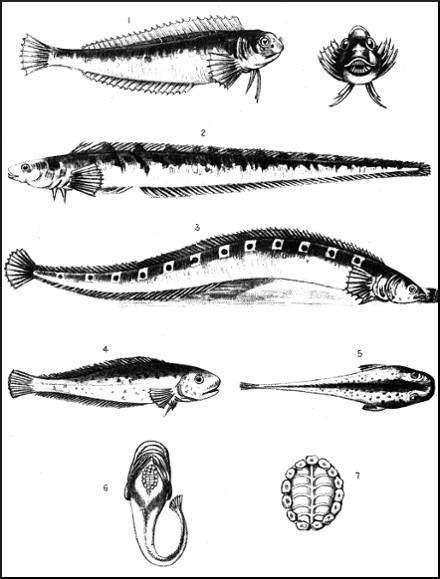
From the illustration on Plate 12 the reader will
have no difficulty in recognising the original, should
he by chance meet with it hiding among the tangle,
or beneath the stones by the sea-shore.
The spotted Blenny, Butter-Fish, or Gunnel-Fish,
as it is variously termed, is found lurking under stones
in the same places as the preceding. In the north
of Scotland it is called 'cloachs,' and is used extensively
as a bait for larger fish. When disturbed, it
wriggles its body about in the muddy bottom of the
rock-pool like an eel, for which, indeed, it is occasionally
mistaken.
Its length varies from three to nine inches; the
depth only half an inch; the sides very much compressed
and extremely thin.
The dorsal fin consists of seventy-eight short spiny
rays, and runs the length of the back almost to the
tail. The most conspicuous feature in the Gunnel-Fish
are the eleven round spots which occur at the
top of the back, and reach the lower half of the dorsal
fin; they are black, half encircled by white.
The tail is rounded, and of a yellow colour. The back
and sides are of a deep olive; the belly whitish.
In its young state I have had this fish live in my
aquarium for several months, but it never seemed to
be happy or contented.
The Five Bearded Rockling is almost as great a
favourite with the writer as the Smooth Blenny. It
is a very pretty fish, and may be easily tamed. In
the course of a week I trained one to feed out of
my hand, and when I put my finger in the water the
fish would rub against it with its head, just as a
favourite cat frequently does against the leg of a
person with whom it is very familiar; moreover, if I
moved the intruding digit with a circular motion
through the water, the Rockling would waltz round
the tip with evident signs of pleasure.
This fish is often found in tide-pools, and may
readily be identified by the prominent appendages
attached to its head, to the presence of which, the
Rockling owes its familiar appellation.
The Goby (Gobius unipunctatus), or, as it is more
popularly termed, One-Spotted Goby, is frequently
found inhabiting the same pool as the Blenny or the
Rockling. The distinguishing character of this
pretty creature is the black spot which is situated
between the fifth and sixth ray of the first dorsal fin.
Its length is usually about one, or one and a half
inches; specimens have, however, sometimes been
found on the shores of the Frith of Forth, that measured
nearly three inches.
The colour of the Goby is very changeable. If the
animal is labouring under excitement, its body
assumes a deep brownish tint, approaching in some
instances to black; this gives place to brown, drab,
and even amber, or yellowish white.
The Goby possesses the power of attaching its body
to any object by means of its ventral fins, which become
united together in the form of a funnel.
Another species (Gobius bipunctatus), or Two-Spotted
Goby, is generally found among the Fuci, in
rocky situations. Its name is derived from a dark
spot which is distinctly apparent on each side, near
to the origin of the pectoral fin.
The head and upper part of the body is dark brown,—the
under part of the head and belly white or pale
drab.
Allusion has already been made to the peculiarity
of the Gobies affixing their bodies to rocks or other
substances, by means of a sucker formed by the
junction of the ventral fins. The adhesive power in
question, which this class of creatures possess, is very
limited as compared with that which is exercised by
the true sucker fishes, and especially by the members
of a certain species, whose bodies are furnished
with two distinct organs of adhesion.
The extraordinary adhesive powers of the Lump-Sucker,
for instance, have been tested by several
writers. One observer states, that a fish of moderate
size has been known to suspend a weight of
above 20 lbs., upon which it had accidentally fastened
itself. Mr. Pennant says still more, for he has known
that, in flinging a fish of this kind just caught into
a pail of water, it fixed itself so firmly to the bottom,
that, on taking it by the tail, the pail was lifted up,
though it contained several gallons of water.
To descend from the largest to the smallest species,
we arrive at the Montague Sucker-Fish, or, as it is
sometimes called, the Diminutive Sucker, one of the
most interesting little creatures to be met with at
the sea-shore. At the coast near Edinburgh I
have met with many specimens, equally well in
the spring or winter season, as during the summer
months. At such locality this species may
therefore be pronounced common; yet it is comparatively
unknown to most 'collectors' in the neighbourhood.
Many, indeed, contend that my designation
is erroneous. But having taken considerable
pains to satisfy my mind upon the subject, I have no
hesitation whatever in stating that the little fish in
question is identical with that of the Montague Sucker.
Donovan, in his 'Natural History of British
Fishes,'[19] was the first to illustrate and publish an
account of this petite gem of ocean. His figures are
copied from drawings made by Colonel Montague,
who also furnished the description of the specimen
delineated. With the important exception of the
sucker—an organ of adhesion which is very nearly
correct—the general appearance of the Diminutive
Sucker-Fish as figured, is not at all satisfactory.
Perhaps this is not to be wondered at, when we
remember that the specimen from which the sketches
were taken was very small indeed. Moreover, it
was diaphanous, and is depicted as being principally
transparent, spotted, and tinged with pink.
The Diminutive Sucker, in its adult state, is said
to be from two to three inches in length; consequently
Colonel Montague's first specimen must have
been an extremely young one.
The usual colour is deep orange, varied with
minute dark spots. The under parts of the body
and throat are of flesh colour; the centre of the
sucker being faintly tinged with crimson.
I have seldom met with specimens measuring
more than one, or one and a quarter inches. It
is a marked peculiarity in this Sucker-Fish, that
when adhering to any substance it has a constant
habit of curving the tail towards the head. In
such position it will remain motionless for several
hours.
There is little difficulty in capturing the Montague
Sucker in its native haunts. It does not
possess the power of darting to and fro with the
speed of the Blenny, or most other fishes, but progresses
through the liquid element with a peculiar
quivering motion.
It is not a fish that can be recommended for the
aquarium. A fortnight to three weeks is the longest
time that I have been able to keep a specimen
alive; indeed, until I adopted the plan of allowing
each little captive to remain quiet and undisturbed
in a dark and shady place, death ensued in the course
of one or two days.
My illustrations (Plate 12) having been carefully
drawn and coloured from a living specimen, the
student will, I trust, find no difficulty in recognising
the Diminutive Sucker, should he be so fortunate as
to meet with it in a rocky pool.
'There is also a fish called the Sticklebag, a fish
without scales, but hath his body fenced with several
prickles. I know not where he dwells in winter,
nor what he is good for in summer, but only to
make sport for boys and women anglers.' Thus
contemptuously does dear old Izaak speak of the
Sticklebag, or Stickleback, as it is now termed, one
of the most amusing and interesting members of the
finny tribe. I have frequently transferred specimens
of the Stickleback from fresh water to salt water,
and found them live quite as well in the latter as in
the former.
The contrast, however, between the appearance of
the three spined Stickleback, when first taken from
the sea, and one captured in the fresh water pond is
very remarkable. The first is dressed in a gorgeous
coat of varied colours. Around the mouth and belly
it is bright crimson, on the upper part of its body
various tints of green prevail; while in the pond
specimen no red colour is visible at all, but only
white blended with green.
In addition to Gasterosteus aculeatus, whom we
have above alluded to, there is another species, G.
spinachia, or Fifteen-Spined Stickleback, which is
also an inhabitant of rock-pools by the sea-shore,
but unlike the first-mentioned, is never found in fresh
water. Both species possess one peculiarity in common,
a description of which will form an appropriate
conclusion to this chapter. I allude to their nest-building
habits, which has only of late years been
proved to exist, although Aristotle has recorded the
same fact regarding a fish (Phycis) in the Mediterranean
Sea, which was known to make a nest and
deposit its spawn therein.
The duties of mason and architect are invariably
undertaken by the male Stickleback. His materials
are of course very limited, still his labours are skilfully
and even artistically performed. Having chosen
a suitable spot as a foundation for his house, he collects
some delicate sea-weeds, gravel and sand, and with
these materials, aided by a glutinous fluid which is
given off from his body, the house is built. When
completed, and not before, he seeks out his mate, and
invites her to take possession of her newly formed
home. If she shows any affectation or coquetishness,
he does not hesitate to nip hold of her tail, and urge
her forward by equally expressive signs. Soon, like
a dutiful little pet, she enters, and having deposited
spawn, retires again, leaving her lord and master to
guard the casket and its living treasure. This task,
though extremely arduous, he adopts with pride and
gratification.
How so small a creature can bear up so long under
such a state of apparent excitement appears marvellous.
His assiduity is most extraordinary. By night
he rests beside the nest, and by day, if he can
possibly hinder it, he allows nothing to approach.
When there are other members of the Stickleback
family in the aquarium, numerous combats are sure
to ensue, for as the young and transparent offspring
of one fish are deemed a great dainty by the non-parental
body, the latter invariably endeavour to
satisfy their cannibal propensities at the harrowing
expense of their neighbours.
When the spawn are hatched, fresh care devolves
upon the parent, in order to keep them within the
nursery, and protect them from the greedy mouths of
the larger fish, always on the look-out for tit-bits.
Should one of the little fishlings stray beyond the
prescribed bounds, the watchful parent darts after it,
and in an instant his jaws close over the wanderer
apparently for ever, but in fact only for a time, for
swimming quickly back the old fish puffs out the
straggler into its nest lively and uninjured.