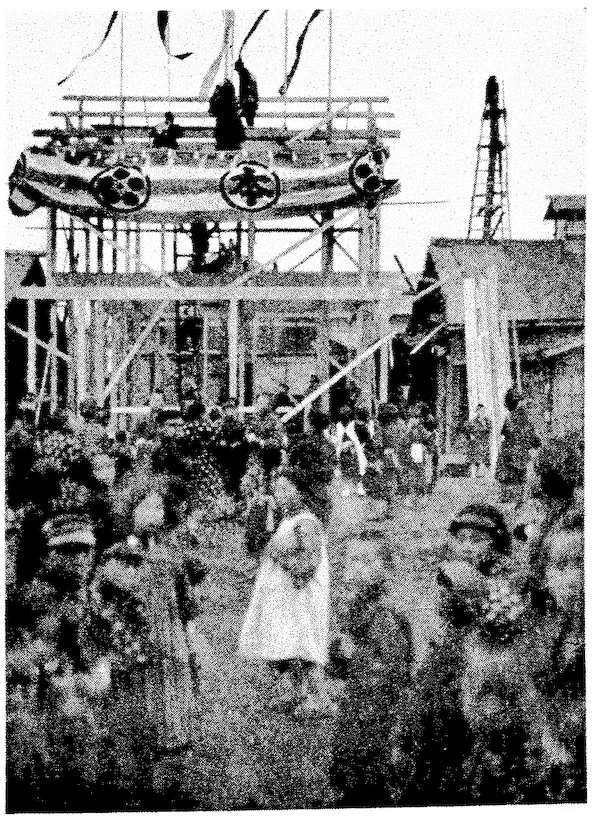
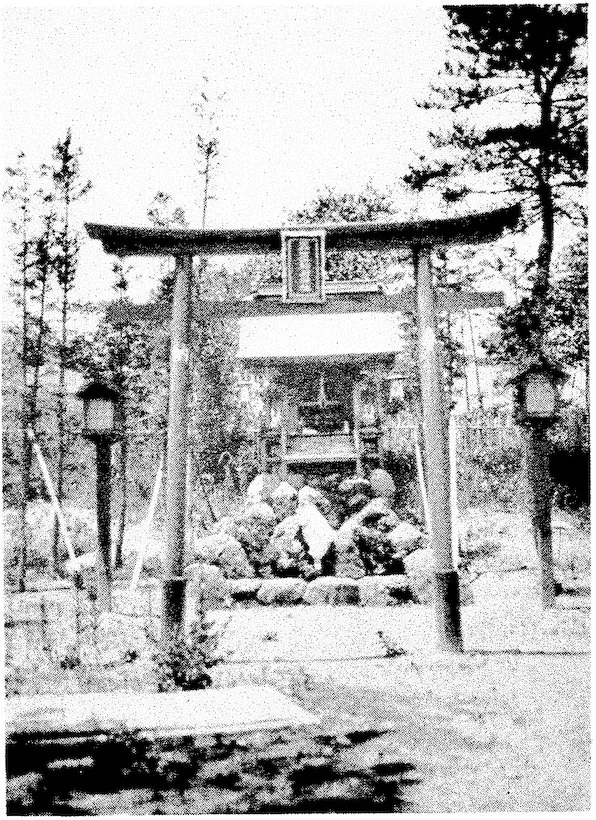
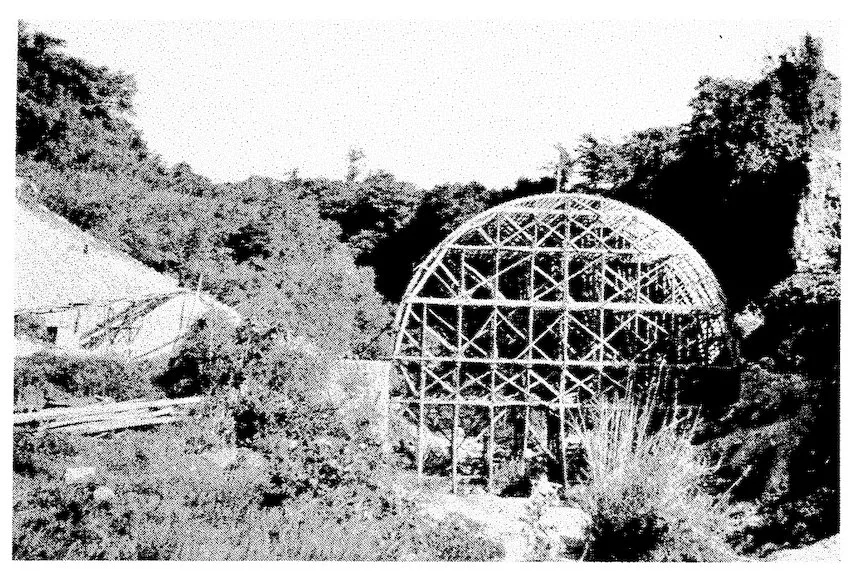
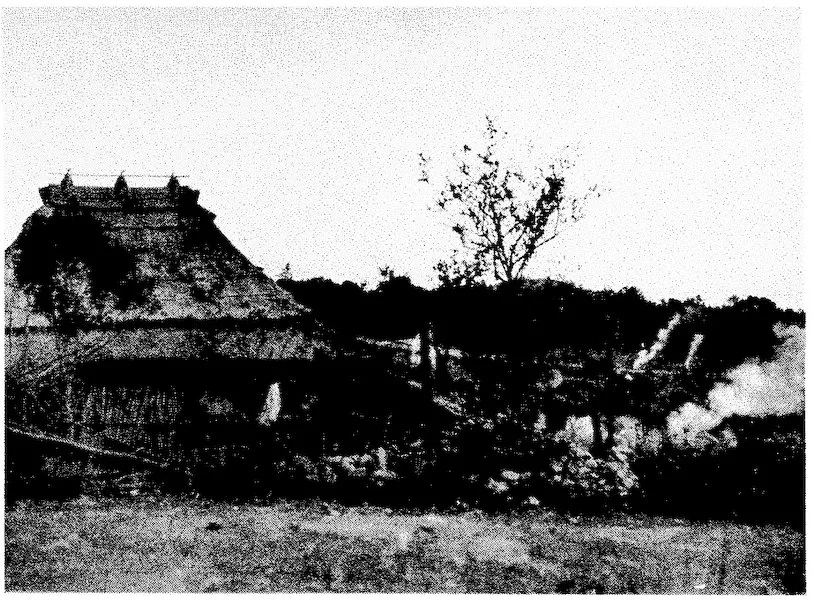
Preparing to propitiate the gods, and the neighbors, in favor of a new building in Hokkaido, where religious custom remains even if architecture changes; this ceremony seems always to take place at sunset
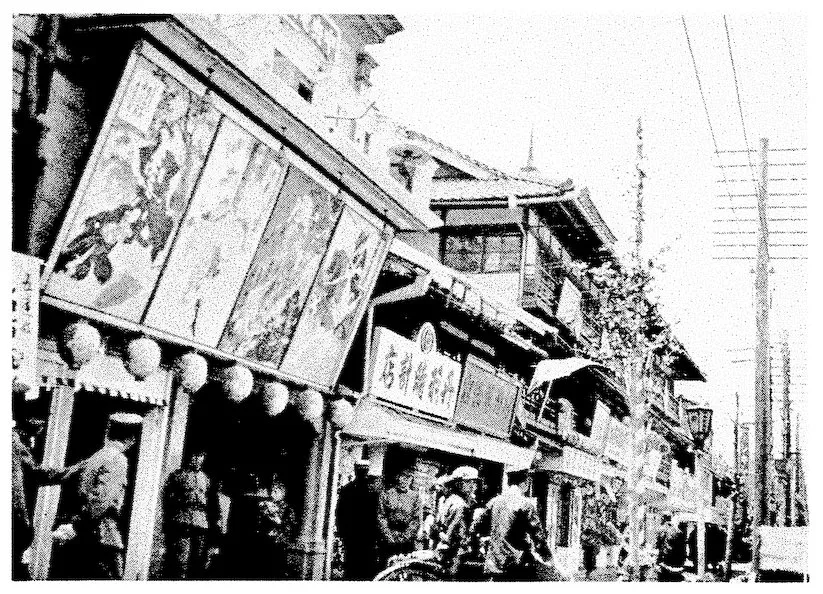
The front of a Yoshiwara house in Tokio, with the usual advertising features of large framed photographs of the inmates, two of whom appear in person behind the railing, one hiding behind a newspaper rather than be photographed. The sign reads “3-yen two-storied natural inn”
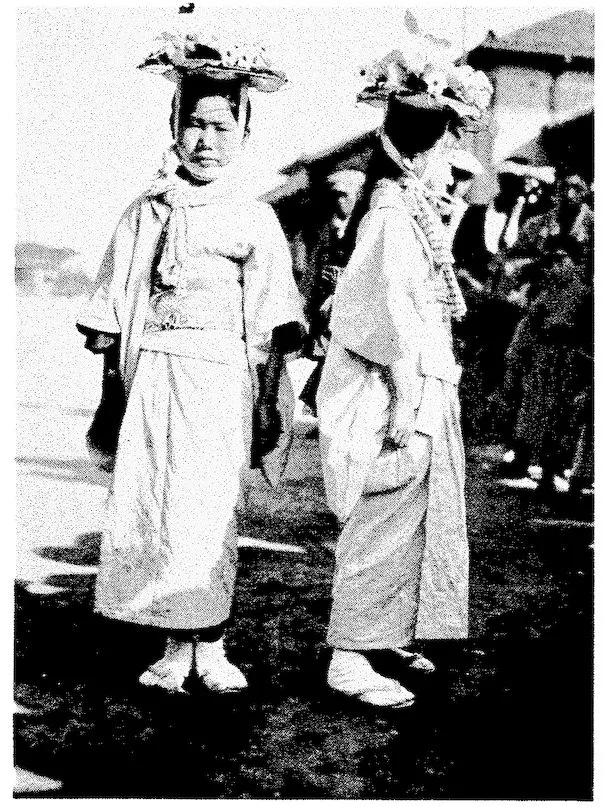
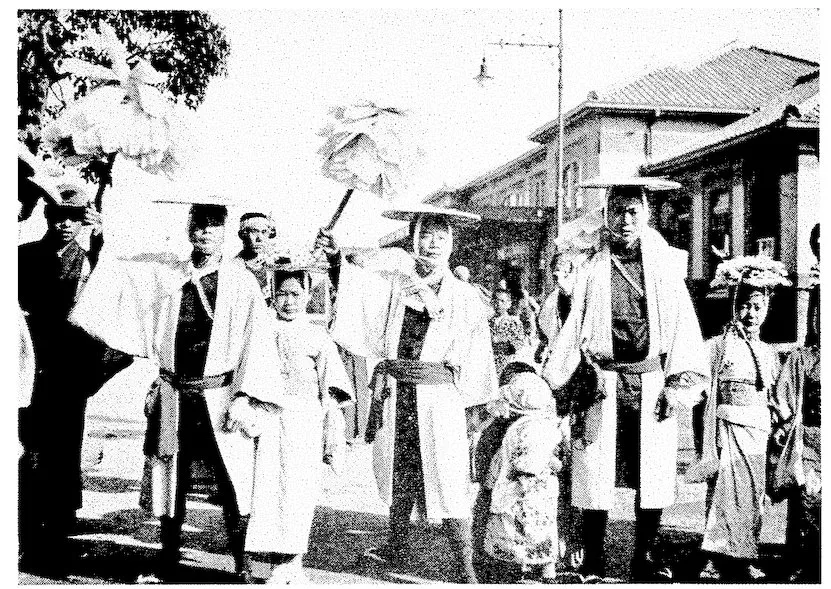
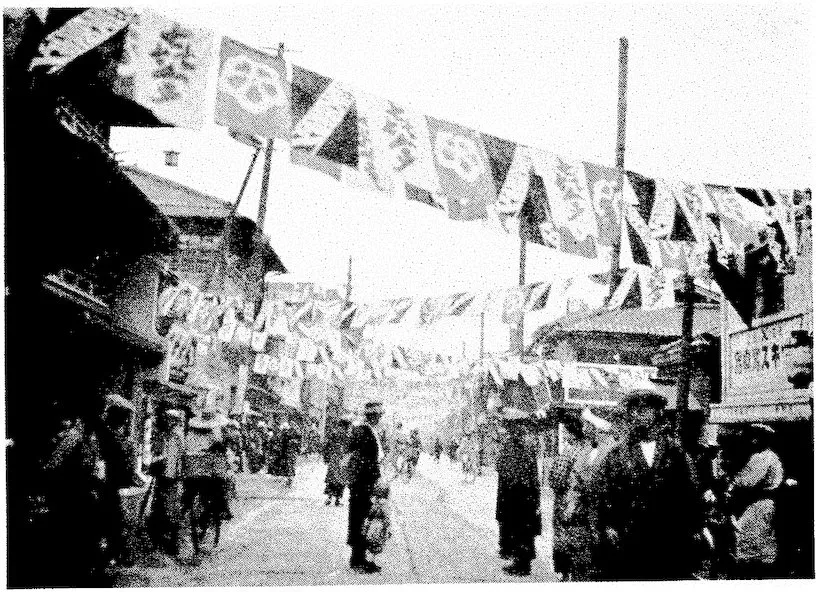
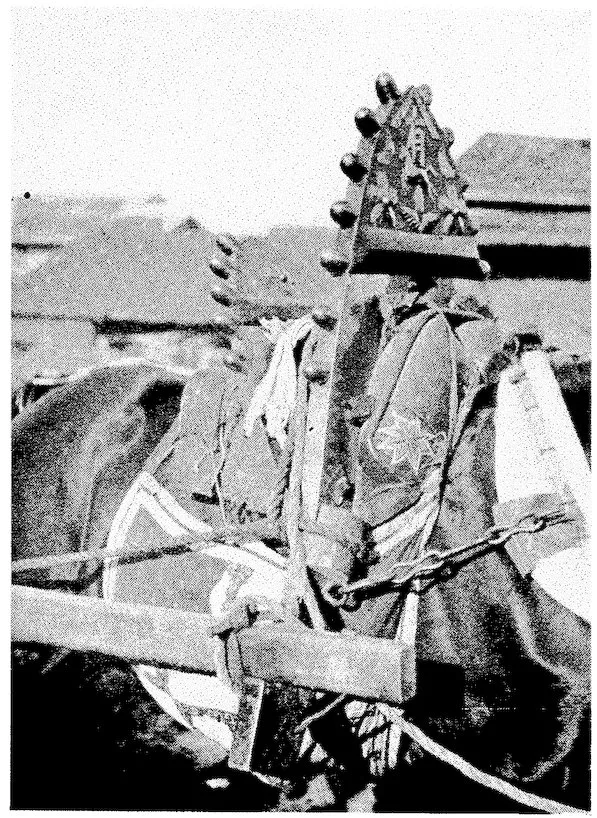
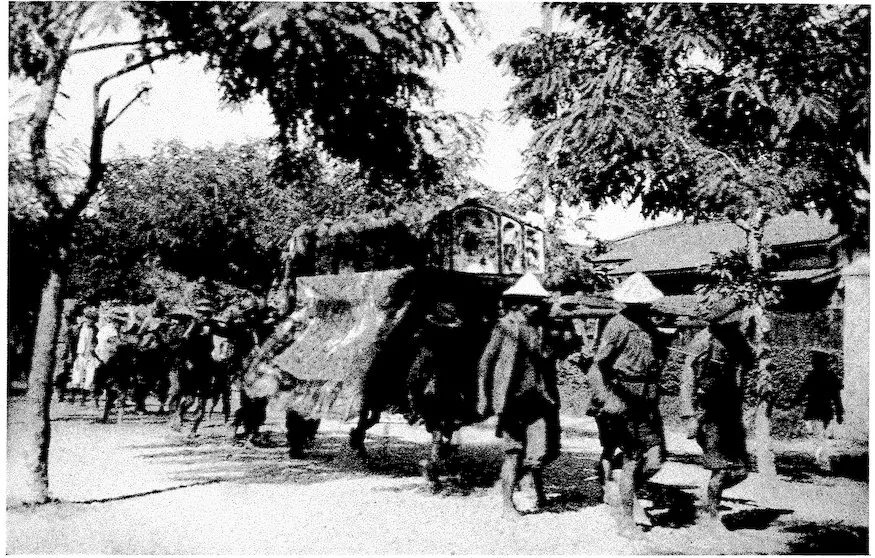
Residents of Yamada-Isé garbed for the cart-drawing festival. Brilliant colors characterize the clothing; the torn-paper “duster” is a frequent Shinto motif
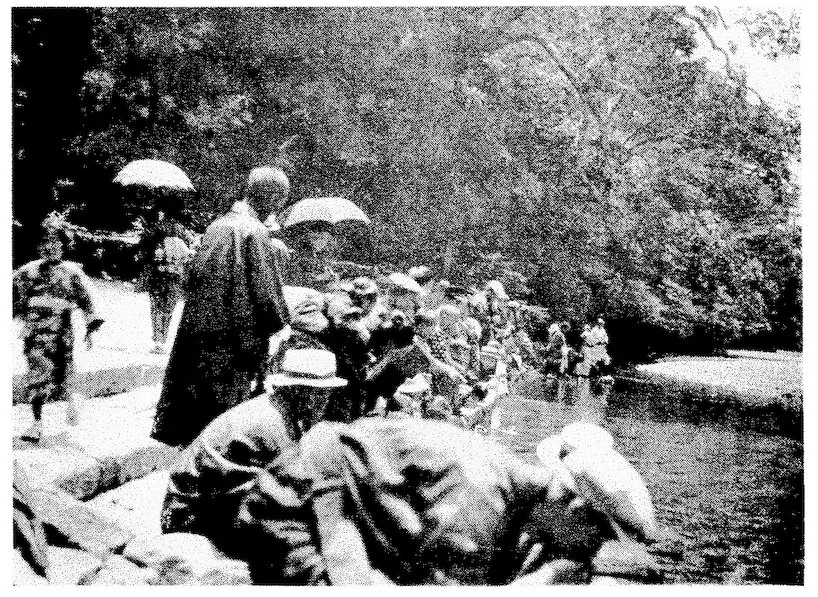
viiInside the grounds of the Naigu, most sacred of all the Shinto temple groups of Japan, all pilgrims purify themselves by washing in the sacred river before proceeding to their devotions; photography is strictly forbidden
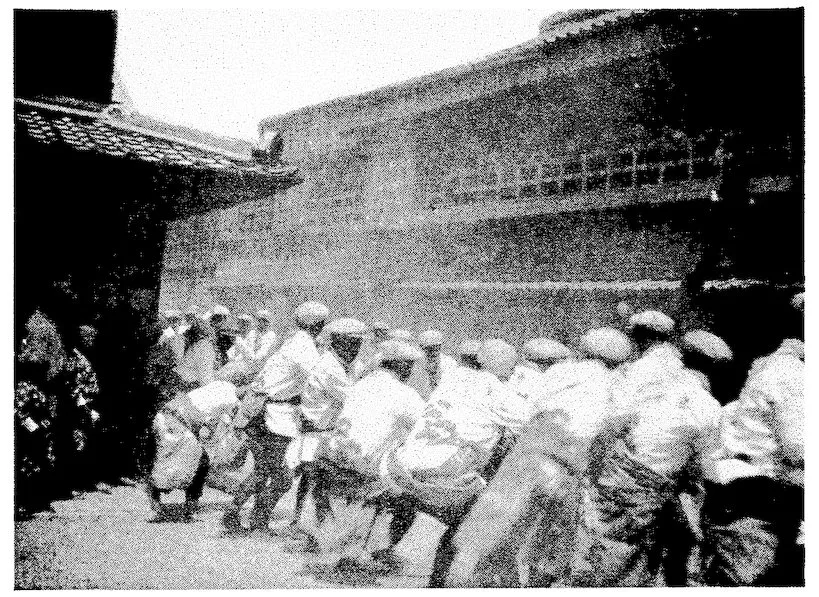
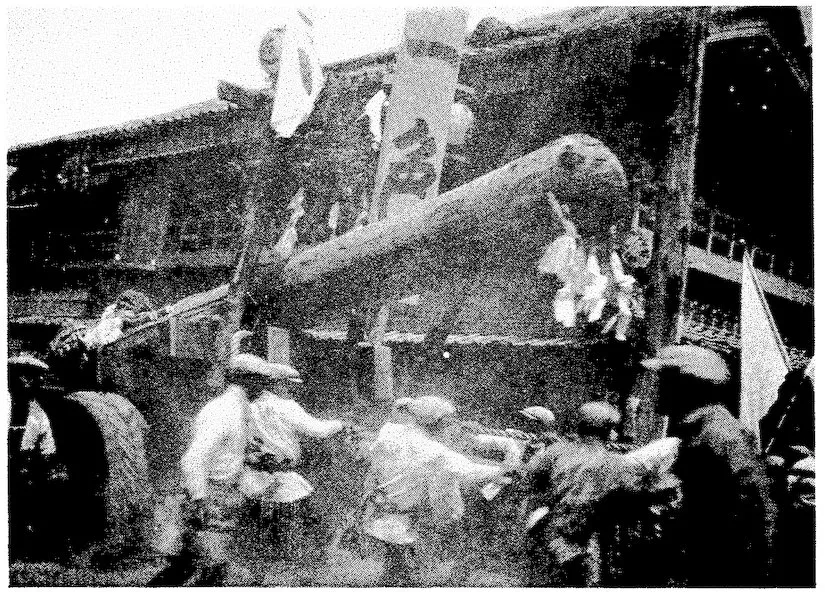
At last the sacred timber itself, wrapped in grass mats to prevent any injury, came creaking and grinding around the corner of a narrow, winding street
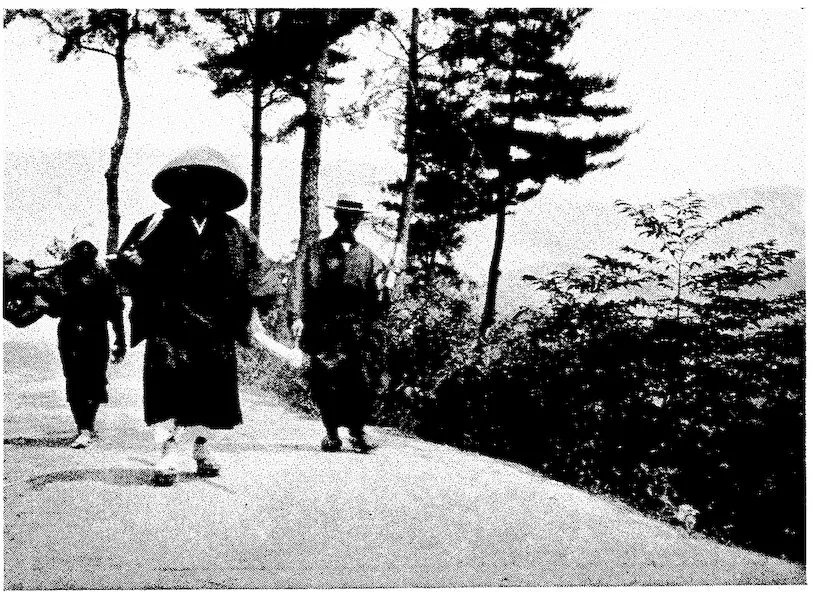
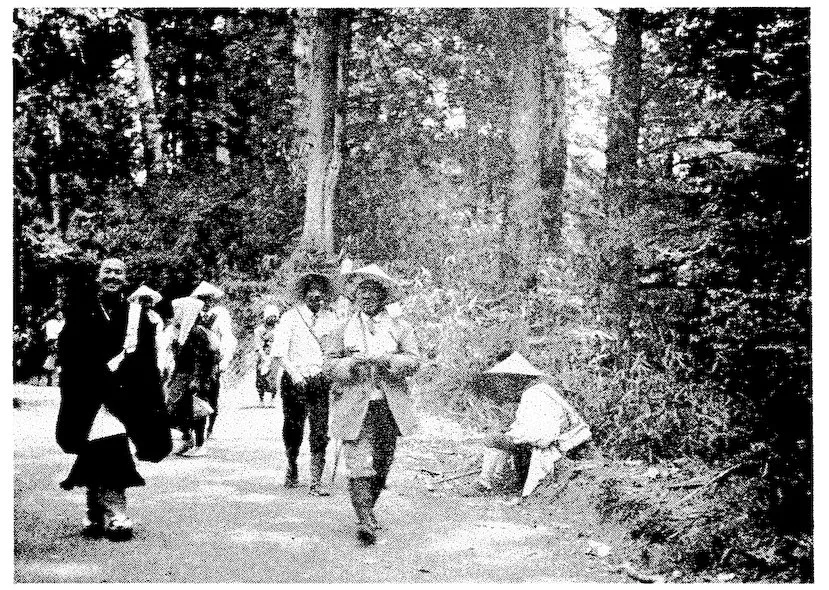
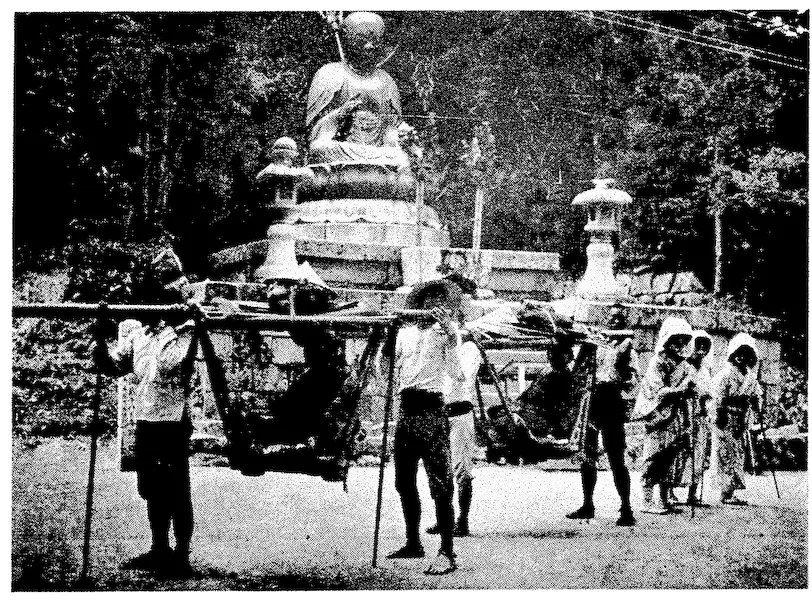
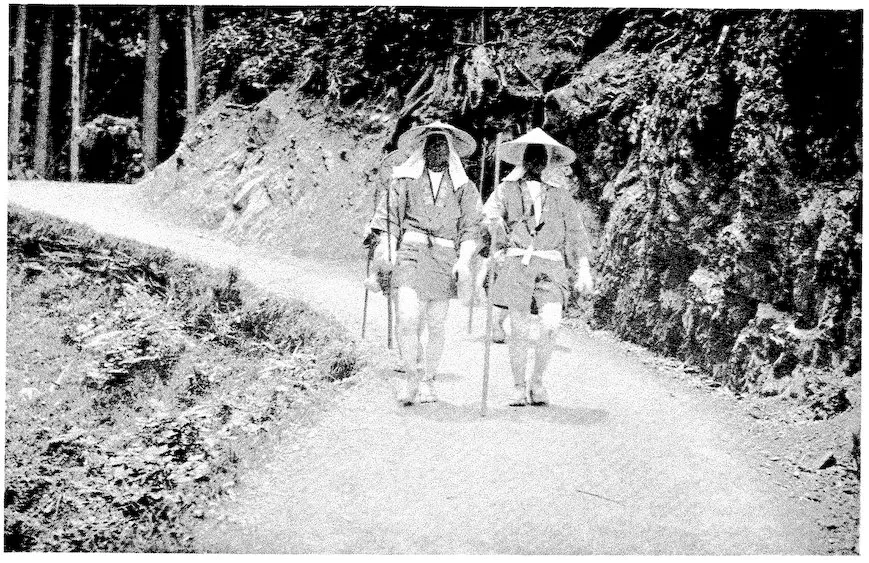
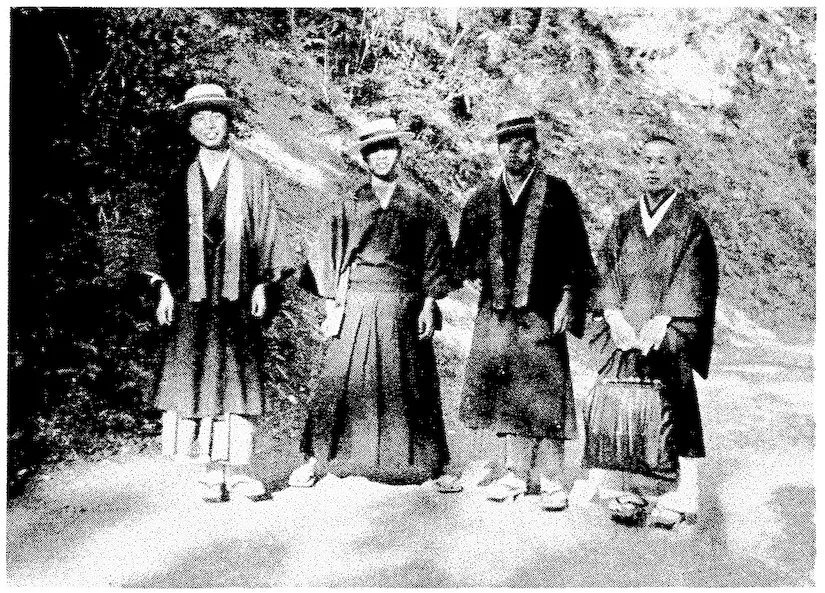
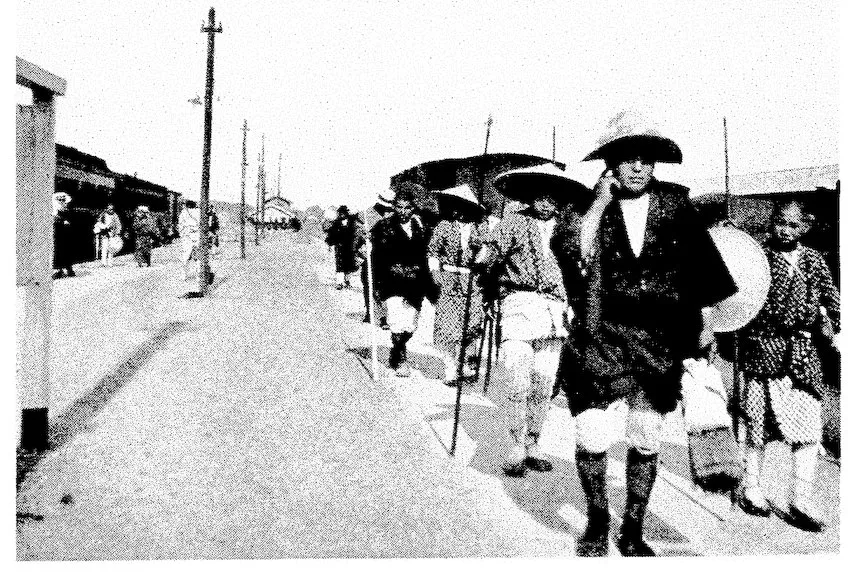
Pilgrims—in real life lawyers, doctors, dentists, business men of Japan’s second largest city—climb Koya-san with all the customary accoutrement, led at the end by the young Buddhist priest who took me in as guest
Women pilgrims arriving at the entrance to the miles of temples, tombs, and the like on Koya-san, a point beyond which, up to half a century ago, no member of the fair sex was allowed to pass
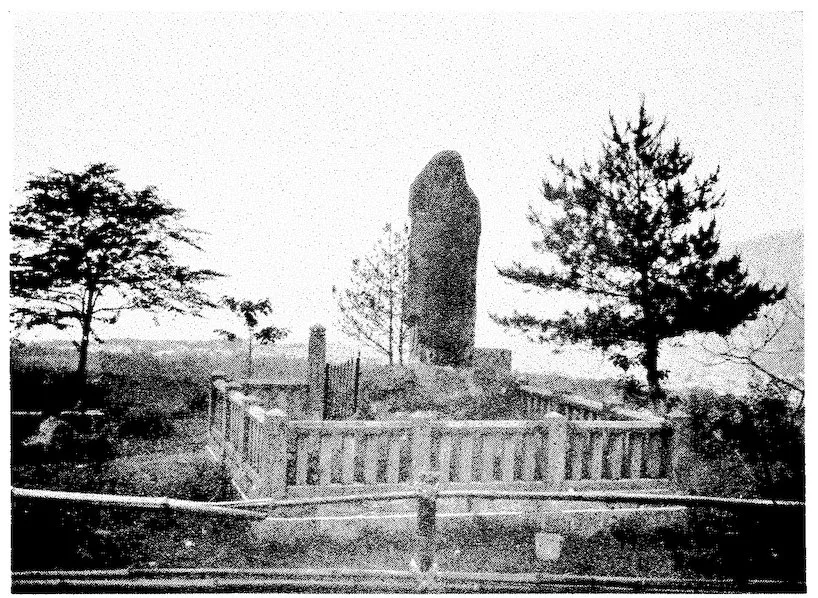
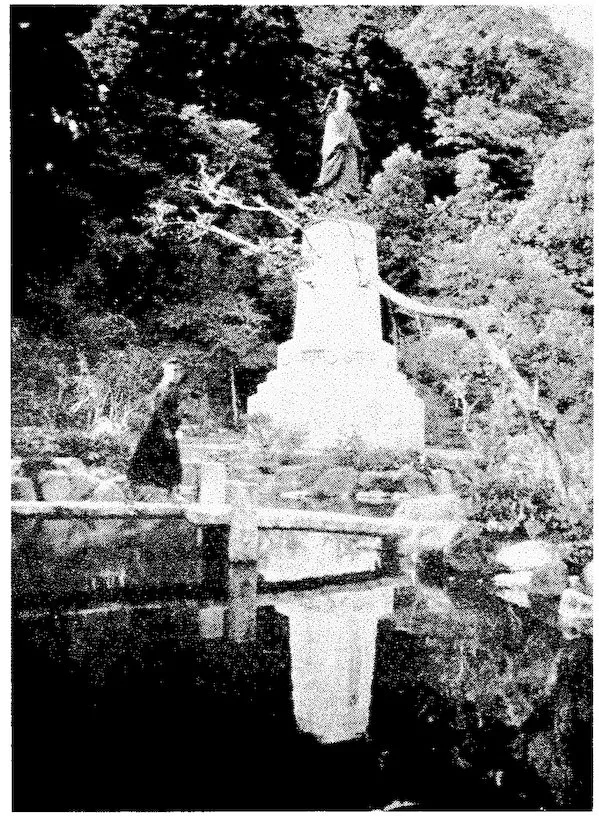
A memorial in the park of Kagoshima to the old-fashioned men who perished in the Satsuma rebellion, an attempt to halt the restoration and keep Japan closed to the outside world
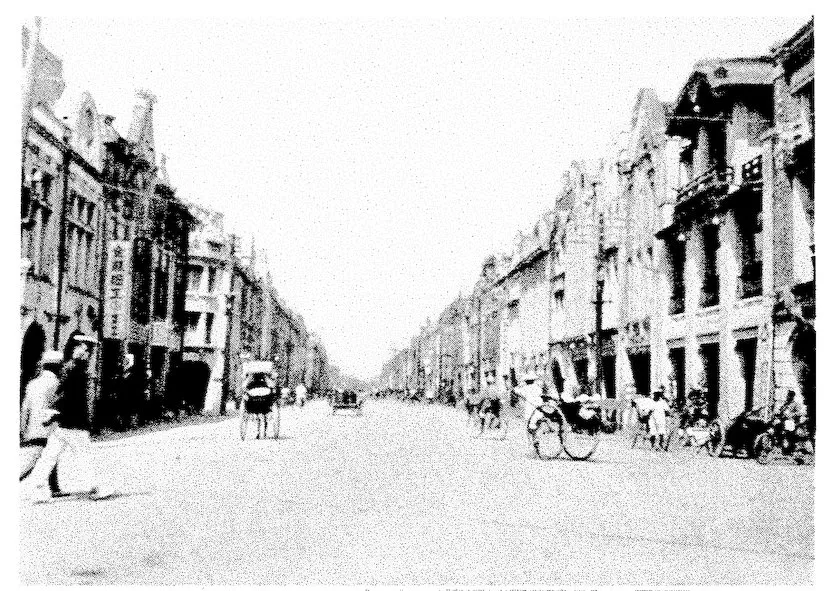
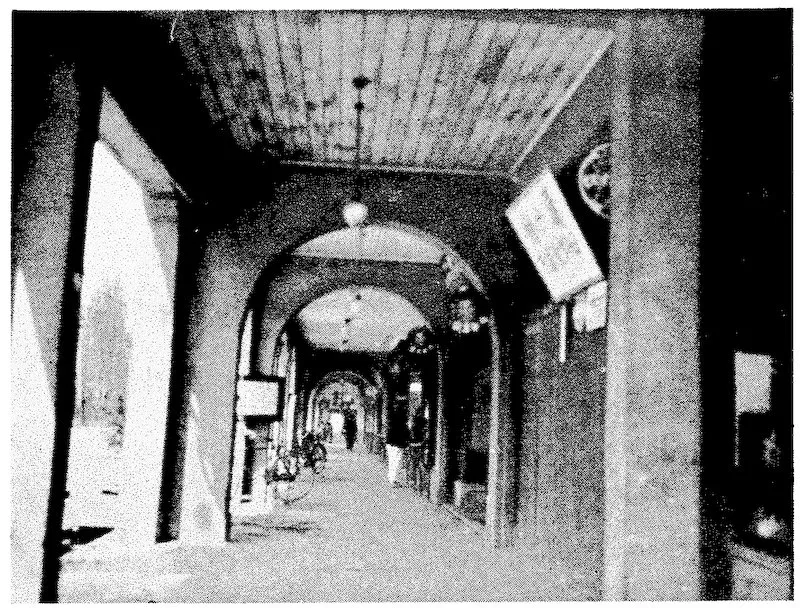
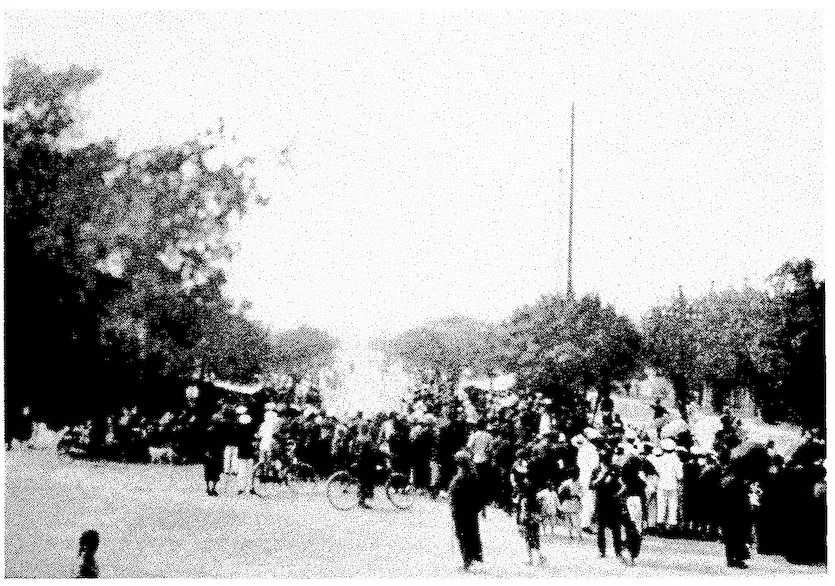
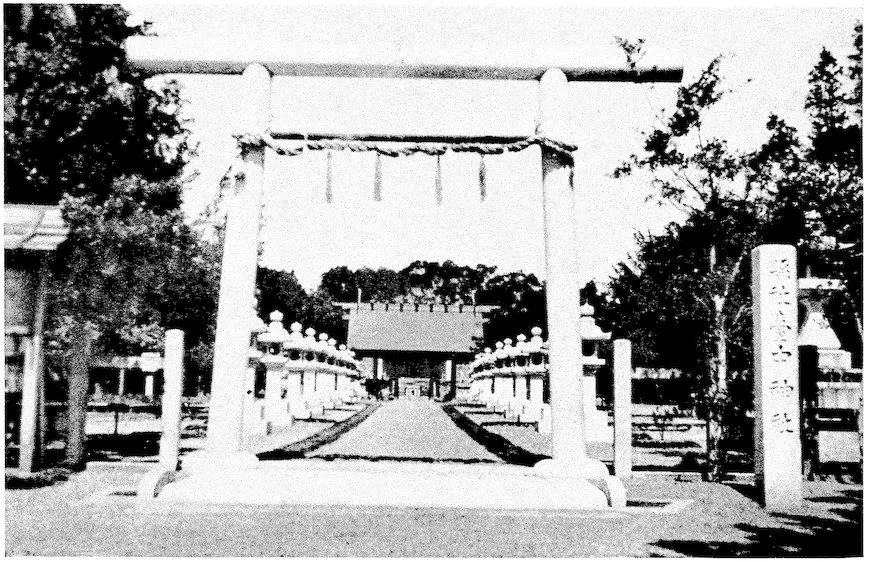
xThe Japanese build Shinto shrines in every Formosan town of importance, but they have made little progress in making Shintoists or mikado-worshipers of the inhabitants
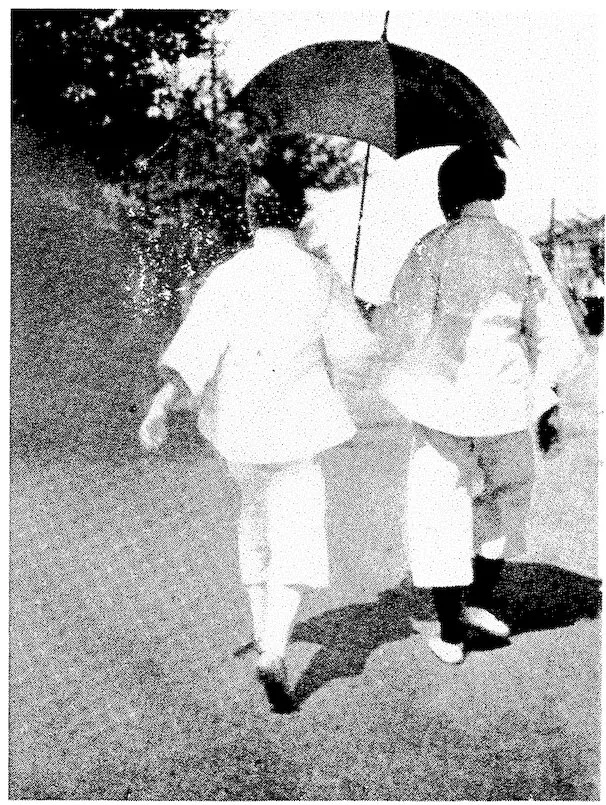
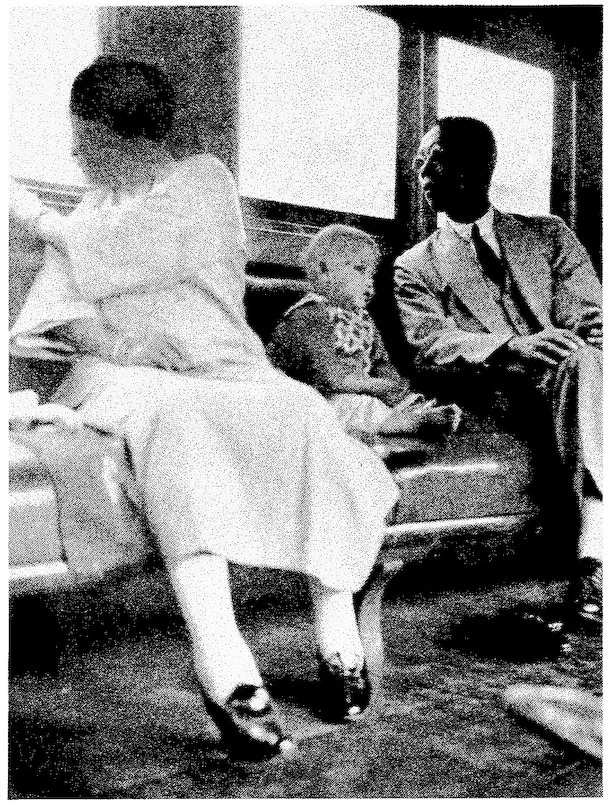
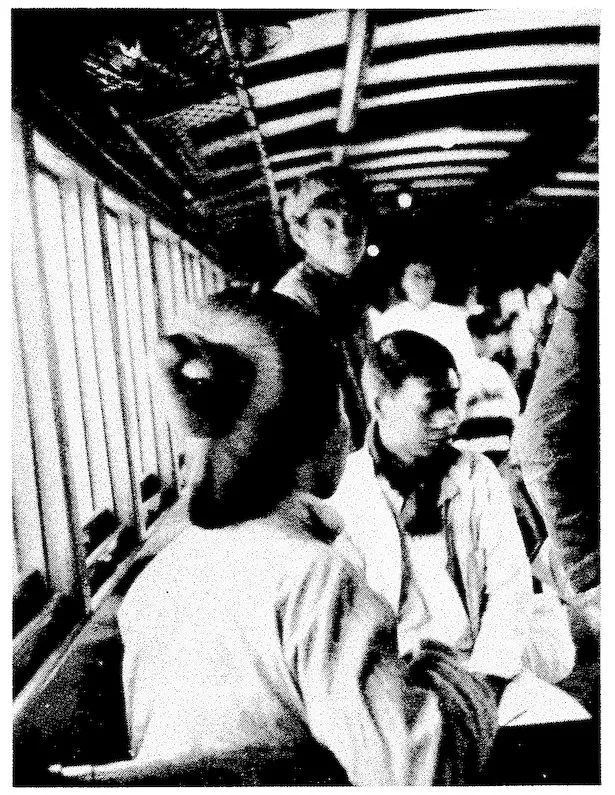
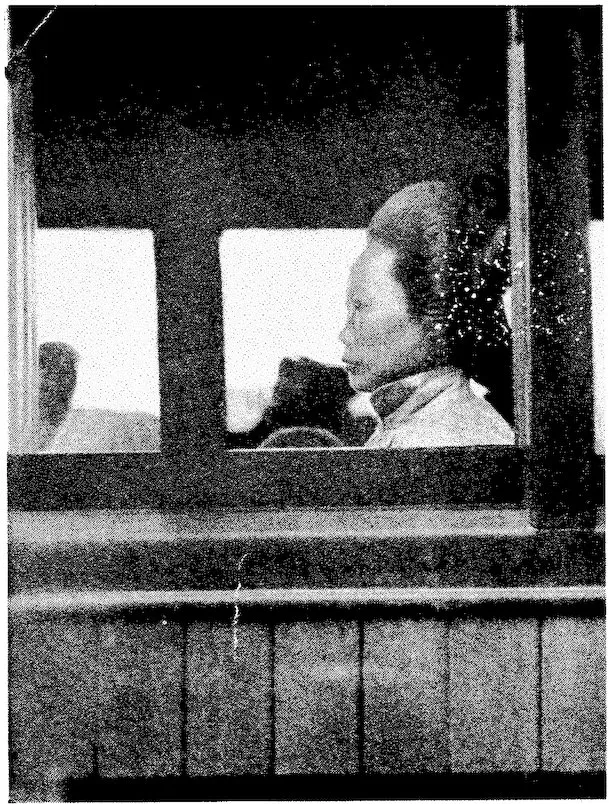
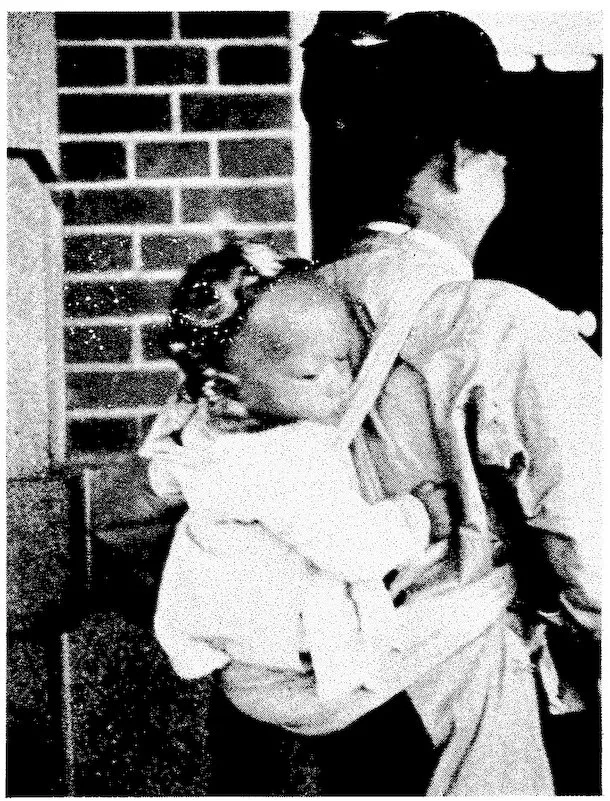
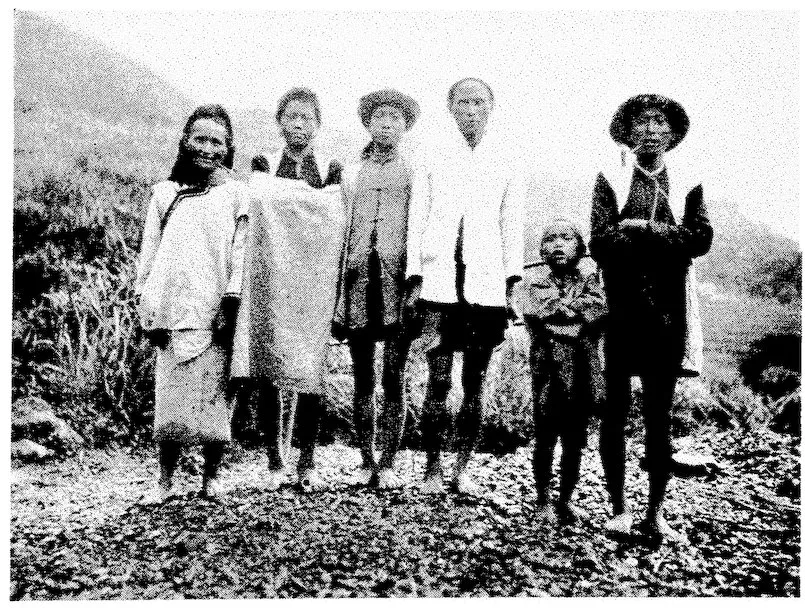
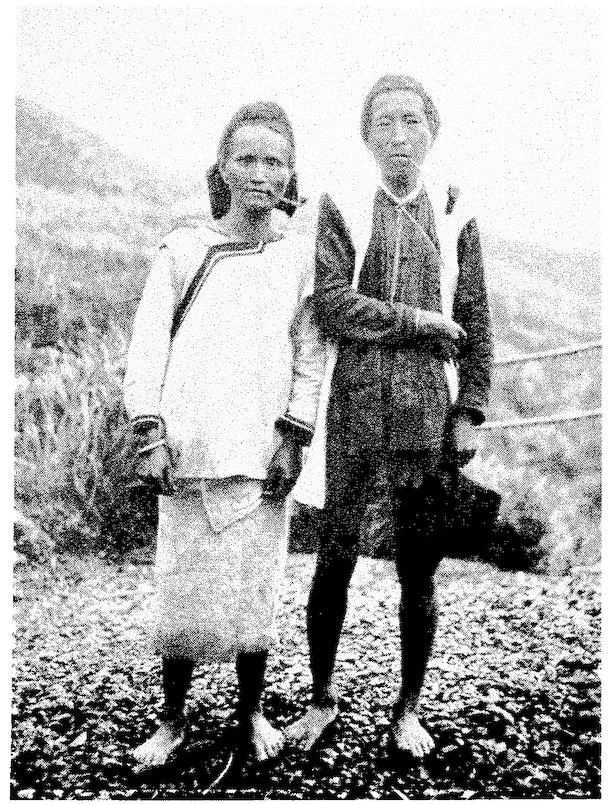
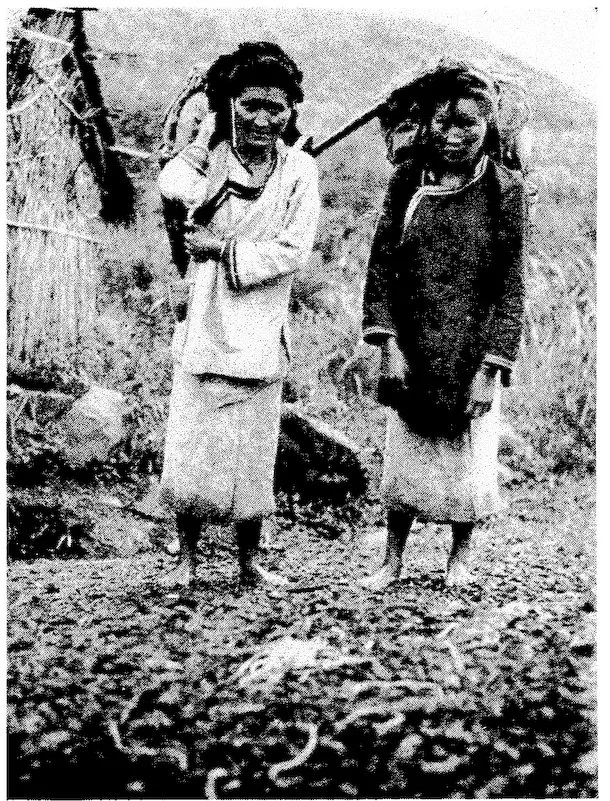
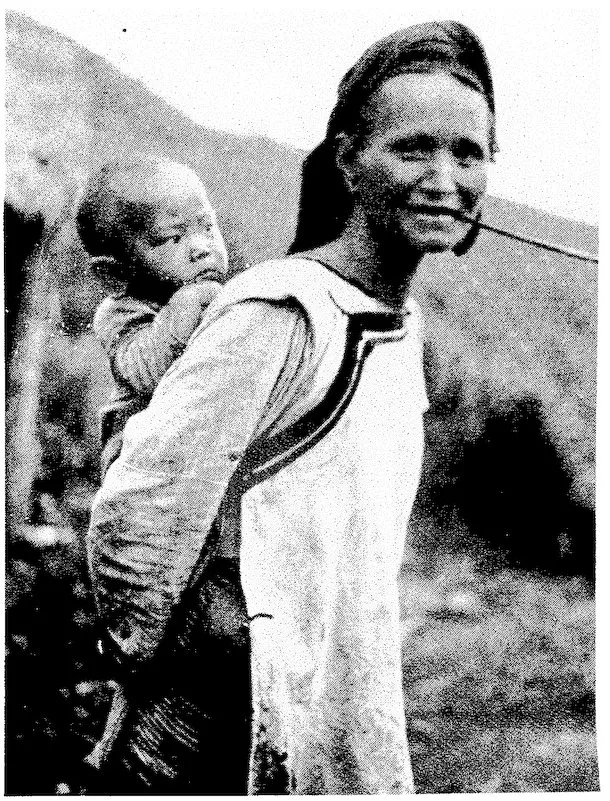
In third class there are usually several Formosan country women with a striking head-dress suggestive of, yet on close examination quite different from, those of the ladies of Japan
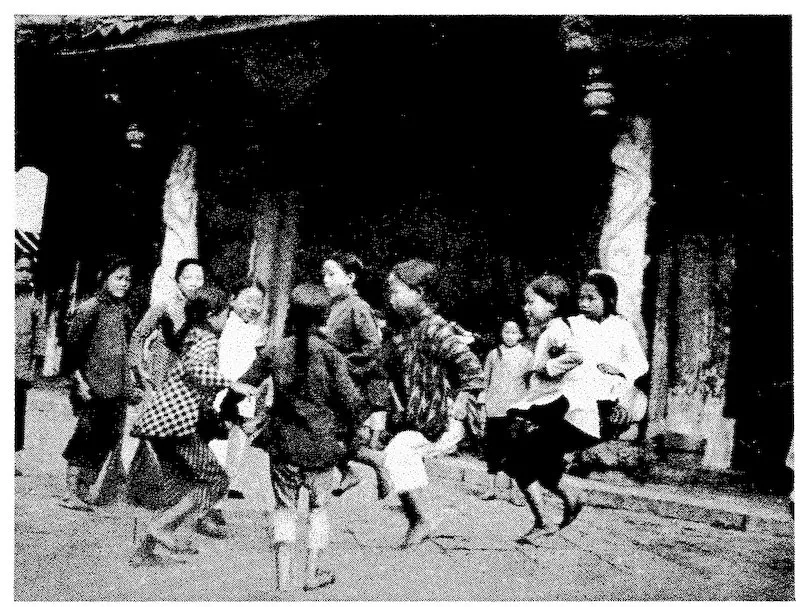
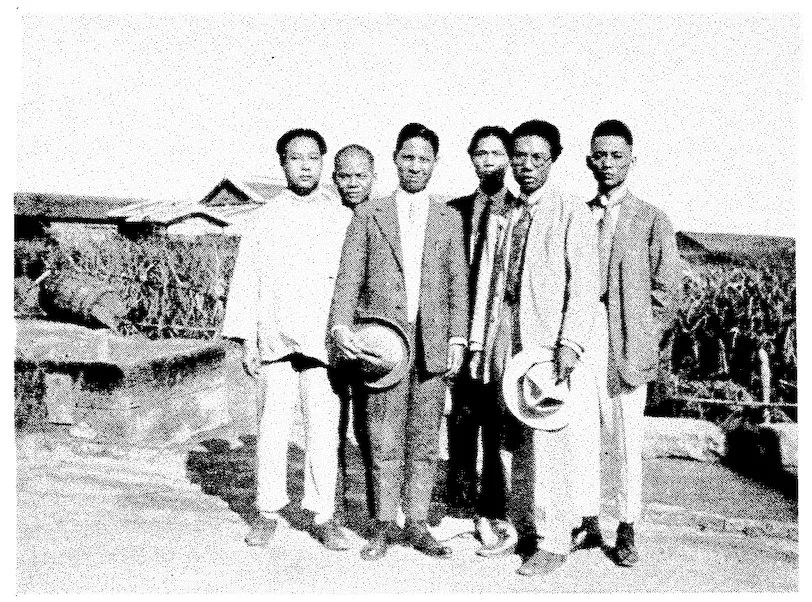
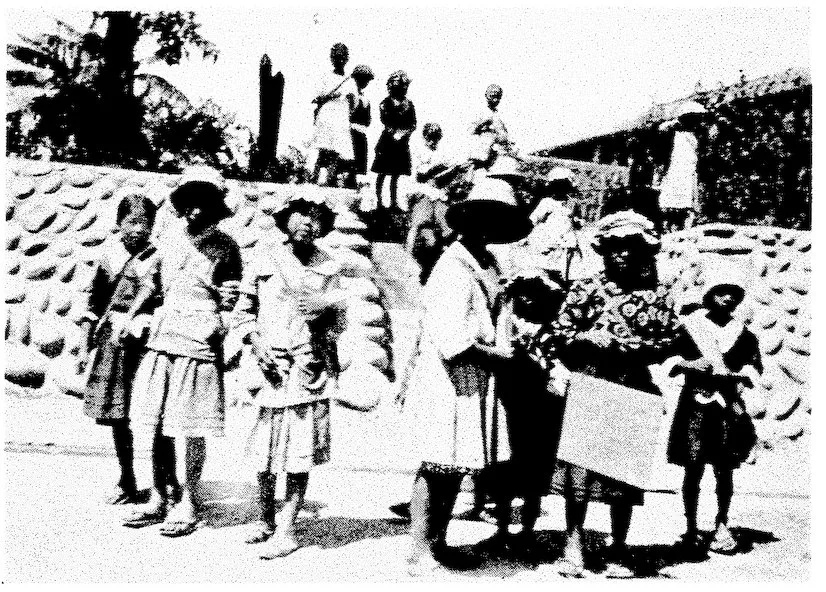
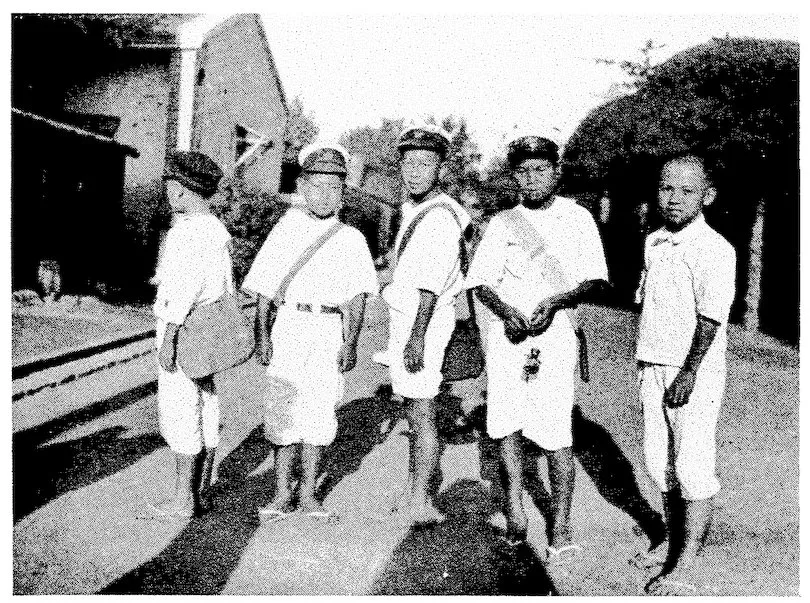
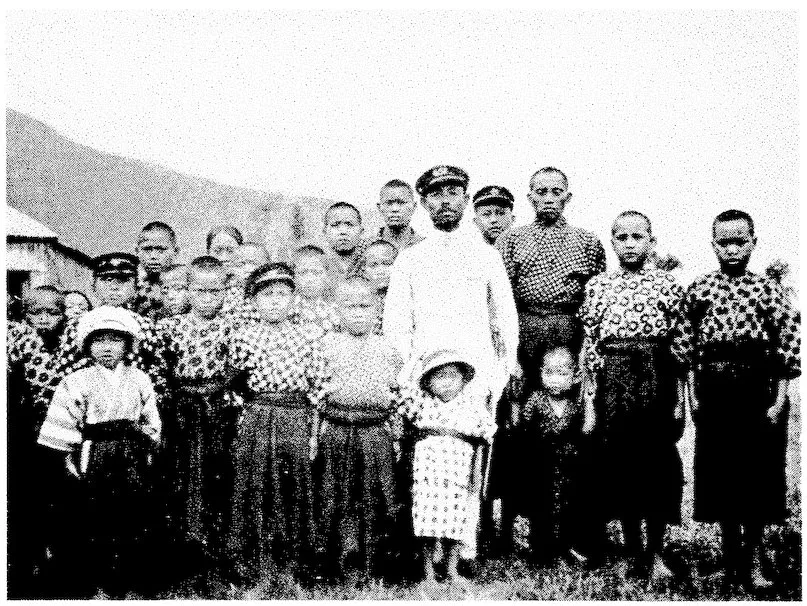
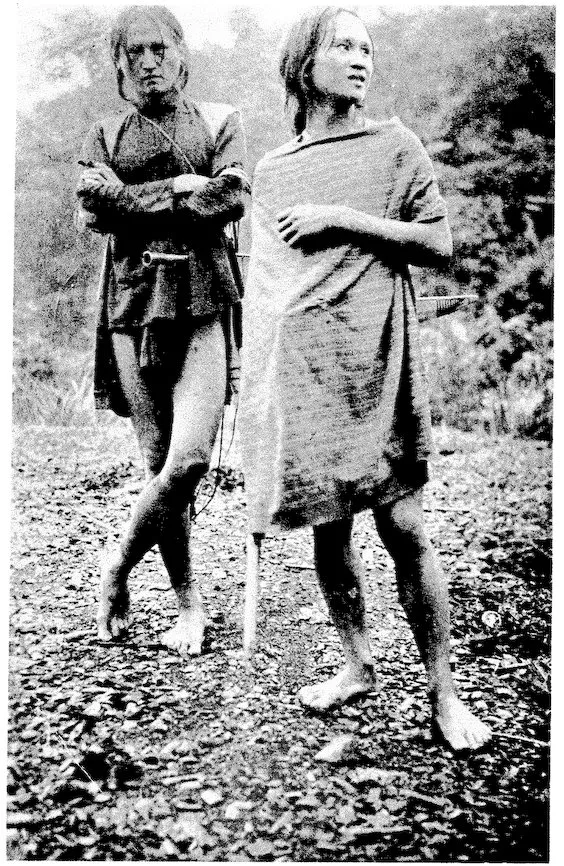
The Japanese say that they themselves cannot distinguish the reformed head-hunters of Formosa from their own country people. But for the teacher and two children in the front row these are all of the wild mountain tribes, the tallest man and his little boy in front of him being both in the first grade
All the way across the Pacific we mused on the
probability of getting a glimpse of Japanese
family life—not of mere inns or wide-open lower-order
hovels, but of the unexpurgated interior of a
real Nipponese home. The chance came quickly
and unexpectedly, on our first day in the country.
One of those fires which rival earthquakes in strewing
with disasters the history of this flimsily wood-built
land had just erased one of the three or four
hotels of Tokyo that welcome foreigners—at least
foreigners of the table and chair habit. Luckily for
us; for, had the mishap been postponed a fortnight,
the likelihood of seeing all our worldly goods, lugged
thither with much mental and financial effort, ascend
in smoke, would have been excellent. It was lucky,
too, that the refugees from the chaotic ruin had
filled its former rivals to overflowing; for thereby
not only did we escape the legal banditry which they
have the reputation of practising upon those who
4fall into their hands as clients, but we realized our
pent-up desire.
One of my few letters of introduction to the
island empire did the trick. The addressee himself
lived far from his office, but one of his subordinates
requested—or consented, at a flicker of the superior’s
eyebrow—to be permitted to offer us temporary
asylum in his mean and dishonorable abode.
Not that the solution was reached at once, just like
that, in an easy, offhand American manner. The
Japanese mind does not work that way. To begin
with, there was an interminable session with the
telephone, actually manipulated by a boyish underling,
under the dictation of the seated man of
standing. Yet, though fully half the audible end
of the conversation consisted of the endless repetition
of “Moshy-moshy”—which seems to be an abbreviation
of something corresponding to “Pardon
your dishonorable servant for presuming to
exist, but have the honorable kindness to deign to
listen to the miserable noises which I shall now convey
to your august ear through this most disreputable
and unethical mechanical contraption”—and
though the instrument was of as antiquated form,
and the telephone system of Japan is as deeply imbedded
in the postal and telegraph department of
the Government, as in France, it was noticeable that
it performed its ends with what would there be considered
vertiginous and incredible efficiency.
5Just where the hour or two went between this
confirming of my information regarding the plenary
condition of Tokyo’s surviving hotels and the
actual offer of temporary refuge no one with mere
American experience could fathom, nor one without
generations of schooling in the intricacies of Japanese
etiquette explain. As to the similar length of
time which elapsed between that epochal decision
and its physical accomplishment—do not housewives,
even of our own often too swift-moving land,
require time to prepare themselves and their dwellings
for the fitting deception of unexpected but
“highly distinguished” guests?
The mean and dishonorable abode proved to be a
most delightful and thoroughly Japanese dwelling
set in its own spacious garden, at half an hour’s
dodging by “motor-car” from the modernized heart
of Tokyo. So far so good. But other difficulties
quickly beset our path. Should, for instance,
“highly honorable” guests commit the uncleanly
Western barbarism of shaking hands in response to
the welcoming antics of the entire galaxy of hosts,—women,
children, servants, as well as the now lordly
master himself,—who were wiping with their
brows the matted threshold a high step above us?
Should the removal of one’s dishonorable footwear
and the performance of whatever might be the
proper gesticulations of greeting be simultaneous—ambidextrous,
so to speak—or consecutive, and, if
6the latter, in what order? What, if any, should be
the reputable means of concealing the sudden discovery
that, presuming upon its customary invisibility
in one’s own scheme of life, one had been so careless
as to permit a humble nether garment to reach
a state incompatible with the publicity to which it
is frequently subjected in Japan? Certainly one
must, at least, flinging aside all etiquette, Oriental
or Western, dash after that two-year-old member
of the family, who, still dishonorably shod, set off
on a sudden scamper through the frail house, in
imminent possibility of racing unchecked through
one of its paper walls, the while clamoring for his
overdue bath, board, and bed in a manner not customarily
used toward a chance host in any land.
Things move with a certain Oriental leisureliness
even in Japan; but the time came when, after a
supper that night that might have been less deliberately
an attempt to be European, and baths which
were not particularly noted for their privacy, piles
of quilts were at last spread upon the spotless straw
matting of our large second-story chamber and cylindrical
bean-bags lay ready to receive our weary
heads. Beyond a miniature gorge the darkness was
sprinkled with hundreds of the lights of Tokyo; to
our ears came across the intervening gardens the
mild night noises of Ushigome-ku, one of the most
populous wards of the densely populated Japanese
7capital, the subdued scraping of wooden getas most
conspicuous among them; surely we could not complain
of delay or lack of thoroughness in the granting
of our wish for a glimpse of home life in Japan.
II
8
As a matter of fact, while it is picturesque at a
distance of space or time, actual living in the
flimsy toy houses of Japan is far from convenient
to one “raised” in Western fashion. It is glorious
to be able to nudge one’s neighbor during a performance
of “Madame Butterfly” and hoarsely to
boast, “I once lived like that”—I am, of course,
speaking of the stage-setting, not of the story—but
it is equally inglorious to forget for a moment
the frailty of paper walls and thrust a hand through
one of those sliding shoji. To be able—and expected—to
run about indoors on bare or stockinged
feet, leaving all the dust or mud of the street—and,
from Tokyo down, one or both are rarely lacking
in Japan—at the threshold has an Elysian sound,
a suggestion of speckless Golden Stairs and noiselessly
flitting angels. It is an unusual Westerner,
however, who does not feel his dignity swiftly evaporating
when deprived of his customary footwear.
Nor is it merely his shoes which are de trop in a
Japanese house; for ideal convenience he should
leave his legs, too, at the door. The awkward
school-boy’s difficulty in disposing of his hands and
9arms is mild indeed beside that of the Occidental
guest faced with the problem of what to do with
his superfluous lower limbs on the cushion-scattered
matting of a Japanese room. In flowing kimono
it is bad enough; in trousers, which custom decrees
shall retain the suggestion of a crease, it is disheartening.
It is all very well, of course, to be able
to tuck beds in a closet during the day, to have
a room uncluttered by furniture, but the total lack
of drawers, shelves, or hooks leaves Japan the original
land for hanging things on the floor.
More troublesome still to us of an ungregarious
race is the utter absence of seclusion in Japanese
dwellings. Since that initiation in Tokyo we have
inhabited a score of them, mainly inns and public
hostelries; and of the petty annoyances of life, of
which Japan has her share, even as other lands, perhaps
the most exasperating, certainly the most
wearying, is the impossibility of sometimes being
alone. No wonder so many Japanese turn Shinto
or Buddhist recluses and retire to temple or monastery—though
even for them there is little genuine
seclusion. The romantic paper walls have very
slight capacity for deflecting sound. Let the man
four rooms removed from you in a native inn turn
over in his sleep, and you spring awake ready to do
battle with an intruder. Let a pair of fellow-guests
engage in one of those interminable conversations
which seem to be the most frequent toward midnight
10and beyond, and a megaphone could scarcely
increase the din.
The Japanese are not a noisy race. Verbal strife
is rare, domestic quarrels all but unknown, or at
least inaudible to the outer world; the streets, usually
innocent of paving, give back dust rather than
uproar; the gentle-voiced temple bells of all Japan
could not equal the din of a single belfry-hung copper
kettle of South America. Yet, if all else fails,
at least the omnipresent servant can be relied upon
to shorten one’s springless slumber. Besides the
paper-covered shoji forming the walls of the room
itself, there are the heavier sliding walls of the
house itself, usually of solid boards, occasionally of
glass. No human power can induce house or inn
servant to close these before one has fallen asleep;
all the studied cruelties of the Orient could not coax
her to leave one of them ajar during the night, nor to
refrain from opening with a mighty slamming
and stowing them away in their daytime box on the
house corners at the first peep of dawn. From
that moment on, if not, indeed, during the brief
night itself, one’s most private chamber is never
wholly one’s own. Soft-footed servant-girls patter
in and out on every possible provocation, often
with none at all, shoving aside the semi-transparent
shoji not only without a “by your leave” but
without a suggestion of warning, magnificently oblivious
to even a complete state of nudity on the
11part of the possibly somewhat modest inmate.
Would one bathe? A maid will make every effort
to assist at the disrobing; a “bath-boy,” if not a
domestic of the just then still less welcome gender,
must needs force his way in to lend a helping hand
during the ablutions, while the common tub is all
too likely to contain already a denizen or two, smiling
a welcome to the hesitating new-comer. Fortunately
the temperature of a Japanese bath, as unendurable
to the Occidental as the quilt of arctic
thickness with which he is expected to cover himself
on the most breathless summer night, furnishes
an inoffensive excuse for preferring a spigot and
one of the wooden half-buckets scattered about the
flooded floor.
Though the equipment of Japanese hostelries of
the native type does not include dining-rooms, let
not the humanity-weary guest fancy that his meals
at least may be taken in delicious solitude. From
the moment when he claps his hands thrice to announce
the arrival of appetite, a serving-maid, if
not two or three of them, will be always with him,
now touching face to mat as she places before him
on the floor a more or less edible dish, the rest of
the time sitting on her heels within arm’s length,
with the inscrutable face of a bronze Buddha, yet
watching with eyes that catch every faintest suggestion
of a faux pas his inexperienced wielding of
the untractable chop-sticks, that she may report his
12barbarianisms later to a cachinnatory kitchen. Constantly,
on every side, one has the sense of being
but a thin paper sheet removed from other beings,
those ubiquitous human beings with which all Japan
teems, so that in street or train, on country road or
mountain trail, almost nowhere can the traveler
escape for a brief moment, when the Occidental
mood is upon him, from the fellow-mortals with
which the island empire is so overcrowded. And
through it all lurks the burden of his superfluous legs,
the necessity of squatting when he would sit, and
the subconscious worry as to where shoes should
be worn and where removed, intensified rather than
lightened in those scattered establishments for the
wanderer ranked as “semi-foreign.” We shall never
regret, I am sure, our stay in Japan; but we were
often thankful that it was to be only a brief stepping-stone
to China, where tables and chairs, and
beds and hooks, and less ephemeral footwear would
again be found among the stage properties of life.
III
13
I ought really not to say a word about Japan, I
suppose, with only six weeks of scurrying to and
fro in it. “Old-timers” of the former treaty-ports,
to say nothing of the more experienced ones of the
interior, would be scathing at the suggestion that so
brief a stay could give the slightest food for thought.
But “old-timers” the world over rarely deign to
pour out on paper their own distilled wisdom, and
such bits as are conversationally dropped by those
who have spent at least half a lifetime in an alien
land often suggest that their few immediate trees
have long since cut off any clear view of the woods.
At any rate, though China was our real goal, there
seemed no good reason to dash blindly past the still
interesting, if better known, empire which adjoins
it to the east; and, once there, no serious harm can
be done by recording a few fleeting impressions.
I am quite willing to have charged to the brevity
of our sojourn the notion that Japan is sometimes
overrated,—that Matsushima and Toba are, to be
sure, pretty, pine-clad clusters of islands, but in no
way superior to scores of similar, yet rarely mentioned,
scenes of our own broad land: that the Inland
14Sea is beautiful, yet no more so than many a
stretch of water along our northern border which
has not had its tithe of publicity; that Enoshima is,
after all, a commonplace handful of earth with some
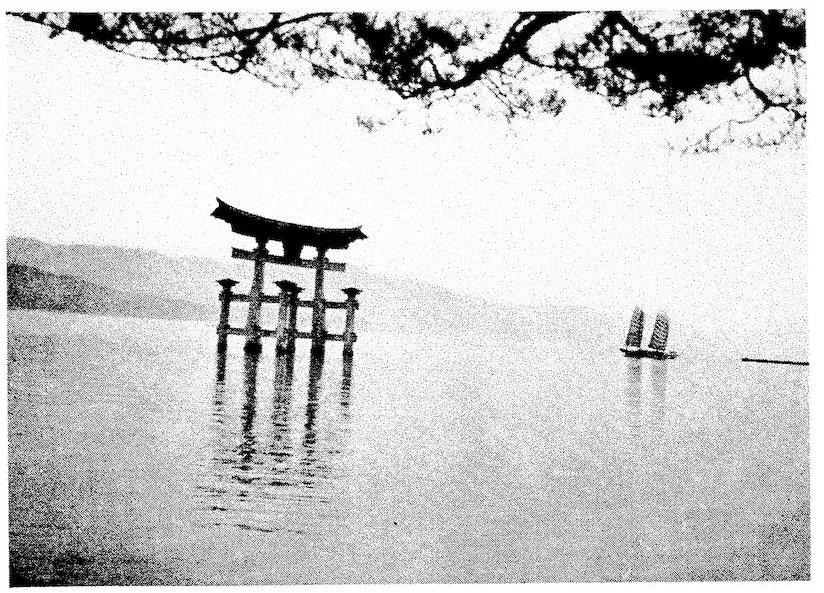
trees and caves and shrines on it; that Miyajima
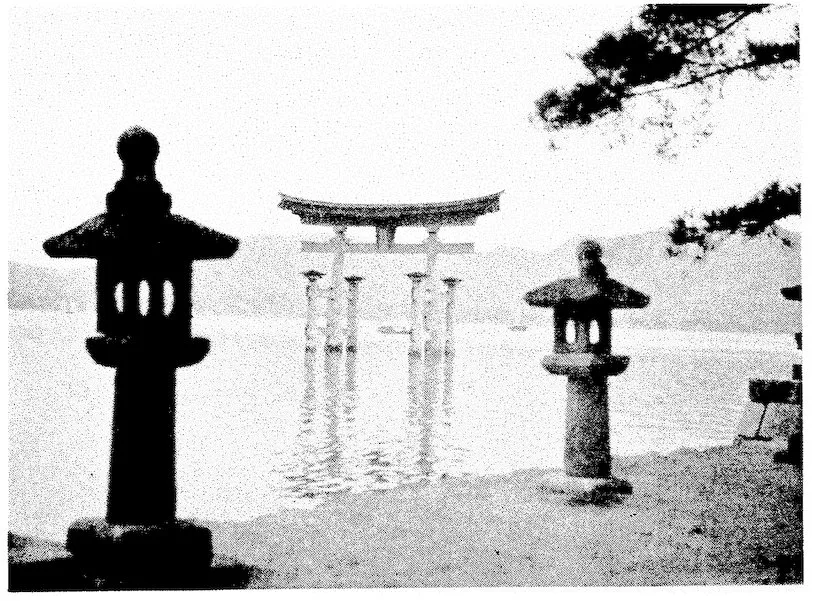
really consists of a single torii picturesquely set only
partly above high tide—and of absurdly high prices
for unpleasing accommodations; that many a sea-flanked
strip of sand, viewed undignifiedly through
the outspread legs, is as genuine a “bridge of
heaven” as Ama-no-hashidate.
Yet to say that and cease would be to leave the
falsest of impressions. A wrathful Englishman we
ran across within the shadow of the giant Buddha
of Kamakura voiced the conviction, born of a two
months’ commercial struggle with its often exasperating
people, that “Japan is nothing more than camouflage,
clever publicity, the deliberate spreading
abroad of false notions.” In certain moods it would
be easy to agree with him. With the exception of
France, and perhaps of Italy, Japan is, partly by
chance, partly by design, the most advertised country
on the globe; and much preinformation leads inevitably
to swollen anticipations. But once the heat
of experience has shrunk these to normal size, once
the traveler realizes that it is delicacy of detail which
he must look for, that intensive cultivation of all
they have is natural, almost inevitable to the crowding
people of this constricted island nation, his disappointment
15will lessen, perhaps disappear. It is
surely to his credit rather than otherwise that the
little brown Nihon-jin makes the most of his opportunities,
and not particularly reprehensible to
have sung, or caused to be sung, to the world praises
of what to him are beloved and genuinely peerless
scenes. For the Japanese truly and frankly loves
the beauties of nature. He has a scenery-worship
as well as an ancestor-worship, and his lack, in the
great majority of cases, of a point of comparison
sometimes leads to the veritable adoration of places,
scenes, and vistas which for the world at large are
commonplace. At his worst he is an improvement
upon those of some other lands who spend their
energies in decrying the paucity of attractions in
their native habitat, treating nothing as worthy of
enthusiasm that is not separated from them by sea
or frontier. And, when all is said and done; if even
the mammoth outdoor Buddha looked absurdly small
in comparison with its world-wide fame, and the
canal-boat trip through a tunneled mountain proved a
school-boy’s wonder; whatever else Japanese may
seem petty and overdrawn, there is always Fujiyama—except
on those many days of the year when he
chooses to veil his peerless face in the clouds.
IV
16
One need not go to the records of her patent-office
to confirm the wide-spread impression
that the Japanese mainly imitate. Merely to skim
through one of the phrase-books so carefully compiled
to give the casual traveler all the words and
phrases except those he will really need is to unearth
ample evidence on this score. Philologically speaking,
if one may convict on such slight testimony, the
Japanese language is visibly a hodgepodge, a potpourri,
an ollo podrida; in other words, a mess. I
cannot carry the curious reader back to their gleanings
from the Malaysian fields from which perhaps
they sprang, from the Yemishi, or “hairy Ainu,”
whose place in the sun they usurped, nor yet do more
than repeat the common knowledge that they fish new
words from the Chinese classics far more freely than
we of the West help ourselves to a needed tidbit of
Latin or Greek. But their later history can be
sketched with a handful of words chosen almost at
random from one of these simple vocabularies-for-travelers,
words which bring back to mind the days
when the Portuguese, the Dutch, then the English-speaking
races, and finally, in restricted fields, the
Germans and the French spread out linguistic displays
for their choosing.
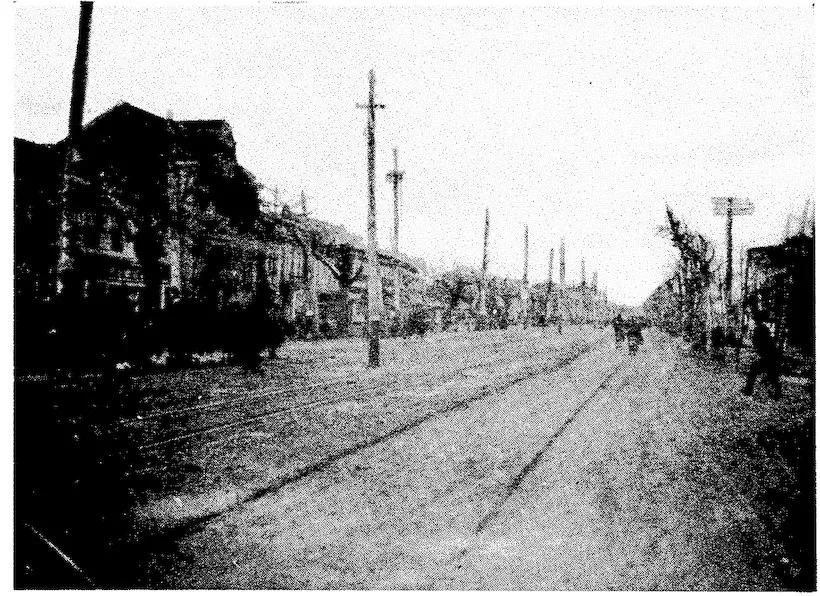
The American-like main street of Sapporo, capital of Hokkaido, the northernmost island of Japan proper
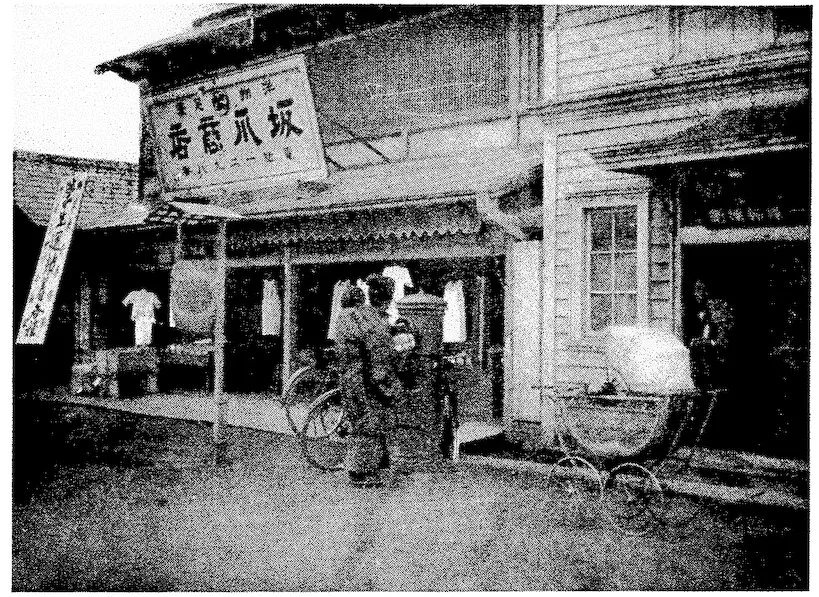
A street-lamp, a mail-box, and an American-copied baby-carriage before a shop of Sapporo
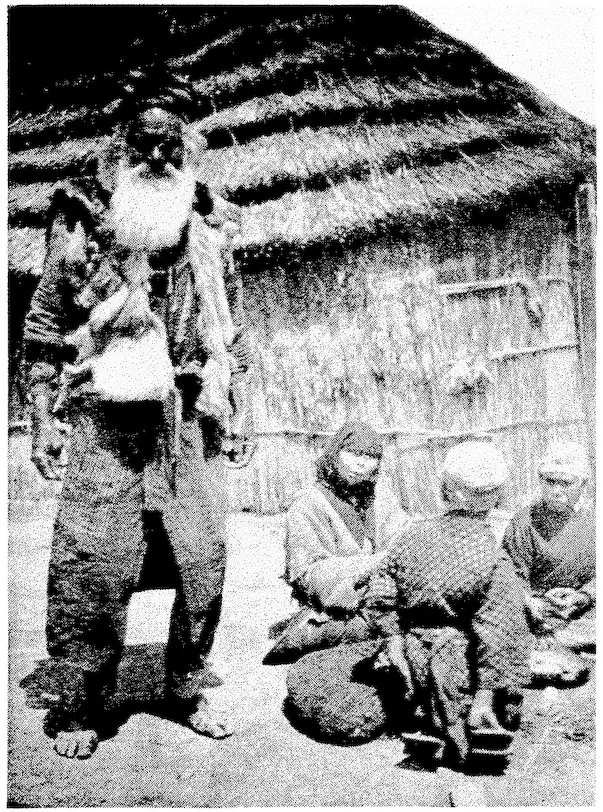
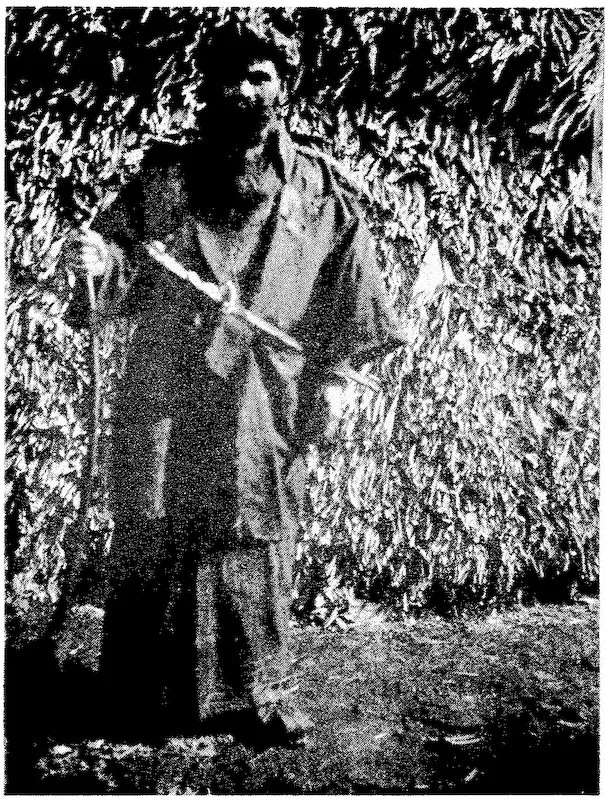
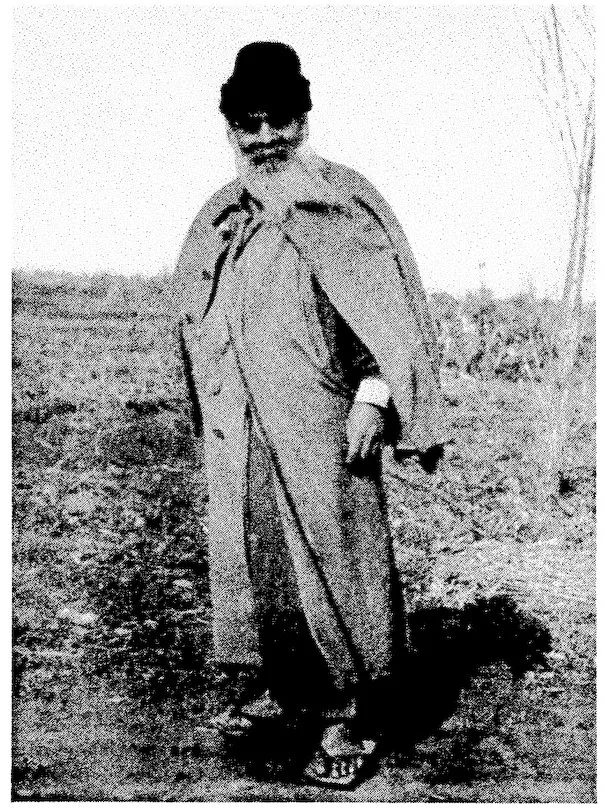
The old Ainu chief who threatened to crown me with a plow
The younger Ainu chief of another village, in ceremonial garb
17Could, for example, a fat volume on “Japanese
Cleanliness through the Ages” say more than does
the fact that their word for “soap” is “shabon”? The
Portuguese brought it, of course, and they did not
“discover” Japan for the Western world until exactly
half a century after Columbus sighted the West
Indies. To this day “pan” remains the Japanese
word for “bread”—or for the horrible dough-balls
which their semi-Europeanized cooks occasionally
perpetrate. If the Lusitanians brought them the
Western substitute for rice, they were repaid by
carrying back tea, which in the Portuguese tongue is
to this day known by the Japanese—or Chinese—word
“cha.” Reminders of the two and a half centuries
during which a dozen Dutch traders, imprisoned
on a little swampy island in their westernmost
port, were the only white men permitted to
come into contact with the Nipponese are still scattered
through the speech of the masses. The children
of Nagasaki still call Europeans indiscriminately
“Orando-san” (Mr. Hollander); it would probably
be unearthing no scandal to conclude that the tabako
and beeru so generously stocked throughout the
island empire came from the same source. At length
came the Americans, and the English, with their
ships and railways, and all the complicated paraphernalia
of modern civilization—and one inquires
18one’s way to the suteishon, perhaps to ask the uniformed
coolie who is lighting a rampu there for a
matchi with which to incinerate one of the miserable
maki-tabako inflicted upon its people by the Japanese
Imperial Government Tobacco Monopoly.
It is a rare Japanese even to-day who uses a
hankechi in place of a wad of soft native paper; and
though aisukuriimu now and then offers to minister
to a parched and dusty throat, it may be better on
the whole to await one’s return to Philadelphia. The
letter l is for the Japanese tongue the greatest stumbling-block
in Western speech; hence one is warned
that predatory mosquitos may cause marariya, that
the train is about to enter a tunneru, that there is not
a hoteru in town, but only Japanese inns. Newboys
occasionally announce their ability to supply the
“Mairu” as well as the “Taimusu”; in the first- and
second-class waiting-room of important stations may
be found, in a cover with large embossed gold letters,
the “REGURATIONS” of the Imperial Government
Railways.
German, say those who should know, is sometimes
heard in barracks and on drill-field, localities
with no welcoming smile for the foreigner, and here
and there it has left its impress upon the schoolroom;
but the casual traveler will be more likely to
run across it in the realms of physicians and druggists,
should misfortune turn his attention thither.
In a land where virtually all others interested in attracting
19a foreign clientele announce themselves in
what purports at least to be English, the native leech
with the excuse for his presumption of a visit to
Germany, or of a Berlin correspondent, calls himself
a “Praktische Artz” and his establishment an
“AugenundohrenheilAnstalt.”
When the desk-man of a Japanese inn comes to
obliterate his legs and bow his head on the more or
less spotless matting of the room assigned you and
discovers to his horror that you cannot write—in
the crippled hieroglyphics with which he is familiar—the
information demanded by the ever-inquisitive
police, he still declines to believe that the printed
questions on the tissue-paper register in his hand are
worse than Greek to you. Many a time I have had a
hotel “boy” give up hope of making me understand
some verbal remark, only to see him triumphantly
jot it down for me in his irrational ideographs, or invisibly
write it with a finger on his open palm. A
Chinese or Korean would no more catch the meaning
of his spoken word than I, but they would almost
certainly recognize its conventionalized picture;
therefore why should not also this other gwai-koku-jin,
or “outside-country man”? A roughly
drawn square means a mouth or opening, an entrance
or an exit, to all three races, though their
respective verbal terms for it may be utterly devoid
of similarity—merely to mention one example among
thousands.
20Travelers in at least as good a position as I to
know have reported the Japanese excellent linguists.
My own brief experience implies quite the contrary.
The study of English is obligatory in the higher
schools, yet I have rarely found even a square-capped,
beskirted university student capable of understanding
three consecutive words of my native
tongue, or of comprehensively pronouncing half a
dozen nouns. I looked in vain for any improvement
in this respect since I first wandered through Japan
a score of years ago. If there is any, it is among
the higher officials of those government departments
or large industrial enterprises where it is indispensable,
and with whom the average traveler rarely
comes in contact. Among the rank and file, even
of the educated, with mild exceptions in favor of
what were once treaty-ports, there are now and
then unexpected oases of comprehension, but almost
never anything dependable. I am quite ready
to admit myself in error, but I carried away the impression
that the average American school-boy retains
more French or German from a two-year
course than does the newly graduated Japanese youth
from his five or six years of English.
The comparison is, I hasten to admit, not entirely
fair. An Oriental language is far more widely
separated from our own than is any of the important
tongues of Europe. If the Japanese student struggling
with English finds his way beset with as great
21difficulties as I found mine in attempting to piece together
a minimum vocabulary of Japanese, it is small
wonder if he loses heart. Probably he is as much dismayed
by the incredible brevity of our tongue as we
are by the redundant elaboration of his. To be informed
that our brief “I” becomes in Japanese watakushiwa
is likely to be even more disheartening than
the mere necessity of turning one’s thinking topsyturvy
and attempting to assert that “Watakushi no
tsuma wa hoteru no Shimonoseki ni des-ka”—“Me
of dishonorable wife in the nominative case hotel of
Shimonoseki in is question mark.” For like some
other Orientals the Japanese have the charming
custom of pronouncing their grammatical distinctions
and quotation-marks along with the rest of the
sentence.
It is partly their policy of “Japan for the Japanese”
that makes them so backward in speaking a tongue
which they strive so assiduously to teach themselves,
for though they constantly emphasize the necessity of
knowing the most wide-spread Occidental language
they refuse to hire more than a handful of foreign
teachers. The teaching of English is, with almost
negligible exceptions, left to natives who could not,
though starvation stared them in the face, make
themselves understood in a New York quick lunchroom.
For one thing English or American teachers
demand several times the pittance paid Japanese
pedagogues—Lafcadio Hearn is not the only man
22to learn that the granting of Japanese citizenship
reduces the beneficiary to the Japanese scale of
salaries—with the army and navy eating the lion’s
share of the national revenues. Strange as it may
seem, too, bashfulness is a noticeable Japanese
characteristic, though in groups and in predicaments
where no one speaks English the difficulty is made
several times worse by many thinking they can.
However, I must admit that I wandered over all
Japan, from the primeval forests of the thinly inhabited
north island to the southernmost town of
Formosa, on nothing but a faulty phrase-book, more
than once passing a full week without meeting a fellow-Caucasian,
yet saw and procured all there was
to see or procure which was worth a little persistence.
But it was not always a simple task. The
Japanese lack completely that quickness of comprehension
under difficulties which flowers best perhaps
in Spanish-speaking peoples. Pronounce the
commonest of his words a score of times, and if your
pronunciation is in the slightest degree faulty he
will stare blankly at you until doomsday. His own
speech being utterly devoid of gestures, those simple
motions which carry the tongue-tied traveler far in
many another country convey to him no meaning
whatever. Pick up an egg and a frying-pan, pretend
to break the former into the latter, light a match
under it, and make the elsewhere universal sign for
eating by feigning mastication, and you will unquestionably
23succeed in gathering the entire village
as an amazed and intently amused audience to your
strange outlandish antics, but under no circumstances
will a single bystander guess that you harbor an innate
desire to partake of a pair of fried eggs. This
characteristic is so ingrained that all the pointing
in the world will never call the attention of your
auditor to the near-by object you are attempting to
indicate, though it may cause him and the throng
which quickly gathers behind him to examine with
meticulous care your outstretched finger. The kingpin
of all possible misunderstandings in attempting
to wrestle with this more than alien tongue, however,
is the difficulty of distinguishing “yes” from
“no.” Ask your waiter, “Is there no bread?”—or
shall I play upon the popularity of the day and say
“bananas”?—and his violent nodding of the head,
accompanied by a very positive “Hai!” which the
phrase-book translates as “Yes,” may cause you to
wait long in vain before you discover that what he
really meant was, “Yes, you are perfectly right;
there is no bread.”
V
24
My impression that Japan is only a little country
after all somewhat evaporated during a
visit to its slightly known northern island. This was
no doubt partly due to the almost Oriental leisureliness
of Japanese trains, and it is perhaps as much the
long day’s ride from Tokyo to the northern end of
the main island as the uninviting aspect of the
steamers which set one across to Hokkaido that
causes the overwhelming majority of visitors to
confine themselves to the well-beaten track from
Nikko to Nagasaki and miss a region amply worth
while.
Beyond beautiful Volcano Bay with its smoking
cones lies quite another Japan, inconspicuous on the
world map yet of a surprising vastness. Hakodate,
the chief landing-place, burdened with that silly Japanese
rule forbidding photography within modern
cannon-shot of fortifications which the most slow-witted
of spies could easily find some other means
of picturing, calls for nothing more than the unavoidable
halt of an hour or two. But on the long
day’s journey northward from there to Sapporo
one’s coming is already rewarded. Though May will
25soon be half gone, it is cold enough for an overcoat,
and the Imperial Government Railways are still
heating their trains. Low huts, with heavily
thatched or rusty-tin roofs, held down by scores of
stones that testify to the occasional violence of
storms, hug the ground closely, in a way unknown in
the main island. Instead of rice-fields, the rich black
soil is given over mainly to corn and potatoes, corn
shocked as it is in the United States, as weatherbeaten
cones of it that have stood through the long,
arduous winter still testify. Now and again the
train rumbles for an hour or more along the very
edge of this or that magnificent bay, through collections
of miserable huts, with thatched fishing-boats
and millions of herring split in two and hung on
lines to dry in the sun, and millions more in heaps
and bales ready for shipment. There is a genuine
Japanese atmosphere, not to say scent, about these
clusters of toilsome poverty, though certainly there
is little of that cleanliness which the mind habitually
associates with the Japanese.
But these familiar touches, like the rare glimpse
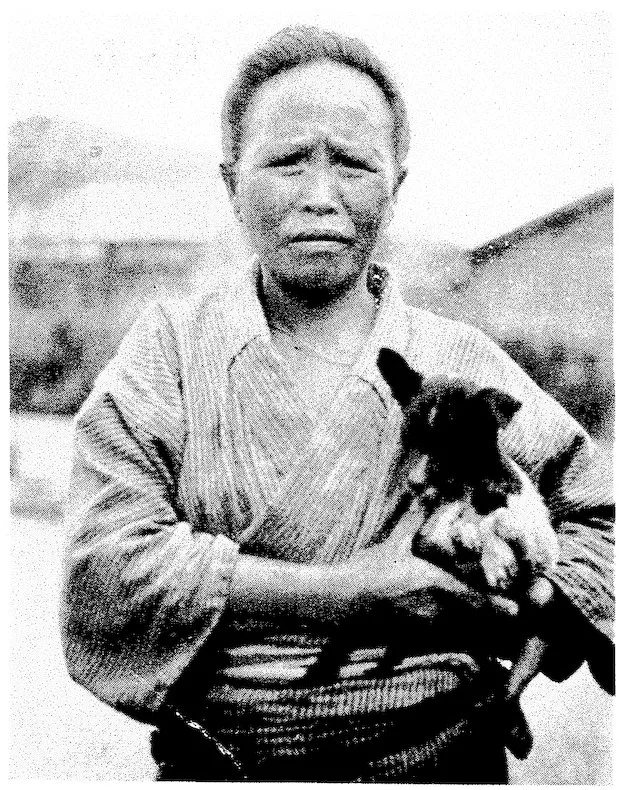
of an aged wife with unsightly blackened teeth, are
merely the reminders of the old well-known Japan
which give contrast to the real Hokkaido. New England
landscapes of hills, then low mountains dabbled
with snow, finally big white patches beside and below
the track, succeed one another as the train
struggles inland. At length come rugged, snowcovered
26peaks rising into the clouds; before long all
the mountains in view, more than can be counted
on the fingers of both hands, are blanketed with
snow, great fields of which lie in the hollows far
below us. Yet, as I have already said, May was well
along. It required a distinct mental effort to keep
in mind that this was still Japan.
Lower down again there was a profusion of wild
flowers, though the buds did not seem so far advanced
as they are along our northern border on the
same date. There came whole hours of primeval
forest, with at most a rare patch of clearing, then
broad vistas of charred stumps and the primitive conditions
that go with them, finally some square-cut
cultivated fields, but these only in the dead-flat
lands, as if there were far too much room available
to trouble with hilly ground. On the whole, the
fields, though still small to the American eye, were
ten times the size of those of Japan’s main island.
Also there was much plowing with shaggy horses, instead
of mud-wading men and women with hoes,
goodly herds of cattle grazing here and there—in
short, a landscape in which a rural American from
our Northern States would have felt almost at home.
Yezo, as the island which the Japanese, for some
political reason, have renamed Hokkaido is still best
known to the outside world, has never kept pace with
the rest of Japan. Though the primitive Ainus were
reduced to serfdom at least a dozen centuries ago,
27the north island was an almost unknown wilderness
even when the Japanese resumed their intercourse
with the outside world in the middle of the last century.
A plan to make it an independent fief of the
crumbling Tokugawa shogunate at the time of the
imperial restoration having been bloodily upset a
year later, various schemes of government under an
executive appointed from Tokyo finally crystallized
in 1886 in an independent administration, with Sapporo
as the capital. To the already American aspect
of the landscape were added, through the initiative
of the first governor, charged with the task of
colonizing the island, a group of American agricultural
experts, who brought with them machinery,
seeds, trees, and other aids of a similar nature. To-day
Hokkaido produces, for instance, an ample supply
of American apples for all Japan—and incoming
travelers must hand over to courteous but stern custom
officials the last remnants of this fruit in their
possession, though a case of oranges or a month’s
supply of raisins pass duty-free.
It was these same American experts who laid out
the capital, Sapporo, thereby wholly depriving it
of the picturesqueness of genuine Japanese towns
and giving it the spaciousness, convenience, and
solidity of an American city. Its wide, squarely intersecting
streets—a hundred and sixty feet from
wall to wall, if you must have statistics—have not
merely sidewalks but rows of trees to delimit them
28from the roadway that is the common battle-ground
of pedestrians and vehicles in the rest of Japan.
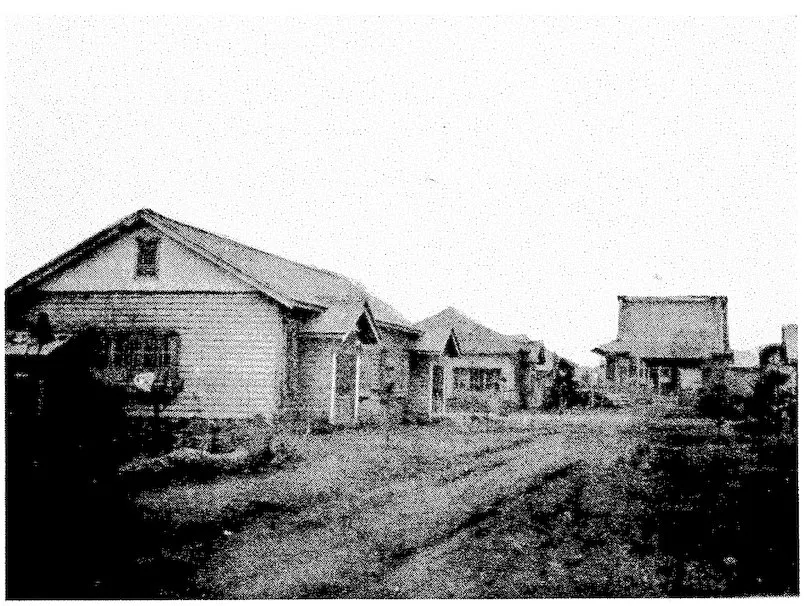
Lawns and lawn-mowers, men shingling the roofs
of clapboard houses, even government barracks built
in similar fashion, elms and maples in lieu of the
rugged and distinctive Japanese pine-tree, the big
campus of an agricultural college copied after that
of Massachusetts, with a snow-capped mountain
background to its broad baseball, track, and tennis
field, are but a few of the reminders of Sapporo’s
origin. Even the women have almost abandoned the
elaborate and costly coiffure of their southern sisters,
and dress their hair in American fashion. Paper
walls are all but unknown; baby-carriages—but what
gain are these in a land where children come so thick
and fast that every perambulator seems to hold
twins, to be indeed evidently designed for them,
while a still later arrival dozes on the propeller’s
back? With its big fruit-stores, its self-sufficient,
well-supplied people, an extent seeming to belie its
mere half-century of age, Sapporo looks almost a
transplanted bit of our own land, for all the rickshaws
racing noiselessly through its wide streets and
notwithstanding some of the unfortunately still Japanese
personal habits of many of its inhabitants—and
by the same token it does not, of course, offer the
mere traveler a tithe of the interest of almost any
village of the real Japan.
Beyond Sapporo lies nearly the whole island, wonderful
29plains of black loam soil almost as flat as our
prairies, now stretching from the distant sea on one
hand to faintly delimned ranges of snow-capped
mountains on the other, now filling some vast basin
between whitened rival ramparts which merge in
either direction into the horizon. The great valleys
now and again pinched out between brown hills
littered with charred stumps, growing gradually into
heavily wooded mountains, with many a snow-capped
peak more massive and well nigh as symmetrical as
Fujiyama itself, yet thus far doomed to fameless
isolation. Big rivers brought down thousands of
fresh-cut logs, whole acres of which gathered in
placid back-waters. But the fertile plains always
soon came again, now with wigwam-like stacks of
hop-poles recalling Bavaria in spring,—Sapporo
beer is famous throughout Japan,—now mile after
mile of fields completely flooded, though plainly not
destined for rice, with plowing horses and their
drivers wading thigh-deep in the cold mud and
water. It was a land like the richest sections of
Illinois or Kansas; yet gangs of women were piling
up great logs, a score of them supplied the motive-power
of a primitive, singsong pile-driver, and half-starved
fisher-folk still battle for existence along the
coast. It seemed as if the few inhabitants, accustomed
for countless generations to the crowded
struggle for existence farther south, were mentally
incapable of taking advantage of the wide and fertile
30opportunities all about them, of casting out the centuries-old
sense of inequality they brought with them
and enjoying the fulsome prosperity of ample elbow-room.
There are signs everywhere that the Japanese
Government is doing its best to turn Hokkaido into
a cleared and settled land. A hundred telegraph
or telephone wires, on half a dozen rows of posts,
parallel the track, not to mention an important power
line; pine, or at least evergreen, nurseries cover a
sloping hillside here and there; much forest has recently
been denuded and burned, with somewhat less
wasteful methods than those in vogue before the
spreading sugar-fields of Cuba. But of all the
obstacles its people set against the laborious efforts
of the Government more nearly to equalize the density
of population of this great north island with
the rest of the empire, the dread of battling with the
rigorous climate stands first. The man of Japan is
not on the whole adaptable. He hesitates at the
limits of heat and cold to which his frail type of
architecture and his thin, flowing garb are unfitted;
he is, by temperament, no pioneer, but resembles
those militant birds that prefer to settle down in the
warm, well-feathered nest built by some other species.
If he goes to a new and undeveloped land, it is, by
choice, as an economic hanger-on, as shopkeeper or
official, rather than to do his share in the rude labor
of reducing the primitive to the cultivated. No one,
31I believe, has ever accused the Japanese of laziness;
it seems to be rather his inherent dread of the primeval,
of great unpeopled spaces, that leaves Hokkaido,
large and fertile enough to support in unaccustomed
style a third of the people of all Japan,
with a scattered population barely one fifth that of
the city of Tokyo.
VI
32
But things are progressing, if slowly, in the
general direction of official desires. Asahigawa,
for example, north of the geographical center
of the island, in what was at the beginning of the
present century an unpeopled wilderness, is already a
“whale of a town,” spreading for miles across the
floor of a splendid valley, with a great row of snow-clads
all along its far eastern horizon. There is
scarcely a typical Japanese building in it, only a
Shinto shrine or two, hardly a shoji or a tiled roof.
Yet the spirit of Japan has in no way been lost in the
transplanting. That courteous yet subtle something
which tells the foreigner that he is welcome as a
visitor but as nothing more, that seldom spoken yet
ever-sensed insistence on “Japan for the Japanese,”
are as evident here as in the most crowded portions
of the main island.
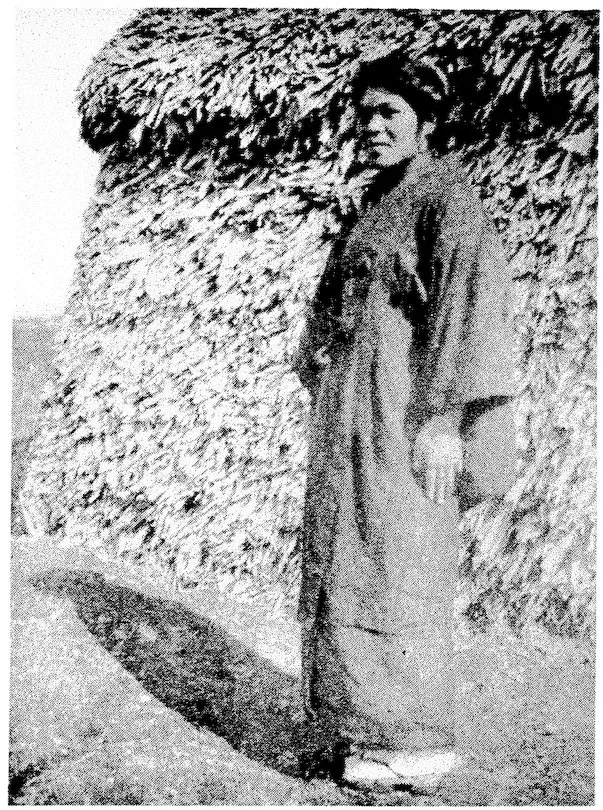
An Ainu who has come into close contact with Japanese civilization
An Ainu girl of the younger, unmustached generation
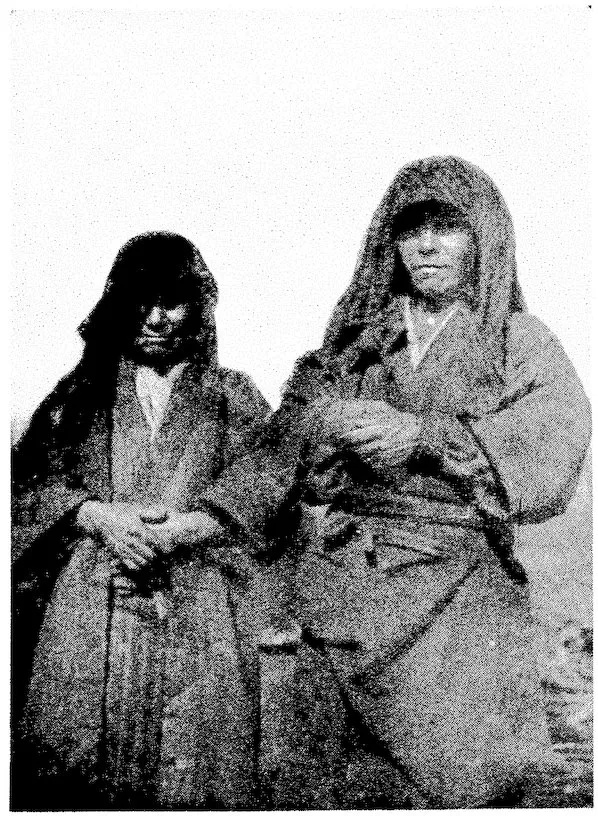
The older Ainu women of the primitive tribe of northern Japan have flaring blue tattooed mustaches—but they are almost invisible to the camera
Preparing to propitiate the gods, and the neighbors, in favor of a new building in Hokkaido, where religious custom remains even if architecture changes; this ceremony seems always to take place at sunset
Surely, too, the public ceremonies I chanced upon
were strictly national. It seemed to be dedication
day for new buildings, a propitious phase of the
moon perhaps; and at least half a dozen unfinished
structures scattered about the town, still in their
two-by-four skeleton form, were preparing to receive
33the blessings of the gods. The gangs of carpenters
simultaneously left off toward five in the afternoon
the work of erecting and took to raising instead,
with a plethora of amateur assistance, various symbolic
contrivances at the tops of the structures. First
to be placed were five big upright banners, respectively
red, saffron, white, green, and purple in
color. Then there arose a central support bearing
a small mirror—unfailing symbol of Shintoism—and
a fantastically misshapen doll god in a red bib.
A rude platform having been laid across the joist
high up under this improvised chapel, and various
other minor preparations being concluded, there
gingerly ascended the sagging ladder a Shinto—priest,
I suppose we must call him, for want of a
more exact term. His shaven head, topped by a sort
of mitered cap from which undulated what seemed
to be the old Tokugawa head-dress, its projecting
tail-like afterpiece apparently made of window-screening,
his brilliant green robe and purple sash,
and variegated minor decorative paraphernalia, gave
him an appearance strikingly out of keeping with the
generally matter-of-fact Asahigawa style of architecture
and costume. It was much as if an actor in a
Shakspere rôle had suddenly emerged in full costume
among a Broadway crowd.
While the owner of the new structure and a dozen
of his assistants or male relatives sat down on their
heels along the improvised platform, high above the
34increasing throng in the street below, the Shinto
functionary set up beneath the banners several little
conventionalized houses or shrines of baked clay. Of
the numerous antics in which he indulged during the
succeeding half-hour the most conspicuous was the
frenzied shaking of one of those bundles of white
paper strips on a handle, like a feather-duster or
fly-dislodger, that abound in Shinto shrines, apparently
for the purpose of driving off the host of evil
spirits which might menace the new building. Finally
he sprinkled everything and every one within
reach with a sprig of pine branch dipped in a bowl of
what may have been mere water, but which more
probably was sake, the rice wine of Japan. With
that his fee seemed to be earned, though he remained
long enough to grace the beginning of the last act of
the ceremony before speeding away in a rickshaw to
the next skeleton structure in need of his administrations.
The now large and jostling throng in the street
below was plainly, and quite naturally, most interested
in the final formality. From his point of
vantage high above, the now broadly smiling proprietor
held up a wooden ticket, made a speech which
the crowd applauded with increasing evidence of
pleasure and approval, then flung the token to the
multitude. My subsequent discovery that it was exchangeable
for a silk kimono accounted for the applause
and the wild scramble for its possession that
35forthwith took place in the dust-deep street. Various
less valuable and more perishable gifts followed,
after which came a deluge of presents for every one.
All the men on the platform began tearing open
veritable bales of bonbons, those heavy white dough-balls
inclosing a sort of jam, which take the place of
candy in Japan, and took to flinging them in great
handfuls in all directions. Fully a quarter of an
hour the bombardment lasted, the several hundred
townsmen of both sexes, of every age and social
standing, engaging in a good-natured but riotous
battle for possession of the tidbits. The purpose
evidently was to make sure that every person within
sight received a present, that he might vouchsafe the
new building his blessing or good will, for when I
showed no eagerness to engage in the scramble, one
of the flingers made it his special task to throw bonbons
at me until I had accepted one. The “housing
crisis” is as acute in Japan as in the rest of the
civilized world. If the country has no grafting contractors
and labor-leaders—and rumor says it has—there
seems to be at least the appreciable obstacle of
dispensing in religious fees and community gifts a
sum about equal to the cost of each unboarded building.
VII
36
The chief interest of the average casual visitor
to Japan’s north island is, no doubt, in the remnants
of its primitive people, the “hairy Ainu.” A
cluster of them dwell in the outskirts of Asahigawa;
there are scattered Ainu villages along the farther
reaches of the Hokkaido coast, and here and there in
the forested mountains. Subservient now to their
conquerors as are our own Indians, their customs and
even their language have taken on many things from
the Japanese. In theory the mikado’s Government
acts the rôle of altruistic guardian over the scanty
twenty thousand of these aborigines which its records
claim still survive, in Yezo, in the scattered
Kuriles, and in the Japanese half of the once Russian
island of Karafuto, or Saghalien, still farther north.
There are no cases listed, however, of these helpless
wards’ amassing pianos and automobiles from natural
resources discovered on their reservations.
Driven, if admittedly faulty historical records be accepted
as veracious evidence, from their once solid
foothold on the main island of Japan to the nooks
and crannies of its frigid neighbors during the more
than twenty-five centuries since their slant-eyed foes
came upon them from somewhere to the south, the
Ainus have lost completely their former rugged
power of physical resistance to such aggression.
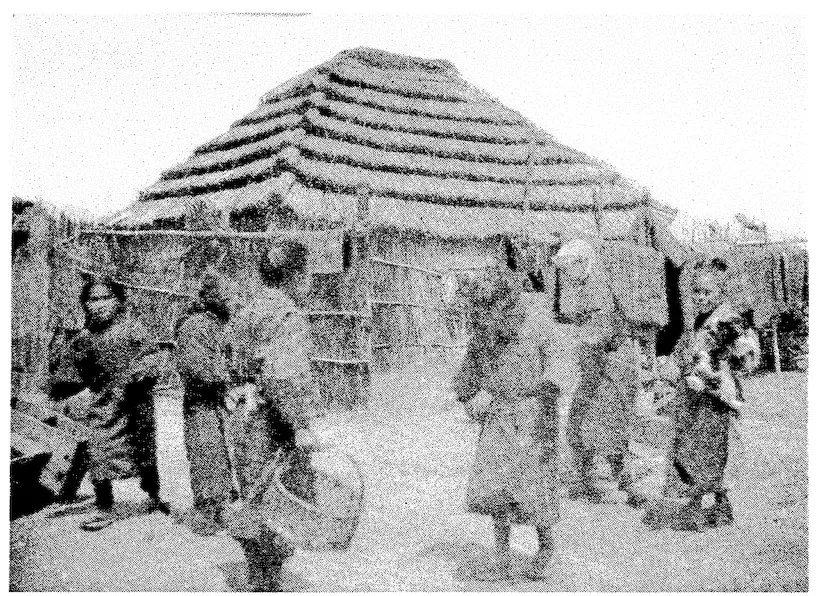
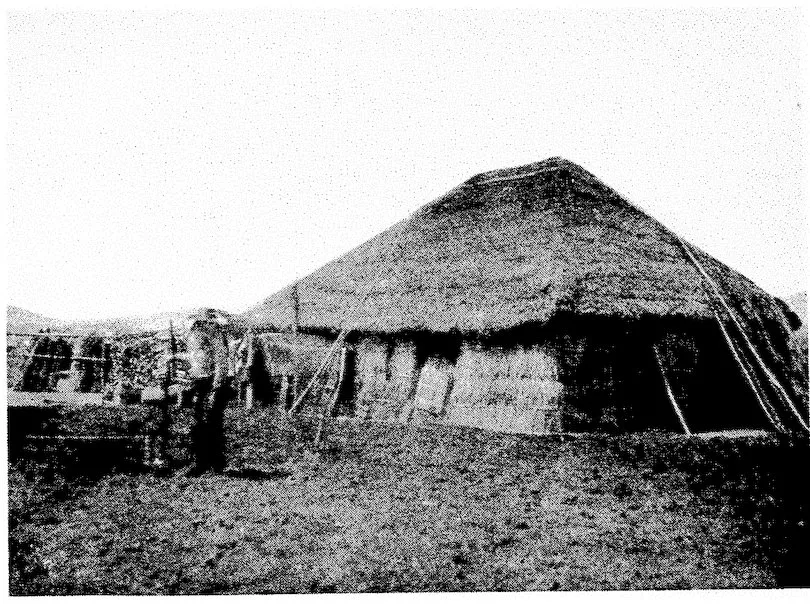
A typical Ainu hut—and kodak-shy Ainu children scrambling for coppers
In the American-like north island of Japan a Shinto shrine or a Buddhist temple here and there is almost the only touch of Oriental architecture
An Ainu working in his front garden
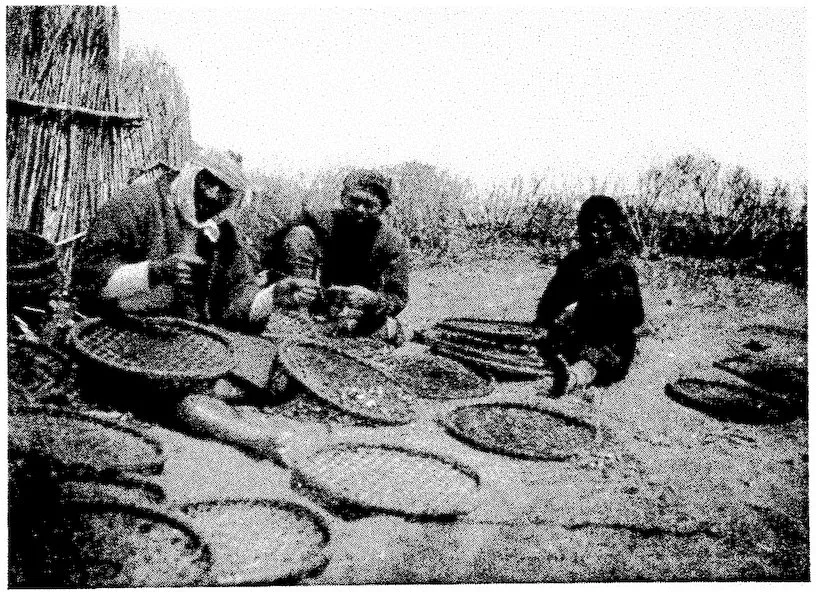
Ainus mending their fishing utensils
37The experienced traveler gradually learns that
outward appearances are often deceitful; hence there
is perhaps no proof of anything in the fact that the
Ainu, even the defeated dregs of the race which survive
to-day, are much handsomer specimens of the
human family, at least to Western eyes, than their
conquerors. The women, to be sure, are mainly slatterns,
as is so often the case among primitive peoples,
particularly those under the domination of what we
fondly call civilization. But it was hard to realize
that these sturdy, upstanding men, not merely more
powerful but far more comely than the average
Japanese, are little more than children in intellect.
What seems to have been a sincere effort to educate
a picked group of Ainu youths in Tokyo ended with
an even more sudden relapse into savagery than was
ever the case with our Indian-school graduates.
Such Ainu villages as I visited were outwardly
distinguished mainly by the superimposed layers,
like incredibly thick rows of shingles, of the thatch
covering their roofs; that and earth floors, rubbish
heaps, and a generally un-Japanese shiftlessness.
Their clothing has almost completely succumbed to
Japanese, or Japanese-Western, influence, even to
the greater or less absence thereof on what, to Occidental
races, would be embarrassing occasions. The
38features are blunt, the nose almost as negroid as that
of lower-class Nipponese, but the eyes are unslanted
and full-lidded, quite as we of the West expect eyes
to be. As to their far-famed “hairiness,” the older
men, to be sure, have patriarchal beards—the
younger, disliking perhaps the notoriety which this
feature has brought upon the race, are commonly
smooth-shaven—and their sturdy bare arms and legs
are generously adorned with black hair. But I have
seen as goodly displays in American gymnasiums,
and it is mainly their contrast to the effeminate-skinned
Japanese that has given them their reputation
for undue hirsute adornment. The children of
Japan, in fact, and even uncultivated adults in their
naughty moods, often greet any visitor of Caucasian
race with the contemptuous term “keto-jin,” or
“hairy foreigner.”
It is not the beards of the men but the magnificent
mustaches of the women that will surprise the
average traveler. It has long been the Ainu custom,
now somewhat dying out, to begin decorating early
in life the upper lip of the girls with a crude tattooing
of what seems to be kitchen soot, treated later with
some native concoction which gives it a bluish tint,
so that by the time her early marriage-day comes the
maid is adorned with a blue mustache having the
flourishing upturned ends cultivated by the Italian
dandy and giving her a dashing air somewhat out of
keeping with her sex and the life of drudgery before
39her. Other decorations of a similar nature are
now and then perpetrated on other parts of the body,
notably a miniature Vandyke on the lower lip. While
the custom may be merely fantastic in youth, it becomes
hideous in old age. Like the young men, the
women who have not yet outlived the sense of shame
seem to resent this most notorious of their features
and can with difficulty be induced to withdraw a corner
of a garment from across their mouths when
facing a stranger or a camera.
The Ainus live mainly by fishing and hunting and
are noted for their valiancy, particularly for the
feat of killing the savage brown bear of Yezo with
a knife, or with bow and arrows. Crude sledges,
scarcely large enough for half-grown children, leaning
against their huts indicate that they are not
house-bound during the long rigorous winters. Some
of the chiefs who can afford it are said still to indulge
in polygamy; the race has plainly a greater dread of
soap and water than of fleas and ancient, fishy
smells; the Ainu’s greatest desire in life is reputed to
be a copious supply of Japanese sake, a craving which
their self-constituted guardians make no frantic efforts
to curb.
I might still have departed from Hokkaido with
a lingering doubt of the inherent savagery of the
Ainu in spite of the wide-spread testimony to the
contrary, but for my last encounter with him. I had
been sauntering for an hour or two about one of his
40villages, stalking for photographs—for a mixture
of superstition and childish cupidity engendered by
hurried, kodak-armed tourists has made the tribe
somewhat camera-shy. A magnificent specimen of
fully adult and hirsute manhood was almost on the
point of falling into my trap when a sound between
a grunt and a shriek from a rather surly boy whom
I had not been able to shake off caused me to glance
around. Down one of the sandy lanes serving as
streets came striding the village chief—for such I
had found him to be shortly after pilfering his likeness
by a simple ruse. Having this already, I had
no special interest in watching his approach, and
turned back to my still uncaptured quarry. Suddenly
I beheld the chief, physically a mighty man still for
all his huge bush of almost snow-white hair and
beard, scowling upon me with his broad nose all but
touching my face and his liquid black eyes blazing.
Exactly what was the cause of his quite evident displeasure
there was no means of knowing, for though
he was speaking voluminously in a voice which any
orator might have envied, it was not even in Japanese,
and no stray word gave me an inkling of the
subject of his discourse.
All at once the notion seemed to strike him that I
had no intention of complying with his wishes, whatever
they were. With a sudden short, shrill scream
which instantly betrayed the savage, he dashed off a
few paces and caught up the first manly weapon
41within reach, which chanced to be nothing more or
less than a complete wooden plow! Raising this
above his head in one powerful hand, he sprang toward
me with a shriek of uncontrolled anger and a
contorted expression of rage such as no doubt scores
of the big brown bears of his native mountains had
beheld during the last moments of their existence.
The part of wisdom, of course, would have been
frankly to take to my heels. But there are few things
more difficult for the average Caucasian than openly
to show fear of an opponent of an admittedly inferior
race, particularly when a score of persons of
that race are peering out through the doors and
walls to behold his discomfiture. Moreover, I was
busily engaged in seeing that my kodak be returned
to its case before serious harm came to it. I stood
where I was, therefore, instinctively turning my back
to catch the expected blow where it would do me the
least damage—and when I looked up again my
howling savage was brandishing the plow over my
head, yet somehow hesitating to bring it down upon
me. The taming influence, no doubt, the forced repression
of centuries of stern Japanese rule, the ability
to glimpse the consequences, with which long generations
of vicarious contact with the ruthless justice
of civilization had tinctured his savage soul, stayed
his hand. Denied the privilege of completely following
his instinct, he was helpless. From the roaring
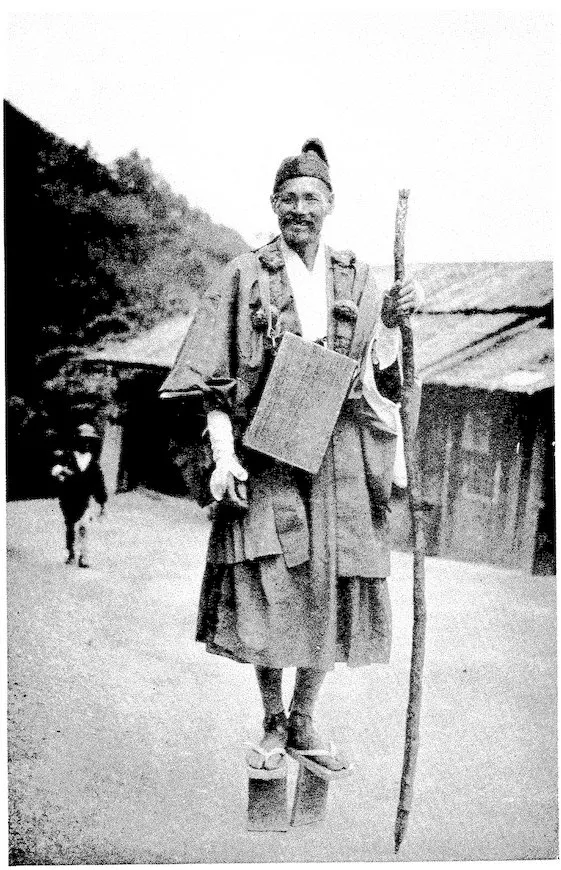
savage he became an angrily shrieking child. The
42plow he still grasped in his mighty right hand, but
its end rested on the ground. With his left he caught
the lapel of my coat in a grip which mere yanking
never would have loosened. But when I gave him
what school-boys of my day called the “thumbtwist,”
he grunted with the sudden, unexpected pain,
released his hold, and, though still bellowing in his
magnificent oratorical voice, watched me walk away
without following.
VIII
43
There is, perhaps, no good reason why the
stranger should be often astounded, rather than
merely amused at the contrasts of Japan. Any nation,
particularly so far removed and individualistic
a nation, hedging itself round for more than two
centuries with a Chinese wall of seclusion, then suddenly
emerging into the sunlight of to-day and making
frantic efforts to overtake its modernized fellows,
could not but present a similar spectacle. Yet
I confess myself still not immune to shocks of this
nature. To stroll from the mammoth wrestling pavilion
of Tokyo, with its wholly un-Occidental pastime,
throng, contestants, point of view, to the
commonplace field a gunshot distant where a group
of Japanese youths in baseball uniforms were defeating
at our national game a similar group from
one of our own universities, was like stepping across
a thousand years of time in a single stride. Side
by side there travel, carouse, and worship men of
whom one seems no farther removed from us either
in garb or mentality than a Frenchman, while the
other might that very moment have stepped forth
from a daimyo’s train in the “Cipangu” of Marco
Polo. In the heathenish interior of an Asakusa temple,
44most popular with the rank and file of all Tokyo’s
myriad places of worship, there pause to toss a copper
coin into the enormous grated hopper, to clap their
hands thrice and call the wandering attention of the
gods to their prayers, even to buy tissue-paper charms
written by a Buddha-faced priest, men in faultless
Broadway attire who have spent the day in modern
offices between telephone and stenographer. Under
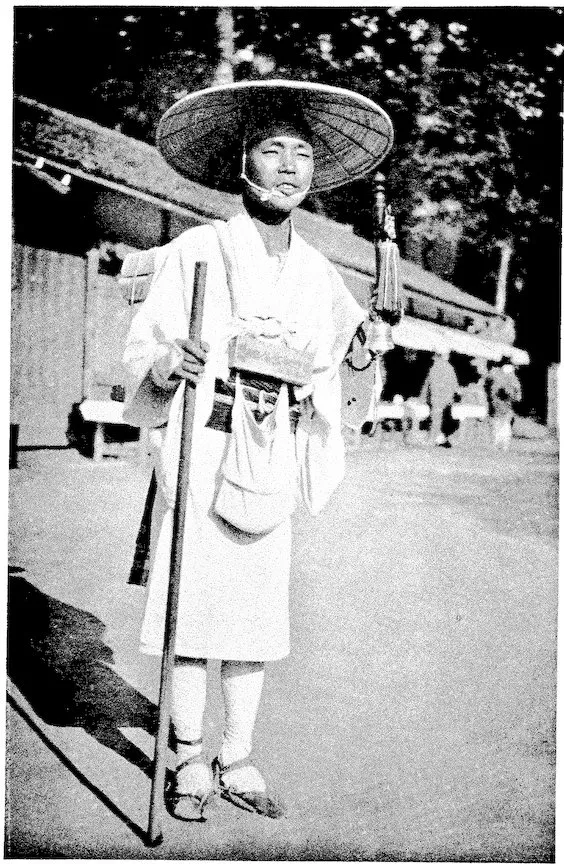
the fantastic garb of a wandering pilgrim, with his
jingling bells and his prayer-written staff, is often
concealed a doctor or a lawyer of Western training,
with perhaps a fluent command of English.
Among the cabin-passengers on the Nippon Yusen
Kaisha liner that brought us across the Pacific was a
brilliant young Japanese who had been teaching the
intricacies of a medical specialty in one of the oldest
and most famous of our universities. Outwardly, at
least, nothing remained of his Orientalism except a
hint of foreign accent in his English, and his telltale
eyes. Even his point of view on matters large
or small seemed that of the American colleagues he
had left behind. On the dock at Yokohama he was
met by his future wife, properly chaperoned, shrinking
subserviently within her modest kimono and
pillow-like obi. The pair bowed solemnly to each
other at some two yards’ distance, he moderately, she
almost to the stone flagging; then as he stalked away
she clattered behind him in her wooden clogs, lugging
his American hand-bag.
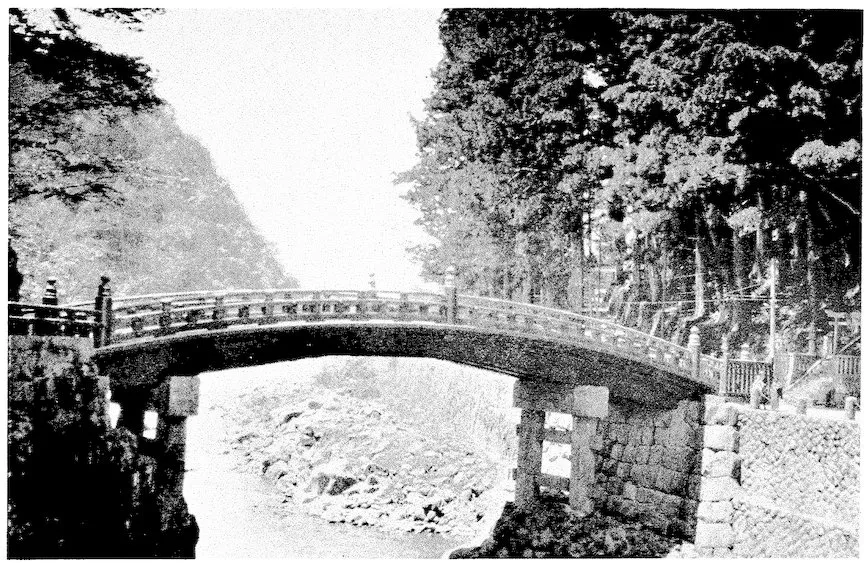
The sacred red lacquer bridge at Nikko
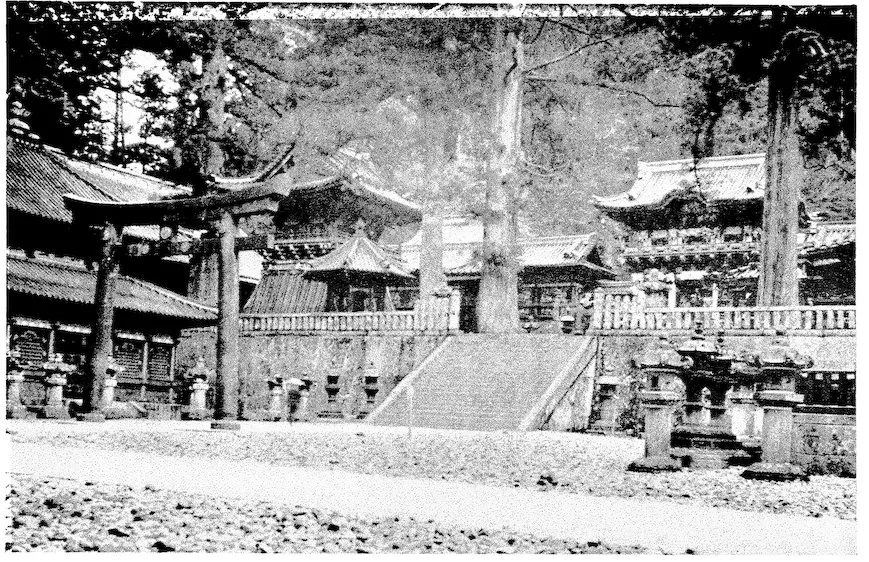
A quiet corner of the temples of Nikko
45Our passage had been enlivened also by a naval
engineer from one of Japan’s great government shipyards,
who was returning from two years of study
and observation among those of America and
Europe. He was to have remained a year longer,
but both his father and his fiancée had suddenly
died. I visited him one day at his home in Tokyo,
one of those frail little houses of the capital set in its
quaint, inevitable garden. His latest European garb
had been altered only by the removal of his shoes;
but an elder sister kowtowed profoundly at his curt,
quick command and hurried away, to prostrate herself
before us on the matted floor a moment later
with a tray of tea and sweetmeats.
He would be going away in a few days, I suggested,
to the naval base to which he was attached?
“As soon as I have arranged my marriage,” he replied.
“But,” I said, “your fiancée is no longer living?”
“Ah, yes, that one died,” he answered, in an expressionless
monotone, “but my sister has picked
out three other girls for me to choose from, and in a
few days I will decide....”
“And the marriage?”
“In about three months, as soon as everything is
prepared. You see, my father having died, I have
become the head of the family, and I must marry
quickly.”
IX
46
Were facetiousness toward so solemn a people
permitted, one might say that the Japanese are
imitators at top rather than at bottom. The nation has
apparently almost no notions of its own in the matter
of head-dress; but certainly no one can accuse it
of copying its footwear from extraneous sources.
Fortunately the “derbies” and “bowlers” which
topped off kimonos and European garb alike a decade
or two ago seem to have passed into the limbo befitting
such eyesores; but the foreign adaptations
that have taken their place are little less incongruous.
A group of Japanese males in their native costume,
to which three out of four of them still cling more
or less unalterably, and wisely, look as if they had
been suddenly beset by a whirlwind in a foreign
land, and had borrowed for the return journey whatever
head coverings their hosts could spare them.
Fedoras, caps, slouchy felts, particularly, now that
summer was spreading northward across the empire,
stiff straw hats, loomed forth on every hand—or
head. Is it because the Restoration caught them with
nothing between the fantastic hair-dress of shoguns
and samurai, still retained in a modified form by
47their hog-fat wrestlers, and the parasol-like sun- and
rain-shades of the peasants, that most of the nation
copies with such poor success our Western styles of
head-dress? Personally I much prefer the bareheaded
tooth-brush pompadour or closely clipped
pates of most boys and of no small number of men
of old-fashioned or indifferent attitude. The distinctly
national feminine coiffure, too, never covered
with anything but a parasol or an umbrella, helps to
save the situation.
The two-toed human biped, reminiscent of the
primitive horse, the cloven-hoofed mortal who shuffles
his way in many millions through the islands of
Japan is, however, unknown in all the rest of the
round world. No other race has had the genius—to
use a polite word—to evolve that cross between a
stocking-foot and a foot-mitten, the great toe separated
from the rest, which rounds off Japanese bare
legs, irrespective of sex. Beneath this may be seen
every manner of makeshift, always gripped by the
independent great toe,—wooden clogs of many
shapes and sizes, getas ranging from flat boards to
veritable stilts that raise the wearer a foot above
the ground in the rainiest muddy weather, matted-topped
sandals of wood, slippers—if a mere sole with
a V-shaped cord as upper may be so called—for
house wear, of a score of different forms and materials,
slippers for the hallways, others for certain
unmentioned chambers, special rubber slippers for the
48bath-room, crude straw waraji for pilgrims and peasants,
worn-out examples of which lie strewn along
any traveled road, varied and special footwear for
every time, place, and occasion.
In the old days when this was all, when man,
woman, or child stepped instinctively in or out of his
multifarious sole-protectors with unhesitating ease,
it was a mere question of knowing the intricate
etiquette of footwear. But now, with Western shoes
wide-spread among the men and making headway
among school-girls, there is often physical labor involved
in the Japanese persistence in his peculiar
footwear habits. At the “semi-European” hostelry
where we sojourned for a week in Kyushu, southernmost
island of Japan proper, the sub-manager laced
or unlaced his shoes thirteen times in showing us our
Japanese quarters. No wonder the island empire
is the favorite dumping-ground for congress gaiters!
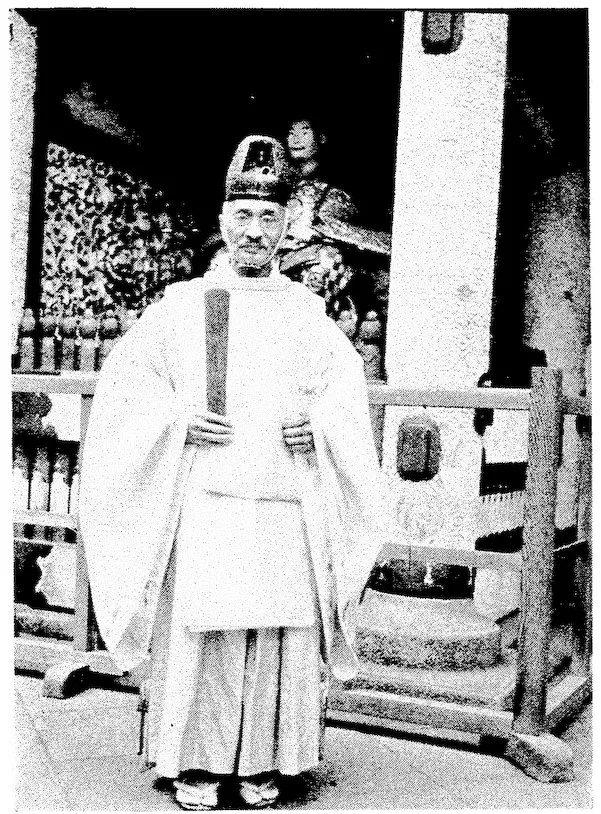
A Shinto priest (if the word fits) of Nikko
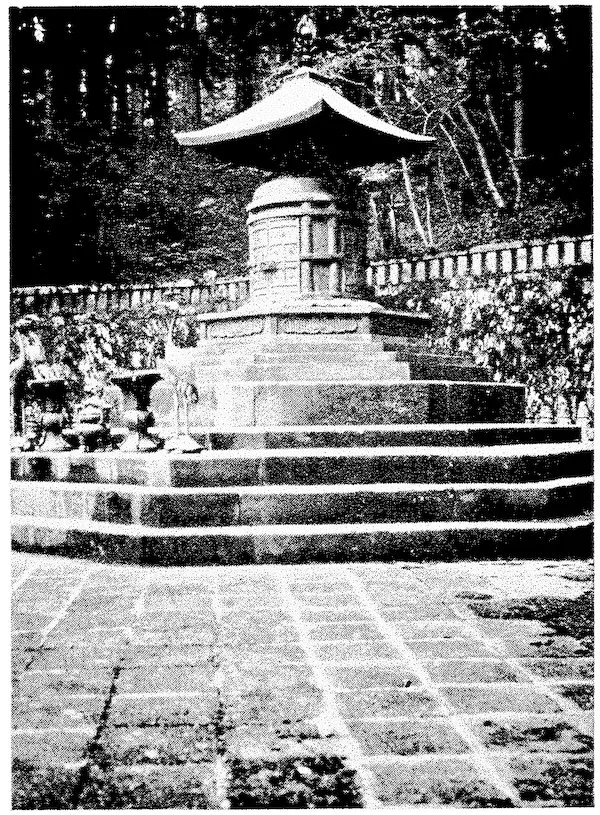
The tomb of Iemitsu, founder of the Nikko shrines, and the holy of holies of its great group of temples, photographed only by stealth
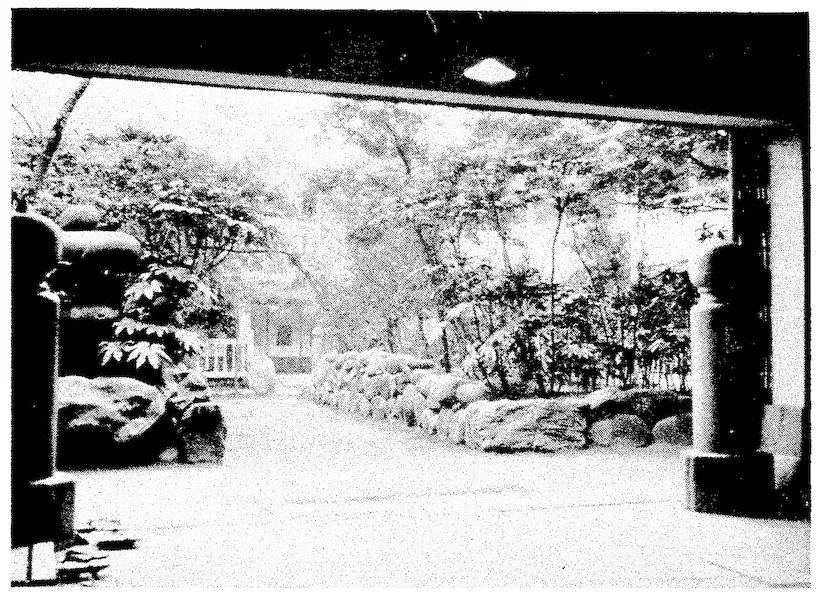
Not a palace garden, but the entrance to a house of prostitution in Tokyo’s Yoshiwara
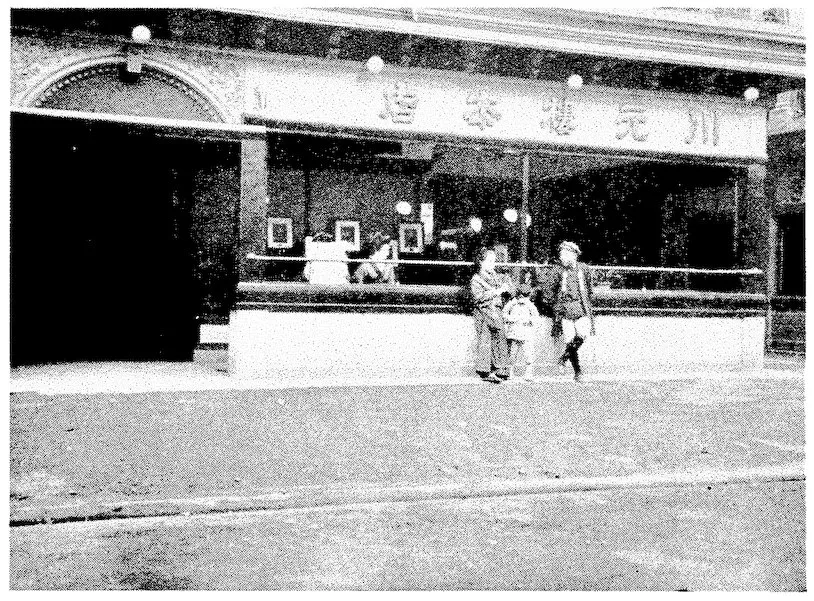
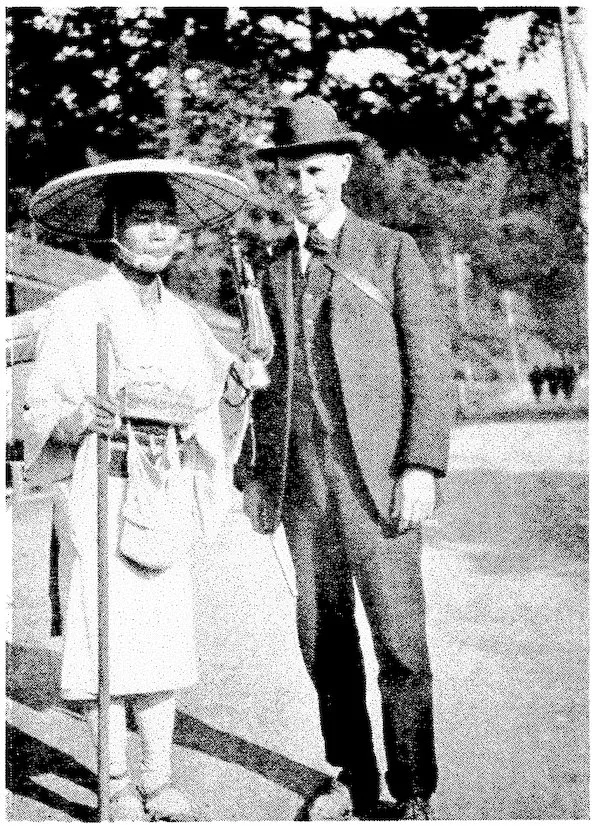
The front of a Yoshiwara house in Tokyo, with the usual advertising features of large framed photographs of the inmates, two of whom appear in person behind the railing, one hiding behind a newspaper rather than be photographed; the sign reads “3-yen two-storied natural inn”
The Nipponese take extraordinary care to keep
their feet off the ground. Even the peasants, market-women,
boys and girls whose weather-toughened
supports have never been subjected to the effeminate
niceties of the toed-sock-foot, almost invariably wear
at least straw waraji out of doors. Pleasing custom,
and a wise one, too, in a land where nothing that may
enrich the land is wasted. But I believe I am giving
no proof of extraordinary perspicacity in asserting
that to her footwear is largely due the poor roads and
the abominable streets of Japan. Her people are not
49great believers in pavements; they can easily hobble
and scrape through life on their clumsy stilts
without them. If it rains—and there are weeks on
end when it does, indeed—until the shoe-clad foreigner
cannot stir out of doors without covering
himself to the ankles with paste-like mud, the native
merely steps into higher and higher getas and stumps
serenely on. In the classic speech of recent years,
“he should worry.” Before it fell in a crash one
Saturday noon there was scarcely a square yard of
street even in Tokyo that was not deep in dust or
deep in mud, according to the weather. The municipal
fathers had recently threatened to spend forty
million yen toward giving the capital a modern pavement.
If the threat is made good, now that the opportunity
for general improvement is so excellent,
Tokyo will no longer seem Japan, for dust and mud
are as national as getas and kimonos. When a stretch
of Japanese street becomes really impassable, a few
loads of sea-shore stones are spilled into it—to the
still greater discomfiture of the shoe-shod foreigner.
At least one class of Japanese profits by this atrocity
of streets and roads. Scores of what would be
pleasant strolls, were there anything fit to stroll on,
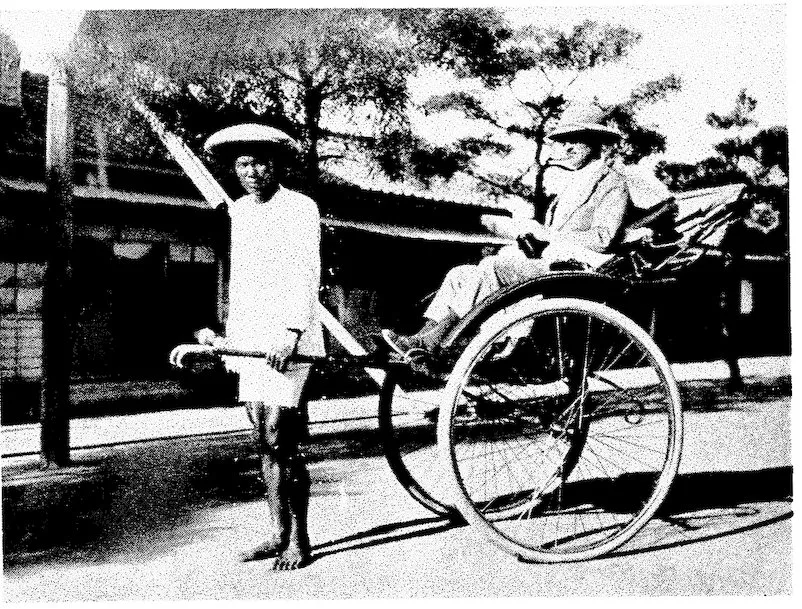
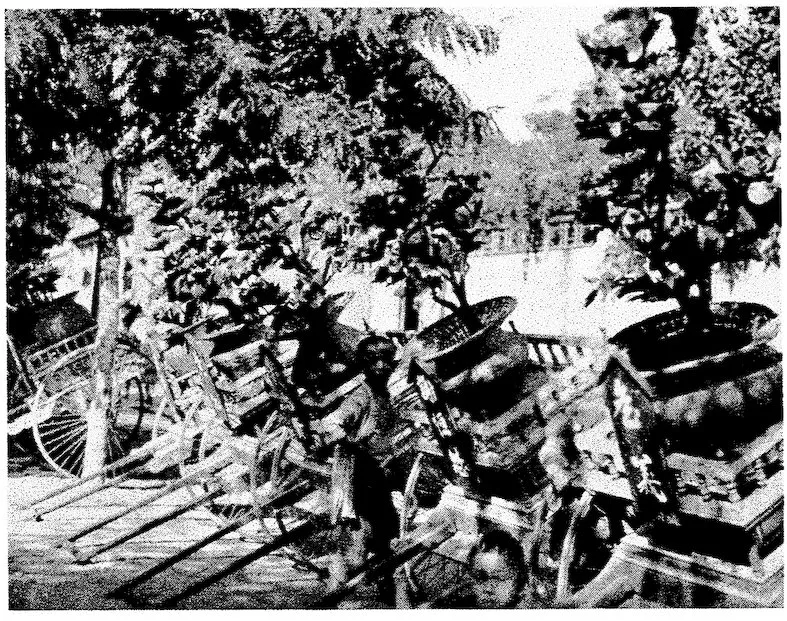
must be abandoned, to the advantage of the rickshaw-man.
If he had no such allies, it is doubtful
whether this human horse of the Orient would not
already have passed from the stage in Japan, for
there his constantly increasing demands have made
50him almost a luxury. To be jogged about Tokyo for
a short day of sight-seeing or shopping costs even
the initiated ten or twelve yen, which is almost half
as bad as if it were American dollars. No extraordinary
reward in these times, perhaps, for a hard
day’s toil. Let us not, however, in our fairness to
the physical toiler, lose sight of the fact that it is
what he accomplishes, not how greatly he exerts himself,
which counts; and your rickshaw-man moves
you from place to place but little faster than you
could walk, and not much more comfortably.
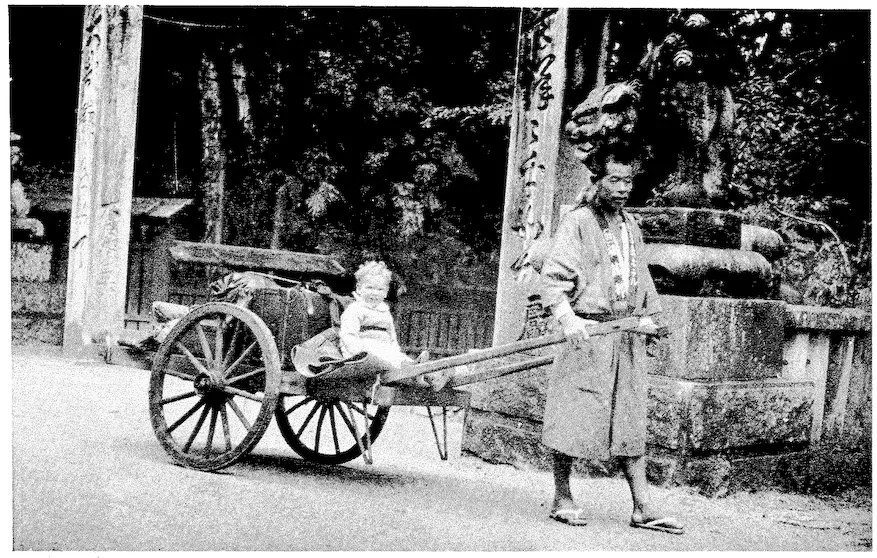
Personally, I found riding in a kuruma—which is
a politer, more ladylike Japanese word for rickshaw—an
unpleasant, almost a humiliating experience, as
if I were being impressed with the notion that the
man trotting in the shafts before me was more sturdy
than I—which in Japan at least he usually wasn’t.
Or my mind harked back to the origin of this unseemly
means of conveyance, to the American—we
admit we are an inventive nation—missionary who,
half a century ago, converted—in addition, we trust,
to many parishioners—a baby-carriage into a means
of giving his invalid wife an occasional outing. Even
the glistening wire wheels and the plump pneumatic
tires to which the contrivance has since advanced
cannot blot out that unmanly derivation.
Perhaps it is true also that no rickshaw-runner
survives his tenth year in the profession, but as some
of those I have ridden behind were plainly over fifty,
51and the speed of the majority in Japan by no means
killing, I found this no great contributing cause of
my displeasure in rickshaw riding. But often the
choice is narrow,—a mud bath, a coating of dust and
perspiration, a small and ancient type of tram-car
with a floor as muddy or dusty as the street outside
and inevitably packed beyond any American conception,
possibly a limping, asthmatic, purse-flattening
exile from our most popular automobile factory, or—the
spider-mannered kuruma-ya, sitting on his
own dashboard, awaiting a victim. The miniature
member of our family became instantly fond of
“widin’ man,” fortunately, for his walking was still
limited; the unofficial head thereof recognizes the
rickshaw’s domestic convenience, in spite of her constant
dread that the runner’s reputedly brief span
of life will end between the shafts sustaining her;
but I, the minority, prefer stretching my legs to
cramping them.
X
52
It is nearly a score of years now since the many
private “iron roads” of the island empire were
combined under a cabinet minister, yet when all is
said and done the Imperial Government Railways of
Japan are a refutation of an almost universal experience
elsewhere, that trains will not run properly
under government ownership. Perhaps it is the
combination of religion and patriotism of which
Shintoism seems to be concocted, the semi-deification
of the mikado and all his belongings; perhaps it is
due to mere habit, or racial temperament; the fact
remains that government ownership and employment
do not mean carelessness and neglect, indolence and
waste, in Japan. One has, to be sure, the impression,
at sight of the swarms of men and boys in the dull-blue
railway uniform, that the system is over-staffed;
but nothing, one recalls, is more plentiful in Japan
than human beings. If improvement and extension
languish a bit, there are reminders that the railways,
like schools and many another ward of the mikado’s
Government, must often be content with modest
rations, that its favorite sons, the army and navy,
may lose none of their sturdy corpulence.
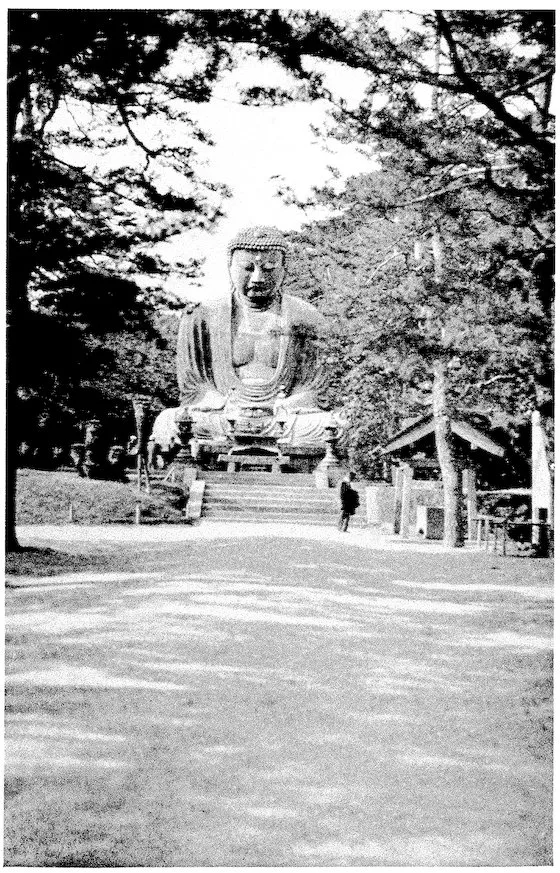
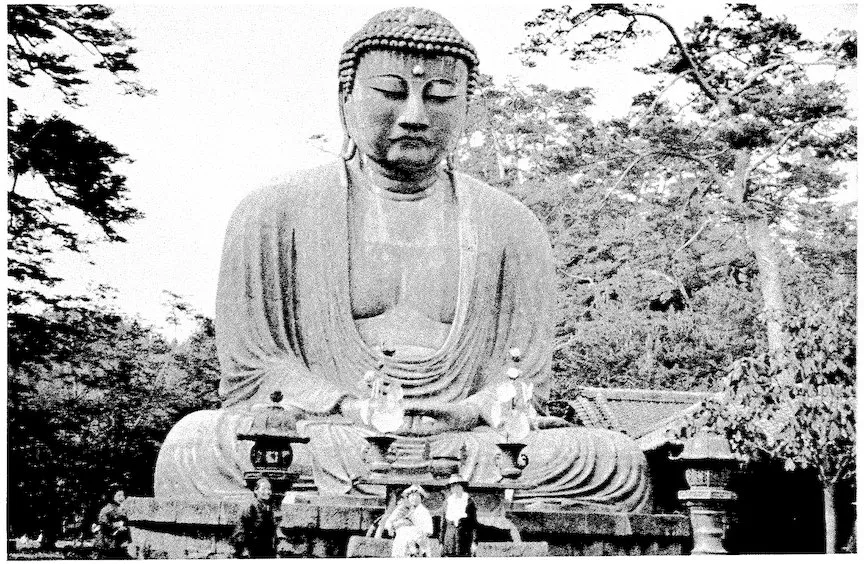
Approaching the great Buddha of Kamakura which stood through the earthquake of September 1, 1923
Thus the great Buddha has gazed down through the ages with what strikes the Western beholder as indifference to the woe or weal of puny mankind
53A narrow gauge is not conducive to reckless
speed; the Japanese express-train that covers a mile
in two minutes congratulates itself on a feat, while
the locals that fulfil most of the promises, nearly always
to the minute, of a bulky national time-table
consume an incredible amount of time both at stations
and between them. But few sports in Japan
are far beyond the reach of rail, and the risk to
life and limb is negligible. The adolescent squeal of
the European-copied locomotives may be annoying to
Americans, who will probably regret that the two car-length
cushions on either side in first- and second-class
are better suited to squatting on one’s heels or
stretching out at full shoeless length than to ease in
viewing the passing landscape; one may question the
Japanese conception of certain indispensable conveniences,
but such as he conceives them they are always
in order. Diligent scrub-women at the terminals
are no more so than the train-boy, in no way
related to the commerce-minded nuisance of the same
name in our own land, who come hourly to sweep
out the carriages with but slight disturbance to its
occupants, and several times a day to mop them. All
cars are smoking-cars; there is no division by sex
even of wash-rooms. But in what other land does
the guard, whom we would call conductor, uncover
with a regal bow as he enters to announce the regretful
necessity of troubling the honorable passengers
to display their respectable tickets, or pause to
54rearrange a rug over a sleeping traveler and to set
aright the shoes, clogs, sandals, getas, and slippers
scattered along his way through the train?
The experienced traveler rarely brings his lunch
with him on a Japanese railway journey; he knows
that he will find frequent and fresher supplies along
the way, and at prices no higher than in his own
street. Prices can sprout wings in Japan quite as
easily as elsewhere, but it may be due to a frowning
government that the wide-spread custom of considering
travelers by train temporary prisoners, to be
mulcted during the confinement of as great a portion
of their financial solvency as possible, has not yet
taken root there. In the very likely event of there
being no dining-car, with tolerable European meals
of four or five courses at a scant seventy cents each,
there is a system of station venders more frequent
and more dependable perhaps than anywhere else
in the world. Never does a train halt at a place of
any importance that the singsong cry of “O-bento!”
does not call attention to green-capped youths marching
up and down the platform offering for sale all
that a reasonable traveler can demand in the way of
food and drink.
It is conceivable that the foreigner may not at
once take kindly to the “honorable bento,” the staff
of life of Japanese travelers; but with persistence he
will come to endure and even to relish it. Two fresh
wooden boxes tied together with a paper ribbon contain
55the collation, which is uniform in cost,—forty
sen, the half-cents of Japan, everywhere now,
since the war,—and almost so in contents and
quality. On top clings a paper napkin and a paper-sealed
pair of chop-sticks, the virginity of the latter
assured by their being but half split in two, with—such
is the Japanese genius for unexpected little details!—the
inevitable toothpick tucked between
them. The larger box contains hot boiled rice, all a
native cares to eat at one sitting and more than the
normal American can. The several little compartments
of the other hold a piece of fish—fortunately
not usually raw, as the Japanese like it—perhaps a
bit of meat, some slices of cold potato, a cut of sweet
omelet that is most likely of all Japanese viands to
appeal to the average Western taste, two or three unknown
vegetables, some boiled, the others pickled,
perhaps some brown beans to give one chop-stick
practice, and a shaving of red ginger to lend the rest
seasoning. Variations on this menu, according to
the locality and the things each place is famed for,
are pickled lily- or lotus-root, black mushrooms,
bean-curd, shrimps, steamed eel, edible seaweed,
sliced octopus, and even stranger sea-foods.
If all this does not suffice, one may summon other
wearers of the green cap. There is the tea boy, the
hot milk boy, fruit sellers, venders of rice-cakes, of
the dough-ball sweetmeats of Japan, of wood-wrapped
native jams, of California raisins, a trifle
56cheaper than at home, a hawker of cigarettes, periodicals,
beer, and more doubtful thirst-quenchers, perhaps
even an incongruous purveyor of near-bread
and sandwiches. Hot boiled milk in bottles holding
a scant glassful is expensive; tea, on the other hand,
is almost given away. For eight sen, a bare four
cents, the boy furnishes an earthenware tea-pot with
cover and handle, crudely glazed, like the tea-cup
that goes with it, and fills it with hot water from his
traveling buffet—furnishes everything, in fact, except
tea, in lieu of which the purchaser finds merely
a sack-inclosed handful of leaves that do the water
no harm if one prefers to throw them out and add
real tea of one’s own, some bouillon cubes, or whatever
individual taste suggests. Most traveling Japanese
deceive themselves into believing that this
tasteless hot water is really their indispensable beverage.
The stranger cannot but wonder how all this
can be supplied at so slight a price, and why the pot
and cup cannot be retrieved at some other station.
They never are, however, but, like the bento boxes
and all the rest of the waste which Japanese travelers
cast under the seats, and never out of the window,
they are periodically swept up by the train-boy and
dumped as the train passes over some river or arm
of the sea. Where these are shallow, one may see
thousands of broken tea-pots and cups heaped up at
the bottom. Thus, for a yen at most, a rugged appetite
can be tamed into submission for several hours.
57To be sure, the Imperial Government Tobacco Monopoly
cigar, which may sometimes be had to top
off with, sadly belies even its misspelled Spanish
label; but one may be so fortunate as still to have
left a few of the fifty genuine smokes which the
Japanese customs generously allow the traveler to
bring into the country with him—and what boots
it to worry about to-morrow?
To-night, however, is a more serious matter.
All the horrors of the American so-called “sleeping-car”
are as nothing compared with the bitter tragedy
in many acts of a night spent in one of the
poor imitations thereof that ramble up and down
Japan. The natives, I believe, find little fault with
them, and there is no reason that they should be remodeled
to fit the few foreigners who might use
them. For it is mainly a question of fit, so far at
least as the Anglo-Saxon is concerned. By day second
class differs from first only in the color of the
upholstery, and perhaps a bit more companionship.
But not only is the normal second-class berth
built to Japanese specifications; the so-called “large
size” ones are merely wider, which is very slight
advantage to the full-length man. Granted, however,
that he has succeeded in stowing himself away,
there are other inconveniences. The Imperial Railways
being narrow-gauge, it is inevitable that some
portion of the average Western anatomy shall more
or less continually protrude into the aisle. The
58flimsy curtains that satisfy the atrophied sense of
privacy of the Japanese are always half open for
one cause or another; there is no real dressing-room;
if one is so daring, dexterous, and determined
as to disrobe inside a berth, where the retention
of a tooth-brush means overcrowding, one must
resort to the customary Japanese custom of hanging
one’s clothes on the floor—and the only floor
available is that of the aisle. Worst of all, perhaps,
the sleeping-car of Japan is never really that but a
day-coach with furnishings which runs at night.
The lights blaze unabated; short-distance passengers
stalk in or out of the car at every station and chatter
and smoke incessantly between them; trainmen
are constantly marching through, and never fail to
slam the four or five noisily sliding doors; at every
halt brazen-voiced youth walk back and forth along
the platform outside insistently repeating the name
of the station—in short, there is even less likelihood
of a bit of sound sleep than in a Japanese
inn.
First class ought to be better, but it is not unlikely
to be worse. Yokels along the way, or in third
class, are curious to see the rare personage who
travels thus, and the magnificence about him; the
scarcity of occupants makes it the favorite rendezvous
of the train-crew as work-, play-, or catnapping-room;
the other half of the same coach is
not infrequently the dining-car and all-night café;
59and the train-boy will die at his post rather than
permit a window to stay open for an instant on
the hottest night. Old travelers who know the ropes
often make their night trips in first class without
taking a berth. Their sleeping-place is the same
that it would be with a berth-ticket, in some ways
all the better for not being made up—and there is
a saving of seven yen.
It is perhaps natural that “boys” in hotels and
on trains have no realization of the advisability
of quieting down toward midnight in a land where
the most courteous seem to have no respect for the
sleeper, where even husbands habitually wake their
wives or children at any hour of the night on the
flimsiest provocation. A nation accustomed since
time immemorial to paper walls, overcrowding, and
uncomfortable substitutes for beds probably is not
conscious of the value of long, sound slumber. The
passing foreigner who sees ill-slept faces all about
him and notes the tendency to nap by day whenever
a chance offers realizes that a wise people
should be as insistent on restful sleep as in avoiding
dyspeptic food and unhealthful eating habits.
Our impression is that the Japanese are careless in
both these respects.
XI
60
Along Broadway complaints have been heard
during recent years of the almost dishonest
brevity of some plays. Of all the things that may be
said against theatrical performances in Japan, that
would be the most unreasonable. I pride myself on a
certain amount of endurance, in any good cause, but
I confess to a kindly feeling toward that Tokyo
friend who did not take me to the “Meiji-za” until
the show was half over. Not that it was so far beyond
me, or that I am incapable of appreciating,
even of enjoying at times, things wholly foreign to
our American point of view; but even Fred Stone,
I fancy, would begin to grow wearisome if he cavorted
about the stage almost incessantly from two
until midnight.
Venders of food and religious trinkets line with their shops the shaded walks of the island of Enoshima
The leglessness of Japanese houses! A corner of our room in the Japanese hotel at Kozu
The façade of a moving-picture theater in Nagoya
By the time we had checked our shoes in one of
the adjoining tea-houses—for to do so at the door
of the theater itself means a long and severe struggle
to recover them—and were shown to a box six
inches deep and furnished with cushions and a tray
of tea, most of the crowded house had already had
four and a half hours’ worth of the admission
fee. For most of them it was supper-time, and
61scores of men and boys flitted back and forth along
the “aisles,” level with the tops of patrons’ heads,
serving meals contained in lacquered boxes, the inevitable
tea, and white vase-like bottles of warm
sake. Unshod and experienced, they caused little
or no annoyance, especially to an audience accustomed
to see actors often enter or leave the stage
by these same polished wooden runways. In the gently
sloping balcony the rice-fed multitude, gathered
in family groups in similar square, shallow, mat-floored
inclosures, piled about them the plentiful
waste of their lunches without for a moment letting
their attention waver from the stage.
Unchaperoned not merely by a Japanese but by
one capable of appreciating and mitigating a foreigner’s
difficulties, the performance would have
been as meaningless and unintelligible to me as a
baseball game to an Englishman. But a few well-chosen
words of explanation now and then disclosed
as many unsuspected fine points as pass unnoticed
by a novice at a Spanish bull-fight. The one
thing the Japanese actor must avoid above all others,
it transpired, was “acting,” in the Western sense.
The more nearly, apparently, he acts like a normal,
genuine, every-day human being, the lower he is
rated in histrionic ability. There are, to be sure,
topical farces and the like in modern Japan; but
the national drama, patronized by the great mass of
the recreation-seeking, and offering the greatest
62stage fame, consists of little more than endless elocution,
accompanied by certain stilted actions cut
and dried for centuries, any deviation from which
diminishes by just that much the player’s applause.
His every step, gesture, and inflection is stereotyped
by age-long custom and repetition, and his
highest goal is to approximate as nearly as possible
those steps, gestures, and inflections which won the
undying fame of some bygone king of the stage.
That does not mean, however, that the Japanese
actor has no chance to develop and display personal
advantages. The more nearly, for example,
he can make his voice sound like an enraged giant
imprisoned in the pit of his stomach the greater
will be the uproar that greets the conclusion of one
of his speeches. He is given, too, frequent opportunities
to imply by facial expression alone the
thoughts that are supposed to be passing through
his mind, which are often expressed at the same
time by a sort of Greek chorus of three or four
men dimly seen behind wooden bars in a kind of
raised box on one side or the other of the stage,
who declaim in a curiously unrhythmic rhythm as
they pick at native instruments. The koto and
the samisen, by the way, are not the last word in
musical contrivances, but I confess to a decided preference
for Japanese “music” over American “jazz,”
and for much of her theater to the unsuccessful
63striving for originality which often afflicts our
own.
There is a reminder of the three thumps which
announce the raising of the curtain in France in
the beating together of two sticks of wood so hard
that they have almost the resonance of bell-metal,
faster and faster, until it reaches a deafening crescendo,
which constitutes the signal for the next act
in Japan. There is lacking the perfect imagination
of a Chinese audience, which makes a property-man
in black or coolie-blue invisible, or the stick on
which a new moon is raised above the cloth horizon
quite in keeping with the poetic spirit of the
drama; but the scenery is decidedly elementary, and
many conventions which strike the Western visitor
as ludicrous pass quite unnoticed. Not merely
do the actors often make their entrance or exit
along the raised aisles through the audience, declaiming
as they come or go, but bands of them,
representing the samurai of rival shoguns, now
and then wage pitched battle far out on these passageways,
to the seeming peril of the lacquered rice-dishes
of auditors beneath them. If a wall or a
fence is indicated in the scene, only the gate or door,
standing in dignified isolation, is actually in evidence,
and must be carefully opened and closed whenever a
character passes through it. There is something
curiously incongruous between such medieval contrivances
64and the ultramodern revolving stages of
the best Tokyo theaters, on which a group of actors,
suddenly coming to the end of their scene, relapse
into motionlessness and are spun around in plain
sight of the audience until the next group and setting
are disclosed and put into action.
But these after all mainly mechanical differences
are not the chief ones between the Japanese and
American stage. It is more surprising to find that
the two corner-stones of our theater, novelty and
the sex appeal, are wholly unnecessary to the Nipponese
playwright. “Old stuff” pleases best, even
in the “movies.” Month after month, year after
year, one might almost say century after century,
the Japanese playgoer is content to witness the same
dramas, to follow with breathless interest some national
legend, some event in the history of the island
empire as well known to its every school-boy as is
Washington’s crossing of the Delaware to us. He
is not merely satisfied; he prefers these ancient tales,
dressed in the elaborate costumes of shogunal days,
ruled by the curious morality of long ago, when
parents slew a beloved son for some intangible point
of honor, and suicide was considered, under certain
circumstances, the height of virtue. The Japanese
is decidedly not a demonstrative race, yet the suppressed
sobs and blowing of noses of the “Meiji-za”
audience all but drowned out the stentorian, cavernous
voices of the actors at the climax of a scene
between a self-doomed father and his infant son,
though every native present had heard the story a
hundred times.
Farming in Japan rice-fields is a great life—if you don’t weaken
A Japanese woman enjoying her pipe and the seascape at Toba
Little girls of Yamada-Isé dressed in a riot of color, topped by hats of real flowers, for the twenty-one-yearly rebuilding festivities
A peasant woman of Japan up to her knees in work
65The same themes suffice for the now fairly numerous
Japanese motion-picture producers. The old familiar
kimono-clad figures, whitened faces, and well-tried
situations all but monopolize the posters before
“movie” houses. As on the speaking stage, the
rare female rôles are most often played by men;
in the few cases where they are not, the women
never under any circumstances give the slightest
reminders of the appeal of sex. The result is that
when, to fill out its program, the cinema flashes an
American or a European picture on the screen, this
unfailing motif fairly shrieks at one from the very
first foot of film. The traveler from the West is
suddenly astounded by the realization of the omnipresence
of this appeal in the dramas, good and
bad, high and low, of our own land. What would
have been at home the most innocent of flirtations,
the purest youthful love-story, becomes all at once,
sensed in the curiously tense atmosphere of the
Oriental audience about one, the height of indecency.
If the film is of the type the Westerner would regard
in his home land as mildly risqué, a burning
sense of shame surges up his spine; he feels an all
but overwhelming desire to rise and shout to the
now gaping audience that it is completely misunderstanding,
to hurry back home and demand that
66laws be framed to forbid the exporting for the
amusement of peoples so utterly different from ourselves
of screen-stories which cause them completely
to misjudge us, to the appreciable widening
of that gulf between nations that so much largely
futile effort is being made to narrow.
Misunderstandings of this sort, however, are inevitable.
Honest Japanese themselves admit that
they are no models for the average of other nations
in relations between the sexes, but with them there is
almost no indication of this fact on the surface. Nor
is this hypocrisy; it is age-long custom, and temperament,
for they are above all things outwardly undemonstrative.
For a man and woman to shake
hands, to take an arm, fills the untraveled Japanese
with amazement; for husband and wife to exchange
the most perfunctory of kisses in public at parting
or greeting is more scandalous than in holy Zion
City itself. Even to show such signs of affection to
one’s children where others may see is extremely
bad form.
“Do Japanese man and wife never kiss?” I asked
one of my Tokyo acquaintances.
“Never!” he replied, with an amazement at the
question that showed through his habitually expressionless
face. “Of course,” he added a moment
later, with the air of a man who would be truthful
at all costs, but with the cynical smirk of one treading
67lewd ground, “they sometimes do, but only in
the privacy of their chamber.”
It was this same man who, more familiar with
the speech of England than with our own, explained
that the only outward manifestation which distinguishes
a geisha from her more respectable sisters
is “too much swank.” Certainly her public
manners and personal appearance give no other indication
of her calling. Japan’s very yoshiwaras,
these walled and sternly policed restricted districts
of her larger cities, are outwardly models of propriety;
the big framed photographs of the inmates,
displayed to attract passing clients, invariably show
them as properly attired as the most circumspect
of dowagers. It may be that the frank, casual disclosure
of what in Western lands commonly remain
hidden charms, in the public baths and the naturally
rather disclosing garb of Japan, makes the Japanese
callous to any such incitements.
XII
68
The undoubtedly many attractions of the island
empire for the mere traveler are, unfortunately,
greatly offset by the high cost of living there.
The rapidity with which letters of credit are depleted
turns almost to naught the well nigh frantic efforts
of such publicity agencies as the diligent Japan Tourist
Bureau to attract visitors. Two or three years
ago those who cater to and depend upon the passing
foreigner comforted themselves with the thought
that his scarcity was merely a temporary aftermath
of the World War. Now that he still fails to come
in appreciable numbers, there is dismay in such
quarters, though it is characteristic of the Japanese
temperament to assert that “the increase is gratifying.”
Word has drifted to the ear of many a prospective
tourist that life is unreasonably expensive in
Japan, or he hears proof of that fact in crossing the
Pacific and goes on to China without landing, or
cuts to a fraction the time he planned to spend in
the mikado’s realm. If even Americans feel that
way about it, one can easily imagine the sensations
of those from war-impoverished lands with a feeble
currency.
69Some of this raising of prices is justifiable; much
of it is not. The Japanese working-man has recently
won a wage commensurate with a citizen instead
of a serf, and the consumer must take care
of it. But the war engendered the profiteer there as
elsewhere; it left behind newly rich to set bad examples
and crowd the heels of their more honest
brethren; a great increase in taxes has popularized
the pastime of seeing how much of them can be
passed on to the next man. Then there is what a
Tokyo editor calls “expensive face-saving.” In olden
days the Japanese “saved face” in other ways; it is
no doubt in keeping with the general westernization
of their standards that the modern method of doing
so should be by ostentatious extravagance. The ordinary
Japanese business man who would keep up
with the procession and not give his colleagues and
his clients the impression that he is hovering on the
verge of insolvency must waste much money on mere
show. Completely separate wardrobes for the four
seasons, often European as well as native style, are
indispensable. When he entertains his friends or
customers he can scarcely invite them to his home,
not so much because of domestic seclusion as because
it is the fashion to have such gatherings in a
tea-house, where geisha-girls may be summoned to
serve or dance. Not only do the more famous of
these expect an opera-singer’s fee, but the chaya itself
has boosted its prices to the new-rich level. Then
70there is the very serious matter of tipping. In the
United States this vicious importation from Europe
has swollen almost beyond recognition of its origin,
but the extra fees exacted there are mere flea-bites
compared with the chadai, or “tea-money,” of
Japan. On the amount of it depends the reputation
for importance of the giver, and it is a common
failing to wish to impress the world with one’s importance.
The Japanese of any standing who puts
up in a native hotel, for example, and is handed a
bill for twenty yen at the end of a three-day stay,
is expected to send at least half that amount as a
tip to the proprietor, to give another five yen to the
maid who brought his food and kept his room in
order, and generously to remember the bath-boy and
the shoe-man. “Is there any other country,” asks
the irate editor, “where such a ridiculous custom as
tipping to eighty per cent of the bill prevails?”
All this, of course, is reflected in general prices.
But what has particularly aroused the wrath of travelers
is the almost universal Japanese custom of expecting
the foreigner, particularly the Caucasian visitor,
to pay higher prices for the same things than
the native. Perhaps this is merely an extension,
almost flattering, of the notion that one pays according
to one’s importance. The fact remains
that the American and the European are sometimes
frankly and naturally, more often surreptitiously,
made to pay more than the Japanese, a custom which
71ignorance of the language, among other things,
makes it next to impossible to combat. In some
cases this, too, is justifiable. An American staying
in a native inn is likely to require more attention, to
call for stranger foods, to be more careless with the
floor-matting than the Japanese guest—and he is
almost certain to be ignorant of, or to scorn, the
native custom of exorbitant tips. But the overcharging
is not confined to justifiable cases; among
those who habitually come into contact with foreign
travelers it has become a fixed habit, and has spread
to a considerable extent to the rank and file. I have
already mentioned the high cost of kuruma-riding.
In the slang of the rickshaw-man and his class, a
foreigner is a kane-mochi, a “possessor of money,”
in other words, a rich man, and whenever it is
possible he is treated accordingly. Wherever he
moves, except by the government railways or the
strictly public means of conveyance, the tourist has
the feeling that his money is being taken away from
him with unjust rapidity; whenever he stops he is
likely to be quickly impressed with the nation that
it is better for his financial constitution to move on
again.
It is not the Japanese alone who are to blame for
this baiting of the visiting traveler. The score of
more or less foreign hotels throughout the country
which cater especially to such clients have been joined
together in a price-fixing association, mainly by the
72efforts of the typically American manager of the
most pretentious of them, situated in a busy “treaty-port.”
In the best few of these the virtually uniform
charges are not entirely out of reason; but to
come upon a run-down or poorly constructed and
badly provided member of the association, far from
the beaten track, only to be confronted by the same
inflated rates, is likely to turn one’s attention once
more to the train schedule. It would perhaps be
unfair to suspect that the typical American hotel
man above mentioned resorted to a manœuver time-honored
in his native land in order to remove an incentive
for travelers to desert his own ostentatious
and necessarily high-priced establishment for more
modest ones in out-of-the-way places; but the Japanese,
for all his reputation for cleverness and foresight,
is often dense.
There are many Americans, to be sure, who would
not consider the foreign hotels of Japan high-priced,
though they might express dissatisfaction at what
they get for their money. But I am one of the firm
believers in travel for persons of modest means, and
not merely for the wealthy or those shielded from
financial worries by an expense account. There are
many who can, and should, and do go to see foreign
lands, who still cannot, will not, and should
not continually pay at least six dollars a day for a
place to sleep and three heavy meals which they
often do not wish to eat—plus constant increases
73for bottled water, for many services that should not
be regarded as extras, for clever manipulations of
the stated daily rate, and the high tips expected at
their departure by a long line of more or less useless
servants. Yet there is often no choice but to
patronize the sometimes flea-bitten members of the
hotel association or stay at home. One may not
have the courage, or even the ability, to live in
Japanese inns, and even these have in many cases
caught the hint and greet the foreigner with “special
rates,” on the pretense that they are furnishing
him with silk- instead of cotton-covered futons, and
“European food,” though they are as ignorant even
of the appearance of the latter as a Tennessee mountaineer
is of Japanese viands. Their own overreaching
is depriving those who long to do business
with him of the patronage of the modest traveler,
and the immodest are too scarce to bring them a livelihood.
All that has saved some of these ill-advised exotic
hostelries from disaster is an increasing Japanese
patronage. Men who have been abroad sometimes
prefer to live in foreign style, or at least to show
their families a sample of it; some find it cheaper to
pay the high rates and low tips of these establishments
than the low rates but high tips expected of
“persons of importance” in native hotels; the war-rich
make them new forms of ostentation and overrun
some of them with their geisha parties. Hence
74it is a rare dining-room that does not contain a
few men faultlessly European from the neck down,
audibly enjoying their soup, tea, or toothpick in
Japanese fashion or striving to conceal their chagrin
at the unadaptability of wives still distinctly native
in garb and manners. For if the Japanese smile at
our clumsiness with the chop-sticks, we recover the
amusement with interest among the native sojourners
in these so-called European hotels. Daintily kimonoed
ladies clutching forks upside down in the
wrong hand, grasping the body of a tea-cup for
fear the handle to which they are unaccustomed will
prove too frail, paring their fruit backward with
what is to them a clumsy knife, unconsciously trying
to draw their feet up on their chairs—and often succeeding—the
while avoiding the eye of inwardly
wrathful though outwardly imperturbed husbands,
enliven many a meal. That their mishaps are not
confined to the detested public place of eating is suggested
by the unfailing anecdote of those traveled
Japanese who are given to admitting personal discomfiture
of how they fell out of their first bed.
It is as much as anything the commonplace atmosphere
and stereotyped menus of these exorbitant
imitations of Occidental hotels that make one inclined
to hurry through Yokohama, Nagoya, Kobe,
even temple-rich Kyoto, and spend such time as one
can afford in smaller and less sophisticated places.
There—almost anywhere off the one well-beaten
75track, in fact—one must endure the unconscious bad
manners of a race which, for some unexplainable reason,
always quickly gathers about a foreigner, though
a hundred others have passed within a fortnight, and
giggles childishly at him if he speaks, though the
study of his language is compulsory in every higher
school and, except that his eyes do not squint, his
appearance is scarcely a whit different from many of
the gigglers themselves. But there are compensations,
in glimpses of unsophisticated corners, unadvertised
bits of picturesqueness, semi-survivals of
customs that carry one back to the days, not yet
nearly a century distant, when to wander in a land
now as safe as any on the globe would have been to
lose one’s head forthwith by order of some wrathful
daimyo. Nor does one ever tire of seeing the velvety
Japanese landscape, its rugged misshapen pines,
its terraced hillsides, and its crazy-quilt rice-fields
cut up into absurd little patches so carefully tended
that there is hardly a weed in the whole country, or
of the laborious, uncomplaining, mud-wading men
and women who spend their lives in them. Fields
pink with Chinese clover that is to be plowed under
to enrich the soil change to white stretches of daisies
doomed to the same undignified end as one rambles
southwestward; otherwise, there is a picturesque
sameness which nevertheless does not grow
wearisome.
XIII
76
It was by mere lucky chance that I happened down
to Yamada-Isé on the very day her great celebration
began. In theory, as I understand it, Shinto
shrines are rebuilt every seven years; in practice,
at least in this most venerated center of the cult, as
sacred to millions of Japanese as Jerusalem, Mecca,
or Benares to men of other faiths, some of the
holy edifices are actually reconstructed, and new
ones added, every twenty-first year. In the springtime,
when sap and pilgrims are on the move, one
may expect to find many of the trains of Japan
crowded, but I had certainly not looked forward
to fighting my way amid such throngs as poured
with me down to this chosen terrestrial abode of the
gods that watch over the island empire. There
had been no warning, so far as I was concerned,
that another twenty-one years had passed and that
the generation-separated festivities were again on
the point of beginning.
The multitude which disgorged through the station
exits was a mere handful compared to the endless
welter of humanity that already surged along
the few streets of the little city, a city as far removed
77in some respects from westernized Kobe or
Yokohama as the moon. Yet every train that arrived
as long as I remained was packed beyond anything
we of the Occident would believe possible.
Pilgrims, devout and otherwise, nearly all in strange,
fantastic garb, eddied back and forth through the
town, while the keepers and employees of inns, of
eating- and drinking-places, of shops crammed with
displays of the myriad queer trinkets sold to the
pious in holy places, raced up and down along the
edges of the human stream frantically shouting the
merits of their establishments or their wares. It
was not difficult to believe the naïve assertion of the
home-made local guide-book that “the occupation of
the people of Yamada is to feed peacefully upon
pilgrims.”
Some of the latter sat on the polished floors of
the wide-open anterooms of inns, tending their dusty
and weary feet; the overwhelming majority, however,
had confined the physical exertions of their
pilgrimage to the purchase of a railway ticket. In
the overcrowded, paper-walled hostelries, in some
cases on the train itself, they changed their every-day
garb for curious costumes supposed to fit the
occasion, until one might have fancied a mammoth
outdoor fancy-dress ball was under way. Many of
the townspeople were already similarly decked out,
with a certain uniformity that still did not preclude
individual touches. There was, too, a quaint and
78apparently unwitting mixture of the ancient and the
modern,—caps of to-day topping off bizarre kimonos
of samurai times, the familiar Japanese imitation
of a thermos bottle riding on the hips of youths
garbed in a way that might not have been out of
place here a thousand years ago.
In the midst of all this maelstrom of incongruity,
a bare two minutes from the station I came upon
what I took to be the nucleus of the festivities, but
which proved later to be but a small detail of them.
From a narrow side street there suddenly emerged
upon the principal artery of the town, to the accompaniment
of an uproar of strange music and a
babel of orders and warnings, the ends of two mammoth
ropes, grasped, first by two men in strange
attire, then by two rows of little girls, crowded as
closely together as they could walk, dressed in combinations
of flowers and brilliant clothing quite beyond
the power of mere man to describe, and singing
a chorus of un-Occidental rhythm. Behind them
came scores of little boys, then larger girls, youths
of ever-increasing size, and finally, the ropes seeming
to have no end, two long lines of men, all in
wondrous garb, all chanting weirdly as they advanced
tugging at the big rolls of hemp. At last,
when the head of the procession was already out of
hearing, there came creaking and grinding around
the corner, with the assistance of sturdy young men
excitedly applying great wooden levers, a very Juggernaut
79of a car, its two mammoth wheels some two
feet thick and so weighty that they crushed like eggs
the stones from the sea that had been strewn along
the way, the body so ponderous that it suggested a
moving house. High up on this was a float, a fantastic
scene taken from Japanese legend, with several
living figures posing as motionlessly as the jolting
and swaying of the cart permitted, and with
as many mechanical assistants, in incongruous working
clothes, performing unknown labors in half-concealed
corners of it.
But it is time to explain. The holy city of Yamada
and its environs, location of the two great
shrines of Isé, are divided into twenty-one wards or
sections. At the time of the rare rebuilding festival
each of these must, by ancient custom, furnish a
cart to bring up from the two near-by rivers the timbers
to be used in the reconstruction. These are
specially selected hinoki, a sturdy cousin of the pine
or spruce, felled in the mikado’s private forests amid
elaborate religious ceremonies, in order that they
may be properly consecrated, then floated down the
rivers with similar formalities. So great is the
reverence for this sanctified wood that the mammoth
logs are commonly wrapped in reed mats to
prevent the slightest injury, and arrive in Yamada
thus protected. The shrines themselves, dedicated
to the divine ancestors of the mikado, principal gods
of the Japanese people, are so sacred that carpenters
80engaged upon them are said to be required
to bathe and put on spotless white garments before
coming to work, and to discard either wood or
clothing on which falls a drop of blood or other
stain incident to their labor.
But custom and century-old tradition have made
the wheeled contrivances furnished by the wards
much more than mere timber-hauling carts. The
different sections vie with one another in constructing
mighty vehicles, in surmounting them with elaborate
tableaux, in providing music and the like to accompany
them. Long before it is time actually to
go down to the rivers for the logs the twenty-one
processions set out for a round of the little city,
some invisible master of ceremonies preventing collisions.
The wards are small; the vehicles must be
drawn entirely by man-power; hence every family is
required to send at least one member to assist in the
pulling. Many a household reports intact, decked
out in the requisite costumes, and prepared to spend
the day and the night, if necessary, in tugging at
the ropes with Japanese patience.
Residents of Yamada Isé garbed for the cart-drawing festival. Brilliant colors characterize the clothing; the torn paper “duster” is a frequent Shinto motif
Inside the grounds of the Naigu, most sacred of all the Shinto temple groups of Japan, all pilgrims purify themselves by washing in the sacred river before proceeding to their devotions; photography is strictly forbidden
A small section of the long line of rope-pullers returning with a sacred timber from the river to the temple rebuilding
At last the sacred timber itself, wrapped in grass mats to prevent any injury, came creaking and grinding around the corner of a narrow winding street
81The darkness which fell upon the long May day
increased rather than lessened the festivities. From
my hilltop lodging the whole region pulsated with
weird music, groaned with the straining of mammoth
wheels over sea-stones, flickered far and wide
with fantastic paper lanterns. When I descended
once more to the town almost every one of its narrow
streets was blocked by a cart and all that went
with it. Directly behind each vehicle now was a
band or orchestra, if words so inaccurate to the occasion
be allowed. They consisted of rectangular,
flower- and silk-bedecked, canopied affairs on tiny
wheels, in which the score of musicians seemed to
be sitting, but inside which they were really walking.
In some cases these were all women, in others
all men; sometimes the genders were mixed; a
few venturesome wards even sought to carry off
the palm with more or less trained bands of shy and
awkward children.
Every ten yards or so each cart halted, the great
tapering lines of rope-holders fell into the position
of “at rest,” and the musicians struck up queer yet
enlivening noises on their dull-toned drums, metallic-voiced
bars of wood, and misplaced fiddle-strings.
During the halts as well as the advances the living
figures of the float-tableaux strove to hold their
poses, hour after hour. Not a few of these groupings
suggested real artistic ability. I was particularly
taken with a scene of olden times in which a
woman, garbed and rice-powdered to the exact likeness
of a wax figure preserved from shogunal days,
knelt on the floor of the car, while two men decked
out to perfection as two-sword samurai of the old
swash-buckling era stood on either side of her. It
was some time before I realized that they were living
persons, so unblinking was their expression, so
82nearly motionless their bodies even during the pitching
and swaying of the ponderous cart. One of the
pseudo-samurai in particular had been given a pose
that seemed physically impossible for any length of
time—until I made out a loop of fine wire with a
padded bottom sustaining his outstretched right arm.
Even with that assistance he was displaying a patriotism
or a civic spirit quite beyond any I ever hope to
attain.
How far into the night this rivalry continued I
cannot say, for I am one of those unfortunates who
require a certain amount of sleep even on extraordinary,
twenty-one-yearly occasions. Certainly, unless
dreams deceived me, Yamada did not once during
the night fall wholly silent, and with dawn the
festivities again steadily increased in volume. The
carts had gone down to the rivers, but the ever-growing
throngs of pilgrims were taxing the capacity of
the town and completely swamping its transportation
facilities. Tram-cars, automobiles, horse-drawn
bashas, rickshaws raced back and forth along or
beside the wide new gravel-strewn highway between
the inner and outer shrine, four miles apart, and
still the overwhelming majority were forced to
stump out or back in their curious and clumsy
footwear.
The distant Naiku shrine was best worth the
visiting, in its great mountain-base park amid immense
trees considerably resembling redwoods, the
83more accessible of which were protected by split-bamboo
jackets to prevent the aggressively pious
from stripping them of the bark that is reputed to
be a protection against evil spirits. The unpainted
shrines of hinoki wood, set back within inclosures
shut off from the general public, were of a primitive,
undecorated style said to represent the purest
and oldest form of Shinto architecture. Here and
there gleaming new shrines, and inclosures of the
same white wood, had already been erected, and a
few matting-wrapped logs from the imperial forest
lay awaiting similar use. Every one of the swarming
pilgrims, of high or low degree, who crossed the
sacred bridge into the shaded grounds paused to
kneel at the edge of a clear little river and purify
himself before proceeding farther into the holy precincts.
Such is the absence of fanaticism, or at least
of intolerance, in the faiths of Japan that the foreigner
may mingle freely with believers, getting
physically as near the gods as they, without once
catching a hint of resentment. Neither my own
ablutions at the sacred river, though from a somewhat
different motive than theirs, nor my purchase
of a copper’s worth of beans for the sacred horse—which
closely resembled the rather overfed and underworked
buggy-steed of a Kansas farmer—aroused
more than a slight, fleeting attention from
my fellow-pilgrims.
When I returned from island-studded Toba by a
84stroll through Futami-no-Ura, with its far-famed
sacred rocks connected by a rope bridge, the last
act of the timber-hauling was reaching its height.
Up the long, sloping road from the river, where they
had been loaded with religious rites, came the carts.
Their now dust-covered and perspiring rope-clutchers
strained toilsomely through the narrow Yamada
streets, the girls and many of the younger boys
fallen out along the way. There was grim determination
in the faces of the sturdy youths, who were
mainly left now, to finish the task, that their wards
might not be discredited. When at last the carts
themselves appeared they had been stripped of all
the fanciful decorations of the night before—tableaux,
floats, silken drapery, the following clusters
of musicians were all gone; the mere vehicles, bare as
a wrestler girded for the contest, ground crushingly
over the loose stones, each laden with one massive
hinoki log. Clouds of dust half hid them and the
struggling pullers, even in the blazing sunshine;
scores of the solemn little sword-bearing policemen
of Japan lined the way along which they were to
pass, to hold back the multitudes from pressing too
closely upon the sacred timbers, to prevent, as far
as possible, irreverent foreigners from photographing
them, so sacrosanct are they and the shrines that
are built from them. As each cart groaned into the
hallowed precincts—this time the Geku, or outer
shrine, on the edge of Yamada town itself—the entrance
85was barred from behind it even to the reverent
throngs, and none but Shinto functionaries and
local or visiting notables were permitted to follow
it to its final goal.
Though cremation is much more common than burial, a Japanese cemetery bears no small resemblance to one of our own
Within the grounds of the finest of Kyoto’s temples
Hundreds of semi-sacred deer roam at will about Nara and vicinity, recalling the sacred bulls of India
The entrance to the ever-higher temples of Nara
86For a full week the same scenes were to be enacted
daily, and it is small wonder if the inhabitants of
holy Yamada-Isé surreptitiously heave a sigh of
relief when their strenuous labors are over and the
town has settled down again to feed peacefully upon
the pious, who will arrive constantly but in less
overwhelming multitudes during the coming twenty-one
years.
XIV
87
It was fitting that a pilgrimage to Koya-san
should follow my unexpectedly well-chosen visit
to Yamada-Isé. As the latter is the holy of holies of
Shintoism, so is the sacred mountain-top of Koya,
also situated on the southernmost peninsula of the
main island, perhaps the most venerated center of
Buddhism in Japan. This time there was no special
occasion to swell the pilgrim ranks, but the less accessible
sanctuary enjoys a constant popularity, and
almost as great a one as its rival over the mountain
range to the east. I was, therefore, far from
alone at any time during the journey, even though
I had abandoned the less mobile two thirds of my
family in delightful Nara.
For those moderately accustomed to walking uphill
it is three hours’ steady climb from the railway
to the hallowed summit of Koya-san. Before
long the flat, dusty, rice-growing plain gives way to
rugged foot-hills, then to real, if not especially lofty,
mountains, up which clambers a more than well-worn
trail that is almost a highway. Along this
lower stretch those who grew weary of their burdens
could pick up a porter at will, and to suit any
88load, for they range from eager boys of eight to
powerfully legged men who have made carrying
a life’s work. The carriers are of both sexes, too,
and the frequent sight of a haughty man of wealth,
easily recognizable for all his pilgrim garb, burdened
only with a fan and a towel, and followed by a sun-browned
woman bowed half double beneath his baggage,
kept one reminded that this was Japan. Here
also those who can climb only by the exertions of
others engage their kagos, a cross between a traveling-chair
and a hammock swung on a single bamboo
pole. But the gods are evidently not kindly disposed
toward those who thus ease their pilgrimage
without just and sufficient cause, and I passed many—the
ailing, the lame, the blind, tottering old women—who
were taking no chances of thus jeopardizing
celestial favor.
The typical pilgrim garb of knee-length kimono,
inner sleeves ending in a kind of fingerless glove,
brilliant sash, white drawer-stockings and straw sandals,
a huge woven-reed hat, on the chest a wooden
alms-box inscribed with Chinese characters, with a
sack to hold donations of food below it, a formally
folded pack on the back, a bell, a kind of scepter, and
a rosary in one hand and a long staff topped by
jingling rings in the other, was frequently seen in
its entirety, and did not always cover one who actually
lived on alms, though the genuine pilgrim is
expected in theory to do so. But modifications of
89this get-up, ranging all the way from slight variations
to full European attire, were to be seen in the
almost unbroken lines of climbing and descending
Japanese. Here a pilgrim’s smock and a coolie’s
straw head-shade—one or both of them stamped with
intricate characters indicating each temple visited—disguised
a merchant or a dentist from near-by
Osaka, a doctor of Tokyo, the principal of one of
Japan’s important higher schools. Women in full
Japanese dress, their skirts drawn high about their
bare legs in the frank and natural manner of the
country, their faces still waxen with rice-powder in
spite of their flushing exertions, more likely than not
disfigured with the clumsy gold teeth so general in
Japan as to be almost the rule, strained their way
upward with a difficulty that would have evoked
laughter from their laborious country sisters, did
not the barriers of caste and an inexpressive temperament
prevent it. A short-haired widow, a plump
and comely nun, who, in her black garb and closely
clipped head, might easily have been mistaken for
a man, an aged peasant with a deep sorrow in his
eyes, a man and woman of wealth fulfilling some
vow made in time of stress—the wife, of course,
plodding in the rear, as the social standing of the
sex requires—city youths and school-boys making
the pilgrimage a combination of lark, duty, and
mountain excursion—there is no class or age or condition
in Japan that was not represented. Descending,
90satisfied pilgrims sometimes suggested yeomen
suddenly stepping forth from the days of King Arthur;
now and again a kago came down bearing an
inert, white-faced man for whom the exertion of the
climb had been too much.
The basha is still the most rapid and aristocratic means of conveyance in many parts of Japan
Some of my fellow-pilgrims on the climb to Koya-san; it is as usual to hire women carriers as men in this part of Japan
No small number of pilgrims to the sacred mountain climb by the exertion of others
91The entire ascent was well-, indeed over-supplied
with the indispensable requirements of travelers,—food,
drink, and even lodgings. Sometimes the
open-front shops lined unbrokenly both sides of the
way, until it seemed a city street; there was not a
single projecting point, not a solitary place of vantage
along it, that did not have its tea-house with an
ever-spreading view of the world below. This was
splendidly wooded in the steeper portions, fantastic
with patchwork rice- and wheat-fields wherever
cultivation was possible. A river serpentined
through the middle distance; a rugged and in places
bare range of hills formed the horizon. Here and
there lay a compact little town, but a Japanese village
pitched on a mountain-side is disappointing, because,
while an almost unbroken green usually surrounds
it, there are no red, or maroon, or old-rose
tile roofs to contrast with this, but only dull-gray
ones, which with time blend almost imperceptibly into
the landscape.
For several miles, more than half-way up, and so
distinct in limits as to suggest that they were forbidden
elsewhere, the pleasure of the climb and the
view were ruined by scores of horribly diseased beggars
92along the roadside, creatures as dreadful as
any to be seen in China or India, and many times
more conspicuous, for they were the first I remembered
meeting anywhere in the country. It is the
Japanese way to thrust infirmity out of sight; in
Japan, unlike the rest of the Orient, begging is not
only frowned upon but is neither customary nor
often necessary; but here foreign visitors are few
and piety quite ready to assist in the support of
the helpless. Leprous women with babies already
rotting from the same disease, men plainly far beyond
the assistance of medicine, children with hairless
scalps and great suppurating sores where skin
should have been, horrors that one would avoid any
effort to recall, writhed and gurgled appeals in the
sun-scorched dust, or trailed whiningly after each
passer-by.
Most of the pilgrims, no doubt with a certain
amount of the self-seeking which distinguishes almsgiving
by the pious the world over, took care to toss
something to every one who asked, for which purpose
every shop along the way offered, for slightly
more than their value in modern money, stacks of
old copper coins, worth a fourth or an eighth of a
cent. Only a man of wealth could have afforded
any real relief to the scores after scores of unfortunates,
and I made the error of trying to pick out
a few of the more deserving cases. For no sooner
93had I dropped ten sen, equal to an American nickel,
into the hand of a mother of three leprous children
than the word of the extraordinary benefaction
spread from end to end of beggars’ row. Every
mendicant thereafter who was still able to walk,
even on hands and knees, stuck to my heels long
after his precinct had been left far behind, and I
quickly became known all over the mountain-side
as the eccentric and wealthy foreigner who gave ju
sen at a throw.
Japan seems to have no tramps in the American
sense, but her pilgrims take the place of them. The
youth—and even the unyouthful—who suddenly
feels the call of the road has only to slip into some
fantastic garb, clutch a handful of jingling bells,
and set off for some famous shrine or temple. If
he is more than a “gay cat” by nature and the wandering
life proves the one above all others he prefers,
he may remain perpetually on a pilgrimage.
He who openly “panhandled” or halted at houses to
demand, tramp fashion, a “hand-out” or a “set-down”
would quickly catch the unwelcome attention
of the omnipresent Japanese police. But let him
grasp a tinkling staff at his waist, and he may safely
and permanently appeal to charity anywhere without
even the exertion of opening his mouth. Far be
it from me to assert that this ruse is widely practised,
but few people are more persistent travelers
94within their own land than the Japanese, and by no
means all of them are financially in traveling circumstances.
Not far from the end of the climb I fell in with
a group of professional and business men from
Osaka—though it would have been hard to recognize
them as such under their pilgrims’ disguise—led
by a young Buddhist novice who had come a
little way down the mountain to meet them. The
latter, for all his priestly garb and manner, was
something in the nature of a hotel runner, and at
sight of me he bowed low, rubbing his thighs Japanese
fashion, and asked, with an ingenuous smile,
whether I had chosen a stopping-place. When I answered
in the negative, he replied in his chipped English,
as if that fully settled the matter, “Then you
will stay in my temple.”
All Koya-san is a Buddhist sanctuary, without layman
inns to minister to the wants of visitors, and any
who spend the night there must put up in one of the
score of monasteries, technically as invited guests.
While these make no actual charges, it is the custom,
rarely overlooked, to leave as a donation to the adjoining
temple an amount at least equal to what one
would pay in a first-class inn—hence the competition
of novice runners. Japanese are usually assigned to
this or that group of priests, according to the part
of the country from which they hail, but foreigners
are fair game for any of them, and the first to establish
95contact with such a windfall becomes henceforth
his undisputed host. I had no choice, therefore,
as well as no other desire, than to accept the
proffered hospitality.
Pilgrims—in real life lawyers, doctors, dentists, business men of Japan’s second largest city—climb Koya-san with all the customary accoutrement, led at the end by the young Buddhist priest who took me in as guest
Women pilgrims arriving at the entrance to the miles of temples, tombs, and the like on Koya-san, a point beyond which, up to half a century ago, no member of the fair sex was allowed to pass
Two pilgrims to Koya-san
The shrine in our garden at Beppu
96Would that all hotel-runners were as solicitous
for the welfare of the guests they capture as was
this girl-faced priest-to-be. From the moment of
laying claim to me until he handed me back my
knapsack and bade me farewell at the beginning of
the descent next morning, he never for a moment
relaxed his efforts to anticipate my slightest want.
There may have been a touch of selfishness in his attention,
for the Japanese who longs to learn English
is diligent in the pursuit of travelers on whom
to practise; but there was nothing to suggest that his
hospitality would not have been as sincere had I
turned out to be one of those rare visitors to Japan
who are neither Orientals nor yet speak what no
small number of Nipponese consider the universal
tongue of the West.
From the curious old back gate, main entrance to
Koya-san since the coming of the railway, the
ground sloped gently down into a shallow dish-shaped
mountain-top filled with more temples, monasteries,
royal tombs, and similar religious edifices
than one could have counted in a day. Until half a
century ago no woman was allowed to pass the first
shrine within the gate, where she must say her prayers
and return. Contact with the modern world has
97softened much that is still essentially Japanese, however,
and the numerous female pilgrims are now
housed by the priests quite as freely as are male
visitors. Shopkeepers, too, have gradually invaded
the once wholly non-secular residence, lining the
broad central street with all the odds and ends that
find sale among pilgrims, and some of them have
brought their families with them, so that the once
strictly monasterial aspect of the town has largely
disappeared. I was surprised to learn, also, though
perhaps I should have known it, that during the last
few years the Buddhist priests of Japan have been
permitted to marry. My informants all added, however,
that few do so, because there is a conviction
that a man with family cares cannot give his full
energies to priestly duties, and those with ambitions
for high place refuse to handicap themselves. As I
have a passing acquaintance with the sternly celibate
Buddhist votaries of other parts of the Orient, it
was hard to picture this essential change, until I
recalled that even the Roman Catholic clergy has
been deprived of legitimate family joys, and worries,
only since the days of Pope Gregory VII.
XV
98
The monastery and temple to which my self-appointed
host was attached did not differ greatly
in appearance from any large and high-class Japanese
dwelling, dull and time-worn without, to be sure,
but spacious, pleasing, and comfortable within. Word
of the unexpected “distinguished guest” had evidently
gone ahead, for as we turned into the grassless
courtyard six or seven members of this particular
group—in other words, half of it—lined up along
the groove of the open sliding wall to bow me welcome.
One of them wore the modern hair-cut and
ordinary kimono of the Japanese layman, and was,
as his appearance suggested, no priest or priest-to-be,
but a temporal business manager—“bookkeeper,”
my guide, with his limited English vocabulary, called
him—such as attends to the worldly affairs of each
temple. Besides him there were a dozen inmates,
ranging from the head bonze, whose rank made him
invisible to casual visitors, down to my cicerone,
latest and therefore lowest in rank of the several
youthful novices. When he had exchanged our shoes
for slippers, these in turn to be abandoned in the
polished wooden hallways at the entrance to the
99mat-carpeted rooms, and had washed from bamboo
dippers at a sort of sanctified water-trough filled with
glass-clear water from a spring up the hillside, the
group from Osaka, three women among them, and I
were shown to cushions in a matted room. The paper
walls of this were decorated with painted bamboo
branches, peacocks, and various species of birds that
were no mean examples of the best Japanese art.
Later on, when the other guests had departed, I was
assigned to an adjoining suite of two rooms such
as no Japanese inn I have ever inhabited can boast,
and distinctly superior in decoration, size, and specklessness
to the quarters reserved for the royal family
in another monastery, which I was shown later in
the day.
Descending, satisfied pilgrims sometimes suggest the knights of ancient days
In short, there was nothing about the establishment,
except the close-cropped heads, black robe-like
kimonos, and rosaries of the inmates, to distinguish
it from a sumptuous private residence accustomed
to receive frequent guests. The three women, with
that indifference to public exposure characteristic
of the Japanese, changed from their road-worn
kimonos to more decorative ones from their bags,
merely turning their backs on us during the process.
Boys as wooden-faced as the serving-lads of
any layman inn, and hired in the same way for the
same purpose, brought us the noonday meal with all
the requisite kneeling and bowing of such service.
I know not how often Caucasian visitors come to
100Koya-san, except that I saw no other foreigners than
a group of Koreans during my whole pilgrimage, but
certainly I was the sight of the town, with inmates
of other monasteries constantly calling on one pretext
or another to see this queer fellow and hear his
giggle-producing speech. But there were evidences,
too, of real culture, and certainly hints of European
influence had crept in at some time, for though all
the novices escorted me to the bath-room, they did
not come inside to help me into the big square wooden
tub of scalding water, or to pour it over me with the
little wooden buckets scattered about the flooded
floor. In fact, they even permitted me, almost without
argument, to bathe before, instead of immediately
after, the evening meal, sure proof of something
un-Japanese.
Beggars along the ascent to Koya-san have all sorts of schemes to attract attention and charity
But I am getting ahead of the story. Koya-san
is strictly vegetarian in diet, as befits true Buddhists,
though visitors often surreptitiously break this rule
by fishing in their knapsacks. I felt no such inclination,
however, by the time we had finished an
excellent Japanese luncheon. Long experience had
evidently taught the monks how to live well in spite
of the injunction not to kill any living creature.
While we—ladies and all, of course, though not the
inmates—were topping off the meal with ephemeral
native cigarettes, I noticed the men from Osaka were
conferring in undertones with the temple “bookkeeper”
and slipping into his hands a considerable
101sum of money. Not wishing to shirk my share, I
called one of them aside and asked if this were a
“donation” to cover the meal. No, it was merely
for the purchase of a brace of prayers for their
dead fathers and mothers; any donations to the
temple in return for its hospitality could be made
when I left. For a moment there seemed something
strangely incongruous in this buying of priestly
mummeries by doctors, lawyers, and merchants from
a great city smudged by belching factory chimneys,
some of whom read, and to a limited degree spoke,
English. But do not millions of our own fellow-countrymen
also purchase priestly prayers for their
dead fathers and mothers?
I am writing no guide-book; hence I shall not tell
in detail of the great monasteries, temples, “ancestral”
and “golden” halls, and what not that I visited
during the afternoon under the guidance of another
“bookkeeper,” eager to improve his scanty and halting
English. What stands out most clearly in
memory is the taking of tea in plain but priceless
Satsuma ware with the urbane head priests of several
monasteries, and the private view of a large, newly
constructed, yet strictly old-Buddhist building filled
with the chief treasures of all the temples on the
mountain-top,—tapestries, paintings, illuminated
texts, statues, carvings by the famous Unkei, a whole
résumé of the heyday of Japanese art. Then there
was the long stroll through the great cemetery, more
102than a mile beneath towering hinoki and massive
evergreens of venerable age, in the shaded stillness of
which are the myriad tombs, stone monuments of
every size and age, blackened by time and in some
cases decrepit with neglect, of the great men of bygone
Japan,—mikados, shoguns, daimyos, samurai,
monks, priests, and famous heroes. Not that they
are all buried here, but it was, and is, the custom even
of the strictest Shintoists among them to provide for
a monument, with perhaps a lock of hair or one of
their stray ribs under it, in the most sanctified Buddhist
spot in the island empire.
There is no gain in running the risk of choosing
wrong between two rival faiths; besides, who can
say where Shintoism leaves off and Buddhism begins
in Japanese mysticism? Perhaps the intermingling
may be best expressed in the words of one of my
traveled friends of Nippon, that “all Japanese must
be Shintoists”—for what is Shintoism, after all, but
an almost chauvinistic patriotism?—but that “there
is no reason in the world why they shall not be Buddhists
also, or Christians, or even Christian Scientists
for that matter.” If Christianity can overlook
a certain amount of ancestor-worship among its disciples,
as at least one branch of it seems able to do in
the Orient, the statement is hardly an exaggeration.
There is certainly no lack of the outward manifestations
of their religion, be it single or multiple, among
the Japanese, yet one looks almost in vain for any indication
103of what is referred to in the West as the
“spiritual life.”
The garden variety of Japanese mankind follows
the lead of their haughty nobles and rulers, and
those of the rank and file who can do so inter some
portion of themselves in the mammoth cemetery of
Koya-san. Behind the “Hall of Ten Thousand
Lamps” at the end of the long, funereal, yet peaceful
avenue is the “Innermost Temple,” containing the
remains of Kobo-Daishi, the China-trained monk
who founded this great sanctuary some eleven hundred
years ago, and beside it is the Kotsu-do, or
“Hall of Bones.” Through the slatted door of this
paper-prayer plastered and gruesome circular edifice
is tossed a bone or a wisp of hair of those who have
not attained the dignity of a monument, or even of
a grave, on the sacred mountain-top, yet who wish
to improve their chances in the next existence by
lying, even in part, beside the holy founder of Koya-san.
The great painting of a hell worthy of the imagination
of the most savage of medieval Christians,
with devils gleefully forking naked sinning souls into
the bottomless brimstone pit, and all the rest of the
ridiculous Dante-esque details, which decorates the
wall of one of the smaller temples particularly popular
with the rank and file, need not have caused any
great surprise had I recalled how even widely separated
religions are prone to steal their most effective
thunder from one another. What was really more
incongruous was to come upon a score of the younger
monks and novices, stripped to slight garb that displayed
their athletic forms to advantage, finishing
off their day of university curriculum on the monasterial
tennis-court. In fact, it transpired, the most
modest and retiring of the young recluses in “our”
temple was the tennis champion of all Koya-san. As
I may have remarked before, there is no one like the
Japanese to mix casually the old and the new, the
prehistoric with the latest thing of the day.
Three Buddhist novices and a temple “bookkeeper,” my guides, philosophers and friends during my stay there, bid me farewell to Koya-san
Pilgrims descending from a train on their return from Koya-san
Dotombori, the theater and “moire” street of Osaka
Osaka Castle is perhaps the most impressive in Japan
104One would scarcely have recognized these tennis-players,
or the rather diffident youths who squatted
about their foreign visitor all that evening, in the
gorgeously attired and self-confident monks and
novices who performed the impressive Buddhist service
early next morning. I had asked permission to
attend this, even though it meant being called at
five. It was nearer six when all was ready, and
in the meantime I was graciously granted an audience
by the chief bonze of our temple. This yielded
little beyond the giving and taking of politenesses
through an interpreter, and the fact that the chief
himself set the rest of the monastery a bad example
in the matter of shaving. I was reminded
that of all the miscellaneous information pumped out
of me by the more youthful of my hosts during my
stay what seemed to create the greatest wonder was
the assertion that I, and millions of my fellow-countrymen
105like me, made it a practice to shave every day.
Had a similar custom prevailed within the monastery,
the faces of the solemn dozen who gathered at length
about the altar in a dimly lighted interior room would
have seemed less out of keeping with their rich and
florid robes and their apocalyptical occupation.
The service lasted for an hour, but as I have no
gift for proselyting I shall make no attempt to explain
its inner mysticism. The “bookkeeper,” who
knelt between me and the three other pilgrims who
made up the congregation, mentioned that it was
dedicated to the ancestors of all those present, and
through them, I suppose, back to the Kami, the original
gods of the Japanese people. For the first half-hour
the dozen robe-wearers sat motionless on their
feet about the four sides of the barbarically intricate
and richly glittering altar, incessantly chanting
responses to the singsong intonations of the head
priest, occupying the central position. The author
of these quatrains evidently had not strained his
sinews of originality, for most of them consisted of
the endless repetition of the same few meaningless
words. Lest I yield unwittingly to the soporific
effect of this incessant droning, I took to studying
the countless details of the altar. My ecclesiastical
learning is limited, however, and I could find no
meaning in, nor even English words for, any of
them, except half a dozen chickens cut out of paper.
What in the name of religion have chickens to do
106with one’s ancestors? Reminders of their favorite
dish, or their calling, or perhaps their chief vice,
or....
But the dozen gorgeous figures, weary at last perhaps,
even though they were Japanese, of sitting on
their feet, rose and took to parading entirely around
the altar. Their stockinged feet made not a sound
on the soft matting, but their chanting never for a
moment hesitated, while the ringing of bells and the
striking of cymbals steadily increased, and more incense
clouded the already dimly seen room. The
youths, who had shown a tendency to giggle at the
sound of English, or even less provocation, the day
before, refused now to catch a hint of my amusement
at their antics, and continued their march with
the solemnity of ancient stone images. Now and
again one or the other of them became for a brief
space the soloist, while the rest of the group chanted
the responses. Toward the end of the ceremony
the names of the three Japanese pilgrims squatting
beside me were chanted out one after the other, and
they rose one by one to sprinkle a pinch of incense
into a smoldering bowl, and to receive a package of
tissue-paper prayers or indulgences. They were doing
this, whispered my cicerone, in honor of their own individual
ancestors.
Perhaps it is not a bad idea after all, this ancestor-worship,
at least in Japan, where the bygone are cremated
instead of robbing the living of badly needed
107acreage. Most of us owe the old fellows something,
and at least such ceremonies serve to keep them in
mind. Running back through as much of my own
as was awake, I was startled to find that I could only
remember, or at least vizualize into a real being, a
single one of my own departed forebears—since female
ancestors count for nothing whatever in the
Orient—and while I felt sure that the old gentleman
would keenly have enjoyed the incense of a good
Habana cigar, I could not see what....
But about that moment, fortunately, the service
came to an abrupt end, and a much more important
one, contained in lacquered cups and rice-bowls, was
announced. An hour later the “bookkeeper” pocketed
my donation in so unworldly a spirit as not
even to count it, while the younger of my hosts
donned their every-day black robes preparatory to
seeing me off on my journey to the world below.
XVI
108
A few weeks’ stay among them is, of course,
not sufficient time to judge any people. But
there are some things which make themselves as apparent
in days as in years. Perhaps what impressed
itself most strongly upon us were the mistakes we
commonly make about the Japanese, false impressions,
which have come to be accepted among us
almost as truisms. Because they have shown themselves
clever—“cribber,” one of my Japanese acquaintances
pronounced it, and there seemed something
amusingly significant in this form of the word;
because they have shown more than a Yankee
cuteness in copying the point of view and the institutions,
the articles and the trade-marks, of other
civilizations—many of us have hastily concluded that
they are a very intelligent people. Because we hear
with wondering interest that they never enter their
houses with their shoes on, that they are always
bathing, we think of them as a very cleanly people.
Therefore it was something akin to a shock to us
to find that in the mass the Japanese seem stupid,
and that they are by no means as clean as we
fancied.
109To give the less important precedence, even their
famous mat floors, untouched by shod feet, are
often so dirty that to walk across them means to
carry off a black sole. Frequent bathing is all
very well, but when dozens habitually do so in the
same water, Western notions may suggest quite
another descriptive adjective. No wonder a Japanese
doctor startled the medical world a few years
ago by the assertion that bathing is unhealthful!
Having in mind the skin-diseases alone that are
passed along in Japanese bath-rooms, he was easily
within the bounds of reason. Not even to mention
the unspeakable Oriental manner in which they fertilize
their fields, the “cleanly little Japanese” are
more indecent in public customs than even the
Spanish, even more frank about certain natural functions.
But perhaps it is all in the point of view.
These same public bathers consider our hand-shaking
a dirty habit, especially prone to spread disease;
they are shocked at the custom of blowing the nose
and carrying the soiled handkerchief along—though
not at the intolerable noses of nearly all small Japanese
youngsters, even of the higher classes.
Quite aside from the difficulties of the language,
we had frequent distinct examples, and the testimony
of almost every frank and observing foreign
resident with whom we talked, of Japanese stupidity.
The rank and file at least are slow-witted—or
shall I say, in order to be wholly on the safe side
110and avoid any false impression of wishing to give
offense, that they are a surprisingly slow-thinking
people? They catch an idea with exasperating sluggishness,
by no means as quickly as more than one
“wild” tribe with which I have come in contact.
There are constant evidences of this mental deliberation,—their
dragging, never-ending theatrical performances,
for example. Observers in a position to
know assure me that the Japanese are extremely poor
aviators, because their minds will not work with the
swiftness required in such a calling; or they suddenly
let go of the controls to “look in the book and see”
what they should do next. In the average interview
their single-track minds run round and round in the
same small circle, and nothing short of a mental
earthquake will shake them out of it. With patience
you can get them just so far in their thinking, and
then you run again and again up against a stone
wall. No doubt there are cases in which they make
a pretense of this in order to avoid committing themselves
or giving information which they are not sure
has been released by the powers-that-be higher up;
but that after all is only another proof of limited
intelligence, since a brilliant people would find some
smoother means of covering the retreat.
But perhaps our experience was limited as to
class as well as in time. I have been assured by
men who come into contact with Japanese in high
places that these are unusually sharp-minded men,
111who at the same time admitted that the masses are
stupid even by the standards of our own. I have
heard this from several reputable sources; I have had
a few hints of it myself. But I have yet to meet a
dozen Japanese men whom I can vizualize as worthy
opponents across a conference-table of even our own
homespun diplomats and statesmen. Is there perhaps
something in the Japanese form of government
which brings the more brilliant men to the top more
often than in our own; or is there naturally a wider
gulf between the masses and the bright few? In
this connection one recalls that the really oblique eye,
which most of us assumed to be universal in Japan,
is almost rare; and this is said to be the mark of the
patrician, of the aristocratic, intelligent handful
which built up Japan on the broad base of the heavier
featured, the racially quite different, plebeian, gullible
millions.
In building a Japanese bridge the first thing needed is a compact framework of bamboo tied with vines
Making paper from mulberry-leaves by spreading the sheets on boards out in the blazing sunshine of southern Japan
Stripping off the kozu, or mulberry-leaf paper, when dry; among other things it is used in making Japanese parasols
Bringing in the sheaves from a Japanese rice-field
Of course it is partly their long-winded Japanese
formalities that give the impression of mental inertness.
Unless they have lived long abroad they
cannot understand our abrupt way of asking or
giving directions or of making arrangements. They
prefer the circuitous route of ultra-politeness—or ultra-deviousness;
they accuse us of being “fire-engines”
because we expect a ten-word instruction to
be interpreted in less than that many minutes. It is
really, I suppose, the long set forms in which they
must address one another, their endless honorifics,
112that take much of the time and the energy which
might otherwise express itself in mental alertness.
Greetings and farewells of the most casual, meet-on-the-street
kind are interminable, accompanied by innumerable
low bows at strictly fixed intervals. A
formal conversation reminds one of a Broadway
musical comedy of some years back in which a foreigner
talked incessantly for ten minutes, at the end
of which the “interpreter” informed the audience that
“He said, ‘Yes.’” We got the impression, too, that
it is difficult to hold the average Japanese to the
point, whether because of a naturally wandering attention
or the custom of making mental side excursions
into recesses to which the Westerner is
never admitted.
As to that far-famed Japanese courtesy, it was,
of course, in constant evidence. Groups of a dozen
or a score of men often stood on railway platforms
bowing to a departing friend in exact unison, like a
field of wheat over which strong gusts of wind are
passing, until the train carried him out of sight.
Leave a native inn and you will have the whole personnel
bobbing up and down at the threshold and
wishing you until you are out of hearing a continued
life of ease and prosperity—provided you have remembered
every one in your parting distributions.
Yet, like some of the European nations famed for
their politeness, theirs is largely a courtesy of forms
rather than a genuine consideration for the rights
113and convenience of others. There is often much
more real courtesy among peoples who take fewer
pains to show it outwardly.
I have mentioned the complete disrespect for the
sleeper, whether in train, inn, or home. The street
manners of Japan are not on the whole good; when
it comes to public conveyances they are almost barbaric.
The same man who has bowed himself nearly
to the ground a score of times in parting from the
kowtowing group of friends on the platform will not
have the slightest compunction in stretching out
across four seats and letting three fellow-travelers
stand for a hundred miles. As far as our observations
carry, the giving up of a place to a woman is
unheard of; even if she has a baby on her back she
has been so well trained to take second place that
astonishment would overwhelm her if the rule were
broken. It is a rare foreign visitor, I am sure, who
has not had the humiliating and probably anger-producing
experience of entering some important establishment,
or one announcing itself grandiloquently
in English, not only to find no one with the slightest
knowledge of that tongue, but to have the entire staff
leave its typewriters and desks and come to laugh at
him, as at some ungainly creature escaped from the
zoo. This form of rudeness is so common in Japan
as to suggest that it is not recognized there as such,
any more than is their frank, incessant staring; but
it is one of the things that is most likely to leave
114resentment in the soul of the traveler long after he
has departed. I wonder what habits of our own
offend, entirely “unbeknownst” to us, the visitor to
our own land. As to the silly giggling that often
besets the Japanese when they hear, or particularly
when they attempt to speak, our tongue, we should
not forget that under their skins they are as timid
and self-conscious as any civilized race on earth.
On the other hand it would not be difficult to make
up quite a long list of the good qualities of the Japanese.
Their unbounded patience might head it—though
that has also the germs of vice in it. Rarely
indeed is a Japanese visibly angry; to show wrath or
impatience is the height of ill-breeding, as with several
other Oriental peoples; which perhaps is why the
Westerner who complains about anything, who even
asks to have the slightest custom altered, is more or
less secretly ranked as “queer” or of low social standing.
Many a passing traveler forgets this, to his and
his country’s disadvantage. They are a remarkably
uncomplaining people; there is said to be no profanity
in the language—which is enough in itself
to make the national pace slow. Their quietness is as
pleasing as is their almost complete lack of jewelry.
They certainly have none of the indolence of so many
Oriental races—unless the multitudes of monks and
bonzes squatting in motionless contentment in temples
and monasteries is evidence of it. They certainly
are not expansive, be that a fault or a virtue;
115life on the whole is very solemn to the Japanese, and
only once in a blue moon does the visitor meet one
with a suggestion of the saving sense of humor. A
joke goes a very long way without exploding, and
except among those who have traveled abroad it is
quite likely never to reach its goal. Not only is life
itself no joking matter with them; I can recall no
people, either in frock-coats or loin-cloths, that takes
itself, its customs, and its institutions more seriously.
Even the children have little fun in them. Young
or old they are a disciplined people, in great contrast
to their near neighbors, the Chinese, to the Latin-American,
who keeps constantly recurring to my
mind in this connection, and to a large extent to us
Americans. That this may be due as much to temperament
as to centuries of training was often suggested.
The striking difference of deportment
between our, I believe, quite normal American small
son and Japanese children of similar age was constant
evidence on this point. While he showed endless
curiosity at everything about him, and incessant
inventiveness in satisfying it, or in amusing himself
with whatever chanced to be available, the
kimono-clad youngsters in trains or street sat
hour after hour without speaking or playing, almost
without moving, their minds apparently wholly dormant.
A nurse-maid could have taken care of ten
of them more easily than of one of him. Yet it is
not, I feel sure, because they are unduly suppressed,
but because they are born that way.
Japanese threshing usually consists of beating the heads of bundles of grain on a round stone
After it has been winnowed by the wind and swept up, the rice or other grain is spread out on the grass mats to dry in the sunshine
The never-failing picturesqueness of Miyajima
After all this is almost all there is worth while at Miyajima nowadays
116Though their code of morality deviates considerably
from our own, we did not find the Japanese, for
all the assertions one hears to that effect, particularly
in the East, especially dishonest, or at least no more
so than the average of most races. The time-worn
statement so often quoted as evidence of their untrustworthiness,
that even in their own banks they
find it necessary to use Chinese cashiers, is mainly
nonsense. I know of no American or European bank
in the Far East that does not recruit its personnel
chiefly among the Celestials, and I am sure it is not
because of their extraordinary honesty. Japanese
banks, on the other hand, even in China, choose by
far the majority of their employees from among their
own people. It is quite true that one soon learns not
to intrust the development of important films to
Japanese photographers, finding by sad experience
that they are very likely to fade a few weeks later
even if they seem well done at the time, and that any
unusual successes among them may shortly afterward
appear for sale on news-stands, or in the
pages of Japanese periodicals. It is equally true
that Japanese factory imitations of either their own
once excellent products or of foreign wares are
prone to prove great disappointments. But let us
be charitable and believe that this is due to Western
notions too hastily swallowed to be thus far properly
117digested, as well as to their great anxiety to gather
quickly the large sums demanded by their gluttonous
army and navy, under the perhaps mistaken impression
that only their armed strength will save them
from domination or complete absorption by Western
nations.
XVII
118
Persons in a position to know something
about the subject tell us that Japanese husbands
are “almost all” unfaithful. I take it that they refer
to those who can afford to be; certainly the great
mass of haulers and carriers, of mud-wading rice-growers,
would scarcely have the time or the means
to indulge in extramarital relations. The facts seem
to be that rather a large number of men of means
maintain two and even three households, usually in
at least a pretense of ignorance of each other; and
that the almost government-owned yoshiwaras in
every city of size are prosperous, while questionable
hotels abound from end to end of the empire. Part-Japanese
women we met asserted that they would
under no circumstances marry Japanese men, not
even to gain high rank, alleging that the average
native husband is not only maritally untrustworthy
but treats his wife brutally—whatever that may
mean. As some of these ladies had already stuck it
out bravely to the beginning of middle age, we are
forced to give their testimony due weight. Yet
there is certainly little active outward evidence of
all this, but the appearance of model propriety everywhere—except
in one notorious respect.
119Even the cynical traveler comes to the conclusion
that, for all the striking differences between their
ways and our ways, the Japanese are really civilized—until
he sees a man in faultless European attire,
carrying a portfolio that suggests he may be a cabinet
minister, calmly take off everything except his
scanty underwear and change to a kimono in a first-class
car occupied by ladies. Among men somewhat
lower in the social scale, yet far enough above the
brute to know better, personal exposure often reaches
the incredible. It may be pleasant in summer to
wander across town or the length of an empire in
bath-robe and slippers, but there are times and places
that the unconcealed human form is out of place. I
am no prude, and I realize that in some matters we
English-speaking people are secretive to the point of
silliness; but certainly in this respect the Japanese
are as much at fault in the other direction.
Their unseemly exposure or behavior is, to my
mind, another form of discourtesy to woman,
another evidence of her unimportance in the Japanese
scheme of things. For, however often they may
assure us that we misjudge because we do not understand,
we of the West—I think I may safely make
the statement general—do not admire the Japanese
conception of the position of women. While one of
that sex is to a large extent the power behind the
throne of a mad mikado, and there is considerable
copying, at least outwardly, of Western manners
120among the profusion of nobility, the wealthy, and the
traveled, to the overwhelming mass of the nation a
wife seems still to be merely a married servant. I
shall not soon forget the half-horrified, even though
subtle, expression of astonishment of our Tokyo host
because my wife had not stayed up to tuck me into
bed when I returned from a theater toward midnight.
I have no choice but to judge from his manner that
Japanese wives always do. In Japan a woman is
trained never to sit down until all the men present
have done so; and with a Westerner suddenly introduced
into a Japanese household the variance of custom
in this respect is likely to result in a standing-match.
This relative position is maintained all down
the line; the men are always first. Again it may be
only a difference in point of view; even the Japanese
woman would consider it highly immodest to precede
her husband or a male relative. Nor am I sure where
the greatest wisdom prevails,—in Japan, where they
spoil the men, or in the United States, where we do
our best to spoil the women. Adversity, however, is
said to be beneficial to the character, and Japanese
women are almost superhuman in maintaining a
cheerful demeanor and a smiling countenance under
any and all circumstances.
The Japanese have so often been called “Oriental
Prussians” or “Germans of the Orient” that we
found it amusing to trace evidences of similarity between
the two races. These are, to tell the truth,
121rather numerous. Both countries have—unless one
of them has lost it since the World War—a docile,
hard-working population accustomed to little individual
thinking in political matters, ruled by a powerful
oligarchy of overlords with a very warlike past and
traditions. Like the Germans, the Japanese might
use the word “kriegen” interchangeably as “to obtain”
or “to make war”; both fought their way to
the top—or to wherever they are to-day. In both
countries the military man considers himself, and
strives, not infrequently by rudeness, to make others
consider him, the lord of creation. Both are forced
to resort to emigration or expansion to ease the over-pressure
of a prolific population and of excess energy
within their borders. Both are a disciplined people;
in both countries what seem to us questionable
methods are used to twist the gullible mass mind into
the shape which best suits the ruling class; both are
likewise given to another form of propaganda in the
hope of increasing their national stock abroad; both
indulge in what we might frankly call spying, though
they may think it merely gathering useful information
about their neighbors. Every Japanese, like
every German, is potentially a spy—or shall we
merely say an agent?—of his government wherever
he may be; for you may be sure that any slightest
item of information of interest to that government
which he may run across will be duly communicated
to it. With both nations patriotism seems to be
122above mere personal morals; in the ancient Japanese
language “government” and “worship” were the
same word.
One might continue picking up likenesses, on minor
as well as on important matters. As in Germany, a
man or a woman stands at military attention holding
a flag at a prescribed angle whenever a train
passes a grade-crossing. The same unhilarious conscript
soldiers, and haughty officers who do not often
deign to return their exaggerated salutes, their bullet
heads emphasized by close-cropped hair, overrun
both countries. Students in uniform caps, a great
prevalence of thick eye-glasses that are reminders
of the similar intricacy of their printed pages—if
one took time to hunt out all the resemblances the
list would be endless.
Some of the Germanness of Japan, such as her
army and her medicine, is frankly copied; no small
amount of it is unconscious yet perfectly natural, in
view of the considerable similarity in their histories
and their temperament. For, remember, Japan has
always been militant, has always been fighting, if
only between her own clans, ever since she took the
islands that now constitute the empire from the
Yemishi, or Ainus, or whoever held them first.
Likewise there has never been a let-up in learning,
nor a lack of bravery and similar virtues. We are so
accustomed to speak of the “sudden rise” of Japan
that we are prone to think of the Japanese as did the
123ignorant Portuguese and Spanish conquistadores
who “discovered” them, as did the bigoted churchmen
who followed those forceful adventurers,—as
heathen “gentiles” much like the Indians of America.
Indeed, they probably looked upon these newfound
islands as quite like newly discovered America,
or the neighboring Philippines, as filled with
savages whom it was not only their privilege but their
duty to bespoil to the best of their ability, and incidentally
to reduce to the “true faith.” Whereas
Japan had been a civilized land centuries before the
Portuguese and the Spanish emerged from barbarism—and
the mere fact that, disgusted with the “true
faith” brought by these rapacious and narrow-minded
wanderers, they drove them out and shut themselves
up within their own boundaries for more than two
hundred years is no reason to have supposed that they
could not adopt modern civilization, at least in its
more graspable aspects, quickly, especially as they
had long been accustomed to imitate, to take whatever
seemed good to them, from China or Korea or
whatever other neighbor had something to offer. No
wonder the Japanese policeman detailed to attend a
Fourth of July celebration in Japanese territory,
when he received the answer to his query as to how
long ago this independence that was being celebrated
had been won, greeted it with the Nipponese form of
“Good Lord! Is that all?”
There are no rickshaws on the island of Miyajima; hence we had to trust even our most precious belongings to a ninguruma, or baggage-cart
A view of Beppu, famed for its hot springs at the head of the Inland Sea, on Kyushu, southern island of Japan proper
A Shinto monument, with the famous watering-place of Beppu in the background
But the mere fact that they are so capable of imitation,
124so able to profit by the experience of others,
is curbing their militant spirit, if I have not misread
the signs. They see the point of recent events; even
their stiff-necked and short-sighted military oligarchy
seems to be coming to realize that they are half a century
too late to enlarge their place in the sun by
mere force of arms, that other no less strenuous, if
less bloodthirsty, methods have come, perhaps permanently,
to the fore. Thus though one still now
and then sees, or at least feels, the old samurai spirit
among the militarists of Japan, the wish to take the
short cut by force, the frankness of primitive man
peering out from beneath their pride and their superimposed
reticence and their rather stupid politenesses,
one has the feeling that the nation perhaps is getting
over it, though it may still have a long way to go.
Imitation is double-edged, however, and let the world
turn its back on what it recently professed to believe
is a bygone form of rivalry and there is but little
doubt that the Japanese will be able to execute an
about-face quite as quickly as any other nation. That
the old tendency to think first of a resort to arms
whenever national desires are crossed, and only later
to consider wiser counsels, was recently shown in the
quickly wide-spread demand for war with the United
States over the Supreme Court decision on the California
land laws and congressional insistence on curbing
the admission of Japanese immigrants.
The popular feeling of Japan toward our own
125people seems constantly to swing like a pendulum. As
I write, there is considerable anti-American agitation;
a bare year ago there were marked professions
of friendship; the year before that we were in their
black books because of some other now forgotten incident;
the American traveler in Japan can no more
gauge the feeling toward him on any given day than
he can guess the rate of exchange between his money
and that of Europe. Nor will it often matter much;
at worst the superficial Japanese courtesy may wear
thin, their gift for red-tape gymnastics reach its
highest rather than its lowest ebb. Certainly he will
be in no more physical danger than at home, and his
money will always be welcome to the sourest face he
meets. When I first journeyed through Japan, a
score of years ago, even the rickshaw-men were offensively
cocky over the defeat of the Russians,
which they considered proof of their superiority over
all the white race. To-day the nation seems to take
a somewhat more modest view of its achievements,
though by no means unaware of its progress and, at
bottom, probably just as convinced of its place in
the vanguard of mankind, if something less given
to publicly announcing it.
For a time at least there was a strong run of sentiment
in our favor, on account of the international
conference on disarmament, the results of which
seem to have been on the whole pleasing to every one
except the militarists—who, it must be remembered,
126are often the most vocal. The fact that there has as
yet been no reduction in the heavy burden of taxation
under which the nation has long staggered has
not made it possible for the man on the street to hope
that there soon will be, and the belief is wide-spread,
even if not freely expressed to strangers, that what
might almost have amounted to national bankruptcy
has been averted by the Washington agreement. Not
that the man on the street gives much thought to the
actions of his Government, by our standards, or considers
his personal opinion on national affairs, if he
has one, of any importance. It is said that there is
considerable liberalism and even radicalism under
the surface of the placid, mikado-worshiping life of
the Japanese; but in so far as any frequent visible
evidence of it is concerned, all Japan suggests some
of the hotels and public gathering-places of South
America, which bear large placards to the effect that
“The discussion of politics is strictly forbidden.”
Some of the editors of native newspapers are occasionally
outspoken, notably in the “Osaka Mainichi,”
which at times has the aspect of a really free press;
but these are concerned rather with individual men
and very general issues than openly with the government;
and it is significant that the slightest hint of
levity toward the mikado or anything pertaining to
him is frowned upon by all classes.
Undue attention to any subject is prone to enlarge
it beyond its natural proportions. As a nation we
127have come, with our national tendency for exaggeration,
to think of the Japanese either as supermen
or devils—depending largely upon the part of the
country from which we hail. They are neither, but
merely human beings, perhaps a bit superior to the
average, take the world as a whole; of moderate intelligence,
high diligence, strong imitative ability or
an unusual capacity to realize that the experience of
others may be worth profiting by; of a national
homogeneity and loyalty equal to that of a well-knit
family; prone, like the rest of us, to be spoiled
by too much power over those they consider, perhaps
rightly, their inferiors; with a tradition of
getting things, nationally, by force; extremely distrustful
of the intentions of others; and with the
very human trait of trying to put their best foot forward,
even to the extent of an occasional falsehood.
Not easily gauging the psychology of other races, at
least of the West, they are somewhat clumsy with
the propaganda they carry on in their own favor,
such as newspapers of their own in English in the
Far East, under the sincere belief that they are compelled
to combat by some such means the hostility
of their neighbors and the jealousy of trade rivalries.
Like some other over-sensitive persons and peoples,
they want only good said about them, as if the world
might thereby be made to believe that they are terrestial
angels.
We may not like the Japanese; the great majority
128of Westerners in the Far East are vociferous in proclaiming
that they do not, and certainly they have
some unlikable qualities. But what would we do in
their shoes? Sixty million of them are crowded into
a space equal to one of our Western States, with the
sight constantly before them of Occidental aggression
taking virtual possession, even if only in the
name of “protectorate” or “sphere of influence,” of
almost all the Orient, and the realization that they
are virtually the only strictly self-governing nonwhite
race on the globe—it is small wonder if they
seem over-wary. Most Americans who are conscious
of any opinion at all on the subject profess to have
more liking for the Chinese or the Koreans than for
the Japanese—and I rather think I am one of them.
But with our national trait for rooting for the under
dog are we not sometimes given to squandering our
sympathies on weak and whining people and of distrusting
strong, self-reliant races? Perhaps the Japanese
are worse than I judge them to be after a
brief sojourn among them; but few civilizations have
equaled them in unity and longevity, in the sense of
race loyalty, and a willingness to sacrifice themselves
on the altar of good citizenship—for all the recent
ugly stories of “graft” worthy of anywhere in the
West; and, whatever else they may be, we must give
them credit for being to-day the only self-contained
and constructive civilization in almost half a world
of weakness and semi-anarchy.
XVIII
129
We had left Tokyo before the latest catastrophe
overwhelmed her and the surrounding section
of Japan, and threw into greater relief some of
her most striking national traits. Among the stories
of the great earthquake and fire which have been confirmed,
perhaps the most astounding to us was the
refusal of the captains of Japanese war-ships and
transpacific liners to rescue the refugees who appealed
to them for succor, while foreign ships near-by
were making every effort to save them. But—they
were waiting for orders! The Japanese mind,
particularly of the official class, is not trained to
function on its own initiative. Their superiors seem
to partake of some of the divinity of the superior
of them all, the being so sacred that he can only be
referred to indirectly and by inference as “mikado,”
the “honorable gate”—behind which he reigns. Besides,
the Japanese are Orientals, and nowhere does
the Oriental soul seem to quiver with anything like
the profundity of our own at the sight of suffering
and violent death. The longer one has lived in the
East, provided it has been in actual living contact
with its strange peoples, the less impossible it will be
130to visualize those stern Japanese captains in Yokohama
Harbor unflinchingly dooming to death under
their very eyes scores of their own race because they
considered it their solemn duty not to take them on
board until they had received official instructions to
do so.
That extreme Japanese reticence on questions concerning
their own country, less often adroitly sidestepped
than deliberately refused as a subject of
conversation even by those readiest to talk, and inquire,
freely on any other, is exemplified in the
secrecy that still prevails over their losses. We shall
never know how many perished in that great earthquake
and fire of 1923 even if the Japanese themselves
ever work it out exactly; we shall particularly
remain in all the ignorance in which they are capable
of keeping us as to the amount of damage done to
their navy and their great naval base at Yokosuka.
We also might have attempted—though probably it
would not have struck us as worth the trouble—to
keep the results of such a disaster in our own land
from the rest of the world, but we certainly should
not have succeeded. We have no such training in
national reticence.
Underneath their protestations of thankfulness
for our national and individual help during their hour
of trial, say those who were in close contact with the
Japanese at the time of the catastrophe and immediately
afterward, there was no real gratitude at
131all; they accepted our help as something naturally
due them, as if we were merely instruments of the
Kami or national gods that watch over them. I am
in no position to confirm or deny this statement, but
it is wide-spread enough to be worth reporting.
After all, how genuine is gratitude, East or West?
I certainly can name several races, in both hemispheres,
that do not have a visible trace of it. But
it was surely adding insult to injury not only not
genuinely to thank us but to suspect us of the worst
motives in aiding them. Perhaps that is still more
typical of the race. Knowing them even imperfectly
it is not hard to imagine them asking themselves
what these foreigners were up to, why they
were coming into their harbors, not only the open
commercial ports but into those officially closed to
outside nations, merely on the pretext of wishing to
help their suffering people. Surely there must be
some real reason behind this apparently gratuitous
altruism,—a chance in a lifetime to get secret information
about their precious country, possibly even
to photograph those inviolate “strategic zones”, that
had turned gray so many officers assigned to protect
them from kodaking tourists—something up their
sleeves, certainly. It needs no comment to show
what such a people would evidently have done under
similar circumstances; we suspect others particularly
of what we do or would like to do ourselves.
A peasant’s house near Beppu, with hot water for bathing and heat for cooking furnished by nature, there being a live volcano near at hand
The terraced hills of Kyushu are even more remarkable than those of the main island
A glimpse of Nagasaki through the loggia of a hilltop temple
It is quite as typical of Japan to find that Tokyo is
132being rebuilt with astonishing rapidity, and its complex
business of life resuming. But no less so is
the order in which it is being reconstructed. No part
of the destroyed capital has been so artistically, so
thoroughly, and so quickly resurrected as its yoshiwara,
the official segregated district out beyond the
temple of Kwannon, goddess of mercy and most popular
of all with the Japanese masses. One of the
great holocausts of that horrific first day of September
took place there. Hundreds of the women of the
yoshiwara who escaped from the crashing houses and
devouring flames took refuge in a shallow artificial
pond, perhaps fifty by thirty feet in size, within the
inclosure, one of the decorative features of the high-walled
precinct about which the courtezans used to
place their tutelary gods and goddesses. There was
soon hardly standing-room in it, and the flames rose
ever higher. The water of the pool became tepid,
then hot, then took to boiling. When squads of soldiers
and workmen could get near the place on the
following day there was little left but an enormous
caldron of cooked bodies. A granite stone roughly
carved with Chinese characters recalls the tragedy to
those who can read them, but it seems already almost
forgotten, though from the stone rises intermittently
the smoke of incense, a tribute perhaps from their
successors to those who so miserably perished there.
But there seems to be no particular difficulty in
securing women for this degrading “necessity” in
133Japan, any more than in getting right of way for the
rebuilding of the district. The houses in which the
new oiran are housed are among the finest in phenix-like
Tokyo, much finer than the dwellings erected
for mere citizens, while the barracks put up for the
homeless are pigsties in comparison. Trees and
flowers have been planted to give the place an air of
quiet dignity and respectability; the streets are
straight, broad, and clean, which is more than can be
said of the commercial and industrial part of Tokyo;
the houses are artistically constructed on Japanese-Chinese
lines; inside of each of them is a miniature
landscape garden with little altars where each inmate
burns a candle or a lantern to her particular god.
Street peddlers again sing their multifarious wares
gaily from brothel to brothel, flattering the women
on their appearance, and showing them how to improve
it with trinkets from their stocks; out in the
wide portico beside the inviting photographs two men
sit like spiders, warming their hands over a hibachi
as the night chill advances, and scanning each passer-by
with a furtive eye to business. Those who can get
them to talk on the point will be assured that “business
is as flourishing as ever, perhaps more so, for
the women are nearly all new, and all the houses
have agreed upon a flat rate of a yen and a half an
hour, so that many a fine sturdy young fellow has
regretfully to leave for lack of accommodations.”
It was an appalling disaster, that latest of Japan’s
134misfortunes, in the front rank of those that have befallen
mankind; yet it was not the first of its kind,
not only in Japan but in Tokyo itself, and a people
so familiar with its own long unbroken historical
records should have been at least subconsciously
prepared for it. Besides, no small part of Tokyo
ought to have been destroyed, anyway; those noisome
old shacks along dirty narrow streets down near the
muddy bank of its alleged river, for instance, were
unworthy of the capital of an enlightened people.
Though it already boasted some quite modern skyscrapers,
a considerable portion of the city was so
built that once a fire started it must sweep an enormous
area. For a year an American expert in city
planning had been laying out on paper a new Tokyo,
which the disaster will make it so much more simple
to carry out—though I believe no one has been cynical
enough to assert that the earthquake was made to
order. Yokohama is gone; whether or not it is rebuilt,
it was only an insignificant little fishing village
when it was first opened to foreign trade in 1859, an
ephemeral thing indeed in the long history of Japan.
A dreadful calamity, there is no question. But I
like to dwell on the comedy rather than the tragedy
of life, and the picture that recurs most often to my
mind is not of little children pinned under fallen timbers
and awaiting the licking flames, not that giant
cooking-pot of the yoshiwara, but of that haughty
English lady living on the bluff at Yokohama, who
135was just taking a bath before sitting down to luncheon,
on what must have been a hot and dusty day,
when the crash came—and who promptly tobogganed
in her tub down the long slope of the bluff to the sea-shore,
as easily and as unhurt as Minerva riding the
waves. I cannot find absolute court-room proof of
the story—ma, si non è vero è ben’ trovato.
A stream which languishes through Nagasaki furnishes a drying-place for new parasols
A glimpse of Kagoshima, southernmost city of Japan proper, with its island volcano of Sakurajima in its splendid harbor
XIX
136
Until familiarity dulls the attention, one
misses the sight of animals and of pastureland
in Japan except in Hokkaido to the north.
Perhaps there are a few more horses to the square
ri in half-tropical Kyushu than on the long main
island, but even there mankind furnishes the great
majority of beasts of burden—and of milch animals,
too, one might be so frank as to add, for Japanese
children are habitually, and unsecretively,
suckled long after they can walk and talk. Japan,
like South America, outside the narrow llama-zone,
was not supplied by nature with four-footed assistants.
The first horses are said to have reached
the islands from Korea late in the third century of
the Christian era, and they are still far from numerous.
With a people doomed to do nearly all its own
hauling and carrying, it is not so strange that the
horse is a kind of sacred animal of Shintoism.
Without horses there was no great reason for
roads, and to this day the Japanese do not fully realize
the importance of good highways and solid
bridges, so that the automobile has not been much
of a relief to their horseless condition. Besides, the
137Government seems to regard this new contraption
from the West as a luxury to be kept out of the
hands of the people, and to be saddled with a staggering
proportion of the tax-returns. In addition
to a heavy import duty and all that goes with it, the
yearly licence-fee for an automobile in Tokyo is three
hundred dollars. One might easily suspect a policy
of keeping the government railways free from competition,
and be thankful that at least these only serious
means of transportation by land in the empire
are being steadily extended.
The line down the east coast of Kyushu is complete
now, except for twenty miles of the most execrable
road extant, linked up by the ubiquitous,
omnivorous, all-suffering Ford. The railway is
mainly tunnels, so frequent in Japan, with wonderfully
terraced hills or vistas of blue tropical waters
between them, seas so mirror-clear that it seems a
sacrilege to scratch the surface of them with an occasional
steamer. Along it, too, lies Beppu, landing-place
of three shipwrecked Portuguese sailors in a
rowboat half a century after the discovery of America,
where multitudes of Japanese come now to bake
or boil, sporting the naïve garb of Adam and Eve, in
the overflow from smoking Aso-san behind. The
peasants of Kyushu were already harvesting their
grain in May, though frogs still croaked in choruses
in the flooded rice-fields. Fancy our farmers working
under umbrellas, and tilling their soil at sunset
138on Sunday. Above each scattered village along the
way still floated in the wind the huge fish of gaily
colored cloth that are put up on boys’ festival day
early in May over every house in the empire in which
a boy has been born within the past few years. Its
open mouth fastened to a bamboo pole, and filled
with wind, each seemed to be swimming in the air
high above the lowly abodes it honored. They are
emblematic of the carp, it seems, which to the Japanese
personifies perseverance, a fighter to the end,
and hence a fitting example or spiritual guardian for
the rising male generation.
Kagoshima, in the far south, was dusty and uninteresting
as a city, and so hot that its people were
more indecent in exposure than Hindus. But the
famous island volcano in its harbor gave it a suggestion
of Naples, and the place teems with history.
Here, legend has it, the divine pair which founded
Japan landed; or, if you will have none of mythology,
there is the reality of that probably Malay race with
paper houses and no chairs making this the first
stepping-stone to a modern empire. Kagoshima was
the first to greet and the last to accept the Occident.
Father Xavier, the Jesuit, set foot here seven years
after his wind-blown fellow-countrymen drifted upon
the empire at Beppu; here, not yet half a century
ago, the Satsuma lords made the last stand against
the influx of Western ways that had followed the
restoration—a final rebellion of the old loose-jointed
139order opposed to strong centralized government,
which ended for the defeated leaders in seppuku, a
politer term for harakiri. There are statues of these
forgiven rebels now in the hillside park above the
town still in their curious shogunal dress. Only
those of retentive memories can recall how many
times Kagoshima town and castle have been destroyed.
Usually it was by their own fellow-countrymen,
but England did likewise in 1863, because of
the killing of an Englishman near Yokohama by a
vassal of the Satsuma lord. It was by such outspoken
methods that the Western world brought
Japan to her modern knowledge of the rights of
foreigners within her borders. And through it all
Kagoshima continued to make its famous Satsuma
ware, looking to the uninitiated like the checked and
cast-off crockery of a ten-cent store, until Kyoto
wrested the art from her.
We are apt to forget that Japan did not hermetically
seal herself up for more than two centuries from
mere hermit temperament, but because she had tried
the faith and the ways of the West and found them
wanting. The Jesuits were welcomed, and had
everything their own way for a long time. Then
came the Franciscans and the Dominicans, aggressive
Spanish priests who refused to recognize the pope’s
award of this region of “heathen gentiles” to their
Portuguese rivals; and the bewildered Nipponese
sought in vain to reconcile the practice of deadly
140quarreling with the preaching of brotherly love of
these strange beings from an outside world. Finally,
in 1600, the Protestant Dutch came, led by the Englishman,
Will Adams, and mutual slander became the
order of the day. Ever more puzzled, the rulers of
Japan sent a man to Europe to investigate these
strange things at their source, and after seven years
he came back to report what Japan was already concluding,
that Christianity was vicious and the ways
of the West to be avoided. Rumors of rough doings
in the unfortunate New World seem to have drifted
in, too, and brought the astonished realization that
this handful of Spanish and Portuguese friars and
traders dreamed of conquering this ancient empire
and of forcing upon it their own corrupt faith, as
upon other “barbarians.” There followed increasing
orders for them to retire, and justifiable, even if too
bloodthirsty, punishments for disobedience, culminating
in beheadings and crucifixions which supplied
the church with a long list of martyrs and saints. All
foreigners were at length forbidden to move about
in Japan, “for fear that Portuguese would travel
with Dutch passports.” Then finally, in his wrath,
the ruling shogun commanded that so long as Japan
should be Japan any Christian who had the temerity
to set foot upon it should forthwith lose his head;
and for long afterward his threat was approximately
made good. Even books from the Western world
were forbidden, and when, more than a century
141later, they were again permitted, it was on condition
that they contain nothing concerning Christianity.
It must have been a dreary life to the handful
of Dutch traders who were allowed to remain, imprisoned
on the little flat island of Deshima in what
is now the heart of Nagasaki. Perhaps, being Dutch,
they smoked their pipes contentedly in their sea-level
patch of earth, indifferent to the lure of winding
trails climbing away out of the hill-girdled harbor.
About them Nagasaki grew from a mere fishing-village
to a center of commerce with the outside world,
though even that did not mean much by modern
standards. The forbidden faith, too, seems to have
dug in and remained, awaiting a more propitious occasion
to reassert itself; for of the seventy-seven
thousand Roman Catholics now credited to Japan
fifty-seven thousand are in and about Nagasaki, as
against only ten thousand even in Tokyo. The count
is stretched, of course, after the Catholic-mission
custom of crediting the church with a family of five
members whenever one of them is baptized, even
though the other four be non-existent or totally ignorant
of the existence of churches; but, assuming that
the fraud is evenly practised, the proportions are
suggestive. No doubt it was by the same intensive
methods of census that the martyrs of the sixteenth
century won the reputation of having made more
than a million converts in sixty years. To-day,
though there are about thirteen hundred Christian
142missionaries of all sects on the field in Japan, and the
Protestants claim almost twice as many converts as
the older branch of the faith, and the Greek orthodox
Church nearly half as many, there is barely one
confessed Christian among one hundred and fifty-eight
persons throughout the island empire.
The Nagasaki we saw was dull and considerably
down at heel, dusty and hot and dirty, by no means
the busy city even of my first visit early in the century.
Women, repulsive in their rags and soot as
beings from the infernal regions, still load passing
ships with coal by handing endless baskets of it over
their heads along steep gangways; and establishments
of the “Madame Butterfly” type may still be
found here and there in the hilly, sometimes flower-scented
suburbs. Next year, they say, the inauguration
of a daily twenty-four-hour steamer service to
Shanghai will give the place new life, but in the
meanwhile changes in world routes have left it sad
and discouraged. Even the rickshaw-men stop our
American quartermaster in the street to ask, as does
the governor, whether there is not some way of getting
American transports to come there again for
coal, instead of putting in through Hyasaki Strait to
a port nearer the mines. The Washington Conference
was almost the last straw, forcing Nagasaki’s
great shipyard to give up a mammoth warship-building
contract. Speaking of the conference, there lay in
Nagasaki Harbor at the time of our visit a newly
143launched forty-million-yen battle-ship, still in her
first red coat of paint, which was actually and visibly
being dismantled—unless, as a cynical foreigner
long resident in Japan put it, they tow the hulk up
some creek and throw their convenient pall of military
secrecy about her until she has been rebuilt. But
cynicism, after all, is not the trait most needed in
the world just now. Besides, June had come, the
golden-yellow biwas were ripe, and the long rainy
season was upon us; it was high time we pushed on
to throttled Korea and topsyturvy China.
A memorial in the park of Kagoshima to the old-fashioned men who perished in the Satsuma rebellion, an attempt to halt the restoration and keep Japan closed to the outside world
The workhorse saddles of Kagoshima are gaily decorated in red and gold
Government House at Taihoku, capital of Formosa
One often wonders if the Japanese have not made the streets of Formosan cities too broad for its tropical climate
XX
144
Had I come directly from Japan proper to Formosa,
instead of by way of several months in
China, my impression of its Japaneseness might not
have been so acute. But that interim in the quite
different, even though neighboring, land of Confucius
made the changes which its present rulers have
wrought upon the long-Chinese island during the
thirty years since they took possession of it stand
out in striking relief. No doubt a journey in the
reverse order, from Japan through Formosa to
China, would have emphasized instead the likenesses
between the island and the former Celestial Empire.
For at least in its thickly inhabited western coastland
Formosa is still as much Chinese as Japanese,
and the little-accessible mountainous bulk of the
country is a world apart, where neither of the great
nations chiefly concerned in the history of the island
has left many traces.
A cross-wave journey from Foochow through the
habitually turbulent waters of the shallow Formosan
channel kept our small Japanese steamer rolling like
the proverbial log, all night and all day, to the very
mouth of Kiirun Harbor. After the often Elysian
145freedom of life in China—for the foreigner enjoying
the rights of extraterritoriality—the realization came
almost with a shock that I was back in a mikado-ruled
land again. The literal-minded little police
officer, for instance, who kept me courteously but
firmly imprisoned on the ship during the two hours
necessary to telephone the “foreign office” in the
capital and get me “special permission” to land, because
some t or i in my passport had not been
properly crossed or dotted, called attention to a
grave error in my guide-book. Cameras, he carefully
pointed out, are not merely “regarded with suspicion
in Kiirun,” as the red-faced volume had it, but they
are strictly forbidden! In fact, most of his conversation
during that stupid two hours was on this important
point. I trust the ordinarily exact, though
often human, compiler thereof will take care in
future not to permit other serious mistakes of this
description to sully his excellent pages. The notion
that the writer might have meant the statement to be
mildly facetious could not, of course, have occurred
to a matter-of-fact little Nipponese mind.
Luckily there are fourteen passenger-trains a day
to the capital, eighteen miles inland from Keelung—as
in Korea most places in Formosa have two names,
for the Japanese and their neighbors will never agree
on the proper pronunciation of the same ideographs,
and l is as great a bugbear to one race as r is to
the other. The weather, too, was kind; for though
146this northern and chief port of the island boasts itself
one of the rainiest spots on earth, with some
twelve feet of rainfall a year, there was nothing
worse during the hour I waited for the next train
than a sincere promise of rain soon to come. Not
that a deluge would have mattered much; there is
very little of interest in Kiirun for the mere wanderer,
except those fourteen trains,—a small bay with
a breakwater, several unphotographable forts, some
quite modern streets lined by brick Japanese-Western
hybrid-looking buildings that are both shops and residences,
all closely surrounded by lightly jungled hills,
was all that appeared on the surface before the train
sped away with me still in time to have luncheon in
the capital. There are also fourteen daily trains back
from there to Keelung, which somehow suggests that
the capital was purposely built within scampering
distance of the coast, an impression that is enhanced
by the discovery that there is a village of the head-hunting
Taiyal tribe within five miles of it.
Taipeh or Taihoku, Japanese capital of Formosa,
is often mentioned as the most modern city in Japan.
There was no difficulty in compelling the Chinese or
Formosan inhabitants of the island to tear down
wherever improvements were desirable, whereas the
same thing does not quite apply to the Japanese at
home. Physically at least it is nearly all that a city
should be, an astonishing place for the Far East and
almost within the tropics. Spreading over a large
147area, with wide, well-paved streets—far too wide and
hard, in fact, for this latitude—with fine parks,
splendid government buildings, a great botanical garden
out in the southern suburb, it is indeed in many
ways better than most Japanese cities, and an improvement
on no small number of American ones.
Certainly the Chinese quarter has nothing like the
filth of the least dirty of purely Chinese towns and
it is probably cleaner than some tenement districts
of New York.
The business streets of Taihoku and other modernized cities throughout Formosa are lined by shady and more or less cool arcades
Japanese field-day in the streets of the Formosan capital
Formosan ladies of the well-to-do class
It takes a sharp eye to tell the country women of Formosa from their husbands and brothers, since there is almost complete equality of garb and work
Yet Taihoku gives one a queer, almost an uncanny
feeling, after months in China; for here all is
orderliness in complete contrast to Chinese disorder
on the other side of the channel, a Prussian exactness
which Prussia never attained. Japanese life
makes one direct from China feel very staid and orderly.
The Nipponese, it is quickly impressed upon
such a visitor, hate any suggestion of irregularity as
bitterly as the Chinese seem to love it. One wonders
that the orderliness, the almost military discipline
of life, does not get even on Japanese nerves.
Formosa has not been under martial law for years,
yet military precision, perhaps unconsciously, reigns
everywhere. The “foreign office,” outwardly courteous
and inwardly suspicious of strangers, sent a
graduate of the Middle School to show me about the
city, and he was visibly distressed whenever we fell
out of military step—or rather, when I did. That
is the atmosphere of all Taihoku. Even little school-girls,
148in their uniform garb, their uniform knapsacks
hung just so over one shoulder, walk like
trained soldiers, some in wooden getas that scrape
noisily along the modern macadam, more of them
with shoes, the heels of which strike the pavement
with hard Prussian exactness. The very streets dare
not deviate from their fixed course; the bicycles rolling
silently along them seem to steer by the compass;
the big foreign horses on which diminutive,
solemn-faced Japanese men bob like manikins jog
with formal punctiliousness; the parks, the botanical
gardens are laid out precisely; one has the feeling that
the big fish in their artificial ponds dare not caper
except as provided by law. Every article in the fine
shops beneath the precise shady arcades that flank
every business street has the air of being in its exact
place; the very leaves on the trees that fill the city
with such a profusion of vegetation compared with
wood-greedy China seem to hang in a prescribed
way; even the mountains in the near eastern distance
look orderly, though that of course is illusion, for
there disorderly head-hunters reign supreme. With
the Nipponese worship of discipline how those head-hunters
must grate on Japanese nerves!
Perhaps those recent months in haphazard China
lead me to exaggerate; but at least the Japaneseness
of Taihoku is striking. Uniforms or European
clothes with Japanese modifications cover most men;
even the women are considerably given to more or
149less Western dress, for the silken obi and the professional
hair-dresser are often out of reach in these
days of inflated prices. But judo, which we know
better as jiu-jitsu, and the samurai style of fencing,
seem to be the favorite sports—or, since the Japanese
looks upon these games with almost sacred patriotism,
let us call them the chief forms of personal
physical discipline. “Annonei! An-n-no ...” and
“So des-ka!”, the “moshi-moshi” of the telephone-booth,
the whistling intake of breath without which
the typical Japanese cannot reflect on the slightest
subject, are heard everywhere. The revered shrine
of Taiwan Jinsha, of a branch sect of modern Buddhists,
overlooking a big lotus pond from the base of
a wooded hill in Maruyama Park, might have been
brought bodily from Kyoto; the few Shinto temples
scattered about the city exude a Japanese cleanliness
which would be wholly incompatible with a
Chinese place of worship.
Rickshaws, commonly the traveler’s first personal
contact with any city of the Far East, are much
higher, both in build and price, than in China. One
feels up in the air in them—and correspondingly let
down when the time comes to pay them off. Even the
rickshaw-men are all in uniform,—clean and whole
jacket-shirt and trousers, white even to their mushroom
hats, an extraordinary contrast to the cheerful
ragamuffins across the channel. Here the runners
are all Formosans, that is, Chinese immigrants of
150not more than a few generations back, occasionally
interbred with the aborigines, or sometimes pure “reclaimed”
savages who not long since “were seeking
whom they might decapitate,” but who have left off
head-hunting for the less picturesque vice of yen-hunting.
There is nothing in the appearance of any
of them, however, to suggest anything but cleaner,
better paid, very much more disciplined Chinese.
Formosans in general seem to be merely domesticated,
repressed, quieted, and more frequently bathed Celestials,
with here and there some aboriginal blood in
their veins.
There are no tramways in Formosa, so that the
capital is astonishingly quiet for so large a city;
there are said to be a hundred and twenty thousand
Formosans and half as many Japanese in it. Evidently
the rickshaw-men are not allowed to solicit fares,
and do so only in low tones and cautiously, so that
after dark they remind one of the slinking women of
the night who prowl the streets in too many of the
cities of the West. This is a contrast indeed to noisy
China, where a howling mob of human horses surges
pell-mell down upon every possible client, and where
at least one of them is always shrieking along in the
wake of the foreigner who dares to walk a block.
Here, even as they run, they make scarcely a sound.
But they expect at least eighty sen an hour, four
yen a day, and are correspondingly slower than their
Chinese counterparts. The rule is not absolutely
151fixed, but still it is a rule in the East that the more
you pay a coolie of any calling the less work you get
out of him. Besides, the rickshaws themselves, made
of necessity in Japan, cost from three to five hundred
yen, against eighty dollars “Mex” in Peking, so that
the cleaner uniforms and the better-fed bodies are
not the only reasons for the higher charges.
But that is one of the sad things about Formosa
under the Japanese: prices are approximately twenty-five
per cent higher than in Japan itself, and to the
traveler from China they are atrocious there. With
all its excellencies, too, there is scarcely a hint of
picturesqueness about Taihoku. The imposing Japanese
hotel for foreigners is sumptuous, but absurd
in its charges, distressingly standardized and chiefly
full of emptiness, like so many of Korea and Japan
proper. It, too, owes its predicament largely to that
American hotel-man of price-fixing temperament,
for it belongs to the iniquitous hotel association that
standardizes life for the Occidental traveler throughout
the Japanese Empire, and makes living seem a
luxury rather than a mere necessity.
XXI
152
Several trains run day and night the whole
length of Formosa, covering the 257 miles between
the northern and the southern port in ten or
twelve hours. Besides, there are branch-lines, and
growing extensions above Keelung and below Takao
in the south, while over on the precipitous east side
of the island work is progressing on the system that
before many years will encircle it entirely. But the
railway confines itself everywhere to the edges of
the island, like Japanese control and orderliness, and
nowhere penetrates very far into the magnificent
mountainous interior that makes up three fourths of
the area and nearly all the beauty of Formosa.
Against the almost anarchistic background of
travel, even by rail, in the China of to-day, these real
Japanese trains were like a return to the modern
world again. One could overlook the meter-gauge,
as of Japan proper, and the screechy, ear-torturing
whistles of the locomotives copied from Europe; for
the trains take the time-table seriously; ticket-collectors
uncover and bow at the door even of third
class—the patronage of which is quite possible to the
traveler without “face” to lose and the habit of
153stretching his money over the greatest possible distances;
the constant watering and sweeping of the
car-floors is an enormous gain over China, where
none but a few special first-class coaches can vie in
cleanliness with the cheapest class here, though the
mass of Formosans has not yet by any means
reached the Japanese stage of pulchritude. On the
other hand it is not they who strip to scanty underwear
in the first- and second-class coaches.
Whether it is due to fear of the savages beyond
or that more desirable land is plentiful, the hills do
not seem to be cultivated even near Keelung and Taihoku.
They are densely green, but with low shrubbery
rather than crops, while rice spreads everywhere
across the bottom-lands where they are not
already covered with graves—acres of graves that
are merely green mounds, recalling Korea; graves of
stone, horseshoe-shaped, recalling southern China.
Wide roads rather cheaply paved, with unsubstantial-looking
bridges, parallel and cross the track,
bearing bicycles, once in a long while an automobile,
above all bullock- and coolie-carts, which take the
place of pole-burdened carriers jogging along the
narrow, winding, stone-flagged trails across the
channel.
Here even the fields are orderly, the rows of beans
or sugar-cane, of sweet potatoes and indigo, stretching
away in unwavering military lines, sometimes
clear to the distant foot-hills. Discipline is so omnipresent
154that even the traveler direct from China
soon ceases to be surprised that there are no riots
at stations between those getting on and off the
train, no bullying soldiers and other ticketless persons
of influence or special privileges crowding out
honest passengers. Instead the stations are so exactly
alike, so standardized, that one feels sure the
resplendent station-master’s honorable chop-sticks
inside are pointed in such a direction—perhaps northeastward
toward Tokyo. The very station trees are
disciplined, in military alignment and trimmed as
precisely alike as the hair of boys in an orphanage.
Men stand at petrified military attention at crossings
and switches, a green flag in the hand toward
the approaching train, a red one on the side toward
which, by their gracious permission, it is permitted
to proceed.
But out in the country there is some of the picturesqueness
of China. Rags on the ends of fish-poles,
manipulated by old women, by broken grandfathers,
by children too young to wield a hoe, or
merely by the wind, do their best to scare away the
crop-destroying birds. The locomotive fronts of
water-buffaloes now and then challenge the screeching
trespasser upon their domain, always to think
better of it in time and flounder away through the
muddy rice-fields, perfect pictures of the better part
of valor. But at the larger stations men in red
caps wait discreetly, as in Japan, beneath the eaves
155to carry off the baggage of travelers who summon
them to life, and venders in green caps parade the
platform offering the ubiquitous “O-bento!” and
crying other wares which any one knowing English
can, listening carefully, recognize by ear,—“Matchi!
Tabako! See-dare! See-tron! Bee-ru! Aisucureemu!”
Toward the center of the island the main line divides,
to come together again a hundred miles farther
on, and that section close along the barren seacoast
is a dreary trip, the dirty low water only rarely
showing a patch of blue far out, a long region covered
as far as the eye can see, or to dismal mountain
foot-hills, with cobblestones of all sizes, only
now and then a tiny oasis of thin cultivation among
them. Splendid dikes, made of these same cobblestones
held together with wire netting, protect the
right of way against rivers undoubtedly turbulent
in the rainy season. The numerous streams of Formosa
are short, but they all lead merry lives while
they last. Tunnels, of which the Japanese seem
inordinately fond, abound; and where else are telegraph-wires
so numerous as in the islands of the
Nipponese? It is as if they were suggestive of a
spying disposition.
The south-bound traveler in Formosa comes at
length frankly into the tropics. Banana-groves become
numerous; rice and sugar-cane stretch to the
very base of sometimes distant mountains; bamboos
156wave their plumes languidly in the tepid air
and dispute with palm-trees for foothold on jungled
hillsides that are gashed with precipitous stony
watercourses down which rage torrents in the season
of the rains. Geographically, too, the temperate
zone has been left behind; for a sign-board just
below Kagi marks the Tropic of Cancer, which distributes
the island almost equally between the cool
and the equatorial divisions of the earth.
By this time the fair highways with poor bridges
have degenerated into dirt roads that grow rather
pathy farther south, though four-wheeled wagons,
with tiny wheels in front and huge ones behind,
drawn by water-buffaloes at their own chosen speed,
continue to the end of the island. Chinese roofs
cover the compact villages modestly, as if they dared
not toss their corners so picturesquely aloft as in
the land whence they came. Throughout the island
there is but little color—or odor—compared with
China, but there is a certain gaiety in feminine costumes,
varying more or less by districts. These
mingle together on the railway, so that Cantonese
women with flowers in their hair, Foochow field-women
with their historic three-dagger head-dress,
women from Amoy and Swatow with their own peculiar
notions of propriety in personal adornment
jostle Formosan country women with still other
ideas on this important subject. For a considerable
distance through the center of the island the native
157women dress their coarse jet-black hair into what
looks like a clumsy imitation of the exaggerated
style of Japan, so that they suggest modest countrified
geishas; but the custom is said to be autonomous,
and no daughter of Taiwan so low as
to copy from the women of their unloved rulers.
Below the imaginary line dividing the tropics
from the less ardent zone nearly every one except
the Japanese takes to chewing the betel-nut, as we
miscall it. It is really the betel-leaf, from a climbing
vine which, for convenience sake, is often
planted beside the areca-palm, the most slender member
of the palm family. The nut of this, together
with lime and sometimes other ingredients, added
to the betel-leaves which are the base and most
important part of it, makes up the substance of this
repulsive habit. The gaping mouths of the Chinese
are ugly enough under normal circumstances; when
they drivel with betel-juice they are a sight to go
far to avoid. Perhaps it is because the areca-palm
and its affectionate climbing companion will only
grow in the tropics that the people of a small island
are geographically divided as to the habit, though
that is not a particularly satisfying explanation.
Persimmons, which the Japanese call khaki, papayas
and pumalos, those giant members of the citron
family of which strangers do not always grow so
fond as the geta-wearing race, abound in southern
Formosa. Up and down the island country women,
158in the trousers, jacket, and mushroom hats which
make them all but indistinguishable from their husbands,
shovel cobble ballast along the railway. How
our “straw bosses” would shriek with laughter at
that, or turn the circumambient air a dense blue,
according to their individual temperaments!
XXII
159
I have already given it as my humble opinion
that the Japanese are not particularly adaptable.
This was impressed upon me once more in Takao,
principal port of southern Formosa and the end
of the main line of the railway. The island is small;
American or European visitors are rare; the “foreign
office” in the capital had insisted on showing
me special attention—which of course was not entirely
mere courtesy. As I descended from the train
at Takao, the government official who met me turned
out to be one of those charming gentlemen into
which the brighter pebbles of Japanese humanity
can be polished under favorable circumstances, who
spoke English perfectly, and who was a Christian
into the bargain, whatever difference that may make.
He made the inexcusable error of mistaking me for
a person of importance, and we were soon spinning
away in his high-powered motor-car to the
best inn of Takao. It was the absolutely unchanged
Nipponese character of this hostelry which emphasized
the old impression that the people of Japan
do not readily adapt themselves to a new environment.
From its arched entrance to the tiny back
garden the principal inn of Takao might have been
160in the heart of Tokyo—and in the depths of midwinter.
There were the same polished wooden floors
between the step-shelf at the door where one exchanged
one’s footwear for inn slippers; the square,
mat-floored room with almost as large an antechamber
to which I was assigned had been as hermetically
sealed as paper shoji and sliding wooden
outer walls could make it. The three or four quilts
spread on the floor in the middle of the room would
have been an excellent bed in northern Manchuria
in January; on an early October night in the tropics
a sheet would have been a much more welcome covering
than the arctic quilt in the form of a kimono,
the invariable one under which the guest of the
Japanese is forced to smother himself in all climates
and latitudes, or go uncovered. For toward
morning there is a mild chill even in southern
Formosa, which the immense mosquito-net all but
filling the large room could not entirely shut out.
To say that the inn was Japanese is also equivalent
to mentioning that electric lights blazed throughout
it during the night, glaring fiercely in upon the
pseudo-sleeper even though he may have found some
means of turning out the one immediately over his
head.
But if every other suggestion had been lacking,
the bath alone would have proved how thoroughly
Japan has been transplanted to this southernmost
point of the empire. The lady of the house herself
161conducted me to the place of public ablutions; no
respectable Japanese hostess would leave to a mere
servant-maid this courtesy toward a guest whom the
attentions of the government proved a distinguished
personage. She was as comely a young woman as
an uncomely race ordinarily produces, eminently respectable,
I am sure, in the Japanese sense of the
word, with a plump baby of the vintage of the previous
summer, and a husband who would certainly
not have endured with equanimity any suggestion
of unseemly conduct, from his Nipponese point of
view, on the part of his wife. A shadow projected
upon the glazed glass of the bath-room door showed
that it was occupied. I know of ladies who might
have turned back under the circumstances; my Japanese
hostess slid the door wide open and courteously
invited me to enter with her.
In the middle of the wet floor, between the big
steaming wooden tub and the small wooden bucket
with which he had been rinsing his parboiled body,
stood a young man, a stranger for the night, like
myself, as I gathered from the subsequent conversation.
He was clothed in a wet skin and a welcoming
smile. On the wall within reach of him
hung a large towel that would have covered him
completely; he might even have turned his back;
but he was too well bred a Japanese gentlemen to
indulge in selfish personal activity while receiving
guests, as it were, in a temporary abode. He bowed
162courteously to us, begging me with a gesture and
a word to make myself at home, then stood smiling
as serenely as if he had been arrayed in a frockcoat
gleaming with the order of the Rising Sun.
The more old-fashioned and circumspect of American
ladies might perhaps by this time have found
some fitting excuse to discreetly withdraw; my
hostess could not, of course, think of subjecting me
to such a discourtesy. She had still to show me
where the soap was kept, to indicate the tub of
steaming water, to point to the wooden wash-basins
strewn about the floor and to the cold-water faucets
from which to fill them when I wished to cool
my cooked skin, and to imply that all these things
were at my disposal, though it would surely not
have required genius to guess all this without
her immediate personal assistance. Meanwhile she
had opened conversation with the gentleman garbed
in the welcoming smile. He had found his chamber
comfortable, she hoped, my scanty knowledge
of Japanese told me. He had indeed; and would
she be good enough to have him called in time for
the early morning train south? From this auspicious
beginning social intercourse went smoothly on,
through what seemed to be a comparing of the number
of friends, or enemies, lost in the great earthquake,
and such other matters as might come up
between a lady and a gentleman at a dinner-table
or in a ball-room. Then at length the dripping
163guest, having fulfilled the proprieties by showing
no unseemly haste to attend to his own insignificant
affairs in the face of social requirements, strolled
across to the towel-rack, thrust his feet into rubber
slippers, bade us a courteous good evening, and
shuffled out into the hallway.
My hostess showed no indication of following,
but waited politely for me to slip off the newly laundered
kimono that had been laid out for me upon
my arrival. There was in her manner no suggestion
of a Chinese curiosity to know how foreigners
bathe, or whether their skins are that color all over;
such questions she had probably long since solved.
She was merely waiting upon me like an attentive
servant, quite as she might have waited to pour out
my beer or to fill my bowl with rice at dinner. Perhaps
she meant to soap my back or.... Luckily
her husband looked in at last, to bow ceremoniously
to me and to tell his wife that new guests had arrived,
requiring her attention, if I would be so good
as to excuse her. Nor was this, of course, the
trumped-up story of a suspicious husband, as the
sounds of thrice-clapped hands throughout the house
indicated. Truly a Japanese would have felt as
completely at home in the principal inn of Takao
as within sight of the moat of the Imperial Palace;
even the charge of five yen for the privilege of
lying a few hours on the floor would have struck him
as home-like in its exorbitance.
The Japanese build Shinto shrines in every Formosan town of importance, but they have made little progress in making Shintoists or mikado-worshipers of the inhabitants
The Chinese type of temples and demon-propitiating are still dearest to the hearts of the Formosans
XXIII
164
Takao by day proved to be a small Gibraltar,
with a dredged harbor, a modern Japanese
quarter built mainly on reclaimed land on one side of
the little bay, and on the other a Formosan Chinese
town of the customary toned-down disorder and
odors, both soon petering out among some rather
barren hills. Monkeys scamper through the shrubbery
on the tops of these, no doubt pausing now and
then on a swaying branch to gaze down upon the
works of their more developed but less care-free
prototypes below; palm-trees here and there stand
out against the dense tropical sky-line; flowers grow
in a certain profusion in Japanese gardens and in
the modified jungle beyond the outskirts. Seasons
vary greatly within short distances throughout Formosa,
and at Takao the rains come in July and
August, even then only in torrential afternoon
showers, so that for all its two and a half degrees
of greater propinquity to the equator life is less
dreary there than in constantly raining Kiirun.
Steamer-loads of timbers from the forests of
Arisan in the heart of the island were being shipped
from Takao for the rebuilding of Tokyo. Under
165ordinary circumstances Japan furnishes her own
lumber and that of Formosa goes to China and adjacent
lands. The Takao coolies handling it earn
an average of a yen a day; farmers and Chinese in
the surrounding country districts get forty sen, an
improvement on the home-land of the latter, who
are no doubt glad to escape trouble-ridden China at
any price. It is but a short journey across the Formosan
channel from Takao to Amoy—where returning
Chinese, armored with Japanese citizenship
picked up in Formosa, which brings with it
the rights of extraterritoriality, make great trouble
for the local authorities; but that is another story.
So, too, is the unoccupied group of unpainted
wooden buildings specially erected to house the
prince regent during a recent two-day visit, which
are so sacred that they cannot even be photographed.
Nor, thanks to the dreadful secrecy that hangs over
all fortified zones in the Japanese Empire, can the
rather pretty scene below, with the well-laid-out little
modern town at one’s feet, the more haphazard
old one across the blue harbor, from out of which
through the miniature Pillars of Hercules a pathetic
little knock-kneed Portuguese steamer under a Chinese
captain was just at that moment hobbling, recalling
that once, three or four centuries ago....
Heito, farther south, is also reached by rail,
through pineapple—“groves,” one is inclined to miscall
them—with Chinese well-sweeps to irrigate the
166rice-fields bizarre against the background of an
immense wireless station. But even when one has
come this far south there is little more to be seen
than a standardized Japanese town in Formosa—southern
Formosa, one might specify, since the
mouths of all the non-Japanese population are ugly
with betel-juice. Japanese school-boys and girls,
in their respective uniforms and their unfailing
knapsacks, and in strictly segregated groups, step—one
might almost say strut—through the wide,
mildly dusty street in the refreshing early morning or
at sun-baked noon, for the youngest of them is quite
conscious that he belongs to the ruling race in
this verdant tropical isle. Formosan children, too,
wear a species of uniform when they attend school,
so that at times it is difficult to tell the two races of
pupils apart at a glance; but the self-sufficient air
of the one and the disorganized, straggling temperament
of the others, who seldom march in formation
even to or from school, are alone indicative.
Meantime their respective fathers sit languidly
in their shops or diligently wield brush, pen,
or typewriter in the office of the local government,
drag laden carts and jog under pole-balanced burdens
through the streets, or sternly patrol them in
police uniforms; their mothers either squat and
haggle in the cement-floored market-place or scrape
along the pavement to and from them in wooden
sandals, shuffle in kimonos fairly familiar with the
167wash-tub about neat little wooden houses with sliding
walls, shaded by a tree or two and brightened by
flowers wherever there is space for a root to gather
nourishment, or huddle in Chinese homes of mud
bricks as uncleanly and uncomfortable as the laws
of Japan will allow—all according to the same racial
division. Bicycles and lofty, pneumatic-tired rickshaws
flash not too swiftly past; in the outskirts
sway the more than pencil-slender palms without
which the streets and the floors of the Formosan
houses could not everywhere be flecked with reddish
patches of drying saliva.
Other cities up and down the tamed and cultivated
western side of Formosa are much like this
one, varying mainly in size. Tainan, the former
capital, still preserves the remnants of a solid old
medieval fort as a reminder of Dutch days, and
several mementos of the reign of Koxinga, the
pirate chief. Its neighboring wastes, stretching to
the horizon, are divided into shallow fields in which
sea-water evaporates to what looks more like heaps
of whitish sand than like the refined product that
finally emerges from them. Three hundred million
pounds of salt a year are taken from the sea
on the western coast of Formosa, and all of it is
consumed in Taiwan or Japan. In all these towns,
in all Formosa, one is struck, as in Hokkaido, with
the fact that the Japanese are not pioneers, that they
are officials or merchants, government employees
168or petty shopkeepers, exploiters or capitalists, but
rarely tillers of the soil or clearers of virgin woodlands.
Tainan has kept perhaps the most evidences of
its Chinese origin, but Shokwa and Taichu, Shinchiku
and Toyen have them also. Here and there
an old city gate transformed into a merely ornamental
monument recalls the Chinese walls that
once inclosed all Formosan cities; temples confusedly
dedicated to Confucius, Buddha, and Lao-tze,
but really sacred to the myriad devils of the spirit
world, draw hordes of joss-burning adherents; wailing,
garish Chinese funerals plod their way through
the unnaturally wide streets, all the ragamuffins of
the town carrying some form or other of the multicolored
paraphernalia that must accompany even
these exiled Celestials to their graves. The Chinese
sections of these interior towns have no more cleanliness
or conveniences than the Japanese have forced
upon them. Water-carriers do not slop their way
through them from a neighboring river, as in China,
because the new rulers have put street-hydrants within
reach of every household. Of these and a score
of other labor- and disease-saving improvements the
typical Chinese would no doubt say that they throw
coolies out of work and leave their families to
starve. Similar noises issued from bartenders and
type-setters when prohibition and the linotype forced
their way into our own land. How false the contention
169is demonstrated by the appearance of the
Formosan Chinese, well fed and clothed in state
compared to the masses struggling for mere existence
throughout the length and breadth of continental
China.
It was in Shokwa that misfortune sentenced me
to spend a night in a Formosan inn, thereby bringing
out the sharp contrast between this miserable
type of accommodation and the luxury of Japanese
hostelries. It is true that one surrendered one’s
shoes at the foot of the ladder-like stairway leading
upward from the earth-floored shop where the innkeeper
sold some noisome form of food, but there
any suggestion of Japanese influence ended. The
shoes were forthwith chucked into a broken-down
cupboard along with the footwear of fellow-guests
with whom one would have been quite satisfied
not to mingle so intimately, and out of which one
might be fortunate enough to claw them in the
morning. How many generations of unwashed feet
had already mounted the unswept stairs in the decrepit
slippers that were offered to those finicky
guests to whom the feet as nature left them are
not sufficient I make no pretense of knowing.
Along the second-story hallway, so narrow that
one unconsciously turned the shoulders sidewise,
were several shallow alcoves, almost entirely taken
up with sections of floor raised about three feet above
the rest and covered with thin straw mats. On each
170of these Chinese notions of a bed lay a man and
a woman, fully dressed, for it is not a Chinese habit
to disrobe merely to sleep, but in no way concealed
by the long-unwashed counterfeits of curtains that
hung limply about the openings. All these fellow-guests
were smoking; most of them were quarreling,
or at least conversing in the distressingly querulous
voices of Chinese domestic intercourse; a few
of them were already covered with the uninviting
quilt that in most cases constitutes the sum total
of Chinese bedding. But at least there was no
bath-room indecency here—for the excellent reason
that bathing was quite foreign to the establishment
and, one felt instinctively, olfactorily, to the general
run of its clients. The nearest approach to the steaming
vat of the Japanese was a clogged sink off a
narrow corner of the narrower stairway, in which
dishes, clothing, slop-jars, proprietor, servants, and
guests shared indiscriminately a fouled faucet. In
short, my one night in a Formosan inn almost carried
me back to China.
XXIV
171
But it is not in her flat, thickly inhabited, modernized
western plains that the traveler looks
for anything worth the trouble of coming to Formosa
to see; that lies rather up among the mountain
ranges that bound his field of vision wherever
he looks eastward from along the railway. Before
we venture into the hills, however, whence we
may never return, the story of Formosa may be
unfamiliar enough to those who have not been there
to be worth the sketching. When the Portuguese
first caught sight of the island they named it in an
exclamation of admiration “Ilha Formosa!” In
earlier days the Japanese, too, called it Beautiful
Island (Takasagoshima); later they used the Western
term, but finally came back to the old Chinese
title of Taiwan (Terraced Bay), which is the official
name to-day. Of those who inhabit it probably
not one in ten thousand has ever heard the
Portuguese name by which the island is still known
to the world at large.
The Chinese “discovered” Taiwan during the Sui
dynasty, about six centuries after Christ. In those
days there was no one to dispute Celestial claims,
172and for a thousand years China more or less ruled
over it. Then the Spanish and the Hollanders respectively
found it worthy of their attention, and
in 1624 the Dutch East India Company took formal
possession. Tradition records that when the
Dutch first landed they came upon a group of
Japanese already established in the southern part
of the island and claiming full ownership. Rather
than dispute with them, the Hollanders, harking
back perhaps to their school-day memories of the
history of Carthage, modestly asked for as much
ground as they could cover with an ox-hide, on
which to build themselves a resting-place. Perhaps
the verb “to cover” is not identical in the two
languages; or possibly international honor was not
so perfect during those dark days as in the present
model age. At any rate the Dutch took what must
have been the hide of a dinosaur, or at least of its
modern prototype, a water-buffalo, cut it as the Chinese
to this day cut a hide, in one narrow strip, and
inclosed space for the building of Fort Zelandia.
Nemesis overtook the wily Dutchmen, however,
in the shape of Koxinga, and a few months after
this piratical son of a Chinese father and a Japanese
mother drove the Hollanders completely off the
island there was scarcely a trace of their forts and
“factories,” their schools and chapels, to show that
the West had ever set foot there. Eventually, in a
typically Chinese way, the island came back to
173China, but from Koxinga’s death in 1663 to the
Sino-Japanese War life in Formosa was one long
period of bloody struggles with the head-hunting
aborigines and of ceaseless rebellion among the
Chinese settlers themselves, without safety for any
one anywhere in the island. It is not without interest,
though of no visible importance, that during
one of those more than two hundred troubled
years, at about the time Admiral Perry was coaxing
and bluffing Japan to open her doors to the outside
world, Formosa was under American rule.
The present, and to all appearances enduring,
status of Taiwan dates from 1895, when a treaty
was signed on a Japanese war-ship in the outer harbor
of Keelung, which forthwith became Kiirun.
That part was easy; a few presents to corrupt Manchu
officials, according to the Chinese, and the wicked
deed was done. But the subjugation of the Formosans
was another matter. Enraged by what they
considered a cowardly act of the Peking Government,
through its corrupt spokesmen, in turning
them over like chattels to a despised foreign race,
they bade defiance to the new claimants. The Japanese,
however, were not dismayed by the general
uprising of “Formosan rebels”; they had been in
the ring before and were still in training. Within
a year the Chinese population, commonly called Formosans,
though the self-sufficient mountaineers who
have inhabited the main portion of the island in
174almost complete independence as far back as recorded
history mentions it seem better entitled to the
name, turned in their arms and acknowledged themselves
subdued.
So far so good; but behind these recent immigrants,
mainly from Amoy and vicinity on the
neighboring mainland, who had run true to form
in settling on the fertile lowlands along the west
coast, lived the Hakkas, a foot-hill people who had
crossed from the continent at an earlier date. They,
too, were used to fighting. For generations they
had been the buffer between the coast dwellers and
the savages of the mountainous interior, and their
unremitting efforts to save their heads from adorning
the skull-shelves of the wild tribes had given
them experience in, and perhaps a taste for, warfare.
At any rate the Hakkas had become experts at
the chief Formosan pastime. They also could stalk
their enemies night and day along the precipitous
border-land. The incentive to success was perhaps
even stronger with them than with the head-hunting
aborigines, for whereas the latter were merely
in need of new skulls to prove their prowess, the
Hakkas developed a taste for savage flesh, under the
belief widely current among slightly civilized races
that it is not merely a choice viand but that their
own bodies absorb the courage and the strength of
the men they eat. Perhaps, too, their commissary
department was poorly organized or full of corruption
175during these border raids. Whatever the origin
of the habit, they had long been accustomed to
feast on a savage carcass with relish and apparently
without unpleasant after-effects.
Now they turned their attention around upon the
Japanese. An impartial observer might have foreseen
the result. It was modern science against primitive
courage and weapons. General revolt dwindled
at length to local uprisings, the last of which, in 1913,
resulting in the beheading, this time by another
type of head-hunters, of nearly a hundred Hakkas.
Since then the foot-hill dwellers have been more or
less model citizens, leaving the Japanese only the
task of subduing the real Formosans, the wild men
of the mountains, a chore in which they are engaged
to this day.
Concurrently the efficient little men of Japan got
busy in the lowlands where they had already made
their possession effective. They introduced, at least
in theory, the queer notion of general education; they
encouraged agriculture by taking land away from
absentee owners and turning it over in perpetuity
to the actual occupants. Two decades of their industry
have brought great changes. The world at
large probably still thinks of Formosa, if at all, as
a land of savages and jungles and high, almost inaccessible
mountains. These the island has to this
day, but it has also great modern buildings, fine
streets, railways, motor-bus lines, model schools, and
176departments of sanitation. Under the Japanese it
has developed from one of the most dangerous to
one of the safest dwelling-places on the globe—so
long as one keeps out of reach of the mountain-bound
head-hunters. The contrast between modern
comfort and primitive man still hunting the heads
of his neighbors, almost within sight of each other
on any clear day, will no doubt remain the chief
romance of Taiwan for some time to come.
Of late years there has been much more or less
loose talk about the probability—not a few call it
the necessity—of some outside power taking over
China, either lock, stock, and barrel, or under the
euphonistic title of “protectorate.” Granting that
such a thing were possible, and after that desirable,
in view of the semi-anarchy which reigns to-day
over that vast land, Formosa gives a fairly clear
idea of what China would become under the Japanese,
as Indo-China suggests what it would be under
European “protection.” There can be no dispute
as to the material advantages which the Japanese
have brought the Formosans; there remains the question
as to whether life as a whole is an existence
more worth living for these forced wards of alien
guardians. For one gets the impression that the
Celestial, wherever he may be, loves dirt and disorder
and “squeeze” and constantly fluctuating currencies.
Besides is it not the very confusion of
China, even the dangers of banditry and undisciplined
177soldiery, which gives it much of its charm, and
not merely the saving sense of humor of the Chinese,
their irrepressible cheerfulness, and their several
other un-Japanese characteristics?
XXV
178
The Taiwan of to-day is a military and commercial
outpost of the Japanese Empire. The
visitor who erroneously mistakes it for anything else
exposes himself to surprise if not to disappointment.
The Japanese rule Formosa for the benefit of the
Formosans exactly so far, and not a hair’s-breadth
farther, as it is to the advantage of Japan and the
Japanese to do so. Though it may appear otherwise
on paper, the supremacy of the civilian authority is
quite nominal, and one constantly feels the influence
of the real military rulers underneath. Let a
dispute on policy arise between these two factors
and there is never the iota of a doubt as to which
one will impress its will over the other. Economically
the island is as strictly under Japanese exploitation
for the Japanese as it is politically under the
rule of Japanese militarists.
What are erroneously called Formosans make up
the great bulk of the population of the island.
When the Japanese came thirty years ago this Chinese
element, whose connection with the island for
the most part dates back only a few generations, was
reckoned at three million; to-day the “Formosans of
179Chinese race holding Japanese registration” number
about half a million more than that. The most
casual observer cannot but quickly note that these
so-called Formosans are really exiled Celestials.
Their temples, their graves, their superstitions, their
costumes, almost their every point of view toward
life or death are those of China, of the adjoining
Fukien coast in particular, modified only in minor
degrees by their longer or shorter sojourn in this
semi-tropical isle. I found no one ready to testify
that there are still in Formosa Chinese or Hakkas
of cannibalistic tastes; but few on the other hand
were ready absolutely to deny it. Such things still
exist here and there in China, at least in times of
famine. As in China, too, and by no means confined
to the lowest classes, in fact probably less
prevalent, per capita, among them, is the equally
unpraiseworthy practice of living on a wife’s immorality.
The Chinese are always picturesque in
their phrasing, and the house in which such things
occur is known among the neighbors as the “half-closed
gate,” while the man who hires out his women
is gently referred to as a “guest husband.” Those
Formosan Chinese who can afford the expense involved,
or who cannot otherwise acquire the male
heir necessary to carry on their precious family and
the worship of its ancestral tablets, take concubines.
Class distinctions are also much the same
as across the channel; actors, barbers, butchers,
chiropodists, funeral musicians and servants are regarded
with contempt, as outcasts whom no respectable
woman will marry. Among countless other
details going to show that the Formosans are merely
transplanted Chinese is the fact that they will tell
missionaries who come to work among them what
extraordinarily distinct Chinese they speak, what
wonderful linguists they must be to have learned the
miserable language of the speakers so perfectly—and
then turn around to ask the missionary’s teacher
what on earth these western barbarians are trying
to say.
Formosan school-girls waiting for classes to begin in an ancient temple of Confucius which the Japanese have turned into a school
After all, girls are girls, whether they go to school in Ward No. 1 or in a former temple of Confucius in Formosa
A group of reassembled Formosan classmates in a small interior town, ranging now in social scale from shopkeepers to professors in the capital
All the Japanese have left of the old city walls of Formosa is here and there an ancient gate for decorative purposes
180I ran across several of the Protestant missionaries,
of British nationality, scattered about Formosa, and
one day I chanced upon a Spanish priest who had
been nearly forty years in the island. These two
branches of proselyters were far more in agreement
upon the good and bad effects of Japanese
rule than is ordinarily the case on controversial
questions between the two principal divisions of
Christianity. The delight at speaking his native
tongue, which he had to a noticeable degree forgotten,
partly accounts no doubt for his greater picturesqueness
of language and the emotion that
spread in ripples down the long white beard of the
padre of—but I must not be too specific. Suffice it
to say that he had been stationed in one of the larger
interior cities since some years before the Japanese
took over the island.
181He had found all Japanese with whom he had
ever come in contact intellectually slow as compared
with the Formosans, even when they were better educated.
Yet the more stupid Japanese always gets
any available government job first, he went on, can
rise higher, and is paid from fifty to eighty per
cent. more for the same work than Formosans. Until
quite recently the Japanese man who married a
Formosan became himself a Formosan, but the Formosan
woman who married a Japanese did not attain
Japanese citizenship. Japanese life, the padre
asserted, is ostentatious with modern superficial improvements,—roads,
schools, hospitals, sewers, running
water, electricity, the telegraph and the telephone—he
spoke of these things with the scorn
which the Spanish as a race still feel for them—but
as soon as you dig under the surface of all this....
There is far more immorality of all kinds than in
the old pre-Japanese days. Merchant ethics are
much lowered; Formosan girls of the class which
a generation ago would have been immaculate in
social behavior parade the streets in gay, insufficient
garb, most of them ready at anything like
sufficient provocation to give or sell their favors
to any male who longs for them.
I had myself seen no small number of these Formosan
“flappers,” girls above the peasant and coolie
class, gaudy and conspicuous in their numerous hair
ornaments, their flower-embroidered silk jackets, and
182trousers reaching hardly below the knees—perhaps
this was what the padre referred to as “insufficient”—their
silk stockings ending in little gay-colored
cloth shoes. There is scarcely any foot-binding, by
the way, among the younger generation in Formosa;
the Japanese do not actually forbid it, but the southern
coast of China, from which most “Formosans”
come, is not greatly given to the custom so nearly
universal elsewhere in the former Manchu Empire.
But from personal experience I only knew that there
was more spontaneous gaiety, more freedom of life
in the Western sense, among this new generation of
the downtrodden sex. The padre insisted that I had
not delved deeply enough into the situation. Perhaps
I lack the keen Latin flair for such things.
There are also in Formosa, it seemed, many Japanese
women of not the strictest morals, but as they
confine their affections to their own race, the priest
was evidently not much worried by them.
Certainly Formosa has made rapid strides for the
better in most things material, he admitted; certainly
the Japanese had done away with banditry
and made it safe for any one, whom they are willing
shall do so, to go anywhere in the island—outside
the wire fence that incloses the head-hunters. Even
the Protestant missionaries who were there before
the change, often harsh but fairly just critics, in a
position to know whereof they speak, hasten to
bring the Japanese that mead of praise. But “in
183matters moral and spiritual,” some of them go on,
“we fear there has been no progress”; or, “materially
Formosans are undoubtedly better off under the
Japanese; morally they are undoubtedly worse.”
Prostitution, for instance, virtually unknown in
polygamous Formosa, was introduced by the new
rulers, as was to be expected, legalized through the
Japanese form of segregation, and “has brought
moral disaster to many of the inhabitants of Taiwan,
Japanese as well as Formosans.”
There are more than enough schools in Formosa,
the priest went on, sumptuous ones at that—for the
Japanese. There have never been enough for the
Formosans, and wherever it is possible to avoid
building new ones for them they are assigned to
old Confucian temples and the like. Primary schools
for the Japanese and the Formosans are separate,
but the Formosan children must learn Japanese, since
teachers are forbidden to give their classes in the
“Formosan language,” a Fukien dialect most nearly
resembling that of Amoy. In other words, no Formosan
child can go to a government school unless
he can speak Japanese, and henceforth, according
to a new ruling, no more private schools can be
opened. There are still a few tutor schools, but
even in these some Japanese must be taught. The
Catholics have given up attempting to have schools
for their parishioners in Taiwan, and in the humble
opinion of the Spanish padre the Protestant missionaries
184are wasting money on them. It is forbidden
to mention religion in the class-room. The Protestant
mission school in Taihoku is quite an institution,
however, and there the Formosan language is
mainly used. But, as in Korea, the knowledge of the
old classics is rapidly disappearing from the island.
Missionaries vehemently assert that a Formosan university
is badly needed, because Formosan youths
sent to Japan to complete their education come back
badly corrupted in morals. The Japanese probably
have another idea on the subject, such as,—what is
a little looseness of morals compared with a chance
to impress with the greatness of the “mother-country,”
to Japanize, the new generation in Formosa?
A well-to-do Formosan family in a typical upper-class railway carriage, identical with those of Japan
In third class there are usually several Formosan country women with a striking head-dress suggestive of, yet on close examination quite different from, those of the ladies of Japan
To our Western eyes the women of Formosa are seldom striking beauties
Baby rides in Formosa much as he does in Japan
185Plagues have been wiped out, my Spanish informant
continued, but there is more consumption,
and more diseases of the brothel. There are fewer
poor Formosans now than before the Japanese came,
but fewer rich also. Personally I should list this
among the improvements, but the priest gave it
as an example of Japanese exploitation. The poor
people have more money in silver or paper under
the new order of things, but not so much in food.
Perhaps so, yet one gets the impression that merely
the numerous good trains in which a formerly house-bound
population may run about the island at will
tend to make life less drab; and certainly the number
of popular excursions and travels for pleasure
bear out the notion. One of the padre’s bitterest
186complaints was that all foreigners, however long
they may have been in the island and however altruistic
the labor they may have done for its people,
are incessantly looked upon with suspicion by
the Japanese. Every time he left town to visit one
of his out-stations, when he went on any journey
whatever, he had to give the police authorities detailed
information as to where, when, and why he
was going; and still they never failed to send spies
behind his back to ask whom he had talked with,
what he had said, and so on to the end of patience.
Rumors, which, he had many proofs, were instigated
by the authorities, scared the timid natives away
from Christianity; by their spy methods, by making
fun, or worse, of the children who go to church,
they made conversion impossible. Yet the same
authorities constantly assert that there is complete
religious liberty wherever the mikado rules—a yarn
for outside consumption.
Certainly there were too many points of similarity
between his complaints and those one hears
in Korea to dismiss them all as the false impressions
of an overworked zealot. The mass of the Japanese,
particularly those in official positions, do not look
with favor upon the advance of Western religion,
and with it Western notions of political liberty, in
their possessions. On the other hand I have known
Protestant missionaries in Formosa to say that “we
question whether any country enjoys a larger measure
187of religious liberty than do the Formosans. Unfortunately,
like the people from which they sprang,
indifference to the moral demands of any practical
religion are manifest; often the most ardent devotees
of what to them is religion are the most immoral
persons in their districts.”
Some Formosan men adopt the Japanese custom,
especially the footwear, and, being taller and more
stately in appearance, look strange indeed. I cannot
recall ever having seen a Korean in getas and
kimono. Have the Formosans forgotten the disgrace
of being conquered; do they live farther
enough south to be more easy-going, or was there
less of the old Chinese culture and pride of race
among these comparative immigrants, so that they
never did much care that they are ruled by an alien
race? Missionaries and other foreigners, long residents
in the island and familiar enough with its
language to know something of the minds of the
people, assert that the Formosans really hate the
Japanese, but that the new generation is so used
to them that, thanks to the passiveness, not to say
fatalism, in the Chinese character, they do not actively
think of what life would be without them.
Besides, if they are at all in touch with their ancestral
home-land the former Amoy coolies who
make up so large a proportion of the population of
Formosa probably prefer some Japanese exactitude,
much as it may grate on their nerves, to being
188robbed or impressed into unpaid service by bandits
and soldiers across the channel. Thus, while there
is very much of a “Korean question” and, only two
hundred miles south of Formosa, an active “Philippine
question,” there is apparently no longer a “Formosan
question.” Independence, if it is ever considered
at all in Taiwan, is evidently regarded as
hopeless, not even worth thinking about.
XXVI
189
Not merely do the authorities of Formosa look
upon all foreigners with suspicion, but the tendency
to impress the island with the greatness of
Japan has led to a marked decline in courtesy toward
them. They habitually treat Caucasians at
least as at best unwelcome interlopers. The racial
clannishness of the Japanese stands out with double
clarity in their southernmost island. Bare statistics
speak volumes; of the nearly four million
inhabitants credited to Formosa by the latest census
a hundred and seventy-five thousand are Japanese,
and only one hundred and fifty are foreigners—except
some thirty thousand non-subject Chinese. The
Japanese have never really allowed foreigners to
acquire land in Formosa, any more than in Japan—queer
noises those against the California land laws
under the circumstances—and the naturalization at
least of Westerners is rare and difficult. Politically
the Japanese Empire is like Brahmanism and Judaism
among religions—not open to other people; yet
the little brown men complain bitterly if the rule
is made to work both ways.
Not only are they scarce there, but in Formosa
the precedence of Caucasians is exceedingly low.
190The three foreign consuls were the last persons presented
to the prince regent at the time of his recent
visit; they were the only foreigners invited to meet
him, and they were got rid of before the speech of
welcome by the governor-general. I had the amusing
privilege of attending the public reception of a
new governor-general, whom a war-ship had deposited
on the island the day before I landed.
Thanks to the fact that national mourning in our
own land made available the formal dress which
would otherwise have adorned our official representative
in the island, I was able to run the gauntlet
of Japanese official requirements. In the auditorium
of the imposing foreign-style hotel of Taihoku not
a foreigner had a seat, of which there were several
hundred, during the feudal ceremony of welcome,
and no attention whatever was paid to the invited
foreign guests at the atrocious stand-up cold supper—at
three yen a plate—which followed. I could
not but note the contrast between this positively ill-bred
treatment and the attentions showered upon
foreigners by Chinese authorities, though the latter
in many cases like us no better than do the Japanese.
Since Japanese consuls in foreign countries have
much military intelligence work to do, it is impossible
to convince the authorities and people of
Japan that our consuls confine themselves to the
commercial side of their calling. Even when a duly
credited representative of a Western nation asks for
191such information as is commonly shared freely between
all civilized countries, the Formosan government
hedges and delays, and Japanese firms follow
its lead. All reports to foreign consuls must go
through a long succession of government bureaucrats
for approval; every one is afraid to give the
simplest information for fear the men higher up
will not sanction it—and in Japanese firms and official
circles the man higher up is indeed a being
to be dreaded. All such information is subject to
censorship, and to all possible delays at every turn,
ending at military headquarters. Here the heart
of the report is invariably taken out of it and the
long-delayed and wholly emasculated reply is sent
all the way back “through proper channels” to the
originating bureau to be forwarded. Yet when
some firms once answered a consul direct, the government
demanded and kept the reports! The Japanese
are such good copiers themselves that they
seem to be mortally afraid some one will steal their
own puny little ideas. On the other hand the clerk
of our consulate in Formosa is a Japanese—which
is enough said.
Japanese coastwise laws secure for Japanese bottoms
virtually all shipping to or from Formosa. The
Japanese import tariff applies, of course, to all the
empire, which means that there is a high, in most
cases a prohibitive, duty on all foreign goods coming
into the island. Consequently one rarely sees
192in its markets anything but Japanese wares, including
many imitations of Western articles. As in
Korea, American residents who are given endless
trouble to get shipments through the customs are
asked why they do not at least have their goods sent
from Seattle or San Francisco in Japanese ships,
with the hint that this might save them some of
their difficulties. The Formosan cargo open to foreign
ships is very limited, so that rarely indeed does
other than a Japanese steamer call at the island. This
is surely short-sighted policy. If the great transpacific
liners, all of which go almost within sight of
Taiwan, touched there the tourist income of Formosa
would increase a hundredfold. As it is, only
a brave or a foolish traveler will take one of the Japanese
coastwise steamers to and from the place to see
it, even if he ever finds himself in a port from which
they sail. Little trade can be indulged in by purely
foreign firms in Formosa, unless they have at least
an agency in Japan proper. Local firms do not know
English, and they hesitate to run the risk of divulging
trade secrets to outsiders by having such
correspondence translated. These things, in addition
to the American hesitancy to sell in the small
lots that are required for such a market, plus the
bad packing that seems to be a general and incorrigible
American fault, do not leave much chance
to find your favorite tooth-paste or wearable shoes
in Formosan shops.
A Formosan funeral
After the low, squat ones of China, the Japanese rickshaws of Formosa seem lofty not merely in price
Flowers on their way to an ancestral temple
XXVII
193
Real enlightenment and emperor-worship are
hardly compatible, complains a missionary in
Formosa. He should have had no difficulty in recognizing,
in far less time than he has probably spent
there, that for all its outward garb the government of
the island, if not of Japan itself, is a real shogunate
still, a feudal type of thing, in which all men bow
low before their official superiors, in which there is
never any of the hearty frankness of modern life.
The slowest-minded people ever to reach high estate
are also the tightest little people on earth; compared
to the Japanese the Chinese are open and aboveboard,
as well as brilliant and overflowing with the sense
of humor.
There is no free press in Taiwan; the barriers
against one are mainly secrecy and dictatorship. If
the government is concerned, there is virtually no
chance of getting any news, or at least correct news;
if it is outside news, and in the slightest degree concerns
the government, a strict censorship will see
that it is not shared with the public. Such information
as one may find in Formosan papers, therefore,
is true in just so far as the government wishes the
194truth to be known. “It is undesirable,” said a recent
governor-general, “to see in newspapers comments
and criticisms concerning the administration.”
No doubt American politicians often feel the same
way about it. The same mikado-appointed autocrat
dissolved a society of Formosans who planned
to introduce governmental reforms, with the placid
remark: “To establish a legislature in Taiwan is
against the constitution of Japan, and the constitution
has never been amended. Any movement aiming
at the conclusion of the laws of Japan from this
island is against peace and order. The constitution
of Japan allows freedom of speech and the organization
of political societies, but people under a constitutional
government should be moral and gentlemanly
in their acts, and it is accordingly the duty of
the state to correct persons who are unable to take
such a gentlemanly and moral attitude.” A number
of such persons, whose lack of gentlemanly morals
consisted in attempting to organize one of the
political societies permitted by the constitution, are
being corrected in the big “model” prison of Taihoku,
and incidentally learning to work with their
hands instead of their heads.
In other words, though the Japanese have copied
the constitutions of the West, by way of that of
Bavaria, those of them at least who are governing
Formosa have no real conception of what a modern
free government with the consent of the governed
195means. Compare Japanese rule in their semi-tropical
isle with Porto Rico or the Philippines, where
even legislation and the courts are in Spanish! It
is rather a pity that the group of islands not far
south of Formosa over which the American flag still
flutters cannot have a sample of Formosan rule to
offset their complaints at their present status, and
as a reminder of what may very easily happen to
them if they win that independence for which certain
of their political-minded citizens are clamoring.
But to come back to the complaining missionary
and his charge of mikado-worship. “The Japanese
constitution,” he continues, “guarantees to all citizens
religious liberty; how then can the government
require its officials, and every child in its government
schools, be they Formosans or Koreans, to
bow down before the picture of the emperor and
to worship him in Shinto shrines? For certainly
this is nothing more nor less than worship, so far
as the word has any meaning in English or to the
mere Western mentality, in spite of the clever but
ineffectual explanation that ‘the government declares
that all ceremonial observances which are officially
obligatory shall not be regarded as religious but as
patriotic.’”
It is easy enough for a stern government to order
men to believe thus and so, but the human mind
is sometimes perverse in its workings. Shintoism
is taught in the schools of Formosa; gleaming new
196Shinto shrines are to be found throughout the pacified
part of the island; but I have yet to see a Formosan
enter one of them as a voluntary worshiper
or to hear of one who has given his free-will adherence
to the Japanese doctrine. The Chinese type
of temples still holds the allegiance of the great non-Japanese
mass of the population; and the majority
of us are inclined to sympathize with them in their
choice, even though their mainly devil-propitiating
form of worship may be a lower one than pure
Shintoism.
But is the charge of mikado-worship justified? I
took the trouble one day to ask one of the most intelligent
Japanese officials it has been my fortune to
meet, a man educated in the West and with as liberal
views as such officials ever seem to attain, what the
more cultured Japanese thought of the suicide of
General Nogi and his wife, that they might accompany
the late mikado to the other world. He showed
immense surprise that such a question could occur
to me at all, and promptly assured me that “every”
Japanese considered it a noble act, and one to be
emulated. The house in which this ancient Nipponese
sacrifice was committed was set aside by the
government as a national museum, and squads of
school-children were constantly being shown
through it when we were in Tokyo, while their
teachers preached to them on the ideal patriotism
of Nogi’s life, and particularly of his death, striving
to inculcate into their plastic minds, probably
with considerable success, the same more than medieval
ideas. The authorities are tireless in their
attempts to bring the younger generation of Formosans
to the same point of view, though there is no
evidence that these efforts have thus far borne any
fruit.
The Japanese furnish excellent school accommodations throughout Formosa, at least to their own children
Japanese boys on their way to school in southern Formosa
The Japanese say that they themselves cannot distinguish the reformed head-hunters of Formosa from their own country people; but for the teacher and two children in the front row these are all of the wild mountain tribes, the tallest man and his little boy in front of him being both in the first grade
Former head-hunters more or less domesticated during years of labor in the camphor camps of the Japanese
197Not long ago the prince regent of Japan made
an official visit to Formosa, partly no doubt for this
very purpose. There were months of preparation
for the “epoch-making” occasion, preparations so intensive
that neither the governor-general nor the
government had much time left for less important
matters. The group of buildings on the hilltop
above Takao, of which I have already spoken, were
specially constructed for the housing of the royal
visitors. They are of wood, but spacious enough to
accommodate a dozen large families. The prince
spent two nights there, leaving them so sacred that
no one else can enter, much less inhabit them. I
had the luck to see translations of articles on the
princely visit as they appeared in Formosan papers,
though it was not, of course, intended that this evidence
of the essentially shogunal character of modern
Japan should be given out to the world at large.
Among this mass of evidence unconsciously tending
to bear out the charge that the Japanese consider their
198supreme ruler virtually a god a few are especially
amusing. For, remember, this was merely the son
of the divine mikado, not yet quite deified himself,
I suppose, so that one can only surmise how much
nearer the focus of absurdity matters might have
gone if the sacred emperor had been mentally capacitated
to make the visit himself. One horrified
writer reports that the imperial personage “seemed
to be most interested in water-buffaloes and sedan-chairs”!
How that must have broken the hearts of
the improvement-showing officials! Two hundred
and seventy police in plain clothes were stationed
along the road by which the prince traveled, but
“they hid themselves behind trees and other things,
because the authorities wished them to be so inconspicuous,
if possible, as not to catch the imperial
eye at all.” A long list of instructions were issued
to the people of Formosa, a few of which will give
the atmosphere of the occasion quite as fully as the
whole document. The population was ordered:
1.
Not to get sick and start an epidemic during the imperial visit.
2.
To fly the Japanese flag from every building along the prince’s route, on penalty of
severe punishment.
3.
To dress neatly and wear footwear; to take off their hats when the procession was
passing; not to use telescopes or look upon the procession from up-stairs or any other
elevated place—and 199so on, into the very depths of the proper conduct of mere
man toward his gods. Obviously unofficial photography would have been almost a capital
offense.
XXVIII
200
Taiwan is not merely a military and commercial
outpost of the empire; it is also very much
of a closed corporation, a greatly exploited island,
“both legally and illegally,” an observing missionary
puts it. In the slang of the day—unless the expression
has died of old age since I left my inventive
native land—“exploit is the middle name” of
the modern Japanese. Perhaps he does it even unconsciously,
as when he standardizes the existence of
tourists passing through his country and sees to it
that they pay and tip as much as the traffic will bear.
All the important industries of Formosa are government
monopolies, and the second-rate ones are strictly
controlled by Japanese interests. Opium has been
a monopoly of the government since 1896, camphor
and salt since 1899, tobacco since 1905, and
liquors since 1922. Even sugar is virtually so,
though the Hakkas up in the foot-hills still operate
crude sugar-mills of the iron-roller type, propelled
by water-buffaloes. “All these monopolies,” says a
government organ, “are for the good of the public,
to check speculation, and to maintain a high uniform
quality. As a matter of fact these monopolies have
made considerable revenue for the government of
201Taiwan, though that was not the main object in
establishing them.”
Fortunate accident, surely; for we read further
on that during the first year of the newly established
liquor monopoly the government lost 1,250,000 yen
in liquor taxes—do not burst yet into tears of sympathy—but
gained 5,500,000 yen on the monopoly.
An improvident and impractical people, indeed, to
have overlooked such an advantage until it was
accidentally called to their attention! There are
some things to be said in favor of government monopolies,
as of most human or divine contraptions;
but the trouble with them, as far as my inexpert experience
goes, is not merely that they offer government
officials strong temptation to peculation, but
that each bureau burns with eagerness to push the
sale of its product, however detrimental it may be
to the consumer.
The Government Monopoly Bureau in Taihoku,
where nearly all the world’s supply of camphor is refined,
and where the opium smoked on the island is
prepared, is worthy of a visit—provided one can get
into it. Personally I could not gain admission to
the opium section, and I have yet to meet a foreigner
who has been more fortunate. I must take
on hearsay also the assertion that the Japanese are
stamping out opium smoking throughout the island.
How China was forced by Western nations to
open her ports and markets to the opium trade is
202too old and discreditable a story to need repeating.
Chinese immigrants brought the habit to Formosa,
and when the Japanese took over the island a considerable
percentage of the Formosan Chinese were
users. The Japanese licensed smokers, provided severe
penalties for those who indulged in the stuff
without a license, and fixed a certain date after which
no new licenses would be given out. Even this happy
scheme was probably not entirely an original idea
with them. Somewhere in the East, in a once well-governed
province of China, I think, the authorities
long ago provided each opium smoker with a license—in
the form of a board several feet long on which
the evidence of his weakness was set forth in large
red characters, and which the licensee was forced to
carry himself, uncovered, to the licensed opium establishment
whenever he wished to smoke, even the
most wealthy or influential not being permitted to
let a servant do so. This admirable scheme, doubly
effective in a land where “face” is lost with such
poignant regret, has naturally been allowed to fall
into desuetude, like so many excellent things in
China. I will not go so far as to suggest that the
idea might be of use in a land where costly efforts
are being made to stamp out the use of intoxicating
liquors, but there is no international copyright on
ideas of government.
The Japanese did not carry things that far in
Formosa, but by refusing new licenses and constantly
203raising the price of the drug they are reputed to be
doing away with the habit. Unfortunately even officials
cannot deny that cocaine, morphine, and opium
products which are more injurious than the pure
stuff are manufactured—in England and the United
States, for instance, as well as in Japan—and smuggled
by Japanese into Taiwan in large quantities.
Tobacco is used by both sexes, almost all ages, and
all races in Formosa. Quite aside from whatever
evil effects this dreadful weed may produce on the
physical, mental, and moral system—you can see that
I have been hobnobbing with Protestant missionaries—more
money is spent on it by a people who could
easily find a better use for their limited wealth than
on opium at its worst. The Government Monopoly
tobacco factory in Taihoku is a model establishment—though
not so much can be said of the employment
of hundreds of very young Formosan girls
in it—hence it is one of those things which the “foreign
office” is glad to show. Two Filipino youths
do their best to make the cigars which issue from it
a trifle less deadly than those to be had in Japan
proper, but this is a mere side-line in a land where
cigarettes and smoking-tobacco are an almost universal
form of indulgence. Perhaps there is really
nothing suspicious at all in the curious fact that
Japanese cigarettes, which have a hollow mouthpiece
that requires them to be made by hand, can be sold
in Formosa at a considerably lower price than the
204machine-made cigarette, in which peanut-oil is mixed
with the tobacco to comply with Chinese taste, that
are manufactured there for the non-Japanese Formosans.
Many of the foot-hills of Taiwan are dotted with
compact little bushes that at first glance are interesting
only for the regularity with which they are
spaced. Then one is reminded that between nine and
ten million pounds of “Formosa oolong” go to the
United States each year, though most of us supposed
that tea is by no means the favorite American
stimulant. Japanese transpacific ships stop at Taiwan
for tea in the season, but just why this important
Formosan product has remained merely a
Japanese rather than an official government monopoly
does not appear on the surface. Possibly it
is because the Nipponese lack one of the faculties essential
to its preparation, either by an oversight on
the part of their ancestral gods or from overindulgence.
At any rate the official tea-taster of one of
the most important Japanese firms, whose daily chore
it is for six months out of the year to sample scores
of tray-loads of tea-leaves raw, infused, and in some
strange concoction, comes from “the Bronix,” to
the luxuries of which he retires during the other
half of the year.
Though much coal is mined in Formosa, it is
poor and full of sulphur, which makes it fortunate
that unlimited electric power can be developed. One
205of the most agreeable trips into the interior under
genuine Japanese control brings one to Lake Candidius,
named for a former Dutch missionary, a
beautiful sheet of water at a considerable elevation,
amid delightful mountainous surroundings. A tunnel
has been opened which lets into the lake a mountain
stream that raises it sixty feet above its natural
level, and with a drop of a thousand feet in the first
two miles of the outlet it is planned to electrify the
whole island. Just now the scheme is held up for
lack of funds, like so many things, excellent and
otherwise, in this expensive after-war world. The
Japanese, by the way, show little respect for the
foolish Chinese superstitions of the Formosans
when they interfere with developing the natural resources
of the island. Slowly, too, the Formosans
learn, advancing beyond their continental relatives.
The Japanese were digging for water in Taihoku
some years ago, for instance, when the workmen unexpectedly
struck gas. An old Formosan lady naturally
supposed that this came from the nether world,
and burned joss before it. It is reported that her
startling experience has cured no small number of
persons of being too hasty in concluding that infernal
forces can always be propitiated in the orthodox
manner.
The most valuable resource so far discovered in
the great mountainous interior of Formosa is the
immense camphor-trees. One sees them here and
206there in southern China, but usually in splendid isolation
in a temple compound, or with a little shrine
at the foot of the enormous trunk to show that the
venerable growth is inhabited by benevolent spirits
and is therefore sacred. But no such kindly superstitions
spare those of Formosa from destruction;
hence in this case the Japanese have a genuine monopoly.
The production of camphor in Taiwan began
two centuries ago, but it is only under the new
rulers that this splendid source of revenue has been
exploited in much more than a desultory manner.
To-day Formosa produces nine of the twelve million
pounds of camphor with which the world is yearly
supplied, and Japan proper yields two millions more,
leaving a bare million to be credited to China and to
synthetic processes. Thus it is not difficult to figure
out why you are almost forced to patronize the Japanese,
whether you like them or live on the Pacific
Coast, whenever you need moth-balls or an eye-shade,
perfume or a “tortoise-shell” comb.
Let us descend for a moment frankly into statistics
and see what becomes of the world’s twelve million
pounds of camphor a year. Official Japanese
records report that it is consumed by:
Celluloid manufacture
6,000,000
pounds
Religious uses
2,000,000
„
Perfumery
1,500,000
„
Drug purposes
1,000,000
„
Other uses
1,500,000
„
207In other words, if the Far East were not so devoted
to its gods the price of smelling-salts might be several
points lower—if the Japanese Government chose
to have it so.
A visit to one of the camphor stations in savage
territory can be arranged through the “foreign office”
of Formosa, as the cheerful guide-book has it, “for
the visitor who is willing to run the risk of leaving
his head there.” Beside the little narrow tracks along
which Formosan coolies push those to whom the
loss of a head is no very serious matter two-bushel
bags of camphor-chips, the not unpleasant smell of
which strikes the passing nostrils, lie here and there
at the foot of the steep, narrow paths down which
they are carried on men’s backs to await wheeled
transportation. The entire tree is chopped up with
a little hollowed-out ax that makes the chips look
as if they had been dug with a sugar-scoop. Little
push-car loads of these come down to the railway,
but a large quantity of the chips are boiled in the
field, at camphor camps consisting principally of
several mounds of earth and mud bricks resembling
Chinese brick-kilns, with bamboo pipes for carrying
the water of mountain streams through them,
and others for drawing off the product. This almost
colorless camphor oil is put in tins identical with
those in which American gasolene and kerosene
come to the Orient, and is shipped down to the capital.
Private companies engage in the sometimes dangerous
208work of camphor-gathering, but they must
sell all their product to the government, and not
argue the price. The necessity of protecting the camphor
camps from raids by head-hunters, however,
requires a government police force and certain administrative
buildings, so that all of them have a
more or less official character. Down at the Monopoly
Bureau in Taihoku the refined camphor,
looking like snow-drifts, or, more precisely, like a
lifetime supply of the purest white sugar on a very
damp day, lies in great bins, and the densely camphorated
air is so hard to breathe that one marvels at
the endurance of the Formosan coolies who shovel
the stuff back and forth for hours at a time.
While they are not necessarily monopolies, there
are other Formosan products which are worthy of
mention, and other dangers than head-hunters to
dull the pleasures of life in this Beautiful Island of
Somewhere. It is rich in aggressive venomous
snakes, for instance. A man of altruistic tendencies
has compiled a big volume filled with colored copies,
as nearly life-size as possible, of all the deadly reptiles
so far discovered by the new rulers, so that
even he who cannot read may recognize them as he
runs; and under each is the antidote to be used in
case one is bitten by that particular species. Unfortunately,
it is often a long way between drugstores
in Formosa. White ants destroy one’s furniture,
leaving a splendid-looking shell that is as
209hollow within as New Year’s resolutions; floods
sometimes turn Taihoku itself into a lowland rival
of Lake Candidius. Earthquakes are so common
that no one but the newly arrived or the abnormally
timid thinks anything of them. There are often
several a day; nine hundred have been registered in
a single recent year. “I’ll see you after the afternoon
shake,” is said to be one of the fixed forms of
rendezvous among the residents of the island—though
they are not strong and frequent enough to
save bartenders one of their principal exertions, as
even a brief visit to the cozy foreign club of Taihoku,
redolent mainly of tea export, will demonstrate. But,
then, there would be little reason to travel if the
dodging of untamed motorists were the chief peril
the world over.
XXIX
210
There can be no dispute as to the justice of
having named the chief stepping-stone between
Japan and the Philippines “Ilha Formosa.” Even
from the sea it is a beautiful island; no visitors, except
those foolish enough to content themselves with
a journey along its tame, railway-linked western flatlands,
will be likely to forget in one brief lifetime its
magnificent interior. Once it has decided, not far
inland, to take to the clouds, Formosa rises very
abruptly from the western foot-hills, range after
range of blue mountains, their tops most often covered
with clouds, the highest of them topped with
snow in midwinter, vying with one another in their
excited upward climb until they culminate in Niitakayama,
known to the outside world as Mount Morrison.
This giant of the Japanese Empire rears its
head, though rarely showing it to the world below,
more than thirteen thousand feet above the sea, on
which it can look down in almost any direction.
Many of its neighbors have an elevation of more than
ten thousand feet. Then, as if their ambition for
climbing had suddenly subsided, the ranges drop precipitously
down to where the blue waters of the Pacific
211lap the solitary crags beneath. The cliffs on the
east coast of Formosa are reputed to be the most
headlong in the world, towering in places a sheer six
thousand feet from the water’s edge.
One extremely narrow valley, between this great
central mass of mountains and the smaller eastern
coast range, stretches half the length of the island,
in its central portion, and along this the Japanese
are already completing a section of the government
railways. This passes a few plantations and links
together some unimportant towns, but runs mainly
through semi-savage territory. The wild region to
the north of it presents a serious problem to the engineers
charged with completely surrounding Taiwan
by rail. There are two trails by which the island
can be crossed, one at the southern end, and another,
unsafe without a large escort, nearly through the
middle of it. Several hundred miles of push-car
tracks thrust their way inland in perhaps half a dozen
places, but none of them penetrate very deeply into
the precipitous and savage interior, doubly romantic
because it is forbidden territory.
One journey well worth the making is that up
Arisan, where great forests of evergreen trees,
some of which are believed to be fifteen centuries
old, are being exploited by means of an exceedingly
steep little railway that brings down mammoth logs
for local building and for export. But wherever
the traveler strikes inland he cannot fail to be rewarded
212by unusual scenic beauties, and sooner rather
than later to run into the true Formosans. If these
wild men have a sense of humor, they surely laugh
at the world below, for they monopolize the invigorating
climate of the mountains, while the despised
little people who claim to rule over them, and, as
far as the savages know, all the rest of the effeminate
human race which considers head-hunting too
hardy a pastime for its feeble nerves, must content
themselves with the sea-level plains, even in enervating
midsummer. The Japanese forbid travelers to
visit these children of nature on the more or less sincere
pretext that they may lose their heads; the fame
of the head-hunters themselves proves a much more
effective ban. It is conceivable that an experienced
and resourceful explorer might escape the net of
Japanese police so solicitous of his welfare, but nothing
but good luck, and perhaps a disarming temperament
or a taking way with savages, could save him
from whatever the mountain-dwellers, who would
be sure to pick him up soon after he crossed the
guard-line, might choose to do with him.
A typical house of the savages of Formosa, built in a coast city as a lodging for those who can be induced to visit it
The savages and head-hunters of the Formosan interior build their homes of slate, sometimes filled in with slabs of wood and other stone
A semi-domesticated couple from the head-hunting tribes
It is typical of wild tribes the world over that the women do all the carrying and most of the other hard work
The hand-cars, by which are moved freight and
those few passengers whose thighs or lack of time
will not permit them to furnish their own transportation,
consist of a platform five feet square set on a
four-wheeled truck. For ordinary travelers a box or
a bag thrown on this as a seat completes the arrangements
for a journey into the interior. When a
213foreigner is captured, however, he has little choice
but to travel “first class,” which means that he rides
on one of these same hand-cars, surmounted by a
superstructure of wicker or woven bamboo-withes,
like a sentry-box with a seat, at least trebling the
price of the trip. This has its advantages, though
they are scarcely worth the money. Unless there is
another first-class passenger, which seems rarely to
happen, the distinguished victim has the conveyance
to himself. It calls for him as near his inn as the
little railway track will bring it, and at the hour he
chooses to be ready; his pushers are a bit above the
average, thanks to the double incentive of a hope of
tips and the preference for the lighter work of passenger
over freight service. When he meets another
car he may sit stolidly in his place, while its lower-class
passengers alight and their pushers lift it off
the track, providing it is not laden with a heavy
cargo from the hills that is even more immovable
than a first-class passenger.
A single pusher trots one across the first dozen
miles of plain, where the scenes are approximately
the same as along the steam railway,—rice-fields,
flooded or waving with ripening grain, according to
the season, water-buffaloes, some of them slowly and
ponderously performing their allotted labors, others
leisurely grazing the scanty grass of grave-mounds
and paddy-dikes, probably with a solitary black bird
on their backs, or with a faded and somewhat tattered
214young Formosan stretched out at full length,
his head equally comfortable on the neck or the rump
of his phlegmatic beast. A village or a cluster of
shops appears now and then, some of them division-points
at which the traveler changes cars and crews—by
having his superstructure set over upon another
hand-car propelled by a new pair of legs.
The pushers are all Formosans, quite like any
other Chinese coolies in outward appearance, except
that they are better fed and less likely to be raggedly
clothed. But before long the traveler recently
from China will be struck by their taciturnity, their
lack of Chinese cheerfulness, as if they had led a
lifetime of repression, or had underneath their outer
obedience a deadly hatred of all alien races, and not
merely of the one ruling over them, which makes
them unwilling to enter into conversation with
foreigners beyond the few remarks necessitated by
their calling. In short, they differ from their Chinese
fellows across the channel just as alien-ruled
peoples the world over differ from men who consider
themselves independent.
At length the dead level gives way to slopes growing
gradually steeper, with lesser descents between
them, down which pusher and all coast at pleasant
speed. The hitherto straightforward track begins
to twist and wind in an effort to find the easiest
ascents; there may come a long bridge of piles and
bamboo, with so swift a climb into some town
215across the river that even a first-class passenger is
expected to descend, and will have time to explore
the place before his baggage has been pushed around
the great circle by which the track mounts to it.
Here two pushers man the car to which his private
cabin is transferred, for the ascents will grow ever
steeper, first over increasing foot-hills, then into
actual mountains, while for half-hours at a time
only the utterly dispassionate will fail to get out
and walk.
Men and women working in couples push many
of the freight-cars and nearly all the work-trains
one passes on the way. Until one is close upon them
it is all but impossible to distinguish one sex from the
other among these country people of lower Formosa,
dressed almost exactly alike, in a loose jacket-shirt,
and cotton trousers reaching to the calves, topped
by a mushroom hat of leaves and bamboo splints.
With experience the eye learns that the slightly
plumper, the bit less angular workers, those who
swing their hips as they walk and take a trifle
shorter steps, are the female of the species. Somehow
one comes in time to know them by instinct,
whether knee-deep in the fields or trotting in a row
of coolies of mixed gender under undulating pole-borne
burdens. Yet one is never ready to wager
any great odds on the question until they are so
close at hand that their often comely features and
their distinctly feminine forms leave no ground on
216which an opponent would be willing to lay a stake.
There is no downtrodden air about these women,
any more than among the country women of Japan.
With their sturdy bodies and uncrippled feet they
are on physical equality with their men, and why
should they take a back seat for them? At times
they do, but only where feminine modesty requires
it. Here is real domestic companionship, each car-pusher
with his wife as a team-mate, perhaps with
the rest of the family on her back to complete the
picture.
Higher still begin the tea-fields, dense low bushes
stretching in rather closely planted rows over hills
and ridges, which here and there show evidences of
recent reduction, probably by burning off the former
jungle, from wilderness to cultivation. Somewhere
about here, too, or just over the next high ridge
yonder, one will begin to see scattered members of the
mountain tribes. This far down they look anything
but dangerous, rather too tame and over-friendly, in
fact. The first one I came upon was a tattooed old
woman who greeted me from beside the track like a
long-absent brother, and had almost to be shaken off
by force.
At the first camphor camp where I stopped for the
night, in this case quite a town, with a Japanese sergeant
of police and several shops, there were numbers
of head-hunters who had more or less submitted
to civilization. Some of them wore Japanese garb,
217especially a few women, who seemed to be keeping
house for lonely men from Japan. From such camphor
stations jungle paths strike inland in hardly
accessible places, up slopes where civilized man would
never expect to find a trail. These are difficult for
effete shod humanity to follow under the most
favorable conditions; when it rains, as it does often
and generously in the mountains of Formosa, they
are almost impossible. But they lead those who have
the persistence and the prehensile capacity to climb
them through magnificent forests, adorned with
splendid ferns as big as many of our northern trees,
to isolated clusters of huts that one recognizes at a
glance as the dwellings of “wild” men. In some place
these low shacks are built of rude slabs of wood;
more often they are made of slate, with a smaller hut
on stilts near-by in which food is stored. Probably
the men cannot be trusted with food in the house itself
while their women are away working to grow
more of it for them. Even as near civilization as
this one begins to run across youths dressed in a
single blanket-like garment, carrying bow and
arrows, a huge knife in the half of a section of
bamboo as scabbard hanging at their thighs, who
look easily capable of taking the head of any unwary
traveler who ventures too far outside the protecting
sphere of the Japanese.
XXX
218
The three principal mountain tribes of Formosa
are in turn officially subdivided, for convenience’
sake as much as for any ethnographic reason,
into nine groups, besides one semi-civilized tribe living
under ordinary district administration among the
Formosan Chinese and Hakkas. The latest census,
taken partly, I suspect, by absent treatment, estimates
the savages at 131,609, and credits them with
living in 670 villages, large and small. It should be
borne in mind, however, that three or four huts in
some little, almost inaccessible clearing may constitute
a village in the wild man sense; they do not go
in for metropolises. I have my misgivings about the
exactness of that final 9 in the population figures,
and particularly of the precise 2999 men—with 2753
women—who are still reckoned as “uncontrolled.”
Surely the enumerators might have found, or “estimated,”
just one more man and made it a round
number. However, there are few peoples more
meticulous than the Japanese, and they inform us
that 47,015 of the mountaineers are “under control
and residing within administrative districts,” while
78,842 are “under control, but residing outside administrative
219districts.” The wisest travelers will
probably not take too seriously the word “control”
as applied to this last and latest group.
These tribes, who divide themselves into many
clans, between which fighting and even head-hunting
may be legitimate, hold more than half the island,
even without rolling it out level, which would vastly
increase their area. Of the three main divisions, the
ferocious Taiyals, who tattoo themselves blue in the
face, are the fiercest, the most persistent, and the most
successful head-hunters; and they hold approximately
the northern half of the wild territory. The others,
perhaps because man grows less energetic toward the
south, are more or less amenable to civilizing influences.
Below the precarious trail across almost
the center of the island all except some small groups
about the foot of Niitakayama, who still occasionally
perform barbarous acts, are virtually domesticated;
and to-day the Taiyals are the only consistent head-hunters.
With them head-hunting is the most important,
the most glorious thing in life. Their effete
southern neighbors engage mainly in agriculture,
legitimate hunting, fishing, and cattle-raising; but the
southern half of the mountainous territory is poor,
too rugged to be arable in most places, yet even without
any great amount of timber except about Arisan
and Mount Morrison.
The Ami, through the length of whose district
runs the railway on the precipitous east side of the
220island, are thought to be the most numerous of the
nine tribes; but as the chaotic territory of the aggressive
and powerful Taiyals has never been fully
explored, it is impossible to be dogmatic on this
subject. There are a few groups in the heart of
the Taiyal region who have never come in contact
with the outside world, except by hearsay. But the
Taiyal territory is very rich in forest products; the
valuable camphor-trees are probably still more numerous
and immense as one penetrates into the interior;
there is said to be gold—all of which will
no doubt eventually be the undoing of these sturdy
children of the wilderness. For while the mere desire
to make good their claim of ruling over it might
never lead even the aggressive Japanese to complete
the conquest of Taiwan, the world must have its
moth-balls and perfumes, and the camphor-tree
grows too slowly to hope that the laying out of
camphor plantations by the foresighted Nipponese
will save the mountaineers of Formosa from destruction,
whether in warfare or by the slower but
quite as fatal method of submitting to civilization.
Slowly but surely the effeminate non-head-hunting
world is pressing in upon them; yearly the guard-line
which surrounds them is shrinking.
For the savages are completely fenced in. The
aiyu-sen, or guard-line, is a cleared space, from fifty
to a hundred feet wide, climbing over hill and dale
completely around the uncontrolled territory. It is
221started by cutting a road along the crest of a mountain,
then destroying the vegetation on either side of
this far enough back so that the guards can see attacking
savages in time to defend themselves. This
system dates back to the reign of Ch’ien-Lung, toward
the middle of the eighteenth century, when the
Chinese paid tamed savages to protect them against
the others. Corruption grew up, as is inevitable in
Chinese affairs, until the settlers were forced to
establish guard-lines at their own expense, sometimes
hiring the irregular troops commonly, and often
erroneously, known in China as “braves,” sometimes
doing the guarding themselves, turn and turn
about. Similar things exist in many parts of the
anarchistic China of to-day. There was little and
at times no government supervision, and corruption
increased. Those who became chiefs of the
guards protected their own property splendidly but
had no time to bother with that of others. Very
little government guarding remained when the Japanese
took over the island. They began by recognizing
and paying the semi-public guards, but as soon
as they had put down the “Formosan rebels” in the
lowlands they took over the corralling of the savages
themselves, and now all guards are government employees,
members of the police force.
To-day the guard-line is about three hundred miles
long. It is constantly being changed, as the Japanese
conquer new territory in order to take in more camphor-trees
222or to punish a district that has grown too
insolent to be endured, so that the savages are gradually
but surely having their holdings reduced. Not
infrequently, thanks to the naïveté of all savages, the
Nipponese have reached an agreement with the wild
men as to the advancement or the “rectification” of
the aiyu-sen; sometimes they must fight for it.
This last resort is a hazardous undertaking. The
abrupt condition of the mountain fastnesses of the
Taiyals in particular is beyond the mere stay-at-home
imagination to picture. There are sheer slopes cut
with as many as eight hundred steps along the guard-line,
almost perpendicular precipices of thousands of
feet; sometimes it crosses great chasms by precarious
bridges—there is one suspension-bridge of rattan
and wire more than four hundred feet long. As
water must be carried to the tops of the hills, in
sections of bamboo, as well as everything else to be
used by the expedition, the work is not only hard but
dangerous, many coolies having been killed in the
past; and the carriers are rarely volunteers. Hence
there is a tithing system by which each village can be
made to supply its quota of workmen, though these
are paid good Formosan wages. Some of the tamer
tribes can be made into baggage-carriers, and there
are not a few savages as guardsmen, mostly if not
entirely from the southern part of the island. The
weather is as treacherous as the savages; sudden mist,
torrential rain, and what the Japanese at least consider
223“bitter” cold, hamper the punitive expeditions.
Yet the guards along the aiyu-sen are fighting somewhere
more or less all the year around.
Except for the commanders, in comparatively safe
places, there are now very few Japanese guardsmen;
nearly all of them are Formosans, island-born
Chinese or tamed savages, who, at last report, were
paid from seven to fifteen yen a month, according to
grade and length of service, an allowance during punitive
expeditions, and a hundred yen for their grieving
families if they were killed in line of duty. A
favorite scheme has always been, even before Japanese
days, to get one savage village to kill off another
by putting a price on the heads taken, thus
making it possible for the skull-gatherers to kill two
birds with one stone, as it were. The Japanese will
tell you that this has never been government policy
but that “individual policemen do it, strictly against
orders”—the same excuse we heard in Korea, and
from our own pacifiers in Haiti. Outspoken Nipponese
confess that some of the outrageous acts of
the head-hunters, as when they rose one night not
many years ago and slew all the Japanese in a border
district, are due to the misconduct of the Japanese
or Formosan guardsmen, particularly the world-wide
and age-old misdemeanor of “fooling with the women.”
As a general rule, given the difference in temperament
between the two divisions, suppression is the
224policy toward the fierce northern tribes and development
toward the more gentle southerners, though
there are mixtures of the two treatments. The Taiyals
are treacherous, like all true savages, as well
as ferocious and brave. These tattooed savages of
the north had long experience with Chinese authorities
before the Japanese came; hence they are adepts
at chicanery. They make an agreement with the
Japanese to let them into a new district, and then attack
their camphor-stills, perhaps destroying the
whole camp, cottages and all. When they have been
generously filled with sake at some “savage-station”
along the guard-line they have often turned upon
their “benefactors” and carried their heads home as
souvenirs of the festive occasion. There have been
some real North American Indian massacres; they
have been known to destroy entire Formosan villages;
one battle with the Taiyals cost 272 casualties
among the Japanese and their assistants—and in
savage warfare the dead are far more numerous than
the groaning. When these little misunderstandings
become acute, the Japanese have two ways of clearing
them up,—by sending out a punitive expedition
or by blockading the savages, cutting off their right
to barter with the outside world until they come to
terms. By this latter method they have been made
to rebuild camphor-stills and cottages, the whole
camp complete.
At very frequent intervals along the aiyu-sen there
225are gates, a group of police buildings, and three or
four guards. Every fourth or fifth of these is a
“superintendent’s station,” with a Japanese commander,
a doctor, perhaps another official or two. An
inspector is in charge of each group of four or five
of these superintendencies; there is, of course, a
telephone system around the entire guard-line. It
is only at these superintendents’ stations that the
savages are allowed to barter with the outside world,
and that barter is only permitted on condition that
they obey the instructions of the authorities, furnish
reports on various tribal affairs, and so on. Except
for armed expeditions against them, which are costly
in money and often in lives, the only effective punishment
which the Japanese can mete out to naughty
savages is to take away their right to barter their
forest products and game for the things they covet
or require. If they are good little children their
overlords give them agricultural implements, seeds,
medicine, medical treatment, and in some cases even
allow them guns and ammunition. Neither savages
nor those who live outside the guard-line are allowed
to pass it without a special permit. Even against wild
men with slight requirements and plenty of natural
resources, who ought to be able to supply themselves
everything they need, this economic pressure is often
sufficient to make them behave. When it is not,
there is nothing to do but “lose face” or fight.
Head-hunting, like many other sports, is double-edged,
226and the savages have long been familiar with
the thought of losing their own skulls. Hence they
are very formidable enemies. The Japanese have
constructed bullet-proof, loopholed forts, barbed-wire
entanglements, mines, and wire fences, the latter in
some places locally electrified by harnessing mountain
streams; hand-grenades, sometimes mountain-
and field-guns, are used; on the east coast war-ships
have occasionally been called upon to subdue belligerent
villages. The electric barriers are widely
notorious, but even those residents not very friendly
to the Japanese admit that they use them to protect
themselves, not in the hope of exterminating the savages
whom they have not yet succeeded in subjugating.
Besides, the savages are nobody’s fools. Perhaps
one or two of them electrocuted themselves
when the scheme was first introduced, more than a
decade ago, but the burnt child of nature also learns
to avoid the fire. Now they dig holes under the electrified
fence, or build bamboo stiles over it—they
are expert bridge-builders, as the many suspension-bridges
of rattan and bamboo which they have
thrown across great mountain chasms and torrential
gorges testify—and men in need of heads come over
or under the barrier in the dead of night, or at some
momentarily unguarded spot, armed with rifles, with
which they are suspiciously well supplied, though
spears, long curved machete-like knives, and slender
227bows and arrows are perhaps more general, and lie in
ambush for victims.
But it may be that a more modern method, one
that has proved effective in many another land, will
do away with the necessity of using armed force
to complete the conquest of Formosa: drink is doing
for the savages almost as fast as it is for those
Americans who cannot bring themselves to accept
prohibition. Among the Taiyals also wood-alcohol
is said to be almost as free as air—except in price
and after-effects. It is rumored that the Japanese
are not insisting on complete abstinence in the mountains,
and it would be more or less human if they
look not too severely upon a certain amount of head-hunting
among the tribes themselves, so long as they
respect the taboo on those outside the guard-line. For
the thinner the population the sooner the mountainous
territory will be subdued and the greater the
amount of it that can be exploited. The holders of
Taiwan promise to set aside reservations for the
savages as they take in more of their estate, and probably
on the whole they are handling the situation as
fairly and humanely and efficiently as we would; as
we have, for instance, in Santo Domingo or the
Philippines.
XXXI
228
There are distinct evidences of blood-relationship
between the savages of Taiwan and the
inhabitants of the southern islands of Japan proper.
Japanese who have lived long in Formosa confess
that they cannot tell a head-hunter from one of their
own people merely by his features. To Westerners
the mountaineers look almost exactly Japanese, except
that the eyes seem a bit more liquid, a trifle
wider open, with that wild something in them of
untamed animals which distinguishes the genuine
savage the world over. Not merely do their features
suggest the same origin as their would-be rulers;
they are of about the same size and build, perhaps a
bit larger, thanks to their more open-air life. It is
coming to be believed by many that they and the
Japanese are both Malay tribes which history has
driven in different directions. Possibly they are the
same people, who fought their way up from the
south, this branch getting side-tracked and lost
among the mountain fastnesses of Formosa and
going, or remaining, wild, while the head-hunting
propensities of the other branch turned to more
modern methods. It is a captivating thought, and
229would make the “Jap man’s burden” all the more
justified—merely the task of reclaiming his own
lost brethren.
Young braves of a wild Formosan tribe, whom he who cares to keep his head might do well to avoid meeting far from the protecting Japanese overlords
A Japanized woman from the mountain-dwelling tribes of Formosa
One might not think to look at her that her father probably had a dozen or more trophies in his slate-built skull-cupboard
230Certainly I had to look twice to recognize that the
boys in a frontier school at one of the advance stations
in Taiyal-land, dressed as they were in uniform
kimonos of black and white plaid, were not what they
seemed at first sight, but the sons of men who were
recently, and in some cases probably still are, hunting
the heads of their neighbors. In fact, there was one
man among the two score boys who had the right
to wear the hawk-feather of the successful hunter, a
sturdy fellow of thirty, still with that peculiar wild-animal
look in his eyes, who was in the same primary
class as his son of six. It struck me that it would
be a more thankful job to try to teach the son, an
impression in which the Japanese teacher, in his
pedagogue-gendarme uniform, bore me out.
In the camphor-camps and on the plantations where
they accept employment as the first step toward giving
up their chief tribal pastime, the savages work
hard and are docile; those at least who are caught
young learn moderately well in school, and they are
on the whole not bad neighbors. In fact, we should
get over the strange notion that because a man has
the hobby of collecting the skulls of his fellows
rather than postage-stamps or “old masters” he cannot
also be in many ways quite an agreeable individual.
I know many a man purporting to be civilized
231with whom I would much less rather go off on a
camping-trip than with the fiercest head-hunter I
have ever seen—once we got on a proper footing as
to the inflated value I put on my own top-piece. It
is said that doctors and teachers can go safely anywhere
among them, if they carry proper and conspicuous
credentials, and provided the Japanese will let
them. The visitor who gets permission from, or
evades, the government guards and goes at once to
the chief of the tribe, makes himself popular by
petting the children, treating the sick, and other
forms of courtesy, until he has convinced his hosts
that he is harmless, has rather a good chance of
bringing his head back to civilization on his shoulders.
Yet it is well not to gamble too recklessly.
Though I have no illusions as to the utility of that
portion of my anatomy about the neck, I several
times had the feeling in Formosa that sturdy young
men with disconcertingly piercing eyes and distressingly
large knives at their waists were gazing at it
with at least mild covetousness. Yet this may have
been merely the result of a guilty conscience.
In short, they are not bad fellows, once one can
overlook their little idiosyncrasy of gathering skulls
that are not yet ripe for the garnering. They make
good chauffeurs, for instance; certainly we all know
chauffeurs who would make good head-hunters, and
others whom we would be delighted to turn over to
the innermost tribes of Formosa. I have already
232mentioned how no small number of these naïve children
of the mountains have degenerated into rickshaw-runners,
though I doubt whether they sprint
between the shafts with anything like the vim that
they did in pursuing or saving a head. Nor should
we be too hard on them; for it is the old, old story,—the
women are the cause of all the trouble. It seems
that no self-respecting mountain girl will marry a
youth who has not proved his male prowess by taking
a head; and when life without a companion becomes
too miserable to be endured there is nothing for the
most kind-hearted young Taiyal to do but to dig or
bridge his way over the electric barrier, bringing his
weapons and his provisions with him, and wander
up and down the border, perhaps for weeks, until
the chance comes to bring home proof of his manhood.
True, a human head is required on every other
important occasion in savage life. A lad not only
cannot win a bride but he cannot join the adults in
the tribal “club-house” until he has performed this
manly feat; the savages must have new skulls for the
seed festival each autumn, for without them their
gods would not give them good luck during the year
to follow; they need them whenever they hold any
religious rite or perform any of the ceremonies with
which life is marked; when a dispute occurs between
members of a tribe the decision goes to the one who
first gets a head; the man with the most trophies in
his “skull-shelf” becomes automatically the chief of
233his tribe. They have come to consider the custom
indispensable to their existence, just as we do clothing
or automobiles. Yet who can say that if the
women did not force them to make that first start in
the evil habit they would ever succumb to it on
the later and less important occasions in life?
What a pity, too, that transportation is so costly
and communication between kindred souls on opposite
sides of the earth so difficult! Otherwise the head-hunters
of Formosa might share the same heads with
their brethren in the habit, the jívaros of the upper
Amazon, and either reduce by half the consumption
of raw materials or double the finished product. For
whereas the jívaros remove all the bones and shrink
the rest of the head down to the size of an orange, the
Formosans care nothing for the flesh or the most
comely face but prize only the bare, freshly boiled
skulls. These are placed before the home of the
proud hunter, upon or in a “skull-shelf,” sometimes a
mere straight counter of bamboo, more often a cupboard
made of slate, with a pigeonhole for each skull,
quite like our post-office boxes, so that in calling
upon your head-hunting friend you can tell his importance
in the Taiyal scheme of things just as
easily as one of our own countrymen can see whether
or not there is any mail for him at last, without hindering
the postmaster from weighing out sugar or
cutting up plug tobacco.
But life has become bitter and drab indeed among
234some of the tribes of Formosa, especially near the
guard-line, where they are so hard pressed by unkindly
civilization that they have come perforce to
be satisfied with monkey-skulls! I am not in a position
to state what kind of wives these poor degenerates
get, but the imagination easily pictures the
old men of the tribe grumbling about the worthlessness
of the new generation and telling the “club-house”
that things were not like this in the good old
days when men were men. The Japanese assert that
their police or their troops have at one time or
another been through virtually all the savage territory,
in such force as was necessary, and that they
have destroyed most of the “skull-shelves.” Thus
monuments of art always suffer before the ruthless
military conqueror! But the more genuine of the
savages insist on starting new collections, and now
and then it is the Japanese themselves who contribute
trophies with which they have parted with the
most poignant regret. The different tribes who still
honor the ways of their forefathers continue to exchange
heads between themselves; within the past
year there are known to have been at least three
Formosan Chinese heads taken, though the Japanese
claim to have passed this twelvemonth without any
such physical loss of face. There is no record of
the savages of Formosa ever having taken a Caucasian
head. It may be that they have heard rumors
of recent doings in the Western world and have decided
235that such skulls cannot be of any use to them;
or, again, the records may be incomplete, for this is
one of the unkindnesses of man toward man which
the victim very rarely has the face to report to the
police.
XXXII
236
The savages of Taiwan raise excellent tobacco,
profoundly scorning the Japanese Government
Tobacco Monopoly Bureau; they make, and both
sexes smoke, bamboo-root pipes, not of the very long,
one-piece type so common among the Chinese, but
much like our corn-cob, the bowl upright on a small
stem. Most of them chew betel-“nut.” They are
fond of peanuts, covering the floors of their “club-houses”
with the shells; they grow some rice and
more potatoes, and have a way of preserving the
tubers for long periods. Their low houses are
thatched but usually built of slabs of slate, laid flat,
with carved beams under the eaves and, out in front,
a wide veranda, or family club-house, floored with
slate or flat stones, very much like the paepae of the
South Seas. Their kitchen utensils are crude, including
some shallow iron kettles, such as are widely used
by the Chinese, and they pound their rice or millet
with a wooden pestle in log-made mortars. Furniture
is one of the least serious of their problems, so
long as the family “skull-shelf” is kept in good condition.
Children are carried papoose-fashion, and
the bearing of other burdens, also almost exclusively
237the privilege of the women, is done on the back, with
a “tump-line” or head-strap across the forehead, like
our North American Indians and so many other
primitives throughout the globe. In fact, it is
astonishing how many customs are strikingly alike
among wild people of opposite sides of the earth; at
times they seem almost as unoriginal as their civilized
brethren.
Even the women of the domesticated Taiyal head-hunters
who hang about the camphor-camps have
their faces tattooed in blue, with two broad bands
in long diagonal lines, like symmetrical cat-scratches,
from the corners of the mouth and nose to where they
disappear in the hair near the ears. This makes
them look astonishingly like the blue-mustache-wearing
Ainu women at the other end of the Japanese
Empire, though there is probably no relationship
except savagery between the two races. Sometimes
there are short marks of tattooing on the
chin, and usually a column of short horizontal lines
down the middle of the forehead. The men and the
older boys have a narrow strip of horizontal blue
lines from the hair to the bridge of the nose, while
there are many individual and tribal variations on
the general custom of making pictorial supplements
of their faces. When the time comes that the youth
or girl must be tattooed he or she is laid out on the
ground, or on a reed mat, and experts, usually old
women, strike the blue stuff in with a kind of coldchisel
238and hammer. The victim is said never to cry
out, but the mother or some other kind friend generally
volunteers to sit on him during the ceremony.
The tribesmen wear plenty of clothing, which they
make themselves; for, unlike that portion of Formosa
which the wild men leave to the weaklings of
civilization, it is by no means always midsummer in
the mountains. The men and the boys in most cases
wear a single garment from shoulders to loins; on
cold and rainy days they wrap themselves in a
rough-woven blanket that seems to go entirely
around them, like the proverbial barrel of the clothesless
bather. Those who have taken a head wear a
hawk-feather in the top of their own, which is sometimes
covered with a cross between a hat and a cap
but is more commonly bare, their long hair done up
in various more or less fantastic forms of coiffure,
according to the tribe, individual vanity, and the
proximity of festival-time. The women, including
those who come into the camphor-camps, dress in a
loose kind of skirt and a cloak-waist open under the
arms, showing the outer sides of their breasts. Like
all habitual mountain-climbers, unburdened with
shoes, both sexes have overgrown and widely separated
great toes. Most Taiyal belles sport necklaces
of what seem to be human teeth. Men and women
alike have various ideas of ear-adornment, such as
bamboo tubes thrust through the pierced and
stretched lobes, and more or less universally deck
239themselves out in other wild-man forms of ornament.
Some of the chiefs and their wives are very
resplendent in their court regalia.
The plains to the south of the magnificent Taiyal
territory are less inducive to independence of spirit,
and both land and people peter out in interest, the
far southerners becoming mere farmers, with many
schools now among them. Some become assistant
policemen and even rise to the height of assistant
school-teachers, though they must teach only in the
Japanese language and are considered civilized only
in so far as they take on Japanese manners and point
of view. There are still some small wild tribes
scattered through the southern half of the island,
but, in the main, pacification has ended there and
development begun. The Paiwan of the extreme
south, a more pleasant-looking people than most of
the others, make crudely carved stone images, vaguely
resembling totem-poles. They cradle their children
by hanging them in baskets to vine-ropes swinging
from the branch of a tree. Some of them have so far
deserted their old ways as to build split-bamboo
houses somewhat like those of the Japanese, and
after a certain schooling are prone to mix their own
garb with that of their conquerors. They make
good guardsmen, but they, too, had until quite recently
their “skull-shelves,” of the pigeonhole variety,
and they still have their club-houses, commonly built
high above the ground on bamboo scaffolding.
240Over on Botel-Tobago, one of the many small islands
off the coast of Formosa, there is an extremely
primitive race called the Yami. But there must
somewhere be an end to everything, and I beg to be
excused the arduous sea-going labor of visiting the
Pescadores, the Kuriles, far-flung Yap, and the Marshall
Islands, so recently forced to give allegiance to
the divine mikado, merely to round out this hasty
journey through some of the nooks and corners of
the Japanese Empire.