You are going down, perhaps, by
railway, to pass your usual six weeks at some watering-place
along the coast, and as you roll along think more than once, and
that not over-cheerfully, of what you shall do when you get
there. You are half-tired, half-ashamed, of making one more
in the ignoble army of idlers, who saunter about the cliffs, and
sands, and quays; to whom every wharf is but a “wharf of
Lethe,” by which they rot “dull as the oozy
weed.” You foreknow your doom by sad
experience. A great deal of dressing, a lounge in the
club-room, a stare out of the window with the telescope, an
attempt to take a bad sketch, a walk up one parade and down
another, interminable reading of the silliest of novels, over
which you fall asleep on a bench in the sun, and probably have
your umbrella stolen; a purposeless fine-weather sail in a yacht,
accompanied by many ineffectual attempts to catch a mackerel, and
the consumption of many cigars; while your boys deafen your ears,
and endanger your personal safety, by blazing away at innocent
gulls and willocks, who go off to die slowly; a sport which you
feel to be wanton, and cowardly, and cruel, and yet cannot find
in your heart to stop, because “the lads have nothing else
to do, and at all events it keeps them out of the
billiard-room;” and after all, and worst of all, at night a
soulless réchauffé of third-rate London
frivolity: this is the life-in-death in which thousands spend the
golden weeks of summer, and in which you confess with a sigh that
you are going to spend them.
Now I will not be so rude as to apply to you the old
hymn-distich about one who
“—finds some mischief still
For idle hands to do:”
but does it not seem to you, that there must surely be many a
thing worth looking at earnestly, and thinking over earnestly, in
a world like this, about the making of the least part whereof God
has employed ages and ages, further back than wisdom can guess or
imagination picture, and upholds that least part every moment by
laws and forces so complex and so wonderful, that science, when
it tries to fathom them, can only learn how little it can
learn? And does it not seem to you that six weeks’
rest, free from the cares of town business and the whirlwind of
town pleasure, could not be better spent than in examining those
wonders a little, instead of wandering up and down like the many,
still wrapt up each in his little world of vanity and
self-interest, unconscious of what and where they really are, as
they gaze lazily around at earth and sea and sky, and have
“No speculation in those
eyes
Which they do glare withal”?
Why not, then, try to discover a few of the Wonders of the
Shore? For wonders there are there around you at every step,
stranger than ever opium-eater dreamed, and yet to be seen at no
greater expense than a very little time and trouble.
Perhaps you smile, in answer, at the notion of becoming a
“Naturalist:” and yet you cannot deny that there must
be a fascination in the study of Natural History, though what it
is is as yet unknown to you. Your daughters, perhaps, have
been seized with the prevailing “Pteridomania,” and
are collecting and buying ferns, with Ward’s cases wherein
to keep them (for which you have to pay), and wrangling over
unpronounceable names of species (which seem to be different in
each new Fern-book that they buy), till the Pteridomania seems to
you somewhat of a bore: and yet you cannot deny that they find an
enjoyment in it, and are more active, more cheerful, more
self-forgetful over it, than they would have been over novels and
gossip, crochet and Berlin-wool. At least you will confess
that the abomination of “Fancy-work”—that
standing cloak for dreamy idleness (not to mention the injury
which it does to poor starving needlewomen)—has all but
vanished from your drawing-room since the
“Lady-ferns” and “Venus’s hair”
appeared; and that you could not help yourself looking now and
then at the said “Venus’s hair,” and agreeing
that Nature’s real beauties were somewhat superior to the
ghastly woollen caricatures which they had superseded.
You cannot deny, I say, that there is a fascination in this
same Natural History. For do not you, the London merchant,
recollect how but last summer your douce and portly head-clerk
was seized by two keepers in the act of wandering in Epping
Forest at dead of night, with a dark lantern, a jar of strange
sweet compound, and innumerable pocketfuls of pill-boxes; and
found it very difficult to make either his captors or you believe
that he was neither going to burn wheat-ricks, nor poison
pheasants, but was simply “sugaring the trees for
moths,” as a blameless entomologist? And when, in
self-justification, he took you to his house in Islington, and
showed you the glazed and corked drawers full of delicate
insects, which had evidently cost him in the collecting the spare
hours of many busy years, and many a pound, too, out of his small
salary, were you not a little puzzled to make out what spell
there could be in those “useless” moths, to draw out
of his warm bed, twenty miles down the Eastern Counties Railway,
and into the damp forest like a deer-stealer, a sober
white-headed Tim Linkinwater like him, your very best man of
business, given to the reading of Scotch political economy, and
gifted with peculiarly clear notions on the currency
question?
It is puzzling, truly. I shall be very glad if these
pages help you somewhat toward solving the puzzle.
We shall agree at least that the study of Natural History has
become now-a-days an honourable one. A Cromarty stonemason
was till lately—God rest his noble soul!—the most
important man in the City of Edinburgh, by dint of a work on
fossil fishes; and the successful investigator of the minutest
animals takes place unquestioned among men of genius, and, like
the philosopher of old Greece, is considered, by virtue of his
science, fit company for dukes and princes. Nay, the study
is now more than honourable; it is (what to many readers will be
a far higher recommendation) even fashionable. Every
well-educated person is eager to know something at least of the
wonderful organic forms which surround him in every sunbeam and
every pebble; and books of Natural History are finding their way
more and more into drawing-rooms and school-rooms, and exciting
greater thirst for a knowledge which, even twenty years ago, was
considered superfluous for all but the professional student.
What a change from the temper of two generations since, when
the naturalist was looked on as a harmless enthusiast, who went
“bug-hunting,” simply because he had not spirit to
follow a fox! There are those alive who can recollect an
amiable man being literally bullied out of the New Forest,
because he dared to make a collection (at this moment, we
believe, in some unknown abyss of that great Avernus, the British
Museum) of fossil shells from those very Hordwell Cliffs, for
exploring which there is now established a society of subscribers
and correspondents. They can remember, too, when, on the
first appearance of Bewick’s “British Birds,”
the excellent sportsman who brought it down to the Forest was
asked, Why on earth he had bought a book about “cock
sparrows”? and had to justify himself again and again,
simply by lending the book to his brother sportsmen, to convince
them that there were rather more than a dozen sorts of birds (as
they then held) indigenous to Hampshire. But the book,
perhaps, which turned the tide in favour of Natural History,
among the higher classes at least, in the south of England, was
White’s “History of Selborne.” A
Hampshire gentleman and sportsman, whom everybody knew, had taken
the trouble to write a book about the birds and the weeds in his
own parish, and the every-day things which went on under his
eyes, and everyone else’s. And all gentlemen, from
the Weald of Kent to the Vale of Blackmore, shrugged their
shoulders mysteriously, and said, “Poor fellow!” till
they opened the book itself, and discovered to their surprise
that it read like any novel. And then came a burst of
confused, but honest admiration; from the young squire’s
“Bless me! who would have thought that there were so many
wonderful things to be seen in one’s own park!” to
the old squire’s more morally valuable “Bless me!
why, I have seen that and that a hundred times, and never thought
till now how wonderful they were!”
There were great excuses, though, of old, for the contempt in
which the naturalist was held; great excuses for the pitying tone
of banter with which the Spectator talks of “the
ingenious” Don Saltero (as no doubt the Neapolitan
gentleman talked of Ferrante Imperato the apothecary, and his
museum); great excuses for Voltaire, when he classes the
collection of butterflies among the other “bizarreries de
l’esprit humain.” For, in the last generation,
the needs of the world were different. It had no time for
butterflies and fossils. While Buonaparte was hovering on
the Boulogne coast, the pursuits and the education which were
needed were such as would raise up men to fight him; so the
coarse, fierce, hard-handed training of our grandfathers came
when it was wanted, and did the work which was required of it,
else we had not been here now. Let us be thankful that we
have had leisure for science; and show now in war that our
science has at least not unmanned us.
Moreover, Natural History, if not fifty years ago, certainly a
hundred years ago, was hardly worthy of men of practical common
sense. After, indeed, Linné, by his invention of
generic and specific names, had made classification possible, and
by his own enormous labours had shown how much could be done when
once a method was established, the science has grown rapidly
enough. But before him little or nothing had been put into
form definite enough to allure those who (as the many always
will) prefer to profit by others’ discoveries, than to
discover for themselves; and Natural History was attractive only
to a few earnest seekers, who found too much trouble in
disencumbering their own minds of the dreams of bygone
generations (whether facts, like cockatrices, basilisks, and
krakens, the breeding of bees out of a dead ox, and of geese from
barnacles; or theories, like those of elements, the vis
plastrix in Nature, animal spirits, and the other musty
heirlooms of Aristotleism and Neo-platonism), to try to make a
science popular, which as yet was not even a science at
all. Honour to them, nevertheless. Honour to Ray and
his illustrious contemporaries in Holland and France.
Honour to Seba and Aldrovandus; to Pomet, with his
“Historie of Drugges;” even to the ingenious Don
Saltero, and his tavern-museum in Cheyne Walk. Where all
was chaos, every man was useful who could contribute a single
spot of organized standing ground in the shape of a fact or a
specimen. But it is a question whether Natural History
would have ever attained its present honours, had not Geology
arisen, to connect every other branch of Natural History with
problems as vast and awful as they are captivating to the
imagination. Nay, the very opposition with which Geology
met was of as great benefit to the sister sciences as to
itself. For, when questions belonging to the most sacred
hereditary beliefs of Christendom were supposed to be affected by
the verification of a fossil shell, or the proving that the
Maestricht “homo diluvii testis” was, after all, a
monstrous eft, it became necessary to work upon Conchology,
Botany, and Comparative Anatomy, with a care and a reverence, a
caution and a severe induction, which had been never before
applied to them; and thus gradually, in the last half-century,
the whole choir of cosmical sciences have acquired a soundness,
severity, and fulness, which render them, as mere intellectual
exercises, as valuable to a manly mind as Mathematics and
Metaphysics.
But how very lately have they attained that firm and
honourable standing ground! It is a question whether, even
twenty years ago, Geology, as it then stood, was worth troubling
one’s head about, so little had been really proved.
And heavy and uphill was the work, even within the last fifteen
years, of those who stedfastly set themselves to the task of
proving and of asserting at all risks, that the Maker of the coal
seam and the diluvial cave could not be a “Deus quidam
deceptor,” and that the facts which the rock and the silt
revealed were sacred, not to be warped or trifled with for the
sake of any cowardly and hasty notion that they contradicted His
other messages. When a few more years are past, Buckland
and Sedgwick, Murchison and Lyell, Delabêche and Phillips,
Forbes and Jamieson, and the group of brave men who accompanied
and followed them, will be looked back to as moral benefactors of
their race; and almost as martyrs, also, when it is remembered
how much misunderstanding, obloquy, and plausible folly they had
to endure from well-meaning fanatics like Fairholme or Granville
Penn, and the respectable mob at their heels who tried (as is the
fashion in such cases) to make a hollow compromise between fact
and the Bible, by twisting facts just enough to make them fit the
fancied meaning of the Bible, and the Bible just enough to make
it fit the fancied meaning of the facts. But there were a
few who would have no compromise; who laboured on with a noble
recklessness, determined to speak the thing which they had seen,
and neither more nor less, sure that God could take better care
than they of His own everlasting truth. And now they have
conquered: the facts which were twenty years ago denounced as
contrary to Revelation, are at last accepted not merely as
consonant with, but as corroborative thereof; and sound practical
geologists—like Hugh Miller, in his “Footprints of
the Creator,” and Professor Sedgwick, in the invaluable
notes to his “Discourse on the Studies of
Cambridge”—have wielded in defence of Christianity
the very science which was faithlessly and cowardly expected to
subvert it.
But if you seek, reader, rather for pleasure than for wisdom,
you can find it in such studies, pure and undefiled.
Happy, truly, is the naturalist. He has no time for
melancholy dreams. The earth becomes to him transparent;
everywhere he sees significancies, harmonies, laws, chains of
cause and effect endlessly interlinked, which draw him out of the
narrow sphere of self-interest and self-pleasing, into a pure and
wholesome region of solemn joy and wonder. He goes up some
Snowdon valley; to him it is a solemn spot (though unnoticed by
his companions), where the stag’s-horn clubmoss ceases to
straggle across the turf, and the tufted alpine clubmoss takes
its place: for he is now in a new world; a region whose climate
is eternally influenced by some fresh law (after which he vainly
guesses with a sigh at his own ignorance), which renders life
impossible to one species, possible to another. And it is a
still more solemn thought to him, that it was not always so; that
æons and ages back, that rock which he passed a thousand
feet below was fringed, not as now with fern and blue bugle, and
white bramble-flowers, but perhaps with the alp-rose and the
“gemsen-kraut” of Mont Blanc, at least with Alpine
Saxifrages which have now retreated a thousand feet up the
mountain side, and with the blue Snow-Gentian, and the Canadian
Sedum, which have all but vanished out of the British
Isles. And what is it which tells him that strange
story? Yon smooth and rounded surface of rock, polished,
remark, across the strata and against the grain; and furrowed
here and there, as if by iron talons, with long parallel
scratches. It was the crawling of a glacier which polished
that rock-face; the stones fallen from Snowdon peak into the
half-liquid lake of ice above, which ploughed those
furrows. Æons and æons ago, before the time
when Adam first
“Embraced his Eve in happy hour,
And every bird in Eden burst
In carol, every bud in flower,”
those marks were there; the records of the “Age of
ice;” slight, truly; to be effaced by the next farmer who
needs to build a wall; but unmistakeable, boundless in
significance, like Crusoe’s one savage footprint on the
sea-shore; and the naturalist acknowledges the finger-mark of
God, and wonders, and worships.
Happy, especially, is the sportsman who is also a naturalist:
for as he roves in pursuit of his game, over hills or up the beds
of streams where no one but a sportsman ever thinks of going, he
will be certain to see things noteworthy, which the mere
naturalist would never find, simply because he could never guess
that they were there to be found. I do not speak merely of
the rare birds which may be shot, the curious facts as to the
habits of fish which may be observed, great as these pleasures
are. I speak of the scenery, the weather, the geological
formation of the country, its vegetation, and the living habits
of its denizens. A sportsman, out in all weathers, and
often dependent for success on his knowledge of “what the
sky is going to do,” has opportunities for becoming a
meteorologist which no one beside but a sailor possesses; and one
has often longed for a scientific gamekeeper or huntsman, who, by
discovering a law for the mysterious and seemingly capricious
phenomena of “scent,” might perhaps throw light on a
hundred dark passages of hygrometry. The fisherman,
too,—what an inexhaustible treasury of wonder lies at his
feet, in the subaqueous world of the commonest mountain
burn! All the laws which mould a world are there busy, if
he but knew it, fattening his trout for him, and making them rise
to the fly, by strange electric influences, at one hour rather
than at another. Many a good geognostic lesson, too, both
as to the nature of a country’s rocks, and as to the laws
by which strata are deposited, may an observing man learn as he
wades up the bed of a trout-stream; not to mention the strange
forms and habits of the tribes of water-insects. Moreover,
no good fisherman but knows, to his sorrow, that there are plenty
of minutes, ay, hours, in each day’s fishing in which he
would be right glad of any employment better than trying to
“Call spirits from the vasty
deep,”
who will not
“Come when you do call for them.”
What to do, then? You are sitting, perhaps, in your
coracle, upon some mountain tarn, waiting for a wind, and waiting
in vain.
“Keine luft an keine seite,
Todes-stille fürchterlich;”
as Göthe has it—
“Und der schiffer sieht bekümmert
Glatte fläche rings umher.”
You paddle to the shore on the side whence the wind ought to
come, if it had any spirit in it; tie the coracle to a stone,
light your cigar, lie down on your back upon the grass, grumble,
and finally fall asleep. In the meanwhile, probably, the
breeze has come on, and there has been half-an-hour’s
lively fishing curl; and you wake just in time to see the last
ripple of it sneaking off at the other side of the lake, leaving
all as dead-calm as before.
Now how much better, instead of falling asleep, to have walked
quietly round the lake side, and asked of your own brains and of
Nature the question, “How did this lake come here?
What does it mean?”
It is a hole in the earth. True, but how was the hole
made? There must have been huge forces at work to form such
a chasm. Probably the mountain was actually opened from
within by an earthquake; and when the strata fell together again,
the portion at either end of the chasm, being perhaps crushed
together with greater force, remained higher than the centre, and
so the water lodged between them. Perhaps it was formed
thus. You will at least agree that its formation must have
been a grand sight enough, and one during which a spectator would
have had some difficulty in keeping his footing.
And when you learn that this convulsion probably took plus at
the bottom of an ocean hundreds of thousands of years ago, you
have at least a few thoughts over which to ruminate, which will
make you at once too busy to grumble, and ashamed to grumble.
Yet, after all, I hardly think the lake was formed in this
way, and suspect that it may have been dry for ages after it
emerged from the primeval waves, and Snowdonia was a palm-fringed
island in a tropic sea. Let us look the place over more
fully.
You see the lake is nearly circular; on the side where we
stand the pebbly beach is not six feet above the water, and
slopes away steeply into the valley behind us, while before us it
shelves gradually into the lake; forty yards out, as you know,
there is not ten feet water; and then a steep bank, the edge
whereof we and the big trout know well, sinks suddenly to unknown
depths. On the opposite side, that flat-topped wall of rock
towers up shoreless into the sky, seven hundred feet
perpendicular; the deepest water of all we know is at its very
foot. Right and left, two shoulders of down slope into the
lake. Now turn round and look down the gorge. Remark
that this pebble bank on which we stand reaches some fifty yards
downward: you see the loose stones peeping out everywhere.
We may fairly suppose that we stand on a dam of loose stones, a
hundred feet deep.
But why loose stones?—and if so, what matter? and what
wonder? There are rocks cropping out everywhere down the
hill-side.
Because if you will take up one of these stones and crack it
across, you will see that it is not of the same stuff as those
said rocks. Step into the next field and see. That
rock is the common Snowdon slate, which we see everywhere.
The two shoulders of down, right and left, are slate, too; you
can see that at a glance. But the stones of the pebble bank
are a close-grained, yellow-spotted rock. They are Syenite;
and (you may believe me or not, as you will) they were once upon
a time in the condition of a hasty pudding heated to some 800
degrees of Fahrenheit, and in that condition shoved their way up
somewhere or other through these slates. But where? whence
on earth did these Syenite pebbles come? Let us walk round to the
cliff on the opposite side and see. It is worth while; for
even if my guess be wrong, there is good spinning with a brass
minnow round the angles of the rocks.
Now see. Between the cliff-foot and the sloping down is
a crack, ending in a gully; the nearer side is of slate, and the
further side, the cliff itself, is—why, the whole cliff is
composed of the very same stone as the pebble ridge.
Now, my good friend, how did these pebbles get three hundred
yards across the lake? Hundreds of tons, some of them three
feet long: who carried them across? The old Cymry were not
likely to amuse themselves by making such a breakwater up here in
No-man’s-land, two thousand feet above the sea: but
somebody or something must have carried them; for stones do not
fly, nor swim either.
Shot out of a volcano? As you seem determined to have a
prodigy, it may as well be a sufficiently huge one.
Well—these stones lie altogether; and a volcano would
have hardly made so compact a shot, not being in the habit of
using Eley’s wire cartridges. Our next hope of a
solution lies in John Jones, who carried up the coracle.
Hail him, and ask him what is on the top of that cliff . . . So,
“Plainshe and pogshe, and another Llyn.” Very
good. Now, does it not strike you that this whole cliff has
a remarkably smooth and plastered look, like a hare’s run
up an earthbank? And do you not see that it is polished
thus only over the lake? that as soon as the cliff abuts on the
downs right and left, it forms pinnacles, caves, broken angular
boulders? Syenite usually does so in our damp climate, from
the “weathering” effect of frost and rain: why has it
not done so over the lake? On that part something (giants
perhaps) has been scrambling up or down on a very large scale,
and so rubbed off every corner which was inclined to come away,
till the solid core of the rock was bared. And may not
those mysterious giants have had a hand in carrying the stones
across the lake? . . . Really, I am not altogether jesting.
Think a while what agent could possibly have produced either one
or both of these effects?
There is but one; and that, if you have been an Alpine
traveller—much more if you have been a Chamois
hunter—you have seen many a time (whether you knew it or
not) at the very same work.
Ice? Yes; ice; Hrymir the frost-giant, and no one
else. And if you will look at the facts, you will see how
ice may have done it. Our friend John Jones’s report
of plains and bogs and a lake above makes it quite possible that
in the “Ice age” (Glacial Epoch, as the
big-word-mongers call it) there was above that cliff a great
neve, or snowfield, such as you have seen often in the Alps at
the head of each glacier. Over the face of this cliff a
glacier has crawled down from that neve, polishing the face of
the rock in its descent: but the snow, having no large and deep
outlet, has not slid down in a sufficient stream to reach the
vale below, and form a glacier of the first order; and has
therefore stopped short on the other side of the lake, as a
glacier of the second order, which ends in an ice-cliff hanging
high up on the mountain side, and kept from further progress by
daily melting. If you have ever gone up the Mer de Glace to
the Tacul, you saw a magnificent specimen of this sort on your
right hand, just opposite the Tacul, in the Glacier de
Trelaporte, which comes down from the Aiguille de Charmoz.
This explains our pebble-ridge. The stones which the
glacier rubbed off the cliff beneath it it carried forward,
slowly but surely, till they saw the light again in the face of
the ice-cliff, and dropped out of it under the melting of the
summer sun, to form a huge dam across the ravine; till, the
“Ice age” past, a more genial climate succeeded, and
neve and glacier melted away: but the “moraine” of
stones did not, and remains to this day, as the dam which keeps
up the waters of the lake.
There is my explanation. If you can find a better, do:
but remember always that it must include an answer
to—“How did the stones get across the
lake?”
Now, reader, we have had no abstruse science here, no long
words, not even a microscope or a book: and yet we, as two plain
sportsmen, have gone back, or been led back by fact and common
sense, into the most awful and sublime depths, into an epos of
the destruction and re-creation of a former world.
This is but a single instance; I might give hundreds.
This one, nevertheless, may have some effect in awakening you to
the boundless world of wonders which is all around you, and make
you ask yourself seriously, “What branch of Natural History
shall I begin to investigate, if it be but for a few weeks, this
summer?”
To which I answer, Try “the Wonders of the
Shore.” There are along every sea-beach more strange
things to be seen, and those to be seen easily, than in any other
field of observation which you will find in these islands.
And on the shore only will you have the enjoyment of finding new
species, of adding your mite to the treasures of science.
For not only the English ferns, but the natural history of all
our land species, are now well-nigh exhausted. Our home
botanists and ornithologists are spending their time now,
perforce, in verifying a few obscure species, and bemoaning
themselves, like Alexander, that there are no more worlds left to
conquer. For the geologist, indeed, and the entomologist,
especially in the remoter districts, much remains to be done, but
only at a heavy outlay of time, labour, and study; and the
dilettante (and it is for dilettanti, like myself, that I
principally write) must be content to tread in the tracks of
greater men who have preceded him, and accept at second or third
hand their foregone conclusions.
But this is most unsatisfactory; for in giving up discovery,
one gives up one of the highest enjoyments of Natural
History. There is a mysterious delight in the discovery of
a new species, akin to that of seeing for the first time, in
their native haunts, plants or animals of which one has till then
only read. Some, surely, who read these pages have
experienced that latter delight; and, though they might find it
hard to define whence the pleasure arose, know well that it was a
solid pleasure, the memory of which they would not give up for
hard cash. Some, surely, can recollect, at their first
sight of the Alpine Soldanella, the Rhododendron, or the black
Orchis, growing upon the edge of the eternal snow, a thrill of
emotion not unmixed with awe; a sense that they were, as it were,
brought face to face with the creatures of another world; that
Nature was independent of them, not merely they of her; that
trees were not merely made to build their houses, or herbs to
feed their cattle, as they looked on those wild gardens amid the
wreaths of the untrodden snow, which had lifted their gay flowers
to the sun year after year since the foundation of the world,
taking no heed of man, and all the coil which he keeps in the
valleys far below.
And even, to take a simpler instance, there are those who will
excuse, or even approve of, a writer for saying that, among the
memories of a month’s eventful tour, those which stand out
as beacon-points, those round which all the others group
themselves, are the first wolf-track by the road-side in the
Kyllwald; the first sight of the blue and green Roller-birds,
walking behind the plough like rooks in the tobacco-fields of
Wittlich; the first ball of Olivine scraped out of the volcanic
slag-heaps of the Dreisser-Weiher; the first pair of the Lesser
Bustard flushed upon the downs of the Mosel-kopf; the first sight
of the cloud of white Ephemeræ, fluttering in the dusk like
a summer snowstorm between us and the black cliffs of the
Rheinstein, while the broad Rhine beneath flashed blood-red in
the blaze of the lightning and the fires of the
Mausenthurm—a lurid Acheron above which seemed to hover ten
thousand unburied ghosts; and last, but not least, on the lip of
the vast Mosel-kopf crater—just above the point where the
weight of the fiery lake has burst the side of the great
slag-cup, and rushed forth between two cliffs of clink-stone
across the downs, in a clanging stream of fire, damming up
rivulets, and blasting its path through forests, far away toward
the valley of the Moselle—the sight of an object for which
was forgotten for the moment that battle-field of the Titans at
our feet, and the glorious panorama, Hundsruck and Taunus,
Siebengebirge and Ardennes, and all the crater peaks around; and
which was—smile not, reader—our first yellow
foxglove.
But what is even this to the delight of finding a new
species?—of rescuing (as it seems to you) one more thought
of the Divine mind from Hela, and the realms of the unknown,
unclassified, uncomprehended? As it seems to you: though in
reality it only seems so, in a world wherein not a sparrow falls
to the ground unnoticed by our Father who is in heaven.
The truth is, the pleasure of finding new species is too
great; it is morally dangerous; for it brings with it the
temptation to look on the thing found as your own possession, all
but your own creation; to pride yourself on it, as if God had not
known it for ages since; even to squabble jealously for the right
of having it named after you, and of being recorded in the
Transactions of I-know-not-what Society as its first
discoverer:—as if all the angels in heaven had not been
admiring it, long before you were born or thought of.
But to be forewarned is to be forearmed; and I seriously
counsel you to try if you cannot find something new this summer
along the coast to which you are going. There is no reason
why you should not be so successful as a friend of mine who, with
a very slight smattering of science, and very desultory research,
obtained in one winter from the Torbay shores three entirely new
species, beside several rare animals which had escaped all
naturalists since the lynx-eye of Colonel Montagu discerned them
forty years ago.
And do not despise the creatures because they are
minute. No doubt we should most of us prefer discovering
monstrous apes in the tropical forests of Borneo, or stumbling
upon herds of gigantic Ammon sheep amid the rhododendron thickets
of the Himalaya: but it cannot be; and “he is a
fool,” says old Hesiod, “who knows not how much
better half is than the whole.” Let us be content
with what is within our reach. And doubt not that in these
tiny creatures are mysteries more than we shall ever fathom.
The zoophytes and microscopic animalcules which people every
shore and every drop of water, have been now raised to a rank in
the human mind more important, perhaps, than even those gigantic
monsters whose models fill the lake at the Crystal Palace.
The research which has been bestowed, for the last century, upon
these once unnoticed atomies has well repaid itself; for from no
branch of physical science has more been learnt of the
scientia scientiarum, the priceless art of learning; no
branch of science has more utterly confounded a wisdom of the
wise, shattered to pieces systems and theories, and the idolatry
of arbitrary names, and taught man to be silent while his Maker
speaks, than this apparent pedantry of zoophytology, in which our
old distinctions of “animal,”
“vegetable,” and “mineral” are trembling
in the balance, seemingly ready to vanish like their
fellows—“the four elements” of fire, earth,
air, and water. No branch of science has helped so much to
sweep away that sensuous idolatry of mere size, which tempts man
to admire and respect objects in proportion to the number of feet
or inches which they occupy in space. No branch of science,
moreover, has been more humbling to the boasted rapidity and
omnipotence of the human reason, or has more taught those who
have eyes to see, and hearts to understand, how weak and wayward,
staggering and slow, are the steps of our fallen race (rapid and
triumphant enough in that broad road of theories which leads to
intellectual destruction) whensoever they tread the narrow path
of true science, which leads (if I may be allowed to transfer our
Lord’s great parable from moral to intellectual matters) to
Life; to the living and permanent knowledge of living things and
of the laws of their existence. Humbling, truly, to one who
looks back to the summer of 1754, when good Mr. Ellis, the wise
and benevolent West Indian merchant, read before the Royal
Society his paper proving the animal nature of corals, and
followed it up the year after by that “Essay toward a
Natural History of the Corallines, and other like Marine
Productions of the British Coasts,” which forms the
groundwork of all our knowledge on the subject to this day.
The chapter in Dr. G. Johnston’s “British
Zoophytes,” p. 407, or the excellent little
résumé thereof in Dr. Landsborough’s
book on the same subject, is really a saddening one, as one sees
how loth were, not merely dreamers like, Marsigli or Bonnet, but
sound-headed men like Pallas and Linné, to give up the old
sense-bound fancy, that these corals were vegetables, and their
polypes some sort of living flowers. Yet, after all, there
are excuses for them. Without our improved microscopes, and
while the sciences of comparative anatomy and chemistry were yet
infantile, it was difficult to believe what was the truth; and
for this simple reason: that, as usual, the truth, when
discovered, turned out far more startling and prodigious than the
dreams which men had hastily substituted for it; more strange
than Ovid’s old story that the coral was soft under the
sea, and hardened by exposure to air; than Marsigli’s
notion, that the coral-polypes were its flowers; than Dr.
Parsons’ contemptuous denial, that these complicated forms
could be “the operations of little, poor, helpless,
jelly-like animals, and not the work of more sure
vegetation;” than Baker the microscopist’s detailed
theory of their being produced by the crystallization of the
mineral salts in the sea-water, just as he had seen “the
particles of mercury and copper in aquafortis assume tree-like
forms, or curious delineations of mosses and minute shrubs on
slates and stones, owing to the shooting of salts intermixed with
mineral particles:”—one smiles at it now: yet these
men were no less sensible than we; and if we know better, it is
only because other men, and those few and far between, have
laboured amid disbelief, ridicule, and error; needing again and
again to retrace their steps, and to unlearn more than they
learnt, seeming to go backwards when they were really progressing
most: and now we have entered into their labours, and find them,
as I have just said, more wondrous than all the poetic dreams of
a Bonnet or a Darwin. For who, after all, to take a few
broad instances (not to enlarge on the great root-wonder of a
number of distinct individuals connected by a common life, and
forming a seeming plant invariable in each species), would have
dreamed of the “bizarreries” which these very
zoophytes present in their classification?
You go down to any shore after a gale of wind, and pick up a
few delicate little sea-ferns. You have two in your hand,
which probably look to you, even under a good pocket magnifier,
identical or nearly so. [37] But you are
told to your surprise, that however like the dead horny
polypidoms which you hold may be, the two species of animal which
have formed them are at least as far apart in the scale of
creation as a quadruped is from a fish. You see in some
Musselburgh dredger’s boat the phosphorescent sea-pen
(unknown in England), a living feather, of the look and
consistency of a cock’s comb; or the still stranger
sea-rush (Virgularia mirabilis), a spine a foot long, with
hundreds of rosy flowerets arranged in half-rings round it from
end to end; and you are told that these are the congeners of the
great stony Venus’s fan which hangs in seamen’s
cottages, brought home from the West Indies. And ere you
have done wondering, you hear that all three are congeners of the
ugly, shapeless, white “dead man’s hand,” which
you may pick up after a storm on any shore. You have a
beautiful madrepore or brain-stone on your mantel-piece, brought
home from some Pacific coral-reef. You are to believe that
its first cousins are the soft, slimy sea-anemones which you see
expanding their living flowers in every rock-pool—bags of
sea-water, without a trace of bone or stone. You must
believe it; for in science, as in higher matters, he who will
walk surely, must “walk by faith and not by
sight.”
These are but a few of the wonders which the classification of
marine animals affords; and only drawn from one class of them,
though almost as common among every other family of that
submarine world whereof Spenser sang—
“Oh, what an endless work have I in hand,
To count the sea’s abundant progeny!
Whose fruitful seed far passeth those in land,
And also those which won in th’ azure sky,
For much more earth to tell the stars on high,
Albe they endless seem in estimation,
Than to recount the sea’s posterity;
So fertile be the flouds in generation,
So huge their numbers, and so numberless their nation.”
But these few examples will be sufficient to account both for
the slow pace at which the knowledge of sea-animals has
progressed, and for the allurement which men of the highest
attainments have found, and still find, in it. And when to
this we add the marvels which meet us at every step in the
anatomy and the reproduction of these creatures, and in the
chemical and mechanical functions which they fulfil in the great
economy of our planet, we cannot wonder at finding that books
which treat of them carry with them a certain charm of romance,
and feed the play of fancy, and that love of the marvellous which
is inherent in man, at the same time that they lead the reader to
more solemn and lofty trains of thought, which can find their
full satisfaction only in self-forgetful worship, and that hymn
of praise which goes up ever from land and sea, as well as from
saints and martyrs and the heavenly host, “O all ye works
of the Lord, and ye, too, spirits and souls of the righteous,
praise Him, and magnify Him for ever!”
I have said, that there were excuses for the old contempt of
the study of Natural History. I have said, too, it may be
hoped, enough to show that contempt to be now ill-founded.
But still, there are those who regard it as a mere amusement, and
that as a somewhat effeminate one; and think that it can at best
help to while away a leisure hour harmlessly, and perhaps
usefully, as a substitute for coarser sports, or for the reading
of novels. Those, however, who have followed it out,
especially on the sea-shore, know better. They can tell
from experience, that over and above its accessory charms of pure
sea-breezes, and wild rambles by cliff and loch, the study itself
has had a weighty moral effect upon their hearts and
spirits. There are those who can well understand how the
good and wise John Ellis, amid all his philanthropic labours for
the good of the West Indies, while he was spending his intellect
and fortune in introducing into our tropic settlements the
bread-fruit, the mangosteen, and every plant and seed which he
hoped might be useful for medicine, agriculture, and commerce,
could yet feel himself justified in devoting large portions of
his ever well-spent time to the fighting the battle of the
corallines against Parsons and the rest, and even in measuring
pens with Linné, the prince of naturalists.
There are those who can sympathise with the gallant old Scotch
officer mentioned by some writer on sea-weeds, who, desperately
wounded in the breach at Badajos, and a sharer in all the toils
and triumphs of the Peninsular war, could in his old age show a
rare sea-weed with as much triumph as his well-earned medals, and
talk over a tiny spore-capsule with as much zest as the records
of sieges and battles. Why not? That temper which
made him a good soldier may very well have made him a good
naturalist also. The late illustrious geologist, Sir
Roderick Murchison, was also an old Peninsular officer. I
doubt not that with him, too, the experiences of war may have
helped to fit him for the studies of peace. Certainly, the
best naturalist, as far as logical acumen, as well as earnest
research, is concerned, whom England has ever seen, was the
Devonshire squire, Colonel George Montagu, of whom the late E.
Forbes well says, that “had he been educated a
physiologist” (and not, as he was, a soldier and a
sportsman), “and made the study of Nature his aim and not
his amusement, his would have been one of the greatest names in
the whole range of British science.” I question,
nevertheless, whether he would not have lost more than he would
have gained by a different training. It might have made him
a more learned systematizer; but would it have quickened in him
that “seeing” eye of the true soldier and sportsman,
which makes Montagu’s descriptions indelible word-pictures,
instinct with life and truth? “There is no
question,” says E. Forbes, after bewailing the vagueness of
most naturalists, “about the identity of any animal Montagu
described. . . . He was a forward-looking philosopher; he spoke
of every creature as if one exceeding like it, yet different from
it, would be washed up by the waves next tide. Consequently
his descriptions are permanent.” Scientific men will
recognize in this the highest praise which can be bestowed,
because it attributes to him the highest faculty—The Art of
Seeing; but the study and the book would not have given
that. It is God’s gift wheresoever educated: but its
true school-room is the camp and the ocean, the prairie and the
forest; active, self-helping life, which can grapple with Nature
herself: not merely with printed-books about her. Let no
one think that this same Natural History is a pursuit fitted only
for effeminate or pedantic men. I should say, rather, that
the qualifications required for a perfect naturalist are as many
and as lofty as were required, by old chivalrous writers, for the
perfect knight-errant of the Middle Ages: for (to sketch an
ideal, of which I am happy to say our race now affords many a
fair realization) our perfect naturalist should be strong in
body; able to haul a dredge, climb a rock, turn a boulder, walk
all day, uncertain where he shall eat or rest; ready to face sun
and rain, wind and frost, and to eat or drink thankfully
anything, however coarse or meagre; he should know how to swim
for his life, to pull an oar, sail a boat, and ride the first
horse which comes to hand; and, finally, he should be a
thoroughly good shot, and a skilful fisherman; and, if he go far
abroad, be able on occasion to fight for his life.
For his moral character, he must, like a knight of old, be
first of all gentle and courteous, ready and able to ingratiate
himself with the poor, the ignorant, and the savage; not only
because foreign travel will be often otherwise impossible, but
because he knows how much invaluable local information can be
only obtained from fishermen, miners, hunters, and tillers of the
soil. Next, he should be brave and enterprising, and withal
patient and undaunted; not merely in travel, but in
investigation; knowing (as Lord Bacon might have put it) that the
kingdom of Nature, like the kingdom of heaven, must be taken by
violence, and that only to those who knock long and earnestly
does the great mother open the doors of her sanctuary. He
must be of a reverent turn of mind also; not rashly discrediting
any reports, however vague and fragmentary; giving man credit
always for some germ of truth, and giving Nature credit for an
inexhaustible fertility and variety, which will keep him his life
long always reverent, yet never superstitious; wondering at the
commonest, but not surprised by the most strange; free from the
idols of size and sensuous loveliness; able to see grandeur in
the minutest objects, beauty, in the most ungainly; estimating
each thing not carnally, as the vulgar do, by its size or its
pleasantness to the senses, but spiritually, by the amount of
Divine thought revealed to Man therein; holding every phenomenon
worth the noting down; believing that every pebble holds a
treasure, every bud a revelation; making it a point of conscience
to pass over nothing through laziness or hastiness, lest the
vision once offered and despised should be withdrawn; and looking
at every object as if he were never to behold it again.
Moreover, he must keep himself free from all those
perturbations of mind which not only weaken energy, but darken
and confuse the inductive faculty; from haste and laziness, from
melancholy, testiness, pride, and all the passions which make men
see only what they wish to see. Of solemn and scrupulous
reverence for truth; of the habit of mind which regards each fact
and discovery, not as our own possession, but as the possession
of its Creator, independent of us, our tastes, our needs, or our
vain-glory, I hardly need to speak; for it is the very essence of
a nature’s faculty—the very tenure of his existence:
and without truthfulness science would be as impossible now as
chivalry would have been of old.
And last, but not least, the perfect naturalist should have in
him the very essence of true chivalry, namely, self-devotion; the
desire to advance, not himself and his own fame or wealth, but
knowledge and mankind. He should have this great virtue;
and in spite of many shortcomings (for what man is there who
liveth and sinneth not?), naturalists as a class have it to a
degree which makes them stand out most honourably in the midst of
a self-seeking and mammonite generation, inclined to value
everything by its money price, its private utility. The
spirit which gives freely, because it knows that it has received
freely; which communicates knowledge without hope of reward,
without jealousy and rivalry, to fellow-students and to the
world; which is content to delve and toil comparatively unknown,
that from its obscure and seemingly worthless results others may
derive pleasure, and even build up great fortunes, and change the
very face of cities and lands, by the practical use of some stray
talisman which the poor student has invented in his
laboratory;—this is the spirit which is abroad among our
scientific men, to a greater degree than it ever has been among
any body of men for many a century past; and might well be copied
by those who profess deeper purposes and a more exalted calling,
than the discovery of a new zoophyte, or the classification of a
moorland crag.
And it is these qualities, however imperfectly they may be
realized in any individual instance, which make our scientific
men, as a class, the wholesomest and pleasantest of companions
abroad, and at home the most blameless, simple, and cheerful, in
all domestic relations; men for the most part of manful heads,
and yet of childlike hearts, who have turned to quiet study, in
these late piping times of peace, an intellectual health and
courage which might have made them, in more fierce and troublous
times, capable of doing good service with very different
instruments than the scalpel and the microscope.
I have been sketching an ideal: but one which I seriously
recommend to the consideration of all parents; for, though it be
impossible and absurd to wish that every young man should grow up
a naturalist by profession, yet this age offers no more wholesome
training, both moral and intellectual, than that which is given
by instilling into the young an early taste for outdoor physical
science. The education of our children is now more than
ever a puzzling problem, if by education we mean the development
of the whole humanity, not merely of some arbitrarily chosen part
of it. How to feed the imagination with wholesome food, and
teach it to despise French novels, and that sugared slough of
sentimental poetry, in comparison with which the old fairy-tales
and ballads were manful and rational; how to counteract the
tendency to shallowed and conceited sciolism, engendered by
hearing popular lectures on all manner of subjects, which can
only be really learnt by stern methodic study; how to give habits
of enterprise, patience, accurate observation, which the
counting-house or the library will never bestow; above all, how
to develop the physical powers, without engendering brutality and
coarseness—are questions becoming daily more and more
puzzling, while they need daily more and more to be solved, in an
age of enterprise, travel, and emigration, like the
present. For the truth must be told, that the great
majority of men who are now distinguished by commercial success,
have had a training the directly opposite to that which they are
giving to their sons. They are for the most part men who
have migrated from the country to the town, and had in their
youth all the advantages of a sturdy and manful hill-side or
sea-side training; men whose bodies were developed, and their
lungs fed on pure breezes, long before they brought to work in
the city the bodily and mental strength which they had gained by
loch and moor. But it is not so with their sons.
Their business habits are learnt in the counting-house; a good
school, doubtless, as far as it goes: but one which will expand
none but the lowest intellectual faculties; which will make them
accurate accountants, shrewd computers and competitors, but never
the originators of daring schemes, men able and willing to go
forth to replenish the earth and subdue it. And in the
hours of relaxation, how much of their time is thrown away, for
want of anything better, on frivolity, not to say on secret
profligacy, parents know too well; and often shut their eyes in
very despair to evils which they know not how to cure. A
frightful majority of our middle-class young men are growing up
effeminate, empty of all knowledge but what tends directly to the
making of a fortune; or rather, to speak correctly, to the
keeping up the fortunes which their fathers have made for them;
while of the minority, who are indeed thinkers and readers, how
many women as well as men have we seen wearying their souls with
study undirected, often misdirected; craving to learn, yet not
knowing how or what to learn; cultivating, with unwholesome
energy, the head at the expense of the body and the heart;
catching up with the most capricious self-will one mania after
another, and tossing it away again for some new phantom; gorging
the memory with facts which no one has taught them to arrange,
and the reason with problems which they have no method for
solving; till they fret themselves in a chronic fever of the
brain, which too often urge them on to plunge, as it were, to
cool the inward fire, into the ever-restless seas of doubt or of
superstition. It is a sad picture. There are many who
may read these pages whose hearts will tell them that it is a
true one. What is wanted in these cases is a methodic and
scientific habit of mind; and a class of objects on which to
exercise that habit, which will fever neither the speculative
intellect nor the moral sense; and those physical science will
give, as nothing else can give it.
Moreover, to revert to another point which we touched just
now, man has a body as well as a mind; and with the vast majority
there will be no mens sana unless there be a corpus
sanum for it to inhabit. And what outdoor training to
give our youths is, as we have already said, more than ever
puzzling. This difficulty is felt, perhaps, less in
Scotland than in England. The Scotch climate compels
hardiness; the Scotch bodily strength makes it easy; and
Scotland, with her mountain-tours in summer, and her frozen lochs
in winter, her labyrinth of sea-shore, and, above all, that
priceless boon which Providence has bestowed on her, in the
contiguity of her great cities to the loveliest scenery, and the
hills where every breeze is health, affords facilities for
healthy physical life unknown to the Englishman, who has no
Arthur’s Seat towering above his London, no Western Islands
sporting the ocean firths beside his Manchester. Field
sports, with the invaluable training which they give, if not
yet still
“The
temperate will,
Endurance, foresight, strength, and skill,”
have become impossible for the greater number: and athletic
exercises are now, in England at least, becoming more and more
artificialized and expensive; and are confined more and
more—with the honourable exception of the football games in
Battersea Park—to our Public Schools and the two elder
Universities. All honour, meanwhile, to the Volunteer
movement, and its moral as well as its physical effects.
But it is only a comparatively few of the very sturdiest who are
likely to become effective Volunteers, and so really gain the
benefits of learning to be soldiers. And yet the young man
who has had no substitute for such occupations will cut but a
sorry figure in Australia, Canada, or India; and if he stays at
home, will spend many a pound in doctors’ bills, which
could have been better employed elsewhere. “Taking a
walk”—as one would take a pill or a
draught—seems likely soon to become the only form of
outdoor existence possible for too many inhabitants of the
British Isles. But a walk without an object, unless in the
most lovely and novel of scenery, is a poor exercise; and as a
recreation, utterly nil. I never knew two young lads go out
for a “constitutional,” who did not, if they were
commonplace youths, gossip the whole way about things better left
unspoken; or, if they were clever ones, fall on arguing and
brainsbeating on politics or metaphysics from the moment they
left the door, and return with their wits even more heated and
tired than they were when they set out. I cannot help
fancying that Milton made a mistake in a certain celebrated
passage; and that it was not “sitting on a hill
apart,” but tramping four miles out and four miles in along
a turnpike-road, that his hapless spirits discoursed
“Of fate, free-will, foreknowledge
absolute,
And found no end, in wandering mazes lost.”
Seriously, if we wish rural walks to do our children any good,
we must give them a love for rural sights, an object in every
walk; we must teach them—and we can teach them—to
find wonder in every insect, sublimity in every hedgerow, the
records of past worlds in every pebble, and boundless fertility
upon the barren shore; and so, by teaching them to make full use
of that limited sphere in which they now are, make them faithful
in a few things, that they may be fit hereafter to be rulers over
much.
I may seem to exaggerate the advantages of such studies; but
the question after all is one of experience: and I have had
experience enough and to spare that what I say is true. I
have seen the young man of fierce passions, and uncontrollable
daring, expend healthily that energy which threatened daily to
plunge him into recklessness, if not into sin, upon hunting out
and collecting, through rock and bog, snow and tempest, every
bird and egg of the neighbouring forest. I have seen the
cultivated man, craving for travel and for success in life, pent
up in the drudgery of London work, and yet keeping his spirit
calm, and perhaps his morals all the more righteous, by spending
over his microscope evenings which would too probably have
gradually been wasted at the theatre. I have seen the young
London beauty, amid all the excitement and temptation of luxury
and flattery, with her heart pure and her mind occupied in a
boudoir full of shells and fossils, flowers and sea-weeds;
keeping herself unspotted from the world, by considering the
lilies of the field, how they grow. And therefore it is
that I hail with thankfulness every fresh book of Natural
History, as a fresh boon to the young, a fresh help to those who
have to educate them.
The greatest difficulty in the way of beginners is (as in most
things) how “to learn the art of learning.”
They go out, search, find less than they expected, and give the
subject up in disappointment. It is good to begin,
therefore, if possible, by playing the part of
“jackal” to some practised naturalist, who will show
the tyro where to look, what to look for, and, moreover, what it
is that he has found; often no easy matter to discover.
Forty years ago, during an autumn’s work of
dead-leaf-searching in the Devon woods for poor old Dr. Turton,
while he was writing his book on British land-shells, the present
writer learnt more of the art of observing than he would have
learnt in three years’ desultory hunting on his own
account; and he has often regretted that no naturalist has
established shore-lectures at some watering-place, like those up
hill and down dale field-lectures which, in pleasant bygone
Cambridge days, Professor Sedgwick used to give to young
geologists, and Professor Henslow to young botanists.
In the meanwhile, to show you something of what may be seen by
those who care to see, let me take you, in imagination, to a
shore where I was once at home, and for whose richness I can
vouch, and choose our season and our day to start forth, on some
glorious September or October morning, to see what last
night’s equinoctial gale has swept from the populous
shallows of Torbay, and cast up, high and dry, on Paignton
sands.
Torbay is a place which should be as much endeared to the
naturalist as to the patriot and to the artist. We cannot
gaze on its blue ring of water, and the great limestone bluffs
which bound it to the north and south, without a glow passing
through our hearts, as we remember the terrible and glorious
pageant which passed by in the glorious July days of 1588, when
the Spanish Armada ventured slowly past Berry Head, with
Elizabeth’s gallant pack of Devon captains (for the London
fleet had not yet joined) following fast in its wake, and dashing
into the midst of the vast line, undismayed by size and numbers,
while their kin and friends stood watching and praying on the
cliffs, spectators of Britain’s Salamis. The white
line of houses, too, on the other side of the bay, is Brixham,
famed as the landing-place of William of Orange; the stone on the
pier-head, which marks his first footsteps on British ground, is
sacred in the eyes of all true English Whigs; and close by stands
the castle of the settler of Newfoundland, Sir Humphrey Gilbert,
Raleigh’s half-brother, most learned of all
Elizabeth’s admirals in life, most pious and heroic in
death. And as for scenery, though it can boast of neither
mountain peak nor dark fiord, and would seem tame enough in the
eyes of a western Scot or Irishman, yet Torbay surely has a soft
beauty of its own. The rounded hills slope gently to the
sea, spotted with squares of emerald grass, and rich red fallow
fields, and parks full of stately timber trees. Long lines
of tall elms run down to the very water’s edge, their
boughs unwarped by any blast; here and there apple orchards are
bending under their loads of fruit, and narrow strips of
water-meadow line the glens, where the red cattle are already
lounging in richest pastures, within ten yards of the rocky
pebble beach. The shore is silent now, the tide far out:
but six hours hence it will be hurling columns of rosy foam high
into the sunlight, and sprinkling passengers, and cattle, and
trim gardens which hardly know what frost and snow may be, but
see the flowers of autumn meet the flowers of spring, and the old
year linger smilingly to twine a garland for the new.
No wonder that such a spot as Torquay, with its delicious
Italian climate, and endless variety of rich woodland, flowery
lawn, fantastic rock-cavern, and broad bright tide-sand,
sheltered from every wind of heaven except the soft south-east,
should have become a favourite haunt, not only for invalids, but
for naturalists. Indeed, it may well claim the honour of
being the original home of marine zoology and botany in England,
as the Firth of Forth, under the auspices of Sir J. G. Dalyell,
has been for Scotland. For here worked Montagu, Turton, and
Mrs. Griffith, to whose extraordinary powers of research English
marine botany almost owes its existence, and who survived to an
age long beyond the natural term of man, to see, in her cheerful
and honoured old age, that knowledge become popular and general
which she pursued for many a year unassisted and alone.
Here, too, the scientific succession is still maintained by Mr.
Pengelly and Mr. Gosse, the latter of whom by his delightful and,
happily, well-known books has done more for the study of marine
zoology than any other living man. Torbay, moreover, from
the variety of its rocks, aspects, and sea-floors, where
limestones alternate with traps, and traps with slates, while at
the valley-mouth the soft sandstones and hard conglomerates of
the new red series slope down into the tepid and shallow waves,
affords an abundance and variety of animal and vegetable life,
unequalled, perhaps, in any other part of Great Britain. It
cannot boast, certainly, of those strange deep-sea forms which
Messrs. Alder, Goodsir, and Laskey dredge among the lochs of the
western Highlands, and the sub-marine mountain glens of the
Zetland sea; but it has its own varieties, its own ever-fresh
novelties: and in spite of all the research which has been
lavished on its shores, a naturalist cannot, I suspect, work
there for a winter without discovering forms new to science, or
meeting with curiosities which have escaped all observers, since
the lynx eye of Montagu espied them full fifty years ago.
Follow us, then, reader, in imagination, out of the gay
watering-place, with its London shops and London equipages, along
the broad road beneath the sunny limestone cliff, tufted with
golden furze; past the huge oaks and green slopes of Tor Abbey;
and past the fantastic rocks of Livermead, scooped by the waves
into a labyrinth of double and triple caves, like Hindoo temples,
upborne on pillars banded with yellow and white and red, a
week’s study, in form and colour and chiaro-oscuro, for any
artist; and a mile or so further along a pleasant road, with
land-locked glimpses of the bay, to the broad sheet of sand which
lies between the village of Paignton and the sea—sands
trodden a hundred times by Montagu and Turton, perhaps, by
Dillwyn and Gaertner, and many another pioneer of science.
And once there, before we look at anything else, come down
straight to the sea marge; for yonder lies, just left by the
retiring tide, a mass of life such as you will seldom see
again. It is somewhat ugly, perhaps, at first sight; for
ankle-deep are spread, for some ten yards long by five broad,
huge dirty bivalve shells, as large as the hand, each with its
loathly grey and black siphons hanging out, a confused mass of
slimy death. Let us walk on to some cleaner heap, and leave
these, the great Lutraria Elliptica, which have been lying buried
by thousands in the sandy mud, each with the point of its long
siphon above the surface, sucking in and driving out again the
salt water on which it feeds, till last night’s
ground-swell shifted the sea-bottom, and drove them up hither to
perish helpless, but not useless, on the beach.
See, close by is another shell bed, quite as large, but comely
enough to please any eye. What a variety of forms and
colours are there, amid the purple and olive wreaths of wrack,
and bladder-weed, and tangle (ore-weed, as they call it in the
south), and the delicate green ribbons of the Zostera (the only
English flowering plant which grows beneath the sea). What
are they all? What are the long white razors? What
are the delicate green-grey scimitars? What are the tapering
brown spires? What the tufts of delicate yellow plants like
squirrels’ tails, and lobsters’ horns, and tamarisks,
and fir-trees, and all other finely cut animal and vegetable
forms? What are the groups of grey bladders, with something
like a little bud at the tip? What are the hundreds of
little pink-striped pears? What those tiny babies’
heads, covered with grey prickles instead of hair? The
great red star-fish, which Ulster children call “the bad
man’s hands;” and the great whelks, which the youth
of Musselburgh know as roaring buckies, these we have seen
before; but what, oh what, are the red capsicums?—
Yes, what are the red capsicums? and why are they poking,
snapping, starting, crawling, tumbling wildly over each other,
rattling about the huge mahogany cockles, as big as a
child’s two fists, out of which they are protruded?
Mark them well, for you will perhaps never see them again.
They are a Mediterranean species, or rather three species, left
behind upon these extreme south-western coasts, probably at the
vanishing of that warmer ancient epoch, which clothed the Lizard
Point with the Cornish heath, and the Killarney mountains with
Spanish saxifrages, and other relics of a flora whose home is now
the Iberian peninsula and the sunny cliffs of the Riviera.
Rare on every other shore, even in the west, it abounds in Torbay
at certain, or rather uncertain, times, to so prodigious an
amount, that the dredge, after five minutes’ scrape, will
sometimes come up choked full of this great cockle only.
You will see hundreds of them in every cove for miles this day; a
seeming waste of life, which would be awful, in our eyes, were
not the Divine Ruler, as His custom is, making this destruction
the means of fresh creation, by burying them in the sands, as
soon as washed on shore, to fertilize the strata of some future
world. It is but a shell-fish truly; but the great Cuvier
thought it remarkable enough to devote to its anatomy elaborate
descriptions and drawings, which have done more perhaps than any
others to illustrate the curious economy of the whole class of
bivalve, or double-shelled, mollusca. (Plate II. Fig.
3.)
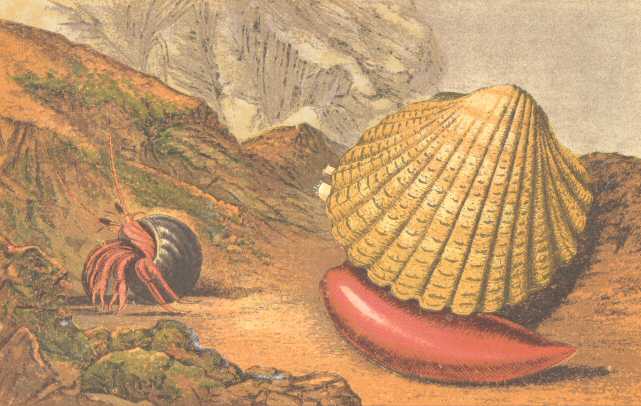
That red capsicum is the foot of the animal contained in the
cockleshell. By its aid it crawls, leaps, and burrows in
the sand, where it lies drinking in the salt water through one of
its siphons, and discharging it again through the other.
Put the shell into a rock pool, or a basin of water, and you will
see the siphons clearly. The valves gape apart some
three-quarters of an inch. The semi-pellucid orange
“mantle” fills the intermediate space. Through
that mantle, at the end from which the foot curves, the siphons
protrude; two thick short tubes joined side by side, their lips
fringed with pearly cirri, or fringes; and very beautiful they
are. The larger is always open, taking in the water, which
is at once the animal’s food and air, and which, flowing
over the delicate inner surface of the mantle, at once oxygenates
its blood, and fills its stomach with minute particles of decayed
organized matter. The smaller is shut. Wait a minute,
and it will open suddenly and discharge a jet of clear water,
which has been robbed, I suppose, of its oxygen and its organic
matter. But, I suppose, your eyes will be rather attracted
by that same scarlet and orange foot, which is being drawn in and
thrust out to a length of nearly four inches, striking with its
point against any opposing object, and sending the whole shell
backwards with a jerk. The point, you see, is sharp and
tongue-like; only flattened, not horizontally, like a tongue, but
perpendicularly, so as to form, as it was intended, a perfect
sand-plough, by which the animal can move at will, either above
or below the surface of the sand. [67]
But for colour and shape, to what shall we compare it?
To polished cornelian, says Mr. Gosse. I say, to one of the
great red capsicums which hang drying in every Covent-garden
seedsman’s window. Yet is either simile better than
the guess of a certain lady, who, entering a room wherein a
couple of Cardium tuberculatum were waltzing about a plate,
exclaimed, “Oh dear! I always heard that my pretty
red coral came out of a fish, and here it is all
alive!”
“C. tuberculatum,” says Mr. Gosse (who described
it from specimens which I sent him in 1854), “is far the
finest species. The valves are more globose and of a warmer
colour; those that I have seen are even more
spinous.” Such may have been the case in those I
sent: but it has occurred to me now and then to dredge specimens
of C. aculeatum, which had escaped that rolling on the sand fatal
in old age to its delicate spines, and which equalled in colour,
size, and perfectness the noble one figured in poor dear old Dr.
Turton’s “British Bivalves.” Besides,
aculeatum is a far thinner and more delicate shell. And a
third species, C. echinatum, with curves more graceful and
continuous, is to be found now and then with the two
former. In it, each point, instead of degenerating into a
knot, as in tuberculatum, or developing from delicate flat
briar-prickles into long straight thorns, as in aculeatum, is
close-set to its fellow, and curved at the point transversely to
the shell, the whole being thus horrid with hundreds of strong
tenterhooks, making his castle impregnable to the raveners of the
deep. For we can hardly doubt that these prickles are meant
as weapons of defence, without which so savoury a morsel as the
mollusc within (cooked and eaten largely on some parts of our
south coast) would be a staple article of food for sea-beasts of
prey. And it is noteworthy, first, that the defensive
thorns which are permanent on the two thinner species, aculeatum
and echinatum, disappear altogether on the thicker one,
tuberculatum, as old age gives him a solid and heavy globose
shell; and next, that he too, while young and tender, and liable
therefore to be bored through by whelks and such murderous
univalves, does actually possess the same briar-prickles, which
his thinner cousins keep throughout life. Nevertheless,
prickles, in all three species, are, as far as we can see,
useless in Torbay, where no wolf-fish (Anarrhichas lupus) or
other owner of shell-crushing jaws wanders, terrible to lobster
and to cockle. Originally intended, as we suppose, to face
the strong-toothed monsters of the Mediterranean, these
foreigners have wandered northward to shores where their armour
is not now needed; and yet centuries of idleness and security
have not been able to persuade them to lay it by.
This—if my explanation is the right one—is but one
more case among hundreds in which peculiarities, useful doubtless
to their original possessors, remain, though now useless, in
their descendants. Just so does the tame ram inherit the
now superfluous horns of his primeval wild ancestors, though he
fights now—if he fights at all—not with his horns,
but with his forehead.
Enough of Cardium tuberculatum. Now for the other
animals of the heap; and first, for those long white
razors. They, as well as the grey scimitars, are Solens,
Razor-fish (Solen siliqua and S. ensis), burrowers in the sand by
that foot which protrudes from one end, nimble in escaping from
the Torquay boys, whom you will see boring for them with a long
iron screw, on the sands at low tide. They are very good to
eat, these razor-fish; at least, for those who so think them; and
abound in millions upon all our sandy shores. [70]
Now for the tapering brown spires. They are
Turritellæ, snail-like animals (though the form of the
shell is different), who crawl and browse by thousands on the
beds of Zostera, or grass wrack, which you see thrown about on
the beach, and which grows naturally in two or three fathoms
water. Stay: here is one which is “more than
itself.” On its back is mounted a cluster of
barnacles (Balanus Porcatus), of the same family as those which
stud the tide-rocks in millions, scratching the legs of hapless
bathers. Of them, I will speak presently; for I may have a
still more curious member of the family to show you. But
meanwhile, look at the mouth of the shell; a long grey worm
protrudes from it, which is not the rightful inhabitant. He
is dead long since, and his place has been occupied by one
Sipunculus Bernhardi; a wight of low degree, who connects
“radiate” with annulate forms—in plain English,
sea-cucumbers (of which we shall see some soon) with
sea-worms. But however low in the scale of comparative
anatomy, he has wit enough to take care of himself; mean ugly
little worm as he seems. For finding the mouth of the
Turritella too big for him, he has plastered it up with sand and
mud (Heaven alone knows how), just as a wry-neck plasters up a
hole in an apple-tree when she intends to build therein, and has
left only a round hole, out of which he can poke his
proboscis. A curious thing is this proboscis, when seen
through the magnifier. You perceive a ring of tentacles
round the mouth, for picking up I know not what; and you will
perceive, too, if you watch it, that when he draws it in, he
turns mouth, tentacles and all, inwards, and so down into his
stomach, just as if you were to turn the finger of a glove inward
from the tip till it passed into the hand; and so performs, every
time he eats, the clown’s as yet ideal feat, of jumping
down his own throat. [72]
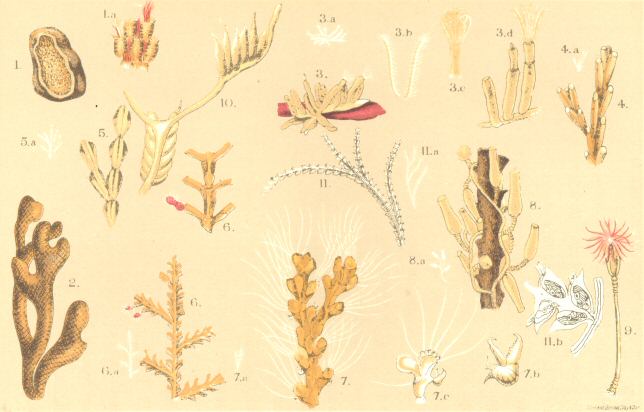
So much have we seen on one little shell. But there is
more to see close to it. Those yellow plants which I
likened to squirrels’ tails and lobsters’ horns, and
what not, are zoophytes of different kinds. Here is
Sertularia argentea (true squirrel’s tail); here, S.
filicula, as delicate as tangled threads of glass; here,
abietina; here, rosacea. The lobsters’ horns are
Antennaria antennina; and mingled with them are Plumulariæ,
always to be distinguished from Sertulariæ by polypes
growing on one side of the branch, and not on both. Here is
falcata, with its roots twisted round a sea-weed. Here is
cristata, on the same weed; and here is a piece of the beautiful
myriophyllum, which has been battered in its long journey out of
the deep water about the ore rock. For all these you must
consult Johnson’s “Zoophytes,” and for a dozen
smaller species, which you would probably find tangled among
them, or parasitic on the sea-weed. Here are Flustræ,
or sea-mats. This, which smells very like Verbena, is
Flustra coriacea (Pl. I. Fig. 2). That scurf on the frond
of ore-weed is F. lineata (Pl. Fig. 1). The glass bells
twined about this Sertularia are Campanularia syringa (Pl. I.
Fig. 9); and here is a tiny plant of Cellularia ciliata (Pl. I.
Fig. 8). Look at it through the field-glass; for it is
truly wonderful. Each polype cell is edged with whip-like
spines, and on the back of some of them is—what is it, but
a live vulture’s head, snapping and snapping—what
for?
Nay, reader, I am here to show you what can be seen: but as
for telling you what can be known, much more what cannot, I
decline; and refer you to Johnson’s
“Zoophytes,” wherein you will find that several
species of polypes carry these same birds’ heads: but
whether they be parts of the polype, and of what use they are, no
man living knoweth.
Next, what are the striped pears? They are sea-anemones,
and of a species only lately well known, Sagartia viduata, the
snake-locked anemone (Pl. V. Fig. 3 [74]). They have
been washed off the loose stones to which they usually adhere by
the pitiless roll of the ground-swell; however, they are not so
far gone, but that if you take one of them home, and put it in a
jar of water, it will expand into a delicate compound flower,
which can neither be described nor painted, of long pellucid
tentacles, hanging like a thin bluish cloud over a disk of
mottled brown and grey.
Here, adhering to this large whelk, is another, but far larger
and coarser. It is Sagartia parasitica, one of our largest
British species; and most singular in this, that it is almost
always (in Torbay, at least,) found adhering to a whelk: but
never to a live one; and for this reason. The live whelk
(as you may see for yourself when the tide is out) burrows in the
sand in chase of hapless bivalve shells, whom he bores through
with his sharp tongue (always, cunning fellow, close to the
hinge, where the fish is), and then sucks out their life.
Now, if the anemone stuck to him, it would be carried under the
sand daily, to its own disgust. It prefers, therefore, the
dead whelk, inhabited by a soldier crab, Pagurus Bernhardi (Pl.
II. Fig. 2), of which you may find a dozen anywhere as the
tide goes out; and travels about at the crab’s expense,
sharing with him the offal which is his food. Note,
moreover, that the soldier crab is the most hasty and blundering
of marine animals, as active as a monkey, and as subject to
panics as a horse; wherefore the poor anemone on his back must
have a hard life of it; being knocked about against rocks and
shells, without warning, from morn to night and night to
morn. Against which danger, kind Nature, ever maxima in
minimis, has provided by fitting him with a stout leather
coat, which she has given, I believe, to no other of his
family.
Next, for the babies’ heads, covered with prickles,
instead of hair. They are sea-urchins, Amphidotus cordatus,
which burrow by thousands in the sand. These are of that
Spatangoid form, which you will often find fossil in the chalk,
and which shepherd boys call snakes’ heads. We shall
soon find another sort, an Echinus, and have time to talk over
these most strange (in my eyes) of all living animals.
There are a hundred more things to be talked of here: but we
must defer the examination of them till our return; for it wants
an hour yet of the dead low spring-tide; and ere we go home, we
will spend a few minutes at least on the rocks at Livermead,
where awaits us a strong-backed quarryman, with a strong-backed
crowbar, as is to be hoped (for he snapped one right across there
yesterday, falling miserably on his back into a pool thereby),
and we will verify Mr. Gosse’s observation, that—
“When once we have begun to look with curiosity on the
strange things that ordinary people pass over without notice, our
wonder is continually excited by the variety of phase, and often
by the uncouthness of form, under which some of the meaner
creatures are presented to us. And this is very specially
the case with the inhabitants of the sea. We can scarcely
poke or pry for an hour among the rocks, at low-water mark, or
walk, with an observant downcast eye, along the beach after a
gale, without finding some oddly-fashioned, suspicious-looking
being, unlike any form of life that we have seen before.
The dark concealed interior of the sea becomes thus invested with
a fresh mystery; its vast recesses appear to be stored with all
imaginable forms; and we are tempted to think there must be
multitudes of living creatures whose very figure and structure
have never yet been suspected.
“‘O sea! old sea! who yet knows
half
Of thy wonders or thy pride!’”
Gosse’s Aquarium, pp. 226,
227.
These words have more than fulfilled themselves since they
were written. Those Deep-Sea dredgings, of which a detailed
account will be found in Dr. Wyville Thomson’s new and most
beautiful book, “The Depths of the Sea,” have
disclosed, of late years, wonders of the deep even more strange
and more multitudinous than the wonders of the shore. The
time is past when we thought ourselves bound to believe, with
Professor Edward Forbes, that only some hundred fathoms down, the
inhabitants of the sea-bottom “become more and more
modified, and fewer and fewer, indicating our approach towards an
abyss where life is either extinguished, or exhibits but a few
sparks to mark it’s lingering presence.”
Neither now need we indulge in another theory which had a
certain grandeur in it, and was not so absurd as it looks at
first sight,—namely, that, as Dr. Wyville Thomson puts it,
picturesquely enough, “in going down the sea water became,
under the pressure, gradually heavier and heavier, and that all
the loose things floated at different levels, according to their
specific weight,—skeletons of men, anchors and shot and
cannon, and last of all the broad gold pieces lost in the wreck
of many a galleon off the Spanish Main; the whole forming a kind
of ‘false bottom’ to the ocean, beneath which there
lay all the depth of clear still water, which was heavier than
molten gold.”
The facts are; first that water, being all but incompressible,
is hardly any heavier, and just as liquid, at the greatest depth,
than at the surface; and that therefore animals can move as
freely in it in deep as in shallow water; and next, that as the
fluids inside the body of a sea animal must be at the same
pressure as that of the water outside it, the two pressures must
balance each other; and the body, instead of being crushed in,
may be unconscious that it is living under a weight of two or
three miles of water. But so it is; as we gather our
curiosities at low-tide mark, or haul the dredge a mile or two
out at sea, we may allow our fancy to range freely out to the
westward, and down over the subaqueous cliffs of the
hundred-fathom line, which mark the old shore of the British
Isles, or rather of a time when Britain and Ireland were part of
the continent, through water a mile, and two, and three miles
deep, into total darkness, and icy cold, and a pressure which, in
the open air, would crush any known living creature to a jelly;
and be certain that we shall find the ocean-floor teeming
everywhere with multitudinous life, some of it strangely like,
some strangely unlike, the creatures which we see along the
shore.
Some strangely like. You may find, for instance, among
the sea-weed, here and there, a little black sea-spider, a
Nymphon, who has this peculiarity, that possessing no body at all
to speak of, he carries his needful stomach in long branches,
packed inside his legs. The specimens which you will find
will probably be half an inch across the legs. An almost
exactly similar Nymphon has been dredged from the depths of the
Arctic and Antarctic oceans, nearly two feet across.
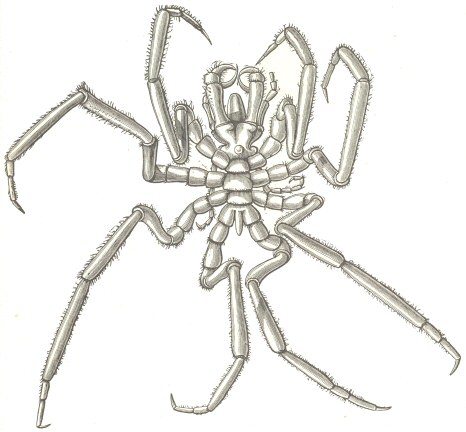
You may find also a quaint little shrimp, Caprella,
clinging by its hind claws to sea-weed, and waving its gaunt
grotesque body to and fro, while it makes mesmeric passes with
its large fore claws,—one of the most ridiculous of
Nature’s many ridiculous forms. Those which you will
find will be some quarter of an inch in length; but in the cold
area of the North Atlantic, their cousins, it is now found, are
nearly three inches long, and perch in like manner, not on
sea-weeds, for there are none so deep, but on branching
sponges.
These are but two instances out of many of forms which were
supposed to be peculiar to shallow shores repeating themselves at
vast depths: thus forcing on us strange questions about changes
in the distribution and depth of the ancient seas; and forcing
us, also, to reconsider the old rules by which rocks were
distinguished as deep-sea or shallow-sea deposits according to
the fossils found in them.
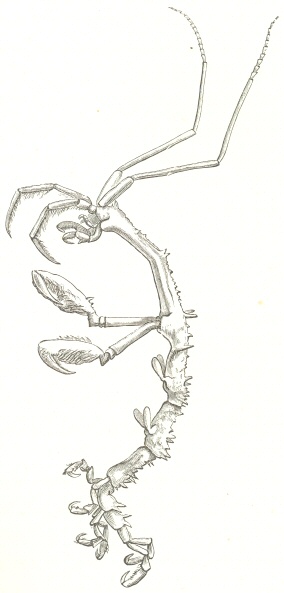
As for the new forms, and even more important than them, the
ancient forms, supposed to have been long extinct, and only known
as fossils, till they were lately rediscovered alive in the
nether darkness,—for them you must consult Dr. Wyville
Thomson’s book, and the notices of the
“Challenger’s” dredgings which appear from time
to time in the columns of “Nature;” for want of space
forbids my speaking of them here.
But if you have no time to read “The Depths of the
Sea,” go at least to the British Museum, or if you be a
northern man, to the admirable public museum at Liverpool; ask to
be shown the deep-sea forms; and there feast your curiosity and
your sense of beauty for an hour. Look at the Crinoids, or
stalked star-fishes, the “Lilies of living stone,”
which swarmed in the ancient seas, in vast variety, and in such
numbers that whole beds of limestone are composed of their
disjointed fragments; but which have vanished out of our modern
seas, we know not why, till, a few years since, almost the only
known living species was the exquisite and rare Pentacrinus
asteria, from deep water off the Windward Isles of the West
Indies.
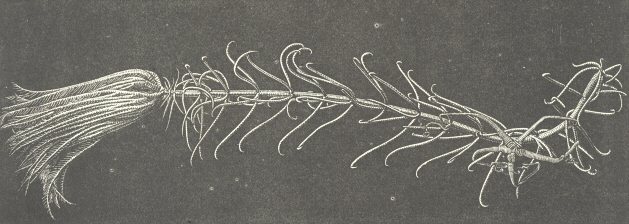
Of this you will see a specimen or two both at Liverpool and
in the British Museum; and near them, probably, specimens of the
new-old Crinoids, discovered of late years by Professor Sars, Mr.
Gwyn Jeffreys, Dr. Carpenter, Dr. Wyville Thomson, and the other
deep-sea disciples of the mythic Glaucus, the fisherman, who,
enamoured of the wonders of the sea, plunged into the blue abyss
once and for all, and became himself “the blue old man of
the sea.”
Next look at the corals, and Gorgonias, and all the sea-fern
tribe of branching polypidoms, and last, but not least, at the
glass sponges; first at the Euplectella, or Venus’s
flower-basket, which lives embedded in the mud of the seas of the
Philippines, supported by a glass frill “standing up round
it like an Elizabethan ruff.” Twenty years ago there
was but one specimen in Europe: now you may buy one for a pound
in any curiosity shop. I advise you to do so, and to
keep—as I have seen done—under a glass case, as a
delight to your eyes, one of the most exquisite, both for form
and texture, of natural objects.
Then look at the Hyalonemas, or glass-rope ocean floor by a
twisted wisp of strong flexible flint needles, somewhat on the
principle of a screw-pile. So strange and complicated is
their structure, that naturalists for a long while could
literally make neither head nor tail of them, as long as they had
only Japanese specimens to study, some of which the Japanese
dealers had, of malice prepense, stuck upside down into
Pholas-borings in stones. Which was top and which bottom;
which the thing itself, and which special parasites growing on
it; whether it was a sponge, or a zoophyte, or something else; at
one time even whether it was natural, or artificial and a
make-up,—could not be settled, even till a year or two
since. But the discovery of the same, or a similar, species
in abundance from the Butt of the Lows down to Setubal on the
Portuguese coast, where the deep-water shark fishers call it
“sea-whip,” has given our savants specimens enough to
make up their minds—that they really know little or nothing
about it, and probably will never know.
And do not forget, lastly, to ask, whether at Liverpool or at
the British Museum, for the Holtenias and their
congeners,—hollow sponges built up of glassy spicules, and
rooted in the mud by glass hairs, in some cases between two and
three feet long, as flexible and graceful as tresses of
snow-white silk.
Look at these, and a hundred kindred forms, and then see how
nature is not only “maxima in minimis”—greatest
in her least, but often “pulcherrima in
abditis”—fairest in her most hidden works; and how
the Creative Spirit has lavished, as it were, unspeakable
artistic skill on lowly-organized creature, never till now beheld
by man, and buried, not only in foul mud, but in their own
unsightly heap of living jelly.
But so it was from the beginning;—and this planet was
not made for man alone. Countless ages before we appeared
on earth the depths of the old chalk-ocean teemed with forms as
beautiful and perfect as those, their lineal descendants, which
the dredge now brings up from the Atlantic sea-floor; and if
there were—as my reason tells me that there must have
been—final moral causes for their existence, the only ones
which we have a right to imagine are these—that all, down
to the lowest Rhizopod, might delight themselves, however dimly,
in existing; and that the Lord might delight Himself in them.
Thus, much—alas! how little—about the wonders of
the deep. We, who are no deep-sea dredgers, must return
humbly to the wonders of the shore. And first, as after
descending the gap in the sea-wall we walk along the ribbed floor
of hard yellow sand, let me ask you to give a sharp look-out for
a round grey disc, about as big as a penny-piece, peeping out on
the surface. No; that is not it, that little lump: open it,
and you will find within one of the common little Venus
gallina.—The closet collectors have given it some new name
now, and no thanks to them: they are always changing the names,
instead of studying the live animals where Nature has put them,
in which case they would have no time for word-inventing.
Nay, I verify suspect that the names grow, like other things; at
least, they get longer and longer and more jaw-breaking every
year. The little bivalve, however, finding itself left by
the tide, has wisely shut up its siphons, and, by means of its
foot and its edges, buried itself in a comfortable bath of cool
wet sand, till the sea shall come back, and make it safe to crawl
and lounge about on the surface, smoking the sea-water instead of
tobacco. Neither is that depression what we seek.
Touch it, and out poke a pair of astonished and inquiring horns:
it is a long-armed crab, who saw us coming, and wisely shovelled
himself into the sand by means of his nether-end. Corystes
Cassivelaunus is his name, which he is said to have acquired from
the marks on his back, which are somewhat like a human
face. “Those long antennæ,” says my
friend, Mr. Lloyd [90]—I have not verified the fact, but
believe it, as he knows a great deal about crabs, and I know next
to nothing—“form a tube through which a current of
water passes into the crab’s gills, free from the
surrounding sand.” Moreover, it is only the male who
has those strangely long fore-arms and claws; the female
contenting herself with limbs of a more moderate length.
Neither is that, though it might be, the hole down which what we
seek has vanished: but that burrow contains one of the long white
razors which you saw cast on shore at Paignton. The boys
close by are boring for them with iron rods armed with a screw,
and taking them in to sell in Torquay market, as excellent
food. But there is one, at last—a grey disc pouting
up through the sand. Touch it, and it is gone down, quick
as light. We must dig it out, and carefully, for it is a
delicate monster. At last, after ten minutes’ careful
work, we have brought up, from a foot depth or
more—what? A thick, dirty, slimy worm, without head
or tail, form or colour. A slug has more artistic beauty
about him. Be it so. At home in the aquarium (where,
alas! he will live but for a day or two, under the new irritation
of light) he will make a very different figure. That is one
of the rarest of British sea-animals, Peachia hastata (Pl. XII.
Fig. 1), which differs from most other British Actiniæ in
this, that instead of having like them a walking disc, it has a
free open lower end, with which (I know not how) it buries itself
upright in the sand, with its mouth just above the surface.
The figure on the left of the plate represents a curious cluster
of papillæ which project from one side of the mouth, and
are the opening of the oviduct. But his value consists, not
merely in his beauty (though that, really, is not small), but in
his belonging to what the long word-makers call an
“interosculant” group,—a party of genera and
species which connect families scientifically far apart, filling
up a fresh link in the great chain, or rather the great network,
of zoological classification. For here we have a simple,
and, as it were, crude form; of which, if we dared to indulge in
reveries, we might say that the Creative Mind realized it before
either Actiniæ or Holothurians, and then went on to perfect
the idea contained in it in two different directions; dividing it
into two different families, and making on its model, by adding
new organs, and taking away old ones, in one direction the whole
family of Actiniæ (sea-anemones), and in a quite opposite
one the Holothuriæ, those strange sea-cucumbers, with their
mouth-fringe of feathery gills, of which you shall see some
anon. Thus there has been, in the Creative Mind, as it gave
life to new species, a development of the idea on which older
species were created, in order—we may fancy—that
every mesh of the great net might gradually be supplied, and
there should be no gaps in the perfect variety of Nature’s
forms. This development is one which we must believe to be
at least possible, if we allow that a Mind presides over the
universe, and not a mere brute necessity, a Law (absurd misnomer)
without a Lawgiver; and to it (strangely enough coinciding here
and there with the Platonic doctrine of Eternal Ideas existing in
the Divine Mind) all fresh inductive discovery seems to point
more and more.
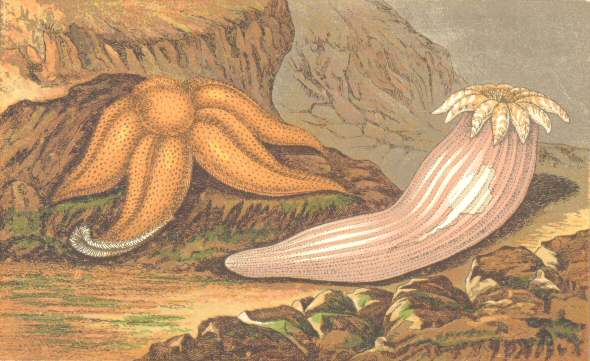
Let me speak freely a few words on this important
matter. Geology has disproved the old popular belief that
the universe was brought into being as it now exists by a single
fiat. We know that the work has been gradual; that the
earth
“In tracts of fluent heat began,
The seeming prey of cyclic storms,
The home of seeming random forms,
Till, at the last, arose the man.”
And we know, also, that these forms, “seeming
random” as they are, have appeared according to a law
which, as far as we can judge, has been on the whole one of
progress,—lower animals (though we cannot yet say, the
lowest) appearing first, and man, the highest mammal, “the
roof and crown of things,” one of the latest in the
series. We have no more right, let it be observed, to say
that man, the highest, appeared last, than that the lowest
appeared first. It was probably so, in both cases; but
there is as yet no positive proof of either; and as we know that
species of animals lower than those which already existed
appeared again and again during the various eras, so it is quite
possible that they may be appearing now, and may appear
hereafter: and that for every extinct Dodo or Moa, a new species
may be created, to keep up the equilibrium of the whole.
This is but a surmise: but it may be wise, perhaps, just now, to
confess boldly, even to insist on, its possibility, lest any
should fancy, from our unwillingness to allow it, that there
would be ought in it, if proved, contrary to sound religion.
I am, I must honestly confess, more and more unable to
perceive anything which an orthodox Christian may not hold, in
those physical theories of “evolution,” which are
gaining more and more the assent of our best zoologists and
botanists. All that they ask us to believe is, that
“species” and “families,” and indeed the
whole of organic nature, have gone through, and may still be
going through, some such development from a lowest germ, as we
know that every living individual, from the lowest zoophyte to
man himself, does actually go through. They apply to the
whole of the living world, past, present, and future, the law
which is undeniably at work on each individual of it. They
may be wrong, or they may be right: but what is there in such a
conception contrary to any doctrine—at least of the Church
of England? To say that this cannot be true; that species
cannot vary, because God, at the beginning, created each thing
“according to its kind,” is really to beg the
question; which is—Does the idea of “kind”
include variability or not? and if so, how much
variability? Now, “kind,” or
“species,” as we call it, is defined nowhere in the
Bible. What right have we to read our own definition into
the word?—and that against the certain fact, that some
“kinds” do vary, and that widely,—mankind, for
instance, and the animals and plants which he domesticates.
Surely that latter fact should be significant, to those who
believe, as I do, that man was created in the likeness of
God. For if man has the power, not only of making plants
and animals vary, but of developing them into forms of higher
beauty and usefulness than their wild ancestors possessed, why
should not the God in whose image he is made possess the same
power? If the old theological rule be
true—“There is nothing in man which was not first in
God” (sin, of course, excluded)—then why should not
this imperfect creative faculty in man be the very guarantee that
God possesses it in perfection?
Such at least is the conclusion of one who, studying certain
families of plants, which indulge in the most fantastic varieties
of shape and size, and yet through all their vagaries
retain—as do the Palms, the Orchids, the
Euphorbiaceæ—one organ, or form of organs, peculiar
and highly specialized, yet constant throughout the whole of each
family, has been driven to the belief that each of these three
families, at least, has “sported off” from one common
ancestor—one archetypal Palm, one archetypal Orchid, one
archetypal Euphorbia, simple, it may be, in itself, but endowed
with infinite possibilities of new and complex beauty, to be
developed, not in it, but in its descendants. He has asked
himself, sitting alone amid the boundless wealth of tropic
forests, whether even then and there the great God might not be
creating round him, slowly but surely, new forms of beauty?
If he chose to do it, could He not do it? That man found
himself none the worse Christian for the thought. He has
said—and must be allowed to say again, for he sees no
reason to alter his words—in speaking of the wonderful
variety of forms in the Euphorbiaceæ, from the weedy
English Euphorbias, the Dog’s Mercuries, and the Box, to
the prickly-stemmed Scarlet Euphorbia of Madagascar, the
succulent Cactus-like Euphorbias of the Canaries and elsewhere;
the Gale-like Phyllanthus; the many-formed Crotons; the Hemp-like
Maniocs, Physic-nuts, Castor-oils, the scarlet Poinsettia, the
little pink and yellow Dalechampia, the poisonous Manchineel, and
the gigantic Hura, or sandbox tree, of the West Indies,—all
so different in shape and size, yet all alike in their most
peculiar and complex fructification, and in their acrid milky
juice,—“What if all these forms are the descendants
of one original form? Would that be one whit the more
wonderful than the theory that they were, each and all, with the
minute, and often imaginary, shades of difference between certain
cognate species among them, created separately and at once?
But if it be so—which I cannot allow—what would the
theologian have to say, save that God’s works are even more
wonderful than he always believed them to be? As for the
theory being impossible—that is to be decided by men of
science, on strict experimental grounds. As for us
theologians, who are we, that we should limit, à priori,
the power of God? ‘Is anything too hard for the
Lord?’ asked the prophet of old; and we have a right to ask
it as long as the world shall last. If it be said that
‘natural selection,’ or, as Mr. Herbert Spencer
better defines it, the ‘survival of the fittest,’ is
too simple a cause to produce such fantastic variety—that,
again, is a question to be settled exclusively by men of science,
on their own grounds. We, meanwhile, always knew that God
works by very simple, or seemingly simple, means; that the
universe, as far as we could discern it, was one organization of
the most simple means. It was wonderful—or should
have been—in our eyes, that a shower of rain should make
the grass grow, and that the grass should become flesh, and the
flesh food for the thinking brain of man. It was—or
ought to have been—more wonderful yet to us that a child
should resemble its parents, or even a butterfly resemble, if not
always, still usually, its parents likewise. Ought God to
appear less or more august in our eyes if we discover that the
means are even simpler than we supposed? We held Him to be
Almighty and All-wise. Are we to reverence Him less or more
if we find Him to be so much mightier, so much wiser, than we
dreamed, that He can not only make all things, but—the very
perfection of creative power—make all things make
themselves? We believed that His care was over all His
works; that His providence worked perpetually over the
universe. We were taught—some of us at least—by
Holy Scripture, that without Him not a sparrow fell to the
ground, and that the very hairs of our head were all numbered;
that the whole history of the universe was made up, in fact, of
an infinite network of special providences. If, then, that
should be true which a great naturalist writes, ‘It may be
metaphorically said that natural selection is daily and hourly
scrutinizing, throughout the world, every variation, even the
slightest; rejecting that which is bad, preserving and adding up
all that is good; silently and insensibly working, whenever and
wherever opportunity offers, at the improvement of each organic
being, in relation to its organic and inorganic conditions of
life,’—if this, I say, were proved to be true, ought
God’s care and God’s providence to seem less or more
magnificent in our eyes? Of old it was said by Him without
whom nothing is made—‘My Father worketh hitherto, and
I work.’ Shall we quarrel with physical science, if
she gives us evidence that those words are true?”
And—understand it well—the grand passage I have
just quoted need not be accused of substituting “natural
selection for God.” In any case natural selection
would be only the means or law by which God works, as He does by
other natural laws. We do not substitute gravitation for
God, when we say that the planets are sustained in their orbits
by the law of gravitation. The theory about natural
selection may be untrue, or imperfect, as may the modern theories
of the “evolution and progress” of organic forms: let
the man of science decide that. But if true, the theories
seem to me perfectly to agree with, and may be perfectly
explained by, the simple old belief which the Bible sets before
us, of a Living God: not a mere past
will, such as the Koran sets forth, creating once and for all,
and then leaving the universe, to use Goethe’s simile,
“to spin round his finger;” nor again, an
“all-pervading spirit,” words which are mere
contradictory jargon, concealing, from those who utter them,
blank Materialism: but One who works in all things which have
obeyed Him to will and to do of His good pleasure, keeping His
abysmal and self-perfect purpose, yet altering the methods by
which that purpose is attained, from æon to æon, ay,
from moment to moment, for ever various, yet for ever the
same. This great and yet most blessed paradox of the
Changeless God, who yet can say “It repenteth me,”
and “Behold, I work a new thing on the earth,” is
revealed no less by nature than by Scripture; the changeableness,
not of caprice or imperfection, but of an Infinite Maker and
“Poietes,” drawing ever fresh forms out of the
inexhaustible treasury of His primæval Mind; and yet never
throwing away a conception to which He has once given actual
birth in time and space, (but to compare reverently small things
and great) lovingly repeating it, re-applying it; producing the
same effects by endlessly different methods; or so delicately
modifying the method that, as by the turn of a hair, it shall
produce endlessly diverse effects; looking back, as it were, ever
and anon over the great work of all the ages, to retouch it, and
fill up each chasm in the scheme, which for some good purpose had
been left open in earlier worlds; or leaving some open (the
forms, for instance, necessary to connect the bimana and the
quadrumana) to be filled up perhaps hereafter when the world
needs them; the handiwork, in short, of a living and loving Mind,
perfect in His own eternity, but stooping to work in time and
space, and there rejoicing Himself in the work of His own hands,
and in His eternal Sabbaths ceasing in rest ineffable, that He
may look on that which He hath made, and behold it is very
good.
I speak, of course, under correction; for this conclusion is
emphatically matter of induction, and must be verified or
modified by ever-fresh facts: but I meet with many a Christian
passage in scientific books, which seems to me to go, not too
far, but rather not far enough, in asserting the God of the
Bible, as Saint Paul says, “not to have left Himself
without witness,” in nature itself, that He is the God of
grace. Why speak of the God of nature and the God of grace
as two antithetical terms? The Bible never, in a single instance,
makes the distinction; and surely, if God be (as He is) the
Eternal and Unchangeable One, and if (as we all confess) the
universe bears the impress of His signet, we have no right, in
the present infantile state of science, to put arbitrary limits
of our own to the revelation which He may have thought good to
make of Himself in nature. Nay, rather, let us believe
that, if our eyes were opened, we should fulfil the requirement
of Genius, to “see the universal in the particular,”
by seeing God’s whole likeness, His whole glory, reflected
as in a mirror even in the meanest flower; and that nothing but
the dulness of our own souls prevents them from seeing day and
night in all things, however small or trivial to human
eclecticism, the Lord Jesus Christ Himself fulfilling His own
saying, “My Father worketh hitherto, and I work.”
To me it seems (to sum up, in a few words, what I have tried
to say) that such development and progress as have as yet been
actually discovered in nature, bear every trace of having been
produced by successive acts of thought and will in some personal
mind; which, however boundlessly rich and powerful, is still the
Archetype of the human mind; and therefore (for to this I confess
I have been all along tending) probably capable, without violence
to its properties, of becoming, like the human mind,
incarnate.
But to descend from these perhaps too daring speculations,
there is another, and more human, source of interest about the
animal who is writhing feebly in the glass jar of salt water; for
he is one of the many curiosities which have been added to our
fauna by that humble hero Mr. Charles Peach, the self-taught
naturalist, of whom, as we walk on toward the rocks, something
should be said, or rather read; for Mr. Chambers, in an
often-quoted passage from his Edinburgh Journal, which I must
have the pleasure of quoting once again, has told the story
better than we can tell it:—
“But who is that little intelligent-looking man in a
faded naval uniform, who is so invariably to be seen in a
particular central seat in this section? That, gentle
reader, is perhaps one of the most interesting men who attend the
British Association. He is only a private in the mounted
guard (preventive service) at an obscure part of the Cornwall
coast, with four shillings a day, and a wife and nine children,
most of whose education he has himself to conduct. He never
tastes the luxuries which are so common in the middle ranks of
life, and even amongst a large portion of the working
classes. He has to mend with his own hands every sort of
thing that can break or wear in his house. Yet Mr. Peach is
a votary of Natural History; not a student of the science in
books, for he cannot afford books; but an investigator by sea and
shore, a collector of Zoophytes and Echinodermata—strange
creatures, many of which are as yet hardly known to man.
These he collects, preserves, and describes; and every year does
he come up to the British Association with a few novelties of
this kind, accompanied by illustrative papers and drawings: thus,
under circumstances the very opposite of those of such men as
Lord Enniskillen, adding, in like manner, to the general stock of
knowledge. On the present occasion he is unusually elated,
for he has made the discovery of a Holothuria with twenty
tentacula, a species of the Echinodermata which Professor Forbes,
in his book on Star-Fishes, has said was never yet observed in
the British seas. It may be of small moment to you, who,
mayhap, know nothing of Holothurias: but it is a considerable
thing to the Fauna of Britain, and a vast matter to a poor
private of the Cornwall mounted guard. And accordingly he
will go home in a few days, full of the glory of his exhibition,
and strong anew by the kind notice taken of him by the masters of
the science, to similar inquiries, difficult as it may be to
prosecute them, under such a complication of duties, professional
and domestic. Honest Peach! humble as is thy home, and
simple thy bearing, thou art an honour even to this assemblage of
nobles and doctors: nay, more, when we consider everything, thou
art an honour to human nature itself; for where is the heroism
like that of virtuous, intelligent, independent poverty?
And such heroism is thine!”—Chambers’ Edin.
Journ., Nov. 23, 1844.
Mr. Peach has been since rewarded in part for his long labours
in the cause of science, by having been removed to a more
lucrative post on the north coast of Scotland; the earnest, it is
to be hoped, of still further promotion.
I mentioned just now Synapta; or, as Montagu called it,
Chirodota: a much better name, and, I think, very uselessly
changed; for Chirodota expresses the peculiarity of the beast,
which consists in—start not, reader—twelve hands,
like human hands, while Synapta expresses merely its power of
clinging to the fingers, which it possesses in common with many
other animals. It is, at least, a beast worth talking
about; as for finding one, I fear that we have no chance of such
good fortune.
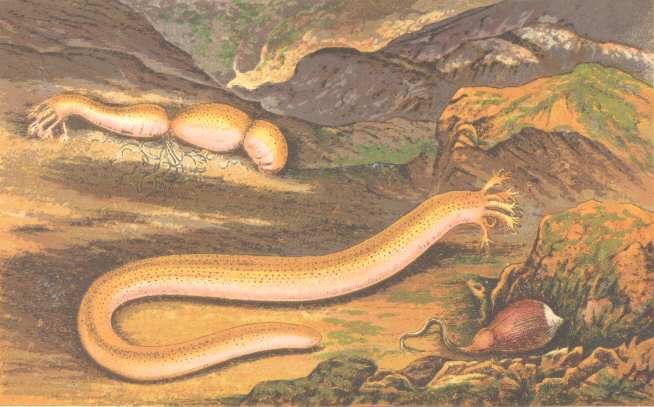
Colonel Montagu found them here some forty years ago; and
after him, Mr. Alder, in 1845. I found hundreds of them,
but only once, in 1854 after a heavy south-eastern gale, washed
up among the great Lutrariæ in a cove near Goodrington; but
all my dredging outside failed to procure a specimen—Mr.
Alder, however, and Mr. Cocks (who find everything, and will at
last certainly catch Midgard, the great sea-serpent, as Thor did,
by baiting for him with a bull’s head), have dredged them
in great numbers; the former, at Helford in Cornwall, the latter
on the west coast of Scotland. It seems, however, to be a
southern monster, probably a remnant, like the great cockle, of
the Mediterranean fauna; for Mr. MacAndrew finds them plentifully
in Vigo Bay, and J. Müller in the Adriatic, off Trieste.
But what is it like? Conceive a very fat short
earth-worm; not ringed, though, like the earth-worm, but smooth
and glossy, dappled with darker spots, especially on one side,
which may be the upper one. Put round its mouth twelve
little arms, on each a hand with four ragged fingers, and on the
back of the hand a stump of a thumb, and you have Synapta
Digitata (Plates IV. and V., from my drawings of the live
animal). These hands it puts down to its mouth, generally
in alternate pairs, but how it obtains its food by them is yet a
mystery, for its intestines are filled, like an
earth-worm’s, with the mud in which it lives, and from
which it probably extracts (as does the earth-worm) all organic
matters.
You will find it stick to your fingers by the whole skin,
causing, if your hand be delicate, a tingling sensation; and if
you examine the skin under the microscope, you will find the
cause. The whole skin is studded with minute glass anchors,
some hanging freely from the surface, but most imbedded in the
skin. Each of these anchors is jointed at its root into one
end of a curious cribriform plate,—in plain English, one
pierced like a sieve, which lies under the skin, and reminds one
of the similar plates in the skin of the White Cucumaria, which I
will show you presently; and both of these we must regard as the
first rudiments of an Echinoderm’s outside skeleton, such
as in the Sea-urchins covers the whole body of the animal.
(See on Echinus Millaris, p. 89.) [111] Somewhat similar anchor-plates,
from a Red Sea species, Synapta Vittata, may be seen in any
collection of microscopic objects.
The animal, when caught, has a strange habit of
self-destruction, contracting its skin at two or three different
points, and writhing till it snaps itself into
“junks,” as the sailors would say, and then
dies. My specimens, on breaking up, threw out from the
wounded part long “ovarian filaments” (whatsoever
those may be), similar to those thrown out by many of the
Sagartian anemones, especially S. parasitica. Beyond this,
I can tell you nothing about Synapta, and only ask you to
consider its hands, as an instance of that fantastic play of
Nature which repeats, in families widely different, organs of
similar form, though perhaps of by no means similar use; nay,
sometimes (as in those beautiful clear-wing hawk-moths which you,
as they hover round the rhododendrons, mistake for bumble-bees)
repeats the outward form of a whole animal, for no conceivable
reason save her—shall we not say honestly His?—own
good pleasure.
But here we are at the old bank of boulders, the ruins of an
antique pier which the monks of Tor Abbey built for their
convenience, while Torquay was but a knot of fishing huts within
a lonely limestone cove. To get to it, though, we have
passed many a hidden treasure; for every ledge of these flat
New-red-sandstone rocks, if torn up with the crowbar, discloses
in its cracks and crannies nests of strange forms which shun the
light of day; beautiful Actiniæ fill the tiny caverns with
living flowers; great Pholades (Plate X. figs. 3, 4) bore by
hundreds in the softer strata; and wherever a thin layer of muddy
sand intervenes between two slabs, long Annelid worms of
quaintest forms and colours have their horizontal burrows, among
those of that curious and rare radiate animal, the Spoonworm, [113] an eyeless bag about an inch long,
half bluish grey, half pink, with a strange scalloped and
wrinkled proboscis of saffron colour, which serves, in some
mysterious way, soft as it is, to collect food, and clear its
dark passage through the rock.
See, at the extreme low-water mark, where the broad olive
fronds of the Laminariæ, like fan-palms, droop and wave
gracefully in the retiring ripples, a great boulder which will
serve our purpose. Its upper side is a whole forest of
sea-weeds, large and small; and that forest, if you examined it
closely, as full of inhabitants as those of the Amazon or the
Gambia. To “beat” that dense cover would be an
endless task: but on the under side, where no sea-weeds grow, we
shall find full in view enough to occupy us till the tide
returns. For the slab, see, is such a one as sea-beasts
love to haunt. Its weed-covered surface shows that the
surge has not shifted it for years past. It lies on other
boulders clear of sand and mud, so that there is no fear of dead
sea-weed having lodged and decayed under it, destructive to
animal life. We can see dark crannies and caves beneath;
yet too narrow to allow the surge to wash in, and keep the
surface clean. It will be a fine menagerie of Nereus, if we
can but turn it.
Now the crowbar is well under it; heave, and with a will; and
so, after five minutes’ tugging, propping, slipping, and
splashing, the boulder gradually tips over, and we rush greedily
upon the spoil.
A muddy dripping surface it is, truly, full of cracks and
hollows, uninviting enough at first sight: let us look it round
leisurely, to see if there are not materials enough there for an
hour’s lecture.
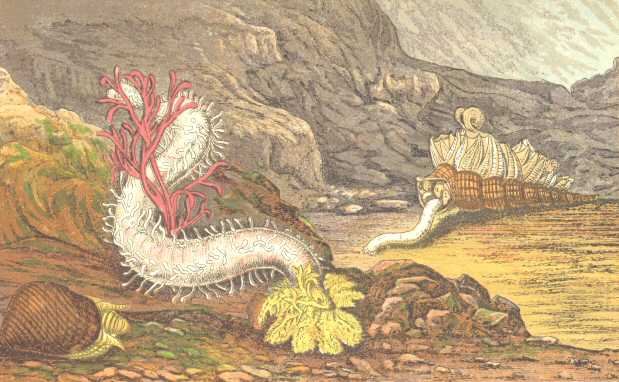
The first object which strikes the eye is probably a group of
milk-white slugs, from two to six inches long, cuddling snugly
together (Plate IX. fig. 1). You try to pull them off, and
find that they give you some trouble, such a firm hold have the
delicate white sucking arms, which fringe each of their five
edges. You see at the head nothing but a yellow dimple; for
eating and breathing are suspended till the return of tide; but
once settled in a jar of salt-water, each will protrude a large
chocolate-coloured head, tipped with a ring of ten feathery
gills, looking very much like a head of “curled
kale,” but of the loveliest white and primrose; in the
centre whereof lies perdu a mouth with sturdy teeth—if
indeed they, as well as the whole inside of the beast, have not
been lately got rid of, and what you see be not a mere bag,
without intestine or other organ: but only for the time
being. For hear it, worn-out epicures, and old Indians who
bemoan your livers, this little Holothuria knows a secret which,
if he could tell it, you would be glad to buy of him for
thousands sterling. To him blue pill and muriatic acid are
superfluous, and travels to German Brunnen a waste of time.
Happy Holothuria! who possesses really the secret of everlasting
youth, which ancient fable bestowed on the serpent and the
eagle. For when his teeth ache, or his digestive organs
trouble him, all he has to do is just to cast up forthwith his
entire inside, and, faisant maigre for a month or so, grow a
fresh set, and then eat away as merrily as ever. His name,
if you wish to consult so triumphant a hygeist, is Cucumaria
Pentactes: but he has many a stout cousin round the Scotch coast,
who knows the antibilious panacea as well as he, and submits,
among the northern fishermen, to the rather rude and undeserved
name of sea-puddings; one of which grows in Shetland to the
enormous length of three feet, rivalling there his huge
congeners, who display their exquisite plumes on every tropic
coral reef. [116]
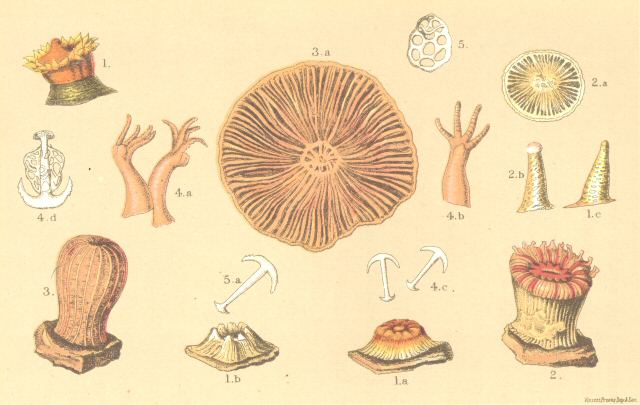
Next, what are those bright little buds, like salmon-coloured
Banksia roses half expanded, sitting closely on the stone?
Touch them; the soft part is retracted, and the orange flower of
flesh is transformed into a pale pink flower of stone. That
is the Madrepore, Caryophyllia Smithii (Plate V. fig. 2); one of
our south coast rarities: and see, on the lip of the last one,
which we have carefully scooped off with the chisel, two little
pink towers of stone, delicately striated; drop them into this
small bottle of sea-water, and from the top of each tower issues
every half-second—what shall we call it?—a hand or a
net of finest hairs, clutching at something invisible to our
grosser sense. That is the Pyrgoma, parasitic only (as far
as we know) on the lip of this same rare Madrepore; a little
“cirrhipod,” the cousin of those tiny barnacles which
roughen every rock (a larger sort whereof I showed you on the
Turritella), and of those larger ones also who burrow in the
thick hide of the whale, and, borne about upon his mighty sides,
throw out their tiny casting nets, as this Pyrgoma does, to catch
every passing animalcule, and sweep them into the jaws concealed
within its shell. And this creature, rooted to one spot
through life and death, was in its infancy a free swimming
animal, hovering from place to place upon delicate ciliæ,
till, having sown its wild oats, it settled down in life, built
itself a good stone house, and became a landowner, or rather a
glebæ adscriptus, for ever and a day. Mysterious
destiny!—yet not so mysterious as that of the free medusoid
young of every polype and coral, which ends as a rooted tree of
horn or stone, and seems to the eye of sensuous fancy to have
literally degenerated into a vegetable. Of them you must
read for yourself in Mr. Gosse’s book; in the meanwhile he
shall tell you something of the beautiful Madrepores
themselves. His description, [118] by far the best
yet published, should be read in full; we must content ourselves
with extracts.
“Doubtless you are familiar with the stony skeleton of
our Madrepore, as it appears in museums. It consists of a
number of thin calcareous plates standing up edgewise, and
arranged in a radiating manner round a low centre. A little
below the margin their individuality is lost in the deposition of
rough calcareous matter. . . . The general form is more or less
cylindrical, commonly wider at top than just above the bottom. .
. . This is but the skeleton; and though it is a very pretty
object, those who are acquainted with it alone, can form but a
very poor idea of the beauty of the living animal. . . . Let it,
after being torn from the rock, recover its equanimity; then you
will see a pellucid gelatinous flesh emerging from between the
plates, and little exquisitely formed and coloured tentacula,
with white clubbed tips fringing the sides of the cup-shaped
cavity in the centre, across which stretches the oval disc marked
with a star of some rich and brilliant colour, surrounding the
central mouth, a slit with white crenated lips, like the orifice
of one of those elegant cowry shells which we put upon our
mantelpieces. The mouth is always more or less prominent,
and can be protruded and expanded to an astonishing extent.
The space surrounding the lips is commonly fawn colour, or rich
chestnut-brown; the star or vandyked circle rich red, pale
vermilion, and sometimes the most brilliant emerald green, as
brilliant as the gorget of a humming-bird.”
And what does this exquisitely delicate creature do with its
pretty mouth? Alas for fact! It sips no honey-dew, or
fruits from paradise.—“I put a minute spider, as
large as a pin’s head, into the water, pushing it down to
the coral. The instant it touched the tip of a tentacle, it
adhered, and was drawn in with the surrounding tentacles between
the plates. With a lens I saw the small mouth slowly open,
and move over to that side, the lips gaping unsymmetrically;
while with a movement as imperceptible as that of the hour hand
of a watch, the tiny prey was carried along between the plates to
the corner of the mouth. The mouth, however, moved most,
and at length reached the edges of the plates, gradually closed
upon the insect, and then returned to its usual place in the
centre.”
Mr. Gosse next tried the fairy of the walking mouth with a
house-fly, who escaped only by hard fighting; and at last the
gentle creature, after swallowing and disgorging various large
pieces of shell-fish, found viands to its taste in “the
lean of cooked meat and portions of earthworms,” filling up
the intervals by a perpetual dessert of microscopic animalcules,
whirled into that lovely avernus, its mouth, by the currents of
the delicate ciliæ which clothe every tentacle. The
fact is, that the Madrepore, like those glorious sea-anemones
whose living flowers stud every pool, is by profession a
scavenger and a feeder on carrion; and being as useful as he is
beautiful, really comes under the rule which he seems at first to
break, that handsome is who handsome does.
Another species of Madrepore [121] was discovered on
our Devon coast by Mr. Gosse, more gaudy, though not so delicate
in hue as our Caryophyllia. Mr. Gosse’s locality, for
this and numberless other curiosities, is Ilfracombe, on the
north coast of Devon. My specimens came from Lundy Island,
in the mouth of the Bristol Channel, or more properly from that
curious “Rat Island” to the south of it, where still
lingers the black long-tailed English rat, exterminated
everywhere else by his sturdier brown cousin of the Hanoverian
dynasty.
Look, now, at these tiny saucers of the thinnest ivory, the
largest not bigger than a silver threepence, which contain in
their centres a milk-white crust of stone, pierced, as you see
under the magnifier, into a thousand cells, each with its living
architect within. Here are two kinds: in one the tubular
cells radiate from the centre, giving it the appearance of a tiny
compound flower, daisy or groundsel; in the other they are
crossed with waving grooves, giving the whole a peculiar fretted
look, even more beautiful than that of the former species.
They are Tubulipora patina and Tubulipora hispida;—and
stay—break off that tiny rough red wart, and look at its
cells also under the magnifier: it is Cellepora pumicosa; and
now, with the Madrepore, you hold in your hand the principal, at
least the commonest, British types of those famed coral insects,
which in the tropics are the architects of continents, and the
conquerors of the ocean surge. All the world, since the
publication of Darwin’s delightful “Voyage of the
Beagle,”‘ and of Williams’ “Missionary
Enterprises,” knows, or ought to know, enough about them:
for those who do not, there are a few pages in the beginning of
Dr. Landsborough’s “British Zoophytes,” well
worth perusal.
There are a few other true cellepore corals round the
coast. The largest of all, Cervicornis, may be dredged a
few miles outside on the Exmouth bank, with a few more
Tubulipores: but all tiny things, the lingering and, as it were,
expiring remnants of that great coral-world which, through the
abysmal depths of past ages, formed here in Britain our limestone
hills, storing up for generations yet unborn the materials of
agriculture and architecture. Inexpressibly interesting,
even solemn, to those who will think, is the sight of those puny
parasites which, as it were, connect the ages and the æons:
yet not so solemn and full of meaning as that tiny relic of an
older world, the little pear-shaped Turbinolia (cousin of the
Madrepores and Sea-anemones), found fossil in the Suffolk Crag,
and yet still lingering here and there alive in the deep water of
Scilly and the west coast of Ireland, possessor of a pedigree
which dates, perhaps, from ages before the day in which it was
said, “Let us make man in our image, after our
likeness.” To think that the whole human race, its
joys and its sorrows, its virtues and its sins, its aspirations
and its failures, has been rushing out of eternity and into
eternity again, as Arjoon in the Bhagavad Gita beheld the race of
men issuing from Kreeshna’s flaming mouth, and swallowed up
in it again, “as the crowds of insects swarm into the
flame, as the homeless streams leap down into the ocean
bed,” in an everlasting heart-pulse whose blood is living
souls—and all that while, and ages before that mystery
began, that humble coral, unnoticed on the dark sea-floor, has
been “continuing as it was at the beginning,” and
fulfilling “the law which cannot be broken,” while
races and dynasties and generations have been
“Playing such fantastic tricks before high
heaven,
As make the angels weep.”
Yes; it is this vision of the awful permanence and perfection
of the natural world, beside the wild flux and confusion, the mad
struggles, the despairing cries of the world of spirits which man
has defiled by sin, which would at moments crush the
naturalist’s heart, and make his brain swim with terror,
were it not that he can see by faith, through all the abysses and
the ages, not merely
“Hands,
From out the darkness, shaping man;”
but above them a living loving countenance, human and yet
Divine; and can hear a voice which said at first, “Let us
make man in our image;” and hath said since then, and says
for ever and for ever, “Lo, I am with you alway, even to
the end of the world.”
But now, friend, who listenest, perhaps instructed, and at
least amused—if, as Professor Harvey well says, the simpler
animals represent, as in a glass, the scattered organs of the
higher races, which of your organs is represented by that
“sca’d man’s head,” which the Devon
children more gracefully, yet with less adherence to plain
likeness, call “mermaid’s head,” [126a] which we picked up just now on
Paignton Sands? Or which, again, by its more beautiful
little congener, [126b] five or six of
which are adhering tightly to the slab before us, a ball covered
with delicate spines of lilac and green, and stuck over (cunning
fellows!) with stripes of dead sea-weed to serve as improvised
parasols? One cannot say that in him we have the first type
of the human skull: for the resemblance, quaint as it is, is only
sensuous and accidental, (in the logical use of that term,) and
not homological, i.e. a lower manifestation of the same
idea. Yet how is one tempted to say, that this was
Nature’s first and lowest attempt at that use of hollow
globes of mineral for protecting soft fleshy parts, which she
afterwards developed to such perfection in the skulls of
vertebrate animals! But even that conceit, pretty as it
sounds, will not hold good; for though Radiates similar to these
were among the earliest tenants of the abyss, yet as early as
their time, perhaps even before them, had been conceived and
actualized, in the sharks, and in Mr. Hugh Miller’s pets
the old red sandstone fishes, that very true vertebrate skull and
brain, of which this is a mere mockery. [127] Here the whole animal, with his
extraordinary feeding mill, (for neither teeth nor jaws is a fit
word for it,) is enclosed within an ever-growing limestone
castle, to the architecture of which the Eddystone and the
Crystal Palace are bungling heaps; without arms or legs, eyes or
ears, and yet capable, in spite of his perpetual imprisonment, of
walking, feeding, and breeding, doubt it not, merrily
enough. But this result has been attained at the expense of
a complication of structure, which has baffled all human analysis
and research into final causes. As much concerning this
most miraculous of families as is needful to be known, and ten
times more than you are likely to understand, may be read in
Harvey’s “Sea-Side Book,” pp.
142–148,—pages from which you will probably arise
with a sense of the infinity and complexity of Nature, even in
what we are pleased to call her “lower” forms, and
the simplest and, as it were, easiest forms of life.
Conceive a Crystal Palace, (for mere difference in size, as both
the naturalist and the metaphysician know, has nothing to do with
the wonder,) whereof each separate joist, girder, and pane grows
continually without altering the shape of the whole; and you have
conceived only one of the miracles embodied in that little
sea-egg, which the Creator has, as it were, to justify to man His
own immutability, furnished with a shell capable of enduring
fossil for countless ages, that we may confess Him to have been
as great when first His Spirit brooded on the deep, as He is now
and will be through all worlds to come.
But we must make haste; for the tide is rising fast, and our
stone will be restored to its eleven hours’ bath, long
before we have talked over half the wonders which it holds.
Look though, ere you retreat, at one or two more.
What is that little brown thing whom you have just taken off
the rock to which it adhered so stoutly by his
sucking-foot? A limpet? Not at all: he is of quite a
different family and structure; but, on the whole, a limpet-like
shell would suit him well enough, so he had one given him:
nevertheless, owing to certain anatomical peculiarities, he
needed one aperture more than a limpet; so one, if you will
examine, has been given him at the top of his shell. [129] This is one instance among a
thousand of the way in which a scientific knowledge of objects
must not obey, but run counter to, the impressions of sense; and
of a custom in nature which makes this caution so necessary,
namely, the repetition of the same form, slightly modified, in
totally different animals, sometimes as if to avoid waste, (for
why should not the same conception be used in two different
cases, if it will suit in both?) and sometimes (more marvellous
by far) when an organ, fully developed and useful in one species,
appears in a cognate species but feeble, useless, and, as it
were, abortive; and gradually, in species still farther removed,
dies out altogether; placed there, it would seem, at first sight,
merely to keep up the family likeness. I am half jesting;
that cannot be the only reason, perhaps not the reason at all;
but the fact is one of the most curious, and notorious also, in
comparative anatomy.
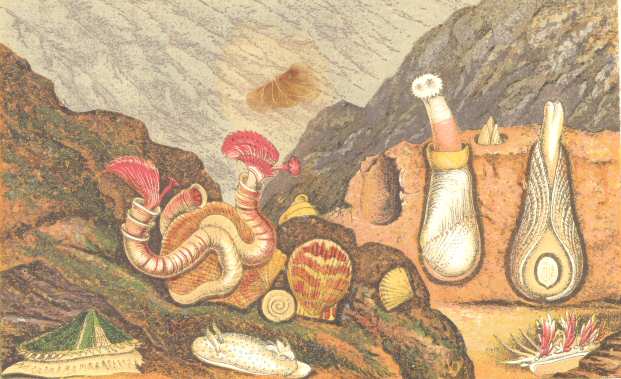
Look, again, at those sea-slugs. One, some three inches
long, of a bright lemon-yellow, clouded with purple; another of a
dingy grey; [130a] another exquisite little creature of
a pearly French White, [130b] furred all over
the back with what seem arms, but are really gills, of ringed
white and grey and black. Put that yellow one into water,
and from his head, above the eyes, arise two serrated horns,
while from the after-part of his back springs a circular
Prince-of-Wales’s-feather of gills,—they are almost
exactly like those which we saw just now in the white
Cucumaria. Yes; here is another instance of the same custom
of repetition. The Cucumaria is a low radiate
animal—the sea-slug a far higher mollusc; and every organ
within him is formed on a different type; as indeed are those
seemingly identical gills, if you come to examine them under the
microscope, having to oxygenate fluids of a very different and
more complicated kind; and, moreover, the Cucumaria’s gills
were put round his mouth, the Doris’s feathers round the
other extremity; that grey Eolis’s, again, are simple
clubs, scattered over his whole back, and in each of his
nudibranch congeners these same gills take some new and fantastic
form; in Melibæa those clubs are covered with warts; in
Scyllæa, with tufted bouquets; in the beautiful Antiopa
they are transparent bags; and in many other English species they
take every conceivable form of leaf, tree, flower, and branch,
bedecked with every colour of the rainbow, as you may see them
depicted in Messrs. Alder and Hancock’s unrivalled
Monograph on the Nudibranch Mollusca.
And now, worshipper of final causes and the mere useful in
nature, answer but one question,—Why this prodigal
variety? All these Nudibranchs live in much the same way:
why would not the same mould have done for them all? And
why, again, (for we must push the argument a little further,) why
have not all the butterflies, at least all who feed on the same
plant, the same markings? Of all unfathomable triumphs of
design, (we can only express ourselves thus, for honest
induction, as Paley so well teaches, allows us to ascribe such
results only to the design of some personal will and mind,) what
surpasses that by which the scales on a butterfly’s wing
are arranged to produce a certain pattern of artistic beauty
beyond all painter’s skill? What a waste of power, on
any utilitarian theory of nature! And once more, why are
those strange microscopic atomies, the Diatomaceæ and
Infusoria, which fill every stagnant pool; which fringe every
branch of sea-weed; which form banks hundreds of miles long on
the Arctic sea-floor, and the strata of whole moorlands; which
pervade in millions the mass of every iceberg, and float aloft in
countless swarms amid the clouds of the volcanic dust;—why
are their tiny shells of flint as fantastically various in their
quaint mathematical symmetry, as they are countless beyond the
wildest dreams of the Poet? Mystery inexplicable on the
conceited notion which, making man forsooth the centre of the
universe, dares to believe that this variety of forms has existed
for countless ages in abysmal sea-depths and untrodden forests,
only that some few individuals of the Western races might, in
these latter days, at last discover and admire a corner here and
there of the boundless realms of beauty. Inexplicable,
truly, if man be the centre and the object of their existence;
explicable enough to him who believes that God has created all
things for Himself, and rejoices in His own handiwork, and that
the material universe is, as the wise man says, “A platform
whereon His Eternal Spirit sports and makes melody.”
Of all the blessings which the study of nature brings to the
patient observer, let none, perhaps, be classed higher than this:
that the further he enters into those fairy gardens of life and
birth, which Spenser saw and described in his great poem, the
more he learns the awful and yet most comfortable truth, that
they do not belong to him, but to One greater, wiser, lovelier
than he; and as he stands, silent with awe, amid the pomp of
Nature’s ever-busy rest, hears, as of old, “The Word
of the Lord God walking among the trees of the garden in the cool
of the day.”
One sight more, and we have done. I had something to
say, had time permitted, on the ludicrous element which appears
here and there in nature. There are animals, like monkeys
and crabs, which seem made to be laughed at; by those at least
who possess that most indefinable of faculties, the sense of the
ridiculous. As long as man possesses muscles especially
formed to enable him to laugh, we have no right to suppose (with
some) that laughter is an accident of our fallen nature; or to
find (with others) the primary cause of the ridiculous in the
perception of unfitness or disharmony. And yet we shrink
(whether rightly or wrongly, we can hardly tell) from attributing
a sense of the ludicrous to the Creator of these forms. It
may be a weakness on my part; at least I will hope it is a
reverent one: but till we can find something corresponding to
what we conceive of the Divine Mind in any class of phenomena, it
is perhaps better not to talk about them at all, but observe a
stoic “epoche,” waiting for more light, and yet
confessing that our own laughter is uncontrollable, and therefore
we hope not unworthy of us, at many a strange creature and
strange doing which we meet, from the highest ape to the lowest
polype.
But, in the meanwhile, there are animals in which results so
strange, fantastic, even seemingly horrible, are produced, that
fallen man may be pardoned, if he shrinks from them in
disgust. That, at least, must be a consequence of our own
wrong state; for everything is beautiful and perfect in its
place. It may be answered, “Yes, in its place; but
its place is not yours. You had no business to look at it,
and must pay the penalty for intermeddling.” I doubt
that answer; for surely, if man have liberty to do anything, he
has liberty to search out freely his heavenly Father’s
works; and yet every one seems to have his antipathic animal; and
I know one bred from his childhood to zoology by land and sea,
and bold in asserting, and honest in feeling, that all without
exception is beautiful, who yet cannot, after handling and
petting and admiring all day long every uncouth and venomous
beast, avoid a paroxysm of horror at the sight of the common
house-spider. At all events, whether we were intruding or
not, in turning this stone, we must pay a fine for having done
so; for there lies an animal as foul and monstrous to the eye as
“hydra, gorgon, or chimæra dire,” and yet so
wondrously fitted to its work, that we must needs endure for our
own instruction to handle and to look at it. Its name, if
you wish for it, is Nemertes; probably N. Borlasii; [136] a worm of very “low”
organization, though well fitted enough for its own work.
You see it? That black, shiny, knotted lump among the
gravel, small enough to be taken up in a dessert spoon.
Look now, as it is raised and its coils drawn out. Three
feet—six—nine, at least: with a capability of
seemingly endless expansion; a slimy tape of living caoutchouc,
some eighth of an inch in diameter, a dark chocolate-black, with
paler longitudinal lines. Is it alive? It hangs,
helpless and motionless, a mere velvet string across the
hand. Ask the neighbouring Annelids and the fry of the rock
fishes, or put it into a vase at home, and see. It lies
motionless, trailing itself among the gravel; you cannot tell
where it begins or ends; it may be a dead strip of sea-weed,
Himanthalia lorea, perhaps, or Chorda filum; or even a tarred
string. So thinks the little fish who plays over and over
it, till he touches at last what is too surely a head. In
an instant a bell-shaped sucker mouth has fastened to his
side. In another instant, from one lip, a concave double
proboscis, just like a tapir’s (another instance of the
repetition of forms), has clasped him like a finger; and now
begins the struggle: but in vain. He is being
“played” with such a fishing-line as the skill of a
Wilson or a Stoddart never could invent; a living line, with
elasticity beyond that of the most delicate fly-rod, which
follows every lunge, shortening and lengthening, slipping and
twining round every piece of gravel and stem of sea-weed, with a
tiring drag such as no Highland wrist or step could ever bring to
bear on salmon or on trout. The victim is tired now; and
slowly, and yet dexterously, his blind assailant is feeling and
shifting along his side, till he reaches one end of him; and then
the black lips expand, and slowly and surely the curved finger
begins packing him end-foremost down into the gullet, where he
sinks, inch by inch, till the swelling which marks his place is
lost among the coils, and he is probably macerated to a pulp long
before he has reached the opposite extremity of his cave of
doom. Once safe down, the black murderer slowly contracts
again into a knotted heap, and lies, like a boa with a stag
inside him, motionless and blest. [138]
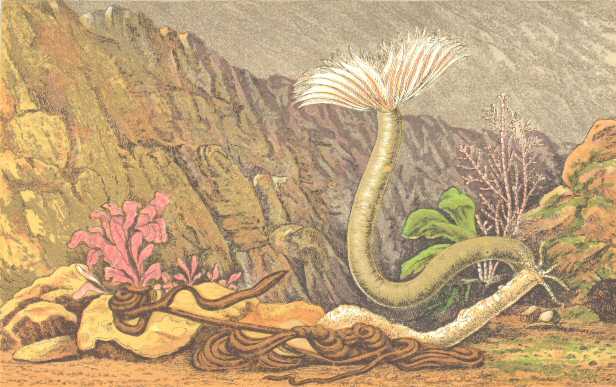
There; we must come away now, for the tide is over our ankles;
but touch, before you go, one of those little red mouths which
peep out of the stone. A tiny jet of water shoots up almost
into your face. The bivalve [139a] who has burrowed
into the limestone knot (the softest part of the stone to his
jaws, though the hardest to your chisel) is scandalized at having
the soft mouths of his siphons so rudely touched, and taking your
finger for some bothering Annelid, who wants to nibble him, is
defending himself; shooting you, as naturalists do humming-birds,
with water. Let him rest in peace; it will cost you ten
minutes’ hard work, and much dirt, to extract him; but if
you are fond of shells, secure one or two of those beautiful pink
and straw-coloured scallops (Hinnites pusio, Plate X. fig. 1),
who have gradually incorporated the layers of their lower valve
with the roughnesses of the stone, destroying thereby the
beautiful form which belongs to their race, but not their
delicate colour. There are a few more bivalves too,
adhering to the stone, and those rare ones, and two or three
delicate Mangeliæ and Nassæ [139b] are trailing their graceful spires up
and down in search of food. That little bright red and
yellow pea, too, touch it—the brilliant coloured cloak is
withdrawn, and, instead, you have a beautiful ribbed pink cowry,
[140a] our only European representative of
that grand tropical family. Cast one wondering glance, too,
at the forest of zoophytes and corals, Lepraliæ and
Flustræ, and those quaint blue stars, set in brown jelly,
which are no zoophytes, but respectable molluscs, each with his
well-formed mouth and intestines, [140b] but combined in
a peculiar form of Communism, of which all one can say is, that
one hopes they like it; and that, at all events, they agree
better than the heroes and heroines of Mr. Hawthorne’s
“Blithedale Romance.”
Now away, and as a specimen of the fertility of the
water-world, look at this rough list of species, [140c] the greater part of which are on this
very stone, and all of which you might obtain in an hour, would
the rude tide wait for zoologists: and remember that the number
of individuals of each species of polype must be counted by tens
of thousands; and also, that, by searching the forest of
sea-weeds which covers the upper surface, we should probably
obtain some twenty minute species more.
A goodly catalogue this, surely, of the inhabitants of three
or four large stones; and yet how small a specimen of the
multitudinous nations of the sea!
From the bare rocks above high-water mark, down to abysses
deeper than ever plummet sounded, is life, everywhere life; fauna
after fauna, and flora after flora, arranged in zones, according
to the amount of light and warmth which each species requires,
and to the amount of pressure which they are able to
endure. The crevices of the highest rocks, only sprinkled
with salt spray in spring-tides and high gales, have their
peculiar little univalves, their crisp lichen-like sea-weed, in
myriads; lower down, the region of the Fuci (bladder-weeds) has
its own tribes of periwinkles and limpets; below again, about the
neap-tide mark, the region of the corallines and Algæ
furnishes food for yet other species who graze on its watery
meadows; and beneath all, only uncovered at low spring-tide, the
zone of the Laminariæ (the great tangles and ore-weeds) is
most full of all of every imaginable form of life. So that
as we descend the rocks, we may compare ourselves (likening small
things to great) to those who, descending the Andes, pass in a
single day from the vegetation of the Arctic zone to that of the
Tropics. And here and there, even at half-tide level, deep
rock-basins, shaded from the sun and always full of water, keep
up in a higher zone the vegetation of a lower one, and afford in
nature an analogy to those deep “barrancos” which
split the high table-land of Mexico, down whose awful cliffs,
swept by cool sea-breezes, the traveller looks from among the
plants and animals of the temperate zone, and sees far below, dim
through their everlasting vapour-bath of rank hot steam, the
mighty forms and gorgeous colours of a tropic forest.
“I do not wonder,” says Mr. Gosse, in his charming
“Naturalist’s Rambles on the Devonshire Coast”
(p. 187), “that when Southey had an opportunity of seeing
some of those beautiful quiet basins hollowed in the living rock,
and stocked with elegant plants and animals, having all the charm
of novelty to his eye, they should have moved his poetic fancy,
and found more than one place in the gorgeous imagery of his
Oriental romances. Just listen to him
“It was a garden still beyond all price,
Even yet it was a place of paradise;
* * * * * *
And here were coral bowers,
And grots of madrepores,
And banks of sponge, as soft and fair to eye
As e’er
was mossy bed
Whereon the wood-nymphs lie
With languid limbs in summer’s sultry hours.
Here, too, were living flowers,
Which, like a bud compacted,
Their purple cups contracted;
And now in open blossom spread,
Stretch’d, like green anthers, many a seeking head.
And arborets of jointed stone were
there,
And plants of fibres fine as silkworm’s thread;
Yea, beautiful as mermaid’s
golden hair
Upon the waves
dispread.
Others that, like the broad banana growing,
Raised their long wrinkled leaves of purple hue,
Like streamers wide
outflowing.’—Kehama, xvi. 5.
“A hundred times you might fancy you saw the type, the
very original of this description, tracing, line by line, and
image by image, the details of the picture; and acknowledging, as
you proceed, the minute truthfulness with which it has been
drawn. For such is the loveliness of nature in these
secluded reservoirs, that the accomplished poet, when depicting
the gorgeous scenes of Eastern mythology—scenes the wildest
and most extravagant that imagination could paint—drew not
upon the resources of his prolific fancy for imagery here, but
was well content to jot down the simple lineaments of Nature as
he saw her in plain, homely England.
“It is a beautiful and fascinating sight for those who
have never seen it before, to see the little shrubberies of pink
coralline—‘the arborets of jointed
stone’—that fringe those pretty pools. It is a
charming sight to see the crimson banana-like leaves of the
Delesseria waving in their darkest corners; and the purple
fibrous tufts of Polysiphonia and Ceramia, ‘fine as
silkworm’s thread.’ But there are many others
which give variety and impart beauty to these tide-pools.
The broad leaves of the Ulva, finer than the finest cambric, and
of the brightest emerald-green, adorn the hollows at the highest
level, while, at the lowest, wave tiny forests of the feathery
Ptilota and Dasya, and large leaves, cut into fringes and
furbelows, of rosy Rhodymeniæ. All these are lovely
to behold; but I think I admire as much as any of them, one of
the commonest of our marine plants, Chondrus crispus. It
occurs in the greatest profusion on this coast, in every pool
between tide-marks; and everywhere—except in those of the
highest level, where constant exposure to light dwarfs the plant,
and turns it of a dull umber-brown tint—it is elegant in
form and brilliant in colour. The expanding fan-shaped
fronds, cut into segments, cut, and cut again, make fine bushy
tufts in a deep pool, and every segment of every frond reflects a
flush of the most lustrous azure, like that of a tempered
sword-blade.”—Gosse’s Devonshire Coast, pp.
187–189.
And the sea-bottom, also, has its zones, at different depths,
and its peculiar forms in peculiar spots, affected by the
currents and the nature of the ground, the riches of which have
to be seen, alas! rather by the imagination than the eye; for
such spoonfuls of the treasure as the dredge brings up to us,
come too often rolled and battered, torn from their sites and
contracted by fear, mere hints to us of what the populous reality
below is like. Often, standing on the shore at low tide,
has one longed to walk on and in under the waves, as the
water-ousel does in the pools of the mountain burn, and see it
all but for a moment; and a solemn beauty and meaning has
invested the old Greek fable of Glaucus the fisherman: how eating
of the herb which gave his fish strength to leap back into their
native element, he was seized on the spot with a strange longing
to follow them under the waves, and became for ever a companion
of the fair semi-human forms with which the Hellenic poets
peopled their sunny bays and firths, feeding “silent
flocks” far below on the green Zostera beds, or basking
with them on the sunny ledges in the summer noon, or wandering in
the still bays on sultry nights amid the choir of Amphitrite and
her sea-nymphs:—
“Joining the bliss of the gods, as they
waken the coves with their laughter,”
in nightly revels, whereof one has sung,—
“So they came up in their joy; and before
them the roll of the surges
Sank, as the breezes sank dead, into smooth green foam-flecked
marble
Awed; and the crags of the cliffs, and the pines of the
mountains, were silent.
So they came up in their joy, and around them the lamps of the
sea-nymphs,
Myriad fiery globes, swam heaving and panting, and rainbows,
Crimson, and azure, and emerald, were broken in star-showers,
lighting,
Far in the wine-dark depths of the crystal, the gardens of
Nereus,
Coral, and sea-fan, and tangle, the blooms and the palms of the
ocean.
So they went on in their joy, more white than the foam which they
scattered,
Laughing and singing and tossing and twining; while, eager, the
Tritons
Blinded with kisses their eyes, unreproved, and above them in
worship
Fluttered the terns, and the sea-gulls swept past them on silvery
pinions,
Echoing softly their laughter; around them the wantoning
dolphins
Sighed as they plunged, full of love; and the great sea-horses
which bore them
Curved up their crests in their pride to the delicate arms of
their riders,
Pawing the spray into gems, till a fiery rainfall, unharming,
Sparkled and gleamed on the limbs of the maids, and the coils of
the mermen.
So they went on in their joy, bathed round with the fiery
coolness,
Needing nor sun nor moon, self-lighted, immortal: but others,
Pitiful, floated in silence apart; on their knees lay the
sea-boys
Whelmed by the roll of the surge, swept down by the anger of
Nereus;
Hapless, whom never again upon quay or strand shall their
mothers
Welcome with garlands and vows to the temples; but, wearily
pining,
Gaze over island and main for the sails which return not; they,
heedless,
Sleep in soft bosoms for ever, and dream of the surge and the
sea-maids.
So they passed by in their joy, like a dream, on the murmuring
ripple.”
Such a rhapsody may be somewhat out of order, even in a
popular scientific book; and yet one cannot help at moments
envying the old Greek imagination, which could inform the
soulless sea-world with a human life and beauty. For, after
all, star-fishes and sea-anemones are dull substitutes for Sirens
and Tritons; the lamps of the sea-nymphs, those glorious
phosphorescent medusæ whose beauty Mr. Gosse sets forth so
well with pen and pencil, are not as attractive as the sea-nymphs
themselves would be; and who would not, like Menelaus, take the
grey old man of the sea himself asleep upon the rocks, rather
than one of his seal-herd, probably too with the same result as
the world-famous combat in the Antiquary, between Hector and
Phoca? And yet—is there no human interest in these
pursuits, more humanity and more divine, than there would be even
in those Triton and Nereid dreams, if realized to sight and
sense? Heaven forbid that those should say so, whose
wanderings among rock and pool have been mixed up with holiest
passages of friendship and of love, and the intercommunion of
equal minds and sympathetic hearts, and the laugh of children
drinking in health from every breeze and instruction at every
step, running ever and anon with proud delight to add their
little treasure to their parents’ stock, and of happy
friendly evenings spent over the microscope and the vase, in
examining, arranging, preserving, noting down in the diary the
wonders and the labours of the happy, busy day. No; such
short glimpses of the water-world as our present appliances
afford us are full enough of pleasure; and we will not envy
Glaucus: we will not even be over-anxious for the success of his
only modern imitator, the French naturalist who is reported to
have fitted himself with a waterproof dress and breathing
apparatus, in order to walk the bottom of the Mediterranean, and
see for himself how the world goes on at the fifty-fathom line:
we will be content with the wonders of the shore and of the
sea-floor, as far as the dredge will discover them to us.
We shall even thus find enough to occupy (if we choose) our
lifetime. For we must recollect that this hasty sketch has
hardly touched on that vegetable water-world, which is as
wonderful and as various as the animal one. A hint or two
of the beauty of the sea-weeds has been given; but space has
allowed no more. Yet we might have spent our time with
almost as much interest and profit, had we neglected utterly the
animals which we have found, and devoted our attention
exclusively to the flora of the rocks. Sea-weeds are no
mere playthings for children; and to buy at a shop some thirty
pretty kinds, pasted on paper, with long names (probably
mis-spelt) written under each, is not by any means to possess a
collection of them. Putting aside the number and the
obscurity of their species, the questions which arise in studying
their growth, reproduction, and organic chemistry are of the very
deepest and most important in the whole range of science; and it
will need but a little study of such a book as Harvey’s
“Algæ,” to show the wise man that he who has
comprehended (which no man yet does) the mystery of a single
spore or tissue-cell, has reached depths in the great
“Science of Life” at which an Owen would still
confess himself “blind by excess of light.”
“Knowest thou how the bones grow in the womb?” asks
the Jewish sage, sadly, half self-reprovingly, as he discovers
that man is not the measure of all things, and that in much
learning may be vanity and vexation of spirit, and in much study
a weariness of the flesh; and all our deeper physical science
only brings the same question more awfully near.
“Vilior algâ,” more worthless than the very
sea-weed, says the old Roman: and yet no torn scrap of that very
sea-weed, which to-morrow may manure the nearest garden, but says
to us, “Proud man! talking of spores and vesicles, if thou
darest for a moment to fancy that to have seen spores and
vesicles is to have seen me, or to know what I am, answer
this. Knowest thou how the bones do grow in the womb?
Knowest thou even how one of these tiny black dots, which thou
callest spores, grow on my fronds?” And to that
question what answer shall we make? We see tissues divide,
cells develop, processes go on—but How and Why? These are
but phenomena; but what are phenomena save effects? Causes, it
may be, of other effects; but still effects of other
causes. And why does the cause cause that effect? Why
should it not cause something else? Why should it cause
anything at all? Because it obeys a law. But why does it
obey the law? and how does it obey the law? And, after all,
what is a law? A mere custom of Nature. We see the
same phenomenon happen a great many times; and we infer from
thence that it has a custom of happening; and therefore we call
it a law: but we have not seen the law; all we have seen is the
phenomenon which we suppose to indicate the law. We have
seen things fall: but we never saw a little flying thing pulling
them down, with “gravitation” labelled on its back;
and the question, why things fall, and how, is just
where it was before Newton was born, and is likely to remain
there. All we can say is, that Nature has her customs, and
that other customs ensue, when those customs appear: but that as
to what connects cause and effect, as to what is the reason, the
final cause, or even the causa causans, of any phenomenon,
we know not more but less than ever; for those laws or customs
which seem to us simplest (“endosmose,” for instance,
or “gravitation”), are just the most inexplicable,
logically unexpected, seemingly arbitrary, certainly
supernatural—miraculous, if you will; for no natural and
physical cause whatsoever can be assigned for them; while if
anyone shall argue against their being miraculous and
supernatural on the ground of their being so common, I can only
answer, that of all absurd and illogical arguments, this is the
most so. For what has the number of times which the miracle
occurs to do with the question, save to increase the
wonder? Which is more strange, that an inexplicable and
unfathomable thing should occur once and for all, or that it
should occur a million times every day all the world over?
Let those, however, who are too proud to wonder, do as seems
good to them. Their want of wonder will not help them
toward the required explanation: and to them, as to us, as soon
as we begin asking, “How?” and
“Why?” the mighty Mother will only reply with
that magnificent smile of hers, most genial, but most silent,
which she has worn since the foundation of all worlds; that
silent smile which has tempted many a man to suspect her of
irony, even of deceit and hatred of the human race; the silent
smile which Solomon felt, and answered in
“Ecclesiastes;” which Goethe felt, and did not answer
in his “Faust;” which Pascal felt, and tried to
answer in his “Thoughts,” and fled from into
self-torture and superstition, terrified beyond his powers of
endurance, as he found out the true meaning of St. John’s
vision, and felt himself really standing on that fragile and
slippery “sea of glass,” and close beneath him the
bottomless abyss of doubt, and the nether fires of moral
retribution. He fled from Nature’s silent smile, as
that poor old King Edward (mis-called the Confessor) fled from
her hymns of praise, in the old legend of Havering-atte-bower,
when he cursed the nightingales because their songs confused him
in his prayers: but the wise man need copy neither, and fear
neither the silence nor the laughter of the mighty mother Earth,
if he will be but wise, and hear her tell him, alike in
both—“Why call me mother? Why ask me for knowledge
which I cannot teach, peace which I cannot give or take
away? I am only your foster-mother and your nurse—and
I have not been an unkindly one. But you are God’s
children, and not mine. Ask Him. I can amuse you with
my songs; but they are but a nurse’s lullaby to the weary
flesh. I can awe you with my silence; but my silence is
only my just humility, and your gain. How dare I pretend to
tell you secrets which He who made me knows alone? I am but
inanimate matter; why ask of me things which belong to living
spirit? In God I live and move, and have my being; I know
not how, any more than you know. Who will tell you what
life is, save He who is the Lord of life? And if He will
not tell you, be sure it is because you need not to know.
At least, why seek God in nature, the living among the
dead? He is not here: He is risen.”
He is not here: He is risen. Good reader, you will
probably agree that to know that saying, is to know the key-note
of the world to come. Believe me, to know it, and all it
means, is to know the keynote of this world also, from the fall
of dynasties and the fate of nations, to the sea-weed which rots
upon the beach.
It may seem startling, possibly (though I hope not, for my
readers’ sake, irreverent), to go back at once after such
thoughts, be they true or false, to the weeds upon the cliff
above our heads. But He who is not here, but is risen, yet
is here, and has appointed them their services in a wonderful
order; and I wish that on some day, or on many days, when a quiet
sea and offshore breezes have prevented any new objects from
coming to land with the rising tide, you would investigate the
flowers peculiar to our sea-rocks and sandhills. Even if
you do not find the delicate lily-like Trichonema of the Channel
Islands and Dawlish, or the almost as beautiful Squill of the
Cornish cliffs, or the sea-lavender of North Devon, or any of
those rare Mediterranean species which Mr. Johns has so
charmingly described in his “Week at the Lizard
Point,” yet an average cliff, with its carpeting of pink
thrift and of bladder catchfly, and Lady’s finger, and
elegant grasses, most of them peculiar to the sea marge, is often
a very lovely flower-bed.
Not merely interesting, too, but brilliant in their vegetation
are sandhills; and the seemingly desolate dykes and banks of salt
marshes will yield many a curious plant, which you may neglect if
you will: but lay to your account the having to repent your
neglect hereafter, when, finding out too late what a pleasant
study botany is, you search in vain for curious forms over which
you trod every day in crossing flats which seemed to you utterly
ugly and uninteresting, but which the good God was watching as
carefully as He did the pleasant hills inland: perhaps even more
carefully; for the uplands He has completed, and handed over to
man, that he may dress and keep them: but the tide-flats below
are still unfinished, dry land in the process of creation, to
which every tide is adding the elements of fertility, which shall
grow food, perhaps in some future state of our planet, for
generations yet unborn.
But to return to the water-world, and to dredging; which of
all sea-side pursuits is perhaps the most pleasant, combining as
it does fine weather sailing with the discovery of new objects,
to which, after all, the waifs and strays of the beach, whether
“flotsom jetsom, or lagand,” as the old Admiralty
laws define them, are few and poor. I say particularly fine
weather sailing; for a swell, which makes the dredge leap along
the bottom, instead of scraping steadily, is as fatal to sport as
it is to some people’s comfort. But dredging, if you
use a pleasure boat and the small naturalist’s dredge, is
an amusement in which ladies, if they will, may share, and which
will increase, and not interfere with, the amusements of a
water-party.
The naturalist’s dredge, of which Mr. Gosse’s
“Aquarium” gives a detailed account, should differ
from the common oyster dredge in being smaller; certainly not
more than four feet across the mouth; and instead of having but
one iron scraping-lip like the oyster dredge, it should have two,
one above and one below, so that it will work equally well on
whichsoever side it falls, or how often soever it may be turned
over by rough ground. The bag-net should be of strong
spunyarn, or (still better) of hide “such as those hides of
the wild cattle of the Pampas, which the tobacconists receive
from South America,” cut into thongs, and netted
close. It should be loosely laced together with a thong at
the tail edge in order to be opened easily, when brought on
board, without canting the net over, and pouring the contents
roughly out through the mouth. The dragging-rope should be
strong, and at least three times as long as the perpendicular
depth of the water in which you are working; if, indeed, there is
much breeze, or any swell at all, still more line should be
veered out. The inboard end should be made fast somewhere
in the stern sheets, the dredge hove to windward, the boat put
before the wind; and you may then amuse yourself as you will for
the next quarter of an hour, provided that you have got ready
various wide-mouthed bottles for the more delicate monsters, and
a couple of buckets, to receive the large lumps of oysters and
serpulæ which you will probably bring to the surface.
As for a dredging ground, one may be found, I suppose, off
every watering-place. The most fertile spots are in rough
ground, in not less than five fathoms water. The deeper the
water, the rarer and more interesting will the animals generally
be: but a greater depth than fifteen fathoms is not easily
reached on this side of Plymouth; and, on the whole, the beginner
will find enough in seven or eight fathoms to stock an aquarium
rivalling any of those in the “Tank-house” at the
Zoological Gardens.
In general, the south coast of England, to the eastward of
Portland, affords bad dredging ground. The friable cliffs,
of comparatively recent formations, keep the sea shallow, and the
bottom smooth and bare, by the vast deposits of sand and
gravel. Yet round the Isle of Wight, especially at the back
of the Needles, there ought to be fertile spots; and Weymouth,
according to Mr. Gosse and other well-known naturalists, is a
very garden of Nereus. Torbay, as may well be supposed, is
an admirable dredging spot; perhaps its two best points are round
the isolated Thatcher and Oare-rock, and from the mouth of
Brixham harbour to Berry Head; along which last line, for perhaps
three hundred years, the decks of all Brixham trawlers have been
washed down ere running into harbour, and the sea-bottom thus
stored with treasures scraped up from deeper water in every
direction for miles and miles.
Hastings is, I fear, but a poor spot for dredging. Its
friable cliffs and strong tides produce a changeable and barren
sea-floor. Yet the immense quantities of Flustra thrown up
after a storm indicate dredging ground at no great distance
outside; its rocks, uninteresting as they are compared with our
Devonians, have yielded to the industry and science of M.
Tumanowicz a vast number of sea-weeds and sponges. Those
three curious polypes, Valkeria cuscuta (Plate I. fig. 3),
Notamia Bursaria, and Serialaria Lendigera, abound within
tide-marks; and as the place is so much visited by Londoners, it
may be worth while to give a few hints as to what might be done,
by anyone whose curiosity has been excited by the salt-water
tanks of the Zoological Gardens and the Crystal Palace.
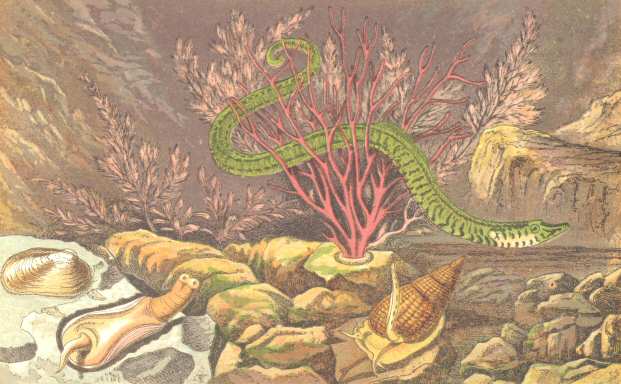
An hour or two’s dredging round the rocks to the
eastward, would probably yield many delicate and brilliant little
fishes; Gobies, brilliant Labri, blue, yellow, and orange, with
tiny rabbit mouths, and powerful protruding teeth; pipe fishes
(Syngnathi) [163] with strange snipe-bills (which they
cannot open) and snake-like bodies; small cuttlefish
(Sepiolæ) of a white jelly mottled with brilliant metallic
hues, with a ring of suckered arms round their tiny
parrots’ beaks, who, put into a jar, will hover and dart in
the water, as the skylark does in air, by rapid winnowings of
their glassy side-fins, while they watch you with bright
lizard-eyes; the whole animal being a combination of the
vertebrate and the mollusc, so utterly fantastic and abnormal,
that (had not the family been amongst the commonest, from the
earliest geological epochs) it would have seemed, to man’s
deductive intellect, a form almost as impossible as the mermaid,
far more impossible than the sea-serpent. These, and
perhaps a few handsome sea-slugs and bivalve shells, you will be
pretty sure to find: perhaps a great deal more.
Meanwhile, without dredging, you may find a good deal on the
shore. In the spring Doris bilineata comes to the rocks in
thousands, to lay its strange white furbelows of spawn upon their
overhanging edges. Eolides of extraordinary beauty haunt
the same spots. The great Eolis papillosa, of a delicate
French grey; Eolis pellucida (?) (Plate X. fig. 4), in which each
papilla on the back is beautifully coloured with a streak of
pink, and tipped with iron blue; and a most fantastical yellow
little creature, so covered with plumes and tentacles that the
body is invisible, which I believe to be the Idalia aspersa of
Alder and Hancock.
At the bottom of the rock pools, behind St. Leonard’s
baths, may be found hundreds of the snipe’s feather Anemone
(Sagartia troglodytes), of every line; from the common brown and
grey snipe’s feather kind, to the white-horned Hesperus,
the orange-horned Aurora, and a rich lilac and crimson variety,
which does not seem to agree with either the Lilacinia or
Rubicunda of Gosse. A more beautiful living bouquet could
hardly be seen, than might be made of the varieties of this
single species, from this one place.
On the outside sands between the end of the Marina and the
Martello tower, you may find, at very low tides, great numbers of
a sand-tube, about three inches long, standing up out of the
sand. I do not mean the tubes of the Terebella, so common
in all sands, which are somewhat flexible, and have their upper
end fringed with a ragged ring of sandy arms: those I speak of
are straight and stiff, and ending in a point upward. Draw
them out of the sand—they will offer some
resistance—and put them into a vase of water; you will see
the worm inside expand two delicate golden combs, just like
old-fashioned back-hair combs, of a metallic lustre, which will
astonish you. With these combs the worm seems to burrow
head downward into the sand; but whether he always remains in
that attitude I cannot say. His name is Pectinaria
Belgica. He is an Annelid, or true worm, connected with the
Serpulea and Sabellæ of which I have spoken already, and
holds himself in his case like them, by hooks and bristles set on
each ring of his body. In confinement he will probably come
out of his case and die; when you may dissect him at your
leisure, and learn a great deal more about him thereby than (I am
sorry to say) I know.
But if you have courage to run out fifteen or twenty miles to
the Diamond, you may find really rare and valuable animals.
There is a risk, of course, of being blown over to the coast of
France, by a change of wind; there is a risk also of not being
able to land at night on the inhospitable Hastings beach, and of
sleeping, as best you can, on board: but in the long days and
settled fine weather of summer, the trip, in a stout boat, ought
to be a safe and a pleasant one.
On the Diamond you will find many, or most of those gay
creatures which attract your eye in the central row of tanks at
the Zoological Gardens: great twisted masses of Serpulæ, [167] those white tubes of stone, from the
mouth of which protrude pairs of rose-coloured or orange fans,
flashing in, quick as light, the moment that your finger
approaches them or your shadow crosses the water.
You will dredge, too, the twelve-rayed sun-star (Solaster
papposa), with his rich scarlet armour; and more strange, and
quite as beautiful, the bird’s foot star (Palmipes
membranaceus), which you may see crawling by its thousand
sucking-feet in the Crystal Palace tanks, a pentagonal webbed
bird’s foot, of scarlet and orange shagreen. With
him, most probably, will be a specimen of the great purple
heart-urchin (Spatangus purpureus), clothed in pale lilac horny
spines, and other Echinoderms, for which you must consult
Forbes’s “British Star-fishes:” but perhaps the
species among them which will interest you most, will be the
common brittle-star (Ophiocoma rosula), of which a hundred or so,
I can promise, shall come up at a single haul of the dredge,
entwining their long spine-clad arms in a seemingly inextricable
confusion of “kaleidoscope” patterns (thanks to Mr.
Gosse for the one right epithet), purple and azure, fawn, brown,
green, grey, white and crimson; as if a whole bed of China-asters
should have first come to life, and then gone mad, and fallen to
fighting. But pick out, one by one, specimens from the
tangled mass, and you will agree that no China-aster is so fair
as this living stone-flower of the deep, with its daisy-like
disc, and fine long prickly arms, which never cease their
graceful serpentine motion, and its colours hardly alike in any
two specimens. Handle them not, meanwhile, too roughly,
lest, whether modesty or in anger, they begin a desperate course
of gradual suicide, and, breaking off arm after arm piecemeal,
fling them indignantly at their tormentor. Along with these
you will certainly obtain a few of that fine bivalve, the great
Scallop, which you have seen lying on every fishmonger’s
counter in Hastings. Of these you must pick out those which
seem dirtiest and most overgrown with parasites, and place them
carefully in a jar of salt water, where they may not be rubbed;
for they are worth your examination, not merely for the sake of
that ring of gem-like eyes which borders their
“cloak,” lying along the extreme out edge of the
shell as the valves are half open, but for the sake of the
parasites outside: corallines of exquisite delicacy,
Plumulariæ and Sertulariæ, dead men’s hands
(Alcyonia), lumps of white or orange jelly, which will protrude a
thousand star-like polypes, and the Tubularia indivisa, twisted
tubes of fine straw, which ought already to have puzzled you; for
you may pick them up in considerable masses on the Hastings beach
after a south-west gale, and think long over them before you
determine whether the oat-like stems and spongy roots belong to
an animal, or a vegetable. Animals they are, nevertheless,
though even now you will hardly guess the fact, when you see at
the mouth of each tube a little scarlet flower, connected with
the pink pulp which fills the tube. For a further
description of this largest and handsomest of our Hydroid
Polypes, I must refer you to Johnston, or, failing him, to
Landsborough; and go on, to beg you not to despise those pink, or
grey, or white lumps of jelly, which will expand in salt water
into exquisite sea-anemones, of quite different forms from any
which we have found along the rocks. One of them will
certainly be the Dianthus, [170] which will open
into a furbelowed flower, furred with innumerable delicate
tentacula; and in the centre a mouth of the most delicate orange,
the size of the whole animal being perhaps eight inches high and
five across. Perhaps it will be of a satiny grey, perhaps
pale rose, perhaps pure white; whatever its colour, it is the
very maiden queen of all the beautiful tribe, and one of the
loveliest gems with which it has pleased God to bedeck this lower
world.
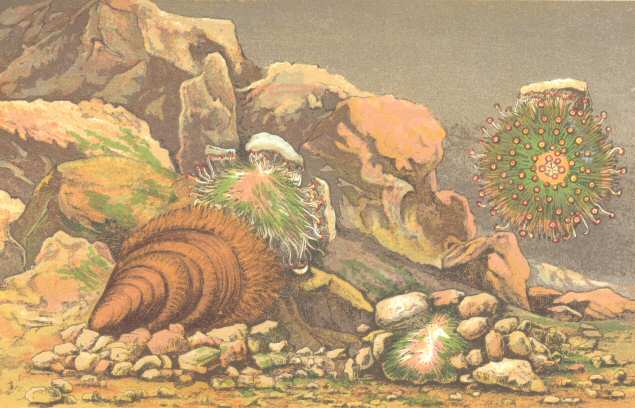
These and much more you will find on the scallops, or even
more plentifully on any lump of ancient oysters; and if you do
not dredge, it would be well worth your while to make interest
with the fish-monger for a few oyster lumps, put into water the
moment they are taken out of the trawl. Divide them
carefully, clear out the oysters with a knife, and put the shells
into your aquarium, and you will find that an oyster at home is a
very different thing from an oyster on a stall.
You ought, besides, to dredge many handsome species of shells,
which you would never pick up along the beach; and if you are
conchologizing in earnest, you must not forget to bring home a
tin box of shell sand, to be washed and picked over in a dish at
your leisure, or forget either to wash through a fine sieve, over
the boat’s side, any sludge and ooze which the dredge
brings up. Many—I may say, hundreds—rare and
new shells are found in this way, and in no other.
But if you cannot afford the expense of your own dredge and
boat, and the time and trouble necessary to follow the occupation
scientifically, yet every trawler and oyster-boat will afford you
a tolerable satisfaction. Go on board one of these; and
while the trawl is down, spend a pleasant hour or two in talking
with the simple, honest, sturdy fellows who work it, from whom
(if you are as fortunate as I have been for many a year past) you
may get many a moving story of danger and sorrow, as well as many
a shrewd practical maxim, and often, too, a living recognition of
God, and the providence of God, which will send you home,
perhaps, a wiser and more genial man. And when the trawl is
hauled, wait till the fish are counted out, and packed away, and
then kneel down and inspect (in a pair of Mackintosh leggings,
and your oldest coat) the crawling heap of shells and zoophytes
which remains behind about the decks, and you will find, if a
landsman, enough to occupy you for a week to come. Nay,
even if it be too calm for trawling, condescend to go out in a
dingy, and help to haul some honest fellow’s deep-sea lines
and lobster-pots, and you will find more and stranger things
about them than even fish or lobsters: though they, to him who
has eyes to see, are strange enough.
I speak from experience; for it was not so very long ago that,
in the north of Devon, I found sermons, not indeed in stones, but
in a creature reputed among the most worthless of
sea-vermin. I had been lounging about all the morning on
the little pier, waiting, with the rest of the village, for a
trawling breeze which would not come. Two o’clock was
past, and still the red mainsails of the skiffs hung motionless,
and their images quivered head downwards in the glassy swell,
“As idle as a painted ship
Upon a painted ocean.”
It was neap-tide, too, and therefore nothing could be done
among the rocks. So, in despair, finding an old coast-guard
friend starting for his lobster-pots, I determined to save the
old man’s arms, by rowing him up the shore; and then
paddled homeward again, under the high green northern wall, five
hundred feet of cliff furred to the water’s edge with rich
oak woods, against whose base the smooth Atlantic swell died
whispering, as if curling itself up to sleep at last within that
sheltered nook, tired with its weary wanderings. The sun
sank lower and lower behind the deer-park point; the white stair
of houses up the glen was wrapped every moment deeper and deeper
in hazy smoke and shade, as the light faded; the evening fires
were lighted one by one; the soft murmur of the waterfall, and
the pleasant laugh of children, and the splash of homeward oars,
came clearer and clearer to the ear at every stroke: and as we
rowed on, arose the recollection of many a brave and wise friend,
whose lot was cast in no such western paradise, but rather in the
infernos of this sinful earth, toiling even then amid the
festering alleys of Bermondsey and Bethnal Green, to palliate
death and misery which they had vainly laboured to prevent,
watching the strides of that very cholera which they had been
striving for years to ward off, now re-admitted in spite of all
their warnings, by the carelessness, and laziness, and greed of
sinful man. And as I thought over the whole hapless
question of sanitary reform, proved long since a moral duty to
God and man, possible, easy, even pecuniarily profitable, and yet
left undone, there seemed a sublime irony, most humbling to man,
in some of Nature’s processes, and in the silent and
unobtrusive perfection with which she has been taught to
anticipate, since the foundation of the world, some of the
loftiest discoveries of modern science, of which we are too apt
to boast as if we had created the method by discovering its
possibility. Created it? Alas for the pride of human
genius, and the autotheism which would make man the measure of
all things, and the centre of the universe! All the
invaluable laws and methods of sanitary reform at best are but
clumsy imitations of the unseen wonders which every animalcule
and leaf have been working since the world’s foundation;
with this slight difference between them and us, that they fulfil
their appointed task, and we do not.
The sickly geranium which spreads its blanched leaves against
the cellar panes, and peers up, as if imploringly, to the narrow
slip of sunlight at the top of the narrow alley, had it a voice,
could tell more truly than ever a doctor in the town, why little
Bessy sickened of the scarlatina, and little Johnny of the
hooping-cough, till the toddling wee things who used to pet and
water it were carried off each and all of them one by one to the
churchyard sleep, while the father and mother sat at home, trying
to supply by gin that very vital energy which fresh air and pure
water, and the balmy breath of woods and heaths, were made by God
to give; and how the little geranium did its best, like a
heaven-sent angel, to right the wrong which man’s ignorance
had begotten, and drank in, day by day, the poisoned atmosphere,
and formed it into fair green leaves, and breathed into the
children’s faces from every pore, whenever they bent over
it, the life-giving oxygen for which their dulled blood and
festered lungs were craving in vain; fulfilling God’s will
itself, though man would not, too careless or too covetous to
see, after thousands of years of boasted progress, why God had
covered the earth with grass, herb, and tree, a living and
life-giving garment of perpetual health and youth.
It is too sad to think long about, lest we become very
Heraclituses. Let us take the other side of the matter with
Democritus, try to laugh man out of a little of his boastful
ignorance and self-satisfied clumsiness, and tell him, that if
the House of Commons would but summon one of the little Paramecia
from any Thames’ sewer-mouth, to give his evidence before
their next Cholera Committee, sanitary blue-books, invaluable as
they are, would be superseded for ever and a day; and sanitary
reformers would no longer have to confess, that they know of no
means of stopping the smells which in past hot summers drove the
members out of the House, and the judges out of Westminster
Hall.
Nay, in the boat at the minute of which I have been speaking,
silent and neglected, sat a fellow-passenger, who was a greater
adept at removing nuisances than the whole Board of Health put
together; and who had done his work, too, with a cheapness
unparalleled; for all his good deeds had not as yet cost the
State one penny. True, he lived by his business; so do
other inspectors of nuisances: but Nature, instead of paying Maia
Squinado, Esquire, some five hundred pounds sterling per annum
for his labour, had contrived, with a sublime simplicity of
economy which Mr. Hume might have envied and admired afar off, to
make him do his work gratis, by giving him the nuisances as his
perquisites, and teaching him how to eat them. Certainly
(without going the length of the Caribs, who upheld cannibalism
because, they said, it made war cheap, and precluded entirely the
need of a commissariat), this cardinal virtue of cheapness ought
to make Squinado an interesting object in the eyes of the present
generation; especially as he was at that moment a true sanitary
martyr, having, like many of his human fellow-workers, got into a
fearful scrape by meddling with those existing interests, and
“vested rights which are but vested wrongs,” which
have proved fatal already to more than one Board of Health.
For last night, as he was sitting quietly under a stone in four
fathoms water, he became aware (whether by sight, smell, or that
mysterious sixth sense, to us unknown, which seems to reside in
his delicate feelers) of a palpable nuisance somewhere in the
neighbourhood; and, like a trusty servant of the public, turned
out of his bed instantly and went in search; till he discovered,
hanging among what he judged to be the stems of ore-weed
(Laminaria), three or four large pieces of stale thornback, of
most evil savour, and highly prejudicial to the purity of the
sea, and the health of the neighbouring herrings. Happy
Squinado! He needed not to discover the limits of his
authority, to consult any lengthy Nuisances’ Removal Act,
with its clauses, and counter-clauses, and explanations of
interpretations, and interpretations of explanations.
Nature, who can afford to be arbitrary, because she is perfect,
and to give her servants irresponsible powers, because she has
trained them to their work, had bestowed on him and on his
forefathers, as general health inspectors, those very summary
powers of entrance and removal in the watery realms for which
common sense, public opinion, and private philanthropy are still
entreating vainly in the terrestrial realms; so finding a hole,
in he went, and began to remove the nuisance, without
“waiting twenty-four hours,” “laying an
information,” “serving a notice,” or any other
vain delay. The evil was there,—and there it should
not stay; so having neither cart nor barrow, he just began
putting it into his stomach, and in the meanwhile set his
assistants to work likewise. For suppose not, gentle
reader, that Squinado went alone; in his train were more than a
hundred thousand as good as he, each in his office, and as
cheaply paid; who needed no cumbrous baggage train of
force-pumps, hose, chloride of lime packets, whitewash, pails or
brushes, but were every man his own instrument; and, to save
expense of transit, just grew on Squinado’s back. Do
you doubt the assertion? Then lift him up hither, and
putting him gently into that shallow jar of salt water, look at
him through the hand-magnifier, and see how Nature is maxima in
minimis.
There he sits, twiddling his feelers (a substitute, it seems,
with crustacea for biting their nails when they are puzzled), and
by no means lovely to look on in vulgar eyes;—about the
bigness of a man’s fist; a round-bodied, spindle-shanked,
crusty, prickly, dirty fellow, with a villanous squint, too, in
those little bony eyes, which never look for a moment both the
same way. Never mind: many a man of genius is ungainly
enough; and Nature, if you will observe, as if to make up to him
for his uncomeliness, has arrayed him as Solomon in all his glory
never was arrayed, and so fulfilled one of the proposals of old
Fourier—that scavengers, chimney-sweeps, and other workers
in disgusting employments, should be rewarded for their
self-sacrifice in behalf of the public weal by some peculiar
badge of honour, or laurel crown. Not that his crown, like
those of the old Greek games, is a mere useless badge; on the
contrary, his robe of state is composed of his
fellow-servants. His whole back is covered with a little
grey forest of branching hairs, fine as a spider’s web,
each branchlet carrying its little pearly ringed club, each club
its rose-coloured polype, like (to quote Mr. Gosse’s
comparison) the unexpanded birds of the acacia. [181a]
On that leg grows, amid another copse of the grey polypes, a
delicate straw-coloured Sertularia, branch on branch of tiny
double combs, each tooth of the comb being a tube containing a
living flower; on another leg another Sertularia, coarser, but
still beautiful; and round it again has trained itself, parasitic
on the parasite, plant upon plant of glass ivy, bearing crystal
bells, [181b] each of which, too, protrudes its
living flower; on another leg is a fresh species, like a little
heather-bush of whitest ivory, [182] and every needle
leaf a polype cell—let us stop before the imagination grows
dizzy with the contemplation of those myriads of beautiful
atomies. And what is their use? Each living flower,
each polype mouth is feeding fast, sweeping into itself, by the
perpetual currents caused by the delicate fringes upon its rays
(so minute these last, that their motion only betrays their
presence), each tiniest atom of decaying matter in the
surrounding water, to convert it, by some wondrous alchemy, into
fresh cells and buds, and either build up a fresh branch in their
thousand-tenanted tree, or form an egg-cell, from whence when
ripe may issue, not a fixed zoophyte, but a free swimming
animal.
And in the meanwhile, among this animal forest grows a
vegetable one of delicatest sea-weeds, green and brown and
crimson, whose office is, by their everlasting breath, to
reoxygenate the impure water, and render it fit once more to be
breathed by the higher animals who swim or creep around.
Mystery of mysteries! Let us jest no more,—Heaven
forgive us if we have jested too much on so simple a matter as
that poor spider-crab, taken out of the lobster-pots, and left to
die at the bottom of the boat, because his more aristocratic
cousins of the blue and purple armour will not enter the trap
while he is within.
I am not aware whether the surmise, that these tiny zoophytes
help to purify the water by exhaling oxygen gas, has yet been
verified. The infusorial animalcules do so, reversing the
functions of animal life, and instead of evolving carbonic acid
gas, as other animals do, evolve pure oxygen. So, at least,
says Liebig, who states that he found a small piece of matchwood,
just extinguished, burst out again into a flame on being immersed
in the bubbles given out by these living atomies.
I myself should be inclined to doubt that this is the case
with zoophytes, having found water in which they were growing
(unless, of course, sea-weeds were present) to be peculiarly
ready to become foul; but it is difficult to say whether this is
owing to their deoxygenating the water while alive, like other
animals, or to the fact that it is very rare to get a specimen of
zoophyte in which a large number of the polypes have not been
killed in the transit home, or at least so far knocked about,
that (in the Anthozoa, which are far the most abundant) the
polype—or rather living mouth, for it is little
more—is thrown off to decay, pending the growth of a fresh
one in the same cell.
But all the sea-weeds, in common with other vegetables,
perform this function continually, and thus maintain the water in
which they grow in a state fit to support animal life.
This fact—first advanced by Priestley and Ingenhousz,
and though doubted by the great Ellis, satisfactorily ascertained
by Professor Daubeny, Mr. Ward, Dr. Johnston, and Mr.
Warrington—gives an answer to the question, which I hope
has ere now arisen in the minds of some of my readers,—
How is it possible to see these wonders at home?
Beautiful and instructive as they may be, can they be meant for
any but dwellers by the sea-side? Nay more, even to them,
must not the glories of the water-world be always more momentary
than those of the rainbow, a mere Fata Morgana which breaks up
and vanishes before the eyes? If there were but some method of
making a miniature sea-world for a few days; much more of keeping
one with us when far inland.—
This desideratum has at last been filled up; and science has
shown, as usual, that by simply obeying Nature, we may conquer
her, even so far as to have our miniature sea, of artificial
salt-water, filled with living plants and sea-weeds, maintaining
each other in perfect health, and each following, as far as is
possible in a confined space, its natural habits.
To Dr. Johnston is due, as far as is known, the honour of the
first accomplishment of this as of a hundred other zoological
triumphs. As early as 1842, he proved to himself the
vegetable nature of the common pink Coralline, which fringes
every rock-pool, by keeping it for eight weeks in unchanged
salt-water, without any putrefaction ensuing. The ground,
of course, on which the proof rested in this case was, that if
the coralline were, as had often been thought, a zoophyte, the
water would become corrupt, and poisonous to the life of the
small animals in the same jar; and that its remaining fresh
argued that the coralline had re-oxygenated it from time to time,
and was therefore a vegetable.
In 1850, Mr. Robert Warrington communicated to the Chemical
Society the results of a year’s experiments, “On the
Adjustment of the Relations between the Animal and Vegetable
Kingdoms, by which the Vital Functions of both are permanently
maintained.” The law which his experiments verified
was the same as that on which Mr. Ward, in 1842, founded his
invaluable proposal for increasing the purity of the air in large
towns, by planting trees and cultivating flowers in rooms,
that the animal and vegetable respirations might
counterbalance each other; the animal’s blood being
purified by the oxygen given off by the plants, the plants fed by
the carbonic acid breathed out by the animals.
On the same principle, Mr. Warrington first kept, for many
months, in a vase of unchanged water, two small gold fish and a
plant of Vallisneria spiralis; and two years afterwards began a
similar experiment with sea-water, weeds, and anemones, which
were, at last, as successful as the former ones. Mr. Gosse
had, in the meanwhile, with tolerable success begun a similar
method, unaware of what Mr. Warrington had done; and now the
beautiful and curious exhibition of fresh and salt water tanks in
the Zoological Gardens in London, bids fair to be copied in every
similar institution, and we hope in many private houses,
throughout the kingdom.
To this subject Mr. Gosse’s book, “The
Aquarium,” is principally devoted, though it contains,
besides, sketches of coast scenery, in his usual charming style,
and descriptions of rare sea-animals, with wise and goodly
reflections thereon. One great object of interest in the
book is the last chapter, which treats fully of the making and
stocking these salt-water “Aquaria;” and the various
beautifully coloured plates, which are, as it were, sketches from
the interior of tanks, are well fitted to excite the desire of
all readers to possess such gorgeous living pictures, if as
nothing else, still as drawing-room ornaments, flower-gardens
which never wither, fairy lakes of perpetual calm which no storm
blackens,—
οὐτ’ ἐν
θέρει, οὐτ’
ἐν ὁπώρῃ.
Those who have never seen one of them can never imagine (and
neither Mr. Gosse’s pencil nor my clumsy words can ever
describe to them) the gorgeous colouring and the grace and
delicacy of form which these subaqueous landscapes exhibit.
As for colouring,—the only bit of colour which I can
remember even faintly resembling them (for though
Correggio’s Magdalene may rival them in greens and blues,
yet even he has no such crimsons and purples) is the Adoration of
the Shepherds, by that “prince of
colorists”—Palma Vecchio, which hangs on the
left-hand side of Lord Ellesmere’s great gallery. But
as for the forms,—where shall we see their like?
Where, amid miniature forests as fantastic as those of the
tropics, animals whose shapes outvie the wildest dreams of the
old German ghost painters which cover the walls of the galleries
of Brussels or Antwerp? And yet the uncouthest has some
quaint beauty of its own, while most—the star-fishes and
anemones, for example—are nothing but beauty. The
brilliant plates in Mr. Gosse’s “Aquarium”
give, after all, but a meagre picture of the reality, as it may
be seen in the tank-house at the Zoological Gardens; and as it
may be seen also, by anyone who will follow carefully the
directions given at the end of his book, stock a glass vase with
such common things as he may find in an hour’s search at
low tide, and so have an opportunity of seeing how truly Mr.
Gosse says, in his valuable preface, that—
“The habits” (and he might well have added, the
marvellous beauty) “of animals will never be thoroughly
known till they are observed in detail. Nor is it
sufficient to mark them with attention now and then; they must be
closely watched, their various actions carefully noted, their
behaviour under different circumstances, and especially those
movements which seem to us mere vagaries, undirected by any
suggestible motive or cause, well examined. A rich fruit of
result, often new and curious and unexpected, will, I am sure,
reward anyone who studies living animals in this way. The
most interesting parts, by far, of published Natural History are
those minute, but graphic particulars, which have been gathered
up by an attentive watching of individual animals.”
Mr. Gosse’s own books, certainly, give proof enough of
this. We need only direct the reader to his exquisitely
humorous account of the ways and works of a captive soldier-crab,
[190] to show them how much there is to be
seen, and how full Nature is also of that ludicrous element of
which we spoke above. And, indeed, it is in this form of
Natural History: not in mere classification, and the finding out
of means, and quarrellings as to the first discovery of that
beetle or this buttercup,—too common, alas! among mere
closet-collectors,—“endless genealogies,” to
apply St. Paul’s words by no means irreverently or
fancifully, “which do but gender strife;”—not
in these pedantries is that moral training to be found, for which
we have been lauding the study of Natural History: but in
healthful walks and voyages out of doors, and in careful and
patient watching of the living animals and plants at home, with
an observation sharpened by practice, and a temper calmed by the
continual practice of the naturalist’s first
virtues—patience and perseverance.
Practical directions for forming an “Aquarium” may
be found in Mr. Gosse’s book bearing that name, at pp. 101,
255, et seq.; and those who wish to carry out the notion
thoroughly, cannot do better than buy his book, and take their
choice of the many different forms of vase, with rockwork,
fountains, and other pretty devices which he describes.
But the many, even if they have Mr. Gosse’s book, will
be rather inclined to begin with a small attempt; especially as
they are probably half sceptical of the possibility of keeping
sea-animals inland without changing the water. A few simple
directions, therefore, will not come amiss here. They shall
be such as anyone can put into practice, who goes down to stay in
a lodging-house at the most cockney of watering-places.
Buy at any glass-shop a cylindrical glass jar, some six inches
in diameter and ten high, which will cost you from three to four
shillings; wash it clean, and fill it with clean salt-water,
dipped out of any pool among the rocks, only looking first to see
that there is no dead fish or other evil matter in the said pool,
and that no stream from the land runs into it. If you
choose to take the trouble to dip up the water over a
boat’s side, so much the better.
So much for your vase; now to stock it.
Go down at low spring-tide to the nearest ledge of rocks, and
with a hammer and chisel chip off a few pieces of stone covered
with growing sea-weed. Avoid the common and coarser kinds
(fuci) which cover the surface of the rocks; for they give out
under water a slime which will foul your tank: but choose the
more delicate species which fringe the edges of every pool at
low-water mark; the pink coralline, the dark purple ragged dulse
(Rhodymenia), the Carrageen moss (Chondrus), and above all, the
commonest of all, the delicate green Ulva, which you will see
growing everywhere in wrinkled fan-shaped sheets, as thin as the
finest silver-paper. The smallest bits of stone are
sufficient, provided the sea-weeds have hold of them; for they
have no real roots, but adhere by a small disc, deriving no
nourishment from the rock, but only from the water. Take
care, meanwhile, that there be as little as possible on the
stone, beside the weed itself. Especially scrape off any
small sponges, and see that no worms have made their twining
tubes of sand among the weed-stems; if they have, drag them out;
for they will surely die, and as surely spoil all by sulphuretted
hydrogen, blackness, and evil smells.
Put your weeds into your tank, and settle them at the bottom;
which last, some say, should be covered with a layer of pebbles:
but let the beginner leave it as bare as possible; for the
pebbles only tempt cross-grained annelids to crawl under them,
die, and spoil all by decaying: whereas if the bottom of the vase
is bare, you can see a sickly or dead inhabitant at once, and
take him out (which you must do) instantly. Let your weeds
stand quietly in the vase a day or two before you put in any live
animals; and even then, do not put any in if the water does not
appear perfectly clear: but lift out the weeds, and renew the
water ere you replace them.
This is Mr. Gosse’s method. But Mr. Lloyd, in his
“Handbook to the Crystal Palace Aquarium,” advises
that no weed should be put into the tank. “It is
better,” he says, “to depend only on those which
gradually and naturally appear on the rocks of the aquarium by
the action of light, and which answer every chemical
purpose.” I should advise anyone intending to set up
an aquarium, however small, to study what Mr. Lloyd says on this
matter in pp. 17–19, and also in page 30, of his pamphlet;
and also to go to the Crystal Palace Aquarium, and there see for
himself the many beautiful species of sea-weeds which have
appeared spontaneously in the tanks from unsuspected spores
floating in the sea-water. On the other hand, Mr. Lloyd
lays much stress on the necessity of aërating the water, by
keeping it in perpetual motion; a process not easy to be carried
out in small aquaria; at least to that perfection which has been
attained at the Crystal Palace, where the water is kept in
continual circulation by steam-power. For a jar-aquarium,
it will be enough to drive fresh air through the water every day,
by means of a syringe.
Now for the live stock. In the crannies of every rock
you will find sea-anemones (Actiniæ); and a dozen of these
only will be enough to convert your little vase into the most
brilliant of living flower-gardens. There they hang upon
the under side of the ledges, apparently mere rounded lumps of
jelly: one is of dark purple dotted with green; another of a rich
chocolate; another of a delicate olive; another sienna-yellow;
another all but white. Take them from their rock; you can
do it easily by slipping under them your finger-nail, or the edge
of a pewter spoon. Take care to tear the sucking base as
little as possible (though a small rent they will darn for
themselves in a few days, easily enough), and drop them into a
basket of wet sea-weed; when you get home turn them into a dish
full of water and leave them for the night, and go to look at
them to-morrow. What a change! The dull lumps of
jelly have taken root and flowered during the night, and your
dish is filled from side to side with a bouquet of
chrysanthemums; each has expanded into a hundred-petalled flower,
crimson, pink, purple, or orange; touch one, and it shrinks
together like a sensitive plant, displaying at the root of the
petals a ring of brilliant turquoise beads. That is the
commonest of all the Actiniæ (Mesembryanthemum); you may
have him when and where you will: but if you will search those
rocks somewhat closer, you will find even more gorgeous species
than him. See in that pool some dozen large ones, in full
bloom, and quite six inches across, some of them. If their
cousins whom we found just now were like Chrysanthemums, these
are like quilled Dahlias. Their arms are stouter and
shorter in proportion than those of the last species, but their
colour is equally brilliant. One is a brilliant blood-red;
another a delicate sea-blue striped with pink; but most have the
disc and the innumerable arms striped and ringed with various
shades of grey and brown. Shall we get them? By all
means if we can. Touch one. Where is he now?
Gone? Vanished into air, or into stone? Not
quite. You see that knot of sand and broken shell lying on
the rock, where your Dahlia was one moment ago. Touch it,
and you will find it leathery and elastic. That is all
which remains of the live Dahlia. Never mind; get your
finger into the crack under him, work him gently but firmly out,
and take him home, and he will be as happy and as gorgeous as
ever to-morrow.
Let your Actiniæ stand for a day or two in the dish, and
then, picking out the liveliest and handsomest, detach them once
more from their hold, drop them into your vase, right them with a
bit of stick, so that the sucking base is downwards, and leave
them to themselves thenceforth.
These two species (Mesembryanthemum and Crassicornis) are
quite beautiful enough to give a beginner amusement: but there
are two others which are not uncommon, and of such exceeding
loveliness, that it is worth while to take a little trouble to
get them. The one is Dianthus, which I have already
mentioned; the other Bellis, the sea-daisy, of which there is an
excellent description and plates in Mr. Gosse’s
“Rambles in Devon,” pp. 24 to 32.
It is common at Ilfracombe, and at Torquay; and indeed
everywhere where there are cracks and small holes in limestone or
slate rock. In these holes it fixes its base, and expands
its delicate brown-grey star-like flowers on the surface: but it
must be chipped out with hammer and chisel, at the expense of
much dirt and patience; for the moment it is touched it contracts
deep into the rock, and all that is left of the daisy flower,
some two or three inches across, is a blue knot of half the size
of a marble. But it will expand again, after a day or two
of captivity, and will repay all the trouble which it has
cost. Troglodytes may be found, as I have said already, in
hundreds at Hastings, in similar situations to that of Bellis;
its only token, when the tide is down, being a round dimple in
the muddy sand which firs the lower cracks of rocks.
But you will want more than these anemones, both for your own
amusement, and for the health of your tank. Microscopic
animals will breed, and will also die; and you need for them some
such scavenger as our poor friend Squinado, to whom you were
introduced a few pages back. Turn, then, a few stones which
lie piled on each other at extreme low-water mark, and five
minutes’ search will give you the very animal you
want,—a little crab, of a dingy russet above, and on the
under side like smooth porcelain. His back is quite flat,
and so are his large angular fringed claws, which, when he folds
them up, lie in the same plane with his shell, and fit neatly
into its edges. Compact little rogue that he is, made
especially for sidling in and out of cracks and crannies, he
carries with him such an apparatus of combs and brushes as Isidor
or Floris never dreamed of; with which he sweeps out of the
sea-water at every moment shoals of minute animalcules, and sucks
them into his tiny mouth. Mr. Gosse will tell you more of
this marvel, in his “Aquarium,” p. 48.
Next, your sea-weeds, if they thrive as they ought to do, will
sow their minute spores in millions around them; and these, as
they vegetate, will form a green film on the inside of the glass,
spoiling your prospect: you may rub it off for yourself, if you
will, with a rag fastened to a stick; but if you wish at once to
save yourself trouble, and to see how all emergencies in nature
are provided for, you will set three or four live shells to do it
for you, and to keep your sub-aqueous lawn close mown.
That last word is no figure of speech. Look among the
beds of sea-weed for a few of the bright yellow or green
sea-snails (Nerita), or Conical Tops (Trochus), especially that
beautiful pink one spotted with brown (Ziziphinus), which you are
sure to find about shaded rock-ledges at dead low tide, and put
them into your aquarium. For the present, they will only
nibble the green ulvæ; but when the film of young weed
begins to form, you will see it mown off every morning as fast as
it grows, in little semicircular sweeps, just as if a
fairy’s scythe had been at work during the night.
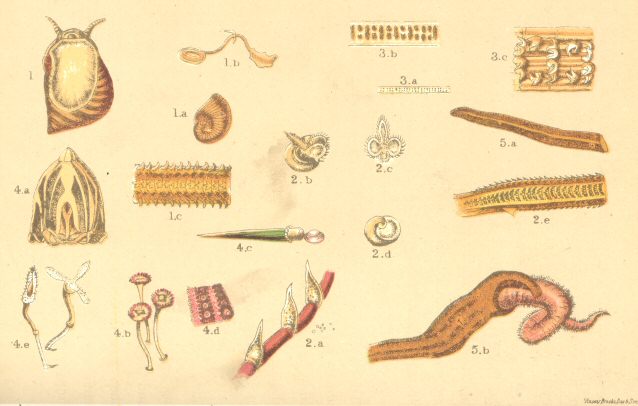
And a scythe has been at work; none other than the tongue of
the little shell-fish; a description of its extraordinary
mechanism (too long to quote here, but which is well worth
reading) may be found in Gosse’s “Aquarium.” [201]
A prawn or two, and a few minute star-fish, will make your
aquarium complete; though you may add to it endlessly, as one
glance at the salt-water tanks of the Zoological Gardens, and the
strange and beautiful forms which they contain, will prove to you
sufficiently.
You have two more enemies to guard against, dust, and
heat. If the surface of the water becomes clogged with
dust, the communication between it and the life-giving oxygen of
the air is cut off; and then your animals are liable to die, for
the very same reason that fish die in a pond which is long frozen
over, unless a hole be broken in the ice to admit the air.
You must guard against this by occasional stirring of the
surface, or, as I have already said, by syringing and by keeping
on a cover. A piece of muslin tied over will do; but a
better defence is a plate of glass, raised on wire some half-inch
above the edge, so as to admit the air. I am not sure that
a sheet of brown paper laid over the vase is not the best of all,
because that, by its shade, also guards against the next evil,
which is heat. Against that you must guard by putting a
curtain of muslin or oiled paper between the vase and the sun, if
it be very fierce, or simply (for simple expedients are best) by
laying a handkerchief over it till the heat is past. But if
you leave your vase in a sunny window long enough to let the
water get tepid, all is over with your pets. Half an
hour’s boiling may frustrate the care of weeks. And
yet, on the other hand, light you must have, and you can hardly
have too much. Some animals certainly prefer shade, and
hide in the darkest crannies; and for them, if your aquarium is
large enough, you must provide shade, by arranging the bits of
stone into piles and caverns. But without light, your
sea-weeds will neither thrive nor keep the water sweet.
With plenty of light you will see, to quote Mr. Gosse once more,
[203] “thousands of tiny globules
forming on every plant, and even all over the stones, where the
infant vegetation is beginning to grow; and these globules
presently rise in rapid succession to the surface all over the
vessel, and this process goes on uninterruptedly as long as the
rays of the sun are uninterrupted.
“Now these globules consist of pure oxygen, given
out by the plants under the stimulus of light; and to this oxygen
the animals in the tank owe their life. The difference
between the profusion of oxygen-bubbles produced on a sunny day,
and the paucity of those seen on a dark cloudy day, or in a
northern aspect, is very marked.” Choose, therefore,
a south or east window, but draw down the blind, or throw a
handkerchief over all if the heat become fierce. The water
should always feel cold to your hand, let the temperature outside
be what it may.
Next, you must make up for evaporation by fresh water
(a very little will suffice), as often as in summer you find the
water in your vase sink below its original level, and prevent the
water from getting too salt. For the salts, remember, do
not evaporate with the water; and if you left the vase in the sun
for a few weeks, it would become a mere brine-pan.
But how will you move your treasures up to town?
The simplest plan which I have found successful is an earthen
jar. You may buy them with a cover which screws on with two
iron clasps. If you do not find such, a piece of oilskin
tied over the mouth is enough. But do not fill the jar full
of water; leave about a quarter of the contents in empty air,
which the water may absorb, and so keep itself fresh. And
any pieces of stone, or oysters, which you send up, hang by a
string from the mouth, that they may not hurt tender animals by
rolling about the bottom. With these simple precautions,
anything which you are likely to find will well endure
forty-eight hours of travel.
What if the water fails, after all?
Then Mr. Gosse’s artificial sea-water will form a
perfect substitute. You may buy the requisite salts (for
there are more salts than “salt” in sea-water) from
any chemist to whom Mr. Gosse has entrusted his discovery, and,
according to his directions, make sea-water for yourself.
One more hint before we part. If, after all, you are not
going down to the sea-side this year, and have no opportunities
of testing “the wonders of the shore,” you may still
study Natural History in your own drawing-room, by looking a
little into “the wonders of the pond.”
I am not jesting; a fresh-water aquarium, though by no means
as beautiful as a salt-water one, is even more easily
established. A glass jar, floored with two or three inches
of pond-mud (which should be covered with fine gravel to prevent
the mud washing up); a specimen of each of two water-plants which
you may buy now at any good shop in Covent Garden, Vallisneria
spiralis (which is said to give to the Canvas-backed duck of
America its peculiar richness of flavour), and Anacharis
alsinastrum, that magical weed which, lately introduced from
Canada among timber, has multiplied, self-sown, to so prodigious
an extent, that it bid fair, a few years since, to choke the
navigation not only of our canals and fen-rivers, but of the
Thames itself: [206] or, in default of these, some of the
more delicate pond-weeds; such as Callitriche, Potamogeton
pusillum, and, best of all, perhaps, the beautiful Water-Milfoil
(Myriophyllium), whose comb-like leaves are the haunts of
numberless rare and curious animalcules:—these (in
themselves, from the transparency of their circulation,
interesting microscopic objects) for oxygen-breeding vegetables;
and for animals, the pickings of any pond; a minnow or two, an
eft; a few of the delicate pond-snails (unless they devour your
plants too rapidly): water-beetles, of activity inconceivable,
and that wondrous bug the Notonecta, who lies on his back all
day, rowing about his boat-shaped body, with one long pair of
oars, in search of animalcules, and the moment the lights are
out, turns head over heels, rights himself, and opening a pair of
handsome wings, starts to fly about the dark room in company with
his friend the water-beetle, and (I suspect) catch flies; and
then slips back demurely into the water with the first streak of
dawn. But perhaps the most interesting of all the tribes of
the Naiads,—(in default, of course, of those semi-human
nymphs with which our Teutonic forefathers, like the Greeks,
peopled each “sacred fountain,”)—are the little
“water-crickets,” which may be found running under
the pebbles, or burrowing in little galleries in the banks: and
those “caddises,” which crawl on the bottom in the
stiller waters, enclosed, all save the head and legs, in a tube
of sand or pebbles, shells or sticks, green or dead weeds, often
arranged with quaint symmetry, or of very graceful shape.
Their aspect in this state may be somewhat uninviting, but they
compensate for their youthful ugliness by the strangeness of
their transformations, and often by the delicate beauty of the
perfect insects, as the “caddises,” rising to the
surface, become flying Phryganeæ (caperers and sand-flies),
generally of various shades of fawn-colour; and the
water-crickets (though an unscientific eye may be able to discern
but little difference in them in the “larva,” or
imperfect state) change into flies of the most various
shapes;—one, perhaps, into the great sluggish olive
“Stone-fly” (Perla bicaudata); another into the
delicate lemon-coloured “Yellow Sally” (Chrysoperla
viridis); another into the dark chocolate “Alder”
(Sialis lutaria): and the majority into duns and drakes
(Ephemeræ); whose grace of form, and delicacy of colour,
give them a right to rank among the most exquisite of God’s
creations, from the tiny “Spinners” (Baëtis or
Chloron) of incandescent glass, with gorgeous rainbow-coloured
eyes, to the great Green Drake (Ephemera vulgata), known to all
fishermen as the prince of trout-flies. These animals,
their habits, their miraculous transformations, might give many
an hour’s quiet amusement to an invalid, laid on a sofa, or
imprisoned in a sick-room, and debarred from reading, unless by
some such means, any page of that great green book outside, whose
pen is the finger of God, whose covers are the fire kingdoms and
the star kingdoms, and its leaves the heather-bells, and the
polypes of the sea, and the gnats above the summer stream.
I said just now, that happy was the sportsman who was also a
naturalist. And, having once mentioned these curious
water-flies, I cannot help going a little farther, and saying,
that lucky is the fisherman who is also a naturalist. A
fair scientific knowledge of the flies which he imitates, and of
their habits, would often ensure him sport, while other men are
going home with empty creels. One would have fancied this a
self-evident fact; yet I have never found any sound knowledge of
the natural water-flies which haunt a given stream, except among
cunning old fishermen of the lower class, who get their living by
the gentle art, and bring to indoors baskets of trout killed on
flies, which look as if they had been tied with a pair of tongs,
so rough and ungainly are they; but which, nevertheless, kill,
simply because they are (in colour, which is all that fish
really care for) exact likenesses of some obscure local species,
which happen to be on the water at the time. Among
gentlemen-fishermen, on the other hand, so deep is the ignorance
of the natural fly, that I have known good sportsmen still under
the delusion that the great green May-fly comes out of a
caddis-bait; the gentlemen having never seen, much less fished
with, that most deadly bait the “Water-cricket,” or
free creeping larva of the May-fly, which may be found in May
under the river-banks. The consequence of this ignorance is
that they depend for good patterns of flies on mere chance and
experiment; and that the shop patterns, originally excellent,
deteriorate continually, till little or no likeness to their
living prototype remains, being tied by town girls, who have no
more understanding of what the feathers and mohair in their hands
represent than they have of what the National Debt
represents. Hence follows many a failure at the
stream-side; because the “Caperer,” or
“Dun,” or “Yellow Sally,” which is
produced from the fly-book, though, possibly, like the brood
which came out three years since on some stream a hundred miles
away, is quite unlike the brood which is out to-day on
one’s own river. For not only do most of these flies
vary in colour in different soils and climates, but many of them
change their hue during life; the Ephemeræ, especially,
have a habit of throwing off the whole of their skins (even,
marvellously enough, to the skin of the eyes and wings, and the
delicate “whisks” at their tail), and appearing in an
utterly new garb after ten minutes’ rest, to the
discomfiture of the astonished angler.
The natural history of these flies, I understand from Mr.
Stainton (one of our most distinguished entomologists), has not
yet been worked out, at least for England. The only
attempt, I believe, in that direction is one made by a charming
book, “The Fly-fisher’s Entomology,” which
should be in every good angler’s library; but why should
not a few fishermen combine to work out the subject for
themselves, and study for the interests both of science and their
own sport, “The Wonders of the Bank?” The work,
petty as it may seem, is much too great for one man, so prodigal
is Nature of her forms, in the stream as in the ocean; but what
if a correspondence were opened between a few fishermen—of
whom one should live, say, by the Hampshire or Berkshire chalk
streams; another on the slates and granites of Devon; another on
the limestones of Yorkshire or Derbyshire; another among the yet
earlier slates of Snowdonia, or some mountain part of Wales; and
more than one among the hills of the Border and the lakes of the
Highlands? Each would find (I suspect), on comparing his
insects with those of the others, that he was exploring a little
peculiar world of his own, and that with the exception of a
certain number of typical forms, the flies of his county were
unknown a hundred miles away, or, at least, appeared there under
great differences of size and colour; and each, if he would take
the trouble to collect the caddises and water-crickets, and breed
them into the perfect fly in an aquarium, would see marvels in
their transformations, their instincts, their anatomy, quite as
great (though not, perhaps, as showy and startling) as I have
been trying to point out on the sea-shore. Moreover, each
and every one of the party, I will warrant, will find his
fellow-correspondents (perhaps previously unknown to him) men
worth knowing; not, it may be, of the meditative and half-saintly
type of dear old Izaak Walton (who, after all, was no fly-fisher,
but a sedentary “popjoy” guilty of float and worm),
but rather, like his fly-fishing disciple Cotton, good fellows
and men of the world, and, perhaps, something better over and
above.
The suggestion has been made. Will it ever be taken up,
and a “Naiad Club” formed, for the combination of
sport and science?
And, now, how can this desultory little treatise end more
usefully than in recommending a few books on Natural History, fit
for the use of young people; and fit to serve as introductions to
such deeper and larger works as Yarrell’s “Birds and
Fishes,” Bell’s “Quadrupeds” and
“Crustacea,” Forbes and Hanley’s
“Mollusca,” Owen’s “Fossil Mammals and
Birds,” and a host of other admirable works? Not that
this list will contain all the best; but simply the best of which
the writer knows; let, therefore, none feel aggrieved, if, as it
may chance, opening these pages, they find their books
omitted.
First and foremost, certainly, come Mr. Gosse’s
books. There is a playful and genial spirit in them, a
brilliant power of word-painting combined with deep and earnest
religious feeling, which makes them as morally valuable as they
are intellectually interesting. Since White’s
“History of Selborne,” few or no writers on Natural
History, save Mr. Gosse, Mr. G. H. Lewes, and poor Mr. E. Forbes,
have had the power of bringing out the human side of science, and
giving to seemingly dry disquisitions and animals of the lowest
type, by little touches of pathos and humour, that living and
personal interest, to bestow which is generally the special
function of the poet: not that Waterton and Jesse are not
excellent in this respect, and authors who should be in every
boy’s library: but they are rather anecdotists than
systematic or scientific inquirers; while Mr. Gosse, in his
“Naturalist on the Shores of Devon,” his “Tour
in Jamaica,” his “Tenby,” and his
“Canadian Naturalist,” has done for those three
places what White did for Selborne, with all the improved
appliances of a science which has widened and deepened tenfold
since White’s time. Mr. Gosse’s “Manual
of the Marine Zoology of the British Isles” is, for
classification, by far the completest handbook extant. He
has contrived in it to compress more sound knowledge of vast
classes of the animal kingdom than I ever saw before in so small
a space. [215]
Miss Anne Pratt’s “Things of the Sea-coast”
is excellent; and still better is Professor Harvey’s
“Sea-side Book,” of which it is impossible to speak
too highly; and most pleasant it is to see a man of genius and
learning thus gathering the bloom of his varied knowledge, to put
it into a form equally suited to a child and a
savant. Seldom, perhaps, has there been a little
book in which so vast a quantity of facts have been told so
gracefully, simply, without a taint of pedantry or
cumbrousness—an excellence which is the sure and only mark
of a perfect mastery of the subject. Mr. G. H.
Lewes’s “Sea-shore Studies” are also very
valuable; hardly perhaps a book for beginners, but from his
admirable power of description, whether of animals or of scenes,
is interesting for all classes of readers.
Two little “Popular” Histories—one of
British Zoophytes, the other of British Sea-weeds, by Dr.
Landsborough (since dead of cholera, at Saltcoats, the scene of
his energetic and pious ministry)—are very excellent; and
are furnished, too, with well-drawn and coloured plates, for the
comfort of those to whom a scientific nomenclature (as liable as
any other human thing to be faulty and obscure) conveys but a
vague conception of the objects. These may serve well for
the beginner, as introductions to Professor Harvey’s large
work on British Algæ, and to the new edition of Professor
Johnston’s invaluable “British Zoophytes,” Miss
Gifford’s “Marine Botanist,” third edition, and
Dr. Cocks’s “Sea-weed Collector’s Guide,”
have also been recommended by a high authority.
For general Zoology the best books for beginners are, perhaps,
as a general introduction, the Rev. J. A. L. Wood’s
“Popular Zoology,” full of excellent plates; and for
systematic Zoology, Mr. Gosse’s four little books, on
Mammals, Birds, Reptiles, and Fishes, published with many plates,
by the Christian Knowledge Society, at a marvellously cheap
rate. For miscroscopic animalcules, Miss Agnes
Catlow’s “Drops of Water” will teach the young
more than they will ever remember, and serve as a good
introduction to those teeming abysses of the unseen world, which
must be afterwards traversed under the guidance of Hassall and
Ehrenberg.
For Ornithology, there is no book, after all, like dear old
Bewick, passé though he may be in a scientific
point of view. There is a good little British ornithology,
too, published in Sir W. Jardine’s
“Naturalist’s Library,” and another by Mr.
Gosse. And Mr. Knox’s “Ornithological Rambles
in Sussex,” with Mr. St. John’s “Highland
Sports,” and “Tour in Sutherlandshire,” are the
monographs of naturalists, gentlemen, and sportsmen, which remind
one at every page (and what higher praise can one give?) of
White’s “History of Selborne.” These
last, with Mr. Gosse’s “Canadian Naturalist,”
and his little book “The Ocean,” not forgetting
Darwin’s delightful “Voyage of the Beagle and
Adventure,” ought to be in the hands of every lad who is
likely to travel to our colonies.
For general Geology, Professor Ansted’s Introduction is
excellent; while, as a specimen of the way in which a single
district may be thoroughly worked out, and the universal method
of induction learnt from a narrow field of objects, what book
can, or perhaps ever will, compare with Mr. Hugh Miller’s
“Old Red Sandstone”?
For this last reason, I especially recommend to the young the
Rev. C. A. Johns’s “Week at the Lizard,” as
teaching a young person how much there is to be seen and known
within a few square miles of these British Isles. But,
indeed, all Mr. Johns’s books are good (as they are bound
to be, considering his most accurate and varied knowledge),
especially his “Flowers of the Field,” the best cheap
introduction to systematic botany which has yet appeared.
Trained, and all but self-trained, like Mr. Hugh Miller, in a
remote and narrow field of observation, Mr. Johns has developed
himself into one of our most acute and persevering botanists, and
has added many a new treasure to the Flora of these isles; and
one person, at least, owes him a deep debt of gratitude for first
lessons in scientific accuracy and patience,—lessons
taught, not dully and dryly at the book and desk, but livingly
and genially, in adventurous rambles over the bleak cliffs and
ferny woods of the wild Atlantic shore,—
“Where the old fable of the guarded mount
Looks toward Namancos and Bayona’s hold.”
Mr. Henfrey’s “Rudiments of Botany” might
accompany Mr. Johns’s books. Mr. Babington’s
“Manual of British Botany” is also most compact and
highly finished, and seems the best work which I know of from
which a student somewhat advanced in English botany can verify
species; while for ferns, Moore’s “Handbook” is
probably the best for beginners.
For Entomology, which, after all, is the study most fit for
boys (as Botany is for girls) who have no opportunity for
visiting the sea-shore, Catlow’s “Popular British
Entomology,” having coloured plates (a delight to young
people), and saying something of all the orders, is, probably,
still a good work for beginners.
Mr. Stainton’s “Entomologist’s Annual for
1855” contains valuable hints of that gentleman’s on
taking and arranging moths and butterflies; as well as of Mr.
Wollaston’s on performing the same kind office for that far
more numerous, and not less beautiful class, the beetles.
There is also an admirable “Manual of British Butterflies
and Moths,” by Mr. Stainton, in course of publication; but,
perhaps, the most interesting of all entomological books which I
have seen (and for introducing me to which I must express my
hearty thanks to Mr. Stainton), is “Practical Hints
respecting Moths and Butterflies, forming a Calendar of
Entomological Operations,” [220] by Richard Shield,
a simple London working-man.
I would gladly devote more space than I can here spare to a
review of this little book, so perfectly does it corroborate
every word which I have said already as to the moral and
intellectual value of such studies. Richard Shield, making
himself a first-rate “lepidopterist,” while working
with his hands for a pound a week, is the antitype of Mr. Peach,
the coast-guardsman, among his Cornish tide-rocks. But more
than this, there is about Shield’s book a tone as of Izaak
Walton himself, which is very delightful; tender, poetical, and
religious, yet full of quiet quaintness and humour; showing in
every page how the love for Natural History is in him only one
expression of a love for all things beautiful, and pure, and
right. If any readers of these pages fancy that I
over-praise the book, let them buy it, and judge for
themselves. They will thus help the good man toward
pursuing his studies with larger and better appliances, and will
be (as I expect) surprised to find how much there is to be seen
and done, even by a working-man, within a day’s walk of
smoky Babylon itself; and how easily a man might, if he would,
wash his soul clean for a while from all the turmoil and
intrigue, the vanity and vexation of spirit of that
“too-populous wilderness,” by going out to be alone a
while with God in heaven, and with that earth which He has given
to the children of men, not merely for the material wants of
their bodies, but as a witness and a sacrament that in Him they
live and move, and have their being, “not by bread alone,
but by every word that proceedeth out of the mouth of
God.”
Thus I wrote some twenty years ago, when the study of Natural
History was confined mainly to several scientific men, or mere
collectors of shells, insects, and dried plants.
Since then, I am glad to say, it has become a popular and
common pursuit, owing, I doubt not, to the impulse given to it by
the many authors whose works I then recommended. I
recommend them still; though a swarm of other manuals and popular
works have appeared since, excellent in their way, and almost
beyond counting. But all honour to those, and above all to
Mr. Gosse and Mr. Johns, who first opened people’s eyes to
the wonders around them all day long. Now, we have, in
addition to amusing books on special subjects, serials on Natural
History more or less profound, and suited to every kind of
student and every grade of knowledge. I mention the names
of none. For first, they happily need no advertisement from
me; and next, I fear to be unjust to any one of them by
inadvertently omitting its name. Let me add, that in the
advertising columns of those serials, will be found notices of
all the new manuals, and of all apparatus, and other matters,
needed by amateur naturalists, and of many who are more than
amateurs. Microscopy, meanwhile, and the whole study of
“The Wonders of the Little,” have made vast strides
in the last twenty years; and I was equally surprised and
pleased, to find, three years ago, in each of two towns of a few
thousand inhabitants, perhaps a dozen good microscopes, all but
hidden away from the public, worked by men who knew how to handle
them, and who knew what they were looking at; but who modestly
refrained from telling anybody what they were doing so
well. And it was this very discovery of unsuspected
microscopists which made me more desirous than ever to
see—as I see now in many places—scientific societies,
by means of which the few, who otherwise would work apart, may
communicate their knowledge to each other, and to the many.
These “Microscopic,” “Naturalist,”
“Geological,” or other societies, and the
“Field Clubs” for excursions into the country, which
are usually connected with them, form a most pleasant and hopeful
new feature in English Society; bringing together, as they do,
almost all ranks, all shades of opinion; and it has given me deep
pleasure to see, in the case at least of the Country Clubs with
which I am acquainted, the clergy of the Church of England taking
an active, and often a leading, interest in their practical
work. The town clergy are, for the most part, too utterly
overworked to follow the example of their country brethren.
But I have reason to know that they regard such societies, and
Natural History in general, with no unfriendly eyes; and that
there is less fear than ever that the clergy of the Church of
England should have to relinquish their ancient boast—that
since the formation of the Royal Society in the seventeenth
century, they have done more for sound physical science than any
other priesthood or ministry in the world. Let me advise
anyone who may do me the honour of reading these pages, to
discover whether such a Club or Society exists in his
neighbourhood, and to join it forthwith, certain that—if
his experience be at all like mine—he will gain most
pleasant information and most pleasant acquaintances, and pass
most pleasant days and evenings, among people whom he will be
glad to know, and whom he never would have known save for the
new—and now, I hope, rapidly spreading—freemasonry of
Natural History.
Meanwhile, I hope—though I dare not say I trust—to
see the day when the boys of each of our large schools shall
join—like those of Marlborough and Clifton—the same
freemasonry; and have their own Naturalists’ Clubs; nay
more; when our public schools and universities shall awake to the
real needs of the age, and—even to the curtailing of the
time usually spent in not learning Latin and Greek—teach
boys the rudiments at least of botany, zoology, geology, and so
forth; and when the public opinion, at least of the refined and
educated, shall consider it as ludicrous—to use no stronger
word—to be ignorant of the commonest facts and laws of this
living planet, as to be ignorant of the rudiments of two dead
languages. All honour to the said two languages.
Ignorance of them is a serious weakness; for it implies ignorance
of many things else; and indeed, without some knowledge of them,
the nomenclature of the physical sciences cannot be
mastered. But I have got to discover that a boy’s
time is more usefully spent, and his intellect more methodically
trained, by getting up Ovid’s Fasti with an ulterior hope
of being able to write a few Latin verses, than in getting up
Professor Rolleston’s “Forms of Animal Life,”
or any other of the excellent Scientific Manuals for beginners,
which are now, as I said, happily so numerous.
May that day soon come; and an old dream of mine, and of my
scientific friends, be fulfilled at last.
And so I end this little book, hoping, even praying, that it
may encourage a few more labourers to go forth into a vineyard,
which those who have toiled in it know to be full of ever-fresh
health, and wonder and simple joy, and the presence and the glory
of Him whose name is Love.


