In various chapters throughout the foregoing portions of
this book we have had occasion to refer to the colour of
glass and the causes affecting it, but these references have
chiefly been made from the point of view of the production
of glasses as nearly colourless as possible under the circumstances.
While it is obvious that for the great majority of
the purposes for which it is used the absence of all visible
coloration is desirable or even essential in the glass
employed, there are numerous other uses where a definite
coloration is required. Thus we have, as industrial
and technical uses of coloured glass, the employment of
ruby, green and purple glasses for signalling purposes, as
in the signal lamps of our railways, the red tail-lights of
motor-cars, or even the red or green sectors of certain
harbour lights and lighthouses; again, coloured glasses,
ruby, green, and yellow, are extensively employed in connection
with photography. Rather less exacting in their
demands upon the correctness of the colour employed are
the architectural and ornamental uses to which coloured
glass is so extensively put in both public and domestic
buildings, while, finally, coloured glass is largely the
foundation upon which the stained-glass worker builds up
his artistic achievements; in another direction, coloured
glass is also utilised in the production of ornamental articles
and of some table-ware. While it must be admitted that
in a great many cases the colour-resources of the glass
maker are hopelessly misapplied, yet in really artistic hands
few other materials are capable of yielding results of equal
beauty.
By the “colour” of a glass is generally understood the
tint or colour which is observed when it is viewed, in comparatively
thin slices, by transmitted light; the actual
colour is thus a property, not so much of the kind or
variety of glass as of each individual piece, since thick
pieces out of the same melting will show a different tint
from that seen in thinner pieces. As we have already
pointed out, such glasses as sheet or plate, which appear
practically colourless when viewed in the ordinary way,
show a very decided green colour when viewed through a
considerable thickness. In the same way, a very thin layer
of the glass known as “flashing ruby” shows a brilliant red
tint, but a thickness of one-sixteenth of an inch is sufficient
to render the glass practically opaque, giving it a black
appearance by both transmitted and reflected light. Again,
cobalt blue glass, when examined with a spectroscope in
thin layers, is found to transmit a notable proportion of
red rays, but thicker pieces entirely suppress these rays.
These phenomena will be readily understood when we
recollect that colour in a transparent medium arises from
the fact that the medium has different absorbing powers for
light of different colours. All transparent substances, and
certainly glass, are only partially transparent: all light
waves passing through such a substance are gradually
absorbed, and the extent to which they are absorbed differs
according to the length of these waves. It always happens
that for some special wave-lengths the substance has the
power of absorbing the energy of the entering waves and
converting it into heat-vibrations of its own molecules or
atoms. In the most transparent and colourless glasses this
process, so far as the waves of ordinary light are concerned,
only goes on to a negligibly slight extent; if, however, we
extend our view beyond the range of ordinary visible light,
and consider the region of shorter waves that lies in
the spectrum beyond the violet, we find that ordinary
colourless glass becomes strongly absorbent; thus to waves
of about half the length of those which produce upon our
eyes the impression of yellow light, ordinary glass is as
opaque as is a piece of metal to white light. In this wider
sense, then, we may fairly say that all glasses are coloured—i.e.,
all have a power of selective absorption; but in the
case of those which are nearly colourless in the ordinary
sense, this absorption takes place only for waves which are
either decidedly shorter or decidedly longer than those to
which our eyes are sensitive. Those glasses which appear
coloured in the ordinary sense, on the other hand, owe this
property to the fact that the power of absorption for
light-waves extends into the region of the visible spectrum;
thus a blue or violet glass is practically opaque to red rays,
while a red glass is opaque to blue, green or violet rays.
This statement may be verified in a striking manner by
holding over one another a piece of deep blue or green
glass and a similar piece of ruby glass—the combination
will be found to be very nearly opaque even when each
glass by itself is practically transparent.
The question which now naturally presents itself to us is,
what is the essential difference between, for instance, a
piece of red glass and a piece of “white” glass that confers
upon the former the power of absorbing blue light? A
perfectly complete and satisfactory answer to this question
is not, in the writer’s opinion, available in the present state
of our knowledge, but to a certain extent the difference
between the two kinds of glass can be explained. The
difference is produced, in the first instance by introducing
into the colourless glass some additional chemical element
or elements, the substances in question being generally
known as “colouring oxides,” although they are by no
means always introduced in the form of oxides, and are
frequently present in the glass in entirely different forms.
To a certain extent the colour of the glass may be ascribed
to a definite “colouring” property of the chemical elements
concerned; thus most of the chemical compounds of such
elements as nickel, cobalt, iron, manganese and copper are
more or less deeply coloured substances, and it would seem
as if the atoms or “ions” of these elements had the specific
power of absorbing certain varieties of light-waves while
not materially affecting others. But this specific “colouring”
property is not so easily explained when we recollect
that the colours of iron compounds, for example, may be
green or red according to the state of combination in which
that element is present, and that iron has also the power of
imparting either a green or a yellow colour to glass according
to circumstances. The detailed discussion of these
questions, however, lies outside our present scope, and we
must confine ourselves to the broad statement that colouring
substance in glass may be roughly divided into two
kinds or groups; the first and probably the largest group
are those bodies which occur in glass in true solution, the
element itself being present in the combined state as a
silicate or other such compound (borate, phosphate, etc.)
which is soluble in the glass. In this class, the colouring
effect upon the glass is specifically that of the element
introduced, and is brought about in the same way as the
colouring of water when a coloured salt—such as copper
sulphate—is dissolved in it. The second class of colouring
substances, however, behave in a different manner; they
are probably present in the glass in a state of extremely
fine division, and held not in true solution, but really in a
sort of mechanical suspension that approximates to the
condition of what is known as a “colloidal solution.” The
point which is known beyond doubt, thanks to the researches
of Siedentopf and Szigmondi on ultra-microscopical particles,
is that in certain coloured glasses, of which ruby glass is
the best example, the colouring substance, be it gold or
cuprous oxide, is present in the form of minute but by no
means atomic or molecular particles suspended in the glass.
The presence of these particles has been made optically
evident, although it can hardly be said that they have been
rendered visible, and it is at all events probable that these
suspended particles act each as a whole in absorbing the light-waves
characteristic of the colour which they produce in
glass. This being the case, it is easy to understand how
readily the colour of such glasses is altered or spoilt by
manipulations which involve heating and cooling at different
rates—too rapid a rate of cooling producing a different
grouping of the minute particles, altering their size or
shape, or even obliterating them entirely by allowing the
element in question to go into or to remain in solution in
the glass.
While it would be entirely foreign to the purpose of this
volume to give in this place a series of recipes for the
production of various kinds of coloured glass, it will be
desirable to state in general terms the colours or range of
colours which can be produced in various kinds of glass by
the introduction of those chemical elements which are
ordinarily used in this way. In general terms it may be
said that the lighter elements do not as a rule tend to the
production of coloured glasses, while the heavier elements,
so far as they can be retained in the glass in either solution
or suspension, tend to produce an intense colouring effect.
The element lead appears to form a striking exception to
this rule, but this is due to the fact that while the silicates
of most of the other heavy elements are more or less
unstable, the silicate of lead is very stable, and can only be
decomposed by the action of reducing agents. When lead
silicates are decomposed in this way, however, the resulting
glass immediately receives an exceedingly deep colour,
being turned a deep opaque black, although in very thin
layers the colour is decidedly brown. On the other hand,
glasses very rich in lead are always decidedly yellow in
colour, and it has been shown that this coloration is due
to the natural colour of lead silicates and not to the presence
of impurities. What has just been said of lead applies,
with only very slight modification, also to the rare metal
thallium and its compounds, which have been introduced
into glass for special purposes. Leaving these two exceptional
bodies on one side, we now pass to a consideration of
the elements in the order of their chemical grouping. The
rare elements will not be considered except in certain cases
where their presence in traces is liable to affect results
attained in practice.
The Alkali Metals, sodium, potassium, lithium, etc., and
their compounds, have no specific colouring effect, although
the presence of soda or of potash in a glass affects the
colours produced by such substances as manganese, nickel,
selenium, etc.
Copper, as would be anticipated from the deep colour of
most of its compounds, produces powerful colouring effects
on glass. Cupric silicates produce intense green, to greenish-blue
tints. Copper, either as metal or oxide, added to glass
in the ordinary way, always produces the green colour; but
when the full oxidation of the copper is prevented by the
presence of a reducing body, and the glass is cooled slowly,
or is exposed to repeated heating followed by slow cooling,
an intense ruby coloration is produced. In practice this
colour is produced by introducing tin as well as copper into
the mixture, and so regulating the conditions of melting as
to favour reduction rather than oxidation of the copper.
Under these circumstances the copper is left in the glass in
a finely divided and evenly suspended state; if exactly the
right state of division and suspension is arrived at, a
beautiful red tint is the result, although the coloration of
the glass is so intense that it can only be employed in very
thin sheets, being “flashed” upon the surface of colourless
glass to give it the necessary strength and thickness for
practical use. It is further very easy to slightly alter the
arrangement of the copper in the glass, with the result of
producing an opaque, streaky substance resembling sealing-wax
in colour and appearance, this product being, of course,
useless from the glass-maker’s point of view. Finally, by
exceedingly slow cooling, and under other favouring conditions
which are not really understood, the particles of
suspended colouring-material—be it metallic copper or
cuprous oxide—grow in size and attain visible dimensions,
appearing as minute shimmering flakes, thus producing the
beautiful substance known as “aventurine.”
Silver is never introduced into glass mixtures, the reason
being that it is so readily reduced to the metallic state
from all its compounds that it cannot be retained in the
glass except in a finely-divided form, causing the glass to
assume a black, metallic appearance resembling the stains
produced by the reduction of lead in flint glasses. On the
other hand, silver yields a beautiful yellow colour when
applied to glass as a surface stain, and it is widely used for
that purpose.
Gold is introduced into glass for the production of brilliant
ruby tints; its behaviour is very similar to that of copper,
except that the noble metal has a great tendency to return
to the metallic state without the aid of reducing agents.
No addition of tin is therefore required, but the rate of
cooling, etc., must be properly regulated, since rapidly
cooled glass containing gold shows no special colour, the
rich ruby tint being only developed when the glass is
re-heated and cooled slowly. The colouring effect of gold
is undoubtedly more regular and uniform than that of
copper, and it is accordingly possible to obtain much lighter
shades of red with the aid of the noble metal. “Gold ruby”
can therefore be obtained of a tint light enough to be used
in sheets of ordinary thickness, and the process of “flashing”
is not essential.
The elements of the second group, such as magnesium,
calcium, strontium, barium, zinc and cadmium, exert no
strong specific colouring action on glass, with perhaps the
exception of cadmium, and that element only does so to
any considerable extent in combination with sulphur,
sulphide of cadmium having the power of producing rich
yellow colours in glass. The sulphur compounds of barium
also readily produce deep green and yellow colours, and the
formation of these tints is, indeed, very difficult to avoid in
the case of glasses containing much barium. A colouring
effect has sometimes been ascribed to zinc, but this is not
in accordance with facts.
Of the elements of the third group, only boron and
aluminium are ever found in glass in any notable quantity.
Boron is present in the form of boric acid or borates, and as
such produces no colouring effect, nor does there seem to be
any tendency for the separation of free boron. The compounds
of aluminium also possess no colouring effect,
although certain compounds of this element are utilised for
imparting a white opacity to glass for certain purposes—such
glass being known as “opal.”
The elements of the fourth group are of greater importance
in connection with glass. Carbon is capable of exerting
powerful colouring effects when introduced into glass.
These effects are of two kinds, viz., indirect in consequence
of the reducing action of carbon on other substances
present, and direct from the presence of finely-divided
carbon or carbides in the glass. The latter are similar in
kind to those produced by the presence of other finely-divided
elementary bodies (copper, gold, lead, etc.) except
that the lightness of the carbon particles tends to the
production of yellow and brown colours rather than of red
and black, while the chemical nature of carbon renders the
glass in which it is suspended indifferent to rapid cooling,
so far as the carbon tint is concerned. The indirect effects
of carbon, in reducing other substances that may be present
in the glass, become evident with much smaller proportions
of carbon than are required to produce visible direct effects.
As we have seen above, carbon, in the form of coke, charcoal
or anthracite coal, is regularly introduced, as a reducing
medium, into glass mixtures containing sulphate of soda.
If even a slight excess of carbon be used for this purpose,
the formation of sulphides and poly-sulphides of sodium
and of calcium results, and these bodies, like all sulphides,
impart a greenish-yellow tint to the glass, at the same
time bringing other undesirable results in their train.
Silicon, in the form of silicic acid and its compounds, is a
fundamental constituent of all varieties of glass, and in this
form is in no sense a colouring substance; on the other
hand, there is no doubt that under some conditions silicon
may be reduced to the metallic state at temperatures which
normally occur in glass-furnaces, and it is practically
certain, that if present in glass in this condition, silicon
would colour the glass. It is just possible that some of the
colouring effects produced in ordinary glass by powerful
reducing agents, such as carbon, either in the solid form or
as a constituent of furnace gases, may be due to the reduction
of silicon in the glass.
Tin by itself does not appear to have any colouring effect
upon glass, except that its oxide, in a finely suspended
state, produces opalescence and, in large quantities, white
opacity. Tin, however, is used in conjunction with copper
in the production of copper-ruby, to which reference has
already been made.
Lead and Thallium have already been dealt with, and it
only remains to add that their presence in the glass,
although not in itself producing any intense colouring
action, increases the colouring effects of other substances.
This is probably merely a particular case of the fact that
dense glasses, of high refractive index, are more sensitive
to colouring agencies than the lighter glasses of low
refractive index; this applies to barium as well as to lead
and thallium glasses.
Phosphorus occurs in some few glasses in the form of
phosphoric acid, and this substance, as such, has no colouring
effect. Calcium phosphate, however, is sometimes added to
glasses for the purpose of producing opalescence. Its
action in this respect is probably similar to that of tin
oxide and aluminium fluoride, these substances all remaining
undissolved in the glass in the form of minute particles in
a finely divided and suspended state.
Arsenic does not exert a colouring effect on glass, and
owing to its volatile nature it can only be retained in glass
in small quantities and under special conditions. A
“decolourising” action is sometimes ascribed to arsenic,
but if this action really exists it can only be ascribed to the
fact that arsenic compounds are capable of acting as carriers
of oxygen, and their presence thus tends to facilitate the
oxidation of impurities contained in the glass. A further
reference to this subject will be found below in reference to
the compounds of manganese.
Antimony, although frequently added to special glass
mixtures, does not appear to produce any very powerful
effects, except possibly in the direction of producing
white opacity if present in large proportions. The sulphide
of antimony, however, exerts a colouring influence, although
its volatile and unstable character renders the effects
uncertain.
Vanadium, owing to its rarity, is probably never added
to glass mixtures for colouring purposes, although it is
capable of producing vivid yellow and greenish tints when
present even in minute proportions. On the other hand,
vanadium occurs in small proportions in a number of fire-clays,
including some of those of the Stourbridge district,
and glass melted in pots containing this element is liable
to have its colour spoilt by taking up the vanadium from
the clay.
Sulphur is an element whose presence in various forms
is liable to affect the colour of glass in a variety of ways.
The colouring effects of sodium-, calcium-, cadmium-, and
antimony-sulphides have already been referred to. Sulphur
probably never exists in glass in the uncombined state
at all, but sulphur and its oxides, which are often
contained in furnace gases, sometimes exert a very marked
action upon hot glass. The presence of sulphur gases
in the atmospheres of blowing-holes and annealing kilns is
liable to produce in the glass a peculiar yellowish milkiness
which penetrates for a considerable depth into the mass of
the glass and cannot be removed by subsequent treatment.
Glass vessels, particularly if made of glass produced from
raw materials among which salt-cake has figured, are also
affected by contact with fused sulphur or its vapour, the
effect being a gradual disintegration of the glass. The
precise mechanism of these actions is not known at present,
but they probably consist in the formation of sulphur compounds
within the glass, possibly giving rise to an evolution
of minute bubbles of gas.
Selenium, which is chemically so closely related to
sulphur, is a relatively rare element, which is, however,
finding some use in glass-manufacture as a colouring and a
decolouring agent. The introduction of selenium or of its
compounds under suitable conditions into a glass mixture
produces or tends to produce a peculiar yellowish-pink
coloration, the intensity of the colour produced being
dependent upon the chemical nature of the glass as a whole
and, of course, upon the amount of selenium left in the
glass at the end of the melting process, this latter in turn
depending upon the duration and temperature of the
process in question. The pink colour of selenium glass is
best developed in those containing barium as a base, but it
is also developed in lead glasses, while soda-lime glasses do
not show the colour so well. As a “decolouriser” the
action of selenium is entirely that of producing a complementary
colour which is intended to “cover” the green or
blue tint of the glass; where the depth of the tint to be
“covered” is small, selenium can be used very successfully
in this way, although it is a relatively costly substance for
such a purpose. No oxidising or “cleansing” action can
be ascribed to selenium or its compounds.
Chromium is one of the most intensely active colouring
substances that are available for the glass-maker, and it is
accordingly used very extensively. It has the advantage of
relative cheapness, and can be conveniently obtained and
introduced into glass in the form of pure compounds whose
colouring effect can be accurately anticipated; the colours
produced by the aid of chromium have the further advantage
of being very constant in character, being little affected by
oxidising or reducing conditions, and only very slightly by
the length or temperature of the melting process. The
rate of cooling, in fact, appears to be the only factor that
materially affects the colours produced by compounds of
chromium. The colours produced by chromium alone are
various depths of a bright green, the depth varying, of
course, with the proportion of chromium that is present in
the glass and with the purity of the glass itself. Very
frequently, chromium is used in conjunction with either
iron or copper to produce various tints of “cold blue”
and “celadon green” respectively. This element is most
usually introduced into the glass mixture in the form of
potassium bichromate; although other compounds might
be employed, this substance presents several advantages to
the glass maker. In the first place, since the colouring
effect of chromium is very intense, it must be used in very
small quantities, and if chromic oxide itself were used, the
weighing would have to be carried out with extreme
care; potassium bichromate, however, contains a much
smaller proportion of the effective colouring substance, so
that much larger weights can be employed, and the accuracy
of weighing required is proportionately reduced. A further
consideration arises from the fact that chromic oxide is
itself an extremely refractory body, and is therefore comparatively
difficult to incorporate with glass, while its
presence tends to make the glass itself more viscid and
refractory; the simultaneous introduction of the alkali,
as provided by the use of the bichromate, is thus an
advantage in restoring the fluidity and softness of the glass
when finished, while also facilitating the solution of the
chromium in the glass during the fusion process; this
process of solution, however, takes some time, chromium
glasses being liable to appear patchy if insufficient time is
given to the “founding.”
Uranium is one of the rarer and more costly elements,
but is nevertheless used in glass-making for special purposes
on account of the very beautiful fluorescent yellow colour
which it imparts when added in small proportions. This
yellow is quite characteristic and unmistakable, so that
none of the other varieties of yellow glass can ever be used
as a substitute for uranium glass, but the great cost of the
latter prevents its extended use. Uranium is usually
introduced into glass mixtures in the form of a chemical
compound, such as uranyl-acetate or uranyl-nitrate, both
these substances being obtainable in the form of small,
intensely bright yellow crystals.
Fluorine occurs in a number of glasses in the form of
dissolved or suspended fluorides, principally fluoride of
aluminium. The element is not essentially a colouring
substance, and is only mentioned here because the fluoride
named is the most frequently used means of producing
“opal” glass. The fluoride is most frequently introduced
into the glass mixtures as calcium fluoride, used in
conjunction with felspar, or as cryolite, a natural mineral
which consists of a double fluoride of sodium and
aluminium.
Manganese is one of the most important colouring
elements used by the glass-maker. When introduced into
glass in the absence of other colouring ingredients,
compounds of manganese produce a range of colours lying
in the region of pinkish-purple to violet, according to the
chemical nature of the glass. The exact colour produced
varies according as the glass has lead, lime or barium as
its base, and it also depends upon the presence of soda or
potash as the alkaline constituent. The nature and
intensity of the colour, however, which the addition of a
given percentage of manganese will produce depends upon
other factors besides the chemical composition of the bases
used in the mixture. The heat and duration of the
“found” and the reducing or oxidising conditions of the
furnace in which it has been carried on very materially
affect the result. Thus, a glass having a slight tinge of
pink or purple derived from manganese can be rendered
entirely colourless by the action of reducing gases or by introducing
into the glass a reducing substance, such as a piece of
wood. It will thus be seen that while manganese is a most
useful element for the glass-maker, its employment requires
much skill and care, and generally involves some troublesome
manipulations before the desired result is attained.
In practice, manganese is most frequently used with
other colouring ingredients for the production of what may
be called “compound” colours, the function of the
manganese being to provide the “warm” element, i.e., the
pink or purple component, required. One of the most important
uses of manganese coming under this head is its use
as a “decolouriser.” By a “decolouriser” the glass-maker
understands a substance which can be used to improve the
colour of a glass which, from the nature of its raw materials
and conditions of melting, would have a greener colour than
is thought desirable for the product in question. It may
be said at once that the most perfect and satisfactory
method of obtaining the better colour required is to adopt
the use of purer raw materials and methods of melting less
liable to lead to contamination of the glass. On the other
hand, this radical course is often impossible on the ground
of expense, and the less satisfactory course must be adopted
of covering one undesirable colour by another complementary
colour which would, in itself, be equally undesirable. The
rationale of this procedure depends upon the fact that a
slight amount of absorption of light is not readily detected
by the human eye if it be uniformly or nearly uniformly
distributed over the whole range of the visible spectrum,
i.e., if the colour of the resulting light is nearly neutral,
while an equally slight absorption in one region of the
spectrum, while actually allowing more light to pass through
the glass, is at once detected by the eye owing to the colour of
the transmitted light. Now it has been found that the colour
produced in glass by the addition of very small proportions
of manganese is approximately complementary to the
greenish-blue tinge of the less pure varieties of ordinary
glass; the addition of manganese in suitable proportions to
such glass therefore results in the production of a glass
which transmits light of approximately neutral, usually
slightly yellow, colour, the increased total absorption only
becoming noticeable in large pieces. This “covering” of
the greenish tinge is generally most completely successful
in the case of soda-flint glasses, but the method is also used
to a certain extent in the case of the soda-lime glasses used
for sheet and plate-glass manufacture. Manganese added
to glass for this purpose is generally introduced into the
mixture in the form of the powdered black oxide (manganese
dioxide), which is available as a natural ore in a condition
of sufficient purity. Added in this form, the manganese
compound exerts a double action, the decomposition of the
dioxide resulting in the liberation of oxygen within the
mass of melting glass, and this oxygen itself exerts a
favourable influence on the resulting colour of the glass,
since it removes organic materials whose subsequent reducing
action would be deleterious, and it also converts all iron
compounds present into the more highly-oxidised (ferric)
state in which their colouring effects are less intense. The
actual colouring effect of the manganese itself is, of course,
afterwards developed, and produces the effects discussed
above.
The “covering” of the greenish tints due to iron and
other compounds is only possible when these are present
in very small proportions. When larger quantities of
these substances have been introduced into the glass the
addition of manganese modifies the resulting colour, but is
no longer able to neutralise it. A very large range of
colours can be obtained by using various proportions of
iron and manganese, the best-known of these being the
warm brown tint known as “hock-bottle,” while all shades
between this and the bright green of iron and the purple of
manganese can be obtained by suitable mixtures. What
has been said above as to the sensitiveness of manganese
colours applies with even greater force to these mixed tints,
since here both the iron and the manganese compounds
are liable to undergo changes of oxidation. Copper-manganese
and chromium-manganese colours are also
used, as indeed almost any number of colouring ingredients
may be simultaneously introduced into a glass mixture,
the resulting colour being, as a rule, purely additive.
Iron is so widely distributed among the materials of the
earth’s crust that it is exceedingly difficult to exclude it
entirely from any kind of glass, although the purest
varieties of glass contain the merest traces of this element.
Cheaper varieties of glass, however, always contain iron
in measurable quantity, while the cheapest kinds of
glass contain considerable proportions of this element.
The colouring effects of iron have already been alluded to
at various points in the earlier chapters as well as in the
section on manganese just preceding. Little further
remains to be said here. Just as the less highly oxidised
compounds of iron—i.e., the “ferrous” compounds—always
show a decided green tint, so glasses containing iron when
melted under the usually prevalent reducing conditions of
a glass-making furnace, show a decided green tint whose
depth depends upon the amount of iron present, provided
no manganese or other “decolouriser” has been introduced.
“Ferrous” compounds are, however, readily converted
into the more highly oxidised or “ferric” state by the
action of oxidising agents, and this change can also be
brought about in molten glass by the action of such substances
as nitrates or other sources of oxygen. The ferric
compounds, however, show characteristic yellow tints which
are much less intense and vivid than the corresponding
green colours of the “ferrous” series, and a similar result
is brought about by the oxidation of iron compounds contained
in glass; hence the “washing” or cleansing effects
ascribed to oxidising agents introduced in the fusion of
glass. It should, however, be borne in mind that the
oxidation of other substances besides iron compounds, viz.,
organic matter, carbon and sulphur compounds, may, and
probably does, play a most important part in this process
in the case of most varieties of glass.
Nickel exerts a powerful colouring influence on glass, in
accordance with the fact that most of the other compounds
of this element are also deeply coloured. The exact colour
produced in glass depends upon the nature of the glass
and on the condition of oxidation in which the nickel is
present. The colours, however, are usually of a greenish-brown
tint, although brighter colours can be produced by
nickel under special conditions. This element is not,
however, much used as a colouring agent in practice,
although it has been advocated as a “decolouriser.” The
writer is not, however, aware that it has ever been successfully
used for this purpose, and, in fact, the colours to which
it gives rise do not appear to be even approximately complementary
to the ordinary green and blue tints which
“decolourisers” are intended to cover.
Cobalt is one of the most powerful colouring agents in
glass, and is very largely used in the production of all
varieties of blue glass. The blue colour produced by
cobalt is, in fact, probably the most “certain” of the
colours available to the glass-maker, this tint being least
affected by all those circumstances that lead to variations
in other tints. Almost the only difficulty involved in the use
of cobalt is the great colouring power of this element, which
requires that for most purposes only very small quantities
may be added to the glass mixture. Formerly cobalt was
added to glass mixtures in the form of “zaffre,” which was
a very impure form of cobalt oxide. At the present time,
however, the more expensive but much more satisfactory
pure oxide of cobalt is in almost universal use. This
substance shows a perfectly constant composition and, by
means of accurate weighing, enables the glass-maker to
introduce precisely the right amount of cobalt into his
batch.
The range of colours which are available to the modern
glass manufacturer are, as will be seen from a consideration
of the list of colouring elements given above, practically
unlimited, particularly as these substances can be
used in almost any combination to produce mixed or intermediate
tints. This practically infinite variety of possible
tints, indeed, involves the principal difficulty encountered by
the manufacturer of coloured glass, i.e., that of matching
his tints, or of keeping the colour of any particular variety
of glass so constant that pieces produced at various times
can be used indiscriminately together. This ideal is,
perhaps, never entirely realised, but in the case of glasses
intended for special technical uses the ideal degree of
constancy is very closely approached.
In addition to being called upon to produce a large
variety of different tints, the glass-maker is also called
upon to produce various depths of the same tint. In many
cases this can be readily done by the simple means of
varying the amount of colouring material added to the
glass. Where the colouring effect of small quantities of
these substances is not excessively powerful there is no
very great difficulty in doing this, but in certain cases this
mode of regulating the intensity of the colour is not
available. Thus copper-ruby glass cannot readily be made
of so light a tint as to appear of reasonable depth when used
in sheets of the thickness of ordinary sheet-glass. As has
already been indicated, the desired tint is obtained by the
process of “flashing,” i.e., of placing a very thin layer of deep
ruby-coloured glass upon the surface of a sheet of ordinary
more or less colourless glass of the usual thickness. This is
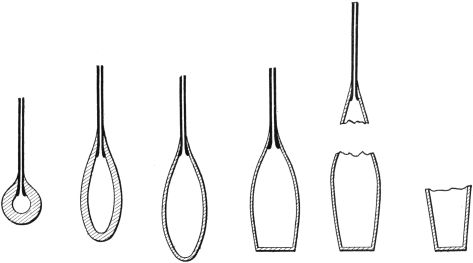
generally accomplished by having a pot of molten ruby
glass available close to a pot from which colourless glass is
being gathered. A small gathering of ruby glass is first
taken up on the pipe, and the remaining gatherings required
for the production of the sheet are taken from the pot of
colourless glass. When such a composite gathering is
blown into a cylinder in the manner described in the
previous chapter, the ruby glass lies as a thin layer over
the inner face of the cylinder, but special care and skill on
the part of the gatherer and blower is required to ensure
that this layer shall be evenly distributed and of the
right thickness to produce just the tint of ruby required.
Since the whole layer of red glass is so thin, a very slight
want of uniformity in its distribution leads to wide variations
of tint, and in practice these are often seen in the
less successful cylinders of such glass.
The chemical composition of the ruby and the colourless
glass which are to be employed for this purpose must also
be properly adapted to one another in order to produce two
glasses which shall have as nearly the same coefficient of
thermal expansion as possible. If this requirement is not
met, the resulting glass is subjected to internal strains
which may lead to fracture, while, if the ruby glass has the
higher coefficient of expansion, the sheet after flattening
tends to draw itself up on the “flashed” side and cannot
be passed out of the annealing kiln in a properly flat condition.
Although most usually applied to copper-ruby glass, the
flashing process is often used with other colours also.
Coloured glass of this kind is at once recognised when
looked at through the edges. Thus examined the glass
simply shows the greenish tint of ordinary sheet-glass
which constitutes practically the entire thickness of the
sheet. In the same way, if such “flashed” glass be cut or
etched in such a way that the layer of coloured glass is
removed in places, the resulting pattern appears in white
on the coloured ground—a feature which is utilised for
certain decorative purposes. The flashing process just
described, it should be noted, is applicable to any form of
glass-ware which is blown from a gathering, and the
coloured layer can be applied either upon the inside or
outside of any object thus produced.
In addition to the palette of colours which the glass-maker
is able to supply, the artist in stained glass has a
further range of colours at his disposal in the form of
stains and transparent colours which can be applied to the
surface of glass and developed and rendered more or less
permanent by being properly “fired.” The colours produced
in this way are also, in one sense, coloured glasses,
or rather glazes, whose raw materials are put upon the
glass by the brush of the painter, and only subsequently
caused to combine and melt by suitable heating. The
degree of heat applicable under these circumstances is,
however, very limited by the necessity of avoiding any
great softening of the substratum of glass, while many of
the colours themselves are composed of materials which
could not resist very high temperatures. The fluxes used
in the composition of these colours must for this reason be
of a very fusible kind, with the inevitable result of a greatly
reduced chemical stability as compared with the glass
itself.
The whole subject of painting on glass, even from the
purely technical as apart from the æsthetic point of view,
is a very wide one, and lies outside the scope of the present
volume. Only one further technical point in connection
with glass-painting and stained glass work will therefore
be touched upon here. This is an example of the fact that
the more technically “perfect” modern product is not
always preferable for special purposes which have been
well served by older and far less “perfect” products. The
production of technically excellent coloured glass in modern
times was, somewhat surprisingly at first, accompanied by
a very marked decline in the artistic beauty of stained glass
windows produced with this modern material; the ancient
art of stained glass was, therefore, for a time regarded as a
“lost art,” and glass-makers were blamed for being unable
to produce the brilliant and beautiful tints which had been
formerly available. More careful study, however, revealed
the fact that while the actual colour of modern glass was at
least as brilliant and varied as that of ancient glass, the
difference lay in the fact that the modern glass was practically
entirely free from such imperfections as air-bubbles,
striæ, and other defects which improved appliances and
methods had enabled the glass-maker to eliminate from his
products. Finding the beauty of his wares greatly improved
by this increased purity of the glass in the case of window
glass and table ware, it was natural for the glass-maker to
endeavour to produce the same “improvement” in the
coloured glasses intended for artistic purposes and, indeed,
it is more than likely that the stained-glass workers themselves
pressed this line of improvement upon him by a
demand for “better” glass. It turned out, however, on
close examination, that this very perfection of modern
glass rendered it less adapted for these artistic purposes.
A perfect piece of glass, having smooth surfaces and no
internal regularities, allows the rays of light falling upon
it to pass through undeflected in direction, and merely
changed in colour, according to the tint of the glass in
question. On looking at the glass, external objects can be
quite clearly seen, and much of the interest and mystery of
the glass itself is lost. On the other hand, when falling
upon a piece of glass having an irregular surface, and containing
all manner of irregularities such as striæ, air-bells,
and even pieces of enclosed solid matter, the light is
scattered, refracted, and deflected into all manner of
directions until it almost appears to emanate from the
body of the glass itself, which thus appears almost to shine
with an internal light of its own; the eye can hardly
perceive the presence of external objects, and the whole
window appears as a brilliant self-luminous object.
Once their attention had been drawn to these facts,
modern glass-makers endeavoured, and with much success,
to reproduce the desirable qualities of the ancient glass,
while still availing themselves of modern methods to produce
more stable glasses and a wider range of colours.
The irregular surface of the old glass is imitated by using
rolled or “muffed” instead of ordinary blown glass, while
the internal texture is rendered non-homogeneous by the
deliberate introduction of solid and gaseous impurities and
by manipulations so arranged as to leave the glass in layers
of different density, which appear in the finished glass as
“striæ.” As a consequence, it is probably not too much to
claim that the modern workers in coloured glass have
materials at their disposal which are at least as suitable
for the purpose as those that were available in the best days
of the ancient art.
Some reference has already been made to the technical
uses of coloured glass, but one or two further points in that
connection remain to be discussed. For such technical
purposes as railway and marine signals, the consensus of
practical experience has decided in favour of certain colours
of glass, such as red and green of particular tints. On the
other hand, for various purposes in connection with photography,
the glass-maker does not appear to have been able
to meet the new requirements, with the result that flimsy
and otherwise unsatisfactory screens made of gelatine or
celluloid stained with organic dyes are employed in place
of coloured glass in such cases, for example, as the covering
of lamps for use in photographers’ “dark” rooms, and for
the light-filters used for orthochromatic and tri-chromatic
photography. In all these cases it is necessary to use a
transparent coloured medium which transmits only light of
a certain very definite range of wave-lengths, and there is
no doubt that for the glass-maker, who is confined to the
use of a number of elementary bodies for his colouring
media, it is by no means easy to comply with these requirements
of exact transmission and absorption. On the other
hand, the field of available coloured glasses has not been
fully explored from this point of view, the only extensive
work on the subject having been done in connection with
the Jena firm of Schott, who have put upon the market a
series of coloured glasses of accurately-known absorbing
power. There is, however, little doubt that a much greater
extension of this field is possible, and that it will be opened
up by a glass-maker who undertakes the exhaustive study
of coloured glasses from this point of view, although it
must be admitted that there is considerable doubt whether
the results obtainable by the aid of aniline and other dyes
as applied to gelatine can ever be equalled by coloured
glasses.