The discovery of making glass is attributed to the
early Phoenicians. Pliny relates that certain mariners
who had a cargo of soda salt, having landed on the
banks of a river in Palestine, started a fire to cook
their food, and, not finding any stones to rest their pots
on, they placed under them some lumps of the soda
from their cargo. They found that the heat of their
fire had melted the soda and fused it with the sand
of the river bank, producing a transparent glass. The
natives in the vicinity where this discovery was made
in process of time carried on the practice of fusing
sand with soda and other materials to make glass,
until they succeeded in improving and bringing the art
to a high degree of excellence. Discoveries amongst
the ruins of Pompeii and Herculaneum present some
first-rate examples of the skill attained by the ancients
in glassmaking: glass was found to have been used there,
admitting light into dwellings in the form of window
glass.
The ancient Egyptians have left us many distinct
proofs that glassmaking was practised in Egypt. At
the same time, the glazing of pottery was also carried
out, proving that they knew the mode of mixing,
2fusing, and melting the proper ingredients for glassmaking.
Among the tombs of Thebes many specimens
of glass and glazed pottery beads have been
found, which suggests a date about 3,500 years ago.
From the Egyptians, the Greeks and Romans acquired
the art of glassmaking, which in Nero’s time was so
highly developed that clear crystal glasses were produced
in the form of drinking cups and goblets, which superseded
the use of gold cups and were much prized by the
Emperor in those days.
Many specimens of old Roman glass discovered have
been preserved in the British Museum, and, although
many valuable pieces have been lost by disintegration
and collapse due to the influence of years of exposure,
there still remain some very fine examples which
show that the Romans were highly skilled in glassmaking.
One of the finest examples of the work of
the ancient Romans in glassmaking is the Portland
Vase, which was unearthed near Rome. This is an
ornamented vase showing white opaque figures upon a
dark blue background. The white opal appears to
have been originally cased all over the blue and the
beautiful figures carved out in cameo fashion, with
astonishing patience and skill upon the part of the
operator.
The Venetians and Muranians followed the Romans
in the art, and examples of old Venetian glassware
show rare skill and ingenuity. To the Venetians
belongs the honour of first making glass at a cost to
allow of its being more generally used, and they also
introduced the art of making window glass and drinking
vessels into this country. Jacob Verzelina, a Venetian,
introduced such glassmaking into England, working at
a factory in Crutched Friars, London, between 1550
and 1557, where he made window glass, afterwards
3carrying on similar work in other places about the
country until his death in 1606.
Not until 1619 were glass works started in the neighbourhood
of Stourbridge. There we find some remains
of a factory worked by Tyzack about that date in
making window glass in the village of Oldswinford.
That Stourbridge should have been selected as one of
the early centres for glassmaking is probably due to
the presence in that locality of the so necessary
and important to glass manufacturers in building their
furnaces and pots, and the coal used for maintaining
the fires for melting their glass.
Stourbridge was known for a long time before this as
a centre for the mines producing , and eventually
this clay was adopted for making glass-house pots;
now many other sources are available for these fire-clays.
Much of the antiquity of the glassmaking of
England is hidden in the neighbourhood of Stourbridge,
and the writer has himself found a few antique
specimens of old green devitrified window glass embedded
in the subsoil of some fields near Oldswinford, probably
relics of the Huguenots, who practised and extended
the art of glassmaking in that district. Other important
centres for glassmaking now are York, London,
Manchester, Edinburgh, Newcastle, and Birmingham;
but, although glassmaking has reached a high degree
of excellence in this country, there is nothing yet
comparable with the extensive factories which exist
abroad. The conservatism of many English manufacturers,
and the adverse influence of the Glass Makers’
Society, considerably restrict the progress of this trade
compared with the broad and progressive manner in
which it is carried on abroad.[1]
CHAPTER II THE CHEMISTRY OF GLASS-MAKING AND THE MATERIALS USED
4
The term “glass,” in a general sense, is applied to the
hard, brittle, non-crystalline, transparent, opaque or
translucent vitreous substance which results from
fusing silica with active mineral solvents or fluxes,
such as the alkalies, earthy bases, or metallic oxides.
Silica exists in great abundance, in a free natural
state, in the form of flints, quartz, and sand; and in
the latter form it is now most generally used for
glassmaking. When sand alkali and lead oxide are
heated together to a high temperature, the sand is
dissolved by the solvent action of the fused alkali
and lead oxide until the whole becomes a molten
mass of glass. The solvent action of the alkalies, soda
potash or lead oxide, is very energetic whilst
being heated, and the mass boils with evolution of
gases until, at last, the solution, becoming complete,
settles down to a clear quiescent molten liquid metal,
which is quite soft and malleable, after the nature of
treacle. In this condition it is ready for working.
The time and temperature necessary for melting such
mixtures vary according to the proportions and
composition of the ingredients.
Silica, combined with alumina and other oxides, is
freely distributed in nature in the form of clays, granites,
and feldspars, which are also available for use in glassmaking.
Originally glass was made by using crushed
and ground flint stones as the source for the silica:
hence is derived the old name of “flint” glass; but now
5the large extensive deposits of white sand present a
much more convenient and less expensive source, and
sand has become universally used. Fine white sand is
obtained from Fontainebleau, near Paris; other sources
are Lippe, Lynn, Aylesbury, Isle of Wight, Holland, and
Belgium.[2] These are the sources preferred by crystal
glass manufacturers and makers of fine quality glass,
such as chemical ware pressed glass, tube, cane, and
medical bottles, on account of their greater purity. The
commoner varieties of sand from Reigate and Bagshot
and even red sand are being used in the manufacture of
the lower grades of glass such as beer bottles and jam
jars, where a greater latitude in the chemical impurities
present is permissible. Only the best and purest silica
sands are used for making cut crystal and optical glasses.
In these trades the sand is always cleaned by washing
it in water to clear it from any salt, chalk, or other
impurities which may possibly be present. The sand,
after washing, is heated to redness, or “burnt,” in order
to burn off any organic or vegetable matter, and when
cold it is sifted through a fine screen to take out any
coarse grains or lumps. In this prepared state, the
sand is ready for weighing out into the proportions
desired for mixing with the other materials, and is
stored for use in covered wooden compartments situated
in or near the mixing rooms, along with the other
materials which may be used in the glass mixtures.
The alkalies, potash or soda, or a mixture of both,
are commonly used in making glass in the form either
of carbonates, sulphates, or nitrates. The soda and
potash silicates form very fusible glasses, but they are
not permanent, being soluble in water; therefore they
6cannot be used alone. In making glassware for domestic
use, other bases, such as lead oxide, barium, or lime,
have to be added to form more insoluble combinations
with the silica or sand.
Carbonate of Potash or Pearlash, which before the
war was imported into this country by glass makers
from Stassfurt, is much prized by crystal glass makers
on account of the colourless silicate it forms when fused
with the best white sand. It is now very expensive
and difficult to get, and is less used on this account.
Potash carbonate is very hygroscopic and absorbs much
moisture from the air; therefore it is necessary to keep
it within sealed chests while in store.
Potash and soda each have an influence upon the
colour of the resulting glasses in which they are respectively
used. The potash silicate gives better and clearer
glasses than the soda silicate.
Carbonate of Soda, or Soda Ash, is now more generally
used. Being a less expensive form of alkali, it constitutes
a base in most of the commoner varieties of
glassware. Carbonate of soda is manufactured in
England from common salt, of which there are large
deposits in the Midlands. This common salt, or chloride
of sodium, is treated chemically and converted into the
carbonate, in which form it is supplied to the glass
manufacturers as soda ash.
Sulphate of Soda (Salt Cake) is the form of alkali
used in window and bottle glassmaking. In mixtures
containing sulphate of soda it is necessary to use a small
proportion of carbon in some form, such as charcoal
or coal, in order to assist the decomposition of the salt
and the formation of the sodium silicate. Sulphate of
soda is used in this class of glassware on account of its
cheapness. Glasses made from sulphate of soda mixtures
are not so clear and colourless as those in which
7the source of alkali is potash or soda carbonate. On
this account, the best crystal glasses cannot be made
from sulphate of soda.
Potash Nitrate (Saltpetre) is used in glass mixtures to
oxidise the molten metal and improve the colour of
the glass. In fusing it disengages oxygen gas, which
purifies the glass while melting, and assists the decolorizers
in their action by keeping up an oxidising condition
within the molten mass.
Sodium Nitrate, or Chili Nitre, is the corresponding
soda salt to potash nitre. It is much cheaper, but less
pure; it has a similar but not nearly so powerful an
oxidising action in the glass as potash nitre. It is
exported from Chili, where it exists naturally in a crude
state as “Caliche,” from which the nitrate is refined
by recrystallisation.
Boric Acid acts as an acid in glass, as does silicic
acid. It renders glass more fusible and brilliant; it
has a searching action upon the colourising properties
of certain metallic oxides when they are dissolved in
the glass. It is an expensive ingredient, but is considerably
used in optical and special chemical glassware
in replacing a portion of the silicates ordinarily used and
forming borates. It cannot be used in large amounts,
as an excess produces glass of a less stable nature.
Borax, or Borate of Soda, consists of boric acid
combined with soda. It is a very useful glassmaking
material and is an active fluxing agent. If used in
excess in glass mixtures it causes considerable ebullition,
or boiling of the metal. In moderate proportions it is
used in the manufacture of enamels for glass, as it
helps to dissolve the colorific oxides and diffuse the
colouring throughout the enamel mass.
Tincal, and Borate of Lime, are other forms in which
borates may be introduced into glass.
8Carbonate of Lime, Limespar, Limestone, Paris White,
or Whitening are all forms of Calcium Carbonate. It is
an earthy base and is added to the simple alkaline
silicates and borates to form insoluble combinations or
double silicates of soda and lime. By the use of lime,
glasses are rendered more permanent and unchangeable
when in use. Lime forms a very powerful flux at high
temperatures. The quantity used must be carefully
regulated according to the proportion of other bases
present; otherwise an inferior or less stable glass may
be produced. In excess it causes glass to assume a
devitrified state.
Dolomite is a Magnesium Limestone, and is a natural
stone which is available for use in making glass in tank
furnaces.
Fluorspar, or Fluoride of Lime, is used in giving
opacity and translucency to glass. It can only be
used in small amounts, as the presence of any large
proportion attacks the clay of the pots, causing serious
damage by the sharp cutting chemical action due to
the evolution of fluorine gas.
Phosphate of Lime is another material which produces
opacity and translucency, but does not seriously
attack the pots. Bone ash is a form of phosphate
of lime, and is procured by calcining bones until all
organic matter is consumed.
Carbonate of Barium, or Witherite, is a very heavy,
white powder, and is a form of earthy base available
for use in glassmaking. It can be used to replace lime,
with similar results. By replacing other elements in
the glass which are of lower density, barium can be
used to increase the density of glass. Like lime it is
a very powerful flux in glass at high temperatures.
It gives increased brilliancy and little coloration. For
this reason it is very useful in the manufacture of
9pressed glassware, giving a glass which leaves the moulds
with better gloss than is found to be the case with lime
glasses.
Magnesia and Strontia are other bases which are less
used in glassmaking.
Zinc Oxide is a base used in the manufacture of
many optical glasses. With boric acid it gives silicates
of a low coefficient of expansion and special optical
values. Used with cryolite, it forms a very dense opal
suitable for pressed ware. It is rather more expensive
than the other bases used.
Cryolite is a natural opacifying ingredient used in
making opal glasses. It consists of a combination of the
fluorides of aluminium and sodium, and is one of the most
active fluxes known to glass and enamel makers. Its
cutting chemical attack on the pots is very
intensive. It is imported from Greenland. An artificially
manufactured form of cryolite is known, which
is a little cheaper than the natural variety and gives
similar results in opacifying glass.
Alumina. This is sometimes present to a small
extent in glass makers’ sands. As such it is not a dangerous
impurity. It exists in combination with silica and
potash to a large extent in feldspars, china clays, and
granites. Alumina, when used, has a decided influence
upon the viscosity and permanency of glass. In large
proportions it noticeably diminishes the fusibility of
glass, and makes it more or less translucent. Owing to
the refractory nature of alumina it is with difficulty
that it can be diffused in alkaline silicates, borates, or
lead silicates; consequently any considerable proportion
present in glass may cause cords or striae, which are
objectionable defects in the glass.
Oxide of Lead. Red Lead, or Minium, is much used
in the manufacture of enamels, table glassware, and
10heavy optical glass. It gives great brilliancy and
density to all glasses in which it is used, but if used in
excess the glass is attacked readily by mineral acids
and becomes unstable. Red lead is a powerful flux,
even at low temperatures, and forms the chief base in
making best crystal ware and enamels. The red oxide
of lead used by glass manufacturers is a mixture of the
monoxide and peroxide. Glass manufacturers, in buying
red lead, should realise that it is the peroxide
present which is the active oxidising agent, and that at
least 27 per cent. should be present. A dull, dark red
oxide shows a low percentage of peroxide; a bright
orange red a high percentage. Impure red oxides of
lead may be adulterated with barytes, finely divided
metallic lead, or added water. Such impure varieties
should be avoided. The red oxide of lead is preferred
to the other oxides and forms of lead for glassmaking,
on account of its greater oxidising action, which is
desirable in producing crystal glassware.
Tin Oxide and Antimony Oxide are used as opacifiers.
When used they generally remain suspended in a finely
divided form in the glass. Used in small quantities
they have a favourable influence in the development
of ruby-coloured glasses.
Manganese, Arsenic, and Nickel Oxides are used in
glassmaking as “decolorizers,” which will be treated
in a later chapter.
Cullet. In all glasses a proportion of “cullet,” or
broken glass scrap, is used. This cullet is usually of
the same composition as the glass mixture or “batch.”
The use of cullet facilitates the melting, and assists in
giving homogeneity to the resultant glass by breaking up
the cords and striae which tend to develop in most glasses.
In the commoner varieties of bottle glass Basalt and
other igneous rocks are crushed and used. These are
11naturally occurring silicates containing lime, alumina,
alkalies, iron, and other elements in varying proportions.
They are used more on account of their cheapness,
and produce dark, dirty-coloured glasses, which in the
case of common bottles are not objected to. In some
instances iron, manganese or carbon is added to produce
black bottle glass.
Of the various silicates used in glassmaking, the
silicate of alumina is the most refractory. The silicates
of lime and barium are rather refractory, but under a
strong heat and in the presence of other silicates they
can be readily formed. The silicates of the alkalies,
lead, and many of the other metals are formed at much
lower temperatures. In the case of the silicate of iron,
manganese, or copper, a strong affinity is shown between
the metal and the silica, and a black or dark-coloured
slag with a very low melting point is formed. Such
slags are very active in corroding the masonry
and pots of the furnace.
No single silicate is entirely free from colour. Each
gives a slight distinctive coloration, the lead silicate
being yellowish and the soda silicate greenish, but by
the judicious mixture of different silicates and the use
of decolorizers, such as manganese, nickel, etc., compound
silicates are obtained, giving less perceptible
colours or crystal effects. In optical glassmaking the
use of the ordinary decolorizers is not permissible, and
the purity of the materials used becomes the most
important factor.
The raw mixture of the various materials used in
making glass is termed a “batch.” The mixing is
usually done by hand, but in many cases mechanical
batch mixers are used. If the mixing is done by hand,
the materials are first weighed out in their correct proportions
by means of a platform weighing-machine. As they
12are weighed out, one by one, they are introduced into
a rectangular wooden arbour or box, large enough to
hold the whole unit weight of the batch and allow of its
being mixed and turned from side to side. The batch
is then sieved, and all the coarse materials reduced
or crushed to a size not coarser than granulated sugar.
By sieving and turning the batch several times a
thorough mixture of the ingredients is obtained. A few
ounces of manganese dioxide are then added, according
to the unit weight of the batch weighed out, and
the proportion of decolorizer necessary; which varies
according to the heat of the furnace and the amount
of the impurities present.
The whole batch is then put into barrels and conveyed
to the glass house, where the furnace is situated. Here
it is tipped into another arbour or box in a convenient
position near to the melting pot, and, a proportional
quantity of “cullet” being added, the mixture is then
ready for filling into the pots. The stopper of the pot
mouth is taken away and placed aside, and a man shovels
the mixture or batch into the hot pot until it is full. He
then replaces the stopper, and, after a few hours, when
the first filling has melted and subsided, another filling
of batch into the pot takes place until it becomes full
of glass metal in its molten state. The batch melts
with considerable ebullition, owing to the chemical
reactions taking place under the heat of the furnace,
giving off at the same time large quantities of gas.
By the evolution of these gases the batch shrinks in
volume so that it becomes necessary to fill a pot more
than once with the batch before it becomes full of
molten metal. The capacity of the pots varies between
250 and 1,200 kilogrammes, according to the type of
glass and nature of the goods made.
Much care is required in mixing and sieving batches
13containing lead and other poisonous ingredients, to
prevent the inhalation of the dust by the mixer. Therefore,
where such materials are used, exhaust fans and
ventilating ducts should be provided and fitted in the
mixing rooms. A proper respirator should be worn by
the mixer in charge to prevent any absorption into his
system of the poisonous dust. Cases of poisoning are
not unknown, but these are due to gross carelessness.
A small regular weekly dose of Epsom salts should be
taken by the mixers who have to prepare lead batches.
This salt tends to remove any lead salts absorbed in
the system by converting them into insoluble lead
sulphate.
14CHEMICAL FORMULAE AND MOLECULAR WEIGHTS.
Materials. |
Formulae. |
Molecular Weight. |
| Alumina |
Al2O3 |
102 |
| Antimony Oxide |
Sb2O3 |
287 |
| Arsenic |
As2O3 |
197 |
| Bismuth Oxide |
Bi2O3 |
468 |
| Boric Acid |
H3BO3 |
62 |
| Borax |
Na2B4O710H2O |
382 |
| Calcined Borax |
Na2B4O7 |
202 |
| Calcined Potash |
K2CO3 |
138 |
| Carbon |
C |
12 |
| Carbonate of Barium |
BaCO3 |
197 |
| Carbonate of Magnesia |
MgCO3 |
84 |
| China Clay |
2SiO2Al2O32H2O |
258 |
| Chrome Oxide |
Cr2O3 |
153 |
| Cobalt Oxide |
Co2O3 |
105 |
| Copper Oxide (Red) |
Cu2O |
143 |
| Copper Oxide (Black) |
CuO |
79 |
| Cryolite |
6NaFAl2F6 |
210 |
| Dolomite |
CaOMgO2CO2 |
184 |
| Fluorspar |
CaF2 |
78 |
| Gold Chloride |
AuCl32H2O |
339 |
| Iron Oxide |
Fe2O3 |
160 |
| Lime |
CaO |
56 |
| Lime Spar |
CaCO3 |
100 |
| Manganese Oxide |
MnO2 |
87 |
| Nickel Oxide |
NiO2 |
75 |
| Nitrate of Soda |
NaNO3 |
85 |
| Phosphate of Lime |
Ca3(PO4)2 |
310 |
| Potash Carbonate |
K2CO3(2H2O) |
174 |
| Potash Felspar |
6SiO2Al2O3K2O |
556 |
| Red Lead |
Pb3O4 |
683 |
| Saltpetre |
KNO3 |
101 |
| Sand |
SiO2 |
60 |
| Soda Carbonate |
Na2CO3 |
106 |
| Sodium Fluoride |
NaF3 |
61 |
| Sulphate of Soda |
Na2SO4 |
142 |
| Tin Oxide |
SnO2 |
150 |
| Uranium Oxide |
UO2 |
272 |
| Zinc Oxide |
ZnO |
81 |
CHAPTER III THE CHEMICAL AND PHYSICAL PROPERTIES OF GLASS
15
The main essential and peculiar property of glass is
its transparency. When subjected to a gradually
increasing temperature, glass becomes softened, and
whilst hot it is plastic, ductile, and malleable, in which
state it can be cut, welded, drawn, or pressed. A
thread of glass can be drawn so thin and fine that it
can be twisted and bent to a remarkable extent, showing
that glass is flexible.
The above properties shown by glass while softened
under heat permit it to be shaped and formed by a
variety of methods, so that in the manufacture of the
different kinds of glass we find goods pressed, blown,
drawn, moulded, rolled and cast from the hot metal.
Upon cooling, the form given to them is retained
permanently.
Another property of glass is its conchoidal fracture
and liability to crack under any sudden change of
temperature. Advantage is taken of this peculiarity
in dividing or cracking apart glass when necessary,
during the stages of the manufacture of any glass article.
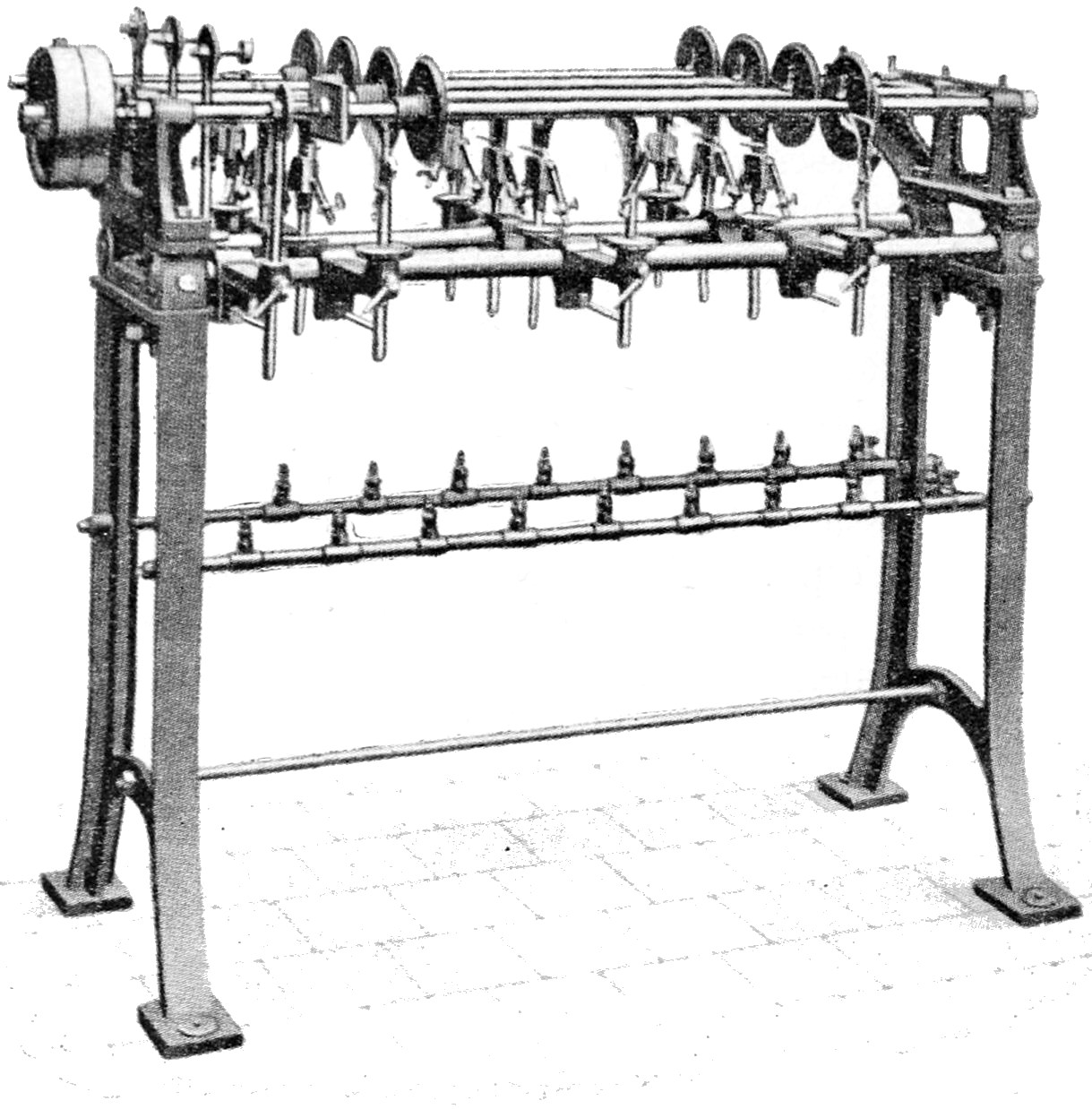
By permission of
Melin & Co.
HORIZONTAL CRACKING-OFF MACHINE
If a glass worker, in making an article of glass,
desires to detach or cut apart certain sections, he
applies a cold wet substance, such as an iron file
wetted with water, to any portion of the hot glass,
which causes it to fracture at the point of contact with
the cold metal, and a slight jar is then sufficient to break
the two portions apart. This method of chilling heated
glassware to divide it is applied in the mechanical process
16of cutting up the long cylindrical tubes of glass into
short sections for use as miners’ safety lamp chimneys.
Wherever it is desired to cut them through, a narrow
section or line round the cylinder is first heated by a
sharp, hot pencil of flame projected from a burner against
the rotating cylindrical tube of glass at equidistant
short sections, and the divisions chilled by contact
with a cold, steel point, or the heated area may be
gently scratched with a diamond point, when a clean,
sharp fracture results exactly where the chill or scratch
17has been applied and spreads round the whole circumference
in a circle, giving neat, clean-cut divisions. In
cutting narrow tube and cane, the fracture caused in the
structure of the glass by scratching its surface with a
steel file or diamond is sufficient to cause it to break
apart without the application of heat.
A piece of hot glass will weld on to another piece of
hot glass of similar composition. The glass maker
uses this method of welding for sticking handles on to
jugs, etc., during the process of making table glassware.
The density of glass varies according to its composition.
Certain classes of lead and thallium glass for optical
work are of very high density. The specific gravities
of such glasses may vary from 3·0 to well over 4·0.
In soda-lime glasses the density is less and approaches
2·4. Ordinary crystal glass approximates to a specific
gravity of 3·1.
The elasticity and thermal coefficient of expansion
of glass can be regulated within normal limits. Glasses
are now manufactured which can be perfectly sealed to
copper, iron, nickel, and platinum wires.
Glass, if kept heated for any length of time at a
temperature just short of its softening or deformation
point, becomes devitrified and loses its transparency,
becoming opaque and crystalline. In this state it has
much of the nature of vitreous porcelain and is totally
different to manipulate, being tough and viscid on
further heating. This devitrified state may occur
during glassmaking, where the metal is allowed to remain
in the pot or tank furnace for a considerable time under
low temperature. Small stars or crystals first develop
throughout the glass and continue to grow until it
becomes a stony, white, opaque, vitreous mass. “Réaumur’s
Porcelain” is a glass in a devitrified state, and is
used for pestles and mortars, devitrified glass being less
18brittle than ordinary glass and similar to vitrified
porcelain.
Glass can be toughened to an extent which is surprising.
Bastie’s process consists of plunging the finished
glass article whilst hot into a bath of boiling oil,
which toughens the glass so much as to make it extremely
hard and resistant to shocks, losing most of its brittle
nature. Strong plates of glass are produced by a
process of toughening under pressure. These plates of
glass are used for ship porthole lights and in positions
where great strength is required. Toughened or
hardened glass is of great value in the production of
miner’s lamp glasses and steam-gauge tubing. Glass,
when hardened, is difficult to cut even with the diamond,
and difficulty is experienced in finding suitable means
to cut it into shapes to suit commercial requirements.
“Prince Rupert drops,” or tears, exhibit the state in
which unannealed glass physically exists. These are
made as a curiosity by dropping a small quantity of
hot metal from the gathering-iron into a bath of water
and then taking the pear-shaped drops out quickly.
These pear-shaped drops of glass will stand a hard blow
on the head or thicker portion without breaking, but,
if the tail is pinched off or broken, the whole mass
crumbles and falls to powder. This well illustrates the
latent stresses or strains apparently in a state of tension
and thrust within the structure of unannealed glass.
Glass is not a good conductor of heat. This accounts
for the necessity of slow cooling or annealing glassware,
and also applies when re-heating glass, which
must be done slowly and evenly to allow time for the
conduction of the heat through the mass gradually.
Glass is a non-conductor of electricity, and is used to a
considerable extent in the electrical trades for insulation
purposes. Most glasses are attacked slightly, but not
19readily, by water and dilute mineral acids. Continued
exposure to a moist, humid atmosphere causes slight
superficial decomposition, according to the stability and
chemical composition of the glass. Old antique specimens
of glass show the superficial decomposition caused
by long continuous exposure to atmospheric moisture.
Many antique specimens have been known to collapse
instantly upon being unearthed. The first change in
antique glass is exhibited by a slight iridescence forming
on the surface, gradually increasing towards opacity
afterward disintegration sets in, until it finally collapses
or crumbles to powder. Glasses high in lead are
readily attacked by the acid vapours met with in the
atmosphere, but the harder soda-lime glasses are more
resistant. An excess of boric acid, soda, or potash
also renders glass subject to disintegration and decay.
Hydrofluoric acid attacks all silicate glasses, liberating
silicon fluoride. Use is made of this acid reaction in
decorating glasswares in “Etching,” by exposing the
surface of glass to the fumes of hydrofluoric acid gas
in some form.
The most permanent glasses are those containing the
highest proportion of silica in solution, but the available
heat necessary to decompose such highly silicious
mixtures is limited by the present known refractory
materials which can be procured for constructing the
furnaces. Quartz glassware is a highly silicious glass.
It is now made and used in the manufacture of special
chemical apparatus and laboratory ware such as crucibles,
muffles, etc., which have to withstand severe
physical and chemical tests. This quartz glass possesses
remarkable features in its low coefficient of expansion
and resistance to heat changes. It is highly refractory.
Articles made of this glass can be heated to red heat
and plunged directly into cold water several times
20without fracturing. Several varieties of quartz glass are
now manufactured, and a new field for investigation is
presented in applying the features and properties of
this glass for use in chemical processes.
In a purely physical sense glass is a supercooled
liquid, the silicates are only in mutual solution with
each other, and they appear to be constantly changing.
Glass cannot be described as a homogeneous or definite
chemical compound. Many of the after effects and
changes which occur in glass, and the formation of
crystals in the devitrification of glass tend to prove the
above assertion. The colour changes which take place
when ruby and opalescent glass is re-heated, and even
the change in colour of glass going through the lehr,
cannot be explained unless in the above sense of viewing
these remarkable changes. Glasses with an excess of
lime in their composition are more subject to devitrification
than lead glasses or those of moderate lime content
constructed from more complex formulas. The presence
of a small proportion of alumina in glass prevents this
tendency to devitrification and ensures permanency.
Those glasses which have the highest silica content,
and which have been produced at the highest temperatures,
show the greatest stability in use. Bohemian
glasses of this type contain as much as 75 per cent.
silica, and are produced in gas-fired regenerative or
recuperative furnaces, where the heat approaches
1,500° Centigrade. Such glass is much sought after
for enamelling on, being harder and less easily softened
by the muffle heat firing on the enamels used. Taking
two corresponding glasses of the same basicity, or proportion
of silicic acid to the bases present, those formulae
which have the greater complexity of bases produce
the more fusible glasses. A multiple of bases constituting
a more active flux than a single base content,
21it follows that a compound mixture of silicates fuses or
melts at a lower temperature than the respective simple
silicates would. These facts are useful in constructing
commercial formulae for glasses.
Glasses containing lead oxide as an ingredient are
subject to reduction when exposed to flames of a carbonaceous
nature. The carbon partially reduces the
lead oxide to its metallic state, forming a black deposit.
On this account, lead glasses cannot be used in blow-pipe
working with the ease with which soda-lime glasses
can be worked, without reduction taking place. English
crystal glass, which contains a high percentage of lead,
is usually melted in hooded or covered pots to prevent
the carbonaceous flames of the furnace reducing the
lead and otherwise destroying the clearness of the
glassware. Soda-lime glass and others without the
presence of lead can be melted in open pots without
any fear of reduction. Modern gas-fired recuperative
furnaces, in which more complete combustion of the
carbon takes place, can now be used for melting lead
glasses in open pots, thus presenting a great saving in
the fuel required to melt and produce such glass,
besides permitting the use of a cheaper form of pot.
This cannot be done with the ordinary English coal-fired
furnaces.
Advantage is taken of the reducing action of the
coal-gas flame when producing lustre and iridescent
glassware. A small proportion of easily reducible metal,
such as silver or bismuth, is introduced into the glass
and first melted under oxidising conditions. It is then
reduced in after-working by flaming, which deposits
the metal in a thin sheen upon the surface of the glass,
where it comes in contact with the reducing flames.
An example of this effect is shown in Tiffany lustre
ware, in which silver chloride is used and reduced
22within the glass, giving a pretty coloured iridescence
on the surface, due to the reflection of light from the
particles of metal deposited under the surface.
“Aventurine” is a form of glass in which copper
and iron oxides are introduced under reducing conditions
during melting. The glass is then allowed to
cool slowly. The metallic copper tends to separate out
in small spangled crystals, which give a pretty sparkling
effect. The use of strong reducing agents with very
slow annealing is necessary to produce this effect.
Copper and gold ruby-coloured glass presents other
instances of partial precipitation of the metal by
reduction within the glass. According to the extent
of reduction, the glass ranges in colour from yellow, ruby,
to brown.
The manganese silicate is readily affected by oxidising
or reducing conditions, the purple colour being present
under oxidising influences and a greenish-grey colour
under reducing conditions. In using manganese as a
decolorizer, the glass maker may have added too much
of it to his glass, in which case it shows too prominent
a purple colour. To destroy this excess of colour he
pushes either a little strip of green willow wood or a
clean potato to the bottom of the pot of metal. The
reducing action of the carbonaceous gas involved takes
out the excess of purple colour by partially reducing the
manganese present to a colourless state.
The colour of glass is gradually affected in course
of time by sunlight. This change in colour is often
noticeable in old windows, the glass having developed
a yellowish green tint in course of time from the
action of the solar rays.
Glass which has been incompletely fused or not
sufficiently melted to give a complete solution of the
materials present is in a weakened state of cohesion
23and is liable to disintegration. The presence of undecomposed
sulphates, chlorides, or borates in the glass
also tends to early disintegration. A continual exudation
and crystallisation of salt takes place upon the
surface until the glass wholly disintegrates away to a
white powdered salt.
Glass is a poor conductor of heat. When a piece of
glass has been expanded under the influence of heat,
and is rapidly cooled, the superficial outer portions
become intensely strained and contracted upon the
interior portions, which retain the heat longer. Under
these conditions of cooling, glass is apt to “fly,” or
collapse and fall to pieces, owing to the outer portions
giving way under the great strain. These stresses or
strains are relieved in the process of annealing, under
which they are gradually eased by a slow and regular
cooling from the heated condition. Certain glasses, the
composition of which shows considerable differences in
the density of the respective bases present, are more
subject to this defect than those in which the bases are
of more even density and homogeneous in character.
Such glasses should be “de-graded” and re-melted in
order more thoroughly to diffuse and distribute the
denser portions throughout the mass. In de-grading
glass, the hot glass is ladled out and quenched in cold
water, dried, and re-used as “cullet.”
CHAPTER IV THE COMPOSITION OF THE DIFFERENT KINDS OF GLASS
24
The composition of glasses may be simple, compound,
or complex, according to the number of bases or acids
which may be present in the mixture.
The Simple types of glass are exhibited in the soda
silicate, potash silicate, and lead silicate. The two
former silicates are of most industrial value.
Soda Silicate is made from a fusion of 100 parts of
sand with 50 parts of soda carbonate and 5 parts of
charcoal. The charcoal is added to facilitate the
decomposition. The fused mass when cool is transparent
and of a pale, bluish, sea-green colour. Upon
boiling it in water it dissolves and gives a thick viscid
solution called “Water Glass.” This is extensively
used in the various arts and manufactures. Textile
fabric and woodwork saturated with this solution and
dried are rendered fireproof. In the manufacture of
artificial stone it forms, with lime and other basic
oxides, very stable cements. Mixed with silicious
or ganister it forms the well-known fire cements
for repairing the cracks in retorts, muffles,
etc. Water glass is also used in soap, and colour
making, and for preserving eggs.
Potash Silicate is less used, being more expensive.
It is produced from a fusion of 100 parts sand, 60 parts
potash carbonate, and 6 parts charcoal.
Lead Silicate is composed of 100 parts sand and 66
parts of red lead fused together. This silicate is mostly
used in the manufacture of soft enamels and artificial
25gems, and goes under the names of “Rocaili flux,”
“strass metal,” and “diamond paste.”
There is another form of soluble glass which is a
combination of the soda and potash silicates. This is
really a double silicate and may be produced by fusing
sand 100 parts, soda carbonate 25 parts, potash carbonate
30 parts, and 6 parts of charcoal. This silicate is used
in soap making. Soluble glass can also be formed by
using sulphate of soda as the alkali. In this case, a
larger proportion of the alkaline salt has to be used,
also a larger amount of carbon, in order to complete
the decomposition of the sulphate. A mixture of sand
100 parts, saltcake 70 parts, and carbon 16 parts would
produce sodium silicate. The boron silicate and borate
of alumina are two other forms of soluble glass used in
their simple states.
The Compound Glasses may be flint or crystal glass,
soda-lime glass, Bohemian glass, pressed glass, and
sheet glass. These are the general type of glasses
used in the manufacture of domestic glasswares.
Crystal Glass, which is a silicate of lead and potash,
is made from best sand 100 parts, red lead 66 parts,
potash carbonate 33 parts, cullet 50 parts, to which a
small proportion of potash nitre, arsenic, and manganese
dioxide is added. The bulk of English cut-glass
table ware and fancy goods are made from this type of
glass. It gives very brilliant and colourless results,
more especially when cut and polished. A second-rate
quality of crystal glass for table ware may consist of
a silicate of lead and soda, as follows: sand 100 parts,
red lead 66 parts, soda carbonate 25 parts, cullet 50
parts; with small proportions of Chili nitre, arsenic,
and manganese.
Bohemian Glass is made from sand 100 parts, potash
carbonate 35 parts, lime carbonate 15 parts, cullet
2650 parts; with small proportions of potash nitre, arsenic,
and manganese dioxide. This type of glass is used
mostly by continental manufacturers for chemical ware,
table and mirror glass. It is a hard, brilliant, and stable
glass, very suitable for enamelled glassware. It is a
silicate of potash and lime.
Pressed Glass consists of sand 100 parts, soda carbonate
50 parts, barium carbonate 15 parts, cullet 50 parts;
together with soda nitre, arsenic, manganese, and
cobalt. This is used by manufacturers of pressed glass
table ware or moulded ware. It is a silicate of soda
and barium, the barium having a direct influence in
giving a good surface to the pressed goods.
Crown Glass consists of a silicate of soda and lime;
sand 100 parts, soda carbonate 36 parts, lime carbonate
24 parts, soda sulphate 12 parts, cullet 50 parts; with
traces of manganese and cobalt. This glass is used for
making sheet window glass by the crown, disc, and
cylinder methods.
Plate Glass is a silicate of soda and lime; sand 100
parts, soda sulphate 55 parts, limestone 30 parts, coal
or anthracite 5 parts; with traces of nickel oxide,
cobalt, or antimony oxide. This is used for cast plate
glass, rolled plate, cathedral glass, window and mirror
glass.
The Complex Glasses may be described as those in
which more than three bases are introduced, and
constitute such types of glasswares as bottles,
thermometer tubes, chemical ware, etc.
Common Bottle Glass may be described as an example
of complex formulae. Common bottle glass, or tank
metal, is made from a silicate of soda, alumina, lime,
magnesia, and iron, as follows: Common sand, containing
iron and alumina, 100 parts; greenstone or
basalt (a silicate of alumina, iron, lime, magnesia, and
27potash), 25 parts; dolomite limestone (magnesia and
lime), 30 parts; sulphate of soda, 35 parts; carbon, 5
parts. Felspathic granites may be also used in such
glasses.
Bottle glasses require intense heat to melt, and are
usually dark in colour when made from igneous rocks,
owing to the large amount of colorific oxides present
in such materials. These dark colours are not objected
to in bottles for stout, wine, and beer.
It will be noticed these formulae cover a long range,
from the best table glass to the commonest dark bottle
glass. Besides these, opal, opalescent, and fancy
glasses are made, in which either arsenic, tin, alumina,
antimony, zinc or barium oxides or borates phosphates
and fluorides may enter into the compositions.
Glass makers’ recipes vary considerably in the proportions
of the various materials used, according to
the locality and the type of furnace used. Generally,
it will be found that, where a gas-fired furnace is in
use, a larger proportion of sand can be used and a
cheaper metal produced.
The metals produced in covered pots are usually
softer and contain more lead and fluxes than those
produced in open pots. In using open pots the heat
of the furnace has direct access to the surface of the
metal therein. In the case of covered pots, the heat
has to be conducted through the cover of the pot, which
retards the heat to a certain extent. On this account,
softer mixtures are used in covered pots.
CHAPTER V COLOURED GLASS AND ARTIFICIAL GEMS
28
In colouring glass, either or several of the following
colorific oxides may be used. They are added to the
batch before fusion. Varying proportions are added,
according to the depth of the colour desired. Occasionally
the colour is influenced by the nature and
composition of the rest of the batch. In some instances
several colouring oxides are used. In this way many
delicate tints are obtained; in fact, there are but few
colours that cannot be produced in glass.
For Green Glasses the following oxides may be used:
Chromium oxide, 2 to 6 per cent. of the batch; black
oxide of copper, ·5 to 3 per cent.; red iron oxide, ·5 to
1 per cent.; or a mixture of two or three of the above
oxides in less proportions. Salts of chromium, copper,
or iron may be used as the carbonates, sulphates, and
chromates.
For Blue Glasses, cobalt oxide, ·1 to 1 per cent. of
the batch; zaffre blue or smalts, 1 to 3 per cent.; nickel
oxide, 2 to 4 per cent.; iron oxide, 1 to 2 per cent.;
black oxide of copper, 2 per cent.
For Violet and Purple, manganese oxide, 2 to 4 per
cent. of the batch.
For Rubies, red oxide of copper, gold chloride, purple
of cassius, antimony oxysulphide, selenium metal in
small proportions.
For Yellows, uranium yellow, 4 to 6 per cent. of the
batch; potassium antimoniate, 10 per cent.; carbon,
6 per cent.; sulphur, 5 per cent.; ferric oxide, 2 to 4 per
cent. Silver nitrate and cadmium sulphide are also used.
29Black Glass is obtained from mixtures of cobalt
oxide, nickel oxide, iron oxide, platinum and iridium.
Many very dark or black bottle glasses are obtained by
using basalt, iron ores, or greenstone in a powdered
form, added to the batch ingredients.
White Glasses or Opal are obtained by using phosphate
of lime, talc, cryolite, alumina, zinc oxide, calcium
fluoride, either singly or in double replacements of the
bases present in the glass batches.
Many of the colouring oxides give distinctive colours
to glass of different compositions; also the resulting
colours may vary with the same colouring ingredient,
according to reducing or oxidising meltings. Thus, in
a batch of reducing composition, red copper oxide gives
ruby glass, but in oxidising compositions the colour
given is green or bluish-green. Iron oxide in an
oxidising batch gives a yellow. In the reducing batch
it gives bluish or green results. Manganese is similarly
affected.
Many colouring oxides give more brilliant tints with
glasses made from the silicates of potash and lime than if
used in glasses composed from silicates of lead and soda.
For many colours the lead glasses are preferred. In
colouring the batches, the colouring oxides must be
intimately mixed with the batch materials before fusion,
more especially in the preparation of the pale tints,
where only small quantities of colouring are necessary.
It is a well-known fact that careful mixings give good
meltings, for then the materials are more evenly distributed
and uniformly attacked during the melting.
Careful and exact weighings are necessary when using
colorific oxides, and a pot is kept for each respective
colour melted, so that the different colours and crystal
glasses do not get contaminated with each other. When
open pots are used for colours, the colour pots should
30be kept together in one section of the furnace, so that
whilst melting, especially during the boiling up of the
batches, the colours do not splash over into the other
pots containing crystal metal.
As a rule, smaller pots are used for coloured glass;
generally they are only a third of the size of crystal
melting pots. When this is so, they are set together
under one arch of the furnace, and the workman informed
which pots contain the respective colours. All colour
cuttings and scraps should be kept separate from other
cullet for re-use. Coloured glasses are expensive, and
no waste of glass should be permitted.
Artificial Gems. In the manufacture of the glasses
for imitation “paste” jewels, every effort is made to
procure pure materials and colorific oxides. The base
for making artificial gems is a very heavy lead crystal
glass termed “Strass paste,” which gives great brilliancy
and refraction. The composition of such a paste
would be: Best white sand 100 parts, pure red oxide of
lead 150 parts, dry potash carbonate 30 parts. These
should be thoroughly well melted until clear and free
from seed, and the molten mass ladled out of the pot
and quenched in cold water, or “de-graded.” This
assists in making the paste homogeneous. After
repeated melting and de-grading, the paste or cullet is
collected, dried, and crushed for use in making the
coloured pastes. Usually, this strass metal is melted
in small, white porcelain crucible pots holding about
5 to 10 kilogrammes of the metal and heated in
a properly regulated gas and air injector furnace. The
coloured paste is kept in fusion for a whole day, after
which it is slowly cooled and annealed within the pot,
and the gems cut from the lumps of glass thus obtained.
The following are some of the compositions used in the
preparation of the respective gems.
31Opal. Powdered strass paste, 1,000 parts; white
calcium phosphate, 200 parts; uranium yellow, 5 parts;
pure manganese oxide, 3 parts; antimony oxide, 8 parts.
Ruby. Powdered strass paste, 1,000 parts; purple of
cassius, 1 part; white oxide of tin, 5 parts; antimony
oxide, 10 parts.
Beryl. Powdered strass, 1,000 parts; antimony oxysulphide,
10 parts; cobalt oxide, ·25 parts.
Amethyst. Powdered strass glass, 1,000 parts; purest
manganese oxide, 8 parts; pure cobalt oxide, 2 parts.
Emerald. Powdered strass glass, 1,000 parts; green
chrome oxide, 1 part; black copper oxide, 8 parts.
Sapphire. Powdered strass glass, 1,000 parts; pure
cobalt oxide, 15 parts.
Topaz. Powdered strass glass, 1,000 parts; antimony
oxide, 50 parts; uranium yellow, 10 parts.
Garnet. Powdered strass glass, 1,000 parts; antimony
oxysulphide, 100 parts; gold chloride in solution, 1 part;
pure manganese oxide, 4 parts.
Turquoise. Powdered strass glass, 1,000 parts; cobalt
oxide, ·5 parts; black copper oxide, 10 parts; white
opal glass, made with tin oxide, 200 parts.
After suitable pieces of glass of the requisite tints are
obtained, they are cut and ground on a Lapidary’s
wheel, then polished, engraved, and set as gems.
Artificial Pearls are now cleverly made in glass.
A tube of the requisite size made of translucent or
opal glass is cut into small sections, which are heated
on a tray to softening point whilst set in a rotatory
movement. As the heat increases they gradually melt
in and seal at the openings, when they are removed
from the tray and sorted.
CHAPTER VI DECOLORIZERS
32
Decolorizers are the agents employed by the glass
maker to neutralise or subdue the objectionable tints
given by the colouring action of small traces of iron
oxide, which exists as an impurity present in the
materials used or otherwise become accidentally admixed
during the process of the manufacture of glassware.
The small additions of manganese dioxide, arsenic,
nitre, nickel oxide, selenium, antimony, oxide, etc., to
glass batches may be considered as decolorizers. The
most commonly used of these materials is manganese
dioxide, so the action of this material will be explained.
Every glass maker finds that one or other of the raw
materials he uses may contain impurities. It is seldom
that glass makers’ sand can be obtained that does not
contain traces of iron oxide present as an impurity.
Again, the cullet collected from the glass house often
contains iron scale or rust from the blowing-irons,
which firmly adheres to the glass and gets admixed
with the batch for re-melting. The presence of even
very small traces of iron in glass becomes evident as a
pale sea-green tint when viewed through any thickness
of metal. The chemical action of the glass upon the
walls of the pot is continually dissolving a minute
quantity of iron from the and diffusing it
throughout the metal, giving it a tendency to the
pale-green tint.
To subdue or neutralise this objectionable tint in
the glass, the glass maker uses certain metallic oxides
33which give delicate counter-tints. Only those glasses
which are made from the purest materials can be
decolorized to become sufficiently clear to use in making
the best table glassware. In optical glassware,
where the use of manganese is not permissible, the
greatest care has to be taken in the selection and testing
of the materials to be used. If manganese oxide be
used in making optical glass, although the eye may
not be sensitive enough to observe the actual color
absorption, glass is produced in which the solar rays
are obstructed, and much less light is transmitted by
the glass when used as an optical lens or prism.
Therefore the optician avails himself of those glasses
which have not been decolorized as being more satisfactory
for his purpose, as more light is transmitted by
such glasses.
Apart from the pale sea-green tint given to glass by
the presence of small traces of iron, certain of the
silicates themselves produce natural colors. The soda
silicate present in soda-lime metal tends to give a pale
bluish-green tint when viewed through any thickness
of glass. The lead silicate has a yellowish hue. Each
of these influences has to be counteracted if clear crystal
glass is desired. The decolorization of glass by manganese
dioxide depends upon the purple tint it gives to
glass. This purple color, being complementary to the
pale green color given by the presence of iron, serves
and acts as a counter-tint, and by the absorption of the
green light, a less perceptible coloring is produced.
In the case of the decolorization of glass, we get the
red and blue of the purple subduing the blue and
yellow or green tint given by the iron. But certain
other factors are necessary. The purple color from
manganese oxide is given only to glass in the
presence of oxidizing agents; and the absence of
34sufficient oxidising agents in the glass batch, the
purple manganese colour is unstable and its action as
a counter-tint is lost. Therefore, the glass maker uses
strong oxidising agents in his glass mixtures for
crystal effects, usually in the form of potassium nitrate
and red lead, which liberate oxygen. Whilst undergoing
decomposition in the glass melt, the presence of
this free oxygen keeps the manganese used in a higher
state of oxidation, and gives the necessary purple
coloration. It is also evident that, if the glass melting
in the pot is kept at a high temperature for any considerable
length of time, this period of oxidation cannot last,
and, after all the free oxygen gas has been evolved,
any further heating tends to turn the glass greenish
again or of poor colour, by the conversion of the manganese
into the lower state of oxidation in which the
purple colour is not evident. If by chance the glass
maker has added too much manganese to the glass,
and the purple colour becomes too evident, he resorts
to the use of a small amount of carbonaceous reducing
agent, such as a piece of charred wood or potato, which
he plunges or pushes to the bottom of the pot by means
of a forked iron rod or pole, where it vaporises, giving
off moisture and carbonaceous gases which reduce the
manganese purple colour to a lower oxidised colourless
state, and in a very short time the excess of purple
colour has disappeared and the glass appears colourless.
Much of the success of crystal glassmaking depends
upon the proper adjustment of the decolorizers used
and obtaining the best colourless effect. The quality
of the manganese is important; only pure manganese
dioxide should be used. In many cases the mineral
ore, pyrolusite, is used on account of its cheapness.
This is objectionable, as much iron may be present
in the ore, when its use as a remedy is worse than
35the defect. The necessity of taking advantage of
the services of a consultant chemist here becomes
apparent, for, if glass manufacturers would only have
their different consignments of materials examined and
tested from time to time, many of the disappointments
and difficulties experienced by them at present would
be obviated. A considerable saving in the cost of
batch materials can be made by the judicious selection
of more suitable qualities in preference to inferior or
adulterated varieties. In many cases, a chemist can
substitute for certain of the expensive batch materials
other cheaper materials introducing the same elements
at less expense, and still retain the same quality in the
glass produced.
CHAPTER VII THE REFRACTORY MATERIALS USED
36
Of the greatest importance to the glass manufacturer
are the refractory materials upon which the life of his
furnace and pots depends. A few notes giving a description
of them and dealing with the manufacture of the
fire-resisting blocks used in building the furnaces will
be of interest.
The chief and most generally used of such materials
are the goods. The best known deposits of
fire-clays in this country are those in the Midlands,
Stourbridge, Leeds, and Glasgow districts. In each of
these districts the mining of fire-clays and the manufacture
of fire-resisting goods for furnace work forms an
important industry. The theoretical composition of
a true would be a double silicate of alumina, and
in this pure state it would be of a very refractory
nature. But, naturally, fire-clays show the presence
of other bases, such as iron, lime, magnesia, titanium,
and alkalies, which, if present to any appreciable
extent, lower the degree of resistance to heat or refractoriness
of the clay. These other bases may be considered
as impurities or natural fluxing agents. The
characteristics of a highly refractory clay suitable for
glass manufacturers’ requirements would be: (a) that such
a clay should show no signs of softening at the highest
heat of the furnace; (b) a squatting point not below
Cone 31 or 1690° Centigrade; (c) a high alumina content
not below 30 per cent.; (d) the greatest freedom from
impurities; (e) a fine-grained texture; and (f) a high
degree of plasticity. These are the qualities most
37essential for glass house work. The figures given by
the chemical analyses of good fire-clays would probably
fall within the following limits—
| Silica |
49% to 65% |
| Alumina |
48% to 31% |
| Ferric Oxide |
0·5% to 1·5% |
| Titanium Oxide |
nil to 1·5% |
| Lime |
nil to 0·5% |
| Magnesia |
nil to ·2% |
| Total Potash and Soda |
0·5% to 1·8% |
Clays of higher silica content than 70 per cent. would
not be considered suitable as pot-clays owing to the
case in which glass attacks silicious clays. It is important
that chemical analyses of fire-clays should be
compared with results obtained from the analysis of
fired or burnt samples, or they should be recalculated
to allow of such comparison, so as to exclude the figures
for the hygroscopic and chemically combined water
of the clays.
The writer gives the following particulars of a
very suitable for glass house pot-making. It is
plastic and highly refractory, and is now being considerably
used by the trade. The clay is supplied by
Mansfield Bros., Church Gresley. The figures are from
a report made by Mr. J. W. Mellor, D.Sc., of the County
Laboratory, Stoke-on-Trent, and are as follows—
Raw Fire-clay Dried at 109° Cent.
| Silica |
46·45 per cent. |
| Titanic Oxide |
2·65 per cent. |
| Alumina |
35·32 per cent. |
| Ferric Oxide |
1·31 per cent. |
| Manganese Oxide |
— |
| Magnesia |
0·09 per cent. |
| Lime |
0·41 per cent. |
| Potash |
1·08 per cent. |
| Soda |
·76 per cent. |
| Loss when calcined over 109° Cent |
12·14 per cent. |
The melting point is given as equal to Seger Cone 33
or 1730° Centigrade.
38The physical properties of fire-clays vary as well as
their chemical properties. The analysis alone of a
is not always sufficient indication as to its
ultimate behavior when in use. Many physical tests
have to be carried out before a clay can be proved
satisfactory for a particular purpose, and much information
can be gained by engaging the services of a specialist
upon refractory materials to carry out petrographic,
pyrochemical, and physical tests, and report upon the
suitability of the material for its specific purpose.
Fire-clays should be plastic, and this plasticity should
be developed to its utmost to increase the binding
properties of the clay when used. To develop the
plasticity, fire-clays should be weathered or exposed in
thin layers to the action of atmospheric influences.
The heat of the sun and the action of frosts and rain
have a direct influence in breaking up the clay and
developing its better properties. The use of new
unweathered clay is the cause of much trouble to the
glass manufacturer who makes his own pots and furnace
goods, and on this account he should insist upon having
his clays weathered for some time before use, so as to
have them thoroughly matured. Before fire-clays are
weathered or used for important work they should
undergo a process of selection and cleaning. When
first raised from the mines all foreign and inferior portions,
carbonaceous matter, vegetation, iron pyrites, and
stones are removed. The best and cleanest portions of
the are sorted out and removed to the weathering
beds, where the lumps are broken down to small pieces
about the size of an egg, and left to mature and season
by weathering.
This is then spread out in a layer about
2 ft. deep, and, after a period of exposure to the action
of the weather, the heap is turned by men shoveling
39the clay from one side to the other. The clay, under
the continued action of the wind, frost, and rain, disintegrates
and slacks down until it is reduced to a mild,
fine-grained mass, which condition shows it to be well
seasoned and ready for use. Fire-clays vary in this
respect: some clays season quickly in the course of a
few months, others take years to develop their proper
nature. The former may be classed as mild fire-clays,
the latter as strong fire-clays.
After weathering, the clay is carted or conveyed to
the clay-grinding plant, where it is stored under cover
until it is dry enough to be ground on the clay-mill.
Here the clay is fed into a revolving pan, and crushed
under heavy iron runners, and, after passing through
perforations in the bottom of the pan, it is elevated on
to screens which sieve the clay to a requisite degree of
fineness. It is then admixed with a large proportion of
ground-burnt and the mixture is tempered with
water until it forms a plastic mass of dough, which is
conveyed to the workshops where the furnace blocks
or pots are to be made. These making and drying
shops have false or double floors, under which steam or
heated air is passed using pipes or flues below the
floors, giving the steady and uniform heat which is
necessary to dry the goods as they are made.
Heavy goods should on no account be hurried
in drying, lest trouble should occur through the goods
cracking or warping.
In making the blocks for the furnaces the workman
takes a portion of the prepared clay and tramps the
plastic mass into a wooden frame, or mold, the shape
and size of the block required, with due allowance made
for shrinkage. The blocks are made on the warm floor,
which is of cement or overlaid with quarries.
When the mold is filled the surplus clay is cut off and
40the wooden frame is lifted up, leaving the clay block
on the floor. The empty mold is then cleaned and
refilled. The blocks are left until they attain considerable
stiffness from the evaporation of the water present
by the heat of the room. They are then dressed and
cut to the final shape desired, after which they are
further dried until they become quite hard and white.
When thoroughly dry the blocks are removed from the
drying sheds to the kiln for burning.
In burning thick and heavy blocks much care and
vigilance is required in expelling the chemically combined
water present in the clay, and, as the temperature
rises and approaches red heat, the rate of
heating should be retarded to allow proper oxidation to
take place throughout the structure of the
blocks, and prevent black cores from being formed. In
all fire-clays, besides the mechanically admixed water
used in preparing the clay to a plastic mass, which is
mostly driven off whilst in the drying shed, there
exists water in a chemically combined state. This
the combined water is not expelled below 250° Centigrade,
and is tenaciously held by many varieties of mild
fire-clays. Due care has to be exercised in dehydrating
goods made from such clays; therefore the man in
charge of the burning regulates his fires, keeping the kiln
at a moderate heat for some time to allow this chemically
combined water to be properly and completely expelled.
This dehydration stage in burning clay goods occurs
between the temperatures of 300° and 650° Centigrade.
After the dehydration stage of burning is completed,
the fireman raises the temperature within the kiln to a
dull red heat, when the next stage in the process of
burning begins. This is the oxidation period, during
which any organic carbonaceous matter present in the
clay is expelled. During this stage in burning,
41goods require extended time, to allow for the
heated air to permeate and get to the interior portions
of the blocks and oxidize the cores; otherwise the blocks
are badly burnt.
After the oxidation stage is completed, the fireman
raises the heat quickly until he obtains a high temperature,
sufficient to eliminate and complete the shrinkage
of the goods. When this heat is sufficient to complete
the fire-shrinkage, the kiln is finished and is allowed to
cool down. The blocks, when cold, are then withdrawn
and delivered to the furnace builder.
For the erection of the furnaces several grades of
blocks are used, according to the conditions and
nature of the heat they have to resist. In the presence
of reducing agents, fuel ash, or glass, goods
vary greatly as to their suitability. So the local conditions
to which they are to be subjected whilst under
heat should be first ascertained, and the mixtures for the
blocks adapted accordingly. So many differences exist
in the pyrochemical and physical properties of clays
that their misuse is often apt to occur if the conditions
under which they are to be used are not properly
understood and allowed for. A may show a
the high degree of refractoriness under a fusion test, and
yet be less suitable for a specific purpose than one of
less refractoriness showing better physical properties
and of the more suitable chemical constitution. The size
of grain in both the burnt clay and raw clay used in
the mixtures for making glasshouse furnace blocks is
of the greatest importance. In many cases it is necessary
to grade the ground-burnt material used, so that
the proportion of coarse grains to the fine flour can be
regulated to suit requirements. The burnt clay used in
making the furnace blocks should be hard and well
burnt, to prevent any after-shrinkage of the goods
42when they are used in the furnace. Fire-clay goods for
glass house furnaces should not be burnt at a lower
temperature than Cone 12, and in the construction of gas-fired
furnaces and tanks, burning the blocks at a higher
temperature, Cone 14 would give much better results.
On the Continent the glass manufacturers usually
grind and mix their fire-clays, with the result
that they know exactly what they are using in
making their pots and furnace goods, and they are not
then dependent upon outside firms to carry out their
wishes. English glass manufacturers usually buy their
clays ready mixed, and as often as not have perforce to
take the mixtures offered by the clay firms. Unfortunately,
in Great Britain many of the firms who supply
the refractory requirements of the glass trade are
exceptionally backward in applying technical knowledge
to their trade; consequently, progress is somewhat
retarded in the glass trade as far as the refractory
materials are concerned. So obstinate is this ignorance
of science that quite recently one well-known
firm replied to an inquiry for samples of fire-clays to be
sent for important research work then being undertaken
upon the resources of the country, stating
“that, as their clay product was perfect, and research
work was quite unnecessary.” It often turns out that
their conservatism is simply a cloak to hide ignorance, as
it is quite evident to any technicist that there is ample
scope for improvement in the present goods
on the market, and such an open opportunity for a
scientific investigation into the nature of their fire-clays,
however well known they may be, should be welcomed
with delight, and every facility and assistance offered
for research chemists to improve their material, and
apply tests with the object of developing the best
properties of such refractories for special purposes.
CHAPTER VIII GLASS HOUSE FURNACES
43
The pots within which the raw materials are melted are
set within a strongly heated chamber called the glass
furnace. The old circular type of English furnace usually
contains either six, ten, or twelve pots, and will be
described first. The pots stand in a circle upon a form of
hob called the “siege,” which constitutes the floor of the
furnace. In the centre of this chamber and below the
level of the siege is the “eye” of the furnace through
which the flames come from the furnace fire below. The
burning fuel is contained in a circular or cylindrical-shaped
fire-box, about 4 ft. deep and 5 ft. in diameter,
and is supported by a number of strong iron bars across
the bottom of the fire-box. Passing under the fire-box,
and across the whole width of the glass furnace, there
is an underground tunnel called the “cave,” each end
of which is exposed to the outside air, which is drawn
in through the caves by the draught of the chimney
cone above the fires. These caves are of sufficient
height and width to allow the fireman, or “tizeur,”
as he is called, to attend to the stirring of the furnace
fires from time to time. Using a long hooked bar
of iron, he rakes out the dead ashes and clinkers, as
they are formed, and stirs the fire through the bars by
prodding the fuel with a long poker. The coal is fed
upon the furnace fire through a narrow mouth situated
in the glass house leading into a chute which runs under
the siege, from the glass house floor level towards the
fire-box of the furnace. The fuel is pushed down this
44chute and falls into the fire-box and is fed at intervals
of the half to three-quarters of an hour, according to the
heat desired and the draught allowed.
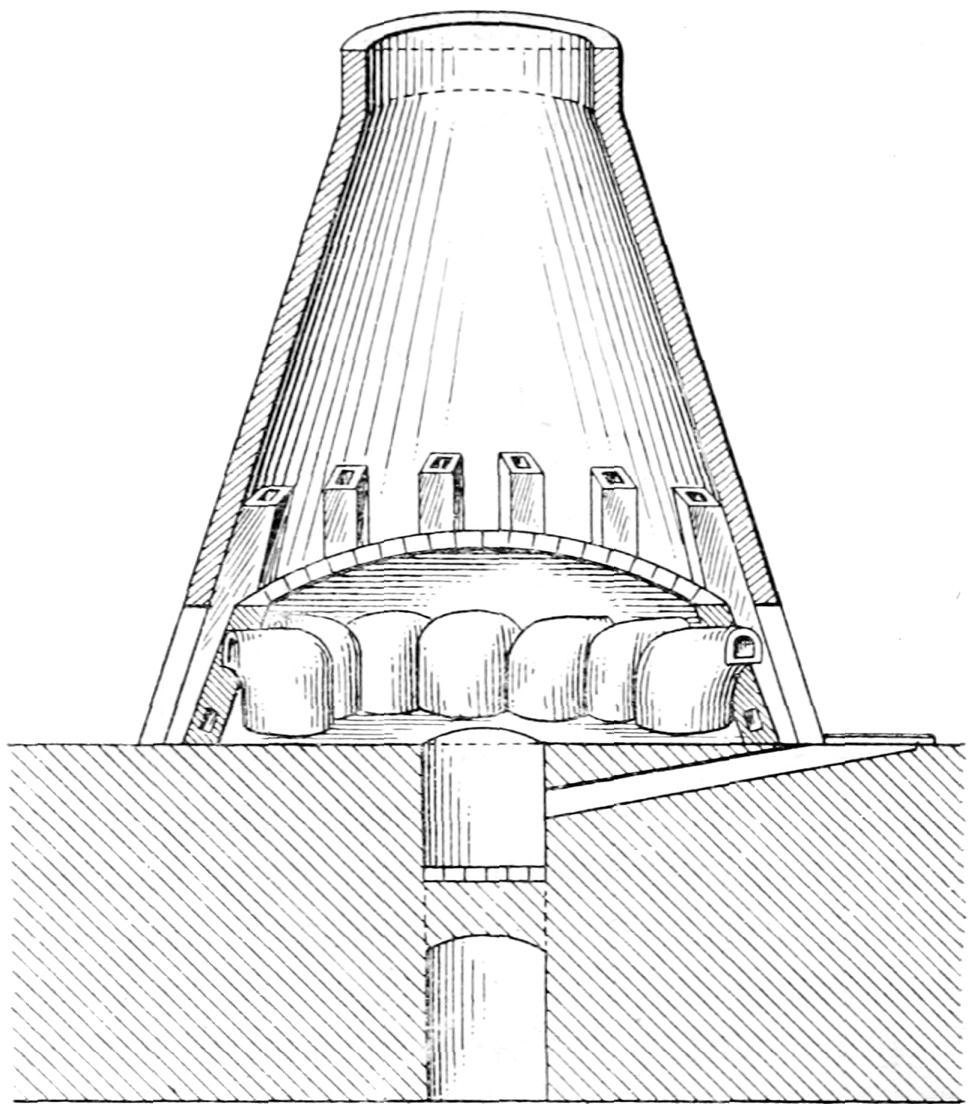
INTERIOR OF ENGLISH TYPE OF GLASS-MELTING FURNACE
Above the siege and over the pots is a covering
called the crown of the furnace, which is supported by
fire-brick pillars. This is built of the most refractory
material possible to be obtained, as the hottest flames
from the furnace fires beat against this crown and are
reverberated downwards upon the surrounding pots.
The flames, continuing their course, pass between the
pots into small openings or flues leading from the siege
floor and passing upwards through the pillars which
45are situated between each pair of pots, they then escape
from little chimneys leading into the outer dome or
conical-shaped structure so familiar to outsiders. This
outer truncated cone-shaped structure constitutes the
main chimney of the furnace. The furnace chamber
containing the pots is constructed entirely within this
cone. The blocks are carefully shaped, neatly
fitted, and cemented together with a mortar made of
fine, plastic, raw ground mixed to thin paste
with water. The presence of any molten glass which
escapes from a cracked pot, and the fluxing action of the
fuel ashes, cause severe corrosion of the blocks forming
the siege and fire-box, and these necessarily have to be
made of extra thickness in order to extend the life of the
furnace. When the furnace crown or siege becomes
badly corroded away, the furnace has to be put out for
repair; so generally an auxiliary furnace is kept at
hand, in order that it may be started and the workmen
transferred from one furnace to the other whilst the
repairs are being done.
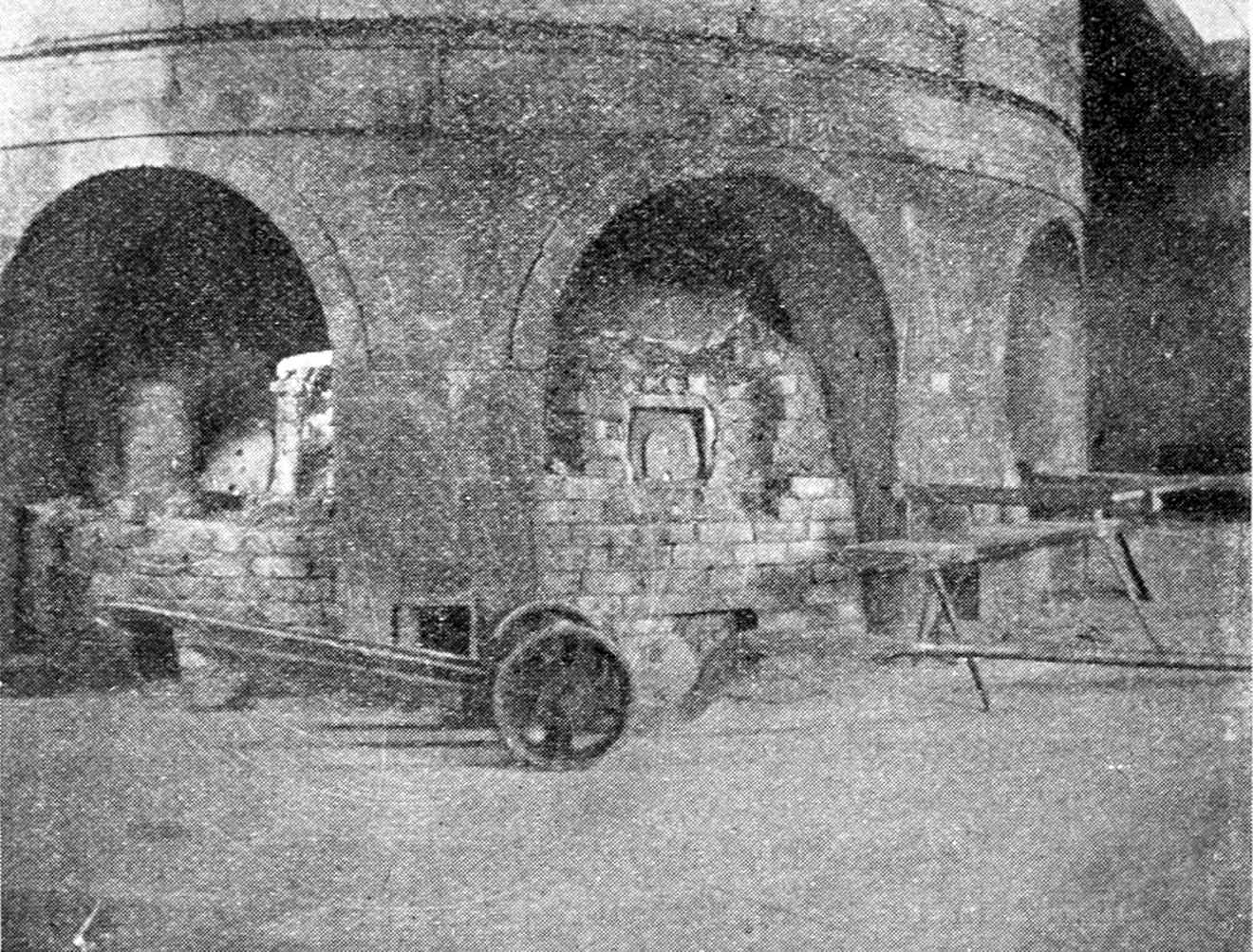
EXTERIOR VIEW OF ENGLISH GLASS-MELTING FURNACE
Pot Trolley in foreground
The action of the glass upon the siege of the
furnace is very active, and any leakage quickly
destroys the blocks, leaving fissures which
gradually increase in size until the blocks are eaten
right through. Consequently, every care is taken to
preserve the pots from losing metal. If by chance any
pot develops a crack through which the metal leaks into
the furnace, the glass working is ceased at that particular
pot, and every endeavour is made to ladle out
what remains of the metal, and so prevent any more
running on to the siege and causing further mischief.
The metal is ladled out of the pot by means of thick,
heavy, iron spoons, with which the hot metal is scooped
out of the pot and dropped into a large cauldron containing
water. This is very exhausting work, but there
46is worse trouble still if the metal is allowed to continue
to run through the crack in the pot and over the siege
into the eye of the furnace, for it then fluxes with the
ashes of the fuel, causing them to form into a big
mass of conglomerate, which, lying in the fire, interferes
with the draught and combustion of the fuel within the
furnace, and before the furnace can be got to work properly
again has to be cut away, piece by piece, through
the firebars whilst hot, until it is all removed. At the
sign of any glass running down into the fires and through
the bars, the tizeur hurries up to give the word that a
47pot is leaking in the furnace, and when the pot is
isolated the work of ladling the hot metal out into
water begins in earnest. A pot which has cracked
and leaks is useless for any further work of melting glass,
and at a convenient time it has to be withdrawn from
the furnace and a new pot must be substituted. Glass-melting
pots form a very expensive item in the glass
manufacturer’s costs; consequently, every care is taken
to prevent the pots within the furnace from getting
chilled by inadvertently allowing the fires to burn too
low or allowing cold air to rush through the bars,
through unskilful clinkering and inattention to the
furnace fires. Sometimes these furnaces are fitted with
a Frisbie Feeder. This is a mechanical firing arrangement
fitted underneath the furnace bars, by which the
fuel is fed upwards into the furnace box, so that all
smoke given off by the fuel baitings has to travel
through the hot fuel above, and thereby is more completely
consumed, giving better combustion than when
the black fuel is thrown on the top of the hot bed of
fuel. A mechanically operated piston pushes up small
charges of fuel from within a cylindrical-shaped box,
which works on a swivel backwards and forwards as
the fuel is fed into it.
In the old type of English furnace containing twelve
pots, each 38 in. diameter and holding about 15 cwts.
of metal, the furnace would be capable of melting
7 to 8 tons of glass a week, taking 40 tons of best fuel.
The more up-to-date glass-melting furnaces are constructed
upon a much better principle than the coal-fired
old English type of furnace just described. These
are usually producer gas-fired and give more economy
and greater convenience in every way.
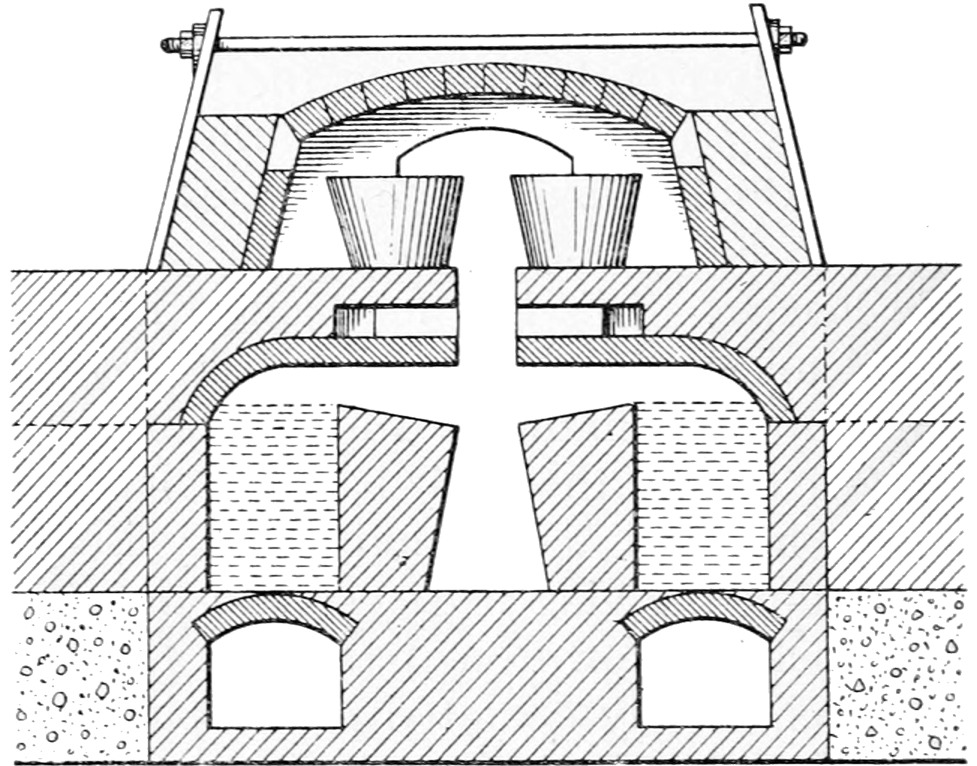
Fig. A
SIEMENS SIEGBERT TYPE OF REGENERATIVE GLASS-MELTING FURNACE
In these better types of modern furnaces some form
of regeneration or recuperation of the waste heat is
48usually adopted. These furnaces are much smaller and
more compact; being gas-fired, they give much higher
temperatures, more complete combustion of the fuel,
greater ease in regulation, cleaner conditions, and far
greater production than the older types of English
furnaces. Considering the reasonable initial cost that
the latest types of these modern furnaces can be built
for, it appears incredible that so many of the old out-of-date
English furnaces remain in use in this country.
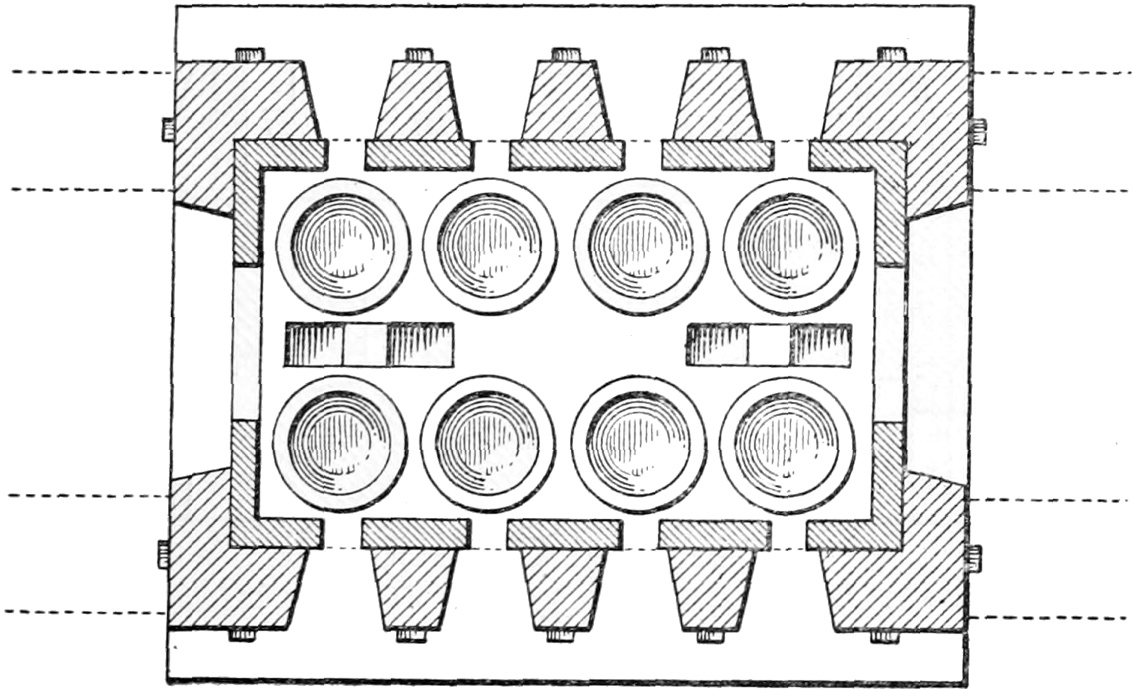
Fig. B
SIEMENS SIEGBERT TYPE OF REGENERATIVE GLASS-MELTING FURNACE
As examples of the types of regenerative and recuperative
furnaces, a description will be given of the Siemens
Siegbert Gas-fired Regenerative Furnace and the
Hermansen Recuperative Furnace for glass-melting,
which are extensively used on the Continent and are
giving remarkably good results.
49
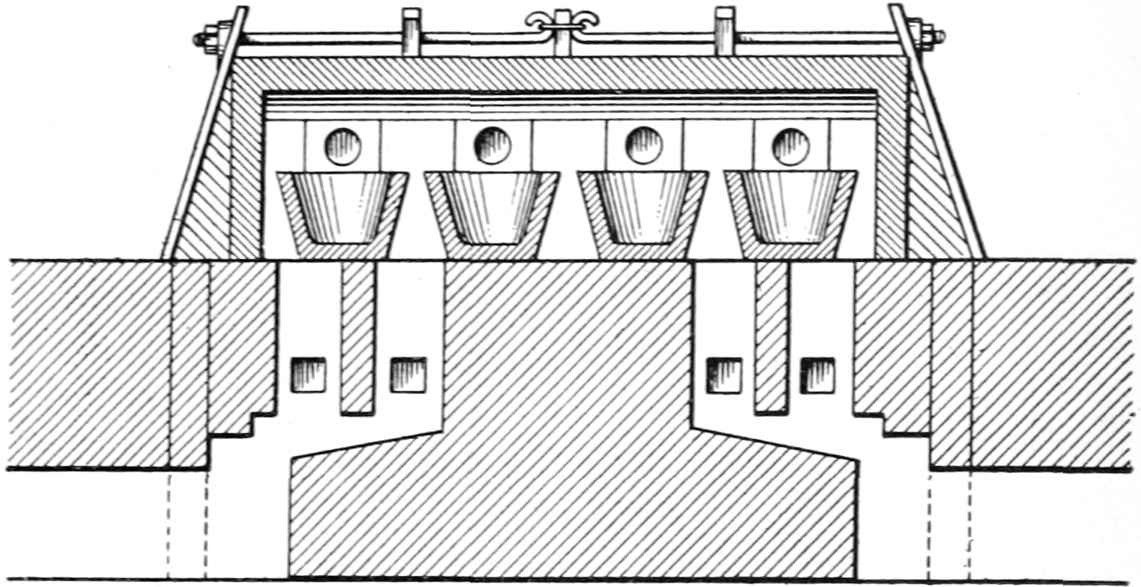
Fig. C
SIEMENS SIEGBERT TYPE OF REGENERATIVE GLASS-MELTING FURNACE
In the Siemens Siegbert type, the furnace may be a
rectangular or an oval-shaped chamber, approximately
18 ft. by 9 ft., the crown of which is about 4 ft. 6 in.
high. No outer cone-shaped dome exists, and the pots
within the chamber are arranged much closer together
and practically touching each other round the furnace.
The furnace chamber is heated by a mixture of producer
gas and heated air, the gas being generated in an
independent gas producer situated outside the glass
house and some little distance away from the furnace.
At either end of the furnace, beneath the floor of the
siege, are two blocks of regenerators. These are deep
rectangular chambers containing an open lateral arrangement
of fire-brick chequers, through which the air or
products of combustion pass on their way to or from
the furnace. Port-holes are situated directly above
these regenerators which lead the gases through the
50floor or siege into the furnace chamber. The draught
is induced by a tall stack, which draws the gas from
the gas producers through a duplicate arrangement of
flues to the port-holes at one end of the furnace, where
it is mixed with the air which has been drawn and
heated in its passage through the regenerator beneath.
This gaseous mixture, whilst in combustion, is drawn
across the furnace chamber to the other end of the
furnace. The flames playing across the tops of the pots
on either side pass down through the port-holes and
regenerator at the opposite end. The hot gases or
products of combustion, in passing through the lateral
channels of this regenerator, leave behind their heat by
the absorptive or conductive capacity of the fire-brick
chequers through which the hot gases have passed on
their way to the stack. The direction of the current is
reversed at intervals of half an hour or less by using
an arrangement of valves situated in the gas and air
51flues, so that the currents are made to travel on the contrary
direction, the air necessary for combustion then
being drawn through the hot block of regenerators
which was previously heated by the exit gases. On its
way through these lateral channels the air becomes
intensely heated, and, when it is admixed with the coal
gas at the porthole, this pre-heated air accelerates the
combustion and calorific intensity of the gaseous
mixture. The direction of the current is continually
being reversed at the interval of half an hour or less by
the manipulation of the valves, so long as the high
temperature is desired.
In practice, however, the regenerators are only used
whilst the batch materials are being melted during the
night, and by morning, when the metal is melted and
“plain,” the heat is brought back, or retarded, by
using the gas from the gas producers and cool atmospheric
air under natural draught, instead of the regenerated
hot air. This cooler mixture, naturally not being
so active in combustion, maintains just sufficient
temperature for working the metal out during the day.
Later in the day, when the pots are emptied and refilled
with batch, the regenerators are re-connected and the
founding proceeds again through the night, and the
metal is again got ready for the workmen coming in
next morning.
It will be seen that this method of melting and
working out the metal does away with night work,
the furnace man alone remaining in charge during the
night. All firing is done outside the glass furnace
room, which is well lighted, clean, and free from coal
dust, totally different conditions from those existing
in many English glass houses of to-day.
A Siemens Siegbert furnace taking ten open crucible
pots, and filled each day, turns out 15 to 18 tons of
52metal a week. The crucibles are about 30 in. in diameter
and have a capacity of 5-1/2 cwts. of metal each. The
amount of fuel consumed is about 18 tons a week.
This type of furnace costs about £1,600 to £2,000 to
build. In the miter’s opinion, a disadvantage of this
furnace is that, during the reversing in the direction of
the fire gases, the greatest heat is suddenly brought to
bear on the cooler pots, resulting in a short life for the
pots. The temperature of the incoming air is not so
constant as with the recuperative type of furnace;
however, with proper control, these defects may be
obviated to some extent.
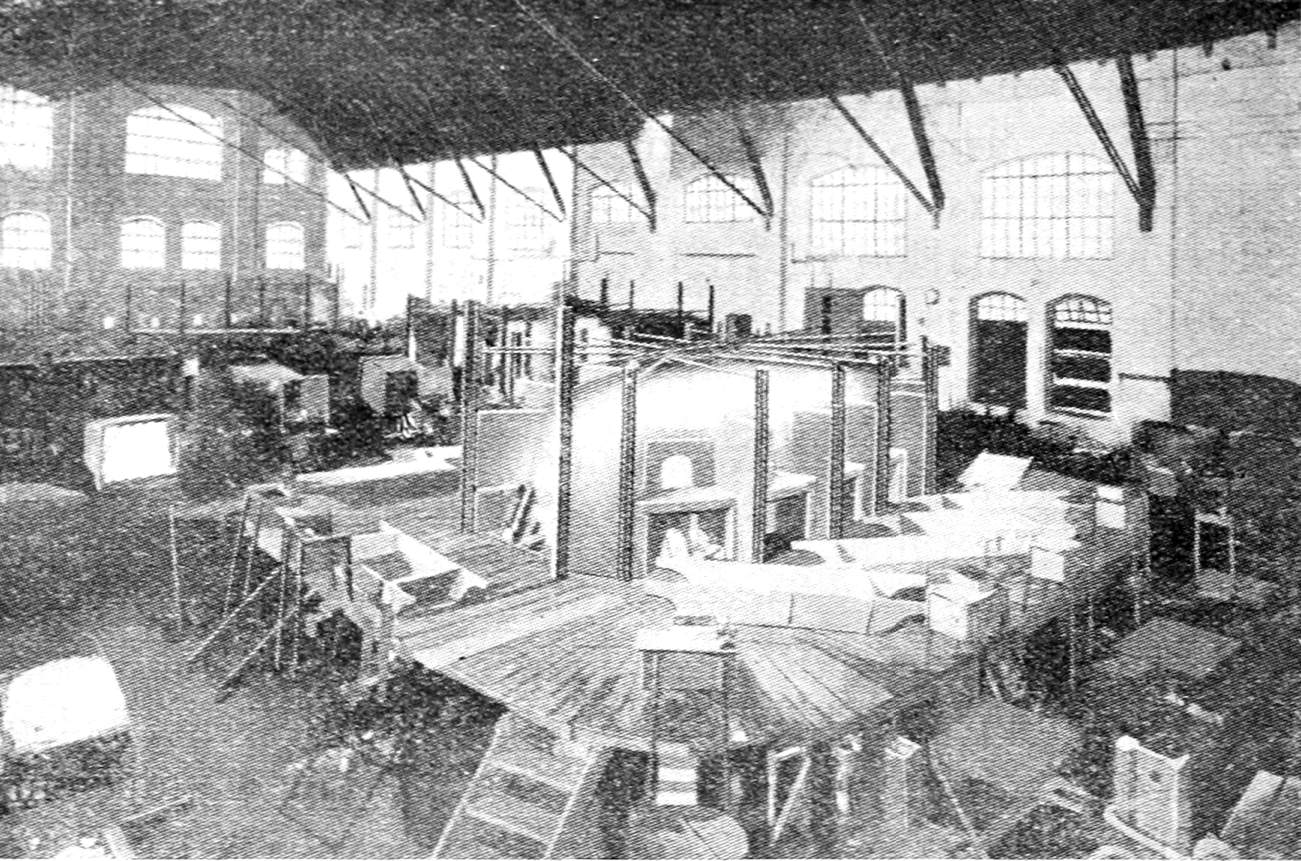
A MODERN GLASS HOUSE
The Hermansen Continuous Recuperative Glass-melting
Furnace in foreground (Twelve Covered Pot Type).
By the kindness of Messrs. Hermansen, the patentees,
I am permitted to illustrate their Recuperative Glass-melting
Furnace, eight pot type.
53
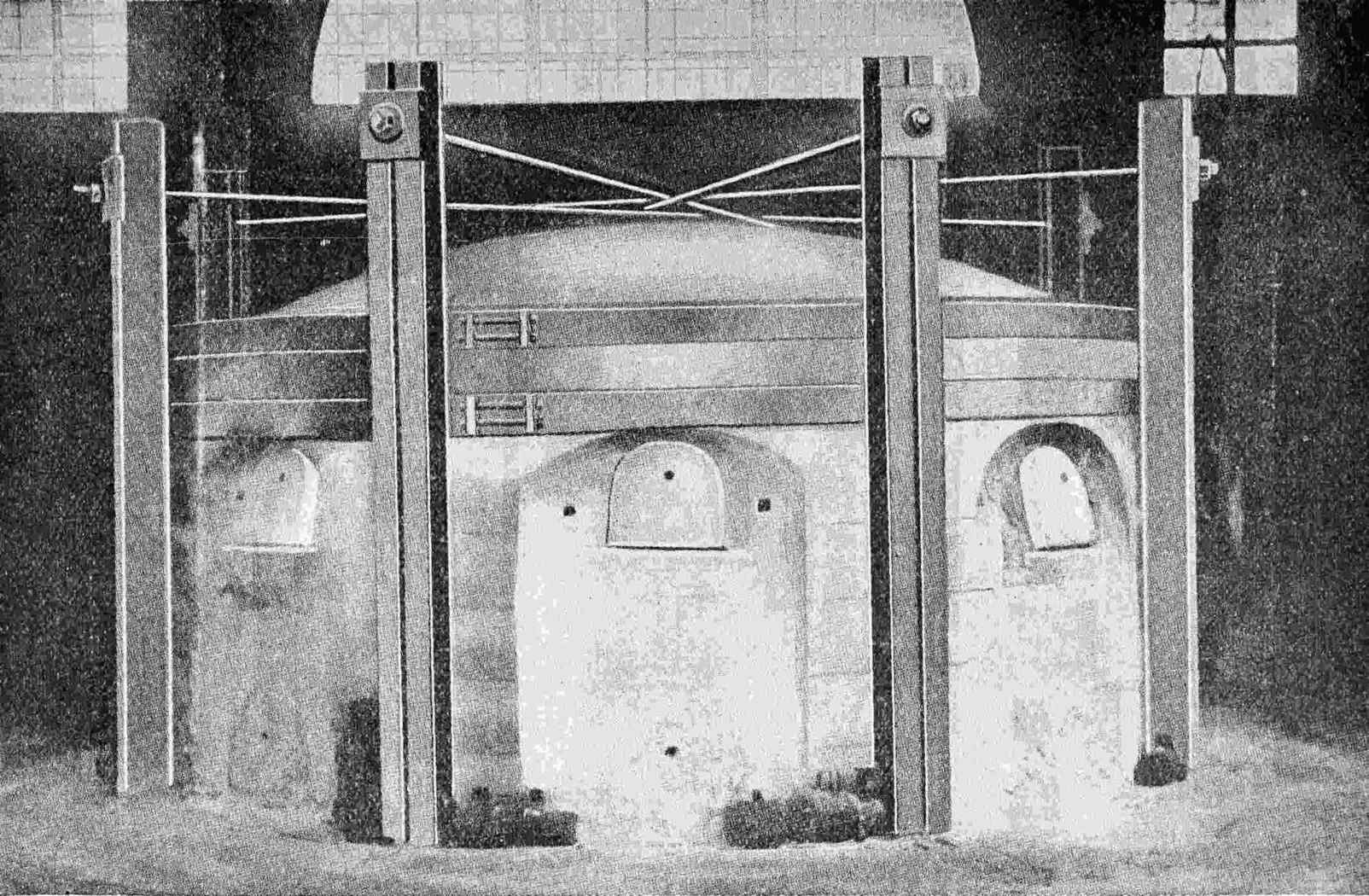
HERMANSEN GLASS HOUSE FURNACE (EIGHT POT TYPE)
54
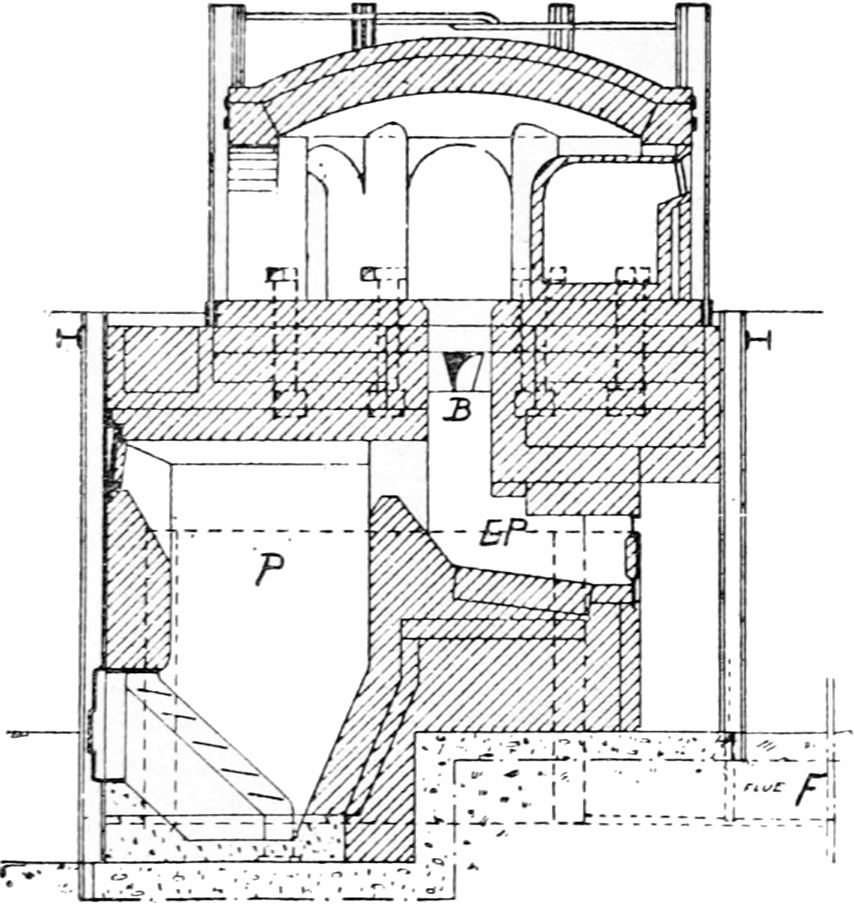
Sectional Elevation.
A
HERMANSEN’S CONTINUOUS RECUPERATIVE GLASS-MELTING FURNACE
P. Producer.
B. Burner.
G.P. Glass Pocket.
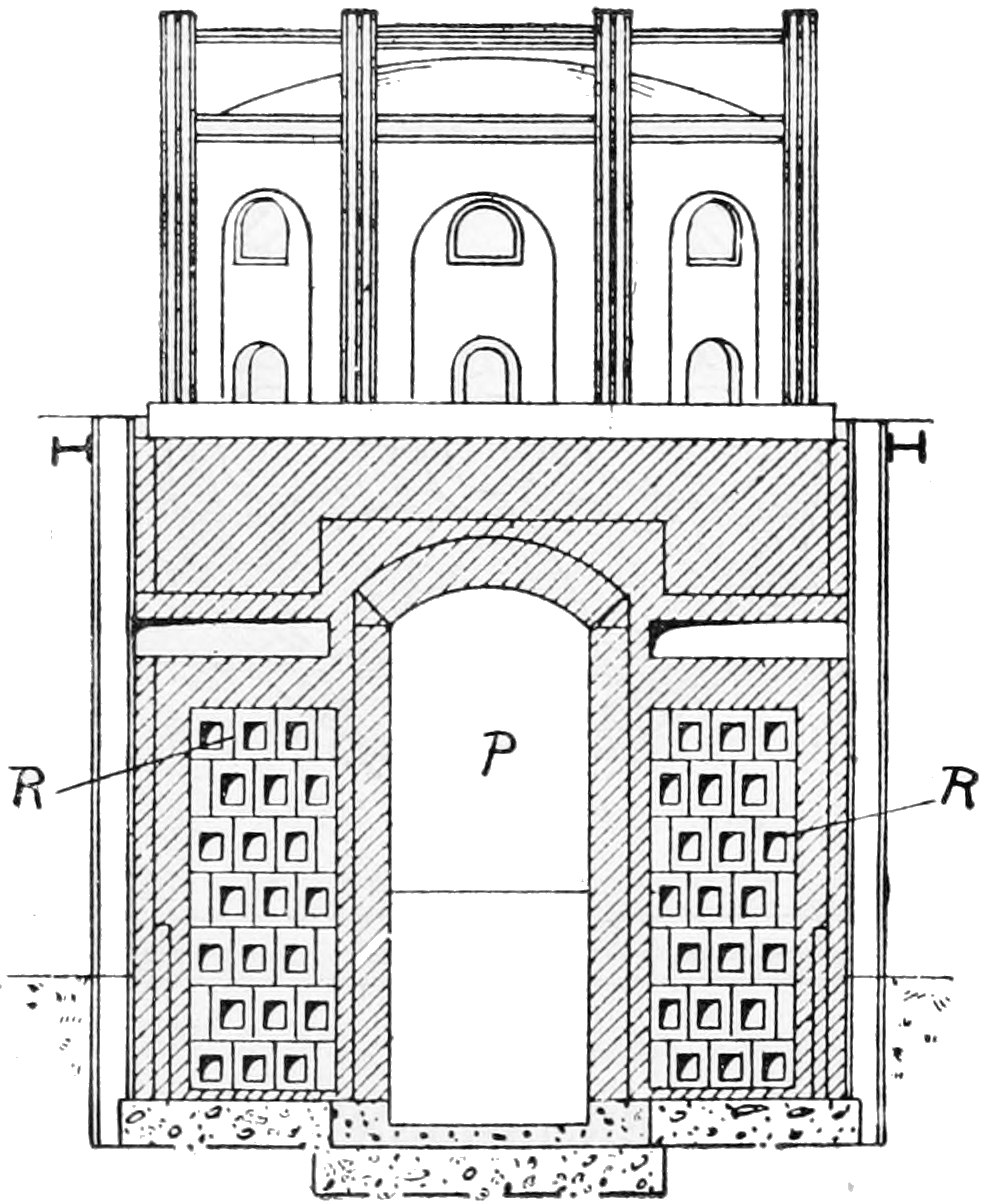
B
HERMANSEN FURNACE
Cross Section through Gas Producer.
P. Gas Producer.
R. Recuperators.
The Hermansen furnace, like the Siemens furnace, is
producer gas-fired. The gas producer is built within
the body of the furnace, (P) below the glass house floor.
On either side of this gas producer the recuperators are
situated. These are constructed by an arrangement of
tubes, designed to give two distinct continuous
channels, the one horizontal and the other vertical. The
vertical channels are connected with the atmosphere
and supply the air necessary for combustion. The
horizontal channels (R) are the flues through which the
hot waste products of combustion are continually being
drawn from the furnace by the stack. It will be
55evident that, the horizontal channels being intermediate
to the vertical tubes, the waste heat is continually
being absorbed by the air travelling inwards. In other
words, the air is pre-heated by passing through flues
which are surrounded by the hot waste gases. Therefore,
in this type of furnace there is no necessity for
reversing the currents to procure the necessary pre-heated
air for combustion, and the regulation of the
furnace heat becomes a simple matter of controlling the
draught by means of the dampers provided in the
main flue. In this type of furnace the glass is melted
nightly; open or covered pots may be used, the capacity
of which varies between 5 and 12 cwts., according to
56the class of glassware manufactured. The furnace is
designed in four, six, and eight pot types, and several
are now working in this country. These Hermansen
furnaces are capable of producing 20 tons of metal, with
a fuel consumption of 16 tons.
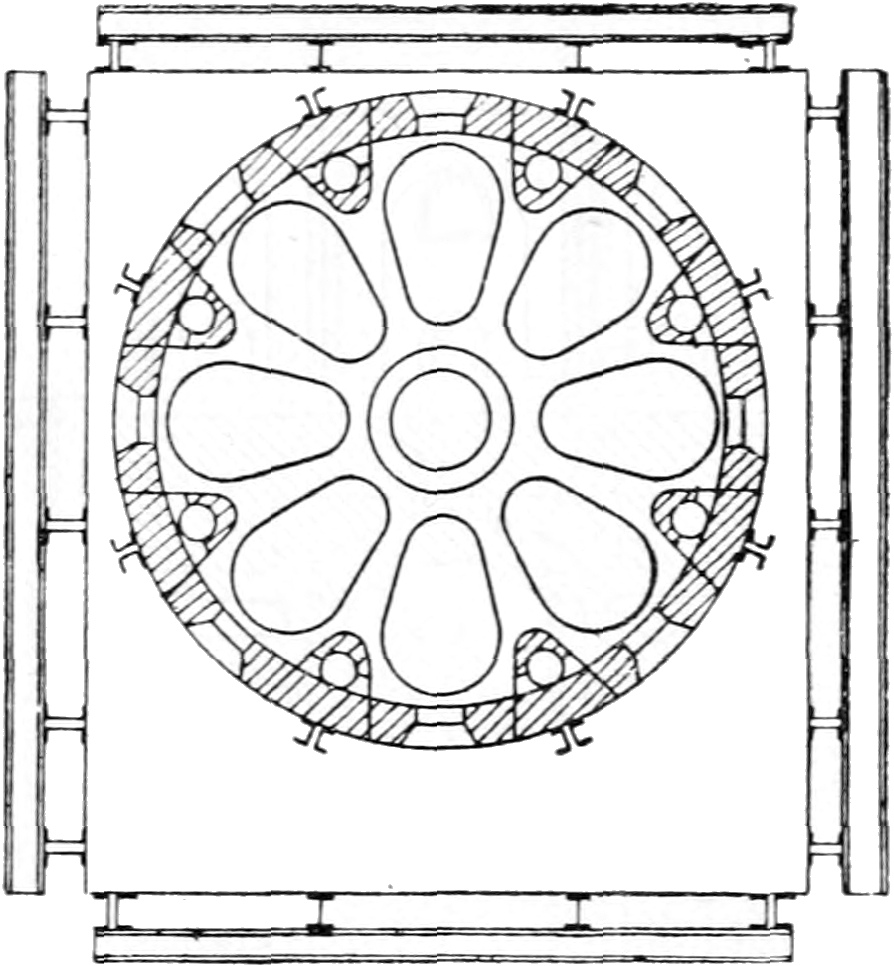
C
PLAN OF HERMANSEN’S FURNACE
(Eight Pot Type)
The Hermansen Continuous Recuperative Furnace
is the most efficient furnace known to the writer. It is
easier to control than the regenerative types. Being
compact, it takes up little space and is easy to repair,
and its life well surpasses other types. The initial
outlay and cost of erection varies from £850 to £1,200.
The combustion in this type of furnace is so perfect that
it is used with open crucible pots for melting lead
crystal glasses. On the Continent this furnace is in
general use for all types of glassware, and, from the
amount of glass it will melt, its efficiency is greater than
the regenerative type.
57Tank Furnaces are at present used for the melting
of the commoner and cheaper types of glass. They are
so constructed as to contain a single rectangular-shaped
compartment, or tank, about 18 in. to 2 ft. deep, and
from 30 to 100 ft. long. The bed and retaining walls
of this tank are constructed of specially selected fireclay
blocks; no pots are used. Tank furnaces are simple
and melt the glass economically, but the metal produced
is not nearly so good a quality as pot metal.
Tank furnaces are chiefly used for making the cheaper
glasswares, such as wine, stout, and beer bottles, gum
bottles, ink-pots, sauce bottles, and like goods, where a
large production is essential. Improvements are continually
taking place in the design of this type of furnace,
and much finer and clearer metals are being produced.
It is quite probable that in the future tanks will be
preferred for making cast plate and sheet window glass,
as a larger body of metal is held by them when compared
with pot furnaces. Like the Siemens and Hermansen
furnaces, they are gas-fired, but the port-holes
by which the gas and air are introduced and the products
of combustion are withdrawn from the melting chamber,
are situated on either side, above the level of the metal,
whilst the glass blowers work at one end of the furnace.
The melting and working of the metal is continuous.
The tank is divided by a shallow bridge, which is
partially submerged and situated midway between the
two ends of the furnace, dividing it into two sections,
respectively the melting and working compartments.
This bridge keeps back all unmolten material and allows
only that portion which is melted to travel forward
to the working compartment. The tank is crowned
or arched over, and at the working end openings are
provided to enable the glass workers to gather the
metal from within. Small rings, or syphons, are used,
58which, floating on the metal, serves further to refine the
glass as it is gradually used. The batch mixture is
filled through a convenient opening near to the port-holes.
Tank furnaces vary in capacity. Some have
been constructed to give an output of 300 tons of glass
a week. This pace can only be kept up with the aid
of automatic bottle-making machinery; in which case
hand labor is practically eliminated.
Liquid fuel or oil-fired glass furnaces have not proved
a success, being very costly in repairs on account of
the local heating effects of the flames issuing from the
burners vaporizing the oil.
Electric furnaces for glass-melting have been tried
with partial success. These are expensive in maintenance
compared with their efficiency in producing
glass.
CHAPTER IX GLASS-MELTING POTS AND THEIR MANUFACTURE
59
Glass house pots are large hollow vessels made of
refractory in which the glass manufacturer
melts the materials of which his glass is composed, and
which retain the molten metal whilst in a state of
fusion for the workmen’s use. In the case of the lead
crystal glass, the materials, whilst being melted, require
protection from the flames, smoke, and fuel ash present
in the old English types of furnace chambers, which
would otherwise reduce the lead present to a metallic
state and spoil the glass; therefore, such glasses are
melted in covered or hooded pots and thus protected
from the direct action of the flames. Consideration has
to be given to the extra amount of heat required from
the furnace to find its way through the hood of the pot.
For crown plate and chemical glassware, the metal is
usually melted in open or uncovered pots. In this case
the fusion is facilitated by allowing the heat of the
furnace to come into direct contact with the materials
within the pots.
Pots which are covered or hooded have an opening
cut out in the front, in a position just above the level of
the molten metal. Through this opening the workman
gathers the hot metal. In the case of open pots, the
crucible is set in a similar position within the furnace,
but the working hole or mouth is built to form part of
the construction of the furnace in front of the crucible.
Good pots are of the greatest importance to the glass
manufacturer, and upon their life much of the success
60of glassmaking depends. They have necessarily to
resist the corrosive action of the raw materials and
molten glass within, and, at the same time, withstand
the very intense heat of the furnace without giving
way under the great weight of the glass within them.
Should a pot of metal give way whilst in the furnace,
the loss is considerable and very serious, for not only
has the metal been wasted, but much of it has flooded
the floor of the furnace and siege, and, finding its way
into the fire-box, attacks the furnace walls, fusing
and melting with the fuel ash, checking the draught,
and causing endless trouble.
Glass house pots are very difficult and expensive to
manufacture, and upon an average each pot has cost
£10 by the time it is set within the furnace; therefore
every care is taken to extend their life by procuring the
best possible materials for their manufacture.
Only the best selected pot-clays available are used,
and every endeavour is made to keep them clean and
free from foreign contamination. Only the best portions
of the seam are taken for this purpose,
and a considerable amount of diligence and stringent
precaution is taken to procure the best qualities. As
the clay is raised from the mine, clay pickers look
over the lumps and select out the best portions. A
foreman of long experience is stationed at the head
of the mine, and it is his duty to supervise the clay
pickers and see that every care is exercised to guard
against any unfortunate results which would naturally
attend any indiscriminate or indifferent selection. The
best portions having been selected and placed aside,
the lumps are scraped on the surface to remove any
dirt, and broken into pieces about the size of an egg,
which are again carefully examined on all sides and
cleaned from foreign matter such as pyrites or bluish
61parts. If this is carefully done, and the clays analysed
and tested from time to time, a good pot-clay is obtained.
The clay for burning is treated similarly and
dried. It is then burnt to a very high temperature and
taken to the mill to be ground to the necessary fineness
of grain. All pot-clays are well seasoned and weathered
before use. They are first ground to a very fine flour
and then mixed with a ground-burnt clay, or “chamotte.”
The proportion of raw clay to burnt varies with most
manufacturers but depends very much upon the
plasticity or binding property of the raw pot-clay used.
The burnt clay is preferable if ground to a size about
1 to 1-1/2 mm., being sieved to take out any coarser
particles. Some clays are more plastic than others,
so the proportions in the pot-clay mixtures may vary
from six parts of burnt clay to five of raw, down to
one part of burnt clay to three of raw clay. The
proportions are reckoned by volume, not by weight.
The mixture is sieved into a trough and mixed with
water to form a stiff paste, and removed into a large
tank, where it is allowed to soak for some time. It is
then well-tempered by treading with the bare feet
until the whole mass becomes plastic and tough. The
clay mass is turned and trodden several times, in order
thoroughly to consolidate the clay particles. Many
efforts have been made to do this work mechanically,
but without success. The fact remains, and experience
has proved that, in the process of treading, the clay is
more consolidated than by any mechanical method of
preparation. The tempered and toughened clay is then
allowed to sour and mature for a few weeks before use.
It is then ready for the pot maker to begin the work
of building the pots.
The room in which the pots are to be made is kept
evenly warm using a series of hot water circulating
62pipes arranged around the outer walls. Usually a
temperature of between 60 to 70° Fahr. is maintained.
Double doors are provided at the entrance, with a
porch, so as to prevent sudden inrushes of cold air and
prevent draughts in the pot-making room. All unauthorised
persons are prohibited entrance, and only those
who work therein are allowed free access. They are
made responsible for keeping the place clean, as well as
looking after the clay and taking care of the pots
whilst they are being made.
The usual shape of a pot is of round section, 38 in.
in diameter and 42 in. high, but many other shapes
and sizes are used, according to the class of goods being
manufactured. Thus, for colours, a very much smaller
pot, less than one-third this size, is used, three of
them, taking the position of one large pot, being set
within one arch. For sheet and optical glass, a covered
pot with a very large mouth or working opening is used.
In some instances, as in the Hermansen furnace, the
pots are oval or egg-shaped. These are used on account
of their larger capacity in relation to the space occupied
in the furnace. Other pots have an interior division,
which has a syphonic refining action upon the glass;
such pots permit of continuous melting and working,
instead of the intermittent process adopted when the
regular or common shape is used. For plate glass, open
crucible or bowl-shaped pots are used.
In regard to the manner in which the pots are made,
and their subsequent treatment in annealing, the utmost
care and control is necessary. In making the pots,
the pot maker begins by making the pot bottom first,
working the plastic clay paste into rolls about the
size of a large sausage. He takes these rolls and
applies them one after another in a circular form upon
a round level board, the size of the bottom of the pot.
63This board is supported on a low table. As he applies
each roll, he presses them together to exclude all
air spaces between them, and continuously work the
rolls on the top of each other in circles, until he gets
a circular flat slab of clay in thickness about 4
in. and the width of the pot bottom. He then has
the necessary thickness and size of the pot bottom
formed as a clay slab, which is smoothed and leveled
over the face with a knife or straight piece of wood.
The slab of clay is then reversed upon another board,
covered with a strong hurden cloth and a layer of
ground-burnt clay, which prevents the clay from
sticking to the board, and facilitates drying of the pots.
The first board is then removed, and the pot maker
begins to build the sides or walls of the pot upon the
circular clay slab by working the clay in rolls around the
circumference of the slab to a thickness of 3 in., which
gives the thickness of the pot walls. As he works and
presses on each roll with his right hand, he supports
the inside of the curve with his left hand, and presses
roll after roll around the circumference of the slab of
clay, increasing the height of the walls until he attains
a height of about 6 in. The height of this wall is
increased by about 6 in. every other day or so; these
time intervals allow each section built to stiffen a little
before beginning upon the next section.
The workman passes from one pot bottom to another,
building up these sections until he builds each to a
height of about 30 in., when he places within each pot
a clay ring about 18 in. in diameter, which he has previously
made.[3] After placing these rings within the pots,
the pot maker begins to form the hood or dome of the
64pot by working on the clay rolls, and at the same time
drawing the sides inwards towards the middle, lessening
the thickness of the walls and gradually diminishing
the open space until it is covered and sealed in. Whilst
the clay is still soft, the mouth or working opening is
worked on and cut out of the dome, and the whole
finished and smoothed by means of wooden tools.
The pots are now completed and are left to dry
gradually at a moderate heat, which is increased a little
at the end of a few months in order to thoroughly dry
them. They are then removed from the boards and
are ready for the furnace.
Crucible pots are made in a similar way, except that
at the height of about 27 to 30 in. the pot maker finishes
off the top edge of the walls and leaves it in that form
to be dried.
Many efforts have been made to manufacture pots
by other methods. One which has been tried with a
fair amount of success is to cast the whole pot or portions
thereof by using a plaster case mould and pouring in
liquid clay slip. Another method which has been tried
is to press the form by means of a hydraulic press and
mould. Other mechanical contrivances have been used,
but few of them have given such satisfactory results as
the hand-made pots.
| Mixture for Pot-clay |
| |
|
By volume. |
| (Base) |
Fine ground strong Fire-clay |
5 parts |
| (Binder) |
Fine ground mild Plastic Fire-clay |
4 parts |
| (Grog) |
Ground burnt Chamotte |
2 parts |
| (Grog) |
Ground selected Potsherds |
1/2 part |
The fusion point of the mixture should not be less
than Cone 32, or 1710° Centigrade.
Strong fire-clays are those coarser and harder grained,
and are usually more silicious and less plastic than the
65mild fire-clays. Mild fire-clays are very fine-grained,
plastic, and easily weathered clays. They act as the
binder portion in fixing the burnt grog used in pot-clays.
The raw clays should be ground very fine and separately
from the burnt clays. The ground burnt should
be crushed from hard and well-burnt fire-clays, and
should pass a sieve of ten meshes to the linear inch.
The mineralogical composition of the fire-clays
for making pots is important. The presence of pyrites
renders fire-clays unsuitable as pot-clays. Some indication
as to the subsequent behavior of a can
be obtained by submitting it to a petrographic examination,
and the usual pyrochemical and physical tests
carried out in testing refractory materials. In this
country, Stourbridge pot-clays are chiefly used for
pot-making, and so conservative are the majority of
glass manufacturers that they will not use other clays,
although, in the writer’s opinion, many better clays
exist in Great Britain, and have now been introduced
and used successfully by some firms for pot-making.
Ground potsherds are selected pieces of old broken
pots, cleaned from any adhering glass. These selected
pieces are crushed and ground in a similar way to the
burnt clay, and sieved to the same degree of fineness
before use.
Plumbago glass house pots are sometimes used.
These are made from mixtures of graphite, or plumbago,
and raw . They are very refractory and
withstand the attack of very basic glasses, where such
have to be manufactured.
Pot rings are made by taking a long roll of clay
about 3 in. in thickness and shaping it around a circular
frame. The two ends are joined and finished smoothly,
the frame took away, and the ring dried. A ring is
placed in each pot.
66Stoppers are the lids used to close the mouth of
covered pots whilst the metal is being melted. These
are made in plaster case molds by pressing a bat of
clay into the desired shape and releasing the outer
case by turning the whole upside down upon a board
and lifting off the mold. An indentation is made
in the middle, forming a small hole. An iron rod
can there be inserted, by which the stopper can be
lifted away from the pot mouth whilst hot. Stoppers
are burnt before use and are made in various sizes to
fit the mouths of different pots.
It is always advisable for the glass manufacturer to
make his pots and prepare his clay, as he then
knows exactly what he is using, and he is not dependent
upon outside firms for his pots as he has them ready
at hand when needed. The conveyance of pots from
one district to another by rail or road is always accompanied
by considerable risk, as the vibrations are given
they in such journeys often cause mischief. As they
are very heavy and fragile, their loading and unloading
into the wagons is often attended with a mishap. As
often as not, latent strains are caused, which only
develop when the pot is put in the furnace.
Annealing and Setting the Pots in the Furnace. The
pots, when made and dried, being of raw clay have
to be carefully annealed before they can be introduced
into the hot furnace. In doing this, the pot is removed
from the drying rooms and placed within a small
auxiliary furnace called a pot arch, which is constructed
purposely to anneal them and get them hot before
placing them in the glassmaking furnace. The pot is
moved by picking it up on a long three-pronged iron
trolley, made purposely to lift and move them about.
The pot is set within the pot arch, resting upon two or
three rows of fire-bricks, which allows the trolley to
67be removed and brought away, leaving the pot in a
raised position in the pot arch. The doors of the pot
arch are then closed and sealed with a stiff clay paste
or mortar, and slow fires started which gradually heat
the pot, until at the end of a week it is got to a white
heat, and the pot is ready to be removed and set within
the furnace for melting the glass.
At a convenient time, arrangements are made for
setting the pot. All other work about the glass house
has to cease, as all hands are required to help in the
strenuous and arduous work. The old pot in the
furnace, which has done work for several months, has
to be withdrawn from the furnace and the new pot
from the pot arch has to take its place. We see gangs
of men here and there. Some are pulling down the wall
of bricks from the front of the old pot, making an
opening in readiness to remove it. Another gang of
men advance with long, heavy, strong iron crowbars,
sharpened at the points, with which by heavy blows
and levering they endeavour to loosen the old pot from
the floor of the siege, to which it has become firmly
cemented by the heat and any leakage of glass which
may have taken place. Eventually, by their combined
exertions, they succeed in loosening the pot, and then,
levering it up, they place the low iron pot trolley under
it and drag it out of the furnace, whence it is taken
away and thrown aside.
The old pot having been removed from the furnace,
the glowing heat radiates more intensely than ever into
the faces of the men at work, who endure it in relays
whilst they work clearing away the old bricks and preparing
the siege for the new setting. When this is done,
a gang of men open the pot arch doors, and, placing
the iron trolley under the new pot, convey it to the
opening in the glass furnace from which the old pot has
68been removed. Facing the terrific heat, they struggle
to push the new pot into its place in the furnace, with
the aid of crowbars, and working in relays, in turn face
the heat till at last it is got into position. Naturally,
everything has to be done in a hurry, so that the new
pot may not be chilled before it is got into the furnace
by being exposed too long to the outside air. The
whole work proves very exhausting to the men, as there
is little protection from the heat. After the pot is set
in its place, the trolley is brought away and the wall of
bricks rebuilt up in front of the pot to protect it, clay
being daubed over the exterior of the brick wall to
prevent any inrushes of air, which would cause the pot
to crack by finding a way through the joints in the
brickwork.
The furnace, during these operations, is driven and
worked to its full capacity, so as to allow for the very
considerable loss of heat which takes place whilst the
opening is being made and the pots removed.
The above is a description of the usual method of
pot setting. In more modern and up-to-date works
a travelling chain screen is used. This screen is like
a curtain of loose chains, which is adjusted to hang
in front of the open arch of the furnace and protects
the workmen from the fierce heat. At the same time
it permits the workmen to see and carry out the work
of pot setting with greater ease and convenience.
In using this screen arrangement whilst setting, the
pot is pushed through the chain screen, which closes
upon it after it has passed through. The workmen
are thus enabled to get closer to their work by manipulating
the crowbars through the screen as the heat is
not radiated full upon them.
The newly set pot is allowed to stand empty in the
furnace for a day or two to regain heat before it is
69filled with batch. It is first glazed on the inside by
a workman taking a gathering of glass from another
pot and plastering or covering the inside all round with
the hot metal, which flows down and glazes the surface
of the pot, giving it a certain amount of protection
from the attack of the raw batch materials which are
to be introduced later.
The founder, or glass melter, now takes charge of
the pot, and he brings up the mixture of batch and
cullet and shovels it into the empty pot until it is filled
well above the mouth or level of the opening. The
heat of the furnace melts the batch, and after several
hours it becomes liquid and shrinks in volume so
that probably only two-thirds of the height or capacity
of the pot is occupied. The pot is then again filled
with more batch materials until it is full of molten
metal up to the level of the mouth of the pot.
The furnace is kept going at its full heat until the
founder, drawing a small portion of the glass on the
end of an iron rod, examines it and finds that it is
melted clear and free from seeds or bubbles of gas.
When clear, the metal is “plain,” and at this stage is in
a very liquid, fluid, and watery state, too liquid to be
easily gathered. It is, therefore, allowed to cool off
by removing the stopper down and leaving the mouth
of the pot open, until the glass becomes more viscid,
or of a stiffer nature. The glass is then skimmed by
dragging off any scum present on the surface, which is
due to undecomposed salts that may have risen during
the melting.
The metal is now ready for the glass blowers to begin
work. Upon looking into the pot, the ring
will now be noticed floating on the surface of the glass.
This ring keeps back from its interior any further scum
that may arise whilst work is in progress. The glass
70blower always gathers from within this ring, where the
metal is cleanest; and from time to time the metal
within the ring is skimmed in order to keep that portion
in the best condition. When the greater part of the
metal within the pot has been gathered or worked out,
the heat of the furnace is raised again and fresh batch
materials filled and the process repeated.
The time taken to melt the glass depends upon the
heat of the furnace. A gas-fired furnace will melt the
batches in eight hours, but the old type of English
furnace takes much longer, usually two to three days.
CHAPTER X LEHRS AND ANNEALING
71
Owing to the peculiar structure of glass, and its liability
to fly or collapse when exposed to sudden changes of
temperature, a process of annealing becomes necessary
in order to produce a more equal distribution of the
tensions throughout the structure of the glass; otherwise,
glassware of any thickness would be in such a
state of tension as to be extremely liable to fracture
when passing through any sudden change in the atmospheric
temperature, especially in frosty weather. In
this state it is useless or dangerous for general purposes.
On this account most glasswares undergo a form of
annealing at some time during the process of their
manufacture. And in the case of certain goods, such
as table glass, lamp glasses, optical glass, etc., special
care and time are devoted to this process of annealing.
Often in the case of improperly annealed glass, instances
are known where its unhomogeneous structure has
suddenly given way as the result of derangements set
up by internal tension. Friction, or rough handling
whilst cleaning, at the ordinary temperature of the
atmosphere, is sufficient to cause a rupture. Therefore
annealing cannot be too carefully attended to.
For annealing the glass manufacturer uses a lehr,
which is an arched tunnel with a fully exposed opening
at the exit end and partially closed at the entrance
end, where the goods are introduced. The lehr is
heated at the entrance end to a temperature of about
350° Cent., which temperature is gradually diminished
towards the exit end, which is quite cool. The hot end,
72or entrance, should be constantly at a temperature
just short of the actual deformation or softening point
of the glass introduced; usually the entrance is in a
position near, or convenient to, the glass furnace around
which the glass blowers make the goods.
In old-fashioned works coal-fired lehrs are used, but
they are very unsatisfactory and difficult to regulate.
The heat of the lehrs in modern works is maintained
and regulated by a series of gas burners situated under
the floor of the tunnel or lehr. Along this floor are
placed iron trays linked up with each other to form a
continually travelling track, which gradually moves
towards the cold end of the lehr; these trays are operated
by a mechanical jack and gears. As each tray of goods
comes out of the cooler end of the lehr, they are taken
off and conveyed to the warehouses for cleaning and
packing, and the empty tray is sent back to the entrance
end to be linked up and refilled again with fresh goods.
These tunnels, or lehrs, are about 40 ft. long, and as
the glasswares travel through on the trays they are
subjected to the gradually diminishing heat, until they
are ultimately removed at the cooler end in an annealed
condition, in which state they are less liable to fracture
in use. The time occupied in travelling through the
lehr is usually about three days. But this period
varies according to the nature of the ware being manufactured.
In special glasses, and in the annealing of
optical glass, the glass may undergo a process of annealing
that takes as long as ten days, and in other cases,
where the glassware is made very thin, no annealing at
all is necessary. Usually the thicker and heavier
articles require the longest time in annealing. Table
glass which is made thick and heavy for cutting or
decoration requires a little more care and time in the
lehr than ordinary plain glassware, as the abrasive
73action of cutting quickly develops any latent strains
and causes fracture.
In some works, especially on the Continent, several
small externally-heated kilns are used for annealing,
in which the hot glassware, as it is made, is packed in
tiers; when full, these kilns are closed up and then
allowed to cool of their own accord; after which they
are opened and the goods taken out to the warehouse.
This is an intermittent process of annealing, and is
quite satisfactory for certain classes of goods, such as
lamp shades, which are usually of equal thickness
throughout their form.
The travelling or continuous form of lehr admits
goods of more unequal thickness in form and variety.
Thus, wine-glasses, jugs, and bowls may be annealed
together with less risk of malformation in their shape
than would be present if they were annealed together
in kilns. The manufacturer can, by suitably arranging
the temperature of the gas burners, give more heat to
one side of the lehr than to the other. He then places
the heavier goods on the hotter side and reserves the
other for lighter goods, such as wines, etc. They then
travel down together side by side under the most
suitable conditions for the annealing of each class.
Many physical changes take place in the glass passing
through the lehr. One remarkable effect is the slight
change in colour which occurs in glass decolorized with
manganese. It is noticed that the glass becomes a
greener tint in passing through the lehr when the
decolorization is just on the margin of efficiency.
The state in which the structure of glass exists when
quickly cooled and the action of annealing might be
explained. When glass is quickly cooled, being a bad
conductor of heat, insufficient time is allowed for the
middle or interior portions of the glasswares to settle
74down and assume their normal state of solidification.
The outer portion, or crust, will first cool and contract
with an enormous strain upon the hot interior. This
difference in the state of tension between the outer and
interior portions gives a want of uniformity, and stresses
of tension and thrust are developed, which cause the
whole to collapse with the slightest external scratch
or heat change. In annealing, this strained or forced
condition in the structure of the glass is relieved by
subjecting the glass to a pre-heating, and gradually
diminishing the temperature, allowing a sufficient time
for the different layers mutually to adjust themselves
to their comparative normal positions, and thus relieve
the strains within the mass. Much depends upon the
pre-heating temperature and the rate at which the
diminution of the temperature takes place. If this
is properly provided for, the best results are obtained
in the stability of the resulting glass. The presence of
any stress can be determined by using a polariscope.
The average British glass manufacturer has little
knowledge of the value of a polariscope, or stress
viewer, in ascertaining the physical state of his glasswares,
and until he adopts its use there is little prospect
of an improvement in his annealing methods. Much
faulty annealed glass is being turned out which the
glass manufacturer is not aware of, and which could be
avoided by the intelligent use of such a simple instrument,
which detects badly annealed glass at once by
the aid of crossed nicols and a selenite plate.
Owing to the unequal densities of the various silicates
present in the heavy lead and barium glasses, they are
more subject to striation and require more careful
annealing than the soda-lime glasses, in which the
silicates present are of more equal density. However,
much depends upon the proper “founding” and melting
75of such glasses. The use of a larger proportion of cullet
assists in breaking up striation. The presence of striae
or cords in glass disqualifies it for most purposes, as it
is usually found that, apart from their defective appearance,
they tend to produce stresses within the glass.
Transparency, brilliancy, stability, and homogeneity
are important factors in producing perfect glassware,
and the proper development of these distinguishing
properties requires considerable skill on the part of the
glass manufacturer, alike from a technical, physical,
and practical standpoint.
CHAPTER XI THE MANIPULATION OF GLASS GLASS MAKERS’ TOOLS AND MACHINES
76
The tools used by the glass blowers are few and simple.
The greater part of the crude form is produced by
blowing out the hot glass into a spherical or pear-shaped
bulb and regulating the size and thickness by gathering
more or less material. The tools are mainly employed
in finishing and shaping this bulb into the desired form,
such as shearing, forming the neck spout, crimpling,
and sticking on the handles to the various shapes made.
According to the type of the goods manufactured,
different manipulative methods in forming the articles
are adopted in various works.
The best English table glassware is mostly hand-made
blown ware, generally entirely executed by the handicraft
of the workman without the aid of moulds to form
any part of the articles, and a considerable amount of
skill and practice is necessary before the workman is
competent enough to shape a number of articles exactly
to the form of his model. It is astonishing to notice
the skill and precision with which a workman produces
wine-glasses one after another, so uniform that one
cannot trace any dissimilarity between them.
A second class, or cheaper form, of tableware is made
by blowing the sphere or bulb of hot glass within a
mould, to give some part, or the whole form, of the
desired article. If only a portion of the intended
shape is thus formed by the mould, it is afterwards
finished by hand with tools. This is the general continental
method of working, and has only been partially
77adopted by this country for making tableware. Where
a number of articles of one shape have to be produced,
this is by far the most economical method. Glass
tumblers, honey pots, and rose bowls illustrate this
class of ware.
Another class of tableware produced by a method of
pressing the form is known as “Pressed glassware.”
The hot metal is gathered from the pot and a portion
cut off, and allowed to fall into an iron mould fixed
within a lever press, which carries a plunger fitting
within the mould formed to shape the interior and
exterior, with the thickness of the glass as the intermediate
space between them. As the hot glass is
introduced, the workman brings down the lever arm
and the plunger presses the hot metal to shape. The
plunger is then released and the mould reversed, turning
out the pressed form of glass, which is then carried
away to be fire-polished or further manipulated with
tools before it goes to the lehr. The case or mould
portion is made in two halves, to facilitate the removal
of the hot glass after being pressed. Pressed glass
tableware can be recognised by the presence of seams,
showing these divisions of the mould. Many exquisite
designs imitating cut-glass tableware are executed in
pressed glassware. The moulds are a very expensive
item, as there is much tool work in cutting the patterns
and refacing them after prolonged use. In making
pressed goods, an oily, carbonaceous liquid is used to
give the moulds some protection and prevent the
oxidation of the iron. This liquid is from time to time
applied, as the work of pressing proceeds, by mopping
the interior of the mould with a mop dipped in the
preparation.
Another process in glassmaking is that of bottle-making
by automatic machinery, in which the glass
78worker does little but gather the requisite quantity
of glass from the pot and place it into the revolving
clips of a bottle-making machine, which does the work
of formation, by the aid of compressed air delivered
from a supply main. This is largely of American
introduction, and is the method adopted in making
common bottles. In some cases the bottle neck may be
finished by a hand tool after a mould has done its part
of forming the bottle. Modern machines have been
perfected to do the whole work of gathering the metal,
forming the shape, and completing the bottle; a number
of arms travelling round a track carry the mould forms,
which alternately dip into water to keep them cool,
open to receive the hot metal, close, deliver a requisite
pressure of air to extend the hot glass within the mould,
and then deliver the bottle on to a travelling belt,
which takes them to be annealed.
In the manufacture of bottles by machines, hand
labour is practically eliminated as far as the actual
making of the bottle is concerned. The bottle-making
industry is undergoing great changes by the introduction
of such machinery. In some plants a ten-armed
machine will produce automatically 120 gross of 16 oz.
bottles in twenty-four hours, at an average cost of
1s. 6d. a gross.
Owen’s Bottle-making Machines are of this type.
Such machines produce 700 bottles an hour, according
to their size and the number of arms fitted to the
machine.
As an illustration of a less complicated bottle-making
machine, “The Harlington” may be described.
This machine consists principally of a table, on which
is arranged on the left-hand side a parrison mould, and
on the right-hand side a column with a revolving table
carrying two finishing moulds.
79
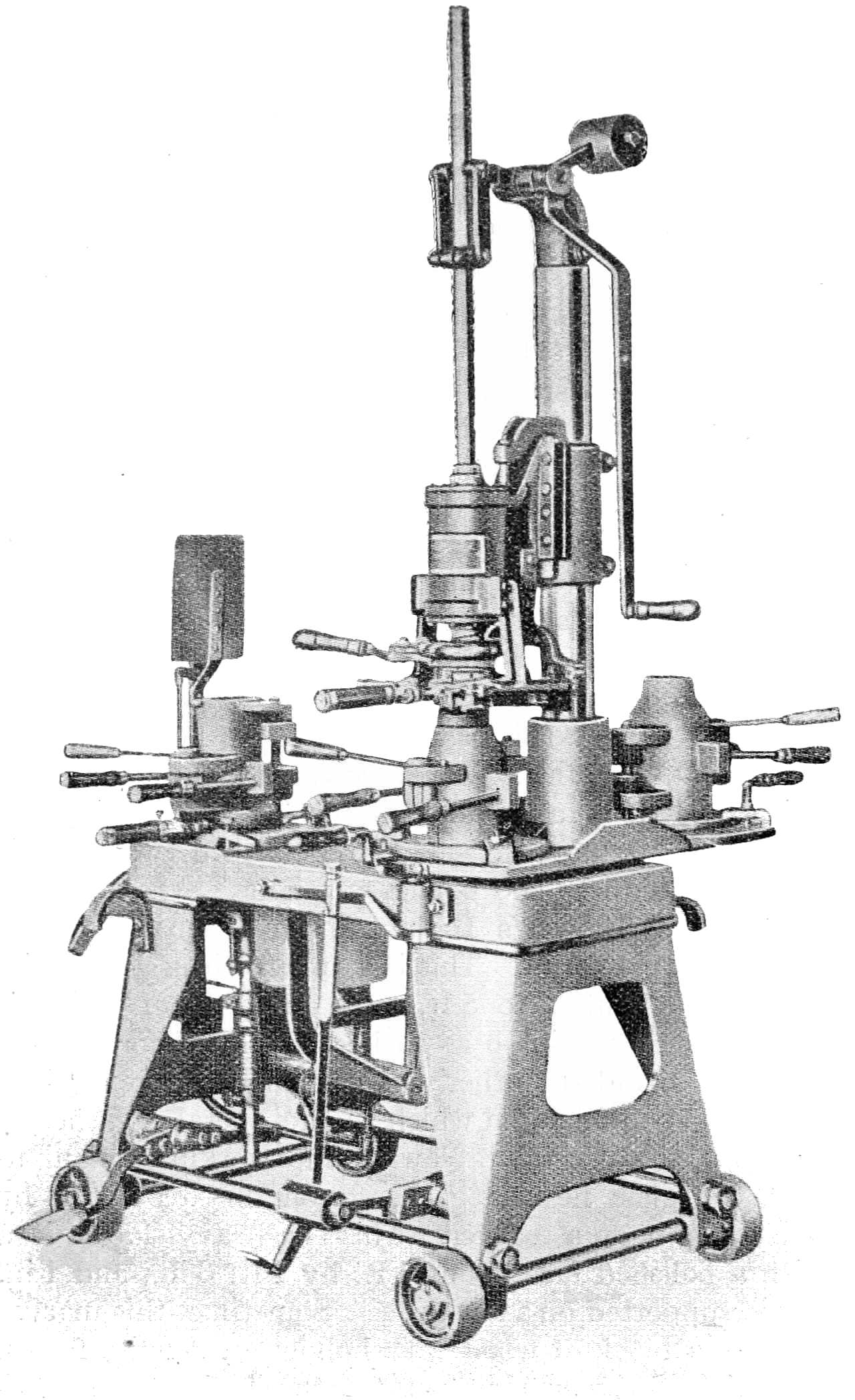
By permission of Melin & Co.
“THE HARLINGTON” BOTTLE-MAKING MACHINE
80Below the table, near the parrison mould, is arranged
an air cylinder, through which a piston runs, operated
by a hand lever. On the upper part of the column, on
which revolves the table with the two finishing moulds,
is also arranged an air cylinder operated by a hand lever.
The method of working is now as follows—
A gatherer puts the metal into the parrison mould
into which it is sucked by moving the left-hand lever.
Through this operation the head of the bottle is formed
and finished. By reversing the lever, air enters the
parrison, thus blowing the same out to the height of
the parrison mould. The parrison mould is now opened
and the parrison hanging in the head-mould held by
the tongues is placed under the blowing cylinder above
the open finishing mould. Now the latter is closed,
and by moving the lever, the bottle is blown and
finished. Whilst this last operation is being effected
by a boy, the table is revolved and the previously
finished bottle is taken out and another parrison is made
ready to be handled in the described way. This
machine produces 200 bottles per hour.
The Glass Blower’s Tools. The glass maker’s chief
tool is the blow-iron. This is a tube of iron 1/2 to 1-1/4 in.
wide and about 4 to 5 ft. long, one end of which is
shaped or drawn in so as to be convenient for holding
to the lips, and the other end is slightly thickened into
a pear-shaped form, on which the hot metal is gathered.
In making crystal tableware the workman manipulates
the glass he has gathered on this blow-iron by
marvering it on a marver. This is a heavy slab of iron
with a polished face about 1 ft. by 1 ft. 6 in., and 1 in.
thick, supported on a low table. Sometimes this marver
may be a block of wood with hollows of definite forms,
in which the workman rotates the hot glass he has
gathered to regulate the form and thickness of the metal
81to suit his work before beginning to blow it out into a
hollow bulb.
The pontil is a solid rod of iron of similar length and
thickness to the blow-iron. By gathering a little wad
of hot glass on the pontil and sticking it against the end
of the bulb attached to the blow-iron, the workman can
detach the bulb from the blow-iron and hold it by the
pontil to which it has been transferred, and which
enables him to work on the other end or opening in the
bulb which is exposed in detaching it from the blow-iron.
After re-heating the glass, he may shear it with his
scissors or shears, open it out with his pucellas, crimple
it with his tongs, measure and caliper it, or shape it
to a template.
Whilst he is doing such operations he sits in a
glass worker’s chair. This chair has two long
extending arms, which are slightly inclined, and along
which he rolls his blow-iron or pontil, with the glass
article attached, working upon the rotating form, turning
the iron with one hand, whilst he uses his tools with
the other hand, to shape or cut the glass to its requisite
form whilst it is hot, soft, and malleable.
The shears are like an ordinary pair of scissors, and
are used for cutting the hot glass, or shearing off the
tops of bowls and wines to their proper height.
82The pucellas is a steel, spring-handled tool in the
form of tongs, which the workman uses to widen,
extend, or reduce the open forms of glass by bringing
pressure upon the grips of the tool whilst applying it
to the hot glass.
The glass maker also uses another form of spring
tool in taking hold of hot glass or pinching hot glass to
form. These are the tongs.
The battledore, or palette, is a flat board of wood with
a handle, used for flattening and trueing the bottoms
of jugs or decanters, etc.
The chest knife is a flat bar of iron, usually an old
file, used for knocking off the waste glass remaining on
the blow-irons and pontils after use. A chest or iron
box is kept for collecting such waste glass for further
use. A pair of compasses, calipers, and a foot rule
complete the glass maker’s outfit of tools.
Making a Wine-glass. The manipulations in the
manufacture of a wine-glass will now be described.
A common mule wine-glass is formed from three distinct
pieces of glass: (a) the bowl; (b) the leg; (c) the foot.
A wine “shop,” or “chair,” consists of three men;
a “workman,” whose main work consists of finishing
the wine-glass; a “servitor,” who forms or shapes the
bulb; a “foot maker,” who gathers and marvers the
glass; and a boy who carries away and cleans the
blow-irons.
The “footmaker” of the “chair” gathers on the end
of a blowing-iron sufficient glass to form a bowl. This
is then shaped on a marver until the required shape
is obtained. The footmaker then blows this out to a
hollow bulb similar in size to the pattern to which he
is working. When the bulb leaves the footmaker it is
the shape of the bowl of the wine-glass.
This is then handed over to the servitor, who drops
83a small piece of hot glass on to the end of the bulb,
and heats the whole by holding it in the furnace. This
serves to make the joint of the two pieces perfect. The
servitor next proceeds to draw out the leg from the
small piece of glass at the end of the bulb, leaving a
button of glass at the end of the leg. The servitor
then dips the end of the leg into the molten glass within
the pot and gathers on sufficient glass to form a foot.
He spreads this portion of the glass out to the required
shape and size with a pair of wooden clappers, with
which he squeezes the hot glass to form the foot.
The servitor has now done his part of the work, and
the glass is handed to the workman. It is then cracked
off, and the foot caught by a spring clip arrangement
attached to a pontil, called a “gadget.” The workman
now re-heats or melts the top edge of the glass by
holding it within the furnace, and when it is hot he
cuts off the surplus glass with a pair of shears. A line is
chalked on at the correct distance from the foot, and
guides the workman in cutting the glass to the proper
height. He then melts the top again and opens it out
with his spring tool to the required shape, after which
the glass is taken to the annealing lehr by the boy, to
be annealed.
Other forms of wine-glasses are made, and various
methods are adopted, according to the district and class
of workmen.
For instance, the method of making the above
common mule wine-glass varies in different districts.
Instead of gathering the metal for the foot upon the leg
of the glass, the workman may drop a piece of hot glass,
which has been gathered by the servitor, on to the
button at the end of the leg, and by means of a pair of
wood clappers spread the hot glass to form the foot.
In another method of making a wine-glass, the stem
84or leg is drawn out from the body of the bulb by pinching
down a knob at the end of the glass. The servitor
draws the leg out of this knob and knocks off the
extreme end. Meanwhile, the footmaker has been preparing
a foot, gathering a small portion of metal on a
blow-iron and blowing it out and shaping it into a
double globule. The end globule forms the foot and
the second merely acts as a support. The footmaker
takes these globules, and the servitor sticks them on
to the drawn stem of the wine whilst it is hot; the
blow-iron holding the globules is knocked away, leaving
them adhering to the leg of the wine-glass. The footmaker
then knocks off the second globule at the line
between the two and, re-heating the bulb at the foot
of the glass, opens and widens the edges out. The
glass then goes to the workman to be finished in the
same way as the common mule wine-glass.
Many articles of glassware are formed with the aid
of moulds. Take as an illustration the manufacture of
tumblers and honey pots. A quantity of glass is
gathered on the blow-iron, marvered, and blown out
into an elongated bulb, which is introduced into a
mould divided in two halves, which open or shut by
hinges, a handle being fixed on either half to facilitate
the operation. The interior of the mould is made to
the shape of the article, and as the bulb of hot glass is
introduced it is shut, and the workman blows down
his blow-iron and extends the glass until it expands and
fills the space within the mould, giving the complete
form of the article with a surplus of metal just where
the blow-iron is attached to the glass at the top. These
tops are then cut off and finished, either by the workman
re-heating the article by attaching the bottom to a
pontil and shearing off the top edges, or the glass is
annealed in its unfinished state and the top surplus
85portion cut off by an automatic machine specially
constructed for cracking off such goods.
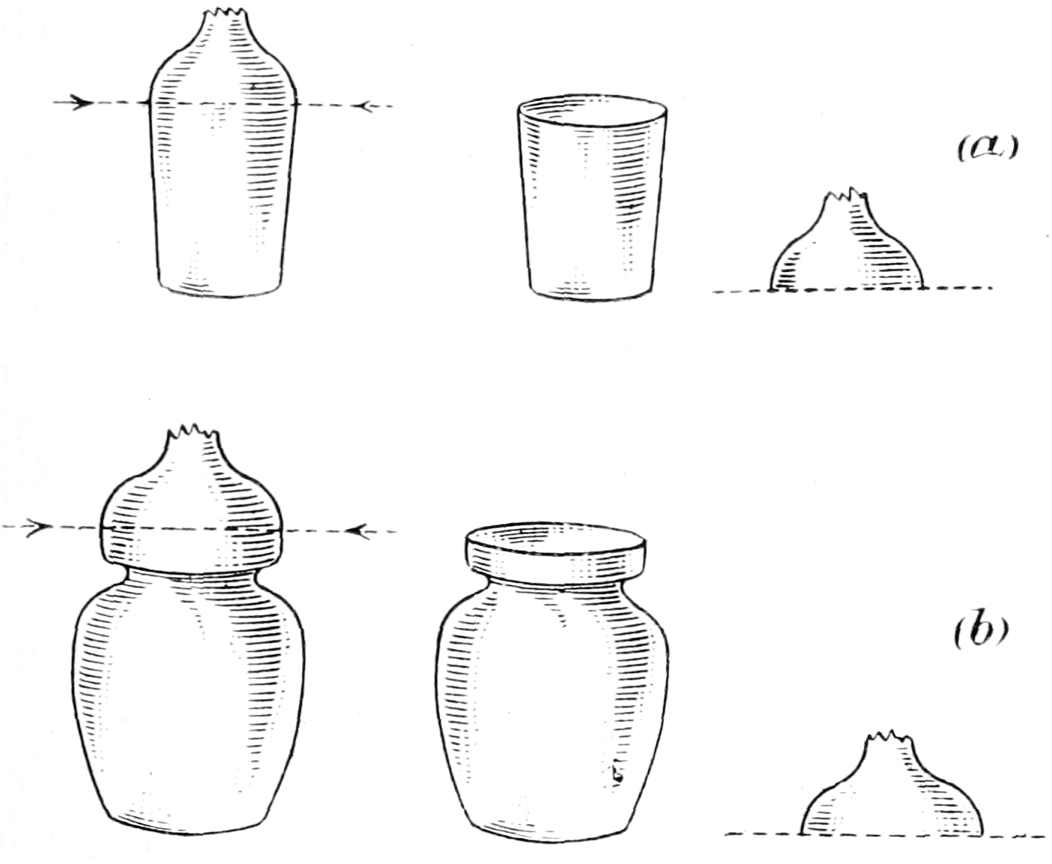
GLASSWARE BLOWN IN MOULDS SHOWING PORTIONS CRACKED OFF
(a) Tumbler.
(b) Honey Pot.
Such machines consist of a set of revolving tables upon
which the glass articles are centred, and each in turn
revolves in front of a thin, pointed, hot jet of gas flame,
which impinges on the glass at the height at which the
glass is to be cracked off. After one or two revolutions in
front of this hot pencil of flame, it is removed, and, by
applying a cold steel point so adjusted as to touch the
part where the jet has heated the glass, a chill is
imparted which causes the upper portion of the glass
to crack away in a clear, sharp line round the glass.
This top portion of surplus glass is thrown aside and
returned to the furnace for re-melting as cullet.
86The tumbler or honey pot is then conveyed to another
machine which fire-polishes the edges to a smooth finish.
This machine consists of a circular revolving frame
carrying small supports, which themselves rotate on
their own centres. Upon each support an article is
placed to be fire-polished and the frame carries them
round, and they travel into another section of the
machine, passing under a hooded chamber, which is
heated by a fierce jet of flame. The jet of flame,
which is localised on to the top edges of the tumblers
or other goods passing through the hood, gives just
sufficient heat to melt and round off the sharp edges
of the glassware where they have been cracked off by the
previous machines. By using these machines in this
way labour is considerably economised, and as many
as 300 or more articles an hour can be cracked off and
fire-polished with unskilled labour.
These machines are extensively adopted in the manufacture
of electric light bulbs, shades, lamp chimneys,
and tumblers.
Moulds are usually opened, shut, and dipped by boys,
but in up-to-date glass works an automatic machine
called a “Mechanical Boy” is used. With this machine,
the mould is operated at the desire of the workman
and not at the desire of the boy. The output is considerably
expedited by the use of these automatic
devices for opening and shutting the moulds.
It is obvious that whatever the shape of the mould,
or whatever the design within the case, the glass takes
the impression and retains it in after working. In
this way, square sections, fluted indentations, or raised
bosses can be formed with facility and regularity.
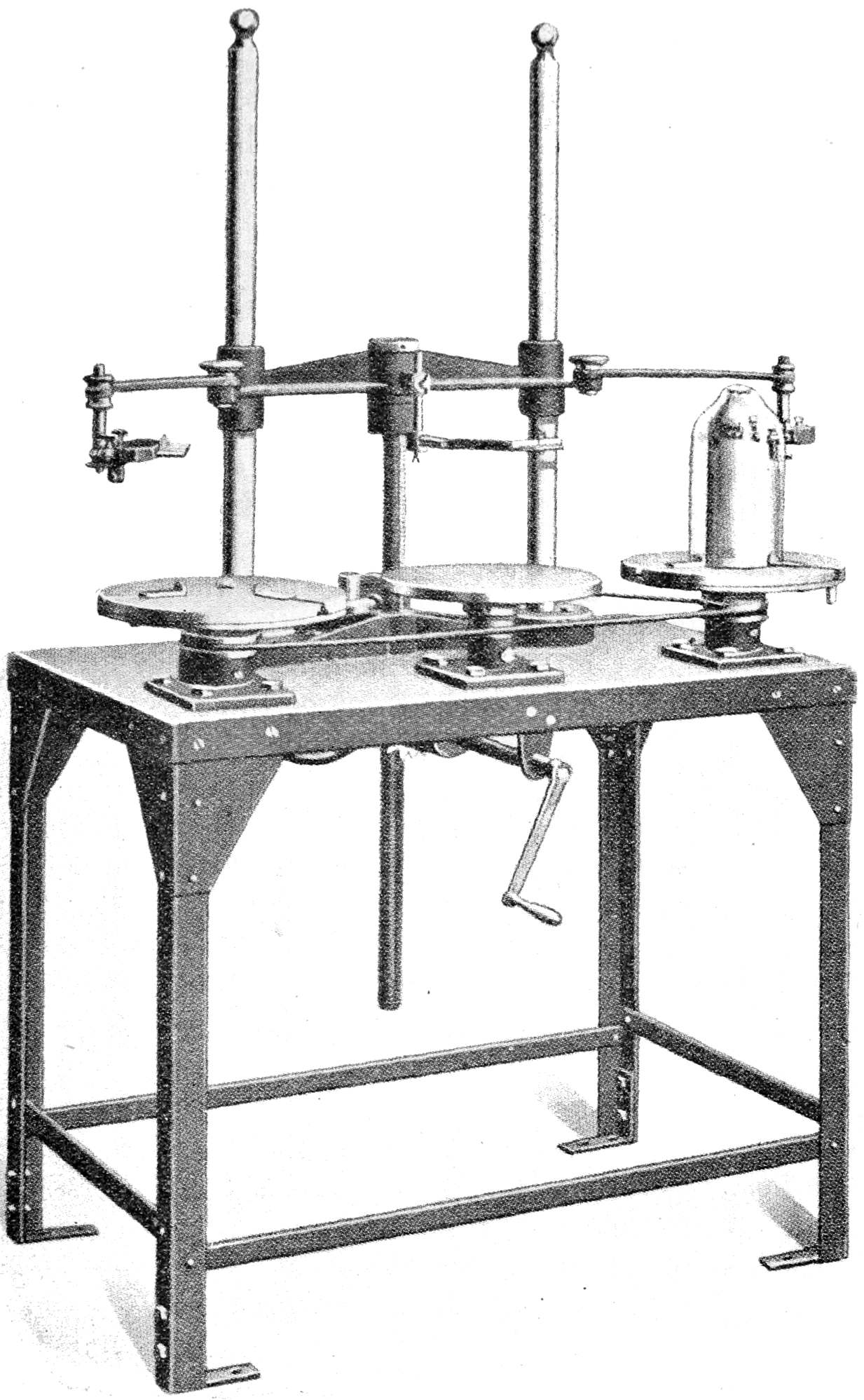
By permission of Melin & Co.
VERTICAL CRACKING-OFF MACHINE
The Glass Workers’ Union consider that the introduction
of machinery deprives men of their independence
and right to work, but as yet the glass blowers
88have been always fully occupied with useful work about
the factories in which such machines have been introduced,
so it cannot be said that they have been forced
to be idle.
The advantages possessed by these automatic
machines in their larger output at so much less cost
compared with hand labour is the great factor in inducing
their adoption; and in these days of progress
and competition such machines enable the glass manufacturers
to cope with the increasing demand and go
far towards bringing a factory up to date and making
it well equipped.
Manufacturers should certainly turn their attention
to these mechanical methods, as their use is quite
general on the Continent and in America, and by their
use the metal can be worked out of the pots or tanks
much more quickly, increasing considerably the turnout
or capacity of the furnace against the fuel consumption.
Much of the glassware imported into this country is
composed of such articles as would have been manipulated
by machines, and, unless a similar method of
manufacturing them is adopted here, we cannot hope
to compete with other countries in supplying our own
needs. In the writer’s opinion, it is mainly due to the
adoption of machinery for producing glassware that
the continental people have been enabled to undersell
us in our own market, and English manufacturers could
produce at a much cheaper rate if they would only
adopt similar methods of manufacture and the gas-fired
furnaces as used abroad.
CHAPTER XII CROWN, SHEET, AND PLATE GLASS
89
The glass used in windows may be either crown, sheet,
or plate.
Crown Glass is made in the form of circular flat discs
about 4 ft. in diameter. The workman, by repeated
gatherings, collects sufficient glass on the end of his
blow-iron until he has a mass approximately 10 or
14 lb. in weight, which he marvers into a pear-shaped
lump by rotating the hot glass in the hollow of a wooden
block. He then blows the glass into a spherical bulb (a),
which, by quick rotation, is widened and assumes a
mushroom shape (b). Another workman attaches a pontil
to the outer centre of this bulb by welding it on with a
small portion of hot metal.
The blow-iron is then detached by wetting and chilling
the glass near to the blow pipe, which breaks away,
leaving an opening in the bulb where it has become
detached (c).
This is then carried to an auxiliary heated furnace,
which has a wide opening emitting great heat, and by
resting the pontil upon a convenient support and
rotating it quickly the action of centrifugal force and
heat causes the glass to spread out at the opening,
which becomes larger and larger until the glass finally
opens out into a flat circular disc of fairly even thickness
throughout, with the pontil still at the centre, forming
a bullion point or slight swelling, due to the knob of
glass used in affixing it (d).
Next, the workman, keeping the disc in rotation,
90brings it away from the furnace and allows the metal
to stiffen and set by cooling, when it is carried to the
annealing oven and detached from the pontil. The
discs are then stacked up for annealing. When
annealed, these are afterwards cut across in sections
or squares of convenient size by using a glass cutter’s
diamond.
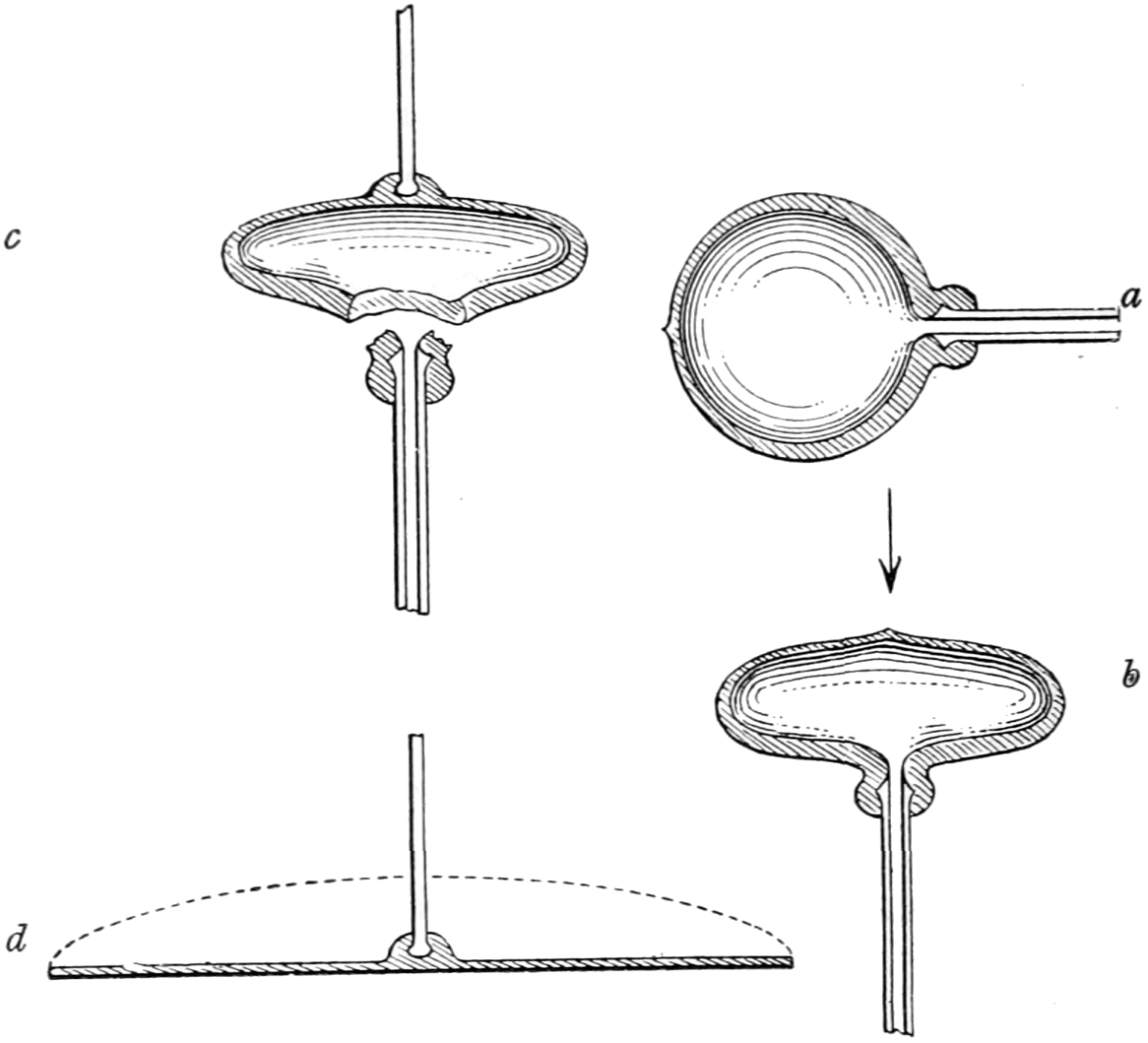
FOUR STAGES IN CROWN GLASS-MAKING
It is evident that the centre portion, containing the
bullion point or bull’s eye, is useless for plain window
glazing, but occasionally these are sought after by glass
decorators for use in coloured leaded lights for door
panels, etc.
91Sheet Glass is made in the form of thin, walled, hollow
cylinders of glass, which are split along their length
and round the cap and then opened out by heat and
allowed to uncurl until each sheet lies out flat. The
workman gathers a sufficiency of glass upon his blow-iron
by repeated gatherings, and marvers it into a
ball about as big as one’s head. This is blown out (a)
and widened by rotating the blow-iron until he gets a
mushroom shape (b), with a heavier bulk of glass at the
extremity than at the sides.
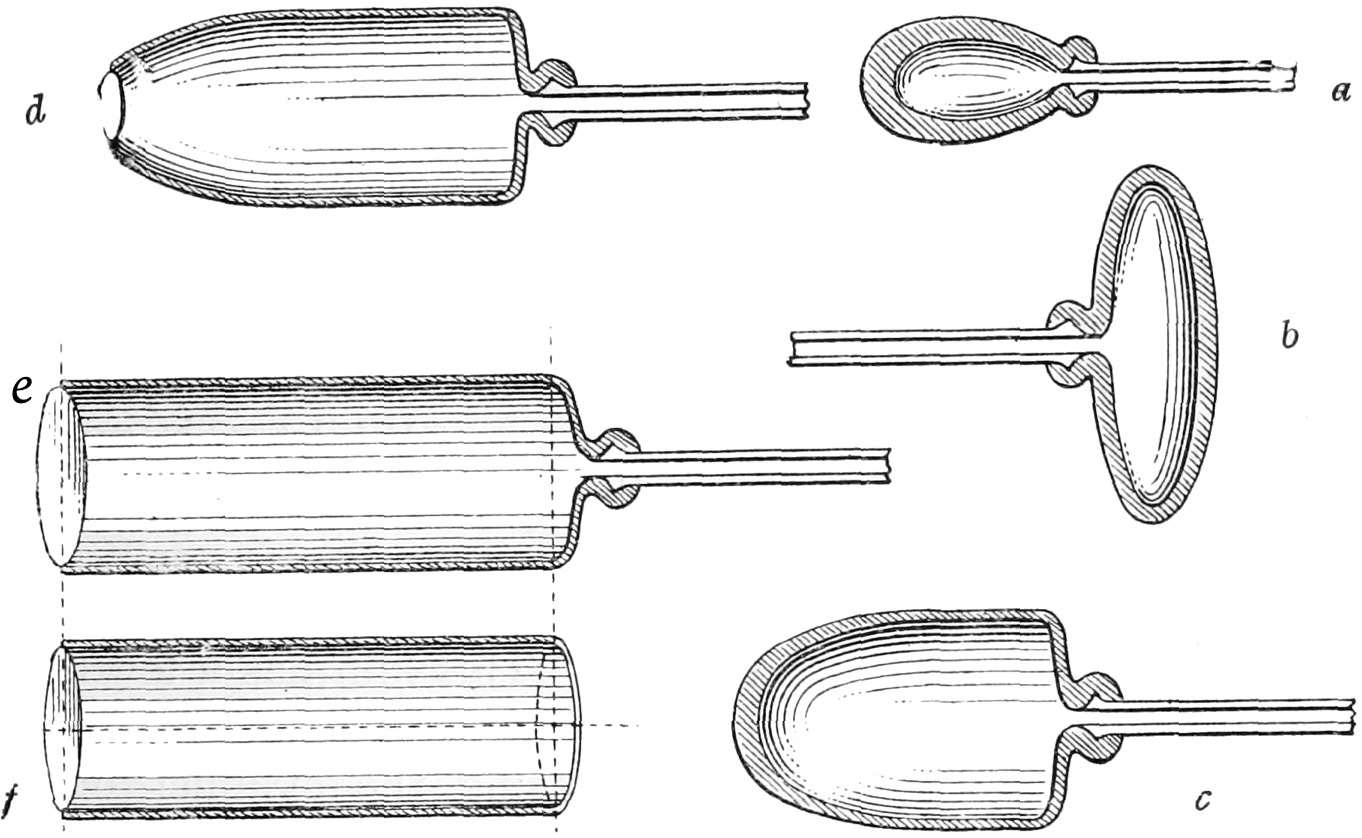
SIX STAGES IN SHEET GLASS-MAKING
This extra thickness of glass at the extremity of the
bulb tends to lengthen the bulb of glass as he swings
it in a pendulum fashion, and by blowing and swinging
it alternately he gets an extended form (c).
To permit the workman to swing the mass of glass
out conveniently to the full length of the intended
cylinder, a long, narrow pit or trench is provided below
the floor level, and by standing alongside this trench
92the workman is enabled to swing the glass within the
trench at arm’s length until the requisite length and
width of cylinder are obtained. This work requires a
high degree of skill and strength. The shape of the
cylinder of glass is now as shown on page 91 (d).
The extremity of this cylinder is now re-heated and
opened with the aid of a spring tool with charred wooden
prongs, until the opening is enlarged and drawn out
to the same diameter as it is throughout the cylinder.
It is now in the form of an open-ended cylinder (e).
The cap of the cylinder at the blow-iron end is now
cracked off. A thread of hot glass is wrapped round
the shoulder near the cap, and the line chilled by using
a curved, hook-shaped rod of iron. Whilst the cap
is being cracked off, the cylinder is allowed to rest
supported by a wooden cradle.
The cylinder is now open at both ends (f) and is taken
to the flattening kiln or furnace. This kiln has a level,
smooth floor, heated from below, upon which the
cylinders are flattened out. Placing the cylinder on
the floor in front of him, the workman places along the
inside length of the cylinder a long red-hot iron rod
touching the glass, and then chills the line with a touch
from a cold iron rod. This causes a split to take place
along the whole length of the cylinder. As these
cylinders are split open, they are removed to a hotter
zone within the flattening kiln, where the heat causes
the cylinder to uncurl and gradually flatten out.
As the sheet becomes flat the workman levels it out
with a flat block of charred wood called a polisher. This
is attached to a long handle, and is rubbed over the face
of the sheet of glass. The weight of the wooden block
is just sufficient to smooth out any creases and assists
in levelling out any irregularities of the surface. It is
essential that the floor upon which the glass is resting
93should be perfectly smooth and level, and uniformly
heated. As each sheet is levelled, it is removed to
the annealing oven and afterwards stacked up until
cool, after which the rectangular sheets are cut up
to the various sizes required for window panes.
It is evident that the crown glass method gives more
waste in cutting up, and does not provide such large
sheets as the cylinder method. On the other hand,
cylinder glass always shows a certain amount of waviness
on the surface, and is not so brilliant as crown glass.
The better surface of crown glass no doubt is due
to the fire-polishing it receives when being expanded
out into the disc. It appears to be somewhat difficult
to get a perfectly smooth level face to cylinder glass
by using the wooden polisher.
Plate Glass is used as mirror glass and in glazing
shop windows and showcases. It may vary between
1/4 and 3/4 in. in thickness, and is more expensive to produce
than crown or cylinder glass.
In the manufacture of best plate glass, the materials
are melted in open crucible-shaped pots of varying
sizes; sometimes, in making large, heavy plate, their
capacity reaches 25 cwts. of metal. When the metal
is plain and clear from seeds it is either ladled out into
smaller crucible pots for casting, or, as in the case of
casting large sheets, the whole crucible of metal is
lifted bodily out of the furnace by means of a crane,
and, after being skimmed, is conveyed by an overhead
travelling derrick to the casting table.
This table is a level iron bench the size of the plate
to be cast, the face of which consists of thick sheets of
iron plate riveted together to form a level top; along
the whole length of each side of this table is a raised
flange of a height sufficient to give the thickness of the
plate of glass to be cast: resting on these two outer
94edges a long, heavy metal roller runs, covering the full
width of the table. The crucible of hot metal is brought
to a convenient position and the contents poured out
on the table in front of the metal rollers. These rollers
then travel along and squeeze or roll out the hot metal
over the surface of the table to the thickness regulated
by the side pieces, which also prevent the metal from
flowing over the sides. The empty crucible is then
conveyed back to the furnace for refilling.
The cast plate of glass is then trimmed from any
excess of glass at the ends, and when set and stiff is
lifted at one end slightly and pushed forward into a
conveniently situated annealing oven, where it is
re-heated and subjected to a gradually diminishing
temperature to anneal it. The plate of glass, as delivered
from the annealing oven, shows surfaces somewhat
rough, wavy, and uneven, from the marks left by the
table and the roller, and it has to be ground and polished
level and smooth on both sides. This is done by fixing
one face of the glass plate in a plaster of Paris bedding
and setting it within a mechanical grinding machine.
This machine carries several revolving arms, to which
are attached other smaller plates of glass. These are
used as the rubbers, a slurry or paste of sharp sand
and water, or abrasive powder, being interposed
between the two. The revolving circular motion of
the arms causes a grinding action between the two
plates, which wears down any irregularities and
gives a more even face. After this, finer grades of
abrasive materials are employed, and, finally, polishing
powder, until the face of the glass plate is polished
smooth and level. The large plate of glass is then
reversed and the process of grinding resumed on the
other side.
Much care is necessary in handling these large plates,
95and every attention is necessary and devoted to get the
largest pieces of plate without defects. All portions
showing defects have to be cut away, and, consequently,
reduce the size of the plate when finished.
In another method of making plate glass the molten
metal is fed between two or more parallel rollers, which
are spaced apart to the thickness of the glass required
(about 1/4 in.). These rollers squeeze the glass out to a
uniform thickness. A roughly decorated surface is
sometimes given to this glass intentionally, by the
metal rollers being indented with some form of set star
pattern. This glass is not ground or polished, and is
sold under the name of muffled or cathedral glass.
It is mostly used for roof lighting, where the transparency
may be somewhat obscured.
Wired glass, or strengthened plate, is formed by
embedding in the soft glass, whilst being rolled, a network
of metallic wire of special composition to suit the
temper of the glass. This wire is fed from a separate
roller into the space between the parallel rolls as the
hot metal is fed in from either side. It is necessary
that the wire should be made from a metallic alloy
which is not easily oxidised. Another method of
strengthening plate glass consists in sealing together
two plates with an intersecting film of celluloid.
A decorated coloured rolled plate is made for use
in leaded lights by mixing portions of several differently
coloured glasses together in a small pot and
slightly agitating the contents so as to intermix the
respective colours. When the glass is rolled out, a
pretty agate or marbled effect is obtained, due to the
distributed coloured glasses becoming intermixed. As
a rule, these glasses are more or less opalescent, and
are only used for decorative purposes, church lights, etc.
CHAPTER XIII TUBE, CANE, AND CHEMICAL GLASSWARE
96
Laboratory and chemical glassware consists of thin
blown ware in the form of flasks, beakers, test tubes,
etc., used in chemical operations. Most of these goods
are blown in hinged moulds mechanically or automatically
operated by the worker. The lips and flanges of
the necks are neatly formed afterwards by re-heating
and working the edge to a form allowing them to pour
cleanly, and prevent any fluid contained therein from
running down the sides of the flask or beaker whilst in
use. The heavier glassware, in the form of desiccators,
measuring cylinders, specimen jars, and three-necked
bottles, are made by handwork. Chemical apparatus
has necessarily to be made from a permanent stable
highly refractory glass, so as to resist the solvent actions
of mineral acids, alkaline solutions, and boiling water,
as well as sudden changes in temperature.
The manufacture of tube and cane glass for various
purposes forms a large and extensive portion of the
glass trade. Considerable quantities of tube and cane
glass in various sizes are used by lamp workers in the
manufacture of certain forms of chemical apparatus and
filling electric light bulbs. By re-heating glass tube and
working before a blow-pipe flame, the various forms of
test tubes, pipettes, burettes, soda-lime U-tubes, and
condensers are made. Generally, for chemical apparatus
two classes of tube are made, one a soft soda tube, and
the other hard combustion tubing. Particular care has
to be devoted to the grading and sorting of the various
sizes. The bore of the tube, the thickness of the walls,
97and the outside width have all to be checked and the
lengths classed accordingly.
In the manufacture of tubing, unless the glass is of
large size or great thickness, it is not annealed, and
shows a case-hardened condition which materially
increases the strength of the tube to resist internal
pressure, as is the case with boiler gauge tubing. In
the manufacture of apparatus from tube and cane,
care must be taken that the various pieces used in
welding together the different portions of the apparatus
should be of the same temper and composition, and
supplied from one source, so that they may join and
work perfectly together.
The lamp worker or glass blower should take care
to get his supplies from a reliable source, so that the
glass pieces will be adapted to work together. Trouble
occurs when odd tubings from various makers are worked
together. The same applies to fancy glass working,
where various coloured canes are worked into ornaments.
Reputable firms can always supply from stock such
colours and tubing properly adapted for their specific
purposes, and they take every precaution to see that
the various colours join and work together. Supplies
of glass rod can be had that will join on to platinum,
nickel, iron, or copper wire with sound joints.
In making cane glass, the workman gathers sufficient
metal upon a pontil: for thin cane he would gather less
than for heavy thick cane. After gathering, he marvers
the metal into the form of a solid cylinder. Meanwhile,
an assistant gathers a little metal on a post or pontil
with a flattened end. The metal he has gathered has
covered the flat end of the post, and he holds this in
readiness for the workman, who is now re-heating the
cylinder of glass at the pot mouth. As the cylinder of
glass becomes soft, he withdraws it and allows the end
98of the cylindrical shaped mass of glass to fall gently
upon the flat end of the post, to which it adheres.
They then carry the glass between them to a wooden
track or run-way, along which they walk at a smart
pace in opposite directions; stretching out the hot glass
between them, it gradually thins out and rests on the
floor. The pace the men separate apart from each
other is regulated according to the thickness of the cane
desired: for very thin cane a smart trot is necessary,
but for a thick cane a slow walk is sufficient. As the
glass is drawn out it is allowed to rest on wooden supports,
and when cool is cut up into convenient lengths
by scratching the glass with a steel file. These lengths
are collected and bundled up for sorting and classification.
All portions distorted or over-size are returned
as cullet for re-melting and re-use.
In tube making, instead of a solid cylinder as in
cane making, the workman, by gathering the glass on a
blow-iron and blowing and marvering it, obtains a
thick-walled, hollow, cylindrical form. This is re-heated
and the end stuck to a post and drawn apart as before
described in cane making, forming a tube of a width
proportional to the rate the two have travelled apart in
drawing it out, and to the quantity of metal gathered.
In this way the respective sizes and thicknesses are
regulated. A narrow cane or tube may be drawn out
for 300 ft., but for a thick or wide one probably only
30 ft. may be drawn. In making the larger widths,
some method of cooling, or fanning, is adopted, to
ensure uniform size by cooling the hot glass quickly
as it is drawn out. It is evident that, whatever shape
is given to the original mass of glass whilst being marvered,
the tube will bear a similar shape in proportion,
either within or outside the glass. In this way, square,
triangular, or oval sections can be produced in both
tube and cane.
99The manufacture of white opal, coloured cane, and
tube is carried out on like methods to those used in
ordinary cane and tube making.
We will now describe the manufacture of Filigree.
This is rod or tube containing opal or coloured threads,
either straight, spiral, or interlaced within a transparent
glass; these threads follow the whole length of
the cane or tube.
This curious form of glasswork was originated by the
Venetians, who are exceptionally skilled in producing
some elegant and ornamental filigree decorated glassware.
The method of producing filigree cane consists of
first taking a number of short lengths of opal or coloured
cane previously drawn and cut to about 6 in. lengths.
These are then placed in vertical positions around the
inner circumference of an iron cup mould, which may
be about 5 in. in diameter. The opal strips of cane
are supported vertically in small recesses provided in
the rim of the mould at equidistant intervals. A ball
of hot crystal glass is gathered on a pontil and is lowered
into the inside of the mould, the hot metal coming in
contact with the opal strips of glass adheres to them,
and upon withdrawing the glass it brings the opal strips
away with it arranged in sections round the circumference
of the ball of glass. This is now re-heated and
marvered until the canes or strips of opal are well
embedded in the hot glass. Then the workman gathers
another coating of hot glass over the whole, marvers it
again into a cylindrical form, and then proceeds to draw
it out as described in cane making.
If a spiral form of lines is desired, the workmen,
whilst drawing out the cane, turn or twist the pontil
and post in contrary directions. These rotations cause
the opal veins or threads to assume a spiral or twisted
form within the glass. Various coloured cane may
100be used in the above process, and by placing them
in alternate positions to the opal strips within the cup
mould some very pretty and curious filigree work is
obtained. These twisted filigree canes are used and
manipulated over again in the process of making the
various Venetian goblets and wine stems. Some fine
effects in the application of filigree decoration can be
seen in the specimens of Venetian glassware exhibited
in the British Museum.
Millefiore work is produced by the workman, first
spreading a layer of an assortment of small coloured
glass chips of varying sizes (between 1/8 and 1/4 in. cube)
over the face of the marver, and then taking a gathering
of crystal metal on his blow-iron and rolling the ball of
hot glass into the coloured mixture on the marver.
The hot glass collects up a coating of the coloured
chippings, and is then re-heated and again marvered,
another gathering of crystal metal is made, which
incases the whole. This is then blown out and worked
into some form of ornament, such as a paper weight,
inkpot, or bowl, producing a curious result that shows
blotches of colours embedded within the glass, the
effect of which is increased if a backing of opal glass
has been used in the first gathering: this shows the
coloured effect against a white background.
Spun Glass. Another curious form of glass is the
spun glass which is much employed in making fancy
ornaments. Glass can be spun into a thread so fine
and flexible that it can be worked into a fabric like any
textile material. In this way, glass ties can be made
by plaiting the spun glass threads into the required
form. Spun glass fibre is used in making the brushes
used for cleaning metals with acids. On account of its
greater resistance to acids than is shown by ordinary
cloth, an endeavour is being made to use spun glass
101cloth in certain industries as a commercial application.
Spun glass is used for making a form of filter cloth
which is being used successfully in filtering acid residues
in certain chemical processes, and, no doubt, when the
elasticity and strength of the glass threads can be more
developed, the scope for its use in other industrial
processes will be increased.
The method of making spun glass thread consists in
melting the end of a plain or coloured glass rod (which
may be square, round, or triangular in section) in a
blow-pipe flame and grasping the end which is melting
with a pair of pincers, drawing it out and affixing it
to a wooden drum, which is turned rapidly away from
the glass being heated. The drum may be 2 or 3 ft.
in diameter, and as the glass is continually fed into the
heat it is drawn out into a very thin thread by the
rapidly revolving drum, and coiled up until a sufficient
quantity has been obtained. The thread is then cut
across the drum, collected, and used for plaiting or
braiding into the fabric or cloth.
The iridescence and variety of colours yielded by the
refraction of light between the glass threads gives spun
glass its peculiar effect, very evident in the forms in
which it is used in decorating small ornaments such as
forming the tails of glass birds.
Glass wool is made in a somewhat similar way, and
is successfully used as a non-conductive packing material
for insulation from heat.
Glass frost or snow is made by blowing small gatherings
of glass out to a bursting point. These very thin
shells are then crushed and the flakes collected, and used
for such purposes as surfacing sand paper or decorating
Christmas cards, being sieved to the requisite size and
affixed with a siccative to the paper.
Dolls’ eyes and artificial human eyes are made by
102well-trained operators working before a blow-pipe flame
and manipulating tube and cane of delicately coloured
tints to form the pupil and shell of the eye, the veins
being pencilled on with thin threads of red-coloured
glass. A considerable amount of skill and adaptation
is necessary to do this class of work, and much depends
upon the matching of the coloured cane glass used to
give the natural effects. When properly made, so clever
and natural are these glass imitations of the human eye
that it is with difficulty that the ordinary observer can
tell that they are not real. A skilled worker will make
the artificial eye to fit the muscles of the socket and so
move. In this way much ingenuity has been shown in
fitting the eye sockets damaged during the war.
Aventurine is a golden coloured glass containing
minute yellowish spangles or crystals reflecting upon
each other and giving its peculiar effect. This glass
is obtained by the use of an excess of copper with strong
reducing agents in the glass, whereby the copper is
partially reduced within the glass, giving the pretty
spangled effect. This glass is often used in the form of
jewel stones, being cut and polished and fitted in ornaments.
The process of making this glass was originated
by the Italians, and for some time it remained a
secret with them, and even now is styled “Italian
aventurine.”
Chrome aventurine is another form, giving a green,
spangled effect. This is got by using an excess of
chromium in the presence of reducing agents.
The successful production of aventurine depends
upon slowly cooling the molten glass so as to assist
crystallisation.
Mica schist, or flake mica, is used to give another
curious effect in glass. A gathering of some dark-coloured
glass is rolled or marvered upon a thin layer of
103flaked mica, and then a further gathering or coating of
clear crystal metal is made. The whole is then blown
and formed into some fancy ornament or vase. When
finished, the glistening mica flakes show through against
the coloured background, giving a curious silvery
reflection.
CHAPTER XIV OPTICAL GLASS
104
The manufacture of optical glass forms a very important
section of the glass industry, and presents some of the
most difficult problems the glass maker has to deal
with. It is in this section of the glass trade that
applied physical and chemical science becomes of the
utmost importance to the manufacturer. The production
of optical glass is impeded by any defects which
become evident in the structure of glass when examined
under a polariscope. The presence of any striae, seeds,
or stresses within the structure of the glass disqualifies
it for any important optical work. It is a difficult
matter to get pieces of optical glass only a few inches
in diameter of the right optical constant and refractive
index that are homogeneous enough to allow of the
light rays passing without some dispersion when set
up for use. It becomes necessary, therefore, to achromatise
one glass with another in the form of doublets
to correct aberration. A high degree of transparency
and durability is necessary in all optical glasses.
The persistent evidence of stresses developed in the
solidification of the glass upon cooling, even when the
glass is slowly and carefully annealed, is a most difficult
factor to deal with. In annealing optical glass, the
various temperatures and time periods have to be
delicately adjusted and controlled, or big losses result.
Even then many efforts may be made before a suitable
piece of glass is obtained, and the costs keep accumulating
with each attempt, and some idea of the amount
105of labour involved in the undertaking to produce
optical glass at once becomes evident. The use of
decolorizers and impure materials is not permissible,
on account of the absorption and consequent resistance
to the passage of light rays. The annealing, instead
of occupying one or two days, is sometimes extended
over a course of ten or fifteen days, in order gradually
to relieve any stress present. The pots in which the
glass is melted may only once be used, as the glass is
usually allowed to cool down gradually and undergo
the process of annealing within the pot.
The temperature of the furnace is controlled by
regulating the draught by means of dampers in the
main flues, arranged to act so as to carry out the annealing
of the glass within the furnace. The regulation of
the temperature within the furnace is of the greatest
importance; if too hot the glass dissolves the clay of
the pot, and if retarded too much it gives difficulty in
freeing the metal from seeds, and plaining or fining the
glass properly. Small furnaces containing one or two
pots give the best results. These furnaces are worked
on an intermittent process of first melting the glass and
then gradually cooling to anneal the glass within the
pots in mass, the furnace being allowed to die out
gradually. When cool, the pots are broken away from
the glass, which is then cleaved into lumps. Each
lump is carefully examined for any defects and the best
pieces selected for re-annealing. These are afterwards
ground to the desired shape in the form either of a lens
or prism. The chances are that not many pieces of
perfect glass can be obtained from each pot of metal,
and probably out of a whole pot only a fifth would be
suitable for use after the process of selection and cleaving
has taken place.
In the manufacture of optical glass, batch materials are
106chosen that do not differ greatly in specific gravity.
Every effort is devoted to obtain the purest materials
possible; the batches are finely ground and well mixed
before melting. The glass-melting pots should be made
of the purest and most refractory obtainable
in order to prevent the solution of any impurities into
the glass whilst it is melting. In heating the pots for
melting optical glasses every endeavour is made to heat
them equally all round the top, bottom, and sides, so as
to dissolve all portions of the glass evenly and completely
together. At times the melted glass is stirred
with a bent iron rod encased in a porcelain tube, and
the glass agitated in order thoroughly to mix the
components whilst fusing, and keep the composition of
the glass as uniform as possible. After the metal has
melted and plained clear from all seed and cords, the
pot of metal is annealed, and when cooled the glass is
extracted in lumps and examined for any defective
pieces, which are rejected. The selected pieces are
afterwards ground to the desired shape and, if necessary,
re-annealed. In this process the pots being used only
once, are expensive items, and they considerably
increase the cost of production.
Before the war the optical glass trade was confined
to a few firms in this country, who supplied only a
fraction of our needs. We have been dependent mostly
upon continental supplies of optical glass, and it is
only quite recently that Government state assistance
has been forthcoming in giving scientific aid to manufacturers
by investigating and reorganising this section of
the glass industry. It is to be hoped that this state
assistance will continue, and that the optical branch
of the glass trade will be perfected to such an extent
that we may in future be independent, and produce
for ourselves all the optical glass requirements of our
107navy and army. It is to be regretted that this industry
did not receive state assistance before the war. If it
had, we should certainly have been better prepared
and equipped than was the case at the start of the
Great War.
CHAPTER XV DECORATED GLASSWARE
108
Certain methods of decorating glass are carried out
whilst the glass is being made by the workmen. Other
methods consist in decorating the glass after it has been
made, such as cutting, fluting, etching, engraving, and
enamelling. In another form of decoration the method
consists of a combination of two or more of the above
processes. The crystal glass may be cased over with
a thin covering of coloured glass by the glass worker,
and this outer coloured casing cut through by the glass
cutters, exposing and showing through the colourless
crystal underneath with very effective results.
A small portion of coloured glass, such as citron green,
topaz, blue, or ruby metal is gathered from the pot by
an assistant, and the workman, gathering a ball of
crystal glass on his blow-iron, allows a portion of the
coloured metal held by the assistant to fall or drop
upon the ball of crystal. Upon blowing the whole out,
the coloured metal is spread as a thin casing upon the
outside of the bulb of crystal. This bulb is then worked
into a wine-glass or other article, which, after annealing,
is sent to the glass cutter, who decorates the outer
surface by cutting the glass on his wheel. The colourless
glass then shows through against the coloured surface
where it has been cut to the pattern, the colour standing
out in relief.
In another form of decoration, the workman allows
small pear-shaped tears or drops of coloured glass to
fall upon the outer surface of a bowl or vase, in equidistant
positions round the circumference of the article,
109By placing and working the coloured glass into position
in this way, some pretty artistic results are obtained,
dependent upon the skill and artistic taste of the
workmen.
In another method of decoration, certain coloured
glasses are used, the composition of which causes them
to turn opalescent upon re-heating the glass to a dull
red heat. The re-heating of the tops of crimpled flower
vases made from such glass gives pretty results, showing
a gradual fading opalescence, extending from the top
edges to a few inches down the vase, into a clear coloured
glass at the foot of the stand. A similar effect, without
the opalescence, is obtained by the workman gathering
a small piece of coloured glass on the tip of his blow-iron,
and then taking a further gathering of clear crystal
metal. The whole is then blown out and worked into a
vase or wine-glass, thus obtaining a coloration denser at
the top edges, where the vase or wine-glass has been
sheared off, and gradually fading away to a colourless
glass a few inches towards the foot, which is clear
crystal.
There are also certain compositions which, when
worked into a vase, and re-heated on the edges, strike
or turn to a colour such as pale blue or ruby. These
are self-coloured glasses, in which the colouring remains
latent until the glass is re-heated, like the opalescent
glasses. In these glasses the composition is the more
essential factor.
Glass cutting is an effective way of decorating
glassware. In using this method, the crystal glassware
is made fairly heavy and strong, so as to permit of the
deep cuttings which refract the light and show up the
prismatic patterns so brilliantly.
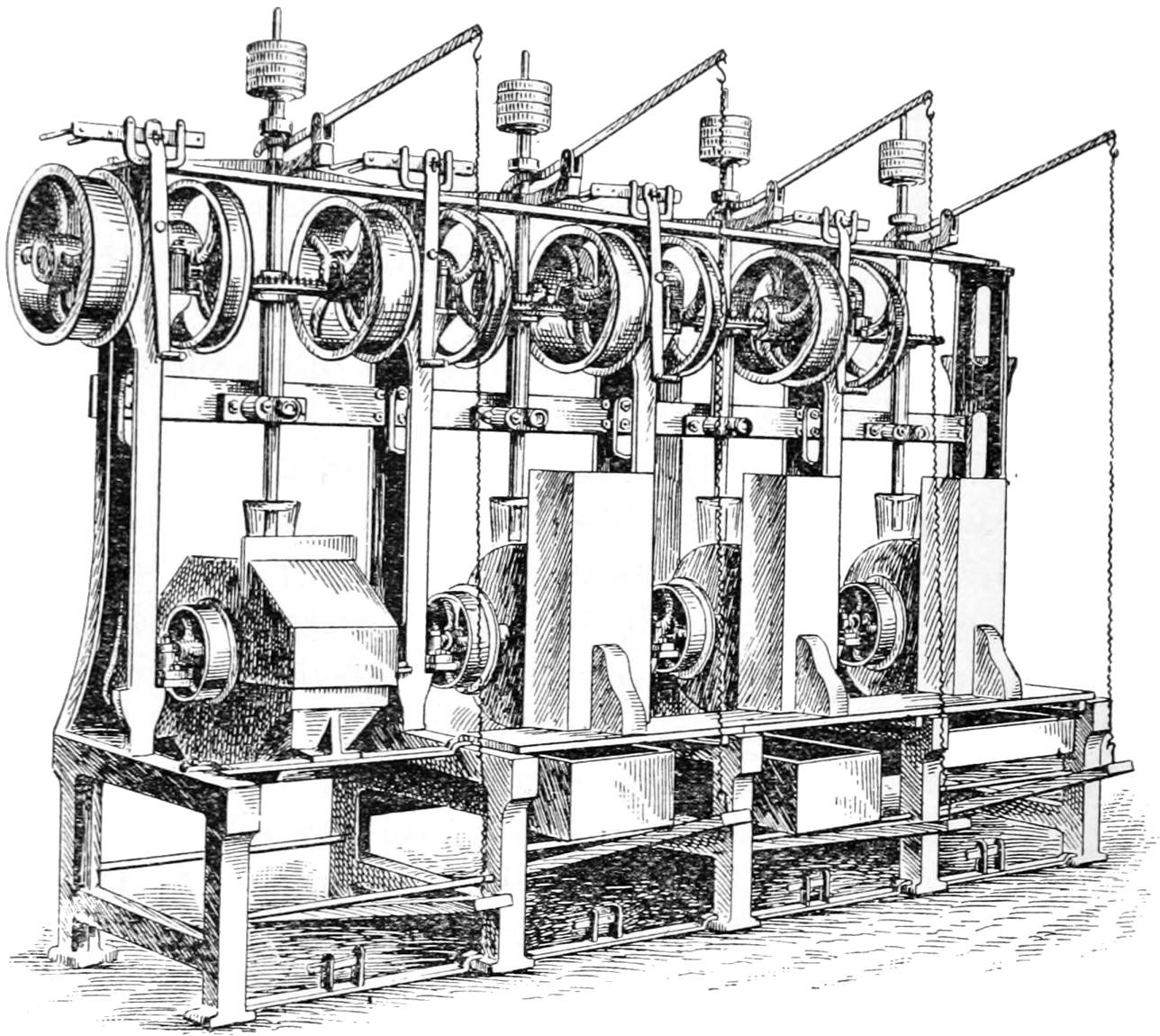
MACHINE FOR SMOOTHING BOTTOMS OF TUMBLERS
In cutting glassware, the glass cutter works in front
of a rotating disc of iron carried in a frame. This wheel
110has a bevelled edge upon which a fine jet of sand and
water is allowed to drip from a tundish above. The
abrasive action of the sand cuts into the glass, and the
workman, by holding the glass dish or bowl against the
wheel, follows the design or pattern in diagonal lines
across the article. These cuttings are recrossed, and
the intermediate diamond spaces filled in with lightly
cut set patterns, until the whole of the intended design
is “roughed” out over the surface of the glass, after
which the glass is taken to another frame carrying
a stone wheel, which is of much finer abrasive action.
This stone wheel smooths the rough cuts done by the
111previous wheel. After this the cuts are polished successively
on a wood wheel and brush with polishing
powders, until a smooth and polished cut is obtained.
As the value of the glass is greatly increased by
cutting, only the best and clearest articles of table glass
are so treated. The work of cutting becomes technical
and expensive, according to the richness of the cutting
demanded. The crystal table glass made from lead
gives the most brilliancy in cutting. Soda-lime glasses
are found to be hard to cut and do not give such brilliant
and prismatic effects as the glass made from lead
compositions.
An automatic machine for grinding, smoothing, and
polishing the bottoms of tumblers, etc., “bottoms”
or grinds, smooths, and polishes tumblers at the rate
of 2,000 a day. Four vertical revolving wheels are
fixed within a frame, one iron, two stone, and one wood.
Over each of these is a rotating spindle carrying the
tumbler so that the bottom of it is automatically pressed
against each vertical wheel in turn. The first wheel
does the roughing, the two next the smoothing, and
the fourth the polishing. These machines are simple
and require only unskilled labour to operate, and go
far towards cheapening production.
Glass engraving and intaglio work is a much lighter
and more artistic method of decorating glass than the
deep cutting before described. In these processes the
glass is cut or ground to a less extent, and a more free
treatment of design is possible. Floral ornamentation
and natural forms of applied designs can be carried out,
and portions may be left rough or polished, according
to the effect of light and shade required. The workman,
whilst engraving, works before a small copper or metal
wheel rotating in a lathe, and uses fine grades of emery
or carborundum powders made into a paste with oil,
112as the abrasive medium. The frame turning these
wheels is like a lathe, and may be worked by a foot
treadle. The wheels are interchangeable, and an assortment
of various sizes, having different bevelled edges,
is kept at hand in a case, from which the engraver
selects the one most suitable for the particular work
to be done.
Glassware for engraving and intaglio may be made
much lighter than that required for cutting.
Etching is a method of decorating glass by the chemical
action of hydrofluoric acid. This acid in its various
combinations attacks glass, decomposing its surface
and giving a dull or semi-matt effect. Only those
portions of glass which constitute the design are
exposed to the acid paste or fumes. The other portions
are protected by a covering of beeswax, which is unaffected
by the acid and protects any portions covered
by it.
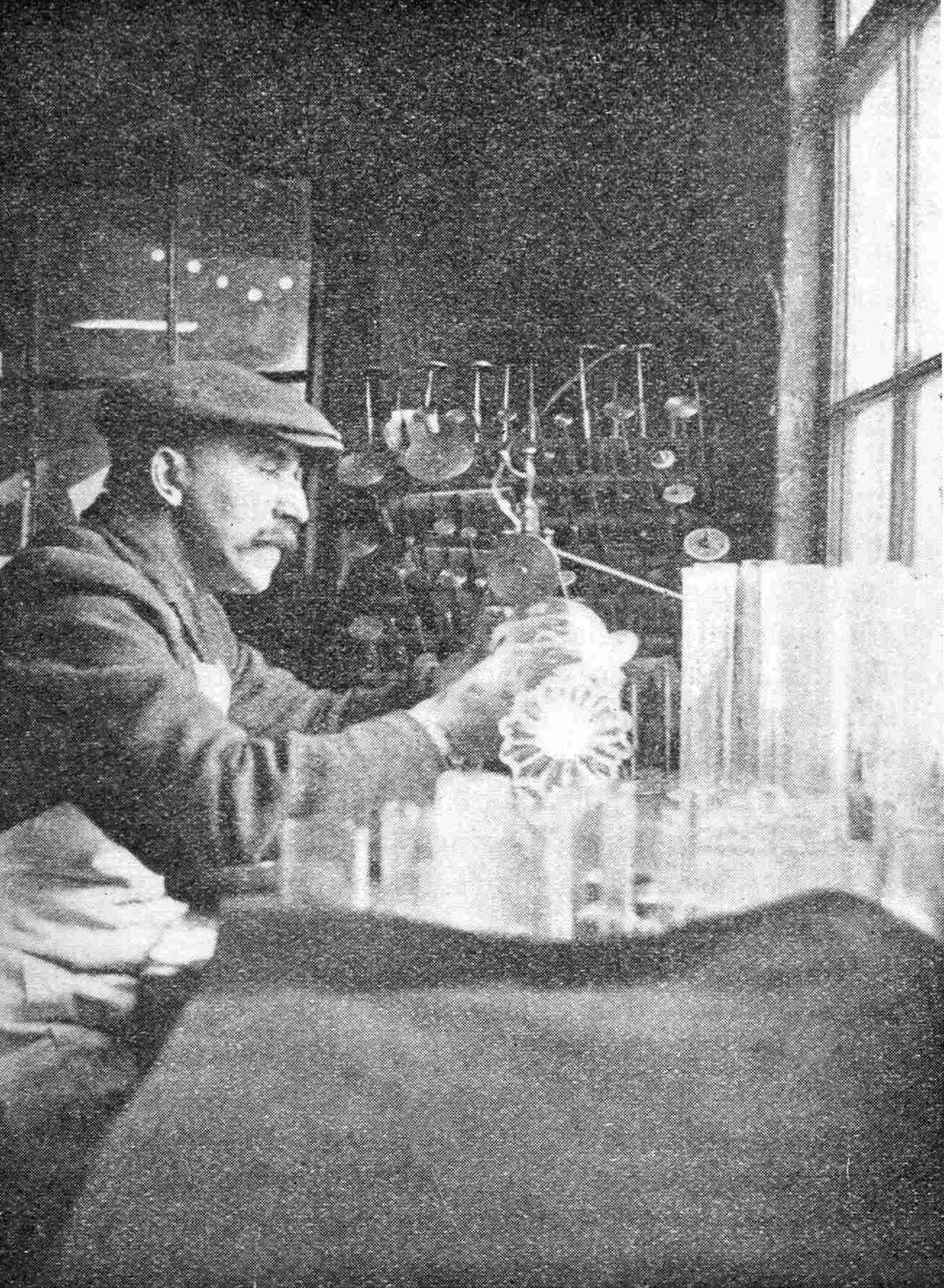
The process carried out is varied in many ways.
In some cases pantograph and etching machines are
introduced to give the designs. A warm copper plate,
with the design or ornament engraved thereon, is
covered with a wax paste, and the surplus cleaned off
with a palette knife or pad of felt, leaving the paste
in the recesses of the engraving; a piece of thin tissue
paper is laid over the engraved plate and takes an
impression of the design in wax. This tissue is
then transferred to the glass to be decorated, the
wax design adheres to the glass, and the paper is drawn
away. A further resist or coating of wax is painted
round the design to protect the rest of the glass, and a
paste composition giving the action of hydrofluoric
acid is applied, which after a short time eats into the
exposed portions of glass. After another short interval,
it is washed off, and the wax coating removed by washing
114the glass in hot, soapy water. The design then appears
in a matt state against the clear, unattacked glass.
The mechanical method of etching the design is
carried out by first dipping the whole glass into a bath
of hot liquid wax, allowing a thin coating to set and
cool upon the surface of the glass. The article is then
introduced into a machine which has a number of
needles, worked by sliding gears in an eccentric fashion.
These needles are adjusted just to scratch away the thin
coating of the wax into a design, and expose the glass
in the form of a decorated scroll or band round the
glass. The glass is then dipped into a vat or bath of
dilute hydrofluoric acid for a few minutes, after which
it is removed and washed, and the wax recovered by
heating the glass upon a perforated tray, when it melts
and runs off the glass, and is collected for further use.
The article is then washed and cleaned and shows the
scroll or etched portions where the needle has traced
the design. Another effective result is obtained by
etching a design on the back of a plate glass panel.
After cleaning and silvering or gilding the back, the
design appears in a matt silver or gilt lustre upon
viewing it from the front of the mirror.
Glass which has been sand-blasted has a similar
appearance to etched glass, but a rather coarser surface.
The portions of the glass plate to be decorated are
exposed to the action of a blast of air, into which fine,
sharp-grained quartz sand is automatically fed. An
abrasive action, due to the force with which the particles
of sand are blown against the glass, takes place, rendering
the surface opaque or matt. This method is
generally adopted in printing trade names or badges
upon bottles, etc. A stencil of parchment or lead foil
is cut out to form, and used to protect the glass and
resist the abrasion where required. Rubber gloves are
115worn by the operator. The work of sand-blasting is
executed within a small enclosed dust-proof chamber
fitted with glass panels. The operator manipulates the
glass through openings in the sides of the chamber.
The air blast is supplied by a motor-driven air compressor
and is regulated by a foot pedal. The action
is very sharp and quick, and is a cheap and effective
way of badging hotel glassware and proprietary bottles.
Glassware may be decorated by being enamelled
with coloured enamels. In this method of decorating,
soft, easily-fused, coloured enamels are used, containing
active fluxes such as borates of lime and lead, which
melt at low temperatures. These enamel colours are
prepared by being fused and then ground to fine powders,
which are mixed with a siccative or oil medium, and
painted upon the glass. The painted ware is then
heated within a gas or wood-fired enamelling furnace or
muffle, until the painted designs are melted and fused
well upon the glass. The glass is re-annealed in cooling
down the muffle. For this form of decoration, a hard
refractory glass is required that will not soften easily
under the heat of the muffle; otherwise the glassware
becomes misshapen too easily under the heat necessary
to flux or fuse the enamels properly.
A form of staining glass is also practised which
consists of applying compositions containing silver salts
to portions of the glass and firing at a low heat. The
silver stains the glass a deep yellow. The colour may
be varied by the use of copper salts, when a fine ruby
stain is obtained wherever applied.
Iridescent glassware is produced by several methods.
Sometimes a small proportion of silver and bismuth is
added to a coloured glass batch, and by manipulating
the resulting glass in a carbonaceous flame the silver
is partially reduced within the glass, forming a pretty
116iridescent reflection on the glassware. By a suitable
adjustment of the oxygen content in the composition of
such glasses, the iridescence can be regulated to such an
extent that the slightest flash or reducing influence
gives a beautifully finished lustre over the ware.
Iridescence can also be formed by re-heating crystal
glassware within a chamber in which salts of tin, barium,
aluminium, and strontium are volatilised. This method
produces a superficial iridescence which is not quite
so permanent as the previous process.
Glass Silvering. The silvering of mirrors is carried
out by taking a thoroughly cleaned plate of polished
glass and floating one surface in a solution of silver
nitrate, to which a reducing agent is added. The
silver is thereby precipitated or deposited in a thin
lustrous film upon the glass, which causes reflection by
the rays of light striking against the silvered background.
After silvering, the back of the plate is coated with a
protecting paint or varnish, which dries and preserves
the silver deposit and gives it permanency.
In the manufacture of fancy ornaments, such as birds,
hat pins, and small animals, various coloured glass
cane and tube are worked together by the operator
melting and welding the respective colours together
before a blow-pipe flame, the tails of the birds being
formed by sealing in a fan of spun glass into the body
of the bird, which has been blown out and formed from
a piece of tube. Some very curious ornaments are
formed in this way. Glass buttons, pearl, and bead
ornaments are formed by working cane and tube of
various coloured compositions before the blow-pipe,
sticking and shaping the various forms on to wire.
Mosaic glass decoration is used in jewellery in a mural
or tessellated form. In this method small cubical or
other shaped cuttings of various coloured opaque glass
117are inlaid in mastic cements or pastes to form the
design, the face being afterwards ground and polished
smooth, and mounted or set within the ornament.
Larger cuttings may be inlaid in cement for pavement
or mural decoration.
CHAPTER XVI ENGLISH AND FOREIGN METHODS OF GLASS MANUFACTURE COMPARED
118
The continental methods of glassmaking differ so much
from the English methods that a few remarks giving
comparisons will be of interest. It is noticeable that
chemical and engineering science is more thoroughly
applied in the manufacture of glassware abroad. Their
method of specialising wherever possible, and the
introduction of mechanical and automatic machines
have done much toward increasing their production
and efficiency.
The flourishing and extensive state of glassmaking
abroad is shown by the size and extent of the glass
works, some of which work as many as forty or fifty
furnaces and employ 3,000 to 5,000 hands. Gas-fired
regenerative or recuperative furnaces are more generally
used, which permit higher temperatures, cheaper metal,
and greater economy in fuel and labour.
The present type of English furnace is very wasteful,
and even with good fuel it is difficult to maintain high
temperatures and regularity in working. Our method
of firing, raking, and teasing is very exhausting to the
workmen in attendance.
In many English glass works, especially those in the
Stourbridge district, it is the practice to fill the pots
on a Saturday morning and take until the following
Monday night to melt and plain the glass, no glassware
being made for three days of each week. Starting on
119Monday night or Tuesday morning, the glass makers
work in six hour shifts day and night until Friday night
or Saturday morning, when the pots are again filled
and the weekly course starts over again. Abroad the
pots are filled nightly and hold just sufficient metal to
last out the work during the day, and are built of a
capacity to suit the articles being made. The disadvantages
of our method are obvious when a comparison is
made with the continental method of melting the glass
nightly and working it out daily, especially when the
efficiency or output of the furnaces as compared with
their fuel consumption is taken into consideration.
Abroad the furnaces are small and compact; they take
up less floor space, yet they are far greater in efficiency.
As they are gas-fired, the combustion is more complete,
and by the use of regenerators or recuperators greater
heat is available for melting the glass quickly. Larger
proportions of sand are used in the glass mixtures,
which, being the cheaper component, cheapen the
production of their glass wares.
Owing to the more perfect combustion which takes
place within the chambers of gas-fired furnaces abroad,
lead glasses are successfully melted within open crucible
pots. When the heat comes into direct contact with
the batch materials being melted, it does its work
quicker and with less fuel consumption than is the case
if it has first to be conducted through the hood of
covered pots which have necessarily to be used in the
old English type of furnace.
It is particularly noticeable that the glass workers
abroad do not spend so much time upon producing an
article as is usual under the English method of working.
By the extensive use of moulds fitted to mechanical
contrivances operated by the foot, their work is expedited
and made simple and easy.
120Technological education in the glass industry abroad
is more thorough and general. The glass workers, not
having to work at night, have the evenings free for
recreation and education. It would do much towards
developing the English glass trade if night work for
boys could be abolished. The adoption of the continental
system of melting the metal during the night
and working only during the day (by using gas-fired
furnaces) would do much in this direction. One cannot
expect the youths of the glass trade, who have to work
during nights, to attend the evening classes for educating
themselves, without a severe strain upon their constitutions.
This fact partially accounts for the repeated
failure to establish technical classes and trade schools
in the glassmaking centres of this country. The conservatism
and lack of support from the glass manufacturers
themselves account for much of the slow progress
and development of the trade. As a rule, it will be
found that the manufacturers have everything to gain
by the better technical education of their employees.
It is with pleasure we notice that a few at least are now
taking this broader view and giving such schools their
hearty support and financial aid. In the glassmaking
centres abroad there are established state-aided technical
and trade schools, where, for a small nominal fee, the
youths of the glass works are trained and taught the
principles of their industry. Apprenticeship in the
factories then becomes unnecessary.
The working hours abroad are usually sixty hours
a week (ten hours a day), compared with the English
forty-four to fifty hours’ week (six hour shifts).
The trade unions of the glass workers abroad are
more progressive, and their officials do not interfere
with the manufacturers’ endeavours to increase efficiency
and cheapen production by introducing machinery.
121The promotion of the workpeople goes by merit, and
not by the dictation of the trade union officials, as is
too often the case in this country. Here, very little
sentiment or good-fellowship exists between the glass
workers’ union and the employers, and in its place
the rank officialdom of unionism has become so evident
as to be a bar to the progress of the industry. Instead
of assisting the progress of the trade, and mediating
in cases of dispute, the union appears to exist as a
buffer of antagonism between the glass workers and
their employers. Many a capable youth in the glass
trade here has been kept back from promotion to a
better position solely by the dictation of the union to
which the men belong. Cases are known where the
union have restricted the workman’s output when he
may be working under piece rate. The best inducements
may have been offered him by the employer to
increase his output, and, although the workman may
be willing to accept the master’s terms, we find a union
official stepping between them, and fixing the maximum
number of the articles that shall be made in his six
hour shift. Usually, this fixed quantity is got through
in four hours, yet the workman is not allowed to make
more than the stipulated number fixed by the union,
or he is fined. Another incredible fact is that the
employer here, when in need of a workman, is not
allowed to choose his own men. He must apply to
the union, and the man remaining longest on the society’s
unemployed book is then sent to him. Whatever his
inefficiency may be, the employer is bound to take him;
if he employs anyone else, a strike results. Such action
is despotic and shows up the worst features of trade
unionism that can possibly be conceived. The English
glass industry has been repeatedly disorganised by this
obstinate attitude of the glass makers’ union, and a
122consequence is that the foreigner has seized the opportunity
to step in and increase his market, to the detriment
of our own trade; with this extended market,
increased output, and cheaper production, the foreigner
undersells us in our own country.
It is to be hoped these adverse conditions will soon be
remedied and the English glass industry restored to a
more flourishing state by the prompt and united action
of the men and masters, realising the gravity of the
position and acting accordingly.
APPENDIX — JOURNALS AND BOOKS FOR REFERENCE — SOCIETIES’ JOURNALS AND TRANSACTIONS
123
“American Pottery Gazette.” (New York, U.S.A.)
“Boswell’s Memoir on Sands Suitable for Glassmaking.” (Longmans, Green & Co., London.)
“Pottery Gazette.” (Scott Greenwood, London.)
“Sprechsaal.” (Coburg, Germany.)
“Painting on Glass and Porcelain.” Hermann. (Scott Greenwood.)
“Decorated Glass Processes.” (Constable, London.)
“Jena Glass.” Hovestadt. (Macmillan & Co.)
“Glass Manufacture.” Rosenhain.
“Producer Gas-Fired Furnaces.” Ostwald.
“Glassmaking.” By A. Pellatt. (Bogue, London.)
“Gas and Coal Dust Firing.” Putsch. (Scott Greenwood.)
“The Collected Writings of H. Seger.” (Scott Greenwood.)
“Ceramic Industries.” Vol. I. By Mellor.
“Modern Brickmaking”; “British Clays, Sands, and Shales”; “Handbook of Clay Working.” By A. B. Searle. (Griffin & Co.)
“Glass Blowing.” By Shenstone.
“Asch’s Silicates of Chemistry and Commerce.”
“Clays.” By A. B. Searle. (Pitman, London.)
“Fuel and Refractory Materials.” Sexton. (Mackie & Sons.)
“Furnaces and Refractories.” Harvard. (McGraw, New York)
“The Society of Glass Technology.” (Sheffield.)
“The American Ceramic Society.” (Columbus, Ohio, U.S.A.)
“The English Ceramic Society.” (Stoke-on-Trent, Staffs.)
“Journal of the Society of Chemical Industry.” (Westminster, London.)