The cover image was created by the transcriber and is placed in the public domain.
GIRLS IN BOOKLAND
HILDEGARDE HAWTHORNE
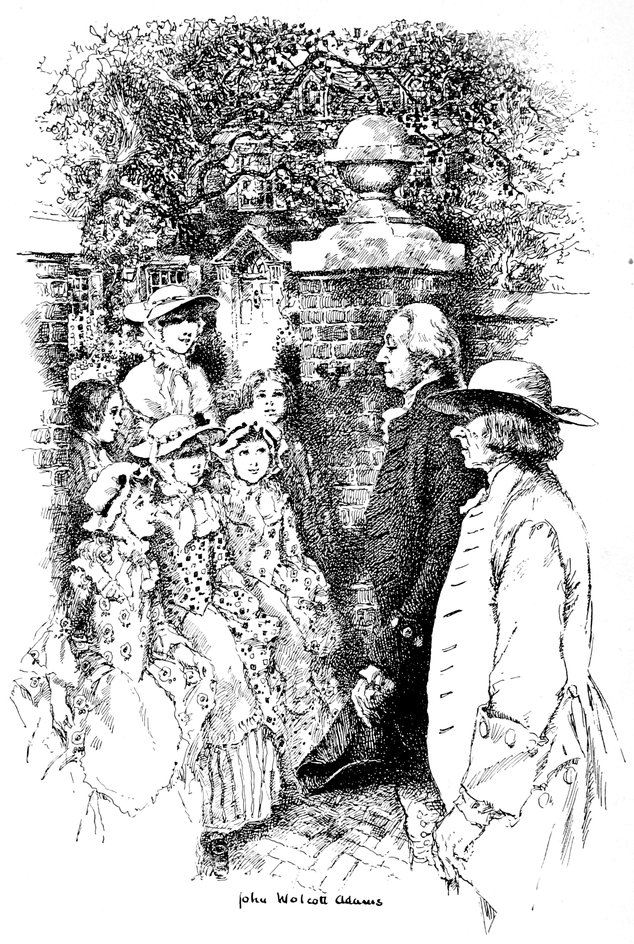
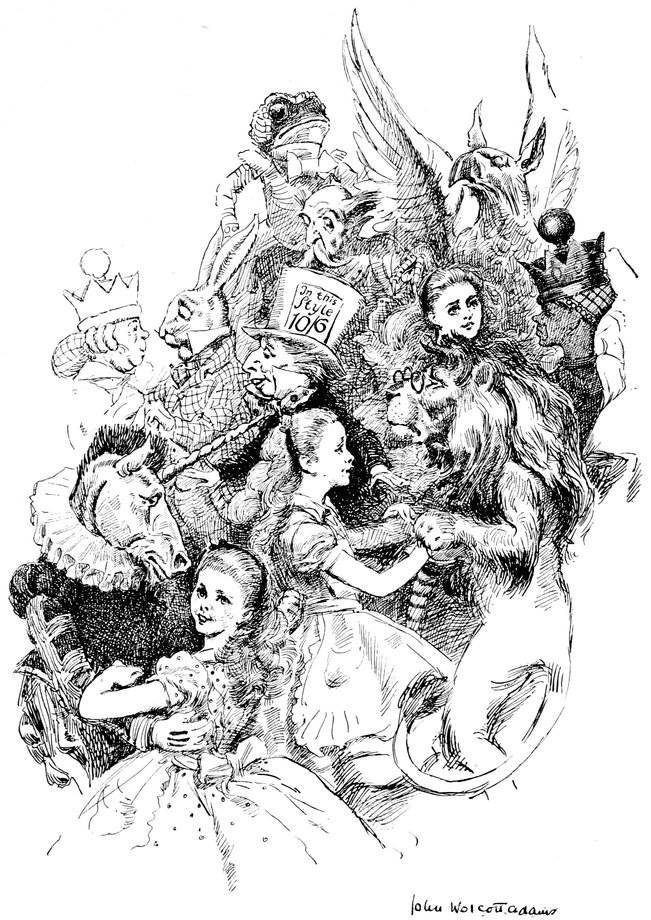
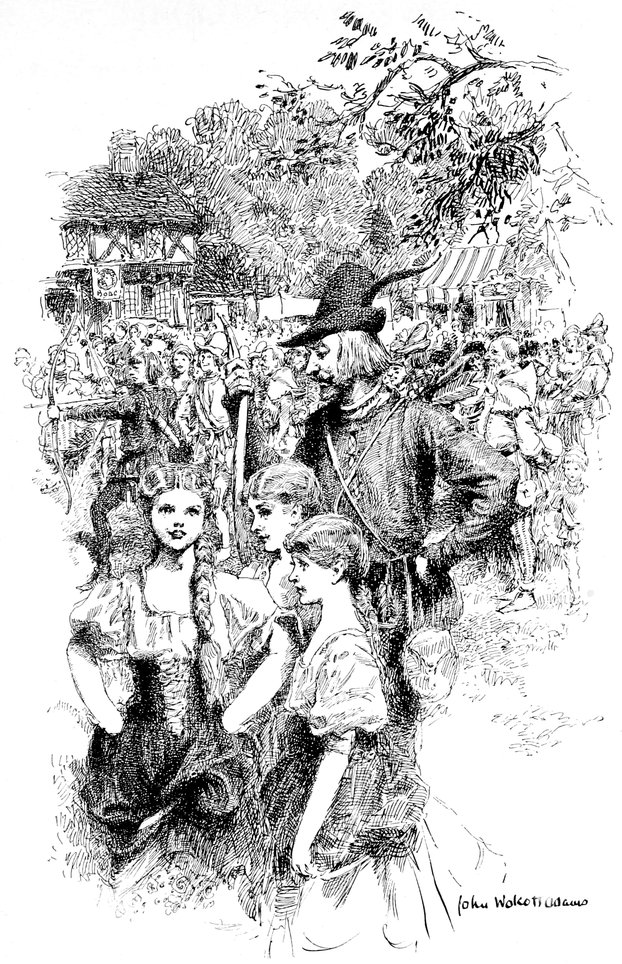
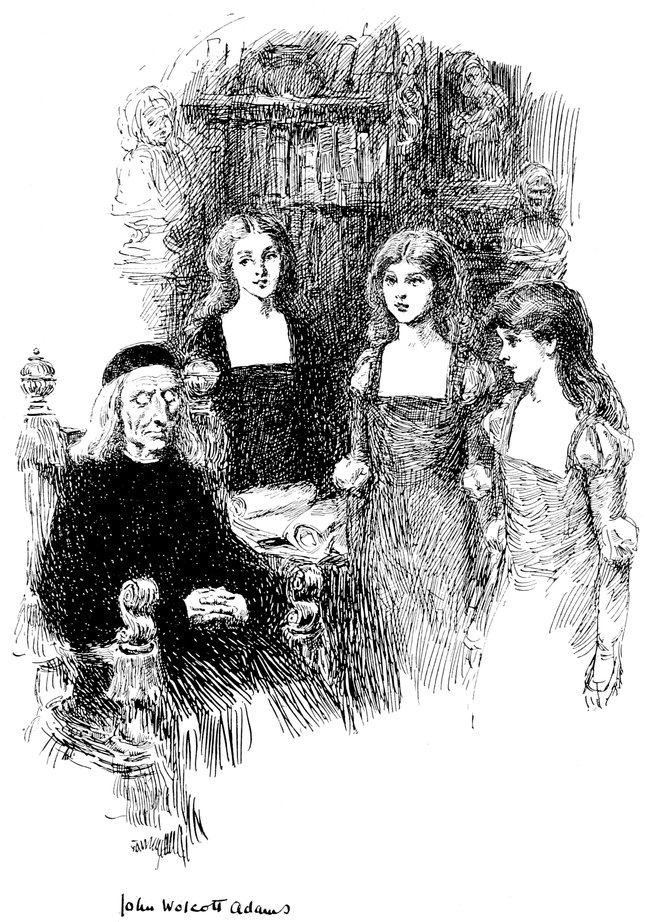
A DEMURE LITTLE CROWD THEY WERE, STANDING PRIMLY, HAND IN HAND
BY
HILDEGARDE HAWTHORNE
ILLUSTRATED BY
JOHN WOLCOTT ADAMS
NEW YORK
GEORGE H. DORAN COMPANY
COPYRIGHT, 1917,
BY GEORGE H. DORAN COMPANY
COPYRIGHT, 1915, 1916,
BY THE BUTTERICK PUBLISHING COMPANY
PRINTED IN THE UNITED STATES OF AMERICA
To
My Four Little Nieces
UNA, ROSAMOND,
SYLVIA AND JOAN
A WORD BEFORE THE STORY
vii
Inside this world in which we live there is another
world, a very wonderful world, that is
ours for the taking. Many things in the world
we live in every day are denied to us. Maybe for
the reason that we cannot possibly learn how to
make use of them all, even though we think we
want them very much. Lots of us can never hunt
lions in Africa or sail the high seas, or find gold,
or herd cows on the wild prairies, or know a
pirate, or run an engine, or become kings or
queens or presidents or the wives of presidents,
or anything great and famous like that. We have
to let others do those things, and they again have
to let us do the things we do. We can each only
be our kind of boy or girl, man or woman.
But in the world inside this we can be and do
anything, not only now and here, but back in dim
ages when knights were bold and castles held prisoned
princesses. We can know intimately all sorts
of people, savages and noblemen, cowboys and
bank-clerks, fairies and fisher folk, poor little children
and rich little children, great captains and
wicked robbers, lovely ladies and strange old
women, poets and farmers. We can go on high
adventure and find dreams come true. We can be
viiihundreds of different persons, men and women
and boys and girls, beasts and fishes, clouds and
mountains. Once inside that world, anything is
liable to happen to us.
This inside world is the world of books. There,
on your bookshelf, inside the quiet-looking blue
and brown and red and green volumes, all sorts of
exciting things are going on, all sorts of people
are busy over all sorts of affairs, talking and
laughing, crying and playing, having marvellous
escapes, doing wonderful deeds. If we could just
step inside those books and join in the life going
on so busily—lose ourselves in one book after another!
Wouldn’t it be thrilling?
Rose and Ruth were lucky in having the fairy
to help them, to be sure. But even without a
fairy much may be done.
Rose kneeled on the long window-seat and
peered through the glass, occasionally rubbing
away the mist that gathered so that
she might the better watch the wild game the
snow was playing. It was falling so thickly that
the row of alfalfa haystacks resembled dim giants,
advancing on the house stealthily but surely; the
horse barn loomed darkly behind them and seemed
enormous—a grim castle, or a dungeon. And how
the snowflakes whirled and danced, never touching
the ground, yet somehow turning it whiter
and whiter. The prairie vanished in the whiteness,
and even at a little distance the sky was all
mixed up with it.
Every now and then Rose could hear a long,
wild shriek that swept around the house and died
away slowly. It was the wind, of course, but it
certainly sounded like a cry for help, and Rose
wondered if, after all, it might not be a princess
in distress. One couldn’t be quite sure, and Marmie
16had said that very morning that it was always
the most unexpected thing that happened.
“And a snow-storm,” thought Rose, “isn’t so
unexpected as a princess.”
She turned her head and looked into the big
pleasant room. The fireplace had a fine blaze in
it, and lying on the Navajo blanket that covered
the floor right before it, busily reading, was Rose’s
younger sister, Ruth.
“Oh, Ruth, stop reading and come and look out.
It’s getting blizzarder every minute.”
Ruth grunted, turned a page, and remarked:
“Wait just a bit, till I finish this chapter.”
Rose looked out once more, just in time to see
a man ride round the corner of the barn and disappear
into the flying snow.
“There goes Jim to round up the cows,” she
exclaimed. “I guess the other boys have gone
too. Probably we are going to have a sockdolager
of a storm.”
“Marmie said you mustn’t say sockdolager,”
chided Ruth, abandoning her book and joining
Rose at the window. “Oh, I wish we could go riding
too. But I guess we won’t any more now, till
spring. Don’t you hate to think of winter coming,
Rose? We can’t go out at all most of the
time, or just round the inclosure, and that’s no
fun, and we sha’n’t have anything to do, and we
sha’n’t see a living soul for months. That’s what
Marmie said. I wish we had some other little
girls to play with. Books are nice, but they aren’t
17alive and real—O-o-o see how hard it’s snowing
now! I can’t see the barn any more.”
The two little girls leaned close together, looking
out at the storm that grew more furious as
the moments passed. It shook the house, it blotted
out the landscape, it even hid the haystack giants.
It made them feel very small and lonely and far
from everybody. The nearest ranch was five miles
away. That didn’t seem much in summer, but
now—why, no one would care to ride there now,
and as for the two themselves, they knew they
would not get far from home for months to come.
Presently it began to grow dark, and the sisters
returned to the fire, curling up close together
on the long seat with its thick cushions that stood
in front of the hearth.
Rose was a good deal taller than her sister,
though they were only a year apart. Her hair was
thick and hung in two long red braids, a real
golden red, and her eyes were golden too, with
brown shadows. There were freckles on her nose,
which turned up just a little. Rose was forever
imagining and pretending, and wondering whether
she might not be lucky enough to stumble on a
fairy or a gnome, or find a charm or a wishing
cup; and Ruth would listen to the wonderings,
and follow her sister about, hoping that Rose
really might have an adventure, and that she
would be in it too.
Ruth was a slender, vivid, dark little thing,
with hair that tumbled round her head in curls,
18and big, black eyes that opened wide when she
sat listening to Rose’s make-believes. She liked
to read better than anything, and even when they
went off on long rides she would tuck in a book
somewhere, and find a chance to read it while
they stopped for a rest or to water the ponies or
to chat with the Dillinghams, on the next ranch.
“Think of all the little girls there are in the
world, hundreds and hundreds and millions, and
we don’t know any of them,” continued Rose,
lugubriously. “Wouldn’t it be grand if we had
a magic carpet, and could sit on it and wish we
were anywhere and be there in the shake of a
cat’s hind leg.”
“What’s that?” asked Ruth.
“Oh, nothing. It’s just what Jim says when
he means a little bit of a time.”
“Where would we go, Rose?”
“Perhaps to a big school, where lots and lots
of girls were playing together. Or to a fairy
island, where all the nicest boys and girls in the
world lived, and went on picnics and had parties.
Or maybe we’d go to a nice big house where there
were two other girls as old as we are, and they
were wishing, like us, that they had some little
friends to play with—that would be nicest of all,
I think.”
Ruth sighed deliciously, picturing the joy of it.
“I don’t suppose you can possibly find such a
carpet,” she murmured.
“N-no—I suppose they are all in Persia or
19Arabia. Or perhaps they are all worn out by this
time.”
The fire shot up a great plume of sparks as one
of the logs fell apart, and then died down. The
room was dark, for the storm had brought night
on earlier than it should have come.
“Well,” said a small, clear voice right beside
the girls, “I don’t know anything about wishing
carpets; but I can’t see why you don’t go through
the Magic Gate. If you go through that, you reach
places quite as interesting as those you are talking
about—and as for children! Why, it leads to
thousands and thousands of them.”
Rose was too surprised to breathe, and Ruth’s
eyes opened and opened.
“What’s the matter? Don’t you know a fairy
when you see one?” went on the clear voice.
The girls looked all around.
“But—but we don’t see anything,” stammered
Rose.
“What do you look like?” queried Ruth.
“Can’t see me? How extremely provoking. I’m
sitting right here on the arm of the settee, and I
look just like a fairy—what would you have me
look like?” The voice sounded the least bit impatient.
Rose, who was nearest to it, started back a
trifle. She wasn’t exactly frightened,—but it was
a little—well, startling—to hear a fairy and then
not be able to see it! Rose had never expected
that sort of adventure.
20“I—I can hear you,” she said, politely. “Perhaps
if you got right in front of the fire we could
see you.”
“The fire won’t help. Why, I have a shine of
my own. Come now, look hard.”
Both girls looked hard at the sound of the voice.
But they couldn’t see it a whit better than they
could see the bang of a door or the creak of a
board. They felt very sorry and embarrassed, for
they could tell the fairy was trying her hardest
to be seen.
“It’s too bad,” said Rose, at last. And Ruth
echoed her sadly. “To think that there is really
a fairy here with us, and we can’t see you!”
“It’s ridiculous,” remarked the voice, “but I
suppose it can’t be helped. You’ll have to get
along without seeing me, that’s all. Anyhow, you
seem to be able to hear me, and that’s something.
And there’s no knowing; you might be disappointed
if you did see me, and that would hardly
be pleasant.”
“Indeed we shouldn’t!” exclaimed both girls
at once. “No one was ever disappointed in a
fairy.”
“Tut-tut,” said the voice, and then gave a little
laugh, so sweet and mellow that it made Rose
and Ruth laugh too. “But come, how about that
Magic Gate?”
“Where is it?” asked Ruth, who liked to get
straight to essentials.
“You can find it easily enough with me,” returned
21the fairy. “It’s near enough—and it’s far
enough. Would you really like to go through
it?”
“Can we get back again? We couldn’t leave
the ranch for too long,” answered Rose. “Marmie
might miss us, and every evening we play
games with Dad.”
“Oh, yes, you can get back. In fact, you can’t
stay inside the Magic Gates beyond a certain
length of time. There are rules that have to be
kept, you see.”
“Oh, Ruth, I’d like to go, wouldn’t you?”
breathed Rose, excitedly.
“Yes,” replied Ruth, clutching her sister’s
arm. “But where does it go, Fairy?”
“It will lead you to other little girls—little
girls who only live inside the Magic Gates and
can’t be reached any other way. All sorts of little
girls, in all sorts of places and all sorts of times.”
“Will they like us to come?”
Again the fairy laughed her silver laugh, that
sounded like drops of rain falling on the roof of
an enchanted palace.
“They’ll be delighted, my dears. For they
really don’t begin to live until some one finds the
way to them through the gates. They are all remarkable
little girls, too, in their different ways,
and I know you’ll enjoy playing with them. So
suppose we start. Since you can’t see me, each
of you must take hold of one of my hands. Do
22you want to choose where to go first, or shall I
choose for you?”
“You choose,” said the two girls, stretching
out their hands. They could hear the fire snapping
as they did so, and the wind in the chimney
seemed to be calling to them. And they felt a
slim, strong little hand clasp theirs, and the clear
voice said:
“We might just as well begin in the Golden
Age. Have you heard of Sappho, the Greek girl
who wrote wonderful poems after she grew up?
She was a very sweet and merry child, and I
know you’ll enjoy playing with her. So shut
your eyes, shut your eyes, shut ... your
... eyes....”
The fairy’s voice trailed away into silence as
Rose and Ruth obeyed her. The two girls had a
queer sensation, as though everything they knew
was flying past them ... a sort of whirr ...
then a kind of tiny shock, as if they had suddenly
stopped falling, and then....
CHAPTER II The Winner of the Torch Race
25
“Open your eyes,” cried that clear, laughing
voice.
And Rose and Ruth obeyed, opening
them very wide indeed. Opening their mouths
too, just as one always does when so full of surprise
that one cannot hold a bit more.
“I’ll bring you home in good time,” went on
the fairy, just as though nothing in the least extraordinary
had happened. “Just amuse yourselves
as you like. Sappho will be along presently
and I’m sure you’ll get on nicely together.
And now I’ve other affairs to see to, so I’ll say
good-bye for the present.”
“Good-bye,” returned the two girls, though
when the fairy stopped talking it was hard to believe
she was there to say anything to, because
we are none of us used to answering a voice with
nothing around it.
And still they stared, and the wonder in them
grew bigger and bigger.
For instead of the living room at the ranch, with
the fire snapping in the huge chimney, the familiar
dimness of coming twilight, and the storm flapping
26at the windows like a great wild bird with wet
wings, they saw a green slope where large trees
stood about looking magnificent in summer leafage
while birds chattered and piped in the
branches. Far below them on a peninsula round
which the bluest sea imaginable flung its broad
arm lay a city of clustering, flat-roofed houses
gathered about a splendid temple that appeared
to be built entirely of snow-white pillars, row on
row. A white road led through gardens and vineyards
to this city, and out upon the shining waters
boats of odd shapes with sails of scarlet, brown,
buff or gaily striped canvas dipped at anchor or
slipped lightly before the gentle breeze. The
warm air was full of the perfume of flowers, and
from somewhere not far off came the sweet sound
of a flute, played softly and dreamily.
“Jiminy Cripsey!” sighed Rose, forgetting that
she’d promised not to.
Ruth bent down to pick a brilliant flower at her
feet.
“It’s—it’s real, Rose,” she whispered. “Smell
it. That fairy is a good one, isn’t she?”
“She’s the best I ever saw,” agreed Rose, who
didn’t remember that she hadn’t seen her, nor any
other either. “This is a transformation!” Then
she gave a sudden little shriek. “Why, Ruth,
look at yourself—and me too!”
Dumbly Ruth turned her eyes on her sister and
herself, or at least on her clothes. Instead of the
blue serge dresses with sailor collars and silk
27ties, the stockings and slippers they had on when
the fairy first spoke to them, Rose now wore a
one-piece garment of very soft stuff of a pale,
lovely yellow with a border of dull blue. This
garment was caught on the right shoulder and
passed under her left arm, leaving it bare. A
girdle of blue was clasped about her waist, and
on her bare feet were sandals with blue thongs
binding them and crossed around her ankles. Her
hair was knotted in the nape of her neck, and a
blue fillet circled her head. Ruth wore exactly
the same dress, except that it was white with a
border, girdle and fillet of crimson.
Both girls began to laugh.
Each of them found they had a narrow bracelet
of curious looking metal on one of their arms,
and they fingered these joyfully.
“Isn’t this a dandy adventure, Ruth? How
funny you look! But these are pretty dresses,
just the same, aren’t they? How light and cool
they are!” And tossing her arms into the air,
Rose danced upon the grass.
“O—Eh!” called a laughing voice.
Rose and Ruth whirled round, and there, a little
above them on the slope, stood a slender, long-legged
girl of their own age, dressed as they were,
though her gown was striped faint rose and blue,
like the sky at sunrise.
In her hands she held a pair of long pipes that
joined at the mouth-piece, and she stood, poised
and erect, laughing, her eyes shining dark and
28vivid under the rippling waves of her golden hair,
bound with silver bands.
Smiling back at her, the sisters stood close together,
feeling a little shy but full of admiration.
“I was afraid you were going to be late,” said
the stranger girl, coming swiftly toward them.
“I’ve been waiting here a long while, blowing on
my pipes, hoping that perhaps I could win some
dryad out to play with me. But now you are
here it doesn’t matter. Did you come very far?”
“We came so fast I don’t know ... is this
place near Wyoming?” answered Rose, doubtfully.
“Wyoming? You must be barbarians! I never
heard any one speak of that country, not even
the sailors who have been to the end of the earth.”
“Who are you?” asked Ruth, who wasn’t quite
sure just what a barbarian was, and so didn’t care
to commit herself by either admitting or denying
that she or her sister might be such a creature.
“I am Sappho.”
“Oh, yes, the fairy said you would come to play
with us. How lovely! And do you live there in
the town by the sea? For that is the sea, isn’t
it? We never saw it, but our mother came from
England when she was a little girl, and she has
told us about it.”
“Surely it is the sea. Sometimes I long to go
away on it, far beyond those cloudy mountains
there in Asia; but in your land is there no sea?
How strange a place! How can one live away
from the sea—not I at least, I should die of loneliness.”
SAPPHO PASSED HER WITHOUT A GLANCE
29“We are lonely sometimes,” said Rose, “but
not for the sea. We want other girls, for where
we live there are only boys, and they live a long
way off, on the next ranch. What is the name of
your town?”
“That city is called Mitylene, and this is the
island of Lesbos, the loveliest of all the Grecian
islands.”
“Ruth, do you hear, this is Greece! Where
Hector and Achilles lived, and Jason, and Ulysses ... Oh, Sappho, how wonderful! Shall we
see them?”
Sappho laughed. “Why, they died long ago,”
she answered. “They belonged to ancient times.
To-day there are no heroes like them; yet the
men of Greece are strong and brave still—there
are none in the world like unto them. But come,
the games will soon begin, and we must be there.
Are you to run in the torch race?”
“What’s that?”
“That’s the race the girls run. I shall be in—I
mean to win it, and to hear the people cheer me,
and to wear a crown of flowers....”
And laughing again, the girl set the double
pipes to her lips and blew a sweet refrain that
had a merry lilt to it, so merry that Rose and
Ruth and Sappho too all began dancing in time
to it, while their light, soft garments floated about
them like wreaths of parti-coloured mist.
30Then without more ado they set off down the
long slope toward the road that should lead them
to Mitylene, chattering as they went, and asking
each other a hundred questions in as many seconds.
For never had Rose and Ruth imagined such
scenes as they saw about them. As they left the
trees they came out on a smooth meadow, where
a shepherd lad clad in a goatskin all spotted brown
and white sat on a rock, a short, stout crook in
his hands, and sang cheerily to himself and the
white flock that grazed nearby. His shock of dark
hair surrounded his head in a tangle of curls, his
eyes shown brightly at the girls, his legs and arms
were as brown as they were bare.
“Greetings,” he cried.
“Greeting,” replied Sappho. “Are you coming
to see the games?”
“Can I leave my sheep for the wolves to get?”
“They would not run faster than you should
a wolf come,” Sappho called back over her shoulder.
The boy returned to his singing, scorning to reply,
but she laughed.
“Now he will sulk when I next meet him,” she
said to Rose. “Boys are amusing. I love to
tease them, they who pretend to laugh at us girls
because we are not so strong as they—some day
I will show them what Sappho can do.”
Passing through a vineyard the girls reached
the road, down which a procession was winding
31its slow way. At the head were men dressed in
long flowing robes, white or dull blue or soft
brown. They carried branches in their hands.
Then came six pipers, dressed much like the girls,
in what Sappho called a chito. All wore sandals,
and most had a band of colour or of silver or gold
round their heads. Behind the pipers, who were
playing a slow marching air, came a snow-white
heifer, with flowery garlands wreathed about her
horns and over her smooth flanks. Boys in scarlet
tunics led her by long ropes decorated with flowers.
Behind these again came many lovely young
women, wearing the chito and also the cloak-like
outer robe that fell in many soft folds, one end
being flung over the shoulder. These garments
were bewilderingly varied in colour, some striped,
some embroidered, some in strange patterns, but
all were harmonious and beautiful. The people
moved gaily and freely, and occasionally broke
out into a chant.
“Where are they taking that white cow?” asked
Ruth, gazing rapturously at the picture they made,
with the golden sunlight falling on them, the garlands
swinging, the flowers and costumes each
brighter than the other.
“To the sacrifice,” replied Sappho.
“Do you mean they are going to kill her?”
“Do they not kill cows in your country?”
“Y-yes—but not all covered up with flowers—not
a pet cow like that!”
“The cow given to the gods must be the best
32and prettiest and gentlest of all, or they would
be angry.”
Rose, remembering the Greek stories she had
read, suddenly realised that Sappho probably believed
in all those wonderfully named personages
she usually skipped, and feeling her ignorance, did
not pursue the subject further.
A two-wheeled cart drawn by small oxen came
up slowly as the girls stood watching the procession
turn into the forest. An old man wrapped
in a dark cloak walked beside it, leaning on a
staff. As he neared them Sappho called out:
“Polemo!”
The old man glanced up, and his wrinkled face
broke into a smile. Calling to his oxen, he hurried
toward the girls, hobbling along fast enough
with the help of his stout stick.
“Greeting, Sappho,” he said, “and to your
friends greeting. What do you so far from the
town, you who are to run to-day? Your mother
early this morning bade me keep watch for you,
saying you had gone to the hills at daybreak.
Will you climb into the ‘chariot’?” and he
chuckled, designating the heavy cart with its four-spoked
wheels, with a sweep of his staff.
“May we, Polemo? That will be great fun.
These friends of mine have never been to our
Lesbos before—it is but right they should enter
Mitylene in state.”
“Climb in, all of you. You’ll keep your feet
out of the dust, even though you won’t reach home
33much sooner for all these four beasts will do
for you. But climb in, climb in,” and the old
fellow laughed as the three youngsters clambered
joyously aboard his lumbering vehicle, Ruth and
Rose hugely amused and delighted to be travelling
in a manner so unusual.
“What is this race you are to run, Sappho?”
asked Rose, as they stood swaying in the cart,
grasping one side firmly, and watching the oxen
plant their heavy feet in the white dust, while they
grunted protestingly in reply to the urgings of
Polemo.
“This is the maiden’s day, and we younger
ones are to run the torch race. All the city will
be out to see us. I am afraid of only one among
the girls, my cousin Chloë. She is a few months
my elder, and a very Artemis for running. But
you will bring me fortune.”
“I’m sure I hope so. How did you know we
were coming to-day?”
Sappho hesitated.
“I—I don’t know exactly. I only know I was
to go to the hill and fetch you. But your names
I know not.”
The girls quickly told her. At that moment a
chariot flew by them, drawn by three horses and
driven by a tall young man in fluttering robes.
“Oh, look, Rose,” cried Ruth, her eyes shining.
“Isn’t it just like the circus, only better.”
“He threw the discobolus farther than any last
year,” said Sappho. “Is he not beautiful!” And
34she waved her hand at the disappearing driver.
They were close to the town now, and many
people were travelling along the road in the same
direction. There was much laughter and gaiety,
young boys racing each other with shouts, groups
of men conversing as they walked, riders with
cloaks of rich colours. Asses loaded with huge
packs trotted onward, urged by men in short,
skirted garments that barely reached half down
their bare thighs. Some wore no foot covering,
some had sandals with long thongs that crossed
back and forth over their legs up to the knees. A
few carried a cloak of skins or of bright cotton
cloth. Many women and girls were in the constantly
increasing throng, and these wore long
flowing robes for the most part, sometimes hanging
straight from the shoulders, sometimes girdled
above the waist. It was a rainbow-hued crowd.
Rose and Ruth had never seen so much colour,
not even among the Indians of the Reservation.
Soon they were in the narrow street into which
the road they had been travelling merged. One-
and two-storied houses presented their blank
walls to this street, with only an occasional window
and the square or arched entrances to break
the line. As they came to a corner Sappho jumped
down, beckoning the two American girls to follow.
“Many thanks to you, Polemo,” she cried.
“Come,” and she sped along the street, closely
pursued by Rose and Ruth, who had no mind
35to lose her. Reaching a doorway, she turned to
await the two.
“This is my father’s house,” she said. “You
will be welcome. Come in and we will have some
bread and fruit before we go to the games.”
The three entered a square room bare of furnishing,
and passing through, found themselves
in a courtyard where flowers grew and the sun
shone. Several rooms opened on this court, round
which ran a sort of gallery, supported on pillars.
A woman dressed in robes like those they had
seen worn by the women outdoors came to meet
them across the court. She moved slowly, with
great dignity, smiling as she approached.
“Who are these, Sappho?” she asked. “Are
they come to the games?”
“I was sent to get them this morning,” replied
Sappho. “I know not how, Mother. Something
spoke to me, and I went. They come from far.”
“You are welcome,” said the lady, taking the
two girls by the hand and leading them into a room
beyond the court. Here, on a low table, a great
loaf of bread, a jar of golden honey, an earthen
pitcher of milk and a bowl half full of luscious
figs stood waiting.
“Sit and eat,” she said. “But for you, Sappho,
be sparing, if you are to run.”
“I will take no more than one piece of bread
and a swallow of milk,” said the girl. “But you
two must be hungry, having come so far.” She
filled two cups with the milk, and her mother cut
36a large piece of bread for the visitors, who were
too shy as yet to say anything more than a murmured
thank you. But with the taste of the good
food their tongues were soon loosened, and all
three chattered together and to the quiet, smiling
woman, who kept filling their cups and offering
more bread and honey.
And then it was time to go to the games. In
came a tall, bearded, grave-looking man who
turned out to be Sappho’s father. He seemed to
take Rose and Ruth for granted, and bade them
all come with him.
Out in the street every one was pressing in one
direction. Another man joined their group whom
Sappho spoke to as Uncle, and then the two men
walked ahead, leaving the girls and the woman
to follow. They passed a beautiful building in a
large square, evidently the market place.
“Is not that a fine temple?” asked Sappho. “It
was finished only last year, and the town feasted
for days to celebrate. Are not the pillars beautiful,
and that row of statues?”
Rose and her sister could only stare in appreciation.
Never had they dreamed of any building
so exquisite, with its rosy-tinted marble, its
graceful pillars, one behind another, row on row.
“It looks like that old book of mamma’s with
the pictures of the World’s Fair,” said Ruth,
breathlessly.
And now the crowd began filing into the large
stadium, and settling down into the seats that
37rose tier on tier under the open blue sky. Their
own party found places where a good view was
to be had, inside a railed off portion where the
relatives and friends of the competitors only were
allowed to sit. Once seated, the girls looked about
them at the gay, inspiring scene.
Colour everywhere. Gay banners and streamers,
bright cloths flung over the railings, laughter,
talk, movement. Down in the arena people moved
too, sprinkling the dust with a little water, removing
scraps of torn decorations, smoothing
slight inequalities. Friends hailed each other
from various parts of the big place, groups clustered,
chatting.
“I must go now,” said Sappho, and her eyes
snapped with excitement, looking dark as deep
water at night. “We are the first. Soon now my
name will be on the lips of all these people, they
will be shouting for me, will be throwing flowers
upon me....” She stopped, clasping her hands
over her young bosom, and throwing her head
back to gaze into the sky. “Sometimes I feel that
the world itself will call my name aloud, not now
alone, but on and on till time is old.”
The sudden colour flooded her face, and she
smiled a flashing glance at her friends, who were
looking at her with an excitement almost equalling
her own.
“Wish me good fortune,” she begged.
“We do, we do. You will win, I know it....”
She gave them each a quick embrace, bent before
38her mother, and followed her father toward
a little doorway beyond the tier of seats. Before
entering this, she turned and waved to the
girls, who were still standing watching her.
“Isn’t she simply a Jim-Dandy?” the irrepressible
Rose wanted to know.
“Sit down now,” said the gentle voice of Sappho’s
mother, as she settled herself on her own
broad bench, over which a scarlet cloth was laid.
“In a moment you will see all the girls who are
to run come out through that little door almost
opposite—see, there they come.”
And as she spoke a bevy of young things, all
of them in a short white one-piece slip that left
the arms and legs bare, came pouring out into
the arena. Each of them carried a torch in her
hand, whose flame bent and fluttered in the breeze.
Straining their eyes to look, the girls distinguished
Sappho among the others. She had bound
her hair with a broad scarlet ribbon and stood
very light and proud, looking fit and ready even
at this distance.
Men in brilliant cloaks were moving among the
girls, assigning them their places. Presently
they drew back, leaving a line of eager
young figures, tense and tremulous with excitement.
Suddenly, at a signal the girls did not see,
they were off.
What a race it was, under that blue and throbbing
sky, with the vari-coloured throng waving
streamers of blue and gold and crimson, and shouting
39encouragements. Slender and vivid as the
blown-back flames of their torches, the white
young runners, dashing this way and that to save
their torches from attack, or to attack in their
turn. The fire fluttered at the ends of the sticks
with a life of its own. Now one girl and then another
would forge ahead for a yard or two, but
some other racer would reach her, and beat at
the flame, lowered by the speed of her movement.
Before long, several torches were extinguished.
The shout of the populace was one long roar by
this time, and Rose and Ruth did their share in
making a noise. Ruth, not given to demonstrations,
was hopping up and down like a mechanical
toy, waving both arms over her head, and calling
out, “Oh, Sappho, Sappho, Sappho, HURRY!”
While Rose stood hugging herself, yelling madly,
“Go it, go it, you’ve GOT to win!”
A half dozen of the twenty or more runners
were left by this time. The others, dropping their
dead torches, walked slowly back to the starting
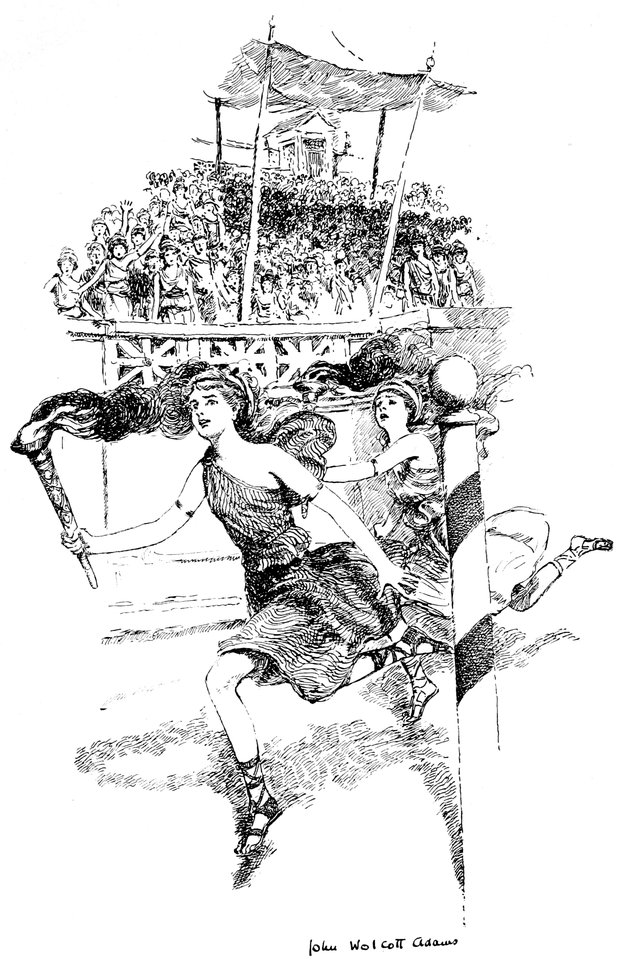
point. A tall dark girl and Sappho ran together
near the middle of the bunch, three girls leading
them by a few paces. Very soon, however, Sappho,
with a sudden burst of speed, passed these
three and ran freely out into the lead. Rose and
Ruth gave one cry of frantic joy. But at the instant
the dark girl, springing forward, reached
Sappho’s side, and made a vicious strike at her
torch. She missed it, but with a quick movement
swung the flame of her own torch under Sappho’s
40upraised arm, so that the red fire licked upward
toward the wrist.
With a scream Sappho dropped her torch. Only
a few of the concourse had seen the trick, and
from these came a shout of protest. Without a
sound the dark girl sprang wildly onward. But
Sappho stooped, lifted her torch and waved it. It
still flamed. Then, with a sort of fury, she began
running.
Like blown thistledown she sped after her opponent.
Her feet scarcely touched the ground,
her slight garment clung to her, showing the lithe
slimness of her girlish form. On, on she went.
Never had girl run so fast, so finely, in all the
history of the race. The great crowd rose to her,
and a mighty tumult broke out. She caught up
with the dark girl, who faltered slightly, hearing
that shout in which cries of rage mingled, calling
her own name, Chloë, with shouts of shame, shame.
Sappho passed her without a glance, and the
next instant sank into the arms of her father,
waiting beyond the finish line.
Then indeed the crowd went wild. Her father
led her out by the hand before the officials, seated
splendidly in a group at the head of the arena.
Panting, trembling, her face pale, she stood, lifting
her eyes to those bent toward her, while the
vast circle poured out a mighty roar of “Sappho,
Sappho, hail to young Sappho!” Flowers rained
down on her, and then, amid a sudden silence, one
41of the judges stepped down and laid a wreath on
her tossed hair.
When she came back to her young friends the
colour had returned to her cheeks. Her mother
laid her hands on her head:
“Sappho, my daughter, I no longer regret that
I did not bear a son,” she whispered. “And your
arm, poor child?”
“Nothing,” answered Sappho, lifting it to show
the scarlet scar of the heat. “What is pain that
it should matter, if only one triumphs!”
Ruth and Rose clasped her hands in theirs, and
gasped out their joy and excitement as best they
might.
“You are the wonderfullest, the loveliest ...”
they asserted.
Sappho smiled:
“No, I’m not,” she said. “But I’m the happiest ...”
“Come, my dears,” said a brisk, decided voice,
while slender hands caught Rose’s right and
Ruth’s left. “Time to be getting home ...”
The arena grew dim, the shouting died, Sappho
wavered and vanished. The two girls shut their
eyes instinctively. Once more came that sudden
sense of falling....
“Why, look, there are the torches,” cried Ruth,
clutching at her sister.
But it was the flickering flame of the fire in the
living room, for there were Rose and Ruth, sitting
on the big settee among the pillows, while the
42log fell apart with a crash and an up-burst of
flame.
“Why, we’re home again,” said Rose, slowly.
“And the fairy, is she here?”
But if she were she did not answer, and since
she couldn’t be seen, there was nothing to be done
but to suppose she had gone.
CHAPTER III An Adventure with Little Women
45
Winter was really hard and fast here
with Rose and Ruth, and they were settled
doing all the winter things. Each
morning there was school of course, school right
at home, for not even the smallest school house
broke the long line of the prairie within many
miles of the Ranch. And there was plenty of outdoor
play and excitement, too.
Somehow the two little girls never remembered
a single thing about their wonderful adventure
with Sappho and the fairy except when they were
alone. Just as soon as Marmie or any one else
came near, every bit of the memory of it floated
out of their heads. But they would talk of it to
each other eagerly. And one afternoon, as they
sat together on the big settee, Rose suddenly wondered
whether the fairy were not coming to visit
them again some fine time.
“Golly, I do wish she’d come again, Ruth!
There must be lots of other places to go to through
the Magic Gate, and lots of other little girls to
play with. Do you think she’s forgotten all about
us?”
46Ruth had just opened her mouth to reply when
she had to open it even wider with surprise, for
who should speak up but the fairy herself, in that
darling voice of hers, like the chiming of tiny
crystal bells:
“Forgotten you? Nonsense. The memory of
a fairy is the strongest thing you can meet in a
whole year of un-re-mit-ted seeking. But I’m
very busy to-day, and we must hurry right off—what
do you say to paying Little Women a visit?”
“What! Meg and Beth and Amy and ... and
JO?”
The fairy laughed at the sound of the way they
said it, both together, and both almost speechless
with delight. Next instant Rose and Ruth both
felt her take one of their hands, and shut their
eyes just as she told them too, her voice dying
softly away like a breeze in a quaking aspen.
Then came again the rushing feeling, the sensation
of a little fall, a slight shock, and suddenly
both girls found themselves running, clutching
tightly to strong hands quite as big as their own ... not fairy’s hands. There was a joyous peal
of laughter, and an eager voice cried:
“That was good. How you can run! Just as
fast as I do, and Meg is always calling me a
Tomboy....”
They opened their eyes, and found themselves
grasping each a hand of a girl no older than themselves,
a brown-skinned, clear-eyed girl, with a
roguish light playing over her face, flushed with
47the exercise. Her dark chestnut hair hung in
two braids from under a funny little round hat,
and her skirts, full and voluminous to a remarkable
degree, reached almost to her ankles. They
were of some grey woollen goods, trimmed with
scarlet braid in quite an intricate design. A little
black jacket with sleeves wide at the bottom and
a cunning turndown collar was also trimmed with
braid, black this time. Altogether, the two girls
thought they had never seen a quainter, more fascinating
costume.
“It’s Jo,” exclaimed Rose, and threw her arms
round their new friend’s neck with a shout of
joy.
Jo wriggled away, looking embarrassed.
“Mustn’t kiss,” she muttered. “Amy and
Beth won’t mind, though,” she added quickly.
“Come on in, they are all waiting for us.”
The girls found that they were standing on a
sidewalk opposite a little garden gate that opened
on a straight path leading to a pretty, gabled
wooden cottage snuggled under big trees. As Jo
spoke she swung wide the gate, and the three hurried
up to the porch. As they set foot on the top
step the door opened, and Jo’s three sisters appeared,
beckoning.
“Come on—hurry. Isn’t it cold, though!”
Rose and Ruth felt as though it were not the
first time by many that they had passed through
the hospitable door and scampered down the chilly
hallway into the big, comfortable room with its
48coal fire blazing red-faced at one end, its prints
and photographs on the walls, its easy chairs and
sofa, its winter roses and geraniums in the windows.
They felt, indeed, very much at home, and
completely forgot how it happened that they were
there at all. Evidently they were expected, for
Meg asked what had made them so late.
“We ran, anyway,” Jo told her. “Rose could
beat me, I believe. Don’t you wish we were boys,
Rose, and could run real races?”
“Take off your wraps,” said Amy. “Oh, Ruth,
you’ve a new dress!”
It was undoubtedly quite new. Ruth looked
down at herself with astonishment and delight.
Amy was helping her off with a long cloak of
heavy blue cloth, and under that Ruth saw her
full skirts spreading out deliciously—pale grey
with pale blue bows of ribbon looping up the overskirt.
Her waist was grey, with more blue bows
and ribbon braiding, and she had on the loveliest
white batiste undersleeves that buttoned close to
her wrists. It was too fascinating.
She whirled about, while her skirts bobbed and
swung, and there was Rose in a dress just as
quaint and pretty and absurd, only it was decorated
with pink bows and braiding.
“They are both new,” she cried. “Oh, what
fun it is!”
“I like pretty clothes, don’t you?” said Amy,
folding away Ruth’s cloak nicely. “Jo doesn’t
care—says clothes are a nuisance, and if she had
only been a boy she’d never have had to think of
them at all.”
THEY FINALLY REACHED THE COTTAGE
49“It does seem a pity Jo wasn’t born a boy,”
Beth remarked, “since we haven’t one in the family,
and she wants to be one so badly.”
“It’s one of the ‘indescrutable’ things that happen,”
Amy finished, and then looked troubled as
the rest shouted with laughter.
“Never mind,” gurgled Rose, “it wouldn’t be
Amy unless she made those perfectly scrumptious
mistakes.”
“Well, girls, Hannah’s got a little lunch ready
for us, and if we are to get to the river in time
we must start soon,” Meg admonished them.
“To the river?” Rose and Ruth both wanted
to know.
“Yes—the skating party, you know. There are
to be big bonfires and lots of fun, and the ice is
perfect.”
Just then Hannah opened the door.
“It’s time ye was eatin’, children,” she told
them.
It was a jolly little lunch, where every one talked
together. Mrs. Marsh was at a neighbour’s helping
in the care of a new baby, and Mr. Marsh had
gone to Boston on some business connected with
the great slave question.
“You know, people say we may go to war over
this business of keeping slaves,” Meg said, with
sudden gravity. “But that seems too horrible.”
50“If I were a man I’d like to go to war,” Jo announced,
with flashing eyes.
Rose and Ruth were conscious of a hazy recollection.
Surely there had been—but they couldn’t
feel certain.
“Well, thank heaven, you can’t, Jo,” sighed
Meg, “but I’m awfully afraid that father will.
As chaplain of his regiment, you know.”
A frightened hush spread over the little crowd
of girls, and then Beth, in her soft voice, spoke the
right word:
“We’ll be sorry—but a glorious kind of sorry,”
she said. “Father does what is right, and makes
us all love it.”
“So he does,” smiled Meg, “and you are a
sweet child, Beth.”
And then they were all laughing again, and
war seemed far away, while good things to eat
were very close at hand. Hannah had made corn
bread, such cornbread, and there was a wonderful
sort of apple pudding-pie that Amy hailed
joyously as “pandowdy” and which Rose and
Ruth found delectable.
And then it was time to hurry into one’s outdoor
clothes again, and make for the river, where
the whole village was to skate that afternoon.
Meg decided to take Amy and Beth with her
by way of the highroad, but Jo asked the two
guests if they wouldn’t like to go through the
woods with her.
“It’s such fun breaking through the drifts, and
51I see you’ve your arctics. They have tramped a
kind of path, so it won’t be too hard for us, and
the woods must look splendid.”
So it was agreed that the strangers should go
that way, to see the woods, and have the excitement
of a real tramp through the snow, while
Meg saw the two little girls safe. They would
meet at the river.
What fun it was! Rose and Ruth could not
believe that they were really following Jo off
the road and up a path under pines all powdered
with snow, yet that’s just what they did. How
fine and bracing the air was, and how pink the
three pairs of cheeks! They went along, chattering
madly, and presently Jo confided that she
was writing a story.
“It’s most thrilling,” she said, “all about two
lovers in a high tower, and a terrible old uncle
who isn’t really their uncle but an impostor. And
in the end he’s found dead with his hand on the
knob of the secret door where all the money is
hidden——”
The two girls listened, gasping. What a gorgeous
plot!
And now they were in the heart of the woods.
The trees crowded close, the snow was deeper
than was easy to get through. Ruth floundered
in spots, laughing, and Jo took her hand to help
her.
“It’s drifted in a little,” she said. “When we
get through this dip it won’t be so deep.”
52They struggled on, slipping over their boot
tops, and though the snow was dry, Rose noticed
that her voluminous skirts were getting heavy.
She longed for the sensible clothes they wore at
home. Suddenly a sound like some one sobbing
struck her ears. She was a step or two ahead of
Jo and her sister.
“Do you hear that, girls?” she asked, looking
around anxiously. “I thought I heard some one
crying.”
“Crying!” exclaimed Jo. “Perhaps it’s a fox
or——”
But at that moment the sound broke out again,
and crying it undoubtedly was. They hurried on,
a little scared, turned a bend, and there, sure
enough, huddled in the snow at the foot of a huge
evergreen, sat a small, a very small boy.
“Gee-willikins!” grunted Rose, while Jo rushed
forward, and Ruth stared, white and frightened.
She was very young.
“He’s alive safe enough,” said Jo, in her deepest
voice, as the small boy started wailing in earnest
at sight of her. Rose joined her, and the
two bent over the youngster, who looked up at
them, pale and with his face streaked with tears.
“Poor little thing! How on earth did he get
here, d’you suppose?”
“He must be lost,” hazarded Rose, rubbing the
boy’s hands, that were almost frozen. Ruth had
come up by this time, and the three began to question
the child all together. He only stared in response,
53but when Jo drew a cookie out of her
pocket, he smiled faintly, and began to munch it.
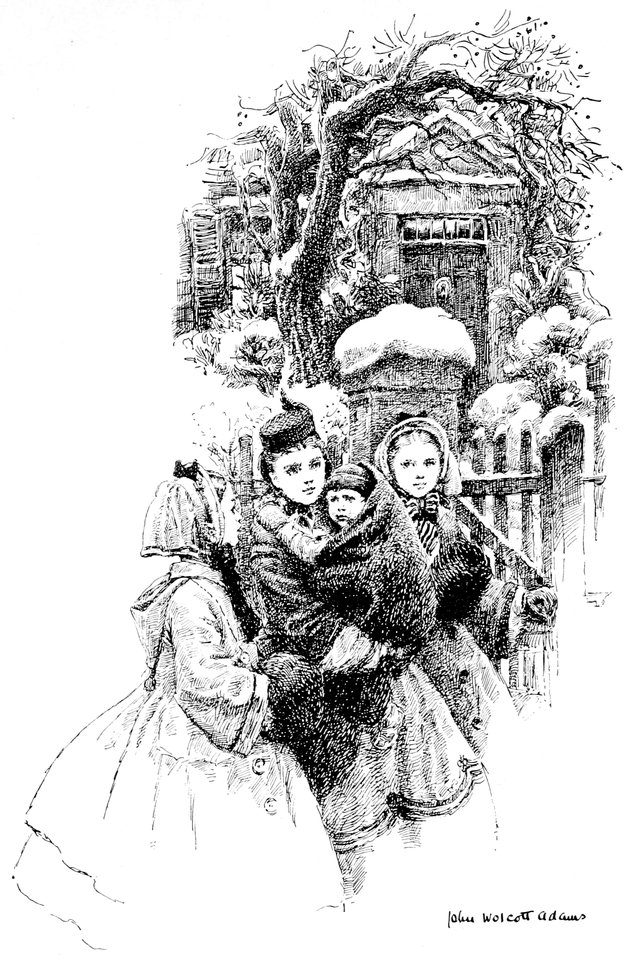
“Poor baby, he’s famished. How did you get
here all alone, little man?” And Jo bent over
him, wrapping part of her cloak over the shivering
little body.
He gurgled an unintelligible reply, but stopped
crying.
Rose looked at Jo. “He’d have probably died
out here if we hadn’t come this way,” she whispered.
“What are we going to do with him?”
“We’ve got to get him home somehow,” Jo answered.
“I wonder if he can walk.” She turned
to the boy, and smiled encouragingly. “Can you
come a little way with us, sonny?”
His eyes filled with tears again, but he nodded.
“Tell you what, girls,” said Jo, briskly, “I’ll
try to carry him a bit. You two go ahead and
trample down the snow as much as you can, and
I’ll follow. It’s like a story, isn’t it?”
She got the little lad up, wrapping her cloak
round him, and holding him snuggled close. He
put his arms round her neck, and smiled.
“Dear little cold thing,” Jo muttered hoarsely,
and then began to struggle back home as well
as she might. But very soon she had to sit down
and rest.
“I’ll take him now, Jo,” said Rose. “We can
do it somehow, turn and turn about.”
And so they did, but it was awfully hard work.
The youngster fell asleep, shivering still, for he
54was wet with melted snow, and his torn shoes
showed bare toes. A forlorn mite!
The skating party was forgotten as the three
girls struggled homeward through the drifts.
Pretty nearly exhausted themselves, they finally
reached the cottage. The lamp was lighted in the
living room, and the light streamed hospitably
down across the path.
Mrs. Marsh met them at the door.
“What is it, girls? Why, what little boy—the
poor child! Jo, run and tell Hannah to get some
milk heated.”
Taking the child in her own motherly arms,
Mrs. Marsh hurried into the room and sitting
down close beside the fire, began taking off his
wet, half-frozen rags, while the girls told her
breathlessly how they had found him sobbing under
the evergreen. He seemed very drowsy, and
looked pitifully white and thin in the glow of the
fire.
“Jo rubbed his hands and wrapped him in her
own cloak; she must be frozen herself,” said
Rose, “but she wouldn’t hear of letting me do it.
Oh, dear, is he going to die?”
Ruth began crying. The little boy did look so
badly.
“Hush, dears. Of course he isn’t. Why, he’ll
be fat and smiling before I get through with him,”
laughed Mrs. Marsh. At this moment Jo, followed
by Hannah, came in with the hot milk. Hannah
rushed off to get a woollen nightgown, while
55Rose crumbled some bread into the bowl of milk,
and Mrs. Marsh fed the half awake child spoonful
by spoonful.
“Luckily he isn’t frost-bitten,” she murmured.
“Jo, dear, get the crib down from the garret with
Hannah’s help, and make it up warmly in the
little room off mine. I’ll get him to sleep, and
then we’ll try and find out where he belongs.”
Bathed, fed and wrapped in the snug nightie,
the little boy looked, as Jo said, like a fairy
changeling. Tucked into the crib, he immediately
fell sound asleep.
“Put on your wraps, girls, and we’ll run down
to the village and find out what we can,” said
Mrs. Marsh. “How fortunate it was that you
went that way, Jo, with your little friends. But
I fear Meg must be worried at your not meeting
her. We’ll go to the river first, and see what we
can discover there.”
The river made a fine sight. A broad stretch
had been chosen for the skaters, and along the
banks huge bonfires were waving in the wind and
filling the air with the sweet breath of burning
wood. Dark shapes flitted over the ice, or crowded
round the fires, and a gay medley of shouts, laughter
and talk rose upward.
Meg and the two children were soon found,
and Meg heaved a relieved sigh when she saw
her mother and sister and Rose and Ruth hurrying
toward them.
The news was quickly told, and other interested
56persons gathered round. Presently word went
about that a Mrs. Gillig, a widow who lived more
or less on charity, had been seeking her only child
since early in the afternoon. Some one ran to
fetch her, and presently she and Mrs. Marsh were
headed toward the Marsh cottage.
“The dear child, he just wanted to help me,”
the widow kept repeating. “Told me this morning,
he did, that he was going to find a fairy as
would make things easy for me. Little attention I
paid to his talk, bless his poor heart, and so off
he goes, and it’s near getting killed he’s been....
Heaven be merciful!”
She thanked the girls tearfully before going
with Mrs. Marsh.
“It’s a hard job you must have had bringing
him back,” she said, “and many wouldn’t have
been brave enough and sensible enough. Fortunate
it was that ye went by when ye did, or
where’d my little boy be this minute?”
“Poor thing,” said Jo, as they watched the two
women hurrying away, Mrs. Marsh giving her
arm to the widow. “I shouldn’t wonder, you
know, if after all her boy did find a fairy, because
mother is a good fairy if ever there was
one.”
Mrs. Marsh had insisted that the girls stay
behind to enjoy the fun, for there was to be a supper
later, and the skating was perfect. So they
put on their skates, while the young people of the
village crowded round and were introduced, and
57off they went, each with a boy, while the lights
shone and the stars began to come out, and spirits
sang to the tinkling of the skates. It was splendid.
Presently they gathered at one of the fires.
Amy, her cheeks glowing, announced that she had
never before been at such an “auspicatious” occasion.
Meg and Beth were busy unpacking a
huge lunch basket. Jo came skating up, all alone,
sturdy and independent, the fire reflected in her
dark eyes.
“I’m going to write a story about that little
boy,” she confided, “and call it ‘The Waif of the
Woods.’ Or perhaps we can make a play of it,
and all of us act it. Think of the snow-laden
scene and—oh, Beth, plum-cake!” With a squeal
of delight Jo plunged to help in the unpacking,
upsetting a pile of tin plates that went rolling
down the bank and over the ice in every direction.
“Oh, Jo, see what you’ve done,” cried everybody,
while Jo began frantically to chase the
bounding plates. Rose and Ruth ran laughing to
help her....
“Come along to supper, girls,” said a familiar
voice. “You ought to be hungry after your day in
the snow.”
Rose and Ruth caught their breath. There in
the open doorway stood their mother, the light
from the hall lamp streaming round her. The fire
was burning low, but a log that had rolled out
58on the hearth spread a smell of burning wood
through the room. As they slipped off the settee,
feeling a little dazed at the sudden transition,
they heard a tiny chuckle....
CHAPTER IV A Looking-Glass Visit
61
It was one of those warm spells that turn up
so unexpectedly in winter, and that almost
make you believe that you’ve slept right
through the cold months, and that spring is sitting
out there in the sun, ready to begin her immortal
business of turning the earth into grass and leaves
and flowers. But of course she isn’t, and often
the next day will be so freezing, blowy, grey and
grim that you go about smiling scornfully, as well
as you can for a stiff face and chattering teeth,
and saying to yourself that never, NEVER will
you let yourself be fooled again.
But of course you are.
Anyhow, this was a real spring-feeling day,
and Rose and Ruth whooped with delight when
their Dad told them they might ride out on the
range with him and have a camp-fire lunch. Then
they must ride straight back alone.
They were used to that, however, and liked the
excitement of riding alone across the mesa and
down through the shallow cañon that brought
them in sight of their home.
The warm wave had swept most of the snow
62away, though there were streaks of it left in all
the shaded spots. And oh, but the prairie wind
was sweet as it blew into their faces.
Pink-faced and laughing, they reined in their
cow-ponies at the turn of the trail to wave farewell
to Marmie, who stood at the open door flapping
a dish-cloth in return. Dad let out a huge
yell, and the dish-cloth flapped harder than ever.
Then they set the broncos to loping, and soon even
the cottonwoods had disappeared from sight behind
the rocky shoulder that guarded the beginning
of the cañon.
A glorious morning they had of it. Dad let
them race up on the mesa, timing them, while Jim
and Hank, two of the boys, shouted cheers. Rose
came in only the least bit ahead, and that was
because Ruth had to swerve away from a prairie
dog hole. And then the lunch!
“Marmie knows what we can hold after riding
all morning, doesn’t she, Dad,” grunted Ruth,
surveying the wreck of tin cans, paper packages,
chicken bones and sardine boxes which were the
sole survivors of a sumptuous feast.
“She sure does,” agreed Dad. “But how a
pindling little thing like you can hold the half
of what you’ve put away beats me.”
“I’m not pindling,” asserted Ruth indignantly,
throwing herself forthwith upon her father and
belabouring him with both fists, in which exercise
she was immediately joined by her sister, and
what a grand scrimmage the three of them had.
63Finally they got Dad flat on the ground and both
sat on him, panting but triumphant. When he
suddenly sprang right up on his feet, sending
them rolling, while he roared with delighted laughter.
“I may be old and tuckered out but I can send
you two spinning like tops,” he jeered.
“Dad, you aren’t a bit old,” Rose declared
anxiously. “You’re the youngest father in the
world.”
At that he laughed some more, and then told
them they must set off for home or Marmie would
be worried.
The wind was blowing up colder as they rode
back. But in their sheepskin coats they were cosy
enough, and jogged along cheerily over the brown,
dry grass. It was a six or seven mile ride, so
they went easily, for they had ridden a lot that
day.
“Some little girls don’t ever ride,” Ruth said.
“Wouldn’t it seem funny not to have any horses,
and to walk whenever you went anywhere.”
“They go in cars,” said Rose. “Electric cars,
you know.”
“I’d like to see a electric car,” Ruth returned,
rather uncertainly. “It must be like magic,
Rose.”
Rose nodded. “But not so magic as our
fairy.”
“Oh, no-o! Do you know, I dreamed about our
fairy last night, and she told me she was coming
64to see us to-day. I wonder if she will.
Wouldn’t it be fine, just when we’ll be feeling like
sitting by the fire and making believe, after all
this riding!”
“I wonder if she could take us to see any little
girl we wanted to choose, Ruth?”
Ruth looked big-eyed at that.
“We never asked her that. Who would you
like to see?”
“I’d like to go to visit Alice.”
“Alice?”
“Alice in Wonderland, of course. Wouldn’t
you?”
Ruth fairly gasped.
“Wouldn’t it be simply corking! Get along,
Chump, what’s the matter with you?” This to
her pony, who had shied at an old log by the
trail.
“Why, perhaps she would take us through the
Looking-Glass! Haven’t you always just yearned
to find our big mirror all misty, so’s you could
climb through it the way she climbed through
hers? Rose, let’s ask the fairy the very next
time she comes.”
“That’s what I mean to do. But remember
that this is my own idea, Ruthsy, and let me do
the asking.”
“YOU SEE,” THEY BOTH REMARKED CONFIDENTIALLY, “WE KNEW ALICE, SO OF COURSE WE HAD TO CHOOSE YOU”
65Ruth was quite willing. And when the two
girls reached home, and had unsaddled their
mounts and tied them up in the barn, with plenty
of hay to chew on, they ran eagerly into the house,
feeling that the fairy might be waiting for them.
But Marmie met them at the door, and in the excitement
of telling all about the ride, and the
race, and how good the lunch was, they forgot
the fairy.
It wasn’t till after supper that they found themselves
alone in the living room, snuggled cosily
before the fire, deliciously tired after their energetic
day. And then, before they had a chance
to remember that they were expecting to see, or
at least to hear, her, there she was:
“A penny for your thoughts,” said that chiming,
crystal voice, close beside Ruth.
Ruth jumped, and then laughed. “You darling
fairy, how you startled me,” she exclaimed.
“And how wonderful of you to come. Rose and
I’ve been longing for you all day.”
“Were you thinking of me just now?” the fairy
asked.
“N-no. I wasn’t thinking at all. I was feeling
warm....”
“Me too,” agreed Rose. “Warm and lazy.”
“Altogether too lazy for a little visit with me,
I suppose?”
And then the idea flashed back into Rose’s mind.
“Of course we aren’t! And oh, fairy, could
you take us to see Alice in Wonderland?”
“I don’t see why not. But you must both be
very nice little girls with Alice. None of your
Jiminy Cripseys, Rose, and neither of you must
jump up and down and scream or run wild races.
66Alice is the best mannered little girl beyond the
Magic Gate.”
“We’ll be ever so good, fairy. Crikey, perhaps
we’ll see the White Knight or the Walrus and the
Carpenter.” Rose spoke as though the two latter
were one.
“There you go,” warned the fairy, in a smiling
kind of voice. “What do you suppose Alice
would make of ‘Crikey’?”
Ruth laughed, and so did Rose after a moment.
“I guess she’ll think I’m a sort of monster
too,” she said. “But that’s the last. Cross
my heart.”
“Well, off with us, then,” said the fairy. She
took the children by the hand, while they shut
their eyes tight. And then, with a drop and a
jerk, she let them go.
They opened their eyes to find themselves in a
large, square, comfortable room, with big easy
chairs standing on either side of a fireplace, in
which burned a bright coal fire. On the mantelpiece
were a clock and two vases, under glass
domes. Round the room were low bookcases well
filled with books, there was a round table near
the middle, and other chairs and furniture, a
bright coal-scuttle and fire irons, and on a low
table near the fire a tea-tray with tea and cakes
and sandwiches. Standing on the rug before
the fire was Alice, her hands behind her back,
watching a black and a white kitten playing together.
67But the minute the girls’ eyes fell on her she
looked up with a delighted smile.
“I’m so glad you could come,” she said.
“Please, tea is ready. Of course it’s mostly milk.
Let’s have some right off, for I know I want it
and I’m sure you do too.”
Rose and Ruth nodded, drawing nearer. The
kittens ran after a ball, thumping along with
heavy sounding feet, like little lions. All three
children laughed.
“That’s much better,” said Alice, cheerfully.
“Now we won’t be a bit shy any more. Will you
begin with sandwiches, and have cake later?”
They would. And as they ate and drank, they
noticed that they were all dressed in neat little
gowns with short puffed sleeves, and wore aprons
with a ruffle. Their hair was brushed back and
held by a ribbon tied on top of their heads in a
neat bow, and on their feet were striped stockings
and heelless black slippers.
“It must be nice to be Alice in Wonderland,”
Rose said, munching a piece of plum-cake with
great care not to drop any crumbs. “Do you go
there much?”
“Oh, yes, indeed. I’m always running over,
or else stepping through the Looking-Glass. It
gets to be a habit, you know.”
“Can we all go after we’ve had our tea?” asked
Ruth, a little anxiously, for they seemed so settled
that she could hardly believe they would do
anything so wonderful as get to Wonderland.
68“Would you like to?” cried Alice, excitedly.
“Oh, how perfectly splendid. You see, I’ve never
had any little girls to play with, or to go there
with. I’m always alone. And it would be so nice
if you would come with me this time.”
“That’s just how it is with us. We haven’t any
little girl friends either, and that’s why the fairy
takes us with her through the Magic Gate ... that’s
how we got here, you know.”
Alice looked interested, finishing her tea quickly.
“So that’s how you came? Not through a mirror
or a hole in the ground?”
“We’ve often tried to get through our big glass
in the hall,” said Ruth, “but it never will soften
up for us. And the prairie dog holes aren’t big
enough to go down.”
Just at this moment the two kittens, racing
after each other, jumped up on the table, then to
the mantelpiece, and then right through the mirror.
“Oh, my, the kittens will be lost,” exclaimed
Alice, and there she was, up on the mantelpiece
herself, and going through after her pets. Rose
and Ruth followed without an instant’s hesitation.
As they jumped down on the opposite side, into
Looking-Glass Land, they saw Alice running
through the door; as she went out she turned and
beckoned them.
They hastened after her, and gave a little gasp
as they found themselves walking hand in hand
69with her through a green meadow. Nearby a cow
looked at them thoughtfully.
“Why, I didn’t know there was a cow here,”
Rose remarked, surprised.
“That’s true,” murmured the cow, in a vexed
way, and immediately disappeared.
“Dear me, I wonder where she went,” said
Alice.
“She went to ruminate, if you know where that
is,” remarked a voice behind them. They turned
and found the Red Queen, looking at them severely.
“It isn’t a place, is it?” Ruth ventured.
“Well, what sort of thing is it, then?”
“Why, I don’t think it’s a thing, either,” Rose
put in.
“Ridiculous. Must be a thing or a place or a
person. I suppose next you’ll say it’s me, or
you. But where are your goloshes?”
“Goloshes,” the three replied. “Why, you
don’t need goloshes unless the ground is wet.”
“Where I was brought up, goloshes have nothing
to do with the ground,” returned the Red
Queen. “They are for you. Just look at your
feet!”
“It does seem as though they were wet,” Alice
said, in a puzzled voice, lifting up first one foot
and then the other. Rose and Ruth looked quickly
at their own shoes. To their surprise they were
sopping wet.
“Isn’t that extraordinary,” Rose exclaimed.
70“Why, I don’t remember that we went through
a puddle!”
The Red Queen laughed scornfully. “Next
time you’ll wear your goloshes, I hope. And now
take off your shoes and stockings. Walking barefoot
will help you grow.”
“Does it?” asked Ruth, as the three little girls
sat down and joyfully pulled off their shoes and
stockings, for who doesn’t love to walk barefoot
in short fine grass! “I don’t see why it
should.”
“Whys should be asked, not seen,” the Red
Queen retorted. “And that reminds me....”
With the last word she turned on her pedestal,
and jumping about a foot into the air, rapidly
glided out of sight.
Rose and Ruth and Alice continued their walk
across the meadow. The two visitors had lots of
questions to ask, and Alice chatted back gleefully.
“It is so very nice having you with me,” she
said. “I’ve been lonely so much, and I’ve wished
so hard that some other little girl would only
go through the Looking-Glass or into Wonderland
with me. You see, talking things over is half the
fun, and now we can talk everything over as we
go along—I wonder why the grass looks so far
away——”
To be sure it did.
“We—we’ve grown, just as the Red Queen said
we would, only how fast,” quavered Rose, a good
71deal disturbed. “Do you suppose it really is going
barefoot that’s done it?”
“Do you know,” Alice replied, “Looking-Glass
Land and Wonderland have got mixed up. We’re
popping up and down just as I always do in Wonderland.
But it is nice up here, isn’t it?”
Indeed it was. The view was so fine. By this
time all three of the little girls were at least
twenty feet high, and they were still growing.
“Well, we aren’t little girls any longer,” Ruth
remarked, “though I feel like one the same as
ever, don’t you? Why, it’s like climbing a hill,
only ever so much faster! Look over there. Isn’t
it a village? And see what a crowd of people.
Let’s go.”
“I think we’d better try to grow down a bit,”
said Alice. “You see, if we get among those
people while we are so tall they may not like it.”
“Yes, but how are we to grow small?” Rose
wanted to know, in a worried tone.
“Put on your shoes and stockings, stupid,” said
a voice, and there was the Red Queen whirling
past them in the air.
“I suppose it might be worth trying,” Alice
remarked, “if we can get them on. They look
very tiny,” and she held hers up. They looked
exactly as though they had been made for a doll,
and the three girls burst out laughing.
“Talk about wearing shoes too small for you,”
Rose gurgled, examining her own bits of slippers.
“But there’s nothing like trying.”
72They sat down carefully, so as not to crush any
more shrubbery than possible, for they had left
the meadow behind them and were on a sparsely
wooded hillside. And wonderful to say, as soon
as they began to put on the tiny shoes and stockings
their feet shrank to the proper size and they
too. So in a minute or two they were all little girls
again, and they started merrily down the hill in
the direction where the village lay.
“You know, it’s awfully handy to be able to
grow up like that just by taking off your shoes
and stockings,” said Rose. “Just think, if you
want to talk with some one upstairs when you’re
playing outdoors, all you need to do is to pull
them off, and then lean in at the window. How
surprised people would be for a while, till they
got used to it.”
At this moment there was a rustle in the bushes
beside the path the girls were following, and the
White Rabbit stepped out.
“How do you do, Alice? Are these little girls
friends?”
“Oh, yes. This is Ruth and this is Rose, Mr.
Rabbit.”
“I’m glad you did that. So many people hyphen
me,” said the White Rabbit, in a pleased
voice.
“Hyphen you?”
“Yes, and it’s an affectation I can’t abide. Very
nice little girls, I’m sure.” Here, to the delight
of Rose and Ruth, he pulled out his watch and
73gave it an anxious look. “Bless my stars!” he exclaimed,
“I’m going to be late again.”
With that he turned and whisked out of sight in
no time at all.
“How sudden people are here,” complained
Ruth. “Just when you really think of something
you want to say, they hurry away—and so fast!”
“It is rather provoking of them,” Alice agreed,
in her quiet way. “But see, here we are at the
village already.”
And so they were. In fact, they were right in
the middle of it, though none of them had noticed
arriving. They were in a square, with a bit of
lawn in the centre where Rose felt relieved to see
the cow peacefully grazing. Around the square
was a row of little houses looking just like Noah’s
Arks, with hinges on the roofs, and long ladders
leading up. Several of the roofs were raised and
from beneath them looked out the various creatures
that belonged in Wonderland. Ruth pointed
out the Mock Turtle excitedly. It was leading
out from one of the houses, trying to arrange the
ladder, while big tears rolled down its cheeks.
Each time it almost got the ladder properly adjusted,
it would raise one of its flippers to wipe its
eyes, and let the ladder slip again.
The square was already fairly crowded, with
new creatures crowding down the ladders every
minute.
“There is the White Knight,” said Alice, in
Rose’s ear. “Let’s go over and see if he has
74any new inventions.” Ruth had gone to the assistance
of the Mock Turtle, and was holding the
ladder while he struggled to climb out from his
house.
The White Knight was sitting his horse at the
edge of the grassplot. He had taken off his
helmet, and was wiping his forehead with a huge
handkerchief, while slowly shaking his head.
As Alice and Rose came up he smiled at them,
pushing back his shaggy hair with both hands,
just as he used to do.
“It’s very nice to see you both here,” he began.
“Did you——” but his horse, which had been
grazing quietly, just then took a step forward,
and the Knight promptly fell off. Rose and Alice
both hurried to help him to his feet.
“Won’t you stand with us a little while, instead
of mounting again?” Alice asked. “You see,
we sha’n’t waste so much time.”
“It’s better than wasting shoes,” the White
Knight objected. “There’s so much more of it,
you know.”
“Do tell us,” Alice put in hastily, “have you
invented anything new lately?”
A gratified look passed over the Knight’s gentle
face.
“Yes,” he answered. “I’ve been working on
it a long, long time—that’s why I know there’s so
much, you see—and now it’s all done but the making.
I haven’t quite decided how to make it yet.”
75“But isn’t that the most important part?”
asked Rose.
“Well, of course, it has its importance,” the
Knight replied, looking vexed, “but after all the
inventing is the main thing, isn’t it?”
“Yes, I’m sure it is,” Alice agreed, and then
she whispered to Rose, “One can’t argue with him
at all, he doesn’t understand it. And he gets so
troubled, poor old thing.”
Rose nodded, smiling. “Could you tell us just
what the invention is?” she went on, turning to
the Knight.
“Well, perhaps not just what it is,” he said.
“But I might tell you about what it’s for.”
Rose began to feel bewildered.
“Please do,” she answered.
“It’s a trap for ideas,” replied the Knight, in
a weak voice. “You see, so many ideas run wild,
and if only they could be trapped we could tame
them and use them.... You haven’t any wild
ideas, have you?” he added this anxiously.
“Why, Marmie tells me I have,” Rose returned,
“but I don’t see exactly how one could trap
them.”
“Not one—no, not one. But several might.
And that’s just where my invention comes in.”
At this moment Ruth came running up.
“Oh, girls,” she called, “the Mock Turtle is
going to give a dance, and he’s asking all the
rest, and us, too. So come over, it’s going to be
such fun!”
76“A dance,” said the White Knight, sorrowfully.
“If it were only a song! You know I can sing
tunes of my own invention,” he added, turning to
Rose. “But it’s very exhausting, and the Mock
Turtle has no real stamina.”
The three girls shook hands with him gravely,
and he walked to his horse, that had been quietly
cropping grass all this while.
“I’ll send you one of my traps as soon as it’s
made,” he called back to Rose.
“Thank you ever so much,” she answered, and
then the three girls hastened toward the house
of the Mock Turtle, before which a large and
strange crowd was collected.
There was the Gentleman dressed in white paper
with his friend the Goat in spectacles, walking
about arm in arm and apparently discussing the
contents of a newspaper from which the Gentleman
in white paper read aloud bits of news. Rose
heard him read an item that sounded like this:
“Billing and Cooing are to play the finals next
Tuesday of the past week. A large and enthusiastic
crowd cheered the victor, whose name we
hope to secure the instant it is known.”
“Perfectly ridiculous,” grunted the Goat. “I
might be supposed to know something of Billing,
mightn’t I? Well, it’s poppycock, that’s what
it is.”
At this moment the cow slipped an arm—or it
must have been a leg, Rose thought later, into
the one not taken by the Goat, and leaned affectionately
77over the Gentleman in white paper.
“And who knows about Cooing if not I?” she
whispered, but in so loud a way that Rose couldn’t
help hearing. “And I tell you it’s false as moonshine.”
Humpty Dumpty and Tweedledum and Tweedledee
were all three sitting in a row on the coping
in front of the Mock Turtle’s house. They
were panting and fanning themselves, and they
smiled amiably at the three girls.
“Have you learnt how to be real yet?” asked
Tweedledee, in a loud voice.
“Or contrariwise?” demanded his brother.
“It’s your turn,” announced Humpty Dumpty.
But the girls couldn’t stop there. They wanted
to join the dancers, who were spinning round and
round in the dizziest, jolliest sort of a way in the
middle of the square. The grass had vanished
and in its place was a round shining floor, that
looked like ice.
The White Rabbit was dancing with the White
Queen, looking very pleased indeed and taking a
lot of fancy steps. The Gryphon and the White
Knight were doing a kind of breakdown and falling
down flat every few seconds, while the Frog
Footman looked on and shook his head dubiously.
The old lady Sheep, with her knitting in her hands,
was twirling about by herself in the most remarkable
way, while the Lion and the Unicorn hopped
about with the Red Queen, who seemed to be in
a very bad temper, for she scowled first at one and
78then at the other ferociously, and each of the big
creatures fairly trembled under her glances.
But as soon as they saw Alice they dropped
the Queen and rushed up.
“Why, here’s the Monster,” they roared, smiling
in the largest kind of manner. “And other
Monsters! Come on, the dance is beginning.”
Rose found herself whirling round and round
in the Lion’s grasp, while the Unicorn chose Ruth.
“You see,” they both remarked, confidentially,
“we knew Alice, so of course we had to choose
you.”
As for Alice, she and the Red Queen came flying
behind, barely touching the ice-like floor as
they twirled. And after them came all the strange
and unreal creatures of the Looking-Glass and
Wonderland. Round and round they danced, like
leaves in autumn.
Suddenly Rose and Ruth found themselves at
the head of the whole crowd, who were ranged behind
them in double column, Alice and the White
Rabbit being next them. As the music struck up
louder than ever—and somehow they hadn’t noticed
music till now, when it seemed to come from
everywhere at once—Alice leaned toward them.
“Teach them the Indian dance,” she whispered,
“only hurry, HURRY!”
For a second Rose and Ruth didn’t grasp her
meaning. Then they remembered that they knew
a war dance taught them by a young Sioux who
had herded for their father last summer. Rose
79let out a wild Indian war-whoop, echoed by Ruth,
and crouching down and doubling their fists, the
two girls commenced to step and circle, at first
slowly, then faster and faster. Behind them
stretched the motley gathering. Some one was
throwing Bill the Lizard high into the air. The
Red and the White Queen both had feathers stuck
into their crowns, like an Indian head-dress. Wild
yells resounded here and there from the stamping
throng....
“Good-bye, dears, wasn’t it lovely?” Alice said,
her arms round their necks, as they stood, bewildered,
on the rug before the fire, looking so neat
and English in its tidy grate....
But hold on! It wasn’t Alice’s fireplace before
which they found themselves. It was their own
and Marmie was coming in with a pitcher of lemonade
and a cake on a tray.
“I’ve got a treat for you, girlies,” she said.
“Are you all tired out by your long ride to-day?”
CHAPTER V A Tournament and a Rescue with Rowena
83
There had been three days of grim and
gloomy weather, but little cared Rose and
Ruth what colour the sky might be, nor how
iron-bound the world without. This because it
was close to Christmas, and they had been extremely
busy finishing Christmas presents. You
kept running upon them bent mysteriously over
some task, and what a shriek of agony either
of them gave when thus surprised!
But now the presents were really finished, two
whole days before the Day. And so when the
fourth morning broke just as grey and cold as
ever, with a moany kind of wind dragging about
outside the house, and leaping inside with a whoop
whenever the door was opened, the two girls were,
as Rose remarked, “plum disgusted.”
“No one with a spark of life in him could sit
down quietly with nothing to do and Christmas
hanging over his head,” she grumbled. “I’m too
excited inside. If we could tear about outdoors
with any comfort at all—but I’m sure my nose
would break off if I hit it with a pencil this minute,
and we’ve only been out twenty minutes.”
84Ruth shivered in an agreeing way. Suddenly
a smile broke over her face:
“Rose, we’ve forgotten all about the fairy!”
“Good Crickey! What’s the matter with us?
I’m sure she’ll come and take us somewhere if
only we go into the living room and feel thoroughly
lonely. Oh, Ruth, where could we go this
time?”
“I’ve an idea, a peachy one. But just you wait
till she comes, and then I’ll ask her if I can
choose this time.”
So the girls ran joyously into the big, comfortable
room, piled logs on the fire, heaped a lot of
cushions on the rug before it, and snuggled down
deliciously to wait, and feel lonely.
“I wonder if we’ll ever be able to see her,”
Ruth murmured. “Wouldn’t it be funny to meet
her somewhere and not know her unless she spoke
first?”
“Huh! I guess if we saw a fairy anywhere we
could be mighty certain——”
“It was your fairy, eh?”
Both girls started, as they always did when the
honey-sweet tinkle of that voice made itself heard.
And then they giggled delightedly.
“Oh, fairy, here you are. And we do want
one of your Magic Gate adventures so much.
We’re so lonely and tired of its being such horrid
weather that we can’t stay out a second without
feeling friz, as Jake says.”
“Which means you wouldn’t be sitting here and
85wishing for me if you had an earthly thing to do?”
and the fairy’s voice sounded a bit mocking.
“Fairy, dear, it isn’t our fault. Somehow you
never get into our minds when anything else is
going on, or when any one else is there. Don’t
you fix it that way yourself? We’re sure you
do. I guess we wouldn’t think of anything but
you if you didn’t.”
The fairy laughed. “So you’ve found me out,”
she gurgled. “Clever young ones. Yes, I suppose
I am at the bottom of it. I couldn’t have
you calling for me all the time, or I’d like to know
how I’d get through my work. Well, what shall
we do now I am here?”
Ruth leaped up excitedly:
“May I wish, this time, fairy? Oh, please
let me!”
“Of course you can, dear child. But don’t
plunge about like a bewitched windmill. I can’t
keep my wings still in such a commotion.”
“I’m so sorry,” Ruth said, hastily sinking down
on the rug. “How I wish we could see your
wings.”
“They are rather nice, if I say it as shouldn’t.
But come now, what is it you were going to propose?”
Rose listened eagerly, wondering where Ruth
meant to go. She had a plan of her own, and was
hoping Ruth wouldn’t choose that, so that she
could get her turn next time.
“Please take us to visit Rowena—you know,
86in ‘Ivanhoe,’” Ruth almost whispered, so thrilled
was she at the idea of seeing her favourite heroine.
Rose sighed with relief and with pleasure, too.
It wasn’t her plan, and yet it was so splendid.
“Fine idea,” said the fairy, briskly. “Give me
your hands, and—poof!!”
When the two children opened their eyes the
fairy, as usual, had gone and they stood hand in hand,
staring about them.
They were standing in a sort of avenue through
a forest. On either side sturdy oaks crowded
close, with holly and other shrubs and bushes.
Underfoot the grass grew thick and short, scarcely
trampled by the light traffic that passed over it.
The dew lay heavy, and it was evidently very
early in the morning. The two girls looked about,
wondering whether any one were in sight. But
the wood seemed deserted, except for hundreds
of birds fairly singing their little heads off. Then
Rose gave Ruth an excited glance.
“Look at our clothes this time, Ruthsie! Aren’t
they simply scrumptious?”
They were all of that. Rose wore a pale blue,
straight cut skirt of shining silk, and over it a
tunic of purple wool, very fine and soft. This
tunic reached almost to her knees and was embroidered
round the bottom and the sleeves, which
were wide and elbow length, in a rich design of
yellows and blues. Her hair hung in two braids,
twined with silken threads and turquoises, and a
small, light hoop of silver held a floating pale blue
veil on her head, a veil that almost reached the
ground behind. Several bracelets and a chain
round her neck gave the finishing touch to her
glory. Ruth’s dress resembled her sister’s, except
that it was in various shades of yellow. Both
had soft shoes that terminated in upward-curling
points at the toes.
“ROOM FOR THE LADY ROWENA, THE LADY ROSE, THE LADY RUTH, AND THE NOBLE THANE CEDRIC!”
87“Aren’t we wonderful!” gasped Ruth, lost in
admiration of their grandeur.
At this moment a sound of barking and a confused
shouting became audible, and grew louder.
Then down the green reach of the avenue came
riding a picturesque cavalcade.
In front were a group of men dressed in short
green doublets and scarlet tights. Small, close-fitting
caps trimmed with grey fur were on their
heads and bugles were slung from their shoulders,
which, as they drew near the two staring girls,
they set to their lips with a flourish. A clear,
sweet call rang on the air.
Behind these young men rode a man somewhat
older in years, of a fine and free bearing. He
wore a cloak of scarlet cloth trimmed with fur,
sweeping back from doublet and hose of green.
A hoop of silver studded with blue stones bound
his long, golden hair, that fell straight down upon
his shoulders. A short straight sword hung at
his side, and in his hand he held a spear.
Beside him on a small white horse rode a lovely
girl. She, too, wore green, a flowing gown, embroidered
88with gold, and from her head floated a
snowy veil, which could not hide the yellow glory
of her hair. Her blue eyes laughed, and in her
cheeks the healthy colour glowed, but for the rest
her skin was milky white. Rose and Ruth had
never seen a skin so fair.
Behind these two came a dozen men in brown
and scarlet, with shields on their arms. Two of
them led a pair of horses like that ridden by the
young girl. These were saddled and bridled, the
broad reins, like those on the rest of the horses,
being richly decorated. The saddles were queer
side affairs, bulky and soft, and also very splendid
in appearance.
Down upon the girls swept this gay train of
riders, huge dogs circling about them; and as they
advanced, the young girl waved her hand joyously.
“Look, noble Thane,” she cried, “there they are
awaiting us, even as I said.” She rode up with
the words, jumped lightly from her horse, and
clasped first Rose and then Ruth in her arms.
They responded with delight, for never had they
seen so sweet a maid.
“Dear Rose and Ruth, I grieve you should have
had to wait for us, but the hour sped too fast;
the noble Cedric would by no means hurry over
breaking his fast, and so detained us at the start,”
and she smiled mischievously toward her companion.
“But will ye mount, and come with us?
A tourney has been called not far from here, and
we go to see the knights joust. Bring the palfreys,”
89she added, motioning to the two men with
the led horses.
These rode forward, and at the same time the
leader, Cedric, saluted gravely.
“Welcome, maids,” he said. “Cedric the
Saxon and the Lady Rowena are overjoyed to
meet with you.”
Inspired by the solemnity of his manner, Rose
courtesied, and Ruth quickly followed her example.
Then the two girls were lifted into their
saddles, which felt like a couple of rocking-chairs
to the hardy westerners, accustomed to their Indian
ponies and Mexican saddles, especially when
the palfreys started off on an easy amble. But
certainly these present trappings better suited the
rich clothes they wore.
Rowena put herself between her two new
friends as they set merrily off under the trees.
Cedric the Saxon rode ahead, looking back now
and then with a smile. He seemed a pleasant
man, and was hardly less fair of skin than Rowena
herself.
“The lists are set not far away,” Rowena told
them. “Never till now have I seen knights jousting,
and brave will be the sight. They say that
King Richard will be there before leaving for the
Holy Land to conquer the infidel. Will that not
be a wondrous thing? Never was there a Norman
I could abide but this same Richard Cœur de Lion,
who is truly a gallant knight.”
90“Think of seeing King Richard! Oh, let’s
hurry,” exclaimed Rose.
Rowena laughed. “We will arrive in good season,”
she said soothingly, “and the Thane will
not go at a harder pace when he takes maidens
with him. ’Tis but a scant three miles farther.
See, yonder rides a train bent the same way.”
Sure enough, through the scattering trees, that
grew more openly here, with the grass green under
them, another group of horsemen rode through
the sun-flecked shade. The light flashed on steel,
and rioted in the blues, scarlets and yellows of
their doublets and cloaks. There was a prodigious
clanking as they raced along, and a sound
of hearty laughter. Only for a moment they
showed, and then the forest hid them once more.
Ruth and Rose had a thousand questions to ask,
and Rowena apparently liked nothing better than
to reply. Ruth was particularly interested in
finding out who was going to do the fighting, and
whether any one could get killed.
“They grow pretty fierce sometimes, don’t
they?” she asked.
Rowena nodded. “Many a young knight is injured
in these mock battles. But a man must
abide the chance of the day.”
“Like foot-ball games. I never saw one of
those yet, but lots of boys are hurt in them, and
some are killed every year,” she told the Saxon
girl.
“Men are made that way, I trow,” Rowena answered.
91“With all this jousting and the real
wars, I marvel there is a man left alive.”
Just here the woods broke away, and the little
company came out on the brow of a hill, that
sloped down by easy degrees to a fair plain. Two
little American girls gave a gasp of admiration
as they gazed at the scene spread before them.
In the centre of the plain was an oblong square,
surrounded by a stout palisade. Up from this the
ground sloped in every direction crowded with
gay tents and pavilions, with grand-stands decorated
with streamers, and hung with rich tapestries.
Throngs of brilliantly clad people were
climbing to the various seats, glittering as they
moved like fireflies over a field of June clover.
Darting about between the tents and across the
meadow were numerous horsemen, evidently messengers
and heralds. At either end of the enclosed
space were huge wooden gates, guarded by
a splendid group of mounted men-at-arms. At
both sides of each entrance a herald gorgeously
apparelled sate his horse, pennant in hand. Before
the different pavilions flashed great shields,
bearing the arms of the knights who were to carry
them. Hawkers of cakes and other things to eat
and drink moved here and there, or displayed
their wares under awnings on the outskirts of the
throng. An immense buzz and rattle, mellowed
by distance, rang in the air.
“In the elevated seat under the purple and scarlet
canopy, there in the centre,” explained Rowena,
92“the King and Prince John will sit. See,
those are the royal arms. At the further end are
the knights challengers, and nearer us the defenders.
Over opposite the King’s seat you see another
throne—that is for the Queen of Love and
Beauty, who will give the prizes. How wonderful
it would be to occupy that seat. I would rather
sit there than on the throne of the real queen.”
“Perhaps you will some day,” Rose whispered
back, for the glory of it all had taken her voice
away. “Isn’t it corking! Ruth, don’t you wish
we lived here instead of at home? You must be
awfully happy, Rowena.”
Rowena nodded. Her cheeks were glowing and
her eyes shining. As they set off once more toward
the lists, the two American girls thought
that the earth could never hold a sight more beautiful
and stirring than their own gay cavalcade
sweeping down the slope to that magnificent
gathering below under the tender blue sky with
the ring of huge trees, dark in summer greenery,
fencing in the whole.
They dismounted near one end of the eastern
gallery, as Rowena called the rows of seats, and
preceded by two of their escort, who kept shouting
“Room for the Lady Rowena, the Lady Rose,
the Lady Ruth, and the noble Thane Cedric” and
shoving aside the populace, who sometimes
laughed and sometimes grumbled, they gradually
attained the seats that had been assigned them.
These were not very far from the royal box, and
93gave a fine view of the lists. Cedric was soon in
conversation with a couple of acquaintances, but
the three young girls settled themselves comfortably
and began to take in all the details of the
scene before them.
Rose and Ruth were amused to see how the
rougher elements of the crowd, who were clustered
thickly in the open space of ground between the
stands and the palisade, knocked each other about
in taking their places. Shouts, hoarse guffaws,
blows, filled the air and lit everywhere. In spite
of the confusion, people seemed to keep their
tempers wonderfully, and to think no more of a
buffet on the head or a thump in the midriff than
we should of a polite request to move aside.
Suddenly an out-burst of cheers shook the
crowd. Rowena rose to her feet, as did her
friends, and all turned instinctively to the royal
box.
“There he is ... King Richard! And that is
Prince John beside him. They say there is little
love between the brothers,” whispered Rowena.
Among a group of attendants two figures stood
out conspicuously. One was that of a tall and
finely proportioned man, who carried himself
magnificently. A jewelled circlet rested on his
thick, curling hair, that fell to his shoulders. His
crimson cloak was trimmed with broad bands of
ermine, his doublet was of gold brocade, and the
jewelled hilt of his sword glittered in the sunlight.
Round his neck was a heavy chain of gold
94in which precious stones were set. He laughed
and nodded to the cheering multitude, looking to
the right and left, evidently in the gayest of
spirits. Beside him stood a younger, slenderer
man, shrewd and handsome, with an arrogant lift
to his head, who was marvellously dressed in scarlet
and gold raiment.
Presently the spectators settled back into their
seats, and Richard gave the signal for the commencement
of the tourney.
There was a blare of trumpets, and then the
heralds rode into the lists, announcing something
in loud ringing voices. But neither Rose nor Ruth
could understand what they were saying. Rowena
said they were calling the rules of the engagement.
They were accompanied by their pages,
and made a brave show as they moved slowly
around the inclosure. As they passed, money was
thrown to them by the knights and lords and
princes, amid wild shouts from the yeoman crowd
that was now packed tight between seats and
fence.
Presently the circuit was completed, and the
heralds left the lists by either gate. There remained
two men, clad all in armour, with helmets
on their heads and drawn swords in their hands.
These sat like statues at either end of the lists.
The gates were left open, and through them
rode ten or twelve knights in chain armour, with
different coloured plumes waving from their helmets,
and long shields, pointed at the lower end
95and decorated in colour with various designs. Each
knight carried a lance in his right hand, the butt-end
resting on the mailed toe of his boot, the shining
head, from which a gay pennant fluttered, high
in air. The horses, wild with excitement, plunged
and caracoled, their gorgeous trappings swinging
about them, the gold and jewels on their bridles
and on the curious high, boxlike saddles flashing
many-coloured rays. Slowly this gallant company
rode round the lists, while every one shouted and
hurrayed. Then they gathered in two opposing
clumps, waited a moment, and then with short,
sharp cries, hurled themselves at full gallop each
at each.
They met near the middle of the lists with a
crash that must have been heard a long way off.
Ruth and Rose grasped each other’s hands in a
grip that hurt as they stared. A cloud of dust
swept up into the air. Through it rolling shapes
of men and horses showed dimly. As the light
breeze cleared the view, the two girls saw that
six of the knights lay on the ground. The rest
had whirled about and were riding back to the
starting point. The horses whose masters had
been thrown were galloping wildly around, or
struggling to their feet with snorts of terror. The
fallen knights also began to get to their feet, and
once up, to walk slowly toward the exits. Half
way across, one of these staggered and fell.
“He is hurt,” said Rowena calmly. “Was it
not a marvellous fine set-to? But see, the Queen
96of Beauty has taken her place.” Evidently the
knight’s injuries might be either severe or slight
for all she cared.
But the two sisters could not feel so little disturbed,
and watched with anxious eyes as the
knight was lugged off the field between two men-at-arms.
He was carried into one of the pavilions,
looking very much done up.
“Do you s’pose he’s killed?” whispered Rose.
But Rowena was far too much interested in the
scene opposite to answer.
In fact, the new arrivals surpassed the rest of
the spectators in splendour. They looked like a
bank of brilliant sunset clouds, so many-hued were
the floating garments of the ladies and the embroidered
doublets of the youths who filled the
reserved space. In their midst, wonderful in silver
and rose and pale blue, stood a straight, slender,
graceful girl, with a hoop of sapphires confining
her rich chestnut hair under its blue veil.
She looked like something dreamed of rather than
a reality, so lovely she was.
The King rose and bowed to her, and she returned
the salutation with a deep courtesy. Renewed
cheers burst out, there was a waving of
furred caps and silken streamers. Then the girl
and her companions took their seats.
“She is a Norman lady,” Rowena told the girls.
“When will a Saxon sit in that throne?” and her
voice had a bitter note.
But now the tourney began once more. It
97seemed to the two girls like a vast medley of
colour and motion, sharp sounds, falling men and
horses, flashing spears and swords. Here two
combatants battered each other with inconceivable
fury, their blades resounding on shields and
head-pieces; here one stood over his fallen foe,
shouting like a madman, and shaking his weapon
in the air. There the crash of chargers meeting
shook the ground. Intervals of rest occurred,
while the strained lookers-on sat back more easily,
exchanging laughing comment, or pointing out
some friend in the crowd. Several of the knights
had been wounded, blood had flowed, a horse had
broken a leg ... the crowd leaned forward, yelling,
while Rose saw the King lift a great silver
cup to his lips, after raising it to the Queen of
Beauty opposite....
Suddenly the lists were cleared and every one
began to stream off toward the refreshments.
Cedric turned to the three little maids with a
smile.
“The Saxons have held their own nobly,” he
said, and his eyes flashed with pride. “How like
ye this great sport of knights?”
“It’s—it’s strenuous,” declared Rose, “but it’s
certainly the most exciting thing any one ever did.
I’ve been clenching my hands so hard I’ve almost
dug my nails through the skin.”
“So have I,” Ruth murmured. “I feel dazed
with it all—such noise and dash and colour and—oh,
such fierceness!”
98Cedric laughed. “And thou, Rowena?”
Rowena’s blue eyes were aflame.
“Marked thou the knight in silver?” she asked.
“He is young, but how he rode, and with what
ease he overthrew yonder huge fellow in black,
with the Norman arms on his shield. Think ye he
is Ivanhoe, the Saxon knight we have heard of?
Would I were queen of the tourney, and might
crown him with the bay!”
“So, so,” and her guardian smiled at the eager
maid. “Some day perhaps thou wilt be queen;
none will merit it more. As for the youth, I know
him not. But let us away to the tents there, and
get refreshments ere the jousts begin once more.”
So down they went, and preceded by two of
their escort, made their way through the gay
throngs, where every one wore silks and satins
and fine woollens and furs and leather jerkins or
else jinkling armour, or perhaps the robes of a
priest or a monk, till it seemed like a gigantic
masquerade.
At the tent where they stopped were cakes and
goblets of wine, pasties of game, a roast sucking
pig and other delicacies, which the girls, hungry
after the ride and the excitement of the morning,
made gallant inroads upon, drinking milk instead
of the wine which Cedric quaffed, a milk that
tasted odd, and which Rowena told them was
goat’s milk.
Finishing their luncheon, they looked about
them. The scene was bewitching, and catching
99Rowena by the hand, they persuaded her to leave
Cedric to his meal, the while they sauntered
through the crowd, enjoying the various sights.
Rowena looked doubtful, but yielded. Evidently
it was a new experience for her to venture
away from the protection of a servant or a kinsman.
They wandered slowly about, stopping to watch
a game between a group of shouting boys dressed
in tights and brilliant jackets, evidently pages belonging
to great houses, and then drawn on to see
several stout country yokels pitching quoits or
rolling a ball on the smooth grass. As they passed,
curious glances were thrown at them, but no one
bothered them.
Suddenly a sound of frightened weeping mixed
with shouts of laughter broke on their ears. The
crying was evidently from some little child or
young girl. Ahead of them a circle of boys and
youths jostled each other about something of interest
which the girls could not see.
“Some one’s getting hurt inside that ring of
boys,” Rose exclaimed. “A little girl, I’ll bet.
Let’s see what we can do,” and with the words
she began to push forward, closely followed by
Ruth.
Rowena called to them, however. “Come back,
it is none of our affair, and there is danger....”
But they paid no attention, and not wanting to be
left behind, she also crowded to the front. A
100sharp scream from the still unseen child gave
Rose additional energy.
“Room, you varlets,” she cried boldly, adopting
the language she had heard used by their escort.
“Room for the Lady Rose and the Lady
Rowena and the Lady Ruth. Room, I say.”
Somewhat astonished, the crowd gave way
slightly, and peering through the break Rose saw
a lovely girl a little younger than Ruth cowering
to the ground, while a crowd of young bullies
evoked shrieks of laughter from the onlookers by
pelting her with crusts of bread, apple cores, clods
of turf and anything else that came handy.
“Daughter of an unbelieving Jew,” they yelled.
“Who are you, to wear all those fine garments
when honest Christians starve....”
Rose didn’t wait one moment. With an actual
roar of rage she burst through the circle and
catching the nearest boy by the arm she hurled
him to one side—luckily, as she explained to Ruth
later, he wasn’t half her size.
“You pack of cowards,” she cried, facing the
amazed crowd of tormentors with her eyes on fire
with scorn and wrath. “You make me sick. Go
and find some one of your own size; why, if I had
a few of our cowboys here with me, you’d get the
worst licking any of you ever heard of. If there’s
an ounce of manhood in the lot of you, you ought
to die of shame.”
Ruth and Rowena closed in on either side, and
now the three girls turned to the terrified child at
101their feet. The crowd growled, but several mumbling
something to the effect that they must be
highborn ladies or princesses, broke up in some
confusion and drew away.
“You’re all right now,” Ruth murmured soothingly,
smoothing the tumbled hair of the rescued
maiden, who rose to her feet, panting a little
through fright and surprise, the tears still standing
in her immense black eyes. “Come, we’ll take
you to your people. Who are you, and where is
your father or your mother?”
“I am Rebecca, daughter of Isaac of York,”
whispered the child. “Oh, do not leave me to be
killed! Yonder, beyond that furthest tent on the
slope, my father has a pavilion. Take me back
there, and we will escape from this frightful
place.”
The poor little thing trembled from head to foot,
and Rose threw a protecting arm about her.
“You’re all right now, dear,” she said. “Come
along with us, and we’ll see you safe with your
father. How lovely you are,” she added, almost
involuntarily.
It wasn’t surprising, however. The young
Jewess had an exotic beauty, like some tropic
flower which her somewhat fantastic dress, with a
strong hint of the Orient in its flowing lines and
changing hues, suited to admiration. Her skin
was a clear olive, her hair glossy black, her eyes
deep and wonderfully dark.
102Rowena withdrew from her with a gesture of
haughtiness.
“Will you touch the Jew’s daughter?” she said
to Rose, a note of scorn in her voice.
“Don’t be silly,” replied Rose, somewhat
roughly. “What’s the matter with all you people
anyhow? You make me tired. Come along, Rebecca.”
The little thing gave Rose a grateful glance, but
seemed too astonished to reply. The party immediately
set off toward the indicated pavilion, and
reached it without adventure, though every one
they passed stared at them in amazement. Rowena
evidently would have preferred to stay behind,
except that she did not want to be left alone.
In her eyes the little Jewess was a nuisance at the
least, and it was clear that she could not understand
what possessed her two friends in acting
toward her with such kindness.
Within sight of the place where her father had
pitched his shelter, Rebecca looked up at her two
rescuers.
“Thank you, highborn damsels, most gracious
ladies,” she stammered, her voice tremulous.
“Now I am safe—ye will not want to come
farther.” Pressing her hands to her forehead, to
her lips and to her breast, she made a deep salaam.
“Farewell, and a thousand, thousand thanks.”
And then she darted toward the pavilion like a
young antelope, disappearing within its shelter
with one backward, smiling look.
103“Isn’t she a little wonder,” exclaimed Ruth.
And at that moment a loud blare of trumpets shivered
the air.
“The tournament is to begin again,” cried
Rowena. “Let us hasten back....”
They turned, but everything blurred before
their eyes. The brightly dressed people, the decorated
lists, the gay tents, the great horses in their
splendid trappings. A second’s dizziness....
“Wasn’t it gorgeous!”
They both said it at the same instant, opening
their eyes on their own familiar room.
“But I don’t think I would care to live with
Rowena after all,” Rose added. “Those times
looked all right—but——”
“Yes, that’s how I feel,” Ruth agreed.
CHAPTER VI Afternoon Tea in Cranford
107
Christmas was over, and Rose and Ruth
were sure there had never been one more
full of fun nor more unexpectedly rich in
“just-what-I-wanted” presents since time, or at
least all of time they were personally interested in,
began.
In the first place, they had each had a new saddle
given them, having always, until now, to make
shift as well as might be with two discarded ones
no longer fit for heavy use. They almost took
their new saddles to bed with them, so rapturous
was their delight in them.
“Don’t they smell good?” Ruth declared, sniffing
at hers as though it were a flower.
Rose agreed. “They are the most beautiful
saddles in the world, Ruth. Oh, dear, I wish the
weather would give us a chance to try them on the
broncos!”
But so far it hadn’t, for Christmas had come
in with a storm, and the snow was too deep for riding.
So the two girls tried their new snow-shoes,
second to the splendid saddles in the joy they
created. They got a few tumbles in the soft snow,
108and lay helpless with laughter till their father
pulled them up and started them fresh. But before
long they were expert enough to get along
without assistance, and even to race each other.
There had been other gifts; no one had expressed
a wish, it seemed, all the year, which had
not been remembered. And there had been a tree
and a joyous dinner ending with a real English
plum pudding, such as Marmie had learned to
make when she was a little girl in England. Dad
had been gloriously happy over the sweater Rose
and Ruth had spent months in knitting for him,
and Marmie simply tickled to death over a patent
dish-washer they had got for her, assisted by
Dad. Oh, it was a great Christmas!
After a day of strenuous exercise on the snow-shoes
the girls were in their usual places before
the log fire, watching the strange glowing pictures
in the flames. The days were so short that though
it was already dark, it was still a long way to supper,
and Ruth was wondering which of her new
books she would begin with, and whether Rose
would get up and light the lamp if she asked her,
when her sister remarked:
“It will be my turn to wish the next time the
fairy comes, and do you know what I’m going to
ask her to do?”
“What?”
“Do you remember how Marmie has told us
about her visit to Knutsford, in England, when
she was little? And that that is the real name of
109Cranford. Well, don’t you think it would be
dandy to go there the next time we go through the
Magic Gate?”
“Jiminy!” exclaimed Ruth, adopting one of her
sister’s expressions, in her excited approval of the
idea.
“Last time, when you wished, I was so afraid
you’d choose that. Rowena was a fine wish,
though. But there must be lots of nice little girls
in Cranford, and we will have such fun if the
fairy takes us there—I wish we could take our
new saddles with us.”
“The little girls in Cranford haven’t any cow-ponies,”
Ruth returned.
“I should say not.” But it wasn’t either of the
girls that said that.
No, it was Honeysweet, as Rose had inwardly
named their fairy, because of that small, golden
voice of hers. And now, in the joy of hearing her,
she divulged this name.
“Very pretty,” agreed the fairy. “It’s always
been a favourite of mine, too—honey, I mean.”
“Then can we call you Honeysweet after this?”
“Why not make it Honeysqueak, since it’s my
voice you’re alluding to?” replied the fairy,
laughing.
They laughed too. What a funny name, and her
voice wasn’t at all a squeak. But the name caught
their fancy, all the same, and was immediately
adopted. Fairy Honeysqueak! Who ever heard
anything so absurd, and how the girls giggled.
110Then Rose told her wish to go to Cranford and
meet the little girls of that delightful village.
Honeysqueak thought it an excellent plan.
“They are extremely good little girls,” she said,
“and I’m sure you couldn’t be in better company.
I’ll take you there for tea, which is the proper
time to visit in Cranford. Indeed, I think the
good ladies have the kettle on the fire already,
expecting you. So give me your little paws, and
shut your eyes....”
They found themselves walking sedately up a
paved street between high walls, over which fell
pink and yellow roses, jasmine and ivy. Evidently
there had recently been a shower, for the
cobbles were shining with wet, while here and
there a puddle gleamed. But the sun was out
again, and the sky blue above them. No one was
to be seen, but they seemed to know where to go,
turning to the right at a corner without the slightest
hesitation.
Nothing so demure as their two selves had ever
met their eyes before. They were dressed in
the quaintest little gowns imaginable, made of
flowered muslin, with full, ruffled skirts over—yes,
actually!—over lace-trimmed pantelettes that
were gathered in close to their ankles. Low,
heelless slippers with ribbons that crossed behind
and tied in front in a tiny bow, and white stockings
were on their feet, and in addition they wore
odd overshoes with supports under the instep that
lifted them nearly a couple of inches above the
damp pavement. Clack-clack went these queer
things with each step they took.
FOR THERE WAS PETER ON THE DOCTOR’S HORSE, WITH RUTH MOUNTED BEHIND HIM
111Snowy white undersleeves of sheer lawn with
hemstitching, and tuckers to match completed
their gowns, while on their heads were the cutest
poke bonnets, tied under the chin with a huge
ribbon bow. Their hair was arranged in quantities
of curls, which filled in the bonnets all
round their cheeks most attractively. Rose’s ribbons
were pink, as were the flowers of her printed
muslin, and Ruth’s blue, the babiest blue.
They smiled at each other. Each wore mits,
and carried a reticule over one arm, a neat parasol
being in Rose’s possession.
As they turned a corner they met a boy in long
green trousers reaching almost to his ankles and
buttoning to an absurd short-waisted coat with
a double row of brass buttons down the front
and a wide turndown collar. A low, wide-brimmed
felt hat was on his head, and a mass of curls
hung from under the brim.
“Here you are,” he remarked cheerily. “Mrs.
Jenkyns sent me to see if I could find you on the
way. Tea is ready, and all the young people are
gathered to meet you.”
“Are we late?” asked Ruth anxiously, pattering
along faster on her amazing footgear. She
thought the things harder to manage than snow-shoes.
“Oh, no,” answered the boy, gallantly offering
an arm to each of the girls. And so escorted,
112they turned in at an open gateway, proceeded up
a very neat box-bordered path, and found themselves
in front of an open doorway that led into
a tiny hall. From beyond came a sound of voices.
As they paused, releasing their guide the better
to settle their bonnets before going in, a pretty
maid in a very large white apron and cap to
match came tripping down the hall. Smilingly
she took the parasol, helped to untie the poke
bonnets and asked them to leave their pattens in
the corner of the hall. So they slipped off the
clackety things with relief, and followed the maid
toward the voices.
“I feel rather frightened,” Ruth whispered,
and Rose nodded for answer. She looked a trifle
flushed and nervous. Everything was so sort of
hushed, as she confided to Ruth later.
At the door the two girls were met by a sweet-faced
old lady in very full skirts, wearing a large
lacy cap trimmed with ribbons on top of her white
hair.
“I’m sure it’s most pleasant of you to come,
dears,” she said. “George told me he found you
right at the corner. And now come and meet the
young people before we sit down to our tea.”
Sitting primly on the straight-backed chairs and
a long settee between two windows were some six
or seven girls and three little boys. The girls
were all dressed in the same fashion as Rose and
Ruth, and the boys wore the same funny trousers
and short coat that adorned George, who was to
113be seen near the tea-table, holding a large flowered
cosy while the maid set down a tray. George
appeared to be a very useful little boy.
The smiling lady took Rose and Ruth round the
circle, saying agreeable things that were evidently
meant to make the children feel at ease, but did
not succeed particularly well in so doing. In fact,
every one seemed tongue-tied to an alarming degree.
Presently the circuit had been made, however,
each little girl dropping a curtsey, gravely
returned by the two sisters. Then the old lady
released their hands.
“Now I’m sure you’ll all behave most genteelly,”
she said, “and be sure to eat a nice tea.
Martha will see that everything is right. I don’t
want to restrain you in your enjoyment, and so I’ll
leave you to make friends in your own way; I know
young people like to be left to themselves.”
With that she smiled more benignly than ever,
and moved off through an archway into an adjoining
room, where Ruth, who was nearest, saw that
a group of ladies were gathered about another tea-table.
They all wore the fluffiest sort of lace caps,
and skirts that spread wide, with bows of ribbon
and narrow ruffles and braid trimmings. Some
had fichus, some lace tuckers, all had bunches
of curls hanging over their ears. A subdued murmur
came from them.
With a concerted movement, the little party of
“young people” now advanced to the tea-table.
Martha set about filling cups and handing sandwiches
114and cake. With the munching every one
began to unbend.
A rather tall girl with dark curls who looked
even more serious than the others seated herself
beside Rose.
“I am Deborah, the Rector’s eldest daughter,”
she said quietly. “Perhaps you have never been
in the house of a Rector before? It is a great pity
that my honoured father is absent or you might
be permitted to go in and curtsey to him. Peter ...” this somewhat sharply, addressing a
slender lad in a blue coat with waistcoat and
trousers of nankeen, who had pulled Ruth’s curls
and was smiling mischievously as she looked from
one side to the other, trying to catch her tormentor
in the act.
“Deborah,” he returned, mincingly.
“Leave off your teasing ways,” she said, shaking
her head. “He is a bad, wild boy, Ruth, if he
is my own brother.”
“I don’t mind,” asserted Ruth, and she fixed
a daring eye upon him. “Come near enough and
I’ll pull your curls ... since you have them!”
He laughed, and took a seat beside her. Deborah
turned back to Rose, who was looking curiously
around at the circle of proper little maidens
who were eating and drinking so very, very nicely,
and seeming so exceedingly staid and grown-up.
“Don’t you ever make a noise?” she asked
Deborah.
115“Why should we make a noise?” Deborah’s
face expressed genuine amazement.
Rose sighed. She began to feel an irresistible
impulse to leap up and give one good yell—Red
Indian yell, she muttered to herself.
A little girl with exceedingly blonde curls, pink
cheeks and blue eyes, a plump and pretty little
face, whispered:
“Would you like to see the sampler I am working?
It is very sweet—three rules for a good
girl, the digits, the letters, and a rose.”
“Don’t boast, Matty,” chided Deborah.
“It isn’t boasting to say what it looks like,”
retorted Rose, who began to dislike Deborah.
“Oh, but I’m sure Deborah is right,” Matty
whispered again. “She is a superior child,
every one says so.”
At this moment Ruth and Peter burst out into
a hearty laugh. All the grave childish faces turned
to them, and many a small hand in the act of
conveying a delicious morsel of cake to a waiting
mouth, paused midway.
“And then Windy Bob gave a yell you could
hear half a mile,” Ruth was saying, “and got
out his knife and started to cut the rope. But
Rickety Bob just needed that little minute to get
ahead—and WIN!” She ended with a shout.
“What is she talking about?” asked Matty,
interestedly.
“I guess she’s telling about the race between
Windy Bob and Rickety Bob, the two oldest cowpunchers
116in Wyoming,” said Rose. “It was a
corking race, all right.”
“Listen to this,” Peter was saying. “Did you
ever hear anything so amusing! Couldn’t we all
go out there some time?”
“Go where, Peter?” It was Deborah’s voice,
clear and disapproving.
But the other children were all crowding round
Ruth. “Tell us the story, too, won’t you, please?”
they demanded. “What is a cow-puncher, and
where do they get such funny names?”
“Oh, Lord, Rose, they don’t know what a cow-puncher
is,” Ruth remarked, looking toward her
sister in astonishment.
“Tell you what,” proposed Rose, who was getting
rather tired of the solemn tea, “let’s go outdoors
and find a horse and show them some tricks.
Have any of you got a pony?”
“There’s the doctor’s nag,” said Peter, eagerly.
“He’s nothing very much, but he has more
life in him than a sedan chair—which is the horse
most used hereabouts.”
“Come on then,” said Rose, getting to her feet.
It was easy to see that Deborah objected. But
then she was curious—and with a cautious glance
between the curtains, which had been dropped by
the maid so that the card playing ladies might
not be distracted by the playfulness of the young
people, she followed the bunch of boys and girls,
who were pressing after Peter, Rose, and Ruth
in no small excitement.
117Peter led them up the neat and narrow street,
where one or two passers-by stared at the children
in amazement. For they were chattering
at the top of their voices, and laughing in the
most unrestrained manner over the reminiscences
of Ruth and Rose, who, delighted at so appreciative
an audience, raked up all the old cowboy
yarns they could recollect, and told them with
fervour.
Just as Rose concluded a description of a
round-up in the heyday of range life, a description
she had heard a hundred times from old
Windy Bob, who had cooked for her father’s outfit
during several years, they reached a peaceful,
grassy meadow, gay with golden buttercups. In
the midst of this meadow a small horse was grazing.
“There he is,” announced Peter.
“Is there a saddle and bridle?”
To be sure there was, and Peter ran off to get
both from the stable. In the meanwhile Rose
inveigled the horse toward her with a lump of
sugar brought from the tea. The saddle was unlike
any she had ever seen, but Ruth and she got
it on, as well as the bridle.
Both girls could ride like the true Westerners
they were, and now, tucking their voluminous
skirts neatly about them, they showed off before
that admiring herd of children in their quaint
clothes, making them appear like miniature men
118and women, children who had never made a noise
before in all their well-managed lives.
But they made plenty now. When Rose bent
down from the saddle at full gallop and picked
up a handkerchief from the grass, their shouts of
applause rent the air. When Ruth stood up in
the saddle for a few perilous yards even Deborah
gasped with wonder, and as for Peter....
Peter evidently thought Ruth the very nicest
girl he had ever seen. He was a handsome, gallant-looking
lad, with dark curls that did not make
him look girlish, and a bright, fun-loving glance.
He climbed into the saddle next, and stuck there
too, but when he tried to do Rose’s trick, off he
tumbled, among the yells of the other boys and
to the terror of all the little girls. He laughed,
and tried again, and fell again, and Rose went to
show him how. As for the little horse, it seemed
too astonished at these extraordinary proceedings
to protest by so much as a shrug; it just did, as
nearly as it knew how, what it was urged to do.
After they tired of the riding, Ruth proposed
squat tag. It too was new to the Cranford
boys and girls, but they took to it rejoicingly.
How they raced, and shouted, and laughed. And
what havoc the game played with flowing skirts
and white ruffles and lace tuckers, and how flushed
the young faces looked under the little poke bonnets,
though many of these were flung on the grass
in the abandon of the sport.
It was a royal afternoon.
119Before the hilarity had begun to die down a
sedan chair born by two respectable servants in
wigs and long full-skirted coats came slowly down
the street. Behind it came two more, and after
these a group of ladies moving in the gentlest
possible manner, and chattering together over the
agreeable party that had but that instant broken
up.
Upon the shocked ears of this genteel group
broke a wild screeching, mixed with even wilder
laughter. As they turned their heads in the direction
of the sound, they saw—well, by the expression
upon their faces as they stood rooted to the
dust of the pavement, it was evident that they
couldn’t believe their own eyes.
For there was Peter on the doctor’s horse, with
Ruth mounted behind him, reining back his panting
steed before a circle of hopping and yelling
children who were flourishing sticks in the most
threatening manner. Ruth was screaming wildly,
and Deborah—Deborah the superior—was waving
a carving knife in Peter’s face.
“Good gracious,” stammered one of the ladies.
Whereupon the sedan chairs came to a sudden
halt, three tops lifted simultaneously, and three
astounded faces appeared above them.
“Are they all mad?”
Rose suddenly caught sight of the little procession,
frozen into a horrified immobility. She saw
that an explanation was necessary, and hastily
scrambled under the fence.
120“We’re playing Indian,” she said. “Peter has
rescued Ruth, the trapper’s daughter, from her
Indian captor, and has been intercepted by the
rest of the tribe ... it’s very exciting, and he
does it so splendidly.”
“Look, look at their frocks, my poor dear Arabella,”
gasped one of the heads in a sedan chair
to another.
But now the rest of the children had perceived
the interruption. A sudden silence fell upon them.
All but Peter. Slipping off his horse, together
with rescued Ruth, he laughed aloud.
“My, we’ll all catch it,” he said. “But it was
worth it! It’s the most wonderful day we’ve ever
known. I’m glad I rescued you, Ruth.”
“I’m glad, too,” Ruth answered. “You make
a splendid backwoodsman. Must we stop?”
“I rather think so. Look at the ladies,” and
he waved toward the group in the street.
Miraculously, it seemed, mothers, aunts, and
elder sisters had appeared, and were sorting out
the different boys and girls who belonged to them.
Slender hands in silk mittens were lifted in horror
to the skies, as the ruin of clothes and the dust
of Indian conflict and cowboy life were more and
more revealed. There was a storm of low-voiced
protest, like the whisper of winds in a forest of
firs, faces turned pale, and there was a sniffle here
and there among the reprimands.
“We were just playing,” Rose reiterated.
“Yes,” added Ruth, feeling that they two were
121the ones to blame. “We wanted to show them
what fun it is to be pioneers, that’s all.”
“In Cranford,” came back the stern reply, “we
are ladies and gentlemen. You have all forgotten
your manners. Dear, dear, what will people
say?”
And then they all drifted away, driving their
captured children before them. All but Peter.
Smiling, he took a hand of each of the girls and
shook it.
“You’ve given the old ladies lots to talk about,”
he said, “and that is what they need. And now
will you come home with me and....”
But Peter wavered before their eyes even as
he spoke. Dizzily they closed them. When they
opened them again, they were home indeed, but it
was their own familiar ranch home, not Peter’s.
“I wish he could have come with us,” mourned
Ruth. “I did love Peter, didn’t you, Rose?”
CHAPTER VII A Letter from Lorna
125
Late in the afternoon the wind had begun
blowing, and by dark it was shrieking and
howling and shaking the ranch house as
though it were a living thing, and were trying to
snatch them all up and carry them off to an unknown
place. Ruth had been reading a legend
called “The Flying Dutchman,” and she whispered
to Rose, as they waited for Marmie to take
them up to bed, the story of the demon ship with
its ghostly crew, that flew on the wings of a wild
wind, bringing the tempest with it, to leave some
unlucky vessel to fight in vain against the strength
of wind and wave.
“Out on the ocean it would go scudding by, all
murky black and elfy white,” Ruth said. “The
poor sailors on the good ship would see it, and
know they were doomed. A dreadful man stood
at the helm, leering, and the wind shrieked and
howled ... like that ...” and she stopped, a
little pale, as the house trembled at a new and
stronger rush of the gale.
“Could the Flying Dutchman and his magic
ship fly over the land to us here?” she asked
126Marmie, when they went to bed. But Marmie
laughed, and told the two girls that even magic
ships must stay on the water.
“It’s going to be a hard blow,” Marmie said,
“but you mustn’t be frightened. The house is
quite safe, and fortunately the boys have got the
stock safely corralled. But they’ve had a job
over it. Dad says he’s never had a harder time,
and that he thought his horse and he would certainly
be blown clean up to the moon before it was
done.”
And blow it did all night. The girls kept waking
up and hearing the sound of it, and their beds
rocked, so that they thought they really might
have blown out to sea, after all. Rose even got
up to peer out of the window, but there, in the
grey light, for the moon was shining through
clouds, she saw the red roofs, snuggled under
the hill; one of the cottonwood trees however, the
biggest of all, lay flat.
When morning came the wind was gone, but torrents
of sleety rain were falling.
So there was no going out to play. After lessons
and dinner were over and Marmie had gone
to see about putting things to rights, Rose and
Ruth settled themselves in the living room. Rose
was painting with her box of water colours, and
Ruth sat looking into the fire, very quiet and
rather drowsy, for she hadn’t slept much through
the wild night.
Though it was early in the afternoon the room
127was pretty dark, for the skies were black and
grey, and the sleet pushed itself against the windows
like a heavy curtain.
“What do you suppose I’m painting?” Rose
asked her sister suddenly.
Ruth jumped. She must have been almost
asleep.
“Are you going to be an artist when you grow
up, Rose? If you are you can make pictures for
my stories, because I’m going to be an author,
and write wonderful books with fairies and heroines
and wild robbers and splendid knights in
them.”
“Yes, but what d’you think I’m painting now?”
insisted Rose.
“A ship with the Flying Dutchman on it?”
“No.”
“Can I see and try to guess?”
“All right,” agreed Rose, apparently not troubled
by the suggestion that her painting might
be difficult to identify.
So Ruth came and leaned over the artist’s shoulder,
and looked at the drawing on the big sheet
of paper.
In the background was a large dark green tree
that arched splendidly over the top of the picture.
On the ground underneath were some flat-topped
mushrooms, and seated on one of these was a little
creature with a golden crown and flowing hair,
dressed in a sort of rainbow coloured fuzzy looking
128garment, and carrying in one tiny hand a slender
flower stalk topped by a white blossom.
Ruth gasped with admiration.
“It’s the best picture you’ve ever made, Rose!”
Rose looked at it complacently.
“Isn’t it nice? I meant the dress to look like
mist, but I couldn’t, so I changed it to a rainbow.
Well, what is it?”
“A fairy.”
“Of course—but what fairy?”
Ruth gave a delighted shriek. “Why, OUR
Fairy, of course. Oh, I wonder if it looks like
her.”
There came a tiny chuckle from somewhere
near.
“So that’s what you think I look like,” remarked
a chatty dewdrop-falling sort of voice.
Rose and Ruth whirled round and round like
a couple of well spun tops. But nothing could
they see except what was always to be seen, and
in their excitement they didn’t even see that.
“Look, here I am, right beside my portrait,”
laughed the voice.
Well, you can be sure they stared hard enough.
Ruth thought she saw a slight glow, more like a
light that was thinking of shining than one that
had really begun its work. If you can imagine
the shadow of a light, that is as like it as anything.
“HUSH, LORNA. NO ONE SHALL HURT THEM. BUT THEY MUST GO FROM HERE AT ONCE. TWO OF MY BOYS ARE SADDLING NOW!”
129“No, that’s not a very good picture of me,” the
fairy said, evidently giving up the hope of making herself truly visible. “I’m not a fair fairy,
not at all. That may account for the difficulty
you have in seeing me. I’m the brunette of the
family—and my edges are a trifle indeterminate—I
never could see any reason for having an edge
all round you. But never mind about me. What
are we going to do, now I’m here? Shall we throw
open that Magic Gate for another little adventure?”
Rose jumped up and down, stiff-legged with
joy.
“What jolls! Oh, do take us to visit some little
girl again.”
“Please,” begged Ruth, hugging herself breathless,
as she did at times when stirred beyond control.
“I thought of taking you to see another child
even lonelier than you two ever thought of being.
She’s quite a way off—back in the seventeenth
century, and in Devonshire, or Exmoor, if you
prefer it—into the bargain. But we’ve a long
rainy day before us.”
“Who is she, fairy?”
“Her name’s Lorna—Lorna Doone. I’ve told
her to expect you, so perhaps we’d best be off
at once.”
“Lorna,” gasped Ruth. “Oh, Rose, remember?”
Rose nodded. “We had her book last Christmas.
Shall we see John Ridd, too?”
130“I shouldn’t wonder. And now give me your
hands.”
Which of course they did, and had their little
thrill of a fall as they shut their eyes, and opened
them to find themselves standing beside a flowing
brook, with green forest trees bending overhead.
“Rose, Ruth—oh, I’m glad to see you,”
called a very sweet voice, and as they turned toward
it they saw a pretty girl with a great wave
of dark hair falling over her shoulders, running
toward them down a little slope. She was dressed
in a straight cut gown of green velvet, with fine
white chemisette and sleeves of sheerest lawn.
Her great eyes shone with pleasure, and her red
lips were parted in excitement.
“And we, too, Lorna—dear Lorna,” they called
back. They ran to meet her, and the three of them
clasped hands halfway up the slope of soft grass,
and then kissed rather shyly.
“Come to my bower. We will have a lovely
day. I have received permission to play here till
evening, and there is a little luncheon laid out for
us—but come.”
As usual, Rose and Ruth found they were
dressed in the same style as their small hostess.
Very fine and pretty they all looked, and very
happy they felt in the clear sun and shadow under
the mighty trees.
The bower was a lovely spot of twisted branches
and rustic work, all overgrown with vines and
flowers. Inside, on a table made of a thick section
131of some forest tree, smoothed and mounted
on a sturdy wooden pillar, were set various goodies—a
small meat pie, a tiny roast bird, bread, a
jug of milk and preserved fruits.
Merrily they sat down to the picnic.
“Nay, but the trouble I had to fetch enough here
for the three of us,” Lorna told them. “I got one
of the lads to carry the basket with the bread and
milk and bird, and the rest I carried myself, waiting
till there was none to see me go.”
“Suppose they came here,” Rose enquired.
“They are most of them gone on a long ride,”
Lorna returned, and she looked a little pale. Then
her eyes filled with tears. “I fear they are gone
on a bad errand,” she whispered.
Ruth threw affectionate arms about her, while
Rose patted her shoulder.
“Never mind, Lorna dear. It is not your fault,
and you are sweet and lovely. And perhaps you
are mistaken this time.”
“When the Doones go riding harm is pretty
sure to befall,” Lorna said, though she ceased to
cry. “And now let us play.”
Play they did. Rose and Ruth taught their
hostess several new games—games they played at
home. One was tree-tag, and what a runner Lorna
proved. With flying hair and laughing eyes she
slipped beyond touch, rushing from tree to tree,
uncatchable as a wood-sprite. How they laughed.
Time flew. Flew faster than they dreamed.
Suddenly, as they sank in a shouting heap after
132a hop-skip-and-a-jump race, they heard a heavy
step crunching the gravel by the brook, and the
next instant a tall, dark man with gloomy and
disturbed features stood before them.
Lorna sprang to her feet.
“How is this, Queen?” asked the man, roughly
enough. “What little maids are these, and how
came they here with you in the valley of the
Doones?”
Lorna met the man’s eye highly, with no sign
of fear. “These are my friends,” she said, “here
under my protection. I know not how they came,
but they mean no harm—surely I can be allowed
a playmate once in a while. I will tell Sir Ensor
if ye affright them—or harm them.”
“Well, come and tell him,” answered the man.
“Come ye all,” and his fierce look swept the two
other girls with a glance that sent a quick shiver
through their veins, “and we shall see how Sir
Ensor takes the matter.”
He turned as he finished and strode off through
the brush. Lorna gave her friends a somewhat
tremulous smile.
“Dear me,” she whispered, all her fine show of
courage gone, “I hope no harm will come to you.
But truly I think not. Sir Ensor is kind when
he wills to be, and we have but played together.
They will take you beyond the gate and set you
down on the moor, and then you must find your
way to some of the good folk of Exmoor. Perhaps”—she
hesitated and then a sudden smile
133chased the fear from her face, leaving it clear
and rosy as a wild flower—“perhaps you will even
make your way to the Ridds, and see that good
boy, John, with his gentle voice and kind eyes.
He came here once, long ago, in the earliest of
spring when the snow still patched the ground
here and there, though primroses had begun to
bloom in the forest. And I like him. I would like,
too, to send him a word by you....” She stopped
talking suddenly, darted into her bower, and fumbling
in a corner, brought out a sheet of paper and
a quill pen and ink. “Wait but a moment, I will
write a few words to him and if you see him you
will give him my letter. That will be good fun.”
Rose and Ruth thrilled with the excitement of
it all. “I don’t care if they do set us down on
the moor, Rose,” Ruth whispered. “It won’t be
any wilder than the prairie, and we were never
frightened there. But I wish we had our horses,
and that Lorna could come with us.”
Rose nodded. “Isn’t she lovely? And if only
we do find John——”
Lorna came running with a folded paper in her
hand. “Here it is, just a greeting. Hide it, and
hasten, for they will suspect something unless we
go at once to Sir Ensor.”
So down the slope they raced, and reached the
green bottom of the valley in no time at all. A
lovely picture they made, the three sweet maids,
flushed with their running, their eyes ashine with
excitement. An elderly, tall, thin man watched
134them as they came toward him, and smiled, though
his face did not look like one much given to smiling.
The girls saw him suddenly, and their gay chatter
died. But he waved a friendly hand.
“Nay, fear nothing, children,” he called. And
as they drew nearer, still somewhat fearfully, he
asked them how they had got into the Doone valley.
“Our fairy brought us,” answered Rose. “I
don’t know just how. You shut your eyes, and
take her by the hand—and there you are.”
“How is this, Lorna?” asked the old man, and
straight and active he looked for all his years,
“Know you ought of a fairy?”
“Some fairy has found out how lonely I am
here with no little maid for a playmate, and found
a way to bring these friends hither,” Lorna said.
“Oh, Sir Ensor, you will not have them harmed,”
and with the words she began to cry and sob.
“Hush, Lorna. No one shall hurt them. But
they must go from here at once. Two of my boys
are saddling now, and will take them out on the
moor and leave them within walking distance of
some of the good Exmoor folk.” Sir Ensor
sneered a trifle over the end of his sentence. “I
doubt that any of them would care to see my stout
youths at too close range,” he concluded. Then,
turning to Rose and Ruth, “You must have your
eyes bound,” he said, sternly. “And do not come
hither again, with or without this talk of fairies.”
135Lorna flashed a smile at them, and as her kinsman
walked slowly away she threw her arms first
round one and then the other of her new friends.
“We had a happy day—and now my letter is
safe. They will take you close to the Ridd farm.
And perhaps some day you will come back, or
perhaps your fairy will take me to play with
you.”
“Gee-whillikans, but that would be fine,” exclaimed
Rose. “I wonder if she could? We would
give you the time of your life, Lorna. And how
you’d love riding our cow-ponies, wouldn’t she,
Ruth?”
“And sitting by the fire telling stories,” added
Ruth. “Oh, Lorna, we like you so much. What
a pity you can’t come along now.”
Lorna shook her head. “They wouldn’t let me
go—I’m their ‘queen,’ you know. But some day
I will be big enough to have my own way, and
then——” she smiled, tossed back her dark curls,
and kissed the two sisters once more. At that moment
two young men rode up on a pair of fine
lively horses.
“Up with you, little maids,” they shouted, galloping
close, and with a last look and wave of their
hands, Rose and Ruth were swung up in front of
their escorts, and large kerchiefs were tied before
their eyes. Then the horses broke into a run, that
carried the two girls swiftly away. They heard
Lorna’s voice calling a last good-bye, and responded
136lustily, while the men laughed not unkindly.
Part of the way must have been very rough,
for the horses struggled along slowly, and once
the two men dismounted, leading their mounts,
and asking the girls whether they could stay in
the saddle. The indignation with which both replied
that they certainly could do so, and that they
weren’t afraid of any horse, greatly amused them.
“So, so—little spit-fires. Not afraid of any
horse, eh? Nor afraid of any man, either?”
“Not of you, anyhow,” Ruth replied; “you are
too nice and young and laughy to be cross.”
At that the two laughed harder than ever. And
then there was more galloping, and suddenly a
stop.
“Here we leave you to go the rest of the way
afoot,” said the taller of the two men, whom the
other called Jan. “Have a care the wolves do
not devour you—they won’t be won over by your
wiles and saucy ways.”
They plucked the bandage from the children’s
eyes with the word, whirled their horses about,
and were off at top speed.
Rose and Ruth exchanged a rather frightened
glance.
It was the word “wolves” that had scared them.
But they decided that the men had only been teasing
them, and started bravely off in the direction
opposite to that the riders were taking.
They had walked some time and began to feel
137tired, when Rose grabbed her sister suddenly by
the arm.
“Look—look there,” she whispered, excitedly.
Ruth saw a moving object on the edge of the
moor, and thought “wolf.” But the next moment
both girls realised that it was another horseman.
He drew near rapidly, and presently approached
them. He was a big, handsome, jolly-looking man,
and rode a beautiful strawberry-roan mare, that
looked both wild and gentle.
For a moment he sat in silence, looking down
on them, while they stared up at him. Then he
swung himself from the saddle, and patted his
mare on her sleek shoulder.
“Isn’t she a beauty?” he remarked.
“I know who you are,” Ruth told him, still staring.
“You’re Tom Faggus the highwayman, and
this is Winnie, your wonderful strawberry mare.
Oh, Mr. Tom, do take us to the Ridd ranch. We
are so tired, and we don’t know how to get there.”
“So that’s the way of it. And how do you two
little maids happen to be walking the moor alone
at this hour?”
Whereupon they told him, and when he heard
the Doone name he frowned.
“Lucky to get away at all,” he muttered. “But
come, we’ll see whether Winnie will allow us all
three to jog on together to Ridd’s house, where
I’m sure we’ll find a welcome. How will it be,
Winnie, my lady?”
138The mare turned her lovely head and looked
softly at her master, whinnying a low response.
“Up with us, then,” he exclaimed. And swinging
the two little girls aboard the gentle creature,
he mounted himself, setting Ruth before him and
Rose behind.
“And now Winnie shall do as she likes,” he
said, and bending forward past Ruth he whispered
a word or two. Winnie laid back her ears, and
then started off with a motion so smooth and
swift that both girls gasped in delight.
“To think of riding your beautiful horse, Mr.
Highwayman,” Rose ejaculated. “Golly-winks,
it seems too good to be true! Did you ever stop a
stage?”
Tom laughed. “Surely you don’t think I’ll
admit anything like that? Stop a stage? You
wouldn’t care to ride with a man who’d do a thing
like that, now, would you?”
“Oh, yes,” they both answered, earnestly. “Of
course we would. You are a good highwayman,
we know all about you.”
“How’s that? I don’t seem to know you two
half as well.”
The girls tried to remember. But somehow they
only felt hazily that they had heard a good deal
about Tom Faggus.
“Perhaps the fairy told us.”
Tom laughed again, very heartily. He didn’t
seem to think much of fairies.
And now they were riding up to a house sunk
139a bit between the bare moor hills, with a high
hedge running along one side, and trees beyond.
A long, low house of stone, with thatched roof
and overhanging eaves, and vines clambering up
the walls. In the growing twilight, with the lights
shining from its windows, it looked delightfully
homey and hospitable. Men moved about in the
yard, and as the mare reached the gate, a tall,
handsome boy ran out.
“Is it you, Cousin Tom,” he cried eagerly.
“That it is. And here are two young maids
with me whom I found lost on the heath.”
The boy looked curiously at the sisters, and as
they started to slip to the ground he helped them,
kindly if clumsily, to reach a footing.
“It’s John Ridd, isn’t it?” Rose spoke, half
shyly. He looked at once so young and so big one
hardly knew how to take him.
“John it is,” Tom said, fondling his mare.
“And where is your mother, John?”
She came from the house at the word, and welcomed
Tom and his charges very prettily. Hearing
they had escaped from the Doones she shook
her head sadly, and her eyes filled with tears,
for she had cause enough to hate these robbers.
John listened eagerly to the tale the girls told,
when they were all in by the fire together, the
mother getting supper and making things comfortable.
What a splendid big kitchen it was, with its
raftered ceiling from which depended huge hams
140and flitches, and vari-coloured bunches of herbs.
A great fire burned briskly at one end, a long
table set with blue and white china stretched down
the middle, with heavy wooden chairs about it.
Snowy curtains fluttered at the small-paned windows,
and a row of geraniums bloomed on each
sill. Rose and Ruth thought they had never seen
so inviting a room.
So there they sat, toasting their feet before the
blaze, while they watched the spit that held a
great roasting goose turn slowly round and round.
John asked many slow questions concerning the
Doones, but of Lorna he spoke no word.
“We love Lorna,” Ruth said of a sudden.
“Don’t you love her, John?”
He looked at her startled.
“Why yes, I think I do. Who could help loving
such a maid?” he replied. “But ’tis long since
I saw her, and then only for a few minutes ...
among primroses.” He smiled more shyly than
seemed possible for so stout and huge a youth, who
looked as though he were already a fit match for
most men.
“Lorna has sent you a letter,” whispered Rose,
drawing it from her pocket cautiously, for she felt
that none but John should know of it.
“Lorna—a letter!” The boy flushed scarlet,
and took the folded sheet as though he feared to
hurt it in his great hands. “Why, the sweet
maiden! What said she?”
“That she liked you—and hoped some time to
141see you once more,” Rose told him. “And I think—I
seem to know somehow——” but here her
faint memory failed her. She could not remember
what happened to John and Lorna. But she
knew she liked them both.
John tucked the letter carefully away in his coat
unread. And it was a gay supper they all sat
down to, when his mother called them to the table.
Tom had some good stories to tell, adventures on
long rides where he had met some who would
have been as glad not to meet him. But it was
plain to be seen that he harmed them not at all.
They gave their money over without any fuss, as
soon as he expressed a wish for it.
“Which is all the better for me,” laughed Tom.
“For I would not kill any man, no, nor harm any,
either. But how shall I refuse to take the fat
purses they are so kind as to lay in my hands?”
“Tom, Tom, you will lie in a bloody grave, I
fear,” sighed Madam Ridd. “But better men
than you have done that.”
And they all knew she was thinking of her husband,
killed by the Doones. And Rose, who sat
beside her, laid her warm hand lovingly on the
widow’s. She smiled at the caress ... Rose
smiled back.... And suddenly felt a sort of
blurr.... She clutched Mistress Ridd’s hand
more firmly. There was a moment of darkness....
And there they were, she and Ruth, back home,
quite cosy in the settle by the fire.
CHAPTER VIII Little Maid Marian
145
Rose was carolling gaily:
“Under the greenwood tree,
Who loves to lie with me,
And tune his merry note
Unto the sweet bird’s throat—
Come hither, come hither, come hither,
Here shall he see
No enemy
But winter and rough weather.”
Ruth joined at the last line.
“I never can remember the other verse,” she
said, as Rose too fell silent. “It is always the
first verse that’s easy, isn’t it?”
And then began the airiest, fairiest singing ever
a child listened to. Have you ever seen the spiderwebs
stretched across the grass-blades in the early
morning, all ashine with tiniest dew-drops? Well,
if they were turned into music, they would probably
sound like the singing Rose and Ruth heard:
“Who doth ambition shun
And loves to live i’ the sun,
Seeking the food he eats
And pleased with what he gets—
146Come hither, come hither, come hither,
Here shall he see
No enemy
But winter and rough weather.”
“Oh, Fairy, Fairy Honeysqueak,” they
breathed, when the miraculous loveliness of it
ended.
“That was right, wasn’t it, every word?” asked
the fairy briskly.
“Think of your knowing Shakespeare’s song.”
“Why shouldn’t I? He loved fairies, and did
a great deal to make us known. He is a prime
favourite with us all.”
“How wonderful. Did he ever see any of you?”
“Probably. I never met him myself, however.
I was rather new then, and not going about a great
deal. I’d recently come from the moon; you know
many of us come from there; and I hadn’t quite
got the hang of things here yet. But talking about
greenwood trees, why don’t you girls let me take
you to visit Maid Marian? She lives in Sherwood
Forest, and you’ll probably meet Robin Hood,
and may see some of the real greenwood life. You
know, after all, there’s nothing else quite as good,
or so we fairies think.”
Nothing could seem better than such an invitation,
and Rose and Ruth were delighted.
“What luck, my singing that song! But I wish
we could hear you sing some more, Fairy Honeysqueak.”
Honeysqueak laughed. “You absurd child, I
147haven’t any real voice at all. My companions
make fun of me every time I try to train any
young Hylas or grass-hopper for the spring music.
But I’m a good teacher, voice or no voice, they
have to admit that. But let’s be running along,
dears, Marian is expecting you.”
They reached their two hands towards the voice
the Fairy had been maligning, felt her own slip
into their clasp, then that tiny sinking feeling
and little shock ... and there they were!
They found themselves seated on a wooden
bench, their backs up against the wall of a house,
in front of them what looked like a public square,
crowded with a merry throng in the picturesque
garments of stage folk. The upper story of the
house against which their bench was placed projected
so as to make a pleasant shade, and between
the moving throng they caught glimpses
of a green on which games seemed to be in progress,
while a group near them to the right was
collected in front of a punch and judy show, the
squeaky voices of the actors sounding funnily
distinct above the general commotion.
“I’m so glad you could get here for the Fair,”
said a young girl who was seated beside Rose,
“and how fortunate we are to have so brave a day
for it. Have you ever seen the wrestlers and the
single stick exercises?” She bent nearer and
whispered:
“It is almost certain that bold Robin and some
of his merry outlaws will come for a trial with
148these village gabies—and then we shall see what
we shall see.”
A bonny-looking girl she was, with a fair English
skin and pale gold hair worn in heavy plaits
that reached below her waist. She was dressed
in a rose-coloured bodice and overskirt, prettily
draped over a flowered petticoat, and her shoes
had high red heels. She wore no hat, but the
sun seemed to have no effect on her fairness.
Her eyes were almost black, a strange contrast,
and were laughing and mischievous in expression.
“So you are Maid Marian?” Rose stated,
rather than asked. Ruth was lost in the puppet
show, having got up to go a little closer, and
Rose could see her grinning broadly at the witticisms
Punch was uttering.
“See your sister, quite taken with the show,”
returned Marian. “They are funny little creatures,
to be sure. But let us push our way nearer
the common, and so get a look at the lads there.”
They rose and, gathering in Ruth, who didn’t
want to leave the mimic drama till Maid Marian
whispered that Robin might arrive at any minute,
and once he did they would never be able to get
within sight of the contestants, they shoved and
wriggled through the jolly holiday crowd until
they found themselves in the front row of observers.
“GREETING, SWEET MAID,” HE SAID TO MARIAN
149It was a gay sight. Two stakes, from which
fluttered many coloured streamers, were set up at
either end of a broad stretch of greensward.
On this several young men were engaged in trials
of strength. Just opposite the girls a handsome
young fellow, tall and active, lithe as a cat, was
exchanging rapid blows with a shorter, thickset
man, who was none the less extremely agile.
Their weapons were stout staves, and the way they
went at each other was most thrilling. Shouts
greeted their efforts, and from the applause and
laughter when either man got in a good stroke, it
was easy to see that both had plenty of friends.
Not far distant two other lads were wrestling,
struggling on the ground, breathing heavily as
they tugged and strove together. There were
others besides these, but too far off to engage the
girls’ attention.
“Ho-ho! well struck, Tom,” roared a fat man
beside Rose, as one of the two who were having
the bout at single sticks delivered a resounding
thwack on his opponent’s leather cap. “Nay,
but the boy is a wonder. He’ll win, I’ll wager
my best calf on it. Saw ye that now ... lay
on, Tom; ye’ll have him on his knees to you.”
Tom was the shorter of the two young men, and
though he had got in a good blow or two, it did
not look as though he had the best of his adversary.
That young man fought on with a smile,
dodging and springing about, and presently he
came down hard on Tom’s cap, so hard that the
young fellow reeled.
“Where’s your Tom now!” shouted another
man, thumping the fat gentleman on the back.
150“And the calf? Will ye wager the calf now!” A
chorus of laughs and shouts greeted this inquiry,
but the fat man was no whit disturbed.
“It wouldn’t be easy for thee to wager a calf,
Ned, unless it were one of those you carry about
with you,” he retorted.
At this moment there was a disturbance at the
further end of the common. Men crowded thither,
surging across the grass and being pushed back
again. And then three men clad in Lincoln green,
with long bows in their hands, broke through the
fringe of people and strode out into the open.
Marian gripped the arms of her two friends.
“’Tis Robin Hood himself,” she whispered.
“The one in the centre, with the long feather in
his cap. The two with him I know not.”
A group of men surrounded the three new arrivals,
apparently discussing something of interest,
for there was much waving of arms and loud
speech. Presently a burst of laughter broke from
the onlookers, and the group drew away, leaving
Robin and his companions alone.
“A match, a match!” yelled the crowd, enthusiastically.
“What are they so excited about?” asked Ruth
of Maid Marian.
“They want a shooting match with the long bow
and broad arrow, but the sheriff and his assistants
are loath to grant it, since they know Robin
is sure to win, and the sheriff hath a son whom he
would fain see carry away the fine prize offered.”
151“But if they don’t hold the match he couldn’t
win it, either, could he?”
“Once Robin has gone, thinking there is to be
no match, the shooting would soon begin,” laughed
Marian. “But Robin will not go ... not he.”
To be sure, what with the expostulations of the
crowd and the fact that Robin and his men sat
themselves down on the grass composedly to wait,
the sheriff yielded.
“Since ye wish it,” he called, “the match will
be held. Listen to the rules, and see ye mark them
well.”
Joyous cheering answered him.
“Oh, what fun,” exclaimed Rose. “Let’s get
where we can see him.”
But they were already in an excellent position,
thanks to Marian. The rest of the contestants
busy on the common had all cleared off, including
the two young men who had belaboured each other
so diligently with sticks. They were now chatting
together, while they pulled on their leather jerkins,
in the most amicable manner, while the fat man
looked on with a goodnatured grin.
Several men were employed setting up the target
at one end of the field, others were drawing a
white line on the grass at the opposite end. The
spectators arranged themselves in two long lines,
those in front sitting or reclining on the grass,
and every one in the merriest of spirits.
It was an unforgettable sight, that many-coloured,
picturesque throng of men and women and
152children, all so eagerly interested. Little family
parties sat together, half-grown boys raced in and
out, somehow getting through the close-packed
rows, older men pressed together, discussing distances
and records. At the end near the white
line Robin Hood and his men lounged, chatting,
leaning on their long bows, observed by every one.
Several others with bows began to collect near
them, one whom the Maid pointed out as the sheriff’s
son. He was a jolly-looking lad of about
eighteen, with a shock of red hair.
“He can shoot well,” she told the two girls,
“and were it not for Robin might win the prize.
You can see it there, a bow of the finest yew,
mounted in silver, as is the quiver with its twelve
fine arrows.”
She indicated a pavilion near them, where the
bow with several other prizes was displayed. And
now the first to shoot stepped into position.
He was a stout, middle-aged man, and wasted
no time in preliminaries, but fitting an arrow to
his string, he drew it to the head and let go. It
grazed the target, sinking into the large shield
that had been erected behind it.
Others stepped up, some doing worse, some better.
Then the sheriff’s son took his turn. He
carefully adjusted his arrow, waited an instant,
and let fly.
A cheer went up. The arrow was within two
rings of the center.
“Almost a bull’s-eye, Will,” shouted two or
153three, encouragingly, and the youngster smiled as
he stepped back.
Robin now took the archer’s place. Drawing
his arrow to its head, he seemed to let it go carelessly.
For an instant it looked as though it had
missed the target entirely. Ruth and Rose felt
their hearts sink, for they wanted bold Robin to
win. But Maid Marian was laughing.
“He has split the other,” she cried. And “It’s
a tie, it’s a tie,” came calls from the onlookers
here and there.
All this while the three girls had been slowly
drawing nearer and nearer to the end of the course
where Robin and his men stood. As he stepped
back, smiling, he caught sight of them, and instantly
walked over.
“Greeting, sweet maid,” he said to Marian.
She answered him smiling and blushing, and turning
to Rose and Ruth, “These be friends of mine,”
she said, “and of thine too, Sir.”
He bowed gallantly. “Come ye to the greenwood
when this is over, and we will have a little
feast of celebration; for I fear the sheriff’s red-headed
boy will not carry off that bow. It has
taken my eye, Marian.”
Marian whispered something, on the pretence
of bending down to fasten her shoe-lace. To Rose
it sounded as though she had said:
“The sheriff means to keep it ... a messenger
went this morning to Nottingham ... you know
what that may mean.”
154Robin looked startled for a second. But another
cheer from the crowd made him turn to the
target. The sheriff’s son had shot again, and
there stuck his arrow, not two inches from the centre
of the bull’s-eye.
“Come on, Robin,” yelled several, “beat that
an you can.”
Once again Robin shot, carelessly as before.
And again the arrow split that of his opponent.
There was a hush over the crowd, in the midst of
which the sheriff’s son once more aimed at the
target. This time his arrow found almost the very
centre. Wild cheers went up, and many called to
Robin to better that.
Once more he stood poised, his great bow bent.
Then he let fly. The arrow sang through the air,
and quivered in the centre of the target, close beside
the other.
“I think,” said Robin, in a clear voice, “that
when ye come to measure ye will find mine the
closer by the fraction of an inch.” And as the
crowd pressed about the target a wild shout told
that he spoke truth.
“It’s Robin, bold Robin hath won,” they cried.
“You are a wizard, Sir,” said the sheriff’s son,
gracefully enough. But his father frowned.
“Give me my prize,” quoth Robin, “for I and
my men must be away.”
“Not so fast,” returned the sheriff. “There
is much to be done first. If you cannot abide the
155proper time, you must even leave your prize
behind.”
Murmurs from those near greeted this speech.
“Nay, nay, fair play,” they muttered. “Englishmen
will not stand by to see what is fairly won
denied to him who won it. Give Robin his prize,
hear you. Your son is a great archer, but he lost
this day ...” with other such protests.
But nothing cared the sheriff for their growls.
Two or three of his men were by, and these he
set before the pavilion.
“Now on with the foot races, lads.”
Some of the villagers heeded him, and the runners
grouped themselves ready for the word, while
the older men cleared the track, shoving the spectators
back into line with much racket of voice
and commotion generally.
In the midst of all this Maid Marian whispered
to Rose and Ruth, who were looking on at it all
with great interest.
“Can you run?”
“Run? D’you want us to race?” both of them
asked incredulously, staring at the young men who
waited in a tense row.
Marian giggled, her black eyes snapping.
“I want you to help me get Robin Hood his lawful
prize,” she continued, speaking low and hurriedly.
“As soon as the race starts, when all are
watching to see who wins, we must slip into the
pavilion, grasp bow and arrows and quiver and
make a dash for the edge of the forest yonder.
156You see Robin and his men are heading there now.
They will be ready for us ... will you do it?”
“Of course—won’t we, Ruth? Golly, I hope we
make it.” And Rose felt her heart going faster
as she looked at the strip of road and the rising
slope that lay between the common and the forest.
Robin and his men, apparently giving up any intention
of claiming the prize, were walking slowly
across the grass. The sheriff’s son was talking
to his father, evidently far from pleased at his
parent’s way of winning prizes for him, or so the
girls judged by the expression of his face and his
gestures, for he was too far off for his words to be
heard.
With Marian to manœuvre, the girls soon found
themselves before the pavilion, and there they
stood, looking in as though lost in admiration at
the brave show inside. The men stationed at
the entrance paid no attention to them. Seeing
that Robin and his friends had gone, they lounged
forward to get a better view of the approaching
race. Marian slipped inside, followed close by
Rose and her sister. A wild shouting behind told
them the race was on. Instantly each grasped one
of the coveted articles, Rose getting the arrows,
which were stood beside the quiver to make the
better showing, Ruth snatching that and Marian
the bow. Lightly they turned, and saw only the
broad backs of a row of spectators, all eagerly urging
the runners on by name. They stepped out,
circled the pavilion, and were about to start running
157toward the forest when the sheriff’s son stood
before them.
Gasping, but clutching tight to their plunder,
the girls halted, wavering like birds who tilt on
a bough.
“So-ho?” exclaimed the red-headed youth.
Then he grinned. “Brave wenches ... hasten,
I’ll not hinder ye,” he said, “but go to it, or the
matter will go hard with you.”
Off they sped, flew across the road, and were
lightly mounting the opposite slope when a yell
behind told them they were discovered.
“Crikey,” panted out Rose, “what’ll they do?”
Do? They all came after with another mad yell.
Glancing over their shoulders, the girls seemed to
see the whole village leaping and plunging across
the road. Ruth saw the sheriff’s son drag back
one man by the arm and throw another to the
grass, but the rest came on, though most seemed
simply amused. The old sheriff, however, with
four of his men, looked to be blazing with rage.
His arms were going like windmills, and he roared
like a lion, while he sailed along at top speed, well
in front of everybody. With their heads over their
shoulders, watching him, the girls hurried on.
And then, with the most remarkable unanimity,
every soul suddenly stood still, and silence fell
on them all. It was as though some magic spell
had been spoken, turning the whole active, howling
throng into statues. The sheriff stood stiffer
158than any one, with his mouth open after his last
yell.
Instinctively the girls looked round.
And there, in a picturesque line, stood at least
forty men dressed like Robin Hood, each with his
bow drawn to his ear, and an arrow trembling on
the string.
Maid Marian burst into a silver peal of laughter,
and dropped into a walk. Rose and Ruth imitated
her. They felt important, too, let me tell you,
walking slowly up toward that stalwart row of
men, carrying the prizes, while behind them the
village stood transfixed.
Near the edge of the forest Robin and the two
men who had been with him ran down to meet
them, laughing heartily, and complimenting them
on their bravery.
“Come to the greenwood life with us,” they
said. “What have you maids, so bright and so
brave, to do with those dull fellows there?” And
Robin waved his hands with a scornful gesture of
dismissal to the villagers. Then he set a small
horn to his lips and blew a gay call. The sheriff,
with an anxious eye over his shoulder, led back
his crestfallen men, followed or preceded by the
entire village, all of whom seemed just as eager
to get back as a moment before they had been to
come forward. All but the sheriff’s son, who had
taken off his cap and waved a salute to the three
maids in the most gallant manner imaginable.
“He’s nice, isn’t he, Rose?” remarked Ruth,
159waving back. “But what a horrid father he’s
got.”
And then they plunged into the cool green forest
with Robin Hood and his band and pretty Maid
Marian.
The soft shadow closed about them, the men
in their green suits, with scarlet feathers in their
caps, pressed forward, laughing at the success of
the plot. Robin walked beside Marian, admiring
the captured bow. The leaves rustled, birds sang,
a lovely smell of growing things filled the warm
air.
Rose and Ruth walked proudly beside Robin’s
two friends, who had relieved them of their share
of the capture. And they told the girls gaily how
Robin, knowing very well the slippery ways of
the sheriff, had prepared his little surprise.
“It isn’t the first time he has fooled his honour
the sheriff, nor will it be the last. But he could
hardly have got what he won so neatly had it not
been for you and Maid Marian. Many a laugh
he’ll get out of it.”
They came presently, still talking over the adventure,
to a lovely glade in the forest where fires
were burning and venison roasting before them.
Long tables were set out under the trees, loaded
with huge pasties and flagons of mead and wine,
with mighty loaves and baskets of fruits, and all
most handsome with glittering silver plate.
Here they were seated close to Robin himself,
who saw to it that their plates were heaped with
160the delicious food. What an appetite every one
had, and how the talk ran gaily on, with anecdote
and jest, and many a word of praise for the three
girls who had foiled the sheriff so neatly.
“We are being heroines, my dear,” said Rose to
Ruth, and Marian added, “isn’t it nice?”
Just then Robin stood up, lifting his silver cup
high.
“A toast, my merry men all,” he cried, “a toast
to the three prettiest, bravest, coolest young maids
in all Sherwood Forest.”
The men all sprang to their feet, their eyes on
the blushing trio, happy but shaking with shyness,
and gave a great cheer, clinking their drinking
horns:
“To the brave and fair and sweet,” they
shouted.
And as the shout died down, the forest quivered,
wavered, fell away....
And there was Rose’s canary, which had been
sent for as a birthday present and had only come
two days ago, singing his little head off, and Marmie’s
voice calling to supper.
CHAPTER IX The Adventure in Guinevere’s Castle
163
Marmie decided it was grip, after the usual
remedies had had no effect whatever on
the generally wretched feeling that made
both Rose and Ruth as miserable as wet kittens.
“I feel as though I had been broken to pieces
and then put together again all wrong,” Ruth
told her sister, as they lay in their little white
beds, and Rose coughed and sneezed something
that sounded like “So do I.”
However, this terrible sensation lasted only a
couple of days. After that they began to weary
of staying in bed. The sun was bright outdoors,
and they could hear exciting noises downstairs,
and at mealtimes Marmie and Dad laughed several
times, but when the girls wanted to know
what all the fun had been, Marmie couldn’t remember
at all.
“Why, we didn’t laugh any more than we ever
do, dears. Indeed, I thought we were rather
glum.”
“Can’t we get up, Marmie?”
“Perhaps for a bit to-morrow. But just stay
164quiet to-day and get strong. You’ve had fever,
you know.”
And she piled their beds with toys and books,
and went away to attend to other things, leaving
a big bell within reach so that either of them could
ring if anything was wanted.
But they didn’t feel like playing or like reading.
It seemed as though the bedclothes smothered all
the fun out of that sort of thing.
“Why are people sick?” asked Ruth, fretfully.
“Probably to make them appreciate being well.
Just think how we go on almost all the time bursting
with health, and never stop to like it.”
“I do like it,” Ruth returned indignantly.
“But just the way you like to breathe, without
thinking about it. Now we think about it, though.
Golly, I’d like a big piece of pie this minute.”
They both sighed.
“Well, well, well!” exclaimed that raindrop-falling
voice they loved so much to hear. “What’s
all this woe?”
“Oh, Fairy, Fairy Honeysqueak! We’ve been
sick, but we’re better. How perfectly splendid of
you to come. We were just wishing we could do
something besides lie here and think about good
things to eat we can’t have. Can you take us on
an adventure? Or can’t we go till we are well
again?”
Rose had poured out these questions and explanations
in a breath, and when she stopped
165Honeysqueak laughed in her most delicious
fashion.
“This being ill is one of the absurd ways of
mortals that I simply cannot understand,” she
said, finally. “But I don’t believe there’s much
sickness in you two any longer. Certainly not
enough to keep us from going on an adventure.
Indeed, that’s what I came for. And as I want
to see an old friend of mine, I’m going to choose
this time.”
“And where will you choose to go? Darling
fairy, tell us, because we want to know who your
old friend is.”
“I’m going to take you to see little Guinevere,
and have a chat with old Merlin myself.”
“Queen Guinevere?” gasped Ruth.
“Well, she isn’t queen anything yet, because
she’s only a little girl. But she lives in a castle,
and her mother’s a queen.”
“Hurry up and let’s go,” begged both the excited
girls, stretching their hands toward the
sound of Honeysqueak’s voice.
Her tiny hands slipped into theirs, and immediately
their eyes closed. Off they floated ...
floated ... thump!
Before them a huge grey arch of stone curved
into the air, barred by a great iron gateway.
Through the bars of this gate they could see a
moat full of dark water, and hanging in the air,
or so it seemed, was a bridge.
166“Blow the horn hanging by the gate,” said the
voice of Honeysqueak.
“Why, you haven’t gone this time, fairy, have
you! How lovely! Will you stay with us all
through our visit?” asked Rose delightedly.
“I’ll be about,” returned the fairy. “You see,
they are all used to fairies here, and one more or
less won’t matter. But blow the horn.”
Ruth had found the horn while Rose talked, a
golden bugle hanging from a ring in the stone
arch; now she set it to her lips and blew with all
her might.
At once the barred gate rose upward, while the
bridge fell. The way lay straight across the moat.
But all this while never a man showed himself.
The girls walked rather fearfully across the
bridge, for they weren’t sure that it might not
spring up into the air again and shake them off.
It remained quiet, however. On the further side
a strip of greensward separated the moat from
the wall of a castle. The castle was built with
two round towers and a square middle portion,
in which a huge and heavy door of wood strengthened
with bands and bolts of iron, with a small
window in the upper part, frowned inhospitably.
A kind of bronze gong hung beside this door.
“Strike the gong,” said Honeysqueak.
THE YOUTH, DISMOUNTING, WALKED SLOWLY TOWARD GUINEVERE
167This time Rose stepped forward, took up an
iron hammer that rested on the ground, and struck
the gong a couple of resounding thwacks. The
hollow tumult that ensued rolled on and on, first
gathering strength, then diminishing, then once
more swelling into a perfect sea of sound; it
seemed as though all the echoes in the world had
collected there, and were playing with the voice of
the gong.
“My crikey,” murmured Rose.
And then the door swung slowly open. In the
entrance stood a mighty man dressed in chain
armour, over which hung a splendid silken tunic
of scarlet with embroideries in gold. A sword
hung at his side, the visor of his helmet was closed,
and in his hand he held a spear.
“Who comes?” he asked gruffly.
“Friends of the great Merlin,” answered the
voice of the fairy. “Let us pass.”
“Ye are welcome,” answered the knight, stepping
aside. “Enter.”
So the two sisters walked hand and hand into
the castle, the knight going on before. He led
them into a lofty room hung with tapestries, with
rushes strewn over the floor. High windows with
thick glass in small irregular panes let through a
soft light, and working near them at a great frame
on which was stretched a piece of embroidery, sat
a young girl. Her long golden hair curled down
her back, while on top of her head she wore a sort
of cap of threads of pearls. Her dress was
straight and narrow, of shining white with silver
threads, a golden chain hung round her neck, and
there were bracelets on her arms. Rose and Ruth
168looked at her in wonder. Never had they seen a
fairer sight.
“Princess Guinevere,” said the knight, bowing
low, “here are friends of the great Merlin. I
brought them here, according to thy command.”
“Ye are right welcome, princesses,” said Guinevere,
smiling sweetly, and coming forward. “I
trust ye are not weary with travel ...” and she
clapped her hands together lightly. At once two
maidens entered, carrying bread and honey and
milk, which they placed on a table. In the meanwhile
Guinevere had taken each of the girls by the
hand and now she led them to two stools by the
table.
“Will ye not eat and refresh yourselves?” she
said.
“Thanks, Princess Guinevere,” replied Rose.
Ruth was too thunderstruck at finding herself a
princess to say anything. Looking at Rose and
herself she found they were dressed much as
Guinevere, except that instead of white she wore
a gold-coloured silk, and Rose a lovely lavender
embroidered with palest green. In spite of her
astonishment she set to heartily at the bread and
honey, as did Rose.
“Merlin told me ye would arrive to-day,” Guinevere
continued. “And fain am I to see ye.
There have been strange doings in the castle, and
I wot well that ye can help me if ye will. The
King, my father, is away on a quest, and except
for the knight ye saw and my maidens I am alone.
169Sure are we that there is some enchantment afoot,
for yesternight there were strange sounds
throughout the castle, and this morning at cockcrow
a loud voice summoned all my knights, one
by one by name, to come and do battle. They rode
out, armed and with drawn swords in their hands,
and vanished forthwith, nor have we seen ought of
them since.”
“Good gracious, I should think some of them
would have stayed here to look after the castle,”
ejaculated Rose.
“It would scarcely beseem them to refuse
battle,” returned the Princess, “and the castle is
safe from attack. Unless there be evil enchantment
at work. But Merlin will soon be here, and
there is none so great in magic as he.”
“It would be too bad if he didn’t come,” Ruth
said, as she admired the golden chain that hung
round her neck and reached as far as her waist,
“for the fairy came especially to see him.”
“What fairy?”
“Our fairy. Fairy Honeysqueak. You know
she brought us, and she said she wanted to have
a chat with Merlin.”
“Ah,” said Guinevere. “Perhaps she too will
help my knights and me.”
“I guess so. But couldn’t we do something?”
It was Rose that wanted to know.
“Let us go up into the tower and watch,” replied
Guinevere. “Possibly some knight sore beset
170might fly back here, and it were well to be
prepared to give him speedy ingress.”
So up into the tower they went, by a winding
stairway, narrow and slippery, so worn were the
stones of which it was built. Every few steps a
long slit in the wall gave a glimpse of the outdoor
world, a shimmer of blue and green, a flash
of meadow or a glint of water shining in the sun.
And presently the three girls emerged on top of
the turret and were able to overlook the country
between the battlements that formed a screen behind
which they could keep hidden.
It was a strange sight for Rose and Ruth.
A great forest stretched on three sides of the
castle, beyond the square enclosed by the moat and
the high wall. This forest was open, however,
with grassy glades, and you could see far into
the green, shadowy expanse. On the fourth side
stretched a rolling meadow, through which a
stream meandered, while far away a lake lay
gleaming. But what was strange was not forest
or lake or meadow, but the fact that, wherever the
girls looked, they saw two knights in furious
combat.
In one of the glades a large knight in black
armour was hacking frantically at a smaller
knight, who wore a scarlet sleeveless sort of a jacket
over his armour. The smaller knight didn’t
seem to mind the blows showered upon him, but
whacked back in good measure, rising in his stirrups
and whirling his sword with both hands.
171The horses stamped and circled, kicking up the
dust.
These two were the nearest, but in all the glades
and scattered about the meadows were other combatants,
and always a knight in scarlet fought a
knight in black.
“Yonder are my knights, the noble lords in scarlet,”
Guinevere informed them. “Would Merlin
were here to help us.”
“Here is Merlin, Princess.”
Rose and Ruth turned quickly toward the new
voice. There stood a fine looking old man with a
long sweeping grey beard, and singularly bright
and piercing eyes that shone under heavy eyebrows.
He was wrapped in a long black cloak embroidered
in many colours with strange figures,
and on his head was a close-fitting cap of black
velvet.
“Oh, Merlin,” cried Guinevere, “what does this
mean, this calling forth of all my knights to do
battle with these black warriors? And see them
fighting in a circle, nor can I mark that one among
them all hath the advantage.”
Merlin shook his head slowly.
“It has taken all the powers of my magic, lady,
to prevent thy knights from being overborne.
There is a wicked and fierce queen, called by the
name of Carla of the Quaking Pool, who hath laid
a spell upon this castle and all those who would
fight for thee. And unless some one come soon
172to our succour, I do fear ...” and again he shook
his grey head.
“What, Merlin, thou afeard?” asked a voice,
and Rose and Ruth were rejoiced to recognise the
Fairy Honeysqueak. “’Tis not like thee. Who
is this wicked queen that she should so prevail
upon thee?”
“She is a sister to the Lady of the Lake, but
she is evil,” returned Merlin, sadly. “But right
glad am I to see thee again, my lady fairy. Wilt
thou not give me help in this danger?”
“I had come hoping for some quiet talk with
thee, Merlin, but it is not to be,” said the fairy.
“What with this danger and thy weakness. Yet
help cometh.”
“It is sore needed,” returned the wizard. “See,
even now, my magic avails little.”
Rose and Ruth, looking eagerly between the
protecting walls, saw that the ring of red champions
was weakening. One by one they began to
give way, though still fighting desperately.
“Lordy!” exclaimed Rose, breathlessly, “just
look at the fearful whacks that big black Knight
is giving to the little red one—there, he nearly
got him down that time. Can’t we do something?
It seems awful to stand here and watch our soldiers
getting the worst of it.”
At this moment there was a great shout from
all the black knights, and with the roar of that
shout the red knights dropped their weapons, or
fell from their horses, or stumbled, if they were
173afoot, and fell to the ground. It seemed indeed
as though some bad magic were at work.
Merlin groaned, and Guinevere began to sob.
Ruth looked frantically round for the fairy, forgetting
she could not be seen.
“Fairy, can’t something be done?” she cried.
“We’re doing all we can,” returned the voice
of the fairy, and it seemed to be a sort of gasp,
as though she were indeed straining every power
she had.
At this moment a number of damsels ran from
the forest and gave each of the red knights something
to drink from a shining goblet. At once
these fell to with renewed strength, laying on so
lustily with their swords that the black warriors
were now forced back.
“See, see, they’ve got their chance now,” Rose
yelled, jumping up and down in her excitement.
“Oh, Guinevere, let’s run down and see what we
can do, if those other girls can help that much.”
And with the word she turned and began racing
down the spiral stairway as fast as she could go.
Ruth followed without a second’s pause, and
after her came Guinevere, though Merlin called
out something as she vanished from the roof that
sounded like “beware!”
The three girls soon found themselves outside
the castle. At a word from the Princess the solitary
knight let down the drawbridge, and raised
the portcullis. Out ran the three, and turned
174to the little glade where the red knight was fighting
so doughtily with his huge antagonist.
But what was their astonishment to find no one
there at all. Everything looked quiet and peaceful,
there was not even a broken grass-blade to
mark the spot of the desperate encounter.
Rose and Ruth stared, bewildered. But Guinevere
trembled.
“This is magic,” she whispered. “Let us return
forthwith to the castle, Lady Princesses. If
it be not too late.”
They turned, but the forest seemed to have
closed in upon them, and the castle could not be
seen.
Hand in hand they made their way along a
path that appeared to lead in the direction where
the castle must be. Presently they reached a
crossing. Here an old man was sitting.
“Tell us, kind sir, which is the right pathway
toward the castle?” asked Guinevere.
The old man mumbled a few indistinct words,
and waved with his hand toward the left. So
thanking him, the three young damsels proceeded
on their way. But they had not taken three steps
before a voice called to them faintly to turn back.
And Rose felt sure the voice was that of the fairy.
“I think so too,” said Ruth. “Let us turn as
she says, Princess Guinevere.”
Guinevere consented, so the three turned back.
And no sooner had they done so than they saw
the castle, but it looked a great way off.
175When they reached the spot where the old man
had been, he was no longer there.
With the castle in sight, they pushed along as
fast as might be, their hearts thumping anxiously.
What a bewildering business it was! Rose and
Ruth felt as though they were walking on quicksand,
everything seemed so uncertain.
“But what has become of all the knights?” Ruth
wanted to know.
And then one appeared, the big black knight,
right in the middle of the path. And he smiled
full evilly upon the three.
“Welcome, Princesses,” he said. “Yet it meseems
that three fair damsels should not be wandering
thus unattended through the Perilous Forest.”
And again he smiled.
As Ruth told her sister later, that smile felt
like an icicle slipped down her back.
Then he set a horn to his lips and blew a shrill
call. The girls shrank together, looking anxiously
around. No sooner had the echoes of that call
died to silence when two other knights in black
armour rode up. Bending from their saddles, the
three each grasped one of the maidens, swung
them to the horses’ backs, and set off full tilt into
the forest.
Rose saw Ruth before her, bobbing up and
down, and looking back as well as she might could
catch a gleam of Guinevere’s bright hair as she
was carried along by her captor. She could not
see much of her own knight, for his visor was
176down and he was all covered up in his armour and
a black cloak that streamed behind him as they
rode.
“Help, Merlin, help!” called Guinevere, but her
cries were suddenly stifled, as though the knight
who bore her before him had covered her mouth.
He was the big knight who had first halted them.
Rose felt angry. It seemed to her that Merlin
really ought to do something for them, something
that would count.
“Dear fairy,” she whispered, “what shall we
do?”
And immediately the fairy’s voice came clear
and sweet.
“Keep your courage,” it said. “If you don’t
get frightened, everything will come out right.
But no one can help you if you are afraid.”
“I’m not afraid,” replied Rose sturdily. And
with the words she felt a glow run over her, chasing
away the chill that had struck into her very
vitals when the knight dragged her up in front of
him. “We’ll beat them,” she added, and laughed.
Just then the knight who rode ahead with Ruth
drew rein, checking his steed. Looking by him
Rose saw that the way was blocked by a knight in
red.
Instantly the three black knights dropped their
captives to the ground and prepared for battle.
Ruth and Guinevere joined Rose, their eyes
shining.
“We mustn’t be frightened,” whispered Rose.
177“The fairy has just told me. There they go...!”
Bang! The first of the black knights spurred
his horse straight at the red knight, who set his
spear in rest, and charged to meet the onslaught.
Over went the black knight and lay still on the
ground.
The two sisters gave a shout of triumph.
“One!” cried Rose, just like the Count of Monte
Christo in the play.
And then, to their amazement, the red knight
turned his horse and rode away at full speed.
“Something’s wrong,” declared Ruth. “What
does he act like that for?”
She looked to Guinevere to explain, but the
young Princess shook her head sadly.
In the meanwhile the other two knights had
run to see whether their comrade were yet alive.
But he lay dead, with the red knight’s spear head
in his throat.
Then the big knight took Guinevere, while the
second knight swung both Rose and Ruth to the
saddle of the dead knight’s horse, and once more
they set off in a wild gallop.
Presently the way was again barred by a knight
in red, and this time he too killed the knight who
fought him, and then made off at top speed. Now
only the big black knight remained. Grimly he
put the three girls on the two free horses, driving
them before him through the forest.
The shadows were growing long now, for the
sun was climbing down the western slope of the
178sky. The three girls rode silently, watching eagerly
to see if a new champion would not come to
meet them. Soon indeed one came crashing
through the trees, and silently opposed the big
knight.
This time, however, after a dreadful crashing
and smashing, the black knight threw the red one
to the ground. Leaping from his horse he rushed
to his fallen foe, drawing his sword. Before he
reached him, however, the red knight vanished.
They mounted and rode on, and once again the
same thing happened, and the girls began to feel
afraid, though they struggled against it, while the
big knight cursed wickedly.
Then suddenly an old man stood before them.
As they gazed at him, they saw it was none other
than Merlin.
Lifting one hand, he stayed the big knight.
“Ride no farther, rash knight,” he said, in a
deep voice. “My magic has prevailed, and thou
goest but to thy doom.”
The knight answered with a short, contemptuous
laugh.
“Out of the way, old fool,” he ordered. “Thinkest
thou to stop me when I have laid two of thy
knights low this very half hour?”
“Leave these damsels here with me, and thou
shalt go free with thy life,” answered Merlin.
“One awaiteth thee who wilt surely slay thee. Yet
would I liefer that he and the Princess Guinevere
179should not meet—for that meeting reads darkly in
the book of Fate.”
“Out of my way, or ’twill be the worse for
thee!” shouted the knight fiercely. With the
words he put spurs to his horse and charged upon
Merlin. But the old man had disappeared.
Once again he drove the horses with the girls
upon them before him. And the day darkened.
Then, in the path, Rose, who sat in front of
Ruth on the leading horse, saw a new champion
sitting on a great black horse. But he himself
looked to be no more than a youth, slender and
wearing no armour, though on his arm was a
shield and in his hand a sword that shone in the
shadow like a streak of lightning in a black sky.
“Loose those damsels, false and caitiff knight,”
cried this youth, in a clear voice. “And set thyself
to thy defence, or thy hour has come.”
But when the black knight saw the mere boy
who opposed him he laughed aloud.
“Child,” he cried, “I will crush thee in my
bare hands ... dare ye oppose me!”
Without waiting for further parley the youth
rode forward, while the girls drew aside with
heavy hearts, for they hated to see this young man
killed by their fierce captor. And how he could
help being killed, after the success of this huge
knight with stronger fighters, they knew not.
But the youth was stronger than he looked, and
swift and brave beyond any imagining. He managed
his horse so wonderfully that again and again
180he escaped a mighty blow aimed at him by the
black knight, and landed immense buffets upon
that proud man. On and on they fought, breathing
hard, uttering short exclamations. And ever the
youth got his shield between the sword of the
black knight and his body, and ever he rained
blows on his adversary like winter rain.
Rose and Ruth and Guinevere sat looking on,
trembling with terror of a sort, though they were
too excited to feel really afraid. And suddenly
they saw the youth rise in his stirrups and bring
his blade down on the casque of the black knight
with so mighty a blow that it was split asunder,
and with a frightful crash the knight fell dead
upon the ground.
The youth, dismounting, walked slowly toward
Guinevere. The girls saw that he was very pale,
and that he staggered as he walked.
“It is a great joy to have saved thee from this
evil man, lady,” he said, in a weak voice. “And
now I pray thee to tell me of some holy man
nearby, who will help me of my wounds, for I am
sore hurt.”
“Come with me into my castle, where my
maidens and I will tend thee carefully, fair youth,”
returned the Princess. “Right gallantly hast thou
fought, never so young a knight did so valiantly
before this. How may I thank thee?”
“I require no thanks—joy enough it is to look
upon thee and to have served thee,” returned the
181youth. “But let us e’en hasten, for I am passing
faint.”
Then, to the great relief of Rose, who feared
that the boy would die before they could possibly
get back to the castle, she saw that they stood in
the meadow before the walls. The gate was open,
and a stream of knights in red armour was riding
hastily toward them. In a few moments the youth
was lifted to the saddle of one of these knights
and the whole cavalcade, conducting Guinevere
and the girls, rode into the donjon keep.
Merlin met them looking grave.
“It was not well, Princess, to leave this castle,”
he said. “Now that has happened which cannot
be gainsaid. But at least my magic has prevailed,
with the help of my friend, the fairy. And now
to assist this noble lord.”
With his wand he touched the face of the youth,
who lay in a swoon, supported by a knight. At
once the young hero opened his eyes and stood up,
healed of his hurts.
Gravely he looked into the eyes of the princess,
who returned his gaze with steady eyes in which
tears shone, however.
“Thou hast saved me from I know not what of
evil,” she whispered. “Wilt thou not tell me thy
name, fair youth?”
“My name is Lancelot,” answered the youth.
And Merlin sighed.
The princess took a knot of ribbon from her
dress, and gave it to her rescuer.
182“Sometime we shall see each other, when we
are both older,” she said. “I feel this to be true.
Do not forget me, noble Lord Lancelot, and know
well that I shall keep thee secure in my heart and
memory.”
“The mischief has begun,” murmured Merlin,
but no one noticed the old man.
With another long look at Guinevere, Lancelot
turned and walked lightly from the hall; the
knights and ladies watched him as he mounted his
steed, which waited at the doorway. Once in the
saddle, he turned to look again at Guinevere, who
was watching him with shining eyes. First lifting
the ribbon to his lips, he bowed his head, and
thrust the knot into the bosom of his embroidered
doublet. Then he swung his horse to the right
about, and sprang away into the purple evening.
Guinevere stood silent, her hands pressed to her
heart.
“Come,” said the fairy, “we must go. I’ve
had a good deal of anxiety to-day, and I want to
get home.”
With the words the scene wavered, faded. And
there were Rose and Ruth in their little white
beds, with Marmie at the door bringing in some
delicious-looking jelly.
“You’ve been so good and quiet that I’m going
to give you a treat, youngsters,” she smiled at
them. “Just look at this!”
CHAPTER X In the Hielands with Di Vernon
185
It didn’t take Rose and Ruth a great while to
pick up, once they were allowed out of bed.
All the same, Marmie thought it best for them
not to be too energetic in their amusements for a
bit.
So, though the January weather was bright and
not very cold, the two girls could not go riding
yet, and at the earliest hint of sundown Marmie
would come to the door and call them in.
“Come along, girlies. I’ve got a big piece of
chocolate cake and a glass of milk for each of you,
right before the fire. You can play indoors as
much as you like, but the hens and you must be
out of the cold when the sun slips behind the
hill....”
And she waited for them, smiling, as they came
back from feeding the chickens, a pail hanging
between the two, their knitted red caps drawn
tightly down round their faces, that were looking
round and rosy again.
“Oh, goody! chocolate cake,” shouted both,
skipping joyously and swinging the pail. “You
sweet Marmie! Do you know, the old red hen laid
186an egg to-day, and so did the pullet that crows,
and that Dad said never would be anything but a
feminist. I guess he’ll be surprised!”
“I guess he will, and we’ll give him that egg for
his breakfast to-morrow. But hurry in—I’m
freezing.”
My gracious, but that cake and milk were good!
The girls pretended they were two grown-up
ladies, and that Ruth was visiting Rose, and they
conversed in the most perfect manner while they
ate and drank, being careful not to lose so much
as a crumb.
They giggled a lot, too, but if you asked why
I’m sure I don’t know, and I don’t believe they
did. After all, that is the pleasantest kind of giggling,
that just comes, as Rose once said, rolling
up from inside you without your having anything
to do with it.
So when Ruth said that she had been obliged to
leave her six children at home because they all had
chickenpox, both girls went off into a perfect gale
of laughter. It was only when they stopped for
breath that they heard the fairy’s voice, and it
was all mixed up with laughter too, saying:
“What in the world are you two young ones
laughing at? And if you’re having such a good
time of course you won’t want to go visiting
with me.”
At that they laughed again, all three of them,
especially when Rose tried to explain why they
187were laughing. So she gave it up finally, which
was easy since after all she didn’t know.
“Oh, Fairy Honeysqueak, I do wish we hadn’t
eaten up all the cake, so that we could have had
some for you. Do you like cake?”
“No, I usually take a little pollen and dew when
I’m hungry,” replied the fairy. “Cake is too
solid for my constitution. So don’t worry. And
now where shall we go?”
After some excited conversation on that topic,
it was decided that they would visit Di Vernon,
whom the girls had long known in “Rob Roy.”
“You know she hasn’t any girls to play with
either,” Rose reminded Ruth. “Only that great
pack of stupid boy cousins. I’m sure she’ll be
glad to see us, and I just love her.”
Whiff!!
And there they were, side by side, beside a noisy,
rushing stream that leaped down small precipices
and swirled round tiny promontories in the liveliest
manner imaginable, now shining in the sun,
now dark under shadowy copses or bending trees.
A most delectable stream.
Wading about in one of the larger pools was a
dark, pretty girl dressed in a short kilted skirt,
with a gay plaid wrapped about her shoulders.
Her black hair hung down her back in curls, tumbling
from under a fetching cap with a long scarlet
feather in it. She was kicking the water about
with her feet and laughing. On the shore, beside
her shoes and stockings, lay a rod and creel. “I
188came here to meet you,” she called, “and got
weary waiting, after catching as fine a string of
trout as any one would wish to see. Come, come
down the bank and play in this fresh water a wee
bit before we start back to Osbaldistone Hall,
where we are to have a try with the falcons, so
my uncle said.”
Rose and Ruth found themselves looking just
as Scotch as the lassie before them, in plaid and
kilted frocks. Down the little bank they scrambled,
and off came shoes and stockings in a jiffy.
Di opened her creel for them to see the shining
catch, and begged them to try a cast in the pools
above. But the two preferred to wade, especially
as they hadn’t a notion how to fish with the artificial
flies Di had been using.
“We fish with worms at home,” said Rose,
“though Dad says he’s going to teach us fly fishing
next summer. You must be a dandy at it.”
“I cannot allow my cousins to beat me at any
such sport,” answered Di, as the three clambered
up on a rock lying in mid-stream and squatted
down to watch the racing water. “They box
and wrestle and tramp, and jeer at me for not being
expert in such matters, as though I had been
born a huge ungainly boy. So when it comes to
fishing or riding or falconry, I’ll not let them pass
me.”
There was just a fascinating touch of Scotch
brogue to Di’s speech. Ruth thought she was the
loveliest creature she had ever seen, with the clear
colour shining in her cheeks, her clustering curls,
her flaming sun-brown eyes and graceful, slender
body.
“ROB ROY IS FRAE THE HIELANDS COME, DOWN TO THE LOWLAND BORDER”
189“Is it far to your home from here?” she asked.
“Just a bit climb and a run down into the glen.
Let’s be off, for bonnie as this burn is it’s time
we were thinking of dinner.”
What a tramp that was, under the spreading
trees near the brook, up to a heathy hill where the
air was sweet as honey and the butterflies rocked
over the flowers that crowded every step of the
way! Di pointed out the Cheviot hills, rising high,
huge rounded domes, desolate and frowning but
wonderfully picturesque.
From the hilltop the girls looked down on Osbaldistone
Hall, a fine old building that seemed
to be of huge size, peeping out here and there from
behind the splendid grove of oaks that crowded
close upon it. A narrow footpath led down the
slope into the glen, and Di led the way along this
at a dancing pace.
Diana took her two friends toward the Hall
by way of an ancient garden guarded by high
hedges of holly, between which ran narrow grassy
paths, giving every now and then on open spaces
where once there had been carefully tended flowerbeds.
Now these were overrun with weeds, but
the hardy perennials that yet struggled there managed
to bring to bloom many a lovely flower.
Larkspur and Canterbury-bells, marigold and late
roses made the garden sweet and bright, and both
190the young Americans kept exclaiming with joy
over the pretty sight.
“Do you love flowers?” Di wanted to know.
“Are they not delightful, and the more so, I think,
for this neglect? We will return here later if
there be time, but now we must make our way to
the dining-hall or uncle will begin to bluster.”
Passing through an arched stone passage, they
came out into a square courtyard surrounded on
all sides by the massive old Hall. Doorways and
windows opened to this court, and servants were
scurrying across it. Diana crossed it and led on
through a maze of vaulted hallways until, passing
through a great double door, they came out into
a long room, also vaulted, paved with stone, with
a mighty fireplace at one end, in which, for all it
was warm summer outside, a fire crackled and
flamed. Heavy oak tables were set for the meal,
and just as the girls entered at one side, a crowd
of men and boys tumbled in at the other, laughing
and shouting and calling commands to a dozen
dogs who poured in with them. When the boys
saw Rose and Ruth, however, they immediately
fell silent, staring half-sullenly, half-shyly in their
direction, and shuffling forward awkwardly to
their seats.
“These are my cousins, and you can see their
manners are hardly polished,” said Di, somewhat
scornfully. “But here comes my uncle; we will
go and greet him if the dogs will let us be heard.”
Sir Hildebrand came in at that moment, a tall,
191broad-shouldered, handsome man in a green cloth
suit that would have been magnificent if it had
not been shabby. He was shouting at two of his
hounds, and flourishing a riding whip. It seemed
to Rose and Ruth that never in this world had
they heard so astounding a racket as echoed and
roared under the vaulted stone roof. Di moved
along unconcerned through it all, and they after
her. As they reached the baronet he looked down
at them with a quick, attractive smile:
“Well, Di, my girl, any one been bothering you—none
shall cross my Di,” he cried in a big hearty
voice.
“Nay, Uncle, every one treats me with the
greatest respect. But here be two friends of mine
I would have you welcome to Osbaldistone Hall.”
No sooner said than done, and the baronet made
the two sisters welcome in a jovial way, telling
them to eat their fill at his board and to consider
his roof their own for as long as they chose.
“It shall ne’er be said that Di, the only female
in Osbaldistone Hall, couldna’ ha’ her will here.
All friends of hers are friends o’ mine and my
sons’.”
The dinner, plentiful and confused, with servants
bringing in and taking out dishes and filling
glasses, all the while exchanging remarks with the
herd of young men as well as with the laird himself,
went on to a prodigious din. The dogs
yelped, knives and forks rattled. As the brothers
lost their early shyness of Rose and Ruth they
192addressed remarks across them to each other, all
having to do with riding or hunting in some form.
Di regarded these youths with a mingling of
amusement and scorn, while they were evidently
afraid of her quick tongue. The youngest boy,
who seemed not more than a year or so older than
she, she left alone, however. He was an odd, unattractive,
squat figure of a boy, but there was an
air of ease and self-possession about him that
was very different from the rough, ungainly bearing
of his older brothers.
Dinner was hurried over, so that the party
might get away for the sport with the falcons.
Sir Hildebrand wanted to know whether the
two girls were fond of hawking, and good at it.
But they told him they didn’t even know what he
meant.
“Know nought of hawking!” exclaimed the
baronet, evidently vastly astonished. “Well,
well! Ye should see Di at it—eh, but she’s a
wonder.”
In the courtyard a number of horses waited,
saddled and bridled, and a couple of fine pointers
ran round, nosing and barking eagerly. Di ordered
one of her cousins to help her two friends
on their horses, while Sir Hildebrand did the same
for her.
“Hollah, cadger!” cried the old sportsman, as
soon as he was himself in the saddle. “Bring out
the birds.”
An old fellow came from an archway with a
193wooden frame on which several beautiful hawks
were sitting. They had a sort of hood on their
heads, made of leather with a topknot of feathers,
with an opening in front for the strong, hooked
beak. Each bird was secured by a strap round one
leg, and several wore bells.
The men and Di were all drawing heavy gauntlets
on their left hands. The cadger went round,
hobbling, from one to the other. Di chose a fine
falcon, stretching out her wrist for it to hop upon.
“Since you do not understand the sport, you
must be content to look on,” she said, smiling at
Rose and Ruth. “Ride close by me, for this pretty
lady I’ve chosen is the best flyer and footer among
the lot. Ten years she has been at the work, and
is still strong and fierce as though she were but
three.”
“Isn’t she beautiful, and doesn’t she seem
tame!” Rose remarked, as they put their horses
to the canter, swept out under the arched entrance
to the courtyard and through an inclosure and
started for the open fields. “What is she going
to hunt?”
“We’re after grouse,” returned Di. “Wait
till you see her at work.”
On swept the group of riders, and what a splendid
sight it was, the mettlesome horses, the dogs
running free on either side, the birds balancing
on the wrists of the hawkers. White, rolling
clouds were drifting across a pale blue sky, and
the smell of the wind was sweet with perfume.
194Rose and Ruth enjoyed the free, light gait of their
horses; once they met a hedge, saw the rest go
lightly over, and followed, though it was new to
them, and their hearts did come up into their
throats. But the horses went over like birds,
scarcely jarring the girls at the landing.
Presently they reached a wide sweep of rolling
country, overgrown here and there with thick
clumps of gorse and bracken or dwarf trees, and
green with grass or purple with heather, a lovely
sight. Here the field spread out, and the two dogs
began to quarter. Di’s eyes lighted with excitement.
“Follow close,” she called. “We’ll keep near
Jock, who is as good a dog as master ever owned.
Watch now.”
Checking their horses to a walk, the girls rode
after one of the dogs, letting him keep well in
the lead; they began to feel excited. Suddenly
the dog stopped, rigid, quivering ever so slightly,
with his head turned to a big clump of golden
gorse.
Instantly Di unhooded and set free her hawk,
that rose into the air with one mighty sweep, took
a few wide circles, and hung on wings that seemed
motionless. With a short, sharp bark the dog
rushed in, and on the instant, with a great whirring
of wings, up flew a small covey of grouse.
Like lightning the hawk dropped through the
air, falling straight upon one of the terrified
grouse and bearing it down to the ground.
195“Perfect,” cried Di, riding forward and blowing
a small whistle. At the sound the hawk rose
and flew back to her, lighting calmly, though its
eyes were flashing, on Di’s extended wrist.
“Get the game, Thornie,” the girl called to one
of her cousins, who had also set his hawk at the
covey. “See, your bird is stooping to ... ah!”
The second hawk had missed striking, and was
once more wheeling up into the air. In the meanwhile
the rest of the grouse dropped to earth and
disappeared in the undergrowth.
Thornie jumped off his horse and picked up the
dead grouse, a fine big fellow.
“’Tis a braw beastie, that of yours, Cousin,”
he remarked, as he stuffed the game into a bag.
“’Twas my father trained her, as you ken....”
“Your own is not so bad, Thornie, if ever you
could get started in time. But you wait till the
game is up before you cast, and then have nothing
for your pains.”
The boy turned sulkily away.
“I guess he doesn’t like to be teased,” Ruth
remarked, looking after him. She thought Di a
trifle severe.
Di laughed. “Who could help teasing the stupid
lad?” she answered. “It’s good for him, too.
’Twill teach him a little humility, for it’s his private
opinion that there’s no better hawker in the
country than he. But isn’t she a beauty?”
“She’s wonderful,” exclaimed Rose. “How do
you ever teach them? Wild as a hawk is what
196I’ve always heard, but I never knew anything so
tame and well-trained. Why, this is lots more fun
than chasing jackrabbits.”
For a couple of hours they raced about across
the downs, flushing covey after covey. Sometimes
four or five hawks were in the air at once and it
was thrilling to see them swoop down in arrowlike
flight. They often missed at the first swoop,
but when the grouse were flushed a second time
they usually got them.
Di proved a fearless rider, sending her horse
over the rough ground, jumping ditches and
swerving suddenly as she followed her hawk in
the chase. Rose rode a close second, but Ruth
dropped back a little, unused to the side-saddle.
Di saw that she was tiring, and rode up to her,
pulling the hood back over her bird’s handsome
head.
“We’ve had enough,” she said. “Let’s ride
back and leave these boys to work with their courtesy
released from the necessity of waiting upon
us.... A necessity that, as you see, weighs heavily
on them,” and she gave an amused glance
across the field, where her cousins were paying
precious little attention to anything except the
business in hand. “We’ll see if Maisy won’t give
us a cup of tea and a few bannocks, which surely
won’t come amiss after all this riding and
slaughter.”
Taking a short cut, they soon brought up at the
Hall again, and Di led them to a smaller, cosier
197room than the place where they had dined, where
there were books and comfortable chairs and hangings
on the walls.
A rosy-cheeked maid brought them the tea,
which they took with a good appetite. Di amused
them with tales of her rough cousins’ exploits, and
she had just set them laughing by a description
of how two of them had tried a race riding with
their faces to the tails of their two horses, and
how they were run away with, when a wild, shrill,
multitudinous music suddenly burst in upon them.
“Great Jingoes, what’s that?” Rose exclaimed.
“It’s the bag-pipes—something’s afoot,” and
Di sprang to her feet. “Come, we’ll see what’s
to be seen.”
Running through a maze of passages the girls
hastened toward that shrilling commotion, and
once more found themselves in the great dining
room. There a sight, crowded and picturesque,
met them.
The room was full of Highlanders in all the
glory of kilt and tartan, bonnet and plaid. Two
pipers were marching back and forth at one end
of the chamber with quick, short steps, blowing
with all their skill. In the centre of a group stood
a man of powerful appearance, with a shock of red
hair showing under his bonnet. He looked toward
the girls as they entered, and Rose saw that he
had the glance of an eagle, so proud and wild it
was.
198“’Tis the MacGregors—and Rob Roy himself!”
exclaimed Di, and her own eyes shone.
“Welcome, Chief,” she said, advancing toward
the red-haired man with dignity. “My uncle is
hawking, but will be hame on the instant, and
glad to see you and any of your clan. I trust the
business that brings you to our roof is fortunate.”
“Greeting, Miss Diana,” returned the Highland
chief, in a deep, guttural voice that was singularly
impressive. “Well I ken that it is always welcome
I am at this house. We come on business
that may well turn out a bluidy one, but not here
and not now.”
At this moment the baronet entered, his dogs
leaping about him. Instantly he walked straight
to the chieftain, his hand extended.
“Well, MacGregor.” He beckoned to a servant.
“Bring refreshments for our guests, and quick
about it,” he said. “Sit ye,” he added, waving
his hand at the wild company, which gathered
about the tables with a deal of scraping and much
talk in a strange tongue—Gaelic, thought Rose,
with a thrill, and turning to Ruth she whispered:
“Ruth, they must be here to help ‘the king over
the water.’”
Ruth nodded. With Diana they were seated
close to the wild Highlander, who was eagerly
talking to Sir Hildebrand. Wine was brought in
in large cups and handed about. The pipers now
marched round the table, the air full of the skirling
of the pipes. Then they sat down.
199Sir Hildebrand rose:
“To his Excellency!” he shouted, in a voice
that rang through the room.
With a great crash every Highlander leaped to
his feet, and raised his beaker high in air. Rob
Roy flashed a glance about the hall, and set his
cup to his lips. Each of his followers did the
same, and put back their empty goblets with a
bang on the board.
Diana clasped the girls’ hands in hers.
“Are they not a splendid sight?” she whispered.
“Is not the Jacobite cause one to sacrifice life
for? Oh, one day, when I am a woman, I too
will serve it!”
Her uncle turned to her.
“Do ye propose a toast, Di, and then ye must
e’en run away and leave us to our parley.”
Di sprang on her chair. With her black hair
floating on her shoulders, her colour high with excitement,
her lips parted, her slender arm
stretched up as she clasped in her hand a small
glass of red wine, she was an inspiring sight.
“To the Clan MacGregor,” she cried, “and its
head, Rob Roy. May God fight with him!”
There was a roar, and every Highlander, springing
to his feet, half drew the sword hanging at
his side and sent it back with a crash into the scabbard.
The pipes broke out into wilder music, and
the level rays of the setting sun shone in on waving
plume and brilliant tartan, lighting up the
wild, dark faces that crowded round the girls.
200Suddenly they burst into song, to a tune lively
and ringing, and these were the words that
sounded in the ears of Rose and Ruth:
“Rob Roy is frae the Hielands come,
Down to the Lowland border....”
The music faded, the sun dropped, Di’s bright
loveliness wavered—
And the girls opened their eyes to find that the
fire in the living room had died down and the quiet
of evening settled on the house.
Yet for an instant they seemed to hear a far-off
echo of the shrilling of the bag-pipes.
CHAPTER XI A Summer Day with Ramona
203
“Oh, I wish it was summer,” sighed Ruth,
looking out at the bleak landscape. “It
looks as though it never in this world
could be summer again, doesn’t it? I wonder if
it ever forgets to come—wouldn’t it be awful,
Rose, if it did! Just think, waiting and waiting,
and thinking that surely next week summer would
come, and still it didn’t, until it was winter-time
again!”
“Yes, that would be awful,” agreed Rose, joining
her sister at the window and looking out with
her. “But wouldn’t it be nice if it forgot to be
winter sometime, and summer kept right on?
That’s the way it is in the tropics, I s’pose. Why
don’t the inventors invent a way to spread summer
all over? Spring and summer and fall and
then spring right off.”
“Of course, we couldn’t ever play in the snow,”
Ruth remarked.
“I Hum-mm.”
“And it would be funny to have Christmas in
summer.”
204“Yep, that’s true. I guess bits of winter are
imperative.”
“What’s imperative?”
“I guess it means nice, very nice. Yesterday
Marmie said we needed to have the kitchen done
over, and Dad said ‘yes that’s imperative, and so
are two new horses.’ So it must mean something
nice.”
Ruth nodded. “All the same, there’s much too
much winter; it’s a greedy thing, taking such a
lot out of the year. I’d like to get somewhere
where it only lasts a few days.”
“Perhaps the fairy would take us to a place
like that,” Rose put in. “We haven’t seen her
for a long time.”
“Maybe she’d take us to California.... Oh,
Rose, perhaps we could go and see Ramona!”
“Goody, but that would be larks! I’m sure she
will; she’s so sweet and obliging.”
“Which simply proves that listeners do hear
good of themselves,” said the voice of Fairy
Honeysqueak.
“Oh, fairy, have you been here long?”
“What do you suppose made you think of me,
you funny dears?”
“Can’t we really think of you till you get here?
That’s part of the magic, isn’t it?”
“Yes, it’s part of the magic. And so you were
wishing for summer, eh? Or at least for summer
weather.”
“We want to visit Ramona. Marmie read us
205all about her while we were still sick, and we did
like her so much. And though we didn’t like the
old Señora, the Moreno Ranch must be beautiful,
even if they do raise sheep. Poor Ramona, we
do love her so much!”
“Well,” said the fairy, “you’ll love her all the
more after seeing her. But you’d better not say
too much about being Americans, because you
know the old Señora hasn’t the slightest use for
you.”
“I know—but she never really knew a nice
American, did she? Some of those Americans
weren’t a bit nice, and I don’t wonder she thought
we were pretty bad. But Ramona won’t mind,
will she?”
“I don’t think she will,” and the fairy slipped
her leaf-cool hands into theirs. “So shut your
eyes, girls, and we’ll find out.”
The next thing the two girls knew they found
themselves on the trellised walk that led from the
brook to the veranda in front of the house, the
delightsome place where stood the great red jars
in which the Señora grew her huge geraniums,
her yellow musk and sweet-smelling carnations.
The white, adobe walls of the house, bowered in
climbing and blossoming vines, showed here and
there between the tangled grape leaves that grew
so luxuriantly over the trellis. Behind them
sounded sweetly the murmur of the brook, mingled
with the subdued laughter and chatter of the maids
206who were at their labour of washing the linen, and
with the singing of many birds.
Rose and Ruth each drew in a long, rapturous
breath.
“I guess this is where summer is born,” said
Ruth.
“It smells like the middle of a rose,” agreed
her sister. “But come on, probably Ramona is
on the veranda waiting for us.”
They sauntered up the wide walk, and presently
reached the arched veranda, where, in that raised
portion at the westernmost end where the Señora
spent most of her time, the sisters saw two figures
bending over a large bird-cage. One of these, in
its scanty black gown with a piece of lace draped
mantilla-wise over her head and shoulders, was
surely the Señora. The other, slender, youthful,
in white, must be Ramona.
Just as the girls set foot on the steps that led
from path to veranda, this white-clad figure
turned, and the next instant came running to meet
them ... Ramona!
Their hearts leaped to meet her, the gentle,
adorable young thing, with her blue-black hair
hanging so straight, her olive skin beautifully
flushed, her deep blue eyes that seemed black under
the thick, long lashes. And how sweet was
her voice as she made them joyfully welcome.
“This is indeed a happiness,” she said, “and
the Señora too is glad that you can come, for
Don Felipe has been eager to see you. Will you
come up and speak to the Señora at once?”
THE OTHER, SLENDER, YOUTHFUL, IN WHITE, MUST BE RAMONA
207“Yes,” returned Rose, “but it is you, Ramona,
whom we love. Will the Señora let us spend this
day with you?”
“Doubtless she will consent—” and the girl
turned to precede them up the steps.
The Señora turned slowly to meet the three.
Her dark eyes met theirs serenely, but coldly.
She did not seem very much interested.
“Ramona will take care of you, my children,”
she said. “I have given her permission for this
day to leave her duties in the house—it is nothing,”
she added, as the two visitors began to thank
her. “Ramona does not often see any one of her
own age and station.”
Evidently the Señora took them for the daughters
of some Mexican landholder. Both breathed
a little sigh of relief. The old lady looked so dark
and quiet among the radiant flowers, which tossed
their heads in the wind as though they were laughing,
that she made the two young Americans feel
afraid of her. As Ruth said later, she felt like
winter, and they didn’t want anything to do with
winter.
“Felipe is busy just now,” the Señora finished,
“but he will join you in the court, when you come
in for the noon meal.” She bowed her head, dismissing
them.
“And the birds?” asked Ramona, hesitating.
“Oh, the birds ...” the Señora turned to the
208cage, where several little brown and green birds
were hopping about and chirping. “I will attend
to them, Ramona.”
The three girls turned away, running down the
steps into the garden. Never had Rose and Ruth
imagined that one place could hold so many
flowers. And beyond the garden came orchards
of oranges and almonds, also in flower.
“How wonderful—Oh, Ramona, do you always
live in the thick of such a storm of flowers?”
“Almost always, Ruth, there are flowers, more
than can be numbered. But this is spring, you
know, and best of all. But we must hurry ... I
have something to do ... I need your help.”
“What is it?” asked both girls. They saw that
Ramona seemed troubled. They had stopped
under a group of pepper trees, whose feathery
foliage waved gracefully in the breeze. Beyond
them rose the hills, blue and serrated against the
deep sky. Behind, from the elevation they had
reached, the house was plainly visible, long and
low, white and green, a lovely sight amid its
spreading gardens and meadows. Figures were
moving about, dressed in white and pink and blue,
girls at their work.
Ramona sighed.
“I do not know whether I am doing right,” she
said, “but how could I refuse? See, I have a
basket hidden here that we must take with us.”
She bent down and from a tangle of fern leaves
pulled out a covered basket.
209Rose and Ruth were excited. This looked like
an adventure.
“Tell us, Ramona. What are you going to do?”
“We must go to the hills and hurry, for the
Señora expects us back by noon. There is hidden
a poor man, running from Americans who say
he has stolen a horse—they are bad men, they
lie....” Ramona’s eyes flashed.
“Why don’t you tell the Señora?”
“This Indian was here last year working for
the Señora, and somehow he displeased her. It
was not really his fault, but the Señora would not
allow him to explain. I am afraid that if she knew
he were here now she might not let him go on.”
All this while the girls had been following a
narrow, vague path that wound among the eucalyptus
trees and was evidently rarely travelled.
Ramona led the way with the basket on her arm,
promising to let Rose take it when it began to
tire her. Presently the path plunged into a thicket
of wild mustard, which Rose and Ruth recognised
at once. The filmy golden flowers floated high
above their heads, and the fine branching stems
and leaves made an intricate tangle through which
it was slow work to force a passage. But the
beauty and fragrance intoxicated the youngsters.
“What a wonderful land!” Rose exclaimed.
“You have never seen winter, have you, Ramona?”
Ramona laughed. “We think we have winter
here, when the nights grow chilly and there are
210not so many flowers, but I have heard of lands
where everything dies and is covered with white
cold snow, like that on the mountain-tops. That
I have never seen. It must be sad.”
“Well, no, not so sad in some ways,” Ruth
answered, and the two sisters launched out into a
description of winter sports that made Ramona
open her great eyes very wide.
They now reached a little brook, which they
crossed, and found themselves among the foothills,
threading along a little cañon where occasional
trees clambered up the broken sides and stood
boldly against the sky.
“He is hiding here,” Ramona said. Raising
her voice, she gave a clear call.
From a little further on came an answer, and
presently, on a rock some way up the trail, the
girls saw a man standing. He disappeared, and
then came into view again, heading toward them.
Ramona stopped, setting down the basket.
“Poor fellow,” she said. “He has a hard trip
before him, he is going to join relatives and must
cross desert land to reach them. It is hard, the
way the Indians are treated.”
“Why are so many people cruel?” Ruth wondered.
“When you read history or even stories,
it seems as if the world were full of cruel people.”
“I guess they like to write about the cruel ones
more than the kind ones,” Rose explained.
“What made them say this Indian had stolen a
horse?”
211Ramona told them that the Americans were
chasing the Indians from their homes, and that
sometimes they accused them of doing things in
order to get rid of them, or to kill them. “They
wanted this man’s farm, and this was the easiest
way to get it,” she added, bitterly. For the gentle
Ramona was moved to the depths of her, and had
heard many a sad tale told over the sheep-shearings
and among the servants.
The Indian came up at this moment, looking
rather doubtfully at Rose and Ruth.
“These are my friends, and have helped me
carry this to you,” Ramona said, giving him the
basket. “But I fear it is too little to help you
far. Will you find any one else on the way?”
“Back among the mountains there will be some.
May the Saints bless you, Señorita. My horse is
rested, and I must go at once.” He looked gravely
at the two sisters. “They accused me of stealing
my own horse, the horse I had raised from a colt,”
he said. “There is no place left for the Indians
now, none at all! They must die ...”
“No, no,” cried Ramona, “things will get better,
there will be a happier time for you all. Now
you must go. If any enquire after you, I shall
know how to send them back.”
The Indian whistled, bringing up to him a
graceful black horse with white feet and nose that
trotted fearlessly forward and stopped close at
his side. He smiled at the girls.
212“She knows me, it seems,” he said. “We are
not strangers, eh?”
“What a darling she is,” Rose answered, “and
as much of a pet as a dog. I should think she
did know you. Come, girls, let’s help him pack
her.”
Quickly they all set to work to pack the contents
of the basket on the mare in such a way as not to
interfere with her being ridden. And, as they
were all young and the sun shone and the soft wind
blew fragrance at them up the valley, they were
soon laughing together. The Indian told them
how he had reared the horse, and how fleet she
was, forgetting his trouble in answering their
questions.
Everything was finished, and he shook hands
with all three and then slipped into the saddle.
They stood watching as he threaded his way
up the cañon until he reached a turning high up.
There he stopped an instant, waving a salute,
which they returned. The next moment he disappeared.
“I pray that all may be well with him,” murmured
Ramona. “And now we must hasten back.
We have barely time to get to the house.”
Much relieved at the fortunate ending of the
adventure, the girls set off merrily on the homeward
track. Ramona took them another way that
brought them to a road. It was shorter, and
since they did not fear to be seen now there was
213no need of keeping in the cover of the wild mustard.
“We have no time to push our way through
that,” Ramona told them. “There is only a mile
on this road, and then we gain a path through the
orange orchard straight home.”
But they had not gone far before a cloud of
dust warned them that horsemen were coming.
Ramona quickly hid the empty basket in the green
thicket beside the road, and the three girls walked
quietly on.
It took but a few more minutes for the riders
to meet them. There were three rough-looking
men who pulled up their horses with a jerk.
“Hello, girls,” called one of these men, “tell
me, ain’t ye seen an Indian goin’ this way? Must
of passed here about sun-up this morning.”
“We see many Indians,” replied Ramona. “But
we have seen none pass here this morning. What
do you want with an Indian?”
“Never mind what we want,” returned the
man, grinning at his companions. “He’ll find
that out when we get him. Ain’t seen him, hey?
How long have you been out here?”
“We have been watching the shepherds driving
in the sheep from the meadows since dawn, and
now we are on our way home through the orange
orchard. If he had passed here we should have
seen him, I think.”
“Look here, he’s a hoss-thief,” interrupted another
of the men, “and we don’t want any foolin’
214about this. He must have come this way—there
ain’t no other.”
“Go on, then, and find him,” said Ramona,
calmly. “But are you so sure there is no other
way?”
Beckoning to Rose and Ruth, she made as
though to go on.
“Hold on,” said the first man. “Is there another
way? And where the h—— is it?”
Ramona gave him a scornful glance, ably seconded
by her two young friends. The girls’
hearts were thumping, but they never quivered,
and continued to walk on toward the ranch.
But the man wheeled his horse so that it blocked
their way.
“Look here, you got to show us that trail,” he
said, and there was a menace in his voice. “We
ain’t ridin’ for fun.”
The girls stopped. No one was to be seen on
the road in either direction. What would Ramona
do?
To their surprise she smiled gently at the man.
“You do not need to talk in that way,” she said.
“I will tell you how to find the trail. But I am
the Señorita Ortegna and not a servant, to be
commanded.”
With a laugh, the men all swept off their sombreros.
“We ain’t doin’ any commandin’,” said the
first who had spoken, “but we’d like to know
215where that trail leads off, if you don’t mind
tellin’.”
Ramona laughed too.
“About two miles back, you passed a group of
adobe huts, did you not?”
“Sure. Broken down old things, been deserted.”
“Ride around behind them and to the left.
You’ll see two old live-oaks growing close together
a little way ahead, and to the right of them the
trail leads off to the mountains.”
“That’s the stuff! Much obliged, I’m sure,
Señorita—didn’t get all the rest of it. Sorry to
leave you, girls,” and he gave them all three a
bold smile, as he swung his horse around and
galloped away with his two companions.
“Crickey! but I wish his horse would throw
him!” grunted Rose. “If he isn’t a brute I never
saw one. But how about it, Ramona? Will he
be able to catch up with the Indian? I guess not,
with all the start he has, and his horse is better
than theirs, too.”
“It will be a long time before he catches the
Indian that way,” smiled Ramona. “That trail
leads into a blind cañon, and after they have ridden
to the end, which will take them all day,
they will have to ride back. They will be three
sick men before they get back where they came
from.”
“Ramona, you’re a wonder!” Rose laughed
for the joy of it, Ruth joining in delightedly.
216“Won’t they be mad clean through, though! It
makes me feel good to think of it!”
“That is all very well,” remarked Ramona,
laughing too, “but it is getting late, and time we
were home. Here, this is where we turn into the
orchard.”
Under the trees they hastened their steps, and
presently saw a boy on horseback coming toward
them. He waved his hat on catching sight of them,
and spurred his horse in their direction.
“It’s Felipe,” explained Ramona. “The Señora
has perhaps sent after us, and he has been
seeking. Are we late, Felipe?” she called, as he
came nearer.
He rode up, bowing and smiling. A handsome
boy, dark of feature and hair and slender of build,
graceful as a cat.
“The Señora is troubled at your long absence,
and sent me out to find you, Ramona,” he told
her. “These, then, are your friends? It is a
pleasure to meet them.” Dismounting, he kissed
the girls’ hands gallantly and yet with entire absence
of affectation.
Hooking his reins over his arm, he joined them
in the short walk that remained to the house.
“It was lucky my riding in this direction,” he
remarked, “but the orange trees are so sweet
now, and I know how Ramona loves them, so I
thought she might have led you this way.”
So, chattering easily together as though they
had been friends for years, the four young people
217reached the house. On one of the verandas
that surrounded the inner court the lunch table
had been set out, and here the Señora awaited
them.
“You are late,” she said, in her soft, slow
voice, “I hope you have enjoyed the walk you
have had. Sit down, and we will eat our refreshments
before it grows too warm for comfort.”
They ate the delicious Mexican dishes in silence,
for the Señora did not encourage talking.
She spoke a gracious word every now and then,
to be sure, but to the girls she seemed to be thinking
of something far off! There was a gloom
around the Señora that reached the hearts of all
who came near her. They were glad when the
luncheon was over, and they were left to themselves,
the Señora retiring into her own room.
It was a thrilling thing to watch the sheep being
penned, for that is where Ramona and Felipe
took the girls that afternoon. Wherever they
went there was a greeting and a smile for Ramona,
who seemed sunshine itself. Not a shepherd
but called to her, not a maid but came to
her for a word. As the sheep were crowded into
the pens, with much laughter from the men and
a deal of excited shouting, and with endless bleating
by the frightened animals, new flocks coming
in all the time from the hills and meadows, it
seemed to Rose and Ruth that the world had fairly
turned into sheep.
“What heaps and heaps!” exclaimed Ruth.
218“Ramona, I think sheep are more fun than cattle,
after all. Only I wouldn’t dare say that at
home.”
“No, they haven’t any use for sheep out our
way,” Rose agreed. “Oh, see them coming in
there! And look at Felipe!”
For Felipe was everywhere, ordering this man,
helping that one, laughing, shouting. Now he
came running toward the girls.
“We shall have a splendid yield this year, I
feel sure,” he cried. “The sheep are in fine condition,
and have grown fat. And what a number
of lambs! Juan says it will be the best season we
have had in years.”
The sun was setting as the last of the sheep
were driven into the pens. A cool breeze blew
in from the west, sweet with innumerable perfumes,
and in the trees the mocking birds began
to sing, while huge fireflies flew diamond-bright
over the fields and among the branches of the
trees. Ramona slipped her arms affectionately
round Rose and Ruth.
“This has been a happy day,” she whispered.
“And it is good to know that the Indian is now
safely away beyond the hills.”
And that was all—the visit to Ramona was
over.
CHAPTER XII Romola and the Florentine Boy
221
Marmie said that it seemed to have been
raining forever, and Rose and Ruth both
felt that she was far from exaggerating.
“But anyhow, spring’s coming,” Ruth added,
when she and Rose were discussing this interminable
rain. “See, the snow down in the corner
by the fence has gone, and that was the last
patch we could see from the house. But Dad
says the cellar’ll be flooded if it doesn’t let up
soon.”
“Look at the perfect river that’s rushing down
there behind the barn! Suppose it doesn’t stop
raining for weeks and weeks. I wonder if lakes
begin that way?”
“No, rain-lakes always soak away into the
ground after it stops raining. Real lakes soak
up from way down deep. Some of them haven’t
any bottom at all.”
“Oh, Rose! Then they must go right through
to China.”
“Yep, that’s what they do, I guess. Wouldn’t
it be great to dive right through and come up in
China?”
222“D’you s’pose the fairy could do that?”
“Of course. Fairies can do anything.”
“Now how do you know what fairies can or
cannot do, young lady?” It was the voice of
Honeysqueak.
The girls whirled round from the window,
through the panes of which they had been observing
the steady downpour for the last half hour,
for the voice came from behind them. But of
course they saw nothing.
“You darling fairy! Did you get wet coming
here?”
The fairy laughed. “Here you are one minute
saying I can do anything, and the next wondering
whether I got wet because it’s rainy outside.
Of course I didn’t.”
“How can you help it?”
“The earliest lessons they give young fairies
are in dodging raindrops. Why, there is more
room between raindrops if you know where to find
it, than there is between a rose and its fragrance.”
The girls laughed. “But that’s different,” they
said.
“Maybe,” agreed the fairy. “Anyway, there’s
no difficulty in keeping dry out in the rain if you
can see as far as your nose and jump as far as
your wing-spread.”
Neither Rose nor Ruth was quite sure she
understood what the fairy meant, but they
thought they ought not to ask too many questions,
223so they only said “Oh,” and wished they
too had wings.
“If you aren’t too busy watching the rain to
come with me,” continued the fairy, “I’d like
to take you to see a little friend of mine, called
Romola. She lives in Florence, and is rather a
remarkable child.”
“I know who you mean,” said Ruth. “Marmie
read us about her and Tito last summer in the
long evenings, and once Marmie was in Florence
too, and she says that some day when we’re big
we shall go to Italy.”
“Well, I’m going to take you there now, only
it’s a far-back Italy, for you’ll remember that we
must visit the fifteenth century as well as Florence
if we want to find Romola.”
“Yes. What fun that will be! How good you
are to us, dear fairy. You’re sure it doesn’t tire
you to take us so far?”
The fairy laughed; and her laugh was as wonderful
as sunlight on water. “You forget that
all I have to do is to take you through the Magic
Gate,” she explained. “So give me your hands
and we’ll be off.”
Just as Rose was thinking that the fairy’s hand,
in spite of being so small, felt very firm and
strong, and Ruth that it was softer than the inside
of a tulip-petal, the journey was over, and
the girls opened their eyes to find themselves
standing before a sombre stone building pierced
with small windows, and none too many of these.
224A huge door faced them, hung on large ornamental
hinges, and just as they blinked in the
sudden astonishment of the scene, these doors
swung slowly open, showing a stone inner court.
A young girl stood within the open doors.
Though she was younger than when Rose and
Ruth had met her before, in the book, there was
no mistaking her, with her marvellous red-gold
hair, rippling like tiny waves flooded with the
sunset, and falling far down below her shoulders.
Tall and slight, clad in a straight-hanging black
gown square at the throat, she looked pale and
shining, almost as though there were a light within
her.
“Romola!” exclaimed both the girls together.
“Oh, this is good,” the girl answered, coming
forward with a smile and outstretched hands.
“Will you come up first and see my father, and
then go with me on an errand I must do that will
take me on the other bank of the Arno?”
“That will be great,” said Rose. “How is your
father, Romola?”
Romola shook her head sadly. “The blind are
blind,” she replied. “But come.”
“FATHER, HERE ARE THE TWO FRIENDS I TOLD YOU OF,” SAID ROMOLA
225They crossed the court and mounted several
flights of stairs, and paused at a door while Romola
lifted the latch. Inside was a short passage
which brought them to a large room, lofty but
dusky, crowded with shelves full of huge books,
with busts and statues and pictures, with tables
and great carved chairs and dim hangings. Seated
near the one narrow window was a man, whose
long white hair was partially covered with a black
velvet cap, and who was wrapped in a dark, flowing
garment that reached to his feet. He looked
like a picture the girls had once found in a book,
the portrait of some one called Dr. Faustus,
though his face was kinder, and his eyes were
closed.
“Father, here are the two friends I told you
of,” said Romola, as the three young girls advanced.
“I give you welcome, my children,” returned
the old man, gravely. “My daughter is going to
the other side of Florence with a manuscript of
mine that must be delivered into the hand of a
scholar there, as she has perhaps told you. Maso,
my serving man, will accompany her, but I shall
be glad if you too will be of the party, for Florence
is a city whose streets are safer the more
companions you have.”
The two girls were only too eager to be off into
the excitement of the streets from this somewhat
sad and stern chamber dominated by the blind
old scholar, so they thanked Messer Bardo shyly,
bade him good-bye, and made their way out, while
Romola bent over her father for an instant to be
sure that there was nothing he wanted.
Maso, a smiling old fellow, dressed in a sort of
tunic, black, as were most of the garments worn
by the Florentines, and carrying in his hand a
226stout stave, waited for his mistress and her guests
at the street door.
“We will cross by the old bridge, Maso,” Romola
told him. “And we must waste no time,
for these are troublesome times, and my father
will not be at ease until we are safe back once
more.”
“What can happen to us?” asked Rose.
“One can never tell but that some street fight
will break out—Florence is filled with fierce men,”
answered Romola, as they set out down the narrow
street that ran beside the river.
It was a perfect day, softly radiant, and all the
city looked tawny and ruddy, as though the sun
of many centuries had soaked into the walls of
the houses. Here and there, from a high balcony,
a splendid bit of colour was given by a piece of
silk or rich tapestry flung over the railing. The
crowd that jostled each other along the centre of
the street, for there were no sidewalks, seemed
energetic and voluble. Now and then a monk
slipped past silently, dressed in a brown or black
habit, or more often in a white woollen tunic
reaching to his feet over which was thrown a
black, full cloak. Now and then a couple of men
on horseback, or some one driving a donkey,
shoved the foot passers by aside, very rudely,
Ruth and Rose thought.
“They might be more careful,” exclaimed Rose,
in some wrath, when one tall man on a fine black
horse almost knocked her over before she could
227flatten herself against the side of a house to get
out of his way. He heard her furious exclamation,
and laughed.
Maso looked anxious, and Romola shook her
head. “You mustn’t get in the way of the Medici,”
she remarked. “But here is the bridge,
and the other bank is not so crowded.”
“Who are the Medici?” Ruth wanted to know.
“And was he one?”
“They are the rulers of Florence, and he was
one of their house. See, here comes a company
of men-at-arms, and the great Duke himself. We
are in luck, Maso, to see so goodly a sight.”
Maso nodded, and Rose and Ruth agreed. For
it was truly a fine company that came trampling
through the narrow street. There were
some ten men in the party, the leader riding a
coal-black horse and his followers on shining bays.
This leader was a splendid object, clad in a sort
of tunic of chain mail, with a crested helmet on
his head that left his dark and beautiful face
exposed, a face at once thoughtful, proud and
fierce. A jewelled sword hung at his side, and
jewels flashed from his horse’s trappings. He
was laughing at something said by one of his
train, yet the laugh did not lighten his stern
expression.
“Who is he?” whispered Rose, staring with all
her eyes.
“Lorenzo the Magnificent,” returned Romola,
228“Duke of Florence. A goodly sight, but a wicked
man.”
At this moment the cavalcade stopped just beside
the three girls, and Lorenzo bent his eyes
upon them.
“Here be three fair lilies,” he called. “What
do you on the streets of Florence without guardian?”
he added, urging his horse close to the
girls, and giving them a smiling glance. They
shrank back against the wall, Rose feeling a sudden
terror at the bold-eyed look, Ruth catching
her sister’s hand, half in excitement, half in fear,
Romola answering firmly:
“Nay, my lord the Duke, we are escorted by
my father’s old servant here, since my father,
being blind, cannot himself guard us from insults.”
“Ho-ho,” cried the Duke, while his men exchanged
amused glances. “Here is a maid without
fear in her heart, eh? Insults—who has insulted
you?”
Romola made no reply, but child as she was
her eyes met the Duke’s bravely. Maso stepped
forward timidly, whispering the girls to come
away.
The Duke made a gesture, and one of his men,
crowding forward, shuffled the old man out of the
way, striking at him with his riding whip. The
rest encircled the girls, broadly smiling now, and
exchanging smothered comments. Lorenzo sate
his steed in silence, staring down upon the three.
229The two young Americans began to feel that the
adventure was serious, but this had the effect
of making them angry. It was all very well to
be a duke, but there were limits.
Rose, stepping forward, straight and slim in
her simple gown which resembled the one worn
by Romola, suddenly spoke up.
“You ought to be ashamed of stopping three
little girls like this,” she said, in a clear voice.
“Just because you are a duke doesn’t give you
a right to interfere with us. Go on and let us
alone, please.”
Lorenzo listened to her with an expression of
dreamy amusement. His eyes drooped, and he
let the reins fall on his horse’s neck.
“So Lorenzo is chidden in the streets of Florence
by babes,” he said at last. “We must see
more of these children,” and he turned to his
men. “Bring them to the palace,” he said.
Romola clutched the hands of her friends, stepping
back as she did so.
“Let be, Lord Duke,” she exclaimed. “We are
nothing but children—let us go to our home.”
But the Duke, turning his horse, rode on, stately
and silent. Three of his men instantly snatched
up the girls, and followed, surrounded by the
rest in such wise that they hid the captives pretty
well from sight.
None of the girls made a sound. Rose and
Ruth were too astounded by this bold kidnapping
230to do more than gasp, and Romola, pale and
dignified, seemed frozen.
Through the gay streets they rode, and everywhere
the crowd saluted, bowing low. The clatter
of the horses’ hoofs made a prodigious din,
and Rose and Ruth, even when they got back
their breath after the first shock of astonishment,
felt that a scream would scarcely be heard, and
if heard it didn’t look as though anybody would
pay attention.
They reached a square decorated with statues,
and here Lorenzo rode out alone into the centre,
while a crowd, quickly growing in numbers,
pressed about him in a circle. Rose and her sister
thought he meant to make a speech, but what
was their astonishment when he suddenly began
to sing. His voice was fine and resonant, and apparently
his song amusing, for shouts of laughter
and approval greeted him at the conclusion
of each verse.
“He often sings songs of his own composition
to the populace,” explained Romola, and then
she leaned nearer Rose.
The men who guarded the girls had placed them
behind them on their horses, and paid slight attention
to them. As the interest in the Duke’s
performance increased, their captors, leaning forward,
and shouting with laughter, gave the
youngsters a chance to escape which Romola was
quick to see.
“Try to slip off your horse, and tell Ruth to
231do the same when you see me doing so,” she whispered.
“They are all intent on the singing, and
once in the crowd we can easily escape.”
Rose nodded, and watching her chance, spoke
to Ruth. The two kept their eyes on Romola.
The ring of men that had surrounded them was
now broken, and several spectators were looking
curiously up at the girls.
Lorenzo had just finished a verse which brought
a perfect storm of applause, when Romola, with
a movement cat-like and quick, slipped to the
ground. With thumping hearts the sisters followed.
But Ruth, not so tall as the others,
slipped her hold and fell. The slight commotion
attracted the attention of her captor, who instantly
gave a shout.
Ruth was up at once, and the three girls dashed
into the crowd, crouching low and slipping in and
out like eels. The men, attempting to run them
down, were checked by the crowd, too jammed to
give way. Panting, the three reached a corner.
Here a boy of sixteen or so leaned against the
wall, sombrely watching the thronged square with
its brilliant central figure.
“Help us,” panted Romola. “The Duke has
threatened to take us to his palace, we know
not what will become of us. We managed to slip
from the horses in the confusion, but they are
after us ... hear the shouts!”
“Quick!” said the boy, without an instant’s
hesitation, and turning, he ran down a narrow
232street for a hundred yards, beckoning the girls
to follow. At a sort of sunken gateway he
stopped, drew a key from his breast, turned it in
the lock, and waved them within.
Safe inside, with the door shut behind them,
the girls drew long, sobbing breaths, for the struggle
to get through the crowd had been severe.
They were in a dusky sort of crypt, with vaulted
passages leading away in various directions.
“Come,” said the boy, and walked ahead of
them a short way, then opened another door,
admitting them into a small octagonal chamber
with benches around the walls and a table in the
centre. A huge crucifix hung on the wall at one
end, and a dusky painting faced it. A little light
came through a high, narrow window, while two
tall candles flamed dimly before the crucifix.
“You are safe here,” said the boy. “Presently,
when the hue and cry has died down, I will
guide you back home. So the tyrant tried to
steal you?” His voice as he spoke trembled,
and a look of hate shone in his dark eyes.
“Yes,” said Romola. “These two friends of
mine and I, with old Maso, were bound for the
other bank of the Arno when we encountered
the Magnificent. It amused him to accost us, and
when we refused to be frightened, he gave orders
we should be taken to his castle. What
might have happened to us all I know not. In
the meanwhile Maso must certainly have returned
233to my father, who will be in despair—for which
of us can oppose the Medici?”
The boy, who wore a long red garment reaching
to his heels, with a cross hanging from a chain
round his neck, made a fierce gesture.
“I am a son of Holy Church,” said he, “soon
to be admitted to orders. But I should be glad
to run my blade through his black heart. The
blood of the murdered Pazzi is in my veins, and
there is no Florentine but knows how my House
was destroyed by this upstart Medici—how my
father was dragged at a horse’s heels through the
streets, hacked into pieces and flung to the Arno.”
He told this dreadful tale quietly, without raising
his voice, but the tone of him made Ruth
shiver, and Rose turn pale, while Romola’s eyes
flashed.
“This is no time to turn monk,” she cried.
“Why are you not a soldier, and consecrated to
vengeance? Will the Church help you kill the
tyrant?”
“What a lot of killing and fury there is here
in Florence,” said Rose. “I wonder how any of
you escape.”
“The strong escape,” muttered the boy, fingering
his cross. “But the mighty will be brought
low ... there is One even now, though men know
him not....” He stopped.
Quick, light footsteps were approaching the
door opposite that by which the boy had brought
the girls into the chamber. It was thrown open,
234and a man in monk’s garb stood on the threshold.
He was of middling stature, dark-skinned, with
eyes of amazing brilliance under heavy, dark
brows.
A look of astonishment spread over his face as
his eyes fell on the young girls.
“What is this?” he exclaimed, in a deep and
musical voice. “How come these maidens here,
Francesco?”
In a few words Francesco told of the escape,
and that he was waiting to take the girls back to
Romola’s house. The monk shook his head with
a denunciatory gesture.
“The time is coming when the word must be
spoken,” he said. “You have done well, Francesco,
in rescuing these maids. The throng has
dispersed, and it will be safe—safe as it ever is,—to
return. Come with me.”
He led them out of the room and up a spiral
staircase, finally bringing them out through a
small door into the body of a church. The next
moment they stepped once more into the street, a
short, twisted way that was deserted by all except
a begger or two.
“Go as swiftly as may be,” he told Francesco,
“and keep to the meaner streets. Bless you, my
daughters,” he added, making the sign of the
cross, and fixing his strangely luminous eyes on
the girls for a moment, “peace be with you.”
He turned at the word and re-entered the
church.
235“Who is he?” asked Romola, looking after him.
“His name is Savonarola,” returned their boy
friend. “He is a great man, and some day the
world will wonder at him. But we must hasten.”
“But the manuscript,” it was Rose who suddenly
bethought herself of the forgotten errand.
“What about that?”
“That must wait,” Romola answered. “I must
return to my father—he will want to thank you,”
she added, to the boy. “You risked a great danger
if we had all been overtaken, seeing what
House you belong to.”
He smiled, shaking his head ... and with that
the street, he, Romola, and all faded. Rose and
Ruth were back in their own home.
CHAPTER XIII Little Nell and the Bun-Shop
239
Even when you are very old, too old to
care about playing games or racing with
the cloud-shadows on the grass when the
west wind is taking the big white ones that look
like ships so gaily across the sky, even then your
feel pretty good at the first beginning of spring.
Long before the grass shows a tint of green
down by the fence corners and along the brookside
there is a new smell to the air, a smell that
makes you want to jump up and down and shout.
Then come the pussy-willows, grey, demure, and
fluffy, as if they had no notion how important they
were. And after that—but we haven’t got farther
than that just yet.
For that is where the spring stood when Rose
and Ruth returned from their first ride of the
season to the next ranch with Marmie. A yellow
and rose sky looked at them calmly from the west
as they reached home and jumped off their
ponies.
“Wasn’t it a heavenly ride, Marmie?” exclaimed
Rose, hauling off her saddle, the fine new
saddle she was so proud of, and turning her horse
into the corral. “Just think, it will soon be summer
240and we can stay outdoors all day long, and go
on camping trips again. Jimminy-kingsy, it
seems as if one couldn’t wait another minute!”
“What lots of waiting there is in life, isn’t
there, Marmie?” said Ruth.
Marmie laughed. “Come to think of it, Ruth,
you’re right. And now it’s supper we’re waiting
for, or at least Dad is. Will it cheer you up to
know we are going to have waffles?”
“Oh, Marmie! Umm—and just when we’re so
hungry, too.”
“And after supper you two will have to amuse
yourselves alone, for Dad and I are going to be
busy all evening.”
Fortunately there were enough waffles, though
Rose and Ruth had both doubted the possibility;
they were so hungry that it seemed as though the
world in all its length and breadth could hardly
hold enough waffles to satisfy them. But when
Daddy dared them to eat another they only
sighed.
And when they went into the living room while
Marmie and Dad departed to the den, where they
always worked over the new schemes for the
ranch together, there was the fairy waiting for
them!
Of course they didn’t see her. But the room
was full of a wavy kind of music, and they felt
at once that she was dancing.
“Is it you, Fairy Honeysqueak? And are you
dancing?—what scrumptious music it is.”
241“I’ve been chatting with Spring,” answered
Honeysqueak, “and that always leaves me in a
dancy mood. That music was the echo of her
talk—it always lingers awhile. Why, even you
mortals dance to her.”
“Is that what makes one feel so light and
jumpy? But we never heard her before.”
“You mean you didn’t know you heard; but
you did, all the same. And now, unless you don’t
want the trouble, I’m going to take you to London
to see a little girl who has never been anything
else but just a little girl.”
“Of course we want to go ... trouble! Oh,
Fairykins!” That was Rose. Ruth wanted to
know who the little girl was.
“She’s Little Nell, and I want you to be awfully
nice to her, for she doesn’t get much fun, you
know.”
You may be sure they would be nice to her,
and mighty glad of the chance. So the fairy
clasped their hands and led them once again
through the Magic Gate. When they opened their
shut eyes, after that well-remembered little jar
of landing on the other side, they found themselves
in a street.
It was a busy, crowded street, with carts rattling
down the middle and people hurrying along
the pavements, some with parcels and baskets,
all with umbrellas, for a thin rain was falling.
Rose and Ruth found themselves neatly clad in
long waterproof cloaks of a circular pattern that
242fell almost to their feet, with little hoods framing
their faces, and they also had an umbrella, a big
one for the two of them. Before them, smiling at
them gently, was a little girl of a sweet and tender
beauty, with a threadbare cloak of the same
pattern as their own and a small and somewhat
battered-looking umbrella. She carried a little
basket on one arm.
“It’s Nell,” said Rose, “isn’t it? We’ve come
to play with you, and we are going to have a
lovely time.”
Nell looked a bit startled.
“But I have work that must be done,” she said.
“And my grandfather needs me, I fear. Maybe
you will come with me and see him?”
“Later,” said Rose. “But really this is a good-time
day. The fairy said so, and we are going
to be happy every minute. You don’t have any
little girls to play with, Nell. And now you are
going to play with us.” Rose was decidedly firm.
She had always wanted Nell to have some real
fun, and here she was with a chance to give it
her.
Ruth, dodging from under the umbrella, caught
Little Nell by the hand.
“Come on, you sweet little thing,” she told
her. “And first of all let’s get out of the rain.
Is there a place near here where we can get some
ice-cream or something good to eat? I’m hungry.”
“LADIES,” SAID DICK SWIVELLER, “I WILL ACCEPT YOUR KIND, NAY YOUR PRINCELY OFFER. LET US DRINK CONFUSION IN THIS TEA—CONFUSION TO DIRE DESTINY”
243Nell seemed to abandon her doubts. An expression of gaiety dawned in her serious blue eyes,
and she squeezed Ruth’s hand impulsively.
“There’s a bun-shop just round the corner,”
she answered, “and we can find anything we want
there. I’ve been doing a number of errands, and
my feet are so wet—it will be pleasant to get to
a fire.”
“Then let’s hurry,” said Rose, and the sisters,
flanking Nell on either side, with the rain dripping
cheerily down their necks, hurried along
the way she led them. As they went they chattered
joyfully and laughed considerably. For it
seemed exceedingly jolly to be scuttling along
the shining pavement, with the roar of traffic in
their ears, the passers-by smiling at them, and
Little Nell looking shyly up, a flush on her cheeks
and excitement all over her.
“I was so happy when I knew you were coming,”
she confided, “only I really did not see how
I could take so much time just to be a little girl
in. But I feel I can, somehow, and it’s such a
wonderful feeling.”
“Do you know, I think you are too good,” said
Rose. “I never knew any girl on earth so good
as you, Nell. You’re what Marmie calls Conscientious,
and that makes you work too hard. Don’t
you think so, Ruth?”
“Yes, I do,” answered Ruth. “You know, if
we are good very long Marmie thinks we can’t
be feeling quite well. I don’t mean that we are
244bad, you know, but just kind of—oh, enterprising.”
Nell shook her solemn little head. And she
looked so sweet and old-fashioned and lovely as
she did that the sisters both wanted to hug her,
but the umbrellas prevented.
“Life has always seemed rather a stern and
difficult business, and all I can do is to hope that
I shall not prove entirely useless in carrying out
my share of it,” she replied, quaintly. “You
speak as though it were something to play through—and
you almost make me feel that you are
right.” She added this with a tiny sigh and a
downward look, as though half frightened by the
boldness of her conclusion.
“You bet we’re right,” said Rose. “Is this
the bun-shop?”
It was. A window displayed cakes and pastries,
and a sign invited those who felt the pangs of
hunger to step inside.
Indoors a door led them into a neat, pretty
room with a bright fire at one end, some pots of
geranium blazing quite as brilliantly on the window
board, a red carpet with huge bunches of yellow
and green posies, and snowy curtains. A
couple of tables and a number of wide-armed,
comfortable chairs, with a dresser, completed the
furniture of the place. At one of these tables
a young man was sitting, with a pot of tea and
some muffins before him.
“What a dandy room,” exclaimed the sisters,
245squeezing Nell’s hands in rapture. “Come close
to the fire, Nell, and dry yourself, or you’ll catch
an awful cold. My, you are wet!”
And they busied themselves in helping her out
of her cloak and bonnet, and in sitting her before
the blaze with her feet stretched out on the
fender. A motherly woman came in while they
were busy with this and asked them smiling,
“Would they have tea?”
Nothing could be better, they said, though they
felt daring, because Marmie only allowed them to
have it on their birthdays, as an immense treat.
But they thought the present occasion warranted
a real spree.
So tea came, with buns and toasted crumpets,
which had been timidly suggested by Little Nell.
The motherly woman helped them draw one table
close to the fire, in which she was assisted by the
young man, who sprang forward, asserting loudly
that lovely woman should not overburden her
strength when he was present. The landlady
laughed, calling him Mr. Richard.
“It’s an odd fish you are, Mr. Richard,” she
said, “and no mistake. There, I think that will
do nicely for the young ladies.”
“Thanks ever so much,” supplemented Rose.
“Wouldn’t you like to sit nearer the fire too?”
she added, addressing the youth. “There’s plenty
of room.”
“Room and to spare at the board,” announced
this personage, with a flourish of the hand, “so,
246ladies, I will accept your kind, nay, your princely
offer. Let us sit together, and let us drink confusion—in
this tea—confusion to dire destiny.”
“What’s that?” said Ruth.
“The providence that shapes our ends, roughhew
them how we will!” And carrying his cup,
plate and pot of tea, the young man made the
transfer to the circle by the fire. “Your health,
young ladies, though this is not the ruby,” he
finished, lifting his cup high before setting it to
his lips.
The girls, including Nell, giggled.
“You’re funny,” said Rose. “What’s your
name?”
“Richard Swiveller, at your service. And
yours, fair ones?”
They introduced each other gravely. And then
began to make away with the delicious provender
before them.
“We have met,” said Dick, buttering a muffin,
“we have encountered each other in this singular
spot for a reason—but what that reason may be,
that indeed ’twere difficult to say. Unless you
know?”
“We’ve come to give Nell a good time,” declared
Ruth, who felt a strong liking for the
dauntless Richard. “You see, she is so good and
so helpful and so busy that she has no time to
play, and we want to play—after we’ve eaten.”
And she bit into her bun.
Nell laughed. She began to look rosy, what
247with the comfort of the fire and the glow imparted
by the tea.
“How shall we begin?” she asked.
“On with the dance, let joy be unconfined,”
proclaimed Mr. Swiveller. With the words he
drew from the bosom of his bottle-green coat a
fife. “Here is linked sweetness, long drawn out,
or shall be. And now, if you have finished eating,
let us push aside the tables and begin.”
Suiting the action to the word, and gladly assisted
by the three girls, he cleared the centre of
the room, and sitting in an easy and careless position
on one corner of the table, he set his instrument
to his lips, beginning at once to pipe a melody,
somewhat jerky, to be sure, but certainly
lively and provocative.
With much laughter, the two sisters set to work
to teach Nell the one-step. She was apt enough,
and graceful as a kitten at play, once the newness
of the experience wore off. Dick himself
insisted upon joining the dancers, playing the
while as well as might be, and more discordantly
than ever, but with a sense of time that made up
for the rest of his defects as a musician. Presently
he showed them a jig, and in this Ruth
soon became expert, distancing the two other girls,
and evoking from her instructor the most rapturous
praise.
But at last, exhausted by the vigour of their
efforts, they all sank laughing into chairs, unable
to take another step.
248“Let’s play something quiet,” said Rose. “Do
you know Up Jenkins, Mr. Swiveller?”
“No, princess,” returned Dick, sadly. “In
some respects my education has been shamefully
neglected. I never so much as heard of Mr. Up
Jenkins.”
So they laughed at that, and then the sister
instructed Nell and Dick in the mysteries of the
game. Seated at the table, Rose and Nell on one
side and Dick and Ruth at the other, they brought
out a nice new shilling from Rose’s reticule. The
business of the game was for the side holding
the shilling to bring it down, concealed in one of
the four hands, flat upon the table at the command
“Down Jenkins” from the captain of the
opposing side. His business it was, or hers, to
order up one by one the four out-spread hands,
saying sternly “Up Jenkins,” to each. The one
under which the shilling lay to be the last. If the
captain, consulting freely with the other member
of his side, guessed accurately, the shilling
changed over; if not, it remained in the possession
of the foe. But if the enemy made the mistake
of obeying the command of any one but the
captain, or lifted a hand when it was simply
pointed to, without waiting for the command, or
broke several other rules, why the shilling was
lost to them. It was a good, noisy game and,
played with the fervour devoted to it by this little
party, afforded endless amusement. Dick in especial
proved a wonder, for his sly methods of
249causing the opposing captain to think the shilling
was under his hand when it really lay cosily with
Ruth, his extraordinary flow of language, his
quick, stern commands when he was not the captain,
these and numerous other tricks kept his
new friends in an almost unbroken storm of laughter.
Suddenly a gleam of sunlight fell across the
table, and looking out the four saw that the rain
had passed. The motherly landlady entering the
room at the same moment, they told her they must
go. But first Rose had her fill the little basket with
a variety of good things to eat, which were to be
taken to Nell’s grandfather. Then, bidding Dick
good-bye, though he placed his hand on his heart
and declared solemnly that he should not be able
to support life unless he were allowed to play
Up Jenkins at least twice a day with them in future,
they walked out into the sunlight, which
gleamed from low in the west, for evening was
approaching.
Cheerily, with their umbrellas under their arms,
the three threaded the crowded streets, where
hucksters were calling their wares, where donkeys,
drawing funny little carts, disputed the way
with immense dray horses, and sprightly-looking
hansoms dashed by the huge busses, top-heavy
with their loads of passengers. The pavements
were gay with gentlemen in wide-bottomed, full-skirted
coats of brilliant blues, greens and snuff
browns, with curly-brimmed high hats atop of
250whiskered faces, and striped, tight-fitting trousers
on their legs, as well as with ladies in hoop-skirts
and shawls and bonnets, demure as pansies when
they were young and slight, but resembling overblown
peonies or immense inverted cabbages of
the purple variety when they were elderly and fat.
Everybody seemed to know every one, and there
was much nodding and greeting to and fro. Several
nodded kindly to the Little Nell, having seen
her pass the same way often before. One or two
stopped to speak a word, and complimented her
on her rosy cheeks and bright eyes.
“You look blooming as a wild rose, child,”
said one. “And your friends too. It does an
old woman good to see such happy faces.”
“She often speaks to me,” said Nell, “but I
know not who she is, except that she hath, so
she has told me, a daughter Barbara. She is a
kind soul.”
And now they reached the door of the queer
old shop where Nell and her grandfather lived.
There he stood, peering out under his hand, waiting.
When he saw the three girls coming toward
him, he smiled gently.
“We’ve had such a good time,” said Rose, when
Nell had introduced her and Ruth. “We’ve been
playing together all the afternoon. And see,
we’ve brought a little basketful of good things
for you, too.”
So they went in and unpacked the goodies. Then
the old man took them all over his shop, showing
251them numerous things, some queer, some beautiful,
all old. Then it was time to say good-bye, for
it was growing dark. The two sisters shook hands
with Nell’s grandfather, and then turned to Nell
herself, clasping her warmly in their arms.
“You are a dear little thing, and as pretty as a
picture,” Ruth told her. “We have loved being
with you.”
Rose kissed her, saying that she would never
forget their jolly afternoon, and Little Nell, serious
once more, embraced them tenderly, murmuring
that no one had a right to be sad in a world
that held such persons as Rose and Ruth, not to
speak of Dick.
With which the two sisters found themselves
once more safe and sound at home—after the
properest good-bye they’d ever taken, as Ruth remarked.
“It’s usually just ‘swish,’ and we’re off. But
this time we really took leave.”
“And how much fun we had!” sighed Rose contentedly.
CHAPTER XIV Evangeline and the Big Bear
255
Evening lay red in the west as Marmie
stood in the doorway and called to Rose
and Ruth to come into supper. They
were planting seeds in their own little garden-patch,
and were as grimy as roots, both of them.
Rose had been devoting her energies to radishes
and lettuce. Ruth to pansies and sweet alyssum,
for it seemed to her that a vegetable bed ought
to have a border of flowers.
“Like having flowers on the dinner-table,” she
remarked, as she strewed the tiny seeds. “And
they’ll go right on blooming long after your radishes
have been eaten up,” she added.
“Yes, but by that time we’ll have planted peas,
and then corn, and then tomatoes and then eggplants—this
is going to be one round of good
things to eat,” Rose returned with gusto. “What
fun planting is! It’s just as magic as getting
turned into a swan or a fox or any of those real
things ... all right, we’re c-o-o-ming....”
This last in answer to Marmie, whose voice had
at last reached the girl’s inner consciousness.
So they gathered up their tools and ran in to
wash up before sitting down to supper.
256“You little grubs,” said Marmie, “you don’t
really need to get into the ground yourselves
when you plant. Hurry and dig yourselves out,
because Dad wants me to ride to the south ranch
with him after supper. He’s got to look over
the fences.”
“But it’ll be dark, Marmie.”
“There’s a full moon, youngster.”
“Can’t we go too, please, please?”
“Not this time, dears. We’ll be rather late
getting back, and I want you to get to bed good
and early. But soon we’ll fix up a picnic, when
the weather grows more settled. I think we are
going to have a very early spring this year ... why, it’s more like the end of April than
the end of March right now.”
After they had waved their parents out of sight,
the two girls turned back into the house a trifle
forlornly.
“Dear me, I wish we were big enough to do
just what we wanted to do,” grumbled Rose.
“Grown-up people don’t consider enough how we
young ones suffer when they don’t let us do
things.”
They went glumly into the living room and sat
down, trying to think of something to do. But
the thought of the ponies loping out there in the
moonlight with Dad and Marmie drove other ideas
away.
Suddenly Ruth looked up eagerly.
“Oh, Rose, I do wish the fairy would come,”
257she exclaimed. “Then we wouldn’t mind being
left behind.”
“That’s true. Suppose we wish for her.”
“A wish is as good as a smile,” remarked the
voice of Honeysqueak. “I’ve been sitting right
here some time, but such a pair of scowling faces
frightened all the words away—I couldn’t get
hold of one.”
“Well, it’s no use my shaking my head, because
you can’t see me,” said the fairy.
“But....”
And her voice sounded just as though she were
shaking it.
So Rose and Ruth both laughed rather shamefacedly,
and then the fairy laughed too and the
air cleared like magic.
“And now that life seems worth while again,
my dears, suppose we go off on a little trip of
our own?”
Nothing could be better than that, and when
Ruth begged that they might visit Evangeline
this time, Rose thought it a splendid suggestion,
and the fairy agreed.
“There isn’t a lovelier place anywhere than
Grand Pré,” she told them, “nor a sweeter girl
than Evangeline. So come along, quick, quick,
quick!”
And in less time than you’d take to get out of
258your chair, the sisters found themselves in
Acadie, of a lovely June afternoon.
They were strolling along a white and curving
road shaded by trees. On either hand the meadows
spread, deep in grass, reaching to the blue,
calm waters of the Basin of Midas on one side,
on the other to the misty-topped mountains, dark
with forest. Ahead of them lay the lovely village,
with its white, thatch-roofed cottages and big
church. Flax in bloom made broad patches of
blue, a clearer, lighter blue than the sea-water,
but just as beautiful. It was a smiling, lovely
scene.
Coming to meet them, with a basket on her arm,
was a girl of their own age dressed in a blue frock
with full white sleeves and opening at the throat
over a white yoke. A white cap with broad lappets
topped her shining brown hair. She was as
winsome a sight as ever the sun shone on, with
a sweet and laughing face and a body as lissom as
the swaying grain just ripening in the fields.
Rose and Ruth were dressed in the same way,
and they turned their heads with delight to make
their caps wave the white wings that so pleasantly
shaded their necks.
“Here you are, and late too,” cried Evangeline.
“I had hoped to meet you nearer the village.
Come, we’ll return to the farm, and then my father
has given permission for us to take the big,
kind Alphonse and picnic on Blomidon. Will that
not be a fine holiday? And on a day so fair!”
SO GABRIEL CLIMBED IN BETWEEN RUTH AND EVANGELINE, AND THE LITTLE PARTY HASTENED ON TOWARD THE CAPE
259“We only got here this minute,” said Rose.
“How sweet you look, Evangeline! We are so
glad to meet you. Ruth said she always loved
you better than any other heroine in ...
in ...” Rose couldn’t quite remember what she
had intended saying, so she ended with a skip of
joy, and the statement that a picnic on Blomidon
was a wonderful idea, and who was Alphonse?
“Alphonse is the dog. Father will let me go
anywhere with him, so big and strong and wise he
is, and so brave and gentle. Do you like dogs?”
Of course they did, and all three of them chatting
at once, they trudged merrily along the road
toward the farm, roomy and generous, with big
barns stretching round three sides of a square,
with dove-cotes and hen-houses and kennels, and
the wide-eaved gracious house in front, facing the
sea.
As they pushed open the white gate of the
house-place, a hearty-looking white-haired man
called to them from an open window.
“Welcome, mes petites. Evangeline, offer thy
friends some milk and a slice of bread and cheese,
and then be off with you all, for I do not want
you to be late getting home.”
A table stood under a great, shady sycamore
by the door, with chairs about it, and here Evangeline
spread a simple meal of bread and cheese
and berries, with a huge pitcher of creamy milk.
Bees murmured all about them, butterflies flitted
past, and the clear air seemed to shimmer above
260the meadows and orchards and over the gleaming
sea.
“I think this is the loveliest place in the whole
world,” decided Ruth, sighing with content. “Oh,
are we going to drive?” for in the yard two men
were harnessing a pretty sorrel horse to a wagon
with two seats, singing as they did so.
“Indeed we are. My father has business on
beyond among the hills, and he will drive us
close to the forest to spend the afternoon, and
stop for us on the way back. It would be too far
to walk.”
What fun it was, climbing so joyously into the
wagon, with Father Bellefontaine helping them
settle down, and putting in the baskets of dainty
cakes and the bottle of fruit-juice and the basket
of great red strawberries on which they were to
feast under the murmuring pines, that sang an
echo to the stirring waves, endless as time. And
that drive!
First they went through the quaint village
where every one knew them, and waved or called
a greeting. Evangeline was a favourite with
young and old alike, that was evident. Such a
clean, bright little village, with orchards almost
up to the cottage doors, these cottages so pretty
with dormer windows and huge beams of wood
criss-crossing the white or tinted plaster of their
walls. Brilliant little gardens bloomed before
many, and vines scrambled up most. Children
played everywhere, and once, coming down a side
261street, Rose caught a glimpse of the pleasant-faced
old priest, surrounded by a group of youngsters,
who were grasping at his hands and his
flowing black robe, while he smiled down upon
them.
Then came the spreading meadows, protected
from the sea by dikes on which willows grew in
long rows. And then the hills, covered with
trees.
Their way led far out on the cape, and the song
of the sea was always in their ears, while its blue
shone between trees or stretched far as they
topped some slight rise. Father Bellefontaine
pointed out sights of interest here and there.
They passed the smithy and were hailed by Basil
Lajeunnes who worked there amid a shower of
sparks to the merry ring of iron on iron. A slender
youth ran out to exchange a word with them
as they stopped a moment—Basil’s son, young Gabriel,
and Evangeline smiled at him, but said
nothing.
“If there were room in the wagon we should
like to take you too, Gabriel,” said the farmer.
“But like enough one boy with so many maids
would be too bashful, ... eh, Basil?” and he
laughed toward his friend, who had come to the
door of the smithy and stood smiling.
Gabriel laughed too. “If there were room I
would surely forget my bashfulness,” he answered,
his eyes dancing.
“Then in with you,” cried Farmer Bellefontaine,
262“and you two behind make room somehow.
I shall be glad enough to have Gabriel with these
maids in the forest, for all Alphonse is here.”
So Gabriel climbed in between Ruth and Evangeline,
and the little party hastened on toward
the cape, Alphonse leaping and barking around
the wagon and horse as though he enjoyed it all
every bit as much as the rest.
“Be wise children and do not wander too deep
into the forest,” warned Evangeline’s father as
he left the young people in the shadow of the
mighty pines, baskets and all, and drove off about
his business. “I shall be back by sunset.”
They had little trouble taking the baskets farther
in among the trees, where a spring bubbled
up between moss-covered stones, to wander away
in a clear streamlet. The air was redolent of the
fragrance of the needles, and the shadows and
sun played all sorts of fantastic games with each
other as the wind stirred the boughs so high above
the children’s heads.
They took off shoes and stockings and paddled
in the clear water, and chased each other laughing
over the brown needles, silky soft to their bare
feet. They sang and laughed, and Gabriel showed
them a new game with a ball he had brought.
Then came the picnic, and they ate every morsel,
including a cold chicken, whose bones alone they
threw to Alphonse. He was so clever catching
them that they couldn’t praise him enough, nor
he be done wagging his tail.
263Then Gabriel told them there was a wonderful
view of the bay to be had from a nearby hilltop,
and offered to lead them there. They packed up
the baskets neatly, put on their shoes and stockings,
and then started away, Alphonse in the lead,
sniffing the breeze and dashing after squirrels,
which chattered at him mockingly from a branch
just beyond reach.
They had not gone very far before they came
to another path branching from the one they had
been following. Gabriel was not sure which way
to take, so he asked them to wait at the junction
while he explored a bit. Off he went, while Alphonse
lay down beside the girls, whose hands
were full of flowers plucked on the walk.
Evangeline told them of her life on the farm,
and of the festival soon to occur, a Saint’s day
when all the village turned out to dance and play
games, dressed in its best. She was to have a
new gown, her father had promised her.
Suddenly, as they talked, Alphonse sprang up
with a deep growl, his hair bristling all over him,
his eyes flashing. Startled, the girls sprang to
their feet, but there was nothing to be seen.
“I wish Gabriel were back,” exclaimed Evangeline.
“What can be wrong, that Alphonse acts
so strangely?”
Still growling hoarsely, Alphonse began to
crawl up the path which had not been taken by
Gabriel. Then with a loud bark, he sprang forward
and disappeared.
264Catching each other by the hand, their hearts
thumping, the three girls stared after him.
There was another sharp bark, then an angry
whine, and Alphonse reappeared, running, frightened
but fierce. Behind him a huge brown shadow
rolled, a shadow that resolved itself into a great
hairy beast in no time at all.
“A bear!”
They all gasped the words. Alphonse, seeing
them, turned again and faced the huge creature,
snarling like a wolf. The bear paused and reared
up on its hind legs.
Then, in the dim greenness behind, a small
head showed. A cub.
“Hasten!” whispered Evangeline, her voice
shaking. “Up the path toward Gabriel while the
dog holds her back.”
Rose and Ruth felt the most peculiar sensation
in their knees as they turned to follow Evangeline.
Through Rose’s head flashed a remembered description:
“and his knees were like water.” That
was it. But this did not keep them from flying
like scared rabbits up the path under the shadowy
trees. Behind them a hoarse roar burst out,
mixed with indescribable growling, snarling and
whining. Ruth glanced back to see dog and bear
rolling on the ground together.
At this moment, Gabriel, breathless, reached
them. He had heard the sounds as he was returning,
and knew something must be wrong.
Quickly he put himself between the girls and the
265bear. He had drawn a short, broad and sharp
knife from his belt, and clutched this tightly.
“Have a care, dear Gabriel,” whispered Evangeline.
“It is a horrible great brute and there is
a cub with it.”
He nodded. The bear was still rolling on the
ground with the dog, but now she rose, snorting
and shaking her head. Her small eyes gleamed
as she saw the little group crouched together,
Gabriel some paces in front. Growling again, she
strode forward with a rolling movement.
An icy chill shook the three girls. She was
going to attack.
Gabriel glanced back over his shoulder. His
face was pale but steady.
“Run,” he commanded. “I can keep her
back ... hurry....”
They did not stir. Rose and Ruth felt that
nothing could make them move away from whatever
was to come; Evangeline stood, her little
hands clenched and pressed against her breast,
her eyes on Gabriel and the advancing beast.
The dog had once more gathered himself up,
and now came again to the attack. Just as the
bear reared up before Gabriel, its great paws
waving, Alphonse sprang. The bear swerved,
sinking to all fours, and the dog’s teeth gripped
its pointed nose.
At the same moment Gabriel closed in, knife
ready. All the girls saw was a whir of brown, a
flash of steel, the white spot on Alphonse’s throat
266he held on grimly; Gabriel thrust the knife deep
into the great creature’s neck, close behind the
ear.
With an almost human groan the animal swung
its heavy paw at the boy, and felled him to the
ground. The knife dropped from his hand, rattling
on the path.
Rose heard a scream—it was Evangeline—and
she saw the girl spring forward to help her playmate
and comrade. But Rose herself was quicker.
With Gabriel’s fall she had plunged at the knife,
snatched it up, and now, brushing Evangeline
aside, she made a lunge at the bear, which had
rolled over on both boy and dog. Her knife sank
into the beast’s head, at the base of the brain.
But the stroke was not needed ... the bear was
already dead.
“It’s dead,” gasped Rose, and Ruth, sobbing,
was beside her, struggling to drag the carcass off
the boy, who lay still. Evangeline, on her knees
murmuring prayers, had caught his hand in hers.
By frantic efforts the three succeeded in getting
Gabriel free. Blood trickled from his left shoulder,
but in an instant his eyes opened. He had
had the breath knocked out of him, and it took
only a few minutes to bring him around.
All the girls were crying, in an excited way,
and quite unconsciously. Gabriel sat staring at
the huge brown body. Suddenly he exclaimed:
“And Alphonse!”
267Poor Alphonse. He had given his life for his
mistress. He was crushed under his enemy.
They got him free tenderly, but it was hopeless.
There was no more wagging of the responsive tail,
no cheery bark, no joyful gambolling life in the
kindly dog. Evangeline patted him, the tears running
down her cheeks.
“He died a hero’s death,” said Gabriel, gravely.
“We will carry him back down the trail and see
that he is given fit burial.”
“But you, your arm, Gabriel,” asked Evangeline
suddenly. “It is wounded.”
“Nothing much, a scratch. My mother will
dress it as soon as we reach home.”
But the girls would not have that, and bound
the wound up as well as might be with Evangeline’s
kerchief. While they were at this work
an odd whining made itself noticeable.
“Oh, look,” whispered Ruth. “It’s the cub.”
And so it was, for the little creature had slowly
drawn nearer to its dead mother, and now was
nosing over her, whining in a surprised, pained
manner, and pawing at her with its small feet.
Reaching the bleeding wound in her throat it
stopped suddenly, lifted its head high in the air,
and began crying.
“Poor little beast,” said Rose. “Let’s take it
back with us, Gabriel. It will make a nice pet.”
Gabriel took off his leather belt and fastened
it around the cub’s neck, handing the other end
of the strap to Rose and Ruth. He and Evangeline
268then took up the dead Alphonse between
them, and the cavalcade set off down the path,
slowly enough. It was difficult work, but at last,
with many rests, and some frantic demonstrations
from the terrified cub, they got back to the spot
where Farmer Bellefontaine had left them early
that afternoon. It seemed an hundred years ago!
There he was, anxiously pacing about, looking
now in this direction, now in the other, for the
sun was setting, and he began to fear something
had happened. When he saw the queer procession
coming toward him he stared in astonishment,
and then called out sharply:
“What is this? What have you been about?”
His astonishment grew when the story was told
him, and it looked as though he too would faint,
so white he grew, thinking of his beloved child
in such danger.
Evangeline told him of Rose’s bravery, and he
embraced her, laughing, but with tears in his eyes.
“What an affair, what an affair! And never
again shall you get out of your old father’s sight,
child. But my boy, what a stroke that was of
thine!”
“It was plain luck,” returned Gabriel. “I
struck blindly, and the blade must somehow have
reached the brain. Then poor Alphonse helped
me. He hung to the beast’s muzzle to the very
end.”
Well, it had to be told over again on the way
home, with the small cub in the lunch basket, and
269when they reached Gabriel’s home, there was more
excitement. All the village crowded round, the
barber came to bind up Gabriel’s wound, his
father stood by beaming, his mother wept and
called on heaven in thanksgiving, and every one
had something to say. Several of the youths of
the place determined to go out the first thing in
the morning to bring in the old she-bear, and it
was plain to see that they envied Gabriel his adventure.
Rose too came in for a deal of congratulation
and hand-shaking and even kisses, for Evangeline
was quick to tell of her courage, and to
praise the swiftness of the help she offered.
“In an instant she had the knife up, and then—it
was wonderful, so strong, so steady,” and
she illustrated the stroke. Rose was embarrassed,
but Ruth looked on with shining eyes.
Then all bade Gabriel farewell, each giving him
a kiss. The cub squealed in the basket, the horse
started off gaily, everybody waved and hurrahed—it
was like a story ... the moon shone softly
over the broad meadows, the wind sighed, the village
dogs barked....
Or no. It was their own dogs barking! They
were back at home, and when they looked at the
clock they decided it was time for them to hop
right off to bed.
“But that was a splendid adventure,” said
Ruth, “and you were a wonder, Rose. We must
tell Marmie.”
“If we can only remember. But we never do
270when she’s here, Ruth,” returned Rose, puzzling
again over the freakish forgetfulness that came
to them whenever they tried to recall for the benefit
of others any of their many trips through the
Magic Gate.
CHAPTER XV The Little Quaker-City Maid
273
There are many miracles, only we become
used to them in time, and forget their marvel.
We look calmly at the tiny chick pecking
its way out of the egg, a downy thing with
bright black eyes and crowded full of lively motion
where only a short while ago there was no
more than a yolk and a white with shell to keep
them together. We see a worm turn to a butterfly
and go on unconcerned. We see a baby begin
to walk and to talk, and we behave as though that
were to be expected—and so it is, for we live in the
midst of marvellous happenings, as I began by
saying.
And here were Rose and Ruth in the thick of
the miracle of spring. Only yesterday there was
nothing much to speak of. Just a beginning, a
hint, a mist over the trees, a green tinge to the
grass. To-day ... what a transformation.
Blue-birds were twittering and flying, song-sparrows
tuning up. The trees had brought out
leaves and tassels and sweet-smelling fringes.
Willows were burning with yellow and rose, windflowers
nodded, and Marmie’s snowdrops and
274crocuses were all abloom along the south wall of
the house. There was a delirious quality to the
air, and bees hummed. One white butterfly teetered
over the yellowest crocus.
The girls were wild for the school hours to
pass—Marmie always taught them, for there was
no school within reach—so that they could be out
in it all. And Marmie let them take their luncheon
and ride over to the little lake with their rods after
trout.
“Be home by sunset, dears,” she had said, “and
have a good time. There are many, many nice
things in this old world, but being a child in spring
is one of the best.”
They had a wonderful day of it, and each of
them had caught plenty of fish, fine fellows that
would make dandy eating for supper. Lunch had
been delicious, and the spring day increasingly
beautiful. Now, in the warm, mild afternoon,
they felt delightfully lazy.
The ponies were cropping the grass, the fish
were in the creel, and that was hung up on the
limb of a tree, where it reached the water. Side
by side the sisters lay, their heads resting on their
saddles, drinking in the lovely day through every
pore.
“Winter’s really gone,” remarked Rose, dreamily.
“And what a splendid winter it’s been,
Ruth.”
“Yep. We haven’t been a bit lonely this year,
275just because of Fairy Honeysqueak. She’s given
us a lot of glorious experience, hasn’t she?”
“It’s some time since we’ve seen—I mean heard
her. I wonder if she isn’t coming any more, now
that spring is here at last? I wish we could at
least say good-bye and thank you, don’t you?”
“Then that’s just what you can do,” the silver-sounding
voicelet spoke, the clear and chiming
voice they knew and loved so. “For I’m come,
and I’m going to take you one last trip for a sort
of farewell, because I’m too busy now that
spring’s here to be able to play any more; and I
daresay you’ll not have any too much time on your
hands yourselves.”
“Oh, Fairy Honeysqueak, how sweet and kind
of you to come once more. We shall miss you awfully.
I guess we are the two luckiest girls in the
world to know you. When it’s cold again and you
have nothing to do, perhaps you’ll come back.
Please.”
She laughed, and the sound was like the rocking
of canterbury-bells atop of their long stalks, if
you could only hear them.
“It has been lots of fun for me too, and maybe
I’ll see you next year, though no one can tell about
a fairy,” she answered. “Anyway, here we are
now. And now for our last trip. How about going
to Quaker-town to see a small maid called
Darthea Penniston?”
“What larks! And shall we see Hugh Wynne
too? And Washington? And....”
276“I’m sure I don’t know what you’ll see or not
see; keep your eyes open, that’s what they’re for.
Except that you must shut them now, and grab
my hands tight....”
So that’s what was done, and once more the
two felt the singular sensation, ending in a slight
jar, which always accompanied their trips through
the Magic Gate.
They found themselves in a garden, very bright
and pretty with many flowers growing in beds
bordered by little box hedges and separated by
paths of red brick. A sun-dial was in the centre of
the garden, where the paths met, while at the bottom
of the garden ran a clear stream. Willows
bowed over this, dipping the fine long ends of their
slender branches in the water. A couple of
benches stood under these trees. On one of these
sat a little girl in a rose-pink gown, her hat hanging
from her arm by long strings, a broad-brimmed
leghorn with roses round the brim. She
seemed to be studying, for there was a school book
open on her knees.
Rose and Ruth were dressed in flowered muslin
skirts, very full and reaching to their boot tops,
with pointed bodices of the same pretty stuff having
lace ruffles at the neck and elbow sleeves. Over
this they each wore a little apron. Their shoes
were square-toed, with big bright buckles, and
they had on white stockings. Little bonnets were
tied under their chins.
Demurely they walked down the sweet-smelling
277garden path toward the small, dark-haired maid
seated on the bench. She pored over her book,
and seemed in no special good spirits.
Just as they were on the point of speaking she
looked up. Instantly a smile flooded her face like
sudden sunshine on a dark day.
Up she jumped and was beside them in an instant.
“So you’ve really come! What good news this
will be to Hugh and Jack, for I have promised
them if you came that we will go to Hugh’s house
after school; his mother has told him to bring one
or two or his school-mates to play in the garden
this afternoon. And they look forward to meeting
you. But we must hurry, we shall be late else,
and there is no knowing what that hateful David
Dove may not do in such a case.”
Somewhat to their surprise Rose and Ruth
found they had a few books strapped together
under their arms. Evidently school it must be.
So with Darthea they set off, through the gate that
opened on a pretty street faced by neat houses,
with cosy porches vine-embowered. Other children,
singly and in groups, were bound the same
way with themselves. Many of these were clad in
sober grey, with white kerchiefs worn fichu-wise
on the girls, and broad-brimmed Quaker hats on
the boys.
“How grown-up they look in those funny
clothes,” Ruth whispered to Rose. “Not at all
like children. And how gravely they go along.”
278Just here two boys, clad like those Ruth was
criticising, in full-skirted coats and breeches
reaching to the knee, with buckled shoes and wide-brimmed
hats, sober-hued as mice, came round the
corner of another street. When they saw Darthea
and her friends they hastened their steps, and
presently bowed before them gravely.
Darthea looked at them shyly under her long
black lashes, introducing Rose and Ruth very
prettily, however, in spite of her apparent confusion.
“This is Hugh Wynne, and his friend Jack
Warner, Rose and Ruth. They are coming with
me to your mother’s after school,” she added,
turning to the boys.
“That is fine news,” answered Hugh smiling.
“And she will have good cakes for us, and damson
jam, and has promised to play at hide-and-find in
the orchard with us.”
“What a dear mother you have, Hugh,” Darthea
replied. “She is like one of us, yet so lovely
a lady, too.”
Hugh nodded, looking much pleased. By this
time the five of them had reached the school, a
brick building rather plain and grim in appearance.
The room where they were to study was
long and low, with a huge blackboard at the upper
end, near the master’s desk, and a globe by that.
The master himself, a thin man with a prominent
nose on which rested a pair of horn-bowed spectacles,
sat waiting for the shuffling feet to be still
279and the children to be seated. Then he rose and
began the afternoon exercises in a high, disagreeable
voice.
Rose and Ruth looked about them, at the subdued
rows of children, girls and boys, bent over
their slates and books. When the teacher addressed
one of these he or she stood up, put hands
behind back, and answered in the best manner
possible. Often they failed to please the master,
however, whereupon he sneered at them, calling
them in front of him to his desk. Once he made a
boy stand up beside his desk with a paper pinned
foolscap fashion on his head, at which the class
giggled. But Rose and Ruth felt a helpless anger
stir in them. They forthwith hated David Dove
with a very real hatred.
Suddenly his eye fell on Ruth, and pointing a
long finger at her, he asked her something in an
abrupt tone. Confused, she did not catch his
meaning.
“What did you say, sir?” she asked, her voice
trembling a little.
“You know very well what I said,” returned
the teacher, in a cold, slow way. “Answer me
at once, or ’twill be the worse for you.”
Ruth looked helplessly at Rose, who flushed, fire
leaping into her eyes.
“My sister is not a liar,” she said, addressing
the teacher. “She told you she didn’t hear what
you asked her, and she didn’t. Ask it again.”
There was a terrified hush over the school, and
280every eye turned to Rose and Ruth. As for the
teacher, he seemed stunned.
Darthea jumped to her feet.
“These are friends of mine, sir,” she called out,
though her voice shook more than Ruth’s had
done. “They do not know the ways of this school
yet, and have only come this morning for trial.”
“Ha,” exclaimed the teacher. “Then, since
they are no scholars of mine, and cannot be punished
for this insolence, you will please step up
here, Darthea, and take a whipping for them.”
With tears, barely suppressed, Darthea stepped
into the aisle and began to walk toward the desk.
Utterly astounded for a second, Rose and Ruth
stood motionless. Then they rushed after her,
and all three came to halt before the master.
The two sisters were shaking with excitement
and anger, so unjust and brutal the whole thing
seemed to them. Looking up into the cold and
sneering eyes of Mr. Dove, Rose spoke.
“Do you mean to say you are going to hit her!
A man, and ... and ... you coward!”
For Rose had never imagined such a thing as
this.
And Ruth said too, in a voice that was hoarse
with emotion, “Yes, you coward.”
Darthea looked from one to the other in amazement.
Behind them there was a rustle all over the
school. Murmurs rose, and some of the boys, including
Hugh and Jack, stood up. The master
281faced the crowd of children for an instant, his eyes
glittering.
“I will take this to your parents,” he said presently,
looking icily around the room. Motioning
to the girls, he added, “Sit down.”
Silently they returned to their places, though
their hearts beat hard for some time. The hour
dragged along, and at last the master rose, dismissing
the school. In a moment every one was
outside, crowding round the newcomers.
“You’ll catch it yet,” they said. “Wait till he’s
had time to think over what to do.”
“Come along,” said Darthea. Hugh and Jack
had quickly joined them, and off they went to
Hugh’s big, comfortable house in the midst of its
orchards and gardens. At the garden gate they
were met by Mrs. Wynne, lovely in her Quaker
dress, her eyes as blue as lakes, and a smile on the
merriest mouth in the world.
“So here you are, the little friends of this boy
of mine,” she cried. “And I have a bite or two
of good things out in the garden for you. How
went it at school to-day?”
They all told her at once, and she was much
interested. “Brave words,” she said, “and brave
behaviour too. And now let us forget all about
this unkind Dove, who has the heart of a hawk,
methinks.”
As they went into the garden, where under a
sort of summer-house was set a table looking most
hospitably loaded, she told them that Hugh’s
282father was at a friend’s house talking over the
troubles between the Colonies and England.
“Colonel Washington and his lady are in town,
up from Virginia on a visit, and the Colonel is
pressing for some decisive action, so I heard your
father say, Hugh. Naturally he is not too pleased
at this, being a man of peace.”
“George Washington near here!” It was Rose
who ejaculated these words, while Ruth stood
rooted, her eyes fairly bulging.
“Yes,” returned Mrs. Wynne, calmly, and turning
to Hugh, “your father thinks him a dangerous
man, my son.”
“But, but, can we see him?” stuttered Rose.
Hugh’s mother laughed. “Are you so fond of
the soldiers, Rose? But ’tis long since the colonel
served. He is a married man now, very much settled
and with a big estate to take care of in Virginia.
Of course you shall see him, if you wish
to. The meeting will be over in half an hour, and
he and his friends will pass here on the way to
take a boat down the river.”
“It isn’t only that we love soldiers, it’s because,
because....” Rose couldn’t remember just why
it was so important to see Washington, though
she felt her heart thumping at the thought, and
saw in Ruth’s eyes the same puzzled excitement.
Mrs. Wynne turned to Darthea.
“I hear thy mother is better, child, which is
good news. And you make school a far pleasanter
283place for Hugh, for which I thank you. Now come
and help me with the tea and cakes.”
“Thank you, Mistress Wynne,” replied Darthea,
smiling shyly. “Hugh and Jack and I have
grown good friends at school, even though they
be Quakers and I of Christ Church. May I fill
these cups?” And very prettily she set about
helping the others to the refreshments, while Mistress
Wynne cut the cakes and served the preserves,
luscious as can be imagined. Rose and
Ruth and the two boys fell to in high delight,
presently joined by Darthea. Then came the
games, and none more joyous at these than Hugh’s
sweet mother herself. They were all laughing
and racing like wild things when Ruth, hiding behind
a clump of Rose of Sharon, saw a group of
gentlemen appearing down the street.
Instantly she rushed across the lawn, calling
out, “Here comes Washington, here comes Washington,”
and waving her arms. Rose was beside
her in a moment, and the rest came laughing, Mrs.
Wynne greatly amused at the two girls’ excitement
over the Colonel.
“One would think him a hero to hear you two,”
she declared. “But be quiet or Mr. Wynne will
not be pleased. Softly now, we will walk down to
the gate and speak to the gentlemen.”
A demure little crowd they were, standing
primly, hand in hand, the three maids in front
and Mrs. Wynne, with the boys either side of her,
looking uncommonly pretty, behind them. Rose
284and Ruth saw some four or five men, two of unusual
height, one of these in Quaker clothes, the
other in a blue coat and cocked hat, with his hair
in a queue ... the great Washington beyond a
doubt!
As soon as they saw the lady the men removed
their hats and bowed gravely, while the tall
Quaker, frowning somewhat, asked what was
wanted.
“These two maids were desirous of seeing you
pass, Colonel Washington,” Mrs. Wynne told the
man in blue, who stood smiling. “They could only
tell me ‘because’ when I wanted to know why they
were so pressing, but so it was.”
Rose and Ruth blushed, but they looked hard at
the wonderful Washington, nevertheless. How
tall he was, how kindly the look in his eyes, and
his faint smile, as though his mind was busy with
thoughts beyond the present moment, touched
them. They curtsied instinctively, and Darthea
did the same, flashing a mischievous look upward
as she dropped her bonny head.
The Colonel laughed outright at the youngsters.
“Why these maids should desire to see me is
beyond my guessing, Mistress Wynne,” he replied
to the lady. “But after the somewhat grim consultation
we have been engaged in, I know it is a
pleasure to look on them.”
Every one bowed once more, and with another
smile at the young girls, Washington turned to
resume his way, bending once again to the speech
285of Mr. Wynne. The other men had meanwhile
strolled on ahead.
The boys and Mrs. Wynne turned back to the
house, but Rose, Ruth and Darthea remained
hanging over the gate, watching their hero depart.
At the street corner the group turned and disappeared.
With a sigh the girls were about to follow
their hostess into the house, when Rose noticed
something lying on the pavement just where
the men had turned.
“They’ve dropped something ... see!” she
said, pointing this out to the two others.
“So they have!”
“Let’s go after them....”
And through the gate they flew, down the street,
and there Rose picked up a wallet, initialled G. W.
“It’s HIS!” her voice struck with awe.
Already the men were out of sight. There stood
the three girls, the wallet in Rose’s hands, all their
eyes big with the wonder of it. What to do next?
“We must take it to him,” Darthea said. “He
may not miss it until he is on board, and so too
late.”
It certainly seemed the thing to do. With a
backward glance at the house, but in vain so far
as seeing Mrs. Wynne or the boys went, the three
set briskly off down the street.
“You know the way, do you, Darthea?” Ruth
panted, as they flew along.
“Oh yes! It is not far. Two turns, and then
straight down to the river and the dock where
286the ship lies. Is this not fortunate? But how fast
they have gone.”
They reached the next corner just in time to
see the Colonel with Mr. Wynne turn again out of
sight. Passers-by stared at them, for the streets
of Philadelphia were unused to seeing three girls,
bare-headed and panting, hurrying frantically
along.
“Suppose we miss him, what will we do?” Ruth
gasped.
“We won’t,” Rose returned. “Look, there’s
the river now.”
There was the flash of water, to be sure, and the
street down which Darthea now led them stepped
to its edge. At the foot of it there was a dock,
busy with all the stir of departing ships and arriving
passengers. Sailors were rushing about,
porters hoisting baggage, a crowd of men and
boys jostled each other, women and children too
were to be seen.
Grasping the wallet firmly, and closely pursued
by Ruth and Darthea, Rose dodged in and out of
the crowd to the gangway leading on board. There
a soldier was stationed, and as the three came
running up, looking everywhere for Colonel Washington
or the men of his party, he halted them.
“Are you sailing by this ship?” he wanted to
know, looking doubtfully at their hatless state.
“No, but we have something of Colonel Washington’s
which he let fall on the way here,” said
287Rose. “Let us in quickly, so that we can find him
before the ship sails.”
The man hesitated. “Colonel who? I know
him not. What game are you playing?”
He looked stupid and sullen, and the girls drew
back dismayed. Just then Mr. Wynne appeared
on deck, coming toward the gangway.
Rose flourished the wallet at him. “Make this
man let us through,” she cried. “Colonel Washington
dropped this beyond your gate, and we’ve
brought it.”
The Quaker looked at them severely, but motioned
the soldier to allow them to pass.
“It is not meet for you to come like this,” he
said sternly, looking at them gravely as they came
timidly up to him. “Where was Hugh that he
could not have fetched the packet hither?”
“They had gone into the house, and I happened
to see it as you all turned the corner,” explained
Rose. “Please, may I give it to the Colonel?”
and she clutched the wallet tightly to her breast.
“Nonsense. Give it to me,” said Mr. Wynne.
Rose stood uncertainly, and Darthea gave her a
look of encouragement, just a flash, but it heartened
her.
“I want to give it, please, myself,” she repeated.
Mr. Wynne looked surprised, but before he
could say anything Ruth saw the Colonel, talking
with two of the men who had passed their gate,
288standing just inside a door leading into the ship’s
cabin. She slipped hastily up to him.
“Please, Colonel Washington,” she whispered,
touching his sleeve, “my sister has brought your
wallet, which you dropped....”
Washington clapped his hand to his breast, a
look of consternation on his face. “Dropped ... good
heavens, so I did,” he exclaimed. “What,
your sister you say?” he added, looking down at
Ruth’s flushed face.
“Yes,” and catching his hand, she drew him toward
the group, where Rose and Darthea faced
Mr. Wynne.
As the two approached, the Colonel stepping
eagerly forward, Rose saw him, and ran to meet
him, holding up the precious find.
“Thank you, a thousand thanks,” he said, in
his deep voice, as he took the thing from her hand.
“Did you three race hither with this for me? It
was a sweet and thoughtful act, and I cannot tell
you how much I am under obligation to you.
Even the temporary loss of this wallet would
mean more to me than I care to think of.”
“But it’s wonderful to do something for you,”
returned Rose, and her eyes filled with tears.
“Dear maid,” said the tall Colonel, touched to
the quick, “I hope your kindness to me will not
prove more than I deserve. You have done me no
small service. I wish I might requite it.” He
held out both hands as he spoke, smiling so winningly
that without an instant’s hesitation Rose
289put hers into them and lifted her face to be kissed.
Then Ruth and then Darthea must have one too,
while they all laughed, even Mr. Wynne.
“Foolish children,” he said. “You must forgive
them, Colonel. Since Braddock’s day, you
have been a hero, you know.”
The Colonel shook his head.
“The maids have put me doubly in their debt,”
he said. The soldier now called out that the gangway
was to be withdrawn, so Mr. Wynne drove
them all before him off the ship. On the dock they
stood waving as the ship drew away, watching
that tall figure in blue as he returned the
salute. Waving farewell till the Quaker bade them
follow him home, and be sensible.
They turned back to the town as the last streak
of sunlight shone on the sails, tingeing them with
a pale salmony pink, and flushing the waves that
rippled by the prow. Washington waved his
handkerchief a last time, his white head clear
against the dark woodwork behind him. Gulls
swept the air above, and a chantey rose upward
as the sailors worked at the ropes. Rose and Ruth
felt their hearts swell to think they had served
this man. Hand in hand with Darthea they followed
the tall Quaker back through the streets,
chatting of the adventure they had had.
“Why do you think so much of Mr. Washington?”
Darthea was asking, as they reached the
gate of her house, to which Mr. Wynne had taken
them.
290It was odd that Rose and Ruth could not quite
remember what it was they knew of him. Surely
he ... he....
“Why, he was the Father of his country,” exclaimed
Ruth, and at the same instant Rose actually
shouted: “He is the first, the greatest, the
man who made us America.”
But where was Darthea? Where the bricked
street, the green-bowered garden, the stiff figure
of the Quaker moving off?
Gone like a dream. And there instead was the
placid lake, the cottonwoods, the grazing ponies
and the sun low in the western sky.
It was time to saddle and get home.
They rode back talking of it, and wondering
why they hadn’t been able to tell Darthea about
Washington. But at last Rose thought she understood.
“You see, where we were, it hadn’t happened
yet,” she said. “The fairy took us to the time
before Washington had beaten the English and
made us a nation, so of course we didn’t remember ... what hadn’t yet happened.”
“But I almost did,” Ruth asserted.
“Think of having been kissed by Washington,”
Rose continued. “I guess we’ll never forget that,
anyhow.”
And they never did, though they never remembered
at the right time to tell Marmie or Dad or
anybody else, except once when Rose was talking
in her sleep, her mother heard her say something
291to the effect that she and Ruth were the only little
girls in America Washington had ever kissed.
When she told Rose about it next morning, the
little girl was confused.
“Somehow I think he really did, Marmie ...
only I can’t explain,” she said. But Marmie only
laughed, calling her a funny little dreamer.
In the summer that followed Rose and Ruth saw
no more of the Winter Fairy who had taken them
on so many delightful excursions through the
Magic Gate. Often they talked of her, and occasionally,
just before falling asleep, they thought
they caught a faint sound of her voice, almost like
moonbeams singing. But of this they could not be
quite sure. When they turned the pages of the
books in which lived the heroines she had taken
them to see, it almost seemed to them at times that
she had left the key of that Gate in their hands,
and that the story was real to them ... real as
the house in which they lived, real as themselves.
But when they told this to their mother she
smiled, and said it was imagination, and kissed
them.
TRANSCRIBER’S NOTES
Silently corrected typographical errors and variations in spelling.
Archaic, non-standard, and uncertain spellings retained as printed.