When as a lad I trudged along in the brick-yards, now more
than forty years ago, I remember most vividly that the popular
song of the employés of that day was
“When lads and lasses in their best
Were dress’d from top to toe,
In the days we went a-gipsying
A long time ago;
In the days we went a-gipsying,
A long time ago.”
Every “brick-yard lad” and “brick-yard
wench” who would not join in singing these lines was always
looked upon as a “stupid donkey,” and the consequence
was that upon all occasions, when excitement was needed as a
whip, they were “struck up;” especially would it be
the case when the limbs of the little brick and clay carrier
began to totter and were “fagging up.” When the
task-master perceived the “gang” had begun to
“slinker” he would shout out at the top of his voice,
“Now, lads and wenches, strike up with the:
“‘In the days we went a-gipsying, a
long time ago.’”
And as a result more work was ground out of the little English
slave. Those words made such an impression upon me at the
time that I used to wonder what “gipsying”
meant. Somehow or other I imagined that it was connected
with fortune-telling, thieving and stealing in one form or other,
especially as the lads used to sing it with “gusto”
when they had been robbing the potato field to have
“a potato fuddle,” while they were “oven
tenting” in the night time. Roasted potatoes and cold
turnips were always looked upon as a treat for the
“brickies.” I have often vowed and said many
times that I would, if spared, try to find out what
“gipsying” really was. It was a puzzle I was
always anxious to solve. Many times I have been like the
horse that shies at them as they camp in the ditch bank, half
frightened out of my wits, and felt anxious to know either more
or less of them. From the days when carrying clay and
loading canal-boats was my toil and “gipsying” my
song, scarcely a week has passed without the words
“When lads and lasses in their best
Were dress’d from top to toe,
In the days we went a-gipsying
A long time ago,”
ringing in my ears, and at times when busily engaged upon
other things, “In the days we went a-gipsying” would
be running through my mind. In meditation and solitude; by
night and by day; at the top of the hill, and down deep in the
dale; in the throng and battle of life; at the deathbed scene;
through evil report and good report these words, “In the
days we went a-gipsying,” were ever and anon at my
tongue’s end. The other part of the song I quickly
forgot, but these words have stuck to me ever since. On
purpose to try to find out what fortune-telling was, when in my
teens I used to walk after working hours from Tunstall to Fenton,
a distance of six miles, to see “old Elijah Cotton,”
a well-known character in the Potteries, who got his living by
it, to ask him all sorts of questions. Sometimes he would
look at my hands, at other times he would put my hand into his,
and hold it while he was reading out of the Bible, and burning
something like brimstone-looking powder—the forefinger of
the other hand had to rest upon a particular passage or verse; at
other times he would give me some of this yellow-looking stuff in a small paper to wear against my
left breast, and some I had to burn exactly as the clock struck
twelve at night, under the strictest secrecy. The stories
this fortune-teller used to relate to me as to his wonderful
power over the spirits of the other world were very amusing, aye,
and over “the men and women of this
generation.” He was frequently telling me that he had
“fetched men from Manchester in the dead of the night
flying through the air in the course of an hour;” and this
kind of rubbish he used to relate to those who paid him their
shillings and half-crowns to have their fortunes told. My
visits lasted for a little time till he told me that he could do
nothing more, as I was “not one of his sort.”
Like Thomas called Didymus, “hard of belief.”
Except an occasional glance at the Gipsies as I have passed them
on the road-side, the subject has been allowed to rest until the
commencement of last year, when I mentioned the matter to my
friends, who, in reply, said I should find it a difficult task;
this had the effect of causing a little hesitation to come over
my sensibilities, and in this way, between hesitation and doubt,
matters went on till one day in July last year, when the voice of
Providence and the wretched condition of the Gipsy children
seemed to speak to me in language that I thought it would be
perilous to disregard. On my return home one evening I
found a lot of Gipsies in the streets; it struck me very forcibly
that the time for action had now arrived, and with this view in
mind I asked Moses Holland—for that was his name, and he
was the leader of the gang—to call into my house for some
knives which required grinding, and while his mate was grinding
the knives, for which I had to pay two shillings, I was getting
all the information I could out of him about the Gipsy
children—this with some additional information given to me
by Mr. Clayton and several other Gipsies at Ashby-de-la-Zouch,
together with a Gipsy woman’s tale to my wife, mentioned in
my “Cry of the Children from the Brick-yards of
England,” brought forth my first letter upon the condition
of the poor Gipsy children as it appeared in the Standard,
Daily Chronicle, and nearly every other daily paper on
August 14th of last year:—“Some years since my
attention was drawn to the condition of these poor neglected
children, of whom there are many families eking out an existence
in the Leicestershire, Derbyshire, and Staffordshire lanes.
Two years since a pitiful appeal was made in one of our local
papers asking me to take up the cause of the poor Gipsy children;
but I have deferred doing so till now, hoping that some one with
time and money at his disposal would come to the rescue.
Sir, a few weeks since our legislators took proper steps to
prevent the maiming of the little show children, who are put
through excruciating practices to please a British public, and
they would have done well at the same time if they had taken
steps to prevent the warping influence of a vagrant’s life
having its full force upon the tribes of little Gipsy children,
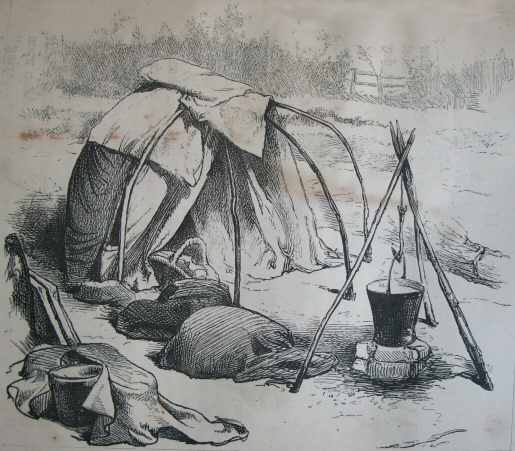
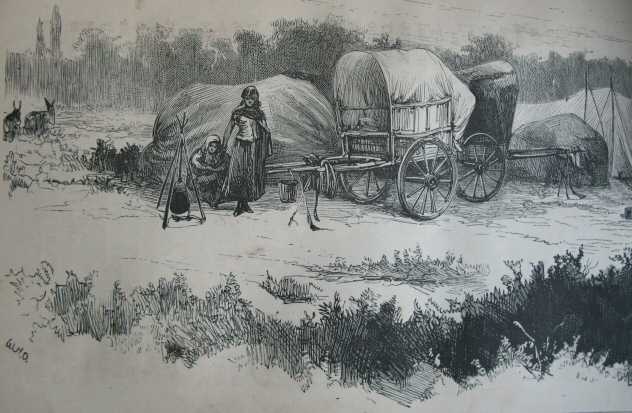
dwelling in calico tents, within the sound of church
bells—if living under the body of an old cart, protected by
patched coverlets, can be called living in tents—on the
roadside in the midst of grass, sticks, stones, and mud; and they
would have done well also if they had put out their hand to
rescue from idleness, ignorance, and heathenism our roadside
arabs, i.e., the children living in vans, and who attend
fairs, wakes, &c. Recently I came across some of these
wandering tribes, and the following facts gleaned from them will
show that missionaries and schoolmasters have not done much for
them. Moses Holland, who has been a Gipsy nearly all his
life, says he knows about two hundred and fifty families of
Gipsies in ten of the Midland counties and thinks that a similar
proportion will be found in the rest of the United Kingdom.
He has seen as many as ten tents of Gipsies within a distance of
five miles. He thinks there will be an average of five
children in each tent. He has seen as many as ten or twelve
children in some tents, and not many of them able to
read or write. His child of six months old—with his
wife ill at the same time in the tent—sickened, died, and
was ‘laid out’ by him, and it was also buried out of
one of those wretched abodes on the roadside at Barrow-upon-Soar,
last January. When the poor thing died he had not sixpence
in his pocket. In shaking hands with him as we parted his
face beamed with gladness, and he said that I was the first who
had held out the hand to him during the last twenty years.
At another time later on I came across Bazena Clayton, who said
that she had had sixteen children, fifteen of whom are alive,
several of them being born in a roadside tent. She says
that she was married out of one of these tents; and her brother
died and was buried out of a tent at Packington, near
Ashby-de-la-Zouch. This poor woman knows about three
hundred families of Gipsies in eleven of the Midland and Eastern
counties, and has herself, so she says, four lots of Gipsies
travelling in Lincolnshire at the present time. She said
she could not read herself, and thinks that not one Gipsy in
twenty can. She has travelled all her life. Her
mother, named Smith, of whom there are not a few, is the mother
of fifteen children, all of whom were born in a tent. A
Gipsy lives, but one can scarcely tell how; they generally locate
for a time near hen-roosts, potato-camps, turnip-fields, and
game-preserves. They sell a few clothes-lines and
clothes-pegs, but they seldom use such things themselves.
Washing would destroy their beauty. Telling fortunes to
servant girls and old maids is a source of income to some of
them. They sleep, but in many instances lie crouched
together, like so many dogs, regardless of either sex or
age. They have blood, bone, muscle, and brains, which are
applied in many instances to wrong purposes. To have
between three and four thousand men and women, and fifteen
thousand children classed in the census as vagrants and
vagabonds, roaming all over the country, in ignorance and evil
training, that carries peril with it, is not a pleasant look-out
for the future; and I claim on the grounds of justice and
equity, that if these poor children, living in vans and tents and
under old carts, are to be allowed to live in these places, they
shall be registered in a manner analogous to the Canal Boats Act
of 1877, so that the children may be brought under the Compulsory
Clauses of the Education Acts, and become Christianised and
civilised as other children.”
The foregoing letter, as it appeared in the Standard,
brought forth the following leading article upon the subject the
following day, August 15th, in which the writer
says:—“We yesterday published a letter from Mr.
George Smith, whose efforts to ameliorate and humanise the
floating and transitory population of our canals and navigable
rivers have already borne good fruit, in which he calls attention
to the deserted and almost hopeless lot of English Gipsy
children. Moses Holland—the Hollands are a Gipsy
family almost as old as the Lees or the Stanleys, and a Holland
always holds high rank among the ‘Romany’
folk—assures Mr. Smith that in ten of the Midland counties
he knows some two hundred and fifty families of Gipsies, and that
none of their children can read or write. Bazena Clayton,
an old lady of caste, almost equal to that of a Lee or a Holland,
confirms the story. She has lived in tents all her
life. She was born in a tent, married from a tent, has
brought up a family of sixteen children, more or less, under the
same friendly shelter, and expects to breathe her last in a
tent. That she can neither read nor write goes without
saying; although doubtless she knows well enough how to
‘kair her patteran,’ or to make that strange cross in
the dust which a true Gipsy alway leaves behind him at his last
place of sojourn, as a mark for those of his tribe who may come
upon his track. ‘Patteran,’ it may be remarked,
is an almost pure Sanscrit word cognate with our own
‘path;’ and the least philological raking among the
chaff of the Gipsy dialect will show their secret argot to
be, as Mr. Leland calls it, ‘a curious old tongue, not
merely allied to Sanscrit, but perhaps in point of age
an elder though vagabond sister or cousin of that ancient
language.’ No Sanscrit or even Greek scholar can fail
to be struck by the fact that, in the Gipsy tongue, a road is a
‘drum,’ to see is to ‘dicker,’ to get or
take to ‘lell,’ and to go to ‘jall;’ or,
after instances so pregnant, to agree with Professor von
Kogalnitschan that ‘it is interesting to be able to study a
Hindu dialect in the heart of Europe.’ Mr. Smith,
however, being a philanthropist rather than a philologist, takes
another view of the question. His anxiety is to see the
Gipsies—and especially the Gipsy
children—reclaimed. ‘A Gipsy,’ he reminds
us, ‘lives, but one can scarcely tell how; they generally
locate for a time near hen-roosts, potato-camps, turnip-fields,
and game-preserves. They sell a few clothes-lines and
clothes-pegs; but they seldom use such things themselves.
Washing would destroy their beauty . . . To have between three
and four thousand men and women, and eight or ten thousand
children, classed in the census as vagrants and vagabonds,
roaming all over the country in ignorance and evil training, is
not a pleasant look-out for the future; and I claim that if these
poor children, living in vans and tents and under old carts, are
to be allowed to live in these places, they shall be registered
in a manner analogous to the Canal Boats Act, so that the
children may be brought under the Education Acts, and become
Christianised and civilised.’
“Mr. Smith, it is to be feared, hardly appreciates the
insuperable difficulty of the task he proposes. The true
Gipsy is absolutely irreclaimable. He was a wanderer and a
vagabond upon the face of the earth before the foundations of
Mycenæ were laid or the plough drawn to mark out the walls
of Rome; and such as he was four thousand years ago or more, such
he still remains, speaking the same tongue, leading the same
life, cherishing the same habits, entertaining the same wholesome
or unwholesome hatred of all civilisation, and now, as then,
utterly devoid of even the simplest rudiments of religious
belief. His whole attitude of mind is negative. To him all who are not Gipsies, like
himself, are ‘Gorgios,’ and to the true Gipsy a
‘Gorgio’ is as hateful as is a ‘cowan’ to
a Freemason. It would be interesting to speculate whether,
when the Romany folk first began their wanderings, the
‘Gorgios’ were not—as the name would seem to
indicate—the farmers or permanent population of the earth;
and whether the nomad Gipsy may not still hate the
‘Gorgio’ as much as Cain hated Abel, Ishmael Isaac,
and Esau Jacob. Certain in any case it is that the Gipsy,
however civilised he may appear, remains, as Mr. Leland describes
him, ‘a character so entirely strange, so utterly at
variance with our ordinary conceptions of humanity, that it is no
exaggeration whatever to declare that it would be a very
difficult task for the best writer to convey to the most
intelligent reader any idea of such a nature.’ The
true Gipsy is, to begin with, as devoid of superstition as of
religion. He has no belief in another world, no fear of a
future state, nor hope for it, no supernatural object of either
worship or dread—nothing beyond a few old stories, some
Pagan, some Christian, which he has picked up from time to time,
and to which he holds—much as a child holds to its fairy
tales—uncritically and indifferently. Ethical
distinctions are as unknown to him as to a kitten or a
magpie. He is kindly by nature, and always anxious to
please those who treat him well, and to win their
affection. But the distinction between affection and esteem
is one which he cannot fathom; and the precise shade of
meum and tuum is as absolutely unintelligible to
him as was the Hegelian antithesis between nichts and
seyn to the late Mr. John Stuart Mill. To make the
true Gipsy we have only to add to this an absolute contempt for
all that constitutes civilisation. The Gipsy feels a house,
or indeed anything at all approaching to the idea of a permanent
dwelling, to amount to a positive restraint upon his
liberty. He can live on hedgehog and acorns—though he
may prefer a fowl and potatoes not strictly his own.
Wherever a hedge gives shelter he will roll himself up
and sleep. And it is possibly because he has no property of
his own that he is so slow to recognise the rights of property in
others. But above all, his tongue—the weird, corrupt,
barbarous Sanscrit ‘patter’ or ‘jib,’
known only to himself and to those of his blood—is the
keynote of his strange life. In spite of every effort that
has been made to fathom it, the Gipsy dialect is still
unintelligible to ‘Gorgios’—a few experts such
as Mr. Borrow alone excepted. But wherever the true Gipsy
goes he carries his tongue with him, and a Romany from Hungary,
ignorant of English as a Chippeway or an Esquimaux, will
‘patter’ fluently with a Lee, a Stanley, a Locke, or
a Holland, from the English Midlands, and make his
‘rukkerben’ at once easily understood. Nor is
this all, for there are certain strange old Gipsy customs which
still constitute a freemasonry. The marriage rites of
Gipsies are a definite and very significant ritual. Their
funeral ceremonies are equally remarkable. Not being
allowed to burn their dead, they still burn the dead man’s
clothes and all his small property, while they mourn for him by
abstaining—often for years—from something of which he
was fond, and by taking the strictest care never to even mention
his name.
“What are we to do with children in whom these strange
habits and beliefs, or rather wants of belief, are as much part
of their nature as is their physical organisation? Darwin
has told us how, after generations had passed, the puppy with a
taint of the wolf’s blood in it would never come straight
to its master’s feet, but always approach him in a
semicircle. Not Kuhleborhn nor Undine herself is less
susceptible of alien culture than the pure-blooded Gipsy.
We can domesticate the goose, we can tame the goldfinch and the
linnet; but we shall never reclaim the guinea-fowl, or accustom
the swallow to a cage. Teach the Gipsy to read, or even to
write; he remains a Gipsy still. His love of wandering is
as keen as is the instinct of a migratory bird for its annual
passage; and exactly as the prisoned cuckoo of the first
year will beat itself to death against its bars when September
draws near, so the Gipsy, even when most prosperous, will never
so far forsake the traditions of his tribe as to stay long in any
one place. His mind is not as ours. A little of our
civilisation we can teach him, and he will learn it, as he may
learn to repeat by rote the signs of the zodiac or the
multiplication table, or to use a table napkin, or to decorously
dispose of the stones in a cherry tart. But the lesson sits
lightly on him, and he remains in heart as irreclaimable as
ever. Already, indeed, our Gipsies are leaving us.
They are not dying out, it is true. They are making their
way to the Far West, where land is not yet enclosed, where game
is not property, where life is free, and where there is always
and everywhere room to ‘hatch the tan’ or put up the
tent. Romany will, in all human probability, be spoken on
the other side of the Atlantic years after the last traces of it
have vanished from amongst ourselves. We begin even now to
miss the picturesque aspects of Gipsy life—the tent, the
strange dress, the nomadic habits. English Gipsies are no
longer pure and simple vagrants. They are tinkers, or
scissor-grinders, or basket-makers, or travel from fair to fair
with knock-’em-downs, or rifle galleries, or itinerant
shows. Often they have some ostensible place of
residence. But they preserve their inner life as carefully
as the Jews in Spain, under the searching persecution of the
Inquisition, preserved their faith for generation upon
generation; and even now it is a belief that when, for the sake
of some small kindness or gratuity, a Gipsy woman has allowed her
child to be baptised, she summons her friends, and attempts to
undo the effect of the ceremony by subjecting the infant to some
weird, horrible incantation of Eastern origin, the original
import of which is in all probability a profound mystery to
her. There is a quaint story of a Yorkshire Gipsy, a
prosperous horse-dealer, who, becoming wealthy, came up to town,
and, amongst other sights, was shown a goldsmith’s
window. His sole remark was that the man must be a big
thief indeed to have so many spoons and watches all at
once. The expression of opinion was as naïve and
artless as that of Blucher, when observing that London was a
magnificent city ‘for to sack.’ Mr.
Smith’s benevolent intentions speak for themselves.
But if he hopes to make the Gipsy ever other than a Gipsy, to
transform the Romany into a Gorgio, of to alter habits of life
and mind which have remained unchanged for centuries, he must be
singularly sanguine, and must be somewhat too disposed to
overlook the marvellously persistent influences of race and
tongue.”
Rather than the cause of the children should suffer by
presenting garbled or one-sided statements, I purpose quoting the
letters and articles upon the subject as they have
appeared. To do otherwise would not be fair to the authors
or just to the cause I have in hand. The flattering
allusions and compliments relating to my humble self I am not
worthy of, and I beg of those who take an interest in the cause
of the little ones, and deem this book worthy of their notice, to
pass over them as though such compliments were not there.
The following are some of the letters that have appeared in the
Standard in reply to mine of the 14th instant.
“B. B.” writes on August 16th:—“Would you
allow an Irish Gipsy to express his views touching George
Smith’s letter of this date in your paper? Without in
the least desiring to warp his efforts to improve any of his
fellow-creatures, it seems to me that the poor Gipsy calls for
much less sympathy, as regards his moral and social life, than
more favoured classes of the community. Living under the
body of an old cart, ‘within the sound of church
bells,’ in the midst of grass, sticks, and stones, by no
means argues moral degradation; and if your correspondent looks
up our criminal statistics he will not find one Gipsy registered
for every five hundred criminals who have not only been within
hearing of the church bells but also listening to the
preacher’s voice. It should be remembered that
the poor Gipsy fulfils a work which is a very great convenience
to dwellers in out-of-the-way places—brushes, baskets,
tubs, clothes-stops, and a host of small commodities, in
themselves apparently insignificant, but which enable this tribe
to eke out a living which compares very favourably with the
hundreds of thousands in our large cities who set the laws of the
land as well as the laws of decency at defiance. As to
education—well, let them get it, if possible; but it will
be found they possess, as a rule, sufficient intelligence to
discharge the duties of farm-labourers; and already they are
beginning to supply a felt want to the agriculturist whose
educated assistant leaves him to go abroad.”
“An Old Woman” writes as follows:—“In
the article on Gipsies in the Standard of to-day I was
struck with the truth of this; remark—‘He is kindly
by nature, and always anxious to please those who treat him well,
and to win their affections.’ I can give you one
instance of this in my own family, although it happened long,
long ago. The Boswell tribe of Gipsies used to encamp once
a year near the village in which my grandfather (my
mother’s father), who was a miller and farmer, lived; and
there grew up a very kindly feeling between the head of the tribe
and my grandfather and his family. Some of the Gipsies
would often call at my grandfather’s house, where they were
always received kindly, and oftener still, on business or
otherwise, at the mill, to see ‘Pe-tee,’ as they
called my grandfather, whose Christian name was Peter. Once
upon a time my grandfather owed a considerable sum of money, and,
alas! could not pay it; and his wife and children were much
distressed. I believe they feared he would be
arrested. Everything is known in a village; and the news of
what was feared reached the Gipsies. The idea of their
friend Pe-tee being in such trouble was not borne quietly; the
chief and one or two more appeared at the farm-house, asking to
see my grandmother. They told her they had come to pay my
grandfather’s debt; ‘he should never be
distressed for the money,’ they said, ‘as long as
they had any.’ I believe some arrangement had been
made about the debt, but nevertheless my grandmother felt just as
grateful for the kindness. The head of the tribe wore
guineas instead of buttons to his coat, and when his daughter was
married her dowry was measured in guineas, in a pint
measure. I suppose, as in the old ballad of ‘The
Beggar of Bethnal Green,’ the suitor would give measure for
measure. The villagers all turned out to gaze each year
when they heard the ‘Boswell gang’ were coming down
the one long street; the women of the tribe, fine, bold,
handsome-looking women, in ‘black beaver bonnets, with
black feathers and red cloaks,’ sometimes quarrelled, and
my mother, then a girl, saw the procession several times stop in
the middle of the village, and two women (sometimes more) would
fall out of the ranks, hand their bonnets to friends, strip off
cloak and gown, and fight in their ‘shift’ sleeves,
using their fists like men. The men of the tribe took no
notice, stood quietly about till the fight was over, and then the
whole bevy passed on to their camping-ground. My
grandfather never passed the tents without calling in to see his
friends, and it would have been an offence indeed if he had not
partaken of some refreshment. Two or three times my mother
accompanied him, and whenever and wherever they met her they were
always very kind and respectful to ‘Pe-tee’s little
girl.’ In after years, when visiting her native
village, she often inquired if it was known what had become of
the tribe; at last she heard from some one it was thought they
had settled in Canada: at any rate they had passed away for ever
from that part of England.”
Mr. Leland wrote as follows in the Standard, August
19:—“As you have kindly cited my work on the English
Gipsies in your article on them, and as many of your readers are
giving their opinions on this curious race, perhaps you will
permit me to make a few remarks on the subject. Mr.
Smith is one of those honest philanthropists whom it is the duty
of every one to honour, and I for one, honour him most sincerely
for his kind wishes to the Romany; but, with all my respect, I do
not think he understands the travellers, or that they require
much aid from the ‘Gorgios,’ being quite capable of
looking out for themselves. A tacho Rom, or real
Gipsy, who cannot in an emergency find his ten, or even twenty,
pounds is a very exceptional character. As I have, even
within a few days, been in company, and on very familiar footing
with a great number of Romanys of different families of the dark
blood who spoke the ‘jib’ with unusual accuracy, I
write under a fresh impression. The Gipsy is almost
invariably strong and active, a good rough rider and pedestrian,
and knowing how to use his fists. He leads a very hard
life, and is proud of his stamina and his pluck. Of late
years he kairs, or ‘houses,’ more than of old,
particularly during the winter, but his life at best requires
great strength and endurance, and this must, of course, be
supported by a generous diet. In fact, he lives well, much
better than the agricultural labourer. Let me explain how
this is generally done. The Gipsy year may be said to begin
with the races. Thither the dark children of Chun-Gwin,
whether pure blood, posh an’ posh (half-and-half),
or churedis, with hardly a drop of the kalo-ratt,
flock with their cocoa-nuts and the balls, which have of late
taken the place of the koshter, or sticks. With them
go the sorceresses, old and young, who pick up money by
occasional dukkerin, or fortune-telling. Other small
callings they also have, not by any means generally
dishonest. Wherever there is an open pic-nic on the Thames,
or a country fair, or a regatta at this season, there are
Romanys. Sometimes they appear looking like petty farmers,
with a bad, or even a good, horse or two for sale. While
summer lasts this is the life of the poorer sort.
“This merry time over, they go to the Livinengro
tem, or hop-land—i.e., Kent. Here they
work hard, not neglecting the beer-pot,
which goes about gaily. In this life they have great
advantages over the tramps and London poor. Hopping over,
they go, almost en masse, or within a few days, to London
to buy French and German baskets, which they get in
Houndsditch. Of late years they send more for the baskets
to be delivered at certain stations. Some of them make
baskets themselves very well, but, as a rule, they prefer to buy
them. While the weather is good they live by selling
baskets, brooms, clothes-lines, and other small wares. Most
families have their regular ‘beats’ or rounds, and
confine themselves to certain districts. In winter the men
begin to chiv the kosh, or cut wood—i.e.,
they make butchers’ skewers and clothes-pegs. Even
this is not unprofitable, as a family, what between manufacturing
and selling them, can earn from twelve to eighteen shillings a
week. With this and begging, and occasional jobs of honest
hard work which they pick up here and there, they contrive to
feed well, find themselves in beer, and pay, as they now often
must, for permission to camp in fields. Altogether they
work hard and retire early.
“Considering the lives they lead, Gipsies are not
dishonest. If a Gipsy is camped anywhere, and a hen is
missing for miles around, the theft is always at once attributed
to him. The result is that, being sharply looked after by
everybody, and especially by the police, they cannot act like
their ancestors. Their crimes are not generally of a
heinous nature. Chiving a gry, or stealing a horse,
is, I admit, looked upon by them with Yorkshire leniency, nor do
they regard stealing wood for fuel as a great sin. In this
matter they are subject to great temptation. When the
nights are cold—
“Could anything be more alluring
Than an old hedge?
“As for Gipsy lying, it is so peculiar that it would be
hard to explain. The American who appreciates the phrase
‘to sit down and swap lies’ would not be taken in by
a Romany chal, nor would an old salt who can spin
yarns. They enjoy hugely being lied unto, as do all Arabs
or Hindus. Like many naughty children, they like successful
efforts of the imagination. The old dyes, or
mothers, are ‘awful beggars,’ as much by habit as
anything; but they will give as freely as they will take, and
their guest will always experience Oriental hospitality.
They are very fond of all gentlemen and ladies who take a real
interest in them, who understand them, and like them. To
such people they are even more honest than they are to one
another. But it must be a real aficion, not a merely
amateur affectation of kindness. Owing to their entire
ignorance of ordinary house and home life, they are like children
in many respects, though so shrewd in others. Among the
Welsh Gipsies, who are the most unsophisticated and the most
purely Romany, I have met with touching instances of gratitude
and honesty. The child-like ingenuity which some of them
manifested in contriving little gratifications for myself and for
Professor E. H. Palmer, who had been very kind to them, were as
naïve as amiable. I have observed that some Gipsies of
the more rustic sort loved to listen to stories, but, like
children, they preferred those which they had heard several times
and learned to like. They knew where the laugh ought to
come in. The Gipsy is both bad and good, but neither his
faults nor his virtues are exactly what they are supposed to
be. He is certainly something of a scamp—and,
nomen est omen, there is a tribe of Scamps among
them—but he is not a bad scamp, and he is certainly a most
amusing and eccentric one.
“There is not the least use in trying to ameliorate the
condition of the Gipsy while he remains a traveller. He
will tell you piteous stories, but he will take care of
himself. As Ferdusi sings:
“‘Say what you will and do what you
can,
No washing e’er whitens the black Zingan.’
“The only kindness he requires is a little charity and
forgiveness when he steals wood or wires a hare.
All wrong doubtless; but something should be allowed to one whose
ancestors were called ‘dead-meat eaters’ in the
Shastras. Should the reader wish to reform a Gipsy, let him
explain to the Romany that the days for roaming in England are
rapidly passing away. Tell him that for his
children’s sake he had better rent a cheap cottage; that
his wife can just as well peddle with her basket from a house as
from a waggon, and that he can keep a horse and trap and go to
the races or hopping ‘genteely.’ Point out to
him those who have done the same, and stimulate his ambition and
pride. As for suffering as a traveller he does not know
it. I once asked a Gipsy girl who was sitting as a model if
she liked the drom (road) best, or living in a
house. With sparkling eyes and clapping her hands she
exclaimed, ‘oh, the road! the road!’”
Mr. Beerbohm writes under date August 19th:—“In
reading yesterday’s article on the customs and
idiosyncrasies of Gipsies I was struck by the similarity they
present to many peculiarities I have observed among the
Patagonian Indians. To those curious in such matters it may
be of interest to know that the custom of burning all the goods
and chattels of a deceased member of the tribe prevails among the
Patagonians as among the Gipsies; and the identity of custom is
still further carried out, inasmuch as with the former, as with
the latter, the name of the deceased is never uttered, and all
allusion to him is strictly avoided. So much so, that in
those cases when the deceased has borne some cognomen taken from
familiar objects, such as ‘Knife,’
‘Wool,’ ‘Flint,’ &c., the word is no
longer used by the tribe, some other sound being substituted
instead. This is one of the reasons why the Tshuelche
language is constantly fluctuating, but few of the words
expressing a proper meaning, as chronicled by Fitzroy and Darwin
(1832), being now in use.”
The Rev. Mr. Hewett writes to the Standard, under date
August 19th, to say that he baptised two Gipsy children in 1871. One might ask, in the language of one of the
“Old Book,” “What are these among so
many?” The following letter from Mr. Harrison upon
the subject appeared on August 20th:—“I have just
returned from the head-quarters of the Scotch
Gipsies—Yetholm (Kirk), a small village nestling at the
foot of the Cheviots in Roxburghshire. Here I saw the abode
of the Queen, a neat little cottage, with well-trimmed garden in
front. Inside all was a perfect pattern of neatness, and
the old lady herself was as clean ‘as a new
pin.’ As I passed the cottage a carriage and pair
drove up, and the occupants, four ladies, alighted and entered
the cottage. I was afterwards told that they were much
pleased with their visit, and that, in remembrance of it, each of
the four promised to send a new frock to the Queen’s
grandchild. The Queen’s son (‘the
Prince,’ as he is called) I saw at St. James’s Fair,
where he was swaggering about in a drunken state, offering to
fight any man. I believe he was subsequently locked
up. In the month of August there are few Gipsies resident
in Yetholm: they are generally on their travels selling
crockeryware (the country people call the Gipsies
‘muggers,’ from the fact that they sell mugs),
baskets made of rushes, and horn spoons, both of which they
manufacture themselves. I have a distinct recollection of
Will Faa, the then King of the Gipsies. He was 95 when I
knew him, and was lithe and strong. He had a keen hawk eye,
which was not dimmed at that extreme age. He was considered
both a good shot and a famous fisher. There was hardly a
trout hole in the Bowmont Water but he knew, and his company used
to be eagerly sought by the fly-fishers who came from the
South. My opinion of the Gipsies—and I have seen much
of them during the last forty years—is that they are a
lazy, dissolute set of men and women, preferring to beg, or
steal, or poach, to work, and that, although many efforts have
been made (more especially by the late Rev. Mr. Baird, of
Yetholm), to settle them, they are irreclaimable. There are
but two policemen in Yetholm and Kirk Yetholm, but
sometimes the assistance of some of the townsfolk is required to
bring about order in that portion of the village in which the
Gipsies reside. I may say that the townsfolk do not
fraternise with the Gipsies, who are regarded with the greatest
suspicion by the former. Ask a townsman of Yetholm what he
thinks of the Gipsies, and he will tell you they are simply
vagabonds and impostors, who lounge about, and smoke, and drink,
and fight. In fact, they are the very scum of the human
race; and, what is more singular, they seem quite satisfied to
remain as they are, repudiating every attempt at
reformation.”
“F. G. S.” writes:—“One of your
correspondents suggests that the silence of the Gipsies
concerning their dead is carried so far as to consign them to
nameless graves. In my churchyard there is a headstone,
‘to the memory of Mistress Paul Stanley, wife of Mr. Paul
Stanley, who died November, 1797,’ the said Mistress
Stanley having been the Queen of the Stanley tribe. In my
childhood I remember that annually some of the members of the
tribe used to come and scatter flowers over the grave; and when
my father had restored the stone, on its falling into decay, a
deputation of the tribe thanked him for so doing. I have
reason to think they still visit the spot, to find, I am sorry to
say, the stone so decayed now as to be past restoration, and I
would much like to see another with the same inscription to mark
the resting-place of the head of a leading tribe of these
interesting people.”
To these letters I replied as under, on August
21st:—“The numerous correspondents who have taken
upon themselves to reply to my letter that appeared in your issue
of the 14th inst., and to show up Gipsy life in some of its
brightest aspects, have, unwittingly, no doubt, thoroughly
substantiated and backed up the cause of my young
clients—i.e., the poor Gipsy children and our
roadside arabs—so far as they have gone, as a reperusal of
the letters will show the most casual observer of our
hedge-bottom heathens of Christendom. At the same time, I would say the
tendency of some of the remarks of your correspondents has
special reference to the adult Gipsies, roamers and ramblers,
and, consequently, there is a fear that the attention of some of
your readers may be drawn from the cause of the poor uneducated
children, living in the midst of sticks, stones, ditches, mud,
and game, and concentrated upon the ‘guinea buttons,’
‘black-haired Susans,’ ‘red cloaks,’
‘scarlet hoods,’ the cunning craft of the old men,
the fortune-telling of the old women, the ‘sparkling
eyes’ and ‘clapping of hands,’ and
‘twopenny hops’ of the young women, who certainly can
take care of themselves, just as other un-Christianised and
uncivilised human beings can. I do not profess—at any
rate, not for the present—to take up the cause of the men
and women ditch-dwelling Gipsies in this matter; I must leave
that part of the work to fiction writers, clergymen, and
policemen, abler hands than mine. I may not be able, nor do
I profess, to understand the singular number of the masculine
gender of dad, chavo, tikeno, moosh,
gorjo, raklo, rakli, pal palla; the
feminine gender dei, tikeno, chabi,
joovel, gairo, rakle, raklia, pen
penya, or the plural of the masculine gender dada,
chavi, and the feminine gender deia, chavo;
but, being a matter of fact kind of man—out of the region
of romance, fantastical notions, enrapturing imagery, nicely
coloured imagination, clever lying and cleverer deception,
beautiful green fields, clear running rivulets, the singing of
the wood songster, bullfinch, and wren, in the midst of woodbine,
sweetbriar, and roses—with an eye to observe, a heart to
feel, and a hand ready to help, I am led to contemplate, aye, and
to find out if possible, the remedy, though my friends say it is
impossible—just because it is impossible it becomes
possible, as in the canal movement—for the wretched
condition of some eight to ten thousand little Gipsy children,
whose home in the winter is camping half-naked in a hut, so
called, in the midst of ‘slush’ and snow, on the
borders of a picturesque ditch and
roadside, winterly delights, Sunday and week day alike. The
tendency of human nature is to look on the bright side of things;
and it is much more pleasant to go to the edge of a large swamp,
lie down and bask in the summer’s sun, making
‘button-holes’ of daisies, buttercups, and the like,
and return home and extol the fine scenery and praise the
richness of the land, than to take the spade, in shirt-sleeves
and heavy boots, and drain the poisonous water from the roots of
vegetation. Nevertheless, it has to be done, if the
‘strong active limbs’ and ‘bright sparkling
eyes’ are to be turned to better account than they have
been in the past. It is not creditable to us as a Christian
nation, in size compared with other nations not much larger than
a garden, to have had for centuries these heathenish tribes in
our midst. It does not speak very much for the power of the
Gospel, the zeal of the ministers of Christ’s Church, and
the activity of the schoolmaster, to have had these plague spots
continually flitting before our eyes without anything being done
to effect a cure. It is true something has been done.
One clergyman, who has ‘had opportunities of observing
them,’ if not brought in daily contact with them, tells us
that some eight or nine years since he publicly baptised two
Gipsy children. Another tells us that some time since he
baptised many Gipsy children, as if baptism was the only thing
required of the poor children for the duties and responsibilities
of life and a future state. Better a thousand times have
told us how many poor roadside arabs and Gipsy children they have
taken by the hand to educate and train them, so as to be able to
earn an honest livelihood, instead of ‘cadging’ from
door to door, and telling all sorts of silly stories and
lies. How many poor children’s lives have been
sacrificed at the hands of cruelty, starvation, and neglect, and
buried under a clod without the shedding of a tear, it is fearful
to contemplate. The idlers, loafers, rodneys, mongrels,
gorgios, and Gipsies are increasing, and will increase, in our
midst, unless we put our hand upon the
system, from the simple fact that by packing up with wife and
children and ‘taking to the road,’ he thus escapes
taxes, rent, and the School-board officer. This they see,
and a ‘few kind words’ and ‘gentle
touches’ will never cause them to see it in any other
light. The sooner we get the ideal, fanciful, and romantic
side of a vagrant’s and vagabond’s life removed from
our vision, and see things as they really are, the better it will
be for us. For the life of me I cannot see anything
romantic in dirt, squalor, ignorance, and misery. Ministers
and missionaries have completely failed in the work, for the
simple reason that they have never begun it in earnest;
consequently, the schoolmaster and School-board officer must
begin to do their part in reclaiming these wandering tribes, and
this can only be done in the manner stated by me in my previous
letter.”
In the Leicester Free Press the following appeared on
August 16th:—“Mr. George Smith, of Coalville, is
earning the title of the Children’s Friend. His
‘Cry of the Brick-yard Children’ rang through
England, and issued in measures being adopted for their
protection. His description of the canal-boat children has
also resulted in legislation for their relief. Now I see
Mr. Smith has put in a good word for Gipsy children. It
will surprise a good many who seldom see or hear of these
Gipsies, except perhaps at the races, to find how numerous they
are even in this county. I do not think the number is at
all exaggerated. A few days ago while driving down a rural
lane in the country I ‘interviewed’ one of these
children, who had run some hundreds of yards ahead, in order to
open a gate. At first the young, dark-eyed, swarthy damsel
declared she did not know how many brothers and sisters she had,
but on being asked to mention their names she rattled them over,
in quick succession, giving to each Christian name the surname of
Smith—thus, Charley Smith, Emma Smith, Fanny Smith, Bill
Smith, and the like, till she had enumerated either thirteen or
fifteen juvenile Smiths, all of whom lived with their parents in
a tent which was pitched not far from the side of the
lane. Of education the child had had none, but she said she
went to church on a Sunday with her sister. This is a
sample of the kind of thing which prevails, and in his last
generous movement Mr. Smith, of Coalville, will be acting a good
part to numerous children who, although unable to claim
relationship, rejoice in the same patronymic as
himself.”
In the Derby Daily Telegraph, under date August 16th,
the following leading article was published:—“When
the social history of the present generation comes to be written
a prominent place among the list of practical philanthropists
will be assigned to George Smith, of Coalville. The man is
a humanitarian to the manner born. His character and
labours serve to remind us of the broad line which separates the
real apostle of benevolence from what may be termed the
‘professional’ sample. George Smith goes about
for the purpose of doing good, and—he does it. He
does not content himself with glibly talking of what needs to be
done, and what ought to be done. He prefers to act upon the
spirit of Mr. Wackford Squeers’ celebrated educational
principle. Having discovered a sphere of Christian duty he
goes and ‘works’ it. Few more splendid
monuments of practical charity have been reared than the
amelioration of the social state of our canal population—an
achievement which has mainly been brought about by Mr.
Smith’s indomitable perseverance and self-denial. A
few years ago we were accustomed to speak of the dwellers in
these floating hovels as beings who dragged out a degraded
existence in a far-off land. We were gloomily told that
they could not be reached. Orators at fashionable
missionary-meetings were wont to speak of them as irreclaimable
heathens who bid defiance to civilising influences from
impenetrable fastnesses. Mr. George Smith may be credited
with having broken down this discreditable state of things.
He brought us face to face with this unfortunate section of our
fellow-creatures, with what result it is not necessary to
say. The sympathies of the public were effectually roused
by the narratives which revealed to us the deplorable depths of
human depravity into which vast numbers of English people had
fallen. The sufferings of the children in the gloomy,
pestiferous cabins used for ‘living’ purposes
especially excited the country’s pity. At this
present moment the lot of these poor waifs is far from being
inviting, but it is vastly different from what it was a short
time back. It was only a few days ago that the Duke of
Richmond, in reply to no less a personage than the Archbishop of
Canterbury, announced that express arrangements had been made by
the Government to meet the educational requirements of the once
helpless and neglected victims.
“Mr. Smith has now embarked upon a fresh crusade against
misery and ignorance. He has turned his attention from the
‘water Gipsies’ to their brethren ashore. He
has already began to busy himself with the condition of
‘our roadside arabs,’ as he calls them. We fear
Mr. Smith in prosecuting this good work of his is doomed to
perform a serious act of disenchantment. The ideal Gipsy is
destined to be scattered to the winds by the unvarnished picture
which Mr. Smith will cause to be presented to our vision.
He does not pretend to show us the romantic,
fantastically-dressed creature whose prototypes have long been in
the imaginations of many of us as types of the Gipsy
species. Those of our readers who have formed their notions
of Gipsy life upon the strength of the assurances which have been
given them by the late Mr. G. P. R. James and kindred writers
will find it hard to substitute for the joyous scenes of sunshine
and freedom he has associated with the nomadic existence, the
dull, wearisome round of squalor and wretchedness which is found,
upon examination, to constitute the principal condition of the
Gipsy tent. Whether it is that in this awfully prosaic
period of the world’s history the picturesque and jovial
rascality which novelist and poet have insisted in connecting
with the Ishmaelites is stamped ruthlessly out of being
by force of circumstances, it is barely possible to say.
Perhaps Gipsies, in common with other tribes of the romantic
past, have gradually become denuded of their old
attractiveness. It is, we confess, rather difficult to
believe that Bamfylde Moore Carew (wild, restless fellow though
he was) would persistently have linked his lot with that of the
poor, degraded, poverty-stricken wretches whom Mr. Smith has
taken in hand. Perchance it happens that our old heroes of
song and story have, so far as England is concerned, deteriorated
as a consequence of the money-making, business-like atmosphere
that they are compelled to breathe, and that with more favoured
climes they are to be seen in much of their primitive
glory. In Hungary, for instance, it is declared that Gipsy
life is pretty much what it is represented to be in our own
glowing pages of fiction. The late Major Whyte-Melville, in
a modern story declared to be founded on fact, introduces us to a
company of these continental wanderers who, with their beautiful
Queen, seem to invest the scenes from our old friend, ‘The
Bohemian Girl,’ with something akin to probability.
But there is, of course, a limit to even Mr. Smith’s
labours. Hungary is beyond his jurisdiction. He does
not pretend to carry his experience of the Gipsies further than
the Midlands. Derbyshire, Staffordshire, and our
neighbouring counties have offered him the examples he requires
with his new campaign. The lot of the roamers who eke out a
living in the adjacent lanes and roadways is, he explains to us,
as pitiful as anything of the sort well could be. The tent
of the Gipsy he finds to be as filthy and as repulsive as the
cabin of the canal-boat. Human beings of both sexes and of
all ages are huddled together without regard to comfort. As
a necessary sequence the women and children are the chief
sufferers in a social evil of this sort. The men are able
to rough it, but the weaker sex and their little charges are
reduced to the lowest paths of misery. Children are born,
suffer from disease, and die in the canvas hovels; and are
committed to the dust by the roadside. One old woman told Mr. Smith ‘that
she had had sixteen children, fifteen of whom are alive, several
of them being born in a roadside tent. She says that she
was married out of one of these tents; and her brother died and
was buried out of a tent at Packington, near
Ashby-de-la-Zouch.’ The experience of this old crone
is akin to that of most of her class. She also tells Mr.
Smith that she could not read herself, and she did not believe
one in twenty could. Morally, as well as from a sanitary
point of view, Gipsy life, as it really exists, is a social
plague-spot, and consequently a social danger. Especially
does this contention apply to the children, of whom Mr. Smith
estimates that there are ten thousand roaming over the face of
the country as vagrants and vagabonds. It is to be hoped
many months will not be allowed to elapse before this difficulty
is seriously and successfully grappled with. Mr.
Smith’s counsel as to the children is that ‘living in
vans and tents and under old carts, if they are to be allowed to
live in these places they should be registered in a manner
analogous to the Canal Boats Act of 1877, so that the children
may be brought under the compulsory clauses of the Education
Acts, and become Christianised and civilised as other
children.’ The Duke of Richmond and his department
may do much to facilitate Mr. Smith’s crusade without
temporising with the prejudices of red-tapeism.”
Figaro writes August 27th:—“Our old friend
having successfully tackled the brick-yard children, and the
floating waifs and strays of our barge population, has now taken
the little Gipsies in hand, with a view of bringing them under
the supervision of the School Board system now general in this
country. He is a bold and energetic man, but we are bound
to say we doubt a little whether he will be able to tame the
offspring of the merry Zingara, and pass them all through the
regulation educational standard. Should he succeed, we
shall be thenceforth surprised at nothing, but be quite prepared
to hear that Mr. Smith has become
chairman of a society for changing the spots of the leopard, or
honorary director of an association for changing the
Ethiopian’s skin!”
The following letter from the Rev. J. Finch, a rural dean,
appeared in the Standard, August 30th:—“The
following facts may not be without some interest to those who
have read the letters which have recently appeared in the pages
of the Standard respecting Gipsies. During the
thirty years I have been rector of this parish, members of the
Boswell family have been almost constantly resident here. I
buried the head of the family in 1874, who died at the age of
87. He was a regular attendant at the parish church, and
failed not to bow his head reverently when he entered within the
House of God. His burial was attended by several sons
resident, as Gipsies, in the Midland counties, and a headstone
marks the grave where his body rests. I never saw, or
heard, any harm of the man. He was a quiet and inoffensive
man, and worked industriously as a tinman within a short time of
his death. If he had rather a sharp eye for a little gift,
that is a trait of character by no means confined to
Gipsies. One of his daughters was married here to a member
of the Boswell tribe, and another, who rejoiced in the name of
Britannia, I buried in her father’s grave two years
ago. After his death she and her mother removed to an
adjoining parish, where she was confirmed by Bishop Selwyn in
1876. Regular as was the old man at church, I never could
persuade his wife to come. In 1859 I baptized, privately,
an infant of the same tribe, whose parents were travelling
through the parish, and whose mother was named Elvira.
Great was the admiration of my domestics at the sight of the
beautiful lace which ornamented the robe in which the child was
brought to my house. Clearly there are Gipsies, and those
of a well-known tribe, glad to receive the ministrations of the
Church.”
I next turned my steps towards London, having heard that
Gipsies were to be found in the outskirts of this Babylon.
I set off early one morning in quest of them from my lodgings,
not knowing whither; but my earliest association came to my
relief. Knowing that Gipsies are generally to be found in
the neighbourhood of brick-yards, I took the ’bus to
Notting Hill, and after asking the policeman, for neither
clergyman or other ministers could tell me where they were to be
found, I wended my way to Wormwood Scrubs, and the following
letter, which appeared in the Daily News, September 6th of
last year, is the outcome of that “run out,” and is
as follows:—“It has been the custom for years—I
might almost say centuries—when speaking of the Gipsies, to
introduce in one form or other during the conversation either
‘the King of the Gipsies,’ ‘the Queen,’
or some other member of ‘the Royal Family.’ It
may surprise many of your readers who cling to the romantic side
of a Gipsy’s life, and shut their eyes to the fearful
amount of ignorance, wretchedness, and misery there is amongst
them, to say that this extraordinary being is nothing but a
mythological jack-o’-th’-lantern, phantom of the
brain, illusion, the creation of lying tongues practising the art
of deception among some of the ‘green horns’ in the
country lanes, or on the village greens. It is true there
are some ‘horse-leeches’ among the Gipsies who have
got fat out of their less fortunate hedge-bottom brethren and the
British public, who delight in calling them either ‘the
King,’ ‘Queen,’ ‘Prince,’ or
‘Princess.’ It is true also that there are vast
numbers of the Gipsies who, with a chuckle, tongue in cheek, wink
of the eye, side grin and a sneer, say they have these important
personages amongst them; and if any little extra stir is being
made at a fair-time in the country lanes, in the neighbourhood of
straw-yards, they will be sure to tell them that either the
‘king,’ ‘queen,’ or some member of the
‘royal family’ is being married or visiting them; and
nothing pleases the poor, ignorant Gipsies better than to get the
bystanders, with mouths open, to believe
their tales and lies. I should think that there is scarcely
a county in England but what a Gipsy king’s or
queen’s wedding has not taken place there within the last
twenty years. There was one in Bedfordshire not long since;
another at Epping Forest; and the last I heard of this wonderful
airy being was that he had taken up his head-quarters at the
Royal Hotel, Liverpool, and a carriage with eight wheels and six
piebald horses had been presented to him as a wedding present
from the Gipsies. Gipsy ‘kings,’
‘queens,’ and ‘princes,’ their marriages
and deaths, are innumerable among the ‘royal
family.’ It is equally believing in moonshine and
air-bubbles to believe that the Gipsies never speak of their
dead. There is a beautiful headstone put in a little
churchyard about two and a half miles from Barnet in memory of
the Brinkly family, and it is carefully looked after by members
of the family; one of the Lees has a tombstone erected to his
memory in Hanwell Cemetery; and such silly nonsense is put out by
the cunning, crafty Gipsies as ‘dazzlers,’ to enable
them more readily to practise the art of lying and deception upon
their gullible listeners. Then again, with reference to the
Gipsies having a religion of their own. There is not a word
of truth in this imaginative notion prevalent in the minds or
some who have been trying to study their habits. Excepting
the language of some of the old-fashioned real Gipsies, and a few
other little peculiarities, any one studying the real hard facts
of a Gipsy’s life with reference to the amount of
ignorance, and everything that is bad among them, will come to
the conclusion that there is much among them to compare very
unfavourably with the most neglected in our back streets and
slums. Of course, there are some good among them, as with
other ‘ragamuffin’ ramblers. The following
particulars, related to me by a well-known Gipsy woman in the
neighbourhood of ‘Wormwood Scrubs’ and the
‘North Pole,’ remarkable for her truthfulness,
honesty, and uprightness, will tend to show that
my previous statement as regards the amount of ignorance
prevalent among the poor Gipsy children has not been
over-stated. She has had six brothers and one sister, all
born in a tent, and only one of the eight could read a
little. She has had nine children born in a tent, four of
whom are alive, and only one could read and write a little.
She has seventeen grandchildren, and only two of them can read
and write a little, and thinks this a fair average of other Gipsy
children. She tells me that she got a most fat living for
more than twenty years by telling lies and fortunes to
servant-girls, old maids, and young men, mostly out of a book of
which she could not read a sentence, or tell a letter. She
said she had heard that I had taken up the cause of the poor
Gipsy children to get them educated, and, with hands uplifted and
tears in her eyes, which left no doubt of her meaning, said,
‘I do hope from the bottom of my heart that God will bless
and prosper you in the work till a law is passed, and the poor
Gipsy children are brought under the School Board, and their
parents compelled to send them to school as other people
are. The poor Gipsy children are poor, ignorant things, I
can assure you.’ She also said ‘Does the Queen
wish all our poor Gipsy children to be educated?’ I
told her that the Queen took special interest in the children of
the working-classes, and was always pleased to hear of their
welfare. Again, with tears trickling down her face, she
said, ‘I do thank the Lord for such a good Queen, and for
such a noble-hearted woman. I do bless her. Do Thou,
‘Lord, bless her!’ After some further
conversation, and taking dinner with her in her humble way in the
van, she said she hoped I would not be insulted if she offered
me, as from a poor Gipsy woman, a shilling to help me in the work
of getting a law passed to compel the Gipsies to send their
children to school. I took the shilling, and, after making
her a present of a copy of the new edition of my ‘Cry of
the Children from the Brick-yards of England,’ which she
wrapped in a beautiful white cloth, and after a
shake of the hand, we parted, hoping to meet again on some future
day.”
The foregoing letter brought forth the following letter from
Mr. Daniel Gorrie, and appeared in the Daily News under
date September 13th, as under:—“Mr. George Smith,
Coalville, Leicester, whose letter on the above subject appears
in your impression to-day, succeeded so well in his efforts on
behalf of the poor slave-children of the Midland brick-yards,
that it is to be hoped he will attain equal success in drawing
attention to the pitiful condition of the Gipsy children, who are
allowed to grow up as ignorant as savages that never saw the face
nor heard the voice of a Christian missionary. In one of
the late Thomas Aird’s poems, entitled ‘A Summer
Day,’ there are some lines which, with your permission, I
should like to quote, that are in perfect accord with Mr.
Smith’s wise and kindly suggestion. The lines are
these:—
“‘In yonder sheltered nook of nibbled
sward,
Beside the wood, a Gipsy band are camped;
And there they’ll sleep the summer night away.
By stealthy holes their ragged, brawny brood
Creep through the hedges, in their pilfering quest
Of sticks and pales to make their evening fire.
Untutored things scarce brought beneath the laws
And meek provisions of this ancient State.
Yet is it wise, with wealth and power like hers,
To let so many of her sons grow up
In untaught darkness and consecutive vice?
True, we are jealous, free, and hate constraint
And every cognisance, o’er private life;
Yet, not to name a higher principle,
’Twere but an institute of wise police
That every child, neglected of its own,
State claimed should be, State seized and taught and trained
To social duty and to Christian life.
Our liberties have limbs, manifold;
So let the national will, which makes restraint
Part of its freedom, oft the soundest part,
Power-arm the State to do the large design.’
“The above lines, I may add, were written by the
poet (in losing whom Mr. Thomas Carlyle lost one of his oldest
and most valued friends) many, many years before the Education
Acts now in force came into existence. As many parents
might not like the idea of Gipsy children attending the same
Board schools as their own, would it not be possible to establish
special schools in those parts of the Midland counties where
Gipsies ‘most do congregate’?”
To which I replied as under, in the Daily News bearing
date September 13th:—“In reply to Mr. Gorrie’s
letter which appears in your issue of this morning, I consider
that it would be unwise and impracticable to build separate
schools for either the brick-yard, canal-boat, Gipsy, or other
children moving about the country, in tents, vans, &c., for
their use solely; especially would it be so in the case of Gipsy
children and roadside arabs. What I have been and am still
aiming at is the education of these children, not by isolating
them from other working-classes—colliers, potters,
ironworkers, factory hands, tradesmen, &c.—but by
bringing them in daily contact with the children of these
parents, and also under some of the influences of our little
missionary civilisers who are brought up and receiving some of
their education in drawing-rooms, and whose parents cannot afford
to send them to boarding-schools, colleges, &c., and have to
content themselves by having their children educated at either
the national, British, or Board schools. I confess that it
is not pleasant to hear that our children have picked up vulgar
words at school; and it requires patience, care, and watchfulness
on the part of parents to counteract some of the downward
tendencies resulting from an uneven mixing of children brought up
and educated under such influences. Better by far put up
with these little ills than others we know not of, the outcome of
ignorance. On the other hand, it is pleasing to note how
glad the parents of Gipsy, canal-boat, and brick-yard children
are when their children pick up ‘fine words’ and
become more ‘gentlerified’ by mixing with children higher up the social scale. Bad habits,
words, and actions are generally picked up between school
times. It would be well for us to rub down class feeling
among children as much as possible as regards their
education. The children of brick-makers, canal-boatmen, and
Gipsies are of us and with us, and must be taken hold of,
educated, and elevated in things pertaining to their future
welfare. The ‘turning up of the nose,’ by those
whose duty, education, and privilege should have taught them
better things, at these poor children has had more to do in
bringing about their pitiable and ignorant condition than can be
imagined. The Canal Boats Act, if wisely carried out, will
before long bring about the education of the canal-boat children;
and in order to bring the Gipsy children, show children, and
other roadside arabs under the Education Acts, I am seeking to
have all movable habitations, i.e., tents, vans, shows,
&c., in which the families live who are earning a living by
travelling from place to place, registered and numbered, as in
the case of canal-boats, and the parents compelled ‘by hook
or by crook’ to send their children to school at the place
wherever they may be temporarily located, be it national,
British, or Board school. The education of these children
should be brought about at all risks and inconveniences, or we
may expect a blacker page in the social history of this country
opening to our view than we have seen for many a long
day.”
The following leading article upon Gipsies and other tramps of
a similar class appeared in the Standard, September 10th,
1879, and as it relates to the subject I have in hand I quote it
in full:—“Not only in his ‘Uncommercial
Traveller,’ but in many other scattered passages of his
works, Dickens, who for many years lived in Kent, has described
the intolerable nuisance inflicted by tramps upon residents in
the home counties, and has sketched the natural history of the
sturdy vagabond who infests our roads and highways from early
spring to late autumn, with a minuteness and power
of detail worthy of a Burton. The subject of vagabondage is
not, however, confined in its interest to the Metropolis and its
adjacent parts. In the United States the habitual beggar
has become as serious a nuisance, and, indeed, source of positive
danger, as he was once amongst ourselves; and in the State of
Pennsylvania more especially it has been found necessary to pass
what may be described as an Habitual Vagrants Act for his
suppression. That the terms of this enactment should be
excessively severe is hardly matter of astonishment, when we bear
in mind the fate of little Charley Ross. Early in the year
1874 a couple of men who were travelling up and down the country
in a waggon stole from the home of his parents in Germantown,
Pennsylvania, a boy of some seven years named Charley Ross.
They then sent letters demanding a large sum of money for his
restoration. The ransom increased, until no less than
twenty thousand dollars was insisted upon. While the
parents, on the one hand, were attempting to raise the money, and
while the police were endeavouring to arrest the kidnappers, all
negotiations fell through. The two men believed to have
been concerned in the abduction were shot down in the act of
committing a burglary on Rhode Island, and from that day to this
the fate of Charley Ross has remained a mystery. Under
these circumstances, public opinion has naturally run high, and
it has been provided that any habitual tramp making his way from
place to place, without earning an honest livelihood, shall be
liable to imprisonment with hard labour for a period of twelve
months; and that tramps who enter dwellings without permission,
who carry fire-arms, or other weapons, or who threaten to injure
either persons or property, shall be put to work in the common
penitentiary for a period of three years. Pennsylvania in
this is but reverting to the old law of England in the Tudor
days. In the time of Henry VIII. vagrants were whipped at
the cart’s tail, without distinction of either sex or
age. The whipping-post, together with
the stocks, was a conspicuous ornament of every parish green, and
it was not until the year 1791 that the whipping of women was
expressly forbidden by statute. There were other enactments
even more severe. By an act of Elizabeth idle soldiers and
marines, or persons pretending to be soldiers or marines,
wandering about the realm, were held ipso facto guilty of
felony, and hundreds of such offenders were publicly
executed. Another act of the same kind was directed against
Gipsies, by which any Gipsy, or any person over fourteen who had
been seen or found in their fellowship, was guilty of felony if
he remained a month in the kingdom; and in Hale’s
‘Pleas of the Crown’ we learn that at one Suffolk
Assizes no less than thirteen Gipsies were executed on the
strength of this barbarous act, and without any other reason or
cause whatever.
“The ancient severity of our Statute Book has long since
been modified, and the worst that can now befall ‘idle
persons and vagabonds, such as wake on the night and sleep on the
day, and haunt customable taverns and ale-houses, and routs
about; and no man wot from whence they come ne whither they
go,’ is a brief period of hard labour under the provisions
of the Vagrant Act. Under this comprehensive statute are
swept together as into one common net a vast variety of petty
offenders, of whom some are deemed ‘idle and disorderly
persons,’ other ‘rogues and vagabonds,’ and
others again ‘incorrigible rogues.’ Under one
or other of these heads are unlicensed hawkers or pedlars;
persons wandering abroad to beg or causing any child to beg;
persons lodging in any outhouse or in the open air, not having
any visible means of subsistence, and not giving a good account
of themselves; persons playing or betting in the public street;
and notorious thieves loitering about with intent to commit a
felony. At the present period of the year the country in
the neighbourhood not of the Metropolis alone, but of all large
towns, is filled with offenders of this kind. Indeed, the
sturdy tramp renders the country to a very great
extent unsafe for ladies who have ventured to go about without
protection. Ostensibly he is a vendor of combs, or
bootlaces, or buttons, or is in quest of a hop-picking job, or is
a discharged soldier or sailor, or a labourer out of
employment. But whatever may be his pretence, his mode of
procedure is more or less the same. If he can come upon a
roadside cottage left in the charge of a woman, or possibly only
of a young girl, he will demand food and money, and if the demand
be not instantly complied with will never hesitate at
violence. Indeed, when we remember how many horrible
outrages have within the last few years been committed by
ruffians of this kind, it is quite easy to understand the
severity necessary in less civilised times. Only recently
the Spaniard Garcia murdered an entire family in Wales; and some
few years ago, at Denham, near Uxbridge, a small household was
butchered for the sake of a few shillings and such little plunder
as the humble cottage afforded. And although grave crimes
of this kind are happily rare, and tend to become rarer, petty
violence is far from uncommon. Many ladies resident in the
country can tell how they have been beset upon the highway by
sturdy tramps of forbidding aspect, to whom, in despair, they
have given alms to an amount which practically made the
solicitation an act of brigandage. The farmer’s wife
and the bailiff tell us how haystacks are converted into
temporary lodging-houses, chickens stolen, and outbuildings
plundered. Only too often the rogues are in direct league
with the worst offenders in London. Whitechapel supplies a
large contingent of the Kentish hop-pickers, and the
‘traveller’ who is ostensibly in search of a
haymaking or hopping job is, as often as not, spying out the
land, and planning profitable burglaries to be carried out in
winter with the aid of his colleagues.
“There is, no doubt, much about the tramp that is
picturesque. A romantic imagination pictures him as a sort
of peripatetic philosopher, with more of Jacques in him than of
Autolycus; living in constant communion with Nature;
sleeping in the open air; subsisting on the scantiest fare;
slaking his thirst at the running brook; and only begging to be
allowed to live his own childlike and innocent life, as
purposeless as the butterflies, as happy as the swallows, as
destitute of all worldly ends and aims as are the very violets of
the hedge-row. Æsthetic enthusiasm of this kind is
apt to be severely checked by the prosaic realities of actual
existence. The tramp, like the noble savage, is a relic of
uncivilised life with which we can very well afford to
dispense. There is no appreciation of the country about
him; no love of Nature for its own sake. In winter he
becomes an inmate of the workhouse, where he almost always proves
himself turbulent and disorderly. As soon as it becomes
warm enough to sleep in a haystack, or under a hedge, or in a
thick clump of furze and bracken, he discharges himself from
‘the Union’ and takes to ‘the
roads.’ From town to town he begs or steals his way,
safe in the assurance that should things go amiss the nearest
workhouse must always provide him with gratuitous board and
lodging. Work of any kind, although he vigorously pretends
to be in ‘want of a job,’ is utterly abhorrent to
him. Home county farmers, led by that unerring instinct
which is the unconscious result of long experience, know the
tramp at once, and can immediately distinguish him from the
bonâ-fide ‘harvester,’ in quest of
honest employment. The tramp, indeed, is the sturdy idler
of the roads—a cousin-german of the
‘beach-comber,’ who is the plague of consuls and
aversion of merchant skippers. In almost every port of any
size the harbour is beset by a gang of idle fellows, whose
pretence is that they are anxious to sign articles for a voyage,
but who are, in reality, living from hand to mouth.
Captains know only too well that the true
‘beach-comber’ is always incompetent, often
physically unfit for work, and constitutionally mutinous.
When his other resources fail, he throws himself upon the nearest
consul of the nation to which he may claim to belong, and a very
considerable sum is yearly wasted in providing such
ramblers with free passages to what they please to assert is the
land of their birth. Harbour-masters and port authorities
generally are apt to treat notorious offenders of this kind
somewhat summarily, and our local police and poor-law officers
are ill-advised if they do not follow the good example thus set,
and show the tramp as little mercy as possible. Leniency,
indeed, of any kind he simply regards as weakness. He would
be a highwayman if the existing conditions of society allowed it,
and if he had the necessary personal courage. As it is, he
is a blot upon our country life, and an eyesore on our
roads. Vagabondage is not a heritage with him, as it is
with the genuine Gipsies. He has taken to it from choice,
and the true-bred Romany will always regard him with contempt, as
a mere migratory gaol bird, who knows no tongue of the roads
beyond the cant or ‘kennick’ of thieves—a
Whitechapel argot, familiarity with which at once tells
its own tale. Fortunately, our existing law is sufficient
to keep the nuisance in check, if only it be resolutely
administered. The tramp, however, trades upon spurious
sympathy. There will always be weak-minded folk to pity the
poor man whom the hard-hearted magistrates have sent to gaol for
sleeping under a haystack—forgetting that this interesting
offender is, as a rule, no better than a common thief at large,
who will steal whatever he can lay his hands on, and who makes
our lanes and pleasant country byways unpleasant, if not actually
dangerous.”
The foregoing article upon Gipsies and tramps brought from a
correspondent in the Standard, under date September 12th,
the following letter:—“I have just been reading the
article in your paper on the subject of tramps. If you
could stand at my gate for one day, you would be astonished to
see the number of tramps passing through our village, which is on
the high road between two of the principal towns in South
Yorkshire; and the same may be said of any
place in England situated on the main road, or what was formerly
the coach road. We seldom meet tramps in town, except
towards evening, when they come in for the casual ward.
They spend their day in the country, passing from one town to
another, and to those who reside near the high road, as I do,
they are an intolerable nuisance. A tramp in a ten mile
journey, which occupies him all day, will frequently make 1s. 6d.
or 2s. a day, besides being supplied with food, and the more
miserable and wretched he can make himself appear, the more
sympathy he will get, and if he is lucky enough to meet a
benevolent old lady out for her afternoon drive he will get 6d.
or 1s. from her. She will say ‘Poor man,’ and
then go home thinking how she has helped ‘that poor,
wretched man’ on his way. Tramps are a class of
people who never have worked, and who never will, except it be in
prison, and, as long as they can get a living for nothing, they
will continue to be, as you say in your article, ‘A blot
upon the country and an eyesore on our roads.’
“I always find the quickest way of getting rid of a
tramp is to threaten him with the police, and I am quite sure if
every householder would make a rule never to relieve tramps with
money, and only those who are crippled, with food, the number
would soon be decreased. If people have any old clothes or
spare coppers to give away, I am sure they will soon find in
their own town or village many cases more worthy of their charity
than the highway tramp. I do not recommend anybody to find
a tramp even temporary employment, unless they can stand over him
and then see the man safe off the premises, and even then he may
come again at night as a burglar; but I am sure work could be
found at 1s. 6d. or 2s. a day by our corporations or on the
highways, where, under proper supervision, these idle vagabonds
would be made to earn an honest living. You will find that
nine out of ten tramps have been in prison and have no character,
and although they may say they ‘want
work,’ they really do not mean it. Not long ago I
caught a great rough fellow trying to get the dinner from a
little girl who was taking it to her father at his work.
‘Poor man! he must have been very hungry,’ I fancy I
hear the benevolent old lady saying. Of course, during the
last year we have had many men ‘on the road’ who are
really in search of work, but I always tell them that there is as
much work in one place as another, and unless they really have a
situation in view they should not go tramping from town to
town. Many of them have no characters to produce, and I
expect when they find ‘tramping’ is such a pleasant
and easy mode of living they will join the ranks and become
roadsters also.”
In May’s Aldershot Advertiser, September 13th,
1879, the following is a leading article upon the condition of
Gipsies:—“The incoming of September reminds us that
in the hop districts this is the season of advent of those
British nomads—the Gipsies, the only class for whom there
is so little legislation, or with whose actions and habits,
lawless as they are, the agents of the law so seldom
interfere. The miners of the Black Country owe the
suppression of juvenile labour and the short time law to the long
exertions of the generous-hearted Richard Oastler. The
brickmaker may no longer debase and ruin, both morally and
physically, his child of the tender age of nine or ten years, by
turning it—boy or girl—into the brick-yard to toil,
shoeless and ragged, at carrying heavy lumps on its head.
The canal population—they who are born and die in the
circumscribed hole at the end of a barge, dignified by the name
of ‘cabin,’ are just now receiving the special
attention of Mr. Smith, of Coalville, and certainly, excepting
the section of whom I am writing, there is not to be found in
privileged England a people so utterly debased and regardless of
the characteristics of civilised life. The Factory Act
prevents the employing of boys or girls under a certain age, and
secures for those who are legally employed a sufficient time for recreation. But who cares for, or thinks
about, the wandering Romany? True, Police-Constable Argus
receives authority by which he, sans
cérémonie, commands them to ‘move
on,’ should he come across any by the roadside in his
diurnal or nocturnal perambulations. But it often occurs
that the object for which they ‘camped’ in the spot
has been accomplished. The farmer’s hedge has been
made to supply them with fuel for warmth and for culinary
purposes; his field has been trespassed upon, and fodder stolen
for their overworked and cruelly-treated quadrupeds; so, the
‘move on’ simply means a little inconvenience
resulting from their having to transfer their paraphernalia to
another ‘camp ground’ not far off. They also
enjoy certain immunities which are withheld from other
classes. Excepting that some of them pay for a
hawker’s licence, they roam about as they list, untaxed and
uncontrolled, though the earnings of most of them amount to a
considerable sum every year; as they are free from the
conventional rule which requires the house-dwelling population,
often at great inconvenience, to ‘keep up
appearances,’ it often happens that the wearer of the most
tattered garments earns the most money. They can and do
live sparingly, and spend lavishly. The labour which they
choose is the most remunerative kind. Ploughing or
stone-breaking is not the employment, which the Gipsy usually
seeks! He takes the cream and leaves the skimmed milk for
the cottier, and having done all there is to do of the kind he
chooses, he is off to some other money-making industry. A
Gipsy will make four harvests in one year; first he goes
‘up the country,’ as he calls going into Middlesex,
for ‘peas-hacking.’ That over, he goes into
Sussex (Chichester—’wheat-fagging’ or tying),
and on that being done, returns toward Hampshire—North
Hants—to ‘fag’ or tie, and that being done he
enters Surrey for hop-picking (previously securing a
‘bin’ in one of the gardens). Some idea of his
gross earnings may be obtained from the following fact:—Two
able-bodied men, an old woman of about 75
years of age, and two women, earned on a farm in one harvest, no
less than £42. After that, they went hop-picking,
and, in answer to my question, ‘How much will they earn
there?’ the farmer, who is a hop-grower, said, ‘More
than they have here.’ These operations were performed
in less than a quarter of the year. In the places through
which they pass to their work they sell what they can, and at
night pitch their tent or draw their van on some common or waste
land, buy no corn for their horses, nor spend any money for coal
or wood. If they locate themselves on the margin of a wood,
and make a prolonged sojourn, the uproar, the screams, the cries
of ‘murder’ heard from their rendezvous
All this, and more, they do with impunity. ‘It is
only the Gipsies quarrelling.’ No inspector of
nuisances pays them a visit; the tax-gatherer knows not their
whereabouts; the rate-collector troubles them not with any
‘demand note;’ their children are not provided with
proper and necessary education, yet no school attendance officer
serves them with a summons. Their existence is not known
officially, saving the time a census is taken, when, at the
expense of the house-dwellers, a registry is made of
them. Not a farthing do they contribute to the government,
imperial or local, though many of them are in a position to do
it, and can, without inconvenience, find from £40 to
£80; or £100 for a new-travelling van when they want
one. Overcrowding and numerous indecencies exist in galore
among them, yet no representative of the Board of Health troubles
himself about the number of cubic feet of air per individual
there may be in their tent or van. Is this neglect,
indifference, obliviousness, or do the authorities believe that
the impurities and unsanitary exhalements are sufficiently
oxidised to prevent any disease? It is worthy of remark
that they are not liable to the epidemics which afflict
others. The loss of a pony from a
common simultaneously with their exodus is a suspicious fact
occasionally. They live in defiance of social, moral,
civil, and natural law, a disgrace to the legislature.—J.
W. B.”
In the Hand and Heart, September 19th of last year, the
editor says, with reference to our roadside
arabs:—“Mr. George Smith, of Coalville, whose efforts
to better the condition of the wretched canal population have met
deserved success, draws attention to the state of another
neglected class. Parliament, he says, which has lately been
reforming so many things, would have done well to consider the
case of the Gipsies, ‘our roadside arabs.’ Of
the idleness, ignorance, heathenism, and general misery
prevailing among these strange people he gives some curious
instances. One old man, whose acquaintance Mr. Smith made,
calculates that ‘there are about 250 families of Gipsies in
ten of the Midland counties, and thinks that a similar proportion
will be found in the rest of the United Kingdom. He has
seen as many as ten tents of Gipsies within a distance of five
miles. He thinks there will be an average of five children
in each tent. He has seen as many as ten or twelve children
in some tents, and not many of them able to read or write.
His child of six months old—with his wife ill at the same
time in the tent—sickened, died, and was “laid
out” by him, and it was also buried out of one of those
wretched abodes on the roadside at Barrow-upon-Soar, last
January. When the poor thing died he had not sixpence in
his pocket.’ An old woman bore similar
testimony. ‘She said that she had had sixteen
children, fifteen of whom are alive, several of them being born
in a roadside tent. She says that she was married out of
one of these tents; and her brother died and was buried out of a
tent at Packington, near Ashby-de-la-Zouch. This poor woman
knows about three hundred families of Gipsies in eleven of the
Midland and Eastern counties, and has herself, so she says, four
lots of Gipsies travelling in Lincolnshire at the present
time. She said she could not read herself, and thinks that
not one Gipsy in twenty can. She has travelled all her
life. Her mother, named Smith, of whom there are not a few,
is the mother of fifteen children, all of whom were born in a
tent.’ Mr. Smith’s conclusion (which will not
be disputed) is that ‘to have between three and four
thousand men and women, and eight or ten thousand children
classed in the Census as vagrants and vagabonds, roaming all over
the country, in ignorance and evil training that carries peril
with it, is not a pleasant look-out for the future.’
He contends that ‘if these poor children, living in vans
and tents and under old carts, are to be allowed to live in these
places, they should be registered in a manner analogous to the
Canal Boats Act of 1877, so that the children may be brought
under the compulsory clauses of the Education Acts, and become
Christianised and civilised as other children.’”
The Illustrated London News, October 4th,
says:—“Among the papers to be read at Manchester is
one on the condition of the Gipsy children and roadside
‘arabs’ in our midst, by Mr. George Smith, of
Coalville, Leicester. Here, indeed, is a gentleman who is
certainly neither a dealer in crotchets nor a rider of
hobbies. Mr. Smith has done admirable service on behalf of
the poor children on board our barges and canal-boats, and the
even more pitiable boys and girls in our brick-fields; and to his
philanthropic exertions are mainly due the recent amendments in
the Factory Acts regulating the labour of young children.
He has now taken the case of the juvenile ‘Romanies’
in hand; and I wish him well in his benevolent crusade. Mr.
Smith has obligingly sent me a proof of his address, from which I
gather that, owing to a superstitious dislike which the Gipsies
entertain towards the Census, and the successfully cunning
attempts on their part to baffle the enumerators, it is only by
conjecture and guesswork that we can form any idea of the number
of Bohemians in this country. The result of Mr.
Smith’s diligent inquiries has led him to the assumption
that there are not less than 4,000 Gipsy men and women, and from
15,000 to 20,000 Gipsy and ‘arab’—that is to
say, tramp—children roaming about the country
‘outside the educational laws and the pale of
civilisation.’”
The following leading article, relating to my paper upon
“The Condition of the Gipsy Children,” appears in the
Daily News, October 6th:—“At the Social
Science Congress Mr. George Smith, of Coalville, will to-morrow
open a fresh campaign of philanthropy. The philanthropic
Alexander is seldom in the unhappy condition of his Macedonian
original, and generally has plenty of worlds remaining ready to
be conquered. Brick-yards and canal-boats have not
exhausted Mr. Smith’s energies, and the field he has now
entered upon is wider and perhaps harder to work than either of
these. Mr. Smith desires to bring the Gipsy children under
the operation of the Education Act. Education and Gipsies
seem at first sight to be words mutually contradictory.
Amid the mass of imaginative fiction, idle speculation, and
deliberate forgery that has been set afloat on the subject of the
Gipsies, one thing has been made tolerably clear, and that is the
intense aversion which the pure bred Gipsy has to any of the
restraints of civilised life. Whether those restraints take
the form of orderly and cleanly living in houses of brick and of
stone, or of military service, or of school attendance, is pretty
much a matter of indifference to him. Schools, indeed, may
be regarded from the Gipsy point of view as not merely irksome,
but useless institutions. Our most advanced places of
technical education do not teach fortune-telling, or that
interesting branch of the tinker’s art which enables the
practitioner in mending one hole in a kettle to make two.
Except for music the Gipsies do not seem to have much aptitude
for the arts; they are more or less indifferent to literature;
and business, except of certain dubious kinds, is a detestable
thing to them. Their vagrant habits, on the other hand,
enable them, without much difficulty, to evade the great
commandment which has gone forth, that all the English world
shall be examined.
“The condition of the Gipsies is a sufficiently gloomy
one. We may pass over those degenerate members of the race
who have elected to pitch permanent tents in the slums and
rookeries of great towns, because, in the first place, they are
degenerate, and in the second, their children ought to be within
reach of School Board visitors who do their duty
diligently. It is only the Gipsy proper who has the
opportunity of evading this vigilance. His opportunity is
an excellent one, and he fully avails himself of it. Gipsy
households, if they can be so called, are of the most fluid, not
to say intangible character. The partnerships between men
and women are rarely of a legal kind, and the constant habit of
aliases and double names make identification still more
difficult. As a rule, the race is remarkably prolific, and
though the hardships to which young children are exposed thin it
considerably, the proportion of children to adults is still very
large. Hawking, their chief ostensible occupation, cannot
legally be practised until the age of seventeen, and until that
time the Gipsy child has nothing to do except to sprawl and loaf
about the camp, and to indulge in his own devices. Idleness
and ignorance, unless the whole race of moralists have combined
to represent things falsely, are the parents of every sort of
vice, and the average Gipsy child would appear to be brought up
in a condition which is the ne plus ultra of both.
It is true that Gipsies do not very often make their appearance
in courts of justice, but this is partly owing to the cunning
with which their peccadilloes are practised, partly to their
well-known habit of sticking by one another, and still more to
the mild but very definite terrorism which they exercise.
Country residents, when a Gipsy encampment comes near them, know
that a certain amount of blackmail in this way or that has to be
paid, and that in their own time the strangers, if not interfered
with, will go. Interference with them is apt to bring down
a visit from that very unpleasant fowl, the ‘red
cock,’ whose crowings usually cost a good deal more than a
stray chicken here and a vanished blanket there. So the
Ishmaelites are left pretty much alone to wander about from
roadside patch to roadside patch to pick up a living somehow or
other, and to exist in the condition of undisturbed freedom and
filth which appears to be all that they desire.
“The gloss has long been taken off the picture which
imaginative persons used to varnish for themselves as to the
Romany. Nor, perhaps is any country in Europe so little
fitted for these gentry as ours. England is every year
becoming more and more enclosed, and the spaces which are not
enclosed are more and more carefully looked after. Whether
in our climate open-air living was ever thoroughly satisfactory
is a question not easy to answer. But even if we admit that
it might have been merry in good greenwood under the conditions
picturesquely described in ballads, the admission does not extend
to the present day. There is no good greenwood now, except
a few insignificant patches, which are pretty sharply preserved;
and the killing of game, except on a small scale and at
considerable risk, is difficult. The cheapness of modern
manufactures has interfered a good deal with the various trades
of mending, mankind having made up their minds that it is better
to buy new things and throw them away when they fail than to have
them patched and cobbled. Fortune-telling is a resource to
some extent, but even this is meddled with by the Gorgio and his
laws. The raison d’être of the vagabond
Gipsy is getting smaller and smaller in England, and as this goes
on the likelihood of his practices becoming more and more
undisguisedly criminal is obvious. The best way to prevent
this is, of course, to catch him young and educate him. A
century or two ago the innate Bohemianism of the race might have
made this difficult, if not impossible. But it is clear
that even if the Gipsy blood has not been largely crossed during
their four centuries of residence in England, other
influences have been sufficient to work upon them. If they
can live in towns at all, they can live in them after the manner
of civilised townsmen. A Gipsy at school suggests odd
ideas, and one might expect that the pupils would imitate some
day or other, though less tragically, the conduct of that
promising South African prince who, the other day, solemnly took
off his trousers (as a more decisive way of shaking our dust from
his feet), and began vigorously to kill colonists. But it
is by no means certain that this would be the case. The old
order of Gipsy life has, in England, at any rate, become
something of an impossibility and everything of a nuisance.
It has ceased to be even picturesque.”
The following is a copy of my paper upon the “Condition
of Gipsy Children,” as read by me before the Social Science
Congress, held at Manchester on October 7th, 1879. Although
it was at the “fag end” of the session, and the last
paper but two, it was evident the announcement in the papers that
my paper was to be read on Tuesday morning had created a little
interest in the Gipsy children question, for immediately I began
to read it in the large room, under the presidency of Dr.
Haviland, it was manifest I was to be honoured with a large
audience, so much so, that, before I had proceeded very far with
it, the hall was nearly full of merchant princes—who could
afford to leave their bags of gold and cotton—and ladies
and gentlemen desirous of listening to my humble tale of
neglected humanity, and the outcasts of society, commonly called
“Gipsies’ children.” Dr. Gladstone, of
the London School Board, opened the discussion and said that he
could, from his own observation and knowledge of the persons I
had quoted, testify to the truthfulness of my remarks. Dr.
Fox, of London, Mr. H. H. Collins, Mr. Crofton, and other
gentlemen took part in the discussion, and it was the unanimous
feeling of those present that something should be done to remedy
this sad state of things; and the chairman said that the result
of my labours with regard to the Gipsies would be that something
would be done in the way of legislation. The paper
caused some excitement in the country, and was copied lengthily
into many of the daily papers, including the Leicester Daily
Post, Leicester Daily Mercury, Nottingham
Guardian, Nottingham Journal, Sunday School
Chronicle, Record, and others nearly in full, and was
read as follows:—
“As it is not in my power to open out a painful subject
in the flowery language of fiction, romance, and imagery, in
musical sounds of the highest pitch of refinement, culture, and
sentiment, I purpose following out very briefly the same course
on the present occasion as I adopted on the three times I have
had the honour to address the Social Science Congress with
reference to the brick-yard and canal-boat children—viz.,
that of attempting to place a few serious, hard, broad dark facts
in a plain, practical, common-sense view, so as to permeate your
nature till they have reached your hearts and consciences, and
compelled you to extend the hand of sympathy and help to rescue
my young clients from the dreadful and perilous condition into
which they have fallen through long years of neglect.
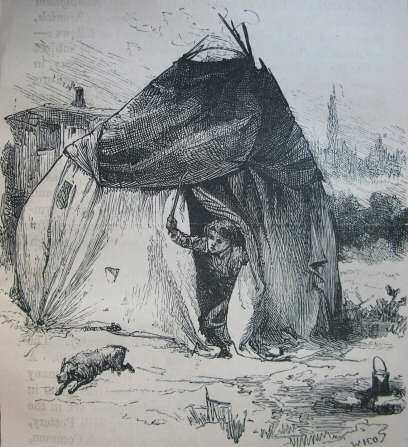
“Owing to a superstitious regard and dislike the Gipsies
had towards the Census, and their endeavours to evade being
taken, no correct number has been arrived at; and it is only by
guess work and conjecture we can form any idea of the number of
Gipsies there are in this country. The Census puts the
number at between 4,000 and 5,000. A gentleman who has
lived and moved among them many years writes me to say that there
cannot be less than 2,000 in the neighbourhood of London, whose
Paradises are in the neighbourhood of Wormwood Scrubs, Notting
Hill Pottery, New Found Out, Kensal Green, Battersea, Dulwich
Common, Lordship Lane, Mitcham Common, Barnes Common, Epping
Forest, Cherry Island, and like places. A gentleman told me
some time since that he gave a tea to over 150 Gipsies residing
in the neighbourhood of Kensal Green. A Gipsy woman who has
moved about all her life says she knows about 300 families in ten of the Midland counties. Another Gipsy, in
a different part of England, tells me a similar story, and says
the same proportion will be borne out all over the country.
Of hawkers, auctioneers, showmen, and others who live in caravans
with their families, there would be, at a rough calculation, not
less than 3,000 children; taking these things along with others,
and the number given in the Census, it may be fairly assumed that
I am under the mark when I state that there are not less than
4,000 Gipsy men and women, and 15,000 to 20,000 Gipsy and other
children moving about the country outside the educational laws
and the pale of civilisation.
“Some few Gipsies who have arrived at what they consider
the highest state of a respectable and civilised life, reside in
houses which, in 99 cases out of 100, are in the lowest and most
degraded part of the towns, among the scum and offscouring of all
nations, and like locusts they leave a blight behind them
wherever they have been. Others have their tents and vans,
and there are many others who I have tents only. A tent as
a rule is about 7ft. 6in. wide, 16ft. long, and 4ft. 6in. high at
the top. They are covered with pieces of old cloth,
sacking, &c., to keep the rain and snow out; the opening to
allow the Gipsies to go in and out of their tent is covered with
a kind of coverlet. The fire by which they cook their meals
is placed in a kind of tin bucket pierced with holes, and stands
on the damp ground. Some of the smoke or sulphur arising
from the sticks or coke finds its way through an opening at the
top of the tent about 2ft. in diameter. The other part of
the smoke helps to keep their faces and hands the proper Gipsy
colour. Their beds consist of a layer of straw upon the
damp ground, covered with a sack or sheet, as the case may
be. An old soapbox or tea-chest serves as a chest of
drawers, drawing-room table, and clothes-box. In these
places children are born, live, and die; men, women, grown-up
sons and daughters, lie huddled together in such a state as would
shock the modesty of South African savages, to
whom we send missionaries to show them the blessings of
Christianity. As in other cases where idleness and filth
abounds, what little washing they do is generally done on the
Saturday afternoons; but this is a business they do not indulge
in too often. They are not overdone with cooking utensils,
and the knives and forks they principally use are of the kind
Adam used, and sensitive when applied to hot water. They
take their meals and do their washing squatting upon the ground
like tailors and Zulus. Lying, begging, thieving, cheating,
and every other abominable, low, cunning craft that ignorance and
idleness can devise, they practise. In some instances these
things are carried out to such a pitch as to render them more
like imbeciles than human beings endowed with reason.
Chair-mending, tinkering, and hawking are in many instances used
only as a ‘blind;’ while the women and children go
about the country begging and fortune-telling, bringing to their
heathenish tents sufficient to keep the family. The poor
women are the slaves and tools for the whole family, and can be
seen very often with a child upon their backs, another in their
arms, and a heavily-laden basket by their side. Upon the
shoulders of the women rests the responsibility of providing for
the herds of ditch-dwelling heathens. Many of the women
enjoy their short pipes quite as much as the men.
“Judging from the conversations I have had with the
Gipsies in various parts of the country, not more than half
living as men and wives are married. No form or ceremony
has been gone through, not even ‘jumping the
broomstick,’ as has been reported of them; and taking the
words of a respectable Gipsy woman, ‘they go together, take
each other’s words, and there is an end of it.’
I am also assured by Levi Boswell, a real respectable Gipsy, and
a Mrs. Eastwood, a Christian woman and a Gipsy, who preaches
occasionally, that not half the Gipsies who are living as men and
wives are married. When once a Gipsy woman has been
ill-used, she becomes fearful, and as one said to me a few days
since, ‘we are either like devils or like
lambs.’ In the case of some of the adult Gipsies
living on the outskirts of London an improvement has taken
place. There is some good among them as with others.
A Gipsy in Wiltshire has built himself a house at the cost of
£600. Considerable difficulty is experienced
sometimes in finding them out, as many of the women go by two
names; but in vain do I look for any improvement among the
children. Owing to the act relating to pedlars and hawkers
prohibiting the granting of licences for hawking to the youths of
both sexes under seventeen, and the Education Acts not being
sufficiently strong to lay hold of their dirty, idle, travelling
tribes to educate them—except in rare cases—they are
allowed to skulk about in ignorance and evil training, without
being taught how to get an honest living. No ray of hope
enters their breast, their highest ambition is to live and loll
about so long as the food comes, no matter by whom or how it
comes so that they get it. In many instances they live like
pigs, and die like dogs. The real old-fashioned Gipsy has
become more lewd and demoralised—if such a thing could
be—by allowing his sons and daughters to mix up with the
scamps, vagabonds, ‘rodneys,’ and gaol birds, who now
and then take their flight from the ‘stone cup’ and
settle among them as they are camping on the ditch banks; the
consequence is our lanes are being infested with a lot of dirty
ignorant Gipsies, who, with their tribes of squalid children,
have been encouraged by servant girls and farmers—by
supplying their wants with eggs, bacon, milk, potatoes, the men
helping themselves to game—to locate in the neighbourhood
until they have received the tip from the farmer to pass on to
his neighbours. Children born under such circumstances,
unless taken hold of by the State, will turn out to be a class of
most dangerous characters. Very much, up to the present,
the wants of the women and children have been supplied through
gulling the large-hearted and liberal-minded they have been brought in contact with, and the result has
been that but few of the real Gipsies have found their way into
gaols. This is a redeeming feature in their character;
probably their offences may have been winked at by the farmers
and others who do not like the idea of having their stacks fired
and property destroyed, and have given the Gipsies a wide
berth. Gipsies, as a rule, have very large families,
generally between eight and sixteen children are born in their
tents. Owing to their exposure to the damp and cold ground
they suffer much from chest and throat complaints. Large
numbers of the children die young before they are
‘broken’ in.’ And it is a ‘breaking
in’ in a tremendous sense, fraught with fearful
consequences. With regard to their education, the following
cases, selected from different parts of the country, may be
fairly taken as representative of the entire Gipsy
community. Boswell, a respectable Gipsy, says he has had
nine sons and daughters (six of whom are alive), and nineteen
grandchildren, and none of them can read or write; and he also
thinks that about half the Gipsy men and women living as husbands
and wives are unmarried. Mrs. Simpson, a Gipsy woman and a
Christian, says she has six sons and daughters and sixteen
grandchildren, and only two can read and write a little.
Mrs. Eastwood says she has nine brothers and sisters. Mr.
Eastwood, a Christian and a Gipsy, has eight brothers and
sisters, many among them have large families, making a total of
adults and children of about fifty of all ages, and there is
scarcely one among them who can tell a letter or read a sentence;
in addition to this number they have between them from 130 to 150
first and second cousins, among whom there are not more than two
who can read or write, and that but very little indeed, and Mr.
Eastwood thinks this proportion will apply to other
Gipsies. Mrs. Trayleer has six brothers and sisters, all
Gipsies, and not one can read or write. A Gipsy woman,
whose head-quarters are near Ashby-de-la-Zouch, has fifteen
brothers and sisters, some of whom
have large families. She herself has fifteen sons and
daughters alive, some of whom are married. But of the whole
of these brothers and sisters, nieces, nephews, grandchildren,
&c., numbering not less than 100 of all ages, not more than
three or four can read or write, and they who can but very
imperfectly. Mrs. Matthews has a family of seven children,
nearly all grown-up, and not one out of the whole of these can
read or write; thus it will be seen that I shall be under the
mark when I state that not five per cent. of the Gipsies,
&c., travelling about the country in tents and vans can
either read or write; and I have not found one Gipsy but what
thinks it would be a good thing if their tents and vans were
registered, and the children compelled to go to school—in
fact, many of them are anxious for such a thing to be brought
about. In the case of the brick-yard and canal-boat
children, they were over-worked as well as ignorant. In the
case of the Gipsy children, these children and roadside arabs,
for the want of education, ambition, animation, and push, are
indulging in practices that are fast working their own
destruction and those they are brought into contact with, and a
great deal of this may lay at the door of flattery, twaddle,
petting, and fear.
“The plan I would adopt to remedy this sad state of
things is to apply the principles of the Canal Boats Act of 1877
to all movable habitations—i.e., I would have all
tents, shows, caravans, auctioneers’ vans, and like places
used as dwellings registered and numbered, and under proper
sanitary arrangements and supervision of the sanitary inspectors
and School Board officers in every town and village. With
regard to the education of the children when once the tent or van
is registered and numbered, the children, whether travelling as
Gipsies, auctioneers, &c., are mostly idle during the day;
consequently, a book similar to the half-time book, in which
their names and attendance at school could be entered, they could
take from place to place as they travel about, and it could be
endorsed by the schoolmaster showing
that the child was attending school. The education obtained
in this way would not be of the highest order; but through the
kindness of the schoolmaster—for which extra trouble he
should be compensated, as he ought to be under the Canal Boats
Act—and the vigilance of the School Board visitor, a plain,
practical, and sound education could be imparted to, and obtained
by, these poor little Gipsy children and roadside arabs, who, if
we do our duty, will be qualified to fill the places of those of
our best artisans who are leaving the country to seek their
fortunes abroad.”
The following is a leading article in the Birmingham Daily
Mail, October 8th:—“Mr. George Smith, whose
exertions on behalf of the canal population and the children
employed in brick-yards have been accompanied with so much
success, is now turning his attention to the education of the
Gipsies. He read a paper on this subject at the Social
Science Congress, yesterday, suggesting that the same plan of
registration which had proved advantageous in the case of the
canal-boatmen and their families should be adopted for the more
nomadic class who roam from place to place, with no settled home
and no local habitation. The Gipsies are a strange race,
with a romantic history, and their vagabond life is surrounded
with enough of the mysterious to give them at all times a special
and curious interest. In the days of our infancy we are
frightened with tales of their child-thieving propensities, and
even when years and reason have asserted their influence we are
apt to regard with a survival of our childish awe the wandering
‘diviners and wicked heathens’ who roam about the
country, living in a mysterious aloofness from their
fellow-men. Scores of theories have been propounded as to
the origin of the Gipsy race, whence they sprang, and how they
came to be so largely scattered over three of the four quarters
of the globe. Opinion, following in the wake of the learned
Rudiger, has finally settled down to the view that they came from India, but whether they are the Tshandalas
referred to in the laws of Menou, or kinsmen of the Bazeegars of
Calcutta, or are descended from the robbers of the Indus, or are
identical with the Nuts and Djatts of Northern India, has not
been ascertained with any degree of certainty. The
Gyptologists are not yet agreed upon the ancestry of this ancient
but obscure race, and possibly they never will be. We know,
however, that the Gipsies have wandered up and down Europe since
the eleventh century, if not from a still earlier period, and
that they have preserved their Bohemian characteristics, their
language—which is a sort of daughter of the old
Sanscrit—their traditions, and the mysteries of their
religion during a long career of restless movement and frequent
persecution. And they have kept, too, their indolent, and
not too creditable habits. Early in the twelfth century an
Austrian monk described them as ‘Ishmaelites and braziers,
who go peddling through the wide world, having neither house, nor
home, cheating the people with their tricks, and deceiving
mankind, but not openly.’ That description would hold
good at the present day. The Gipsies are still a lazy,
thieving set of rogues, who get their living by robbing
hen-roosts, telling fortunes, and ‘snapping up unconsidered
trifles’ like Autolycus of old. Pilfering, varied
with a rude sort of magic, and the swindling arts of divination
and chiromancy for the special behoof of credulous servant-girls,
are the stock-in-trade of the modern Zingaris. Without
education, and without industry, they transmit their vagrant
habits to generation after generation, and perpetuate all the
vices of a lawless and nomadic life.
“It is very easy to give a romantic and even a
sentimental colouring to the wandering Romany. The
‘greenwood home,’ with its freedom from all the
restraints of a conventional state of society, is not without its
attractive side—in books and in ballads. Minor poets
have told us that ‘the Gipsy’s life is a joyous
life,’ and plays and operas have been written to
illustrate the superiority of vagabondage over
civilisation. But the pretty Gitana of the stage is
altogether a different sort of being from the brown-faced,
elf-locked, and tawdrily dressed female who haunts back entries
with the ostensible object of selling clothes-pegs, but with the
real motive of picking up whatever may be lying in her way.
There is but small chance of Bohemian Girls finding themselves in
drawing-rooms nowadays. The last experiment of the kind was
made by the writer of a charming book on the Gipsies, who was so
fascinated by one of their number that he married her; but the
wild, restless spirit was untameable, and the divorce court
proved that the supposed precept of fidelity, which is said to
guide the conduct of Gipsy wives, is not without its
exceptions. The Gipsies have nothing in common with our
conventional ways and habits, and whether it is possible ever to
remove the barrier that separates them from civilisation is a
question which only experiment can satisfactorily answer.
Mr. Smith’s scheme is not the first, by many, that has been
made to improve the conditions of Gipsy life. Nearly half a
century ago the Rev. Mr. Crabb, of Southampton, formed a society
with the object of amalgamating the Gipsies with the general
population, but the scheme was comparatively futile. Still,
past failure is no reason why a new attempt should not be
made. Mr. Smith says there cannot be less than 4,000 Gipsy
men and women, and from 15,000 to 20,000 Gipsy children moving
about the country, outside the educational laws and the pale of
civilisation, and not five per cent. of them can either read or
write. Their mode of life is such as ‘would shock the
modesty of South African savages,’ for men, women, and
grown-up sons and daughters lie huddled together, and in many
cases they ‘live like pigs and die like dogs.’
There is certainly room enough here for education, and education
is the only thing that is likely to have any practical
results.
“It is proposed that the principles of the Canal Boats
Act shall be applied to all movable habitations; that
is, that all tents, shows, caravans, auctioneers’ vans, and
like places used as dwellings, shall be registered and numbered,
and put under proper sanitary supervision. Mr. Smith points
out that when once a tent or van had been registered and
numbered, it could be furnished with a book similar to a
half-time book, in which the names of the children having first
been entered, the attendances at school could be endorsed by the
schoolmaster—for which extra trouble he should be
compensated—as the children travelled about from place to
place. By this means something tangible would be done to
prevent the roadside waifs from growing up in the ignorance which
is the parent of idleness. Why should these ten or fifteen
thousand little nomads be allowed to remain in the neglected
condition which has characterised their strange race for
centuries? It is time that the spell was broken.
There are no traditions of Gipsy life worth perpetuating; there
is no sentimental halo around its history which it would be cruel
to dispel. In past ages the Gipsies have been subjected to
harsh laws and barbarous edicts; it remains for our more
enlightened times to deal with them on a humaner plan. It
is only by the expanding influence of education that the little
minds of their children can gain a necessary experience of the
utility and dignity of honest labour. When they have
received some measure of instruction they will be fitter to
emerge from the aimless and vagabond life of their forefathers,
and break away from the squalor and precarious existence which
has held so many generations of them in thrall. Mr.
Smith’s idea is worthy the attention of legislators.
It does not look so grand on paper, we admit, but it is a nobler
thing to educate the young barbarian at home than to make war
upon the unoffending barbarian abroad. The instincts and
habits which have been transmitted from father to son for
hundreds of years are not, of course, to be eradicated in a day,
or even in a generation; but the time will, perhaps, eventually
come when the Gipsies will cease to exist as a separate
and distinct people, and become absorbed into the general
population of the country. Whether that absorption takes
place sooner or later, nothing can be lost by conferring on the
young ‘Arabs’ of the tents the rudiments of an
education which will hereafter be helpful to them if they are
desirous of abandoning their squalor and indolence, and of
earning an industrious livelihood. Their dread of fixed and
continuous occupation may die out in time, and closer intimacy
with the conditions of industrial life may teach them that
civilisation has some compensations to offer for the sacrifice of
their roaming propensities, and for taking away from them their
‘free mountains, their plains and woods, the sun, the
stars, and the winds’ which are the companions of their
free and unfettered, but wasted and purposeless lives.”
The Weekly Dispatch, in a leading article, October
13th, says:—“Mr. George Smith, of Coalville, has an
eye for the nomads of the country. His name must already be
unfavourably known throughout most of the canal barges of the
United Kingdom. If he is not the Croquemitaine of every
floating nursery journeying inland from the metropolis he ought
to be, for it was mainly he who thrust a half-time book into the
hands of the bargee and compelled him, by the Canal Boats Act of
1877, to soap his infants’ faces and put primers in their
way. With Smith of Coalville, therefore, it may be expected
that each juvenile of the wharves and locks now associates his
most unhappy moments. The half-time book of the act comes
between him and the blessed state of his previous
ignorance. Registered and numbered, supervised and
inspected, he has been put on the road to know things that must
necessarily disillusionise him of the black enchantments of life
on the water highway. It is allowable to hope, however,
that having recovered from the first discomforts of civilising
soap and primers, he will yet live to appreciate Mr.
Smith’s name as one associated with kindly
intent and generous aspirations in his behalf. A generation
of bargemen who had a less uncompromising vocabulary of oaths,
who could beguile some of the tedium of their voyaging with
reading, and who in other important respects showed the
influences of half-time, would be a smiling reward of
philanthropy and an important addition to our civilisation.
That Mr. Smith anticipates some such reward is evident from the
eagerness with which he has been pushing the principle in another
quarter. At the Social Science Congress he has just
propounded a scheme of educational annexation for Gipsy children
similar in every respect to that applied to the occupants of the
canal-boats. That is, he would have every tent and van
numbered and furnished with a half-time book, and he would ordain
it as the duty of School Board visitors to see that the Gipsies
render their children amenable to the terms of the act to the
extent of their wandering ability, under threat of the usual
penalties. The prospect which he foresees from such
treatment is that a body of wanderers numbering not much below
20,000 will be rescued from a position which, he says, would at
present shock South African savages, and will thus be brought in
to honest industry and ‘qualified to fill the places of our
best artisans, who are leaving the country to seek their fortunes
abroad.’ It is impossible not to wish Mr.
Smith’s scheme well, especially as he contends that the
Gipsies themselves are not averse to having their children
educated; but it is equally impossible to be sanguine as to
results. The true Gipsy, who is not to be confounded with
the desultory hawker of English origin, has many arteries of
untameable blood within him. He has never as yet shown the
slightest concern about the English phases of civilisation which
Mr. Smith would like to press upon his notice. Such ideas
as those of God, immortality, and marriage are as unknown to him
as the commonest distinction between mine and thine. He is
a well-looking artistic vagabond, to whom a half-time book and a
penalty will in all probability be no
better than a standing joke to be cracked with impunity at the
expense of the rural School Boards.”
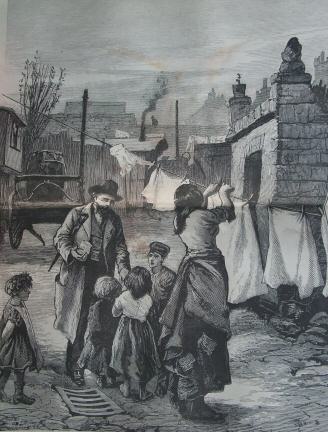
The Sportsman of October 16th, 1879, has the following
notice:—“Mr. George Smith, of Coalville, whose
philanthropic efforts on behalf of ‘our canal-boat
population’ are well known, has lately turned his attention
to the wandering Gipsy tribes who infest the roadside, with the
view to procuring at least a modicum of education for their
children. He says that the Gipsies are lamentably ignorant,
few of them being able even to write their names. By
certain proceedings which took place at Christchurch Police-court
on Tuesday, it would almost seem that some of the dark-faced
wanderers already are educated a little too much. At all
events, they occasionally manifest an ability to ‘take a
stave’ out of the rest of the community. At the court
in question a Gipsy woman named Emma Barney was brought to task
for ‘imposing by subtle craft to extort money’ from a
Bournemouth shopkeeper named Richard Oliver. It seems that
Oliver is troubled with pimples on his face, and that Emma
Barney—not an inappropriate name, by the way—said she
could cure these by means of a certain herb, the name of which
she would divulge ‘for a consideration.’ Before
doing so, however, she required Richard’s coat and
waistcoat, and some silver to ‘steam in hot water,’
after which the name of the herb would be given—on the
following day. It is needless to say that the coat,
waistcoat, and silver did not return to the Oliver home, and that
the pimples did not depart from the Oliver face. The
‘Gipsy’s home’ for the next two months will be
in the county gaol. It is a curious reflection, however,
that such strange credulity as that displayed by the Bournemouth
shopkeeper in this case can be found in the present year of
grace, with its gigantic machinery for educating the
masses.”
The following leading article, taken from the Daily
Telegraph, under date October 17th of last year, will show
that crime is far from abating among the classes of the Gipsy
fraternity:—“The melancholy truth that
there exists a ‘breed’ of criminals in all societies
was well illustrated at Exeter this week. Sir John
Duckworth, as Chairman of the Devon Quarter Sessions, in charging
the grand jury, had to tell them that the calendar was very
heavy, the heaviest, in fact, known for many years. There
were forty-five prisoners for trial, whereas the average number
is twenty-five, taking the last five years. Sir John could
assign no particular reason for such a lamentable increase,
though he supposed the prevailing depression of trade might have
had something to do with it. But he pointed out a very
notable fact indeed, which sprang from an examination of the gaol
delivery, and this was that out of the forty-five prisoners
twenty had been previously convicted. Such a percentage
goes far to prove that the criminal propensity is innate, and to
a certain degree ineradicable by punishments; and this only
enhances the immense importance of national education, by which
alone society can hope to conquer the predatory tendency in
certain baser blood, and to supply it with the means and the
instincts of industry. In justice, however, to the existing
generation of criminals, we ought also to remember that such
serious figures further prove the difficulty encountered by
released prisoners in living honestly. A rat will not steal
where traps are set if it can only find food in the open, and
some of these twice-captured vermin of our community might tell a
piteous tale of the obstacles that lie in the way of
honesty.”
The Weekly Times, under date October 26th, 1879, has
the following article upon the Gipsies near London. The
locality described is not one hundred miles from Mary’s
Place and Notting Hill Potteries. The writer goes on to say
that “There are at the present time upwards of two thousand
people—men, women, and children, members of the Gipsy
tribe—camped in the outlying districts of London.
They are settled upon waste places of every kind. Bits of
ground that will ere long be occupied by houses, waste corners
that seem to be of no good for anything,
yards belonging to public-houses, or pieces of
‘common’ over which no authority claims any rights;
or if there are rights, the authority is too obscure to interfere
with such poor settlers as Gipsies, who will move away again
before an authoritative opinion can be pronounced upon any
question affecting them. The Gipsies, in the winter,
certainly cause very few inconveniences in such places as the
metropolis. They do not cause rents to rise. They are
satisfied to put up their tent where a Londoner would only
accommodate his pig or his dog, and they certainly do not affect
the balance of labour, few of them being ever guilty of robbing a
man of an honest day’s work. Yet, with all their
failings, the Gipsies have always found friends ready to take
their part in times of trouble, and crave a sufferance on account
of their hard lot, and the scanty measure with which the good
things of this life have been, and still are, meted out to
them. Constrained by an irresistible force to keep ever
moving, they fulfil the fate imposed upon them with a degree of
cheerfulness which no other class of people would exhibit.
As the approach of winter reduces outdoor pursuits to the fewest
possible number, the farm labourer finds it difficult to employ
the whole of his time profitably, and those who only follow an
outdoor life for the pleasures it yields naturally gravitate
towards the shelter of large towns in which to spend the winter
months of every year. So when the cold winds begin to blow,
and the leaves are falling, the Gipsies come to town, and settle
upon the odd nooks and corners, and fill up the unused yards, and
eat and drink, and bring up children, in the very places where
their fathers and grandfathers have done the same before
them. The young men get a day’s work where they can;
the young women hawk wool mats, laces, or other women’s
vanities; while the more skilful go round with rope mats, and
every form of chair or stool that can be made of rushes and
canes. The old folks do a little grinding of knives, or
tinker pots and pans; and, if a fine day or a
pleasure fair calls forth all the useful mouths and hands from
their tents and caravans, the babies will take care of themselves
in the straw which makes the pony’s bed until some member
of the camp returns home in the evening. So the winter
months pass away, and in the spring, when the cuckoo begins to
call, these restless-footed people, whose origin no man is
acquainted with, go forth again, and in the lanes and woods, or
on the commons of the country, pass their summer, earning a
precarious subsistance—honestly if they can—content
with hard food and poor clothes, so that they may feel the free
air of heaven blowing about them night and day, while the sun
paints their cheeks the colour of the ancient Egyptians.
Our Gipsies have always been a favourite study with ethnological
folk; poets have sung their wild, free life, and painters have
taken them as types of the happy, if the careless; while
philanthropists have occasionally gone amongst them, and told
pitiful tales of their degradation, ignorance, and misery.
It was not from any feeling of romance or pity that we were
induced the other day to accept an invitation from Mr. George
Smith, of Coalville, to spend a few hours amongst some of these
people. Mr. George Smith’s life has been devoted to
the amelioration of the condition of many very poor and almost
entirely neglected classes of the community, and it was pleasant
to have the opportunity of going with such a simple-hearted hero
amongst those in whom he takes a deep interest. Having
devoted many years of his life to the poor brick-yard children,
and afterwards to the children labouring in canal-boats, he has
found one more class still left outside every Act of Parliament,
and beyond every chance of being helped in the right way to earn
an honest living and become industrious members of society.
These are the Gipsies and their children, who have been let alone
so severely by all so-called right-thinking men and women that
there is great danger of their becoming a sore evil in our
midst. Unable to read or write—their powers of
thought thereby cramped—with no one to
look after them, separated from the people in whose midst they
live, there can be little wonder that they should grow up with
certain loose notions about right and wrong, and a manner of life
the reverse of that which prevails amongst Christian people; but,
now that Mr. George Smith has got his eyes and his heart fixed
upon them, there will surely be something done which, in the near
future, will redeem these people from many of the disadvantages
under which they labour, and add to the body corporate a tribe
possessed of many amiable characteristics. Mr. Smith never
takes up more than one thing at a time, and upon the
accomplishment of it he concentrates all his energies. This
attribute is the one which has enabled him to carry to successful
conclusions the acts for the relief of the brick-yard and the
canal-boat children; but while he is about a work he becomes
thoroughly possessed by his subject, and the most important event
that may happen for the country, or for the world, loses all
value in his eyes unless it bears directly upon the
accomplishment of the object in hand. Thus it happened
that, from the time we sallied out together in search of a Gipsy
camp, until the moment we parted at night, Mr. Smith thought of
nothing, spoke of nothing, remembered nothing, saw nothing, but
what had some relation to the Gipsies and their mode of
life. The Zulus were to be pitied because theirs was a sort
of Gipsy life; and the Gipsies’ tents were nothing more
than kraals. All his stories were of what Gipsies he had
met, and what they had said; and even our fellow-travellers in
the train were only noticeable because they looked like some
Gipsy man or woman whom he had met elsewhere. We had a
short ride by rail, and a tramp through a densely-populated
district, and then we came to the camping-ground we wanted.
It was a spacious yard, entered through a gate, and surrounded
with houses, whose back yards formed the enclosure. There
were three caravans and three kraals erected there, and as it was
Sunday afternoon nearly all the inhabitants were at
home. Those who were absent were a few children able to go
to Sunday-school, whither they went of their own free will and
with the approval of their parents. The kraals were not all
constructed on the same pattern—two were circular in form
and the third was square. This was on the right hand at
entering, and had at one time been a tumble-down shelter for a
calf, who had many years before gone the way of all
beef—into a butcher’s shop. There were tiles on
the low roof—in places—but plenty of openings were
left for the rain to come in, and for the smoke from the fire in
the bucket to find a way out if it chose. The floor was
common earth, and very uneven in places. Alice, the
mistress of this abode, was a woman over fifty, with a face the
colour of leather, and vigour enough to do any amount of
work. As we entered, she told Mr. Smith a piteous tale of
the loss of her spectacles, without which she solemnly declared
she could not read a line. She left the spectacles one day
when she was going ‘hopping,’ hidden under a tile
above her head, and when she returned the case was there, but the
spectacles were gone. She carried her licence to hawk in
her spectacle-case, until the time came when she could happily
beg the gift of a pair of new ones. Her husband, a
white-haired old man, with a look of innocent wonder in his face,
sat on a lump of wood, warming his hands over the fire. He
said little—his wife scarcely allowing an opportunity for
any one else to speak—but seemed to consider that he was a
fortunate man in having such a remarkable wife. There was a
handsome young woman sitting in the only chair in the place,
daughter of the old couple; and her brother lay extended on a bed
made of indescribable things in one portion of the cabin, where
the tiles in the roof showed no openings to the sky. His
wife, a thoroughbred Gipsy, sat nursing a baby—their
first-born—on the edge of the bed. The wood walls
were covered with old clothes, sacking, and a variety of odd
things, fastened in their places by wooden skewers, and adorned
with a few pots and pans used in
cooking. Here, for six or seven winters, this family had
resided, defying alike the frosts and snows and rains of the most
severe winters. Nor could they be made to admit that a
cottage would be more comfortable; that hut had served them well
enough so many years, and would be good enough as long as they
lived. Besides, said Alice, the rent was a consideration,
and the whole yard only cost 2s. a week. This woman was the
mother of eighteen children, of whom eleven were living.
Drawn up close by was a caravan, in the occupation at the time of
two young women, thorough Gipsies in face and tongue, who chaffed
us as to the object of our visit, and begged hard for some kind
of remembrance to be left with them. But we did not accept
their invitation to walk up, but passed down the yard, by heaps
of manure and refuse of all kinds, by another kraal, where a
bucket containing coal was burning, and a young man lay stretched
on a dirty mattress, and a little bantam kept watch beside him,
to the steps of another caravan, where, from the sounds we heard,
high jinks were going on with some children. At the sound
of a tap on the door there was an instant hush, and then a girl
of nineteen, who had a baby in her arms, asked us to come
in. We looked up in amazement; the girl’s face
appeared like an apparition—so fair, so beautiful, so like
some face we had seen elsewhere, that we were confused and
puzzled. In a moment the mystery was solved; we had seen
that face before in several of the choicest canvases that have
hung in recent years upon the walls of the Academy; we had met
with the fairest Gipsy model that ever stood before the students
of the Academy, the favourite alike of the young artist and the
head of his profession. It can only fall to the lot of a
few to see Annie, the Gipsy model; but the curious may look upon
her counterpart, only of heroic size, in Clytie, at the British
Museum. Annie has a face of exquisite Grecian form, and a
hand so delicate that it has been painted more than once in the
‘portrait of a titled lady.’ When she
was a very little girl, she told us, hawking laces in a basket
one day, a gentleman met her at the West-end who was a painter,
and from that day to the present Annie has earned a
living—and at times of great distress maintained all the
family—by the fees she received as a model. Her
mother had had nine children, of whom eight were living; and
three of the family are constantly employed as models.
Annie is one, the young fellow who was watched over by the bantam
was another, and a boy of four was the third. The father is
of pure Gipsy blood, but the mother is an Oxfordshire woman, and
neither of them possess any striking characteristic in their
faces; yet all their girls are singularly beautiful, and their
sons handsome fellows. They have got a reputation for
beauty now, and ladies have, but without success, tried to
negotiate for the possession of the youngest. Never before
had we seen such fair faces, such dainty limbs, such exquisite
eyes, as were possessed by the Gipsy occupants of that
caravan. Annie was as modest and gentle-voiced and mannered
as she was beautiful; and there came a flush of trouble over her
fair face as she told us that not being able to read or write had
‘been against’ her all her life. There was more
refinement about Annie and her mother than we had discovered
amongst others with whom we had conversed. Thus, Annie,
speaking of her grandfather, laid great emphasis on the assertion
that he was a fine man. He lived to be 104, she said, and
walked as upright as a young man to his death. He went
about crying ‘chairs to mend,’ in that very locality,
up to within a short time of his death, and all the old ladies
employed him because he was so handsome. She was playing
with a baby girl as she talked with us, and the child fixed her
black eyes upon her sister’s face, and crooned with baby
pleasure. ‘What is baby’s name,’ we
asked? ‘Comfort,’ replied Annie.
‘We were hopping one year’ said the mother,
‘and there was a young woman in the party I took to very
much, and her name was Comfort. Coming away from the hop grounds, the caravans had to cross a
river, and while we were in the water one day the river suddenly
rose, the caravans were upset, and eleven were drowned, Comfort
amongst the number. So I christened baby after her in
remembrance.’ All the family were neatly dressed, and
once, when Annie opened the cupboard door for an instant, we
caught sight of a dish of small currant puddings.”
A visit to a batch of Gipsy wigwams, Wardlow Street, Garrett
Lane, Wandsworth, induced me to send the following letter to the
London and country daily papers, and it appeared in the Daily
Chronicle and Daily News, November 20th, as
under:—“The following touching incident may slightly
show the thorough heartfelt desire there is—but lacking the
power—among the Gipsies to be partakers of some of the
sanitary and educational advantages the Gorgios or Gentiles are
the recipients of. A few days since I wended my way to a
large number of Gipsies located in tents, huts, and vans near
Wandsworth Common, to behold the pitiable spectacle of some sixty
half-naked, poor Gipsy children, and thirty Gipsy men and women,
living in a state of indescribable ignorance, dirt, filth, and
misery, mostly squatting upon the ground, making their beds upon
peg shavings and straw, and divested of the last tinge of
romantical nonsense, which is little better in this
case—used as a deal of it is—than paper pasted upon
the windows, to hide from public view the mass of human
corruption which has been festering in our midst for centuries,
breeding all kinds of sin and impurities, except in the eyes of
those who see beautiful colours and delights in the aroma of
stagnant pools and beauty in the sparkling hues of the gutter,
and revel in adding tints and pictures to the life and death of a
weasel, lending enchantment to the life of a vagabond, and admire
the non-intellectual development of beings many of whom are only
one step from that of animals, if I may judge from the amount of
good the 20,000 Gipsies have accomplished in the world during the last three or four centuries.
Connected with this encampment not more than four or five of the
poor creatures could read a sentence or write a letter. In
creeping almost upon ‘all-fours,’ into one of the
tents, I came across a real, antiquated, live, good kind of Gipsy
woman named Britannia Lee, who boasted that she was a Lee of the
fourth generation; and in sitting down upon a seat that brought
my knees upon a level with my chin, I entered into conversation
with the family about the objects of my inquiries—of which
they said they had heard all about—viz., to get all the
Gipsy tents, vans, and other movable habitations in the country
registered and under proper sanitary arrangements, and the
children compelled to attend school wherever they may be
temporarily located, and to receive an education which will in
some degree help to get these poor unfortunate people out of the
heartrending and desponding condition into which they have been
allowed to sink. Although Mrs. Lee was ill and poor, her
face beamed with gladness to find that I was trying in my humble
way to do the Gipsy children good; and in a kind of maternal
feeling she said she should be pleased to show her deep interest
in my work, and asked me if I would accept all the money she had
in the world, viz., one penny and two farthings? With much
persuasion and hesitation, and under fear of offending her, I
accepted them, which I purpose keeping as a token of a
woman’s desire to do something towards improving her
‘kith and kin.’ She said that Providence would
see that she was no loser for the mite she had given to me.
He once sent her, in her extremity, a shilling in the middle of a
potato, which she found when cooking. With many expressions
of ‘God bless you in your work among the children!
You will be rewarded some day for all your time, trouble, and
expense,’ we parted.”
The London correspondent of the Croydon Chronicle
writes as under, on November 22nd, touching a visit we both made
to a number of poor Gipsy children squatting about upon
Mitcham Common. Among other things he says:—“I
have had a day in your neighbourhood with George Smith, of
Coalville. He is visiting all the Gipsy grounds he can find
and reach, for the purpose of gaining information as to the
condition of the swarms of children who live in squalor and
ignorance under tents. He is of opinion that he will be
able to get them into schools, and do as much for them generally
as he has done for the brick-field and canal children; and I have
no doubt myself that he will succeed. Well, the other day
he asked me to have a run round with him, and we went to Mitcham
Common to see some of the families there. He told me that
one of the Gipsy women had been confined, and that she wanted him
to give the child a name. He did not know what to call it,
so we had to put our heads together and settle the matter.
After a great deal of careful deliberation he decided that when
we reached the common the child should be called
‘Deliverance.’ I have been told that this
sounds like the name of a new ironclad, and perhaps it would have
done as well for one as for the other. The tents were much
of a character—some kind of stitched-together rags thrown
over sticks. Our visit was made on a fine day, when it was
not particularly cold, and the first tent we came to had been
opened at the top. We looked over (these tents are only
about five feet high), and beheld six children, the eldest being
a girl of about eight or ten. The father was anywhere to
suit the imagination, and the mother was away hawking.
These children, sitting on the ground with a fire in the middle
of them, were making clothes-pegs. The process seemed
simple. The sticks are chopped into the necessary lengths
and put into a pan of hot water. This I suppose swells the
wood and loosens the bark. A child on the other side takes
out the sticks as they are done and bites off the bark with its
teeth. Then there is a boy who puts tin round them, and so
the work goes on. When the day is done they look for the
mother coming home from hawking
with anything she may have picked up. When they have
devoured such scraps and pickings as are brought, they lie down
where they have worked and as they are, and go to sleep. It
is a wonderful and mysterious arrangement of Providence that they
can sleep. They have only a rag between them and the
snow. A good wind would blow their homes over the
trees. I do not wish to make any particularly violent
remarks, but I should like some of the comfortable clergymen of
your neighbourhood, when they have done buying their toys and
presents for young friends at Christmas, to walk to Mitcham
Common and see how the children are there. They would then
find out what humbugs they are, and how it is they do the work of
the Master. One tent is very much like another. We
visited about half-a-dozen, and we then went to name the
child. We stayed in this tent for about ten minutes.
It was inhabited by two families, numbering in all about
twenty. I talked a little time with the woman lying on the
ground, and she uncovered the baby to show it to me. I do
not know whether it is a boy or a girl, but
‘Deliverance’ will do for either one or the
other. She asked me to write the name on a piece of paper,
and I did so. With a few words, as jolly as we could make
them, we crawled out, thanks and blessings following George
Smith, as they always do.”
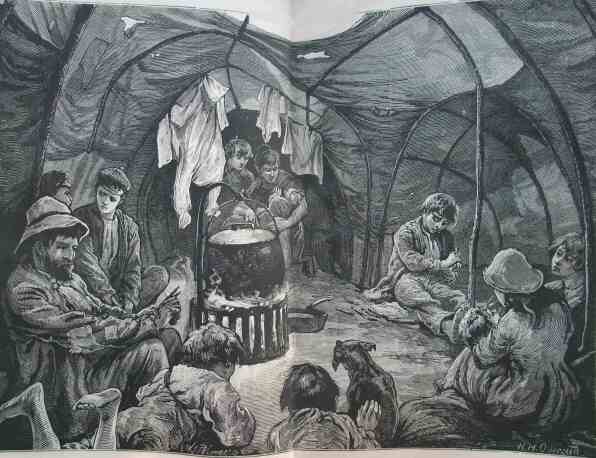
Leading article in the Primitive Methodist, November
27th:—“Mr. George Smith, of Coalville, is
endeavouring to do a work for the children of Gipsies similar to
that he has done for the children employed in brick-yards and the
children of canal-boatmen—that is, bring them under some
sort of supervision, so that they may secure at least a small
share in the educational advantages of the country.
Recently he published an account of a visit to an encampment of
the Gipsies near Wandsworth Common, and it is evident that these
wanderers without any settled place of abode look on his efforts
with some considerable approval. The encampment was made up
of a number of tents, huts, and vans, and
contained some sixty half-naked poor Gipsy children and thirty
Gipsy men and women, living in an indescribable state of
ignorance, dirt, filth, and misery, mostly squatting upon the
ground, or otherwise making their beds upon peg shavings and
straw; and it turned out upon inquiry that not more than four of
these poor creatures could read a sentence or write a
letter. They are, however, not indisposed to be subject to
regulations that will contribute to their partial education, if
to nothing more. In passing from one of these miserable
habitations to another, Mr. Smith found an old Gipsy woman proud
of her name and descent, for she was a Lee, and a Lee of the
fourth generation. To this old woman he explained his
purpose, sitting on a low seat under the cover of the tent with
his knees on a level with his chin. He wanted, he said,
‘to get all the Gipsy tents and vans, and other movable
habitations in the country, registered and under proper sanitary
arrangements, and the children compelled to attend school
wherever they may be temporarily located, and to receive an
education which will in some degree help to get them out of the
low, heartrending condition into which they have been allowed to
sink.’ Mrs. Lee listened with pleasure to this
narration of Mr. Smith’s purpose, and, though in great
poverty, desired to aid this good work. Her stock of cash
amounted to three-halfpence; but this she insisted upon giving,
so that she might contribute a little, at any rate, towards the
improvement of her people. We hope Mr. Smith may succeed in
his work, and succeed speedily, so that these Gipsy children, who
are trained up to a vagabond life, may have a chance of learning
something better. And evidently, from Mr. Smith’s
experience, there is no hostility to such a measure as he wishes
to have made law among the Gipsies themselves.”
Owing to my letters, papers, articles and paragraphs, and
efforts in other directions during the last several months, the
Gipsy subject might now be fairly considered to have made good headway, consequently the proprietor of
the Illustrated London News, without any difficulty, was
induced—in fact, with pleasure—to have a series of
sketches of Gipsy life in his journal, the first appearing
November 29th, connected with which was the following notice, and
in which he says:—“Our illustrations, from a sketch
taken by one of our artists in the neighbourhood of Latimer Road,
Notting Hill, which is not far from Wormwood Scrubs, show the
habits of living folk who are to be found as well in the
outskirts of London, where there are many chances of picking up a
stray bit of irregular gain, as in more rural parts of the
country. The figure of a gentleman introduced into this
sketch, who appears to be conversing with the Gipsies in their
waggon encampment, is that of Mr. George Smith, of Coalville,
Leicester, the well-known benevolent promoter of social reform
and legislative protection for the long-neglected class of people
employed on canal-barges, whose families, often living on board
these vessels, are sadly in want of domestic comfort and of
education for the children.” The editor also inserted
my Congress paper fully. The following week another sketch
of Gipsy life appeared in the same journal, connected with which
were the following remarks:—“Another sketch of the
wild and squalid habits of life still retained by vagrant parties
or clans of this singular race of people, often met with in the
neighbourhood of suburban villages and other places around
London, will be found in our journal. We may again direct
the reader’s attention to the account of them which was
contributed by Mr. George Smith, of Coalville, Leicester, to the
late Social Science Congress at Manchester, and which was
reprinted in our last week’s publication. That
well-known advocate of social reform and legal protection for the
neglected vagrant classes of our population reckons the total
number of Gipsies in this country at three or four thousand men
and women and ten thousand children. He is now seeking to
have all movable habitations—i.e., tents, vans,
shows, &c.—in which the families
live who are earning a living by travelling from place to place,
registered and numbered, as in the case of canal-boats, and the
parents compelled to send their children to school at the place
wherever they may be temporarily located, be it National,
British, or Board school. The following is Mr.
Smith’s note upon what was to be seen in the Gipsies’
tent on Mitcham Common:—
“‘Inside this tent—with no other
home—there were two men, their wives, and about fourteen
children of all ages: two or three of these were almost men and
women. The wife of one of the men had been confined of a
baby the day before I called—her bed consisting of a layer
of straw upon the damp ground. Such was the wretched and
miserable condition they were in that I could not do otherwise
than help the poor woman, and gave her a little money. But,
in her feelings of gratitude to me for this simple act of
kindness, she said she would name the baby anything I would like
to chose; and, knowing that Gipsies are fond of outlandish names,
I was in a difficulty. After turning the thing over in my
mind for a few hours, I could think of nothing but
“Deliverance.” This seemed to please the poor
woman very much; and the poor child is named Deliverance
G---. Strange to say, the next older child is named
“Moses.”’”
On December 13th, an additional sketch, showing the inside of
a van, was given, to which were added the following
remarks:—“Another sketch of the singular habits and
rather deplorable condition of these vagrant people, who hang
about, as the parasites of civilisation, close on the suburban
outskirts of our wealthy metropolis, is presented by our artist,
following those which have appeared in the last two weeks.
Mr. G. Smith, of Coalville, Leicester, having taken in hand the
question of providing due supervision and police regulation for
the Gipsies, with compulsory education for their children, we
readily dedicate these local illustrations to the furtherance of
his good work. The ugliest place we know in the
neighbourhood of London, the most dismal and
forlorn, is not Hackney Marshes, or those of the Lea, beyond Old
Ford, at the East-end; but it is the tract of land, half torn up
for brick-field clay, half consisting of fields laid waste in
expectation of the house-builder, which lies just outside of
Shepherd’s Bush and Notting Hill. There it is that
the Gipsy encampment may be found, squatting within an
hour’s walk of the Royal palaces and of the luxurious town
mansions of our nobility and opulent classes, to the very west of
the fashionable West-end, beyond the gentility of Bayswater and
Whiteley’s avenue of universal shopping. It is a
curious spectacle in that situation, and might suggest a few
serious reflections upon social contrasts at the centre and
capital of the mighty British nation, which takes upon itself the
correction of every savage tribe in South and West Africa and
Central Asia. The encampment is usually formed of two or
three vans and a rude cabin or a tent, placed on some piece of
waste ground, for which the Gipsy party have to pay a few
shillings a week of rent. This may be situated at the back
of a row of respectable houses, and in full view of their bedroom
or parlour windows, not much to the satisfaction of the quiet
inhabitants. The interior of one of the vans, furnished as
a dwelling-room, which is shown in our artist’s sketch,
does not look very miserable; but Mr. Smith informs us that these
receptacles of vagabond humanity are often sadly
overcrowded. Besides a man, his wife, and their own
children, the little ones stowed in bunks or cupboards, there
will be several adult persons taken in as lodgers. The
total number of Gipsies now estimated to be living in the
metropolitan district is not less than 2,000. Among these
are doubtless not a small proportion of idle runaways or
‘losels’ from the more settled classes of our
people. It would seem to be the duty of somebody at the
Home Office, for the sake of public health and good order, to
call upon some local authorities of the county or the parish to
look after these eccentricities of Gipsy life.”
On January 3rd, 1880, additional illustrations were
given in the Illustrated London News. 1. Tent at
Hackney; 2. Tent at Hackney; 3. Sketch near Latimer Road, Notting
Hill; 4. A Bachelor’s Bedroom, Mitcham Common; 5.
Encampment at Mitcham Common; 6. A Knife-grinder at Hackney Wick;
7. A Tent at Hackney Marshes. “A few additional
sketches, continuing those of this subject which have appeared in
our journal, are engraved for the present number. It is
estimated by Mr. George Smith, of Coalville, Leicester, who has
recently been exploring the queer outcast world of Gipsydom in
different parts of England, that some 2,000 people called by that
name, but of very mixed race, living in the manner of Zulu
Kaffirs rather than of European citizens, frequent the
neighbourhood of London. They are not all thieves, not even
all beggars and impostors, and they escape the law of vagrancy by
paying a few shillings of weekly rent for pitching their tents or
booths, and standing their waggons or wheeled cabins, on pieces
of waste ground. The western side of Notting Hill, where
the railway passenger going to Shepherd’s Bush or
Hammersmith sees a vast quantity of family linen hung out to dry
in the gardens and courtyards of small dwelling-houses, bordered
towards Wormwood Scrubs by a dismal expanse of brick-fields,
might tempt the Gipsies so inclined to take a clean shirt or
petticoat—certainly not for their own wearing. But we
are not aware that the police inspectors and magistrates of that
district have found such charges more numerous in their official
record than has been experienced in other quarters of London; and
it is possible that honest men and women, though of irregular and
slovenly habits, may exist among this odd fragment of our motley
population. It is for the sake of their children, who ought
to be, at least equally with those of the English labouring
classes, since they cannot get it from their parents, provided
with means of decent Christian education, that Mr. George Smith
has brought this subject under public notice. The Gipsies, so long as they refrain from picking and
stealing, and do not obstruct the highways, should not be
persecuted; for they are a less active nuisance than the Italian
organ-grinders in our city streets, whose tormenting presence we
are content to suffer, to the sore interruption both of our daily
work and our repose. But it is expedient that there should
be an Act of Parliament, if the Home Secretary has not already
sufficient legal powers, to establish compulsory registration of
the travelling Gipsy families, and a strict licensing system,
with constant police supervision, for their temporary
encampments, while their children should be looked after by the
local School Board. These measures, combined with judicious
offers of industrial help for the adults and industrial training
for the juniors, with the special exercise of Poor-Law Guardian
administration, and some parochial or missionary religious
efforts, might put an end to vagabond Gipsy life in England
before the commencement of the twentieth century, or within one
generation. We hope to see the matter discussed in the
House of Lords or the House of Commons during the ensuing
session; for it actually concerns the moral and social welfare of
more than thirty thousand people in our own country, which is an
interest quite as considerable as that we have in Natal or the
Transvaal, among Zulus and Basutos, and the rest of
Kaffirdom. The sketches we now present in illustration of
this subject are designed to show the squalid and savage aspect
of Gipsy habitations in the suburban districts, at Hackney and
Hackney Wick, north-east of London; where the marsh-meadows of
the river Lea, unsuitable for building-land, seem to forbid the
extension of town streets and blocks of brick or stuccoed
terraces; where the pleasant wooded hills of Epping and Hainault
Forest appear in the distance, inviting the jaded townsman, on
summer holidays, to saunter in the Royal Chace of the old English
kings and queens; where genuine ruralities still lie within an
hour’s walk, of which the fashionable West-ender knoweth
nought. There lurks the free and fearless
Gipsy scamp, if scamp he truly be, with his squaw and his
piccaninnies, in a wigwam hastily constructed of hoops and poles
and blankets, or perhaps, if he be the wealthy sheikh of his wild
Bedouin tribe, in a caravan drawn from place to place by some
lost and strayed plough-horse, the lawful owner of which is a
farmer in Northamptonshire. Far be it from us to say or
suspect that the Gipsy stole the horse; ‘convey, the wise
it call;’ and if horse or donkey, dog, or pig, or cow, if
cock and hen, duck or turkey, be permitted to escape from field
or farmyard, these fascinated creatures will sometimes follow the
merry troop of ‘Romany Rye’ quite of their own
accord, such is the magic of Egyptian craft and the innate
superiority of an Oriental race. These Gipsies, Zingari,
Bohemians, whatever they be called in the kingdoms of Europe, are
masters of a secret science of mysterious acquisition, as remote
from proved crime of theft or fraud as from the ways of earning
or winning by ordinary industry and trade. There is many a
rich and splendid establishment at the West-end supported by a
different application of the same mysterious craft.
Solicitors and stockbrokers may have seen it in action. It
is that of silently appropriating what no other person may be
quite prepared to claim.”
The following remarks appeared in the December number of
The Quiver:—“Mr. George Smith, who has earned
a much-respected and worthy name by his interest in and
persevering efforts for the well-being of our canal population,
is bent on doing similar service for the Gipsy children and
roadside arabs, who are sadly too numerous in the suburban and
rural districts of the land. By securing the registration
of canal-boats as human domiciles, he has brought quite a host of
poor little outcasts within the pale of society and the
beneficent influence of the various educational machineries of
the age. By bringing the multitudinous tents, vans, shows,
and their peripatetic lodgers under some similar arrangements,
he hopes to put civilisation, education, and
Christianity within reach, of the thousand ragged Ishmaelites who
are at present left to grow up in ignorance and
degradation. These vagrant juveniles are growing up to
strengthen the ranks of the unproductive and criminal classes;
and policy, philanthropy, and Christianity alike demand that the
nomadic waifs should be encircled by the arms of an ameliorating
law which will give them a chance of escaping from the life of
semi-barbarity to which untoward circumstances have consigned
them, and to place them in a position to make something better of
the life that now is, and to secure some fitting preparation for
the life that is to come. It is evidently high time that
something should be done, otherwise we must sooner or later be
faced with more serious difficulties than even now exist.
Our sympathies are strongly with the warm-hearted philanthropist;
and we trust that in taking to this new field of effort he will
win all needful aid, and that his endeavours to rescue from a
life of crime and vagabondage these hitherto much-neglected
little ones will be crowned with success.
“‘The glories of our mortal state
Are shadows, not substantial things;
There is no armour against fate—
Death lays its icy hands on kings:
Sceptre and crown
Must tumble down,
And in the dust be equal made
With the poor crooked scythe and spade:
Only the actions of the just
Smell sweet and blossom in the
dust.’—Shirley.”
The following is my letter, relating to the poor little Gipsy
children’s homes, as it appeared in the Daily News,
Daily Chronicle, and other London and country daily
papers, December 2nd:—“Amongst some of the sorrowful
features of Gipsy life I have noticed lately, none call more
loudly for Government help, assistance, and supervision than the
wretched little rag and stick hovels, scarcely large
enough to hold a costermonger’s wheelbarrow, in which the
poor Gipsy women and children are born, pig, and die—aye,
and men too, if they can be called Gipsies, with three-fourths,
excepting the faintest cheering tint, of the blood of English
scamps and vagabonds in their reins, and the remainder consisting
of the blood of the vilest rascals from India and other
nations. A real Gipsy of the old type, of which there are
but few, will tell you a lie and look straight at you with a
chuckle and grin; the so-called Gipsy now will tell you a lie and
look a thousand other ways while doing so. In their own
interest, and without mincing matters, it is time the plain facts
of their dark lives were brought to daylight, so that the
brightening and elevating effects of public opinion, law, and the
Bible may have their influence upon the character of the little
ones about to become in our midst the men and women of the
future. Outside their hovels or sack huts, poetically
called ‘tents’ and ‘encampments,’ but in
reality schools for teaching their children how to gild
double-dyed lies,—sugar-coat deception, gloss idleness and
filth, paint immorality with Asiatic ideas, notions, and hues,
and put a pleasant and cheerful aspect upon taking things that do
not belong to them, may be seen thousands of ragged, half-naked,
dirty, ignorant and wretched Gipsy children, and the men
loitering about mostly in idleness. Inside their sack
hovels are to be found man, wife, and six or seven children of
all ages, not one of them able to read or write, squatting or
sleeping upon a bed of straw, which through the wet and damp is
often little better than a manure-heap, in fact sometimes
completely rotten, and as a Gipsy woman told me last week,
‘it is not fit to be handled with the hands.’
In noticing that many of the Gipsy children have a kind of
eye-disease, I am told by the women that it is owing to the
sulphur arising from the coke fire they have upon the ground in
their midst, and which at times also causes the children to turn
pale and sickly. The sulphur affects the men and women in various ways, sometimes causing a kind of
stupor to come over them. I have noticed farther that many
of the adults are much pitted with small-pox. It is a
wonder to me that there is not more disease among them than there
appears to be, considering that they are huddled together,
regardless of sex or age, in the midst of a damp atmosphere
rising out of the ground, and impregnated with the sulphur of
their coke fires. Probably their flitting habits prevent
detection. My plan to improve their condition is not by
prosecuting them and breaking up their tents and vans and turning
them into the roads pell-mell, but to bring their habitations
under the sanitary officers and their children under the
schoolmaster in a manner analogous to the Canal Boats Act, and it
has the approval of these wandering herds. The process will
be slow but effective, and without much inconvenience.
Unless something be done for them in the way I have indicated,
they will drift into a state similar to Darwin’s
forefathers and prove to the world that civilisation and
Christianity are a failure.”
The following article appears in the Christian World,
December 19th, by Christopher Crayon (J. Ewing Ritchie), in which
he says:—“The other day I was witness to a spectacle
which made me feel a doubt as to whether I was living in the
nineteenth century. I was, as it were, within the shadow of
that mighty London where Royalty resides, where the richest
Church in Christendom rejoices in its Abbey and Cathedral, and
its hundreds of churches, where an enlightened and energetic
Dissent has not only planted its temples in every district, but
has sent forth its missionary agents into every land, where the
fierce light of public opinion, aided by a Press which never
slumbers, is a terror to them that do evil, and a praise to them
that do well; a city which we love to boast heads the onward
march of man; and yet the scene before me was as intensely that
of savage life, as if I had been in a Zulu kraal, and savage life
destitute of all that lends it picturesque attractions, or ideal
charms. I was standing in the midst
of some twenty tents and vans, inhabited by that wandering race
of whose origin we know so little, and of whose future we know
less. The snow was on the ground, there was frost in the
very air. Within a few yards was a great Board school;
close by were factories and workshops, and the other concomitants
of organised industrial life. Yet in that small area the
Gipsies held undisputed sway. In or about London there are,
it is calculated, some two thousand of these dwellers in
tents. In all England there are some twenty thousand of
these sons of Ishmael, with hands against every one, or, perhaps
to put it more truly, with every one’s hands against
them. In summer-time their lot is by no means to be envied;
in winter their state is deplorable indeed.
“We entered, Mr. George Smith and I, and were received
as friends. Had I gone by myself, I question whether my
reception would have been a pleasant one. As Gipsies pay no
taxes, they can keep any number of dogs, and these dogs have a
way of sniffing and snarling, anything but agreeable to an
unbidden guest. The poor people complained to me no one
ever came to see them. I should be surprised if any one
did; but Mr. George Smith, of Coalville, is no common man, and
having secured fair play for the poor children of the
brick-fields—he himself was brought up in a
brick-yard—and for the poor, and sadly-neglected, inmates
of the canal-boats, he has now turned his attention to the
Gipsies. His idea is—and it is a good one—that
an Act of Parliament should be passed for their
benefit—something similar to that he has been the means of
carrying for the canal and brick-field children. In a paper
read before the Social Science Congress at Manchester, Mr. Smith
argued that all tents, shows, caravans, auctioneer vans, and like
places used as dwellings should be registered and numbered, and
under proper sanitary arrangements, with sanitary inspectors and
School Board officers, in every town and village. Thus in
every district the children would have their names and attendance registered in a book, which they could take
with them from place to place, and when endorsed by the
schoolmaster, it would show that the children were attending
school. In carrying out this idea, it is a pity that Mr.
Smith should have to bear all the burden. As it is, he has
suffered greatly in his pocket by his philanthropic effort. . .
.
“It is no joke going into a Gipsy yard, and it is still
less so when you go down on your hands and knees, and crawl into
the Gipsy’s wigwam; but the worst of it is, when you have
done so, there is little to see after all. In the middle,
on a few bricks, is a stove or fireplace of some kind. On
the ground is a floor of wood-chips, or straw, or shavings, and
on this squat some two or three big, burly men, who make
linen-pegs and skewers, and mend chairs and various articles, the
tribe, as they wander along, seek to sell. The women are
away, for it is they who bring the grist to the mill, as they
tell fortunes, or sell their wares, or follow their doubtful
trade; but the place swarms with children; and it was wonderful
to see with what avidity they stretched out the dirtiest little
hand imaginable as Mr. Smith prepared to distribute some sweets
he had brought with him for that purpose. As we entered,
all the vans were shut up, and the tents only were occupied, the
vans being apparently deserted but presently a door was opened
half-way, and out popped a little Gipsy head, with sparkling eyes
and curly hair; and then another door opened, and a similar
spectacle was to be seen. Let us look into the van, about
the size of a tiny cabin, and chock full, in the first place,
with a cooking-stove; and then with shelves, with curtains and
some kind of bedding, apparently not very clean, on which the
family repose. It is a piteous life, even at the best, in
that van; even when the cooking pot is filled with something more
savoury than cabbages or potatoes; the usual fare; but the
children seem happy, nevertheless, in their dirty rags, and with
their luxurious heads of curly hair. All of them are as
ignorant as Hottentots, and lead a life horrible to think
of. I only saw one woman in the camp,
and I only saw her by uncovering the top and looking into the
tent in which she resides. She is terribly poor, she says,
and pleads earnestly for a few coppers; and I can well believe
she wants them, for in this England of ours, and especially in
the outskirts of London, the Gipsy is not a little out of
place. Around us are some strapping girls, one with a
wonderfully sweet smile on her face, who, if they could be
trained to domestic service, would have a far happier life than
they can ever hope to lead. The cold and wet seem to affect
them not, nor the poor diet, nor the smoke and bad air of their
cabins, in which they crowd, while the men lazily work, and the
mothers are far away. The leading lady in this camp is
absent on business; but she is a firm adherent of Mr. George
Smith, and wishes to see the children educated; and as she is a
Lee, and as a Lee in Gipsy annals take the same rank as a Norfolk
Howard in aristocratic circles, that says a good deal; but, then,
if you educate a Gipsy girl, she will want to have her hands and
face, at any rate, clean; and a Gipsy boy, when he learns to
read, will feel that he is born for a nobler end than to dwell in
a stinking wigwam, to lead a lawless life, to herd with
questionable characters, and to pick up a precarious existence at
fairs and races; and our poets and novelists and artists will not
like that. However, just now, by means of letters in the
newspapers, and engravings in the illustrated journals, a good
deal of attention is paid to the Gipsies, and if they can be
reclaimed and turned into decent men and women a good many
farmers’ wives will sleep comfortably at night, especially
when geese and turkeys are being fattened for Christmas fare; and
a desirable impulse will be given to the trade in
soap.”
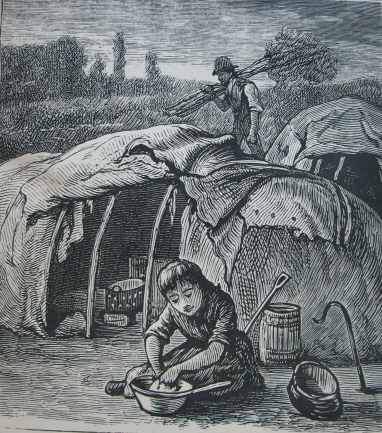
In the Sunday School Chronicle, December 19th, the
kind-hearted editor makes the following
allusions:—“Mr. George Smith stirs every feeling of
pity and compassion in our hearts by his descriptions of the
Gipsy Children’s Homes. It is one of the curious
things of English life that the distinct
Gipsy race should dwell among us, and, neither socially nor
politically, nor religiously, do we take any notice of
them. No portion of our population may so earnestly plead,
‘No man careth for our souls.’ The chief
interest of them, to many of us, is that they are used to give
point, and plot, to novels. But can nothing be done for the
Gipsy children? Christian enterprise is seldom found
wanting when a sphere is suggested for it; and those who live in
the neighbourhood of Gipsy haunts should be especially concerned
for their well-being. What must the children be, morally
and religiously, who bide, we cannot say dwell, in
such homes as Mr. George Smith describes?
“‘In their own interest, and without mincing
matters, it is time the plain facts of their dark lives were
brought to daylight, so that the brightening and elevating
effects of public opinion, law, and the Bible may have their
influence upon the character of the little ones about to become
in our midst the men and women of the future. Outside their
hovels or sack huts, poetically called “tents” and
“encampments,” but in reality schools for teaching
their children how to gild double-dyed lies, sugar-coat
deception, gloss idleness and filth, and put a pleasant and
cheerful aspect upon taking things that do not belong to them,
may be seen thousands of ragged, half-naked, dirty, ignorant, and
wretched Gipsy children, and the men loitering about mostly in
idleness. Inside their sack hovels are to be found man,
wife, and six or seven children of all ages, not one of them able
to read or write, squatting or sleeping upon a bed of straw,
which through the wet and damp is often little better than a
manure-heap, in fact sometimes it is completely rotten, and as a
Gipsy woman told me last week, “it is not fit to be handled
with the hands.” In noticing that many of the Gipsy
children have a kind of eye disease, I am told by the women that
it is owing to the sulphur arising from the coke fire they have
upon the ground in their midst, and which at times also causes
the children to turn pale and sickly.’”
The following brief account of the Hungarian Gipsies of
the present day, as seen by a writer under the initials “A.
C.,” who visited the Unitarian Synod in Hungary last
summer, is taken from the Unitarian Herald, bearing date
January 9th, 1880, and in which the author says:—“Not
far from Rugonfalva we came on a colony of exceedingly squalid
Gipsies, living in huts which a respectable Zulu would utterly
despise. Their appearance reminded me of Cowper’s
graphic sketch, which I am tempted to quote:—
“‘I see a column of slow-rising
smoke
O’ertop the lofty wood that skirts the wild.
A vagabond and useless tribe there eat
Their miserable meal. A kettle, flung
Between two poles upon a stick transverse,
Receives the morsel—flesh obscene of dog,
Or vermin, or, at best, of cock purloined
From his accustomed perch. Hard-faring race,
They pick their fuel out of every hedge,
Which, kindled with dry leaves, just saves unqueuched
The spark of life. The sportive wind blows wide
Their fluttering rags, and shows a tawny skin,
The vellum of the livery they claim.’
“Transylvania is one great museum of human as well as
natural products, and this singular race forms an interesting
element of its motley population. It is supposed that the
tribe found its way to Hungary in the beginning of the fifteenth
century, having fled from Central Asia or India during the Mongol
reign of terror. About the close of last century Pastor
Benedict, of Debreczin, mastered their language, and on visiting
England found that the Gipsies in this country understood him
very well. There are now about eighty thousand of them in
Transylvania, but three-fourths of this number have settled
homes, and caste distinctions are so strong that the higher
grades would not drink from a cup used by one of their
half-savage brethren. On reaching the mansion of Mr.
Jakabházi, at Siménfalva, who employs about one
hundred and forty civilised Gipsies on his
estate, we had an opportunity after dinner of seeing them return
in a long procession from the fields. Some of the women
carried small brown babies, that appeared able to find footing
anywhere on their mothers’ shoulders, backs, or
breasts. These labourers are almost entirely paid in food
and other necessaries, and if kindly treated are very honourable
towards their master, and generally adopt his religion.
When smarting under any grievance, they, on the contrary,
sometimes change their faith en masse, and when
conciliated undergo as speedy a re-conversion. The women
are, as a rule, very fond of ornaments, and the men are, above
all things, proud of a horse or a pair of scarlet breeches.
Of late years they have in a few districts began to intermarry
with the Wallachs, and the sharp distinction between them and the
other races in Hungary will, no doubt, gradually
disappear.”
The Weekly Times again takes up the subject, and the
following appears on January 9th, 1880:—“We made a
second expedition, with Mr. George Smith, of Coalville, on
Sunday, in search of a Gipsy encampment; and though the way was
long and tedious, and we were both lamed with walking before we
returned at night, yet we had not gone one step out of our
way. There is no encampment of these ancient and
interesting people in the neighbourhood of the hundred odd square
miles which composes the site of the metropolis, with which Mr.
Smith is not acquainted, and to which we verily believe he could
lead a friend if he was blindfolded. The way we went must
remain somewhat of a secret, because the Gipsies do not care to
see many visitors on the only day of the week which is one of
absolute rest to them. All that we shall disclose about the
way is, that we skirted Mount Nod, and for a short distance
looked upon the face of an ancient river, then up-hill we
clambered for many longish miles, until we turned out of a
certain lane into the encampment. There was a rude
picturesqueness in the gaping of the vans and tents. In
the foreground were the vans, to the rear the cloth
kraals, with their smoky coverings stretched over poles; from a
hole in the centre the smoke ascended, furnishing evidence that
the open brazier was burning within. The vans protected the
approach to the camp, just in the same way that artillery are
planted to keep the road to a military encampment. Mr.
Smith’s face seemed to be well known to these strange
people, and we no sooner appeared in sight than the swinging door
of every van was edged with faces, and forth from the strange
kraals there crept child and woman, youth and dog, to say a
kindly word, or bark a welcome to the visitors. But for the
Gipsies’ welcome we might have had an unpleasant reception
from the dogs. They were evidently dubious as to our
character, their training inclining them to bite, if they get a
chance, any leg wearing black cloth, but to give the
ragged-trousered visitors a fawning welcome; so they sniffed
again and again, and growled, until driven away by the voices of
their owners. Perchance, during the remainder of the day,
they were revolving in their intelligent minds how it had come to
pass that the black cloth legs were received with evident marks
of favour. Nor were they able to settle the point easily,
for whenever we happened to look round the encampment during the
afternoon, from the raised door-way of a kraal where we happened
to be couched, we noticed the eyes of one or other of the
four-footed guardians fixed intently on us. There were
about twenty vans and tents in all; and each paid one shilling a
week to the ground landlord. That money, with whatever else
was required for food, was obtained by hawking at this season of
the year, and trade was very bad. Winter must be a fearful
experience for these children of the air, and the field, the
summer sun, the wild flowers, and the fruits of harvest.
Such rains as have descended, such snows as have been falling,
such cold winds as have been blowing, must discount fearfully the
joys of the three happier seasons of the year.
“Invitations to stoop and enter any
‘tent’ were freely tendered, and ‘peeps’
were indulged in with regard to a few. In one, a closed
cauldron covered the brazier fire, and two men and a dog watched
with unceasing vigilance. We tried to make friends here,
but failed. There was a steamy exudation from the cauldron
which filled the air with fragrance, and our curiosity overcame
our prudence, but with no satisfactory result. ‘A
stew,’ we suggested. ‘Yes! it was summut
stewing.’ ‘Couldn’t we guess what it
was?’ ‘Not soon,’ was the reply; ‘a
few bones and a potato or two; perhaps a bit of something
green. At such hard times they were mostly glad to get
anything.’ But nothing more could be gleaned, and the
two men and the dog never lost sight of the cauldron while the
visitors remained. In a few cases the tents were pegged
down all round, and across the top, upon a stout line, there hung
a few articles fresh from the wash. The pegged cloth
indicated that the female occupants were within, but ‘not
at home,’ nor would they be visible until the wind had
dried the garments that fluttered overhead. We tarried, and
were made quite at home in another kraal, where we gleaned many
interesting particulars of Gipsy life; and here we held a sort of
smoking levée, and were honoured by the company of
many distinguished residents in camp. We lay upon a bed of
straw, which covered the whole of the interior, save a little
space filled with the brazier, in which a fire of coke was
burning; above was a hole, out of which the smoke passed.
The straw had been stamped into consistency by the feet of the
family; there was no odour from it, and in that particular was an
improvement on the rush and straw floors in the English houses of
which Erasmus made such great complaint. There was no
chair, stool, or box on which to sit, and all of us reclined
Eastern fashion in the posture that was most convenient.
The owner of the kraal and his wife were very interesting people:
the mother’s hair descended by little steps from the crown
of her head, until it stuck out like a
bush, in a line with the nape of her neck, a dense dead-black
mass of hair. She had been a model for painters many a
time, she said, before small-pox marked her; and, since, the back
of her head had often been drawn to fit somebody else’s
face.
“‘When I come again what shall I bring you?’
said Mr. Smith, in most reckless fashion, to the Egyptian
Queen. ‘Well,’ said she, without a
moment’s hesitation, ‘if there is one thing more than
another that I do want, it’s a silk handkercher for my
head—a real Bandana.’ The request was
characteristic. Of the tales we heard one or two were
curious, one positively laughable, and one related to a deed of
blood. Mr. Smith, going into a tent, found an aged Gipsy
woman, to whom he told the object of his visiting the Gipsies,
and what he hoped to accomplish for the children, and she forwith
handed him a money gift. On more than one occasion a
well-polished silver coin of small value, a penny, or a farthing
has been quietly put into Mr. Smith’s hands, in furtherance
of his work, by some poor Gipsy woman. The story which made
us laugh was of a Gipsy marriage. It is one of the
unwritten laws of Gipsy life that the wife works while the
husband idles about the tent. The wife hawks with the
basket or the cart and sells, while the husband loiters about the
encampment or cooks the evening meal. But one young Gipsy
fell in love with an Irish girl named Kathleen, and from the day
of their marriage Tom never had an idle moment. In vain did
he plead the usages of Gipsy married life. Kathleen was
deaf to all such modes of argument, and drove her husband forth
from tent and encampment, by voice or by stake, until she
completely cured him of his idleness, and she remained mistress
of the field. Whenever a young Gipsy is supposed to be
courting a stranger, the fate of Tom at the hands of Kathleen is
told him as a warning. During the afternoon we were
continually exhorted to see ‘Granny’ before we
left. Every one spoke of her with respect, and when we were
about to leave, Patience offered to show us
‘Granny’s tent.’ Repentance joined her
sister, and before we were up and out of the tent opening, we saw
Patience at a tent not far off; she dived head and shoulders
through an opening she made, and then appeared to be pulling
vigorously. Her activity was soon explained. We
thrust our heads through the opening, and were face to face with
a shrivelled-faced old woman, whose cheeks were like discoloured
parchment, and whose hands and arms appeared to be mere
bones. But her eye was bright, and her tongue proved her to
be in possession of most of her faculties. She could not
stand or walk, nor could she sit up for many minutes at a time,
and the action of Patience was caused by her hastily seizing the
old woman by her arms as she lay on her straw floor, and dragging
her into a sitting position. If the old dame had been
asleep, Patience had thoroughly aroused her. She greeted us
with Gipsy courtesy, and told us she was ‘fourscore and six
years of age.’ Her name, in answer to our query, she
said was ‘Sinfire Smith.’ ‘Why,
that’s the same as mine,’ said Mr. Smith.
‘O, likely,’ said Sinfire, ‘the Smiths is a
long family.’ For four score and six years poor
Sinfire has led a Gipsy life, and though her house now is only a
tent, and her bed and bedding straw, she made no moan, and there
was nothing she wished to have.”
“Farewell, farewell! so rest there,
blade!
Entomb me where our chiefs are laid;
But, hark, methinks I hear the drum,
I would that holy man were come.”—Harris.
“What sound is that as of one knocking gently?
Yet who would enter here at hour so late?
Arise! draw back the bolt—unclose the portal.
What figure standeth there before the gate?
“He bears to thee sweet messages from Heaven,
Whispers of love from dear ones folded there,
And tells thee that a place for thee is waiting,
That thou shalt join them in their home so fair.”
A. F. B.—“Sunday at
Home.”


