"These temples grew as grows the grass:
Art might obey, but not surpass;
The passive master lent his hand
To the vast soul that o'er him planned,
And the same power that built the shrine
O'erspread the tribes that knelt therein."—Emerson.
Fancy a wet, cloudy, spring day in an old Italian town;
the only objects visible in the little grass-grown square
where the hotel stands, being two or three mournful carriages,
with the sorriest steeds harnessed to them, that even
Italian feeding can produce, and surrounding these, houses
of mildewed stone, faced occasionally with brown plaster, large
flakes of which are peeling off in every direction. The drivers
have long since given up all hope of even a stray tourist, and
ensconced themselves in the low wine-shop that you may see
at the corner of the square, whence the sound of their voices
and the smoke of their cigars, break forth occasionally into
the heavy atmosphere.
Every now and then a slippered figure, with white stockings
down at heel, and black stuff petticoat wrapped carefully
over its head, hurries by on some domestic errand, or a stray
dog limps dejectedly in and out of the carriage wheels, in
search of stray scraps of sausage or cheese, which might
indeed well be there, since the drivers eat both, pretty well all
day long. To close the picture, an Englishman in a tweed
suit, staring contemplatively at the prospect from the doorway
of the principal hotel, and wondering whether it was really
worth while to travel half across Europe, in order to reach such
a resting-place: wondering also whom he shall get to direct him
to the Arena Chapel, for this is Padua, once most learned of
universities, and now dullest of cities, and it is here that
Giotto painted the Scrovegni Chapel from floor to ceiling.
After more or less contradictory directions and several
fruitless attempts, I discovered the entrance to the enclosure
wherein the chapel stands, and being by this time wet, tired,
dirty, and considerably out of temper, immediately resolved
to leave it to the next day to see the pictures, and returned
to my hotel depressed in spirit, but trying to look forward to
the morrow. All was unchanged in the square, save that the
dog had departed, and the vetturini grown a trifle more
noisy; so after a solitary dinner, wherein the landlord
figured as sole attendant, and macaroni formed the principal
dish, I turned into my room, and consoled myself with concocting
an imaginary leader to the Times on the fallacy of
believing that Italian weather was better than English, and
so to bed.
Never was change more complete than that I woke to the
next morning. A blazing sun, such as we see in July only,
shone in the midst of a blue sky, and streamed brightly in
upon the paved bedchamber, and a fresh little breeze rattled
cheerfully to and fro the big window-shutters, and hinted at
its being time to get up. A glance into the square revealed
my vetturino friends cheerfully cracking their whips at
imaginary flies, and, seated by the side of the fountain, a
brown-skinned maiden in the whitest of linen and heaviest of
earrings, was amicably partaking of a chunk of sausage, with
the youngest of the party. The very dog had turned up
again, and looked at least twice the size that he did yesterday,
and was sitting at a respectful distance from the last-named
couple, watching for scraps with cheerful confidence.
Now, if ever, it appeared to me was the time for a first
favourable impression of a great artist, and so, hurrying
through dressing and breakfast, I started for the chapel.
Venting the content of my soul as I went along, in the solitary
Italian phrase I was master of, I waved my hand to the young
coachman, and said, ché bel' tempo. He looked down at his
dark-eyed damsel; she was sitting on the step of the carriage
by this time, and if ever a coachman agreed with any one,
which is doubtful, that young fellow did with me; though I
gathered his assent merely from his eloquent looks, for of
what he said I have not the faintest conception.
So, like Æneas, with hope and fortune favouring me, I
drew near to the great wooden gate which marks the entrance
to the Arena. The large gates are immovable, but a little
lattice door opens if you push it deftly at the right moment
after having rung the bell, and on entering, you see a long
garden, where currants and apple-trees, acacias and vines,
almonds and poplars, are all mixed together in a confusion
of greenery. At the end of the narrow gravel walk rises a
house, not unlike an English suburban villa, much out of
repair, in front of which two or three small children are
tumbling about in perilous proximity to an old well, while at
what should be the dining-room window, stands a girl twisting
up her long, black hair, with the most perfect composure.
Anything more delightfully unlike the usual aspect of a show
place could hardly be imagined, and at first (not being able
to see the chapel at all) I thought I had mistaken my
direction for the third time, but there was the servant
evidently getting ready to receive me, and, as I had undoubtedly
rung the bell, I walked boldly up to the house.
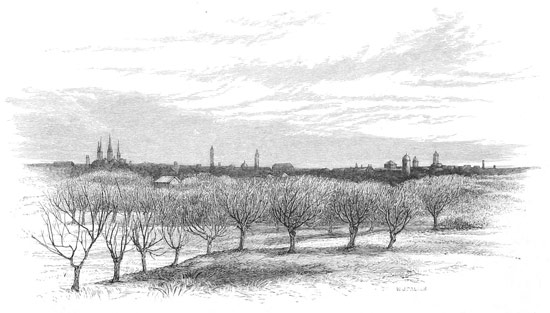
PADUA.
From a drawing by the Author.
A few steps explained the matter. The chapel stands to
the right of the house, at the edge of the orchard, and the
servant was doing up her hair previous to bringing out the
keys. The chapel outside is simply a barn-shaped building,
with a gable roof, absolutely undecorated in any way whatever,
unless a round-arched door, with the remains of a
very small fresco above it, can be called decorative. The
entrance is at the west end of the building, which is lighted
from the south side only, by six long narrow windows. The
gable roof hardly projects at all beyond the walls. The whole
appearance of the chapel being somewhat like those box-like
constructions drawn by children, to represent a house. If it
be a proper criticism to call a thing ugly which has only
been constructed for a certain purpose, and which has fulfilled
that purpose fairly well for six hundred years, the
Scrovegni Chapel may fairly be called by that name; but
personally I must confess to a feeling of gratification at
finding there was absolutely no attempt at architectural
embellishment in the whole building, and many will probably
share this feeling. Knowing that the interior was absolutely
covered with frescoes, each of which was almost priceless, it
seemed to me appropriate, both to the pictures, and the simplicity
of style in the master who executed them, that their
covering should be not sculptured marble or vaulted stone,
but simply plain, honest building.
After all the chapel was hardly more to the frescoes than
is the canvas to the picture, and it afforded a refreshing contrast
to the way in which things are done nowadays, to
remember that Enrico Scrovegni,[57] wishing to build a temple to
the honour, and for the service of, the Virgin, thought it
more necessary to give her the work of genius within her
shrine, than to adorn its exterior with costly materials and
sculptured ornament. Given that it was a choice between
Giotto's frescoes and elaborate architectural design (and we
may suppose that a plain citizen could not afford both), then
we can look at this homely building with pleasure rather than
repulsion, as we do at the rough coating of some precious
stone. And if we do not grumble at the plainness of the
building, still less will we do so at its position in the quaint
garden-close, where flickering shadows from the bright leaves
of the acacias dot the gravel path, and where from behind the
chapel rises the humming of the custodian's bee-hives.[58]
Is not this such a surrounding as we might best desire for
our painter's work? In front of his masterpieces, an orchard
green and gay, with trembling leaves and flashing sunshine,
and human with the soft voices of laughing children; and
behind, a rich meadow, where a few cattle doze lazily through
their time, and long ranges of bee-hives stand in the very
shadow of the chapel; and if the eye lifts its gaze from
meadow and orchard, with a sense of something wanting to
the full agreement of the surroundings and the painter's mind,
it meets the great dome of the neighbouring church rising
against the cloudless sky, as it might in one of Giotto's own
frescoes, and is satisfied. So with the rustling of the leaves,
and the murmur of the bees in our ears, and something of
the bright sunshine in our hearts, we enter the chapel where
the custodian waits patiently enough, having had experience
of many tourists and their foolish ways.
A long vaulted chamber plainly divided by a high arch
into nave and chancel, lighted by six high narrow windows,
all on the right hand wall, the entire interior surface covered
with frescoes, three tiers of which run from the ceiling to
within about eight feet of the ground; at intervals, below this
lowest tier, there are other frescoes of smaller size in monochrome,
symbolical of the various Christian virtues and vices,
surrounded by craftily painted borders, imitating mosaic
of coloured marbles.
Wherever the eye turns it meets a bewilderment of colour
pure and radiant, and yet restful to the eye; tints which resemble
in their perfect harmony of brightness the iridescence
of a shell, and seem to be possessed of something of the same
strange quality of imprisoned light. From the blue ceiling,
with its medallions and golden stars, to the lowest range of
mosaic, there is literally not a spot where the eye cannot rest
with pleasure; and the whole interior, owing perhaps to its
perfect simplicity of form, and the absence of all other
decoration than the frescoes, presents less the aspect of a
building ornamented with paintings, than that of some
gigantic opal in the midst of which the spectator stands.
It is difficult to speak without seeming exaggeration of the
effect produced, or to attempt to convey to those of my readers
who are not familiar with the spot, the peculiar qualities of
the colouring in these paintings. In England, and to the
majority of Englishmen, pure colour, bright colour, and staring
colour, are almost interchangeable terms, and depth of colour
is but too frequently understood to mean depth of shadow.
Now you must quite get rid of the idea that the colouring of
these frescoes is crude or violent, because I call it "pure."
If there is one quality of our master's work which is more
certain than another, it is the general harmony of his tints,
the absence of any discordant effect from his paintings. The
great difference between his system of colouring and that of
later masters is, that his harmony is gained by means of the
combination of broad masses of comparatively simple tints,
while later artists discovered that by paying greater attention
to the gradation of colour, its subtle variations of light
and shade, and its enhancement by means of complementary
tints, they could produce a greater truth to nature, as well as
a greater amount of colour beauty, than in any other way—and
one, moreover, which was applicable to all the varying
conditions of nature. Giotto's system was one which
he would have been the first to discard, had it occurred
to him to paint a picture save in full daylight, for its
beauty is incompatible with any other effect. It must always
be remembered in thinking of his work, that he was the successor
of men who absolutely banished shadow from their
pictures; for the gloomy hues of the older Byzantine pictures
were not representative of shadow, any more than their rich
tones represented light; and Giotto's master, Cimabue, had
revolted from the darkness of his predecessors' pictures to
comparatively light tints.
It was, of course, impossible for Giotto to work out an
entire system of chiaroscuro for himself (as a matter of fact
it took another two hundred years to accomplish that advance);
the marvel is that by his exquisite arrangement of tint he
was able to compose pictures which are to this day comparable
in colour beauty to those of the great masters of
succeeding ages, though they are not comparable in subtlety
of colour, nor is there ever such beauty of a special colour
gained as in the work of the later artists.[59]
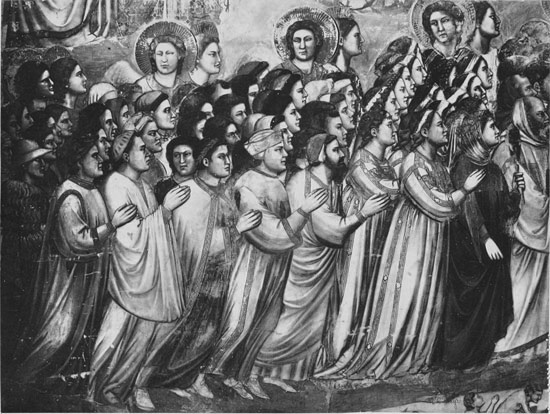
PARADISE.
FRESCO BY GIOTTO.
IN THE CAPPELLA DELL' ARENA, PADUA.
(Greatly restored.)
The series of paintings comprises illustrations of the
apocryphal history of Joachim and Anna, the Virgin's parents,
the life of the Virgin up to the period of the Annunciation,
and finally, a set of illustrations of the life and passion of
Jesus Christ, culminating in a fresco above the choir showing
Him enthroned in glory. Thus the series forms one connected
history, supplementing which there is on the great wall above
the door a representation of the last judgment. Every fresco
is surrounded by a frame, painted in imitation of coloured
mosaic, and at intervals, beneath the lowest row of the scenes
from the life of Christ, there are representations of the
Virtues, each of which has its corresponding Vice facing it
upon the opposite side of the chapel. In the arrangement it
should be noticed that each Virtue has its head turned to the
portion of the Last Judgment fresco representing Heaven,
or to the fresco of Christ in Glory; each Vice looks towards
the portion representing Hell. These symbolical figures are
in greyish green, with occasionally a background of dull red;
the historical works are in various colours.
This arrangement is probably due in some measure to the
rules of Byzantine art, but here the resemblance ends;
nothing can be more original, owing less to tradition, than
the composition of the various pictures in this series. They
are not so much an improvement upon Byzantine art, as
a wholly new departure; the difference is something like that
between the gallop of a horse, and the fierce rush of a locomotive,
not only a greater pace, but a changed mode of progression.
It is difficult to see how the one could have ever
developed into the other, and there is no clue left, save such
as may be found in that lonely shepherd life led by the young
artist, amidst the olive groves and grey hills of Vespignano.
I subjoin a table of the subjects of these series in the order in
which they here occur; but I do not propose to weary my
readers with a description of the composition of each picture;
it will be sufficient if I indicate the main features of a few of
the most important.[60]
The order of the drawings in the Arena Chapel is as
follows:—
- 1. Joachim's Offering rejected by the High Priest.
- 2. Joachim retires to the Sheepfold.
- 3. The Angel appears to Anna.
- 4. The Sacrifice of Joachim.
- 5. The Angel appears to Joachim.
- 6. The Meeting of Joachim and Anna.
- 7. The Birth of the Virgin Mary.
- 8. The Presentation of the Virgin.
- 9. The Rods are brought to the High Priest.
- 10. The Watching of the Rods at the Altar.
- 11. The Espousal of the Virgin Mary.
- 12. The Virgin Mary returns to her Home.
- 13. The Annunciation—the Angel Gabriel.
- 14. The Annunciation—the Virgin Mary.
- 15. The Marriage of the Virgin.
- 16. The Salutation.
- 17. The Nativity.
- 18. The Wise Men's Offering.
- 19. The Presentation in the Temple.
- 20. The Flight into Egypt.
- 21. The Massacre of the Innocents.
- 22. The Young Christ in the Temple.
- 23. The Baptism of Christ.
- 24. The Marriage in Cana.
- 25. The Raising of Lazarus.
- 26. The Entry into Jerusalem.
- 27. The Expulsion from the Temple.
- 28. The Hiring of Judas.
- 29. The Last Supper.
- 30. The Washing of the Feet.
- 31. The Kiss of Judas.
- 32. Christ before Caiaphas.
- 33. The Scourging of Christ.
- 34. Christ bearing His Cross.
- 35. The Crucifixion.
- 36. The Entombment.
- 37. The Resurrection.
- 38. The Ascension.
- 39. The Descent of the Holy Spirit.
The first of this series which deserves especial attention is
that numbered two in the above table, the representation of
Joachim's retirement to the sheepfold, after his offering has
been rejected by the high priest. This is especially remarkable
as being the first of his series of the Arena frescoes
in which Giotto's early training shows itself. Nothing
can be more marked than the evident delight of the painter
in depicting any form of this shepherd life. Throughout
his works every opportunity of introducing animal nature,
especially sheep nature, is eagerly seized and made the
most of, and, as in this fresco, the animals have invariably
a character of their own, and are by no means walking gentlemen
in the scene represented. Look, for instance, at the varied
action of the sheep in this composition, and the eager welcome
that Joachim's dog is giving to his master. In the third
and fourth pictures, too, of the Sacrifice of Joachim, and the
subsequent appearance of the angel, is the delight of the
painter in animal idiosyncrasies apparent, as in the two rams
butting at one another, and the air of quiet watchfulness in
which the dog lies down, with a sense of responsibility strong
upon him.
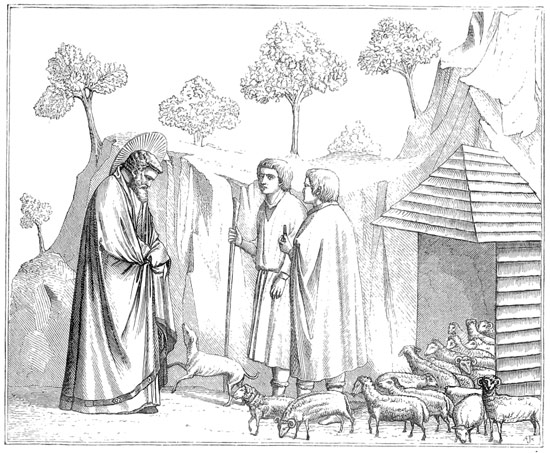
JOACHIM RETIRES TO THE SHEEPFOLD. BY GIOTTO.
In the Cappella dell' Arena, Padua.
The Meeting of Joachim and Anna, chiefly remarkable for
the grace and beauty of the two leading figures; it is somewhat
curious to notice how the position of Anna's head
suggests that of a famous modern picture, perhaps the most
celebrated ever painted in England, the Huguenots, by Mr.
J. E. Millais, R.A. A propos of this fresco, Mr. Ruskin
remarks, that the artist has heightened the effect of the
leading figures by wilfully coarsening the features of the subordinate
characters, and that the horizontal lines of the
architecture enhance by contrast the beauty of the curved
draperies. I am, however, inclined to think that the first of
these contrasts is accidental, as the type of face of the servants
in this composition, is found throughout the minor characters
in Giotto's pictures; indeed, it may be noticed that, whether
from his own uncomeliness, or some other more recondite reason,
the painter had a curious difficulty in depicting beautiful
faces, that belongs to him alone of contemporary masters.
This does not apply to beauty of gesture or line, to which he
was excessively sensitive.
8. The Presentation of the Virgin—the Virgin represented not as a child,
but, as Lord Lindsay remarks, a dwarf woman. The figure of Anna in
this picture is one of the least graceful in Giotto's works.
10. The Watching of the Rods at the Altar.—Chiefly characteristic as
showing Giotto's power of seizing the expression in the simplest actions,
which is most characteristic of the subject; in this fresco the eagerness of
the watchers is shown with a quite unmistakeable plainness, especially in
the three centre figures, though all of these have their backs more or less
turned to the spectator.
11. The Espousal of the Virgin.—Some of the figures in this composition
are very fine, such, for instance, as those of Joseph, the high priest,
and the youth behind, who is in the act of breaking the rod over his knee.
Mr. Ruskin remarks of this last figure that in Perugino's treatment of the
same subject (at Cannes) there is "nothing in the action of the disappointed
suitors so perfectly true and touching as that of the youth breaking
his rod in this composition of Giotto."
12. The Return of the Virgin Mary to her Home.—The figure of the violin-player
in this composition is remarkable, not only for its beauty, but for
being identical with that of one of the attendants in the fresco of the
Daughter of Herodias dancing before Herod, in the Santa Croce at Florence.
It is a very quiet picture, full of slow movement and dignified grace, but a
little wanting in the variety of action which is generally characteristic of
Giotto's work, and more severe in the lines of the drapery.
13. The Annunciation—the Angel Gabriel and the Virgin Mary. These
are two single figures which together encircle the arch above the entrance
to the choir of the chapel, and are as beautiful as any of the compositions;
especially fine is the attitude of the lines of drapery of the angel's figure.
Giotto seems not to have attempted to render the Virgin's face beautiful
either in expression or feature.
16. The Salutation—almost the first fresco where Giotto's full powers
are seen. I know no two figures more finer in their way than those
of the Virgin and Elizabeth. Here the plainness of Mary's face seems
quite obscured by the beauty of its expression, and every line of the two
figures helps to tell the story. This picture is smaller than the others,
owing to its place beneath the figure of the Virgin in the Annunciation,
and is nearly bare of all background.
17. The Nativity.—This Nativity is doubly interesting from the fact of
the subject being repeated at Assisi in the lower church[61] in the series
generally attributed to Giotto. The one at Padua is as beautiful as any of
the Arena frescoes, and in every way finer than the Assisi rendering, which
latter is almost certainly the work of one of Giotto's pupils, and is as stiff
and mechanical in its general arrangement as the former is easy and natural.
I need not enter into the reasons which have convinced me of Giotto not
having personally executed the Assisi Nativity, as they are given at length
in a subsequent chapter.[62] The varied action of the angels, the natural
gestures of the Virgin and the shepherds and the quiet harmony of blue
and grey colour (in which this fresco is almost entirely painted), are
especially worthy of notice. Very noticeable too are the attentive animals,
and the natural manner in which the Virgin turns half round in her bed
to place the child in its attendant's arms. On the right are the shepherds
listening to the angels, who fly hither and thither above the mountain
background; on the left, the ox and ass stretching their heads towards the
Virgin's couch.
18. The Adoration of the Magi.—The composition of this fresco in its
leading figures is very fine, and somewhat more elaborate than customary
in this series. The artist has tried very hard to get some expression of
interest in the camel, who is being held by an attendant on the left of
the picture, and has actually succeeded to some extent, despite the Noah's-ark-like
appearance of the animal, caused no doubt by Giotto's insufficient
acquaintance with its shape.
19. The Presentation in the Temple.—There are two incidents in this
scene, for the right interpretation of the latter of which I am indebted to
Mr. Ruskin. The first of them is the naturalism of the child, which is
evidently struggling to leave the high priest's arms and get back to its
mother, who holds out her arms to receive it; the second being the approach
of an angel to Simeon, who is supposed by Mr. Ruskin to typify
the angel of death, "sent in visible fulfilment of the thankful words of
Simeon: 'Lord, now lettest Thou Thy servant depart in peace.'" The
drapery of the Virgin in this fresco, though simple, is very fine.
20. The Flight into Egypt.—One of the simplest of the series. The
colour in several places completely gone, as, for instance, in the Virgin's
robe, which, originally blue, is now a yellowish white, the dark shadow
of the drapery alone remaining. The patient pace of the tired ass on which
the Virgin is seated, if contrasted with that of the one on which Christ
is riding in the fresco of the Entry into Jerusalem, will show how
minute was Giotto's observation and appreciation of animal life.
21. The Murder of the Innocents.—Perhaps the least pleasing of the
series, though no doubt much of its lack of beauty is owing to the change
of colour which this fresco has sustained, a change which, from some unknown
cause, has been much more radical than in most of this series. The
composition could, however, have been at no time a beautiful one, and
the heap of stiff wooden dolls (for such they seem) that represents the
slaughtered innocents is simply ugly. The fresco, however, is full of
action, and the figure of the leading executioner, who stands drawing back
his sword to pierce the child, whom he holds head downwards in his left
hand, is one of the most vigorous Giotto ever conceived.
22. The Teaching of Christ in the Temple.—This fresco is so much injured
by damp as to be practically destroyed.
23. The Baptism of Christ by John.—Wholly Byzantine in its arrangement,
especially in the water, which is depicted as a heavy green wall, reaching
half way up the fresco and covering Christ's body as high as the chest.
Mary and Joseph stand on the right bank, attendants on the left, Christ
in the centre of the picture, with a glory streaming down upon him. It is
somewhat curious to observe that Giotto has made a compromise in the
garments of the Apostle John, and while clothing him in a pink robe, for
the sake of the fresco's colour, has allowed a little bit of the camel's-hair
garment to be seen beneath the long drapery.
24. The Wedding in Cana.—A touch of nature in the fat butler in the
foreground, who is swigging away at the wine before taking it to the table;
otherwise this fresco is one of the most commonplace of the series. It is
worthy of notice that in all cases where Giotto has to represent a scene in
which the actors are seated, the artist seems to lose much of his attractiveness;
to become more commonplace. It is as if the dramatic instinct in
him refused to work freely except when he could depict varied actions.
25. The Raising of Lazarus.—This is another fresco full of the various
attitudes of surprise and energy in which Giotto delighted so much. The
pose of the principal figure of the disciples should be noticed, as it is very
characteristic of our artist, and occurs in many of his frescoes where surprise
or grief has to be indicated. The body is bent slightly forward with
the arms thrown abruptly back, the hand hollowed with the palm towards
the ground, the fingers held together and the thumb as much spread out as
possible. The figures of the two attendants in this fresco, who are raising
the heavy slab which covered the tomb of Lazarus, are of very marked
action; the one on the right trying to raise the slab to his shoulder, while
the left-hand one, with feet planted firmly wide apart, is just bending to
the strain of lifting his end of the stone from the ground, or as a rowing
man would say, is just "getting his weight on."
26. The Entry into Jerusalem.—Greatly injured by damp but still interesting.
Notice the figure of the woman, whose cloak has tumbled over
her head in her excitement, and the haste with which the two boys in the
background are climbing the palm-trees to get a good view.
27. The Expulsion of the Money-changers.—Like the last this composition
is one of varied interest, but the left-hand portion of it having been
considerably damaged by damp is scarcely intelligible. The attitude of
Christ is energetic, and there is a fine contrast in feeling between the two
money-changers on the right hand of the picture, one of whom shrinks
away, while the other seems inclined to stand his ground, while the precipitation
with which the goat is leaping out of the little pen is one of
those little semi-burlesque touches of animal life which Giotto introduces
whenever he gets a chance.
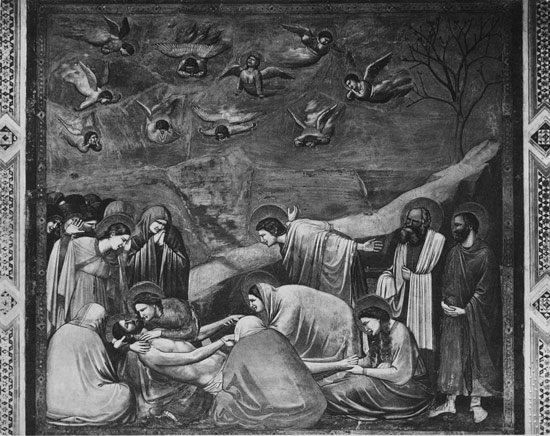
THE
ENTOMBMENT OF CHRIST.
FRESCO BY GIOTTO.
IN THE CAPPELLA DELL' ARENA, PADUA.
28. The Hiring of Judas.—A small composition of four figures, placed
on the wall beneath the arch of the choir, immediately beneath the Angel
of the Annunciation. Judas has already received the bag of money, and the
high priest, with one finger raised, like a sort of ecclesiastical Dogberry, is
just giving him his last instructions. The Devil, too, in the shape of a
black hobgoblin, with claws and tail, is also giving the apostate advice,
whispering it into his ear. The small fresco beneath this and in the corresponding
place on the other side of the choir is simply painted with a
representation of an arched ceiling, wall, and window, apparently intended
to give the impression from a distance of there being a side transept to the
choir.
29. The Last Supper.—In this, as in all his frescoes of seated figures,
Giotto is less at home than usual. It is curious to notice that the attitude
of John in this fresco is the same as was adopted in all the later renderings
of this scene. The moment chosen is the usual one of the Saviour's
speech—"He that dippeth his hand in the dish with me, the same shall
betray me."[63]
30. The Washing of the Feet.—Very characteristic of Giotto and wonderfully
true to life in the positions and actions of all concerned. Notice the
apostle tying his sandal on the left of the picture, and the one who is
about to have his feet washed, holding up his long robe lest it should get
wet.
31. The Betrayal.—This composition is much more thickly filled with
figures than most of the series, and is one of the finest, though hardly one
of the most beautiful. The figures of Christ and Judas are both grand in
their respective ways, and stand out vividly from the crowd that surrounds
them. There is no mistake about what is transpiring; one does not have
to look for the action in a middle of graceful lines, but it presents itself
strongly and at the first glance. The figure of the high priest who points
out Christ to the soldiery is also very fine, dignified and yet eager in
action, and with a mixed expression of triumph and anxiety. In colour
this fresco bears comparison with any in the chapel.
32. The Trial.—"And Pilate rent his garments," &c. Chiefly interesting
for the very beautiful figure of Christ, who stands with hands tied and
body slightly bent, half turned away from his judge, the face expressing
resignation, but in an even greater degree removedness from the scene
around, possessed by some over-mastering idea.
33. The Crown of Thorns.—Here Giotto is again in a somewhat burlesque
humour: the delight of those who are here mocking, tickling, pinching,
and smiting Christ is evidently the ruling motive of the picture. It is
noticeable that here there are only servants engaged in the derision and
tormenting, not soldiers, according to the commoner rendering.
34. The Bearing of the Cross.—In this fresco the figures of both Christ
and Mary are fine, that of Christ being similar to the attitude at the trial
above referred to.
35. The Crucifixion.—One of the most beautiful of the series. The
Magdalen kneels at the foot of the cross, weeping bitterly; St. John,
half fainting, is supported by two disciples on the left of the picture;
on the right the soldiers squabble over the division of Christ's robe;
the Saviour looks down upon the Magdalen, and above the cross fly here
and there angels.
36 and 37. The Entombment and the Resurrection.—These are the
two most beautiful frescoes in the chapel, so beautiful that they throw
all the others into comparative shade, and fortunately they are both little
injured by damp. In the first, Christ is being prepared for burial by
the disciples and the two Maries. The Magdalen supports his feet upon
her knees; the Mother lays one arm upon his breast, whilst she raises
his head towards her with the other in a last embrace. St. John bends
over the body in Giotto's usual attitude of grief and horror; other
disciples and attendants stand round weeping and watching; in the
background are mountains, and above them a choir of angels.
In the Resurrection, the soldiers sleep beside the red porphyry tomb
where Christ was laid, and on which, at head and foot, sit the white-winged,
white-robed angels. Nearly in the centre kneels the Magdalen
in a long robe of crimson, which shrouds her form from head to foot all
but her face; to the extreme right of the picture stands Christ, half
turning away from the kneeling woman, one arm outstretched as though
warning her "noli me tangere."
38 and 39. The Ascension, and the Descent of the Holy Spirit.—The
former of these two frescoes, which form the concluding ones of the series,
is very formal in its arrangement—the Christ being in the centre of the
picture, with hands raised to the choir of angels, who hover on both
sides. Below, the disciples are also in two groups, nor is there very
much to dwell upon in their expression or gestures. The whole fresco
seems as if Giotto had felt himself more fettered by the traditional manner
of representing the scene, or less at liberty to treat it in his own peculiar
fashion, than in the preceding scenes of the series. The Descent of the
Holy Spirit is very similar in the arrangement of the seated figures to that
of the Last Supper, and is only remarkable for its very delicate
colouring.
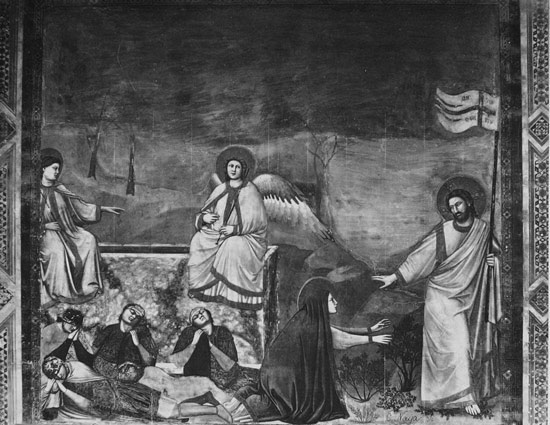
"NOLI ME TANGERE."
FRESCO BY GIOTTO.
IN THE CAPPELLA DELL' ARENA, PADUA.
This picture of the Descent of the Holy Spirit completes the series of the
history of the Virgin and our Saviour, and we have only now to mention
the symbolical figures in monochrome, which are painted at intervals
beneath the lowest row of frescoes, and which it is probable were an after
thought of Giotto's, possibly suggested to him by Dante, who, as I have
said, was living at Padua during the time when Giotto was occupied in
painting the Arena Chapel.
Be that as it may, it is the fact that in no other place does Giotto show
much tendency towards symbolical representation; these are the only
figures of the kind that we know to have been executed by his hand. In
this arrangement all the Virtues are painted upon the right side of the
chapel, and have their faces turned to the heavenly side of the great
fresco above the door; the Vices are on the left, and look in like manner
to the part of that fresco representing hell. The list is as follows:—
| Virtues. |
Vices. |
| 1. |
Hope. |
8. |
Folly. |
| 2. |
Charity. |
9. |
Inconstancy. |
| 3. |
Faith. |
10. |
Anger. |
| 4. |
Justice. |
11. |
Injustice. |
| 5. |
Temperance. |
12. |
Infidelity. |
| 6. |
Fortitude. |
13. |
Avarice. |
| 7. |
Prudence. |
14. |
Despair. |
This list is in the order in which the frescoes are placed round the
chapel, beginning on the right hand of the doorway and returning to the
left of the entrance; it will be seen, therefore, that the corresponding
Virtue and Vice face each other throughout the series.
Some of these allegorical figures are very beautiful; especially there
should be noticed Charity, holding a basket of fruit in one hand and
stretching forth the other to the Almighty, who bends down from heaven
to place some fruit in her hand. As Mr. Ruskin has remarked, the figure
is made to trample upon money-bags, as if in contempt. Hope also is a
very beautiful figure flying upward with outstretched arms, and an expression
of rapture and longing upon her face. After these Justice and
Temperance are the finest. Of the Vices, Injustice is perhaps the most
interesting, if it is only for the sake of giving a clear example of how far
Giotto understood the nature of trees. The foreground of this fresco
being a wood, behind which sits Injustice in a cave, with a sword in his
left hand and a grappling-hook in his right, to catch the unwary traveller,
who is represented in a small predella to the picture, being robbed and
stripped of his clothes. Anger too is a fine figure, rending her garment
apart in futile wrath, and so is Despair, with clenched fists and downcast
head. On the whole, this series of Virtues and Vices is a remarkable one
for the plainness with which the thing symbolised is shown, and the penetration
which has led Giotto in almost every case to the real root of the
Virtue or Vice. For a full description of these most interesting frescoes
the reader cannot do better than refer to the little book written for the
Arundel Society by Mr. Ruskin, entitled Giotto and his Works in Padua.
Note.—"This chapel, built in, or about, the year 1303, appears to have
been intended to replace one which had long existed upon the spot; and
in which from the year 1278 an annual festival had been held on Ladyday,
in which the Annunciation was represented in the manner of our English
mysteries (and under the same title: 'Una sacra rappresentazione di quel
mistero'), with dialogue and music, both vocal and instrumental. Scrovegni's
purchase of the ground would not be allowed to interfere with the
national custom; but he is reported by some writers to have rebuilt the
chapel with greater costliness, in order, as far as possible, to efface the
memory of his father's unhappy life. But Federici, in his history of the
Cavalieri Godenti, supposes that Scrovegni was a member of that body, and
was assisted by them in decorating the new edifice. The order of Cavalieri
Godenti was instituted in the beginning of the thirteenth century, to defend
the 'existence,' as Selvatica states it, but, more accurately, the
'dignity' of the Virgin against the various heretics by whom it was
beginning to be assailed. His knights were at first called 'Cavaliers of
St. Mary;' but soon increased in power and riches to such a degree that
from their general habits of life they received the nickname of the 'Merry
Brothers.'
"Federici gives powerful reasons for his opinion that the Arena Chapel
was employed in the ceremonies of their order; and Lord Lindsay observes
'that the fulness with which the history of the Virgin is recounted on
its walls, adds to the plausibility of his supposition.'
"Enrico Scrovegni was, however, towards the close of his life driven into
exile, and died at Venice in 1320. But he was buried in the chapel he
had built, and has one small monument in the sacristy as the founder of
the building, in which he is represented under a Gothic niche, standing
with his hands clasped and his eyes raised, while behind the altar is his
tomb, on which, as usual at this period, is a recumbent statue of him.
The chapel itself may not unwarrantably be considered as one of the first
efforts of Popery in resistance to the Reformation; for the Reformation,
though not victorious till the sixteenth, began in reality in the thirteenth
century; and the remonstrances of such bishops as our own Grossteste,
the martyrdom of the Albigenses in the Dominican crusades, and the
murmurs of those 'heretics,' against whose aspersions of the majesty of
the Virgin this chivalrous order of the Cavalieri Godenti was instituted,
were as truly the signs of the new era in religion, as the opponent work of
Giotto on the walls of the Arena was a sign of the approach of a new era
in art."—From The Arena Chapel at Padua, by John Ruskin.
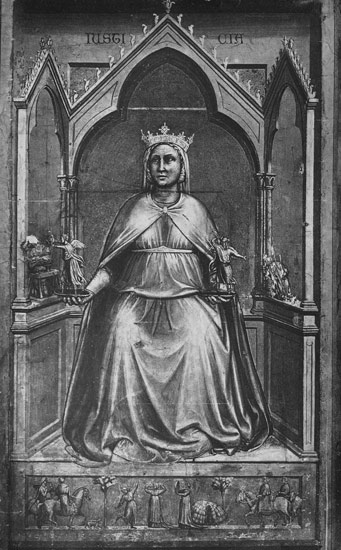
JUSTICIA.
FRESCO BY GIOTTO.
IN THE CAPPELLA DELL' ARENA, PADUA.
CHAPTER IX. GIOTTO'S STYLE.
"There is in truth a holy purity, an innocent naïveté, a child-like grace
and simplicity, a freshness, a fearlessness, a yearning after all things
truthful, lovely, and of good report, in the productions of this early time
which invest them with a charm peculiar in its kind, and which few even
of the most perfect works of the maturer era can boast of; and hence the
risk and danger (which I warn you of at the outset) of becoming too
passionately attached to them, of losing the power of discrimination, of
admiring and imitating their defects as well as their beauties, of running
into affectation in seeking after simplicity, and into exaggeration in our
efforts to be in earnest; in a word of forgetting that in art, as in human
nature, it is the balance, harmony and co-equal development, of sense,
intellect, and spirit, which constitutes perfection."—Lord Lindsay's
Christian Art.
I feel my inability to convey to my readers any adequate
idea of the general style of Giotto's painting, and this
not so much because it is a complicated one or difficult to
understand, as because of its very simplicity. A few points
may be mentioned in which it differed from that of his predecessors
in Italy, from the pictures of the Renaissance period,
and lastly from those of our own time; but when all is said,
the peculiar beauty of the colouring, the simplicity and
purity of the feeling, the strength and directness of the
painter's aim, and the unstudied grace of his compositions
will remain to baffle any description that can be given.
First let me note that previous to the time of Giotto (since
the decay at least of Greek art) colour in painting meant
almost exclusively the arrangement of gorgeous hues on a
golden background. The tints used being little, if at all,
gradated, but laid on more in the manner of a mosaic
than a modern picture. Derived, as were the traditions
of painting, from manuscripts of Mount Athos and
mosaics of Byzantium, they were almost wholly confined to
the composition of pure colours in pleasing juxtaposition,
and these colours were almost invariably full and deep.
It may, perhaps, make my meaning clearer if I take an
antithetical example from the art of the present day.
Everybody knows the characteristics of French landscape
painting, a beautiful tone of grey and black, and perhaps a
few other tertiary tints, and no form or colour whatever,
depending entirely on the gradation for its beauty. Well,
before Giotto there was no such thing as tone, save in pure
colours; and gradation of colour was practically unknown.
The colours used were dark and rich, purples and crimsons
and deep blues, and here and there orange and green and
heavy blue-blacks. These, laid upon a gold ground, more or
less ornamented with chased designs, formed the chief portion
of the pictorial art of the centuries preceding Giotto.
Looking into one of these pictures was like looking into a
decaying fire, where amidst masses of dark shade there still
burnt gloomily here and there, patches of glowing cinders and
bright flame. Hung in the dim recess of a chapel or an
oratory, lighted by the faint glimmer of the silver lamps,
these works of Christian art may well have harmonised with
the dark ages of superstition which gave them life, but they
were essentially unsuitable for having any real effect upon
men's minds, apart from their religious uses. They had no
connection with the real life of the world, full of varying
emotions and conflicting passions; they had no affinity with
the times when the hardbound earth cracked at the close of
winter, and the sun shone once more in a blue sky, and all
men's "pulses throbbed together with the fulness of the
spring."
This was the first change that Giotto made in artistic
method. "Away with the gold background," he said; "let
us have the blue sky," and, as in the days of creation, "it was
so." This we may fancy was the first step, but with it came
many others. With the introduction of the sky came a
corresponding lightening of the tones used throughout the
picture, a corresponding increase in the amount of light
depicted in the composition.
And, as over the whole of Byzantine art, there had brooded
a gorgeous gloom, through which the tints only revealed
themselves dimly and slowly, as we may see at the present
day, the hues of tropic sea-weed glow faint beneath the waves
of the China Sea, so over Giotto's frescoes there shone a calm,
full light, not bathed in sunshine or enhanced by contrasted
shade, but a plain clear breadth of day, sufficient to reveal
clearly each object in the picture.
Just think what a change this one alteration in tone must
have brought about! what an instrument it was for the correcting
of the absurd traditions which then governed the practice
of painting. It must have been like that produced by a
Times leader upon the iniquities of local boards of guardians;
namely, delight and amazement to the world at large, horror
and consternation to the idiots who had done ill by stealth
(though strictly in accordance with rule), and blushed to find
it fame.
So keep this fact well in view, that the great change
effected by Giotto was the change from rush-light to daylight,
and it was only after this that further advance became
possible. Do not run away with the idea that he gained
thereby the whole truth; far from it. There were two
centuries and a half of painters to come after him before the
whole truth of light and shade was mastered, for Giotto may
be said to have practically ignored shade altogether.
Nor did he advance much further in the gradation of colour
than his predecessors had done; his paint is generally put
on in broad flat washes, with little attempt at gradation;
its beauty depends chiefly upon the exquisite manner in
which these washes are combined with one another. Thus
he never reaches to the utmost beauty of colour, which is
only obtainable with the utmost gradation of light and shade;
but his work presents itself like a landscape, ere the sun
rises, on a fine summer's morning, when each object lies
clearly and a little coldly defined, in the shadowless air.
It must be remembered that with the attempt to master
the intricacies and gradation of light and shade, came also the
use of secondary and tertiary tints, to an extent unknown in
the time of Giotto, who may almost be described as the last
of the pure colourists, taking pure in the sense of primary.
Chiaroscuro went on gradually advancing in importance,
relatively to colour and subject, till in the times of Rembrandt
we find it absolutely thrusting colour and subject out
of the field altogether, and making the flash upon a tin
pannikin, or the obscurity of a cottage kitchen, of equal
importance with the grandest traditions of our race.
What is perhaps best known as the special quality of
Giotto's art is his study of nature; and it is right that I
should say a few words upon this somewhat indefinite phrase,
and try to show in what Giotto's study of nature consisted,
and wherein it differed from that of preceding painters.
If we were able to return in reality to the old times when
our painter lived, I do not fancy we should find—as many good
people suppose—that the folk of that day were ignorant that
there were such things as domesticated animals and birds,
trees and flowers, clouds and sunsets. You may be very sure
that mediæval Florentines on the ridge of Fiesole, have often
paused to watch the sun gilding the spires of Florence, much
as the English traveller does; and young lovers wandering
idly amongst the almond-trees by the Arno, plucked the
blossoms, and admired their loveliness, as we do to-day. It
was only that somehow the idea had never occurred to any one
that these things were suitable for pictures; there was a
notion that it would be a sort of irreverence to put such vulgar
details into religious scenes—arising perhaps from a similar
feeling to that which makes many well-trained Christians dislike
to pray for any specially desired object. Perhaps it was
owing to Giotto's early training, or rather no training, in the
midst of a wild mountain country, perhaps only to his rough
humorous, anti-reverential character, but probably to the combination
of circumstance and individuality, that made him
introduce into his compositions all sorts of extraneous matter.
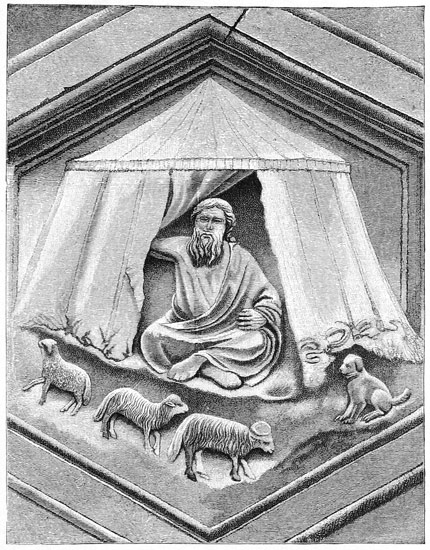
That to the last he entertained a strong sympathy with
his early shepherd life, it is impossible to doubt, and in
the designs for the decoration of the base of the Campanile,
only two of which he lived to execute with his own hand,
there is a singularly beautiful bas-relief, illustrating the
pastoral life, in which the sheep, and the puppy watching
them, are as fine as anything we have from his hand.
The great difficulty of accounting for Giotto's introduction
of hitherto unused matter into his pictures, lies in the fact that
it does not seem to have been due especially to any partiality
on his part for this or that branch of nature, as to a principle
of getting to the bottom of his subject, whatever it was. He
appears to have had a power of grasping the spirit of whatever
scene he was engaged upon, and illustrating that appropriately,
which is, as far as I know, unequalled in the records
of painting. And it is noteworthy that this spirit is with
him always the reverse of eclectic: no painter can be more
entirely free from all principles of aristocracy; his sympathies
are always with the people; the view he takes of any subject
is the plain, common-sense view, such as plain, common-sense
people can understand.
Connected with this is the third great characteristic of
Giotto, perhaps the strongest in his whole nature, and certainly
the one which was least in accordance with the spirit
of his time. This is his strong dramatic power.
This power shows itself in almost every work of the
master's we have left us, and even survives his death, and
lives in the work of his pupils. His pictures are not alone
scenes, they are SITUATIONS, on each the curtain might fall
without any sense of incongruity. Besides their appropriateness
of gesture and oneness of feeling, they possess the great
characteristic of dramatic art, in making the scene live before
you, subduing its various incidents into one strain of meaning,
yet keeping each incident complete and individual, as
well as making it help the main purpose. In most of
Giotto's pictures there will be found a diversity of
action and expression, all of which lead up to the main
action, and help to enforce and illustrate it. A minor
point in which the same quality shows, is in the amount of
emotion which this painter is capable of expressing by a
single gesture, an amount so great that it occasionally runs
some danger of lapsing into caricature. This is especially
plain in such pictures as the Betrayal and the Entombment, in
the Arena Chapel. But where this dramatic quality is most
strongly marked is in the bas-reliefs on the base of the
Campanile; in all these Giotto has succeeded, not only in
choosing the most appropriate figures for illustrating his
meaning, but in seizing the very moment which is most
significant.
To sum up these three main characteristics of Giotto's
style, they are—First, a lighter, purer tone of colour than
had been in use before the time of Cimabue, and a greater
variety and purity of tint than had been attained by that
master, especially in the more distant portions of the picture.
Second, the introduction into his compositions of a certain
amount of natural detail which had been before totally neglected,
and the substitution of the portraits of actual men
and women for the imaginary beings that had formerly filled
up the backgrounds of the Byzantine pictures. Third, comes
the power of illustrating the real meaning of his subject,
and not merely suggesting it, as had formerly been the case,
allied to which is the dramatic quality of which I have just
spoken.
I feel how barren is all this description to explain the
progress in art made by this artist—the progress from
stagnation to movement, from death to life, from symbolical
types, to the things themselves. It would appear unnecessary
to dwell upon the few points in which his work was technically
deficient, or those in which he but repeated the errors
of his predecessors, but the following may just be mentioned.
The comparative dulness of the reds in use at that time,
the lack of depth of hue, and variation of colour in differing
aspects of light and shade; the comparative poorness of the
drapery, as compared with that of the later Venetian and
Florentine masters; the deficiency in the rendering of form,
and the elementary amount of knowledge of perspective and
anatomy—on all these points might exception be taken to his
work with perfect justice, and yet when each had been given
its due amount of criticism, the wonder would still be that
he accomplished so much, and not so little. For two hundred
years after the death of Giotto the advance in the drawing of
landscape was so slight as to be almost imperceptible, and yet,
compared with his landscape, that of those that preceded him
was as "moonlight unto sunlight, and as water unto wine."
I have omitted in this description the main characteristic
of Giotto's style, and I have done so because it is so intangible
that it can only be felt, not described. This characteristic,
hinted at by Lord Lindsay in the quotation which is placed at
the head of this chapter, is the simple faith in which each of
these compositions abounds; the feeling conveyed to the spectator
that thus, and no otherwise, did the occurrence take
place, and that the painter has not altered it a jot or tittle for
his own purposes. This must be felt to be believed, and I
only call attention to it here lest it should be supposed that
it has failed to impress me.
CHAPTER X. GIOTTO AT ASSISI.—THE UPPER CHURCH.
Of all the minor disadvantages of travel which have
accompanied the substitution of the locomotive for the
coach, perhaps none is so real an evil as the very partial
impression an ordinary traveller derives from a short visit to
some interesting land. When Rome and Florence, for
instance, are brought within the compass of a day's journey,
the tourist is little likely to care to break his journey for
comparatively obscure cities, much less villages, scurries past
"reedy Thrasymene" without recognition, and scarce notices
the towers and churches of Perugia, rising green and grey
on the mountain side. Still less likely is our tourist to arrest
his comet-like progression at a rough country station, some
fourteen miles from the old Etruscan city, a station where
very obviously, neither guard nor porter expects him to alight,
and which he has some difficulty in identifying by the help
of a nearly illegible inscription, as Assisi. And yet there
was a time when this forgotten town played no inconsiderable
part in the world's history, and was the central seat of an
Order that reckoned princes among its followers, and practically
divided with the Dominicans the spiritual sovereignty of
Europe.[64] And even now, if any very strong-minded traveller
should be able to defy the ominous silence of Bradshaw,[65] and
the neglect of Cook, and more regardful of what has been,
than what is, spend a few days in the home of poverty, he
will not regret, we think, in after years his deviation from
the accustomed routine of travel; nay, if he gain no other
advantage, he will at least have had a brief space in which
to take quiet breath, ere the red-books and the valet de place
are again in requisition, ere St. Peter's becomes No. 17 in the
often consulted plan, and Rome takes "at least a week to see
properly." For at Assisi there is no hurry, and so strong is
the spirit of the place that the most energetic tourist quickly
succumbs to it; even those who rush over here from Perugia
for a day's excursion, treading softly ere they have been a
couple of hours in the city of St. Francis. And now we will
suppose that "our uncommercial traveller" has safely escaped
the clutches of the three or four inn touts whom his arrival
has roused into unwonted energy, and consigning his bag to
the least ill-favoured, has set out manfully along the dusty
road leading from the station to the town; for be it noted
that Assisi is not strong in equipages, and the solitary rough
wooden box denominated omnibus, is hardly an attractive
conveyance at first sight, though ere long the traveller begins
to look upon it as an old friend, as it is to be found during
the greater part of the day, standing about in various unexpected
parts of the town, being apparently left wherever it
has taken a passenger. One further violence we must do to
the mind of the well-instructed tourist, namely, to beg that
he will not accept guidance, nor torment himself with details,
archæological or otherwise, but simply open his eyes to all
the quiet influences of past devotion and present beauty
which he will find around him. And first, he will see by the
side of the road a vast church, in the most uninteresting style
of Renaissance architecture, not unlike a small edition of St.
Peter's. This is St. Mary of the Angels, little notable, save
for its size, and a small chapel it contains, where St. Francis
first assembled his few followers. In it there is only to be
seen—a spoilt fresco, by Perugino; walls dark with age, save
where, here and there, the dim lamplight falls upon the silver
offerings of penitence and thanksgiving; and some carved
doors, more curious than beautiful. These need not delay us
much from the steep ascent to the town. Another dusty
mile of road, and Assisi lies before and above us, rising a
confused mass of tiled roofs and massive walls, from the grey
depths of the olive-groves which surround it. Not only on
a mountain, but of the mountain, does the town seem to be
built, the ponderous blocks of dim red and dusty yellow stone,
scarcely seeming to have more the characteristics of houses
than of the cliffs above, save where, here and there, a square
tower of church or fortification lifts itself into clear pre-eminence
of definition from the tumbled confusion of roofs,
walls, and buttresses. Another turn in the long, winding
road, and the great attraction of the few sightseers who visit
Assisi, the Convent of St. Francis—with what Bradshaw
calls its "three superb churches," which are, in fact, two—stands
revealed. Picture to yourself a long mass of building,
standing upon a double range of tall arches, and
pierced with a multitude of small windows. This is the
convent building itself; beyond it, on a level with its
roof, rises the Church of St. Francis, with its square
campanile. Of the same dull-yellowish colour as the other
buildings of the town, there is little beauty in the church
from this point of view, save that of massive strength,
and a certain simplicity of design which, when carried out
upon so large a scale, almost amounts to grandeur. So, leaving
the convent on our left, we enter beneath a massive square
tower the first street of the city. It is difficult to say whence
comes the sense of extreme desolation which oppresses us, not
from the absence of life certainly, for at this point there are
commonly a few of the villagers and townspeople chatting
round an old fountain, and on every side resounds the squeaking
of the pigs, that every well-to-do inhabitant of Assisi
keeps tethered on the ground-floor of his house. Nor is it
that there are no signs of commercial enterprise, for we
notice the hammered brass and copper jars and cauldrons
glimmering dimly in the recesses of one of the dark shops,
and some strings of onions and other vegetables in another.
Is it something, we wonder, in the construction of the town
itself, in its rough-hewn blocks of dusty stone, its huge
buttresses, its blocked-up arches, its weather-beaten tiles, the
defacement of its ruined fountains, and the general appearance
of enormous toil with which the city must have been
constructed? Or is it still more the case, that even at the
first glance we connect the appearance of the town with the
state of the superstition to which it owes its existence; whose
power changed the small Etrurian village into a shrine of the
deepest sanctity and proudest priesthood, and having done its
work for good and evil, faded gradually away, and now finds
voice only on the trembling lips of the half-dozen monks who
are all that remain at Assisi of the famous Brotherhood?
For whatever reason, the place is desolate—desolate as no
place can be which has not once been great; and as we ascend
the street, the impression deepens. Few of the houses have
glass to their windows; the old arched entrances are blocked
up with rough stone, and low, square doorways supply their
place; the ground-floor of the house is commonly used as a
store-room, a stable, or a piggery. The upper windows show
us nothing within that we are accustomed to connect with
ideas of domestic comfort. Even the massive ironwork seems
to partake of the general desolation, and is coated with the
grey dust of centuries. Here and there we pass a fountain,
generally situated in a small grass-grown open space, with a
couple of earthen pitchers left to fill themselves leisurely;
and over all there is still the sense of death in life, needing a
vigorous effort on our part to endure. We begin to think
there was some sense in that philistine American we met at
Florence, who smiled so scornfully at our determination to
visit Assisi, and to have thoughts of the next train to a more
lively spot. However, food and wine at the modest little
hotel quickly dissipate our loneliness; our musings on St.
Francis and his monks assume a more pleasant complexion,
and by the time we find our way down the long street to the
convent, we are in a fit mood to appreciate any beauty or
pleasure which we may chance to find there. And indeed he
would be hard to please who could be discontented with the
enjoyment here provided, for whether it be Nature or Art for
which his "thirsty soul doth pine," here he may satiate
himself at leisure.
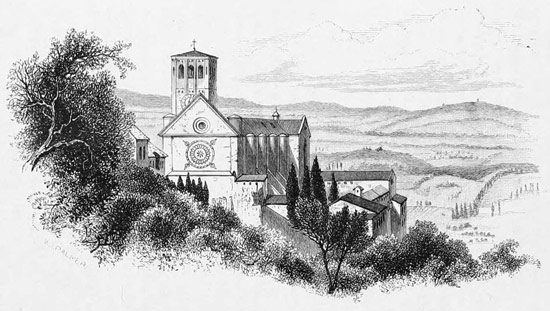
ASSISI.
From a drawing by the Author.
Everything on our way seems to tell the same story
of departed grandeur; the city is almost as deserted
as one of those we read of in the Arabian Nights. A
beautiful arcade, each capital of whose pillars is carved to
represent a different species of vegetation, incloses nothing;
the house of the poet Metastasio is falling into ruins, and
scarcely can one decipher his coat of arms sculptured above
the door. No dogs bark, nor children scream, nor loungers
stare as the unwonted stranger passes through the market-place;
the very café has been fain to part with its chairs and
little tables, and now is only a gaunt, bare room, in a corner
of which sits, in half obscurity, a melancholy woman sewing
slowly. The market-place is certainly the most gloomy part
of the town, were it only from its contrast to the market-places
we are accustomed to see; and so let us hurry down the
long, grass-grown street, till at last a sudden breadth of light
opens before us, and straight in front, across a patch of green
meadow, rises the Church of St. Francis, while a little to the
left a steep incline leads down to the entrance of the Lower
Church, called incorrectly, in some works, the crypt, as
the real crypt is beneath this lower edifice. The Lower
Church stands upon a shelf of rock, the side of which slopes
abruptly upward, against which one end of the church is
built. The position of the two churches may perhaps be
understood by thinking of them as situated upon two successive
steps of a staircase, the floor of the Upper Church
being merely a continuation of the upper step, and being thus
immediately above the roof of the Lower Church.
Let us pause before entering the church, and cast our
eyes over the scene before us. We stand on a little terrace
half-way up the town, looking down upon tiled roofs,
grey walls, and greyer olive groves, interspersed with some
brighter greens of acacia and poplar. Beneath us, winding
away in long perspective, is the road to the station, with the
tall dome of St. Mary of the Angels forming a prominent
blot upon the landscape, and breaking the level monotony of
the plain. On the right a broad river-bed, nearly dry at the
present season, stretches a snake-like course towards Perugia,
the towers of which are just visible in the distance. In front
of us, the valley of the Tiber stretches away for miles and
miles, broken only by long lines of poplars and tiny villages,
which, from the height at which we stand, only show as
gleaming spots in the sunshine. In the extreme distance,
purple mountains enclose the valley on every side, and immediately
behind us rises the mountain on which Assisi is built,
crowned with a ruined citadel, and black against the sky, the
sharp pinnacles of cypress-trees. Whichever way one turns,
there is beauty—in the quaint architecture of the old town,
in the wild growth of the ancient olive-trees, and their delicate
tints of greyish-green and silver; in the brighter colours
of the plain, with its broad stretches of sunshine and little
shadows of cloud; in the ranges of mountains, the darkness
of the cypresses, and the brightness of the sky. And so
murmuring within ourselves that the old monk was no bad
judge of scenery, after all, we turn in beneath the broad
portico of the church.
It is not known when this church first began to receive
pictorial adornment; but it is probably true that Giunta
Pisano painted there in 1236, though there can be little doubt
that anterior to this period there were paintings the authorship
of which is unknown, and whose date is uncertain. The
whole question of the authorship of the frescoes at Assisi is
discussed by Crowe and Cavalcaselle;[66] but it is difficult to
extract their real conclusion from the mass of verbiage in
which it is enveloped, and the limitations with which it is
encumbered. Nor can I attach much importance to the conclusion
which these authors have drawn from frescoes in such
a terrible state of decay, as those in the northern and southern
transepts of the Upper Church. But I do not propose to
enter here upon the question of the authorship of any of
these frescoes, except such as are attributed to Giotto; and
even this had better be deferred till I have given my readers
some idea of the general appearance of the church. Its shape
is the usual Latin cross formed by a nave and transepts, without
chapels or side aisles. From the entrance, which is at
the east end of the church, to the choir, the building is
divided into four portions by grouped shafts, five in number,
only half of which project from the walls from the capitals;
from each group spring to right and left pointed arches, in the
centre of each of which is a long narrow window reaching from
the ceiling to within about twenty-four feet of the ground, and
from the capitals there also spring arches which cross the
building diagonally, and intersect at the summit of the
ceiling, thus forming triangular openings with curved bases,
each of which is filled with a fresco, most of them greatly
obliterated. The shafts and capitals have all been painted in
various colours, as have also the spaces within the side arches
on each side of the narrow windows above mentioned, and so
have the faces and sides of each arch. The four main
portions, into which the ceiling is thus divided, are alternately
painted blue with golden stars, or filled with medallions
and figure subjects. The painting of the arches is in imitation
of marble mosaic. The intersecting arches of the roof are
round (as in the Lower Church), not pointed like the side
arches, and on the sides of the latter, which are double in
width of the centre arches, there are busts of various saints
and martyrs of the church connected by rich ornament and
involved geometrical design. On either side of the windows,
in the second row from the roof, are the frescoes ascribed to
Cimabue, all of which are considerably defaced; above these
are the ones assigned by Vasari and Lord Lindsay to Giunta
Pisano. The roof was, while I was there, in process of utter
destruction (by restoration), and its ruin is by this time
probably completed.
Underneath the windows there is a third row of paintings,
thirty-six in number, commonly supposed to be the work of
Giotto, and beneath this again painted bands of mosaic, and
so to the floor, which is alternately inlaid with squares and
octagons of marble originally red and white, but which has
worn into the warm dusty yellow which seems to overspread
the whole of Assisi.
The choir is built and decorated in a similar manner, and
its centre occupied by a very elaborately worked iron screen
(once bronzed and gilt) erected upon a marble daïs, inlaid
with glass mosaic, the patterns of each step being different,
but all intricate and beautiful. The daïs is about ten feet
high and thirty-eight feet long, and the screen about nine
feet high. Surmounting the screen there is a narrow marble
canopy, supported upon twelve marble pillars, with capitals of
acanthus leaves richly gilt, the convex side of the leaves in
the upper portion of each capital being very deeply cut and
painted vermilion. The screen surrounds a plain marble altar.
The arrangement of the choir is similar to that of the body
of the church, each of the transepts being similar in size and
arrangement to one of the four divisions already spoken of;
the only difference is in the size of the windows, which are
exactly double of those in the nave, though of identical shape,
each having one pointed archivault; but at the choir end of the
church the window is treble in size. The two sides of the
choir which have no windows, are ornamented with small
galleries of tre-foiled Gothic arches supporting canopies.
Underneath these galleries are a row of paintings corresponding
with the lowest row of frescoes in the nave. There
is a recess of about two feet running the whole length of
the church between the groups of shafts just above the lowest
row of frescoes, which serves to measure the depth of the
side arches, and also as a domain to the two lower rows of
frescoes. The colour on the shafts, and on the lowest portion
of the side walls, has almost entirely disappeared, and the
whole of the paintings in the church are much injured by
damp. So much is this the case, that it makes me doubt
whether it is worth while going very deeply into the question
of their authorship, though this is a favourite battleground
with the biographers of early Italian painters.
Vasari boldly ascribes the whole upper portion of the
church to Cimabue, and the lower to Giotto: Lindsay asserts
that Giunta Pisano had painted the upper, Cimabue the
middle, and Giotto the lower range of compartments:
Kugler, though somewhat indefinite, holds that he worked
out his apprenticeship in the Upper Church of Assisi, and
afterwards came again and laboured in the Lower one.
To sum up then the discussion of this matter, which is
hardly an interesting one to the general reader, my explanation
of the probable authorship of the lower row of frescoes
would be the following. That they have been painted by a
pupil of Giotto's at the same time that the master himself was
at work on the frescoes in the Lower Church, and that the only
frescoes by Giotto in the Upper Church, are the two almost
monochrome compositions that are placed one on each side of
the principal entrance. It should be noted that these two are
far more conspicuous, owing to their isolated position, than any
other frescoes in the church, which may well have been the
reason for their execution by the master himself. And it is
somewhat curious to observe that they are both painted in
little more than two shades of colour, and are the only
frescoes in the church so painted, as if Giotto were purposely
restraining his hand, so as not to spoil by contrast
the cruder work of his pupil. This pupil I believe to have
been Taddeo Gaddi; but I have not seen sufficient undoubted
works by his hand, to render this more than a mere conjecture,
and there is no evidence on the subject whatever, save
such as may be inferred from the fact that Gaddi was almost
certainly present with Giotto at the time he painted in the
Lower Church.
Leaving the question of the actual authorship undecided just
now, notice how far this hypothesis, besides having strong
internal evidence in its favour, goes to solve the difficulties of
this matter; by it we account easily and naturally for the
Giottesque qualities which we find in these works, and also
for their comparative feeble significance. And by the effort
to combine the Byzantine manner of Cimabue with the
simplicity of Giotto, we account for all the very inferior architecture
with which these pictures are crowded: architecture
which is to a certain extent Giottesque in form, but seems to
be wholly conventional in colouring and arrangement.
Giotto would naturally say to his pupil something of this
sort: "Look here, Gaddi, this a great chance for you to
distinguish yourself; mind you make the most of it. Don't
forget that what you have to do is to complete Cimabue's
work; you must not make his compositions look more absurd
and unnatural than you can help; above all, your work
must be in keeping with his in colour, or you'll spoil the
church. Mind you preserve the character of the architecture,
and keep it uniform throughout; and if you let your work
be a little conventional, it will be all the better."
So we may imagine Giotto talking to his pupil; and the
compositions are exactly such as might have been produced
after such an exhortation, by an earnest, but not very
brilliant pupil, in attempting to combine as much as possible
of the character of Giotto's work, with the form of Cimabue's
compositions.
Indeed, these frescoes frequently fall between the two
stools of naturalism and conventionalism, and have the
merits of neither. The architecture is throughout utterly
absurd, worse, because not so refined as that of the Byzantine,
and quite without the beauty of Giotto; an effort towards
the simplicity of the buildings in the frescoes of the Arena
Chapel being nevertheless observable, though it results only
in a toy-shop architecture of the lowest order, yellow and blue
towers being stuck one against another.
The figures, too, show the attempt to depict emotion, but
without success; and lastly, the colouring, as at present seen,
is crude, to the verge of discordancy; but upon this last it
would be unsafe to lay much stress, as it is impossible to say
what deterioration may not have resulted from the damp,
which in some places has actually obliterated the composition
altogether. This execution by a pupil would also account
for Giotto having restricted himself to shades of grey, green,
and blue in the two frescoes at the end of the chapel to which
I have above referred. The subjects of these are St. Francis
preaching to the Birds, and St. Francis' Dream; and amongst
all the Giottos I have seen, there is no more harmonious piece
of colouring than in the last named of these works.[67]
There is one piece of corroborative evidence in favour of
these works being by Taddeo Gaddi that I may quote for
what it is worth, which is, that in the series of panels in the
Gallery at Berlin which formerly were part of the frescoes in
the Santa Croce of Florence, and which are certainly, according
to Crowe and Cavalcaselle, the work of Gaddi; "the
subjects are, in fact, more or less repetitions of those in the
Upper Church of Assisi." Now it seems more probable that
Gaddi should have repeated his own compositions than that
he should have repeated those of some unknown master,
especially one of such comparatively feeble powers.
Here I must leave the consideration of the authorship of
these frescoes; as I said in the beginning, it is a much vexed
question, and one that there is at present no positive evidence
for deciding; the one thing that is certain is that in a very
short time, if it has not happened already, the frescoes will,
to all intents and purposes, have entirely vanished.
Crowe and Cavalcaselle hold that there were a series of
painters who worked at the Upper Church, and that the
whole history of the revival of early Italian art is comprised
and explained in these paintings, and seem to hold that
Giotto painted only one or two of these frescoes; while, lastly,
in one of Dr. Dohme's German series of biographies, which is
the latest work issued on this subject, we have the author
maintaining the thesis that Giotto painted all these frescoes
(in the lower row), and that when he had finished this series
he began again upon those of the Lower Church.
Of the various opinions, those of Vasari and Lindsay can,
I think, be shown to be wrong from a comparison of the
dates of Giotto's works. In the first place there is no
evidence whatever to hint at two visits to Assisi, except
Vasari's statement that Giotto was invited to Assisi by Fra
Mure. Now Fra Mure, who was general of the Franciscan
order, only held that post between 1296 and 1302, and therefore
if he invited Giotto to complete the frescoes of the Upper
Church, it must have been between those years; but from a
register preserved in the Vatican, the famous Navicella mosaic
was executed by Giotto in 1298, and that he was still at Rome
in 1300, is proved by a portion of a fresco representing Pope
Boniface announcing the opening of the Jubilee, which took
place 1300, and upon the completion of which work Giotto
betook himself to Florence, and painted the famous frescoes
in the Bargello, in one of which the portrait of Dante occurs.
Dante was exiled in 1302, and this, and many minor considerations,
point to the date 1301-2 for the execution of
these frescoes. It is therefore easy to see that Giotto could
not have had the possibility of accepting Fra Mure's invitation
between the dates of 1296 and 1302. The question
remains whether the lower row of frescoes were executed by
Giotto at any subsequent period?
Now there is a consensus of testimony that in Florence, in
the year 1303, Giotto executed the designs for the façade of
the Duomo, afterwards carried out by Andrea Pisano; and
that in the same year he married. What happened during
the next two years is matter of conjecture: Vasari states
that he proceeded to Avignon, which is contradicted by
Crowe and Cavalcaselle on the authority of Abertini; and we
can find nothing certain till we discover our painter
at Padua between 1305-6 painting in the Chapel of the
Arena.
If the frescoes in the Upper Church be compared at all
carefully with those of the Arena Chapel, it is at once
evident that if they be the work of the same hand, it must
have worked in a far earlier stage of progress, and it is
equally evident, that the transition from the frescoes of the
Upper Church to those of the Lower, is marked by an abrupt
interval of time.
It is impossible that Giotto could have so far fallen away
in skill as to execute the frescoes in the Upper Church
subsequent to his painting of the Arena Chapel at Padua;
and it is nearly impossible from the dates of his work that he
could have found time to do them before. The only hypothesis
that seems to be left, if we wish to believe that Giotto executed
this series in the upper church, is that Giotto accompanied
Cimabue when he worked at Assisi, and painted the lower
row of frescoes under the direction of his master.
This theory does not seem to me likely for many reasons;
first, it would have been most probable that had Giotto and
Cimabue visited Assisi together, some evidence of such a visit
would have been discovered; secondly, it seems improbable
that Cimabue would have allowed his apprentice such license
in composition and incident as is here shown; and thirdly, the
manner of the pictures is not as was Giotto's early manner,
semi-Byzantine, but rather errs in the opposite direction, and
seems a coarse imitation of Giotto's natural method of depicting
events. It will be noticed, in careful examination of
these works, that, as far as can be judged from the damaged
state in which they at present exist, the composition, and
what artists call motive, of the pictures are, as a rule, very
superior to their execution, which is blundering and unmasterly.
I am led by this, and other considerations of style
and time, to come to the conclusion that these works are not
from the hand of Giotto himself, but were probably executed
by his pupils, while the master himself was painting in the
Lower Church. The likelihood of this hypothesis will be
greater if we remember that there are in the Castellani
Chapel of Santa Croce, frescoes which are undoubtedly by
the hand of Agnolo Gaddi, which betray many of the
so-called Giottesque traits that we find in these frescoes; and
indeed the wonder would rather be demanded if this were
not the case, and if the inaugurator of a new style of
painting did not have his merits imitated by the students
working under his tuition.
Again, it seems to be a gratuitous assumption on the part of
Messrs. Crowe and Cavalcaselle to hold that this lower row of
scenes from the life of St. Francis must be the work of successive
artists merely because they exhibit differences of
merit. We should rather expect that the same workman, or
workmen, would improve in the course of so long a series,
especially if they were painted more or less under the direction
of a master like Giotto. In any case, a comparison of
dates renders it excessively improbable that Giotto paid two
visits to Assisi, and if this be so, we are, I think, justified in
concluding that the utmost connection he had with the
frescoes of the Upper Church was through the medium of
his pupils.
Whether or no Crowe and Cavalcaselle are right in believing
that other painters besides Giunta and Cimabue had a hand
in the upper rows of frescoes, and, if so, who those painters
were, are questions which are just now beyond our subject;
and very soon they will be beyond any one's interest or
power to answer, for the last traces of colour yet remaining
in these works are rapidly fading away. It is, however,
impossible to imagine with Vasari that all these upper rows
of pictures were executed by one hand, for the very strongest
differences in style, composition, and even (traces of) colour
exists between them.
Thus in the fresco of the Creation, there is not the slightest
approach to naturalism of treatment; the Almighty stands
within a circle of vermilion and gold surrounded by a halo,
which is apparently intended to represent the sun; beneath
him is the moon, with a man's face in it, so that there should
be no mistaking what it was intended for; beneath the moon,
floating in the air in a lozenge-shaped patch of red, is Adam,
while beneath him again are some sheep, and an animal that
may be either ox, dog, or fox, for it partakes of the character
of all three; and to the right of the picture is the sea, with
several gigantic fishes half in, half out of the water. The
only other fresco in this compartment which is yet decipherable,
represents the building of the ark, and is of like
character. Compare, however, with these the picture in the
next compartment eastwards, representing the sacrifice of
Isaac. Large portions of the left-hand side of this work are
destroyed, but sufficient are left to show an attempt, rough, it
is true, but quite unmistakable, to represent a mountain
landscape, with a temple in the distance. Turn to the right
hand of the picture: Isaac is half sitting, half lying on the
sacrificial altar, and Abraham stands beside him with one hand
upon the child's head, his left foot firmly planted on the step
of the altar, and his right arm swung up to its fullest height
above his head. Seldom have I seen a more vivid bit of
arrested motion depicted in any work of art; the painter has
actually caught the pause caused by the sudden appearance
of the angel, bidding the father to stay his hand. The action
of all the limbs is most remarkable in its intensity, even
Abraham's long robes fly out wildly behind his outstretched
arm. It is impossible that these two pictures can belong to
the same hand, or even to the same school—the first is
entirely Byzantine in manner, and might have been copied
from a fifth century MS.; the latter lacks nothing but a
certain amount of fuller detail and a little more anatomical
knowledge, to stand as a faithful representation of the event
it depicts.
We now come to the question of whether this fresco be
one of the works of Giotto, and again must answer it in the
negative. In none of the undoubted works by this master is
there so advanced a naturalism as here, especially in the
treatment of the drapery, which is far nearer to that of the
Renaissance period than that of the Byzantine. It will be
found on a careful examination of the works in the Arena
Chapel at Padua, that the main lines of the drapery are
either straight (or very slightly curved), and in some measure
stiff; it would have been almost folly to expect that this
should be otherwise, remembering that anterior to Giotto the
treatment of drapery had been exclusively founded upon the
formal parallel lines of the Byzantine mosaics.
In all probability the Renaissance painters have here
supplied the place of a vacant or faded fresco with one of
their own compositions, and this is rendered the more likely
as there are in the Lower Churches several wretchedly bad
Renaissance pictures.
CHAPTER XI. THE LOWER CHURCH OF ASSISI.
At first sight the church seems of small extent, as the
entrance is in a transept at the north side, and
the eye looks across the nave without perceiving it; but a
few steps forward, and an abrupt turn to the left, brings the
church before us—a vast dim cave, glowing with rich colour
and subdued light. Looking up the nave, the building
appears to be lighted only by the narrow windows in
the thick wall of the apse, save where here and there a dull
gleam from one of the side chapels steals across, but hardly
lightens, the gloom.
Nor is it alone in shape of roof and dimness of light that
the resemblance to a cavern exists, for it is visible too in the
low walls, whence the arched roof springs in massive curves,
and in the seeming absence of all support for the great
arches, for the plain stone pillars that support them, half
embedded in the walls, and only reaching to a height of eight
feet from the ground, attract little notice, and the arches
seem to grow out of the walls as if in a building of nature's
own construction.
The division of the church, and the arrangement of the
arches, is the same as in the Upper Church; but everything
which is there arranged so as to give appearance of lightness
and unsubstantiality, is here made as ponderous in appearance
as possible. The two churches might stand for embodiments
of light and shade, of graceful symmetry and rock-hewn
strength. And it is easy to see that this is no chance
contrast caused by the circumstances of the case, for where
the windows give upon the church, they are deep sunken in
arched recesses, while the large windows in the side chapel
are more than half veiled by the arched entrances to the
chapels, which last form almost a separate row of chambers,
so wholly are they cut off from the nave. Half way up the
nave a massive iron grating divides the church, and further
on, beneath the centre of the great arches that form the body
of the choir, the high altar stands upon a daïs of four steps, its
only decoration being six massive candlesticks, whose huge
lights reach almost to the roof. The apse is the usual semicircle,
pierced with narrow arched windows, and within its
shadow, are the desks and pulpits where sit all that are left of
the Franciscan Brethren. We will not attempt to describe more
than its general effect, and indeed that is best done by simply
saying that it closely resembles that of St. Mark, at Venice.
In detail, there is hardly the least similarity; but in depth of
light and shade, in profusion of rich colour gleaming on every
hand, in the general effect of its round arches, mosaic pavement,
and glimmering lamps, the similarity is striking. If
the lover of nature found the prospect without to his mind,
the lover of art can hardly fail to be satisfied with the prospect
within. Above the high-altar shine the four greatest
works of Giotto, and to right and left of the choir, roof and
wall are covered with frescoes by Giotto, Cimabue, Memmi,
Gaddi, and others, every inch of space being filled with paintings.
Chapel after chapel opens in long series from the choir,
each rich in paintings, even the huge round arches of the
nave are painted in delicately-involved patterns to represent
mosaics of coloured marble. Here our traveller may well
rest in silent wonder, that so much beauty remains unvisited,
for unvisited it is by nine out of every ten tourists who pass
by the gates of Assisi. There is, perhaps—we will even say
probably—no building within the limits of the civilised
world in which so much colour-beauty is concentrated as in
that of the Lower Church. For six hundred years have
these walls glowed like jewels through the "dim, religious
light," and the setting sun has lighted up with still greater
glory the golden halos of their pictured saints; for six
hundred years have prayer and praise rung along these
massive arches and echoed up the mountain-side; and now
prayer and picture are fading alike; the most damaged fresco
on the walls is hardly so maimed as the rite it witnesses, the
vilest restoration no greater parody on the original than are
those few poor monks parodies of their ancient Order. It is,
we think, impossible for any one with a heart which is not
entirely dead to all human sympathies not to be somewhat
moved at this combination of fading art and faded faith, but
it is a feeling the power of which we can hardly hope to
explain to our readers, apart from the influences which produced
it. The religio loci is, of all other influences, the one
which is least capable of deliberate analysis, and the combination
between colour-beauty and a peculiar solemnity of
feeling, one of which many people even deny the existence.
It is worth noticing that though the whole effect of the
church is, as I have said, excessively similar to that of
St. Mark's at Venice, especially in the richness of subdued
colouring, the effect which is produced in St. Mark's by
elaborate Byzantine mosaics, and the lavish use of gold and
precious marbles, is here gained only by the lovely colouring
of the frescoes, which cover every available space, and even
are continued on the arches themselves, which are painted in
elaborate imitations of marble mosaic. The richness of hue
of these painted mosaics is very great, and the patterns frequently
of great delicacy and beauty. On the first arch, for
instance, there is a running border of vine leaves drawn with
a freedom and truth which is remarkable, if we compare it
with the representation of natural foliage in the frescoes.[68]
Most of the patterns, however, both on the arches and the
borders surrounding the pictures are more or less geometrical,
and are interspersed with medallions of the heads of various
prophets and saints of the Church.
The most westerly portion of the building, including the
entrance, is destroyed by bad Renaissance work of the most
vulgar type, and any one who wishes to see the two
styles (pre- and post-Raphael) most strongly contrasted in
favour of the former, could hardly have a better opportunity
than is given by the series of frescoes (representing the
Popes) in this part of the church.
Let us next look in detail at the arrangement of the frescoes.
It is in the four triangular spaces of the roof immediately
above the altar, that the four great Giotto frescoes, illustrating
the three vows of the Order of St. Francis—Obedience,
Chastity, Poverty, and one of the Enthronement of St. Francis
in Heaven, are seen.
In the right-hand transept of the choir there are a series of
designs by Gaddi, Memmi, Cimabue, and Giotto, of various
New Testament subjects, the most prominent of which is a
magnificent Enthronement of the Virgin, by Cimabue, underneath
which Giotto has painted St. Francis and four brethren
of his order, who gaze at the Madonna with reverent ecstasy.
The most interesting portion of the church is undoubtedly
the choir, though, owing to the narrow arched windows and
the altar being placed at the west instead of the east end, it
is only towards sundown that there is sufficient light to
thoroughly illuminate the frescoes on the roof.
First let me give a description of these four works, and
then examine the question of the authorship of the other
frescoes in the choir which are attributed to Giotto.
The Frescoes above the High Altar in the Lower Church of
Assisi.—The subjects chosen for illustration typify, as might
be expected, the vows and the reward of the Franciscan brotherhood;
the four frescoes representing—first, the Vow of Poverty;
second, that of Chastity; third, Obedience; and fourth, the
Enthronement of St. Francis in Heaven. The first three of
these subjects are all treated in the manner of allegories, the
interpretation of which is sufficiently obvious.
The first and last frescoes represent St. Francis himself as
the protagonist of the allegory, the second and third only
introduce him incidentally. Thus, in the first fresco, the
subject is St. Francis wedded to Poverty, typifying the course
which must be followed by all disciples of the order. The
chief features of this composition are as follows:—Towards
the centre of the fresco, slightly to the left-hand side, are the
three chief actors in the scene—Christ, St. Francis, and
Poverty, the saint in the dress of his order, his bride in a thin
short robe with naked feet; around the group stand the
angels in whose presence the marriage is being solemnised.
On the left hand of the composition, in the foreground of
the picture, a beggar appeals to a young man for alms, in
answer to which the youth is taking off his cloak, while his
guardian angel pats him on the shoulder approvingly, and
points to the marriage ceremony as if to confirm his charitable
intention. On the right hand of the picture two figures,
with money-bags clutched firmly in their hands, seem to resist
the pleading of an angel, who points to St. Francis, and
apparently urges them to follow his example. The centre of
the foreground is occupied by two figures of children, one
of whom, with garments held tightly round him, is throwing
stones at Poverty, whilst the other is pointing at her
scornfully with a long stick. The figure of Poverty herself,
which is the central one of the fresco, has at her feet a
barking dog and a thicket of brambles, the thorns of which
have torn rents in her robe, but in the background a flowering
rose-tree seems to symbolise the advantages which the saint
promises to her followers. The upper part of the composition
represents one angel bearing a model of the church up to
heaven, and another carrying the cloak which the young man
on the left has given to the beggar, to receive both of which
gifts the Almighty bends down from the clouds.[69]
There is in this fresco a praise of poverty which is by no
means in accordance with the ideas which the painter himself
entertained, and must have been a very perfunctory performance
on his part; for, curiously enough, there is in existence
a canzone on the subject of poverty by Giotto, in which he
clearly states his opinion of it as a very dangerous thing, and
one that tended towards vice rather than led to its abstention.
This canzone may be found in Vasari.[70]
The Vow of Chastity.—This fresco also falls into three chief
divisions, as follows:—The left-hand group is composed of eight
figures, of whom three are aspirants who wish to join the
Franciscan brotherhood. One of these is being welcomed by
St. Francis himself, while another, a nun, is presented with
a cross by one of the attendant female figures, possibly
intended to typify Sta. Chiara; behind these are two more
figures of saints. A soldier, with a shield in one hand and
a scourge in the other, stands by the side of St. Francis, and
indicates the struggle and the means of victory which those
who desire to excel in chastity must endure—the rocky
ground upon which the group stands showing the difficulty
of the first approach. The centre of the foreground is occupied
by a group which has in its midst a naked figure in a
font being baptised by angels, behind whom stand two
attendant angels with the garments of the novice, and two
soldiers, holding scourges, seem to wait for the ceremony to
be completed. The third group, in the foreground, symbolises
the victory of the angels and monks over the evil desires of
the flesh, and consists of several figures, the chief of which
is a monk, with wings already sprouting out of his brown robe
and a halo round his cowled head, who is driving away with
his trident a figure symbolical of love—love as understood by
the priests—half cupid, half devil. A winged beast, something
between horse and pig, has been already vanquished by the
same stout monk, and is falling backwards into an abyss of
flame; a third figure beyond, also symbolical of lust, is
having his arm seized by a winged skeleton, who plants his
foot firmly upon the figure's thigh and apparently intends to
kick him into the flames below. The background of the picture
is filled with the fortress in which Chastity sits securely
guarded behind double walls, to whom angels are bearing
the crown and palm of heavenly victory. Beneath her seat
two angels offer her banner and shield to the novice below.
These are undoubtedly the two finest of the allegorical
series, being both more varied in composition and incident
and finer in individual figures than the frescoes of Obedience
and St. Francis in Glory, both of which are a little formal in
their arrangement.
In the Obedience the action takes place within a shrine,
divided into three compartments, to the right and left hand
of which large groups of ministering angels are kneeling.
This shrine symbolises the Monastery of St. Francis, or the
house of all those who join his brotherhood. In its left-hand
compartment, which is presided over by a double-faced figure
with mirror and shield labelled Prudence, a saint with a
halo exhorts two monks, who seem to wait their turn to take
the required vow. In the centre, Obedience, a winged female
figure in a man's robe, imposes the yoke of obedience upon a
kneeling figure, laying at the same time her finger upon her
lips. On the right hand are three figures—a kneeling saint,
Humility holding a torch in her hand, and a centaur, who,
with arm upraised, is witnessing the vow taken by the monk
with despair, and whose advance seems checked by a reflection
cast upon him from the mirror of Prudence.
The fourth fresco—St. Francis enthroned in Heaven—represents
the saint sitting in a shrine, a sceptre in one hand, and
a breviary in the other, above him a legend to the effect that
this is his reward, and around groups of angels bearing lilies
and palms, trumpets and harps. Of all the four frescoes,
this is the least interesting, St. Francis himself in his heavy
robe, covered with gold embroidery, being almost comically
stiff and unnatural.
Having spoken very briefly of the main incidents of these
four great frescoes, I must say a few words upon their
special characteristics. They are in my opinion the greatest
works which Giotto has left to us, though a good deal of the
naïf grace and freshness of the artist's early work has
disappeared.
Though single figures in the Santa Croce frescoes may
perhaps be favourably compared with any in these Assisi
compositions, yet for scope of imagination and variety of
detail, they stand easily pre-eminent, and owing to their
fortunate position beneath the floor of the Upper Church, they
have been almost entirely preserved from the effects of damp,
which has ruined nearly all Giotto's later works in Florence.
There is to be seen in these symbolical paintings the fulfilment
of all that was promised in the work of the Arena Chapel;
accompanied by a more daring ambition, and a far higher
power of realising the conceptions of the artist. The key of
colour is the same—pure and delicate; perhaps, as compared
with later artists, a trifle faint; but it is here much more
extended, and there is much more variety in the individual
tints. Gradation, that great secret of beautiful colour, is
more diligently sought for; tints are more broken up, more
numerous, and more skilfully combined, and the effect of the
fresco, as a whole, is infinitely richer. Similar advance is
noticeable in the composition, which is studied with an elaboration
suitable to the masses of figures introduced into each
work, and which though occasionally a little formal, is in
the highest degree excellent, if it be contrasted with that
which was prevalent before and contemporary with our
Painter.
Other merits there are, such as might have been expected in
an older artist, of which the chief are a fuller knowledge of
form, and a greater attention to its details, to which must
certainly be added an increase in the richness and disposition
of the folds of the drapery, and a little concession to the claims
of elegance in the arrangement of the attitudes and robes.
The old grace is still there, but it is hardly as unconscious
as of old; it owes less to feeling, and more to skill; it is
more wonderful, but hardly so charming. These frescoes are,
we may say in conclusion, by far the most important uninjured
works which remain to us from Giotto's hand, and
fortunately they seem from their position to stand a good
chance of preservation. Neither dust nor damp can well
affect them; the little light that suffices to illumine the
poor ritual of Assisi, will take many a year to darken the tints
of these pictures above the altar; and the old church above
them will have crumbled into ruin before any accident can
disturb the massive arches on whose interstices Giotto has
painted these pictures. The only other fresco of Giotto's
maturity which I have heard of as being of nearly equal
importance with these, is one in the shop of Francesco
Pittipaldi, at Naples, which was originally a part of the
convent of Sta Chiara. This fresco (which I have not
seen) is quoted by Crowe and Cavalcaselle as being one of
those beautiful compositions by Giotto which "are his grand
claim to the admiration of the world." It represents the
miracles of the loaves and fishes, and is symbolical of the
almsgiving of the Franciscans.
I may here mention the other later works of this painter,
which circumstances have prevented me from examining,
and of which therefore I have given no description. These
are:—1st. Works in the Brera Gallery at Milan, and in
the Pinacoteca of Bologna—originally parts of an altarpiece
for the church of St. Maria degli Angeli at Bologna.
2nd. St. Francis receiving the Stigmata, now in the Louvre,
formerly belonging to the convent of St. Francesco at Pisa.
3rd. An Entombment of the Virgin, belonging to a Mr. Martin.
These works are given as Giotto's on the authority of Crowe
and Cavalcaselle.
We may observe generally with regard to the pictures in
the north transept, that they are in every way more elaborate
than those of the Arena at Padua, the drapery especially
being more varied in its folds and colours. Another very
characteristic difference in these later pictures is the
greater preponderance of the architectural element in the
designs. In the Arena Chapel what little architecture is
introduced, is simple in form and excessively plain in colour,
serving for little more than a bare indication of the meaning
of the composition, and being in no wise an important portion
of the picture. But at Assisi, in six at least out of the nine
pictures attributed to Giotto in the northern transept, architecture
has a very important place assigned to it, and it is
noticeable that the architectural portions of the composition
are decorated with mosaic borders in some way corresponding
to those used in the decoration of the actual church. The
attempt seems to have been at Assisi to glorify the building
of the church, and to render the pictures subordinate to the
architectural unity of decoration, whereas in the Arena
Chapel the attempt was evidently to obliterate the building
through the beauty of the pictures, or rather to make the
spectator forget the plain shell which inclosed the frescoes
in tracing the story which their compositions pictured.
The figures, too, in these Assisi frescoes are comparatively
small, and possess but slight individual interest; here and
there we see attempts at animation of gesture, but they are
comparatively slight, and the chief interest of the frescoes
depends upon the grace of the composition, and the richness
of the colouring used.
The colouring, too, is perceptibly different from that of the
Arena Chapel, where, though very delicate, it is simple in the
extreme, while in many of these pictures, the hues used are
deep and rich in general effect, but have lost much of the
fresh purity which formerly distinguished them.
At the Arena Chapel the picture stood out at a glance,
every superfluous detail giving instant place to the main
spirit of the scene; here the treatment is much more
elaborate, but a considerable portion of the earnestness and
oneness of the Arena frescoes is gone; the work, though
beautiful, is not striking, not that it is exactly confused, but
seems rather to be that of a conscientious workman carrying
out directions faithfully, with a little painful effort.
Of course this alteration in architecture and colour was
caused to some considerable extent by the necessity of the
work being in harmony with the very elaborate decoration
of the church, and by the fact of the construction of the
building being far more intricate and elaborate than the plain
oblong box of the Arena Chapel. The simple magnificence
of tint which makes each fresco in the latter building tell as
if it were of a perfect jewel, and the breadth of composition
and treatment, owing to which the picture denotes as forcibly
as possible the fact depicted, would perhaps have been out of
harmony if adopted here; but there can be little doubt which
treatment is the most admirable in itself or most like that of
Giotto's usual style.
However this may be, there is another and a simpler reason
for the differences we have noted, which is, that in all probability
the only frescoes executed by Giotto's own hand were
those in the four triangular spaces above the choir, and two
others presently to be mentioned; the majority of the works
attributed to him were probably executed by Taddeo Gaddi
and Simon Memmi, under his superintendence. This would
render it probable that greater elaboration should be bestowed
upon the more mechanical portions of the composition which
could be executed almost equally well by the pupil, and would
likewise account for the pictures being treated more from the
point of view of portions of the building, and the figures
being kept subordinate, as it will of course account for the
work being both more varied in colouring, and also for its
having less of the master's delicate beauty.
It must be noted that the scale of colouring in the Vows of
St. Francis is a much more extended one than the painter
was possessed of at the time of his decoration of the Arena
Chapel, and this alone should have made Messrs. Crowe and
Cavalcaselle hesitate before attributing these works to an
earlier period.[71] Very certainly growth in years and genius
would be likely to increase the richness and variety of his
tints, and no doubt most of these north transept frescoes were
executed by his pupils, and only had the final touches laid on
by the master. The most noticeable quality in these frescoes,
compared with the undoubted work of Giotto, both in the
Arena Chapel and the frescoes in the ceiling of Assisi, is the
lack of that life in every line which was so excellent a merit
in Giotto's work. In the frescoes of Padua every line is
perfectly unfaltering and necessary, and endowed with a
force and deliberate intention to which it is difficult to find a
parallel in the history of art. "No man," says Mr. Ruskin,
somewhere, "has expressed so much action in a single gesture
as Giotto has done." Of this vivid expression the frescoes in
the north transept appear to me to retain few traces; they
have just the same relation to the early work that a clever
imaginary landscape has to a rough sketch from nature. The
first may not be wrong, but we feel that the latter is right.
A good deal of the difference is no doubt also due to the
fact of the influence of Cimabue, who had painted here before
Giotto's time, and something perhaps to the genius loci;
the darkened air, the fragrant incense, the mixed influences of
priestcraft and superstition, that fill the place.
A painter is but a man after all, and quâ painter he is
necessarily a more susceptible man than the rest—an instrument
prone to echo to various influences. No doubt there
must have been a far different spirit in this half-lighted cave
to that which dwelt in the fair open hall of the Arena; as
different as the somewhat barren mountain, on which the
convent stands, was from the bee-haunted, flowery inclosure
in which stands Scrovegni's chapel.
Some or all of these various reasons may serve to explain
the difference in feeling between these works and those
executed by Giotto both in earlier and later times, especially
the excessive use of gold and lustrous richness; and some of
the lifeless expressions of the figures may probably be attributed
to the influences of monastic discipline and want of
fresh air and sunlight.
The pictures in the north transept, attributed to Giotto by
Professor Dobbert (the latest writer on this subject, and,
as far as critical opinion goes, little more than an echo of
Crowe and Cavalcaselle) are as follows:—1. The Visitation;
2. The Adoration of the Shepherds; 3. The Magi; 4. The Presentation
in the Temple; 5. The Flight into Egypt; 6. The
Massacre of the Innocents; 7. The Return of the Family;
8. The Crucifixion.
The Salutation (or Visitation).—This composition is in its
main figures a repetition of the one in the Arena chapel.
There are, however, more people introduced; the background
is altered, the figures are slighter and stiffer, the lines of the
drapery less flowing, and with less action in them. The
faces are thinner and larger, and the figures are smaller in
proportion to the size of the picture.
The Nativity.—This composition is altogether inferior in
interest and dramatic power to that in the Arena. The
natural action of the Virgin, as she half turns on her bed
to place the Child in the nurse's arms, is changed to a stiff
sitting posture; the angels are arranged in four groups, instead
of flying hither and thither as in the Arena picture. Indeed
the picture is wholly symmetrical in its arrangements, Joseph
being in one corner, the shepherds and their flocks in another;
the two attendants and the Child in the centre. Above these
come again the Virgin and Child, with a row of angels hovering
on each side; and above these again the roof of the shed,
with two more groups of angels; down the centre of the
picture a glory streams upon the Infant Christ. It may be
noticed that the Virgin's face in this and the other pictures
in this transept is much more of the Greek type than that
used by Giotto at Padua. The only real Giottesque traits in
this composition are, first, the natural actions and expressions
of the two attendants engaged in purifying the Child; and,
second, the actions of the ox and the ass, who poke their
heads across the manger with the patient stupidity, and
wonder-what-it's-all-about, look of nature.
The Adoration of the Magi.—In this and the following
fresco of the Presentation in the Temple we find perhaps the
strongest proof of these works being more probably imitations
of Giotto's manner than original works. I cannot conceive
how it is possible for any artist (or indeed any one with an
eye for a picture at all) to imagine that these stiff, formal
draperies, falling in folds, which seem as if each had a leaden
weight attached to it, so straight and stiff are they, and those
inexpressive faces, chiefly of the aquiline type, could have
proceeded from the same hand as the frescoes of Obedience
and Poverty.
Standing, as I did, here on the steps of the high altar,
by the side of the one fresco, and beneath the others, it appeared
inconceivable that a question should ever have been
raised as to the authorship of the frescoes of the north
transept, or at least as to their being by Giotto's own hand.
The misleading fact has, I suppose, been the reproduction
of so many of the master's figures and attitudes in these
frescoes; but, rightly understood, this should rather have
created the contrary presumption, for it is far more likely
that a pupil should repeat his master's figures, than that a
man of such inventive genius as Giotto undoubtedly was
at a later time, should deliberately set himself to copy his
earlier work, as he must have done if these pictures were
by him.
But apart from all such à priori considerations, the difference
in the work and the style is so great as to put the matter
beyond a question. There is not to be found in any of the
hundreds of figures in the four large compositions in the
ceiling of this church, one in which the faces are of the same
type, the figures of the same long, lean kind, and the drapery
of the straight, angular nature that we find in these two
frescoes of the Adoration and the Presentation. The same
thing applies to the Flight into Egypt, though in this composition
there is a greater approach in some respects to the
master's manner. It is worthy of notice that the various
trees and ferns in this picture are painted without the dark
background employed by Giotto in his Arena pictures; each
leaf is now painted dark against the background, instead of
light on a background of a dark patch, the rough outside
shape of the tree. This is no inconsiderable advance, and
a still greater may be noticed in the painting of the bramble
in the fresco of St. Francis' Wedding to Poverty.
The only other picture in this series of which it is necessary
to speak is the Crucifixion, which is incomparably the
finest of these paintings, and bears most likeness to the
master's work. I am inclined to think that this composition
was in great measure, if not wholly, executed by Giotto
himself, though even this work shows traces of inferiority
to that of the Arena Chapel in some respects; and the painting
has suffered a good deal from damp and apparently, in
some places, from restoration, though being unable to examine
it in a very good light, I am not certain upon the latter point.
It only remains to sum up my remarks upon these works.
From the considerations I have given, and many other differences
on which it were too long to enter here, I am led to
the inevitable conclusion, that the only composition actually
painted by Giotto in the Lower Church of St. Francis at
Assisi, besides the four allegorical works in the ceiling of
the choir, is the Crucifixion, and a small predella to it in
monochrome, representing St. Francis and four monks of the
order gazing towards the cross in the above picture.
Professor Dobbert's conjecture, that Giotto visited Assisi
a second time, and then designed both the allegorical pictures
and those in the transept, and left them to be executed by
his pupils, seems to be refuted by the excessive superiority
of the ceiling frescoes to those of the transept, and the
unlikeness of the former to the work of any of Giotto's
pupils. It must be repeated here that there is not at present
the slightest evidence of Giotto having been twice at Assisi,
and that the professor's conjecture is not supported by anything
but Crowe's idea that the transept frescoes were done
at a later period than those of the ceiling.
I should have liked to dwell a little upon the other interesting
portions of the town, of its quaint and often beautiful
architecture, or of the many glorious walks along the mountain
to be taken therefrom, but it would lead me too far from my
subject, and I must be content with mentioning that it would
be difficult to find more impressive hill scenery than that which
surrounds Assisi, though it is of a somewhat gloomy character.
The olive and the cypress are almost the only trees to be seen
on one side of the town, and the mountains slope abruptly
down to a narrow valley, through which foams a mountain
torrent. In the immediate neighbourhood are the spots
connected with the actual life of St. Francis and Sta Chiara
(the saint who was the first of his female followers), the most
interesting of which is the Hermitage of St. Francesco, lying
in a cleft of the mountain, some two miles from the town.
Many another church and monument is there of interest in
this place, but we have outstayed our space, and, we fear, our
readers' patience; so let us take the midnight train to more
civilised Florence, throw behind us the dreamy idleness of the
few hours we have spent amongst traditions of saint and
miracle, and leave Assisi sleeping upon the mountain-side in
its accustomed solitude. In one last look from our comfortable
first-class carriage, we see the convent and the sharp
points of its surrounding cypresses, dark against the clear
starlight, and in another instant the train has swept on out
of the shadow of the mountain, and we are in the nineteenth
century once more.
CHAPTER XII. GIOTTO'S LATER WORK AT FLORENCE.
"The characteristics of Power and Beauty occur more or less in different
buildings, some in one and some in another; but all together, and
all in their highest possible relative degrees, they exist, as far as I know,
only in one building in the world, the Campanile of Giotto."—John
Ruskin, The Seven Lamps.
The later work of Giotto at Florence falls into two
distinct divisions, the one consisting of his frescoes
and his great panel picture of the Coronation of the Virgin,
the other of his sculpture and architecture, both of which last
have as their sole remaining example, the Campanile, in the
Piazza del Duomo, better known as "Giotto's tower." The
limits of my space compel me to speak very briefly upon each
of these divisions, which I regret the less because they are
by far the best known and most frequently written about of
Giotto's works; and when Mr. Ruskin has put forth his whole
strength in description, an inferior writer may be well pardoned
for unwillingness to make his inferiority manifest.
With this brief word of apology then, I speak first of the
frescoes in the Santa Croce.
Giotto painted four chapels here, but the only remaining
frescoes are those in the chapels of the Peruzzi and the Bardi,
the former containing scenes from the lives of St. John the
Evangelist and St. John the Baptist, the latter representations
of the life and death of St. Francis. Both these chapels
have suffered a good deal from restoration, especially that of
the Bardi, which has been so coarsely repainted as to have
entirely lost all beauty of colour, and which I shall not therefore
dwell upon in detail.
The top fresco on the right hand wall of the Peruzzi
Chapel, has also been quite ruined by coarse repainting, and
when examined with a good glass shows a coarse black line
round every portion of the composition, not unlike that used
by the disciples of a certain modern school of decorative
painting, who seek to gain the effect which their incompetence
otherwise denies them by outlining their compositions
in this manner.
The two lower frescoes on the right hand wall, however,
representing respectively the Healing of Drusiana by St. John,
and the Ascension from the grave of that Evangelist, though
they have been a good bit restored, have had the restoration,
carefully and sparingly done, and retain still a beauty of
colour as great as is to be found in any of Giotto's works. The
chief differences observable between these frescoes and those
of the earlier years are such as we might expect to find in the
later work of an earnest painter, and are briefly as follows:—First,
a loss of the semi-burlesque spirit observable in the Arena
Chapel, and not wholly absent from the four great frescoes of
the Lower Church at Assisi. All is grave and dignified in
treatment; the action proceeds in a still vivid, but not eager,
manner; it is the difference between the Stabat Mater played
on the organ, and "The Campbells are coming," on the bagpipes
of a Highland regiment. Allied to this change, and
dependent upon it, is the loss of a good deal of the incidental
drama of the composition, a certain diminution of
interest in the spectators, who are now more parts of the
general scene, and less individual characters affected in
different ways by what is happening. The composition gains,
perhaps, in dramatic unity, gains certainly if judged by the
canons of later art, but loses in dramatic intensity, and, it
seems to me, in truth to life. Again, there is much more
composition, and that of a more elaborate kind, than in the
Arena work: the figures are larger proportionately to the
fresco in which they are placed, and possessed of a uniform
grace and dignity which were absent from the earlier
frescoes. Increased knowledge of form and power of arrangement,
is seen in the figures of the men, and the
treatment of the draperies; the latter especially, while
still being drawn with comparative breadth and simplicity,
have gained in beauty of line, and slightly in attention to
the form beneath them. Lastly, there is to be noticed an
advance in the treatment of colour which is the most
important of all the changes. It is with the greatest
diffidence I speak upon this point, as it is nearly impossible, in
the dim light of this chapel (whose only window is covered
with a yellow curtain), to be sure of what is the painter's
original work and what is restoration; but while making
every allowance for error, it seems to me that there is here
shown, in places where the work is almost certainly genuine,
a great increase in the power of gradation of colour, a capability
of making each portion more beautiful in itself, besides
being beautiful as a part of the whole. There is not found
in these frescoes (in the Peruzzi), any longer those broad
masses of comparatively ungradated tint which are so common
in the Arena series; and there is further to be found an
extension of the scale of colouring, a power of combining more
delicate and more varied hues than in the earlier frescoes.
The whole tone of the picture is sharper and more mellow
than before, and though this is by no means an unmixed gain,
for much of the crystalline purity and freshness of the earlier
pictures is lost thereby, yet on the whole the gain is greater
than the loss, much in the same way that though we may
regret the absence of the bright eye and ardent impetuosity
of youth, we must needs give greater honour to manhood
which has fulfilled the promise, though it may have lost something
of the freshness, of "the wild gladness of morning."
On the left hand wall of this chapel there are also three
frescoes of which the uppermost is of comparatively little
importance; the remaining two are—first, The Birth of John;
second, The Daughter of Herodias dancing before Herod.
The lower of these is a good deal faded, but (I believe) not
at all restored, and both are of exceeding beauty. In the
first, the picture is divided into two parts by pillars supporting
the section of a house similar to those of which Giotto
generally formed his interiors. The larger portion of the fresco
represents the mother of the Evangelist lying upon her bed
surrounded by friends and attendants, and in the smaller part
the nurse is presenting the infant to the father, who is apparently
deep in thought. The figure of the nurse holding out
the child, and all the attendants and friends who press round
the bed, are full of interest, and the whole composition of the
picture very fine.
More beautiful, however, to me, is the lowest fresco of
Herodias, if it were only for the figure of the violin (for it
is a sort of violin) player, a figure whose grace and truth of
action has, I think, never been surpassed.
In this picture the daughter of Herodias is represented
twice, the first time in the main body of the fresco, dancing
in front of the table at which the king is seated, while in the
centre an attendant brings in the Baptist's head upon a dish,
and offers it to the king; and again on the extreme right of
the fresco, where, in a sort of inner room, the dancer kneels
to her mother, and presents her with the head.
There are in the Bardi Chapel frescoes of Sta. Chiara and
St. Louis, also by Giotto; but both have been restored
especially the latter,[72] which is wholly ruined thereby.
Formerly in the Baronzelli Chapel, but now in a small room
close to the sacristy, hangs the greatest masterpiece of our
artist upon panel; indeed the only one of his works executed
in that manner which can fairly be called worthy of his
powers.[73] This is the famous Coronation of the Virgin, a
picture in five compartments, the four outer ones of which
represent a choir of angels with various musical instruments,
and an attendant company of saints, prophets, and martyrs,
while the centre division shows the Virgin dressed as a bride
seated upon a throne, and bending her head to receive the
crown from Christ.
It is wholly beyond my power to convey to my readers any
idea of the exceeding loveliness of this work, and no description
could, I think, give more than a faint shadow of its
beauty. Descriptions of pictures are stupid things at the
best, and when the attempt is made to describe a work
whose beauty consists less in any hard tangible perfection of
form and colour, than in a delicate purity of feeling and an
intense belief in the subject treated of, when we have to
catalogue as beauties, the expressions of a choir of angels, and
the raptures of the surrounding saints, words seem totally
inadequate to the task.
Perhaps some faint idea of the picture may be gained by
likening it to the Paradise of Fra Angelico, which hangs in
the Uffizi Gallery, and which is probably familiar to most of
my readers, if only through the medium of the innumerable
copies which have been made of the figures of the playing
and singing angels which surround its frame. Fancy these
Angelico figures enlarged slightly and made human, instead
of angelic; fancy them arranged in rows, one above the other,
the first row kneeling, and the second standing behind them,
while further in the background, tier above tier, rise the
heads of prophets and martyrs almost to the top of the golden
background. Put two pictures of this sort on each side of
a central one of Christ and the Virgin, lower Fra Angelico's
key of colour just a little, till his pinks, blues, and yellows
have shades of neutral colour toning them down, let the types
of the saints and angels be rather heavier in the jaw, and
broader in the face than his, and then you have the bones,
so to speak, of Giotto's Coronation.
More than this I cannot tell you of the beauty of this
picture, and it were useless to dwell upon the tender gravity
of the singing angels, the devotion of the listening saints,
the exquisite balance of the groups, and the pure brightness
of the colouring. In a picture the whole of whose effect
depends upon such subtle combination of faith and skill as
does this Coronation, it is worse than useless to attempt to
catalogue its merits as if for an auctioneer's programme. It
is best to say, simply, that in a devotional age a great painter
put forth his whole strength, to embody his faith in the
loveliest design he could conceive, and that the result was
worthy of him.
In the cloisters of the S. Maria Novella there are some
frescoes attributed to Giotto much injured by damp, and one,
the Birth of the Virgin, spoilt by restoration; one, however,
remains, of great beauty, which in its leading figures is
as fine as any of Giotto's work; this is the Meeting of
Joachim and Anna at the Golden Gate. The leading figures
here are fortunately comparatively uninjured by the damp,
though Anna's blue robe has lost a little of its colour; the
faces are full of expression, tender and loving to a degree,
and the attitudes of both figures both graceful and natural.
In this work the painter has gained a nearer approach to
female beauty than in any other fresco which I have seen.
After a long and careful examination of these frescoes I am
unwillingly forced to come to the conclusion that they are not
by Giotto, but are later works of his school. I say unwillingly,
for it is with the greatest reluctance that I differ on
this point from Mr. Ruskin, who has in one of his small
series, called Mornings in Florence, expatiated very enthusiastically
upon the merit of these works. The technical
reasons which have most certainly lead me to this conclusion
can hardly be stated so as to interest the general reader, but
the main points which are evident upon the surface of the
matter are—1st, the comparative crudeness and poorness of
colour in three out of the four frescoes, a crudity which is
scarcely to be accounted for by any amount of restoration. The
colour is not so much violent as it is weak and uninteresting;
2nd, the exaggeration in gesture never used by Giotto in subordinate
figures, and a certain wilful ugliness of attitude which
I have never found in that painter's works; 3rd, the difference
in the drawing of the drapery, which is sharp and thin in its
folds, the folds being far more numerous than in Giotto's
work, and their angles much more abrupt. The last difference
is one of beauty. As far as I know Giotto was incapable of
drawing a face of the slender rounded type such as Anna's in
the second of these frescoes which I have referred to. Both
the drawing of that face and its delicate modelling belong to
another and a later hand than his. Lastly I may state for
whatever it is worth, that I heard only a few days since that
it is probably the case, according to the best opinion of the
archæologists, that the cloister in which these frescoes are, is
of a later date than that of Giotto's death. If this be so
of course it sets the matter at rest, but whether it be so or
not I think a careful examination of the frescoes will satisfy
any one interested in the matter that they cannot fairly be
attributed to our artist. It must be remembered that the
work of the Giotteschi, as they are called, is exceedingly
puzzling and confused and liable to be mistaken very easily
even by one who is devoting his whole attention to the
subject. Mr. Ruskin has in two former instances been led to
attribute works to Giotto which are not by that artist according
to almost indisputable evidence: the instances I allude to
are, one in speaking of the frescoes at Avignon as by this
artist, the other in attributing to him a picture now discovered
to be by Lorenzo Monaco in the Uffizi Gallery.
FLORENCE.
Showing Giotto's Campanile, and the "Duomo."
THE CAMPANILE.
From my window au troisième, in the Piazza del Duomo,
the look-out this gray April afternoon cannot be called
altogether gay. The sellers of flowers and oranges have
withdrawn well into the shelter of their little awnings,
through which the rain slowly trickles upon the bright
mass of fruit; in the great square, the restless population of
Florence move aimlessly to and fro with cloaks muffling their
faces; there are five close cabs stationed just beneath my
window, the drivers of which sit on their respective boxes,
beneath the shelter of four large green umbrellas and one
blue one; behind them the Baptistery lifts its conical roof by
the side of the scaffolding which marks the restoration of the
cathedral, and beyond and above everything the Campanile[74]
in the square of the Signoria raises its grim castellated head,
dark and threatening. One building alone refuses to succumb
to the influences of cloud and rain, refuses to lose its beauty
or be deprived of its colours; its delicate traceries, and its
shades of red, yellow, black, white, and green marble still
standing out clearly perceptible through the heavy atmosphere.
This is the building with the account of which
closes the story of Giotto's life; this is the last and greatest
achievement of that great genius who joined to his skill of
hand a heart tender enough to enter into every human weakness,
and sympathies which extended to the animal and
vegetable creation, and drew, with as much simple fidelity
and honest enjoyment the dog watching the sheep and the
oxen drawing the wain, as the sufferings of the Saviour, or
the faith of the disciples.
In shape the Campanile is a square tower without buttress
of any kind, rising 292 feet straight from the pavement of
the piazza. It has four stories, but does not diminish towards
the top, the only difference being that the windows increase
in size, and in this way an appearance of superior lightness
is gained by the upper stories. The style of the architecture
is Gothic in so far as it makes use of the pointed arch, but
can hardly be described as such without giving a false impression
to those who are accustomed to the Gothic of the north;
and who think of that style as one of varied, if somewhat
gloomy, masses, of irregular arches, pinnacles, and buttresses;
colourless save for the lichen that grows between the grey
stones, and owing their beauty more to the unwearied inventiveness
of their builders' fancy than to any symmetrical
unity of design.
It seems to me that this Campanile, as does the cathedral,
partakes much more of the Lombardic element than the
Gothic, especially in its use of coloured marbles, which are
here employed throughout the whole surface of the tower. One
thing is certain, that whatever be the style of the architecture
it has a character of its own which renders it a thing apart.
In the course of many years' travel in every quarter of the
globe, I have come upon but one building which had at all
the same sort of power over the imagination which is
possessed by this tower of Giotto. That structure was the
Taj, at Agra, which in its exquisiteness of finish, its delicacy
of involved ornament, its perfectly unsullied whiteness, and
above all, in its completeness of design, resembled the
Florentine Campanile, though for beauty of proportion, no
less than for that of colour, the Indian tomb must yield
precedence to the Italian bell-tower. The Taj, too, owes much
of its effect to the beauty of its surroundings; to the stately
entrance, the long paved approach of white marble, the great
daïs of the same, on which the tomb stands, and last, not
least, to thick rows of dark cypress trees which surround it to
right and left, and toss their fretted spires towards the sky,
a hundred feet below the great dome. The Campanile has
no such proud surroundings, no such adventitious helps to
its beauty, but stands in simple strength, in the busiest
square in Florence, in the midst of the fruit-sellers and
flower-sellers, where the street boys can play at hide-and-seek
round its base, and wonder idly perhaps at the inlaid marbles.
In either case the surroundings are such as one should be
loth to change; for the tomb which marks the pride and love
of an Eastern monarch, the quiet inclosed garden, with its
marble terraces and clustering groups of cypress; and for the
Campanile—which was the last gift of a great artist to his
native city—the busy square, the thronging people, the
hundred cries of Florence sounding about its base, and
fading into a faint scarce-heard murmur long ere they reach
the great overhanging battlements, round whose massive
sculpture resound only the whispering of the breeze and the
fluttering of white-winged birds.
The building is in four stories, the two lowest of which
are entirely without windows, the first being adorned with
bas-reliefs by Giotto, and with statues by Donatello and
others. Intermediate between the lowest series of bas-reliefs
and the statues, are four series of bas-reliefs, each seven in
number, representing the beatitudes, the works of mercy, the
virtues, and the sacraments.
The second and third stories have each two pointed-arched
windows of the same size and design, each of which is
divided in the usual Gothic manner by a centre shaft. This
shaft is of exquisite delicacy, in design a richly carved spiral,
ending in a capital, from which spring two trefoiled arches.
The sides of these windows are also enriched with a similar
shaft, then a rich border of mosaic, inclosed again by a spiral,
terminating in a second pointed arch which forms the outer
border to the window, above which is a triangular canopy
thickly carved. The whole of these windows, with the exception
of the mosaic band, are executed in white marble, and
surrounded by slabs of green serpentine and red porphyry.
The fourth story has but one window, rather larger than both
those in the second or third story, and divided by two spirals
instead of one. It is noticeable that the sides and canopy of this
highest aperture are comparatively simple in form and devoid
of sculpture, which practically ceases with the third story.
Giotto was too thorough an artist to put elaborate sculpture
at a height where it could not be seen, and preferred, instead
of substituting coarser work, to depend for the beauty of
this upper story, almost entirely upon the effect of boldly
designed mosaic. Instead, therefore, of a single narrow band
of mosaic above the arch of the window, there are in the
fourth story four comparatively wide ones, and above this the
triangular space beneath the plain arch is filled with the same
work, as are also the spaces beside and above the canopy.
Above the canopy is a still broader band of mosaic, on which
the jagged arches of the battlements seem to rest; and above
these again, a last band of mosaic is surmounted by a gallery
of white marble about six feet high, pierced with quartre-foils
along its whole length.
It is wholly impossible to describe the delicacy and finish
which the crest of this campanile possesses; the eye is led on
from story to story, the mosaic being used more and more
freely, the sculpture more sparingly, as the ascent is made,
till at last the sculpture ends in one perfectly shaped
window, and the mosaic blossoms forth like a flower into
fullest beauty. Gradually the massive base, with its dark bas-reliefs,
changes into lighter sculpture, with backgrounds of
blue marble, then into figures of the saints, prophets, and
patriarchs, breaking the uniformity of which are two long
vertical pierced panels of quartre-foils in circles, serving to
give light to the interior, but not telling as windows, then two
rich bands of mosaic carry on the effect up to the first range of
windows. There is no difference between the first and second
stories, except that the lower one has a rich band of
sculpture beneath the window, which is replaced by plain
marble in the second; but above the second, as I have
said, the sculpture ceases to be the main feature, the mosaic
takes its place, and succeeds in carrying out the unison of
rich work and lightness of effect in a way which is as novel
as it is beautiful.
A few words must be said of the famous range of bas-reliefs,
the lowest, all of which were designed by Giotto,
though he only lived to execute two. This series is twenty-eight
in number, exclusive of those on the small half towers
which form the corners of the Campanile. They represent
first the creation of man and woman, then the gradual
development of knowledge, the gradual increase of man's
power over nature, and discovery of his own capacities. Of
three of these, illustrations are given which may be relied
upon for fidelity to the main points of the design, though
they do little justice to the exquisite delicacy of the work.
These bas-reliefs are in lozenge form, about eighteen inches
in height and slightly less in breadth, and entirely surround
the tower; nearly the whole of these were sculptured by
Luca della Robbia and Andrea Pisano, to whom was entrusted
the carrying out of Giotto's designs.
I shall not endeavour here to classify these reliefs according
to their authorship for two reasons; one, that the carrying
out of Giotto's design, whether by Andrea Pisano, Luca della
Robbia, or any other sculptor, is as to each special relief a
pure matter of conjecture, and is besides little connected with
the subject I have in hand; and the other reason is that this
classification, though attempted with great ingenuity, and
after close investigation by Mr. Ruskin, in his pamphlet on
the "Shepherd's Tower," appears to me to have yielded no
satisfactory results, but rather to have involved the subject
in further obscurity, insomuch as it has led him to attribute
various reliefs in the series to Giotto's own hand, wholly on
internal evidence, and that moreover in my judgment of a
most unsatisfactory nature. I content myself, therefore, with
observing that the three first frescoes of the series and the one
representing the drunkenness of Noah are almost certainly the
work of a different hand to that of the rest of the bas-reliefs,
and that that hand has probably modified Giotto's original
design to a considerable extent in the relative importance of
the landscape portions of the composition.
In these last designs of Giotto's life, there is a curious
recurrence to the ideas of his earliest time, a curious delight
in depicting natural objects, and treating his subject from
the humorously dramatic point of view; such as indeed he
never altogether lost, but which lies very much in the shade
in the later frescoes of this master. In fact, in some of these
bas-reliefs, the comic element almost entirely predominates, as,
for instance, in that which is entitled Logic, in which two furious
disputants stand face to face, the countenances inflamed with
passion, one apparently being just on the eve of proceeding
to the argumentum ad hominem, the other rapping an open
book querulously with his finger. Others show a depth
of perception of character which perhaps would hardly have
been expected from the artist, as in the relief of Arithmetic,
where a master is instructing two of his pupils in that gentle
science. One of the boys is evidently intelligent enough, and
bends happily over his book; the other is of a heavy bovine
type, and is listening with a puzzled expression to the master's
explanation. Of all the designs, perhaps the finest are simply
narrative, and of such, the three first of the series, the creation
of Adam, the creation of Eve, and the relief called The First
Arts, are singularly beautiful. It should be noticed here that
Giotto's knowledge of, and skill in depicting, trees, made great
advances from the time of the frescoes in the Arena to that of
these reliefs. No doubt something must be allowed for the
genius of those who executed the reliefs; but if they were
done from Giotto's designs, and there is a concensus of opinion
that such was the case, the advance is a very marked one. I
am the more inclined to believe in this progress as in the
drawing of the brambles, in the great fresco of St. Francis
wedding Poverty in the Lower Church of Assisi, there are the
elements of such leaf and bough drawing as are seen here;
and even at Assisi, the advance from the Arena, in the drawing
is very evident. Especially fine in design, and as far as it
goes, true to nature, is the drawing of the vine in the relief
of Noah's Drunkenness, or as it is sometimes called, the
Convention of Wine. The drawing of the leaves and grapes,
and their disposition in the panel, is perhaps the finest piece
of good sculptural design to be found at such an early date;
and I should have selected this relief for reproduction, had it
not been, owing to Giotto's intense perception of the essential
meaning of his subject, so unpleasing in the degradation of
the drunken figure, as to unfit it for purposes of illustration.
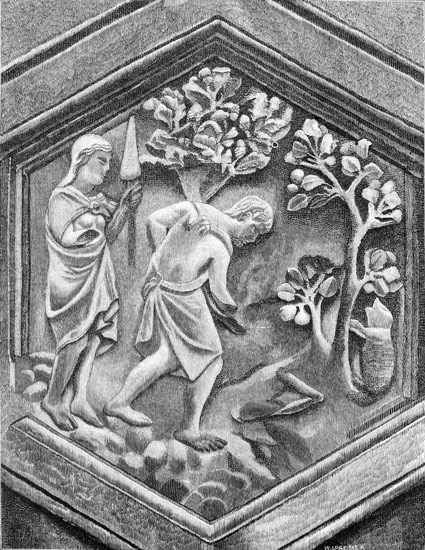
THE FIRST ARTS. BAS-RELIEF DESIGNED BY GIOTTO.
On the Campanile, Florence.
Our artist's sympathy with animal life, also revives in these
works in its full force, and may be seen in many instances.
Look for example at the fresco of ploughing, where the driver
is guiding the oxen by the simple, yet perfectly efficient plan,
of twisting the tail round his wrist, and pulling it one way
or the other, when he wishes to turn. Or look at the puppy
in the bas-relief of Shepherd Life, as he sits outside the
patriarch's tent watching the sheep file past. What a sense
of comical responsibility and mischief there is in his face, the
quintessence, so to speak, of puppydom. Or look, for another
kind of truth, at the action of the horse in the fresco of Riding,
and the manner in which the rider is urging him with hand
and voice at the same time, and the wind is blowing out his
mantle behind. There is a curious circumstance with regard to
this last design, which I discovered by chance a few weeks ago
when walking in the sculptor's rooms of the British Museum.
That is, that there is a figure in one of the great friezes there,
not that of the Parthenon, but the next in beauty, that of the
Erectheum, which is almost identical in the figure of its man
and his action with this of Giotto's. The very lines of the cloak
blowing out behind are almost identical, and the grasp of the
rider's knees, the pose of his figure and the outstretched arm
(what is left of it in the Greek sculpture, it has been taken
just below the elbow) are all exactly similar. The whole spirit
of the Greek frieze is as vivid in Giotto's work as it is in
the original sculpture, executed more than a thousand years
before. It merely shows the extraordinary unity of all good
art, that a mediæval Italian, working purely from nature and
life, should be able to arrive by himself, at a representation
which has all the feeling of that which is acknowledged to be
the finest art the world has ever seen. It must be noticed
that where Giotto falls short of his Grecian predecessor, is
chiefly in the nobility of the types both of man and horse.
Giotto's horse is going, and his man is urging him as certainly
as in the frieze, but his horse is comparatively a common every-day
cabhorse and is going in something of the same rocking-time
manner we may see in Hyde Park any day of the week.
And the man is like most of Giotto's men, a very ordinary individual,
somewhat of what hunting men call "a tailor," perhaps,
though he is evidently accustomed to riding. The Grecian
sculptor has refined the types of both man and horse, and given
the latter a grand sweeping action, such as would be promptly
stopped by the police, if indulged in within the limits of the
park. This difference, however, is a difference in aim, not a difference
in feeling; the beauty of line, and the meaning of the
scene are given with almost as much intensity by our artist as
by the unknown sculptor who preceded him. Most unfortunately
I only found this similarity too late to permit me to
make use of it in the book; for a drawing of these two figures
side by side would have shown the likeness and dissimilarity
more than pages of description.
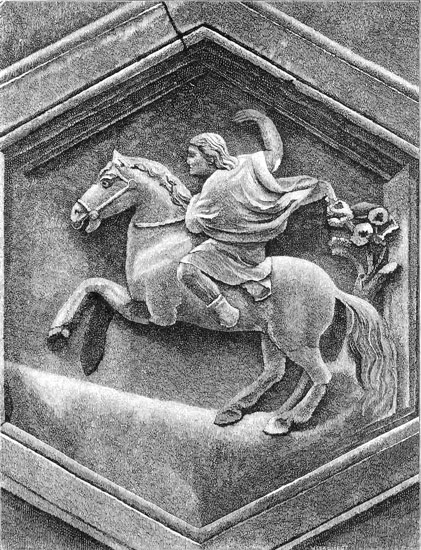
RIDING. BAS-RELIEF DESIGNED BY GIOTTO.
On the Campanile, Florence.
Many other bas-reliefs of this series are of great interest,
but there is no space left for me to dwell upon them, nor are
their merits other than those which I have spoken of so frequently
throughout this book, of simple truth, of keen
discernment, and of genuine feeling. At every step the work
seems to say to us, "Here is the representation of something
true;" and the artist seems to say, "I have only tried to give
you facts in the most beautiful arrangement consistent with
truth; if you want more, or less, why, you must go elsewhere."
And so it is that from the time when he draws the meditations
of a puppy, to that in which he hangs his massive
tower of coloured marble, between the earth and heaven, his
work seems simple, grand, and sincere. He is not painting
pictures to aggrandise himself, he is only lovingly recording
what he knows, feels, or hopes. He is not above, nor below
his work; his work is himself; it is himself, in joy, or sorrow,
or curiosity, or surprise; in mirth, or indifference. He is
human in his failings as well as in his greatness, and pretends
to no greater merit, than that of doing good work in a
straightforward manner.
Therefore we look back across the centuries with pleasure,
to catch a glimpse of the homely figure whose dreams of beauty
were mingled with tenderness and mirth, who lived in a
coarse age, and made coarse jokes at odd times; but who
walked hand in hand with Dante, as great, if not as sublime
a genius, and whose life, as we can read it in his paintings, was
one of sympathy with all things living, and perfect devotion
to his art. Neither a Philistine, nor a humbug, he seems to
have trod the narrow path of art with secure footsteps, a
good workman, as well as a great imaginative painter; a
merry as well as an honest man. Such are the men whom
Art wants nowadays, as it wanted them then, those who are
men as well as artists, who will not dream in courtly isolation
of beauties which never existed, but will go down into the
markets, and the streets, where men sin and sorrow, or by the
rivers and fields, where they toil and hope, and use their
genius to brighten the facts of every day, to interpret the
strange gleams of beauty, which fall here and there upon a
weary world.
I like to think that that Campanile of "porphyry and
jasper" was not raised by one who dwelt amidst cold dreams
of architectural proportion and gave his life to the designing
of geometrical ornament, but by the man who could
feel the humour of the dog, the patience of the oxen, and love
to have such things carved about the base of his tower; and
as I sit here in its very shadow, it seems to me as if the most
fitting meed of praise with which to conclude an essay on the
old painter, is, not that he painted the purest and loveliest
frescoes in the world; not that he raised above Florence a
tower, which has been the wonder and delight of all succeeding
ages, but that he was the first to show by his work,
that Art was useful to man, not only as a teacher, but as
a friend.
INDEX.
| PAGE |
| Annunciation. By Giotto, |
59 |
| Arena Chapel, Padua |
69 |
| "Frescoes in |
76 |
| "Note by Mr. Ruskin on |
84 |
| Arnolfo di Cambio |
21 |
| Arnolfo di Lapi (Cambio?) |
21 |
| Assisi, Lower Church of |
111 |
| Assisi, Upper Church of |
94 |
|
| Byzantine Architecture |
15 |
|
| Campanile, The, at Florence |
135 |
| Cennini |
29 |
| Christian Architecture |
16 |
| Cimabue |
33 |
| Coronation of the Virgin. By Giotto |
128 |
|
| Florence, Santa Croce |
65, 66, 118, 128 |
| "Santa Maria Novella |
65, 133 |
| "Campanile at |
135 |
| Fresco Painting |
28 |
| Frescoes in Arena Chapel, Padua |
76 |
| Frescoes at Assisi |
115, 124 |
| Frescoes in Santa Croce |
128 |
| Frescoes in Santa Maria Novella |
133 |
|
| Giotto, born at Vespignano (1266?) |
41 |
| "taken by Cimabue to Florence |
43 |
| "story of his O |
45 |
| "visits Rome |
45 |
| "returns to Florence, |
46
|
| "paints portrait of Dante |
46 |
| "marries Ciuta di Lapo |
47 |
| "frescoes in the Arena Chapel at Padua |
47 |
| "paints a buckler |
49 |
| "visits Assisi |
51 |
| "frescoes in Santa Croce, Florence |
51 |
| "designs the Campanile, Florence |
52 |
| "dies at Florence in 1336 |
52 |
| "latest works of |
120 |
| Giunta of Pisa |
23, 100 |
| Greek Art |
12 |
| Guido of Siena |
38 |
|
| Illuminated Manuscripts |
14 |
|
| Lombardic Architecture |
24 |
|
| Madonna Enthroned. By Cimabue |
36 |
| Madonna Enthroned. By Giotto |
59, 63 |
| Mosaics |
13, 21 |
|
| Navicella, The |
45, 62 |
|
| Padua, Arena Chapel at |
61 |
| Painting, Chief function of |
53 |
| Pisa, Campo Santo of |
61 |
| Pisano, Andrea |
139 |
| Pisano, Niccolo |
20 |
|
| Robbia, Luca della |
139 |
| Ruskin, John |
24, 84 |
|
| Scrovegni Chapel at Padua |
69 |
|
| Venice, Saint Mark's |
22, 27, 112 |
THE END.
R. CLAY, SONS, AND TAYLOR, PRINTERS. BREAD STREET HILL, E.C.
Published in Monthly Volumes.
A NEW SERIES OF
ILLUSTRATED BIOGRAPHIES OF
THE GREAT ARTISTS.
The increasing love of art in our own country and the great desire for
knowledge in all matters connected with the literature of art and the
lives of the Great Masters called for the publication of the very important
information which modern research has gathered together on every side, and
which has now attracted the attention of all students of art-biography both at
home and abroad.
The intention of the projectors of this Series has been to produce, in an
easily accessible form and at a price within reach of every one, the results of
the recent investigations which have been made by many well-known critics,
especially those of Germany and the Netherlands.
Dr. Woltmann lately published a new edition of his great work on Hans
Holbein; Professor Carl Lemcke on Rubens and on Van Dyck; Dr.
Anton Springer on Raphael and Michelangelo; Herr Vosmaer has
issued a revision of his celebrated treatise on Rembrandt, and Herr Thausing
an elaborate Life of Albrecht Dürer. These works correct old statements
that have been proved to be untrue, impart new facts, and add materially to
our interest in the histories of the painters. Many of the Italian art-critics
have likewise recently issued treatises on the great artists of their own country;
and in France scarcely a week passes without the appearance of some new
contribution to the History of Art. All this matter has been carefully studied.
The Series is issued in the form of handbooks. Each work contains a
monograph of a Great Artist—or a brief history of a Group of Artists
of one school—a portrait of the Master, and as many examples of his art
as could be readily procured. Cheapness of price having been especially
aimed at, the introduction of expensive new engravings was thought to be
unadvisable. Arrangements were therefore made with the proprietors of the
most important art publications on the Continent for the reproduction of
many of their costly woodcuts. These have been printed with great care, and
each biography of the Series has been illustrated with at least twelve to twenty
full-page engravings. The price of each volume is 3s. 6d.
The following Biographies are now ready:—
ITALIAN PAINTERS.
LEONARDO DA VINCI. By Dr. J. Paul Richter, Author of "Die
Mosaiken von Ravenna." With 16 Illustrations. From recent researches.
MICHELANGELO. By Charles Clément, Author of "Michel-Ange,
Léonard et Raphael." With many large Engravings.
RAPHAEL. From the text of J. D. Passavant. By N. D'Anvers,
Author of "An Elementary History of Art." With 20 Engravings.
TITIAN. From the most recent researches. By Richard Ford Heath,
M.A., Hertford College, Oxford. With 16 Engravings.
TINTORETTO. From investigations at Venice. By W. Roscoe Osler,
Author of occasional Essays on Art. With many Engravings.
GERMAN, FLEMISH, DUTCH, &c.
HOLBEIN. From the text of Dr. A. Woltmann. By Joseph Cundall,
Author of "Life and Genius of Rembrandt." With 20 Engravings.
THE LITTLE MASTERS OF GERMANY. By W. B. Scott,
Author of "Lectures on Fine Arts." With 16 Engravings.
⁂ An Edition de luxe, containing 14 extra plates from rare engravings in
the British Museum, and bound in Roxburgh style, may be had, price 10s. 6d.
REMBRANDT. From the text of C. Vosmaer. By J. W. Mollett, B.A.,
Officier de l'Instruction Publique (France). With 16 Engravings.
RUBENS. From recent authorities. By C. W. Kett, M.A., Hertford
College, Oxford. With 16 Engravings.
VAN DYCK and HALS. From recent authorities. By Percy R. Head,
Lincoln College, Oxford. With 16 Engravings.
FIGURE PAINTERS OF HOLLAND. By Lord Ronald Gower,
Trustee of National Portrait Gallery. With 18 Engravings.
VERNET & DELAROCHE. From Charles Blanc. By J. Ruutz Rees,
Author of various Essays on Art. With 16 Engravings.
ENGLISH PAINTERS.
HOGARTH. From recent researches. By Austin Dobson, Author of
"Vignettes in Rhyme." With 16 Illustrations.
REYNOLDS. From the most recent authorities. By F. S. Pulling, M.A.,
Exeter College, Oxford. With 16 Illustrations.
TURNER. From recent investigations. By Cosmo Monkhouse, Author
of "Studies of Sir E. Landseer." With 20 Engravings.
LANDSEER. A Memoir, by Frederick G. Stephens, Author of
"Flemish Relics," &c. With many Illustrations.
The Volumes preparing for Early Publication are:—
FRA ANGELICO and the EARLY PAINTERS of FLORENCE.
By Catherine Phillimore. With 16 Illustrations.
FRA BARTOLOMMEO and ALBERTINELLI. By Leader Scott,
Author of "A Nook in the Apennines." With 16 Illustrations.
VELAZQUEZ. By Edwin Stowe, M.A., Brasenose College, Oxford.
With many Illustrations.
GAINSBOROUGH and CONSTABLE. By G. M. Brock-Arnold,
Hertford College, Oxford. With many Illustrations.
ALBRECHT DÜRER. From recent authorities. By R. F. Heath, M.A.,
Hertford College, Oxford. With many Illustrations.
VAN EYCK and THE FLEMISH SCHOOL. By Mary Heaton,
Author of "The History of Albrecht Dürer." With many Illustrations.
GIOTTO. By Harry Quilter, M.A., Trinity Col., Cambridge. From
recent investigations at Padua and Assisi. With many Illustrations.
CORNELIUS and OVERBECK. By J. Beavington Atkinson,
Author of "The Schools of Modern Art in Germany."
NOTICES OF THE PRESS.
1. From a Review in the Spectator, July 5, 1879.
"It is high time that some thorough and general acquaintance with the
works of these mighty painters should be spread abroad, and it is also curious
to think how long their names have occupied sacred niches in the world's
heart, without the presence of much popular knowledge about the collective
work of their lives.... If the present series of biographies, which seems to
be most thoroughly and tastefully edited, succeeds in responding to the wants
of modest, if ardent, art-knowledge, its aim will be accomplished."
2. Reprinted from the Times, January 22, 1880.
"Few things in the way of small books upon great subjects, avowedly cheap
and necessarily brief, have been hitherto so well done as these biographies of
the Great Masters in painting. They afford just what a very large proportion
of readers in these hurrying times wish to be provided with—a sort of concentrated
food for the mind. The Liebigs of literature, however, especially
in that of the fine arts, need no small amount of critical acumen, much experience
in the art of system, and something of the bee-like instinct that guesses
rightly where the honey lies. The mere 'boiling down' of great books will
not result in giving us a good little book, unless the essence is properly diluted
and set before us in a form that can be readily assimilated, so to speak, and
not in an indigestible lump of details. The writers of these biographies have,
on the whole, succeeded in giving an excellent aperçu of the painters and
their works, and better where they have adhered to the lives written by acknowledged
specialists—such as M. Vosmaer for Rembrandt, Passavant for Raphael,
and Dr. Woltmann for Holbein. The life of Holbein is by the editor, with
whom the idea of such a series originated, and to whose great experience is to
be attributed the very valuable copies of all the important pictures contained
in the different biographies. These have been selected with great taste and
judgment, and being taken generally from less well-known works by the
masters, they enhance the interest and add much to the practical utility of the
books. The chronological lists of the works of the masters are also very
useful additions."
3. From La Chronique des Arts, March 20, 1880.
"A un prix d'extrême bon marché, 4 francs environ, en petits volumes
joliment cartonnés, et ornés de quinze à vingt planches, la maison Sampson
Low, Marston et Cie., à Londres, a entrepris de publier une série de biographies
des grands artistes, résumées d'après les travaux les plus récents et les
plus estimés. Une bibliographie, une liste des gravures exécutées par ou
d'après l'artiste, une liste de ses œuvres ou de leurs prix; enfin, un index accompagnant
ces résumés confiés à des écrivains distingués versés dans l'histoire
de l'art. Ont paru ou sont en préparation dans cette série de notices: Titien,
Rembrandt, Raphaël, Van Dyck et Hals, Holbein, Tintoret, Turner, Rubens,
Michel-Ange, Léonard, Giotto, Gainsborough, Velazquez, Pérugin, Reynolds,
Landseer, Delaroche et Vernet, les Petit Maîtres, les Peintres de figure en
Hollande.
"Peut-être la maison Sampson Low, Marston et Cie, devrait-elle tenter
une édition française de ces jolis et intéressants petits volumes sérieusement
étudiés, dont la brièveté substantielle et le bon marché deviennent une bénédiction
par ce temps d'énormes publications à prix non moins énormes."—Duranty.
SAMPSON LOW, MARSTON, SEARLE & RIVINGTON,
CROWN BUILDINGS, 188. FLEET STREET.