GIL BLAS SETS OUT FOR THE ASTURIAS, AND PASSES
THROUGH VALLADOLID, WHERE HE GOES TO SEE HIS
OLD MASTER, DOCTOR SANGRADO. BY ACCIDENT, HE
COMES ACROSS SIGNOR MANUEL ORDONNEZ, GOVERNOR
OF THE HOSPITAL.
Just as I was arranging matters to take my
departure from Madrid, and go with Scipio to the
Asturias, Paul V. gave the Duke of Lerma a cardinal's
hat. This pope, wishing to establish the inquisition
in the kingdom of Naples, invested the minister
with the purple, and by that means hoped to bring
King Philip over to so pious and praiseworthy a
design. Those who were best acquainted with this
new member of the sacred college, thought, much
like myself, that the church was in a fair way for
apostolical purity, after so ghostly an acquisition.
Scipio, who would have liked better to see me
once more blazing at court, than either cloistered or
rusticated, advised me to show my face at the
cardinal's audience. Perhaps, said he, his eminence,
finding you at large by the king's order, may think
it unnecessary to affect any further displeasure
against you, and may even reinstate you in his
service. My good friend Scipio, answered I, you
seem to forget that my liberty was granted only on
condition of making myself scarce in the two Castiles.
Besides, can you suppose me so soon inclined to
become an absentee from my domain of Lirias? I
have told you before, and I tell it you once again,
Though the Duke of Lerma should restore me to his
good graces, though he should even offer me Don
Rodrigo de Calderona's place, I would refuse it. My
resolution is taken: I mean to go and find out my
parents at Oviedo, and carry them with me to
Valencia. As for you, my good fellow, if you
repent of having linked your fate with mine, you
have only to say so; I am ready to give you half of
my ready money, and you may stay at Madrid, where
fortune puts on her kindest smiles to those who woo
her lustily.
What, then, replied my secretary, a little affected
by these words, can you suspect me of any unwillingness
to follow you into your retreat? The very
idea is an injury to my zeal and my attachment.
What, Scipio! that faithful appendage, who would
willingly have passed the remnant of his days with
you in the tower of Segovia, rather than abandon
you to your wretched fate, can he feel sorrowful at
the prospect of an abode where a thousand rural
delights are waiting to smile on his arrival? No,
no, I have not a wish to turn you aside from your
resolution. Nor can I refrain from owning my
malicious drift; when I advised you to show your
face at the Duke of Lerma's audience, it was for the
purpose of ascertaining whether any seedlings of
ambition were scattered among the fallows of your
philosophy. Since that point is settled, and you are
mortified to all the pomps and vanities of the world,
let us make the best of our way from court, to go
and suck in with Zephyrus and Flora the innocent,
delicious pleasures so luxuriant in the nursery of our
imaginations.
In fact, we soon afterwards took our departure
together, in a chaise drawn by two good mules,
driven by a postilion whom I had added to my
establishment. We stopped the first day at Alcala
de Henarès, and the second at Segovia, whence,
without stopping to see our generous warden,
Tordesillas, we went forward to Penafiel on the
Duero, and the next day to Valladolid. At sight
of this large town, I could not help fetching a deep
sigh. My companion, surprised at that conscientious
ventilation, inquired the reason of it. My good
fellow, said I, it is because I practised medicine here
for a long time. It gives me the horrors, even now,
to think of my unexpiated murders. The whole list
of killed and wounded are mustered in battle array
yonder: the tomb and the hospital yawn with their
disgorged inhabitants, who are rushing on to tear
me piecemeal, and exact the vengeance due to the
drenched crew. What a dreadful fancy! said my
secretary. In truth, Signor de Santillane, your
nature is too tender. Why should you be shocked
at the common course of exchange in your branch
of trade? Look at all the oldest physicians: their
withers are unwrung. What can exceed the
self-complacency with which they view the exits of
patients, and the entrances of diseases? Natural
constitution bears the brunt of all their failures, and
medical infallibility takes the credit of lucky
accidents.
It is very true, replied I, that Doctor Sangrado, on
whose practice I formed myself, was like the rest of
the old physicians in point of self-complacency. It
was to little purpose that twenty people in a day
yielded to his prowess: he was so persuaded that
bleeding in the arm and copious libations of warm
water were specifics for every case, that instead of
doubting whether the death of his patients might not
possibly invalidate the efficacy of his prescriptions,
he ascribed the result to a vacillating compliance with
his system. By all the powers! cried Scipio with a
burst of laughter, you open to me an incomparable
character. If you have any curiosity to be better
acquainted with him, said I, it may be gratified
to-morrow, should Sangrado be still living, and
resident at Valladolid: but it is highly improbable; for
he had one foot in the grave when I left him several
years ago. Our first care, on putting up at the inn,
was to inquire after this doctor. We were told that
he was not dead; but, being incapacitated by age
from paying visits or any other vigorous exertions,
he had been superseded by three or four other
doctors who had risen into repute by a new practice,
accomplishing the same end by different means. We
determined on lying by for a day at Valladolid, as
well to rest our mules as to call on Signor Sangrado.
About ten o'clock next morning we knocked at
his door, and found him sitting in his elbow-chair,
with a book in his hand. He rose on our entrance,
advanced to meet us with a firm step for a man of
seventy, and begged to know our business. My
worthy and approved good master, said I, have you
lost all recollection of an old pupil? There was
formerly one Gil Blas, as you may remember, a boarder
in your house, and for some time your deputy.
What! is it you, Santillane? answered he, with a
cordial embrace. I should not have known you
again. It, however, gives me great pleasure to see
you once more. What have you been doing since
we parted? Doubtless you have made medicine
your profession. It was very strongly my inclination
so to do, replied I; but imperious circumstances
made me reluctantly abandon so illustrious a calling.
So much the worse, rejoined Sangrado: with the
principles you sucked in under my tuition, you would
have become a physician of the first skill and
eminence, with the guiding influence of heaven to defend
you from the dangerous allurements of chemistry.
Ah, my son! pursued he with a mournful air, what
a change in practice within these few years! The
whole honor and dignity of the art is compromised.
That mystery by whose inscrutable decrees the lives
of men have in all ages been determined, is now laid
open to the rude, untutored gaze of blockheads,
novices, and mountebanks. Facts are stubborn things;
and ere long the very stones will cry aloud against
the rascality of these new practitioners: lapides
clamabunt! Why, sir, there are fellows in this
town, calling themselves physicians, who drag their
degraded persons at the currus triumphalis antimonii,
or, as it should properly be translated, the
cart's tail of antimony. Apostates from the faith of
Paracelsus, idolaters of filthy kermes, healers at
haphazard, who make all the science of medicine to
consist in the preparation and prescription of drugs!
What a change have I to announce to you! There
is not one stone left upon another in the whole
structure which our great predecessors had raised.
Bleeding in the feet, for example, so rarely practised in
better times, is now among the fashionable follies of
the day. That gentle, civilized system of evacuation,
which prevailed under my auspices, is subverted by
the reign of anarchy and emetics, of quackery and
poison. In short, chaos is come again! Every one
orders what seems good in his own eyes; there is no
deference to the authority of ancient wisdom; our
masters are laid upon the shelf, and their axioms not
one tittle the more regarded for being delivered in
languages as defunct as the subjects of their application.
However desirable it might seem to laugh at so
whimsical a declamation, I had the good manners to
resist the impulse; and not only that, but to inveigh
bitterly against kermes, without knowing whether it
was a vegetable or an animal, and to pour forth a
commination of curses against the authors and
inventors of so diabolical an engine. Scipio, observing
my by-play in this scene, had a mind to come in for
his share in the banter. Most venerable prop of the
true practice, said he to Sangrado, as I am descended
in the third generation from a physician of the old
school, give me leave to join you in your philippic
against chemical conspiracies. My late illustrious
progenitor—heaven forgive him all his sins!—was so
warm a partisan of Hippocrates, that he often came
to blows with ignorant pretenders, who vomited forth
blasphemies against that high priest of the faculty.
What is bred in the bone will not come out of the
flesh: I could willingly inflict tortures and death with
my own hands on those rash innovators whose
daring enormities you have characterized with such
accuracy of discrimination and such force of
language. When wretches like these gain an ascendency
in civilized society, can we wonder at the
disjointed condition of the world?
The times are even more out of joint than you are
aware of, said the doctor. My book against the
vanities and delusions of the new practice might as well
have fallen still-born from the press; it seems, if
anything, to have acted by contraries, and to have
exasperated heresy. The apothecaries, like the
Titans of old, heaping potion upon pill, and invading
the Olympus of medicine, think themselves fully
qualified to usurp and maintain the throne, now that
it is only thought necessary to set open the doors,
and to drive the enemy out at the portal or the
postern by main force. They go to the length of
infusing their deadly drugs into apozems and cordials,
and then set themselves up against the most eminent
of the fraternity. This contagion has spread its
influence even among the cloisters. There are monks
in our convents who unite surgery and pharmacy
to the labors of the confessional. These medical
baboons are always dipping their paws into chemistry,
and inventing compositions strong enough to
lay a scene of ecclesiastical mortality in the temperate
abodes of peace and religion. Now, there are in
Valladolid above sixty religious houses for both sexes:
judge what ravage must have been made there by
unmerciful pumping and the lancet misapplied. Signor
Sangrado, said I, you are perfectly in the right to
give these poisoners no quarter. I utter groan for
groan with you, and heave the philanthropic sigh
over the invaded lives of our fellow-creatures,
sinking under the fell attack of so heterodox a practice.
It fills me with horror to think what a dead weight
chemistry may one day be to medicine, just as
adulterated coin operates on national credit. Far be that
evil day from this generation.
Just at this climax of our discourse, in came an
old female servant, with a salver for the doctor, on
which were a little light roll and a glass with two
decanters, the one filled with water and the other with
wine. After he had eaten a slice, he washed it down
with a diluted beverage, two parts water to one of
wine; but this temperate use of the good creature
did not at all save him from the acrimony of my
ridicule. So so, good master doctor, said I, you
are fairly caught in the fact. You a wine-bibber? you,
who have entered the lists like a knight-errant
against that unauthenticated fermentation? you, who
reached your grand climacteric on the strength of the
pure element? How long have you been so at odds
with yourself? Your time of life can be no excuse
for the alteration? since, in one passage of your
writings, you define old age to be a natural
consumption, which withers and attenuates the system;
and as an inference from that position, you reprobate
the ignorance of those writers who dignify wine with
the appellation of old men's milk. What can you
say, therefore, in your own defence?
You belabor me most unjustly, answered the old
physician. If I drank neat wine, you would have
a right to treat me as a deserter from my own
standard; but your eyes may convince you that my wine
is well mixed. Another heresy, my dear apostle of
the wells and fountains! replied I. Recollect how
you rated the canon Sedillo for drinking wine, though
plentifully dashed with the salubrious fluid. Own
modestly and candidly that your theory was unfounded
and fanciful, and that wine is not a poisonous
liquor, as you have so falsely and scandalously
libelled it in your works, any further than, like
any other of nature's bounties, it may be abused to
excess.
This lecture sat rather uneasily on our doctor's
feelings as a candidate for consistency. He could
not deny his inveteracy against the use of wine in
all his publications; but pride and vanity not
allowing him to acknowledge the justice of my attack on
his apostasy, he was left without a word to say for
himself. Not wishing to push my sarcasm beyond
the bounds of good humor, I changed the subject;
and after a few minutes' longer stay, took my leave,
gravely exhorting him to maintain his ground against
the new practitioners. Courage, Signor Sangrado! said
I: never be weary of setting your wits against
kermes; and deafen the health-dispensing tribe with
your thunders against the use of bleeding in the feet.
If, spite of all your zeal and affection for medical
orthodoxy, this empiric generation should succeed in
supplanting true and legitimate practice, it will be
at least your consolation to have exhausted your best
endeavors in the support of truth and reason.
As my secretary and myself were walking to the
inn, making our observations in high glee on the
doctor's entertaining and original character, a man
from fifty-five to sixty years of age happened to pass
near us in the street, walking with his eyes fixed on
the ground, and a large rosary in his hand. I conned
over the distinctive cut of his appearance most
cunningly, and was rewarded in the recognition of Signor
Manuel Ordonnez, that faithful trustee for the affairs
of the hospital, of whom so honorable mention is
made in the first volume of these true and instructive
memoirs. Accosting him with the most profound
and unquestionable tokens of respect, I paid my
compliments in due form and order to the venerable
and trustworthy Signor Manuel Ordonnez, the man
of all the world in whose hands the interests of the
poor and needy are most safely and beneficially
placed. At these words he looked me steadfastly in
the face, and answered that my features were not
altogether strange to him, but that he could not
recollect where he had seen me. I used to go
backwards and forwards to your house, replied I, when
one of my friends, by name Fabricio Nunez, was in
your service. Ah! I recollect the circumstance at
once, rejoined the worthy director with a cunning
leer, and have good reason to do so; for you were a
brace of pleasant lads, and were by no means
backward in the little scape-grace tricks of youth and
inexperience. Well! and what is become of poor
Fabricio? Whenever he comes across my thoughts,
I cannot help feeling a little uneasy about his
temporal and eternal welfare.
It was to relieve your mind upon that subject, said
I to Signor Manuel, that I have taken the liberty of
stopping you in the street. Fabricio is settled at
Madrid, where he employs himself in publishing
miscellanies and collections. What do you mean
by miscellanies and collections? replied he. I mean,
resumed I, that he writes in verse and prose, from
epic poems and the highest branches of philosophy,
down to plays, novels, epigrams, and riddles. In
short, he is a lad of universal genius, and most
exemplary benevolence; sometimes modestly taking to
himself the credit of his own compositions, and
sometimes lending out his talents to the literary
ambition of those noblemen who write for their own
amusement, but wish their names to be concealed,
except from a chosen circle. By traffic like this, he
sits at the very first tables. But how does he sit at
his own? said the director; upon what terms does
he live with his baker? Not quite so confidentially
as with people of fashion, answered I; for, between
ourselves, I take him to be quite as much out at
elbows as ever Job was. More bonds and judgments
against him than ever Job had, take my word
for it! replied Ordonnez. Let him lick the spittle
of his titled friends and patrons, till his stomach
heaves at the nauseating saliva; his printed dedications
and his oral flattery, in spite of all the cringing
and all the toad-eating which constitute the stock in
trade of his profession, with all the profits of his
works, whether by subscription or ordinary publication,
will not bring grist enough to his mill to keep
hunger from the door. Mind if what I say does
not turn out to be true! He will come to the dogs
at last.
Nothing more likely, replied I; for he cohabits
with the muses already, and many a plain man has
found to his cost, that there is no keeping
company with the sisters without being worried by their
bullying brethren. My friend Fabricio would have
done much better by remaining quietly with your
lordship; he would now have been lying on a bed of
roses, and everything he had touched would have
turned to gold. He would at least have been in a
very snug berth, said Manuel. He was a great
favorite of mine; and I meant, by a regular gradation
from subaltern to principal situations, to have
established him in ease and affluence on the basis of
public charity; but the foolish fellow took it into
his head to set up for a wit. He wrote a play, and
brought it out at the theatre in this town: the piece
went off tolerably well, and nothing thenceforth
would serve his turn but commencing author by
profession. Lope de Vega, in his estimation, was but
a type of him: preferring, therefore, the intoxicating
vapor of public applause to the plain roast and boiled
of this substantial ordinary, he came to me for his
discharge. It was to no purpose for me to argue
the point, or to prove to him what a silly cur he was,
to drop the bone and run after the shadow: the mad
blockhead was so suffocated by the smother of authorship,
that the instinctive dread of fire could not rouse
his alacrity to escape burning. In short, he was
miserably unconscious of his own interest, as his
successor can testify; for he, possessing practical
good sense, though without half Fabricio's quickness
and versatility, makes it his whole study and
delight to go through his business in a workman-like
manner, and to fall in with all my little ways.
In return for such good conduct, I pushed him
forward in a manner corresponding with his deserts;
and he unites in his own person, even at this time of
day, two offices in the hospital, the least lucrative
of which would be more than sufficient to place any
honest man at his ease, though encumbered with a
yearly teeming wife.
GIL BLAS CONTINUES HIS JOURNEY, AND ARRIVES IN SAFETY
AT OVIEDO. THE CONDITION OF HIS FAMILY. HIS FATHER'S
DEATH, AND ITS CONSEQUENCES.
From Valladolid we got to Oviedo in four days,
without any untoward accident on the road, in spite
of the proverb which says that robbers lay their ears
to the ground when pilgrims are going with rich
offerings, and traders are riding with fat purses. It
would have been a feasible as well as a tempting
speculation. Two tenants of a subterraneous abode
might have presented an aspect to have frightened
our doubloons into a surrender; for courage was not
one of the qualities I had imbibed at court; and
Bertrand, my mule-driver, seemed not to be of a
temper to get his brains blown out in defending a
purse into which he had no free ingress. Scipio was
the only one of the party who was anything of a
bully.
It was night when we came into town. Our
lodgings were at an inn near my uncle, Gil Perez,
the canon. I was very desirous of ascertaining the
circumstances of my parents before my first
interview with them; and, in order to gain that
information, it was impossible to make my inquiries in a
better channel than through my landlord and landlady,
into the lines of whose faces you could not
look without being satisfied that they knew every
tittle of their neighbors' concerns. As it turned out,
the landlord kenned me after a diligent perusal of my
features, and cried out, By Saint Antony of Padua! this
is the son of the honest usher, Blas of Santillane.
Ay, indeed! said the hostess; and so it is, without
a single muscle altered! just for all the world that
same little stripling Gil Blas, of whom we used to
say that he was as saucy as he was high. It brings
old times to my memory, when he used to come
hither with his bottle under his arm, to fetch wine
for his uncle's supper.
Madam, said I, you have a most inveterate
memory; but for goodness' sake change the subject,
and tell me the modern news of my family. My
father and mother are doubtless in no very enviable
situation. In good truth, you may say that,
answered the landlady; you may rack your brains as
long as you like, but you will never think of anything
half so miserable as what they are suffering at this
present moment. Gil Perez, good soul! is defunct
all down one side by a stroke of the palsy, and the
other half of him is little better than a corpse; we
cannot expect him to last long: then your father,
who went to live with his reverence a little while
ago, is troubled with an inflammation of the lungs,
and is standing, as a body may say, quavery-mavery
between life and death; while your mother, who is
not over and above hale and hearty herself, is obliged
to nurse them both.
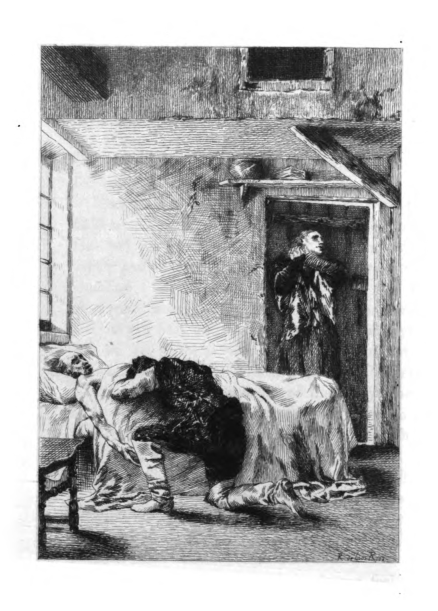
Gil Blas at Gil Perez's bedside
On this intelligence, which made me feel some
compunctious yearnings of nature, I left Bertrand
with my stud and baggage at the inn: then, with
my secretary at my heels, who would not desert me
in my time of need, I repaired to my uncle's house.
The moment I came within my mother's reach, a
natural emotion of maternal instinct unfolded to her
who I was, before her eyes could possibly have run
over the traces of my countenance. Son, said she,
with a melancholy expression, after having embraced
me, come and be present at your father's death; your
visit is just in time to take in all the piteous
circumstances of so deplorable an event. With this
heart-rending reception, she led me by the hand into a
chamber where the wretched Blas of Santillane,
stretched on a comfortless bed, in cold and dismal
accord with the thinness of his fortunes, was just
entering on the last great act of human nature.
Though surrounded by the shades of death, he was
not quite unconscious of what was passing about
him. My dearest friend, said my mother, here is
your son Gil Blas, who entreats your forgiveness for
all his undutiful behavior, and is come to ask your
blessing before you die. At these tidings my father
opened his eyes, which were on the point of closing
forever: he fixed them upon me, and reading in my
countenance, notwithstanding the awful brink on
which he stood, that I was a sincere mourner for his
loss, his feelings were recalled to sympathy by my
sorrow. He even made an attempt to speak, but
his strength was too much exhausted. I took one
of his hands in mine, and while I bathed it with my
tears, in speechless agony of soul, he breathed his
last, as if he had only waited my arrival to pay the
debt of nature, and wing his way to scenes of untried
being.
This event had been too long present to my
mother's mind to overwhelm her with any unparalleled
affliction. Perhaps it sat more heavily on me
than on her, though my father had never in his life
given me any reason to feel for him as a father.
But besides that mere filial instinct would have
made me weep over his cold remains, I reproached
myself with not having contributed to the comfort of
his latter days; then, when I considered what a
hard-hearted villain I had been, I seemed to myself
like a monster of ingratitude, or rather like an
impious parricide. My uncle, whom I afterwards
saw lying at his length on another wretched couch,
and in a most lamentable pickle, made me experience
fresh agonies of upbraiding conscience. Unnatural
son! said I, communing with my own uneasy
thoughts, behold the chastisement of heaven upon
thy sins in the disconsolate condition of thy nearest
relations. Hadst thou but thrown to them the
superflux of that abundance in which before thy
imprisonment thou rolledst, thou mightest have
procured for them those little comforts which thy uncle's
ecclesiastical pittance was too scanty to furnish, and
perhaps have lengthened out the term of thy father's
life.
Gil Perez had fallen into a state of second
childhood, and was, though numerically upon the list of
the living, in every individual organ a mere corpse.
His memory, nay, his very senses had retired from
their allotted stations in his system. Bootless was
it for me to strain him in my pious arms, and lavish
outward tokens of affection on him: they might as
well have been wasted on the desert air. To as
little purpose did my mother ring in his unnerved
ear, that I was his nephew Gil Blas; he gazed at
me with a vacant, stupid stare, and gave neither sign
nor answer. Had the ties of consanguinity and
gratitude been all too weak to awaken my tender
sympathy for an uncle to whom I owed the means
of my first launch into the world, the impression of
helpless dotage on my senses must have softened me
into something like the counterfeit of virtuous
emotion.
While this scene was passing, Scipio preserved a
melancholy silence, sharing in all my sorrows, and
mingling his sighs with mine in the chastised luxury
of friendship. But concluding that my mother,
after so long an absence, might wish to have some
such conversation with me as the presence of a
stranger must rather repress than promote, I drew
him aside, saying, Go, my good fellow, sit down
quietly at the inn, and leave me here with my only
surviving parent, who might consider your company
as an intrusion, while talking over family affairs.
Scipio withdrew, for fear of being a clog upon our
confidence, and I sat down with my mother to an
interchange of communication which lasted all night.
We reciprocally gave a faithful account of all that
had happened to each of us since my first sally from
Oviedo. She related in full measure and running
over all the petty insults, disappointments, and
mortifications which she had undergone in her pilgrimage
from house to house as a duenna. A great number
of these little anecdotes it would have hurt my pride
that my secretary should have noted down in his
biographical budget, though I had never concealed
from him the ups and downs in the lottery of my own
life. With all the respect I owe to my mother's
sainted memory, the good lady had not the knack of
going the shortest road to the end of a story; had
she but pruned her own memoirs of all luxuriant
circumstances, there would not have been materials
for more than a tithe of her narrative.
At length she got to the end of her tether, and I
began my career. With respect to my general
adventures, I passed them over lightly; but when I
came to speak of the visit which the son of Bertrand
Muscada, the grocer of Oviedo, had paid me at
Madrid, I enlarged with decent compunction on that
dark article in the history of my life. I must
frankly own, said I to my mother, that I gave that young
fellow a very bad reception; and he, doubtless, in
revenge, must have drawn a hideous outline of my
moral features. He did you more than justice, I
trust, answered she; for he told us that he found you
so puffed and swollen with the good fortune thrust
upon you by the prime minister, as scarcely to
acknowledge him among your former acquaintance;
and, when he gave you a moving description of our
miseries, you listened as if you had no interest in
the tale, or knowledge of the parties. But as fathers
and mothers can always find some clew for palliation
in the conduct of their graceless children, we were
loath to believe that you had so bad a heart. Your
arrival at Oviedo justifies our favorable interpretation,
and those tears which are now flowing down your
cheeks are so many pledges either of your innocence
or your reformation.
Your constructions were too partial, replied I;
there was a great deal of truth in young Muscada's
report. When he came to see me, all my faculties
were engrossed by vanity and mammon; ambition,
the prevailing devil which possessed me, left not a
thought to throw away on the desolate condition of
my parents. It, therefore, could be no wonder if
in such a disposition of mind I gave rather a freezing
reception to a man, who, accosting me in a peremptory
style, took upon him to say, without mincing
the matter, that it was well known I was as rich as
a Jew, and therefore he advised me to send you a
good round sum, seeing that you were very much
put to your shifts: nay, he went so far as to
reproach me, in phrase of more sincerity than good
manners, with my unfeeling negligence of my family.
His confounded personality stuck in my throat; so
that, losing my little stock of patience, I shoved him
fairly by the shoulders out of my closet. It must be
confessed that I took the administration of justice a
little too much into my own hands, being judge and
party in the same cause; neither was it proper that
you should bear the brunt, because the grocer was a
little anti-saccharine in his phraseology; nor was his
advice the less pertinent or just, though couched in
homely terms, or urged with plodding vulgarity.
All this came plump in the teeth of my conscience
the moment I had turned Muscada out of doors. The
voice of natural instinct contrived to make its way;
my duty to my parents brought the blood into my
face; but it was the blush of shame for its neglect,
and not the glow of triumph at its performance. Yet
even my remorse can give me little credit in your
eyes, since it was soon stifled in the fumes of avarice
and ambition. But some time afterwards, having
been safely lodged in the tower of Segovia by royal
mandate, I fell dangerously ill there; and that timely
remembrancer was the cause of bringing back your
son to you. So true is it that sickness and
imprisonment were my best moral tutors; for they enabled
nature to resume her rights, and weaned me effectually
from the court. Henceforth, all my dear delight
is in solitude; and my only business in the
Asturias is to entreat that you would share with me
in the mild pleasures of a retired life. If you reject
not my earnest petition, I will attend you to an estate
of mine in the kingdom of Valencia, and we will
live there together very comfortably. You are, of
course, aware that I intended to take my father thither
also; but since heaven has ordained it otherwise, let
me at least have the satisfaction of affording an
asylum to my mother, and making amends by all the
attentions in my power for the fallow seasons in the
former harvest of my filial duty.
I accept your kind intentions in very good part,
said my mother, and would take the journey without
hesitation if I saw no obstacles in the way. But
to desert your uncle in his present condition would
be unpardonable; and I am too much accustomed
to this part of the country to like living elsewhere:
nevertheless, as the proposal deserves to be maturely
weighed, I will consider further of it at my leisure.
At present your father's funeral requires to be
ordered and arranged. As for that, said I, we will
leave it to the care of the young man whom you saw
with me; he is my secretary, with as clever a head
and as good a heart as you have often been
acquainted with; let the business rest with him; it
cannot be in better hands.
Hardly had I pronounced these words when Scipio
came back; for it was already broad day. He
inquired whether he could be of any service in our
present distresses. I answered that he was come
just in time to receive some very important directions.
As soon as he was made acquainted with the business
in hand, A word to the wise, said he: the whole
procession, with its appropriate heraldry, is already
marshalled in this head of mine; you may trust me
for a very pretty funeral. Have a care, said my
mother, to make it plain and decent, without anything
like pomp or parade. It can scarcely be too humble
for my husband, whom all the town knows to have
been low in rank and indigent in circumstances.
Madam, replied Scipio, though he had been the
meanest and most destitute of the human race, I
would not bate one button in the array of his
posthumous honors. My master's credit is at stake in
the proper conduct of the ceremony; he has been in
an ostensible situation under the Duke of Lerma, and
his father ought to be buried with all the forms of
state and nobility.
I thought exactly as my secretary did upon the
subject, and even went so far as to bid him spare
no expense on the occasion. A little leaven of
vanity still fermented in the mass of my philosophy,
and rose in my bosom with all the effervescence of
its original lightness. I flattered myself that by
lavishing posthumous honors on a father who had
blessed the day of his decease by no lucrative
bequest, I should instil into the conceptions of the
bystanders a high sense of my generous nature. My
mother, on her part, whatever airs of humility she
might put on, had no dislike to seeing her husband
carried out with due observance of funeral pomp and
ceremony. We therefore left Scipio to do just as he
pleased; and he, without a moment's delay, adopted
all the necessary measures for the display of the
undertaker's liveliest fancy.
The genius of that artist was called forth but too
successfully. His emblems, devices, and draperies
were so ostentatious as to disgust instead of cajoling
the natives: every individual, whether of the town
or the suburbs, whether high or low, rich or poor,
felt shocked and insulted by this after-thought parade.
This ministerial beggar on horseback, said one, can
put his hand into his pocket for his father's funeral
baked meats, but never found in his heart wherewithal
to furnish his living table with common necessaries.
It would have been much more to the purpose,
said another, to have made the old gentleman's
latter days comfortable, than to have wasted such
thriftless sums on a post-obit act of filial munificence.
In short, quips of the brain and peltings of the tongue
pattered round our execrated heads. It would have
been well had the storm been only a whirlwind of
passion, or hurricane of words; but we were all,
Scipio, Bertrand, and myself, corporally admonished
of our misdeeds on our coming out of church; they
abused us like pickpockets, made mouths and odious
noises as we passed, and followed Bertrand at his
heels to the inn with a copious volley of stones and
mud. To disperse the mob which had collected
before my uncle's house, my mother was obliged to
show herself at the window, and to declare publicly
that she was thoroughly satisfied with my proceedings.
Another detachment had filed off to the
stable-yard where my carriage stood, in the full
determination of breaking it to pieces; and this they
would inevitably have done, if the landlord and
landlady had not found some means of quieting their
perturbed spirits, and turning them aside from their
outrageous purpose.
All these affronts, so revolting to my dignity, the
effect of the tales which the young grocer had been
spreading about town, inspired me with such a
thorough hatred for my native place, that I determined
on quitting Oviedo almost immediately, though but
for this bustle I might have made it my residence for
some time. I announced my intention, with the
reasons of it, to my mother, who, considering my
uncouth reception as no very flattering compliment
to herself, did not urge my longer stay among people
so little inclined to treat me civilly. The only point
remaining now to be discussed was her future
destiny and provision. My dear mother, said I, since
my uncle stands so much in need of your attendance,
I will no longer urge you to go along with me; but,
as his days seem likely to be very few on earth, you
must promise to come and take up your abode with
me at my farm as soon as the last duties are
performed to his honored remains.
I shall make no such promise, answered my
mother, for I mean to pass the remnant of my days
in the Asturias, and in a state of perfect independence.
Will you not on all occasions, replied I, be
absolute mistress in my household? May be so, and
may be not, rejoined she: you have only to fall in
love with some flirt of a girl, and then you will
marry: then she will be my daughter-in-law, and I
shall be her step-mother; and then we shall live
together as step-mothers and daughters-in-law usually
do. Your prognostics, said I, are fetched from a
great distance. I have not at present the most
remote intention of entering into the happy state; but
even though such a whim should take possession of
my brain, I will pledge myself for instructing my
wife betimes in an implicit submission to your will
and pleasure. That is giving security without the
means of making good your contract, replied my
mother; you would scarcely be able to justify bail.
I would not even swear that, in our sparring-matches,
you might not take your wife's part in preference to
mine, however ill she might behave, or however
unreasonably she might argue.
You talk very excellent sense, madam, cried my
secretary, coming in for his share of the conversation;
I think just as you do, that docility is about
as much the virtue of a donkey as of a daughter-in-law.
As the matter stands, that there may be no
difference of opinion between my master and you,
since you are absolutely determined to live asunder,
you in the Asturias, and he in the kingdom of
Valencia, he must allow you an annuity of a hundred
pistoles, and send me hither every year for the
payment. By thus arranging matters, mother and
son will be very good friends, with an interval of
two hundred leagues between them. The parties
concerned fell in at once with the proposal: I paid
the first year in advance, and stole out of Oviedo the
next morning before dawn, for fear of vying with
Saint Stephen in popular favor. Such were the
charms of my return to my native place. An
admirable lesson this, for those successful upstarts,
who, having gone abroad to make their fortunes,
come home to be the purse-proud tyrants of their
birthplace.
GIL BLAS SETS OUT FOR VALENCIA, AND ARRIVES AT LIRIAS;
DESCRIPTION OF HIS SEAT; THE PARTICULARS OF HIS
RECEPTION, AND THE CHARACTERS OF THE INHABITANTS
HE FOUND THERE.
We took the road for Leon, afterwards that of
Valencia; and, continuing our journey by short
stages, arrived on the evening of the tenth day at the
town of Segorba, whence early on the morrow we
repaired to my seat, at the distance of very little
more than three leagues. In proportion as we
approached nearer, it was amusing to see with what a
longing eye my secretary looked at all the estates
which lay in our way, to the right and left of the
road. Whenever he caught a glimpse of any which
bespoke the rank and opulence of its owner, he never
missed pointing at it with his finger, and wishing
that were the place of our retreat.
I know not, my good friend, said I, what idea
you have formed of our habitation; but if you have
taken it into your head that ours is a magnificent
house, with the domain of a great landed proprietor,
I warn you in time that you are laying much too
flattering an unction to your vanity.
If you have no mind to be the dupe of a warm
imagination, figure to yourself the little ornamented
cottage which Horace fitted up near Tibur, in the
country of the Sabines, on a small farm, the
fee-simple of which was given him by Mæcenas. Don
Alphonso has made me just such another present,
more as a token of affection than for the value of
the thing. Then I must expect to see nothing but a
dirty hovel! exclaimed Scipio. Bear in mind,
replied I, that I have always given you quite an
unvarnished description of my place; and now, even at
this moment, you may judge for yourself whether I
have not stuck to truth and nature in my representations.
Just carry your eye along the course of the
Guadalaviar, and observe at a little distance from the
further bank, near that hamlet, consisting of nine or
ten tenements, a house with four small turrets: that
is my mansion.
The deuce and all! stammered out my secretary,
short-breathed with sudden admiration: why, that
house is one of the prettiest things in nature.
Besides the castellated air which those turrets give
it, all the beauties of situation and architecture,
fertility of soil, and perfection of landscape, combine
to rival or excel the immediate neighborhood of
Seville, complimented as it is for its picturesque
attractions by the appellation of an earthly paradise.
Had we chosen the place of our settlement for
ourselves, it could not have been more to my taste: a
river meanders through the grounds, distilling plenty
and verdure from its fertilizing bosom; the leafy
honors of an umbrageous wood invite the mid-day
walk, and qualify the temperature of the seasons.
What a heavenly abode of solitude and contemplation!
Ah! my dear master, we shall act very
foolishly if we are in a hurry to run away from our
happiness. I am delighted, answered I, that you
are so well satisfied with the retreat provided for us,
though yet acquainted with only a small part of its
attractions.
As we were chatting in this strain, we got nearer
and nearer to the house, where the door opened as
by magic, the moment Scipio announced Signor Gil
Blas de Santillane, who was coming to take possession
of his estate. At the mention of this name,
received with reverential homage by the people who
had been instructed in the transfer of their obedience,
my carriage was admitted into a large court, where I
alighted; then, leaning with all my weight upon
Scipio, as if walking was a derogation from my
dignity, and putting on the great man after the most
consequential models, I reached the hall, where, on
my entrance, seven or eight servants made their
obeisances. They told me they were come to
welcome their new master with their best loves and
duties; that Don Cæsar and Don Alphonso de
Leyva had chosen them to form my establishment,
one in quality of cook, another as under-cook, a third
as scullion, a fourth as porter, and the rest as
footmen; with an express injunction to receive no wages
or perquisites, as those two noblemen meant to defray
all the expenses of my household. The cook,
Master Joachim by name, was commander-in-chief
of this battalion, and announced to me the whole
array of the campaign; he declared that he had laid
in a large stock of the choicest wines in Spain, and
insinuated that for the solid supply of the table, he
flattered himself a person of his education and
experience, who had been six years at the head of my
Lord Archbishop of Valencia's kitchen, must know
how to dish up a dinner so as to meet the ideas of the
most fastidious layman in Christendom. But the
proof of the pudding is in the eating, added he; so
I will just go and give you a specimen of my talent.
You had better take a walk, my lord, while dinner
is getting ready; look about the premises, and see
whether you find them in tenantable condition for a
person of your lordship's dignity.
The reader may guess whether I did not stir my
stumps; and Scipio, still more eager than myself to
take a bird's-eye inventory of our goods and chattels,
dragged me back and fore from room to room.
There was not a corner of the house that we did not
peep into, from the garret to the cellar; not a closet
or a cranny, at least as we supposed, could escape
our prying curiosity; and in every fresh room we
went into, I had occasion to admire the kindness of
Don Cæsar and his son towards me. I was struck,
among other things, with two apartments, which
were as elegantly furnished as they could be, without
misplaced magnificence. One of them was hung
with tapestry, the celebrated manufacture of the Low
Countries; the velvet bed and chairs were still very
handsome, though in the fashion of the time when the
Moors possessed the kingdom of Valencia. The
furniture of the other room was in the same taste:
to wit, an old suit of hangings, made of yellow
Genoa damask, with a bed and arm-chairs to match,
fringed with blue silk. All these effects, which
would have furnished but a sorry display in an
upholsterer's shop, made no contemptible appearance
in their present situation.
After having rummaged over every article of the
paraphernalia, my secretary and myself returned to
the dining-room, where the cloth was laid for two;
we sat down, and in an instant they served up so
delicious an olla podrida, that we could not help
revolving on the various turns of the fate below,
which had parted the good Archbishop of Valencia
from his cook. We had in truth a most catholic and
ravenous appetite—a circumstance which added new
zest to our praises and enjoyments. Between every
succeeding help, my servants, with all the alacrity
of fresh and holiday service, filled our large glasses
to the brim with wine, the choicest vintage of La
Mancha. Scipio, not thinking it genteel to express
aloud the inward chucklings of his heart at our dainty
fare, winked and nodded his delight, and spoke by
signs, which I returned with the like dumb eloquence of
overflowing satisfaction. The remove was a dish of
roast quails, flanking a little leveret in high order,
just kept long enough; for this we left our hash,
good as it was, and gorged ourselves to a surfeit on
the game. When we had eaten as if we had never
eaten before, and pledged one another in due
proportion, we rose from table, and went into the garden
to look out for some cool, pleasant spot, and take
our afternoon's nap voluptuously.
If hitherto my secretary had goggled satisfaction
at what he had seen, he stared wider and grinned
broader at this vista vision of the garden. He
scarcely allowed the comparison to be in favor of the
Escurial. The reason of its extreme niceness was,
that Don Gæsar, who came backwards and forwards
to Lirias, took pleasure in improving and ornamenting
it. All the walks well gravelled and lined with
orange trees, a large reservoir of white marble, with
a lion in bronze spouting water like a dolphin's
deputy in the middle, the beauty of the flower
borders, the profusion and variety of the fruit
trees,—such pretty particulars as these made Scipio smack
his lips, and snuff the air; but his raptures reached
their summit at the gradual descent of a long walk,
leading to the bailiff's cottage, and overarched by the
interwoven boughs of the trees planted on each side.
While eulogizing a place so well adapted for a
refuge from the intenseness of the heat, we made a
halt, and sat down at the foot of an elm, where
sleep required very little cunning to entangle two
high-fed, half-tipsy blades, just risen from so
voluptuous and voracious a repast.
In about two hours we were startled out of our
sleep by the report of musketry, popping so near the
head-quarters of our repose, that we apprehended
the camp to be attacked. On the alert! was the
first idea that invaded our dozing minds. That we
might procure the most authentic intelligence in
what direction the enemy was approaching, we
directed our march towards the bailiff's tenement.
There were collected eight or ten clodhoppers, all
friends and neighbors, assembled on the green for
the purpose of honoring my arrival, just communicated
to the vacant senses of the said clodhoppers by
a discharge of fire-arms, whose barrels and furniture
might thank me for the unusual favor of a thorough
cleaning. The greater part of them were acquainted
with my person, having seen me more than once at
the castle, while engaged in the business of my
stewardship. No sooner did they set eyes on me,
than they all shouted in unison, Long life to our new
lord and master! Welcome to Lirias! Then they
loaded once again, and fired another volley in honor
of the occasion. My habits and manners were
softened down to the most condescending urbanity,
though with a decorous infusion of distance, lest any
degrading constructions might be put upon too
unlimited a freedom of address. With respect to my
protection, I promised it according to the customary
charter of newly-installed possessors, and went so
far as to throw them a purse of twenty pistoles: and
this, in my opinion, was the point of all others in
my conduct which touched their hearts most nearly.
After this benefaction, I left them at liberty to waste
as much powder as they pleased, and withdrew with
my secretary into the wood, where we walked to and
fro till nightfall, without being at all tired of our
rural prospect; so many charms had the view of a
landscape, heightened by the substantial beauties of
ownership in fee-simple, to our elevated and delighted
imaginations!
The cook, the under-cook, and the scullion were
not resting upon their oars all this time; they were
working hard to fit up for us an artifice of belly
timber more magnificent than what we had already
demolished, so that we were over head and ears in
amazement, when, on our return to the room where
we had dined, we saw on the table a dish of four
roast partridges, with a smothered rabbit on one
side, and a fricasseed capon on the other. The
second course consisted of pigs' ears, jugged game,
and chocolate cream. We drank deeply of the most
delicious wines, and began to think of going to bed
when it became a matter of doubt whether we could
sit up any longer. Then my people, with lighted
candles before me, led the way to the best bedroom,
where they were all most officious in assisting to
undress me; but when they had tendered me my
gown and nightcap, I dismissed them with an
authoritative undulation of my hand, signifying that
their services were dispensed with for the remainder
of that night.
Thus I sent them all about their business, keeping
Scipio for a little private conference between
ourselves; and I led to it by asking him what he thought
of my reception, as arranged by order of my noble
patrons. Indeed and indeed, answered he, the human
heart could not devise anything more delicious; I
only wish we may go on as we have begun. I have no
wish of the kind, replied I: it is contrary to my
principles to allow that my benefactors should put
themselves to so much expense on my account; it
would be a downright fraud upon their benevolence.
Besides, I could never feel myself at home with
servants in the pay of other people; it is just like
living in a lodging or an inn. Then it is to be
remembered, that I did not come hither to live upon
so expensive a scale. What occasion have we for so
large an establishment of servants? Our utmost
want, with Bertrand, is a cook, a scullion, and a
footman. Though my secretary would not have
been at all sorry to table for a continuance at the
governor of Valencia's expense, he did not oppose
his own luxurious taste to my moral delicacy, but
conformed at once to my sentiments, and approved
the reduction I was meditating to introduce. That
point being decided, he left my chamber, and betook
himself to his pillow in his own.
A JOURNEY TO VALENCIA, AND A VISIT TO THE LORDS OF
LEYVA. THE CONVERSATION OF THE GENTLEMEN, AND
SERAPHINA'S DEMEANOR.
I got my clothes off as soon as possible, and went
to bed, where, finding no great inclination to sleep,
I communed with my own thoughts. The mutual
attachment between the lords of Leyva and myself
was uppermost in the various topics of my contemplation.
With my heart lull of their late kindness,
I determined on setting out for their residence the
next day, and quenching my impatience to thank
them for their favors. Neither was it a slender
gratification to anticipate another interview with
Seraphina; though there was somewhat of alloy in
that pleasure: it was impossible to reflect without
shuddering, that I should at the same time have to
encounter the glances of Dame Lorenza Sephora,
who might not be greatly delighted at the renewal
of our acquaintance, should her memory happen to
stumble upon the circumstances connected with a
certain box on the ear. With my mind exhausted
by all these different suggestions, my eyelids at
length closed, and the sun had peeped in at my
window long before they turned upon their hinges.
I was soon out of bed, and dressed myself with
all possible expedition, in the earnest desire of
prosecuting my intended journey. Just as I had finished
my hasty operations, my secretary came into the
room. Scipio, said I, you behold a man on the
point of setting out for Valencia. I ought to lose
no time in paying my respects to those noblemen to
whom I am indebted for my little independence.
Every moment of delay in the performance of this
duty throws a new weight of ingratitude on my
conscience. As for you, my friend, there is no
necessity for your attendance; stay here during my
absence; I shall come back to you within the space of
a week. Heaven speed you, sir! answered he: be
sure you do not slight Don Alphonso and his father:
they seem to me to thrill with the kindly vibrations
of friendship, and to be unbounded in their
acknowledgment of obligation: gratitude and
benevolence are so uncommon in people of rank, that
they deserve to be made the most of where found.
I sent a message to Bertrand, to hold himself in
readiness for setting out, and took my chocolate
while he was harnessing the mules. When all was
prepared, I got into my carriage, after having
directed my people to consider my secretary as master
of the house in my absence, and to obey his orders
as if they were my own.
I got to Valencia in less than four hours, and
drove at once to the governor's stables, where I
alighted and left my equipage. On going to the
house, I was informed that Don Cæsar and his son
were together. I did not wait for an introduction,
but went in without ceremony; and addressing myself
to both of them, Servants, said I, never send in
their names to their masters: here is an old piece of
family furniture, not ornamental indeed, but of a
fashion when gratitude was neither out of date nor
out of countenance. These words were accompanied
with an effort to throw myself on my knees; but
they anticipated my purpose, and embraced me one
after the other with all possible evidence of sincere
affection. Well, then, my dear Santillane, said Don
Alphonso, you have been at Lirias to take possession
of your little property. Yes, my lord, answered I;
and my next request is, that you would be pleased
to take it back again. What is your reason for
that? replied he. Is there anything about it at all
offensive to your taste? Not in the place itself,
rejoined I: on the contrary, that is everything that my
heart can wish; the only fault I have to find with it
is that the kitchen smells too strongly of the
hierarchy; a lay Christian should not live like an
archbishop; besides that, there are three times as many
servants as are necessary, and consequently you are
put to an expense at once enormous and useless.
Had you accepted the annuity of two thousand
ducats, which we offered you at Madrid, said Don
Cæsar, we should have thought it enough to give
you the mansion furnished as it is; but you know
you refused it; and we felt it but right to do what
we have done as an equivalent. Your bounty has
been too lavish, answered I: the gift of the estate
was the utmost limit to which it should have been
extended, and that was more than sufficient to crown
my largest wishes. But to say nothing about what
it has cost you to keep up so great and expensive an
establishment, I declare to you most solemnly that
these people stand in my way, and are a great
annoyance. In one word, gentlemen, either take back
your boon, or give me leave to enjoy it in my own
way. I pronounced these last words so much as if
I was in earnest, that the father and son, not
meaning to lay me under any unpleasant restraint, at
length gave me their permission to manage my household
as it should seem expedient to my better judgment.
I was thanking them very kindly for having granted
me that privilege, without which a dukedom would
have been but splendid slavery, when Don Alphonso
interrupted me by saying, My dear Gil Blas, I will
introduce you to a lady who will be extremely happy
to see you. Thus preparing me for the interview,
he took me by the hand and led the way to
Seraphina's apartment, who set up a scream of joy on
recognizing me. Madam, said the governor, I flatter
myself that the visit of our friend Santillane at
Valencia is not less acceptable to you than myself. On
that head, answered she, he may rest confidently
assured; time has not obliterated the remembrance of
the service which he once rendered me; and to that
must be added a new debt of gratitude incurred on
the score of your obligations. I told the governor's
lady that I was already too well requited for the
danger which I had shared in common with her
deliverers in exposing my life for her sake: compliments
to the like effect were bandied about for some
time on both sides, when Don Alphonso motioned to
quit Seraphina's room. We then went back to Don
Cæsar, whom we found in the saloon with a
fashionable party, who were come to dinner.
All these gentlemen were introduced, and paid
their compliments to me in the politest manner; nor
did their attentions relax in assiduity, when Don
Cæsar told them that I had been one of the Duke
of Lerma's principal secretaries. In all likelihood
several of them might not be unacquainted that Don
Alphonso had been promoted to the government of
Valencia by my interest, for political secrets are
seldom kept. However that might be, while we were
at table, the conversation principally turned on the
new cardinal. Some of the company either were,
or affected to be, his unqualified admirers, while
others allowed his merit upon the whole, but thought
it had been rather overrated. I plainly saw through
their design of drawing me on to enlarge on the
subject of his eminence, and to gratify their taste for
scandal with court anecdotes at his expense. I could
have been well enough pleased to have delivered my
real sentiments on his character, but I kept my tongue
within my teeth, and thereby passed, in the estimation
of the guests, for a close, confidential, politic,
trustworthy young statesman.
The party respectively retired home after dinner
to take their usual nap, when Don Cæsar and his
son, yielding to a similar inclination, shut themselves
up in their apartments.
For my own part, full of impatience to see a town
which I had so often heard extolled for its beauty, I
went out of the governor's palace with the intention
of walking through the streets. At the gate a man
accosted me with the following address: Will Signor
de Santillane allow me to take the liberty of paying
my respects to him? I asked him who and what he
was. I am Don Cæsar's valet-de-chambre, answered
he, but was one of his ordinary footmen during your
stewardship; I used to make my court to you every
morning, and you used to take a great deal of notice
of me. I regularly gave you intelligence of what
was passing in the house. Do you recollect my
apprising you one day that the village surgeon of Ley va
was privately admitted into Dame Lorenza Sephora's
bedchamber? It is a circumstance which I have by
no means forgotten, replied I. But now that we
are talking of that formidable duenna, what is
become of her? Alas! resumed he, the poor creature
moped and dwindled after your departure, and at
length gave up the ghost, more to the grief of
Seraphina than of Don Alphonso, who seemed to
consider her death as no great evil.
Don Cæsar's valet-de-chambre, having thus
acquainted me with Sephora's melancholy end, made
a humble apology for having presumed to stop my
walk, and then left me to continue my progress. I
could not help paying the tribute of a sigh to the
memory of that ill-fated duenna; and her decease
affected me the more because I taxed myself with
that melancholy catastrophe, though a moment's
reflection would have convinced me that the grave
owed its precious prey to the inroads of her cancer,
rather than to the cruel charms of my person.
I looked with an eye of pleasure upon everything
worth notice in the town. The archbishop's marble
palace feasted my eyes with all the magnificence of
architecture; nor were the piazzas which surrounded
the exchange much inferior in commercial grandeur;
but a large building at a distance, with a great crowd
standing before the doors, attracted all my attention.
I went nearer, to ascertain the reason why so great a
concourse of both sexes was collected, and was soon
let into the secret by reading the following inscription
in letters of gold on a tablet of black marble over the
door: La Posada de los Representantes.[*] The
play-bills announced for that day a new tragedy,
never performed, and gave the name of Don Gabriel
Triaquero as the author.
GIL BLAS GOES TO THE PLAY, AND SEES A NEW TRAGEDY.
THE SUCCESS OF THE PIECE. THE PUBLIC TASTE AT
VALENCIA.
I stopped for some minutes before the door, to
make my remarks on the people who were going in.
There were some of all sorts and sizes. Here was
a knot of genteel-looking fellows, whose tailors at
least had done justice to their fashionable pretensions;
there, a mob of ill-favored and ill-mannered
mortals, in a garb to identify vulgarity. To the
right was a bevy of noble ladies, alighted from their
carriages to take possession of their private boxes;
to the left, a tribe of female traders in lubricity, who
came to sell their wares in the lobby. This mixed
concourse of spectators, as various in their minds as
in their faces, gave me an itching inclination to
increase their number. Just as I was taking my check,
the governor and his lady drove up. They spied me
out in the crowd, and having sent for me, took me
with them to their box, where I placed myself
behind them, in such a position as to converse at my
ease with either.
The theatre was filled with spectators from the
ceiling downwards, the pit thronged almost to
suffocation, and the stage crowded with knights of the
three military orders. Here is a full house, said I
to Don Alphonso. You are not to consider that as
anything extraordinary, answered he; the tragedy
now about to be produced is from the pen of Don
Gabriel Triaquero, the most fashionable dramatic
writer of his day. Whenever the play-bill announces
any novelty from this favorite author, the whole town
of Valencia is in a bustle. The men as well as the
women talk incessantly on the subject of the piece:
all the boxes are taken; and on the first night of
performance there is a risk of broken limbs in getting
in, though the price of admission is doubled, with the
exception of the pit, which is too authoritative a part
of the house for the proprietors to tamper with its
patience. What a paroxysm of partiality! said I to
the governor. This eager curiosity of the public,
this hot-headed impatience to be present at the first
representation of Don Gabriel's pieces gives me a
magnificent idea of that poet's genius.
At this period of our conversation the curtain rose.
We immediately left off talking, to fix our whole
attention on the stage. The applauses were
rapturous even at the prologue: as the performance
advanced, every sentiment and situation, nay, almost
every line of the piece, called forth a burst of
acclamation; and at the end of each act the clapping of
hands was so loud and incessant, as almost to bring
the building about our ears. After the dropping of
the curtain, the author was pointed out to me, going
about from box to box, and with all the modesty
of a successful poet, submitting his head to the
imposition of those laurels which the genteeler, and
especially the fairer part of the audience had prepared
for his coronation.
We returned to the governor's palace, where we
were met by a party of three or four gentlemen.
Besides these mere amateurs, there were two veteran
authors of considerable eminence in their line, and a
gentleman of Madrid with tolerably fair claims to
critical authority and judgment. They had all been
at the play. The new piece was the only topic of
conversation during supper-time. Gentlemen, said
a knight of St. James, what do you think of this
tragedy? Has it not every claim to the character
of a finished work? Thoughts that breathe, and
words that burn, a hand to touch the true chords of
pity, and sweep the lyre of poetry—requisites how
rarely, and yet how admirably united! In a word,
it is the performance of a person mixing in the
higher circles of society. There can be no possible
difference of opinion on that subject, said a knight of
Alcantara. The piece is full of strokes which Apollo
himself might have aimed, and of perplexities
contrived so that none but the author himself could have
unravelled them. I appeal to that acute and ingenious
stranger, added he, addressing his discourse
to the Castilian gentleman; he looks to me like a
good judge, and I will lay a wager that he is on my
side of the question. Take care how you stake on
an uncertainty, my worthy knight, answered the
gentleman with a sarcastic smile. I am not of your
provincial school; we do not pass our judgment so
hastily at Madrid. Far from sentencing a piece on
its first representation, we are jealous of its apparent
merit while aided by scenic deception; our fancies
and our feelings may be carried away for the
moment, but our serious decision is suspended till we
have read the work; and the most common result
of its appeal to the press is a defalcation from its
powers of pleasing on the stage.
Thus you perceive, pursued he, that it is our
practice to examine a work of genius closely before
we stamp on it the mark of a stock piece: its
author's fame, let it ring as loudly as it may, can
never confound our exactness of discrimination.
When Lope de Vega himself or Calderona ventured
on the boards, they encountered rigid critics, though
in an audience which doted on them—critics who
would not sign their passport to the regions of
immortality till they had sifted their claims to be
admitted there.
That is a little too much, interrupted the knight
of St. James. We are not quite so cautious as you.
It is not our custom to wait for the printing of a piece
in order to decide on its reputation. By the very
first performance it sinks or swims. It does not
even seem necessary to be inconveniently attentive to
the business of the stage. It is sufficient that we
know it for a production of Don Gabriel, to be
persuaded that it combines every excellence. The works
of that poet may justly be considered as commencing
a new era, and fixing the criterion of good taste.
The school of Lope and Calderona was the mere
cart of Thespis, compared with the polished scenes
of this great dramatic master. The gentleman, who
looked up to Lope and Calderona as the Sophocles
and Euripides of the Spaniards, could not easily be
brought to acknowledge such wild canons of criticism.
This is dramatic heresy with a vengeance! exclaimed
he. Since you compel me, gentlemen, to decide
like you on the fallacious evidence of a first night, I
must tell you that I am not at all satisfied with this
new tragedy of your Don Gabriel. As a poem, it
abounds more with glittering conceits than with
passages of pathos or delineations of nature. The verses,
three out of four, are defective either in measure or
rhyme; the characters, clumsily imagined or
incongruously supported; and the thoughts have often the
obscurity of a riddle without its ingenuity.
The two authors at table, who, with a prudence
equally commendable and unusual, had said nothing
for fear of lying under the imputation of jealousy,
could not help assenting to the last speaker's opinions
by their looks; which warranted me in concluding
that their silence was less owing to the perfection of
the work, than to the dictates of personal policy.
As for the military critics, they got to their old topic
of ringing the changes on Don Gabriel, and exalted
him to a level with the under tenants of Olympus.
This extravagant association with the demigods, this
blind and stiff-necked idolatry, divorced the Castilian
from his little stock of patience, so that, raising his
hands to heaven, he broke out abruptly into a volley
of enthusiasm: O divine Lope de Vega, sublime and
unrivalled genius, who hast left an immeasurable
space between thee and all the Gabriels who would
light their tapers from thy bright effulgence! and
thou, mellow, soft-voiced Calderona, whose elegance
and sweetness, rejecting buskined rant and tragic
swell, reign with undisputed sway over the affections,
fear not, either of you, lest your altars should be
overturned by this tongue-tied nursling of the muses!
It will be the utmost of his renown, if posterity,
before whose eyes your works shall live in daily
view, and form their dear delight, shall enroll his
name, as matter of history and curious record, on the
list of obsolete authors.
This animated apostrophe, for which the company
was not at all prepared, raised a hearty laugh, after
which we all rose from table and withdrew. An
apartment had been got ready for me by Don
Alphonso's order, where I found a good bed; and my
lordship, lying down in luxurious weariness, went
to sleep upon the tag of the Castilian gentleman's
impassioned vindication, and dreamed most crustily
of the injustice done to Lope and Calderona by
ignorant pretenders.
GIL BLAS, WALKING ABOUT THE STREETS OF VALENCIA,
MEETS WITH A MAN OF SANCTITY, WHOSE PIOUS FACE
HE HAS SEEN SOMEWHERE ELSE. WHAT SORT OF MAN
THIS MAN OF SANCTITY TURNS OUT TO BE.
As I had not been able to complete my view of
the city on the preceding day, I got up betimes in
the morning with the intention of taking another
walk. In the street I remarked a Carthusian friar,
who doubtless was thus early in motion to promote
the interests of his order. He walked with his eyes
fixed on the ground, and a gait so holy and
contemplative as to inspire every passenger with
religious awe. His path was in the same direction
as mine. I looked at him with more than ordinary
curiosity, and could not help fancying it was Don
Raphael, that man of shifts and expedients, who has
already secured so honorable a niche in the temple
of fame. (See Books I. to VI. of my Memoirs.)
I was so utterly astonished, so thrown off my
balance by this meeting, that, instead of accosting
the monk, I remained motionless for some seconds,
which gave him time to get the start of me. Just
heaven! said I, were there ever two faces more
exactly alike? I do not know what to make of it! It
seems incredible that Raphael should turn up in such
a guise! And yet how is it possible to be any one
else? I felt too great a curiosity to get at the truth
not to pursue the inquiry. Having ascertained the
way to the monastery of the Carthusians, I repaired
thither immediately, in the hope of coming across
the object of my search on his return, and with the
full intent of stopping and parleying with him. But
it was quite unnecessary to wait for his arrival, to
enlighten my mind on the subject; on reaching the
convent gate, another physiognomy, such as few
persons had read without paying for their lesson,
resolved all my doubts into certainty; for the friar
who served in the capacity of porter was unquestionably
my old and godly-visaged servant, Ambrose
de Lamela.
Our surprise was equal on both sides at meeting
again in such a place. Is not this a play upon the
senses? said I, paying my compliments to him. Is
it actually one of my friends who presents himself to
my astonished sight? He did not know me again
at first, or probably might pretend not to do so;
but, reflecting within himself that it was in vain to
deny his own identity, he assumed the start of a man
who all at once hits upon a circumstance which had
hitherto escaped his recollection. Ah, Signor Gil
Blas, exclaimed he, excuse my not recognizing your
person immediately. Since I have lived in this holy
place, every faculty of my soul has been absorbed in
the performance of the duties prescribed by our rules,
so that by degrees I lose the remembrance of all
worldly objects and events.
After a separation of ten years, said I, it gives me
much pleasure to find you again in so venerable a
garb. For my part, answered he, it fills me with
shame and confusion to appear in it before a man
who has been an eye-witness of my guilty courses.
These ghostly weeds are at once the charm of my
present life, and the condemnation of my former.
Alas! added he, heaving a righteous sigh, to be
worthy of wearing it, my earlier years should have
been passed in primitive innocence. By this discourse,
so rational and edifying, replied I, it is plain,
my dear brother, that the finger of the Lord has been
upon you, that you are marked out for a vessel of
sanctification. I tell you once again, I am delighted
at it, and would give the world to know in what
miraculous manner you and Raphael were led into
the path of the righteous; for I am persuaded that
it was his own self whom I met in the town, habited
as a Carthusian. I was extremely sorry, afterwards,
not to have stopped and spoken to him in the street,
and I am waiting here to apologize for my neglect
on his return.
You were not mistaken, said Lamela; it was Don
Raphael himself whom you saw; and as for the
particulars of our conversion, they are as follow:
After parting with you near Segorba, we struck into
the Valencia road, with the design of bettering our
trade by some new speculation. Chance or destiny
one day led our steps into the church of the
Carthusians, while service was performing in the choir.
The demeanor of the brethren attracted our notice,
and we experienced in our own persons the involuntary
homage which vice pays to virtue. We admired
the fervor with which they poured forth their
devotions, their looks of pious mortification, their
deadness to the pleasures of the world and the flesh, and
in the settled composure of their countenances, the
outward sign of an approving conscience within.
While making these observations, we fell into a
train of thought which became like manna to the
hungry and thirsty soul: we compared our habits of
life with the employments of these holy men, and
the wide difference between our spiritual conditions
filled us with confusion and affright. Lamela, said
Don Raphael, as we went out of church, how do you
stand affected by what we have just seen? For my
part, there is no disguising the truth; my mind is
ill at ease. Emotions new and indescribable are
rushing upon my mind; and, for the first time in
my life, I reproach myself with the wickedness of
my past actions. I am just in the same temper of
soul, answered I; my iniquities are all drawn up in
array against me; they beset me, they stare me in
the face; my heart, hitherto proof against all the
arrows of remorse, is at this moment shot through
and through, torn and disfigured, tormented and
destroyed. Ah! my dear Ambrose, resumed my
partner, we are two stray sheep, whom our heavenly
Father, in mercy, would lead back gently to the
fold. It is he himself, my child, it is he who warns
and guides us. Let us not be deaf to the call of his
voice; let us abandon all our wicked courses; let us
begin from this day to work out our salvation with
diligence and in the spirit of repentance: we had
better spend the remainder of our days in this
convent, and consecrate them to penitence and devotion.
I applauded Raphael's sentiment, continued brother
Ambrose, and we formed the glorious resolution of
becoming Carthusians. To carry it into effect, we
applied to the venerable prior, who was no sooner
made acquainted with our purpose, than, to ascertain
whether our call was from the world above or the
world beneath, he appointed us to cells, and all the
strictness of monkish discipline, for a whole year.
We acted up to the rules with equal regularity and
fortitude, and, by way of reward, were admitted
among the novices. Our condition was so much what
we wished it, and our hearts were so full of religious
zeal, that we underwent the toils of our novitiate
with unflinching courage. When that was over, we
professed; after which, Don Raphael, appearing
admirably well qualified, both by natural talent and
various experience, for the management of secular
concerns, was chosen assistant to an old friar who
was at that time proctor. The son of Lucinda
would infinitely have preferred dedicating every
remaining moment of his existence to prayer; but he
found it necessary to sacrifice his taste for devotion,
in furtherance of the general prosperity. He entered
with so much zeal and knowledge into the interests
of the house, that he was considered as the most
eligible person to succeed the old proctor, who died
three years afterwards. Don Raphael accordingly
fills that office at present; and it may be truly said
that he discharges his duty to the entire satisfaction
of all our fathers, who praise in the highest terms
his conduct in the administration of our temporalities.
What is most of all miraculous, and shows the hand
of heaven in his conversion, is that, with such an
accumulation of business rushing in upon him in his
bursarial department, his regards are inalienably
fixed on the world to come. When business leaves
him but a moment to recruit nature, instead of
lavishing the short period in indulgence, his thoughts
wing their way into the regions of devout and holy
meditation. In short, he is the most exemplary
member of this body.
At this period of our conversation I interrupted
Lamela by an ebullition of joy to which I gave vent
at the sight of Raphael coming in. Here he is! exclaimed
I; behold that righteous bursar for whom I
have been so impatiently waiting. With a leap and
a bound did I run to meet and embrace him. He
submitted to the hug with his newly-acquired
resignation; and, without betraying the slightest shock
at meeting with an old companion of his profaner
hours, his words were dictated by the spirit of
gentleness and humility: The powers above be praised,
Signor de Santillane, the powers be praised for this
kind providence whereby we meet again. In good
truth, my dear Raphael, replied I, your happy
destiny pleases me as much as if it had been my own
good luck; brother Ambrose has told me the whole
story of your conversion, and the tale almost moved
me to a similar change. What a glorious lot for you
two, my friends, when you have reason to flatter
yourselves with being among that picked number of
the elect, who have eternal happiness thrust upon
them whether they will or no!
Two miserable sinners like ourselves, resumed the
son of Lucinda, with an air which marked the
extreme of sanctified morality, must not hope that our
own merits are of weight enough to save our souls;
but even the wicked one who repenteth findeth
grace with the Father of mercies. And you, Signor
Gil Blas, added he, is it not time to lay in a claim
for pardon of the offences which you have committed?
What is your business here in Valencia? Are you
not hankering after some office of devil's deputy, and
making shipwreck of your voyage to another world?
Not so, by the blessing of heaven, answered I; since
I turned my back on the court, I have led a very
moral sort of life; sometimes enjoying rural recreations
on an estate of mine at a few leagues' distance
from this town, and sometimes coming hither to pass
my time with my friend the governor, whom you
both of you must know perfectly well.
On this cue I related to them the story of Don
Alphonso de Leyva. They heard the particulars
with attention; and on my telling them that I had
carried to Samuel Simon, on the part of that
nobleman, the three thousand ducats of which we had
robbed him, Lamela interrupted the thread of my
narrative, and addressing his discourse to Raphael,
said, Father Hilary, if this be true, the honest
vender of wares has no reason to quarrel with a robbery
which has paid him fifty per cent.; and our
consciences, as far as that indictment goes, may bask in
the sunshine of acquitted innocence. Brother
Ambrose and I, said the bursar, did actually, on the
assumption of the habit, send Samuel Simon fifteen
hundred ducats privately, by a pious ecclesiastic who
made a pilgrimage to Xelva for the sole purpose of
accomplishing this restitution; but it will go hard
with Samuel at the general reckoning, if he for filthy
lucre could soil his fingers with that sum, after having
been reimbursed in full by Signor de Santillane.
But, said I, how do you know that your fifteen
hundred ducats were faithfully paid into his hands?
Unquestionably they were! exclaimed Don Raphael;
I would answer for the disinterested purity of that
ecclesiastic as soon as for my own. I would be
your collateral security, said Lamela; he is a priest
of the strictest sanctity, a sort of universal almoner;
and though many times cited for sums of money
deposited with him for charitable uses, he has always
nonsuited the plaintiffs, and gone out of court with
an augmentation of alms-giving notoriety.
Our conversation continued for some time longer:
at length we parted, with many a pious exhortation
on their side, always to have the fear of the Lord
before my eyes, and with many an earnest entreaty
on mine, that they would remember me constantly
in their prayers. Don Alphonso was now the first
object of my search. You will never guess, said I,
with whom I have just had a long conference. I
am but now come from two venerable Carthusians
of your acquaintance; the name of the one is Father
Hilary, that of the other, brother Ambrose. You
are mistaken, answered Don Alphonso; I am not
acquainted with a single Carthusian. Pardon me,
replied I; you have seen brother Ambrose at Xelva
in the capacity of commissary, and Father Hilary as
register to the inquisition. O heaven! exclaimed
the governor with surprise, can it be within the
bounds of possibility that Raphael and Lamela
should have turned Carthusians? It is even so,
answered I; they professed several years ago. The
former is bursar and proctor to the convent, the
latter, porter.
The son of Don Cæsar rubbed his forehead twice
or thrice, then shaking his head, These worshipful
officers of the inquisition, said he, most assuredly
purpose playing over the old farce on a new stage
here. You judge of them by prejudice, answered
I, from the impression of their characters as men of
sin: but had you been edified by their lectures as I
have been, you would think more favorably of their
holiness. To be sure, it is not for mortal men to
fathom the depth of other men's hearts; but to all
appearance they are two prodigals returned home.
It possibly may be so, replied Don Alphonso: there
are many instances of libertines, who hide their heads
in cloisters, after having scandalized human nature
by their obliquities, to expatiate their offences by a
severe penance: I heartily wish that our two monks
may be such libertines restored.
Well! and why not? said I. They have embraced
the monastic life of their own accord, and have squared
their conduct for a length of time according to the
maxims of their order. You may say what you
please, retorted the governor; but I do not like the
convent's rents being received by this Father Hilary,
of whom I cannot help entertaining a very untoward
opinion. When the fine story he told us of his
adventures comes across my mind, I tremble for the
reverend brotherhood. I am willing to believe with
you, that he has taken the vow with the pious intention
of keeping it; but the blaze of gold may be too
much for the weakness of his regenerated eyesight,
It is bad policy to lock up a reformed drunkard in a
wine cellar.
In the course of a few days Don Alphonso's misgivings
were fully justified; these two official props
and stays of the establishment ran away with the
year's revenue. This news, which was immediately
noised about the town, could not do otherwise than
set the tongues of the wits in motion; for they
always make themselves merry at the crosses and losses
of the well-endowed religious orders. As for the
governor and myself, we condoled with the Carthusians,
but kept our acquaintance with the apostate
pilferers in the background.
GIL BLAS RETURNS TO HIS SEAT AT LIRIAS. SCIPIO'S
AGREEABLE INTELLIGENCE, AND A REFORM IN THE DOMESTIC
ARRANGEMENTS.
I passed a week at Valencia in the first company,
living on equal terms with the best of the nobility.
Plays, balls, concerts, grand dinners, ladies' parties,
all things that heart could wish or vanity grow tall
upon, were provided for me by the governor and his
lady, to whom I paid my court so dexterously, that
they were heartily sorry to see me set out on my
return to Lirias. They even obliged me, before they
would let me go, to engage for a division of my time
between them and my hermitage. It was determined
that I should spend the winter in Valencia, and the
summer at my seat. After this bargain, my benefactors
left me at liberty to tear myself from them,
and go where their kindness would be always staring
me in the face.
Scipio, who was waiting impatiently for my
return, was ready to jump out of his skin for joy at
the sight of me; and his ecstasies were doubled at
my circumstantial account of the journey. And
now for your history, my friend, said I, taking
breath: to what moral uses have you turned the
solitary period of my absence? Has the time passed
agreeably? As well, answered he, as it could with
a servant to whom nothing is so dear as the presence
of his master. I have walked over our little domain,
circuitously and diagonally: sometimes seated on the
margin of a fountain in our wood, I have taken
pleasure in beholding the transparency of its waters,
which are as pellucid as those of the sacred spring,
whose projection from the rock made the vast forest
of Albunea to resound with the roar of the cascade:
sometimes, lying at the foot of a tree, I have listened
to the song of the linnet or the nightingale. At
other times I have hunted or fished; and, what has
given me more rational delight than all these
pastimes, I have whiled away many a profitable hour
in the improvement of my mind.
I interrupted my secretary in a tone of eager inquiry,
to ask where he had procured books. I found
them, said he, in an elegant library here in the house,
whither Master Joachim took me. Heyday! in what
corner, resumed I, can this said library be? Did we
not go over the whole building on the day of our
arrival? You fancied so, rejoined he; but you are to
know that we only explored three sides of the square,
and forgot the fourth. It was there that Don Cæsar,
when he came to Lirias, employed part of his time
in reading. There are in this library some very good
books, left as a never-failing phylactery against the
blue devils, when our gardens despoiled of Flora's
treasure, and our woods of their leafy honors, shall
no longer challenge those miscreant invaders to
combat in the forest or the bower. The lords of Leyva
have not done things by halves, but have catered for
the mind as well as for the body.
This intelligence filled me with sincere rapture.
I was shown to the fourth side of the square, and
feasted with an intellectual banquet. Don Cæsar's
room I immediately determined to make my own.
That nobleman's bed was still there, with correspondent
furniture, consisting of historical tapestry,
representing the rape of the Sabine women by the Romans.
From the bedchamber, I went into a closet fitted up
with low bookcases well filled, and over them the
portraits of the Spanish kings. Near a window
whence you command a prospect of a most bewitching
country, there was an ebony writing-desk and a
large sofa, covered with black morocco. But I gave
my attention principally to the library. It was
composed of philosophers, poets, historians, and
abounded in romances. Don Cæsar seemed to give
the preference to that light reading, if one might
judge by the profusion of supply. I must own, to
my shame, that my taste was not at all above the
level of those productions, notwithstanding the
extravagances they delight in stringing together;
whether it was owing to my not being a very
critical reader at that time, or because the Spaniards
are naturally addicted to the marvellous. I must
nevertheless plead, in my own justification, that I was
alive to the charms of a sprightly and popular
morality, and that Lucian, Horace, and Erasmus
became my favorite and standard authors.
My friend, said I to Scipio, when my eyes had
coursed over my library, here is wherewithal to feed
and pamper our minds; but our present business is
to reform our household. On that subject I can
spare you a great deal of trouble, answered he.
During your absence I have sifted your people
thoroughly, and flatter myself it is no empty boast
to say that I know them. Let us begin with Master
Joachim: I take him to be as great a scoundrel as
ever breathed, and have no doubt but he was turned
away from the archbishop's for errors which were
too great to be excepted in the passing of his
accounts. Yet we must keep him for two reasons:
the first, because he is a good cook; and the second,
because I shall always have an eye over him; I shall
peep into his actions like a jackdaw into a marrow-bone,
and he must be a more cunning fellow than I
take him for, to evade my vigilance. I have already
told him that you intended discharging three fourths
of your establishment. This declaration stuck in his
stomach; and he assured me that, owing to his extreme
desire of living with you, he would be satisfied
with half his present wages rather than be turned off,
which made me suspect that he was tied to the string
of some petticoat in the hamlet, and did not like to
break up his quarters. As for the under-cook, he is
a drunkard, and the porter a foul-mouthed Cerberus,
of whose guardianship our gates are in no want;
neither is the game-keeper a necessary evil. I shall
take the latter office myself, as you may see
to-morrow, when we have got our fowling-pieces in order,
and are provided with powder and shot. With
regard to the footmen, one of them is an Arragonese,
and to my mind a very good sort of fellow. We
will keep him; but all the rest are such rapscallions,
that I would not advise you to harbor one of them,
if you wanted an army of attendants.
After having fully debated the point, we resolved
to keep well with the cook, the scullion, the
Arragonese, and to get rid of the remainder as decently
as we could; all which was planned and executed on
the same day, mollifying the bitter dose by the
application of a few pistoles, which Scipio took from
our strong box, and distributed among them as from
me. When we had carried this reform into effect,
order was soon established in our mansion; we
divided the business fairly among our remaining
people, and began to look into our expenses. I could
willingly have been contented with very frugal
commons; but my secretary, loving high dishes and
relishing bits, was not a man who would suffer Master
Joachim to hold his place as a sinecure. He kept
his talents in such constant play, working double
tides at dinner and at supper, that any one would
have thought we had been converted by father Hilary,
and were working out the term of our probation.
THE LOVES OF GIL BLAS AND THE FAIR ANTONIA.
Two days after my return from Valencia to Lirias,
clodpole Basil, my farming man, came at my dressing-time
to beg the favor of introducing his daughter
Antonia, who was very desirous, as he said, to have
the honor of paying her respects to her new master.
I answered that it was very proper, and would be
well received. He withdrew, and in a few minutes
returned with his peerless Antonia. That epithet,
though bold, will not be thought extravagant in the
case of a girl from sixteen to eighteen years of age,
uniting to regular features the finest complexion
and the brightest eyes in the world. She was dressed
in nothing better than a stuff gown; but a stature
somewhat above the female standard, a dignified
deportment, and such graces as soared higher than
the mere freshness and glow of youth, communicated
to her rustic attire the simplicity of classical costume.
She had no cap on her head; her hair was fastened
behind with a knot of flowers, according to the chaste
severity of the Spartan fashionables.
When she illumined my chamber with her presence,
I was struck as much on a heap by her beauty
as ever were the princes, knights, nobles, and
strangers, assembled at the solemn feast and
tournament of Charlemain, by the personal charms of
Angelica. Instead of receiving Antonia with modish
indifference, and paying her compliments of course,
instead of ringing the changes on her father's
happiness in possessing so lovely a daughter, I stood
stock still, staring, gaping, stammering: I could
not have uttered an articulate sound for the
universal world. Scipio, who saw clearly what was the
matter with me, took the words out of my mouth,
and accepted those bills of admiration which my
affairs were in too much disorder to admit of my
duly honoring. For her part, my figure being
shrouded by a dressing-gown and nightcap, like the
orb of day by a winter fog, she accosted me
without being shamefaced, and paid her duty in terms
which fired all the combustibles in my composition,
though her words were but the holiday expressions of
commonplace salutation. In the mean time, while
my secretary, Basil, and his daughter, were engaged
in reciprocal exchange of civility, I found my senses
again; and passed from one extreme of absurdity to
another, just as if I had thought that a hare-brained
loquacity would be a set-off against the idiotic silence
of my first encounter. I exhausted all my stock of
well-bred rodomontade, and expressed myself with
so unguarded a freedom as to make Basil look about
him; so that he, with his eye upon me as a man
who would set every engine at work to seduce
Antonia, was in a hurry to get her safely out of my
apartment, with a resolved purpose, probably, of
withdrawing her forever from my pursuit.
Scipio, finding himself alone with me, said with a
smile, Here is another defence for you against the
blue devils! I did not know that your farming man
had so pretty a daughter; for I had never seen her
before, though I have been twice at his house. He
must have taken infinite pains to keep her out of the
way, and it is impossible to be angry with him for
it. What the plague! here is a morsel for a lickerish
palate! But there seems to be no necessity for
blazoning her perfections to you; their very first
glance dazzled you out of countenance. I do not
deny it, answered I. Ah, my beloved friend; I have
surely seen an inhabitant of the realms above; the
electrical spark now thrills through all my frame, it
scorches like lightning, yet tingles like the vivifying
fluid at my heart.
You delight me beyond measure, replied my secretary,
by giving me to understand that you have at
length fallen in love. Nothing but a mistress was
wanting to complete your rural establishment at all
points. Thanks to heaven, you are now likely to
be accommodated in every way. I am well aware
that we shall have a hard matter to elude Basil's
vigilance; but leave that to me, and I will undertake
before the end of three days to manage a private
meeting for you with Antonia. Master Scipio, said
I, it is not so sure that you would be able to keep
your word; but, at all events, I have not the least
desire to make the experiment. I will have nothing
to do with the ruin of that girl; for she is an angel,
and does not deserve to be numbered among the
fallen ones. Therefore, instead of laying the guilt
upon your soul of assisting me in her dishonor, I
have made up my mind to marry her with your kind
help, supposing her heart not to be pre-occupied by
a prior attachment. I had no idea, said he, of your
directly plunging headlong into the cold bath of
matrimony. The generality of landlords, in your
place, would stand upon the ancient tenure of
manorial rights: they would not deal with Antonia upon
the square of modern law and gospel, till after failure
in the establishment of their feudal privileges. But
though this may be the way of the world, do not
suppose that I am by any means against your honorable
passion, or at all wish to dissuade you from
your purpose. Your bailiff's daughter deserves the
distinction you design for her, if she can give you
the first fruits of her heart, an offering of sensibility
and gratitude; that is what I shall ascertain this
very day by talking with her father, and possibly
with her.
My agent was a man to transact his business
according to the letter. He went to see Basil
privately, and in the evening came to me in my closet,
where I waited for him with impatience, somewhat
exasperated by apprehension. There was a slyness
in his countenance, whence my prognostic inclined
to the brighter side. Judging, said I, by that look
of suppressed merriment, you are come to acquaint
me that I shall soon be at the summit of human bliss.
Yes, my dear master, answered he, the heavens smile
upon your vows. I have talked the matter over with
Basil and his daughter, declaring your intentions
without reserve. The father is delighted at the idea
of your asking his blessing as a son-in-law; and you
may set your heart at rest about Antonia's taste in a
husband. Darts and flames! cried I, in an ecstasy
of amorous transport; what! am I so happy as to
have made myself agreeable to that lovely creature?
Never question it, replied he; she loves you already.
It is true, she has not owned so much by word of
mouth; but my assurance rests on the tale-telling
sparkle of her eye, when your proposals were made
known to her. And yet you have a rival! A
rival! exclaimed I, with a faltering voice and a cheek
blanched with fear. Do not let that give you the
least uneasiness, said he; your competitor cannot
bid very high, for he is no other than Master Joachim,
your cook. Ah! the hangdog! said I, with an
involuntary shout of laughter: this is the reason, then,
why he had so great an objection to being turned out
of my service. Exactly so, answered Scipio; within
these few days he made proposals of marriage to
Antonia, who politely declined them. With
submission to your better judgment, replied I, it would
be expedient—at least, so it strikes me—to get rid of
that strange fellow before he is informed of my
intended match with Basil's daughter: a cook, as you
are aware, is a dangerous rival. You are perfectly
in the right, rejoined my trusty counsellor; we must
clear the premises of him—he shall receive his
discharge from me to-morrow morning, before he puts
a finger in the fricandeaus; thus you will have
nothing more to fear either from his poisonous sauces
or bewitching tongue. Yet it goes rather against
the grain with me to part with so good a cook; but
I sacrifice the interests of my own belly to the
preservation of your precious person. You need not, said
I, take on so for his loss; he had no exclusive patent;
and I will send to Valencia for a cook, who shall
outcook all his fine cookery. According to my
promise, I wrote immediately to Don Alphonso, to
let him know that our kitchen wanted a prime
minister; and on the following day he filled up the
vacancy in so worthy a manner as reconciled Scipio
at once to the change in culinary politics.
Though my adroit and active secretary had assured
me of Antonia's secret self-congratulation on the
conquest of her landlord's heart, I could not venture to
rely solely on his report. I was fearful lest he should
have been entrapped by false appearances. To be
more certain of my bliss, I determined on speaking
in person to the fair Antonia. I therefore went
to Basil's house, and confirmed to him what my
ambassador had announced. This honest peasant,
of patriarchal simplicity and golden-aged frankness,
after having heard me through, did not hesitate to
own that it would be the greatest happiness of his
life to give me his daughter; but, added he, you are
by no means to suppose that it is because you are
lord of the manor. Were you still steward to Don
Cæsar and Don Alphonso, I should prefer you to
all other suitors who might apply: I have always
felt a sort of kindness towards you; and nothing
vexes me but that Antonia has not a thumping fortune
to bring with her. I want not the vile dross,
said I; her person is the only dowry that I covet.
Your humble servant for that, cried he; but you will
not settle accounts with me after that fashion; I am
not a beggar, to marry my daughter upon charity.
Basil de Buenotrigo is in circumstances, by the
blessing of Providence, to portion her off decently;
and I mean that she should set out a little supper, if
you are to be at the expense of dinners. In a word,
the rental of this estate is only five hundred ducats:
I shall raise it to a thousand on the strength of this
marriage.
Just as you please, my dear Basil, replied I; we
are not likely to have any dispute about money
matters. We are both of a mind; all that remains is
to get your daughter's consent. You have mine,
said he, and that is enough. Not altogether so,
answered I; though yours may be absolutely necessary,
no business can be done without hers. Hers follows
mine of course, replied he; I should like to catch
her murmuring against my sovereign commands!
Antonia, rejoined I, with dutiful submission to
paternal authority, is ready, without question, to obey
your will implicitly in all things; but I know not
whether in the present instance she would do so
without violence to her own feelings; and, should
that be the case, I could never forgive myself for
being the occasion of unhappiness to her; in short,
it is not enough that I obtain her hand from you, if
her heart is to heave a sigh at the decision of her
destiny. O, blessed virgin! said Basil; all these
fine doctrines of philosophy are far above my reach;
speak to Antonia your own self, and you will find,
or I am very much mistaken, that she wishes for
nothing better than to be your wife. These words
were no sooner out of his mouth, than he called his
daughter, and left me with her for a few short
minutes.
Not to trifle with so precious an opportunity, I
broke my mind to her at once. Lovely Antonia,
said I, it remains with you to fix the color of my
future days. Though I have your father's consent,
do not think so meanly of me as to suppose that I
would avail myself of it to violate the sacred freedom
of your choice. Rapturous as must be the possession
of your charms, I waive my pretensions if you but
tell me that your duty, and not your will, complies.
It would be affectation to put on such a repugnance,
answered she; the honor of your addresses is too
flattering to excite any other than agreeable
sensations, and I am thankful for my father's tender care
of me, instead of demurring to his will. I am not
sure whether such an acknowledgment may not be
contrary to the rules of female reserve in the polite
world; but if you were disagreeable to me, I should
be plain-spoken enough to tell you so; why, then,
should I not be equally free in owning the kind
feelings of my heart?
At sounds like these, which I could not hear
without being enraptured, I dropped on my knee before
Antonia, and in the excess of my tender emotions,
taking one of her fair hands, kissed it with an
affectionate and impassioned action. My dear Antonia,
said I, your frankness enchants me: go on; let nothing
induce you to depart from it; you are conversing
with your future husband; let your soul expand
itself, and reveal all its inmost emotions in his
presence. Thus, then, may I entertain the flattering
hope that you will not frown on the union of our
destinies! The coming in of Basil at this moment
prevented me from giving further vent to the
delightful sensations which thrilled through me. Impatient
to know how his daughter had behaved, and ready
primed for scolding in case she had been perverse or
coy, he made up to me immediately. Well, now,
said he, are you satisfied with Antonia? So much
so, answered I, that I am going this very moment
to set forward the preparations for our marriage.
So saying, I left the father and daughter, for the
purpose of taking counsel with my secretary thereupon.
NUPTIALS OF GIL BLAS WITH THE FAIR ANTONIA; THE STYLE
AND MANNER OF THE CEREMONY; THE PERSONS ASSISTING
THEREAT; AND THE FESTIVITIES ENSUING THEREUPON.
Though there was no occasion to consult with
the lords of Leyva about my marriage, yet both
Scipio and myself were of opinion that I could not
decently do otherwise than communicate to them my
purpose of connecting myself with Basil's daughter,
and just pay them the compliment of asking their
advice, after the act was finally determined on.
I immediately went off for Valencia, where my
visit was a matter of surprise, and still more the
purport of it. Don Cæsar and Don Alphonso, who
were acquainted with Antonia, having seen her more
than once, wished me joy on my good fortune in a
wife. Don Cæsar, in particular, made his speech
upon the occasion with so much youthful fire, that
if there had not been reason to suppose his lordship
weaned, by that icy moralist, time, from certain
naughty propensities, I should have suspected him
of going to Lirias now and then, not so much to
look after his concerns there, as after his little
empress of the dairy. Seraphina, too, with the kindest
assurances of a lively interest in whatever might
befall me, said that she had heard a very favorable
character of Antonia; but, added she, with a
malicious fling, as if to taunt me with my supercilious
reception of Sephora's amorous advances, even though
her beauty had not been so much the talk of the
country, I could have depended on your taste, from
former experience of its delicacy and fastidiousness.
Don Cæsar and his son did not stop at cold
approbation of my marriage, but declared that they
would defray all the expenses of it. Measure back
your steps, said they, to Lirias, and stay quietly
there till you hear further from us. Make no
preparation for your nuptials, for we shall make that
our concern. To meet their kind intentions with
becoming gratitude, I returned to my mansion, and
acquainted Basil and his daughter with the projected
kindness of our patrons. We determined to wait
their pleasure with as much patience as falls to the
lot of poor human nature under such circumstances.
Eight long days dragged out their tedious measure,
and brought no tidings of our bliss. But the rewards
of self-control are not the less assured for being slow:
on the ninth, a coach drawn by four mules drove up,
with a cargo of mantua-makers for the bride, and an
assortment of rich silks on which to exercise their
art. Several livery servants, mounted on mules,
accompanied the cavalcade. One of them brought
me a letter from Don Alphonso. That nobleman
sent me word that he would be at Lirias next day
with his father and his wife, and that the marriage
ceremony should be performed on the day after that,
by the vicar-general of Valencia. And just so it
came to pass: Don Cæsar, his son, and Seraphina,
with that venerable dignitary, were punctual to their
appointment, all four of them in a coach and six,—none
of your mules, like the mantua-makers,—preceded
by another coach and four, with Seraphina's
women; and the rear was brought up by a company
of the governor's guards.
The governor's lady had hardly entered the house
before she testified an ardent longing to see Antonia,
who, on her part, no sooner knew that Seraphina was
arrived, than she ran forward to bid her welcome,
with a respectful kiss upon her hand, so gracefully
and modestly impressed, that all the company were
enchanted at the action. And now, madam, said
Don Cæsar to his daughter-in-law, what do you
think of Antonia? Could Santillane have made a
better choice? No, answered Seraphina; they are
worthy each of the other; there can be no doubt but
their union will be most happy. In short, every one
was lavish in the praise of my intended; and if they
felt her beams so powerfully under the eclipse of a
stuff gown, what must they not have endured from
her brightness in the meridian sunshine of her
wedding finery! One would have fancied she had
been clothed in silks, jewels, and fine linen from her
cradle, by the dignity of her air and the ease of her
deportment.
The happy moment which was to unite two fond
lovers in the bands of Hymen being arrived, Don
Alphonso took me by the hand and led me to the
altar, while Seraphina conferred the like honor on
the bride elect. Our procession had marched in fit
and decent order through the hamlet to the chapel,
where the vicar-general was waiting to go through
the service; and the ceremony was performed amidst
the heartfelt congratulations of the inhabitants, and
of all the wealthy farmers in the neighborhood,
whom Basil had invited to Antonia's wedding. Their
daughters, too, came in their train, tricked out in
ribbons and in flowers, and dancing to the music of
their own tambourines. We returned to the mansion
under the same escort; and there, by the provident
attentions of Scipio, who officiated as high steward
and master of the ceremonies, we found three tables
set out; one for the principals of the party, another
for their household, and the third, which was by far
the largest, for all invited guests promiscuously.
Antonia was at the first, the governor's lady having
made a point of it; I did the honors of the second;
and Basil was placed at the head of that where the
country people dined. As for Scipio, he never sat
down, but was here, there, and everywhere, fetching
and carrying, changing plates and filling bumpers,
urging the company to call freely for what they
wanted, and egging them on to mirth and jollity.
The entertainment had been prepared by the
governor's cooks; and that is as much as to say
that there were all the delicacies imaginable, in
season or out of season. The good wines laid in for me
by Master Joachim were set running at a furious
rate; the guests were beginning to feel their jovial
influence, pleasantry and repartee gave a zest to
conviviality, when on a sudden our harmony was
interrupted by an alarming occurrence. My secretary,
being in the hall where I was dining with Don
Alphonso's principal officers and Seraphina's women,
suddenly fainted. I started up and ran to his
assistance; and, while I was employed in bringing
him about, one of the women was taken ill also. It
was evident to the whole company that this sympathetic
malady must involve some mysterious incident,
as in effect it turned out, almost immediately, that
thereby hung a tale; for Scipio soon recovered, and
said to me in a low voice, Why must one man's
meat be another man's poison, and the most auspicious
of your days the curse of mine? But every man
bears the bundle of his sins upon his back, and my
pack-saddle is once more thrown across my shoulders
in the person of my wife.
Powers of mercy! exclaimed I, this can never be!
It is all a romance. What! you the husband of that
lady whose nerves were so affected by the
disturbance? Yes, sir, answered he, I am her husband;
and fortune, if you will take the word of a sinner,
could not have done me a dirtier office than by
conjuring up such a grievance as this. I know not, my
friend, replied I, what reasons you may have for thus
belaboring your rib with wordy buffets; but however
she maybe to blame, in mercy keep a bridle on your
tongue; if you have any regard for me, do not displace
the mirth and spoil the pleasure of this nuptial
meeting by ominous disorder or enraged questions
of past injuries. You shall have no reason to
complain on that score, rejoined Scipio, but shall see
presently whether I am not a very apt dissembler.
With this assurance he went forward to his wife,
whom her companions had also brought back to
life and recollection, and, embracing her with as
much apparent fervor as if his raptures had been
real, Ah, my dear Beatrice, said he, heaven has at
length united us again after ten years of cruel
separation! But this blissful moment is well purchased
by whole ages of torturing suspense! I know not,
answered his spouse, whether you really are at all
the happier for having recovered a part of yourself:
but of this at least I am fully certain, that you never
had any reason to run away from me as you did. A
fine story indeed! You found me one night with
Signor Don Ferdinand de Leyva, who was in love
with my mistress Julia, and consulted me on the
subject of his passion; and only for that, you must
take it into your stupid head that I was caballing
with him against your honor and my own: thereupon
that poor brain of yours was turned with
jealousy; you quitted Toledo in a huff, and ran away
from your own flesh and blood as you would from a
monster of the deserts, without leaving word why or
wherefore. Now, which of us two, be so good as to
tell me, has most reason to take on and be pettish?
Your own dear self, beyond all question, replied
Scipio. Beyond all question, reëchoed she, my own
ill-used self. Don Ferdinand, very shortly after you
had taken yourself off from Toledo, married Julia,
with whom I continued as long as she lived; and,
after we had lost her by sudden death, I came into
my lady her sister's service, who, as well as all her
maids,—and I would do as much for them,—will give
me a good character; honest and sober, and a very
termagant among the impertinent fellows.
My secretary, having nothing to allege against
such a character from my lady and her maids, was
determined to make the best of a bad bargain. Once
for all, said he to his spouse, I acknowledge my bad
behavior, and beg pardon for it before this honorable
assembly. It was now time for me to act the
mediator, and to move Beatrice for an act of amnesty,
assuring her that her husband from this time forward
would make it the great object of his life to play the
husband to her satisfaction. She began to see that
there was reason in roasting of eggs, and all present
were loud in their congratulations on the triumph
of suffering virtue, and the renovated pledge of
broken vows. To bind the contract firmer, and
make it memorable, they were seated next to one
another at table; their healths were drank according
to the laws of toasting: Wish you joy! Many
returns of this happy day! rang round on every
side: one would have sworn that the dinner was
given for their reconciliation, and not on account of
my marriage.
The third table was the first to be cleared. The
young villagers jumped up in a body; the lads took
out their blooming partners; the tambourines struck
up a merry beat; spectators flocked from the other
tables, and caught the enlivening spirit from the gay
bustle of the scene. Every limb and muscle of every
individual was in motion: the household of the
governor and his lady formed a set, apart from the
rustics of the company, while their superiors did not
disdain to mingle with the homelier dancers. Don
Alphonso danced a saraband with Seraphina, and
Don Cæsar another with Antonia, who afterwards
took me for her partner. She did not perform much
amiss, considering that she never got much further
than the five positions, in learning which she had her
ankles kicked to pieces by a provincial dancing-master
at Albarazin, while on a visit to a tradesman's
wife, one of her relations. As for me, who, as I
have already said, had taken lessons at the Marchioness
de Chaves's, I figured away as the principal
man in this rural ballet. With regard to Beatrice
and Scipio, they preferred a little private conversation
to dancing, that they might compare notes on
the subject of wear and tear during the painful period
of separation: but their billing and cooing was
interrupted by Seraphina, who, having been informed
of this dramatic discovery, sent for them to pay the
customary compliments of congratulation. My good
people, said she, on this day of general joy, it gives
me additional pleasure to see you two restored to
one another. My friend Scipio, I return you your
wife under a firm belief that she has always
conducted herself as became a woman; take up your
abode with her here, and be a good husband to her.
And you, Beatrice, attach yourself to Antonia, and
let her be as much the object of your devoted service,
as Signor de Santillane is that of your husband.
Scipio, who could not possibly, after this, think of
Penelope as fit to hold a candle to his own wife,
promised to treat her with all the deference due to
such a paragon of conjugal fidelity.
The country people, having kept up the dance till
late, withdrew to their own homes; but the rejoicings
were prolonged by the company in the house. There
was a grand supper, and at bed-time the vicar-general
pronounced the blessing of consummation. Seraphina
undressed the bride, and the lords of Leyva
did me the same honor. The ridiculous part of the
business was, that Don Alphonso's officers and his
lady's attendants took it into their heads, by way of
diverting themselves, to perform the same ceremony:
they also undressed Beatrice and Scipio, who, to
render the scene supremely farcical, gravely allowed
themselves to be untrussed, and put to bed with all
nuptial pomp and state.
THE HONEY-MOON (A VERY DULL TIME FOR THE READER AS
A THIRD PERSON) ENLIVENED BY THE COMMENCEMENT OF
SCIPIO'S STORY.
"'Tis heaven itself, 'tis ecstasy of bliss,
Uninterrupted joy, untired excess;
Mirth following mirth, the moments dance away;
Love claims the night, and friendship rules the day."
On the day after the wedding, the lords of Leyva
returned to Valencia, after having lavished on me a
thousand marks of friendship. There was such a
general clearance, that my secretary and myself,
with our respective wives, and our usual establishment,
were left in undisturbed possession of our own
home.
The efforts which we both made to please our
ladies were not thrown away: I breathed by degrees
into the partner of my joys and sorrows as much
love for me as I entertained for her; and Scipio
made his better part forget the woes and privations
he had occasioned her. Beatrice, who had very
winning ways with her, and was all things to all
women, had no difficulty about worming herself into
the good graces of her new mistress, and gaining
her complete confidence. In short, we all four
agreed admirably well together, and began to enjoy
a bliss above the common lot of humanity. Every
day rolled along more delightfully than the last.
Antonia was pensive and demure; but Beatrice and
myself were enlisted in the crew of mirth; and even
though we had been constitutionally sedate, Scipio
was among us, and he was of himself a pill to purge
melancholy. The best creature in the world for a
snug little party! one of those merry drolls who have
only to show their comical faces, and set the table in
a roar of inextinguishable laughter.
One day, when we had taken a fancy to go after
dinner, and doze away the usual interval in the most
sequestered spot about the grounds, my secretary got
into such exuberant spirits as to chase away the
drowsy god by his exhilarating sallies. Do hold
your tongue, my loquacious friend, said I; or else,
if you are determined to wage war against this lazy
custom of our afternoons, at least tell us something
which we shall be the wiser for hearing. With all
my heart and soul, sir, answered he. Would you
have me go through all fabulous histories of wandering
knights, distressed damsels, giants, enchanted
castles, and the whole train of legendary adventures?
I had much rather hear your own true history,
replied I; but that is a pleasure which you have not
thought fit to give me so long as we have lived
together, and I seem likely to go without it to the end
of the chapter. How happens that? said he. If I
have not told you my own story, it is because you
never expressed the slightest wish to be troubled with
the recital: therefore it is not my fault if you are in
the dark about my past life; but if you are really at
all curious to be let into the secret, my loquacity is
very much at your service on the occasion. Antonia,
Beatrice, and myself unanimously took him at his
word, and arranged ourselves for listening like an
attentive audience. The speculation was a safe one
on our parts; for the tale was sure to answer, either
as a stimulant or a soporific.
I certainly ought to have been descended, said
Scipio, from some family of the highest rank and
earliest antiquity; or, in default of such parentage,
from the most distinguished orders of personal merit,
such as that of St. James of Alcantara, if a man may
be permitted to decide on the fittest circumstances
for his own birth: but as it is not among the
privileges of human nature to elect one's own father,
you are to know that mine, by name Torribio Scipio,
was a subaltern myrmidon of the Holy Brotherhood.
As he was going back and fore on the king's highway,
and looking after business in his own line, he
met, once on a time, between Cuenja and Toledo,
with a young Bohemian babe of chance, who
appeared very pretty in his eyes. She was alone, on
foot, and carried her whole patrimony at her back in
a kind of knapsack. Whither are you going, my
little darling? said he in a philandering tone of
voice, unlike the natural hoarseness of his accents.
Good worthy gentleman, answered she, I am going
to Toledo, where I hope to gain an honest livelihood
by hook or by crook. Your intentions are highly
commendable, retorted he; and I doubt not but you
have many a hook and many a crook among the
implements of your trade. Yes, with a blessing on
my endeavors, rejoined she: I have several little
ways of doing for myself: I know how to make
washes and creams for the ladies' faces, perfumes for
their noses and their chambers; then I can tell
fortunes, can search for things lost with a sieve and
shears, and erect figures for the taking in of shadows
with a glass.
Torribio, concluding that so well provided a girl
would be a very advantageous match for a man like
himself, who could scarcely scrape wherewithal to
support life by his own profession, though he was as
good a thief-taker as the best of them, made her an
offer of marriage, and she was nothing loath, nor
prudishly coy. They flew on the wings of inclination
and convenience to Toledo, where they were
joined together; and you behold in me the happy
pledge of holy and lawful matrimony. They fixed
themselves in a shop on the outskirts of the town;
where my mother commenced her career by selling
the said washes, creams, tapes, laces, silk, thread,
toys, and pedler's ware; but trade not being brisk
enough to live comfortably by it, she turned
fortune-teller. This drew her customers, got her
countenance, credit, crowns, and pistoles: a thousand dupes
of either sex soon trumpeted up the reputation of
Cosclina; for so my gypsy mamma had the honor to
be named. Some one or other came every day to
bargain for the exercise of her skill in the black art;
at one time a nephew at his wit's and purse's end,
wanting to know how soon his uncle was to set off
post for the other world, and leave behind him
wherewithal to piece his worn-out fortunes; at another,
some yielding, lovesick girl, to inquire whether the
swain who kept her company, and had promised to
marry her, would keep his word or be false-hearted.
You will take notice, if you please, that my mother
always sold good luck for good money: if the
accomplishment trod on the heels of the prediction, well
and good; if it was fulfilled according to the rule
of contraries, she was always cool, though the
parties were ever so violently in a passion, and told
them plainly that it was her familiar's fault, not hers;
for though she paid him the highest wages, and bound
him by potent spells to stir up the caldron of
futurity from the bottom, like earthly cooks, he would
sometimes be careless or out of humor, and
apportion the ingredients wrongly.
When my mother thought the conjuncture momentous
enough to raise the devil without cheapening
him in the eyes of the vulgar, Torribio Scipio
enacted his infernal majesty, and played the part just
as if he had been born to it, humoring the hideous
features of the character by a very small aggravation
of his own natural face, and practising the pandemonian
note of elocution in the lower octave of his
voice. A person in the slightest degree superstitious
would be scared out of his senses at my father's figure.
But one day, as his satanic prototype would have it,
there came a savage rascal of a captain, who asked
to see the devil, for no earthly purpose but to run
him clean through the body. The inquisition,
having received notice of the devil's death, sent to take
charge of his widow, and administer to his effects:
as for poor little me, just seven years old at the time,
I was sent to the foundling hospital. There were
some charitable ecclesiastics on that establishment,
who, being liberally paid for the education of the
poor orphans, were so zealous in their office as to
teach them reading and writing. They fancied there
was something particularly promising about me,
which made them pick me out from all the rest, and
send me on their errands. I was letter-carrier,
messenger, and chapel-clerk. As a token of their
gratitude, they undertook to teach me Latin; but their
mode of tuition was so harsh, and their discipline so
severe, though I was a sort of pet with them, that,
not being able to stand it longer, I ran away one
morning while out on an errand, and, so far from
returning to the hospital, got out of Toledo through
the suburbs on the Seville side.
Though I had not then completed my ninth year,
I already felt the pleasure of being free, and master
of my own actions. I was without money and
without food: no matter! I had no lessons to say by
heart, no themes to hammer out. After having
pushed on for two hours, my little legs began to
refuse their office. I had never before made so long a
trip. It became necessary to stop and take some
rest. I sat myself down at the foot of a tree close
by the highway; there, by way of amusement, I took
my grammar out of my pocket, and began conning
it over by way of a joke: but at length, coming to
recollect the raps on the knuckles, and the castigations
on the more classical seat of punishment which
it had cost me, I tore it leaf by leaf with an apostrophe
of angry import. Ah! you odious thing of a book! you
shall never make me shed tears any more.
While I was assuaging my vindictive spirit by
strewing the ground about me with declensions and
conjugations, there passed that way a hermit with a
white beard, with a large pair of spectacles on his
nose, and altogether an outside of much sanctity.
He came up to me; and, if I was an object of
speculation to him, he was no less so to me. My little
man, said he with a smile, it should seem as if we had
both taken a sudden liking to each other; and in that
case we cannot do better than to live together in my
hermitage, which is not two hundred yards distant.
Your most obedient for that, answered I, pertly
enough; I have not the least desire to turn hermit.
At this answer, the good old man set up a roar of
laughter, and said with a kind embrace, You must
not be frightened at my dress; if it is not becoming,
it is useful; it gives me my title to a charming
retreat, and to the good-will of the neighboring
villages, whose inhabitants love, or rather idolize me.
Come this way, and I will clothe you in a jacket of
the same stuff as mine. If you think well of it, you
shall share with me the pleasures of the life I lead;
and, if it does not hit your fancy, you shall not only
be at liberty to leave me, but you may depend on it
that in the event of our parting, I shall not fail to do
something handsome by you.
I suffered myself to be persuaded, and followed
the old hermit, who put several questions to me,
which I answered with a truth-telling simplicity not
always to be found in a more advanced stage of
morality. On our arrival at the hermitage, he set
some fruit before me, which I devoured, having eaten
nothing all day but a slice of dry bread, on which I
had breakfasted at the hospital in the morning. The
recluse, seeing me play so good a part with my jaws,
said, Courage, my good boy! do not spare my fruit;
there is plenty of it, heaven be praised. I have not
brought you hither to starve you. And indeed that
was true enough; for an hour after our coming in,
he kindled a fire, put a leg of mutton down to roast,
and, while I turned the spit, laid a small table for
himself and me, with a very dirty napkin upon it.
When the meat was done enough, he took it up,
and cut some slices for our supper, which was no
dry bargain, since we quaffed a delicious wine, of
which he had laid in ample store. Well, my chicken,
said he, as he rose from table, are you satisfied with
my style of living? You see how we shall fare every
day, if you fix your quarters here. Then, with
respect to liberty, you shall do just as you please in
this hermitage. All I require of you is to accompany
me, whenever I go begging to the neighboring
villages; you will be of use in driving an ass laden
with two panniers, which the charitable peasants
usually fill with eggs, bread, meat, and fish. I ask
no more than that. I will do, said I, whatever you
desire, provided you will not oblige me to learn
Latin. Friar Chrysostom—for that was the old
hermit's name—could not help smiling at my
schoolboy frowardness, and assured me once more that he
should not pretend to interfere either with my
studies or my inclinations.
On the very next day we went on a foraging
party with the donkey, which I led by the halter.
We made a profitable gleaning; for all the farmers
took a pleasure in throwing somewhat into our
panniers. One chucked in an uncut loaf, another a
large piece of bacon; here a goose, there a pair of
giblets, and a partridge to crown the whole. But
without entering further into particulars, we carried
home provender enough for a week; and hence you
may infer the esteem and friendship in which the
country people held the holy man. It is true that
he was a great blessing to the neighborhood: his
advice was always at their service when they came
to consult him: he restored peace where discord had
reigned in families, and made up matches for the
daughters; he had a nostrum for almost any disease
you could mention, with an assortment of pious
rituals to avert the curse of barrenness.
Hence you perceive that I was in no danger of
starving in my hermitage. My lodging, too, was
none of the worst; stretched on good fresh straw,
with a cushion of ratteen under my head, and a
coverlet over me of the same stuff. I made but one
nap of it all night. Brother Chrysostom, who had
promised me a hermit's dress, made up an old gown
of his own for me, and called me little brother
Scipio. No sooner did I appear in my religious
uniform, than the ass's back suffered for my genteel
appearance in the eyes of the villagers. It was who
should give most to the little brother! so much were
they delighted with his spruce figure.
The easy, slothful life I led with the old hermit
could not be very revolting to a boy of my age. On
the contrary, it suited my taste so exactly, that I
should have continued it to this time, but that the
fates and destinies were weaving a more complicated
tissue for my future years. It was cast in the figure
of my nativity, early to rouse myself from the
effeminacy of a religious life, and to take leave of
brother Chrysostom after the following manner.
I often observed the old man at work upon his
pillow, unsewing and sewing it up again; and one
day, I saw him put in some money. This circumstance
excited a tingling curiosity, which I promised
myself to satisfy the first time he went to Toledo, as
he generally did once a week. I waited impatiently
for the day, but as yet, without any other motive
than the mere desire of prying. At last the good
man went his way, and I unpicked his pillow, where
I found, among the stuffing, the amount of about
fifty crowns in all sorts of coin.
This treasure must have accumulated from the
gratitude of the peasantry, whom the hermit had
cured by his nostrums, and of their wives, who had
become pregnant by virtue of his spiritual interference.
But however it got there, I no sooner set my
eyes on the money, which might be mine without
any one near me to say nay, than the gypsy voice of
nature and pedigree spoke within me. An
inextinguishable itch of pilfering tingled in my veins,
and proved that we come into the world with the
mark of our descent, and with our characters about
us. I yielded to the temptation without a struggle,
tied up my booty in a canvas bag where we kept our
combs and night-caps; then, having laid aside the
hermit's and resumed my foundling's dress, got clear
off from the hermitage, and hugged my bag as
though it had contained the boundless treasure of
the Indies.
You have heard my first exploit, continued Scipio,
and I doubt not but you will expect a succession of
similar practices. Your anticipations will not be
disappointed; for there are many such evidences of
genius behind, before I come to those of my actions
which prove me good as well as clever; but I shall
come to them, and you will be convinced by the
sequel, that a scoundrel born may be licked into
virtue, as the cub of a bear into shape.
Child as I was, I knew better than to take the
Toledo road; it would have been exposing myself
to the hazard of meeting friar Chrysostom, who
would have balanced accounts with me on a very
thriftless principle. I therefore travelled in another
direction, leading to the village of Galves, where I
stopped at an inn kept by a landlady who was a
widow of forty, and hung out the bunch of grapes
to a very good purpose. This good woman no
sooner kenned me, than, judging by my dress that I
must be a truant from the orphan school, she asked
who I was and whither I was going. I answered
that, having lost my father and mother, I was
looking for a place. Can you read, my dear? said she.
I assured her that I could read, and write, too, with
the best of them. In point of fact I could just form
my letters, and join them so as to look a little like
writing; and that was clerkship enough for a village
pothouse. Then I will take you into my service,
replied the hostess. You may earn your board easily
enough by scoring up the customers and keeping
my ledger. I shall give you no wages, because this
inn is frequented by very genteel company, who
never forget the waiters. You may reckon upon
very considerable perquisites.
I clinched the bargain, reserving to myself, as
you may suppose, the right of emigration whenever
my abode at Galves should cease to be pleasant.
No sooner was I settled in my place, than a weight
lay heavy on my mind. I did not wish it to be
known that I had money; and it was no easy matter
to devise where it could be hidden, so as that what
was sauce for the goose should not be sauce for the
gander. I was not yet well enough acquainted with
the house to trust the places obviously most proper
for such a deposit. What a source of embarrassment
is great wealth! I determined, however, on a corner
of our granary under some straw; and, believing it
to be safer there than anywhere else, made myself
as easy about it as I well could.
The household consisted of three servants—a
lubberly ostler, a young Galician chambermaid, and
myself. Each of us sponged what we could upon
travellers, whether on foot or on horseback. I
always came in for some small change, when the
bill was paid. Then the equestrians gave something
to the ostler, for taking care of their beasts; but as
for our female fellow-servant, the muleteers who
passed that way chucked her under the chin, and
gave her more crowns than we got farthings. I had
no sooner realized a penny, than away it went to the
granary, and slept with its precursors; so that the
higher rose my heap, the more greedy did my little
heart become. Sometimes would I kiss the hallowed
images of my idolatry, and look at them with a
devotional glow which few worshippers feel but those
whose religion is their gold.
This inordinate passion sent me back and fore to
gratify it at least thirty times a day. I often met
the landlady on the staircase. She, being naturally
of a suspicious temper, had a mind to find out one
day what could carry me every minute to the corn
loft. She therefore went up and began rummaging
about everywhere, supposing perhaps that it was my
receptacle for articles purloined in the house. Of
course she did not forget to pull the straw about;
and behold, there was my bag! Two hands in a
dish and one in a purse, was not one of her proverbs;
so that, finding the contents in crowns and pistoles,
she thought, or seemed to think, that the money was
lawfully and honestly hers. At least she had
possession, and that is nine points of the law, though
scarcely one of honesty. But to do the thing
decently, after calling me little wretch, little rascal,
and so forth, she ordered the ostler, a fellow without
any will but hers, to give me a hearty flogging; and
then turned me out of doors, with this salt eel for my
breakfast, and a lady-like oath that no light-fingered
gentry should ever darken her doors. In vain did
I protest and vow that I had never wronged my
mistress: she affirmed the direct contrary, and her
word would go further than mine at any time. Thus
were friar Chrysostom's savings transferred from one
thief to a greater thief in the thief-taker.
I wept over the loss of my money as a father over
the death of his only son; and though my tears could
not bring back what I had lost, they at least answered
the purpose of exciting pity in some people, who saw
how bitterly they flowed, and among others in the
parson, who was accidentally going by. He seemed
affected by my sad plight, and took me home with
him. There, to gain my confidence, or rather to
pump me, he began soothing my sorrows. How
much this poor child is to be pitied! said he. Is it
any wonder if, thrown upon the wide world at so
tender an age, he has committed a bad action?
Grown up men are not always proof against the
flesh or the devil. Then, addressing me, Child,
added he, from what part of Spain do you come,
and who are your parents? You have the look of
family about you. Open your heart to me confidentially,
and depend upon it, I never will desert you.
His reverence, by this kind and insinuating
language, engaged me by degrees to tell him all my
history, without falsification or reserve. I owned
everything; and thus he moralized on the leading
article of my confession: My little friend, though
hermits ought to lay up such treasures as neither
force nor fraud can wrest from them, that was no
excuse for your taking the measure of punishment
into your own hands: by robbing brother Chrysostom,
you nevertheless sinned against that article of
the decalogue which tells you not to steal; but I
will engage to make the hostess return the money,
and will punctually remit it to the reverend friar at
his hermitage: you may therefore make your
conscience perfectly easy on that score. Now, between
ourselves, my conscience was perfectly callous to
everything like compunction with respect to the crime
in question. The parson, who had his own ends to
answer, had not done with me yet. My lad, pursued
he, I mean to take you by the hand, and find a good
berth for you. I shall send you to-morrow morning,
by the carrier, to my nephew, a canon of Toledo.
He will not refuse, at my request, to admit you upon
his establishment, where they live like so many sons
of the church, rosily, merrily, and fatly, upon the
rents of his prebendal stall: you will be perfectly
comfortable there, take my word for it.
Patronage like this gave me so much encouragement,
that I did not throw away another thought
either upon my bag or my whipping. My mind was
wholly occupied with the idea of living rosily,
merrily, and fatly, like a son of the church. The
following day, at breakfast time, there came, according
to orders, a muleteer to the parsonage, with two
mules saddled and bridled. They helped me to
mount one, the muleteer flung his leg over the other,
and we trotted for Toledo. My fellow-traveller was
a good, pleasant companion, and desired nothing
better than to indulge his humor at the expense of his
neighbor. My little volunteer, said he, you have a
good friend in his reverence, the minister of Galves.
He could not give you a better proof of his kindness
than by placing you with his nephew the canon, whom
I have the honor of knowing, far beyond all question
or comparison, to be the cock of the chapter; and a
hearty one he is. None of your lantern-jawed saints,
with Lent in his face, a cat-of-nine-tails on his back,
and a cholera morbus in his belly. No such thing!
Our doctor is rubicund in the jowl, efflorescent on
the nose, with a wicked eye at a bumper or a girl;
militant against no earthly pleasure, but most
addicted to the good things of the table. You will be
as snug there as a bug in a blanket.
This hangman of a muleteer, perceiving with what
exquisite satisfaction I took in all this, went on
tantalizing me with the joys of an ecclesiastical life.
He never dropped the subject till we got to the
village of Obisa, and stopped there to refresh our mules.
Then, while bustling about the inn, he accidentally
dropped a paper from his pocket, which I was
cunning enough to pick up without his seeing me, and
took an opportunity of reading while he was in the
stable. It was a letter addressed to the governors
and superintendents of the orphan school, conceived
in these terms:—
"Gentlemen: I consider it as an act at once of
charity and of duty to send you back a little
truant; he seems a shrewd lad enough, and may
do very well with good looking after. By dint
of hard and frequent chastisement, I doubt not but
you will ultimately bring him to a sense of his own
unworthiness and your benevolence. May a blessing
be vouchsafed on your pious and charitable labors
for the early extirpation of sin and wickedness!
(Signed) "THE MINISTER OF GALVES."
When I had finished reading this pleasant letter,
which let me into the good intentions of his reverence
the rector, it required little deliberation to
determine what I was to do: from the inn to the banks
of the Tagus, a space of three good miles, was but
a hop, step, and jump. Fear lent me wings to
escape from the governors of the foundling hospital,
whither I was absolutely resolved never to return,
having formed principles of taste diametrically
opposite to their method of teaching the classics. I
went into Toledo with as light a heart as if I had
known where to get my daily bread. To be sure,
it is a town of ways and means, where a man who
can live by his wits need never die of hunger.
Scarcely had I reached the high street, when a
well-dressed gentleman, by whom I brushed, caught me
by the arm, saying, My little fellow, do you want a
place? You are just such a smart lad as I was
looking for. And you are just the master for my money,
answered I. Since that is the case, rejoined he, you
are mine from this moment, and have only to follow
me, which I did without asking any more questions.
This spark, about the age of thirty, and bearing
the name of Don Abel, lodged in very handsome
ready-furnished apartments. He was by profession
a blacklegs; and the following was the nature of our
engagement. In the morning I got him as much
tobacco as would smoke five or six pipes; brushed
his clothes, and ran for a barber to shave him and
trim his whiskers; after which he made the circle of
the tennis-courts, whence he never returned home
till eleven or twelve at night. But every morning,
at going out, he gave me three reals for the expenses
of the day, leaving me master of my own time till
ten o'clock in the evening; and, provided I was
within doors by his return, all was well. He gave me a
livery besides, in which I looked like a little lackey
of illicit love. I took very kindly to my condition,
and certainly could not have met with any more
congenial with my temper.
Such and so happy had been my way of life for
nearly a month, when my employer inquired whether
I liked his service; and on my answer in the
affirmative, Well, then! resumed he, to-morrow we shall
set out for Seville, whither my concerns call me.
You will not be sorry to see the capital of Andalusia.
"He that hath not Seville seen," says the proverb,
"Is no traveller I ween." I engaged at once
to follow him all over the world. On that very day,
the Seville carrier fetched away a large trunk with
my master's wardrobe, and on the next morning we
were on the road for Andalusia.
Signor Don Abel was so lucky at play, that he
never lost but when it was convenient; but then it
was seldom convenient to stay long in a place,
because those who are always losers find out, at last,
that though chance is a dangerous antagonist,
certainly it is a desperate one; and that accounted for
our journey. On our arrival at Seville, we took
lodgings near the Cordova gate, and resumed the
same mode of life as at Toledo. But my master
found some difference between the two towns. The
Seville tennis-courts could produce players equally
in fortune's good graces with himself; so that he
sometimes came home a good deal out of humor.
One morning, when he was biting the bridle for the
loss of a hundred pistoles the day before, he asked
why I had not carried his linen to the laundress. I
pleaded forgetfulness. Thereupon, flying into a
passion, he gave me half-a-dozen boxes on the ear
in such a style, as to kindle an illumination in my
blinking eyes, to which the glories of Solomon's
temple were no more to be compared, than the
torches in a Candlemas procession to a rush-light.
There is for you, you little scoundrel! said he; take
that, and learn to mind your business. Must I be
eternally at your heels to remind you of what you
are to do? Are your brains in your belly, and all
your wits in your grinders? You are not a
downright idiot. Then why not prevent my wants and
anticipate my orders? After this experimental
lecture, he went out for the day, leaving me in high
dudgeon at a reprimand so much in the manner of
my friend the ostler, for such a trifle as not getting
up his things for the wash.
I could never learn what happened to him a short
time after at a tennis-court; but one evening he came
home in a terrible heat. Scipio, said he, I am bent
on going to Italy, and must embark the day after
to-morrow on board a vessel bound for Genoa. I have
my reasons for making this little excursion; of course
you will be glad to attend me, and to profit by so
fine an opportunity of seeing the loveliest country
on the face of the earth. My tongue gave consent;
but with a salvo in my heart, and a bargain with my
revenge, to give him the slip just at the moment of
embarkation. This was so delightful a scheme, that
I could not help imparting it to a bully by profession,
whom I met in the street. During my abode in
Seville, I had picked up some awkward acquaintance,
and this was one of the most ungainly. I told him
how and why my ears had been boxed, and then
communicated my project of running away from Don
Abel just before the ship was to sail, begging to
know what he thought of the plan.
My bluff adviser puckered his eyebrows while he
listened, and fiddled with his fingers about his
whiskers: then, blaming my master very seriously, My
little hero, said he, you are eternally disgraced, can
never show your face again, if you sit down quietly
with so paltry a satisfaction as what you propose.
To let Don Abel go off by himself would be a poor
revenge for wrongs like yours; the punishment
should be proportioned to his crime. Let us fine
him to the full amount of his purse and effects,
which we will share like brothers after he is gone.
Now, it is to be noted that though thieving fell in
very naturally with the bent of my genius, the
proposal rather startled me, as the robbery was upon a
large scale for so young an apprentice.
And yet the arch deceiver of my innocence found
the means of working me up to the perpetration, so
that the result of our enterprise was as follows: This
glorious ruffian, a tall, brawny fellow, came in the
evening about twilight to our lodging. I showed
my master's travelling trunk ready packed, and
asked him whether he could carry so heavy a load
upon his shoulders. So heavy as that! said he:
show me where a transfer of property is to be made
in my favor, and I could run with Noah's ark to the
top of Mount Ararat. To prove his words, he felt
the trunk, flung it carelessly over his back, and
scampered down stairs. I followed nimbly; and we
had just got to the street door, when Don Abel,
brought home in the nick of time by the ascendency
of his lucky stars, stood like an apparition, to appall
our guilty souls.
Whither are you going with that trunk? said he.
I was so taken by surprise, that my assurance failed
me; and broad-shoulders, finding that he had drawn
a blank in the lottery, threw down his booty, and
took to his heels, rather than be troubled for an
explanation. Once more, whither are you going with
that trunk? said my master. Sir, answered I, with
all the honest simplicity of a criminal pleading in
arrest of judgment, I was going to put it on board
the vessel, that we might have the less to do
to-morrow, before we embark ourselves. Indeed!
Then you know, retorted he, in what ship I have
taken my passage? No, sir, replied I; but those
who can talk Latin may always find their way to
Rome: I should have inquired at the port, and
somebody would have informed me. At this
explanation, which left his opinion where it found it,
he darted a furious glance at me. I thought, for
all the world, he was going to cuff me again about
the head. Who ordered you, cried he, to take my
trunk out of this house? You, your own self, said
I. Can you possibly have forgotten how you rated
me but a few days ago? Did not you tell me, with
a flea in my ear, that you would have me prevent
your wants, and do beforehand from my own head
whatever your service might require? Now, not to
be threshed a second time for want of forethought, I
was seeing your trunk safe and soon enough on board.
On this the gamester, finding that I had cut my
teeth of wisdom sooner than suited his purpose,
turned me off very coolly, saying, Go about your
business, Master Scipio, and speed as you may
deserve. I do not like to play with folks who are in
the habit of revoking. Get out of my sight, or I
shall set your solfeggio in a crying key.
I spared him the trouble of telling me to go twice.
Off I shot like an arrow, for fear he should unfledge
me by taking away my livery. When distant enough
to slacken my pace, I walked along the streets,
musing whither I might betake myself for a night's
lodging, with only two reals in my pocket. The
gate of the archbishop's palace at length stared me
in the face; and, as his grace's supper was then
dressing, a savory odor exhaled from the kitchens,
impregnating the gale with soup and sauce for a mile
round. Ods haricots and cutlets! thought I; it
would be no hard matter for me to dispense with one
of those little side dishes, which will be of no use to
the archbishop but to make out the figure of his
table: nay, I would be contented only just to dip in
my four fingers and thumb, and then to sup like a
bear upon suckings. But how to accomplish it! Is
there no way of bringing these choice morsels to
a better test than that of smell? And why not?
Hunger, they say, will break through stone walls.
On this idea did I set my wits to work; and, by
dint of conning over the subject, a stratagem struck
me, which set my lungs as well as appetite in motion,
just as the old carpenter kept bawling, "I have
found it," like a madman, when he had hit the right
nail of his proposition on the head. I ran into the
court of the palace, and made the best of my way to
the kitchens, calling out with all my might,
"Help! help!" as if some assassin had been at my heels.
At my reiterated cries, Master Diego, the archbishop's
cook, ran with three or four kitchen drudges
to learn what was the matter, and seeing only me,
asked why I roared so loud. Ah, good sir, answered
I, with every token of exquisite distress, for mercy's
sake and for St. Polycarp's, save me, I beseech you,
from the fury of a blusterer, who swears he will kill
me. But where is this disturber of the public
peace? cried Diego. You have no one to quarrel with but
yourself; for I do not see so much as a cat to spit at
you. Go your ways, my little man, and do not be
afraid; it is evidently some wag who has been
playing upon your cowardice for his diversion; but he
knew better than to follow you within these walls,
for we would have cut his ears off at the least. No,
no, said I, it was for no laughing matter that he ran
after me. He is a noted footpad, and meant to rob
me; I am certain that he is now waiting for me at
the corner of the street. Then he may wait long
enough, replied the knight of the iron spit; for you
shall stay here till to-morrow. You shall sup with
us, and we will give you a bed.
I was out of my little wits with joy at the mention
of these last tidings; and it was like the turnpike road
to paradise after crossing an Arabian desert, when,
being led by Master Diego through the kitchens, I
there saw my lord archbishop's supper, and the
stew-pans in the last throes of parturition. There
were fifteen accountable souls—for I reckoned them
up—in attendance on the labor; but the litter of
dishes far outnumbered the fecundity of nature in
her most prolific mood: so much more gracious and
bountiful is providence to the heads of the church in
the indulgence of their appetites, than mindful of the
worthless brute creation in the propagation of its
kind. Here it was, at the fountain head of prelacy,
inhaling an atmosphere of gravy, instead of just
snuffing the scent as it lay upon the breeze, that I
first shook hands with sensuality. I had the honor
of supping with the scullions, and of sleeping in
their room—an initiation of friendship so sincere and
strong, that on the following day, when I went to
thank Master Diego for his goodness in vouchsafing
me a refuge, he said, Our kitchen lads have been
with me in a body, to declare how excessively
delighted they are with your manners, and to propose
having you among them as a fellow-servant. How
should you, on your part, like to make one of the
society? I answered that with such a feather in my cap,
I should be the vainest and the happiest of mortals.
Then so be it, my friend, replied he; consider yourself
henceforth as a buttress of the hierarchy. With
this invitation, he introduced me to the major-domo,
who thought he saw talent enough in me for a
turnspit.
No sooner was I in possession of so honorable an
office, than Master Diego, following the practice of
cooks in great houses, who pamper up their pretty
dears in private with all sorts of good things, selected
me to supply a lady in the neighborhood with a
regular table of butcher's meat, poultry, and game.
This good friend of his was a widow on the right
side of thirty, very pretty, very lively, and to all
appearance contenting herself with cupboard love
for her cook. His generous passion was not
confined to furnishing her with bread, meat, and
garnish; she drank her wine too, and the archbishop
was her wine-merchant.
The improvement of my parts kept pace with
that of my carnal condition in his grace's palace,
where I gave a specimen of rising genius still ringing
on the trump of fame at Seville. The pages and
some others of the household had a mind to get up a
play on my lord archbishop's birthday. They chose
a popular Spanish tragedy, and, wanting a boy
about my age to personate the young King of Leon,
cast me for the part. The major-domo, a great
spouter, undertook to train me for the stage, and,
after a few lessons, pronounced that I should not be
the worst actor of the company. His grace not
wishing to starve so handsome a compliment to himself,
no expense was spared in getting it up magnificently.
The largest hall in the palace was fitted up
as a theatre, with appropriate decorations. At the
side scene there was a bed of turf, on which I was
to be discovered asleep, when the Moors were to rush
in and take me prisoner. When we had got so forward
with our rehearsals as to be sure of being ready
by the time fixed, the archbishop sent out cards of
invitation to all the principal families in the city.
At length the great, the important day arrived;
and each performer was big with the contrivance and
adjustment of his dress. Mine was brought by a
tailor, accompanied by our major-domo, who, after
taking the trouble of drilling me at rehearsal, wished
to see justice done to my outward appearance. The
tailor put me on a rich robe of blue velvet, with
hanging sleeves, gold lace, fringe, and buttons: the
major-domo himself crowned me with a pasteboard
crown, studded with false diamonds and real pearls.
Moreover, they gave me a sash of pink silk worked
in silver; so that every new ornament was like a
quill-feather in the wing of a bird. At last, about
dusk, the play began. The curtain drew up for my
soliloquy, the purport of which was to express, in a
roundabout, poetical way, that not being able to
defend myself from the influence of sleep, I was
going to lie down and take it as it came. To suit
the action to the word, I sidled off to the corner
between the flat and the wings, and squatted down
on my bed of turf; but instead of going to sleep,
according to promise, I was hammering upon the
means of getting into the street, and running away
with my coronation finery. A little private staircase,
leading under the theatre into the lower saloon,
seemed to furnish the probability of success. I slid
away slyly, while the audience were considering some
necessary question of the play, and ran down the
staircase, through the saloon to the door, calling out,
"Make way! make way! I must change my dress,
and run up again in a moment!" They all made a
lane, for fear of hindering me; so that in less than
two minutes I got clear out of the palace, under
cover of the darkness, and scampered to the house
of my friend who saw gentlemen's trunks safe on
board.
He stared like a stuck pig at my equipment! But
when I let him into the why and the wherefore, he
laughed ready to split his sides. Then, shaking
hands in the sincerity of his heart, because he
flattered himself with the hope of a pension on the King
of Leon's civil list, he wished me joy of so successful
a first appearance, and joined issue with the
major-domo in the prognostic, that with encouragement
and practice I should turn out a first-rate actor,
and make no little noise in the world. After we had
diverted ourselves for some time at the expense of
my manager and audience, I said to the bully,
What shall we do with this magnificent dress? Do
not make yourself uneasy about that, answered he.
I know an honest broker, without an atom of
curiosity in his composition, who will buy or sell
anything with any person, provided that he gets the turn
of the market upon the transaction. I will fetch him
to you to-morrow morning. The knowing fellow
was as good as his word; for he went out early the
next day, leaving me in bed, and returned two hours
afterwards with the broker, carrying a yellow bundle
under his arm. My friend, said he, give me leave
to introduce Signor Ybagnez of Segovia, who, in
spite of the bad example set him by the trade in
general, trusts to fair dealing and small profits for a
moderate pittance and an unblemished character. He
will tell you to a fraction what the dress you want
to part with is really worth, and you may take his
calculation as the balance of justice between man
and man. O, yes! to a nicety, said the broker.
Else wherefore live I in a Christian land, but to
appraise for my neighbor as for myself? To take a
mean advantage never was, thank heaven! and at
these years never shall be imputed to Ybagnez of
Segovia. Let us look a little at those articles! You
are the seller; I am the buyer! We have only to
agree upon an equitable price. Here they are, said
the bully, pulling them out: now own the truth,—was
there ever anything more magnificent? You do
not often see such velvet: and then the trimming! You
cannot say too much of it, answered the salesman,
examining the suit with the prying eye of a dealer:
it is of the very first quality. And what think you
of the pearls upon this crown? resumed my friend.
A little rounder, observed Ybagnez, and there would
be no setting a price upon them! However, take them
as they are, it is a very fine set, and I do not want
to find fault about trifles. Now, your common run
of appraisers, under my circumstances, would affect
to disparage the goods for the sake of getting them
cheaper; one of those fellows would have the conscience
to offer twenty pistoles; but there is nothing
like bargaining with an upright, downright man!
I will give forty at a word; take them or leave
them.
Had Ybagnez ventured up to a hundred, he would
not have burned his fingers; for the pearls alone
would have fetched two hundred anywhere. The
bully, who went snacks, then said, Now only look!
What a mercy it is to fall into the hands of a man
not of this world! Signor Ybagnez estimates money
as dross, in comparison of his principles and his soul.
He may die to-night, and yet not be taken
unprepared! This is too much! You make me blush,
said the salesman of principle and soul; but so far
is true, that my price is always fixed. Well, now,
is it a bargain? The money down upon the nail
too! Stop a moment, answered the bully; my
little friend must first try on the clothes you have
brought for him by my order: I am very much
mistaken if they will not just fit him. The salesman
then, untying his bundle, showed me a second-hand
suit of dark cloth with silver buttons. I got up, and
got into it: too big for me every way! but these
gentlemen could have sworn it had been made to my
measure. Ybagnez put it at ten pistoles; and as he
was an upright, downright man, of fixed principle
and soul, estimating money as dross in comparison
of integrity, his first price was of course his last.
He therefore took out his purse, and counted down
thirty pistoles upon a table; after which he packed
up the King of Leon's regalia, and went his way.
When he was gone, the bully said, I am very well
satisfied with that broker. And so he well might
be; for I am certain he must have received at least
a hundred pistoles as hush-money. But there was
no reason why the broker's benevolence should pay
the debts of my gratitude: so he took half the money
on the table, without saying with your leave or by
your leave, and suffered me to pocket the remainder,
with the following advice: My dear Scipio, with
that balance of fifteen pistoles, I would have you get
out of this town as fast as you can; for you may
suppose that my lord archbishop will ferret you out
if you are above ground. It would grieve me to
the heart if, after having risen so superior to the
prejudice of honesty, you had the weakness to fall foul
of what alone keeps it afloat—the house of
correction. I answered that it was my fixed purpose to
make myself scarce at Seville, and accordingly, after
buying a hat and some shirts, I travelled through
vineyards and olive groves to the ancient city of
Carmona; and in three days afterwards arrived at
Cordova.
I put up at an inn close by the market-place,
giving myself out for the heir of a good family at
Toledo, travelling for his pleasure. My appearance
did not belie the story, and a few pistoles, which I
contrived carelessly to chink within the landlord's
hearing, pinned his faith upon my veracity.
Probably my unfledged youth might lead him to take
me for some graceless little truant who had robbed
his parents and run away. But that was no concern
of his: he took the thing just as I gave it him, for
fear lest his curiosity should clash with my
continuance at his house. For six reals a day one
could live like a gentleman at this inn, where there
was generally a considerable concourse of company.
About a dozen people sat down at supper. It was
whimsical enough; but the whole party plied their
knives and forks without speaking a word, except
one man, who talked incessantly, right or wrong,
and made up for the silence of the rest by his eternal
babble. He affected to be a wit, to tell a good story,
and took great pains to make the good folks merry
by his puns; and accordingly they did laugh most
inextinguishably; but it was at him, not with him.
For my part I paid so little attention to the talk
of this rattle, that I should have got up from table
without knowing what it was all about, if he had
not brought it home to my business and my bosom.
Gentlemen, cried he, just as supper was over, I
have kept my best story for the last; a very droll
thing happened within these few days at the
archbishop of Seville's palace. I had it from a young
fellow of my acquaintance, who assures me that he
was present at the time. These words made my
heart jump up into my throat, for I had no doubt of
this being my exploit—and so it turned out. This
pleasant gentleman related the facts as they actually
happened, and even carried the adventure to its
conclusion, of which I was as yet ignorant: but now
you shall be made as wise as myself.
No sooner had I absconded, than the Moors, who
were, according to the progress of the fable and the
rising of the interest, to lay violent hands on me,
appeared upon the stage, for the fell purpose of
surprising me on my bed of turf, where the author had
given them reason to expect me fast asleep; but
when they thought they were just going to capot the
King of Leon, they found, to their surprise, that
both the king and the knave made a trick against
them. Here was a hole in the ballad! The actors
all lost their cue; some of them called me by name,
others ran to look for me: here is a fellow bawling
as though his bellows would burst, there stands
another muttering to himself about the devil, just
as if that reptile could stand upright in such a
presence! The archbishop, perceiving trouble and
confusion to lord it behind the scenes, asked what
was the matter. At the sound of the prelate's voice,
a page, who was the fiddle of the piece, came to the
front and spoke thus: My lord archbishop, ladies,
and gentlemen! We are extremely sorry to inform
you, as players, but extremely glad, as men and
Christians, that the King of Leon is at present in no
danger whatever of being taken prisoner by the
Moors: he has adopted effectual measures for the
security of his royal person; and to the royal person,
as liberty avails little without property, he has
irrevocably attached the crown, insignia, and robes. And
a happy deliverance for himself and Christendom! exclaimed
the archbishop. He has done perfectly
right to escape from the enemies of our religion, and
to burst from the bonds in which their malice would
have laid him. By this time, probably, he has
reached the confines of his kingdom, or may have
entered the capital. May no unlucky accident have
retarded him on his journey! And that the sin of
none such may lie heavy on my conscience, I beg
leave very positively to make my pleasure known
that he may proceed unmolested by any interruption
from this quarter; I should be highly mortified,
indeed, if his majesty's pious endeavors were to be
frustrated by the slightest indignity from the
ministers of that religion in whose cause he labors and
suffers. The prelate, having thus declared his
acquiescence in the motives of my flight, ordered
my part to be read, and the play to be resumed.
CONTINUATION OF SCIPIO'S STORY.
As long as I had money in my purse, my landlord
was cap in hand; but the moment he began to
suspect that the funds were low, he became high and
mighty, picked a German quarrel with me, and one
morning, before breakfast, begged it as a favor of
me to march out of his house. I followed his counsel
as proudly as you please, and betook me to a church
belonging to the fathers of St. Dominic, where,
while mass was performing, an old beggar accosted
me on the usual topic of alms. I dropped some
small change into his hat, which was truly the
orphan's mite, saying, at the same time, My friend,
remember in your prayers to mention a situation for
me; if your petition is heard with favor, it shall be
all the better for you; hearty thanks and a handsome
poundage!
At these words, the beggar surveyed me up and
down, from head to foot, and answered, in a grave
tone, What place would you wish to have? I
should like, replied I, to be footman in some family
where I should do well. He inquired whether the
matter pressed. With all possible importunity, said
I; for unless I have the good luck to get settled
very soon, the alternative will be horrible; death by
the gripe of absolute famine, or a livelihood in the
ranks of your fraternity. If the latter were, after
all, to be your lot, resumed he, it certainly would be
rather hard upon you, who have not been brought
up to our habits of life; but, with a little use and
practice, you would prefer our condition to service,
which, partiality apart, is far less respectable than
the beggar's vocation. Nevertheless, since you like
a menial occupation better than leading a free and
independent life like me, you shall have a berth
without more ado. Mean as my appearance is, you
must not measure my power by it. Meet me here
at the same hour to-morrow.
I took care to keep the appointment. Though at
the spot before the time, I had not long to wait
before the beggar joined me, and told me to follow
him. I did so. He led me to a cellar not far from
the church, where he resided. We went in together,
and sitting down on a long bench, at least a hundred
years the worse for wear, the conversation took this
turn on his part: A good action, as the proverb
says, always meets with its reward; you gave me
alms yesterday, and that has determined me to get
you a place, which shall be soon done, with a
blessing on my endeavors. I know an old Dominican,
by name Father Alexis, a holy monk, a ghostly
confessor. I have the honor to do all his little odd jobs,
performing my task with so much discretion and
good faith, that he always lends his interest to me
and my friends. I have spoken to him about you,
and in such terms as to prepossess him in your
favor. You may be introduced to his reverence
whenever you please.
There is not a moment to be lost, said I to the
old beggar; let us go to the good monk immediately.
The mendicant agreed, and led me by the arm to
Father Alexis, whom we found in his room, hard at
work, writing spiritual letters. He broke off to talk
with me. As it was the wish of the mendicant, he
would do all in his power to serve me. Having
learned, pursued he, that Signor Balthasar Velasquez
is in want of a footboy, I wrote to him this morning
on your behalf, and he just sent me for answer, that
he would take you without further inquiry on my
recommendation. This very day you may call on
him from me; he is one of my flock, and my very
good friend. Thereupon the monk preached to me
for three quarters of an hour on my moral and
religious duties, and how to fulfil them in conscience
and honor. He enlarged principally on the obligation
of serving Velasquez with diligence and devotion,
and then assured me that he would take care
and keep me in my place, provided my master had
no very material fault to find with me.
After having thanked the holy person for his goodness
towards me, I left the convent with the beggar,
who told me that Signor Balthasar Velasquez was an
old woollen-draper, but with much simplicity and
good nature in his character. I doubt not, added
he, but you will be perfectly comfortable in his
house. I begged to know his place of residence,
and repaired thither immediately, after promising to
make my gratitude manifest as soon as I had taken
root in my new soil. I went into a large shop,
where two fashionable young apprentices were
walking up and down, practising new grimaces against
the entrance of the next customer. I inquired
whether their master was at home, saying that I
wanted to speak with him from Father Alexis. At
that venerable name they showed me into the
counting-house, where their principal was turning over
the ledger. I made a low bow, and coming up to
him, Sir, said I, Father Alexis ordered me to call
here and offer myself as a servant to your honor.
Ah! my smart lad, answered he, you are heartily
welcome. It is enough that the holy man sent you;
and I shall take you in preference to three or four
others who have been recommended. It is a clear
case; your wages begin from this day.
A very short time in the family convinced me that
the head of it was just such a man as he had been
described. In point of simplicity he was every thing
that could be wished; so exquisite a subject for
imposition, that it seemed next to an impossibility not
to exercise my craft upon such a handle. He had
been a widower four years, and had two children, a
son of five-and-twenty, and a daughter in her eleventh
year. The girl, brought up by a severe duenna,
under the spiritual conduct of Father Alexis, walked in
the high road of virtue; but her brother, Gaspard
Velasquez, though no pains had been spared to make
a good man of him, picked out for himself all the
vices of a young profligate. Sometimes he staid
away from home two or three days together; and
if, on his return, his father ventured to remonstrate
in the least against his proceedings, Gaspard shut his
mouth at once, with a haughty toss of the head and
an impertinent answer.
Scipio, said the old man one day, my son is the
plague of my life. He is over head and ears in all
kinds of debauchery: and yet there is no accounting
for it, since his education was by no means neglected.
I have given him the very best masters; and my
friend Father Alexis has done his utmost to train
him up in the way he should go; but there was no
breaking him in; Master Gaspard ran restive, and
bolted into downright libertinism. You may
perhaps tell me that I spared the rod and spoiled the
child. Quite otherwise! he was punished whenever
the occasion seemed to demand it; for, though
good-tempered at bottom, I am not to be played upon. I
have even gone so far as to lock him up; but that
only made him more headstrong than before. In
short, he is one of those impracticable beings, on
whom good example, good advice, and a good horsewhip,
are equally thrown away. If ever he makes
any figure in the world, it must be by a miracle from
heaven.
Though my heart was not grievously wrung by
the sorrows of this unhappy father, sympathy was
expected from me, and I condoled with him accordingly.
How much to be pitied you are, sir! said I.
Virtues like yours deserve to have been handed down
in your progeny. The event is quite the reverse,
my good lad, answered he. Heaven heard my
prayer, and gave me a son, but converted the
blessing into an affliction. Among other grounds of
complaint against Gaspard, I may tell you, in
confidence, there is one which gives me a great deal of
uneasiness; a vast longing to rob his old father,
which he too often finds the means of satisfying, in
spite of all my caution. Your predecessor played
into his hands, and was turned away in consequence.
As for you, I flatter myself that my son will never
be able to tamper with your honesty. You will take
my side of the question; for doubtless Father Alexis
has given you your lesson on that head. You may
rest assured of that, said I: for a good long hour
did his reverence lecture me on doing your will and
pleasure without let or hinderance; but I can assure
you there was no need of his saying anything about
the matter. I feel within myself a sort of call to
serve you faithfully, and I promise to do it with a
zeal beyond all the temptations of the world to shake
or lessen.
He who only hears one side is in danger of deciding
partially. Young Velasquez, a mixture of the
fribble and the braggart, concluding from the cut of
my countenance that I was made up of mortal frailty,
like my predecessor, drew me aside to a snug corner,
and there talked to me after this fashion: Now mind
what is said to you, my dear fellow; you may think
I do not know that you are set as a spy upon me by
my father; but take especial care how you proceed,
for I can assure you most sincerely, that the office is
not without very considerable inconvenience to those
who undertake it. If ever I find that you tell tales
out of school, I will give you such a basting as you
never had in your life; but if you will make common
cause with me, and a fool of my father, you may buy
golden returns of gratitude from your humble
servant. Do you wish me to deal with you upon the
nail? You shall go snacks in all that we can squeeze
out of the old fellow. You have only to take your
choice: fall at once into the ranks either of father or
son; for neutrals will come worst off, where the
contending parties fight for their existence.
Sir, answered I, you make the shoe pinch very
tight; it is self-evident that there is nothing for me
to do but to enlist under your banners, though in my
conscience it seems like a crying sin to betray Signor
Velasquez. That is no concern of yours, rejoined
Gaspard; he is an old hunks, who wants to keep
me under his thumb; a curmudgeon, who refuses me
the rights of nature, in refusing to stand to the
expenses and repairs of my pleasures; for pleasured
are the necessaries of life at five-and-twenty. It is
in this point of view that you must form your opinion
of my father. If that is the case, so be it, sir,
said I; there is no standing against so just a subject
of complaint. I am quite at your service to play
second fiddle in all your laudable enterprises; but
let us take especial care to conceal our good
understanding, for fear, your faithful, humble servant
should be kicked out of doors. It will not be
amiss, in my poor opinion, for you to affect an
extreme antipathy against me: some good round of
abuse would have a very pretty effect; you need not
be nice; all the blackguard terms in the dictionary
will come at your call. Nay, a box on the ear now
and then, or a kick on the breech, will break no
squares; on the contrary, the more you express
your thorough dislike, the more Signor Balthasar
will pin his faith upon my sleeve. My cue will be,
apparently, to avoid speaking to you if possible. In
waiting at table, I shall perform my little attentions
to you at arm's length; and whenever your honor
may happen to be called over the coals by the shopmen,
you must not take it amiss if I abuse you worse
than a pickpocket.
As plain as chalk from cheese! cried young Velasquez
at this last hint; this is admirable, my friend;
at your early age it is uncommon to meet with such
a talent for intrigue; I consider it as a most happy
omen for my purpose. With such a performer to
play up to me, I flatter myself the old codger will
be pinched to the bone and left penniless. You
really carry your good opinion of me beyond what
my merit will justify, said I; some industry may
fall to my share, but not such exalted genius. But
I shall do my utmost; and if my honest endeavors
fail, your candor must find excuses for my imbecility.
It was not long before Gaspard had proof positive
that I was to a hair's breadth the very man he wanted;
and the following was precisely the first trick I played
into his hand. Balthasar's strong box was in the
good man's chamber, by his bed-side, a sort of
oratory, with a prayer-book always lying upon it.
Every time I looked that way, my eyes glistened
with hope and pleasure; my heart chuckled over
the very idea of what might happen: Fair, sweet,
cruel box, will you forever be coy to my addresses?
May I never experience the heartfelt delight of
possessing all your charms for better, for worse? As I
went into the room at pleasure, and only Gaspard
was warned off the premises, it happened one day
that I watched his father. The old gentleman,
fancying himself unobserved of human eye, after
having opened his treasury and closed it fast again, hid
the key behind the hangings. I took an accurate
observation of the place, and communicated the
discovery to my young master, who said, with an
improving hug, Ah! my dear Scipio, what glorious
news you bring! Our fortune is made, my dear fellow.
I will furnish you with wax; you shall take the
impression of the key, and then our business is done.
There will be no difficulty in finding a benevolent
locksmith in Cordova, where, to do the place justice,
there are as many rogues as in any part of Spain.
Well! but why, said I to Gaspard, do you want
a false key? We may find our account in the proper
one. Yes, answered he; but I am afraid lest my
father, through mistrust or whim, should take a
fancy to hiding it elsewhere; and the safest way is, to
have one of our own. I commended his precaution,
and falling in with all his principles, got ready for
taking the impression of the key: this was effected
one morning early, while my old master was paying
a visit to father Alexis, with whom he for the most
part held very long conferences. I did not stop
here, but availed myself of the key to open the
strong box, wherein an ample range of large and
small bags threw me into the most delightful
perplexity imaginable. I did not know which to choose,
there was such a family likeness among them;
nevertheless, as the fear of being caught did not allow
of any long deliberation, I laid hands, hap-hazard,
on the largest. Then, locking the box carefully,
and putting the key back again behind the hangings,
I got away out of the chamber with my booty, and
hid it under my bed, in a small closet where I lay.
Having performed this exploit so successfully, I
ran back as fast as my legs would carry me to young
Velasquez, who was waiting at a house where he had
given me notice to meet him, and his delight was
extreme at the recital of what I had just done. He
was so fully satisfied with me, as to lavish caresses
without number, and to offer me thrice, in the fulness
of his heart, half the contents of the bag, which
I did thrice refuse. No, no, sir, said I; this first
bag is yours, and yours only; apply it to your own
uses and occasions, I shall return forthwith to the
strong box, where, as our lucky stars have contrived
it, there is money enough for both of us. Accordingly,
three days afterwards I carried off a second
bag, containing, like the first, five hundred crowns,
of which I would only handle the fourth part, let
Gaspard be as pressing as he pleased to force upon
me a brotherly division, share and share alike.
As soon as this young man found himself so flush
of money, and consequently in a condition to gratify
his hankering after women and play, he gave himself
up entirely to the devices of his own imagination;
nay, his evil genius pursued him so far as to make
him fall desperately in love with one of those female
harpies, who devour without remorse or intermission,
and swallow up the largest fortunes. His disbursements
at her instigation were frightful; and thus it
became necessary for me to pay so many visits to the
strong box, that old Velasquez at length found out
he had been robbed. Scipio, said he one morning,
I must give you a piece of information; some one
robs me, my friend; my strong box has been opened;
several bags have been taken out; that is a certain
fact. Whom ought I to accuse of this theft? or
rather, who else but my son can have committed it?
Gaspard must have got by stealth into my chamber,
or else you yourself must have played booty with
him; for I am tempted to believe you are in league
with him, though to outward appearance you do not
set up your horses together. And yet I am unwilling
to harbor that suspicion, because Father Alexis
undertook to answer for your honesty. I gave him
to understand that, by the blessing of heaven on a
good natural disposition, my neighbors' goods had
no temptation in my sight; and I so happily suited
the action to the lie, and the lie to the action, that
my judge pronounced a verdict of acquittal on the
evidence of grimace and hypocrisy.
Accordingly the old man dropped the subject; but
for all that, there was a general misgiving in his
breast, and it would sometimes light upon me:
taking precautions, therefore, against our further
attacks, he had a new lock put to his strong box, and
always carried the key in his pocket. By these
means, an embargo being laid on our traffic with
the bags, we looked excessively foolish, especially
Gaspard, who, being unable any longer to keep his
nymph in her usual style, knew very well that he was
likely to be tossed out of her window. He had,
however, invention enough to devise an expedient
for keeping his head above water a few days longer;
and that was neither more nor less than to get into
his clutches, in the form of a loan, my dividend on
the joint stock of the strong box. I refunded to the
last farthing; and this restitution, it is to be hoped,
may be set off as an anticipated act of justice to the
old draper, in the person of his heir.
The young man, having exhausted this scanty
supply, and desperate of any other, fell into a deep
melancholy, and into ultimate derangement. He no
longer looked on his father in any other light than
as the bane of his life.. His frenzy broke out into
the most dreadful projects; so that, without listening
to the voice of consanguinity or nature, the wretch
conceived the impious design of poisoning him. He
was not content with making me privy to the
atrocious design, but even proposed to render me the
instrument of parricide. At the very thought, my
blood ran cold within me. Sir, said I, is it possible
that you are so rejected of heaven as to have formed
this horrid plot? What! is it in your nature to
murder the author of your existence? Shall Spain,
the favored abode of the Christian faith, bear witness
to the commission of a crime, at the first blush of.
which transatlantic savages would recoil with horror?
No, my dear master, added I, throwing myself on
my knees, no, you will not be guilty of an action
which would raise the hand of all mankind against
you, and be overtaken by an infamous punishment.
I pressed many arguments beside on Gaspard, to
dissuade him from so fearful an enterprise. How
the deuce I came by all the moral and religious
topics which I brought to act against the fortress
of his despair, is more than I can account for; but
it is certain that I preached like a doctor of
Salamanca, though a mere stripling, born of a gypsy
fortune-teller. And yet it was to no purpose that
I suggested the duty of communing with his own
better resolutions, and stoutly wrestling with the
fiend who was lying in wait for his immortal soul;
my pious eloquence was dissipated into air. His
head hung sullenly on his bosom, and his tongue
uttered no sound, in answer to all my mollifying
exhortations, so that there was every reason to conclude
he would not swerve from his purpose.
Hereupon, taking my own measures, I requested
a private interview with my old master; and being
closeted with him, Sir, said I, allow me to throw
myself at your feet, and to implore your pity. In
pathetic accord with my moving accents, I prostrated
myself before him, with my face all bathed in tears.
The merchant, surprised at what he saw and heard,
asked the cause of my distress. Remorse of conscience
and repentance, answered I; but neither repentance
nor remorse can ever wash out my guilt. I have been
weak enough to give ear to your son, and to be his
accomplice in robbing you. To this confession I
added a sincere acknowledgment of all that had
happened, with the particulars of my late conversation
with Gaspard, whose design I laid open without the
least reserve.
Bad as was the opinion which old Velasquez
entertained of his son, he could scarcely believe his
ears. Nevertheless, finding no good reason to
distrust the truth of my account, Scipio, said he, raising
me from the ground, where I had till now been prostrate
at his feet, I forgive you in consideration of the
important notice you have communicated. Gaspard! pursued
he, raising his voice up to the loudness of
anguish, does Gaspard aim a blow at my life?
Ah! ungrateful son, unnatural monster! better thou hadst
never been born, or stifled at thy birth, than to have
been reared for the destruction of thy father! What
plea, what object, what palliation of the atrocious
deed? I furnished thee annually with a reasonable
allowance for thy pleasures, and what wouldst thou have
more? Must I have drained my fortune to the dregs to
support thee in thy extravagance? Having vented his
feelings in this bitter apostrophe, he enjoined secrecy
on me, and told me to leave him alone, while he
considered how to act in so delicate a conjuncture.
I was very anxious to know what resolution this
unhappy father would take, when on that very day
he sent for Gaspard, and addressed him thus,
without betraying the inward emotions of his heart: My
son, I have received a letter from Merida, purporting
that if you are disposed to marry, you may make a
match with a very fine girl of fifteen, with a
handsome fortune in her pocket. If you have not
forsworn that happy and holy estate, we will set out
to-morrow morning by daybreak for Merida: you
will see the lady in question, and if she hits your
fancy, the business may soon be settled. Gaspard,
pricking up his ears at a handsome fortune, and
already fingering the cash by anticipation, answered
unhesitatingly that he was ready to undertake the
journey; and accordingly they departed the following
day at sunrise, without attendants, mounted on good
mules.
Having reached the mountains of Fesira, in a delightful
spot for the operations of banditti, but terror-stirring
to the timid souls of travellers, Balthasar
dismounted, and desired his son to do likewise. The
young man obeyed, but expressed his surprise at
such a requisition, in so lonely a place. I will tell
you the reason presently, answered the old man,
darting at him a look of mingled grief and anger:
We are not going to Merida; and the alleged
courtship was only an invention of mine, for the purpose
of drawing you hither. I am not ignorant, ungrateful
and unnatural son, I am not uninformed of your
meditated crime. I am aware that a poison,
prepared by your hands, was to have been administered
to me; but, mad as you are, could it enter into your
contemplation that my life could have been invaded
with impunity by such means? How fatally
mistaken! Your crime would soon have been detected,
and you would have perished under the hands of the
executioner. There is a safer way of glutting your
fell malice, without exposing yourself to an
ignominious death; we are here without witnesses, and in
a place where daily murders are perpetrated; since
you are so thirsty after my blood, plunge your dagger
into my bosom: the assassination will naturally be
laid at the door of some banditti. After these words,
Balthasar, laying his breast bare, and pointing to
his heart, ended with this challenge: Here,
Gaspard, strike deep enough, strike home; make me
pay that forfeit for having engendered such a
disgrace to human nature, and no more than what is
due to so monstrous a production.
Young Velasquez, struck by this reproach as by a
thunderbolt, far from pleading in his own justification,
fell instantly lifeless at his father's feet. The
good old man, hailing the germ of repentance in this
unfeigned testimony of shame, could not help yielding
to paternal weakness; he made all possible haste
to give his assistance; but Gaspard had no sooner
recovered the use of his senses, than, unable to stand
in the presence of a father so justly offended, he
made an effort to raise himself from the ground, then
sprang upon his mule, and galloped out of sight without
saying one word. Balthasar suffered him to take
his own course, and returned to Cordova, little
doubting but conscience would play its part in revenging
his wrongs. Six months afterwards it appeared that
the culprit had thrown himself into the Carthusian
convent at Seville, there to pass the remnant of his
days in penance.
CONCLUSION OF SCIPIO'S STORY.
Bad example sometimes produces the converse of
itself. The behavior of young Velasquez made me
think seriously on my own predicament. I began to
wrestle with my thievish propensities, and to live
like one of the better sort. A confirmed habit of
pouncing upon money wherever I could get it, had
been contracted by such a long succession of individual
acts, that it was no easy matter to say where it
should stop. And yet I was in hopes to accomplish
my own reformation, under the idea that to become
virtuous, a man had nothing to do but to contract
the desire of being so. I therefore undertook this
great work, and heaven seemed to smile upon my
efforts. I left off eying the old draper's strong box
with the carnal regard of avaricious longing: nay,
I verily believe, that if it had depended on my own
will and pleasure to have turned over the contents to
my own use, I should have abstained from the crime
of picking and stealing. It must, however, be
admitted, that it would have been an unadvisable
measure to tempt my new-born integrity with meats too
strong for its stomach; and Velasquez was nurse
enough to keep me on a proper diet.
Don Manriquez de Medrano, a young gentleman,
knight of Alcantara, was in the habit of coming
backwards and forwards to our house. He was a
customer, one of our principal in point of rank, if
not punctual in point of pay. I had the happiness
to find favor with this knight, who never met me
without that sort of notice which encouraged conversation,
and with that conversation he appeared always
to be very much pleased. Scipio, said he, one day,
if I had a footman of your kidney, it would be as
good as a fortune to me; and if you were not in the
service of a man who stands so high in my regards,
I should make no scruple about enticing you away.
Sir, answered I, you would have very little trouble
in succeeding; for I am distractedly partial to
people of fashion; it is my weak side; their free
and easy manners fascinate me to the extreme of
folly. That being the case, replied Don Manriquez,
I will at once beg Signor Balthasar to turn you over
from his household to mine: he will scarcely refuse
me such a request. Accordingly Velasquez was kind
and complying, with so much the less violence to his
own private feelings, as there seemed no reason to
think, that if a man parted with one knavish servant,
he might not easily get another in his place. To
me the change was all for the better, since a
tradesman's service appeared but a beggarly condition, in
comparison with the office of own man to a knight of
Alcantara.
To draw a faithful likeness of my new master, I
must describe him as a gentleman possessing every
requisite of person, figure, manners, and disposition.
Nor was that all; for his courage and honor were
equal to his other qualities: the goods of fortune
were the only good things he wanted; but being the
younger son of a family more distinguished by
descent than opulence, he was obliged to draw for his
expenses on an old aunt living at Toledo, who loved
him as her own child, and administered to his
occasions with affectionate liberality. He was always
well dressed, and everywhere well received. He
visited the principal ladies in the city, and among
others the Marchioness of Almenara. She was a
widow of seventy-two, but the centre of attraction to
all the fashionable society of Cordova, by the elegance
of her manners and the sprightliness of her
conversation: men as well as women laid themselves out
for an introduction, because her parties conferred at
once on the frequenters the patent of good company.
My master was one of that lady's most assiduous
courtiers. After leaving her one evening, his spirits
seemed to be more elevated than was natural to him.
Sir, said I, you are evidently in a good deal of
agitation; may your faithful servant ask on what
account? Has anything happened out of the
common way? The young gallant smiled at so home a
question, and owned candidly that he had just been
engaged in a serious conversation with the Marchioness
of Almenara. I will lay a wager, said I, laughing
outright, that this moppet of threescore and ten,
this girl in her second childhood, has been unfolding
to you all the secret movements of a tender,
susceptible heart. Do not make a jest of it, answered
he; for the fact is, my friend, that the marchioness
is seriously in love with me. She told me that the
narrowness of my circumstances was as well known
to her as the nobility of my birth; that she had
taken a liking to me, and was determined to place
me at my ease by marriage, since she could not
decently lay her fortune at my feet on any other
terms. That this marriage would expose her to
public ridicule, she professed to have considered;
that scandal would be busy at her expense; in short,
that she should pass for an old fool with an ambitious
eye and a lickerish constitution. No matter for
that! She was not to be awed from the career of
her humor by quips and sentences: her only alarm
was, lest I should either make sport of her intentions,
or torment her more grievously by my aversion.
Such, continued the knight, was the substance of
the marchioness's declaration, and I am the more
astonished at it because she is the most prudent and
sensible woman in Cordova; wherefore I answered
by expressing my surprise at her honoring me with
the offer of her hand, since she had hitherto persisted
in her resolution of remaining in a state of widowhood.
To this she replied, that having a considerable
fortune, it would give her pleasure to share it
in her lifetime with a man of honor to whom she
was attached. To all appearance, then, rejoined I,
you have made up your mind to take a lover's leap.
Can you doubt about that? answered he. The
marchioness is immensely rich, with excellent
qualities both of head and heart. It would be the
extreme of folly and fastidiousness to let so
advantageous a settlement slip through my fingers.
I entirely approved my master's purpose of profiting
by so fine an opportunity to make his fortune,
and even advised him to bring the matter to a short
issue, for fear of a change in the wind. Happily the
lady had the business more at heart than myself;
her orders were given so effectually, that the
necessary forms and ceremonies were soon got over.
When it became known in Cordova that the old
Marchioness of Almenara was getting herself ready
to be the bride of young Don Manriquez de Medrano,
the wits began breaking their odd quirks and
remnants in derision of the widow; but though she
heard her own detractions, she did not put them to
mending; the town might talk as they pleased; for
when she said she would die a widow, she did not
think to live till she were married. The wedding
was solemnized with a publicity and splendor which
furnished fresh food for evil tongues. The bride,
said they, might at least have had the modesty to
dispense with noise and ostentation, so unbecoming
in an old widow who marries a young husband.
The marchioness, far enough from yielding to the
suggestions of shame at her own inconsistency, or
the disparity of their ages, yielded herself up without
constraint to the expression of the most lively joy.
She gave a grand concert and supper, with a ball
afterwards, and invited all the principal families in
Cordova. Just before the close of the ball, the
new-married couple disappeared, and were shown to
an apartment, where, with no other witnesses but
her own maid and myself, she spoke to my master
in these terms: Don Manriquez, this is your apartment;
mine is in another part of the house: we will
pass the night in separate rooms, and will live
together by day like mother and son. At first the
knight did not know what to make of this; he
thought that the lady was only trying his temper, as
if her coldness must be wooed to kindness, and her
love, like her pardon, not unsought, be won.
Imagining, therefore, that good manners required,
at least, the show of passion, he made his advances,
and offered, according to the laws of amorous suit
enacted in such cases, to assist in the disencumbering
duties of her toilet; but, so far from allowing
him to interfere with the province of her servant, she
pushed him back with a serious air, saying, Hold,
Don Manriquez; if you take me for one of those
sweet-toothed old women who marry a second time
from mere incontinence, you do me a manifest
injustice: my proposals were not fraught with
conditions of hard service as the tenure of our nuptial
contract; the gift of my heart was unmixed with
sensual dross, and your gratitude is only drawn upon
for returns of pure and platonic friendship. After
this explanation, she left my master and me in our
apartment, and withdrew to her own with her attendant,
forbidding the bridegroom, in the most positive
manner, to attempt retiring with her.
After her departure, it was some time before we
recovered from our surprise at what we had just
heard. Scipio, said my master, could you ever have
believed that the marchioness would have talked in
such a strain? What think you of so philosophic a
bride? I think, sir, answered I, that she is a phoenix
among the brood of hymen. It is for all the world
like a good living without parochial duties. For my
part, replied Don Manriquez, there is nothing so
much to my taste as a wife of modest pretensions;
and I mean to make her amends for the trophy she
has raised to unadulterated esteem by all the delicate
attentions in my power to pay. We kept up the
subject of the lady's moderation till it was full
time to separate. My quarters were fixed in an
anteroom with a book-case bedstead; my master's in an
elegant bed-chamber with every appurtenance except
one: but however necessary it might be to play the
disappointed bridegroom, I am much mistaken if in
the bottom of his soul he was half so much afraid
of sleeping by himself as of being encumbered with
a bedfellow.
The rejoicings began again on the following day,
and the bride was so jocund on the occasion, that
the bolts of the fools among her visitors were not
soon shot. She was the first to laugh at all their
pointless jokes; nay, she even set the little wits to
work, by giving them an example of pleasantry,
which they were very little able to follow. The
happy man, on his part, seemed to be very little less
happy than his partner; and one would have sworn,
judging by the glance of satisfaction which
accompanied his language and deportment, that he liked
mutton better than lamb. This well-matched pair
had a second conversation in the evening; and then
it was decided that, without interfering in the least
with one another, they should live together just on
the same footing as they had lived before marriage.
At all events, much credit must be given to Don
Manriquez on one account: he did, from delicate
consideration towards his wife, what few husbands
would have done under his circumstances, for he
discarded a little seamstress of whom he was very fond,
and who was very fond of him, because he did not
choose to keep up a connection insulting to the
feelings of a lady so studious of his.
While he was furnishing such unusual testimonies
of gratitude to his elderly benefactress, she overpaid
and doubly paid her debt of obligation, even without
diving into its nature or extent. She gave him the
master key of her strong box, which was better
provided than that of Velasquez. Though she had
reduced her establishment during widowhood, it was
now replaced upon the same footing as in the lifetime
of her first husband; the complement of household
servants was enlarged, the stud and equipages were
in the very first style; in a word, by her generosity
and kindness, the most beggarly knight belonging
to the order of Alcantara became the most moneyed
member of the fraternity. You may perhaps be
disposed to ask me how much I was in pocket by all
that; and my answer is, fifty pistoles from my
mistress, and a hundred from my master, who, moreover,
appointed me his secretary, with a salary of four
hundred crowns; nay, his confidence was so
unbounded, that I was fixed on to fill the office of
treasurer.
Treasurer! cried I, interrupting Scipio at the very
idea, and bursting into an immoderate fit of laughter.
Yes, sir, replied he, with a cool, unflinching
seriousness; you are perfectly right—treasurer was the
word; and I may venture to say that the duties of
the office were executed without the slightest occasion
for a committee of inquiry. True it is that the
balance may be somewhat against me, for I was
always in the habit of overdrawing my wages; and
as the firm was dissolved somewhat suddenly, it is
by no means impossible that the balance of my cash
account might be on the wrong side: but, at all
events, it was my last slip; and since that time my
ways have been ways of uprightness and honesty.
Thus was I, continued this son of a gypsy, secretary
and treasurer to Don Manriquez, who, to all
appearance, was as happy in me as I in him, when he
received a letter from Toledo, announcing that his
aunt, Donna Theodora Moscoso, was on her last
legs. He was so much affected by the news as to
set out instantly and pay his duty to that lady, who
had been more than a mother to him for several
years. I attended him on the journey with only two
under-servants; we were all mounted on the best
horses in the stable, and reached Toledo without loss
of time, where we found Donna Theodora in a state
to warrant our hopes that she would not, at present,
weigh anchor on her outward-bound voyage; and,
in fact, our judgment on her case, though point
blank in contradiction to that of an old physician
who attended her, proved by the event that we knew
at least as much of the matter as he did.
While the health of our venerable relative was
improving from day to day, less, perhaps, from the
effect of the prescriptions than in consequence of her
dear nephew's presence, your worthy friend the
treasurer passed his time in the pleasantest manner
possible, with some young people whose acquaintance
was admirably calculated to ventilate the confined
cash in his pocket. Sometimes they enticed me to
the tennis-court, and took me in for a game: on
those occasions, not being quite so steady a player
as my master Don Abel, I lost much oftener than I
won. By degrees play became a passion with me;
and if the taste had been suffered to gain complete
possession, it would doubtless have laid me under the
necessity of drawing bills of accommodation on the
family bank; but happily love stepped in, and saved
the credit both of the bank and of my principles.
One day, passing along near the church of the
Epiphany, I espied, through a lattice with the drapery
drawn up, a young girl who might well be called a
thing divine, for nothing natural was ever seen so
lovely. I would lay on my compliment still thicker,
if words were not wanting to express the effect of her
first appearance upon my mind. I set my wits to
work, and by dint of diligent inquiry, learned that
her name was Beatrice, and that she was
waiting-maid to Donna Julia, younger daughter of the Count
de Polan.
Beatrice broke in upon the thread of Scipio's story
by laughing immoderately: then, directing her speech
to my wife, Charming Antonia, said she, do but just
look at me, I beseech you, and then say truly whether
I could be likened to a thing divine. You might at
that time, to my enamoured sight, said Scipio; and,
since your conjugal faith is no longer under a cloud,
my visual appetite increases by what it feeds on. It
was a pretty compliment! and my secretary, having
fired it off, pursued his narrative as follows:—
This intelligence kindled the flame of passion
within me; but not, it must be confessed, a flame which
could be acknowledged without a blush. I took it
for granted that my triumph over her scruples would
be easy, if my biddings were high enough to command
the ordinary market of female chastity; but
Beatrice was a pearl beyond price. In vain did I
solicit her, through the channel of some intriguing
gossips, with the offer of my purse and of my most
tender attentions; she rejected all my proposals with
disdain. I had recourse to the lover's last remedy,
and offered her my hand, which she deigned to
accept on the strength of my being secretary and
treasurer to Don Manriquez. As it seemed expedient to
keep our marriage secret for some time, the ceremony
was performed privately, in presence of Dame
Lorenza Sephora, Seraphina's governess, and before
some others of the Count de Polan's household.
After our happy union, Beatrice contrived the means
of our meeting by day, and passing some part of
every night together in the garden, whither I repaired
through a little gate of which she gave me a key.
Never were man and wife better pleased with each
other than Beatrice and myself: with equal impatience
did we watch for the hour of our appointment;
with congenial emotions of eager sensibility did we
hasten to the spot, and the moments which we passed
together, though countless from their number in the
calendar of cold indifference, to us were few and
fleeting, in comparison with that eternity of mutual
bliss for which we panted.
One night, a night which should be expunged from
the almanac, a night of darkness and despair,
contrasted with the brightness of all our former nights,
I was surprised, on approaching the garden, to find
the little gate open. This unusual circumstance
alarmed me; for it seemed to augur something
inauspicious to my happiness: I turned pale and
trembled, as if with a foreknowledge of what was going
to happen. Advancing in the dark towards a bower,
where our private meetings had usually taken place,
I heard a man's voice. I stopped on the instant to
listen, when the following words struck like the
sound of death upon my ear: Do not keep me
languishing in suspense, my dear Beatrice; make my
happiness complete, and consider that your own
fortunes are closely connected with mine. Instead of
having patience to hear further, it seemed as if more
had been said than blood could expiate; that devil,
jealousy, took possession of my soul; I drew my
sword, and breathing only vengeance, rushed into
the bower. Ah! base seducer, cried I, whoever
you are, you shall tear this heart from out my breast,
rather than touch my honor on its tenderest point.
With these words on my lips, I attacked the gentleman
who was talking with Beatrice. He stood upon
his guard without more ado, like a man much better
acquainted with the science of arms than myself, who
had only received a few lessons from a fencing-master
at Cordova. And yet, strong as his sword-arm
was, I made a thrust which he could not parry; or,
what is more likely, his foot slipped: I saw him fall;
and, fancying that I had wounded him mortally, ran
away as hard as my legs would carry me, without
deigning to answer Beatrice, who would have called
me back.
Yes, indeed! said Scipio's wife, resolved to have
her share in the development of the story; I called
out for the purpose of undeceiving him. The
gentleman conversing with me in the arbor was Don
Ferdinand de Leyva. This nobleman, who was in
love with my mistress Julia, had laid a plan for
running away with her, from despair of being able
to obtain her hand by any other means; and I had
myself made this assignation with him in the garden,
to concert measures for the elopement, and with his
fortune he assured me that my own was closely
linked; but it was in vain that I screamed after my
husband; he darted from me as if my very touch
were contamination.
In such a state of mind, resumed Scipio, I was
capable of anything. Those who know by experience
what jealousy is, into what extravagance it drives
the best regulated spirits, will be at no loss to
conceive the disorder it must have produced in my weak
brain. I passed in a moment from one extreme to
another: emotions of hatred succeeded instantaneously
to all my former sentiments of affection for my
wife. I took an oath never to see her more, and to
banish her forever from my memory. Besides, the
supposed death of a man lay upon my conscience;
and, under that idea, I was afraid of falling into the
hands of justice; so that every torment which could
be accumulated on the head of guilt and misery by
the fury of despair and the demon of remorse, was
the remediless companion of my wretched flight. In
this dreadful situation, thinking only of my escape,
I returned home no more, but immediately quitted
Toledo, with no other provision for my journey but
the clothes on my back. It is true I had about
sixty pistoles in my pocket—a tolerable supply for a
young man whose views in life pointed no higher
than a good service.
I walked forward all night, or rather ran, for the
phantom of an alguazil always dogging me at the
heels made me perform wonders of pedestrian
activity. The dawn overtook me between Rodillas and
Maqueda. When I was at the latter town, finding
myself a little weary, I went into the church which
was just opened, and having put up a short prayer,
sat down on a bench to rest. I began musing on
the state of my affairs, which were sufficiently out
at elbows to require all my skill in patchwork; but
the time for reflection, as well as for repentance, was
cut short. The church echoed on a sudden with
three or four smacks of a whip, which made me
conclude that some carrier was on the road. I
immediately got up to go and see whether I was right or
wrong. At the door, I found a man, mounted on a
mule, leading two others by the halter. Stop, my
friend, said I: whither are those two mules going?
To Madrid, answered he. I came hither with two
good Dominicans, and am now setting out on my
return.
Such an opportunity of going to Madrid gave me
an itching desire for the expedition: I made my
bargain with the muleteer, jumped upon one of his
mules, and away we scampered towards Illescas,
where we were to put up for the night. Scarcely
were we out of Maqueda, before the muleteer, a man
from five-and-thirty to forty, began chanting the
church service with a most collegiate twang. This
trial of his lungs began with matins, in the drowsy
tone of a canon between asleep and awake; then he
roared out the Belief, alternately in contralto, tenor,
and bass, in all the harmonious confusion of high
mass; and not content with that, he rang the bell
for vespers, without sparing me a single petition, or
so much as a bar of the Magnificat. Though the
scoundrel almost cracked the drum of my ear, I
could not help laughing heartily; and even egged
him on to make the welkin reverberate with his
hallelujahs, when the anthem was suspended a few rests,
for the necessary purpose of supplying wind to the
organ. Courage, my friend! said I; go on and
prosper. If heaven has given you a good capacious
throat, you are neither a niggard nor a perverter of
its precious boon. O! certainly not, for the matter
of that, cried he: happily for my immortal soul, I
am not like carriers in general, who sing nothing but
profane songs about love or drinking: I do not even
defile my lips with ballads on our wars against the
Moors; such subjects are at least light and unedifying,
if not licentious and impure. You have, replied
I, an evangelical purity of heart, which belongs only
to the elect among muleteers. With this excessive
squeamishness of yours about the choice of your
music, have you also taken a vow of continence,
wherever there is a young bar-maid to be picked up
at an inn? Assuredly, rejoined he, chastity is also
a virtue by which it is my pride to ward off the
temptations of the road, where my only business is
to look after my mules. I was in no small degree
astonished at such pious sentiments from this prodigy
of psalm-singing mule-drivers; so that, looking upon
him as a man above the vanities and corruptions of
this nether world, I fell into chat with him after he
had gone the length of his tether in singing.
We got to Illescas late in the day. On entering
the inn-yard, I left the care of the mules to my
companion, and went into the kitchen, where I ordered
the landlord to get us a good supper, which he
promised to perform so much to my satisfaction as to
make me remember all the days of my life what
usage travellers meet with at his house. As, added
he, now only ask your carrier what sort of a man I
am. By all the powers of seasoning! I would defy
the best cook in Madrid or Toledo to make an olio
at all to be compared to mine. I shall treat you this
evening with some stewed rabbit after a receipt of
my own; you will then see whether it is any boast
to say that I know how to send up a supper.
Thereupon, showing me a stewpan with a young rabbit, as
he said, cut up into pieces, There, continued he, is
what I mean to favor you with. When I shall have
thrown in a little pepper, some salt, wine, a handful
of sweet herbs, and a few other ingredients which I
keep for my own sauces, you may depend on sitting
down to such a dish as would not disgrace the table
of a chancellor or an archbishop.
The landlord, having thus done justice to his own
merits, began to work upon the materials he had
prepared. While he was laboring in his vocation,
I went into a room, where, lying down on a sort of
couch, I fell fast asleep through fatigue, having taken
no rest the night before. In the space of about two
hours, the muleteer came and awakened me, with the
information that supper was ready, and a pressing
request to take my place at table. The cloth was
laid for two, and we sat down to the hashed rabbit.
I played my knife and fork most manfully, finding
the flavor delicious, whether from the force of
hunger in communicating a candid mode of interpretation
to my palate, or from the natural effect of the
ingredients compounded by the cook. A joint of
roast mutton was next served up. It was remarkable
that the carrier only paid his respects to this
last article; and I asked him why he had not taken
his share of the other. He answered, with a
suppressed smile, that he was not fond of made dishes.
This reason, or rather the turn of countenance with
which it was alleged, seemed to imply more than was
expressed. You have not told me, said I, the real
meaning of your not eating the fricassee; do have
the goodness to explain it at once. Since you are
so curious to be made acquainted with it, replied he,
I must own that I have an insuperable aversion to
cramming my stomach with meats in masquerade,
since one evening at an inn on the road between
Toledo and Cuença, they served me up, instead of a
wild rabbit, a hash of tame cat; enough, of all conscience,
ever after to set my intestines in battle array
against all minces, stews, and force-meats.
No sooner had the muleteer let me into this secret,
than, in spite of the hunger which raged within me,
my appetite left me completely in the lurch. I
conceived, in all the horrors of extreme loathing, that
I had been eating a cat dressed up as the double of
a rabbit; and the fricassee had no longer any power
over my senses, except by producing a strong
inclination to retch. My companion did not lessen my
tendency that way, by telling me that the innkeepers
in Spain, as well as the pastry-cooks, were very much
in the habit of making that substitution. The drift
of the conversation was, as you may perceive, very
much in the nature of a lenitive to my stomach; so
much so, that I had no mind to meddle any more with
the dish of undefinables, nor even to make an attack
upon the roast meat, for fear the mutton should have
performed its duty by deputy as well as the rabbit.
I jumped up from table, cursing the cookery, the
cook, and the whole establishment; then, throwing
myself down upon the sofa, I passed the night with
less nausea than might reasonably have been expected.
The day following, with the dawn, after having paid
the reckoning with as princely an air as if we had
been treated like princes, away went I from Illescas,
bearing my faculties so strongly impregnated with
fricassee, that I took every animal which crossed the
road, of whatever species or dimensions, for a cat.
We got to Madrid betimes, where I had no sooner
settled with my carrier, than I hired a ready-furnished
lodging near the Sun-gate. My eyes, though
accustomed to the great world, were, nevertheless,
dazzled by the concourse of nobility which was
ordinarily seen in the quarter of the court. I admired
the prodigious number of carriages, and the countless
list of gentlemen, pages, gentlemen's gentlemen, and
plain, downright footmen, in the train of the grandees.
My admiration exceeded all bounds on going to the
king's levee, and beholding the monarch in the midst
of his court. The effect of the scene was enchanting,
and I said to myself, It is no wonder they should
say that one must see the court of Madrid, to form
an adequate idea of its magnificence: I am delighted
to have directed my course hither, and feel a sort of
prescience within me that I shall not come away
without taking fortune by surprise. I caught
nothing napping, however, but my own prudence, in
making some thriftless, expensive acquaintance. My
money oozed away in the rapid thaw of my propriety
and better judgment, so that it became a measure
of expedient degradation to throw away my
transcendent merit on a pedagogue of Salamanca, whom
some family lawsuit or other concern had brought to
Madrid, where he was born, and where chance, more
whimsical than wise, thrust me within the horizon
of his knowledge. I became his right hand, his
prime, principal agent, and dogged him at the heels
to the university when he returned thither.
My new employer went by the name of Don
Ignacio de Ipigna. He furnished himself with the
handle of don, inasmuch as he had been tutor to a
nobleman of the first rank, who had recompensed his
early services with an annuity for life: he likewise
derived a snug little salary from his professorship in
the university; and, in addition to all this, laid the
public under a yearly contribution of two or three
hundred pistoles for books of uninstructive morality,
which he protruded from the press periodically by
weight and measure. The manner in which he
worked up the shreds and patches of his composition
deserves a notice somewhat more than cursory. The
heavy hours of the forenoon were spent in muzzing
over Hebrew, Greek, and Latin authors, and in
writing down upon little squares of card every pithy
sentence or striking thought which occurred in the
morning's reading. According to the progress of
this literary Pam in winning tricks from the ancients,
he employed me to score up his honors in the form
of an Apollo's wreath: these metaphysical garlands
were strung upon wire, and each garland made a
pocket volume. What an execrable hash of
wholesome viands did we cook up! The commandments
set at loggerheads with an utter confusion of tables;
Epicurean conclusions grafted on stoical premises!
Tully quoting Epictetus, and Seneca supporting his
antitheses on the authority of monkish rhyme!
Scarcely a month elapsed without our putting forth
at least two volumes, so that the press was kept
continually groaning under the weight of our
transgressions. What seemed most extraordinary of all
was, that these literary larcenies were palmed upon
the purchasers for spick and span new wares, and
if, by any strange and improbable chance, a
thick-headed critic should stumble with his noddle smack
against some palpable plagiarism, the author would
plead guilty to the indictment, and make a merit of
serving up at second-hand
What Gellius or Stobæus hashed before,
Though chewed by blind old scholiasts o'er and o'er.
He was also a great commentator, and filled his
notes chuck full of so much erudition as to multiply
whole pages of discussion upon what homely
common-sense would have consigned to the brief
alternative of a query:—
Disputes of Me or Te, or Aut or At,
To sound or sink in cano O or A,
Or give up Cicero to C or K.
As almost every author, ethical and didactic, from
Hesiod down to himself, took his turn to dangle on
some one or other of our manuscript garlands, it was
impossible for me not to suck in somewhat of sage
nurture from so copious a stream of philosophy: it
would be rank ingratitude to shift off my obligation.
My handwriting also became strictly and decidedly
legible, by dint of continual transcription; my estate
was more that of a pupil than of a servant, and my
morals were not neglected, while my mind was
polished, and my faculties raised above their former
level. Scipio, he used to say, when he chanced to
hear of any serving lad with more cunning than
honesty in his dealings, beware, my good boy, how
you take after the evil example of that graceless
villain. "The honor of a servant is his fidelity;
his highest virtues are submission and obedience. Be
studious of thy master's interests; be diligent in his
affairs, and faithful to the trust which he reposeth in
thee. Thy time and thy labor belong unto him.
Defraud him not thereof, for he payeth thee for
them." To sum up all, Don Ignacio lost no
opportunity of leading me on in the path of virtue, and
his prudent counsels sank so deep into my heart, as
to keep under anything like even the slightest wish
of playing him a rogue's trick during the fifteen
months which I spent in his service.
I have already mentioned that Doctor de Ipigna
was a native of Madrid. He had a relation there,
by name Catalina, waiting-maid to the lady who
officiated as nurse to the heir-apparent. This
abigail, the same through whose intervention I got
Signor de Santillane released from the tower of
Segovia, intent on rendering a service to Don Ignacio,
prevailed with her mistress to petition the Duke
of Lerma for some preferment. The minister named
him for the archdeaconry of Grenada, which, as a
conquered country, is in the king's gift. We repaired
immediately to Madrid on receiving the intelligence,
as the doctor wished to thank his patronesses
before he took possession of his benefice. I had
more than one opportunity of seeing Catalina, and
conversing with her. The cheerful turn of my temper
and a certain easy air of good company were
altogether to her taste; for my part, I found her so much
to my liking, that I could not help saying yes to the
little advances of partiality which she made in my
favor: in short, we got to feel very kindly towards
each other. You must not write a comment with
your nails, my dear Beatrice, on this episode in the
romance of my amours, because I was firmly
persuaded of your inconstancy, and you will allow that
heresy, though impious, being also blind, my
penance may reasonably be remitted on sincere
conversion.
In the mean time, Doctor Ignacio was making
ready to set out for Grenada. His relation and
myself, out of our wits at the impending separation,
had recourse to an expedient which rescued us from
its horrors: I shammed illness, complained of my
head, complained of my chest, and made a characteristic
wry face for every pain and ache in the catalogue
of human infirmities. My master called in a
physician, who told me with a grave face, after
putting his questions in the usual course, that my
complaint was of a much more serious nature than it might
appear to unprofessional observation, and that,
according to all present likelihood, I should keep my
chamber a long time. The doctor, impatient to take
possession of his preferment, did not think it quite
so well to delay his departure, but chose rather to
hire another boy; he therefore contented himself with
handing me over to the care of a nurse, with whom
he left a sum of money to bury me if I should die, or
to remunerate me for my services if I should recover.
As soon as I knew Don Ignacio to be safe on the
road for Grenada, I was cured of all my maladies.
I got up, made my final bow to the physician who
had evinced so thorough a knowledge of my case,
and fairly turned my nurse out of doors, who made
her retreat good with baggage and ammunition
to the amount of more than half the sum for which
she ought to have accounted with me. While I was
enacting the sick man, Catalina was playing another
part about the person of her mistress, Donna Anna
de Guévra, into whose conception having, by dint of
many a wordy process, inserted the notion that I
was the man of all others ready cut and dry for an
intrigue, she induced her to choose me for one of her
agents. The royal and most catholic nurse, whose
genius for great undertakings was either produced
or exasperated by the love of great possessions,
having occasion for suitable ministers, received me among
her hangers-on, and lost no opportunity of ascertaining
how far I was for her purpose. She confided
some commissions to my care, which, vanity apart,
called for no little address, and what they called for
was ready at hand: accordingly she gave me all
possible credit for the diligent execution of my office,
while my discontent swelled high against her for
fobbing me off with the cold recompense of approbation.
The good lady was so abominably avaricious as not
to give me a working partner's share in the profits
of my industry, nor to allow for the wear and tear
of my conscience. She seemed inclined to consider,
that, by paying me my wages, all the requisitions of
Christian charity were made good between us. This
excess of illiberal economy would soon have parted
us, had it not been for the fascination of Catalina's
gentle virtues, who became more desperately in love
with me from day to day, and completed the paroxysm
by a formal proposal of marriage.
Fair and softly, my pretty friend, said I: we must
look before we leap into that bottomless gulf: the
first point to be settled is to ascertain the death of a
young woman who obtained the refusal before you,
and made me supremely happy for no other purpose
but to anticipate the purgatory of an intermediate
state in the present. All a mere sham, a
put-off! answered Catalina: you swear you are married only
by way of throwing a genteel veil over your
abhorrence of my person and manners. In vain did I
call all the powers to witness that what I said was
solemnly true: my sincere avowal was considered as
a mere copy of my countenance; the lady was grievously
offended, and changed her whole behavior in
regard to me. There was no downright quarrel;
but our tender intercourse became visibly more rigid
and unaccommodating, so that nothing further took
place between us but cold formality and common-place
attentions.
Just at the nick of time, I heard that Signor Gil
Blas de Santillane, secretary to the prime minister
of the Spanish monarchy, wanted a servant; and the
situation was the more flattering, as it bore the bell
among all the vacancies of the court register office.
Signor de Santillane, they told me, was one of the
first men, high in favor with the Duke of Lerma,
and consequently in the direct road to fortune: his
heart, too, was cast in the mould of generosity: by
doing his business, you most assuredly did your own.
The opportunity was too good to be neglected: I
went and offered myself to Signor Gil Blas, to whom
I felt my heart grow from the first; for my
sentiments were fixed by the turn of his physiognomy.
There could be no question about leaving the royal
and most catholic nurse for him; and it is to be
hoped I shall never have any other master.
Here ended Scipio's story. But he continued
speaking, and addressed himself to me. Signor de
Santillane, do me the favor to assure these ladies
that you have always known me for a faithful and
zealous servant. Your testimony will stand me in
good stead, and vouch for a sincere reformation in
the son of Cosclina.
Yes, ladies, said I, it is even so. Though Scipio
in his childhood was a very scape-grace, he has been
born anew, and is now the exact model of a trusty
domestic. Far from having any complaints to make
against him, my debt is infinite. On the fatal night
when I was carried off to the tower of Segovia, he
saved my effects from pillage, and refunded what he
might have taken to himself with impunity: not
contented with rescuing my worldly pelf, he came out
of pure friendship and shut himself up with me in
my prison, preferring the melancholy sympathies of
adverse fortune to all the charms of lusty, buoyant
liberty.