THE TENDER ATTACHMENT BETWEEN GIL BLAS AND DAME
LORENZA SEPHORA.
Away went I to Xelva with three thousand ducats
under my charge, as an equivalent to Samuel Simon
for the amount of his loss. I will have the honesty
to own that my fingers itched, as I jogged along, to
transfer these funds to my own account, and begin
my stewardship in character, since everything in this
life depends upon setting out well. There was no
risk in preferring instinct to principle, because it was
only to ride about the country for five or six days,
and come home upon a brisk trot, as if I had done
my business and made the best of my way. Don
Alphonso and his father would never have believed
me capable of a breach of trust. Yet, strange to
tell, I was proof against so tempting a suggestion; it
would scarcely be too much to say, that honor, not
the fear of being found out, was the spring of so
praiseworthy a decision; and as times go, that is
saying a great deal for a lad whose conscience had
been pretty well seasoned by keeping company with
a long succession of scoundrels. Many people who
have not that excuse, but frequent worshipful society,
will wonder how such squeamishness should have
prevailed over my good sense: treasurers of charities
in particular; persons who have the wills of relations
in their custody, and do not exactly like the contents;
in short, all those whose characters stand higher than
their principles, will find food for reflection in my
overstrained scrupulosity.
After having made restitution to the merchant,
who little thought ever to have seen one farthing of
his property again, I returned to the castle of Leyva.
The Count de Polan had taken his departure, and
was far on his journey to Toledo with Julia and Don
Ferdinand. I found my new master more wrapped
up than ever in Seraphina; his Seraphina equally
wrapped up in my master, and Don Cæsar just as
much wrapped up as either in the contemplation of
the happy couple. My object was to gain the good
will of this affectionate father, and I succeeded to
my wish. The whole house was placed implicitly
under my superintendence—nothing was done without
my special direction; the tenants paid their rents
into my hands; the disbursements of the family
were all under my revision; and the subordinate
situations in the household were at my disposal
without appeal; and yet the power of tyrannizing did
not give me the inclination, as it has always hitherto
done to my equals and superiors. I neither turned
away the male servants because I did not like the
cut of their beards, nor the female ones because they
happened not to like the cut of mine. If they made
up to Don Cæsar or his son at once, without currying
my favor as the channel of all good graces, far
from taking umbrage at them on that account, I
spoke out officiously in their behalf. In other
respects, too, the marks of confidence my two
masters were incessantly lavishing on me inspired
me with a substantial zeal for their service. Their
interest was my real object; there was no sleight of
hand in my ministry; I was such a caterer for the
general good as you rarely meet with in private
families or in political societies.
While I was hugging myself on the well-earned
prosperity of my condition, love, jealous of my
dealings with fortune, was bent on sharing my gratitude
by the addition of a higher zest. He planted,
watered, and ripened in the heart of Dame Lorenza
Sephora, Seraphina's confidential woman, an abundant
crop of liking for the happy steward. My Helen,
not to sink the fidelity of the historian in the vanity
of the man, could not be many months short of her
fiftieth year. But for all that, a look of wholesomeness,
a face none of the ugliest, and two good-looking
eyes of which she knew the efficient use, might make
her still pass for a decent bit of amusement in a
summer evening. I could only just have been thankful
for a little more relief to her complexion, since it
was precisely the color of chalk; but that I
attributed to maiden concealments, which had eat
away all the damask of her cheek.
The lady ogled me for a long time with ogles
that savored more of passion than of chastity; but
instead of communing in the language of the eyes, I
made pretence at first not to be sensible of my own
happiness. Thus did my gallantry appear as if
arrayed in its first blushes; a circumstance which
was rather tempting than repulsive to her feelings.
Taking it into her head, therefore, that there was no
standing upon dumb eloquence with a young man
who looked more like a novice than he was, at our
very first interview she declared her sentiments in
broad, unequivocal terms, that I might have no plea
for misinterpretation. She played her part like an
old stager; affected to be overwhelmed with confusion
while she was speaking to me; and after having
said all she wanted to say in a good audible voice,
put her hand before her face, to hide the shame
which was not there, and make me believe that she
was incommoded by the delicacy of her own feelings.
There was no standing such an attack; and though
vanity had a larger share in my surrender than the
tender passion, I did not receive her overtures
ungraciously. Nay, more, I presumed to overlook
decorum in my vivacity, and acted the impatient
lover so naturally as to call down a modest rebuke
upon my freedoms. Lorenza chid my fondness, but
with so much fondness in her chidings, that while
she prescribed to me the coldness of an anchorite, it
was very evident she would have been miserably
disappointed if I had taken her prescription. I
should have pressed the affair at once to the natural
termination of all such affairs, if the lovely object of
my ardent wishes had not been afraid of giving me a
left-handed opinion of her virtue, by abandoning the
works before the siege was regularly formed. This
being so, we parted, but with a promise to meet
again; Sephora in the full persuasion that her
reluctant resistance would stamp her for a vestal in my
esteem, and myself full of the sweet hope that the
torments of Tantalus would soon be succeeded by an
elysium of enjoyment.
My affairs were in this happy train, when one of
Don Cæsar's under servants brought me such a
piece of news as gave an ague to my raptures. This
lad was one of those inquisitive inmates who apply
either an ear or an eye to every keyhole in a house.
As he paid his court constantly to me, and served
up some fresh piece of scandal every day, he came
to tell me one morning that he had made a pleasant
discovery; and that he had no objection to letting
me into the fun, on condition that I would not
blab; because Dame Lorenza Sephora was the
theme of the joke, and he was afraid of becoming
obnoxious to her resentment and revenge. I was
too much interested in coming at the story he had to
tell, not to swear myself into discretion through
thick and thin; but it was necessary that my motive
should seem curiosity, and not personal concern, so
that I asked him, with an air of as much indifference
as I could put on, what was this mighty discovery
about which he made such a piece of work. Lorenza,
whispered he, smuggles the surgeon of the
village every evening into her apartment: he is a
tight vessel, well armed and manned; and the pirate
generally stays pretty long upon his cruise. I do
not mean to say, added he, with supercilious candor,
but that all this may be perfectly innocent on both
sides, but you cannot help admitting that where a
young man does insinuate himself slyly into a girl's
bed-chamber, he takes better care of his own pleasure
than of her reputation.
Though this tale gave me as much uneasiness as
if I had been verily and romantically in love, I had
too much sense to let him know it; but so far stifled
my feelings as to laugh heartily at a story which
struck at the very life of all my hopes. But when no
witnesses were by, I made myself full amends for
having gulped down my rising indignation. I
blustered and stormed, muttered blessings on them the
wrong way, and swore outright; but all this without
coming nearer to a decision on my own conduct.
At one time, holding Lorenza in utter contempt, it
was my good pleasure to give her up altogether,
without condescending so far as to come to any
explanation with the coquette. At another time,
laying it down as a principle that my honor was
concerned in making the surgeon an example to all
intriguers, I spirited up my courage to call him out.
Thus dangerous valor prevailed over safe indifference.
At the approach of evening I placed myself
in ambuscade; and sure enough, the gentleman did
slink into the temple of my Vesta, with a fear of
being found out that spoke rather unfavorably for
the purity of his designs. Nothing short of this
could have kept my rage alive against the chilliness
of the night air. I immediately quitted the precincts
of the castle, and posted myself on the high road,
where the gay deceiver was sure to be intercepted
on his return. I waited for him with my fighting
spirits on the full boil: my impatience increased
with the lapse of time, till Mars and Bellona seemed
to inhabit my frame, and enlarge it beyond human
dimensions. At length my antagonist came in sight.
I took a few strides, such as bully Mars or Bellona
might have taken; but I do not know how the
devil it came to pass, my courage went farther off
as my body came nearer; my frame was contracted
within somewhat less than its human dimensions,
and my heart felt exactly like the heart of a coward.
The hearts of Homer's heroes felt exactly the same,
when the dastardly dogs were not backed by a
supernatural Drawcansir! In short, I was just as
much out of my element as ever Paris was when he
pitted himself against Menelaus in single combat.
I began taking measure of this operator in love, war,
and anatomy. He appeared to be large limbed and
well knit, with a sword by his side of a most
abominable length. All this made me consider that the
better part of valor is discretion: nevertheless,
whether from the superiority of mind over the
nervous system in a case of honor, or from whatever
other cause, though the danger grew bigger as the
distance diminished, and in spite of nature, which
pleaded obstinately that honor is a mere scutcheon,
and can neither set a leg nor take away the grief
of a wound, I mustered up boldness enough to
march forward towards the surgeon sword in
hand.
My proceeding seemed to him to be of the drollest.
What is the matter, Signor Gil Blas? exclaimed
he. Why all this fire and fury? You are
in a bantering mood, to all appearance. No, good
master shaver, answered I, no such thing; there
never was anything more serious since Cain killed
Abel. I am determined to try the experiment,
whether as little preparation serves your turn in the
field of battle as in a lady's chamber. Hope not
that you will be suffered to possess without a rival
that heaven of bliss in which you have been indulging
but this moment at the castle. By all the
martyrdoms we phlebotomizers have ever suffered or
inflicted, replied the surgeon, setting up a shout of
laughter, this is a most whimsical adventure. As
heaven is my judge, appearances are very little to be
trusted. At this put off, fancying that he had no
keener stomach for cold iron than myself, I got to
be ten times more overbearing. Teach your parrot
to speak better Spanish, my friend, interrupted I;
do you think we do not know a hawk from a hernshaw?
Imagine not that the simple denial of the
fact will settle the business. I see plainly, replied
he, that I shall be obliged to speak out, or some
mischief must happen either to you or me. I shall
therefore disclose a secret to you, though men in
our profession cannot be too much on the reserve.
If Dame Lorenza sends for me into her apartment
under suspicious circumstances, it is only to conceal
from the servants the knowledge of her malady.
She has an incurable ulcer in her back, which I
come every evening to dress. This is the real
occasion of those visits which disturb your peace.
Henceforward, rest assured that you have her all to
yourself. But if you are not satisfied with this
explanation, and are absolutely bent on a fencing
match, you have only to say so: I am not a man to
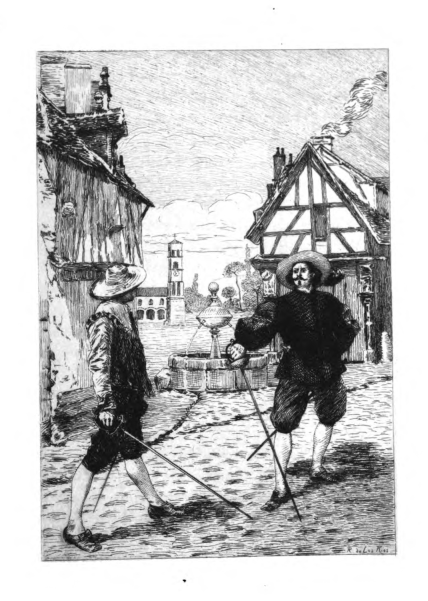
turn my back upon a game at sword play. With
these words in his mouth, he drew his long rapier,
which made my heart jump into my throat, and
stood upon his guard. It is enough, said I, putting
my sword up again in its scabbard; I am not a wild
beast, to turn a deaf ear to reason: after what you
have told me, there is no cause of enmity between
us. Let us shake hands. At this proposal, by
which he found out that I was not such a devil of a
fellow as he had taken me for, he returned his
weapon with a laugh, met my advances to be reconciled,
and we parted the best friends in the world.
From that time forward Sephora never came into
my thoughts but with the most disgusting associations.
I shunned all the opportunities she gave me
of entertaining her in private, and this with so
obvious a study, almost bordering on rudeness, that she
could not but notice it. Astonished at so sudden a
reverse, she was dying to know the cause, and at
length, finding the means of pinning me down to a
tête-à-tête, Good Mr. Steward, said she, tell me, if
so please you, why you avoid the very sight of me?
It is true that I made the first advances; but then
you fed the consuming fire. Recall to memory, if
it is not too great a favor, the private interview wo
had together. Then you were a magazine of
combustibles, now you are as frozen as the north sea.
What is the meaning of all this? The question was
not a little difficult of solution, for a man
unaccustomed to the violence of amorous interrogatories.
The consequence was, that it puzzled me most
confoundedly. I do not precisely recollect the identical
lie I told the lady, but I recollect perfectly that
nothing but the truth could have affronted her more
highly. Sephora, though by her mincing air and
modest outside one might have taken her for a lamb,
was a tigress when the savage was roused in her
nature. I did think, said she, darting a glance at
me full of malice and hideousness, I did think to
have conferred such honor as was never conferred
before, on a little scoundrel like you, by betraying
sentiments which the first nobility in the country
would make it their boast to excite. Fitly indeed
am I punished for having preposterously lowered
myself to the level of a dirty, snivelling adventurer.
That was pretty well; but she did not stop there:
I should have come off too cheaply on such terms.
Her fury taking a long lease of her tongue, that
brawling instrument of discord rung a bob-major of
invective, each strain more clamorous and confounding
than the former. It certainly was my duty to
have received it all with cool indifference, and to
have considered candidly that in triumphing over
female reserve, and then not taking possession of the
conquest, I had committed that sin against the sex
which would have transformed the most feminine of
them into a Sephora. But I was too irritable to
bear abuse, at which a man of sense in my place
would only have laughed; and my patience was at
length exhausted. Madam, said I, let us not rake
into each other's personal misfortunes. If the first
nobility in the country had only looked at your back,
they would have forgotten all your other charms,
and have boasted but little of the sentiments they
had excited you to betray. I had no sooner laid in
this home stroke, than the enraged duenna visited
me with the hardest box on the ear that ever yet
proceeded from the delicate fingers of a woman
scorned. Such favors might pall on repetition; so
I did not wait for a second, but took shelter in the
nimbleness of my legs from the clatter of castigation
she was going to shower down on me.
I returned thanks to the protecting powers for
having brought me clear off from this unequal
encounter, and fancied that I had nothing further to
apprehend, since the lady had taken corporal
vengeance. It was likely, too, that she would be wise
and hold her tongue, for the honor of her own back;
and, in point of fact, a full fortnight had elapsed
without my hearing a word upon the subject. The
very tingling in my own cheek began to abate, when
I was told that Sephora was taken ill. With that
forgiveness of injuries so natural to me, I was
sincerely afflicted at the news. I really felt for the
poor lady. I concluded that, unable to contend
with a passion so ill repaid, that hapless victim of
her own tenderness was giving up the ghost. It
was with exquisite pain that I turned this subject in
my thoughts. I was the cruel cause that her heart
was breaking; and my pity, at least, was the duenna's,
though love is too wayward to be controlled by
advice. But I was miserably mistaken in her nature.
Her tenderness had all curdled into acrimonious
hatred; and at that very moment was she plotting
to be my bane.
One morning, while I was with Don Alphonso,
that amiable young master of mine was absent,
moody, and out of spirits. I inquired respectfully
what was the matter. I am vexed to the soul, said
he, to find Seraphina weak, unjust, ungrateful. You
are not a little surprised at this, added he, remarking
the expression of astonishment with which I heard
him; yet nothing is more strictly and lamentably
true. I know not what reason you have given Dame
Lorenza to be at variance with you; but true it is,
you are become so unbearably hateful to her, that if
you do not get out of this castle as soon as possible,
her death, she says, must be the sure consequence.
You cannot but suppose that Seraphina, who knows
your value, used all her influence at first against a
prejudice to which she could not administer without
injustice and ingratitude. But though the best of
women, she is still a woman. Sephora brought her
up, and she loves her like a mother. Should her
old nurse die shortly, she would fancy she had her
death to answer for, had she refused herself to any
of her whims. For my own part, with all my affection
towards Seraphina,—and it is none of the weakest,—I
will never be guilty of so mean a compliance as
to side with her on this question. Perish our
duennas! perish the whole system of our Spanish
vigilance! but never let me consent to the banishment of a
young man whom I look upon rather as a brother
than a servant!
When Don Alphonso had thus expressed his sentiments,
I said to him, My good sir, I am born to be
the mere whipping-top of fortune. It had been my
hope that she would leave off persecuting me when
under your roof, where everything held out to me
happy days and an unruffled life. Now, the part
for honor to take is to tear myself away, whatever
hankering I may feel after my continuance. No,
no, exclaimed the generous son of Don Cæsar.
Leave me to bring Seraphina to a proper view of
things. It shall never be said that you are
sacrificed to the caprices of a duenna, who, on every
occasion, has but too much influence over the family.
All you will get by it, sir, replied I, will only be to
put Seraphina in an ill humor by opposing her
wishes. I had much rather withdraw, than run the
risk, by a longer abode here, of sowing division
between a married pair, who are a model of conjugal
felicity. Such a consequence of my unhappy quarrel
would make me miserable for the remainder of
my days.
Don Alphonso absolutely forbade me to take any
hasty step; and I found him so determined in the
intention of standing by me, that Lorenza must
infallibly have been thrown into the background, if
I had chosen to have stood an election against her.
There were moments when, exasperated against the
duenna, I was tempted to keep no measures with
her; but when I came to consider that to unravel
this surgical mystery would be to plunge a dagger
into the heart of a poor creature, whose curse had
been my fastidious prejudice against an ulcerated
back, and whom a physical and mental misfortune
were conjointly handing down to the grave, I lost all
feeling but that of compassion towards her. It was
evident, since I was so portentous a phenomenon,
that it was my imperious duty to reëstablish the
tranquillity of the castle by my absence; and that
duty I performed the next morning before daybreak,
without taking any leave of my two masters, for fear
they should oppose my departure from a misplaced
partiality towards me. My only notice was to leave
behind in my chamber a memorial, containing an
exact account of my receipts and disbursements
during the time of my stewardship.
WHAT HAPPENED TO GIL BLAS AFTER HIS RETREAT FROM
THE CASTLE OF LEYVA, SHOWING THAT THOSE WHO ARE
CROSSED IN LOVE ARE NOT ALWAYS THE MOST MISERABLE
OF MANKIND.
I was mounted on a good horse, my own property,
and was the bearer of two hundred pistoles,
the greater part of which arose from the plunder of
the vanquished banditti, and the forfeiture of Samuel
Simon by the Inquisition; for Don Alphonso, without
requiring me to account for any part of the said
forfeiture, had made restitution of the entire sum out
of his own funds. Thus, considering my effects,
however obtained, as converted into lawful property
by a sort of vicarious sponsorship, I took them into
my good graces without any remorse of conscience.
An estate like this rendered it absurd to throw away
any thought about the future; and a certain
likelihood of doing well, which always hangs about a
young man at my age, held out an additional security
against the caprices of fortune. Besides, Toledo
offered me a retreat exactly to my mind. There
could not be a doubt but the Count de Polan would
take a pleasure in giving a kind reception to one of
his deliverers, and would insist on his accepting an
apartment in his own house. But I only looked
upon this nobleman as a very distant resource; and
determined, before laying any tax on his grateful
recollection, to spend part of my ready cash in
travelling over the provinces of Murcia and Grenada,
which I had a very particular inclination to see.
With this intention I took the Almanza road, and
afterwards, following the route chalked out, travelled
from town to town as far as the city of Grenada,
without stumbling on any sinister occurrence. It
should seem as if fortune, wearied out with the
school-girl's tricks she had been playing me, was
contented at last to leave me as she found me. But
she still had her skittish designs upon me, as will be
seen in the sequel.
One of the first persons I met in the streets of
Grenada was Signor Don Ferdinand de Leyva,
son-in-law, as well as Don Alphonso, of the Count de
Polan. We were both of us equally surprised at
meeting so far from home. How is this, Gil
Blas? exclaimed he—to find you in this city! What the
devil brings you hither? Sir, said I, if you are
astonished at seeing me in this country, you will be
ten times more so when you shall know why I have
quitted the service of Signor Don Cæsar and his son.
Then I recounted to him all that had passed between
Sephora and myself, without garbling the facts in
any particular. He laughed heartily at the recital;
then, recovering his gravity, My friend, said he, my
mediation is at your service in this affair. I will
write to my sister-in-law ... No, no, sir, interrupted
I, do not write upon the subject, I beseech
you. I did not quit the castle of Leyva to go back
again. You may, if you please, make another use
of the kindness you have expressed for me. If any
of your friends should be looking out for a secretary
or a steward, I should be much obliged to you to
speak a good word in my favor. I will take upon
me to assure you that you will never be reproached
with recommending an improper object. You have
only to command me, answered he; I will do whatever
you desire. My business at Grenada is to visit
an old aunt in an ill state of health. I shall be here
three weeks longer, after which I shall set out on my
return to my castle of Lorqui, where I have left Julia.
That is my lodging, added he, showing me a house
about a hundred yards from us. Call upon me in a
few days; probably I may by that time have hit upon
some eligible appointment.
And, in fact, so it was; for the very first time that
we came together again, he said to me, My Lord
Archbishop of Grenada, my relation and friend, is in
want of a young man with some little tinge of
literature, who can write a good hand and make fair
copies of his manuscripts, for he is a great author.
He has composed I know not how many homilies,
and still goes on composing more every day, which
he delivers to the high edification of his audience.
As you seem to be just the thing for him, I have
mentioned your name, and he has promised to take
you. Go, and make your bow to him as from me;
you will judge, by his reception of you, whether
my recommendation has been couched in handsome
terms.
The situation was, to all appearance, exactly what
I should have picked out for myself. That being
the case, with such an arrangement of my air and
person as seemed most likely to square with the ideas
of a reverend prelate, I presented myself one
morning before the archbishop. If this were a gorgeous
romance, and not a grave history, here might we
introduce a pompous description of the episcopal
palace, with architectural digressions on the structure
of the building; here would be the place to expatiate
on the costliness of the furniture like an upholsterer,
to criticise the statues and pictures like a connoisseur;
and the pictures themselves would be nothing to the
uninformed reader, without the stories they represent,
till universal history, fabulous and authentic, sacred
and profane, should be pressed into the service.
But I shall content myself with modestly stating
that the royal palace itself is scarcely superior in
magnificence.
Throughout the suite of apartments, there was a
complete mob of ecclesiastics and other officers,
consisting of chaplains, ushers, upper and menial
servants. Those of them who were laymen were
most superbly attired; one would sooner have taken
them for temporal nobility than for spiritual
under-strappers. They were as proud as the devil, and
gave themselves intolerably consequential airs. I
could not help laughing in my sleeve, when I
considered who and what they were, and how they
behaved. Set a beggar on horseback! said I. These
gentry are in luck to carry a pack without feeling the
drag of it, for surely if they knew they were beasts
of burden, they would not jingle their bells with so
high a toss of the head. I ventured just to speak to
a grave and portly personage who stood sentinel at
the door of the archbishop's closet, to turn it upon
its hinges as occasion might require. I asked him
civilly if there was no possibility of speaking with
my lord archbishop. Stop a little, said he, with a
supercilious demeanor and repulsive tone; his grace
will shortly come forth, to go and hear mass; you
may snatch an audience for a moment as he passes
on. I answered not a single syllable. Patience
was all I had for it; and it even seemed advisable
to try and enter into conversation with some of the
jacks in office; but they began conning me over from
the sole of my foot to the crown of my head, without
condescending to favor me with a single interjection;
after which they winked at one another, whispered,
and looked out at the corners of their eyes, in
derision of the liberty I had assumed, by intruding upon
their select society.
I felt, more fool that I did so, quite out of
countenance at such cavalier treatment from a knot of
state footmen. My confusion was but beginning to
subside, when the closet door opened. The
archbishop made his appearance. A profound silence
immediately ensued among his officers, who quitted
at once their insolent behavior, to adopt a more
respectful style before their master. That prelate
was in his sixty-ninth year, formed nearly on the
model of my uncle, Gil Perez, the canon, which is
as much as to say, as broad as he was long. But
the highest dignitaries should always be the most
amply gifted; accordingly his legs bowed inwards to
the very extremity of the graceful curve, and his
bald head retained but a single lock behind, so that
he was obliged to ensconce his pericranium in a fine
woollen cap with long ears. In spite of all this, I
espied the man of quality in his deportment, doubtless,
because I knew that he actually happened to be
one. We common fellows, the fungous growth of
the human dunghill, look up to great lords with a
facility of being overawed, which often furnishes them
with a Benjamin's mess of importance when nature
has denied even the most scanty and trivial gifts.
The archbishop moved towards me in a minuet
step, and kindly inquired what I wanted. I told
him I was the young man about whom Signor Don
Ferdinand de Leyva had spoken to him. He did
not give me a moment to go on with my story.
Ah! is it you? exclaimed he; is it you of whom so
fine a character has been given me? I take you into
my service at once; you are a mine of literary
utility to me. You have only to take up your abode
here. Talking thus condescendingly, he supported
himself between two ushers, and moved onwards,
after having given audience to some of his clergy,
who had ecclesiastical business to communicate.
He was scarcely out of the room, when the same
officers who had turned upon their heel, were now
cap in hand to court my conversation. Here the
rascals are, pressing round me, currying favor, and
expressing their sincere joy at seeing me become as
it were an heirloom of the archbishopric. They
had heard what their master had said, and were
dying with anxiety to know on what footing I was to
be about him; but I had the ill nature not to satisfy
their curiosity, in revenge for their contempt.
My lord archbishop was not long before he
returned. He took me with him into his closet for a
little private conference. I could not but suppose
that he meant to fathom the depth of my understanding.
I was accordingly on my guard, and prepared
to measure out my words most methodically. He
questioned me first in the classics. My answers
were not amiss; he was convinced that I had more
than a schoolboy's acquaintance with the Greek and
Latin writers. He examined me next in logic; nor
could I but suppose that he would examine me in
logic. He found me strong enough there. Your
education, said he, with some degree of surprise, has
not been neglected. Now let us see your
handwriting. I took a blank piece of paper out of my
pocket, which I had brought for the purpose. My
ghostly father was not displeased with my performance.
I am very well satisfied with the mechanical
part of your qualifications, exclaimed he, and still
more so with the powers of your mind. I shall
thank my nephew, Don Ferdinand, most heartily,
for having sent me so fine a lad; it is absolutely a
gift from above.
We were interrupted by some of the neighboring
gentry, who were come to dine with the archbishop.
I left them together, and withdrew to the second
table, where the whole household, with one consent,
insisted on giving me the upper hand. Dinner is a
busy time at an episcopal ordinary; and yet we
snatched a moment to make our observations on
each other. What a mortified propriety was painted
on the outside of the clergy! They had all the look
of a deputation from a better world: strange to think
how place and circumstance impose on the deluded
sense of men! It never once came into my thoughts
that all this sanctity might possibly be a false coin;
just as if there could be nothing but what appertained
to the kingdom above, among the successors of the
apostles on earth.
I was seated by the side of an old valet-de-chambre,
by name Melchior de la Ronda. He took care
to help me to all the nice bits. His attentions were
not lost upon me, and my good manners quite enraptured
him. My worthy sir, said he, in a low voice,
after dinner I should like to have a little private talk
with you. At the same time he led the way to a part
of the palace where we could not be overheard, and
there addressed me as follows: My son, from the
very first instant that I saw you, I felt a certain
prepossession in your favor. Of this I will give you a
certain proof, by communicating in confidence what
will be of great service to you. You are here in a
family where true believers and painted hypocrites
are playing at cross purposes against each other.
It would take an antediluvian age to feel the ground
under your feet. I will spare so long and so
disgusting a study, by letting you into the characters
on both sides. After this, if you do not play your
cards, it is your own fault.
I shall begin with his grace. He is a very pious
prelate, employed without ceasing in the instruction
of the people, whom he brings back to virtue, like
sheep gone astray, by sermons full of excellent
morality, and written by himself. He has retired from
court these twenty years, to watch over his flock with
the zeal of an affectionate pastor. He is a very
learned person, and a very impressive declaimer: his
whole delight is in preaching, and his congregation
take care he should know that their whole delight is
in hearing him. There may possibly be some little
leaven of vanity in all this heavenly-mindedness;
but, besides that it is not for human fallibility to
search the heart, it would ill become me to rake into
the faults of a person whose bread I eat. Were it
decent to lay my finger on any thing unbecoming in
my master, I should discommend his starchness.
Instead of exercising forbearance towards frail
churchmen, he visits every peccadillo as if it were a
heinous offence. Above all, he prosecutes those with
the utmost rigor of the spiritual court, who, wrapping
themselves up in their innocence, appeal to the
canons for their justification, in bar of his despotic
authority. There is besides another awkward trait
in his character, common to him with many other
people of high rank. Though he is very fond of
the people about him, he pays not the least attention
to their services, but lets them sink into years
without a moment's thought about securing them any
provision. If at any time he makes them any little
presents, they may thank the goodness of some one
who shall have spoken up in their behalf: he would
never have his wits enough about him to do the
slightest thing for them as a volunteer.
This is just what the old valet-de-chambre told me
of his master. Next, he let me into what he thought
of the clergymen with whom we had dined. His
portraits might be likenesses; but they were too
hard-featured to be owned by the originals. It
must be admitted, however, that he did not represent
them as honest men, but only as very scandalous
priests. Nevertheless, he made some exceptions,
and was as loud in their praises as in his censure of
the others. I was no longer at any loss how to play
my part so as to put myself on an equal footing with
these gentry. That very, evening, at supper, I took
a leaf out of their book, and arrayed myself in the
convenient vesture of a wise and prudent outside.
A clothing of humility and sanctification costs
nothing. Indeed it offers such a premium to the wearer,
that we are not to wonder if this world abounds in a
description of people called hypocrites.
GIL BLAS BECOMES THE ARCHBISHOP'S FAVORITE, AND THE
CHANNEL OF ALL HIS FAVORS.
I had been after dinner to get together my baggage,
and take my horse from the inn where I had
put up, and afterwards returned to supper at the
archbishop's palace, where a neatly-furnished room
was got ready for me, and such a bed as was more
likely to pamper than to mortify the flesh. The day
following, his grace sent for me quite as soon as I
was ready to go to him. It was to give me a homily
to transcribe. He made a point of having it copied
with all possible accuracy. It was done to please
him; for I omitted neither accent, nor comma, nor
the minutest tittle of all he had marked down. His
satisfaction at observing this was heightened by its
being unexpected. Eternal Father! exclaimed he in
a holy rapture, when he had glanced his eye over all
the folios of my copy, was ever any thing seen so
correct? You are too good a transcriber not to have
some little smattering of the grammarian. Now tell
me with the freedom of a friend: in writing it over,
have you been struck with nothing that grated upon
your feelings? Some little careless idiom, or some
word used in an improper sense? O! may it please
your grace, answered I with a modest air, it is not
for me, with my confined education and coarse taste,
to aim at making critical remarks. And though ever
so well qualified, I am satisfied that your grace's
works would come out pure from the essay. The
successor of the apostles smiled at my answer. He
made no observation on it; but it was easy to see
through all his piety that he was an arrant author at
the bottom: there is something in that dye that not
heaven itself can wash out.
I seemed to have purchased the fee-simple of his
good graces by my flattery. Day after day did I get
a step farther in his esteem; and Don Ferdinand,
who came to see him very often, told me my footing
was so firm, that there could not be a doubt but my
fortune was made. Of this my master himself gave
me a proof some little time afterwards; and the
occasion was as follows: One evening in his closet
he rehearsed before me, with appropriate emphasis
and action, a homily which he was to deliver the
next day in the cathedral. He did not content himself
with asking me what I thought of it in the gross,
but insisted on my telling him what passages struck
me most. I had the good fortune to pick out those
which were nearest to his own taste, his favorite
common-places. Thus, as luck would have it, I
passed in his estimation for a man who had a quick
and natural relish of the real and less obvious
beauties in a work. This, indeed, exclaimed he, is what
you may call having discernment and feeling in
perfection! Well, well, my friend! it cannot be said
of you,
Bœotum in crasso jurares aëre natum.
In a word, he was so highly pleased with me, as to
add, in a tone of extraordinary emotion, Never mind,
Gil Blas! henceforward take no care about hereafter:
I shall make it my business to place you among the
favored children of my bounty. You have my best
wishes; and to prove to you that you have them, I
shall take you into my inmost confidence.
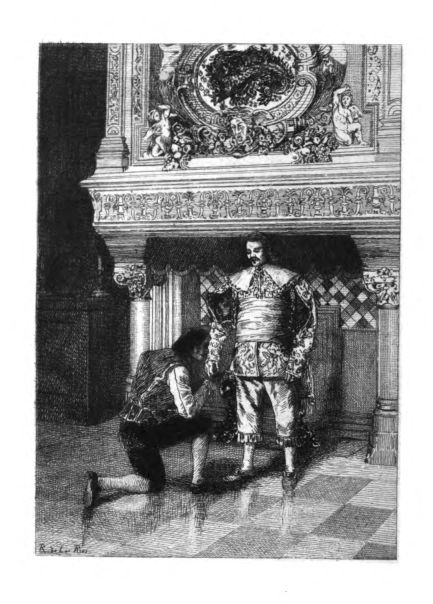
These words were no sooner out of his mouth,
than I fell at his grace's feet, quite overwhelmed
with gratitude. I embraced his elliptical legs with
almost pagan idolatry, and considered myself as a
man on the high road to a very handsome fortune.
Yes, my child, resumed the archbishop, whose speech
had been cut short by the rapidity of my prostration,
I mean to make you the receiver-general of all my
inmost ruminations. Hearken attentively to what I
am going to say. I have a great pleasure in
preaching. The Lord sheds a blessing on my homilies;
they sink deep into the hearts of sinners; set up a
glass in which vice sees its own image, and bring
back many from the paths of error into the high
road of repentance. What a heavenly sight, when
a miser, scared at the hideous picture drawn by my
eloquence of his avarice, opens his coffers to the poor
and needy, and dispenses the accumulated store with
a liberal hand? The voluptuary, too, is snatched
from the pleasures of the table; ambition flies at
my command to the wholesome discipline of the
monastic cell; while female frailty, tottering on the
brink of ruin, with one ear open to the siren voice
of the seducer, and the other to my saintly
correctives, is restored to domestic happiness and the
approving smile of heaven, by the timely warnings of
the pulpit. These miraculous conversions, which
happen almost every Sunday, ought of themselves
to goad me on in the career of saving souls.
Nevertheless, to conceal no part of my weakness from
my monitor, there is another reward on which my
heart is intent, a reward which the seraphic
scrupulousness of my virtue to little purpose condemns as
too carnal; a literary reputation for a sublime and
elegant style. The honor of being handed down to
posterity as a perfect pulpit orator has its irresistible
attractions. My compositions are generally thought
to be equally powerful and persuasive; but I could
wish of all things to steer clear of the rock on which
good authors split, who are too long before the
public, and to retire from professional life with my
reputation in undiminished lustre.
To this end, my dear Gil Blas, continued the
prelate, there is one thing requisite from your zeal
and friendship. Whenever it shall strike you that
my pen begins to contract, as it were, the ossification
of old age, whenever you see my genius in its
climacteric, do not fail to give me a hint. There is
no trusting to one's self in such a case; pride and
conceit were the original sin of man. The probe of
criticism must be intrusted to an impartial stander-by,
of fine talents and unshaken probity. Both
those requisites centre in you: you are my choice,
and I give myself up to your direction. Heaven be
praised, my lord, said I, there is no need to trouble
yourself with any such thoughts yet. Besides, an
understanding of your grace's mould and calibre will
last out double the time of a common genius; or, to
speak with more certainty and truth, it will never
be the worse for wear, if you live to the age of
Methusalem. I consider you as a second Cardinal
Ximenes, whose powers, superior to decay, instead
of flagging with years, seemed to derive new vigor
from their approximation with the heavenly regions.
No flattery, my friend! interrupted he. I know
myself to be in danger of failing all at once. At
my age one begins to be sensible of infirmities, and
those of the body communicate with the mind. I
repeat it to you, Gil Blas, as soon as you shall be
of opinion that my head is not so clear as usual,
give me warning of it instantly. Do not be afraid
of offending by frankness and sincerity: to put me
in mind of my own frailty will be the strongest
proof of your affection for me. Besides, your very
interest is concerned in it, for if it should, by any
spite of chance towards you, come to my ears that
the people say in town, "His grace's sermons
produce no longer their accustomed impression; it is
time for him to abandon his pulpit to younger
candidates," I do assure you, most seriously and
solemnly, you will lose not only my friendship, but the
provision for life that I have promised you. Such
will be the result of your silly tampering with
truth.
Here my patron left off to wait for my answer,
which was an echo of his speech, and a promise of
obeying him in all things. From that moment there
were no secrets from me; I became the prime
favorite. All the household, except Melchior de la
Ronda, looked at me with an eye of envy. It was
curious to observe the manner in which the whole
establishment, from the highest to the lowest,
thought it necessary to demean themselves towards
his grace's confidential secretary; there was no
meanness to which they would not stoop to curry
favor with me; I could scarcely believe they were
Spaniards. I left no stone unturned to be of service
to them, without being taken in by their interested
assiduities. My lord archbishop, at my entreaty,
took them by the hand. He got a company for one,
and fitted him out so as to make a handsome figure
in the army. Another he sent to Mexico, with a
considerable appointment which he procured him;
and I obtained a good slice of his bounty for my
friend Melchior. It was evident, from these facts,
that if the prelate was not particularly active in good
works, at least he rarely gave a churlish refusal,
when any one had the courage to importune him for
his benevolence.
But what I did for a priest seems to deserve
being noticed more at large. One day a certain
licentiate, by name Lewis Garcias, a well-looking
man still in the prime of life, was presented to me
by our steward, who said, Signor Gil Blas, in this
honest ecclesiastic you behold one of my best friends.
He was formerly chaplain to a nunnery. Scandal
has taken a few liberties with his chastity.
Malicious stories have been trumped up to hurt him in
my lord archbishop's opinion, who has suspended
him, and unfortunately is so strongly prejudiced by
his enemies, as to be deaf to any petition in his favor.
In vain have we interested the first people in
Grenada to get him reëstablished; our master will not
hear of it.
These first people in Grenada, said I, have gone
the wrong way to work. It would have been much
better if no interest at all had been made for the
reverend licentiate. People have only done him a
mischief by endeavoring to serve him. I know my
lord archbishop thoroughly: entreaties and importunate
recommendations do but aggravate the ill condition
of a clergyman who lies under his displeasure:
it is but a very short time ago since I heard him
mutter the following sentiment to himself. The more
persons a priest, who has been guilty of any misconduct,
engages to speak to me in his behalf, the more
widely is the scandal of the church disseminated,
and the more severe is my treatment of the offender.
That is very unlucky, replied the steward; and my
friend would be put to his last shifts if he did not
write a good hand. But, happily, he has the pen of
a ready scribe, and keeps his head above water by
the exercise of that talent. I was curious to see
whether this boasted handwriting was so much
better than my own. The licentiate, who had a
specimen in his pocket, showed me a sheet which I
admired very much: it had all the regularity of a
writing-master's copy. In looking over this model
of penmanship, an idea occurred to me. I begged
Garcias to leave this paper in my hands, saying that
I might be able to do something with it which should
turn out to his advantage; that I could not explain
myself at that moment, but would tell him more the
next day. The licentiate, to whom the steward had
evidently talked big about my capacity to serve him,
withdrew in as good spirits as if he had already been
restored to his functions.
I was in earnest in my endeavor that he should
be so, and lost no time in setting to work.
Happening to be alone with the archbishop, I produced
the specimen. My patron was delighted with it.
Seizing on this favorable opportunity, May it please
your grace, said I, since you are determined not to
put your homilies to the press, I should very much
like them at least to be transcribed in this masterly
manner.
I am very well satisfied with your performance,
answered the prelate; but yet I own that it would be
a pleasant thing enough to have a copy of my works
in that hand. Your grace, replied I, has only to
signify your wishes. The man who copies so well
is a licentiate of my acquaintance. It will give him
so much the more pleasure to gratify you, as it may
be the means of interesting your goodness to extricate
him from the melancholy situation to which he
has the misfortune at present to be reduced.
The prelate could not do otherwise than inquire
the name of this licentiate. I told him it was Lewis
Garcias. He is in despair at having drawn down
your censure upon him. That Garcias, interrupted
he, if I am not mistaken, was chaplain in a convent
of nuns, and has been brought into the ecclesiastical
court as a delinquent. I recollect some very heavy
charges which have been sent me against him. His
morals are not the most exemplary. May it please
your grace, interrupted I in my turn, it is not for me
to justify him in all points; but I know that he has
enemies. He maintains that the authors of the
informations you have received are more bent on doing
him an ill office than on vindicating the purity of
religion. That very possibly may be the case, replied
the archbishop; there are a great many firebrands in
the world. Besides, though we should take it for
granted that his conduct has not always been above
suspicion, he may have repented of his sins; in
short, the mercies of heaven are infinite, however
heinous our transgressions. Bring that licentiate
before me; I take off his suspension.
Thus it is that men of the most austere character
descend from their altitudes when interest or a
favorite whim reduces them to the level of the frail.
The archbishop granted, without a struggle, to the
empty vanity of having his works well copied, what
he had refused to the most respectable applications.
I carried the news with all possible expedition to the
steward, who communicated it to his friend Garcias.
That licentiate, on the following day, came to return
me thanks commensurate with the favor obtained.
I presented him to my master, who contented himself
with giving him a slight reprimand, and put the
homilies into his hand, to copy them out fair. Garcias
performed the task so satisfactorily, that he was
reinstated in the cure of souls, and was afterwards
preferred to the living of Gabia, a large market town
in the neighborhood of Grenada.
THE ARCHBISHOP IS AFFLICTED WITH A STROKE OF
APOPLEXY. HOW GIL BLAS GETS INTO A DILEMMA, AND HOW
HE GETS OUT.
While I was thus rendering myself a blessing
first to one and then to the other, Don Ferdinand de
Leyva was making his arrangements for leaving
Grenada. I called on that nobleman before his
departure, to thank him once more for the
advantageous post he had procured me. My expressions
of satisfaction were so lively, that he said, My dear
Gil Blas, I am delighted to find you in such good
humor with my uncle the archbishop. I am absolutely
in love with him, answered I. His goodness
to me has been such as I can never sufficiently
acknowledge. Less than my present happiness could
never have made me amends for being at so great a
distance from Don Cæsar and his son. I am persuaded,
replied he, that they are both of them equally
chagrined at having lost you. But possibly you
are not separated forever; fortune may some day
bring you together again. I could not hear such an
idea started without being moved by it. My sighs
would find vent; and I felt at that moment so strong
an affection for Don Alphonso, that I could willingly
have turned my back on the archbishop and all the
fine prospects that were opening to me, and have
gone back to the castle of Leyva, had but a mortification
taken place in the back of the scarecrow which
had frightened me away. Don Ferdinand was not
insensible to the emotions that agitated me, and felt
himself so much obliged by them, that he took his
leave with the assurance of the whole family always
taking an anxious interest in my fate.
Two months after this worthy gentleman had left
us, in the luxuriant harvest of my highest favor, a
lowering storm came suddenly over the episcopal
palace; the archbishop had a stroke of apoplexy.
By dint of immediate applications and good nursing,
in a few days there was no bodily appearance of
disease remaining. But his reverend intellects did not so
easily recover from their lethargy. I could not help
observing it to myself in the very first discourse that
he composed. Yet there was not such a wide gap
between the merits of the present and the former
ones as to warrant the inference that the sun of
oratory was many degrees advanced in its post-meridian
course. A second homily was worth waiting for,
because that would clearly determine the line of my
conduct. Alas, and well-a-day! when that second
homily came, it was a knock-down argument. Sometimes
the good prelate moved forward, and sometimes
he moved backwards; sometimes he mounted up into
the garret, and sometimes dipped down into the
cellar. It was a composition of more sound than
meaning, something like a superannuated schoolmaster's
theme, when he attempts to give his boys more sense
than he possesses of his own, or like a capuchin's
sermon, which only scatters a few artificial flowers
of paltry rhetoric over a barren desert of doctrine.
I was not the only person whom the alteration
struck. The audience at large, when he delivered
it, as if they too had been pledged to watch the
advances of dotage, said to one another in a whisper
all round the church, Here is a sermon with symptoms
of apoplexy in every paragraph. Come, my
good Coryphæus of the public taste in homilies, said
I then to myself, prepare to do your office. You
see that my lord archbishop is going very fast—you
ought to warn him of it, not only as his bosom friend,
on whose sincerity he relies, but lest some blunt
fellow should anticipate you, and bolt out the truth in
an offensive manner, in that case you know the
consequence; you would be struck out of his will, where,
no doubt, you have a more convertible bequest than
the licentiate Sedillo's library.
But as reason, like Janus, looks at things with
two faces, I began to consider the other side of the
question; the hint seemed difficult to wrap up so as
to make it palatable. Authors in general are stark
mad on the subject of their own works, and such an
author might be more testy than the common herd
of the irritable race; but that suspicion seemed
illiberal on my part, for it was impossible that my
freedom should be taken amiss when it had been forced
upon me by so positive an injunction. Add to this,
that I reckoned upon handling the subject skilfully,
and cramming discretion down his throat like a
high-seasoned epicurean dish. After all my pro and con,
finding that I risked more by keeping silence than by
breaking it, I determined to venture on the delicate
duty of speaking my mind.
Now there was but one difficulty; a difficulty
indeed! how to open the business. Luckily the orator
himself extricated me from that embarrassment, by
asking what they said of him in the world at large,
and whether people were tolerably well pleased with
his last discourse. I answered that there could be
but one opinion about his homilies; but that it should
seem as if the last had not quite struck home to the
hearts of the audience, like those which had gone
before. Do you really mean what you say, my
friend? replied he, with a sort of wriggling surprise.
Then my congregation are more in the temper of
Aristarchus than of Longinus! No, may it please
your grace, rejoined I, quite the contrary.
Performances of that order are above the reach of
vulgar criticism: there is not a soul but expects to be
saved by their influence. Nevertheless, since you
have made it my duty to be sincere and unreserved,
I shall take the liberty of just stating that your last
discourse is not written with quite the overpowering
eloquence and conclusive argument of your former
ones. Does not your grace feel just as I do on the
subject?
This ignorant and stupid frankness of mine
completely blanched my master's cheek; but he forced a
fretful smile, and said, Then, good Master Gil Blas,
that piece does not exactly hit your fancy? I did
not mean to say that, your grace, interrupted I,
looking very foolish. It is very far superior to what
any one else could produce, though a little below par
with respect to your own works in general. I know
what you mean, replied he. You think I am going
down hill, do not you? Out with it at once. It is
your opinion that it is time for me to think of
retiring? I should never have had the presumption,
said I, to deliver myself with so little reserve, if it
had not been your grace's express command. I act
in entire obedience to your grace's orders; and I
most obsequiously implore your grace not to take
offence at my boldness. I were unfit to live in a
Christian land, interrupted he, with stammering
impatience,—I were unfit to live in a Christian land if
I liked you the less for such a Christian virtue as
sincerity. A man who does not love sincerity sets
his face against the distinguishing mark between a
friend and a flatterer. I should have given you
infinite credit for speaking what you thought, if you
had thought any thing that deserved to be spoken.
I have been finely taken in by your outside show of
cleverness, without any solid foundation of sober
judgment!
Though completely unhorsed, and at the enemy's
mercy, I wanted to make terms of decent capitulation,
and to go unmolested into winter quarters; but
let those who think to appease an exasperated author,
and especially an author whose ear has been long
attuned to the music of his own praises, take
warning by my fate. Let us talk no more on the
subject, my very young friend, said he. You are as
yet scarcely in the rudiments of good taste, and
utterly incompetent to distinguish between gold and
tinsel. You are yet to learn that I never in all my
life composed a finer homily than that unfortunate
one which had not the honor of your approbation.
The immortal part of me, by the blessing of heaven
on me and my congregation, is less weighed down
by human infirmity than when the flesh was stronger.
We all grow wiser as we grow older, and I shall in
future select the people about me with more caution;
nor submit the castigation of my works but to a much
abler critic than yourself. Get about your business! pursued
he, giving me an angry shove by the shoulders
out of his closet; go and tell my treasurer to
pay you a hundred ducats, and take my priestly
blessing in addition to that sum. God speed you,
good Master Gil Blas! I heartily pray that you may
do well in the world! There is nothing to stand in
your way but the want of a little better taste.
THE COURSE WHICH GIL BLAS TOOK AFTER THE ARCHBISHOP
HAD GIVEN HIM HIS DISMISSAL. HIS ACCIDENTAL MEETING
WITH THE LICENTIATE WHO WAS SO DEEPLY IN HIS
DEBT, AND A PICTURE OF GRATITUDE IN THE PERSON OF
A PARSON.
I made the best of my way out of the closet, cursing
the caprice, or more properly the dotage, of the
archbishop, and more in dudgeon at his absurdity,
than cast down at the loss of his good graces. For
some time it was a moot point whether I should go
and lay claim to my hundred ducats; but after
having weighed the matter dispassionately, I was not
such a fool as to quarrel with my bread and butter.
There was no reason why that money, fairly earned,
should deprive me of my natural right to make a
joke of this ridiculous prelate; in which good deed
I promised myself not to be wanting, as often as
himself or his homilies were brought upon the carpet
in my hearing.
I went therefore and asked the treasurer for a
hundred ducats, without telling a word about the
literary warfare between his master and me.
Afterwards I called on Melchior de la Ronda, to take a
long leave of him. He was too much my friend not
to sympathize with my misfortune. While I was
telling my story, vexation was strongly imprinted on
his countenance. In spite of all his respect for the
archbishop, he could not help blaming him; but,
when in the fever of my resentment I threatened to
be a match for the prelate, and to entertain the whole
city at his expense, the prudent Melchior gave me a
salutary caution: Take my advice, my dear Gil Blas,
and rather pocket the affront. Men of a lower sphere
in life should always be cap in hand to people of
quality, whatever may be their grounds of complaint.
It must be admitted there are some very coarse
specimens of greatness, which in themselves are scarcely
deserving of the least respect or attention; but even
such animals have their weapons of annoyance, and
it is best to keep out of their way.
I thanked the old valet-de-chambre for the good
counsel he had given me, and promised to be guided
by it. Pleased with my deference to his opinion, he
said to me, If you go to Madrid, be sure you call
upon my nephew, Joseph Navarro. He is factotum
in the family of Signor Don Balthazar de Zunigna,
and I can venture to recommend him as a lad in
every respect worthy of your friendship. He is just
as nature made him, with all the vivacity of youth,
courteous in his manners, and forward to oblige; I
could wish you to get acquainted with him. I
answered that I would not fail to go and see this Joseph
Navarro as soon as I should get to Madrid, whither I
meant to return in due time. Then did I turn my
back on the episcopal palace, never to grace it with
my presence again. If I had kept my horse, I
should perhaps have set out for Toledo immediately;
but I had sold it during the period of my administration,
supposing that I was in office for life, and
should not henceforward be migratory. My final
resolution was to hire a ready-furnished lodging, as
I had made up my mind to stay another month in
Grenada, and then to pay the Count de Polan a
visit.
As dinner-hour was drawing nigh, I asked my
landlady if there was any eating-house in the
neighborhood. She answered that there was a very good
one within a few yards of her house, where the
accommodations were excellent, and the company select
and numerous. I made her show me where it was,
and went thither sharp set. I was shown into a
large room, resembling the hall of a monastery in
every thing but good cheer. There were ten or a
dozen men sitting at a long table, with a cloth spread
over it that fretted in its own grease; but they, with
unoffended nostrils, were engaged in general conversation,
though they dined individually, each having a
miserable scrap for his portion. The people of the
house brought me my allowance, which at another
time would have turned my stomach, and have made
me sigh after the luxuries of the table I had just
lost. But at this moment I was so indignant against
the archbishop, that the homely fare of a paltry
eating-house seemed more palatable than the dainties
of his sumptuous board. It was a burning shame
to see such a waste of provisions served up in soups
and sauces to pamper the appetite. Arguing like a
deep examiner in the economy of the human frame,
and reasoning medically as well as philosophically
on the disproportion between the simple wants of
nature and the complexity of luxurious indulgence,
Cursed be they, said I, who invented those pernicious
dinners and suppers, where one must sit on the
tenterhooks of self-denial, for fear of overloading the
storehouse and shop of the whole body! Man wants
but little here below; and provided he can but keep
body and soul together, the less he eats, the better.
Thus did I, in my surly vein, give utterance to wise
saws; which, however just in theory, had hitherto
been little recommended by my practice.
While I was despatching my commons, without
any danger of a surfeit from repletion, the licentiate
Lewis Garcias, who had got the living of Gabia in
the manner above mentioned, came into the room.
The moment he recognized me, he ran into my arms
with all the cordiality of friendship, or rather with
the extravagant joy of a lover after a long exile from
his mistress. He folded me repeatedly within his
sincere embrace, and I was compelled to stand the
brunt of a long-winded compliment on the unparalleled
disinterestedness of my conduct towards him.
Gratitude is a fine virtue; and yet it is wearisome
when carried beyond due bounds. He took his seat
next me, saying, Well! a parson must not swear;
though, by the mass, my dear patron, since my good
fortune has thrown me in your way, we will not part
without a jovial glass. But as there is no good wine
in this shabby inn, I will take you, if you please,
after our make-shift dinner, to a place where I will
treat you with a couple of bottles, rich, genuine, and
old, in comparison of which the Falernian of Horace
was all a farce. The church will give us absolution,
in the cause of gratitude! If I could but get you for
a few days down at my parsonage of Gabia! Mæcenas
was never more welcome to the poet's Sabine
farm, than the author of all my ease and comfort to
the choicest produce of a glebe which is mine only
by your benevolence.
While he was holding this high-flown language,
his little slice of dinner was set before him. He fell
to without the fear of indigestion before his eyes,
still heightening the luxury of the repast, at intervals,
by fine speeches addressed to me in the most fulsome
style of flattery. I took the opportunity, when his
mouth was filled with something more substantial, to
edge in a word or two amidst the torrent; and as he
had not forgotten to ask after his friend the steward,
I made no bones about acknowledging that I was no
longer a hanger-on of the church. I even went so
far as to particularize the most trivial circumstances
attending my resignation, to all of which he listened
with an attentive ear. After all his fine professions,
who would not have expected to see him moved even
to tears with the throes of resentful gratitude, to hear
him thunder bulls and interdicts against the superannuated
archbishop? The devil a bit! he did neither
the one thing nor the other. But his countenance
fell, and his whole air was that of an absent man;
the rest of his dinner was bolted down without the
garnish of intermediate talk about Mæcenas; as soon
as he had done, he hurried from table without
minding grace or gratitude, wished me good day with a
cold and distant air, and got off as fast as possible.
The unfeeling scoundrel, perceiving that I was no
longer in a situation for him to pump anything out
of me, would not even take the trouble to draw a
decent veil over his dirty principles. But such a
blackguard could excite no other sensation than
contempt and laughter. Looking at him with derision,
the fittest chastisement for fellows like these, I called
after him, loud enough to be heard by the whole
room, Stop there, you nun's priest! Go and put
those two bottles in ice against Mæcenas comes to
the Sabine farm! Be sure they are rich, genuine,
and old, or they will be a farce to Falernian.
GIL BLAS GOES TO THE PLAY AT GRENADA. HIS SURPRISE
AT SEEING ONE OF THE ACTRESSES, AND WHAT HAPPENED
THEREUPON.
No sooner had Garcias rid the room of his presence,
than two gentlemen came in, extremely well
dressed, and took their seats close by me. They
began talking about the players of the Grenada
company, and about a new piece which just then had
a great run. According to their account, it was
quite the town talk. Nothing would do for me but
to go and see it that very day. I had never been at
the play since my residence at Grenada. As I had
lived nearly the whole time in the archbishop's
palace, where all such profane shows were condemned
as uncanonical, I had been cut off from every
recreation of that sort. All my knowledge of men
and manners was drawn from homilies!
I repaired, therefore, to the theatre at the
appointed hour, and found a very full house. All
around me, discussions were going on about the
piece before the curtain drew up; and there was not
a soul in the numerous assembly but had some
remark to make upon it. One liked it, another could
not bear it. Do not you think the dialogue is
particularly happy? said a candid critic on my right.
Was there ever such miserable stuff! cried a snarling
critic on my left. In good truth, if bad authors
abound, it must be admitted that the public are at
variance about what is good and what is bad: but
the bad judges have a right to be pleased for their
money; and as they far outnumber the good ones,
their favorite writers can never want employment.
When one only considers through what an ordeal
dramatic poets have to pass, it is a matter of wonder
that any should be found hardy enough at once to
contend against the ignorance of the multitude, and
the random shot of those self-created guides in
matters of taste, who always pretend to lead the
blindness of the public judgment, and too frequently push
it into the mire of absurdity.
At length the buffoon of the piece came forward
by way of prologue. As soon as his grotesque
countenance was visible, there was a general clapping
of hands; a sure indication of his being one of those
spoiled actors who are allowed to take any liberties
with the pit, and to be applauded through thick and
thin. In fact, this player neither opened his lips,
nor moved a muscle, without exciting the most
extravagant raptures. He would have performed
better had he been less conscious what a favorite he
was. But he presumed on that circumstance most
abominably. I observed that he sometimes forgot
what was set down for him, and took the license of
adding to his part out of his own free fancy; a
common cause of complaint against low comedians,
which, though it make the unskilful laugh, cannot
but make the judicious grieve. Would the audience
but receive such mirth with hisses, instead of crying
bravo, they might restrain the absurd practice, and
purge the stage from barbarism.
Some of the other performers were greeted with
the usual tokens on their entrance, and particularly
an actress who played the chambermaid. There was
something about her which more than usually
attracted my attention; and language must sink under
the labor of expressing my astonishment at tracing
the features of Laura, that fair, that chaste, that
inexpressible she, whom I supposed to be still at
Madrid, warbling in one key, with hands, sides,
voice, and mind incorporate with Arsenia. But
there could be no doubt of her identity. The kick
in her gallop, the leer in her eye, and the tripping
pertness of her tongue, all conspired in evidence that
there could be no mistake. Yet, as if I had refused
belief to the affidavit of my own eyes and ears, I
asked her name of a gentleman who was sitting
beside me. What the deuce! Why, where do you
come from? said he. You must unquestionably be
a new importation, not to have seen or heard of the
divine Estella.
The likeness was too perfect for me to be mistaken.
It was easy to comprehend why Laura, changing her
sphere of action, changed her name also; wherefore,
from curiosity to know how matters stood with her,
since the public always pry into the most private
concerns of theatrical persons, I inquired of the same
man whether this Estella had any particular affair
of gallantry on her hands. He informed me that
for the last two months there had been a great
Portuguese nobleman at Grenada,—his name was the
Marquis de Marialva,—who had laid out a great deal
of money upon her. He might have told me more,
if I had not been afraid of becoming troublesome
with my questions. I was better employed in
musing on the information this good gentleman had
given me than in attending to the play; and if any
one had asked me what it was all about, when the
piece was over, I should have been puzzled for an
answer. I could do nothing but decline Laura and
Estella through all cases and numbers, till at length
I boldly made up my mind to call at her house the
next day. Not but there was some risk as to
the reception she might give me: it might be
suspected, without excess of modesty, that my
appearance would give her no great pleasure in the high
tide of her affairs; nor was it at all improbable that
so good an actress, to revenge herself on a man with
whom certainly she had an account to settle, might
look strange, and swear she had never seen his face
before. Yet did none of these apprehensions deter
me from my venture. After a light supper,—for all
the meals at my eating-house were regulated on
principles of economy and temperance,—I withdrew
to my chamber with an anxious longing for the next
day.
My sleep was short and interrupted, so that I got
up by daybreak. But as it was to be recollected
that a mistress in high keep was not likely to be
visible early in the morning, I passed three or four
hours in dressing, shaving, powdering, and
perfuming. It was my business to present myself
before her in a trim not to put her to the blush at
acknowledging my acquaintance. I sallied forth
about ten o'clock, and knocked at her door, after
having inquired her address at the theatre. She
was living on the first floor of a large and elegant
house. I told a chambermaid, who opened the door
to me, that a young man wanted to speak with her
lady. The chambermaid went in to give my message,
when all at once I heard her mistress call out,
not in the best-tempered tone in the world, Who is
the young man? What does he want? Show him
up stairs.
This was a hint to me that my time was ill chosen;
that probably her Portuguese lover was at her
toilet, and that she spoke so loud with the laudable
design of convincing him that she was not a sort of
girl to allow of any impertinent intruders. This
conjecture of mine turned out to be the fact; the
Marquis de Marialva lounged away almost every
morning with her; I had made up my mind to be
kicked down stairs by way of welcome; but that
admirable actress, never forgetting her cue, ran
forward with open arms at the sight of me, exclaiming,
Ah! my dear brother, is it you that I behold? On
the strength of so near a kindred, she was no
niggard of her embraces, but recollected herself so far
as to say, turning round to the Portuguese, My lord,
you must excuse me if nature will put in her claim,
and trench upon good breeding. After three years
of absence, I cannot see a brother once again, whom
I love so tenderly, without expressing my feelings in
all their warmth. Come! my dear Gil Blas,
continued she, addressing me afresh, tell me some news
of the family: in what circumstances did you leave it?
This whimsical scene disconcerted me at first, but
I was not long in seeing through Laura's intention,
and playing up to her with a spirit scarcely less than
her own, answered, according to the plot, Heaven be
praised, sister, all our good folks are in perfect
health, and well in the world. I make no doubt,
resumed she, but you must be very much surprised
to find me an actress in Grenada; but hear me first,
and blame me afterwards. It is three years, as you
may recollect, since my father thought to have
established me advantageously in marriage with Don
Antonio Cœllo, an officer in the service, who took
me from the Asturias to Madrid, his native place.
Six months after our arrival, he got into an affair of
honor in consequence of his violent temper. Some
attentions incautiously paid to me were the cause of
the affray, and his antagonist was killed. This
gentleman was of a family high in rank and interest.
My husband, who, though well born, had very few
connections, made his escape into Catalonia with
every thing he could get together in jewels and
ready money. He embarked at Barcelona, went
over into Italy, enlisted in the Venetian service, and
finally lost his life in the Morea, fighting against the
Turks. In the mean time, a landed estate which
constituted our whole revenue was confiscated, and
I was left a widow with very little for my support.
What was to be done in so pressing an emergency?
There was nothing left to pay my travelling
expenses back into the Asturias. And then what
should I have done there? I should have got nothing
from my family but a long string of condolences,
which would have furnished me neither with food
nor with raiment. On the other hand, I had been
too well brought up to fall into those courses, into
which too many poor young women are betrayed for
the sake of a scandalous subsistence. There was
but one thing remaining for me to determine on. I
turned actress to preserve my morals.
So tingling a sense of ridicule came over me
when Laura wound up her romance with this pious
motive for turning actress, that I could scarcely
refrain from relieving myself by a fit of laughter. But
gravity was of too much consequence to be dispensed
with, and I said to her with an air the counterpart
of her own, My dear sister, I entirely approve of
your conduct, and am heartily glad to meet with you
at Grenada, and moreover settled on so respectable
a footing.
The Marquis de Marialva, who had not lost a
word of all these fine speeches, swallowed down
blindfold whatever Don Antonio's widow thought fit
to drench his credulity with. He took part in the
conversation too, and asked me whether I had any
fixed employment in Grenada or elsewhere. I paused
for a moment to consider whether and after what
manner I should lie; but as there seemed no need
in this case to draw on my invention, I told the
truth by way of variety. In a plain, matter-of-fact
manner did I rehearse my introduction to the
archbishop's palace, and my discharge therefrom, to the
infinite amusement of his Portuguese lordship. To
be sure, in telling the truth, I did not keep my word,
for I could not help launching out a little at the
archbishop's expense, in spite of my solemn promise
given to Melchior. But the best of the joke was,
that Laura, taking my story for a fiction invented
after her example, burst out into peals of laughter;
whereas the whimsicality of the circumstance would
have raised a soberer mirth, had she known it to
have been alloyed with the base ingredient of
veracity.
After having come to the end of my tale, which
closed with just mentioning the lodging I had taken,
dinner was announced. I instantly motioned to
withdraw, as if intending to take that frugal meal at
home; but Laura would not hear of it. Do you
mean to affront me, brother? said she. You must
dine here. Indeed I cannot think of your staying
any longer at a paltry inn. You must positively
board and lodge in my house. Send your trunks
hither this very evening; there is a spare bed for
you.
His Portuguese lordship, possibly not altogether
relishing this excess of hospitality even to a brother,
then interfered between us, and said to Laura, No,
Estella, you have not sufficient accommodation to
give him a bed without inconvenience. Your brother
seems to be a clever young fellow, and the circumstance
of his being so nearly related to you gives
him a strong claim on my kindness. He shall be
put at once upon my establishment. I am in want
of a secretary, and shall delight in giving him the
appointment; he shall be my right-hand man.
Let him be sure to come and sleep at my house this
very night; I will order a room to be got ready for
him. I will fix his regular salary at four hundred
ducats; and if, on better acquaintance, I have reason,
as I trust I shall, to be satisfied with him, I will
place him in a situation to laugh at the consequences
of having been a little too plain-spoken with his
patron the archbishop.
My acknowledgments to the marquis for this high
honor were followed by those of Laura, who far
exceeded me in powers of panegyric. Let us drop the
subject, interrupted he; it is a settled point. Settled
as it was, he confirmed the contract on the lips of
his green-room Dulcinea, and went his way. She
immediately pulled me by the arm into a closet,
where, secure from interruption, she cried out, Cut
my laces! I shall burst if I do not give way at once
to the fit of laughter that is coming over me. And
so she probably would; for she threw herself into an
arm-chair, and holding both her sides, shouted out
her convulsive peal of mirth like a mad woman. It
was impossible for me to refrain from following her
example. When we had exhausted our risible
propensities, Own, Gil Blas, said she, that we have just
been acting a very humorous farce. But I did not
look for the concluding scene. My only thought
was to secure you board and lodging under my own
roof; and there was no other possibility of making
the proposition in a modest way but by passing you
off for my brother. But I am heartily glad that the
chapter of accidents has opened with so good a berth
for you. The Marquis de Marialva is a nobleman
of liberal and honorable sentiments, who will be
better than his word in what he does for you. But
confess now! There is scarcely a woman in existence
except myself, would have given so coming-on
a reception to a fellow who shirks his friends without
saying with your leave or by your leave. I, however,
am one of those simple-hearted girls, who are
glad to receive back again the base man they have
once loved, though he should have offended and
repented seven, or even seven thousand times.
The best way for me was to acknowledge the
extreme ill-breeding of which I had been guilty,
to blush and beg pardon once for all. After this
explanation, she led the way to a very handsome
dining-room. We placed ourselves at table, where,
having a chambermaid and a footboy for eye-witnesses,
we kept within the bounds of brother and
sister. When we had done dinner, we went back
again into the same closet where we had been
conversing before. Having our time to ourselves, my
paragon of a Laura, giving herself up to her natural
love of merriment, and to her no less natural curiosity,
required from me a faithful and true narrative of all
my pros and cons, my ins and outs, since that
unmannerly separation of ours. I gave her a full and
particular account; nothing extenuating on my own
behalf, nor setting down aught in malice on the other
side. When I had quenched her thirst after a story,
she slaked mine, by communicating the particulars
of her eventful life to the following effect.
LAURA'S STORY.
I shall just run over to you, as briefly as possible,
the circumstances which led me to embrace the
theatrical profession.
After you took French leave, so much to your
credit, great events happened. My mistress Arsenia,
more surfeited with a glut of pleasures than
scandalized at their immorality, renounced the stage, and
took me with her to a fine estate which she had just
purchased in the neighborhood of Zenora with the
wages of her sinful life. We soon got acquainted
in the town. Our visits there were very frequent,
and sometimes for a day or two together. With
the exception of these little excursions, we were as
closely domesticated as probationers in a nunnery, and
almost as piously employed.
On one of our high days and holidays, Don Felix
Maldonado, the corregidor's only son, saw me by
chance, and took a liking to me. He soon found
an opportunity of speaking with me in private; and,
as it is in vain to affect modesty before one who
knows me so well, there was some little contrivance
of my own to bring the interview about. The young
gentleman was not twenty years of age; the very
picture of Venus's sweetheart, or Venus's sweetheart
the very picture of him, with a form for a sculptor
to work from; with an address so elegant, and with
sentiments so generous, as to throw even his personal
graces into the background. There was such a
winning way with him, so pressing an earnestness
to prevail, when he took a large diamond from his
own finger, and slid it upon mine, that it would have
been quite brutal not to have let it stay there. It
was really something like sentiment that I began to
entertain towards a swain of so interesting a
character. But what an absurd thing it is for wenches
of a certain sort to hook themselves upon young men
of family, when their surly fathers hold official
situations! The corregidor, who had scarcely his equal
in the whole tribe of corregidors, got wind of our
correspondence, and determined to close it in a
summary manner. He sent a host of alguazils to take
me into custody, who dragged me away, in spite of
my cries and tears, to the house of correction for
female penitents.
There, without bill of indictment or form of trial,
the lady abbess ordered me to be stripped of my ring
and my clothes, and to be dressed in the habit of the
institution,—a long gown of gray serge tied about
the middle with a strap of black leather, whence
depended a rosary with large beads swinging down
to my heels. After this pleasant reception, they
took me into a hall, where there was an old monk,—the
deuce knows of what order,—who set to work
preaching up repentance and resignation, pretty
much in the same strain as Dame Leonarda, when
she exhorted you to patience in the subterraneous
cavern. He told me that I was excessively obliged
indeed to those good people who had so kindly shut
me up, and could never thank them sufficiently for
their good deed in rescuing me from the harpy
talons of the world, the flesh, and the devil. But I
must frankly own that all my other sins were pressed
down and heaped high with ingratitude: far from
overflowing with the milk of human kindness
towards those who had conferred such a favor upon
me, I abused them in terms that would have put any
dictionary to the blush.
Eight days thus passed in this wilderness of desolation;
but on the ninth—for I had notched the hours
and even the minutes on a stick—my fate seemed
beginning to take another turn. Crossing a little
court, I met the house steward, a personage whose
will was absolute; yes, the lady abbess herself was
obedient to his will. He rendered an account of his
stewardship to none but the corregidor, on whom
alone he was dependent, and whose confidence in
him was unbounded. His name was Pedro Zendono,
and the town of Salsedon in Biscay laid claim to the
honor of his birth. Figure to yourself a tall man,
with the complexion of a mummy and the bare
anatomy of a dealer in mortification; he might have
sat for the penitent thief in a picture of the
crucifixion. He scarcely ever cast a carnal glance
towards us Magdalens. You never saw such a face
of rank hypocrisy in all your life, though you have
spent some part of it under the same roof with the
archbishop, and are not unacquainted with the clergy
of his diocese.
But to return from this digression; ... I met
this Signor Zendono, who said to me slyly as he
passed, Take comfort, my girl; I am sensibly
affected with your wretched case. He said no more,
and went on his way, leaving me to make my own
comments on so concise and general a text. As he
looked like a good man, and there was no positive
evidence to set against his looks, I was simpleton
enough to fancy that he had taken the trouble of
inquiring why I was shut up, and meant, not
finding me so atrocious a culprit as to deserve such
shameful insults, to take my part with the corregidor.
But I was not up to the tricks of the Biscayan; he
had a much longer head. He was turning over in
his mind the scheme of an elopement, and made the
proposal to me in profound privacy some days
afterwards. My dear Laura, said he, your sufferings
have taken such deep possession of my mind that I
have determined to end them. I am perfectly aware
that my own ruin is involved in the measure, but
needs must when the tender passion drives. To-morrow
morning do I intend to take you out of prison,
and conduct you in person to Madrid. No sacrifice is
too great for the pleasure of being your deliverer.
I was very near fainting with surprise and joy at
this promise of Zendono, who, concluding from my
acknowledgments that my very life depended on my
rescue, had the effrontery to carry me off next day
in the face of the whole town, by the following
device: He told the lady abbess that he had orders
to take me before the corregidor, who was at his
country box a few miles off; and, without betraying
himself by a single change of countenance, packed
me off with him for my companion, in a post-chaise
drawn by two good mules, which he had bought for
the occasion. Our only attendant was the driver, a
servant of his own, and entirely devoted to the
steward by stronger ties than those of gratitude. We
began bowling away, not in the direction of Madrid,
as I had taken for granted, but towards the frontiers
of Portugal, whither we got in less time than it took
the corregidor of Zamora to receive the deposition of
our flight, and uncouple his pack or set them
barking at our heels.
Before we entered Braganza, the Biscayan made
me put on man's clothes, with which he had taken
the precaution of providing himself. Reckoning on
me as being fairly launched in the same boat with
him, he said to me in the inn where we put up,
Lovely Laura, do not take it unkindly of me to have
brought you into Portugal. The corregidor of
Zamora will make our own country too hot to hold us,
for in his eyes we are two criminals, under the weight
of whose enormities it is not for Spain to groan.
But we may set his malice at defiance in this distant
realm, though at the present conjuncture under the
dominion of the Spanish monarchy. At least we
shall stand a better chance for safety here than at
home. League your fortunes with those of a man
who would follow you in prosperity or in adversity
through the world. Let us fix our residence at
Coimbra. There I will get employed as a spy for
the Inquisition; under the cover of that formidable
tribunal—a refreshing shade for us, but Cimmerian
darkness to its victims—our days will glide smoothly
on in ease and pleasure, and we shall fatten on the
spoil of religious delinquency.
A proposal so much to the point gave me to
understand that I had to do with a knight who had
other motives for officiating as the guardian of
distressed damsels, besides the honor of chivalry. I
saw at once that he reckoned much on my gratitude,
and still more on my distress. Nevertheless, though
these two pleas were almost equally eloquent in his
favor, I rejected his addresses with disdain. The
reason was that there were two advocates still more
eloquent on the side of a refusal—a certainty that
he was disagreeable, and a strong suspicion that he
was poor. But when he returned to the charge,
and offered to say the grace of matrimony before he
fell to, proving to me at the same time, by the
undeniable evidence of cash in hand, that his stewardship
had enabled him to live in clover for a long time
to come, the truth must come out in spite of blushes;
my heart was softened, and my ears unstopped. I
was dazzled by the gold and jewels which he laid out
in burning row before me, and became a living monument,
in my own person, that miraculous transformations
are effected by the power of pelf, as well as
by the wand of love. My Biscayan became, by little
and little, quite another sort of man in my eyes.
His tall body and bare bones were plumped up into
a shapely and commanding figure; his cadaverous
complexion was improved into a manly brown; even
that look, as if butter would not melt in his mouth,
was no longer hypocrisy, but a staid and decent
aspect. Having made these discoveries, I accepted
his hand without any material abhorrence, and he
plighted the usual vows in all due form. After this,
like a good wife, I kept the spirit of contradiction as
much as possible under the hatches. We resumed
our journey, and Coimbra soon received a new
family within its walls.
My husband stocked my wardrobe as became my
sex and station, making me a present of several
diamonds, among which I fixed my eye on that of Don
Felix Maldonado. There were no further documents
wanting to give a shrewd guess whence came all the
precious stones I had seen, and to be morally certain
that I had not married a troublesomely nice observer
of the eighth article in the decalogue. Yet, considering
myself as the main spring of all his little deviations
from the strict law of propriety, it was not for
me to judge harshly on that point. A woman can
always find a palliation for the misdeeds which are
set in motion by the power of her own beauty. But
for that, he certainly would have ranked no higher
than one of the wicked in my estimation.
I had no great reason to complain of him for two
or three months. His attentions were always polite
and kind, amounting apparently to a sincere and
tender affection. But no such thing! These proofs
of wedded love, this worshipping with the body, and
endowing with the worldly goods, were all but a copy
of his countenance; for the cheating fellow meant,
as men serve a cucumber, to throw me away on the
first opportunity. One morning, at my return from
mass, I found nothing at home but the bare walls;
the movables, not excepting my own apparel, every
stick and every thread, had been carried off. Zendono
and his faithful servant had taken their measures
so adroitly, that in less than an hour the house
had been completely gutted; so that with nothing
but the gown upon my back, and Don Felix's ring,
as good luck would have it, on my finger, here stood
I, like another Ariadne, abandoned by the ungrateful
rifler of my effects as well as of my charms.
But you may take my word for it, I did not beguile
the sense of my misfortunes in tragedy, elegy, scene
individable, or poem unlimited. I rather fell upon
my knees, and blessed my guardian angel for
having delivered me from a rascal who must sooner or
later fall into the hands of justice. The time we
had passed together I considered in the light of a
dead loss, and my spirits were all on the alert to
make up for it. If I had been inclined to stay in
Portugal, as a hanger-on to some woman of fashion,
I should have found no difficulty in suiting myself;
but whether it was patriotism, or some astrological
conjunction, preparing a better fortune for me under
the influence of the planets, my whole heart was
bent on getting back into Spain. I applied to a
jeweller, who valued my diamond and gave me cash for
it, and then took my departure with an old Spanish
lady who was going to Seville in a post-chaise.
This lady, whose name was Dorothea, had been
to see a relation settled at Coimbra, and was on her
return to Seville, where she lived. There was such
a sympathy between us as made us fast friends on
the very first day of our acquaintance; and the
attachment grew so close while we travelled together,
that the lady insisted, at our journey's end, on my
making her house my home. I had no reason to
repent having formed such a connection. Never
was there a woman of a more charming character.
One might still conclude, from the turn of her
countenance, and from the spirit not yet quenched in her
eyes, that in her youth the catgut of many a guitar
must have been fretted under her window. As a
proof of this, she had many trials what a state of
widowhood was; her husbands had all been of noble
birth, and her finances were flourishing on the
accumulation of her several jointures.
Among other admirable qualities, she had that of
not visiting severely the frailties of her own sex.
When I let her into the secret of mine, she entered
so warmly into my interests as to speak of Zendono
with more sincerity than good manners. What
graceless fellows these men are! said she, in a tone
from which one might infer that she had met with
some light-fingered steward in the passing of her
accounts. They would not be worth picking off a
dunghill, if one could do without them! There is a
large fraternity of sorry scoundrels in the world, who
make it their sport to gain the hearts of women, and
then desert them. There is, however, one consoling
circumstance, my dear child. According to your
account, you are by no means bound fast to that
faithless Biscayan. If your marriage with him was
sufficiently formal to save your credit with the world,
on the other hand, it was contracted loosely enough
to admit of your trying your luck at a better match,
whenever an opportunity may fall in your way.
I went out every day with Dorothea, either to
church, or to visit among her friends; both likely
occasions of picking up an adventure; so that I
attracted the notice of several gentlemen. There were
some of them who had a mind to feel how the land
lay. They made their proposals to my venerable
protectress; but these had not wherewithal to defray
the expenses of an establishment, and those were
mere unfledged boys under age; an insuperable
objection, which left me very little merit in turning a
deaf ear to them. One day a whim seized Dorothea
and me to go and see a play at Seville. The bills
announced a favorite and standard piece: El
Embaxador de Si-mismo, written by Lope de Vega.
Among the actresses who came upon the stage, I
discovered one of my old cronies. It was impossible
to have forgotten Phenicia, that bouncing
good-humored girl whom you have seen as Florimonde's
waiting-maid, and have supped with more than once
at Arsenia's. I was aware that Phenicia had left
Madrid about two years ago, but had never heard
of her turning actress. I longed so earnestly to
embrace her, that the piece appeared quite tedious.
Perhaps, too, there might be some fault in those
who played it, as being neither good enough nor bad
enough to afford me entertainment. For as to my
own temper, which is that of seeking diversion
wherever I can find it, I must confess that an actor
supremely ridiculous answers my purpose just as well
as the most finished performer of the age.
At last, the moment I had been waiting for being
arrived, namely, the dropping of the curtain on this
favorite and standard piece, we went—for my widow
would go with me—behind the scenes, where we
caught a glimpse of Phenicia, who was playing off
the amiable and unaffected simpleton, and listening
with all the primness of studied simplicity to the soft
chirping of a young stagefinch, who had evidently
suffered himself to be caught in the birdlime of her
professional or meretricious talents. No sooner did
her eye meet mine, than she quitted him with a
genteel apology, ran up to me with open arms, and
lavished upon me all the demonstrations of strong
attachment imaginable. Our expressions of joy at
this unexpected meeting were indeed reciprocal; but
neither time nor place admitting of any very copious
indulgence in the privilege of asking questions, we
adjourned till the following day, with a promise of
renewing our mutual inquiries thick and threefold,
under the shelter of her friendly roof.
The pleasure of talking is the inextinguishable
passion of woman, coeval with the act of breathing.
I could not get a wink of sleep all night for the
burning desire of having a grapple with Phenicia,
and closing in upon her in the conflict of curiosity.
Witness, all the powers who preside over tattling,
whether the love of lying in bed—another passion of
woman—prevented me from getting up and flying to
my appointment as early as good manners would
allow. She lived with the rest of the company in a
large, ready-furnished lodging. A female attendant
who met me at entrance, on being requested to show
me Phenicia's apartment, led the way up stairs to a
gallery, along which were ranged ten or twelve small
rooms, divided only by partitions of deal boards,
and inhabited by this merry band. My conductress
knocked at a door, which Phenicia opened; for her
tongue was cruelly on the fidget to be let loose, as
well as my own. We allowed ourselves no time for
the impertinent ceremonies which usually usher in a
visit, but plunged at once into a most furious career
of loquacity. It seemed as if we should have a
tight bout together. There were so many interrogatories
to be bandied backwards and forwards, that
question and answer rebounded like tennis-balls, only
with tenfold velocity.
After having related our adventures each to other,
and inquired into the actual condition of affairs,
Phenicia asked me how I meant to provide for
myself. My reply was, that I purposed, while waiting
for something better, to get a situation with some
young lady of quality. For shame! exclaimed my
other self; you shall not think of such a thing. Is it
possible, my darling, that you should not yet be
disgusted with menial service? Are you not heartily
sick of knocking under to the good or ill pleasure of
others, of being cap-in-hand to all their caprices, and
after all to be entertained with that unchangeable
tune called a scolding—in a word, to be a downright
slave? Why do not you follow my example, and
turn your thoughts towards the stage? Nothing can
be better suited to people of parts, when they happen
not to be equally favored in the articles of wealth
and birth. It is a sphere of life which holds a middle
rank between the nobility and mere tradespeople; a
profession exempted from all troublesome restraint,
and raised far above the common prejudices of humble
and decent society. The public are our bankers,
and we draw upon them at sight. We live in a
continual round of ecstasy, and spend our money to
the full as fast as we earn it.
The theatre (for she went on at a great rate) is
favorable above all to women. When I lived with
Florimonde,—it is a misery to think of it,—I was
reduced to take up with the supernumeraries of the
prince's company; not a single man of fashion paid
the least attention to my figure. How came that
about? Because they never got a glimpse of it.
The finest picture in the world may escape the
admiration of the connoisseurs, if it is not placed in a
proper light. But since I have been suitably framed
and varnished, which could only happen in
consequence of a theatrical finish, what a revolution! The
finest young fellows of all the towns we pass through
are shuffling at my heels. An actress, therefore,
has all her little comforts about her, without deviating
from the line of her duty. If she is discreet,—by
which we mean that she should not admit more than
one lover into her good graces at a time,—her
exemplary conduct is cried up as without a parallel.
She is called a very Niobe for her coldness; and
when she changes her favorite, she is reprimanded
as slightly by the world as a lawful widow who
marries a few weeks too soon after the death of her
first husband. If, however, the widow should look
for luck in odd numbers, and take to herself a third,
the contempt of all mankind is poured down on her
devoted head; she is considered as a monster of
indelicacy; whereas we happier women are so much
the more in vogue, as we add to the list of our
favorites. After having been served up to a hundred
different lovers, some battered nobleman finds us a
dainty dish for himself.
Do you mean that by way of news? interrupted I,
as she uttered the last sentiment. Do you imagine
me to be ignorant of these advantages? I have
often conned them over in my mind, and they are
but too alluring to a girl of my character. The
attractions of the stage would be irresistible, were
inclination all. But some little talent is indispensable,
and I have not a spark. I have sometimes
attempted to rehearse passages from plays before
Arsenia. She was never satisfied with my performance,
and that disgusted me with the profession.
You are easily put out of conceit with yourself,
replied Phenicia. Do not you know that these great
actresses are very apt to be jealous? With all their
vanity, they are afraid lest some newer face should
put them out of countenance. In short, I would
not be guided by Arsenia on that subject; she did
not give her real opinion. In my judgment, and
without meaning to flatter you, the theatre is your
natural element. You have admirable powers, free
and graceful action, a fine-toned voice, volubility of
declamation, and such a turn of countenance! Ah,
you little rogue! you will bring all the young
fellows behind the scenes, if once you take to the
boards!
She plied me with many flattering compliments
besides, and made me recite some lines, only by way
of enabling me to form my own judgment as to
my theatrical genius. Now that she was my censor,
it seemed quite another thing. She praised me up
to the skies, and held all the actresses in Madrid as
mere makeweights in the scale. After such a
testimony, it would have been inexcusable to hesitate
about my own merit. Arsenia stood attainted, nay,
convicted of jealousy and treachery. There could
be no question about my being everything that was
delightful. Two players happened to drop in by
accident, and Phenicia prevailed on me to repeat the
lines I had already spouted; they fell into a sort of
enthusiastic trance, whence they were roused only to
launch out fervently in admiration of me. Literally,
had they all three been flattering me up for a wager,
they could not have adopted a more extravagant
scale of panegyric. My modesty was not proof
against such praise from those who were themselves
praised. I began to think myself really worthy of
something; and now was my whole heart and soul
turned towards a theatrical life.
Since this is the case, said I to Phenicia, the affair
is determined. I will follow your advice, and engage
in your company, if they will accept me. My friend,
transported with joy at this proposal, clasped me in
her arms; and her two companions seemed no less
delighted than herself at finding me in that humor.
It was settled that I should attend the theatre on the
following day in the morning, and exhibit before the
collected body the same sample of my talent as I
had just displayed. If I had bought golden opinions
from Phenicia and her friends, the actors in general
were still more complimentary in their judgment,
after I had recited but twenty lines before them.
They gave me an engagement with the utmost
willingness. Then there was nothing thought of but
my first appearance. To make it as striking as
possible, I laid out all the money remaining from the
sale of my ring; and though my funds would not
allow of being splendid in my dress, I discovered
the art of substituting taste for glitter, and
converting my poverty into a new grace.
At length I came out. What clapping of hands! what
general admiration! It would be speaking
faintly, my friend, to tell you downright that the
spectators were all in an ecstasy. You must have
heard with your own ears what a noise I made at
Seville, to believe it. The whole talk of the town
was about me, and the house was crowded for three
weeks successively; so that this novelty restored the
theatre to its popularity, when it was evidently
beginning to decline. Thus did I come upon the
stage, and step into public favor at once. But to
come upon the stage with such distinction is generally
a prelude to coming upon the town; or at least
to putting one's self up at auction to the best bidder.
Twenty sparks of all ages, from seventeen to seventy,
were on the list of candidates, and would have worn
me in my newest gloss. Had I followed my own
inclination, I should have chosen the youngest, and
the most of a lady's man; but in our profession,
interest and ambition must bear the sway, till we
have feathered our nest; that is as invariable a rule
as any in the prompt-book. On this principle, Don
Ambrosio de Nisana, a man in whom age and ugliness
had done their worst, but rich, generous, and
one of the most powerful noblemen in Andalusia,
had the refusal of the bargain. It is true that he
paid handsomely for it. He took a fine house for
me, furnished it in the extreme of magnificence,
allowed me a man cook of the first eminence, two
footmen, a lady's maid, and a thousand ducats a
month for my personal expenses. Add to all this a
rich wardrobe, and an elegant assortment of jewels.
What a revolution in my affairs! My poor brain
was completely turned. I could not believe myself
to be the same person. No wonder if girls soon
forget the meanness and misery whence some man of
quality has rescued them in a fit of caprice. My
confession shall be without reserve: public applause,
flattering speeches buzzed about on every side, and
Don Ambrosio's passion kindled such a flame of
self-conceit as kept me in a continual ferment of
extravagance. I considered my talents as a patent of
nobility. I put on the woman of fashion, and
becoming as chary as I had hitherto been lavish of
my amorous challengers, determined to look no
lower than dukes, counts, or marquises.
My lord of Nisana brought some of his friends to
sup with me every evening. It was my care to
invite the best companions among our actresses, and
we wore away a good part of the night in laughing
and drinking. I fell in very kindly with so delicious
a life; but it lasted only six months. Men of rank
are apt to be whimsical; but for that fault, they
would be too heavenly. Don Ambrosio deserted me
for a young coquette from Grenada, who had just
brought a pretty person to the Seville market, and
knew how to set off her wares to the best advantage.
But I did not fret after him more than four-and-twenty
hours. His place was supplied by a young
fellow of two-and-twenty, Don Lewis d' Alcacer,
with whom few Spaniards could vie in point of face
and figure.
You will ask me, doubtless, and it is natural to
do so, why I selected so green a sprig of nobility for
my paramour, when my own experience so strongly
dissuaded from such a choice. But, besides that
Don Lewis had neither father nor mother, and was
already in possession of his fortune, you are to know
that there is no danger of disagreeable consequences
attaching to any but girls in a servile condition of
life, or those unfortunate loose fish who are game
for every sportsman. Ladies of our profession are
privileged persons; we let off our charms like a
rocket, and are not answerable for the damage
where they fall; so much the worse for those families
whose heirs we set in a blaze.
As for Alcacer and myself, we were so strongly
attached to one another, that I verily believe, Love
never yet did such execution as when he took aim at
us two. Our passion was of such a violent nature,
that we seemed to be under the influence of some
spell. Those who knew how well we were together,
thought us the happiest pair in the world; but we,
who knew best, found ourselves the most miserable.
Though Don Lewis had as fine an outside as ever
fell to the lot of man, he was at the same time so
jealous, that there was no living for vexation at his
unfounded surmises. It was of no use, knowing his
weakness and humoring it, to lay an embargo on
my looks, if ever a male creature peeped into
harbor; his suspicious temper, seldom at a loss for
some crime to impute, rendered my armed neutrality
of no avail. Our most tender moments had always
a spice of wrangling. There was no standing the
brunt of it; patience could hold out no longer on
either side, and we quarrelled more peaceably than
we had loved. Could you believe that the last day
of our being together was the happiest? Both
equally wearied out by the perpetual recurrence of
unpleasant circumstances, we gave a loose to our
transports when we embraced for the last time. We
were like two wretched captives, breathing the fresh
air of liberty after all the horrors of our prison-house.
Since that adventure, I have worn a breastplate
against the little archer. No more amorous nonsense
for me, at least to a troublesome excess! It
is quite out of our line to sigh and complain like
Arcadian shepherdesses. Those should never give
way to a passion in private, who hold it up to
ridicule before the public.
While these events were passing in my domestic
establishment, Fame had not hung her trumpet
breathless on the willows; she spread it about
universally that I was an inimitable actress. That
celestial tattler, though bankrupt times out of
number, still contrives to revive her credit; the
comedians of Grenada therefore wrote to offer me an
engagement in their company; and by way of evidence
that the proposal was not to be scorned, they sent
me a statement of their daily receipts and disbursements,
with their terms, which seemed to be advantageous.
That being the case, I closed, though
grieved in my heart to part with Phenicia and
Dorothea, whom I loved as well as woman is capable of
loving woman. I left the first laudably employed in
melting the plate of a little haggling goldsmith,
whose vanity so far got the better of his avarice that
he must needs have a theatrical heroine for his
mistress. I forgot to tell you that on my translation to
the stage, from mere whim, I changed the name of
Laura to that of Estella; and it was under the
latter name that I took this engagement at Grenada.
My first appearance was no less successful here
than at Seville; and I soon felt myself wafted along
by the sighs of my admirers. But resolving not to
favor any except on honorable terms, I kept a guard
of modesty in my intercourse with them, which
threw dust in their eyes. Nevertheless, not to be
the dupe of virtues which pay very indifferently, and
were not exactly at home in their new mansion, I
was balancing whether or not to take up with a
young fellow of mean extraction, who had a place
under government, and assumed the style of a
gentleman in virtue of his office, with a good table and
handsome equipage, when I saw the Marquis de
Marialva for the first time. This Portuguese
nobleman, travelling over Spain from mere curiosity,
stopped at Grenada as he passed through it. He
came to the play. I did not perform that evening.
His examination of the actresses was very particular,
and he found one to his liking. Their acquaintance
commenced on the very next day; and the definitive
treaty was very nearly concluded when I appeared
upon the stage. What with some personal graces,
and no little affectation in setting them off, the
weather-cock veered about all on a sudden; my
Portuguese was mine, and mine only, till death do us
part. Yet, since the truth must be told, I knew
perfectly that my sister of the sock and buskin had
entrapped this nobleman, and spared no pains to chouse
her out of her prize; to my success you are yourself
a witness. She bears me no small grudge on that
account; but the thing could not be avoided. She
ought to reflect that it is the way of all female flesh;
that the dearest friends play off the same trick upon
one another, and put a good face upon it into the
bargain.
THE RECEPTION OF GIL BLAS AMONG THE PLATERS AT
GRENADA; AND ANOTHER OLD ACQUAINTANCE PICKED UP
IN THE GREEN-ROOM.
Just as Laura was finishing her story, there came
in an old actress who lived in her neighborhood, and
was come to take her to the theatre as she passed
by. This venerable tutelary of the stage was
admirably fitted to play some superannuated strumpet
among the heathen goddesses in a pantomime. My
sister was not remiss in introducing her brother to
that stale old harridan, whereupon a profusion of
compliments was bandied about on both sides.
I left them together, telling the steward's relict
that I would join her again at the playhouse, as soon
as I had sent my baggage to the Marquis de Marialva's,
to whose residence she directed me. First I
went to the room I had hired, whence, after having
settled with my landlady, I repaired with a porter
who carried my luggage to a large ready-furnished
house, where my new master was quartered. At
the door I met his steward, who asked me if I was
not the lady Estella's brother. I answered in the
affirmative. Then you are welcome, Signor
Cavalier, replied he. The Marquis de Marialva, whose
steward I have the honor to be, has commissioned
me to receive you properly. There is a room got
ready for you; I will show you the way to it, if you
please, that you may be quite at home. He took
me up to the top of the house, and thrust me into so
small a room, that a very narrow bed, a chest of
drawers, and two chairs completely filled it. This
was my apartment. You will not have much spare
room, said my conductor, but as a set-off, I promise
you that you shall be superbly lodged at Lisbon. I
locked up my portmanteau in the wardrobe, and put
the key in my pocket, asking at the same time what
was the hour of supper. The answer was, that his
lordship seldom supped at home, but allowed each
servant a monthly sum for board wages. I put
several other questions, and learned that the marquis's
people were a happy set of idle fellows. After a
conversation short and sweet, I left the steward to
go and look for Laura, reflecting, much to my own
satisfaction, on the happy omens I drew from the
opening of my new situation.
As soon as I got to the playhouse door, and
mentioned my name as Estella's brother, there was free
admission at once. You might have observed the
forwardness of the guards to make way for me, just
as if I had been one of the most considerable
noblemen in Grenada. All the supernumeraries,
doorkeepers, and receivers of checks whom I encountered
in my progress, made me their very best bows. But
what I should like best to give the reader an idea of
is the serious reception which the merry vagrants
gave me in the green-room, where I found the whole
dramatis personæ ready dressed, and on the point of
drawing up the curtain. The actors and actresses,
to whom Laura introduced me, fell upon me without
mercy. The men were quite troublesome with their
greetings; and the women, not to be outdone, laid
their plastered faces alongside of mine, till they
covered it with a villanous compound of red and white.
No one choosing to be the last in making me
welcome, they all paid their compliments in a breath.
Æolus himself, answering from all the points of the
compass at once, would not have been a match for
them: but my sister was; for the loan of her tongue
was always at the service of a friend, and she brought
me completely out of debt.
But I did not get clear off with the squeezes of the
principal performers. The civilities of the
scene-painters, the band, the prompter, the candle-snuffer,
and the call-boy were to be endured with patience;
all the understrappers in the theatre came to see me
run the gantlet. One would have supposed one's
self in a foundling hospital, and that they had none
of them ever known what sort of animals brothers
and sisters were.
In the mean time the play began. Some gentlemen,
who were behind the scenes, then ran to get
seats in the front of the house: for my part, feeling
myself quite at home, I continued in conversation
with those of the actors who were waiting to go on.
Among the number there was one whom they called
Melchior. The name struck me. I looked hard at
the person who answered to it, and thought I had
seen him somewhere. At last I recollected that it
was Melchior Zapata, a poor strolling player, who
has been described, in the first volume of this true
history, as soaking his crusts in the pure element.
I immediately took him aside, and said, I am
much mistaken if you are not that Signor Melchior
with whom I had the honor of breakfasting one day
by the margin of a clear fountain, between Valladolid
and Segovia. I was with a journeyman barber. We
had some provisions with us which we clubbed with
yours, and all three partook of a little rural feast, to
which wit and anecdote gave additional relish.
Zapata bethought him for a minute or two, and then
answered, You tell me of a circumstance which
often since came across my mind. I had then just
been trying my fortune at Madrid, and was returning
to Zamora. I recollect perfectly that my affairs were
a little out at elbows. I recollect it too, replied I,
by the token of a doublet which you wore, lined with
play-bills. Neither have I forgotten that you
complained of having a wife cursed with incorruptible
chastity. O! that misfortune has found its remedy
long ago, said Zapata, shaking his ears. By all the
powers of womanhood, the jade has effectually
reformed that virtue, and given me a warmer lining to
my doublet.
I was going to congratulate him on his wife's
having shown so much sense, when he was obliged to
leave me and go on the stage. Being curious to
know what sort of an animal his wife was, I went up
to an actor and desired him to point her out. He
did so, saying at the same time, There she is; it is
Narcissa—the prettiest of all our women except your
sister. I concluded that this must be the actress in
whose favor the Marquis de Marialva had declared
before meeting with his Estella; and my conjecture was
but too correct. After the play, I attended Laura
home, where I saw several cooks preparing a
handsome entertainment. You may sup here, said she.
I will do no such thing, answered I: the marquis
perhaps will like to be alone with you. Not at all,
replied she; he is coming with two of his own
friends and one of our gentlemen; you will just
make the sixth. You know that in our free and
easy way there is no impropriety in secretaries sitting
down at table with their masters. Very true, said I;
but it is rather too soon to assume the privilege of a
favorite. I must first get employed in some
confidential commission, and then lay in my claim to that
honorable distinction. Judging it to be so best, I
went out of Laura's house, and got back to my inn,
whither I reckoned on repairing every day, since my
master had no regular establishment.
AN EXTRAORDINARY COMPANION AT SUPPER; AND AN
ACCOUNT OF THEIR CONVERSATION.
I remarked in the coffee-room a sort of an old
monk, habited in coarse gray cloth, at supper, quite
alone in a corner. I went and sat opposite to him
out of curiosity; we exchanged a civil bow, and he
showed himself to be quite as well bred as I was,
notwithstanding my lay education. My commons
were brought me, and I fell to with a very catholic
appetite. While I was eating, my tongue was mute,
but my eyes glanced by snatches towards this singular
character, and always caught his at the same
employment. Liking better to stare than be stared at,
I addressed my speech to him thus: Pray, father,
have we ever by any chance met anywhere but here?
You peer at me as if you scarcely knew whether I
was an acquaintance or a stranger. He answered
gravely, If I look at you with fixed attention, it is
only to admire the prodigious variety of adventures
which are chronicled in the features of your face.
It should seem, said I, in a joking tone, as if your
reverence was something of a physiognomist. Far
more deeply imbued in science than a mere
physiognomist, answered the monk, I found prophecies on
my observations which have never been belied by
the event. My skill in palmistry is no less, and I
will set my oracles against the surest of antiquity,
after comparing the inspection of the hand with that
of the face.
Though this old man had all the appearance of
profound wisdom, his talk was so like that of a
madman, that I could not help laughing at him
outright. So far from being offended at my want of
manners, he smiled at it, and went on to the following
effect, after running his eye round the coffee-room,
to be assured that there were no listeners: I
am not surprised at finding you so prejudiced against
two sciences which pass at this time of day for mere
frivolity; the long and painful study they require
disheartens the learned, who turn their backs upon
them, and then swear that they are fables, out of
disgust at having missed their attainment. For my
part, I am not to be frightened by the darkness
which envelops them, any more than by the difficulties
which are perpetual stumbling-blocks in the
pursuit of chemical discoveries, and in the marvellous
art of transmuting baser metals into gold.
But I do flatter myself, pursued he, looking
steadfastly at me, that I am addressing a young
gentleman of good sense, to whom my systems will not
appear altogether in the light of idle dreams. A
sample of my skill will dispose you better than the
most subtile arguments to pass a favorable judgment
on my pretensions. After talking in this manner he
drew from his pocket a phial full of a lively-looking
red liquor, on which he expatiated thus: Here is an
elixir which I have distilled this morning from the
juices of certain plants; for I have employed almost
my whole life, like Democritus, in finding out the
properties of simples and minerals. You shall make
trial of its virtue. The wine we are drinking with
our supper is very bad; henceforth it will become
excellent. At the same time he put two drops of
his elixir into my bottle, which made my wine more
delicious than the choicest vintages of Spain.
The marvellous strikes the imagination; and when
once that faculty is enlisted, judgment is turned
adrift. Delighted with so glorious a secret, and
persuaded that he must have outdeviled the devil
before he could have got at it, I cried out in a
paroxysm of admiration, O reverend father! prithee
forgive your servant if he took you at first for an old
blockhead. I now abjure my error. There is no
need to look further to be assured that it depends only
on your own will to turn an iron bar into a wedge
of gold in the twinkling of an eye. How happy
should I be were I master of that admirable science!
Heaven preserve you from ever acquiring it,
interrupted the old man, with a deep sigh. You know
not, my son, what a fatal possession you covet.
Instead of envying, rather pity me, for having taken
such infinite pains to be made unhappy. I am
always disturbed in mind. I fear a discovery; and
then perpetual imprisonment would be the reward of
all my labors. In this apprehension, I lead a
vagabond life, sometimes disguised as a priest or monk,
sometimes as a gentleman or a peasant. Where is
the benefit of knowing how to manufacture gold on
such terms? Are not the goods of this world
downright misery to those who cannot enjoy them in
tranquillity?
What you say appears to me very sensible, said I
to the philosopher. There is nothing like living at
one's ease. You have rid me of all hankering after
the philosopher's stone. I will rest satisfied with
learning from you my future destiny. With all my
heart, my good lad, answered he. I have already
made my remarks upon your features; now let me
see your hand. I gave it him with a confidence
which will do my penetration but little credit in the
esteem of some readers. He examined it very
attentively, and then pronounced, as in a rapture of
inspiration, Ah! what transitions from pain to
pleasure, and from pleasure to pain! What a whimsical
alternation of good and evil chances! But you have
already experienced the largest share of your allotted
reverses. You have but few more tides of misfortune
to stem, and then a great lord will contrive for
you an eligible fate, which shall not be subject to
change.
After having assured me that I might depend on
his prediction, he bade me farewell, and went out of
the inn, leaving me in deep meditation on the things
I had just heard. There could be no doubt of the
Marquis de Marialva being the great lord in
question; and consequently nothing appeared more
within the verge of possibility than the accomplishment
of the oracle. But though there had not been
the slightest likelihood, that would have been no
hinderance to giving the impostor monk unbounded
credit, since his elixir had transmuted my sour
incredulity into the most tractable digestion of his
falsehoods. That nothing might be wanting on my
side to play into the hands of my foreboded luck, I
determined to attach myself more closely to the
marquis than I had ever done to any of my masters.
Having taken this resolution, I went home in
unusually high spirits: never did foolish woman
descend in better humor from the garret of another
foolish woman who had told her fortune.
THE MARQUIS DE MARIALVA GIVES A COMMISSION TO GIL
BLAS. THAT FAITHFUL SECRETARY ACQUITS HIMSELF OF
IT AS SHALL BE RELATED.
The marquis was not yet returned from his
theatrical party, and I found his upper servants
playing at cards in his apartment while they were
waiting for his arrival. I got to be sociable with them,
and we amused ourselves with jocular conversation
till two o'clock in the morning, when our master
arrived. He was a little surprised at seeing me,
and said, with an air of kindness, which made me
conclude that he came home very well satisfied with
his evening, How is this, Gil Blas? Are you not
gone to bed yet? I answered that I wished to know
first whether he had any commands for me. Probably,
replied he, I may have a commission to give
you to-morrow morning; but it will be time enough
then to acquaint you with my wishes. Go to your
own room, and henceforward remember that I
dispense with your attendance at bed-time; my other
servants are sufficient for that occasion.
After this hint, which was much to my satisfaction
in the main, since it spared me a slavery which
I should have felt very unpleasantly at times, I left
the marquis in his apartment, and withdrew to my
garret. I went to bed. Not being able to sleep, it
seemed good to follow the counsel of Pythagoras,
and to examine all the actions of the day by the test
of reason; to reprimand severely what had been done
amiss, and if any thing had been done well, to
rejoice in it.
On looking into the day-book of my conscience,
the balance was not sufficiently in my favor to keep
me in good humor with myself. I felt remorse at
having lent myself to Laura's imposition. It was
in vain to urge, in self-defence, that I could not,
with any decency, give the lie to a girl who had no
object in view but to do me a pleasure, and that I
was in some sort under the necessity of becoming an
accomplice in the fraud. This was a paltry excuse
in the darkness of the night, for I pleaded against
myself that at all events the matter should be pushed
no farther, and that it was the summit of impudence
to remain upon the establishment of a nobleman
whose confidence I so ill repaid. In short, after a
severe trial, it was agreed in my own breast, that I
was very little short of an arrant knave.
But to have done with the morality of the act,
and pass on to the probable issue, it was evidently
playing a desperate game, to cozen a man of consequence,
who might be enabled, as an instrument for
the visitation of my sins perhaps, to detect the
imposture in its very infancy. A reflection at once so
prudent and so virtuous acted as a refrigerator on
my spirits; but visions of pleasure and of interest
soon raised them again above the freezing point.
Besides, the prophecy of the man with the elixir
would have been enough to put me in heart once
more. I therefore gave myself up to the indulgence
of the most agreeable fancies. All the rules of
arithmetic, from simple addition to compound interest,
were set in array, to cast up what sum my salary
would amount to at the end of ten years' service.
Then there was a large allowance for presents and
gratuities from my master, whose liberal disposition
according admirably with my liberal desires, my
imagination grew quite fantastical, and extended the
landmarks of my fortune over innumerable acres of
unsubstantial territory. Sleep overtook me in the
calculation, and raised a magnificent aerial mansion
on the estate, where a new race of grandees was to
originate. I got up the next morning about eight
o'clock to go and receive my patron's orders; but as
I was opening my door to go out, what was my
surprise at meeting him in his wrapping-gown and
night-cap! He was quite alone. Gil Blas, said he,
on parting with your sister last night, I promised to
pass this morning with her; but an affair of
consequence will not admit of my keeping my word. Go
and assure her from me that I am deeply mortified
at the disappointment, but that I shall certainly sup
with her to-night. That is not all, added he,
putting a purse into my hands and a little shagreen case
set round with diamonds; carry her my portrait,
and keep this purse of fifty pistoles, which I give
you as a mark of my early-conceived friendship. I
took the picture in one hand, and in the other the
purse to which I was so little entitled. I put my
best leg foremost in my way to Laura, muttering to
myself, in the transports of excessive joy, Good! the
prophecy is accomplished in the twinkling of an
eye. What a windfall, to be the brother of a girl so
full of beauty and attraction! It is a pity the credit
attached to the relationship is not commensurate
with the lucre and the comfort.
Laura, unlike most women in her profession,
had a habit of early rising. I caught her at her
toilet, where, while waiting for her illustrious
foreigner, she was ingrafting on her natural beauty
all the adventitious charms which the cosmetic art
could supply. Lovely Estella, said I, on accosting
her, thou absolute loadstone of the tramontanes, I
may now sit down at table with my master, since he
has honored me with a commission which gives me
that prerogative, and which I am just come to fulfil.
He cannot have the pleasure of waiting on you this
morning, as he had purposed; but, to make you
amends for the disappointment, he will sup here
this evening, and sends you his picture, which, to
all appearance, is enclosed in something more
valuable than itself.
I put the box into her hand at once, and the lively
sparkling of the brilliants which encompassed it
made her eyes sparkle and her mouth water. She
opened it out of mere curiosity, looked carelessly at
the painting, as people perform a duty for which
they have little relish, then shut it, and once more
fell greedily on the jewelry. Their beauty made
her eloquent, and she said to me, with the smile of a
satirist, These are copies which those mercenary
things called actresses value much more highly than
originals.
I next acquainted her that the generous Portuguese,
when giving me charge of the portrait, recommended
it to my care by a purse of fifty pistoles.
I beg you will accept of my congratulations, said
she; this nobleman begins where it is even uncommon
for others to leave off. It is to you, my divine
creature, answered I, that this present is owing; the
marquis only made it on the score of natural affection.
I could be well pleased, replied she, that he
were to make you a score such presents every day.
I cannot express in what extravagance you are dear
to me. From the first moment of our meeting, I
became attached to you by so strong a tie, as time
has not been able to dissolve. When I lost you at
Madrid, I did not despair of finding you again; and
yesterday, on your sudden appearance, I received
you like a deodand. In a word, my friend, heaven
has created us for one another. You shall be my
husband, but we must get plenty of money in the
first instance. I shall just lend myself out to three
or four silly fellows more, and then you may live
like a gentleman on your means.
I thanked her in the most appropriate terms for
such an instance of extreme condescension on my
behalf, and we got insensibly into a conversation
which lasted till noon. At that hour I withdrew,
to go and give my master an account of the manner
in which his present was received. Though Laura
had given me no instructions thereupon, I was not
remiss in composing a fine compliment on my way,
with which I meant to launch out on her part; but
it was just so much flash in the pan. For, when I
got home the marquis was gone out; and the fates
had decreed that I should never see him more, for
reasons which will be methodically stated in the
succeeding chapter.
A THUNDERBOLT TO GIL BLAS.
I repaired to my inn, where meeting with two
men of companionable talents, I dined and sat at
table with them till the play began. We parted;
they as their business and desire pointed them, and,
for my own part, my bent was towards the theatre.
It may be proper to observe, by the way, that I had
all possible reason to be in a good humor. The
conversation with my chance companions had been
joyous in the extreme; the color of my fortune was gay
and animating; yet for all that I could not help
giving way to melancholy, without either knowing why,
or being able to reason myself out of it. It was
doubtless a prophetic warning of the misfortune
which threatened me.
As I entered the green-room, Melchior Zapata
came up, and told me, in a low voice, to follow
him. He led me to an unfrequented part of the
house, and opened his business thus: Worthy sir,
I make it a point of conscience to give you a very
serious warning. You are aware that the Marquis
de Marialva had at first taken a fancy to Narcissa,
my wife; he had even gone so far as to fix a day for
trying the relish of my rib, when that cockatrice
Estella contrived to flyblow the bill of fare, and transfer
the banquet to her own untainted charms. Judge,
then, whether an actress can be gulled instead of
gulling, and preserve the sweetness of her temper.
My wife has taken it deeply to heart, and there is
no species of revenge to which she would not have
recourse. A fine opportunity has offered. Yesterday,
if you recollect, all our supernumeraries were
crowding together to see you. The deputy candle-snuffer
told some of the inferior comedians that he
recollected you perfectly well, and that you might be
anything but Estella's brother.
This report, added Melchior, came to Narcissa's
ears to-day: she lost no time in questioning the
author; and that grub of the interior stood to the
whole story. He says that he knew you as Arsenia's
servant, when Estella waited on her at Madrid under
the name of Laura. My wife, full of glee at this
discovery, means to acquaint the Marquis de Marialva
with it, when he comes to the play this evening;
so take your measures accordingly. If you are not
Estella's brother in good earnest, I would advise you
as a friend, and on the score of old acquaintance, to
make your escape while your skin is whole. Narcissa,
satisfied in her tender mercy with only one
victim, and that of her own sex, has allowed me to
give you this notice, that you may outrun your ill
luck.
It would have been waste of words to press the
subject farther. I returned thanks for the caution
to this fretter of his hour, who saw by my terrified
aspect that I was not the man to give the deputy
candle-snuffer the lie. I did not feel the least
temptation to carry my dangerous valor such a length.
I had not even the heart to go and bid farewell to
Laura, for fear she should insist on my keeping up
the farce. I could easily conceive that so excellent
an actress might get out of the scrape with flying
colors; but there seemed to be nothing for me short
of a swingeing castigation; and I was not so far gone
in love as to stand by my sweetheart at the risk of my
own person. I thought of nothing but a precipitate
retreat with my household gods, or rather goods, if
such a trumpery collection of individual property
might be called so. I disappeared from the playhouse
in the twinkling of an eye; and, in less time
than it would have taken to confess my sins, was my
portmanteau carried off and safely lodged with a
muleteer who was to set out for Toledo at three
o'clock next morning. I could have wished myself
already with the Count de Polan, whose hospitable
roof seemed my only safe asylum. But I was not
there yet; and it was impossible to think without
dread of the time remaining to be passed in a town
where I was afraid they would hunt me out without
giving me a night's law.
The smell of supper drew me to my inn notwithstanding;
though I was as uneasy as a debtor who
knows that a writ is out against him. My stomach,
I believe, was not sufficiently well knit that evening
for my supper to play its part as it should do. The
miserable sport of fear, I watched all the people who
came into the coffee-room, and whenever by chance
they carried a gallows in their physiognomy,—which
is no uncommon ensign in such places of resort,—I
shuddered with horrid forebodings. After having
supped the supper of the damned, I got up from
table and returned to my carrier's house, where I
threw myself on some clean straw till it was time to
set out.
My patience was well tried during that interval;
for a thousand unpleasant thoughts attacked me in
all directions. If I dozed now and then, the
enraged marquis stood before me, pounding Laura's
fair face to a jelly with his fist, and turning her
whole house out at window; or, to come nearer
home, I heard him giving directions for my death
under the operation of a cudgel. At such a vision
I started out of my sleep, and waking, which is
usually so pleasant after a frightful dream, inspired
me with more horror than even the fictions of my
entranced fancy.
Happily the muleteer delivered me from so dire a
purgatory, by coming to acquaint me that his mules
were ready. I was immediately on my legs, and
set out radically cured, for which heaven has my best
thanks, of Laura and the occult sciences. As we
got farther from Grenada, my mind recovered its
tone. I began chatting with the muleteer, laughed
at his droll stories, and insensibly lost all my
apprehensions. I slept undisturbed at Ubeda, where we
lay the first night, and on the fourth day we got to
Toledo. My first care was to inform myself of the
Count de Polan's residence, whither I repaired under
the full persuasion that he would not suffer me to
lodge elsewhere. But I reckoned without my host.
There was no one at home but a person to take care
of the house, who told me that his master was just
gone to the castle of Leyva, having been sent for on
account of Seraphina's dangerous illness.
The count's absence was altogether unexpected:
here was no longer any inducement to stay at Toledo,
and all my plans were changed at once. Finding
myself so near Madrid, I resolved to go thither. It
came into my head that I might make my way at
court, where talents of the first order, as I had heard,
were not absolutely necessary to fill situations of the
first consequence. On the very next morning I took
advantage of back carriage, to be set down in the
renowned capital of Spain. Fortune took me kindly
by the hand, and introduced me to a higher cast of
parts than those I had hitherto filled.
GIL BLAS TAKES LODGINGS IN A READY-FURNISHED HOUSE.
HE GETS ACQUAINTED WITH CAPTAIN CHINCHILLA. THAT
OFFICER'S CHARACTER AND BUSINESS AT MADRID.
On my first arrival at Madrid, I fixed my headquarters
in a lodging-house, where resided, among
other persons, an old captain, who was come from
the distant part of New Castille, to solicit a pension
at court, and he thought his claims but too well
founded. His name was Don Annibal de Chinchilla.
It was not without much staring that I saw him
for the first time. He was a man about sixty, of
gigantic stature, and of anatomical leanness. His
whiskers were like brushwood, fencing off the two
sides of his face as high as his temples. Besides
that, he was short in his reckoning by an arm and
a leg; there was a vacancy for an eye, which
Polypheme would have supplied as he did, had patches
of green silk been then in the fashion; and his
features were hacked sufficiently to illustrate a treatise
of geometry. With these exceptions, his configuration
was much like that of another man. As to his
mental qualities, he was not altogether without
understanding; and what he wanted in quickness he
made up by gravity. His principles were rigid in
the extreme; and it was his particular boast to be
delicate on the point of honor.
After two or three interviews, he distinguished me
by his confidence. I soon got into all his personal
history: he related on what occasions he had left an
eye at Naples, an arm in Lombardy, and a leg in
the Low Countries. The most admirable circumstance
in all his narratives of battles and sieges was,
that not a single feature of the swaggerer peeped out;
not a word escaped him to his own honor and glory;
though one could readily have forgiven him for making
some little display of the half which was still extant
of himself, as a set-off against the dilapidations
which had deducted so largely from the usual
contexture of a man. Officers who return from their
campaigns without a scratch upon their skin, or a
love-lock out of place, are not always so humble in
their pretensions.
But he told me that what gave him most uneasiness
was the having wasted a considerable portion
of his private fortune on military objects, so that he
had not more than a hundred ducats a year left—a
poor establishment for such a pair of whiskers, a
gentleman's lodging, and an amanuensis to multiply
memorials by wholesale. For, in point of fact, my
worthy friend, added he, shrugging his shoulders,
I present one, with a blessing on my endeavors, every
day, and the last meets with the same attention as
the first. You would say that it was an even bet
between the prime minister and me, which of us two
shall be tired first, the memorialist or the receiver
of the memorials. I have often had the honor, too,
of addressing the king on the same subject; but the
rector and his curate say grace in the same key; and
in the mean time my castle of Chinchilla is falling
to ruin for want of necessary repairs.
Faint heart never won fair lady, said I most
wisely to the captain; you are perhaps on the eve of
finding all your marches and countermarches repaid
with usury. I must not flatter myself with that
pleasing expectation, answered Don Annibal. It is
but three days since I spoke to one of the minister's
secretaries; and if I am to trust his representations,
I have only to hold up my head and look big. What,
then, did he say to you? replied I. Had those poor
dumb mouths, your wounds, no eloquence to wring a
hireling pittance for their profuse expense of blood?
You shall judge for yourself, resumed Chinchilla.
This secretary told me in good plain terms, My
honest friend, you need not boast so much of your zeal
and your fidelity; you have only done your duty
in exposing yourself to danger for your country.
Naked glory is the true and honorable recompense
of gallant actions, and as such is the prize at which
a Spaniard aims. You therefore argue on false
principles, if you consider the bounty you solicit as a
debt. In case it should be granted, you will owe
that favor exclusively to the royal goodness, which,
in its extreme condescension, requites those of its
subjects who have served the state valiantly. Thus
you see, pursued the captain, that if I had a hundred
lives, they are all pledged, and that I am likely to go
back as hungry as I came.
A brave man in distress is the most touching
object in this world. I exhorted him to stick close,
and offered to write his memorials out fair for
nothing. I even went so far as to open my purse to
him, and to beg it as a favor that he would draw
upon me for whatever he wanted. But he was not
one of those folks who never wait to be asked twice
on such occasions. So much the reverse, that with
a commendable delicacy on the subject, he thanked
me for my kindness, but refused it peremptorily.
He afterwards told me that, for fear of sponging upon
any one, he had accustomed himself, by little and
little, to live with such sobriety, that the smallest
quantity of food was sufficient for his subsistence;
which was but too true. His daily fare was confined
to vegetables, by dint whereof his component parts
were confined to skin and bone. That he might
have no witnesses how ill he dined, he usually shut
himself up in his chamber at that meal. I prevailed
so far with him, however, by repeated entreaties, as
to obtain that we should dine and sup together;
then, undermining his pride by little indirect artifices
of compassion, I ordered more provision and wine
than I could consume to my own share. I pressed
him to eat and drink. At first he made difficulties
about it; but in the end there was no resisting my
hospitality. After a time, his modesty becoming
fainter as his diet was more flush, he helped me off
with my dinner and lightened my bottle almost
without asking.
One day, after four or five glasses, when his
stomach had renewed its intimacy with a more
generous system of feeding, he said to me with an
air of gayety, Upon my word, Signor Gil Blas, you
have very winning ways with you; you make me do
just whatever you please. There is something so
hearty in your welcome as to relieve me from all
fear of trespassing on your generous temper. My
captain seemed at that moment so entirely to have
got rid of his bashfulness, that if I had been in the
humor to have seized the lucky moment, and to have
pressed my purse once more on his acceptance, I am
much mistaken if he would have refused it. I did
not put him to the trial, but rested satisfied with
having made him my messmate, and taken the
trouble not only to copy out his memorials, but to
assist him in their composition. By dint of having
written homilies out fair, I had learned the knack of
phraseology, and was become a sort of author. The
old officer, on his side, had some little vanity about
writing well. Both of us thus contending for the
prize, the bursts of eloquence would have done honor
to the most celebrated professors of Salamanca. But
it was in vain that we sat on opposite sides of the
table, and drained our genius to the very dregs, to
nourish the flowers of rhetoric in these memorials;
you might as well have planted an orange-grove on
the sea-beach. In whatever new light we placed
Don Annibal's services, it was all the same at court,
the connoisseurs were decided about their merit; so
that the battered veteran had no reason to sing the
praises of that spirit which leads officers on to spend
their family estates in the service. In the virulence
of his spleen he cursed the planet under which he
was born, and sent Naples, Lombardy, and the Low
Countries to the devil.
That his mortification might be pressed down and
running over, it happened to his face one day that a
poet, introduced by the Duke of Alva, having
recited a sonnet before the king on the birth of an
infanta, was gratified with a pension of five hundred
ducats. I believe the lop-limbed captain would have
gone raving mad at it, if I had not taken some pains
to recompense his spirit. What is the matter with
you? said I, seeing him quite beside himself. There
is nothing in all this which ought to go so terribly
against the grain. Ever since Mount Parnassus
swelled above the subject plain, have not poets
pleaded the privilege of laying princes under
contribution to their muse? There is not a crowned
head in Christendom that has not substituted a
pensioned laureate for the household fool of less
refined times. And between ourselves, this species of
patronage, for the most part, galloping down full
drive to posterity on the saddle of Pegasus, raises a
hue and cry in honor of royal munificence; but
bounty to persons who are lost in a crowd, however
deserving, adds nothing to the bulk or stature of
posthumous renown. Augustus must have drained
his treasury by gratuities, and yet how few of the
names on his pension list have come down to us!
But distant ages shall be informed, as we are, in all
the hyperbole of poetic diction, that his benefits
descended on Virgil like the rain from heaven, whose
drops arithmetic has no combinations to count, no
principles by which to reason on their number.
But let me talk ever so classically to Don Annibal,
there was a confounded acidity in that sonnet which
curdled all the milky ingredients of his moral
composition; it was impossible to chew, swallow, and
digest such food with human organs; and he was
fully determined to give the matter up at once. It
seemed right, nevertheless, by way of playing for his
last stake, to present one more memorial to the
Duke of Lerma, and if that failed there was an end
of the game. For this purpose we went together to
the prime minister's. There we met a young man,
who, after saluting the captain, said to him in a tone
of affection, My old and dear master, is it your own
self that I see? What business brings you to this
mart of favor? If you have occasion for any one to
speak a good word for you, do not spare my lungs;
they are entirely at your service. How is this,
Pedrillo? answered the officer; to hear you talk, it
should seem as if you held some important post in
this house. At least, replied the young man, I
have influence enough here to put an honest rustic
like you into the right train. That being the case,
resumed the captain with a smile, I place myself
under your protection. I accept the pledge, rejoined
Pedrillo. You have only to acquaint me with your
particular taste, and I engage to give you a savory
slice out of the ministerial pasty.
We had no sooner opened our minds to this young
fellow, so full of kind assurances, than he inquired
where Don Annibal resided; then, promising that
we should hear from him on the following day, he
vanished without informing us what he meant to do,
or even telling us whether he belonged to the Duke
of Lerma's household. I was curious to know what
this Pedrillo was, whose turn of mind appeared to be
so brisk and active. He is a brave lad, said the
captain, who waited on me some years ago, but
finding me out at elbows, went away in search of a
better service. There was no offence to me in all
that; it is very natural to change when one cannot
be worse off. The creature is pleasant enough, not
deficient in parts, and happy in a spirit of intrigue
which would wheedle with the devil. But notwithstanding
all his fine pretence, I am not sanguine in
my reckoning on the zeal he has just testified for me.
Perhaps, said I, there may be some plausibility in
his designs. Should he be a retainer, for example,
to any of the duke's principal officers, it will be in
his power to serve you. You have lived too long in
the world not to know that in great houses every
thing is done by party and cabal; that the masters
are governed by two or three upper servants about
their persons, who, in their turn, are governed by
that multitude of menials attendant upon them.
On the next morning we saw Pedrillo at our
breakfast table. Gentlemen, said he, if I did not
explain myself yesterday as to my means of serving
Captain Chinchilla, it was because we were not in a
place where such a communication could be made
with safety. Besides, I was disposed to ascertain
whether the thing was feasible, before you were
made parties in it. Understand, then, that I am
the confidential servant of Signor Don Rodrigo de
Calderona, the Duke of Lerma's first secretary. My
master, who is much addicted to women, goes almost
every evening to sup with a little Arragonian
nightingale, whom he keeps in a cage near the purlieus
of the court. She is quite a young girl from
Albarazin, a most lovely creature. She has some
wit as well as beauty, and sings enchantingly; they
call her the Spanish Siren. I am the bearer of
some tender inquiries every morning, and am just
come from her. I have proposed to her to pass off
Signor Don Annibal for her uncle, and the object of
the forgery is to engage her lover in his interests.
She is very willing to lend her aid in the business.
Besides some little commission to which she looks
forward on the profits, it will tickle her vanity to be
taken for the niece of a military man.
Signor de Chinchilla looked very grim at this
suggestion. He declared his extreme abhorrence of
becoming a party concerned in a mere swindling
trick, and still more of adopting a female adventurer,
no better than she should be, into his family, and
thus casting a stain upon its immaculate purity. It
was not only for himself that he felt all this soreness;
there was a recoil of ignominy on his ancestors,
which would lay their honors level with the dust.
This morbid delicacy seemed out of season to
Pedrillo, who could not help expressing his contempt
of it thus: You must surely be out of your wits to
take the matter up on that footing. A fine market
you bring your morals to, you dictators from the
plough, with your ridiculous squeamishness! Now
you seem a good sensible man, appealing to me as he
spoke these last words. Can you believe your ears
when you hear such scruples advanced? Heaven
defend us! At court, of all the places in the world,
to look at morals through a microscope! Let
Fortune come under what haggard form she may, they
hug her in their arms, and swear she is a beauty.
My way of thinking was precisely with Pedrillo,
and we dinned it so stoutly into both the captain's
ears, as to make him the Spanish Siren's uncle
against nature and inclination. When we had so
far prevailed over his pride, we all three set about
drawing up a new memorial for the minister, which
was revised, with a copious interlacing of additions
and corrections. I then wrote it out fair, and
Pedrillo carried it to the Arragonian chantress, who
that very evening put it into the hands of Signor Don
Rodrigo, telling her story so artlessly that the
secretary, really supposing her the captain's niece,
promised to take up his case. A few days afterwards
we reaped the fruits of our little project.
Pedrillo came back to our house with the lofty air
of a benefactor. Good news, said he to Chinchilla.
The king is going to make a new grant of officers,
places, and pensions; nor will your name be forgotten
in the list. But I am specially commissioned
to inquire what present you purpose making to the
Spanish Siren, for the piper must be paid. As to
myself, I vow and protest that I will not take a
farthing; the pleasure of having contributed to patch
up my old master's broken fortunes is more to me
than all the ingots of the Indies. But it is not
precisely so with our nymph of Albarazin: she has a
little Jewish blood to plead when the Christian
precept of loving her neighbor as herself is preached
up to her. She would pick her own natural father's
pocket; so judge you whether she would be above
making a bargain with a travelling uncle.
She has only to name her own terms, answered
Don Annibal. Whatever my pension may be, she
shall have the third of it annually if she pleases; I
will pledge my word for it; and that proportion
ought to satisfy her craving, if his Catholic Majesty
had settled his whole exchequer on me. I would as
soon take your word as your bond, for my own part,
replied the nimble-footed messenger of Don Rodrigo;
I know that it will stand the assay; but you have to
deal with a little creature who knows herself, and
naturally supposes that she knows all the rest of the
world by the same token. Besides, she would like
better to take it in the lump; two thirds to be paid
down, in ready money. Why, now how the devil does
she mean that I should get the wherewithal? bawled
the captain, in a quandary. Does she take me for an
auditor of public accounts, or treasurer to a charity?
You cannot have made her acquainted with my
circumstances. Yes, but I have, replied Pedrillo; she
knows very well that you are poorer than Job; after
what she has heard from me, she could think no
otherwise. But do not make yourself uneasy; my
brain is never at a loss for an expedient. I know
an old scoundrel of a usurer, who will take ten per
cent. if he can get no more. You must assign your
first year's pension to him, in acknowledgment for a
like valuable consideration from him, which you will
in point of fact receive, only deducting the
above-mentioned interest. As to security, the lender will
take your castle at Chinchilla, for want of better;
there will be no dispute about that.
The captain declared his readiness to accept the
terms, in case of his being so fortunate as to possess
any beneficial interest in the good things to be given
away the next morning. It happened accordingly.
He got a government with a pension of three hundred
pistoles. As soon as the news came, he signed
and sealed as required, settled his little concerns in
town, and went off again for New Castille with a
balance of some few pistoles in his favor.
GIL BLAS COMES ACROSS HIS DEAR FRIEND FABRICIO AT
COURT. GREAT ECSTASY ON BOTH SIDES. THEY ADJOURN
TOGETHER, AND COMPARE NOTES; BUT THEIR CONVERSATION
IS TOO CURIOUS TO BE ANTICIPATED.
I had contracted a habit of going to the royal
palace every morning, where I lounged away two or
three good hours in seeing the good people pass to
and fro; but their aspect was less imposing there
than in other places, as the lesser stars turn pale in
the presence of the sun.
One day, as I was walking back and fore, and
strutting about the apartments, making about as
wise a figure there as my neighbors, I spied out
Fabricio, whom I had left at Valladolid in the
service of a hospital director. It surprised me not a
little that he was chatting familiarly with the Duke
of Medina Sidonia and the Marquis of Santa Cruz.
Those two noblemen, if my senses did not deceive
me, were listening with admiration to his prattle.
To crown the whole, he was as handsomely dressed
as a grandee.
Surely I must be mistaken! thought I. Can this
possibly be the son of Nunez the barber? More
likely it is some young courtier who bears a strong
resemblance to him. But my suspense was of no
long duration. The party broke up, and I accosted
Fabricio. He knew me at once; took me by the
hand, and after pressing through the crowd to get
out of the precincts, said, with a hearty greeting,
My dear Gil Blas, I am delighted to see you
again. What are you doing at Madrid? Are you
still at service? Some place about the court,
perhaps? How do matters stand with you? Let me
into the history of all that has happened to you since
your precipitate flight from Valladolid. You ask a
great many questions in a breath, replied I; and we
are not in a fit place for story-telling. You are in
the right, answered he; we shall be better at home.
Come, I will show you the way; it is not far hence.
I am quite my own master, with all my comforts
about me; perfectly easy as to the main chance, with
a light heart and a happy temper; because I am
determined to see every thing on the bright side.
I accepted the proposal, and Fabricio escorted me.
We stopped at a house of magnificent appearance,
where he told me that he lived. There was a court
to cross; on one side it had a grand staircase leading
to a suit of state apartments, and on the other
a small flight, dark and narrow, whither we betook
ourselves to a residence elevated in a different sense
from what he had boasted. It consisted of a single
room, which my contriving friend had divided into
four by deal partitions. The first served as an
antechamber to the second, where he lay; of the third he
made his closet, of the last his kitchen. The
chamber and antechamber were papered with maps, and
many a sheet of philosophical discussion; nor was the
furniture by any means unsuitable to the hangings.
There was a large brocade bed much the worse for
wear; tawdry old chairs with coarse yellow coverings,
fringed with Grenada silk of the same color; a
table with gilt feet, and a cloth over it that once
aspired to be red, bordered with tinsel and embroidery
tarnished by that old corroder, time; with an ebony
cabinet, ornamented with figures in a clumsy taste
of sculpture. Instead of a convenient desk, he had
a small table in his closet; and his library was made
up with some few books, and a great many bundles
of paper arranged on shelves one above the other
the whole length of the wall. His kitchen, too
modest to put the rest of the establishment out of
countenance, exhibited a frugal assortment of
earthenware and other necessary implements of cookery.
Fabricio, when he had allowed me leisure to
philosophize on his domestic arrangements, begged to
know my opinion of his apartments and his
housekeeping, and whether I was not enchanted with
them. Yes, beyond all manner of doubt, answered
I, with a roguish smile. You must have applied
your wits to a good purpose at Madrid, to have got
so well accoutred. Of course you have some post.
Heaven preserve me from any thing of the sort! replied
he. My line of life is far above all political
situations. A man of rank, to whom this house
belongs, has given me a room in it, whence I have
contrived to piece out a suit of four, fitted up in such
taste as you may see. I devote my time to no
employments but what are just to my fancy, and never
feel what it is to want. Explain yourself more
intelligibly, said I, interrupting him. You set me all
agog to be let into your little arrangements. Well
then! said he, I will rid you of that devil curiosity
at once. I have commenced author, have plunged
headlong into the ocean of literature; verse and
prose run equally glib; in short, I am a jack of all
trades to the muses.
What! you bound in solemn league and covenant
to Apollo? exclaimed I, with most intolerable
laughter. Nothing under a prophet could ever have
anticipated this. I should have been less surprised at
any other transformation. What possible delights
have you had the ingenuity to detect in the rugged
landscape of Parnassus? It should seem as if the
laborers there have a very poor taking in civil life,
and feed on a coarse diet without sauce. Out upon
you! cried he, in dudgeon at the hint. You are
talking of those paltry authors, whose works and
even their persons are under the thumb of booksellers
and players. Is it any wonder that writers
under such circumstances should be held cheap?
But the good ones, my friend, are on a better
footing in the world; and I think it may be affirmed,
vanity apart, that my name is to be found in their
list. Questionless, said I, talents like yours are
convertible to every purpose; compositions from
such a pen are not likely to be insipid. But I am
on the rack to know how this rage for fencing with
inky weapons could have seized thee.
Your wonder and alarm has mind in it, replied
Nunez. I was so well pleased with my situation in
the service of Signor Manuel Ordonnez, that I had
no hankering after any other. But my genius, like
that of Plautus, being too high-minded to contract
itself within the sphere of menial occupations, I
wrote a play, and got it acted by a company then
performing at Valladolid. Though it was not worth
the paper it was scrawled upon, it had more success
than many better pieces. Hence concluded I that
the public was a silly bird, and would hatch any eggs
that were put under it. That modest discovery, with
the consequent madness of incessant composition,
alienated my affections from the hospital. The love
of poetry being stronger than the desire of accumulation,
I determined on repairing to Madrid, as the
centre of every thing distinguished, to form my taste
in that school. The first thing was to give the
governor warning, who parted with me to his own great
sorrow, from a sort of affection the result of
similar propensities. Fabricio, said he, what possible
ground can you have for discontent? None at all,
sir, I replied; you are the best of all possible
masters, and I am deeply impressed with your kind
treatment; but you know one must follow whithersoever
the stars ordain. I feel the sacred fire within
me, on whose aspiring element my name is to be
wafted to posterity. What confounded
nonsense! rejoined the old fellow, whose ideas were all
pecuniary. You are already become a fixture in the
hospital, and are made of a metal which may easily be
manufactured into a steward, or by good luck even
into a governor. You are going to give up the great
object of life, and to flutter about its frippery. So
much the worse for you, honest friend!
The governor, seeing how fruitless it was to
struggle with my fixed resolve, paid me my wages, and
made me a present of fifty ducats as an acknowledgment
of my services. Thus, between this supply
and what I had been able to scrape together out of
some little commissions, which were assigned to me
from an opinion of my disinterestedness, I was in
circumstances to make a very pretty appearance on
my arrival at Madrid; which I was not negligent in
doing, though the literary tribe in our country are
not over-punctilious about decency or cleanliness.
I soon got acquainted with Lope de Vega, Cervantes,
and the whole set of them; but though they
were fine fellows, and thought so by the public, I
chose for my model, in preference, Don Lewis de
Gongora the incomparable, a young bachelor of
Cordova, decidedly the first genius that ever Spain
produced. He will not suffer his works to be printed
during his lifetime, but confines himself to a private
communication among his friends. What is very
remarkable, nature has gifted him with the
uncommon talent of succeeding in every department of
poetry. His principal excellence is in satire; there
he outshines himself. He does not resemble, like
Lucilius, a muddy stream with a slimy bottom; but
is rather like the Tagus, rolling its transparent waters
over a golden sand.
You give a fine description of this bachelor, said I
to Fabricio; and questionless a character of such
merit must have attracted an infinite deal of envy.
The whole gang of authors, answered he, good and
bad equally, are open-mouthed against him. He
deals in bombast, says one; aims at double meanings,
luxuriates in metaphor, and affects transposition.
His verses, says another, have all the
obscurity of those which the Salian priests used to
chant in their processions, and which nobody was
the wiser for hearing. There are others who impute
it to him as a fault, to have exercised his genius at
one time in sonnets or ballads, at another in
writing, in heroic stanzas, and in minor efforts of
wit alternately, as if he had madly taken upon
himself to eclipse the best writers each in their own
favorite walk. But all these thrusts of jealousy are
successfully parried, where the muse, which is their
mark, becomes the idol of the great and of the
multitude at once.
Under so able a master did I serve my apprenticeship;
and, vanity apart, the preceptor was reflected
in the disciple. So happily did I catch his
spirit, that by this time he would not be ashamed to
own some of my detached pieces. After his
example, I carry my goods to market at great houses,
where the bidding is eager, and the sagacity of the
bidders not difficult to match. It is true that I have
a very insinuating talent at recitation, which places
my compositions in no disadvantageous light. In
short, I am the dear delight of the nobility, and live
in the most particular intimacy with the Duke of
Medina Sidonia, just as Horace used to live with his
jolly companion Mæcenas. By such conjuration and
mighty magic have I won the name of author. You
see the method lies within a narrow compass. Now,
Gil Blas, it is your turn to deliver a round
unvarnished tale of your exploits.
On this hint I spake; and, unlike most narrators,
gave all the important particulars, passing lightly
over minute and tiresome circumstances. The action
of talking, long continued, puts one in mind of
dining. His ebony cabinet, which served for larder,
pantry, and all possible uses, was ransacked for
napkins, bread, a shoulder of mutton far gone in a
decline, with its last and best contents, a bottle of
excellent wine; so that we sat down to table in high
spirits, as friends are wont to do after a long
separation. You observe, said he, this free and
independent manner of life. I might find a plate laid for
me every day, if I chose it, in the very first houses;
but, besides that the muse often pays me a visit and
detains me within doors, I have a little of Aristippus
in my nature. I can pass with equal relish from the
great and busy world to my retreat, from all the
resources of luxury to the simplicity of my own
frugal board.
The wine was so good that we encroached upon
a second bottle. As a relish to our fruit and cheese,
I begged to be favored with the sight of something,
the offspring of his inspired moments. He
immediately rummaged among his papers, and read me a
sonnet with much energy of tone. Yet, with all the
advantage of accent and expression, there was
something so uncouth in the arrangement as to baffle all
conjecture about the meaning. He saw how it
puzzled me. This sonnet then, said he, is not quite
level to your comprehension! Is not that the fact?
I owned that I should have preferred a construction
somewhat less forced. He began laughing at my
rusticity. Well then, replied he, we will say that
this sonnet would confuse clearer heads than thine;
it is all the better for that. Sonnets, odes, in short,
all compositions which partake of the sublime, are of
course the reverse of the simple and natural; they
are enveloped in clouds, and their darkness
constitutes their grandeur. Let the poet only fancy
that he understands himself, no matter whether his
readers understand him or not. You are laughing
at me, my friend, said I, interrupting him. Let
poetry be of what species it may, good sense and
intelligible diction are essential to its powers of
pleasing. If your peerless Gongora is not a little
more lucid than yourself, I protest that his merit will
never pass current with me. Such poets may entrap
their own age into applause, but will never live
beyond it. Now let me have a taste of your prose.
Nunez showed me a preface which he meant to
prefix to a dramatic miscellany then in the press.
He insisted on having my opinion. I like not your
prose one atom better than your verse, said I. Your
sonnet is a roaring deluge of emptiness; and as for
your preface, it is disfigured by a phraseology stolen
from languages yet in embryo, by words not stamped
in the mint of general use, by all the perplexity of a
style that does not know what to make of itself. In
a word, the composition is altogether a thing of your
own. Our classical and standard books are written
in a very different manner. Poor tasteless
wretch! exclaimed Fabricio. You are not aware that every
prose writer who aspires to the reputation of sentiment
and delicacy in these days, affects this style of
his own, these perplexities and innovations which are
a stumbling-block to you. There are five or six of
us, determined reformers of our language, who have
undertaken to turn the Spanish idiom topsy-turvy;
and with a blessing on our endeavors, we will pull
it down and build it up again, in defiance of Lope
de Vega, Cervantes, and all the host of wits who
cavil at our new modes of speech. Our party is
strongly supported in the fashionable world, and we
have laid violent hands upon the pulpit.
After all, continued he, our project is commendable;
for, to speak without prejudice, we have ten
times the merit of those natural writers, who express
themselves just like the mob. I cannot conceive why
so many sensible men are taken with them. It was
all very well at Athens and at Rome, in a wild and
undistinguishing democracy; and on that principle
only could Socrates tell Alcibiades that the last
appeal was to the people in all disputes about
language. But at Madrid there is a polite and a
vulgar usage, so that our courtiers talk in a different
tongue from their tradesmen. You may assure yourself
that it is so; in fine, this newly invented style is
carrying everything before it, and turning old nature
out of doors. Now I will explain to you by a single
instance the difference between the elegance of our
diction and the flatness of theirs. They would say,
for example, in plain terms, "Ballets incidental to
the piece are an ornament to a play;" but in our
mode of expression, we say more exquisitely,
"Ballets incidental to the piece are the very life and
soul of the play." Now observe that phrase, life
and soul. Are you sensible how glowing it is,
at the same time how descriptive, setting before you
all the motions of the dancers, as on an intellectual
stage?
I broke in upon my reformer of language with a
burst of laughter. Get along with you, Fabricio,
said I; you are a coxcomb of your own manufacture,
with your affected finery of phrase. And you,
answered he, are a blockhead of nature's clumsy
moulding, with your starch simplicity. He then went on
taunting me with the Archbishop of Grenada's angry
banter on my dismission: "Get about your business!
Go and tell my treasurer to pay you a hundred
ducats, and take my blessing in addition to that
sum. God speed you, good master Gil Blas! I
heartily pray that you may do well in the world!
There is nothing to stand in your way but a little
better taste." I roared out in a still louder
explosion of laughter at this lucky hit; and Fabricio,
easily appeased on the score of impiety, as
manifested in the opinion expressed concerning his
writings, lost nothing of his pleasant and propitious
temper. We got to the bottom of our second bottle,
and then rose from the table in fine order for an
adventure. Our first intention was to see what was
to be seen upon the Prado; but passing in front of
a liquor-shop, it came into our heads that we might
as well go in.
The company was in general tolerably select at
this house of call. There were two distinct
apartments, and the pastime in each was of a very
opposite nature. One was devoted to games of chance
or skill, the other to literary and scientific
discussion; and there were at that moment two clever men
by profession handling an argument most
pertinaciously, before ten or twelve auditors deeply
interested in the discussion. There was no occasion
to join the circle, because the metaphysical thunder
of their logic made itself heard at a more respectful
distance: the heat and passion with which this
abstract controversy was managed made the two
philosophers look little better than madmen. A
certain Eleazar used to cast out devils by tying a ring
to the nose of the possessed: had these learned swine
been ringed in the same manner, how many little
imps would have taken wing out of their nostrils!
Angels and ministers of grace defend us, said I to
my companion; what contortions of gesture, what
extravagance of elocution! One might as well
argue with the town crier. How little do we know
our natural calling in society! Very true indeed,
answered he; you have read of Novius, the Roman
pawnbroker, whose lungs went as far beyond the
rattle of chariot wheels as his conscience beyond the
rate of legal interest; the Novii must certainly have
been transplanted into Spain, and these fellows are
lineal descendants. But the hopeless part of the
case is, that though our organs of sense are deafened,
our understandings are not invigorated at their
expense. We thought it best to make our escape from
these braying metaphysicians, and by that prudent
motion to avoid a headache which was just beginning
to annoy us. We went and seated ourselves in a
corner of the other room, whence, as we sipped our
refreshing beverage, all comers and goers were
obnoxious to our criticism. Nunez was acquainted
with almost the whole set. Heaven and earth! exclaimed
he, the clash of philosophy is as yet but in
its beginning; fresh reinforcements are coming in on
both sides. Those three men, just on the threshold,
mean to let slip the dogs of war. But do you see
those two queer fellows going out? That little
swarthy, leather-complexioned Adonis, with long,
lank hair parted in the middle with mathematical
exactness, is Don Juliano de Villanuno. He is a
young barrister, with more of the prig than the
lawyer about him. A party of us went to dine with
him the other day. The occupation we caught him
in was singular enough. He was amusing himself in
his office with making a tall greyhound fetch and
carry the briefs in the causes which were so
unfortunate as to have him retained; and of course the
canine amicus curiæ set his fangs indifferently into
the flesh of plaintiff or defendant, tearing law, equity,
precedent, and principle into shreds. That licentiate
at his elbow, with jolly, pimple-spangled nose and
cheeks, goes by the name of Don Cherubino Tonto.
He is a canon of Toledo, and the greatest fool that
was ever suffered to walk the earth without a keeper.
And yet he arrays his features in that sort of not
quite unmeaning smile, that you would give him
credit for good sense as well as good humor. His
eye has the look of cunning if not of wisdom, and
his laugh too much of sarcasm for an absolute idiot.
One would conclude that he had a turn for mischief,
but kept it down from principle and feeling. If you
wish to take his opinion upon a work of genius, he
will hear it read with so grave and rapt a silence,
as nothing but deep thought and acute mental
criticism could justify; but the truth is, that he
comprehends not one word, and therefore can have nothing
to say. He was of the barrister party. There were
a thousand good things said, as there always must
be in a professional company. Don Cherubino added
nothing to the mass of merriment, but looked such
perfect approbation at those who did, was so
tractable and complimentary a listener, that every man
at table placed him second in the comparative
estimate of merit.
Do you know, said I to Nunez, who those two
fellows are, with dirty clothes and matted hair, their
elbows on that table in the corner, and their cheeks
upon their hands, whiffing foul breath into each
other's nostrils as they lay their heads together? He
told me that by their faces they were strangers to
him; but that by physical and moral tokens they
could only be coffee-house politicians, venting their
spleen against the measures of government. But do
look at that spruce spark, whistling as he paces up
and down the other room, and balancing himself
alternately on one toe and on the other. That is
Don Augustino Moreto, a young poet sufficiently of
nature's mint and coinage to pass current, if
flatterers and sciolists had not debased him into a mere
coxcomb by their misplaced admiration. The man
to whom he is going up with that familiar shake by
the hand, is one of the set who write verses and
then call themselves poets; who claim a speaking
acquaintance with the muses, but never were of their
private parties.
Authors upon authors, nothing but authors! exclaimed
he, pointing out two dashing blades. One
would think they had made an appointment on
purpose to pass in review before you. Don Bernardo
Deslenguado and Don Sebastian of Villa Viciosa!
The first is a vinegar-flavored vintage of Parnassus,
a satirist by trade and company; he hates all the
world, and is not liked the better for his taste. As
for Don Sebastian, he is the milk and honey of
criticism; he would not have the guilt of ill-nature on
his conscience for the universe. He has just brought
out a comedy without a single idea, which has
succeeded with an audience of tantamount ideas; and
he has just now published it to vindicate his
innocence.
Gongora's candid pupil was running on in his
career of benevolent explanation, when one of the Duke
de Medina Sidonia's household came up and said,
Signor Don Fabricio, my lord duke wishes to speak
with you. You will find him at home. Nunez, who
knew that the wishes of a great lord could not be too
soon gratified, left me without ceremony; but he left
me in the utmost consternation, to hear him called
Don, and thus ennobled, in spite of Master Chrysostom
the barber's escutcheon, who had the honor to
call him father.
FABRICIO FINDS A SITUATION FOR GIL BLAS IN THE
ESTABLISHMENT OF COUNT GALIANO, A SICILIAN NOBLEMAN.
I was too happy in Fabricio's society not to hunt
him out again early the next morning. Good day
to you, Signor Don Fabricio, said I on my first
approach; it seems you are the picked and chosen
flower, or rather, saving your presence, the
nondescript excrescence of the Asturian nobility. This
sarcasm had no other effect than to set him laughing
heartily. Then the title of Don was not lost upon
you! exclaimed he. No, indeed, my noble lord,
answered I; and you will give me leave to tell you
that when you were recounting your transformations
to me yesterday, you forgot the most extraordinary.
Exactly so, replied he; but to speak sincerely, if I
have taken up that prefix of dignity, it is less to
tickle my own vanity, than in tenderness to that of
others. You know what stuff the Spaniards are
made of; an honest man is no honest man to them,
if his honor is not bolstered up with escutcheons,
pedigree, and patrimony. I may tell you, moreover,
that there are so many gentry, and very queer sort
of gentry too, dubbed Don Francisco, Don Pedro,
Don What-do-you-call-him, or Don Devil, that if
they owe their coats of arms to any herald but their
own impudence, modern nobility is a mere drug in
the market, so that a plebeian of nature's ennobling
confers infinite honor on the upstarts of an artificial
creation, by herding with their order.
But let us change the subject, added he. Last
night, supping at the Duke de Medina Sidonia's,
where, among other company, we had Count Galiano,
a great Sicilian nobleman, the conversation turned
upon the ridiculous effects of self-love. Delighted
at having a case in point by way of illustration, I
treated them with the story of the homilies. You
may well suppose that there was a hearty laugh, and
that the archbishop's dignity was not saved in the
concussion; but the effect was not amiss for you,
since the company felt for your situation; and Count
Galiano, after a long string of questions, which of
course I answered to your advantage, commissioned
me to introduce you. I was just now going to look
after you for that purpose. In all probability he
means to offer you a situation as one of his
secretaries. I advise you not to hang back. The count is
rich, and lives away at Madrid, on the scale of an
ambassador. He is said to have come to court on a
negotiation with the Duke of Lerma, respecting some
crown lands which that minister thinks of alienating
in Sicily. In one word, Count Galiano, though a
Sicilian, has every feature of generosity, fair
dealing, and gentlemanly conduct. You cannot do
better than get upon that nobleman's establishment.
In all probability the flattering prophecy respecting
you at Grenada is to be fulfilled in his person.
It was my full determination, said I to Nunez, to
take my swing about town and look at men and manners
a little, before the harness was buckled on my
back again; but you paint your Sicilian nobleman
in colors which fascinate my imagination and change
my purpose. I should like to close with him at
once. You will do so very soon, replied he, or I
am much deceived. We sallied forth together
immediately, and went to the count's, who resided in
the house of his friend, Don Sancho d'Avila, the
latter being then in the country.
The court-yard was overrun with pages and footmen
in rich and elegant liveries, while the antechamber
was blockaded by esquires, gentlemen, and various
officers of the household. They were all as fine
as possible, but with so whimsical an assortment of
features, that you might have taken them for a
cluster of monkeys dressed up to satirize the Spanish
fashions. Do what you will, there is a certain class
of men and women in nature, whom no art can trick
out into anything human.
At the very name of Don Fabricio, a lane was
formed for my patron, and I followed in the rear.
The count was in his dressing-gown, sitting on a
sofa and taking his chocolate. We made our
obeisance in the most respectful manner; while an
inclination of the head on his part, accompanied with a
condescending smile, won my heart at once. It is
very wonderful, and yet very common, how the most
trifling notice from the great penetrates the very soul
of those who are not accustomed to it! They must
have behaved like fiends before their behavior will
be complained of.
After taking his chocolate, he recreated himself
with the humors of a large ape, which underwent
the name of Cupid: why the ape was made a god, or
the god likened to an ape, the parties concerned can
best answer; the only point of resemblance seemed
to be mischief. At all events, this hairy brat of the
sylvan Venus had so gambolled himself into his
master's good graces, had established such a character
for wit and humor, that the life of society was
extinguished in his absence. As for Nunez and
myself, though we had a better turn for drollery, we
were cunning enough to chime in with the prevailing
taste. The Sicilian was highly delighted with this,
and tore himself away for a moment from his favorite
pastime, just to tell me, My friend, you have only
to say whether you choose to be one of my secretaries.
If the situation suits you, the salary is two
hundred pistoles a year. If Don Fabricio gives you
a character, that is enough. Yes, my lord, cried
Nunez, I am not such a cowardly fellow as Plato,
who introduced one of his friends to Dionysius the
tyrant, and then was afraid to back his own
recommendation. But I have no anxiety about being
reproached on that head.
I thanked the poet of the Asturias with a low bow,
for having so much better an opinion of me than
Plato had of his friend. Then addressing my
patron, I assured him of my zeal and fidelity. No
sooner did this good nobleman perceive his proposal
to be acceptable, than he rang for his steward, and
after talking to him apart, said to me, Gil Blas, I
will explain the nature of your post hereafter.
Meanwhile, you have only to follow that right hand
man of mine; he has his orders how to bestow you.
I immediately retreated, leaving Fabricio behind with
the count and Cupid.
The steward, who came from Messina, and proved
by all his actions that he came thence, led the way
to his own room, overwhelming me all the while
with the kindness of his reception. He sent for the
tailor who lived upon the skirts of the household, and
ordered him to make me out of hand a suit of equal
magnificence with those of the principal officers.
The tailor took my measure and withdrew. As to
lodging, said the native of Messina, I know a room
which will just suit you. But stay! Have you
breakfasted? I answered in the negative. O, poor
shamefaced youth, replied he, why did not you say
so? Come this way: I will introduce you where,
thank heaven, you have only to ask and have.
So saying, he let me down into the buttery, where
we found the clerk of the kitchen, who was a
Neapolitan, and of course a complete match for his
neighbor on the other side of the water. It might
be said of this pair that they were formed to meet by
nature. This honest clerk of the kitchen was doing
justice to his trade by cramming himself and five or
six hangers on with ham, tongue, sausages, and other
savory compositions, which, besides their own relish,
possess the merit of engendering thirst: we made
common cause with these jolly fellows, and helped
them to toss off some of my lord the count's best
wines. While these things were going on in the
buttery, kindred exploits were performing in the
kitchen. The cook, too, was regaling three or four
tradesmen of his acquaintance, who liked good wine
as well as ourselves, nor disdained to stuff their craws
with meat pasties and game: the very scullions were
at free quarters, and filched whatever they pleased.
I fancied myself in a house given up to plunder; and
yet what I saw was comparatively fair and honest.
These little festivities were laughing matters; but
the private transactions of the family were very
serious.
THE EMPLOYMENT OF GIL BLAS IN DON GALIANO'S
HOUSEHOLD.
I went away to fetch my movables to my new
residence. On my return the count was at table
with several noblemen and the poet Nunez, who
called about him as if perfectly at home, and took
a principal share in the conversation. Indeed, he
never opened his lips without applause. So much
for wit! With that commodity at market, a man may
pay his way in any company.
It was my lot to dine with the gentlemen of the
household, who were served nearly as well as their
employer. After meal-time I withdrew to ruminate
on my lot. So far so good, Gil Blas! said I to
myself: here you are in the family of a Sicilian count,
of whose character you know nothing. To judge by
appearances, you will be as much in your element as
a duck upon the water. But do not make too sure!
You ought to look askew at your horoscope, whose
unkindly position you have too often experienced
with a vengeance. Independent of that, it is not
easy to conjecture what he means you to do. There
are secretaries and a steward already: where can
your post be? In all likelihood you are intended to
manage his little private affairs. Well and good!
There is no better luck about the house of a great
nobleman, if you would travel post haste to make
your fortune. In the performance of more honorable
services, a man gets on only step by step, and
even at that pace often sticks by the way.
While these philosophical reflections were revolving
in my mind, a servant came to tell me that all
the company was gone home, and that my lord the
count was inquiring for me. I flew immediately to
his apartment, where I found him lolling on the sofa,
ready to take his afternoon's nap, with his monkey
by his side.
Come nearer, Gil Blas, said he; take a chair, and
hear me attentively. I placed myself in an attitude
of profound listening, when he addressed me as
follows: Don Fabricio has informed me that, among
other good qualities, you have that of sincere
attachment to your masters, and incorruptible integrity.
These are my inducements for proposing to take you
into my service. I stand in need of a friend in a
domestic, to espouse my interests and apply his whole
heart and soul to the reform of my establishment.
My fortune is large, it must be confessed, but my
expenditure far exceeds my income every year. And
how happens that? Because they rob, ransack, and
devour me. I might as well be in a forest infested
by banditti, as an inhabitant of my own house. I
suspect the clerk of the kitchen and my steward of
playing into one another's hands; and unless my
thoughts are unjust as well as uncharitable, they are
pushing forward as fast as they can to ruin me
beyond redemption. You will ask me what I have to
do but send them packing, if I think them scoundrels.
But then where are others to be got of a better
breed? It will be sufficient to place them under the
eye of a man who shall be invested with the right of
control over their conduct; and you have I chosen
to execute this commission. If you discharge it
well, be assured that your services will not be repaid
with ingratitude. I shall take care to provide you
with a very comfortable settlement in Sicily.
With this he dismissed me, and that very evening,
in the presence of the whole household, I was
proclaimed principal manager and surveyor-general of
the family. Our gentlemen of Messina and Naples
expressed no particular chagrin at first, because they
considered me as a spark of mettle like their own,
and took it for granted, that though the loaf was to
be shared with a third, there would always be cut
and come again for the triumvirate. But they looked
inexpressibly foolish the next day, when I declared
myself in serious terms a decided enemy to all
peculation and underhand dealing. From the clerk of
the kitchen I required the buttery accounts without
varnish or concealment. I went down into the
cellar. The furniture of the butler's pantry underwent
a strict examination, particularly in the articles of
plate and linen. Next I read them a serious lecture
on the duty of acting for their employer as they
would for themselves; exhorted them to adopt a
system of economy in their expenditure; and wound
up my harangue with a protestation that his lordship
should be acquainted with the very first instance of
any unfair tricks that I should discover in the
exercise of my office.
But I had not yet got to the length of my tether.
There was still wanting a scout to ascertain whether
they had any private understanding. I fixed upon a
scullion, who, won over by my promises, told me
that I could not have applied to a better person to
be informed of all that was passing in the family;
that the clerk of the kitchen and the steward were
one as good as the other, and agreed to burn the
candle at both ends; that half the provisions bought
for the table were made perquisites by these
gentlemen; that the Neapolitan kept a lady who lives
opposite St. Thomas's College, and his colleague, not to
be outdone, provided for another next door to the
Sungate; that these two nymphs had their larder
regularly supplied every morning, while the cook,
following a good example, sent a few little nice
things to a widow of his acquaintance in the
neighborhood; but as he winked at the table arrangements
of his dear and confidential friends, it was but fair
that he should draw whenever he pleased upon the
wine-cellar; in short, by the practices of these three
blood-suckers, a most horrible system of extravagance
had found its way into my lord the count's establishment.
If you doubt my veracity, added the scullion,
only take the trouble of going to-morrow morning
about seven o'clock into the neighborhood of
St. Thomas's College, and you will see me with a load
upon my back, which will convert your suspicions
into certainty. Then you, said I, are in the
confidence of these honest purveyors? I am factor to the
clerk of the kitchen, answered he; and one of my
comrades runs on errands for the steward.
I had the curiosity the next day to loiter about
St. Thomas's College at the appointed hour. My
informer was punctual to time and place. He brought
with him a large tray full of butcher's meat, poultry,
and game. I took an account of every article, and
drew out the bill of fare in my memorandum book,
for the purpose of showing it to my master, at the
same time telling my little turnspit to execute his
commission as usual.
His Sicilian lordship, naturally warm in his temper,
would have turned his countryman and the Italian
out of doors together, in the first fury of his anger;
but after cooling upon it, he got rid of the former
only, and gave me his vacant place. Thus my office
of supervisor was suppressed very shortly after its
creation; nor did I relinquish it with any reluctance.
To define it strictly and properly, it was nothing
better than that of a spy with a sounding title; there
was nothing substantial in the nature of the
appointment: whereas, to the stewardship was tied the key
of the strong box, and with that goes the mystery of
the whole family. There are so many little
perquisites, and so much patronage attached to that
department of administration, that a man must
inevitably get rich, almost in spite of his own honesty.
But our Neapolitan was not so easily to be driven
from his strongholds. Observing to what a pitch
of savage zeal I carried my integrity, and that I was
up every morning time enough to enter in my books
the exact quantity of meat that came from market,
he abandoned the practice of sending it off by wholesale;
yet the plunderer did not therefore contract the
scale of his demands on the animal creation. He
was cunning enough to make it as broad as it was
long, by arranging the services with so much the
more profusion. Thus, what was sent down again
untouched being his property by culinary common
law, he had nothing to do but to pamper up his pet
with victuals ready dressed, instead of giving her the
trouble of cooking for herself. The devil will levy
his due out of every transaction, so that the count
was very little the better for his paragon of a
steward. The unbounded prodigality in our style
of setting out a table, even to a surfeiting
degree, was a plain hint to me of what was going
forward: I therefore took upon myself to retrench
the superfluities of every course. This, however,
was done with so judicious a hand, that there was
nothing like parsimony to be discovered. No one
would ever have missed what was taken away; and
yet the expense was reduced very considerably by a
well-regulated economy. That was just what my
employer wanted; good housewifery, but a magnificent
establishment. There was a love of saving at
the bottom, but a taste for grandeur was the
ostensible passion.
Abuses seldom exist alone. The wine flowed too
freely. If, for instance, there were a dozen
gentlemen at his lordship's table, the consumption was
seldom less than fifty, sometimes sixty bottles. This
was strange, and looked as if there was more in it
than met the lips of the guests. Hereupon I
consulted my oracle of the scullery, whence I derived
most of my wisdom; for he brought me a faithful
account of all that was said and done in the kitchen,
where they had not the least suspicion of him. It
seemed that the havoc of which I complained
proceeded from a new confederacy between the clerk of
the kitchen, the cook, and the under butler. The
latter carried off the bottles half full, and shared
their contents with his allies. I spoke to him on
the subject, threatening to turn him and all the
footmen under him out of doors at a minute's warning,
if ever they did the like again. The hint was
understood, and the evil remedied. I took especial care
lest the slightest of my services should be lost upon
my master, who overwhelmed me with commendations,
and took a greater liking to me every day.
On my part, as a reward to the scullion, he was
promoted to the situation next under the cook.
The Neapolitan was furious at encountering me in
every direction. The most aggravating circumstance
of the whole was the overhauling of his accounts;
for, to pare his nails the closer, I had gone into the
market, and informed myself of the prices. I
followed him through all his doublings, and always
took off the market penny which he wanted to add.
He must have cursed me a hundred times a day;
but the curses of the wicked fall in blessings on the
good. I wonder how he could stay in his place
under such discipline; but probably something still
stuck by the fingers.
Fabricio, whom I saw occasionally, rather blamed
my conduct than otherwise. Heaven grant, said he,
one day, that all this virtue may meet with its
reward! But between ourselves, you might as well
be a little more practicable with the clerk of the
kitchen. What! answered I, shall this freebooter
put a bold face upon the matter, and charge a fish at
ten pistoles in his bill which cost only four? and
would you have me pass the articles in my accounts?
Why not? replied he, coolly. He has only to let
you go snacks in the commission, and the books will
be balanced in your favor by the customary rule of
stewardship arithmetic. Upon my word, my friend,
you are enough to overturn all regular systems of
housekeeping; and you are likely to end your days
in a livery, if you let the eel slip through your
fingers without skinning it. You are to learn that
fortune is a very woman, ready and eager to
surrender, but expecting the formality of a summons.
I only laughed at this doctrine, and Nunez laughed
at it too, when he found that bad advice was thrown
away upon an incorrigibly honest subject. He then
wished to make me believe it was all a mere joke.
At all events, nothing could shake my resolution to
act for my employer as for myself. Indeed, my
actions corresponded with my words on that subject;
for I may venture to say that in four months my
master saved at least three thousand ducats by my
thrift.
AN ACCIDENT HAPPENS TO THE COUNT DE GALIANO'S
MONKEY; HIS LORDSHIP'S AFFLICTION ON THAT OCCASION.
THE ILLNESS OF GIL BLAS, AND ITS CONSEQUENCES.
At the expiration of the before-mentioned time,
the repose of the family was marvellously troubled
by an accident, which will appear but a trifle to the
reader, and yet it was a very serious matter to the
household, especially to me. Cupid, the monkey of
whom I was speaking, that animal so much the idol
of our lord and master, attempting to leap from one
window to another, performed so ill as to fall into
the court and put his leg out of joint. No sooner
were the fatal tidings carried to the count, than he
sung a dirge which pealed through all the neighborhood.
In the extremity of his sufferings, every inmate
without exception was taken to task, and we
were all within an inch of being packed off about
our business. But the storm only rumbled, without
falling; he gave us and our negligence to the devil,
without being by any means select in the terms of
the bequest. The most notorious of the faculty in
the line of fractures and dislocations were sent for.
They examined the poor dear leg, set, and bound it
up. But though they all gave it as their opinion
that there was no danger, my master could not be
satisfied without retaining the most eminent about
the person of the animal, till he could be pronounced
to be in a state of convalescence.
It would be a manifest injustice to the family
affections of his Sicilian lordship, not to commemorate
all the agonizing sensations of his soul during this
period of painful suspense. Would it be thought
possible that this tender nurse did not stir from his
darling Cupid's bedside all the livelong day? The
bandages were never altered or adjusted but in his
presence, and he got up two or three times in the
night to enquire after his patient. The most provoking
part of the business was, that all the servants,
and myself in particular, were required to be eternally
on the alert, to anticipate the slightest wishes of
this ridiculous baboon. In short, there was no peace
in the house, till the cursed beast, having recovered
from the effects of its fall, got back again to his old
tricks and whirligigs. After this, shall we be
mealy-mouthed about believing Suetonius, when he tells us
that Caligula cared more for his horse than for all
the world besides, that he gave him more than the
establishment and attendance of a senator, and that
he even wanted to make him consul? Our wise
master stopped little short of the emperor in his
partiality to the monkey, and had serious thoughts of
purchasing for him the place of corregidor.
Mine was the worst luck of any in the family; for
I had so topped my part above all the other servants,
by way of paying my court to his lordship, and had
nursed poor dear Cupid with such assiduity, as to
throw myself into a fit of illness. A violent fever
seized me, so that I was almost at death's door.
They did what they pleased with me for a whole
fortnight, without my consciousness; for the physicians
and the fates were both conspiring against me.
But my youth was more than a match for the fever
and the prescriptions united. When I recovered my
senses, the first use I made of them was to observe
myself removed to another room. I wanted to know
why, and asked an old woman who nursed me; but
she told me that I must not talk, as the physician
had expressly forbidden it. When we are well, we
turn up our noses at the doctors; but when we are
sick, we are as much like old women as themselves.
It seemed best therefore to keep silence, though
with an inveterate longing to hold converse with my
attendant. I was debating the point in my own
mind, when there came in two foppish-looking fellows,
dressed in the very extreme of fashion. Nothing
less than velvet would serve their turn, with linen
and lace to correspond. They looked like men of
rank; and I could have sworn that they were some
of my master's friends come to see me out of regard
for him. Under that impression I attempted to sit
up, and flung away my nightcap to look genteel; but
the nurse forced me under the bedclothes again, and
tucked me up, announcing these gentlemen, at the
same time, as my physician and apothecary.
The doctor came up to my bedside, felt my pulse,
looked in my face, and, discovering undeniable
symptoms of approaching convalescence, assumed an air
of triumph, as if it was all his handiwork, and said
there was nothing wanting but to keep the bowels
open, and then he flattered himself he might boast
of having performed an extraordinary cure. Speaking
after this manner, he dictated a prescription to
the apothecary, looking in the glass all the time,
adjusting the dress of his hair, and twisting his visage
into shapes which set me laughing in spite of my
debility. At length he took his leave with a slight
inclination of the head, and went his way, more taken
with the contemplation of his own pretty person, than
anxious about the success of his remedies.
After his departure, the apothecary, not to have
the trouble of a visit for nothing, made ready to
proceed as it is prescribed in certain cases. Whether
he was afraid that the old woman's skill was not
equal to the exigency, or whether he meant to
enhance his own services by assiduity, he chose to
operate in person; but in spite of practice and
experience, accidents will happen. Haste to return
benefits is among the most amiable propensities of
our nature; and such was my eagerness not to be
behindhand with my benefactor, that his velvet
dress bore immediate testimony to the profuseness
of my gratitude. This he considered merely as
one of those little occurrences which checker the
fortunes of the pharmaceutical profession. A napkin
is a resource for every thing in a sick room, and
least said was soonest mended; so he wiped himself
quietly, vowing indemnity and vengeance to himself
for the necessity under which he unquestionably
labored of sending his clothes to the scourer.
On the following morning he returned to the attack
more modestly equipped, though there was then
no risk of my springing a countermine, as he had only
to administer the potion which the doctor had
prescribed the evening before. Besides that I felt
myself getting better every moment, I had taken such
a dislike, since the day before, to the pill-dispensing
tribe, as to curse the very universities where these
graduated cutthroats kept their exercises in the
faculty of slaying. In this temper of mind, I
declared, with a round oath, that I would not accept of
health through such a medium, but would willingly
make over Hippocrates and his myrmidons to the
devil. The apothecary, who did not care a doit
what became of his compound, if it was but paid
for, left the phial on the table, and stalked away in
Telamonian silence.
I immediately ordered that bitch of a medicine to
be thrown out of window, having set myself so doggedly
against it, that I would as soon have swallowed
arsenic. Having once drawn the sword, I threw
away the scabbard; and erecting my tongue into an
independent potentate, told my nurse in a determined
tone that she must absolutely inform me what was
become of my master. The old lady, fearing lest
the development of the mystery might completely
overset me, or thinking possibly that her prey might
escape out of her clutches for want of a little
irritating contradiction, was most provokingly mute; but
I was so pressing in my demand to be obeyed, that
she at length gave me a decisive answer: Worthy
sir, you have no longer any master but your own
will. Count Galiano is gone back into Sicily.
I could not believe my ears; and yet it was fatally
the fact. That nobleman, on the second day of my
indisposition, being afraid of harboring death under
the same roof with him, had the benevolence to send
me packing with my little effects to a ready-furnished
room, where providence was left to cure, or a nurse
to kill me, as it happened. While the alternative
was tottering on the balance, he was ordered back
into Sicily, and in the headlong haste of his
obedience, never thought about me; whether it was that
he numbered me already among the dead, or that
great lords, like great wits, have short memories.
My nurse gave me these particulars, and informed
me that it was she who had called in a physician and
an apothecary, that I might not die without professional
honors. I fell into profound musing at this
fine story. Farewell my brilliant establishment in
Sicily! Farewell my budding hopes and blushing
honors! When any great misfortune shall have
befallen you, says a certain pope, look well to your
own conduct, and you will find that there is always
something wrong at the bottom of it. With all
reverent submission to his holiness, I cannot help
thinking myself in this instance an exception to the
infallibility of his maxim. How the deuce was I
to blame for being visited by a fever? There was
more reason for remorse in the monkey or his master
than in me.
When I beheld the flattering chimeras with which
my head was filled all vanishing into air, into thin
air, the first thing that worried my poor brain was
my portmanteau, which I ordered to be laid upon my
bed to examine it. I groaned heavily on discovering
that it had been opened. Alas! my dear portmanteau,
exclaimed I, my only hope, consolation, and
refuge! You have been, to all appearance, a
prisoner in an enemy's country. No, no, Signor Gil
Blas, said the old woman; make yourself easy on
that head; you have not fallen among thieves.
Your baggage is as immaculate as my honor.
I found the dress I had on at my first entrance
into the count's service; but it was in vain to look
for that which my friend from Messina had ordered
for me as a member of the household. My master
had not thought fit to leave me in possession of it,
or else some one had made free with it. All my
other little matters were safe, and even a large leather
purse with my coin in it, which I counted over twice,
not being able to believe at first that there could be
only fifty pistoles remaining out of two hundred and
sixty, which was the balance of the account before my
illness. What is the meaning of all this, my good
lady? said I to the nurse. Here is a leak in the
vessel. No living soul but myself has touched a
farthing, answered the old woman, and I have been
as good an economist for you as possible. But
illness is very expensive; one must always have one's
money in one's hand. Here! added this excellent
economist, taking a bundle of papers out of her
pocket, this is a statement of debtor and creditor, as
exact as a banker's book, and you will see that I
have not laid out the veriest trifle in need-nots.
I ran over the account with a hasty glance; for it
extended to fifteen or twenty pages. Mercy on us!
The poulterers' shops must have been exhausted,
while I was in too weak a state to take sustenance!
There must have been at least twelve pistoles stewed
down into broths. Other articles were much to the
same tune. It was incredible what a sum had been
lavished in firing, candles, water, brooms, and
innumerable articles of house-keeping and house-cleaning.
After all, extortionate as the bill was, the
utmost ingenuity could not raise it above thirty
pistoles, and consequently there was a deficiency of a
hundred and eighty to make the account even. I
just ventured to point that out; but the old woman,
with a show of simplicity and candor, put all the
saints in the calendar into requisition to attest that
there were no more than eighty pistoles in the purse
when the count's steward gave her charge of the
wallet. What say you, my good woman? interrupted
I with precipitation: was it the steward who
placed my effects in your hands? To be sure it was,
answered she; the very man; and with this piece
of advice: Here, good mother; when Gil Blas shall
be numbered with the dead, do not fail to treat him
with a handsome funeral: there is in this wallet
wherewithal to defray the expenses.
Ah! most pestiferous Neapolitan! exclaimed I in
the bitterness of my heart. I am no longer at a
loss to conjecture what is become of the deficiency.
You have swept it off as an indemnity for a part of
the plunder which I have prevented you from
making free with. After relieving my mind by
exclamations, I returned thanks to heaven that the
scoundrel had been so modest as not to take the
whole. Yet whatever reason I had for believing
the action to be perfectly in character for the person
to whom it was imputed, the nurse had not altogether
cleared herself from my suspicions. They hovered
sometimes over one and sometimes over the other;
but let them light where they would, it was all the
same to me. I said nothing about the matter to
the old woman; not even so much as to haggle
about the items of her fine bill. I should not have
been an atom the richer for doing so; and we must
all live by our trades. The utmost of my malice
was to pay her and send her packing three days
afterwards.
I am inclined to think that at her departure she
gave the apothecary notice of her quitting the premises,
and having left me sufficiently in possession
of myself to take French leave without acknowledging
my obligations to him; for she had not been
gone many minutes before he came in puffing and
blowing, with his bill in his hand. There, under
names which had escaped my conscription, though
as arrant a physician as the worst of them, he had
set down all the hypothetical remedies which he
insisted that I had taken during the time when I could
take nothing. This bill might truly be called the
epitome of an apothecary's conscience. Such being
the case, we had a bustle about the payment. I
pleaded for an abatement of one half. He swore
that he would not take a doit less than his just
demand. He kept his oath, and yet relaxed; for
considering that he had to do with a young man who
might run away from Madrid within four-and-twenty
hours, he preferred my offer of three hundred per
cent. on the prime cost of his drugs, though a pitiful
profit for an apothecary, to the risk of losing all.
I counted out the money with an aching heart, and
he withdrew, chuckling over his revenge for the
scurvy trick I had played him on the day of evacuation.
The physician made his appearance next; for
beasts of prey inhabit the same latitudes. I fee'd
him for his visits, which had been quite as frequent
as necessary, and his object was answered. But he
would not leave me without proving how hardly he
had earned his money, for that he had not only
expelled the enemy from the interior, but had defended
the frontiers from the attack of all the disorders on the
army list of the materia medica. He talked very
learnedly, with good emphasis and discretion; so
much so, that I did not comprehend one word he
said. When I had got rid of him, I flattered
myself that the destinies had now done their worst.
But I was mistaken; for there came a surgeon
whose face I had never seen in the whole course of
my life. He accosted me very politely, and
congratulated me on the imminent danger I had
escaped; attributing the happy issue of my complaints
to those which he had himself cut, with the profuse
application of bleeding, cupping, blistering, and all
sorts of torments, consequent and inconsequent.
Another feather out of my poor wing! I was obliged
to pay toll to the surgeon also. After so many
purgatives, my purse was brought to such a state
of debility, that it might be considered as dead and
gone; a mere skeleton, drained of all its vital juices.
My spirits began to flag, on the contemplation of
my wretched case. In the service of my two last
masters I had wedded myself to the pomps and
vanities of this wicked world, and could no longer, as
heretofore, look poverty in the face with the sternness
of a cynic. It must be owned, however, that I was
in the wrong to give way to melancholy, after
experiencing so often that fortune had never cast me
down, but for the purpose of raising me up again;
so that my pitiful plight at the present moment, if
rightly considered, was only to be hailed as the
harbinger of approaching prosperity.