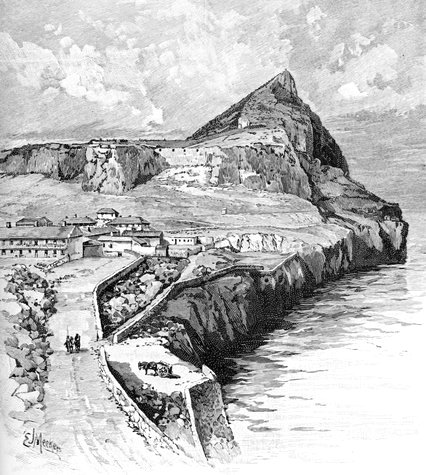
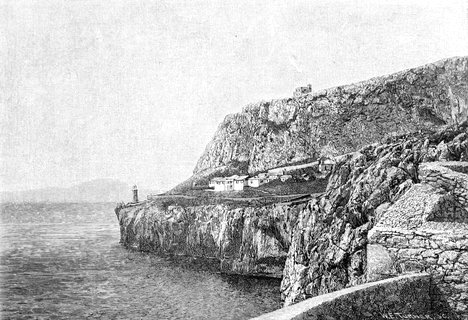
Although Gibraltar is the greatest fortress in the
world, if it were only that, it would not have half
the interest which it now has. The supreme interest of
the Rock is in the record of centuries that is graven on its
rugged front. For nearly eight hundred years it was the
prize of war between the Spaniard and the Moor, and its
legends are all of battle and of blood. Ten times it was
besieged and passed back and forth from conqueror to
conqueror, the Cross replacing the Crescent, and the Crescent
the Cross. Ten times was the battle lost and won.
When, at last, in 1598 the Spaniards drove the Moors out
of Spain, they remained masters of Gibraltar, and held it
with undisputed sway for a little more than a hundred
years. They might have held it still but for a surprise,
hardly worthy to be called a siege; for the place was
taken by a coup de main, that is one of the strangest incidents
of history. It was the War of the Spanish Succession,
waged by half Europe to determine which of two
incompetents should occupy the throne of Spain. The
English sent a squadron into the Mediterranean, under Sir
George Rooke, who, after cruising about and accomplishing
little, bethought himself, in order not to return in complete
failure, to try his hand on Gibraltar. The place was
well fortified, with a hundred guns, but inside the walls
only a hundred and fifty men (a man and a half to a
gun!), so that it could offer but a brief resistance to a
bombardment, and thus the Spaniards lost in three days
what they spent more than three years to recover, and
spent in vain.
Though the place was taken by an English fleet, it was
not taken for England, but in the name of an Archduke
of Austria, whom England supported as a pretender to
the Spanish throne; and had he succeeded in gaining it
the place would doubtless have been turned over to him
(as on a visit to Gibraltar he was received by the garrison
as lawful sovereign of Spain, and proclaimed King by the
title of Charles III.), but as he was finally defeated, England
thought it not a bad thing to keep the place for
herself.
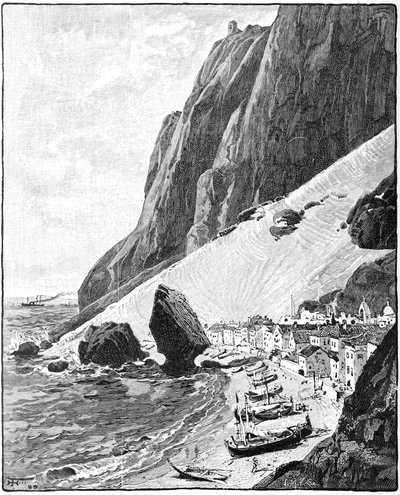
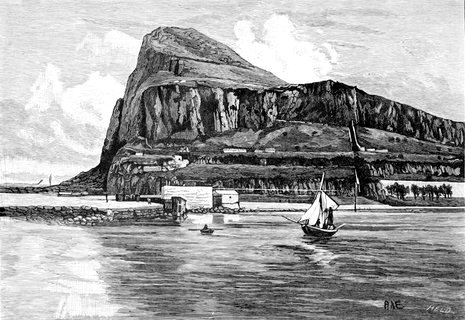
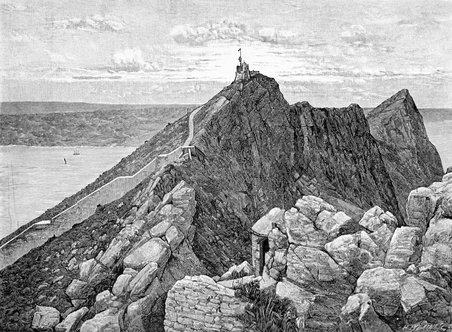
CATALAN BAY, ON THE EAST SIDE OF GIBRALTAR.
Cliff Scaled by the Spaniards in an Attempt to Take the Rock by Surprise.
Hardly had it slipped from their hands before the
Spaniards realized the tremendous blow which had been
given to their power and their pride, and made desperate
endeavors to recover it. The very same year they
attacked it with a large army and fleet. At the beginning
an attempt was made which would seem to have been
conceived in the heroism of despair. The eastern side of
Gibraltar terminates in a tremendous cliff, rising fourteen
hundred feet above the sea, which thunders against the
rocks below. This side has never been fortified, for the
reason that it is so defended by nature that it needs no
other defence. One would as soon think of storming El
Capitan in the valley of the Yosemite as the eastern side
of the Rock of Gibraltar. Yet he who has followed a
Swiss guide in the Alps knows that with his cool head and
agile step he will climb heights which seemed inaccessible.
And so a Spanish shepherd, or goatherd, had found a path
from Catalan Bay, up which he offered to lead a party
to the top, and five hundred men were daring enough to
follow him. They knew that the attempt was desperate,
but braced up their courage by religious enthusiasm, devoting
themselves to the sacrifice by taking the sacrament, and
binding themselves to capture Gibraltar or perish in the
attempt. In the darkness and silence of the night they
crept slowly upward till a part had reached the top, and
concealed themselves in St. Michael's Cave until the break
of day; when with the earliest dawn they attacked the
Signal Station, killing the guard, and then by ropes and
ladders brought up the rest of the party. Following up
the momentary success, they stormed the wall of Charles V.,
so called because constructed by him. But by this
time the garrison had been awakened to the fact that there
was an enemy within the walls. The roll of drums from
below summoned the troops to arms, and soon the grenadiers
came rushing up the hill. Exposed to the fire from
above, many fell, but nothing could check their advance,
and reaching the top they charged with such fury that
half of the party that had scaled the heights soon fell,
some of whom were driven over the cliff into the sea. An
officer who was present during the whole of the siege tells
how they made short work of it. "Five hundred Spaniards
attacked the Middle Hill but were soon repulsed,
and two hundred men with their commanding officer
taken. The rest were killed by our shot, or in making
their escape broke their necks over the rocks and precipices,
which in that place are many and prodigiously high."
So ended the first and last attempt to take Gibraltar in
the rear. But still the Spanish army lay encamped before
the town, and the siege was kept up for six months
with a loss of ten thousand men. No other attack was
made during that war, though the war itself raged elsewhere
for seven years more, till it was closed by the treaty
of Utrecht, in which Gibraltar was finally ceded to Great
Britain.
But the Spaniards did not give it up yet. In 1727 they
renewed the struggle, and besieged the place for five
months with nearly twenty thousand men, but with the
same result as before, after which it had rest and quiet
for half a century, till the time of the Great Siege, which
I am now to describe.
It seems beginning a long way off to find any connection
between the siege of Gibraltar and the battle of Saratoga;
but one followed from the other. The surrender of
General Burgoyne (who had marched from Canada with a
large army to crush the Rebellion in the Colonies) was the
first great event that gave hope, in the eyes of Europe,
to the cause of American independence, and led France
to join it openly, as she had before favored it secretly.
Spain followed France, having a common hatred of England,
with the special grievance of the loss of Gibraltar,
which she hoped, with the help of her powerful ally, to
recover.
In such a contest the chances were more evenly balanced
than might be at first supposed. True, England
had the advantage of possession, and if possession is nine
points of the law, it is more than nine points in war, especially
when the possessor is intrenched in the strongest
fortress in the world. But as an offset to this, she had to
hold it in an enemy's country. Gibraltar was a part of
the territory of Spain, in which the English had not a
foot of ground but the Rock on which they stood; while
it was much nearer to France than to England. Thus the
allied powers had facilities for attacking it both by land
and sea, and brought against it such tremendous forces
that it could not have held out for nearly four years, had
it not been for the British power of resistance, animated
by one of the bravest of soldiers.
To begin with, England did not commit the folly by
which Spain had lost Gibraltar—in leaving it with an insufficient
garrison. It had over five thousand troops in
the fortress—a force by which it was thoroughly manned.
But its power for defence was doubled by having a
commander, who was fitted by nature and by training
for the responsibilities that were to be laid upon him.
George Augustus Eliott was the son of Sir Gilbert Eliott,
of Roxburghshire, where he was born in 1718. Scotch
families in those days, like those of our New England
fathers, were apt to be large, and the future defender of
Gibraltar was one of eleven children, of whom but two
were daughters, and of the nine sons George was the
youngest. After such education as he could receive at
home, he was sent to the continent, and entered the
University of Leyden, where, with his other studies, he
acquired a knowledge of German, which was to be of
practical use to him afterward, as he was to serve for a
year in a German army. But France was the country
that then took the lead in the art of war; and from Holland
he was sent to a famous military school in Picardy,
founded by Vauban, the constructor of the French fortresses,
where he learned the principles which he was to
apply to the defence of a greater fortress than any in
France. He gave particular attention also to the practice
of gunnery. As Napoleon learned the art of war in the
artillery school of Brienne, so did Eliott in the school of
La Fère. An incidental advantage of this French education
was that he acquired the language so that he could
speak it fluently, a knowledge which was of service to him
afterward when he had so much to do with the French,
even though it were as enemies.
From France Eliott travelled into other countries on a
tour of military observation, and then enlisted for a year
in the Prussian army, which was considered the model in
the way of discipline. Thus equipped for the life of a
soldier, he returned to Scotland, where (as his father
wished that he should be further inured to the practice of
arms), he entered a Welsh regiment then in Edinburgh as
a volunteer, and served with it for a year, from which he
went into the engineer corps at Woolwich, and then into
a troop of "horse grenadiers," that, under his vigorous
training, became famous as a corps of heavy cavalry.
When it was ordered to the Continent, he went with it,
and served in Germany and the Netherlands, where he
took part in several engagements and was wounded at
the battle of Dettingen.
In this varied service Eliott had gained the reputation
of being a brave and capable officer, but had as yet no
opportunity to show the extraordinary ability which he
was afterward to display. He had, however, acquired
such a mastery of the art of war, that he was fitted for
any position. In those days, however, promotion was
slow, and he had served in the army (which he entered
at the age of seventeen,) forty years, and was fifty-seven
years old, and had yet reached only the grade of a Lieutenant-General,
when, in 1775, he was placed in command of
the fortress of Gibraltar. This was four years before the
siege began, by which time he was a little turned of sixty,
so that he was familiarly called "Old Eliott." But his
good Scotch frame did him service now, for he was hale
and strong, with a heart of oak and a frame of iron; asking
no indulgence on account of his years, but ready to endure
every fatigue and share every danger. Such was the
man who was to conduct the defence of Gibraltar, and to
be, from the beginning to the end, its very heart and
soul.[4]
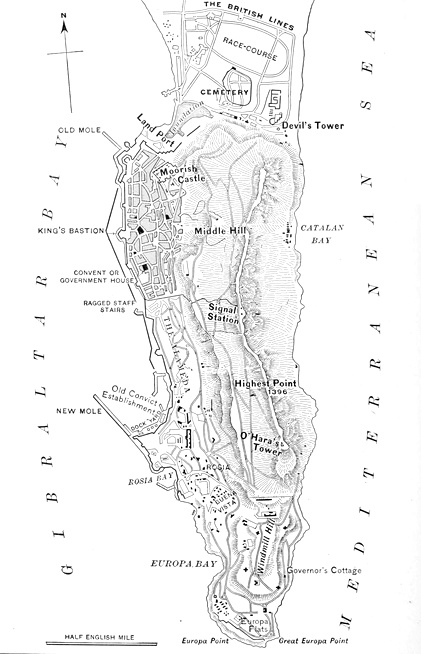
PLAN OF GIBRALTAR.
It was in the year 1779, and on the very longest day
of the year, the 21st of June, that Spain, by order of the
King, severed all communication with Gibraltar. But
this was not war; it was simply non-intercourse, and not
a hostile gun was fired for months. It is an awkward
thing to strike the first blow where relations have been
friendly. It had long been the custom of the Spaniards
to keep a regiment of cavalry at San Roque, and one of
infantry at Algeciras, across the bay, between which and
the garrison there was a frequent exchange of military
courtesies. Two days before this abrupt termination of
intercourse, the Governor had been to pay his respects to
General Mendoza, and found him very much embarrassed
by the visit, so that he suspected something was wrong,
and was not surprised when the order came down from
Madrid to cut off all friendly communication. The Spaniards
had resolved to make a fresh attempt to recapture
Gibraltar, thinking at first that it might be done by a
blockade, without a bombardment. There are two ways
to take a fortress—by shot and shell, or by starvation.
The latter may be slower and not so striking to the imagination
as carrying a walled city by storm, but it is
even more certain of success if only the operation can be
completely done. But to this end the place must be
sealed up so tightly that there shall be no going out nor
coming in. This seems a very simple process, but in execution
is not so easy, especially if the fortress be of large
extent, and has approaches by land and sea. The Spaniards
began with a vigor that seemed to promise success,
by constructing a parallel across the isthmus which connects
the Rock with the mainland. This was itself a
formidable undertaking, but they seemed not to care for
cost or labor. Putting ten thousand men at work, they
had in a few weeks drawn a line across the Neutral
Ground, which rendered access to the garrison impossible
by land. Any supplies must come by sea.
To prevent this, the Spaniards had a large fleet in the
Bay and cruising in the Straits. But with all their vigilance,
they found it hard to keep a blockade of a Rock,
with a circuit of seven miles, when there were hundreds
of eyes looking out from the land, answered by hundreds
of watchers from the sea. In dark nights boats with muffled
oars glided between the blockading ships, and stole
up to some sheltered nook, bringing news from the outside
world. And there were always daring cruisers ready
to attempt to run the blockade, taking any risk for the
sake of the large reward in case of success. Sometimes
the weather would favor them. A fierce "Levanter"
blowing from the east, would drive off the fleet, and fill
the Straits with fog and mist, under cover of which they
could run in undiscovered. At another time a bold privateer
would come in, in face of the fleet, and if sighted
and pursued, would set all sail, and rush to destruction
or to victory. Once under the guns of the fortress she
was safe. Thus for a time the garrison received irregular
supplies.[5]
But in spite of all it was often in sore and pressing
need. The soldiers required to be well fed to be fit for
duty, and yet not infrequently they were half starved.
Six thousand capacious mouths made havoc of provisions,
and a brig-load was quickly consumed. As if this was
not enough, the hucksters of the town, who had got hold
of the necessaries of life, secreted them to create an appearance
of greater scarcity, that they might extort still
larger prices from the famine-stricken inhabitants. Drinkwater,
in his "History of the Siege," gives a list of prices
actually paid.
"The hind-quarter of an Algerian sheep, with the head and
tail, was sold for seven pounds and ten shillings; a large sow for
upwards of twenty-nine pounds; a goat, with a young kid, the
latter about twelve months old, for near twelve pounds. An English
milch cow was sold for fifty guineas, reserving to the seller a
pint of milk each day whilst she gave milk; and another cow was
purchased by a Jew for sixty guineas, but the beast was in such a
feeble condition that she dropped down dead before she had been
removed many hundred yards."
But it was not only meat that was wanted: bread was
so scarce that even biscuit-crumbs sold for a shilling a
pound! The economy of flour was carried to the most
minute details. It was an old custom that the soldiers
who were to mount guard should powder their hair, like
the servants in the royal household; but even this had to
be denied them. The Governor would not waste a thimbleful
of the precious article, which he had rather see
going into the stomachs of his brave soldiers than plastered
on their hair.
A brief entry in a soldier's diary, tells how the pinch
came closer and closer: "Another bakery shut up to-day.
No more flour. Even salt meat scarce, and no vegetables."
Shortly after this an examination of supplies revealed
the fact that no fresh meat remained, with the exception
of an old cow, which was reserved for the sick. A goose
was sold for two pounds, and a turkey for four.
In such a condition—so near to the starvation point—there
was but one thing to do. It was a hard necessity,
but there was no help for it, and an order was issued for
the immediate reduction of the soldiers' rations, already
barely sufficient to sustain life.
The effect of this continued privation upon the morale
of the garrison was very depressing. Hunger, like disease,
weakens the vital forces, and when both come together
they weigh upon the spirit until the manliest
give way to discouragement. That this feeling did not
become general was owing chiefly to the personal influence
of the Governor, whose presence was medicine to
the sick, and a new force to the well, making the brave
braver and the strong stronger. When famine stared
them in the face he made light of it, and taught others to
make light of it by sharing their privations. At the beginning
of the siege he had formed a resolution to share
all the hardships of his men, even to limiting himself to
the fare of a common soldier. His food was of the plainest
and coarsest. As a Scotch boy he had perhaps been
brought up on oatmeal porridge, and it was good enough
for him still. If a blockade-runner came in with a cargo
of fresh provisions, he did not reserve the best for himself,
but all was sold in the open market. If it be said
that he had the means to buy which others had not, yet
his tastes were so simple that he preferred to share the
soldier's mess rather than to partake of the richest food.
Besides, he had a principle about it. To such extent did
he carry this, that, on one occasion, when the enemy's
commander, as a courtesy not unusual in war, sent him a
present of fruit, vegetables, and game, the Governor,
while returning a polite acknowledgment, begged that the
act might not be repeated, for that he had a fixed resolution
"never to receive or procure, by any means whatever,
any provisions or other commodity for his own private
use;" adding, "I make it a point of honor to partake
both of plenty and scarcity in common with the lowest of
my brave fellow-soldiers." Once indeed when the stress
was the sharpest, he showed his men how close they could
come to starvation and not die, by living eight days on
four ounces of rice a day! The old hero had been preparing
for just such a crisis as this by his previous life,
for he had trained himself from boyhood to bear every
sort of hardship and privation. The argument for total
abstinence needs no stronger fact to support it than that
the defence of Gibraltar was conducted by a man who
needed no artificial stimulus to keep up his courage or
brace his nerves against the shock of battle. "Old
Eliott," the brave Scotchman and magnificent soldier, was
able to stand to his guns with nothing stronger to fire his
blood than cold water. Chalmers' Biographical Dictionary
says:
"He was perhaps the most abstemious man of the age. His
food was vegetables, and his drink water. He neither indulged
himself in animal food nor wine. He never slept more than four
hours at a time, so that he was up later and earlier than most other
men. He had so inured himself to habits of hardness, that the
things which are difficult and painful to other men were to him
his daily practice, and rendered pleasant by use. It could not be
easy to starve such a man into a surrender, nor to surprise him.
His wants were easily supplied, and his watchfulness was beyond
precedent. The example of the commander-in-chief in a besieged
garrison, has a most persuasive efficacy in forming the manners of
the soldiery. Like him, his brave followers came to regulate
their lives by the most strict rules of discipline before there arose
a necessity for so doing; and severe exercise, with short diet, became
habitual to them by their own choice."
Thus the old Governor, by starving himself, taught his
men how to bear starvation. After that a soldier, however
pinched, would hardly dare to complain.
He might not indeed care for himself, but he could not
help caring for those dependent on him. The cruel hardship
of it was that the suffering fell not on the soldiers
alone, but on women and children. The Governor had
tried, as far as possible, to send away all non-combatants.
But it was not always easy to separate families. There
were soldiers' wives, who clung to their husbands all the
more because of their danger. If a Scotch grenadier
were to have his legs carried off by a cannon-ball, or
frightfully torn by a shell, who could nurse him so well as
his faithful wife, who had followed him in the camp and
in the field? And so, for better, for worse, many a wife,
with the courage of womanhood, determined to share her
husband's fate. It was a brave resolution, but it only
involved them in the common distress. There were so
many more mouths to feed, when the supply even for the
soldiers was all too little. The captain who has recorded
so faithfully the heroisms and the privations of the siege,
says:
"Many officers and soldiers had families to support out of the
pittance received from the victualling office. A soldier and his
wife and three children would inevitably have been starved to
death had not the generous contribution of his corps relieved his
family. One woman actually died through want, and many were
so enfeebled that it was not without great attention they recovered.
Thistles, dandelions, and wild leeks were for some time the
daily nourishment of numbers."
Another account tells the same pitiful tale, with additional
horrors:
"The ordinary means of sustenance were now almost exhausted,
and roots and weeds, with thistles and wild onions, were greedily
sought after and devoured by the famished inhabitants.
"Bread was becoming so scarce that the daily rations were
served out under protection of a guard, and the weak, the aged,
and the infirm, who could not struggle against the hungry, impetuous
crowd that thronged the doors of the bakeries, often returned
to their homes robbed of their
share."[6]
"Ancell's Journal," kept during the siege, thus records
the impressions of the day:
"It is a terribly painful sight to see the fighting among the
people for a morsel of bread at an exorbitant price; men wrestling,
women entreating, and children crying, a jargon of all languages,
piteously pouring forth their complaints. You would
think sensibility would shed a tear, and yet when we are in equal
distress ourselves our feelings for others rather subside."
While this slow and wasting process of starvation was
going on, the garrison were in a fearful state of suspense.
Sometimes it seemed as if England had forgotten them,
but again came tidings that the nation was watching their
defence with the utmost anxiety, and would speedily send
relief. The time of waiting seemed long as the months
passed—summer and autumn and part of winter, and
no help appeared. The blockade began in June, 1779,
and it was January, 1780, before the fleet of Admiral
Rodney, after gaining a battle over the Spanish fleet off
the coast of Portugal, bore away to the south. To those
who were watching from the top of the Rock, probably
no event of their lives ever moved them so much as when
they first caught sight of the English ships entering the
Straits of Gibraltar. Men, women, and children, wept
aloud for joy, for the coming fleet brought them life from
the dead. And when it anchored in the bay, and the
ships began to unload, they brought forth not only guns
and ammunition, but more priceless treasures—beef, pork,
butter, flour, peas, oatmeal, raisins, and biscuits, as well
as coals, iron hoops, and candles! Revelling in such
abundance, could they ever want again? It was indeed a
timely relief, and if the fleet could have remained, it
might have put an end to the siege. But England was
then carrying on wars in two hemispheres; and while the
French fleet was crossing the Atlantic to aid the American
colonies in gaining their independence, she could not
afford that her largest fleet should lie idle in the Bay
of Gibraltar. As soon, therefore, as the stores could
be landed, Admiral Rodney returned to England. The
Governor seized the opportunity to send home great
numbers of invalids and women. It was necessary that
the garrison should "strip for the fight," as there were
darker days to come.
Gibraltar had been saved from the jaws of famine by
the arrival of the English fleet. But as soon as it left,
the Spanish ships remained masters of the bay, and the
blockade was closer than ever. The garrison had had a
narrow escape. That it might not be caught so again,
the Governor, with his Scotch thrift, put his men upon a
new kind of service, quite apart from military duty.
The Rock is not wholly barren. There are many nooks
and corners that are bright with flowers, and anything
that the earth can yield will ripen under that warm southern
sky. Accordingly the soldiers, in the intervals of firing
the big guns, were put to do a little gardening; and
turned patches of ground here and there to cultivation;
and where the hillside was too steep, the earth was raised
into terraces and banked up with walls, on which they
raised small quantities of lettuce or cabbages; so that
afterward, although they still suffered for many of the
comforts, if not the necessaries, of life, they never came
quite so near absolute starvation.
This "home produce" was the more important as the
garrison was now to be cut off from its principal resource
outside. For a time it had been able to obtain supplies
from the Barbary Coast. At first the Moors were all on
the side of England, for the Spaniards were their hereditary
enemies, who had fought them for hundreds of
years, and finally driven them out of Spain, for which the
Moors took a pious revenge by thronging the mosques of
Tangier to pray that Allah would give the victory to the
arms of England! But after a time they saw things in a
new light. It could not be Christian charity that softened
their hearts toward their old enemies, for they hated
the very name of Christian, but some secret influence
(was it Spanish gold?) so worked on the mind of the Sultan
of Morocco that he became convinced that Allah was
on the side of the besiegers—a discovery which he announced
in a manner that was not quite in the usual style
of diplomatic intercourse. Thus, without any warning,
"A party of black troops that were quartered in the vicinity of
Tangier, came to the house of the British Consul, and being introduced,
informed him that they had orders from their master to
abuse and insult him in the grossest manner, which they immediately
put in execution by spitting in his face, seizing him by the
collar, and threatening to stab him with their daggers!"
Fortunately he escaped with nothing worse than this
gross outrage; but the serious part of the business was
that it cut off all communication of Gibraltar with the
Barbary Coast; for the Sultan prohibited the export of
provisions, and as the supplies brought by the convoy
were exhausted in a few months, the garrison was again,
not indeed at the starvation point, but in sore need
of what was for its health and vigor. The meagre diet
threatened to produce a pestilence. At one time there
were seven hundred men in the hospitals; at another the
small-pox broke out; and at another the garrison was so
reduced by the scurvy, caused by the use of salt meats,
that strong men became weak as children, and hobbled
about on crutches. This threatened a great disaster,
which was averted only by lemons! In the moment of
extremity a Dutch "dogger" coming from Malaga was
captured, and found to be laden with oranges and lemons,
"a freight which, at such a crisis, was of more value to
the garrison than tons of powder or magazines of ammunition."
The lemons were instantly distributed in the
hospitals. The men seized them and devoured them
ravenously, and the restoration was so speedy as to seem
almost miraculous.
And yet this relief was only temporary. Soon we
have this picture of the condition of the garrison:
"As the spring of 1781 advanced, the situation assumed the
most distressing aspect. The few provisions which remained were
bad in quality, and having been kept too long were decomposed
and uneatable. The most common necessaries of life were exorbitantly
dear; bad ship biscuit, full of worms, was sold at a shilling
a pound; flour, in not much better condition, at the same
price; old dried peas, a shilling and fourpence; salt, half dirt,
the sweepings of ships' bottoms and storehouses, at eight pence;
old salt butter, at two shillings and sixpence; and English farthing
candles cost sixpence apiece. Fresh provisions commanded
a still higher price: turkeys sold at three pounds twelve shillings,
sucking pigs at two guineas, and a guinea was refused for a calf's
pluck.
"The English government, aware of this condition of things,
had for months turned their attention to the relief of the fortress;
but the many exigencies of the war, and the extensive arena over
which it was spread, caused so many demands upon the navy
that it had hitherto been impossible to provide a fleet for the
succor of Gibraltar. But the relief of the garrison was indispensable,
and the honor of England required that it should be executed.
Accordingly the government made extraordinary efforts
to equip a squadron to convoy a flotilla of merchantmen to the
Rock."[7]
But with all their efforts, it was more than a year before
the second fleet arrived. When it came, it was
loaded with all conceivable supplies, which took ten days
to unload. The joy of the beleaguered garrison knew no
bounds. And yet this new relief only precipitated a
calamity which had been long impending. The scene of
the arrival is thus described by an eye-witness:
"At daybreak, April 12th, the much-expected fleet, under the
command of Admiral Darby, was in sight from our Signal-house,
but was not discernible from below, being obscured by a thick
mist. As the sun, however, became more powerful, the fog gradually
rose, like the curtain of a vast theatre, discovering to the
anxious garrison one of the most beautiful and pleasing scenes it
is possible to conceive. The convoy, consisting of near a hundred
vessels, led by several men-of-war, their sails just enough
filled for steerage; whilst the majority of the line-of-battle ships
lay-to under the Barbary shore, having orders not to enter the
bay lest the enemy should molest them with their fire-ships. The
ecstasies of the inhabitants at this grand and exhilarating sight
are not to be described. Their expressions of joy far exceeded
their former exultations [at the arrival of the fleet under Admiral
Rodney]. Alas! they little dreamed of the tremendous blow that
impended, which was to annihilate their property, and reduce
many of them to indigence and
beggary."[8]
What this blow was, at once appeared. The arrival of
the second fleet from England convinced the Spaniards
that it would be impossible to reduce Gibraltar by blockade,
and determined them to try the other alternative of
bombardment. Enormous batteries, mounting 170 guns
and 80 mortars, had been planted along the shore; and
now (before even the English ships could be unladen of
their stores) was opened all round the bay a feu d'enfer,
which was kept up for six weeks! Only two hours
out of the twenty-four was there any cessation, and that
for a singular reason. National customs must rule in war
as in peace. The Spaniards began their fire at daybreak,
and continued it without intermission till noon. Then
suddenly it ceased, and the camp of the besiegers relapsed
into silence: for that the officers, if not the men, were
asleep! What Spanish gentleman could be deprived of
his siesta? At two o'clock precisely they woke up and
went to fighting again. At nightfall the cannon ceased,
but only that the mortars (which did not need to be aimed
with precision, and therefore could be fired in darkness
as well as in daylight) opened their larger throats, and
kept up the roar till daybreak. Thus, with only the time
of the siesta, there was not an hour of day or night that
the Rock did not echo with tremendous reverberations.
The town was soon set on fire, and completely destroyed.
There was no safety anywhere, not even in the casemates.
If a bomb-proof withstood a falling shell, it would sometimes
explode at the open door, wounding those within.
Men were killed sleeping in their beds. The scene at
night was more terrible than by day, as the shells were
more clearly seen in their deadly track. Sometimes a
dozen would be wheeling in the air at the same moment,
keeping every eye strained to see where the bolts would
fall, and the bravest held their breath when (as was several
times the case) they fell near the powder magazines!
Again, the soldiers were not the only ones to suffer:
their wives and children were their partners in misery.
When the town was on fire, the people fled from it, and
at a distance watched the flames that rose from their
burning dwellings, in which all their little property was
consumed—the roofs that sheltered them, and even the
food that fed them. For six weeks they had not a moment's
rest, day nor night. Although they had fled to
the southern end of the Rock, destruction pursued them
there. The Spanish ships had a custom of sailing round
Europa Point, and firing indiscriminately on shore. This
was generally at night, so that the poor creatures who had
lain down to snatch a moment of forgetfulness, were
roused at midnight and fled almost naked to seek for
shelter behind rocks and in holes in the ground, in which
they cowered like hunted beasts, till the storm of fire had
passed over them.
The troops were not quite so badly off, for though they
were shelled out of their old quarters, and had not a roof
to cover them, yet English soldiers and sailors are ingenious,
and getting hold of some old ship canvas they
rigged up a few forlorn tents, which they pitched on the
hillside. But again they were discomfited. Gibraltar is
subject at certain seasons to terrific storms of thunder and
lightning, and now the rains poured down the side of the
Rock in such floods as to sweep away the tents, and leave
the men exposed to the fury of the elements. It seemed
as if the stars in their courses fought against them. But
they were to find that the stars in their courses fight for
those who fight for themselves.
Sometimes the storms, so terrible in one way, brought
relief in another. There had been a scarcity of fuel as
well as of food. A soldier could hardly pick up sticks
to make his pot boil, and cook his scanty meal; so that
when a furious gale wrecked a ship in the bay, and cast
its fragments on the shore, which furnished fuel for their
camp-fires for some weeks, they counted it a providential
interposition for their deliverance; and as the firelight
cast its ruddy glow in their faces, they thanked God and
took courage.
But with all their courage, kept up by such occasional
good fortune, it was a life-and-death struggle, as they
fought not only with the enemy, but with hunger and
cold, and every form of privation.
During all this dreadful time the old Governor was
magnificent. Going among the families that were houseless
and homeless, for whom he felt the utmost sympathy
(for with all his rugged strength he had a very tender
heart), he allayed their fears; terrified and miserable as
they were, it was impossible to resist the sunshine of that
kindly Scotch
face.[9]
Then he turned to his soldiers, who may well have
been appalled by the tremendous fire, which wrought such
wreck and ruin. If they were troubled and anxious, he
was calm. He shunned no danger, as he had shunned
no privation. Indeed danger did not affect him as it did
other men, but only roused the lion in his breast. The
more the danger grew, the higher rose his unconquerable
spirit. He was constantly under fire, and his perfect
coolness tended to produce the same composure in others
equally exposed. Terrible as the bombardment was, not
for one moment did he admit the possibility of surrender.
But now came a new danger, not from without, but
from within. The fire which swept the town uncovered
cellars and other hiding-places in which the hucksters
had concealed provisions and other stores to double their
price, and extort the last penny from the half-fed population.
When their storehouses were destroyed little sympathy
was felt for them. Indeed, there was a general
feeling of savage exultation; and as here and there supplies
of food were found, they were seized without scruple
and appropriated to the common use. Men who have
been living on short allowance are apt to be led into excesses
by sudden plenty, and the soldiers could hardly be
blamed if for once they gave themselves a generous supply.
From the extreme of want they went to the extreme
of waste. In some cases incredible profusion
prevailed. Drinkwater says: "Among other instances
of caprice and extravagance, I recollect seeing a party of
soldiers roast a pig by a fire made of cinnamon!"
If this had been all, there would not have been so much
to regret. But in the stores were casks of wine and barrels
of spirits, which were now knocked on the head, and
the contents distributed with no restraint, till soon a large
part of the garrison was in such a state of intoxication as
to be utterly unfit for duty. "As the enemy's shells
forced open the secret recesses of the merchants, the soldiers
instantly availed themselves of the opportunity to
seize upon the liquors, which they conveyed to haunts of
their own. Here in parties they barricaded their quarters
against all opposers, and insensible of their danger, regaled
themselves with the spoils." For a time this sudden
madness ran riot in the streets, threatening the overthrow
of all order and discipline.
It can hardly be matter of surprise that the reaction
from this long tension of feeling, with the sudden temptation
to drunkenness, should show itself in wild extravagances.
An incident related in "Ancell's Journal," shows
the soldier in the mood of making sport of his dangers:
"April 15, 1781.—Yesterday I met a soldier singing in the
street with uncommon glee, notwithstanding the enemy were firing
with prodigious warmth,
'A soldier's life is a merry life,
From care and trouble free.'
He ran to me with eagerness, and presenting his bottle, cried:
'D——n me if I don't like fighting, with plenty of good liquor
for carrying away. 'Why, Jack,' says I, 'what have you been
about?' 'Faith,' says he, 'I scarce know myself. I have been
constantly, on foot and watch, half-starved and without money,
facing a parcel of pitiful Spaniards. I have been fighting, wheeling,
marching, counter-marching, sometimes with a firelock,
sometimes with a handspike, and now with my bottle.'
"A shell that instant burst, a piece of which knocked the bottle
out of his hand. 'Jack,' says I, 'are you not thankful to God
for your preservation?' 'How do you mean?' says he; 'fine
talking of God with a soldier whose trade and occupation is cutting
throats. Divinity and slaughter sound very well together;
they jingle like a cracked bell in the hands of a noisy crier. My
religion is a firelock, open touch-hole, good flint, well-rammed
charge, and seventy rounds: this is military creed. Come, comrade,
drink!'"
Such license as this would soon demoralize the best
troops in the world. Had the Spaniards known the degree
to which it existed at that moment, and been able to
effect an entrance into the fortress, Gibraltar might have
been lost.
The insubordination was suppressed only by the most
strenuous efforts of the Governor and the vigorous enforcement
of discipline. An order was issued that any
soldier caught marauding should be "executed immediately,"
and this summary judgment was put in force in
several cases, where men were not only executed without a
moment's delay, but on the very spot where the crime was
committed. This timely severity, with the personal influence
of the Governor, at length brought the soldiers to
their senses, and order was restored. Perhaps they were
brought back to duty in part by the continued roar of
that terrific bombardment, for in a true soldier nothing
rouses the martial spirit like the sound of the enemy's
guns. Danger and duty go together: and many of those
who had been carried away by this temporary frenzy,
when they "came to themselves," were among the bravest
who fought in the conflicts that were yet to come.
It was now a struggle of endurance—firing and counter-firing
month after month, with exciting incidents now
and then to relieve the monotony of the siege. Of these
episodes the most notable was the sortie executed on the
night of November 26, 1781. The siege had lasted more
than two years, and the Spaniards, boastful and confident
as they are apt to be, by this time appreciated the enormous
difficulty of attacking the Rock of Gibraltar. To do
them justice, instead of being daunted by the greatness of
the task, their military ardor rose with the vastness of the
undertaking, and they had been engaged for months in
rearing a stupendous parallel across the Neutral Ground,
to be mounted with the heaviest battering artillery. The
Governor had kept his eye upon the progress of the work,
and as he saw its lines spreading out wider and wider,
and rising higher and higher, he could not but feel anxiety
for the moment when these batteries should open, and
rain shot and shell upon the devoted garrison. The way
in which he met the new danger showed that he had the
promptness in action of a great commander.
From the beginning of the siege he had observed the
utmost economy in the use of his resources. He was
sparing of his ammunition, and sometimes reproached his
officers with great severity for wasting it in unimportant
attacks. He saved his powder as he saved his men. Indeed
he was sparing of everything except himself. Yet
"he never relaxed from his discipline by the appearance
of security, nor hazarded the lives of his garrison by wild
experiments. Collected within himself, he in no instance
destroyed, by premature attacks, the labors which would
cost the enemy time, patience, and expense to complete;
he deliberately observed their approaches, and seized on
the proper moment in which to make his attack with success."
For months he had been waiting and watching:
the time for action had now come.
During the siege there had been frequent desertions on
both sides. Now and then soldiers of the garrison,
wearied with the interminable siege (and thinking it better
to take the chances of instant death than to be shut
up in a fortress-prison and perish by inches), let themselves
down by ropes over the face of the Rock. Some
escaped to the enemy, and some were dashed on the rocks
below. On the other side there were among the Spanish
soldiers a good many Walloons from Belgium, who had
no interest in the contest, and were as ready to fight on
one side as the other. Occasionally one of these would
stray out of the camp, as if without intention, and when
he had got at a distance which he thought gave him a
chance of escape, would take to his heels and run for the
gates of the fortress. If discovered, he was immediately
fired at, and a mounted guard started in pursuit, and if
overtaken, he was brought back, and the next day his
body, hanging from the scaffold, in full sight of the Rock,
served as a ghastly warning alike to the besiegers and the
besieged.
But, in spite of all, desertions went on. One day a
couple of deserters were brought to the Governor, one of
whom proved to be uncommonly intelligent, and gave important
information. "Old Eliott" took him up to a
point of the Rock from which they could look down into
the camp of the besiegers, and questioned him minutely
as to its condition and the intentions of the enemy. He
said that the parallel was nearly completed; and that as
soon as all was ready the Spaniards would make a grand
assault; but that meanwhile the works, enormous as they
were, were not guarded by a large force, the besiegers not
dreaming that the batteries prepared for attack could be
themselves attacked! The Governor instantly perceived
the value of this information, but kept it to himself, and
had the deserter closely confined lest he should incautiously
reveal to others what he had told to him. Keeping
his own counsel, he made his preparations, which he
did not disclose even to his lieutenants until the moment
for action. It was in the evening when he called them
together, and announced his intention to make an attack
on the works of the besiegers that very night, and at midnight
about two thousand men were in arms on the "Red
Sands," now the Alameda, to carry the daring purpose
into execution. Their orders were of the strictest kind:
"Each man to have thirty-six rounds of ammunition, with
a good flint in his piece and another in his pocket. No
drums to go out, excepting two with each of the regiments.
No volunteers will be allowed." The brave old
commander wanted no amateurs on such an occasion.
"No person to advance before the front, unless ordered
by the officer commanding the column: and the most profound
silence to be observed." As it took two or three
hours to form the columns, and acquaint all with the
special duty to be undertaken, and the necessity for the
strictest obedience, it was nearly three o'clock when they
began to move. The moon was just setting across the
bay, and soon all was dark and still, as the men advanced
with quick but cautious steps through the silent streets.
The commander had picked his men for the daring attempt.
Knowing how powerful are the traditions of
bravery, he had chosen two regiments that had fought
side by side at the battle of Minden, twenty-two years before.
The officers to lead them he had chosen with
equal care, and yet, when it came to the moment of
action, the old soldier felt such a fire in his bones that
he could not resist the impulse to keep them company.
As they emerged from the gates they had still three-quarters
of a mile across the plain to reach the enemy's
works. With all the precautions to secure silence, the
tramp of two thousand men, however muffled, could
not but reach the ears of the Spanish sentinels, and a
few rapid shots told that they were discovered. But
the alarm was given too late. It only quickened the advance
of the column, which, as it reached the works,
rushed over the parapet, bayoneting the men, such as did
not flee, panic-stricken by the sudden attack, and spiking
the guns. As the soldiers had come prepared with faggots
for the purpose, they immediately set the works on fire.
But even at this moment of terror there was one who
thought of mercy as well as of victory. Before the flames
had spread the Governor, "anxious that none of the wounded
should by any accident perish in the burning batteries,
went into the trench himself and found among the bodies
of the slain a wounded officer, whom by his uniform he
knew to be a captain of the Spanish artillery, to whom he
spoke with all kindness, and promising him every assistance,
ordered him to be removed, as the fire was now rapidly
spreading to the spot where he lay. But the Spaniard,
raising himself with difficulty, feebly exclaimed,
"No, sir, no, leave me and let me perish amid the ruins of
my post." In a few minutes he expired. It was afterward
found that he had commanded the guard of the San Carlos
battery, and that when his men threw down their arms
and fled, he rushed forward into the attacking column,
exclaiming, "At least one Spaniard shall die honorably,"
and fell where he was found, at the foot of his
post."[10]
It was now too late to talk of mercy. In an hour the
flames had spread into a conflagration that could not be
subdued. As it rose into the air, it lighted up the Rock
above and the plain below. Leaving the elements to complete
the work of destruction, the assailants made their
retreat, only to hear, as they re-entered the gates, the explosion
of the magazines. So vast was the ruin wrought
that the camp was like a city on fire, and continued to
burn for four days, without an effort on the part of the
Spaniards (who seemed to be stunned and bewildered by
the sudden attack) to subdue the flames. Thus was destroyed
at a single stroke what it had cost months of
labor and millions of money to construct.
And so the game of war went on for three long years,
until it had fixed the gaze of the whole civilized world.
The last act was to be inaugurated by a change in the
military command, and in the method of attack. Hitherto
the siege had been conducted chiefly by the Spaniards,
as was fitting, since, if the fortress were taken, to
Spain would fall the splendid prize. They had fought
bravely, maintaining the reputation which had never been
shaken from the days of Alva, when the Spanish infantry
was more dreaded than any other on the battle-fields of
Europe. During the siege the officers of the garrison, as
they looked down from their heights into the hostile
camp, could not but admire the way in which both officers
and men exposed themselves. It was not to their dishonor
if they had failed in attempting the impossible.
But having to confess defeat, it was but military prudence
to see if another mode of operation might not be
more successful. Accordingly, French skill in the art of
war was now called in to take part in the tremendous conflict.
The Duc de Crillon, who had recently distinguished
himself by the capture of Minorca, was put in command
of the combined land forces; while a French engineer,
the Chevalier d'Arçon, was to prepare an armament more
formidable than had ever been known in naval warfare.
The plan had certainly the merit of boldness. There
was to be no more long blockade, and no more attempt to
take the place by stratagem. Gibraltar was to be taken,
if at all, by hard fighting. But the conditions of battle
were unequal: for how could wooden ships be matched
against stone walls? No ships of the day could stand an
hour against guns fired from behind those ramparts.
But this engineer was bold enough to believe that vessels
could be made so strong that they would withstand even
that tremendous fire. He proposed to construct "battering
ships" of such enormous strength that they could be
moored within short range, when he in turn would open a
fire equally tremendous, that should blow Gibraltar into
the air! All he asked was that his flotilla might be laid
close alongside the enemy, when, gun to gun and man to
man, the contest should be decided. Once let him get
near enough to make a breach for a storming party to
mount the walls, and his French grenadiers would do the
rest. It was bravely conceived, and to the day of battle
it seemed as if it might be bravely done.
To begin with, ten of the largest ships in the Spanish
navy were to be sacrificed: for it seemed like a sacrifice
to cut down the huge bulwarks of their towering sides.
But show was to be sacrificed to strength. The new constructor
would have no more three-deckers, nor two-deckers.
All he wanted was one broad deck, reaching the
whole length of the ship, from stem to stern, which
should be as solid as if it were a part of the mainland, or
a floating island, on which he could plant his guns as on
the ramparts of a fortress. Having thus dismantled and
razeed the great ships, he proceeded to reconstruct them
without and within. His method is of interest, as showing
how a hundred years ago a naval engineer anticipated
the modern construction of ironclads. His battering
ships were in outward shape almost exactly what the
Merrimac was in our civil war. He did everything except
case them with iron, the art of rolling plates of wrought
iron, such as are now used in the construction of ships,
not being then known. But if they could not be
"plated" with iron on the outside, they were "backed"
by ribs of oak within. Inside their enormous hulls was a
triple thickness of beams, braced against the sides. Next
to this was a layer of sand, in which it was supposed a
cannon-ball would bury itself as in the earth. To this
sand-bank, resting against its oaken backing, there was
still an inner lining in a thick wall of cork, which, yielding
like india-rubber, would offer the best resistance to
the penetration of shot.
Having thus protected the hulls, it was only necessary
to protect the crews. For this the decks were roofed
with heavy timbers, which were covered with ropes, and
next with hides, after the manner of the ancient Romans;
so that the men working at the guns were almost as secure
from the enemy's fire as if they were inside of the
strongest casemates that the art of fortification could construct.
Thus shielded above and below—from the deck
to the keel—these novel ships-of-war were in truth floating
fortresses, and it was hardly presumptuous in their
constructor to say that they "could not be burnt, nor
sunk, nor taken."
These preparations for attack could not be made without
the knowledge of the garrison. From the top of the
Rock they had but to turn their glasses across the bay,
and they could see distinctly hundreds of workmen
swarming over the great hulks, and could almost hear the
sound of the hammers that ceased not day nor night.
Turning to the camp of the besiegers, they could see
"long strings of mules streaming hourly into the trenches
laden with shot, shell, and ammunition." Deserters
brought in reports of the vast preparations, and the confidence
they inspired. The fever of expectation had spread
to the capitals of Spain and France. The King of Spain
was almost beside himself with eagerness and impatience.
Every morning his first question was "Is it taken?" and
when answered in the negative he always kept up his
courage by saying, "It will soon be ours." His expectations
seemed now likely to be realized. All felt that
at last the end was nigh, and the Comte d'Artois, the
brother of Louis XVI., the King of France, had made the
journey all the way from Paris to be present at the grand
culmination of the surrender of Gibraltar!
So sure were the allies of victory that they debated
among themselves as to "how many hours" the garrison
could keep up a resistance. Twenty-four hours was the
limit, and when the French commander, less sanguine
than the naval constructors and engineers, thought it
might be even two weeks before the place fell, he was
the subject of general ridicule.
Taking for granted that the fire of the garrison would
soon be silenced, precise directions were given about the
landing of the storming party. As soon as a break was
made, the grenadiers were to mount the walls. It was
especially ordered that strong bodies of troops should
advance rapidly and cut off the retreat of the garrison,
which might otherwise flee to the heights of the Rock,
and keep up for a while longer the hopeless resistance.
The victory must be complete.
On the other hand, the garrison was roused to greater
exertion by the greater danger. Its ardor was excited
also by what was passing in other parts of the world.
War was still raging in both hemispheres, with the usual
vicissitudes of victory and defeat. England had lost
America, but her wounded pride was soon relieved, if not
entirely removed, by a great victory at sea. Cornwallis
surrendered at Yorktown, in October, 1781, and only six
months after, in April, 1782, Admiral Rodney (the same
who had relieved Gibraltar only two years before) gained
a victory in the West Indies over Count de Grasse, which
almost annihilated the French fleet, and assured to England,
whatever her losses upon land, the mastery of the
seas. The tidings of this great victory reached Gibraltar,
and fired the spirit of every Briton. The Governor was
now sixty-four years old, and the events of the last three
years might well make him feel that he was a hundred.
But his youth returned in the great crisis that was upon
him. Both Governor and garrison burned to do something
worthy the name and fame of Old England. The
opportunity soon came.
Though the battering ships were regarded as invincible,
yet to make assurance doubly sure the French and
Spanish fleets had been quadrupled in force. If any
man's heart had been trembling before, it must have
failed him on September 12, 1782, when there sailed
into the bay thirty-nine ships of the line, raising the
naval armament to fifty line-of-battle ships, with innumerable
smaller vessels—the largest naval armament
since the Spanish Armada—supported on land by an
army of forty thousand men, whose batteries, mounted
with the heaviest ordnance, stretched along the shore.
Against this mighty array of force by land and sea the
English commander, mustering every gun and every man,
could oppose only ninety-six pieces of artillery, manned
by seven thousand soldiers and sailors.
As the allied forces had been waiting only for the fleet,
the attack was announced for the following day, and accordingly
soon after the sun rose the next morning the
battering-ships were seen to be getting under way. It
was a grand sight, at which the spirits of the besiegers
rose to the highest pitch. So confident were they of victory
that thousands of spectators, among whom were
many of the Spanish nobility, had gathered near the
"Queen's Seat," in the Spanish lines, to witness the final
capture of Gibraltar, for which they had been waiting
three long years.
Even the Englishmen who lined the ramparts could not
but admire the order in which the ships took up their positions.
So confident was the Spanish Admiral that they
were shot-proof and bomb-proof, that he took no pains
to keep at long range, but advanced boldly and moored
within half gunshot, with large boats full of men ready to
land as soon as the guns of the fortress were silenced.
To both sides it was evident that the decisive day had come.
While the ships were being ranged in line of battle, the
English stood at their guns in silence till "Old Eliott"
took his stand on the King's Bastion, and gave the signal
for the roar of earth and hell to begin. Instantly the
floating batteries answered from the whole line, and their
fire was taken up along the shores of the bay, till there
were four hundred guns playing on the devoted town. No
thunderstorm in the tropics ever shot out such lightnings
and thunderings. As the hills echoed the tremendous reverberations,
it seemed as if the solid globe was reeling
under the shock of an earthquake.
The ships at first aimed their guns a little too high, so
that balls and shells flew over the line-wall and fell in the
rear; but they soon got the range, and lowering their
guns to almost a dead-level, fired point-blank. "About
noon their firing was powerful and well-directed." Guns
were dismounted, and the wounded began to fall and to
be carried to the rear. But others took their place at the
guns, and kept up the steady fire, never turning from the
one object directly in front. Although the batteries on
the land tried to divert their fire, the Governor disdained
to answer them with a single gun. "Not there! not
there!" was the danger. His keen eye saw that the fate
of Gibraltar was to be decided that day by the answer
given to those battering ships that were pouring such a
terrific fire into his lines. In the midst of it all he was as
cool as if on parade. A large part of the day he kept
his place on the King's Bastion, the centre at which the
enemy's fire was directed, and his presence had an inspiring
effect upon his men. To do them justice, the soldiers,
who had served under such a commander for three
years, were worthy of their leader. As he looked
along the lines they were wrapped in a cloud of smoke,
and yet now and then, by the flashing of the guns,
he could see their heroic features glowing "with the
light of battle in their faces." On that day, as with
Nelson twenty-three years later, "England expected
every man to do his duty," and did not expect in
vain.
But for a time all their courage and skill seemed to be
without result. For hours the battle raged with doubtful
issue. Though the English fired at such short range,
they did not produce much effect. Their thirty-two-pound
shot could not pierce the thick-ribbed sides of the
battering-ships, while their heaviest shells were seen to
rebound from the roofs, as the shots of the Congress and
the Cumberland rebounded from the roof of the Merrimac.
Apparently the fire of the garrison produced as
little impression on the ships as the fire of the ships produced
on the rocks of Gibraltar.
The disparity of forces was so great that the allies
might have carried the day if that inequality had not
been balanced by one advantage of the besieged. They
had one means of destruction which could not be so easily
turned against land defences—in the use of hot shot.
The experiment had been tried on the works of the besiegers,
and they now hoped it would have still greater
effect upon the ships. But their enemies were neither
surprised nor daunted by this new mode of attack. They
were fully aware of what the English had done, and what
they proposed to do, and with true Castilian pride
laughed at this new method of destruction. So much did
they despise it, that one of the Spanish commanders said
"he would engage to receive in his breast all the hot shot
of the enemy."
Meanwhile "Old Eliott" had gone on with his preparations.
A few days before, coal had been served out to the
furnaces, which had been placed beside the batteries.
These were now kept at white heat, and the heavy balls
dropped into them till they glowed like molten iron, and
then were carefully lifted to the
guns.[11]
As the artillerymen sighted their guns they observed
with grim satisfaction that the ships had anchored at
the right distance, so that they had but to elevate their
guns very slightly, just enough to save the necessity of
ramming the ball with a second wadding to hold it in
place; and thus not a moment was lost when moments
were very precious, but the ball was simply rolled into the
cannon's mouth, from which it was instantly hurled at the
foe.
Yet even the hot shot did not at first make much impression.
The French engineer had guarded against
them by having pumps constantly pouring water into the
layer of sand below, where a red-hot cannon-ball would
soon be rendered harmless. In fact, a number of times
during the day smoke was seen to issue from the floating
batteries, showing that the hot shot had taken effect, but
the flames were promptly extinguished. It was not till
late in the afternoon that they began to burst out, and it
was seen that the Admiral's ship was on fire. As the
night drew on the flames became more visible, showing
the exact position of the Spanish line, and furnishing a
mark for the English guns. On another ship the fires
advanced so rapidly that they had to flood the magazine
for fear of an explosion. Others threw up rockets, and
hoisted signals of distress to their consorts, and boats
were seen rowing toward them. At midnight nine out of
the ten battering-ships were on fire. The scene at this
moment was awful beyond description, as the flames
mounted higher and higher till they lighted up the whole
bay and the surrounding shores. When it became evident
that the ships could not be saved, there was a panic
on board; all discipline was lost in the eagerness to escape
from the burning decks; sailors and gunners threw
themselves into the sea. French and Spanish boats
picked up hundreds, and still there were hundreds more
who were perishing, whose agonized shrieks rose upon the
midnight air. The English heard it, and stout hearts
that quailed not at the roar of guns, quivered
"At the cry
Of some strong swimmer in his agony."
Then it was that the English showed that their courage
was equalled by their humanity, as the very men who had
fought all day at the guns pushed off in boats to save
their foes from drowning. This was an attempt which
involved the utmost danger, for the ships were on fire,
and might blow up at any moment. But Brigadier
Curtis, learning from the prisoners that hundreds of
officers and men, some wounded, still remained on board,
forgot everything in his eagerness to save them. Careless
of danger from the explosions which every instant
scattered fragments of wreck around him, he passed
from ship to ship, and literally dragged from the burning
decks the miserable Spaniards whom their own countrymen
had left to perish. The Governor watched the
movement with the utmost anxiety, which rose to "anguish,"
to use his own word, as he saw the gallant officer
push his boat alongside one of the largest ships, that was
a mass of flames. As he stood transfixed with horror at
the sight, there came a tremendous explosion, and the
ship was blown into the air, its fragments falling far and
wide over the sea. That was a moment of agony, for he
could not doubt that friend and foe had perished together.
But as the wreck cleared away the little pinnace was
seen, by the light of the other burning ships, to be still
afloat, though shattered. A huge beam of timber had
fallen through her flooring, killing the coxswain, wounding
others of her crew, and starting a large hole in her
bottom, through which the water rushed so rapidly that
it seemed as if she must sink in a few minutes. But
English sailors are equal to anything, and stripping off
their jackets they stuffed them into the hole, and thus
kept the boat above water till they reached the shore,
bringing with them 357 of their late enemies, whom they
had saved from a horrible death. The wounded were sent
to the hospitals and treated with the greatest care; and an
officer who died four days after, received the honors that
would have been paid to one of their own countrymen,
the grenadiers following his bier and firing their farewell
shot
"O'er the grave where the hero was buried."
This last act was all that was wanting to complete the
glory of England on that immortal day. History records
the heroic conduct of British seamen at the Battle of the
Nile, when the French Admiral's ship, the Orient, took
fire, and Nelson sent his boats to pick up the drowning
crew. While this should be remembered, let it not be
forgotten that sixteen years before the Battle of the Nile,
the garrison of Gibraltar had set the splendid example.
The next morning saw the bay covered with wrecks.
The victory was complete. The siege was still kept up in
form, and the besiegers continued firing, and for some
days threw into the town four, five, and six hundred
shells, and from six hundred to a thousand shot, every
twenty-four hours! But this was only the muttering
thunder after the storm. The battle was over, and from
that day to this—more than a hundred years—the Red
Cross of England has floated from the Rock of Gibraltar.
The close of this long and terrible conflict was like the
ending of a play, when the curtain falls at last upon a
scene of happy reunion. Even during the years of fiercest
strife the courtesies of war had been strictly observed.
Flags of truce passed between the garrison and the camp
of the besiegers; prisoners were exchanged, and now and
then one or the other of the commanders paid a compliment
that was well deserved, to the courage and skill of
his antagonist. Especially did the Duc de Crillon, true
Frenchman as he was, indulge in these flattering phrases.
In a letter written just before the attack of the battering-ships,
he assures General Eliott of his "highest esteem,"
and of "the pleasure to which I look forward of becoming
your friend, after I shall have proved myself worthy of
the honor, by facing you as an enemy!" That pleasure
he was now to have. He had faced the General as an
enemy; he was now to know him as a friend.
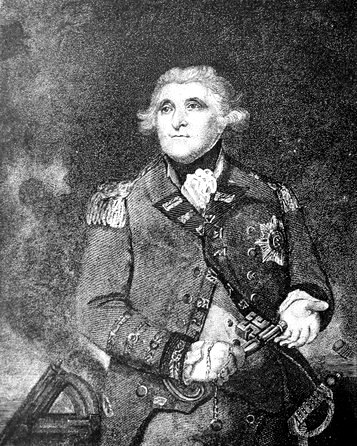
Painted by Sir Joshua Reynolds P.R.A. Engraved by J. Cochran.
GEORGE AUGUSTUS ELIOTT, LORD HEATHFIELD, BARON GIBRALTAR.
[The above portrait of "Old Eliott" was taken on his return from Gibraltar, in 1787, when he was the hero
of England. The figure is drawn against a background of the clouds of war, with the cannon pointing
downward, as when fired from the top of the Rock; while he holds firmly in his hand the key of the fortress
he has won. The face is open, frank, and bold, with eyes looking straight before him, as if he did not fear
any enemy. Many have remarked a likeness to Wellington, with a more prominent nose, a feature which
Napoleon always looked for in one whom he chose for a post of peculiar difficulty and danger.]
For months, there had been whispers in the air of a
coming peace, and the attitude of the contending parties
was more that of armed neutrality than of active war.
At last the announcement came. The besiegers were
the first to receive it, and sent the news to the garrison;
but "Old Eliott," true soldier as he was, waited for orders
from home. At length a British frigate sailed into the
harbor with the blessed tidings that Great Britain had acknowledged
the independence of America, and that the
three powers—England, France, and Spain—had solemnly
agreed to be at peace. Now all barriers to intercourse
were removed, and the Governor rode out to meet
his late enemy at a point midway between the lines.
Both Generals instantly dismounted and embraced, thus
answering a blow, or the many blows given and received,
with a kiss. The Duke soon after returned the visit, and
found the gates of Gibraltar, which had not been forced
in three and a half years of war, now thrown wide open
to his coming in the attitude of peace. He was received
with all the honors of war. As he rode through the gates
his appearance was greeted with loud huzzas, which ran
along the lines, and echoed among the hills, a salutation
which at first he did not understand, and was confused by
it, as it might be interpreted as a cheer of triumph over a
fallen enemy; but when it was explained to him that it
was the way in which English soldiers greeted one whom
they recognized as a hero, he was very much flattered by
the demonstration. As the artillery officers were presented
to him he complimented them highly on their
courage and skill, saying pleasantly (no one could doubt
his sincerity in this) that he "would rather see them
here as friends than on their batteries as enemies!"
And so at last, after these long and terrible years, the
curtain fell on a scene as peaceful as ever ended a tragedy
on the stage.
Such are the heroic memories which gather round Gibraltar,
and overshadow it as its mighty crags cast their
shadows on the sea. Let us not say, "All this is nothing
to us, because we are neither Englishmen, nor Frenchmen,
nor Spaniards." "We are men, and whatever concerns
man concerns us." If it be indeed "beautiful to die
for one's country," the spot is holy ground where, for the
dear sake of "country," brave men have fought and
died.