 EFORE entering on a description of the Great Siege, which stands
foremost among the brilliant episodes of our military history, it will
be necessary for the reader’s understanding of its details to put before
him a view of the Rock and its defences as they then existed. In doing
so we must necessarily avail ourselves of the close and careful account
furnished by Captain Drinkwater, who wrote from personal knowledge, and
shared in the various experiences of the siege. We shall, however, as
far as possible, spare our readers the infliction of purely technical
language.
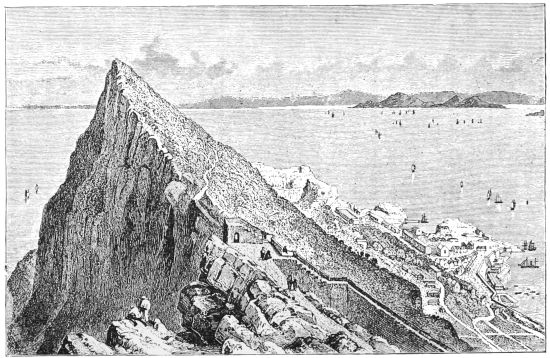
The Rock of Gibraltar forms a kind of promontory rising seaward to a
height of 1300 feet, and connected with the mainland by a low sandy
isthmus. The landward face varies considerably in elevation. The
breadth of the isthmus at the foot of the Rock is about 2700 feet, but
towards the country it broadens rapidly. Across this neck of land,
which, with the Rock and the Algesiras coast, forms the Bay, the
Spaniards, before the Great Siege, had erected a line of fortifications,
1700 yards in length, and distant about a mile from the nearest posts of
the garrison. At each extremity a fort of twenty-four guns was erected;
one christened St. Barbara, and the other St. Philip. Their cross-fire
completely commanded the so-called Neutral Ground, a narrow belt or
strip between English Gibraltar and the Spanish mainland.
The Rock, we must add, is divided into two unequal parts by a ridge
extending from north to south. The western section is a gradual slope,
broken up with precipices; but the eastern, which looks out upon the
blue Mediterranean, and the northern, facing the Spanish batteries, are
both very steep, and, in fact, inaccessible.
At the foot of the north-west slope, and surrounded by irregular
fortifications, lies the town, which communicates with the isthmus by a
long, narrow causeway, strongly bristling with defensive works. These,
and the causeway itself, are over-looked by the guns mounted in the
King’s, Queen’s, and Prince’s lines; ramparts excavated out of the solid
rock, and practicable only to birds of prey. At different heights, up to
the very crest, batteries are planted so as to present to an enemy a
peculiarly grim and forbidding aspect. The Old Mole, to the west of the
Grand Battery, joined with the above lines to pour a tremendous
cross-fire on the causeway and Neutral Ground. So great an annoyance did
this battery prove to the besiegers, that, by way of distinction, they
named it the Devil’s Tongue; and the entrance into the garrison, with
its batteries here, there, and everywhere, and its cannons and mortars
on the causeway and Old Mole, suggested to them the picturesque title of
the Mouth of Fire.
All along the sea-line were stout bastions, joined by curtains, which
were mounted with great guns and howitzers, and supplied with casemates
for 1000 men. These sufficiently defended the town; which was protected
also by a rocky shoal, stretching along the front far into the Bay, and
preventing the approach of large ships. From the south bastion a curtain
stretched up the base of the hill, and terminated the fortifications of
the town at an inaccessible precipice. Here was placed the South-port
gate, with a dry ditch in front of it, a covered way, and glacis. Above
this gate, on the rugged slope of the hill, and connected with the
curtain, was a large bastion, pointing its guns at the Bay. Further up,
an ancient Moorish wall ran along to the ridge of the rock, in the front
of which a curtain, with loop-holes and redans, built in the reign and
christened by the name of Charles V., extended to the summit. Between
these two walls, the Moorish and the Emperor’s, stood the Signal-House,
whence, on a clear bright day, the guard could command an unimpeded view
of the Mediterranean, and discern even the shining waters of the
Atlantic over the Spanish mountains. “Signals,” says Drinkwater,
“formerly were made at this post on the appearance of topsail vessels
from east and west, but soon after the commencement of the late war we
discovered that the Spanish cruisers were more frequently informed of
the approach of our friends by our signals than by their own. The
signals were therefore discontinued during the siege, but resumed after
the general peace of 1783.”
Following a line of ramparts along the beach, the visitor, at the time
we are speaking of, came to the New Mole, with its 26-gun battery, and
thence proceeded to the well-known quay of the Ragged Staff, usually
employed for the landing of stores for the garrison. Ships of the line
could lie along the Mole, such was the depth of water; and at the Mole
head was stationed a circular battery for heavy cannon. The Rock is not
easily accessible from the New Mole fort to the north end of Rosia Bay,
but it was defended, like every other point, by batteries and ramparts.
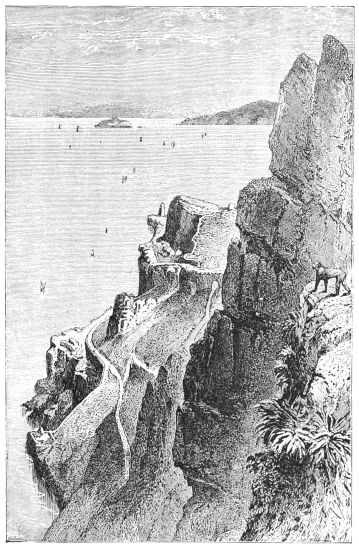
From the south end of Rosia Bay the cliff rose gradually to Buena
Vista—so called on account of its beautiful view of the Spanish and
African coasts, bathed in a glow of colour. Several guns were mounted
there, and the hill towards Europa Point bore some defensive works.
Thence the Rock sweeps down by the Devil’s Bowling-Green—so named, on
the lucus à non lucendo principle,[1] from its rugged surface—to
Little Bay, where a battery stood surrounded by frowning precipices; and
onward stretched the line of works and batteries to Europa Point, the
southern extremity of the garrison, though not the southern extremity of
the European continent. From this point frown precipitous cliffs of the
gloomiest aspect to Europa Advance, where the fortifications were
terminated by some few batteries.
Whether the young reader can or cannot follow in every particular the
foregoing description, he will at least derive from it the idea of a not
insufficient system of defensive works, which did credit to the ability
of the engineer-officers of the time. Every point of vantage had its
battery or bastion. The natural advantages of the position were
carefully utilised, and the approaches were commanded by heavy guns,
which could pour on an advancing enemy a withering fire. In all, the
fortifications were armed with six hundred and sixty-three pieces of
artillery.
The town of Gibraltar, says Drinkwater, is built on a bed of red sand.
The houses were composed of different materials, principally of a solid
well-tempered cement called tapia; but some of the rock-stone,
plastered, and blue-washed on the outside, so as to moderate the fiery
rays of the sun. These were generally covered with tiles, but the flat
terraced roofs remained in the Spanish houses, and, in many, the
mirandas or towers, whence the inmates, without removing from home,
could luxuriate in a bright and ample prospect of the Bay and
neighbouring coasts.
Most conspicuous among the buildings was the old Moorish castle, which
recalled to the spectator the palmy days of Saracenic supremacy in
Spain. It was situated on the north-west side of the hill, and
originally consisted of a triple wall, the outermost of which rose sheer
from the water’s edge. The lower portions, however, had been destroyed
before the siege, and on their ruins was planted the Grand Battery. The
walls formed an oblong, ascending the hill, with the principal tower, or
governor’s residence, at the upper angle. The remains of a mosque were
still visible; as also those of a Saracenic court, and a tank or
reservoir for water.
Ruins of Moorish edifices were discernible also on Windmill Hill, and at
Europa. Those on the hill were in a condition which rendered it
impossible to determine their original character; at Europa they have
been converted by the Spaniards into a chapel, dedicated to the Virgin
Mary. Fragments of Moorish walls run along the water’s edge; and near
Europa Advance is a Moorish bath, which our English soldiers named the
Nuns’ Well. It is sunk eight feet deep in the rock, and measures
seventy-two feet by forty-two feet. Over it is an arcaded canopy,
supported by graceful Saracenic columns.
In the hill are numerous caves and hollows, some natural, and some
improved by the hand of man. Of the former the most considerable appears
to be St. Michael’s Cave, which lies on the south side, about eleven
hundred feet above the sea-level. The remains of a strong wall are
visible near this entrance, which is only five feet wide. On entering,
the stranger finds himself in a considerable cavity, about two hundred
feet in length, and ninety feet in breadth; and the light of his torch,
if he penetrate into the interior, reveals the mouths of several other
caves. From the roof depend stalactites of great size and curious shape,
giving to the whole that character of Gothic architecture which is
noticeable in all stalactitic grottoes. There are also numerous
stalagmites, which in some cases almost join the calcareous droppings
from the roof, and appear to form supporting pillars.
Mr. Bartlett describes in some detail a visit which he paid to this
remarkable cave. Accompanied by a guide with blue lights, he descended
the slippery pathway between lofty pillars of stalactite, to find
himself in a darkness visible, and in a silence so deep and still that
the droppings of the water which filters through the roof above could be
distinctly
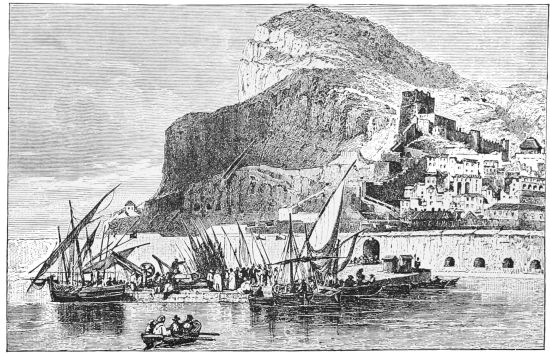
THE LANDING-PLACE, AND REMAINS OF MOORISH CASTLE.
Page 31.
heard as they fell at intervals on the rock beneath. The guide lighted a
heap of brushwood, the blaze of which disclosed to view a lofty
vault-shaped dome, supported as it were on columns of milk-white
stalactite, not unlike the trunks of palm-trees, and a variety of
fantastic foliage, some stretching down to the very floor of the cavern,
others resting midway on rocky ledges and congealed calcareous masses,
springing from the floor, “like the vestibule of some palace of the
genii.” At a given signal the blue lights were kindled, and the entire
scene, which before had been but partially illuminated, flashed into
sudden splendour; hundreds of stalactites shone with a mysterious gleam;
the lofty columns, fantastically wrought, seemed suddenly converted into
silver, as if by the wand of some magician. This revelation of the
wonders of the cavern was but transient; for the lights speedily burning
down, Mr. Bartlett was forced to retire before he became involved in
dangerous darkness. And this was the more necessary, in order to avoid a
certain deep gloomy fissure, which forms the pathway into the unknown
depths below. “While our eyes were endeavouring,” says a traveller, “to
penetrate a little further into its mysteries, I suddenly flung my torch
into it. The effect was beautiful: the torch blazed brightly as it
fell, making for itself a sort of halo of glittering gems, as it lighted
the walls of the gulf momentarily but beautiful. We tried this with all
the torches it was safe to spare, for we were far from daylight, and
then tossed fragments of rock and crystals, which echoed far in the
depths, and fell we knew not where. It is supposed that the whole Rock
is galleried in this way. Explorations have been attempted, and two
soldiers once undertook to descend this very gulf. One only returned,
however; his comrade had disappeared for ever.”
An ominous and gloomy character attaches to this chasm, and it has been
supposed that more than one poor fellow has here met with foul
play,—having been enticed by assassins on various pretences into the
cave, and, after having been plundered, flung into this horrible gulf,
as a place that tells no tales.
Not long before Mr. Bartlett’s visit, a gentleman who was desirous of
investigating into the penetralia of the cave, caused himself to be let
down by ropes, bearing a light in his hand; but what was his horror, on
his foot meeting with some resistance, to find that he was treading on a
dead body, while his torch at the same time disclosed to him the livid
features of a murdered man! Another gentleman of Mr. Bartlett’s
acquaintance explored the windings of the cave for a distance of four
hundred feet. The actual extent of the subterranean passages has never
been ascertained, and exaggeration and popular fancy find in it a
fertile subject; the vulgar believing that it is the mouth of a
communication beneath the Strait with Mount Abyla, and that by this
sub-oceanic passage the apes upon the Rock found their way from Africa.
The Moors, it is said, had a complete knowledge of the interior of the
cave; and a fancy has sometimes prevailed that through these
subterranean windings an enemy might obtain admission into the fortress!
The reader may be reminded that Captain Hamley, in some of the amusing
tales which he formerly contributed to Blackwood’s Magazine, made good
use of the Rock and its natural curiosities.[2]
In different parts of the hill may be found several other caves of the
same description. One of these, called Pocoroca, was fitted up, at the
beginning of the Great Siege, for the governor; but was afterwards
converted into a powder-magazine, which proved greatly convenient for
the batteries on the height.
The fossils discovered in various parts of the Rock rank among its
curiosities; but the visitor takes more interest in the apes which have
colonized it. They breed in places inaccessible to man, and climb up and
down the craggy precipices with wonderful celerity. The supposition is
that they came from Barbary with the Saracens, as a similar species
inhabit Mons Abyla, or, as it is popularly called, Apes’ Hill. In former
days red-legged partridges, woodcock, teal, and wild rabbits frequented
the Rock, but these have almost wholly disappeared before the rifles of
our English sportsmen.
Drinkwater records that eagles and vultures annually visited Gibraltar
on their way into the Spanish interior; and that the former bred among
the precipices, and, with the hawk, might often be seen wheeling above
its summit. The green lizard is still numerous; and scorpions and other
reptiles haunt the neighbourhood of the fissures and the crevices of the
Rock. The climate on the whole is genial. Winter loses all its severity;
and the summer-heats are tempered by refreshing breezes from the sea.
The worst inconvenience is the recurrence in December and January of
violent thunderstorms, with gales, and heavy rains, almost tropical in
their fury. Yet there is so little soil on the Rock, that the climatic
advantages do not produce any abundant vegetable-growth. When the rains
set in, wild grasses shoot up in the chinks and fissures; but as soon as
the sun reasserts its power, these disappear, and the eye rests only on
bare, sombre, and sterile rock. The western slopes, however, present an
agreeable contrast to the barrenness which everywhere else is dominant.
There the vegetation, though dwarfed, is dense; palmettos flourish, and
lavender, and Spanish broom, while the rugged rock absolutely blooms
with roses, periwinkles, and asphodels.
The view from the summit is perhaps sufficient to compensate for any
deficiency of beauty in the Rock itself. The spectator stands there on
the boundary, as it were, of the Old World, on the confines of two great
continents. At his feet the low and narrow tongue of land, called Europa
Point, stretches far into the sea, covered with bastions and casemates,
intermingled with villas and gardens. To the west extends the undulating
line of the Strait, with its waters of an intense blue, and beyond rises
the rocky coast of Tarifa, while the mighty sweep of the Atlantic Ocean
is lost in the western vapours. On the right, the Mediterranean, of a
pale azure, relieved by flashes and gleams of silver, beats in pearly
foam against the very foot of the Rock; opposite frown the dusky cliffs
of Africa, with the white houses and dismantled fortifications of Ceuta,
visible at the bottom of a vast bay, and the Mount Abyla of the
ancients, that other “Pillar of Hercules,” looking as if, in truth, a
demigod had torn it from the Rock of Gibraltar, and planted the two huge
fragments as gigantic landmarks at the extremity of the universe.
Bring your gaze back to nearer points, and on the right you see the
graceful rounded outline of the sheltered Bay, associated with the names
of Rodney, and Howe, and Nelson, and Collingwood, whose “tall ships”
have so often rested upon its waters. Gibraltar stands on the one side,
its harbour thronged with masts; on the other, the small town of
Algesiras lies on the slope of the hills, and bathes its feet in the
warm, bright waves. In the curve shelters the village of San Roque, the
first the traveller meets with on entering Spain; nearer still, and in
the rear, we see the thin sandy isthmus which links Gibraltar to the
mainland. The division between English and Spanish territory is marked
by a
row of towers, and we can distinguish close at hand the tents of a small
camp always occupied by a few regiments. Finally, the background of the
picture, beyond San Roque, is filled in with the green mountains of
Ronda; and towering above and behind these, the rose-tinted peaks of the
Sierra Benneja, and the snowy summits of the Alpuxarras. It is difficult
to conceive a grander spectacle.
We have thus endeavoured to furnish the reader with a general view of
the Rock, and town, and fortifications of Gibraltar at the time that
General Elliot assumed the governorship.
In 1777 the position of Great Britain was one of apparent peril, and her
enemies were not without grounds for their belief that her power had
received a mortal blow. Her North American colonies had seceded, and all
her attempts to reduce them to obedience had failed, while her military
prestige had been obscured by the surrender of Burgoyne’s army at
Saratoga. France had espoused the cause of the American States, whose
ambassador had been received at Versailles with special distinction. The
circumstances of the time seemed favourable to Spain to attempt a
recovery of her coveted fortress; and in June she issued a declaration
of war. But instead of being cowed by this demonstration on the part of
another enemy, the public spirit of England was roused to a fever of
patriotism. The fleets of Spain and France rode in the Channel with as
mighty a display as when Drake and his compeers launched their frigates
against the Invincible Armada. To their sixty-six sail of the line, the
British admiral, Sir Charles Hardy, could oppose only thirty-eight; but
with them he succeeded in preventing the enemy from landing an invading
army. The chief attack of Spain, however, was directed against
Gibraltar, and she cared little to expend her resources in any other
direction.
At the outbreak of hostilities, General Elliot, the veteran governor of
the Rock, found himself at the head of a garrison 5382 strong. He had
428 artillerymen and 106 engineers; and as soon as he had been apprised
of the possibility of war, had privately made preparations for defence.
On the 21st of June, by order of the Spanish Court, communication
between Spain and Gibraltar was closed; and efforts were made to arrange
for constant supplies of provisions from Barbary. Admiral Duff, at the
same time, brought his ships—a 60-gun man-of-war, three frigates, and a
sloop—alongside the New Mole; the barriers were everywhere shut; and at
all exposed points the guards were strengthened. Meanwhile, the enemy
made no overt movement against the fortress; but it was observed that in
various places they were collecting deposits of earth and other
materials, and mounting new guns along their line of entrenchments. And
in the course of July they assembled a powerful fleet in the Strait;
while the camp was constantly being reinforced with additional regiments
of cavalry and infantry.
Towards the middle of August the enemy succeeded in establishing a
strict blockade, and it was conjectured that their object was to reduce
the garrison by famine. Only forty head of cattle were in the place, and
the vigilance of the Spanish cruisers interrupted the supplies from
Barbary. Two bullocks, however, by the governor’s order, were killed
daily for the use of the sick. Due warning had been given to the
inhabitants of the peril impending over them, and each person had been
directed to have in store six months’ provisions. By far the greater
number this precaution had been neglected; and as they could not be
supplied from the garrison stores, most of them were compelled to quit
Gibraltar and go elsewhere in quest of subsistence.
On the 12th of September some of the British batteries opened fire on
the enemy, with the view of interrupting the workmen engaged in
enlarging and pushing forward their fortifications; and for several days
the firing was kept up, though with no particular vigour. In November
the garrison began to experience the effects of scarcity, and provisions
fetched the most extravagant prices. Mutton was 3s. and 3s. 6d. per lb.;
veal, 4s.; pork, 2s. and 2s. 6d.; a pig’s head fetched 19s., and ducks
from 14s. to 18s. a couple; while a goose was prized at a guinea. Fish
was not less dear, and vegetables were scarcely attainable “for love or
money;” but bread, the staff of life, was the article most wanted. It
was about this period, says Drinkwater, that the governor made trial
what quantity of rice would suffice a single person for twenty-four
hours, and for eight days he actually lived on four ounces of rice a
day. General Elliot, however, was always remarkable for his
abstemiousness of living, his general fare being vegetables, simple
puddings, and water. He was not the less a robust and healthy man,
capable of much hard work and exercise; but the scanty diet just
mentioned would certainly not suffice for a man working hard in a
climate where the heat makes exhausting demands on the human frame.
On the 14th October occurred an episode which gives a striking idea of
the courage and resources of the British seaman “of the olden time.”
About eight in the morning the look-outs discovered a small cutter,
flying the British flag, coming down towards the Bay with a westerly
wind. It proved to be the Buck, Captain Fagg, fitted out as a
privateer, and carrying 24 nine-pounders. The Spaniards also sighted
her, and made the usual signal for seeing an enemy, at Cabrita Point.
Immediately, the Spanish admiral, with a ship of the line, a 50-gun
ship, a 40-gun frigate, and some smaller craft, twenty-one in all, got
under weigh to intercept this formidable foe! The Buck, nothing
daunted, changed her course, and stood direct for the Barbary coast,
speeding along at a gallant rate; while the Spanish frigate, xebecs, and
lighter craft, unable to sail so closely to the wind, were carried
downward by the strength of the current, like a squadron of huntsmen
when baffled by the sudden doubling of a hare. When the Spanish admiral,
who was last in the chase, became aware of this misadventure, he
tacked, wore round, and returned to the Point, so as to cut off the
Buck in the Bay. The 50-gun ship also wore, and in this way checked
her drift to leeward. Captain Fagg at this moment steered direct for the
garrison. The 50-gun ship endeavoured to intercept her, but the
batteries at Europa opened fire, and drove her off. Then the Spanish
admiral bore down heavily from Cabrita Point, but the Buck nimbly
manœuvred past her, and replied to a couple of irregular broadsides of
shot and shell with her little stern-chase guns,—soon afterwards
anchoring safely under the cannon of the Rock.
The privateer brought neither news nor supplies, and, indeed, was sadly
in want of provisions. Yet the incident cheered the garrison greatly,
for it showed that the Bay was still open to ships from England, if
managed as skilfully and boldly as Captain Fagg’s cutter.
We pass on to January 1780. On the 8th a Neapolitan vessel was
wind-driven within range of the British guns, and compelled to
surrender. She proved to be an argosy of great price, having on board
about six thousand bushels of barley, than which nothing could have been
more acceptable to the garrison. The inhabitants had for some time been
put upon a daily ration of bread, which was delivered by the bakers
under the protection of sentries with fixed bayonets. Yet even this
precaution did not prevent a scene of excitement daily; and in the
struggling, pushing, heated crowd it was necessarily the strongest who
gained the advantage,—forcing their way to the front, and frequently
carrying off the portions that should have gone to feeble women and
helpless children. Nor were the inhabitants the only sufferers. Many
officers and soldiers had to support their families on the scanty dole
allowed by the victualling-office; and a private, with his wife and
three children, must have been starved, but for the assistance
generously rendered by his comrades. It is recorded that one woman
actually perished of hunger; others were reduced to such a condition of
feebleness that it was with difficulty they were saved; and numbers eked
out a wretched existence on wild leeks, thistles, dandelions, and the
like.
Necessity is the mother of invention, and hunger sharpens the wits of
needy men. Some Hanoverian soldiers, in their distress, were stimulated
to devise a new process of chicken-hatching. The eggs were placed, with
some such warm substance as cotton or wool, in a tin case capable of
being heated by a lamp or hot water; and a proper temperature being
maintained, they were hatched about as quickly as if a hen had sat upon
them. A capon was then trained to rear the little ones; and, to prepare
him for this unusual duty, his breast and belly were stripped bare of
feathers, and he was cruelly flagellated with a bunch of nettles. When
placed upon the brood, they afforded so much warmth and comfort to his
poor smarting body, that he addressed himself to the task of rearing
them with considerable satisfaction.
On the 10th a soldier of the 58th Regiment was executed for stealing,—a
sharp but necessary example.
On the 12th the monotony of the siege was interrupted by a discharge of
ten shot from one of the Spanish forts. They did some slight damage to
houses, and wounded a woman; but their principal effect was to scare the
inhabitants, who, fearing that a bombardment was about to commence,
packed up their valuables, and made preparations for concealing
themselves in all kinds of places. On the cessation of the firing,
however, they regained courage.
On the 15th, wistful eyes looking out to seaward were rejoiced by the
appearance of a brig carrying the British flag, which, regardless of the
enemy’s batteries, stood right into the Bay, and brought the glad
intelligence that she was the forerunner of a large convoy which had
sailed from England in December with ample supplies for the blockaded
garrison. After the first emotions of surprise and pleasure had
subsided, fresh apprehensions seized the wavering minds of the besieged.
They concluded that the enemy could not fail to have obtained
information of the approaching relief, and that they would be prepared
to intercept it. The event proved, however, that the Spaniards had
received no certain intelligence, and, concluding that the convoy would
be escorted only by a small squadron, had despatched eleven men-of-war
to make short work of it. But these were attacked by Admiral Sir George
Rodney with a powerful fleet of twenty-one sail of the line, and driven
into headlong flight. The British admiral also fell in with fifteen
Spanish merchantmen, escorted by six ships of war, all of which he
captured; and before the end of the month, with his prizes and
transports, he dropped anchor in the Bay.
On board Sir George Rodney’s fleet was a royal midshipman, the young
Duke of Clarence, afterwards William IV. He was entrusted to the charge
of Admiral Digby; and when, one morning, Don Juan Langara, the Spanish
admiral, visited the British commander, he was introduced to the
youthful prince. During the conference between the two admirals, Prince
William Henry withdrew; and when it was announced that Don Juan wished
to return to his own ship, the royal midshipman appeared, touched his
hat, and intimated that the admiral’s boat was ready. Whereupon, it is
said, Don Juan exclaimed,—“Well does Great Britain merit the empire of
the sea, when the humblest stations in her navy are supported by princes
of the blood!”
For a time the garrison and inhabitants of Gibraltar enjoyed both peace
and plenty. The Spanish forces seemed to have abandoned their task; and
a constant interchange of courtesies was maintained between their
leaders and the British officers. On the 13th of February Sir George
Rodney’s fleet got under weigh, leaving behind two men-of-war and a
couple of frigates, and sailed for England; and immediately afterwards
the Spaniards renewed the blockade. About the middle of March, General
Elliot found it necessary once more to regulate the issue of provisions,
and gave directions that the garrison should be victualled monthly
(bread excepted) in the following proportion:—For a soldier, each first
and third week, 1 lb. of pork, 2½ lbs. of salt cod (which, by the way,
proved very injurious, and caused the appearance of that terrible
disorder, scurvy), 2 pints of pease, 1 lb. of flour, ¼ lb. of raisins, 1
lb. of rice, 5 oz. of butter, 1½ pint of oatmeal. Second and fourth
week, 1½ lb. of beef, 2 lbs. of fish, 2 pints of pease, 1 lb. of rice, 5
oz. of butter, 1½ lb. of wheat, and 1 lb. of raisins. This, it must be
owned, was but meagre fare.
In the month of June the Spaniards showed signs of prosecuting the siege
with greater vigour, and made a bold attempt to destroy the vessels in
the Bay with fire-ships. But the alarm being given, the Panther, a
60-gun man-of-war, and the other armed vessels, immediately opened a
brisk cannonade to check their progress; and springing into their boats,
the officers and seamen, with characteristic vigour, grappled the
blazing ships. The flames raged fiercely, but our sailors, nothing
daunted, towed them under the British guns, where they were soon
destroyed.
The blockade increasing in severity, both the garrison and inhabitants
felt the pressure of want, and provisions were once more selling at
almost fabulous prices. Such vessels as escaped the enemy’s cruisers
were chiefly loaded with “luxuries” rather than “substantials;” but a
cargo of fruit which arrived in October proved of inestimable value in
checking the ravages of scurvy, a disease that at one time threatened to
prove much more destructive to the garrison than the enemy’s fire.
In March 1781 the want of bread was severely experienced, many families
having received none for several days, and biscuit-crumbs selling for
tenpence and one shilling per pound. Fresh meat and fish were equally
scarce and equally dear. The dietary of the garrison was reduced to the
barest necessaries; and the distress which the women and children must
have undergone may be inferred from the nature of the weekly allowance
to each soldier, which was—5¼ lbs. of bread, 13 oz. of salt beef and 18
oz. of pork (both almost putrid), 2½ oz. of rancid butter, 12 oz. of
raisins, half a pint of pease, a pint of Spanish beans, a pint of wheat
(which was ground into flour for puddings), 4 oz. of rice, and quarter
of a pint of oil.
Great, therefore, was the joy of the besieged when, on the 12th of
April, a convoy of nearly one hundred vessels arrived from England,
escorted by a strong fleet under Admiral Darby. The historian of the
siege, in describing this event, soars almost into the region of poetry.
“At daybreak,” he says, “the much-expected fleet, under the command of
Admiral Darby, was in sight from our signal-house, but was not
discernible from below, being obscured by a thick mist in the Gut. As
the sun, however, became more powerful, this fog gradually rose, like
the curtain of a vast theatre, discovering to the anxious garrison one
of the most beautiful and pleasing scenes it is possible to conceive.
The convoy, consisting of near a hundred vessels, was in a compact body,
led by several men-of-war, their sails just enough filled for steerage;
whilst the majority of the line-of-battle ships lay-to under the Barbary
shore, having orders not to enter the Bay, lest the enemy should molest
them with their fire-ships. The ecstasies of the inhabitants at this
grand and exhilarating sight are not to be described. Their expressions
of joy far exceeded their former exultations. But, alas! they little
dreamed of the tremendous blow that impended, which was to annihilate
their property and reduce many of them to indigence and beggary.”
As the convoy drew near, a squadron of fifteen gun-boats advanced from
Algesiras, and, assembling in regular array under the batteries at
Cabrita Point, opened a smart fire on the nearest ships, supported by
the gun and mortar batteries on the land; but they were soon compelled,
by an English line-of-battle ship and a couple of frigates, to effect a
precipitate retreat.
This second relief of the garrison stung the Spaniards into the adoption
of a measure which had little value in a military sense, but inflicted a
large amount of suffering on the inhabitants of the town of Gibraltar.
The convoy had scarcely anchored, when they bombarded the town and
fortifications with sixty-four heavy guns and fifty mortars. The
unfortunate inhabitants, who were busily congratulating each other on
the arrival of the fleet, exchanged their exultation for sorrow, and
fled in the greatest confusion—old and young, men, women, and
children—to the southward, abandoning their property to the mercy of
the soldiers. Soon after noon the firing ceased, and the inhabitants
hastened to secure such valuables as could be easily removed; but those
bulkier articles which “the avaricious and hard-hearted hucksters” had
concealed in their stores, to retail in small quantities at exorbitant
prices, were all destroyed.
About five o’clock the hostile batteries reopened, and their storm of
shot and shell was continued uninterruptedly; without interfering,
however, with the disembarkation of the supplies. Several soldiers were
killed and wounded in their quarters on the 13th. The Spaniards being
accustomed to indulge themselves with a siesta in the middle of the day,
the garrison and inhabitants enjoyed an interval of peace every noon;
otherwise, the roar of the guns and the hiss of the rapid missiles made
day and night equally hideous.
On the evening of the 14th, says Drinkwater, the enemy’s shells were
very profusely distributed; some that did not burst were examined, and
on the fuse being drawn it was found that inflammable matter had been
mixed with the powder. These combustibles set on fire a wine-house near
the Spanish church, and before the conflagration could be extinguished
four or five houses were burned to the ground. Detachments of infantry
were sent to quench the flames, but the enemy’s cannonade became so
brisk that great confusion ensued. From this disaster may be dated the
irregularities into which, through the combined influence of drink and
resentment, many of the soldiers fell. Some died of intoxication on the
spot, and others were with difficulty recovered.
“Though riot and violence,” continues Drinkwater, “are most contrary to
that spirit of regular discipline which should always prevail in
military affairs, something may yet be urged in extenuation of the
conduct of the troops. The extreme distress to which they had been
reduced by the mercenary conduct of the hucksters and liquor-dealers, in
hoarding, or rather concealing their stocks, to enhance the price of
what was exposed for sale, raised amongst the troops (when they
discovered the great quantities of various articles in the private
stores) a spirit of revenge. The first and second days they conducted
themselves with great propriety; but on the eve of the third day their
discipline was over-powered by their inebriation, and from that instant,
regardless of punishment or the entreaties of their officers, they were
guilty of many and great excesses. The enemy’s shells soon forced open
the secret recesses of the merchants, and the soldiers instantly availed
themselves of the opportunity to seize upon the liquors, which they
conveyed to haunts of their own. There, in parties, they barricaded
their quarters against all opposers, and, insensible of their danger,
regaled themselves with the spoils. Several skirmishes occurred amongst
them, which, if not seasonably put a stop to by the interference of
officers, might have ended in serious consequences.”
Such is life in a beleaguered town! There is something more to be feared
than the attacks of external enemies, and that is, the irregularities
within; the outbursts of a spirit of military insubordination, and the
follies and crimes of the non-combatants,—all adding to the anxiety and
increasing the responsibility of the military and civil authorities. At
Gibraltar the entire burden rested on the shoulders of General
Elliot,—who bore it, however, with inflexible calmness and resolute
patience, tempering justice with mercy, but not fearing to strike
heavily when it was necessary for the common safety.
The bombardment continued briskly, and casualties occurred daily. On
the 21st, the besieged counted forty-two rounds in a couple of minutes!
The garrison flag-staff was so much damaged that the upper part had to
be cut off; but the shot-torn colours were nailed to the stump. From
the enemy’s gun and mortar boats on the 23rd, two hundred and sixty shot
and forty shells were discharged. The wife of a soldier was killed
behind the South Barracks. The relaxation of discipline among the
soldiers had become so alarming that, on the 26th, General Elliot issued
orders, which were strictly carried out, that any soldier found drunk or
asleep on his post, or plundering, should be executed. Everybody’s
spirits were raised on the 27th by the arrival of twenty ships with
provisions from Minorca; and this encouragement was sorely needed at a
time when the garrison was harassed not only by fire but water—the
rains falling heavily, and thunderstorms being of frequent occurrence.
It was awful to hear the reverberating peal mingling with the roar of
cannon, and to see the smoke-clouds of battle pierced by the lurid
arrows of the lightning.
It must not be supposed that the English endured the enemy’s bombardment
in silence. The guns of the Rock were plied at times with equal
alacrity and effect; but the prudent general would not allow his men to
waste their shot and powder, and they fired only when the enemy were
well within range. On the morning of May the 7th, the gun and mortar
boats opened upon the town and the New Mole for about an hour. The
garrison replied with four hundred rounds, at which the governor was
much displeased. “There would be no end,” said he, “of expending
ammunition, if we fired every time they came, and while they were at so
great a distance.”
Among the incidents which marked the history of the siege within the
walls, we may mention that, on one occasion, a Hanoverian and some other
ill-disposed fellows were detected in plundering a store. They were
given in charge to a sentry; but the Hanoverian attempted to escape.
“Halt!” cried the sentry, “or I’ll fire!” The marauder continuing his
flight, the sentry carried out his threat, and the man fell dead on the
spot. A soldier of the 58th was, on another occasion, hung at the door
of the store in his robbery of which he had been surprised. On the 9th,
an officer lost his leg by a shot. The remarkable feature of this
occurrence was, that the wounded man saw the shot coming on its fatal
errand, but was so fascinated by it that he could not move out of the
way. A shell fell into a house in which fifteen or sixteen persons were
huddled together; all escaped except a child, whose mother had been
killed by a shell only a few days before. A soldier, rambling about the
town, came upon a store of watches and other valuable articles, among
the ruins of a house, and hastened to take possession of them. Then
arose the puzzling question, What should he do with this treasure-trove?
To convey them to his quarters was impossible, as every one was examined
on his return from duty. The expedient to which he finally resorted was
very curious. He took out the wad of a gun on the King’s Bastion, and
tying his prize in his pocket-handkerchief, secreted it in the bore of
the gun as far as he could reach; afterwards replacing the wad. In the
piping times of peace a better repository could hardly have been
invented; but it happened that on this same evening, while the marauder
lay asleep in his casemate, the hostile gunboats approached, and fire
was vigorously opened upon them. One of the first guns discharged was
that which contained the soldier’s ill-gotten wealth, and all his
visions of future greatness were dissipated in a moment!
The incessant bombardment had, of course, a ruinous effect upon the
town. Scarcely any of the houses north of the Grand Parade were
inhabitable; all of them were deserted. The families of some of the
soldiers lingered still in a few near South-port; but even of these only
the walls remained standing. The governor and lieutenant-governor,
however, maintained their quarters,—men being kept constantly employed
in repairing the damage done by shot or shell. But the general aspect of
the town was most pitiful; the streets were solitary, and instead of the
hum of voices one heard only the whirr of shot and the rush and
explosion of shells.
On the 9th of June, the garrison was aroused by the blowing-up of one of
the Spanish magazines. The effect was that of a continual roll of fire,
like repeated volleys of musketry, which led the besieged to conjecture
that the accident had befallen their repository for fixed ammunition and
live shells. Their drums immediately beat to arms; and the entire force,
numbering thirteen battalions of infantry, besides cavalry, paraded in
front of the camp. It was thought that the enemy by this disaster must
have suffered severely in men as well as munitions.
The British batteries, though constantly repaired, were much damaged by
the incessant fire; and the enemy’s shot frequently drove through seven
solid feet of sandbag-work. As an additional protection, strong wooden
caissons were constructed; filled in compactly with clay, and covered in
front and on the top with junk cut in lengths for the purpose. These
proved very effectual. The bombardment was not wholly without profit to
the besieged; for it directed their attention to the weak points of
their fortifications, which were immediately strengthened, until they
were rendered virtually impregnable.
The monotony of the siege—and all soldiers agree that a siege, with its
daily round of duties, and its continuous roar of cannon, becomes in
time distressingly wearisome from its lack of variety—was interrupted
on the 7th July by another lively episode of British seamanship. At
early morn the Spaniards at Cabrita Point were observed signalling that
an enemy was in sight; and when the mists dispersed, the English
themselves could see a vessel becalmed at a considerable distance, but
rowing, with the current, towards the beleaguered Rock. Fourteen
gunboats had put out from Algesiras to cut her off; whereupon Captain
Curtis, of the Brilliant man-of-war, ordered Sir Charles Knowles, with
three barges, to endeavour to get alongside and receive any despatches
she might have on board, while he himself towed out a couple of praams
to cover and protect her. Sir Charles’s errand was soon accomplished,
and he returned with letters for the governor. By this time the vessel,
an English sloop-of-war, was within a league and a half of the garrison,
but the headmost Spanish gunboat had got up within range, and hurled at
her a torrent of round and grape shot, which was followed by rapid
discharges from her consorts. The Helma, Captain Roberts, carried only
fourteen small guns; but her crew handled them gallantly, and poured in
volleys of fire from the quarter-deck. So unequal a contest, it was
thought, could have but one, and that a disastrous, issue; the English
sloop was lying becalmed, a league from the Rock, with fourteen
gunboats, well-manned, and each mounted with a twenty-six pounder,
crashing into her timbers repeated avalanches of grape shot and round
shot. Captain Roberts, however, showed no signs of yielding, and
maintained a steady and well-directed, if not a heavy fire. Had the calm
lasted, he would probably have sunk rather than have surrendered; but
happily a westerly breeze sprung up, and, rippling across the waves,
soon filled his canvas, and carried him and his gallant crew into
safety. The loss of the Helma, notwithstanding the tremendous fire to
which she had been exposed, was only one man killed and two men wounded,
but her upper rigging and sails were much torn by the shot. Had the
gunboats been well handled, it is difficult to believe that she could
have escaped; but the inferior gunnery of the Spaniards was proved on
many occasions during the war.
The bombardment for some weeks had gradually slackened, and by this time
was reduced to a discharge of three shells in twenty-four hours; which
the English soldiers, from an idea that the Spaniards intended by the
number some allusion to the Trinity, with much more profanity than
humour named Father, Son, and Holy Ghost. Captain Drinkwater
gravely observes that probably the Spaniards might entertain a bigoted
respect for that mystical number, and, remembering the heretical
condition of the English, might apprehend some efficacy from it in the
great work of “converting the garrison to the Catholic faith;” an
attempt at jocosity not much more successful than that of the soldiers!
Uncle Toby, in Sterne’s great fiction, tells us that “our army swore
terribly in Flanders.” There seems good reason to believe that they
swore terribly and acted vilely in Gibraltar. A wide chasm separates the
British soldiers of to-day from the British soldiers of yesterday. They
were then recruited from the lowest classes, the scum and refuse of
society, the outpourings of our jails, and it was with difficulty that
even a terribly rigid discipline kept them in order. They were ill-fed,
ill-paid, ill-treated; and their moral character was of the very lowest.
But to-day the soldier is thoughtfully cared for, not only as regards
his material but his moral and intellectual wants. Hence the ranks of
our army now include a large proportion of respectable young men, who
are aware that good conduct will place great prizes within their reach.
The only bonds between them and their predecessors are those of loyalty
and courage. The soldiers of Napier who stormed Magdala are as eminent
for their courage and faithfulness as were those of Elliot who defended
Gibraltar. In these virtues they could not surpass their predecessors;
but in all other respects they are unquestionably above them.
An incident occurred on the 27th which is worth recording. During an
attack made by the gun and mortar boats, a shell burst within the
hospital and killed an artillerist. Some time before, this man, a very
gallant fellow, had broken his thigh; his active spirit was ill able to
endure the confinement his case rendered necessary, and he tottered
abroad in order to enjoy the fresh air in the hospital court.
Unfortunately, in one of his lively moods he fell, and was compelled to
take to his bed again. He was lying there when a shell from the mortar
boats crashed into the ward, and rebounding, lodged upon him. The
invalids and convalescents in the same room contrived, by vigorous
exertions, to crawl out on hands and knees, while the fuse was burning;
but the unfortunate artillerist was kept down by the weight of the
shell, which after some seconds exploded, tore off both his legs, and
scorched him piteously. Strange to say, he survived the shock, and was
sensible up to the moment that death relieved him from his agony. His
last words were a regret that he had not died on the batteries, “with
his face to the foe,” as all true soldiers wish.
A few days later a shell wounded a private of the 73rd; that is, he was
knocked down by the wind of it; and the shell, instantly bursting,
killed a soldier standing close by, and mangled most terribly the hero
of our anecdote. His head was fractured, his left arm broken in two
places, one of his legs shattered, the skin and muscles of part of his
right hand torn off, the middle finger crushed, and his whole body most
severely bruised. In a word, the man was reduced to a bleeding and
mutilated mass of flesh, and his recovery seemed hopeless. The surgeons
who took charge of him were at a loss to which injury they should first
give their attention. That evening, however, he was trepanned; a few
days afterwards his leg was amputated. All his wounds and fractures were
carefully dressed, and, thanks, it may be supposed, to a wonderfully
robust constitution, as well as to the skill of his medical attendants,
his cure was completely effected. His name, adds the historian, is
Donald Ross; and he long continued to enjoy His Majesty’s bounty in the
shape of a pension of ninepence a day. “Ninepence a day,” however, seems
but poor payment for a trepanned skull, an amputated leg, and a
shattered right hand!
The enemy, by this time, had completed the construction of an advanced
range of batteries, which, in spite of the continual fire of the
garrison, assumed a threatening aspect. They rolled a storm of shot and
shell upon the British works, doing serious execution; and the strength
and energies of the defenders were severely taxed. A battery named St.
Carlos was especially annoying, from its position, and the heavy
ordnance with which it was mounted. Acting on information which he
obtained from two deserters, General Elliot determined on an attempt to
destroy it. He formed his plans with the secrecy and deliberation
characteristic of the man, and communicated them to no one until the
hour fixed for their execution. On the evening of the 26th of November,
as the gates were shut after first gun-fire, he assembled on the
Redsands, now called the Alameda, a detachment consisting of a couple of
regiments, the grenadiers and light infantry from the other regiments,
one hundred artillery, and two hundred workmen (or sappers and miners,
as we now call them),—in all, about 2074 men, with 99 officers, and 147
non-commissioned officers. Each private carried thirty-six rounds of
ammunition, and “a good flint in his piece, with another in his pocket.”
In those days rifled guns, Sniders, and Martini-Henrys had not been
dreamed of; and the British musket was a cumbrous weapon, in which the
charge was ignited by a spark from a flint.
The officers having received their instructions, the whole force, with
one hundred sailors from the ships in the Bay, assembled under the
command of Brigadier Ross, and being divided into three columns, armed
with fire-fagots and other implements, advanced, under cover of the
darkness, against the enemy’s batteries. In the deepest silence they
marched under the dark shadow of the Rock; but, in spite of all their
precautions, the right column was seen and challenged by the Spanish
sentinels, who instantly fired. The officer in command, forming his
attacking corps, dashed forward at a brisk pace for the extremity of the
parallel, which he entered without opposition, and began to dismantle.
Part of Hardenberg’s regiment in the darkness mistook their way, and
found themselves, before they discovered their error, in front of the
terrible St. Carlos battery. Satisfied with the object before them, they
rushed at it, cheering, mounted the parapet, and flung themselves into
the middle of the works. There was no resource for the Spaniards, in
the presence of men so determined, but to retreat; which they did,
without loss of time. The central and left columns were equally
successful; for Elliot’s warriors were men of a very resolute temper,
and having made up their minds to carry the Spanish batteries, what
could the Spaniards do but let them have their way! The British
commanders then reformed their ranks, while the pioneers and
artillerymen proceeded to do their duty.
The batteries were soon prepared for the operation of the fire-fagots,
and these being ignited, the flames spread rapidly in every direction.
The whole line of works soon presented one vast mass of fire and lurid
smoke, which threw its glare over the Rock, was reflected in the waters
of the Bay, and revealed every object in the vicinity.
Their task thus successfully accomplished, the British soldiers prepared
to regain their own lines. Such had been their dash and courage that the
Spaniards, though at a short distance they had one hundred and
thirty-five guns mounted, seemed stricken with a panic, and made no
effort to impede their operations. Thus, in a single hour the British
were able to reduce to ruins the labours of many weeks. The event
“challenges greater admiration,” says Drinkwater, “when we reflect that
the batteries were distant near three-quarters of a mile from the
garrison, and only within a few hundred yards of a besieging enemy’s
lines.” There can be no doubt that the achievement was a brilliant one;
the coup de main was well conceived, and well executed, with but a
trifling loss of life. Only five men were killed; the wounded and
missing did not exceed twenty-five. Altogether, it served to show the
Spaniards of what sort of stuff the British soldier was made.







