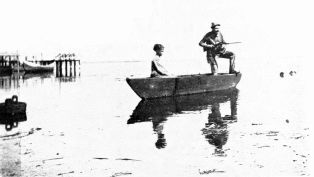
With his next opera—for Tosca is the only one of his
works so entitled by the composer—Puccini made a
rather curious reversal of the proceedings as compared
with La Bohème, taking it from an Italian story treated
from the French point of view. From the old world
story of Murger, Puccini turned to a notable example of
modern French stagecraft, in Sardou's drama of La
Tosca. His librettists again were Giocosa and Illica, and
they provided the composer with a strikingly apt presentation
of the grim story; not one, perhaps, that lends
itself altogether to musical expression, but one which
certainly grips the attention and carries the hearer
along. By Tosca, Puccini certainly sustained his now
universal popularity made manifest by the preceding
La Bohème. It was given first at the Costanzi Theatre,
Rome, on January 14, 1900, conducted by Mugnone,
and cast as follows:
| Tosca |
Darclée. |
| Cavaradossi |
De Marchi. |
| Scarpia |
Giraldoin. |
| Angelotti |
Galli. |
| The Sacristan |
Borelli. |
London saw it in the summer of the same year at
Covent Garden, where it was given on July 12 with
the following cast, Mancinelli being the conductor.
| Tosca |
Ternina. |
| Cavaradossi |
De Lucia. |
| Scarpia |
Scotti. |
| Angelotti |
Dufriche. |
| The Sacristan |
Gilibert. |
In America, Tosca was first given in Italian on
February 4, 1901, at the Metropolitan Opera House,
New York, by Maurice Grau's company, the cast and
conductor being the same as that for the first Covent
Garden performance, with the substitution of Cremonini
for De Lucia as Cavaradossi.
Its first American production in English was by
Henry W. Savage's company, at the Teck Theatre,
Buffalo, and cast as follows, Emanuel being the
conductor:
| Tosca |
Adelaide Norwood. |
| Cavaradossi |
Joseph Sheehan. |
| Scarpia |
W. Goff. |
| Angelotti |
F. J. Boyle. |
| The Sacristan |
Francis Carrier. |
In the music of Tosca Puccini reveals, more powerfully
perhaps than anywhere, that quick instinct of the
theatre which may be called dramatic, or merely a
very clever fitting of music to the mood of the moment.
It is, in fact, very purely melodramatic, the word being
used here not in its accepted sense of the traditional
"tootle-tootle" in the orchestra when the wicked
villain pursues the innocent and sorely tried heroine.
The story is tragic in all conscience, but it hardly
reaches the level of true tragedy, since it is more
horrible than impressive, and lacks that restraint and
poetry which are two necessary qualities. This much
must be said for the operatic version. It is a shade
less revolting, less purely realistic than the drama, and
it undoubtedly provides a splendid acting rôle for the
exponent of the name part; while the lover, and the
villain—Scarpia, the chief of the police—are provided
with opportunities, very little behind, in point of vocal
and dramatic effect. One could very well imagine a
production, on prevailing lines set upon elaboration of
detail, in which Puccini's music, or a great deal of it,
was used purely as incidental music. This suggestion,
however, must in no way be taken to mean that as a
whole the music of this opera lacks continuity of
interest or fails to exhibit the close and essential union
between speech and song. There are many pages of
strong and definite lyrical charm, but somehow the
main interest lies in the action which fascinates the
spectator, rather, one feels, against his better—or more
calm—judgment. It is, in short, a most moving picture
of love, hate, jealousy, passion and intrigue. These,
after all, form the great bulk of the material for operatic
treatment; and without entering into the question
whether Tosca is or is not a work for all time, it has
certain very "live" attributes which make it a notable
achievement.
The scene in the first act shows the Attavanti
Chapel in the Church of Saint Andrea della Valle in
Rome. The strenuous, shuddering chords which preface
the short prelude are representative of the cruel
nature of Scarpia, whose personality dominates the
scene—more than this, the figure seems to give at once
the atmosphere of stress, and hints at a wealth of
incident which characterises the whole of that which is
to follow.
A man in prison garb, harassed, dishevelled, well-nigh
breathless with fear and haste, comes in and
glances hastily this way and that. This is Angelotti,
a victim of Papal tyranny, who has escaped from the
Castle of S. Angelo; and his entrance, it will be noted,
is also characterised by a theme always associated with
him throughout the work.
On a pillar is an image of the Virgin, and underneath
it a stoup. "My sister wrote to tell me of this spot,"
says Angelotti, as he searches for the key which will
open the chapel and allow him to escape. While he
searches in feverish haste the string of chromatic
chords carries on the idea of his agitation. With yet
another glance to reassure himself that he has not been
followed, he opens the gate in the grille of the chapel
and disappears.
A light tripping figure ushers in the Sacristan, and
it continues for a space while he walks to the daïs, on
which is an easel and a covered picture. He complains
of the bother he has in washing the brushes of the
artist who is painting an altar-piece. He is surprised
not to find Cavaradossi painting. The Angelus rings,
and the Sacristan kneels and continues the prayer.
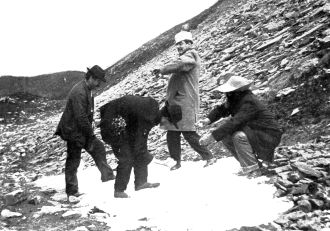
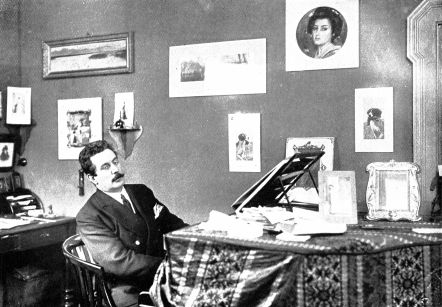
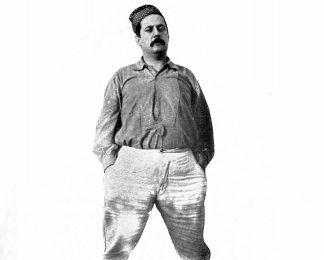
PUCCINI SNOWBALLING IN SICILY
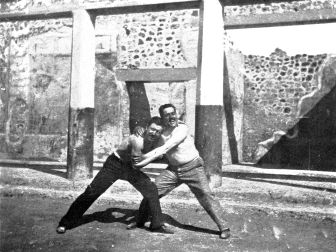
PUCCINI WRESTLING AT POMPEII
Cavaradossi now comes in, and a broad melodious
phrase is heard as he ascends the daïs and uncovers
the picture. The Sacristan is amazed to find that it
represents the features of a lady who has been frequently
to pray in the church, and is further shocked
when the artist draws forth a miniature and compares
it with his figure, into whose features he has incorporated
the dusky glow and peach-like bloom of his
beloved Floria. The phrase indicated at Cavaradossi's
entrance now swells out in a lyrical melody in which
he sings that his Madonna's eyes are blue, while
Tosca's are dark as a moonless night, the Sacristan
punctuating the rhapsody with a pious ejaculation to
the effect that the artist scorns the saints and jests with
the ungodly.
After the Sacristan's departure to a snatch of his
characteristic phrase, Angelotti, believing the church
empty, comes out of the chapel. Cavaradossi does not
at first recognise, in this prison-worn creature, his
friend the Consul of the Republic. Tosca's voice is
heard, and the artist makes a sign to Angelotti to remain
yet a little while in hiding, and on hearing that the
fugitive is spent with hunger, he gives him the basket
left, for his refreshment, by the Sacristan.
A quick moving figure, accompanied by triplets,
announces Tosca's entrance, and she thinks that
she has heard her lover conversing with another
woman, and even declares she heard the swish
of skirts. Cavaradossi attempts to embrace her, but
she reproves him, and first makes an offering before the
Virgin's shrine. This done, she tells him that although
she is singing at the theatre that evening, the piece is
a short one, and proceeds to sing in a delightfully suave
melody, which increases gradually in intensity, of the
delights of love in a quiet secluded cottage far away
from all worldly distractions. Cavaradossi comes in
at the close with an impassioned burst on a characteristic
high note, in which he says that he is caught in
the toils of her enchantment. The artist makes as his
excuse for her quick dismissal the need of continuing
his work on the picture, but his frequent glances
towards the chapel show that his anxiety for his friend
is the cause of his agitation. But Tosca now comes in
sight of the picture, and is struck by the resemblance
of the face to some one she has seen. She immediately
connects the whispering she has heard before arriving
upon the scene and the anxious looks towards the
chapel together as a proof that Cavaradossi has been
meeting the original of the picture. The incident,
however, leads up to a further avowal of devotion on
the part of Cavaradossi, and their voices blend together
for a brief space in a delicious bit of melody. Tosca
elects to be comforted, and with a final thrust she goes
out, requesting her lover to change the lady's eyes to
black ones.
Angelotti now comes out of the chapel and tells of
his plan of escape. Cavaradossi gives him the key
of his villa, and indicates the way he may reach it.
Angelotti takes up the bundle of clothes left by his
sister for his disguise—the sister being the lady who
has been frequenting the church of late, and who has
attracted the artist's attention—and goes off, while
his friend tells him, as a final precaution in case of
urgent need, of a passage that leads down to a cellar.
Just as Angelotti is going the cannon sound from the
fortress, giving the signal that the prisoner's escape
has been discovered.
On their exit, the Sacristan enters, followed by
choir boys, acolytes and a crowd of people. The
Sacristan tells them the news of Bonaparte's defeat,
that there will be rejoicings and a new cantata for the
occasion sung by Tosca, and his snatch of melody is
cleverly derived from the theme heard on his first
entrance. The choir boys burst out into a great riot
of joyous merrymaking, beginning with "Te Deum"
and "Gloria," and breaking out into "Long live the
King," the Sacristan trying his best to drive them into
the sacristy to vest for the festival service. Their
jollity is cut short by the entrance of Scarpia—whose
sinister theme breaks in characteristically, as always—followed
by Spoletta and others of his staff. After
bidding them curtly prepare for the solemn "Te
Deum," he motions the rather frightened Sacristan to
his side, and tells him that a State prisoner has
escaped, and from information received has been
tracked here. He asks which is the Attavanti Chapel,
and the facts that the gate is open and that a new key
is in the lock give at once a clue.
A police agent comes out of the chapel and brings
with him the basket given to Angelotti by Cavaradossi;
and Scarpia, after a little more judicious questioning of
the Sacristan, is able to guess that the fugitive has
been assisted by the painter.
Tosca now comes back, and after signalling to the
Sacristan, Scarpia retires behind a pillar, watching her
as she looks about for Cavaradossi. To serve his own
ends, he decides to rouse the jealousy of the woman;
and after a little flattery, expressed in a suave, flowing
melody, he brings out a fan and mildly inquires
whether it forms any part of the customary outfit of
a painter. From the coronet on it Tosca recognises
it as belonging to the Marchioness Attavanti, who is
the sister of Angelotti, and a member of the family to
whom the chapel is dedicated. Forgetful of Scarpia's
presence and the place where she is, Tosca, in a
finely emotional passage—broken into now and again
by Scarpia, who rams home his poisonous suggestions—bewails
the weakness of her lover; and the wily
Scarpia, after tenderly escorting her to the church
door, despatches an agent to watch her closely. His
exultation at having fired her jealousy is punctuated
twice by the sound of cannon; and into the rather
curious triplet accompaniments is worked the opening
phrases of the organ, which signals the approach of the
procession of the Chapter, with the Cardinal, to whom
Scarpia makes a reverence as he passes him.
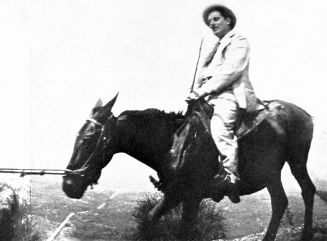
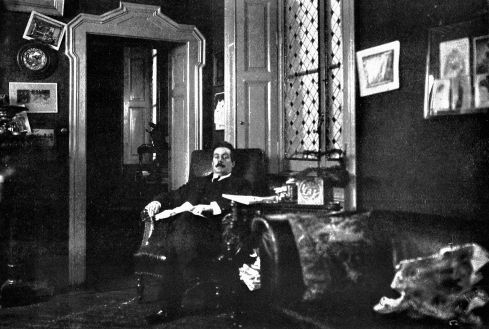
PUCCINI DESCENDING ETNA ON A MULE
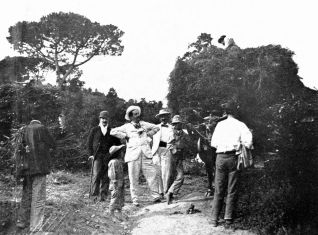
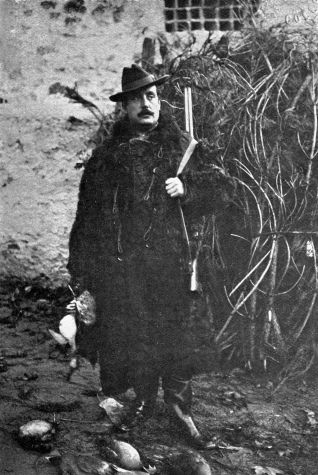
PUCCINI ON HIS FARM AT CHIATRI
"Our help is in the name of the Lord, who hath made
heaven and earth," sing the Chapter and monks, while
Scarpia continues his musings as to the business he
has on hand. From the mere catching of the escaped
prisoners his thoughts turn to lustful possession of
Tosca; and the whole scene, finely contrasted, is worked
up with superb force into one of those magnificently
solid finales which reveal the technic of Puccini so
emphatically. The cannon continue to go off—the
sound is managed, by the way, by striking a huge cone
over which is stretched, drum-fashion, a tight skin—the
whole crowd turn towards the high altar, the stately
"Te Deum" swells through the church, and at the
end, Scarpia, after saying that for Tosca he would
renounce his hopes of heaven, joins in the last phrase:
"All the earth shall worship Thee, the Father everlasting."
The curtain descends quickly to the harsh
progression of chords forming the Scarpia theme.
The second act shows us Scarpia's room in the
Farnese Palace. It is on an upper floor. To the left
a table is laid, and at the back a large window looks
over the courtyard.
Scarpia is at supper, and looks at his watch from
time to time impatiently. "Tosca is a famous
decoy," he sings; "to-morrow's sunrise shall see the
two conspirators hanging side by side on my tallest
gallows." Ringing a handbell, which is answered by
Sciarrone, he inquires whether Tosca is in the Palace,
and learns that she has been summoned thither.
Scarpia orders the window to be thrown open, and
borne on the evening air comes the sound of a gavotte
from the orchestra which is playing in one of the lower
rooms at an entertainment given by Queen Caroline.
Very skilfully is this graceful little melody, just sufficiently
archaic in its mould to be characteristic of the
period, used as a background for the clever dialogue
which follows, from which we learn that Tosca is to be
lured to the Palace in the hope of seeing Cavaradossi.
Spoletta comes in to give an account of his visit to the
villa, and enrages Scarpia by telling him of Angelotti's
escape. The minister is somewhat mollified when
Spoletta tells him that he promptly secured the painter.
Now, with striking effect, the dance measure gives
place to a cantata, proving that Tosca is in the Palace
in the Queen's apartments. Scarpia's directions as to
securing Cavaradossi are worked into the musical
fabric with consummate effect, and continue as the
painter, now a prisoner, is led in. Cavaradossi breaks
off from his curt and guarded replies to Scarpia's
questioning on hearing Tosca's voice. He denies
strenuously that Angelotti received any aid from him,
and even laughs at his examiner. Scarpia shuts the
window in anger, and the repetition of his characteristic
similar phrase leads up to a strenuous passage in
which determination is skilfully depicted in contrast to
the almost colloquial movement of the preceding
passages. "Once more," says Scarpia, "where is
Angelotti?" and from a remark by Spoletta the application
of the process torture to wring a confession from
the prisoner is hinted at. Tosca now enters, and runs
quickly to her lover, who tells her quickly in an undertone
not to say a word of what she has seen at the
villa. As Scarpia signals to Sciarrone to slide back
the panel which leads to the torture chamber, he says
formally, "Mario Cavaradossi, the judge is wanting to
take your depositions." Sciarrone then gives the
directions to Roberto, an underling, to at first apply
the usual pressure, and to increase it as he will direct
him.
Then follows a highly dramatic scene, ushered in
with a characteristic theme indicating the torture which
Tosca's lover is to undergo, between Scarpia and
Tosca, in which the latter dismisses the fan episode
as a feeble trick to rouse her jealousy. Scarpia, however,
comes very quickly to plain speaking, and tells
Tosca that she had better confess all that she knows
as to the escape of Angelotti if she wishes to spare
Cavaradossi an hour of anguish. Tosca learns with
horror that a fillet of steel, gradually tightening round
the temples, is being applied to Cavaradossi's head, and
on hearing his groan of pain, she relents and bursts
out that she will speak if he is released. But Mario
from within calls on Tosca to be silent, and that he
despises the pain. Scarpia directs further pressure to
be applied. Tosca is allowed to gaze through the open
door, and, distracted by what she sees, signifies her
intention of revealing all she knows. Her mind is
made up when she hears another groan of anguish, and
she tells Scarpia that Angelotti is to be found in the
well in the garden of the villa. Scarpia now orders
Cavaradossi to be brought in. From Scarpia's directions
to Spoletta, the fainting victim, nearly at his
last gasp by what he had endured, learns of Tosca's
treachery, and curses her. This painful scene, finely
worked up as it is in intensity, comes to a climax by
the news brought in by Sciarrone of the victory at
Marengo by Bonaparte. This enrages Scarpia, but he
will at least keep the victim he has in hand; and
Cavaradossi, exulting as he foresees the downfall of
the minister, is borne off. Tosca now turns to Scarpia,
and implores him to save Cavaradossi. Splendidly
dramatic is the closing scene, beginning with Scarpia's
light and airy remark that his little supper was interrupted,
and rising to heights of emotional fulness
when Tosca asks him outright to name his price for
saving her lover's life. Tosca's horrified scream, to a
rising passage of two high notes, when she listens to
Scarpia's lascivious proposals, thoroughly fits the
situation. The drums are used cleverly to indicate
the march of the prisoners to their doom, and the
setting up of the gallows for Cavaradossi, and in
contrast to Scarpia's sinister passages, comes the
broad lyrical and impassioned prayer of Tosca, who
rails at God for having forsaken her in her hour of
need. Scarpia presses his infamous proposals, when
Spoletta returns, and speaking outside brings the
news that Angelotti has poisoned himself rather than
allow himself to be taken. A question as to the
disposal of Cavaradossi brings the climax, and Tosca,
by taking upon herself to give directions as to
this, indicates her consent to Scarpia's wishes. But
this master of deceit will not allow the release to be
managed in any but his own way. He tells Spoletta
that there will be an execution, but it will be a sham
one, as in the case of another prisoner, by name
Palmieri, the guns being loaded with blank cartridge
only, and the victim instructed to fall and feign death.
But Tosca wants more than this on her side of the
bargain. Scarpia must give them both a passport out
of the place, and as he goes to the table to write it
Tosca's eyes catch sight of a knife on the table. In an
instant her mind is made up, and as he returns to give
her the paper, and to clasp her in a feverish embrace,
she plunges the knife into his heart. The death-scene
is perhaps a little prolonged, but seeing that it has
been preceded by the torturing of Cavaradossi, it is at
least logical that Tosca should remind him of the
ghastly torture he inflicted on her loved one. The
intensity of the scene is rounded off by the expressive
phrase on a low monotone of Tosca, "And yesterday
all Rome lay at this man's feet." The action to the
finishing notes of this moving scene follows that of the
play. Tosca searches for the passport, and snatches
it from the fast locking palms of the dead man. With
a shudder she rinses her finger with a serviette dipped
in the carafe, and then puts the candles from the supper
table at the head of the corpse, and taking a crucifix
from the wall, places it on the breast, as the Scarpia
theme in long-drawn chords is played softly by the
orchestra. She goes out quietly as the curtain
falls.
The third act takes place on an open space or
platform within the Castle of S. Angelo. At the back
we see the dome of S. Peter's and the Vatican. The
expressive prelude, and the opening song by a shepherd,
are musically of great interest. It begins with a horn
passage, and at the rise of the curtain it is still night,
and we see the dawn break, and hear the many bells
from the church towers, one of the most striking
sounds of the Eternal city.
The pastoral melody of the shepherd has a plaintive
character, and he sings:
Day now is breaking,
The weary world awaking,
Lending new sorrow
And sadness to the morrow.
And the sheep-bells come in with their jangle as the
shepherd continues, with a suggestion of a love
theme:
If you could prize me
To live I might try,
But if you despise me
I may as well die.
Then the church bells continue the strain, now near,
now afar.
A gaoler enters and looks over the parapet to see if
the soldiers to whom is entrusted the grim task of
execution have arrived. Led by a sergeant, the picket
enters, bringing Cavaradossi. The gaoler, after making
him sign a paper, tells him that he has an hour, and
that a priest is at his disposal. Cavaradossi, after
giving a ring to the gaoler as the price of the favour,
is allowed to write a letter, and sings his beautiful air,
one of the chief lyrical gems of the opera, "E luce van
stelle." It ends emotionally, and the singer bursts into
tears with the thought that never was life so dear to
him as now when he is within sight of death.
Spoletta comes in bringing Tosca, and is amazed
to find that she brings a safe-conduct. Tosca and
Cavaradossi join in a finely expressive duet, in which
the latter learns of her devotion, and how for him she
killed Scarpia. Towards the close the voices are unsupported,
and the whole number has a very characteristic
force and movement.
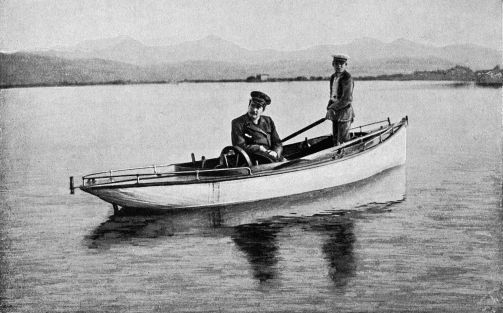
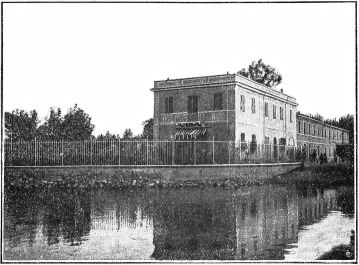
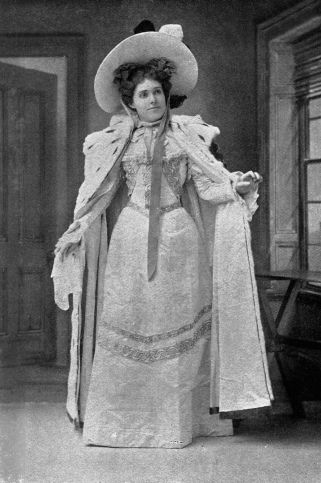
PUCCINI AT TORRE DEL LAGO IN HIS MOTOR BOAT "BUTTERFLY"
The sky has gradually been getting lighter, and the
passage of time is marked by the striking of the hour
of four by the church clock. Then Tosca gives the
final instructions to the condemned man. "As soon
as they fire, fall down." Cavaradossi, in his joy at his
coming release, is even able to be humorous, and
suggests that he will be acting like Tosca.
Tosca watches the supposed execution from the
parapet. "How well he acts!" she cries, after she has
covered her ears with her hands to shut out the sound
of the shooting, and then sees her lover prostrate on
the ground. Leaning over, she calls to him: "Get
up, Mario, now. Quickly away, Mario, Mario." Then
with a heart-piercing cry she learns that Scarpia has
been false to the end, and that the execution has in
very truth taken place. By this time the news of
Scarpia's death has come out, and Spoletta naturally
fixes on Tosca as the murderess. The soldiers' voices
are heard joining in the hue and cry, and Sciarrone
comes in to seize Tosca. Tosca after thrusting back
Spoletta nearly to the ground, hurls herself from the
parapet. Her last thoughts are of the tyrant who has
so cruelly wronged her, and her last words are: "O
Scarpia, we shall face God together!"
In pure orchestration, Puccini in Tosca shows an
advance on La Bohème, in the general symphonic fulness
and in the more extended use of representative
themes. The orchestra employed is the usual large
orchestra of the moderns, and Puccini adds a third
flute, a contrabassoon, a celesta, and for the special
effects in the opening of the third act a set of bells.
There are several places where more work than
hitherto is obtained from the dividing of the strings, but
not in any way like the Strauss method, for example,
of subdividing them into several distinct groups. As
will have been seen during the progress of the story,
the themes stand out as invariably characteristic, and
at the first entrance of Tosca the theme is delightful,
given out by the flute against the plucked strings.
There is excellent work by the wood wind in the impressive
finale of the first act, which is mainly developed
out of the bell theme.
In the pastoral music at the opening of the third act
Puccini uses with characteristic force a passage of
fifths—one which he is always very fond of employing,
and which, curiously enough, always has the effect of
bringing about the special flavour or atmosphere it is
intended to convey in any one particular place.
In the Daily Telegraph the critic prefaces his column
notice, which appeared the day after the first production,
with a protest against the conjunction of a pure
and beautiful art—music—with the workings of a
humanity that has gone to the devil. But apart from
these considerations, the writer has little but praise for
the singularly lucid libretto.
"The first and all important remark to make concerning
the music," he proceeds, "has to do with its
Italian character. There is very little that can be regarded
as common to it and to the typical German
opera. The pedestal is not on the stage and the statue
in the orchestra. Tosca does not offer us declamation
as a key to symphonic music nor symphonic music as
a key to declamation. The work does not follow the
old operatic lines into matter of detail. All is subordinate
to the changing situations and emotions of
the stage. So far Tosca is modern; for the rest it
presents the characteristics which have always distinguished
Italian opera—long reaches of tender or
passionate melody, intense climaxes, and a disposition
to proceed everywhere on broad and direct lines to the
desired goal."
The charm of the light music of the first act, the
beautiful soul of Cavaradossi to the picture he has
painted, the piling up of the effects in the finale, the
vigour of the music in the second act, particularly
where Scarpia presses his suit, and the duet of the
lovers at S. Angelo, are the points which call forth
praise, while, on the other hand, this critic finds most
of the music allotted to Angelotti and Scarpia dull.
The notice ends with a tribute to the art of Ternina,
who "acted with the grace and directness of a true
tragedian."
Mr. Arthur Hervey, in the Morning Post, sets out,
very clearly and characteristically, a plain and straightforward
account of the music and story. The curious
succession of chords at the opening of the prelude, the
suggestion of the amorous nature of Scarpia's character
by the opening notes of the second act, the pleasing
effect of the gavotte heard during Scarpia's monologue,
when he awaits the arrival of his spies, the beautiful
song for Tosca, "Vissi d'arte d'amor," the beauty of
the music in the last act, the ingenuity, finish and
resource of the orchestration as a whole, are points
which are fully expressed by this discerning critic.
With regard to the interpretation, he does not find
Signor Scotti's Scarpia entirely satisfactory, while he
joins in the fullest praise for Ternina's masterly performance
in the name part. It ends, that the opera
was received with every sign of success, and that the
composer, Mancinelli, the conductor, and the exponents
were called many times before the curtain.
The Times critic makes an interesting comparison at
the outset of his notice, referring to the masterly finale
of the first act: "The scene is one in which Meyerbeer
would have delighted, but it is treated by Puccini with
far greater sincerity than Meyerbeer could ever command,
and with a knowledge of effect at least equal to
his." With regard to the use of representative themes,
the writer finds that the one associated with the passion
of Scarpia—a phrase with an arpeggio in it, appears to
be derived from the woman's charm in the "Ring."
Referring to the gavotte and cantata at the opening of
the second act, the writer says they are "in excellent
style and belong to the period of the action or a little
before it, as it may be doubted whether the Roman
composers of 1800 were capable of producing so
interesting a piece of solid workmanship as the
cantata, or so graceful and original a composition
as the gavotte."