GETTING READY TO BE A MOTHER A Little Book of Information and Advice for the Young Woman Who is Looking Forward to Motherhood
Transcriber’s Note:
The cover image was created by the transcriber and is placed in the public domain.
GETTING READY
TO BE A MOTHER
THE MACMILLAN COMPANY
NEW YORK · BOSTON · CHICAGO · DALLAS · ATLANTA · SAN FRANCISCO
MACMILLAN & CO., Limited
LONDON · BOMBAY · CALCUTTA · MELBOURNE
THE MACMILLAN CO. OF CANADA, Ltd.
TORONTO
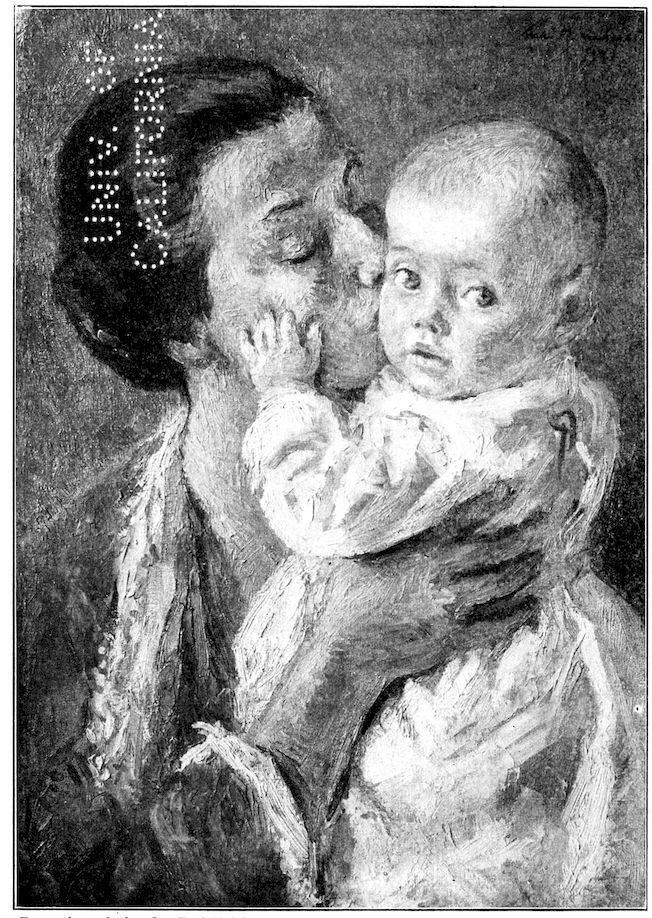
From the painting by Gari Melchers.
THE CARESS
THE BEGINNING
“Where did I come from, where did you pick me up?” the
baby asked its mother.
She answered, half crying, half laughing, and clasping the
baby to her breast:
“You were hidden in my heart as its desire, my darling.
“You were in the dolls of my childhood’s games: and when
with clay I made the image of my god every morning, I made and
unmade you then.
“You were enshrined with our household deity, in his worship
I worshiped you.
“In all my hopes and my loves, in my life, in the life of my
mother you have lived.
“In the lap of the deathless spirit, who rules our home, you
have been nursed for ages.
“When, in girlhood, my heart was opening its petals, you
hovered as a fragrance about it.
“Your tender softness bloomed in my youthful limbs like a
glow in the sky before sunrise.
“Heaven’s first darling, twin-born with the morning light, you
have floated down the stream of the world’s life, and at last you
have stranded on my heart.
“As I gaze on your face mystery overwhelms me; you who
belong to all who have become mine.
“For fear of losing you I hold you tight to my breast. What
magic has snared the world’s treasure in these slender arms of
mine?”
From “The Crescent Moon” (child poems), by Rabindranath
Tagore.
BY
CAROLYN CONANT VAN BLARCOM, R.N.
AUTHOR OF “OBSTETRICAL NURSING,” “THE MIDWIFE IN ENGLAND”
Formerly Assistant Superintendent and Instructor in Obstetrical Nursing and the Care of Infants and Children at the Johns Hopkins Hospital Training School for Nurses. Honorary Member of the Midwives’ Institute, England.
WITH AN INTRODUCTION BY
J. CLIFTON EDGAR, M.D.
Emeritus Professor of Obstetrics and Clinical Midwifery in the Cornell University Medical College; Consulting Obstetrician to Bellevue Hospital; Surgeon to the Manhattan Maternity and Dispensary; Consulting Obstetrician to the New York Maternity, Jewish Maternity, and Greenwich General Hospitals.
AND
FREDERICK W. RICE, M.D.
Associate Professor of Obstetrics, New York University and Bellevue Hospital Medical College; Attending Obstetrician to Bellevue Hospital; Assistant Surgeon to the Manhattan Maternity and Dispensary; Assistant Surgeon to St. Bartholomew’s Clinic and Hospital.
WITH SEVENTY ILLUSTRATIONS
New York
THE MACMILLAN COMPANY
1922
All Rights Reserved
PRINTED IN THE UNITED STATES OF AMERICA
Copyright, 1922,
By THE MACMILLAN COMPANY.
Set up and electrotyped. Published December, 1922.
TO
THE BABY,
UPON WHOSE WELLBEING
DEPENDS THE FUTURE
OF THE RACE
PREFACE
xi
The young woman who is looking forward to motherhood
is very often torn by sharply conflicting emotions. Her
eagerness to have a baby and her happy anticipations may
be dimmed by fears and misgivings, by superstitious and erroneous
beliefs born of an ignorance that is little less than
pathetic. A little information about physiological functions
and an explanation of some of the facts of motherhood
prove to be very reassuring to the mystified, uninformed
young woman.
There is, too, the immeasurably important question of
the expectant mother’s personal hygiene—the general
scheme of her living in such a way as to promote her own
and her baby’s welfare—concerning which the average
young woman is almost wholly ignorant.
But the busy doctor, who gives of himself, impartially,
to a large number of patients, often finds it difficult to discuss
with each one, in a leisurely, reassuring way, the facts
that he would like to have her grasp, the misinformation
he would like to dispel and the small but influential details
of her daily life that he wishes her to consider. It
is just such simple information and such details of personal
hygiene that I have attempted to set forth in this
little book, with the hope that it may help the expectant
mother intelligently and confidently to do her part in making
ready for the baby; and to spend the period of her expectancy
in a happy frame of mind, free from haunting
anxieties. And I have given some space to a description
of the course of the baby’s development in order that his
xiimother might have an abiding sense of his reality and his
need of her protecting care from the very moment of his
origin.
In no sense does this book replace the doctor’s care, for
it is merely a composite of the advice about simple, everyday
little things which the majority of obstetricians give
to the average, normal woman. I have stressed the fact
that the first need of both mother and baby, from the beginning
of pregnancy, is supervision by a physician and
that such advice as these pages offer is of value only as it
forms a part of his personal care.
I have drawn information from “The Practice of Obstetrics,”
by J. Clifton Edgar, M. D.; “Obstetrics,” by J.
Whitridge Williams, M. D.; “The Prospective Mother,”
by J. Morris Slemons, M. D.; “The Diseases of Infants
and Children,” by J. P. Crozer Griffith, M. D. and “The
Newer Knowledge of Nutrition,” by E. V. McCollum,
Ph. D., Sc. D. I am deeply indebted to Dr. J. Clifton
Edgar, Dr. Frederick W. Rice and Dr. John W. Harris for
helpful advice and criticisms and to Miss Louise A. Schofield
for editorial assistance. Practical suggestions have
been generously contributed by other doctors, and by
nurses, in this country and Canada, whose effective work is
inspired by their belief that the future welfare of our race
depends upon the care given to-day to maternity patients
and their babies.
Carolyn Conant Van Blarcom.
149 East 40th Street
New York City
INTRODUCTION
xiii
The childbearing function is a wonderfully complex
physiological phenomenon. It affects and is influenced by
almost every organ and tissue in the human body.
The body of the female child from the earliest weeks of
its life in its mother’s womb, while receiving nourishment
from her body, through infancy and the years of childhood
to maturity is being gradually molded and developed
for the special carrying out of this one function—the
crowning and most vital act of woman.
Although the childbearing function is the origin and
source of the human race, existing throughout the ages, the
processes connected with it have only in recent years been
clearly understood.
Our present-day knowledge of the processes connected
with childbirth makes it easy to understand how, in the
early ages of the human race, the function was a normal
function, with little or no danger to mother or child.
But with the gradual growth of the race, with the beginning
of the struggle for existence and the appearance and
spreading of disease, all interfering with the natural
growth and development of the body, the function of child
bearing ceased to be a normal function, as designed by
its Maker, and became one fraught with dangers to both
mother and child. Nevertheless, through ignorance of these
changes brought on by civilization, the idea that the function
is a normal process, the risk slight and fatalities infrequent
and when occurring, inevitable, is the almost universal
belief to-day.
The dangers to the life of the mother and child in the
carrying out of this function are well known to the medical
xivprofession, as well as the fact that for the most part
they are preventable. Yet in spite of this knowledge, each
year brings forth, unchanging, its toll in fatalities and
countless numbers of invalid mothers, with the inevitable
destroying factor of the happiness of the home.
Statistics are available to show that less than half of all
pregnancies are normal and that the illness and loss of
human life, from causes associated with childbirth, are distressingly
and needlessly high.
Failure to get these facts to the public; failure to teach
lay women the dangers to be avoided and the methods of
protection, is one very important reason why there has
been no decrease in the high mortality rates.
During the past ten years, maternity hospitals and private
and public health bodies, in various parts of the
country, have obtained wonderful results, locally, in reducing
infant and maternal mortality, by giving to large
groups of prospective mothers information concerning the
common dangers associated with childbirth and how they
might best be prevented.
If every expectant mother, no matter what her status or
location, followed the simple, practical advice which this
book offers, the rate of illness and death among our mothers
and babies would be materially lessened.
This book, therefore, so complete in its information on
every subject pertaining to the mother during pregnancy
and confinement and of the care of the newborn infant,
should be far reaching in its beneficial results.
It is a book containing knowledge which every physician
must admit that expectant mothers should have, and which
a large number of expectant mothers are now earnestly
seeking for their own protection and that of their newborn.
Does it seem the most amazing of miracles, so stirring in
its beauty and mystery that you are eager to make ready
and prepare for it fitly?
Or have you, perhaps, come to share the general feeling
that motherhood is a natural state which one accepts when
it comes, but need not prepare for?
This attitude seems to go back to a very old and deeply
rooted conviction that, as women always have had babies
and have had them through the working of one of Nature’s
laws that has been operating over and over throughout the
ages, they doubtless will continue to have them in the same
old way, and the entire matter may well be left to take
care of itself. As to the baby, when he comes, one may
expect that the ability to care for him will come too.
Because of this reasoning, or lack of it, it has been a
fairly general custom for the woman who expected a baby
to seek her doctor’s aid only when she went into labor, or
shortly beforehand, and to give no thought to the care of
her baby until he was born. All too often the mother has
died, because of this tardy care, been injured or become an
invalid, while equally sad things have happened to the baby—and
needlessly so.
But now, happily, a great change is taking place in the
realm of mothers and babies. We still realize, of course,
that childbearing is a natural function, but we know that
conditions must be made favorable for the smooth working
2of this natural law if all is to be well; that for the sake of
both mother and baby it is of urgent importance to
give thought and care to the baby during the nine months
before he is born.
There is little doubt that the most critical period in one’s
life is the first ten months—the nine months before birth
and the first month afterward—and that the care which is
given during these months influences one’s physical state,
for good or ill, throughout all the rest of life. In the light
of this knowledge, women are more and more generally
seeking and being given “prenatal care,” which is care
before the baby is born, together with advice and instructions
which fit them to assume motherhood safely and successfully.
Ideal prenatal care would really begin during the expectant
mother’s own infancy, for the chances of a normal
pregnancy, labor and lying-in period are greatly increased
by good care during the early years of life. But for the
time being we shall have to content ourselves with an effort
to extend, as widely as possible, the care that is now
known to be beneficial for expectant mothers from the beginning
of pregnancy.
This prenatal care is undertaken in much the same spirit
in which one makes a garden, for example. We know, of
course, that plants which are neglected sometimes grow
and blossom satisfactorily, though one would not think of
depending upon them to do so. But we have learned that
plants that are given the care and protection that they
need are almost certain to flourish and bloom after the
manner of their kind.
Experience teaches, however, that this care must be
regular and sustained and always given for the twofold
purpose of preserving the plants from injury as well as
nourishing them. Accordingly we put them in good soil,
3to begin with, and then give water, sunshine or shade, according
to their respective needs, and we take care to protect
them from the destructive effects of harmful insects,
blights, weeds or anything which may be unfavorable to
their healthy progress. We do not close our eyes to the
fact that these harmful conditions are possible. Instead,
we are anxious to find out all about them—what causes
them and how to recognize them—in order that we may
prevent or remove them before they do serious damage.
Many women, nowadays, are taking just that kind of
attitude toward motherhood. They begin by consulting
a doctor as soon as they know that they are pregnant,
because they appreciate the importance of doing so. They
study eagerly the questions relating to motherhood; the
structure and workings of those parts of their own bodies
which are concerned with the baby’s creation; how he
evolves within them; what he needs during those nine
months of development; what practices, what conditions
are bad for the baby and themselves; what they can do to
avoid or correct these and how they can help to make
things go smoothly.
The women who face the facts of motherhood in this
way generally go through the entire adventure normally
and successfully, as Nature intended they should. More
than this, those women who place themselves under a doctor’s
care from the beginning of, or early in, pregnancy,
are greatly reassured to find out how much can be done
to safeguard them, and they do not have that fear of the
approaching birth which is suffered by so many women
who do not know nor understand what is going on.
The results of the painstaking work and study which
have been carried on to increase the comfort and safety
of mothers and babies have made it possible for the doctors
to plan something of a routine which they find advisable
4for their patients to adopt. To begin with, it is
quite plain that the first need of every expectant mother
is examination and measurement, early in pregnancy, by
a good physician. The information thus obtained helps the
doctor to foretell the kind of labor that his patient is likely
to have, and by planning for it ahead of time he is often
able to save her much harm and suffering. An early examination
also enables the doctor to discover and correct
any slight trouble which may exist at that time and which
might grow worse if not treated, and to advise his patient
about the general care which he wishes her to take of herself
throughout pregnancy. In regard to this care, doctors
are generally agreed that the average woman needs
to do little more than observe the ordinary rules of personal
hygiene, which as a matter of fact, should be followed by
all of us; that is, she should live a simple, regular life as to
diet, fresh air, exercise, rest, sleep, diversions, etc. This
all sounds simple enough and as a matter of course, but
it is usually overlooked in spite of being of the most urgent
importance to both mother and baby.
This advice varies in little things, here and there, among
different doctors, but in the main it is about the same the
world over, where thought is being given to the care of
expectant mothers. For no matter where they are or what
their status, their needs in general are the same. They
need a doctor’s supervision and they need to practice the
principles of personal hygiene.
Accordingly, in addition to making an early examination
and giving instructions about the regulation of her
daily life, the doctor usually wants to see his patient and
make certain observations every little while during pregnancy,
just to make sure that everything is going as it
should and to be in a position to discover the earliest and
slightest symptoms of complications.
5In the old days there were certain complications associated
with childbirth which the doctors did not know how
to prevent and sometimes could not cure—complications
which were bad for both mother and baby. But now they
know a great deal about both preventing and curing even
the most serious of these complications. They have discovered,
for one thing, that many conditions which give serious
trouble during labor, or soon afterwards, actually have
their beginnings during pregnancy, and sometimes very
early.
Quite evidently, then, it means a great deal to the expectant
mother to have the doctor discover and treat these
complications before they have had time to become serious.
But he can give early treatment only if he knows about the
symptoms of the trouble when they first appear. Some of
these symptoms may be detected by the expectant mother
herself after they have been explained to her, but some
of them can be discovered only by a doctor or a nurse.
That is why it is important for the doctor to see his patient
at frequent intervals during pregnancy; about once a
month during the first half and every two weeks afterwards.
He sees her for much the same reasons that the housewife
looks over the contents of her darning basket—not
once and for all time, but regularly, once a week, over and
over and over. She searches each time not for holes alone,
but for thin places, too; an occasional broken thread or the
beginning of a “run,” knowing how much trouble she will
save herself, later on, by promptly repairing the smallest
break or evidence of wear. She knows quite well that there
are no more holes because she looks for them, than there
are if she does not, and that failure to look for them will
not keep the holes from being there nor from growing larger.
No more does the expectant mother develop a complication
6because she is examined, nor does an existing condition
cease to exist because she is not examined; and yet
some women still take just that illogical attitude toward examinations
and supervision during pregnancy.
One factor which keeps some expectant mothers from
seeking medical care is the well-meaning but dangerous
counsel so freely offered by older women who claim fitness
to advise by virtue of having had several children of their
own. Their lack of success, as evidenced by miscarriages,
stillbirths, children dying in early infancy, as well as injuries
and disabilities of their own, is usually overlooked
as they press their superstitions and remedies upon the inexperienced
and bewildered younger woman. When disaster
follows, as it so often does, it is very likely to be ascribed
to the will of God, and the mother’s needless sacrifice
does not even serve as a warning to others who are
in line for the same kind of advice.
Another obstacle to adequate prenatal care is sometimes
found in the husband who considers it entirely reasonable
to secure expert advice upon the subject of cattle-raising,
let us say, or the care and running of his automobile or
about his investments, but who has a conviction that it is
normal and natural for women to have children without
making what he considers a fuss about it. He may cherish,
too, a suspicion that it is not altogether good for his
wife to be thinking too much about her condition. His
mother never began bothering until the baby came.
On the other hand, many husbands show the tenderest
solicitude for their wives throughout pregnancy and would
be only too eager to have them enjoy all the benefits of
prenatal care, if they only knew and understood about it.
The expectant mother will be wise, therefore, if she undertakes
to convince her husband, if need be, that her occupation
of bearing and rearing children merits quite the same
7thoughtful attention as his work, to which he devotes his
best powers.
How easy and worth while this may be was demonstrated
a couple of years ago at a county fair which was attended
by a very intelligent farmer and his wife. The farmer
was interested in hog-raising and both he and his wife accepted
without question the fact that success in this enterprise
could be achieved only through serious study and the
most painstaking care. But as to childbearing, if they
thought of it at all, they looked upon it as simply one of
those natural functions which always had and doubtless
always would take care of itself.
When this couple reached the fair the farmer entered
one of his fine animals in a prize-winning contest and as
there was a baby contest, too, the wife entered their little
son. In due time the judges inspected the various contestants
and it was found that point by point the farmer’s
hog measured up to all of the standards of perfection for
his kind and easily won the first prize. Not so with the
baby; point by point he fell below even a moderate average
of what a baby should be and was outranked by many
of his more robust infant competitors.
As various admirers discussed hog-raising with the
farmer, it became quite evident that he had carefully
studied the question and had applied to his occupation
the most approved methods of which he could learn.
But when the doctors and nurses at the baby contest talked
with the crestfallen mother about her baby, who had seemed
right enough to her, they found that she knew little or nothing
of the business of being a mother; that it had never
occurred to her nor to her husband that she might profit
by care and instruction about herself and her baby both before
and after he was born. As might be expected, she
had been unable to nurse him and on the whole he proved
8to be a pretty poor specimen of a baby, with a dismal outlook
as to health.
Since the mother was then in an early stage of another
pregnancy, the doctor talked it all over with her and her
husband. He convinced them that such thoughtful and
painstaking care as they had devoted successfully to hog-raising
were equally effective when applied to baby-raising.
As a result, the expectant mother, with her husband’s
whole-hearted approval, placed herself under the care and
supervision which she found were available through a prenatal
clinic in her vicinity.
The happy sequel to that story is that when another
fair was held, a year later, the farmer entered another
one of his hogs and the wife her new baby, and that this
baby held his own with the hog by taking a prize, too.
So sincerely do doctors now believe in the urgency of
having all maternity patients under supervision and care
during the nine months before the baby comes and the
first several weeks afterwards, that they not only care for
those women who come to their offices, but also give of their
knowledge and skill to organizations engaged in prenatal
and maternity work. These organizations may be visiting
nurse associations, prenatal clinics, health centers or dispensaries.
As the doctors are assisted by nursing staffs
they are able to offer protection, through these channels,
to a very large number of mothers and babies.
Among the women who are cared for by such organizations,
or by doctors in their private practice, there is an
enormous reduction in the occurrence of convulsions, for example,
abortions, miscarriages, stillbirths, infections (childbed
fever), and prolonged and difficult labors. Or, to put
it the other way round, good care started during early
pregnancy and continued throughout labor and the lying-in
period gives both mother and baby enormously increased
9chances to live and enjoy good health. One reason why
the baby is so much better off is that good care practically
always enables his mother to nurse him, for, except in extremely
rare cases when there is a definite physical disability,
as tuberculosis for example, every mother can nurse
her baby if she really wants to and if she, the doctor and
nurse bend all their energies to accomplish this happy
end. A baby who is not breast-fed is defrauded of a protection
which is rightfully his, and usually because someone
has failed to do all in his or her power.
Organizations which include doctors and nurses who can
give skilled care to maternity patients are increasing in
scope and number throughout cities, towns and rural districts
in all parts of the country. This makes us hope that
before long good care during pregnancy, childbirth and
young motherhood will be available to every woman in
the land. But quite as earnestly do we also hope that
every woman in the land who is looking forward to motherhood
will seek this care. Certain it is that the expectant
mother who does seek care, whether from a doctor in his
office or through a prenatal clinic, is approaching her
motherhood in the only way that is safe for herself and
her baby. She should realize, however, that although the
doctors can accomplish a great deal through examinations
and advice, they can give the full benefits of their skill
only to those women who do their part by following instructions
faithfully, week after week, throughout nine
months. The doctor cannot live his patient’s life for her;
he can plan and advise her ever so wisely, but this counts
for very little unless she lives as he directs.
The young woman who sees her motherhood as a coveted
privilege, crowded with happy possibilities, who is willing
to bear its inconveniences and take the necessary precautions
to insure a satisfactory outcome, is very likely to
10go through her experience in good health and buoyant
spirits. And in the end she will have not only the ecstasy
of possessing a beautiful, well baby who has every
prospect of continuing so, but as the years pass she will
have the satisfaction of knowing that she is a better, more
helpful, more companionable mother because of being in
good health herself.
That is the point of good maternity care—future well-being
as well as immediate safety for both mother and baby—and
it rests with each woman to decide for herself if she
is to have such care.
CHAPTER II SIGNS THAT A BABY IS COMING
11
The woman who wants a baby and is in a position to have
one is usually eager to know how she can tell when a baby
is coming. She wants to know because the baby’s coming
means so much to her and also in order that she may know
when to consult a doctor.
I am sorry to have to admit, at the outset, that making
this important discovery is far from being a simple matter.
One would suppose, after all these ages, during which
countless babies have been born and countless pregnancies
have been observed by doctors and others, that there would
be some known way of finding out definitely, at an early
date, whether or not a baby was coming. But strangely
enough, there is no positive evidence of the baby’s existence
within his mother’s body until eighteen or twenty weeks
after his life there has begun.
On the other hand, so many symptoms of pregnancy
are known to women, the world over, that very often an expectant
mother is correct when she suspects at an early
date that she is pregnant, particularly if she has already
had a child. But as the well-known symptoms are much like
those of various conditions other than pregnancy, even experienced
mothers sometimes believe themselves pregnant
when they are not. The reverse is true also, for we occasionally
hear of a woman who fails to recognize the meaning
of the changes which she notices in herself, and is unaware
of being pregnant up to the very time of going into labor.
12And so we find that there are some signs of pregnancy
which are only possible, since they may be caused by some
other conditions; others which may be accepted as probable,
and a few signs which are positive because they are never
due to any cause but pregnancy.
The possible signs can all be detected by the expectant
mother, herself, and may be described as follows:
1. Stopping of Menstruation. This is usually the first
symptom noticed. Although it is possible for the periods
to be stopped by any one of several other causes, the missing
of two successive periods, after intercourse, is a strong
indication of pregnancy in a healthy woman of the childbearing
age, whose menses have been regular.
2. Changes in the Breasts. These, also, occur early.
The breasts usually increase in size and firmness, and many
women complain of throbbing, tingling or pricking sensations
and a feeling of tightness and fullness. The breasts
may be so tender that even slight pressure is painful. The
nipples become larger and more prominent; they and the
colored circle of skin around them grow darker, while the
veins and the glands that feel like little lumps under the
skin become more noticeable. If, in addition to these symptoms,
it is possible for a woman who has not had children
to squeeze from her nipples a pale yellowish fluid, called
colostrum, she may feel almost certain that she is pregnant.
But it must be remembered that these symptoms,
also, may be due to causes other than pregnancy; that
even milk in the breasts may be present in a woman who
has borne children, for months, or possibly years, after the
birth of her last baby.
3. “Morning sickness,” as the name suggests, is nausea,
sometimes accompanied by vomiting, from which many expectant
mothers suffer the first thing in the morning. This
varies from a little nausea, when first raising her head,
13to repeated attacks of vomiting during the day and even
during the night. As a rule, however, the discomfort is
experienced during the early part of the day only. Morning
sickness may set in immediately after conception, but
begins about the sixth week, as a rule, and lasts until the
third or fourth month. It occurs in about half of all pregnancies
and is particularly common among women who are
pregnant for the first time. On the other hand, one must
not forget that many non-pregnant women suffer from nausea
in the morning; many women go through pregnancy
without any such disturbance, while others are entirely
comfortable in the morning but nauseated during the latter
part of the day.
4. Frequent Urination. There is usually a desire to
pass urine frequently during the first three or four months
of pregnancy, after which the tendency disappears, but returns
during the later months. The desire may be due in
part to nervousness, but is largely caused by pressure
made upon the bladder by the growing baby, and not by
kidney trouble, as is sometimes believed. For pressure on
the outside of the bladder gives much the same sensation
as is experienced when the bladder is full of urine. After
the baby grows to such a size that he pushes up into the
abdomen (we shall describe this later), he does not press
upon the bladder and therefore ceases to create a desire to
urinate until the last month or six weeks before he is
born when he sinks back into the pelvis.
5. Increased discoloration of the colored parts of the
skin is another early symptom of pregnancy. In addition
to the deepened tint of the nipples and the circles around
them, a dark streak appears upon the lower part of the
abdomen, extending upward toward the umbilicus, or navel.
There are also the yellowish, irregularly shaped blotches
which sometimes appear upon the face and neck; dark circles
14under the eyes and pinkish or bluish streaks on the
abdomen.
6. “Quickening” is the name which is commonly given
to the mother’s first feeling of the baby’s movements. It
occurs about the eighteenth or twentieth week, and is regarded
by some doctors as a positive sign of pregnancy and
by others as merely a possible sign. The sensation is compared
to a very slight quivering, or tapping, or to the fluttering
of the wings of a bird as it is held in one’s hand.
Beginning very gently, these movements grow more vigorous,
as time goes on, until they become very troublesome toward
the latter part of pregnancy, amounting then to sharp
kicks and blows. Women who have had children can usually
distinguish between quickening and the somewhat similar
sensation caused by the movement of gas in the intestines;
but a woman pregnant for the first time may be
deceived.
There are many other possible symptoms of pregnancy,
but their value is very uncertain and as we have seen, even
the ones described above are not entirely dependable. But
if you have missed two periods; if your breasts have grown
larger and firmer; if your nipples are stiffer and more
prominent and you can squeeze colostrum from them, you
may be reasonably certain that a baby is coming.
The probable signs of pregnancy are more apparent to
the doctor than to the expectant mother, but there are two
which you may easily detect:
1. Enlargement of the abdomen, which is a very important
sign, may be noticed about the third month. At this
stage a rounded mass may be felt in the abdomen which
steadily increases in size as the weeks and months slip by.
Rapid enlargement of the abdomen in a woman of childbearing
age may be taken as fair, but not positive, evidence
that she is carrying a baby. However, complete reliance
15cannot be placed in this sign, since it is possible for
the abdomen to be enlarged by a tumor, by dropsy, or
by fat.
2. Painless contractions of the uterus (or womb, within
which the baby lies) begin during the early weeks of pregnancy
and occur at intervals of five or ten minutes
throughout the entire period. The expectant mother may
not be conscious of these contractions during the early
months, but later she can detect them by placing her hand
upon her abdomen and feeling the uterus, beneath it, grow
first hard and then soft, as it contracts and relaxes. But
the probable signs of pregnancy, like the possible symptoms,
may occur in women who are not pregnant, and accordingly
the appearance of any one of them alone, is not
of great significance.
The positive signs of pregnancy, of which there are three,
are not apparent until the eighteenth or twentieth week.
They relate to the baby, but with one exception they cannot
be detected by the expectant mother. However, they are
of such moment that you will be interested to know what
they are.
1. Hearing and counting the baby’s heart beat is unmistakable
evidence of the baby’s existence. The doctor
sometimes hears this by resting his ear upon the mother’s
abdomen and sometimes by listening through a stethoscope.
2. Ability to feel the outline of the baby’s body is also
a positive sign of pregnancy, if the head, buttocks, back
and extremities are unmistakably made out through the
mother’s abdominal wall.
3. Feeling the movements of the baby is accepted as a
third positive sign of pregnancy. There is some difference
of opinion concerning the value of “quickening,” alone, as
a positive sign, but if the baby’s movements are felt by
the doctor, also, through the mother’s abdominal wall, or
16by vaginal examination, there can be no doubt that a
baby is there. Feeling these movements some time after
the eighteenth or twentieth week, by placing a hand upon
the abdomen, is the one positive sign which the expectant
mother may detect for herself.
Some Other Changes in the Mother’s Body While the
Baby Grows. In addition to the signs and symptoms
which we have just described, there are a good many other
changes which will take place in your own body, in the
course of the baby’s development, and you will want to
learn about some of them in order that you may know
what to expect.
The abdomen. Of course, the steady enlargement of the
abdomen and the alteration in its shape, as pregnancy advances,
is the change that you will be most conscious of.
As the abdomen grows larger, the skin which covers it is
stretched more and more tightly with the result that the
tissues just under the surface sometimes give way, or split
and form pale pink or bluish streaks. These streaks, which
are called striæ, grow white and glistening after the baby
is born, so that the abdomen of an expectant mother who
has had children, will show silvery streaks from earlier
pregnancies and also the bluish ones recently formed.
These streaks are of no consequence and I mention them
simply because you are almost certain to notice them and
may wonder what they are. They may appear upon the
hips, thighs and breasts as well as upon the abdomen, if
the skin over these parts is greatly stretched.
The umbilicus (navel) is deeply indented during about
the first three months of pregnancy, but afterwards the pit
steadily grows shallower and by the seventh month, it is
level with the surface of the abdomen. After this time the
navel may protrude, in which state it is described as a
“pouting umbilicus.”
17An increase in the vaginal discharge is another change
which you may notice during the latter months of pregnancy.
The changes in the skin consist chiefly of the increased
discoloration over various parts of the body, which was
mentioned among the possible signs of pregnancy. The
degree of this discoloration varies with the complexion of
the individual, as blonds may be tinted but slightly more
than usual, while the discolored areas on a brunette may
become almost black. As the skin glands become more active,
there is also an increase in perspiration and sometimes
the hair becomes much more luxuriant during pregnancy.
Changes in the digestive tract are the morning sickness
already described, and constipation. The latter is suffered
by at least one half of all pregnant women and is due
chiefly to pressure made upon the intestines by the enlarged
uterus, though weakening of the stretched abdominal
muscles may be one cause. Constipation is most
troublesome during the latter part of pregnancy. There
may be, also, heartburn, acid stomach and intestinal indigestion
giving rise to gas, diarrhea and cramps. The so-called
“cravings” of pregnancy are not so common in real
life as they are in rumor, but the expectant mother may
show unexpected likes and dislikes for certain dishes, possibly
because of her tendency to be nauseated. Her appetite
may be very capricious during the early weeks and
become almost ravenous later on.
The bones and teeth may grow softer during pregnancy,
if the expectant mother does not eat proper food, and as a
result we hear of the old beliefs that each baby costs the
mother a tooth and that broken bones heal slowly during
pregnancy. Both of these occurrences are entirely unnecessary,
and may be prevented by eating suitable food,
as will be explained in the chapter on nutrition.
18The carriage, or mode of walking, is somewhat affected
by pregnancy because of the increased size and weight of
the abdomen. In an effort, to hold herself erect, the expectant
mother throws back her head and shoulders and finally
assumes a gait that may be described as a waddle, being
particularly noticeable in short women.
You hear a good deal about the thyroid gland these
days, so you may as well know that it is very often enlarged
during pregnancy and thus may form a swelling on the
front part of the neck. If you notice it you might tell
your doctor but it need not worry you for it will almost
certainly return to its normal size after the baby comes.
When to Expect the Baby. Now that you are familiar
with the most apparent changes which will take place in
your body during pregnancy, you are probably on tiptoe
to find out as nearly as possible the date upon which to expect
the baby. Unfortunately we cannot foretell the exact
date, for the very simple reason that we have no way of
knowing just when pregnancy begins. Quite evidently,
then, not knowing when it begins we cannot figure out the
exact date upon which pregnancy will end in the baby’s
birth. But we do know that labor usually begins about
ten lunar months, or forty weeks, or from 273 to 280 days,
after the beginning of the last menstrual period. Thus
the approximate date of the baby’s arrival may be estimated
by counting forward 280 days or backward 85 days
from the first day of the last period. Or, what is perhaps
simpler and amounts to the same thing, one may add seven
days to the first day of the last period and count back
three months. For example, if the last period began on
June 3, the addition of seven days brings us to June 10,
while counting back three months from this, indicates
March 10 as the approximate date upon which the baby
may be expected.
19This is probably as satisfactory as any method of estimation,
but at best it is only approximate, being accurate in
about one case in twenty. However, it comes within a week
of being correct in half the cases; and is within two weeks
of the actual date in eighty per cent. of all pregnancies.
Still another method is to count forward twenty or
twenty-two weeks from the day upon which you first feel
the baby move. This “quickening,” as we have seen,
usually occurs about the eighteenth or twentieth week, but
is so irregular that it is not wholly reliable. The possibility
of figuring out the date of the baby’s arrival is made still
more uncertain by the fact that there is evidently considerable
variation in the length of entirely normal pregnancies.
Many healthy children are born before ten lunar
months have elapsed since the last menstrual period, while
more births occur after than on the expected date. The
first pregnancy is usually shorter than later ones, and
women who are well nourished and well cared for usually
have longer pregnancies than those who are not.
Taking it as a whole, the average woman has unusually
good health during pregnancy. She may feel some weariness
during the first few months and she may lose a little
weight, but during the latter part of the period her general
health is improved and there is an increase of flesh, not
alone in the abdomen, but over the entire body, sometimes
amounting to twenty-five or thirty pounds. She loses
about fifteen pounds of the increased weight when the baby
is born, and still more during the weeks immediately following,
when her body returns to about its original condition.
But very often the experience of pregnancy is so
beneficial that the improved state of health and nutrition
which accompany it become permanent.
CHAPTER III WHERE THE BABY’S LIFE BEGINS
20
As you plan for the care of your baby during the nine
months before he is born, you will want to know something
of the place where his life begins; where one tiny cell is so
miraculously stimulated and nourished that it finally develops
into a beautiful little body. Not only will you
find all of this of absorbing interest, but a general idea
of the structures and workings of those parts of your body
where the baby lives and grows will help you better to understand
some of the doctor’s precautions and to give yourself
intelligent care while your body performs its supreme
function.
To begin with, there is the pelvis. This is a very irregular,
bottomless, bony basin, or curved canal, within
which lie the reproductive or generative organs to be described
presently. The pelvis is really composed of four
bones which are entirely separate in early life but firmly
welded into one rigid structure in adults. I mention this
because many women believe that labor pains are caused
by a spreading or opening of these bones, whereas, as we
shall see presently, the pains are really due to the strong
contractions of the muscles of the uterus (or womb) in
which the baby lies, which force the baby down through
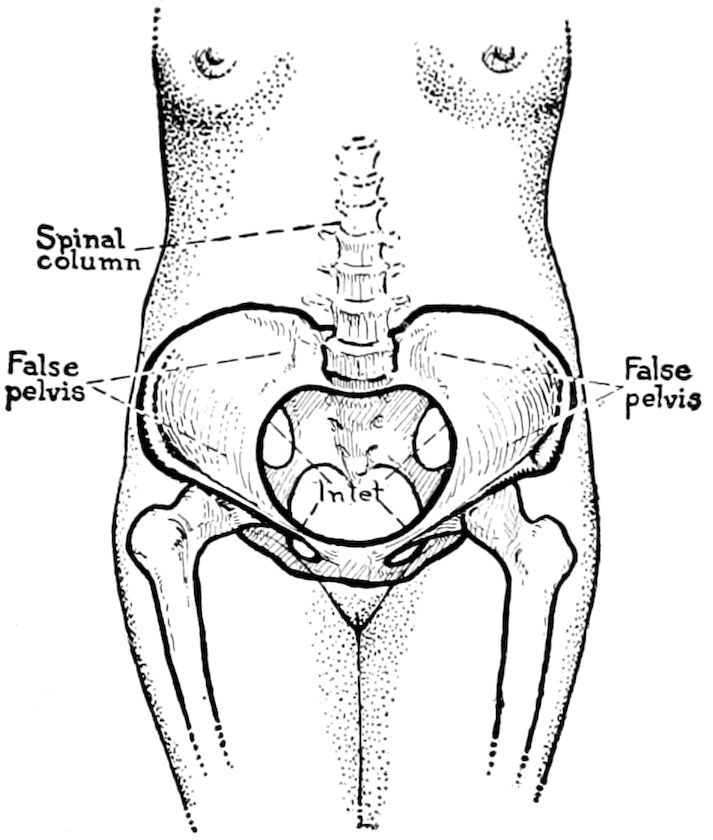
this inflexible ring. You may see in Fig. 1 how the pelvis
is placed in the body, being interposed between the spinal
column, which it supports, and the thighs upon which it
rests. We can feel two of its prominent points on either
21side below the waist, as our hips, and we rest upon two
other projections while in the sitting position.
Fig. 1.—Diagram showing the structure of the pelvis and its position in the body, the inlet being heavily outlined.
This bony canal is drawn in, or narrowed about midway
in its length so that it is broader above and below
than it is in the middle. You are likely to bear the doctors
speak of this narrow part as the inlet. I thought you
would be interested to know about this for it is largely in
order to discover the size and shape of the inlet that the
doctor is so anxious to make certain examinations and measurements.
The wide part of the pelvis above the inlet is called the
upper, or false pelvis, while the smaller cavity below is
known as the true pelvis. During the early part of pregnancy
the baby lies in the true pelvis, but as pregnancy
22advances and he grows larger, he pushes up through the
inlet into the larger pelvis where he remains until he is
born. When that time comes he must pass down through
the inlet again on his way into the world. If this opening
is about the usual size and shape and the baby is of an average
size, he will usually pass through with comparatively
little trouble. But if the inlet is smaller than normal or of
an unusual shape, it may be difficult, or even impossible,
for the head of a normal-sized baby to pass through without
the doctor’s assistance. You can see how important it
is, therefore, for the doctor to know beforehand about the
size and shape of the pelvic inlet, since it enables him to
plan to help with the birth, if necessary, thus saving mother
and baby from exhausting themselves in trying to do the
impossible. In the old days many mothers and babies were
injured, and sometimes even lost their lives, because doctors
did not know about measuring the pelvis and planning
ahead of time for a difficult labor. But now they know
how to make things easier and safer.
It is worth mentioning here that proper care during infancy
and childhood, with proper food, fresh air and exercise,
helps to promote normal development of the pelves of
little girls, and this in turn tends to make childbirth normal
for these children when they grow up and are ready
to have babies of their own.
The Generative or Reproductive Organs. The pelvis is
an interesting structure but not nearly so interesting as
the generative organs which lie within it: the uterus (or
womb), tubes and ovaries. These, with the vagina, are often
called the internal genitalia because they are inside the
body. The pelvis practically remains rigid and inactive
throughout pregnancy and labor, but the ovaries and the
uterus are constantly active and are concerned with an undertaking
which is so utterly amazing that it is far beyond
23our powers of understanding. We can only look on and
wonder.
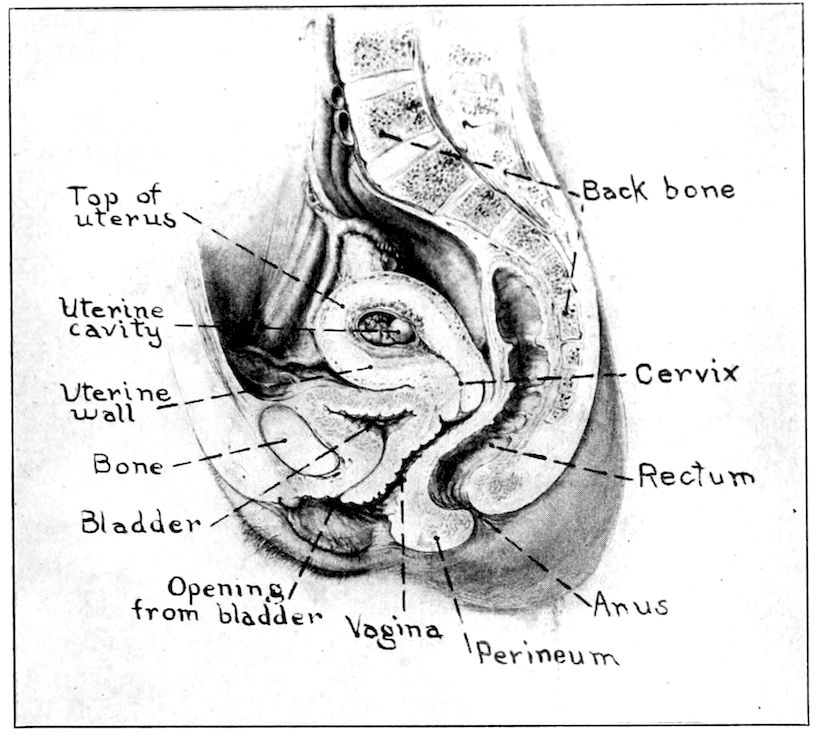
Fig. 2.—Drawing showing the structure and relation of the female generative organs, as viewed from the side. (Drawn by Max Brödel. Used by permission of A. J. Nystrom and Co., Chicago.)
The uterus, or womb, in which the baby develops, is a
firm little mass of muscle, which, in its non-pregnant state,
is much the shape of a slightly flattened pear, about three
inches high, an inch and a quarter wide at its broadest
point, three quarters of an inch thick, and weighs about
two ounces. We usually speak of the main part of the
uterus as the body: the round top as the fundus and the
24smaller part of the organ, below, as the neck or cervix.
This important little organ is placed about the middle of
the true pelvis, with the upper end pointing slightly forward.
(See Fig. 2.) It is more or less swung in this position
by being attached to ligaments instead of to any fixed
part, the ligaments, in turn being attached to the sides of
the pelvis. This explains why the uterus may move about,
tip forward or backward, and how, by a stretching of the
ligaments that hold it, it is able to grow and push upwards
as pregnancy advances.
Within the body of the uterus is a flat cavity which is
somewhat triangular in shape, with an opening at each of
the three corners. The two upper openings lead into the
tubes, which will be described in a moment, while a third
opening leads down into the cervix, the lower end of the
cervix, in turn, protruding into the vagina. The upper
and lower ends of the cervix are drawn in as though with
a draw string so that they are scarcely more than small
round holes. These are called the internal os and the external
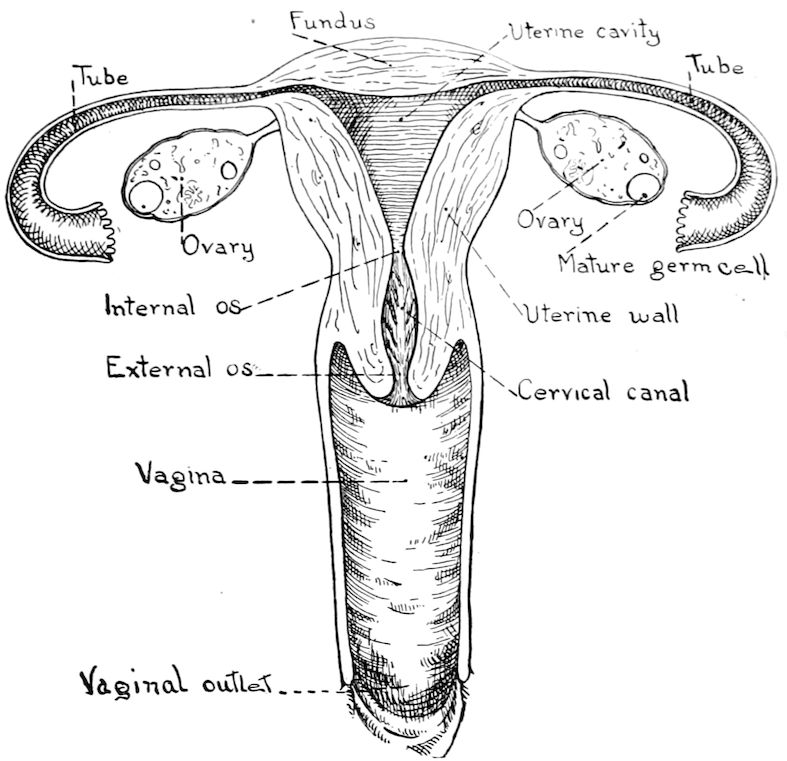
os. Fig. 3 gives an idea of how the cavity of the uterus
and the cervix would look from the front, with the tubes
reaching out from the upper corners of the uterus, and the
cervix opening into the vagina. The uterus is lined with
a soft mucous lining something like the lining of one’s
mouth. Bear this in mind, for this lining represents,
in part, the soil in which the tiny human seed is planted
and through which its roots draw nourishment.
The Fallopian tubes are two little muscular passage
ways, about five inches long, which extend from the two
upper corners of the uterine cavity toward the sides of the
pelvis. The tubes are very small where they arise from
the uterus, but gradually grow larger toward their free ends
and finally spread out into wide, funnel-shaped openings
that lead directly into the abdominal cavity. The tubes,
25also, are lined with a mucous membrane but of a most
surprising kind. Its surface is covered with tiny hair-like
projections which make it something like a brush with very
soft, moist bristles. These little hairs are in constant motion,
waving and sweeping along in much the same way
that a field of wheat waves and sweeps in the wind. Remember
about this, too, for it has something to do with
the very beginning of the baby.
Fig. 3.—Diagram showing the structure and relation of the female generative organs, as seen from the front.
The Ovaries. Very near and a little below the flaring,
open ends of the tubes are the ovaries, the sex glands of the
26female. There is one on each side, held in place by ligaments
and they are about the size and shape of almonds. In
the ovaries are embedded the ova, or eggs, the female germ
cells which are concerned with producing the baby and
also with the function of menstruation.
Fig. 4.—Diagram of human ovum.
Just a word about what is meant by “a cell.” It is simply
a tiny mass of jelly-like substance, called protoplasm,
contained in a thin membrane or skin and is so small that it
can be seen only through a microscope. In its unmatured
state the ovum is a single cell, about ¹⁄₁₂₅ of an inch in
diameter. In the protoplasm there is a spot called the
nucleus and within this a smaller one called the nucleolus,
or the germinal spot. These are long names and you need
not remember them unless you want to, but glance at Fig.
4 which shows an ovum and you will see that in its general
structure it is much like a hen’s egg, for the latter has a
27yolk within the white and on the yolk a tiny speck or
germinal spot. The formation of each woman’s full quota
of ova, fifty thousand or more, is probably complete at the
time of her birth.
The vagina is a muscular tube, or passage way, leading
from the outside of the body to the cervix, which you will
remember is the lower part of the uterus. The vagina
slopes upward from its opening and instead of meeting the
cervix evenly it meets it almost at right angles and encases
it like a sheath for about half an inch. Fig. 2 shows
how these organs would appear if we were looking at them
from the side.
The Bladder. If you will glance again at Fig. 2, you will
see that just in front of the vagina there is a tiny passage
leading up to a sac which also is in front of the vagina, and
since in this picture it is practically empty, it lies below
the uterus. This sac is the bladder and you can readily
understand that as the uterus enlarges during pregnancy,
it presses upon the bladder and this pressure on the outside
gives the same sensation as is produced by pressure from
the inside when the bladder is filled with urine. That is
why the expectant mother has such a constant desire to
urinate during the early weeks of pregnancy, before the
uterus pushes up into the abdomen, and also during the
later weeks, as well as during labor, when the bladder is
being pressed upon by the baby’s head.
The Rectum. In the same picture you will see the rectum
which lies just behind the uterus and vagina and which
terminates in the anus. Between the rectum and the vagina
is a thick triangular mass of muscle, called the perineum,
which practically forms a floor to the pelvis, the bony basin
without a bottom.
The external genitalia, sometimes called the vulva,
really have nothing to do with the creation of the baby, but
28you will better understand some of the care that is given
you if you know a little about them, too. Between the
thighs, where they join the body, are two thick folds of flesh,
called the labia and between these lie the perineum, just
mentioned, and the openings from the rectum, vagina and
bladder as shown in Fig. 2.
Now that we have something of an idea of the structure
of the organs concerned with the creation of the baby, we
shall want to learn about the usual activities of these interesting
little parts, before the baby begins his life within
them.
Puberty or Adolescence. You know, of course, that girls
are incapable of becoming mothers until after what is
termed puberty, or adolescence, and by these terms we
mean the period during which childhood develops into
sexual maturity, and the individual becomes capable of reproduction.
The age at which puberty occurs varies with
climate, race and occupation and with different individuals
of the same status. But the average for girls, in temperate
climates, is from the twelfth to the sixteenth year
and for boys from the fourteenth to the seventeenth year.
Girls in southern climates sometimes mature as early as the
eighth or ninth year while in colder regions puberty
may be delayed until they are eighteen or twenty years
old.
The occurrence of puberty marks the establishment of
ovulation and menstruation, two functions which are usually
performed once a month during the childbearing
period.
Ovulation, which probably occurs about midway between
the menstrual periods, is simply the name which has been
given to the principal function of the ovary and may be
defined as the development of the ovum, or egg, and its expulsion,
when mature, from the ovary. As the entire human
29body has its origin in this tiny ovum, its career and
course of development are of momentous importance to
us, and at the same time furnish a tale of absorbing interest.
The ovaries are packed full of these tiny egg-like
cells, which probably lie dormant, as stated before, until
the girl reaches puberty. Then they begin to develop and
grow and push their way from the inside of the ovary to
the surface where they look more or less like blisters. When
an ovum reaches the surface of the ovary, a thin membrane
which contains it, bursts, and it is suddenly expelled into
the abdominal cavity. You will remember that the ovary is
very near the funnel-like end of the tube, so, when the little
cell is shot out of the ovary, it finds itself floating around
quite close to this wide opening. Some of the ova that are
projected into the abdominal cavity are doubtless lost, but
others find their way into the near-by mouth of the tube,
and if not fertilized by uniting with a male cell, which we
shall explain presently, they pass down the tube into the
uterus and are finally carried out in the menstrual flow. It
is probable that as a rule only one ovum ripens and escapes
from the ovary each month from puberty until the
menopause or change of life.
The interesting thing about all of this is that each time
an ovum does mature and is discharged from the ovary,
the lining of the uterus becomes thicker and softer in order
to facilitate the attachment of the ovum, if it is fertilized,
this attachment being necessary if a baby is to develop.
This preparation of the uterine lining is often, and very
appropriately, referred to as “nest-building.”
Menstruation, which is the evidence of sexual maturity,
is a monthly hemorrhage from the uterus, escaping through
the vagina, and it normally recurs regularly throughout the
childbearing period, except during pregnancy and while
the young mother nurses her baby. The length of this childbearing
30period is about thirty years and continues from
puberty until the menopause. The frequency of the menstrual
periods varies from twenty-one to thirty days but
the normal interval between periods is twenty-eight days,
which is the length of what is called the “menstrual cycle.”
Thus it is usually a lunar month from the beginning of one
period to the next one, making thirteen menstrual periods
during each calendar year. The complete course of a menstrual
cycle consists of four stages, which, it is believed,
occur somewhat as follows:
The first, or constructive stage, lasts about seven days.
It is during this stage that the preparations are made to
receive the ovum traveling down the tube. The entire
uterus becomes congested with blood and is somewhat enlarged
and softened as a result, while its lining grows red,
thick and velvety. If the ovum remains unfertilized, which
is usually the case, it does not attach itself to this elaborately
prepared lining, but passes out with the uterine discharges
and all of this preparation not only goes for
naught but must be undone.
The second stage, therefore, which lasts about five days,
is the destructive stage and is the period we speak of as
menstruation. During this period the extra tissue
which has been formed in the uterus is broken down; it
mixes with the blood that oozes from the congested lining
and together they pour from the vagina as the menstrual
flow.
The third or reparative stage, which follows, occupies
about three days during which time the uterus and its lining
return to their normal state.
The fourth, or quiescent stage, now follows and lasts
twelve or fourteen days. This is the time remaining before
Nature, with unwearying patience, begins all over again to
prepare for the reception and attachment of the next matured
31ovum, in ease of its possible fertilization. And so
it goes, month after month and year after year.
It is very important for a woman who is suffering from
painful menstruation to consult a doctor about correcting
the cause, in the interests of her future childbearing, if
for no other reason, for this is one step toward preparing
a good soil in which to plant the seed from which a baby
may grow. For example, a misplacement of the uterus is
a frequent cause of painful menstruation and if it remains
uncorrected may make conception impossible; or if
conception perchance does take place, the malposition of
the uterus may, later, be the cause of an abortion or miscarriage.
Inflammation of the lining of the uterus is another
cause of menstrual difficulty and if allowed to persist,
may interfere later on with the normal development and
nourishment of the baby.
The menopause, also termed the climacteric, or the
change of life, marks the permanent stopping of menstruation
and ability to bear children. This ordinarily occurs
between the ages of forty and fifty, the majority of women
ceasing to menstruate during their forty-sixth year.
The most favorable age for motherhood to begin is a subject
of considerable interest to most women. When it is
considered from all standpoints, social, ethical, spiritual as
well as physical, the most favorable age for motherhood
to begin seems to be sometime in the early twenties. Children
have been born to little girls nine years old and to
women over sixty, but the extremes of the reproductive
years are not favorable periods for childbearing.
Now a word about the breasts. They appear to be
merely large, soft masses of fat, one on each side of the
chest, having no connection with the pelvic organs. But in
reality they are very complicated glands and strangely
enough, though no one knows why, their activities are controlled
32by the activities of the generative organs down
in the pelvis. Certain it is that their function is very important
to the baby, for the breasts are the factories in
which nourishment is produced to nourish him during the
first few months after he is born.
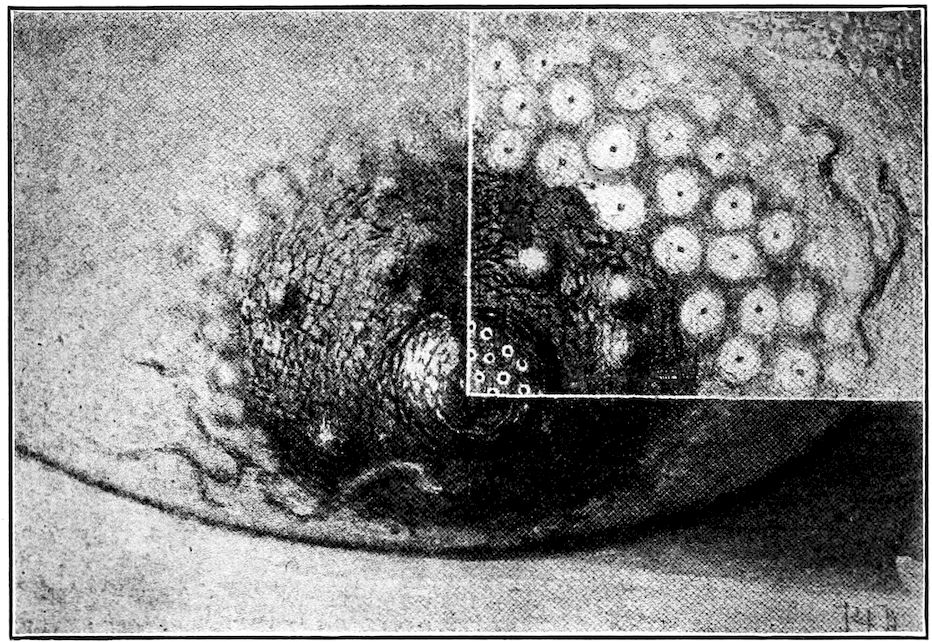
Fig. 5.—Front view of breast, showing areola; openings from milk ducts and the glands beneath the skin.
If we could look inside of the breasts we should see that
in structure they are much like several clusters of grapes
in which the stems and grapes are hollow. The milk is
formed in the tiny sacs corresponding to the grapes, and
pours into the little tubes conforming to the stems; these
empty into a central tube, opening upon the surface of the
nipple from which the baby will extract his nourishment.
If you will look at Fig. 5 you will see in that picture of the
front of a breast, that a part of it apparently has been
magnified to show these openings of the milk ducts. There
33are about fifteen or twenty of them in each nipple. The
picture shows also the little glands which appear as small
lumps under the skin around the nipple, both in the dark
circle called the areola and in the white skin surrounding
it.
Summing up this chapter briefly, we find that the pelvis
is an irregular, bony canal or basin, drawn in about the
middle, thus forming the upper, or false pelvis and lower
or true pelvis, neither of which has a bottom. The opening
between these two basins is called the inlet, while the
lower margin of the true pelvis is called the outlet, but
it is the inlet that is of particular importance during
childbirth. In the center of the lower pelvis and swung
upon ligaments attached to its sides is the uterus, whose
lower part, called the cervix, extends downward into the
vagina; while reaching out from the upper corners of the
uterus are the tubes, and near their open ends, one on each
side, are the ovaries filled with germ cells called ova. The
bladder lies in front of the uterus and vagina and the rectum
behind, while below is the perineum, forming a floor to
the pelvic cavity. Every four weeks during the childbearing
years an ovum is expelled from one of the ovaries
into the abdominal cavity and the uterus regularly prepares
to receive it in case of its fertilization, but if it is
not fertilized the ovum is lost and menstruation occurs.
We see, too, that although the breasts are situated remotely
from the pelvic organs they are really very important
accessories, since they provide milk to nourish the
baby after his life within the uterus is terminated by his
birth.
CHAPTER IV HOW THE BABY DEVELOPS BEFORE HE IS BORN
34
Now that we know something of the place where the
baby’s life begins and how the way is prepared for his
growth, we are ready to follow the interesting course of
events that occur from the time the seed, a tiny egg-like
cell, bursts from an ovary until the beautiful, fully developed
baby comes into the world.
You will remember that when the ovum is expelled from
an ovary it may float about in the abdominal cavity and be
lost or it may enter the near-by mouth of a tube. Also
that if it enters a tube it is carried downward toward
the uterine cavity by the sweeping motion of the hair-like
projections on the lining of the tube. This journey of the
ovum through the tube is of enormous consequence, for during
its course occur the events which decide whether the
ovum shall, like most of its fellows, be simply swept along
to no end and lost, or whether by chance it is to receive
the mysterious impulse which begins the development of a
new human being. The amazing power which enables this
cell to reproduce itself, and to develop with unbelievable
complexity is acquired somewhere in the tube, usually in
the upper end, by meeting and fusing with a spermatozoon,
the germinal cell of the male.
The spermatozoa are attracted to the ovum much as
bits of metal are drawn to a magnet, but although the
ovum that is destined to be fertilized is surrounded by
several spermatozoa, only one actually enters and fuses
with it.
35This fusion is termed fertilization, or, in lay parlance,
conception, and the instant at which it occurs marks the
beginning of pregnancy. The establishment of this fact
is of considerable importance, since it does away with
any possible controversy concerning the time at which a
new life begins. The origin of the baby is exactly coincident
with the fusion of the male and female cells. Furthermore,
the sex of the child and any inherited traits and
characteristics are also established at this decisive moment.
No amount of dieting, exercise or mental effort on the part
of the expectant mother can alter or influence them in the
smallest degree, for the father has made his complete contribution
toward the creation of the new being and the
mother, also, has made hers, except for nourishment which
she provides throughout pregnancy.
All told, probably more than five hundred theories have
been advanced to explain what it is that decides of which
sex the forthcoming child is going to be. But as the results
of applying these theories have scarcely borne out the
claims of their advocates, they are given but scant attention
to-day.
The present belief regarding the causation of sex is that
although there is but one kind of ovum, there are two
kinds of spermatozoa, one capable of producing a male
and the other a female child, but the sex-determining form
of the male cell that fertilizes any one ovum is a matter
of the merest chance. Statistics show that more male than
female babies are born, the usual proportion being about
105 boys to 100 girls among those who are carried to
“term” or the end of pregnancy. Among abortions and
prematurely born babies there is also a larger number of
boys than girls, but as more boys than girls die in infancy,
the two sexes about even up in the number of those living
to adult life.
36Concerning the time of the month when conception is
most likely to occur, there is a wide difference of opinion.
Some doctors think that the most favorable period is just
before or just after menstruation, while others believe that
conception is most likely to take place about midway between
the menstrual periods.
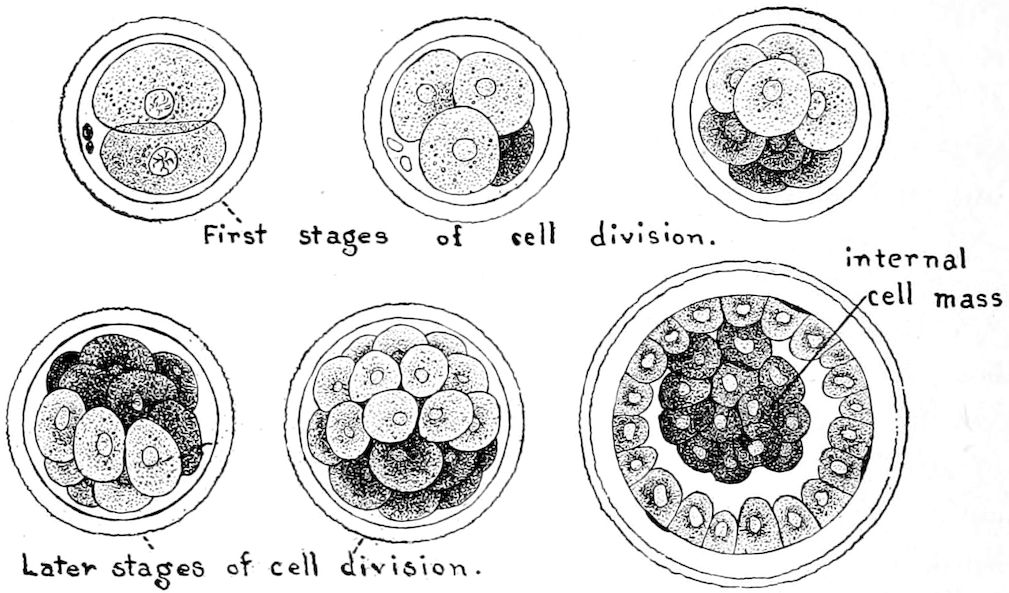
Fig. 6.—Diagram indicating process of cell division.
Returning to the ovum which meets a spermatozoon in
the course of its journey down the tube, we find that as
soon as a spermatozoon enters an ovum it disappears and is
completely absorbed, and, as the ovum in turn is instantly
possessed of new powers, through the presence of the male
cell, the result of this union is an entirely new cell. But
instead of continuing its existence as a single cell, the fertilized
ovum divides into two cells; these two into four; the
four into eight and so on until a clustering mass of cells is
formed which looks something like a mulberry. If you will
look at Fig. 6 you will see what happens as this cell division
progresses and also that in time the cells rearrange themselves
in such a way as to leave a space in the center of the
37mass so that it becomes a little sac with a cluster of cells at
one point, which hangs toward the center, called the internal
cell mass. This will interest you because it is from cells at
one point in this little cluster that the baby begins to develop,
together with the cord, bag of waters and afterbirth,
to be described later.
While these changes are taking place, the entire mass is
being carried slowly down the tube toward the uterus by
the sweeping motion of the soft little hairs on the lining
of the tube. It is steadily growing, and by the time it
reaches the uterus the mass is about the size of the head
of a pin. As you will remember, the lining of the uterus
prepares each month to receive the fertilized ovum, becoming
soft and thick. The cell mass floats around for a little
while after it reaches the uterine cavity and then resting at
some point, sinks down into the soft lining and is completely
buried.
From now on the cells which compose the mass rapidly
increase in number and very shortly cease to be all of one
kind. These different kinds of cells rearrange themselves
and grow in such a manner that some of them begin to
form the different parts of the baby’s body and others
develop into two thin membranes that finally enclose the
baby in a double sac. He is attached to the inner surface
of the sac; the space which he does not occupy is filled with
fluid and the sac itself is attached to the uterine lining at
the point where the cell mass happened to stop and bury
itself.
This sac is what you have heard called the “bag of
waters,” but the doctors refer to it as the membranes.
As it enlarges and pushes out into the uterine cavity it still
consists of two thin membranes except where it is attached
to the uterus, at which point it grows into a thick, spongy
mass of blood-vessels. These blood-vessels divide and
38branch out in a tree-like fashion and burrow into the
uterine wall. As you will see later, it is through this mass
of branching blood-vessels that the baby virtually eats and
breathes and gives off waste materials during the nine
months of his life within the uterus. The doctors refer to
the mass as the placenta but you have heard it called the
“afterbirth,” because it is expelled after the baby is born.
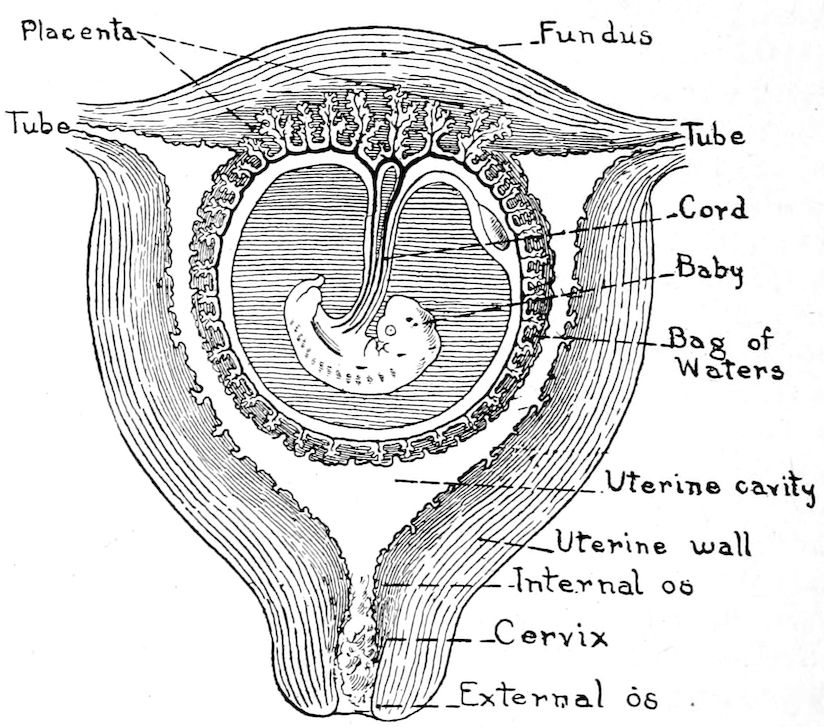
Fig. 7.—Diagram showing the developing baby, at an early stage, with cord, membranes and placenta, within the uterine cavity.
As the baby’s development advances the part by which
he is connected with the placenta lengthens out into what
is called the umbilical cord. There are blood-vessels in
this cord through which blood constantly flows back and
forth, carrying nourishment to the baby from his mother
39and waste matter from his little body to the placenta where
it is taken up by her blood. But this exchange of materials
takes place through thin membranes and consequently the
blood of the mother and baby never mingle. Fig. 7 will
give you an idea of how the sac of membranes, with the baby
hanging inside, grows out into the uterine cavity; how at
the point where the membranes are attached to the uterus
the blood-vessels have developed into the thick, spongy
placenta and how the baby is connected with it by means
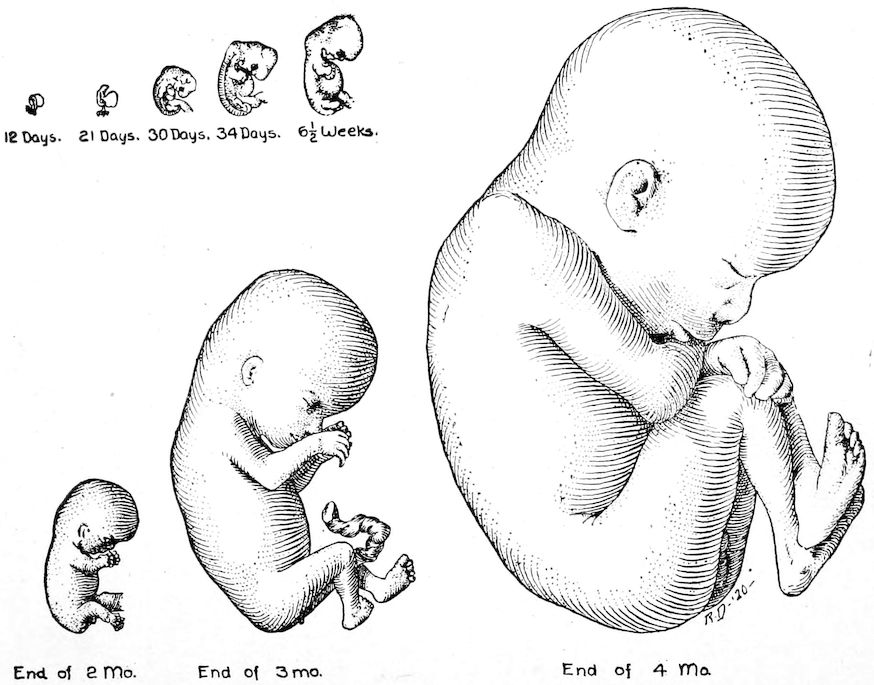
of the cord. In Fig. 8 you may see how the baby changes
in appearance as the weeks of pregnancy go by. At the end
of the fourth month he really looks quite like the baby that
we are so eagerly preparing for.
If we follow his development within the uterus month
by month, we find that by the end of the first lunar month,
or fourth week, the baby’s body is about ½ inch long and
looks about as is suggested in the third little outline in
Fig. 8.
At the end of the second month, or eighth week, his
head is fairly well shaped; bones are beginning to develop,
webbed hands and feet are formed and the little body is
about 1 inch long.
At the end of the third month, or twelfth week, his
entire body shows marked development and is about 3½
inches long. His fingers and toes are separated and bear
soft nails; the teeth are forming, the eyes have lids and the
umbilical cord has taken definite form.
At the end of the fourth month, or sixteenth week, in
addition to the development of all parts a fine, soft hair
appears over the body; there is a black, tarry substance,
called meconium, in the baby’s intestines and he measures
about 6 inches in length and weighs perhaps ¼ pound.
40
Fig. 8.—Appearance of the baby at different stages, early in his development.
41By the end of the fifth month, or twentieth week, the
baby has grown and developed markedly. He is now covered with skin on which are occasional patches of a greasy,
cheesy substance called vernix caseosa, and though there is
some fat beneath the skin his face looks old and wrinkled.
A certain amount of hair has appeared upon the head and
the eyelids are opening. It is usually during the fifth
month that the expectant mother first feels her baby move,
this sensation being commonly referred to as “quickening.”
He is now about 10 inches long and weighs about 9 ounces.
By the end of the sixth month or twenty-fourth week,
the baby is about 12 inches long and weighs possibly 1½
pounds. He is thin and wrinkled in appearance and if born
at this time will attempt to breathe and move his limbs but
will perish in a short time.
By the end of the seventh month, or twenty-eighth
week, he still looks thin and scrawny; his skin is reddish
and is well covered with the cheesy vernix caseosa. If born
at this stage, the baby will move quite vigorously and cry
feebly, but he is not likely to live for any length of time.
He is now about 14 inches long and weighs about 2¾
pounds.
By the end of the eighth month, or thirty-second week,
the baby has grown to about 17 inches in length and 4
pounds in weight, but continues to look thin and old and
wrinkled. His nails do not extend beyond the ends of his
fingers but are firmer in texture; the soft, downy hair begins
to disappear from his face but the hair on his head is more
abundant. If born at this stage, the baby will have a fair
chance to live, provided he is given painstaking care. This
is true in spite of the old belief, still widely current, that a
seven months’ baby is more likely to live than one born at
eight months (meaning calendar months). The fact is that
after the twenty-eighth week the probability of the baby’s
living increases greatly with each added week of life within
the uterus. His growth during the latter part of pregnancy
42is rapid, for he gains nine tenths of his weight after the fifth
month and one half of his weight during the last eight
weeks of uterine life.
At the end of the ninth month, or thirty-sixth week,
the increased amount of fat under the baby’s skin has given
a plumper, rounder contour to the entire body; the aged
look has passed and his chances for life have greatly increased.
He weighs about 5½ pounds at this stage and is
perhaps 18 inches long.
The end of the tenth month, or fortieth week, usually
marks the end of pregnancy. Fig. 9 will show you how the
baby lies in the uterus just before birth, curled up into the
smallest possible space.
Fig. 9.—The usual position of the baby just before he is born.
43The average normally developed baby has grown to a
length of about 20 inches and weighs about 7¼ pounds,
boys usually being about three ounces heavier than girls,
but there may be a variation of weight among entirely
normal, healthy babies from a minimum of 5 pounds to as
high as 11 pounds or more. Newborn babies very seldom
weigh more than 12 pounds, in spite of legends and rumors
to the contrary.
The size of the baby is affected by the race of his parents;
colored babies, for example, averaging a smaller weight than
white babies. And, as might be expected, the size of the
parents is likely to be reflected in their infants, large parents
tending to have large children and vice versa.
The number of children which the mother has previously
borne is also a factor, since the first child is usually the
smallest, the size of those following showing an increase with
the mother’s age up to her twenty-eighth year, if her pregnancies
do not occur at too frequent intervals.
Twins. Sometimes a woman gives birth to more than
one baby at the same time. When there are two they are
called twins; triplets when there are three; quadruplets,
quintuplets and sextuplets respectively, when there are
four, five and six babies within the uterus at once. Six
is the largest accredited number on record.
It is estimated that twins occur once in ninety pregnancies
and triplets once in about seven thousand cases.
The tendency seems to be inherited, as is evidenced by the
number of twins and triplets to be found among relatives.
Twins are often prematurely born and each is likely to
be smaller than a baby resulting from a single pregnancy,
but their combined weight is greater than the weight of one
normal baby.
Extra-uterine Pregnancy. Another departure from the
normal pregnancy is when the baby develops outside of the
44uterus. Although in the normal course of events the fertilized
ovum travels down the tube and becomes attached
to the uterine lining, it is possible for it to stop, and
more or less completely develop at any point along the
way. This is called an extra-uterine pregnancy, since it
occurs outside of the uterus. If the baby develops in one
of the ovaries, it is termed an ovarian pregnancy, and a
tubal pregnancy if it develops in a tube, this being the most
frequent variety of extra-uterine pregnancies. Only about
one out of a hundred such pregnancies continue throughout
the allotted period, and accordingly, a live baby, capable of
living for any length of time, seldom results.
To sum up a normal pregnancy, we find that in the course
of ten lunar months following the fertilization of an ovum,
the uterus grows from a small, flattened pelvic organ, 3
inches in length, to a large muscular sac, about 15 inches
long occupying the abdominal cavity. It increases its weight
sixteen times, that is, from 2 ounces to 2 pounds, while
the capacity of the uterine cavity is multiplied five hundred
times. Within the uterus is a baby weighing about 7¼
pounds; a placenta weighing perhaps 1¼ pounds and approximately
a quart of fluid. The baby is attached to the
placenta by means of a jelly-like cord about as thick as
one’s first finger and 20 inches long; baby, placenta, cord
and fluid all being contained in a thin, but strong sac frequently
called the bag of waters, but by the doctors termed
the membranes. The total weight of the uterus and its
contents at the end of pregnancy is usually about 15
pounds.
Throughout the baby’s life within the uterus, the placenta
virtually acts as his digestive organs, lungs, kidneys and
bowels. Bear this in mind, and you will realize why, in
taking care of yourself you are taking care of your baby
while his body is being built and getting itself into running
45order to take up life as a separate being. The full realization
that whatever is good for you is good for your baby
will make you eager to give yourself the care that is outlined
in the next chapter.
CHAPTER V TAKING CARE OF THE BABY BEFORE HE COMES — COMMON DISCOMFORTS DURING PREGNANCY — HELPING TO PREVENT COMPLICATIONS
46
We shall see that taking care of your baby before he
is born means taking such care of yourself throughout
pregnancy, that you not only keep your own body in its
usual good running order, but in addition, so effectively
promote the activities of your various organs that you
also keep the baby’s body going, his body that is growing
all the time.
Quite reasonably this requires extra work on the part
of some of your organs, particularly those concerned with
digestion and the process of throwing off impurities. The
latter is of the greatest possible importance for in addition
to excreting the usual amount of impurities from your own
body you must excrete also those thrown off by your baby.
The amount of waste from him is not large but it seems
to be of such a character that it harms the mother if it is
not steadily excreted.
Good digestion and satisfactory excretion are dependent
upon a number of factors and fortunately most of them
are within your own control.
Your frame of mind is one of the most important factors
of all. I know that to suggest the cultivation of a cheerful,
hopeful mental attitude is easier said than done. But
after all it really is largely a matter of habit which you
can acquire if you set yourself to it, particularly if you
realize that your physical condition will be benefited by
your going through pregnancy happily. And remember
that whatever is good for you is good for your baby.
47Continue with the work, amusements and exercise that
you are used to and enjoy, except of course such activities
as the doctor may forbid. In general, try to forget that
you are pregnant, so far as you can do this and still remember
to take proper care of yourself.
Above all, don’t worry. Worry will interfere with your
sleep and it will also upset your digestion quite as seriously
as will wrong food. Try not to be too self-centered
or too watchful of your symptoms, but at the same time
avoid the dangerous habit of thinking that any unusual condition
which develops is due to your being pregnant, for a
sick pregnancy is not normal.
It will relieve you of a great deal of anxiety if you report
to your doctor everything you do not understand, for the
consciousness that he will know just what to do, if anything
is necessary, will help to keep you from worrying.
It is important, too, for you to get rid of the depressing
beliefs in connection with pregnancy that have come down
to us through the ages.
For instance, do not believe for a moment that anything
you do, think or see can “mark” or deform your baby, for
remember that after conception you give him nothing but
nourishment. The only communication between you and
the baby is through your and his blood, and blood does not
carry mental impressions. Accordingly, no effects of fear,
horror or unpleasant memories which you may have can
possibly reach him. It is true that once in a while a woman
does see something shocking and later gives birth to a
marked or deformed baby. But there is little doubt,
now, that such an occurrence is merely a coincidence. If
you will stop and think for a moment you will realize that
most expectant mothers see or hear or think something
unpleasant at some time during pregnancy, and yet most
babies are born without mark or blemish. Anger, fright
48or sudden shock may upset your digestion, but it does not
directly affect your baby.
As for that common belief that in “reaching up” the
mother may slip the cord around the baby’s neck—if you
will picture for a moment how the baby lies within the
uterus you will realize how impossible this is, for the
mother’s arms have no connection with him or the cord.
So dismiss these doubts and fears from your mind and
dwell instead upon the loveliness of what is in store for
you, for, I repeat, your physical condition will be benefited
if you go through pregnancy happily. And remember
again that whatever is good for you is good for your baby.
So your first step toward caring for the little life already
within your charge is to follow the example of Mrs. Wiggs,
who constantly wiped the dust from her rose-colored spectacles.
Now for the more specific details of your care. Of these
the question of your diet is of enormous importance.
Let us consider first what your food accomplishes if it
is suitable and conditions are favorable for its use by you
and the baby. It should provide nourishment for your
various tissues, as under ordinary conditions; it should
promote the activities of your skin and kidneys, as well
as bowels, since it is through them that the waste from
your own and your baby’s body must be excreted, and your
food should be adequate also, to build and nourish the
baby’s body without his having to draw materials from
your tissues. Strange as it may seem, the baby’s physical
needs are supplied before yours are met, and if there
are not enough food materials for you both, your bones,
teeth and muscles will be deprived. Furthermore, taking
proper food during pregnancy is an important step toward
preparing yourself to nurse your baby, after he is born,
which is quite as urgent as nourishing him before birth.
49To accomplish these ends you not only must eat suitable
food, but you must digest and absorb it as well. This requires
that you constantly guard against overeating, constipation
and indigestion of any kind. Indigestion may be
avoided during pregnancy exactly as it is at other times,
by eating proper food, by cultivating a happy frame of
mind; by having sufficient exercise, fresh air, rest and
sleep.
If you are accustomed to a fairly simple, well balanced,
mixed diet, you probably will need to make little or no
change, except to have the evening meal light if it has been a
hearty one. It may surprise you to learn that you need
not “eat for two,” in quantity, as is so commonly believed
necessary, for during pregnancy you make so much better
use of food materials than usual that an amount and kind
of food that keep you in good condition will be adequate to
meet your baby’s needs, too, until the latter part of pregnancy.
On the other hand, it is very unwise for an expectant
mother to cut down her diet, with the idea of keeping
the baby small and thus make labor easy, except under
the direction of her doctor. In general it is the size of the
baby’s head that makes labor easy or difficult, and not the
amount of fat distributed over his body. And if the mother
cuts down the minerals in her diet to make the baby bones
soft, the only result is that her own bones and teeth are
softened, because the baby extracts from them enough lime
to supply what the food lacks.
Three meals a day will usually be enough during at least
the first half of pregnancy and they should be taken with
clock-like regularity, eaten slowly and masticated thoroughly.
The possible need for slight additional food during
the later weeks may be supplied more satisfactorily by
lunches of milk, cocoa or broth and crackers or toast, between
meals and upon retiring, than by taking larger meals.
50An expectant mother who has a tendency to nausea early
in pregnancy often feels better for taking a small lunch
regularly five or six times daily instead of the usual three
full meals.
It is of the greatest importance that every pregnant woman
drink an abundance of fluid to act as a solvent for her
food and waste material and promote the activity of her
kidneys, skin and bowels. She needs about three quarts
daily, most of which should be water, the remainder consisting
of milk, cocoa, soup and other liquids. Alcohol should
not be taken except upon the doctor’s orders and only
moderate amounts of coffee and tea, unless he gives permission
for more.
The expectant mother will be wise to avoid fried food,
pastry, rich desserts, rich salad dressings and any other food
which would ordinarily disagree with her.
Since the enjoyment of one’s meals promotes digestion
at all times, the expectant mother should try to eat the
things that she enjoys most and that agree with her. The
average pregnant woman who has no symptoms of complications
will usually be able to supply her own and her
baby’s needs and at the same time keep within the bounds
of safety if she selects her diet from the foods included
in the following groups:
Animal Foods. Milk and eggs are the most satisfactory,
but for the sake of variety and to tempt her appetite the
expectant mother will usually be allowed to take rather
sparingly, and preferably only once a day, of fish, the
various kinds of shell fish, beef, lamb, chicken or game.
Pork, veal and goose should be avoided as a rule, and particularly
by women with whom they ordinarily disagree.
Soups. Thin soups and broths have little food value but
because of their appetizing flavor and aroma are an aid
to digestion, and frequently by stimulating a flagging appetite
51will help the expectant mother to eat and assimilate
more than she would without them. But cream soups and
purées have a high food value and, like thin soups and
broths, also supply a definite amount of fluid which she
must have.
Vegetables. The group of vegetables generally designated
as “leafy” are of even greater importance to the
expectant mother than they are to the average person. Of
these she may safely eat onions, asparagus, celery, string
beans, spinach, and she should make a point of taking a
green salad, such as lettuce, cress or romaine, at least once
daily. Sweet potatoes, white potatoes, rice, peas, Lima
beans, tomatoes, beets and carrots, also, may be eaten with
safety, as a rule, but cabbage, cauliflower, corn, egg-plant,
Brussels sprouts, parsnips, cucumbers and radishes should
be taken with great caution and avoided altogether if they
cause gas or any kind of distress.
Fresh Fruits. A necessary part of the diet is fresh fruit,
and among those fruits which are both beneficial and usually
harmless are apples, peaches, apricots, pears, oranges,
figs, cherries, pineapple, grapes, plums, strawberries, raspberries,
blackberries and grapefruit. These are more likely
to be laxative if eaten alone, as before breakfast and at bedtime.
Cooked fruits are also valuable articles of diet, but
are probably less laxative than raw fruit. Some of the
citrous fruits, oranges, grapefruit or lemons, should be
taken daily because they possess a certain indispensable
food value which is peculiar to them.
Cereals. For their nourishing and laxative qualities,
cereals are important and their food value is increased by
the milk and cream which are usually taken with them.
Cooked cereals should invariably be cooked longer than the
usual directions suggest. Bran, eaten alone as a cereal or
in combination with other grains, is an excellent laxative.
52Breads. Graham, cornmeal, whole wheat and bran bread
are all good, in general the expectant mother will be on
the safe side if she eats sparingly, if at all, of very fresh
or hot breads and hot cakes.
Desserts. Desserts are very important for they add to
the attractiveness of most people’s meals, and if wisely
chosen and properly made, may supply a good deal of easily
digested nourishment. They may include, in addition to
fresh and cooked fruits and preserves, ice-cream, a wide
variety of custards, creams and puddings made largely of
milk, eggs and some ingredient to give substance and firmness,
such as gelatin, cornstarch, rice, tapioca, farina, arrow-root
and similar materials.
In general the expectant mother should eat an abundance
of fruit and vegetables, taking at least some uncooked fruit
and a green salad, daily, and make sure that her food contains
a good deal of residue, such as is provided by fruit
and coarse vegetables. This residue increases the bulk of
the material in the intestines, and this helps to overcome the
tendency toward constipation. As fat is less easily digested
than starchy foods, and more likely to cause nausea during
pregnancy, it is better to eat no more fat than usual but to
supply the additional material which is needed after about
the sixth month, by taking a little more starchy food. However,
a slight increase only is necessary, and this chiefly
during the last three or four weeks.
The Kidneys. It is scarcely possible to say enough about
the importance of keeping your kidneys in normal working
order during pregnancy, for through them is excreted much
of the waste matter from your baby’s body as well as
your own. Sometimes when these impurities are not
thrown off as they should be the expectant mother has convulsions.
You will be glad to know how much you yourself
can do toward preventing convulsions by drinking plenty
53of water and by faithfully measuring your urine and taking
a specimen to the doctor when he asks you to. As I said
before, you should drink at least three quarts of fluid every
day. Most of this should be water, the remainder being
milk, cocoa, soup, tea, coffee, and so on.
The doctor will probably want you to measure your
urine and take a specimen to him once a month during the
first half of pregnancy and every two weeks afterward, or
even every week toward the end. He can tell by examining
the urine whether your kidneys are acting as they should
and if they are not he may save you serious trouble by putting
you to bed for a few days with no nourishment but
milk and water.
In preparing a specimen you will need a covered corked
vessel large enough to hold all the urine passed in twenty-four
hours, and it must be thoroughly washed and scalded.
The next step is to pass urine, suppose we say at eight
o’clock in the morning, and throw it away. All of the urine
which you pass after this time until eight o’clock the next
morning must be saved in the vessel and kept in a cool
place to prevent its decomposing. If you will put a teaspoonful
of chloroform or boracic acid powder into the vessel
it will tend to preserve the urine and will not injure
the specimen. At the end of twenty-four hours the urine
should be shaken to mix it thoroughly and about half a
pint poured into a bottle that has been washed and scalded.
Carefully cork and label this with the date, your name
and address and the total amount of urine passed in the
twenty-four hours. The vessel for collecting the urine and
whatever you use as a measure should be reserved for these
purposes only. If you have no tin or glass measure, a
regular-size quart tomato can will prove entirely satisfactory.
If you find, when measuring your urine, that you pass
54less than a quart and a half in twenty-four hours, you may
know without being told that this is not enough and that
you should drink more water.
The Skin. People are likely to think of the skin as being
simply a covering for the body, whereas, in reality, it is a
very complicated and active organ which helps to regulate
the body temperature and constantly throws off impurities,
just as the kidneys do. This latter function is performed
by the sweat glands which open upon the surface of the
skin as the “pores,” and we are told that in all there are
some twenty-eight miles of these tiny tube-like structures
in the skin. These glands should be, and usually are, constantly
active; they pour upon the surface of the body an
oily substance which keeps the skin soft; they also excrete
something more than a pint of water daily, which contains
impurities that are harmful if retained in the body. We
are not aware of this constant excretion of fluids, which
is termed “insensible perspiration,” but it continues even
in cold weather and must not be stopped if health is to be
preserved. If the oil, dust, particles of dead skin and the
waste material left by dried perspiration are allowed to
remain upon the surface of the body they will clog the
pores, or gland openings, and thus interfere with their action.
The removal of this material, then, is necessary to
maintain health, and is done automatically in part for
the fluid evaporates and much of the solid matter is rubbed
off on the clothing. The most important aids to the
skin’s activity are the drinking of plenty of water, deep
breathing, exercise and warm baths.
Regular and thorough bathing serves the double purpose
of removing waste matter already on the surface, and of
stimulating the glands to increased activity in giving off
still more.
Many doctors advise a warm, not hot, shower or tub bath
55every day, with soap used freely over the entire body, followed
by a brisk rub. The best time for this warm, cleansing
bath, as a rule, is just before retiring, as it is soothing
and restful, and tends to induce sleep. Very hot baths are
fatiguing, particularly during pregnancy, and should never
be taken except with the doctor’s permission; but cold
baths usually may be continued throughout pregnancy if
one is accustomed to them and reacts well afterwards. Under
these conditions the morning cold plunge, shower or
sponge is beneficial, as it stimulates the circulation and
thus promotes the activity of the skin. Some doctors forbid
tub bathing of any kind after the seventh month, on the
ground that as the expectant mother sits in the tub her vagina
is filled with unsterile water and should labor occur
shortly afterward an infection, or fever, might result. And
as she is heavy and somewhat uncertain on her feet, there
is also the danger of her slipping and falling while getting
in or out of the tub. Other doctors permit tub baths
throughout pregnancy, up until the onset of labor; while
as to hot foot baths, since there seems to be no reason for
or against them at any time during the nine months, they
may be taken or not at will.
Bathing in a quiet stream or lake is apparently harmless
but sea bathing, if the surf is rough, is inadvisable because
of the beating of the waves upon the abdomen and the general
violence of the exercise.
The importance of keeping the body evenly warm
throughout pregnancy cannot be overemphasized, for a sudden
chilling or wetting may so check action of the skin as
to impose more of a burden upon the kidneys than they
can meet, in their effort to throw off the skin’s share of the
body waste. Accordingly, a single chilling will sometimes
be enough to cause convulsions. This may be one reason
why convulsions occur more frequently during cold weather
56or after a sudden drop in the temperature after warm or
mild days.
The Bowels. The bowels, also, throw off a certain
amount of impurities and if they do not move thoroughly
at least once a day these impurities may be taken into the
system and again the kidneys be given extra work.
Unhappily a great many pregnant women are constipated,
particularly during the later weeks, while women
who have always had a tendency of this kind may have
trouble with their bowels from the very beginning of pregnancy.
Your bowels should move regularly every day,
and to this end you should attempt to empty them at the
same hour each day, immediately after breakfast being the
best time. The importance of regularity in making the
attempt cannot be overemphasized, even though the bowels
do not always move.
The measures which tend to prevent constipation, as already
pointed out, are drinking plenty of fluids, and eating
fresh fruit, coarse vegetables and bulky cereals such as
bran; also taking a glass of hot or cold water just before
going to bed and the first thing in the morning. You should
not take enemas or cathartics without your doctor’s order,
but you may safely increase the amount of fluids which
you drink and the bulk of your food, in order to regulate
your bowels.
Senna and prunes cooked together prove to be helpful
in keeping the bowels regular and they are entirely harmless.
A simple way of preparing them for this purpose
is to pour a quart of boiling water over an ounce of senna
leaves and allow them to stand for about two hours. A
pound of well washed prunes should soak overnight in this
liquor, after it has been strained, and then cooked in it until
tender. They may be sweetened with two tablespoonfuls
of brown sugar, and the flavor improved by adding a stick
57of cinnamon or slice of lemon while they are cooking. Half
a dozen of these prunes, with some of the syrup, may be
taken at the evening meal to start with, and increased or
decreased in number as necessary.
Clothes. The chief purpose of clothes under all conditions
is to aid in keeping the body warm, thus helping to
preserve an even circulation of the blood and the activity of
the sweat glands. As has been pointed out, this is of especial
importance during pregnancy. The expectant mother’s
clothes should be not only sufficiently warm, but they should
be equally warm over her entire body. They should be light
and porous, and fairly loose, so as not to interfere with the
circulation or other bodily functions. There must be no
pressure on chest or abdomen; no tight garters, belts, collars
or shoes.
The clothes of the mother-to-be, like every other detail
of her care, must be adapted to her surroundings and mode
of living. If her house is well and evenly heated during
the cold months, she may quite safely dress lightly while indoors;
if it is not, she should wear underwear with high
neck, long sleeves and drawers, both indoors and out, except
when the weather is warm enough to cause perspiration.
At all times, however, the warmth of her clothing should
be suited to the temperature of the home, the climate and
the state of the weather.
Remembering that it is important for you to keep up
the diversions and amusements that you enjoy, it is worth
while to have your clothes as pretty and becoming as possible,
for you are much more likely to go about and mingle
with your friends if you feel that you are becomingly and
well dressed. At the same time your clothes should be so
made that their weight will hang from the shoulders instead
of from the waistband.
And that brings us to the question of corsets, a much
58discussed garment. Women who have not been accustomed
to wearing corsets will scarcely feel the need of adopting
them during pregnancy except, perhaps, during the later
weeks when the heavy abdomen needs to be supported for
the sake of comfort. This need is felt particularly by
women who have had children and whose abdominal walls
are somewhat weakened in consequence.
If you have been wearing comfortable, well fitting corsets,
you probably will not feel the need of making a change
until the third or fourth month. But by this time the baby
will have pushed up out of the lower pelvis into the abdomen
and your corsets then, if you wear any, must be so
constructed that they will not compress nor disguise your
figure, but will provide support and accommodate themselves
to an abdomen that is steadily increasing in size and
changing in shape. Such corsets are made of soft material;
have elastic inserts and have lacings at the sides as well as
in the back. They come well down and fit snugly over the
hips. (See Fig. 10.) Some women find comfort in attaching
shoulder straps to their corsets thus suspending some of
the abdominal weight from the shoulders. But as a rule,
the most comfortable arrangement is a short-waisted maternity
corset worn with a brassière that supports the breasts
and does not compress the nipples.
I hope this description will make clear to you why the
same style corsets as you ordinarily wear cannot be satisfactory
during pregnancy, no matter how large they are,
and may even prove harmful.
59
Fig. 10.—Front and side views of a satisfactory maternity corset, adjusted at the fifth month of pregnancy. (By courtesy of Emma E. Goodwin, New York.)
60
Fig. 11.—Front, side and back views of home-made binder for supporting a heavy, pendulous abdomen during later weeks of pregnancy. It is adjusted as the expectant mother lies down, the ends being crossed in the back and pinned to the lower margin of the front, thus giving additional support.
Also breast-binder made of a straight strip of soft cotton material, 10 or 12 inches wide and 2 yards long. This is crossed in front and held with safety-pins, the ends being carried over the shoulders and pinned to the back of the binder. It should be snug below the breasts but loose over the nipples. The openings over the nipples show how this binder may be used to support the breasts of the nursing mother. (From photographs taken at the Maternity Centre Association, New York.)
Even a properly fitting maternity corset may become
uncomfortable during the last few weeks of pregnancy,
and have to be replaced by an abdominal supporter of
linen or rubber. And when this stage is reached, even
the woman who has worn no corsets may find that she is
more comfortable if she adopts such a support, particularly at night. There are many admirable binders on
the market, or such an one as is illustrated in Figs. 11
and 12 may easily be made at home as well as comfortable
61and inexpensive stocking supporters, made from tapes or
strips of muslin, as in Fig. 13.
Fig. 12.—Abdominal binder used in Fig. 11, showing darts at top of front to fit it over the abdomen.
Your shoes, also, merit some thought, for your feet will
probably be larger during the latter part of pregnancy,
partly because of the possibility of their being somewhat
swollen and partly because the increased weight of your
body tends to spread them. This added weight also increases
the strain put upon the arch and as a result, flat-foot
is fairly common among expectant mothers who have not
taken pains to have their arches well supported. Your shoes
would better be an inch longer than those you ordinarily
wear; they should have broad, common sense heels and fit
snugly over the instep, in spite of being full large. If your
shoes are not comfortable you will find yourself tiring easily
and for this reason will tend to take less exercise than you
should.
Another reason for the need of proper shoes is that as
pregnancy advances the expectant mother becomes rather
unsteady on her feet, and broad, firm heels help to make
her feel more secure. The heels need not be flat at first,
if you have been accustomed to wearing high ones, for the
sudden lowering of the heels may injure your arches, but
as the weeks wear on you would better adopt moderately
low heels. High French heels should be avoided because
they not only increase the difficulty and discomfort of
62walking but cause backache, as well, by forcing a position
that adds to the pressure on the lower part of the abdomen.
They increase the risk of turning the ankles, too, and of
tripping and falling, which is a very serious accident for
the expectant mother.
Fig. 13.—Front and back view of home-made stocking supporters made of webbing or 1–inch strips of muslin and a pair of child’s side garters. The straps are sewed together in the back, but pinned in front to permit adjustment as the abdomen enlarges. (By courtesy of the Maternity Centre Association, New York.)
Fresh Air. If you realize by this time how important it
is to keep your digestion in good order and promote the
activity of all your excretory organs, you probably suspect
how important fresh air and exercise are to you and your
63expected baby, because of their effect upon your entire well-being.
The average individual uses up in a minute’s time the
oxygen contained in four bushels of air, and since the pregnant
woman takes in through her lungs the oxygen for
both herself and her baby, she must have a sufficient quantity
of air to supply at least this amount.
Accordingly, you should make a point of spending at
least two hours of each day in the open air. If the weather
is so stormy or severe as to make it undesirable for you to
go out from under cover, because of the danger of getting
wet or chilled, you can wrap up well and take your airing
on a protected porch or in a room with all the windows
wide open.
But this is only a part of it, for the air in your house or
rooms must be kept fresh all day by being constantly
changed; this requires a steady inpouring of fresh air and
outpouring of stale air.
A very good way to accomplish this is to have one or more
windows open slightly, top and bottom, all the time. But
there must be no sudden changes of temperature, nor drafts,
for fear of chilling your skin. At night you should sleep
in a room with the windows open, taking care to be well
protected by light, warm coverings.
Exercise. Each detail of the expectant mother’s daily
routine seems to be more important than the last. And so
when we come to the question of regular out-of-door exercise
we are almost persuaded to believe that whatever else may
be neglected, this is indispensable, since it promotes digestion,
stimulates the activity of the skin and lungs, steadies
the nerves, quiets the mind and promotes sleep. And more
than that, walking, which is probably the most satisfactory
form of exercise for her to take, also strengthens some of
the muscles that are used during labor. But exercise is
64downright injurious if continued to the point of fatigue,
no matter how little has been taken. Each woman must
be a law unto herself in this matter, therefore, and must be
impressed with the importance of stopping before she is
tired. It may be a good plan for you to start by walking
only a short distance at a time, increasing this gradually
until you are able to walk possibly as much as an hour in
the morning and an hour in the afternoon without fatigue.
All violent exercise and sports are of course to be avoided,
particularly swimming, horseback riding and tennis. While
motoring and carriage driving are pleasant diversions, they
cannot be classed as exercise. They should be taken only in
comfortable vehicles and over smooth roads, so that there
will be no jarring nor jolting, and the expectant mother
should not do the driving herself.
A certain amount of exercise, in the shape of light housework,
may be taken indoors. This is distinctly beneficial
if not continued to the point of fatigue, both because of the
exercise which it provides, and also the diversion and
interest, for these promote mental and physical health. But
this indoor exercise must not interfere with, nor to any
degree replace the daily exercise which you take out of
doors; nor must it include heavy work, such as washing,
sweeping, heavy lifting, running a sewing machine by foot
or much running up and down stairs.
However, the amount and kind of work which the expectant
mother may comfortably and safely do, are so
related to what she has been accustomed to, that it is not
possible to do more than describe what has proved of benefit
for the average woman.
There are women to whom massage and gymnastics are
helpful during pregnancy when for some reason the out-of-door
activities are not possible or advisable. This might
be true of an expectant mother with heart trouble, for example,
65or of one who is being kept in bed to prevent an
abortion and accordingly is a matter which is closely directed
by the doctor.
Traveling. In general, traveling is less dangerous for
the expectant mother of to-day than formerly because it
causes less strain, discomfort and fatigue than in the old
days. But the question cannot be settled once for all women
nor for all stages of pregnancy. Each woman’s general
condition must be considered; her tendency to nausea; the
length of the journey and the ease with which it may be
made; also, whether or not she has ever had or been threatened
with an abortion. As a rule, it is considered wise to
avoid traveling during the first sixteen and the last four
weeks of pregnancy, and at the time of the month when
menstruation would ordinarily occur. Certainly a journey
should not be undertaken at any time during pregnancy
without a doctor’s permission.
Rest and Sleep. When we studied the changes that take
place during pregnancy we found that as the abdomen increased
in size and weight the expectant mother was required
to make a constant, though unconscious effort to
stand upright. This is probably one reason for the fatigue
which she so often feels without apparent cause, and why,
upon exertion, she tires more easily than usual.
Accordingly, you may find it necessary to rest frequently
during the day in order to avoid the ill effects of fatigue.
It is a good plan to work and exercise in short periods rather
than long, always lying down when tired, and for an hour
or two after the noon meal. You should be careful not
to be over active or to overexert yourself at the time when
menstruation would occur if you were not pregnant, for
fear of bringing on an abortion. This precaution is particularly
important during the first four months, the period
when abortions occur most frequently.
66Since eight hours’ sleep is usually considered necessary
to keep the average person in good condition, you can
scarcely expect to get along satisfactorily with less. In fact,
this is so important to your general well-being that you
should make a serious effort to secure it.
Fresh air during the day and open windows at night;
prudent eating; a comfortable bed furnished with warm
but light bedding; warm baths; a hot water bag to the feet
and a hot drink upon retiring are all conducive to sleep.
But in addition to these, and perhaps of even more importance,
are cheerfulness and a tranquil, untroubled state
of mind.
Breasts. Breast feeding is the most urgent single need
of the baby, for whose coming we are making preparations,
and practically every mother, excepting those with definite
physical disability, can supply this need of her baby’s if she
gives herself proper care both before and after his birth.
You will be glad to know in this connection that everything
that promotes your general health helps to prepare you to
nurse your baby, but there is need also for care of the
breasts and nipples themselves, to make the nursing satisfactory,
and to prevent sore nipples and possibly even
breast abscesses.
Briefly, this local care consists of supporting heavy
breasts, but avoiding pressure; bringing out flat or retracted
nipples and toughening the skin which covers them.
After they become heavy and uncomfortable the breasts
may be supported by brassières, which are snug below the
breasts, loose over the breasts themselves and suspended
from shoulder straps; or by some such binder as is shown
in Fig. 11, which answers the same purpose.
If your nipples are flat or retracted, you should begin
about the fifth month to make them more prominent in
order that when the baby nurses he may be able to grasp
67them easily. There are several ways of accomplishing
this, all of them in the nature of massage, but whatever
is done must be done regularly and persistently. One simple
and effective method is to grasp the nipple between the
thumb and forefinger, draw it out, hold it for a moment,
then release it and allow it to retract. This should be done
over and over, two or three times daily. Or the unstoppered
opening of a warm bottle may be placed over a flat nipple
and held in place until the nipple is drawn up into the neck
of the bottle as it cools and a partial vacuum is formed.
The toughening of the nipples should be begun eight
weeks before the baby is expected. There are two general
methods which seem to give about equally satisfactory results.
One is to soften the skin, and the other is to harden
it. In either case the nipples should first be scrubbed gently
with a soft brush or cloth, warm water and soap, for about
five minutes night and morning. After the scrubbing they
should be rubbed with lanolin, cocoa butter or vaselin and
covered with a piece of clean soft cloth or gauze, to protect
the clothing. Or, they may be bathed with a wash consisting
of equal parts of a saturated solution of boracic acid and
95 per cent alcohol. You will probably have to have a druggist
prepare this for you because of the alcohol.
But no matter which course is followed the care must be
regular to be effective. You will find that matters will be
simplified if you will assemble in one place and keep in
readiness the soap, brush and lotion or ointment which you
use each time, using them for no other purpose.
Care of the Teeth. It is very important for the expectant
mother to give her teeth scrupulous care from the beginning
of pregnancy, for in addition to the ordinary wear
and tear with which we all have to cope, her tendency to
have an acid stomach makes her mouth acid and this is
bad for her teeth. Accordingly, in addition to using dental
68floss and brushing your teeth after each meal, you should
use an alkaline mouth wash several times daily, particularly
after vomiting and before retiring, for much damage may
be done by the acid secretions in the mouth if they are allowed
to bathe the teeth during the long night stretches.
Common baking soda (a teaspoonful to a tumbler of water),
lime water or milk of magnesia all make excellent mouth
washes. It is important, also, that you consult a dentist
as soon as you know that you are pregnant and have any
necessary repairs done promptly, for delay may be serious.
You may have a number of minor ills and temporary
disturbances during pregnancy which are not serious but
capable of making you very uncomfortable, and which you
may sometimes relieve yourself. But should they be severe
or persistent, you should consult your doctor at once. The
most common of these minor discomforts may be grouped
as digestive disturbances and “pressure symptoms.”
Chief among the digestive disturbances are “morning
sickness,” “heartburn,” “distress” and flatulence or
“gas.”
“Morning sickness” is probably the commonest discomfort
of pregnancy as it occurs in about half of all cases.
Because of the expectant mother’s tendency to nausea during
the early months, it may be brought on by slight causes
which would not produce nausea under ordinary conditions.
While it is true that grief, anxiety, fright, shock,
incessant worry, fits of temper or brooding may induce
nausea when the diet is entirely satisfactory, nausea and
even vomiting may be caused in the expectant mother just
as they may in any one else by indiscretions in diet, rapid
or overeating. On the other hand, simple, light food taken
69in small quantities, five or six times daily, eaten slowly and
masticated thoroughly; the cultivation of a happy frame
of mind; exercise and fresh air all tend to prevent this
very uncomfortable condition.
Prevention is of great importance, as the habit of vomiting
is acquired easily but broken up with difficulty.
When “morning sickness” occurs, however, the sufferer
is often relieved by eating two or three hard, unsweetened
crackers or crisp toast, immediately upon awaking and then
lying still for half or three quarters of an hour. She should
then dress slowly, sitting down as much as possible while
doing so, and eat her regular breakfast. Lying flat, without
a pillow for a little while after meals, or whenever having
the slightest feeling of sickness, will frequently prevent, and
also relieve nausea. Sometimes comfort is derived from
the use of either hot or cold applications over the stomach.
Some expectant mothers find that they can prevent nausea
by having hot coffee, or even a full breakfast before arising.
But the habit of having breakfast in bed should not be cultivated
lightly, for in spite of yourself it is likely to make
you feel like an invalid, the thing you should carefully
avoid. So don’t do it unless your doctor orders it.
“Heartburn,” so called, which is suffered by so many
expectant mothers, has nothing to do with the heart. It is
due entirely to too much acid in the stomach and is usually
felt as a burning sensation, which starts in the stomach and
rises into the throat. It may be prevented, as a rule, by
taking a tablespoonful of olive oil or a cupful of cream or
rich milk fifteen or twenty minutes before meals and avoiding
fat and fried food at the meals themselves. Or, it may
be enough simply to avoid eating fats and fatty foods.
Since the painful, burning sensation is directly due to too
much acid in the stomach, it usually may be relieved by
taking a tablespoonful of lime water; a teaspoonful of sodium
70bicarbonate in water; a small piece of magnesium
carbonate; or a drink of any alkaline water that one fancies.
“Distress.” Another common discomfort of pregnancy
is called “distress” by the sufferers themselves, and occurs
after eating. It may be neither heartburn nor pain, but resemble
both and make the expectant mother very miserable.
It is usually suffered by women who eat rapidly, do
not chew their food thoroughly or who eat more at one
time than the stomach can hold comfortably. This is one
more reason for taking small amounts of food at a time,
eating slowly and masticating thoroughly.
Flatulence, or “gas,” may or may not be associated with
heartburn, but is fairly common among expectant mothers,
and is rather uncomfortable. A daily bowel movement is
of prime importance in preventing and relieving flatulence
and at the same time foods which form gases should be
carefully omitted from the diet. The chief offenders are
parsnips, beans, corn, fried foods, sweets of all kinds, pastry
and very sweet desserts. Yeast cakes and artificially fermented
milk sometimes help to prevent flatulence.
Pressure Symptoms. Under the general heading of
pressure symptoms are several forms of discomfort resulting
from pressure of the enlarged uterus (containing the
baby) on the blood-vessels which return from the lower
part of the body, thus interfering with the flow of blood
back to the heart. The commonest pressure symptoms are
swollen feet, varicose veins, hemorrhoids (piles), cramps in
the legs and shortness of breath. They may appear at any
time during the last half of pregnancy and they grow worse
as the weeks wear on.
71
Fig. 14.—Right-angled position to relieve swelling or varicose veins of the feet and legs. (By courtesy of the Maternity Centre Association.)
Swelling of the feet is very common, and when very
slight may not be serious or particularly uncomfortable.
The swelling may be confined to the back of the ankle, which
grows white and shining, or it may extend all the way up
the legs to the thighs. Sitting down, with the feet resting
on a chair, or lying down with the feet elevated on a pillow
will give a certain amount of relief. If the swelling and
discomfort are extreme, the expectant mother may have to
go to bed until they subside, but very often she will be relieved
by elevating her feet or assuming the right-angled
position shown in Fig. 14, for even a little while, several
times a day. But while employing these harmless measures
to make yourself comfortable, you must remember that the
swelling of your feet and ankles is one of the symptoms that
your doctor wants to know about. For this reason you
should promptly report to him even the slightest swelling
and begin to measure and save your urine for examination.
72Varicose veins are not peculiar to pregnancy but they
are among the pressure symptoms which frequently appear
during the later months, particularly among women who
have borne children. The enlargement of the veins is not
usually serious but it may cause a good deal of discomfort.
While varicose veins may occur in the vulva, they are usually
confined to the legs, and both legs are about equally
affected. Sometimes, however, the veins in the right leg are
more distended than those in the left, or the right side alone
may be affected.
Considerable relief may be obtained by keeping off the
feet, particularly by elevating them, and also by the use
of elastic bandages. When an expectant mother finds it
difficult or nearly impossible to sit or lie down for any
length of time, she may secure great relief in a few moments
by lying flat on the bed with her legs extended straight into
the air, at right angles to her body, resting against the wall
or head board, as shown in Fig. 14. This right-angled position
for five minutes, three or four times a day, will accomplish
wonders in reducing varicose veins.
A spiral elastic bandage, also, will give comfort and help
to prevent the veins from growing larger, if applied freshly
after each time that the leg is elevated. The most satisfactory
bandages, from the standpoint of expense, comfort and
cleanliness, are of stockinette or of flannel cut on the bias,
measuring three or four inches wide and eight or nine yards
long. If made of flannel, the selvages should be whipped
together smoothly so that there is neither ridge nor pucker
at the seam. The bandage should be wrapped around the
leg with firm, even pressure, starting with a few turns
over the foot to secure it, and leaving the heel uncovered,
carried up the leg to a point above the highest swollen
vessels. As a rule the bandage may be left off at night.
There are satisfactory elastic stockings on the market, but
73they are fairly expensive, often cannot be washed and
seem to offer no practical advantage over the bandages.
Swollen veins in the vulva may be relieved by lying flat
and elevating the hips, or by lying on the side with the hips
elevated on a pillow for a few moments several times a day,
as shown in Fig. 15.
Fig. 15.—Lying on the side with hips elevated to relieve swelling or varicose veins of the vulva. (By courtesy of the Maternity Centre Association.)
Hemorrhoids, or “piles,” are virtually varicose veins
which protrude from the rectum, but, unlike those in the
legs, are extremely painful. As it is the straining in constipation
that causes these enlarged veins to protrude from
the rectum, this is one more reason for preventing constipation,
for a pregnant woman whose bowels move freely
every day rarely has hemorrhoids. If hemorrhoids appear,
and give pain, the first step is to soften the fingers with
vaselin and gently push the hemorrhoids back into the
rectum. You can do this quite easily for yourself. You
should notify your doctor if you have hemorrhoids, but
while waiting to see him, if you are very uncomfortable
you will be almost certain to find relief in lying down with
your hips elevated on one or two pillows; applying an
ice bag to the rectum, or ice-cold cloths or cloths wrung
74from equal parts of water and witch hazel. Sometimes the
hemorrhoids are worse during the first few days after the
baby is born but as a rule they disappear when the ultimate
cause is removed, which in this case is pressure made by
the baby.
Cramps in the legs, numbness or tingling may be caused
by pressure of the large, heavy uterus upon nerves supplying
the lower extremities. Lying down, applying heat and
rubbing the painful parts will usually relieve the discomfort.
Shortness of breath is sometimes very troublesome
toward the end of pregnancy, and as may be easily understood,
is due to the upward, and not downward pressure of
the uterus. For this reason the discomfort is made worse by
lying down and relieved by one’s sitting up or being well
propped up on pillows or a back rest.
Vaginal Discharge. Although the normal vaginal discharge
is increased during the later months of pregnancy
you should tell your doctor if your discharge is very free.
You should not take douches to remove it, unless your
doctor orders them, for the normal discharge gives you a
certain amount of protection against infection. If it is irritating
or causes itching or burning you may obtain relief
by avoiding the use of soap and by bathing the uncomfortable
parts with water, containing a teaspoonful of
sodium bicarbonate to a pint, or with olive oil.
Itching of the skin is a fairly common discomfort, and
is possibly a result of irritating material being excreted
by the skin glands and deposited upon the surface of the
body. The local irritation usually may be relieved, if not
very severe, by bathing the uncomfortable areas with the
solution of sodium bicarbonate as above, or a lotion consisting
of a pint of lime water, half an ounce of glycerin
and thirty drops of carbolic acid. It is a good plan, also,
75to drink more water, in order to promote the activity of
the skin, kidneys and bowels, and thus dilute the material
that may be responsible for the itching and increase its
elimination through all channels.
Some women complain of discomfort caused by the
stretching of the skin over the enlarged abdomen. There
is a very old belief that rubbing the skin with oil will relieve
this sensation and also prevent the appearance of the purplish
streaks described in a previous chapter. There seems
to be little foundation for this belief, but if a woman fancies
that she is safer and more comfortable after oiling her abdomen,
there is certainly no reason why she should not do so.
I have described to you the details of personal hygiene
which your doctor is likely to want you to adopt during
your months of expectancy, and some of the simple things
that you may do to relieve minor discomforts when they
arise, for having these things in black and white may make
the whole matter a little easier for you.
But there is still more that you can do to help the doctor
help you. You can tell him about any discomfort or any
new condition that appears, and follow his advice instead of
talking it over with your family or friends. This will make
it possible for him to prevent serious complications by
treating them in the very beginning.
You have probably learned, in one way or another, that
the complications associated with childbirth that are most
serious are infections (childbed fever), convulsions, abortions
or miscarriages and severe bleeding, but perhaps you
have not heard that you, yourself, can help greatly in the
prevention of all of these conditions, in your own case, and
chiefly by little more than exercising good common sense.
76Your part in preventing childbed fever, if your baby is
to be born at home, lies in having in readiness a clean
room, sterile sheets, towels, gauze pads, etc., as will be described
in the next chapter.
Concerning the other complications we shall say a word
here.
Convulsions. You can do a great deal toward preventing
the condition that causes convulsions by following the
advice about your personal care that we have just gone over
and by making it possible for the doctor to treat early
symptoms promptly. In fact, after looking over the records
of many thousands of mothers who have had prenatal care,
it seems almost safe to say that the expectant mother who
follows such a course will not have convulsions.
One of the commonest of the early symptoms is headache,
sometimes persistent and very severe. Others which you
can detect are blurred vision, spots before the eyes, dizziness,
vomiting which is more persistent or severe than
could be called “morning sickness,” puffiness under the
eyes or elsewhere about the face or hands, swelling of the
feet and ankles and severe pain in the stomach. It might
be that if you had even one of these symptoms your doctor
would think it worth while to put you to bed and give you
nothing but milk, or only water, for a day or two, not because
you were sick, but to keep you from being so, on the
same principle that you darn a thin place in a stocking to
keep a hole from coming.
In any event, tell your doctor about the symptoms and
let him decide what is to be done, for therein lies your
safety.
Miscarriages. The question of abortions, miscarriages
and premature births is one of enormous importance, and
one about which there is a good deal of misunderstanding.
As to the meaning of the terms, many women are puzzled
77to know the difference between them. Doctors are not likely
to use the word miscarriage, but will describe as an abortion
a termination of pregnancy which occurs before the
end of the seventh month and as premature labors those
occurring from that time until the expected date of confinement.
In the minds of lay people, however, the term
abortion is often associated with criminal practice, miscarriage
being a term loosely applied to all births occurring
before the seventh month, while the premature baby is the
one born after the seventh month of pregnancy but before
the expected date of confinement.
Of all of these accidents, abortions are the most frequent,
though in the nature of things it is impossible to say how
often they occur. They sometimes happen so early in pregnancy
that the expectant mother is unaware of the accident;
or if she does know of it she may make the mistake
of taking no notice of it or regard it of so little consequence
that she does not consult a doctor. But such information
as is available suggests that at least one out of every five
pregnancies ends in abortion, the tragedy of this being that
it is very largely a preventable disaster.
Since the ovum is insecurely attached to the uterine lining
until the sixteenth or eighteenth week, an abortion is more
likely to occur during this time than later, while of this
period, the second and third months seem to be the most
perilous. Abortions are less likely to happen during first
pregnancies than succeeding ones and their frequency seems
to increase with the number of pregnancies. They occur
more often among women over thirty-five years than in
younger ones, and in all cases are most likely to take place
at the time when menstruation would fall due were the
woman not pregnant.
The prevention of abortions is of such obvious importance
and there is so much that you can do to this end, that we
78shall take up the question somewhat at length. Preventive
treatment really begins very early. In the discussion about
menstruation we referred to the importance of finding out
the cause of painful periods, in the interest of good obstetrics,
since inflammation of the uterine lining or a misplaced
uterus might be responsible for the pain and if neglected
might cause an abortion later on. The correction of
such troubles, no matter when they are discovered, is an
early step toward preventing abortions.
But after pregnancy has actually begun, there are certain
preventive measures which have proved to be very effective.
A woman who is pregnant for the first time, and who, therefore,
does not know whether she is likely to have an abortion
or not, should avoid such risks as fatigue, sweeping,
lifting or moving heavy objects, running a sewing machine
by foot, running, jumping, dancing, traveling or any action
which might jar or jolt her during the first sixteen or
eighteen weeks.
An expectant mother who has had an abortion will have
to take even greater precautions, as she is in more danger
than is a woman who has not had this experience. It is of
prime importance, to begin with, that she have the cause of
her previous abortion discovered, and if possible corrected.
And since the accident is most likely to be repeated at about
the same time, or a little earlier, in each succeeding pregnancy
it is a wise precaution for the expectant mother to
remain quietly in bed for at least a week before and after
the time when an abortion may be feared.
Complete rest and relaxation are such effective preventive
measures that patients with a tendency to have abortions
who have been willing to stay in bed during most of their
pregnancy have sometimes been rewarded by going through
the entire period and in the end giving birth to a normal,
fully developed baby. As out-of-door exercise is clearly
79impossible in such cases, it is important that the patient
keep her room very well ventilated all of the time, and
possibly, under the doctor’s direction, have massage or bed
exercises.
The marital relation is usually considered inadvisable
in all cases after the eighth month of pregnancy, and among
women who have had abortions or miscarriages it is best
omitted throughout the entire period. This is particularly
true of women over thirty-five who are pregnant for the
first time.
To sum it up in a word, your part in preventing an abortion
or miscarriage after pregnancy has begun, consists
largely of avoiding fatigue; resting when tired; avoiding
physical shocks such as blows upon the abdomen, jolts or
falls particularly during the first sixteen or eighteen weeks
and at the time when menstruation would ordinarily occur
if you were not pregnant, and avoiding overwork during
the later weeks of pregnancy.
The common symptoms of abortions or miscarriages are
bleeding, often accompanied by recurring pain, beginning
in the small of the back and finally felt as cramps in the
lower part of the abdomen. Since menstruation is suspended
during pregnancy you should always regard bleeding
or a bloody discharge as a symptom of a possible miscarriage,
whether you have pain or not. Upon its appearance
you should send for the doctor, go to bed at once and
keep absolutely quiet.
Should you be so unfortunate as to have a miscarriage,
in spite of all your precautions, bear in mind that you will
need to stay in bed quite as long afterwards and have the
same care as though you had given birth to a fully developed
baby. It is because so many women fail to appreciate
this that abortions and premature births are often followed
by ill health and invalidism. Under proper care, an abortion
80or premature labor is not, of itself, any more serious
for a woman than a normal delivery.
Bleeding from the vagina, or a sudden increase in the
size of the abdomen with perspiration and a sudden feeling
of faintness, may be the beginning of severe bleeding, or
hemorrhage, from any one of a number of causes, and in
such a case the expectant mother should notify her doctor,
go to bed at once and keep quiet until he arrives.
Summing up the whole question of preventing complications,
we find that the following symptoms may be forerunners
of serious trouble and therefore should be watched for
and reported to the doctor as soon as they are noticed:
1.
Persistent or severe vomiting.
2.
Persistent or severe headache.
3.
Dizziness.
4.
Blurred vision or the appearance of black spots before the eyes.
5.
Puffiness under the eyes, or elsewhere about the face.
6.
Swelling of the feet, ankles or hands.
7.
Sharp pains, particularly in the stomach.
8.
Prolonged failure to feel the baby’s movements after they have once been felt.
9.
Bleeding, or a bloody discharge.
10.
Pain in the small of the back followed by cramp-like pains in the abdomen, before the
expected date of confinement.
11.
Unwarranted mental depression, anxiety or apprehension.
These are generally accepted as the danger signs of
pregnancy, any one of which, alone or in combination with
one or more of the others, is of importance. In addition to
these it really is important that you talk to your doctor or
your nurse freely if you are feeling worried or depressed
about anything at all. Sometimes one feels blue without
knowing why, and if you should feel so during your pregnancy
81you should not keep it to yourself but talk it over
with your doctor or your nurse.
When all is said and done, what we want for each expectant
mother is little more than that she shall live a normal,
regular, wholesome life; that she shall be able, and
what is of equal importance, be willing to weave into her
everyday life the principles of personal care which every
one should adopt; that she shall watch and be watched for
symptoms of complications throughout the entire period of
pregnancy, in order that they may be detected early,
speedily treated and serious troubles thereby prevented.
The adoption of such simple precautions will pave the
highroad to health and happiness for yourself and your
baby.
CHAPTER VI MAKING READY FOR THE BABY
82
In making ready for the actual arrival of the baby there
are several factors to consider, chief among them being the
doctor; the nurse; the place where the baby is to be born;
the room he is to occupy and an equipment which will
facilitate the care of yourself and the baby, at the time
of his birth and afterwards.
Of course you have long since placed yourself under a
doctor’s care, so that is settled. If you are in the care of
a privately engaged physician, he will, in all probability
tell you his wishes in regard to your engaging a nurse.
She should be satisfactory to both you and the doctor from
the standpoint of training and professional fitness as well
as her personality. The selection of the nurse, therefore,
should be made in coöperation with your doctor. It is wise
to engage her during the early part of your pregnancy
both to insure your securing the one that you and the doctor
want especially, and to have that much of the preparation
off your mind. It is usually a good plan to engage the
nurse to hold herself in readiness to respond to your call
at any time after two weeks before the expected date of
your confinement. Quite reasonably, if she is obliged to
give up or refuse an engagement in order to hold herself
available for you, from a given date, she will do so at your
expense. Try to arrange to have the nurse stay with you
for six weeks after the baby is born, even though this involves
considerable financial sacrifice on your part. Of
83course if you can afford to keep her still longer, so much
the better.
All of this is in case you are in the care of a privately
engaged physician and are to have a special nurse. If
you are being cared for during pregnancy by doctors and
nurses connected with a dispensary, health center or prenatal
clinic, they will advise with you about your nursing
care at the time of confinement and afterwards.
The next question to consider is whether the baby is to
be born at your home or in a hospital. The doctor who is
advising you will have his wishes on this subject, too, and as
they are entirely in your interest, you will, of course, do
as he advises. You will be likely to find that for the birth
of the first baby he will want you to go to a hospital, if
there is a good one available; also if you have had any
symptoms of complications during this pregnancy or difficulty
with previous labors.
If you are going to a hospital you or your doctor will
make the necessary arrangements about your room, well in
advance of the date upon which you expect to go, in order
to feel sure that a room will be ready for you.
It sometimes happens, that for a variety of reasons it is
nearly or quite impossible for the expectant mother to go
to a hospital, or that her doctor is entirely willing that she
shall be confined at home. If it is decided that you are
to remain at home, it will be possible, with a little planning
and effort on your part, to imitate very nearly in your own
home the advantages which are offered by a hospital.
You will remember that in the last chapter I mentioned
childbed fever as being one of the serious complications,
associated with childbirth, that could be prevented by careful
work. In the old days, when the importance of cleanliness
was not appreciated, this fever was very common in
maternity hospitals, but nowadays it seldom occurs in
84well conducted institutions because the doctors and nurses
know how to do clean work and also because they have
clean things to work with. So if you are to be attended at
home by a good doctor and a good nurse you may make the
conditions of your confinement practically ideal by providing
a clean room and such an outfit of sterile sheets, towels,
dressings and certain other articles as would be available
for their use in a hospital.
Suppose we settle the question of the rooms first.
It is a very important one but need not be the bugbear
that some people think it is. In all probability you will
have no choice as to a room for yourself and will have to use
the one you ordinarily occupy. Should you have a choice,
however, it will be well to select one that is cool and shady,
if the baby is coming during the summer, but one that is
bright and sunny for occupancy during most of the year.
It should be conveniently near a bathroom, if possible;
have an adjoining room for the nurse and one near by for
the baby.
The ideal to work toward is: A room with a washable
floor with small, light rugs; freshly laundered curtains at
the windows but no heavy draperies; a single brass or
iron bedstead, about thirty inches high, with a firm mattress,
and so placed as to be accessible from both sides and
with the foot in a good light, either by day or night; a bedside
table and two others (folding card tables are a great
convenience); a bureau; a washstand, unless there is a
bathroom on the same floor; one or two comfortable chairs,
two or three straight chairs and a couch or chaise longue,
all of which should be of wood or wicker or covered with
freshly laundered chintzes.
Between such a room as this and the one that must be
used there may be a wide difference, but it will be worth
while to approach this standard as nearly as possible. It is
85not necessary to make the room bare; in fact, it should be
as cheerful and pretty as is compatible with cleanliness.
There is no objection to pictures on the walls, but the
room should be free from useless, small articles which are
likely to be dust catchers, give the nurse unnecessary work
and occupy space needed for other things.
The room should be given a thorough house-cleaning
about two weeks before the baby is expected. If there is a
carpet on the floor that cannot be taken up conveniently,
it might be well to have in readiness a large canvas or
rubber or an abundance of newspapers to protect the floor
near the bed. If the bed is low, the attentions of the doctor
and nurse will be made much easier if you have ready four
solid blocks of wood, of the same size, upon which to elevate
the bed, after the casters have been removed. The blocks
should be of such a size as to bring the height of the bed
up to thirty inches. And it is important, too, to have a large
board, or table leaves, at hand, to slip under the mattress
to make it firm, particularly if the bed is soft or sinks in the
middle.
The chief requisites for the baby’s room are that it may
be well ventilated and easily cleaned. The floor should be
of hard wood, or covered with linoleum, in order that it may
be wiped up with a damp cloth every day, and the walls
should be freshly papered, or, better still, painted. As bright
light and glare are bad for the baby the walls would better
be of a soft shade, such as grayish green or blue, than
white, and there should be dark shades at the windows, in
order that the room may be darkened at will.
The furnishings may consist of a brass or enameled crib,
with a hair mattress; a chest of drawers; a low straight
chair and low rocker, both without arms, and a low table
for the baby’s toilet articles. An ordinary kitchen table,
enameled and with the legs sawed off, serves admirably. All
86of the furniture should have smooth, washable surfaces,
such as hard wood or enamel, and the walls should be
free from pictures, for the baby’s room will have to be
kept scrupulously clean and free from dust.
So much for the rooms.
When it comes to the question of providing the outfit to
be used in your personal care, the matter of nightgowns
and the like will be determined by your tastes and your
means, rather than by specific needs. But six or eight
nightgowns, a warm bed jacket if the weather is cool, a
dressing-gown and a pair of slippers, will probably be
enough to keep you fresh and comfortable, so far as these
things are concerned, whether you are in a hospital or at
home.
But the preparation of necessary dressings and other articles
for a home confinement is a different matter and you
should learn the wishes of your doctor concerning them.
If his instructions are not specific, you may find that the
following lists will be helpful guides in assembling an equipment
which will prove adequate to meet the ordinary requirements
of a home confinement. Most of the articles
listed, or satisfactory substitutes, are to be found in the
average household, but they should be gotten together in
one place so as to be ready at a moment’s notice.
1 piece rubber sheeting or oilcloth, 2 × 1½ yards.
Two or three dozen safety-pins.
Hot water bag with flannel cover.
1 two-quart fountain syringe.
1 douche pan.
1 bed-pan.
872 covered slop jars or covered pails.
3 basins, about 16, 14 and 12 inches in diameter.
2 stiff nail brushes, nail scissors and file or orange stick.
3 agate or enamel pitchers, holding at least 1 quart each.
Medicine glass.
Medicine dropper.
2 bent glass drinking tubes.
100 bichlorid tablets.
4 ounces chloroform.
4 ounces boric acid powder.
4 ounces green soap.
1 pint grain alcohol.
Small jar of vaselin to be sterilized.
Lard, olive oil, vaselin or albolene to oil the baby.
Roll of adhesive plaster, 1 inch wide.
One package of absorbent cotton.
One clinical thermometer.
In addition to these, a certain supply of sterile dressings
will be needed. Complete outfits of such dressings, sterilized
and ready for use, may be obtained from any one of a
number of firms, of which your doctor will know; or they
may be prepared by the nurse, or you yourself may prepare
and sterilize the following:
One dozen towels.
Three sheets.
Five or six dozen sanitary pads, about 10 inches long and 4 inches
wide, made of gauze and cotton batting with a top layer of
absorbent cotton.
Two to four bed pads, about 30 inches square and 4 inches thick,
made of gauze and cotton waste or cotton batting with a top
layer of absorbent cotton; or of newspapers covered with
muslin.
One pair of leggings made of canton- or outing-flannel, either
loose fitting hose reaching to the thighs or a yard square folded
diagonally and stitched on one side. See Fig. 16.
88Five or six dozen gauze sponges, made by folding pieces of gauze
18 inches square into small pads with all raw edges inside.
Two or three dozen gauze squares, 4 inches square.
Four or five dozen cotton pledgets, or wads of absorbent cotton
about the size of an egg with the edges drawn together between
thumb and finger and twisted into a spiral.
Six pieces of bobbin or narrow tape, 9 inches long, to tie the
baby’s cord.
Fig. 16.—Two types of easily made leggings, suitable for use at the baby’s birth.
To make these supplies you will need about four pounds
of absorbent cotton, 6 or 8 packages of cotton batting, and
possibly 40 yards of gauze in addition to cotton flannel
for the hose.
In preparing the dressings for sterilization, you may
divide them into packages as follows: The sheets in one
package; 6 towels in a package; 6 sanitary pads in a package;
892 delivery pads in a package; the gauze squares in two
packages; the leggings in one package; the bobbin in one
package. The sponges and pledgets should be put up in
bags or small pillow cases, 2 or 3 dozen in a bag. Wrap each
package in heavy muslin, either new or old, using pieces
large enough to well protect the contents from contamination
by dust or handling, tie them securely with string and
sterilize as follows: Fill a wash boiler about a quarter full
of water and fashion a hammock by securely tying a towel
or strip of muslin to the handles at each end and allowing
it to hang so that the bottom of the hammock is about
halfway down in the boiler. As the weight of the dressings
makes the hammock sag low in the middle it is a wise precaution
to place a rack or support of some kind in the bottom
of the boiler, to hold the dressings well above the
bubbling water, at the point where they hang lowest. Pile
the dressings into the hammock, cover the boiler tightly and
keep the water boiling vigorously for an hour; dry the
packages in the sun, or by placing them in the oven for a
few moments, taking care that they are not loosened or
opened, and at the end of twenty-four hours repeat
the steaming and drying process, wrap the packages in a
clean sheet and put them in a drawer or covered box where
they may remain undisturbed until needed. The nail
brushes, douche pan and fountain syringe may be wrapped
in muslin and sterilized in the same way, or the nurse may
boil them when the time comes to use them.
Bed pads made of newspapers offer excellent protection
and are, of course, less expensive than those made of cotton.
They consist of six or eight thicknesses of newspaper opened
out to the full size of the page and covered with a piece of
freshly laundered muslin which is folded over the edges
and basted in place or held with safety-pins, as shown in
Fig. 17. These pads may be made virtually sterile by
90ironing them on the muslin side with a very hot iron, folding
the ironed surface inside without touching it, ironing the
outside after it is folded and wrapping the pads in a clean
sheet or muslin, also recently ironed, and putting them away
with the other dressings, in a place protected from dust.
Fig. 17.—Reverse side of pad made of newspapers and old muslin to protect bed during a home confinement. If muslin is held in place with safety-pins it may be removed easily, washed and used for another pad. (By courtesy of the Maternity Centre Association.)
Baby Clothes. In planning the baby clothes, there are a
few general principles to bear in mind that are of considerable
importance to the baby’s welfare. His health
actually may be injured by having his clothes too warm
or not warm enough, and also if they are tight enough to
bind or constrict any part of his body or so ample as to
form bunches and wrinkles which will make him uncomfortable
and restless.
91To be entirely satisfactory his clothes should be simple in
design and so made as to slip on easily, fit loosely and at the
same time smoothly; the materials should be soft, light
and porous. Complete outfits of baby clothes may be bought
outright, but few expectant mothers are willing to forego
the sheer ecstasy of fashioning the little garments themselves,
while they dream dreams of the baby who is to wear
them. The following list of garments will meet the baby’s
needs, and those which you may make are really very
simple:
Two to four dozen diapers, about 18 inches square.
Three flannel bands 6 inches wide and 27 inches long, unhemmed.
Three knitted bands with shoulder straps.
Three shirts, infants’, size 2, of cotton and wool, silk and wool but not all wool.
Four wool and cotton flannel petticoats.
Four wool and cotton flannel nightgowns.
Six thin white cotton slips, or dresses.
Flannel wrapper or a yard square of flannel for extra wrap in cool room.
Cloak and cap or other wrap for out door use in cool weather.
Let us take these up in turn.
The diapers may be of any soft, absorbent, loosely woven
material, such as cheesecloth, stockinette, bird’s-eye, cotton
flannel or thin Turkish toweling, single or double thickness,
according to the weight of the material used, and
about 18 inches square when hemmed.
The first bands are of cotton and wool flannel, torn-straight
across the width of the material in 6–inch strips
and left unhemmed. After the cord separates, this band
is usually replaced by a knitted band with shoulder straps.
The shirts should have high necks and long sleeves, come
well down over the hips and open all the way down the
92front. They should be of cotton and wool or silk and wool
but not all wool as this is too warm. During very warm
weather the shirts should be of thin cotton or silk. It is
better to start with size 2 as the smaller size will soon be
outgrown.
Fig. 18.—Pattern for baby’s petticoat (shown in C. Fig. 20) requiring ¾ yard of material one yard wide. The cotton dress (A) and flannel nightgown (B) in Fig. 20, may be made from this pattern with the addition of straight sleeves.
The petticoat is a very important item in the baby’s
wardrobe, for, helping as it does to keep his body evenly
warm, it is worn constantly except during very warm
weather. It should be a straight little slip, about 27 inches
long, hanging from the shoulders, made entirely of flannel,
without the broad cotton waistband that has tortured so
many babies in days gone by.
93The chief purpose of the dresses or slips is to keep the
petticoats clean and add to the daintiness of the baby’s attire
and they are made, therefore, of very thin, soft cotton
or linen material. They are made from the same pattern
as the petticoats, except that they have sleeves and these
may be set in or cut out in one piece with the rest of the
garment like kimono sleeves, as in Fig. 19.
Fig. 19—Pattern for kimono-style dress or nightgown, shown in E, Fig. 20, and requiring 1½ yards of material 27 inches wide.
The nightgowns are made like the slips, but of the same
part wool flannel as that used for the petticoats.
The petticoats, slips and nightgowns should all open
down the back and may be fastened with either tapes or
buttons and buttonholes. These fastenings present about
equal advantages but there is perhaps a slight preference
for buttons as babies sometimes tangle their fingers in tapes
or get them in their mouths.
94
Fig. 20.—An outfit of satisfactory baby clothes:
A. Thin cotton dress, open down the back. B. Flannel nightgown with set-in-sleeves. C. “Gertrude” petticoat, open down the back. D. Shirt, opened all the way down the front. E. Flannel nightgown with kimono sleeves. F. Knitted band with shoulder straps. G. Flannel square with tapes run through casings to form hood of one corner. H. Bag, with hood, suitable for premature baby or for outdoor sleeping.
95A satisfactory little wrap to use at first may be made
from a yard square of soft, warm material with a hood
formed of one corner by running tapes through casings.
Patterns for these baby clothes may be obtained from
two or three of the large pattern concerns, or you may cut
them out, yourself, by using Figs. 18 and 19 as guides,
while Fig. 20 shows how the various little garments look
when finished.
The question of socks for the new baby is one upon which
doctors hold different opinions, some believing that the
warmth provided by the petticoat is sufficient; others, that
there is an advantage in the extra protection afforded by
socks, so you would better learn the wishes of your own
doctor in this connection.
Additional Articles Which Are Needed or Useful in the Care of the Baby:
Bath tub, tin, enamel, agate or rubber.
Drying frames for shirts and stockings.
Rubber bath apron.
Flannel, or Turkish toweling bath apron.
Low chair without arms.
Low table.
Screen to protect baby during bath.
Rack upon which to hang clothes to warm during bath.
Scales, with beam and basket or scoop, not the spring variety.
Hot water bag and cover.
Crib, basket or box, to be used as bed.
Folded felt pad, blanket or hair pillow for mattress.
Rubber or oilcloth to cover mattress.
6 crib sheets.
1 thermometer.
2 crib blankets.
96Soft towels and wash cloths.
An old blanket to be used for bath blanket.
3 or 4 dozen safety-pins, assorted sizes.
Castile soap.
Boric acid powder.
Olive oil or albolene.
Absorbent cotton pledgets, preferably sterile.
Enamel pail and cover.
Fig. 21.—Baby’s toilet tray equipped with jelly glasses, bottles, celluloid hair receiver for cotton, and a soap dish, as follows:
1. Safety-pins sticking in cake of soap. 2. Jar for sterile nipples. 3. Jar of sterile water. 4. Jar of boracic acid solution. 5. Nursing bottle. 6. Sterile water to drink. 7. Nursing bottle for water. 8. Small tooth pick swabs. 9. Liquid petrolatum. 10. Gauze mouth swabs. 11. Absorbent cotton. 12. Soap.
(By courtesy of the Maternity Centre Association.)
The giving of the baby’s daily bath, after he comes, will
be greatly simplified if you will assemble beforehand and
keep in readiness on a tray or small table, all of the things
which are to be used each time. Dainty little outfits for this
purpose may be bought, or you may arrange an entirely
satisfactory one from jars and bottles to be found in the
house, as suggested in Fig. 21.
97The above lists of dressings and articles to be used in the
care of both mother and baby can be considerably modified,
according to one’s tastes and means, and still be satisfactory.
They merely represent a fair average of what has been
found adequate to meet the usual needs of the mother and
baby at home.
It will be a good plan for you to have in readiness, by
about the end of the seventh calendar month, all of the
dressings and other articles to be used during the confinement.
This is in case you should have a premature labor,
for which the same dressings are needed as in a normal delivery.
The baby’s clothes, however, will be in time if they
are ready by the end of the eighth month. A baby born
before this time would probably be so frail that he would
be wrapped in cotton at first, instead of being dressed in the
clothes ordinarily prepared for a fully developed baby.
If you will make such preparations for the baby’s arrival
as I have suggested, you will be doing a great deal toward
securing his safety and well-being, as well as your own.
CHAPTER VII THE BABY’S ARRIVAL — THE MIRACLE [1]
98
During the past nine months you have had the happiness
of guarding the little life within you and of making soft,
warm garments to have in readiness for the baby when he
comes. You have prepared your room and his; folded up
the packages of gauze and cotton and prepared all sorts
of other things to be pressed into service upon the baby’s
arrival, and through it all you have dreamed and planned
and built the loveliest of castles in Spain.
And now, at last, the baby is coming!
It almost takes your breath away to realize it after all
those months of waiting and dreaming, and though it
scarcely seems possible, the waiting is almost over.
This same waiting grows very hard toward the end for
you are tense with expectation and suspense. The hours
and days seem endlessly long, as they pass without giving
the looked-for signs that the baby has started. You find
it very hard not to grow discouraged and impatient, he
seems so long in coming. Your physical discomfort is aggravated
by the greater pressure made by the baby during
this period, and you cannot get away from it day or night.
The desire to urinate is almost constant; your back aches;
your feet feel heavy and swollen and the baby disturbs
your nights by his increasingly vigorous kicking.
But this does not last long, so try to minimize the fatiguing
effects of it all by resting and sleeping as much as
possible during the day. The time does slip by and the
99baby really does come and you don’t want to be tired before
the big event.
The miracle of the baby’s origin at the moment of conception;
of his growth and the development of the intricate
parts of his little body, is equaled only by the miracle
of his birth—his separating from your protecting body and
coming into the world as a new human being when the time
comes that he is able to exist separately and independently.
Since very early in pregnancy, you will remember, your
uterus has been growing alternately hard and soft as the
muscles have contracted and relaxed. But these contractions
have been as painless, and so far as we know, as
fruitless as the contractions of a boy’s biceps as he clenches
his fist and produces a hard lump on his arm.
But when the baby is ready to take up his life among
the rest of us human beings, the contractions of your uterine
muscles are altered in such a manner that you gradually
become conscious of them and they become so purposeful
that they are able slowly but steadily to force the baby
down through that narrow part of the pelvis called the inlet,
through the cervix, and finally out into the world.
Since, at the proper time you will be able to help these
altered muscular contractions to accomplish their high purpose,
you will want to watch their progress, with your
mind’s eye, as far as possible.
Recall, for a moment, the fact that the baby is contained
in a sac of fluid in the cavity of the uterus, above the cervix;
that the cervix, below, is a canal drawn in tightly at
the upper end, or internal os, and also at the lower end, or
external os.
Quite evidently after the baby’s head has been squeezed
through the pelvic inlet by pressure of the uterine contractions,
the cervix must open widely in order that he may
pass through it, too. And so Nature gradually stretches
100this narrow canal by using the lowermost part of the bag
of waters as a water-wedge and forcing it down into the internal
os, a little farther with each pain. The opening
grows wider and wider as the bag of waters is pressed
farther and farther down into the cervical canal, which also
widens slowly, and finally the external os, too, is stretched
wide open by the water-wedge. Fig. 22 shows how the cervix
looks with the bag of waters pressed against the upper opening
and how the entire canal is gradually dilated by
this wedge, as it is pressed downward.
As you doubtless know, the process of your baby’s
emergence into the world and separation from your body is
termed labor. The onset of labor is usually marked by the
expectant mother becoming conscious of the uterine contractions
through dragging pains which are felt first in
the small of the back and then in the lower part of the abdomen
and thighs. In the beginning the pains are feeble and
infrequent, but they gradually grow more severe and more
frequent. Sometimes the first sign of labor is a gush of
fluid, caused by the rupture of the membranes, or the
appearance of blood, but these are not typical. Intestinal
colic is sometimes mistaken for labor pains by women
who are pregnant for the first time, but when the cramps
come regularly and the uterus is felt, through the abdominal
wall, to grow hard as the pain increases, and soft as
it subsides, there can be no doubt that they are labor pains.
This is the time, usually, when you will go to the hospital,
if your baby is to be born there, or when you will
notify your doctor that you think you are in labor. If you
are to remain at home the doctor may want you to send for
the nurse at once, in which case he depends upon her to
communicate with him. Or he may prefer that you notify
him and let him send the nurse. Either arrangement is
simple and easy to carry out, but you must be sure that
you understand just what the doctor wants you to do when
you think labor has started. It is not a bad plan to write
down his instructions about this, with the telephone number
and street address of the one to be summoned, so that
you will know exactly how to proceed when the time comes.
101
Fig. 22.—Diagrams showing how the cervix is dilated as the bag of waters is forced downward by the uterine contractions.
102The entire duration of labor may vary from a few moments
to several days, but the average length of the first
labor is about eighteen hours and of subsequent births
about twelve hours. The process is usually described as
being divided into the first, second and third stages of labor,
approximately as follows:
First stage
Second stage
Third stage
Total
First labor
16 hours
1¾ hours
15 minutes
18 hours
Later labors
11 hours
45 minutes
15 minutes
12 hours
The first stage begins with the onset of labor and lasts
until the cervical canal is completely dilated; the second
stage begins when the cervix is dilated and lasts until the
baby is born; the third stage begins with the birth of the
baby and lasts until the afterbirth is expelled.
First Stage. The pains are mild at first and occur at intervals
of from fifteen to thirty minutes, but they gradually
increase in frequency and intensity until by the end of
fourteen to sixteen hours, they are very severe, and recur
every three or four minutes, each pain lasting about one
minute. The pains begin in the back, then pass slowly forward
to the abdomen and down into the thighs.
The average woman is entirely comfortable between pains
and until they become very frequent she will usually prefer
to be up and about, but if she is on her feet when a contraction
begins she will usually seek relief by leaning forward
on something secure, as the foot of the bed or a table,
or by sitting down until the pain subsides. As time passes,
there is an increasing, sometimes persistent desire to empty
103the bowels and bladder because of pressure upon these two
organs by the baby’s head as it is forced slowly downward.
There may be vomiting, also when the cervix becomes nearly,
or quite dilated.
In the course of the stretching process, the cervix sustains
many tiny tears from which blood oozes and tinges the
vaginal discharge. This bloodstained discharge is often
called the “show” and usually appears toward the end of
the first stage.
When the cervix is fully dilated, the membranes, or bag
of waters, usually rupture, and there is a sudden gush of
fluid, but the rupture of the membranes does not necessarily
mark the end of the first stage. Sometimes, though
not often, they break before labor begins, thus producing
what is known as a “dry” labor. They may rupture before
the cervix is fully dilated or they may not rupture at all
until the doctor punctures them to facilitate the baby’s
birth.
If the nurse is delayed in reaching you, there is a good
deal that you can do and have done, during this first stage
of labor, in the way of preparing for the baby’s arrival,
this preparation relating in general to yourself and to the
room including placement of the sterile dressings.
As to yourself, try first to picture what takes place during
the fifteen or sixteen hours of the first stage. The baby’s
head has usually passed through the pelvic inlet and not
much happens, now, beyond the widening of the cervical
canal, as the bag of waters is forced down by the squeezing
of the uterus each time that it contracts. (See Fig. 23.)
As the contractions grow stronger and more frequent you
may have a desire to help matters by “bearing down,” or
straining, but this is very unwise for nothing that you can
do will hasten the dilation of the cervix. The bearing down
will tire you and then you will not be able to make as much
104helpful effort during the second stage as you would in a
fresh and rested condition. For this reason, if your pains
begin at night, don’t get up, but stay in bed and try to
get as much sleep as possible. If they begin during the day,
keep up and about during most of the time, but lie down
often enough and long enough to prevent your getting tired.
But above all don’t bear down during the first stage.
Fig. 23.—Drawing showing the baby’s descent at the time of birth. The head is passing through the inlet and pressure by the bag of waters has started to dilate the cervix. (Drawn by Max Brödel. Used by permission of A. J. Nystrom and Co., Chicago.)
Take a warm soapsuds enema; a thorough, warm, sponge
or shower bath, scrubbing the inner surface of the thighs
and lower abdomen thoroughly, but do not bathe between
105the labia. Put on a freshly laundered nightgown, stockings,
dressing-gown and slippers and braid your hair, preferably
in two braids.
Drink all of the water you want and about every three
or four hours take some form of liquid nourishment such
as milk, cocoa, strained soup or broth, with toast or
crackers. Such nourishment will help to keep you from
getting tired and will do no harm, but it may not be altogether
wise to take anything more solid without your doctor’s
permission. It is not uncommon for one to feel nauseated
toward the end of the first stage and this tendency
may be aggravated by taking solid food.
One thing to remember is the very great importance of
your poise and favorable mental attitude. So much of
proved value has been done, and still is being done, to
safeguard you and your baby, that you have every reason
to feel calm and secure, and it is of very practical importance
that you cultivate this attitude. The woman who
allows herself to become excited, nervous and apprehensive
has much harder time than the one who asserts her self-mastery
and preserves a tranquil state of mind. This is
so definitely the case that for the sake of your own comfort
I cannot urge you too strongly to remember it and to
exclude disturbing or exciting influences as far as possible.
One of the most troublesome of these is excitable but well-meaning
and officious friends or relatives. Accordingly,
if your nurse is not at hand try to have some one cool-headed
woman with you and insist upon excluding those
who would be upsetting or likely to offer advice and suggestions.
In getting yourself ready, then, it is advisable to
take a bath and an enema; put on clean clothing; not to
stay in bed entirely throughout the first stage, but on the
other hand to try to keep mind and body fresh and rested
by lying down when you begin to feel tired, taking light
106nourishment regularly, not bearing down during pains and
denying yourself to visitors who might be excitable.
This is all simple enough and you will not find it difficult
to carry it out. And, happily, the preparations relating
to the room are equally simple and uncomplicated.
Either you or the friend who is with you, may make the
bed—you if you feel like it, she, if you are tired. The
mattress is covered with the larger of the two pieces of
rubber sheeting that you have in readiness and over this is
placed the lower sheet, stretched very smooth and tight
and tucked well under the mattress at head, foot and sides.
If the sheet is not very large, it may be made secure by
being pinned with safety-pins to the under side of the
mattress. The smaller rubber is then placed across the
middle third of the bed and over this a muslin sheet, folded
once through the middle, tucked well under the sides of
the mattress. Next, the upper sheet, a light blanket and a
thin counterpane, all left open at the foot, and a pillow.
The packages of sterile dressings, douche pan, fountain
syringe, pitchers and basins may be placed on the tables,
and the washstand equipped for the doctor’s hands with
soap, sterile nail-brush, nail scissors and file. A large
kettle or pail of water should be boiled, covered and put
aside to cool and a large receptacle such as a wash-boiler,
half or two thirds full of water put on to boil when the
pains begin to come about every five minutes.
The baby’s bathtub should be near at hand for sometimes
babies do not breathe quite satisfactorily at first and are
helped to do so by being held in a tub of warm water.
There should be, also, a box, basket or crib, in readiness to
receive the baby, furnished with a clean blanket and hot water
bottle with a flannel cover.
These are the preparations which may be made during
the first stage—that period when the cervix is being slowly
107but steadily dilated by the bag of waters as it is forced
downward by the uterine contractions. You feel these as
pains beginning in the back, and finally in the lower abdomen
and thighs, gradually growing stronger and more
frequent.
Second Stage. The first stage is ended, and the second
stage begins, when the cervix is wide enough for the baby
to pass through. From this time on you should stay in bed
and if neither the doctor nor the nurse has arrived, your
cool-headed friend must stand by and not leave you alone.
The bag of waters usually, though not always, breaks at
this time, and there is a rush of fluid. But the character
of the pains changes even though the membranes do not
rupture. They come about every two minutes, now, from
the beginning of one pain to the one following, each pain
lasting about a minute. They are stronger and more
forcible and you begin to have an uncontrollable desire to
strain or bear down.
If the doctor or nurse is with you, they will tell you how
to use your pains to advantage, but if they are not there
you would better avoid bearing down since you want to
retard the baby’s birth, if possible, until one or the other
arrives. In such a case, you may delay matters by opening
your mouth and breathing deeply during pains and by
lying on your side.
We all know that in spite of the most careful planning,
babies are sometimes born before the arrival of doctor or
nurse and that the mother and her cool-headed friend, who
is standing by, meet the emergency together. Fortunately,
births occurring under such circumstances are not the ones
that are likely to be associated with trouble for either mother
or baby, so there is little or no cause for concern. Most
doctors feel that the wisest course for the cool-headed friend
to follow at such a time is to do nothing at all. So if the
108baby arrives in advance of the doctor, why, he is here, and
that is about all there is to it! The moment you have been
longing for, for nine long months, has come; your anxiety
and waiting are all over, and with much less trouble than
you expected.
Third Stage. After the baby is born, your pains will
subside for a few moments and then the uterus will begin
again to contract and gradually detach the placenta from
its inner surface, forcing it out just as the baby was
expelled.
In the meantime the baby is lying on the foot of the bed
with the cord connecting him with the placenta which is
still within your uterus. Under no circumstances should
anyone pull on the cord to aid in the expulsion of the placenta.
It will come away, naturally, in due time. When
the placenta is finally expelled, the third and last stage of
labor is over.
In case you and your cool-headed friend feel that something
should be done, perhaps I would better assure you
once more that when a baby is born so quickly and easily
that he arrives before the doctor, you have cause for relief
only—not anxiety. Practically the only unfavorable conditions
which may arise are hemorrhage in your case and
failure to breathe satisfactorily, on the part of the baby,
and you and your cool-headed friend may as well understand
how simply these possibilities may be met.
Although, as everyone knows, there is normally a certain
amount of blood lost at the time of confinement, varying
from one half to one pint, this is accepted as a matter of
course. A serious hemorrhage very rarely occurs because
of one of Nature’s ingenious provisions. The tiny muscle
fibers that make up the uterine wall run in every direction,
criss-cross, up and down and around, forming a veritable
tangle. After the placenta comes away, all of these little
109fibers contract, or grow shorter, and the result is that the
muscles squeeze down upon the blood-vessels so tightly
that they are closed and blood cannot escape.
Accordingly, as long as the uterine muscles are contracted
there can be no hemorrhage. The fortunate thing about
this is that you can find out if they are contracted, and if
they are not, you, yourself can stimulate them to do so.
If you will press your fingers down deep into your abdomen,
near the navel, you will feel the uterus as a hard round
mass, which is often likened to a baseball. If it continues
to feel hard and round there cannot be any serious amount
of bleeding, but if it becomes soft, the tiny muscle fibers are
relaxing their grip on the vessels and bleeding may possibly
occur. Quite naturally the thing to do, then, is to
stimulate the muscles to contract and this is done by kneading
the uterus through the abdominal wall. You will feel
it grow hard under your hand and then you will know that
everything is all right.
Your friend may want to bathe you and put on a pad
but it would be better to leave this for the doctor or nurse
for this reason: Childbed fever is the result of introducing
infective material into the vagina. Remember that. If no
germs gain entrance, there will be no childbed fever. When
your baby came quickly and there was a rush of water,
your vagina was well washed out. If you and your friend
keep fingers and everything else away from the vaginal
outlet and the area immediately surrounding it, it will remain
clean and you need not worry about the possibility of
infection.
Perhaps I have given more space to all of this than
seems warrantable, but I want you to know just what is
going on so that you will not be worried. And also, in order
that you will not make trouble for yourself by trying to
do something when all that you really need do is to lie still,
110as comfortably as possible, keep your hand on the uterus
and knead it enough to keep it hard.
If your friend can slip out the wet sheet and put a dry
one in its place, without your having to turn over, you will
be just that much more comfortable, but the doctor will
attend to everything else when he comes.
Next the baby. Presumably he is lying there on the foot
of the bed, all safe and sound, trying to get used to the
new order of things. He is probably making his presence
known by crying lustily and though the day may come
when that sound will not be altogether pleasant, it is
nothing short of music to you now, for you have been waiting
a long time to hear it. The baby has come from a very
warm place and has suddenly undergone the most abrupt
change in his entire mode of living that he will ever experience,
so the transition should be made as easy for him as
possible. There are two things which he must do immediately,
that your body has been doing for him. He must
breathe through his lungs and he must keep his body warm.
If he has cried loudly, your faithful cool-headed friend may
just wrap a little blanket about him, letting him lie as he
is until the doctor comes, taking care that his face is not
covered for he needs plenty of air. If the room is chilly
she might place a flannel covered bag of warm water beside
him outside the blanket.
If the baby has not really cried lustily, as we know that
even the youngest baby can, he should be made to cry, as
that is the way he gets his breathing apparatus to running
as it should. Your friend may take one of the clean little
gauze squares that you prepared, and wrapping it around
her little finger reach well back into the baby’s mouth and
remove any mucus that may be lodged there and interfere
with his breathing. She will do this more easily and thoroughly
if she will pick the baby up by the feet, with one
111finger between his slippery little ankles so that her grip will
be firm, and wipe out his mouth as he hangs head down.
Fig. 24.—Helping the new baby to breathe by holding him head downward and sharply spanking him. Note that the nurse has one finger between the baby’s ankles to prevent his slipping from her hand.
The main thing to remember is that the lining of that
new little mouth is as delicate as a rose leaf and if it is
wiped with other than the gentlest stroke the surface may
be injured and give trouble later on. While he is hanging,
112head down, your friend may rub his back or stroke it with
her free hand and in all probability you will then hear the
baby use his lungs to your heart’s content. But if he still
does not cry well he may be sharply spanked two or three
times as shown in Fig. 24. In this picture the cord has been
cut and the baby is removed from the bed, but that is not
necessary for it is very common to hold the baby up, wipe
out his mouth, stroke his back or spank him, before the cord
is cut.
You need not be at all disturbed if your baby needs
these little forms of encouragement, at first, for remember
that all of a sudden he is given some very complicated and
taxing work to do and it is only reasonable that he should
have all possible help as he undertakes it.
Remember, too, in looking forward to this event, that the
probability that you or your friend will have to think of
any of these things is very remote for the doctor and nurse
are almost certain to be with you, and you will be able to
give yourself over entirely to being very happy that at
last your baby has come.
113
By
Elizabeth Newport Hepburn
The wind blows down the street,
A shutter bangs somewhere,
While twilight falls as softly as
A woman’s flowing hair.
Within a quiet room,
Adventurers at rest,
A mother holds her new-born son,
Safe, now, upon her breast!
For out of Night and Pain,
The womb of mystery,
Is sprung this miracle of Life
That she can touch and see.
No seer’s prophetic dream,
No star in all the skies
Burns with a luster half so bright
As happy mother eyes.
No questor for the Grail,
No searcher for the Truth,
Counts more than those who bear and rear
And love and nurture Youth!
Within her curving arm,
All safe and warm he lies,
The heir of all that Man has won
Down countless centuries!
1. Written expressly for “Obstetrical Nursing” by Carolyn Conant
Van Blarcom.
CHAPTER VIII THE BABY’S MOTHER
114
For the first week or two after the baby comes, you will
be in bed, of course; your doctor will come in often and
you will doubtless be cared for by a nurse devoted exclusively
to you, or by a visiting nurse aided by members
of your family. You will find that it is money well spent
to keep the nurse, or someone else, to care for and help you,
for six or eight weeks after the baby’s birth, or longer
if possible.
Adequate care after childbirth accomplishes two important
ends. It practically always averts such immediate
complications as hemorrhage and infection and it prevents
more or less chronic invalidism. Infection is prevented by
the scrupulously clean care which is given to your breasts
and perineum, while hemorrhage is avoided by keeping you
quiet and closely watching the condition of the uterus.
Later invalidism is prevented by the many precautions
which enter into your general care. These relate to your
position in bed, diet, fresh air, rest, exercise, bathing, attention
to your bowels; observance of symptoms and conserving
all of your forces while increasing your strength.
All of these details are important, for during the five or
six weeks after confinement certain changes take place in
your body which return it very nearly to its pre-pregnant
state, and lack of watchful care while these changes are in
progress may retard them and result in your being more
or less permanently wretched.
115Make every effort, therefore, to secure the care that you
need during this transitional period of five or six weeks
called the puerperium.
You will doubtless feel a little tired and nervous at first,
for you have been through something of an ordeal, but
when one considers the great things that your body has
accomplished, your recovery and return to a normal condition
will be surprisingly rapid. During the first few days
you are likely to have little or no appetite but be very
thirsty; be constipated; perspire freely and have an increased
amount of urine, which you may have difficulty in
passing; but these conditions are only temporary.
In the beginning you will probably be nursed just about
as anyone would be after a slight operation, with the
addition of special attention to your breasts and perineum
to prevent infection, and the toning up of abdominal
muscles. In order to prevent bleeding and hasten your
recovery you will be kept very quiet for a day or two, perhaps
flat on your back; you may not be allowed to have any
visitors and your diet, at first consisting of liquids, will
finally be made up of light, easily digestible but nourishing
food.
About the sixth or eighth day you will probably begin to
sit up in bed and about the ninth or tenth day you may
be allowed to sit up in a chair for a little while. Some
young mothers are able to sit up for an hour the first time,
without fatigue, while others can sit up for only a few
moments, morning and afternoon, on the first day, gradually
lengthening the period each time that they get up.
You will probably be able to sit up an hour or so longer
on each successive day and walk a few steps on the third
or fourth day after getting up.
These first few days of being up and trying to walk are
often tiring, and a little discouraging in consequence, but
116of course you will gain steadily, even though it be slowly,
do a little more each day and gradually feel more and more
like your old self.
The mother who has stitches, because of the perineum
having been torn at the time of the baby’s birth, does not
usually sit up in bed until the ninth or tenth day, when
the stitches are removed, sitting up in a chair for an hour,
two or three days later. In connection with tears it may be
well for you to know that in spite of the most skillful and
careful efforts to prevent them, tears of some degree usually
occur when the first baby is born and in about half of the
confinements that follow.
But as most tears are very slight and are immediately
repaired they have little or no effect upon one’s comfort
or general health.
It is ordinarily considered a safe precaution to avoid
going up and down stairs until the baby is about four weeks
old and not wholly to resume normal activities within six
or eight weeks after his birth. A pinkish or red discharge
or backache, after the mother gets up are regarded as indications
that she is not quite ready to do much standing or
walking and that she still needs a good deal of rest.
The whole question of the time for sitting up, of getting
up and of walking about varies so with different individuals,
as you see, that it is not possible to describe a definite
routine, for some women recover slowly and would be
injured by getting up and about at a period which would
be entirely safe and normal for the majority. The doctor
has to decide what is best in each case.
While you are being actually nursed as a bed patient,
especial attention is given to the bathing of the perineum,
as has been stated; the care of the breasts and restoring tone
to your abdominal muscles, so we may well have a word of
explanation about each of these details.
117The Perineum. The nurse will bathe the area between
your thighs very carefully, at regular intervals, using
pledgets soaked in some kind of antiseptic solution, and
put on a fresh one of the sterile pads that you made and
sterilized some weeks back. This attention is partly to promote
your comfort and partly to remove any infective
material that may be present, thus preventing fever. After
the care that you have had up to this time, it will scarcely
be possible for you to have childbed fever if all infective
material is kept away from the vaginal outlet. I speak
of this in order that you may realize how important it is
for you to avoid touching these parts with your fingers,
upon which there are almost certain to be germs. There is
little doubt that women sometimes seriously infect themselves
after the doctor and nurse have taken the most
scrupulous care to protect them from this very complication.
Your breasts will be given painstaking care in order that
the baby may nurse satisfactorily and to prevent both sore
nipples and breast abscesses. If you cared for your breasts
during the latter part of pregnancy as was advised in
Chapter V and will continue to observe ordinary precautions
while the baby is nursing, it is not at all likely that
you will have any trouble with your breasts.
The main features of the care of your breasts, now, are
keeping the nipples clean and supporting the breasts themselves
if they grow heavy enough to be uncomfortable. This
latter condition is not uncommon about the third or fourth
day after the baby is born, when the colostrum is replaced
by what one might call almost a rush of milk. The breasts
may then become hard, swollen and uncomfortable and
sometimes a sensitive lump or “cake” may be felt. The
usual course, nowadays is simply to support those swollen
breasts and to apply ice bags or hot compresses to the
painful areas.
118There are innumerable bandages and methods for supporting
heavy breasts, any one of which is satisfactory so
long as it meets the two chief requirements: to lift the
breasts, suspending their weight from the shoulders, and,
while fitting snugly below, to avoid making pressure at any
point, particularly over the nipples. One may take a towel
for example, or a straight strip of muslin, fasten it around
the chest, pin in darts below the breasts with safety-pins,
and provide support by means of shoulder straps, attached
with safety-pins to the front and back of the binder. Fig.
25 shows such a binder being used to hold ice bags in place,
for which also it is satisfactory and very easily devised.
Fig. 25.—Straight binder for supporting heavy breasts, or holding ice caps in place on breasts that are painful. Darts are pinned in below the breasts and the binder is held up by shoulder straps, pinned on front and back.
119
Fig. 26.—Supporting heavy breasts by means of three folded towels; one fastened about the waist, one over each shoulder, crossing front and back.
120Three folded towels or folded bands of muslin will provide
a comfortable support if applied in the sling-like manner
indicated in Fig. 26; the Indian binder shown in Fig.
27, made of cheesecloth or any soft material is cool, light
and very comfortable, and in addition to these improvised
binders there are several entirely satisfactory brassières,
opening down the front, to be bought in the shops. Happily
the discomfort from swollen breasts lasts only a day or
two, for in some mysterious way Nature makes an adjustment
between the amount of milk produced by the mother
and that withdrawn by the baby. So as he comes to nurse
regularly and satisfactorily, the excessive supply of milk
disappears, and with it the discomfort.
Fig. 27.—Indian binder for supporting heavy breasts, used at The Montreal Maternity Hospital. The tapering ends tie in a knot in front.
The care of the nipples practically resolves itself into
keeping them clean in order to avoid infection. Notice
that I say keeping them clean, for merely bathing them,
no matter how regularly, is not enough. The nurse will
probably bathe your nipples with boracic acid solution and
sterile cotton pledgets before and after each time that the
baby nurses, and keep them covered, during the intervals,
with sterile gauze or cotton.
Fig. 28.—Sterile gauze held in place over nipples by means of tapes and adhesive strips.
Here again you may undo all of the nurse’s careful precautions
against infection, which might cause an abscess,
121if you touch your nipples with your fingers or anything
else that is not sterile, except the baby’s mouth. The gauze
squares or sponges or the
cotton pledgets that you
sterilized will serve excellently
to protect your
nipples between nursings.
These may be held in place
by a binder or by tapes
tied through the ends of
narrow strips of adhesive
plaster, four being applied
to each breast as shown in
Fig. 28. Strips of adhesive
plaster about five inches
long are folded back at one
end so that two adhesive
surfaces stick together for
about an inch. Through a
hole cut in this folded end
a narrow tape or bobbin is
tied, and the strips are
applied to the breast, beginning
at the margin of
the darkened area and
extending outward. The
free ends of the tapes are
tied over pads of gauze or
cotton between nursings,
and untied to expose the
nipple at nursing time.
Lead shields are sometimes used to protect the nipples,
being held in place by means of a binder. These shields
should be scoured and boiled daily.
122Method of Nursing. One important reason for all of
this scrupulous care is that it favors the baby’s nursing
satisfactorily and without interruption, so now you will
want to know about the actual details of nursing him.
The baby is usually put to the breast for the first time,
between eight and twelve hours after he is born. This gives
the mother an opportunity to rest, and the baby too profits
by being quiet and undisturbed during this interval. His
need for food is not great as yet, nor is there much if any
nourishment available for him. There is no hard and fast
rule for the mother’s position in bed, while nursing her
baby, beyond the fact that both she and the infant should
be in a relation that makes the nursing easy. One very
natural and satisfactory method is for her to turn slightly
to one side, and hold the baby in the curve of her arm so
that he may easily grasp the nipple on that side. If you
take this position you should hold your breast from the
baby’s face with your free hand by placing the thumb
above and the fingers below the nipple, thus leaving his
nose uncovered to permit free breathing, as shown in Fig.
29. You and the baby should lie in such positions that
both will be comfortable and relaxed and the baby will be
able to take into his mouth, not only the nipple but much
of the dark circle as well, so as to compress the base of the
nipple with his jaws and extract the milk by suction.
The comfort of this position is sometimes increased by
laying the baby on a small pillow placed close to the
mother’s side, thus raising his body to the level of his
head as it rests upon her arm.
You and the nurse may have to resort to a number of
expedients in persuading the baby to begin to nurse, for
he does not always take the breast eagerly at first. He must
be kept awake, first and foremost, and sometimes suckling
will be encouraged by patting or stroking his cheek or chin
123or lightly spanking his buttocks. If his head is drawn away
from the breast a little, as he holds the nipple in his mouth,
he will sometimes take a firmer hold and begin to nurse.
Moistening the nipple by expressing a few drops of colostrum
or with sweetened water may whet the baby’s
appetite and thus prompt him to nurse.
Fig. 29.—A comfortable position for mother and baby, while nursing in bed.
You must be prepared to find the early attempts to nurse
your baby far from satisfactory, but if you persevere in
124making attempts regularly, you will almost certainly
succeed.
During the first two or three days the baby obtains only
colostrum while nursing, but the regular suckling is
extremely important, not alone for the sake of getting him
into the habit of nursing but because his suckling is the
best and surest means of stimulating your breasts to produce
milk. And, as we shall see in a moment, the irritation
of the nipples in this manner so definitely promotes desirable
changes in the uterus that these go on more rapidly
in women who nurse their babies than in those who do not.
Fig. 30.—Protecting cracked or sore nipples by having the baby nurse through a shield.
If your nipples are not sufficiently prominent for the
baby to grasp them, or if they become sore, you may have
to use a shield for a while as shown in Figs. 30 and 31, but
the shield should be discarded as soon as possible for it is
125the baby’s suckling that produces the desired effects. If a
shield is used, it should be washed and boiled after each
nursing and kept in a sterile jar or solution
of boracic acid, between times.
The length of the nursing periods,
and the intervals between them, are decided
upon by the doctor according to
the needs and condition of each baby:
his weight, vigor, the rapidity with
which he nurses, the character of his
stools and his general condition. The
length of the nursing periods themselves,
is usually from ten to twenty
minutes, the intervals between them
being measured from the beginning of
one feeding to the beginning of the next, and are fairly
uniform for babies of the same age and weight.
The average baby nurses about every six hours during
the first two days, or four times in twenty-four hours.
After this, according to one schedule, he will nurse every
three hours during the day for about three months and at
10 p.m. and 2 a.m., or seven times in twenty-four hours.
From the third to the sixth month he nurses every three
hours during the day and at ten o’clock at night, or six
times in twenty-four hours, and from that time until he
is weaned he nurses at four-hour intervals during the day
and at ten o’clock at night, or five times daily. Such a
feeding schedule may be arranged in a table as follows:
Day
Night
First and second days
6
12
6
12
First three months
6
9
12
3
6
10
2 a.m.
Third to sixth month
6
9
12
3
6
10
After the sixth month
6
10
2
6
10
126It is becoming more and more common to omit night feedings
after ten o ’clock with the average baby who is in good
condition even during the first three months. When this
practice is adopted the baby seems not only to do as well
as he normally should, but to profit by the long digestive
rest during the night. Certainly the mother is benefited by
the unbroken sleep thus made possible.
As a rule the baby nurses from one side, only, at each
nursing, emptying the breasts alternately, but if there is
not enough milk in one breast for a complete feeding both
breasts may be used at one nursing. Neither you nor the
baby should go to sleep while he is at the breast, but he
should pause every four or five minutes to keep him from
feeding too rapidly.
After you sit up you will find it a good plan to occupy
a low, comfortable chair while nursing the baby. Lean
slightly forward and raise the knee upon which the baby
rests by placing your foot on a stool; support his head in
the curve of your arm and hold your breast from his face
though slightly above it, just as you did while nursing him
in bed. Nurse him in a quiet room where you will not be
disturbed and where neither your breasts nor the baby
will be exposed to drafts or the possibility of being chilled.
Some mothers like to lie down while nursing the baby,
for in addition to finding the position comfortable they are
glad to have these regular, though short periods of rest.
Abdominal Binders and Bed-Exercises. Most women
are interested in this question as it concerns the restoration
or preservation of the “figure.”
The application of a snug binder for the first day or two
after the baby comes, is a fairly common practice, for many
women are very uncomfortable as a result of the sudden release
of tension on their abdominal walls, a discomfort
which a binder relieves. And during the first few days
127after the mother gets up and walks about she is sometimes
given great comfort by a binder that is put on and snugly
adjusted about her hips and the lower part of her abdomen,
as she lies on her back.
In addition to this, some doctors like to have the young
mother wear a snug binder throughout her entire stay in
bed, while others instruct their patients to take bed exercises.
If the binder is your portion, you have nothing
to do but wear it, for some one else must put it on you. But
if bed exercises are in order, the following descriptions and
pictures of the exercises taken by young mothers at the
Long Island College Hospital may be helpful.
The day upon which the exercises are started, the rate
at which they are increased and the length of time during
which they are continued, are, of course, entirely regulated
by the doctor according to the strength and needs of each
patient, for they are never continued to the point of fatigue.
Quite evidently, then, there can be no definite directions
for these exercises; one can give only a description of the
positions and movements that are frequently used and the
order in which they are adopted.
The average mother who is recovering normally begins
the chin-to-chest exercise from twelve to twenty-four hours
after the baby’s birth. She lies flat on her back and raises
her head until the chin rests upon her chest. (See Fig. 32.)
By resting her hand upon the abdomen she feels for herself
that the abdominal muscles contract as she lifts her
head and accordingly realizes that she is actually exercising
them. The movement is usually repeated twenty-five times,
morning and evening, every day and continued as long as
the patient is in bed.
128
Fig. 32.
Figs. 32 to 38 inclusive are bed exercises the young mother. For description see text. (From photographs taken at the Long Island College Hospital.)
Fig. 33.
129The familiar deep-breathing exercise comes next and is
ordinarily started on the third or fourth day. The mother
lies flat, with her arms at her sides, then extends them
straight out from the shoulders (Fig. 33), raises them above
her head, as in Fig. 34, and returns them to their original
position. She repeats this exercise ten times morning and
evening as long as she is in bed.
Fig. 34.
Fig. 35.
The one-leg flexion exercises are not taken by mothers who
have stitches, but in other cases they are usually started
about the fifth day. One thigh is flexed sharply on the
abdomen and the foot brought down to the buttocks as in
130Fig. 35. The leg is then straightened out and lowered to
the bed. This is repeated ten times, with each leg, morning
and evening, for two or three days.
Fig. 36.
The next exercise sometimes replaces the one-leg-flexion
and sometimes it is taken up in addition to it, being started
after the former has been done for a day or two, according
to the strength of the mother. Both thighs are brought up
on the abdomen in this one, as in Fig. 36, but when the
legs are straightened the feet are lowered not quite to the
bed, as in Fig. 37, before being raised again. This is repeated
ten times morning and evening.
Fig. 37.
Then comes the exercise for which the leg-flexions prepare
131the mother and which are sometimes discontinued
when this one is adopted. It is started, as a rule, about
the seventh day, or two or three days before the mother gets
up. Both legs are slowly raised to a position at right
angles to the body, as in Fig. 38, and slowly lowered but not
far enough for the heels to touch the bed (see Fig. 37), and
the movement repeated. As this exercise requires a good
deal of effort it is taken up very gradually, somewhat as
follows: The legs are raised once in the morning and twice
in the evening of the first day; second day, three times in
the morning and four times in the evening; third day,
five times in the morning and six times in the evening and
so on, if the mother is not fatigued, until the exercise is
repeated ten times or more each morning and evening for
several months.
Fig. 38.
The knee chest position shown in Fig. 39 is intended
to prevent a misplacement of the uterus, from which so
many women suffer after childbirth. It is usually started
about the seventh day and the patient begins by being
assisted to that position and keeping it for a moment or
132two, gradually lengthening the time to about five minutes
each morning and evening; this is often continued for
two months or more.
Walking on all fours is violent exercise and is taken up
very gradually. Some women are able to attempt it on
the first day out of bed, if they have been taking the other
exercises regularly, but as a rule it is not started until
the second, third or fourth day after getting up. The
clothes are free from all constrictions, pajamas being very
satisfactory; the knees are held stiff and straight with
the feet widely separated, to allow a rush of air into the
vagina, and the entire palmar surface of the hands rests
flat on the floor. (See Fig. 40.) The patient starts by taking
only a few steps each morning and evening, gradually
lengthening the walk to five minutes twice daily and continuing
it for about two months. It is believed that as
the young mother walks in this position the uterus and
rectum rub against each other, producing something the
same result as would be obtained if it were possible to
massage them, the effect of this being to promote involution,
which will be explained later, and lessen the tendency
toward constipation and uterine misplacement.
Fig. 39.—Knee chest position.
133The general purpose of these exercises, as a whole, then,
is to strengthen the abdominal muscles, thus helping to prevent
a large, pendulous abdomen; to increase the convalescing
mother’s general strength and tone just as exercise
benefits the average person; to promote involution
(See page 134); to prevent misplacement of the uterus and
in a measure to relieve constipation. In order that the
exercises may accomplish these much-to-be-desired ends,
the doctors who advise them feel that it is important for
them to be taken with moderation and judgment; started
slowly; increased gradually and constantly adjusted to
the strength of the individual mother.
Fig. 40.—Walking on all fours.
Otherwise they may do more harm than good.
Concerning the changes that take place in your body
during the puerperium, the ones that will interest you particularly
are: (1) the shrinkage in the size of your uterus
and its gradual descent into the pelvis where it was before
134the baby began his life within it; (2) the production of
milk by your breasts; (3) a loss of body weight.
The Uterus. Immediately after delivery the uterus
weighs about 2 pounds; is from 7 to 8 inches high; about
5 inches across and 4 inches thick. The top of the uterus,
or fundus, may be felt just below the navel and the inner
surface where the placenta was attached, is raw and bleeding.
At the end of six or eight weeks the organ has descended
into the pelvic cavity and resumed approximately
its original position and size and its former weight of 2
ounces. This return of the uterus to practically its pre-pregnant
state is called involution and in the interest of
your immediate recovery and future health it is important
that this shall progress normally.
There is evidently a close relation between the functions
of the breasts and of the uterus and accordingly involution
is likely to progress more satisfactorily in women who nurse
their babies than in those who do not. The so-called “after-pains,”
also, are affected by nursing, being more severe, as
a rule, when the baby is at the breast than at other times.
These pains are caused by alternate contractions and relaxations
of the uterine muscles and are more common in
women who have had other children than after the first
baby. These pains usually subside after the first twenty-four
hours, though they may persist for three or four days.
In connection with the changes that take place in the
uterus, the discharge called lochia should be mentioned.
This is quite profuse and bloody at first but if the uterus
involutes normally the discharge gradually decreases in
amount and fades in color, until by the end of the puerperium
it has entirely disappeared.
The Production of Milk. During the first two or three
days after the baby is born, the breasts secrete a small
amount of yellowish fluid called colostrum, which differs
135somewhat from the milk that comes later. About the third
day the meager amount of colostrum is replaced by milk
and as this increases rapidly in amount, the breasts usually
become tense and swollen and sometimes painful; but this
discomfort generally subsides in a day or two.
The production of milk is definitely stimulated by the
baby’s suckling and will not continue for more than a few
days without this stimulation, a fact to be remembered if,
for any reason, it is desirable to dry up the breasts. The
end earnestly to be desired is for the breasts to produce
a quantity and quality of milk which will adequately
nourish the baby during the first eight or ten months of his
life, and with proper care and effort this ideal can nearly
always be realized. But if the mother becomes pregnant
while nursing her baby—and this sometimes occurs as
early as a few weeks after childbirth—the quality of her
milk is likely to suffer.
The return of menstruation, however, does not necessarily
affect the milk unfavorably, as is so generally believed. It
is true that in the ideal course of events, the mother does
not menstruate while nursing her baby, that is, for eight or
ten months, but it is probable that about one-third of all
nursing mothers begin to menstruate about two months
after confinement and half of those who do not nurse their
babies begin to menstruate in six weeks. A nursing
mother may menstruate once and then not again for several
months or a year; or she may menstruate regularly
and still nurse her baby satisfactorily.
Menstruation is more likely to return early after the
birth of the first baby than after those born subsequently.
Mothers sometimes wonder whether this early discharge
is menstrual or lochial, and though they, themselves, cannot
possibly distinguish between them, a physician can
easily decide by examination, and in the interest of the
136mother’s future health it is important that this uncertainty
be cleared up.
The loss of weight is one of the striking changes which
take place during the puerperium, varying in different
women from a total loss of from twelve to fifteen pounds.
Fat women lose more than thin women and those who
nurse their babies lose more than those who do not. This
loss may be somewhat controlled, however, by suitable diet
and under most conditions the mother returns to not less
than her pre-pregnant weight by the end of the sixth or
eighth week. You will recall that there was a general gain
in weight, over the entire body, during pregnancy, in addition
to the increased weight of the uterus.
If all goes well, your doctor may not call to see you regularly
after the first couple of weeks, but he will probably
want to make a thorough examination, sometime about five
or six weeks after the baby’s birth. As this examination
is a very influential factor in securing your future health
you should be sure to have it made. A slight abnormality,
if detected at this time, may usually be corrected with little
difficulty, but if allowed to persist may result in chronic invalidism,
or necessitate an operation. In case the uterus is
not properly involuted, for example, or the perineum is
found to be flabby, a little more rest in bed is indicated;
while a uterine misplacement, which seems to occur in about
a third of all cases, usually may be corrected by the adjustment
of a pessary. Quite evidently, then, it rests with the
young mother to coöperate with the doctor in guarding
against future ill health, or even operations, by having this
final examination made and following whatever course he
prescribes, as a result of his inspection.
Most of the discussion in this chapter relates to the care
that is given to you by others, in preparing you to take up
life anew, perhaps unaided, and assume the care of your
137baby. As we shall see in the next chapter, the care of your
baby, for the next few months, is closely associated with the
care which you take of yourself and the regulation of your
daily life.
CHAPTER IX THE MOTHER’S CARE OF HERSELF—FOR THE BABY’S SAKE
138
Now that you actually have your baby in your arms, soft
and warm and lovely, you find yourself looking into those
wide, wondering eyes of his and wanting nothing so much
as to give him your protection.
If he could talk, as he looks back at you, I fancy your
baby would tell you how much your care of him, during
the months before he was born, has meant, and then he
would beg you to stand by, very closely, for a few months
more, until he is a little more used to being a separate
person living outside your body.
“You have given me a wonderful start,” he seems to tell
you, “and now I want to go on and develop the best possible
mind and body. I shall be able to do this if you will
help me, for what you can give me now is of more importance
than what all the rest of the people in the world can
give. You can give me through your milk exactly the
materials that Nature intends me to use to develop and
build this partly finished body of mine, and to protect it
from disease. Just tide me over this most difficult period
of my life, and I’ll be a credit to us both, not only as a baby
but as a growing child and later as a robust man or woman,
helping to do my share of the world’s work. I’ll have fine
straight limbs to bear me on my way, a good brain to help
me take a creditable place among people who count, and
steady nerves I’ll have, that will always be dependable.
139I’ll put into reality the dreams that you and I are dreaming,
and when I do, I’ll look back to these early weeks and
months and realize that I could not have done it but for
you.”
And so you look into the eyes of this baby of yours and
pledge yourself to stand by and do for him all that lies in
your power, realizing already that the keeping of that
pledge is going to bring you, along with its demands, an
endless and satisfying happiness; a consciousness that you
are doing something indispensable to your baby’s welfare
that no one else in the world can do.
You know, now, that your baby’s greatest single need
for the next few months is satisfactory nursing at your
breast, but you will be able to give him this only if your
diet and general mode of living are favorable to the production
of good milk.
Quite evidently, then, your big service to your baby, for
a while, is largely a matter of caring for yourself.
It seldom happens that the mother who has had good
prenatal care, followed by good care during and after
labor, is unable to nurse her baby if she orders her own
life in the way that is known to be necessary to promote
and maintain the production of breast milk. The first
essential is her real desire to nurse her baby, next, her
appreciation of the continuous care of herself that is necessary
to this end, and third her whole-hearted willingness
to take such care, for her baby’s sake.
It is safe to say that if the doctor and the nurse and the
baby’s mother all want him to nurse at the breast, and all
do everything in their power to make this possible, they
will almost invariably succeed. This assertion can scarcely
be made too positively and we should never lose sight of
the fact that if the baby is not breast-fed he is being
defrauded, and in the vast majority of cases, because of
140insufficient effort on the part of those who are caring for
him.
Practically the only conditions which doctors in general
now recognize as sufficient reason for the mother’s not
nursing her baby are retracted nipples, tuberculosis, convulsions,
severe heart or kidney trouble, certain acute
infectious diseases such as typhoid fever, and the state of
pregnancy.
When none of these conditions exist, a favorable frame
of mind and a state of good nutrition are the two indispensable
factors in establishing breast feeding and maintaining
the production of a satisfactory quantity and quality of
breast milk. These factors in turn are both affected by the
mother’s general mode of living.
Women with happy, cheerful dispositions usually nurse
their babies satisfactorily, while those who worry and fret
are likely to have an insufficient supply of milk or milk
of a poor quality. In addition to this sustained influence
exerted by the nursing mother’s state of mind it is well to
remember that the quality of milk that has been entirely
satisfactory may be seriously injured, for the time being,
by a fit of temper, fright, grief, anxiety or any marked
emotional disturbance. Actual poisons seem to be created
as a result of these emotions and they may affect the baby
so unfavorably as to make it necessary to give him artificial
food, temporarily, and empty the breasts by pumping or
stripping before he begins to nurse again.
I realize that it is not easy entirely to reorganize your
life and assume new and exacting duties, while recovering
from an experience resembling an illness in some of its
effects, and still remain calm, undiscouraged and perpetually
cheerful. But each tiny victory that you accomplish
in your attempt to achieve this end will bring such satisfaction
that you will not count the cost. And the incomparable,
141always deepening happiness of watching your very
own baby grow lovelier and sturdier, day by day, because of
the things that you, and no one else, are doing, will make
you deny, even to yourself, that anything you do is hard.
Particularly will this be true if you repeatedly remind
yourself that the satisfactorily breast-fed baby is much
more likely to live through the difficult first year than is
the bottle-fed baby, and also is much less susceptible to
disease and infection.
We shall consider, for a moment, the more important details
of the routine care that you should give yourself, for
the baby’s sake, and then we shall be ready for the pleasantest
task of all—the actual care of the baby himself.
In general you should try to live just a normal, tranquil,
unhurried kind of life that is unfailingly regular in its
daily routine.
Diet. As was the case during pregnancy, the question
of your diet is an important one. Throughout the entire
nursing period your food should be such that it will nourish
you and also aid in producing milk of a character that will
meet the baby’s needs, the needs of a growing, developing
body. The best producer of such milk is a diet consisting
largely of milk, eggs, “leafy” vegetables and fresh fruit,
all taken with an appetite made keen by constant fresh air.
Bear this in mind and it will keep you from putting your
faith in so-called milk-producing foods and nostrums.
Your meals may well be made up from the groups of
foods that are suitable for the expectant mother, as given
in Chapter V. At this time, as during pregnancy, you
should avoid all food that may produce any form of indigestion,
but for the baby’s sake now, as well as your own.
While it is not generally believed by doctors of to-day, that
there are many, if any, articles of diet which may in themselves
injure the mother’s milk, it is generally accepted that
142if her digestion is upset this may be, and usually is, bad
for her milk and therefore bad for the baby.
Certain drugs are excreted through the milk and may
affect the baby just as they would if administered to him
directly, as for example alcohol and opium, from which
morphine, heroin, codein, laudanum and paregoric are
derived.
Although the old belief no longer holds sway, that certain
substances from such highly flavored vegetables as onions,
cabbages, turnips and garlic were excreted through the
milk and upset the baby, it is definitely known that certain
substances in certain foods are excreted through the
milk to the baby’s great advantage. It is necessary to the
baby’s well-being, therefore, that the nursing mother’s diet
shall include, regularly, those articles of food which contain
these substances. These foods are milk, egg-yolk, glandular
organs such as sweetbreads, kidneys and liver; the green
salads such as lettuce, romaine, endive, and cress and
the citrous fruits which are oranges, lemons, grapefruit
and limes.
These are called “protective foods” because they protect
the body against certain diseases which will be described in
the chapter on Nutrition. It is possible for a baby who
nurses at the breast of a woman whose diet is poor in protective
foods, to be so incompletely nourished as to be on
the border line of one of these diseases, or even to develop
the disease itself.
It becomes apparent, therefore, that although you did
not have to “eat for two” before the baby came, you have
to do so now in certain very important respects. For this
reason it may be advisable for you to increase the nourishment
provided by your three regular meals by taking a
glass of milk, cocoa, or some beverage made of milk, during
the morning and afternoon and before retiring.
143The morning and afternoon lunches would better be
taken about an hour and a half after breakfast and
luncheon, respectively, in order not to spoil your appetite
for the meals which follow. It is of considerable importance
that you take your meals with clock-like regularity and
enjoy them, as enjoyment promotes digestion; but at the
same time you should guard against overeating for fear
of causing indigestion, as this, you know, is almost sure to
upset the baby. Rich and highly seasoned foods, in fact
any articles of food or drink which might upset you, should
be avoided for the same reason. Drink water freely but
do not take alcohol nor strong tea or coffee without your
doctor’s permission.
Summing up the matter of your diet, we find that you
should have light, nourishing, easily digestible food, consisting
chiefly of cereals, creamed dishes, creamed soups, eggs,
meat in moderation, salads and the fresh fruits and vegetables
that ordinarily agree with you. Many doctors advise
at least a quart of milk daily, in addition to that which is
used in preparing the meals and an abundance of water
to drink.
Bowels. Your bowels should move freely and regularly
every day, but you should not take cathartics, or even
enemata without your doctor’s order. You probably will
be able to establish the habit of a daily movement by taking
exercise, eating bulky fruit and vegetables, drinking an
abundance of water and regularly attempting to empty
your bowels at the same time every day, preferably immediately
after breakfast.
Rest and Exercise. You will not be likely to thrive,
nor will the baby, unless you have adequate rest and sleep
and take daily at least a moderate amount of exercise in the
open air. You need eight hours sleep, out of twenty-four,
in a room with the windows open, and as fatigue is bad
144for your milk it may be a good plan for you to lie down
for a while every afternoon. Your exercise will, of course,
have to be adjusted to your tastes, habits, circumstances
and physical endurance, for it must always be stopped
before you are tired. Walking is often the best form of
exercise that the nursing mother can take and though as a
rule she may engage in any mild sports that she enjoys,
violent exercise is inadvisable because of the exhaustion that
may follow.
Recreation. Part of the value of exercise lies in the
pleasure and diversion which it offers, for as we have seen,
a happy, contented frame of mind is practically indispensable
to the production of good milk. In addition to
some regular and enjoyable exercise, therefore, you need a
certain amount of recreation and change of thought and
environment. If life is monotonous and colorless, the
average woman is almost sure to become irritable and
depressed; to lose her poise and perspective; to worry and
fret, and then, no matter what she eats nor how much she
sleeps, her digestion will suffer, her milk will be affected
and the baby will pay. This, of course, goes back to the
question of the young mother’s mental state and the condition
of her nerves as determining factors in her ability to
nurse the baby successfully.
Just here it is important to say a word of caution about
this very question of your attitude of mind, particularly as
it relates to your care of yourself.
It may be that one of the most difficult tasks you will
have will be that of getting out of the habit of accepting
the position that borders on being an invalid—of being a
protected person who is thought about, cared for and considered
at every turn. This has been your position for
several months and the most natural result of it all is a
tendency to cling, perhaps ever so little and even unconsciously,
145to this very pleasant state. It is not possible for
anyone to reduce so broad and intangible a subject to
a few definite words of advice. But think it over for yourself
and try to strike that happiest of happy mediums that
lies somewhere between the equally harmful courses of
coddling yourself and of overdoing.
A good many doctors think that for the sake of giving
the nursing mother an opportunity to go out, mingle with
her friends, take in some music or a play, it is often a
good plan to replace one breast feeding, sometime in the
course of each day, with a bottle feeding. The freedom
which this long interval between two nursings gives the
mother for diversion and amusement, will often affect her
general condition so favorably that the quality of her milk
is definitely better than it otherwise would be and the
baby is benefited as a result. This single supplementary
feeding cannot be regarded lightly, however, for it must be
prepared with the same cleanliness and accuracy as an
entirely artificial diet, which will be described in the next
chapter.
Weaning. One advantage in giving the baby a supplementary
bottle once a day, is that it paves the way for
weaning, when the time comes to make this change. Under
ordinary conditions, the mother begins to wean her baby
about the eighth or tenth month. Having started by replacing
one breast feeding, daily, with a bottle feeding,
she gradually increases the number of bottles given daily
until the breast feedings are discontinued by the time the
baby is eleven or twelve months old. There are exceptions
to this general rule, of course, and under any conditions the
weaning should always be directed by a doctor, for the baby
may suffer seriously unless the change in food is skillfully
made. If the mother’s milk is satisfactory and the baby
is doing well, it is often considered wise not to discontinue
146the breast feeding entirely, during the hot summer months
even though the weaning falls due at this time.
It was formerly deemed advisable to wean the baby for
any one of several reasons, but at present the only indications
for this step which seem to be generally accepted by
the medical profession, are: pulmonary tuberculosis, acute
infectious diseases in the mother and pregnancy. Menstruation
was long regarded as incompatible with satisfactory
nursing, but it is now known that if the mother is taking
proper care of herself and is in generally good condition,
the impoverishing effect of menstruation upon the milk is
usually for the duration of the periods only. It may be
necessary to supplement the breast feeding with suitably
modified cows’ milk during menstruation, but the baby
should be put to the breast regularly, just the same, for if
the stimulation of the baby’s suckling is discontinued, the
temporary reduction in the amount of the milk secreted
will probably become permanent.
The state of pregnancy, however, is different, for though
some women nurse a baby satisfactorily for some months
after becoming pregnant, it is not considered advisable to
subject any woman to the combined strain of pregnancy
and nursing. Moreover, the mother’s milk is usually so
impoverished during pregnancy that the nursing baby
suffers in consequence.
Drying up the breasts used to be a great bugbear.
Lotions, ointments and binders were employed and often a
breast pump as well. Various drugs were given by mouth
and the mother was more or less rigidly dieted. It is true
that some of these measures are still employed and are
followed by a disappearance of the milk. But at the same
time, the breasts dry up quite as satisfactorily when none
of these things are done, provided the baby does not nurse.
It is not known what starts the secretion of milk in the
147mother’s breasts, but certain it is that absence of the baby’s
suckling stops it.
If it is left to you to dry up your breasts, your safest
course will be to do nothing beyond applying a supporting
bandage, if your breasts are heavy enough to be uncomfortable,
and keeping your nipples scrupulously clean. You
may rely absolutely upon the fact that the baby’s suckling
is the most important stimulation in promoting the activity
of the breasts and if this stimulation is not given, or is
removed, the secretion of milk will invariably subside in the
course of a few days. This is true whether the reason for
drying up the breasts is that the baby is stillborn or has
died, or a live baby’s nursing is discontinued. It is true
that the breasts may be swollen and very uncomfortable
for a day or two, and in addition to a supporting bandage
the doctor may order sedatives, but the discomfort subsides
as the milk disappears.
Quite naturally you will not drink an extra amount of
milk if you are drying up your breasts, but it probably
will not be necessary to place any other restrictions upon
your diet.
In thinking over the nursing period as a whole, we find
that after all it is a fairly simple matter so to order one’s
life as to promote and maintain a satisfactory supply of
milk. The milk thus produced is the ideal baby food and
there is no entirely adequate substitute. Never forget that.
It gives the baby enormously increased chances of living
past babyhood and protects him from many diseases.
Quite evidently breast feeding is every baby’s birthright
and his mother is the only one who can deprive him of it.
CHAPTER X THE MOTHER’S CARE OF HER BABY — YOUR BABY’S FOOD — COMMERCIAL BABY FOODS — ARTICLES OF FOOD WHICH ARE SOMETIMES INCLUDED IN THE BABY’S DIETARY — BATHING AND DRESSING YOUR BABY — YOUR BABY’S CLOTHES — AIRING YOUR BABY — EXERCISING YOUR BABY — TRAINING YOUR BABY — KEEPING YOUR BABY WELL IN SUMMER — KEEPING YOUR BABY WELL IN WINTER — RELIEVING COLIC, CONSTIPATION AND CONVULSIONS — THE PREMATURE BABY — TRAVELING WITH YOUR BABY
148
“The mother is the natural guardian of her child; no other
influence can compare with hers in its value in safeguarding
infant life.”—Sir Arthur Newsholme.
Before undertaking the care of the new baby, suppose
we stop for a moment, and consider just what he represents;
what he has been through; what struggles and dangers
are ahead of him; what are the weaknesses of his
equipment to meet these perils and what must be the
character of your service to him if you are to do quite all
in your power to help him safely over this hazardous period
of early infancy.
At the time of birth, the baby makes the most complete
and abrupt change in his surroundings and condition that
he will make during his entire lifetime.
For nine months he has existed under ideal conditions;
he has been safeguarded from injury; kept at the temperature
which was best for him, and above all, has been
furnished with exactly the proper amount and character
of nourishment necessary for his growth and development.
Suddenly he emerges from this completely protecting environment
into a more or less hostile world, where he must
assume the task of living, with a frail little body that in
many respects is only imperfectly developed. And yet the
baby must not only continue the bodily functions and
activities that were begun during his intra-uterine life,
149but must develop certain functions which were imperfect
and even establish others which were performed for him.
You will recall that while within the uterus, the baby
received his nourishment and oxygen and gave up waste
material through the placenta. Accordingly, his organs of
digestion, respiration and excretion are imperfectly developed
at birth and are capable of functioning only within
very narrow limits at first.
His respirations are usually established immediately after
birth, when he cries vigorously, for his lungs are thereby
filled with air. The other functions are established more
gradually and the care of the baby must be such that the
immature, unused organs will have their development promoted
through activity and yet not be overtaxed.
The Baby’s Condition at Birth. The newborn baby boy
weighs from seven and a quarter to seven and a half pounds
and is about twenty inches long, girl babies being perhaps
a little smaller. His body is well rounded and his flesh
firm. The skin is a deep pink, or even red, and is covered
with the cheesy substance called vernix caseosa, which is
likely to be thickly deposited over the back and in folds of
the skin and creases, as in the thighs and under the arms.
Some babies still have, when born, the fine downy hair on
parts or all of the body, that they had before birth.
The head and abdomen are relatively large, the chest
narrow and the limbs short. The legs are so markedly
bowed that the soles of the baby’s feet may nearly or quite
face each other, but they finally assume a normal position.
The bones are still soft and the entire body is, therefore,
very flexible. Some of the bones which unite later in life
and make the adult skeleton firm and rigid, are separate at
birth.
Most newborn babies have faded blue eyes, the permanent
color appearing gradually, but the amount and color of the
150hair varies greatly, some babies being bald, while others
have abundant hair from the beginning.
The shape of the baby’s head is often badly distorted at
birth, being so long from chin to crown that the mother is
deeply concerned. But you may rest quite assured that
even though badly misshapen, your baby’s head in the
course of a few days will assume the lovely, rounded contour
so characteristic of babyhood. The temporary deformity
of the head is caused by a molding and overlapping
of the bones of the skull as it is forced through the
narrow part of the pelvis, the inlet, that we learned about
in Chapter III. About the middle of the top of the head
you will be able to feel a soft, diamond shaped spot and
farther back another soft spot, smaller than the one in
front and somewhat triangular in its outline. These soft
places are openings between the bones of the skull and are
called the anterior and posterior fontanelles. They always
may be felt on the new baby’s head.
Growth and Development. The physical progress which
is made during the first year by average, normal babies who
are satisfactorily nourished and cared for is fairly uniform
and the average rate of this progress is somewhat as follows:
Weight. There is a loss in weight of 6 to 10 ounces
during the first week of life, after which the baby usually
gains from 4 to 8 ounces each week, during the first five
months. From this time the gain is only about half as
rapid, or at the rate of 2 to 4 ounces weekly. At six months,
therefore, the average baby weighs from 15 to 16 pounds,
or double the normal birth weight of 7½ pounds, and at
twelve months he weighs from 20 to 22 pounds, or three
times the average birth weight. Fig. 41 gives an idea of
how the baby’s weight drops during the first week and the
rate of the normal weekly gain afterwards, during the
first year.
151
Fig. 41.—Baby’s weight chart showing the usual loss during the first week and subsequent gain during the first year of life.
152The weight is perhaps the most valuable single index to
the baby’s condition that we have, but at the same time
it must be remembered that a baby whose food contains an
excess of sugar or starch may be of normal weight, or over,
but be incompletely nourished and very susceptible to
infection, while other babies who are small and gain slowly
are sometimes very well and vigorous. Moreover, quite
commonly there are periods in the lives of entirely normal
babies during which there is little or no gain in weight.
This may occur during the period from the seventh to the
tenth month, for example, or in very warm weather. But
the doctor is likely to want to watch the baby’s weight,
for when studied in conjunction with other conditions it
gives a certain amount of information about the baby’s general
state and progress.
Height. The height of the average baby at birth is about
20 inches, though boys may measure a little more and girls
a little less; at six months it is about 25 inches and 28 or 29
inches at the end of a year.
Head and Chest. The circumferences of the head and
chest are about the same at birth, the chest being possibly
a little the smaller of the two. Both measure about 13½
inches, gradually increasing to about 16½ inches in six
months and to 18 inches by the end of the first year.
Fontanelles. The posterior fontanelle, the one at the
crown of the head, usually closes in six or eight weeks
but the larger, anterior fontanelle is not entirely closed
until the baby is about eighteen or twenty months old.
Teeth. Although it occasionally happens that a baby
has one or two teeth at birth, the average infant has none
until the sixth or seventh month, when the two lower, central
incisors appear. After a pause of a few weeks the
two upper, central incisors come through, followed by the
two lateral incisors in the upper jaw. At the end of the
153first year, therefore, the average baby has six teeth, or eight
if the lower lateral incisors have appeared by the first
birthday, as they sometimes do. This is the usual course
of dentition, during the first year, as shown in Fig. 42,
but there are wide variations among entirely well and
normal babies, the first tooth sometimes not appearing before
the tenth, eleventh or even twelfth month. As a rule,
however, an entire lack of teeth by the time the baby is a
year old is regarded as an evidence of faulty nutrition.
Fig. 42.—Diagram showing first, or “milk,” teeth and the ages at which they usually appear.
The baby who is properly fed and cared for, cuts his
teeth with little or no trouble, in spite of the widely current
but seriously mistaken belief that a teething baby is a sick
baby. We have no way of estimating the number of babies
who die, needlessly, as a result of this dangerous conviction,
for if the baby is sick while teething, the trouble is all
too often accepted as a normal occurrence and is not given
the attention it needs until too late. Frail, delicate babies
may have convulsions each time that a tooth is cut and if
a baby is having digestive trouble, this is likely to grow
worse while he is teething. But cutting teeth is a normal
154process and the healthy, properly fed baby suffers little or
no inconvenience while it is in progress.
Stools and Urine. During the first two or three days the
stools are of dark green, tarry material called meconium.
In the course of two or three days they begin to grow
lighter and shortly the normal stools appear, these being
bright yellow in color, of a smooth, pasty consistency and
having a characteristic odor. During the first month or
six weeks the baby’s bowels may move three or four times
daily, but after this they usually move but once or twice
in the course of twenty-four hours. As the nourishment is
increased, the stools grow somewhat darker and firmer and
finally become formed.
Fig. 43.—Appearance of cord immediately after birth.
The newborn baby’s bladder usually contains urine and
this may be passed immediately after birth or not until
several hours later. After the first urination the bladder
may be emptied five or six times a day or oftener.
The Cord. Within a few days after birth the stump of
the umbilical cord that is attached to the baby’s navel,
155begins to shrivel and turn black and a red line appears
where the cord joins the abdomen. By the eighth or tenth
day, as a rule, the cord has shrunken to a dry, black string,
when it drops off and leaves an ulcer or small red area
which heals entirely in the course of a few days. Figs. 43,
44, 45 and 46 show these progressive changes.
Fig. 44.—Appearance of cord four days after birth.
Fig. 45.—Appearance of navel immediately after cord has dropped off.
156Skin. The soft, downy hair that may be remaining on
the surface of the body usually disappears by the end of
the first week and there is often a scaling of the skin which
lasts for two or three weeks, while a delicate pink tint
replaces the deeper color of the skin in the course of ten
days or two weeks. The baby does not perspire until after
the first month, ordinarily, when a very slight perspiration
begins, gradually increasing until by the time the baby
is a few months old he is perspiring freely.
Fig. 46.—Appearance of a normal, well healed navel.
Tears. There are no tears at birth and opinions differ as
to whether they appear in the course of two or three weeks
or three or four months. The absence of tears is one reason
for bathing the baby’s eyes so carefully during the early
days and weeks, for if dust or other foreign material
gets into the eyes it is not washed out by tears as it is after
their flow is established.
General Behavior. During the first few weeks the
average baby sleeps most of the time; that is, from 19 to 21
hours daily. He gradually sleeps less, as the special senses
157develop and will sometimes lie quietly for an hour or more
with his eyes open, sleeping only 16 or 18 hours, daily, at
six months and 14 to 16 hours at the end of a year.
The baby begins to make noises and “coo” at about two
months and to utter various vowel sounds when about six
months old. By the end of a year these indefinite noises
and sounds become distinct words. At about the fourth
month he grasps at objects and smiles, and very soon even
laughs. He holds up his head at about the third or fourth
month; sits up and also begins to creep at six or seven
months, while sometime between the ninth and twelfth
months he will stand while holding on to something secure
and begin to walk with assistance.
These degrees of development at different ages are not
to be taken as the only measure of normal progress, for some
well babies mature more rapidly and many others more
slowly than at the rate which is found to be average. In
addition to these fairly specific evidences of the baby’s
condition and progress, such as weight, height, strength
and muscular development, there are other and less definite
indications of his well-being which should be taken into
account.
The baby who is well and is being properly fed in all
respects, will have good color; his flesh will be firm; he will
take his nourishment with a certain amount of eagerness
and seem satisfied afterwards. He will sleep for two or
three hours after each feeding; will sleep quietly at night
and while awake, unless he is wet or uncomfortable for some
other good reason, he will seem contented, good-natured
and happy.
You have seen how the average, well baby grows and develops,
provided he is given proper care. I want you now
to have just a glimpse of the other side of the question, so
that you may realize what happens to the unfortunate little
158citizens who are not given such care. This glimpse will
make you realize more than ever, how worth while are all
of the precautions that you take for your baby.
It is estimated that out of every 1000 babies born alive,
in this country, 40 die during the first month of life, and
that more than as many again, or about 85 all told, perish
before reaching the first birthday.
So hazardous is this period of early infancy, in the United
States, that our annual loss of baby life is between seven
and eight times as great as was the yearly loss of our young
men in the war, for upwards of 200,000 babies less than a
year old die each year. That the first month is more dangerous
than any which follow is shown by the fact that
about 100,000 of these baby deaths occur during the first
four weeks of life. The tragedy of these figures is made
darker by the fact that at least half of the babies who are
lost die from preventable causes. In other words, they
die from lack of proper care.
That is the point of this for you. These babies die, not
by an act of Providence, but from lack of care—not the
difficult, complicated care needed by sick babies but just the
everyday care which any mother may give—the care that
keeps well babies well.
That is what you are going to do—keep your well baby
well. And you are going to be surprised to find how easy it
is, after all, to say nothing of the pleasure of it, for the
thing very nearly sums itself up into feeding your baby
as the doctor orders and keeping him clean in every particular.
Bear these two factors in mind for errors in feeding
and lack of cleanliness are the underlying causes of
the vast majority of baby ills.
You will often feel a little like Alice in Wonderland,
who found, one time, that she had to keep running very
fast to stay where she was, for you will not be able to
159relax in a single detail of your baby’s care if you are to
keep him well. With him, as with you, or anyone else,
the satisfactory use of even ideal food is largely dependent
upon the general condition and mode of living, and we find
accordingly, that the question of keeping the baby well
finally resolves itself into the following common sense requirements:
1.
Proper food.
2.
Fresh air.
3.
Regularity in the daily routine care.
4.
Cleanliness of food, clothing and surroundings.
5.
Preservation of an even body temperature.
6.
Adequate rest and sleep.
7.
Periodic consultations with your doctor.
Carve these principles into the tablets of your brain
and you cannot fail to give your baby the kind of care
that is literally life-saving. I am going to describe the
tiny, intimate details of this care, for I think this will help
you, in the beginning at least, but if you will keep these
fundamentals in mind and use good common sense you
really need not read another word about baby care, for
they give it all in a nutshell.
Let me warn you emphatically against making the very
serious mistake of acting upon the advice of friends or
relatives, no matter how many children they have had.
These counselors are just as dangerous for babies as they
are for expectant mothers, so beware of them!
“Is it not preposterous,” says Herbert Spencer, “that the fate
of a new generation should be left to the chance of unreasoning
custom, impulse, fancy, joined with the suggestions of ignorant
nurses and the prejudiced counsel of grandmothers? To tens of
thousands that are killed, add hundreds of thousands that survive
with feeble constitutions, and millions that grow up with
constitutions not so strong as they should be, and you have some
160idea of the curse inflicted on their offspring by parents ignorant
of the laws of life.”
It is a very wise precaution to have your doctor see
the baby every week or ten days during the first three
months and once a month during the remainder of the
year. Not because he is fragile or ill. Not at all. You
consult your doctor in order to be sure that you are keeping
your baby well.
Did you ever hear of the Chinese custom of paying the
doctor as long as one is well, but not paying for attention
during illness? It isn’t so very heathenish—that idea of
paying for the skillful care that will prevent illness.
In addition to taking the general precaution of seeing
your doctor periodically, about the baby, be sure to consult
him about anything that you do not understand or about
any new condition that arises. You will find any number
of persons who are ready and eager to advise you, but your
doctor is the only one whose advice it is safe for you to
follow.
The Daily Schedule. The importance of regularity in
the daily routine of the baby’s care cannot be stressed too
often nor too insistently. No matter how well he is nursed
in other respects, nor how skillfully the doctor directs his
care, the baby cannot be expected to progress satisfactorily
if his life is not absolutely regular.
Begin by arranging a daily program for the feedings,
fresh air, bath, sleep and exercise and then allow nothing
to interfere with your carrying it out.
The hours for the nursings, which vary with different
doctors, will constitute the greater part of this daily schedule.
For a baby on four hour feedings, for example, some
such program as the following may be arranged, while
for a baby on a three hour schedule a slightly different program
may be arranged.
161
6
a.m.
Feeding.
8
a.m.
Orange juice (when ordered).
9
a.m.
Bath.
10
a.m.
Feeding.
10:30 to
2
p.m.
Out of doors.
2
p.m.
Feeding.
2:30 to
4
p.m.
Out of doors.
4
p.m.
Orange juice (when ordered).
4 to
5:30
p.m.
Indoor airing and exercises (when ordered).
5:30
p.m.
Preparation for the night.
6 p.m.
Feeding.
10 p.m.
Feeding.
2 a.m.
Feeding (when ordered).
Proper feeding is probably the most decisive single factor
in the routine care of the baby.
In order that the food shall be satisfactory, it must be
not only suitable in composition for the individual baby,
but it must be clean, fresh and at the right temperature;
given in suitable amounts and at suitable intervals; it must
be given properly—not too fast nor too slowly and it must
be given under favorable conditions. Moreover, as has been
stated, the baby, himself, must be kept in a general condition
which will promote the digestion and assimilation of
the food that is given to him. Fresh air, suitable clothing,
an even body temperature, gentle handling, proper bathing,
regular sleep, freedom from excitement, fatigue, and
irritation all promote the baby’s ability to use his food to
advantage. Reverse conditions all work against it. Accordingly,
the actual value of the baby’s food to him
will be largely dependent upon the care that you give him.
There are three methods of nourishing the baby: by
breast feeding, by artificial feeding and by a combination
of the two, termed mixed or supplementary feeding.
162Breast Feeding. From all standpoints, maternal nursing,
under normal conditions, is the most satisfactory method
of nourishing a baby. If the breast milk is suitable it
meets all of the baby’s requirements and the proportion
and character of its constituents are exactly suited to his
digestive powers. In order for maternal nursing to be
entirely satisfactory, the condition of both mother and
baby must be favorable. The preparation and care of the
mother have been described: her general condition and
state of nutrition; the care and condition of her nipples,
flat or retracted nipples being· brought out if possible, and
if not, the nursing facilitated by the use of a shield. As
to the baby, if his diaper is wet or soiled, it should be
changed before he is put to the breast, partly to make him
comfortable and partly to avoid disturbing him for this
after his feeding; and his mouth is gently swabbed with
boric-soaked cotton, if your doctor so orders.[2]
2. Boracic acid solution is made by adding one teaspoonful of the
crystals to one cup (half-pint) of boiling water.
Although nursing is an instinct, the baby may have to
learn how to nurse or to acquire the habit, this being one
reason for putting him to the breast during those first two
or three days when he obtains little or no actual food, as
was explained in Chapter IX. As he expresses the milk by
squeezing and suction made possible only when the nipple
is well back in his mouth, he must take into his mouth
practically the entire colored area which surrounds the nipple.
To do this he lies in the curve of his mother’s arm
as she turns slightly to one side, and holds her breast away
from his nostrils in order that he may breathe freely.
Sometimes, even when other conditions are favorable,
the baby is unable to nurse because of some physical disability.
He may be too feeble, may have a cleft palate
or find suckling painful because of an injury to the mucous
163membrane which occurred when his mouth was wiped out
just after birth. The manner in which the baby nurses,
therefore, may be significant and should be described to
the doctor if there is any difficulty.
When the baby has finished nursing he should be taken
up very gently, held upright against the shoulder for a
moment or two, to help him bring up gas if he has any,
and then placed in his crib and left to sleep. If he is
nursing satisfactorily, he will be sleepy and contented
afterwards and will sleep for two or three hours; he will
seem generally good-humored and comfortable while
awake; he will have good color; gain weight steadily and
have two or three normal bowel movements daily. The
normal stool in breast-fed babies is bright yellow, smooth
and has no evidences of undigested food.
If the baby is not being adequately nourished, he will
present exactly the opposite picture, in some or all of
these respects. He will be unwilling to stop nursing after
the normal length of time and will give evidence of being
not satisfied when taken from the breast. He may be listless
and fretful and sleep badly. He will not gain weight
as he should and he may vomit or have colic after nursing.
To ascertain whether or not such a baby is getting enough
milk it is customary to weigh him, without undressing him,
before and after each nursing. Each fluid ounce of milk
will increase his weight one ounce. If the baby is not obtaining
a normal amount of milk at each nursing, he is
often given enough modified milk after each meal to supply
the shortage, but at the same time an effort is made to increase
the supply of breast milk by improving the mother’s
personal hygiene, as described in Chapter IX.
The amount which the baby needs at each feeding varies,
not only according to his weight and age, but also according
to his vigor and activity and therefore must be estimated
164for each baby. A very general estimate of the
amount taken by the average, well baby at each feeding,
is about as follows:
First week
1½
to 2½
ounces
Second and third week
2
to 4
ounces
Fourth to ninth week
3
to 4½
ounces
Tenth week to fifth month
3½
to 5
ounces
Fifth to seventh month
4½
to 6½
ounces
Seventh to twelfth month
6½
to 9
ounces
Artificial Feeding. There is no entirely adequate substitute
for satisfactory maternal nursing, and any other food
that is given to the young baby is at best a makeshift.
Considering the baby’s delicacy, therefore, and his urgent
needs, no pains should be spared to make any artificial
food that is given to him, as satisfactory as possible. And
no matter what it costs, he should have only the freshest,
cleanest and purest milk that can be bought.
In preparing and giving artificial food it must be borne
in mind that normal breast milk has the following characteristics:
1.
It is exactly right in quantity, quality and proportion.
2.
It is fresh, clean and sweet.
3.
It is free from bacteria.
4.
It tends to protect the baby from infection.
5.
It definitely protects him from certain nutritional diseases.
Cows’ milk, suitably modified, is apparently the best
available substitute for mother’s milk, but it must first
meet certain requirements and then be handled with scrupulous
cleanliness and care, if it is to be satisfactory.
The requirements are that the milk shall be:
1.
Whole milk. It must not be altered by the removal of cream nor the addition of such
preservatives as salicylic acid, formaldehyde or boracic acid.
165
2.
Its composition must not vary greatly from day to day.
3.
It must be clean and free from disease germs; other organisms should not be present in
excessive numbers.
4.
It must be fresh; less than 24 hours old when it is delivered.
All of this means that the milk must come from a herd
of healthy, tuberculin-tested cows. The milk from a single
cow may vary markedly from day to day but that from
several cows is nearly constant. The stables and the cows
must be kept clean, the udders carefully washed before
each milking; the milkers themselves must wear freshly
washed clothing, scrub their hands thoroughly and milk
into sterile receptacles; the milk must be immediately
covered and cooled to a temperature of 45° F. or 50° F.
and kept there.
Milk produced under such conditions is usually described
as “certified milk” and is often prescribed as infant
food without being pasteurized or sterilized. But if there
is any doubt about the source of the milk and the method
of its handling, it should be strained into a clean receptacle
through filter paper or a thick layer of absorbent cotton
and subsequently boiled or pasteurized.
Whether certified or not, the milk should invariably be
placed in the refrigerator, or some other place which has a
temperature of 50° F., as soon as it is received, and it must
be kept cool and clean.
Keeping milk cool means keeping it at a temperature of
50° F. Keeping it clean implies cleanliness not alone of
the milk itself but of your hands and the utensils that you
use as well as the destruction of disease germs by pasteurization
or sterilization. Among the germs which are
likely to be present in infected milk are those that cause
diarrhea, sore throats, typhoid fever, diphtheria and scarlet
fever.
166When the doctor makes out the formula for the baby’s
milk, he will adjust the proportions of the different ingredients
to the baby’s immediate needs and digestive powers.
But his careful estimations will be set at naught unless
you are absolutely accurate in preparing and giving the
milk. Your invariable responsibility in connection with the
baby’s milk, therefore, is to keep it cool and clean and be
accurate.
You will appreciate the necessity for modifying cows’
milk before giving it to your baby if you will note the
differences between mother’s milk and cows’ milk as indicated
by the following table and consider, too, why Nature
has made these differences:
Mother’s Milk
Cows’ Milk
Fats
3.5
to
4.
per cent
3.5
to
4.
per cent
Sugar
6.5
to
7.5
per cent
4.5
to
4.75
per cent
Proteins
1.
to
1.5
per cent
3.5
to
4.
per cent
Salts
.2
per cent
.7
to
.75
per cent
Water
87.
to
88.
per cent
87.
per cent
The various tissues of the body and the bony skeleton are
built by the proteins and salt. Accordingly Nature supplies
these in greater abundance to the baby calf, who
grows so fast as to double his birth weight in about forty-seven
days, than to the baby boy who scarcely doubles his
birth weight within 180 days. The calf begins life with a
physical need for the large amount of proteins and salts
which are present in cows’ milk and with digestive organs
that can cope with them, but the baby needs less, can digest
less and, therefore, should be given less. There are of
course, other and finer differences between the two milks
and an attempt is sometimes make to meet these. For example,
mother’s milk is slightly alkaline and cows’ milk
slightly acid and the curd of cows’ milk is larger, tougher
167and harder to digest than that formed by mother’s milk.
Some doctors add lime water to cows’ milk, before giving
it to the baby, to make it alkaline and have the curd made
softer, finer and more digestible by boiling.
Articles Needed in Preparing the Baby’s Food. A complete
equipment for preparing and giving the baby’s milk
should be assembled, kept in a clean place, separate from
utensils in general use, and never put to any other service.
A satisfactory outfit for this purpose comprises the following
articles:
One dozen graduated nursing bottles.
One dozen nipples.
Clean, new corks or a package of sterile, non-absorbent cotton for stoppers.
Bottle brush.
Covered kettle, capacity one gallon, for boiling bottles and possibly pasteurizing milk.
Pasteurizer or wire bottle rack.
Small kettle, about one quart size.
Graduated pint or quart measuring glass.
Pitcher, two-quart size.
Long-handled spoon for mixing.
Funnel.
Measuring spoons—table and tea sizes.
Double boiler.
Thermometer which will register at least 212° F.
Cream dipper (if ordered).
Two small covered jars for sterile and used nipples.
Sugar (lactose, maltose or cane sugar according to orders).
Lime water (if ordered).
Utensils of enamel or aluminum ware are probably the
most satisfactory ones to use as they are easily kept clean,
while bottles with wide mouths and curved bottoms and inner
surfaces can be thoroughly washed more easily than
168those with small necks and sharp corners. Nipples that
can be turned inside out to be washed should be selected
as it is almost impossible to clean thoroughly those with
tubes or narrow necks. New bottles will be rendered less
breakable if placed in cold water, which is gradually
heated, allowed to boil for half an hour and cooled before
the bottles are removed.
The bottles should be rinsed with cold water after each
feeding and then carefully washed and scrubbed with the
bottle brush in hot soapsuds or borax water, containing two
tablespoonfuls to the pint. They may be kept full of water
while not in use or rinsed with hot water and stood upside
down until they are all boiled on the following morning,
preparatory to being filled with the freshly prepared milk.
The baby’s bottles should never be washed in dishwater nor
dried on a towel. The nipples should be rinsed in cold
water, turned inside out and scrubbed with a brush, in
hot soapsuds or borax water; rinsed and placed in a jar
ready to be boiled with the bottles.
Preparing the Milk. The full quantity of milk which the
baby will take in the course of twenty-four hours is prepared
at one time and the prescribed amount for each
feeding poured into as many separate bottles as there will
be feedings.
You should begin by assembling on a table everything
that you will use in preparing the milk formula, as the
nurse has in Fig. 47. Boil for five minutes all of the
articles that will come in contact with the milk, including
the full number of bottles and nipples and the jars in which
the nipples are kept; remove them with the long-handled
spoon without touching the edges or inner surfaces, dropping
the nipples into one of the sterile jars.
Wash the mouth of the milk bottle before removing the
cap and pour the amount which the formula calls for into
169the sterile pitcher. To this is added the sterile water in
which the sugar has been dissolved in the measuring glass
and then the potato or barley water, the lime water or soda
solution as ordered. This mixture is thoroughly stirred
and the amount for one feeding at a time, measured in
the measuring glass and poured into the specified number
of bottles, which are then stoppered.
Fig. 47.—Preparing the baby’s milk. (From a photograph taken at Johns Hopkins Hospital.)
If certified milk is used for the milk mixture it is often
given to the baby without being pasteurized, in which case
the bottles are placed in the refrigerator as soon as they are
filled and stoppered. Very frequently, however, the milk
is sterilized or pasteurized. You will feel surer of keeping
170the mouths of the bottles clean if you cover them with
squares of gauze or muslin before they are sterilized, holding
the caps in place with tapes or rubber bands.
Pasteurization as applied to infant feeding consists of
heating the milk to 140–165° F. and keeping it at that temperature
for 20 to 30 minutes.
There are many excellent pasteurizers for home use on
the market, but entirely satisfactory results may be obtained
by improvising one from the wire bottle rack seen in Fig. 47,
and the large kettle already provided. One method is to
place the rack, containing the bottles, in the kettle which is
filled with cold water to a level a little above the top of the
milk in the bottles, and allow the water to come to the
boiling point. The kettle is removed from the fire, covered
tightly and the bottles allowed to stand in the hot water
for twenty minutes. Cold water is then run into the kettle
to cool the milk gradually and avoid breaking the bottles,
after which they are placed in the refrigerator, well or
spring-house and kept at a temperature of 50° F. until
they are taken out, one at a time, for feedings. If a wire
rack is not available the bottles may be stood on a saucer
or a thick pad of folded newspapers in the bottom of the
kettle.
Pasteurization does not destroy all germs that may be in
the milk, but it kills the more important ones and apparently
impairs the nutritive and protective properties of the
milk less than boiling. However, pasteurized milk must be
kept cold and must be used within twenty-four hours, for
the aging of milk is quite as undesirable as souring.
Scalding is another method of destroying germs in milk.
The milk is placed in an open vessel and the temperature
raised to about 180° F., or until bubbles appear around the
edge and the milk steams in the center, after which it is
cooled and kept at a temperature of 50° F.
171Many doctors prefer to have the baby’s milk boiled, since
boiling insures absolute sterilization and also renders the
curd more digestible. Other changes are produced by boiling,
however, which make it important to add orange juice
and cod-liver oil to the baby’s diet at an early date, as
will be explained in the next chapter.
Milk may be boiled directly over the flame for a time
varying from three to forty-five minutes, or it may be
placed in a double boiler, the water in the lower receptacle
being cold, and allowed to remain until the water has
boiled from six to forty-five minutes.
When milk is boiled or scalded, the other ingredients are
added beforehand, as a rule, after which it is measured and
poured into the bottles. Or the milk mixture may be
poured into the bottles as for pasteurization and the bottles
kept in the actively boiling water for any desired length
of time.
All of these points, however, are definitely specified by
the doctor.
Giving the Baby His Bottle. At feeding time, the bottle
should be taken from the refrigerator, the stopper removed
and a sterile nipple taken up by the margin and put on
the bottle without touching the mouthpiece. The milk is
brought to a temperature of about 100° F. by standing the
bottle in a deep cup or kettle of warm water and placing
it on the fire. The temperature of the milk may be tested
by dropping a few drops on the inner side of the wrist or
forearm where it should feel warm but not hot. This
dropping will also indicate if the hole in the nipple is of
the proper size to allow the milk to drop rapidly in clean
drops but not to pour. If the hole is too small, the drops
will be small and infrequent and the baby will be obliged
to work too hard to obtain it; while if the hole is too large
the baby will feed too rapidly and may have colic as a
172result. If the hole is too large the nipple will have to be
discarded; if too small or if there is no hole, one of the
proper size may be made by piercing the nipple with a
heated darning needle or small steel knitting needle.
Fig. 48.—Proper position in which to hold baby and bottle during feeding.
173
Fig. 49.—Holding the baby upright immediately after feeding, and gently patting his back to help him bring up air in order to prevent colic.
The baby’s diaper should be changed if it is soiled or
wet before he is given the bottle and he should be held comfortably
on your arm, in a reclining position, while you
hold the bottle with your free hand as shown by the nurse
in Fig. 48. The bottle should be inclined sufficiently to
keep the neck full of milk; otherwise the baby may draw in
air as he nurses. He should be kept awake while feeding
174but he should be allowed to pause every three or four minutes
in order not to take his milk too rapidly. Not less
than ten nor more than twenty minutes is devoted to a
feeding, as a rule, and if the baby refuses a part of his
milk, it should be thrown away; never warmed over for
another time.
After being fed, the baby should be held upright against
your shoulder for a moment or two, as in Fig. 49, and ever
so gently patted on the back to help bring up any air
which he may have swallowed. He should on no account
be rocked nor played with after taking the bottle, but should
be placed gently in his crib, warm and dry and left alone
to sleep. Turning him or moving him about even to the
extent of changing his diaper at this time may cause vomiting.
The evidences of satisfactory and unsatisfactory feeding
in the bottle-fed baby are about the same as in the baby
who is fed at the breast, except that the gain in weight on
artificial food may be a little slower and less steady than on
maternal nursing; the stools have a characteristic sour
odor; are a little lighter in color and may contain white
lumps of undigested fat; are usually dryer than in breast feeding
and may be formed, in even a very young baby.
Many doctors feel that all babies, whether breast-fed
or on the bottle, require a certain amount of cool boiled
water to drink between feedings. A small amount is given
at first and gradually increased according to the doctor’s
instructions, and it may be given from a bottle, a medicine
dropper or poured slowly from the tip of a teaspoon.
I feel sure that you have realized, long before this, that
the entire question of planning the baby’s food is such an
important and complicated matter that it cannot with
safety to the baby be undertaken by any one but your doctor.
Unexpected situations do arise, however, when the
175doctor is not within immediate reach and the mother has
to plan the baby’s food, temporarily, to the best of her
ability.
Should you find yourself in such an emergency, you will
find help in the milk formulas contained in a pamphlet
issued by the American Medical Association, remembering
that they are intended for the average, normal baby and are
not necessarily suitable for all babies. A large, vigorous
baby may need more food and a small, frail baby have to
take less than the amounts specified in the following directions:[3]
3. From “Save The Babies” by Dr. L. Emmet Holt and Dr. H. K.
L. Shaw. Copied by courtesy of The American Medical Association.
“The simplest plan is to use whole milk (from a shaken
bottle) which is to be diluted according to the child’s age and
digestion.
“Beginning on the third day, the average baby should be given
3 ounces of milk daily, diluted with seven ounces of water. To
this should be added one tablespoonful of lime water and 2 level
teaspoonfuls of sugar. This should be given in 7 feedings.
“At one week, the average child requires 5 ounces of milk
daily, which should be diluted with 10 ounces of water. To this
should be added 1½ even tablespoonfuls of sugar and one ounce
of lime water. This should be given in 7 feedings.
“The milk should be increased by ½ ounce about every 4 days.
“The water should be increased by ½ ounce about every 8
days.
“At 3 months the average child requires 16 ounces of milk
daily, which should be diluted with 16 ounces of water. To this
should be added 3 tablespoonfuls of sugar and 2 ounces of lime
water. This should be given in 6 feedings.
“The milk should be increased by ½ ounce about every 6
days.
“The water should be reduced by ½ ounce about every 2
weeks.
176“At 6 months the average child requires 24 ounces of milk
daily, which should be diluted with 12 ounces of water. To this
should be added 2 ounces of lime water and 3 even tablespoonfuls
of sugar. This should be given in 5 feedings.
“The amount of milk should be increased by ½ ounce every
week.
“The milk should be increased only if the child is hungry and
digesting his food well. It should not be increased unless he is
hungry, nor if he is suffering from indigestion even though he
seems hungry.
“At 9 months, the average child requires 30 ounces of milk
daily, which should be diluted with 10 ounces of water. To this
should be added 2 even tablespoonfuls of sugar and 2 ounces of
lime water. This should be given in 5 feedings.
“The sugar added may be milk sugar or, if this cannot be
obtained, cane (granulated) sugar or maltose (malt sugar).
“At first plain water should be used to dilute the milk.
“At 3 months, sometimes earlier, weak barley water may
be used in the place of plain water; it is made with ½ level
tablespoonful of barley flour to 16 ounces of water and cooked
20 minutes.
“At 6 months the barley flour may be increased to 1½ even
tablespoonfuls, cooked in the 12 ounces of water.
“At 9 months, the barley flour may be increased to 3 level
tablespoonfuls, cooked in the 10 ounces of water.
“A very large baby may require a little more milk than that
allowed in these formulas. A small delicate baby will require
less than the milk allowed in the formulas.”
These formulas may be tabulated as shown on p. 177.
Mixed Feeding. Under some conditions the breast-fed
baby is given also a certain amount of modified milk, and
this combination of natural and artificial feeding is termed
mixed or supplementary feeding.
A deficiency in the breast milk, ascertained by weighing
the baby before and after each nursing, may be supplied
177by following each nursing with a bottle feeding; or for
some reason, one or two breast feedings, in the course of
the day are sometimes replaced by entire bottle feedings.
In any case the milk mixture to be used as supplementary
feeding is prepared with exactly the same painstaking care
as is the milk for entire artificial feeding.
If supplementary food is given because of an inadequate
supply of breast milk, it is of great importance that the
baby be put to the breast regularly, no matter how little
food he obtains, for his suckling is the best possible means
of stimulating the breasts to secrete more milk, and of equal
importance is the fact that they will tend to dry up if the
baby nurses less than about five times in twenty-four hours.
Moreover, even a little breast milk is valuable to him and
he should have the benefit of all there is to be had.
Age
Milk
Water
Barley Water
Lime Water
Sugar
No. of feedings
Hours
Day
Night
3–7
days
3
ozs.
7
ozs.
½
ozs.
2
teaspoons
7
6–9–12–3–6
10–2
2d
week
5
„
10
„
1
„
1½
tablespoons
7
6–9–12–3–6
10–2
3d
„
6
„
10½
„
1
„
1½
„
7
6–9–12–3–6
10–2
1
month
7
„
11
„
1
„
2
„
7
6–9–12–3–6
10–2
2
„
11
„
13
„
1½
„
2½
„
7
6–9–12–3–6
10–2
3
„
16
„
16
ozs.
2
„
3
„
7
6–9–12–3–6
10–2
4
„
19
„
15
„
2
„
3
„
6
6–9–12–3–6
10
5
„
21½
„
14
„
2
„
3
„
6
6–9–12–3–6
10
6
„
24
„
12
„
2
„
3
„
5
6–10–2–6
10
7
„
26
„
12
„
2
„
3
„
5
6–10–2–6
10
8
„
28
„
11
„
2
„
2½
„
5
6–10–2–6
10
9
„
30
„
10
„
2
„
2
„
5
6–10–2–6
10
An entire bottle feeding is sometimes given to a baby
who is nursing satisfactorily at the breast, in order to give
his mother an opportunity to take longer outings than are
possible between the regular nursings. And sometimes it
is to the mother’s advantage, and therefore to the baby’s,
to give him a bottle during the night and thus allow her to
sleep undisturbed.
178
Since the baby’s nourishment is prescribed by the doctor,
you have no reason to concern yourself with the various
proprietary baby foods and canned and powdered milks
that are so persuasively advertised to young mothers. And
I earnestly hope that by the time you finish this little book,
no one will be able to make you believe that any of these
foods is likely to be satisfactory if used as a sole article
of diet throughout the bottle-feeding period.
Unquestionably there are many times and circumstances
when the temporary or supplementary use of a prepared
infant food or canned or powdered milk is advantageous.
In some cases of intestinal disturbance a proprietary food
may be a great boon, or while the mother is traveling and
is unable to have freshly prepared milk formulas supplied
to her along the way. These foods may be valuable, also,
during the summer, while one stays at a hotel or boarding
house where the freshness, cleanliness or purity of the milk
are uncertain, or during a sudden shortage of fresh milk,
as may occur during a strike or severe storm when transportation
is interrupted. But you should not use a prepared
infant food for any length of time without your
doctor’s order.
If you are confronted with the necessity of choosing
a prepared food, for temporary use, you may be guided
by considering the general objects and principles of
baby feeding and the character of the various foods at your
disposal.
The proprietary foods may be divided into two general
groups: one kind contains milk powder and is usually added
to water, while the other consists largely of sugar and
starch and is added to fresh milk before being given to
the baby.
179Canned milk is of two kinds; evaporated, which is unsweetened,
and condensed, which is sweetened. Evaporated
milk is whole milk from which part of the water has been
removed, the milk then being canned and sterilized. The
addition of water to evaporated milk restores it to the composition
of whole milk in many respects, but it is still milk
that has been heated. Condensed milk is evaporated milk
to which cane sugar has been added to aid in its preservation.
Since bacteria do not grow well in highly sweetened
foods, it is not necessary to bring sweetened condensed milk
to as high a temperature as the unsweetened product, to
prevent subsequent bacterial decomposition. The high percentage
of sugar in condensed milk quite obviously renders
it unsuitable for continuous use as the sole article in a
baby’s dietary.
Milk powders or dried milks are prepared by rapidly
evaporating the water from whole milk, skimmed milk or
partly skimmed milk, leaving the solid constituents in the
form of a light, white powder. Milk powder readily dissolves
in water, forming a “reconstructed milk” which
closely resembles the fresh milk from which it was prepared.
But it must not be forgotten that reconstructed
milk has been heated. Many doctors consider whole milk
powder the most satisfactory form of preserved milk which
is available for baby food. Should it be used, however,
the importance of keeping it tightly covered and in a cold
place must be recognized, for the presence of fat renders
it likely to become rancid if not kept cold.
Barley water, sometimes used to dilute whole milk, is
made by mixing the barley flour to a smooth paste in cold
water, adding boiling water and boiling for twenty minutes
180or cooking in a double boiler for an hour, straining and
adding enough water to replace the amount lost in cooking.
The proportions for different ages are as follows:
Three months, ½ level tablespoonful barley flour to 16 oz. water.
Six months, 1½ level tablespoonfuls barley flour to 12 oz. water.
Nine months, 3 level tablespoonfuls barley flour to 10 oz. water.
Potato Water. One tablespoonful of thoroughly boiled
potato is mashed into one pint of the water in which the
potato was boiled and carefully strained.
Spinach. Spinach is carefully washed, steamed for half
an hour and mashed through a fine sieve. It is sometimes
started at the sixth month; one teaspoonful daily, gradually
increased to one or two tablespoonfuls daily.
Orange Juice. The orange should be dipped in boiling
water and wiped on a clean towel before being cut and
squeezed, to avoid possible infection of juice. It is usually
given to babies, sometimes as young as one month old, who
take heated milk. It is carefully strained and started gradually
by giving one teaspoonful in water once or twice daily
between feedings and increasing to ½ or 1 ounce by the
sixth month and 1½ to 2 ounces by the end of the first
year.
Infusion of Orange Peel. This is sometimes used instead
of orange juice, and is made by boiling one ounce of finely
grated orange peel in two ounces of water, adding a little
sugar to counteract the bitter taste and adding enough
sterile water to bring it up to two ounces.
Tomato Juice. Canned tomato strained through a fine
sieve, is sometimes given to a baby a few weeks old, starting
with one teaspoonful and gradually increasing to four to
six ounces daily.
Whey. One quart of whole milk heated to 98° F. or
100° F. and one half ounce of liquid rennet or one junket
181tablet stirred into it and allowed to stand half an hour
or until firm and solid, is poured into a cheesecloth bag
and allowed to drain for about an hour without being
squeezed.
Protein Milk. The curd from one quart of milk, which
remains after the whey is drained, as directed above, is
mashed through cheesecloth in a fine wire sieve, with a
potato-masher or bowl of a spoon and the curd washed
through with one pint of water. A pint of buttermilk is
added and the mixture boiled while being stirred constantly.
This is sometimes given in diarrhea.
Beef Juice. One pound of thick round steak, slightly
broiled, is cut into small pieces and the juice expressed
with a meat press or a lemon squeezer, the amount varying
from 2 to 3 ounces. It may be diluted with an equal
amount of warm water, or slightly warmed by being placed
in a cup standing in hot water, and salted to taste.
Broths. One pound of lean meat, all fat and gristle removed,
is allowed to one pint of water. The meat is cut
finely and put on in cold water, heated slowly and allowed
to simmer for three or four hours, when water is added to
replace what was lost in cooking. It is strained, the fat
removed and slightly salted.
Oatmeal Water. Two level tablespoonfuls of oatmeal in
a pint of boiling water is cooked in a double boiler for two
hours, strained and enough boiling water to replace the
amount lost in cooking.
By the time you assume your baby’s care he will probably
be having his daily bath in a tub. It may be given
under a spray, however, or the doctor may prefer to have
him sponged. The sponge bath may be given in your
182lap or on a table covered with a pad, either method being
satisfactory if the baby is kept warm and comfortable. But
one inclines to the idea of having the baby bathed in the
lap for he seems happier there; more comfortable and less
frightened and we cannot be sure that these factors are
unimportant to even a tiny baby.
The best time for the daily bath, during the first three
or four months, is about an hour before the second feeding
in the morning. After this age the full bath is sometimes
given before the six o’clock feeding, in the evening, for a
bath at this hour is soothing and restful and often helps
toward giving the baby a good night.
Preparation for the bath should be made with its possible
effects, both good and bad, in mind, for the baby may be
helped or harmed according to the skill with which he is
bathed. He must not be chilled during his bath, and fatigue
and irritation must be avoided by giving it quickly and
with the least possible handling and turning. These ends
may be served by conveniently arranging all of the articles
which will be needed, on a low table at the right hand side
of your chair, before the baby is undressed.
There should be a pitcher of hot and one of cold water;
a bath thermometer; two soft washcloths; soft towels; bath
blankets; Castile, or some other mild soap; boracic acid
solution; sterile cotton pledgets; large and small safety-pins,
or large ones and a needle and thread if the band is
to be sewed on; unscented talcum powder; sterile albolene
or olive oil; soft hair brush and a complete outfit of clothing.
The little garments should be arranged in the order
in which they will be put on, the petticoat slipped inside
the dress, and in cold weather, all hung before the fire or
heater, to warm.
The temperature of the room should be about 72° F.
and if it is possible to bathe the baby before an open fire
183or a heater, so much the better. In any case he must be
protected from drafts and a sheet hung over the backs of
two straight chairs will serve very well as a screen if no
other is available.
The tub or basin should be about three-quarters full of
water at 100° F. for the new baby; about 95° F. after the
third month and gradually lowered to 85° F. or 90° F. for
the baby a year old. The temperature of the water should
not be guessed at, but tested with a thermometer, though
in an emergency you may safely use water that feels comfortably
warm to your elbow.
Lay a folded towel in the bottom of the tub, before beginning,
as babies are often frightened by coming in contact
with the hard surface.
It is a good plan to wear a waterproof apron, covered
with one of flannel over which is laid a soft towel, until the
bath is finished. The towel is then slipped out, leaving the
dry, flannel apron to wrap about the baby. Wash your
hands thoroughly with hot water and soap, before beginning;
sit squarely, with your knees together, on a chair
without arms; take the baby in your lap and undress
him under a blanket. In order that the bath may be
given deftly and quickly it is well to bathe the different
parts in the same order every day, for practice makes
perfect.
It is usually a routine to weigh the baby every morning,
during the first two or three weeks and once or twice a
week afterwards, though premature babies and those who
are frail are sometimes weighed at longer intervals because
of the inadvisability of disturbing them so often. The baby
is undressed for his bath, wrapped in a blanket, and laid
in the scoop or basket of a beam scale and a note made
of the entire weight, for if he is placed in the scales without
protection he is likely to be chilled and frightened. The
184weight of the blanket is ascertained separately and deducted
from the total thus giving the baby’s exact weight.
The eyes should be bathed first, with pledgets of sterile
cotton dipped in warm boracic acid solution, each pledget
being used but once. To prevent the solution from running
from one eye into the other, the baby’s head is turned
slightly to one side and the lower eye wiped gently from
the nose outward. The lids may then be separated by
placing one thumb below the brow and lifting it slightly,
and the eye flushed with a gentle stream by squeezing a
freshly soaked pledget just above it. The head is turned to
the other side and the eye on that side bathed in like
manner.
The mouth is swabbed out very gently with boric-soaked
cotton wrapped about the tip of the little finger, care being
taken not to injure the delicate mucous lining. The nostrils
are cleaned with little spirals of cotton dipped in
mineral oil or olive oil.
The face is then washed with warm water, no soap, and
patted dry. The scalp, neck and ears are washed with soap
and water and thoroughly dried by patting and by wiping
gently in the creases. The body should then be soaped with
your hand, only one part being uncovered at a time in
order to avoid chilling.
To place the baby in the tub, slip your left hand under
his head in such a way that it will rest upon your wrist
as your fingers spread out to support his shoulders. Your
thumb naturally curves over and holds the upper part of
the baby’s arm without pulling or straining it. Grasp his
ankles with the right hand and lower the little body into
the water, feet first, as shown in Fig. 50. This gradual
lowering of the baby into the water is worth while, for
he is likely to be frightened if he is plunged in suddenly.
If the baby’s arm and shoulder are firmly held and supported by your left hand, it is an easy matter to steady
his entire body and keep his head out of the water while
giving the bath with your right hand, as in Fig. 51.
185
Fig. 50.—Method of holding baby and lowering him into his bath.
186
Fig. 51.—Method of comfortably supporting the baby’s head above the water while giving his bath.
The new baby is not usually kept in the tub for more than
two or three minutes, but when he is three or four months
187old he may stay in for five minutes and still longer as he
grows older.
Hot water should never be poured into the tub after the
baby has been placed in his bath but cold water is often
added, for a three or four months old baby, or the warm
bath followed by a quick sponge with cold water. The
little body is quickly patted dry, afterwards, and rubbed
briskly with the palm of the hand; the legs and arms
stroked toward the body; the back from the neck downward
and the chest and abdomen with a circular motion.
Babies who react well to cold baths are benefited by them,
but those who do not, may be harmed. Such “toughening”
methods, to be beneficial, therefore, must be adjusted very
carefully to the individual baby and should be employed
only in accordance with the doctor’s directions.
The genitals should be bathed and dried with care; inspected
daily and any unusual appearance reported to the
doctor. It is not uncommon for girl babies to have a
slight bloody discharge from the vagina. Although this
is unimportant and soon disappears, your doctor should be
told of any discharge, however slight. The doctor often
wishes to have the foreskin of boy babies retracted every
morning at the time of the bath, by gently rubbing it
back with gauze or cotton, taking pains that it is pulled
forward to the original position after the part underneath
has been thoroughly bathed with boracic acid solution. If
retraction is impossible after several daily attempts, the
baby is not infrequently circumcised.
The care of the baby’s teeth is a part of the bath and
should begin when the first tooth appears. It should be
wiped front and back with a piece of gauze or cotton dipped
in boracic acid or soda solution or some other weak alkaline
wash, to neutralize the acid secretions of the mouth
as these favor decay. After the baby has five or six teeth,
188the use of a very soft brush with tooth paste is often
advised, the teeth being brushed with a circular motion or
from the gums toward their edges. The teeth should be
wiped, or brushed, morning and evening and after feedings.
The reason for such close care of the temporary teeth
is that they serve as a mold or brace to hold the jaws in
proper shape for the permanent teeth which appear later.
If the “milk” or first teeth decay or crumble away before
the jaws are developed to the point when the permanent
teeth appear, these second teeth are likely to be crowded,
crooked and uneven.
After all of these details have been attended to and
the entire body, including creases and folds, has been
patted quite dry, it may be dusted with an unscented talcum
powder, but this powdering must not be resorted to as
an aid in drying the skin. In order to prevent chafing,
the buttocks and thighs should be wiped clean with oil, or
bathed with warm water, no soap, patted dry and powdered
or oiled each time that the diaper is changed.
The cord has dropped off, in all probability, by the time
you begin to bathe your baby, and the navel so well healed
that you need do nothing to it, but you may be interested
to know what painstaking care the nurse has given to this
important detail of the baby’s toilet. The form and method
of cord dressings vary somewhat with different doctors
but in practically all cases the dressings are sterile, to
prevent infection, and porous in order that air may gain
access to the cord and promote the drying process. The
dressing itself may consist of dry, sterile gauze or gauze wet
with alcohol wrapped about the cord, as shown in Fig.
52; or it may consist of squares of sterile gauze or muslin
with holes in the centers to fit around the cord, and dusted
with some such powder as boric acid, bismuth or salicylic
acid and starch. The dressed cord is laid flat on the abdomen
189and directed upward to prevent its being wet with
urine; a gauze sponge is placed over the dressing and the
flannel binder applied, being sewed on or held in place
with safety-pins, as shown in Fig. 53.
Fig. 52.—Cord dressed with dry sterile gauze. (From photograph taken at Johns Hopkins Hospital.)
190
Fig. 53.—Straight flannel binder applied over cord dressing.
The band is put on firmly and with even pressure, but
not tightly. It is a mistake to think that a tight band
strengthens the baby’s abdominal muscles, for it has quite
the opposite tendency and in addition may give pain and
even cause vomiting. The band is removed every morning
at the time of the bath, or whenever it is soiled, but the
191cord dressing is not usually taken off unless it is soiled.
When the cord finally drops off, the straight flannel binder
is replaced by a knitted band with shoulder straps. This
is usually worn for three or four months, particularly in
cold weather, to provide a little extra warmth over the
abdomen. Thin, delicate babies sometimes need this band
for a year or more.
Fig. 54.—Putting on the diaper which has been folded straight through the middle.
After the band has been applied, the warmed shirt is put
on and then the diaper. There are two methods of putting
on the diaper.
One is to fold the square diagonally and bring the diagonal
fold around the baby’s waist. One of the lower corners
is drawn up between the thighs, the two corners from
the sides brought over this, straight across the waistline
and not carried down between the thighs. The fourth
corner is brought up over these and all are pinned securely
with a safety-pin, while two other safety-pins hold
the margins of the diaper together above the knees. The
other method is to fold the diaper straight through the
192center, forming a rectangle twice as long as it is wide;
to lay the baby on it lengthwise, draw the lower half up
between his thighs as shown in Fig. 54, and pin it on each
side at the waistline and above the knees. (See Fig. 55.)
In either case the diaper must be put on smoothly and
care taken to avoid forming a thick pad between the thighs
as this will tend to curve the bones of legs, which, as you
know, are still soft. Squares of soft, absorbent material,
which may be burned, when soiled, placed inside the diapers
will greatly facilitate the laundry work.
Fig. 55.—How the diaper in Fig. 54 looks after it has been put on.
The baby’s diaper should be changed whenever it is wet
or soiled, for in addition to making him restless and fretful
for the time being, the skin about the thighs and buttocks
will grow red and chafed if he is allowed to wear
wet diapers. Wet diapers should not be dried and used
again but washed with mild soap, boiled and whenever
possible, dried in the open air and sunshine. All of this
makes it apparent that the regular use of waterproof
protectors is to be condemned since a baby so protected
may wear a wet diaper for some time before it is discovered.
Under special circumstances such as a drive, a
193short journey or visit the diaper may be covered by waterproof
drawers but their habitual use will make the baby
unhappy and uncomfortable and may even result in a
serious condition of the skin.
Coming back to dressing the baby, after his bath, we
find that after the band, shirt and diaper have been adjusted
the petticoat and dress are put on with the fewest
possible motions and the baby’s hair brushed upward from
his neck and back from the forehead. He should be
wrapped in a small blanket, fed and laid quietly in his
crib to sleep. If his hands and feet are cold a hot water
bottle at 125° F. with a flannel cover, may be placed beside
him.
When the baby is made ready for the night he may have
a sponge bath or simply have his face and hands sponged
with warm water, according to the wishes of the doctor.
The clothing which the baby has worn during the day
should be entirely replaced. The day and night clothing
may be worn more than once, if clean and if aired between
times, but it is better not to have the baby wear the same
set of clothes for twenty-four hours at a stretch. In cold
weather a tape is often run through the hem of the stockinette
or flannel nightgown in order that it may be drawn
up, bag fashion, to keep the baby’s feet warm. During
very warm weather the baby sleeps in a thin cotton slip.
Your baby’s clothes were made long since, of course, but
a word about their use is worth while as they may be very
influential in promoting the baby’s well-being. In order
that his body may be kept at an even temperature the
warmth of his clothing must always be adjusted to the
needs of the moment. The general tendency is to dress the
194baby too warmly and the usual result is that he perspires;
is listless, pale, and fretful; sleeps badly; is susceptible
to colds and other infections and has poor recuperative
powers. His digestion is likely to be deranged and he may
have prickly heat. On the other hand, if the baby is not
dressed warmly enough his hands and feet will be cold
and his lips blue; he will cry from discomfort and the
general result may be lowered vitality and disturbed digestion.
If the baby’s clothes are not comfortable, if they
pull and drag or have tight bands, he will be fretful and
restless, with disturbed sleep and upset digestion in consequence.
The little wardrobe will be entirely adequate, under
ordinary conditions, if it consists of shirts, bands, diapers,
flannel petticoats, dresses, nightgowns, flannel wrappers
and sacques. As the petticoats and dresses are cut twenty-seven
inches long, many doctors feel that they offer enough
protection for the feet of the average baby to make stockings
unnecessary until he is from four to six months old.
The skirts are then shortened to ankle length and stockings
added to the baby’s attire. Other doctors think it wiser to
put knitted socks or part wool stockings on the new baby,
particularly if he is born during cold weather.
When the baby begins to creep, he should wear soft
soled shoes, part wool stockings in cold weather and thin
cotton or silk ones during the summer, and firm but flexible
soled shoes as soon as he tries to stand alone or to walk.
During the first month or two the baby scarcely needs
special clothing for outdoor wear as he may be wrapped
in one of the flannel squares with a casing run in one corner
to form a hood, or he may be placed on a square diagonally
and the upper corner folded about his head and
held under the chin with a safety-pin. The corners on the
sides are folded about his shoulders, the lower one brought
195up over his feet and limbs and the additional blankets
tucked in over all. But as the baby grows older and moves
about in his carriage, he will need a cap and cloak or wrap
with hood attached. In cold weather the cap should be
knitted or wool lined and the cloak of soft woolen material
or wool lined. In moderate weather the cap may be of one
thickness of cotton or silk, or very light flannel, while on
very warm days he will need no head covering at all.
To sum up: The baby’s clothes should be simple in design,
hang from the shoulders, fit smoothly but loosely and
have no constricting bands; they should be of soft, light,
porous material; their warmth always adjusted to the immediate
temperature so that the baby will be protected
from being either chilled or overheated. And his clothing
must always be clean and dry.
An abundance of fresh air is one of the baby’s greatest
needs as it increases his resistance to disease and his recuperative
powers, improves his appetite and aids digestion.
In general, the more the baby is in the open air and the
more fresh air he has while in the house, the better.
The two factors which must be considered in supplying
the baby with fresh air are the condition and vigor of the
baby himself and the immediate temperature and state of
the weather. His age and the season of the year can be
only partial guides because of the difference between individual
babies of the same age and the variations in temperature,
winds and moisture during any one season.
The air of the room which the baby occupies should be
changing constantly in order that it may always be fresh,
but the temperature should be equable and the baby protected
from drafts. As the tendency here, as with the
196baby’s clothes, is toward overheating, you will do well to
remember that the young baby who lies covered up in his
crib, may usually be kept in a colder room than is advisable
for an older one who is creeping or walking about.
During cold weather the baby’s bed should not be directly
in front of an open window and he should be protected
from direct currents of cold air by a sheet hung
over the head and side of his crib.
Two or three times daily, while the baby is out of the
room, the windows should be opened wide to air the room
thoroughly, one of these airings being just before the baby
is put to bed for the night.
The doctor’s usual instructions concerning the temperature
of the nursery are to keep it from 68° F. to 70° F.
during the day and about 65° F. at night, during the first
three months and lower it gradually to 64° F. during the
day and about 55° F. at night as the baby grows older. It
is customary to begin to open the nursery window at night
when the baby is three or four months old, if he is well and
the temperature is above freezing.
In planning to take the baby out of doors it is wiser,
as a rule, to begin with the indoor airing when he is about
a month old, except, of course, during the moderate or mild
months of the year, when he is taken out at once. If the
weather is cold, the baby may be protected with extra wraps
and carried in the arms, into a room in which the windows
are open and kept there for fifteen or twenty minutes.
This indoor airing is increased by being gradually lengthened
to two or three hours and by having the windows
opened wider and wider. By the time he is two or three
months old he is taken out of doors on clear, bright days,
the best time being between ten and three o’clock, when the
sun is high. If he is carried in the nurse’s arms at first
the warmth of her body serves as a protection and helps to
197accustom him to the out-of-door life, when he spends a good
deal of his time out of doors in his carriage.
On windy, stormy days or when there is melting snow
on the ground, the baby may be given his airing on a protected
porch or in a room with the windows open. He is
not usually taken out if the temperature is below freezing
until the third or fourth month. After this time the
average baby is taken out when the temperature is not
lower than 20° F.
When the baby is dressed in his extra wraps he must be
taken out of doors or the windows opened immediately, for
otherwise he will become overheated and be in danger of
chilling when taken into the colder air.
Warm hands and feet, a good color and the baby’s tendency
to sleep most of the time while out of doors are evidences
of his being adequately clothed for his airing, while
the reverse is true if he is not warm enough.
A robust baby who has been gradually accustomed to
being out of doors during the day will usually be much
benefited by sleeping out at night. But he must be protected
from winds and his clothing so arranged that he cannot
be chilled. Knitted or flannel sleeping garments or
sleeping bags (See Fig. 20) are valuable and in addition,
the blankets which cover the baby should be securely pinned
to the mattress with safety-pins and tucked well under
it at the sides and foot. The baby should wear a warm cap
and the bed should be warmed before he is put into it. Or
better still, he may be dressed for the night, put to bed in
a warm room and the crib then moved out on the sleeping-porch.
An excellent device for protecting the baby’s arms and
chest, and keeping him generally well covered, is the poncho
(Fig. 56) devised by Dr. Lucy Porter Sutton of Bellevue
Hospital. The poncho is a rectangle made of flannel, outing
198flannel or an old blanket and cut large enough to tuck
well under the head and sides of the mattress and extend
below the baby’s feet. The baby’s head slips through an
opening, which is almost a right-angled slit, equally distant
from the sides of the poncho and about 20 inches from
the top. The slit is firmly bound and provided with tapes
to tie it together after the baby is put in. The poncho
should be put on loosely enough to permit the baby to move
about at will beneath it. After it is adjusted the bed is
made up as usual with additional blankets.
Fig. 56.—The “Sutton Poncho” which keeps even a restless baby well covered. The insert shows how to make the slit for his head to pass through. The regular bedding is turned back in this picture. (From a photograph taken at Bellevue Hospital.)
Under all conditions the baby’s airings must be increased
199gradually, both as regards lowering the temperature and
lengthening the time, and always adjusted to the vigor and
reaction of the individual baby. He must be warm, but
not too warm; he must be protected from wind and dust,
and his eyes shielded from glare and from flickering light,
such as may be caused by a tree in a light breeze.
Although the baby should not be handled unnecessarily
nor tossed about and played with by friends and relatives,
it is important that his muscular development be promoted
by regular and carefully planned exercise. It is usually
considered best for the baby to lie quiet and undisturbed in
his crib most of the time during the first three or four
weeks. Dr. Griffith begins the baby’s exercise about that
time by having the nurse or mother take him in her arms
on a pillow and carry him about for a few moments several
times daily. After a week or two of this form of exercise
the baby is carried in the arms without a pillow but with his
head and back carefully supported as the nurse is doing
in Fig. 57. The position of the baby’s body is changed by
his being carried about in this way and the movement of
the nurse or mother as she walks, causes a certain amount
of motion of the baby’s muscles which constitutes a gentle
exercise. The baby should be carried first on one arm
and then on the other in order that both sides of his body
may be equally exercised.
This semi-passive form of exercise by means of being
carried about is regarded by many doctors as almost indispensable
to the baby’s welfare. There is a possibility
that lack of this form of “mothering” is one reason why
babies in institutions sometimes fail to progress as they
should. Certainly, it is inadvisable for the baby to be allowed
to lie for very long in one position.
200By the third or fourth month the baby sits up in his
mother’s arms, as she carries him about, and he may be
placed on the outside of his crib coverings for a little
while every day, to kick and struggle at will. His skirts
should be rolled up under his arms, or removed entirely, to
leave his legs quite free, care being taken that the room is
warm and that he has on stockings.
Fig. 57.—Method of carrying baby to support his head and back.
201By about the sixth month he will usually begin to make
an effort to creep, if turned over on his stomach and helped
a little, and he may be propped up in the sitting position,
in his crib, for a few moments every day. As he gives evidence
of having enough energy to creep farther than the
limits of his crib permit, he may be put into a creeping
pen, or upon the floor under certain conditions. It must be
remembered that the floor is likely to be cold, drafty and
dusty. You should assure yourself, therefore, that the
floor is warm and that all drafts are cut off, and then spread
a clean sheet or quilt on the floor before the baby is put
down to creep. When the sheet is taken up, be sure that
it is folded with the upper surface inside in order that
when it is again put down the baby will play on that side
and not on the side that has been next the floor.
A creeping pen or cariole or some such provision is often
more satisfactory than the floor, consisting as it does of a
railed-in platform raised about six or eight inches from the
floor.
The suggestions for exercise, like those for the baby’s
airing, must be very general since it should always be adjusted
to the powers of the individual baby and directed
by the doctor.
Bowels. It is possible to train even a very young baby
to have regular, daily bowel movements; and this training
should be started when the baby is about a month old. At
the same hour each day he may be laid on a padded table,
or taken in your lap, a small basin being placed against or
under the buttocks and a soap stick introduced an inch or
two into the rectum and moved gently in and out. This
slight irritation will usually result in the baby’s emptying
his bowels almost immediately. Another method is to
202hold the baby in a comfortable, reclining position, on a
small chamber in your lap, as in Fig. 58 or with his back
supported against your chest, and the desire to empty his
bowels stimulated by using the soap stick as described. (A
soap stick is simply a piece of soap about three inches long
whittled down to about the size and shape of a lead pencil
with a blunt point.)
Fig. 58.—A comfortable position for the baby who is being trained to use a chamber.
It is of considerable importance that the position and
method which are adopted, be employed at exactly the same
time each day in order to establish a habit. If this is done
and the baby is being properly fed, it will usually be found
that before he is many months old, his bowels will move
freely and regularly without the stimulation of the soap
stick and only when he is resting on the small chamber
or basin that he is accustomed to using. This establishment
of a regular bowel movement not only simplifies the
203laundry work and the care of the baby but is of great
moment to his health.
Fig. 59.—Stiff cuffs on the baby’s elbows keep him from sucking his thumbs.
Thumb Sucking. It is scarcely necessary nowadays to
tell a mother that her baby must not be allowed to suck
on an empty bottle or a pacifier nor be permitted to suck
his thumb. These habits are very dirty and help to spread
disease. The baby may swallow air while practicing them,
with colic as a result, and he may so deform the shape of
his upper jaw that later in life, the upper and lower teeth
will not meet as they should for satisfactory mastication;
his front teeth may protrude in a disfiguring manner; and
by narrowing and elongating the roof of his mouth, the
structure of the air passages may be altered, with respiratory
204troubles and adenoids as a probable consequence.
Thumb sucking may be prevented by the simple procedure
of putting stiff cuffs on the baby’s elbows, such
as are shown in Fig. 59, and which make it impossible for
him to reach his mouth with his thumb. These cuffs are
easily made by covering pieces of cardboard with muslin
and attaching tapes with which to tie them on the baby’s
arms. Another method is to put the baby’s hands into
celluloid or aluminum mitts made for this purpose, or little
bags made of stiff, heavy material, which in turn are tied
to his wrists; or his sleeves may be drawn down over his
hands and sewed or pinned with safety-pins. It should
be borne in mind that a baby sometimes sucks his thumb
because he is hungry or thirsty and will give up the
practice when his food is increased or when he is regularly
given water to drink.
Ear pulling is not uncommon among young babies and,
if allowed to continue, a long, misshapen ear may result.
This may be prevented by using a thin close fitting cap
which ties under the chin, or by using the same kind of
elbow splints as for thumb sucking.
Crying. It is very easy to allow the baby to develop the
crying habit but very difficult to break it up. The first
step toward prevention is general good care, for a baby
who is properly fed and exercised, kept dry and warm, but
not too warm, and whose clothes are comfortable, will
usually cry very little if wisely handled in other respects.
But a baby may cry because he is hungry, thirsty, wet,
cold, overheated, sick or in pain or simply because he wants
to be taken up and entertained and has learned that the
way to realize his wish is to cry. By examining the baby’s
condition and observing his habits, it is usually possible to
discover the cause of his crying. Very often a drink of
fairly warm water will quiet him, particularly at night.
205But unless he seems to have colic and stops crying because
of the relief due to the upright position in your arms, you
should hesitate to take the crying baby up and carry him
about and hold him when it is discovered that this attention
stops his crying.
Persistent crying should be reported to your doctor as
it may be of some significance.
Notice that I say keeping him well. There was a time
when we looked upon the scourge, variously known as
“summer complaint,” “summer diarrhea” and “cholera
infantum” as a seasonal visitation that was to be accepted
with resignation. But happily those dark days are past,
for though the condition itself is a complicated one, the
one big factor in its causation was dirty milk—milk that
was infected or spoiled or both—given to a baby whose
forces were lowered by the heat.
It is perfectly clear, then, isn’t it, that a baby is no
more likely to be ill during the summer than at any
other time, if he is given proper care, the kind of care
that we have been going over in detail? Each of these
details is important but just bear in mind that during warm
weather it is particularly urgent to:
1.
Feed the baby properly.
2.
Keep him clean.
3.
Keep him cool.
4.
Keep him quiet.
The end and aim of these precautions is to prevent disturbance
of the baby’s digestion. As babies suffer from
the heat more than adults do and are often excessively irritated
and exhausted on warm days, these results of the
206heat are sometimes enough to upset his digestion unless he
is safeguarded with greatest care.
It is much the same as with grown people, who often
find that their digestions are upset solely by their being
tired or excited.
The baby should have maternal nursing if possible, during
the summer, for breast-fed babies fall victim to summer
complaint much less frequently than de bottle babies.
Quite evidently, then, you should regulate your own life
with even more care than usual—for the baby’s sake. He
should be fed with absolute regularity, and as a rule, no
matter what the nature of his food, it should be reduced
one quarter to one third in amount when the days are very
hot, and he should have an increased amount of cool, boiled
water to drink. His weight may increase only slightly,
or even stand still for a short time, as a result of his decreased
food, but you need not worry about this if he keeps
well, for the important thing is to avoid digestive disturbances.
It is just the same as with grown people who are
advised to eat less and lighter food than usual, while the
weather is very warm, in order to keep well.
Cleanliness, as at other times, applies to the baby’s
food, clothing and surroundings. Many doctors think it
safer to have all milk boiled during the summer, and of
course expect scrupulous cleanliness in its preparation and
administration.
The baby’s soiled napkins should be placed immediately
in a covered receptacle containing water, or a disinfecting
solution and not left for even a moment where they may
be reached by flies. They should be washed, boiled and
dried in the open air and sunshine as promptly as possible.
The baby should be protected from flies and mosquitoes
by screens in the windows and netting over his crib and
carriage, both because these insects make him restless and
207irritable and because flies, particularly, are carriers of
filth and disease—the kind of disease that kills so many
babies during the summer. Accordingly, you should regard
dies with deadly fear.
The baby should be kept away from dusty places and
from cats and dogs. And since he will put his fingers into
his mouth, in spite of you, it is a wise precaution to wash
his hands several times a day.
The baby should be in the country, in the mountains or at
the seashore, if possible during the warmest part of the
summer at least, but if he is in town there is much that
you can do to keep him cool and comfortable. His clothing
at this season must be adjusted to his condition and
the temperature of the moment just as it is in cold weather.
A thin shirt, band, diaper and cotton slip will usually be
enough for out-of-door wear, while in the house he may
often dispense with the slip, and sometimes with everything
but his diaper.
It is usually best to take the baby out of doors early
in the morning and late in the afternoon, but to keep him
indoors during the warmest part of the day, when it is
likely to be cooler inside than out, particularly if the
blinds are closed.
During excessively hot days, the baby will usually be
more comfortable if he has two or three cool sponge baths,
in addition to the soap and water bath, one of the sponges
being given just before he is put to bed for the night. He
should sleep on a firm mattress, preferably curled hair
but never feathers, and in the coolest, best ventilated room
available.
He must not be played with, held on hot laps nor subjected
to the entertainment and attention which well-meaning
but misguided mothers and friends are so eager to lavish
on a hot, fretful baby.
208Prickly Heat. Very often during warm weather a fine
rash, known as “prickly heat” or heat rash, appears on
the back of the baby’s neck and spreads over his head,
neck, chest and shoulders. As this rash is due to too warm
clothing or to the hot weather or to both, less clothing and
frequent baths will often give relief. If the baby is very
uncomfortable he may he greatly soothed by being immersed,
for two to four minutes in baths, at the temperature
he is accustomed to, containing soda, bran or starch
in the following proportions:
Soda Bath. Two tablespoonfuls of baking soda to one gallon
of water.
Bran Bath. A cheesecloth bag about six inches square, partly
filled with bran, is soaked and squeezed in the bath until the
water is milky.
Starch Bath. About a cupful of cooked laundry starch to one
gallon of water.
The baby should be placed in the tub as for his daily
bath and his entire body submerged, as shown in Fig. 60,
care being taken that his ears are above the surface of the
water.
No soap should be used while the baby has prickly heat
and after the bath he should be patted thoroughly dry and
powdered with some such soothing powder as the following:
Powdered starch
one ounce
Oxid of zinc
one ounce
Boracic acid powder
60 grains
209
Fig. 60.—Method of holding the baby in the tub to keep all but his head covered, in giving a bran, starch, soda or mustard bath.
Diarrhea. If your baby has an increase in the number
of his movements, or if they become watery in character,
something is wrong. It may be only a mild disturbance
or it may be the beginning of an attack of summer diarrhea,
and as at first you cannot possibly tell which it is, you must
not take it lightly. Notify your doctor at once, but if
you are remotely situated or he is delayed in communicating
with you, there are certain helpful things that you can
do for the baby while waiting for the doctor. The first
is to give an enema of half a pint of water, at 110° F.,
containing ½ teaspoonful of salt. (See Fig. 64, page 217,
for method of giving enema.) If the baby seems to have
210only a slight diarrhea it may be enough to reduce his food
one half, whether he is breast-fed or bottle-fed, and to give
him an abundance of cool boiled water to drink. If he
is bottle-fed it is a wise precaution to make up his formula
with skimmed milk and leave out the sugar.
Fig. 61.—Putting the baby into a wet pack.
If the baby has frequent loose movements; seems feverish;
vomits and cries as though he had pain, stop all food
and give nothing by mouth but water, until the doctor
comes.
If you care for your baby, yourself, through an attack
of summer complaint you will find that the doctor’s instructions
are directed toward keeping the baby cool, clean
and quiet, while he, himself, gives very careful attention
to the question of feeding.
It is clear, then, that the baby should be lightly clad
and kept quiet and undisturbed, in a cool shady place, out
211of doors as much as possible. During the warmest part
of the day, however, he will often he better off in the house,
in a room with the shutters closed. But while keeping the
baby cool, you must bear in mind the harm that may be
done by chilling him or exposing him to a cold draft or
wind. The doctor may want him to have several baths
daily, possibly tub baths, at a temperature of 100° F.,
or cool sponge baths. Packs, also, are given, for they not
only cool the baby but quiet him as well, if he is restless.
These packs may be cool (80° F.); tepid (100° F.) or hot
(105° to 108° F.) according to the baby’s needs.
Fig. 62.—The baby in a wet pack with a hot water bag at his feet and cold compress on his head.
It is a simple matter to give a pack and you will enjoy
doing it for you will actually see that your baby will grow
quieter and more comfortable as you give it. Cover the
bed with a rubber and sheet and bring to the bedside a
basin containing a sheet wrung from water of the specified
temperature; a basin containing ice and compresses for the
baby’s head and a flannel covered hot water bottle at 125°
F., for his feet. The baby is laid on the upper half of the
folded wet sheet, and an upper corner wrapped about each
arm, as in Fig. 61, and the sides folded around his legs.
The lower half is brought up between his feet and used to
212cover his entire body, being tucked around his shoulders.
The hot water bottle is placed at his feet and an ice compress
on his head, as in Fig. 62. If the sheets are wrung
from warm or hot water, the baby is covered with a blanket
after he is put into the pack.
Fig. 63.—Diagrams shoving the successive steps in putting the baby in a pack.
Should your baby have summer complaint, remember that
even a mild attack predisposes to another and you will have
to be even more watchful and painstaking than ever, in
your care of him. He will have to return to his customary
diet very slowly, or he may not be able to take his usual
amount of nourishment at all until the weather turns cool.
Even though he gains no weight it is important to avoid
taxing his digestion since it is already being threatened by
the heat.
213
There are certain evils that beset the baby’s way during
the winter just as there are seasonal pitfalls in summer,
but the truth is that if you care for yourself and him according
to the suggestions that have been set down in the
foregoing pages, you are doing practically everything necessary
to make his way safe and comfortable. A baby who
has proper food, plenty of fresh air, is kept clean and
whose daily life is regular, is not likely to be ill during
the winter or any other time.
The chief baby ills that come with the blustery weather
are colds and the troubles that are likely to follow in their
wake, such as bronchitis and pneumonia. Colds are infectious,
you know, so keep the baby away from sneezy people
and out of crowds and dusty places. If he should take
cold in spite of you, send for the doctor at once. It may
amount to nothing and clear up in a day or two, but if you
let it run on, the dreaded bronchitis or pneumonia may
result.
I have tried to impress upon you, at every step, that it is
very unwise for you to delay in sending for the doctor
when your baby seems ill, or to attempt to treat him according
to your own ideas or those of your neighbors. But
if the baby should begin to scream with colic or have a
spasm, you would want to know what to do at the moment,
and in case of constipation there are a few simple nursing
procedures that you may employ to the baby’s advantage.
Colic is always due to indigestion, whether the baby is
breast-fed or bottle-fed, because of the food itself being
wrong in some respect or because it is not properly given.
214The milk may contain too much of the material that forms
the curd, or so much starch and sugar that fermentation
takes place, the pain itself usually being due to undigested
food or gas in the intestines. This condition may also
result from the baby’s being fed too rapidly or too frequently,
or from his swallowing air while sucking on a
pacifier or an empty bottle. Colic may be caused, too,
by chilling the baby as this is likely to disturb his digestion.
Most babies have colic at some time during the first year,
usually before the fifth month. The attacks may occur
several times a day, after feeding, or they may not come
on until the late afternoon or evening when the baby is
tired. Colic is so common that most people are familiar
with the symptoms: violent crying and a flushed drawn
face; cold hands and feet; tightly clenched fists and a hard,
swollen abdomen. As the pain is cramp-like, the baby
stops crying every little while, and then suddenly begins
again, drawing up his legs, doubling up his body and
then straightening out with a jerk.
For immediate relief, you may give the baby a tablespoonful
of hot water in which half a soda mint tablet has
been dissolved, and an enema of half a pint of water, at
110° F., containing one half teaspoonful of salt, given
through a small rubber tube introduced about six inches.
This empties the lower bowel and enables the baby to expel
a good deal of the gas that is troubling him so. Rub his abdomen
with a little oil and apply a compress of several
thicknesses of flannel, wrung from hot water, covering this
with a larger piece of dry flannel, and change it every three
or four minutes for a while. Place a flannel covered hot water
bottle (at 125° F.) at his feet, cover him warmly,
darken the room and he will almost certainly go to sleep.
It is often a good plan to substitute barley water for one
215or two feedings, after an attack of colic, in order to give
the disturbed digestive tract a rest.
Quite naturally, you must tell your doctor if your baby
has colic for the cause may lie in the character of his food.
But it may lie in some error on your part. Go over all
the details of your share of the baby’s care and see if you
can discover anything to correct.
With breast-fed babies, prevention is often accomplished
by the mother’s nursing her baby more slowly, lengthening
the intervals between nursings and by improving her own
hygiene, particularly by relieving constipation and increasing
her recreation and out-of-door exercise. Nursing
mothers who lead sedentary lives and eat rich food very
often have colicky babies as do those who are nervous,
irritable and inclined to worry.
If the baby is bottle-fed he may be taking his food too
fast because of an over-large hole in the nipple; he may
not pause often enough during his meal or he may take
in air as he nurses because the bottle is not properly held,
as shown in Fig. 48.
In any event do not stop until you get at the cause of the
trouble for though the colic itself may not necessarily be
serious, a continuation of the cause may result in a run
down condition or even in malnutrition.
Don’t forget the importance of holding the baby upright
over your shoulder after each feeding, to help him bring up
gas, and of placing him immediately in his crib to be left
quiet and undisturbed. And ask your doctor about drinking
water. Very often the tendency toward colic is lessened
by increasing the amount of cool boiled water given
between meals.
Constipation is very common among babies and may be
manifest by the stools being too small, too dry or too infrequent.
It is more difficult to cope with than colic, though it,
216too, may have its origin solely in unsuitable food. In some
cases, however, the constipation is due to absence of habit
in emptying the bowels regularly; to weakness of the intestinal
muscles; to long-continued undernourishment or
to some such disease as rickets.
It becomes apparent that the prevention of this troublesome
condition is accomplished largely by giving suitable
food; constant fresh air; regularity in the daily routine
and training the baby to empty his bowels at the same
time every day.
When constipation is due to insufficient fat in the food,
cod-liver oil is sometimes given, 15 to 30 drops three or
four times a day; or a teaspoonful of olive oil two or three
times a day. Maltose, malt soup, malted milk, milk of
magnesia, mineral oil, oatmeal water and orange juice are
all found among the remedies for constipation; while soap
sticks, suppositories and enemas of oil or soapsuds sometimes
have to be resorted to.
In giving an enema to relieve constipation, the baby
should be protected from chilling, laid on a pillow and the
bed-pan so placed that he will be comfortable and not inclined
to move, and from half a cup to a cup of soapsuds,
at 105° F., given with a small hard-rubber nozzle, as in
Fig. 64. When warm olive oil is given at night (2 to 4
tablespoonfuls slowly through a small rubber tube introduced
about six inches), it is very often retained until
morning when the baby empties his bowels freely with
little or no assistance.
Abdominal massage will often relieve constipation by
strengthening the intestinal muscles, this in turn tending
to make the bowels move. The abdomen should be rubbed
with a firm but not hard, circular stroke, beginning in the
right groin and working up to the margin of the ribs, across
to the left side and down to the groin. This massage is
217often given for about ten minutes every day, preferably
at night, but never just after feeding.
Fig. 64.—Giving the baby an enema. He is well protected, to prevent chilling, and lies comfortably on a pillow which reaches to the bed-pan, the latter being covered with a diaper where he rests upon it.
Constipation is sometimes entirely cured by nothing
more than a suitable dietary; an abundance of drinking
water; an out-of-door life; massage, and above all, the
unceasing effort to establish a regular habit. These are
all things which you, yourself, may do for the baby. The
longer constipation persists, the harder it is to cure, so do
218all in your power to prevent it and if it develops, try to
end it at once.
Convulsions are a symptom of several disorders of infancy
and they may occur unexpectedly. Although at the
moment, they are more distressing than serious, you should
notify your doctor at once. If he cannot come promptly
you may end the seizure by employing measures that will
quiet and relax the struggling baby. The room should be
darkened, kept absolutely quiet and the baby handled with
the utmost gentleness. As a rule the most satisfactory
course is to immerse the baby in water at 100° F. and keep
him there for five or ten minutes, supporting his head above
the level of the water as shown in Fig. 60. (See p. 209.)
Have some member of the household place cloths, wrung
from cold or iced water, on the baby’s head and change
them frequently. When removed from the bath, the baby
should be wrapped in a blanket, kept very quiet and the
cold applications to his head continued.
If the baby often has convulsions the doctor may instruct
you to give him either a mustard bath or pack whenever he
has an attack.
For a bath, one ounce, or six level tablespoonfuls of dry
mustard is added to one gallon of water at 105° F. and the
baby kept in it for about ten minutes, or until the skin is
well reddened. He is then wrapped in a warm blanket
and surrounded by hot water bottles, with cold compresses
applied to his head. The mustard pack is given in the
manner shown in Figs. 61 and 62, with a sheet wrung from
mustard water which is possibly a little warmer and
stronger than that for the bath, care being taken that the
sheet is not cooled before it is wrapped about the baby.
He is usually left in the pack for about ten minutes or
until his skin is reddened, and then wrapped in warm
blankets, with cold compresses to his head.
219
All of the precautions and gentleness which are necessary
in the care of the normal baby, born at term, must be
greatly increased in caring for the baby who is born prematurely.
The premature baby is not only small, but in
general is imperfectly developed, having slenderer powers
than the full term baby, and at the same time much greater
needs. His respiratory and digestive organs are less ready
to act than those of the normal baby; his muscles and
nerves are feeble; his heat-producing machinery is unstable
and yet he loses an excessive amount of body heat.
Accordingly, the baby who has been deprived of those
valuable last weeks of growth and development within the
uterus, is small and limp; lies quietly most of the time;
moves very feebly, if at all, and needs special care. To help
him in maintaining a normal body temperature it is usually
necessary for him to be oiled with warm olive oil and
entirely wrapped in cotton batting or flannel or enveloped
in a quilted garment, with hood attached, made of cheesecloth
or flannel and cotton batting, such as is shown in
Fig. 65. Diapers are often omitted in caring for very
feeble babies, a pad of cotton, instead, being slipped under
the buttocks, as this may be changed with less disturbance
to the baby than a diaper.
A satisfactory bed may be devised from a basket or box
with the bottom well padded with several inches of cotton,
a small pillow or a soft blanket folded to the proper size,
covered with rubber or oiled muslin and a cotton sheet.
The sides of the basket may be lined with heavy quilted
material, to shut out drafts and help to preserve an even
temperature of the air immediately around the baby, or
such a basket as is shown in Fig. 66 may be used. A
flannel covered hot water bag at 110° F. may be placed
220beside the baby, or two, three or four glass bottles, each
holding about a pint, containing water at 100° F. and
securely stoppered, may be hung in the corners of the
basket. A thermometer, also, should hang in the basket
and the temperature kept between 80° F. and 90° F.
The temperature varies less if the bottles are filled in
rotation than if all are reheated at the same time.
Fig. 65.—Quilted robe, with hood, for the premature baby. It may be made of flannel or cheesecloth with cotton batting for the padding.
The amount of heat needed around the baby is decided
by taking his temperature (by rectum) at regular intervals;
supplying more heat if the temperature is low and less if
it is at or above normal. Some doctors have the temperature
taken every four hours; others twice daily. As the
baby grows able to maintain a temperature of 98° F. to
100° F., unassisted, the surrounding heat is gradually
reduced and finally removed, and flannel clothing replaces
the quilted robe.
221
Fig. 66.—An improvised bed for the premature baby, consisting of a closely woven clothes basket with padded bottom and four flannel covered bottles of hot water, attached to the sides. The necessary thermometer and special feeder are shown in the basket. (By courtesy of Dr. Alan Brown, Hospital for Sick Children, Toronto.)
222The basket in which the baby lies should be placed in a
darkened, well ventilated room and should be carefully
screened from drafts. As the baby needs moist air there
should be a large, open vessel of water in the room.
Since the premature baby’s lungs are not fully expanded,
respirations are likely to be shallow and irregular, thus failing
to supply the amount of oxygen which he needs. And
as crying always causes deep breathing, it is a common
practice to make the baby cry at regular intervals during
the day.
In feeding the premature baby, breast milk is the most
desirable food. In fact, many doctors feel that his life
virtually depends upon it. If the baby is too feeble to
nurse, the milk may be expressed from the mother’s breast,
being immediately covered and placed in the refrigerator
unless used at once. Breast milk is sometimes used whole
and sometimes diluted with sterile water and is often given
from a medicine dropper or through a special feeder. Such
a feeder consists of a glass tube with a small nipple on one
end and a rubber bulb on the other, by means of which the
milk may be gently expressed into the baby’s mouth. (See
Fig. 66.)
The premature baby’s bath is of considerable importance.
It almost always consists of sponging him with warm olive
oil as he lies in his bed and with the least possible exposure
and turning. It is given every day or every second or
third day, according to his condition. The eyes are wiped
with boric pledgets and the nostrils with spirals of cotton
dipped in oil. The buttocks are wiped with an oil sponge
each time the diaper is changed.
223It must be borne in mind constantly that the premature
baby is particularly susceptible to infection. He should
be safeguarded by having everything that comes in contact
with him scrupulously clean; being protected from drafts,
chilling and dust, and allowing no one with a trace of a
cold to come near him. The person who cares for him
should wear a freshly laundered gown and protect her nose
and mouth with a gauze mask while attending him.
Babies should not travel; that is obvious. But if a
journey is unavoidable, the attendant difficulties and disadvantages
may be greatly lessened by making certain
preparations. If the baby is bottle-fed, the preparations
will depend upon the length of the journey and whether or
not it will be possible to have freshly prepared feedings, for
each twenty-four hours, put on the train from laboratories
along the way. If this is not possible and the journey is not
to take more than twenty-four hours, the entire quantity
of food, ice-cold, may be carried in a thermos bottle. The
requisite number of sterile nursing bottles may be taken or
one bottle which is boiled before each feeding. Or the milk
may be prepared as usual and the bottles packed in a portable
refrigerator. Such a refrigerator may be bought or
one may be improvised. The bottles are placed in a covered
pail and packed solidly in crushed ice; this is placed in a
second pail or a box with a diameter which is at least two
inches larger than the inner pail and the space between the
two packed firmly with sawdust. Several thicknesses of
newspapers should be pressed down over the top and a tight
cover fitted to the outer receptacle.
The sterile nipples may be taken in a sterile jar and a
deep cup or kettle will be needed in which to warm the
224bottle before each feeding. It is usually possible to obtain
water on the train which is hot enough for this, or cans of
solid alcohol, a stand and a metal tray may be added to
the traveling outfit. If fresh formulæ cannot be delivered
to the train, daily, and the journey is to last more than
twenty-four hours, one of the proprietary foods or a powdered
milk will often prove to be a satisfactory solution
to the problem of feeding the baby while traveling. The
course to be followed, however, should be selected by your
doctor.
Fig. 67.—If traveling is unavoidable the baby will be comfortable and undisturbed in a basket converted into a bed. (By courtesy of the Maternity Centre Association.)
The baby will usually travel more comfortably and sleep
better if he is carried in a basket. A large market basket
with a handle or a small clothes basket will serve. It may
be lined with a sheet or a blanket; have a small hair pillow
or folded blanket in the bottom and be made up like a crib.
(Fig. 67.) If this basket stands on the car seat during the
225day, and on the foot of your berth at night, the baby will
be cleaner, quieter and less exposed to drafts than if carried
in the arms.
As we look back over these pages of somewhat detailed
description of the baby’s care it is borne in upon us that
the nursing of this unfailingly delightful and engaging
little person has special adjustments and adaptations for
different seasons and circumstances. But that on the whole
the care of all babies, the year round, resolves itself into
the observation of a few general principles, namely: proper
feeding; fresh air, rest and quiet; regularity in the daily
routine; cleanliness of food, clothing and surroundings;
preservation of an even body temperature; consultation
with the doctor at regular intervals and also whenever the
baby seems ever so little ill.
If you are guided constantly by these general principles
and apply them conscientiously, you may revel in the satisfying
consciousness that you are keeping your pledge to
your baby by giving him the best possible start on his life’s
journey.
CHAPTER XI THE NUTRITION OF MOTHER AND BABY
226
Perhaps you are wondering, just a little, why I devote
even a short chapter to the subject of nutrition when I
have already given you suggestions about dietaries for
yourself and your baby. I am doing so because this question
of nutrition is one of such enormous importance in
relation to the baby’s future well-being that I want to give
it special emphasis.
It is probably safe to say that the two most influential
factors in creating and maintaining a satisfactory state of
health are suitable nutrition and the prevention of infection.
Although we shall concern ourselves solely with
nutrition, in this chapter, it may be stated in passing that
a state of good nutrition goes far toward protecting one
from infection.
It will help to make the entire matter clearer to explain
in the beginning that a state of good nutrition is not necessarily
evidenced by one’s being tall nor by being fat. But
it is evidenced by normal size and development; sound teeth
and bones; hair and skin of normal color and texture; blood
of the normal composition; stable nerves; vigor both mental
and physical; normally functioning organs; resistance
to disease, and above all that indescribable condition which
is summed up as a state of general well-being.
That this degree of nutritional stability is not as prevalent
in this country as might be desired is disclosed by
reports upon findings of the examining boards for army
227service, over a period of three years, and physical examinations
of various groups of school children throughout the
country. It was found in the first case, that about sixteen
per cent. of the apparently normal young men who were
inspected for military service, were undernourished in some
degree, and according to Dr. Thomas W. Wood, Professor
of Physical Education, Columbia University, “Five million
children in the United States are suffering from malnutrition.”
This army of undernourished children, which
represents about one third of the children of the country,
is on the broad highway to ill health, invalidism of various
kinds and degrees, instability and inefficiency. They are
certainly not developing into the clear-eyed, alert, buoyant
individuals that go to make up good citizenry.
The tragic aspect of this state of undernourishment is
that though a great deal can be done to nourish and build
up the malnourished child or adult, a certain amount of
damage that results from inadequate nourishment during
the early, formative weeks and months cannot be entirely
repaired later on in life.
As the baby grows and develops, certain substances are
needed at the various stages of his progress, and if these
are not supplied at these stages, there will always be some
degree of inadequacy in the adult make up. It is much like
the futility, when building a house, of using bricks without
straw for the foundation instead of firm, durable rock, and
then trying to make the structure substantial and secure
later on by using good materials when building the upper
stories.
The solid foundation and substantial beams and girders
for men and women are put in during infancy and early
childhood in the shape of good material that forms good
nerves, muscles, bones, teeth and general physical stability.
It is practically impossible to make up to the older child or
228adult for damage caused by failure to supply sufficient
nourishment to the growing, developing, infant body.
“The moving finger writes; and, having writ,
Moves on; nor all thy piety nor wit
Shall lure it back to cancel half a line,
Nor all thy tears wash out a word of it.”
We see all about us, the results of this form of neglect of
babies, in the bow-legged, knock-kneed, undersized, misshapen,
chicken-breasted adults and in those who are nervous
and below par in endurance; are susceptible to colds and
other infections and may be summed up as being “not
strong.”
The reasons for much of the undernourishment among
people in this country to-day are to be found in certain
widespread misconceptions of long standing as to what
constitutes a state of good nutrition or malnutrition and
the value and purposes of different foodstuffs. For malnutrition
does not necessarily describe a simple condition
due to an insufficient amount of food, but to any one of
several complex conditions due to a lack in the food of one
or more essential substances.
One may eat a large amount of food and even have a
well-padded body and yet be seriously in need of certain
food factors—in other words, be incompletely nourished in
some particular.
That was possibly the first misconception—the belief that
one simply needed enough food, and accordingly was well
nourished if three large meals were eaten daily, irrespective
of the composition of those meals. A step forward was
taken when housewives and people generally accepted the
fact that quantity alone was not enough to consider in providing
food, but that the dietary should consist of balanced
amounts of the five food materials: fats, carbohydrates,
229proteins, minerals and water, in order to build and maintain
the body in a state of health.
But this, too, was found to be an error, in so far as it was
only a part of the truth, for it was next ascertained that
even provision for a suitable balance of the five food groups
was not enough to nourish us, but that we must consider
the heat-and-energy-producing properties of these component
parts, as measured by the caloric unit, and that we
must daily take in the requisite number of calories if we
would keep our engines going.
It is now known that even this is not enough, for we may
eat food in ample quantities, consisting of the properly
balanced fats, proteins, carbohydrates, minerals and water,
and it may daily yield the required number of calories, and
still we may suffer from seriously faulty nutrition.
We find an explanation for this fact in the comparatively
recent recognition of three substances, as yet not clearly
understood, which are contained in a certain few articles
of food, each one of which is essential to growth and normal
health and well-being, though not necessarily concerned in
the production of heat or energy. Various terms have been
applied to these mysterious, but necessary substances, such
as vitamines, accessory food substances, as applied to all,
or fat-soluble A, water-soluble B and water-soluble C to
designate them separately.
A surprisingly small amount of each of these substances
is sufficient to meet the needs of an individual, but no one
of these, even in this small amount, can be safely dispensed
with, for if the diet is deficient, or lacking in one or more
of them some form of nutritional disturbance will result.
It may be severe enough to be diagnosed as a disease, or it
may be only enough to keep the individual below a normal
state of health.
When the disturbance is profound enough to produce a
230definite, recognizable condition, it is designated as a deficiency
disease, of which there are three: scurvy, beri-beri
and xerophthalmia. With these are sometimes included
rickets and pellagra. The exact cause of the two latter
disorders is not definitely known but both are associated
with faulty nutrition. Poor hygienic conditions may enter
into the causation of rickets, and infection may be a factor
in the occurrence of pellagra, but neither disease appears
in people who are suitably fed while both diseases may
be produced by faulty diet and both may be cured with
suitable food.
But probably of graver importance to the public welfare
than the well defined nutritional disturbances, themselves,
is the fact that between a state of good health and the level
upon which a disease is recognizable is a long scale, along
which is ranged an uncounted army of under-par, half-sick
people. These are the ones who are tired, nervous, susceptible
to infections, with feeble recuperative powers, and
in general are more or less ineffective in the business of life.
It is this borderline state, or as Dr. Goldberger terms it,
“the twilight zone,” which cannot quite be called disease
but is not health, that is serious to the masses, for diagnosed
disease is given treatment, but nervousness, lack of energy
and endurance, weakness and inefficiency are not treated;
as a rule they are merely tolerated. The sufferers fail to
reach their highest possible development and they fail to
be of highest value to society.
This is the condition which can be so largely prevented by
giving the baby a good nutritional foundation. This must
be started during his prenatal existence, carried through
the nursing period and then continued throughout the rest
of his life.
It will mean much to the coming generation if the expectant
and nursing mothers at large are able so to compose
231their diets that they will provide not only the requisite
fats, proteins, carbohydrates, minerals and water and yield
the necessary calories, but will contain, also, all three protective
substances: fat-soluble A, water-soluble B and water-soluble
C. It can be demonstrated that when these food
factors are not present in the mother’s diet, they will not
appear in her milk, and accordingly will not be supplied to
her baby.
That is the crux of the whole question. If your diet is
faulty, your milk will be faulty in the same respect and
your baby, being incompletely nourished, will start life
with tissues that are lacking in those substances that are
needed to make them sound and to promote health. That is
what we have in mind when we say that the mother’s milk
must be satisfactory not alone in quantity but in quality
as well, if the baby is to be well nourished.
In order to make quite clear how damaging are the
results of diets which are deficient or lacking in protective
substances we shall have a word about rickets and scurvy,
the two diseases due to faulty diet, that are so serious for
babies.
Rickets is a nutritional disturbance, common among
babies who are fed solely or continuously on heated milk,
either boiled or canned, and on proprietary food and sweetened
condensed milk. Rickets may develop, also, among
nursing babies whose mothers are on faulty diets.
The chief characteristics of the disease are arrested
growth and softening of the bones, with dwarfism and deformities
as a result. It is essentially a disease of infancy,
occurring as a rule, between the fourth and eighteenth
months but some of its unfavorable effects, such as bone
deformities and poor resistance to disease, may persist
throughout life. Although babies rarely die of rickets
alone, it is one of the most serious of all health problems
232since it predisposes to such diseases as bronchitis, pneumonia,
tuberculosis, measles and whooping cough and in
general greatly weakens the powers of resistance and
recuperation.
The common, early symptoms of rickets are irritability;
restlessness, particularly at night; a tendency to have convulsions
from very slight causes; digestive disturbances and
profuse perspiration about the head. The baby may be fat,
but is likely to be flabby and have a characteristically white,
“pasty” color. The fontanelles are large and late in closing;
the abdomen is large and the chest narrow; teething
is usually delayed and the teeth may be soft, when they
do come in, and decay early. But the most conspicuous
effect of rickets is upon the bones which are soft, easily
bent and broken and often misshapen. Their growth is
likely to be retarded and the ends of the long bones may be
enlarged, causing swollen wrists and ankles and the little
lumps on the chest, so commonly called a “rickety rosary.”
The bones in the arms and legs may become curved as the
baby lies or sits in his crib, making him either bow-legged
or knock-kneed. Since the soft bones are easily bent their
deformity is increased by the baby’s walking or by the
bunch which may be formed between the thighs by a large,
improperly applied diaper. The spinal column may be
curved, or too weak to permit the baby to sit straight or
stand alone. The entire chest wall is often deformed, producing
the familiar “chicken-breast” and so decreasing the
size of the chest that the baby’s breathing space is cut
down. This is one reason why pneumonia is so serious
with a baby who has, or has had rickets. The forehead is
prominent and the whole head looks square and larger than
normal, while the pelvic deformities in girl babies often
give rise to very serious obstetrical complications later
in life.
233All of this, with the misery which it entails, is due to
faulty nutrition.
The sovereign remedies in rickets are cod-liver oil and
sunshine, in addition to general good care. But the
treatment is a long, slow process, taking from three to fifteen
months, and it is doubtful if the damage which the
disease works can ever be repaired.
Rickets is more common during the cold months of the
year, winter and spring, than during the milder summer
and autumn seasons. A possible explanation for this lies
in the higher value of the cows’ food during the warm
months when green things form the diets of animals. Since
it is now recognized that milk is not a constant product,
but that its properties vary with the food of the animals
that produce it, cows’ milk would be favorably influenced
by their being put to pasture.
Similar evidence of such an influence is seen in the fact
that although rickets is not seen among breast-fed babies
whose mothers are on satisfactory diets, it may and does
occur in breast-fed babies who are nourished by mothers
who are, themselves, on dietaries which are poor in milk
and fresh fruit and vegetables.
It is quite plain that a baby who is fed and cared for in
accordance with the suggestions offered in the preceding
chapters is not likely to develop rickets.
Infantile scurvy is seen among babies who are fed solely
on milk that has been heated, boiled, pasteurized or canned,
since the vitamine, in milk, that prevents scurvy is practically
destroyed by heating or aging. That is one reason why
it is dangerous to give stale milk to babies and why you
should not use canned milk on your own responsibility.
If the doctor orders it for your baby, he will know what to
give in addition to the milk to keep the baby from having
scurvy.
234The disease develops slowly, the first symptoms appearing
between the seventh and tenth months. Tenderness or
pain in the legs is perhaps the most common symptom and
may be detected first by the baby’s crying when his diaper
is changed or his stockings put on. And a baby who has
been cheerful, playful and active will prefer to lie quietly
and will cry whenever he is touched. He grows pale, listless
and weak and fails to gain in weight or length. His
large joints are likely to be swollen and tender; his swollen
gums may bleed; his urine be diminished in amount and
contain blood. But it is entirely possible for a baby to be
in serious need of the vitamine that prevents scurvy and
still not present these well defined symptoms of the disease.
In such a case there may be stationary weight, fretfulness,
a muddy complexion and perhaps tenderness of the bones.
Scurvy, of itself, does not often cause death among
babies, but it is serious, nevertheless, for it makes the
babies very susceptible to infection, particularly nasal
diphtheria and “grip.”
The disease may be either prevented or cured by giving
orange juice, potato water, spinach or tomato juice to a
baby whose diet consists of milk that has been heated and
is therefore lacking in the vitamine that prevents scurvy.
Although scurvy is seldom seen in breast-fed babies it
is believed that an infant who is nursing at the breast of
a woman whose diet is lacking or deficient in fresh milk,
oranges and leafy vegetables will suffer a certain degree of
starvation and thus be sickly and susceptible to infection
without actually having scurvy.
The significance to you, of this complicated and enormously
important question of nutrition may be summed up
as follows:
1.
There are five recognized diseases resulting from faulty nutrition, which may be either
prevented or cured by a diet which 235contains the protective substances, called
vitamines, which are now regarded as essential to normal growth, development and
well-being.
2.
These essential substances are not necessarily provided in adequate amounts by a diet
that is satisfactory in bulk or in its balance of fats, carbohydrates, proteins, salts
and water or that yields the requisite number of calories. The familiar diet of meat,
potatoes, peas, beans, bread, pie and coffee is so far from providing complete
nourishment that those who are limited to it are in a state of partial starvation.
3.
Although the breast tissues are capable of converting into milk certain substances which
they extract from the blood, they cannot create the protective substances which we have
been considering. They can merely excrete these substances if they are contained in the
mother’s diet. The absence, or shortage of these food essentials in the mother’s diet,
and therefore in her milk, may result in rickets or other malnourished conditions in the
baby, or in a degree of faulty nutrition which is not marked enough to be diagnosed, but
enough to keep him frail; enough to give him the poor start that is so likely to put him,
ultimately, in the class of those adults who are more or less unfit, though not actually
ill.
4.
The great protective foods are milk and leafy vegetables and any diet which is poor in
these is incapable of nourishing satisfactorily.
By milk we mean fresh milk, first and foremost and also
cream, butter, buttermilk, cream soups and sauces, custards,
ice-cream and all dishes and beverages made of milk.
By leafy vegetables we mean lettuce, romaine, endive,
cress, celery, cabbage, spinach, onions, string beans, asparagus,
cauliflower, Brussels sprouts, artichokes, beet greens,
dandelions, turnip tops and the like.
Other foods which are rich in protective substances are
fresh fruit, egg-yolks and glandular organs, as liver and
sweetbreads.
236Nearly all of the common foods are deficient in some
respect, but as the shortcomings of the various groups are
different, we can arrange entirely satisfactory diets by
combining foods which supplement each other’s deficiencies.
This explains to us why the meat-potato-peas-beans-bread-and-pie
type of meals fail to supply adequate nourishment.
These foods belong in the same general group and are deficient
in about the same kind of food factors, thus tending
to duplicate, rather than supplement each other.
If such a fare is enriched by the addition of the protective
foods, milk and leafy vegetables, we have a well
rounded diet in which the deficiencies of one group of
foods are supplied by the properties of the other groups.
In fact, it is only by such a supplementing combination
that an entirely satisfactory diet can be secured.
It is generally agreed that the two big problems of babyhood
are proper nutrition and the prevention of infection,
but nutrition is perhaps the greater problem, since any form
or degree of malnutrition lessens the baby’s powers to resist
and to recover from infection. Whether breast-fed or
bottle-fed, therefore, it is imperative that the baby be
nourished in the complete sense of being given all of the
food materials which are essential to normal growth, development
and protection against disease.
If your baby is artificially fed on milk that has been
heated you will understand why the doctor adds such protectives
as cod-liver oil and orange juice, since the protective
properties of milk are impaired by heating. If he
is breast-fed, you will be able to supply to your baby the
requisite nourishment and protective substances only if you
yourself are adequately nourished and in good condition.
That is the point of this discussion; the fact that you
must be on a satisfactory diet or you cannot satisfactorily
nurse your baby. Satisfactory nursing means to give to
237your baby, from the beginning, through your milk, the
materials necessary to build well and securely that temple,
in the form of his body, which he will occupy throughout
life; a structure so substantially built, from the foundation
up through each successive stage, that it will be able to
withstand the attacks of disease and weather the inevitable
storm and stress of life, for perhaps even more than the
allotted three score years and ten.
“The race marches forward on the feet of little children.”
TRANSCRIBER’S NOTES
Silently corrected obvious typographical errors and variations in spelling.
Retained archaic, non-standard, and uncertain spellings as printed.