It is difficult to enumerate in detail all the
works of Gérôme, whose originality and energy
were inexhaustible. Only a short time before his
death he declared that with the help of the
sketches contained in his cupboards he had
material enough to keep him busy for twenty-five
years longer.
Instead of attempting to draw up a chronological
list of his paintings, which would be only
approximately correct, even if limited to the more
important, it is more profitable to study this conscientious
artist under his principal aspects.
Although he made some talented attempts,
Gérôme neither was nor wished to be a portrait
painter, any more than a painter of modern life.
He had, however, as has been pointed out, all the
necessary qualities for this type which demands
so much precision and assurance. In The Emperor
Napoleon III Receiving the Siamese Ambassadors
at the Palace of Fontainebleau, now in the
museum at Versailles, there are eighty portraits.
The artist has represented himself, side by side
with Meissonier, and the story is told that a certain
general accorded him a sitting of only ten
minutes.
Besides the large and somewhat sombre portrait
of Rachel, which adorns the Stairway of
Artists at the Comédie-Française, and which was
painted from existing likenesses and from memory,
there is scarcely anything else to cite than
the portrait of his brother while a student in the
Polytechnic School, a Head of a Woman (1853,
at the museum of Nantes), those of M. Leblond,
at Vesoul, mentioned by M. Guillaumin, of
M. A. T. (1864), of Cléry, the great lawyer, and of
Charles Garnier, the celebrated architect of the
Opéra.
As a sculptor, Gérôme has left some admirable
busts, among others those of Mme. Sarah Bernhardt,
bequeathed to the National Museum, of
General Cambriels, of Henri Lavoix, the Monument
of Paul Baudry destined for La Roche-sur-Yon,
and, most important of all, the Equestrian
Statue of the Duc d'Aumale, which is now to be
seen at Chantilly, and the model for which is
at the museum of Besançon.
Gérôme had a sincere and profound love for
antiquity; with him it was not the enjoyment
of a contemplative mind, a tranquil amateur art,
but that of an historian, an archaeologist coupled
with the instinct of a dramatist, a psychologue,
let us say, who is eager to discover, in any scene
whatever, in the graceful or violent gestures of
such and such personages of bygone days,
some general application. He was certainly
most anxious to suggest interesting or amusing
parallels to modern life, for, in spite of the dissimilarity
of the settings, the tinsels, the decorations,
over which the artist laboured with an
almost devout care of minute detail, human
nature to-day is always more or less close to
the human nature of Greece or Rome.
"Exhibit that picture, it will bring you honour,"
said Paul Delaroche to his pupil, who had shown
him, with much misgiving, the Young Greeks
Occupied in Cock Fighting. "It shows originality
and style." And that was his first success (1847).
The grace of the young figures won much admiration.
Planche praised the harmony of the composition
as a whole. As to Théophile Gautier,
he showed himself, as we have already said,
highly enthusiastic; he declared that the features
of the boy were drawn with extreme subtlety.
"As to the cocks," he added, "they are true
prodigies of drawing, animation, and colour;
neither Snyders, nor Woenic, nor Oudry, nor
Desportes, nor Rousseau, nor any of the known
animal painters have attained, after twenty years
of labour, the perfection which M. Gérôme has
reached at the first attempt." Let us note immediately
that Gérôme was, as a matter of fact,
a very great painter of animals. His dogs, his
horses, and his lions are the work of a masterly
observer.
Closely following upon the Cock Fight, we
must recall Anacreon with Bacchus and Cupid
(1848, Toulouse Museum) which Gérôme himself
characterized as a "lifeless picture," and which
nevertheless earned him a second class medal.
Later on he was destined to treat this same subject
in marble (Salon of 1881). The polished and
somewhat affected grace of Anacreon must have
especially pleased the painter, because in 1889 he
produced a whole series of compositions of delicious
daintiness, entitled Cupid Tipsy. On the
same order of ideas, mention must be made of
Bacchus and Cupid Intoxicated (1850, Bordeaux
Museum), and in addition to these, under the
head of what may be called his Hellenic canvases,—in
which he succeeded in conjuring
up with magic skill the splendours and graces
of that immortal mother of letters and arts,
Greece beloved by the gods,—the following
pictures, The Idyll (1853), full of charm and
solid erudition; The Greek Interior (1856), of sure
and penetrating art; King Candaules (1859), in
which the sumptuous beauty of Nyssia illumines
the bed-chamber of a Heraclid, 700 years B.C.,
and in which the interest of the picturesque
anecdote is enhanced by the artist's marvellous
documentary knowledge.
In the same group must be mentioned Phryne
before the Tribunal (1861, reëxhibited in 1867),
of charming subtlety, but with a little too much
emphasis, perhaps, on the irony of its psychology;
and, of course, Socrates Seeking Alcibiades
at the House of Aspasia, analogous in inspiration,
and, as it happens, belonging to the same year;
and lastly Daphnis and Chloe (1898).
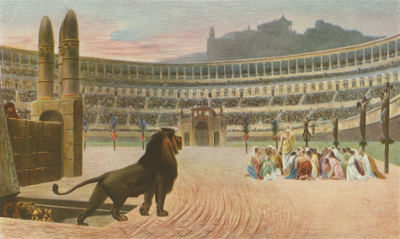
PIERRE LAFITTE & CIE, PARIS
PLATE VI.—THE LAST PRAYER
(In a Private Collection, United States)
The amphitheatre is filled to overflowing with the crowd that has
gathered to witness the martyrdom of the Christians. Around the
vast circle, unhappy victims agonize upon the cross. In one
corner of the arena, a group of men and women, condemned to die,
confess their new faith in an ardent prayer, while from the opened
subterraneous passage the ravenous beasts are advancing upon
their human prey.
Italy also, with all her memories, furnished
Gérôme with scenes of striking contrast, evoked
from the vanished past, spectacles at once sumptuous
and barbaric. He caught this atmosphere
with rare felicity. Paestum (1851) commands attention
because of its group of buffaloes, which
the Goncourts praised for "their ponderous
weight of head, the solidity of their huge bulk,
the grouping of their attitudes, the shagginess
of their coats, the prevailing sense of grateful
coolness."
It is necessary to assign a place apart, in this
series, for the Augustan Age, Birth of Christ
(1855, Amiens Museum). In his own private
opinion, confided to his cousin Timbal, Gérôme
held that this enormous composition, measuring
ten metres in length by seven in height,
lacked inventiveness and originality. It is true
that the artist's personality is not clearly revealed
in this picture, which is a sort of vast commentary
on a phrase by Bossuet, and indisputably
draws its inspiration from the Apotheosis of
Homer by Ingres. Nevertheless, no one can dispute
its noble qualities, and to borrow a phrase
from Théophile Gautier, its "high philosophic
significance." Beside Augustus Caesar deified
appears Rome, in the form of a woman, helmeted,
armed with a buckler, and clad in a red
chlamys; then Tiberius, standing on the right,
then statesmen and poets, Caesar, Cleopatra,
Anthony, Brutus, and Cassius grouped together;
lastly the throng of all nations on their knees,
admirably rendered. In the centre, relatively
unimportant in this immense assemblage, are the
Virgin Mary, the Infant Jesus, and St. Joseph,
treated in a curious fashion, modelled on the
manner of Giotto. "It is the chief ornament of
the Amiens Museum," Gérôme would say jestingly;
for he had largely lost respect for this
prolonged and important effort which represented
two years' work of a serious and diligent
student of history.
The two flawless masterpieces of Gérôme, the
eloquent interpreter of ancient Rome, are unquestionably
his Ave Caesar, Morituri te Salutant
(1859), purchased by Mathews, in which, in the
presence of a bloated, overfed Vitellius, sitting
pacifically in his imperial box, not far from the
white Vestals, crowned with verbena, gladiators
are fighting and dying in the circus, and Pollice
Verso (1874) in which these same gladiators are
represented, no longer as Roman soldiers, but
in the exact costume that they wear at the
moment when the Emperor and the crowd,
ravenous for carnage, turn down their thumbs
as signal for the death stroke. This work, published
by Goupil, did not appear at the Salon.
We must cite further Gaius Maximus, the Chariot
Race, which aroused legitimate enthusiasm in
America; The Wild Beasts Entering the Arena
(1902) and we must not forget that Gérôme also
expended his energy as a sculptor upon these
same attractive gladiatorial figures.
Striking and pathetic contrast is also earnestly
striven for and strongly rendered in The Death
of Caesar (1859, 1867). One almost needs to be an
incomparable "stage manager" in order to show
the body of Caesar after this fashion, in the
foreground, in the chamber deserted by the
Senators; one Conscript Father, as a touch of
satire, has fallen asleep. The effect is powerful,
even though it has been sought for with too
obvious care. Undoubtedly Nadar had the laugh
on his side when he compared the body of
Caesar to a bundle of linen and called the picture
"The Day of the Washerwoman." Gérôme
appreciated the humour of this pleasantry. It
is equally true that Baudelaire applauded the
picture, exclaiming: "Certainly this time M.
Gérôme's imagination has outdone itself; it
passed through a fortunate crisis when it conceived
of Caesar alone, stretched upon the
ground before his overturned throne … this
terrible epitome tells everything."
The clever erudition of the painter, who had
already revealed himself as an adherent of the
so-called group of "Pompeiians," in the Gyneceum
(1850),—in which we perceive a group of
nude women in the court of a house in Herculaneum,—asserts
itself once more, coupled with
an incisive touch of epigram in Two Augurs Unable
to Look at Each Other Without Laughing,
and similarly in the Cave Canem, now at Vesoul
(in front of a Roman house a slave is playing
the role of watch dog), in the Sale of Slaves at
Rome (1884), etc.
A similar ingenuity, with greater amplitude,
constitutes the charm and the surprise of Cleopatra
and Caesar (1886). Cleopatra has had herself
brought into Caesar's cabinet in the palace
at Alexandria, concealed in a bundle of clothing.
"Her appearance there," said Maxime du Camp,
who also praised the interest of the accessories,
treated with exquisite care, "is perfectly chaste, in
spite of her nudity." All the details are executed
with a masterly command of picturesqueness
and accuracy.
As a religious painter Gérôme has to his
credit the Virgin, Infant Jesus, and St. John (1848),
a youthful work imitated from Perugino, a St.
George, in the church of Saint-Georges at Vesoul,
a St. Martin Cutting his Mantle, in the ancient
refectory of Saint-Martin-des-Champs, a Death
of St. Jerome (1878) at Saint-Séverin, a Moses on
Mt. Sinai, and The Plague at Marsailles, and, most
important of all, Golgotha Consummatum Est, intensely
lugubrious and symbolic in aspect, with
Christ and the two thieves appearing, through the
desolate atmosphere, like writhing shadows on
the cross. This conception cost the author a violent
diatribe from Veuillot, while Edmund About,
although making certain reservations, wrote on
the other side: "The entire sum of qualities that
are distinctive of M. Gérôme will be found in
this picture."
As a painter of exotic life Gérôme remains an
observer of the highest order. If he has not
wholly revealed Italy to us in his Guardians of
the Herd and his Pifferari (1855, 1857), he has at
least done so in the case of Egypt, still deeply
impregnated with an ancient and splendid civilization,
naïve and at the same time venerable,
Egypt before the advent of tourists, a luminous
land where the Nile and the Desert reign supreme,
a land of magnificence and of savagery. Landscapes
of this Egypt of poetic mystery, and of
Palestine as well, childish or perverse almas,
rude Albanian Chiefs, Turbaned Turks,—one
never wearies of these decorative effects, these
clear visions, these scenes of animation, whether
violent or delicate, the people, the vegetation, the
fabrics, all resplendent under the marvellous sky
of the Orient.
In the company of this intrepid, venturesome
and observant traveller, we witness the passage
of Egyptian Recruits Crossing the Desert, we are
present at Prayers in the House of an Albanian
Chief, we pause in the Plain of Thebes, not far
from Memmon and Sesostris, and we watch the
Camels at the Drinking Trough, so admirably
realized. Gérôme, who had a gift for finding
the right and pleasing phrase, gave this rather
neat definition of a camel: "The Ship of the Sea
of Sand."
Similarly, the Egyptian Straw-chopper (1861,
again exhibited in 1867, and purchased by M.
Werlé) symbolizes, simply yet forcefully, agricultural
Egypt, and all the varied shadings of
her pastoral poetry. Then again, there is The
Prisoner (1863), in which a boat is making its
way along the vast and pacific Nile. Two negro
oarsmen, the master, a bashibazouk, are in the
prow; and in the stern, beside a buffoon, who
apparently derides him, while twanging the
strings of a guitar, the prisoner lies cross-wise,
fast bound, and abandons himself to his cruel
destiny. There, in a setting of enchanted beauty,
we have the chief actors in this original drama,
in which dream and reality are blended.
What a horde of types, some of them bizarre,
others simply comic! There are, taking them as
they come, a Turkish Butcher in Jerusalem (1863),
The Alma (Professional Singing Girl—1864), The
Slaves in the Market Place, The Clothing Merchant
at Cairo, The Albanians Playing Chess
(1867), The Itinerant Merchant at Cairo (1869).
Then there is the Promenade of the Harem, and
still others, the Santon (Turkish Monk) at the
Door of the Mosque and Women at the Bath
(1876), the Arab and his Courser and The Return
from the Hunt (1878).
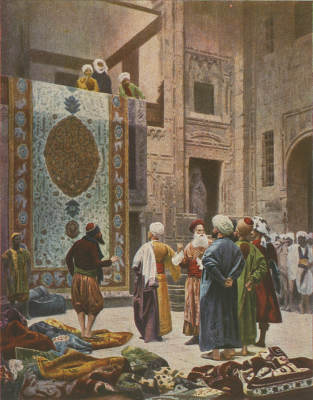
PIERRE LAFITTE & CIE, PARIS
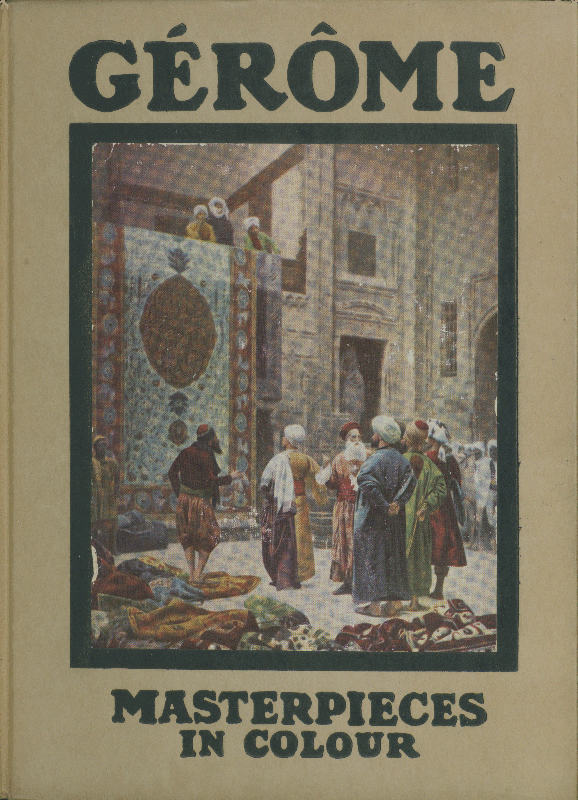
PLATE VII.—THE VENDOR OF RUGS
(In a Private Collection, United States)
From his numerous journeys to the East, Gérôme brought back
many curious memoranda of picturesque scenes, which he subsequently
converted into brilliant canvases. He excelled in reproducing
the caressing beauty of shimmering carpets and the rippling
sheen of silken textures.
In the company of this experienced and reliable
guide, we wander from Jerusalem (1868)
to the Great Bath at Broussa (1885), from a Corner
of Cairo to Medinet and Fayoum. Here we
have the severed heads in the Mosque of El Hecanin,
the nude woman in the Moorish Bath, all the
barbarity and all the grace of the Orient,—and
invariably the anecdote, whether agreeable or
sinister, blends with the matchless splendour of
the landscape.
To this list must be added Recreation in Camp,
a Souvenir of Moldavia (Salon of 1854), in which
a soldier is dancing before his assembled comrades,
to the sound of drums, fifes, and violins.
A sentinel keeps watch. It is a picture taken in
the act, and intensely real.
It is easy to detect the historian, or, to adopt
the expression of M. Jules Claretie, the "Memoir
Maker," possessed of the true gift, agreeable and
individual, lurking behind every one of the works
of this authoritative orientalist. He dedicated
himself quite naturally and with great success to
the interpretation of history and of the historic
and literary anecdote.
His love of contrasts, his gift for depicting
locality and somehow conveying the very atmosphere
belonging to the varied scenes that are to
be brought before the spectator's eye, give amplitude
to such attractive little compositions as Louis
XIV. and Molière (1863), and A Collaboration (1874);
evoke the whole sombre tragedy of the death of
Maréchal Ney, December 7, 1815, Nine o'clock in
the Morning (1868); and appeal successively to
our curiosity, our sympathy, or our admiration,
with a Frederick II., conqueror of Silesia, playing
on his flute, the King Flutist (1874, purchased by
M. H. Oppenheim), His Gray Eminence (1874), in
which the austere and dominant Father Joseph is
making his way alone, down the stairway, in the
presence of the obsequious courtiers; a Bonaparte
day-dreaming before the Sphinx, Oedipus (1886), a
Bonaparte at Cairo gazing at the town from the
back of his Arab horse, a Bonaparte in Egypt,
mounted on a white dromedary, dreaming of his
omnipotence, of his conquest of the universe, and
surrounded by his overdriven soldiers.
As a matter of fact, Gérôme made a sort of
hero-worship of Napoleon and the Napoleonic
epic, resembling in this respect his friend, M.
Frédéric Masson, the celebrated historian of the
Emperor, who was better qualified than any other
writer to pay an eloquent tribute to this Bonaparte
in Egypt.
"Bonaparte is no longer on the road to Syria,
he is on the road to India; he is hesitating between
the two halves of the world that he holds
in his hands; he is weighing the destiny of Alexander
against the destiny of Cæsar; he is asking
himself whether Asia, to which he holds the
key, is a fair exchange for Europe which he has
just quitted; and while his dream embraces the
universe, he leaves his human rubbish heap to
suffer."
Gérôme is wholly himself when he has an
anecdote to give us, whether it be subtle, humorous,
kindly, or dramatic, and even,—why not use
the word?—melodramatic.
Classified thus, The Duel after the Masquerade
fully deserves its brilliant reputation. Reproduced,
not only in lithographs and engravings,
but even transferred to the theatre (given at the
Gymnase, in 1881, by Mme. Fould), its subject
has become a matter of general knowledge. It is
winter in the Bois de Boulogne. A number of
people in fancy costume are bending over a
wounded Pierrot, while one of the witnesses of
this improvised duel is leading away the murderer,
the Harlequin.
One can see at once what a tremendous appeal
a subject like this would have for the general
public.
This singular drama, taking place in the snow,
all this joyousness ending in bloodshed and perhaps
death, is so fantastic that it leaves a lasting
impression. It was, by the way, as M. Guillaumin
has explained, suggested by an actual duel
that took place between Deluns-Montaud, the
Harlequin, and the Prefect of Police Bortelle,
the Pierrot.
Undoubtedly there was, and still is, ground
for criticism. Alexandre Dumas thought, not unreasonably,
that serious-minded men of that age
would not go out to fight each other in such a
costume. Edmond About criticized the pose of
Crispin supporting on his knee an entire group of
spectators, along with the body of poor Pierrot.
But Paul de Saint-Victor praised the "truthfulness
of the postures, the etching-like precision
of the heads, the wise planning of the whole
composition."
In order to appreciate better the daring fantasy
and the wise and invariably picturesque inventiveness
of Gérôme, we have only to study further
such works as the Frieze destined to be
reproduced upon a vase commemorative of the
Exposition of London (1853), Rembrandt Etching
(exhibited in 1867, purchased by M. E. Fould),
which has been admired for its golden half-shadows
and freely compared to Gerard Dow, the
Reception of the Siamese Ambassadors (1865), The
First Kiss of the Sun (1886), the Poet, Thirst (1888),
and fantasies, such as, The Amateur of Tulips,
Whoever you are, here is your Master; anecdotal
portraits throwing side lights on history, such as:
They are Conspiring, or Not Convenient, Louis XI.
visiting Cardinal Balue, Promenade of the Court
in the Gardens of Versailles (1896); animals full of
life and prowess, such as: The Lioness meeting a
Jaguar and Ego nominor Leo, a lion rendered life
size; lastly, his studio interiors, in which he has
chosen to depict himself exactly as he was, that is
to say, a sincere, clear-sighted, and indefatigable
workman.
In the most recent of these studio pictures, he
appears, wearing a sculptor's blouse and occupied
in modelling a statuette of a woman. He astonished
his friends and admirers, during his last
years, by his earnest labours in sculpture. His
two groups, The Gladiators and Anacreon, Bacchus
and Cupid, claimed the attention of the public
at the Exposition of 1878; and it was the same
with his marble statue of Omphale (1887), his
Tanagra, his Dancing Girl, his bronze Lion (1890,
1891), etc.
His efforts to revive the art of coloured or
polychrome sculpture, the so-called chryselephantine
sculpture, which invokes the aid of various
precious elements, constitute one of the most
curious and important artistic experiments of
modern times, even though the result did not
always come up to the expectation.
On February 2, 1892, in an unpublished letter
addressed to M. Germain Bapst, who desired
information concerning the artist's experiment,
Gérôme wrote: "I have always been struck
with a sense of the coldness of statues if, when
the work is once finished, it is left in its natural
state. I have already made some experiments
and am continuing my efforts, for I am
anxious to bring before the eyes of the public
a few demonstrations that I hope will be conclusive.
I know that there are a great many
protests. The world always protests against anything
which is, I will not merely say new, but
even renewed; for it disturbs a good many people
in their tranquillity and their routine." And after
having first shown that ancient architecture was
adorned with colours and that in chryselephantine
sculpture the Greeks combined gold, tin, and
ivory, that they painted the marble and united it
with various metals, Gérôme added: "Shall I
succeed? At least I shall have the honour of
having made the attempt."
In the interesting study which M. Germain
Bapst devoted to this question, after having, as
we have seen, consulted the artist himself, he
recalled the fact that both in chateaux and in
churches the Mediæval statuary was coloured.
In Greece, the Minerva Parthenos contained a
weight of gold equivalent to more than 2,200,000
francs in the French currency of to-day. The
statue of Jupiter at Olympus was partly of ivory
and partly of gold.
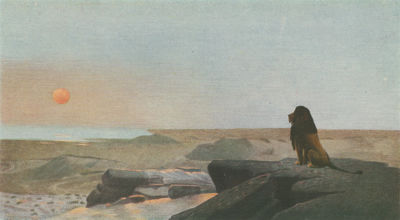
PIERRE LAFITTE & CIE, PARIS
PLATE VIII.—THE TWO MAJESTIES
(In a Private Collection, United States)
In the mournful immensity of African solitudes, the king of
planets mounts towards the zenith, darting his fires upon the arid
land that he consumes, while the other king of the desert, the lion,
contemplates the triumphant ascension of his rival in the sky.
Gérôme has rendered the scene with an eloquence all the greater
because he has employed such simple means.
Towards the middle of the nineteenth century,
the Duc de Luynes undertook, in collaboration
with the architect Dubau, to produce an example of
chryselephantine sculpture, which cost him more
than 500,000 francs and was placed on view at
the Exposition Universelle held in the Palais de
l'Industrie in 1855.
Gérôme in his turn made a like attempt, in
his Bellona, in which, to remedy the cold immobility
of the material, he coloured both the
ivory and the marble and at the same time invoked
the aid of silver, bronze, gold, and enamel.
He had associated with him several experienced
collaborators, such as M. Siot-Decauville, who
was to cast the face of Bellona in bronze, Messrs.
Moreau-Vauthier and Delacour to point the ivory,
M. Gautruche to attend to the verde-antique and
the electroplating. Lastly, Gallé, and M. Lalique
as well, made a number of trial models for the
little head of Medusa.
Among the other examples of Gérôme's sculpture,
mention must be made of The Entrance of
Bonaparte into Cairo (1897), Bonaparte, a bust
(1897), Timour-Lang, the Lion Tamer (1898), Frederick
the Great (1899), Washington (1901), The expiring
Eagle of Waterloo, The Bowlers (1902),
Cupid the Metallurgist, a statue in bronze, Corinth,
a statue in polychrome marble and bronze
(1904).