THE ARMY
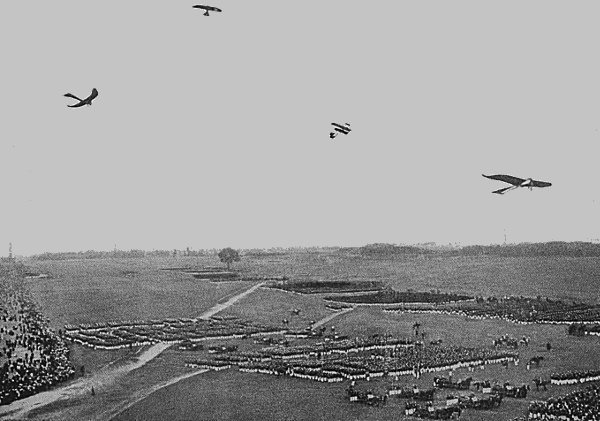
Bird’s-eye View Berlin Parade Grounds
The great military authority, Bernhardi, in an article
in Das Jahr 1913, points out various ways in which military
science has developed since the Franco-Prussian
War and shows how completely we have had to abandon
many of the conceptions gained by a study of earlier
campaigns. Responsible in the main for the changes are
the increased size of the armies and the new technical
inventions of our age.
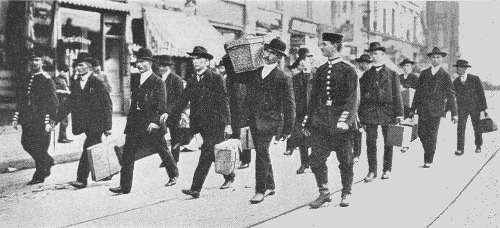
Arrival of Recruits
Almost all the states of continental Europe have gone
over to the principle of universal military service, with
the result that the armies are greater now in time of
peace than ever before in time of war, and that when
mobilization is called for and the reserves are summoned,
the number of men in the field amounts to millions. The
first result has been that far other means of transporting
and concentrating such masses have to be employed than
used to be the case and that networks of railroads have
had to be built for purely strategic purposes. In the
maneuvers that were to have taken place this coming
autumn at Münster in Germany it had been intended to
make a record in the matter of quick transportation and
to dispose of 120,000 men in the course of a single morning
without interrupting the regular passenger traffic.
The old method of victualing armies, too, has had to be
changed, for it is impossible for such hordes to nourish
themselves by what they chance to find in the enemy’s
country. Problems of another kind have arisen. Modern
armies are composed of regulars and reservists alike:
the reservists are not so hardened as the regulars and
often not so efficient, so that it has become a custom to
distribute them in such a way as to achieve the best results.
As a rule, the regulars must be spared for decisive
actions and reservists must occasionally be sacrificed,
apparently needlessly. There may be cases, for
instance, where the reserves must expose themselves to
a murderous fire while the regulars are engaged in the
more difficult but less dangerous task of cutting off the
enemy’s line of retreat.
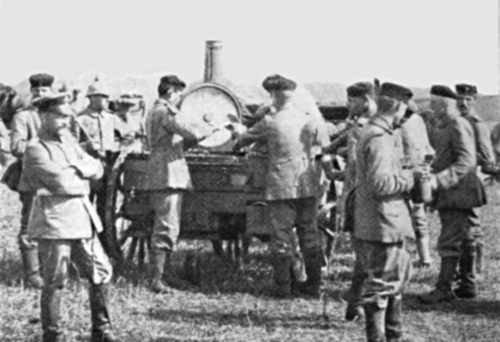
The Field Kitchen
Technical improvements, such as the longer range and
quicker fire of the guns, swifter means of communication
and of signaling and the like, not to speak of other
considerations due to experience, have so changed the old
tactics that a line of battle is now more than ten times as
long as it was only a few years ago. At Sadowa, with
215,000 men, the Austrians had a front of only 10 kilometers;
at Mukden the attacking line of the Japanese,
who had only 170,000 men, extended for 110 kilometers.
“The broken line,” writes Bernhardi, “is to-day the only
battle formation of the infantry.” To-day, officers and
men fight in trenches and take every advantage of the
inequalities of the ground; in 1870 it was considered
disgraceful to take such advantages and the officers
stood erect in the most deadly fire. In consequence of
the length of the lines a check in one quarter is no longer
so serious a matter as it used to be; a modern battle is
a succession of single engagements of which the victor
only needs to win a good majority. The commander
no longer takes up a position, as Napoleon did at Leipzig,
where he can oversee the whole field of operations;
the best place for him is some railroad junction or central
telephone station, with wireless and ordinary telegraph
equipment, where messages can constantly be
sent and received, and to and from which he can despatch
troops, automobiles, motor-wagons or aeroplanes. One
of the chief modern problems is supplying sufficient
ammunition for quick-firing guns—the baggage trains
must not be so long as to hinder the advance of the
troops, yet where there are many guns and each shoots
off hundreds of shots a minute, great quantities of ammunition
are needed.
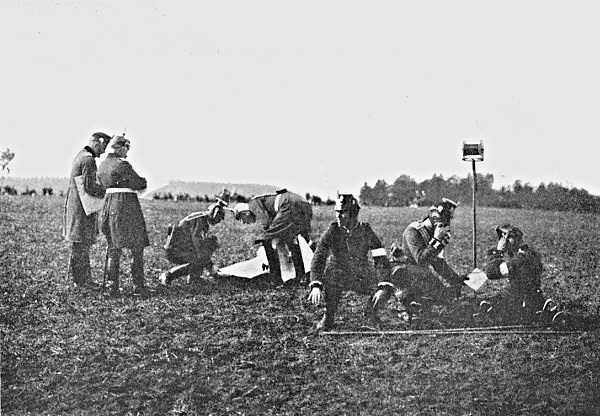
Transmitting and Receiving Orders by Telephone
I have spoken of military service being almost universally
compulsory in Europe. This means that every
man of a certain age and with the requisite health and
strength is obliged to report for duty. It has not hitherto
meant that every eligible recruit was obliged to serve.
In Germany a large contingent, even of the capable,
was formerly excused. In 1910, for instance, nearly
235,000 were declared more or less unfit for service, although
in France they would probably nearly all have
been accepted. By the German army bills of 1911, 1912
and 1913 indeed the numbers of those required for active
service were steadily increased: 9,482 in the first
named year, some 29,000 in the second, and then the
great increase of 63,000 in the third. But there were
still, up to the present mobilization, some thirty thousand
able-bodied recruits who could not be placed.
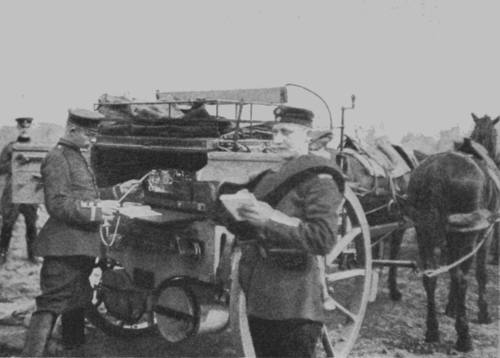
Telegrams
In the Prussian military-service law of 1814, and
again in the constitution of the North German Confederation
of 1867, the principle was laid down that the
army should consist of one per cent. of the population.
This had long been disregarded as the population increased,
and the proportion had sunk as low as eight-tenths
of one per cent. It has now been raised to a little
over the original figure. The population as given officially
in 1913 was 64,925,993, while the number of common
soldiers (I quote the figures given by Stavenhagen
in the Handbuch der Politik) was 647,811.[*]
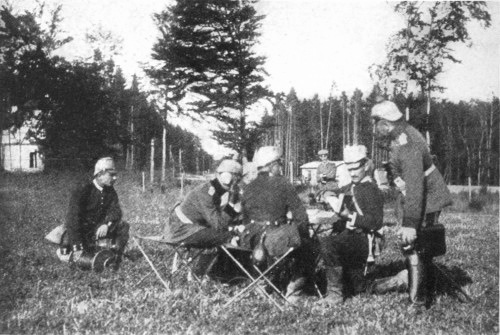
Giving Orders
The cost of the German army has
been enormous—more than twenty-five billion marks between 1872 and
1910, and in 1913 alone, 1,608,653,300 marks. The extraordinary defense
contribution for 1913, 1914 and 1915, a tax, not on income but on
capital direct, is estimated to bring nearly 1,300,000,000 marks.
Strange to say, the tax was very popular—every party in the Reichstag
voted for it, even the social democrats, whose delight in a measure
that fell most heavily on the rich (small properties were exempted)
made them swallow the fact that the money was for national and military
purposes. The yearly sums that the sudden increase in the army entails
are to be paid by a curious tax on the increase of property value to be
estimated every three years.
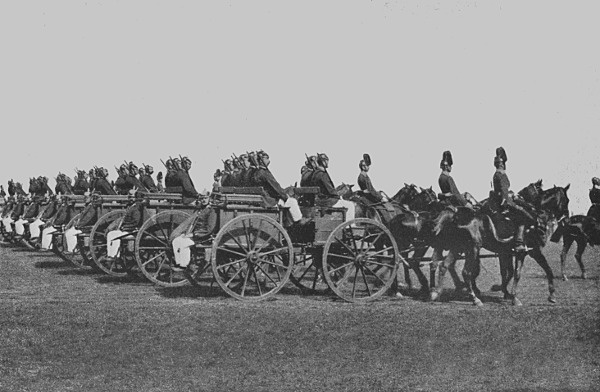
Telegraph Battalion
The estimates as to how much the army numbers when
on a war footing varies between two and three-fourths
millions and four millions. Austria’s army, on paper at
least, numbers 380,000 men in time of peace, which number
gradually was to have risen to 410,000 in the next
few years. In war-time it is estimated at 1,300,000 men.
Curiously enough Italy, with a peace army of only 300,000,
estimates her war army officially at 3,400,000, or
about as much as either Germany or France.

Military Telephone Station
For the armies of the Triple Entente we have an estimate
published by the Deutsche Tageszeitung in January,
1914, which is worth quoting at some length, as it
is from a well-known military writer, Lieutenant
Colonel von Bremen:
The basis of France’s military increase in 1913 is the reintroduction
of the three years’ term of service. By retaining these third-year
men the peace-showing is increased by almost a third. This year
185,000 men are to be called in. The peace strength of the French
army will, from the autumn of 1916 on, amount to 33,000 officers and
officials and some 833,000 men, while up to that period we can
reckon with 780,000 men. One must add to this, 28,000 gendarmes,
customs and forest officials, who likewise belong to the territorial
army (like the Landwehr). In Germany we have for 1913 and
1914, counting officers, non-commissioned officers and men, 802,000,
to which, in 1915, will be added 13,000 men. Deducting from the
present strength of both armies the mere laborers who have to do
with supplies, etc., Germany’s peace force is momentarily the higher,
but not if we reckon France’s gendarmerie, etc. Counting in this,
France, with 40,000,000 inhabitants, has a larger army in time of
peace than Germany, with 65,000,000. The French army has further
advantages in the longer training and in the increased readiness
for war. The troops covering the eastern frontiers have two hundred
men to a company (four-fifths of the war strength) and even
at the time when the recruits are being mustered in, one hundred
forty trained men; while our companies at the same time can dispose
of only half so strong a number. And what it means in case of war
to have at hand two fully trained years’ contingents (especially in
the cavalry) during the period of training the recruits is self-evident.
Further advantages in the French army lie in the longer training of
the inactive officers and in the good provision for officers and
non-commissioned officers. In the house of deputies negotiations are
pending regarding advancement regulations tending to lower the
age limit of the whole body of officers. And, above all, it has been
[Pg 28]
made possible to create a new, twenty-first army corps. So we see
that France, in 1913, has made a very great step forward.
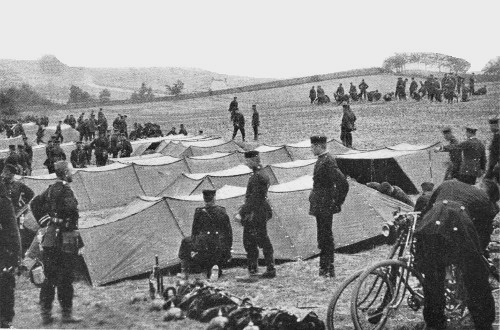
Putting up Campaign Tents
The Russian armaments of 1913 are also significant. The most
important event was the appearance in October of the draft of a
law to prolong the term of active service by three months and that in
the decisive time from January first (fourteenth) to April first
(fourteenth). As in Russia, the recruits are called in at latest by
November fifteenth. Russia will, until spring, still have under arms,
besides the recruits, the trained contingents of three years in the
infantry—four, indeed, in the cavalry. That considerably increases
her readiness for war. And in addition to lengthening the term of
service the number of recruits is still further increased by twenty
thousand men. The momentary military strength of the Russian
empire is about one and one-half millions, of which about 1,200,000
concern Europe (thirty army corps and twenty-four cavalry divisions).
But already for 1914 we can reckon on the formation of
from two to three new army corps and on a considerable increase of
the artillery by at least forty batteries, for which purpose three hundred
twenty million marks have been called for. To make mobilization
speedier and to facilitate the march to the west boundary railroads
are to be built. The estimates for this are about two hundred
sixty million marks. The following stretches are under consideration:
1. Nowogeorgiewsk to Plozk on the Vistula. 2. Cholm—Tomoschow—Belzek.
3. Schepetowka—Proskurow—Larga. In addition
a number of lines are planned of which one is to encircle our
province of East Prussia. Along the German frontier, too, the erection
of wireless stations has energetically been taken in hand. Likewise
they have begun to modernize their fort and field artillery.
Side by side with these endeavors go intended improvements in military
education and training and organized changes in the situation
of the officers’ corps and general staff in the way of raising salaries
and of quicker advancement. Thus for the Russian army, too, and
its capacity for service the year 1913 is to be looked upon as
important.
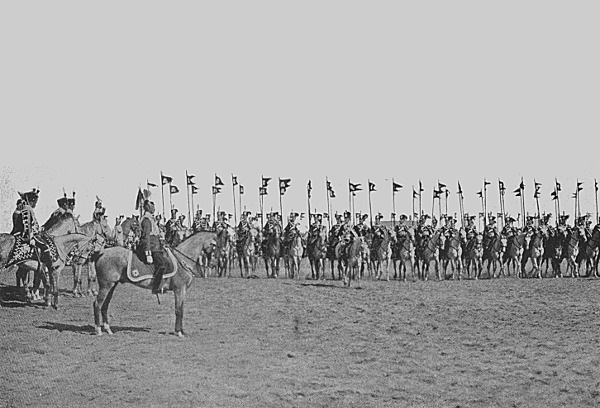
Death’s-head Hussars
Furthest in arrears of the armies of the Triple Entente is the
[Pg 29]
English, which made no progress worth speaking of in 1913. England
in her war plans against us long reckoned with landing an army
of invasion on our coast. The idea has been given up because it was
declared that probably the weak, active army would be more needed
elsewhere, especially as its maximum of about 130,000 men could
not play a decisive part against the millions-of-men armies of Germany.
Nor has the “territorial army,” destined for protection at
home, shown any progress; of its required strength there were still
lacking in October, 1913, seventy thousand men and all efforts to
bring it to the intended height of 314,000 men have failed. The
thought of tunnel connection with France, however, in spite of the
dislike of the Britisher, so proud of the isolation the sea offers him,
has found more adherents than was formerly the case.
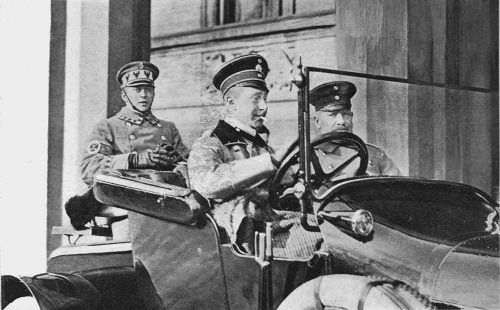
The Crown Prince
If now we draw our conclusions from our military review of the
year 1913 the armaments of Austria and Italy on the one hand and
Russia and England on the other are insignificant as compared with
those of Germany and France. The two latter remain well in the
foreground, and indeed in a European war, too, it is they who first
and foremost would have to try conclusions with each other.
These observations, made by an expert at the beginning
of 1914, are exceedingly interesting in view of
what is now going on. Since Von Bremen wrote, however,
there have been several interesting developments.
In February it became known that of the French soldiers
no less than 265,000 had died, were on the sick-list, or
had been discharged during the previous month. The
explanation is, that in order to raise the figures even
the poorest kind of material had been accepted, that old
unhealthy barracks were overcrowded and that new ones
had been occupied while the plaster was still wet on the
walls; that the army was short of physicians to the extent
of many hundreds. An official note in a Paris paper declares
that two-thirds of the recruits arrive in a tuberculous
condition. Together with these revelations comes
a book, by a French military aeronaut, complaining of
the utter neglect of the air fleet, and declaring that at
the moment France has not one serviceable hydroplane.
The whole appropriation for air-ships in connection with
the navy was but 400,000 francs in 1913, as compared
with millions appropriated by the rival powers. At the
same time come revelations regarding the regular navy
itself. Although there are nine dreadnaughts building,
but two are ready, and no cruisers.
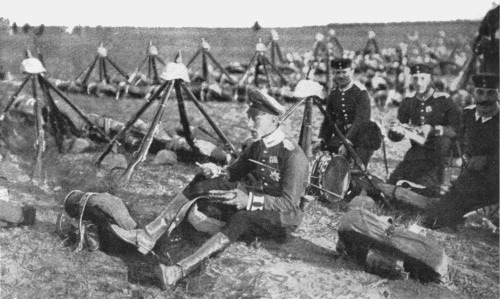
The Crown Prince at Mess
In March appeared the “general annual report of the
British army,” published by the War Office, which
showed that Von Bremen’s statement as to the shortage
of men was not only not exaggerated but greatly underestimated.
The regular army is 9,211 men short, the territorial
army 66,969, the special reserve 29,370. The
explanation lies in the greater attractiveness of the navy
and in the high emigration figures (178,468 males in
1913).
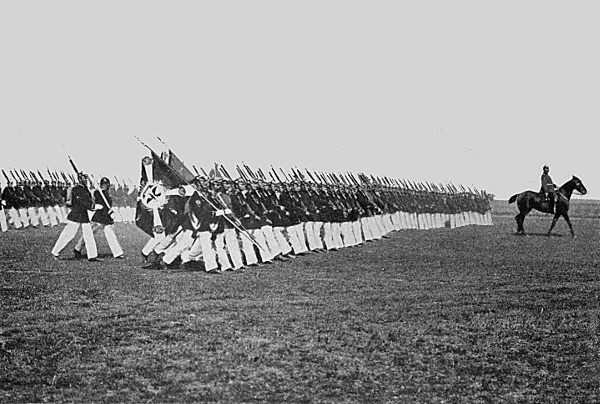
Line Infantry
In April we hear of great appropriations in Austria
both for the army and the navy. Official estimates place
the strength of the army at 390,250 men, but a German
critic points out that of these 60,000 are Landwehr, or
reserves, and ought not to be counted. There is to be a
yearly increase of 31,300 recruits, but the measure is not
to take full effect until 1918. For the navy, 427,000,000
kronen are appropriated, of which 4,000,000 are to go
for military air-ships; but the expenditures are to be
extended over a period of five years. It has been Austria’s
fate throughout the centuries always to be several
years behind.
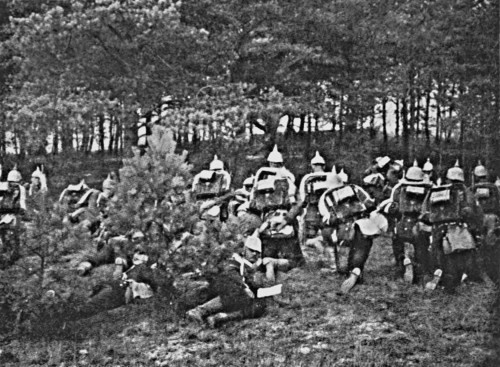
Rear Guard in Ambush
In June, finally, we learn that Russia has set aside
for military expenditures in 1914 alone the monstrous
sum of 2,500,000,000 marks, and by 1916 will have
added 400,000 men—more than Austria’s whole force—to
her standing army, which will amount, in the winter
months at least, to 2,200,000 men. “Characteristic,”
writes the Tägliche Rundschau in commenting on it, “is
the strengthening of the western boundary-strip and the
improvement of the strategic network of railroads in
order to hasten the forwarding of troops.” On the other
hand, attention is drawn in the Danziger Zeitung to the
fact that Russia has at the moment in the Baltic but four
battle-ships, all old-fashioned, although by 1915 it is
hoped to have ready four dreadnaughts.
We shall hear much in the next few months of infantry
and cavalry, of field artillery and foot artillery,
of pioneers, of Verkehrstruppen or communication
troops, and of the Train or transport division. I therefore
preface this section with the definition of these
terms given by a staff officer in the newest book of instructions
for the one-year volunteers.

Artillery Patrol
The infantry represent the main troops of the army. Their value
lies in their endurance when marching, in their correct shooting and
in their brave dashing against the enemy. The infantry is armed
with the ninety-eight gun and bayonet; the sword-knot non-commissioned
officers (Portepeeunteroffiziere), battalion-drummers and ambulance-men
carry revolvers.
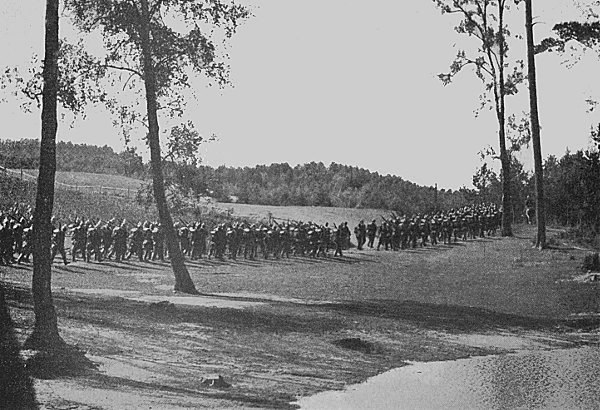
Infantry on the March
To the infantry belong the sharpshooter battalions (Jägerbataillone),
the guard sharpshooter battalion (Gardejägerbataillon)
and the guard rifle-battalion (Gardeschützenbataillon). The
infantrymen are known as grenadiers, musketeers and fusileers.
The cavalry is armed with lance, saber and carbine. Its chief
value is for scouting and for precautionary service, but it is also used
for riding down the enemy and piercing him with the lance. The
cavalry may also dismount and fight on foot like the infantry. For
shooting it uses the carbine.
The cavalry consists of cuirassiers, uhlans, hussars, dragoons and
mounted riflemen. (In Saxony guard-riders (Gardereiter) and carbineers;
in Bavaria heavy riders and light horse (Chevaulegers).)
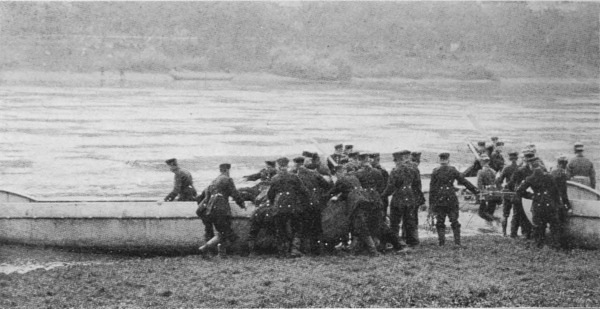
Floating the Pontoons
The field artillery is effective through the swiftness with which it
rides up and through the certainty of aim of its quick-firing guns.
The field artillery carries batteries of cannon for firing against
visible goals and light howitzer batteries, for shooting at objects behind
cover and for demolishing light field fortifications. The drivers
carry a sword and revolver, the cannoneers a dagger and revolver.
Every man of the horse-drawn division is mounted and carries sword
and revolver.
The foot artillery has to serve the fort and siege artillery as well
as the heavy artillery guns of the field army; in attacking a fortress
it must silence the enemy’s heavy fort guns and make breaches in the
[Pg 33]
fortifications; when defending it must overcome the enemy’s heavy
siege guns. The men are called cannoneers; they carry the carbine
and the ninety-eight bayonet.
The pioneers see to the throwing up of entrenchments, the building
and destroying of bridges, obstructions, etc.; they are armed like
the infantrymen.

Machine Guns Being Loaded on Pontoons
The communication troops consist of the railroad regiments, which
in time of war have to see to the building and running of railroads;
of the telegraph battalions, which put up telegraph lines; of the
fortress telephone companies, which attend to all telephone matters
in the fortress; of the air-ship and aeroplane battalions, who are
entrusted with spying out the land and the enemy’s positions by
means of balloons, air-ships and aeroplanes.
The communication troops are armed like the infantry.
The transport service (Train) supplies every kind of column of
the army with bridge materials, food, ammunition, etc. Its weapons
are swords, carbines and revolvers.
It is not worth while here to enter into the question of
uniforms. In time of peace the blue coats and red collars
of the infantry, the varied colored attilas and fur
caps of the hussars, the helms with the flying eagles of
the guards, the tresses, the gleaming epaulettes, the
scarves, the waving plumes, are all interesting enough,
especially to the other sex; but in war that is all laid
aside. In order to be as invisible as possible to the
enemy all categories of troops wear the same ashen
gray—a comparatively recent adaptation of the principle
of protective coloring.
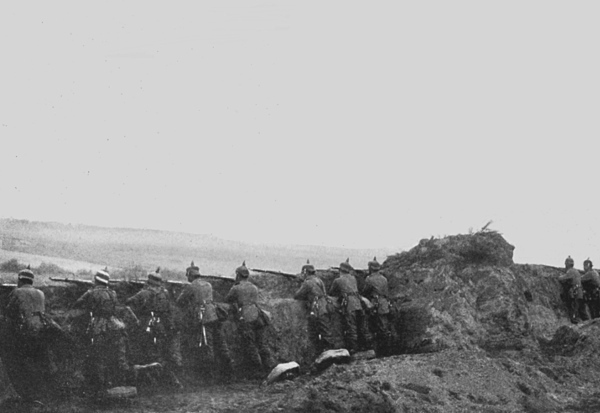
Mountain Earthworks
In the German army the cavalry is merely an adjunct
of the infantry. It is the infantry which decides battles—not
the cavalry, not even the artillery. However, the
infantry of to-day is something very different from the
infantry of the eighteenth and even from that of a
great part of the nineteenth century. German military
writers acknowledge that the world learned new tactics
from the sharpshooters and riflemen of the American
war of the rebellion. The whole modern battle formation
rests on the idea of giving more play to the individual.
In spite of the technical progress that has made
of armies great machines, more weight than ever before
is laid on quick judgment, on good shooting, on physical
bravery and endurance. I know that an idea quite contrary
to this prevails, that many consider war reduced
to the art of setting off the greatest quantities of explosives
within a given time. But this is very far from
the truth. The battles of the past were of much shorter
duration than are those of the present. Wagram was
won in two hours, Mukden took three days.
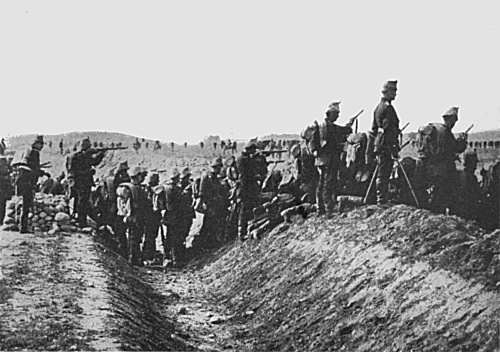
Pursuit
One learns to adapt one’s self even to quick-firing
guns and incredible rifle-ranges. It has been mathematically
demonstrated that, with the rifles now in the
hands of the German infantry, a bullet fired from a distance
of three hundred yards will pass right through five
men standing closely one behind the other and lodge in
the body of the sixth. But men in battle line no longer
stand closely one behind the other, nor even closely side
by side. Even in what is considered a thick firing line
they stand about three feet apart.

Infantry Embarking
I have said that the modern idea is to give more play
to the individual. Within certain limits the men choose
their own position, find the proper rests for their rifles,
get each the range for himself, determine the speed of
their own fire and use their own judgment in the economizing
of ammunition. They are expected to advance
according as they see their opportunity.
A glance at the methods of training the infantry will
give some idea of the care and thoroughness with which
the Germans have made their preparations for war. The
old drill has not been entirely abandoned—indeed, some
military critics think that there is still too much of the
goose-step marching and of the parade tricks. But these
have lost their old importance and the tendency of late
years is toward the most realistic representation of the
circumstances and problems of actual combat. The parade-ground
has given place to the maneuvering field,
acres and miles in extent. For the first time in Germany,
this autumn, whole army corps were to have engaged
in mock combat with one another.
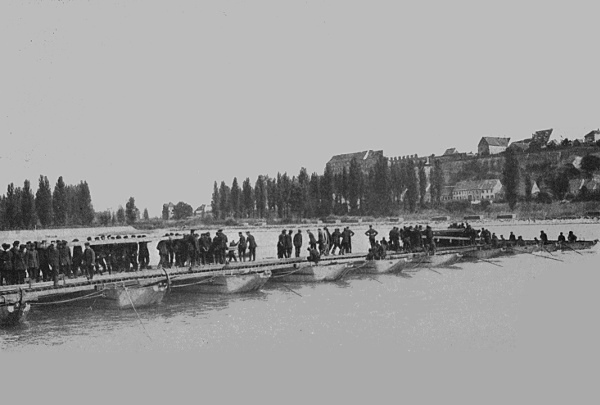
Building a Pontoon Bridge
In the ordinary rifle practise the men are taught first
to shoot well individually, then in groups and detachments,
next in whole troops and companies and finally
in conjunction with cavalry and artillery. They are
made to adapt themselves to the most unfamiliar and unusual
surroundings. Even the targets are of the most
varied description: targets that fall to the ground when
hit, targets that burst, targets surrounded by smoking
objects or colored fires so that there will be some of the
semblance of battle, fixed targets and targets that move
or that float in the air, targets that have been lying flat on
the ground but that suddenly appear here and there like
an enemy issuing from the bushes. The rifleman must
learn never to be surprised at anything, but to keep his
eyes open in all directions.
The German army rifle is of a type first introduced
in 1888, and so much improved in 1898 that it is now
known as the ninety-eight gun. All the infantry
carry the same, for there is no longer any essential
distinction between musketeers, fusileers and grenadiers.
It is a quick-loading rifle which renders it possible
to take aim and shoot as many as twenty-five
times a minute. The caliber is seven and nine-tenths
millimeters, a fact which may not at first seem to the
American reader of great importance, but which becomes
more interesting when it is realized that this is
the smallest caliber which will inflict sufficient injury on
an enemy to make its use profitable. In other words, if
it does not kill him at once it will put him out of the fight
and keep him out for a reasonable time. It was found
in the Russian-Japanese War that a smaller bullet could,
and in a number of cases did, pass through a foeman’s
body without rendering him hors de combat, and that
no less than forty per cent. of all wounded were back
with their troops in three months.
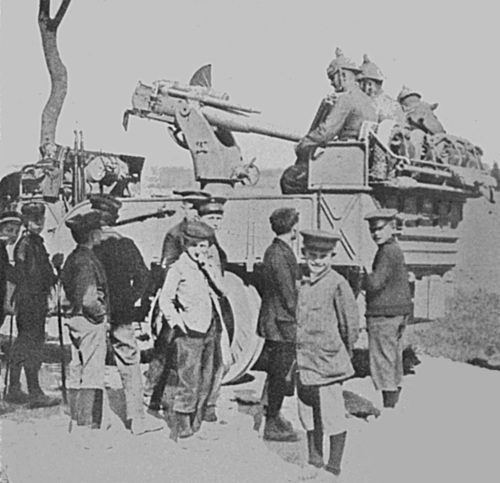
Cannon for Shooting Air-ships
There are Maxim rifles which can fire as many as a
hundred shots a minute and which have other advantages
too; but the German government is well satisfied with its
own gun, considers it superior to that of any of its
neighbors’ and has never seriously considered the question
of changing. It has a smokeless powder, the process
of manufacture of which is a carefully guarded secret.
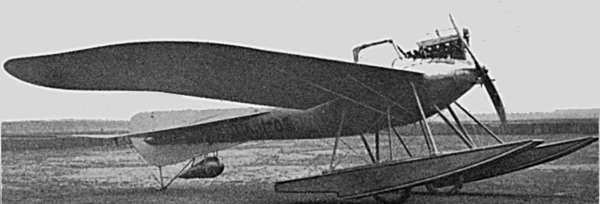
Combination Hydro and Aeroplane
A recent innovation is the supplying of the infantry—for
that matter of the cavalry also—with so-called
machine guns. They are the Gatling guns of our own
country, and every German infantry regiment now—since
the army reform of 1913—has a machine-gun company.
It consists of ninety men and forty horses, with
six guns and three ammunition wagons. As the newest
guns can fire at the rate of six hundred shots a minute,
and as there are more than two hundred infantry regiments,
not to speak of the cavalry and artillery, which
also have their companies of “Gatlings,” one can gain
some impression of the deadliness of modern campaigning.
Many of the quick-firing guns now are supplied
with stands on pivots so that they can be pointed in the
air against balloons and aeroplanes. But their chief use
will be in guarding bridges and narrow passes. Their
bullets carry for two miles, but they can be silenced by
heavy artillery far beyond this range, nor can they carry
enough ammunition for long-continued use. Altogether,
however, a comparison of their fire with the simple
flames of the traditional hell makes the latter place
seem a mere pleasure-resort.
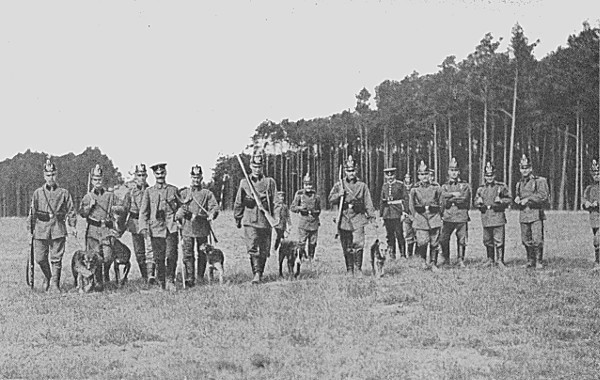
War Dogs Used as Messengers
The training of a soldier has of late years become
more and more humane and rational, and is no longer
confined to manning guns, shooting rifles and performing
long marches. Those Germans with whom I
have spoken on the subject look back to their term of
service with pleasure, and my general conviction is that
the army in time of peace is the most perfect educational
institution in existence. With school learning
every boy when he comes to “serve” is more or less
equipped. What he learns is esprit de corps, manly
bearing, endurance and the feeling that his tasks must
be quickly and faultlessly performed—in other words,
regularity and discipline. The mere change of surroundings
and interests is a benefit, and the outlook on
the world is immeasurably broadened. The old argument
against compulsory military training—that, namely,
young men in their best years are withdrawn from
productive work, does not amount to much in an age
where the general complaint is of overcrowdedness in
almost every calling and profession. The German boy
does his work all the better for his military training and
the nation has thoroughly adjusted itself to the falling
out of these two years. There are dispensations for cases
where the boy’s presence at home is a vital matter for the
support of others, and, as a rule, a place that he filled before
is kept open for him against his return.
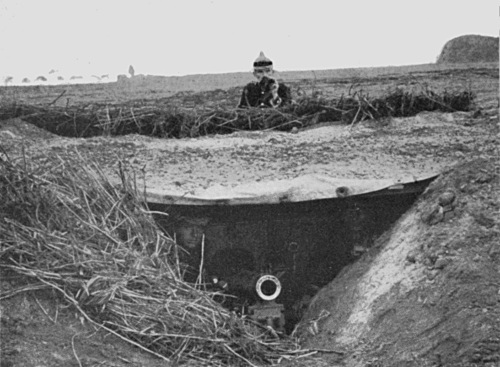
Covered Field Artillery
One of the pleasantest recent developments has been
the enthusiasm for sport that had taken hold of the
army. The authorities encouraged it in every way, for
it was in keeping with the new tactics of training the
individual to be efficient and independent. The author
had the pleasure of attending the first great military
athletic meet that has ever taken place. It was held in
June, 1914, in the great stadium that has been erected
near Berlin for the Olympic games of 1916, and that
army which is now fighting so strenuously for the very
existence of its country was represented in all its pomp
and glory. On an elevated terrace was the emperor with
his court. Next came the logen or boxes which were
blue with the uniforms of the officers. A large majority
of the spectators were soldiers, for whom whole sections
had been reserved; they marched in in seemingly unending
lines, looking very neat in their summer undress
uniforms. The exercises began with gymnastics or
turnen, to which, all over Germany, the greatest importance
is attached. There was the usual running,
jumping and throwing of weights—with us it is a shot,
with them it is a discus. There was a cross-country run
of four miles which started and ended in the stadium,
and in which some fifty or sixty officers took part. It
was won by a splendid young prince of the royal house,
Prince Frederick Leopold. The best comment that I
heard on him was that he looked like a first-class American.
A Howitzer Battery
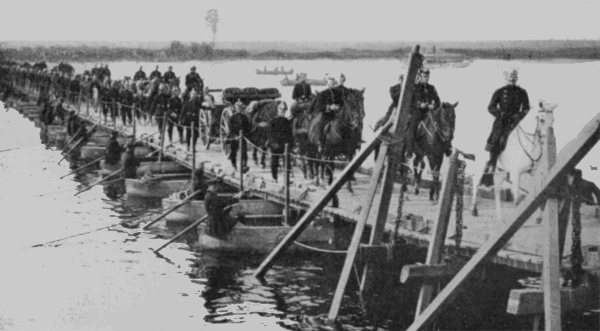
Crossing a Pontoon Bridge
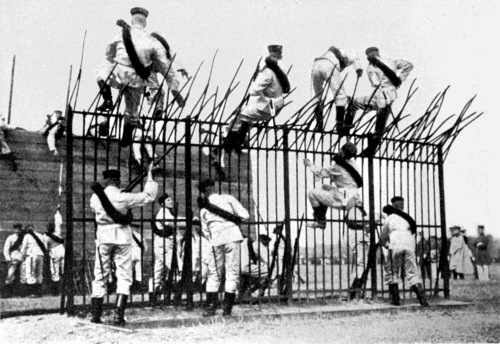
But most interesting of all was the obstacle race for
the common soldiers. A part of their regular training
consists in climbing walls and trees; and on their parade
grounds you will find special tracks with ditches, walls
and palisades; while occasionally the obstacles are of the
most serious kind—iron railings with twisted spikes
through which they must make their way. In the stadium
games the soldiers lined up on the farther side of
a great swimming-pool that runs along one end of the
field below the spectators. At a given signal they
plunged into the water, swam for dear life to the other
side, climbed the low protecting wall and were off helter-skelter
for the hurdles and other obstacles. Behind one
of the hurdles, concealed by green boughs, was a slimy
watery hole, but it detained them but for a moment.
Across the track a high straight impromptu wall was
held in place by soldiers and up it all the contestants had
to clamber. One almost stuck at the top; you watched
him breathlessly to see if he could achieve it, but there
was no jeering, as I fear there would have been at home.
The whole race, in which were some fifty or more participants,
was run with a wonderful freshness, joyousness
and what the Germans call schneidigkeit, which
corresponds to our American slang expression “toniness.”
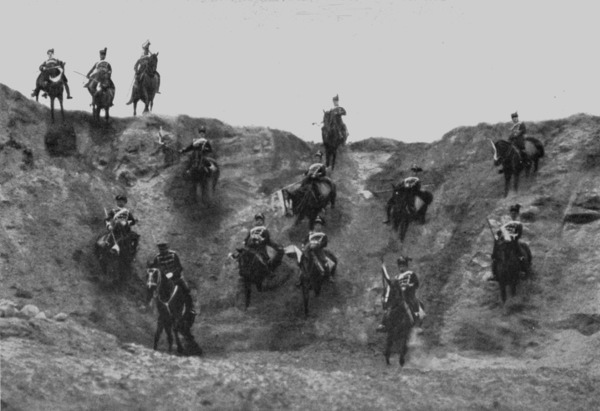
Rough Riding
Even in the ordinary practise on the parade-ground
an adjutant keeps a record of the time that the soldiers
need to overcome the different obstacles. Whole companies
have to pass the required tests. The whole thing
is already reduced to such a system that in war an officer
will know to the smallest detail what he can expect of
his men. Great importance is attached to swimming, for
occasions are sure to arise in a campaign when streams
are to be forded or where the pontoon divisions have
to be assisted.
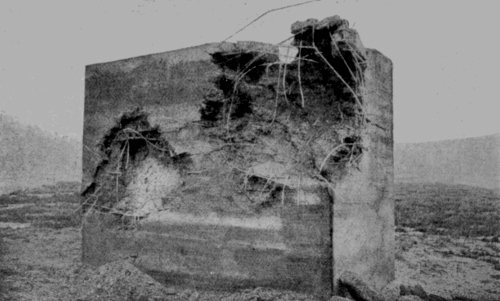
Effect of Two Shells on a Six-Foot
Reinforced Concrete Wall
On the whole the rise of sport has had a great leveling
influence in the army. Soldiers and officers do not,
indeed, compete with each other as a rule; but they take
part in the same meets, and I have observed that the
soldier seems to rise in importance while the tendency of
the officer is to forget himself in the excitement of the
moment. I have a vision of non-participants flying
across the field with the tails of their long coats flapping
behind them to carry tidings or encouragement to
some tired runner—which denotes a very great change
from the unswervingly dignified bearing of other days.
Soldiers and officers now are encouraged to join athletic
associations, which makes for less exclusiveness.
Scaling Barricades
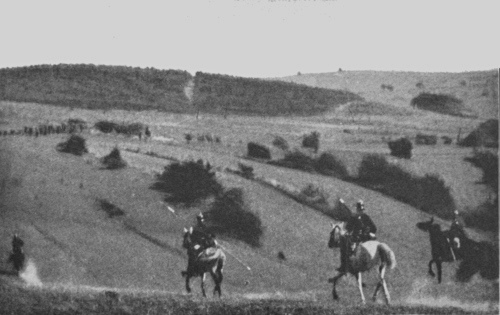
If the infantry is the mainstay of the German army,
the cavalry is indispensable for reconnoitering, for making
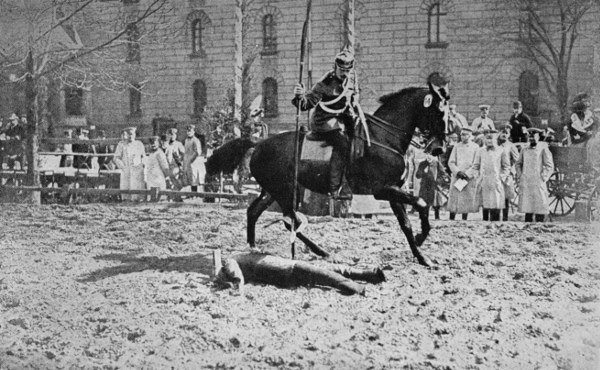
raids and for pursuit. Each cavalryman, as has
been said, carries a lance, a sword and a carbine. Much
time is spent in training the men to the use of the lance,
which is of hollow steel. Men of straw, for instance, are
placed on the ground and the lancer, riding by, has to
inflict a wound in exactly the place designated. Or a
straw head is placed on a stake and must be knocked
off in passing. The carbines, which are stuck in the saddle,
are of a perfected modern type and are but little
inferior to the muskets of the infantry.
Lancer Practising with Straw Man
Cavalry regiments, with which speed of progress is
the first consideration, carry their own bridge-wagons,
so that they can either repair bridges that have been destroyed,
or construct entirely new ones. It has been
found that rafts made of fodder-bags stuffed with straw
and held together by lances, boards, logs, etc., can carry
comparatively heavy weights. Six such bags as I have
described can, at a pinch, carry six men. Barrels and
chests are still more useful if they happen to be at hand.
Needless to say, the cavalry bridge-wagons also carry
explosives for destroying the enemy’s bridges and other
defenses.
Cavalry Patrol
It has been thought in some quarters that aeroplanes
and other contrivances for scouting and communication
would supersede cavalry, but the German army administration
evidently does not think so, as it has more than
150,000 horses in use even in time of peace. In time of
war all private horses are subject to requisition, as are
also automobiles, motor-trucks, motor-wheels and aeroplanes.
The better riders in a regiment train the horses
for the rest, and there is a constant mustering out of the
inferior ones in favor of others that are stronger or
younger or more docile. There are military riding
schools at Hanover, Dresden and Munich, where officers
are taught not only to ride well and to instruct others
but also to break in young horses.
Prussia has her own stud-farms in which the royal
family, since the days of Frederick William I, has taken
the greatest interest. There is a regular Prussian type,
small and tough. The theory has lately been advanced
that Asiatic horses are more free from disease and that
they proved more enduring in the recent Turkish-Bulgarian
War, while the Prussian horse, through faults in
the manner of raising, has degenerated during the long
period of unbroken peace. This, however, is simply an
academic question and nothing short of war itself can
demonstrate that under all conditions another type of
horse will be preferable.

Building a Bridge with Sacks
The Russian-Japanese War brought the old cavalry
raid, such as we associate with the names of Sheridan
and Wilson, once more to honor, and an expedition of
Mischtschenko’s in February, 1905, though not wholly
successful, aroused much interest in cavalry circles in
Europe. It is considered not unlikely that such “raids”
will play a great part in the present war. The Germans
use the American word for the maneuver.
If cavalry is merely an adjunct of infantry, this is
still more true of artillery. Its function, according to
the latest German writers, is to facilitate the advance of
the infantry, or, in other words, to break and open the
path by which the infantry shall storm. It has sometimes
been thought of the battle of the future that it
would consist of two parts: the great artillery duel and
the infantry struggle; and that the infantry would have
to stand aside until the artillery duel was over. The contrary
is the case. The two, in this coming war, will fight
side by side: the artillery opening the breach, the infantry
coming in.
A Field Gun
German batteries consist of six guns, while those of
the French have only four. Good authorities, even in
Germany, prefer the French system, but the change
would mean more expense than was considered warrantable.
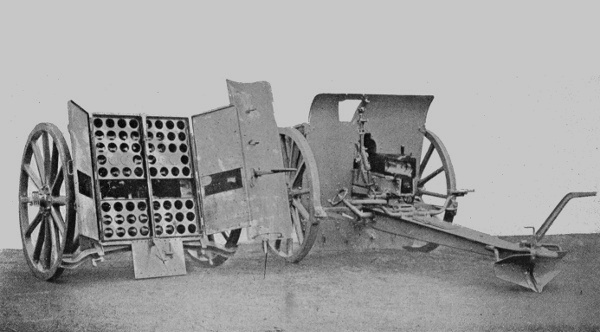
A novelty is that the guns now have great
steel shields that protect the gunners. Another most
useful innovation is the so-called wheel belt. A number
of flat blocks or shoes, wider than the tire and hinged so
as to form a great chain, protect the wheels of the gun-carriage
and prevent them from sinking into the mud.
Formerly a supply of beams, jackscrews and the like
had to be carried along for use in extricating the cannon
when they stuck fast. Now every large gun in the army
has its belt, which can be removed and put on again at
will, the operation lasting but six minutes.
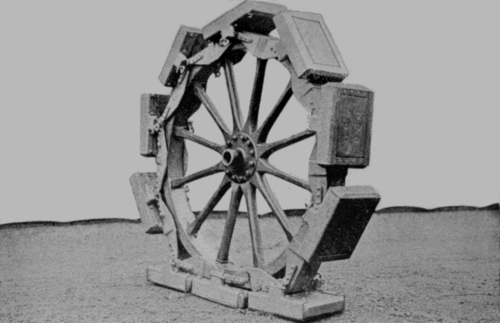
Wheel Belt for Cannon
The largest guns accompanying the infantry have a
bore of twenty-one centimeters, which is much less, of
course, than the fixed guns in fortresses or those used
for coast defense. The size of these is ever increasing,
and there is already talk of forty centimeter guns. The
field guns fire shells and shrapnel and there is a so-called
“unit charge” which is a combination of the two. A
shrapnel is a thin metal ball filled with explosive bullets
and can be discharged either by ignition or percussion.
It is considered preferable to have it burst in the air, just
above the point aimed at, as the shock is downward.
Krupp has patented a shell that explodes by clock-work.
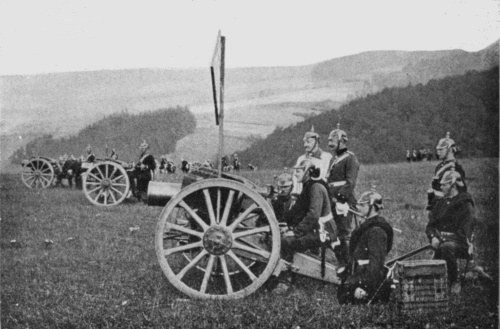
A Howitzer Battery
One further fact concerning artillery may interest
those who follow the present campaigns. In all the
older famous battles the greatest efforts were made to
drag the artillery up the hills and have it crown the
heights. According to recent strategy it chooses rather
low-lying protected spots. Howitzers can shoot right
over a hill and have the shell curve and descend on the
other side. The calculations as to just where it will
strike are made with astounding accuracy, even though
the goal itself may be invisible. The guns are being
constantly improved, but the greatest secrecy is observed
with regard to them. They are shrouded as they pass
through the streets and no one can inspect them without
a written order.
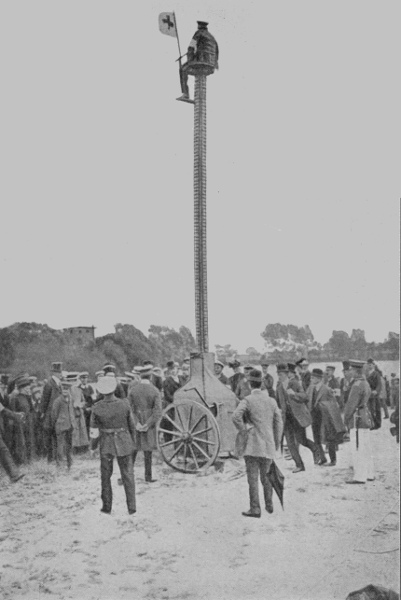
Observation Column
The low situation has its great advantages as well as
its disadvantages, but the latter can be counteracted.
In order to be able to overlook the field, each battery
now has an observation ladder or column, of which the
parts can be telescoped into short space and carried between
two wheels. When desired it is projected into the
air. One advantage of this new invention is that the
wheeled observation ladder can be sent off to quite a
distance carrying a portable telephone by means of
which it is possible at all times to communicate with the
gunners.

Observation Ladder
Many cannon now have telescopes attached to them
to assist the gunner in taking aim. When we reflect
that some of the guns can shoot five and six miles, the
necessity of this will be apparent.
For storming fortifications there are special heavy
siege guns. A modern fortress is something very different
from a medieval or even from an early nineteenth
century one. The old city walls, however solidly
built, are now regarded as mere pleasant bits of antiquity,
and in dozens of German towns have been razed
to the ground and converted into rings or boulevards. So
in the city of Cologne, in Ulm. In their place we now
have groups of sunken guns, of protected batteries and
of underground bomb-proof rooms with walls of reinforced
concrete twelve and fifteen feet thick. Here
and there armored turrets project a few feet above the
ground. Some of the rooms are large enough for a
whole company of infantry. The sunken guns can
rise from their resting-places, fire their charges and sink
back into their beds. Germany has twenty-eight land
forts in all, of which nine are modern in every regard,
and eight coast fortifications. Should the Russians enter
Prussia we may hear much of the great forts at
Königsberg, Graudenz and Thorn, at Danzig, Kulm
and Marienburg, or of the Silesian forts Glogau, Neisse
and Glatz, which played a part already in the wars of
Frederick the Great. In the west, Metz and Strasburg
have been immeasurably strengthened since they passed
into German hands, and Mainz, Coblenz, Cologne, Germersheim
and Wesel are all formidable. To the south
are Ulm and Ingolstadt, while in the north are Kustrin
and Spandau, the latter but a few miles from Berlin. In
Saxony is the Königstein, which, by reason of its natural
position, is considered as impregnable as any fortress
can be.

Covered Field Artillery
Whether the Germans will ever be forced back into
these strong positions remains to be seen. Their policy
is to keep to the offensive and spare their own land as
much as possible. However, what strength of arms may
fail to accomplish may be reserved for famine. With
her commerce entirely cut off, the food supply for the
nation at large will be but scanty, and of all the criticisms
I have read on the German army during the last
six months those on the commissariat department have
been the most severe. A change in the whole administration
was ordered a few months before the war broke
out, but it has scarcely as yet had time to go into full
effect.
Probably the greatest difference between ancient and
modern warfare lies in the systematic use that is now
made of balloons, air-ships, aeroplanes and kites, also of
telegraphy, both fixed and wireless, and of the telephone.
I should add to these, automobiles, motor-trucks,
motorcycles and simple bicycles.
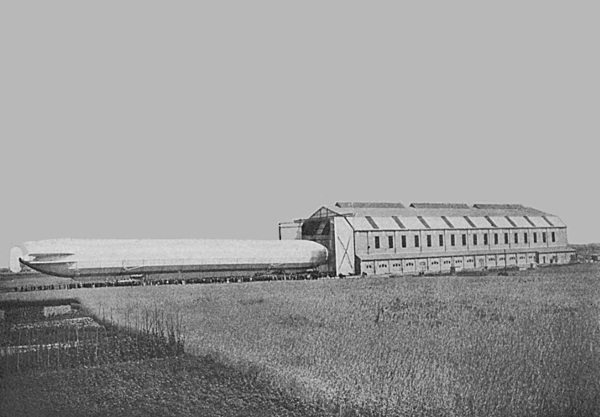
Military Airdome at Cologne
Showing Zeppelin Number II
It may not be generally known that as far back as
1870 Germany attempted to make regular use of military
balloons, and that two balloons and equipment were
purchased from an English aeronaut. Several ascents
were successfully made with a member of the general
staff as passengers. Before Paris, however, it proved
impossible to obtain the gas for inflation, and the whole
balloon detachment was dissolved. Fourteen years later,
in 1884, regular experiments regarding the taking of
observations and the exchanging of signals were begun.
Fifty thousand marks a year were set aside for
the purpose, and so satisfactory were the results that in
1887 a regular balloon corps was organized with a major,
a captain, three lieutenants and fifty non-commissioned
officers and men. The discovery that the gas
could be transported in steel cases in a greatly condensed
form placed military ballooning on a much securer
basis and the corps, greatly increased, has taken part in
the yearly maneuvers since 1893. The captive balloon
is still used as a sort of training-ship for recruits, but
the free balloon has been practically superseded.
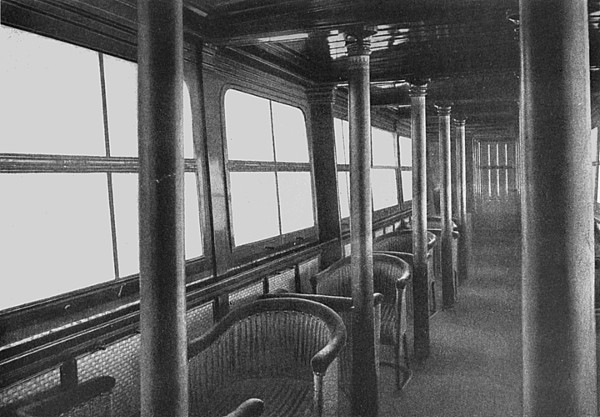
Cabin of the Zeppelin
Airship Hansa
The first Zeppelin and the first Parseval air-ships were
acquired in 1907 and, in spite of frequent accidents,
have become as much a part of the armed forces as have
batteries or battle-ships. There are now no less than five
air-ship battalions under the “general board of inspection
of military, air and power transport matters.” The
combined appropriations of Prussia, Bavaria and Württemberg
for their air fleets in 1913 amounted to 70,000,000
marks. The recent ships, which are not necessarily
confined to the Zeppelin type, though built along the
same lines, are almost as large as ocean steamships. Last
year the “L II” carried twenty-eight passengers on its
trial trip. It exploded in mid-air and twenty-seven
were killed, among them almost all of Germany’s chief
military aeronautic experts. “L III,” which is nearly
completed, will have a displacement of 32,000 cubic
meters. The largest and newest ship at present, the
Schütte-Lanz II, has a displacement of between 23,000
and 24,000 cubic meters, is run by four Maybach motors,
each of one hundred seventy horse-power, and beats
the previous Zeppelin record for speed (seventy-nine kilometers
or forty-nine and three-eighths miles an hour)
by six kilometers. No other country has any air-ship that
can in any way compare with this. Under construction
is the twenty-fifth Zeppelin, which will have a length of
some four hundred fifty feet. All modern air-ships are
equipped with wireless telegraphy having a range of
about four hundred kilometers, and can carry light Gatling
guns. They can lift a weight of some 16,000
pounds and their cost is from 700,000 marks upward.
The Germans have practised very industriously with
their air-ships—only the other day a pilot completed his
seven hundredth trip.
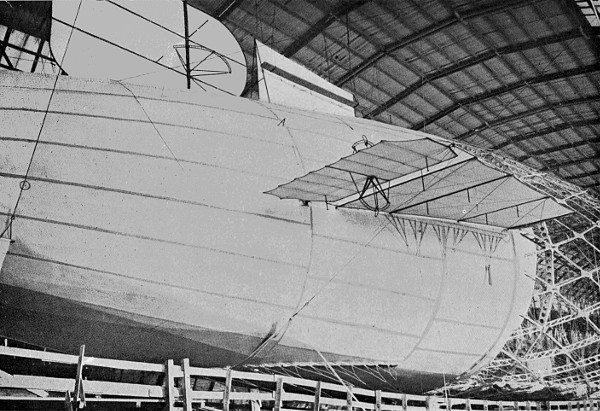
Military Airship in Process of Construction
Whether in war the Zeppelins will come up to the
expectations that have been formed of them remains of
course to be seen. One can conceive of a single ship,
under favorable conditions, throwing down enough explosives
on an army to put it completely to rout. But
the Zeppelin is a very big target and its motors make
enough noise to warn a whole city of its approach. Russia
and Germany herself now have many vertical guns
for shooting air-ships. On the other hand, a Zeppelin
can fly very high and can take refuge behind a cloud.
Its chief objects of attack will doubtless be arsenals,
dockyards, bridges and tunnel-mouths, though no fleet
near the shore and no camp can feel quite safe from it
in future. It would be so tempting to drop a shell in
the midst of an enemy’s general staff and thus bring
confusion into the whole guidance of the army!
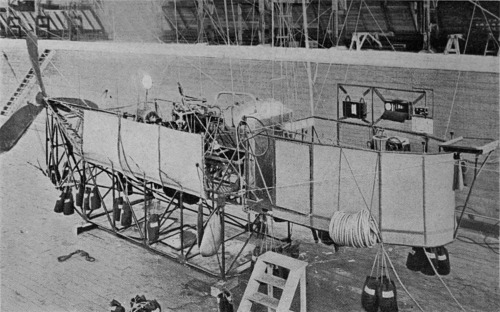
Gondola of the Schütte-Lanz I Airship
The Zeppelin has dangerous enemies in the ordinary
aeroplanes. A Frenchman has just vowed to run the
nose of his “plane” into the first air-ship that appears
over Paris. It is possible for the airman to shoot, too, at
close range, or to fly above the monster and let down
ropes with hooks that shall tear its sides. The new
ships, however, as I have said, can carry Gatling guns,
and it is only a question of how they can best trail them
on the enemy. The latest idea is a shaft that shall extend
right through the body of the Zeppelin and come
out on the upper surface. This arrangement has been
tried on the newest Schütte-Lanz.
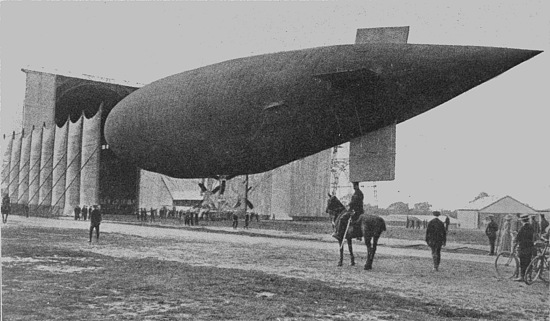
To the value of aeroplanes as instruments of war
Germany awakened late. Not until after an exhibition
of the American, Orville Wright, on the Templehof
field near Berlin in 1910 was the matter taken very
seriously. Now there are four flying battalions in the
army with nearly fifteen hundred men, and it is believed
that the machines are more solid and stable than those of
the French. All records were broken by German machines
during the past year, and the great Prince Henry
races in May, though fatal accidents occurred, demonstrated
very well about what may be expected from a
troop of airmen in time of war. The conditions were
extremely severe and the weather was not favorable, yet
twelve out of twenty-nine starters achieved the final goal
within the time limit.
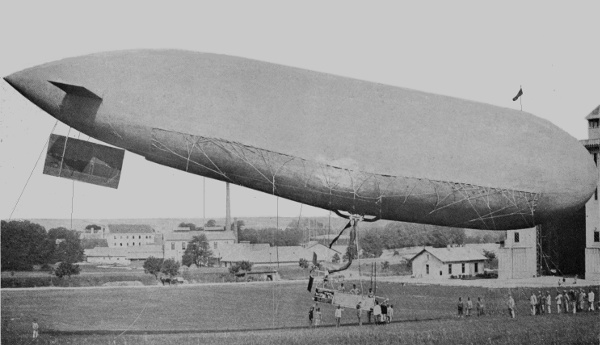
Austrian Military Airship
Parseval
[2]
The favorite machine in the German army is the Albatross-Taube,
which looks quite warlike with its metal
armor covering motor and all. Both monoplanes and
biplanes are used. In case of war all aeroplanes, even
the stock in trade of the manufacturer, are
commandeered. These aeroplanes are easily transportable
by rail so that a number of them can be concentrated
close to the scene of action. They will be used for scouting,
carrying despatches and dropping bombs, and undoubtedly
will have a great effect upon warfare. It is
likely that more maneuvering will be done under the
cover of night than formerly in order to escape the spying
eyes of the birdmen, that false marches and maneuvers
will be undertaken, that bivouac fires will be
lighted in unoccupied places merely for the purpose of
deceiving. It will be easy to conceal cannon by covering
them with green boughs.
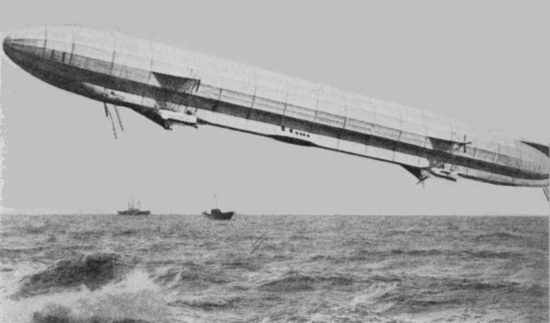
Marine Airship
The German soldiers are already being trained for
these new night operations which the aeroplane and air-ship
will necessitate. They are taught to make their way
by the moon and stars, to place their ears to the ground
and catch and interpret sounds. It is possible for a
finely trained ear to tell in the case of a passing horse
whether it is running free or whether it is carrying a
load, also to estimate the approximate number of a passing
troop. Silent marching is practised, too, the greatest
care being taken that the objects carried shall not clash
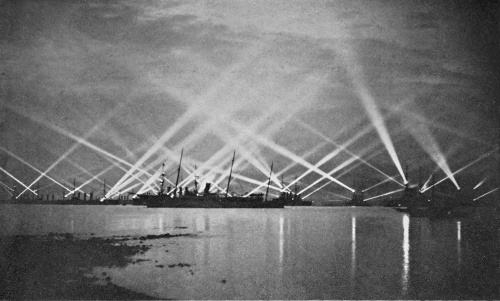
or rattle. The enemy carries powerful electric search-lights
against aeroplanes; a single apparatus requires
several vehicles, each drawn by four horses. There must
be a motor, a dynamo, a great mirror, a water wagon
and a portable tower thirty feet high. The infantry
carries lighter apparatus, too, that can now be loaded on
an automobile, the motor of which can be used for running
the dynamo. Aeroplanes, too, now carry search-lights.
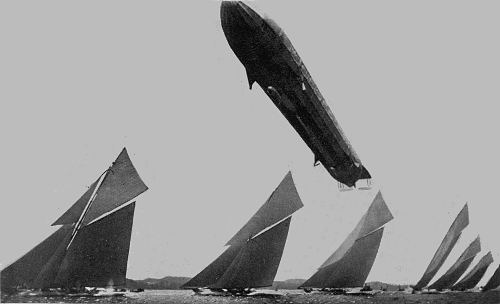
A Zeppelin over the Kiel Bay
An enormous number of automobiles are used in the
army. The German government has a special arrangement
with motor-truck owners (the same is done with
steamship companies) by which it pays a subsidy for
new trucks on the understanding that they shall be at its
disposal in time of need. It has been estimated that nine
motor-wagons can replace one hundred thirty-nine horses
and will need thirty instead of one hundred two men.
Such a wagon will carry easily four tons of baggage.

Albatross-Taube Model 1914
With all the technical aids and inventions, however,
the decisive factor in a war remains the men and more
especially the officers.
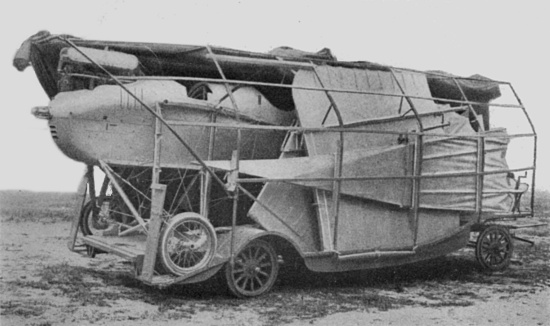
Albatross-Taube Packed for Shipping
I recently overheard a well-known Boston woman
teacher holding forth with the positiveness of complete
conviction on the subject of the German officer and commiserating
him on the life of idleness circumstances
forced him to lead “except, of course, during the three
or four hours a day when he is obliged to exercise.” The
remark was addressed to a distinguished Harvard
professor—anti-military, however, to the core—who had no
contradiction to offer. I should have marked both of
these great people zero for flat ignorance of the subject
had I had them in a class. The German officer, I grant,
may occasionally seem as idle and as frivolous as the son
of a new American millionaire: the only difference
would be that the American conceals his idleness under
a show of industriousness, sending telegrams when he
has nothing else to do, while the German conceals the
fact that he has been up since four in the morning training
a mass of raw recruits, that he has spent several
hours at the Kriegsakademie studying languages, geography,
political economy and the like and that he has as
a permanent job some important problem in tactics to
work out. Those who know the methods of the Prussian
government could never accuse it of giving its employees
too little work. A list is kept of all officers in which
their industry, their interest in their work and their general
good conduct is noted. The ideal that is kept before
them may not be exactly our ideal, but it is a wonderful
one of knightly virtue all the same. The man may
never forget that he is a leader of men; he must grip
his standard of honor, such as it is, like grim death and
be willing unhesitatingly to lay down his life for it. If
he flinch or falter in physical encounter or in any way
is “guilty of conduct unbecoming an officer” he has to
resign his position. He has to conform not only to the
rule of his superiors but also to the code of his fellow
officers. There are things in that code that one would
like not to see there and one misses much that might
well be included, but to down the profession as a sinecure
“except, of course, during the three or four hours
a day” is the purest folly.

Double Monoplane
And peace-time is the mere waiting-period, the period
of training for the real work. In war-time the fate of
the whole country hangs on the officer. An Italian,
Mangiarotti, recently inquired of some two thousand
soldiers who had just taken part in the African campaign
regarding their sensations when facing the
enemy. “The great ideals of God, king and fatherland,”
he writes, “incorporate themselves in one single
personality, the officer.” The lieutenant who does his
duty in the firing line is an absolute hero to his men.
But only real superiority of mind and body can keep
him at this height.
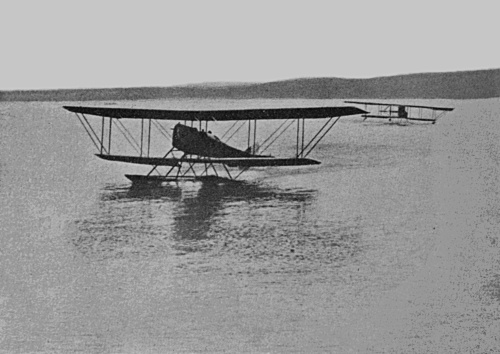
Albatross Hydro and Aeroplane
There are more than thirty thousand officers in the
regular standing army, the great majority of them belonging
to the nobility, who feel that they have a hereditary
right to these positions. I am inclined to think
that this feeling of caste will not be disadvantageous in
war. The military career from youth up has been the
one serious object and occupation in life. The memory
of Jena has been preventative of pride and an incentive
to hard work. The habit of commanding gained as
lord of the manor—as Herr Graf or as Herr Baron—will
not be useless in the field.
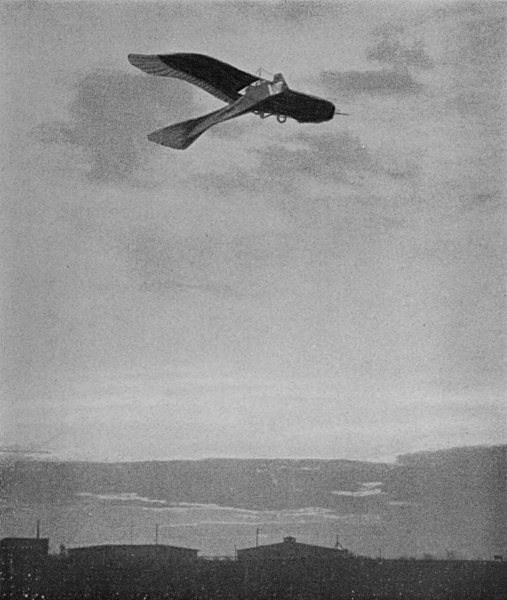
A Taube over the Military Flying Grounds
at Johannisthal, near Berlin
Price Collier, in his Germany and the Germans, gives
the officer a bad character for arrogance and instances
the fact that an officer will crowd a woman off the sidewalk.
Such cases are very rare to-day, much rarer than
they were some thirty years ago. The Zabern affair,
however, has thrown a glaring light on a certain
presumptuousness in the army and aroused at the time very
bitter passions. There was a contempt for the ordinary
laws of justice connected with the trial that is likely to
avenge itself in time if it has not already done so. But
no human institution is perfect, and the officer has at
present far other things to think of than presumptuousness.
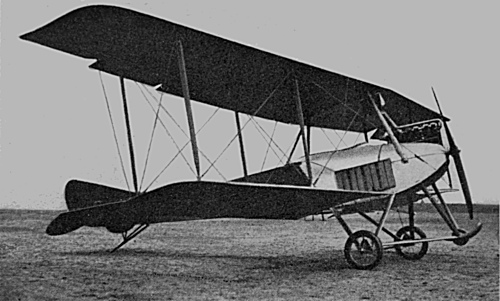
Biplane
In time of war many more officers are needed than in
time of peace. This is provided for in Germany by a
different and less perfect system than in France. From
the one-year volunteers, of whom there are about 15,000
yearly, are taken the “officer aspirants,” who then undergo
supplementary training, returning at intervals in
later life for further instruction and practise. The
general structure of the army does not change in time
of war. Instead of numbering five or six hundred men
the size of a battalion is raised to eleven hundred or
more. There are supplementary troops in all branches,
consisting partly of retired soldiers and partly of raw
recruits, who must be licked into shape as quickly as possible,
but who serve mainly to fill up the ranks at the
front as they become depleted. Every able-bodied man
must leave his occupation and take to the ranks whether
he has had military training or not. Even a German in
foreign lands, if he fail to report for duty to his consul,
is liable on his return to a sentence of six years in the
penitentiary. How many will hasten to naturalize
themselves in other countries is one of the problems of
the war.
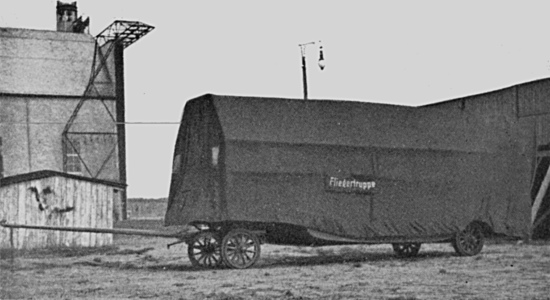
Airship Transportation Wagon
Horses, too, are called in in great numbers as soon as
mobilization is ordered. In time of peace the twenty-five
army corps, each numbering about forty thousand
men, require 157,000 horses; in time of war the demand,
of course, will be much larger, and this is provided for
by instant requisition. But not at random. A list or
census is regularly kept of practically all the horses in
the country; it is revised at stated intervals and commissioners
note the adaptability of every animal to this or
that purpose. In times of mobilization the animals are
brought before final commissions, consisting partly of
military, partly of civilian members, who appraise their
value and declare them confiscate. The transferring of
horses to the rallying centers is one of the chief difficulties
of the railroads, which, as is well known, belong to
the state and are altogether closed to general traffic during
the mobilization period.
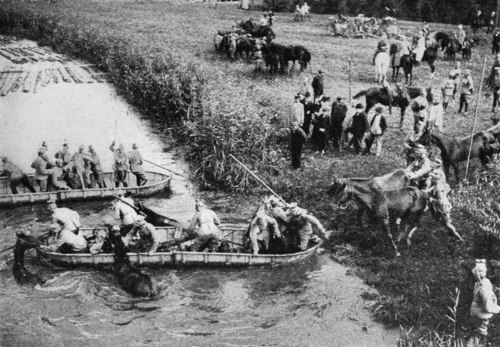
Uhlans Crossing River
Germany is putting, so it is estimated, some four
million men into the field. And behind them, should
the war last long, are nearly a million boys who belong
to the Prussian Jung Deutschland and to the Bavarian
Wehrkraftverein. Boy scouts, we should call them in
our country, but in Germany they are regularly trained
by officers in the army—an occupation of these sinecure-holders
that I omitted to mention. They are taken in
squads on long tramps, are trained to use their eyes and
ears and enjoy the life of the hills and woods. They
carry their cooking utensils and prepare their own
meals. The government encourages the institution by
large grants and often places barracks and tents at the
disposal of the boys for longer expeditions. Public and
private generosity, too, has provided homes in out-of-the-way
places where the boys can take shelter over
night.
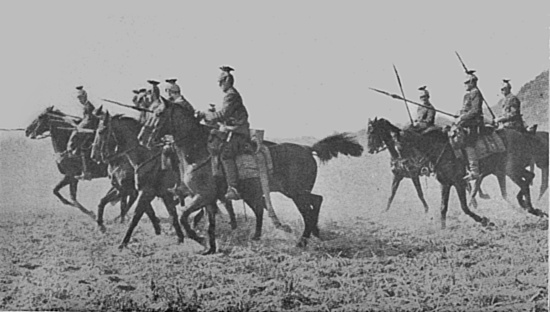
Patrol of Uhlans
How deadly an instrument for war is the German
army remains to be seen. That it has already accomplished
many fine things in time of peace is undoubted.
Not the least of these is the spread of hygienic knowledge
and the encouragement of manliness.
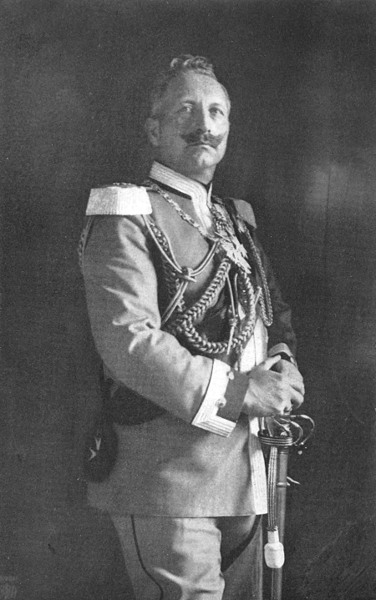
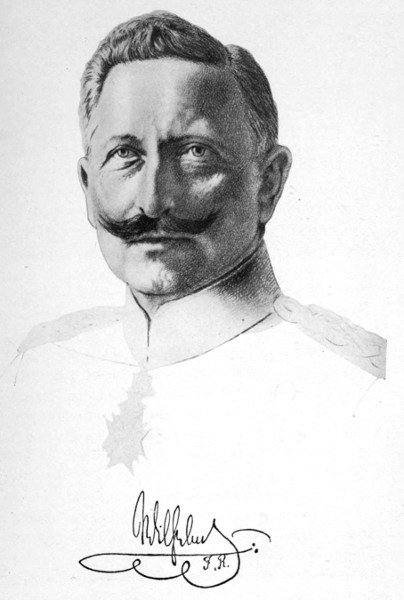
By the terms of the German
constitution the Kaiser is head and chief of the whole German army and,
notwithstanding concessions made to Bavaria, Württemberg and Saxony for
the period when it remains on a peace-footing, is absolute commander in
time of war. Whether he will personally take the field or not is
another question. If he does he will be upheld by an enormous wave of
loyalty, but, on the other hand, the presence of a monarch in camp is
often a hindrance to the operations. His own great-grandfather, and at
the same time the Austrian emperor, made life very bitter for Blücher
and the other real fighters in 1814.
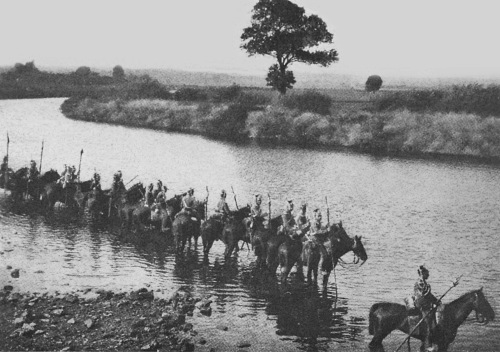
Uhlans Fording River
The real business of commanding a modern army is
done by the chief of the general staff. It is of good
augury that the present holder of that position is again
a Moltke. On him falls the planning and the responsibility
for carrying out of the plans, though he has under
him a huge staff of subordinates—more than two
hundred in all—whose duty is to collect information,
make reports and even tender advice. The older Moltke
once wrote: “The make-up of the headquarters of an
army is of an importance not always sufficiently realized.
Some commanders need no advice, but weigh and
decide things for themselves. Their subordinates have
merely to carry out instructions. But such stars of
first radiance are only to be found about once in a
century. Only a Frederick the Great takes counsel with
no one and determines everything himself. As a rule
the leader of an army can not do without advice.” The
old plan was to hold a council of war and abide by its
decisions; the new one is for the commanding general
to use every aid from others but to take the whole
responsibility himself.
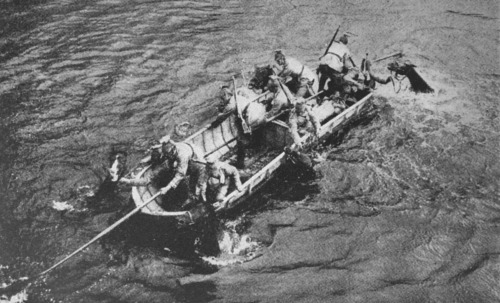
Easily Upset
Headquarters travels with the army and with it goes
the imperial chancellor, ready to take advantage of
every happening in the field to influence the course of
negotiations. The minister of war remains at home to
see to the prompt forwarding of troops and supplies. In
1870 and 1871 Bismarck had much to suffer from female
influences—royal ladies who objected to the bombardment
of beautiful cities and the like. There are at
present no royal ladies in Germany who are likely to
interfere. Blücher used to insist that the most merciful
way of making war was to be absolutely relentless in
pursuit—to the last man and to the last horse. The
worst thing that can happen is to have the campaign
drag on slowly with necessity of renewing battles. This
phase of the matter royal ladies do not always understand.
If the example of the Franco-Prussian War is followed
the Germans will put as many as six different
armies into the field, each with some four army-corps.
There are twenty-five army-corps, and the fighting part
of a single army-corps, which numbers some 41,000
men, strings out on an ordinary road to a distance of
twenty-six kilometers or more than sixteen miles. As
the food supplies, medical and surgical apparatus and
ammunition wagons have to follow at a considerable
distance we may estimate the length of the whole column
at more than double this amount. Were the whole
standing army (not to speak of the reserves) to travel
along the same road it would take twenty-five days to
pass a fixed point. It may be said here that the number
of direct roads passing from Germany into France is
small and that for purposes of invasion the possession
of Belgium was a strategic necessity. Its occupation
meant victory or defeat in the great struggle and the
devil take the consequences. Belgium and France are
so at one that the French have so trusted to the forts of
Liege and Namur, which they believed to be impregnable,
that they have done little to fortify their own
borders in that direction.
Who the commanding generals of the German army
are to be has not yet been made public in America.
Judging by the holders of high positions in peace-time
they will be Grand Duke Frederick II of Baden, Duke
Albert of Württemberg, Prince Rupprecht of Bavaria
and the generals Bülow, Eichhorn, Heeringen and
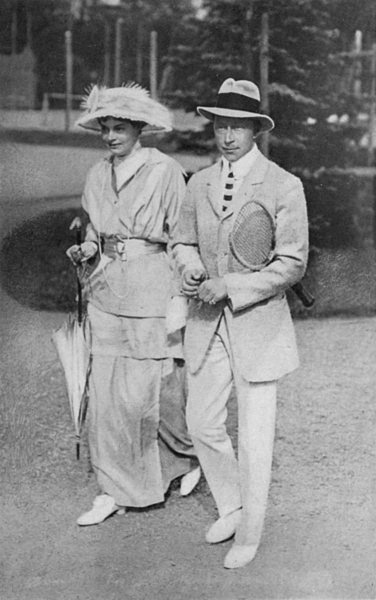
Prittwitz. Whether or not the German crown-prince
will be given a command is doubtful. He is brave and
dashing but impetuous and unbalanced, and his relations
with his father have been somewhat strained. I
am told that at maneuvers he expects far too much from
his men and horses, though his pleasant manners and his
joking way make him very popular. He may, of course,
prove the Frederick the Great of the campaign should
it last sufficiently long for him to gain the proper experience.
[Pg 64]