In Germany I sometimes had to go to three or
four different stores before I could get a spool
of silk thread. Leather is so expensive that only
the upper-class burgher will be able to have real
leather shoes this winter; and starch is twenty
marks a pound. But after all, no German will go
to work with an empty dinner pail.
The German Food Commission is the most uncanny
thing in all the world. Like magic it produces
a substitute for any article that is scarce, it
has everything figured out so that provisioning
shall be divided proportionately each week, and just
what each person shall receive, for everybody does
not receive the same amount of food in Germany.
For instance, a man or woman who does manual
labor gets more bread than a man or woman who
works in an office; people over sixty years get more
cereals, and sick people get more butter and eggs.
These people get what they call Zusatz cards, besides
their regular cards.
Every one in Germany is getting thin, and the
German dieting system proves that much worn-out
statement that "we eat too much," for nine out of
every ten Germans have never been so well in their
lives as they have been since the cards have been
introduced. You feel spry, active and energetic,
and the annoyance is mental rather than physical,
for one is constantly thinking of things to eat.
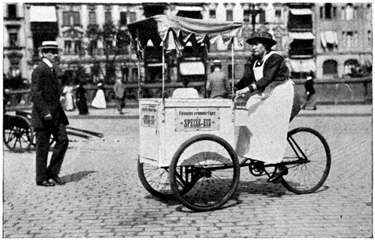
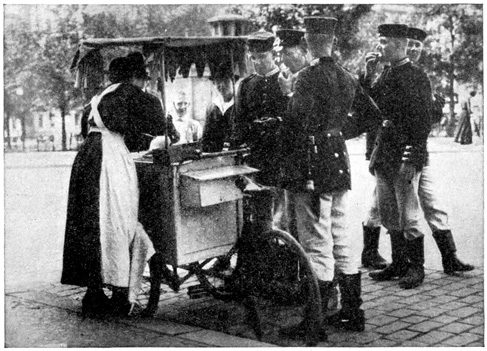
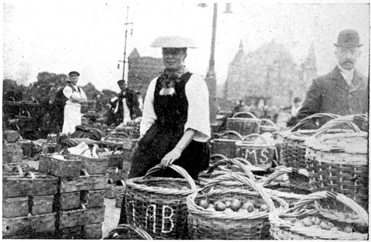
Woman Selling Ices.
The ones that are really hurt by the blockade are
the growing children, and the thing that they lack
and long for is sweets. Before the war, one never
realized what an important role candy played in
the game of life. The food commission recognizes
this, and very often chocolate and puddings are
given on the cards of children under sixteen years
of age.
While food prices have been soaring all over the
world, prices in Germany are almost down to normal
level, for anything that you buy on the cards
is extremely cheap, and everything that is any good
is sold on the cards. Everything that is sold ohne
Karte, or without a card, is either not good or so
expensive that the ordinary person cannot afford
to buy.
When I first came to Germany in October, 1915,
there was only one card, and that was the bread
card. This card was divided off in sections with
the numbers 25, 50 and 100 grams. At that time
the whole card was 2100 grams for each person
each week. Later it was reduced to 1900 grams,
and on the first of May, 1917, to 1600 grams.
This last reduction was a courageous thing for the
bread commission to do at this time—one of the
worst months of the year before the green vegetables
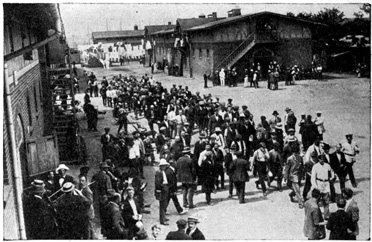
come in—and in Berlin a couple of thousand
workers from a factory gathered on Unter den Linden.
They stayed two hours, broke two windows,
and then went home pacified at a pound of meat a
week more and more wages.
On the bread card it takes a 50 gram section to
buy a good-sized roll, a whole card to buy a big
loaf of black bread, and half a card to buy a small
loaf of bread. After the bread card was reduced
no buns were allowed to be made in Berlin, although
in the other cities they have them. Instead, they
had what they called white bread, but it was almost
as black as the black bread, and when buying one
had to ask, "Is this white or black bread?" I thought
that the bread was very good, and it was of a much
superior quality to what I got in Sweden where the
bread card is of a less number of grams than in
Germany. At the bottom of the German bread card
is the flour ticket, and it allows one the choice of
either 250 grams of flour or 400 grams of bread.
I came out very well on my bread card, for even
when I lived in a boarding-house I kept my card
myself and I took my bread to the table with me.
When people are invited to a meal they always take
their bread and butter with them.
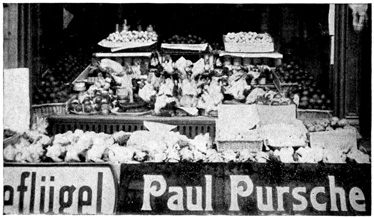
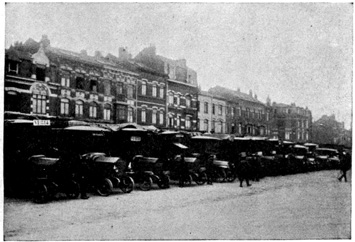
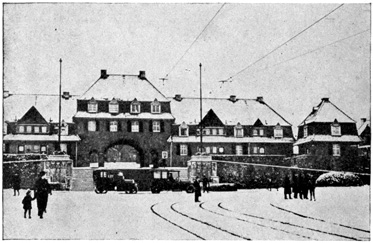
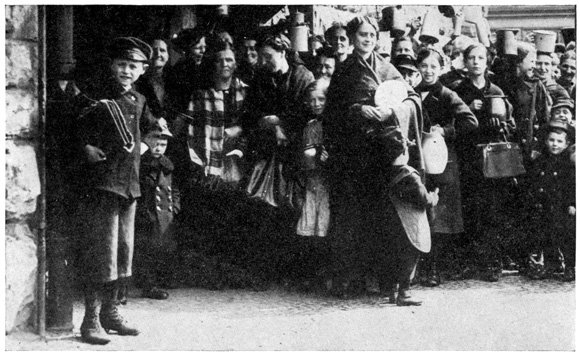
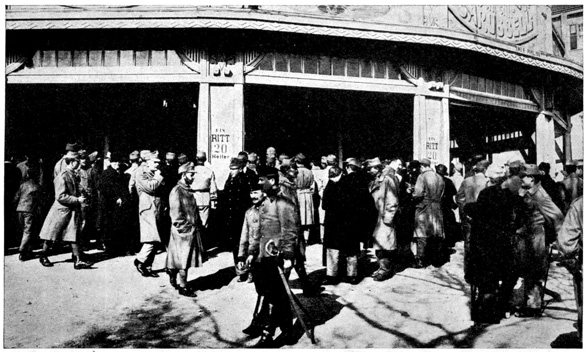
A Store in Charlottenburg, a Suburb of Berlin.
After the bread card the next food restriction
was the two meatless and fatless days a week. On
Tuesday and Friday no butcher was allowed to
sell meat, and no restaurants or boarding-houses
were allowed to serve meat. Monday and Thursday
were the fatless days. The butchers were not
allowed to sell fat, and the restaurants were not
allowed to cook anything in grease. On Wednesday
no pork was allowed to be sold.
Until after Christmas there were no other cards,
but along in December the butter began to be scarce,
and the stores would sell only a half pound to each
person, and the people had to stand in line to get
that half pound. These butter lines were controlled
by the police, and it was no joke standing out in the
cold to get a half pound of butter. But after Christmas
came in rapid succession the butter card, the
meat card, the milk card, the egg card, the soap
card and the grocery card. These cards have regulated
everything and have stopped the standing in
line for articles.
At first the butter card called for half a pound
of butter each week, but now it varies. Then it
wasn't a separate card, but the center of the bread
card was stamped for butter. Now each person
gets either 60 grams of butter and 30 grams of
margarine, or 80 grams of butter. You must buy
your butter in a certain shop where you are registered
and you can buy no place else. This is also
true of sugar, meat, eggs and potatoes.
At first the meat card was only for home buyers,
and the restaurants could serve as much meat as they
liked, but soon it was seen that this was not fair
to the people who eat at home. A card was issued
that was divided off into little sections, so that the
meat could be bought all at once or at different
times. On the first of May, 1917, the meat card was
increased by one-half, and every one is getting 750
grams of meat instead of 500 grams. Here the food
commission made a mistake: they should have given
out more meat in the cold months and have kept
more flour for spring, but instead they increased the
meat card in May and lowered the bread card.
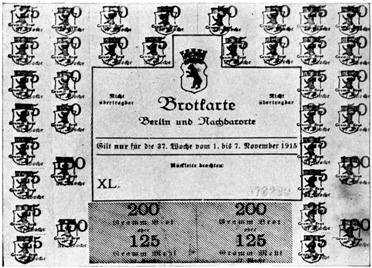
One of the First Bread-Cards.
Another mistake that the food commission is
making is allowing scandalous prices to be charged
for fowls. Fish, chickens, geese and turkeys are
bought without cards, but the prices are so high
that few people can afford to buy them, and the
birds are lying rotting in the store windows. Those
birds are undrawn to make them weigh more. A
medium-sized turkey or goose costs anywhere from
sixty to one hundred marks, and a chicken runs
about thirty marks.
The milk card was among the first cards, and
only sick people and children get milk. The babies
get the best milk and the older children get the next
best, and after they are served the grown-ups get
what is left. Adults have no milk card.
The sugar card varies, but one gets about 1¾
pounds of sugar each month. At preserving time
people are given extra sugar and saccharine on the
grocery card. The potato card varies. First it
was seven pounds a week for each person, then it
was reduced to five and then to three, and then it
was raised to five again. This was the only card
on which we sometimes did not get our allowance,
and when there were not enough potatoes for the
cards we could get extra bread on our potato card.
At first some of the potato cards were red and
others blue. The red cards were good on Monday,
Wednesday, Friday and Sunday, and the blue ones
were good on Tuesday, Thursday, Saturday and
Sunday. Now no potatoes are allowed to be put
into the bread.
The egg card came in the summer of 1916, and
for a long time afterward it was possible to get all
the eggs you wanted in restaurants without a card,
but now one must have a card there as well, even
if you order an omelet or an Eierkuchen, a pancake
of which the Germans are very fond.
The Lebensmittel or "grocery" card is a very
important card, and it is for buying such things as
noodles, rice, barley, oatmeal, macaroni, white cornmeal
and cheese. Then they have other cards for
buying oil, saccharine, matches, sardines and smoked
fish. Fresh fish is without a card. Each week the
stores have numbers hanging up in their windows
telling what can be bought that week, like "Rice on
Number 13" or a "Pudding on Number 6." It is
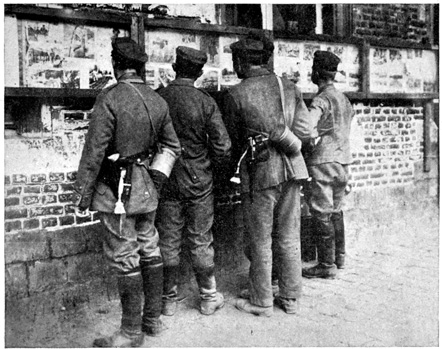
also printed in the newspapers and on the advertising
posts, and sometimes you must be registered
for the things and can buy them only in a certain
store.
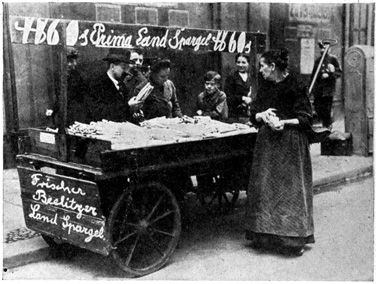
An Asparagus Huckster.
On the first soap cards, you could get every
month a cake of toilet soap, a cake of laundry soap
and some soap powder, but now one can get only
50 grams of either kind of soap and 250 grams of
soap powder each month. Soap was one of the
hardest things to get, and a cake of real soap sells
from five to ten marks a cake. We never thought
of taking a bath with soap but used it only on our
faces. They have what they call "War Soap," and
it can be used on the hands, but if it drops on your
dress it leaves a white spot. If you want to give
a real swell present to any one in Germany just
send a cake of soap.
I always said that when coffee came to an end in
Germany the Germans would be ready to make any
kind of a peace. How could a German live without
coffee? But last summer the coffee gave out and
instead of complaining they took to drinking Kaffee-Ersatz,
or "coffee substitute," with the same passion
that they had lavished on real coffee. It is
the most horrible stuff any one ever tasted with the
exception of the substitute they have for tea, but
the Germans say they like it. They have cards for
Kaffee-Ersatz, and each person gets a half pound
a month.
In the cafés in the summer of 1916 they were still
serving real coffee with milk and sugar. Then
suddenly the waiters commenced asking the patrons
if they wished their coffee black or with cream, and
then later they asked if you wanted the coffee sweet,
and so they brought it, putting in sugar and milk
themselves. A little later you did not get sugar
but two little pieces of saccharine were served, and
now they have a liquid sweet stuff that is used. They
do not serve real coffee any more, but most restaurants
still serve milk. The famous Kaffee mélange,
or coffee with whipped cream, was forbidden
at the beginning of the war.
When I left Germany they had no beer or tobacco
cards, but there was talk about them. The beer restaurants
receive only a certain amount of beer each
day, and when this is gone the people must wait
until the next day. Most beer halls serve only two
glasses to each person. In Munich, because of the
shortage of beer, some of the beer halls do not open
until 6 o'clock at night, and at 4 o'clock the Müncheners
gather at the doors with their mugs in their
hands, patiently waiting. Sometimes they knock
the mugs against the doors to a tune. Munich
without beer is a very sad sight!
In Berlin some of the restaurants will serve beer
only to people who can get chairs, but this does not
faze the clever Berliners, and when they want their
beer they bring camp stools with them, and then
they are sure to have a seat. It is forbidden to
make certain kinds of fine beers because they take
too much malt and sugar. None of the beer is as
good as in times of peace, but the Germans have forgotten
the delicacies of the past, and they live in
the food ideals of the present, and they smack their
lips and say, "Isn't the beer fine to-night?"
From August 1916 until March 1917 it was forbidden
to sell canned vegetables. They were being
saved up for the spring months. The store windows
were decorated with glass jars filled with the
most wonderful kinds of peas, beans and asparagus.
I always felt like smashing the window and stealing
the stuff, but the Germans only looked at it admiringly
and said, "It will be fine when the vegetables
are freed."
Everything on the cards is at a set price, and the
dealers don't dare to charge one cent more; even
the prices of some things not on the cards are regulated.
For instance, this spring no one could charge
more than one mark a pound for cherries, and many
of the cafés had to cut their cake prices. The police
got after Kranzler, the famous cake house, and
it had to reduce all its cakes to twenty pfennigs each.
When I was in Dresden in May, 1917, I ate elephant
meat. An elephant got hurt in the Zoo and
had to be killed. A beer restaurant bought his meat
for 7000 marks, and it was served with sauerkraut
to the public without a card at 1.30 marks. It tasted
like the finest kind of chopped meat, and the restaurant
was packed as long as the elephant lasted.
The food question is not the same all over Germany,
and in Berlin, Dresden, Hamburg and Leipsic
they have less than in other places. Bavaria,
the Rhine Country and East Prussia are far better
off, and in some of the small villages they do not
even have a bread card.
One of the hardest things to get is candy. In
Berlin one can buy chocolate for sixteen marks a
pound, but in Dresden it is very cheap because it is
bought on the card. The candy is bought on the
grocery card and one gets a half pound every two
weeks. Candy lines are the only kind of lines that
one sees now in Germany.
One card I forgot to mention is the coal card that
will be issued for the coming winter. There is no
scarcity of coal, but there are no people or cars for
delivering. The people will be given three-fourths
as much coal as they formerly consumed.
In times of peace eating in a German restaurant
was notoriously cheap, and one could get a menu
of soup, meat, potatoes and dessert for 90 pfennigs,
and in Munich for 80 pfennigs. Now these same
restaurants charge 1.75 marks, that is, twice as
much; but even then food is cheaper than in America.
Before the war some of the restaurants charged
extra if you did not order anything to drink, but this
is now done away with.
Anything can be bought without a card if you
know how to do it. The government tries in every
way to stop this selling, and although the fine is
very heavy for selling ohne Karte, it goes on just
the same. We always managed to get things without
a card. Our janitress got coffee for us at 9.25
marks a pound, our vegetable woman gave us extra
potatoes, and we could always get eggs. On the
card an egg cost 30 pfennigs and without a card
we paid anywhere from 50 pfennigs to 1 mark. The
hardest thing to get without a card was sugar, for
the food commission has an iron hand on the sugar,
but we got it for 2.50 marks a pound. On the card
it was 30 pfennigs a pound. It is said that butter
could be bought for nine marks a pound without
the card, but we never tried to get it.
The police sees that every one gets his share of
food. If a woman holds a servant girl's rations
from her, the girl can report it to the police and
the woman is fined. In a boarding-house when the
potatoes are passed around the landlady tells you
whether you can take two or three potatoes, or one
big potato and one small potato. The food conditions
are not always comfortable, but the food commission
has the things divided off so they will last
for years.