Did the Kaiser's Charge Render the Later
Atrocities Inevitable?
When Charles IX of France was urged to kill
Coligny, he finally consented, in these words,
"Assassinate Admiral Coligny, but leave not a
Huguenot alive in France to reproach me." That
first assassination made the later atrocities inevitable.
When the Kaiser and his War Staff determined
to kill, they delayed for a time, but
once their hands were dripping with blood, the
first massacres made it necessary to go on, and kill
the Belgians and Frenchmen who had witnessed
the crimes. So came the unspeakable atrocities
of the Germans.
"Take heed that ye offend not against one of
my little ones. If any man offend against one
of my little ones, it were better for him that a
millstone were hanged about his neck, and that
he were drowned in the depths of the sea."—The
Gospel of Matthew (Jesus Christ).
I
German Atrocities, Their Nature
and Philosophy
All Americans who have journeyed
through Belgium and France this
year have returned home permanently saddened
men. German cruelty has cut a
bloody gash in the heart, and while there
are Dakin solutions that heal wounds in the
arms and legs, there is no medicine that can
heal the wounds in the heart. Some German-Americans
still insist that the alleged
German atrocities represent English lies, Belgian
hypocrisies and French delusions, but
all possibility of evasion or denial has been
destroyed. Modern courts are satisfied with
two forms of testimony, but the German
atrocities are evidenced by five kinds of
indubitable proof. There is the testimony
of men and women telling what their own
eyes have seen, and their own ears have
heard,—that is a high form of evidence.
There is the testimony of little children,
children too innocent to invent what they
are old enough to describe. Legal authorities
tell us that because children are unprejudiced
their testimony is the highest form of
proof known to modern courts. Third, there
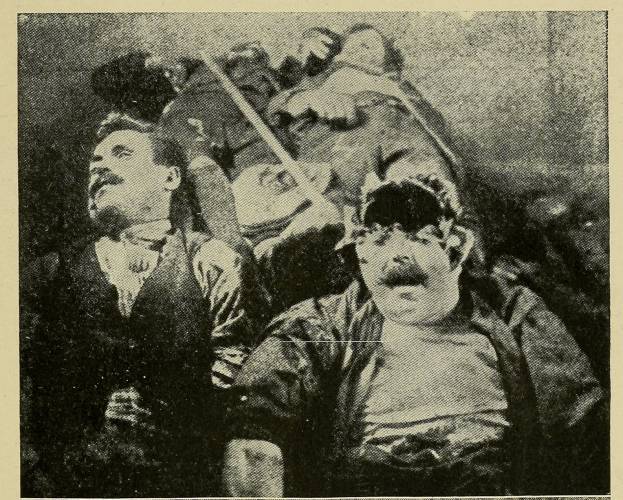
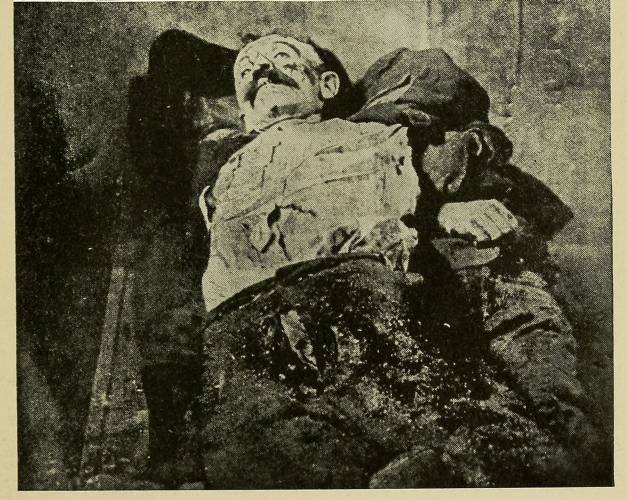
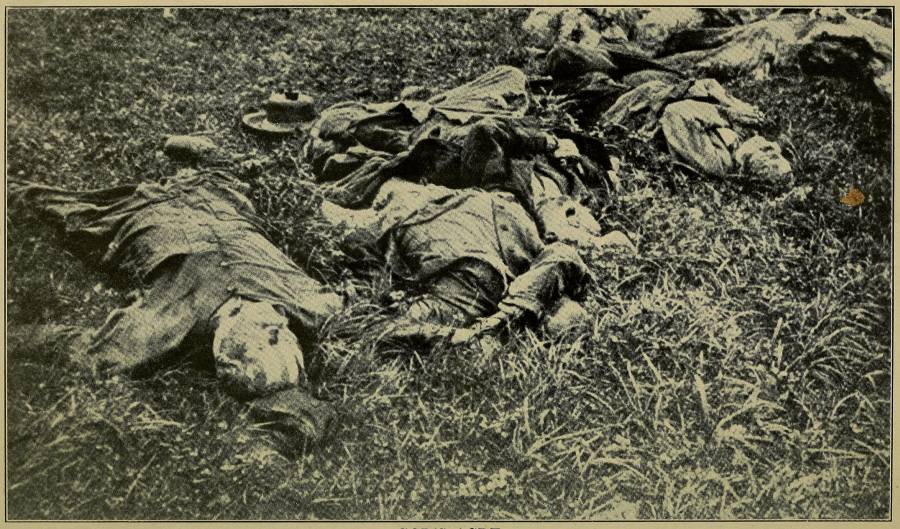
is the testimony of the photograph,—photographs
taken often before the massacred
bodies had grown cold, and immediately
after the German retreat from the town
they had pillaged. The sunbeams move in
straight lines; they tell no lies; they cannot
be bribed; they have no prejudice for
or against the Germans. No one can look
at the hundreds of photographs of mutilated
bodies without confessing that the sunlight,
like a recording angel, has given a damning
testimony that cannot be gainsaid by the
monsters who not only killed men who defended
the honour of their wives, but hacked
these young husbands into shreds, mutilating
the body in ways that can only be mentioned
by men to men and in whispered
tones.
The Germans Convict Themselves
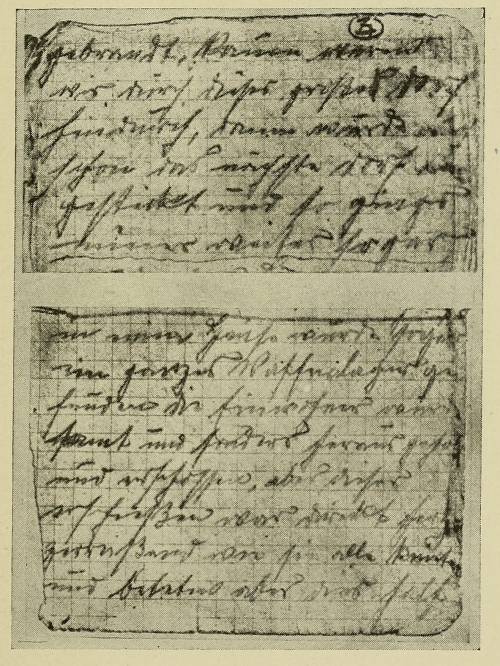
Another form of proof is found in the
journals and diaries of the German soldiers.
The German has climbed into the witness
stand, and given conclusive testimony against
himself. Had his statements been made by
Belgians, French or English, we would have
denied or questioned the words, but when
diaries have been taken from the dead bodies
of German soldiers, and when these different
journals contain substantially the same statements
as to the atrocities committed at a
given day in a given town, it becomes impossible
for an American student to deny
the daily records of German soldiers, with
the confession of deeds committed sometimes
by their fellows, sometimes by themselves.
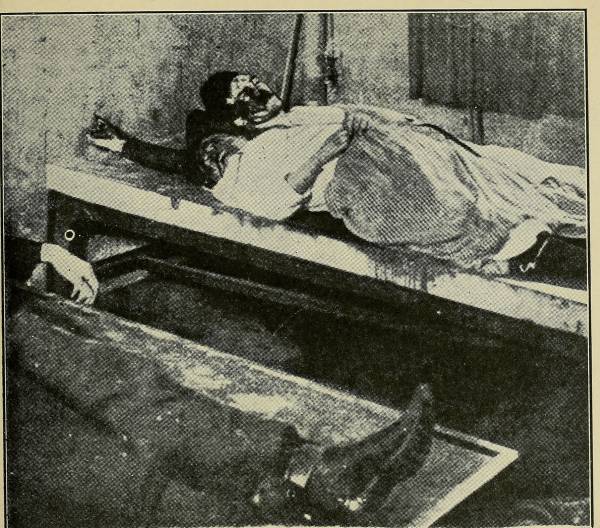
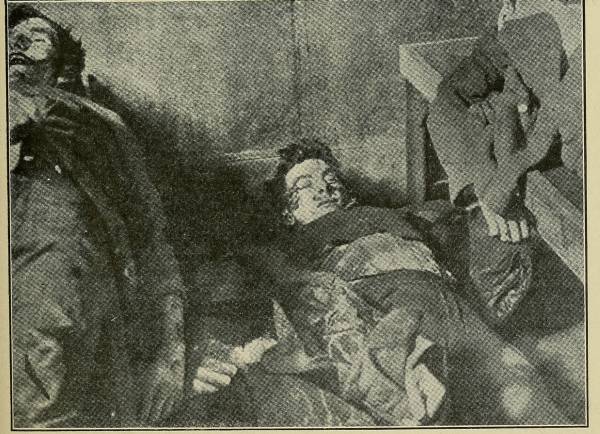
There is also the testimony of mutilated
bodies that have been preserved in certain
morgues against the day of judgment when
arbitrators will behold the proof, hear the
witnesses, and weigh the guilt of the Germans.
The Day of Judgment is coming
when these witnesses will rise literally from
the grave and indict the German Kaiser and
his War Staff for atrocities that are the
logical and inevitable result of the ceaseless
drill of their officers and privates in the
science of murder, as a method of breaking
down the nervous resources of the armed
soldiers of Belgium and France.
Overwhelming Evidence
No horrors in history are so overwhelmingly
evidenced as the German atrocities.
The nature, the number, and the extent of
their crimes have been documented more
thoroughly than the scalpings of settlers by
Sioux Indians, the horrors of the Black Hole
of Calcutta, or the cruelties of the Spanish
Inquisition. No American to-day can cross
the threshold of Belgium or Northern France,
Poland or Serbia, without recalling the words
that Dante saw above the gate of Hell:
"Abandon hope, all ye who enter here."
Not since Judas and his fellow conspirators
crucified Jesus has there been a ruler, a
War Staff or an army, that has deliberately
revived the cross, as an instrument of torture,
to further the ends of military efficiency.
The Germans have literally fulfilled the
Kaiser's charge in 1899, and reproduced in
1914, upon various cards for the Kaiser's
soldiers: "You will take no prisoners; you
will show no mercy; you will give no quarter;
you will make yourselves as terrible as
the Huns under Attila." All scholars know
that the Kaiser was referring to Attila's
well-known motto, "Where my feet fall, let
grass not grow for a hundred years."
A Catalogue of Crimes
The catalogue of German atrocities, now
documented, in legal reports, with the accompanying
photographs, preserved in the
Department of Justice of the various nations,
makes up the blackest page in human
history. Long days and nights spent over
the reports in the various capitals, and in
courts of justice, journeys to and fro amid
the ruined villages along a battle front six
hundred miles in length, leave the head sick
and the heart faint. The traveller would
become utterly hopeless and broken-hearted,
and give himself up to black despair, were it
not that everything that German savagery
has done to destroy one's faith in the divine
origin of the human soul has been more
than recovered by the gentleness, the self-sacrifice,
the fortitude, the sympathy, the
heroism of the British, the Belgians, and the
French. The Germans have at last compelled
all unprejudiced minds to recognize
the atrocity as the German notion of scientific
efficiency. It is not by chance that
the first atrocities were begun on practically
the same day, August 17th, of 1914, and
ended about September 19th, and along a
line extending from the English Channel to
the Swiss frontier, just as the murders and
mutilations, the rapes and the pillaging began
and ended at the same time in Poland,
Rumania and Serbia, and are now being
repeated in more malignant forms in Northeastern
Italy.
These Horrors Do Not Represent
Drunkenness
Nor were these atrocities committed in
moods of drunkenness, hours of anger, nor
by the occasional degenerate, like Jack the
Ripper of Whitechapel Road. Allen White
and Arnold Toynbee are doubtless right in
asserting that most of the attacks upon
little girls and young women were made
by German officers, nevertheless, all must
confess that the German soldiers were not
less culpable, as they pillaged the land,
guided by the deliberate, cold, precise,
scientific, ordered policy of German frightfulness.
The story of German occupancy of Belgium
and France is a long, black story of
unspeakable crimes. These brigands broke
into banks, looted factories, pillaged houses,
burned the farmers' machinery, chopped
down orchards and vineyards. In the face
of their newly-signed treaties with the Allied
nations, pledging the safeguarding of all
buildings dedicated to education and religion,
with the lives and property of non-combatants,
the Germans made their treaties
mere scraps of paper, sneered at the most
solemn obligations given by men to men,
burned cathedrals, colleges and libraries,
mutilated old men and women, violated
little children, nailed a child to a farmer's
barn door upon which they found a calf skin
drying in the sun, and beneath wrote the
word "zwei." They crucified Canadian
officers and Roman Catholic nuns. They
bombed hospitals and Red Cross buildings.
They thrust women and little children between
themselves and the Belgian and
French soldiers defending their native land.
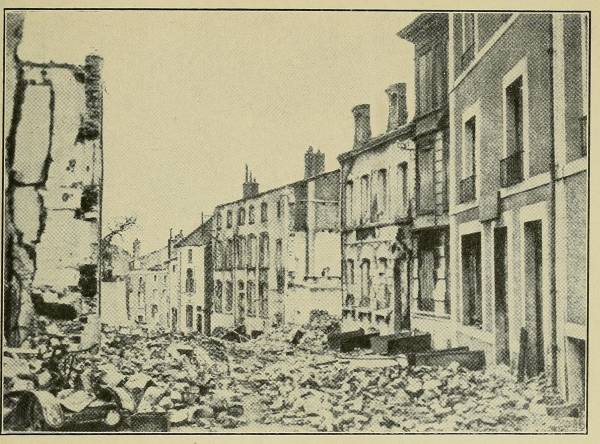
The affidavits, photographs, and mutilated
bodies are witnesses that destroy forever the
last shred of doubt and incredulity. For
men who are open to testimony, the German
atrocities are more surely established than
any of the hideous cruelties recorded in history.
Now, for the first time, wildest savagery
has been reduced to a science, and
damned into existence under the name of
German efficiency.
The Philosophy of the German
Atrocities
At the beginning of the war the American
people questioned all these alleged
horrors, saying that all war is hell, and
abuses are common to all armies. Americans
looked upon these alleged abominations
as being intellectually absurd and morally
monstrous, and therefore we doubted the
evidence. But at last all alike perceive that
the German war-deeds differ from the usual
abuses of war, as a cunning fiend differs from
a drunken man. Germany believes in militarism,
in forty-two centimeter guns, in submarines,
in liquid fire and poisoned gases.
This republic and our Allies believe in
the manufacture of souls of good quality.
We believe in schools, colleges, libraries,
churches, factories, banks, fruitful fields and
a self-sufficing, intelligent and moral manhood.
From the Allied view-point, the very
thought of Germany's asking other nations
to produce property while once in a generation,
with her standing army, she goes forth
to pillage and loot the wealth that industrious
French or Belgians have created, is for
us a monstrous thought. From the German
view-point, however, atrocities represent
military efficiency. Just as the German
War Staff perfected in advance rifles and
cannon as legitimate warfare, so they prepared
in advance certain outrages from
which they expected the greatest possible
results, in terms of conquered territory.
The German Handbook of Military
Tactics
That their officers and soldiers might
understand in advance the use of the atrocity
as a military instrument, the General Staff
of the German army, in 1902, published a
handbook of military tactics, entitled "The
Laws of War on Land." This handbook
sets forth a deliberate system of atrocity,
and prepares the way for every species of
villainy. In clear and unmistakable language,
the War Staff presents principles that
embody the ideas of savages. Witness the
statements on page 35: "By steeping himself
in military history an officer will be able
to guard himself against excessive humanitarian
notions. It will teach him that
certain severities are indispensable to war.
What is permissible includes every means
without which the object of the war cannot
be attained." Witness also the savagery
outlined on page 52: "A war conducted
with energy cannot be directed merely
against the combatants of the enemy states
and the positions they occupy, but it will
and must in like manner seek to destroy the
total intellectual and material resources of
the latter. Humanitarian claims,—such as
the protection of men's lives and their property,
can be taken into consideration only
in so far as the nature and object of the
war will permit." Their Handbook of
Military Tactics is, therefore, nothing other
than the science of atrocity. With an army
steeped in these vicious teachings, with private
soldiers trained by this handbook that
teaches crime as an art, and with the exhortation
of their Kaiser to make themselves
as terrible as the Huns under Attila, the rape
of Belgium, the crucifixion of Poland, and
the assassination of Northern France were
logical and inevitable results.
The German Motive for Massacre an
Overwhelming One
To-day, Germans find it difficult to forgive
Bethmann-Hollweg for his confessions when,
at the beginning of the war, he acknowledged
they were committing a wrong against Belgium,
that their designs made necessary,
by "hacking the way through." We now
know that the motive of the Kaiser and his
War Staff for massacring Belgium was an
overwhelming motive. They had staked
everything upon a short war. "Brussels in
one week, Paris in two weeks, London in two
months,"—that was the programme. The
stubborn opposition of the Belgian army,
standing on a frontier whose sanctity the
Kaiser, by the most solemn treaties, had just
pledged himself to safeguard, stalled the
German military machine, made impossible
a crushing victory over France, and threatened
their dreams of a series of hurricane
victories over England.
Then the German War Staff put into
operation the instructions to "frightfulness"
against aged men and women, girls and
little children. Should the average American
return home at night to find that his
wife and children had been massacred and
mutilated during his absence, he would not
go to the office on the following morning.
The horror of "a great darkness" would fall
upon him, the tool would drop from his hand,
and weeks would pass before he could steel
his hand to the accustomed task. Now the
German War Staff fully realized the true
value of the atrocity as a military instrument.
Their soldiers ran no risk in killing aged
men or raping young girls, but they hoped
that when the news of their crimes reached
the armed opponent, the atrocity committed
upon his wife or child would break his
nerve, and leave him helpless to fight. It
took only three and a half weeks to spread
the black wave of terror and frightfulness
over Belgium, in order to break the nerve
forces of the Belgian army.
The Number of Atrocities
The full extent of this can never be
known. More than one hundred thousand
people are simply reported as "missing,"
other multitudes were burned or thrown into
pits. Only in towns from which the German
armies hurriedly retreated were inquests possible,
and in those towns affidavits were prepared
and photographs of the mutilated bodies
taken. The fact that these atrocities all
along the battle line began on practically the
same day in August and ended on about the
same day in September does not prove, but
does suggest plan and prearrangement. After
the German troops had passed through, it
became possible for the village school-teacher,
priest or banker, the aged women and the
children who had escaped to creep out of
pits, the caves in the fields, or the edge of
the woods, where they had been hiding, and
return to survey the scene of desolation behind
them. In those towns where the soldiers
encountered no opposition by the inhabitants,
for the reason that there were no men
left in the village, the Germans speedily
wrought their devastation and departed.
Then the French authorities hurried forward
their authorized representatives, inquests were
held, photographs taken of the mutilated
bodies, and testimony taken and sent to the
Department of Justice. What took place in
those Belgian towns and cities that are still
in German hands will never be known until
the German officers and soldiers stand before
the Great Judgment Throne and give their
account unto God.
The German War Staff's Report Acknowledges
Their Atrocities
The value of the atrocity as a military instrument
for sending the simoom of terror across
the land is set forth in scores of diaries taken
from the dead bodies of German soldiers, and
also from the occasional reports of German
officers to the War Staff, that were printed
in Berlin and found their way into this country
by way of Denmark, Norway or Sweden.
In the "summarizing report by the General
War Staff," published December 31,
1914, the German chief says in explanation
of the Belgian campaign: "The need of the
German army to push through Belgium was
imperative. Our starting point was that the
tactical object of the Twelfth Corps was to
cross the Meuse with speed. To at once
overcome the opposition of the inhabitants
was a military necessity, and something to be
striven for in every way." And what does
"every way" mean? Let the German Staff
themselves answer. "The flourishing town
of Dinant with its suburbs was burnt, and
made a heap of ruins, and a large number of
Belgian lives lost." "About 220 inhabitants
were then shot, and the village was burned.
Just now, six o'clock in the afternoon, the
crossing of the Meuse begins near Dinant;
all the suburbs, chateaux and houses were
burned down during this night. It was a
beautiful sight to see the villages burning all
around us in the distance." "The town appeared
to be perfectly peaceful, nevertheless,
for the sake of security, a number of the inhabitants
were made prisoners by the grenadiers."
"Later, we decided to assemble all
the male hostages against the garden wall,
where we shot them."
Hundreds of witnesses called in one town,
after the Germans had passed on, show
that the German officers and soldiers were
engaged in one horrible orgy of pillage,
drunkenness, lust and murder. They began
by breaking open all wine cellars and soon
the officers went reeling and staggering
through the streets, firing their revolvers into
the windows of houses and stores. They
blasted the safes open with dynamite. They
carried goods from the shelves to the freight
trains, and as fast as the town was pillaged,
burned the houses. During four days they
looted and burned twelve hundred houses,
stores, factories, schools and churches. They
left lying on the ground seven hundred dead
bodies, chiefly women and children. Two
trains laden with the men and women who
were strong enough to work were carried off
to Germany. All the manufactories where
the artisan class were wont to work were
systematically destroyed. Marching away
from towns that were blazing furnaces, the
German soldiers drove in advance a long line
of women and children, with a few aged
men, and used them as screens behind which
they could march into the next town that
was to be looted.
The Looting of Louvain
In justifying the use of the atrocity as a
military instrument more efficient in breaking
down the morale of the Belgian army
than cannon and liquid fire could possibly be,
a German army officer's letter uses these
words: "The ruthless use of severities upon
the civilians has now succeeded in scattering
the wretched Belgian army." But concerning
what atrocity is this officer writing? He
wrote these words at the end of the third
day, after the Germans had pillaged Louvain,
thus serving notice on all the Belgian and
French cities, rich in historic monuments,
libraries, galleries, cathedrals, and art treasures,
that unless they immediately surrendered,
their whole city would be ruined.
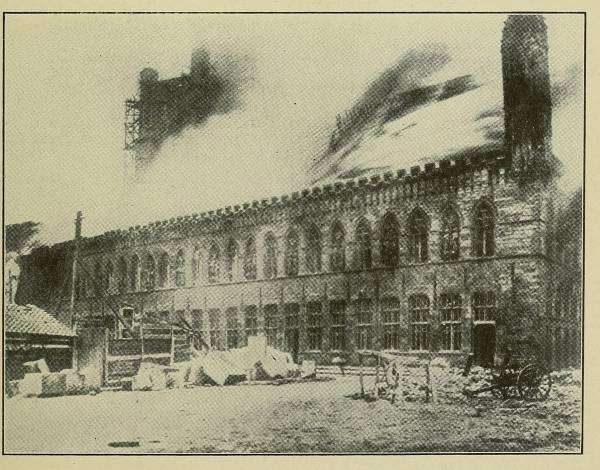
And ruined after what manner? Let Cardinal
Mercier, the Primate of Belgium, tell
the story. "At Louvain the third part of
the city has been destroyed; one thousand
and seventy-four dwellings have disappeared;
in addition, in the suburbs Kesselloo, Herent
and Herberle, one thousand, eight hundred
and twenty-eight houses have been burned.
In this dear city of Louvain, ever in my
thoughts, the magnificent church of St. Peter
will never recover its former splendour. The
ancient college of St. Ives, the art schools,
the commercial and consular schools of the
University; the old markets; our rich library,
with its collections, its unique and unpublished
manuscripts, its archives, its gallery of
great portraits of illustrious rectors, chancellors,
professors, dating from the time of its
foundation, which preserved for masters and
students alike a noble tradition, and were an
incitement to good work—all this accumulation
of intellectual, historic, and artistic richness,
the fruit of the labours of five centuries,
all, all is in ashes."
Breaking Down the Conscience
of Their Men
More terrible still the scheme invented by
the Kaiser and the War Staff for breaking
down the conscience of the German soldier.
The simple peasants of Bavaria, the artisans
of Saxony, until a generation ago, were
reared in the morals of Martin Luther. By
common consent Luther is one of the great
men of modern times. At a critical moment
in history he stood forth affirming Paul's
statement that every man must give an account
of himself unto God. Since Pope
Julius could not give his account unto God,
Martin Luther claimed religious liberty as to
creed and conduct for himself. Since no
kaiser could give his account unto God,
Martin Luther claimed the right of self-government,
through political democracy.
Since no philosopher could give his account,
Luther demanded liberty of thought and
speech. Carrying out this principle, when
three hundred years had passed, the free
nations stood forth clothed with political
democracy, educational democracy, religious
democracy, industrial democracy. Just as
we trace some river back to a spring on the
mountainside, so we trace these great institutions
of the Reformation back to Martin
Luther, who received his ideas from Paul
and John, from Huss and Savonarola, reinforced
by John Calvin and Erasmus.
The Soldier's Token
But Luther's ethics were the ethics of
Moses. For several generations the German
peasants had been taught that it was criminal
to kill, steal, burn, rape and pillage.
They knew by heart the words of Jesus,
"Woe unto him who offends against one of
my little ones; it were better for him that a
millstone were hanged about his neck, and
that he were drowned in the depths of the
sea." Plainly the Ten Commandments stood
squarely in the pathway of the Kaiser's
ambition. Unless his ambitions for world
rule were to be defeated, some scheme had
to be invented to free the German soldier
from conscience, and break the fetters of
divine law.
Therefore the soldier's token was invented.
It comes under Jesus' special condemnation,
in that not only the Kaiser and the War
Staff pursued crime, but "taught men so."
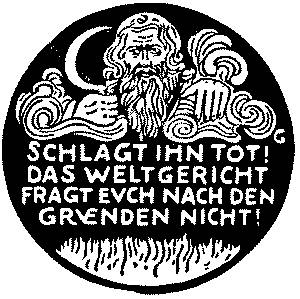
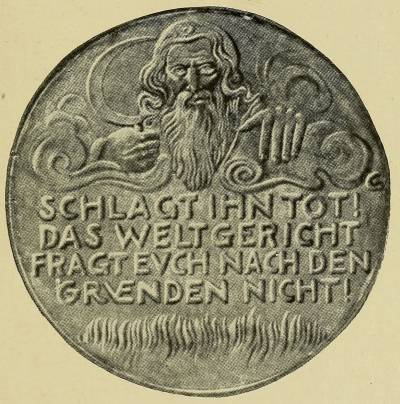
These tokens are made of stiff cardboard or
of aluminum. At the top is a portrait of
Deity as the Kaiser conceives him to be; in
one hand the Kaiser's God holds a sickle, for
the death-harvest. Beneath, the Kaiser and
his War Staff wrote these words, "Strike
him dead; the Day of Judgment will not
ask you for reasons."
The soldier might read this: "You can
slay, pillage, loot, burn, rape, leave thousands
of bodies massacred and mutilated on the
ground, but remember that your Kaiser and
your War Staff will stand between you and
the avenging God, and will see to it that
the Judge of all the earth makes you no
trouble on the great day of accounting."
The Kaiser's God, however, is our Devil.
For three years the Kaiser has had the Devil
all mixed up with God,—being unable to
distinguish between them. Whenever the
Kaiser uses the word "Gott," Americans
always substitute the word "Devil." With
one change the soldier's token is quite accurate,—"Strike
them dead,—old men, girls
and children,—the Devil will not ask you
for reasons. Hell and damnation are fully
satisfied with all you Germans have done."
Eitel Anders
But when the German soldier boy took
this token out of his pocket, and looked at
his license to crime, what effect did it have
upon him? Here is the diary of Eitel
Anders. It is believed that he belonged to
the 14th Bavarian regiment. The diary was
taken from his body upon the battle-field,
and is similar to hundreds of others. "We
crossed the bridge over the Maas at 11:50
in the morning. We then arrived at the
town of Waendre. When we went out of
the town, everything was in ruins. In one
house a whole collection of weapons was
found [the Mayor had ordered the women to
bring to his house every weapon that they
could find, that the Germans might have no
excuse for saying that any one had struck
their soldiers or fired a gun]. All the inhabitants,
without exception, were brought
out and shot. This shooting was heart-breaking,
as they all knelt down and prayed, but
praying is no ground for mercy. A few
shots rang out, and they fell back into the
green grass and slept forever. It is real
sport." But how did Eitel Anders sleep
that night? We know that Macbeth did
not sleep after he murdered Duncan and
Banquo. Did the Kaiser succeed in stultifying
conscience in Eitel Anders? The next
day the soldier made another entry;—mark
the opening words: "This morning, in happy
mood and high spirits, we passed through
Taturages. But before this we cleaned up
the suburb of Mons, and burned the houses.
The inhabitants came out of the houses into the
open plain. Here many heart-breaking scenes
occurred. It was really terrible to watch."
Plainly the soldier's token and the Kaiser's
scheme succeeded. Having stated that he
had murdered men, young Eitel Anders
sleeps well at night, and the "next morning
in happy mood and high spirits" wakened
to plan fresh crimes. Macbeth had no German
soldier's token to help him sleep at
night. Conscience became the whisper of
God in his soul. Sleep forsook his eyes,
and slumber his eyelids. Shakespeare's murderer
did not dare trust himself out under
the stars that blazed with anger, but Eitel
Anders' sleep was not disturbed by the blood
upon his hands, because he really believed
the Kaiser would be able to stand between
him and the Great Day of Judgment.
After General Clauss shot fifteen aged men
in the streets of Gerbéviller, too, that officer
rode away with a light heart, quite free
from the remorse that unseated the reason
of Macbeth. Plainly the Kaiser's scheme
succeeded. It destroyed conscience in many
German officers and soldiers alike. To-day,
the men of Germany without moral sense or
any remorse following their crimes are like
a sky that holds an empty socket where
once the summer-making sun had shined.
They are like human bodies out of which
the intellect has passed, leaving only gibbering
idiots. The German "Laws of War
on Land," their Handbook of Military Tactics,
has organized crime into a science, and
killed in men the spiritual optic nerve. Germany
to-day is an intellectual machine, and
her officers and her soldiers at last can commit
crimes without remorse, which proves
that they are becoming moral idiots.
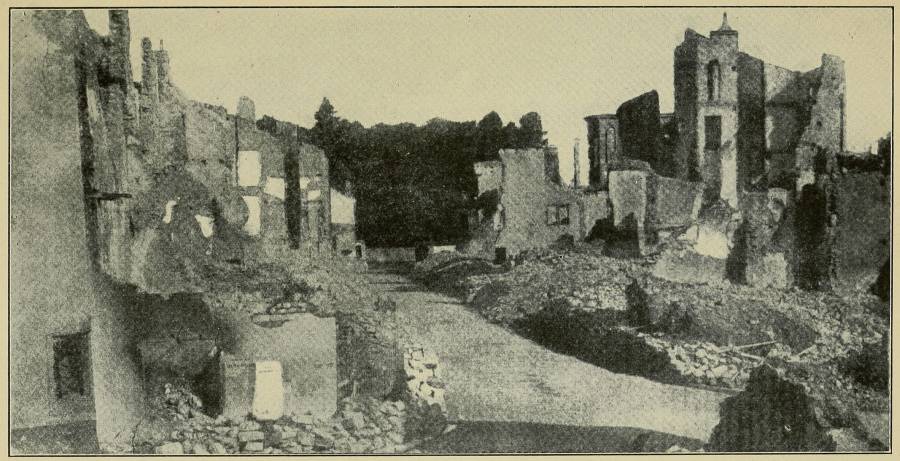
Gerbéviller the Martyred[1]
In August of 1914, when the German
army was broken and compelled to retreat
before the French, they passed through
many French towns and villages in which
they found no soldiers and no weapons, and
where no battle, no skirmish and no shot
took place. During last July and August
we went slowly from one of these ruined
towns to another, talking with the broken-hearted
women and children, comparing the
photographs taken immediately after the
German retreat and almost before the mutilated
bodies were cold. Slowly we sifted
the evidence. On the ground we compared
the full official records made at the time,
with the statements of wretched survivors
who live in cellars, where once stood the
beautiful homes, the orchards and vineyards,
but where now all is desolation and anguish.
Among the multitude of events described
by witnesses who survived the martyrdom
of their village are the following: When
the noise of the approach of General Clauss'
division of twenty thousand soldiers in full
retreat was heard, an aged Frenchman stood
in his open door. He had retired from
business, to spend his last days midst the
friends of his childhood and youth. Hearing
the noise of the approaching army, the
merchant stepped to his open door. As the
first automobile swept by, the German officers
lifted their revolvers and emptied the
lead into the old man's body. He pitched
forward down the stone steps, and in his
death struggle worked his way to the wrought
iron gate, where after the German retreat he
was found dead. Before touching the body,
official photographers, under the direction of
their noble Prefect, took their photographs
from different angles. In the garden behind
the smoking cellar was found the wife, lying
dead upon the grass, her left wrist tied by
the clothes-line to the root of an apple tree,
the right wrist tied to a clump of gooseberry
bushes. She was dead, but not through dagger
or pistol. Standing beside their graves
we studied the photographs and talked with
the families of the fifteen aged men whom
General Clauss ordered shot because there
were no young or middle-aged men in the
village whom he could kill.
Burning of an Ambulance Driver
Most harrowing the testimony given by
the mother of a Red Cross ambulance
driver. The day before the Germans came,
this man had returned from the front, bringing
an ambulance filled with wounded soldiers.
While the division of twenty thousand
Germans were looting the houses, and
carrying away every rug, carpet, table, chair,
picture, tool, art treasure towards the Rhine,
German officers entered the house of Sister
Juliet, who was nursing the wounded soldiers.
Finding the young Red Cross man
there, they immediately shot him. Later
while his mother was holding his head in
her arms and staunching his wounds, a German
officer approached and, seizing her
hands, held them behind her back, while
one of the privates poured petrol over her
son's head. With two fingers this soldier
ripped the clothes from the breast of the
wounded man and poured oil under his shirt
and then set fire to his garments. Referring
to his death struggles and the photograph
of the charred mass that had once been her
son lying on the brick pavement, this mother
exclaimed, "If I had only let him bleed to
death! If I had only let him bleed to death!
Then they could not have made him die
twice!"
The Murder of Hereminel
In a little farming village not many miles
from Gerbéviller the martyred, stands a
battered square belfry, into which the Germans
lifted their machine guns, hoping to
hold back the pursuit of the French army,
thus giving General Clauss time to retreat
and "dig in" some miles to the northeast.
Tying the ropes to the axle of automobile
trucks, the Germans soon lifted their guns
into the church tower. They then drove the
French women and children into the church
and used them as a screen, for no German
ever exposes himself to danger if he can
possibly find a woman or child behind whom
he can hide. One young mother did not
immediately obey, because of certain duties
in connection with her little child. With
two other girls this young wife was stood up
against the stone wall of her own little house
and shot, for the purpose of teaching French
women to obey instantly when German savages
command.
When all the women and children were
packed into the church, a boy was sent back
to tell the French that if they fired upon the
guns in the church belfry, they would kill
their own families. Two nights later when
a storm was raging, the women slipped a
little boy through the window, and sent
word to the officers of the approaching
French army that their wives wished them
to open fire on the German guns. In blowing
these weapons out of the belfry, the
French killed twenty of their own wives
and children, who preferred to share death
with the men they loved, rather than suffer
nameless indignities from German brutes.
In a hundred years of history where shall
you find a record of soldiers, whether red,
black or yellow, save Germans, who were
such sneaking, snivelling cowards that they
do not dare play the game fairly and like
men, but in their chattering terror use
women and little children as shields against
danger? Of a truth, the "Potsdam gang"
has added a new word to the literature of
cowardice.
The Frenchman's Love of France
Terrible also the German assassination of
the land itself. All men love their native
land, but the Frenchman's love has a unique
quality. He speaks of La Belle France as
Dante spoke of Beatrice, as Petrarch spoke
of Laura, and the name of France lingers
upon his lips as music trembles in the air
after the song is sung.
It is love of native land that has made
France beautiful just as through affection
the lark, after completing its nest, makes it
soft and warm by pulling the down out of
her own bosom. The French people love
France as Millais loved his Gleaners, as
Bellini loved the missal he had illuminated,
and as that young architect loved the little
Roslyn chapel, upon whose delicate capitals
he had lavished his very soul. For centuries
the enemies of farms, houses, towns and cities
have been fire, flood and earthquake. Witness
the city of St. Pierre. An interior explosion
blew off the cap of the mountain and
a flood of gas poured down upon the lovely
city, asphyxiated the citizens and left not
one house standing. Witness that mighty
convulsion in San Francisco that brought
thousands of brick buildings crashing down
in ruins. Witness the fire in Chicago that
turned the great city into piles of twisted
iron and ashes. In New Zealand there is
a lake called Avernus, the birdless lake.
Poisonous gases rise from the black flood of
water, and soon the lark with its song, and
the eagle with its flight fall into the poisonous
flood.
But all these images are quite inadequate
to explain the devastation of France upon
the retreat of the Germans. About forty
miles north of Paris, one strikes the ruined
region. Then hour after hour passes, while
with slow movement and breaking heart the
investigator journeys one hundred miles to
the north and zigzags one hundred and
twenty-five miles south again, through that
ruined region. Centuries ago Julius Cæsar
described it as a wild land, rough, with
forests filled with wolves. Then the
Frenchman entered the scene. He subdued
all the wild grasses, drained the valleys and
widened the streams into canals. He enriched
the fields, surrounded the meadows
with odorous hedges and filled swamps with
perfumed shrubs. Slowly the Frenchman
threw arches of stone across the streams and
carved the bridges until they were rich in
art, while everything made for use was
carried up to beauty. He gave to the roof
of the barn its lovely lines; the approach to
the house was upon a curved road, the highways
were shaded by two rows of noble trees.
The stony hillside was terraced, and there
the vines grew purple in the sun. How
simple was his life! What a sanctuary his
little home! With what rich embroidery of
wheat he covered all the hills! He was
prudent without being stingy, thrifty without
being mean. The French peasant saves
against old age with one hand and distributes
to his children with the other.
What Hate Can Do
And having lavished all their love upon
the little farmhouse, the granary and the
garden, having pruned these grape-vines with
their clusters of white and purple, the time
came when each vine seemed like a friend,
dear as that miraculous picture was to
Baucis and Philemon. For these reasons
all France was invested with affection and
beauty.
The French peasants loved their land and
then lost it. One morning the Hun stood at
the gate. The farmers with their pruning
knives were no match for Germans with
their machine guns, and down they fell under
the plum trees they were pruning. The
devastated regions of France are like unto a
world ruined by devils. The Germans cut
down the apples, the pears, and all the
peaches. They did not spare the cherry, the
quince, the gooseberry and currant, or the
vineyards. Gone also all the beautiful
bridges—they have been dynamited! Gone
all the lovely and majestic Thirteenth Century
churches! Gone all the galleries, for
some of the finest art treasures in the world
have perished.
The land has been put back to where it
was when Julius Cæsar described it two
thousand years ago—a wild land, and waste,
growing up with thorns and thistles. That
proclamation on a wall tells the whole story.
"Let no building stand, no vine or tree.
Before retreating see that the wells and
springs are plentifully polluted with corpses
and with creasote." The spirit was this,
"Since we Germans cannot have this land,
no one else shall."
Prince Eitel's Crime
But there is more. One of the historic
chateaux is that of Avricourt, rich in noble
associations of history. It was one of the
class of buildings covered by a clause in the
international agreements between Germany,
France and the United States and all the
civilized nations, safeguarding historic buildings.
For many months it was the home of
Prince Eitel, the Kaiser's second son.
When a judge and jury held inquiry at
the ruins of the chateau, the aged French
servant, who understood the electric lighting
and had charge of the gas plant during
Eitel's occupancy, stated that he heard the
German officers telling Eitel Frederick that
he would disgrace the German name if he
destroyed a building that had no relation to
war, that could be of no aid or comfort to
the French army, and that he would make
his own name, and that of his family, a name
of shame and contempt, of obloquy and
scorn. But the man would not yield. He
brought in his auto trucks and carried to the
freight cars every historic object in the
splendid chateau. Having pledged himself
to leave the building uninjured, the prince
stopped his car at the gates of the exit, ran
back to this historic house, filled his firebrand,
spread the flames upon the halls,
waited until the flames were well in progress,
and then ordered his men to light the fuse of
dynamite bombs. A few days later inquiry
was held and testimony of aged servants
and little children was taken. The degeneracy
of this German Prince as then revealed
has not been equalled since the first chapter
of Romans catalogued the unnatural crimes
of the men of the ancient world. Germany
has no artistic sense. Her own poet, Heine,
predicts that she will yet pull in pieces her
one fine cathedral. The German poet does
not think any beautiful thing is safe so long
as it is in German hands. This gifted Hebrew
had the vision that literally saw the German
pounding to pieces the Cathedral at Louvain
and Ypres, in Arras, in Bapaume, in St.
Quentin, and Rheims.
Rheims Cathedral
One of the atrocities that has horrified the
civilized world has been the ruin of Rheims
Cathedral. Germany, of course, was denied
by nature any gift of imagination. The
German mind is a hearty, mediocre mind,
that can multiply and exploit the inventions
and discoveries of the other races. The
Germans contributed practically nothing to
the invention of the locomotive, the steamboat,
the Marconigram, the automobile, the
airplane, the phonograph, the sewing machine,
the reaper, the electric light. Even as
to the weapons with which she fights, Americans
invented for Germany her revolver, her
machine gun, her turreted ship, and her submarine.
In retrospect it seems absolutely
incredible that Germany could have been so
helplessly and hopelessly unequal to the invention
of the tools that have made her rich.
But imagination is not her gift. If Sheffield
can give her a model knife, Germany
can reproduce that knife in quantities and
undersell Sheffield. The German people keep
step in a regiment, in a factory and on a
ship, and therefore are wholesalers. The
French mind is creative. It stands for individual
excellence, and is at the other extreme
from the German temperament. The emblem
of the German intellect is beer; the emblem
of the English intellect is port wine; the
emblem of the French mind is champagne;
the emblem of an American intellect like
Emerson's is a beaker filled with sunshine—but
Germany has a "beer" mind. It is this
lack of imagination that explains Nietzsche's
statement that for two hundred years Germany
has been "the enemy of culture" while
Heinrich Heine insists that "the very name
of culture is France."
It is this total lack of any appreciation of
art and architecture that explains Germany's
destruction of some of the noblest buildings
of the world. She cannot by any chance
conceive how the other races look upon her
vandalism. Her own foreign secretary expressed
it publicly in one of her state papers,
"Let the neutrals cease chattering about
cathedrals. Germany does not care one straw
if all the galleries and churches in the world
were destroyed, providing we gain our military
ends." Guizot in his history of civilization
presents three tests of a civilized people:
First, they revere their pledges and
honour; second, they reverence and pursue
the beautiful in painting, architecture and
literature; third, they exhibit sympathy in
reform towards the poor, the weak and the
unfortunate.
Now apply those tests to the Kaiser and
his War Staff, and you understand why
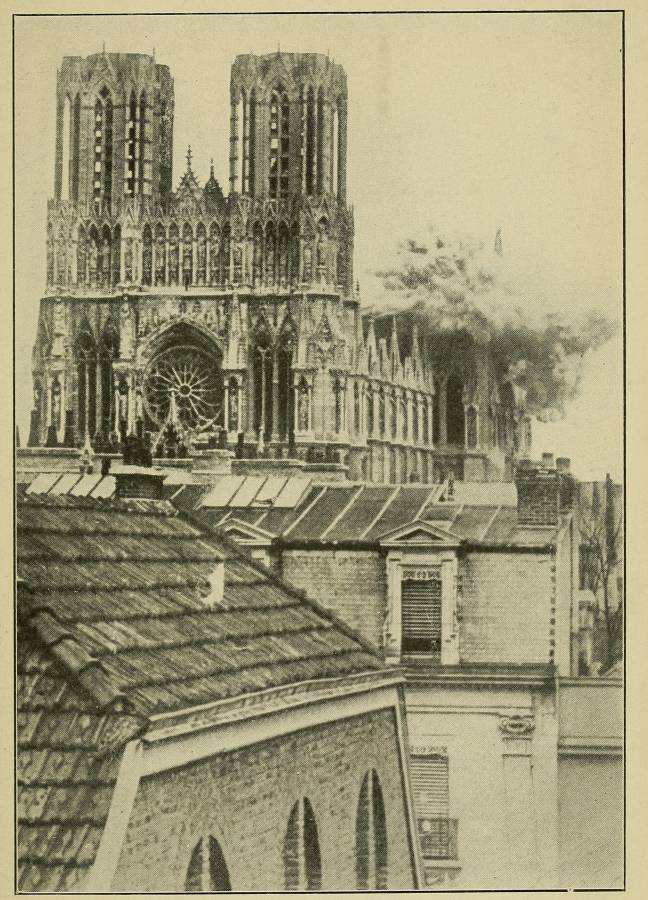
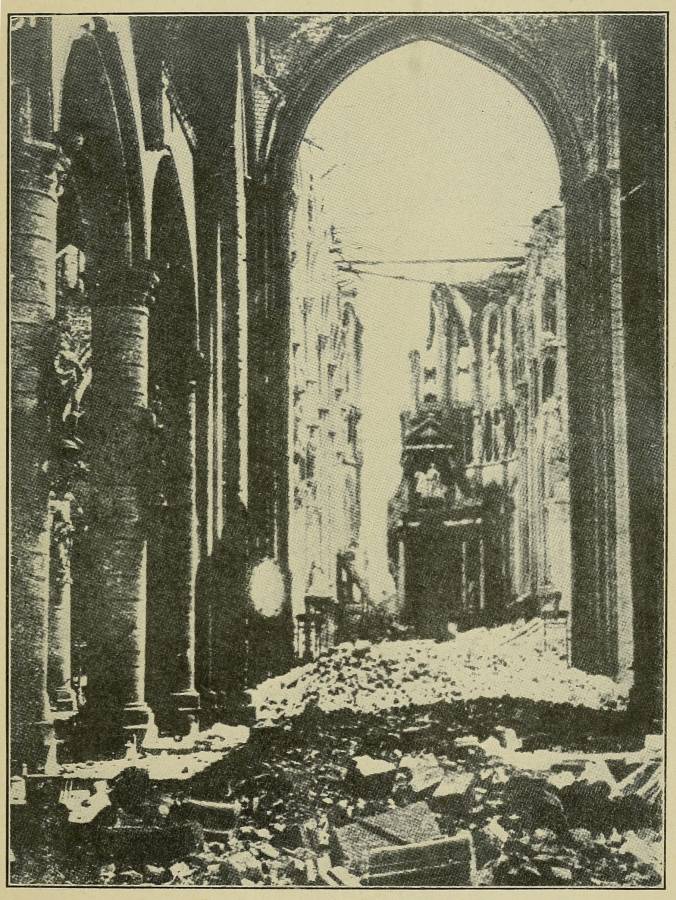
Rheims Cathedral is a ruin.[2] No building
since the Parthenon was more precious to
the world's culture. What majesty and dignity
in the lines! What a wealth of statuary!
How wonderful the Twelfth Century
glass! With what lightness did these arches
leap into the air! Now, the great bombs
have torn holes through the roof; only little
bits of glass remain; broken are the arches,
ruined these flying buttresses, the altar where
Jeanne d'Arc stood at the crowning of Charles
is quite gone. The great library, the bishop's
palace, all the art treasures are in ruins.
But ancient and noble buildings do not belong
to a race, they belong to the world.
Sacred forever the threshold of the Parthenon,
once pressed by the feet of Socrates
and Plato! Thrice sacred that aisle of Santa
Croce in Florence, dear to Dante and Savonarola.
To be treasured forever the solemn
beauty of Westminster Abbey, holding the
dust of men of supreme genius.
In front of the wreck of the Cathedral
of Rheims, all blackened with German fire,
broken with the German hammer, is the
statue of Jeanne d'Arc. There she stands,
immortal forever, guiding the steed of the
sun with the left hand, lifting the banners
of peace and liberty with the right. By
some strange chance, no bomb injured that
bronze. That figure seems a beautiful prophecy
of a day when the spirit of liberty, riding
in a chariot of the sun, shall guide a greater
host made up of all the peoples who revere
the treasures of art and architecture, and
law and liberty, and will ride on to a victory
that will be the sublimest conquest in the
annals of time.
The Devastation of the French
Home
But the ruin of his cathedrals, his galleries,
his schoolhouses, his libraries, his
farmhouses, his vineyards and orchards, is
the least of sorrows of the Frenchman. In
a little village near Ham dwelt a man who
had saved a fortune for his old age, 100,000
francs. When the invading army, like a
black wave, was approaching, he buried his
treasure beneath the large, flat stones that
made the walk from the road up to the
front step of his house. Then, with the
other villagers, the old man fled. Many
months passed by, while the Germans bombarded
the village. At last the German
wave retreated, and once more the old man
drew near to his little village. There was
nothing, nothing left. After a long time,
he located the street, which was on the very
edge of the town, but could not find the
cellar of his own house. Great shells had
fallen. Exploding in the cellar, they had
blown the bricks away. Then other shells
had fallen hard by and blown dirt that filled
up what once had been a cellar. The very
trees in front of his house had been blown
away and replaced by shell pits. In one of
his reports Ambassador Sharp states that
the aged man had up to that time failed to
locate his house, much less his buried treasure.
But what trifles light as air are
houses in contrast with other forms of
desolation!
Ruined Homes and Hopes
At the officers' headquarters, one night
after returning from the front, several officers
were recounting to us their dramatic
experiences. Many harrowing tales were
told. During the winter of 1915, in the
trenches at the foot of Vimy Ridge, several
English officers and a French captain were
down in a safety cellar having their pipes
together and recounting the events of the
day. Rain was falling and they delayed
their stay. Finally the moment came to
return to their trenches above. At that
moment an English sentinel exclaimed:
"One week from to-day and I will be home
in England with my wife and baby. One
more week! The next seven days seem to
me like seven eternities." The English captain
congratulated the boy, saying, "In two
months my permission will come and I will
have eight days home with my family."
Then the English officer noticed the French
officer's agitation. Turning to him, the
English captain exclaimed, "And when do
you go, Captain?" "When do I go home,"
exclaimed the Frenchman bitterly, "when
do I go home? You Englishmen do not
understand! Your land has never been invaded.
Go home! To what could I go?
The Germans have been in my land for a
year. My little town is gone, quite gone.
My little house is gone, and gone my little
shop! My wife is still a young woman!
My little girl,—she is just a little, little girl!
Why, I never thought of her as a woman!
And now our priest writes me that my
young wife and my little girl will have
babes in two months by these brutes!" And
then the storm broke. The Frenchman beat
his head upon the rude table, while the two
Englishmen fled into the rain and night,
knowing that the rain was nothing against
those tears of pain, for that man's hopes
were dead forever. That lieutenant's only
task was to recover France and then transfer
all his ambitions to God in Heaven.
Such devastations of the soul are why
there must be no inconclusive peace. Unconditional
surrender is the only word.
Whether this war goes on one year or five
years it must go on until the Hun repents
and makes restitution—so far as possible.
Alas, a myriad of these German outrages
are irremediable! Thoughtful men doubt
whether the German will ever learn the
wickedness of his own atrocities and the
crimes of militarism until his own land is
laid waste, until he sees the horrors of war
with his own eyes, and hears the groans of
his own people with his own ears, sees his
own land laid desolate, finds his own heart
crushed under anguish. Yet retribution in
kind would be unthinkable for the Allies!
The Foul Crime Against Women
Many Americans have looked with horror
upon the photograph of the mutilated bodies
of women. Sacred forever the bosom of his
mother, and not less sacred the body of every
woman. Not content with mutilating the
bodies of Allied officers, of Belgian boys,
they lifted the knife upon the loveliness of
woman. The explanation was first given by
the Germans themselves. When the Hun
joins the army, he must pass his medical examination.
A few drops of blood are taken
from the left arm, and the Wassermann
blood culture is developed. If free from
disease, the soldier receives a card giving
him access to the camp women, who are kept
in the rear for the convenience of the German
soldier. If, however, the Wassermann
test shows that the German has syphilis, the
soldier bids him report to the commanding
officer. The captain tells him plainly that
he must stay away from the camp women
upon peril of his life, and that if he uses one
of their girls he will be shot like a dog. Having
syphilis himself, the German will hand
it on to the camp girl, and she in turn will
contaminate all the other soldiers, and that
means that the Kaiser would soon have no
army. Therefore, the soldier that has this
foul disease must stay away from the camp
women on peril of his life. Under this restriction
the syphilitic soldier has but one
chance, namely, to capture a Belgian or
French girl; but using this girl means contaminating
her, and she in turn will contaminate
the next German using her. To
save his own life, therefore, when the syphilitic
German has used a French or Belgian
girl, he cuts off her breast as a warning to
the next German soldier. The girl's life
weighs less than nothing against lust or the
possibility of losing his life by being charged
with the contamination of his brother German.
Insane Through Pain and Grief
One pathetic and dramatic story ran up
and down the trenches upon a line twenty
miles in length. Told by different soldiers,
that tragic story never varies in the essential
facts. When the Germans ruined a
village near Ham, they carried away some
fifty-four girls and women between the ages
of fourteen and forty. These girls were
held behind the lines among the camp
women, kept for the Huns. One chilly
morning last April a French boy, lying on a
board on the bottom of his trench, heard
the wild shrieks of a girl. Standing on tiptoe
he peeped over the top to find the French
soldiers in the one trench and the Boches in
the other had forgotten the peril of the
sniper's bullet, and were staring at a young
girl out in No Man's Land. One week of
cruelty had driven the girl insane. The
German soldiers had lifted her out of their
trench, and with their bayonets had pushed
her in the direction of the French lines, and
were shouting to her to go over to her
friends among the French.
What the French soldiers saw was a
young woman, clothed in a dark blue skirt,
her waist torn, her bosom exposed, her hair
loose upon her shoulders. She was standing
bewildered in No Man's Land. Now she
poured forth the pealing laughter of a
maniac, and now she seemed to be talking
to herself. Suddenly her eye caught sight
of a human body, wearing the garb of a
French soldier. The girl did not know that
it was a French boy who in the darkness
had been cutting the barbed wire, and in the
midst of the German flare had been caught by
a bullet. Mistaking the dead boy for that
of her young husband, the girl ran forward,
fell upon her knees, and lifted the body that
was already cold into her arms. From time
to time she would take an arm grown stiff
and try to put it around her neck and then
gaze upon it, not understanding why the
cold hands did not clasp her around in the
dear accustomed way. Suddenly her eyes
saw his coat, lying near by; but she did not
know that the boy in his death struggles
had torn that coat from his body. She
thought that garment, already stiff with
blood, was her own little babe. Picking up
the coat, she dropped upon her knees, lifted
it to her breast, and began to sway to and
fro, and soon the French soldiers heard a
lullaby, familiar and dear to every Frenchman
whose mother with that song charmed
the fear out of the eyes and the terror from
the heart. So terrible was the scene that
for the moment the Frenchman and German
alike forgot all warfare! Finally, a German
lifted his rifle to the shoulder, and as the girl,
rising to her feet, flung the bloody coat
away, and screamed, "The Boche! the
Boche!" his rifle cracked, and the young
woman sank slowly down. A moment
later, all helmets, German and French alike,
disappeared behind the trenches. Silence
rested on No Man's Land, and events went
on as before. But for France the world will
never be the same again. German crimes
have lighted a flame of sacred anger that
will never burn out until German cruelty
has been utterly consumed. That is why
the fire sparkles in the eyes of the Allied
soldiers whenever you suggest peace by
negotiation, or a peace without victory.
A Wounded German Colonel
Last winter, a German colonel was shot
through the spinal cord. His lower limbs
were completely paralyzed, and the paralysis
began to extend to his hands. The
wounded man developed the theory that if
he could only be carried back to Germany
recovery was possible. Lifted into an ambulance,
he was carried twelve miles to the
northeast, towards the Rhine. Unable to
endure the agony of the rough road, he
commanded the ambulance driver to stop
in front of the priest's house, near ——.
Two aged French women cared for the
wounded man during January, February and
March. Little by little the wings of the
angel of death fanned away the mist before
the eyes of the German officer. For two
and a half years he had carried an aluminum
token with a portrait of the German Kaiser's
conception of God, and the words, "Strike
them all dead. The Day of Judgment will
not ask you for reasons." But at last a moment
had come when he lost confidence in
the pledge of the Kaiser and the War Staff
to stand between him and an outraged God.
One morning a little French boy waited
after mass to tell the priest that the German
officer wanted him to come at once. The
important message proved to be a warning
that the von Hindenburg line was nearly
completed, that the orders for retreat had
gone out, that every church, bank, factory,
house, was to be looted and then burned, and
the whole region turned into a desolation.
"These two aged women and you yourself
have been very kind to me, and this pass
will take you through the German lines to
a place of safety." And then the dying
officer advised the priest to take the two
women and go away at once. The news
utterly crushed the kindly man of God.
Touched by the grief of the white-haired
priest, and perhaps terrified by memory and
remorse, words of righteous wrath and repentance
fell from the lips of the officer.
These were his last words, as that old priest
transcribed them from the lips of this dying
German. "Curses upon our army! Curses
upon our Kaiser, and our War Staff! Ten
thousand curses upon the Fatherland!
Either God is dead or Germany is doomed!"
Going out of the door, the last words the
aged priest heard were the dying curses of
an officer, whose soul had been debauched
by his Kaiser and his War Staff, and who
upon the brink of the Day of Judgment
realized that for every crime he must give an
account unto God. "Woe unto him who
offends one of my little ones; it were better
for him that a millstone were hanged about
his neck and that he were drowned in the
depths of the sea."
That conscience-smitten dying German
packed the genius of the moral universe into
the curse he pronounced upon the Kaiser, the
War Staff and the Fatherland. When the
veil was taken away from his eyes he saw
that the stars in their courses were fighting
against the Kaiser. In the awful hour of
death he learned at last that God is not
dead, but that because of her atrocities, Germany
is doomed.