Pudor inde et miseratio.
Tacitus.
I intend to prove that the German armies cannot
wholly escape from the reproach of sometimes violating
the law of nations, and I mean to prove my case according
to French custom from absolutely trust worthy sources.
I shall make use only of documents most rigorously
examined, and I have taken care to criticize their text as
minutely as if in times of peace I were questioning the
authority of some old chronicle or the genuineness of some
old chart. And I shall do so perhaps from professional
habit, perhaps impelled by an inward longing to get
at the truth, in any case for the good of the case I am
pleading: for these pages are intended for every one; for
the casual reader, for the indifferent, and indeed for the
enemy of my country. I wish that the casual reader who
may by chance open this pamphlet in an idle moment
should be struck by the genuineness of the documents,
if he has eyes to see, just as their sordid character will
touch his heart, if he has a heart that feels.
My aim has been that these documents whose authenticity
is obvious should carry an equally obvious authority.
It is easy to make accusations difficult to prove them! No
belligerent has ever been at a loss to bring against his
enemy a heap of evidence, true or false. But though the
evidence may be collected in accordance the most solemn
forms of justice by the highest magistrates, it will unfortunately
long remain useless, so long as the adversary has
not had an opportunity of disputing it, everyone is entitled
to consider statements as lies, or at least as open to refutation.
That is why, I shall abstain here, from quoting
French or Belgian testimony true though I know it to be.
I have preferred that the evidence which I shall call shall
be of such a nature that no living man, not even in Germany
shall attempt to refute it. German atrocities shall
be proved by German documents.
I shall take the evidence chiefly from those war diaries,
which Article 75 of the Rules for Field service of the
German Army advises soldiers to keep on the march,
which we have confiscated from prisoners[1], as being
military papers. It goes without saying that their number
increases daily. I should like some day the complete
collection to be deposited in the collection of German
manuscripts in the Bibliothèque Nationale for everyone’s
instruction. In the meantime, the Marquis of Dampierre,
a former student of the École des Chartes, archivist and
paleographer, is preparing and will shortly bring out a
book in which the greater part of these roadside journals
will be minutely described, copied, and brought into the
full light of day. For my part I have examined but forty.
They will suffice for my task. I shall make some extracts
from them, taking care that each quotation bears sufficient
proof of its genuineness.
In what order shall I arrange them? For many reasons,
but chiefly because some of these documents only ten lines
long contain proof of crimes of many kinds, I shall not
attempt to adopt any rigid order of classification. I shall dip
haphazard into the heap; certain associations of ideas
or pictures, and a certain similarity in the texts will alone
enable me to
group them.
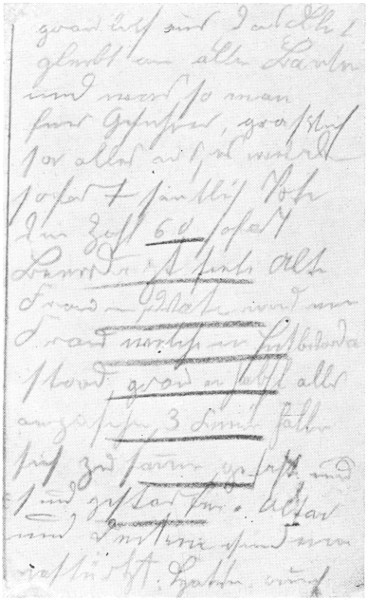 Plate 1.
I open haphazard
the Diary
of a soldier of
the Prussian
Guard, Gefreiter
Paul Spielmann
(I Kompagnie,
Ersatz-Bataillon,
I Garde-Infanterie-Brigade).
Here is
his account of a
night alarm in a
village near Blamont
on the
1st September. At
the bugle call,
the Guard wakes,
and the
massacre begins
(Plates 1 and 2.)
«The inhabitants
fled through the village. It was horrible. Blood was plastered
on all the houses, and as for the faces of the dead, they
were hideous. They were all buried at once, to the number of
sixty. Among them many old men and women, and one woman
about to be delivered. It was a ghastly sight. There were three
children who had huddled close to one another and had died
together. The altar and the ceiling of the church had fallen in.
They had been telephoning to the enemy. And this morning,
2 September, all the survivors were driven out and I saw four
little boys carrying on two poles a cradle in which was a child
of 5 to 6 months old. All this was horrible to see. A blow for
a blow. Thunder
for thunder.
Everything was
pillaged. And I
also saw a mother
with her
two little ones:
and one had a
large wound in
the head, and
had lost an
eye.»[2]
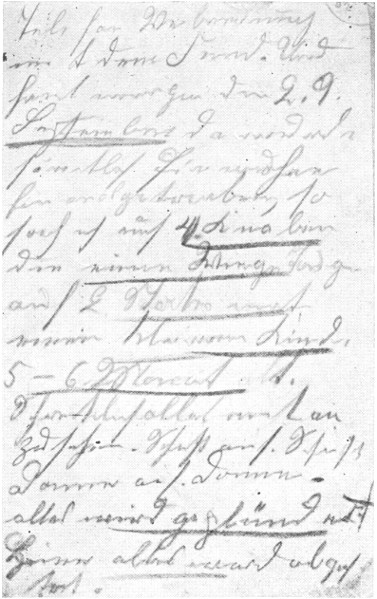 Plate 2.
«They had
been telephoning
to the Enemy»
says this
soldier, the punishment
was
deserved. Let
us remember
the terms of
Art. 50 of the
Hague Convention
of 1907
signed in the
name of the
German Emperor
by a gentleman, Baron Marschall von Bieberstein.
«No collective punishment, pecuniary or other, can be
inflicted upon a community for individual acts for which
they cannot be held responsible as a body.» What tribunal,
during this night of horrors took the trouble to make
sure of the guilt of the community at large?
In an unsigned note-book of a soldier belonging to the
32nd Infantry (IV Reserve Corps) we come across the
following statement.
«3rd September. Creil. The iron bridge has been blown up.
Consequently we burnt the streets and shot the civilians.»[3]
The regular French troops alone—the Engineers—had
blown up the iron bridge at Creil; the civilians had nothing
to do with it. To excuse these massacres, when they condescend
to make any excuse these note-books usually say:
“civilians” and “sharpshooters” had fired on our men.
But the Convention of 1907, that “scrap of paper”, signed
by Germany, stipulates that by its first Article the laws,
rights, and duties of war apply, not only to the army, but
also to the militia and volunteer corps, adding certain conditions,
the chief one of which is the bearing of arms openly
and in Art. 2. “The population of unoccupied territory,
who, at the approach of the enemy, spontaneously take up
arms against the invading forces without having had time
to organize according to the conditions of Art. 1, shall be
considered as belligerent, if the population bears arms
openly and respects the laws and customs of war.” Read
in the light of this text the savage stories which follow
will take their true proportions:
a) Diary of Pte Hassemer VIII Corps.
«3. 9. 1914. Sommepy (Marne). Horrible massacre. The village
burnt to the ground, the French thrown into houses in flames,
civilians and all burnt together.»[4]
b) Diary of Lt Kietzmann (2nd Company, 1st Battalion of
the 49th Regt of Infantry), dated 18th August (Plate 3).
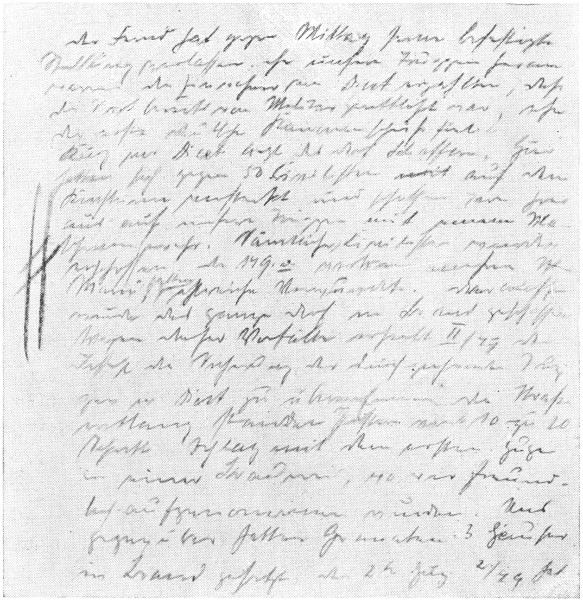 Plate 3.
«A little in front of Diest[5] lies the village of Schaffen. About
50 civilians had hidden in the church tower and had fired on
our men with a machine-gun. All the civilians were shot.»[6]
c) Diary of a Saxon officer (unsigned) (178th Regt XII Army
Corps, I Saxon Corps).
“26th August. The pretty village of Gué-d’Hossus in the
Ardennes has been burnt, although innocent of any crime, it
seemed to me. I was told a cyclist had fallen off his machine,
and that in doing so his gun had gone off: so they fired in
his direction. Thereupon, the male inhabitants were simply
consigned to the flames. It is to be hoped that such atrocities
will not be repeated.”[7]
The Saxon officer however had already seen such “atrocities”
the previous day, 25th August, at Villers en Fagne
(Belgian Ardennes). “Where some Grenadiers of the Guard
had been found dead or wounded”, he had seen the priest
and other villagers shot; and three days earlier the 23rd August,
in the village of Bouvignes to the north of Dinant, he
had seen things which he describes as follows:
“We got into the property of a well-to-do inhabitant, by a
breach effected in the rear, and we occupied the house. Through
a maze of rooms we reached the threshold. There was the
body of the owner on the floor. Inside our men destroyed
everything, like Vandals. Every corner was searched. Outside
in the country, the sight of the villagers who had been shot
defies all description. The volley had almost decapitated some
of them.
“Every house had been searched to the smallest corner, and
the inhabitants dragged from their hiding-places. The men
were shot; the women and children shut up in a convent, from
which some shots were fired. Consequently, the convent is
to be burnt. It can be ransomed however on the surrender of
the guilty and on payment of 15.000 francs.”[8]
Sometimes, as we shall see, the diaries supplement one
another.
d) Diary of Private Philipp. (Kamenz, Saxony. 1st Company.
1st Battalion of the 178th Regt.) The same day
23rd August, a soldier of the same regiment saw a similar
scene to that described above, probably the same, but the
point of view is a different one (Plate 4).
“In the evening, at 10 o’clock the first battalion of the 178th
Regt went down to the village that had been burnt to the north of
Dinant. A sad and beautiful sight, and one that made you
shudder. At the entrance of the village there lay about 50 dead
bodies strewn on the road. They had been shot for having fired
on our troops from ambush. In the course of the night, many
others were shot in the same way, so that we could count
more than two hundred. The women and children, lamp in
hand, were obliged to watch the horrible scene. We then ate
our rice, in the midst of the corpses, for we had not tasted
food since morning.”[9]
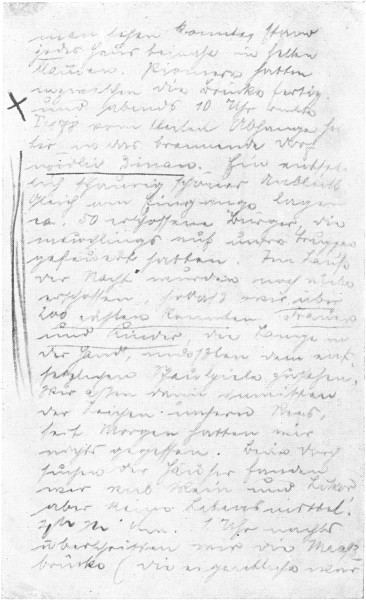 Plate 4.
A fine military subject indeed, and worthy to compete
at the Dresden Academy of Fine Arts. One passage in
the text however is obscure, and might embarrass the
competitors. “The women and children lamp in hand
were obliged to watch the horrible scene.”
What scene? The shooting, or the counting of the
corpses? Painters, who wish to elucidate this point need
only consult the colonel of the 178th Regt. What a gallant
soldier!
He did, that night, but carry out the spirit of his superiors
and comrades in arms. He who wishes to be
convinced need but read in the Sixth Report of the Belgian
Enquiry Commission on the violation of the laws of nations
(Le Havre, 10 Nov. 1914) the base proclamations which
the Germans placarded in Belgium. Three short excerpts
will suffice.
Extract from a Proclamation of General von Bülow
posted up at Liège on the 22nd of August 1914:
“The inhabitants of the town of Andenne, after having
protested their peaceful intentions, treacherously surprised
our troops. It is with my full consent that the general
in command had the whole place burnt, and about a hundred
people were shot.”[10]
Extract from a Proclamation of Major Commander Dieckmann[11]
posted up at Grivegnée on the 8th of September 1914:
“Everyone who does not at once obey the word of command
“Hands up!” is guilty (sic) of the penalty of death.”
Extract from a Proclamation of Marshall, Baron von
der Goltz posted up in Brussels on the 5th of October 1914:
“In future, all places near the spot where such acts have
taken place (destruction of railway lines or telegraph wires)—no
matter whether guilty or not—shall be punished without
mercy. With this
end in view, hostages
have been
brought from all
places near railway
lines exposed
to such attacks,
and at the first
attempt to destroy
railway lines,
telegraph or
telephone lines,
they will be immediately
shot.”[12]
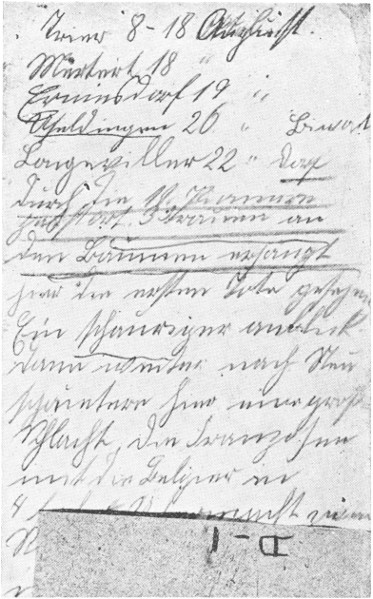 Plate 5.
This (Plate 5)
is the first page
of an unsigned
note-book:
“Langeviller,
22 August. Village
destroyed by the
11th Battalion of
the Pioneers.
Three women
hanged on trees:
the first dead
I have seen.”[13]
Who are these three women? Criminals surely, guilty
no doubt of having fired on the German troops, unless
they had been telephoning to the enemy; and the
11th Pioneers had no doubt punished them justly. But
they have expiated
their crime
now, and the
11th Pioneers have
gone by, and
of their crime, the
newly advancing
troops know nothing.
Among
these new troops
will there be a
commander, a
Christian, to order
the cords to
be cut and to
release these
dead women. No,
the regiment will
march by under
the gibbets, and
the flags will
brush by these
corpses; they will
pass along Colonel
and officers,
gentlemen and
Kulturträger.
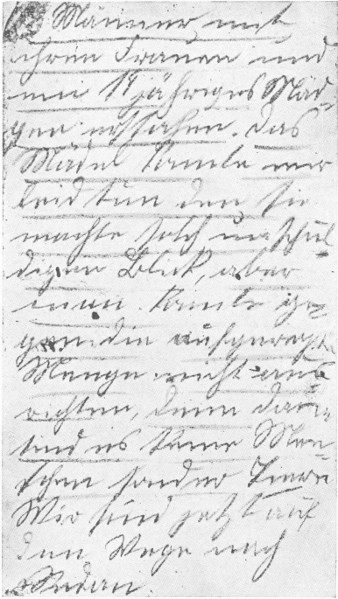 Plate 6.
And they know
full well what
they are doing: these dead women must remain these,
as an example; as an example, not for the other women in
the village—these had already no doubt understood—, but
as an example for the regiment, and for other regiments
who were to come afterwards. These must be made
warlike, they must be taught their duty, that is to shoot
women when the opportunity occurs. The lesson bore
fruit indeed. Here is sufficient proof: the young soldier
who had that day seen and told us of “dead for the first
time” makes the following note on the 10th and last page
of his diary (Plate 6).
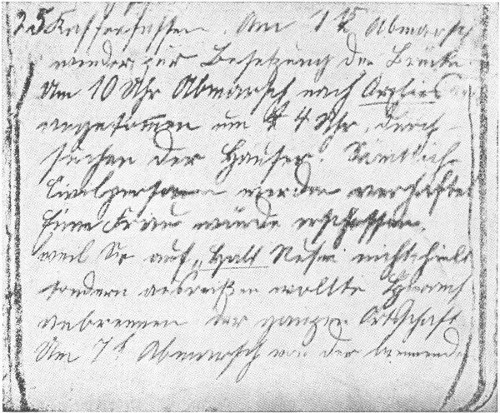 Plate 7.
“In this way we destroyed 8 houses with their inmates.
In one of them two men with their wives and a girl of eighteen
were bayonetted. The little one almost unnerved me so innocent
was her expression. But it was impossible to check the
crowd, so excited were they, for in such moments you are no
longer men, but wild beasts.”[14]
And to prove that this murder of women and children
is all in the days work of the German soldier, here is
further evidence.
a) The author of an unsigned note-book (Plate 7) relates
that at Orchies (Nord) a woman was shot for not having stopped
at the word
of command
Halt! Thereupon,
he adds, the
whole place was
burnt.[15]
b) The officer
already mentioned
of the 178th
Saxon Regt reports
that in the
outskirts of Lisognes
(Belgian
Ardennes) “a
scout from Marburg
having placed
three women
one behind the
other brought
them all down
with one shot”.
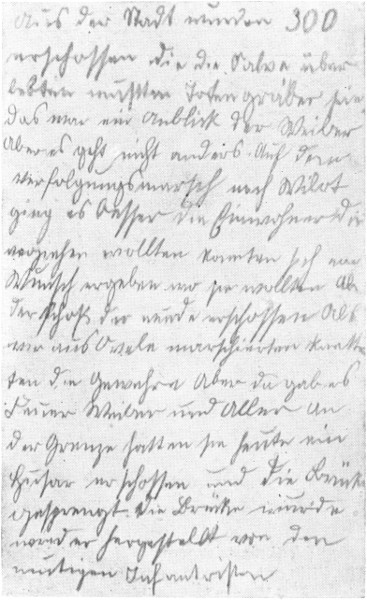 Plate 8.
c) Let us now
quote a few lines
from the diary
of a reservist a
certain Schlauter
(3rd Battery of the 4th Regt, Field Artillery of the Guard,
Plate 8):
25th August (in Belgium): Three hundred of the inhabitants
were shot and the survivors were requisitioned as grave-diggers.
You should have seen the women at this moment! But you can’t
do otherwise. During our march on Wilot, things went better:
the inhabitants who wished to leave could do so and go where
they liked.[16] But anyone who fired was shot. When we left
Owele, shots were fired: but there, women and everything
were fired on[17]....
Often when German troops wish to carry a position,
they place civilians, men, women and children before
them, and take shelter behind this shield of living flesh. As
the stratagem consists essentially in speculating upon
the noblemindedness of the adversary, of saying to him:
“You will not fire upon these unhappy people, I know,
and I hold you at my mercy, disarmed, because I know you
are less cowardly than I”, as it implies a homage to the
enemy, and humiliation of oneself, it is almost inconceivable
that soldiers can resort to it, and that is why it
represents a new invention in the long list of human cruelties,
and the most fearful Penitentiels (Summæ peccatorum)
of the middle ages have not recorded it. And it is also
why, in presence of accounts, French, English or Belgian
accusing the Germans of such practices I for a long time
doubted, I admit if not the truth of the evidence, at least its
importance: such acts must, it seemed to me, prove only the
unavowed crimes of officers, individual acts which do not
dishonour a nation, for a nation on learning them would
repudiate them. But now can we doubt that the German
nation accepts such ruffianly exploits as worthy of her, that
she recognizes and acquiesces in them, when the following
narrative, signed by a Bavarian officer, Lt. A. Eberlein is
laid before us in one of the best known newspapers in
Germany, in the issue of 7th Oct. 1914 (no 513 Vorabendblatt
p. 2 of the
Münchner Neueste Nachrichten)?
Lt Eberlein
describes the occupation
of St Dié at the end of
August. After entering the
town at the head of a
column, he was obliged
to barricade himself inside
a house until reinforcements
came up (Plate
9):
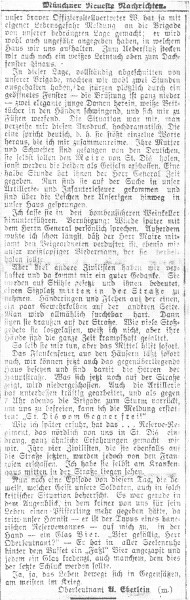 Plate 9.
We had arrested three
civilians, and suddenly a
good idea struck me. We
placed them on chairs and
made them understand that
they must go and sit on them
in the middle of the street.
On one side entreaties, on
the other blows from the
butt-end of a gun. One gets
terribly hardened after a
while. At last they were
seated outside in the street.
I do not know how many
prayers of anguish they
said; but they kept their
hands tightly clasped all
the time. I pitied them;
but the devise worked
immediately. The shooting
at us from the house at the
side stopped at once; we
were able to occupy the
house in front, and became
masters of the principal
street. Every one after that
who showed himself in the
street was shot. The artillery,
too did good work during this, and when towards seven
in the evening, the brigade advanced to free us, I was able to
report that “St Dié is free of the enemy”.
As I learnt later on, the ... regiment of reserve which had
entered St Dié more from the north had had similar experiences
to ours. The four civilians that had been made to sit
in the street had been killed by French bullets. I saw them
myself, stretched out in the middle of the street, near the Hospital.
Article 28 of the Hague Convention of 1907, signed by
Germany, runs thus “It is forbidden to pillage a town or
locality even when taken by assault.” Article 47 runs: “(In
occupied territory), pillage is forbidden”.
This is how the armies of Germany interpret these
articles.
Private Handschuhmacher (of the 11 battalion of Jägers,
reserve) writes in his diary:
“8th August 1914. Gouvy, (Belgium). There as the Belgians had
fired on German soldiers we at once pillaged the Goods Station.
Some cases, eggs, shirts and all eatables were seized. The safe
was gutted and the money divided among the men. All
securities were torn up.”[18]
This took place on the fourth day of the war and
enables us to understand why in a technical article on the
Military Treasury (der Zahlmeister im Felde) the Berliner
Tageblatt of the 26th Nov. 1914 (1 Supplement) notices as a
mere incident an economic phenomenon which is however
curious: “As it is a fact that far more money orders are
sent from the theatre of operations to the interior of the
country than vice versa ...” «Da nun aber erfahrungsgemäss
viel mehr Geld vom Kriegsschauplatz nach der Heimat gesandt
wird ...».
But as, according to the common practice of the German
armies, pillage is but the prelude to incendiarism, non-commissioned-officer
Hermann Levith (of the 160th Regt.
VIIIth Army Corps) writes:
“The enemy had occupied the village of Bièvre and the skirts
of the wood. The 3rd Company advanced in first line. We carried
the village and pillaged and burnt nearly all the houses.”[19]
And Pte Schiller (133 Inf. XIXth Corps) writes:
“It was at Haybes (Ardennes) on the 24th of August that we
had our first battle. The 2nd Battalion entered the village,
searched the houses sacked them and burnt all those from which
shots had been fired.”[20]
Private Seb. Reishaupt (3 Bavarian Inf. 1st Bavarian
Corps) writes:
“Parux (Meurthe-et-Moselle) is the first village we burnt;
then the dance began: villages one after the other; by field
and meadow on bicycle to the ditches by the roadside, there
we ate cherries.”[21]
They vie with one another in stealing, they steal
everything and anything, and they keep a record of their
loot: “Schnaps, Wein, Marmelade, Zigarren” so writes this
plain soldier; and the smart officer of the 178th Saxon, who
at first was indignant at the “Vandalismus” of his men,
confesses in his turn, that the 1st of September at Rethel,
he stole “in a house near the Hôtel Moderne, a splendid
mackintosh and a camera for Felix”. Without distinction of
grade, nor of arms, nor of Corps, they steal, and even
in the ambulances the doctors steal. Here is an example
from the diary of Private Johannes Thode (4. Reserve-Ersatz
Regiment):
“Brussels 5. 10. 14. A motor arrives at the hospital with booty,
a piano, two sewing machines, a lot of albums and all sorts of
other things.”[22]
Two sewing machines, as «booty» (Kriegsbeute). Stolen
from whom? No doubt from two humble Belgian women.
And for whom?
I must admit that out of the forty diaries I have examined,
there are six or seven that tell of no exactions, either from
hypocritical reticence or because certain regiments wage
war less vilely. And I even know of three diaries, whose
authors, as they narrate sordid details, are astonished,
moved to indignation, saddened. I shall withhold their
names, because they deserve our consideration, and to
spare them the risk of being one day blamed or punished.
The first, Pte X ..., who belongs to the 65th Inf. of the Landwehr,
says of some of his fellow comrades (Plate 10):
“They do not behave like soldiers, but like common thieves,
highwaymen and robbers, and are a disgrace to our regiment and
our army.”[23]
The second, Lt Y ..., of the 77th Inf. Reserve, says:
“No discipline ... The Pioneers are not worth much;
as for the artillerymen they are a gang of robbers.”[24]
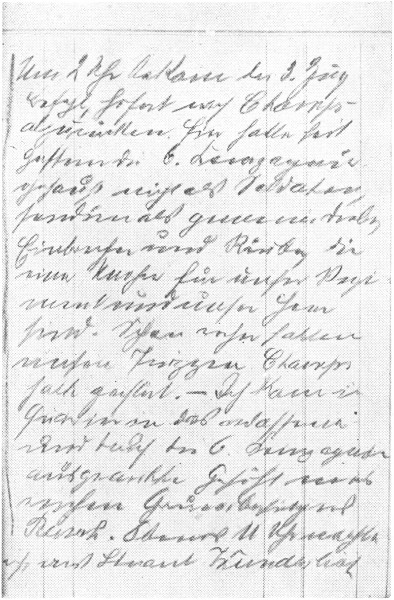 Plate 10.
And the third, Private Z ..., 12th Inf. Reserve (1 Corps
Reserves) writes
(Plate 11):
“Unfortunately,
I am obliged
to mention something
which
ought never to
have happened;
but there are even
in our army ruffians
who are no
longer men, swine
to whom nothing
is sacred.
One of them entered
a sacristy that
was locked, in
which was the
blessed sacrament.
Out of respect
a protestant
avoided sleeping
there; he polluted
the place with his
excrements. How
can there be such
beings! Last
night, a man of the
Landwehr, a man of thirty-five, and a married man, tried to rape
the daughter of a man in whose house he had been quartered,
she was a child; and as the father tried to interpose he kept
the point of his bayonet on the man’s breast.”[25]
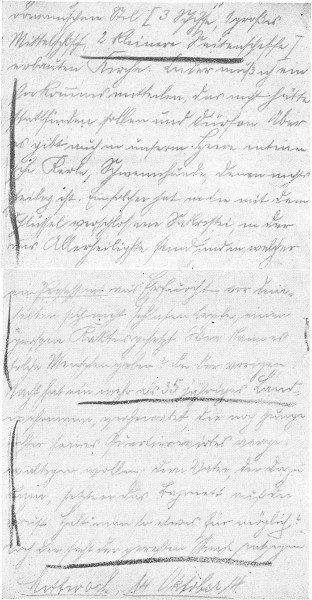 Plate 11.
With the exception of these soldiers, who are worthy of
the name, the thirty other writers are the same, and the same
soul, if the word be allowed, seems to animate them all,
uncontrolled and low. They are all alike, yet with some
shades of difference. There are some who make distinctions,
like subtle lawyers, sometimes blaming, sometimes disapproving:
“Dort war ein Exempel am Platze”. And there are
some who sneer: “Krieg ist Krieg”; or in French, by preference
to add to their scorn “Ja, ja, c’est la guerre”; and
there are some who having done their ugly work, open their
Hymn Book, and sing psalms: for instance the Saxon
officer Rieslang, who relates how one day he left a feast to
go to “Gottesdienst”, but was obliged to leave hurriedly,
having eaten and drunk too much; or again Private Moritz
Grosse of the 177th Inf. who after describing the sack of
St Vieth (22nd August) and that of Dinant (23rd August)
writes this sentence (Plate 12):
Throwing of bombs in the houses. In the evening, military
chorale: Nun danket alle Gott (Now, thank ye all God).[26]
They are all alike. Now, if we consider that I could
substitute for the preceding examples others similar and
no less cynical, taken for instance from the diary of the
reservist Lautenschlager, of the 1st Battalion of the 66th
Inf. Regt, or from the diary of Pte Eduard Hohl of the
VIII Corps, or from the diary of non-commissioned officer
Rheinhold Koehn, of the 2nd Battalion of Pomeranian Pioneers,
or from the diary of the non-commissioned officer
Otto Brandt of the 2nd section of the ambulance corps
(reserves) or from the diary of the Reservist Martin Muller,
of the 100th Saxon Reserves, or from the diary of Lt Karl
Zimmer, of the 55th Inf. or from the diary of Pte Erich
Pressler of the 100th Grenadiers, 1st Saxon Corps, etc.; and
if we notice, that among the extracts already given, there
are very few isolated cases of brutality (as can be and are
found, alas in the most noble minded of armies) and that I
have scarcely noted here any crime that was not done by
order, any crime that does not implicate and dishonour
not only the individual soldier, but the whole regiment,
the officer, the
very nation;
and if we consider
that these
thirty diaries,
whether they
be Bavarian or
Saxon, Baden
or Rhenish,
Pomeranian or
from Brandenburg,
taken haphazard
must
represent hundreds
and
thousands of
similar ones,
all of a fearful
monotony, we
shall be obliged
to allow, I
think, that,
M. René Viviani
in no way
overstated the
case when from
the French tribune
he spoke
of “this system
of collective
murder and pillage which Germany calls war”.
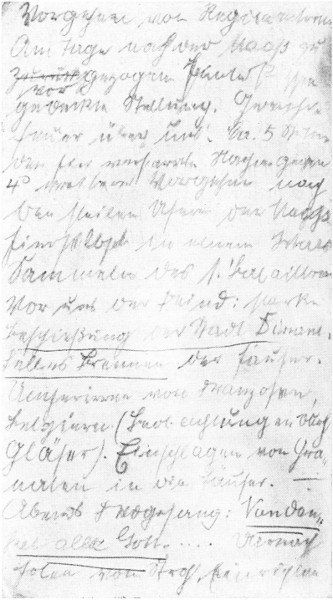 Plate 12.
H. M. the German Emperor, in ratifying the Hague Convention
of 1907 agreed (Article 23) “that it is forbidden ... (c)
to kill or wound an enemy, who having laid down his arms
and having no means of self-defence, gives himself up as a
prisoner; (d) to declare that no quarter will be given”.
Has the German Army respected these conventions? In
the French and Belgian reports, evidence is plentiful resembling
the following which comes from a Frenchman captain
in the 288th Infantry: “On the evening of the 22nd I
learnt that in the wood a hundred and fifty metres from the
cross-roads formed by the intersection of the great
trench at Calonne and the road from Vaux-lès-Palameix
to St Rémy there were some dead bodies of French soldiers
who had been shot by the Germans.
I went there, and saw some thirty soldiers in a small space,
for the most part lying down, some however on their knees
and all having the same kind of wound, a gun-shot in the ear.
Only one, very severely wounded was able to speak. He
told me the Germans had, before leaving, ordered them to
lie down, then had killed them by a shot through the head;
that he had been spared on telling them he was the father
of three small children. Their brainpans had been blown
some distance away, the guns broken at the stock were
scattered here and there, and the blood had so bespattered
the bushes that as I came out of the wood the front of
my cape was all smeared with blood; it was a real charnel-house.”
I have quoted this man’s testimony, not to rely on it as
evidence but merely to make clear the nature of my indictment;
as for justifying it I shall take care not to depart from
the rule I have laid down to resort to German sources of
information only.
Here is an order of the day given on the 26th August by
General Stenger commanding the 58th German Brigade to
his troops:
Von heute ab werden keine Gefangene mehr gemacht. Sämtliche
Gefangene werden niedergemacht. Verwundete ob mit
Waffen oder Wehrlos niedergemacht. Gefangene auch in grösseren
6 geschlossenen Formationen werden niedergemacht. Es
bleibe kein Feind lebend hinter uns.
Oberleutnant und Kompagnie-Chef Stoy; Oberst und Regiments-Kommandeur
Neubauer; General-Major und Brigade-Kommandeur
Stenger.
Translation. After to-day no more prisoners will be taken.
All prisoners are to be killed. Wounded, with or without arms,
are to be killed. Even prisoners already grouped in convoys are
to be killed. Let not a single living enemy remain behind us.
Some thirty soldiers of Stenger’s Brigade (112 and 142nd Regt
of the Baden Infantry), were examined in our prisoners
camps. I have read their evidence, which they gave upon
oath and signed. All confirm the statement that this order
of the day was given them on the 26th August, in one unit
by Major Mosebach, in another by Lt Curtius, etc.; the
majority did not know whether the order was carried out;
but three of them say they saw it done in the forest of
Thiaville, where ten or twelve wounded French soldiers
who had already been spared by a battalion were despatched;
two others saw the order carried out on the Thiaville
road, where some wounded found in a ditch by a company
were finished off.
No doubt, I cannot produce the autograph of General Stenger,
and it is not for me to communicate the names of the
German prisoners who gave this evidence. But I have no
difficulty in producing here German autographs in proof of
crimes precisely similar.
For example (Plate 13), here is an extract from Pte Albert
Delfosse’s diary (III Inf. Reserve, XIV Reserve Corps):
“In the forest of St Rémy, 4th or 5th September, saw a fine
cow and calf destroyed and once more corpses of Frenchmen,
frightfully mutilated.”[27]
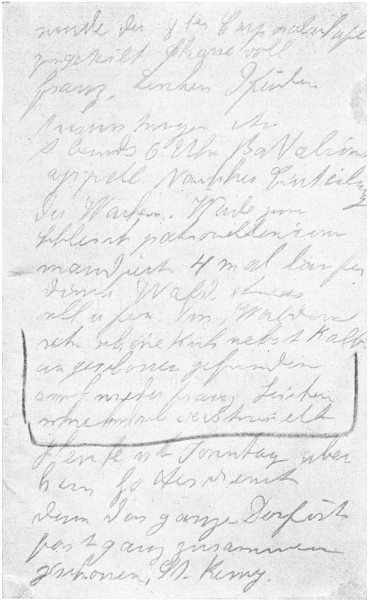 Plate 13.
Are we to understand from this that these dead bodies had
been mutilated in fair fight torn to pieces for example by
shells? It may be; but this would be a kindly interpretation
which the documents (Plates 14 and 15) disprove:
Here is a fac simile on a reduced scale from a newspaper
picked up in the German trenches, the Jauersches Tageblatt
of the 18th October 1914. Jauer is a town in Silesia,
about 50 kilometres west of Breslau; two battalions of the
154th regiment of the Saxon Infantry are stationed there.
One Sunday (Sonntag, den 18 Oktober) no doubt at the
hour when the inhabitants with their women and children
were going to church, this local newspaper was distributed
in the peaceful little town and in the hamlets and villages
of the district, bearing these headlines.
EIN TAG DER EHRE FÜR UNSER REGIMENT.
24 SEPTEMBER 1914.
(A day of honour for our Regiment.
24th September 1914.)
It is the title of an article of two hundred lines, sent
from the front by a soldier of the regiment. Non-commissioned-officer
Klemt. 1. Komp. Infanterie Regt 154.
Klemt tells how on the 24th of September his regiment
which had left Hannonville in the morning and supported
on the march by Austrian batteries was suddenly received
by a double fire from artillery and infantry. The losses
were enormous. And yet the enemy was invisible. At last,
however, it was seen that the firing came from above,
from trees where French soldiers were posted. From now
on I shall no longer summarise, but quote. (Plate 16).
We brought them down like squirrels, and gave them a warm
reception, with blows of the butt and the bayonet: they no
longer need doctors; we are no longer fighting loyal enemies,
but treacherous brigands.[28]
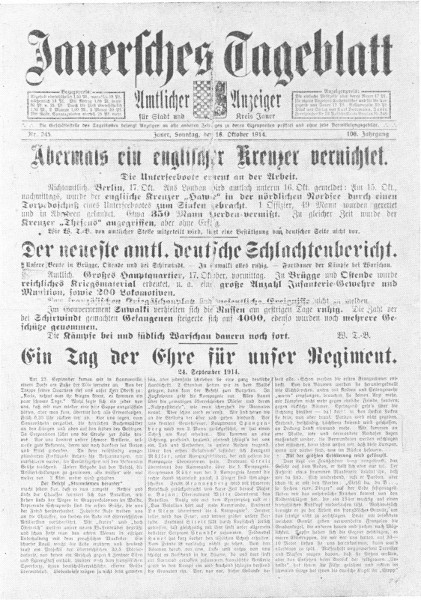 Plate 14.
“By leaps and bounds we got across the clearing. They
were here, there, and everywhere hidden in the thicket. Now it
is down with the enemy! And we will give them no quarter.
Every one shoots standing, a few, a very few fire kneeling. No
one tries to take shelter. We reach a little depression in the
ground: here the red trousers dead or wounded lie on a heap
ground. We knock ‘down’ or bayonet the wounded, for we
know that those scoundrels fire at our backs when we have gone
by. There was a Frenchman there stretched out, full length, face
down, pretending to be dead. A kick from a strong fusilier
soon taught him that we were there. Turning round, he asked
for quarter, but we answered: “Is that the way your tools work,
you,—” and he was nailed to the ground. Close to me I heard
odd cracking sounds. They were blows from a gun on the bald
head of a Frenchman which a private of the 154th was dealing
out vigorously; he was wisely using a French gun so as not
to break his own. Tenderhearted souls are so kind to the
French wounded that they finish them with a bullet, but others
give them as many thrusts and blows as they can.
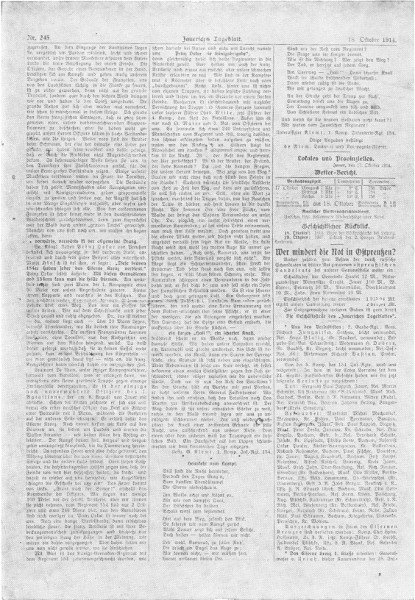 Plate 15.
“Our adversaries had fought bravely, we had to contend
with picked men; they let us get within thirty, even ten metres
of them—too near. Sacks and arms thrown away in quantities
showed that they had try to run, but at the sight of the
“grey phantoms” fear paralyzed them, and on the narrow
path they had to take, German bullets brought them the word
of command, Halt. At the entry into the screen of branches,
there they lay groaning and crying for quarter. But whether
wounded slightly or severely, the brave fusiliers spare their
country the cost of caring for many enemies.”
The narrative goes on, full of literary ornaments. The
writer reports that H. R. H. Prince Oscar of Prussia who
had been told of these brave deeds (perhaps too of others)
of the 154th regiment, and of the regiment of grenadiers
who were brigaded with the 154th declared that they were
both worthy of the name of Königsbrigade, and ends up
with this sentence “When evening came, after a prayer of
thanksgiving we fell asleep in the expectation of the morrow”.
Then the author having added as a postscript a
few more touches in verse takes his composition to his
lieutenant, who affixes his seal thereupon.
Certified to be exact
De Niem, Leutnant und Kompagnie-Führer.
Then he addresses his article to the town of Jauer,
where he is sure that an editor will accept it, compositors
will print it, and an entire population will delight
in it.
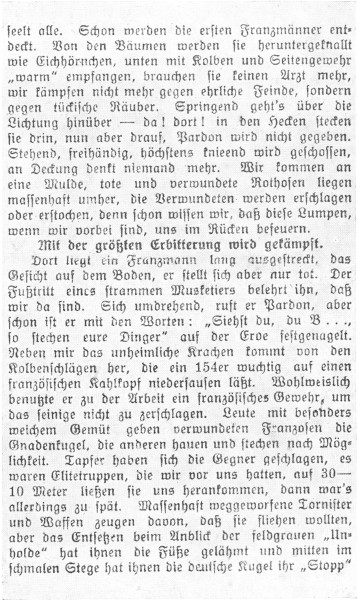 Plate 16.
Now, I ask my reader, no matter of what nationality:
can he imagine such an article being printed in his own
language, in the town in which he lives, and read by his
wife and children? In what country, except Germany is
such a thing conceivable? Not in France, at least.
Here is still one further convincing proof of how usual it
is for the German army to mutilate the wounded. It is
taken (Plates 17 and 18) from the diary of Pte Paul Glöde,
of the 9th Battalion of the Pioneers (IX Corps):
“12th August 1914. In Belgium.—It is easy to imagine the
state of fury of our soldiers, when you see the villages that
have been destroyed. There is not one house left undamaged.
All eatables are requisitioned by the soldiers no longer commanded.
We have seen heaps of dead men and women who
had been executed after trial. But the righteous anger
of our soldiers goes hand in hand with sheer vandalism. In
some villages which had already been deserted they “set up
the red cock” on all the houses (burnt them). The inhabitants
sadden me. If they use disloyal weapons, after all they are but
defending their country. The atrocities that these civilians
have been and are guilty of are avenged in a savage manner.
Mutilation of the wounded is the order of the day.”[29]
This was written on the 12th of August, only eight days
after innocent Belgium had been invaded, and the wounded
who were tortured were only defending, against Germany
that land, their native land which Germany had sworn to
respect and if necessary to defend. But in many a country,
the Pharisees who having read these lines will calmly
go to their churches or Chapels, their bank-parlours or
their chancelleries murmuring: “In what way do these
things concern me? Ja, Ja, it is war”.
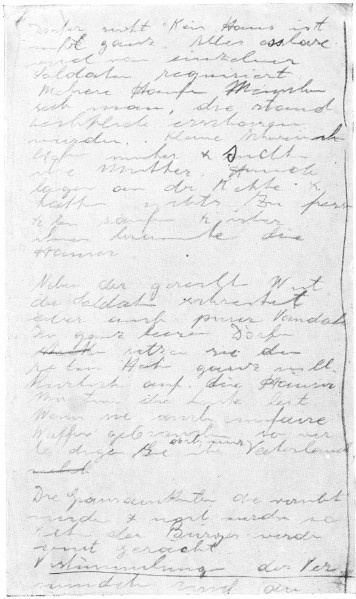 Plate 17.
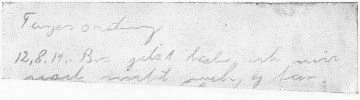 Plate 18.
Yes, it is war, but a war such as was never waged by the
soldiers of Marceau, nor ever will be waged by the soldiers
of Joffre, such as never has been nor ever will be waged
by France, “mother of the arts, of arms and of law”.
Yes, it is war, but such as even Attila would not have waged,
had he agreed to certain engagements, for, to agree to them
would have been to awake to the conception which alone
distinguishes the civilized man from the barbarian—the
nation from the horde—the respect of the given word.—Yes,
it is war, but a war whose insolent principles could
be constructed only by pedantic megalomaniacs, the Julius
von Hartmanns, the Bernhardis, the Treitschkes; principles
that presume to authorize the people elect to blot
out from the laws and customs of war all the humanity
that centuries of Christianity and chivalry have with difficulty
introduced; principles of systematic ferocity, the
odious side of which is already obvious enough; but still
more the senseless and ridiculous side. Is it not indeed
ridiculous that they should be already obliged to deny it
at least in words,—they the burners of Louvain,
Malines and Reims, they the assassins of women, children,
and wounded men! and that they should have imposed
upon their slavish ninety-three Kulturträger the denials
which we know so well: “It is not true, say they,
that we wage war contrary to the laws of nations, and
our soldiers do not commit acts of indiscipline or cruelty[30]”,
and again: “We will carry on this war to the bitter end
as a civilised people, for this we will answer in our name
and on our honour”. Why this pitiful and humble denial?
Perhaps because their theory of war presupposes as a postulate
their invincibility, and as at the first shudder of their
defeat on the Marne it collapsed, they now repudiate it at
the first threat of retaliations.
I shall draw no conclusion: the allied armies who are
marching on towards victory will do that.
General Stenger’s order of the day, mentioned on page 29
was communicated orally by various officers in various
units of the brigade. Consequently the form in which we
have received it may possibly be incomplete or altered.
In face of any doubt, the French government has ordered an
enquiry to be made in the prisoners’ Camps. Not one
of the prisoners to whom our magistrates presented the
order of the day in the above mentioned form found a
word to alter. They one and all declared that this was the
order of the day which had been orally given in the
ranks, repeated from man to man; many added the names
of the officers who had communicated the order to them;
some related in what a vile way it had been carried out
under their eyes. All the evidence of these German soldiers
was collected in a legal manner, under the sanction of an
oath, and it is after reading their depositions that I wrote
the order of the day.
The text of all this evidence was transmitted to all
the French embassies and legations in foreign countries on
the 24th of Oct. 1914. Every neutral wishing to clear his
conscience is at liberty to obtain it from the representatives
of the French Republic who will certainly respond
willingly.
Imp. de Vaugirard, H.-L. Motti, dir., 12-13, Impasse Ronsin, Paris.