THE RAINBOW GAME
WITH her arm stiff and cramped from being
held so long in one position, Georgina waked
suddenly and looked around her in bewilderment.
Uncle Darcy was in the room, saying something
about her riding home in the machine. He didn't
want to hurry her off, but Mr. Milford was waiting
at the gate, and it would save her a long walk
home——
While he talked he was leaning over Aunt Elspeth,
patting her cheek, and she was clinging to his hand
and smiling up at him as if he had just been restored
to her after a long, long absence, instead of a separation
of only a few hours. And he looked so glad
about something, as if the nicest thing in the world
had happened, that Georgina rubbed her eyes and
stared at him, wondering what it could have been.
Evidently, it was the honk of the horn which had
aroused Georgina, and when it sounded again she
sprang up, still confused by the suddenness of her
awakening, with only one thing clear in her mind, the
necessity for haste. She snatched her prism from
the window and caught up her hat as she ran through
the next room, but not until she was half-way home
did she remember that she had said nothing about
the eggs and had asked no questions about the trip
to Brewster. She had not even said good-bye.
Mr. Milford nodded pleasantly when she went
out to the car, saying, "Hop in, kiddie," but he did
not turn around after they started and she did not
feel well enough acquainted with him to shout out
questions behind his back. Besides, after they had
gone a couple of blocks he began explaining something
to Richard, who was sitting up in front of
him, about the workings of the car, and kept on explaining
all the rest of the way home. She couldn't
interrupt.
Not until she climbed out in front of her own gate
with a shy "Thank you, Mr. Milford, for bringing
me home," did she find courage and opportunity to
ask the question she longed to know.
"Did you find the woman? Was it her pouch?"
Mr. Milford was leaning forward in his seat to
examine something that had to do with the shifting
of the gears, and he answered while he investigated,
without looking up.
"Yes, but she couldn't remember where the letter
was from, so we're not much wiser than we were before,
except that we know for a certainty that Dan
was alive and well less than two months ago. At
least Uncle Dan'l believes it is Dan. The woman
calls him Dave, but Uncle Dan'l vows they're one
and the same."
Having adjusted the difficulty, Mr. Milford, with
a good-bye nod to Georgina, started on down the
street again. Georgina stood looking after the rapidly
disappearing car.
"Well, no wonder Uncle Darcy looked so happy,"
she thought, recalling his radiant face. "It was
knowing that Danny is alive and well that made it
shine so. I wish I'd been along. Wish I could have
heard every thing each one of them said. I could
have remembered every single word to tell Richard,
but he won't remember even half to tell me."
It was in the pursuit of all the information which
could be pumped out of Richard that Georgina
sought the Green Stairs soon after breakfast next
morning. Incidentally, she was on her way to a
nearby grocery and had been told to hurry. She
ran all the way down in order to gain a few extra
moments in which to loiter. As usual at this time
of morning, Richard was romping over the terraces
with Captain Kidd.
"Hi, Georgina," he called, as he spied her coming.
"I've got a new game. A new way to play
tag. Look."
Plunging down the steps he held out for her inspection
a crystal paperweight which he had picked
up from the library table. Its round surface had been
cut into many facets, as a diamond is cut to make it
flash the light, and the spots of color it threw as he
turned it in the sun were rainbow-hued.
"See," he explained. "Instead of tagging Captain
Kidd with my hand I touch him with a rainbow,
and it's lots harder to do because you can't always
make it light where you want it to go, or where you
think it is going to fall. I've only tagged him twice
so far in all the time I've been trying, because he
bobs around so fast. Come on, I'll get you before
you tag me," he added, seeing that her prism hung
from the ribbon on her neck.
She did not wear it every day, but she had felt an
especial need for its comforting this morning, and
had put it on as she slowly dressed. The difficulty
of restoring the eggs loomed up in front of her as a
real trouble, and she needed this to remind her to
keep on hoping that some way would soon turn up
to end it.
It was a fascinating game. Such tags are elusive,
uncertain things. The pursuer can never be certain
of touching the pursued. Georgina entered into it,
alert and glowing, darting this way and that to escape
being touched by the spots of vivid color. Her
prism threw it in bars, Richard's in tiny squares and
triangles.
"Let's make them fight!" Richard exclaimed in
the midst of it, and for a few moments the color
spots flashed across each other like flocks of darting
birds. Suddenly Georgina stopped, saying:
"Oh, I forgot. I'm on my way to the grocery, and
I must hurry back. But I wanted to ask you two
things. One was, tell me all about what the woman
said yesterday, and the other was, think of some way
for me to earn twenty cents. There isn't time to
hear about the first one now, but think right quick
and answer the second question."
She started down the street, skipping backwards
slowly, and Richard walked after her.
"Aw, I don't know," he answered in a vague way.
"At home when we wanted to make money we always
gave a show and charged a penny to get in, or
we kept a lemonade stand; but we don't know enough
kids here to make that pay."
Then he looked out over the water and made a
suggestion at random. A boy going along the beach
towards one of the summer cottages with a pail in
his hand, made him think of it.
"Pick blueberries and sell them."
"I thought of that," answered Georgina, still
progressing towards the grocery backward. "And
it would be a good time now to slip away while Tippy's
busy with the Bazaar. This is the third day.
But they've done so well they're going to keep on with
it another day, and they've thought up a lot of new
things to-morrow to draw a crowd. One of them
is a kind of talking tableau. I'm to be in it, so it
wouldn't do for me to go and get my hands all stained
with berries when I'm to be dressed up as a part of
the show for the whole town to come and take a look
at me."
Richard had no more suggestions to offer, so with
one more flash of the prism and a cry of "last tag,"
Georgina turned and started on a run to the grocery.
Richard and the paperweight followed in hot pursuit.
Up at one of the front windows of the bungalow,
two interested spectators had been watching the game
below. One was Richard's father, the other was a
new guest of Mr. Milford's who had arrived only
the night before. He was the Mr. Locke who was
to take Richard and his father and Cousin James
away on his yacht next morning. He was also a
famous illustrator of juvenile books, and he sometimes
wrote the rhymes and fairy tales himself which
he illustrated. Everybody in this town of artists who
knew anything at all of the world of books and pictures
outside, knew of Milford Norris Locke. Now
as he watched the graceful passes of the two children
darting back and forth on the board-walk below, he
asked:
"Who's the little girl, Moreland? She's the child
of my dreams—the very one I've been hunting for
weeks. She has not only the sparkle and spirit that
I want to put into those pictures I was telling you
about, but the grace and the curls and the mischievous
eyes as well. Reckon I could get her to pose for
me?"
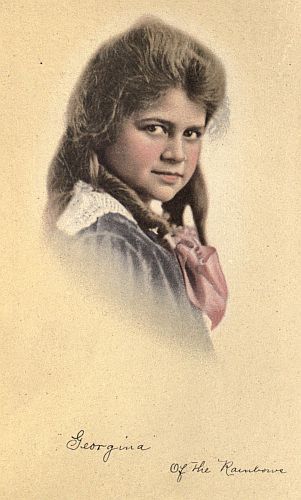
That is how it came about that Georgina found
Richard's father waiting for her at the foot of the
Green Stairs when she came running back from the
grocery. When she went home a few minutes later,
she carried with her something more than the cake
of sweet chocolate that Tippy had sent her for in
such a hurry. It was the flattering knowledge that
a famous illustrator had asked to make a sketch of
her which would be published in a book if it turned
out to be a good one.
With a sailing party and a studio reception and
several other engagements to fill up his one day in
Provincetown, Mr. Locke could give only a part of
the morning to the sketches, and wanted to begin as
soon as possible. So a few minutes after Georgina
went dancing in with the news, he followed in Mr.
Milford's machine. He arrived so soon after, in
fact, that Tippy had to receive him just as she was
in her gingham house dress and apron.
After looking all over the place he took Georgina
down to the garden and posed her on a stone
bench near the sun-dial, at the end of a tall, bright
aisle of hollyhocks. There was no time to waste.
"We'll pretend you're sitting on the stone rim of
a great fountain in the King's garden," he said.
"You're trying to find some trace of the beautiful
Princess who has been bewitched and carried away
to a castle under the sea, that had 'a ceiling of
amber, a pavement of pearl.'"
Georgina looked up, delighted that he had used
a line from a poem she loved. It made her feel as
if he were an old friend.
"This is for a fairy tale that has just begun to
hatch itself out in my mind, so you see it isn't all
quite clear yet. There'll be lily pads in the fountain.
Maybe you can hear what they are saying, or maybe
the gold-fish will bring you a message, because you
are a little mortal who has such a kind heart that
you have been given the power to understand the
speech of everything which creeps or swims or flies."
Georgina leaned over and looked into the imaginary
fountain dubiously, forgetting in her interest
of the moment that her companion was the great Milford
Norris Locke. She was entering with him into
the spirit of his game of "pretend" as if he were
Richard.
"No, I'll tell you," she suggested. "Have it a
frog instead of a fish that brings the message. He
can jump right out of that lily pad on to the edge
of the fountain where I am sitting, and then when
you look at the picture you can see us talking together.
No one could tell what I was doing if they
saw me just looking down into the fountain, but they
could tell right away if the frog was here and I was
shaking my finger at him as if I were saying:
"'Now tell me the truth, Mr. Frog, or the Ogre
of the Oozy Marsh shall eat you ere the day be
done.'"
"Don't move. Don't move!" called Mr. Locke,
excitedly. "Ah, that's perfect. That's exactly what
I want. Hold that pose for a moment or two. Why,
Georgina, you've given me exactly what I wanted and
a splendid idea besides. It will give the fairy tale an
entirely new turn. If you can only hold that position
a bit longer, then you may rest."
His pencil flew with magical rapidity and as he
sketched he kept on talking in order to hold the look
of intense interest which showed in her glowing
face.
"I dearly love stories like that," sighed Georgina
when he came to the end and told her to lean back
and rest a while.
"Barby—I mean my mother—and I act them all
the time, and sometimes we make them up ourselves."
"Maybe you'll write them when you grow up,"
suggested Mr. Locke not losing a moment, but
sketching her in the position she had taken of her
own accord.
"Maybe I shall," exclaimed Georgina, thrilled
by the thought. "My grandfather Shirley said I
could write for his paper some day. You know he's
an editor, down in Kentucky. I'd like to be the editor
of a magazine that children would adore the way
I do the St. Nicholas."
Tippy would have said that Georgina was "running
on." But Mr. Locke did not think so. Children
always opened their hearts to him. He held the
magic key. Georgina found it easier to tell him her
inmost feelings than anybody else in the world but
Barby.
"That's a beautiful game you and Dicky were
playing this morning," he remarked presently, "tagging
each other with rainbows. I believe I'll put it
into this fairy tale, have the water-nixies do it as
they slide over the water-fall."
"But it isn't half as nice as the game we play in
earnest," she assured him. "In our Rainbow Club
we have a sort of game of tag. We tag a person
with a good time, or some kindness to make them
happy, and we pretend that makes a little rainbow
in the world. Do you think it does?"
"It makes a very real one, I am sure," was the
serious answer. "Have you many members?"
"Just Richard and me and the bank president, Mr.
Gates, so far, but—but you can belong—if you'd
like to."
She hesitated a trifle over the last part of her invitation,
having just remembered what a famous
man she was talking to. He might think she was
taking a liberty even to suggest that he might care
to belong.
"I'd like it very much," he assured her gravely,
"if you think I can live up to the requirements."
"Oh, you already have," she cried. "Think of all
the happy hours you have made for people with
your books and pictures—just swarms and bevies
and flocks of rainbows! We would have put you on
the list of honorary members anyhow. Those are
the members who don't know they are members,"
she explained. "They're just like the prisms themselves.
Prisms don't know they are prisms but everybody
who looks at them sees the beautiful places they
make in the world."
"Georgina," he said solemnly, "that is the very
loveliest thing that was ever said to me in all my
life. Make me club member number four and I'll
play the game to my very best ability. I'll try to do
some tagging really worth while."
He had been sketching constantly all the time he
talked, and now, impelled by curiosity, Georgina got
up from the stone bench and walked over to take
a look at his work. He had laid aside the several
outline studies he had made of her, and was now
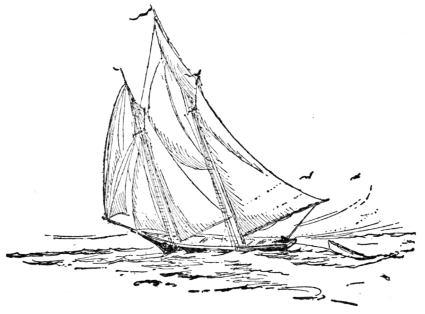
exercising his imagination in sketching a ship.
"This is to be the one that brings the Princess
home, and in a minute I want you to pose for the
Princess, for she is to have curls, long, golden ones,
and she is to hold her head as you did a few moments
ago when you were talking about looking off to
sea."
Georgina brought her hands together in a quick
gesture as she said imploringly, "Oh, do put Hope at
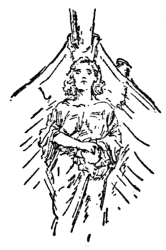
the prow. Every time I pass the Figurehead House
and see Hope sitting up on the portico roof I wish I
could see how she looked when she was riding the
waves on the prow of a gallant vessel. That's where
she ought to be, I heard a man say. He said Hope
squatting on a portico roof may look ridiculous, but
Hope breasting the billows is superb."
Mr. Locke was no stranger in the town. He knew
the story of the figurehead as the townspeople knew
it, now he heard its message as Uncle Darcy knew it.
He listened as intently to Georgina as she had listened
to him. At the end he lifted his head, peering
fixedly through half-closed eyes at nothing.
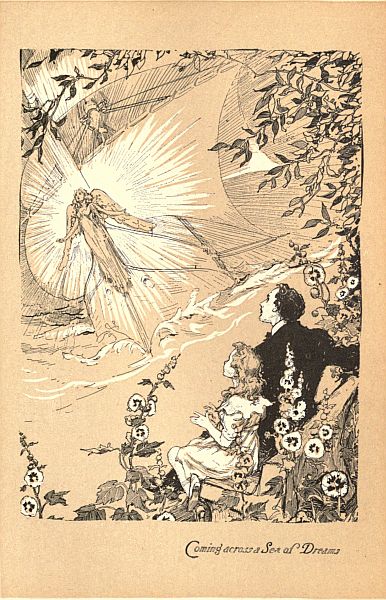
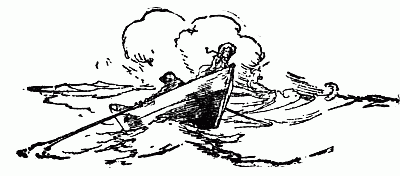
"You have made me see the most beautiful ship,"
he said, musingly. "It is a silver shallop coming
across a sea of Dreams, its silken sails set wide, and
at the prow is an angel. 'White-handed Hope, thou
hovering angel girt with golden wings,'" he quoted.
"Yes, I'll make it with golden wings sweeping back
over the sides this way. See?"
His pencil flew over the paper again, showing her
in a few swift strokes an outline of the vision she
had given him.
And now Tippy would have said not only that
Georgina was "running on," but that she was "wound
up," for with such a sympathetic and appreciative
listener, she told him the many things she would have
taken to Barby had she been at home. Especially,
she talked about her difficulties in living up to the
aim of the club. In stories there are always poor
people whom one can benefit; patient sufferers at
hospitals, pallid children of the slums. But in the
range of Georgina's life there seemed to be so few
opportunities and those few did not always turn out
the way they should.
For instance, there was the time she tried to cheer
Tippy up with her "line to live by," and her efforts
were neither appreciated nor understood. And there
was the time only yesterday when she stayed with
Aunt Elspeth, and got into trouble with the eggs, and
now had a debt on her conscience equal to eight eggs
or twenty cents.
It showed how well Mr. Locke understood children
when he did not laugh over the recital of that
last calamity, although it sounded unspeakably funny
to him as Georgina told it. In such congenial company
the time flew so fast that Georgina was amazed
when Mr. Milford drove up to take his distinguished
guest away. Mr. Locke took with him what he
had hoped to get, a number of sketches to fill in at his
leisure.
"They're exactly what I wanted," he assured her
gratefully as he shook hands at parting. "And that
suggestion of yours for the ship will make the most
fetching illustration of all. I'll send you a copy in
oils when I get time for it, and I'll always think of
you, my little friend, as Georgina of the Rainbows."
With a courtly bow he was gone, and Georgina
went into the house to look for the little blank book
in which she had started to keep her two lists of
Club members, honorary and real. The name of
Milford Norris Locke she wrote in both lists. If
there had been a third list, she would have written
him down in that as the very nicest gentleman she had
ever met. Then she began a letter to Barby, telling
all about her wonderful morning. But it seemed to
her she had barely begun, when Mr. Milford's chauffeur
came driving back with something for her in a
paper bag. When she peeped inside she was so astonished
she nearly dropped it.
"Eggs!" she exclaimed. Then in unconscious imitation
of Mrs. Saggs, she added, "Can you beat
that!"
One by one she took them out and counted them.
There were exactly eight. Then she read the card
which had dropped down to the bottom of the bag.
"Mr. Milford Norris Locke."
Above the name was a tiny rainbow done in water
colors, and below was scribbled the words, "Last
tag."
It was a pity that the new member could not
have seen her face at that instant, its expression was
so eloquent of surprise, of pleasure and of relief that
her trouble had thus been wiped out of existence.
 "At the Tip of Old Cape Cod."