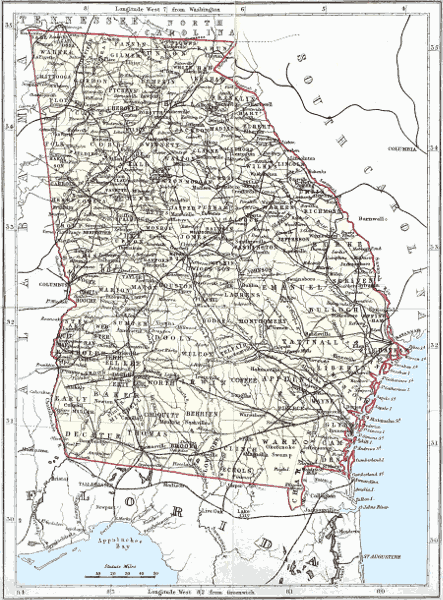
Georgia, one of the thirteen original States
of the American Union, has Tennessee and
North Carolina on the N., South Carolina and
the Atlantic Ocean on the E., Florida S., and
Alabama W. The Savannah river separates
the State on the E. from South Carolina; the
St. Mary’s, on the S., divides it in part from
Florida; the Chattahoochee, on the W., flows
between Georgia and Alabama for nearly half
its course. Georgia lies between 30° 21′ 39″
and 35° N. lat., and between 81° and 85° 53′
38″ W. long. It is 320 miles long from N. to
S., and 256 miles in its greatest breadth from
E. to W., with an area of 58,000 square miles.
Surface.—Georgia has three distinctly marked
zones, varying in soil, climate, and productions.
Her sea-coast is similar to that of the Carolinas,
being skirted by fertile islands, separated from
the mainland by narrow lagoons or by sounds.
This section is essentially tropical. Beginning
at the sea-coast, a gradually ascending sandy
plain extends northward and westward as far
as the head of navigation on the Savannah,
Ogeechee, Oconee, and Ocmulgee rivers, where
it meets a Primary formation. Augusta, Milledgeville,
and Macon indicate the northern
limit of this tract. Here begins the hilly and
finally mountainous region, the most extensive,
fertile, and salubrious of the State. A second
plateau, 60 or 70 miles broad, stretches above
the falls of the rivers until it meets the southernmost
ranges of the great Appalachian chain of
mountains which traverses Virginia, North
Carolina, and northern Georgia under the name
of the Blue Ridge, and is finally lost in Alabama.
This picturesque district extends in Georgia
from Rabun county in the north-east corner of
the State to Dade in the extreme north-west,
where the summit of Lookout Mountain dominates
the valley of the Tennessee. Here are
the sources of the two principal rivers of the
State; here is the gold-producing region; and
here is also the theatre of some of the most sanguinary
battles of the civil war. The elevations
of the Blue Ridge vary from 1,200 to 4,000
feet. In the south-east of the State is the extensive
Okefinokee swamp, which has an estimated
circumference of 180 miles, is filled with
pools and islands, and is the congenial home of
alligators, lizards, and other reptiles.
Rivers and Harbors.—There are many fine
rivers in Georgia. A north and south line passing
through Macon would nearly divide the
streams flowing into the Atlantic from those
discharging into the Gulf of Mexico. The Savannah,
Ogeechee, Altamaha, Santilla, and St.
Mary’s fall into the Atlantic, and the Chattahoochee,
Flint, and tributaries of the Suwanee
flow to the Gulf coast. The rivers are generally
navigable for steamboats to the falls which occur
on the great central plateau of the State—that
is to say, the Savannah to Augusta, the
Oconee and Ocmulgee (confluents of the Altamaha)
to Milledgeville and Macon, and the
Chattahoochee to Columbus. Besides their ordinary
purposes as avenues of travel and commerce,
her rivers have given to Georgia the
character of a manufacturing State, and she is
developing and increasing their abundant water-powers
with energy and success.
The Savannah is formed of two small streams which
rise near the North Carolina line, and unite on the boundary
between S. Carolina and Georgia in Hart county.
Flowing thence in a nearly S.S.E. direction for 450 miles,
it enters the Atlantic near 32° N. lat. The Savannah is
navigable from November to June. Ships ascend it 18
miles to the city of Savannah, steamboats to Augusta,
230 miles, and by means of a canal around the falls there,
constructed in 1845, light draught vessels navigate it 150
miles higher. This canal, 9 miles long, furnishes the
water-power of Augusta. The river is here about 300
yards wide. From Augusta the traveller descends the
Savannah through the cotton-fields of the table-lands,
and the long reaches of semi-tropical vegetation dominated
by groves of live oak, to the rich rice plantations
of the seaboard.
The Chattahoochee is one of the largest and most interesting
rivers of Georgia. It rises on the declivity of
the Blue Ridge, in Habersham county, in the N.E. of
the State, pursues a devious S.W. course through the
gold region of upper Georgia until it reaches West
Point, on the Alabama frontier. It then flows nearly
south to the Florida State line, where it is joined by the
Flint, when the two streams flow on through Florida to
the Gulf under the name of the Appalachicola. Large
steamboats ascend the Chattahoochee in the season of
navigation to Columbus, 350 miles from the Gulf. The
whole estimated length of the river is 550 miles. The
falls at Columbus create a valuable water-power, constituting
that city one of the three important manufacturing
centres of the State. Just above Columbus the
Chattahoochee is broken in picturesque rapids, overlooked
by a rocky cliff called the “Lover’s Leap,” which
is the subject of an interesting legend. Besides Columbus,
the towns of West Point and Fort Gaines are the
most important on the Chattahoochee in Georgia; Appalachicola
at its embouchure on the Gulf is its shipping
and distributing port, but is decreasing in importance
since the railway system of the State has assumed a large
share of the traffic once confined to the navigable
streams.
The Oconee and Ocmulgee rise near each other, in
the N. of the State, flow through its centre to within 100
miles of the sea, when their united streams pass on S.
E. to the Atlantic under the name of the Altamaha.
Milledgeville, the former capital of Georgia, is on the
Oconee, and Macon on the Ocmulgee. Darien on the
Altamaha is reached by vessels drawing 11 to 14 feet of
water. The Ogeechee, rising also in the north, is about
200 miles long. It drains the country between the Savannah
and Altamaha, entering the Atlantic a few miles south
of the Savannah. The Ogeechee is navigable for light
vessels 30 or 40 miles, and for keel-boats to Louisville.
The Santilla and St. Mary’s drain the south-eastern
counties, and are each navigable 30 or 40 miles for
sloops. The Flint, Ockloconee, and Suwanee drain the
south-western counties; the Flint is navigable to Albany,
250 miles from the Gulf, for steamboats. The Tallapoosa
and Coosa, head-waters of the Alabama, and the
Hiawassee, one of the sources of the Tennessee, rise in
the mountains of Georgia—the last, however, finding its
way to the Gulf of Mexico by the Ohio and Mississippi
valleys.
Georgia has about 128 miles of sea-coast, but
has few good harbors, except within the rivers
emptying upon it. St. Mary’s, Brunswick,
Darien, and Savannah are the principal. The
chain of islands lying off the mainland produces
the celebrated Sea-island cotton, but owing to
the changes brought about by the secession war
it is now little cultivated. These islands are
flat, and generally little elevated above the sea.
Cumberland island, one of the most attractive,
is nearly 30 miles long. It is covered with
magnificent forests of oak, and its shores are
skirted with palms, palmettos, and tropical
shrubbery. Other islands from S. to N. are
Jykill, St. Simon’s, Sapello, St. Catharine’s, Ossabaw,
and Cabbage. The Sea Islands, with
the main shore, constitute a coast of 480 miles.
St. Andrew’s, St. Simon’s, Altamaha, Doboy,
Sapello, St. Catharine’s, and Ossabaw are the
principal sounds.
Climate, Soil, and Productions.—The central
and southern portions of Georgia, including the
seaboard, are subject to excessive heats in summer.
At Savannah, observations show the mean
temperature for July to have sometimes reached
99° Fahr. In the northern district of the State
the same season is cooler and less enervating.
Indeed, the mountain region is becoming noted
for its genial and healthful climate, and is attracting
invalids and pleasure-seekers from all
parts of the Union. In the low marshy lands
lying contiguous to or upon the coast, malarious
fevers prevail in spring and summer. The belt
of country stretching from Augusta across the
State to Columbus, having a width of from 30
to 60 miles, is pronounced a very healthy district.
At Augusta the mean summer temperature
is about 79°, the winter 47°. At Atlanta
careful observations give the average of summer
heat as 75°, and winter 45°. Diseases of the respiratory
organs are rare among natives of
northern and central Georgia. The interior is
comparatively free from the dreaded epidemics
cholera and yellow fever, but Savannah and the
coast are periodically scourged by them.
There is in Georgia as great diversity of soil
as of climate. Beginning with the Sea Islands,
which are composed of a sandy alluvium, intermixed
with decomposed coral, we pass from
the rich alluvions near the coast, in which the
great rice plantations are, to the thinner soil of
the Pine Belt, sometimes inaptly denominated
Pine Barrens. These are at present valuable
for their timber and naval stores, but are susceptible
of cultivation. The middle region consists
of a red loam, once productive, but from
long cultivation impoverished. With the aid of
fertilizers it produces cotton, tobacco, and the
cereals. We now reach the so-called Cherokee
country of the north, containing lands among
the most fertile in the State, lands which, notwithstanding
their tillage from an unknown
period by the aboriginal inhabitants, grow
wheat, corn, Irish potatoes, peas, beans, etc.,
abundantly. Cotton may also be successfully
cultivated, but with less advantage than in
other districts of the State. This fibre is chiefly
produced along the fertile bottom lands or contiguous
uplands of the rivers. The same lands
yield rice, Indian corn, and sugar. Middle and
southwest Georgia are the most productive
cotton areas. In the south-west the soil, though
light and sandy, produces cotton. In southern
Georgia there are millions of acres of magnificent
yellow pine forests of great value for house
or ship-building, and in these forests turpentine
plantations have been opened. The live-oak,
also valuable for ship-building purposes, abounds
in the south-east of the State. The swamps
afford cedar and cypress, the central region oak
and hickory. Walnut, chestnut, ash, gum,
magnolia, poplar, sycamore, beech, elm, maple,
fir, and spruce trees are found in different localities;
but in the older settled districts the original
forests have disappeared.
It is frequently said that there is nothing
grown in any of the States except Florida that
Georgia cannot profitably produce. A few of
the tropical fruits of Florida cannot be raised in
Georgia, but all those of the temperate zone
succeed well. Tobacco may be grown in any
part of the State, although it is not extensively
cultivated for export. Cotton is the great
crop of Georgia. She ranks third among the
eight cotton States, having exported or consumed
in her own manufactures, for the year
ending September, 1878, 604,676 bales, worth
at the point of export $30,000,000. Of this
crop 3,608 bales is classed as Sea-island.
Her crop for 1877 was 491,800 bales. The
counties of Burke, Dougherty, Lee, Monroe,
Stewart, Sumter, and Washington yield 25 per
cent. of the whole product of the State.
The emancipation of the slaves in the Southern
States has naturally produced great and important
changes in the labor system of that section.
The planter must now purchase the labor
he formerly owned. The black is free to
dispose of his labor to the best advantage. The
contracts for labor are of three kinds,—for money
wages by the month or year, for a share of
the crop, or for specific rent in money or products.
The first has been practised to a limited
extent by the best and most prosperous planters.
The share system has been the one generally
adopted, because the blacks greatly affected
quasi-proprietorship of the soil, and because
the owners were inexperienced in the
management of free labor, and not inclined to
come personally in contact with it. The share
varies in different localities, but usually one-third
to half the crop goes to the laborers, the
landlords furnishing the necessary tools. The
readjustment of labor in the South is watched
with the keenest interest in other sections of the
Union as one of the difficult problems growing
out of the suddenly changed relation between
white and black; and though some traces of his
original servitude remain a cause of irritation
between North and South, the agreement between
the enfranchised black and his late master
is likely to be harmonious, where each is so dependent
on the other as is the case in the cotton-growing
States of the Union.
Statistics.—A carefully tabulated statement shows
that, in addition to her cotton crop, Georgia produced,
in 1876, 23,629,000 bushels of Indian corn, valued at
$14,172,000; 2,840,000 bushels of wheat, worth $3,805,600;
5,700,000 bushels of oats, worth $3,876,000; and
23,600 tons of hay, worth $347,628. To these principal
crops should be added the timber and naval stores exported
from Atlantic outports. In January, 1877, there
were in Georgia 118,300 horses, 404,900 oxen and other
cattle, 96,200 mules, 270,400 milch cows, 378,600 sheep,
and 1,483,100 swine, having a total valuation of $30,815,117.
The State is admirably adapted for stock-raising,
but, as cotton culture offers the quickest returns, it has
hitherto engrossed the attention of planters and farmers.
The grain and root crops are largely cultivated for the
support of the agricultural population.
The rice crop of Georgia in 1870 was 22,277,380 ℔;
tobacco, 288,596 ℔; molasses, 553,192 gals.; wine, 21,927
gals.; sugar, 644 hhds; sweet potatoes, 2,621,562 bush.;
Irish potatoes, 197,101 bush.; butter, 4,499,572 ℔; honey,
610,877 ℔; wool, 846,947 ℔, increased in 1878 to about
1,000,000 ℔. The latest official census shows that 6,831,856
acres, valued at $94,559,468, are improved in farms;
value of farm implements and machinery, $4,614,701;
estimated value of all farm products, $80,390,228; estimated
value of manufactured products, $31,196,115.
The total valuation of the State in 1870 was $268,169,207,
against $645,895,237, in 1860. The decrease is
owing to the emancipation of the slaves; but the State
is steadily gaining ground in increased acreage cultivated,
increased number and value of manufactories,
and increased productive capacity everywhere.
Mineral Products.—Georgia was perhaps the El Dorado
of which the Spaniards who invaded Florida were in
search. Before the gold discovery in California, the
“placers” of Northern Georgia were profitably worked
for many years; but since 1852 their produce has almost
wholly ceased. The gold-bearing region is comprised in
the counties of Lumpkin, Habersham, Forsyth, and Hall,—the
precious metal being found in the alluvial deposits
of the streams, and also intermixed with the quartz rock
of the hills. A branch mint was established by the Government
at Dahlonega, the shire town of Lumpkin county.
In 1853 it coined gold bullion of nearly half a million
dollars’ value; but, as in California, the placers, or
surface deposits, have become exhausted. Besides this
precious metal, Georgia contains, mainly in N. E. or
Cherokee Georgia, coal and fossiliferous iron ore distributed
along the ridges between the Tennessee and Alabama
border. The Cohutta mountains contain copper,
and also silver and lead ores. Iron ore, manganese,
slate, baryta, and brown hæmatite are found on the
western declivity of this range. Between the Cohutta
mountains and the Blue Ridge is a vein of marble, and
adjacent to it are the gold-bearing schists, which reappear
on the south side of the Blue Ridge. Other minerals
are granite, gypsum, limestone, sienite, marl, burrstone,
soapstone, asbestos, shales, tripoli, fluor-spar, kaolin,
porcelain clay, arragonite, tourmaline, emerald,
carnelian, ruby, opal, calcedony, agate, amethyst, jasper,
garnets, schorl, zircon, rose-quartz, beryl, and even
diamonds.
Population.—The latest official census of Georgia
(1870) gives a population of 1,184,709 souls, 638,926 being
white and 545,142, or nearly one-half, black. This
population is distributed among 136 counties, which include
8 cities and 134 incorporated towns. Georgia,
which ranks tenth in area, is the twelfth of the Union in
respect to population. Though showing an increase of
127,423 persons in the previous decade, which embraced
the period of the war with the North, she has fallen behind
one in her rank; but indications of prosperity in her
agricultural and manufacturing interests warrant the belief
that Georgia will show a marked gain in 1880. A
large proportion of this anticipated increase may be confidently
assigned to the northern section of the State,
though the middle section is at present most thickly settled.
Counties.—There are 136 counties in the State, viz.:
Appling, Baker, Baldwin, Banks, Bartow, Berrien, Bibb,
Brooks, Bryan, Bullock, Burke, Butts, Calhoun, Campbell,
Camden, Carroll, Cass, Catoosa, Charlton, Chatham,
Chattahoochee, Chattooga, Cherokee, Clarke, Clay, Clayton,
Clinch, Cobb, Coffee, Colquitt, Columbia, Cowetta,
Crawford, Dade, Dawson, Decatur, De Kalb, Dodge,
Dooly, Dougherty, Douglas, Early, Echols, Effingham,
Elbert, Emmanuel, Fannin, Fayette, Floyd, Forsyth,
Franklin, Fulton, Gilmer, Glasscock, Glynn, Gordon,
Greene, Gwinnett, Habersham, Hall, Hancock, Haralson,
Harris, Hart, Heard, Henry, Houston, Irwin, Jackson,
Jasper, Jefferson, Johnson, Jones, Laurens, Lee,
Liberty, Lincoln, Lowndes, Lumpkin, Macon, Madison,
Marion, M’Duffie, M’Intosh, Meriwether, Miller, Milton,
Mitchell, Monroe, Montgomery, Morgan, Murray, Muscogee,
Newton, Oglethorpe, Paulding, Pickens, Pierce,
Pike, Polk, Pulaski, Putnam, Quitman, Rabun, Randolph,
Richmond, Rockdale, Schley, Scriven, Spalding,
Stewart, Sumter, Talbot, Taliafero, Tatnall, Taylor, Telfair,
Terrell, Thomas, Towns, Troup, Twiggs, Union,
Upson, Walker, Walton, Ware, Warren, Washington,
Wayne, Webster, White, Whitfield, Wilcox, Wilkes,
Wilkinson, and Worth.
Cities and Towns.—Georgia has no large cities. Savannah,
the chief seaport, has a population of about 30,000;
Atlanta, the capital, 35,000; Augusta, 23,768;
Macon, 10,810; Columbus, 7,401; Athens, 4,251; Milledgeville,
2,750; and Rome, 2,748. The important
towns are Albany, Americus, Bainbridge, Brunswick,
Cartersville, Covington, Cuthbert, Dalton, Dawson, Eatonton,
Fort Valley, Griffin, La Grange, Marietta, Newnan,
Thomasville, Valdosta, Washington, and West
Point. Columbus, Americus, Atlanta, and Rome, as
well as Savannah, are considerable shipping points, for
cotton; Athens is the seat of the University of Georgia;
Augusta and Columbus are manufacturing centres; Macon
has three religious colleges; Darien, Brunswick,
and St. Mary’s manufacture and export lumber. Andersonville,
in Sumter county, acquired terrible celebrity
during the civil war as the site of the chief military prison
of the Southern Confederacy. Atlanta is by far the
best example of rapid growth the State affords. From a
population of 21,189 exhibited by the census of 1870, the
city advanced to 35,000 in 1876. It is a railway and
manufacturing centre. In the vicinity and for its possession
were conducted some of the most important military
operations of the secession war.
Manufactures.—Georgia is the foremost Southern
State in her railway and manufacturing enterprises.
Both have been chiefly developed since the war, from
which everything in the south of the Union dates. Her
rivers and railways afford abundant facilities for the movement
of merchandise as well as crops. Her streams also
provide excellent and unfailing water-power. In the development
of her industries a great future is predicted
for Georgia. Indeed some of the more sanguine claim
that she is already becoming a formidable rival of New
England in the manufacture of cotton and woollen
fabrics.
There are in the State 38 cotton factories, with 123,233
spindles and 2,125 looms. There are 14 woollen factories,
with 4,200 spindles and 135 looms. Augusta and
Columbus take the lead in the number and capacity of
these works, for which certain important advantages are
claimed. The water-power is so ample that the mills
are run by it alone. The streams do not freeze in winter.
The cotton and wool are grown at the factory door,
saving to the mill-owner the cost of transporting his
raw material from a great distance. Labor is cheaper.
Finally, the State, in order to encourage the investment
of foreign capital in manufactures, has by law exempted
such capital from taxation for ten years. The product
of the Georgia mills finds a ready market in the Southern
and Western States. It is asserted on good authority
that during the years 1875, 1876, and 1877—years of
unparalleled depression to the manufacturing interests
of the United States—the mills of Georgia, especially
those of Augusta and Columbus, were never idle, and
paid a handsome return on their invested capital. Besides
the 52 factories which convert so large a share of
her raw product into cloths, there are 1,375 grain mills,
having 1,453 run of stones for corn and 556 for wheat.
There are 734 saw-mills, 77 wagon and carriage factories,
6 iron furnaces, 7 iron foundries, 11 lime-kilns, 4 potteries,
68 tanneries, 6 turpentine distilleries, 2 rolling mills,
5 paper-mills, 12 furniture manufactories, 3 rice-mills,
&c. The manufacture of rope, bagging, twine, tobacco,
ice, sashes and blinds, agricultural implements, boilers
and machinery, fertilizers, &c., is carried on more or
less extensively. Besides Augusta and Columbus, the
largest manufacturing city of the State, there are cotton
factories at Athens, Macon, West Point, Decatur, and
Atlanta. The latter city also has large iron works.
Thomasville, Dalton, Albany, Marietta, and Rome are
also manufacturing points.
Commerce.—Large vessels can enter only four harbors,
viz., Savannah, Darien, Brunswick, and St. Mary’s. The
inlets or sounds which divide the coast islands from each
other or from the mainland are generally only navigable
for small craft. At mean low tides the bar of the Savannah
(Tybee entrance) has 19, the Altamaha 14, that
of St. Simon’s sound (entrance to Brunswick) 17, and
that of St. Mary’s river 14 feet of water. Savannah,
Brunswick, and St. Mary’s are ports of entry. Cotton
and lumber are the principal exports. Of the former
610,419 bales of Upland, and 11,309 of Sea-island were
exported during the year ending September 2, 1878.
The shipment of wool for the same time was 988,389 ℔.
These figures should not be taken to represent the crop
of the State. The ship-timber, boards, deals, clapboards,
&c., are chiefly shipped from the other ports. About
100 vessels, of 22,000 tons burden, are employed in the
foreign and coastwise trade. For the year ending December
31, 1878, the total tonnage of the port of Savannah
was—entered, 280,995 tons foreign and 385,532
coastwise; cleared, 223,885 foreign and 418,958 coastwise;
value of imports $505,596, and of exports $24,014,535.
In the district of Brunswick and Darien the
entries were 124,711 and the clearances 32,579 tons;
value of exports $1,030,943. The St. Mary’s entries
were 16,052 tons foreign and 20,065 coastwise; value of
exports $120,186, and of imports $1,421.
Railways.—Atlanta, Columbus, Macon, Albany, and
Augusta are railway centres. In 1860 there were in
Georgia 1,404 miles of completed railway; in 1878 there
were 2,340 miles. The Atlantic and Gulf Railway crosses
the State from Savannah to Bainbridge, in the extreme
south-west, on the Flint river. It is 236 miles long,
passing through Blackshear, Valdosta, and Thomasville
(from which there is a branch line to Albany—58 miles—and
Macon), while from Dupont there is a junction with
the Florida lines. The Brunswick and Albany also extends
from the coast at Brunswick to Albany, 172 miles,
whence it is to be continued in a westerly direction to
the Chattahoochee, in Early county. A third line connects
Brunswick with Macon (187 miles); and another,
the Central Georgia, unites Savannah with Macon and
Atlanta (294 miles). The Central Georgia works a
branch-line from Millen to Augusta; the Milledgeville
and Eatonton from Gordon to Eatonton (22 miles); the
South-Western from Macon to Eufaula, Ala. (144 miles),
with branches from Fort Valley to Columbus (72 miles),
Smithville to Albany (23½ miles), Cuthbert to Fort
Gaines (20 miles), Fort Valley to Perry (13 miles), and
Albany to Arlington (36 miles); the Macon and Western
from Macon to Atlanta; and the Upson County line
from Barnesville to Thomaston (16 miles).
Atlanta is situated on the great iron highways from
Boston, New York, and Philadelphia to Mobile and New
Orleans, and from Chicago to Florida. The Western
and Atlantic connects Atlanta and the Georgia system
with the Tennessee lines at Chattanooga (138 miles).
Several great battles were fought for the possession of
this railway during the secession war. The Atlanta and
Charlotte Air Line extends to Charlotte, N. C. (269
miles). The Georgia railway connects Atlanta with
Augusta (171 miles), with lateral lines from Carnak to
Warrenton (4 miles), Union Point to Athens (40 miles),
and Barnet to Washington (18 miles); it also works the
Macon and Augusta line from Carnak to Augusta (70
miles). The Atlanta and West Point (80 miles) unites
those places. The Alabama and Chattanooga crosses
the N. W. corner of the State. The Cherokee extends
from Cartersville on the Western and Atlantic to Rockmart
(23 miles). The Columbus and Atlanta, projected
between Columbus and Rome, the Memphis branch
(Rome to Decatur, Ala.), and Savannah, Griffin, and N.
Alabama, from Griffin to Newman, to be extended to
Guntersville, Ala., are in progress. The Georgia Southern
extends from Dalton to the Ala. State line (portion of
Selma, Rome, and Dalton road); North-Eastern from
Athens to Lulah (39 miles); Ocmulgee and Horse Creek
(7 miles); Rome Railroad, Rome to Kingston (20 miles).
Government.—The executive power is vested in a
governor elected for four years by a majority of the people.
If there is no election by the people, the general
assembly chooses one of the two receiving the highest
number of votes. The legislative authority is conferred
upon a senate, members of which are elected for four
years, and a house of representatives elected for two
years. The legislature holds annual sessions, beginning
on the second Wednesday of January. The State judiciary
consists of a supreme court of three judges, who
hold office for twelve years, one retiring every four
years, and of inferior courts, presided over by nineteen
judges, appointed by the executive with the consent of
the senate. Except in probate cases, these courts have
original jurisdiction, civil and criminal, in law and
equity. County courts are established in most of the
counties. There is an ordinary for each county elected
for four years, who holds a court of ordinary and probate.
The organic law of the State now forbids slavery
or involuntary servitude except for the punishment of
crime. Imprisonment for debt, and legislation affecting
the free exercise of that personal liberty guaranteed to
the citizen by the amendments to the Constitution of the
United States, are also prohibited. All male inhabitants
between eighteen and forty-five are subject to military
duty. There is a homestead exemption of $2,000 on
real, and $1,000 on personal property, except for taxes,
for money borrowed or expended on the homestead, or
for labor or materials used upon it. The property held
by a married woman at the time of marriage, or subsequently
inherited or acquired by her, is not liable for
the husband’s debts. A married woman may also sue
and be sued in matters pertaining to her separate estate,
and may carry on trade as if single. Georgia is entitled
to seven representatives and two senators in Congress.
Education.—Previous to the war, there was no common
school system in Georgia. Although a plan of public
instruction was organized at an earlier date, it was
not given effect to until 1873. In that year the schools
were put in working condition, and are now to be found
in every county of the State. The attendance in 1876
was—whites 121,418, colored 57,987, showing a small but
steady increase for the three years the schools had been
in operation. It is computed by the school commission
at 200,000 for 1879. The higher branches of education
are well represented. As early as 1801 steps for founding
a university were taken at Athens. The first commencement
took place in 1804. The college proper
(Franklin College at Athens) annually admits free of
charge “fifty meritorious young men of limited means,”
and also such as may be studying for the ministry who
need aid. There is also connected with the university a
medical college, located at Augusta, and an agricultural
college at Dahlonega, with nearly 250 students, whose
tuition is free. The State college of agriculture and mechanic
arts, also connected with the university, has a
special endowment derived from the United States of
$240,000; the whole endowment of the university is
$376,500. The university, exclusive of its establishments
at Augusta and Dahlonega, has five departments, 13 professors,
and 200 students, with a library of 14,000 volumes,
and two literary societies. Besides the usual collegiate
course, there are a preparatory school and a law
school. Mercer College, at Macon, is a Baptist institution.
It was founded in 1838; and until 1870 it was located
at Penfield, in Greene county. It has an endowment
of $160,000, a library of 12,000 volumes, and about
135 students. Besides the regular academic course,
there are schools of law and theology. The high schools
at Penfield and Dalton are connected with this college.
Emory College at Oxford, Newton county, was chartered
in 1836. It is the property of the Georgia and Florida
conferences of the Methodist Episcopal Church (South).
The present number of students is 156. Emory has a
valuable college apparatus and a good working library,
but lacks an endowment. The Wesleyan Female College
at Macon was one of the first female colleges, if not
the first, in the world, its charter having been granted in
1836. It has 200 students, and is the property of the
Methodist denomination. Since 1840 degrees have been
conferred upon 1,080 graduates. The Southern Masonic
Female College at Covington belongs to the Grand
Lodge of Georgia, and is designed to educate female
orphans of Freemasons. Pio Nono College at Macon is
a recently established Catholic institution, chiefly founded
by the efforts of the bishop of Savannah. The Atlanta
University for the education of negroes was established
by the now extinct Freedmen’s Bureau and various
charitable societies of the Northern States. It receives
an annual appropriation from the Georgia legislature of
$8,000. It accommodates 240 pupils. There are a number
of institutions, in addition to those enumerated, that
are entitled colleges, but come more properly within the
designation of high schools. There are also institutions
for the blind (at Macon), and for the deaf and dumb
(near Rome).
Objects of Interest.—Perhaps the most beautiful
scenery in Georgia is to be found in the
mountain region traversed by the Air Line railway.
About 2½ miles from the town of Toccoa
the creek of that name falls 185 feet over a precipice.
Fifteen miles beyond Toccoa are the
cascades of Tallulah, where the river descends
successive terraces of broken rock between the
walls of a chasm 800 feet deep. In this vicinity
are the charming valleys of Nacoochee and
Mount Yonah. In the extreme north-east is
Rabun gap and the cascades of Eastatoia. Connected
with this region, once the hunting-grounds
of the warlike Cherokees, are many
Indian legends. The country between Atlanta
and Chattanooga is deeply interesting from having
been the battle-ground of opposing armies
in the civil war. Kenesaw mountain, itself the
scene of a bloody encounter, commands a view
of the country which for two months the Confederate
commanders disputed foot by foot.
Stone mountain, 9 miles from Decatur, is much
visited. The Chattahoochee, in the neighborhood
of Columbus, is picturesque; and Savannah
is one of the most attractive and idiosyncratic
cities of the Union. There are numerous
mineral springs scattered over the State, which
are much resorted to by invalids.
History.—Before the arrival of Europeans the
country now embraced in Georgia was inhabited
by the Cherokee and Creek Indians. The
Cherokees possessed the north, the Creeks the
south. Both were very powerful and warlike,
the Cherokees numbering 6,000 warriors, and
having 64 towns and villages. To be more precise,
the Cherokee country extended from the
34th parallel north to the country of the Six Nations,
and from the heads of the rivers emptying
upon the South Carolina coast westward to the
Mississippi. The whole course of the Tennessee
was within this magnificent domain, now mostly
embraced in the four States of Georgia, Alabama,
Mississippi, and Tennessee. In 1729 this
extensive territory was surrendered by treaty
to the crown of Great Britain. The following
year the Cherokees made formal submission to
Sir A. Cuming, Bart.
Georgia was the only one of the original thirteen
colonies that received any aid in its settlement
from the Government of England. General James
Oglethorpe conceived and executed the plan of
founding an English colony in that portion of
the Carolina proprietaries’ grant between the
Savannah and Altamaha. His purpose was to
create an asylum in the New World where insolvent
debtors, and persons fleeing from religious
persecution, might begin life anew or enjoy
religious freedom. By royal letters-patent issued
in June, 1732, the proposed colony was called
Georgia in honor of the reigning prince; and
the House of Commons granted £10,000, which
was soon increased by private subscription to
£36,000. Under the charter the trustees had
powers of legislation, but could receive no reward
for their services. Even grants of land to
themselves were forbidden.
With 116 emigrants Oglethorpe sailed from
England in November, 1732, arriving in the Savannah
in February. He landed at the present
site of Savannah, where he was soon after hospitably
received by delegates from the Lower
Creeks, who consented that the English might
peaceably inhabit among them. The next year
a small number of Bavarians came over, and
were settled in what is now Effingham county.
Oglethorpe also established settlements at Darien,
at Augusta, and on St. Simon’s Island.
In 1736 the colony received considerable accessions
of emigrants, with whom came John and
Charles Wesley, the founders of Methodism.
In 1738 the Rev. George Whitefield visited
Georgia, founding the orphan-house at Bethesda,
near Savannah, from funds chiefly collected
on his tour in the northern colonies.
Anticipating invasion by the Spaniards of
Florida, who claimed Georgia, Oglethorpe, on
the renewal of war between England and Spain,
led an expedition to St. Augustine, Florida,
which he besieged without success at the head
of 2,000 men. The Spaniards retaliated by
landing in 1742 a small force on St. Simon’s
island, from which they were expelled by
Oglethorpe. They then abandoned further attempts.
Slavery was introduced into Georgia
about 1750. In 1752 the trustees surrendered
their privileges to the crown. A royal governor
and council were appointed to administer,
in conjunction with delegates of the people,
the government of the province. During the
French and Indian wars the remote settlements
suffered somewhat from incursions of the Cherokees.
The treaties of 1763 with France and
Spain extended the boundaries of Georgia to
the Mississippi on the W., and to St. Mary’s
on the S. After this the colony flourished
greatly until the breaking out of war with England,
at which time the colony was estimated to
have a population of about 70,000 souls. In
1775 Sir James Wright, the crown governor,
left the province. Delegates were sent to represent
Georgia in the continental congress who
signed the Declaration of Independence. In
1778 a British land and naval force occupied
Savannah and Augusta, but were subsequently
compelled to abandon the latter place. In
September of the same year a combined
American and French force, under Lincoln and
D’Estaing, unsuccessfully attempted the recovery
of Savannah, losing nearly 1,000 men in an
assault. Augusta was reoccupied by the conquerors.
Charleston being surrendered by
General Lincoln in 1780, the patriots of South
Carolina and Georgia were only able to maintain
a partisan warfare, until the advance of
General Greene from the north, at the head of
considerable forces, resulted in the expulsion of
the royal troops from those provinces. Georgia
at the conclusion of peace ratified the several
Acts constituting her one of the United States
of America. She framed her first constitution
in 1777, a second in 1789, and a third (which
has been several times amended) in 1798.
In 1803 Georgia ceded to the general government
all her territory west of the Chattahoochee,
amounting to nearly 100,000 square
miles, out of which the States of Alabama and
Mississippi were subsequently formed. The
cession of Louisiana to the United States was of
great benefit to Georgia in ending hostilities
which the Spaniards were continually inciting
the Indians to commit upon the scattered settlements.
By a treaty with the Creeks, Georgia
became possessed of a large tract in the south-west
of the State. The second war with England
(1812-15) involved Georgia in hostilities
with the Indians on her western border, who
were finally subdued by General Andrew Jackson.
In 1821 the cession of Florida to the
United States relieved Georgia from the long
series of Spanish aggressions beginning with her
existence as a colony.
In 1825 a serious difficulty arose between the
State and national authorities in consequence of
proceedings by the Georgia executive to extinguish
the title to lands in the State held by the
Creeks and Cherokees. The head chief of the
Creeks, M‘Intosh, was assassinated by his people
for signing away these lands to the whites. By
an Act of Congress passed in 1830, these
Indians were subsequently removed to the
Indian territory west of the Mississippi.
Georgia formally seceded from the Union in
January, 1861. The Government forts and arsenals
were seized. The first military operations
were on the coast. In April, 1862, Fort Pulaski,
one of the defences of Savannah, was recaptured
by the Federal forces under Com. Du Pont. St.
Mary’s, Brunswick, Darien, and St. Simon’s
island were also occupied.
In the beginning of 1863 the Federal forces
were in possession of middle and west Tennessee.
In September they occupied Chattanooga
in strong force, the Confederates falling back
by the Western and Atlantic Railway to Lafayette,
Ga. A further advance by General
Rosecrans, the Federal commander, brought on
the severely contested battle of Chickamauga,
on the creek of that name (September 20).
The Federals retreated to Chattanooga, which
was soon threatened by the Confederates under
Bragg. In November the Union army under
General Grant drove Bragg from all his positions.
In the spring of 1864 the Southern army
was at Dalton, Ga., on the railway to Atlanta,
which it covered. In May, General Sherman
moved forward against this force a numerous
and well-appointed Union army. Severe battles
took place at Resaca, Kingston, and Allatoona
Pass. A series of strategical movements,
signalized by frequent bloody conflicts between
the rival armies, resulted in the possession of
Atlanta by the Union forces, September 2.
From this point Sherman began in November
his memorable march across Georgia to the
sea. On December 10th he arrived in the
neighborhood of Savannah, captured Fort
M‘Allister by assault, and occupied the city on
the 21st. A cavalry force under General Wilson
entered Georgia from Alabama in April,
1865, capturing Columbus, West Point, and
Macon, and making Davis, the Confederate
States president, prisoner. In June, 1865, a
provisional governor was appointed for the
State by the president of the United States.
A convention assembled in October at Milledgeville,
which repealed the ordinance of secession,
abolished slavery, and declared the war debt
void. A new constitution was framed and ratified
in 1868, and Rufus B. Bullock inaugurated
as governor. The restoration of civil government
under the new forms was not effected in
Georgia without complications which retarded
its re-establishment on a solid foundation, but
the amendments to the national constitution
were at length adopted, and her senators and
representatives were admitted to seats in
Congress in December, 1870. During the war
Georgia furnished about 80,000 soldiers for the
Confederate armies. She emerged from it with
her industries prostrated, her treasury empty,
her social and political system revolutionized,
her most flourishing cities in ruins. Her great
natural resources are fast advancing her to a
commanding position among her sister States;
and these resources are developing in the hands
of a free people with greater rapidity and advantage
than when half the population was enslaved.
Texas possibly excepted, no Southern
State has a greater future than Georgia.
GEORGIA
New York: Charles Scribner’s Sons
On page 23, the spelling "Kenesaw" is used. This appears to be the
original spelling of "Kennesaw," and has been retained.
The following is a list of changes made to the original.
The first line is the original line, the second the corrected one.
Page 15:
Chattahoochee, Chattooga, Clarke, Cherokee, Clay, Clayton,
Chattahoochee, Chattooga, Cherokee, Clarke, Clay, Clayton,
Page 23:
county now embraced in Georgia was inhabited
country now embraced in Georgia was inhabited
Page 25:
Georgia, founding the orphan-house at Bethseda,
Georgia, founding the orphan-house at Bethesda,
