Journal,
1869.
Jan. 1.—I have set myself many tasks for the year—I
wonder how many will be accomplished?—a novel
called "Middlemarch," a long poem on Timoleon, and
several minor poems.
Jan. 23.—Since I wrote last I have finished a little
poem on old Agatha. But the last week or two I have
been so disturbed in health that no work prospers. I
have made a little way in constructing my new tale;
have been reading a little on philology; have finished
the 24th Book of the "Iliad," the 1st Book of the
"Faery Queene," Clough's poems, and a little about
Etruscan things, in Mrs. Grey and Dennis. Aloud to
G. I have been reading some Italian, Ben Jonson's
"Alchemist" and "Volpone," and Bright's speeches,
which I am still reading, besides the first four cantos
of "Don Juan." But the last two or three days I have
seemed to live under a leaden pressure—all movement,
mental or bodily, is grievous to me. In the
evening read aloud Bright's fourth speech on India,
and a story in Italian. In the Spectator some interesting
facts about loss of memory and "double life." In
the Revue des Cours, a lecture by Sir W. Thomson, of
Edinburgh, on the retardation of the earth's motion
round its axis.
Jan. 27.—The last two days I have been writing a
rhymed poem on Boccaccio's story of "Lisa." Aloud
I have read Bright's speeches, and "I Promessi Sposi."
To myself I have read Mommsen's "Rome."
Feb. 6.—We went to the third concert. Madame
Schumann played finely in Mendelssohn's quintet, and
a trio of Beethoven's. As a solo she played the sonata
in D minor. In the evening I read aloud a short
speech of Bright's on Ireland, delivered twenty years
ago, in which he insists that nothing will be a remedy
for the woes of that country unless the Church Establishment
be annulled: after the lapse of twenty years
the measure is going to be adopted. Then I read
aloud a bit of the "Promessi Sposi," and afterwards
the Spectator, in which there is a deservedly high appreciation
of Lowell's poems.
Feb. 14.—Finished the poem from Boccaccio. We
had rather a numerous gathering of friends to-day, and
among the rest came Browning, who talked and quoted
admirably à propos of versification. The Rector of
Lincoln thinks the French have the most perfect system
of versification in these modern times!
Feb. 15.—I prepared and sent off "How Lisa Loved
the King" to Edinburgh.
Letter to
Miss Sara
Hennell,
15th Feb.
1869.
I have looked back to the verses in Browning's
poem about Elisha, and I find no mystery in them.
The foregoing context for three pages describes that
function of genius which revivifies the past. Man,
says Browning (I am writing from recollection of his
general meaning), cannot create, but he can restore:
the poet gives forth of his own spirit, and reanimates
the forms that lie breathless. His use of Elisha's
story is manifestly symbolical, as his mention of Faust
is—the illustration which he abandons the moment
before to take up that of the Hebrew seer. I presume
you did not read the context yourself, but only
had the two concluding verses pointed out or quoted
to you by your friends. It is one of the afflictions of
authorship to know that the brains which should be
used in understanding a book are wasted in discussing
the hastiest misconceptions about it; and I am sure
you will sympathize enough in this affliction to set any
one right, when you can, about this quotation from
Browning.
Journal,
1869.
Feb. 20.—A glorious concert: Hallé, Joachim, and
Piatti winding up with Schubert's trio.
Feb. 21.—Mr. Deutsch and Mrs. Pattison lunched
with us—he in farewell before going to the East. A
rather pleasant gathering of friends afterwards.
Feb. 24.—I am reading about plants, and Helmholtz
on music. A new idea of a poem came to me yesterday.
March 3.—We started on our fourth visit to Italy,
viâ France and the Cornice.
Letter to
Mrs. Congreve,
4th
May, 1869,
from Paris.
I found your letter at Florence on our arrival there
(on the 23d); but until now bodily ease and leisure
enough to write to you have never happened to me in
the same moments. Our long journey since we left
home on the 3d March, seen from a point of view
which, happily, no one shares with me, has been a
history of ailments. In shunning the English March,
we found one quite as disagreeable, without the mitigation
of home comforts; and though we went even
as far as Naples in search of warmth, we never found
it until we settled in Rome, at the beginning of April.
Here we had many days of unbroken sunshine, and
enjoyed what we were never able to enjoy during our
month's stay in 1860—the many glorious views of the
city and the mountains. The chief novelty to us in
our long route has been the sight of Assisi and Ravenna;
the rest has been a revisiting of scenes already
in our memories; and to most of them we have probably
said our last good-bye. Enough of us and our
travels. The only remarkable thing people can tell
of their doings in these days is that they have stayed
at home.
The Fortnightly lay uncut at Mr. Trollope's, and
Mr. Lewes had nothing more pressing to do than to
cut it open at the reply to Professor
Huxley.[6]
He
presently came to me, and said it was excellent. It
delighted him the more because he had just before, at
Rome, alighted on the Pall Mall account of the article,
which falsely represented it as entirely apologetic. At
the first spare moment I plunged into an easy-chair,
and read, with thorough satisfaction in the admirable
temper and the force of the reply. We intend to start
for Calais this evening; and as the rain prevents us
from doing anything agreeable out of doors, I have
nothing to hinder me from sitting, with my knees up
to my chin, and scribbling, now that I am become a
little sounder in head and in body generally than
beautiful Italy allowed me to be. As beautiful as
ever—more beautiful—it has looked to me on this
last visit; and it is the fault of my physique if it did
not agree with me. Pray offer my warmest sympathy
to Dr. Congreve in the anxieties of his difficult task.
What hard work it seems to go on living sometimes!
Blessed are the dead.
Journal,
1869.
May 5.—We reached home after our nine weeks'
absence. In that time we have been through France
to Marseilles, along the Cornice to Spezia, then to
Pisa, Florence, Naples, Rome, Assisi, Perugia, Florence
again, Ravenna, Bologna, Verona; across the
Brenner Pass to Munich; then to Paris viâ Strasburg.
In such a journey there was necessarily much interest
both in renewing old memories and recording new;
but I never had such continuous bad health in travelling
as I have had during these nine weeks. On our
arrival at home I found a delightful letter from Mrs.
H. B. Stowe, whom I have never seen, addressing me
as her "dear friend."
It was during this journey that I, for the first
time, saw my future wife, at Rome. My eldest sister
had married Mr. W. H. Bullock (now Mr. W.
H. Hall), of Six-Mile-Bottom, Cambridgeshire, and
they were on their wedding journey at Rome when
they happened to meet Mr. and Mrs. Lewes by
chance in the Pamfili Doria Gardens. They saw
a good deal of one another, and when I arrived,
with my mother and another sister, we went by invitation
to call at the Hôtel Minerva, where Mr.
Lewes had found rooms on their first arrival in
Rome. I have a very vivid recollection of George
Eliot sitting on a sofa with my mother by her side,
entirely engrossed with her. Mr. Lewes entertained
my sister and me on the other side of the
room. But I was very anxious to hear also the
conversation on the sofa, as I was better acquainted
with George Eliot's books than with any other
literature. And through the dimness of these fifteen
years, and all that has happened in them, I
still seem to hear, as I first heard them, the low,
earnest, deep, musical tones of her voice; I still
seem to see the fine brows, with the abundant auburn-brown
hair framing them, the long head,
broadening at the back, the gray-blue eyes, constantly
changing in expression, but always with a
very loving, almost deprecating, look at my mother,
the finely-formed, thin, transparent hands, and a
whole Wesen that seemed in complete harmony
with everything one expected to find in the author
of "Romola." The next day Mr. and Mrs. Lewes
went on to Assisi and we to Naples, and we did
not meet again till the following August at Weybridge.
Letter to
Mrs. H. B.
Stowe, 8th
May, 1869.
I value very highly the warrant to call you friend
which your letter has given me. It lay awaiting me
on our return, the other night, from a nine weeks' absence
in Italy, and it made me almost wish that you
could have a momentary vision of the discouragement—nay,
paralyzing despondency—in which many days
of my writing life have been passed, in order that you
might fully understand the good I find in such sympathy
as yours—in such an assurance as you give me
that my work has been worth doing. But I will not
dwell on any mental sickness of mine. The best joy
your words give me is the sense of that sweet, generous
feeling in you which dictated them, and I shall
always be the richer because you have in this way
made me know you better. I must tell you that my
first glimpse of you as a woman came through a letter
of yours, and charmed me very much. The letter was
addressed to Mrs. Follen; and one morning when I
called on her in London (how many years
ago![7])
she
was kind enough to read it to me because it contained
a little history of your life, and a sketch of your domestic
circumstances. I remember thinking that it
was very kind of you to write that long letter in reply
to the inquiries of one who was personally unknown to
you; and looking back with my present experience I
think it was still kinder than it then appeared. For
at that time you must have been much oppressed with
the immediate results of your fame. I remember, too,
that you wrote of your husband as one who was richer
in Hebrew and Greek than in pounds or shillings;
and as the ardent scholar has always been a character
of peculiar interest to me, I have rarely had your image
in my mind without the accompanying image
(more or less erroneous) of such a scholar by your
side. I shall welcome the fruit of his Goethe studies,
whenever it comes. In the meantime let me assure
you that whoever else gave you that description of my
husband's "History of Philosophy"—namely, "that it
was to solve and settle all things"—he himself never
saw it in that light. The work has been greatly altered,
as well as enlarged, in three successive editions;
and his mind is so far from being a captive to
his own written words that he is now engaged in
physiological and psychological researches which are
leading him to issues at variance in some important
respects with the views expressed in some of his published
works. He is one of the few human beings I
have known who will often, in the heat of an argument,
see, and straightway confess, that he is in the
wrong, instead of trying to shift his ground or use any
other device of vanity.
I have good hopes that your fears are groundless as
to the obstacles your new book may find here from its
thorough American character. Most readers who are
likely to be really influenced by writing above the
common order will find that special aspect an added
reason for interest and study, and I dare say you have
long seen, as I am beginning to see with new clearness,
that if a book which has any sort of exquisiteness
happens also to be a popular, widely circulated
book, its power over the social mind for any good is,
after all, due to its reception by a few appreciative natures,
and is the slow result of radiation from that narrow
circle. I mean, that you can affect a few souls,
and that each of these in turn may affect a few more,
but that no exquisite book tells properly and directly
on a multitude, however largely it may be spread by
type and paper. Witness the things the multitude will
say about it, if one is so unhappy as to be obliged to
hear their sayings. I do not write this cynically, but
in pure sadness and pity. Both travelling abroad, and
staying at home among our English sights and sports,
one must continually feel how slowly the centuries
work towards the moral good of men. And that
thought lies very close to what you say as to your
wonder or conjecture concerning my religious point of
view. I believe that religion, too, has to be modified—"developed,"
according to the dominant phrase—and
that a religion more perfect than any yet prevalent
must express less care for personal consolation, and
a more deeply-awing sense of responsibility to man,
springing from sympathy with that which of all things
is most certainly known to us, the difficulty of the human
lot. I do not find my temple in Pantheism,
which, whatever might be its value speculatively,
could not yield a practical religion, since it is an
attempt to look at the universe from the outside of
our relations to it (that universe) as human beings.
As healthy, sane human beings, we must love and
hate—love what is good for mankind, hate what is
evil for mankind. For years of my youth I dwelt in
dreams of a pantheistic sort, falsely supposing that I
was enlarging my sympathy. But I have travelled far
away from that time. Letters are necessarily narrow
and fragmentary, and, when one writes on wide subjects,
are liable to create more misunderstanding than
illumination. But I have little anxiety of that kind in
writing to you, dear friend and fellow-laborer, for you
have had longer experience than I as a writer, and
fuller experience as a woman, since you have borne
children and known the mother's history from the beginning.
I trust your quick and long-taught mind as
an interpreter little liable to mistake me.
When you say, "We live in an orange grove and are
planting many more," and when I think that you must
have abundant family love to cheer you, it seems to me
that you must have a paradise about you. But no list of
circumstances will make a paradise. Nevertheless, I
must believe that the joyous, tender humor of your
books clings about your more immediate life, and
makes some of that sunshine for yourself which you
have given to us.
I see the advertisement of "Old Town Folk," and
shall eagerly expect it.
That and every other new link between us will be
reverentially valued.
Journal,
1869.
May 8 (Saturday).—Poor Thornie arrived from Natal,
sadly wasted by suffering.
May 24.—Sold "Agatha" to Fields & Osgood, for
the Atlantic Monthly, for £300.
Letter to
Mrs. Congreve,
26th
May, 1869.
That "disturbance" in my favorite work, with which
you and Dr. Congreve are good enough to sympathize,
is unhappily greater now than it has been for years before.
Our poor Thornie came back to us about seventeen
days ago. We can never rejoice enough that we
were already at home, seeing that we held it impossible
for him to set out on his voyage until at least six weeks
later than he did. Since he arrived our lives have
been chiefly absorbed by cares for him; and though
we now have a nurse to attend on him constantly, we
spend several hours of the day by his side. There is
joy in the midst of our trouble, from the tenderness towards
the sufferer being altogether unchecked by anything
unlovable in him. Thornie's disposition seems
to have become sweeter than ever with the added six
years; and there is nothing that we discern in his
character or habits to cause us grief. Enough of our
troubles. I gather from your welcome letter, received
this morning, that there is a good deal of enjoyment
for you in your temporary home, in spite of bad weather
and faceache, which I hope will have passed away
when you read this.
Mr. Beesley[8]
wrote to me to tell me of his engagement,
and on Sunday we had the pleasure of shaking
him by the hand and seeing him look very happy.
His is one of a group of prospective marriages which
we have had announced to us since we came home.
Besides Mr. Harrison's, there is Dr. Allbut's, our
charming friend at Leeds. I told Mr. Beesley that I
thought myself magnanimous in really rejoicing at the
engagements of men friends, because, of course, they
will be comparatively indifferent to their old intimates.
Dear Madame Bodichon is a precious help to us.
She comes twice a week to sit with Thornie, and she
is wonderfully clever in talking to young people. One
finds out those who have real practical sympathy in
times of trouble.
Letter to
Frederic
Harrison,
9th June,
1869.
Your letter has fulfilled two wishes of mine. It
shows me that you keep me in your kind thoughts, and
that you are very happy. I had been told by our
friends, the Nortons, of your engagement, but I knew
nothing more than that bare fact, and your letter gives
me more of a picture. A very pretty picture—for I
like to think of your love having grown imperceptibly
along with sweet family affections. I do heartily share
in your happiness, for however space and time may
keep us asunder, you will never to my mind be lost in
the distance, but will hold a place of marked and
valued interest quite apart from those more public
hopes about you which I shall not cease to cherish.
Both Mr. Lewes and I shall be delighted to see you
any evening. I imagine that when you are obliged to
stay in town the evening will be the easiest time for
you to get out to us. Any time after eight you will
find us thoroughly glad to shake hands with you. Do
come when you can.
Journal,
1869.
July 3.—Finished my reading in Lucretius. Reading
Victor Hugo's "L'homme qui rit;" also the Frau
von Hillern's novel, "Ein Arzt der Seele." This week
G. and I have been to Sevenoaks, but were driven
home again by the cold winds and cloudy skies.
"Sonnets on Childhood"—five—finished.
July 10.—I wrote to Mrs. Stowe, in answer to a
second letter of hers, accompanied by one from her
husband.
Letter to
Mrs. H. B.
Stowe, 11th
July, 1869.
I hoped before this to have seen our friend, Mrs.
Fields, on her return from Scotland, and to have begged
her to send you word of a domestic affliction which has
prevented me from writing to you since I received your
and your husband's valued letters. Immediately on our
return from Italy, Mr. Lewes's second son, a fine young
man of five-and-twenty, returned to us from Natal,
wasted by suffering from a long-standing spinal injury.
This was on the 8th of May, and since then we
have both been absorbed in our duties to this poor
child, and have felt our own health and nervous energy
insufficient for our needful activity of body and mind.
He is at present no better, and we look forward to a
long trial. Nothing but a trouble so great as this would
have prevented me from writing again to you, not only
to thank you and Professor Stowe for your letters, but
also to tell you that I have received and read "Old
Town Folks." I think few of your many readers can
have felt more interest than I have felt in that picture of
an elder generation; for my interest in it has a double
root—one, in my own love for our old-fashioned provincial
life, which had its affinities with a contemporary
life, even all across the Atlantic, and of which I have
gathered glimpses in different phases, from my father
and mother, with their relations; the other is, my experimental
acquaintance with some shades of Calvinistic
orthodoxy. I think your way of presenting the
religious convictions which are not your own, except
by indirect fellowship, is a triumph of insight and true
tolerance. A thorough comprehension of the mixed
moral influence shed on society by dogmatic systems
is rare even among writers, and one misses it altogether
in English drawing-room talk. I thank you
sincerely for the gift (in every sense) of this book,
which, I can see, has been a labor of love.
Both Mr. Lewes and I are deeply interested in the
indications which the Professor gives of his peculiar
psychological experience, and we should feel it a great
privilege to learn much more of it from his lips. It is
a rare thing to have such an opportunity of studying
exceptional experience in the testimony of a truthful
and in every way distinguished mind. He will, I am
sure, accept the brief thanks which I can give in this
letter, for all that he has generously written to me.
He says, "I have had no connection with any of the
modern movements, except as father confessor;" and
I can well believe that he must be peculiarly sensitive
to the repulsive aspects which those movements present.
Your view as to the cause of that "great wave
of spiritualism" which is rushing over America—namely,
that it is a sort of Rachel-cry of bereavement towards
the invisible existence of the loved ones, is
deeply affecting. But so far as "spiritualism" (by
which I mean, of course, spirit-communication, by rapping,
guidance of the pencil, etc.) has come within
reach of my judgment on our side of the water, it has
appeared to me either as degrading folly, imbecile in
the estimate of evidence, or else as impudent imposture.
So far as my observation and experience have
hitherto gone, it has even seemed to me an impiety to
withdraw from the more assured methods of studying
the open secret of the universe any large amount of
attention to alleged manifestations which are so defiled
by low adventurers and their palpable trickeries, so
hopelessly involved in all the doubtfulness of individual
testimonies as to phenomena witnessed, which testimonies
are no more true objectively because they are
honest subjectively, than the Ptolemaic system is true
because it seemed to Tycho Brahé a better explanation
of the heavenly movements than the Copernican. This
is a brief statement of my position on the subject,
which your letter shows me to have an aspect much
more compulsory on serious attention in America than
I can perceive it to have in England. I should not
be as simply truthful as my deep respect for you demands,
if I did not tell you exactly what is my mental
attitude in relation to the phenomena in question. But
whatever you print on the subject and will send me I
shall read with attention, and the idea you give me of
the hold which spiritualism has gained on the public
mind in the United States is already a fact of historic
importance.
Forgive me, dear friend, if I write in the scantiest
manner, unworthily responding to letters which have
touched me profoundly. You have known so much of
life, both in its more external trials and in the peculiar
struggles of a nature which is made twofold in its demands
by the yearnings of the author as well as of the
woman, that I can count on your indulgence and power
of understanding my present inability to correspond by
letter.
May I add my kind remembrances to your daughter
to the high regard which I offer to your husband?
Journal,
1869.
July 14.—Returned from Hatfield, after two days'
stay.
July 15.—Began Nisard's "History of French Literature"—Villehardouin,
Joinville, Froissart, Christine
de Pisan, Philippe de Comines, Villers.
July 16.—Read the articles Phœnicia and Carthage
in "Ancient Geography." Looked into Jewitt's "Universal
History" again for Carthaginian religion.
Looked into Sismondi's "Littérature du Midi" for
Roman de la Rose; and ran through the first chapter
about the formation of the Romance languages. Read
about Thallogens and Acrogens in the "Vegetable
World." Read Drayton's "Nymphidia"—a charming
poem—a few pages of his "Polyolbion." Re-read
Grote, v.-vii., on Sicilian affairs, down to rise of Dionysius.
July 18.—Miss Nannie Smith came, after a long
absence from England; Professor Masson and Dr.
Bastian, Madame Bodichon, and Dr. Payne. Some
conversation about Saint-Simonism, à propos of the
meeting on Woman's Suffrage the day before, M.
Arles Dufour being uneasy because Mill did not in
his speech recognize what women owed to Saint-Simonism.
July 19.—Writing an introduction to "Middlemarch."
I have just re-read the 15th Idyll of Theocritus,
and have written three more sonnets. My
head uneasy. We went in the afternoon to the old
water-colors, finding that the exhibition was to close
at the end of the week. Burne-Jones's Circe and St.
George affected me, by their colors, more than any of
the other pictures—they are poems. In the evening
read Nisard on Rabelais and Marot.
July 22.—Read Reybaud's book on "Les Réformateurs
Modernes." In the afternoon Mrs. P. Taylor
came and saw Thornie, who has been more uneasy
this week, and unwilling to move or come out on the
lawn.
July 23.—Read Theocritus, Id. 16. Meditated
characters for "Middlemarch." Mrs. F. Malleson
came.
July 24.—Still not quite well and clear-headed, so
that little progress is made. I read aloud Fourier
and Owen, and thought of writing something about
Utopists.
July 25.—Read Plato's "Republic" in various
parts. After lunch Miss Nannie Smith, Miss Blythe,
Mr. Burton, and Mr. Deutsch. In the evening I read
Nisard, and Littré on Comte.
Aug. 1.—Since last Sunday I have had an uncomfortable
week from mental and bodily disturbance.
I have finished eleven sonnets on "Brother and Sister,"
read Littré, Nisard, part of 22d Idyll of Theocritus,
Sainte-Beuve, aloud to G. two evenings. Monday
evening looked through Dickson's "Fallacies of
the Faculty." On Tuesday afternoon we went to the
British Museum to see a new bronze, and I was enchanted
with some fragments of glass in the Slade collection,
with dyes of sunset in them. Yesterday, sitting
in Thornie's room, I read through all Shakespeare's
"Sonnets." Poor Thornie has had a miserably
unsatisfactory week, making no progress. After lunch
came Miss N. Smith and Miss Blythe, Mr. Burton, Mr.
and Mrs. Burne-Jones, and Mr. Sanderson.
Letter to
Mrs. Congreve,
1st
Aug. 1869.
My last words to you might appear to imply something
laughably opposed to my real meaning. "Think
of me only as an example" meant—an example to be
avoided. It was an allusion in my mind to the servant-girl
who, being arrested for theft, said to her fellow-servant,
"Take example by me, Sally." With the
usual caprice of language, we say. "Make an example
of her," in that sense of holding up for a warning,
which the poor girl and I intended.
Journal,
1869.
Aug. 2.—Began "Middlemarch" (the Vincy and
Featherstone parts).
Aug. 5.—Thornie during the last two or three days
gives much more hopeful signs: has been much more
lively, with more regular appetite and quieter nights.
This morning I finished the first chapter of "Middlemarch."
I am reading Renouard's "History of Medicine."
Aug. 31.—We went to Weybridge, walked on St.
George's Hill, and lunched with Mrs. Cross and her
family.
This visit to Weybridge is a very memorable one
to me, because there my own first intimacy with
George Eliot began, and the bonds with my family
were knitted very much closer. Mr. and Mrs. Bullock
were staying with us; and my sister, who had
some gift for music, had set one or two of the
songs from the "Spanish Gypsy." She sang one
of them—"On through the woods, the pillared
pines"—and it affected George Eliot deeply. She
moved quickly to the piano, and kissed Mrs. Bullock
very warmly, in her tears. Mr. and Mrs. Lewes
were in deep trouble owing to the illness of Thornton
Lewes; we were also in much anxiety as to the
approaching confinement of my sister with her first
child; and I was on the eve of departure for America.
Sympathetic feelings were strong enough to
overleap the barrier (often hard to pass) which separates
acquaintanceship from friendship. A day
did the work of years. Our visitors had come to
the house as acquaintances, they left it as lifelong
friends. And the sequel of that day greatly intensified
the intimacy. For within a month my
sister had died in childbirth, and her death called
forth one of the most beautiful of George Eliot's
letters. A month later Thornton Lewes
died.
Journal,
1869.
Sept. 1.—I meditated characters and conditions for
"Middlemarch," which stands still in the beginning of
chapter iii.
Sept. 2.—We spent the morning in Hatfield Park,
arriving at home again at half-past three.
Sept. 10.—I have achieved little during the last
week, except reading on medical subjects—Encyclopædia
about the "Medical Colleges," "Cullen's Life,"
Russell's "Heroes of Medicine," etc. I have also
read Aristophanes' "Ecclesiazusœ," and "Macbeth."
Sept. 11.—I do not feel very confident that I can
make anything satisfactory of "Middlemarch." I
have need to remember that other things which have
been accomplished by me were begun under the same
cloud. G. has been reading "Romola" again, and expresses
profound admiration. This is encouraging.
Sept. 15.—George and I went to Sevenoaks for a
couple of nights, and had some delicious walks.
Sept. 21.—Finished studying again Bekker's "Charikles."
I am reading Mandeville's Travels. As to
my work, im Stiche gerathen. Mrs. Congreve and
Miss Bury came; and I asked Mrs. Congreve to get
me some information about provincial hospitals, which
is necessary to my imagining the conditions of my hero.
Letter to
Miss Sara
Hennell,
21st Sept.
1869.
As to the Byron subject, nothing can outweigh to
my mind the heavy social injury of familiarizing young
minds with the desecration of family ties. The discussion
of the subject in newspapers, periodicals, and
pamphlets is simply odious to me, and I think it a
pestilence likely to leave very ugly marks. One trembles
to think how easily that moral wealth may be lost
which it has been the work of ages to produce in the
refinement and differencing of the affectionate relations.
As to the high-flown stuff which is being reproduced
about Byron and his poetry, I am utterly
out of sympathy with it. He seems to me the most
vulgar-minded genius that ever produced a great effect
in literature.
Journal,
1869.
Sept. 22.—We went down to Watford for a change.
Sept. 24.—Returned home this morning because of
the unpromising weather. It is worth while to record
my great depression of spirits, that I may remember
one more resurrection from the pit of melancholy.
And yet what love is given to me! What abundance
of good I possess! All my circumstances are blessed;
and the defect is only in my own organism. Courage
and effort!
Oct. 5.—Ever since the 28th I have been good for
little, ailing in body and disabled in mind. On Sunday
an interesting Russian pair came to see us—M.
and Mme. Kovilevsky: she, a pretty creature, with
charming modest voice and speech, who is studying
mathematics (by allowance, through the aid of Kirchhoff)
at Heidelberg; he, amiable and intelligent,
studying the concrete sciences apparently—especially
geology; and about to go to Vienna for six months
for this purpose, leaving his wife at Heidelberg!
I have begun a long-meditated poem, "The Legend
of Jubal," but have not written more than twenty or
thirty verses.
Oct. 13.—Yesterday Mr. W. G. Clark of Cambridge
came to see us, and told of his intention to give up
his oratorship and renounce his connection with the
Church.
I have read rapidly through Max Müller's "History
of Sanskrit Literature," and am now reading Lecky's
"History of Morals." I have also finished Herbert
Spencer's last number of his "Psychology." My head
has been sadly feeble, and my whole body ailing of
late. I have written about one hundred verses of my
poem. Poor Thornie seems to us in a state of growing
weakness.
Oct. 19.—This evening at half-past six our dear
Thornie died. He went quite peacefully. For three
days he was not more than fitfully and imperfectly
conscious of the things around him. He went to Natal
on the 17th October, 1863, and came back to us ill on
the 8th May, 1869. Through the six months of his illness
his frank, impulsive mind disclosed no trace of
evil feeling. He was a sweet-natured boy—still a boy,
though he had lived for twenty-five years and a half.
On the 9th of August he had an attack of paraplegia,
and although he partially recovered from it, it made a
marked change in him. After that he lost a great
deal of his vivacity, but he suffered less pain. This
death seems to me the beginning of our own.
Letter to
Miss Sara
Hennell,
15th Dec.
1869.
The day after our dear boy's funeral we went into
the quietest and most beautiful part of Surrey, four
miles and a half from any railway station. I was very
much shaken in mind and body, and nothing but the
deep calm of fields and woods would have had a beneficent
effect on me. We both of us felt, more than
ever before, the blessedness of being in the country,
and we are come back much restored. It will interest
you, I think, to know that a friend of ours, Mr.
W. G. Clark, the public orator at Cambridge, laid down
his oratorship as a preparatory step to writing a letter
to his bishop renouncing, or, rather, claiming to be free
from, his clerical status, because he no longer believes
what it presupposes him to believe. Two other men
whom we know are about to renounce Cambridge fellowships
on the same ground.
Letter to
Mrs. Congreve,
31st
Dec. 1869.
We shall be delighted to have you on Monday. I
hope you will get your business done early enough to
be by a good fire in our drawing-room before lunch.
Mr. Doyle is coming to dine with us, but you will not
mind that. He is a dear man, a good Catholic, full of
varied sympathies and picturesque knowledge.
Letter to
Frederic
Harrison,
15th Jan.
1870.
I am moved to write to you rather by the inclination
to remind you of me than by the sense of having anything
to say. On reading "The Positivist
Problem"[9]
a second time, I gained a stronger impression of its
general value, and I also felt less jarred by the more
personal part at the close. Mr. Lewes would tell you
that I have an unreasonable aversion to personal statements,
and when I come to like them it is usually by
a hard process of con-version. But my second reading
gave me a new and very strong sense that the last two
or three pages have the air of an appendix, added at
some distance of time from the original writing of the
article. Some more thoroughly explanatory account
of your non-adhesion seems requisite as a nexus—since
the statement of your non-adhesion had to be mentioned
after an argument for the system against the
outer Gentile world. However, it is more important
for me to say that I felt the thorough justice of your
words, when, in conversation with me, you said, "I
don't see why there should be any mystification; having
come to a resolution after much inward debate, it
is better to state the resolution." Something like that
you said, and I give a hearty "Amen," praying that I
may not be too apt myself to prefer the haze to the
clearness. But the fact is, I shrink from decided "deliverances"
on momentous subjects from the dread of
coming to swear by my own "deliverances," and sinking
into an insistent echo of myself. That is a horrible
destiny—and one cannot help seeing that many of
the most powerful men fall into it.
Letter to
Miss Sara
Hennell,
16th Mch.
1870.
Cara has told me about your republication of the
"Inquiry," and I have a longing to write—not intrusively,
I hope—just to say "thank you" for the good
it does me to know of your being engaged in that act
of piety to your brother's memory. I delight in the
act itself, and in the satisfaction which I know you
have in performing it. When I remember my own obligation
to the book, I must believe that among the many
new readers a cheap edition will reach there must be
minds to whom it will bring welcome light in studying
the New Testament—sober, serious help towards a
conception of the past, instead of stage-lights and
make-ups. And this value is, I think, independent of
the opinions that might be held as to the different degrees
of success in the construction of probabilities or
in particular interpretations. Throughout there is the
presence of grave sincerity. I would gladly have a
word or two directly from yourself when you can scribble
a note without feeling me a bore for wanting it.
People who write many letters without being forced to
do so are fathomless wonders to me, but you have a
special faculty for writing such letters as one cares to
read, so it is a pity that the accomplishment should lie
quite unused. I wonder if you have read Emerson's
new essays. I like them very much.
Letter to
Mrs. Congreve,
3d
April, 1870.
We shall leave Berlin on Tuesday, so that I must
ask you to send me the much-desired news of you to
Vienna, addressed to the Hon. Robert Lytton, British
Embassy. We do not yet know the name of the hotel
where rooms have been taken for us. Our journey
has not been unfortunate hitherto. The weather has
been cold and cheerless, but we expected this, and on
the 1st of April the sun began to shine. As for my
Wenigkeit, it has never known a day of real bodily
comfort since we got to Berlin: headache, sore throat,
and Schnupfen have been alternately my companions,
and have made my enjoyment very languid. But think
of this as all past when you get my letter; for this
morning I have a clearer head, the sun is shining, and
the better time seems to be come for me. Mr. Lewes
has had a good deal of satisfaction in his visits to laboratories
and to the Charité, where he is just now gone
for the third time to see more varieties of mad people,
and hear more about Psychiatrie from Dr. Westphal, a
quiet, unpretending little man, who seems to have been
delighted with George's sympathetic interest in this
(to me) hideous branch of practice. I speak with all
reverence: the world can't do without hideous studies.
People have been very kind to us, and have overwhelmed
us with attentions, but we have felt a little
weary in the midst of our gratitude, and since my cold
has become worse we have been obliged to cut off
further invitations.
We have seen many and various men and women,
but except Mommsen, Bunsen, and Du Bois Reymond,
hardly any whose names would be known to you. If
I had been in good health I should probably have continued
to be more amused than tired of sitting on a
sofa and having one person after another brought up
to bow to me, and pay me the same compliment. Even
as it was, I felt my heart go out to some good women
who seemed really to have an affectionate feeling towards
me for the sake of my books. But the sick animal
longs for quiet and darkness.
The other night, at Dr. Westphal's, I saw a young
English lady marvellously like Emily in face, figure,
and voice. I made advances to her on the strength
of that external resemblance, and found it carried out
in the quickness of her remarks. But new gentlemen
to be introduced soon divided us. Another elegant,
pretty woman there was old Boeckh's daughter. One
enters on all subjects by turns in these evening parties,
which are something like reading the Conversations-Lexicon
in a nightmare. Among lighter entertainments
we have been four times to the opera, being
tempted at the very beginning of our stay by Gluck,
Mozart, and an opportunity of hearing Tannhäuser for
the second time. Also we have enjoyed some fine orchestral
concerts, which are to be had for sixpence!
Berlin has been growing very fast since our former
stay here, and luxury in all forms has increased so
much that one only here and there gets a glimpse of
the old-fashioned German housekeeping. But though
later hours are becoming fashionable, the members of
the Reichstag who have other business than politics
complain of having to begin their sitting at eleven, ending,
instead of beginning, at four, when the solid day is
almost gone. We went to the Reichstag one morning,
and were so fortunate as to hear Bismarck speak. But
the question was one of currency, and his speech was
merely a brief winding-up.
Now I shall think that I have earned a letter telling
me all about you. May there be nothing but good to
tell of! Pray give my best love to Emily, and my
earnest wishes to Dr. Congreve, that he may have satisfaction
in new work.
Letter to
Miss Sara
Hennell,
18th May,
1870.
I gladly and gratefully keep the
portrait.[10]
For my
own part, I should have said, without hesitation, "Prefix
it to the 'Inquiry.'" One must not be unreasonable
about portraits. How can a thing which is always
the same be an adequate representation of a living being
who is always varying—especially of a living being
who is sensitive, bright, many-sided, as your brother
was? But I think the impression which this portrait
gives excites interest. I am often sorry for people
who lose half their possible good in the world by
being more alive to deficiencies than to positive
merits.
I like to know that you have felt in common with
me while you read "Jubal." Curiously enough, Mr.
Lewes, when I first read it to him, made just the remark
you make about the scene of Jubal coming with
the lyre. We laughed at Mr. Bray's sharp criticism.
Tell him it is not the fashion for authors ever to be in
the wrong. They have always justifying reasons. But
also it is the fashion for critics to know everything, so
that the authors don't think it needful to tell their reasons.
Journal,
1870.
May 20.—I am fond of my little old book in which
I have recorded so many changes, and shall take to
writing in it again. It will perhaps last me all through
the life that is left to me. Since I wrote in it last, the
day after Thornie's death, the chief epochs have been
our stay at Limpsfield, in Surrey, till near the beginning
of December; my writing of "Jubal," which I finished
on the 13th of January; the publication of the poem
in the May number of Macmillan's Magazine; and our
journey to Berlin and Vienna, from which we returned
on the 6th of this month, after an absence of eight
weeks. This is a fortnight ago, and little has been
done by me in the interim. My health is in an uncomfortable
state, and I seem to be all the weaker for
the continual depression produced by cold and sore
throat, which stretched itself all through our long
journey. These small bodily grievances make life less
desirable to me, though every one of my best blessings—my
one perfect love, and the sympathy shown towards
me for the sake of my works, and the personal
regard of a few friends—have become much intensified
in these latter days. I am not hopeful about future
work. I am languid, and my novel languishes too.
But to-morrow may be better than to-day.
May 25.—We started for Oxford, where we were to
stay with the Rector of Lincoln and his wife. After
luncheon G. and I walked alone through the town,
which, on this first view, was rather disappointing to
me. Presently we turned through Christ Church into
the meadows, and walked along by the river. This
was beautiful to my heart's content. The buttercups
and hawthorns were in their glory, the chestnuts still
in sufficiently untarnished bloom, and the grand elms
made a border towards the town. After tea we went
with Mrs. Pattison and the rector to the croquet-ground
near the Museum. On our way we saw Sir Benjamin
Brodie, and on the ground Professor Rawlinson, the
"narrow-headed man;" Mrs. Thursfield and her son,
who is a Fellow (I think, of Corpus); Miss Arnold,
daughter of Mr. Thomas Arnold, and Professor Phillips,
the geologist. At supper we had Mr. Bywater
and Miss Arnold, and in chat with them the evening
was passed.
May 26.—G. and I went to the Museum, and had
an interesting morning with Dr. Rolleston, who dissected
a brain for me. After lunch we went again to
the Museum, and spent the afternoon with Sir Benjamin
Brodie, seeing various objects in his laboratories;
among others, the method by which weighing has been
superseded in delicate matters by measuring in a graduated
glass tube. Afterwards Mrs. Pattison took me
a drive in her little pony carriage round by their country
refuge, the Firs, Haddington, and by Littlemore,
where I saw J. H. Newman's little conventual dwelling.
Returning, we had a fine view of the Oxford towers.
To supper came Sir Benjamin and Lady Brodie.
May 27.—In the morning we walked to see the two
Martyrs' Memorial, and then to Sir Benjamin Brodie's
pretty place near the river and bridge. Close by their
grounds is the original ford whence the place took its
name. The Miss Gaskells were staying with them,
and, after chatting some time, we two walked with Sir
Benjamin to New College, where we saw the gardens
surrounded by the old city wall; the chapel where
William of Wykeham's crosier is kept; and the cloisters,
which are fine, but gloomy, and less beautiful
than those of Magdalen, which we saw in our walk on
Thursday before going to the Museum. After lunch
we went to the Bodleian, and then to the Sheldonian
Theatre, where there was a meeting à propos of Palestine
Exploration. Captain Warren, conductor of the
Exploration at Jerusalem, read a paper, and then Mr.
Deutsch gave an account of the interpretation, as hitherto
arrived at, of the Moabite Stone. I saw squeezes
of this stone for the first time, with photographs taken
from the squeezes. After tea Mrs. Thursfield kindly
took us to see a boat-race. We saw it from the Oriel
barge, under the escort of Mr. Crichton, Fellow of
Merton, who, on our return, took us through the lovely
gardens of his college. At supper were Mr. Jowett,
Professor Henry Smith, and Miss Smith, his sister,
Mr. Fowler, author of "Deductive Logic," etc.
May 28.—After a walk to St. John's College we
started by the train for London, and arrived at home
about two o'clock.
May 29.—Mr. Spencer, Mrs. Burne-Jones, and Mr.
Crompton came. I read aloud No. 3 of "Edwin
Drood."
May 30.—We went to see the autotypes of Michael
Angelo's frescoes, at 36 Rathbone Place. I began
Grove on the "Correlation of the Physical Forces"—needing
to read it again—with new interest, after the
lapse of years.
Letter to
Miss Sara
Hennell,
13th June,
1870.
Dr. Reynolds advises Mr. Lewes to leave London
again, and go to the bracing air of the Yorkshire coast.
I said that we should be here till the beginning of August,
but the internal order proposes and the external
order disposes—if we are to be so priggish as to alter
all our old proverbs into agreement with new formulas!
Dickens's death came as a great shock to us.
He lunched with us just before we went abroad, and
was telling us a story of President Lincoln having told
the Council, on the day he was shot, that something
remarkable would happen, because he had just dreamt,
for the third time, a dream which twice before had preceded
events momentous to the nation. The dream
was, that he was in a boat on a great river, all alone, and
he ended with the words, "I drift—I drift—I drift."
Dickens told this very finely. I thought him looking
dreadfully shattered then. It is probable that he never
recovered from the effect of the terrible railway accident.
Letter to
Madame
Bodichon,
23d June,
1870, from
Cromer.
We have been driven away from home again by the
state of Mr. Lewes's health. Dr. Reynolds recommended
the Yorkshire coast; but we wanted to know
Cromer, and so we came here first, for the sake of variety.
To me the most desirable thing just now seems
to be to have one home, and stay there till death comes
to take me away. I get more and more disinclined to
the perpetual makeshifts of a migratory life, and care
more and more for the order and habitual objects of
home. However, there are many in the world whose
whole existence is a makeshift, and perhaps the formula
which would fit the largest number of lives is "a
doing without, more or less patiently." The air just
now is not very invigorating anywhere, I imagine, and
one begins to be very anxious about the nation generally,
on account of the threatening drought.
Letter to
the Hon.
Mrs. Robert
Lytton
(now Lady
Lytton),
8th July,
1870, from
Harrogate.
I did not like to write to
you[11]
until Mr. Lytton sent
word that I might do so, because I had not the intimate
knowledge that would have enabled me to measure
your trouble; and one dreads, of all things, to
speak or write a wrong or unseasonable word when
words are the only signs of interest and sympathy that
one has to give. I know now, from what your dear
husband has told us, that your loss is very keenly felt
by you, that it has first made you acquainted with acute
grief, and this makes me think of you very much. For
learning to love any one is like an increase of property—it
increases care, and brings many new fears lest precious
things should come to harm. I find myself often
thinking of you with that sort of proprietor's anxiety,
wanting you to have gentle weather all through your
life, so that your face may never look worn and storm-beaten,
and wanting your husband to be and do the
very best, lest anything short of that should be disappointment
to you. At present the thought of you is
all the more with me because your trouble has been
brought by death; and for nearly a year death seems
to me my most intimate daily companion. I mingle
the thought of it with every other, not sadly, but as
one mingles the thought of some one who is nearest
in love and duty with all one's motives. I try to delight
in the sunshine that will be when I shall never
see it any more. And I think it is possible for this
sort of impersonal life to attain great intensity—possible
for us to gain much more independence than is
usually believed of the small bundle of facts that make
our own personality. I don't know why I should say
this to you, except that my pen is chatting as my tongue
would if you were here. We women are always in
danger of living too exclusively in the affections, and
though our affections are, perhaps, the best gifts we
have, we ought also to have our share of the more independent
life—some joy in things for their own sake.
It is piteous to see the helplessness of some sweet
women when their affections are disappointed; because
all their teaching has been that they can only delight
in study of any kind for the sake of a personal love.
They have never contemplated an independent delight
in ideas as an experience which they could confess
without being laughed at. Yet surely women need
this sort of defence against passionate affliction even
more than men. Just under the pressure of grief, I
do not believe there is any consolation. The word
seems to me to be drapery for falsities. Sorrow must
be sorrow, ill must be ill, till duty and love towards all
who remain recover their rightful predominance. Your
life is so full of those claims that you will not have time
for brooding over the unchangeable. Do not spend
any of your valuable time now in writing to me, but be
satisfied with sending me news of you through Mr.
Lytton when he has occasion to write to Mr. Lewes.
I have lately finished reading aloud Mendelssohn's
"Letters," which we had often resolved and failed to
read before. They have been quite cheering to us
from the sense they give of communion with an eminently
pure, refined nature, with the most rigorous conscience
in art. In the evening we have always a concert
to listen to—a concert of modest pretensions, but
well conducted enough to be agreeable.
I hope this letter of chit-chat will not reach you at a
wrong moment. In any case, forgive all mistakes on
the part of one who is always yours sincerely and affectionately.
Journal,
1870.
Aug. 4.—Two months have been spent since the last
record! Their result is not rich, for we have been
sent wandering again by G.'s want of health. On the
15th June we went to Cromer, on the 30th to Harrogate,
and on the 18th July to Whitby, where Mrs. Burne-Jones
also arrived on the same day. On Monday,
August 1, we came home again for a week only, having
arranged to go to Limpsfield next Monday. To-day,
under much depression, I begin a little dramatic
poem,[12]
the subject of which engaged my interest at
Harrogate.
Letter to
Miss Sara
Hennell,
12th Aug.
1870.
We, too, you see, have come back to a well-tried
refuge—the same place that soothed us in our troubles
last October—and we especially delight in this deep
country after the fuss which belongs even to quiet watering-places,
such as Cromer, Harrogate, and Whitby,
which are, after all, "alleys where the gentle folks
live." We are excited, even among the still woods
and fields, by the vicissitudes of the war, and chiefly
concerned because we cannot succeed in getting the
day's Times. We have entered into the period which
will be marked in future historical charts as "The period
of German ascendency." But how saddening to
think of the iniquities that the great harvest-moon is
looking down on! I am less grieved for the bloodshed
than for the hateful trust in lies which is continually
disclosed. Meanwhile Jowett's "Translation of
Plato" is being prepared for publication, and he has
kindly sent us the sheets of one volume. So I pass
from discussions of French lying and the Nemesis that
awaits it to discussions about rhetorical lying at Athens
in the fourth century before Christ. The translations
and introductions to the "Dialogues" seem to be
charmingly done.
Letter to
Madame
Bodichon,
25th Aug.
1870.
We shall return to town on Monday, various small
reasons concurring to make us resolve on quitting this
earthly paradise. I am very sorry for the sufferings
of the French nation; but I think these sufferings are
better for the moral welfare of the people than victory
would have been. The war has been drawn down on
them by an iniquitous government; but in a great proportion
of the French people there has been nourished
a wicked glorification of selfish pride, which, like
all other conceit, is a sort of stupidity, excluding any
true conception of what lies outside their own vain
wishes. The Germans, it seems, were expected to stand
like toy-soldiers for the French to knock them down.
It is quite true that the war is in some respects the
conflict of two differing forms of civilization. But
whatever charm we may see in the southern Latin
races, this ought not to blind us to the great contributions
which the German energies have made in all
sorts of ways to the common treasure of mankind.
And who that has any spirit of justice can help sympathizing
with them in their grand repulse of the French
project to invade and divide them? If I were a Frenchwoman,
much as I might wail over French sufferings,
I cannot help believing that I should detest the French
talk about the "Prussians." They wanted to throttle
the electric eel for their own purposes.
But I imagine that you and the doctor would not find
us in much disagreement with you in these matters.
One thing that is pleasant to think of is the effort made
everywhere to help the wounded.
Journal,
1870.
Oct. 27.—On Monday the 8th August we went to
our favorite Surrey retreat—Limpsfield—and enjoyed
three weeks there reading and walking together. The
weather was perfect, and the place seemed more lovely
to us than before. Aloud I read the concluding part
of Walter Scott's Life, which we had begun at Harrogate;
two volumes of Froude's "History of England,"
and Comte's "Correspondence with Valat." We returned
on Monday the 29th.
During our stay at Limpsfield I wrote the greater
part of "Armgart," and finished it at intervals during
September. Since then I have been continually suffering
from headache and depression, with almost total
despair of future work. I look into this little book
now to assure myself that this is not unprecedented.
Letter to
Miss Sara
Hennell,
18th Nov.
1870.
Yesterday, for the first time, we went to hear A. (a
popular preacher). I remembered what you had said
about his vulgar, false emphasis; but there remained
the fact of his celebrity. I was glad of the opportunity.
But my impressions fell below the lowest judgment I
ever heard passed upon him. He has the gift of a fine
voice, very flexible and various; he is admirably fluent
and clear in his language, and every now and then his
enunciation is effective. But I never heard any pulpit
reading and speaking which in its level tone was more
utterly common and empty of guiding intelligence or
emotion; it was as if the words had been learned by
heart and uttered without comprehension by a man
who had no instinct of rhythm or music in his soul.
And the doctrine! It was a libel on Calvinism that
it should be presented in such a form. I never heard
any attempt to exhibit the soul's experience that was
more destitute of insight. The sermon was against
fear, in the elect Christian, as being a distrust of
God; but never once did he touch the true ground of
fear—the doubt whether the signs of God's choice are
present in the soul. We had plenty of anecdotes, but
they were all poor and pointless—Tract Society anecdotes
of the feeblest kind. It was the most superficial
grocer's-back-parlor view of Calvinistic Christianity;
and I was shocked to find how low the mental pitch
of our society must be, judged by the standard of this
man's celebrity.
Mr. Lewes was struck with some of his tones as good
actor's tones, and was not so wroth as I was. But just
now, with all Europe stirred by events that make every
conscience tremble after some great principle as a consolation
and guide, it was too exasperating to sit and
listen to doctrine that seemed to look no further than
the retail Christian's tea and muffins. He said "Let
us approach the throne of God" very much as he might
have invited you to take a chair; and then followed
this fine touch—"We feel no love to God because he
hears the prayers of others; it is because he hears my
prayer that I love him."
You see I am relieving myself by pouring out my
disgust to you. Oh, how short life—how near death—seems
to me! But this is not an uncheerful thought.
The only great dread is the protraction of life into imbecility
or the visitation of lingering pain. That seems
to me the insurmountable calamity, though there is an
ignorant affectation in many people of underrating
what they call bodily suffering. I systematically abstain
from correspondence, yet the number of acquaintances
and consequent little appeals so constantly increases
that I often find myself inwardly rebelling
against the amount of note-writing that I cannot avoid.
Have the great events of these months interfered with
your freedom of spirit in writing? One has to dwell
continually on the permanent, growing influence of
ideas in spite of temporary reactions, however violent,
in order to get courage and perseverance for any work
which lies aloof from the immediate wants of society.
You remember Goethe's contempt for the Revolution
of '30 compared with the researches on the Vertebrate
Structure of the Skull? "My good friend, I was not
thinking of those people." But the changes we are
seeing cannot be doffed aside in that way.
Letter to
Madame
Bodichon,
Nov. 1870.
Lying awake early in the morning, according to a
bad practice of mine, I was visited with much compunction
and self-disgust that I had ever said a word to you
about the faults of a friend whose good qualities are
made the more sacred by the endurance his lot has in
many ways demanded. I think you may fairly set
down a full half of any alleged grievances to my own
susceptibility, and other faults of mine which necessarily
call forth less agreeable manifestations from others
than as many virtues would do, if I had them. I trust
to your good sense to have judged well in spite of my
errors in the presentation of any matter. But I wish
to protest against myself, that I may, as much as possible,
cut off the temptation to what I should like
utterly to purify myself from for the few remaining
years of my life—the disposition to dwell for a moment
on the faults of a friend.
Tell the flower and fern giver, whoever it may be,
that some strength comes to me this morning from the
pretty proof of sympathy.
Letter to
Mrs. Congreve,
2d Dec. 1870.
I have it on my conscience that I may not have
given you a clear impression of my wishes about the
poor pensioner who was in question between us to-day,
so I write at once to secure us both against a possible
misunderstanding. I would rather not apply any more
money in that direction, because I know of other
channels[13]
—especially a plan which is being energetically
carried out for helping a considerable group of
people without almsgiving, and solely by inducing them
to work—into which I shall be glad to pour a little
more aid. The repugnance to have relief from the
parish was a feeling which it was good to encourage
in the old days of contra-encouragement to sturdy
pauperism; but I question whether one ought now to indulge
it, and not rather point out the reasons why, in a
case of real helplessness, there is no indignity in receiving
from a public fund.
After you had left me, it rang in my ears that I had
spoken of my greater cheerfulness as due to a reduced
anxiety about myself and my doings, and had not
seemed to recognize that the deficit or evil in other
lives could be a cause of depression. I was not really
so ludicrously selfish while dressing myself up in the
costume of unselfishness. But my strong egoism has
caused me so much melancholy, which is traceable
simply to a fastidious yet hungry ambition, that I am
relieved by the comparative quietude of personal craving
which age is bringing. That is the utmost I have
to boast of, and, really, to be cheerful in these times
could only be a virtue in the sense in which it was felt
to be so by the old Romans when they thanked their
general for not despairing of the republic.
I have been reading aloud to Mr. Lewes this evening
Mr. Harrison's article on "Bismarckism," which made
me cry—it is in some passages movingly eloquent.
Journal,
1870.
Dec. 2.—I am experimenting in a story ("Miss
Brooke") which I began without any very serious intention
of carrying it out lengthily. It is a subject
which has been recorded among my possible themes
ever since I began to write fiction, but will probably
take new shapes in the development. I am to-day at
p. 44. I am reading Wolf's "Prolegomena to Homer."
In the evening, aloud, "Wilhelm Meister" again!
Dec. 12.—George's mother died this morning quite
peacefully as she sat in her chair.
Dec. 17.—Reading "Quintus Fixlein" aloud to G.
in the evening. Grote on Sicilian history.
Dec. 31.—On Wednesday the 21st we went to Ryde
to see Madame Bodichon at Swanmore Parsonage, a
house which she had taken for two months. We had
a pleasant and healthy visit, walking much in the
frosty air. On Christmas Day I went with her to the
Ritualist Church which is attached to the parsonage,
and heard some excellent intoning by the delicate-faced,
tenor-voiced clergyman. On Wednesday last,
the 28th, Barbara came up to town with us. We found
the cold here more severe than at Ryde; and the papers
tell us of still harder weather about Paris, where
our fellow-men are suffering and inflicting horrors.
Here is the last day of 1870. I have written only
one hundred pages—good printed pages—of a story
which I began about the opening of November, and
at present mean to call "Miss Brooke." Poetry halts
just now.
Letter to
Miss Sara
Hennell,
2d Jan.
1871.
We spent our Christmas in the Isle of Wight, and
on Christmas Day I went to a Ritualist church and
heard some fine intoning of the service by a clear,
strong, tenor voice, sweet singing from boys' throats,
and all sorts of Catholic ceremonial in a miniature way.
It is good to see what our neighbors are doing. To
live in seclusion with one's own thoughts is apt to give
one very false notions as to the possibilities of the
present time in the matter of conversion either to superstition
or anti-superstition.
In this cruel time, I no sooner hear of an affliction
than I see it multiplied in some one of the endless
forms of suffering created by this hellish war. In the
beginning I could feel entirely with the Germans, and
could say of that calamity called "victory," I am glad.
But now I can be glad of nothing. No people can carry
on a long, fierce war without being brutalized by it,
more or less, and it pains me that the educated voices
have not a higher moral tone about national and international
duties and prospects. But, like every one
else, I feel that the war is too much with me, and am
rather anxious to avoid unwise speech about it than to
utter what may seem to me to be wisdom. The pain
is that one can do so little.
I have not read "Sir Harry Hotspur," but as to
your general question, I reply that there certainly are
some women who love in that way, but "their sex as
well as I may chide them for it." Men are very fond
of glorifying that sort of dog-like attachment. It is
one thing to love because you falsely imagine goodness—that
belongs to the finest natures—and another to
go on loving when you have found out your mistake.
But married constancy is a different affair. I have
seen a grandly heroic woman who, out of her view as
to the responsibilities of the married relation, condoned
everything, took her drunken husband to her home
again, and at last nursed and watched him into penitence
and decency. But there may be two opinions
even about this sort of endurance—i.e., about its ultimate
tendency, not about the beauty of nature which
prompts it. This is quite distinct from mere animal
constancy. It is duty and human pity.
Letter to
Colonel
Hamley
(now General
Sir
Edward
Hamley),
24th Jan.
1871.
I write to say God bless you for your letter to the
Times, of this morning. It contains the best expression
of right principle—I was almost ready to say, the only
good, sensible words—that I have yet seen on the actual
state of things between the Germans and the French.
You will not pause, I trust, but go on doing what
can be done only by one who is at once a soldier, a
writer, and a clear-headed man of principle.
Journal,
1871.
March 19 (Sunday).—It is grievous to me how little,
from one cause or other, chiefly languor and occasionally
positive ailments, I manage to get done. I have
written about two hundred and thirty-six pages (print)
of my novel, which I want to get off my hands by next
November. My present fear is that I have too much
matter—too many momenti.
Letter to
Mrs. Bray,
3d April,
1871.
I happened to-day to be talking to a very sweet-faced
woman (the sister of Dr. Bridges, whom I think
you know something of), and she mentioned, à propos
of educating children in the love of animals, that she
had felt the want of some good little book as a help in
this matter. I told her of yours, and when I said that
it was written by Mrs. Bray, the author of "Physiology
for Schools," she said, "Oh, I know that book well."
I have made her a present of my copy of "Duty to
Animals," feeling that this was a good quarter in which
to plant that offset. For she had been telling me of
her practical interest in the infant and other schools
in Suffolk, where she lives. We have had a great
pleasure to-day in learning that our friend Miss Bury
is engaged to be married to Mr. Geddes, a Scotch
gentleman. There is a streak of sadness for her family
in the fact that she is to go to India with her husband
next November, but all else is bright in her prospect.
It is very sweet to see, and think of, the happiness
of the young. I am scribbling with an infirm head, at
the end of the day, just for the sake of letting you know
one proof, in addition doubtless to many others which
you have already had, that your pretty little book is
likely to supply a want.
Letter to
Mrs. Gilchrist,
19th
April, 1871.
We are very much obliged to you for your kind, methodical
thoughtfulness as to all which is necessary for
our accommodation at Brookbank, and also for your
hints about the points of beauty to be sought for
in our walks. That "sense of standing on a round
world," which you speak of, is precisely what I most
care for among out-of-door delights. The last time
I had it fully was at St. Märgen, near Freiburg, on
green hilltops, whence we could see the Rhine and
poor France.
The garden has been, and is being, attended to, and
I trust we shall not find the commissariat unendurable.
Letter to
Mrs. Peter
Taylor, 6th
June, 1871.
It seems like a resurrection of a buried-alive friendship
once more to have a letter from you. Welcome
back from your absorption in the Franchise! Somebody
else ought to have your share of work now, and
you ought to rest.
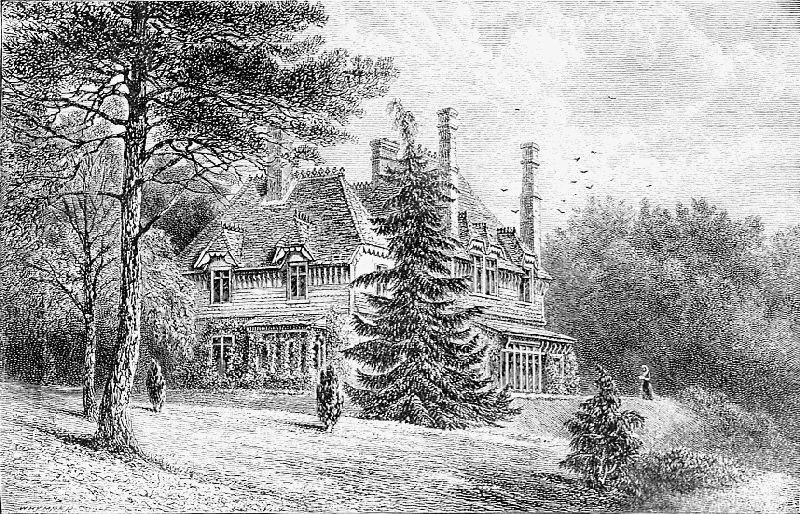
Ever since the 1st of May we have been living in
this queer cottage, which belongs to Mrs. Gilchrist,
wife of the Gilchrist who wrote the life of William
Blake the artist. We have a ravishing country round
us, and pure air and water; in short, all the conditions
of health, if the east wind were away. We have old
prints for our dumb companions—charming children
of Sir Joshua's, and large-hatted ladies of his and
Romney's. I read aloud—almost all the evening—books
of German science, and other gravities. So,
you see, we are like two secluded owls, wise with unfashionable
wisdom, and knowing nothing of pictures
and French plays. I confess that I should have gone
often to see Got act if I had been in town, he is so
really great as an actor. And yet one is ashamed of
seeking amusement in connection with anything that
belongs to poor, unhappy France. I am saved from the
shame by being safely shut out from the amusement.
Letter to
Madame
Bodichon,
17th June,
1871.
How about Madame Mohl and her husband? I
have been wondering through all the horrors whether
M. Mohl had returned to Paris, and whether their
house, containing, too probably, the results of much
studious work, lies buried among ruins. But I will
not further recall the sorrows in that direction.
I am glad to see the words "very satisfactory" in
connection with the visit to Hitchin and Cambridge.
Ely Cathedral I saw last year, but too cursorily. It
has more of the massive grandeur that one adores in
Le Mans and Chartres than most of our English cathedrals,
though I am ready to recall the comparison
as preposterous.
I don't know how long we shall stay here; perhaps,
more or less, till the end of August, for I have given
up the idea of going to the Scott Festival at Edinburgh,
to which I had accepted an invitation. The
fatigue of the long journey, with the crowd at the end,
would be too much for me.
Let us know beforehand when you are about coming.
George is gloriously well, and studying, writing,
walking, eating, and sleeping with equal vigor. He is
enjoying the life here immensely. Our country could
hardly be surpassed in its particular kind of beauty—perpetual
undulation of heath and copse, and clear
views of hurrying water, with here and there a grand
pine wood, steep, wood-clothed promontories, and
gleaming pools.
If you want delightful reading get Lowell's "My
Study Windows," and read the essays called "My
Garden Acquaintances" and "Winter."
Get the volumes of a very cheap publication—the
"Deutscher Novellenschatz." Some of the tales are
remarkably fine. I am reading aloud the last three
volumes, which are even better than the others. I
have just been so deeply interested in one of the stories—"Diethelm
von Buchenberg"—that I want everybody
to have the same pleasure who can read German.
Letter to
Mrs. Gilchrist,
3d
July, 1871.
We are greatly obliged to you for the trouble you
have so sympathetically taken on our behalf, and we
shall prepare to quit our quiet shelter on Wednesday,
the 2d of August. During the first weeks of our stay
I did not imagine that I should ever be so fond of the
place as I am now. The departure of the bitter winds,
some improvement in my health, and the gradual revelation
of fresh and fresh beauties in the scenery, especially
under a hopeful sky such as we have sometimes
had—all these conditions have made me love our little
world here and wish not to quit it until we can settle
in our London home. I have the regret of thinking
that it was my original indifference about it (I hardly
ever like things until they are familiar) that hindered
us from securing the cottage until the end of September,
for the chance of coming to it again after a temporary
absence. But all regrets ought to be merged
in thankfulness for the agreeable weeks we have had,
and probably shall have till the end of July. And
among the virtues of Brookbank we shall always
reckon this, that our correspondence about it has been
with you rather than with any one else, so that, along
with the country, we have had a glimpse of your ready,
quick-thoughted kindness.
Letter to
Mrs. Congreve,
13th
July, 1871.
One word to you in response to Emily's note, which
comes to me this morning, and lets me know that by
this time she is probably in the last hour of her unmarried
life. My thoughts and love and tender anxiety
are with her and with all of you. When you receive
this she will, I suppose, be far away, and it is
of little consequence that I can make no new sign to
her of my joy in her joy.
For the next few weeks my anxiety will be concentrated
on you and yours at Yarmouth. Pray, when
your mind and body are sufficiently free from absorbing
occupation, remember my need of news about you,
and write to me. The other day I seemed to get a
glimpse of you through Mrs. Call, who told me that
you looked like a new creature—so much stronger
than you were wont; and she told me of Dr. Congreve's
address at the school, which raised my keenest
sympathy, and made me feel myself a very helpless friend.
Please give my love to the children, and tell Sophy
especially that I think her happy in this—that there
is a place made for all the effort of her young life to
fill it with something like the goodness and brightness
which she has known and has just now to part with.
I expect her to be your guardian angel, perhaps in a
new way—namely, in saving you from some fatigue
about details.
Letter
to John
Blackwood,
15th
July, 1871.
I still feel that I owe you my thanks for your kind
letter, although Mr. Lewes undertook to deliver them
in the first instance. You certainly made a seat at the
Commemoration Table[14]
look more tempting to me
than it had done before; but I think that prudence
advises me to abstain from the fatigue and excitement
of a long railway journey, with a great gathering at the
end of it. If there is a chance that "Middlemarch"
will be good for anything, I don't want to break down
and die without finishing it. And whatever "the tow
on my distaff" may be, my strength to unwind it has
not been abundant lately.
À propos of bodily prosperity, I am sincerely rejoiced
to know, by your postscript this morning, that Mr.
Simpson is recovered. I hope he will not object to
my considering him a good friend of mine, though it
is so long since I saw him. The blank that is left
when thorough workers like him are disabled is felt
not only near at hand, but a great way off. I often
say—after the fashion of people who are getting older—that
the capacity for good work, of the kind that
goes on without trumpets, is diminishing in the world.
The continuous absence of sunshine is depressing in
every way, and makes one fear for the harvest, and so
grave a fear that one is ashamed of mentioning one's
private dreariness. You cannot play golf in the rain,
and I cannot feel hopeful without the sunlight; but I
dare say you work all the more, whereas when my spirits
flag my work flags too.
I should have liked to see Principal Tulloch again,
and to have made the acquaintance of Captain Lockhart,
whose writing is so jaunty and cheery, yet so
thoroughly refined in feeling. Perhaps I may still
have this pleasure in town, when he comes up at the
same time with you. Please give my kind regards
to Mr. William Blackwood.
Letter
to John
Blackwood,
24th
July, 1871.
Thanks for the prompt return of the MS., which arrived
this morning.
I don't see how I can leave anything out, because I
hope there is nothing that will be seen to be irrelevant
to my design, which is to show the gradual action of
ordinary causes rather than exceptional, and to show
this in some directions which have not been from time
immemorial the beaten path—the Cremorne walks and
shows of fiction. But the best intentions are good for
nothing until execution has justified them. And you
know I am always compassed about with fears. I am
in danger in all my designs of parodying dear Goldsmith's
satire on Burke, and think of refining when
novel-readers only think of skipping.
We are obliged to turn out of this queer cottage
next week; but we have been fortunate enough to get
the more comfortable house on the other side of the
road, so that we can move without any trouble. Thus
our address will continue to be the same until the end
of August.
Tennyson, who is one of the "hill-folk" about here,
has found us out.
Letter to
the Hon.
Mrs. Robert
Lytton
[15]
(now Lady
Lytton),
25th July,
1871.
This morning your husband's letter came to us, but
if I did not know that it would be nearly a week before
any words of mine could reach you, I should abstain
from writing just yet, feeling that in the first days
of sorrowing it is better to keep silence. For a long
while after a great bereavement our only companionship
is with the lost one. Yet I hope it will not be
without good to you to have signs of love from your
friends, and to be reminded that you have a home in
their affections, which is made larger for you by your
trouble. For weeks my thought has been continually
going out to you, and the absence of news has made
me so fearful that I have mourned beforehand. I
have been feeling that probably you were undergoing
the bitterest grief you had ever known. But under
the heart-stroke, is there anything better than to
grieve? Strength will come back for the duty and the
fellowship which gradually bring new contentments,
but at first there is no joy to be desired that would displace
sorrow.
What is better than to love and live with the loved?
But that must sometimes bring us to live with the
dead; and this too turns at last into a very tranquil
and sweet tie, safe from change and injury.
You see, I make myself a warrant out of my regard
for you, to write as if we had long been near each other.
And I cannot help wishing that we were physically
nearer—that you were not on the other side of Europe.
We shall trust in Mr. Lytton's kindness to let us hear
of you by and by. But you must never write except
to satisfy your own longing. May all true help surround
you, dear Mrs. Lytton, and whenever you can
think of me, believe in me as yours with sincere affection.
Letter to
Miss Mary
Cross, 31st
July, 1871.
I read your touching
story[16]
aloud yesterday to Mr.
Lewes, and we both cried over it. Your brother wrote
to me that you had doubts about giving your name.
My faith is, that signature is right in the absence of
weighty special reasons against it.
We think of you all very often, and feel ourselves
much the richer for having a whole dear family to
reckon among our friends. We are to stay here till
the end of the month. When the trees are yellow,
I hope you will be coming to see us in St. John's
Wood. How little like the woods we have around us!
I suppose Weybridge is more agreeable than other
places at present, if it has any of its extra warmth in
this arctic season.
Our best love, to your dear mother supremely, and
then to all.
Letter to
Mrs. Peter
Taylor, 2d
Aug. 1871.
I always say that those people are the happiest who
have a peremptory reason for staying in one place
rather than another. Else I should be sorry for you
that you are kept in London—by Parliamentary business,
of course.
There is sunshine over our fields now, but the thermometer
is only 64° in the house, and in the warmest
part of the day I, having a talent for being cold, sit
shivering, sometimes even with a warm-water bottle at
my feet. I wonder if you went to the French plays
to see the supreme Got? That is a refined pleasure
which I enjoyed so much in Paris a few years
ago that I was sorry to be out of reach of it this
spring.
About the Crystal Palace music I remember feeling
just what you mention—the sublime effect of the
Handel choruses, and the total futility of the solos.
Letter to
Mrs. Bray,
3d Aug.
1871.
Thanks for your little picture of things. Eminently
acceptable in place of vague conjectures. I am a bitter
enemy to make-believe about the human lot, but I
think there is a true alleviation of distress in thinking
of the intense enjoyment which accompanies a spontaneous,
confident, intellectual activity. This may not
be a counterpoise to the existing evils, but it is at least
a share of mortal good, and good of an exquisite
kind.
Are you not happy in the long-wished-for sunshine?
I have a pretty lawn before me, with hills in the background.
The train rushes by every now and then to
make one more glad of the usual silence.
A good man writes to me from Scotland this morning,
asking me if he is not right in pronouncing
Romŏla, in defiance of the world around him (not a
large world, I hope) who will say Romōla. Such is
correspondence in these days; so that quantity is
magnificent en gros but shabby en détail—i.e., in single
letters like this.
Letter to
Mrs. Congreve,
14th
Aug. 1871.
We shall stay here only till the end of this month—at
least, I have no hope that our propriétaires will be
induced to protract their absence; and if the lingering
smell of paint does not drive us away from the Priory
again, we expect to stay there from the first of September,
without projects of travel for many, many
months.
We enjoy our roomy house and pretty lawn greatly.
Imagine me seated near a window, opening under a
veranda, with flower-beds and lawn and pretty hills
in sight, my feet on a warm-water bottle, and my writing
on my knees. In that attitude my mornings are
passed. We dine at two; and at four, when the tea
comes in, I begin to read aloud. About six or half-past
we walk on to the commons and see the great
sky over our head. At eight we are usually in the
house again, and fill our evening with physics, chemistry,
or other wisdom if our heads are at par; if not,
we take to folly, in the shape of Alfred de Musset's
poems, or something akin to them.
Letter
to John
Blackwood,
29th
Oct. 1871.
Yesterday we returned from Weybridge, where, for
a few days, I have been petted by kind friends (delightful
Scotch people), and have had delicious drives
in the pure autumn air. That must be my farewell to
invalidism and holiday making. I am really better—not
robust or fat, but perhaps as well as I am likely to
be till death mends me.
Your account of Mr.
Main[17]
sets my mind at ease
about him; for in this case I would rather have your
judgment than any opportunity of forming my own.
The one thing that gave me confidence was his power
of putting his finger on the right passages, and giving
emphasis to the right idea (in relation to the author's
feeling and purpose). Apart from that, enthusiasm
would have been of little value.
One feels rather ashamed of authoresses this week
after the correspondence in the Times. One hardly
knows which letter is in the worst taste. However, if
we are to begin with marvelling at the little wisdom
with which the world is governed, we can hardly expect
that much wisdom will go to the making of
novels.
I should think it quite a compliment if the general
got through "Miss Brooke." Mr. Lewes amused himself
with the immeasurable contempt that Mr. Casaubon
would be the object of in the general's mind.
I hardly dare hope that the second part will take
quite so well as the first, the effects being more subtile
and dispersed; but Mr. Lewes seems to like the third
part better than anything that has gone before it. But
can anything be more uncertain than the reception of
a book by the public? I am glad to see that the
"Coming Race" has got into a fourth edition. Let
us hope that the Koom Posh may be at least mitigated
by the sale of a good book or two.
As for me, I get more and more unable to be anything
more than a feeble sceptic about all publishing
plans, and am thankful to have so many good heads
at work for me. Allah illah allah!
Letter to
Miss Sara
Hennell,
22d Nov.
1871.
We who are getting old together have the tie of
common infirmities. But I don't find that the young
troubles seem lighter on looking back. I prefer my
years now to any that have gone before. I wish you
could tell me the same thing about yourself. And,
surely, writing your book is, on the whole, a joy to you—it
is a large share in the meagre lot of mankind.
All hail for the morrow! How many sweet laughs,
how much serious pleasure in the great things others
have done, you and I have had together in a past
islet of time that remains very sunny in my remembrance.
Journal,
1871.
Dec. 1.—This day the first part of "Middlemarch"
was published. I ought by this time to have finished
the fourth part, but an illness which began soon after
our return from Haslemere has robbed me of two
months.
Letter to
Miss Sara
Hennell,
15th Dec.
1871.
If you have not yet fallen in with Dickens's "Life"
be on the lookout for it, because of the interest there
is in his boyish experience, and also in his rapid development
during his first travels in America. The
book is ill organized, and stuffed with criticism and
other matter which would be better in limbo; but the
information about the childhood, and the letters from
America, make it worth reading. We have just got a
photograph of Dickens, taken when he was writing, or
had just written, "David Copperfield"—satisfactory
refutation of that keepsakey, impossible face which
Maclise gave him, and which has been engraved for
the "Life" in all its odious beautification. This photograph
is the young Dickens, corresponding to the
older Dickens whom I knew—the same face, without
the unusually severe wear and tear of years which his
latest looks exhibited.
Journal,
1872.
Dec. 20.—My health has become very troublesome
during the last three weeks, and I can get on but tardily.
Even now I am only at page 227 of my fourth
part. But I have been also retarded by construction,
which, once done, serves as good wheels for progress.
Letter
to John
Blackwood,
1st
Jan. 1872.
Your good wishes and pleasant bits of news made
the best part of my breakfast this morning. I am
glad to think that, in desiring happiness for you during
the new year, I am only desiring the continuance
of good which you already possess.
I suppose we two, also, are among the happiest of
mortals, yet we have had a rather doleful Christmas,
the one great lack, that of health, having made
itself particularly conspicuous in the surrounding fog.
Having no grandchildren to get up a Christmas-tree
for, we had nothing to divert our attention from our
headaches.
Mr. Main's book broke the clouds a little, and now
the heavens have altogether cleared, so that we are
hoping to come back from a visit of three days to
Weybridge with our strength renewed—if not like the
eagle's, at least like a convalescent tomtit's.
The "Sayings" are set off by delightful paper and
print, and a binding which opens with inviting ease.
I am really grateful to every one concerned in the volume,
and am anxious that it should not be in any way
a disappointment. The selections seem to me to be
made with an exquisite sensibility to the various lights
and shades of life; and all Mr. Main's letters show
the same quality. It is a great help to me to have
such an indication that there exist careful readers for
whom no subtilest intention is lost.
We have both read the story of the "Megara" with
the deepest interest; indeed, with a quite exceptional
enjoyment of its direct, unexaggerated painting.
The prescription of two days' golfing per week will,
I hope, keep up your condition to the excellent pitch
at which it was on your return from Paris. Good
news usually acts as a tonic when one's case is not
too desperate; and I shall be glad if you and we can
get it in the form of more success for "Middlemarch."
Dickens's "Life," you see, finds a large public ready
to pay more. But the British mind has long entertained
the purchase of expensive biographies. The
proofs lately given that one's books don't necessarily
go out like lucifer matches, never to be taken up
again, make one content with moderate immediate
results, which perhaps are as much as can reasonably
be expected for any writing which does not address
itself either to fashions or corporate interests of an exclusive
kind.
Letter
to John
Blackwood,
18th
Jan. 1872.
It is like your kindness to write me your encouraging
impressions on reading the third book. I suppose
it is my poor health that just now makes me think my
writing duller than usual. For certainly the reception
of the first book by my old readers is quite beyond my
most daring hopes. One of them, who is a great
champion of "Adam Bede" and "Romola," told Mr.
Lewes yesterday that he thought "Middlemarch" surpassed
them. All this is very wonderful to me. I
am thoroughly comforted as to the half of the work
which is already written; but there remains the terror
about the unwritten. Mr. Lewes is much satisfied
with the fourth book, which opens with the continuation
of the Featherstone drama.
We went yesterday to the Tichborne trial, which was
an experience of great interest to me. We had to
come away after the third hour of Coleridge's speaking;
but it was a great enjoyment to me to hear what
I did. Coleridge is a rare orator—not of the declamatory,
but of the argumentative order.
Thanks, not formal, but sincerely felt, for the photographs.
This likeness will always carry me back to
the first time I saw you, in our little Richmond lodging,
when I was thinking anxiously of "Adam Bede,"
as I now am of "Middlemarch."
I felt something like a shudder when Sir Henry
Maine asked me last Sunday whether this would not
be a very long book; saying, when I told him it
would be four good volumes, that that was what he
had calculated. However, it will not be longer than
Thackeray's books, if so long. And I don't see how
the sort of thing I want to do could have been done
briefly.
I have to be grateful for the gift of "Brougham's
Life," which will be a welcome addition to my means
of knowing the time "when his ugliness had not passed
its bloom."
Letter to
Mrs. Congreve,
22d
Jan. 1872.
Your letter seems to pierce the rainy fog with a little
sunlight. Cold and clearness are the reverse of
what we are usually having here. Until the last few
days my chief consciousness has been that of struggling
against inward as well as outward fog; but I am
now better, and have only been dragged back into
headachiness by a little too much fatigue from visitors.
I give you this account as a preface to my renunciation
of a journey to Dover, which would be very delightful,
if I had not already lost too much time to be
warranted in taking a holiday.
Next Saturday we are going to have a party—six to
dine, and a small rush of people after dinner, for the
sake of music. I think it is four years at least since
we undertook anything of that kind.
A great domestic event for us has been the arrival
of a new dog, who has all Ben's virtues, with more intelligence,
and a begging attitude of irresistible charm.
He is a dark-brown spaniel. You see what infantine
innocence we live in!
Glad you are reading my demigod Milton! We
also are rather old-fashioned in our light reading just
now; for I have rejected Heyse's German stories,
brand new, in favor of dear old Johnson's "Lives of
the Poets," which I read aloud in my old age with a
delicious revival of girlish impressions.
Journal,
1872.
Jan. 29.—It is now the last day but one of January.
I have finished the fourth part—i.e., the second volume—of
"Middlemarch." The first part, published
on December 1, has been excellently well received;
and the second part will be published the day after
to-morrow. About Christmas a volume of extracts
from my works was published, under the title, "Wise,
Witty, and Tender Sayings, in Prose and Verse." It
was proposed and executed by Alexander Main, a
young man of thirty, who began a correspondence with
me by asking me how to pronounce Romola, in the
summer, when we were at Shottermill. Blackwood
proposed that we should share the profits, but we refused.
Letter to
Miss Sara
Hennell,
29th Jan.
1872.
I do lead rather a crawling life under these rainy
fogs and low behavior of the barometer. But I am a
little better, on the whole, though just now overdone
with the fatigue of company. We have been to hear
Coleridge addressing the jury on the Tichborne trial—a
very interesting occasion to me. He is a marvellous
speaker among Englishmen; has an exquisitely
melodious voice, perfect gesture, and a power of keeping
the thread of his syntax to the end of his sentence,
which makes him delightful to follow. We are going
some other day, if possible, to hear a cross-examination
of Ballantyne's. The digest of the evidence which
Coleridge gives is one of the best illustrations of the
value or valuelessness of testimony that could be given.
I wonder if the world, which retails Guppy anecdotes,
will be anything the wiser for it.
Letter
to John
Blackwood, 21st
Feb. 1872.
To hear of a friend's illness after he has got well
through it is the least painful way of learning the bad
news. I hope that your attack has been a payment
of insurance.
You probably know what it grieved us deeply to
learn the other day—that our excellent friend Mr.
William Smith is dangerously ill. They have been
so entirely happy and wrapped up in each other that
we cannot bear to think of Mrs. Smith's grief.
Thanks for the list of sales since February 12th.
Things are encouraging, and the voices that reach us
are enthusiastic. But you can understand how people's
interest in the book heightens my anxiety that
the remainder should be up to the mark. It has
caused me some uneasiness that the third part is two
sheets less than the first. But Mr. Lewes insisted
that the death of old Featherstone was the right point
to pause at; and he cites your approbation of the part
as a proof that effectiveness is secured in spite of diminished
quantity. Still it irks me to ask 5s. for a
smaller amount than that already given at the same
price. Perhaps I must regard the value as made up
solely by effectiveness, and certainly the book will be
long enough.
I am still below par in strength, and am too much
beset with visitors and kind attentions. I long for the
quiet spaces of time and the absence of social solicitations
that one enjoys in the country, out of everybody's
reach.
I am glad to hear of the pleasure "Middlemarch"
gives in your household: that makes quite a little preliminary
public for me.
Letter to
Mrs. H. B.
Stowe, 4th
Mch. 1872.
I can understand very easily that the two last years
have been full for you of other and more imperative
work than the writing of letters not absolutely demanded
either by charity or business. The proof that
you still think of me affectionately is very welcome
now it is come, and all the more cheering because it
enables me to think of you as enjoying your retreat in
your orange orchard—your western Sorrento—the beloved
Rabbi still beside you. I am sure it must be a
great blessing to you to bathe in that quietude—as it
always is to us when we go out of reach of London influences,
and have the large space of country days to
study, walk, and talk in. Last year we spent our summer
months in Surrey, and did not leave England.
Unhappily, the country was not so favorable to my
bodily health as to my spiritual, and on our return to
town I had an illness which was the climax of the
summer's malaise. That illness robbed me of two
months, and I have never quite recovered a condition
in which the strict duties of the day are not felt as a
weight. But just now we are having some clear spring
days, and I am in hope of prospering better, the
sunshine being to me the greatest visible good of
life—what I call the wealth of life, after love and
trust.
Letter to
Mrs. H. B.
Stowe, 8th
Mch. 1872.
When I am more at liberty I will certainly read
Mr. Owen's books, if he is good enough to send them
to me. I desire on all subjects to keep an open mind,
but hitherto the various phenomena reported or attested
in connection with ideas of spirit-intercourse,
"psychion," and so on, have come before me here in
the painful form of the lowest charlatanerie. Take
Mr. H. as an example of what I mean. I could not
choose to enter a room where he held a séance. He
is an object of moral disgust to me; and nothing of
late reported by Mr. Crookes, Lord Lindsay, and the
rest carries conviction to my mind that Mr. H. is not
simply an impostor, whose professedly abnormal manifestations
have varied their fashion in order to create
a new market, just as if they were papier mâché wares
or pomades for the idle rich. But apart from personal
contact with people who get money by public exhibitions
as mediums, or with semi-idiots, such as those
who make a court for a Mrs. Guppy or other feminine
personage of that kind, I would not willingly place any
barriers between my mind and any possible channel
of truth affecting the human lot.
The spirit in which you have written in the paper
you kindly sent me is likely to teach others—to rouse
them, at least, to attention in a case where you have
been deeply impressed.
I write to you quite openly, dear friend, but very imperfectly,
for my letters are always written in shreds
of time.
Letter
to John
Blackwood,
14th
Mch. 1872.
Thanks for the budget of this morning. The sales,
we think, are very cheering, and we may well be content
if they continue in the same ratio. But the Greek
proverb about the beginning being the half of the
whole wants as much defining and excepting from as
most other proverbs.
I have just had sent me a copy of the magazine
Für die Literatur des Auslander, containing a review
of "Miss Brooke," which will be good for Asher's
edition, and is otherwise satisfactory as an intelligent
appreciation. It mentions at the end the appearance
of Mr. Main's book, "The Sayings." A Frenchman,
apparently accomplished, a M. Landolphe, who has
made some important translations, is going to translate
the whole of "Middlemarch;" and one of the
contributors to the Revue des Deux Mondes has written
for leave to extract Dorothea's history.
I fancy we have done a good turn to English authors
generally by setting off Asher's series, for we have
heard that Tauchnitz has raised his offers. There is
another way in which benefit might come that would
be still more desirable—namely, to make him more
careful in his selections of books for reprint. But I
fear that this effect is not so certain. You see Franz
Duncker, who publishes the German translation of
"Middlemarch," has also begun an English series.
This is really worth while, for the Germans are excellent
readers of our books. I was astonished to
find so many in Berlin who really knew one's books,
and did not merely pay compliments after the fashion
of the admirers who made Rousseau savage—running
after him to pay him visits, and not knowing a word
of his writing.
You and other good readers have spoiled me, and
made me rather shudder at being read only once; and
you may imagine how little satisfaction I get from
people who mean to please me by saying that they
shall wait till "Middlemarch" is finished, and then
sit up to read it "at one go-off."
We are looking for a country retreat not too far
from town, so that we may run up easily. There is
nothing wanting to our happiness except that "Middlemarch"
should be well ended without growing
signs of its author's debility.
Letter to
Mrs. Peter
Taylor,
17th
March,
1872.
Before I received your letter this morning, I was
going to write you a word of sympathy, knowing how
deeply you would be feeling the death of Mazzini.
Such a man leaves behind him a wider good than the
loss of his personal presence can take away.
"The greatest gift the hero leaves his race
Is to have been a hero."
I must be excused for quoting my own words, because
they are my credo. I enter thoroughly into your sense
of wealth in having known him.
Brighton does not suit Mr. Lewes. But he was
near going there for a night a little while ago to see
our friends, Mr. and Mrs. William Smith. He (the
author of "Thorndale," etc.) is, I fear, wasting fatally
with organic disease, and we grieve much at the too-probably
near parting of a husband and wife who
have been among the perfectly happy couples of the
world. She is a charming woman, and I wish that
you may happen to know her.
Letter to
Miss Sara
Hennell,
22d March,
1872.
Owing to my loss of two months in illness, and my
infirm health ever since, I have not yet finished the
writing of "Middlemarch." This payment of wintry
arrears makes one prefer the comforts of a London
home; but we are obliged to see more company than
my health is equal to, and for this reason I dare say
we shall soon migrate. To-day we have been to our
last morning concert—or Saturday Pop.—held on a
Friday because of the University boat-race to-morrow.
These concerts are an easy pleasure which we are
sorry to part with. This is one of my bad weeks,
owing probably to the change in the weather, and I
am constantly struggling with hemicrania and malaise.
Even writing this scrap of a note is the feather too
much, and I must leave off. You have known too
much of nervous weakness not to understand this.
Journal,
1872.
May 8.—I have been reposing for more than a
week in the hope of getting stronger, my life having
been lately a swamp of illness, with only here and
there a bit of firm walking. In consequence of this
incessant interruption (almost every week having been
half nullified for me so far as my work has been concerned)
I have only finished the fifth book, and have
still three books to write—equal to a large volume
and a half.
The reception of the book hitherto has been quite
beyond what I could have believed beforehand, people
exalting it above everything else I have written.
Kohn is publishing an English edition in Germany;
Duncker is to publish a translation; and Harpers
pay me £1200 for reprinting it in America.
Letter to
Madame
Bodichon,
4th June,
1872.
I am glad to know that you are having a time of
refreshing in fine scenery, with entire freedom to
paint. I am in a corresponding state of relief from
the noises and small excitements that break up the
day and scatter one's nervous energy in London.
We have been in our hiding-place about twelve days
now, and I am enjoying it more and more—getting
more bodily ease and mental clearness than I have
had for the last six months. Our house is not in the
least beautiful, but it is well situated and comfortable,
perfectly still in the middle of a garden surrounded
by fields and meadows, and yet within reach of shops
and civilization.
We managed to get to the Academy one day before
leaving town. I was delighted with Walker's picture—were
you?—and Mason's unfinished Reaper, and a
few, very few, others.
Also we went twice to the opera in order to save
ourselves from any yearnings after it when we should
have settled in the country.
We tell no one our address, and have our letters
sent on from the Priory.
Letter to
Mrs. H. B.
Stowe, 4th
June, 1872.
We too are in a country refuge, you see, and this
bit of Surrey, as I dare say you know, is full of beauty
of the too garden-like sort for which you pity us.
How different from your lodge in the wilderness! I
have read your description three or four times—it
enchants me so thoroughly—and Mr. Lewes is just
as much enamoured of it. We shall never see it, I
imagine, except in the mirror of your loving words;
but thanks, many and warm, dear friend, for saying
that our presence would be welcome. I have always
had delight in descriptions of American forests since
the early days when I read "Atala," which I believe
that you would criticise as half unveracious. I dwelt
on the descriptions in "Dred" with much enjoyment.
Pray give my special thanks to the Professor for
his letter. His handwriting, which does really look
like Arabic—a very graceful character, surely—happens
to be remarkably legible to me, and I did not
hesitate over a single word. Some of the words, as
expressions of fellowship, were very precious to me,
and I hold it very good of him to write to me that
best sort of encouragement. I was much impressed
with the fact—which you had told me—that he was
the original of the "visionary boy" in "Old Town
Folk;" and it must be deeply interesting to talk with
him on his experience. Perhaps I am inclined, under
the influence of the facts, physiological and psychological,
which have been gathered of late years, to
give larger place to the interpretation of vision-seeing
as subjective than the Professor would approve. It
seems difficult to limit—at least to limit with any precision—the
possibility of confounding sense by impressions,
derived from inward conditions, with those
which are directly dependent on external stimulus.
In fact, the division between within and without in
this sense seems to become every year a more subtle
and bewildering problem.
Your experience with the planchette is amazing; but
that the words which you found it to have written
were dictated by the spirit of Charlotte Brontë is to
me (whether rightly or not) so enormously improbable,
that I could only accept it if every condition were laid
bare, and every other explanation demonstrated to be
impossible. If it were another spirit aping Charlotte
Brontë—if here and there at rare spots and among
people of a certain temperament, or even at many
spots and among people of all temperaments, tricksy
spirits are liable to rise as a sort of earth-bubbles and
set furniture in movement, and tell things which we
either know already or should be as well without
knowing—I must frankly confess that I have but a
feeble interest in these doings, feeling my life very
short for the supreme and awful revelations of a more
orderly and intelligible kind which I shall die with
an imperfect knowledge of. If there were miserable
spirits whom we could help, then I think we should
pause and have patience with their trivial-mindedness;
but otherwise I don't feel bound to study them more
than I am bound to study the special follies of a particular
phase of human society. Others who feel differently,
and are attracted towards this study, are
making an experiment for us as to whether anything
better than bewilderment can come of it. At present
it seems to me that to rest any fundamental part of
religion on such a basis is a melancholy misguidance
of men's minds from the true sources of high and pure
emotion.
I am comforted to think that you partly agree with
me there.
I have not time to write more than this very imperfect
fragmentary sketch of only one aspect which
the question of spirit-communications wears to me at
present—being always rather brain-weary after my
morning's work, and called for by my husband to
walk with him and read aloud to him. I spend nearly
three hours every day in this exercise of reading
aloud, which, happily, I can carry on without fatigue
of lungs. Yet it takes strength as well as time.
Mr. Lewes is gone into town to-day, so I have an
additional hour at liberty, and have been glad to be
able to send you a letter which is not worth anything,
indeed, but which satisfies my need to thank you and
the Professor for your sweet friendliness—very sweet
to me, I assure you. Please accept my entire frankness
as a proof of that high value I set on you. And
do not call anything I may have written a prejudice—it
is simply a statement of how certain things appear
to my inward eyesight, which I am ready to have rectified
by more light.
About photographs—I have no photograph of myself,
having always avoided having one taken. That
makes me seem very selfish in being particularly glad
to get yours.
Mrs. Fields, with the beautiful face and charming
manners, sent me a letter a little while ago, inviting
us in the most tempting way to go to Boston. She
said that this pretty action was done at your prompting,
which is just like you as you have always shown
yourself to me.
Dear friend, how much you have lived through,
both in the flesh and in the spirit! My experience
has been narrow compared with yours. I assure you
I feel this, so do not misinterpret anything I say to
you as being written in a flippant or critical spirit.
One always feels the want of the voice and eyes to
accompany a letter and give it the right tone.
Letter to
Mrs. Congreve,
4th
July, 1872.
You were very good and dear to want to give me
the pleasure of knowing that the news was good, instead
of leaving me to my small stock of hopefulness.
Ask Emily to care a little even now, with baby on her
mind, that her old friends are the better for hearing
that she is well. Four or five months ago it happens
that I was writing some playfulness about a baby and
baby's hair, which is now in print, to appear next
month. I am not afraid that Emily should be revolted
by my blasphemy!
Mr. Lewes had "a lovely time" from Saturday to
Monday at Weybridge. He was feeling languid, and
yet was tempted to sit at his desk. The little change
has been very serviceable, and he is now bright.
Our first book, read aloud by me after we came
down, was Wallace's "Eastern Archipelago," which,
I think, you had spoken well of to Mr. Lewes. It is
delightful. The biography of the infant ourang-outang
alone is worth getting the book for. We are now in
the middle of Tylor's "Primitive Culture," which is
worth studying, and useful for reference on special
points, if you happen to want knowledge about the
ideas of the savage tribes.
Our days go by in delicious peace, unbroken except
by my little inward anxieties about all unfinished work.
Letter to
Mrs. Congreve,
19th
July, 1872.
This morning came the joyful news that Gertrude
has a fine healthy baby—a daughter. We have just
been saying in our walk that by the end of this century
our one-day-old granddaughter will probably be
married and have children of her own, while we are
pretty sure to be at rest. This obvious kind of wisdom
does very well for discourse in the delicious sunshine,
as we wander over a hilly, half fern-clad, half
grassy wilderness called South Park, from which we
can overlook two fertile bosky valleys. We like this
bit of country better and better. As to health, I am
not quite so prosperous as I was at first, but to make
amends, Mr. Lewes is in a good average condition,
and only now and then has a morning in which he is
forced to wander about instead of going to his beloved
work. We have had much happiness here,
much sympathy in letters from far-off friends unknown
in the flesh, and peaceful enjoyment of our
occupations. But we have longed for more continuous
warmth and brightness, and to-day may perhaps
be the beginning of that one wanting condition.
Letter to
Miss Sara
Hennell,
1st Aug.
1872(?).
The death of that honored, good creature, Mr. William
Smith, touched us particularly, because of the perfect
marriage-bond which had made the last eleven
years of his life unspeakably precious both to him
and his wife. Mr. Lewes offered to go to Brighton to
see him; but he was so reduced, so very feeble in
body, though he kept to the last much brightness of
mind, that Mrs. Smith feared for him the excitement
of seeing friends who came, specially, from a distance.
Letter to
John
Blackwood,
4th
Aug. 1872.
I like to think that your journey was a success.
But I had felt sure, that unless bad health or bad
weather overtook you, both Mrs. Blackwood and you
must have great happiness in taking that bright, lovely
daughter abroad and watching her fresh impressions.
I imagine her laudable indignation at the
crushing of the little lizard! Those little creatures
darting about the stones seem part of the happiness
of Italian sunshine, as the small birds hopping after
the rain seem part of the moist happiness at home.
I shall send Part VII. in a few days. Since Mr.
Lewes tells me that the Spectator considers me the
most melancholy of authors, it will perhaps be a welcome
assurance to you that there is no unredeemed
tragedy in the solution of the story.
Mr. Lewes examines the newspapers before I see
them, and cuts out any criticisms which refer to me,
so as to save me from these spiritual chills—though,
alas! he cannot save me from the physical chills
which retard my work more seriously. I had hoped
to have the manuscript well out of my hands before
we left this place at the end of the month, but the
return of my dyspeptic troubles makes me unable to
reckon on such a result.
It will be a good plan, I think, to quicken the publication
towards the end; but we feel convinced that
the slow plan of publication has been of immense advantage
to the book in deepening the impression it
produces. Still I shudder a little to think what a long
book it will be—not so long as "Vanity Fair" or
"Pendennis," however, according to my calculation.
How good the articles on French manners and domestic
life are in "Maga." The spirit in which they
are written is excellent.
The manuscript of "Middlemarch" bears the
following inscription:
"To my dear Husband, George Henry Lewes, in this
nineteenth year of our blessed union."
Letter to
Mrs. Cross,
Sept. 1872.
I am tired of behaving like an ungrateful wretch—making
no sign in answer to affectionate words which
have come to me with cheering effect. And I want
to tell you and Mr. Hall (alas! for the dear old
name[18]
which had such cherished associations) that I long
too much to see you all at Six-Mile Bottom, to give
up utterly the prospect of that good. We imagine
that the place is near Ipswich, which is no more
than an hour and fifty minutes from London. If
so, the journey would be easily managed, and would
be worth taking for the sake of one whole day and
two half days with you—just as if you were the hour
nearer, at Weybridge—before we set our faces towards
Germany. I am not hopeless that we might do that
in the second week of September, if you are not quite
disgusted with the thought of me as a person who is
always claiming pity for small ailments, and also if
Mr. Hall can secure me against being shot from the
other side of the hedge by the Prince of
Wales,[19]
while
we are discussing plantations.
I dare not count much on fulfilling any project, my
life for the last year having been a sort of nightmare,
in which I have been scrambling on the slippery bank
of a pool, just keeping my head above water. But I
shall be the happier for having told you that I delight
in the double invitation for the sake of the love it assures
me of, and that I do want to see you all.
You are all gloriously well, I hope, and Alkie looking
more and more cherubic, and Emily and Florence
blooming. My best love to all. Particular regards
to J., and regrets that we were not on his route from
Brindisi. I read his paper on New York with much
interest and satisfaction.
You are often among my imaged companions both
in dreaming and waking hours.
Letter to
Mrs. Cross,
Oct. 1872,
from Homburg.
It was a delightful surprise to see your handwriting
when we went to inquire at the Poste Restante. We
had, on the whole, a fortunate journey, and are especially
grateful to Mr. Hall for suggesting the route
by Trèves, where we spent two nights and an exquisite
day. I was continually reminded of Rome when we
were wandering in the outskirts in search of the antiquities,
and the river banks are a loveliness into the
bargain which Rome has not. We had even an opportunity
of seeing some dissipation, for there happened
to be an excellent circus, where we spent our
evening. The pretty country through which we passed
had an additional interest for us about Libramont.
The air, the waters, the plantations here are all perfect—"only
man is vile." I am not fond of denouncing
my fellow-sinners, but gambling being a vice I
have no mind to, it stirs my disgust even more than
my pity. The sight of the dull faces bending round
the gaming-tables, the raking up of the money, and
the flinging of the coins towards the winners by the
hard-faced croupiers, the hateful, hideous women staring
at the board like stupid monomaniacs—all this
seems to me the most abject presentation of mortals
grasping after something called a good that can be
seen on the face of this little earth. Burglary is heroic
compared with it. I get some satisfaction in looking
on, from the sense that the thing is going to be put
down. Hell is the only right name for such places.
It was cruel to find the bitter cold just set in as we
arrived. For two days we were as cold as in clear
winter days at Berlin. There are no amusements for
the evening here, and the pleasure of listening to the
excellent band in the afternoons is diminished by the
chillness which makes one fear to sit down in the open
air. But we like being idle, and the days pass easily.
It is good to have in our memories the two happy
days at Six-Mile Bottom; and the love that surrounded
me and took care of me there is something very
precious to believe in among hard-faced strangers.
Much gratitude for the anticipated letter that will
come to tell us more news of you by-and-by.
Letter to
John
Blackwood,
4th
Oct. 1872.
At last I begin a letter which is intended not as a
payment but as an acknowledgment of debt. It will
have at least the recommendation of requiring no
answer. After some perfect autumnal days we are
languishing with headache from two days' damp and
mugginess, and feel it almost as much work as we are
equal to to endure our malaise. But on the whole we
are not sorry that we came to this place rather than
any other. On dry days the air is perfect, and the
waters are really an enticing drink. Then there is a
wood close by where we can wander in delicious privacy:
which is really better than the company here,
save and except a few friends whom we found at first,
and who have now moved off to Baden. The Kursaal
is to me a hell, not only for the gambling but for the
light and heat of the gas, and we have seen enough
of its monstrous hideousness. There is very little
dramatic Stoff to be picked up by watching or listening.
The saddest thing to be witnessed is the play
of a young lady, who is only twenty-six years old, and
is completely in the grasp of this mean, money-making
demon. It made me cry to see her young, fresh face
among the hags and brutally stupid men around her.
Next year, when the gambling has vanished, the place
will be delightful; there is to be a subvention from
Government to keep up the beautiful grounds; and it
is likely that there will be increase enough in the number
of decent visitors to keep the town tolerably prosperous.
One attraction it has above other German
baths that I have seen is the abundance of pleasant
apartments to be had, where one can be as peaceful
as the human lot allows in a world of pianos.
Asher's cheap editions are visible everywhere by
the side of Tauchnitz, but the outside is not, I think,
quite equally recommendable and recommending.
We brought no books with us, but have furnished
our table with German books which we bought at
Frankfort, from learned writing about Menschlich
Sprache and Vernunft down to Kotzebue's comedies,
so that we have employment for the rainy hours when
once our heads are clear of aches. The certainty that
the weather is everywhere else bad will help our resolution
to stay here till the 12th at least. In the mean
time we hope to have the proof of the finale to "Middlemarch."
I am rejoiced to learn from Mr. William's letter
that Mr. Simpson has returned from his excursion in
good condition. That must be a comfort to you, both
for friendship and for work's sake.
We mean to return by Paris, and hope that the
weather will not drive us away from health and pleasure-seeking
until the end of the month. I fear, from
the accounts of your Scottish weather, that you will
have enjoyed Strathtyrum less than usual, and will be
resigned to Edinburgh before your proper time. How
one talks about the weather! It is excusable here
where there is no grave occupation, and no amusement
for us, who don't gamble, except seeking health
in walks and water drinking.
Letter to
Mrs. Cross,
27th Oct.
1872, from
Boulogne.
I had meant to write to you again from Germany,
but I was hindered from doing so by the uncertainty
of our plans, which vacillated between further wanderings
in South Germany and the usual dreary railway
journeying by Strasburg to Paris. As it was, we left
Homburg on the 13th and had ten days of delicious
autumnal weather and quietude at Stuttgart and Carlsruhe—ten
days which made the heart of our enjoyment.
We still hesitated whether we should go to
Augsburg, and even Munich, making our way home
through Germany and Belgium, and turning our shoulders
on Paris. Our evil genius persuaded us to go to
Paris and to make the journey by night—whence came
headache and horrible disgust with the shops of the
Rue de la Paix and the Boulevard. After going to
Versailles in the rain, seeing the sad ruins of the
Hotel de Ville, missing the Theatre Français, and
getting "Patrie" in exchange, we rushed away to this
place, where we are trying to recover the sense of
benefit from our change, which forsook us on quitting
old Germany. We have an affinity for what the world
calls "dull places," and always prosper best in them.
We are sure to be at home next week, and I hope before
long to have some news of you there—some dear
faces coming to bring it. We shall linger here a few
days and take a favorable time for crossing, but our
patience will hardly last beyond Friday.
Letter to
Mrs. Wm.
Smith, 1st
Nov. 1872.
We returned yesterday evening from six weeks' absence
in Germany, and I found your dear, sad letter
among the many awaiting me. I prize very highly
the fact that you like to write to me and bear me in
your mind as one who has a certain fellowship in your
sorrow; and I do trust that this letter may reach you
in time to prevent you from thinking, even for a moment,
that I could be indifferent about responding to
any word you send me. I shall address it to the care
of Blackwood & Sons, because I imagine you to be
by this time in Edinburgh with that delightful friend,
Mrs. Stirling, whom I had much kindness from many
years ago when I was on a visit to Mr. and Mrs.
George Combe. She took me to hear Dr. Guthrie
and Dr. Candlish, and through her I saw Craigcrook.
I like to think of those hours and her pleasant talk.
Mr. Lewes, I am thankful to say, has been getting
more robust for the last two years, and is very bright
and active. I think there is hardly any one left to
whom he would so willingly have written or talked
about the subjects which are filling his mind as that
dear one who is gone from your side, but is perpetually
present in your consciousness. To-day I have
been reading the memorial article in Blackwood, and
have been hoping that there is nothing in it which
jars on your feeling. Everybody will think as I do—that
the bits from your pen are worth all the rest. I
have been especially moved, though, by the two stanzas
quoted at the end. Mr. Lewes judges that the writer
of the article did not personally know your husband,
and wishes that more special touches had been given.
I know, dear friend, that the sorrow is irremediable;
but the pain—the anguish—will become less sharp
and life will be less difficult. You will think of things
to do such as he would approve of your doing, and
every day will be sacred with his memory—nay, his
presence. There is no pretence or visionariness in
saying that he is still part of you. Mr. Lewes sends
his affectionate regards, which you will not reject.
We mention your name to each other with a certain
tenderness, as if your sorrow somehow belonged to
our love for each other. But I hardly dare to think
of what these words which I have written mean.
Sometimes in the midst of happiness I cry suddenly
at the thought that there must come a parting. Are
not you and I very near to one another? I mean in
feeling.
Letter to
Mrs. Peter
Taylor,
19th Nov.
1872.
I found a letter from dear Mrs. William Smith on
my return, and I have had another since in answer to
mine. It is inevitable that her sense of loss should
deepen for some time to come. I am hoping that by-and-by
active interests will arise to make her feel that
her life is useful.
The article in Blackwood was chiefly valuable for
the extracts it contained from Mrs. Smith's own memoir.
One felt that the writer of the article had not
known Mr. William Smith personally; but her sketches
did something to supply that defect. Mr. Lewes felt
a peculiar attachment to him. He had always been
thoroughly sympathetic, both morally and intellectually,
and it was a constant regret to us that he and
Mrs. Smith were so far away. There was no man
with whom Mr. Lewes would have found it so pleasant
to discuss questions of science and philosophy—his
culture was so rare and his disposition so free from
littleness: and his wife was worthy of him.
Gertrude's little Blanche is a charming young lady—fat,
cooing, and merry. It is a great comfort to
see her with this hope fulfilled—I mean to see Gertrude
with her hope fulfilled, and not Blanche, as the
grammar seemed to imply. That small person's hopes
are at present easy of fulfilment.
We have made but one expedition since our return,
and that was to see the pictures at Bethnal Green—altogether
a cheering and delightful sight. Of course
you saw them long ago. The Troyon is my favorite.
Letter to
Miss Sara
Hennell,
19th Nov.
1872.
I will impute your total silence towards me for
many, many months to your preoccupation with the
work now announced, and will not believe that a greeting
from me at this time of the year will be less welcome
than of old. I remember that last year one of
your prettily-expressed wishes was that I should write
another book and—I think you added—send it to you
to read. On the strength of this remembrance, you
will be one of the three exceptional people to whom
we order "Middlemarch" to be sent. But do not
write to me about it, because until a book has quite
gone away from me and become entirely of the non-ego—gone
thoroughly from the wine-press into the casks—I
would rather not hear or see anything that is said
about it.
Cara sent me word that you were looking, as usual,
very pretty, and showing great energy on interesting
occasions. But this was two months ago, and some
detailed news from yourself would be a delightful gift.
I am getting stronger, and showing some meagre
benefit from being indulged in all possible ways. Mr.
Lewes makes a martyr of himself in writing all my
notes and business letters. Is not that being a sublime
husband? For all the while there are studies of
his own being put aside—studies which are a seventh
heaven to him.
Is there any one who does not need patience? For
when one's outward lot is perfect, the sense of inward
imperfection is the more pressing.
You are never long without entering into my
thoughts, though you may send nothing fresh to feed
them. But I am ashamed of expressing regard for
my friends, since I do no earthly thing for them.
Letter to
Miss Sara
Hennell,
22d Nov.
1872.
A kiss to you on your birthday! with gratitude for
your delightful letter, such as only you can write me.
How impossible it is to feel that we are as old as we
are! Sometimes it seems a little while since you and
I were walking over the Radford fields, with the youth
in our limbs, talking and laughing with that easy companionship
which it is difficult to find in later life. I
am busy now reading Mr. Lewes's manuscript, which
has been accumulating fast during my "Middlemarch"
time. Did I tell you that in the last two years he has
been mastering the principles of mathematics? That
is an interesting fact, impersonally, at his age. Old
Professor Stowe—Mrs. H. B. Stowe's husband—sent
me this story, which is almost better than Topsy.
He heard a school-master asking a little black girl
the usual questions about creation—who made the
earth, the sea, etc. At last came, "And who made
you?" Some deliberation was necessary, after which
she said, "Nobody; I was so afore." Expect to be
immensely disappointed with the close of "Middlemarch."
But look back to the Prelude. I wish I
could take the wings of the morning every now and
then to cheer you with an hour's chat, such as you
feel the need of, and then fly back on the wings of
the wind. I have the most vivid thoughts of you, almost
like a bodily presence; but these do you no
good, since you can only believe that I have them—and
you are tired of believing after your work is done.
Letter to
John
Blackwood,
1st
Dec. 1872.
Before your letter came, Mr. Lewes had been expressing
to me his satisfaction (and he is very hard
to satisfy with articles on me) in the genuineness of
judgment, wise moderation, and excellent selection of
points in "Maga's" review of "Middlemarch." I
have just now been reading the review myself—Mr.
Lewes had meant at first to follow his rule of not
allowing me to see what is written about myself—and
I am pleased to find the right moral note struck everywhere,
both in remark and quotation. Especially I
am pleased with the writer's sensibility to the pathos
in Mr. Casaubon's character and position, and with
the discernment he shows about Bulstrode. But it is
a perilous matter to approve the praise which is given
to our own doings.
I think that such an article as that which you hint
at on the tone of the Bar is very desirable. We are
usually at one on points of feeling. Is it not time
now to insist that ability and not lying is the force of
a barrister—that he has not to make himself a bad
actor in order to put a case well, but to get the clearness
and breadth of vision which will enable him to
handle the evidence effectively? Untruthfulness usually
ends by making men foolish. I have never read
"Spiritual Wives," but judging from the extracts
which have come before me, it must be a nasty book.
Still, if people will be censors, let them weigh their
words. I mean that the words were unfair by the disproportionateness
of the condemnation which everybody
with some conscience must feel to be one of the
great difficulties in denouncing a particular person.
Every unpleasant dog is only one of many, but we
kick him because he comes in our way, and there is
always some want of distributive justice in the kicking.
I shall be agreeably surprised if there is a respectable
subscription for the four volumes. Already the
numbers taken have been satisfactorily large, considering
the indisposition of the public to buy books by
comparison with other wares, and especially to buy
novels at a high price. I fancy every private copy
has done duty for a circle. Friends of mine in the
country have implied that they lent their copies to all
the readers in their neighborhood. A little fuss of
advertisement, together with the reviews, will perhaps
create a few more curious inquirers after the book,
and impress its existence on the slower part of the
reading world. But really the reading world is, after
all, very narrow, as, according to the Spectator, the
"comfortable" world also is—the world able to give
away a sovereign without pinching itself. Those
statistics just given about incomes are very interesting.
Letter to
J. W.
Cross, 11th
Dec. 1872.
A thousand thanks for your kind interest in our
project, and for the trouble you have taken in our behalf.
I fear the land buying and
building[20]
is likely
to come to nothing, and our construction to remain
entirely of the aerial sort. It is so much easier to
imagine other people doing wise things than to do
them one's self! Practically, I excel in nothing but
paying twice as much as I ought for everything. On
the whole, it would be better if my life could be done
for me, and I could look on. However, it appears
that the question of the land at Shere may remain
open until we can discuss it with you at Weybridge;
and there is no telling what we may not venture on
with your eyes to see through.
But, oh dear, I don't like anything that is troublesome
under the name of pleasure.
Letter to
Mrs. Congreve,
12th
Dec. 1872.
I have had the news that you are safely landed at
Pooree, so now I can write with some courage. I
have got some comfort—I trust it is not false comfort—out
of the probability that there will be much
good mingled with the evil of this winter's exile for
you. You must be the richer for it mentally, and your
health may be the better—and then, you will be back
again in the late spring. In this way I make myself
contented under the incompleteness of our life without
you, and I am determined not to grumble at my
share of the loss which falls so sadly on Dr. Congreve
and the children. Dr. Congreve kindly let me know
when you had got through the trials of the Red Sea,
rather better than might have been expected; and
Sophie tells me that you speak of the brilliant coloring
in your new world as quite equal to any description
you had read. Beyond that all is a blank to me
except the fact of your arrival at Pooree, and all my
feeling is taken up with the joy there must have been
in the meeting with Mr. Geddes. You find it very difficult
to write in the heat—so don't make the thought
of me disagreeable by associating it with a claim on
you for a letter. I will be grateful for scraps from
your correspondence with home, and wait for my turn
when you come back to us. For ourselves, we think
our little granddaughter, Blanche, the perfection of a
baby. She is, dispassionately speaking, very pretty,
and has a cooing, chanting song of her own which it
makes me happy to hear. Mr. Lewes goes on at his
writing with as much interest as ever, and is bringing
the first part of his work into its final shape. Since
we came home I have been reading his manuscript,
which has been piling itself up in preparation for my
leisure, and I have been wearing my gravest philosophic
cap. Altogether we are dangerously happy.
You remember Mrs. Blank of Coventry? You know
hers was another name for astonishing cleverness in
that town. Now, of course, she is old, and her cleverness
seems to have a mouldy flavor. Apropos of
the seventh book of "Middlemarch"—which you may
not have read, but never mind—Mrs. Blank, having
lain awake all night from compassion for Bulstrode,
said, "Poor, dear creature, after he had done so much
for that wretch, sitting up at night and attending on
him! and I don't believe it was the brandy that killed
him—and what is to become of Bulstrode now, he has
nobody left but Christ!" I think this is worth sending
to India, you see; it is a little bit of old Coventry
life that may make you and Emily laugh with all the
more lively memory in the midst of your strange
scenery. But there is a hovering terror while I write
to you from far off, lest my trivialities should find
you when you are ill or have some cause for being
sad. In any case, however, you will take my letter
for a simple proof that I dwell on you and Emily as
images constantly present in my mind, and very often
moving to the foreground in my contemplation. Mr.
Lewes is one with me in many affectionate thoughts
about you, and your names are often on our lips.
We are going to pass the Christmas week with our
friends at Weybridge; and I shall be glad to escape
the London aspects of that season—aspects that are
without any happy association for me. Mr. Lewes
has just been in to speak to me, and begs me to say
that he hopes baby is raised to the nth power. You
see the lofty point of view from which he regards the
world at present. But there is enough of the sap of
affection in him to withstand all the dryness of the
dryest mathematics, and he has very hearty regards
for you all, including Mr. Geddes, not as a matter of
course, but with special emphasis. Good-bye, dear,
dear friend. May it give you some little satisfaction
to think of me as yours always lovingly.
Letter to
Mrs. Wm.
Smith, 18th
Dec. 1872.
Your letter was very welcome to me. I wanted to
know how you were; and I think that I discern in
your words some growth of courage to face the hard
task—it is a hard task—of living a separate life. I
reckon it a great good to me that any writing of mine
has been taken into companionship by you, and seemed
to speak with you of your own experience. Thank
you for telling me of that.
This weather, which is so melancholy in the privation
it must cause to those who are worst off in the
world, adds a little weight to everybody's griefs. But
I trust that you find it a comfort, not an oppression,
to be among friends who make a little claim on your
attention. When you go to How, please tell me all
about the place, and whom you have near you, because
I like to be able to imagine your circumstances.
I have been, and am still, reading Mr. Lewes's manuscript—and
I often associate this with your dear
husband, to whom I imagine mine would have liked
to send his proofs when the matter had reached the
printing stage.
We are both very well, and Mr. Lewes is enjoying
his morning at his desk. He likes very much to be
included in your love, and has always thought you one
of the most charming women among our acquaintance.
Please not to say that he has bad taste in
women. We both cherish very tender thoughts of
your sorrow, dear friend. Let me always be assured
that you think of me as yours affectionately.
Letter to
Mr. Simpson,
18th
Dec. 1872.
We have to thank you for two things especially.
First, for the good bargain you have made for "Middlemarch"
with Australia; and secondly, for the trouble
you have kindly taken with the MS., which has
come to us safely in its fine Russian coat.
The four volumes, we imagine, must have been subscribed
long ago; and we should be glad to know, if
it were convenient—perhaps even if it were inconvenient—what
are the figures representing the courage
of "the trade" in the matter of a 42s. novel, which
has already been well distributed.
We both hope that your health is well confirmed,
and that you are prepared for Christmas pleasures,
among which you would probably, like Caleb Garth,
reckon the extra "business" which the jolly season
carries in its hinder wallet.
SUMMARY.
JANUARY, 1869, TO DECEMBER, 1872.
Poem on Agatha—Reading on Philology, "Iliad," "Faery
Queen," Clough's Poems, Bright's Speeches, "Volpone," Lecture
by Sir Wm. Thomson—Writing "How Lisa Loved the
King"—Browning and Rector of Lincoln on Versification—Letter
to Miss Hennell—Browning's "Elisha"—Fourth visit to
Italy—Two months away—Letter to Mrs. Congreve from Paris—Dr.
Congreve's Reply to Professor Huxley in Fortnightly—Meeting
in Rome with Mrs. Bullock and Mr. and Mrs. Cross—Letter
to Mrs. Harriet Beecher Stowe—Effect of books—Religion
of the future—Arrival of Thornton Lewes from Natal—Letter
to Mrs. Congreve—Marriage engagements of Mr. Beesley, Mr.
Frederic Harrison, and Dr. Clifford Allbut—Finished five "Sonnets
on Childhood"—Letter to Mrs. Stowe—"Old Town Folks"—Presentation
of alien religious convictions—Spiritualism—Reading
Drayton and Grote—Writing Introduction to "Middlemarch"—Reading
Theocritus—Burne-Jones's Pictures—Reading
Littré on Comte—Sainte Beuve—Thornton Lewes's continued illness—Visit
to Mrs. Cross at Weybridge—Reading for "Middlemarch"—Asks
Mrs. Congreve to get information about provincial
hospitals—Letter to Miss Hennell—The Byron scandal—Byron
a vulgar-minded genius—The Kovilevskys—"Legend of
Jubal" begun—Mr. W. G. Clark—Reading Max Müller—Lecky
and Herbert Spencer—Death of Thornton Lewes—Letter to
Miss Hennell describing month's visit to Limpsfield—Letter to
Mrs. Congreve—Mr. Doyle—Letter to F. Harrison on the Positivist
Problem—Aversion to personal statements—Shrinking from
deliverances—Letter to Miss Hennell on Charles Hennell's "Inquiry"—Letter
to Mrs. Congreve from Berlin—Sees Mommsen,
Bunsen, and Du Bois Reymond—Visit to Vienna—Return to
London—Three days' visit to the Rector of Lincoln College, Oxford,
and Mrs. Pattison—Meets Sir Benjamin Brodie—Professor
Rawlinson and Professor Phillips—Dr. Rolleston and the Miss
Gaskells, and Miss Arnold—Mr. Jowett, Professor Henry Smith,
and Mr. Fowler—Re-reading Grove "On the Correlation of the
Physical Forces"—Letter to Miss Hennell—Dickens's Death,
and his story of President Lincoln—Letter to Mme. Bodichon—Visit
to Cromer—Growing dislike of migratory life—Letter to
Mrs. Lytton on the death of Lord Clarendon—Danger of women
living too exclusively in the affections—Reading Mendelssohn's
letters—From Cromer to Harrogate and Whitby—Meets Mrs.
Burne-Jones there—"Armgart" begun—Three weeks' visit to
Limpsfield—Letter to Miss Hennell on the beginning of the war
between Germany and France—Jowett's "Plato"—Letter to
Mme. Bodichon—The French nation—"Armgart" finished at
Limpsfield—Return to the Priory—Letter to Miss Hennell—A
popular preacher—Growing influence of ideas—Goethe's contempt
for revolution of 1830—Letter to Mme. Bodichon on the faults of
one's friends—Letter to Mrs. Congreve—Industrial schemes—Greater
cheerfulness—Frederic Harrison on Bismarckism—Writing
"Miss Brooke"—Reading Wolf's "Prolegomena to Homer"
and "Wilhelm Meister"—Visit to Mme. Bodichon at Ryde—Letter
to Miss Hennell—Ritualism at Ryde—Brutalizing effect
of German war—Trollope's "Sir Harry Hotspur"—Limits of
woman's constancy—Miss Bury's engagement to Mr. Geddes—Letter
to Mrs. Peter Taylor—Three and a half months' visit to
Petersfield—Mode of life—Letter to Mme. Bodichon—Lowell's
"My Study Windows"—"Diethelm von Buchenberg" in Deutschen
Novellenschatz—Letter to Mrs. Congreve—Mrs. Geddes's
marriage—Letter to John Blackwood—Relinquishment of Scott
Commemoration—Captain Lockhart—Letter to John Blackwood
on MS. of "Middlemarch"—Visit from Tennyson—Letter to
Mrs. Lytton on death of her son—Letter to Miss Mary Cross
on story in Macmillan's Magazine—Letter to Mrs. Peter Taylor—Suffering
from cold—Got's acting—Crystal Palace music—Letter
to Mrs. Bray—Delight in intellectual activity—Letter to
Mrs. Congreve—Enjoyment of Cherrimans—Letter to John
Blackwood—Visit to Weybridge—Mr. Main, the collector of the
"Sayings"—Reception of "Middlemarch"—Letters to Miss
Hennell—Foster's "Life of Dickens"—Low health—Tichborne
trial—Letters to John Blackwood: pleased with the "Sayings"—Visit
to Weybridge—Length of "Middlemarch"—Letter to
Mrs. Congreve—Reading Johnson's "Lives of the Poets"—Finished
second volume of "Middlemarch"—Letter to Mrs. Stowe—Spiritualistic
phenomena—Letter to John Blackwood—German
and French interest in "Middlemarch"—Asher's edition—German
readers—Letter to Mrs. Peter Taylor on death of Mazzini—Letter
to Miss Hennell—Low health—Letter to Mrs. Stowe—Spirit
communications—Letter to Mrs. Congreve on Wallace's
"Eastern Archipelago"—Tylor's "Primitive Culture"—Letter to
John Blackwood—"Middlemarch" finished—Letter to Mrs.
Cross on invitation to Six-Mile Bottom, Cambridge—Month's
visit to Homburg—Letter to Mrs. Cross—Trèves—On gambling
at Homburg—Letter to John Blackwood—Play of a young lady
at Homburg—German reading—Letter to Mrs. Cross from Boulogne—Letter
to Mrs. Wm. Smith of condolence on loss of her
husband—Memorial article on Mr. Wm. Smith—Letter to Mrs.
Peter Taylor on Mr. Wm. Smith—Letters to Miss Hennell—Presentation
copies of "Middlemarch"—Mr. Lewes studying mathematics—Letter
to John Blackwood—"Maga's" review of "Middlemarch"—Tone
of the Bar—Letter to J. W. Cross on building
a house at Shere—Letter to Mrs. Congreve—Happiness—Story
of Coventry lady and Bulstrode—Letter to Mr. Simpson—MS. of
"Middlemarch."