Journal,
1862.
January 1.—Mr. Blackwood sent me a note enclosing
a letter from Montalembert about "Silas Marner."
I began again my novel of "Romola."
Letter to
Mrs. Congreve,
7th
Jan. 1862.
It is not unlikely that our thoughts and wishes met
about New-year's Day, for I was only prevented from
writing to you in that week by the fear of saying decidedly
that we could not go to you, and yet finding
afterwards that a clear sky, happening to coincide
with an absence of other hinderances, would have made
that pleasure possible for us. I think we believe in
each other's thorough affection, and need not dread
misunderstanding. But you must not write again, as
you did in one note, a sort of apology for coming to
us when you were tired, as if we didn't like to see you
anyhow and at any time! And we especially like to
think that our house can be a rest to you.
For the first winter in my life I am hardly ever free
from cold. As soon as one has departed with the
usual final stage of stuffiness, another presents itself
with the usual introduction of sore throat. And Mr.
Lewes just now is a little ailing. But we have nothing
serious to complain of.
You seemed to me so bright and brave the last
time I saw you, that I have had cheerful thoughts of
you ever since. Write to me always when anything
happens to you, either pleasant or sad, that there is
no reason for my not knowing, so that we may not
spend long weeks in wondering how all things are
with you.
And do come to us whenever you can, without caring
about my going to you, for this is too difficult for
me in chill and doubtful weather. Are you not looking
anxiously for the news from America?
Letter to
Mrs. Bray,
13th Jan.
1862.
As for the brain being useless after fifty, that is no
general rule; witness the good and hard work that
has been done in plenty after that age. I wish I could
be inspired with just the knowledge that would enable
me to be of some good to you. I feel so ignorant
and helpless. The year is opening happily for us,
except—alas! the exception is a great one—in the
way of health. Mr. Lewes is constantly ailing, like a
delicate headachy woman. But we have abundant
blessings.
Letter to
Miss Sara
Hennell,
14th Jan.
1862.
I hope you are able to enjoy Max Müller's great
and delightful book during your imprisonment. It
tempts me away from other things. I have read most
of the numbers of "Orley Farm," and admire it very
much, with the exception of such parts as I have read
about Moulder & Co. Anthony Trollope is admirable
in the presentation of even average life and character,
and he is so thoroughly wholesome-minded that one
delights in seeing his books lie about to be read.
Have you read "Beata" yet—the first novel written
by his brother at Florence, who is our especial favorite?
Do read it when you can, if the opportunity has
not already come. I am going to be taken to a pantomime
in the daytime, like a good child, for a Christmas
treat, not having had my fair share of pantomime in
the world.
Journal,
1862.
Jan. 18 (Saturday).—We had an agreeable evening.
Mr. Burton[33]
and Mr. Clark[34]
of Cambridge made an
acceptable variety in our party.
Jan. 19-20.—Head very bad—producing terrible
depression.
Jan. 23.—Wrote again, feeling in brighter spirits.
Mr. Smith the publisher called and had an interview
with G. He asked if I were open to "a magnificent
offer." This made me think about money—but it is
better for me not to be rich.
Jan. 26 (Sunday).—Detained from writing by the
necessity of gathering particulars: 1st, about Lorenzo
de Medici's death; 2d, about the possible retardation
of Easter; 3d, about Corpus Christi day; 4th, about
Savonarola's preaching in the Quaresima of 1492.
Finished "La Mandragola"—second time reading for
the sake of Florentine expressions—and began "La
Calandra."
Jan. 31.—Have been reading some entries in my
note-book of past times in which I recorded my
malaise and despair. But it is impossible to me to
believe that I have ever been in so unpromising and
despairing a state as I now feel. After writing these
words I read to G. the Proem and opening scene of
my novel, and he expressed great delight in them.
Letter to
Miss Sara
Hennell,
3d Feb.
1862.
I was taken to see my pantomime. How pretty it
is to see the theatre full of children! Ah, what I
should have felt in my real child days to have been
let into the further history of Mother Hubbard and
her Dog!
George Stephenson is one of my great heroes—has
he not a dear old face?
Letter to
Mrs. Peter
Taylor, 3d
Feb. 1862.
I think yours is the instinct of all delicate natures—not
to speak to authors about their writings. It is
better for us all to hear as little about ourselves as
possible; to do our work faithfully, and be satisfied
with the certainty that if it touches many minds, it
cannot touch them in a way quite aloof from our intention
and hope.
Journal,
1862.
Feb. 7.—A week of February already gone! I have
been obliged to be very moderate in work from feebleness
of head and body; but I have rewritten, with
additions, the first chapter of my book.
Letter to
Mrs. Bray,
8th Feb.
1862.
I am wondering whether you could spare me, for a
few weeks, the Tempest music, and any other vocal
music of that or of a kindred species? I don't want
to buy it until our singers have experimented upon it.
Don't think of sending me anything that you are using
at all, but if said music be lying idle, I should be
grateful for the loan. We have several operas—Don
Giovanni, Figaro, the Barbiere, Flauto Magico, and
also the music of Macbeth; but I think that is all our
stock of concerted vocal music.
Journal,
1862.
Feb. 11.—We set off to Dorking. The day was
lovely, and we walked through Mr. Hope's park to
Betchworth. In the evening I read aloud Sybel's
"Lectures on the Crusades."
Feb. 12.—The day was gray, but the air was fresh
and pleasant. We walked to Wootton Park—Evelyn's
Wootton—lunched at a little roadside inn there, and
returned to Dorking to dine. During stay at Dorking
finished the first twelve cantos of Pulci.
Feb. 13.—Returned home.
Letter to
Madame
Bodichon,
15th Feb.
1862.
I think it is a reasonable law that the one who takes
wing should be the first to write—not the bird that
stays in the old cage, and may be supposed to be eating
the usual seed and groundsel, and looking at the
same slice of the world through the same wires.
I think the highest and best thing is rather to suffer
with real suffering than to be happy in the imagination
of an unreal good. I would rather know that the
beings I love are in some trouble, and suffer because
of it, even though I can't help them, than be fancying
them happy when they are not so, and making myself
comfortable on the strength of that false belief. And
so I am impatient of all ignorance and concealment.
I don't say "that is wise," but simply "that is my
nature." I can enter into what you have felt, for serious
illness, such as seems to bring death near, makes
one feel the simple human brother and sisterhood so
strongly that those we were apt to think almost indifferent
to us before, touch the very quick of our hearts.
I suppose if we happened only to hold the hand of a
hospital patient when she was dying, her face, and all
the memories along with it, would seem to lie deeper
in our experience than all we knew of many old friends
and blood relations.
We have had no troubles but the public troubles—anxiety
about the war with America and sympathy
with the poor Queen. My best consolation is that an
example on so tremendous a scale (as the war) of the
need for the education of mankind through the affections
and sentiments, as a basis for true development,
will have a strong influence on all thinkers, and be a
check to the arid, narrow antagonism which, in some
quarters, is held to be the only form of liberal thought.
George has fairly begun what we have long contemplated
as a happiness for him—a History of Science,
and has written so thorough an analysis and investigation
of Aristotle's Natural Science that he feels it
will make an epoch for the men who are interested at
once in the progress of modern science and in the
question how far Aristotle went both in the observation
of facts and in their theoretic combination—a
question never yet cleared up after all these ages.
This work makes him "very jolly," but his dear face
looks very pale and narrow. Those only can thoroughly
feel the meaning of death who know what is
perfect love.
God bless you—that is not a false word, however
many false ideas may have been hidden under it.
No—not false ideas, but temporary ones—caterpillars
and chrysalids of future ideas.
Journal,
1862.
Feb. 17.—I have written only the two first chapters
of my novel besides the Proem, and I have an oppressive
sense of the far-stretching task before me,
health being feeble just now. I have lately read again
with great delight Mrs. Browning's "Casa Guidi Windows."
It contains, amongst other admirable things, a
very noble expression of what I believe to be the true
relation of the religious mind to the past.
Feb. 26.—I have been very ailing all this last week,
and have worked under impeding discouragement. I
have a distrust in myself, in my work, in others' loving
acceptance of it, which robs my otherwise happy
life of all joy. I ask myself, without being able to
answer, whether I have ever before felt so chilled and
oppressed. I have written now about sixty pages of
my romance. Will it ever be finished? Ever be worth
anything?
Feb. 27.—George Smith, the publisher, brought the
proof of G.'s book, "Animal Studies," and laid before
him a proposition to give me £10,000 for my new
novel—i.e., for its appearance in the Cornhill, and the
entire copyright at home and abroad.
March 1.—The idea of my novel appearing in the
Cornhill is given up, as G. Smith wishes to have it
commenced in May, and I cannot consent to begin
publication until I have seen nearly to the end of the
work.
Letter to
Charles L.
Lewes,
10th
March,
1862, from
Englefield
Green.
We had agreeable weather until yesterday, which
was wet and blustering, so that we could only snatch
two short walks. Pater is better, I think; and I, as
usual, am impudently flourishing in country air and
idleness. On Friday Mr. Bone, our landlord, drove
us out in his pony carriage to see the "meet" of the
stag-hounds, and on Saturday ditto to see the fox-hunters;
so you perceive we have been leading rather
a grand life.
Journal,
1862.
March 11.—On Wednesday last, the 5th, G. and I
set off to Englefield Green, where we have spent a delightful
week at the Barley Mow Inn. I have finished
Pulci there, and read aloud the "Château d'If."
Letter to
Miss Sara
Hennell,
12th
March,
1862.
We returned from our flight into the country yesterday,
not without a sigh at parting with the pure air
and the notes of the blackbirds for the usual canopy
of smoke and the sound of cab-wheels. I am not going
out again, and our life will have its old routine—lunch
at half-past one, walk till four, dinner at five.
Journal,
1862.
March 24.—After enjoying our week at Egham, I
returned to protracted headache. Last Saturday we
received as usual, and our party was joined by Mr.
and Mrs. Noel. I have begun the fourth chapter of
my novel, but have been working under a weight.
Letter to
Miss Sara
Hennell,
27th
March,
1862.
I congratulate you on being out of London, which
is more like a pandemonium than usual. The fog and
rain have been the more oppressive because I have
seen them through Mr. Lewes's almost constant discomfort.
I think he has had at least five days of sick
headache since you saw him. But then he is better
tempered and more cheerful with headache than most
people are without it; and in that way he lightens
his burden. Have you noticed in the Times Mr. Peabody's
magnificent deed?—the gift of £150,000 for
the amelioration (body and soul, I suppose) of the
poorer classes in London. That is a pleasant association
to have with an American name.
Journal,
1862.
April 1.—Much headache this last week.
April 2.—Better this morning; writing with enjoyment.
At the seventy-seventh page. Read Juvenal
this morning and Nisard.
April 16.—As I had been ailing for a fortnight or
more, we resolved to go to Dorking, and set off to-day.
May 6.—We returned from Dorking after a stay
of three weeks, during which we have had delicious
weather.
Letter to
Mrs. Bray,
May, 1862.
Our life is the old accustomed duet this month.
We enjoy an interval of our double solitude. Doesn't
the spring look lovelier every year to eyes that want
more and more light? It was rather saddening to
leave the larks and all the fresh leaves to come back
to the rolling of cabs and "the blacks;" but in compensation
we have all our conveniences about us.
Journal,
1862.
May 23.—Since I wrote last, very important decisions
have been made. I am to publish my novel
of "Romola" in the Cornhill Magazine for £7000,
paid in twelve monthly payments. There has been
the regret of leaving Blackwood, who has written me
a letter in the most perfect spirit of gentlemanliness
and good-feeling.
May 27.—Mr. Helps, Mr. Burton, and Mr. T. A.
Trollope dined with us.
May 31.—Finished the second part, extending to
page 183.
June 30.—I have at present written only the scene
between Romola and her brother in San Marco towards
Part IV. This morning I had a delightful,
generous letter from Mr. Anthony Trollope about
"Romola."
July 6.—The past week has been unfruitful from
various causes. The consequence is that I am no
further on in my MS., and have lost the excellent
start my early completion of the third part had given
me.
July 10.—A dreadful palsy has beset me for the last
few days. I have scarcely made any progress. Yet
I have been very well in body. I have been reading
a book often referred to by Hallam—Meiners's "Lives
of Mirandula and Politian." They are excellent. They
have German industry, and are succinctly and clearly
written.
Letter to
Miss Sara
Hennell,
12th Sept.
1862, from
Littlehampton.
Imagine me—not fuming in imperfect resignation
under London smoke, but—with the wide sky of the
coast above me, and every comfort positive and negative
around me, even to the absence of staring eyes
and crinolines. Worthing was so full that it rejected
us, and, to our great good-fortune, sent us here. We
were pleased to hear that you had seen Mr. Spencer.
We always feel him particularly welcome when he
comes back to town; there is no one like him for
talking to about certain things.
You will come and dine or walk with us whenever
you have nothing better to do in your visit to town. I
take that for granted. We lie, you know, on the way
between the Exhibition and Mr. Noel's.
Journal,
1862.
Sept. 23.—Returned from our stay in the country,
first at the Beach Hotel, Littlehampton, and for the
last three days at Dorking.
Sept. 26.—At page 62, Part VI. Yesterday a letter
came from Mr. T. A. Trollope, full of encouragement
for me. Ebenezer.
Oct. 2.—At page 85. Scene between Tito and
Romola.
Letter to
Mrs. Congreve,
2d
Oct. 1862.
Welcome to your letter, and welcome to the hope
of seeing you again! I have an engagement on Monday
from lunch till dinner. Apart from that, I know
of nothing that will take us farther than for our daily
walk, which, you know, begins at two. But we will
alter the order of any day for the sake of seeing you.
Mr. Lewes's absence of a fortnight at Spa was a great
success. He has been quite brilliant ever since. Ten
days ago we returned from a stay of three weeks in
the country—chiefly at Littlehampton, and we are both
very well. Everything is prosperous with us; and we
are so far from griefs that if we had a wonderful emerald
ring we should perhaps be wise to throw it away
as a propitiation of the envious gods.
So much in immediate reply to your kind anxiety.
Everything else when we meet.
Journal,
1862.
Oct. 31.—Finished Part VII., having determined to
end at the point where Romola has left Florence.
Nov. 14.—Finished reading "Boccaccio" through
for the second time.
Nov. 17.—Read the "Orfeo and Stanze" of Poliziano.
The latter are wonderfully fine for a youth of
sixteen. They contain a description of a Palace of
Venus, which seems the suggestion of Tennyson's
Palace of Art in many points.
Letter to
Miss Sara
Hennell,
26th Nov.
1862.
I wish I knew that this birthday has found you
happier than any that went before. There are so
many things—best things—that only come when youth
is past that it may well happen to many of us to find
ourselves happier and happier to the last. We have
been to a Monday Pop. this week to hear Beethoven's
Septett, and an amazing thing of Bach's, played by
the amazing Joachim. But there is too much "Pop."
for the thorough enjoyment of the chamber music they
give. You will be interested to know that there is a
new muster of scientific and philosophic men lately
established, for the sake of bringing people who care
to know and speak the truth, as well as they can, into
regular communication. Mr. Lewes was at the first
meeting at Clunn's Hotel on Friday last. The plan
is to meet and dine moderately and cheaply, and no
one is to be admitted who is not "thorough" in the
sense of being free from the suspicion of temporizing
and professing opinions on official grounds. The
plan was started at Cambridge. Mr. Huxley is president
and Charles Kingsley is vice. If they are sufficiently
rigid about admissions, the club may come to
good—bringing together men who think variously, but
have more hearty feelings in common than they give
each other credit for. Mr. Robert Chambers (who
lives in London now) is very warm about the matter.
Mr. Spencer, too, is a member.
Letter to
Madame
Bodichon,
26th Nov.
1862.
Pray don't ever ask me again not to rob a man of
his religious belief, as if you thought my mind tended
to such robbery. I have too profound a conviction of
the efficacy that lies in all sincere faith, and the spiritual
blight that comes with no faith, to have any negative
propagandism in me. In fact I have very little
sympathy with Freethinkers as a class, and have lost
all interest in mere antagonism to religious doctrines.
I care only to know, if possible, the lasting meaning
that lies in all religious doctrine from the beginning
till now. That speech of
Carlyle's,[35]
which sounds so
odious, must, I think, have been provoked by something
in the manner of the statement to which it came
as an answer—else it would hurt me very much that
he should have uttered it.
You left a handkerchief at our house. I will take
care of it till next summer. I look forward with some
longing to that time when I shall have lightened my
soul of one chief thing I wanted to do, and be freer
to think and feel about other people's work. We
shall see you oftener, I hope, and have a great deal
more talk than ever we have had before to make
amends for our stinted enjoyment of you this summer.
God bless you, dear Barbara. You are very precious
to us.
Journal,
1862.
Nov. 30 (Sunday).—Finished Part VIII. Mr. Burton
came.
Dec. 16.—In the evening Browning paid us a visit
for the first time.
Dec. 17.—At page 22 only. I am extremely spiritless,
dead, and hopeless about my writing. The long state
of headache has left me in depression and incapacity.
The constantly heavy-clouded and often wet weather
tend to increase the depression. I am inwardly irritable,
and unvisited by good thoughts. Reading the
"Purgatorio" again, and the "Compendium Revelationum"
of Savonarola. After this record I read
aloud what I had written of Part IX. to George, and
he, to my surprise, entirely approved of it.
Dec. 24.—Mrs. F. Malleson brought me a beautiful
plant as a Christmas offering. In the evening we
went to hear the Messiah at Her Majesty's Theatre.
Letter to
Mrs. Peter
Taylor,
24th Dec.
1862.
I am very sensitive to words and looks and all signs
of sympathy, so you may be sure that your kind wishes
are not lost upon me.
As you will have your house full, the wish for a
"Merry Christmas" may be literally fulfilled for you.
We shall be quieter, with none but our family trio,
but that is always a happy one. We are going to
usher in the day by hearing the Messiah to-night at
Her Majesty's.
Evening will be a pleasanter time for a little genial
talk than "calling hours;" and if you will come to us
without ceremony, you will hardly run the risk of not
finding us. We go nowhere except to concerts.
We are longing to run away from London, but I
dare say we shall not do so before March. Winter is
probably yet to come, and one would not like to be
caught by frost and snow away from one's own hearth.
Always believe, without my saying it, that it gladdens
me to know when anything I do has value for
you.
Letter to
Miss Sara
Hennell,
26th Dec.
1862.
It is very sweet to me to have any proof of loving
remembrance. That would have made the book-marker
precious even if it had been ugly. But it is perfectly
beautiful—in color, words, and symbols. Hitherto
I have been discontented with the Coventry book-marks;
for at the shop where we habitually see them
they have all got—"Let the people praise Thee, O
God," on them, and nothing else. But I can think of
no motto better than those three words. I suppose
no wisdom the world will ever find out will make Paul's
words obsolete—"Now abide, etc., but the greatest of
these is Charity." Our Christmas, too, has been quiet.
Mr. Lewes, who talks much less about goodness than
I do, but is always readier to do the right thing, thinks
it rather wicked for us to eat our turkey and plum-pudding
without asking some forlorn person to eat it
with us. But I'm afraid we were glad, after all, to find
ourselves alone with "the boy." On Christmas-eve a
sweet woman, remembering me as you have done, left
a beautiful plant at the door, and after that we went
to hear the Messiah at Her Majesty's. We felt a considerable
minus from the absence of the organ, contrary
to advertisement: nevertheless it was good to
be there. What pitiable people those are who feel no
poetry in Christianity! Surely the acme of poetry
hitherto is the conception of the suffering Messiah
and the final triumph, "He shall reign for ever and
for ever." The Prometheus is a very imperfect fore-shadowing
of that symbol wrought out in the long
history of the Jewish and Christian ages.
Mr. Lewes and I have both been in miserable health
during all this month. I have had a fortnight's incessant
malaise and feebleness; but as I had had
many months of tolerable health, it was my turn to be
uncomfortable. If my book-marker were just a little
longer, I should keep it in my beautiful Bible in large
print, which Mr. Lewes bought for me in prevision for
my old age. He is not fond of reading the Bible himself,
but "sees no harm" in my reading it.
Letter to
the Brays,
29th Dec.
1862.
I am not quite sure what you mean by "charity"
when you call it humbug. If you mean that attitude
of mind which says "I forgive my fellow-men for not
being as good as I am," I agree with you in hoping
that it will vanish, as also the circumstantial form of
alms-giving. But if you are alluding to anything in my
letter, I meant what charity meant in the elder English,
and what the translators of the Bible meant in
their rendering of the thirteenth chapter of 1st Corinthians—Caritas,
the highest love or fellowship, which
I am happy to believe that no philosophy will expel
from the world.
Journal,
1862.
Dec. 31 (Last day of the kind old year).—Clear and
pleasantly mild. Yesterday a pleasant message from
Mr. Hannay about "Romola." We have had many
blessings this year. Opportunities which have enabled
us to acquire an abundant independence; the
satisfactory progress of our two eldest boys; various
grounds of happiness in our work; and ever-growing
happiness in each other. I hope with trembling that
the coming year may be as comforting a retrospect—with
trembling because my work is not yet done. Besides
the finishing of "Romola," we have to think of
Thornie's passing his final examination, and, in case
of success, his going out to India; of Bertie's leaving
Hofwyl, and of our finding a new residence. I have
had more than my average amount of comfortable
health until this last month, in which I have been constantly
ailing, and my work has suffered proportionately.
Letter to
Miss Sara
Hennell,
2d Feb.
1863.
The letter with the one word in it, like a whisper
of sympathy, lay on my plate when I went down to
lunch this morning. The generous movement that
made you send it has gladdened me all day. I have
had a great deal of pretty encouragement from immense
big-wigs—some of them saying "Romola" is
the finest book they ever read; but the opinion of
big-wigs has one sort of value, and the fellow-feeling
of a long known friend has another. One can't do
quite well without both. En revanche, I am a feeble
wretch, with eyes that threaten to get bloodshot on
the slightest provocation. We made a rush to Dorking
for a day or two, and the quiet and fresh air
seemed to make a new creature of me; but when we
get back to town, town sensations return.
Letter to
Miss Sara
Hennell,
9th March,
1863.
That scheme of a sort of Philosophical Club that I
told you of went to pieces before it was finished, like
a house of cards. So it will be to the end, I fancy,
with all attempts at combinations that are not based
either on material interests or on opinions that are
not merely opinions but religion. Doubtless you have
been interested in the Colenso correspondence, and
perhaps in Miss Cobbe's rejoinder to Mrs. Stowe's remonstrating
answer to the women of England. I was
glad to see how free the answer was from all tartness
or conceit. Miss Cobbe's introduction to the new
edition of Theodore Parker is also very honorable to
her—a little too metaphorical here and there, but with
real thought and good feeling.
Letter to
Mrs. Congreve,
18th
April, 1863.
It is a comfort to hear of you again, and to know
that there is no serious trouble to mar the spring
weather for you. I must carry that thought as my
consolation for not seeing you on Tuesday—not quite
a sufficient consolation, for my eyes desire you very
much after these long months of almost total separation.
The reason I cannot have that pleasure on
Tuesday is that, according to a long arranged plan, I
am going on Monday to Dorking again for a fortnight.
I should be still more vexed to miss you if I were in
better condition, but at present I am rather like a
shell-less lobster, and inclined to creep out of sight.
I shall write to you, or try to see you, as soon as I
can after my return. I wish you could have told me
of a more decided return to ordinary health in Mr.
Congreve, but I am inclined to hope that the lecturing
may rather benefit than injure him, by being a
moral tonic. How much there is for us to talk about!
But only to look at dear faces that one has seen so
little of for a long while seems reason enough for
wanting to meet. Mr. Lewes is better than usual just
now, and you must not suppose that there is anything
worse the matter with me than you have been used to
seeing in me. Please give my highest regards to Mr.
Congreve, and love to Emily, who, I hope, has quite
got back the roses which had somewhat paled. My
pen straggles as if it had a stronger will than I.
Letter to
Charles L.
Lewes,
28th April,
1863, from
Dorking.
Glad you enjoyed "Esmond." It is a fine book.
Since you have been interested in the historical suggestions,
I recommend you to read Thackeray's "Lectures
on the English Humorists," which are all about
the men of the same period. There is a more exaggerated
estimate of Swift and Addison than is implied
in "Esmond;" and the excessive laudation of
men who are considerably below the tip-top of human
nature, both in their lives and genius, rather vitiates
the Lectures, which are otherwise admirable, and are
delightful reading.
The wind is high and cold, making the sunshine
seem hard and unsympathetic.
Journal,
1863.
May 6.—We have just returned from Dorking,
whither I went a fortnight ago to have solitude while
George took his journey to Hofwyl to see Bertie.
The weather was severely cold for several days of my
stay, and I was often ailing. That has been the way
with me for a month and more, and in consequence I
am backward with my July number of "Romola"—the
last part but one.
I remember my wife telling me, at Witley, how
cruelly she had suffered at Dorking from working
under a leaden weight at this time. The writing
of "Romola" ploughed into her more than any of
her other books. She told me she could put her
finger on it as marking a well-defined transition in
her life. In her own words, "I began it a young
woman—I finished it an old woman."
Letter to
Madame
Bodichon,
12th May,
1863.
Yes! we shall be in town in June. Your coming
would be reason good enough, but we have others—chiefly,
that we are up to the ears in boydom and
imperious parental duties. All is as happy and prosperous
with us as heart can lawfully desire, except my
health. I have been a mere wretch for several months
past. You will come to me like the morning sunlight,
and make me a little less of a flaccid cabbage-plant.
It is a very pretty life you are leading at Hastings,
with your painting all morning, and fair mothers and
children to look at the rest of the day.
I am terribly frightened about Mrs. ——. She
wrote to me, telling me that we were sure to suit each
other, neither of us holding the opinions of the Moutons
de Panurge. Nothing could have been more decisive
of the opposite prospect to me. If there is one attitude
more odious to me than any other of the many
attitudes of "knowingness," it is that air of lofty superiority
to the vulgar. However, she will soon find
out that I am a very commonplace woman.
Journal,
1863.
May 16.—Finished Part XIII. Killed Tito in
great excitement.
May 18.—Began Part XIV.—the last! Yesterday
George saw Count Arrivabene, who wishes to translate
"Romola," and says the Italians are indebted to
me.
Letter to
Mrs. Bray,
1st June,
1863.
Health seems, to those who want it, enough to
make daylight a gladness. But the explanation of
evils is never consoling except to the explainer. We
are just as we were, thinking about the questionable
house (The Priory), and wondering what would be
the right thing to do; hardly liking to lock up any
money in land and bricks, and yet frightened lest we
should not get a quiet place just when we want it.
But I dare say we shall have it after all.
Journal,
1863.
June 6.—We had a little evening party with music,
intended to celebrate the completion of "Romola,"
which, however, is not absolutely completed, for I have
still to alter the epilogue.
June 9.—Put the last stroke to "Romola." Ebenezer!
Went in the evening to hear La Gazza Ladra.
The manuscript of "Romola" bears the following
inscription:
"To the Husband whose perfect love has been the
best source of her insight and strength, this manuscript
is given by his devoted wife, the writer."
Letter to
Miss Sara
Hennell,
10th June,
1863.
How impossible it is for strong, healthy people to
understand the way in which bodily malaise and suffering
eats at the root of one's life! The philosophy
that is true—the religion that is strength to the
healthy—is constantly emptiness to one when the
head is distracted and every sensation is oppressive.
Journal,
1863.
June 16.—George and I set off to-day to the Isle
of Wight, where we had a delightful holiday. On Friday,
the 19th, we settled for a week at Niton, which,
I think, is the prettiest place in all the island. On
the following Friday we went on to Freshwater, and
failed, from threatening rain, in an attempt to walk to
Alum Bay, so that we rather repented of our choice.
The consolation was that we shall know better than
to go to Freshwater another time. On the Saturday
morning we drove to Ryde, and remained there until
Monday the 29th.
Letter to
Miss Sara
Hennell,
21st June,
1863.
Your letter was a welcome addition to our sunshine
this Sabbath morning. For in this particular we seem
to have been more fortunate than you, having had almost
constant sunshine since we arrived at Sandown,
on Tuesday evening.
This place is perfect, reminding me of Jersey, in its
combination of luxuriant greenth with the delights of
a sandy beach. At the end of our week, if the weather
is warmer, we shall go on to Freshwater for our remaining
few days. But the wind at present is a little
colder than one desires it, when the object is to get
rid of a cough, and unless it gets milder we shall go
back to Shanklin. I am enjoying the hedge-row
grasses and flowers with something like a released
prisoner's feeling—it is so long since I had a bit of
real English country.
Letter to
Charles L.
Lewes,
21st June,
1863.
I am very happy in my holiday, finding quite a
fresh charm in the hedge-row grasses and flowers after
my long banishment from them. We have a flower-garden
just round us, and then a sheltered grassy
walk, on which the sun shines through the best part
of the day; and then a wide meadow, and beyond
that trees and the sea. Moreover, our landlady has
cows, and we get the quintessence of cream—excellent
bread and butter also, and a young lady, with a large
crinoline, to wait upon us—all for 25s. per week; or,
rather, we get the apartment in which we enjoy those
primitive and modern blessings for that moderate sum.
Journal,
1863.
July 4.—Went to see Ristori in Adrienne Lecouvreur
and did not like it. I have had hemicrania for
several days, and have been almost idle since my return
home.
Letter to
Miss Sara
Hennell,
11th July,
1863.
Constant languor from the new heat has made me
shirk all exertion not imperative. And just now
there are not only those excitements of the season,
which even we quiet people get our share of, but
there is an additional boy to be cared for—Thornie,
who is this week passing his momentous examination.
A pretty thing has happened to an acquaintance of
mine, which is quite a tonic to one's hope. She has
all her life been working hard in various ways, as
house-keeper, governess, and several et ceteras that
I can't think of at this moment—a dear little dot,
about four feet eleven in height; pleasant to look at,
and clever; a working-woman, without any of those
epicene queernesses that belong to the class. Her
life has been a history of family troubles, and she has
that susceptible nature which makes such troubles
hard to bear. More than once she has told me that
courage quite forsook her. She felt as if there were
no good in living and striving; it was difficult to discern
or believe in any results for others, and there
seemed none worth having for herself. Well! a man
of fortune and accomplishments has just fallen in love
with her, now she is thirty-three. It is the prettiest
story of a swift decided passion, and made me cry for
joy. Madame Bodichon and I went with her to buy
her wedding-clothes. The future husband is also
thirty-three—old enough to make his selection an
honor. Fond of travelling and science and other
good things, such as a man deserves to be fond of
who chooses a poor woman in the teeth of grand relatives:
brought up a Unitarian, just turned Catholic.
If you will only imagine everything I have not said,
you will think this a very charming fairy tale.
We are going this evening to see the French actress
in Juliet (Stella Colas), who is astonishing the town.
Last week we saw Ristori, the other night heard the
Faust, and next week we are going to hear the Elisir
d'Amore and Faust again! So you see we are trying
to get some compensation for the necessity of living
among bricks in this sweet summer time. I can bear
the opera better than any other evening entertainment,
because the house is airy and the stalls are
comfortable. The opera is a great, great product—pity
we can't always have fine Weltgeschichtliche dramatic
motives wedded with fine music, instead of trivialities
or hideousnesses. Perhaps this last is too strong
a word for anything except the Traviata. Rigoletto
is unpleasant, but it is a superlatively fine tragedy in
the Nemesis. I think I don't know a finer.
We are really going to buy the Priory after all.
You would think it very pretty if you saw it now, with
the roses blooming about it.
Journal,
1863.
July 12.—I am now in the middle of G.'s "Aristotle,"
which gives me great delight.
July 23.—Reading Mommsen and Story's "Roba
di Roma;" also Liddell's "Rome," for a narrative to
accompany Mommsen's analysis.
July 29.—In the evening we went to Covent Garden
to hear Faust for the third time. On our return
we found a letter from Frederick Maurice—the greatest,
most generous tribute ever given to me in my
life.[36]
Letter to
Mrs. Peter
Taylor,
30th July,
1863.
I have wanted for several days to make some feeble
sign in writing that I think of your trouble. But
one claim after another has arisen as a hinderance.
Conceive us, please, with three boys at home, all bigger
than their father! It is a congestion of youthfulness
on our mature brains that disturbs the course of
our lives a little, and makes us think of most things
as good to be deferred till the boys are settled again.
I tell you so much to make you understand that
"omission" is not with me equivalent to "neglect,"
and that I do care for what happens to you.
Renan is a favorite with me. I feel more kinship
with his mind than with that of any other living French
author. But I think I shall not do more than look
through the Introduction to his "Vie de Jésus"—unless
I happen to be more fascinated by the constructive
part than I expect to be from the specimens I
have seen. For minds acquainted with the European
culture of this last half-century, Renan's book can
furnish no new result; and they are likely to set little
store by the too facile construction of a life from materials
of which the biographical significance becomes
more dubious as they are more closely examined. It
seems to me the soul of Christianity lies not at all in
the facts of an individual life, but in the ideas of which
that life was the meeting-point and the new starting-point.
We can never have a satisfactory basis for the
history of the man Jesus, but that negation does not
affect the Idea of the Christ either in its historical
influence or its great symbolic meanings. Still, such
books as Renan's have their value in helping the
popular imagination to feel that the sacred past is, of
one woof with that human present, which ought to be
sacred too.
You mention Renan in your note, and the mention
has sent me off into rather gratuitous remarks, you
perceive. But such scrappy talk about great subjects
may have a better excuse than usual, if it just serves
to divert your mind from the sad things that must be
importuning you now.
Letter to
R. H. Hutton,
8th
Aug. 1863.
After reading your article on "Romola," with careful
reference to the questions you put to me in your
letter, I can answer sincerely that I find nothing fanciful
in your interpretation. On the contrary, I am
confirmed in the satisfaction I felt, when I first listened
to the article, at finding that certain chief elements
of my intention have impressed themselves so
strongly on your mind, notwithstanding the imperfect
degree in which I have been able to give form to my
ideas. Of course, if I had been called on to expound
my own book, there are other things that I should
want to say, or things that I should say somewhat otherwise;
but I can point to nothing in your exposition
of which my consciousness tells me that it is erroneous,
in the sense of saying something which I neither
thought nor felt. You have seized with a fulness
which I had hardly hoped that my book could suggest,
what it was my effort to express in the presentation
of Bardo and Baldasarre; and also the relation
of the Florentine political life to the development of
Tito's nature. Perhaps even a judge so discerning
as yourself could not infer from the imperfect result
how strict a self-control and selection were exercised
in the presentation of details. I believe there is
scarcely a phrase, an incident, an allusion, that did
not gather its value to me from its supposed subservience
to my main artistic objects. But it is likely
enough that my mental constitution would always render
the issue of my labor something excessive—wanting
due proportion. It is the habit of my imagination
to strive after as full a vision of the medium in which
a character moves as of the character itself. The
psychological causes which prompted me to give such
details of Florentine life and history as I have given,
are precisely the same as those which determined me
in giving the details of English village life in "Silas
Marner," or the "Dodson" life, out of which were
developed the destinies of poor Tom and Maggie.
But you have correctly pointed out the reason why
my tendency to excess in this effort after artistic vision
makes the impression of a fault in "Romola" much
more perceptibly than in my previous books. And I
am not surprised at your dissatisfaction with Romola
herself. I can well believe that the many difficulties
belonging to the treatment of such a character have
not been overcome, and that I have failed to bring out
my conception with adequate fulness. I am sorry she
has attracted you so little; for the great problem of
her life, which essentially coincides with a chief problem
in Savonarola's, is one that readers need helping
to understand. But with regard to that and to my
whole book, my predominant feeling is—not that I
have achieved anything, but—that great, great facts
have struggled to find a voice through me, and have
only been able to speak brokenly. That consciousness
makes me cherish the more any proof that my
work has been seen to have some true significance by
minds prepared not simply by instruction, but by that
religious and moral sympathy with the historical life
of man which is the larger half of culture.
Journal,
1863.
Aug. 10.—Went to Worthing. A sweet letter from
Mrs. Hare, wife of Julius Hare, and Maurice's sister.
Aug. 18.—Returned home much invigorated by the
week of change, but my spirits seem to droop as usual
now I am in London again.
Letter to
Madame
Bodichon,
19th Aug.
1863.
I was at Worthing when your letter came, spending
all my daylight hours out-of-doors, and trying with all
my might to get health and cheerfulness. I will tell
you the true reason why I did not go to Hastings.
I thought you would be all the better for not having
that solicitation of your kindness that the fact of my
presence there might have caused. What you needed
was precisely to get away from people to whom you
would inevitably want to be doing something friendly,
instead of giving yourself up to passive enjoyment.
Else, of course, I should have liked everything you
write about and invite me to.
We only got home last night, and I suppose we
shall hardly be able to leave town again till after the
two younger boys have left us, and after we have
moved into the new house.
Since I saw you I have had some sweet woman's
tenderness shown me by Mrs. Hare, the widow of
Archdeacon Hare, and the sister of Frederick Maurice.
I know how you are enjoying the country. I have
just been having the joy myself. The wide sky, the
not London, makes a new creature of me in half an
hour. I wonder, then, why I am ever depressed—why
I am so shaken by agitations. I come back to
London, and again the air is full of demons.
Letter to
Mrs. Bray
and Miss
Sara Hennell,
1st
Sept. 1863.
I think I get a little freshness from the breeze that
blows on you—a little lifting of heart from your wide
sky and Welsh mountains. And the edge of autumn
on the morning air makes even London a place in
which one can believe in beauty and delight. Delicate
scent of dried rose-leaves and the coming on of
the autumnal airs are two things that make me feel
happy before I know why.
The Priory is all scaffolding and paint; and we are
still in a nightmare of uncertainty about our boys.
But then I have by my side a dear companion, who is
a perpetual fountain of courage and cheerfulness, and
of considerate tenderness for my lack of those virtues.
And besides that I have Roman history! Perhaps
that sounds like a bitter joke to you, who are
looking at the sea and sky and not thinking of Roman
history at all. But this too, read aright, has its
gospel and revelation. I read it much as I used to
read a chapter in the Acts or Epistles. Mommsen's
"History of Rome" is so fine that I count all minds
graceless who read it without the deepest stirrings.
Letter to
Mrs. Congreve,
Oct.
1863.
I cannot be quite easy without sending this little
sign of love and good wishes on the eve of your journey.
I shall think of you with all the more delight,
because I shall imagine you winding along the Riviera
and then settling in sight of beautiful things not quite
unknown to me. I hope your life will be enriched
very much by these coming months; but above all, I
hope that Mr. Congreve will come back strong. Tell
him I have been greatly moved by the "Discours
Préliminaire."[37]
Letter to
Miss Sara
Hennell,
16th Oct.
1863.
If I wait to write until I have anything very profitable
to say, you will have time to think that I have
forgotten you or else to forget me—and both consequences
would be unpleasant to me.
Well, our poor boy Thornie parted from us to-day
and set out on his voyage to Natal. I say "poor,"
as one does about all beings that are gone away from
us for a long while. But he went away in excellent
spirits, with a large packet of recommendatory letters
to all sorts of people, and with what he cares much
more for, a first-rate rifle and revolver—and already
with a smattering of Dutch Zulu, picked up from his
grammars and dictionaries.
What are you working at, I wonder? Cara says
you are writing; and, though I desire not to ask prying
questions, I should feel much joy in your being
able to tell me that you are at work on something
which gives you a life apart from circumstantial things.
I am taking a deep bath of other people's thoughts,
and all doings of my own seem a long way off me.
But my bath will be sorely interrupted soon by the
miserable details of removal from one house to another.
Happily Mr. Owen Jones has undertaken the
ornamentation of the drawing-room, and will prescribe
all about chairs, etc. I think, after all, I like a clean
kitchen better than any other room.
We are far on in correcting the proofs of the new
edition of "Goethe," and are about to begin the printing
of the "Aristotle," which is to appear at Christmas
or Easter.
Journal,
1863.
Nov. 5.—We moved into our new house—The
Priory, 21 North Bank, Regent's Park.
Nov. 14.—We are now nearly in order, only wanting
a few details of furniture to finish our equipment
for a new stage in our life's journey. I long very
much to have done thinking of upholstery, and to get
again a consciousness that there are better things
than that to reconcile one with life.
Letter to
Mrs. Bray,
14th Nov.
1863.
At last we are in our new home, with only a few
details still left to arrange. Such fringing away of
precious life, in thinking of carpets and tables, is
an affliction to me, and seems like a nightmare from
which I shall find it bliss to awake into my old world
of care for things quite apart from upholstery.
Letter to
Mrs. Congreve,
28th
Nov. 1863.
I have kissed your letter in sign of my joy at getting
it. But the cold draughts of your Florentine room
came across my joy rather harshly. I know you have
good reasons for what you do, yet I cannot help saying,
Why do you stay at Florence, the city of draughts
rather than of flowers?
Mr. Congreve's suffering during the journey and
your suffering in watching him saddens me as I think
of it. For a long while to come I suppose human
energy will be greatly taken up with resignation rather
than action. I wish my feeling for you could travel
by some helpful vibrations good for pains.
For ourselves, we have enough ease now to be able
to give some of it away. But our removal into our
new home on the 5th of November was not so easy
as it might have been, seeing that I was only half recovered
from a severe attack of influenza, which had
caused me more terrible pains in the head and throat
than I have known for years. However, the crisis is
past now, and we think our little home altogether
charming and comfortable. Mr. Owen Jones has
been unwearied in taking trouble that everything
about us may be pretty. He stayed two nights till
after twelve o'clock, that he might see every engraving
hung in the right place; and as you know I care
even more about the fact of kindness than its effects,
you will understand that I enjoy being grateful for
all this friendliness on our behalf. But so tardy a
business is furnishing, that it was not until Monday
last that we had got everything in its place in preparation
for the next day—Charlie's twenty-first birthday—which
made our house-warming a doubly interesting
epoch. I wish your sweet presence could have
adorned our drawing-room and made it look still
more agreeable in the eyes of all beholders. You
would have liked to hear Jansa play on his violin,
and you would perhaps have been amused to see an
affectionate but dowdy friend of yours splendid in a
gray moire antique—the consequence of a severe lecture
from Owen Jones on her general neglect of personal
adornment. I am glad to have got over this
crisis of maternal and house-keeping duty. My soul
never flourishes on attention to details which others
can manage quite gracefully without any conscious
loss of power for wider thoughts and cares. Before
we began to move I was swimming in Comte and
Euripides and Latin Christianity: now I am sitting
among puddles, and can get sight of no deep water.
Now I have a mind made up of old carpets fitted in
new places, and new carpets suffering from accidents;
chairs, tables, and prices; muslin curtains and down
draughts in cold chimneys. I have made a vow never
to think of my own furniture again, but only of other
people's.
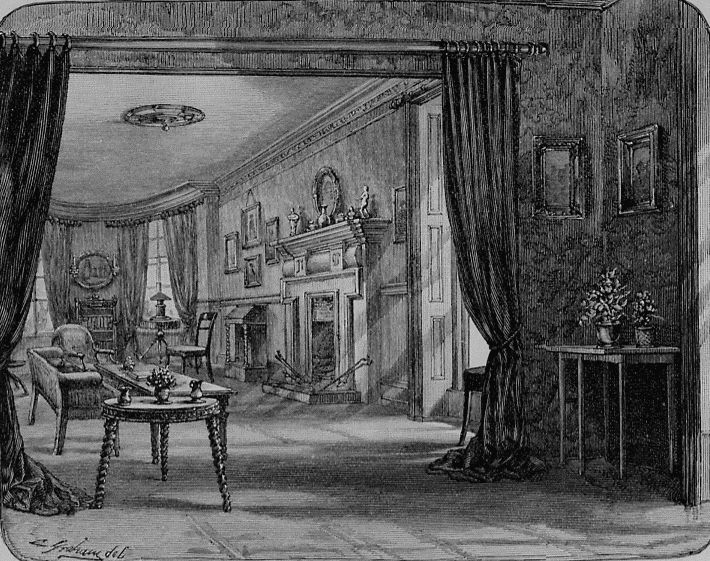
Drawing-room at the Priory.
Letter to
Mrs. Bray,
4th Dec.
1863.
The book[38]
is come, with its precious inscription,
and I have read a great piece of it already (11 a.m.),
besides looking through it to get an idea of its general
plan. See how fascination shifts its quarter as our
life goes on! I cannot be induced to lay aside my
regular books for half an hour to read "Mrs. Lirriper's
Lodgings," but I pounce on a book like yours, which
tries to tell me as much as it can in brief space of the
"natural order," and am seduced into making it my
after-breakfast reading instead of the work I had
prescribed for myself in that pleasant quiet time. I
read so slowly and read so few books that this small
fact among my small habits seems a great matter to
me. I thank you, dear Cara, not simply for giving
me the book, but for having put so much faithful
labor in a worthy direction, and created a lasting
benefit which I can share with others. Whether the
circulation of a book be large or small, there is always
this supreme satisfaction about solid honest
work, that as far as it goes its effect must be good, and
as all effects spread immeasurably, what we have to
care for is kind and not quantity. I am a shabby correspondent,
being in ardent practice of the piano just
now, which makes my days shorter than usual.
Letter to
Madame
Bodichon,
4th Dec.
1863.
I am rather ashamed to hear of any one trying to
be useful just now, for I am doing nothing but indulging
myself—enjoying being petted very much,
enjoying great books, enjoying our new, pretty, quiet
home, and the study of Beethoven's sonatas for piano
and violin, with the mild-faced old Jansa, and not
being at all unhappy as you imagine me. I sit taking
deep draughts of reading—"Politique Positive,"
Euripides, Latin Christianity, and so forth, and remaining
in glorious ignorance of "the current literature."
Such is our life; and you perceive that instead
of being miserable, I am rather following a wicked
example, and saying to my soul, "Soul, take thine
ease." I am sorry to think of you without any artistic
society to help you and feed your faith. It is hard
to believe long together that anything is "worth
while," unless there is some eye to kindle in common
with our own, some brief word uttered now and then
to imply that what is infinitely precious to us is precious
alike to another mind. I fancy that to do without
that guarantee one must be rather insane—one
must be a bad poet, or a spinner of impossible theories,
or an inventor of impossible machinery. However,
it is but brief space either of time or distance that
divides you from those who thoroughly share your
cares and joys—always excepting that portion which
is the hidden private lot of every human being. In
the most entire confidence even of husband and wife
there is always the unspoken residue—the undivined
residue—perhaps of what is most sinful, perhaps of
what is most exalted and unselfish.
Letter to
Miss Sara
Hennell,
26th Dec.
1863.
I get less and less inclined to write any but the
briefest letters. My books seem to get so far off me
when once I have written them, that I should be afraid
of looking into "The Mill;" but it was written faithfully
and with intense feeling when it was written, so
I will hope that it will do no mortal any harm. I am
indulging myself frightfully; reading everything except
the "current literature," and getting more and
more out of rapport with the public taste. I have
read Renan's book, however, which has proved to be
eminently in the public taste. It will have a good influence
on the whole, I imagine; but this "Vie de
Jésus," and still more, Renan's "Letter to Berthelot"
in the Revue des Deux Mondes, have compelled me to
give up the high estimate I had formed of his mind.
Judging from the indications in some other writings
of his, I had reckoned him among the finest thinkers
of the time. Still, his "Life of Jesus" has so much
artistic merit that it will do a great deal towards the
culture of ordinary minds, by giving them a sense of
unity between that far off past and our present.
Letter to
Mrs. Bray,
26th Dec.
1863.
We are enjoying our new house—enjoying its quiet
and freedom from perpetual stair-mounting—enjoying
also the prettiness of coloring and arrangement; all
of which we owe to our dear good friend, Mr. Owen
Jones. He has determined every detail, so that we
can have the pleasure of admiring what is our own
without vanity. And another magnificent friend has
given me the most splendid reclining chair conceivable,
so that I am in danger of being envied by the
gods, especially as my health is thoroughly good
withal. I should like to be sure that you are just as
comfortable externally and internally. I dare say
you are, being less of a cormorant in your demands
on life than I am; and it is that difference which
chiefly distinguishes human lots when once the absolute
needs are satisfied.
Letter to
Mrs. Peter
Taylor,
28th Dec.
1863.
Your affectionate greeting comes as one of the many
blessings that are brightening this happy Christmas.
We have been giving our evenings up to parental
duties—i.e., to games and music for the amusement of
the youngsters. I am wonderfully well in body, but
rather in a self-indulgent state mentally, saying, "Soul,
take thine ease," after a dangerous example.
Of course I shall be glad to see your fair face
whenever it can shine upon me; but I can well imagine,
with your multitudinous connections, Christmas
and the New Year are times when all unappointed visits
must be impossible to you.
All good to you and yours through the coming year!
and amongst the good may you continue to feel some
love for me; for love is one of the conditions in which
it is even better to give than to receive.
Letter to
Mrs. Congreve,
19th
Jan. 1864.
According to your plans you must be in Rome. I
have been in good spirits about you ever since I last
heard from you, and the foggy twilight which, for the
last week, has followed the severe frost, has made me
rejoice the more that you are in a better climate and
amongst lovelier scenes than we are groping in. I
please myself with thinking that you will all come
back with stores of strength and delightful memories.
Only, if this were the best of all possible worlds, Mr.
Lewes and I should be able to meet you in some
beautiful place before you turn your backs on Italy.
As it is, there is no hope of such a meeting. March
is Charlie's holiday month, and when he goes out we
like to stay at home for the sake of recovering for
that short time our unbroken tête-à-tête. We have
every reason to be cheerful if the fog would let us.
Last night I finished reading the last proofs of the
"Aristotle," which makes an octavo volume of rather
less than 400 pages. I think it is a book which will
be interesting and valuable to the few, but perhaps
only to the few. However, George's happiness in
writing his books makes him less dependent than
most authors on the audience they find. He felt that
a thorough account of Aristotle's science was a bit of
work which needed doing, and he has given his utmost
pains to do it worthily. These are the two most important
conditions of authorship; all the rest belong
to the "less modifiable" order of things. I have
been playing energetically on the piano lately, and
taking lessons in accompanying the violin from Herr
Jansa, one of the old Beethoven Quartette players.
It has given me a fresh kind of muscular exercise, as
well as nervous stimulus, and, I think, has done its
part towards making my health better. In fact I am
very well physically. I wish I could be as clever and
active as you about our garden, which might be made
much prettier this spring if I had judgment and industry
enough to do the right thing. But it is a
native vice of mine to like all such matters attended
to by some one else, and to fold my arms and enjoy
the result. Some people are born to make life pretty,
and others to grumble that it is not pretty enough.
But pray make a point of liking me in spite of my
deficiencies.
Letter to
Mrs. Peter
Taylor,
21st Jan.
1864.
I comfort myself with the belief that your nature is
less rebellious under trouble than mine—less craving
and discontented.
Resignation to trial, which can never have a personal
compensation, is a part of our life task which
has been too much obscured for us by unveracious
attempts at universal consolation. I think we should
be more tender to each other while we live, if that
wretched falsity which makes men quite comfortable
about their fellows' troubles were thoroughly got rid
of.
Letter to
Miss Sara
Hennell,
22d Jan.
1864.
I often imagine you, not without a little longing,
turning out into the fields whenever you list, as we
used to do in the old days at Rosehill. That power
of turning out into the fields is a great possession in
life—worth many luxuries.
Here is a bit of news not, I think, too insignificant
for you to tell Cara. The other day Mr. Spencer,
senior (Herbert Spencer's father), called on us, and
knowing that he has been engaged in education all
his life, that he is a man of extensive and accurate
knowledge, and that, on his son's showing, he is a
very able teacher, I showed him Cara's "British Empire."
Yesterday Herbert Spencer came, and on my
inquiring told me that his father was pleased with
Cara's book, and thought highly of it. Such testimonies
as this, given apart from personal influence
and by a practised judge, are, I should think, more
gratifying than any other sort of praise to all faithful
writers.
Journal,
1864.
Jan. 30.—We had Browning, Dallas, and Burton to
dine with us, and in the evening a gentlemen's party.
Feb. 14.—Mr. Burton dined with us, and asked me
to let him take my portrait.
Letter to
Mrs. Peter
Taylor, 3d
March,
1864.
It was pleasant to have news of you through the
fog, which reduces my faith in all good and lovely
things to its lowest ebb.
I hope you are less abjectly under the control of
the skyey influences than I am. The soul's calm sunshine
in me is half made up of the outer sunshine.
However, we are going on Friday to hear the Judas
Maccabæus, and Handel's music always brings me a
revival.
I have had a great personal loss lately in the death
of a sweet woman,[39]
to whom I have sometimes gone,
and hoped to go again, for a little moral strength.
She had long been confined to her room by consumption,
which has now taken her quite out of reach except
to memory, which makes all dear human beings
undying to us as long as we ourselves live.
I am glad to know that you have been interested in
"David Gray."[40]
It is good for us all that these true
stories should be well told. Even those to whom the
power of helping rarely comes, have their imaginations
instructed so as to be more just and tender in their
thoughts about the lot of their fellows.
Letter to
Miss Sara
Hennell,
7th March,
1864.
I felt it long since I had had news from you, but
my days go by, each seeming too short for what I
must do, and I don't like to molest you with mere
questions.
I have been spoiled for correspondence by Mr.
Lewes's goodness in always writing letters for me
where a proxy is admissible. And so it has come to
be a great affair with me to write even a note, while
people who keep up a large correspondence, and set
apart their hour for it, find it easy to cover reams of
paper with talk from the end of the pen.
You say nothing of yourself, which is rather unkind.
We are enjoying a perfect tête à tête. On Friday we
are going to hear the Judas Maccabæus, and try if
possible to be stirred to something heroic by "Sound
an alarm."
I was more sorry than it is usually possible to be
about the death of a person utterly unknown to me,
when I read of Maria Martineau's death. She was a
person whose office in life seemed so thoroughly defined
and so valuable. For an invalid like Harriet
Martineau to be deprived of a beloved nurse and companion,
is a sorrow that makes one ashamed of one's
small grumblings. But, oh dear, oh dear! when will
people leave off their foolish talk about all human lots
being equal; as if anybody with a sound stomach ever
knew misery comparable to the misery of a dyspeptic.
Farewell, dear Sara; be generous, and don't always
wait an age in silence because I don't write.
Letter to
Mrs. Congreve,
8th
March,
1864.
If you were anybody but yourself I should dislike
you, because I have to write letters to you. As it is,
your qualities triumph even over the vice of being in
Italy (too far off for a note of three lines), and expecting
to hear from me, though I fear I should be graceless
enough to let you expect in vain if I did not care
very much to hear from you, and did not find myself
getting uneasy when many weeks have been passed in
ignorance about you. I do hope to hear that you got
your fortnight of sight-seeing before leaving Rome—at
least, you would surely go well over the great galleries.
If not, I shall be vexed with you, and I shall
only be consoled for your not going to Venice by the
chance of the Austrians being driven or bought out of
it—on no slighter grounds. For I suppose you will
not go to Italy again for a long, long while, so as to
leave any prospect of the omission being made up for
by-and-by.
Letter to
Miss Sara
Hennell,
20th
March,
1864.
We run off to Scotland for the Easter week, setting
out on Sunday evening; so if the spring runs away
again, I hope it will run northward. We shall return
on Monday, the 4th April. Some news of your inwards
and outwards would be acceptable; but don't write
unless you really like to write. You see Strauss has
come out with a popular "Life of Jesus."
Letter to
Mrs. Peter
Taylor,
25th
March,
1864.
Fog, east wind, and headache: there is my week's
history. But this morning, when your letter came to
me, I had got up well and was reading the sorrows of
the aged Hecuba with great enjoyment. I wish an
immortal drama could be got out of my sorrows, that
people might be the better for them two thousand
years hence. But fog, east wind, and headache are
not great dramatic motives.
Your letter was a reinforcement of the delicious
sense of bien être that comes with the departure of
bodily pain; and I am glad, retrospectively, that beyond
our fog lay your moonlight and your view of the
glorious sea. It is not difficult to me to believe that
you look a new creature already. Mr. Lewes tells me
the country air has always a magical effect on me,
even in the first hour; but it is not the air alone, is it?
It is the wide sky, and the hills, and the wild-flowers
which are linked with all calming thoughts, just as every
object in town has its perturbing associations.
I share your joy in the Federal successes—with that
check that attends all joy in a war not absolutely ended.
But you have worked and earned more joy than
those who have been merely passives.
Journal,
1864.
April 6.—Mr. Spencer called for the first time after
a long correspondence on the subject of his relation
to Comte.
Letter to
Miss Sara
Hennell,
9th April,
1864.
Yes! I am come back from Scotland—came back
last Saturday night.
I was much pleased to see Cara so wonderfully well
and cheerful. She seems to me ten times more cheerful
than in the old days. I am interested to know
more about your work which is filling your life now,
but I suppose I shall know nothing until it is in print—and
perhaps that is the only form in which one can
do any one's work full justice. It is very disappointing
to me to hear that Cara has at present so little
promise of monetary results from her conscientious
labor. I fear the fatal system of half profits is working
against her as against others. We are going to
the opera to-night to hear the Favorita. It was the
first opera I ever saw (with you I saw it!), and I have
never seen it since—that is the reason I was anxious
to go to-night.
This afternoon we go to see Mulready's pictures—so
the day will be a full one.
Journal,
1864.
April 18.—We went to the Crystal Palace to see
Garibaldi.
Letter to
Miss Sara
Hennell,
30th April,
1864.
Only think! next Wednesday morning we start for
Italy. The move is quite a sudden one. We need a
good shake for our bodies and minds, and must take
the spring-time, before the weather becomes too hot.
We shall not be away more than a month or six weeks
at the utmost. Our friend Mr. Burton, the artist, will
be our companion for at least part of the time. He
has just painted a divine picture, which is now to be
seen at the old Water-Color Exhibition. The subject
is from a Norse legend; but that is no matter—the
picture tells its story. A knight in mailed armor and
surcoat has met the fair, tall woman he (secretly) loves,
on a turret stair. By an uncontrollable movement he
has seized her arm and is kissing it. She, amazed,
has dropped the flowers she held in her other hand.
The subject might have been made the most vulgar
thing in the world—the artist has raised it to the
highest pitch of refined emotion. The kiss is on the
fur-lined sleeve that covers the arm, and the face of
the knight is the face of a man to whom the kiss is a
sacrament.
How I should like a good long talk with you! From
what you say of your book that is to come, I expect to
be very much interested in it. I think I hardly ever
read a book of the kind you describe without getting
some help from it. It is to this strong influence that
is felt in all personal statements of inward experience
that we must perhaps refer the excessive publication
of religious journals.
Journal,
1864.
May 4.—We started for Italy with Mr. Burton.
June 20.—Arrived at our pretty home again after
an absence of seven weeks.
Letter to
Miss Sara
Hennell,
25th June,
1864.
Your letter has affected me deeply. Thank you
very much for writing it. It seems as if a close view
of almost every human lot would disclose some suffering
that makes life a doubtful good—except perhaps
at certain epochs of fresh love, fresh creative activity,
or unusual power of helping others. One such epoch
we are witnessing in a young life that is very near to
us. Our "boy" Charles has just become engaged,
and it is very pretty to see the happiness of a pure
first love, full at present of nothing but promise. It
will interest you to know that the young lady who has
won his heart, and seems to have given him her own
with equal ardor and entireness, is the grand-daughter
of Dr. Southwood Smith, whom he adopted when she
was three years old, and brought up under his own
eye. She is very handsome, and has a splendid contralto
voice. Altogether Pater and I rejoice—for
though the engagement has taken place earlier than
we expected, or should perhaps have chosen, there are
counterbalancing advantages. I always hoped Charlie
would be able to choose or rather find the other half
of himself by the time he was twenty-three; the event
has only come a year and a half sooner. This is the
news that greeted us on our return! We had seen
before we went that the acquaintance, which was first
made eighteen months or more ago, had become supremely
interesting to Charlie. Altogether we rejoice.
Our journey was delightful in spite of Mr. Lewes's
frequent malaise; for his cheerful nature is rarely subdued
even by bodily discomfort. We saw only one
place that we had not seen before—namely, Brescia;
but all the rest seemed more glorious to us than they
had seemed four years ago. Our course was to Venice,
where we stayed a fortnight, pausing only at Paris,
Turin and Milan on our way thither, and taking Padua,
Verona, Brescia, and again Milan, as points of rest
on our way back. Our friend Mr. Burton's company
was very stimulating, from his great knowledge, not
of pictures only, but of almost all other subjects. He
has had the advantage of living in Germany for five
or six years, and has gained those large, serious views
of history which are a special product of German culture,
and this was his first visit to Italy, so you may
imagine his eager enjoyment in finding it beautiful
beyond his hopes. We crossed the Alps by the St.
Gothard, and stayed a day or two at Lucerne; and
this, again, was a first sight of Switzerland to him.
Letter to
Mrs. Congreve,
July, 1864.
Looking at my little mats this morning while I was
dressing, I felt very grateful for them, and remembered
that I had not shown my gratitude when you
gave them to me. If I were a "conceited" poet, I
should say your presence was the sun, and the mats
were the tapers; but now you are away, I delight in
the tapers. How pretty the pattern is—and your
brain counted it out! They will never be worn quite
away while I live, or my little purse for coppers either.
Journal,
1864.
July 17.—Horrible scepticism about all things paralyzing
my mind. Shall I ever be good for anything
again? Ever do anything again?
July 19.—Reading Gibbon, Vol. I., in connection
with Mosheim, also Gieseler on the condition of the
world at the appearance of Christianity.
Letter to
Miss Sara
Hennell,
28th Aug.
1864.
I am distressed to find that I have let a week pass
without writing in answer to your letter, which made
me very glad when I got it. Remembering you just
a minute ago, I started up from Max Müller's new volume,
with which I was consoling myself under a sore
throat, and rushed to the desk that I might not risk
any further delay.
It was just what I wanted to hear about you that
you were having some change, and I think the freshness
of the companionship must help other good influences,
not to speak of the "Apologia," which breathed
much life into me when I read it. Pray mark that
beautiful passage in which he thanks his friend Ambrose
St. John. I know hardly anything that delights
me more than such evidences of sweet brotherly love
being a reality in the world. I envy you your opportunity
of seeing and hearing Newman, and should like to
make an expedition to Birmingham for that sole end.
My trouble now is George's delicate health. He
gets thinner and thinner. He is going to try what
horseback will do, and I am looking forward to that
with some hope.
Our boy's love-story runs smoothly, and seems to
promise nothing but good. His attraction to Hampstead
gives George and me more of our dear old tête-à-tête,
which we can't help being glad to recover.
Dear Cara and Mr. Bray! I wish they too had joy
instead of sadness from the young life they have been
caring for these many years. When you write to Cara,
or see her, assure her that she is remembered in my
most affectionate thoughts, and that I often bring her
present experience before my mind—more or less truly—for
we can but blunder about each other, we poor
mortals.
Write to me whenever you can, dear Sara; I should
have answered immediately but for sickness, visitors,
business, etc.
Journal,
1864.
Sept. 6.—I am reading about Spain, and trying a drama
on a subject that has fascinated me—have written the prologue,
and am beginning the First Act. But I have little
hope of making anything satisfactory.
Sept. 13 to 30.—Went to Harrogate and Scarborough,
seeing York Minster and Peterborough.
Fac-simile of George Eliot's hand-writing.
Letter to
Miss Sara
Hennell,
15th Sept.
1864, from
Harrogate.
We journeyed hither on Tuesday, and found the
place quite as pretty as we expected. The great merit
of Harrogate is that one is everywhere close to lovely
open walks. Your "plan" has been a delightful reference
for Mr. Lewes, who takes it out of his pocket
every time we walk. At present, of course, there is not
much improvement in health to be boasted of, but we
hope that the delicious bracing air, and also the
chalybeate waters, which have not yet been tried, will
not be without good effect. The journey was long.
How hideous those towns of Holbeach and Wakefield
are! It is difficult to keep up one's faith in a millennium
within sight of this modern civilization which
consists in "development of industries." Egypt and
her big calm gods seems quite as good.
Letter to
Miss Sara
Hennell,
26th Sept.
1864, from
Scarborough.
We migrated on Friday last from delightful Harrogate,
pausing at York to see the glorious Cathedral.
The weather is perfect, the sea blue as a sapphire, so
that we see to utmost advantage the fine line of coast
here and the magnificent breadth of sand. Even the
Tenby sands are not so fine as these. Better than
all, Mr. Lewes, in spite of a sad check of a few days,
is strengthened beyond our most hopeful expectations
by this brief trial of fresh conditions. He is wonderful
for the rapidity with which he "picks up" after
looking alarmingly feeble and even wasted. We paid
a visit to Knaresborough the very last day of our stay
at Harrogate, and were rejoiced that we had not
missed the sight of that pretty characteristic northern
town. There is a ruined castle here too, standing
just where one's eyes would desire it on a grand line
of cliff; but perhaps you know the place. Its only
defect is that it is too large, and therefore a little too
smoky; but except in Wales or Devonshire I have
seen no sea-place on our English coast that has greater
natural advantages. I don't know quite why I should
write you this note all about ourselves—except that
your goodness having helped us to the benefit we have
got, I like you to know of the said benefit.
Letter to
Mrs. Congreve,
Sunday, Oct. (?)
1864.
The wished-for opportunity is coming very soon.
Next Saturday Charlie will go to Hastings, and will
not return till Sunday evening. Will you—can you—arrange
to come to us on Saturday to lunch or dinner,
and stay with us till Sunday evening? We shall be
very proud and happy if you will consent to put up
with such travelling quarters as we can give you. You
will be rejoicing our hearts by coming, and I know
that for the sake of cheering others you would endure
even large privations as well as small ones.
Letter to
Mrs. Congreve,
Monday-week
following.
What a pure delight it was to have you with us!
I feel the better for it in spite of a cold which I caught
yesterday—perhaps owing to the loss of your sunny
presence all of a sudden.
Letter to
Miss Sara
Hennell,
2d Oct.
1864.
It makes me very, very happy to see George so much
better, and to return with that chief satisfaction to the
quiet comforts of home. We register Harrogate among
the places to be revisited.
I have had a fit of Spanish history lately, and have
been learning Spanish grammar—the easiest of all the
Romance grammars—since we have been away. Mr.
Lewes has been rubbing up his Spanish by reading
Don Quixote in these weeks of idlesse; and I have
read aloud and translated to him, like a good child.
I find it so much easier to learn anything than to feel
that I have anything worth teaching.
All is perfectly well with us, now the "little Pater"
is stronger, and we are especially thankful for Charlie's
prospect of marriage. We could not have desired
anything more suited to his character and more likely
to make his life a good one. But this blessing which
has befallen us only makes me feel the more acutely
the cutting off of a like satisfaction from the friends I
chiefly love.
Journal,
1864.
Oct. 5.—Finished the first draught of the First Act
of my drama, and read it to George.
Oct. 15.—Went to the Maestro (Burton) for a sitting.
Nov. 4.—Read my Second Act to George. It is
written in verse—my first serious attempt at blank
verse. G. praises and encourages me.
Nov. 10.—I have been at a very low ebb, body and
mind, for the last few days, sticking in the mud continually
in the construction of my 3d, 4th, and 5th
Acts. Yesterday Browning came to tell us of a
bust of Savonarola in terra-cotta, just discovered at
Florence.
Letter to
Miss Sara
Hennell,
23d Nov.
1864.
I believe I have thought of you every day for the
last fortnight, and I remembered the birthday—and
"everything." But I was a little cross, because I had
heard nothing of you since Mr. Bray's visit. And I
said to myself, "If she wanted to write she would
write." I confess I was a little ashamed when I saw
the outside of your letter ten minutes ago, feeling that
I should read within it the proof that you were as
thoughtful and mindful as ever.
Yes, I do heartily give my greeting—had given it
already. And I desire very much that the work which
is absorbing you may give you some happiness besides
that which belongs to the activity of production.
It is very kind of you to remember Charlie's date
too. He is as happy as the day is long, and very
good—one of those creatures to whom goodness comes
naturally—not any exalted goodness, but every-day
serviceable goodness, such as wears through life.
Whereas exalted goodness comes in brief inspirations,
and requires a man to die lest he should spoil his
work.
I have been ill, but now am pretty well, with much
to occupy and interest me, and with no trouble except
those bodily ailments.
I could chat a long while with you—but I restrain
myself, because I must not carry on my letter-writing
into the "solid day."
Letter to
Mrs. Congreve,
Christmas-day,
1864.
Your precious letter did come last night, and crowned
the day's enjoyment. Our family party went off very
well, entirely by dint of George's exertions. I wish
you had seen him acting charades, and heard him
make an after-supper speech. You would have understood
all the self-forgetful goodness that lay under
the assumption of boyish animal spirits. A horrible
German whom I have been obliged to see has been
talking for two hours, with the hardest eyes, blind to
all possibilities that he was boring us, and so I have
been robbed of all the time I wanted for writing to
you. I can only say now that I bore you on my heart—you
and all yours known to me—even before I had
had your letter yesterday. Indeed you are not apart
from any delight I have in life: I long always that
you should share it, if not otherwise, at least by knowing
of it, which to you is a sort of sharing. Our double
loves and best wishes for all of you—Rough being included,
as I trust you include Ben. Are they not idlers
with us? Also a title to regard as well as being collaborateurs.
Journal,
1864.
Dec. 24.—A family party in the evening.
Dec. 25.—I read the Third Act of my drama to
George, who praised it highly. We spent a perfectly
quiet evening, intending to have our Christmas-day's
jollity on Tuesday when the boys are at home.
Journal,
1865.
Jan. 1.—The last year has been unmarked by any
trouble except bad health. The bright spots in the
year have been the publication of "Aristotle" and our
journey to Venice. With me the year has not been
fruitful. I have written three Acts of my drama, and
am now in a condition of body and mind to make me
hope for better things in the coming year. The last
quarter has made an epoch for me, by the fact that,
for the first time in my serious authorship I have written
verse. In each other we are happier than ever.
I am more grateful to my dear husband for his perfect
love, which helps me in all good and checks me in all
evil—more conscious that in him I have the greatest
of blessings.
Letter to
Mrs. Congreve,
3d
Jan. 1865.
I hope the wish that this New Year may be a happy
one to you does not seem to be made a mockery by
any troubles or anxieties pressing on you.
I enclose a check, which I shall be obliged if you
will offer to Mr. Congreve, as I know he prefers that
payments should be made at the beginning of the
year.
I shall think of you on the nineteenth. I wonder
how many there really were in that "small upper
room" 1866 years ago.
Journal,
1865.
Jan. 8.—Mrs. Congreve staying with us for a couple
of nights. Yesterday we went to Mr. Burton's to see
my portrait, with which she was much pleased. Since
last Monday I have been writing a poem, the matter
of which was written in prose three or four years ago—"My
Vegetarian Friend."
Jan. 15 to 25.—Visit to Paris.
Letter to
Mrs. Congreve,
Friday (?),
27th
Jan. 1865.
Are we not happy to have reached home on Wednesday
before this real winter came? We enjoyed
our visit to Paris greatly, in spite of bad weather,
going to the theatre or opera nearly every night, and
seeing sights all day long. I think the most interesting
sight we saw was Comte's dwelling. Such places,
that knew the great dead, always move me deeply;
and I had an unexpected sight of interest in the
photograph taken at the very last. M. Thomas was
very friendly, and pleasant to talk to because of his
simple manners. We gave your remembrances to
him, and promised to assure you of his pleasure in
hearing of you. I wish some truer representation of
Mr. Congreve hung up in the Salon instead of that
(to me) exasperating photograph.
We thought the apartment very freundlich, and I
flattered myself that I could have written better in
the little study there than in my own. Such self-flattery
is usually the most amiable phase of discontent
with one's own inferiority.
I am really stronger for the change.
Journal,
1865.
Jan. 28.—Finished my poem on "Utopias."
Letter to
Miss Sara
Hennell,
6th Feb.
1865.
I suspect you have come to dislike letters, but until
you say so, I must write now and then to gratify myself.
I want to send my love, lest all the old messages
shall have lost their scent, like old lavender
bags.
Since I wrote to you last we have actually been to
Paris! A little business was an excuse for getting a
great deal of pleasure; and I, for whom change of
air and scene is always the best tonic, am much
brightened by our wintry expedition, which ended just
in time for us to escape the heavy fall of snow.
We are very happy, having almost recovered our
old tête-à-tête, of which I am so selfishly fond that I
am beginning to feel it an heroic effort when I make
up my mind to invite half a dozen visitors. But it is
necessary to strive against this unsocial disposition,
so we are going to have some open evenings.
There is great talk of a new periodical—a fortnightly
apparition, partly on the plan of the Revue des Deux
Mondes. Mr. Lewes has consented to become its editor,
if the preliminaries are settled so as to satisfy him.
Ecco! I have told you a little of our news, not daring
to ask you anything about yourself, since you evidently
don't want to tell me anything.
Letter to
Mrs. Congreve,
19th
Feb. 1865.
The party was a "mull." The weather was bad.
Some of the invited were ill and sent regrets, others
were not ardent enough to brave the damp evening—in
fine, only twelve came. We had a charade, which,
like our neighbors, was no better than it should have
been, and some rather languid music, our best musicians
half failing us—so ill is merit rewarded in this
world! If the severest sense of fulfilling a duty could
make one's parties pleasant, who so deserving as I?
I turn my inward shudders into outward smiles, and
talk fast, with a sense of lead on my tongue. However,
Mr. Pigott made a woman's part in the charade
so irresistibly comic that I tittered at it at intervals
in my sleepless hours. I am rather uncomfortable
about you, because you seemed so much less well and
strong the other day than your average. Let me hear
before long how you and Mr. Congreve are.
Journal,
1865.
Feb. 21.—Ill and very miserable. George has taken
my drama away from me.
Letter to
Mrs. Congreve,
27th
Feb. 1865.
The sun shone through my window on your letter
as I read it, adding to its cheeriness. It was good of
you to write it. I was ill last week, and had mental
troubles besides—happily such as are unconnected
with any one's experience except my own. I am still
ailing, but striving hard "not to mind," and not to
diffuse my inward trouble, according to Madame de
Vaux's excellent maxim. I shall not, I fear, be able
to get to you till near the end of next week—towards
the 11th. I think of you very often, and especially
when my own malaise reminds me how much of your
time is spent in the same sort of endurance. Mr.
Spencer told us yesterday that Dr. Ransom said he
had cured himself of dyspepsia by leaving off stimulants—the
full benefit manifesting itself after two or
three months of abstinence. I am going to try. All
best regards to Mr. Congreve and tenderest sisterly
love to yourself.
Journal,
1865.
March 1.—I wrote an article for the Pall Mall
Gazette—"A Word for the Germans."
March 12.—Went to Wandsworth, to spend the Sunday
and Monday with Mr. and Mrs. Congreve. Feeling
very ailing; in constant dull pain, which makes
all effort burdensome.
Letter to
Mrs. Congreve,
16th
March,
1865.
I did not promise, like Mr. Collins, that you should
receive a letter of thanks for your kind entertainment
of me; but I feel the need of writing a word or two
to break the change from your presence to my complete
absence from you. It was really an enjoyment
to be with you, in spite of the bodily uneasiness which
robbed me of half my mind. One thing only I regret—that
in my talk with you I think I was rather merciless
to other people. Whatever vices I have seem to
be exaggerated by my malaise—such "chastening"
not answering the purpose of purification in my case.
Pray set down any unpleasant notions I have suggested
about others to my account—i.e., as being my unpleasantness,
and not theirs. When one is bilious,
other people's complexions look yellow, and one of
their eyes higher than the other—all the fault of one's
own evil interior. I long to hear from you that you
are better, and if you are not better, still to hear from
you before too long an interval. Mr. Congreve's condition
is really cheering, and he goes about with me
as a pleasant picture—like that Raphael the Tuscan
duke chose always to carry with him.
I got worse after I left you; but to-day I am better,
and begin to think there is nothing serious the matter
with me except the "weather," which every one else
is alleging as the cause of their symptoms.
Letter to
Mrs. Bray,
18th
March,
1865.
I believe you are one of the few who can understand
that in certain crises direct expression of sympathy is
the least possible to those who most feel sympathy.
If I could have been with you in bodily presence, I
should have sat silent, thinking silence a sign of feeling
that speech, trying to be wise, must always spoil.
The truest things one can say about great Death are
the oldest, simplest things that everybody knows by
rote, but that no one knows really till death has come
very close. And when that inward teaching is going
on, it seems pitiful presumption for those who are
outside to be saying anything. There is no such thing
as consolation when we have made the lot of another
our own. I don't know whether you strongly share,
as I do, the old belief that made men say the gods
loved those who died young. It seems to me truer
than ever, now life has become more complex, and
more and more difficult problems have to be worked
out. Life, though a good to men on the whole, is a
doubtful good to many, and to some not a good at
all. To my thought it is a source of constant mental
distortion to make the denial of this a part of religion—to
go on pretending things are better than
they are. To me early death takes the aspect of salvation;
though I feel, too, that those who live and
suffer may sometimes have the greater blessedness of
being a salvation. But I will not write of judgments
and opinions. What I want my letter to tell you is
that I love you truly, gratefully, unchangeably.
Journal,
1865.
March 25.—I am in deep depression, feeling powerless.
I have written nothing but beginnings since
I finished a little article for the Pall Mall, on the
Logic of Servants. Dear George is all activity, yet
is in very frail health. How I worship his good humor,
his good sense, his affectionate care for every one
who has claims on him! That worship is my best life.
March 29.—Sent a letter on "Futile Lying," from
Saccharissa to the Pall Mall.
I have begun a novel ("Felix Holt").
Letter to
Mrs. Congreve,
11th
April, 1865.
We are wondering if, by any coincidence or condition
of things, you could come to us on Thursday,
when we have our last evening party—wondering how
you are—wondering everything about you, and knowing
nothing. Could you resolve some of our wonderings
into cheering knowledge? It is ages since you
made any sign to us. Are we to be blamed or you?
I hope you are not unfavorably affected by the sudden
warmth which comes with the beautiful sunshine.
Some word of you, in pity!
Letter to
Mrs. Congreve,
22d
April, 1865.
If the sun goes on shining in this glorious way, I
shall think of your journey with pleasure. The sight
of the country must be a good when the trees are
bursting into leaf. But I will remember your warning
to Emily, and not insist too much on the advantages
of paying visits. Let us hear of you sometimes,
and think of us as very busy and very happy, but always
including you in our world, and getting uneasy
when we are left too much to our imaginations about
you. Tell Emily that Ben and I are the better for
having seen her. He has added to his store of memories,
and will recognize her when she comes again.
Journal,
1865.
May 4.—Sent an article on Lecky's "History of
Rationalism" for the Fortnightly. For nearly a fortnight
I have been ill, one way or other.
May 10.—Finished a letter of Saccharissa for the
Pall Mall. Reading Æschylus, "Theatre of the
Greeks," Klein's "History of the Drama," etc.
Letter to
Mrs. Congreve,
11th
May, 1865.
This note will greet you on your return, and tell
you that we were glad to hear of you in your absence,
even though the news was not of the brightest. Next
week we are going away—I don't yet know exactly
where; but it is firmly settled that we start on Monday.
It will be good for the carpets, and it will be
still better for us, who need a wholesome shaking,
even more than the carpets do.
The first number of the Review was done with last
Monday, and will be out on the 15th. You will be
glad to hear that Mr. Harrison's article is excellent,
but the "mull" which George declares to be the fatality
with all first numbers is so far incurred with regard to
this very article that, from overwhelming alarm at its
length, George put it (perhaps too hastily) into the
smaller type. I hope the importance of the subject
and the excellence of the treatment will overcome that
disadvantage.
Nurse all pleasant thoughts in your solitude, and
count our affection among them.
Letter to
Miss Sara
Hennell,
18th May,
1865.
We have just returned from a five days' holiday at
the coast, and are much invigorated by the tonic
breezes.
We have nothing to do with the Fortnightly as a
money speculation. Mr. Lewes has simply accepted
the post of editor, and it was seemly that I should
write a little in it. But do not suppose that I am going
into periodical writing. And your friendship is not required
to read one syllable for our sakes. On the contrary,
you have my full sympathy in abstaining. Rest
in peace, dear Sara, and finish your work, that you may
have the sense of having spoken out what was within
you. That is really a good—I mean, when it is done
in all seriousness and sincerity.
Journal,
1865.
May 28.—Finished Bamford's "Passages from the
Life of a Radical." Have just begun again Mill's
"Political Economy," and Comte's "Social Science,"
in Miss Martineau's edition.
June 7.—Finished Annual Register for 1832. Reading
Blackstone. Mill's second article on "Comte," to
appear in the Westminster, lent me by Mr. Spencer.
My health has been better of late.
June 15.—Read again Aristotle's "Poetics" with
fresh admiration.
June 20.—Read the opening of my novel to G.
Yesterday we drove to Wandsworth. Walked together
on Wimbledon Common, in outer and inner sunshine,
as of old; then dined with Mr. and Mrs. Congreve,
and had much pleasant talk.
June 25.—Reading English History, reign of George
III.; Shakespeare's "King John." Yesterday G. dined
at Greenwich with the multitude of so-called writers
for the Saturday. He heard much commendation of
the Fortnightly, especially of Bagehot's articles, which
last is reassuring after Mr. Trollope's strong objections.
July 3.—Went to hear the "Faust" at Covent Garden:
Mario, Lucca, and Graziani. I was much thrilled
by the great symbolical situations, and by the music—more,
I think, than I had ever been before.
July 9 (Sunday).—We had Browning, Huxley, Mr.
Warren, Mr. Bagehot, and Mr. Crompton, and talk was
pleasant.
Letter to
Mrs. Peter
Taylor,
Sunday,
10th July,
1865.
Success to the canvassing! It is "very meet and
right and your bounden duty" to be with Mr. Taylor
in this time of hard work, and I am glad that your health
has made no impediment. I should have liked to be
present when you were cheered. The expression of a
common feeling by a large mass of men, when the feeling
is one of good-will, moves me like music. A public
tribute to any man who has done the world a service
with brain or hand has on me the effect of a great
religious rite, with pealing organ and full-voiced choir.
I agree with you in your feeling about Mill. Some
of his works have been frequently my companions of
late, and I have been going through many actions de
grâce towards him. I am not anxious that he should
be in Parliament: thinkers can do more outside than
inside the House. But it would have been a fine precedent,
and would have made an epoch, for such a man
to have been asked for and elected solely on the ground
of his mental eminence. As it is, I suppose it is pretty
certain that he will not be elected.
I am glad you have been interested in Mr. Lewes's
article. His great anxiety about the Fortnightly is to
make it the vehicle for sincere writing—real contributions
of opinion on important topics. But it is more
difficult than the inexperienced could imagine to get
the sort of writing which will correspond to that desire
of his.
Journal,
1865.
July 16.—Madame Bohn, niece of Professor Scherer,
called. She said certain things about "Romola"
which showed that she had felt what I meant my readers
to feel. She said she knew the book had produced
the same effect on many others. I wish I could be
encouraged by this.
July 22.—Sat for my portrait—I suppose for the
last time.
July 23.—I am going doggedly to work at my novel,
seeing what determination can do in the face of despair.
Reading Neale's "History of the Puritans."
Letter to
Mrs. Peter
Taylor, 1st
Aug. 1865.
I received yesterday the circular about the Mazzini
Fund. Mr. Lewes and I would have liked to subscribe
to a tribute to Mazzini, or to a fund for his use,
of which the application was defined and guaranteed
by his own word. As it is, the application of the desired
fund is only intimated in the vaguest manner by
the Florentine committee. The reflection is inevitable
that the application may ultimately be the promotion
of conspiracy, the precise character of which is necessarily
unknown to subscribers. Now, though I believe
there are cases in which conspiracy may be a sacred,
necessary struggle against organized wrong, there are
also cases in which it is hopeless, and can produce
nothing but misery; or needless, because it is not the
best means attainable of reaching the desired end; or
unjustifiable, because it resorts to acts which are more
unsocial in their character than the very wrong they
are directed to extinguish; and in these three supposable
cases it seems to me that it would be a social crime
to further conspiracy even by the impulse of a little
finger, to which one may well compare a small money
subscription.
I think many persons to whom the circular might be
sent would take something like this view, and would
grieve, as we do, that a proposition intended to honor
Mazzini should come in a form to which they cannot
conscientiously subscribe.
I trouble you and Mr. Taylor with this explanation,
because both Mr. Lewes and I have a real reverence
for Mazzini, and could not therefore be content to give
a silent negative.
Letter to
Mrs. Congreve,
1st
Aug. 1865.
I fear that my languor on Saturday prevented me
from fairly showing you how sweet and precious your
presence was to me then, as at all times. We have
almost made up our minds to start some time in this
month for a run in Normandy and Brittany. We both
need the change, though when I receive, as I did yesterday,
a letter from some friend, telling me of cares
and trials from which I am quite free, I am ashamed
of wanting anything.
Journal,
1865.
Aug. 2.—Finished the "Agamemnon" second time.
Letter to
Mrs. Congreve,
6th
Aug. 1865.
When I wrote to you last I quite hoped that I should
see you and Emily before we left home, but now it is
settled that we start on Thursday morning, and I have
so many little things to remember and to do that I
dare not set apart any of the intervening time for the
quiet enjoyment of a visit from you. It is not quite so
cheerful a picture as I should like to carry with me,
that of you and Emily so long alone, with Mr. Congreve
working at Bradford. But your friends are sure
to think of you, and want to see you. I hope you did
not suffer so severely as we did from the arctic cold
that rushed in after the oppressive heat. Mr. T. Trollope
came from Italy just when it began. He says it
is always the same when he comes to England, people
always say it has just been very hot, and he believes
that means they had a few days in which they were
not obliged to blow on their fingers.
When you write to Mr. Congreve pray tell him that
we were very grateful for his Itinerary, which is likely
useful to us—indeed, has already been useful in
determining our route.
Journal,
1865.
Sept. 7.—We returned home after an expedition into
Brittany. Our course was from Boulogne to St. Valéry,
Dieppe, Rouen, Caen, Bayeux, St. Lô, Vire, Avranches,
Dol, St. Malo, Rennes, Avray, and Carnac—back by
Nantes, Tours, Le Mans, Chartres, Paris, Rouen,
Dieppe, Abbeville, and so again to Boulogne.
Letter to
Miss Sara
Hennell,
14th Sept.
1865.
We came home again on Thursday night—this day
week—after a month's absence in Normandy and Brittany.
I have been thinking of you very often since,
but believed that you did not care to have the interruption
of letters just now, and would rather defer correspondence
till your mind was freer. If I had suspected
that you would feel any want satisfied by a letter
I should certainly have written. I had not heard
of Miss Bonham Carter's death, else I should have
conceived something of your state of mind. I think
you and I are alike in this, that we can get no good
out of pretended comforts, which are the devices of
self-love, but would rather, in spite of pain, grow into
the endurance of all "naked truths." So I say no
word about your great loss, except that I love you, and
sorrow with you.
The circumstances of life—the changes that take
place in ourselves—hem in the expression of affections
and memories that live within us, and enter almost into
every day, and long separations often make intercourse
difficult when the opportunity comes. But the delight
I had in you, and in the hours we spent together, and
in all your acts of friendship to me, is really part of
my life, and can never die out of me. I see distinctly
how much poorer I should have been if I had never
known you. If you had seen more of me in late years,
you would not have such almost cruel thoughts as that
the book into which you have faithfully put your experience
and best convictions could make you "repugnant"
to me. Whatever else my growth may have been, it has
not been towards irreverence and ready rejection of
what other minds can give me. You once unhappily
mistook my feeling and point of view in something I
wrote à propos of an argument in your "Aids to Faith,"
and that made me think it better that we should not
write on large and difficult subjects in hasty letters.
But it has often been painful to me—I should say, it
has constantly been painful to me—that you have ever
since inferred me to be in a hard and unsympathetic
state about your views and your writing. But I am
habitually disposed myself to the same unbelief in the
sympathy that is given me, and am the last person who
should be allowed to complain of such unbelief in another.
And it is very likely that I may have been
faulty and disagreeable in my expressions.
Excuse all my many mistakes, dear Sara, and never
believe otherwise than that I have a glow of joy when
you write to me, as if my existence were some good to
you. I know that I am, and can be, very little practically;
but to have the least value for your thought is
what I care much to be assured of.
Perhaps, in the cooler part of the autumn, when your
book is out of your hands, you will like to move from
home a little and see your London friends?
Our travelling in Brittany was a good deal marred
and obstructed by the emperor's fête, which sent all the
world on our track towards Cherbourg and Brest.
But the Norman churches, the great cathedrals at
Le Mans, Tours, and Chartres, with their marvellous
painted glass, were worth much scrambling to
see.
Letter to
Miss Sara
Hennell,
28th Oct.
1865.
I have read Mr. Masson's book on "Recent Philosophy."
The earlier part is a useful and creditable
survey, and the classification ingenious. The later
part I thought poor. If, by what he says of Positivism,
you mean what he says at p. 246, I should answer it is
simply "stuff"—he might as well have written a dozen
lines of jargon. There are a few observations about
Comte, scattered here and there, which are true and
just enough. But it seems to me much better to read
a man's own writing than to read what others say
about him, especially when the man is first-rate and
the "others" are third-rate. As Goethe said long ago
about Spinoza, "Ich zog immer vor von dem Menschen
zu erfahren wie er dachte als von einem anderen
zu hören wie er hätte denken
sollen."[41]
However, I am
not fond of expressing criticism or disapprobation.
The difficulty is to digest and live upon any valuable
truth one's self.
Journal,
1865.
Nov. 15.—During the last three weeks George has
been very poorly, but now he is better. I have been
reading Fawcett's "Economic Condition of the Working
Classes," Mill's "Liberty," looking into Strauss's
second "Life of Jesus," and reading Neale's "History
of the Puritans," of which I have reached the fourth
volume. Yesterday the news came of Mrs. Gaskell's
death. She died suddenly, while reading aloud to her
daughter.
Nov. 16.—Writing Mr. Lyon's story, which I have
determined to insert as a narrative. Reading the Bible.
Nov. 24.—Finished Neale's "History of the Puritans."
Began Hallam's "Middle Ages."
Dec. 4.—Finished second volume of Hallam. The
other day read to the end of chapter nine of my novel
to George, who was much pleased and found no fault.
Letter to
Mrs. Congreve,
4th
Dec. 1865.
We send to-day "Orley Farm," "The Small House
at Allington," and the "Story of Elizabeth." The
"Small House" is rather lighter than "Orley Farm."
"The Story of Elizabeth" is by Miss Thackeray. It
is not so cheerful as Trollope, but is charmingly written.
You can taste it and reject it if it is too melancholy.
I think more of you than you are likely to
imagine, and I believe we talk of you all more than of
any other mortals.
Letter to
Miss Sara
Hennell,
7th Dec.
1865.
It is worth your while to send for the last Fortnightly
to read an article of Professor Tyndall's "On the
Constitution of the Universe." It is a splendid piece
of writing on the higher physics, which I know will interest
you. À propos of the feminine intellect, I had a
bit of experience with a superior woman the other day,
which reminded me of Sydney Smith's story about his
sermon on the Being of a God. He says, that after
he had delivered his painstaking argument, an old
parishioner said to him, "I don't agree wi' you, Mr.
Smith; I think there be a God."
Journal,
1865.
Dec. 11.—For the last three days I have been
foundering from a miserable state of head. I have
written chapter ten. This evening read again Macaulay's
Introduction.
Dec. 15.—To-day is the first for nearly a week on
which I have been able to write anything fresh. I am
reading Macaulay and Blackstone. This evening we
went to hear "The Messiah" at Exeter Hall.
Letter to
Miss Sara
Hennell,
21st Dec.
1865.
"A Merry Christmas and a Happy New Year" is a
sort of hieroglyph for I love you and wish you well all
the year round. Christmas to me is like a great many
other pleasures, which I am glad to imagine as enjoyed
by others, but have no delight in myself. Berried holly
and smiling faces and snap-dragon, grandmamma and
the children, turkey and plum-pudding—they are all
precious things, and I would not have the world without
them; but they tire me a little. I enjoy the common
days of the year more. But for the sake of those
who are stronger I rejoice in Christmas.
Journal,
1865.
Dec. 24.—For two days I have been sticking in the
mud from doubt about my construction. I have just
consulted G., and he confirms my choice of incidents.
Dec. 31.—The last day of 1865. I will say nothing
but that I trust—I will strive—to add more ardent
effort towards a good result from all the outward good
that is given to me. My health is at a lower ebb
than usual, and so is George's. Bertie is spending his
holidays with us, and shows hopeful characteristics.
Charles is happy.
SUMMARY.
JANUARY, 1862, TO DECEMBER, 1865.
Begins "Romola" again—Letter to Miss Hennell—Max Müller's
book—"Orley Farm"—Anthony Trollope—T. A. Trollope's
"Beata"—Acquaintance with Mr. Burton and Mr. W. G. Clark—George
Smith, publisher, suggests a "magnificent offer"—Depression
about "Romola"—Letter to Mrs. Bray asking for loan
of music—Pantomime—First visit to Dorking—Letter to Madame
Bodichon—Impatience of concealment—Anxiety about war with
America—Sympathy with queen—Mr. Lewes begins "History
of Science"—Mrs. Browning's "Casa Guidi Windows"—Depression—George
Smith offers £10,000 for "Romola" for the
Cornhill—Idea given up—Visit to Englefield Green—Working
under a weight—Second visit to Dorking for three weeks—Delight
in spring—Accepts £7000 for "Romola" in Cornhill—Regret
at leaving Blackwood—Palsy in writing—Visit to Littlehampton
and to Dorking third time—Letter to Mrs. Congreve—Mr.
Lewes at Spa—George Eliot in better spirits—Letter to
Miss Hennell—Joachim's playing—New Literary Club—Reading
Poliziano—Suggestion of Tennyson's "Palace of Art"—Visit from
Browning—Depression—Letter to Madame Bodichon—No negative
propaganda—Letter to Mrs. Peter Taylor—"The Messiah"
on Christmas day—Letter to Miss Hennell—St. Paul's "Charity"—The
Poetry of Christianity—The Bible—Adieu to year 1862—Letter
to Miss Hennell—Encouragement about "Romola"—Literary
Club dissolves—Miss Cobbe—Letter to Mrs. Congreve—Depression—Fourth
visit to Dorking for fortnight—Letter to
Charles Lewes on Thackeray's Lectures—The effect of writing
"Romola"—Letter to Madame Bodichon—Odiousness of intellectual
superciliousness—Letter to Mrs. Bray—Thinking of the
Priory—"Romola" finished—Inscription—Visit to Isle of Wight—Ristori—Letter
to Miss Hennell—Thornton Lewes—London
amusements—Opera—Reading Mommsen, Liddell's "Rome," and
"Roba di Roma"—Letter from Frederick Maurice referred to as
most generous tribute ever given—Letter to Mrs. Peter Taylor—Renan's
"Vie de Jésus"—Visit to Worthing—Mrs. Hare—Return
to London—Depression—Letter to R. H. Hutton on "Romola"—The
importance of the medium in which characters move—Letter
to Madame Bodichon—Effect of London on health—Letter
to Mrs. Bray—Delight in autumn—Mommsen's History—Letter
to Mrs. Congreve—The "Discours Préliminaire"—Removal
to the Priory—Mr. Owen Jones decorates the house—Jansa the
violinist—Letter to Mrs. Bray—"Physiology for Schools"—Letter
to Madame Bodichon—Enjoying rest, and music with Jansa—Letter
to Miss Hennell—Renan—Letter to Mrs. Bray—Enjoyment
of Priory—Letter to Mrs. Congreve—Mr. Lewes's "Aristotle"
finished—Letter to Mrs. Peter Taylor—Compensation—Letter
to Mrs. P. A. Taylor—Effect of sunshine—Death of Mrs. Hare—"David
Gray"—Letter to Miss Hennell—Dislike of note-writing—Visit
to Glasgow—Letter to Mrs. Peter Taylor—Joy in
Federal successes—Crystal Palace to see Garibaldi—Mr. Burton's
picture of a Legendary Knight in Armor—Third visit to Italy
with Mr. Burton for seven weeks—Return to London—Charles
Lewes's engagement to Miss Gertrude Hill—Pleasure in Mr. Burton's
companionship in travel—Letter to Mrs. Congreve—Present
of mats—Depression—Reading Gibbon—Gieseler—Letter to Miss
Hennell—Reading Max Müller—Reference to the "Apologia"—Newman—Reading
about Spain—Trying a drama—Letter to
Miss Hennell—Harrogate—Development of Industries—Scarborough—Letters
to Mrs. Congreve—Pleasure in her visit—Letter
to Miss Hennell—Learning Spanish—Two acts of drama
written—Sticking in construction of remainder—Letter to Mrs.
Congreve—Christmas greeting—Retrospect of year 1864—Letter
to Mrs. Congreve, first payment to Positivist Fund—Comparison
with "small upper room" 1866 years ago—Mrs. Congreve
staying at the Priory—Poem "My Vegetarian Friend" written—Visit
to Paris—Letter to Mrs. Congreve—Visit to Comte's apartment
in Paris—Finished poem on "Utopias"—Letter to Miss
Sara Hennell—Delight in dual solitude—Fortnightly Review—Letter
to Mrs. Congreve—Charades—Depression—Mr. Lewes
takes away drama—Article for the Pall Mall, "A Word for the
Germans"—Letter to Mrs. Congreve—Visit to Wandsworth—Depression—Letter
to Mrs. Congreve after visit—Letter to Mrs.
Bray on a young friend's death—Deep depression—Admiration
of Mr. Lewes's good spirits—"Felix Holt" begun—Article on
Lecky's "History of Rationalism" in Fortnightly—Reading
Æschylus, "Theatre of the Greeks"—Klein's "History of the
Drama"—Letter to Mrs. Congreve—First number of the Fortnightly—Frederic
Harrison's article—Reading Mill, Comte, and
Blackstone—Aristotle's "Poetics"—Dine with Congreves at
Wandsworth—"Faust" at Covent Garden—Sunday reception—Browning,
Huxley, and Bagehot—Letter to Mrs. Peter Taylor
on J. S. Mill—The Fortnightly Review—Mr. Burton's portrait
finished—Mazzini subscription—Letter of adieu to Mrs. Congreve—Expedition
to Brittany for month—Letter to Miss Hennell—"Pretended
comforts"—Recollection of early feelings—Delight in
her friendship—Masson's "Recent Philosophy"—Comte—Goethe
on Spinoza—Reading Fawcett's "Economic Condition of Working
Classes"—Mill's "Liberty"—Strauss's second "Life of Jesus"—Neale's
"History of the Puritans"—Hallam's "Middle Ages"—Letter
to Miss Hennell on Tyndall's article on "The Constitution
of the Universe"—View of Christmas day—Retrospect of 1865.