BY BOWMAN TILLER.
CHAPTER II.
Time progressed, and though Mrs. Heartwell still laboured under
unaccountable agitation and alarm, yet there was a counteracting influence
that diffused itself through her frame and buoyed her up with hope.
Honest Ben more than once or twice entered the room, and with diffidence
inquired whether his mistress had any commands; he asked no
intrusive questions—he made no observations—the matter was something
beyond his comprehension, and it never for one moment entered into his
thoughts to speculate upon causes and effects; yet desirous of affording
all the comfort and consolation which suggested itself to his mind, he
took especial pains in making some excellent coffee, which he carried up
to the distressed lady.
"You are kind and considerate, my good friend," said she whilst
accepting the proffered refreshment. "I wish Mr. Heartwell was here
to partake of it with me. Surely something unusual must have happened
to detain him."
"No doubt on it, my lady," returned the seaman; "an ould messmate
or shipmate mayhap, or an extra glass of grog or two."
The lady shook her head as she mournfully replied, "No, no, those
would not be inducements strong enough to keep your master away
from his home."
"Bless you, my lady," responded the seaman earnestly, as he busied
himself about the parlour; "as to the strength of the deucements, all I can
say is, that they mixes 'em strong enough when they pleases—though
half-and-half ought to satisfy any reasonable man. But there, what's the
odds so as you're happy?"
"You must prepare yourself, Ben, to go to Lincoln's Inn, and see if
your master has been detained by business," said the lady, disregarding,
or perhaps not observing the poor fellow's mistake. "You know the
office of Mr. Brady."
"Yes, my lady," returned the seaman; "and I'll make sail as soon as
ever you pleases to give orders."
"Wait then a little longer," added Mrs. Heartwell, as she looked at the
watch: "go down now, and I will ring for you presently."
Accustomed to implicit obedience when afloat, the seaman still
adhered to it now that he was ashore; and therefore again descending to
the kitchen, he awaited the expected summons.
Drearily and heavily the minutes passed away, and yet as the fingers
of the dial moved progressively over the divisions of the hour into
quarters—marking the march of time—they seemed to have flown too
quickly, for they afforded additional evidence that some calamity must
have befallen the individual whose continued absence had caused increasing
pain. Yet there the mourning watcher sat, suffering the extreme
trial of human patience—waiting for those who came not.
Several times had the silent contemplations of Mrs. Heartwell been
disturbed by the loud ticking and sudden stopping of a clock or watch.
At first she scarcely heeded the noise, but the frequent repetition drew
her attention more strongly to it, and she sought for the cause: it could
not be the dial, for the vibrations of that were clear and continuous—it
could not be her own watch, the sound was so different; but to satisfy
herself, she wrapped it in a handkerchief and placed it in the table-drawer.
Again the ticking came; it seemed to fill every corner of the apartment,
sometimes heard in one place and sometimes in another; and when
Mrs. Heartwell fancied she had found the spot from which it emanated,
it suddenly ceased, and then commenced elsewhere. She rang the
bell for Ben, who promptly answered, and stood within the open
door. "Did Mr. Heartwell take his timepiece with him?" inquired
she.
"Yes, my lady," responded Ben; "I saw the chain and seals hanging
down as he went out at the door."
"Is there any strange watch or clock in the house that you know of?"
demanded she again.
"No, my lady, not as I knows of," replied Ben, much surprised at the
question, and somewhat fearful that grief had unsettled the reason of his
mistress.
"Hark then, Ben,—listen, and tell me what is that," exclaimed she
energetically, as the ticking was loudly renewed. "There must be a
clock somewhere to produce such sounds."
Ben did listen as the eyes of his mistress were intently fixed upon him,
but the tar shook his head and was silent.
"It must be some trick," said Mrs. Heartwell; "can you hear it
distinctly?"
"It's easy enough to hear," responded the seaman with another slow
shake of his head; "and though it's some years since I heard it afore,
yet there's no mistaking that, my lady."
"What is it then?" demanded the excited woman in a tone assuming
peremptory command; "what is it that produces so loud and peculiar a
noise?"
"Bless you, my lady," returned the seaman solemnly, as he folded his
arms across his breast. "Them sounds are out of all natur, for the works
were never made by mortal fingers—there's no living hand as winds
'em up—no human spring as sets 'em a-going—that my lady is the death-watch:"
and then Ben added his usual expletive, though his countenance
was ruefully sad, "but what's the odds so as you're happy?"
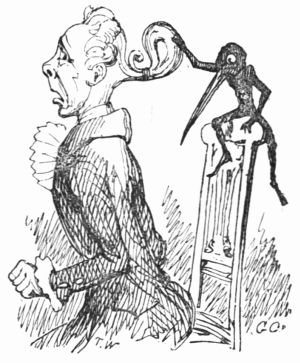
Mrs. Heartwell was perfectly aware that what had generally been
called "the death-watch," was nothing more than a small insect, and the
noise it produced was caused by striking its proboscis against hollow
wood to release itself from confinement; but her nervous system was
greatly relaxed and her mental energies impaired through the violent
agitation she had undergone during the night. For several minutes,
therefore, a superstitious dread came over her mind—it was the first time
she had ever heard the supposed monitor of the shroud and coffin, and
Ben's impressive manner as he announced its alleged character threw an
additional weight of gloom over her already oppressed spirits. But reason
was not long in resuming its sway, though it could not utterly banish
feelings which had been excited by such a visitation, especially acted
upon as she was by previous apprehensions of some direful but unknown
calamity.
The tapers on the table were nearly consumed, and the re-assured lady
directed Ben to supply others in their places: she then walked towards
the window, and unclosing one of the shutters, the bright gleams from a
beautiful daylight mingling with the fading light of the newly-risen
moon streamed full upon her.
Hallowed and tranquillising are the effects of a lovely dawn; darkness
has fled before a mighty conqueror—the face of nature is again unveiled,
and smiling beauty colours every feature with its rosy tints; the sorrows
of the heart are for a time absorbed in the universal peace which prevails,
and even the dying who cannot expect to see its close, rejoice in the
opening glory of another day.
The weary watcher as she looked up to the heavens felt relieved and
comforted; a prayer rose spontaneously from her heart to that Being
who had sent light from above to cheer her in the dreariness of
night; and now with humble adoration she poured forth her gratitude
at being spared to witness the early beams that illumed the east, and
called man forth to his daily labour.
Ben was again summoned—the servants were called up from their beds—Mrs
Heartwell went to the pillow of her sleeping boy, but his repose
was so calm, his rest so undisturbed, that she would not awake him; but
imprinting one gentle kiss on his fair forehead, she descended to the parlour
to commence active operations in search of her husband.
The seaman was despatched to Lincoln's Inn, as the first essay, and
after an absence of about an hour, he returned to report that he had
waited some time at the door of Mr. Brady's office, till the porter had
told him the office would not be open till nine o'clock, and he thought it
best to come and let his mistress know.
"It is fast approaching that hour," said the lady. "Be quick and
get your breakfast; I will go myself, and you and Frank shall accompany
me."
"I wants no breakfast, my lady," returned the seaman. "I'm rigged
and ready at once, if so be as you wishes to get under weigh"—
"No,—do as I direct you "—responded the lady, firmly. "Frank
is not yet ready—we have had our meal whilst you were away, and you
must not be deprived of yours."
The tar made his bow and descended to the kitchen, where the servants
were assembled, and each endeavoured to catechise Ben on the events of
the night; but he could tell them nothing, for he had nothing to tell, and
even Sally failed in drawing forth any communication from the seaman.
When Frank entered the parlour, he ran and kissed his mother, but
looked astonished at beholding his father's vacant chair—he gazed
earnestly in his mother's face, and though she strove to smile upon her
boy, yet fatigue and anxiety had left too visible an impression on her
countenance—With the intuitive quickness of childhood Frank became
instantly aware that something was wrong, and throwing his arms round
his parent's neck, he burst into an agony of grief, whilst she strained him
to her heart, and the tears of the mother and the child ran mingling
down together.
As soon as emotion had subsided, Mrs. Heartwell briefly informed the
lad that she feared something had happened to his father, and that she was
about to make inquiries after him. The returning confidence and self-command
of the mother produced not only a soothing influence, but also
an animated spirit of investigation in the son; the mind of the child was
fresh and vigorous from a night's repose—he had cherished no harassing
fears, had endured no torturing suspense, and therefore, young as he was,
his courage was aroused, and he longed to set out on the search which his
mother had proposed.
His desire was soon gratified, and a very short time beheld Mrs. Heartwell
and Frank, followed by Ben, proceeding from their residence in
Ormond Street towards Lincoln's Inn. The streets were not much
crowded, for the worthy citizens were at that time accustomed to reside
under the same roofs with their shops and warehouses, and consequently
were always on the spot ready for business. Not that they are negligent
in the present day, for no class of men are more punctual than
our merchants and tradesmen; but the extension of commerce has compelled
vast numbers to convert their dwellings into storehouses; and the
City is, to a certain degree, deserted in the evening for the rural suburbs
with their handsome mansions—delightful villas and cottage retreats.
Man has a natural love for the country—the green fields—the pure air—and
the fragrance of flowers—these are the works of the Creator, and
our grateful admiration should be mingled with the worship which is his
due.
The clock had not struck nine when they passed through the spacious
area of Lincoln's Inn Fields, the trees in which had already become
leafless, and gave an air of desolation to the dingy scenery. What a
crowd of reflections do our Inns of Court give rise to—and yet how
few who pass through them ever bestow one thought on the thousands
who are toiling daily, and many nightly, within those walls to render
perfect and secure for others the property which without the aid of the
law would be unsafe! A writer in an American work has remarked,
"what a happy country that would be where there were no lawyers;"
but he must first people it with immaculate beings, to whom the ten
commandments would become as a dead letter, and every one of the
inhabitants must enjoy equality. To suppose such a thing is an absurdity—human
passions and human prejudices will prevail, and it is to govern
the one and guide the other—to protect the right—avenge the injured,
and to punish crime—that laws were framed; and men indefatigably
devoted themselves to study all their bearings that they might be carried
into full effect. An honourable, useful, and manly profession is that of
the lawyer; and though there are some unworthy members amongst the
fraternity—(and what community is without them?)—yet, taken as a
body, they bear a character of which England is justly proud.
Exactly at nine they reached the chambers of Mr. Brady, and at the
same moment a tall, stout, boney man took a key from his pocket and
opened the door.
"Mr. Brady is not yet come, madam," said he, observing that Mrs.
Heartwell was about to address him. "His business-time is half-past
nine, and you will find him punctual to the moment. Would you like to
wait, or will you call again?"
"You are, I presume, in Mr. Brady's service?" said the lady, as she
passed within the door.
"His assistant, madam—his clerk—his confidential clerk," responded
the man, stiffly bowing and assuming a pompous manner.
But Mrs. Heartwell heeded not his conduct, her mind was too much
engrossed by other matters, and she earnestly remarked, "You are then
acquainted with all Mr. Brady's employers—"
"His clients, madam, I suppose you mean," interrupted the person
addressed, as he bent a keen look on the interesting countenance of the
lady. "Oh yes—I necessarily know his clients well—"
"Then," returned she, "you perhaps can inform me whether Mr.
Heartwell"—her voice became tremulous with emotion, but by a sharp
struggle she mastered her feelings and repeated "whether Mr. Heartwell
was here yesterday?"
"Lieutenant Heartwell of the Royal Navy, madam, I presume," said
the clerk, obsequiously bowing. "Have I the honour to address his
worthy lady?"
"He is my husband, sir," answered the lady, proudly, for there was
something in the manners of the man that excited unpleasant sensations—a
smirking attempt to please that but ill accorded with his look and
appearance. "Was Mr. Heartwell here yesterday?"
"Most assuredly he was, madam," responded the clerk. "I hope
nothing unpleasant has occurred."
"Confound the lubber, he seems to know it," mumbled Ben, whose
keen gaze had been fixed upon the man. "I wish my lady ud let me ax
him a bit of his catechiz."
"At what hour did Mr. Heartwell quit this office?" inquired the
agitated woman.
"At what hour, madam?" repeated the clerk, casting his eyes up to a
clock that hung, or rather stood, in the corner; "why really I cannot call
to recollection the precise hour—I was so busily engaged upon the will of
Mr. Checkwell, the rich banker, who was not expected to live many
hours—indeed he died this morning, and if that last testament had not
been made out as quick as it was, so as to enable him to sign it, all his
property would have gone amongst his poor relations—but now he has
bequeathed it to a favorite niece"—and the man smiled—"he will be a
fortunate fellow who wins her favour—two hundred thousand pounds
and—"
"Oh, what's the odds so as you're happy?" exclaimed Ben, peevishly
interrupting him. "Jist tell my lady when the leftenant hauled his wind
out of this."
"Hauled his wind out of this?" reiterated the clerk, giving the worthy
tar a sidelong glance of contempt. "Speak English, my friend."
Ben was about to reply in no very gentle terms, but his mistress raised
her hand, and the tar was silent. She then turned to the clerk. "I have
put a plain and simple question to you, sir; will you oblige me with an
answer?"
"Why really, madam, I beg pardon—but the question has escaped my
memory," responded the man, as if desirous of gaining time.
"I asked you at what hour Mr. Heartwell quitted this place," repeated
the lady, her heart swelling almost to bursting.
"Oh—ay—I trust you will excuse me. I remember now," answered
the clerk, as he retired to his desk; "but the will, madam, the will of
Mr. Checkwell occupied my whole attention. Yet let me see: it must
have been eight o'clock. No, it was later than that; but Mr. Brady can
inform you most correctly, I have no doubt: he will be here in a few
minutes. Will you walk in, and the young gentleman with you?" and,
rising, he opened the door to an inner room. "There are chairs: as for
my friend here, he will perhaps remain in the outer office."
Mrs. Heartwell entered a spacious apartment, the windows admitting
an unobstructed light, which was thrown upon a large oblong table,
bearing innumerable packages of letters and documents tied up with red
tape or green ribbon, according to the rank of the client. The walls of
the room were nearly concealed behind law-books and japanned boxes
with painted initials on their fronts—though some bore in full the names
of highly respectable firms and companies, and one or two displayed the
titles of noblemen. On the floor were pieces of carpet resembling ancient
tapestry, and there were three chairs of dark oak, the seats cased with
leather, the original colour of which it was impossible to detect.
The lady, with her son by her side, retired into a part of the apartment
that was somewhat obscured by shade; and here, as she sate awaiting the
coming of the individual on whose knowledge seemed to rest her future
happiness or misery, her thoughts reverted to the previous evening when
her husband was in that very same apartment; and as there were two
chairs placed at a part of the table that was cleared from papers, she conjectured
that one had been occupied by the lieutenant; and small as the
matter might seem in the estimation of others, she would have given much
to have known which of the two it was. Then arose other contemplations:
one of the chairs was doubtless for the clients—the other, at a
more respectful distance, for the suppliants who came to entreat for delay
against the execution of the law, or to appeal for the extension of mercy
from his creditor. Oh! how many sorrowing spirits grieving over blighted
hopes and desolated prospects—how many breaking hearts, crushed beneath
the torturing pressure of affliction that verged upon despair—how
many upbraiding consciences, filled with remorse at past deeds of shame
or extravagance—had been there! Parents, who had reduced their offspring
from affluence to poverty, through crime or indiscretion—husbands
that had wasted their substance, and brought their wives to want—ruined
merchants and tradesmen who had borne a good name in the world, but,
surrounded by difficulties which they could not master, were compelled to
have their names announced in the Gazette. What a wide field for
reflection was there!
At length Mr. Brady arrived; and, after a short consultation with his
clerk, the door of his room opened, and Mrs. Heartwell beheld a gentlemanly-looking
man of about thirty years of age, whose firm-set frame
gave evidence of strong muscular powers. His limbs were large, but yet
in just proportion to the rest of his body; and a handsomely formed pair
of legs were well displayed in tight black silk stockings. His features
were of a repulsive cast: a round, bullet-head, with high cheek-bones and
protruding bushy eyebrows that frowned above a pair of large but piercing
black eyes, which, like the rattlesnake's, had something of fascination in
them.
There is a world of language in the human eye that carries with it its
own translation; and when Mrs. Heartwell saw the bright orbs of the
lawyer as he looked round the room, a strange thrill came over her bosom—an
indefinable sensation that sickened her very heart: she had never,
to her recollection, seen Mr. Brady before that moment; yet the piercing
keenness of his eyes was vividly pictured on her memory—they were
familiar to the mind as having at some former period occasioned much
distress, but where or when, or with what connexion, baffled remembrance
was utterly at fault.
The lady tremblingly arose as the lawyer approached; but her agitation
was considerably diminished when a voice, soft and gentle, and sweetly
harmonious, requested her "to be seated," and she again resumed the
chair; whilst Frank, overawed by the presence of Mr. Brady, took up a
position nearly behind his mother so as scarcely to be seen, though he
commanded a perfect view of all that was going on. The lawyer retired
to the corner of the table, against which he reclined with his left hand
resting on the corner; he raised his right to his chin, and fixing his eyes
on the distressed lady, seemed to devote himself to mute attention.
Mrs. Heartwell told her name and related the cause of her visit, which
drew forth no remark nor a single token that she was heard, till the narrative
was ended, and even then he continued for a minute or two in deep
and unmoved silence. At length he uttered in accents of soothing
kindness—
"I trust, my dear lady, that you will not distress yourself unnecessarily.
Affairs may not be so bad as you anticipate; and yet—" he paused for a
moment, and then inquired, "Had Mr. Heartwell no friends in your
neighbourhood on whom he could call in his way home?"
"We have but few acquaintances, sir, and but fewer friends," returned
the lady mournfully; "besides, I am certain that my husband would not
have willingly remained away from home all night."
"Was Mr. Heartwell at all addicted—you will excuse my putting so
plain a question, nothing but the urgency of the occasion would compel
me—but was Mr. Heartwell at all addicted to drinking,—I mean so as to
become inebriated?" inquired the lawyer.
"No, sir, never—never," said the lady firmly; "a better husband, a
kinder father, a more sober man never existed—and these very qualities do
but increase my fears for his safety."
"I am gratified to hear it," responded the lawyer. "Mr. Heartwell
transacted business with me yesterday to a very large extent; we had some
wine together, and what with his good fortune and the generous liquor, I
must own he was somewhat elevated when we parted."
Mrs. Heartwell paused for a moment or two before she responded.
The affection she had always cherished for her husband had produced unbounded
confidence in all his actions: she knew that sailors were fond of
the social glass, but she had never seen him indulge to excess, nor witnessed
anything that could induce her to suppose that he had done so; and
the thought that Mr. Brady implied, that he was drunk, went with
thrilling anguish to her very soul, for it wounded her pride whilst it increased
her fears. "Oh, do not say so, sir," said she; "do not say he
was intoxicated; indeed he was ever too guarded to yield to intemperance."
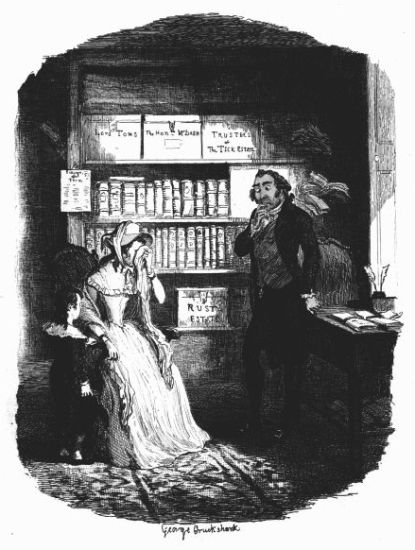
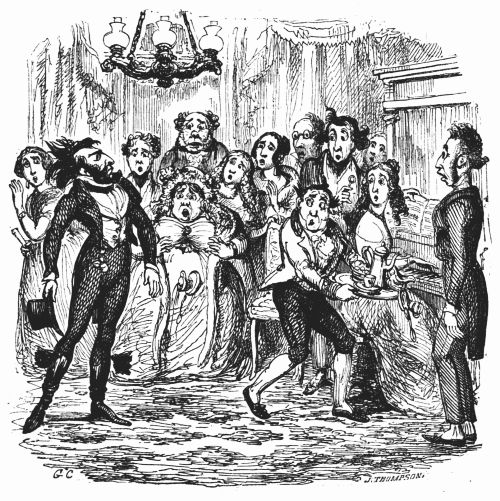
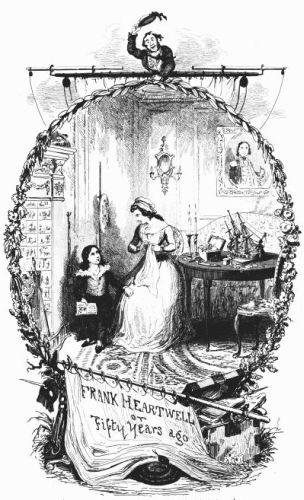
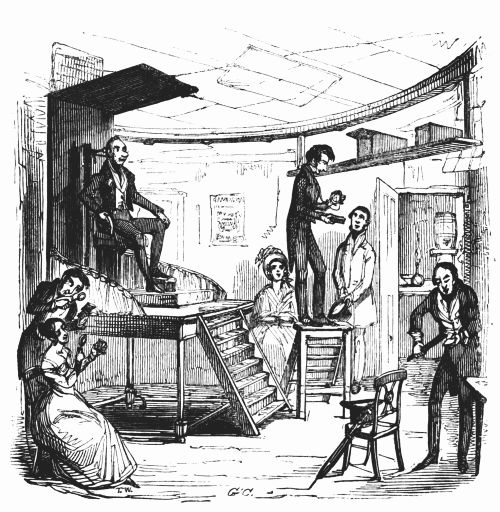
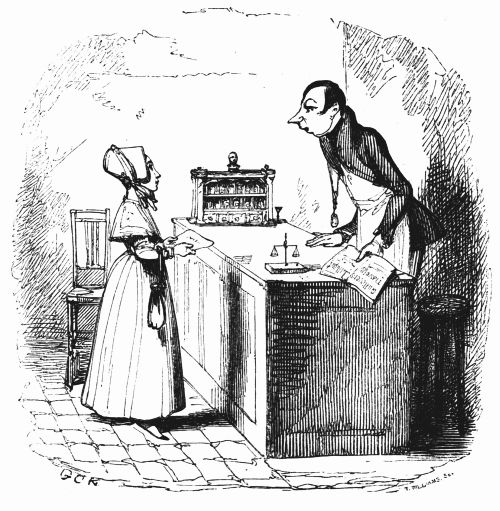
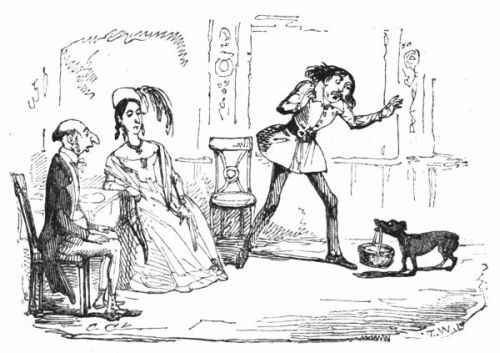
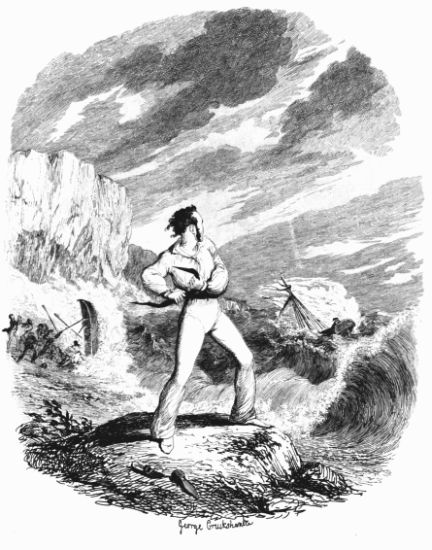
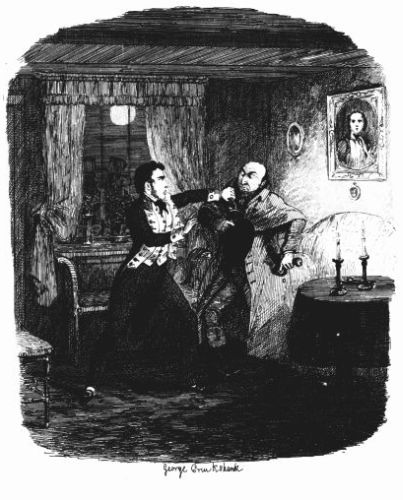
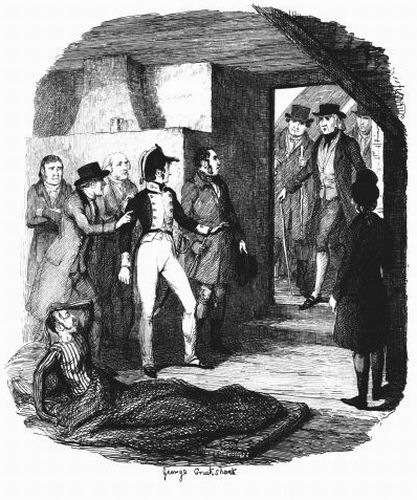
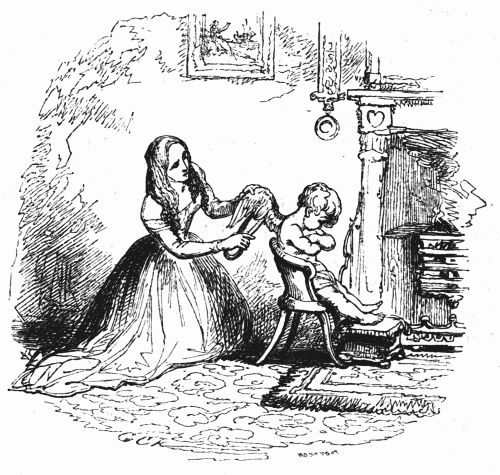
Mrs. Heartwell and Frank's first interview with Mr. Brady.
London, Tilt & Bogue, Fleet Street
"You are labouring under error, my dear lady," said the lawyer
mildly; "I did not say that he was intoxicated, but merely elevated—a
single glass of wine when joy is overpowering the heart will oftentimes
produce the semblance of inebriety. I know you are not aware of the
whole fact, for he mentioned his intention to surprise you, and great was
his gratification at the thoughts of it—the property of his uncle exceeded
his expectations—the whole was converted into gold, and notes, and
securities, to the amount of many thousand pounds; he received it in this
office from an agent of the bank, and at nine o'clock last night, both himself
and the bags were deposited in a hackney-coach—the number of
which, I dare say, can be ascertained—though, probably, my clerk, who
is very particular in all matters of business, may recollect it—and the
coachman was ordered to drive to Ormond Street." The lawyer touched
a bell, and the clerk entered. "Pray, Mr. Shipkins, do you remember
the number of the coach in which Mr. Heartwell left here last night?"
"Four hundred and seventy-five," replied the clerk; "coachman, red
face, carbuncle nose—small eyes—drab box-coat, with seven capes; each
cape bound with scarlet,—he held the light whilst we put in the bags."
The superior nodded, and the clerk withdrew. "Thus far then, my
dear lady, it will not be difficult to trace your husband's progress; but it
is necessary that we should claim the assistance of a magistrate."
Whilst these explanations were going on, Mrs. Heartwell felt almost
crushed beneath the weight of perplexity that appeared to accumulate at
every step. The mention of many thousand pounds as being in the
possession of her husband had conjured up fearful visions; but when, in
addition to this, she found that he was sent away in a coach alone, and
that too in at least a state of elevation, her mind was wrought up to a
pitch of indescribable anguish; she sprang from her chair, and wildly
exclaimed, "It is but too plain, sir—it is but too plain! You send him
in a coach with large sums of money. When he left me he mentioned
his intention to surprise me—he would have returned—delightedly
returned; but he has never been home—Oh my God, sustain me—he is
dead—he is murdered!" and sinking back into her chair, she buried
her face in her handkerchief, and sobbed hysterically, whilst little Frank
clung to his mother, and fixing his tearful eyes upon Mr. Brady, who
he supposed had caused her distress, he observed a twitching spasm convulse
the lawyer's face, and a peculiar cast in one of his eyes, which had
so fierce an expression as to terrify the lad, and which from that moment
was never forgotten. The whole did but occupy a passing instant—the
lawyer's face resumed its usual expression as he uttered,
"No, no, no; do not think that, my dear lady—do not give way to so
horrid a thought. But come, no time should be lost." He started from
the table and put on his hat. "We will walk to the nearest coach-stand,
and proceed to Bow Street."
In accordance with this proposition they left the office; and Ben was
despatched back to Ormond Street for the purpose of ascertaining
whether anything had transpired during their absence, and with instructions
to join his mistress with all expedition at Bow Street. The mother
and son, with Mr. Brady, hastened to Lincoln's Inn Fields, where they
found the very coach 475, in which the clerk had stated that the lieutenant
had quitted the office the night before. The quick eye of Frank was the
first to detect this; and he directly pointed it out to his mother, who at
the first glance saw that the coachman perfectly answered the description
given by Shipkins; and she would have instantly questioned him but for
the request of Mr. Brady, who cautioned her to take no notice lest it
might excite his suspicion. He called him off the stand to receive a fare.
"To Bow Street Police Office," said the lawyer, as the coachman stood
waiting for orders; and the door was closed, the box mounted, and off
he drove. But who can describe the sensations of the agitated wife as
she entered and took her seat in the very vehicle in which it was alleged
that her husband had been conveyed from the office of the lawyer! her
whole frame trembled and her heart grew sick. Mr. Brady was not idle—he
examined every nook and corner of the interior of the carriage in
which the lady assisted him, and every spot on the padded cushions raised
a horrible terror in her breast as she fancied that it might be blood; but
they discovered nothing that could in the slightest degree elucidate the
matter. On reaching their destination, the coachman was directed to
wait for the purpose of conveying them back again.
The doors of the office were thronged with a miscellaneous assemblage
of characters, principally of the lower classes; but there were also many
well-dressed persons in the crowd, for the notorious pickpocket George
Waldron, or, as he named himself, George Barrington, had that morning
been brought up for examination, charged with stealing a purse of money
and a gold watch from the person of a gentleman in Drury Lane Theatre,
and numbers of curious individuals of all ranks were desirous of beholding
a man who by education and manners was the finished gentleman, but in
habit a confirmed thief.
Through this crowd the lawyer and his party pushed their way into
the outer office; and what a scene was presented there!—squalid
poverty in rags—maudlin sensibility awaking from intoxication, and
feverish from the night's debauch—the bucks of fashion, as the dandies
of that day were called, still labouring under the influence of liquor, and
detained to answer for a midnight spree—the detected pickpocket glorying
in the mechanism of his profession, and only ashamed that he should
have practised the art so clumsily as to be caught: these and numerous
others occupied distinct portions to themselves—attended by the various
peace-officers and watchmen, who hoped to profit, and largely too, by
their earnest zeal in protecting his Majesty's liege subjects from let,
hindrance, and molestation.
The first object of Mr. Brady was to detain the coachman; and on
applying to one of the superiors, an officer was promptly set to watch his
movements, with orders to take him into custody should he attempt to
drive away. But the jarvey did not manifest the slightest intention to
depart, for he sat apparently contented on his seat eyeing the different
groups, and perhaps moralising on the instability of human affairs—for
men of sedentary habits are generally found to be moralists, however
humble their pretensions.
The urgency of Mrs. Heartwell's case procured an immediate admission
to the office where the magistrates were sitting; but as they were at that
moment busily engaged, the party was requested to stand aside till the
hearing was disposed of.
At the bar was a tall man of very genteel appearance, whose habit and
demeanour might readily have introduced him to society as a highly
respectable clergyman. He appeared to be about thirty years of age;
his countenance was sedate and indicative of benevolence; but there was
at the same time an arch look in his small sharp eyes that evidenced
pleasantry and wit. His hair was frizzed out and powdered according to
the fashion of the times, and a queue with a plentiful expenditure of
black silk hung down behind. His left hand was raised to his face, and
displayed amazingly long fingers ornamented with rings, and he bowed
occasionally in the most graceful manner to Mr. Bond, the sitting magistrate,
when he had to reply to questions that were put to him. At the
entrance of Mrs. Heartwell, he had turned and cast a rapid but sharp
glance at the lady; and for the moment his dark sallow complexion
assumed a more sickly hue; but finding that she was a stranger, he
politely inclined his head, and resumed his position.
This was Barrington, the notorious pickpocket; and near him stood,
in remarkable contrast, a smart well-made dapper little man, sprucely
dressed, with silver buckles in his shoes, both of which were brightly
polished; his head combed smooth and straight, so that not a hair was
misplaced or out of order, but with a "natty curl" on each side—much in
the same way as in after years the friseur was accustomed to ornament his
brown wig;—his eyes were keen and hawk-like; and diminutive as he was,
there was a something in his manner which strongly marked him as a man
not to be trifled with. This was the afterwards celebrated Townsend.
On the bench with the magistrates, were two or three noblemen and gentlemen
in high life, who had been summoned to give evidence; and amongst
them was the well-known Major Hanger and General St. John, who deposed
to "the previous capture of the pickpocket at the Theatre, his being
taken to the lobby and searched, and the purse and watch found upon him."
"Pardon me, General," said the prisoner, respectfully bowing; "your
memory has not served you correctly—neither purse nor watch was
found upon my person, for this very simple but convincing reason—they
had never been there."
"I remember now," resumed the General; "they were not found upon
your person, but upon the floor close to where you were taken into custody."
"And I saw you drop them," exclaimed Major Hanger, hastily interrupting
the witness.
Barrington bowed his head in the most bland manner, and gracefully
waving his hand, uttered with much seeming good-humour, "One at a
time, gentlemen, if you please—it is neither fair nor honourable to try
and crush a man whom misfortune loves to sport with."
It is not necessary to go through the whole of the examination, which
proved that from the Theatre, Barrington had been conveyed to the Brown
Bear in Bow Street, where he contrived to escape from the charge of the
constable, and since then had been levying contributions in different parts
of the country, assuming a variety of characters as best suited his purpose.
He was subsequently detected in a northern town, mingling in the first
circles, and dexterously carrying on his depredations; from thence he
was conveyed to the metropolis. The charge was considered sufficiently
proven to commit; and this "king of thieves" was removed from the bar
without evincing outwardly the slightest want of self-command.
As soon as he was gone, and the buzz arising from the conversation of
the noblemen and gentlemen had subsided by their taking their departure,
the next case was about to be called, when Mr. Brady earnestly solicited
the private hearing of the magistrates for a few minutes, on a charge of
some magnitude, involving, as it was supposed, the life and property of
an officer in his Majesty's navy.
This was not spoken aloud, but only within the hearing of a few of the
officers, and the request was promptly granted; Mr. Bond passed into a
private room, where Mr. Brady having stated the case, Mrs. Heartwell
was called in to give her deposition, which narrated every circumstance
relative to the lieutenant's quitting his home the afternoon before, and
promising "to be back early, and that he would then communicate something
that would delight and astonish them." The lawyer and the
magistrate looked earnestly at each other, for the former had mentioned
that the circumstance of the officer having to receive considerable property
had been concealed from the wife.
"Were you not at all acquainted with the object to which your
husband alluded?" inquired Mr. Bond.
"Not to its full extent, sir," replied the lady; "I knew that he had
business to transact with Mr. Brady, but was not informed of its purport,
though I supposed it was in some measure connected with the decease of
an uncle in the East Indies."
"My client," remarked the lawyer, "mentioned that his wife was not
cognisant of the transactions between us; and he expressed great delight
at the idea of communicating to her the intelligence that he was now
able to raise his family to affluence."
"I must beg of you to compose yourself as much as possible, madam,"
said Mr. Bond with kindness; "the affair is certainly mysterious, but my
best assistance shall be given."
The magistrate then went on with the examination, and Ben having
in the mean time arrived, made his statement, corroborating that of his
mistress—the lawyer also gave his testimony, and ultimately, the coachman
was brought forward. His deposition went in substance to state,
that "his name was Gervase Simpson, and on the night before, he
had been hired off the stand in the 'Fields' shortly before nine o'clock,
to take up a fare in Lincoln's Inn—that he went, and a middle-aged man
brought out a light, which he held, whilst four or five small, but apparently
heavy bags were put into the vehicle; the light was then taken
away, and a navy officer came out with another gentleman; the former
getting into the coach, and the latter bidding the navy officer 'good
night,' told the deponent to drive to Ormond Street, and then he
believed went in again. That he accordingly drove to Ormond Street,
and felt the check-string pulled; he drew up, dismounted, and opened
the door—the navy officer alighted, and having removed the bags, paid
him his fare, and went down the street; but deponent took no further
notice of his proceedings, remounted his box, and drove to the stand in
Charles Street, Covent Garden. He then got another fare to the Borough,
and afterwards went home to the stables at Newington."
"All this, if true, can easily be traced," said the magistrate; "it certainly
is extremely mysterious—And the lieutenant did not go to his residence,
nor has he been seen since? Was he a man of sober habits and
reputable character?"
"Most unexceptionable in both," replied the lawyer; "it is true that he
had taken a glass or two of wine, but he was perfectly master of his actions—though
I cannot altogether account for his leaving the coach where he did."
"Pray," said the magistrate, addressing the coachman, "had you sufficient
light or opportunity to observe the person of the officer?"
"Vy not exactly, your vurship," answered Jehu; "it vas wery dark
in Linkun's Inn, and them lamps arn't much good, only to blind people;
but I saw the glittering of his buttons and his hanger, and could jist
make out he vas a tall man; but he vhipped in in sich a hurry, that I
hadn't much time to notice; nor did I think of anything of this here
kind happening, for as long as I'm civil and gets my full fare, your
vurship, I seldom troubles myself about other consarns."
"But in Ormond Street," urged the magistrate, "there you possibly
had better light and more time—what took place there?"
"Vell, your vurship, I've tould you all as I knows," responded the
witness. "The lamps in Ormond Street arn't never no better nor the
rest in regard of lighting—they're pretty much like an ould watchman's
eye. I seed as he was an officer of the navy, but arter he tipped
the fare, and there was somut handsome over and above the reglar, I was
too busy reckoning my money to take much notice—he went off with the
bags, some on 'em he had got tied up in a handkercher; but what he had in
em' I never guv a moment's thought to."
"Was the officer sober?" inquired the magistrate.
"Vell, your vurship, it arn't ezactly clear vot sobriety is," answered
the coachman; "he might or he might not, for I took no perticklar notice,
only he seemed to valk avay steady enough. He guv me five shillings;
I said 'Thanky, yer honor,' and he says 'Good night,' and that vos all."
"Should you know the gentleman again?" asked the lawyer, bending
his keen gaze upon the man.
"Vy, yes, I think I should, if I vos to see him as I did last night,"
responded the coachman; "but daylight alters people's looks, and I shouldn't
like to svear."
After other questions of no very material consequence, the magistrate
decided that "the affair should be put into the hands of an experienced
officer, who should thoroughly investigate the whole, and he would be
ready to attend to any information as soon as it was obtained; but if no
further light was thrown upon the transaction, and the lieutenant still
remained absent, then he must request Mr. Brady to be in attendance at
eleven o'clock the following morning, accompanied by his clerk, the bank
agent, and all the evidence he could procure." In the mean time he
recommended that intelligence should be given at the other offices, and
diligent inquiry made at the hospitals; though in the first instance it would
be best to commence the investigation in the neighbourhood of Ormond
Street. Mr. Brady promised strict attention, and the parties withdrew.
THE ASS ON THE LADDER.
"For lowliness is young Ambition's ladder."—Julius Cæsar.
At the end of the second volume of a Hebrew MS of the Bible, written on beautiful vellum,
is the following passage, in fine large Hebrew characters:—"I, Meyer, the son of Rabbi Jacob,
the scribe, have finished this book for Rabbi Abraham, the son of Rabbi Nathan, the 5052nd
year (A.D. 1292); and he has bequeathed it to his children and his children's children for
ever. Amen. Amen. Amen. Selah. Be strong and strengthened. May this book not be
damaged, neither this day nor for ever, until the ASS ascends the LADDER." After which the
accompanying rude figure is drawn.—Pettigrew's Bibliotheca Sussexiana, part I. vol. i.

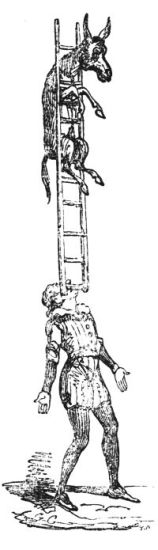
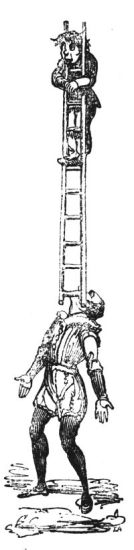
It would appear from the curious sentence copied above, that no longer
ago than five centuries and a half, the feat which is pictured to the
spectator in a fac-simile of the original drawing was regarded as an
event of extremely improbable occurrence. The inference indeed may be,
that it was deemed an impossibility. The prayer of the inscription is,
"May this book be undamaged for ever."— May it be preserved "until
the ass ascends the ladder!"
"Till Birnam wood shall come to Dunsinane," is the unlikely occurrence
which the weird sisters specify as the omen of Macbeth's fall; and "That
will never be!" is the cry of the confident thane. In modern days we wish
a man "good luck till he's tired of it;" or "prosperity till the sky
falls." The despairing and lovelorn damsel in the ditty sings—
"When fishes fly, and swallows dive,
Young men they will prove true."
And one of the same ballad-family sets out with the affecting declaration,
that—
"When gooseberries grow on the stem of a daisy,"
the singer's passion will be no more. These, and a thousand examples of the
"Not till then," are but versions of the Hebrew assumption of impossibility,
expressed in the grotesque fancy of "the ass on the ladder." But
it is clear that Meyer the son of Rabbi Jacob was not in Moorfields last
year; it is certain that Abraham, the son of Rabbi Nathan, little dreamed
of what would be doing at Pimlico in the nineteenth century; for whether
at Mayfair or at Bethnal Green, at Wapping or at Islington, one or both
must have seen the impossibility realised, in the elevation of the donkey,
before the upturned wondering eyes of a crowd of lingering mortals in the
public thoroughfares.
Lest there should be some who never saw the modern street-mountebank,
going forth like Leporello with his ladder, and like Sancho with his
donkey, we must describe his performance. His greatest feat consisted
in balancing upon his chin a ladder with an ass on it. All other tricks
performed, and all eyes and mouths opened, curiosity on tiptoe and incredulity
on the stretch, forth came the wooden machine, and with legs twisted
through the staves, up went the animal. "Who," exclaims the minstrel,
"Ah who can tell how hard it is to climb!" But what poet ever found
a steep so difficult as that gradus ad Parnassum to the seemingly dislocated
donkey? To the topmast round, you would see him clinging like
Shakspeare's giddy sea-boy on the mast; and surveying the mountebank
who had taught him to be such an astonishing ass, with a look that seemed
to say, "You're another!" Then would his master send round the hat
upon its last and greatest voyage of discovery; then would the halfpence
therein be rattled harmlessly in the vacant faces of boys with vacant pockets,
and then would the irresistible appeal be heard, "Come, good gen'lemen,
be liberal, be liberal—tuppence more, and up goes the donkey." Then
bending up each corporal agent for the terrible feat, up indeed would go
the ladder, donkey and all; high up in air, until its lowest stave rested
fairly and firmly on the protruded chin of the mountebank, where it stood
poised, fixed, moveless—the astonishing type, or rather the exact model,
of the balance of power in Europe.
The amazement now should be transferred from the balanced to the
balancer; for what is the difficulty of such a gradus ad Parnassum to the
ass, compared with the sore trial of the man below, who has made the
bridge of his nose a pons asinorum! But in rivalship with the donkey,
the human being shrinks into insignificance; the grotesque patience of the
brute beats the strength and dexterity of the man hollow; the gazers are
all wrapped in ecstasy to see how the ass hangs on, not how the cunning
mountebank balances him. The sympathies of the crowd, men and boys,
are triumphantly borne off by the four-legged performer, and every one of
them goes away more convinced of the uncommon cleverness of the ass,
and consequently on better terms with himself.
But the obstinacy of the long-eared animal is proverbial; and in nothing
is it more strikingly exhibited than in the fact that he will eat if he can.
So was it before the days of Æsop's ass, that cropped a thistle and was
torn in pieces for confessing it; and so has it been before and since the
hour when Sterne's ass consumed the macaroon which curiosity and not
charity presented to him. It is possibly this expensive habit that has led
the mountebank, of late, to cast off the donkey, and to substitute a boy
for him, in the feat of the ladder. The performance to this hour is the
same, with that exception—a two-legged juvenile for a four. Perhaps
the mountebank was jealous of the ass! Can we assume that, in the nature
of a mountebank balancing on his chin a ladder surmounted by a long-eared
brute, there is no room for vanity? Can we imagine a donkey-balancer
incapable of feeling annoyed, when he sees his subordinate—the
agent through whom his own abilities are to be demonstrated—creating
peals of laughter by doing nothing, trotting off with the spoils he did not win,
and cropping every thistle of fame that belongs to another? There is no mind
too shallow for vanity to take root in, no talent too small for it to twine
itself round, no competitor too contemptible to pique and wound it.
"Why, Edmund Kean couldn't get a hand of applause, with such a noisy
brute as that in the piece!" said an actor in the drama of the Dog of Montargis,
when the quadruped was howling over the murdered body of his
master, and breaking the hearts of the audience.
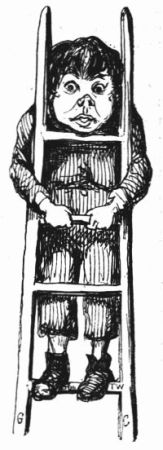
At all events the Boy has taken the Ass's place on the
ladder. The change may have arisen out of that tenderness for the brute
creation which is too amiable a feeling—when in excess—to
pass unadmired. There is a Society for the Prevention of Cruelty to
Animals; and to risk a donkey's life on a ladder, for the sport of a
heedless crowd, might be dangerous to the mountebank. In this age,
society at large knows what is due to donkeys; we can all enter into
their feelings. But as there is no law, and no moral principle, against
the elevation of a human urchin, even to the top stave of the ladder,
there is no reason why the sport should not continue. Philosophers
will explain to you, that a boy is a free agent, and has a right to be
balanced on a human chin, if he likes; but a donkey has no will of his
own at all—except—except when you've hired him for an
hour, at Ramsgate, and are endeavouring to persuade yourself that you're
trotting him out of the town.
The last boy we saw balanced was worthy of the chin that sustained
him. The mountebank to be sure was a miracle, and could have balanced
anything. If the books of the Bank of England were to get into disorder,
every sum confused, and every figure out of its place—he could
balance them. But the boy was at least two miracles rolled into
one—a more than Siamese prodigy—a boy, and yet an ass too. He
looked more like one than the reality, his predecessor. He evidently felt the
past importance of his elevation, high above his compeers. He seemed
quite conscious that every inhabitant, not of that simply, but of the next
parish, was gazing at him in profound amazement. He turned no glance,
whether of contempt or benignant pity, on the open eyes and mouths
around, but looked unutterable things at the knocker of a door opposite.
"So stands the statue that enchants the world!"
This, however, was only at the commencement of the performance, while
the spectators were being coaxed to contribute, and while several among
them, not knowing exactly what they were doing, were giving a half-penny.
But when the ladder was deliberately hoisted up, and fixed on
the chin, then came the utter hopelessness of presenting a true resemblance
of the ass's face—the boy's we mean;—of the conscious pride in its own
blankness, of its self-complacency, tinged with a slight touch of fear,
amounting only to a pleasurable excitement! He was a boy picked out
of the crowd around,—yet he was matchless. You saw at once that he
was not employed by the mountebank—that he was not paid for being
balanced. There was something in his look that distinguished him at a
glance from the hired professor. It might be supposed that, the boy
not being hired, there would be a little difficulty in procuring a substitute
for the ass: not so; only blow a trumpet or beat a drum in the street,
and you are surrounded in less than no time with able and willing
volunteers. This boy entered into the soul of the ass's part; he did
not hug, and hang on the ladder mechanically, or like one who had
done the same thing a dozen times before, that very day. There was
the freshness of the young aspiration, the delicious novelty of the first
grand step in life—in the attempt. It was young Ambition (as Brutus
says) just mounting his ladder. He was animated by the glorious
intoxication of getting up in the world. He looked direct forward; not
at, but through, the brick wall opposite, into futurity. If one of his
schoolfellows had called out, "Master's a coming;" or, "Here's your
father with the cartwhip;" or, "Bill, I'm blessed if here arn't the woman
what we stole the apples on;"—no, even these notes of alarm would have
failed to disturb his equanimity—or his equilibrium. "Have a slice o'
cold pudden, Bill?" might have communicated perhaps to some part of
his frame a momentary touch of human weakness—we can't say positively—boys
are but men;—but nothing short of such an appeal to the weak
side of his nature could have disturbed his rapt and lofty musings.
Since the days of the Hebrew with which we set out, when the Ass on
the Ladder was but a fiction, history has recorded the doings—we had
almost said the sayings—of scores of wonderful quadrupeds. We have
had gifted horses, who should have been elected F.R.S.'s; learned pigs,
who should have been chosen LL.D.'s; humane dogs, who merit statues
like Howard's; and industrious fleas, who do the work of hot water in
putting lobsters to the blush. But such an ass as the Lad on the Ladder
eye never beheld but that once. His face spread before our curious and
inquiring gaze, like a map of the world, and we traced in recollection an
infinite variety of character. What it more immediately suggested was
the expression in the face of a successful candidate at the moment of
"chairing," elevated in some fantastic car, surrounded with banners
bearing patriotic mottoes and devices, and accompanied by roaring raggamuffins.
It also conjured up a vision of a youthful aspirant, fresh from
the office or the shop, strutting in Richard, or fretting in Hamlet, before
eight long sixes, and a full bench of aunts, in a private theatre.
The ass on the ladder brings to memory a thousand other spectacles.
When we behold an orator (to listen is impossible) flourishing his arms
on the hustings, and ever and anon placing his hand upon his crimson
waistcoat, or declaiming for an hour together before a private company
to the exclusion of conversation, in full force of lungs, but in virtue of
no mental superiority, we are forcibly reminded of the ass on the ladder.
When we see a sprig of fashion, who only obtained his nobility yesterday,
and whose worth, if put up to auction, would be dear at the price of a
mushroom, insolently claiming precedence of the untitled bearer of an
ancient and honourable name; or when we observe the high-born, starched
up to the eyes, sneering at humble birth, however associated with merit,
and cutting modest respectability for a parvenu; in these cases we cannot
help thinking of the ass on the ladder.
When we see a vulgar jack, in virtue of his office raised to the rank of
gentleman, treating a poor suitor, who asks for his own, as if he were a
beggar asking alms; or a sleek-headed, rosy-gilled idiot, who lives only
in his own breeches-pocket, pretending to patronise talent because he doles
out, for its exercise, what scarcely keeps its possessor from starving, we are
very apt to call to recollection the ass on the ladder.
When a connoisseur, influential by position, sits down to decide, in
just ten minutes, upon the merits of a work of art or science, which has
cost the producer years of anxious study and ceaseless labour; or when
a military despot lives but to harass, irritate, and torture the sensitive
and honourable minds of those ill-fated officers, who, superior perhaps in
everything else, happen to be below him in rank and fortune,—we
immediately recur for a parallel to the ass on the ladder.
When we see a millionnaire, who has crawled along the road to riches
until he can't stand upright, grasping with usurious hands at the little
still retained by those who helped him to rise; or when a sudden puff of
fortune has blown an adventurer into power and affluence, and we see him
so giddy that he doesn't know his own poor relations, and actually can't
recognise in broad daylight the struggling friend who lent him five pounds
three months before,—then, and under all similar circumstances, we are
sure to think of the ass on the ladder.
When we behold a gentleman turning jockey or stage-coachman,
quitting the legislature for the stable or the cockpit, winking at the worst
vices until he becomes himself tainted, and devoting his time and money
to the destruction of his own health and the demoralisation of his hangers-on;
or when we see a barrister, bullying with conscious impunity a
trembling, blushing, inexperienced witness (perhaps a woman) until
common sense becomes confused, truth begins to contradict herself, and
honesty steps out of the witness-box, looking very much like a rogue,—why,
who can fail to associate with spectacles like these, the ass on the
ladder?
But it is not merely in the army and on the stage, at the bar and in
literature, in the walks of commerce and in the world of fashion, that we
daily detect some living prototype of the long-eared animal in the
ascendant. If public meetings exhibit them, public schools do so no less
abundantly. There is a great deal of ladder-climbing going on at the
universities; and not a proctor in the precincts of learning but could tell
many tales of asinine ambition. Who more irresistibly calls to mind the
ass on the ladder than the noble knocker-wrencher, or the gentlemanly
bell-destroyer, when brought up—many staves up the ladder now—before
a magistrate, and indulgently allowed to take his choice—a fine of forty
shillings, or a month at the treadwheel? When the noble and gentlemanly
sport extends to the pummelling of police-officers, only stopping
within an ace of manslaughter, then the animal may be said to have
reached the topmost stave—an elevation where every kick with which he
indulges himself in his playful humour adds incalculably to his own
imminent danger. The higher the ascent, the greater the ass. We have
seen many instances, more melancholy than ludicrous, of asses falling
from the very top.
For ourselves, we must candidly confess to a painful consciousness of
having been—occasionally, and for not many days together—yet of having
been, ere now, beyond all mistake, upon the ladder adverted to. Nay,
emboldened by the virtuous frankness of this self-criminating admission,
we even venture to put it to our (male) readers, whether they cannot
recollect having had their own feet, at some time of their lives, on the
first round of the ladder; whether they do not feel sensible of having
placed just one foot on that lowest step of the ascent—one only—for we
would not dare to insinuate that they ever got farther, lest they should
turn upon us with the mortifying, and perhaps not altogether mistaken
discovery, that we ourselves, even in this moment of moralising, have
reached the top of it!
" A Scene near Hogsnorton.
"A ditch frequented much by water-rats,
With velvet-headed rushes borderèd;
Two little boys who fish for tittlebats
With sticks, and crooked pins, and bits of thread;
Three willow trees that stand with drooping boughs
Upon the banks, and look disconsolate;
A bull that flings his tail up as he lows—
He's coming at those boys, as sure as fate!
A church spire peeping from amid the trees,
With vane in semblance of a fiery cock;
And Farmer Stubbles lolling at his ease,
Across a gate to view his fleecy flock;
A barn that seems just ready to fall down,
And would, but for the shores that stay its falling;
And, where yon row of elms the green slopes crown,
Is Thomas Noakes, with hand to mouth, outcalling
To Simon Simpson in the fields below,
And telling him to mind that precious bull—
He's fresh from town, poor lad, and does not know
What danger lurks amid the beautiful;
Here a tall oak its branches flingeth out,
As if it said—"I am of trees the king!"
And there an aged hawthorn spreads about
Its crooked arms—a queer misshapen thing;
Far off you see a mill—more trees—some houses—
Look at this frisking colt, why what a kicker!—
Feathers and parasols! here come the spouses
Of Dr. Dobbs, and Mr. Trench, the vicar,
The Smiths, the Joneses, and Jemimah Prescot—
I'm off, before they nail me for their escort!"
The reciter, who wore an air that bespoke him of the country, was here addressed
by a metropolitan gentleman seated in his vicinity, who announced himself as a
brother initialist, A. G. K. "Well, sir, Simon Simpson, 'fresh from town,'
was not more awkwardly situated than I once was, in this very lane here,
when fresh from the country. You see the vehicle has just turned out of Fleet
Street, and is making for Holborn; so if you like to listen, I'll give you my impressions
on first finding myself in
"Chancery Lane.
"I meditated the desperate design of hastening to Holborn by the first street
which led thither; a desperate design, indeed, as I knew not the street through
which I should have to pass. As ill-luck would have it, "Chancery Lane" was
the first that offered, and well does it deserve the name; dark, narrow, crooked,
long, and tedious is this Elysium of the Law! On every side I beheld long and
careworn faces, and, as is generally the case with legal suits, I might easily have
got through it alone, had I not been prevented by the many passengers, like the
numerous little cases put into causes to protract and swell the client's difficulties.
Perhaps it may be thought that I could have stepped into the middle of the street,
and so have managed to walk on; not so—the vehicles were as numerous nearly
as the passengers, and there was no resource but to wait. On this, I began to look
around me, to see if I could discover anything that could take away the tedium of
stoppage. I gazed on the persons nearest to me; from the youngest to the oldest—from
the poorest to the richest, there was the same invariable careworn look.
"First there came the young office-boy, groaning under a large bag of parchment
and what not; then the unfortunate articled clerk, desponding at the idea of five
years in so gloomy a place, wherein his youth's best years were to be spent. The
needy clerks, who received a stipend, came next; their little all had, with the
characteristic theatrical mania of lawyers' clerks, vanished the night previous at
the Adelphi, or adjacent tavern. But not alone did these wear a look of gloom:
the fishermen, the snarers, even the attorneys themselves, looked vexed; the
stoppage of the way teased them sadly. It was five minutes past the time when
that little bony wretch, the office boy, should have been screwed down to his comfortless
stool, far from the apparition of a fire, from the phantom of heat! Last
of all came the client: it will easily be surmised why he looked gloomy.
"The sun never shines there—the houses take care of that; in fact, the very
'fretwork' of the heavens seemed of a parchment yellow; the air breathed of
briefs! No merry laugh is heard in Chancery Lane; no girl trips gaily along!
No! the moaning of the dupe is heard there; the decrepit, grief-worn widow
totters there, to find that her hope of subsistence is faded in useless expense. I
have spoken of the numerous conveyances in the street. The horses were half-starved,
the people within seemed bailiffs; and the omnibus proprietors (unlike
our 'Omnibus') looked anxiously for in-comers.
"Chancery Lane is, indeed, a fit place for the law: the houses overhang the
street—the smoky windows, ay even the few shops seem impregnated with it. I
turned to a book-stall to relieve my aching gaze, when a massive row of calf-bound
volumes frowned upon me; I looked in a fruiterer's stall,—dry musty raisins,
bitter almonds, olives and sour apples met my view. I then cast my eyes at a
perfumery-shop; the wax dummies were arrayed in judge's wigs and black legal
drapery. In despair I turned to a tailor's: a figure arrayed in black, on a wooden
mould, appeared; but it was swathed in a barrister's gown. There was another
figure with finely-cut clothes certainly; but allegorically, I suppose, it had no head.
Such is Chancery Lane. My associations with it are none of the pleasantest.
What are yours?"
This question, addressed to everybody, was answered by nobody. We had now
advanced to the upper end of Chancery Lane; and, passing those buildings on the
left, in which Equity presides over the affairs of suitors, a passenger, who introduced
himself under the designation of Sam Sly, and in whose eye there was a pleasant
twinkle not ill associated with the appellation, observed in an inward tone, as if
he were speaking to himself, "A poor devil who has once got into that court,
must soon feel himself in the position of the letter r." As Mr. Sly's remark was
not intended to be heard at all—so at least it seemed—it of course attracted general
notice; and as there was a disposition manifested to know "why," Mr. Sly politely
explained, "Because, though far advanced in Chancery, he can never get quite
to the end of it. By the way," he proceeded, "all law is but an enigma; and
talking of enigmas, I happen to have one—yes, here it is. Rather an old-fashioned
sort of thing, an enigma, eh? True, but so are epics, you know. Am
I to read? oh! very well, since you're all so pressing;"—and then to the following
tune Mr. Sly trolled out his
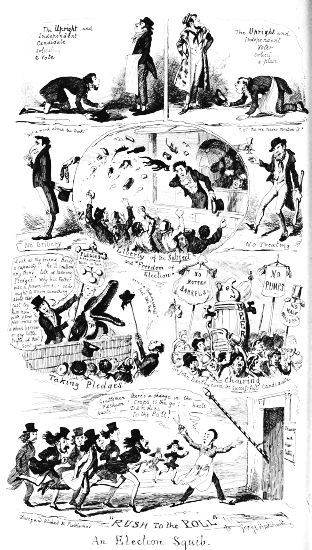
"MY VOTE AND INTEREST."
A COMMUNICATION FROM MR. SIMPLETON SCHEMER, OF DOLTFORD-LODGE,
CROOKSLEY.
Crooksley doesn't return members to Parliament—I wish it did. I'm
sure I took pains enough ten years ago to procure for it—all my property
being situate there—the privilege which was at that time accorded to
other towns of consideration and respectability; for although the population
doesn't much exceed three hundred and sixty, I took upon myself to
make a return of our numbers to the then Secretary of State, which ought
to have prevailed in our favour; for I proved that the population amounted
to within a dozen of seven thousand, merely by including the churchyard,
which I well might do, as part and parcel of Crooksley itself, and adding
the affectionate wives, virtuous husbands, and filial prodigies, now no
more, to the estimate of the living inhabitants; also, by anticipating the
returns of christenings for a few succeeding years; which was easily done
by guessing, on the authority of Blandish (our medical man, with
whom I was at that time friendly), what number of children extra the
various increasing families within the boundaries of Crooksley were likely
to be blessed with.
Not the smallest notice, however, was taken of my memorial; and
Crooksley to this hour does not return a single representative. I read an
advertisement the other day in our county paper, of some new patent
strait-waistcoats; which advertisement was headed thus:—"Worthy
the attention of the Insane!" Now, if Crooksley had been enfranchised,
that is the very heading which might have been affixed to an advertisement
for an independent candidate to represent it at the present crisis—"Candidate
wanted—worthy the attention of the Insane!" for a place more
unlucky in its elections, more ill-omened and perverse in all its contests,
more predestined to choose the wrong candidate, or more wilfully bent on
self-destruction by scorning the advice of its best friends and patrons, I
never lived in, since the day I sold my stock and good-will, and retired
from the Old Jewry for ever.
To every other place with which I am acquainted entrance is obtained
by regular roads; to Crooksley, I verily believe, there is no egress whatever
but by cross-roads. I'm thinking of selling Doltford-lodge—cheap.
The first contest that ever took place in Crooksley—for it is odd
enough, but they never could get up a contested election until I, having
retired from business, went to settle there in the enjoyment of concord,
harmony, and peace,—the first contest occurred several years ago. It was
a struggle—and well do I remember it—for the office of organist. No
sooner was the place vacant—almost, I might say, before the bellows of
the departed holder had lost their last breath of wind—than up started
half-a-dozen of the nobs of Crooksley, with Dr. Blandish at their head,
and down they came to me at the lodge with a flourishing testimonial to
sign—a testimonial in favour of Miss Cramper, as a fit and proper person
to fill the post of organist.
Miss Cramper! And who was Miss Cramper, I internally asked myself.
But I couldn't answer the question. I knew, in fact, little about
her, except that she had lived long in the place, had decent connexions,
not over rich, and happened to be a capital musician; the best organ-player,
I must admit, that anybody ever heard in or out of our village. But with
this exception she hadn't a single claim, not a pretension that I know
of, to the post of organist. She was not asthmatic—she had not nine
children, seven of them solely depending upon her for support—nor did she
even pretend to have lost her eyesight, "or any part thereof," as Knix
the lawyer says; for she was ogling Blandish all throughout the interview,
as if she looked upon him to be the first-fiddle in Crooksley—Humph!
Well! I confess I didn't like the proceeding; and so, after assuring the
requisitionists, in the friendliest manner, that Miss Cramper should
certainly have my vote and interest—in the event, I added, more to
myself, perhaps, than to them—in the event of no candidate coming forward
to oppose her,—what did I do but I brought forward a candidate of
my own!
It so happened that I had taken down there with me from the Old Jewry
an elderly warehouseman, whom I couldn't well send adrift, and who
was of no earthly use to me, either in the house or in the grounds.
Now, poor Joggins, besides being bent double, chanced, very luckily, to
have eyes like an owl, and there were the strongest hopes of their becoming
speedily weaker; so that here at once was a qualification. In
addition to that, he had had two sons: one, a waterman, drowned by
the usual means, collision with a steamer, was easily elevated into a
British seaman dying in defence of his country; and the other, for whom
I had obtained a situation in the new police, was, of course, one of the
brave devoted guardians of his native land. To crown our good-luck,
Joggins had been very fond of playing the flute before wind got so
very valuable to him, and really did know something practically of that
enchanting instrument, so that his qualifications as an organist were more
than indisputable.
Yet, strange to say, his nomination was the signal for violent opposition;
and a tremendous conflict ensued. I was determined that
Blandish, though backed by the vicar, should not carry everything
before him with a high hand, nor become, what, ever since the part I had
taken relative to the enfranchisement question, he was striving to be,
the dictator of Crooksley. My own influence was not slight, and a
powerful party rose up, notwithstanding our adversaries were earliest in
the field. The walls were everywhere placarded, families were everywhere
divided by circulars. "Vote for Joggins," "Vote for Cramper;"
"Joggins and grey hairs," "Cramper and Musical Accomplishments;"
"Joggins the veteran parent of our brave defenders," "Cramper and
Female Virtue;" "Joggins and the failure of eyesight." "Cramper and
Organic changes:" these were among the changes rung throughout the
village, and a mile or two round it, for upwards of three weeks. I called
public meetings, at which I took the chair, and personally carried the resolutions;
and I started a Crooksley Chronicle, of which I was at once the editor
and all the correspondents. In both capacities I defied our antagonists
to prove that their candidate had any one of the qualifications by which
ours was so abundantly distinguished. I dared them to prove that there
were any brave defenders on the other side; that there existed any ocular
weakness; that there was a single grey hair or any symptom of decrepitude:
while, on the other hand, I showed triumphantly that the legitimate
candidate for the office of organist was a veteran flute-player, utterly
and hopelessly incapable of any exertion whatever, and unobjectionable
by the excess of his infirmity.
Blandish was so alarmed at the progress we made, that he began to
give out in reply that Miss Cramper was considerably more advanced in
years than had been insidiously suggested; that her eyesight was anything
but vivid; that what seemed to be her own hair might not bear examination;
and possibly he would have proceeded to other intimations tending
to balance her claims with those of Joggins, had she not stopped him
with the declaration that she would rather lose her election, rather retire
from the contest, than sanction such gross misrepresentations of fact.
Truth, she said, was everything, and it must prevail; her hair was her
own, and her eyes piercers, she thanked Heaven.
But notwithstanding this electioneering attack upon his own nominee,
I saw that Blandish was on the very best terms with Miss C.; and as
the interest he took in her success could not solely be attributed to gratitude
for her attendance at all his evening parties, to play his guests into
patients, by provoking headaches that demanded draughts and powders
in the morning, I issued, the day previously to the poll, a placard containing
surely a very inoffensive query, thus—"WHY is Blandish the patron
of Miss Cramper?" The "why" was in very large capitals. Now will
it be believed that this, though it asserted nothing disrespectful, and
merely put an innocent question, immediately created a very strong
sympathy throughout Crooksley in favour of our adversaries, and that
the popular feeling was instantly shown in tumultuous cries of "Cramper
for ever!" So it happened, however. The result was, that the venerable
Joggins had virtually lost his election before the expiration of the first
hour of polling. I then, feeling that every vote was wanted, went
forward to record my own; when perceiving Blandish (he had a horsewhip
in his hand), I turned back with the view of bringing up a batch of
electors from a distant part of the village; and on my return all was at
an end, and so my vote wasn't wanted; for Joggins, the old idiot, had
resigned. I had a disagreeable encounter afterwards with that Blandish,
who is, I really think, fonder of carrying a horsewhip than any man I
know; but gloriously was I at a subsequent period revenged; for I
shammed a long illness, sent off to a neighbouring town for an apothecary,
and paid him thirty-seven pounds odd for attendance which I never
required, and medicine which I never tasted! Poor Blandish was so
irritated, that he fell really ill himself, and took his own mixtures for
three weeks.
About a year after this we had another election in Crooksley. The
gravediggership became vacant. The Blandish party, who had the
churchwardens with them, wanted to get in young Digdum, the son of
the late official; and he would have walked the course sure enough, if I
hadn't brought forward little Spick the cross-sweeper to oppose him. Party
feeling never ran so high, I think, as on this memorable occasion. Everybody
felt the cause to be his own, and put forth his energies as though the
issue of the struggle depended upon his exertions. It was like a life-and-death
contest; and you would have thought that the consequence of being
beaten was the being buried alive by the victorious candidate. I'm sure
that if it had been to keep ourselves out of "apartments furnished" in the
churchyard, we Spickites could not have toiled harder. Nor were the
Digdumites idle.
On our side we had ranged, besides myself, who acted as chairman of
the committee, Lawyer Knix (who handsomely volunteered his gratuitous
services at two guineas a day); Fobbs, the landlord of the Crumpet and
Spade; Tipson, of the Vicar's Head; (both of them very fond of an opposition,
and always ready to further my views in bringing forward a
candidate, and in keeping the poll open to the latest moment allowed by
law;) then we had the crack printer of our town, whose charges were very
moderate; several of the neighbouring gentry, friends of my own; and
one Swarthy Sam, a character who had no fixed abode in Crooksley, nor
indeed anywhere else, and had not, therefore, a vote to give—but who
kindly took an interest in the contest, and who proved a most valuable
agent, for he particularly knew what he was about in a row, could drown
by his own unaided lungs the voice of the most stentorian speaker on the
other side, and would tear down, I do think, more of the enemy's
placards in an hour than they could stick up in a day. On their side,
they had the fat churchwarden, and the stately master of the workhouse;
the skeleton of a schoolmaster, the parish-lawyer (Knix was independent),
and various other paid functionaries or hirelings.
Well, there wasn't one of them that didn't wish himself well out of
Crooksley before the contest was over; for we left nothing of their
private history unraked, I can tell you. The "Crooksley Chronicle"
came again into play, and I wrote letters—in Junius's style—only under
the various signatures of Vindex, Justitia, A Spickite, Philo-Spickite,
Veritas, An Admirer of Crooksley, Anti-Digdum, &c. &c. We also
raised with remarkable success, a cry of "No brickdust, no pigs' bristles!"
in conjunction with the cry of "No Digdum." It did not in point of
fact mean anything in particular, as far as we were aware, but it vexed the
Digdum party amazingly, and made Spick surprisingly popular[4].
The best of the fun was that we had forestalled them in taking possession
of both public-houses—the Crumpet and Spade, and the Vicar's Head—for
our committee-rooms; so that they had only a little bit of a beer-shop
to assemble in. This drove the Digdum party to distraction. They
made incredible exertions to get us out of the Vicar's Head; and a deputation
came privately to our worthy host's good dame, and offered, if
Digdum were returned, to bury her husband for nothing—for poor Tipson
was sadly apoplectic! Such were the too-powerful temptations (for so in
some instances they proved), such the demoralising practices, to which our
depraved and desperate opponents had resort. They went to Clank the
blacksmith, and promised, if he would but vote for Digdum, they would
see him and all his family buried with pleasure free of charge; but Clank
was not to be seduced, for having once had a turn-up with Swarthy Sam
in the skittle-ground, he preferred being on the same side with Sam, you
see—not caring to fall out—and to say the truth, they were not a few
that had similar feelings. Sam was a capital canvasser, and it wasn't
everybody that would like to say "No" to him.
At last dawn'd the day, the important day,
"Big with the fate of Digdum or of Spick."
Every soul in Crooksley was out of doors; the excitement was intense;
seventeen pots of beer and best part of a round of beef were consumed at
the Crumpet and Spade alone before ten in the morning. Every chaise,
fly, and hack in old Wheeler's yard was in requisition. Both parties were
particularly well satisfied with the result of the canvass, and assembled at
the place of nomination with equal confidence. Our flags bore the several
inscriptions of "Spick the opponent of Corruption," "Spick and
Span," "Spades are trumps," &c.; theirs had, "No Cross-sweeper,"
"No Sweeping Changes," "Digdum and the Rites of the Departed," &c.
&c. Blandish nominated Digdum, and then I proposed Spick in a neat
and appropriate speech.
Well we gained our election—that is, we gained it by a show of hands;
but the other party took the mean advantage of demanding a poll. There
was instantly a rush of upwards of a dozen on their side, and very near a
score on ours. To keep up the advantage we had gained was the thing.
Unfortunately some of our safest voters were now drunk, having received
eighteen-pence a piece to attend the nomination of candidates; and
instead of flocking to the poll, off they went to the Vicar's Head, or the
Crumpet and Spade, swearing they wouldn't vote at all unless supplied
with pots round; which Fobbs and Tipson very readily drew for them:
I having desired those disinterested persons in the morning not to stand
very nice about a measure or two of ale, and they promised me they
would not, as I was to pay. And this, in fact, I shouldn't have minded;
but, unluckily, the worthy electors got so drunk that they absolutely
forgot what colours they fought under, and went and voted for the wrong
candidate.
This turned the scale against us. What was to be done? I had already
got some of the Digdumites away; a tenant of mine, seven miles off, having
engaged to "coop" them, that is, to make them "fuddled," and to prevent
their return in time. A few more must be pounced upon. Swarthy Sam
(that invaluable election-agent) undertook to inveigle them and manage
the business. We got a vehicle or two; and partly by cajolery, partly
by intimidation, and a display of the enemy's colours, off we carried in an
opposite direction to the poll a batch of Digdum's supporters. Away we
drove, Sam conducting us, through by-lanes and across ploughed-fields, I
may say, so that I hardly knew where I was. Deaf to all remonstrances,
on we went, till, feeling pretty secure, I pretended it was time to turn
back or we should all be too late for the poll, and jumped down to consult
privately with Sam as to the expediency of further stratagems; when—to
my inexpressible astonishment and confusion, as you may well imagine—my
swarthy vagabond of an agent, whom I trusted on account of his bad
character, and because nobody else would, indulged his lungs with the
most vociferous roar of laughter I ever heard, to which the entire party
added a chorus. In one instant the whole line of vehicles wheeled round
and galloped off towards Crooksley, leaving me staggering helplessly into
a deep ditch on my left, overcome with rage, mortification, and dismay.
They all arrived in time to vote for Digdum, Sam and all, who went up
arm in arm with Clank, the blacksmith. As for me, I never found my
way back until hours after the poll had closed; and as I approached the
scene with a foreboding heart, the first person I encountered was the
defeated Spick—Spick the rejected of Crooksley—who bitterly assailed me
as the sole cause of his total "ruination," having spoiled his trade of cross-sweeping
by exciting everybody against him, and reduced him to a condition
that promised his successful rival immediate employment in his new
profession. "I shouldn't ha' minded," he said, with a sneer, "your not
guving on me your wote, but what I complains on is, you would guv me
your hintrest!"
After this, as you may well suppose, I grew rather disgusted, and a
little sick of exercising one's public spirit and disinterested philanthropy
to no purpose; so I permitted Dr. Blandish to triumph on one or two
occasions, rather than subject the town to the inconvenience of a contested
election. I allowed the boy Bratts, whom he patronised, to get
elected into our Juvenile Asylum without opposition; and when Soppy
put up for the situation of turncock, full in the teeth of Blandish's pet
candidate, though he came to me and implored the favour of my vote
and interest, I gave him neither. I did not poll for him, nor did I solicit
a soul in his behalf; yet Soppy won the election by a considerable
majority. Indeed Blandish has been disgracefully beaten on more than
one occasion when I had disdained to interfere at all; though whenever
I have interfered—when I have canvassed my very heart out, and talked
the teeth out of my head—bribing here, treating there—threatening this
man with the loss of my custom, and tempting the other with all sorts
of seductive promises—hang me (for it puts me in a passion!) if he hasn't
been triumphantly successful.
There was the election of a contractor to supply leather-shorts to the
charity school. I decided to take no part in it; but when I perceived
which way the election was sure to go, when I saw which man would
beat to a dead certainty, I changed my mind, threw all my influence into
the scale of the popular candidate, gave him my entire support, and would
have given him my vote—only he resigned on the morning of the election
not having a chance of winning; for directly I took up his cause, he
began to lose ground:—odd enough, you will say, but it so happened;
although I set a barrel flowing at Tipson's, promised old coats at Christmas
to two dozen ragged but independent electors, and gave at least half
that number of the better class permission to shoot on my property.
The last great battle that I fought was on behalf of widow Bricks,
candidate for the office of housekeeper to our Infirmary. Here Dr. B.
was "top-sawyer," as they say; this was carrying the war into the
enemy's country. All Crooksley was astonished, petrified almost, at my
boldness; but I was lucky in my choice of a candidate, the Bricks having
been resident in the place as long as Crooksley itself had been in existence,
and the widow being left with eleven small children; while the
Doctor's candidate hadn't the smallest scrap of offspring to go to the poll
with. So to the work of philanthropy I went; and notwithstanding a
hint from the Blandish faction, that if beaten the Doctor would certainly
resign his office in the institution, I was successful beyond my hopes.
We elected the eleven little Bricks upon our committee, and took them
about with us upon our canvas—a procession singularly imposing and
irresistible. Nothing could equal the popular enthusiasm; and the greatest
possible effect was created wherever they appeared, for we kept them all
without their dinners up till bed-time, to make them cry; which is the
only method of melting the public heart, since a constant drop, we are
told, will wear away a stone. The eldest of the Bricks, a boy, had a turn
for spouting; and we made him address the people from the window of
the Vicar's Head, by reciting "My name is Norval," which he had heard
done by some strolling-players. This was amazingly successful; but
unfortunately the mob consisted chiefly of non-electors, for it was only the
subscribers to the institution who had the privilege of voting. Voters,
therefore, I made in scores, simply by paying their subscriptions for them.
As fast as Blandish could extract promises from the old subscribers, I
produced new ones; the list of qualified electors exceeded anything ever
heard of in the annals of benevolence.
I spare you the speech I made at the nomination of candidates; merely
remarking, that I wasn't aware there was so much virtue in woman as I
discovered in the widow, and that I never knew there were half so
many charms and graces in infancy, as I detected in her eleven little angels—who
all stood in a heartrending row upon the hustings, crying lustily,
for they had not been allowed a bit of breakfast on that important occasion.
The effect was seen as the voting proceeded; the compassionate
rushed to the poll and voted for Bricks, I may say, like bricks. Still our
opponents mustered strongly, and I was compelled to make a good many
people benevolent that morning who had never spent a shilling in charity
in their lives.
The numbers for a considerable time were pretty nearly balanced; the
excitement grew more intense, the shouts of "Vote for Bricks and
Babbies," grew more vehement as the day advanced; till towards the
close of the poll, the Blandish faction appeared a little a-head of us,
but at last they were exhausted; they had polled their last Samaritan—the
Doctor himself had given his vote—while I had purposely reserved
mine. Now, mine alone was sufficient to win; mine alone would decide
the contest in the widow's favour; for, having trebled my usual subscription,
I had a right to six votes, and six would give us just a majority of
one. With a heart swelling with conscious triumph, exulting in the cause
of charity and the defeat of our factious adversaries, I walked up to the
ballot-box (we voted by ballot), and there what do you think occurred?
Directing a haughty look to the Doctor's generally red face, now pale with
rage, I was not sufficiently cautious in distinguishing between the Y for
"Yes," and the N for "No," painted on the front of the balloting-machine;
and inconsiderately turning my hand to the left instead of the
right, I dropped the six cork marbles into the enemy's box—hang me,
if I didn't vote against Widow Bricks. Dr. Blandish danced for joy, and
I really thought he never would stand still again. Not another shilling
will his infirmary get from me.
If Crooksley were to return four members to Parliament, I wouldn't be
one of them.
THE CENSUS.
Important days to all householders in the United Kingdom, were
Sunday and Monday, the 6th and 7th ult., and especially perplexing to
those whose ideas of reading and writing were at all circumscribed. Nor
was the discomfort confined to the said illuminated members of society.
Ladies of a very certain age bridled up at being obliged to tell the number
of summers that had passed over their heads: notwithstanding
the loop-hole of the "five years" which the gallantry of the commissioners
allowed them. Elderly gentlemen also, who wore dark wigs
that hid those auricular tell-tales of the ci-devant jeune homme, the ears,
inwardly execrated the system of exposure to which the census paper
gave rise, and willingly ran the risk of a fine "not more than five pounds,
nor less than forty shillings," rather than be classed as old bachelors.
From returns into which the commissioners have allowed us to peep, it
appears that of the middle-aged population of these kingdoms, one in
three has grown five years younger since the date of the last census; one
in seven two years younger; one in twelve remains of the same age;
one in thirty-eight, is five years older than at the period referred to;
and one in five hundred and sixty has attained the full age that
might have been anticipated from the lapse of years. We believe
it has been distinctly ascertained by these returns that the highest
age among the unmarried ladies in this country is twenty-nine—the
average age is twenty-one and seven-eighths. The widows willing to
marry again, are mostly quite juvenile; and it is a remarkable fact that
many are younger now, as widows, than they appear to be in the previous
return as wives. Indeed the effect of the whole calculation is to show,
perhaps in compliment to our young Queen, that her subjects are the most
decidedly juvenile people in Christendom.
Nor was the designation of the respective professions and callings of
our fellow-countrymen a task of less difficulty. Commonplace and
even plebeian, as is the simple question "Who are you?" widely as
the interrogation was diffused a short time back by the gamins of
London, it is a query we opine, in common with the cool audacious
Mr. Dazzle, that would puzzle half the world to answer properly. Some
are all profession—others are not any. Thousands live by their wits—thousands
more by the total absence of them; many whom the world
gives credit to for working hard in an industrious état for their income,
privately lead the lives of gentlemen; and many gentlemen whom we
envy on account of their ostensible otiose existence, labour perchance
in secret much harder than ourselves. Numbers would shrink if their
employment was known, and numbers more would be extremely indignant
if any other than their own was assigned to them.
The schedule stated that the professions of wives, or sons and daughters,
living with and assisting their parents, needed not to be inserted.
There was no mention at all made of the professions of faithless lovers,
election candidates, and false friends; probably these were imagined to be
of so little value as to be utterly beneath notice.
But although the commissioners were pleasantly minute and clear in
their instructions for filling up their circulars, they will still be wide
away from the real statistics of the population, when all the bills are
returned and the totals properly added. What industrious enumerator,
we would ask, did, with praiseworthy indefatigability, leave a schedule at
the temporary habitations of the thousand individuals who on the Monday
in question were located upon Ascot Heath, in anticipation of the approaching
races? Who dared to penetrate into the mysteries of the
yellow caravans there collected, or invade the Bohemian seclusion of the
tilted hovels? What account was taken of the roadside tent-holders,
and the number of the families of these real "potwallopers?" Is the
following paper relating to these people, which has fallen into our
hands, the mislaid document of a careless enumerator of the Sunning-hill
district, or is it an attempt to play upon our credulity:
(COPY.)
Name, (if any) of the House, or of the Village or } Caravan, No. 937,654.
Hamlet in which it stands. }
Name of the Street or other part of the Town, (if in } Winkfield Lane.
a Town), and No. of the House. }
Name and surname of each
person who abode or slept
in this House on the night
of June 6. | Age
of
Males. | Age
of
Females. |
Of what Profession,
Trade, or Employment,
or if of Independent
means. |
If born in
the
County. | If born in
Ireland,
&c. |
|---|
| Bill Soames | 45 | | Shoman. | No | don't Kno |
| | | | Wife—vurks the | | |
| Mary Soames | | 38 | barrul horgan outside | No | No |
| Gipsy Mike | not Nown | | None. | No | No veres pertickler |
| Phelim Conolly | 35 | | Black vild ingian. | not sartin | never Knowd |
| Sarah Cooper | | 24 | tellin off fortuns. | No | |
| Young Chubby a babby | 2 | ired fur the Races. | St. Giles's | |
| Brummagim Harry | 40 | | keeps a Thimble-rig. | Yes | |
But there were many, many others, who were excluded from the privilege
of registering their names amongst the population of their country.
The unfortunate individuals who slept throughout the night in the stony
precincts of the police-office lock-up cells, were deprived of this honour.
Even admitting that the police had received instructions to take down the
names of the stray-flocks under their charge, the ends of the commissioners
were still defeated, for it was not probable that the Hon. Clarence Piercefield,
who had kicked the head waiter at the Cider-cellars, for telling
him not to join in the glees so loudly—who had thrashed the cabman
in Holborn—who had climbed up behind King Charles at Charing-cross,
and who, finally, upon being pulled down again by the police and
taken into custody, had given his name as Thomas Brown,—it was not
probable, we repeat, that this honourable gentleman would see any occasion
to alter the name in the schedule, or recant his alleged profession of "medical
student." His rightful appellation found no place in the paper, no
more than the hundreds who slept out altogether that night, from the
wretched, shivering, poverty-stricken occupiers of the embryo coal-cellars
of future houses in the neighbourhood of railway termini, to the tipsy
gentleman who tumbled by mistake into a large basket of turnip-tops and
onions in Covent Garden-market, and slept there until morning, dreaming
that he was the inhabitant of an Eastern paradise, with houris pelting
roses at him. Even the ill-used Mr. Ferguson, whom everybody has
heard of, but nobody knows, failing in all his attempts to procure a lodging
for the night, found no place in the strictly-worded schedule. The
real name of Mr. Ferguson is Legion, yet he found a lodging nowhere.
And many returns of the erratic youth of respectable families must prove,
that their very fathers did not know they were out, to say nothing of
their mothers: on the other hand, probably many more would be found
wanting in the real numbers, were circumstances narrowly inquired into.
It is fortunate for the correctness of the statistics that Sunday was the
day fixed upon for enumerating the population. Had it been any other,
the numbers who slept in the house would have materially swelled the
lists. The House of Commons might have furnished an imposing array of
names every night in the week to begin with. The various literary
institutions and scientific meetings of the metropolis, on their respective
nights, would not have been behind hand; and even the theatres, might
have sent in a tolerably fair muster-roll of slumberers, according to the
nature of their performances.
We presume that the guards of mail-coaches, drovers who were going
to the Monday's markets, watchmen of houses, newly-buried relations,
and medical men attending Poor Law Unions, will be allowed a future
opportunity of registering their names; for none of these individuals
were ever known—at least we believe not—to sleep or abide one night in
their houses. Are these hardworking and useful classes of society to be
accounted as nothing—to be placed in a scale even beneath "persons
sleeping over a stable or outhouse," who, although not worthy to be
inserted along with their betters in the schedule, are, at all events allowed
a paper to themselves? The care that arranged the manner of enumerating
the population ought to have put forward plans for taking the census
of the always-out-of-doors portion of the English on the night in question,
hackney-coachmen included; and a space might, at the same time, have
been appropriated in the schedule for "those who were not at home, but
ought to have been." We will not dwell upon the material difference
this important feature would have made to the calculations in many
points. We give the commissioners a peep at the fallacy of their plans,
and we leave it to them to remedy it. All we have to add, in conclusion
is, that we sent in our own name according to the prescribed ordinance,
but it was not Rocket.
FRANK HEARTWELL; OR, FIFTY YEARS AGO.
BY BOWMAN TILLER.
CHAPTER III.
A rigid search after Mr. Heartwell was instituted under the superintendence
of two of the most efficient officers of the Bow Street establishment.
The evidence given by the coachman was proved to be strictly
correct, except that a small portion of time was unaccounted for between
the period of his having—as he stated—set the lieutenant down in
Ormond Street, and his arrival at the coach-stand in Covent Garden,
which according to the deposition of the waterman was much later than
would have been required to traverse the distance between the two places.
But Simpson's explanation was that, having by request driven his fare
very quick to Ormond Street, he merely walked his horses to Charles
Street in order to cool them.
Nothing whatever having been elicited that day which was calculated
to throw any light on the mysterious affair, Mr. Brady with his witnesses
appeared before Mr. Bond on the following morning at the time appointed,
when the officers made their reports, and were instructed to persevere.
The Bank Agent deposed that he had paid over to the lieutenant at the
office of Mr. Brady, and in the presence of the lawyer and his clerk, a
thousand guineas in gold, and bank-notes to the amount of fourteen
thousand pounds, besides securities and deeds, relating to property supposed
to be of considerable value in the East Indies, all which had
belonged to the lieutenant's uncle, who had died without issue and intestate:
he produced the receipt for the charge he had delivered, and stated
that he had earnestly advised the lieutenant to deposit the whole in the
hands of his professional man to invest for him to the best advantage;
but though Mr. Heartwell perfectly assented to the propriety of such a
step, yet he expressed himself so desirous of displaying his newly acquired
fortune to his wife, that as a matter of course he (the agent) offered no
further argument against it.
Shipkins, the clerk, corroborated the statement of Mr. Brady; but in
addition, mentioned that the lieutenant had declared that it was his
intention to resign his appointment to the seventy-four for the purpose of
remaining at home with his family, but that it would be necessary for
him in the first instance to visit Portsmouth.
The officers used their utmost vigilance, and the Secretary of State
offered a large reward to any one who could render information of the
fate of the missing officer. Ben was despatched to Portsmouth to make
inquiry whether his master had been seen in that neighbourhood, or on
board the ship; but no clue was obtained.
Days—weeks—months passed away, and Mrs. Heartwell experienced
an unmitigated state of anxiety and suspense. Yet though doubts prevailed
that she should never behold him again, she determined never to
clothe herself in the semblance of mourning till she had proof that he was
dead.
Young Frank partook of the feelings of his mother; but the elasticity
of boyhood does not long retain the acuteness of sorrow; the delightful
changes which Nature is constantly presenting to the ardency of youth
and
"All is beautiful, for all is new,"
superseded the grief which preys upon more advanced age, when the heart
knoweth its own bitterness; and whilst the mother was pining and weeping
over her heavy affliction, Frank forgot in the joys of amusement that
there was anything like unhappiness in the world. He was a bold, free-hearted,
jovial lad, who loved to frolic over the gardens and grounds round
the British Museum. Nor was Ben inactive in either promoting the
mirthful indulgences of the lad, although there might be a little mischief
in progress, or seeing that fair-play was exercised when pugnacity or
wrong led to pugilistic encounters. It is true that the fond parent in her
solicitude would expostulate, and on some occasions reprove; but the ready
acknowledgment of error which Frank always made when in the wrong,
and the argument of Ben, "Bless you, my lady, you can't never go for
to rig out an ould figure-head upon young shoulders—besides, what's the
odds, so as you're happy?" soon produced reconciliation and pardon.
It has been said "Sweet are the uses of adversity;" but it is hard to
contemplate the approach of poverty with its train of evils that no mortal
influence can subdue; and such was the case with Mrs. Heartwell. Daily
she saw her resources decreasing—the pay of the lieutenant was stopped;
she could not claim her widow's pension, for she had no proof of her
husband's death; there were no relations to whom she could apply in her
distress for assistance or counsel. Mr. Brady had sent in a heavy bill
for law business, and pressed for payment; difficulties in short accumulated
on all sides. One, and only one, of her former associates continued
to visit her; and this was an elderly man of unattractive manners, who
claimed a distant relationship. He seldom spoke but when addressed;
and his remarks were generally of a caustic and misanthropic cast, rendering
him an object not only of dislike to many, but of fear to some. He
was poor, but how he lived no one knew; and yet on more than one
occasion he had spoken of important affairs even in the state, that displayed
a tolerably accurate knowledge of persons and things far above his station
in society: in short, he was a mystery that set conjecture at defiance.
Such was Mr. Unity Peach; in age between fifty and sixty; a large
round face, with a great bushy wig upon his head, and one eye covered
over with a black patch, the other grey and cold without expression; he
was stout made, short, and with limbs like a giant, though he complained
of feebleness and debility. He seldom uttered one word of
cheering kindness, yet when asked for his advice he would give it; and
it was seldom known to fail in its beneficial results. To Frank and the
seaman he was an object of aversion that they did not care at all times
to conceal; yet, with a perverseness that seemed congenial to his character,
if there was any individual to whom the old man could be attached, it
was Ben Brailsford.
"You are hurrying on to ruin," said Mr. Unity Peach one day, in
reply to a question from Mrs. Heartwell; "large house—lazy sailor—mischievous
boy."
"But I would willingly quit the house, sir," returned the lady, "and
strive by some means or other to provide for myself and child."
"Let lodgings—keep a school—make the boy a shoemaker—send that
Jack Tar to sea," was the response.
"I have hitherto been guided in my conduct, Mr. Peach, by what I
have supposed would be satisfactory to my husband could he witness my
actions," replied the lady; "and yet—oh yes, I see there is no other
resource, though I should prefer removing from this neighbourhood."
"Pride goeth before destruction, and a haughty spirit before a fall,"
quoted the old man; "Go on and starve—no help for it."
"I wish I had some friend to counsel me," exclaimed the afflicted
woman, as the tears gushed from her eyes.
"Bah!—nonsense!—friends, indeed! Won't take counsel—good morning;"
and Mr. Unity arose to depart.
"I meant no reflections upon you, Mr. Peach," returned the lady.
"You have at times advised me, and well too—but indeed, sir, your
harshness——"
"I know it,—I know it," bitterly replied the old man, interrupting
her, whilst a malicious grin played upon his swarthy countenance; "you
hate me—you all hate me."
"You do me great injustice to suppose such a thing," responded Mrs.
Heartwell, mildly; "I would wish to entertain respect and esteem——"
"Bah! folly!" uttered Mr. Unity, preventing the concluding remarks
of the lady. "No such things in the world as respect, esteem—all deceit."
"I have a better opinion of my fellow-creatures——"
"Better opinion!" interrupted the old man, with a taunting sneer.
"Yes—right—husband murdered—lawyer threatening—abandoned in
trouble—sinking in poverty—eat up with pride—idle boy—saucy sailor—fellow-creatures
indeed!"
At this moment Ben entered, and though deference and respect for his
mistress kept him silent, yet the clenching of his fist and the indignation
of his look plainly evidenced that he would, if he durst, have given Mr.
Unity Peach a thrashing. Nor did the old man seem insensible to what
was passing in the worthy seaman's mind, for he turned upon him a
glance of contempt and defiance that but ill accorded with the angular
inclination of his body, which betokened weakness and decrepitude.
Mrs. Heartwell, endeavouring to suppress her agitation, turned with a
look of inquiry to Ben.
"Why, my lady, I don't perticklarly want anything," replied the
seaman somewhat confusedly, as he fidgetted about the room in his
accustomed way when he had any communication of importance to make.
"Has anything occurred?" asked the lady with impatience.
"Bless you, my lady," ejaculated Ben, whilst a flush spread over his
cheeks, and a tear stood trembling in his eye; "I ounly wish I was
rouling in gould and I'd soon capsize the lubbers; but ounly speak the
word and I'll do it now, though the unconscionable scamps have boarded
us in the smoke."
"Of whom are you speaking?" demanded Mrs. Heartwell, as a thrill
of sickly apprehension passed through her heart. But the seaman had
not time to answer before the door of the room was opened, and in walked
a corpulent but athletic man, whose very appearance announced his calling
to be that of a sheriff's officer; whilst close behind him came his
assistant, though he did not venture beyond the door-way. "Werry
sorry, ma'am—werry sorry," said the officer, producing a writ of execution,
"I al'ays likes to be civil to ladies, but must do my dooty you know—mustn't
I, sir?" and he turned to Mr. Unity Peach, who, bent down and
leaning heavily on his stick, which he seemed to grasp convulsively,
nodded assent.
"What is all this?" demanded Mrs. Heartwell, looking first at the
officer and then at Mr. Peach, and then at Ben, who, though it was the
height of summer, had got hold of the poker, and was busily stirring the
white paper shavings that ornamented the grate.
"Oh, it's not werry much, ma'am," replied the officer, displaying the
official document; "it's only a writ as I've got to sarve, and in course
must trespass upon your family for board and lodging till the matter's
settled—that's all."
"I do not understand it, Mr. Peach," said the distressed lady; "pray
explain it to me."
"Bailiff!" replied the old man, pointing to the officer in an introductory
manner; "come to seize furniture—some of your fellow creatures:"
and then, mimicking the manners of the official, he wound up with the
same exclamation—"that's all."
"That's all, ay, and enough too!" mumbled Ben as he made the room
echo with rattling the poker in the grate; "I ounly wish my lady 'ud
give the word, I'm blessed if it should be all; I'd larn 'em to seize furniture;
and it arn't best for their health that they clap a flipper upon it
whilst I'm here."
"Go to sea," muttered Mr. Unity Peach. "Work for your living—don't
lazy away your time here!"
"I tell you what it is, ould genelman," exclaimed Ben, all the feelings
of the tar aroused within his breast. "You're an oncantankerous scamp
with your spiteful tongue. But bless you, my lady, ounly say the word
and I'll clear the decks of the whole boiling of 'em afore you can look
round you;" and the seaman flourished the poker in a menacing attitude
at the officer and his follower, but the next instant he felt his arm
restrained as if it had been fixed in the gripe of a blacksmith's vice, and
by his side stood Mr. Unity Peach.
"Put that poker down," said the old man in a tone of command as he
grasped the seaman's wrist; "obey the laws."
"All werry right, sir," uttered the sheriff's officer; "not as I'm afear'd
of being attackted, but arter all there's nothing like obeying the law, and
it shows as you're a man of sense. I must do my dooty, howsomever
unpleasant. There's the writ, ma'am."
"At whose suit?" demanded Mr. Peach, who quietly took the weapon
from Ben's hand, and replaced it within the fender.
"At the suit of Muster Jocelyn Brady," replied the officer, "attorney-at-law,
Lincoln's Inn. Debt and costs one hundred and seventeen pounds,
six shillings, and eightpence."
"The villain!" uttered a voice, half suppressed, from some part of the
room, but from whom it proceeded it would have been difficult to say.
Poor Mrs. Heartwell was almost overwhelmed, and Frank coming in
from school and staring wildly at the spectacle, added to her distress.
On seeing his mother's tears, he threw his arms round her neck and kissed
her; and then, turning round with flushed cheeks and a fierceness that he
seldom manifested, demanded of the officer "what business he had there?"
This Mr. Peach explained in as few words as possible, but not without
instilling venom into what he did say, to the great anger of Ben, and the
increased dislike of the boy.
But there was no avoiding the instrument of the law, nor any means to
get rid of its agent. The execution was served, and the bailiff remained
in charge. The almost heart-broken Mrs. Heartwell waited upon the
lawyer, but he refused to see her; the furniture was sold; and it racked
her heart to part with things which time and circumstances had endeared
to her; and now she, who had been within a few minutes of attaining
affluence, was reduced to the verge of destitution.
A small, ready-furnished apartment received the mourner and her son;
but her money was gone, she knew no one to whom she could apply.
Ben had expended every shilling that he possessed; but the worthy
fellow would not desert his mistress; he got employment in a rigging
gang to fit out East Indiamen, and, reserving a bare subsistence for himself,
he devoted all that he could spare to the use of Frank and his mother.
Nor was this all; for after his hours of labour were over in the week days,
and each Sunday, he was constant in his attendance, to perform every kind
office that he could without failing in the respect he had ever manifested
towards his mistress. Nor did Mr. Peach forsake the afflicted lady,
though his visits were not so frequent as before; and he was incessant in
his complaints of bad health, decaying strength, and growing poverty.
"Mrs. Heartwell procured needlework, and toiled day and night to
keep Frank at school, and to obtain him food and clothes." Nor could she
even have done this but through the generosity of some unknown friend,
who regularly transmitted her thirty shillings a month without note or
comment. She believed her benefactor to be a kind and wealthy lady
who had formerly taken an interest in her welfare; but it was evident
the donor did not wish to be openly known.
Thus progressed another twelve months. Ben and Frank were inseparable
companions as often as they could be together; and though
Mr. Peach was constantly persuading his mother to bind the lad apprentice
to a shoemaker, he still continued improving in his education, and
the hard-toiling seaman often went without indulgences himself that he
might secretly supply his young friend with pocket-money. At length
to her great astonishment, Mrs. Heartwell received by post under a blank
cover a note of the Bank of England for £100. Tears of joyous gratitude
filled her eyes. The following day was devoted to recreation—the first
she had known since the loss of her husband. And now came the consideration
as to the best mode of employing the gift to the most advantageous
use. At first the feelings of the mother directed her sole attention
to young Frank, and she thought of appropriating a large portion to
putting him out in the world; but Mr. Peach, who was consulted on all
important occasions, advised her to take a respectable house, furnish
apartments, and let them to a respectable tenant: nor did he forget to
insist upon his usual proposition of making Frank a cordwainer. In
every particular, save the last, the advice was followed.
CHAPTER IV.
Never was there a more instructive lesson issued to the nations of the
earth than that which marked the origin, progress, and termination of the
French Revolution, with all its concomitant circumstances and final results.
England with free institutions, and increasing in population, industry,
and commerce, had set a bright example of what may be achieved under
constitutional means; and as the English were ardent lovers of liberty, it
cannot be supposed that they were indifferent to its extension on the
Continent. Nor were they inactive at home; the changes in France had
caused a feverish excitement amongst the working classes here, which
interested traders in politics were not slow in turning to their own
advantage. In order to counteract and defeat the evil machinations of
such men, the government took into pay a number of individuals to act
as spies in the camp of the disaffected; and as their wages depended upon
the continuance of commotion, it very naturally followed that in numerous
cases they were the secret promoters of agitation. But the political
movement was not confined exclusively to the lower ranks in life; many
of the middle grade had joined in it, and amongst the active disseminators of
revolutionary principles was Mr. Jocelyn Brady. But he moved in an
elevated sphere, and was looked upon and treated with confidence by his
party, both high and low. His legal practice was reported to be extensive,
and he was said to be possessed of considerable property. He had both
a town and a country residence, and he gave excellent dinners. But he was
unrelenting in his avarice, vindictive when offended.
The principal associate of Mr. Brady in most of his political transactions
was a Mr. Acteon Shaft, an acute intelligent man, whose grey hairs
proclaimed him to be of an advanced age; and to him the lawyer was
greatly indebted for much of the information and knowledge he obtained.
Mr. Shaft had travelled far, and had visited foreign courts, and though his
manners were rather uncouth, yet there was a charm in his conversation
that rendered his society courted by men of talent. He was an ardent lover
of rational liberty, and his generosity was the theme of universal praise.
Why two men so opposite in temper and disposition should form companionship
must remain amongst those anomalies which every day's
experience displays; even the pure metal requires a base alloy before it
can be converted into sterling coin. But to return to Mrs. Heartwell, who
had once more a comfortable residence, and devoted herself in every way
to the improvement of her son. Frank, on his part, was most affectionately
attached to his mother, whom he revered with an intensity of feeling
that was truly gratifying to her heart, and she was pleased to see that he
evinced a kindly and generous feeling towards his fellow-creatures. He
was mirthful, but inoffensive, mild and forbearing, except when aroused
by severe injury to himself or others, and then his rage was uncontrollable.
The first lodger that occupied Mrs. Heartwell's apartments was a
Monsieur Polverel, a French deputy, who under the specious pretext of
visiting and studying the institutions of England, availed himself of the
opportunity to disseminate the doctrines of "liberty and equality;"
nor was he long in finding an enlarged circle of congenial spirits—members
of revolutionary clubs and corresponding societies, who, though
advocating "equality," took especial care that no one below a certain
rank should be admitted to their meetings; and the minister of liberty
from France, Monsieur Polverel, finding that his black servant was
accustomed to go out during his absence, actually locked him up in his
room whenever he himself went in an evening to enjoy festivity amongst
his friends, and to preach up the blessings of freedom.
Ben and Frank, however, could not reconcile such tyranny to their
minds, and a duplicate key being procured, the door was speedily thrown
open, and forth issued Sambo to join in their amusements, and many hours
did the youth listen to the negro's narratives of his native place—Port au
Prince, in San Domingo—but care was always taken that he was again
placed in confinement before the time of his master's return.
Monsieur Polverel was one of those finicking, all legs-and-wings sort of
Frenchmen who when in conversation throw themselves into attitudes not
inaptly resembling the wooden harlequins of children whose members are
put into motion by pulling a string, only that his body was more elongated
and had something of the greyhound build; his head was very large, and
when he stood erect he looked like a beadle's staff with a globe on the top;
in fact, it would have been no difficult task to have doubled him up like
a two-foot rule, or to have put his body between his legs like a clasp knife.
Although a leveller, and affecting to despise distinctions, his clothes were
richly ornamented and his fingers were brilliant with costly rings.
When he passed an evening at home without company, he generally
contrived to get Frank and Ben, and the negro into his room, where, in
broken English, he propounded to them the doctrines of republicanism.
Sometimes Mr. Peach was admitted, and the discussions, whilst they afforded
mirth to Frank, and offence to the seaman, tended to open the understanding
of the youth to subjects to which he had hitherto been a stranger.
Frank had now passed his thirteenth year. His predilection was
for the sea; but his mother, who still had numerous difficulties
to contend against, and looked upon her child as her best hope and
encouragement, endeavoured by earnest persuasion to prevail upon him
to settle on shore. In this she was supported by Mr. Peach; but the
lad's longings could not be overcome, though he was deterred from proclaiming
them, and thus balancing between affection for his parent and
the desire to become a sailor, he remained undetermined and inactive.
It was about this time that, to the great regret of Mrs. Heartwell, and
the almost inconsolable grief of her son, Ben Brailsford was pressed; and
disdaining to be anything but a volunteer in the service of his king and
country, he entered for a ship-of-the line, then commanded by the
Honourable Keith Elphinstone (afterwards, Lord Keith). He wrote to
inform them of this event, hoped that he should make prize-money—wished
Frank was with him on the quarter-deck as an officer—expressed
sorrow at parting with them, but wound up all with his old expletive—"But
what's the odds, so as you're happy?"
The youth fretted, and almost sickened at the loss of his old and faithful
associate; he neglected his studies, became melancholy and restless,
and adhered closer to Monsieur Polverel, so as to be noticed by a distinguished
visitor to the deputy, no other than the Duke of Orleans,
who had been prevailed upon to visit London, by Lafayette, in order to
get him out of the way of doing mischief. Frank became a great
favourite with the Duke, who treated him with much kindness, and made
Mrs. Heartwell a very handsome present to assist in promoting the lad's
welfare; and ultimately offered to take him to Paris and provide for him;
but this was declined—the mother could not part with her child.
The beheading of the King of France excited a general feeling of horror
and indignation throughout England. War was declared. The utmost
activity prevailed in the dockyards; and a naval armament was put in
motion. The aristocracy, the clergy, the corporate bodies, the landed
proprietors, the merchants, the bankers, became alarmed, and took the lead
in the re-action that ensued. The Sectarians looked upon the French as
infidels, and hailed the approach of war as the mighty engine which was
to restore religion and morality.
In this state of things the situation of Monsieur Polverel was not of the
most pleasant description. He was well known to the French emigrants
who crowded the metropolis; and on his returning one afternoon from a
republican party, he was pointed out as a disseminator of those principles
which had compelled them to abandon their country. A crowd collected,
who vented their abhorrence in groans and hisses. He quickened his
pace, but his pursuers increased as they progressed, till the deputy was
urgently persuaded to run, by hearing the clattering of stones along the
pavement, and feeling more than one or two hard blows on his back.
Now it was that the length of his legs rendered him good service, and a
chase commenced that caused roars of laughter to the spectators, who
clapped their hands and shouted with delight. On reaching Mrs. Heartwell's
he knocked and rung violently, but Sambo was locked up, and the
maid-servant being busy, was in no great hurry to let him in. Frank,
however, had been looking out at the window, and instantly suspecting
the cause of the uproar, he ran and opened the door, and the Frenchman
had just time to enter as his assailants were ascending the steps. It was
at first feared that they would attack the house, but on being assured that
Monsieur Polverel had taken his departure by the back way, the mob
again set out in pursuit, but the deputy distanced them; for without
waiting for bag or baggage, he hurried to Dover as fast as a chaise-and-four
could convey him, and at this latter place he received a no very
gentle intimation that his presence on British ground could be entirely
dispensed with; and elated was Monsieur Polverel when he once more
found himself within the gates of Calais.
Nothing could exceed the joy of Sambo at his master's departure—the
door was no longer locked upon him—he was free. Since Ben's departure
Frank had greatly attached himself to the negro, whose good humour and
constant willingness to oblige rendered him a favourite in the house.
Other lodgers came to Mrs. Heartwell's; and as Sambo had become
useful, his services were retained.
Frank continued at school for a few months longer, when a new scene
opened before him. He had heard of a seventy-four to be launched at
Deptford, and never having witnessed a ship-launch, he went, accompanied
by Sambo, to see it. But the press-gangs were abroad, and they both fell
into their hands; for such was, at that time, the demand for men and lads to
complete the complements of the ships of war, that respectable shopkeepers,
who had formerly been to sea, were impressed at their own doors, and youths
of "gentle blood" forced away by the gangs if found near the water-side.
Sambo would have resisted when he saw that Frank was seized, but
the youth saw how unavailing it would be, and desired him to desist. He
told the officer that he was the son of a lieutenant in the navy, and
requested to be allowed to return to his home; but this was positively
refused. He then entreated that some one might be sent to apprise his
mother of his detention, and the officer promised that it should be done,
and the lad, who suffered most on his parent's account, became more
appeased, till on being put on board the Tender, off the Tower, a spectacle
presented itself that filled his very soul with disgust.
The receiving-ship was an old sloop of war, and in her hold were not
less than three hundred human beings crowded together on the shingle
ballast, without a single seat except the bundles which some few possessed,
and sat upon for safe protection. Here were crowded together
seamen and landsmen, pickpockets, the refuse of the streets, and shabby-genteel
gentlemen. Many a countenance was marked by sorrow, but the
principal portion was composed of wild, reckless, and even lawless, men.
The gratings were over the hatchways, above which sentinels were placed,
and the atmosphere in the hold was hot and fetid. Several of the impressed
men were in a state of intoxication, which produced repeated
quarrels; and though there was scarcely room to move, blows were
exchanged, and heavy falls upon the shingle or against the timbers in the
side caused swollen and blackened eyes, and severe contusions. Some had
received cuts and injuries in their contest with the gangs, and lacerated
faces presented a hideous and sickening spectacle.
There was but little light during the day; but when night arrived, only
a solitary lantern shed its feeble rays, and the prowling thieves commenced
their work of plunder upon their unfortunate fellow-captives. Resistance
was vain; cries of distress arose, but they were quickly subdued; two or
three held down the victim whilst his pockets were rifled: the means of
obtaining liquor were thus in the power of the abandoned; nor was it
scantily, though stealthily supplied; and drunkenness increased the
disorder that prevailed till a general fight took place, which was only
quelled by an armed party of seamen being sent down to preserve order.
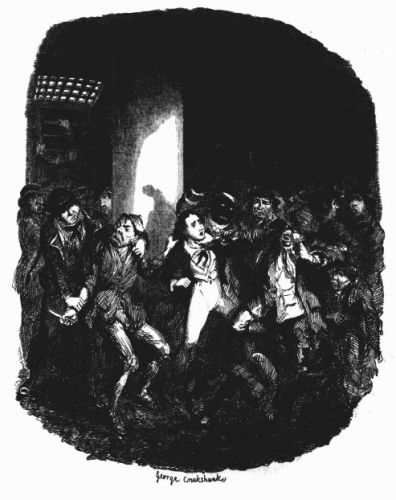
Frank and Sambo, attacked by Ruffians, in the hold
of the Tender.
Horrible, indeed, was that night to poor Frank. To sleep was impossible.
The noise was almost deafening; and his heart sickened at the
oaths and imprecations he was compelled to hear. A miscreant had forcibly
grappled with him and demanded his money; but Sambo, who had
patiently borne with the jokes and the taunts, and even the mischievous
pranks of his fellow-captives, would not endure this; he manfully resisted,
exclaiming, "Me young massa good massa for me! Ye nebber for do him
harm while Sambo here!" Nor did the youth tamely yield to the plunderers:
his spirit was aroused, and placing himself in attitude, he not
only repelled the attack, but with determined resolution he stood up to
his assailants, whilst the negro dealt out sturdy blows and kept them in
check. One fellow was struck down, but another immediately came on,
whom Frank met with vigorous boldness; and thanks to the instructions
of Ben, his opponent found that he had both courage and science to contend
against; and having no love for fighting, and seeing Sambo come to
the assistance of his young master, he drew back. But the thieves commenced
another desperate attack. One of them rushed in and seized
Frank by the throat; another gathered up a handful of shingle to throw
in his face; whilst a third drew a large knife, and laying hold of the
youth's long hair, was about to inflict a deadly wound, when a stout old
man-of-war's man, who had been leaning against the mast, suddenly
seized the cowardly rascal by the wrist, and twisting his arm round so as
nearly to throw him on his back, exclaimed, "Avast there, you lubber!
do you call that English fashion? bright blades again a countryman's
fist? drop the knife, and let the lad alone—drop it, I say!" and another
twist compelled the fellow to obey. The seaman gave him a kick in the
stern that sent him flying away amongst the crowd, and then springing
to Frank's rescue, the robbers were driven off.
"What cheer, what cheer, my lad, eh?" said the tar, taking the
youth's hand; "you tackled to 'em bravely, the picarooning vagabones.
But here, keep under my lee, and no soul fore and aft shall mislest
you. Have you ever been to sea?"
"No," returned Frank, placing himself by the side of the seaman, "I
have never been to sea, but I am the son of a sailor; my father was a
lieutenant in the navy."
"Indeed!" said the tar, "and pray what name did he hail by?—the
son of a British officer ought to have better usage."
Frank felt the justice of the latter remark, but he did not allude to it,
and merely replied, "His name was Heartwell."
"What?" exclaimed the seaman, looking earnestly in the youth's face,
"Heartwell,—Muster Frank Heartwell as was in the ould Robust?"
"Yes, he was the senior lieutenant of the Robust," responded the
youth, who had through Ben's means made himself acquainted with his
father's history.
"Then I sailed with him," rejoined the tar, "and a better officer never
had charge of a quarter-deck. And what's become of him, my boy?"
The youth briefly related the circumstances of his father's disappearance,
and a conversation ensued, the seaman fully performing his promise
to preserve Frank from further molestation; he also praised the negro
for standing up for his young master, and Sambo remarked, "Ah Massa
Frank, dis no laand o' liberty board a ship."
Still Frank's wretchedness was great; he reflected on the delightful
dictures of enjoyment from universal freedom and equality which Monsieur
Polverel had powerfully delineated, and he contrasted them with the
scene before him, where the defenders of their country were treated worse
than brutes by the hand of power. It is probable that he would have
sunk under the infliction, but the hope that he cherished of seeing his
mother come to his rescue. Yet even that hope was mingled with many
misgivings, lest the officer should not have communicated with her, and
he might be sent away without being able to acquaint her where he was.
The morning came, a cutter was hauled alongside the Tender, and
Frank and Sambo, with about one hundred and fifty others, were put on
board; her sails were set, and with a fair breeze she was soon gliding
down the river. But Frank, though aware that they were on the move,
could see nothing of the proceedings; the impressed men were all confined
in the hold, and so crowded together that to sit down was impossible.
At length they reached the Nore, and the impressed hands were transferred
to a gun-brig that immediately got under-weigh for the Downs.
Confinement was now at an end, the men were permitted to be on deck, and
the refreshing breeze came delightful to the wearied frame of the youth.
Provisions were also served out, and by the time they had reached their
first destination he had in a great measure recovered his proper tone.
But the brig did not anchor here; a signal was made for her to proceed to
Plymouth, and without delay she made sail through the Straits of Dover.
The noble white cliffs and the beautiful scenery of the coast delighted
Frank. The sun sparkled upon the waves of the blue ocean, and threw
its golden gleams upon the fertile land of his nativity, whose lofty barriers
rose in grandeur to defend its shores, and whose "wooden walls" floated
in pride to protect its commerce. The horizon was studded with the
white sails of distant vessels, and the ships as they approached or passed,
hoisting their ensigns, gave a bright break in the picture.
Still the thoughts of his mother's uneasiness operated on Frank's heart,
and he determined to write to her as soon as they got to Plymouth;
but even this satisfaction was denied to him, for when abreast of Torbay
a seventy-four came out and received a draft of hands from the brig,
amongst whom was the disappointed lad and the negro, and without communicating
with the shore she spread her canvas for the Mediterranean.
This preyed upon the lad's mind, but no time was allowed him to
indulge in dejection; he was ordered to go to the purser's steward and
get supplied with sailor's apparel, which having dressed himself in, he
was mustered before the first lieutenant, who questioned him as to his
abilities in order to give him a station. Frank at once told him he was
the son of an officer, and had never been to sea before; he named his
father, and as the circumstances of his disappearance were pretty well
known, Mr. Evans not only took the lad by the hand, but declared himself
an old friend and messmate of Mr. Heartwell's, and the emotion he
evinced plainly indicated what his feelings towards him were. He was
requested to stand on one side till the muster was over, when the lieutenant
introduced him to the captain, a noble and generous-minded
seaman, who listened with attention and commiseration to Frank's narrative,
inquired whether he wished to continue in the service, and finding
the lad was desirous to do so he sent for the clerk, and the rating of midshipman
was entered against the name of Frank in the muster-book.
It would be impossible to describe the varied feelings of Frank at this
favourable change in his fortune, which he regretted he could not at once
communicate to his mother. On the passage out, however, they fell
in with a corvette homeward bound, and the newly-made midshipman
having a letter ready written describing the events that had occurred, he
was enabled to send it by this conveyance, and his mind became more
tranquil, and his heart more buoyant.
As for Sambo, he was very soon reconciled to his lot, especially when
he saw that his young friend and master was made an officer, and treated
with kindness and respect. The negro was stationed in the main-top,
and showed himself desirous to learn his duty.
History has recorded the events connected with the occupation of
Toulon by the allied forces; and here it was that Frank first beheld a
scene of warfare. Splendid was the spectacle to his young and ardent
mind. There lay the combined fleets of England and Spain, their bright
colours and floating pennants flashing in the sun; whilst in the background
rose the almost perpendicular mountains of granite, relieved at
the base by the white batteries and buildings of the town. As they
approached the noble harbour, the smoke from the cannon and musketry
proclaimed that active hostility was going on; and Frank felt his heart
swell at the thoughts of being engaged with the enemies of his country.
They had scarcely moored the ship, when reinforcements were demanded
for the shore; and a party of seamen and marines was landed
under the command of Lieutenant Evans, and Frank was permitted to
accompany him on duty in the town.
Here he had indeed opportunity of beholding all the pomp, the circumstances,
and the cruelties of war; for scarcely a day passed that did not
bring with it a skirmish with the enemy. It was not, however, till several
weeks had elapsed that Frank was engaged in hostility. It was on the
night of the sortie made by General O'Hara against the masked battery
that had been constructed by Buonaparte to play upon Fort Malbosquet.
Armed with a cutlass, a brace of pistols, and a pike, the young midshipman
accompanied his party to the attack. He felt that he was now
an officer in the service of his country; and though his heart palpitated
at the thoughts of going into battle, he determined not to flinch. The night
was dark; and silently and stealthily they proceeded up the mountain.
This enemy had suspected the design, and were in readiness to
receive them; and then began the terrible affray. Frank kept as close
to Mr. Evans as he could; he had in some measure become used to the
peals of musketry, but not to the consequences of the murderous discharge;
and his heart quailed when he beheld body after body rolling
down the declivity, and heard the shrieks of the wounded as they lay
bleeding on the ground, or fell from crag to crag mangled and dying.
This dread did not last long, for he was hurled into the very thick
of the mêlée, and desperation lent strength to his arm. Encouraged by
Mr. Evans, who cheered on his men, he rushed forward with the advance,
his spirit rising as the strife increased. For a short time he was separated
from the lieutenant, but the tide of contest ranging back, he once
more joined him at the moment that he had been brought to the earth by
a blow from the butt of a French musket; and the soldier was about to
repeat the stroke, when Frank with his pike charged with the utmost
violence he could muster against the man; the sharpened iron entered
his breast so as to throw the soldier off his balance, the blow descended
short of the intended victim, and the weapon was shattered to pieces.
But the French soldier was not defeated; and snatching at the prostrate
officer's sword he possessed himself of it, and prepared to take ample
revenge on the stripling who had no other weapon to oppose to his
gigantic strength than his cutlass. Frank gazed at his powerful adversary
and believed his last hour was come; but he determined not to
abandon the lieutenant. One thought—one moment's thought of his
mother intruded—a pang of bitterness and anguish passed through his
heart; and then placing himself on the defensive, and purposing if
possible to elude his enemy by activity, he saw him advance. At this
instant, however, a British corporal interposed, and lunged at the Frenchman
with his bayonet; but the brave fellow had been previously wounded
and his strength was failing him; still his spirit was indomitable, and a
sharp conflict ensued, Frank occasionally getting a cut at the Frenchman,
whose superior fencing gave him an admirable command of his weapon; and
the youth with horror saw the sword of Mr. Evans passed through and
through the body of the corporal: it was done with the rapidity of lightning,
and the gallant man fell to the ground with one deep and parting groan.
A laugh—a horrible laugh of triumph issued from the enemy as he
now considered his young victim safe to satiate his revenge. The body
of the lieutenant lay between them; and as he began to give tokens of
returning animation, the soldier seemed undecided whether he should
attack the youth or give the officer the coup-de-grace. Frank beheld him
advance—he would not retreat, but with cool determination parried the
thrust; but the superior strength of his opponent prevailed; his guard was
beat down, and the sword that had so recently taken life was again wet
with blood; the youth was borne backward on its point, and in all
probability another second would have stretched him lifeless by the side
of Mr. Evans, had not a bold athletic seaman flung himself against the
soldier, who promptly recovered his blade, but not till he was staggered
by a blow from the tar, who shouted in a voice that Frank instantly
recognised, "Ware hawse, you lubber—puckalow that—what's the odds,
so as you're happy?"—it was Ben Brailsford.
A cry of delight burst from the youth as he incautiously hailed his old
companion; for Ben was not aware who it was that he had preserved;
but on hearing the well-remembered tongue of his young friend, he turned
suddenly round. The Frenchman instantly perceived his advantage, and
made a pass that must have dangerously wounded if not killed the worthy
seaman, but that the tar, intuitively sensible of his error, sprang on one
side, and the sword of his antagonist did but graze his arm. For several
minutes the conflict was desperate; Ben was unskilled in the practices
of scientific fencing, but he was perfect master of the guards and cuts;
and the Frenchman's vigour began to relax through the wounds he had
received, and the excessive exertions he had undergone. At last finding
resistance futile, the soldier dropped the point of his sword in token of
surrender, and the seaman, after disarming him, hastened to the side of
the youth, who had fallen to the ground inanimate.
THE LIVERY—OUT OF LONDON.
At my friend the squire's, when he lived down at Grassby Farm in
Cheshire, I was a constant visitor; and for nothing was that pleasant
hospitable house more remarkable than for the eccentric animals that
found their way into it, whether as guests or as servants. Of both classes,
in the course of a very few years, there were several queer specimens. I
laugh as I recal them to mind.
Delightful Grassby, what joyous hours have rolled away there! Well
content should I have been to have remained a welcome guest there for
ever, if I could but have secured the privilege of dining as sparingly as I
liked, and of taking just as few glasses of the old ale or the old port as
suited me, rather than my friend. But with the old-fashioned notions of
hospitality prevalent there, the comfort of "enough" was out of the
question. It was a word never used at the squire's table. If you desired
to taste a second or a third dish, good bountiful Mrs. N. sent you a second
or third dinner; and not to eat all that was placed before you, though
already long past the point where appetite and desire cease, was to break
through every principle of their establishment, and violate all their simple
ideas of etiquette and good breeding. If you left the remaining wing of
the turkey, they would be wretched for the rest of the day—"You didn't
like it," "you were not comfortable." After a year or two, Mrs. N. did
so far relax, and mingle mercy with her hospitality, as to say when placing
two ribs of roast beef upon one's plate, "I hope if there's more than you
wish for, that you won't scruple to leave it." The reader will be lucky
if he can secure as much indulgence as this, at many country-houses
where old fashions and principles yet prevail, and my Lady Bountiful
reigns supreme.
Consequences the most alarming sometimes ensued from this sense
of the necessity of consuming whatsoever was placed before you by
your host. A travelling acquaintance of the squire's (one Mr. Joseph
Miller) paid him a flying visit one morning; and as he could not
possibly stay one moment, and insisted upon not taking any refreshment
at all, he was let off with a tankard of ale, and some of the
finest cheese in the county. The traveller threw upward a look of
despair as he saw about half a magnificent "Cheshire" introduced
to his notice; but as time was precious, he went to work, and ate
with vigour for half-an-hour, when the postboy knocked to remind
him of the necessity of completing that stage in a given time, or the
journey would be fruitless. The answer returned was, that the traveller
"would come as soon as he could;" and upon the cheese he fell again
with increased energy. Another thirty minutes elapsed, when he paused
to gaze, with evident symptoms of exhaustion, on the semicircle of
Cheshire, not yet visibly diminished; a second rap now summoned him, but
his reply was an anxious, hopeless look, and the faint ejaculation "Wait!"
The attack on the cheese was once more renewed, but by no means
fiercely. "Gad," cried the squire, at last, "had I guessed you could ha'
staid so long, we'd a hastened dinner a bit." "So long!" exclaimed the
traveller in a tone of despair; "let me tell you such a piece of cheese as that
isn't to be got through so soon as you think for!"
Another case, and a still more piteous one, was that of a young and
simple damsel from a neighbouring county, who brought with her to
Grassby Farm the established consciousness (prevailing still over a large
portion of the country) of the unpardonable rudeness of sending away anything
presented by the host. Accordingly, one day at dinner, when
cheese was sent round, and a plate containing several pieces was handed
to the young lady, she presumed it to be meant for her, and as in duty
bound devoured the whole supply. It so happened that she did not visit
at the squire's again for some considerable time; and then, when remonstrated
with for not calling upon her friends at the farm, she said, "Well,
I will call, I shall be delighted to dine with you again; but—pray don't
give me so much cheese!"
All who entered the farm seemed alike under the influence of one dreary
and imperative necessity; that they must take whatever was offered
them—which never failed to be too much. A French gentleman one
evening underwent with exemplary politeness the martyrdom of drinking
sixteen cups of tea, simply from not knowing that he was expected, when
tired, to put the spoon in the cup. This at last he did, by mere accident,
or good Mrs. N. would have gone on pouring out for him all night, to her
great felicity.
Never but once—only once—was that excellent lady convicted
of a fit of moderation in the arrangements of her table, and that was
when some fine London acquaintances had been persuading her to transform
a rustic lout of a stripling into a page, and assuring her that thick
pieces of bread at dinner were quite barbarous and vulgar. She did so
far forget her original nature, as to decorate the boy with roley-poley
buttons, to turn his Christian name of Colin into the surname of Collins,
and to admonish him on the subject of bread thus—"Collins, don't
cut up so many loaves when we have company at dinner; I don't like
very small pieces, but then there shouldn't be too many; you should
count heads; you must know how much bread will be wanted, and cut
accordingly. Now mind!" Kind, hospitable dame, how was she punished for
her precaution! When the next dinner-party assembled, and a dozen persons
had taken their seats at the table, Collins proceeded to hand the bread
round after the provincial fashion of twenty years ago; but by the time
he reached his mistress, the last person of the dozen, the bread was
gone. "Collins," said she, in a low discreet whisper, "some bread, some
more bread." Collins's
whisper in reply was meant to be equally discreet, but it was more
audible. "Please, ma'am, I did count heads, and cut twelve bits, but
that 'ere gentleman has took two pieces!"
Collins, the page, was but the folly of a day; he speedily
disappeared; yet there remained for some time in the heart of his
mistress a lurking desire to engraft a few of the best London usages upon
the more substantial country customs, and if not to keep pace with the
spirit of the present age, at least to emerge out of the deep recesses of
the past. Robin, the successor of Collins, was a victim to this spirit
of innovation. He was a rustic of one idea; which was, to do whatever he
was ordered as well as he could. If told to make haste, he would simply
start off at the top of his speed; if told to fly, he would assuredly
attempt with his arms and coatflaps an imitation of the action of a bird,
and fly as well as he was able. He understood all instructions literally;
Robin had no imagination. To bring in everything upon a waiter, was
an order he could easily comprehend; mistake was impossible. "Well, I
declare!" cried Mrs. N. to some visitors one morning, "you haven't yet
seen my pets;" (some pups of an illustrious breed, that had just seen
the light;) "Robin, bring in the pets—they are miracles." There
was considerable delay, however, in the execution of this order; and
more than one inquiry went forth, why Robin did not bring in the pups.
At last, when curiosity was at its height, and expectation on tiptoe,
Robin did contrive, after a "to do" outside the door, to make a formal
appearance with the pups, and to explain the delay:—"Here be pups,
ma'am, only dang it they won't keep on waiter."
Where the squire picked up the Imperturbable who came next, I never
understood. At this distance of time it is not unreasonable to doubt
whether he was in reality a human being; he might have been a talking
automaton. He never appeared to have "organs, dimensions, senses,
affections, passions;" he seemed to be simply a thing of clock-work.
"Master wants a bit more muffin," or "The ice has broke and master's
drownded in the pond," would be uttered by him in exactly the same
formal tone of voice, with exactly the same stiff and deliberate air. It
was all one to him whether he had to announce—"There's a cricket-match
on the common," or "the French have landed." Never shall I
forget his walking into the room one day, an hour after dinner, and fixing
himself beside his master's chair while the squire was telling us one of his
sporting stories which were sometimes rather long; waiting patiently
until the close for the signal to proceed, and then when the Squire had
turned round leisurely to know what he wanted, saying in his slow tone,
"When I went up stairs, sir, a little while ago, the house was a-fire! It's
burning now."
But I ought to relate one more example of the manner in which the
patience of the Squire's lady was tried, by the rusticity of her
attendants, during the short season of her attempt to elevate her
household arrangements into something like fashionable dignity. One day,
when the Squire had sent off, upon some frivolous errand, every servant
in the house except cook and coachman, in dropped a very important
visitor who proffered his company at dinner, to the consternation of the
lady: hospitable as she was, she was in a dilemma; but it could not be
helped. The services of the coachman were duly called into requisition
to wait at table, greatly to his chagrin, for he detested the duty, and
whenever he chanced to be called upon to perform it, was sure to find
some means of letting all the room know that he did. He abhorred indoor
work, and took a pride in proclaiming himself to be coachee. On this
occasion, having some apple-dumplings to bring in (vulgarities to which
the Squire was considerably attached), the coachman, not qualified by
daily practice for the duty, let some of them slip off the dish; but
recovering himself, he contrived to balance the dish as he held it out,
and to steady the rolling dumplings therein, with a "Who-o, whoo-oo,
whut!" Neither the Squire nor his lady ever affected the "gentilities"
after this, or allowed their honest hearts to be disconcerted about
trifles; and with this last "tray" of domestic awkwardness, I for the
present take my leave of the Livery.
Rus in Urbe.
OMNIBUS CHAT.
"Easy travelling this, sir; smooth roads, no turnpikes; no dirt thrown about,
no splashing. Pleasant for me, who have just arrived from Van Diemen's Land,"
(we all looked up at our new visitor V. D. L.)—"yes, sir, where they are 'mending
their ways,' as you are here, only not quite so fast; haven't got to Indian-rubber
roads yet, though advanced beyond the point at which the traveller in my legend
was obliged to stop." This allusion being evidently preparatory to the production
of a story, V. D. L. was invited to explain, which he instantly did by chanting
the following
LEGEND OF VAN DIEMEN'S LAND.
Long time ago, when public roads
In far Van Diemen's Land,
Were only fit for frogs and toads,
Composed of pools and sand;
(For folks had not tried newest modes
Of making wood-ways grand);
And narrow wheels, and heavy loads,
Made ups and downs on every hand:
Long time ago,
When things were so,
By some arch wag it was averr'd
The following incident occurr'd.—
It chanced, on one of old October's days,
A traveller was travelling along,
And, as he jolted in his strong-spring'd chaise,
"Beguiled the tedious minutes" with a song:
When, lo! a hat upon a pool he sees,
That did not seem to feel the "balmy breeze,"
But in the middle kept its place!
As if it had resolved, with honest pride,
Not to be driven down upon the side,
When it might hold the central space.
The traveller got out, and took it up,—
Most strange!—a head beneath the hat appears,
Whose hair had of the puddle ta'en a sup,
And now was weeping dirty-looking tears:—
"How?" said the traveller, "why! how is this?
You've sunk a precious depth, my friend, in mud;
How did you 'come to go' so much amiss,
As walk in muddy water—in cold blood?—
Ye gods! why, sir, you must have been like lead,
So deep into this puddle to have gone."
"If I'm so deep," the other gruffly said,
"Where, where, must be the horse that I am on?"
"Accidents of that sort will happen in the best regulated countries," remarked
a modern Traveller, who had now, with an air of subdued jollity, taken his place
amongst us, and who was distinguished among his familiars as Illustrious Tom,
"though I can't say I ever witnessed such an adventure in Cheapside. But you call
to mind a home-adventure, a scene at Bolton. Most towns, you must know, in
almost every county, can boast of their little evening coterie, in which the affairs
of the nation are more or less learnedly discussed, and where the wags of the
place play off their jokes, practical, comical, or serious. It generally happens, too,
that these congregated sons of smoke (for smokers they all are) take up some
district name; as the 'Bolton Trotters,' the 'Wigan Badgers,' the 'Item Dolls,'
the 'Corporation of the King's Arms Kitchen,' the 'Quarter of Hundred Bricks,'
or a hundred other names that might be mentioned; and all these coteries are
composed of about the same materials, the doctors, lawyers, retired tradesmen,
country squires, and budding wags. It may be my province by and by to detail a
few of the farcicalities which I have either taken part in, or heard related by some
old Brick-Badger, Trotter, or Doll. For the present, here is a tale, related to me
with many a deep sigh by an old one, whose trot is now reduced to a most miserable
shamble.
"It had been a stormy November day, when a commercial traveller alighted at
the door of the Swan Inn. It was almost dark. He was a gentleman from
Leeds, in the cloth trade, and had ridden over the moors—not as the young ones
do now who drive—but on a strong Cleveland bay cob, wrapped in a good Devon
kersey coat, that would defy all weathers, much better than your nasty Mackintoshes.
Well, sir, there was a good deal o' guessing, among us who were having
a bit o' trot, at who he was. The waiter was called in, and 'thowt he was a
new chap,'—he didn't know him. In about an hour he made his appearance,
and begged to be allowed to join us. He was a strapping Leeds win'er, and no
toy to play with, I assure you. The trotting was very slow for a time, when the
bold wag, Jem Brown, went in to win, and filled his pipe. Mr. A., the lawyer,
sat on one side the fire; the traveller, in what was called Travellers' Chair, on the
other. Up got Jem to ring the bell, and then, as he passed by him—'You must
have had a rough day,' says Jem; 'didn't I see you ride in about an hour ago?'
'Mebby ye did, I come in about that toime,' was the answer. 'On a bay cob?'
says Jem. 'Eigh, a did.' 'A clever little hack, I be bound,' says Jem again.
'Eigh,' rejoins the traveller, 'the fastest in any town he goes inta.' 'Wew!'
says Jem, 'I'll upo'd him a good 'un, but that's going ow'er far.' 'I'll bet a
pound on't,' says the traveller. 'Nay, I never bet money—but I'll bet brandies
round, I've a faster.' 'Dun,' says the traveller. 'Order in the brandy, and
book it,' says Mr. A. Down went the bet, and down went the brandy, and the
horses were ordered out. The traveller was soon mounted, and sure enough it
was as nice a tit as onny man need wish throw a leg over. The traveller began
to be impatient, when Jem at last made his appearance at the door, pipe in hand.
What's that your fast hoss? let's see him walk.' On he went. 'Here, come
back, and come in, for ye've lost.' 'Lost, how?' 'Why,' says Jem, 'mine's
been stuck fast at Bolton-moor clay-pit this three days, and gone dead this afternoon.'
'A fair trot,' cried the whole party, amidst a roar o' laughter, as Jem
retreated out o' the way of the strapping and irritated loser. (Now it was on
the same evening, and at the expense of this same sturdy Yorkshireman, to provoke
whom was no joke, that a joke was played off, which is commemorated in an oil
painting that now hangs up in the commercial room of the Swan. Mr. A.'s leg
was covered with a black silk stocking; the traveller's was cased in stout leather;
when a bet was laid that the wearer of the silks would hold his leg longer in hot
water than the wearer of the leathers. The experiment was tried in boiling water.
In two minutes the Yorkshireman was in agony, while the lawyer looked on with
astonishing composure-for his was a cork leg.")
"But a Yorkshireman may be a philosopher," observed C.E.W., who now
interposed a remark, "and philosophy can stand every description of hot water,
save that which love brings us into. Practical jokes are of many kinds; a kiss is
very often but a practical joke; and as an appropriate successor to your tale of the
silk stocking and the boot, let me give you the story of
THE GIRL AND THE PHILOSOPHER.
As Kate went tripping up the town
(No lassie e'er looked prettier),
An "unco chiel" in cap and gown
(No mortal e'er looked grittier)
Accosted Kitty in the street,
As she was going to cross over,
And robb'd her of a kiss—the cheat,
Saying, "I'm a philosopher!"
"A what?" said Kitty, blushing red,
And gave his cap a toss over;
"Are you? Oh, phi!" and off she sped,
Whilst he bewail'd the "los-oph-er!"
"The learned lover, sir, who bewailed the 'los-oph-er'(said a visitor, who now
favoured us with his company) was the last man in the world to die of love. No
man ever died of love, who did not kill himself; and no man ever killed himself,
who knew what philosophy was. True philosophy may buy prussic-acid, but,
like Tantalus, taste not a drop; true philosophy saunters to the Serpentine, and
then saunters back to supper and a cigar. This," said Dr. Bulgardo, L.S.D., "I
shall endeavour to illustrate in a poetical tribute to
THE GRAVE OF THE SUICIDE (WHO THOUGHT BETTER OF IT).
My eye grew as dull as a half-scallop'd oyster,
And soon would my death in the Times have rejoiced her;
So to Battersea-fields, for no meadows are moister,
I hurried to drown both myself and my woes.
Down life's sunny stream many seasons I'd floated
Till pleasures now bored me, on which I had doted;
So I vowed that my death should by lovers be quoted
Where the pale, sentimental asparagus grows.
Alas! I exclaim'd, with a half-broken hiccup,
The soft crumbs of comfort no more can I pick up;
My sorrows are mix'd as it were in a tea-cup,
Without any sugar to take off the taste.
But sorrows are often inflicted to try us;
Kind fortune, invisibly, often stands by us;
And now on the roof of the famous eel-pie house
The blinker-eyed goddess was luckily placed.
She kindly assured me my views were mistaken,
That really by Betty I wasn't forsaken;
So I walk'd back to town and got into the Fakenham
coach, to return to my Betty again.
Four lovers already had tried to divert her
Attentions from me, but their eagerness hurt her;
She said that she knew that I wouldn't desert her,
And now is the suicide gayest of men!"
A RIGID SENSE OF DUTY.
At one of our sea-port towns there stood (and, we believe, doth stand there
still) a fort, on the outside of which is a spacious field, overlooking a delightful
prospect of land and water. At the time we are speaking of, a Major Brown
was the commandant; and his family being fond of a milk diet, the veteran had
several cows that pastured in the land aforesaid; a sentry was placed near the
entrance, part of whose duty it was to prevent strangers and stray cattle from
trespassing therein. Upon one occasion, an Irish marine, a stranger to the place,
was on guard at this post, and having received the regular orders not to allow any
one to go upon the grass but the major's cows, determined to adhere to them
strictly. He had not been long at his post, when three elegant young ladies presented
themselves at the entrance for the purpose of taking their usual evening
walk, and were quickly accosted by the marine with "You can't go there!"
"Oh! but we may," uttered the ladies with one voice, "we have the privilege
to do so."
"Privilege," repeated the sentry; "fait an' I don't care what ye have, but you
mustn't go there, I tell ye; it's Major Brown's positive orders to the conthrary."
"Oh—ay—yes—we know that," said the eldest of the ladies with dignity,
"but we are Major Brown's daughters."
"Ah, well, you don't go in there then anyhow," exclaimed Pat, bringing his
firelock to the post, "you may be Major Brown's daughters, but you're not
Major Brown's cows."
The answer to Mr. Sly's Enigma (in last No.) is a liquid[5], which forms the third
part of Rum, the fourth of Port, the fifth of Shrub, the sixth of Brandy, the seventh
of Madeira, the eighth of Burgundy, the ninth of Bordeaux, the tenth of Maraschino.
It is a letter which is not seen in the alphabet, forms no part of a syllable, and yet
is found in every word.—V. D. L.
"Are there two 'S's' in St. Asaph?" asked Lord Dunce of a popular humourist,
as he was directing a letter to a learned Bishop who bore that title. "Unless
you wish to make an 'ass' of his Lordship, decidedly not," was the answer; and
Lord Dunce finished the address without further inquiry.
Driver (calling out). Tom, is that 'ere elderly lady come, as ve vaited for last trip?
Cad. Vel, I do think I sees her a coming.
Driver. But are you sure it's the same?
Cad. Oh yes—Vy I was in the office ven the Governor
booked her, by the name o' Mrs. Toddles, and eh?—hang me if she
arn't a toddling off the wrong vay arter all. Vel, drive on, ve can't
wait for nobody. Some people alvers aire too late, and alvers
vill be.
Driver. Vy, yes, Tom; but I reckon it must take her a
couple o' hours to put on that bonnet afore she comes out. She must git
up a little earlier, or else I should reckimend her to put it on the
night afore.
Oh my goodness there is a mouse!!!
Oh! my good gracious! here is a great
"Black Beadle" !!! !!!!
Flying Beadles.
FRIGHTS!
There is no fever so contagious as fright. It runs, like a bell-wire,
through the house, communicating from one line of agitation to another.
Frights, in a national point of view, are called "clouds on the political
horizon." These clouds are very catching; if one nation in Europe has
the vapours, all have—as we have lately had an opportunity of witnessing.
In a civic, or we should say rather in a commercial, sense, frights
are called "panics;" they are wonderfully contagious. No sooner is one
house in danger, than another feels itself in peril. You walk at such a
season through some vast capital, amidst lines of lofty and durable-looking
mansions, and every one that begins to totter puts at least a couple in
mind of tottering also. As this nods to its fall, that returns the nod
instinctively. Once set the panic afoot, and each seems inclined to be
foremost, rather than hindmost, in the road to ruin; let but a single firm
topple down unexpectedly, and its neighbours break too, from nothing but
sheer apprehension of breaking. Amidst large assemblages of people—in
ball-rooms, theatres, often in churches—fright is irresistible in its progress,
if once kindled. The cry of "fire," or a sound construed into the cracking
of the wainscot, is enough. The strong, the weak, the bold, the
nervous, the old stager and the young novice—are all reduced simultaneously
to a common level: they become one mass of flying, fluttering,
struggling, shrieking, selfish mortality—rushing to the door, and there
effectually blocking up the way; each bent on escape, and each helping
to render escape impossible; trampling, stifling, crushing one another, in
hideous rout and disorder, without one rational idea amongst the bewildered
multitude of the reality of the danger, or one courageous impulse to face it.
This wild alarm, like jealousy, makes the meat it feeds on. There is
something so contradictory in it, that the presence of numbers, which
should be its protection, increases its confusion. It sees its own pale,
glaring, terror-stricken image in each man's face, and its diseased imagination
multiplies the causes of fear, because its effects are manifold.
While such panics prevail, as all veracious chronicles show they do,
amongst mankind, who shall presume ungallantly to laugh at thy innocent
objects of terror, oh, womankind! or, childhood, even at thine! All have
their favourite antipathies. Gentlemen ere now have been appalled at
the sight of a black-bottle; many a lady yet looks aghast at the intrusion
of a black-beetle; while the child still screams, affrighted at the idea of
black-bogy. Leaving the first to the satirist, and the last to the schoolmaster,
let us picture to the eyes of ladies a scene, in which every fair
reader almost must have been, at least once in her life, an actress.
We will suppose that scene to be a lady's "finishing establishment"—for
there are no schools now—the school went out of fashion with the shop,
and the "establishment" came in with the "depôt" and the "emporium."
The group is the prettiest possible, as a specimen of still-life; there
is not a whisper, scarcely a motion; the superior is silently calculating
the amount of her Michaelmas accounts; the assistant is mutely wondering
whether young Ariosto Jackson, whom she met at Northampton last
holidays, will again be there at the next breaking up; and several young
ladies, in process of tuition, are learning irregular verbs by heart, reading
treatises abstrusely scientific, and thinking all the time of nothing; when—all
of a sudden—but no, that is not the word—quicker than lightning,
transformed as by magic, the scene presents to the eye but one image of
consternation—to the ear but one note of terror and dismay.
In the centre of the sacred apartment has been detected a small sable
intruder. A cry of horror from one young lady—"Oh! my good gracious,
there's a great black beadle!" brings every other young lady's heart into
her mouth. In an instant the room resounds with wild piercing screams.
Every chair has its pedestalled votary of Fear, its statue of Alarm exquisitely
embodied; the sofa boasts a rare cluster of affrighted nymphs—more
agonised by far than if they had been, by some wicked bachelor of a
magician, locked for life into a nunnery. The lady-president, to exhibit an
example of presence of mind, has leaped upon a chair for the purpose of
pulling the bell; she at the same time conveys a lesson of industry, for
she agitates it like a "ringer" pulling for a leg of mutton and trimmings.
The bell-rope breaks, and the other is out of reach. The screams increase;
the servants are summoned by more names than they were ever christened
by. "Cook, Sarah, Betsy, Betsy, Jane, Cook, Sarah," are called, together
with several domestics who have long since gone away.
In the mean time let us snatch a glance at the little dingy contemptible
insect, the sable agitator, the Christophe of entomology, who has innocently
created all this palpitation in tender bosoms, this distortion of beautiful
features, this trembling of limbs, and this discord in voices the most
musical. He stands a moment stupified, petrified with astonishment at
the rush and the roar around him; recovering from his first surprise, he
creeps a pace or two in blank perplexity; he wrestles with his fears—for
frightened he is out of his little black wits, you may depend upon it—runs
here and there, a few inches to the east, and then a few inches westward,
to and fro like a bewildered thing; and then making up his mind,
"away he cuts" as hard as he can pelt into the obscurest corner. The
enemy out of sight, the boldest of the party, after a minute or two, ventures
down and makes a desperate rush to the door; others soon follow
this heroine's example; and when they reach the landing—there pale,
though recent from the roasting jack, and peeping up from one of the
lower stairs of the kitchen flight, they perceive the face of the cook—a
face whose expression is half curiosity, half fear. Aspects of wonder and
wo-begone alarm are discernible beyond, and fill up the picture of agitation.
"Oh, cook! where have you been?" cry the pretty tremblers.
"Oh, Miss! what is the matter?" sighs the cook sentimentally, observing
at the same time that "her heart beats that quick as she ain't
sure she knows her own name when she hears it."
"Oh, cook!" cries the least exhausted of the party, "here's a great—here's
a great black beadle in the parlour!" On which a very small
scream, and a pretty shudder at the recollection, pervade the assembly.
"A black-beadle, Miss Higgins! is that all! Lauk, well that is disappineting;
we thought as you was all a being murdered, and so we
couldn't move, we was so frightened. Why, I minds a black-beadle no
more nor—no more nor—no, that I don't! But if it had bin a hearwig,
Miss Higgins!—ur-r-r-rh! now that's a ruptile as I never could abide!"
Had we rushed down stairs sooner, just before the first ring of the bell,
a kitchen-group might have presented itself, not unworthy of being
sketched. There should we have seen a feminine party of four seated
round a table spread with solid viands; the actresses have played their
parts to perfection; not like unfortunate players on the mimic stage, who
raise to their parched lips empty japan cups, and affect to eat large slices
of pasteboard turkeys. No; they have, in the fullest sense of the word,
dined; and are in that delicious state of dreamy repose, induced by a
hearty meal, about mid-day in summer, after having risen early and
"washed" till twelve! It is at this juncture they hear the loud quick
ring of the parlour-bell. At such a moment, when Missus know'd they
was at dinner! Again, again, again; nay, the peal is continuous, and
mingled with confused screams. Terror and the cold beef combined,
strong ale and intense alarm, prevent them from stirring. Still the bell
rings, the screams continue, and grow more distinct! Sarah faints, Betsy
manages about half a fit, and Jane staggers a few paces and falls into the
arms of Robert the gardener. A jug of ale, which the cook mistakes for
water, flung into the face of the fair insensible, causes a sensation that
arouses the whole party; and curiosity overcoming fear, leads them
towards the stairs, where, hushed and horror-stricken, they await the
dread intelligence that "a great black beadle has got into the parlour,"
his first appearance this season!
"Had it been a mad dog, indeed!" they all cry. Yes, and if it had
been merely a tiny puppy with the smallest tin kettle tied to his tail,
retreating affrightedly from roguish boys, they themselves would have
been thrown into a fright indeed. Their instinct would have led them
to cry, "Oh here's a mad dog," and to run right in his way.
Every man has his "fright." Toads are exceedingly unpopular. The
deathwatch, like conscience, doth make cowards of us all. Spiders are
unwelcome visitors. Rats (politics apart) are eminently disagreeable.
One of a party who went out to kill buffaloes, happening to run away
just as all his courage was required, explained the circumstance to his
friends thus: "One man dislikes this, and another man that animal;
gentlemen, my antipathy is the buffalo." But in certain climates, people
are accustomed to horrors; they sup full of them. Nobody there screams
out, "Oh here's a scorpion!" or "Good gracious, here's an alligator!"
The visits of such common-places are not angelic, being neither few nor far
between. It is only some rarer monster that can hope to make a sensation.
Now, a hippopotamus, once a season, would come with a forty
black-beetle power to an evening party; and a group of timid ladies,
kicking the mere crocodiles and rattle-snakes away, may well be imagined
rushing into a corner, startled by an unlooked-for intruder, and crying
out "Oh my! if here isn't a mammoth! Mamma! here's a great large
leviathan!"
A PEEP AT A "LEG-OF-BEEF SHOP."
It is a melancholy sight to witness the half-starved, anatomical-looking
small youths, dressed in every variety of poverty's wardrobe, that linger
for hours near a certain little bow-window in St. Giles's; where the
nobility, gentry, and public are informed that by paying down the sum
of threepence they will be allowed peaceably to depart with an imperial
pint of leg-of-beef soup in their own jug. It is a moving sight. To see
the hungry looks—the earnest gazes, that are darted through that little
bow-window—to see with what intense relish they snuff up the odoriferous
vapours which occasionally ascend through the gratings beneath that
little bow-window, or roll out in their full fragrance through the doorway
adjacent to that little bow-window, ensnaring at every other burst some
new, hungry, unsuspecting wayfarer—to see this is indeed a moving sight.
Seldom, very seldom is it the good fortune of these watchful youths to
revel in such luxuries as leg-of-beef soup, or its rival, alamode;
they are beings destined only to view such things afar off, and make vain
speculations upon their ravishing flavour; to contemplate them as amalgams
expressly prepared for the affluent—those happy ones who can spend
threepence and not feel it. Oh! what felicity to be the master of
such a shop!—to eat as much as he likes and nothing to pay—to
be able to feast his eyesight with the savoury contents of those bright
tin kettles when not hungry—to dress in a white apron and striped
jacket, and to have supreme command of that ladle—to be able to look
sternly upon those perturbed spirits without, and disregard their earnest
whisperings of "Oh, don't it smell jolly; and warn't that piece prime,
though!"—to be able to go on fishing up the delicious morsels with the
same provoking coolness. Oh! to what joys are some men born!
But see. Here come two that have had their enjoyment; maybe each
has eaten a whole three-penn'orth. No longer do the fumes possess any
charm for them; they can now walk composedly past those magic
kettles. Now, two happy beings are entering the elysium—two whose
delights are yet to come. One of them is a dustman in a spotted neckerchief,
red wrist-cuffs, and a cap peculiar to gentlemen in that line of
business; the other is his lady, glorying in the euphonic name of "Doll."
See with what a majestic air he strides in and takes his seat, as if he
could buy up the whole establishment twice over if he chose. Hark with
what a lordly voice he calls the waiting-boy, whose benevolent master, for
services rendered, rewards him with ninepence per week, and the gratuitous
licking of all the crockery soiled on the premises.
"Vater!" again vociferates he of the neckerchief. "Yes, sir," is the
reply. "Didn't you heear me call vater afore?" "Sorry, sir, but the
gen'l'm'n as is just gone was agoin' to forget to pay, sir—that's all, sir."
"That's nuffin to do vith me. Ven I calls 'vater,' I vants yer. I can't
afford to vaste my precious breath to no purpose as the members o' parliament
do, so just prick up them long ears of your'n, and then I think
you'll grow the viser." "Yes, sir." "Vell, then, bring this here leddy
and me a freeha'penny plate each, and two penny crusties, and ven a
gen'l'm'n calls agin, listen to his woice, or maybe it's not unpossible he
may get his bit o' wittles at some other ho-tel." With another professional
"Yes, sir," the urchin vanishes from the presence.
Once more the purveyor's ladle dives into the bright tin kettle. Again
he tortures the hungry beholders outside the window—as they look on
with outstretched necks and spasmodic mouths—with glimpses of its
treasures. They see the choice bits of gristle but for an instant, and no
more; for whilst gazing at the sight, in a paroxysm of longing and fever
of desire, the plates are borne off to that vile dustman.
"Now, Mr. Imperence," says the lady, addressing the purveyor's protégé,
at the same time, with much dexterity and elegance, converting a
fork she has discovered upon the seat into a toothpick. "Now, Mr.
Imperence, I hope you've brought a little less paddywack in it than
there was yesterday. As Will says," she continues, stirring and scrutinising
the contents of the plate, "bless'd if this house ain't quite losing
its caroter." "Brayvo! Doll!" ejaculates her lord approvingly, as leaning
backwards with extended leg he draws from his pocket a coin of the
realm. "Here, jist valk yer laziness across the vay, and travel back
agin vith a pint of half-and-half. Now, vot do you stand ringing o' the
money for? Do you think other people is as vicked as yerself?"—"Th'
s'picious little warmint!" rejoins the lady, swallowing a spoonful
of the soup with alarming expedition, and fulfilling the purposes of a
napkin with the back of her hand. "Did you see wot a imperent grin
the little beast give?" "Never mind, old gal, you get on," responds
the dustman, lounging with both elbows upon the table, and regarding
with an air of much complacency the thin-visaged youths outside.
"You get on, for I must soon be astirring."
In due time the boy and the solution of malt and hops present themselves,
and after a hearty draught of the grateful beverage, the dustman
evinces a disposition to become musical, and whistles an air or two with
perhaps rather more of good will than of good taste. He suddenly looks
round, and discovering his lady has finished the plate of soup and the
last drain of beer also, summons forth the juvenile waiter from behind a
little partition, just at the mortifying moment when his tongue is making
clean the interiors and exteriors of two recently-used plates.
"Now, then, young imp, wot's the damage?"—"Sixpence, please
sir," said the waiter, vainly endeavouring to quiet his tongue, which
keeps playing round the sides of his mouth; "two plates and three
loaves, please, sir." "We aint had free, you cheating little wagabond!"
screams the lady; "we've only had two—you know that!" "Oh!
beg pardon, ma'am," replies the boy, after a sly lick; "it was t'other
box where the gen'lm'n was as had three. Fippence, then, please sir—two
plates and two new'uns—fippence."
"You're a nice sample o' thievery for your age," says the dustman,
contemplating the boy with one eye, and then counting out four penny
pieces and four farthings with curious deliberation. "You're a nice
article to cast a gen'l'm'n's bill. Do you happ'n to know a cove in
London by the name o' Ketch—Jack Ketch?" "Yes, sir." "Vell
then, the next time as you go his vay, have the goodness to leave your
card, and say you was strongly recommended to him by me. Now, Doll."
Having delivered himself to this effect, greatly to the moral benefit of
the boy, who mechanically replies at the conclusion of it, "Yes, sir,"
with a dignified step he leads the way to the door, merely condescending,
as he places his foot upon the sill, to inform the proprietor, that "he's
blow'd if there's a worser prog-shop in the whole blessed vurld!"
Alpha.
A FEW NOTES ON UNPAID LETTERS.
The penny-postage has already wrought an extraordinary change in the
public ideas of the value of money. Formerly, according to the old
maxim, ninepence was but ninepence; but even twopence has now become
a sum sterling, to demand which is to stir men's blood as violently
as if the said coins were flung in their faces. To put a letter into the
post, and an intimate friend to the expense of twopence, was, only the
other day, perfectly natural; under the present system, it is fiendish.
A letter sent free costs the sender a penny; to receive a letter not pre-paid,
is to expend double the amount. In the degree of attention shown
to this little fact, it is not impossible to find a test of the principles of mankind—of
the whole corresponding portion of creation at least.
The last post-office returns show, that there are upon an average 7654
persons—monsters in the human form, we should rather say—in this
metropolis alone, who walk about day by day dropping stampless epistles
into ravenous letter-boxes, from sheer misanthropy—hatred of their fellow-creatures;
which feeling they are pleased to call forgetfulness, stamplessness,
or copperlessness, as convenience may dictate.
Never become enraged when you receive a missive from one of them—never
storm when you pay double—lest you should chance to justify
where you mean to condemn.
At unpaid letters look not blue,
Nor call your correspondent scamp;
For if you storm, he proves that you
Received his letter—with "a stamp!"
Reflect seriously upon the character of such a correspondent. The
man whose letters are not pre-paid may be thus denounced:—
He is selfish, because he would rather you should pay twice, than that
he should pay once.
He would rather inflict an injury on his friend, than act fairly himself.
He is disloyal, because he ought to grace his letter with the head of
his Queen, and he declines doing so.
He prefers seeing his brother's two pockets picked, to having a hand
thrust into one of his own.
He is an old fool, who wants to be thought young, and affects carelessness,
because it is a youthful fault.
Rather than take a bottle of wine out of his own cellar, he would drink
a couple at his neighbour's expense.
Sooner than experience a stamp on his toe, he would see his old father's
gouty feet trampled on.
He is ready to discharge a double-barrelled gun at anybody, to escape
a single shot at himself.
He would ride his friend's horse fifty miles, to save his own from a
journey of five-and-twenty.
To avoid an easy leap from the first-floor window, he would doom his
nearest connexion to jump from the roof.
Rather than submit to the privation of half a meal, he would subject
any human being to the misery of being dinnerless.
He is penny wise and twopence foolish. His penny saved is not a
penny got, since the damage he occasions will recoil upon himself.
He is more mindful of the flourishing finances of the postmaster-general,
than of the scanty funds of individuals who are dear to him.
He has no care for the revenue, for he shrinks from prompt payment.
He is dishonest, for rather than pay in advance he won't pay at all.
Above all, never listen to anything that may be urged in his defence.
Never attach the slightest importance to such arguments as these:—
He is the best of patriots, because he raises a sinking revenue.
He is the best of friends, for he impels all whom he addresses to do
good to the state at a slight cost to themselves.
He is the most loyal of men, for he cannot bear to part with his Queen's
likeness, even upon a penny-piece.
He is a gentleman, and never has vulgar halfpence within reach.
He is kind to street-beggars, and gives away the penny in charity before
he can get to the post-office.
He is well read in ancient literature, and knows that those who pay
beforehand are the worst of paymasters.
He is delicate-minded, and feels that a pre-paid letter implies a supposition
that the receiver would care about the postage.
His house is open to his acquaintances, who write so many notes there
that he never has a stamp to use.
He scorns to subject the portrait of his lady-sovereign to the indignity
of being tattooed like a New-Zealander.
He is a logician, and maintains that if a penny-postage be a good thing,
a twopenny-postage must be exactly twice as good.
He enables others to do a double service to their country, rather than
by doing half that service himself, prevent them from doing any.
He denies himself one pleasure that his fellow-creatures may have two.
He sympathises in the postman's joy at the receipt of twopence, as it
brings back old times, and restores to him his youth.
He is so anxious to write to those he loves, that the stamp, hastily
affixed, comes off in the letter-box.
Signing himself "your most obedient humble servant," of course he
dares not take the liberty of paying for what you receive.
He is married, and leaves it to bachelors to pay single postage.
Mark his hand-writing, nevertheless; and when his unpaid epistle
arrives, let your answer be, a copy of the "Times," supplement and all,
sealed up in an unstamped envelope.
FIRST DISCOVERY OF VAN DEMONS ' LAND.
BY CAPTAIN MARRYAT, C. B.
The vessel rose upon the mountain waves, with her bowsprit pointing
up to the northern star, and then plunged down into the trough of the sea,
as if she were diving like the porpoises which played across her bows,—shaking
and trembling fore and aft as she chopped through the masses of
water which impeded her wild course. Sea after sea struck her on the
chesstree or the beam, pouring over her decks and adding to the accumulation
of water in her hold. Her sides were without a vestige of paint—her
shrouds and standing rigging worn to less than inch-rope; her running
rigging as mere threads; the foresail, the only sail set, as thin as gauze.
Decay was visible in every part of her; her timbers were like touchwood;
even her capstan had half rotted away; and her masts might have proved,
if once ashore, a safe asylum to colonies of ants and woodpeckers. How
then could a vessel in this forlorn condition continue afloat or contend with
so fierce a gale? Because it was the spectre-ship with her spectre-crew;
Vanderdecken, in the Flying Dutchman, still contending against the
divine fiat, still persevering in his fatal oath—that he would double the
Cape. Vanderdecken stood at the break of the weather-gangway with
his chief officer, Jansen, by his side. The crew were most of them sheltering
themselves under the weather-side of the deck; their large, flat,
pale muffin faces sunk down deep in their chests; shoulders, high and
bony; their nether garments like bladders half shrunken, as if there was
nothing in them. When they shifted from one part of the deck to the
other, their broad, flat feet made no sound as they passed along the planks,
which were soft as pith.
Their dresses were now of the colour of mahogany or chocolate; seaweed
was growing here and there on their jackets; and to the seats of
their small-clothes, a crop of barnacles had become firmly attached. They
all looked melancholy and disheartened; and as they shivered, the rattle
of their bones was distinctly to be heard.
Vanderdecken put his speaking-trumpet to his lips—
"Another pull of the weather fore-brace," cried he.
"Yaw, yaw," replied the spectre-crew, put into motion by the order.
The boatswain piped belay—the sound could hardly be distinguished,
as from long use he had blown away much of the metal of which his pipe
was composed. Jansen, the mate, looked up at the fore-yard, and then at
Vanderdecken. He appeared at first irresolute when he looked into the
dogged countenance of Vanderdecken;—at last, he hitched up his nether
garments with both hands, and spoke—"It won't do, Captain Vanderdecken,—and
the men say it won't do—do you not, my lads, all of you?"
"Yaw," was the hollow, melancholy response of the seamen.
"Donder und blitzen—what won't do?" replied the captain.
"We must bear up, Captain Vanderdecken," replied Jansen; "the ship
leaks like an old sieve; our hold is full of water; the men are worn out;
every sail we have has been bent and split; nothing but the foresail left.
It's no use, Captain Vanderdecken, we must bear up and refit."
"You forget mine oath," replied Vanderdecken, surlily. "Hold on,
Jansen, that sea is aboard of us."
Jansen shook his three jackets and ten pair of small-clothes, as soon as
the drenching had passed over.
"I tell you, Mynheer Vanderdecken, it won't do—we must bear up."
"Yaw, yaw," responded the crew.
"Mine oath!" cried the captain again, as he held on by one of the
belaying pins.
"Without sails, without provisions, and without fresh water on board,
you cannot keep your oath—which was to double the Cape. We must
bear up, refit, and then try it again."
"Mine Oath—I have sworn—I cannot—I will not bear up; Jansen,
hold your tongue."
"Well, you may keep your oath—for we will bear up for you against
your will."
"We will! Who will? Do you mutiny?"
"Yaw, yaw; we all mutiny," cried the sailors; "we have been now
two years trying to double this stormy Cape, and never had a dry jacket
the whole time; we must mend our small-clothes, and darn our stockings.
For two years and more we have had no fresh meat, and that is contrary
to the articles. Captain Vanderdecken we do not mutiny; but we will
bear up; with your will, if you please; if not, against your will."
"So you mutiny, you ungrateful rascals! Well, stop a moment, till I
go into my cabin; when I come out again, I will hear what you have to
say, and see if any man dares speak;" and Captain Vanderdecken in a
great fury rushed aft and went into his cabin.
"I know what he will do, my men," said Jansen; "he has gone for his
double-barrelled pistols, and will shoot us through the head;—we must
not let him come out again."
"Nein, nein," replied the seamen; and they ran to the cabin-doors, and
made them fast, so that Vanderdecken could not get out, and could shoot
nobody but himself.
"Now my lads," said Jansen, "put the helm up, and square the yards."
"What's the course to be, Mynheer Jansen," asked the man at the helm.
"Keep her right before it, my man; how's her head now?"
"About south-west."
"That will do—it will fetch somewhere—she walks fast through it.
Spielman, heave the log."
"What does she go?"
"Eighty-five miles an hour; but we must allow something for the
heave of the sea," replied the second mate.
"She don't sail as well as she did; but we are half full of water,"
replied Jansen.
When a ship runs down more than two degrees of longitude in an
hour, it does not take her long to go half round the world. The Flying
Dutchman, as she flew along, was pursued by the demons of the storm
visible to the crew on board, although not to mortal eyes: some, with
puffed-out cheeks, were urging her through the water; others mouthed
and yelled; some kicked her stern in derision; others tumbled and
curveted in the air above her—ever keeping pace with the vessel, jibing
and jeering at their victory; for the Flying Dutchman no longer battled
against the adverse elements, but at last had yielded to them. The
Dutchmen cared little for the imps, they were used to them, and they
smoked their pipes in silence, all but Vanderdecken; the mutiny of the
men had put his pipe out.
On the second day they had passed Cape Horn without perceiving it;
the wind veered more to the east, and they steered more to the northward.
On the fourth evening, the sailor on the look-out at the bow called out
"Land, hoh!" They steered right for it and entered a large bay; the
anchor, in many parts not thicker than a pipe-stem, was dropped, the
foresail clued up, and having first armed themselves, the seamen let the
captain loose. Vanderdecken was as savage as a bear. He ran out with
a pistol in each hand, but a pea-jacket was thrown over his head, and he
was disarmed.
"Cowardly villains!" exclaimed the captain, as soon as the jacket was
removed; "mutinous scoundrels—"
"We return to our duty, Captain Vanderdecken," replied the crew,
"we will obey your orders. What shall we do first? Shall we mend the
sails, or mend our clothes? Shall we darn our stockings, or go on shore
for fresh water? Shall we caulk the ship, or set up the rigging? Speak,
Captain Vanderdecken, you shall order us as you please."
"Tousend tyfels!" replied Vanderdecken, "go to——, all of you."
"Show us the way, captain, and we will follow you," replied the crew.
Gradually the captain's wrath was appeased; the ship required refitting
and watering; he never could have doubled the Cape in the state she
was in; the mutiny had prevented his breaking his oath—and now the
seamen were obedient.
"Shall we take possession of the land, in the name of his most Christian
Majesty?" said Jansen.
"Take possession in the name of his Satanic Majesty," replied Vanderdecken,
turning sulkily away.
The captain had not quite recovered his good-humour—he returned to
his cabin, mixed a tumbler of brandy and gunpowder, set fire to it, and
drank it off—this tisane cooled him down, and when he came out, the
crew perceived that all was right, so they went aft and touched their hats.
"Liberty on shore for an hour or two if you please," said they; "it's a
long while that we've been treading the planks."
"Yes, you may go; but I'll keelhaul every man who's not off to his
work by daylight—recollect that," replied Vanderdecken.
Donder und blitzen—we will all be on board, captain.
"They be queer sort of people in this country," observed Jansen, who
had been surveying the shore of the bay with his telescope. "I can't
make them out at all. I see them put their heads down close to the
ground, and then they stand up again; they wear their breeches very
low, and yet they jump remarkably well—Hundred tousend tyfels!" continued
he, as he looked through the telescope again; "there's one of
them six feet high at least, and he has jumped twenty yards. It can't be
a woman—if she is, what a springy partner she would make in a dance!"
"We'll take the fiddle and schnapps on shore, and have a dance with
the natives," cried the boatswain.
"Mind you behave civilly and make friends with them," said Vanderdecken;
"don't be rude to the women."
"Nein, Mynheer," replied the crew, who now lowered the boats and
were very soon pulling for the shore—every man with his pipe in his mouth.
The spectre-crew gained the beach—quitted the boat, and took up a
position under a high rock. The pipes were refilled—the schnapps
handed round, and very soon they were as jolly as ghosts could be.
"Come, Jansen, give us a song," cried Spielman; "and you, Dirk
Spattrel, keep company with your fiddle."
"My windpipe is not quite so fresh as it was once," said Jansen,
putting his bony fingers up to his neck, "but here goes:—
"In spite of wind and weather,
In spite of mountain waves,
If our timbers hold together
And we sink not to our graves;
The Cape we still will double, boys,
The stormy Cape we'll clear,—
Who cares for toil or trouble, boys,
Who thinks of watery bier?
"We left our wives behind us,
Bright India's realms to gain,
Let nothing then remind us
Of them and home again;
Close luff'd with well-set sails, lads,
We still our course will steer,
And beaten back by adverse gales, lads,
Cry 'Thus, boys, and so near.'
"Who cares for mocking billows,
Or demons of the deep?
One half sleep on our pillows,
While t'others deck-watch keep;
Who cares for lightning's flashing, boys,
Or noisy thunder's roar?
We laugh at wild spray dashing, boys,
And clouds that torrents pour.
"The ocean is the seaman's slave,
Though mutiny it may;
Our beast of burden is the wave
As well by night as day;
To round the Cape we'll reckon, lads,
For so our captain will'd;
Three cheers for Vanderdecken, lads,
His vow shall be fulfill'd."
"Yaw—yaw," cried the crew, "we'll round the Cape yet. Drink,
boys, drink—three cheers for Vanderdecken! We'll caulk the old ship;
we'll repair our old sail; we'll mend our old clothes; we'll darn our old
stockings, and then to sea again. Hurrah!—hurrah!"
Thus did they continue to drink and carouse until, if they had had any
eyes left in their head, they never could have seen visually; but ghosts
see mentally, and in the midst of their mirth and jollity, they saw some
tall objects coming down gradually and peeping over the rocks, probably
attracted by the fiddle of Dirk Spattrel.
"The natives!"—cried Jansen, "the natives!—now, my men, recollect
the captain's orders—don't be rude to the women."
"Yaw—nein—yaw!" replied the reeling spectres; "oh, nein, but we'll
get them down here and have a dance; that's civility all over the world."
"But I say," hiccupped Spielman, "what rum beggars these islanders
be! only look, they are coming down to us, all of their own accord!"
This was true enough; a herd of kangaroos, attracted by the sound of
the music, but of course not able to distinguish the spectre seamen, who,
like all others of a similar nature, were invisible to mortal and to kangaroo
eyes, had come down fearlessly to the foot of the rock where the
crew were carousing.
The Dutchmen had never seen an animal so tall which stood erect like
a man, and they were all very drunk; it is not therefore surprising that
they mistook the kangaroos for natives clothed in skins, and as the
broadest part of their dress was down on the ground, of course they
fancied they were the women belonging to the island.
"Strike up, Dirk Spattrel," cried Jansen, taking hold of the paws of
one of the kangaroos. "Wel sie valtz, Fraulein?"
The kangaroo started back, although it saw nothing, and of course said
nothing.
"Don't be shamming modest, Fraulein. Now then, strike up, Dirk;"
and Jansen passed his arm round the kangaroo, which appeared very
much alarmed, but, seeing nothing, did not hop away. The rest of the
seamen seized the other kangaroos by the paws or round the body, and in
a short time such a dance was seen as never took place before. Some of
the kangaroos stood upon their thick tails and kicked at their invisible
partners with their hind feet, so as to send their ghostships many yards
distant; others hopped and jumped in their fright many feet from the
ground, taking their partners with them; others struggled violently to
disengage themselves from their unseen assailants. Shouts, laughter, and
shrieks resounded from the drunken crew at this strange junketting; at
last, in their struggling to detain the animals, and the attempts of the
frightened kangaroos to escape, the Dutchmen found themselves all
mounted on the backs of the kangaroos, who, frightened out of their
senses, bounded away in every direction. Thus did the ball break up,
every kangaroo carrying off its partner in a different direction. Dirk
Spattrel was the only one left, but there was a kangaroo also unemployed;
determined not to be left behind, the fiddler jumped on its back, and
clinging fast by his legs, commenced such a furious screeching upon his
instrument that the animal made a bound of nearly forty yards every
time, Dirk Spattrel playing on like one possessed, until he had not only
gained, but was far in advance of his brother riders. Away they all went
over hill and dale, the fiddle still shrieking in advance, until the exhausted
animals fell down panting, and the Dutchmen, tired with their
own exertions, and overcome with liquor, dropped asleep where they fell,—for
ghosts do sleep as well as mortal men.
The next morning there was no one on board at eight o'clock, and Vanderdecken
was full of wrath.
At last Dirk Spattrel, the fiddler, made his appearance with the remains
of his instrument in his hand.
"Donder und vind—where are the crew?" cried Vanderdecken.
"All gone off with the natives," replied the fiddler.
"I thought as much," roared Vanderdecken, "and now I'll give you
something for your good news."
Vanderdecken seized the end of the fore-brace and commenced a most
furious attack upon the shoulders of Dirk Spattrel. The blows were
given with great apparent force, but there was no sound, it was like
buffeting a bag of wind; notwithstanding Dirk worked round and
round, twisting and wincing, and crying, "Ah, yaw, ah!"
"Take that, scoundrel!" cried Vanderdecken, as much out of breath as
a ghost could be.
"They're coming off now, captain," said Dirk Spattrel, rubbing his
shoulders.
Jansen and the rest of the crew now made their appearance, looking
very sheepish.
"Where have you been, scoundrels?"
"Mynheer Vanderdecken," replied Jansen, "the island is peopled with
ghosts and goblins, and demons and devils; one of them seized upon each
of us and carried us off the Lord knows where."
"Fools!—do you believe in such nonsense as ghosts and spectres?"
replied Vanderdecken, "or do you think me such an ass as to credit you?
Who ever saw a ghost or spectre! Stuff, Jansen, stuff—you ought to be
ashamed of yourself."
"It's all true, captain; they came down and ran away with us. Is it
not so, men?"
"Yaw, yaw," said the crew, "it's all true, Captain Vanderdecken;
they leaped with us as high as the moon."
"Much higher," cried Dirk Spattrel.
"You're a parcel of lying drunken dogs," roared Vanderdecken; "I stop
all your leaves—you sha'nt go on shore again."
"We don't want," replied Jansen, "we will never go on shore at such
a place—full of devils—it is really Van Demon's Land;—we will have
the fiddle on the forecastle."
"Nein," replied Dirk Spattrel, mournfully showing the fragments.
"De tyfel," exclaimed Jansen, "dat is the worst of all;—now, men,
we will work hard and get away from this horrid place."
"Yaw, yaw," exclaimed the crew.
They did work hard; the sails were repaired, the ship was caulked,
their clothes were mended, their stockings were darned, and all was ready.
The wind blew fiercely from off shore, roaring through the woods, and
breaking down heavy branches.
Vanderdecken held his hand up—"I think there is a light air coming
off the land, Jansen—Man the capstan."
"Only a cat's paw; it will not fill our sails, Captain Vanderdecken,"
replied the mate.
The gale increased until it was at the height of its fury. The lightning
flashed, the thunder roared, and the rain came down in torrents. The
wind howled in its rage.
"I think we shall have a light pleasant breeze soon," said Vanderdecken.
"Heave round, my lads, a little more of it and we shall do. Hoist
blue Peter and fire a gun." A colourless flag, thin as a cobweb, went to
the mast-head; the match was applied to the gun, which was so honeycombed
and worn out, that the smoke came out of it in every direction as
if it had been a sieve. The anchor was hove up by the spectre crew; the
sails were set, and once more the phantom-ship was under weigh, once more
bounding through the waves to regain her position, and fulfil her everlasting
doom. And as she flew before the hurricane, the crew, gathered together
on the forecastle, broke out in the following chorus:—
Away, away! once more away,
To beat about by night and day;
With joy, the Demons' land we leave,
Again the mountain waves to cleave.
With a Ha—Ha—Ha!
Once more the stormy Cape we'll view,
Again our fearless toil pursue;
Defy the spirits of the air,
Who scoffing bid us to despair.
With their Yaw—Yaw—Yaw!
Ha—Ha—Ha!
FRANK HEARTWELL; OR, FIFTY YEARS AGO.
BY BOWMAN TILLER.
CHAPTER V.
Ben Brailsford lost not a moment in raising the insensible Frank in
his arms, and was about to quit the ground, when he caught sight of
the prostrate lieutenant, who now began to recover something like consciousness.
He hesitated to depart, and that hesitation was fatal to their
freedom, for the enemy had rallied, and receiving a strong reinforcement,
became in turn the assailants. The allies were beaten back, and in a few
minutes Ben and his young charge were prisoners of war under the guard
of the very soldier who had so shortly before been defeated by the seaman.
In their progress to the rear they stopped at a dilapidated house near
Alcoule, which was occupied as an hospital, and Frank's wound, which
was not very serious, was dressed by a surgeon, and the youth recovered.
In the same apartment were several wounded officers, amongst whom
were General O'Hara and the man who subsequently ruled the destinies
of France—Napoleon Buonaparte. But the young midshipman and his
gallant protector were not suffered to remain; they were placed with a
number of other prisoners under an escort, and proceeded on towards
Paris. At Louviers they were joined by another detachment from Toulon,
and amongst them was their old acquaintance Sambo. But the negro was
not a prisoner: with the cunning of his race, he had no sooner been
captured than he declared himself the servant of Monsieur Polverel, and
that being forced into the English service, he was endeavouring to escape.
His story was not at first credited; but being recognised by the younger
Robespierre (then acting as the chief of the commissariat before Toulon),
who had seen him in Paris, he was released. A plausible tale deceived
the Frenchman, and Sambo was sent round to join his master.
Ben hailed the black with great glee, and Frank addressed him,
expressing regret at his capture; but the wary negro pretended not to
know them, though when they halted for the night, he found means to
supply them with provisions, and clean straw to sleep upon.
At length they entered Paris, and were met by a revolutionary mob
which had just been witnessing the feeding of the guillotine with victims
from their own body. The appearance of the prisoners was hailed with
loud shouts, and numbers of both sexes rushed forward to wreak their
still unsatiated vengeance. Sambo had stood aloof; but when he saw
the extreme danger which his old friends were in, he joined them, fully
determined to afford all the protection in his power. The sight of a black
seemed to awaken a still greater degree of excitement amongst the rabble,
especially as the negro by his position manifested opposition to their
designs. Yells and shouts arose. "A bas les noirs!" "à la lanterne!"
"à la place de Grève!" "let us see what colour his blood is!" "an
experiment! an experiment!" "away with him to the guillotine!" "we
have had no negro yet! an experiment! an experiment!" A desperate
rush was made upon them, and both Sambo and the young midshipman
were separated from the rest and borne away by the mob.
It was perhaps well for Frank that he had been plundered of his uniform
soon after his capture; for such was the demoniac hatred of the
English, that, as an officer, he probably might have been torn to pieces.
The negro addressed them in their own language, announcing himself a
native of San Domingo, employed by Monsieur Polverel, but his voice was
drowned in the universal outcry, and then he joined in their shouts of
"Vive la Nation!" sung snatches of revolutionary songs, danced as they
danced, and tried by every means to appease their fury. But the
wretches wanted to see a black man die; it promised a new sensation.
The mob approached the Hôtel de Ville, when their progress was
arrested by a tall man who was supported on a post that elevated him so
as to be distinctly conspicuous to all. His dress was shabby in the extreme,
and on his head he wore the revolutionary cap, but both Frank
and the negro instantly recognised Monsieur Polverel. He spoke to the
rabble, and in a vehement address that drew down loud applause he
approved of their excesses, whilst the mob, to show that they had fresh
victims to immolate, thrust forward the negro and the youth, so that he
might see them. Polverel instantly descended, and, rushing amongst the
throng, clasped the negro in his arms.
"What do you?" exclaimed he; "in your just fury the eye of reason
is dimmed—is he not a man and a brother?" and again he embraced him,
to the great surprise of the black. "Cease, my friends," continued Polverel;
"know ye not that deputies have arrived from San Domingo to sit
in the great council of the nation? This is one of them; I am a member
of the Society of 'Les Amis des Noirs,' and know him well." He turned to
Sambo, "Pardon, citizen deputy, the zeal of the people." He took the
arm of the astonished negro, and pinching it most unmercifully, shouted
"Vive le peuple, vive la nation;" the impressive hint was not lost, for
Sambo's voice rose high in chorus.
In an instant the scene was changed, the merciless wretches were
diverted from their purpose, and the negro whom they would have murdered
in pastime but for this fortunate intervention was raised upon the
shoulders of two stout men and greeted with cheers of welcome; they
bore him along to the Hôtel de Ville. In his joy for deliverance Sambo
forgot his young master, but it was only for the moment; and in turning
to look for him, he saw that Monsieur Polverel had taken him under his
protection, and was leading him away from the throng; for the Frenchman
had not forgotten the obligation he was under to Frank for saving
him from the fury of an English mob; he withdrew him cautiously from
the dangerous company he was in, and placing the youth under the charge
of a friend, followed the rabble in order to perfect the rescue of his
servant.
The person to whose care Frank was entrusted was an elderly man
apparently verging upon sixty years of age, but there was a keenness in
his eye and a vivacity in his manner that manifested an active and intelligent
mind; his dress was slovenly, but he wore a handsome tri-color
sash round his loins, and carried a red cap in his hand. At first he spoke
to Frank in French, but something occurring to displease him, he broke
out into broad English, and muttered his anathemas against the cause.
"You are an Englishman, then," said Frank, with symptoms of disgust
which did not escape the other's notice.
"Thou art right," returned the man; "I am an Englishman by birth,
but a citizen of the world—a friend to the whole human race on the
principles of universal liberty. Expatriated and driven from my country,
this noble and enlightened nation has adopted me; and here in brotherly
affection I can carry out into practice my theory of the rights of man.
What is life, my young friend, without the blessings of freedom!"
At this moment a municipal officer, attended by three or four subordinates,
stepped up to Frank's companion, and, grasping him by the arm,
uttered "Citizen Paine, you are our prisoner."
"By whose authority?" demanded the Englishman, his face assuming
a deadly paleness.
"The authority is here," returned the officer, showing a paper with
the signature of Robespierre attached to it, and, a fiacre immediately
stopping by their side, citizen Paine was hurried into it and driven off to
the Luxembourg, where, in the chamber which had been occupied by
many a victim to the revolutionary mania, he contemplated the paternal
regard of the nation that had adopted him, and sighed for the blessing of
that freedom of which he had so vainly boasted. He had sat in judgment
on the mock trial of the unfortunate Louis, but had given his vote against
the monarch's death. This had rendered the ambitious dictator his enemy,
and an opportunity was soon sought to take his life. The egotistical
boasting of Thomas Paine afforded a pretext for arresting him; he was
sent to prison, and would have been sacrificed by "his friends" but for an
accident which saved him.
Frank, hungry and thirsty, destitute of money, and but with few rags
to cover him, now stood alone in one of the by-streets of Paris. As
evening came on, he crept into the cellar-way of an uninhabited house.
At daylight he emerged from his concealment, and proceeded in the same
direction in which he had been going when parted from his guide. It
was yet early when, on turning a corner, he beheld a well-looking young
man, accompanied by a stout Amazonian female, who were hurrying forward,
but, on seeing the youth, suddenly stopped, and Frank felt his arm
grasped by the woman, whilst a chuckle of delight escaped from the young
man, who uttered in a whisper—
"Yah no for peak-a me, Massa Frank, hearee? Dere him, massa,
for me behind—tan lilly bit become for you."
Frank stared with astonishment—the voice was that of Sambo, but the
skin was fair. "How—what is this?" demanded he.
"Oh, it's all ship-shape enough, Master Frank," said the woman in a
masculine tone, and hitching up her petticoats in true nautical style.
"I'm bless'd, young gentleman, but you do shake a cloth or two in the
wind—but there, what's the odds so as you're happy? Mountseer Pulthebell
is coming up astarn, and a precious cruise they've had arter you."
"Yah no for tand palaver here, Missy Ben," muttered Sambo, with a
grin of mirth. "Golly me black deputy now, and dem debbil take off
white head at 'em gullemtine, no sabby de citizen nigger," and he pushed
forward with his companion.
In spite of all his mishaps Frank could not refrain from laughing at
the awkwardness of the pretended female, who straddled along with
swinging arms, the petticoats evidently embarrassing the wearer. In a
few minutes the youth was joined by Monsieur Polverel, who cautioned
him to preserve silence and follow his movements. Shortly afterwards
he stopped before the entrance of a mean-looking building, and knocking
at the door, was immediately admitted. Frank followed, and was ushered
into an apartment poorly furnished, where he found Sambo and the seaman,
and learned that Polverel, by means of his influence and some little intrigue,
had procured Ben's release, and disguised in woman's clothes, under the
guidance of Sambo, whose face was concealed beneath a mask, had got
him clear away from present danger.
Refreshment was ordered, and Polverel led Frank through the house to
some back premises, where the apartments were fitted up in the most
elegant style, everything displaying an air of luxury which strongly contrasted
with the appearance of the front building, which served as a blind
to the populace, who had declared a lasting enmity to all things beyond
their own sphere of enjoyment, though themselves were the principal
sufferers through the want of demand for their manufactures and the consequent
stoppage of industrious labour.
Here Frank and Ben remained, and Polverel renewed his attempts to
undermine the youth's loyalty; he took him with him to the clubs; offers
of lucrative appointments were made, powerful inducements were held
out, but all were firmly rejected. He loved his country too well to swerve
from his allegiance; his heart yearned to see his mother once again; but
had there not been these incentives, the horrible atrocities he had witnessed
were too deeply impressed upon his mind to permit a willing companionship
with the wretches who perpetrated and sanctioned them.
In his evening excursions Frank had frequently encountered a tall man
whose features were familiar to him, and more than once or twice he had
observed him enter the house of Monsieur Polverel. An indefinable
curiosity induced him to watch this man, and being on one occasion in a
remote part of the room, when he and the deputy came in, he remained
perfectly still and undiscovered, and was not long in ascertaining by their
conversation that the stranger was an Englishman in the pay of the
Jacobins, and had brought over some important intelligence relative to
the designs of the English government, which he was now in a traitorous
manner betraying to the enemy.
Frank scarcely suppressed an indignant exclamation, but fortunately
he did suppress it, and rose to quit the room. This was the first intimation
they had of his presence, and as he passed the spy the youth
looked boldly in his face. In an instant the man's countenance underwent
a change; there was the peculiar rolling of the eye which Frank had
never forgotten, and lawyer Brady was revealed before him.
The young midshipman now resolved to attempt an escape, and Polverel
finding that all his endeavours to detain him were useless, at last
furnished him with the means. Stores were about to be forwarded to the
Army of the North, and it was proposed that the seaman and his young
officer should accompany them; the former habited as a Dutchwoman,
the latter as a volunteer, taking their chance to slip away wherever and
whenever they could; but the very night these arrangements were completed,
Polverel was seized by order of his friend, Robespierre, a sham
trial was hurried over, and the next day he was consigned to the guillotine.
Frank did not delay another instant (for he was aware that the property
of the deputy would be plundered by the populace), and being
provided with the papers furnished by Polverel, set out on his journey,
accompanied by Ben in short petticoats, wooden shoes, and a large hat;
his whiskers were shaved off, but he would not part with his tail, and it
was therefore braided up round his head, and a fine buxom vrow he made.
Sambo had no inducement to remain behind; so securing what money he
could find, and taking his fiddle, he joined his young master, and all three
proceeded on their way. The stores for the army were not ready, and
they, therefore, resolved to travel as "independent" characters.
In the evening they stopped at a small village, about thirty miles from
Paris, and entering the kitchen of a cabaret, they ordered supper; but
finding they were objects of notice, Frank directed Sambo to tune his
violin, and he chanted forth a chansonette with much taste and feeling,
to the great gratification of several young demoiselles, who honoured the
performance with applause, and pronounced it "bien bon!"
Sambo next struck up a lively tune, and footing it first to one and
then to another, the company caught up the humour, and to dancing they
went with great glee. Frank, selecting a pretty little girl for a partner,
joined in the sport; and Ben, in short, quilted, red petticoats, nearly up
to his knees—his stout sustainers covered with blue worsted stockings
and heavy sabots—with a tight-fitting woman's jacket and red neckerchief
as a body-dress, and his pipe raised in the air, footed it merrily
enough to Sambo and his violin. Frank, in a jacket with silver lace on
the collar and cuffs, and diminutive worsted epaulettes on the shoulders—striped
gingham trousers, and a tri-color sash round his loins, wheeled with
grace and agility through the mazy figures with his beautiful little partner.
She was tastefully arrayed in a white frock, embroidered with flowers,
(for it was the festival of her tutelar saint,) and her hair was wreathed
with vine-leaves, jasmine, and roses. Several young females, who had
come to visit her on the occasion, were clad in their best attire, and, as a
matter of course, the youths of the neighbourhood had joined them after
their day's labour; and now they were all in motion, till dark night put
an end to the revelry; and the trio, accommodated in a barn, soon forgot
their cares and their pleasures in sweet, refreshing sleep.
The next morning the three quitted the cabaret—at the door they were
accosted by a gendarme; but the youth told his ready tale, showed
his papers, and they received no further molestation. Numerous were
their adventures as they progressed—sometimes in extreme danger of
detection—at others, enjoying themselves in perfect confidence. Two
days they passed in the woods without food, journeying only by night.
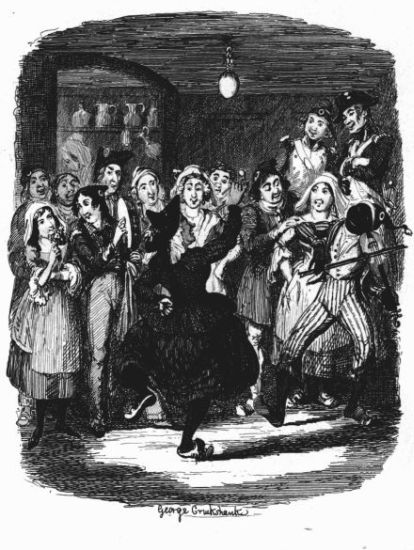
Frank, Ben, and Sambo, amusing the Natives.
London, Tilt & Bogue, 86 Fleet Street.
At length they abandoned the direct road, and kept away to the left
for the coast; hoping to reach some place in the neighbourhood of Blankenberg,
a fishing village on the sea-shore. This they accomplished, and
arrived about midnight on the beach, which they crept along, at some
distance from the vessels, lest they should be detected. Not a boat to
suit their purpose could they find at liberty—all were fast secured by
chains, and their oars removed, as if some such visitation as the present had
been feared. In this dilemma they cautiously returned to the village, and
searched amongst the cottages; but here they were again doomed to
disappointment, and were about to retreat to some place of concealment
till the following night, when the sound of voices was heard in a small
cabin, and Frank, stealthily approaching to listen, at length got near
enough to a chink in the window to see the interior, and ascertained that
an Englishman, with two females, was endeavouring, by the offer of a
considerable sum, to bribe three or four fishermen to convey them either
to Holland or to England. The men at first seemed disinclined to listen
to any proposals that might bring upon them the vengeance of the police,
and they talked of surrendering them to the authorities.
"That will at once seal my doom!" exclaimed the Englishman, in
agony. "Have not the wretches denounced me, because of the money
they owed me, and their base designs upon my child? Oh, God! do
thou appear for me in this trying moment!"
The fishermen consulted together in whispers, whilst the females clung
to the Englishman; and Frank ascertained by their discourse that the
elder lady was the wife, and the younger the daughter, of the man.
Again the latter earnestly urged his appeal to their generosity, their
humanity, and every better principle of human nature—the ladies, too,
joined their entreaties. Frank was half-tempted to the hazardous experiment
of bringing up his companions and forcing them into compliance.
At length the fishermen consented to embark them for Holland, or any
place occupied by the Allies, on condition that they gave up all the money
and every valuable in their possession previously to their departure, and
insured a still further sum on reaching a place of safety. Elated at the
prospect of escape, the terms were immediately complied with; and now
Frank became aware of the extreme danger he should have incurred had
he attempted to attack them, for whilst the Englishman and the females
were divesting themselves of their cash and every valuable they had,
three other athletic men came from an inner apartment—making seven
in all—to claim their share of the spoil.
As soon as the division had taken place, they departed to launch their
boat, commanding the Englishman and the ladies to remain quietly in the
cottage till they were sent for. Frank concealed himself in an adjacent
shed, occupied by his companions, till they were gone.
"It's all plain enough, young gen'l'man," whispered Ben; "they
will get the great vessel afloat—come ashore in the punt for the passengers—we
must seize on her, shove off, and capture the big craft—then
take the ladies on board, and make sail for the North Foreland—though
the wind is dead again us; but what's the odds—"
"That," interrupted Frank, "could only be effected by leaving our
countryman and the ladies behind; an idea I will not for one moment
entertain. Remain here—if I want you, I will whistle—then come without
delay."
The youth returned to the cottage, and addressing the gentleman in
French, he acknowledged that he had overheard their scheme, and earnestly
implored him to permit himself, a female servant, and a negro, to
embark in the same vessel, provided they could gain the consent of the
crew. The gentleman steadfastly refused—"he would not endanger his
own safety by acceding to it."
Rather mortified at being thus harshly treated—especially as he knew
that he might ensure his own safety by leaving them behind—Frank
would have answered indignantly, but he preferred remonstrance, avowed
himself a royalist desirous of joining the Allies, and assured him that no
danger could occur by giving his consent. The man continued inflexible,
till the ladies, won by the youth's earnestness, interceded, and an unwilling
assent was obtained.
The light of coming day had become visible when one of the fishermen
returned, and great was his apparent vexation to find other suppliants for
a passage in the vessel. However, he offered but slight objection, and in
a few minutes they were all down on the beach. Here a difficulty arose
as to their embarkation. The punt would carry no more than two passengers
beside the men that pulled, and the gentleman was unwilling to
leave either his wife or his daughter behind, nor would the females consent
to go without him.
"Do not fear," said one of the fishermen. "Time is precious with us—we
ought to be all on board now; and rely upon it we are not such
fools as to leave any one behind to betray our movements."
The latter argument was the most conclusive, and the gentleman
embarked with his wife, leaving his daughter to the care of Frank, who
spoke soothingly to her, and tried to allay her alarm; he took off his
jacket and wrapped it round her shoulders, as a protection from the cold
air, and in her fear she clung to his arm whilst he supported her.
The punt was not long away—all were soon aboard—the anchor was
weighed, and they hauled off from the shore. The father with the females
took up his station abaft, whilst Frank and his party occupied the midships,
and the seaman and the negro were soon fast asleep; but the young
midshipman's thoughts were too pleasantly occupied by his escape, and
the prospects of an interview with his mother, to compose himself to
slumber. Another object too now presented itself; it was the fair young
creature who had so confidingly clung to him on the beach. However,
to prevent observation, and the better to indulge in meditation, he closed
his eyes, and pretended to be oblivious to all that passed. Whilst thus
reclining, he overheard a sort of muttered conversation between two of
the fishermen which, though he could only catch disjointed sentences,
apprised him that treachery was at work; and he now readily understood
the reason that greater obstruction had not been offered to the embarkation.
The crew doubted the promise to receive further recompense, and expecting
to be rewarded for delivering them up as prisoners, had come to the
determination of making for a French port. Frank's ears tingled whilst
listening to this avowal of abominable treachery, but he cautiously
abstained from exciting any suspicion that he was aware of their designs.
He determined to watch them narrowly, and when opportunity offered,
he got close to Ben, who, on making a tack to windward, had roused up,
and without mentioning particulars, told him "they were betrayed unless
they could master the crew, and directed him to be ready for an attack at
a moment's warning." He then briefly conveyed a similar communication
to Sambo, and vainly tried to catch the eye of the gentleman abaft
for the purpose of inciting him to wariness.
The breeze was to the northward, with a lee tide running, so that,
though apparently working to windward between the sands and the
shore, they were rapidly drifting down towards Ostend, which was then
in the hands of the French. Ben comprehended the whole of this in
an instant, and saw, what the others, from their want of nautical knowledge,
did not observe, that the helmsman frequently edged off from the
wind, so as to facilitate their approach to Ostend, which was soon upon
their lee-bow, and the boat standing for the harbour.
The gentleman, wholly insensible to the danger which threatened them,
sat between his wife and daughter, and was speaking words of cheering
import, relative to their being rescued from the enemy, and the prospect
of soon enjoying the comforts of their native land. Everything was perfectly
tranquil in the vessel, which was lightly dancing over the smooth
waters and breaking the sun-light upon its surface. He also remarked
upon the quietude of their fellow-passengers, and even ventured a joke
upon the apparently solid countenance of the Dutchwoman, when suddenly—in
an instant, as if madness ruled the moment, they saw her spring to her
feet, and, grasping the pump-brake in her hand, she flourished it right
and left, laying a fisherman prostrate at every blow. Sambo also grappled
an opponent, whom he lifted over the gunwale, hurled into the sea
and then attacked another, whilst Frank rushed aft to the steersman,
shouting to the gentleman, "We are Englishmen, it is a French port
under our lee, and we are betrayed; for the sake of those you love—hurrah!—do
not remain inactive."
Nothing could exceed the amazement of the gentleman at this wholly
unexpected occurrence, and his astonishment was still more increased
when the supposed Dutchwoman, came bounding aft, flourishing her weapon,
and shouting in the nautical language of his native land, as he hurled the
steersman from his place,—"Ware hause, you lubber—what's the odds,
so as you're happy?" and taking the tiller, he put the vessel right before
the wind. "Bear a hand, Master Frank," continued Ben, "and keep
her as she goes: and I'm saying, ould gentleman, jist you show yourself
smart, and let 'em know as you've a little English blood in your veins.
Hurrah!—what's the odds?"—and again he rushed forward to assist
Sambo, who was stoutly contesting it with his foes.
British prowess triumphed—the struggle, though severe, did not last
long—the Blankenbergers were conquered; the punt was cast adrift for
those who were swimming—the remainder were bound hand and foot;
the sails were trimmed to stand off from the land; and great indeed was
the gratitude of the husband and the father, and still more delightful were
the acknowledgments of the ladies, when they ascertained the great service
that had been rendered to them. Mutual explanations ensued—hearty
congratulations were given; and in the afternoon they fell in with an
English brig which received them all on board. The fishermen, after a
sound rope's-ending for their treachery, had their vessel restored; and the
rescued party were the next morning gratified by entering the river
Thames.
A TIGER-HUNT IN ENGLAND.
"Who has let loose my tiger?" demanded Sir Pimpleton Pettibones of
his butler, whom he had summoned to the breakfast parlour by the sound
of the bell in a manner that indicated great impatience. "Who has dared
to let him loose? I locked him up last night for robbing the larder, and
this morning he is missing; where is he?"
The butler obsequiously bowed. "Extremely sorry, Sir Pimpleton; but
really, Sir Pimpleton, I am ignorant and innocent of the whole affair."
"Somebody must have let him out," responded the irascible baronet,
"and I shall be too late for the meet. Let search be instantly made—such
a tiger as that is not to be caught every day."
The butler bowed and withdrew; whilst his master, arrayed in a
scarlet hunting-coat, sat down to his repast, venting imprecations upon
the tiger, whom he declared it was his determination to catch before he
should accomplish further mischief. This happened at a beautiful mansion
in Kent, whither Sir Pimpleton had gone down for the hunting season,
taking his tiger (who was a great favourite) with him. Whilst the
search was still in progress, word was brought to the baronet that the
"creature" had been seen early that morning in the stable-yard, and a
beautiful swift-footed pony was missing, which—as the tiger had shown
great partiality to horse-flesh—it was supposed he had made away with.
"Hillio—hillio!—quick—saddle every horse in the stables," shouted
the baronet, "we'll scour the country—the game is up—hark forward—hark
forward!—yoicks, tally ho!" and away he went with grooms and
keepers down to the stalls, where he himself saddled his best hunter, and
in a few minutes he was flying away across the park, with a long straggling
tail like a comet after him, towards the village.
"Have you seen my tiger?" demanded the baronet, reining up his
gallant steed in front of the Pettibones Arms, and addressing the landlord—a
red, platter-faced man of some seventeen stone; "have you seen
him? he broke cover and stole away this morning—he must be prowling
somewhere about—have you seen him?"
"Lor love yer honour, no," responded mine host, with a grin of astonishment
and stupidity. "Them tigers are thirsty sowls; but he's never
been here to drink."
"Hillio, hillio!" shouted Sir Pimpleton, as his attendants came riding up,
"handle your whips and follow me;" and dismounting, he entered the
hostelry, where the good dame was busy in culinary operations. "Where's
my tiger?" was again the cry. "He's crouching somewhere here."
"Now laws ha' mercy upon us, I hope not, yer honour!" exclaimed
the old dame in dreadful alarm. "What, a real tiger, yer honour? Be
em a live un or a stuffed un?"
"Fool!" vociferated the baronet, "a live one to be sure, with large
goggle eyes and a fang tooth. I must find his lair." The entire premises
were examined, but the tiger was not there.
"To horse, to horse," commanded the baronet, to the great relief of the
old lady; "and hark ye, dame, if he should come here, shut him up
directly, and let me know. Away, my men, away." Sir Pimpleton
rushed forth, mounted his horse, and away he scoured like a madman, or
what is next of kin to a madman, a break-neck squire.
"Jeames, Jeames," called the hostess as soon as the cavalcade had
departed, "come in, Jeames, fasten the door, and get thees blunderbusk,
and load un wi' bullocks" (bullets probably), "and if so be the crittur comes
this way, shoot un, Jeames—shoot un without benefit of clargy."
On rode the baronet full pelt, and tailing after him followed half-a-dozen
attendants in scarlet coats and black velvet caps. The coverts were
tried, every nook was searched, but without effect, and they soon afterwards
entered another village.
"My tiger! my tiger!" exclaimed the baronet as he burst into the
first cottage, which contained a female with five or six children playing
and sprawling about the floor. "Have you seen the tiger? he has broke
loose, and cannot be far off."
"The tiger!" repeated the woman, terribly alarmed for the safety of
her infants, which she speedily gathered up and thrust into a capacious
closet. "Oh dear, what shall we do!" The cottage was searched, as
were also several others, to the great consternation of the villagers. Then
arose the cries of mothers for "Johnnies" and "Billies" and "Kitties"
and "Sukies" and "Tommies," to collect the stray lambs of the fold, or, in
other words, the toddling children that were playing on the green; and
in a few minutes not a soul of that population was to be seen.
A turnpike was close at hand, and thither Sir Pimpleton galloped; and
after a few words with the 'pikeman, his sonorous voice was heard.
"Hillio—hillio!—stole away—hark forward—hark forward!" and clapping
spurs to his steed, onwards they pressed, flying over hedges and
ditches to make a short cut.
Now it so happened that the hounds of a neighbouring squire were out,
and as the muster at the meet was pretty strong, and Sir Pimpleton was
well known for an eccentric, several members of the hunt rode up and
inquired "what game they had started?"
"A tiger! a tiger!" shouted the baronet; "we're hard upon him—hark
forward—yoicks—tally ho!"
A tiger-hunt in England was something new in the annals of sporting;
and though they thought it strange to chase the animal without dogs,
yet they were aware that Sir Pimpleton had passed many years in the
East Indies, and probably accustomed to the sport, they concluded it was
"all right;" and desirous of witnessing the novelty, many joined in the
pursuit, amongst whom was the master of the hounds and his pack.
The cavalcade drew near a large town, and in they dashed, the baronet
still shouting, out of breath, "The tiger!—the tiger! Have you seen my
Ben—g-g-gal?" The words were quickly caught up; and the announcement
that a fierce Bengal tiger was adrift in the town spread like wildfire.
The tradesmen shut up their shops; the inhabitants fastened their doors;
there was a brief running to and fro in terror, but the streets were
speedily cleared; and from many an up-stairs window was protruded
a blunderbuss, a fowling-piece, or a pistol, the proprietors of which were
eagerly intent upon destroying the furious animal, though some few even
thus elevated scarcely considered themselves safe from his bound. The
cry of the hounds, the shouting of the hunters, the rattling of horses'
hoofs upon the stones, and the wailings of women, with the cheers of the
men, produced a clamour such as had never before been heard in that
place. Mothers clasped their children and concealed them in beaufets, or
turned them up in press-bedsteads—fathers armed themselves with defensive
weapons, and a body of volunteers mustered in the inn yard with
loaded muskets, taking good care however to keep the gates shut.
"Have you seen the tiger?" was still the cry; and Sir Pimpleton
having obtained some information, "Stole away—hark forward," was
again the word.
They shot up Shooter's-hill without stopping to breathe, and when on
the brow, an animal, with apparently a blood-red back, was seen scouring
towards Blackheath. The baronet, with the lungs of a northerly gale,
uttered the "view halloo," which was caught up and repeated by the rest.
The hounds gave tongue and made play. It was a beautiful burst. The
whip and spur were plied. The steeds, though jaded, knew well by
instinct that the "warmint" was in sight, and kept up their speed, and
down the hill they swept like a mountain torrent.
But the tiger was not to be easily caught. There was no jungle or
hollow to hide in, and away he scudded over the heath with great velocity,
as if sensible that the enemy was behind him. Once he was missed, and
it was supposed had run to earth in a sand-pit; but the next moment he
was seen on the other side climbing the bank to shorten his distance, and
in a few minutes he was over the brow of the hill past the Green Man, and
descending at a tremendous rate. The hunters followed hard upon him,
the hounds in full cry, and again rose the shout from a dozen voices—"The
tiger! the tiger!" But the tiger had disappeared amongst the
horses, and they had now no clue to his advance, except from the amazed
spectators, who hastily cleared the road at the novel and somewhat alarming
spectacle. "The tiger! the chase!" exclaimed Sir Pimpleton.
Three or four hands were extended to point out the direction he had
taken; and those who had not "dropped off" still followed the hounds.
Away they rattled through the Broadway, Deptford, amidst cries and
cheers of "Go it, you'll catch him directly. Hurrah!" And they once
more caught sight of the tiger on the line of road towards New Cross.
Cheerily again sounded the "view halloo,"—the animal seemed to be
sensible that his pursuers were spurring in hot haste after him—the turnpike-men
enjoyed the sport and threw open their gates—hounds and
horses, and men rattled through—the Bricklayers' Arms, the Elephant
and Castle, Westminster-bridge, saw them rush past like a whirlwind,
the tiger still in advance; nor did the chase cease till the baronet's town
mansion, close to St. James's Park, was reached. A reeking pony stood
at the door, which was open. Sir Pimpleton dismounted, cheering the
hunters on—the game was all alive; the whole threw themselves from
their horses, and hounds and men following, the baronet bounced into the
drawing-room, where Lady Pettibones was receiving morning visits from
dashing young spinsters and elderly dowagers.
"The tiger—my tiger," exclaimed Sir Pimpleton, in a wild and loud
voice, "he has broke loose, and is now in the house."
Dreadful was the consternation at this announcement—a mouse crossing
the floor would have been terrific, but to have a savage and sanguinary
tiger ranging about, the thought was horrible. Shrieks and screams
abounded—some ladies threw themselves into the arms of the gentlemen,
others ran hurriedly about, and many, in their terror, could not distinguish
between the ferocious animal and a hound, so as to tell "vich vos the
tiger and vich vos the dog." At length, one of the whippers-in rushed
through the door-way, exclaiming "We've got him, your honour, they're
bringing him along." The confusion grew tenfold. Screams and shrieks
mingled with the loud cheers of the hunters, and the mouthing of the
hounds, when a couple of grooms appeared, dragging in a diminutive being
in a scarlet jacket, buckskin tights, and white top-boots, with several
dirty and ragged fish hanging by a long string in his hand; they placed
him in the middle of the floor right before the baronet, and it was with
difficulty that the hounds could be kept off.
"You rascal," vociferated Sir Pimpleton, raising his whip, "what do
you mean by leading me such a dance! Didn't I lock you up for thieving—didn't
I?"
"Vy yes, your honour," responded this perfect miniature of man;
"but afore that, you ordered me to carry a bundle o' red-herrings to town,
and give this here letter to deliver to her ladyship, and, when I came back,
to bring down the cab; so I only obeyed orders." He held up the letter,
and whilst trying to conceal the tattered fish, he looked smirkingly in the
baronet's face, and added, "I say, your honour, that 'ere pony's worth his
weight in gowld."
"Be off then, and take every care of him," said the more appeased
baronet, looking at the fish and laughing. The lad, winking at the grooms,
waited for no further orders. "And now, ladies and gentlemen," continued
Sir Pimpleton, "that is Ben Gall, my tiger. Men, take off the
hounds; we have had a capital run, gentlemen, which, no doubt, must
have given you good appetites. Your horses shall have every attention—refreshment
shall be immediately brought up for yourselves—a bumper
of brandy round shall open the entertainment, and since we are all here
together, why we'll wind up the day like true sons of Nimrod after an
English Tiger Hunt."
OMNIBUS CHAT.
Our monthly chat commences with a short dissertation on a very ample topic—
INGENIOUS ROGUERIES.
It may be remarked by any one who chooses to note the fact, that the most
ingenious rogueries are seldom those which succeed best. The deep-laid scheme
will often explode of itself; the right hand that never lost its cunning will sometimes
miss its reward; the genius of knavery will walk barefoot, with an appetite
as keen as itself; while the common bungler, the blundering rascal, the scoundrel
who is idiot also, shall succeed in all his stupid, shallow, contemptible designs, and
ride home to dinner quite convinced that, though not strictly honest, he is astonishingly
clever, or talented—for that is, in these cases, the more orthodox word.
It is not the most skilful burglar that safely worms his way to the butler's
pantry, or insinuates with most success his hand into the plate-chest; nor is it the
most dexterous picker of pockets who is permitted longest to ply his art, or
earliest retires upon a Pelion of purses piled upon an Ossa of bandannas. The
blockheads in this, as in some other professions, often carry off the palm. "Whom
the gods love die young." The thief of high and cultivated talent, the swindler of
fine taste and exquisite discernment, is frequently destined to suffer early the fate
which considerably later overtakes the fool. Somehow the world does not do
justice even to its rogues. It refuses to be taken in by the profound rascal, while
it readily falls a victim to the veriest dunce in the great School for Scoundrels.
While we see so many expert horsemen breaking the necks of their nags, or
throwing involuntary summersets;—while we observe how extremely careful, and
how eminently well skilled, is every captain of every steamer that happens to
figure in a horrible collision in broad daylight;—while we are called upon to bear
witness to the excessive caution and singular scientific proficiency of every soul
associated with a railway; and have to notice besides that all their care, and all
their science, has invariably been exercised whenever a frightful accident may
have happened upon their beat;—these failures of roguish talent, and misfortunes
of accomplished knavery, cease to be peculiarly wonderful.
This remark has been suggested by observing the signal failure of a rather
ingenious device, put forth in the form of an advertisement in some of the daily
papers. It is an invitation to everybody who may chance to possess "unstamped
receipts" for sums above £5, to communicate with the advertiser, who is, of course,
to reward the production of such documents! Any simple person would suppose—as
there are very droll specimens of collectors yet alive—more curious by far than
any of the curiosities they collect—collectors of turnpike tickets, and of complete
sets of checks for readmission to the Opera for eleven successive seasons!—that
here was a gentleman who had taken a fancy for collecting a perfect set of unstamped
receipts from the year 1800 to the present time. A little reflection,
however, would show that his object might be to lay informations against the
parties who had signed them. The design has been penetrated into still
further; for it appears that all parties showing such receipts put themselves in the
power of the advertiser, as being equally liable with the signers for accepting
them unstamped!
Yes, we are bound to say that here was considerable ingenuity exercised. Here
was a stone flung that seemed sure to kill two birds. The possessor of such a
document was more than likely to be tempted to show it, by the reward of one
sovereign; which the other party could well afford to pay out of the many sovereigns
extracted in the shape of penalty from the said producer's pocket—to say
nothing of the same amount drawn from the signer of the receipt. Since the
coaxing cry of "Biddy, come and be killed" was first raised, no more seductive
snare has been conceived. "I have assembled you," said the considerate proprietor
of live stock in the story, "I have assembled you, my pretty birds, to learn from
you what sauce you would like to be eaten with." "But we don't want to be
eaten," said the birds with one voice. "You wander from the point," was the
answer. So, perhaps, would the collector of unstamped receipts have said to the
producers. "I have assembled you here to know what you would like to pay me
in lieu of the penalty you have incurred." "But we don't want to pay any penalty."
"You wander from the point."
We have all heard the most scandalous and groundless stories about lawyers;—of
opinions delivered concerning the genuineness of a half sovereign, followed by
the deduction of six-and-eightpence for the advice;—of thirteen-and-fourpence
charged for "attending, consulting, and advising," when the occasion was a
splendid dinner given by the client—followed by a demand on the angry client's
part for wine had and consumed—and this succeeded in turn by an information
against the said client for selling wine without a licence. These, and a thousand
such libels, we can all remember; but the reality above recorded is at least as
striking as the most ingenious of such fictions.
To contrast with the non-success of this wily experiment upon a grand scale, we
may cite an instance of equal ingenuity, exercised in a much humbler walk, and
taking the form of knavery in its mixed character. We distinctly remember it to
have happened. The scene may be a seaport, or the banks of the Thames below
bridge. A seaman, bearing a huge stone bottle, applies at the Nelson's Head
for a gallon of whisky for Captain Rope of the Matilda, lying off shore—to
fill up the bottle already half full. The spirit is duly poured in, and the cash
demanded. "Oh! the capp'n said nothen about that"—the whisky was to be
added to his account, and that was all he knew. But "mine host" did not know
the captain well enough, and couldn't let the whisky go. The gallon was therefore
poured back again into the landlord's measure, and set aside to be called for.
So far there appeared to be no knavery at all; but the spirit so poured back,
presently turned out to be, not whisky, but excellent one-water grog; for the two-gallon
bottle of the sailor contained exactly one gallon of pure water when it was
brought in, and one gallon of pure whisky and water when it was taken out.
The means in this, as in myriads of cases, are curiously disproportioned to the
end. How miserably poor is the prize, considered in reference to the risk; to the
cleverness in the invention of the stratagem; to the address demanded for the due
execution of it, to the time consumed, the trouble taken, the agencies employed!
But the truth is, that the very cleverest rascals are rarely more than half-cunning.
The ablest of knaves must be at best half a blockhead. When we remember how
the great Bardolph, having stolen a lute-case, "carried it twelve miles and sold it
for three half-pence," the perilous, profitless, toilsome, half-witted nature of
roguery needs no illustration. One would like to have seen him walking back,
thirsty and way-wearied, under a broiling sun, and never sure but that the lady
who once owned the lute-case might be walking that way too!
That famous exploit of Master Bardolph's ought to be registered in large letters
over every judgment-seat, and on the door of every police-office. The record would
save much judicial breath, and supersede volumes of admonition.
Shakspeare's illustrations of Vice might possibly have led us into a dissertation
at least as long upon Shakspeare's illustrations of Virtue, but that the learned Dr.
Bulgardo here honoured our humble vehicle with his presence, and called general
attention to a contrast equally striking, under the following title:—
THE SISTER SCIENCES; OR , BOTANY AND HORTICULTURE.
By Dr. BULGARDO, L. S. D.,
Treasurer of several Learned Societies, and Professor of Asparagus at the University of Battersea.
BOTANY.
TO MARY, WITH A BUNCH OF FLOWERS.
Nay! say not faded—'tis despair
Has thus subdued them, for they see
That in themselves however fair,
They ne'er can hope to equal thee!
The Rose's joyous blush has fled,
With which no other lip could vie;
The Heartsease turns aside its head,
Fearing to meet thy deep-blue eye.
More sad the Myrtle's hue appears,
The Jasmine's silver star is dim;
Surpass'd by thee, thou seest the tears
That tremble on the Harebell's brim.
The Woodland Lily's silver cup
Was never seen to droop as now,
It dares not lift its flowerets up
To gaze upon thy gentle brow.
How canst thou look thus calmly on,
And watch them slowly die the while?
Recal them yet, ere life be gone,
Enchantress, with thy sunny smile!
HORTICULTURE.
TO MOLLY, WITH A BASKET OF FRUIT AND VEGETABLES.
Nay! say not shrivell'd—'tis despair
Has thus subdued them, for they see
That in themselves however fair,
They'll ne'er be relish'd, love, like thee!
A deeper blush the Raspberry paints,
Pale is the ruddy Beetroot's lip;
And e'en the red-cheek'd Apple faints,
As though it suffer'd from the pip.
Severely frown the Baking Pears;
The Artichoke's bold crest is down;
The awe-struck Medlar wildly stares
To see thy cheek a swarthier brown.
The icy Cucumber is hot,
The freckled Cauliflower wan;
The Mushroom has no longer got
A single leg to stand upon!
See how the rich, round-shoulder'd Figs
Bow to thy figure's graceful swell;
The sobbing Orange bursts its pigs
To find thee such a Nonpareil!
The Sister Sciences, female Siamese twins, having vanished from the scene,
our correspondent, Mr. H. G. Adams, presented a second specimen of his curious
PHOTOGENIC PICTURES: A SCENE NEAR FOLKSTONE.
[Folkstone was made, says tradition, of the "odds and ends" left after the rest of the world was
finished; and any one who has visited that jumble of heights and hollows, becomes impressed with
the conviction that tradition sometimes speaks the truth.]
Some weather-beaten men with clothes all tar-ry,
Keeping a sharp look-out upon the ocean,
And little Tom, and Jack, and Bill, and Harry,
Making upon the beach a dire commotion,—
Dabbling, like dab-chicks, in the billows briny,
Hunting for crabs, and other things crustaceous,
While a Newfoundland dog, in sport called "Tiny,"
Wags his huge bushy tail, and looks sagacious:
Here wades a shrimper to his waist in water,
There swims a bather, snorting like a grampus;
And lo! James Muddle, with his wife and daughter,
All in a boat, and crying out, "Don't swamp us!"
Far in the offing you may see a cutter,
Her white sails gleaming like the sea-gull's pinions,—
She means to overhaul that craft, with butter
Laden, and cheese, from swampy Scheldt's dominions;
I shouldn't wonder if Schiedam—however,
That's not my business;—turn our glances landward,
There's Farley in his garden—well, I never!—
A-talking down the chimney, to my landlord;
He says, "I see you've got some greens for dinner,
"And pickled pork," but can't say more for coughing;
That smoke just serves him right—the prying sinner!
He's always jeering folks, and at them scoffing:
White cliffs, and houses, underneath and over,
And roads that seem to lead to regions airy—
Old boats converted into roofs, that cover
Buildings, in shape and size that greatly vary,
Denote the place, which popular believings
Point out as being made of ends and leavings.
Here we were reminded by a particularly ample, and unprecedentedly flaring
wood-cut, borne on an appropriate pole past the vehicle, and intended to describe
the indescribable effects of the fireworks in the Surrey Zoological Gardens, of a
pleasant discourse which we overheard in that suburban retreat. "Quite a gem,"
cried a lady from Portland Place, contemplating the splendid pictorial model of
Rome; "really quite a monument of the artist's abilities." "I see St. Paul's,"
said a lady from Shadwell, who was standing by, looking at the same time at the
crowning feature of the picture, "I see St. Paul's quite plain, but where's the
Monument?"
"How those butcher-boys do ride!" exclaimed an elderly gentleman in the
further corner, as one of the blue-frocked fraternity, with basket on arm, and
"spur on heel," dashed past at headlong speed. "Ay, sir, they ride sharp enough,"
replied his next neighbour, whose bronzed features and brawny shoulders
bespoke him a son of old Ocean; "but of all the rough-riding I have ever seen,
nothing comes up to
A NEGRO BOY IN THE WEST INDIES.
The negro boys there are the most cunning imps I have ever had to do with.
I recollect on my last voyage to Jamaica, while my vessel was lying in St. Anne's
bay, I had to go to Port Maria to look for some cargo; and on my way thither,
near Ora Cabeça, I came to one of the numerous small rivers that empty themselves
into the little bays along the coast—I think it was the Salt Gut. When at
some distance, I had observed a negro boy belabouring a mule most heartily; but
before I got up he had left off his thumping and dismounted, and now appeared
in earnest talk with his beast, which, with fore-legs stretched out firm, and ears
laid down, seemed proof against all arguments to induce him to enter the water.
Quashie was all animation, and his eyes flashed like fire-flies.
"Who—o! you no go ober? Berry well—me bet you fippenny me make you
go—No? Why for you no bet?—why for you no go ober?" Here the mule
shook his ears to drive off the flies, which almost devour the poor animals in that
climate. "Oh! you do bet—berry well—den me try."
The young rascal (he was not more than ten years old) disappeared in the
bush, and returned in a few seconds with some strips of fan-weed, a few small
pebbles, and a branch of the cactus plant. To put three or four pebbles in each
of the mule's ears, and tie them up with the fan-weed, was but the work of a
minute. He then jumped on the animal's back, turned round, put the plant to
his tail, and off they went, as a negro himself would say, "like mad, massa." Into
the water they plunged—the little fellow grinning and showing his teeth in perfect
ecstasy. Out they got on the other side—head and ears down—tail and heels up—and
the boy's arms flying about as if they did not belong to him; and I lost sight
of him as he went over the rocky steep at full gallop, where one false step would
have precipitated them into the sea beneath, from whence there would have been
but small chance of escape. No, no, a butcher's boy is nothing to a negro boy—the
one may ride like the deuce, but the other is the very deuce himself riding.
"Did you see any more of him, sir?" inquired a young lady opposite.
"Yes, madam, about two hours afterwards I reached Port Maria, and in an open
space near the stores, there sat, or rather lay, young Quashie eating cakes; and
there also stood the mule, eating guinea grass, and looking much more cheerful
than when I first saw him at the Salt Gut. 'Well, Quashie,' I said, 'you have got
here I see, but which of you won?'—'Quashie win, massa—Quashie never lose.'—'But
will he pay?' I inquired.—'Quashie pay himself, massa. You see, Massa
Buccra, massa gib Quashie tenpenny-bit for grass for mule. Quashie bet fippenny
him make him go ober de Gut—Quashie win—Quashie hab fippenny for cake,
mule hab fippenny for grass.'"
"Had that defrauded mule, sir," here interposed a stranger, "been born in
Ireland a brief while ago, he would have fallen to and devoured the young nigger
out of hand, for cheating him of half his grass; that is, he would, if he had ever
read the ancient records of that country, and become acquainted with the fact I
am about to relate—but stay, perhaps you may relish it better in slip-shod verse."
THE TERRIFIC LEGEND OF THE KILKENNY CATS.
O'Flyn she was an Irishman, as very well was known,
And she lived down by Kilkenny, and she lived there all alone,
With only six great large tom-cats as knew their ways about,
And ev'ry body else besides she scrup'lously shut out.
Oh, very fond o' cats was she—(and whisky too, 'tis said,)
She didn't feed 'em very much, but she comb'd 'em well instead;
As may be guess'd, these large tom-cats, they didn't get very sleek
Upon a combing once a-day, and a "ha'porth" once a-week.
Now on one dreary winter's night, O'Flyn she went to bed,
The whisky-bottle under her arm, (the whisky in her head,)
The six great large tom-cats they sat all in a dismal row,
And horridly glared their hungry eyes—their tails wagg'd to and fro
At last one grim greymalkin spoke in accents dire to tell,
And dreadful were the words which in his awful whisper fell—
When all the other five tom-cats in answer loud did squall,
"Let's kill her—and let's eat her—body and bones and all!"
Oh horrible! oh terrible! oh deadly tale to tell!
When the sun shone in the window-hole all there seem'd still and well;
The cats they sat and lick'd their paws, all in a merry ring,
But nothing else within the place looked like a living thing;
Anon they quarrell'd savagely, and spit, and swore, and hollo'd,
Till at last these six great large tom-cats they one another swallow'd;
And nought but one long tail was left in that once peaceful dwelling,
And a very tough one too it was—it's the same as I've been telling. [C. B.]
In the Character of Marie Stuart.
FRIGHTS!—No. II.
We now propose to turn to other illustrations of fright familiar to every
family, and susceptible of description. Let us take a night-scene, conjured
up by a sudden alarm of
Thieves!
'Tis midnight, and "the very houses seem asleep," out-houses and all.
The "quiet family" has attained its utmost pitch of quietness. All sleep
soundly, where no sound is heard. A breathless hush pervades the domicile.
On a sudden, there is a smart crash, a rattling sound, below. This
sleeper starts up in bed; that, darts farther under the clothes. "What's
that?" is the inward question of everybody. The thought of thieves occurs
to each in turn; one is certain that the area-door has been forced open;
another is sure that the back-parlour sash has been raised. They lie still,
with panting hearts, and listen. Again there is a noise; it is like creaking
footsteps on the stairs, or the opening of drawers; then all is silent again,
and then the noise is renewed.
At last one little quaking Miss ventures half-stifled to whisper,
"Sarah, are you awake?" And Sarah faintly answers, "Yes, did you
hear that?" and both bury themselves in the bed, and dare not breathe.
And then they hear a door open softly, and they utter a low cry of
terror; and then in another minute the door of their own room opens,
and with a loud scream they start up—only to see their dear good mama
with a candle in her hand; but she is pale and frightened, and desires to
know if they had made the noise—but they had not; only they distinctly
heard somebody getting in at the back-door, or the parlour-window. Then
papa commands the whole assembled family "not to be frightened," and
shakes dreadfully—with cold—as he looks at his blunderbuss, and avows
his determination to proceed down-stairs. And then there is a "hush!"
and a general listening. Yes, there is a noise still, and to the stairs he
advances; while his better-half lights his way and holds his garments tight
to check his desperate enthusiasm; and the eldest daughter hardly ventures
beyond the chamber-door, but with astonishing boldness and exemplary
daring springs a rattle; and the others hold on each by each, taking fresh
fright from one another's fears. What an amount of suffering, dread,
terror—is in the bosom of the little quiet family, as down to the scene of
danger they creep with tortoise-pace! And what is all this anxiety, this
trepidation, this sickness of the heart, for! What has occasioned so terrific
a commotion! Perhaps the tongs have fallen down, and the clatter has
filled their ears with all sorts of imaginary noises! Perhaps the cat is
clawing at a string tied to the latch of the pantry-door; or perhaps the
stupid little kitten, having got her tail into the catch of the last new patent
mouse-trap, has dragged that excellent invention off the dresser, and is
whisking round at intervals in a wearying and vain endeavour to extricate
her unprehensile appendage! "Dear me! well I declare how I have
been frightening myself!" cries every member of the shivering family; and
the very next night, should the very same noises again be heard, the
whole frightened family would start, turn pale, quake, wonder, pant,
scream, and spring rattles, exactly as before. Where Fear has once taken
possession, Experience does not always make folks wise.
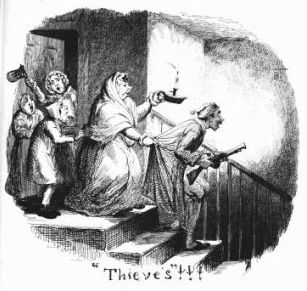
Let us take for another example of the daily domestic romance—
THE STRANGE CAT.
How vividly, among the events of our boyish days, do we remember
the "strange cat" that got into the lumber-room at the top of the house!
Our elder brother and "the boy" had endeavoured to dislodge the animal,
which figured in their description as a thing of intense blackness and
monstrous dimensions, with great frightful staring green eyes, horrid long
claws, and such a tail! Not "frightened of cats" were we, for we had
a favourite one of our own; but this—it trebled in magnitude and horror
the wildest and most savage inhabitants of the then Exeter Change.
Their own fears had magnified the "strange cat" into a monster; and
then they wilfully enlarged the picture to terrify us—a feat, in which
they succeeded, as we dared not go to the upper rooms alone. For two
or three days this "reign of terror" lasted; when, a favourable opportunity
being watched for, the "young master" and the "young man" marched
up, broom and brush in hand, to hunt out this strange secreted intruder—the
black tiger of the upper wilderness. As for our tiny self, we had
ventured a part of the way up-stairs to witness the result, imagining that
the enemy would make its exit by an attic window. Oh horror! A loud
knocking was heard above; a tremendous shouting next arose, succeeded
instantly by an appalling cry of "Here it comes!" This was, shall we
say enough?—it was too much; we turned and flew down-stairs—the last
"flight" of stairs being, with the aid of the handrail, but one leap. The
street door! No, we could not open it. Against it then we set our back
in an agony of fear, and uttered a cry that would have terrified a whole
legion of cats. The hunters were in full cry. Down came the wild animal,
followed by brooms and brushes, bounding and rattling over the stairs—a
clatter that rent the roof. What saw we then? Not a poor half-starved
frightened animal leaping over the banisters to get out of our way, and to
escape through the garden-door; no, of this piteous, this actual spectacle
we saw nothing,—but in its place—this!
This little "tail-piece" expanded to the dimensions of a full-sized Newfoundland
dog, surrounded by a blaze of fire, will convey some idea of
what, in the extremity of our apprehensions, we actually did see.
A SHORT CRUISE AT MARGATE.
Being at Margate the other day, we strolled, in company with "The Old
Sailor," down to the "Jetty," where we were accosted by the veteran Hemptage,
a boatman of the old school, who, with a salute, inquired "Will you take a trip
this morning, Sir?"
"Not if it blows," answered the Old Sailor, assuming as much as possible the
look and manners of a landsman, "I have made up my mind never to go sailing
if there's a breath of wind."
The old man gave him a look, which spoke as plainly as look could—"Here's
a precious lubber, to talk of sailing without wind."
"It would be on possible to move a-head and no breeze, Sir."
"I don't care for that," rejoined the Old Sailor, "I am very timid on the
water; but if you're sure there's no danger, and it will be quite calm (it was
nearly so), I will venture to take a sail."
"Danger!" repeated the veteran somewhat contemptuously, though there was
an expression of doubt and suspicion on his countenance that seemed to say "I
think you're a gammoning me."—"What danger can there be when there's hardly
wind enough to fill the canvas?"
After some further conversation relative to the perils of the ocean, which
drew forth some scornful glances from the veteran, we embarked in a pretty
green boat, with two masts or poles, one sticking up behind and the other near
the middle, to which sails were fastened. Whilst Hemptage was loosing what
we believe is named the main-sail, the Old Sailor jumped aft to set what he
called the "lug mizen," and he was shoving out a pole from the stern, right over
the water. We immediately informed the boatman that our companion was
"meddling with the things at the other end," and the veteran promptly turned
round and exclaimed, "You'd better let that ere alone, Sir. You'll find somut
as 'ull puzzle you there."
"Avast, old boy!" returned the Old Sailor, laughing; "I've rigged out as
many bumkins[6] as you have in my time."
"Ay, ay," drawled out the veteran—"hang me if I didn't think so by the cut
of your jib—I thought it was all gammon, and you knowed better than to go
sailing without wind."
"You have belonged to a man-of-war," said the Old Sailor, as we were standing
off from the shore.
"Why, yes, I've had a spell at it," returned Hemptage somewhat knowingly,
"I was in the owld Hyacinth with Tommy Ussher, and a better Captain never
walked a ship's quarter-deck. I was with him too in the Ondaunted frigate up
the Mediterranean——"
"What! were you in her, in Frejus Bay, when Buonaparte embarked for
Elba?" inquired the Old Sailor.
"Why to be sure I was, and remembers it well enough," returned he with
animation. "And the first thing Boney did when he got aboard was to come
forud on to the foksle and have a yarn with the foksle men[7]."
"What sort of a man was he?" we asked with quickness.
"What sort of a man," reiterated the veteran, "why a stout good-looking
chap enough, only very swarthy. Them images as the Italian boys brings about
is very like, only I never seed him in that little cocked hat."
"Why what did he wear then?" inquired we with some eagerness.
"Oh he wore a round hat[8]," replied Hemptage, "and he used to lean against
the breech of the foksle gun and spin yarns with us for the hour together."
"Well!" we thought, "we never shall have done with Boney." We had never
drawn him in a round hat, and the temptation was too strong to be resisted—so
we have accordingly placed him at the head of this article—and as of course he
would have a fashionable beaver, we have given him one of the shape of that
period, and placed him in contrast with himself.—Boney versus Boney—cock'd
hat against round.
It may be said "What's in a hat?" And when upon the head it becomes a
rather important question. In many cases the answer would be "not much,"
but with respect to Napoleon it certainly must be admitted that there was something
in it.
"But (we asked in continuation of our conversation) how could you talk
with Buonaparte—did he speak English?"
"O yes, pretty well, considering—very well for him," replied Hemptage, "he
mixed a little of his own lingo up with it—but we made it out. During the
passage he used very often to come forud, and he told us he liked English sailors,
and one had wounded him once at Toulon."
Fully aware that the fact of Napoleon's being wounded at Toulon had long
been a disputed point, we questioned the man, and received the following
statement:—
"Why," said the veteran, "he told us the English made a sortie, as they call
it, and drove the French before them. Boney run as well as the rest, and an
English seaman chaced after him; but whether the man was tired, or thought
he'd gone far enough, he didn't know, but he gave him a shove in the starn with
his bagonet, and said, 'Take that, you French Lubber.' The sailor might
have killed him if he had been so disposed, but he acted generously and spared
his life. 'And,' says Boney, 'if ever I could have discovered the man who acted
so nobly, I would have made him comfortable for life.' The wound was in his
thigh."
Now had that Jack Tar taken one step further, or have made a deadly thrust,
the fate of Major Buonaparte would have been sealed at Toulon, and the world
would never have heard of the Emperor Napoleon. We fancy we hear some
of our Hibernian friends exclaiming, "Faith, then, and it's a pity the sailor didn't
know that Boney would be after doing so much mischief."
Thus conversing and moralising, we finished our "Short cruise at Margate."
Hemptage is approaching his seventieth year, and his countenance displays the
colours of a thorough seaman. He has been several times wounded, but looking
hale and hearty. When paid off he was refused a pension—visitors will find him
a pleasant shipmate in a trip—and the lovers of the marvellous may enjoy the
satisfaction of conversing with a man who has seen and talked with "a live
Bonyparty."
PASSIONATE PEOPLE.
"So you will fly out! Why can't you be cool like me? What good can passion do? Passion's
of no use, you impudent, obstinate, overbearing reprobate."—Sir Anthony Absolute.
Of all the evils, all the injuries, all the calamities, by which passionate
people are liable to be visited, none are so perilous, so overwhelming,
as the encounter with a meek, cool, patient, unanswering adversary—if
adversary such a wretch can be called. There is no trial in life like this.
The bare idea of it puts one out of temper. To be placed, when in the
full swing of a violent fit of rage, when indulging to an excess in the
wildest transports of the soul, when giving loose to the most riotous emotions
of our nature; to be placed at such a juncture right opposite some
cold calm personification of indifference, some compound of sadness and
tranquillity, with an air of entire submission, with drooping lids, and
perhaps a smile not entirely free from pity; to see some such person
sitting there imperturbably philosophical, putting the best construction
possible upon one's violence, and evidently making silent excuses for one's
ungovernable fury! I put it to any rational madman—that is to say to
any man I know—whether this be not a species of exasperation too great
to be borne, and quite enough to make one start off for Niagara, to enjoy
the intense satisfaction, the indispensable relief, of jumping down.
I wouldn't give one drop of ink for a man who never goes into terrific
passions, who never lets his blood boil over, at least now and then; but I
should feel peculiar pleasure in hurling any inkstand—the writing-desk
would be better—at the head of him whose fury did not instantly become
ten thousand times more inflamed by the mere presence of that smooth
oily virtue, that "ostentatious meekness," which at once sighs in submissiveness
and smiles in superiority.
All the mischiefs that arise from the excesses of anger and rage must be
conscientiously set down to the account of that provoking passiveness,
that calmness which irritates the fiery beholder past endurance. Let the
physician, who would minister to the mind diseased, take any shape but
that. Who is there that cannot bear testimony to its galling effects from
his own observation or experience! Only say to a man in a pet, "Now
don't lose your temper," and he falls naturally into a rage; say to one
already exasperated, and on the verge of a fit of fury, "Pray don't put
yourself into a passion, it's all a mistake, there's nothing to be angry
about;" and what so sure to set him off at a pace past stopping!
The image of "Patience on a monument smiling at Grief" has been
greatly admired, but as a design it would hardly hold together for five
minutes. Shakspeare was a little out for once. Patience smiling at
Grief! How could Grief stand it! She would be transformed into
Rage in no time. If at all in earnest, she must necessarily be provoked
to jump down in a paroxysm, or to pitch Patience off the monument.
To the truly irritable, and I confess that I am one of them, all such
irritation, to say the least of it, is superfluous. To us who have "free
souls" no such provocation is wanting at any time. We are always
ready to go ahead without this high pressure; our quick blood renders
the spur unnecessary. We never wait for "the motive and the cue for
passion" that Hamlet speaks of.
The real relish and enjoyment of it consists in going into a rage about
nothing. The next pleasure to that consists in being roused to fury about
other people's affairs; in lashing oneself into madness about some grievance
borne by a person who seems perfectly indifferent to it. There are
numbers of people who may be thus said to go into passions by proxy.
They have experienced a slight, of which they give a cool account to
some susceptible friend, who stamps and raves at every word of the
narrative. They calmly inform you that they have been shamefully ill-used;
upon which they stroke their chins complacently, and leave you to
tear your hair. The man who has been cruelly wronged describes with a
glib tongue, while the uninjured auditor disinterestedly gnashes his teeth.
I have always admired that passage in one of George Colman's plays,
where a warm-hearted fellow, giving an account of some flagrant act of
oppression to which he had been a witness, observes,—"Well, you know,
that wasn't no affair of mine; no—and so I felt all my blood creeping into
my knuckles"—and the result shows that he fell, with exemplary promptitude,
into a glorious passion in behalf of the oppressed but uncomplaining
stranger.
This bit of fiction calls to mind a fact which may with no impropriety
be here related. It is an anecdote of a distinguished writer now no more,
W. G. He had complained to me of some ungracious conduct, by which
he felt hurt and insulted; he was helpless, and this made the sense of
injury more acute. He spoke with bitterness, though in gentle tones.
I did not echo those tones; for he was illustrious by his intellect, and
venerable by his years; and, as the phrase is, I at once "rapped out"—pouring
a torrent of reproach, and heaping a mountain of invectives, on
the heads of those, who, to use his own words, "had dared to put an
indignity upon him." He heard me, very quietly, until the full burst of
indignation with which his more moderate complaint had inspired me was
exhausted, and then said with an ejaculation short, sharp, and peculiar
to him,—"I'm afraid you've been picking up some queer doctrines of
late; the principle of them is, as far as I can understand, to be discontented
with everything!" Now as he had taught me just then to be discontented,
and as I was moreover only discontented on his account, I did
not immediately leap out of my fit of passion into one of philosophy; and
I believe he was upon that occasion much struck with certain metaphysical
phenomena, on which I left him to brood; with the curious distinction,
that is to say, between one fellow-creature undergoing the punishment
of the knout without exhibiting a symptom of distress, and another
fellow-creature looking on, all grief and anguish, shuddering at the spectacle,
and feeling every lash on his own heart.
These are the most generous bursts of rage that can be indulged in;
and, next to those that are altogether destitute even of the shadow of a
cause, are the most delicious to the irritable. The wrongs, troubles, and
perversities of individuals, from near relatives to total strangers, generally
form a plentiful supply; in fact, the smallest offence will be thankfully
received, as the history of irascible people amply shows. Very good
grounds for anger occur, as we can all remember, when a fellow-traveller
at an inn refuses to take mustard with his pork-chop; or when another,
in spite of every hint, persists in breaking his eggs at the small end, or
lighting his cheroot at the large end; or when a sturdy fellow walks
just before you through a smart shower of rain, and won't put his
umbrella up, though you obligingly tap him on the shoulder, and remind
him that it's pouring; or when an obstinate one declines the adoption of
somebody else's opinion, merely because he has not been convinced of its
reasonableness; or when an affected one pronounces the word London
"Lunnun," and Birmingham "Brummagem," and, while he asserts in
his justification that Lord Brougham calls the places by those names,
refuses to distinguish his lordship as Lord Bruffham.
If individual grievances or peculiarities should fail, which is scarcely
possible, national ones will do as well. Nay, I know a philanthropist
whose heart was broken fifty times a year, whose blood boiled hourly, at
the recollection of some great outrage that had happened in the dark
ages. Passion, moreover, has this convenience, that it is an essential
privilege of it to reason from the individual to the national; thus, if a
Russian government, or a Russian faction, inflict wrongs on Poland, all
Russia may be indiscriminately condemned; and thus too, if an American
visiting this country should be wanting in good manners, or give you any
cause of offence, you can with strict propriety launch out into a tirade
against the American people, their customs and institutions, laws and
dispositions—wrath will there find "elbow room." You may wind up
with the observation that, bad as is the brute whom you have just
encountered, you believe him to be quite as good as the very best of his
countrymen.
This, indeed, may be laid down as a rule; when a Scotchman offends
you, abuse all Scotland, and offer to prove that Burns was no poet;—when
an Irishman puts you in a heat, be sure to denounce Ireland, and
hint that St. Patrick was no gentleman, nor were his ancestors decent
people. With an Englishman the case is rather different, because anything
you may say against John Bull is pretty sure to please, instead of annoying
a member of his family; who won't much mind a back-handed hit at
himself, if you direct the principal force of your attack against the national
character. It is expedient, therefore, to be less sweeping in your charge,
to concentrate your forces, and to content yourself with a small explosion,
fatal only to his immediate friends and relations. Point out how remarkable
it is that so many persons of the same name should have been hanged
for sheep-stealing; question the depth of his breeches-pocket, where he
rattles a bunch of keys, as though he had anything to lock up; and pick
out some cousin of his who is very badly off, and spitefully ask him to
dinner. But you will never vent your rage satisfactorily, by merely
abusing Old England in an Englishman's presence.
To get into a passion in the street is sometimes peculiarly awkward.
It makes you feel like a bottle of soda-water that wants to go off and
can't. Some people ought to have their hats wired down, cork-fashion.
Walking with an irascible friend the other day—I am fond of such companions,
and can boast a great variety of them—he worked himself into
as pretty a specimen of fury as I have lately seen; but what was to be
done? There was nothing to cause it, and there was no relief to be had.
Apple-stalls upset are but vulgar exploits; me, he could not strangle in
the open street; there was no temptation to smash a lamp in the broad
daylight, however agreeable and comforting at night; there was no loitering
schoolboy in the way, to be kicked "for always tieing that shoe;"
yet, "as fires imprisoned fiercest burn," out the blaze must burst, the volcano
was not to be smothered up. Accordingly, just as we reached the
open window of a butcher's shop, on the board of which a lad in blue
sleeves, and black, glossy, curling hair, sat intently reading the "Sorrows
of Werter," my passionate friend stopped. Whether he meant to snatch,
a weapon, à la Virginius, was doubtful. I thought at least he would have
snatched the grease-marked volume out of the hands of the sentimental
butcher-boy, and trampled it under-foot; when instead, off he darted
across the wide street, I following—rushed up to a house opposite,
seized the large knocker, and plied it with the combined force of forty
footmen, or a legion of penny-postmen rolled into one! I stood, looking
on, amazed, while he knocked and knocked, without one moment's cessation,
until the door was torn open, and the knocker dropped from his fingers.
The servant-maid looked aghast, yet the accustomed spirit of inquiry, Who
was he? What did he want? was uppermost in her face. "Oh!" said my now
subdued companion, "Oh! ah!-a-I'm sorry to have troubled you! I-a-I don't
want anybody—it's all right—thank you—I'm better now!"
Thus saying he quietly took my arm, and we sauntered off. I never saw a
fellow in a more charming flow of spirits than his were throughout the
rest of that day.
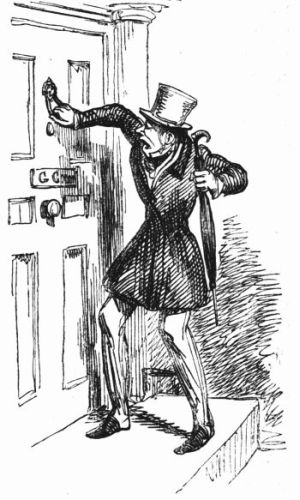
But it is more judicious to choose a spot where you can fall
into a rage comfortably. It is a pity for example to get excited at
Charing-cross, merely by the sight of a Dover coach, with the name of
the town upon it spelt with two o's, "Dovor." "There goes one of those
confounded coaches again," said a companion the other day; "how savage
they make me! Dovor! Why can't they spell the name properly?" "Oh, what
does it signify?"—"Signify! why it's my native town! it puts me in
such a passion that I can't walk;" and by the pace at which he went there
appeared a probability of his overtaking the coach. As a man intoxicated
can run easily, when walking is difficult, so a man in a passion finds
similar relief. I have heard of a nervously-excited individual who was so
annoyed by the cry of "Bank, Bank" all down the Strand, that he jumped
into one of the vehicles, resolved to go to the Bank and draw
out his balance; nor did he remember, until he got there, that he had
performed that ceremony the day before.
What I should respectfully recommend to any one on whom the fit
comes suddenly out-of-doors, whether occasioned by some irritating train
of thought, or a casual encounter equally provocative, is to go directly
home, and give his family the benefit of it. Surely the best compliment
he can pay his wife is to presume that her attachment to him is so great
that she will endure any ill-usage—that she would rather see him
return home in a tremendous passion than have him stay longer away
from her. A man who truly relishes his fit of rage will find a sweet
relief in making his family uncomfortable. The children he can immediately
order up to bed in the dark; and if anything in the shape of protest
falls from the doting mother, he can take an opportunity, slyly, of
upsetting a vase of flowers, water and all, into her work-box, or of tilting
the inkstand upon the favourite autograph in her album.
In the case of a single man, who has neither fond parent nor devoted
partner to vent his fury on, a theatre is no bad resource; he can take his
seat in some quiet corner and hiss the performance,—he will find it very
soothing to his feelings; but he should choose, if possible, the first night of
a new drama, and be constantly on his guard, or he will be tricked out of
all his pleasure by the actors. I know a man who went in a great passion
on purpose to hiss a new comedy, but being off his guard, he sat and
laughed all the evening.
Brutus desires Cassius to "go show his slaves how choleric he is, and
make his bondmen tremble;" implying that it was still more vulgar and
degrading to go into a passion before servants. This notion prevails
amongst a certain class of the choleric to this day. It is not at all uncommon
in genteel families, where appearances must at all sacrifices be
kept up, for John to be desired to shut the door, and perhaps to be despatched
to the remotest part of the house, while his master and mistress
sit down to fight out a pitched battle with bated breath; whispering their
fierce retorts, and dealing out their virulence sotto voce, that it may not
reach the kitchen; recrimination, with savage aspect, speaking in the
blandest key, and threats of separate maintenance breathing in tones that
would have added a delicious tenderness to the fondest sentiment. All of
a sudden, perhaps, a violent crash is heard; the lady, who "could bear it
no longer," has commenced some sportive sallies with the tea-cups, and the
gentleman has promptly followed in some equally lively experiments with
the saucers; and John, when in wild alarm he re-enters the apartment,
perceives in an instant, as clear as crockery itself, that naughty Dash has
not been jumping upon the tea-table, and that it is not that calumniated
quadruped by whom the best blue-and-gold service has been devoted to
destruction.
All these tamperings with passion are great mistakes; there can be no
enjoyment but in speaking out, and letting all the world hear if they
like. I always admired the unhesitating frankness of that respectable
tradesman (I forget his name, purposely) who about nine one summer
morning, after "some words" with his lady respecting the comparative
merits of Souchong and Mocha, deliberately opened the first floor
window, and dashed out the whole breakfast set, tray and all, into one of
the leading streets of the metropolis. People, it is said, put up their
umbrellas as they pass, to this day, in constant expectation of a milky
shower, with small squares of sugar for hailstones. But all such
experiments with cups and saucers, glasses, vases, mirrors, &c., are
much better performed, for obvious reasons, at other people's houses
than at your own. It is very pleasant, and quite pardonable, to
sweep a few glasses off the table in a fit of enthusiasm, now and then—when
you are dining out; but it is perfectly ridiculous to proceed
to such extremities at home, where the modes of venting rage are
infinite. For a somewhat similar reason, I differ from those who systematically
tear their own hair when they fall into a paroxysm; there is no
occasion for it, because you might happen to be wearing a wig, and the
effect would be ludicrous. It is far better to thrust your hand desperately
into the loose locks of somebody sitting next to you, tearing them violently
for the space of an instant, and then apologizing for the wildness of your
excitement, and the extreme susceptibility of your feelings. Your sensibility
and the frankness of your disposition will find many admirers; but
to pull your own hair has at best but an affected and theatrical look.
The practice common to many of the choleric—that of taking off their
hats, flinging them at the first object they see, and then kicking them,
regardless of expense—is one that seems to have arisen out of an instinctive
feeling, but until lately it was to be condemned as ruinous to
those who fall very frequently into a passion; it is less exceptionable
now; the cheap hats are immense conveniences to the choleric. It is
better however to snatch a friend's off his head, and set your foot upon
it, taking care to pick it up immediately, tenderly putting it into shape
a little, brushing its injured nap, and returning it with your unfeigned
regrets. I should not omit to mention one ingenious expedient, which is
sure to produce a speedy relief to over-excited feelings. It is recommended
on authority, as infallible. You should first lock the door of
your sitting-room, and then lie down on your back upon the rug before
the fire—taking at the same time one of the long bell-ropes in either
hand. In this position you will find a little violent pulling very
pleasant. But don't leave off, merely because everybody in the house
comes rattling at the door, desiring to know, not for their own, but for
Heaven's sake, what's the matter. Keep on tugging at both bells, until
the door is broken open—you will then come-to quite comfortably.
The great have some advantages over the humble, but they lack the
luxury of giving a loose to rage at all seasons; they cannot storm and
rave at their own sweet will; while the lowest creature committed to
prison by the magistrate can always spring from the grasp of the constable
and break a window or two. This may seem a poor relief; not so;
there is, doubtless, an exquisite satisfaction in knowing that nothing less
than a large county must pay the damage. Suppose you only shatter a
dozen panes, or effect other wilful injury, is there not something grand in
being revenged upon Middlesex, or venting your fury on all Yorkshire?
Great or humble, Rage is sweet to all. Anger, not Love, is the universal
emotion. The mildest and most even-tempered man I ever met, let
out the secret of his fiery disposition the other day, and betrayed the
violent passions that sometimes seize him. Complaining of the extreme
smallness of his new library, in a figurative style, at once emphatic and
elegant, he said, "It isn't large enough to swing a cat in," adding,
(evidently with a reference to his habits when under the influence of
passion) "which is very inconvenient!" Cats are useful animals in a
house. Is it doubtful, when Sir Anthony Absolute had stormed at the
Captain, and the Captain in consequence had raved at Fag, and Fag in due
succession had pummelled the footboy, that the footboy went forthwith
and kicked the cat? L. B.
OUR NEW COOKS!
"Too many cooks"—"the proverb's something musty."
We have just had another new Cook; but too sure I am that, like the
whole tribe of Cooks that enter our family, she will never pass the
boundaries of the cognomen "New Cook." All our Cooks have been
new. The oldest one we have ever had, in my remembrance, was a
prodigy of a month's service in our kitchen; and although it must be
confessed that, even during that period, she was twice threatened or
warned by my mother, her long stay was astonishing to us all. Compared
with her predecessors she was quite a fixture in the house.
It would take up "too much room in the Omnibus," to detail one
half of the discrepancies of our Cooks. The great Cook who circumnavigated
the globe—who traversed seas remote, and explored lands
unknown, found no such curiosities among the monsters of the great
deep, or the uncivilized eccentrics on shore. One, as my maiden aunt
delicately observes, becomes quite "inebriated"—off she goes; another
has "followers"—off she goes; another increases her "kitchen stuff" at
the expense of the fat of the meat, which she cuts off to a nicety (and my
father is particularly fond of fat)—off she goes—another cannot cook a
potato—off she goes; another forms a clandestine match with the butler
after a week's intimacy—off she goes—he too falling a victim and losing
his place.
When I say that my mother seldom looks over the first offence, I
explain pretty clearly how it is that every week finds us with a new
cook. On the day of their engagement my sanguine parent invariably
tells us "she has found a treasure;" a cook with such a character—never
drinks—no followers—so honest—can cook anything;—such a woman
for making "made up" (sometimes called French) dishes, &c. In a few
days this treasure of a cook turns out to be, without a single exception,
the very worst we ever had to endure (for it rather singularly happens
that each in succession is "the very worst").—"Oh, that dreadful
woman!" is the cry. She boils what she should roast, and roasts what
she should boil; she is a snuff-taker, and almost everything she cooks is
supposed to savour of Lundyfoot or Prince's mixture. Off she goes before
we find out a fair half of her intolerable propensities.
If it be but a chop to serve up, I like it served up in a style that I can
depend upon. Underdone or overdone is of less consequence, so that I
know beforehand, by experience of the cook's performances, how it will be
done. But this continual succession of "treasures" subjects us to a continual
series of experiments.
If we don't settle soon, the office, so far as our family is concerned, will
be in danger of abolition. Already has my distracted mother observed,
on five different occasions, each time with deeper emphasis, "I wish it
were possible to do without a cook." Yesterday, when this exclamation
escaped her, my father, who, excepting in a taste for fat, is a man of very
philosophical notions, caught up the note, and said, doubtingly, "My
dear, do you consider it to be quite necessary to have a dinner every day!"
The last treasure we had only cooked our dinner on one day! She
must have been a practitioner in some wholesale cooking establishment;
cook to an ordinary on a grand scale, where dinners for a hundred and
forty were daily prepared. We had to dine on cold meat for a week
after she left us. You must know, that on the first day of her instalment
in office, the butcher had been directed (we lived a few miles from
town, and at a distance from any market-place) to send us a supply of
animal food sufficient to last for about eight days. There were a leg of
mutton—a saddle of mutton—a sirloin of beef—a round of beef, and
various small nick-nacks for side dishes. Well, my dear credulous
mother received the new cook as usual. She found her to be a
most enormous treasure; and she can at this day make affidavit, if
necessary, that she gave her the proper directions about the dinner.
On the day the circumstance I am about to relate took place, we
had merely the family at dinner. On entering the dining-room, I
observed my mother gently start, as her eye encountered a great
number of large dishes round the table. She, however, suppressed her
astonishment, took her place at the head of the table (my father never
carved), said grace, and was sinking slowly into her chair as the servant
raised the first cover. My mother instantly started up, exclaiming, in a
tone of alarm, and with turned-up eyes,
"Mercy on us! the leg of mutton!"
All eyes turned in a moment upon the uncovered mutton, and then on
my agitated mother. The servant, after a pause, laid his hand on the
second cover, upon which my mother had bent her looks. Up went the
cover amidst curling wreaths of steam.
"Good gracious! look at the sirloin!" cried my mother.
We all looked accordingly at the sirloin, but without discovering in it
anything peculiarly different from other sirloins.
The removal of the next cover exhibited the round of beef—another
exclamation from my mother. We now all commenced staring, first, at
the joints, then at my mother, and then at each other. We certainly
began to think, when a fourth joint had appeared in view, that there was
"something wrong." A pause ensued—my father broke it.
"In the name of wonder," said he, "what's the matter?"
"O that new cook," answered my mother, with a groan.
"What has she done?" inquired my father.
"The whole weeks marketing!" said my mother, sinking into her chair,
for she had been standing all this time.
"Stupid woman," continued my father, "send her off immediately."
"Did you ever hear of such a dreadful creature?" said my mother.
"Off she goes the first thing in the morning;" and sure enough our new
cook gave place to another new one the very next day.
My chief object in taking a trip in the "Omnibus" is the hope of
meeting somebody, in the course of its rounds, who may recommend to
us some treasure of a cook, likely to suit my mother, and remain with
her, say, for a month or two; for this changing once a week worries the
life out of me. You all know the proverb that speaks of too many cooks.
How true it is in our case! We want one, instead of a multitude.
I shall not mention the name of the personage who is proverbially said
to "send cooks." Perhaps we have already had a protegée or two of his
among our professors; but a cook of anybody's sending would be eagerly
welcomed by me—so that she would but be a little steady, and stop!
W. S.
FRANK HEARTWELL; OR, FIFTY YEARS AGO.
BY BOWMAN TILLER.
CHAPTER VI.
The agitation and distress of Mrs. Heartwell at finding that Frank
did not return on the day of the ship-launch may readily be conceived—he
was the only stay and hope of her heart. Suspecting the cause of his
absence, she set out for the tender at the Tower; but as it was dark
night, the sentries would neither allow her to come on board nor render
any information, so that she was forced to return unsatisfied. But
on the following morning she was again alongside, and learned the fate
of her son and the negro, who were then at some distance down the river.
This, though it removed her fears for his safety, did not diminish her
anxiety for his welfare, nor was it till she received the letter announcing
his being placed on the quarter-deck of the Thunderbolt, seventy-four, that
she felt relieved from the sickening apprehensions that had almost overwhelmed
her.
It was about this time that Richard Brothers, the supposed prophet,
became extremely popular; and as he had declared that he was commanded
by divine authority to proclaim the destruction of the city of
London by earthquake and fire, many of his believers who resided within
the doomed precincts quitted their habitations, and found temporary
abodes outside the proscribed districts: amongst these was a Mr. Baurie,
a tradesman of the Strand, who, terrified at the denunciation, at a very
considerable sacrifice of business and property, left his house and occupied
Mrs. Heartwell's apartments. Brothers resided in Paddington-street, where
he was almost worshipped as the Prince of the Hebrews, and the Deliverer
and King of the Jews, who was to restore them to New Jerusalem, and
become their ruler; and as there had been some remarkable coincidences
connected with his prophecies, thousands of all ranks—even bishops and
clergy—visited him, and not a few gave full credence to his absurdities.
He frequently called upon Baurie, and, being a lieutenant in the navy,
Mrs. Heartwell had more than once or twice conversed with him about
her husband. His answers were invariably the same—"Though he be
dead, yet shall he live again—though he is lost, yet shall he be found."
Ambiguous as this reply may be considered, it encouraged the cherished
hope that her husband would be restored to her. Strong as her mind
usually was, the mild and gentlemanly manners of the prophet, combined
with his upright conduct and undeviating integrity, won upon her feelings;
and though she pitied the weakness of his believers, there were times when
his observations made a deeper impression upon herself than she liked to
acknowledge.
Meetings were held in Baurie's apartment, which were attended by numbers
of the select—the principal of whom were Brassey Allhead, an intelligent
oriental scholar, who had resided many years in India, and now sat
as member of Parliament for ——, William Bryan, George Turner, and
others, who pretended to see visions, claimed the gift of prophecy, and bore
testimony to the authenticity of Brothers's mission—that he was the
descendant of King David—the rod that was to come out of the stem of
Jesse, &c., &c.: in fact, there only wanted the "unknown tongues," which
has since been discovered by the disciples of fanaticism, to render the
whole farce perfect in all its parts.
The twilight of a summer evening was gradually deepening its shade,
when a hackney-coach stopped at Mrs. Heartwell's door, and the servant
announced that a strange-looking woman who came in it had endeavoured
to force her way into the house, and still remained clamorous to be
admitted. Without a moment's hesitation, Mrs. Heartwell went to the
hall—the door was re-opened, but the lady could not help retiring back
with amazement, when she beheld a stout female, in short Dutch petticoats,
wooden shoes, and a peaked-crown hat, who, in spite of the resistance
of the servant, immediately and hurriedly advanced towards her.
"Who, and what are you?" demanded Mrs. Heartwell. "Keep the
woman back, Mary!"
The girl caught hold of the intruder's petticoats, but, observing a thick
club queue hanging down the female's back, she shouted, "Oh, my!
ma'am, she's got a pig-tail!" and let them go again.
"What is all this?—who do you want?" demanded the lady, retreating.
"Why don't you stop her, Mary?"
"Lor', ma'am, I carnt," replied the girl, again catching hold of the
petticoats, whilst a well-remembered voice laughingly exclaimed,—
"Bless you, my lady—why, dont you know me? Howsomever I
hope I arnt frightened you; but what's the odds so as you're happy?"
"Can it indeed be Ben!" said Mrs. Heartwell, in surprise. "But
why are you dressed thus?"
"Oh, it's a long story, my lady!" replied the seaman; "and I've
kept the duds on to circumwent the pressgangs. But I am so happy to
see you again."
Mrs. Heartwell extended her hand to the worthy tar, and as her
child was the first object of her thoughts, she eagerly inquired whether
he "had seen or heard anything of Frank." From the answers she
elicited, she very soon came to the conclusion that Frank was not far off.
"He is here, Ben—I am sure of it. Open the door, Mary—the coach
is still waiting—my son!—my son! Merciful Father, I thank thee!"
The next minute the youth was in her arms; and Sambo, full of joy at
his return, sprang in and caught the servant-girl round the neck, so
as to excite something like jealousy in the mind of Ben, who however,
in the fulness of delight, cut a few capers of the college hornpipe,
exclaiming, "What's the odds, so as you're happy!" and making the
hall echo again to the sounds of his wooden shoes.
There was pleasure that night at Mrs. Heartwell's, both in the parlour
and in the kitchen. In the former Mr. Baurie and family and Mr. Unity
Peach, who had called in, witnessed the gratification and anxiety of the
mother as Frank recounted his adventures from first to last, not omitting
his interview with Brady in the character of a traitorous spy, and stating
that the merchant, with his wife and daughter, who had escaped in their
company, had gone to an hotel in the neighbourhood.
Sambo and Ben in the kitchen enjoyed themselves to their heart's
content—the grog was abroach—the pipes sent forth their wreaths of
curling smoke—the servants were delighted, and the hour was late before
they all departed to their rest.
The next morning Frank and his two humble companions were supplied
with suitable apparel, and Mrs. Heartwell looked with pride upon the
handsome appearance of her son in his uniform, though a sigh would now
and then escape as she contemplated the strong resemblance which he
bore to his father, and when she thought how soon they must part again.
The young midshipman, accompanied by the seaman and the negro,
went to the Admiralty and reported their escape to the secretary, who
questioned Frank pretty closely relative to what he had witnessed in
Paris. During the inquiry a tall, upright, stately gentleman entered the
room, and not only remained to listen to the conversation, but put several
questions to the youth, and seemed satisfied with the ready and pleasing
manner in which they were answered. He was then directed to call the
next day, and instructions would be given to him for their future proceedings.
Frank was quitting the Admiralty gates, when a government messenger
tapped him on the shoulder and an officer took him into custody. Ben
and the black would have resisted; but the youth desired them to desist,
and, conscious of innocence of any crime, cheerfully accompanied the
messenger, followed at a little distance by Sambo and the seaman. The
whole had been done so quietly that no bustle was excited, and they were
soon in the Home-office at Downing Street, and Frank was summoned into
the presence of Mr. Dundas, the Secretary of State, and questioned
relative to his having seen lawyer Brady at the house of Polverel, and
what transpired there.
The youth explicitly answered every interrogatory, and was requested
to accompany Mr. Dundas to the Privy Council, which was then about
to sit. The carriage was waiting; and when Ben saw the smiling face of
his young master as he nodded at him on ascending the steps of the
vehicle, he became assured that nothing was wrong, though he determined
to watch where he went to; and both the seaman and the black had a
smart run for it till they saw the equipage enter the archway of a prison-like
building, and Ben became fearful that the young officer was "going
to be clapped in limbo." He went up to the sentry and, offering him a
bite of pigtail, inquired "What place that was," His mind became more
appeased, though his wonder was not lessened, on being told that it was
"the King's Palace."
The Privy Council had met, and lawyer Brady was a prisoner before
them on a charge of treasonable practices. Several witnesses were
examined, who gave evidence against him; but as nothing very conclusive
could be drawn from it, he remained cool and firm till Frank was introduced,
when that peculiar rolling of the eye for which he was remarkable
under sudden excitement plainly indicated strong internal emotion.
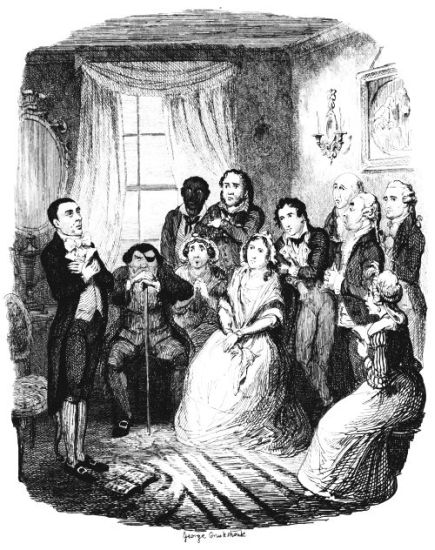
Richard Brothers the Prophet at Mrs. Heartwells.
London: Tilt & Bogue. 86. Fleet Street.
Frank was at first somewhat confused, but he was encouraged by the
tall gentleman he had seen at the Admiralty, and who was, in fact, the
Earl of Chatham, at that time the head of the navy. The youth narrated
every particular that had transpired in connexion with Brady at Paris,
and at the close of his examination he was requested to withdraw. He
was shown into a room where the other witnesses were assembled, and
here Frank learned that Brady had been engaged by the government as
a spy amongst certain of the higher classes of society, whom he first
betrayed, and then, having obtained all the intelligence he could of
national affairs, it was supposed had secretly gone over to communicate
his information to the enemy. This last supposition Frank had confirmed;
and the lawyer was committed to prison on a charge of high treason.
On the following day Frank had another interview with the secretary
of the Admiralty, and was desired to leave his address and remain at
home till further orders, and the seaman and the negro had leave of
absence extended to them.
Mrs. Heartwell was much pleased at retaining her son with her for
some time, especially as she received another handsome donation from
her unknown friend, which enabled her to procure him a complete outfit.
Mr. Wendover, the merchant, had called, and behaved with great kindness
and attention to both the mother and son, and the latter was invited
to pass a few days at a handsome mansion which had just been purchased
near Finchley common, and which gave a right to the owner as lord of
the manor. Frank was delighted—he had never ceased to treasure the
most pleasing remembrances of the interesting girl who had clung to him
for protection on the beach at Blankenburg, and she, with all the tenderness
and devotion of youthful affection, secretly cherished a warm
regard for the young midshipman, and she most earnestly longed to see
him again.
On the evening previous to the intended visit, Brothers, the prophet,
held a "meeting" in the drawing-room of Mr. Baurie's lodgings, and as
on these occasions—which were looked upon in the light of devotional
exercises—none were excluded, Mrs. Heartwell, Frank, Mr. Unity Peach,
Ben and Sambo, and two or three of his leading disciples, as well as the
servants, were present. There was nothing in the illusionist's general
manner that could be construed into aberration of intellect. He was
perfectly intelligible and sane when his monomania was not called into
operation. He was a strong-limbed man; his hair was cropped close—his
full eyes bent upon a book that he held in his right hand, and from
which he commenced his address by reading passages from the prophecies
of Daniel. His dress was remarkably plain, approaching to that usually
worn by the Society of Friends, and his cravat was tied in the most exact
manner, so that the bow in front resembled the cross of St. John of Jerusalem.
At first, his voice was mild and gentle; but as he proceeded and
became warmed with his subject, his countenance assumed an expression
of wild energy, his utterance became deep and sepulchral, till at length,
throwing down the book, he stood erect, with his arms crossed upon his
breast, as the spirit of prophecy seemed to come upon him.
"Woe unto ye of the earth who seeing will not believe; who hear
and yet despise. I am he of whom it is said, that a man will be revealed
to the Hebrews as their prince, and to all nations as their governor,
according to the covenant entered into with king David. Haste then
and flee from the wrath to come, for have I not prophesied, and it hath
come to pass?—Have I not foretold, and the fulfilment is at hand? Did
I not predict the downfal of monarchy in France? and lo! it hath fallen.
Did I not foretel the death of Louis? and he is no more. Did I not say
the king of Sweden was given over to destruction? The great Gustavus
is laid in the tomb by the hand of an assassin. Have I not declared that
England would be deserted by her allies? many of them are already
gone, and the others will quickly follow.—The king of Prussia will
acknowledge the republic of France;—the government of Poland
will be changed, and the monarch driven from his throne;—the
stadtholdership of Holland shall be cut off close to the ground! Hear
and understand, ye men who are in authority! The prisons are
crowded with captives charged with high treason, but the powers shall
not prevail against them;—yet a little while and the prison doors
shall be opened and the whole shall walk forth free. Hearken,
oh! ye Hebrews, and listen, oh! ye people—London, with its Armageddon[9],
shall be utterly destroyed.—Lo! I saw in a vision, and Satan
clothed in white and scarlet, and breathing desecration and fire, was
entering the condemned city, and suddenly there was strife and confusion
among the citizens, and every man's hand was armed against his brother,
till a river ran through London of the colour of blood, and there was a
voice of fury and the noise of an earthquake, and there were groans of
woe—woe—woe! And I prayed and wrestled with the spirit that the
city might be spared, and He, the Mighty One, was angered, and his wrath
frightened away the angel from my side, and all became dark and oblivious;
yet I saw in my vision that London had sunk into the bowels of
the ground, and between the Downs and Windsor there was but one vast
sheet of water, so that no trace of the city could be found. Why will ye
die, oh! house of Israel?—hear and believe! And a storm shall arise—there
will be consternation amongst our rulers—the English Admiralty
shall be shaken as a man would shake bread in a basket." (Frank looked
at Ben, and his countenance evinced displeasure.) "The prop and stay
of the nation shall be knocked away—her armies will be destroyed, and
her navy will be annihilated—the carcases of her soldiers shall strew the
earth—the bodies of her seamen in an ocean-grave lie buried—for the
enemy shall prevail, and the proud ships shall be sunk or grace the triumph
of the foe."
Here the prophet was interrupted by Ben, who, rising up and biting
through his quid, as he hitched up his trowsers, ejaculated with vehemence
the word "Gammon," seemingly to the great delight of Mr. Unity Peach,
who screwed his face into all manner of shapes to conceal his mirth, and
uttered, "Sit down, man—saucy sailor—go to sea." The prophet prepared
to renew his subject; but Frank, seconding Ben's motion by rising also, boldly
said, that "being a British naval officer he could not sit to hear the service
he loved denounced—it would be treason to his country. The English
ensign had been victorious on the seas, and its gallant defenders would
never allow it to be dishonoured."
"Hurrah, Master Frank," shouted Ben, "who cares for a bit of a
breeze! Nillyhate our navy indeed!—bury all hands in the ocean!—strike
to the enemy too!—Gammon, all gammon; but there, what's the
odds so as you're happy."
"Neber see de day, boy," chimed in Sambo, as he imitated the example
of his master, "Golly-make me tink ob em gullemtine."
The three withdrew, and Mr. Unity Peach soon afterwards left the
party, "in order," as he said, "to scold the unmanly interruption given
to Mr. Brothers," but in reality to vent his spleen against everybody; and
the prophet very speedily took his departure.
The stately and elegant mansion purchased by Mr. Wendover was
indeed delightfully situated, and the grounds had been laid out with
considerable taste and skill. Joyous were the hours that Frank passed
there in the society of friends, who esteemed him as their deliverer from
death, and particularly with Helen, who not only admired the handsome
young officer's improved appearance, but also very naturally evinced
gratitude towards him for saving the life of her father.
Never were pair more truly happy; the present was to them all
bright, and clear, and shining; they had no thought of the coming future;
not a cloud intervened to cast a gloom upon their innocent enjoyments;
and no pain was experienced till the time of separation approached, and
then they felt how truly estimable and dear they were to each other.
Frank was on the verge of his seventeenth birth-day; Helen had just
passed her fifteenth; and both were experiencing those delightful sensations
of affection, which in early life are so exquisitely delicious, because they
are untainted by unhallowed thoughts or worldly desires.
On the estate was a beautiful little rural cottage, over which the vine
grew in rich luxuriance, and its garden shone bright with the varied hues
of many flowers. Often when passing it Frank had wished it was the
home of his mother, whose health had become impaired by lodging-house
keeping, and she earnestly desired to retire from it. The place had been
unoccupied for several years, and Helen, without saying anything to Frank,
had urged the suit with her parents to offer it to Mrs. Heartwell as a residence.
Mrs. Wendover and Helen called upon that lady; and the former
was so much gratified with the deportment and conversation of Mrs.
Heartwell, that she at once made the proposition and invited her down
to visit the place.
The invitation was accepted, but before the day arrived Frank was
accosted in the street by Shipkins, who had acted as Brady's assistant,
and he delivered a message from his employer, earnestly entreating that
the youth would come to him, as he had affairs of importance to communicate.
Shipkins also added his own persuasions to go immediately; but
Frank peremptorily declined, until he had consulted with his mother,
who, on his return home, not only advised the interview, but also resolved
to accompany him as vague thoughts rose in her mind that possibly
she might learn something respecting her husband. On the succeeding
forenoon they went to the prison, and were informed that Brady had
contrived to make his escape during the night, and the officers were then
out in search of him.
Protected from impressment by leave from the admiralty, both Ben
and the negro could go where they pleased; and as the merchant had presented
them with a liberal sum, they did not fail to avail themselves of
the enjoyment of freedom. The Royal Circus (as the Surrey Theatre was
then called) was a place of great celebrity for its melo-dramatic performances,
and the "unrivalled" feats of horsemanship, enlivened as they
always were by the quaint humour of a clever clown. Ben and Sambo
had gone to visit a relation of the former somewhere in the neighbourhood
of Walworth, and Frank had engaged to meet them at the notorious tea-gardens
known by the sign of the Dog and Duck, in St. George's Fields,
to accompany them to the Circus. The morning and evening promenades
at the Dog and Duck were frequented by all the dashing bucks of the
time, with their ladies; and amongst the company might often be seen
gentlemen riders, whose modesty on the highway induced them to put
crape over their faces as they uttered "Stand, and deliver"—in short,
the place became the assemblage of the worst characters of society.
Frank, habited in plain clothes (as his uniform would not have corresponded
with the dress of his companions), was crossing the open fields to
the place of appointment, when Shipkins again addressed him, and by
assurances that he could inform him of the fate of his father, induced the
young man to enter a respectable-looking house in the neighbourhood;
but no sooner had they advanced into a room at the back of the premises,
than Frank was seized by two stout men, a wet cloth bound over his
mouth, and he was conveyed to a sort of dungeon in the rear of the
building, where his clothes were stripped off, and a canvas shirt and
trousers substituted in their stead; an iron band was then clasped round
his body, and he found himself chained to the floor.
The intentions of Shipkins were now evident; and Frank conjectured
that his death was determined upon. Thinking more of his mother than
himself, the young man suffered great distress, which was not relieved by a
confused noise that suddenly commenced; and by placing his ear against
the ground, he thought he could distinguish the strife of many human voices.
What it meant he could not tell, but he was not long kept in ignorance,
for in another half hour the door of his dungeon was thrown open, and
Ben and Sambo, with a crowd of people, entered to his rescue.
"He is not here," said the seaman mournfully, and not knowing the
youth in his change of attire; "but this is another victim, anyhow—the
man-trapping vagabones!"
The black, however, with keener eye, had recognised his master, and he
exclaimed, "Golly, you blind, Misser Ben, for no see me young massa,"
and he bounded forward to release him; but the chain and band defied his
strength—the key was not to be found; but the enraged populace
applied crow-bars to the stone in which the staple was fixed, and, after
much exertion, it was forced away, and Frank was carried to the open
air, where other unfortunate captives had been previously conveyed.
It appeared that Ben and the black were passing the house, which was
notoriously known as one of the numerous crimping establishments of the
neighbourhood, when their progress was arrested by a crowd that had
gathered in front of it, and two or three declared that they had seen a young
gentleman decoyed into it, and so many crimes had been perpetrated there,
that they were determined to put a stop to them. Ben required a description
of the young gentleman, which was given, and suspicion crossed his
mind that induced him to join the assailants; in fact, he became their
leader—the doors were beat in—the windows smashed, and a forcible
entrance made by the mob, whose numbers increased every minute.
Several poor creatures were discovered almost in a state of exhaustion, but
the principals of the establishment had escaped. In one room Ben found
a part of Frank's dress, and the sight almost maddened him. The search
was continued, and resulted as has already been told; and now a wild but
characteristic scene of lawless justice ensued. The mob dragged the furniture
out into the fields, and piling it up fire was applied, and the whole
was soon in a blaze. They next proceeded to demolish the building itself,
nor did they cease till the whole was razed to the ground. But Frank
did not wait to witness the termination—a locksmith had succeeded in
forcing the clasp of the band, and releasing him from the encumbrance,
which Sambo carried home with him as a trophy. Mrs. Heartwell was
informed of what had taken place, and a probability was suggested that
her husband might have been carried off in a similar way.
The visit to Finchley was made, and Mrs. Heartwell was persuaded
by Frank to accept the tenancy of the cottage, hoping that Fortune would
favour him with prize-money to render her life independent and comfortable.
He had now twelve months' pay due, which, with what she
would receive by disposing of part of her furniture, would serve for present
exigencies; and a distant relation had bequeathed her an annuity of thirty
pounds a year—so that prospects brightened before her.
Brady could not be found, and Frank was ordered down to join his
ship, that was then refitting at Portsmouth, and to take Sambo with him,
whilst Ben was directed to accompany them and procure a passage
round to Plymouth to the Windsor Castle.
Frank received a letter to his captain from the secretary, and set out
for Portsmouth, where he delivered his letter, and ascertained that it
contained a strong recommendation of himself to the captain. Being somewhat
of a favourite with the first lieutenant, the young midshipman
earnestly solicited him to use his influence in getting Ben transferred to
the same ship with him. The request prevailed; and Ben, by the
admiral's directions, was entered on the books of the "Thunderbolt"
seventy-four. Nor was he disappointed in his expectations
of prize-money, for in the course of a few months several valuable
captures were made, and the young midshipman enjoyed the satisfaction
of knowing that his mother was comfortably settled at the cottage with a
competence, and that Helen when at Finchley visited her daily.
A WARM RECEPTION.
Harry paid twenty pounds of sterling metal,
To risk his life in a balloon, which burst;
Tom and his friends, pic-nicking, boil'd a kettle,
Which Harry (tumbling) fell into head first;
But long ere what it was they well could settle,
Arose unhurt from where he'd been immersed—
And, "Ah! why, Tom," said he, "how do, my buck?—
"You see I've just dropp'd in to take—pot-luck!"
TEA-TABLE TATTLE.
"Is your tea agreeable, my dear Miss Dibsley?"
"Thank you, dear Mrs. Hipson; quite pleasant; very much as I like it;
all green with some black in it; a bit more sugar if you please."
"Glad you like the flavour; I've just changed my tea-dealer,
and—"
"And new brooms sweep clean, as the saying is," tittered Miss
Dibsley; "a trifle more cream,—thank you."
"Brooms!" ejaculated Mrs. Hipson gravely; "um! I hope you don't
mean—by your mention of brooms—I assure you I ordered the
very best seven shilling—"
"Oh dear, quite the reverse," returned Miss Dibsley, helping herself
to another tea-cake.
"With some very superior green," proceeded Mrs. Hipson, "at
eight-and-six, which I do think quite a catch; but really it's extremely
difficult to find good teas now-a-days, for since this curious business
with China—"
"Oh! pray do tell me something about that," said Miss Dibsley; "for
I never yet found anybody who knew, and never had patience to listen if
they did. What has this Emperor of Delf been doing? The cream—thank
you."
"Why, my dear, I've luckily had it all explained to me by a gentleman deeply
concerned in the Potteries, who consequently understands everything connected
with China—it's his business—and he informs me on the best authority that the
disturbance originally broke out thus:—You see there happens to be a place in
America called the Boundary-line, the natives of which employed a gentleman
named McLeod to seize upon one of our East India ships and destroy its cargo of
tea—these Boundary-line people being jealous, as I'm told, of the spread of temperance
in this country. Whereupon our merchants in India naturally became
incensed; and they applied, it seems, to the Emperor of China for a considerable
quantity of opium—of opium, don't you see?—with the view of selling it to
America at a very reduced price, so that the Boundary-line people might be
tempted to buy the injurious drug, and thus become the instruments of their own
punishment."
"Now I begin to understand," said Miss Dibsley. "Euphemius Hipson, my
dear, you can assist me to another lump of sugar?"
"Oh! yes Miss Dibsley," said the young gentleman, jumping up nervously
and spilling his tea over his new pepper-and-salt habiliments; "and if you'd like
a bit more of this cake, here's such a nice—"
"Euphemius, my darling," cried Mrs. Hipson, "Silence! Would you like to take
some more cake, Miss Dibsley? Euphemius, go and sit down. Well, my dear,
as I was saying, the Emperor of China, secretly instigated by his political crony,
old Mehemet Ali—a very clever man, I need not tell you—positively refused to
supply any opium to our merchants; and he seems to have acted with great
obstinacy, for the French king and the Sultan together vainly endeavoured to
counteract the policy of the Pacha, who had succeeded in persuading the Emperor
that we wanted all this opium for home-consumption—in fact (only think!) that
the British were going to destroy themselves with opium, and that thus he should
lose his best customers for tea."
"I see it all," remarked Miss Dibsley; "Euphemius, take my cup; and I think
I'll try the bread and butter."
"Well, the opium we could not get, though the applications that Lord Palmerston
made were unknown; however we could punish Mehemet Ali for his part in the
transaction, and you know as well as I how matters ended in Syria. I must
tell you that his Celestial Majesty never once interposed to protect the Pacha, but
left him to his fate—this I know to be the case. Well, our quarrel with China
still remained open—"
"Cream, Euphemius," said Miss Dibsley.
"We refused to take tea——"
"There's a good lad: a little bit more sugar."
"We refused to take their tea without the supply of opium;—the
Emperor grew more and more incensed—told all manner of falsehoods,
and asserted that our merchants had been administering opium to the
Chinese, (where should they get it, I should like to know!) with the
view of producing sleep and plundering the tea-factories. He then, it is
said—though I don't understand this part of the story—flung
his chops in the faces of the British, and at length provoked our sailors
to make an attack on everything in the shape of junk that they could
find. And so to war we went—all, as you perceive, through the
people of the Boundary-line, and the meddling of Mehemet Ali."
"I never clearly understood the matter before," observed Miss Dibsley,
stirring her fourth cup: "but what has the Emperor been doing lately?"
"Lately, why haven't you heard? My dear, to prevent the British from
being supplied, he has been ordering all his people to destroy their
stocks of teas—hyson, souchong, bohea, congou—all they have,
and promising to indemnify them every sixpence."
"Well to be sure!" exclaimed Miss Dibsley; (a little more gunpowder
in the pot would improve the next cup, my dear madam;) "only think! But
isn't this a good deal like cutting his own nose off?"
"Of course it is, and what his Celestial Majesty will be doing next, I can't
guess—I must ask my friend in the Potteries his opinion."
"I shouldn't at all wonder," returned Miss Dibsley, "if he were to hang himself
up on one of his own tea-trees by his own pigtail, as a scarecrow to frighten
away the barbarians."
"But if this destruction of tea is to go on, what are we to do? What is to become
of the tee-totallers, Miss Dibsley?'
"Can't say, my dear Mrs. Hipson, unless they turn
coffee-totallers."
"It's a melancholy affair, love."
"It is indeed, dear. That last crisp little biscuit there is
positively tempting,—and now I think of it, I'll just venture
on half a cup more tea; that sprinkling of gunpowder holds out
deliciously. That'll do—thank you—charming!—These
Chinese, I believe, have nothing of a navy?"
"I'm credibly informed," responded Mrs. Hipson, "that their ships are
all made of earthenware—in the shape of milk-pots."
"Yes, and their cavalry are all mounted on tea-kettles, and go by steam."
"By the way—Oh! Miss Dibsley, I had almost forgot—you have never seen
the sweet copy of verses that our dear Euphemius has been inditing on this
curious Chinese business. Euphemius, my darling, show them to Miss Dibsley.
He actually pictures the Celestial Emperor sitting on a teapot!—a teapot for a
throne; how imaginative! I assure you—but I shouldn't like it to go farther—that
our friend in the Potteries thinks them quite remarkable, and says that the
youth's knowledge of facts is surprising: Euphemius is hardly seventeen yet—quite
a child! What an age of genius this is! Euphemius, my dear, will you
read?—Martha, you can take away.—Beg pardon, any more tea, Miss Dibsley?
No!—not half a cup?—Take away, Martha. Euphemius, dear, proceed with
your poetry."—"Hadn't I better read it for myself?" said Miss Dibsley. "No,
I thank you," returned Euphemius; "you won't find out the jokes so well as I
shall, 'cause I haven't put 'em all in italics." (Euphemius reads.)
The world rests on a tortoise,
And a teapot rests on that,
And on the teapot sitteth
Earth's Emperor fierce and fat.
He's brother to ten Comets,
And a dozen Suns and Moons;
The ocean is his slop-basin,
And his subjects are all spoons.
Forty cups of tea he taketh
Every minute of the day,
And he's owner of a milk-walk,
Called by men the milky way.
But for all his mighty emperorship,
I wouldn't be in his shoes,
For there's steam enough about him
To stew the chops he issues.
If stronger he his tea makes,
'Twill blow out half his teeth;
For hot's the water under him,
And there's gunpowder beneath.
Yet danger can't convince him,
Though it grow more strong and hot;
Of "green" he's proved a sample;
He's "a spoonful for the pot."
"Tu doces" means "thou tea-chest,"
But to teach old China's tribe,
We must read it thus, "Two doses,"
Such as Nelson would prescribe.
As sure as that's a teapot,
He'll go upward with a whiz,
And be, though more Celestial,
Less Majestic than he is.
As sure as that same crockery
Community are crackt,
Their spouts, and lids, and handles,
Will go smash, and that's a fact.
Though t be first and last of it,
In them there'll be no trust,
Till "with your leaf, or by your leaf,"
Death turns them to "fine dust."
How puzzled be their crania
Beneath our cannon's roar!
They never tasted anything
But "cannister" before.
They'll wonder what it's all about,
When shot yet more abounds;
They look into their teacups,
And can't understand the grounds.
While they fancy that there's nothing
With their own tea on a par,
I wonder what they think of
The British T-a-r.
This fact, Celestial Emperor,
From experience we may know,
If amongst the quick we leave you,
You will leave us—to the sloe.
"Very good indeed, Euphemius;" cried Miss Dibsley, with a slight yawn;
"capital; if you live long enough I haven't a doubt that you'll cut a very pretty
figure as a poet in the pages of the Stoke Poges Gazette, or Wormwood Scrubbs
and Bullock-Smithey Register."
OMNIBUS CHAT.
Meditating luxuriantly in our Omnibus the other day upon the elegant forms of
the fair as they flitted in the sunshine through the streets of the west end, it
occurred to us that we had neglected
THE FASHIONS
of late, and that the public might be expecting from us some report on the costumes
of 1841. In a vehicle like the "Omnibus" it would be unpardonable not
to notice the Fashions. It is a subject to which we intend to pay especial attention.
While thus resolving, a lady swept across the road, and Blackie, the crossing-sweeper,
attracted our attention by these observations upon the fair pedestrian:—
"Wot berry obliging an kin' hearted tings dem white lady is!—dey
not ony gib poor nigger de coppers, but dey so kin' as help him sweepa
de crossing.—Me suppose 'em not berry strong, poor tings, cos dey
ony carry dem little doll umbrella, and dem little picanini bonnet; but
dem berry nice lady, and look berry pretty for all dat. Bless 'em little
heart, me neber wear out-a my broom, if dey go on a-wear dem nice long train."
"Blackie's right," cried our old acquaintance, Mr. Cavil, who now jumped in.
Not quite (thought we); for we could not find it in our hearts to complain very
seriously of the pretty dresses of the present day. Perhaps the train may be just
a thought too long. But we left Mr. Cavil full room to denounce the pinafores
turned hind part before, in which young gentlemen between sixteen and thirty-five
perambulate on Sundays; the best pinafore is but a poor apology for the "Sunday
coat," though they do try to carry it off with a grand air, and a cigar.
The subject of
PLAYBILLS AND PLAYGOING
now took the lead; for at this moment stepped into the vehicle, for the first
time, a passenger, whose name it will be unnecessary to mention, if we introduce
him under the designation of the Playgoer. Not old in years, he is not young in
memory, and still less so in observation. By hearsay, or by optical note, he will
tell you the colour of the small-clothes in which Munden took his farewell of the
stage, and describe the exact pattern of Woodward's shoe-buckles. He hits off
Keeley to the life, and gives you a very lively imitation of Stephens's pathetic
execution of "Auld Robin Gray." Garrick he seems to have known from a boy,
and he enlarges upon the grateful duty of subscribing to the fund now being
raised for erecting a monument to Siddons, as though he had seen that incomparable
actress (so every great authority proclaims her) make her first and last
appearance. We ought to have been born earlier; we ought to have seen Mrs.
Siddons. "You go to the theatre, I suppose, Mr. Cavil?" inquired the Playgoer
of our old acquaintance beside him.
"No I don't," was the response of Mr. Cavil, "but I read the playbills. The
playbill is the veluti in speculum for me. There I see human nature as in a
mirror. There I read of envy, jealousy, and hatred—personal pique, private
friendship—self-interest, sycophancy, adulation—in the varying forms of announcement,
in the varying periods of omission—in the different sizes of type, in the
significant conjunction of names—that may happen to compose the playbill. I
see why this actor is to be run down now, and why the other is to be cried up
then. I detect a reason for the implied insult, a motive for the palpable puff.
Your playbill is a wonderfully accurate expositor of the mysteries of your human
being. I don't want to go into the theatre, while I can read what I find at the
doors. The bill's better than the play. If you want an example, look at that
placard there (pointing as we passed to one that bore her Majesty's name at the
head of it), I should like to see a comedy coming up to that! There you read
of a piece—
"'Which, from its strongly affecting scenes, and powerfully harrowing situations, has
nightly drawn tears of pity and commiseration from the sterner heart of man, from all
who have one spark of the milk of human kindness, whilst woman's softer nature has
swollen with bitterest indignation at the unmerited suffering and patient endurance of
the hapless foundling.'
"Such a bill as that is payable at sight. I can't read it without tears. Its bold
metaphorical originality is unequalled in our literature. We have heard of the
'fountain of our daily bread,' and of the 'fire of patriotism flowing into other
channels;' but who ever before heard of a 'spark of the milk of human kindness!'
Shakspeare never ventured to make the daring combination."
"Mr. Cavil," said the Playgoer, "I admire your literary acumen. As you
have shown how the theatre furnishes amusement to those who never go into it,
let me show in turn that, within, the field of amusement is not exclusively the
stage. We need not travel just now 'behind the scenes;' there we may find ourselves
another time; for the present we are satisfied with
"A ROMANCE OF THE ORCHESTRA."
I once witnessed a scene (say six or seven years ago) in the orchestra of
Covent Garden, which for ludicrousness of effect, and the mysterious manner in
which it arose, surpassed anything that ever came under my notice. A friend,
considerably my senior, and a playgoer of the time of the Kembles, was one of
my companions; the other was his wife, to accommodate whom, being shortsighted,
we had established ourselves in the front row of the pit, on the prompter's
side. At the commencement of the overture, we found that the scroll-end of one
of the large double basses intercepted the lady's view of the stage, and a request
was preferred by my friend to the performer (a most eccentric-looking genius,
with only one eye, and that apparently turning on what mechanics call 'an
universal centre'), to alter his position, but he very uncourteously refused to
move; and still worse, on the rising of the curtain, he left the instrument secured
in a perpendicular position, so as to completely obstruct our lady's view. Thus
he left it, in spite of all our remonstrances. I, with the desperate indignation of
youth, was for cutting the string and letting it fall down, but was restrained by
my elder and more wily friend, who whispered me 'Never mind, I'll serve
him out.'
He then changed places with his lady, and all went on quietly till the fall of
the curtain, when I suddenly missed him. He returned, however, in a few
minutes, with a large piece of—yes, of candle; and he gave me a look which
indicated that I was not to see anything. Yet I did see, that while the rest of the
audience were looking round the house, he leant over, and, unobserved by any
one else, applied the grease with dexterity and effect to the strings of the offending
instrument. He then took his seat, apparently as unconcerned as any spectator
in the pit.
In due time the bell rang for the music to the afterpiece, and we saw our
musical adversary enter, release his instrument, and seat himself. He then tried
the strings at his ear, and finding all right indulged himself with a pinch of
snuff, and quietly awaited his time. The second bell rang-the leader gave the
preliminary tap-tap, and off they went in the overture to Tancredi. After a few
bars, it was our enemy's turn to chime in: he sawed away with right good will,
but, to his utter amazement, without producing the desired effect. He looked
down inquisitively with his single optic, but without comprehending the mystery.
Again he tried, and of course with the same result; another downward look, and
the truth seemed to flash across him. His one eye glared most horribly; but not on
us did his anger fall. In front of him, perched on a high stool, with a step half
way up for his feet, sat a little wee homo, working most industriously at a violoncello,
as big as himself, and in a sweet unconsciousness of the storm gathering in
his rear. On this unoffending victim did he of the double bass vent his rage—for
after the second brief look at his useless instrument he darted one piercing
glance at the violoncello player, deliberately deposited his bow on the desk before
him, and dealt the little man so sound a cuff on the head, that musician, stool,
violoncello, and desk, went down 'in one astounding ruin,' damaging the shins
and toes of immediate neighbours, literally putting their pipes out, and producing
discord dire throughout the realm of harmony.
In vain did the leader rap his desk and try to keep his flock together. On
looking round he found his first flute and fourth violin busily rubbing their
legs; the second trombone gentleman dreadfully irate at having a favourite corn
hurt by the stool falling on it; the small violoncello player awfully pugnacious;
while the grand cause of all was looking on, with a diabolical smile on what
passed for his face, and muttering sotto voce, 'I'll teach you to play me
tricks again.'
We looked quietly on, and my friend gave it as his opinion, that it was a
great pity that the gentlemen could not settle their quarrels in private, instead of
bringing them before the public in such a disgraceful way. How it ended I
know not, for the curtain rose before it could be adjusted, and the 'harmonists'
retired; but we subsequently learnt, that our hero of the double bass was, from
a boorish temper, much disliked in the orchestra, and that to his great annoyance
tricks had been frequently played off upon him; hence his sudden and violent
retaliation on his supposed tormentor.
Our friend the Playgoer having thus introduced us to one of the curiosities of
music—a practiser of sweet sounds, who was anything but the harmonist he
seemed—his story suggested the image of an equally contradictory humorist,
whom we had recently encountered; and we therefore without ceremony presented
ONE OF THE CURIOSITIES OF LITERATURE.
'Twas evening, and loud raged the autumn blast,
As in an Author's darken'd room I stood.
It was a sight to stir the pitying blood;
His soul seemed struggling with some trouble vast;
His thin hand held a pen—his eye, downcast,
Traced its slow movement o'er the blotted sheet;
His air was wild—his heart, I heard it beat!
Lone, pale, he sat, a spectre of the past,
Like Werner when the waters round him throng,
Or like the Banish'd Lord. His heavy task
Weighs on his brain—ah! when may it be done!
"What write you, troubled spirit?" then I ask;
In thrilling tones he said—"A Comic Song,
'Tis for the Jolly Sandboy, No. 1."
Here we stopped to take up another passenger, "his first appearance in our
stage," though evidently an experienced literary traveller. We all welcomed the
new arrival; and Mr. Quickly (for this was his name) pretty soon began to
convince us of his qualifications for a pleasant companionship along the road of
life. We pass by what he said of ourselves, with the bare remark, that like
Falstaff's story, "it was worth the listening;" but still worthier of it was this,
which he recounted to us under the title of
AN INCIDENT OF TRAVEL.
"Will you put that window down, Sir?"
"Certainly not, Sir, I have a bad cold!"
Such was the request addressed to his vis-à-vis in the Royal Mail by a small
gentleman in a suit of black and a profuse perspiration; and such was the answer
returned thereto by the person addressed, a highly nervous individual rejoicing
apparently in about fifteen stone, certainly in a blue coat with gilt buttons, a sealskin
cap, a red face, and nose to correspond.—
"Will you put down the window, Sir?" again demanded, after a few minutes,
our friend of the sable garments, in a tone half angry, half speculative.—
"Really, Sir," was the answer, "I am sorry, Sir—but must decline to do so."
"Do you intend to open the window?" a third time exclaimed the pertinacious
votary of freedom—in accents wherein scorn and wrath were blended, with a
quivering lip and pallid cheek. The lusty man shrunk back in his place—An
assault with violence seemed impending. But though a large—he was a brave
man, and he said "No!" * * *
Again there was a pause—a decidedly unpleasant and embarrassing silence.
The little querist turned pale, and gave a deep sigh—At last, in a voice of thunder,
he roared out. "Will you, Sir, or will you not put down that window?" and at
the same moment his hand with nervous rapidity sought his coat pocket.
The red faced man trembled—he turned pale, and cast a supplicating glance at
the other two inmates of the carriage, as who should say—"Pray help me—I
may be murdered—I really think the wretched imp must have a stiletto or loaded
pistol in his pocket." The glance seemed satisfactory—for the great gentleman
after a short pause mildly said—"I will not, Sir!"
In a second—a large silk pocket handkerchief was suddenly jerked from its
place of repose by the diminutive tormentor of his gigantic victim. With a face
of ashy hue he held out the Indian kerchief with one hand—the other reclined
gracefully on the region of his heart. Anger had passed away from his brow—slowly
and deliberately he cast an unearthly look on his trembling victim, and said—
"Then—Sir—you—must—take the consequences, (here he gave symptoms of
spasmodic affection,) for—I am—going to be—sick!" * * *
When the Royal Mail entered the town of S——, it was observed by the
loiterers round the King's Head yard, where it changed horses, that, though a
chilly day—both windows were down. A tall fat man too was observed reclining
in the extreme corner of the vehicle, with a handkerchief tied round his face—evidently
suffering from cold. His opposite neighbour—a little man in black—had
his head out of the window—and there was a smile on his countenance.
Sympathy for our fat friend, writhing and shivering in the corner of the mail,
at the mercy of that little black imp with a smiling countenance, naturally enough
suggested "FATNESS" as a topic of conversation; everybody, as everybody does in
these cases, giving his opinion upon the moral and physical tendencies of obesity;
some regarding that condition as rather civic than courtly, and others speculating
as to its effects upon the temper and disposition; this person holding a proper
degree of it to be indispensable to a fine woman; and that asserting a plentiful
supply to be essential to the weight of every person in authority. One contended
that nobody could have good humour or generous wit without fat, and another,
that genius and fat have from the very beginning of the world been divided. It
was easy to gather, however, that fat, in the social code, was associated with
a certain amount of respectability, and had always the invaluable property of
redeeming its possessor from insignificance. We could observe too that those
who had it were neither proud of it nor pleased with it, while those who had it
not would give the world for a good slice of the blessing. We also noticed that
every speaker in turn, apparently unconscious that his neighbour had just done the
same thing, quoted the line—"Who drives fat oxen must himself be fat."
At this instant all heads were attracted to the windows by a spectacle
presented at the back of a carriage just then passing; behind it, in
all the pride and pomp of white silk hose, appeared a splendid pair of
calves, accompanied by a livery-coat, cocked hat, and cane. A little
boy had presumptuously mounted the "step behind," and the proprietor of
the calves, instead of ordering him off, thrust him brutally down by
an application of his foot to the face of the unfortunate urchin. Boys
are little men, especially in their passions; and resentment of injury
is a sharp and subtle suggester. The youthful proselyte of vengeance,
after an instant's consideration, darted forwards, caught hold of the
rail of the carriage, ran behind it a few feet, and then thrust a pin
into one of the broad, round, shaking calves of the footman. With
uplifted leg he stood, while the carriage rapidly bore him away from his
retreating tormentor. He had a stick, but he could not use it; he was in
a free country, yet he dared not stop the carriage. He was hopelessly,
ridiculously helpless. How he envied all those of his fraternity who wore
padded calves. A cork leg would have been a real blessing!
"HERE'S A BIT OF FAT FOR YOU!"
cried a learned Professor of Obesity, at the same time tossing over
to us an accurate account of the dimensions of one Thomas Hardy Kirman,
whose case Mr. Pettigrew submitted to the Royal Society in 1833. This
boy, before he was quite twelve years of age, measured five feet one, and
weighed 198 lbs. He was 45½ inches round the waist, 18½ round the
calf, and 19 across the shoulders. His obesity commenced at six years of
age, at which time he fractured his thigh and was confined six weeks.
"Why didn't they let him out to hire,"
said Mr. Cavil, "to the Expositors of
Mesmerism; he must have been made
to stick pins into. Think of a human
creature being turned into a pincushion! It
fills all my flesh with a sense of glass splinters
and Whitechapel blunts."
Here our young acquaintance, Charles
Hookeywalker, with delicate tenderness, proposed
a relief to the feelings of the speaker by volunteering a sonnet.
"Another sonnet!" cried Mr. Cavil, "worse and worse, I hate sonnets."
But the subject in this especial instance was voted to contain a saving grace,
for it was addressed to the Princess Royal, while yet she is
HEIRESS PRESUMPTIVE.
O Royal Cherub! first-born of the queen!
Sweet babe! bright creature! light of all our eyes!
Young heavenly visitant! from the blue skies,
And from the Guelphs, descended! thou hast been
As a new moon to Britain—not a son;
But half a loaf is better far than none—
And so we welcomed thee; but oh! I ween,
(Not thee—I leave thy nurses to wean thee,)
Towards the next our expectations lean
Upon Hope's anchor, wishing for a "He;"
Who shall sometime rule Britons and the sea;
And till he rules our land and ocean green,
The princedom of its Wales his own will be,
That he may learn the trick of sovranty!
FRIGHTS!—No. III.
It may be doubted whether malignity itself occasions greater mischief
in the world than fun. If society may count up its thousands of victims
to the venomous propensities of the envious and the revengeful, so may it
also reckon its thousands of martyrs to propensities the very opposite to
theirs—victims to passions the most joyous and guileless—to feelings the
most sportive and child-like; in short, to a taste for frolic—to a love of
fun.
The malice of an enemy is sometimes not more dangerous than the
gamesomeness of a friend; the slanderous tongues of the envious and the
vile often prove far less sharp and fatal, far less productive of permanent
misery to the innocent, than the jocularity of a prankish old fool of a
nurse, or the light-hearted sally of an affectionate but deplorably stupid
parent. There is plenty of tragedy in this life, acted in earnest; but
there is a good deal of real poisoning done "in jest." People will sport
jokes that are no jokes.
To every domestic circle into which this page may penetrate, the subject
will perhaps suggest some recollection of disasters more or less serious
that have arisen from silly and unthinking frolics, prompted more especially
by that for which human nature has so intense, so enlightened, and
so philanthropic a relish—the fun of frightening people. We hope it
may be from no bitter or melancholy experience that the reader concurs
with us in seeing "no fun in it." The merry laughing face of this species
of "fun," has proved a death's-head ere now; the figure of "fun" has
turned out to be a hideous hobgoblin with outstretched arms—a finger-post
pointing to the next lunatic asylum.
If the fatal consequences that frequently ensue from these practical jests
admitted of any feeling in the mind, associated however remotely with ridicule,
how exquisitely ludicrous would the position of that man appear,
who having enjoyed his funny trick, and played out successfully his game
of fright, beholds his triumph in the pallid visage, the wild glance, the
trembling limbs, the hurried pulse, the panting heart of the object of his
cruel sport; and becoming alarmed in turn at the effect which he had
taken such pains to produce, is obliged to make some attempt to palliate
his error and to chase away the spectres he has conjured up, by exclaiming
in the most deprecating and apologetic tone—"I never thought it
would have frightened you so, it was only my fun!"
We almost wish that the legislature would—just for the "fun" of the
thing—pass some law that might reach these reckless and desperate experimentalists,
and punish the humorous players upon people's nerves, with
a severity proportioned to the whimsicality of the hoax. The law recognises
the criminality of those who carelessly or wilfully sport with the
safety of people's legs, arms, or necks; and it is peculiarly severe upon
all who heedlessly venture to trifle with the sacredness of our goods and
chattels; but it has no eye to the playful freaks of practical jokers, to
whose insatiable thirst for fun the credulous child, the timid girl, the
weak-nerved woman, fall victims; it has no ear for the short sudden
shriek that bursts involuntarily from white and quivering lips, sounding
not unfrequently the knell of sanity in those who utter it, or proclaiming
the approach of vacant, hopeless, miserable idiocy.
The disciples of this school of fun are sure to find plenty of nerves
admirably suited for them to work upon. Children are prepared for the
sport almost in their cradles. Nine out of ten are trained up in terror.
They are taught the destructive lesson of fear, before they can even spell
the word. Before they can speak plainly, they become practised in the
instinctive expression of their feelings, by shuddering, screaming, and
crying their little hearts out, at the idea of "bogie," and the horror of
being left alone in the dark. The very moment this idea is engrafted
upon the sensitive mind, the instant this horror takes possession of the
child's imagination, it loses something of the health and happiness to
which it was born. The dread of being in the dark—of being alone, and
in the dark—clouds perhaps all its after life. It sees nothing that really
is, in its true light, from the fear of seeing something which is not. The
influence of the first horror of "bogie," remains for years and years after
the particular species of "bogie" that had excited the agony of alarm
has become an absurdity too childish to be even laughed at. Unconsciously,
the mind is sensibly affected, in ten thousand different forms, by
the very image which it despises and ridicules. The silly bugbear of the
nursery has an abundant and most appalling progeny. In this, more
perhaps than in any other respect, may it be said that "the child is father
of the man."
The idea of darkness as something terrible would in few instances be
fixed in the mind, were it not for the cruel and senseless practices, by
which servants of all grades—we may add, teachers of some—work upon
the imagination of children. They are taught to see in darkness a
natural enemy, as they are sometimes taught to regard school as a punishment.
"If you are not good, you shall be shut in the dark closet,"—or
"If you don't behave better, you shall be sent to school immediately."
These are family phrases not yet quite out of fashion. The consequences
now and then take an unexpected turn. A little damsel of our acquaintance
was shut up in a dark room; she cried bitterly, violently, for the
first five minutes; then all was suddenly still—quite still; ten minutes
went on, and yet there was a dead silence within. The family at length
began to be uneasy—then frightened—too frightened to go and ascertain
the cause of the phenomenon. At length they rush forth and burst open
the door, when they discover that the little victim had—alone and in the
dark—found her way to a plate of cheesecakes left accidentally in the
apartment, and was making herself extremely ill for want of other
amusement.
How many wits have been set wandering by roadside horrors, raised up from
the elements of the ridiculous! The simplest objects become the means of deadly
mischief. A donkey in the deep shadow, a cow in the dim moonlight, a stump of
an old tree, a white finger-post at the corner of a by-path, have produced in myriads
an agony of agitation; but what are these to the good old English country ghost,
the elements that compose which we here set in their uncombined, and therefore
unterrifying forms, before the spectator. Why, here are agents by which even
the most unskilful may succeed in frightening a whole parish—nay, a county. Look
upon these the simple means, and then behold the easily manufactured ghost!
But of all fields for frights the church-yard is the most productive
of terrors! Yet why? Whosoever wanders over one in the daytime will
find, be he in town or country, that he is surrounded by none but the
most amiable and affectionate people in the world—by the kindest
of relations—the faithfullest of friends. Such people are little
likely to start from behind their tombstones, in the dark, for the mere
pleasure of frightening benighted wanderers. In a churchyard, if the
inhabitants be rightly described, there should be no terror! But what
shall we say for a church, the sanctuary of the disturbed passions,
a temple dedicated to sacredness and love. Yet where is the pious
individual who would feel no tremor, if left to pass the night within the
gothic aisles of such an edifice?
In the vulgar superstition all churches are haunted, so also is
every house that happens to be "in chancery." There are two classes of
haunted tenements—one celebrated for mysterious Sights, and the
other for mysterious Sounds. The old Cock-lane Ghost, and the various
modern editions of that personage at Cambridge and elsewhere, are
specimens of the Visible; the recent mysteries at Windsor and Dublin
are examples of the Audible. Opinions differ as to which is the truly
Terrible. For ourselves, though shadows without substances are eminently
agitating—noises without the slightest possible cause—noises,
sudden, strange, and above all self-existent—noises of this kind
at midnight—in the wainscot, in the next apartment which is
empty, in the room below where the gentleman took the dose of poison by
mistake—are not, we make bold to confess, a sort of sound that we
should like to go out of our way to listen to.
Of the Audible Ghost, Addison's comedy of the "Haunted House" contains
the noisiest representative on record; and perhaps Defoe's account of the
apparition of Mrs. Veal appearing to her friend, presents the Visible
Ghost in most extraordinary reality to our all but believing eyes.
But talk of believing—we shall put the reader's faith to the test, by inviting
him to take a peep into a "haunted house" which we have fitted up for his
reception. Hark!
We remember two of papa's friends who were "regular story tellers." Mr.
O'Brien had a store of Irish legends (of these hereafter); Mr. T. Smith had a
variety of ghost stories. Of one of these a haunted house was the scene—a whole
family of ghosts the dramatis personæ. We must premise, that at the time
referred to, it was the fashion to wear "pigtails," and Mr. Smith, who had eschewed
"pig-tail" and patronised "short cut," or crop, used to say when asked what he had
done with his pig-tail, that "thereby hangs a tale," which joke he retailed at every
opportunity. We may also intimate that a good "ghost story" was in those days
a valuable little property. Mr. Smith seldom dined at home, and always passed
his evenings at other people's firesides. In truth, for more than three parts of the
year, his "ghost story" procured him "bed, board, and lodging," gratis, including
"coals and candles." Now then, let the reader imagine a small family party seated
round the fire, on a winter's evening, and let Mr. Smith tell his own story in his
own way.——
I was staying (he began) some years back at Squire Calf's, at Danglewitch-Hall,
near Nantwich, in Cheshire: my friend, O'Brien here, was also a visitor. ("Sure
I was," says Mr. O'B. with a grin—he was a merry fellow that O'B.) One
evening the conversation turned upon Clay-hall, an old deserted mansion, that
was reported to be haunted. Strange sights, strange sounds, and strange stories,
filled the neighbourhood with alarm; and what surprised me at that time was,
that all the Danglewitch people seemed firmly to believe in them. Being a little
elevated, I bantered the family upon their ridiculous fears—I have since learned to
pay more attention to other people's opinions—and so enraged the squire, that he
offered to bet fifty guineas to one, that I would not dare to sleep in that house for
one night. No sooner said than "Done," cried I, and proposed to go immediately.
The squire instantly ordered the servant to get the key from the old
women at Clay-park lodge, to light a fire in the blue-room, and to provide, besides
a pipe and tobacco, a good bottle of brandy. The whole party, in a merry
mood, sallied forth to conduct me to my quarters. Soon after I wished them all
good night, and fastened the door. I had a brace of pistols and a good sword-stick.
I drew my sword and went over the house at once, to see that the fastenings were
secure—for though not afraid of ghosts, I objected to being surprised by robbers.
Everything was in a dilapidated state, but I ascertained that the locks and
bolts, although rusty, were sufficiently strong to resist an intruder. I was also
certain, that no one was concealed. I then proceeded to my apartment, which was
on the first floor at the back of the house. I slowly ascended the large staircase.
The sound of my footsteps echoed through the empty mansion. As I approached
the landing I was startled by a sudden noise, like the slamming of a door, and
recollected that one of the upper rooms was without a fastening. All was silent
again. I could hear myself breathe. I then held up the light, and looked first up,
and then down, the well staircase, and began to feel that I had done a rather
foolish thing—there might be after all a secret inlet—I might be robbed, murdered.
But it was too late to recede; and the fear of being laughed at overcame
every other fear.
I now entered my chamber and secured the door. The bright fire and
the candles gave a cheering look to a room otherwise dreary enough; for it
was of large dimensions, and its colour was a deep dingy blue. At one end
stood a huge four-post bedstead, hung with dark blue tattered damask curtains,
edged with black; the head of each post was ornamented with a ragged
plume of dark-blue feathers, which gave to it rather a funereal appearance. I
examined every part, and beneath the bed perceived a large chest, which I found
to be firmly locked. Pushing it aside, I proceeded to explore the two closets that
flanked the fire-place. Amongst a quantity of loose lumber, wig boxes, hat boxes,
and odd slippers, I discovered an old black letter volume (a good deal nibbled),
but, as Sir Walter Scott says, "worth its weight in gold for all that;" it was
"God's Revenge against Murther." I just gave it a bang upon the table to knock
out the dust. The blow produced a most tremendous noise that nearly stunned
me, and was echoed apparently from every corner of the building, followed by the
rattling of falling mortar behind the wainscot, and a scampering as if ten thousand
rats were flying in all directions. The cloud of dust almost stifled me; but not
quite overcome, I applied myself to my brandy, and filled my pipe, stirred the
fire, snuffed the candles, opened my book, and began to read. I read on in silence,
broken only by the regular puffing of smoke, the ticking of my watch, and the
singing, or rather sighing, of the kettle. The book absorbed my whole attention.
I was insensibly moved by its revelations. I was so worked upon by it that I felt
a kind of lifting of the chair beneath me, and a peeping shadow appeared evermore
between the candle and the page. Suddenly, at a most exciting point, I
heard a gentle rustling of the bed-curtains. On looking round—horror! never to
be forgotten!——
I distinctly saw a tall figure enveloped in a long night-dress, which touched
the ground. It was standing sideways towards me, so that the face was
hidden by a large feminine cap, which, however, it removed and threw upon the
bed, discovering a most fearful and ghastly profile. It went through the operation
of making its toilet before a small glass, then looked towards the trunk, and then
to the bed. After a moment's hesitation, the trunk was opened, and it proceeded
to put on an old-fashioned brocade dress. The figure then, after surveying itself
in the mirror, slowly turned round, and moved towards me. I felt my blood curdle,
my flesh crawl. It passed the foot of the bed, and advanced towards the door.
The eyes were cast down; the hand was upon the fastenings. At this instant the
village clock struck, or rather tolled out twelve—and as the last stroke of the
bell floated on the breeze, the figure gradually raised its head, and fixed upon me
a pair of horrible glaring eyes that turned my heart to ice. A sharp sliding noise
on the wall opposite made me turn to look, and the two portraits, a lady, and an
officer in a blue uniform, appeared to be leaning out of their frames, and watching
me intently. The figure then hastily passed out of the room, uttering a screaming
note, wilder than the moaning wind. This was answered seemingly from
the cellars by a most hideous long-drawn howl, followed by the rattling of locks,
bolts, and chains, and a confusion of strange unearthly sounds. I sprang up
and seized my pistols. There was a dead silence. I could distinctly hear a
whispering, not only on the stairs, but in the closets, the doors of which were
slowly pushed open, and more than one pair of eyes flashed upon me from the
dark; in an instant the door of the room creaked slowly, and I beheld two or
three parchment faces, with fiery eyes, gazing at me. I made now a desperate
effort, and levelling a pistol either way, uttered a fierce menace, threatening
to fire, if they advanced. This threat was answered by a queer sort of tittering
and snuffling; in desperation I pulled the triggers; the result was a double flash
in the pan, which overspread the room like a sheet of blue lightning. Then broke
forth—a laugh—ten times more horrible than the laughter of a herd of hyenas—I
could endure no longer, and sank into the chair, the pistols dropping from
my hands.
There was a dead pause, and I heard something like the mewing of a cat,
yet seemed it like the voice of a child in distress; and my attention was
attracted by the appearance of a black skeleton of a cat, who was setting up its
back, growling and spitting. It then slowly advanced and prowled round the
fire-place, and sitting down opposite to the fire with its back towards me, turned
its head, and its fearful green eyes met mine. I next heard the whelping of a
cur, and the distant, hollow, wolf-like baying of a watch-dog. The sounds
approached; the dog-chain rattled up the stairs. I tried to seize my sword, but
was paralysed. I could just glance towards the door, whence came a strange,
shuffling sound, and the next moment I saw an extraordinary figure enter, with a
large carving-knife in his hand. He was dressed in blue livery, with tags—a
round paunch—high bony shoulders, and spindle-shanks—he wore a blue Welsh
wig—and his nose, which was of enormous size and hooked, was of a deep blue
also: it was like burning brimstone. He was followed by a skeleton-like figure;
also in livery, and armed like his fellow. These stood and stared at me. They
were followed by a figure, marching into the room with an air of consequence.
He was not prepossessing: dimly-glaring saucer-eyes, with a decided cast in
them; a small, pinched bit of blue nose; a spacious mouth, with a tooth or two
exposed; the look of age diffused over all. He was wrapped in a blue dressing-gown,
and wore a large curled blue wig. As he entered, all appeared blue—the
candles, and the fire, whose flames curled themselves into the likeness of some
ghastly thing. The whole company, for there were now many intruders, seemed
covered with blue mould; they were the children of Mildew and Decay; they
looked damp and slippery. The veteran in the dressing-gown advanced to the
fireside with dignity, and looked at me with a withering scowl. I guessed at
once that he was, or had been, the master of the mansion, and politeness prompted
me to rise. He motioned me to be seated, and then took a chair. A little boy
was at his side, and the stately figure of a lady also stood near him—other faces
peered over his chair. My venerable host then bent forwards, and placing his
hands upon his knees, looked sternly in my face and said, in sepulchral tones,—"Pray,
sir, did you ever hear that this house is haunted?" * * * *
I was thunderstruck! What answer could I make? Not a moment was
allowed me for reflection, for I instantly felt a violent tug at my pigtail behind,
and the brimstoned-nose butler, leering in my upturned face, exclaimed, "And
you don't believe in ghosts!" My terror was at its height. I heard no more;
but I saw—I saw the knife flashing, and felt that, though my head was not off,
my pigtail was gone! Shouts of exulting malice rent the air——
But here Mr. Smith was interrupted by a shout of exulting laughter from one
of his listeners. It was Mr. O'Brien. "O, ho!" screamed that gentleman; "I'll
be kilt intirely. A mighty ingenious tale you've made of it, Mr. Smith. And
sure I must tell the thruth, if you bate me for it. Sure and wasn't it the day after
we had the stag-hunt, and didn't you get so over head and ears in liquor that
you went sleep-walking about the house all night, disturbing the people that
were fast asleep: and the night after, sure didn't we tie your pigtail to the bell-rope
at the head of the bed, to keep you still, or give us notice of your rambles—and
a pretty good notice we got, by the powers! for what wid the bell ringing
and your bawling, we thought the house was on fire. I'll never forget seeing you
pulling one way and the bell pull pulling the other—and all we could do, we could
not keep you aisy, till we undid your tail; so faith it was Betty, the cook, I
remember, who whipt out her scissors, and cut the knot. Oh! oh! och!—and
that's the thrue way you lost your pigtail, Mr. Smith."
IRISH SIMPLICITY.
A military officer, living in barracks, ordered his Irish servant to boil him an egg for
breakfast, adding an injunction to "boil it soft." The officer took up the newspaper
and read for ten minutes, then wondered why his egg did not arrive, and rang the bell.—"My
egg?"—"I'm seeing about it, sir." Another five minutes elapsed. "Where's
this egg?" "Not done, sir." "Not done! do you mean to keep me waiting all day?"
"Bring it directly, sir." Still no egg came; the bell rang once more: "Where is the
egg?" thundered the officer. "Yer honor," cried Thomas, in alarm, "didn't you tell
me to bile it soft, sir! and haven't I biled it this quarter of an hour, and it isn't soft
yet."
LITTLE SPITZ.
A LENTEN ANECDOTE, FROM THE GERMAN OF PROFESSOR SPASS.
BY MICHAEL ANGELO TITMARSH.
"I think," said Rebecca, flinging down her beautiful eyes to the ground,
and heaving a great sigh—"I think, Signor Lorenzo, I could eat a bit of—sausage."
"Of what?" said Lorenzo, bouncing up and forgetting all sense of politeness
in the strange demand. "My dearest madam, you eat a sausage?"
"Ha, ha, I'm blesht," shouted Abednego, the banker, Rebecca's papa,
"I'm blesht, if Signor Lorenz does not think you want to eat the unclean
animal, Rebecca, my soul's darling. These shtudents are dull fellows, look
you, and only know what's in their books. Why, there are in dis
vicked vorld no less than four hundred kindsh of shausages, Signor
Lorenz, of which Herr Bürcke, the court-butcher, will show you the
resheipts.—Confess now, you thought my darling wanted to eat pig—faugh!"
Rebecca's countenance, at the very idea, assumed an expression of the
most intolerable disgust, and she gazed reproachfully at Lorenzo. That
young man blushed, and looked particularly foolish, as he said: "Pardon
me, dearest madam, for entertaining a thought so unworthy. I did, I
confess, think of pork-sausages, when you spoke, and although pretty
learned on most subjects, am indeed quite ignorant upon the matter of
which Herr Abednego has just been speaking."
"I told you so," says Abednego. "Why, my goot sir, dere is mutton-sausages,
and veal-sausages, and beef-sausages, and—"
"Silence, papa," said Rebecca, sharply: "for what has Signor Lorenz to
do with such things? I'm very sorry that I—that I offended him by
asking for any dish of the kind, and pray let him serve us with what he
has."
Rebecca sunk down in a chair looking very faint; but Lorenzo started
up, and swore that he would have himself cut up into little pieces, stuffed
into a bladder, and made sausage-meat of, rather than that the lovely
Israelite should go without the meat that she loved. And, indeed, such
was the infatuated passion which this young man entertained for the
Jewess, that I have not the least doubt but that he would have been
ready to do as he said. "I will send down immediately into the town,"
continued he, "and in ten minutes, my messenger will be back again."
"He must run very fast," said the lady, appeased, "but I thought you
said, Signor Lorenz, that you kept but one servant, and that your old
housekeeper was too ill to move?"
"Madam, make your mind quite easy.—I have the best little messenger
in the world."
"Is it a fairy," said the Jewess, "or a household demon? They say
that you great students have many such at your orders, and I should
like to see one of all things."
"You shall see him, dearest lady," replied the student, who took from
a shelf a basket and a napkin, put a piece of money into the basket (I
believe the poor devil had not many of them), and wrote a few words on a
paper which he set by the side of the coin. "Mr. Bürcke," wrote he, "Herr
Hofmetzler, (that is, Mr. Court-butcher,) have the goodness to send, per
bearer, a rixdollar's worth of the best sausages—not pork." And then
Lorenz opened his window, looked into his little garden, whistled, and
shouted out, "Hallo! Spitz!"
"Now," said he, "you shall see my familiar;" and a great scratching
and whining was presently heard at the door, which made Rebecca
wonder, and poor old fat Abednego turn as yellow as a parsnip. I
warrant the old wretch thought that a demon with horns and a tail was
coming into the room.
The familiar spirit which now made its appearance had a tail certainly,
and a very long one for such a little animal; but there was nothing
terrible about him. The fact is, it was Lorenz's little turnspit-dog, that
used to do many such commissions for the student, who lived half a mile
out of the city of Krähwinkel, where the little dog was perfectly well
known. He was a very sagacious, faithful, ugly little dog, as ever was
seen. He had a long black back and tail, and very little yellow legs;
but he ran excessively fast on those little legs, and regularly fetched his
master's meat and rolls from the city, and brought them to that lovely
cottage which the student, for quiet's sake, occupied at a short distance
from town.
"When I give him white money," said Lorenz, caressing the little
faithful beast, that wagged his tail between the calves of his master's legs,
and looked up fondly in his face, "when I give him white money, he goes
to the butcher's; when I give him copper, he runs to the baker's,—and
was never yet known to fail. Go, my little Spitz, as fast as legs will
carry thee. Go, my dog, and bring with thee the best of sausages
for the breakfast of the peerless Rebecca Abednego." With this gallant
speech, which pleased the lady greatly, and caused her to try to blush as
much as possible, the little dog took the basket in his mouth, and
trotted down stairs, and went off on his errand. While he is on the way
to Krähwinkel and back, I may as well mention briefly who his master
was, how he came to be possessed of this little animal, and how the fair
Jewess had found her way to a Christian student's house.
Lorenz's parents lived at Polkwitz, which everybody knows is a hundred
leagues from Krähwinkel. They were the most pious, orderly,
excellent people ever known, and their son bade fair to equal them in all
respects. He had come to Krähwinkel to study at the famous university
there; but he never frequented the place except for the lectures; never
made one at the noisy students' drinking bouts; and was called, for his
piety and solitary life, the hermit.
The first year of his residence, he was to be seen not only at lectures,
but at church regularly. He never ate meat on a Friday; he fasted all
through Lent; he confessed twice in a month; and was a model for all
young students, not merely at Krähwinkel, Bonn, Jena, Halle, and
other German universities; but those of Salamanca and the rest in Spain,
of Bologna and other places of learning in Italy, nay, of Oxford and
Cambridge in the island of England, would do well to take example by
him, and lead the godly life which he led.
But I am sorry to say that learning oftentimes begets pride, and
Lorenzo Tisch, seeing how superior he was to all his companions, ay, and
to most of the professors of the university, and plunging deeper and
deeper daily into books, began to neglect his religious duties at first a
little, then a great deal, then to take no note of them at all; for though,
when the circumstances of this true history occurred, it was the season of
Lent, Lorenzo Tisch had not the slightest recollection of the fact, not
having been at church, or looked into an almanack or a prayer-book, for
many months before.
Lorenzo was allowed a handsome income of a hundred rixdollars per
year by his parents, and used to draw this at the house of Mr. Abednego,
the banker. One day, when he went to cash a draft for five dollars, the
lovely Miss Rebecca Abednego chanced to be in the room. Ah, Lorenzo,
Lorenzo! better for you to have remained at home studying the Pons
Asinorum; better still for you to have been at church, listening to the
soul-stirring discourses of Father Windbeutel; better for you to have
been less learned and more pious: then you would not have been so likely
to go astray, or allow your fancy to be inflamed by the charms of wicked
Jewesses, that all Christian men should shun like poison.
Here it was Lent season—a holiday in Lent, and Lorenzo Von Tisch
knew nothing about the matter, and Rebecca Abednego, and her father,
were absolutely come to breakfast with him!
But though Lorenzo had forgotten Lent, the citizens of Krähwinkel
had not, and especially one Herr Bürcke, the court butcher, to whom
Tisch had just despatched Spitz for a dollar's worth of sausage-meat.
The visits of Tisch to the Jew's house had indeed caused not a little
scandal. The student's odd, lonely ways, his neglect of church, his queer
little dog that ran of errands for him, had all been talked of by the town's-people,
who had come at last to believe that Lorenzo was no less than a
magician, and his dog, as he himself said in joke, his familiar spirit.
Poor Spitz!—no familiar spirit wert thou; only a little, faithful, ugly
dog—a little dog that Tisch's aunt Konisgunda gave to him, who was
equally fond of it and him.
Those who know Krähwinkel (and who, I should like to know, is not
acquainted with that famous city?) are aware that Mr. Bürcke, the court
butcher, has his handsome shop in the Schnapps-Gasse, only a very few
doors from Abednego's banking-house. Mrs. Bürcke is, or used to be, a
lady that was very fond of knowing the doings of her neighbours, and
passed many hours staring out of her windows, of which the front row
gave her a command of the whole of that beautiful street, the Schnapps-Gasse,
while from the back the eye ranged over the gardens and summer-houses
without the gates of the town, and the great road that goes to
Bolkum. Herr Lorenzo's cottage was on this road; and it was by the
Bolkum-gate that little Spitz the dog entered with his basket, when he
went on his master's errands.
Now, on this day in Lent, it happened that Frau Bürcke was looking
out of her windows instead of listening at church to Father Windbeutel,
and she saw at eleven o'clock Mr. Israel Löwe, Herr Abednego's valet,
porter, coachman, gardener, and cashier, bring round a certain chaise that
the banker had taken for a bad debt, into which he stepped in his best
snuff-coloured coat, and silk stockings, handing in Miss Rachael in a neat
dress of yellow silk, a blue hat and pink feathers, and a pair of red
morocco slippers that set off her beautiful ankle to advantage.
"Odious people!" said Mrs. Bürcke, looking at the pair whom
Mr. Löwe was driving, "odious, vulgar horse!" (Herr Bürcke kept only
that one on which his lad rode;) "Roman-nosed beast! I shouldn't
wonder but that the horse is a Jew too!"—and she saw the party turn
down to the left into Bolkum-Strasse, towards the gate which I have
spoken of before.
When Madame Bürcke saw this, she instantly flew from her front
window to her back window, and there had a full view of the Bolkum
road, and the Abednego chaise jingling up the same. Mr. Löwe, when
they came to the hill, got off the box and walked, Mr. Abednego sat
inside and smoked his pipe.
"Ey du lieber Himmel!" screamed out Mrs. Bürcke, "they have
stopped at the necromancer's door!"
It was so that she called the worthy Tisch: and she was perfectly
right in saying that the Israelitish cavalcade had stopped at the gate of
his cottage; where also appeared Lorenzo, bowing, in his best coat, and
offering his arm to lead Miss Rebecca in. Mrs. Bürcke could not see
how he trembled as he performed this work of politeness, or what glances
Miss Rebecca shot forth from her great wicked black eyes. Having set
down his load, Mr. Israel again mounted his box, and incontinently drove
away.
"Here comes that horrid little dog with the basket," continued
Mrs. Bürcke, after a few minutes' more looking out of the window:—and
now is not everything explained relative to Herr Lorenzo Tisch,
Miss Rebecca Abednego, and the little dog?
Mrs. Bürcke hated Spitz: the fact is, he once bit a hole in one of her
great, round, mottled arms, which had thrust itself into the basket that
Spitz carried for his masters provisions; for Mrs. B. was very anxious
to know what there was under the napkin. In consequence, therefore,
of this misunderstanding between her and the dog, whenever she saw the
animal, it was Mrs. B.'s wicked custom to salute him with many foul
words and curses, and to compass how to do him harm; for the Frau
Hofmetzlerinn, as she was called in Krähwinkel, was a lady of great
energy and perseverance, and nobody could ever accuse her of forgetting
an injury.
The little dog, as she sat meditating evil against him, came trotting
down the road, entered as usual by the Bolkum-gate, turned to the right,
and by the time Madame Bürcke had descended to the shop, there he
was at the door, sure enough, and entered it wagging his tail. It was
holiday Lent, and the butcher-boys were absent; Mr. Bürcke himself
was abroad; there was not a single joint of meat in the shop, nor ought
there to be at such a season, when all good men eat fish. But how was
poor Spitz to know what the season was, or tell what his master himself
had forgotten?
He looked a little shy when he saw only Madame Bürcke in the shop,
doubtless remembering his former disagreement with her; but a sense of
duty at last prevailed with him, and he jumped up on his usual place on
the counter, laid his basket down, whined, and began flapping the place
on which he sat with his tail.
Mrs. Bürcke advanced, and held out her great mottled arm rather
fearfully; he growled, and made her start a little, but did her no harm.
She took the paper out of the basket, and read what we have before
imparted to the public, viz.:—"Mr. Court Butcher, have the goodness to
send per bearer a rixdollar's worth of best sausage meat, not pork.—Lorenz
Tisch." As she read, the dog wagged his tail more violently than ever.
A horrible thought entered the bosom of Mrs. Bürcke, as she looked at
the dog, and from the dog glanced at her husband's cleaver, that hung
idling on the wall.
"Sausages in Lent!" said Mrs. Bürcke: "sausages to be fetched by
a dog for that heathen necromancer and that accursed Jew! He shall
have sausages with a vengeance." Mrs. Bürcke took down the cleaver, and
About twenty minutes afterwards Herr Lorenzo Tisch opened his
garden gate, whither he had been summoned by the whining and scratching
of his little faithful messenger. Spitz staggered in, laid the basket at his
master's feet, licked his hand, and fell down.
"Blesh us, dere'sh something red all along the road!" cried Mr.
Abednego.
"Pshaw! papa, never mind that, let's look at the sausages," said his
daughter Rebecca—a sad gormandizer for so young a woman.
Tisch opened the basket, staggered back, and turned quite sick.—In
the basket which Spitz had carried so faithfully lay the poor little dog's
OWN TAIL!
What took place during the rest of the entertainment, I have never
been able or anxious to learn; but this I know, that there is a single
gentleman now living with Madame Konisgunda Von Speck, in the
beautiful town of Polkwitz, a gentleman, who, if he has one prejudice in
the world, has that of hating the Jewish nation—a gentleman who goes
to church regularly, and, above all, never eats meat in Lent.
He is followed about by a little dog—a little ugly dog—of which he
and Madame Von Speck are outrageously fond; although, between ourselves,
the animal's back is provided with no more tail than a cannon-ball.
"THIS NIGHT VAUXHALL WILL CLOSE FOR EVER!"
(BY LAMAN BLANCHARD.)
These were the words—or rather, this was the line of heartbreaking octosyllabic
verse—that met the gaze of the living on every dead wall of the metropolis.
They stared at me from the newspapers, they glared on me from the
shoulders of perambulating board-men, they rang in my ears everywhere—Vauxhall
will close for ever! Had it been the "Pyramids to be sold by auction,
by George Robins," or "the positively last fall of the Falls of Niagara;"—had
it been the "final extinction of Mount Etna," or "the Moon shining for this night
only, after which it will be disposed of to cheesemongers, by sale of candle, or
private contract," my spirit had been comparatively untroubled;—but Vauxhall!
Truly does our great Wordsworth tell us that there are thoughts which lie
too deep for tears. I cannot cry, though this be a crying evil; my pen must
weep its ink-drops over the event.
Had a dozen Union-workhouses been erected on Epsom downs, or a national
school supplanted the grand stand at Doncaster. Had the Bank of England itself
been turned into alms-houses, or the Royal Academy announced the last day of
drawing—these, and millions of such minor evils, I could well have borne. Some
substitute for the departed might yet have been discovered. Were there no
bread, cheap or dear, at home or abroad, and all the bakers above-ground had
burnt themselves to cinders in their own ovens, still could we have gone to the
pastry-cook's for comfort, and have eaten buns. But the Royal Gardens shut!—closed
for ever!—hammered down!—the light put out, which no Promethean
lampman can relume! Where should Othello go?
"The days of my youth," I exclaimed aloud, as I wandered sorrowfully through
the brilliant avenues of the doomed garden on the last night—"the days of my
youth, where are they?" and an echo answered, "Here we are!" And there they
are indeed, buried for ever in dark Vauxhall, knocked down as part of the fixtures,
swept away with broken lamps and glasses, with the picked bones of
vanished chickens, and the crumbs of French rolls that are past.
To have visited Vauxhall, like bricks, for so many years, only to find bricks
and Vauxhall becoming one!
But what a last night was that! There were many visions in one. From
the Vauxhall of Victoria, fancy reverted to the Vauxhall of the first George, and
the walks became immediately peopled with periwigged beaux, and courtly dames
fresh from the frames of Kneller. Never did living eye behold such a congregation
of grotesque beauties, out of a picture-gallery. The paint was brilliant as the
great master's canvas, the arrangement of the patches was a triumph of art, the
flash of the diamonds made the lamps look dim, the flutter of fans filled the air
with a delicious freshness. All the wits of the last century were there, from Steele
and Addison to Fielding and Goldsmith, and from these to Sheridan, and the
gallant roysterers of a later era. There was Beau Brummell;—it was the first
night the world ever saw the astonishing spectacle of a starched cravat—the first
night the great Discoverer of Starch ever exhibited to the vulgar gaze his sublime
invention. That morning, a friend who called upon him encountered his servant
on the stairs, descending from the Beau's dressing-room, with a whole armful of
stiffened but rumpled cravats—there were at least seventy of the curiosities.—"What,
in the name of mystery, have you got there?" inquired the friend,—"what
are those things?" "These, sir?" responded the valet,—"O, these are
our failures!" The beau's cravat justified that night, by the perfection of its
folds, the multiplicity of experiments. That seventy-first trial was indeed
a triumph.
In the twinkle of an eye, what a change!—Beau Brummell had
disappeared for ever! Renown and grace were dead. The stately dames
had gone: fans, feathers, diamonds—all; and in their place appeared a very
queer collection of feminine miscellanies, young and old, some from the
country, some from the outskirts of the metropolis, dodging here and there,
rushing from sight to sight, too eager and excited to see anything clearly;
expressing their wonder in mingled peals of "My eye!" "Well, raally now!"
and "Lauk-a-mercy!"—exclamations which were interrupted by frequent appeals
to a bag of thick, home-manufactured sandwiches, borne on the arm—or critical
observations on the ginger beer. The beaux, too, had vanished; and instead of
the Sir Plumes, revelling in the "nice conduct of their clouded canes," came a
crowd of London lads, with boots innocent of Warren and hands guiltless of
gloves—creatures, at the bare sight of whom through a telescope, Sir Plume
himself would have fainted. And as for the wits—behold, where they of late
perambulated, a troop of practical jokers, staggering forwards through the walks,
or gathered in twos and threes and half-dozens in the supper-boxes, extinguishing
lamps, smashing crockery, beating in the crowns of hats, and it may be
smoking cigars in a kind of open secrecy.
Short, however, is the duration of this scene. Retreating into
another walk, out of the way of the reeling revellers, I obtained a new view of the
yet famed and once fashionable gardens; and now, methought, their glory was
indeed departed. The place, which before was brighter than the day, seemed the
temple of Twilight. The most brilliant lamp it boasted shed but a miserable
dimness round. The genius of Vauxhall was in the position of Damocles—only,
instead of the sword it was a hammer that was suspended over her. Nothing flourished
there but the universal enemy—Decay. The gardens seemed to hold a place
between Earth and the Eternal Shades. The words "Darkness Visible," formed the
most conspicuous object,—the letters, of an enormous size, were composed of grey
and black lamps, which the rain, descending in torrents, was fast putting out. A
transparency, representing Melancholy playing the bagpipes, had a very striking
and sombre effect; and another exhibition of a fountain that had ceased playing,
with a pair of black swans floating in the puddle beneath, proved truly attractive
to the few low-spirited stragglers that remained. A beautiful dioramic view
of the Elysian fields, brilliantly illuminated, drew my attention; but on going to
look, I saw nothing but a few acres of gloomy waste land, with a board, displaying
the notice, "This ground to let on building leases." The farce performed in the
rotunda was "Blue Devils," at some of the scenes in which the audience were
quite broken-hearted, and the actors were called for amidst general sobs. In the
orchestra, the muffled drum was extremely admired; the violins, reduced to one
string, crumbled under the hands of the players like touchwood, otherwise their
notes would have been highly dispiriting; the larger instruments spoke in hollow
murmurs; the flutes gave forth the parting sighs breathed into them by the
asthmatic and fading musicians. Ramo Samee, reduced to a nonentity, flung
the balls up without even an effort to catch them, and the sword, like Macbeth's
amen, "stuck in his throat." One "swallow" would have been a summer to him.
The waiters went about with umbrellas and lanterns to collect orders. Through
their threadbare, meagre, fleecy habiliments—coats of Scotch mist, and continuations
of London fog—might be traced their thin and fleshless forms. Something
sharper than penury had worn them to the bones—the sense that their occupation
was gone. They shuffled from walk to walk, from box to box, carrying broken
plates with faint impressions of various delicacies; semi-sandwiches were on some,
and on others were exhibited narrow slices of transparent and shadowy ham.
The soda-water they brought had caught the hue of the bottles, and it trickled
forth in showers of tears. The sparkling champagne was perfectly still; the
very punch was "drowned" in the bowl, spiritless and stagnant. The chicken
looked as if it had been deposited for the last few years in the mummy-room of
the British Museum. The tongue might have belonged to the first fat buck
shot by Robin Hood.
Those weak, wan, dilapidated waiters! Those fossil remains of a forlorn hope!
As the night advanced they grew more attenuated. The "any orders?" dwindled
to a whisper, and the "coming, sir!" lapsed into a scarcely audible sigh.
They had hardly strength enough left to carry away the fragments of a tart.
They glided about like ghosts amidst the expiring lamps. Another hour elapsed,
and everything denoted the End of the Change. Ruin had seized on all. The
arrack dried up in the bowl, ere it could be carried to the appointed box. Every
glass was cracked, every fork had forfeited a prong; and in the darkness and
confusion men carved with the handles of their knives, macadamising their
suppers! The trees and shrubs lost their natural character, and became yews
and cypresses; and extending from branch to branch were to be seen large cobwebs,
having the hue and substance of slices of boiled beef. Then there was a
general rush through the rain to see the Invisible Fireworks. What a sight was
that! The catherine wheels were stationary; the rockets changed their minds as
they were going up, and the whiz was but a consumptive cough; the Roman candles
had all been accommodated with extinguishers; and the shells broke their inflammatory
hearts in smoke and silence. Three reluctant and doubtful bangs from
a solitary cracker sounded the requiem of the Pyrotechnic art!
Then methought the company began to "disperse" indeed. Arms put themselves
within other arms, and moved on, while the legs that had once belonged to
them sought the promenade in another direction, and dragged themselves across
it as over a ploughed field. The persevering and inexhaustible spirit of Vauxhall,
however, was yet animate in some; and my eye caught glimpses of strange
groups—parts of people—sometimes the lower extremities—sometimes the upper—disjointed
dancers, all performing quadrilles in spasmodic movements, under
umbrellas, to inaudible music, supplied by the Apparitions of Fiddlers.
Now came, on a sudden, another change. A light appeared in what
had always been the dark walks of the garden, and as it advanced exhibited the
figure of the celebrated Old Hermit. His head hung on his breast, as with a consciousness
that his hour of oblivion was nigh, and he carried his closed volume
under his arm. Another figure, scarcely less shadowy, joined him; it was Simpson,—yea,
Simpson's self! the unforgotten master of the ceremonies. They
advanced, arm in arm; and as they approached the spot on which I stood, riveted
with awe, who should make his appearance, as though he descended from the air,
but a third great adventurer—one equally immortal, but happily far more
mortal than either—the undaunted and untiring aeronaut, Mr. Green! On the
instant, the ground beneath opened, and the great Nassau balloon sprung upward,
already filled with gas. I saw that the finale had arrived. Green embraced the
ghost of the departed master, and, surrendering his own place, handed him into
the car, into which he was followed by many of the unfading luminaries of the
"property" in past and present times. In the moment of ascent, Simpson, my
venerable preceptor in the arts of politeness, the acquaintance of my youth, perceived
me in the crowd; he stretched forth a hand, which felt as cold, damp, and
impalpable as fog, and, shaking mine, exclaimed with his usual urbanity, "One
pinch at—parting?" I felt in my pocket for my snuff-box, eager for a friendly
participation, when suddenly—quick as lightning, in fact—I felt a sharp tap on
my shoulder; and on looking round—
I found myself amidst the old well known blaze of lights, surrounded by myriads
of smart and merry loungers, with police constable 142 X arousing me as people
are aroused from dreams, and saying, for my comfort, "Come sir, come! Why,
you're asleep as you walk. You've been robbed, I tell you; for your pocket's
turned inside out."
I got home about three, and at last fell asleep in reality. I dreamed
that Vauxhall Gardens were entirely built over, covered with finished and
half-finished houses, in streets and terraces; and that I was actually reposing at
that moment in No. 16, Arrack-place, looking upon Sky-rocket-crescent. Methought
there was a universal complaint among the inhabitants, of supernatural
noises in the night. Not a wink was to be had for the tunings of musical instruments,
the calling for waiters, the shouting of "encore," the mingling of thousands
of voices; all crowned with peals of laughter, and whispers of "How tired I am,
sure-ly!" Each night at twelve, every occupier of a tenement on that famous
site was awakened from his first sleep by a multitudinous exclamation of,
"O! Oh! Oh-h-h!" accompanied by a light, blue, red, green, yellow, et cetera,
and a shower of falling sparks.