"The way affairs are ordered in this world bangs me completely. The
things we long for and dream about, and which we think are absolutely
necessary for our happiness, we can't get; and those we don't care a
cent for, are crowded on us."
It was George Ackerman who said this. He took possession of one of the
chairs on the guard and waved his hand to Tony Richardson who was just
entering the pilot-house of the steamer that was to carry him back to
St. Louis.
"Now there's Gus Robbins," continued George, as he pushed his hat on the
back of his head and elevated his feet to the top of the rail. "From the
little I heard of his history I gained the idea that he ran away from
Foxboro' because he had to work in his father's store. He didn't like
the business, and rather than follow it he was willing to trust himself
to the tender mercies of Ned Ackerman, who went squarely back on him the
very first chance he got. If Gus had had any sense at all, he ought to
have known that he couldn't spend his whole life in visiting with Ned,
that he would have to go to work again some time or another, and that
there was nothing on the plains that a dry-goods clerk could do. I
wonder where he went? If he could have heard the way in which Ned talked
about him while we were on the way from Brownsville to Galveston, he
would never have anything more to do with him."
We may anticipate events a little by saying that Gus never did have
anything more to do with Ned, but he had a good deal to do with
George—more, in fact, than he wanted to do. But George proved himself a
faithful friend, and saved Gus from passing some of the best years of
his life in prison.
The young pilot spent a few minutes more in thinking about Gus,
wondering where he went when he left Ned so suddenly in Brownsville, and
then his thoughts came back to Tony. It was the conversation he had had
with the latter a short time before that set George to meditating in
this way.
"And now here's another discontented boy," said he, to himself. "I know
he has everything on earth that any reasonable fellow could ask for,
with one single exception—his own way; and if he could get it, it would
be the worst thing that ever happened to him. He wants just what I've
got and don't care for—liberty to do as he pleases; and I want just
what he's got, but which I never shall have—a kind father and mother.
That's what makes me say that the things we want the most we can't get.
If I could trade places with Tony, how long would it be before he would
want to trade back again?"
While George was communing thus with himself, a sprucely-dressed, but
rather dissipated-looking young man, mounted the steps that led to the
boiler-deck, and stopped short when he discovered the cub-pilot sitting
on the guard. He looked sharply at him for a moment, while an expression
of anxiety settled on his face.
"What evil genius sent that fellow here?" said he, to himself. "He knows
too much about me, and I don't believe it is safe to have him around.
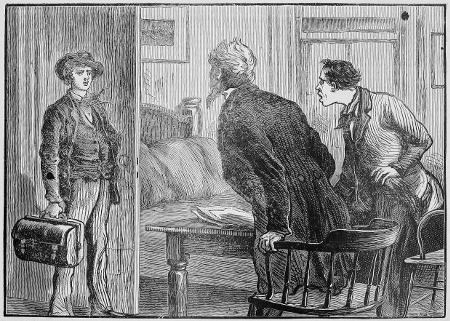
Look here, partner," said he, stepping up and laying his hand upon
George's shoulder, "this boat will not start until Monday afternoon."
The words and the touch aroused George from his reverie, and raising his
eyes to the face above him, he was surprised to see that it belonged to
an old acquaintance—the same young man who had tried to induce him to
surrender Mr. Black's pocket-book into his hands, instead of giving it
to its lawful owner. He had never seen nor heard of him since leaving
the General Quitman.
"I know it," replied George, "but how does it come that you know so
much?"
He did not like the arrogant tone in which the young man addressed him,
and he took this way to show it.
"Being chief clerk of this craft, I am supposed to know something about
her and her contemplated movements," was the young man's reply.
"O, you have charge of the office, have you?" said George. "I wasn't
aware of the fact."
"You are not going down the river with us, are you?"
"Well—yes; I have been thinking about it."
"Then you had better go ashore and wait until we are ready to start. We
don't keep a hotel, and we are not going to board you two whole days for
nothing. The truth is, I don't want him hanging around where he can say
something that would injure me," thought the clerk, as he turned on his
heel and walked away. "He looked at me pretty sharp, but I don't believe
he recognised me. If I thought he did, I should be in suspense during
the whole trip."
"He's a conceited little up-start," soliloquised George. "He has never
had charge of an office before, and it hurts him. It'll not take me long
to give him to understand that he has nothing to do with me."
George was at first inclined to be angry with the clerk for his
unwarrantable assumption of authority. He had been on the river long
enough to know that when a steamer is lying in port, no objection is
ever made to the company of any orderly person. If a visitor chooses to
sit on the guards, and watch the boats that are running up and down the
river, and enjoy the cool breeze, he is welcome to do so. If he wants to
ride up to the coal-fleet on her, he is at liberty to do that also; but
he is generally warned that he had better get off unless he is willing
to walk back. Of course, no passengers are received previous to the day
of sailing, but they are free to come aboard and look about as much as
they please.
"I have as much right aboard this boat as he has," thought George, "but
of course, he didn't know that. Taking me for a passenger, he thought he
would show off a little. No; that can't be the reason, either. He knows
that I am the fellow who found Mr. Black's pocket-book, and that was his
way of showing that he hates me, because I wouldn't give it up to him. I
wonder if Mr. Richardson's agent knows that he drinks and gambles?
Probably not; for if he did, he wouldn't trust him to handle any of the
boat's money. He wants to go easy on me, or I shall let him know that I
remember his doings aboard the Quitman."
George kept his place on the guard until the supper-bell rang, and then
he went into the barber shop. After washing his hands and face, and
brushing his clothes, he came out and took his seat at the table. One of
the waiters pulled his chair out for him, and, as it happened, seated
him next to the clerk, who stared at him as if he was greatly amazed at
his impudence.
"Tea or coffee, sah?" said the waiter.
"Hold on there!" exclaimed the clerk. "Have you got a ticket, young
fellow?"
"Tea," answered George; while the waiter smiled at what he regarded as a
pleasantry on the part of the first clerk. Only those passengers who
have paid their fare are served at table; and to show that they are
square with the office, it is customary for them to place their tickets
beside their plates, so that the waiters can see them.
"Beefsteak or mutton chop, sah?" continued the darkey.
George gave his order; and when the waiter had gone off with his plate,
he thrust his hands into his vest pockets, as if he were searching for
his ticket.
"I guess you haven't got one," said the clerk. "I know you haven't paid
your fare to me."
"I don't seem to find anything that looks like a ticket, that's a fact,"
said George, "but I'll take supper with you, all the same. I wouldn't be
too hard on an old acquaintance, if I were you."
"You are no acquaintance of mine," said the clerk, whose face grew a
shade paler than it usually was.
"But I have seen you before, anyway," persisted George. "I met you on
the Quitman, and we had a talk about a pocket-book I found on the roof.
I believe that, in a roundabout way, you rather gave me credit for
restoring it to its owner. I didn't think then, that you and I would
ever be attached to the same vessel, for I didn't know that you were a
riverman."
"O, you belong here, do you?" exclaimed the clerk.
"I do. My place is in the pilot-house."
"Why didn't you say so, without so much fooling?"
"Why didn't you ask me, if you cared to know?" said George, in reply.
"You ordered me ashore without taking the trouble to make any inquiries.
I think that settles him," added the young pilot, mentally. "I have
frightened him, judging by the looks of his face."
Yes, the clerk was "settled," but not in the way that George supposed.
As we know, this young man, when he came up the river on the General
Quitman, six months before, had lost at the gambling-table a thousand
dollars of the money he had collected for his employer. If he could have
induced George to give Mr. Black's pocket-book to him, he could have
replaced that money, and had something left for himself; but he failed
in this and got himself into trouble the moment he reached St. Louis.
His employer promptly discharged him from the lucrative position he
held, and gave him his choice between refunding the sum he had lost and
standing an action for embezzlement. Of course, he preferred to return
the money, but it was only after infinite trouble that he succeeded in
raising it, his father, to whom he first applied, refusing to aid him in
any way. When at last he procured the help he needed, it was through
representations as to his financial standing that would hardly have
borne investigation in a court of law. He was also obliged to make
promises that he could not keep, and to give a note that he could not
meet when it became due. He had agreed to return the money he had
borrowed in three months, with a heavy interest added. How he was going
to fulfil that agreement was a problem over which he had often racked
his brain, and to assist him in finding a way out of his troubles, and
to make his mind clearer, he regularly and frequently sought the aid of
something stimulating which the barkeeper fixed up for him. He had at
last arrived at the conclusion that there was no way in which he could
extricate himself from the difficulties with which he was surrounded,
and he had almost made up his mind that he would not return with the
boat to St. Louis—that he would abscond somewhere along the river and
leave his creditors to whistle for their money. This was the way the
clerk was situated on the night that he and George Ackerman sat at the
supper-table in the cabin of the Telegraph; and we have been thus
particular in describing it in order that the reader may readily
understand what happened afterward.
"Now, here's a kettle of fish," soliloquised the clerk, twisting
uneasily about on his chair. "This fellow knows me, and worse than that,
he is going down the river with us. I wonder if he knows old Richardson?
If he does, I must either get him off the boat or make a friend of him;
for if he should take it into his head to tell what happened on board
the Quitman, I should lose this berth as sure as I am a living man."
The clerk did not linger as long at the table as he usually did, and
neither did he again speak to George. He seemed to be thinking busily,
and the expression on his face indicated that the subject upon which he
was meditating was not an agreeable one. But at length he assumed a
more cheerful look, and as he arose from the table, he said to himself—
"I think I had better let him stay and try to make a friend of him. If I
can only do that, I can put myself square with the world once more, and
at the same time take revenge on him for getting me into this scrape.
For he is the one that is to blame for it. Why didn't he hand over that
pocket-book when I offered him a reward for it? My first hard work must
be to get on his blind side—make him believe that I am trying to
reform, and all that. He is one of those pious fellows who neither drink
nor smoke, and I must go to work at him in a pious way."
Just then, the young pilot sauntered out of the cabin, and turned toward
his chair on the guard; but when he saw that another close by it was
occupied by the clerk, who was smoking a cigar, he walked in another
direction. He did not like Murray—that was the clerk's name—and he did
not want to have anything to do with him. It would have been well for
him, if he had held to this resolution; but he allowed himself to be
talked out of it, and it required something that came pretty near being
a tragedy, to straighten matters out for him.
"Don't go away mad," said Murray, when he saw George moving off toward
the other side of the boat. "Since we are to be shipmates for one trip
at least, let's be sociable. Sit down here and talk to a fellow."
The young pilot could not well refuse. He sat down in his old place, and
of course, put his feet upon the rail. All the men and boys who sat on
the guards made it a point to do that.
"I didn't recognise you when I first saw you," said the clerk, "but I
knew you as soon as you spoke about that pocket-book. Most fellows would
have taken the reward I offered you, and got themselves into trouble by
it. I didn't know you were a cub. You were not attached to the Quitman,
were you?"
"No; but I made a bargain with Mr. Black during the trip, and I have
been with him ever since," replied George.
"Have a weed?" asked Murray, producing his cigar-case.
"I am obliged to you, but I don't smoke."
"You don't use tobacco or liquor in any form, do you?"
George replied that he never had and never would.
"I wish from the bottom of my heart that I could say the same thing,"
said Murray. "I am a total abstainer now so far as liquor is concerned,
but tobacco gets me. It would be useless for me to make any pretensions
to goodness in your presence, for you know more about my habits than I
wish you did. You saw the company I kept on board the Quitman; and I
don't mind telling you, confidentially, that I came pretty near getting
myself into a row by it. If I could only keep away from the bar, I
should soon be better off in the world than I am now."
"Then, why don't you do it?" asked George.
"Ah! That's just it. Why don't I? How shall I go to work?"
"Begin by throwing away that cigar," said George promptly.
"There she goes!" exclaimed Murray; and as he spoke, the cigar left his
hand and went over into the barge among the coal.
"Now," continued George, "say that you will never go near the bar
again, and stick to it. That's all there is of it."
"Yes; it's a very easy thing to say, but it's an almost impossible thing
to do. You don't know how hard it is for a fellow who is bound down by
the chains of habit, to keep a resolution like that. Why, bless you, I
have made it a thousand times and broken it as often. I took my last
pledge three months ago, and up to this time I have kept it; but I may
go back on it before I am an hour older. If some old friend should come
along and say: 'Murray, have something?' I'd go with him without
thinking. It is a sort of second nature to me. I wish I could be thrown
more into the society of such fellows as you are, and less into the
company of rivermen. Nine out of ten of them spend their money as fast
as they make it, and that's what keeps them on the river."
George leaned his elbows on the railing, rested his chin on his hands,
and looked down at the men who were at work in the barge, but made no
reply. The longer he listened to Mr. Murray, the less he liked him.
"Now, you can do me a great favor, if you will," continued the clerk,
"one that I shall always remember, although I shall never be able to
repay it. I wish you would stay by me as much as you can while you are
off duty. Make the office your headquarters. Come in at any hour of the
day or night—I shall not always be at work, you know—and if you hear
anybody invite me to take a short walk with him, just tip me the wink.
That will put me in mind of my pledge and help me to decline the
invitation."
"But will you decline?" asked George. "Won't you go, anyhow?"
"Of course I'll not go; I'll decline every time. All I want is somebody
close at my elbow to keep my pledge constantly in mind. If you will do
that for me during this trip, I am sure that by the time it is ended I
shall have fallen into the habit of saying 'No,' and then I shall be all
right. To tell you the truth, there's a good deal depending upon your
answer," added Murray, who thought by the expression on George's face
that he did not much like the part he was expected to perform. "My bad
habits have lost several very fine positions for me, and if I don't
break them off, I shall lose this and every other one I get. But I have
tried it often enough to know that I can't abandon them without help.
What do you say?"
"I say that I will do anything I can to help you," was George's answer.
"Thank you!" exclaimed Murray. George's reply argued well for the
success of certain plans upon which he had determined, and he could
scarcely conceal his exultation. "By the way," he added, "are you on
speaking terms with Mr. Richardson?"
"I am quite intimate with Tony, who steered this boat up here for me
to-day, but I am not much acquainted with his father, although I have
visited at his house by Tony's invitation."
"Well, you'll not say a word to him, or anybody else, about what
happened on board the Quitman?" said Murray.
"Not a word."
"All right. I am done with tobacco, liquor and cards for ever," said the
clerk, with great determination "I'll rub it all out, and begin over
again; turn over a new leaf, and see if I can't make a clean record for
myself."
The two sat there on the guards for a long time talking in this way, Mr.
Murray apparently being very communicative and confidential, while
George was exactly the reverse, and finally they bade each other
good-night and separated to their rooms.
"The plan works very well so far," thought Murray, as he locked the door
of the office behind him, and sat down to take another smoke. "Ackerman
is rather suspicious of me, and I shall have hard work to gain his
confidence. I am afraid that the greatest trouble will be to get him in
the habit of loafing about the office. If I can do that, I'll see that
he puts his foot into a very pretty trap. He got me into this scrape,
and he must help me out."
"He doesn't seem to be a bad fellow at heart," thought George, as he
tumbled into his bunk in Texas; "but I must say that he's mighty
palavering, and that his face is almost too red and bloated for that of
a man who has stuck to the pledge for three consecutive months, as he
claims to have done. I hope he is in earnest in his desire to reform,
and if I can help him by giving him a wink now and then, I shall be
perfectly willing to do it."
It was not long after that before the officers of the boat began to tell
one another that the chief clerk and Mr. Black's cub had taken a
wonderful liking for each other. George was in the office almost all
the time, and when the Telegraph left the coal-fleet on Monday morning,
and went back to the city, Murray steered her down for him. As soon as
she was made fast alongside the wharf-boat, George went ashore to make a
few purchases, and when he came back, he found the clerk full of news.
"Ackerman," said he, as the young pilot entered the office and threw
down a copy of a morning paper, which Murray had requested him to buy
for him, "I am sorry to say that Tony Richardson has steered the
Telegraph for you for the last time."
"Why, what do you mean?" exclaimed George. "Has he—has any misfortune
befallen him?"
He was about to ask if Tony had run away, but checked himself just in
time.
"I mean just what I say," answered Murray. "On Saturday morning the
Armada took one of Vandegriff's barges down the river so that she could
coal up while she was under way, and Tony went in charge of the barge to
check the coal and bring back the money. The tug that Vandegriff sent
down the river found the barge and brought it back yesterday morning,
but there was no Tony with her."
"Yes, sir; he's run away," thought George, climbing upon the high stool
and staring blankly at the clerk.
"I don't wonder that you are astonished," continued Murray. "So is
everybody. Poor Tony is at the bottom of the river, beyond a doubt, but
he gave a good account of himself before he went there, for both the
mokes came back with broken heads."
"Great goodness!" exclaimed George, almost tumbling off the high stool
in his excitement. "Then he didn't—do you mean to say that the negroes
threw him overboard?'
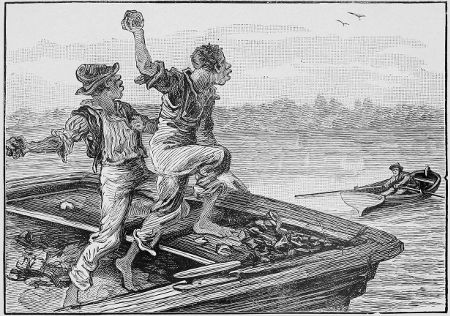
"Certainly; they are in jail for it now; but the money can't be found.
They acknowledge that they made an effort to rob Tony, but declare that
they didn't hurt him at all. They say that he jumped into the skiff that
was towing alongside the barge, and got away with the money; they
couldn't swim a stroke, and therefore they were obliged to stay with the
barge until the tug took them off. The general impression seems to be
that they knocked Tony down with a chunk of coal and robbed him, and
that he died from the effects of the blow. Becoming frightened at what
they had done, they threw the body overboard, hid the money, and made
up this story to lessen their punishment."
"If they did that, they didn't show much sense in staying with the
barge," said George, as soon as he could speak. "Why didn't they get
into the skiff and go ashore?"
"I can account for that only on the supposition that the skiff was lost
while the Armada was towing the barge down the river," answered Murray.
"If Tony ran off with it, as the darkies say he did where is he? If he
had rode up the river, he would have met the tug, and if he had tied up
to the bank, he would have seen her when she passed him. When the
captain of the tug saw the negroes' heads and listened to their story,
he was so certain that they had killed Tony, that he tied them hard and
fast, and never wasted a minute in looking for the boy, although he kept
up a constant whistling, which Tony would certainly have heard if he had
been able to hear anything."
George was so deeply affected by this gloomy news that he could not eat
any dinner. He visited the tug, which lay at a little distance down the
levee, sought an interview with her captain, and after telling him that
he was Tony's friend, questioned him closely in regard to his
disappearance, but without learning anything more than Murray had
already told him.
"It's my opinion," said he, as he walked slowly back to his boat, "that
we shall hear more of this matter some day. If the money wasn't gone, I
should feel certain that Tony had cleared out; but somehow I can't bring
myself to believe that he would steal funds to help him along. I don't
think he's that sort."
The missing boy was constantly in George's mind during the next few
days. He and Murray talked about little besides the mystery attending
his disappearance, and meanwhile their intimacy increased to such a
degree that the officers of the boat began to speak of them as the
"twins." Murray never lost sight of the object he had in view in working
his way into the young pilot's good graces, and circumstances seemed to
conspire to help him. He took particular pains to have it known among
the officers that he had "sworn off" on everything that was bad, and
that George was the one who had induced him to do it. As a consequence
the invitations to visit the bar that he received were numerous and
frequent. They were given principally in George's presence, but he was
never obliged to tip Murray the wink, for the latter seemed to be always
on his guard. This made George believe that he had wronged the clerk by
thinking that his desire to reform was not sincere, and the result was
that he gave him his entire confidence, and put implicit faith in
everything he said. He spent almost all his time when off duty in the
office, and whenever Murray could snatch a quarter of an hour from his
work, he was always to be found in the pilot-house.
The Telegraph reached her journey's end in due time, her freight was
discharged in good condition, her heavy bills were paid, and the money
deposited in the safe, of which Mr. Murray carried the key. In a few
days she was steaming back up the river, with a large passenger list and
a lot of other freight stowed away on the main deck and in the hold. Now
the chief clerk began to show signs of nervousness and excitement. Every
turn of the paddle-wheels brought him nearer to St. Louis, and to the
creditors whom he would have to face when he got there. His situation
being a desperate one, he had determined upon desperate measures to get
him out of it. If his plans failed, he was doomed.
"You say I look worried," remarked Murray, one day, when he and George
and Walker, the second clerk, were alone in the office; "and so would
you, Ackerman, if you had my responsibility resting on your shoulders. I
don't mind telling you in Walker's presence, because it is all in the
family, that there is money enough in this safe under my desk to start
us all on the road to fortune."
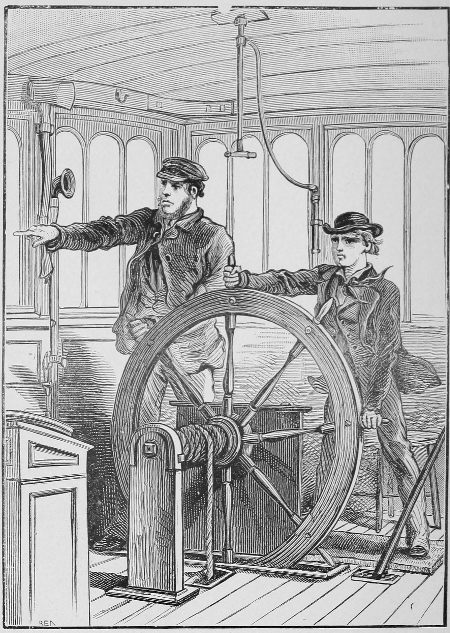
"Who—whoop!" shouted the pilot through the trumpet. "Anything for
Columbia?"
"Yes!" yelled Murray. "Walker, go out and warn the passengers who are to
get off there, and I'll see to the freight."
Walker left the office, and Murray took possession of the stool he had
just vacated.
"I shouldn't think you would like to have so much money in your charge,"
said George.
"Well, we do sometimes deposit it in the bank and take a check on St.
Louis for it. That's the better plan, but I was too busy to do it, and
besides I didn't know just how much I might want to use during the trip.
Another thing, I never heard of money being stolen from the office of a
steamboat. I don't suppose you could open the safe if I should give you
the key, could you?"
"I am sure I couldn't," answered George. "I don't know the combination."
"I'll give it to you," said Murray.
"That wouldn't be right, would it?" asked George, doubtfully. "Suppose
the safe should be robbed, and folks knew that I was acquainted with the
combination. What would they think about it?"
"Folks would never know anything it; and besides, as soon as you had
opened the safe, I should lock it again on another combination, and take
good care of the key," said the clerk, with a laugh. "Here, try it just
for fun. It's all in the family."
George, having never done business for any body except himself, did not
know that business men, and their clerks, too, if they are honest, are
very particular about their safes, and that they never, under any
circumstances, invite outsiders to tamper with them. He did not know
that the most of them lay so much stress on this point, that whenever
they go into an office where there is an open safe, they take care to
keep away from it; but it seems as if his common sense ought to have
told him that he was doing what he ought not to do, when he picked up
the key that Murray took out of his pocket and laid on his desk,
inserted it into the lock, and went to work on the combination the
latter had given him, which, by the way, was not the right one.
"You can't open it to save your life; you are a regular bungler," said
Murray, hoping to arouse George's pride or combativeness to such a
degree that he would keep at work at the safe until he could have time
to carry out a very important part of his scheme. "I must go down and
give the mate a list of the freight that is to be put off at Columbia,
and you stay here and work at it till I come back. The door shuts with a
spring-lock and nobody can surprise you."
These words ought to have aroused George to a sense of the situation,
but they did not. He never suspected anything, but resumed his work
after Murray went out into the cabin, telling himself the while that the
lock was more complicated than the one on the safe at home, for he could
not make the combination work at all.
Murray's first care when he heard the spring-lock close behind him, was
to look around for Walker, whom he finally found on the boiler-deck.
"Those passengers seemed to have disappeared all of a sudden," said the
second clerk. "I thought there were seven to get off at Columbia, and I
can find but three."
"Never mind the passengers," said Murray, speaking as if he were in a
great hurry. "I must go below for a few minutes, and I wish you would
step into the office and stay there. I left Ackerman there alone,
and—by the way—this is between you and me—I did very wrong to tell
him about the large amount of money in the safe. I don't at all like the
way he has hung around and questioned me ever since we left St. Louis."
Walker pricked up his ears at once.
"I wondered why you let him make the office a loafing-place," said he.
"I have several times been on the point of telling him to go out, but
you always appeared to be glad to see him——."
"Well, no; I wasn't glad to see him on account of the safe, you know,
and the money in it," interrupted the chief clerk. "But he was poor
Tony's bosom friend—intimate with the family and all that. Hurry up,
Walker."
Murray went below, and the second clerk hastened toward the office. He
did not go through the cabin, but passed along the guard, moving with
noiseless footsteps, and looking through the glass-door saw George
kneeling in front of the safe twirling the knob. The sight made Walker
about as mad as a man ever gets to be. Opening the door with a quick
push, he stepped across the threshold and confronted the young pilot,
who arose to his feet looking not a little confused. The first thought
that passed through his mind was that Walker suspected him of trying to
rob the safe, and the expression on the second clerk's face certainly
warranted that supposition.
"I guess I'll not try any longer," said George, throwing the key upon
the desk.
"No, I guess I wouldn't," said Walker, picking up the key with one hand
and trying the door of the safe with the other. "What business have you
with this key anyway, and how did it come into your possession?"
"Murray gave it to me and told me to see if I could open the safe,"
replied George, drawing himself up and steadily returning Mr. Walker's
searching gaze. "He gave me the combination, too."
"That's a little too thin, Ackerman," said Walker, closing the door and
throwing the catch into its place. "I have known Murray too long to
believe any such story."
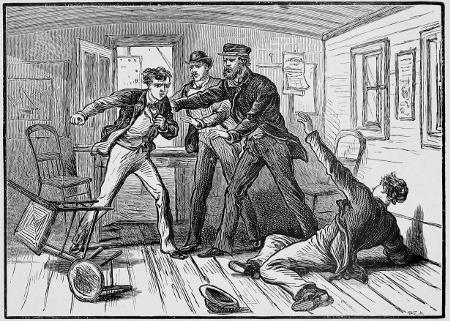
"What do you mean by that?" demanded the young pilot, flushing hotly.
"If you throw out any more insinuations, I'll send you over the rail
into the river. Open that door."
Walker was a full grown man, but George was his equal in stature and
weight, and vastly his superior in strength. He looked dangerous as he
stood there with his sleeves pushed back and his fists doubled up, and
that the clerk thought he was dangerous, was evident from the haste he
used in opening the door and stepping aside so that George could pass out.