"Well, old fellow, what do you think of
me now?"
It was George Ackerman who uttered these
words, and the question was addressed to his
herdsman, Zeke. The former stood in front of
a full-length mirror that hung against the wall
(among other extravagant and useless things for
which Uncle John had spent his nephew's money
were two elegant pier-glasses, one for his own
room and the other for Ned's), and Zeke was
sitting on the edge of a chair, with his elbows
resting on his knees and his chin supported by
his hands.
When the commander of Fort Lamoine accepted
his proffered services, George had asked for and
received a furlough for thirty days to enable him
to procure an outfit and to consult with his guardian
in regard to the management of the ranche
during his absence. That furlough had nearly
expired, and George was about to start for the
fort. The honest fellows who had so long been
employed on the ranche that they began to look
upon themselves as members of the Ackerman
family could not bear the thought of parting
from him, and Zeke especially felt very gloomy
over it. He had often denounced, in the strongest
terms, the circumstances which seemed to render
it necessary that his young friend should cast
his lot among the soldiers for a season, and on
this particular morning he looked as though he
had lost everything that was worth living for.
George had just put on his new uniform for
the first time, and no one, except a very intimate
acquaintance, would have recognized in him the
rough-looking cowboy whom we introduced to
the reader in the first volume of this series of
books. During the eighteen months he had lived
in the pilot-house he had fallen in with some of
the ways of those by whom he was surrounded,
and grown very particular in regard to his personal
appearance, although he did not by any
means go to extremes, as his cousin Ned had done.
As he placed the jaunty fatigue-cap over his long,
curly hair he looked rather complacently at the
handsome face and figure that were reflected from
the polished surface of the mirror.
"Come, Zeke, don't be cross," said he, walking
up to his herdsman and giving him a slap on the
back. "Say just one kind word to me before I
go."
"I won't," growled Zeke in reply.
"Then wish me good luck in my new calling,"
added George.
"I won't," repeated the herdsman in a still louder
tone. "You're always going off on some new
callin' or another, an' I don't see no sort of sense
in it. Didn't I stay home here, quiet an' peaceable,
takin' care of your critters, while you was a-philanderin'
up and down the river on boats that was
likely at any minute to burn up or bust their
boilers? Now that you have got safe home again,
why in creation don't you stay here? Good land
o' Goshen!" shouted Zeke, jumping up, spreading
out his feet and flourishing both his huge fists in
the air, "of all the fool notions that ever a livin'
boy got into his head—"
"That'll do, Zeke," interrupted George with a
laugh. "I have heard that a thousand times, more
or less, already. You will bid me good-bye when
I get ready to go, I suppose?"
"I s'pose I won't do nothin' of the kind," exclaimed
Zeke. "Of all the fool notions that ever
a livin' boy—"
"I understand. Come here and pack my clothes-bag
for me; you can do it better than I can."
"I won't. Them things is goin' to hang you
higher'n the moon the first you know," said Zeke,
scowling savagely at the elegant Mexican costume
which George lifted from the bed. "Don't you
never go 'crost the river with them duds on, 'cause
if you do Fletcher'll string you up for a spy."
"Not in peace-times, I guess," answered George.
"What odds does it make to sich as him whether
it's peace-times or not? You'll see."
"Well, he will have to catch me before he hangs
me. Go and tell the cook that I am getting tired
of waiting for breakfast."
"I won't; I won't never do nothin' for you no
more, nor say another word to you, nuther."
"I am sorry you feel so bad about it," said
George as he proceeded to pack his clothes away
in a canvas bag he had provided for that purpose;
"but the thing is done, and it can't be undone."
"I don't care if the Greasers come over here
next full moon an' steal every huf an' horn you've
got," exclaimed the angry herdsman.
"I do," replied George; "I don't want them to
do anything of the kind. I don't want them to
steal another steer from me or anybody else, and
that is the very reason I became a scout. Our
troops are going to teach those fellows to stay on
their own side of the river, and I am going to help
them do it."
"There's enough without you," growled Zeke.
"Suppose that everybody thought so; where
would we get the men to fight our battles?—What
in the world is that?"
For just then there was a terrific uproar on the
porch. Above the stamping of heavy boots and
hoarse but subdued ejaculations of rage, such as
men sometimes utter when they are engaged in a
fierce struggle, arose the voice of one who spoke
in pleading accents, but whose words suddenly
ceased with a kind of gasping sound, as if his
throat had been seized by a strong hand. Zeke sat
up on his chair and looked at George, whose face
expressed the utmost bewilderment. Before either
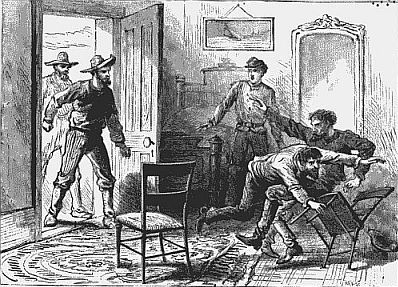
of them could speak the door was thrown open with
great violence, and a dishevelled and half-strangled
man, dressed in a dingy blue jacket and a pair
of dirty leather trousers, was pitched into the room,
with such force that when he brought up against
Zeke that worthy herdsman was knocked out of his
chair, and the two came to the floor together.
"What do you mean by such work as this?"
demanded George, looking first at the prostrate
man and then toward the door, where stood Jake
and Bob with their hands clenched and their faces
flushed with anger.
"Jest take a good squint at that feller's figger-head
an' answer the question for yourself, Mr.
George," answered Jake, shaking his fist at the man
who had been so unceremoniously introduced into
the room.—"Give it to him good an' strong, Zeke!—Well!
I'll—be—blessed!—Won't you, Bob?"
This exclamation was called forth by an action on
the part of George Ackerman that astonished Jake
and Bob beyond measure. Zeke had instantly recognized
the man who had so unexpectedly prostrated
him, and, seizing him by the back of the neck in
his iron grasp, began shaking him as a dog would
shake a rat. George also recognized the man after
he had taken a second look at him, and springing
forward he seized Zeke's arm and tore his grasp
loose. Then he assisted the man to his feet, and
taking his hand in his own shook it cordially.
"Well, I will be blessed!" repeated Jake, who
stood looking the very picture of astonishment.—"Won't
you, Bob?"
"I should say I would," replied the latter, who
was equally amazed. "That's something I never
expected to see—an Ackerman shaking hands with
a cattle-thief!"
"Springer," exclaimed George, "I am glad to
see you again; and without your crutches, too!
I hope you have entirely recovered."
Yes, the man who had made his entrance into
George's room in so unusual a manner was Springer,
whom we have often spoken of as the wounded
cattle-thief. He had, as we know, once been in
the employ of George's father; but proving to be
utterly unfit for the position he held, Mr. Ackerman
had discharged him, and Springer had sought
revenge by making an unsuccessful effort to burn
the ranche. Of course he could not stay in Texas
after that, so he fled across the river and joined his
fortunes with the Contra-Guerrillas, a regiment of
desperadoes in the employ of the ill-starred Maximilian.
He belonged, with other renegade Americans,
to Fletcher's band, who were the principal
foragers for Maximilian's army; but instead of
robbing the adherents of Juarez, who probably
had no stock worth stealing, they made numerous
raids across the river and ran off the cattle belonging
to the Texans. Springer was one of the band
who stampeded George's herd at Catfish Falls, and
during the short skirmish that followed Zeke sent
a bullet through each of his legs, wounding him
severely. He managed to keep up with the band
a few miles, but the rapid motion was too much
for him, and he was finally abandoned by his companions,
who hurried the captured cattle toward the
river, leaving Springer to look out for himself.
The pain occasioned by the wounds that had
been inflicted upon him by Zeke's Winchester was
so intense that the raider was forced to travel very
slowly. Arriving on the banks of a little stream
that ran across the trail he was pursuing, he rolled
out of his saddle to quench his thirst, which had
became almost unbearable; but his bridle slipping
from his hand, his horse wandered away, and, as
Springer was not able to walk, he could not catch
him again. He sank helplessly down beside a tree,
where he was presently discovered by George Ackerman,
who was making his way on foot toward Mr.
Gilbert's ranche. The boy ministered to his wants
by bringing him water in his hat and sharing with
him his slender stock of provisions, and Springer
showed his gratitude by warning George of a plot
which his uncle John and cousin Ned had laid
against him. He went into all the details, but
George refused to believe a word of it until subsequent
events, which we have already described,
proved to his entire satisfaction that the thief had
told him nothing but the truth.
After spending half an hour in the man's company,
George caught his horse, assisted him into
the saddle, and Springer succeeded in crossing into
Mexico without being discovered by any of the
settlers whom Zeke had gathered together to recapture
George's herd. He made his way to Don
Miguel's ranche, and there our hero found him
when he was captured by Fletcher's men. The
raider seemed to be sorry for his misdeeds, and
George had assured him that if he ever made up
his mind to turn over a new leaf and lead a different
sort of life, he would assist him by every
means in his power.
"Springer," said George, drawing up an easy-chair
for the use of his guest, "what brought you
over on this side of the river? Have you abandoned
Fletcher for good?"
The cattle-thief gasped and coughed three or
four times, as if he were trying to clear his throat
of something that stuck there and choked his utterance,
and finally nodded his head in reply.
"Don't pay no attention to him, Mr. George!"
exclaimed Bob. "He don't know nothin' but
stealin' an' lyin', that feller don't, an' I wouldn't
trust him as far as I could sling a yearlin'."
"If it wasn't for sich fellers as him you could
stay to hum quiet an' peaceable like, an' not have
to go off fur a soldier," added Jake.
"When I was a prisoner among the Greasers
he gave me advice that assisted me in making
my escape, and why should I not treat him kindly?"
demanded George, turning indignantly upon
the speakers. "No visitor at the Ackerman ranche
was ever treated so shamefully before, and I tell
you I don't want the thing repeated."
"Why, Mr. George," stammered Jake, "he rid
up to the porch an' said he wanted to speak to
you, an' so we brung him in—me an' Bob did."
"Go and tell the cook to put another plate on
the table and to hurry up breakfast," said George
with an air of disgust.
"Mr. George," said Zeke solemnly, "do you
mean by that that you're goin' to break bread
with this—this varmint?"
"I mean that Springer is going to eat a good
breakfast with me, if that is what you want to
know," replied George.
"Then, Bob, you needn't say nothin' about
that there other plate," continued the herdsman,
picking up his hat and moving toward the door.
"Springer can have the one I was goin' to use."
"Zeke, sit down and behave yourself," exclaimed
George.
"No, I won't. I ain't agoin' to eat salt with
a man what tried to burn this ranche over your
dead father's head, an' you a little babby at the
time, without no power to help yourself. I don't
know what this family is comin' to, anyhow."
"No more do I," chimed in Bob, while he and
Jake looked daggers at their employer's new guest.
"Things ain't as they used to be in the good
ole days. I won't wait on no table that he sets
at."
As if moved by a common impulse, the three
men left the room, Zeke closing the door behind
him with no gentle hand. The cattle-thief seemed
to be greatly relieved to see them go, but their
extraordinary conduct made him very uneasy, and
he looked toward George to see what the latter
thought about it.
"Never mind them," said the boy encouragingly.
"They were employed on this ranche before
I was born, and have finally come to think that
they have more rights here than I have. Now,
what did you want to see me for? How can
I help you? If I were going to stay at home,
so that I could stand between you and the settlers,
I would give you a herdsman's berth, if
that is what you want; but I am going to Fort
Lamoine as soon as I have packed my things and
disposed of my breakfast, and I may not be back
for a year. I am a United States scout."
"I wondered what you were doin' with them
soldier-clothes on; an' that explains it," said
Springer, speaking with difficulty. "I don't reckon
you can help me none jest now, but mebbe I
can help you by puttin' you on your guard agin'
Fletcher."
"Is he after me again?" cried George. "I was
in hope I had seen and heard the last of him."
"Them kind of fellers is always turnin' up when
they isn't wanted," replied Springer. "He's come
back to his ole hole at that there ranche, bringin'
a good many of his ole men with him, an' some
new ones that would be wusser than he is, only
that ain't possible. Amongst them all, they have
laid a plan to visit you next full moon."
"Let them come," said George, snapping his
fingers in the air; "they'll not get me, or any
stock either."
"He wants you more'n he wants stock," continued
Springer. "That is, he wants you first.
Your uncle John put the very mischief into that
there feller's head, an' he's goin' to make a pris'ner
of you, like he did afore. He knows that you
are master here now—that you've got more money
an' cattle than you know what to do with; an' he
thinks you would rather give 'em all up than lose
your liberty."
"No doubt I would," answered George, "but
before he can make any demands upon me he
must catch me. That he will never do, for the
next time—"
He was about to say that the next time he saw
Don Miguel's ranche he would be so strongly backed
up that he would stand in no fear of the boss
cattle-thief and his band. But he didn't say it,
for he did not know how far it would be safe to
trust his friend Springer. He need not have been
so particular on this point, however, for the cattle-thief
knew as much about the contemplated movements
of General Ord's forces as George did himself.
The Mexican authorities had been notified
that if the raids from their side of the river were
not stopped our troops would take the matter in
hand and punish the thieves wherever they could
be found; and those same authorities had been
accommodating enough to warn Fletcher, and so
put him on his guard.
"Where have you been since I last saw you?"
inquired George, "and what has become of my
horse? What did the 'boss' say when he found
I had slipped through his fingers? I told you
I shouldn't stay there and allow myself to be
robbed. Did he follow me?"
"No, he didn't foller you, 'cause nobody knowed
till mornin' come that you had skipped out," answered
Springer. "When Fletcher went to call
you to breakfast, an' you wasn't there, he thought
you was a-loafin' around somewheres about the
ranche; but when somebody told him that the
hoss with the four white feet, that follered us
acrost the river on the night we tried to get the
strong-box out of this house, was gone, he knowed
in a minute what was up, an' he was about the
maddest man you ever see. But he couldn't take
time to hunt you up, an' all he could do was to
swear that he'd hold fast to you the next time he
got his hands on to you."
"He'll never get his hands on me again," said
George confidently.
"I hope he won't, but if he does it'll be worse
for you. That there black hoss of your'n is dead,"
continued Springer; "he was shot at Querétaro.
You see, when we got down to the place where the
fightin' was goin' on, we knowed in a minute that
Max couldn't hold out much longer, so we started
one dark night to cross over to Juarez. His soldiers
seen us comin', an', thinkin' that we were
up to some trick or another, they turned loose on
us an' cut us up fearful."
"It served you just right," said George, with
honest indignation. "You had no business to go
in with Maximilian in the first place, but having
joined him you ought to have stood by him to
the last."
"We did stand by him after that, 'cause we had
to," answered Springer. "But it didn't take 'em
long to captur' the place, an' it didn't take them
long either to say what should be done with Max.
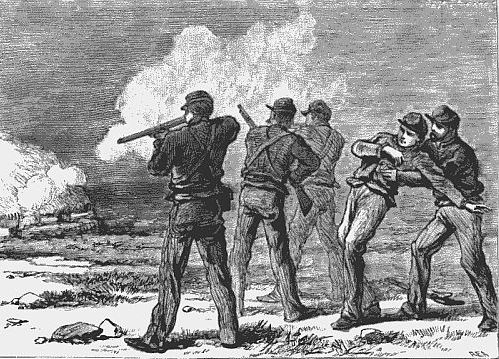
He an' Mejia an' Miramon were took out on a hill
near the ruins of an old stone fort an' shot. I
didn't see it, 'cause I was under guard with Fletcher
an' the rest; but I heared some of 'em who did
see it say that just before the shooting was done
Max he says to Miramon, 'The bravest man should
have the post of honor;' so he puts Miramon in
the middle, an' Max he stood on the left. It was
a mean piece of business all the way through," said
Springer, drawing his hand nervously across his
forehead, "an' I am powerful glad that I am well
out of it. Now, Mr. George, seein' as how you
belong to the army, mebbe I had oughter tell you
something. You remember them two Greasers
who shot that cowboy down to Rio Grande City,
an' was put in jail for it, don't you? Well, they
belong to our gang, an' Fletcher an' the rest are
getting ready to go down there an' take 'em out."
"Very well. Go right down to the commanding
officer at Eagle Pass and tell him of it," said
George promptly. "Then come up to Fort Lamoine,
and we'll see if the colonel won't do something
for Fletcher when he comes over here to capture
me."
"An' there's another thing I had oughter tell
you, Mr. George," continued Springer, sinking his
voice almost to a whisper. "I come over here as
a sort of spy, like. I am to find out all I can about
your ways—where you go of nights, an' all that,
you know—an' then I am to go down to Rio City,
take a look about the jail, see how many guards
there are, an' everything else that is worth knowin',
an' after that I am to go back an' tell Fletcher."
"I am glad you didn't say so while my men
were in here," observed George.
"I was just a trifle too sharp for that," said
Springer, shaking his head and looking very wise.
"I don't want to make them any madder at me
than they be now."
"But you are not going back to Fletcher with
any news, are you? You told me you had left him
for good."
"Mr. George," said Springer earnestly, "I ain't
agoin' to take no news acrost the river that will do
anybody there any good. I ain't forgot that you
helped me when I was a-starving for grub an' water,
and I ain't likely to forget it, nuther. I did
say I had quit them fellers for good, an' when I
said it I meant it; but you can see by the way
your own men used me, right here under your
nose, that I couldn't stay here without nobody to
back me up. I can't starve, so I'll have to go
back till you come home again."
"If you will stay on this side of the river I will
see that you don't starve," replied George. "After
you have told the commanding officer at Eagle
Pass of the attempt that is to be made to release
those murderers, come up to Fort Lamoine and I
will find some honest work for you to do. The
soldiers at the post are not acquainted with you,
and consequently there will be no one to trouble
you. I will say that you used to work for my
father, and that will help you to a position."
While Springer was trying to make the boy understand
how grateful he was to him for his kindness,
there was a rap at the door, and Bob thrust
his head into the room to announce in a surly tone
that breakfast was ready.
"Where's Zeke?" asked George.
"Gone," was the laconic reply.
"All right! If he is foolish enough to go off
without any breakfast, let him go. He'll meet me
somewhere along the trail and say good-bye, I
know. Bob," added George, pointing to the clothes-bag,
which he had packed while he and his visitor
were conversing, "put this into the pack-saddle,
and have everything ready, so that I can start
as soon as I have eaten breakfast.—Come on,
Springer."
George led the way into an adjoining room, and
found an excellent breakfast waiting for him. The
cook, knowing that this was the last meal the young
master of the ranche would eat at that table for long
months to come, had exhausted all his knowledge
of the cuisine in the effort to serve up a breakfast
that would tempt George to eat, no matter whether
he was hungry or not.
True to his promise, Bob kept out of the breakfast-room,
and George and his guest were obliged
to wait on themselves; but as they were used to
that, they got on very well. While they were eating
George once more repeated the instructions he
had given Springer, and reiterated his promise to
furnish him with steady employment and give him
a chance to make an honest living.
Breakfast over, George accompanied his guest to
the door, and saw him ride away toward Eagle Pass.
As soon as he was out of sight the boy went into
the house after his weapons and to take leave of
the servants, who were good-natured enough now
that Springer was gone. After shaking them all
by the hand, and listening to their hearty wishes
for his safe and speedy return, he mounted his
horse, which stood at the porch saddled and bridled,
took his pack-mule by the halter and rode
away toward Mr. Gilbert's ranche. The first person
to greet him as he drew rein in front of the
door was Zeke, who had so emphatically declared
that he would not have another word to say to
him.
"Where's that pizen varmint?" demanded the
herdsman in no very amiable tones.
"Look here, Zeke," replied George, "if you
should happen to meet that man while I am
gone, I want you to treat him civilly; do you
understand? If you see him in trouble, I want
you to help him out. He is sorry for what he
has done, and intends to lead a better life; and
if you don't assist him in every way you can,
you are not the fellow I take you for."
"Humph!" exclaimed Zeke contemptuously.
"Sorry, ain't he? Wants to lead a better life,
don't he? Well, it's mighty little chance he'll
have if he makes a business of bumpin' up agin
me the way he did this mornin', I bet you."
"He couldn't help it; Jake and Bob threw him
against you. I know he is in earnest, for he has
proved it. He came to the ranch to tell me that
my old friend Fletcher is coming over to capture
me next full moon, and he has now gone down
to warn the officer in command at Eagle Pass that
an attempt will soon be made to liberate the
murderers who are in jail there.—Good-morning,
Mr. Gilbert. I have stopped to say good-bye."
"Why don't you slap your foot down an' tell
him he sha'n't go, Gilbert?" demanded Zeke.
"I am as sorry to have him go as you are,"
replied Mr. Gilbert. "But it is to our interest
to do all we can to break up this raiding business,
and George can do more than any of us. In fact,
he is the only one in the settlement who can do
anything, for you know the colonel wouldn't accept
the services of our company of Rangers when
we offered them to him.—Come in, George, and
say good-bye to Mrs. Gilbert and the girls."
This was soon done, for the boy did not like
to linger over the parting; but still, it was much
harder for him to take leave of these good friends
than he thought it would be. The whole family
accompanied him to the door, and when he came
out Zeke turned his back to him.
"Say good-bye to me," said George, giving
him a pat on the shoulder; "it's your last
chance."
"I don't care if it is," shouted the old fellow;
"I won't do it."
"Then I will say it to you: Good-bye, Zeke.
It will be a long time before I see you again, if
indeed I ever do, but I never shall forget you.
You have been a good friend to me."
This was altogether too much for the honest
herdsman. He faced quickly about, and, seizing
George's hand with a grip that brought tears to
his eyes, churned it up and down like a pump-handle.
Then he dropped it and turned away,
while George, without saying another word, vaulted
into his saddle and rode off. Zeke watched him
as long as he remained in sight, and then in broken
accents addressed the silent group who stood in
the doorway:
"Thar's that there boy."—here he waved his
hand in the direction in which George had disappeared—"he
was all I had, an' now he's gone off
to fight them Greasers without askin' me would
I let him go. I toted him in them there arms
when he was a yellin' babby not knee-high to a
duck; I put him on the fust hoss he ever rid;
I slept under the same blanket an' herded cattle
with him when he got bigger; I larnt him how
to throw the lasso an' shoot the rifle; an' now
he's went off an' left me alone! Dog-gone them
pizen Greasers!" roared Zeke, flourishing both
his fists in the air.
He lingered a moment, looking rather sharply at
Mr. Gilbert, as if he had half a mind to take him
to task for giving his consent to George's "fool
notion," and then, thinking better of it, he lumbered
down the steps, mounted his horse and galloped
off toward the place where he had left his
herd in charge of an assistant.
George camped two nights on the prairie, and on
the third afternoon, an hour or two before sunset, he
arrived within sight of one of the stage-company's
deserted stables. Or, rather, it was deserted the
last time he saw it, but now there was an armed
soldier in front of the door, and he was presently
joined by others, one of whom, by signs, invited
him to approach. George complied, and presently
found himself surrounded by a squad of troopers
under the command of Corporal Bob Owens, who
greeted him as we have described.