GEOLOGICAL FACTS; OR, THE CRUST OF THE EARTH, WHAT IT IS, AND WHAT ARE ITS USES.
Transcriber’s Note:
New original cover art included with this eBook is granted to the public domain.
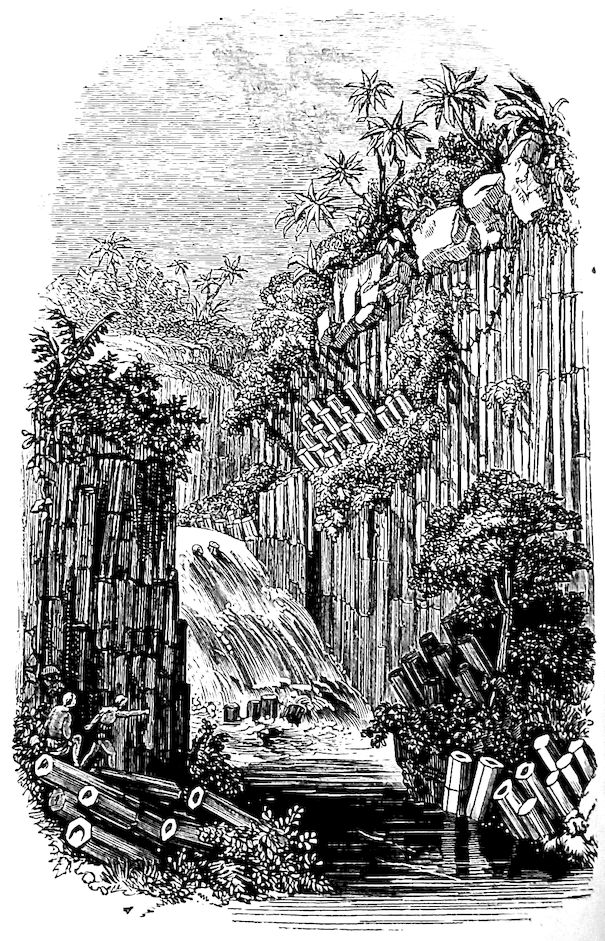
BASALTIC COLUMNS AT REGIA, IN MEXICO
BY
THE REV. W. G. BARRETT,
ROYSTON.
“There is in this universe a stair, or manifest scale of creatures,
rising not disorderly nor in confusion, but with a comely method
and proportion.”—Sir Thomas Browne, Religio Medici, 1642.
LONDON:
ARTHUR HALL, VIRTUE, & CO.
25, PATERNOSTER ROW.
1855.
LONDON:
R. CLAY, PRINTER, BREAD STREET HILL
PREFACE.
v
Last written, and generally last read, a
Preface has nevertheless become so integral
a part of every book, that I may presume,
I trust, upon the attention of my readers while
I ask them to indulge me with a little prefatory
egotism.
This book of mine goes forth into the world
with many misgivings on the part of its author.
How he came to write it was thus-wise. He
was settled in a quiet country town in Cambridgeshire,
Royston to wit, as a Dissenting
viMinister; around him he found a number of
young persons, who did not believe they had
“finished their education” because they had
left school, and who were anxious to avoid
the usual littleness and small talk of such
towns, by earnest attention to actual study.
And so it came to pass that a Geological class
was formed, which, meeting every week, afforded
real stimulus for private work, and led to the
consultation of the best standard works, happily
available through the well-conditioned library
of the town.
The result of those classes is this little book.
What is written here was mostly, if not all,
said there; and, urged to publish, the author
feels a pleasure in dedicating this book to the
class, composed almost entirely of young ladies,
who found in these studies one of their chief
viidelights, and whose private collections have
been greatly assisted by the hints thus obtained.
I do not pretend to teach the Science of
Geology; I aspire simply to give a taste for this
noble and elevating physical study; and, imperfect
as this little manual, written in the few
hours of capricious leisure snatched from an
incessant strain of engagements, must be, I
shall only be too happy, if one and another
lay aside my book, and go up higher to Lyell,
Sedgwick, Buckland, Murchison, Ansted, Miller,
and others.
Possibly my stand-point as a minister of
religion may have given unconsciously a too
theological tone to some of the chapters,
especially the last; if such is the case, I beg
leave to apologise for such an error by the
candid statement, that I have come into contact
viiifrequently with minds who have not hesitated to
express the doubts I have endeavoured to resolve.
I am quite sure that if we, whose calling is
with the greatest and the deepest truths that
can touch the heart of the real world in
which we live and move and have our
being, encourage those whom we meet in the
free intercourse of social life, to express their
doubts, however painful the form of that expression
may sometimes be, we shall be far
better prepared to meet the wants of our age
than if we shut ourselves up in our studies,
and exclude ourselves by conventional devices
from God’s great world of thought and action
that is vibrating so palpably around us, many of
whose most painful throbs are occasioned by a
supposed contradiction between Science and
Scripture.
ixAt the feet of the Master I desire to serve,
I lay this little book, beseeching Him to regard
it as a labour of love, and to use it as an aid
to the faith of others in the inspired books of
Nature and of Revelation.
Removed from the happy town where this
book was written, it only remains to add, that
for many of the fossils figured in the following
pages I am indebted to the kindness of the
Rev. Mr. Meeke, at that time the Unitarian
Minister of Royston, whose cabinet was always
open to my use, and whose courtesy and catholic
kindness I thus desire to record; while to Miss
Butler, one of my Geological class, I am
indebted for all the drawings and devices which
will doubtless make this book more attractive
than it could otherwise have been.
In the words of Archdeacon Hare, I close
xthis brief prelection: “So imperfectly do we
yet understand the redemption wrought for us
by Christ; and so obstinate are we in separating
what God has united, as though it
were impossible for the Tree of Knowledge
to stand beside the Tree of Life. Yet in the
redeemed world they do stand side by side,
and their arms intermingle and intertwine, so
that no one can walk under the shade of the
one, but he will also be under the shade of
the other.”
“In the beginning God created the heaven and the earth.”
Moses.
Geology is the history of the crust of this
planet. This history we compile, not from old
records or moth-eaten state papers, not from antiquarian
research or the study of ancient coins,
but from actual and painstaking examination of
the materials composing this crust. How suitable
is this word crust, will be seen at once,
when it is considered that its thickness in all
probability does not exceed eighty miles, a mere
fraction of the distance to the earth’s centre.
Of this eighty miles we know pretty accurately
the character and arrangement of some seven or
2eight miles; not that we have ever penetrated
so far beneath the surface in a straight line, the
deepest mines not exceeding 1800 or 1900 feet;
but, by putting together the thicknesses of the
various strata, with which we are well acquainted,
we reach this conclusion without much
hesitation. Professor Whewell has well observed,
that “an earth greater or smaller, denser or rarer,
than the one on which we live, would require
a change in the structure and strength of all the
little flowers that hang their heads under our
hedges. There is something curious in thus
considering the whole mass from pole to pole
and from circumference to centre, as employed
in keeping a snowdrop in the position most
suited to its vegetable health.”[1] When we
come to examine this crust, several appearances
of a striking character reward our toil. At first,
and before we proceed in our investigations more
minutely, we find that there are only two varieties
of rocks in all the vast arrangements spread
out before us. Some rocks we find to be unstratified,
and others we find to be stratified:
from the absence of all fossils in the former of
these, and from their crystalline character, we
3conclude that these were formed by the action
of fire, and therefore we call them Igneous or
Plutonic rocks. From the sedimentary character
and from the numerous fossils of the stratified
rocks, we conclude these to have been formed by
the action of water, and we therefore call these
Aqueous or Neptunian rocks. Following out
these investigations, we meet with other facts
equally interesting: we find that the Plutonic
or unstratified rocks lie generally at the base of
all the others, and that where they come up to
the surface and crop out from other rocks, or
rise in towering mountain heights above them,
this has been the result of igneous action from
beneath, and that this elevation has disturbed
the surrounding strata from the horizontal position
in which we imagine them to have been
first arranged. The extent of the Plutonic
rocks is immense; in Europe, the Scandinavian
mountains, the Alps, the Pyrenees, and the
Carpathians; in Asia, the Himalayan, the Caucasian,
and the Altai mountains; in Africa,
the Atlas mountains and the Cape of Good
Hope; in America, nearly the whole of the two
continents, and in Australia, its southern part;—all
these wide regions of the globe are composed
4of those igneous or Plutonic rocks to
which we give the names of granite, basalt,
porphyry, trap, &c. &c. Finding the surrounding
strata disturbed by depression, or upheaval
in consequence of the giant claims of
these older rocks that appear to have risen
out of the centre of the earth in a red-hot or
semifluid condition, and then suddenly to have
cooled down, we begin to examine this upper
and sedimentary strata, and here the most
delightful and romantic results are obtained.
We find no two courses or formations in these
sedimentary rocks alike. Rising up from the
granite, we meet in the clay strata corals and
trilobites, the first fossil forms of ancient life
with which we are acquainted: we rise higher
still, for our imaginary start is from the bottom
of the earth’s crust, and we meet in other rocks
fossil fishes of an extraordinary shape, and once,
doubtless, possessed of extraordinary functions;
higher yet, and touching the coal measures, we
come to vast forests of palms and ferns, that by
chemical changes and mechanical pressure have
been converted into our mineral coal, the vast
fields of which constitute the real diamond mines
of Great Britain; higher yet, exploring the Lias
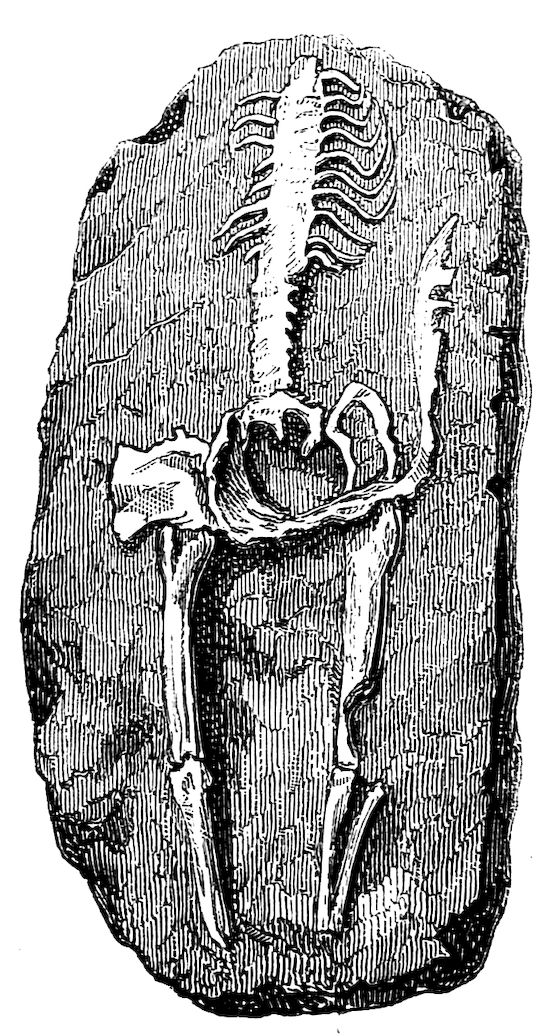
5and Oolitic groups, the huge remains of ancient
saurians (animals of the lizard species) fill us
with awe and wonder, and make us rejoice that
they had no successors in the next strata; higher
yet, and we reach the last period of the earth’s
history, previous to the introduction of man,
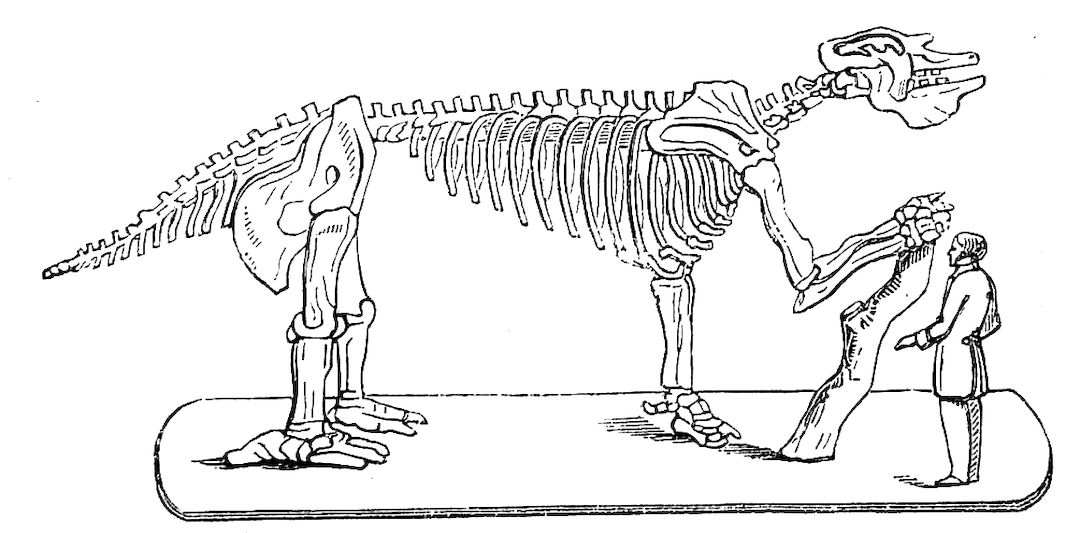
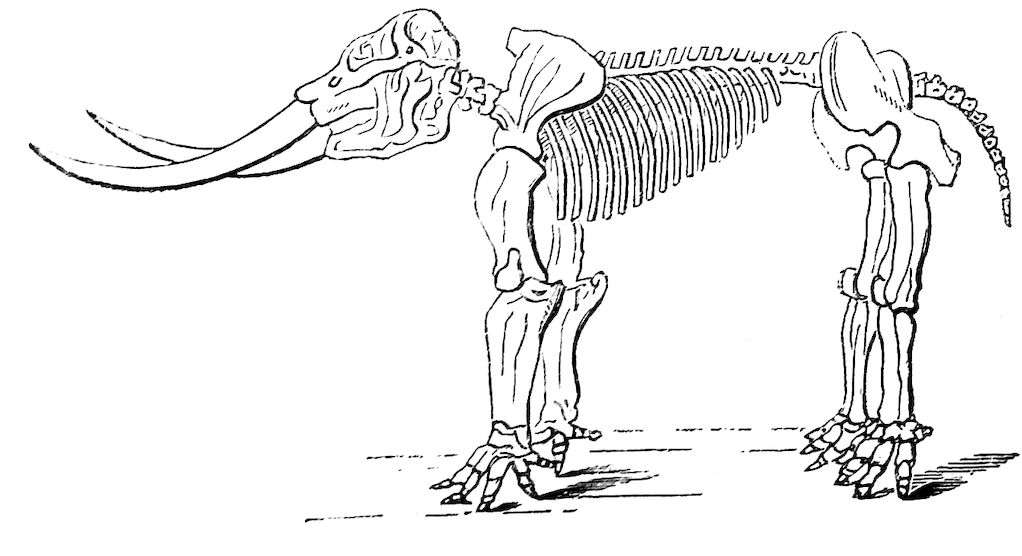
and enormous “four-footed beasts,” the mastodon,
the megatherium and others, astonish us
by their gigantic proportions, and evidently
herbivorous habits; and last of all we rise to
the surface and breathe freely in company with
our fellow man, made in the image of God, to
inhabit this world as his palace, and to interpret
its mysteries as its priest.
We may probably put these general results
into a more popular form,—for we reserve the
details to a seriatim examination of each formation,—by
the following quotation from a modern
and extensively useful writer: “We distinguish
four ages of nature, corresponding to the great
geological divisions, namely—
“1. The primary or palæozoic[2] age, comprising
the Lower Silurian, the Upper Silurian, and the
Devonian. During this age there were no air-breathing
animals. The fishes were the masters
6of creation. We may therefore call it the Reign
of Fishes.
“2. The secondary age, comprising the carboniferous
formation, the trias, the oolitic, and the
cretaceous formations. This is the epoch in
which air-breathing animals first appear. The
reptiles predominate over the other classes, and
we may therefore call it the Reign of Reptiles.
“3. The tertiary age, comprising the tertiary
formations. During this age, terrestrial mammals
of great size abound. This is the Reign
of Mammals.
“4. The modern age, characterized by the
appearance of the most perfect of created beings.
This is the Reign of Man.”[3]
From this brief but necessary outline of “the
treasures of the deep” which lie before us we
may proceed to make a few preliminary remarks
on the moral and theological aspects of this
science. Many persons have supposed that the
statements of Scripture and the alleged facts of
Geology are at variance, and, forgetful that some
of the devoutest minds of this and other countries
have been equal believers in both, have too
summarily dismissed geology from their notice
7as a study likely to lead to infidelity. To such
we would briefly remark, that it is utterly impossible
there can be any contradiction between
the written volume of Inspiration and the outspread
volume of Creation. Both are books
written by the same hand, both are works
proceeding from the same ever blessed and
beneficent Creator. We believe in the plenary
inspiration of the Bible, and we believe equally
in the plenary inspiration of Nature; both are
full of God, for in them both He is all and in all;
and he who is the deepest and the most reverent
student of both will not be long before he comes
to the conclusion that not only is there no disharmony,
no discrepancy and no contradiction
between them, but that they are both harmonious
utterances of the one infinite and ever
blessed God.
“In reason’s ear they both rejoice,
And utter forth a glorious voice;
For ever singing as they shine,
‘The hand that made us is divine.’”
Let us remember that Geology has nothing
to do with the history of man, nor with God’s
government of man; to the Bible, and only
there, do we go for information on these points.
8Geology gives us the history and the succession
of the things and beings that were created and
made, we believe, incalculable ages before man
was placed on the face of the earth. Possibly
at times some new discovery in geology may
appear to contradict our long received interpretations
of isolated passages in Scripture, in which
case the modesty of science compels us to reexamine
our data, while our reverence for the
word of God teaches us to revise our interpretations.
As Dr. Chalmers once remarked, “the
writings of Moses do not fix the antiquity of the
globe; if they fix anything at all, it is only the
antiquity of the species.” We believe that the
same God who, in anticipation of the spiritual
wants of the human race, graciously promised
from the beginning of man’s transgression, that
“the seed of the woman should bruise the
serpent’s head,” laid up for him “in the bowels
of the earth those vast stores of granite, marble,
coal, salt, and the various metals, the products
of its several revolutions; and thus was an inexhaustible
provision made for his necessities,
and for the developments of his genius, ages in
anticipation of his appearance.”[4]
9Truth is, and always must be, coincident.
There can be no real contradiction between the
truth of Scripture and the truth of Science.
Whatever is true in one department of God’s
agency, must be true when compared with his
works in any other department. As an illustration
we may notice one particular in which
Geology and Scripture move towards the same
point in proving the recent introduction of man.
We take up a chart of the earth’s crust, and
examine it so far as that crust is open to our
investigation: eight miles depth or height we
know pretty accurately, and in all these accumulations
we find one concurrent testimony. If
we take the Azoic period of the earth’s crust, and
search through the granitic rocks of Scotland,
Wales, or Cornwall; or if we pass on to the
Palæozoic period, and examine the Old Red Sandstone,
the Carboniferous system, or other formations;
or, extending our researches, investigate
the secondary formations, the Lias, the Oolite,
and the Chalk, and so on until we arrive at the
Tertiary period of the earth’s history; all the testimony
is one; there is no contradiction; there are no
fossil boats or sofas; no fossil beds or books; no
fossil boys and girls; no fossil knives and forks;
10so far as the teachings of Geology go throughout
all these vast periods it says, “there was not a
man to till the earth;” they declare that man is
not so old as the earth, and that all its fossil
remains are pre-Adamite.
Now why should this truth be supposed to lie
against the teaching of Scripture? The object
of Moses in the first chapter of Genesis, is to
teach us that all existing matter owes its origin
to the God of the Bible, and not to any of the
idols of the heathen. “In the beginning,” says
that oldest historical record with which we are
acquainted, “God created the heaven and the
earth;” that is, we apprehend, at some period
of the earth’s history, in all probability an undefined
and incalculable distance from the present
time, God created all matter out of nothing,
the universe, these heavens and this earth, began
to be at the word of God.
“But afterwards,” says Dr. Pye Smith, in his
translation of these words, “the earth was without
form and void;” undergoing, we believe,
those vast geological changes, those deposits of
metal, and those slow accumulations of mineral
wealth, by which it was fitted to become the
temple, the palace, the workshop, and the home
11of man. “The first sentence in Genesis is a
simple, independent, all-comprehending axiom
to this effect, that matter elementary or combined,
aggregated only or organised, and dependent,
sentient, and intellectual beings, have not
existed from eternity either in self-continuity or
succession; but had a beginning; that their
beginning took place by the all-powerful will of
one Being, the Self-existent, Independent and
Infinite in all perfection; and that the date of
that beginning is not made known.”[5]
Dr. Redford says, “We ought to understand
Moses as saying, that indefinitely far back and
concealed from us in the mystery of eternal
ages prior to the first moment of mundane time,
God created the heavens and the earth;” and
Dr. Harris in the same strain writes thus, “The
first verse in Genesis was designed by the Divine
Spirit to announce the absolute origination of
the material universe by the Almighty Creator;
and it is so understood in the other parts of
holy writ; passing by an indefinite interval, the
second verse describes the state of our planet
immediately prior to the Adamic creation, and
12the third verse begins the account of the six
days’ work.”
On this subject we will quote but one brief
sentence more—and we have preferred using
these quotations to stating the question in our
words, thoroughly accordant as they would have
been. In Dr. Hitchcock’s valuable work, entitled
“The Religion of Geology,” he says, “The time
is not far distant when the high antiquity of the
globe will be regarded as no more opposed to
the Bible than the earth’s revolution round the
sun and on its axis. Soon shall the horizon
where Geology and Revelation meet be cleared
of every cloud, and present only an unbroken
and magnificent circle of truth.”
Let these thoughts be borne in mind while
we pursue our examination of the solid crust of
this globe. We do not
“drill and bore
The solid earth, and from its strata thence
Extract a register, by which we learn
That He who made it and revealed its date
To Moses was mistaken in its age.”
Nowhere do we find the age of the globe revealed
either to Moses or any other inspired
writer; we believe that as science has nothing to
13fear from the Bible, so the Bible has nothing to
fear from the widest intellectual range of study.
We ponder in devout amazement over these
unwritten records of the earth’s bygone history:
we find ‘sermons in stones’ as we light on some
delicate fern, or elegant vertebrate animal, preserved
in the deposits of past ages, and the hieroglyphics
of nature and the distincter utterances
of the Bible prompt the same exclamation,—“How
marvellous are thy works, O God, in
wisdom hast thou made them all!” “Waste,
and disorder, and confusion we nowhere find in
our study of the crust of the earth; instead of
this we find endless examples of economy, order,
and design; and the result of all our researches
carried back through the unwritten records of
past time, has been to fix more steadily our assurance
of the existence of one Supreme Creator of
all things; to exalt more highly our conviction
of the immensity of His perfections, of His might
and majesty, His wisdom and His goodness, and
all-sustaining providence; and to penetrate our
understandings with a profound and sensible
perception of the high veneration man’s intellect
owes to God. The earth from her deep foundations
unites with the celestial orbs that roll
14through boundless space, to declare the glory
and show forth the praise of their common
Author and Preserver; and the voice of natural
religion accords harmoniously with the testimonies
of revelation, in ascribing the origin of
the universe to the will of one Eternal and Dominant
Intelligence, the Almighty Lord and
supreme First Cause of all things that subsist;
the same yesterday, to-day, and for ever; before
the mountains were brought forth, or ever the
earth and the world were made, God from everlasting
and world without end.”—Buckland’s
Bridgewater Treatise.
“Come, frankly read the rocks, and see
In them the Earth’s biography;
Let mountain piled on mountain tell
Its antique age; and every shell
In fossil form its tale unfold,
Of life’s bright day through time untold;
And gathering use from great and small,
See good in each, but God in all.”
CHAPTER II. PRELIMINARIES.
15
“Of old hast thou laid the foundation of the earth.”
David.
As yet we have only been talking about the
crust of the earth; we shall now return and
enter upon its actual examination. It will not
be necessary for us personally to descend into
the abysmous caverns that lie beneath our feet,
nor, with hammer in hand, to go forth and explore
the district of country in which we may
happen to dwell: we may do all this by and
by, when we know both how and what to
observe. Meanwhile, with such teachers as
Buckland, Sedgwick, Murchison, Pye Smith,
Hugh Miller, De la Beche, Lyell, Owen and
others, we may for some while to come be only
tarry-at-home travellers; for in a true sense, in
this department of knowledge, “other men have
laboured, and we enter into their labours.”
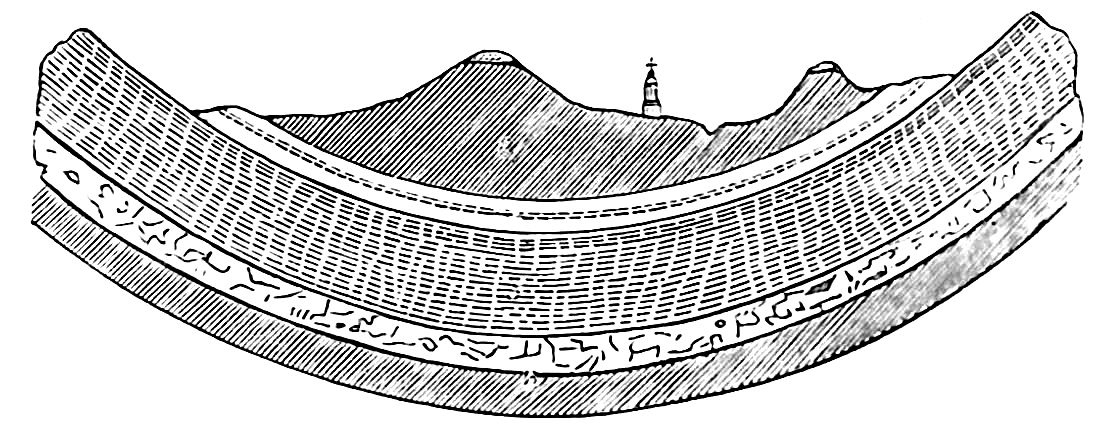
16Let us now look at the crust of the earth, as it
may be represented in two imaginary sections.
Suppose we could make a vertical section of the
earth’s crust, and cut straight down some eighty
miles till we reached the central mass of incandescence
that we believe lies beneath this crust,
or Erdrinde (earth-rind), as the Germans call it,
and then bring out this section to daylight, it
would present something very much like the
following appearance.
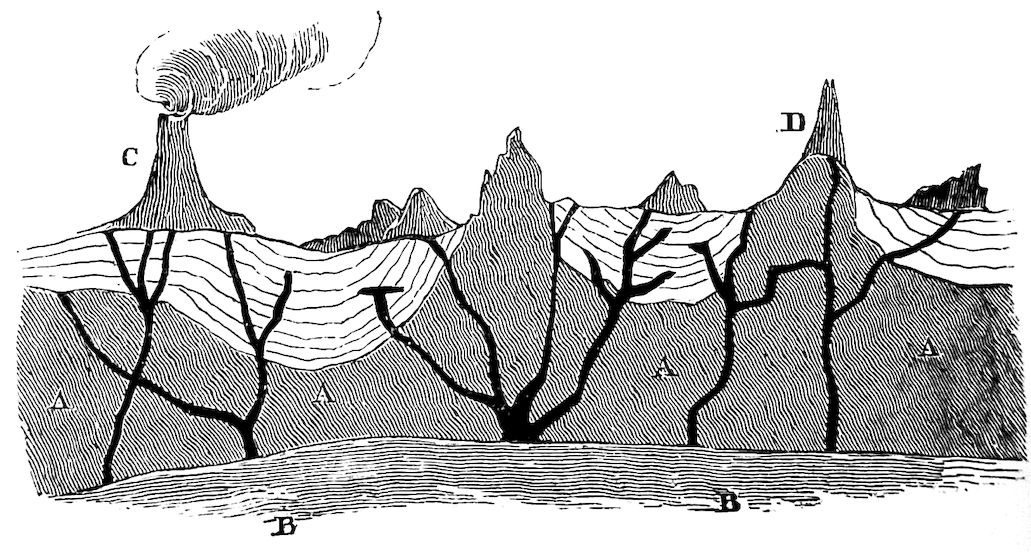
DIAGRAM I.
Here the granite A will be observed forming
the supposed boundary between the superlying
strata and the fire B below to which we have
just referred, and thus will be seen the origin
of all plutonic rocks. Here too will be seen
how the granite is not confined to the lower
17levels, but rises, as mentioned in the first chapter,
far above all the other strata, and forms some of
the highest peaks on the face of the globe.[6]
Here, too, will be seen how the granite is frequently
traversed by veins of trap-dykes, those
black-looking branches, which rise often above
the whole mass of metamorphic and stratified
rocks, often occasioning great difficulties in
mining operations. Here, too, the student will
see how, supposing the theory of a central globe
of heat to be founded in fact, the volcanoes that
are now active, C, form, as the volcanoes that are
extinct, D, once did, the safety valves of this
mighty mass of incandescence, B; and in the
same way may be seen how certain strata may be
above the granite, or above any other formation,
though they do not overlie them, and how the
lowest strata, being formed first, is said to be
older than any superlying strata, notwithstanding
any accidental arrangement produced by
upheaval or depression. For, in “consequence
18of the great commotions which the crust of the
globe has undergone, many points of its surface
have been elevated to great heights in the form
of mountains; and hence it is that fossils are
sometimes found at the summit of the highest
mountains, though the rocks containing them
were originally formed at the bottom of the sea.
But, even when folded or partly broken, their
relative age may still be determined by an examination
of the ends of their upturned strata,
where they appear or crop out in succession, at
the surface or on the slopes of mountains.”[7]
But to make this view of the subject
clearer, let us imagine that some Titanic power
was granted us to push down these towering
masses of granite to their original situation,
below the metamorphic and stratified rocks, by
which means we should at the same time restore
these curved and broken strata to their originally
horizontal position; and let us suppose that we
were now again to descend to the foundations
of the earth for the purpose of making another
vertical section; then the crust of the earth
would present to us an arrangement something
like the leaves of a book, or the coats of an
19onion, arranged in successive and uninterrupted
layers, or in concentric and unbroken circles.
Such a diagram must of course be imaginary,
and unless it is taken into connexion with the
previous remarks, it is more likely to bewilder
than to assist the beginner. Let it again be
urged upon the reader, that such a chart as we
are about to lay before him is only intended to
give him an idea of the succession of these
formations and systems, and that the details
found in it are anticipatory of many future
references to it on the student’s part. Let it not
be supposed that this is a mere barren research
into dry facts that have no connexion with our
truest welfare; for if, as Lord Bacon somewhere
finely observes, all study is to be valued “not
so mush as an exercise of the intellect, but as
a true discipline of humanity,” then what study
is calculated to be more useful than Geology, in
enlarging and purifying the powers of the mind,
by teaching us how harmonious, and orderly,
and economic are the works of God; in removing
all narrow notions of the extent and age of
this solid globe, which from the beginning had
its origin in the almighty will of God; in checking
the presumptuous or the chilling inferences
20of a sceptical philosophy, by everywhere pointing
out the design, skill, and adaptations of an
ever-present and most beneficent Creator; and
in chastening those overweening ideas of ourselves
which both ignorance and knowledge
may create and foster, by saying to us, in the
language of God himself, as we stand amazed in
the presence of huge pre-Adamite vestiges of
creation, “Where wast thou,” vain man, “when
I laid the foundations of the earth? Declare
if thou hast understanding.” (Job xxxviii. 4.)
“Among these rocks and stones, methinks I see
More than the heedless impress that belongs
To lonely nature’s casual work; they bear
A semblance strange to Power intelligent,
And of Design not wholly worn away.
And I own
Some shadowy intimations haunt me here,
That in these shows a chronicle survives
Of purposes akin to those of man,
Measuring through all degrees, until the scale
Of time and conscious nature disappear,
Lost in unsearchable eternity.”—Wordsworth.
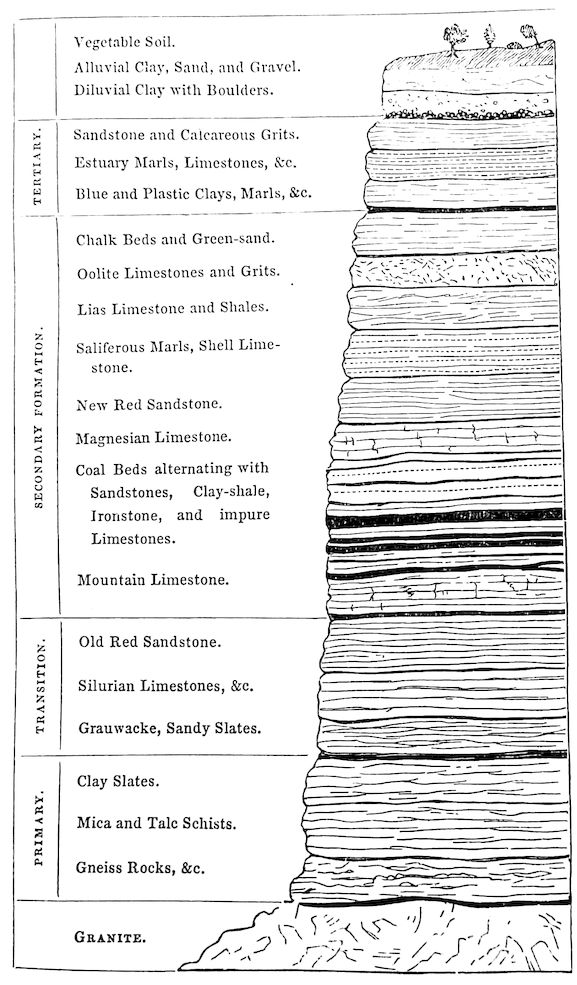
We will now proceed to the diagram to which
we have made allusion, and which represents
an ideal section of the earth’s crust as the various
formations are there found arranged. (Diagram
II.)
21
DIAGRAM II.
22Here, in the words of another writer, we would
add for the reader’s guidance, that “the unstratified
or igneous rocks occur in no regular succession,
but appear amidst the stratified without
order or arrangement; heaving them out of
their original horizontal positions, breaking up
through them in volcanic masses, and sometimes
overrunning them after the manner of liquid
lava. From these circumstances they are, in
general, better known by their mineral composition
than by their order of occurrence. Still it
may be convenient to divide them into three
great classes; granite, trappean, and volcanic—granite
being the basis of all known rocks, and
occurring along with the primary and transition
strata; the trappean, of a darker and less crystalline
structure than the granite, and occurring
along with the secondary and tertiary rocks;
and the volcanic, still less crystalline and compact,
and of comparatively recent origin, or still
in process of formation.” This the student
will observe by another reference to the previous
diagram; but, in looking at the one now before
him, we must also add for his further guidance,—for
we are presuming that we address those
who need initiation into the rudiments of this
23science, and the circumstance that we never met
with a preliminary treatise that quite satisfied
us, or helped such intelligent youth as were
prying into the apparently cabalistic mysteries
of the earth’s structural divisions, is one strong
inducement to the present undertaking;—we
must add, that “it must not be supposed, however,
that all the stratified rocks always occur
in any one portion of the earth’s crust in full
and complete succession as represented” in
Diagram II. “All that is meant is, that such
would be their order if every group and formation
were present. But whatever number of
groups may be present, they never happen out
of their regular order of succession; that is, clay-slate
never occurs above coal, nor coal above
chalk. Thus in London, tertiary strata occupy
the surface; in Durham, magnesian limestone;
in Fife, the coal measures; and in Perthshire,
the old red sandstone and clay-slate; so that it
would be fruitless to dig for chalk in Durham,
for magnesian limestone in Fife, or for coal in
Perthshire. It would not be absurd, however, to
dig for coal in Durham, because that mineral
underlies the magnesian limestone; or for old
red sandstone in Fife, because that formation
24might be naturally expected to occur under the
coal strata of that country, in the regular order
of succession.”[8]
Still, after reading all this, we can easily
imagine, not so much an air of incredulity
taking possession of the countenance of our
courteous reader as a feeling somewhat like this,
with which we have often come into contact
in those geological classes of young persons
which it has been our pleasure to conduct:
“Well, all that’s very plain in the book; I see
granite lies at the bottom, and pushes itself up
to the top very often; and I see in the diagrams
that coal and chalk are not found in the same
place, and that different localities have their
different formations, and the various formations
have their different fossils, but I confess that
I cannot realize it. I know the earth is round
like an orange, a little flattened at the poles—what
is called an oblate spheroid; but all this
surpasses my power of comprehension; can’t
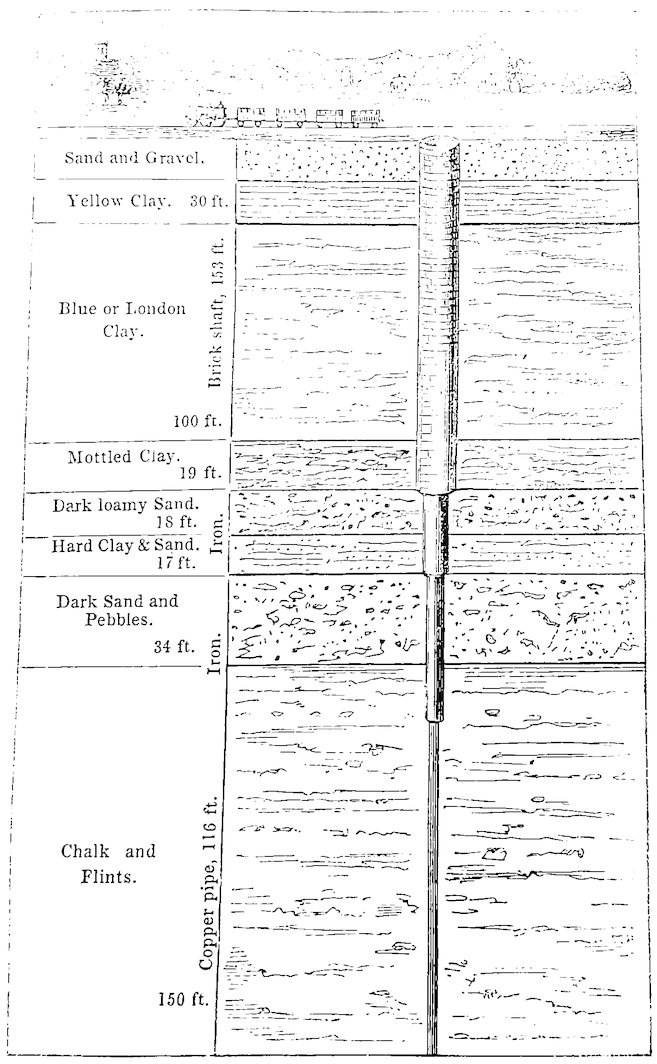
you make it plainer?” Well, let us try; on page
27 is a diagram, representing no ideal, but an
actual boring into the earth. London is situated
on the tertiary formation, in what is called
25geologically the basin of the London clay, that
is almost on the very top of the crust, or external
covering that lies on the vast mass of
molten and other matter beneath. Here is first
a drawing and then a section that may represent
this basin:—
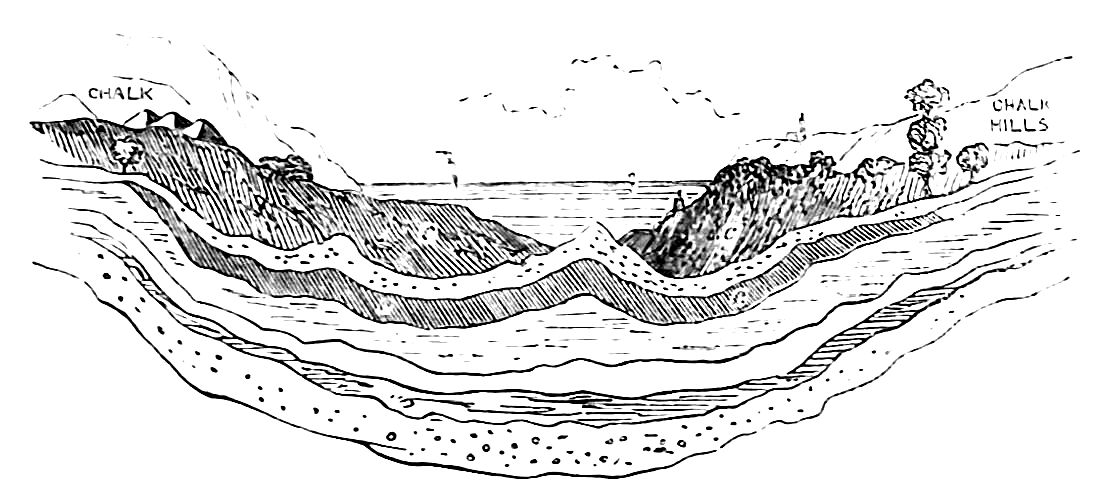
DIAGRAM III.
DIAGRAM IV.
The water which falls on the chalk hills flows
into them, or into the porous beds adjoining, and
would rise upwards to its level but for the
superincumbent pressure of the bed of clay
26above it, cccc. Under these circumstances, in
order to procure water, Artesian[9] wells are sunk
through the bed of clay, perhaps also through
the chalk, but at any rate till the depressed
stratum of chalk is reached; and this gives exit
to the subterranean water, which at once rises
through the iron tubes inserted in the boring to
the surface. By these borings through the clay,
water is obtained where it would be impossible
to sink a well, or where the expense would prohibit
the attempt. To explain this matter, here
is a diagram (No. V.) which represents the Artesian
well at the Model Prison at Pentonville, London,
the strata upon which London is built, and
which we can apply to the diagram on page 21,
that the theory of the earth’s crust may be
the more thoroughly understood before we
proceed.
27
DIAGRAM V.
28In the same manner Artesian wells have been
sunk in other places, as at Hampstead Water
Works, 450 feet deep; Combe & Delafield’s,
500 feet deep; and the Trafalgar-square Water
Works, 510 feet deep.[10] Now, the reader has
only to take this last diagram, and in imagination
to apply it to the one on page 21, in order
to see that so far as actual boring and investigation
go, the geological theory of the earth’s
crust is correct; only again let it be observed
that this order is never inverted, although it
frequently happens that some one or more of
the strata may be absent.
Hitherto we have spoken of the earth’s crust
without reference to that wondrous succession
and development of living beings which once
had their joy of life, and whose fossil remains,
found in the different strata, waken such kindling
emotions of the power of Deity, and enlarge
indefinitely our conceptions of the boundless
resources of His Mind. This will open before us
a new chapter in the history of our planet, already
the theatre of such vast revolutions, and which,
under the influence of Divine truth, is yet to
undergo one greater and nobler than any of
these. We have as yet only glanced at the
surface page of the wondrous book, now happily
29opened for us by geologists, to whose names we
have already made reference; and as the mind
rests with intense pleasure on the discoveries of
Champollion, Belzoni, Lane, Layard, Botta, and
others who have deciphered the hieroglyphics,
in which were written the wars and the chronicles
of ancient nations, whose names and deeds are
becoming, by books and lectures, and above all
by our noble national Museum, familiar even to
our children, and a source of help and solace to
the hard-toiling artisan; so with profounder
interest, as carried back into remoter ages of
antiquity, so remote that they seem to lie beyond
the power of a human arithmetic to calculate,
do we humbly endeavour to decipher the
hieroglyphics,[11] not of Egypt or of Nineveh, but
of the vast creation of God, written in characters
that require, not only learning and science
to understand, but modesty, patience, and
triumphant perseverance. He who with these
30pre-requisites combines reverence for God and
His revelation, will always find in Geology
material both for manly exercise of thought,
and also for reverent adoration of Him who is
Himself unsearchable, and whose ways are past
finding out.
“We not to explore the secrets, ask
Of His eternal empire, but the more
To magnify His works, the more we know.”—Milton.
Most happily for Christendom, our noblest
men of science are not ashamed of the “reproach
of Christ;” and we know not how
to conclude this chapter in a strain more accordant
with our own thoughts than by quoting
the words of an eminent living naturalist:—“I
can echo with fullest truth the experience of
Bishop Heber; ‘In every ride I have taken,
and in every wilderness in which my tent has
been pitched, I have found enough to keep my
mind from sinking into the languor and the
apathy which have been regarded as natural to
a tropical climate.’ Nay, I may truly say, I
found no tendency to apathy or ennui. Every
excursion presented something to admire; every
day had its novelty; the morning was always
pregnant with eager expectation; the evening
31invariably brought subjects of interest fresh and
new; and the days were only too short for
enjoyment. They were not days of stirring
adventure, of dangerous conflicts with man or
with beast, or of hair-breadth escapes in flood
and field; their delights were calm and peaceful,
I trust not unholy, nor unbecoming the character
of a Christian, who has his heart in heaven,
and who traces, even in earth’s loveliest scenes,
the mark of the spoiler. The sentiments expressed
by my friend[12] and fellow-labourer are
those which I would ever associate with the
study of science. ‘If the sight of nature,’ observes
Mr. Hill, ‘were merely the looking at a painted
pageantry, or at a spectacle filling the carnal
mind with wonder and delight, the spirit would
be overpowered and worked into weariness; but
it is admiration at the wisdom, and reverence for
the beneficence of Almighty power. He who
dwelleth in the light which no man can approach
unto, whom no man hath seen, nor can
see,’ is yet visible in His perfections through
32the works of His hand, and His designs are
made manifest in the purpose of His creatures.
Wherever our lot is cast, into whatever scenes
our wayward impulses lead us, the mind-illumined
eye gazes on divine things, and the
spirit-stirred heart feels its pulses bounding
with emotions from the touch of an ever-present
Deity. The habit that sees in every object the
wisdom and the goodness as well as the power
of God, I may speak of, as Coleridge speaks
of the poetical spirit, ‘it has been to me an
exceeding great reward; it has soothed my
afflictions; it has multiplied and refined my
enjoyments; it has endeared my solitude; and
it has given me the habit of wishing to discover
the good and the beautiful in all that meets and
surrounds me.’
“‘Great are thy works, Jehovah, infinite
Thy power! what thought can measure thee, or tongue
“Where wast thou when I laid the foundations of the earth?”—Job xxxviii. 4.
And now in right earnest let us begin our
examination of the earth’s crust. Some of the
terms we may use will, perhaps, at first sight
appear repulsive from their novelty and difficulty;
such words we will explain as we proceed,
and will only stay the student’s course to remark,
that there is a necessity for the use of the dead
languages in the formation of compound terms
that are to become descriptive names, and in their
application to newly discovered objects. This
necessity arises from the fact that it is only in
this way that scientific men of different nations
can understand the character of each other’s
researches, and compare notes with one another.
A fossil is found, let us suppose, in the lias
formation; it proves to be the organic remains
34of some very strange and anomalous creature.
People go down to Lyme Regis to examine it,
and, in doing so, discover others. Comparative
anatomists arrange the dislocated parts and
give them a name; this must be intelligible to
geologists on the Continent as well as in England;
and therefore some term descriptive of the
animal, once the living possessor of these “dry
bones,” must be given, and finally it is called
ichthyosaurus. Any one in Russia, or Austria, or
Italy, who happened to be acquainted with the
rudiments of Greek, would know at once the
kind of animal referred to by its very name,
derived from ichthus, a fish, and sauros, a lizard.
This would indicate to all scientific men the
nature of this remarkable animal, of which we
shall have to tell some stories by and by as
full of wonder as any modern or ancient book
of marvels; while, if we had called it fish-lizard,
only those who understood English would
know what we meant. Our object is to simplify
as much as possible every difficult term
that may be used; but while we solicit our
readers to master each difficulty as it rises,
we hope they will not think that, when they
have read this little book, they are masters of
35Geology, our highest ambition being only to
impart a taste for the science.
To return: our examination commences with
the Plutonic rocks, so called in memory of the
well-known mythological god of the fiery or
infernal regions; and we take granite[14] as a
type of these rocks, because it is so familiar
to all our readers. There are besides granite,
syenite,[15] greenstone, porphyry, basalt, and others,
to dilate upon which would defeat our purpose.
Our object is to lay but a little at a time upon
the memory, and to let that little be well digested
before we pass from the thoroughly known to
the unknown. Nothing but actual examination
can make the student familiar with the varieties
of the rocks of this very ancient epoch in the
world’s history. Well, everybody knows what
granite is; they see it on the kerb-stones of
the wayside, in the hard paving of the London
streets, in the massive slabs of London and
Waterloo Bridges, and elsewhere. “Granite!”
exclaims the reader, “everybody knows what
granite is, and there is an end of it; you make
as much fuss about granite as Wordsworth did
36about his well-known primrose, and the man who
could see nothing but a primrose in a primrose.”
But there is a poetry and a history about
granite upon which we are going to dwell.
This piece of granite which I hold in my
hand is composed of quartz, mica, and feldspar.[16]
The quartz is white and hard—I can’t
scratch it with my knife; the mica is in glistening
plates or scales; and the feldspar is soft
and greyish, and can easily be scratched. Oh,
if this granite could speak, what a story could
it tell! “To give it, then, a tongue were wise
in man.” Let us try. “Once upon a time,
long, long ages ago, incalculable periods before
Adam was placed in possession of Eden, I,
the granite, and my contemporaries, came into
being. Before us, this planet ‘was without
form and void.’ A dark chaotic period, of
which I know nothing, preceded me. When
I first emerged into being, at the command
of Him who laid the foundations of the earth,
this world was a barren, lifeless, uncultivated,
uninhabited, untrodden, seasonless waste. Here
and there were undulations of land and water,
37but all was bare, desolate, and silent: not a
moss nor a lichen covered the ancient skeleton
of the globe; not a sea-weed floated in the
broad ocean; not a trace existed even of the
least highly organized animal or vegetable;
everything was still, and with the stillness of
universal death. The earth was prepared, and
the fiat of creation had gone forth; but there
was no inhabitant, and no beings endowed with
life had been introduced to perform their part
in the great mystery of creation.”[17] And the
granite might go on to say—“Man! of three-score
years and ten, where wast thou when He,
my Maker and yours, laid the foundations of the
earth? Let me tell you what an important part
I have played in the history of your world’s
formation. I rise to the highest elevations, and
form the sublimest pinnacles on the surface of
the globe, and without me your scenery would
lose its grandeur and its glory. But for me
Albert Smith had never climbed Mont Blanc,
nor Humboldt Cotopaxi and Chimborazo; nor
would the head of the famed Egyptian Memnon[18]38have been sculptured. You may see me giving
to Cornwall, Wales, and Scotland their most
valuable minerals and metals. In Europe
‘I am monarch of all I survey,
My right there is none to dispute.’
The Scandinavians, the Hartz mountains, the
Alps, and the Pyrenees are mine; nor is my territory
less in Asia, Africa, the great Americas,
and in the becoming great Australia; and thus,
by my deeply rooted foundations and my vast
extension, I constitute the framework, solid and
immoveable, of this ‘great globe and all that
it inherits.’”
Thus, at any rate, the granite might speak,
nor would there be one word of vain boasting
in it. Having beard it, or fancied we heard it,
which amounts to the same thing, let us soberize
ourselves, and put granite into the third person.
There are no fossils in granite and the other
Plutonic and volcanic rocks; even supposing
any forms of life to have been in existence at
the period to which we are referring, the action
of fire has annihilated all their remains. We
should not therefore expect in Cumberland
and Cornwall, nor in those parts of Devonshire
39where granite prevails, to find the fossils peculiar
to other formations with which in time
we hope to make familiar acquaintance. But
though destitute of interest in this respect, how
great is its importance and interest in those
economic uses which have the geologist for
their guide, and the whole family of man for
their beneficent operations! “Many varieties of
granite are excellent as building stones, though
expensive in working to definite forms. Some
of the most important public works of Great
Britain and Ireland, France and Russia, are
of this material. In selecting granite, those
varieties in which the constituent minerals and
the scales of mica are superabundant, should
be avoided; and, as a practical test, it is wise
to notice the country immediately around the
quarry, as the sandy varieties rapidly disintegrate,[19]
and form accumulations of micaceous
sand. The Hayter or Dartmoor granite, the
Aberdeen granite, the Kingstown (Dublin)
granite, some beds of the Mourne or county of
Down granite, and the Guernsey or Channel
40Island granite, are well known for their excellence.
In some of the quarries the bedding of
the granite is more defined than in others; and
wherever this is the case, or where marked
cleavages or joints prevail, the work is much
facilitated. Many old Egyptian works and
statues were formed of granite, and it is still
used for colossal works, as it takes a fine polish.
For example, the great fountain shell, or vase,
before the Museum at Berlin, and the pedestal
of Peter the Great at St. Petersburg, are of the
northern granite, being sculptured from erratic
blocks. The splendid Scotch granite columns,
in the vestibule of the Fitzwilliam Museum at
Cambridge, are beautiful examples of a modern
application of this rock to the arts.”[20]
It is also in the Plutonic or igneous rocks
that almost all the metals are found; and here
we have our first illustration of that order to
which we shall frequently call attention; an
order as exquisite as can be found in the
drawers of a lady’s cabinet, forbidding the
thought that anything observable at the present
time, in the bowels or on the surface of the
crust of the earth, can be attributed to the
41violent diluvial action of the Noachian deluge.
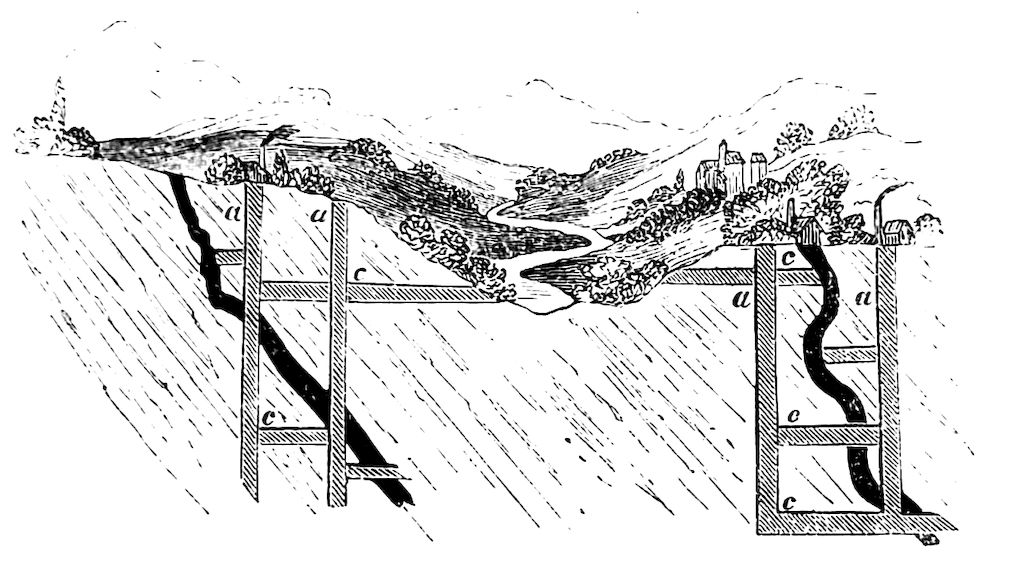
The diagram below represents an ideal section
of a mining district.
SECTION OF A MINING DISTRICT.
Here the metalliferous vein, we may suppose,
has cropped out on the surface of the ground,
or, as the miners say, has “come above grass.”
Let us now suppose that the position of this
vein of ore, copper, lead, or tin, has been
ascertained—that is, how it runs, whether from
north to south, or from east to west—and also
that the “captains” of the mining district
around have given their opinion as to the
extent and thickness of this underground vein.
The next thing is to obtain this mineral wealth.
42For this purpose shafts (a a a a) must be sunk,
which must reach the vein at a certain depth;
then will probably follow cross-cuts (c c c), called
adit levels (technically an “additt”), driven,
as may be seen, at the lowest convenient point
above the level of the highest water of the
valley; and these, in connexion with the shaft,
will serve the purpose of draining the mine and
carrying the ore above ground. It will also be
seen, by reference to the diagram, that the
shafts of a mine do not always correspond;
sometimes they are sunk vertically to meet the
vein, sometimes they are commenced in the
very outcrop itself. On this matter the best
geological lesson is a visit to Cornwall, where
the student will see that everything depends on
the locality of a mine, the nature of the slope
of the hill, or the character of the rock in which
the vein appears, and so on. “The act of
sinking a perpendicular shaft downwards to
a depth where it is calculated the lode should
be cut, may seem to require little further skill
than is necessary to determine correctly the
spot on the surface where the work is to
commence. But the process in this way is
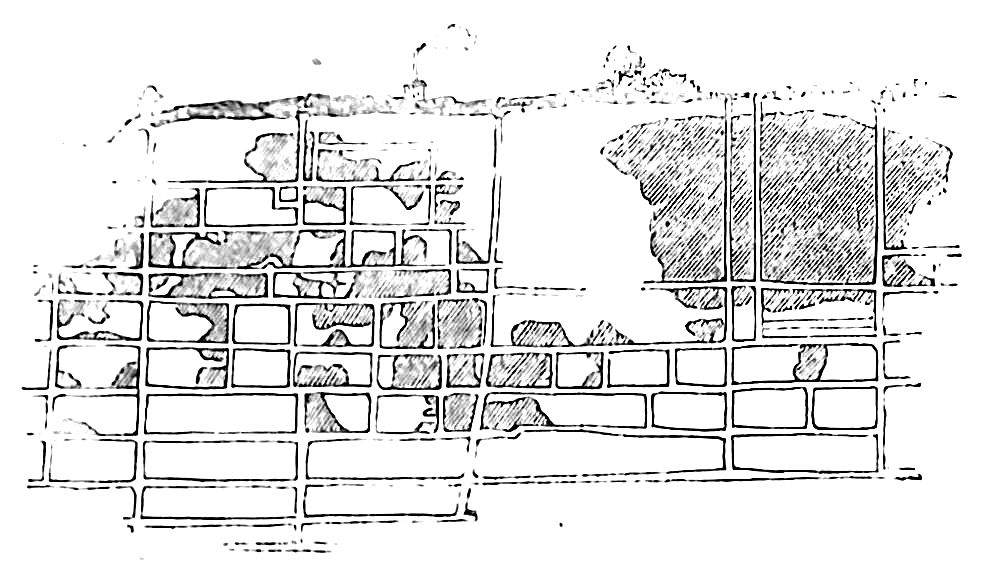
exceedingly tedious; and in a mine at work,
43where many galleries already existing are to be
traversed, much greater rapidity is desirable.
In such a case the shaft is sunk in several
pieces (see diagram below), or, in other words,
the sinking is commenced at the same time in
different levels; and no small skill is required
to lay out the work, so that the different
portions of the shaft thus formed may exactly
fit when they are joined together. An exceedingly
small error of measurement, in any
one of these various and dark subterranean
passages, would, in fact, be sufficient to throw
the whole into confusion; but such an accident
rarely happens, although works of the kind are
common in the Cornish mines.”[21] As an illustration
of the immense quantity of water in the
mines, we may add—and this is almost as
startling as any romantic fiction—that the
various branches of the principal level in Cornwall,
called “the Great Adit, which receives
the waters of the numerous mines in Gwennap,
and near Redruth, measure on the whole about
26,000 fathoms, or nearly thirty miles in length;
one branch only, at Cardrew mine, extends for
nearly five miles and a half, and penetrates
ground seventy fathoms beneath the surface.
The water flows into a valley communicating
with a small inlet of the sea, and is discharged
about forty feet above high-water mark.”[22] In
this method about forty millions of tons of
water are raised by steam-power out of the
mines in Cornwall.
EAST WHEAL CROFLY COPPER MINE, CORNWALL.
44Here, then, we have seen two of the economic
uses of geology in connexion with granite alone;
and as we think of these mineral treasures, requiring
only the labour and skill of man to
bring them out for his service and for the civilization
45of the world, our boast is in our native
land, which, though insular and small, combines
within itself everything needful to develop
its three sources of national wealth—mining,
manufactures, and agriculture—to their highest
point. Our boast is not the warrior’s boast,
which Shakspeare puts into the mouth of one
of his heroes—that this our isle is
“That pale, that white-faced shore,
Whose foot spurns back the ocean’s roaring tides,
And coops from other lands her islanders”—
but rather that, without impropriety or irreverence,
the words of Holy Writ may as legitimately
be applied to Great Britain as to
Palestine. It is a land wherein “thou shalt
eat bread without scarceness, thou shalt not
lack anything in it; a land whose stones are
iron, and out of whose hills thou mayest dig
brass.[23] When thou hast eaten and art full,
then thou shalt bless the Lord thy God for the
good land which He hath given thee.” (Deut.
viii. 9, 10.)
46But before we bring this chapter on granite
and its kindred rocks to a close, we must glance
at one more purpose served by this Plutonic
rock. Here is a teacup, and here is a piece of
granite: the one comes from Cornwall, the
other is made in Staffordshire or Worcestershire.
What relation have they to each other?
If it were not thought infra dig., we should say
the granite is the parent of the teacup. In
Cornwall, especially in the neighbourhood of
St. Austel, the writer has lately visited what
are called the China clay works. “The granite
is here in a state of partial decomposition. In
some localities, this growan” (Cornish for disintegrated
granite) “is tolerably firm, when it
resembles the Chinese Kaolin, and, quarried
under the name of China stone, is extensively
employed in the potteries. This is ready for
the market when cut into blocks of a size convenient
for transport; but the softer material,
which is dug out of pits, and called China clay,
or porcelain earth, requires a more elaborate
preparation for the purpose of separating the
quartz, schorl, or mica from the finer particles
of the decomposed feldspar. This clay is dug
up in stopes or layers, which resemble a flight
47of irregular stairs. A heap of it is then placed
upon an inclined platform, under a small fall of
water, and repeatedly stirred with a piggle and
shovel, by which means the whole is gradually
carried down by the water in a state of suspension.
The heavy and useless parts collect in a
trench below the platform; while the China clay,
carried forward through a series of catch-pits
or tanks, in which the grosser particles are
deposited, is ultimately accumulated in larger
pits, called ponds, from which the clear supernatant
water is from time to time withdrawn.
As soon as these ponds are filled with clay,
they are drained, and the porcelain earth is removed
to pans, in which it remains undisturbed
until sufficiently consolidated to be cut into
oblong masses. These are carried to a roofed
building, through which the air can freely pass,
and dried completely for the market. When
dry they are scraped perfectly clean, packed in
casks, and carried to one of the adjacent ports,
to be shipped for the potteries.”[24] As furnishing
some idea of the extent to which this
business is carried on, it may be added that
37,000 tons of this China clay are annually
48shipped from the south-west of England to the
potteries, the value of which is upwards of
£50,000, while the number of working men and
women thus employed is beyond calculation.
This is one of the practical results of geology.
This is one of the things which geology, once a
neglected and unpopular science, has done for our
comfort and welfare. “A hundred years ago,
it does not seem that any part of this China clay
was made use of, or that this important produce
was then of any value whatever.”[25]
We bring this chapter to a close. Granite and
its kindred rocks should stand associated with
an actual history and poetry, not inferior to
the history and poetry of man’s own handiwork;
and we believe geology, so often regarded
with dread by the uninitiated, will soon
be considered worthy a patient and painstaking
investigation. Remembering that geology is
still an incomplete science, and that we have
much yet to learn concerning the laws of organic
and inorganic matter, we should be modest in the
maintenance of any theory, while thankful for
the acquisition of any fact. “We have yet to
learn whether man’s past duration upon the earth—whether
49even that which is still destined to him—is
such, as to allow him to philosophise with
success on such matters; whether man, placed
for a few centuries on the earth as in a schoolroom,
has time to strip the wall of its coating
and count its stones, before his Parent removes
him to some other destination.”[26]
CHAPTER IV. THE PALÆOZOIC PERIOD.
50
“In His hand are the deep places of the earth.”—David.
Trench, in his charming little book on the
“Study of Words,” says of words that they are
“fossil poetry.” He adds, “Just as in some
fossil, curious and beautiful shapes of vegetable
or animal life, the graceful fern or finely vertebrated
lizard, such as now it may be, have been
extinct for many thousands of years, are permanently
bound up in the stone, and rescued
from that perishing which would otherwise have
been theirs; so in words are beautiful thoughts
and images, the imagination and the feeling of
past ages, of men long since in their graves, of
men whose very names have perished—these,
which would so easily have perished too, are
preserved and made safe for ever.”
Geology is the fossil poetry of the earth;
51such a poetry as those can never dream of who
in a pebble see a pebble and nothing more.
But to those who walk through this great and
beautiful world intent upon finding material for
thought and reflection, there is no “picking up
a pebble by the wayside without finding all
nature in connexion with it;” and the most
retired student, in search not simply of the
picturesque or of the beautiful, but of anything
and everything that can minister to his profounder
worship of Him to whom belongeth
both “the deep places of the earth and the
strength of the hills,” may say of his solitary
rambles:—
We now enter upon the ancient life, or Palæozoic
period of the earth’s history, and proceed to
examine the oldest forms of life, or the most
ancient organic remains found in the crust of
the earth. As we do not aim to teach geology
in this small work, but simply to place the chief
geological facts in such a light as to impart a
52taste for the science, the reader will not expect
any minute details, which are more likely to
perplex than to assist the beginner. Let the
reader dismiss from his mind all that he has
tried to remember about Upper and Lower
Silurian rocks, and the Upper and Lower
Ludlow rocks, the Caradoc sandstone and the
Llandilo flags, and so on; let us simply say that
one part of the crust of the earth, supposed to be
between 50,000 and 60,000 feet in thickness,[28]
is called the Silurian system, and constitutes a
large and interesting part of the Palæozoic
period. The term Silurian was given to this
part of the earth’s crust in consequence of these
rocks being found chiefly in Wales, Devon, and
Cornwall—parts of England once inhabited by
the Silures, who under Caractacus made so
noble a stand against the Romans.
In coming for the first time into contact
with the organic remains of pre-Adamite creations,
it may be well to entreat the student
to mark, as he goes on, the very different and
characteristic fossils of the several formations
through which we propose to travel. There will
be little or no difficulty in doing this, and its
53mastery will be of invaluable service in our after
researches. There is and there can be no royal
road to any kind of learning; all, therefore, that
we propose to do is to take a few of the big
stones, boulders, &c., that have needlessly been
allowed to make the road rougher than necessary,
out of the way, that thus our companion traveller
on this geologic route may feel that every
step of ground walked over is a real and solid
acquisition. In marking the characteristic fossils
of each formation, let us suggest, in passing, the
vast amount of pleasure there is in going to a
friend’s house, and looking at the minerals or
organic remains that may be in the cabinet or
on the mantel-shelf, and being able to take them
up one by one, and to say this is from the
Silurian; that is from the Carboniferous; this
is from the Cretaceous, and that from the
Wealden formations, and so on. Why, it gives
a magical feeling of delightful interest to every
object we see, and will always make a person a
welcome visitor with friends with whom, instead
of talking scandal, he can talk geology. Not long
since the writer had a very pleasing illustration
of this. He had been lecturing on geology in
a small agricultural village; there was a good
54sprinkling of smock-frocks among the hearers,
and he said at the close of one of the lectures,
“Now, very likely most of you have got some
stones, as you call them, at home on the chimneypiece;
perhaps you don’t know their names, or
what they were before they became stones;
well, bring them next week, and we will do our
best to name them for you!” Next week, after
the lecture, up came one, and then another, and
then a third, and so on; and diving their hands
down into the old orthodox agricultural pocket,
brought out a variety of specimens, some of
them very good indeed, which had been “picked
up” by them in the course of their labour, and
which, supposed to be “rather kūrŭss,” had been
carefully conveyed home. When these matters
were given a “local habitation and a name,”
the delight of many was most gratifying.
Now, all this is only just the application of
M. Cousin’s words in relation to physical geography:
“Give me the map of a country, its
configuration, its climate, its waters, its winds,
and all its physical geography; give me its
natural productions, its flora and fauna, and I
pledge myself to tell you à priori what the inhabitants
of that country will be, and what
55place that country will take in history, not accidentally,
but necessarily; not at a particular
epoch, but at all periods of time; in a word, the
thought that country is formed to represent.”
These remarks furnish us with a clue.
Each formation has its own peculiar and characteristic
fossils, and these fossils are arranged
with as much care, and preserved as uninjured,
as if they had been arranged for a first-class
museum. But before proceeding on this fossiliferous
tour, we may anticipate a question
that may possibly be asked on the threshold of
our inquiries, and into which we propose going
fully in the sequel of this volume. It may be
asked, “Were not these fossils placed in the rocks
by the Deluge?” To this, at present, we answer,
that so partial and limited was the character of
the Deluge, being confined to just so much of
the earth as was inhabited by man, and so brief
was its duration, compared with the vast geological
epochs we shall have to consider, that
we do not believe we have one single fossil that
can be referred to the Noachian deluge; and
before we close, we trust it will have been made
evident to every careful reader that fossils, as
records of Noah’s flood, are an impossibility;
56and that the vast antiquity of the globe, taken
into connexion with the prevalence of death on
a most extensive scale, ages and ages previous to
the creation of man, can alone account for our
innumerable treasures of the “deep places of the
earth.”
1
The characteristic fossils of the Silurian
system are entirely unique. The trilobite may
fairly be regarded as the prominent one; besides
which there are orthoceratites, and graptolites,
some members of the crinoidean family, with
different kinds of corallines, and some other
names to be rendered familiar only by future
further study. We
shall confine ourselves
to those that our own
recent researches have
made us familiar with.
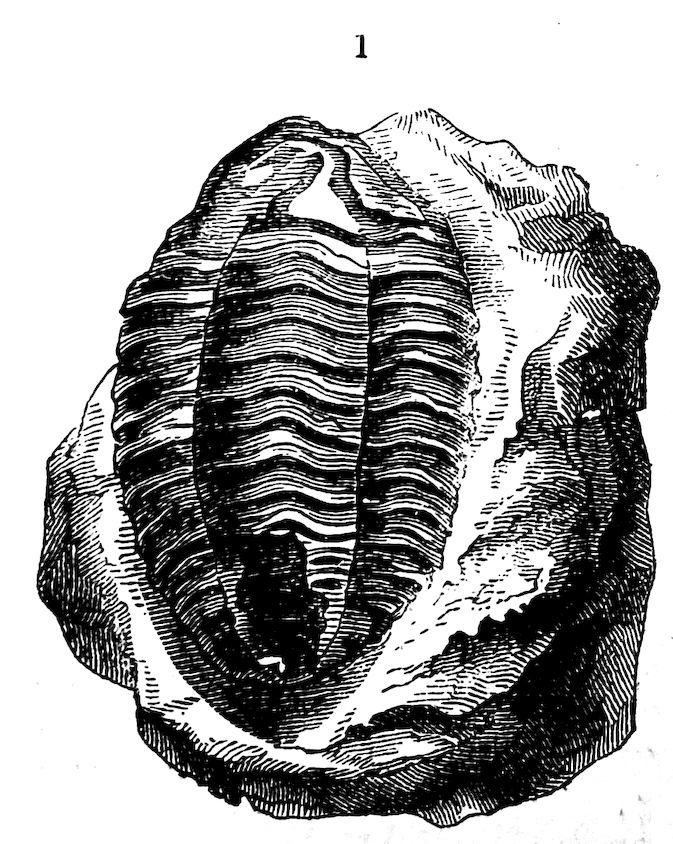
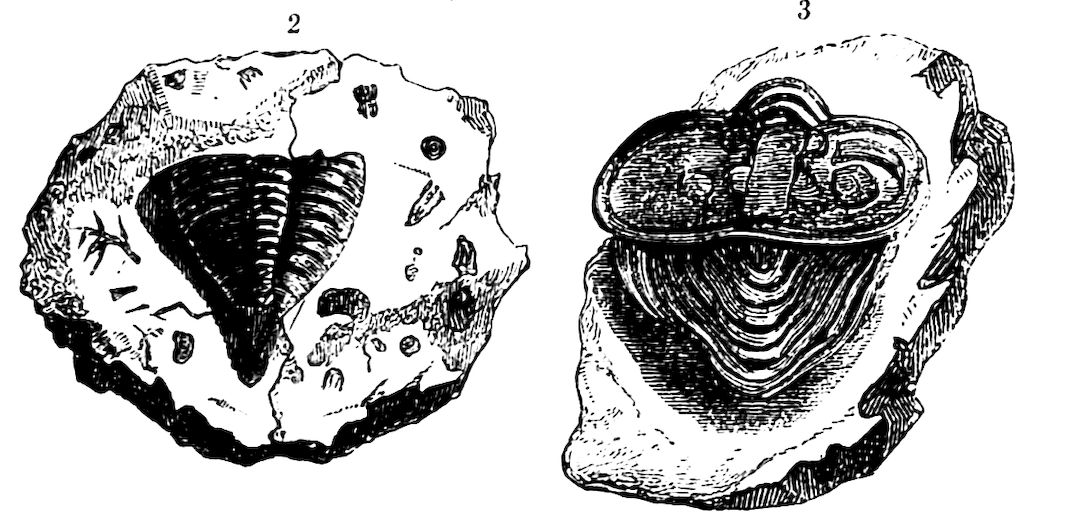
First, here is the trilobite.
We need not
perplex our readers by
any of the numerous
subdivisions of this
remarkable animal’s
nomenclature; that would defeat the purpose
of this book. Any work on geology will do
57this.[29] Here are three trilobites: one (1) by
itself; another, (2) imperfect in its bed or
matrix, and a third (3) rolled up.
This most remarkable crustacean possessed
the power of rolling itself up like the wood-louse
or the hedgehog; and, reasoning by analogy, we
suppose this to have been its defence against its
numerous enemies. It is a very abundant
fossil, found all over Europe, in some parts of
America, at the Cape of Good Hope, but never
in more recent strata than the Silurian. The
hinder part of the body is covered with a
crescent-like shield, composed of segments like
the joints of a lobster’s tail; and two furrows
divide it into three lobes, whence its name.[30]58Most remarkable are the eyes of this animal,
and it is the only specimen in the vestiges of
ancient creations in which the eye, that most
delicate organization, is preserved; and if, as
we believe, this little creature was living and
swimming about, now and then fighting with
some greater Cephalopodous mollusk, millions
and millions of years ago, then in this fact
we have the real fossil poetry of science, the
romance of an ancient world which geology
reveals to our delighted and astonished minds.
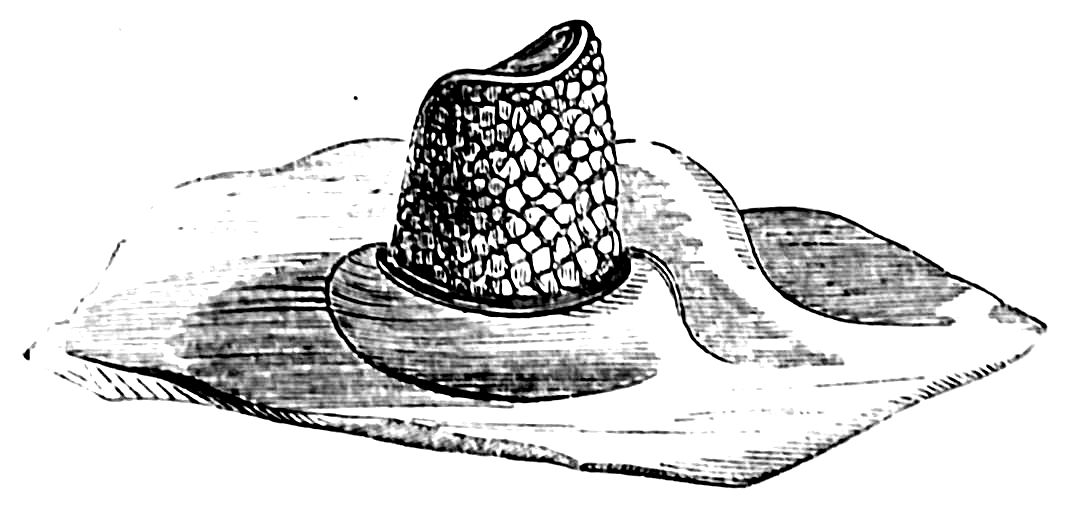
From Buckland’s Bridgewater Treatise we give
a drawing of the eyes of the trilobite; and in
Buckland’s words we add: “This point deserves
peculiar consideration, as it affords the
most ancient, and almost the only example yet
found in the fossil world, of the preservation of
parts so delicate as the visual organs of animals
that ceased to live many thousands, and perhaps
millions of years ago. We must regard these
organs with feelings of no ordinary kind, when
we recollect we have before us the identical
instruments of vision through which the light
of heaven was admitted to the sensorium of
some of the first created inhabitants of our
planet.”[31]
59But these are not the only fossils, or organic
remains, to be found in the clay, slates, &c., of
the Silurian system. Passing by those we have
briefly indicated above, there are others of a
highly interesting character, concerning some
of which we proceed to give a brief history.
Being in Cornwall a short time since, we
made a visit to Polperro, a romantic but
out-of-the-way town on the south-west coast,
for the purpose of procuring some remains of
fossil fish considered characteristic of the
Silurian system of Murchison, and which have
been recently discovered by Mr. Couch, an
eminent local naturalist, in the cliffs east and
west of that town. We did not see Mr. Couch,
but found our way to a coast-guardsman, also
a naturalist, whom we found to be a most
skilful bird and fish stuffer, and a ranger for
60objects of natural history among the surrounding
clay-slates and other rocks. William Loughrin’s
collection of Cornish curiosities will well
repay any traveller going out of the way twenty
or thirty miles, and they will find in him a fine
specimen of an intelligent and noble class of
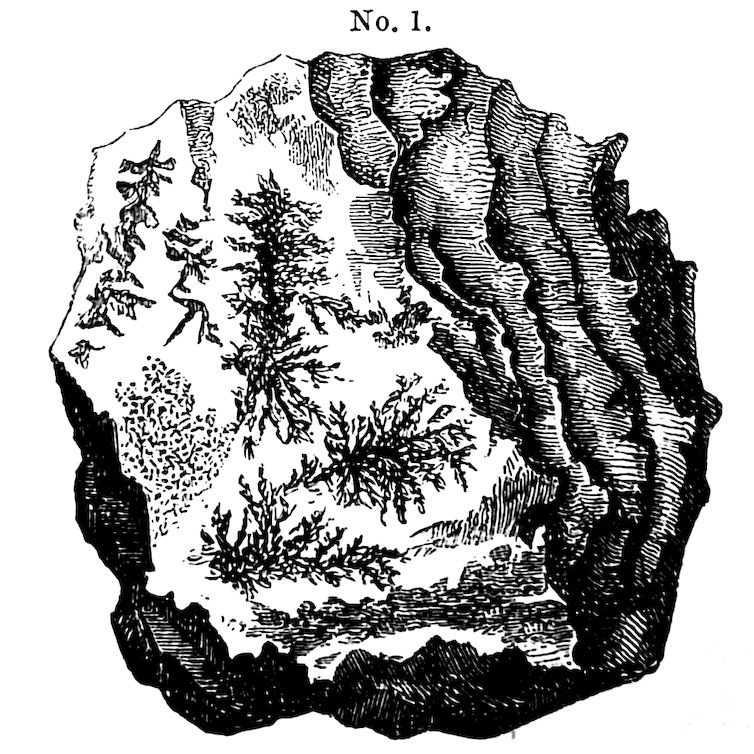
men. Below we give some specimens from the
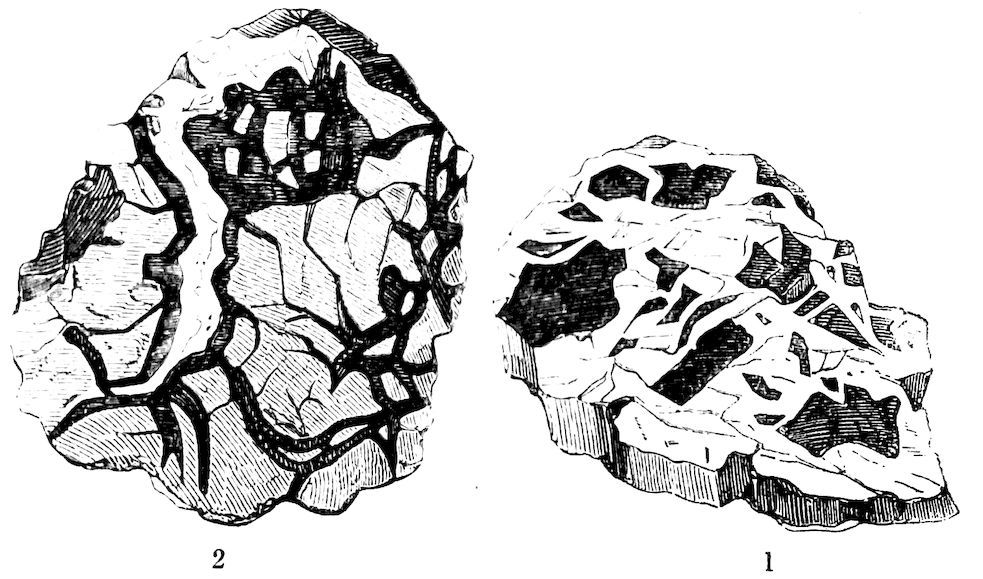
Polperro slate. No. 1 might be taken for impressions
of sea-weed, so remarkably does it resemble
the sea-weed thrown up on our beaches;
but it is generally conceded that this is merely a
crystallization of oxydized matter, such as may
often be found in connexion with manganese.
No. 1.
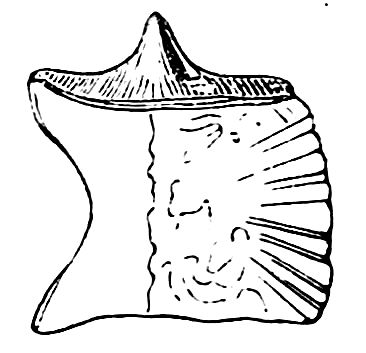
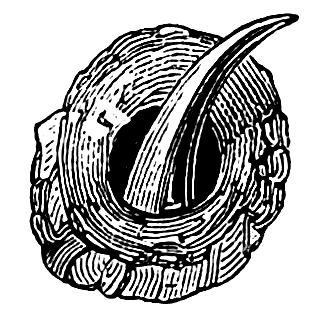
No. 2 is the Bellerophon,[32] a shell which we
61shall afterwards find in the mountain limestone,
but which is rare in connexion with the Silurian
rocks.
No. 2. Bellerophon, a shell which seems to have been abundant.
No. 3. Remains of Vegetable Texture.
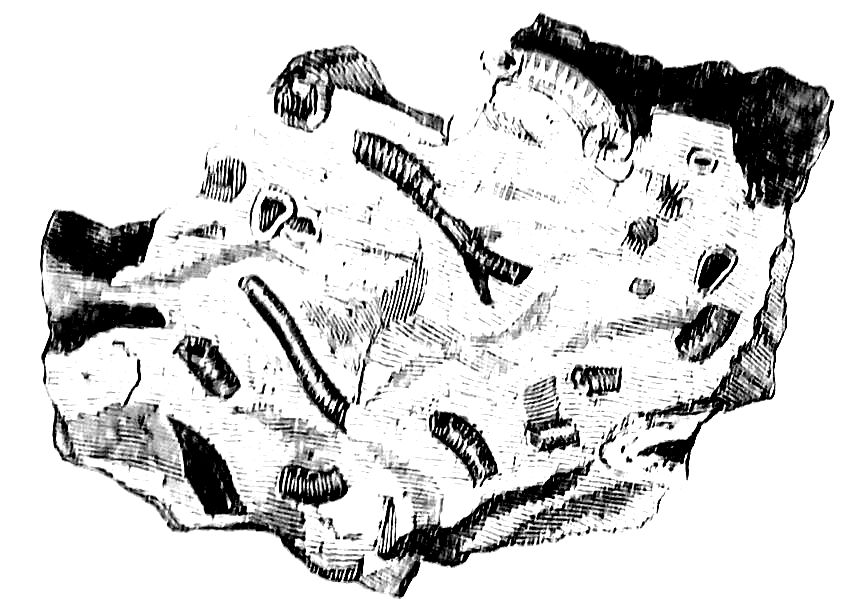
No. 3 we know not how to describe. We are not
certain what organic remains these are; so far as
we have been able to examine them, they appear
to us the remains of succulent vegetables, (?)
62probably the thick, soft stems of sea-weed, that
may once have reposed in quiescence on the
mud of which these slates are composed, and
afterwards have been crushed by the superposition
of mud and shale, until in the course
of ages, by upheaval and depression, they have
become a second time visitants of our atmosphere,
and now expose themselves to our study
and speculations.
No. 3. (Portion magnified two natural sizes.)
No. 4. Coralline. (Natural size.)
63Here is one more form of life of this ancient
period; it is evidently a coralline, which we
also procured at Polperro.
Let us suppose our readers to have made
themselves familiar with these organic remains,
simply as characteristic and illustrative of this
formation; they will easily find their way into
other traces and remnants of ancient life in the
Silurian epoch. How absurd must seem the
development hypothesis to those who rightly
ponder these old, old vestiges! It seems to us
a very idle idea to suppose that a trilobite
could develop itself into a bird, or a monkey, or
by any series of happy accidents, could become
a man;[33] yet such has been the theory of those
who overlook what some writer on geology,
whose name we forget, has expressed strongly
in these words: “There is no fact which has
been demonstrated more completely to the satisfaction
of every man of real science, than that
there is no known power in nature capable of
64creating a new species of animal, or of transmuting
one species into another.”
We close this chapter on the Silurian system
in the eloquent words of Professor Sedgwick:
“The elevation of the faunas of successive
periods was not made by transmutation, but
by creative additions, and it is by watching
these additions that we get some insight into
nature’s true historical progress. Judging by
our evidence—and what else have we to judge
by?—there was a time when Cephalopods were
the highest type of animal life. They were then
the Primates of this world, and, corresponding
to their office and position, some of them were
of noble structure and gigantic size. But these
creatures were degraded from their rank at the
head of Nature, and Fishes next took the
lead; and they did not rise up in nature in
some degenerate form, as if they were only the
transmuted progeny of the Cephalopods, but
they started into life in the very highest ichthyic
type ever reached.
“Following our history chronologically, Reptiles
next took the lead, and, with some evanescent
exceptions, they flourished during the
countless ages of the secondary period as the
65lords and despots of the world: and they had
an organic perfection corresponding to their
exalted rank in Nature’s kingdom; for their
highest orders were not merely great in strength
and stature, but were anatomically raised far
above any forms of the Reptile class now living
in the earth. This class, however, was in its
turn to lose its rank. Mammals were added
next (near the commencement of the tertiary
period), and seem to have been added suddenly.
Some of the early extinct forms of this class,
which we now know only by ransacking the
ancient catacombs of Nature, were powerful and
gigantic, and we believe well fitted for the place
they filled. But they in turn were to be
degraded from their place in Nature, and she
became what she now is by the addition of
man. By this last addition she became more
exalted than before. Man stands by himself,
the despotic lord of the living world; not so
great in organic strength as many of the despots
that went before him in Nature’s chronicle, but
raised far above them all by a higher development
of brain, by a framework that fits him for
the operations of mechanical skill, by superadded
reason, by a social instinct of combinations,
66by a prescience that leads him to act
prospectively, by a conscience that makes him
amenable to law, by conceptions that transcend
the narrow limits of his vision, by hopes that
have no full fruition here, by an inborn capacity
of rising from individual facts to the apprehension
of general laws, by a conception of a cause
for all the phenomena of sense, and lastly, by
a consequent belief in the God of nature:—such
is the history of nature.”[34]
LANDS END, CORNWALL.
CHAPTER V. THE OLD RED SANDSTONE.
67
“The fishes of the sea shall declare unto thee.”—Job.
Lord Bacon remarks, “Some men think that
the gratification of curiosity is the end of knowledge,
some the love of fame, some the pleasure
of dispute, and some the necessity of
supporting themselves by knowledge; but the
real use of all knowledge is this, that we should
dedicate that reason which was given us by
God to the use and advantage of man.” The
historian of the old red sandstone, Hugh Miller,
to whose researches not only we, but such men
as Murchison, Lyell, Ansted, Agassiz and others,
are so exclusively indebted, is a philosopher in
this last category. He does not hesitate to tell
us, how, as a Cromarty quarryman “twenty
years ago,” he commenced a “life of labour and
68restraint,” a “slim, loose-jointed boy, fond of
the pretty intangibilities of romance, and of
dreaming when broad awake;”[35] and how, as a
quarryman, he ever kept his eyes open, to observe
the results of every blow of the hammer,
stroke of the pick, or blast of the powder; and
finding himself in the midst of new and undreamt-of
relics of an old creation, preserved in
“tables of stone,” he adds his testimony to that
of the great father of inductive philosophy,
“that it cannot be too extensively known, that
nature is vast and knowledge limited, and that
no individual, however humble in place or acquirement,
need despair of adding to the general
fund.”[36]
We here enter upon a marvellous field of discovery.
Hitherto the forms of life we have
met with have all been invertebrate. The trilobite,
something between a crab and a beetle,
once revelling, in untold myriads, probably on
the land as well as in the water, and of which
two hundred and fifty species have been brought
to light, is the highest type of life with which
our researches have made us familiar. We are
69now to begin the study of fossil fish, and to
their discovery, strange forms, and characters,
this chapter will be specially devoted. It was
once a generally received opinion among even the
most learned geologists, that the “old red sandstone,”
or the “Devonian system,” was particularly
barren of fossils, but the labours (literally
such, “mente, manu, malleoque”[37]) of Hugh
Miller have proved the contrary. “The fossils,”
he says, “are remarkably numerous, and in
a state of high preservation. I have a hundred
solid proofs by which to establish the proof of
my assertion, within less than a yard of me.
Half my closet walls are covered with the peculiar
fossils of the lower old red sandstone; and
certainty a stranger assemblage of forms have
rarely been grouped together; creatures whose
very type is lost, fantastic and uncouth, and
which puzzle the naturalist to assign them even
their class; boat-like animals, furnished with
oars and a rudder; fish plated over like the
tortoise, above and below, with a strong armour
of bone, and furnished with but one solitary
rudder-like fin; other fish less equivocal in their
form, but with the membranes of their fins
70thickly covered with scales; creatures bristling
over with thorns, others glistening in an enamelled
coat, as if beautifully japanned, the tail
in every instance among the less equivocal
shapes, formed not equally as in existing fish,
on each side the central vertebral column, but
chiefly on the lower side, the column sending
out its diminished vertebræ to the extreme termination
of the fin. All the forms testify of a
remote antiquity—of a period whose fashions
have passed away.”[38]
The old red sandstone formation prevails in
the north of Scotland, Herefordshire, north of
Devonshire, part of Cornwall, and in Worcestershire
and Shropshire. Our attention will be
principally confined to Cromarty, whose romantic
bay and high hills have long arrested the admiring
gaze of the traveller. This was the
scene of Hugh Miller’s labours and discoveries;
this the great library in which he read the history
of pre-Adamite ichthyolites[39] exposed not
only to the light of day, but for the first time
to the inspection of human eyes, by the sweat-of-brow
71toil of one of Scotland’s noble sons.
Before we get into the hard names that must
be connected with this chapter, let us hear
Mr. Miller describe this library of God’s books
that was so long his wonder and his study
in Cromartyshire. “The quarry in which I
wrought lay on the southern shore of a noble
inland bay, or frith rather, with a little clear
stream on the one side, and a thick fir-wood
on the other. Not the united labours of a
thousand men for a thousand years could have
furnished a better section of the geology of this
district than this range of cliffs; it may be
regarded as a sort of chance dissection on the
earth’s crust. We see in one place the primary
rock, with its veins of granite and quartz,
its dizzy precipices of gneiss, its huge masses of
horneblend; we find the secondary rock in another,
with its beds of sandstone and shale, its
spars, its clays, and its nodular limestones.
We discover the still little known, but very
interesting fossils of the old red sandstone in
one deposition; we find the beautifully preserved
shell and lignites of the lias in another. There
are the remains of two several creations at once
before us. The shore, too, is heaped with rolled
72fragments of almost every variety of rock,—basalts,
ironstones, hyperstenes, porphyries, bituminous
shales, and micaceous schists. In short,
the young geologist, had he all Europe before
him, could hardly choose for himself a better
field. I had, however, no one to tell me so at
the time, for geology had not yet travelled so
far north; and so, without guide or vocabulary,
I had to grope my way as best I might, and find
out all its wonders for myself. But so slow
was the process, and so much was I a seeker
in the dark, that the facts contained in these
few sentiments were the patient gatherings of
years.”[40]
Now with regard to the hard names to
which we have just made allusion—names that,
apart from their etymology, which is nothing
more than “sending vagrant words back to
their parish,” are enough to startle any one;
names such as heterocercal, homocercal, cephalaspis,
pterichthys, coccosteus, osteolepis, &c.
&c.—why, they will all presently become plain,
and, we hope, familiar to our readers. “They
are,” says Hugh Miller, “like all names in
science, unfamiliar in their aspect to mere
73English readers, just because they are names
not for England alone, but for England and the
world. I am assured, however, that they are
all composed of very good Greek, and picturesquely
descriptive of some peculiarity in the
fossils they designate.”[41]
The rest of this chapter will be occupied
with an account of the four most remarkable
and characteristic fishes of this formation, to
understand which a few preliminary remarks
are necessary. Cuvier divided all fish into two
groups, the bony and the cartilaginous; and
these two groups he subdivided into two divisions,
characterised by differences in their fins,
or organs of locomotion, one of which he called
Acanthopterygian,[42] (thorny-finned,) and the
other, Malacopterygian,[43] (or soft-finned.) This
concise arrangement did not, however, meet all
the wants of the fish-students, and it was often
practically difficult to know under which class
to arrange particular specimens. More recently
M. Agassiz has arranged fish, not according to
their fins, but according to their scales; and simple
74as this classification may seem, it is one of the
greatest triumphs of genius in modern times,
inasmuch as all fishes extinct and existing, that
have inhabited or are inhabiting the “waters
under the earth,” may be grouped easily under
the following four divisions:—
One more preliminary remark, and we will
proceed to look at the four fishes already alluded
to. Neither the teacher nor the student of any
science can skip definitions, axioms, postulates,
75and so on; they must just be mastered, and
their mastery is a real pleasure. In addition
to a marked difference in the fins, a difference
was observed also in the tails of fossil
(extinct) and living pieces of fish. This difference
between the tails of fish has been happily
described in two words, heterocercal and homocercal,
of which the figures below will give a
better idea than a lengthened description.
1. Heterocercal.
2. Homocercal.
3. Homocercal.
The heterocercal fish, it will be seen, are unequally
lobed, that is, the spinal vertebræ are
prolonged into the upper lobe of the tail, as
seen in the shark, and of which our own
dog-fish is an example; while the homocercal
76fish are equally lobed, and the spine does not
extend into either.
The fossil fish of the old red sandstone belong
almost, if not entirely, to the classes of fish
that have ganoid or placoid scales, and heterocercal
tails; and of these fish we will now say
a few words of the four most remarkable specimens
of the one thousand and upwards fossil
species that have been discovered, and which
can only be known familiarly by accomplished
geologists in the ichthyolite department.
1. Here is a drawing of the
Cephalaspis,[48] or buckler-headed
fish. What an extraordinary
looking creature this is! Like
the crescent shape of a saddler’s
knife without the handle—broad
and flat, with points on each
side running down, ever fixed
in warlike attitude against its
enemies—it reminds one of an
extinct trilobite, and of a living
sole or ray, at the same time;
and one can easily fancy how hard it must have
been for its ancient foes to swallow down so
77singular and so knife-like looking a creature.
This is one of the curious organisms of old life
discovered in Cromarty, Herefordshire, and in
Russia, the original of which, restored in the
drawing, seldom if ever exceeded seven inches.
Let us look now at another curiosity from the
same quarter.
2. Here is a drawing of the Coccosteus,[49]
or berry-boned fish. This
creature is equally singular with his
long extinct neighbour. Hugh Miller’s
description is the best, and as
he was its discoverer, let us give it.
“The figure of the Coccosteus I
would compare to a boy’s kite;
there is a rounded head, a triangular
body, a long tail attached to the
apex of the triangle, and arms thin
and rounded where they attach to
the body, and spreading out towards their termination,
like the ancient one-sided shovel
which we see sculptured on old tombstones,
or the rudder of an ancient galley. A ring of
plates, like the ring-stones of an arch, runs
along what we may call the hoop of the kite.
78The form of the key-stone plate is perfect; the
shapes of the others are elegantly varied, as if
for ornament; and what would be otherwise the
opening of the arch is filled up with one large
plate of an outline singularly elegant.”[50]
3. Above is the Pterichthys,[51] or winged
fish. We have here a fish more strikingly
different to any existing species than either
of the other two just passed under review.
“Imagine,” says Miller, “the figure of a man
rudely drawn in black on a grey ground; the
head cut off by the shoulders; the arms spread
79at full, as in the attitude of swimming; the body
rather long than otherwise, and narrowing from
the chest downwards; one of the legs cut away
at the hip-joint; the other, as if to preserve
the balance, placed directly in the centre of the
figure, which it seems to support. Such, at the
first glance, is the appearance of the fossil.”[52]
We will now turn to the fourth and last of
the singular fishes of this formation.
4. The Osteolepis,[53] or bony scaled fish.
Here we have in the old red sandstone the first
perfect specimen of a fish with pectoral, abdominal,
and caudal fins, ending as the others do
in the heterocercal tail. The vertebral column
seems to have run on to well-nigh the extremity
of the caudal fin, which we find developed
chiefly on the under side. The tail was a one-sided
tail. Take into account with these peculiarities
80such as the naked skull,
jaws, and operculum,[54] the naked and thickly
set rays, and the unequally lobed condition of
tail, a body covered with scales that glitter like
sheets of mica, and assume, according to their
position, the parallelogramical, rhomboidal, angular,
or polygonal form, a lateral line raised,
not depressed, a raised bar on the inner or
bony side of the scales, which, like the doubled up
end of a tile, seems to have served the purpose
of fastening them in their places, a general
clustering of alternate fins towards the tail—and
the tout ensemble must surely impart to the
reader the idea of a very singular little fish.[55]
Most hasty and superficial is this glance
through the wonders of the old red sandstone.
On the economic uses of this formation, as tile-stones
and paving-stones, we need not dwell;
apart from this, these singular inhabitants of
the seas of past ages, the mud of which, elevated
and hardened, has become solid rock, tell
us stories of that long since ancient time to
which no poetry could do justice. Carried away
from the present into those remote eras, our
81minds revel in the realization of scenery and
inhabitants, of which now we possess only the
fossil pictures. At the British Museum, we
gaze with feelings approaching to repulsion
on the stiff and unnatural forms of Egyptian
mummies, but with what feelings of profound
wonder do we look on these small fishes, so
numerous that the relics of them, found in the
Orkneys, may be carried away by cartloads!
No number of creations can exhaust God, for
in Him all fulness dwelleth. The God in whom
we now live, and move, and have our being, is
the same God who gave to these pre-Adamite
fish their marvellous structures, minutely but
fearfully and wonderfully made, and who, when
their joy of life and functions of life had ceased,
consigned them to a calm and peaceful grave.
He is the same God who now upholds all things
by the word of his power, and whom we desire
to honour by the attentive and reverent perusal
of his manifold works. We are tautologists;
we say and do the same thing over and over
again. God never repeats himself: each successive
creation—and how many, extending
through countless ages, does geology disclose!—only
reveals some new aspect of wisdom, love,
82and beneficence. To the mind that cannot
repose in God, we say, Study God, in his
works and in his word; yea, come back to this
remote sandstone era and ask of the “fishes, and
they shall declare unto thee” the might and
majesty, the skill and contrivance of the Almighty;
and though you and I were not there,
nor had Adam yet trod this blessed earth,—
“Think not, though men were none,
That heaven could want spectators, God want praise;
Millions of spiritual creatures walked the earth,
And these with ceaseless praise His works beheld.”
CHAPTER VI. THE CARBONIFEROUS SYSTEM.
83
“As for the earth, out of it cometh bread, and under it is turned up as it were fire.”—Job.
Suppose this lump of coal could speak, what
would it say? Would it not say something
like this: “To get me up out of the earth
involves dirt, danger, slush, and much tallow-candle;
but now you have me, let me tell you
my story, for though black I am comely, and
but for me—but I anticipate. Now and then
I make a dust in your libraries, and inadvertently
shoot out sparks and firestones, but
nevertheless I am of more use to man than the
old granite or the proudest Parian marble; you
may get a long way in philosophy, but you will
never get beyond coal. I am the real Koh-i-noor
of the British empire; and though I can’t,
like my namesake, put on a white dress, I am
84nevertheless worth the soiling of your whitest
gloves. Chemistry makes no discoveries without
me: I light the fire of the laboratory, and
furnish man with the means of every crucial
test. Civilization wants me every day on land
and sea, and though in one sense my labours
end in smoke, in another they end in commerce,
progress, national brotherhood, and interchanging
productions of every clime. The poor student
needs me, for I light his lamp, warm his feet,
and cook his food while he is doing sweat-of-brain
work for others. And best of all, the poor
man is a rich man when he has me; he knows
that next of kin to good food is good fuel, and
man by my help is making such progress, that
the day will come when every man will sit by
his own blazing fire, instead of seeking joy elsewhere
amidst false and pernicious excitements.”
Something like this our friend Coal would be
sure to say; and that Coal may not complain of
any aloofness on our parts, let us proceed to an
examination of the carboniferous system.
“’Tis very pregnant,
The jewel that we find, we stoop and take it,
Because we see it; but what we do not see,
We tread upon, and never think of it.”
Measure for Measure.
85The carboniferous system is not all coal;
underlying, and often overlying, the coal
measures, for the most part, is the mountain
limestone, a formation pre-eminently rich in
marine fossils. During the tremendous convulsions
experienced by the earth immediately after
the deposition of the old red sandstone, a vast
sea of lime, thick, muddy, and hot, seems to
have been poured out over a large portion of
the British islands and elsewhere. This flow
of liquid lime covered and encased many then
existing animals, and we now find it full of
fossils of the crinoidean family, a few molluscs,
and traces of fish. We shall not, however, stay
to examine these now, as we shall meet with
them again in the Oolite; our attention will be
limited to that part of the carboniferous system
which includes only the coal measures, properly
so called.
Coal is a vegetable that, by chemical change
and by mechanical pressure, has become a bituminous
mineral; and this will render it needful
to say a word or two on the ancient vegetable
kingdom. The vast quantities[56] of remains of
86leaves, ferns, and stems of trees, found in the
coal measures, are not in themselves evidence
sufficient of the vegetable origin of coal; we
arrive at that conclusion in consequence of the
researches of modern philosophers, who having
applied the powers of the microscope to the
internal structure of coal, have discovered the
cellular and reticular construction of vegetable
life beautifully preserved, and thus previous
convictions have become certainties. The examination
of the ancient vegetable kingdom is,
however, attended with much difficulty, in consequence
of the total destruction in most cases of
the stems and trunks of the plants, and the entire
absence, in consequence of pressure, of all fructification
on the fronds of the ferns. If we take
an existing species of fern, say the rare and
delicate “maiden-hair fern,”[57] one of the smallest
and most elegant ferns of England, we find the
fructification very distinct on the under side,
and the different methods in which this fructification
is arranged is now the principal guide in
the classification of ferns. But if we take a
fossil fern, say the pecopteris, found in the coal
measures, we shall see that there has been so
87much dislocation and crushing, that all appearance
of seed-vessels has disappeared. The following
sketch will explain this.
EXTINCT FERN, AND MAIDEN-HAIR FERN.
“Nothing,” says Professor Ansted, “however,
is more certain than that all coal was
once vegetable; for in most cases the woody
structure may be detected under the microscope,
and this, if not in the coal in its ordinary state,
at least in the burnt ashes which remain after
it has been exposed to the action of heat, and
has lost its bituminous and semi-crystalline
character. This has been too well and too
frequently proved by actual experiment to
88require more than the mere statement of the
fact.” And here let us say a few words,
which to a few perhaps may have the charm of
novelty, about the economic history of coal;
for as Cowper says that the first curse,
“labour,” has, by God’s blessing on it, been
“softened into mercy,” so do we add also, in
his words, heartily subscribing to their truth,—
“Thus studied, used, and consecrated thus,
On earth what is, seems formed indeed for us;
Not as the plaything of a froward child,
Fretful unless diverted and beguiled;
But as scale, by which the soul ascends
From mighty means to more important ends;
Securely, though by steps but rarely trod,
Mounts from inferior beings up to God;
And sees, by no fallacious light or dim,
Earth made for man, and man himself for Him.”
How long coal has been known and used, we
cannot certainly tell, but a writer in Lardner’s
Cabinet Cyclopædia states that the first mention
of coal is in the pages of one Theophrastus,
who was, it seems, a pupil of Aristotle. He
says, “Those fossil substances that are called
coals,” (Greek, ἄνθραξ) “and are broken for
use, are earthy; they kindle, however, and burn
like wood coals; they are found in Liguria and
in the way to Olympias over the mountains,
89and are used by the smiths.” Cæsar, although
he speaks of the metals of the British isles, does
not once mention its coal; but it seems more
than likely that it was both known and used
by the Romans during their occupation of
Britain. Horsley, in his “Britannia Romana,”
says of Benwell, a village near Newcastle-on-Tyne,
“There was a coalry not far from this
place, which is judged by those who are best
skilled in such affairs to have been wrought by
the Romans; and, in digging up the foundations
of one of the Roman walled cities, coal cinders
very large were dug up, which glowed in the
fire like other coal cinders, and were not to be
known from them when taken up.”
During the time of the Saxons, we find ourselves
on less doubtful ground. In a grant
made to the monks of Peterborough Abbey for
one night’s annual entertainment, those good
old souls had, we find, “ten vessels of Welsh
ale, two vessels of common ale, sixty cartloads
of wood, and twelve cartloads of fossil coal,”
(carbonum fossilium.)
The Danes had so much fighting on hand,
that they troubled themselves neither with coal
nor civilization; and we know little of our
90English diamond until we come to Henry the
Third’s reign, when, in 1239, a charter was
granted to the inhabitants of Newcastle-on-Tyne
to dig coals, and we find the coal called for the
first time “carbo maris,” or sea-coal, a term
retained through all the succeeding centuries.
About this time chimneys came into fashion.
As long as people burnt wood they scarcely
needed chimneys, but coal introduced chimneys,
to say nothing of steamboats and railroads.
The Archbishop of Canterbury, who at that
time used to reside alternately at Croydon and
at Lambeth, had by royal permission thirty cartloads
of “sea-borne coal” annually delivered at
his archiepiscopal palace, because, says the
historian, “for his own private use in his own
chamber he now had the convenience of
chimneys.”
The smoke nuisance of that day deserves a
passing notice. Smoke was then with many a
grand luxury. Old Hollingshed says, “Now
we have many chimneys, yet our tenderlings do
complain of rheums, and catarrhs, and poses.
Once we had nought but rere-doses,[58] and our
91heads did never ake. For the smoke of those
days was a good hardening for the house, and
a far better medicine to keep the good man and
his family from the quack or the pose, with
which then very few were acquainted. There
are old men yet dwelling in the village where I
remain, who have noted how the multitude
of chimneys do increase, whereas in their young
days, there was not above two or three, if so
many, in some uplandish towns of the realm,
and peradventure in the manor places of some
great lords; but each one made his fire against
a rere-dose in the hall, where he dined and
dressed his meat. But when our houses were
built of willow, then we had oaken men; but
now that our houses are made of oak, our men
are not only become willow, but a great many
altogether men of straw, which is a sore
alteration.”
Leaving this digression, let us try and get
a bird’s-eye view of the coal-fields of the
British Isles. If we commence in Devonshire,
we find there the Devonian culms, or Bovey
Tracey coal, lying near the surface of the
ground, and of little except local use. Crossing
over the Bristol Channel, we come into
92Pembrokeshire, to the Welsh basin, remarkable
because thence we mostly get our anthracite
coal. Thence we pass on to the Derbyshire
coal-fields, that go with little interruption into
Scotland, averaging 200 miles in length, and
about 40 in width,—once mighty tropical
swamps, jungles, and forests, now become chief
minerals of commerce. Included in this last
immense field is the great Newcastle coal district,
the most celebrated of any, supplying
almost all the south of England, and nearly all
London, with their best coals; and the Scotch
carboniferous system, celebrated for its numerous
fossils, and for its general base of old
red sandstone. In addition to which there is
the Irish carboniferous system, occupying as
much as 1,000 square miles, but of an inferior
quality, and not likely to be of any great
economical importance.
In the words of Professor Ansted, we add:
“This account of the coal-beds gives a very
imperfect notion of the quantity of vegetable
matter required to form them; and, on the other
hand, the rate of increase of vegetables, and
the quantity annually brought down by some
great rivers both of the eastern and western
93continents, is beyond all measure greater than
is the case in our drier and colder climates.
Certain kinds of trees which contributed
largely to the formation of the coal, seem to
have been almost entirely succulent,[59] and
capable of being squeezed into a small compass
during partial decomposition. This squeezing
process must have been conducted on a grand
scale, and each bed in succession was probably
soon covered up by muddy and sandy accumulations,
now alternating with the coal in the
form of shale and gritstone. Sometimes the
trunks of trees caught in the mud would be
retained in a slanting or nearly vertical position,
while the sands were accumulating around
them; sometimes the whole would be quietly
buried, and soon cease to exhibit any external
marks of vegetable origin.”[60]
There are various kinds of coal on which we
may bestow a few words. There is anthracite,
or non-bituminous coal, and which, therefore,
burns without flame or smoke, and is extensively
used in malting; and sea-coal, which is
highly bituminous, and which gives forth so
94much flame and smoke, that in the good old
times of 1306, Parliament forbad its use in
London by fine and by demolition of all furnaces
in which it was burnt, because “this coal did
corrupt the air with its great smoke and stink;”
and cannel-coal, the etymology of which, they
say, is firm the word candle, because in many
parts of Lancashire the poor use it in place of
oil or tallow for lights; and jet, sometimes
called black amber, which in France employs
about 1,200 men in one district, in making earrings,
rosaries, and other ornaments; and last
of all, there is wood passing into coal called
lignite, found only in the Devonshire culms.
Having thus glanced at the natural history
and varieties of coal, we may here try and
realize the flora of the carboniferous era. An
examination of the fossils of this period enables
us to come to undoubted conclusions concerning
the trees and plants of that era, so that it is no
mere dream to look upon a picture like the
following, and see in it a landscape of the coal-forming
time of the British islands.
95
FLORA OF THE COAL MEASURES RESTORED.
96The sun then poured down his golden beams
of heat and light, and a tropical climate prevailed
in our now cold and humid England.
The mountain tops were gilded with his rays;
a vast ocean studded with islands, and these
crowned with gigantic palms and ferns, then
covered our northern hemisphere. In that ocean
but few fish were to be found, though many
rare molluscous animals swam to and fro,
enjoying their brief term of life, and discharging
all their appropriate functions. Mountain
streams discharged their muddy waters into
this ocean, leaving along their margin course
broken trees, vegetables, grasses and ferns. The
giant Lepidodendron looked like a monarch
of the ancient world, while around him smaller
ferns, vying with each other in beauty and
grace, grew, “first the blade” and then the
ripened frond, until, in obedience to the great
law of organic life, they died and decayed, and
became material for the coming man’s future
use. But amidst all this prodigal luxuriousness
of the vegetable world, there appears to have
been neither bird nor beast to break the monotony
of the scene; all was silent as the grave—rank,
moist verdure below; magnificent ferns
and palms above, and the stillness of death on
every side.[61]
97
98
Let us, however, glance at the principal ferns,
whose fossil remains we have often found at the
mouth of many a coalpit thrown out among the
waste. The uncouth names given to them, uncouth
only in appearance, must not deter the reader
from his acquaintance with their peculiarities; for
are not the names of botanical science almost, if
not quite, as repellent at first? This star-shaped
beauty, (1) the asterophyllite, (from aster, a
star, and phyllon, a leaf,) was a common one;
99this (2) is the sphenopteris (from sphēn, a wedge,
and pteron, a wing), so named from a fancied
resemblance of the petals of the frond to a
wedge; the next (3) is the pecopteris (from pekos,
a comb, and pteron, a wing), from a resemblance
of the frond to the teeth of a comb; the next (4)
is the odontopteris (from odous, a tooth, and
pteron, a wing), and in this the frond is something
like the jaws of a shark bound together
by a central stem, from which they diverge;
and the last (5), our favourite, is the neuropteris
(from neuros, a nerve, and pteron, a wing), on
account of the exquisite beauty with which the
fibres, like nerves, distribute themselves.
“Besides the ferns, then growing to a great
size, there were other plants whose modern
representatives are uniformly small; but as
the resemblance in this case is simply one of
general form, and the great majority of other
trees seem to possess no living type to which
they can be referred, it is by no means impossible
that these also may be completely lost. One
example of them is seen in a plant, fragments
of which are extremely common in the coal
measures, and which has been called calamite.[62]100The remains of calamites consist of jointed
fragments, which were originally cylindrical,
but are now almost always crushed and flattened.
They resemble very closely in general appearance
the common jointed reed, growing in marshes,
and called equisetum, or mare’s tail; but instead
of being confined to a small size, they would
seem to have formed trees, having a stem more
than a foot in diameter, and jointed branches
and leaves of similar gigantic proportions. They
were evidently soft and succulent, and very
easily crushed. They seem to have grown in
great multitudes near the place where the coal
is now accumulated; and though often broken,
they seldom bear marks of having being
transported from a distance.”[63] The fossils
of the carboniferous system here figured we
found not long since in the neighbourhood of
Stockport.
CALAMITES.
CALAMITE.
101
STIGMARIA FICOIDES.
This chapter on the carboniferous system
must not be further lengthened. We do not
aspire to teach the science of geology; we aim
only to impart such a taste for it as shall lead
the reader to consult our master works on this
subject, and if we succeed in this humble but
useful aim, our purpose will be fully answered.
Only in reference to the economic uses of coal, we
will quote the following, copied, we believe, from
102the “Athenæum” some time since, but unfortunately
copied without reference to its original;
a lesson for common-place-book keepers. The
writer in speaking of coal-gas says: “The consumption
of gas is enormous. The following
statistics give us an insight into the extent
which this branch of industry has attained. In
England 6,000,000 tons of coals are annually
employed for the manufacture of gas, and from
12,000,000 to 15,000,000 pounds sterling expended
in its production. In London alone
500,000 tons of coals are annually used, producing
4,500,000,000 cubic feet of gas, and
500,000 chaldrons of coke; of the latter, 125,000
chaldrons are consumed in manufacturing the
gas, and the remainder sold for fuel. Upwards of
half-a-million houses in London burn gas, and the
length of the main arteries for conveying it is
1,600 miles. The capital employed in the metropolis
is 4,000,000l. The manufacture of coal-gas
for the purpose of illumination affords one of the
most striking instances of the triumphs of science
when enlisted in the divine cause of civilization.
Looking at it as a whole, and regarding the
ingenuity evinced in the construction of apparatus,
the chemical skill and beauty displayed
103in the process, and the very valuable purposes
to which it is applied, it forms one of the most
beautiful, curious, and useful of our manufactures;
and probably there is no subject of a
manufacturing character in the present day
which more engages public attention, coal-gas
having now become not a mere luxury, or even
convenience, but an absolute necessary. In the
words of my late colleague and friend, Dr.
Hofmann, ‘The extent to which the use of gas
has affected the arts and manufactures in this
country, can only be conceived by those who are
aware of its innumerable applications in the
double capacity of giving light and heat. To
our experimental chemists the benefits afforded
by gas cannot be overrated, more especially in
England, where the price of spirits of wine is so
exorbitant. But for the use of gas in the laboratory,
the progress of chemistry in this country
must have been greatly retarded.’
“In speaking of the general influence of the
manufacture of coal-gas, it is impossible to leave
unnoticed the number of hands daily engaged
in raising whole strata of coal, in loading and
navigating the fleets employed in conveying it,
not only to the different parts of this kingdom,
104but to foreign countries, which consume a larger
quantity of English coal for the production
than is generally known. The extension of
the gas enterprise produced a sensible effect
on the ironworks, by the vast number of
retorts, the stupendous gas-holders, and endless
pipes required for generating, storing, and conveying
it.
“Several other branches of trade were also
forced into increased activity, and even new
trades sprung up in consequence of the extended
use of gas. The substances produced in the
purification of gas naturally attracted the attention
of the gas manufacturer; and chemistry
soon pointed out valuable purposes to which
they might be applied. The oily matter, which
separates as a secondary product in the distillation
of coal, yielded, when purified in its
more volatile portion, the most convenient
solvent for caoutchouc; another part of it
was found to be an efficient preservative
of timber, and the pitchy residue formed the
chief ingredient of an excellent substitute for the
flag stones of our pavements; while the ammoniacal
liquors were found useful in improving
the fertility of land. Thus, after the lapse of
105countless ages, was the nitrogen of petrified fern
forests resuscitated in the ammoniacal liquors
of the gas-works, to vegetate once more and
increase the produce of our corn fields.”
SIR HUMPHREY DAVY’S LAMP, AND MINER AT WORK.
“All nature feels the secret power,
And through eternal change obeys
Up from the deepest region creeps
The trace of life of former days.”
Faust.
CHAPTER VII. SECONDARY FORMATIONS. No. 1. The New Red Sandstone.
106
“There is a path which no fowl knoweth, and which the vulture’s eye hath not seen; the lions’ whelps have not trodden it, nor the fierce lion passed by it.”—Job.
We now take our leave of the Palæozoic
period, and enter upon the investigation of other
and more recent geological epochs in the history
of the crust of our planet. This division is
known by the names Secondary or Mesozoic,[64]
and is inclusive of the New Red Sandstone,
Oolitic, Wealden, and Cretaceous groups. If,
in our previous survey, we have had our minds
filled with wonder as we looked at the disinterred
relics of past creations, and have gazed at these
fossil forms of ancient life with almost a loving
interest in their still remaining beauty; so, as
107we now study higher types of life, and behold
how “other wonders rise, and seize the soul
the prisoner of amaze,” we shall find reason
upon reason for the penetration of our minds
with the profoundest adoration of Deity. No
man turning up a tumulus, and there finding
coins, weapons, beads, vases, or other such
historical relics, would venture to say such
things were created there; on the contrary, he
would acknowledge that they were Roman, and
that he had come to that conclusion by perceiving
their resemblance to other and similar ancient
Roman relics, discovered where there could be
no doubt of their origin and history. Or if a
traveller were to visit the cities of Herculaneum
and Pompeii, and there find buried beneath the
overwhelming torrent of once burning lava, all
possible kinds of human memorials, not only in
human works, but also in the skeleton remains
of human beings, would he not come to the
conclusion that these were indubitable evidences
of those cities having once been inhabited by
man, and that these skeletons were once covered
with warm flesh, and that they had lived, and
moved, and had their being, even as we do now,
amidst the activities and enjoyments of actual
108life? We apply this to geology. There are
persons who never judge by evidence, (though
what else have we to judge by?) but rashly jump
to conclusions about geological facts, that have
not a particle of common sense to sustain them.
They never think that every rounded pebble
they meet with has been so rounded by the
action of water; they imagine sand to have been
created as sand, instead of taking the geologist’s
proof, that all sand has been produced by the
action of moving water on solid rock. They
believe that fossils were created, and that God
put encrinital remains, and dead ammonites,
and bones of saurians, and teeth and bones of
great mammals, in the earth, just as we find
them in the cliffs and caves of this and every
country; and they imagine that thus to account
for the wonders of creation redounds to the glory
of that God whom thus they ignorantly worship.
Even our great publishing society in Paternoster
Row,[65] that has published about everything in
natural history but geology, has acknowledged
to me that it declines to undertake a work on
this science, because of the theological difficulties
connected with the subject. Why, what is this
109but the very way to breed infidelity? The man
who studies nature and who studies his Bible, is
not ashamed to say he believes them both; though
two books, they are both given by inspiration
of God. Man may be a liar, but neither nature
nor the Bible can lie; and while one tells us
the history of man, the other reveals to us the
history of the creation, and succession of those
beings which preceded the advent of man.
We now come to the New Red Sandstone,
which must occupy our attention both on account
of the unique fossil remains found in it, and
also on account of its economic use and value in
commerce. Few formations, small as it is,
possess so many points of interest to the beginner
as the new red sandstone; for, lying just
above the carboniferous, and between it and the
oolitic group, we find in it certain curiosities of
very olden time, that are full of marvellous
power to fill us with amaze. Every one remembers
Robinson Crusoe’s surprise at finding
“the print of a man’s naked foot on the shore,
which was very plain to be seen in the sand,”
and how he “stood like one thunder-struck, or as
if he had seen an apparition;” and then how
he “went again to see if it might not be his
110fancy, but there was no room for that, for there
was exactly the very print of a foot, toes, heel, and
every part of a foot;” and then how, after “innumerable
fluttering thoughts, and out of himself,”
he went home terrified to his fortification.
Equally surprising are the discoveries made
in the old red sandstone. Large slabs of this
rock have been discovered in England, in
Scotland, and in the United States, on which
are left, as Robinson left the impression of his
foot, the undisturbed footmarks of pre-Adamite
animals; the ebb and flow of the tide of those
distant ages; the ripple-mark showing the
direction of the wind; and casts of the rainprints
made by showers, long long ages ere man
had taken possession of the “deep places of the
earth.” “Romantic nonsense!” says a grave
friend; “let us go to something practical, instead
of losing ourselves in such idle speculations.”
Now, you are just the person whose ear we want
to catch; and to you we say, just listen to the
evidence of these assertions. “The casts of
rainprints below project from the under side of
two layers; the one a sandy shale, and the other
a sandstone presenting a warty or a blistered
surface, and affording evidence of cracks formed
111by the shrinkage of subjacent clay on which
rain had fallen. The great humidity of the
climate of the coal period had been previously
inferred from the nature of its vegetation, and
the continuity of its forests for hundreds of
miles; but it is satisfactory to have at length
obtained such positive proofs of showers of rain,
the drops of which resembled in their average
size those which now fall from the clouds.
From such data we may presume that the
atmosphere of the carboniferous period corresponded
in density with that now investing the
globe and that different currents of air varied
then as now in temperature, so as to give rise,
by their mixture, to the condensation of aqueous
vapour.”[66]
CASTS OF RAIN-PRINTS.
112Again, let us hear the words of Professor
Ansted. “It may appear at first sight that
nothing can be more fleeting, or less likely to be
handed down to future ages, among the fossils of
a bed of sandstone, than the casts of the impressions
of the footsteps of an animal, which by
chance may have walked over that bed when it
existed in the condition of loose sand forming
a seashore. A little consideration, however,
will show that it is in fact a very possible
occurrence, as, if the wet sand should be immediately
covered up with a thin coating of marl,
and another layer of sand be superimposed, such
an impression will be permanently preserved.
In after ages, also, when the soft sands have
become sandstones, and are elevated above
their former level, the stones split asunder
wherever a layer of different material occurs;
113and thus it happens that the casts of the footsteps
may be preserved and exhibited, although
all other traces of the former existence of the
animal have been lost.”[67]
FOOTPRINTS OF A TRYDACTYLE BIRD, AND IMPRESSION OF RAIN. (Nat. size.)
If we go to the British Museum, on the north
wall of room No. 1. we shall find slabs of
sandstone containing footprints of animals, apparently
bipeds and quadrupeds, of which we
find the following notice in the catalogue of the
Museum; and when this description is compared
with the three drawings that follow, we make no
doubt of carrying the conviction of the reader
114along with our own, as to the origin of these extraordinary
ichnites,[68] as such petrified prints are
termed:—“The slabs of sandstone on the north
wall of this room, with the supposed tracks of
an animal called Cheirotherium, are that on
the left from the quarries of Hildburghausen in
Saxony, and that in the centre from those of
Horton Hill, near Liverpool, (the latter presented
by J. Tomkinson, Esq.) On the right
hand are placed slabs from the same new red
sandstone formation, with equally enigmatical
imprests of various dimensions, called Ornithichnites,[69]
being very like footmarks of birds; they
occur in the sandstone beds near Greenfield,
Massachusetts, at a cataract in the Connecticut
River known by the name of Turner’s Falls.”
FOOTPRINTS OF BIPEDS (BIRDS?) PROM TURNER’S FALLS. (Size of slab, 8 ft. by 6.)
115The lines in this drawing are merely to
indicate the direction, the line of progress, of
these bipeds, and the reader by following the
lines will find the illustration all the more
interesting.
But the most remarkable footprints preserved
on slabs of sandstone are those of a quadruped,
whose hinder feet were much larger than his
fore feet. Some of our marsupial[70] quadrupeds,
such as the opossum and kangaroo, and many
species of batrachian[71] reptiles, are distinguished
by the same peculiarity. Below is a copy of
this slab, which is in the window recess of the
same room of the British Museum.
116
The animal that left these impressions on the
soft sandy shore, that are now converted into hard
stone, was originally named the Cheirotherium,[72]
and, indeed, this name is still retained by many
writers, the hand-like footprints being quite a
sufficient reason for so appropriate a name; but
latterly the teeth of a fossil animal, supposed to
be the same as the Cheirotherium, having been
examined, and disclosing a peculiarly labyrinthine
character, the animal has been called
Labyrinthodon.[73] Professor Owen, the great
comparative anatomist of geology, has fairly
established the real character of this animal.
He says it is a huge frog, a gigantic batrachian,
with hinder feet at least twelve inches in
117length, combining a crocodilian with a frog-like
structure; and although the actual shape and
proportions of such an animal must remain
greatly an enigma, it is one of the wondrous
marvels of geology to pause over these extinct
huge creatures, and mark in them the exhaustless
resources of creative power.
“So reads he nature, whom the lamp of truth
Illuminates,—thy lamp, mysterious Word!
Which whoso sees, no longer wanders lost,
With intellects bemazed in endless doubt,
But runs the road of wisdom. Thou hast built
Worlds that never had been, hadst thou in strength
Been less, or less benevolent than strong.”
In Professor Ansted’s remarkable prose poem
on geology, called, “The Ancient World,” we
have the following picture of the new red
sandstone period, which we quote for its vivid
but faithful colouring:—“We may imagine a
wide, low, sandy track by the sea-side; the
hills and cliffs of limestone, which still rise
boldly on the shores of the Avon, and in
Derbyshire and Yorkshire, having then been
recently elevated, and forming a fringe to the
coast line. In some places, where footprints
are found in successive beds and at different
levels, local elevation was probably going on,
118and the line of coast was occasionally shifting.
The sandy fiats thus laid bare, and not reached
by the ordinary level of high water, were of
course traversed by the ancient animals of that
period; but only a few faint records of them
have been handed down for our observation.
Amongst these, however, we are able to enumerate
turtles and tortoises, a little lizard having
a bird-like beak, and probably a bird’s foot,—birds
themselves, some larger than an ostrich,
others as small as our smaller waders. In
some parts of the world there were also large
reptiles with powerful tusks, not surpassed in
the amount of their departure from the ordinary
structure of reptiles by any known aberrant
forms of that strange and varied tribe.
“Amongst the most striking of these objects,
at least on our own shores, would be the numerous
and gigantic Labyrinthodons. We may
imagine one of these animals, as large as a
rhinoceros, pacing leisurely over the sands,
leaving deep imprints of its heavy, elephantine
hind foot, strangely contrasting with the
diminutive step of its short fore extremities.
Another, a small variety, provided like the
kangaroo, not only with powerful hind legs, but
119also with a strong tail,[74] also leaves its impress
on the sand, although itself, perhaps, soon fell a
victim to the voracity of its larger congener.
These and others of their kind, passing over
the sands, and marking there the form of their
expanded feet, marched onwards in their course,
fulfilled their part in nature, and then disappeared
for ever from the earth, leaving, in
some cases, no fragment of bone, and no other
indication of their shape and size than this
obscure intimation of their existence.
“It is strange that in a thin bed of fine clay,
occurring between two masses of sandstone,
we should thus have convincing evidence preserved
concerning some of the earth’s inhabitants
at this early period. The ripple mark,
the worm track, the scratching of the small crab
on the sand, and even the impression of rain
drops, so distinct as to indicate the direction of
the wind at the time of the shower,—these and
the footprints of the bird and the reptile are
all stereotyped, and offer an evidence which no
120argument can gainsay, no prejudice resist, concerning
the natural history of a very ancient
period of the earth’s history. But the waves
that made that ripple mark have long since
ceased to wash those shores; for ages has the
surface then exposed been concealed under great
thicknesses of strata; the worm and the crab
have left no solid fragment to speak to their
form or structure; the bird has left no bone
that has yet been discovered; and the fragments
of the reptile are small, imperfect, and extremely
rare. Still, enough is known to determine
the fact, and that fact is the more
interesting and valuable from the very circumstances
under which it is presented.”[75]
But reminding ourselves of one part of the
title of our book, which professes not only to
describe the crust of the earth, but also to
point out its uses, we must add a few words on
the economic value of this small but interesting
formation. In this same new red sandstone are
found the salt mines of Cheshire, and the brine
pits of Worcestershire, which supply all the
rock and table salt consumed in England, besides
vast quantities for exportation. The rock salt of
121Cheshire was first discovered near Northwich,
while searching for coal; but the largest mine,
called the Wilton Mine, is at Nantwich, and
still yields about 60,000 tons of salt annually.
The salt is generally found from twenty-eight
to forty-eight yards beneath the surface, in
thick strata varying from fifteen to thirty-five
yards in thickness. Besides these beds of salt,
there are brine springs from twenty to forty
yards in depth. Our common table salt is
almost exclusively derived from these springs,
which is produced by evaporating the water,
and allowing the salt to settle at the bottom of
the pans, where, after being washed, it is placed
in moulds like the China clay, and comes to
our grocers’ shops in the blocks we frequently
see. “So far as observation has yet gone, the
English supply is practically inexhaustible; no
limit is known to the extent of the beds or the
springs; and it ought to be regarded as one of
the blessings which we owe to the mineral
wealth of our country, that the beautiful table
salt of England may be obtained at such an
extremely low price as that now charged for
it.”[76]
122To this formation, with its fossil footprints,
we owe doubtless the fine fancy of Longfellow,
in one of his sweet minor poems; and we shall
bring this chapter to a close by quoting the
last three verses of this lyric. If we can fulfil
such a mission, we had better be frail and erring
men than huge Labyrinthodons:—
“Lives of great men all remind us,
We can make our lives sublime,
And departing, leave behind us
Footprints on the sands of time.
“Footprints, that perhaps another,
Sailing o’er life’s solemn main,
A forlorn and shipwreck’d brother,
Seeing, shall take heart again.
“Let us, then, be up and doing,
With a heart for any fate;
Still achieving, still pursuing,
Learn to labour and to wait.”
CHAPTER VIII. SECONDARY ROCKS. No. 2. The Oolitic System.
123
“Hast thou perceived the breadth of the earth? declare if thou knowest it all.”—Job.
The next division of the secondary rocks is
termed the Oolitic system or group. This is
a term rather of convenience than of scientific
accuracy. In this title it is intended to include
the Lias, the Oolite proper, and the Wealden
formations. This chapter will be limited to a
consideration of the first two series of rocks
just named, and in each we shall find abundant
material for thoughtful contemplation and intelligent
wonder. The English student of geology
possesses this great advantage over the student
of geology in other lands: this little “corner
of Europe,” called England, contains types of
almost all the European rocks, and not a few
124of those that are found in Asia, Africa, and
America. To this fact Professor Whewell
alluded when he said, “As if nature wished to
imitate our geological maps, she has placed in
the corner of Europe our island, containing an
index series of European formations in full detail.”
Out of this circumstance, though little
thought of by any except the geologist, arise
our threefold sources of wealth. But for the
varied distribution of rocks through our country,
neither mining, nor manufacturing, nor agricultural
operations could be carried on to that
extent, and with that success, which have made
this country the envy and the admiration of
the civilized world. In the warlike age, when
Shakspeare wrote, we expect that his praise of
England will be on account of her internal
security from foreign invasion, and in the hardy
prowess of her sons; as when he says, and we
are not insensible to the patriotic emotions
wakened up by such noble words,—
“This royal throne of kings, this sceptred isle,
This earth of majesty, this seat of Mars,
This fortress built by nature for herself,
Against infection and the hand of war;
This blessed plot, this earth, this realm, this England.”
King Richard II.
125But, we confess, we rather dwell on other
features in our physical and social history, as
affording the best proof of our real greatness,
and the best illustration of our untiring Anglo-Saxon
energy. We would rather record such
facts as the following, than announce any
“famous victory;” we would rather turn
fondly to considerations like these, than contemplate
“Our sands that will not bear her enemy’s boats,
But suck them to the top-mast.”
“Though animal organization is beyond the
constructive skill of man, he takes the elements
existing in nature, and by new combinations
gets new power. He keeps adding to the qualities
of his noblest coursers, his fleetest dogs,
and his goodliest beeves. He year by year
develops the resources of the soil, reclaims the
marsh from wild fowl, the heath from rabbits,
and the flinty hillside from briars and thistles.
He goes on multiplying the blades of grass and
grains of corn, and compels an equal area to
yield a twofold substance. He discovers in his
raw materials unsuspected properties, until soda
and sand are converted into a Crystal Palace,
and water, coal, and stony ore into a train, which
126rushes with the might of an earthquake and
the velocity of the wind. He devises fresh
applications of machinery, and in the creations
of his ingenuity finds a servant and a master.
The broad result to England is quickly told:
fifty years have doubled the population, and
employment and subsistence have been doubled
likewise. An engine is contrived which economises
labour, and threatens starvation to the
labourer; but the issue proves that the work it
makes is more than it saves. Annihilate all
the cranks and wheels constructed in the interval,
and return our counties with their present
population to the condition in which they
were when the century began, and there would
be nothing but famine in the land. A government
wiser than man’s has provided, in the
constant exertion of talent, for the increase of
our race, and maintains a proportion between
our wants and our progress. Every round we
rise in the ladder leads to a higher; but our
step is limited, or we should outstrip our needs
by too prodigious a stride, and encroach on the
rights of a future age.”[77]
127There is no turning over a leaf in the many-paged
book of geologic investigation, without
finding the frequent application of thoughts
like these. Every part of the crust of the
earth has its uses, and uses, too, that are peculiar
to it; and as we have endeavoured hitherto to
point out the economic uses of each formation
in the great onward progress of humanity, we
shall not find ourselves at a loss in this respect,
now that we enter the second division of the
secondary rocks.
We commence with the Lias.[78] During the
new red sandstone period, clay and marl were
being deposited at the bottom of the seas and
lakes then in existence. These were the natural
degradations of existing rocks; into these soft
deposits sunk various pre-Adamite remains, finding
in the soft argillaceous beds ready to receive
them the “possession of a burying-place” provided
for them by the infinite Creator. Here
they remained until in process of time, at the
close of the new red sandstone period, these
beds and their contents were upheaved from
128beneath the ocean, apparently without much
violence; and becoming hardened by the chemical
action of sun and wind, present us with
the formation we are now studying, rich in its
peculiarly characteristic fossils. The name lias,
or layers, indicates the finely stratified condition
of the rocks, and affords proof of the tranquil
method of their deposit and upheaval. They
stretch in a north-easterly direction from Lyme
Regis, in Dorsetshire, where it may be seen on
the open coast cliffs for about four miles, on to
Whitby, in Yorkshire, where also it lies open to
the sea, in cliffs of considerable elevation, and
lying conformably with other strata, and is thus
particularly favourable to geologistic examination.
It is in the shales of the lias at Whitby,
and at Lyme Regis, that most of the extraordinary
and remarkable fossils have been met
with that we are about to describe, and for
which this formation is so justly renowned.
Indeed, so far as palæontology, or the knowledge
of ancient beings, is concerned, there is no formation
more full of interest to the student.
Here we meet for the first time with the
ammonite. We will introduce him first in his
fictitious, and then in his real character, and
129this we do to show how science dispels the follies
of ignorance and superstition. The ammonites
were once supposed to be petrified snakes—indeed
they are even now called by the ignorant, “snake-stones;”
and the pleasant little legend about
these snake-stones was this, that St. Hilda, who
once resided near Whitby, was very much annoyed,
as any matron would be, especially if she
kept an establishment for young ladies, as St.
Hilda is alleged to have done, by the multitude
of snakes that infested the place, and disturbed
her equanimity. Accordingly, she set to work,
and having first prayed their heads off, then
prayed the snakes into stone. In Scott’s
“Marmion” the legend reads thus:—
“And how the nuns of Whitby told
How of countless snakes, each one
Was changed into a coil of stone
When holy Hilda prayed,
Themselves within their sacred bound,
Their stony folds had often found.”—Canto 2.
Richardson, in his Geology, relates the “instance
of a dealer who having been requested by his
customers to supply them with some of the
creatures which had escaped decapitation, contrived
to manufacture some heads of plaster of
Paris, and affixed them to the specimens; thus
130he pursued a thriving trade, until some remorseless
geologist visiting the place, not only beheaded
the reptiles, but showed that they were
in reality fossil shells.” With the figure of the
ammonite every reader of geological books is
familiar; it is, perhaps, the best known and most
beautiful of all our fossils. We give below
a representation of four different kinds, found
in the lias and oolite.
1. AH. BECHEI. LIAS
2. AM. BRODIEI. OOLITE.
3. AM. HUMPHRIESIANUS. LIAS.
4. AM. WALCOTTI. LIAS.
In general outline it will be seen that the
131ammonite somewhat resembles the nautilus,
and yet there are characteristic differences that
are so striking as to mock the development
hypothesis. In the first place, the shell of the
ammonite, though of the same flat discoidal
form as that of the nautilus, appears to have
been much thinner; secondly, it will be seen
that the whorls of the ammonite are rounder
and more in number than those of the nautilus;
and lastly, the siphuncle, of which more presently,
runs round the chambers of the ammonite,
but through the chambers of the nautilus. Let
us look a little at each of these peculiarities; and
to aid us, we give below two drawings of sections
of ammonites, and two drawings of a nautilus.
AM. KŒNIGI LIAS.
NAUTILUS. (FOSSIL.) HORIZONTAL.
132
AM. HETEROPHYLLUS. LIAS.
NAUTILUS (FOSSIL), SHOWING THE SIPHUNCLE.
The shell of the ammonite is a continued
arch, having transverse arches or ribs crossing
the main arch, giving to some particular forms
of beauty, and to all the peculiar symmetry of
a series of spiral curves. But, to compensate
for the thinness of the shell, a peculiar adaptation
is provided; it consists in the flutings
which are seen in the surface, occasioned by the
transverse ribs. A pencil-case made of a thin
plate of silver is all the stronger for being fluted,
and the zinc roof of a railway station is fluted
or corrugated, on the same principle. It is thus
that strength is combined with economy of
material and elegance of form. In the ammonite
we see this recent invention anticipated by the
Creator, long ages ere man had appeared. In
addition to this, those round knobs or bosses
studding some of the ammonites (e.g. 1 and 3), like
gems upon a diadem, add strength as well as
beauty to their frail forms, and thus served the same
133purpose as the groin work in gothic architecture,
a beautiful illustration of which may be seen in
the roof of Salisbury Cathedral. Then, looking
at the chambers of the shell in the sections, we
find that some were for living in, while others
were mere empty air-cells, used for purposes of
elevation or depression, according as the animal
wished to rise to the top or sink to the bottom
of the sea,—these front chambers being the
drawing-rooms in which the aristocratic ammonite
lived. Running round them is an hydraulic
instrument, called the siphuncle, or air-tube, by
means of which singular mechanism this curious
animal altered his specific gravity for purposes
of sinking or swimming. “The universal prevalence
of such delicate contrivances in the
siphuncle, and of such undeviating and systematic
union of buoyancy and strength in the air
chambers throughout this entire family, are
amongst the most prominent instances of order
and method that pervade these remains of former
races that inhabited the ancient seas; and
strange indeed must be the construction of that
mind, which can believe that all this order and
method can have existed without the direction
and agency of some commanding and controlling
134Mind,”[79] These are what Cowper
finely calls “the unambiguous footsteps of the
God;” and in tracing them our minds are elevated
into exalted ideas of Him, whose wisdom
is unsearchable, and whose ways are past finding
out. With regard to the sections of the ammonite,
as seen in the two previous figures, dimly
indeed compared with the beautiful specimens
from which they were copied, we can only add,
in the words of the treatise just quoted,
“Nothing can be more beautiful than the
sinuous windings of these sutures in many
species, at their union with the exterior shell,
adorning it with a succession of most graceful
forms, resembling festoons of foliage and elegant
embroidery. When these thin septa are converted
into iron pyrites, their edges appear like
golden filagree work, meandering amid the pellucid
spar that fills the chambers of the shelf.”
We pass by some other fossils found in the
lias, such as the pentacrinite, of which we shall
speak when we come to other members of the
crinoideal family, gryphites,[80] of which the
135gryphea incurva is the most common type,
broken portions of which, and sometimes good
specimens, may be found in most gravel heaps,
their peculiar form having obtained for them the
name among the rustics of “devil’s toe-nails;”
and belemnites,[81] often met with in vast numbers,
and known under the name of ladies’ fingers,
and thunderbolts; and fossil fish, a few specimens
of which are found in the lias.
Passing by these, we next notice the huge
Saurians,[82] by far the most wondrous vertebrated
animals with which either the ancient or modern
vestiges of creation have made us acquainted.
These saurians, sometimes called Enaliosaurians,
(enalios, the sea, and sauros, a lizard,) on account
of their peculiar habitat, may all be included in
Milton’s description of the leviathan, though it
is hard to tell what precise creature our great
poet had in his “mind’s eye” at the time of
writing this description—one line of which, from
having a syllable too much, reads most unrhythmically—for
the crocodile does not go so far out
136to sea as he represents, and if he did, would be
hardly likely to go on to the “Norway foam;”
nor can he mean the whale, for the whale has
no “scaly rind:”—
“That sea beast,
Leviathan, which God of all his works
Created hugest that swim the ocean stream.”
Par. Lost, Book I.
But before we enter on a description of these
extinct and anomalous creatures, we shall give
a sketch of both. No. 1 is the skeleton of the
Ichthyosaurus,[83] restored from the fragments
found chiefly at Lyme Regis: it may be seen,
with several of its congeners and contemporaries,
in the British Museum. No. 2 is a restored
outline of this saurian; from both of which
sketches it will be seen that the most justly
dreaded monsters of our tropical climates sink
into insignificance beside the ancient tenants of
the mighty deep, in those remote periods of
geological antiquity we are now contemplating.
The combination of the forms of the fish and
the lizard seems more like a troubled dream of
Fuseli, than the calm and philosophic deductions
137of the most eminent anatomists and philosophers.
The fossil remains of this creature show that
it was intended chiefly, if not entirely, for a
marine life. Like the seal, it may occasionally
have come to bask on the shore, although, like
the seal, it possessed no developed legs or feet,
but only paddles. The size of these animals was
enormous; they sometimes attained a length
of upwards of thirty feet; and to realize such
a creature, we must imagine our meeting with
a monster thus long in some tropical swamp,
having a smooth slimy skin like a whale, a long
heavy head like a porpoise, teeth like a crocodile,
vertebræ hollow, and therefore light, like
the vertebræ of a fish, enabling it to dive
swiftly to the bottom, and equally as swift to
138rise again; and paddles like a whale. Again,
look at the head,—that is, go into room No. 4
of the British Museum, and look with wonder,
as we often have, on Wall-case A(1), and B(2),
and C(3), and you will agree with us that the
half of the wonders of this heteroclite[84] creature
have not been told. It had a gape, that is, it
could open its jaws seven feet, so that a grenadier
guard might walk into his mouth without
stooping; it had teeth, not placed in sockets,
but arranged in a long continuous trough; it
had an eye more marvellous than the eye of
the Ancient Mariner, that kept the wedding
guest sitting on a stone, who could do nought
but hear, for the eye of the Ichthyosaur was
often eighteen inches in diameter, so that a
man might put his head, hat and all, into its
socket,—and this eye was possessed of more
wondrous properties than even the eye of the
celebrated Irishman that could see round a
corner, for the eye of the Ichthyosaur enabled
its owner to see all round the country at one
time; and as it was a very predatory animal,
139having doubtless as many enemies as victims, it
required this eye both day and night, and
accordingly the eye was placed close to the nose,
so that the animal could not come to the surface
of the water to breathe without being immediately
forewarned of danger, or advised of a prize.[85]
Next follows the Plesiosaurus,[86] which may be
seen, in its skeleton parts, restored, and in casts,
in room No. 3 of the British Museum, in Wall-cases
D(4), E(5), F(6). “The beautiful state
of preservation of many of the Plesiosauri, the
entire skeleton, from the point of the muzzle to
the extremity of the tail, lying in relief, as if
it had sunk down quietly on the soft clay, and
become petrified on the spot, manifests how
different were the conditions in which the strata
of the lias and the wealden were deposited;
while the exquisite manner in which the
investing stone has been removed, attests the
consummate skill and indefatigable zeal of the
gentleman (Mr. Hawkins) by whom these
superb fossils were developed.”[87]
140Below, No. 1, is a skeleton of the Plesiosaurus,
and No. 2 is the restored outline of the
animal, whose largest specimen never exceeded
seventeen feet.
Cuvier thus describes the Plesiosaur (we
borrow the quotation from Buckland):—
“The Plesiosaur is the most heteroclite, and
in character the most monstrous, of all the
animals that have yet been found amid the
ruins of a former world. To the head of
a lizard it united the teeth of a crocodile, a
neck of enormous length resembling the body of
a serpent, a trunk and tail like that of an
ordinary quadruped, the ribs of a chameleon,
and the paddles of a whale. Such are the
strange combinations of form and structure of
141the Plesiosaurus, a genus the remains of which,
after interment for thousands of years amidst
the wreck of millions of extinct inhabitants of
the ancient earth, are at length recalled to light
by the researches of the geologist, and submitted
to our examination in nearly as perfect
a state as the bones of species that are now
existing on the earth.”
We add a word upon the uses of this portion
of the crust of the earth, and we do so in the
striking words of Hugh Miller. “We have
seen how this central district of England has its
storehouses of coal, iron, salt, lime,—liberal
donations to the wants of the human animal,
from the carboniferous, saliferous, and silurian
systems; and to this we must now add its
inexhaustible deposits of medicine, contributions
to the general stock by the oolitic system.
Along the course of the lias medicinal springs
abound: there is no other part of England
where they rise so thickly, or of a quality that
exerts a more powerful influence on the human
frame. The mineral waters of Cheltenham, for
instance, so celebrated for their virtues, are of
the number; and the way in which they are
elaborated in such vast quantities seems to be
142as follows:—They all rise in the lias, a formation
abounding in sulphate of iron, lime,
magnesia, lignite, and various bituminous
matters; but they all have their origin in the
saliferous marls of the upper new red sandstone
which the lias overlies. In the inferior formation
they are simply brine springs, but brine
is a powerful solvent. Passing through the lias,
it acts upon the sulphur and the iron—becomes,
by means of the acid thus set free and incorporated
with it, a more powerful solvent still—operates
upon the lime, upon the magnesia, upon
the various lignites and bitumens—and at length
rises to the surface, a brine-digested extract of
liassic minerals. The several springs yield
various analyses, according to the various
rocks of the upper formation through which
they pass; some containing more, some less lime,
sulphur, iron, magnesia, but in all the dissolving
menstruum is the same. And such, it would
appear, is the mode in which Nature prepares
her simples in this rich district, and keeps her
medicine-chest ever full.”
Thus wondrous is the machinery of God’s universe;
every day utters some fresh speech, and
every night shows forth some new knowledge.
143“The Lord of all, himself through all diffused,
Sustains and is the life of all that lives.
Nature is but a name for an effect,
Whose cause is God.”
Note.—We do not like to close this chapter without
mentioning the name of Mary Anning, of Lyme Regis. It
is mainly to her practical talent and perseverance that we
owe these relics of past ages found in the lias: the history
of the British Museum will have to record this humble
name, as well as that of Sir Hans Sloane, its founder. The
following we borrow from Miss Zornlin’s “Recreations in
Geology,” p. 197—
“Mary Anning died in 1847. Her father, by trade a
carpenter, was in his own neighbourhood one of the first
collectors of coorosities, as they are locally termed, such as
petrified ladies’ fingers and turbots (as the fish were termed),
verterbarries (vertebræ), cornemonius (ammonites), and crocodiles’
jaws (ichthyosauri), &c. He died when his daughter
Mary was about ten or eleven years old; and the circumstances
of the family being straitened, she went down one
day to the beach to search for ‘coorosities.’ She found a
fine specimen of an ammonite; and as she was coming home,
a lady who met her in the street offered her half-a-crown for
the fossil in her hand. Mary Anning’s future destiny was
sealed. She prosecuted her searches ‘on beach,’ and in the
following year (1811) observed among the ledges of the
rocks a projecting bone of some animal. This enterprising
girl (then only eleven years old) traced the fossil in the cliff,
and hired some men to dig it out. It proved to be the
skeleton of an ichthyosaurus, and has for many years formed
an object of interest in the British Museum. Mary Anning
afterwards sold this specimen for about 23l.”
To this we add, that in the “Memoirs of Ichthyosauri,”
144by Thomas Hawkins, Esq. reference is made to Miss Anning,
as one “who devoted herself to science, and explored the
frowning and precipitous cliffs, when the furious spring-tide
conspired with the howling tempest to overthrow them, and
rescued from the devouring ocean, sometimes at the peril of
her life, the few specimens which originated all the facts and
ingenious theories of those eminent persons, whose names
must ever be remembered with sentiments of the liveliest
gratitude.”
CHAPTER IX. SECONDARY ROCKS. 3. The Oolite proper.
145
“O Lord, how manifold are thy works! in wisdom hast thou made them all.”—David.
Proceeding with our rapid sketch of the crust
of the earth and its uses, we now leave the Lias,
to enter upon a survey of the Oolite proper.
Overlying the Lias, and underlying the Wealden,
we find this deposit, which, though it occupies
a comparatively narrow track in our own
country, is remarkable for the peculiarity and
beauty of its fossils, and for the commercial
importance of the rocks of which it is composed.
Its name is derived from ōŏn, an egg, and lithos,
a stone,[88] from the remarkable resemblance many
of the beds bear to the roe, or eggs of a fish.
A good specimen of oolite and the hard roe of
a red herring are unlike one another, mostly in
the circumstance that one can be cooked, and
146the other cannot. These egg-like grains are
mere agglomerations of calcareous matter, although
sometimes a piece of coral, or a broken
shell, or a grain of sand, is found to be the
nucleus around which these deposits have arranged
themselves. It may be as well here to
say a word upon the general character of
calcareous rocks, which are so largely to engage
our attention in this and a subsequent chapter.
“This division comprehends those rocks which,
like chalk, are composed chiefly of lime and
carbonic acid. Shells and corals are also
formed of the same elements, with the addition
of animal matter. To obtain pure lime it is
necessary to calcine these calcareous substances,—that
is to say, to expose them to heat of
sufficient intensity to drive off the carbonic acid
and other volatile matter, without vitrifying or
melting the lime itself. White chalk is often
pure carbonate of lime; and this rock, although
usually in a soft and earthy state, is sometimes
sufficiently solid to be used for building, and
even passes into a compact stone, or a stone of
which the separate parts are so minute as not
to be distinguishable from each other by the
naked eye.
147“Many limestones are made up entirely of
minute fragments of shells and corals, or of
calcareous sand cemented together. These last
might be called ‘calcareous sandstones;’ but
that term is more properly applied to a rock in
which the grains are partly calcareous and
partly siliceous, or to quartz-ore sandstones
having a cement of carbonate of lime.
“The variety of limestones called ‘oolite’ is
composed of numerous small egg-like grains,
resembling the roe of a fish, each of which has
usually a small fragment of sand as a nucleus,
around which concentric layers of calcareous
matter have accumulated.
“Any limestone which is sufficiently hard to
take a fine polish is called marble. Many of
these are fossiliferous; but statuary marble,
which is also called saccharine limestone, as
having a texture resembling that of loaf-sugar,
is devoid of fossils, and is in many cases a
member of the metamorphic series.”[89] The
geographical distribution of this group of rocks
may be traced thus:—Commencing with the Bill
of Portland, (for there is no isle of Portland,) it
runs up through part of Dorsetshire, Somersetshire,
148Gloucestershire, Oxfordshire, Northamptonshire,
part of Lincolnshire, terminating in
Yorkshire, where the lias and oolite may be
seen lying conformably or in sequence; the zone
we have thus indicated being about thirty miles
in width. The following tabular arrangement
will supplement this by pointing out the divisions
and subdivisions of the oolite; on which,
however, we do not intend to dwell, as our only
object, in this most preliminary treatise,—and
we shall be pardoned again intruding this
thought upon our readers,—is to assist in the
investigation of our standard text-books on this
science:—
OOLITE PROPER.
1. Upper.
1. Portland stone, with underlying dirt-beds.
2. Kimmeridge clay.
2. Middle.
1. Coral rag.
2. Oxford clay.
3. Lower.
1. Cornbrash and Forest marble.
2. Great Oolite and Stonesfield slate.
3. Fuller’s earth.
4. Inferior Oolite.—Lyell.
In the upper oolites, it will be seen, is
found the famous Portland stone, in which are
some of the most remarkable specimens of the
149extinct fauna of this remote period. “They
are found most plentifully in what is locally
designated the ‘dirt-bed’ of Portland—a stratum
of dark argillaceous mud, which must at
one time have been the soil in which they and
other vegetables flourished, but which, by a
submergence of the land, was converted into the
bottom of an estuary, over which other strata of
clay, limestone, and sand were deposited. ‘At
the distance of two feet,’ says Bakewell, ‘we
find an entire change from marine strata to
strata once supporting terrestrial plants; and
should any doubt arise respecting the original
place and position of these plants, there is, over
the lower dirt-bed, a stratum of fresh-water
limestone; and upon this a thicker dirt-bed,
containing not only the cycadeæ, but stumps of
trees from three to seven feet in height, in an
erect position, with their roots extending beneath
them. Stems of trees are found prostrate upon
the same stratum; some of them are from twenty
to twenty-five feet in length, and from one to
two feet in diameter. The following section of
a cliff in Dorset exhibits very clearly proofs of
the alternation from marine strata to dry land
covered with a forest, and of a subsequent submergence
150of the dry land under a river or lake
which deposited fresh-water limestone.’”
a a a, Portland stone (marine formation); b, Dirt-bed, consisting of black mould and pebbles (temporary dry land); c, Burrstone, and d, Calcareous slate (both of fresh-water formation).—Chambers’ Geology, p. 128.
From the well-known quarries in Portland, a
description of which would tempt us too far
astray, have been procured the materials for St.
Paul’s Cathedral, the Reform Club, and other
public buildings. A visit to Portland, and examination
of the quarries, such as we have
twice paid, is well worth the attention of any
summer tourist, and will richly repay, in its
romantic scenery, and in the unique simplicity
of its people’s manners, a week’s quiet stay at
151the King’s Arms, the once favoured and favourite
inn of George the Third.
Then, if we take the middle oolite, we shall
find in it the well-known “coral rag,” so called
because of the continuous beds of petrified coral
found in great abundance, and in many places,
apparently, in the same position in which they
once grew at the bottom of the sea. We give
below a few specimens recently obtained by us
from the north of Wiltshire, from which it will
be seen how closely they resemble those of
existing species.
OOLITE CORAL. (Nat. Size.)
152
CORALS AND SPONGE FROM THE OOLITE.
But what period was that, and what sunny
clime was this, when the ocean poured its waves
over what are now our oolitic building-stones,
and when the coral insect built its continuous
reefs in this our England, just as it is now distributing
its labours over so vast an expanse of
sea in the tropics and the southern hemisphere?[90]
We cannot but recal the poetic and vivid language
of Hugh Miller: “Oh, that hoarse voice
of Ocean, never silent since time first began!—where
has it not been uttered? There is
stillness amid the calm of the arid and rainless
deserts, where no spring rises and no streamlet
153flows, and the long caravan plies its weary
march amid the blinding glare of the sand; and
the red unshaded rays of the fierce sun. But,
once and again, and yet again, has the roar of
Ocean been there. It is his sands that the winds
heap up, and it is the skeleton remains of his
vassals,—shells, and fish, and the stony coral,—that
the rocks underneath enclose. There is
silence on the tall mountain peak, with its glittering
mantle of snow, where the panting lungs
labour to inhale the thin bleak air, where no
insect murmurs and no bird flies, and where the
eye wanders over multitudinous hill-tops that lie
far beneath, and vast dark forests that sweep on
to the distant horizon, and along long hollow
valleys, where the great rivers begin. And yet,
once and again, and yet again, has the roar of
Ocean been there. The effigies of his more ancient
denizens we find sculptured on the crags, where
they jut from beneath the ice into the mist wreath,
and his later beaches, stage beyond stage, terrace
the descending slopes. Where has the great
destroyer not been,—the devourer of continents—the
blue foaming dragon, whose vocation it is
to eat up the whole land? His ice-floes have
alike furrowed the flat steppes of Siberia, and
154the rocky flanks of Schehallion; and his nummulites
and fish lie embedded in the great stones
of the Pyramids, hewn in the times of the old
Pharaohs, and in the rocky folds of Lebanon
still untouched by the tool. So long as Ocean
exists, there must be disintegration, dilapidation,
change; and should the time ever arrive when
the elevatory agencies, motionless and chill,
shall sleep within their profound depths, to
awaken no more, and should the sea still continue
to impel its currents and to roll its waves,
every continent and island would at length disappear,
and again, as of old, ‘when the fountains
of the great deep were broken up,’
From this digression we return to our third
division of the Oolite proper, the Lower Oolite,
as developed in Somersetshire (around Bath),
and in Wiltshire (Tisbury, Braford, &c.), which
has its own points of interest and of use. Here
occurs the fuller’s earth, mostly found at a
village near Bath, called Old Down, which
possesses the peculiar property of absorbing
the grease or oil remaining in cloth, and thus
155fulling or thickening it. Here also is found that
peculiar rubbly limestone, called “Cornbrash,”[92]
in Wiltshire, which, on exposure to atmospheric
agencies, soon decomposes, and by mixture with
he ordinary constituents of the soil, makes an
admirable material in agricultural operations.
Here also we have the Bath Oolite, the quarries
of which are very extensive, abundant in fossils,
and the character of whose stone gives to the city
of Bath that clean and aristocratic appearance
which is so striking to the stranger approaching
Bath from the Great Western Railway.
“In this lower division,” says Lieutenant-Colonel
Portlock, “also occurs the Bath oolite,
which is an excellent stone for the delicate
mouldings of gothic architecture, and is represented
in France by the Caen stone, which was
imported for the purpose by our early architects,
as may be seen in the beautiful Temple Church.”[93]
Of two varieties of Oolite, called “Barnack
rag” and “Ketton stone,” obtained from the
quarries in Rutlandshire and Northamptonshire,
156almost all the churches in Cambridgeshire, of
the twelfth and thirteenth centuries, are built.
As an instance, and illustrative of previous
remarks, we may specify King’s College Chapel,
Cambridge. Whoever has been to the top of that
gem of gothic architecture, and walked outside
where the stone is weathered, and has been supplemented
in various indifferent ways, may there
see the ripple marks of the old tides and winds,
marking the ebb and flow of pre-Adamite phenomena;
and little shells, some of them most tiny
ones, but in beautiful preservation, once left in
the soft calcareous sand, now embedded in the
hard building stone. And here, before we speak
of the fossils of the Oolite, we should like to be
thoroughly understood about this same ripple-mark,
of which we have more than once spoken,
and which it seems desirable to explain. “Another
structure, often conspicuous in fine-grained
sandstones, is that commonly called “ripple-mark.”
Either in quarries or natural cliffs,
wherever the upper surface of a bed is exposed,
it is often found to be not smooth or flat, but
waved in small undulations, exactly like those
so often seen on a sandy shore. Now, a good
deal of misconstruction has, I think, arisen as to
157the origin of these small undulations or ripples
in the sand, leading sometimes to a possibility
of grave error in geological reasoning. People
standing on the beach, and observing the gentle
rippling motion of the waves, and a very similar
form in the sand beneath them, have not unnaturally
jumped to the conclusion that the one
was the cause of the other, that the ripple on the
surface of the water had somehow imprinted its
form on the sand at the bottom. Now, really, one
is not the cause of the other, but they are both
caused by the same action, and each is as much
a ripple as the other. The wave-like form in
the sand is not a ripple mark, but a ripple; if it
is the mark of anything, it is a ‘current mark,’
and as such I have always preferred to speak of
it. Just as a current in the air produces a
ripple in the surface of the water below it, so a
current in the water produces a ripple in the
sand below it. It makes no difference, indeed,
whether the sand be acted upon by air or water.
Wherever the circumstances are favourable, wind
will cause a ripple or current mark on the surface
of blown sand, as I observed frequently
under very favourable circumstances at Sandy
Cape, in Australia, and as has been observed
158by Sir Charles Lyell, near Calais. In each case
the moving fluid propels the grains of sand forward,
piling them up into ridges, which are
perpetually advancing by the rolling of particles
over the crest of each ridge into the hollow beyond,
where they are for a time sheltered from the
current, but soon buried under the advancing
ridge, to be again turned up and rolled onward,
perhaps, as their site becomes exposed to the
force of the stream.”[94]
Other fossil remains found in the Oolite
demand our notice before we leave this period
of the earth’s history, or this portion of the
earth’s crust. In the autumn of last year we
were en route to Cornwall, but turned aside to
visit, among other matters, the Oolite in the
neighbourhood of Bath, Chippenham, Bradford,
and Trowbridge. Leaving the trunk line of
the Great Western, we transferred ourselves at
Chippenham to the branch that would take us
to Trowbridge, that little Halifax or Preston of
the West of England. Many a long day had
passed since we made our first acquaintance
with the poet Crabbe, and, though fossil hunting,
we felt we must pay a pilgrimage to his
159honoured shrine. We looked at the old church
in which for eighteen years he was the representative
and expounder of a large and human
creed first uttered by the Great Teacher from
Galilee; and standing by Chantrey’s monument
of Crabbe, we thought how dear to God the
man must be, who by dint of purpose, purity,
and hope, had risen from an unknown boy to
command the ear of the public in a time of
poetic dearth, and who, amidst a very chequered
life, had realized the fine idea of Goldsmith:
“As some tall cliff, that lifts its awful form,
Swells from the vale, and midway leaves the storm,
Though round its breast the rolling clouds are spread,
Eternal sunshine settles on its head.”
We have heard it objected to Crabbe’s poetry
that it wants fire, that it has no romance, that
it moves among the homely scenes of rustic life,
and seldom soars above parochial records and
village history. But Crabbe’s life was a singularly
unromantic one; everything with him had
been real, hard, up-hill work, in which he had
broken down had he not believed in work rather
than in genius. At Bungay School he was flogged
unmercifully, according to the wise methods of
teaching the classics then in vogue, but now
160happily exploding, except in our antediluvian
public schools; at Bury St. Edmunds he was
apprenticed to a surgeon, who quickly turned
him into an errand boy and servant of all work;
at twenty years of age, conscious of innate
power, and aspiring to literary honour, he found
himself in London in two equal conditions of
misery, without a friend and without a pound;
and then, in this very condition of impecuniosity,
the tender place of his heart was touched by an
unpropertied girl, Sarah Elwy, and he, the
friendless young man, loves her with a pure,
deep, passionate, and unchanging love. For
eight long years of struggle, her image gave
buoyancy to his spirit, and oneness to his
purpose, amidst the ups and downs of no
common hardships,—now turned from the rich
man’s door by lacqueys in silver lace, and then
politely bowed out by those who might have
been his patrons in an hour of need, until,
fortune favouring the bold, he became not only
the recognised poet of the poor, but better still,
the husband of a woman of surpassing worth.
Never aspiring to be a great poet, but only
a true and real man, he lived, and laboured, and
published much. As a parish clergyman, his
161memory at Trowbridge is a familiar household
word, and having honourably served his generation
according to the will of God, he placidly
and Christianly fell asleep. As we stood by
Chantey’s monumental record of this good
man, we felt that it did us good to look on
such a memorial of a working man; a working
man, in the truest sense of the word, for we
must take some care, or else this good name
will become an empty conventional sham. We
must not confine the term to any one class, whether
to men who work with sweat of brow, or to
other men who work as hard, and harder too,
with sweat of brain; we give the name of
working men to all who toil with head or hand,
and all such may be bettered by the contemplation
of a character like Crabbe’s.
But we return; our digression makes geology
lag behind. We were fortunate in procuring
several fine specimens of the Crinoidean[95] or
Stone-lily family, about which the reader will
pardon a few details. At the stations of the
Great Northern Railway, the marble mantelpieces
162and uprights are all made of the Derbyshire
encrinital marble, and the mind is filled
with singular surprise in the contemplation of
these interesting relics of past creations. How
multitudinous must have been this one form
of life in those ancient days, and how quietly
these encrinites, when their brief term of life was
over, must have sunk down into the soft calcareous
and argillaceous beds lying at the bottom
of the old ocean waiting to receive them, only
that, mummy like, it might embalm them
safely, until in process of time, by upheaval,
evaporation, and sun-hardening, their delicate
forms should be brought out to our daylight in
all the symmetry and beauty of their pre-Adamite
life! But the family of Crinoideans
or Stone-lilies, called the “Pear encrinite,” or
“apiocrinites rotundus,” differs very remarkably
from the “Lily encrinite,” or “encrinites molliformis;”
and the following descriptions grouped
from Lyell and Buckland, aided by the accompanying
figures, will introduce these singular
animals to our readers. “The Crinoideans or
Stone-lilies are almost all confined to the limestone,
but an exception occurs at Bath, where
they are enveloped in clay. In this case, however,
163it appears that the solid upper surface of
the ‘Great Oolite’ had supported for a time
a thick submarine forest of these beautiful
zoophytes, (plant-animals,) until the clear and
still water was invaded by a current charged
with mud,” (see diagram below, a,) “which
threw down the stone-lilies, and broke most of
their stems off near the point of attachment.
The stumps still remain” (b) “in their original
position, but the numerous articulations once
composing the stem, arms, and body of the
zoophyte, were scattered at random through the
argillaceous deposit in which some now lie
prostrate. Vast strata of entrochal[96] marble,
extending over large tracts of country in Northern
Europe and North America, are made up of
the petrified bones of encrinites, just as a cornrick
is composed of straws. Man applies it to
construct his palace or to adorn his sepulchre,
but there are few who know, and fewer still
who duly appreciate the surprising fact, that
much of this marble is composed of the skeletons
of millions of organized beings, once endowed
with life, and susceptible of enjoyment, which
after performing the part that was for a while
164assigned to them in living nature, have contributed
their remains towards the composition
of the mountain masses of the earth.”
In situ.Restored.
PEAR ENCRINITES, OR APIOCRINITES ROTUNDUS. BRADFORD, WILTS.
That a better idea still may be formed of this
zoophyte, let the following diagrams be added:
1 is the body or bulbous head of the pear-encrinite,
curiously laminated, and geometrically
divided; 2 is a stem the natural size, and 3 a
section, or one of the articulations, in which its
entrochal and radiated character will appear.
Below is a root of the pear-encrinite (1); this
will give some idea how rudely the graceful
stems were broken off by the mud sea that came
165upon them, and how firm a hold the roots of
these beautiful zoophytes took of the ocean
bottom; many of these roots are covered with
serpulæ and coral, that only reveal their beauty
under the lens. In the root before us, a little
coral insect has begun to reticulate his tiny links
of network; these may be seen in 3, magnified,
and by comparison with 2, which is a piece of
Jamaica coral, found plenteously on the seashore
of the north side of the island, the
similarity in structure and symmetry will be
immediately detected.
We have already spoken of the Ammonite,
but we give here a specimen of a rare kind,
preserved in the fine clay near Chippenham.
The form of this ammonite is more remarkable
166than that of any other; its delicate nautilus
shell has been sadly compressed, and some of
its external protuberances have been broken off,
and are here restored by dotted lines; but, more
striking still, the delicate horn-like structure
that terminated its mouth or aperture has been
perfectly embalmed by Nature’s kindly hand.
AM. JASON, OR AM. ELIZABETHÆ. Oolite.
167We have no ammonites afloat now: its twin
brother, the nautilus, survives still in sunny
climes on the tropic seas; and, perhaps, when
a “new heaven and a new earth” shall usher in
another act in the great drama of creation, the
nautilus may be superseded by other forms of
molluscous life, to show forth the exhaustless
resources of His skill and wisdom, who is
“wonderful in counsel and excellent in working.”
Thus sings a poet and a geologist:—
“The nautilus and the ammonite
Were launch’d in storm and strife;
Each sent to float, in its tiny boat,
On the wide, wild sea of life.
“And each could swim on the ocean’s brim,
And anon, its sails could furl;
And sink to sleep in the great sea deep,
In a palace all of pearl.
“Thus hand in hand, from strand to strand,
They sail’d in mirth and glee,
Those fairy shells, with their crystal cells,
Twin creatures of the sea.
168“But they came at last to a sea long past,
And as they reach’d its shore,
The Almighty’s breath spake out in death,
And the ammonite lived no more.
“And the nautilus now, in its shelly prow,
As o’er the deep it strays,
Still seems to seek, in bay and creek,
Its companion of other days.
“And thus do we, on life’s stormy sea,
As we roam from shore to shore,
While tempest-tost, seek the loved—the lost,
But find them on earth no more!”—Richardson.
Below we add a small group of oolitic shells,
not on account of any particular beauty of form
attaching to them, but as characteristic of this
formation, and as lying conveniently near us for
being figured. Their hard names—hard to the
mere English reader—may possibly alarm the
young, who may at present skip the names: let
them get to love the science—let them get into
the habit of making nature have a meaning in
its realities, and into the settled purpose of determining
to know what kind of a world this is in
which God has cast their lot, and soon these
hard names will be only as finger-posts, directing
to certain roads on which they may journey
to the end of a happy pilgrimage. Aye, better
than any old pilgrimage to a fabulous Holy
169Sepulchre, will be your pilgrimage to sepulchres
wrought by the hand of Infinite Benevolence,
for the creatures whom his infinite wisdom had
formed, and sustained until he pronounced the
decree, “Return!”
Before we quit the Oolite, we have one more
stranger to introduce—and in very truth he is
the strangest stranger with whom we have yet
made acquaintance. We refer to the Pterodactyle.[97]
The geologist, we may suppose, has
just lighted on one of these extraordinary
170remnants of antiquity, say in the Stonefield
Quarry, Oxfordshire, and stands aghast as his
pick lays open the fragments of this nondescript
creature.
But when the researches of science had laid
bare the whole of the fossil remains of this
heterogeneous creature, when the head and
gape of the crocodile, the wing-hands of the
bat, and the web-feet of the duck were all
revealed; when it was ascertained to be one
of those flying reptiles that have no existing
type, and that it was “the most extraordinary
171of all the beings of whose former existence
the study of fossils has made us aware,” and
“the most unlike anything that exists in the
known world;” the blank wonder of the geologist
gave way to calm and admiring study, as
these undreamt-of relics of the past were made
subservient to the wisdom and delight of the
present.
The following is Cuvier’s description of this
strange creature, borrowed from Ansted, vol. i,
p. 418:—
“You see before you,” he says, “an animal
which in all points of bony structure, from the
teeth to the extremity of the nails, presents the
well-known saurian characteristics, and of which
172one cannot doubt that its integuments and soft
parts, its scaly armour, and its organs of circulation
and reproduction, were likewise analogous.
But it was at the same time an animal provided
with the means of flying; and when stationary,
its wings were probably folded back like those
of a bird, although, perhaps, by the claws
attached to its fingers, it might suspend itself
from the branches of trees. Its usual position,
when not in motion, would be upon its hind
feet, resting like a bird, and with its neck set
up and curved backwards, to prevent the weight
of the enormous head from destroying its
equilibrium. Any attempt, however, to picture
this strange animal in a living state, would
appear to one who has not followed the whole
argument to be rather the production of a
diseased imagination, than the necessary completion
of a sketch of which the main outlines
are known to be true. The animal was undoubtedly
of the most extraordinary kind, and
would appear, if living, the strangest of all
creatures. Something approaching to it in
form we may perhaps recognise in the fantastic
pictures of the Chinese; but art has, in this
respect, not been able to rival nature; and the
173fabled centaur, or dragon, do not present anomalies
more strange than those of the species
we have been considering.”
This description of Cuvier will recal to the
reader’s mind the well-known words of Milton
(Par. Lost, Book II. line 247), in which, in his
description of an imaginary fiend, he almost
realizes to the life the animal whose extinct and
fossil remains have been so recently disinterred.
“The fiend
O’er bog, or steep, through strait, rough, dense, or rare,
With head, hands, wings, or feet, pursues his way,
And sinks or swims, or wades or walks, or creeps or flies.”
1. PTERODACTYLE, FROM SOLENHOFEN, (one-third natural size.)
We conclude this chapter by giving drawings
of the Pterodactyle. The first is the Pterodactyle
174as found at Solenhofen; the second is the skeleton
restored; and the third the animal itself, according
to the best judges of what a portrait of the
Pterodactyle would be.
2. SKELETON RESTORED.
3. THE PTERODACTYLE.
CHAPTER X. SECONDARY ROCKS. No. 4. The Wealden.
175
“The works of the Lord are great, sought out of all them that have pleasure therein.”—David.
Lying immediately between the oolite and the
chalk, is a small formation of fresh water, and
not of marine deposit, to which the term Wealden
has been given. This name has been given
to it because it has been found developed chiefly
in the Wealds, or Wolds,[98] of Sussex, Surrey,
and Kent; and to Dr. Mantell belongs the
honour of investigating this singularly interesting
formation, and of giving us its history, after
months of patient research and laborious toil
176conducted on the spot, just as Hugh Miller has
become the historian and explorer of the Old
Red Sandstone of Cromarty. But although the
Wealden is small when compared with the
vast extent of some other formations, previously
or subsequently added to the material of this
“great globe’s” crust, it possesses unusual
interest on account of the strange organic
remains that are found in it, and of the evidence
which these remains supply of vast changes in
the conditions and characters of the living
beings, found at that period roaming at large
in the once tropical swamps of the Wealden.
The Wealden is almost if not wholly of fresh
water origin; and a word or two on the formation
of the deltas of great rivers, now going on in
various parts of the world, will help us rightly
to appreciate the character of this formation.
It is seldom, some one remarks, that we “can
catch a mountain in process of making,” and
hence we have much difficulty in arriving at
definite ideas concerning the times that the
sedimentary rocks occupied in their deposit.
But we can catch deltas in the process of manufacture,—the
deltas of the Nile, the Mississippi,
the Amazon, and other huge rivers that pour
177down, not their “golden streams,” but their
muddy accumulations, gathered from the mountain
sides whose slopes they wash into the
great ocean basin waiting to receive them.
“All the rivers run into the sea, yet the sea is
not full.”
These deltas,—for we wish to explain as we go
along, and would rather fall into the error of
explaining where there is no necessity, than of
leaving one word that might prove a stumbling-block
unexplained,—these deltas are all the
mouths, (les embouchères,) of oceanic rivers, that
is, of rivers that pursue their impetuous course
towards their native ocean bed; and the character
of these deltas necessarily varies with the
character of the coast through which they pursue
the uneven “tenor of their way.” As the level of
the sea is approached, the rapidity of the mountain
stream is necessarily checked. No longer
dashing down steep mountain precipices, as it did
in the heyday of its youth, it finds itself grown
into a majestic breadth and depth; and as it
nears its maternal home, leaving the high land
of its origin far behind, it traverses with slow
and measured pace the slightly descending
planes by which it falls into the ocean. This
178gradual process enables it to deposit on each
side the alluvial soil, and decayed vegetable
matter, and so on, that have been held by it in
suspension during its rapid progress; and as the
current slackens still more as it approaches its
final destiny, portions of land gradually rise into
view, the results of these deposits, which from
their triangular shape have received the name
of deltas, from their likeness to the Greek
letter Δ.
Thus the mouths of the Ganges form a vast
breadth of waters, with intervening islands and
strips of land, 200 miles in width. Into this
delta the river Ganges runs laden with the
rich spoils of clay, sand, vegetable matter,
&c., gathered from the Himalaya Mountains,
and thus those dismal-looking islands have
been formed in the mouth of this river,
that have become the home of tigers, crocodiles,
&c.
In North America, that “father of waters,”
the Mississippi, sometimes called the Missouri,
runs through a glorious valley of unexhausted
and inexhaustible wealth of 3,000 miles, and
runs out into the sea at least fifty miles, while
its currenmiles further.
179“Like all other great rivers, the Mississippi does
not empty itself into the sea in one continuous
channel, but in a great variety of arms or
mouths, which intersect in sluggish streams the
great alluvial delta, which is formed by the
perpetual deposit of the immense volume of
water which rolls into the ocean. Between
these mouths of the river a vast surface, half
land, half water, from 50 to 100 miles in width,
and 300 in length, fringes the whole coast; and
there the enormous mass of vegetable matter
constantly brought down by the Mississippi is
periodically deposited. A few feet are sufficient
to bring it above the level of the water, except
in great floods; and as soon as that is done,
vegetation springs up with the utmost rapidity
in that prolific slime. No spectacle can be
conceived so dreary and yet so interesting, as
the prospect of these immense alluvial swamps
in the course of formation. As far as the eye
can reach, over hundreds of square leagues,
nothing is to be seen but marshes bristling with
roots, trunks, and branches of trees. In winter
and spring, when the floods come down, they
bring with them an incalculable quantity of
these broken fragments, technically called logs,
180which not only cover the whole of this immense
semi-marine territory, but, floating over it, strew
the sea for several miles off to such an extent,
that ships have often no small difficulty in
making their way through them. Thus the
whole ground is formed of a vast network of
masses of wood, closely packed and rammed
together to the depth of several fathoms, which
are gradually cemented by fresh deposits, till
the whole acquires by degrees a firm consistency.
Aquatic birds, innumerable cranes and storks,
water serpents, and huge alligators, people this
dreary solitude. In a short time a kind of
rank cane or reed springs up, which, by
retarding the flow of the river, collects the mud
of the next season, and so lends its share in the
formation of the delta. Fresh logs, fresh mud,
and new crops of cane or reed, go on for a series
of years, in the course of which the alligators,
in enormous multitudes, fix in their new domain,
and extensive animal remains come to mingle
with the vegetable deposits. Gradually, as the
soil accumulates and hardens, a dwarfish shrub
begins to appear above the surface; larger and
larger trees succeed with the decay of their
more stunted predecessors; and at length, on the
181scene of former desolation, the magnificent riches
of the Louisianian forest are reared.”[99]
To this glowing description we might add
what we ourselves have witnessed on the coast
of South America, where the great Amazon, the
Orinoco, and the Essequibo, roll their mud-laden
waters into the Atlantic, and form vast accumulations
of alluvial deposit all along its northern
coast; indeed, the coast line of all the Guianas
of South America, averaging some five to ten
miles in width, and at least 1,000 miles in
length,—Venezuela, British Guiana, Surinam,
and Cayenne,—are nothing more than the deposit
formed at the base of the mountains by these
and other rivers of smaller note. Buried in
this mud are pebbles, trunks of trees, animal
remains, and so on; and if these in process of
time should be elevated and afterwards hardened,
or submerged and pressed into clayey slate or
sandy stone, the fauna and the flora of these
deltas would then be brought to light, just as
the leaves of plants are exhibited between the
pages of a botanist’s collecting book.
In some such method as this was once formed
182a delta, now constituting the Wealden formation
in our own country. What is now the south-east
of England, including the Weald clay, the
Hastings sand, and the Purbeck beds of limestone
and marls, in short, the greater part of the
counties already named, with part of Dorsetshire,
was once the delta of a mighty river, that
so long and so uninterruptedly flowed through
this then uninhabited part of the planet, that
its accumulated deposits average 1,000 feet in
thickness. We have but to pause over those
words—one thousand feet thick;—once mud,
or rather fluviatile deposits of mud and sand,
a thousand feet thick in order to receive
fresh evidence of the high antiquity of the
globe, and of the recent creation of man.
We have but for a moment to remember that
these deposits consist of innumerable layers of
mollusks and crustaceans, a prodigious accumulation
of the bones of reptiles and fishes, and of
the trunks, branches, and foliage of a long extinct
vegetable world, all quietly brought down by
“the rivers of waters” of that era, and carefully
and without injury deposited in what were then
the bottoms of bays or the rising land of deltas,
in order to appreciate the evidence which this
183one deposit alone affords of the immense period
of time occupied in its accumulation.
Our next section, the cretaceous division of
the secondary rocks, presents us with an exclusively
marine deposit. The Wealden, as we
have said, is a fresh-water deposit. “Many
a long and weary journey,” says Dr. Mantell,
“have I undertaken to examine the materials
thrown up from a newly-made well, or the
section exposed by recent cuttings on the roadside,
in the hope of obtaining the data by which
this problem is now completely settled.” The
data referred to are such as these—the absence of
all ammonites, encrinites, corals, terebratulæ, and
other marine organisms, which form so large a
portion of the cretaceous and other sea deposits.
Here, again, we may anticipate future remarks.
It may be thought—by some it has been roundly
asserted—that these fossils were placed in their
present situations by the deluge. Without entering
into the theological question, as to the
universality or partiality of the Noachian flood,
although, as we shall hereafter see, there is but
one opinion on that subject held by our best
geologists, namely, that the deluge recorded in
the Bible was simply the subsidence or submerging
184of so much of the earth, and no more,
as was then inhabited by man, and that so
partial and so limited was its character, and so
brief its duration, compared with those vast
geological epochs we have been considering,
that there are no traces in nature of that event
at all, i.e. that we have no one single fossil
that can be referred to that event,—without,
we repeat, entering upon the investigation of
this subject, which will be done in a subsequent
part of this volume, we would merely
remark, in reply to this absurd notion, that the
Wealden is evidently an alluvial, and not a
diluvial formation; and as these terms are so
frequently used as if they were synonymous,
we shall venture upon our old habit of explanation.
An alluvial deposit is formed by the
ordinary, but a diluvial deposit by the extraordinary
action of water. Thus all the straths
and carses of Scotland, and our English dales
or dells, (may not the remote etymology be
delta?) are all of alluvial formation; while, as
owing their origin to diluvial, or the violent
action of water, we are to ascribe the heaps of
rubbish, gravel, sand and boulders, that are
found in firm compact together.
185Thus, if we take a basin of water holding
a quantity of earthy matter in solution, and
place it on a quiet table, and allow the earthy
matter gradually to subside, that which is found
at the bottom of the basin is an alluvial formation,
deposited by the quiet and ordinary
action of water.
But when, as sometimes here in Royston,
a sudden and heavy rain occurs, when for a
while “the windows of heaven” seem opened,
and the surrounding hills pour down their
rushing streams through the town, filling, as
unfortunately they do on such occasions, the
cellars of our neighbours in the bottom of the
town, with sticks, stones, flint, gravel, bits of
chalk, paper, bones, cloth, and a variety of
intermingled sundries too numerous to mention,
and all huddled together in wild confusion, then
is formed in such ill-fated cellars a diluvial
deposit, occasioned by the extraordinary action
of water.
Now, the Scripture flood (and we may be
allowed to say, we are not trying to explain
away the fact of the deluge,[100] nor to weaken
186the strength of the Mosaic narrative, but the
very contrary) was a most extraordinary event.
Not only were the “windows of heaven opened,”
but the “fountains of the great deep” were
broken up, and if it had left any traces of its
action, they would have been of a heterogeneous
and diluvial character; whereas in the Wealden,
as elsewhere, the fossils occur in the most
orderly and quiet manner, preserving in many
cases those exquisite forms of beauty which
distinguished them during life.
187Without entering more fully into details of
the fossil remains of this period, we shall conclude
this chapter by a reference to one of the
vast saurians whose remains have been disinterred
from the Wealden. Many years ago
Dr. Mantell discovered, in a quarry at Cuckfield
in Sussex, a tooth, which he took up to the
Geological Society of London; it was altogether
unlike any tooth he had hitherto found, but yet
it was so common, that the quarrymen had
broken many of them up to mend the roads.
The most eminent geologists of the day were
puzzled extremely with this tooth. One thought
it belonged to a fish; another, that it belonged
to an unknown herbivorous mammal; and a
third, who was right, that it belonged to a
herbivorous reptile. Sir Charles Lyell was at
that time about to visit Paris, and the tooth,
and that alone, was shown to Cuvier, who at
once pronounced it to be the tooth of a rhinoceros.
In the process of time other fossil remains
were found, portions of jaws, cervical, dorsal,
and caudal vertebræ; and on Cuvier seeing
these, with the magnanimity of a truly great
mind, he frankly avowed his error, and said,
“I am entirely convinced of my error in pronouncing
188it to be the tooth of a rhinoceros.”
Shortly after, Dr. Mantell was fortunate enough
to procure the skeleton of an iguana,[101] and he
found that the fossil teeth found in Tilgate
forest bore a close resemblance to the teeth of
the iguana. The teeth of the iguana were
found to be small, closely set, and serrated like
the edge of a saw, not so much for crushing
victims, as for champing and grinding its vegetable
food; this corresponded precisely with the
fossil teeth found, and after long and careful
deliberation, the name given to this crocodile
lizard, and the name which it retains, was
Iguanodon, or the reptile with teeth like the
iguana.
The probable size of the Iguanodon was
thirty feet in length, though probably some
exceeded these enormous proportions. Seventy
species have been discovered in the quarries
189opened at Tilgate forest; and this gives us some
idea of the conspicuous part these mighty
creatures once played in the eras happily before
man was an inhabitant of this planet. Why
these remains should generally be found in the
same locality we cannot certainly tell, though
the previous extract from Alison may shed some
light on this curious fact; but it appears beyond
doubt that particular spots were selected by
these beasts as hospitals and dying places,
where, undisturbed by their enemies, they retired
to die unseen.
The drawing on page 195, representing the
restored fauna of this period, that is, inclusive
of the Lias, Oolite, and Wealden formations,
will not only illustrate our previous remarks, but
enable our readers thoroughly to appreciate the
following vivid description of the life of that
remote era, which we do not like to abridge.
Should any feel sceptical as to whether there
were ever such “goings on” in this globe of
ours, especially in our eastern counties, now the
resort of tourists and invalids having no dread
of such creatures before their eyes, we ask them
not to reject all this as fable until they have
gone to the British Museum, and in Room 3,
190and in Wall-case C, they will there see some of
the magnificent specimens, obtained by Dr.
Mantell, of these extinct deinosaurians.[102] On
reading this description, it seems quite justifiable
to congratulate ourselves upon the era in
which we live. Strange forms and monsters
vast have been in the old time before us, and
their disinterred remains teach us again and
again the good and wholesome lesson of the king
of Israel, prefixed as a motto to this chapter.
“Two of these saurians have more especially
attracted attention, in consequence of their great
abundance in a fossil state in our own country,
but they are by no means the only ones known.
Of these two, one was more exclusively a tenant
of the deep, while the other was probably more
frequently met with on the mud banks or on the
shore. Both were truly marine in their habits,
and both seem to have served as the representatives
of the great Cetacean tribe—the whales,
the porpoises, and other similar animals now
existing.
“It is not easy to imagine the conditions of
191existence of such animals. We know their
form, their proportions, their strange contrivances
of structure, their very skin, and the
nature of the food which they devoured; and
yet, knowing with absolute certainty these
points, we hardly dare draw the conclusions
which are suggested. I will, however, venture
to offer a sketch of the appearance of the sea
and its inhabitants during this portion of the
Reptilian epoch.
“There were then, perhaps, existing on or
near the land, some of those reptiles which I
shall describe in the next chapter; and with
them were associated true crocodilians, not much
unlike the fresh water gavial inhabiting the
Ganges. These, also, might occasionally swim
out to sea, and be found in the neighbouring
shoals.
“But these shoals were alive with myriads
of invertebrated animals; and crowds of sharks
hovered about, feeding upon the larger tribes.
There were also numerous other animals, belonging
to those remarkable groups which I
have attempted to describe in some detail.
Imagine one of these monstrous animals, a
plesiosaurus, some sixteen or twenty feet long,
192with a small wedge-shaped crocodilian head,
a long, arched, serpent-like neck, a short compact
body, provided with four large and powerful
paddles, almost developed into hands; an animal
not covered with brilliant scales, but with
a black slimy skin. Imagine for a moment this
creature slowly emerging from the muddy
banks, and, half walking, half creeping along,
making its way towards the nearest water.
Arrived at the water, we can understand from
its structure that it was liable to exhibit greater
energy. Unlike the crocodile tribe, however, in
all its proportions, it must have been equally
dissimilar in habit. Perhaps, instead of concealing
itself in mud or among rushes, it would
swim at once boldly and directly to the attack.
Its enormous neck stretched out to its full
length, and its tail acting as a rudder, the
powerful and frequent strokes of its four large
paddles would at once give it an impulse,
sending it through the water at a very rapid
rate. When within reach of its prey, we may
almost fancy that we see it drawing back its
long neck as it depressed its body in the water,
until the strength of the muscular apparatus
with which this neck was provided, and the
193great additional impetus given by the rapid
advance of the animal, would combine to
produce a stroke from the pointed head which
few living animals could resist. The fishes,
including perhaps even the sharks, the larger
cuttle-fish, and innumerable inhabitants of the
sea, would fall an easy prey to this monster.
“But now let us see what goes on in the deeper
abysses of the ocean, where a free space is given
for the operations of that fiercely carnivorous
marine reptile, the ichthyosaurus. Prowling
about at a great depth, where the reptilian
structure of its lungs, and the bony apparatus of
the ribs would allow it to remain for a long
time without coming to the air to breathe, we
may fancy we see this strange animal, with its
enormous eyes directed upwards, and glaring
like globes of fire. Its length is some thirty or
forty feet, its head being six or eight feet long;
and it has paddles and a tail like a shark; its
whole energies are fixed on what is going on
above, where the plesiosaurus or some giant
shark is seen devouring its prey. Suddenly
striking with its short but compact paddles, and
obtaining a powerful impetus by flapping its
large tail, the monster darts through the water
194at a rate which the eye can scarcely follow
towards the surface. The vast jaws, lined with
formidable rows of teeth, soon open wide to their
full extent; the object of attack is approached—is
overtaken. With a motion quicker than
thought the jaws are snapped together, and the
work is done. The monster, becoming gorged,
floats languidly near the surface, with a portion
of the top of its head and its nostrils visible,
like an island covered with black mud, above
the water.
195
FAUNA OF THE OOLITIC PERIOD, RESTORED.
“But a description of such scenes of carnage,
enacted at former periods of the earth’s history,
may perhaps induce some of my readers to
question the wisdom that permitted them, and
conclude rashly that they are opposed to the
ideas which we are encouraged to form of the
goodness of that Being, the necessary action of
whose laws, enforced on all living beings, gives
rise to them. By no means, however, is this
the case. These very results are perfectly compatible
with the greatest wisdom and goodness
and even according to our limited views of the
course of nature, they may be shown not to
involve any needless suffering. To us men,
constituted as we are, and looking upon death
196as a punishment which must be endured, premature
and violent destruction seems to involve
unnecessary pain. But such is not the law of
nature as it relates to animal life in general.
The very exuberance and abundance of life is
at once obtained and kept within proper bounds
by this rapacity of some great tribes. A lingering
death—a natural decay of those powers
which alone enable the animal to enjoy life—would,
on the contrary, be a most miserable
arrangement for beings not endowed with
reason, and not assisting each other. It would
be cruelty, because it would involve great and
hopeless suffering. Death by violence is to all
unreasoning animals the easiest death, for it is
the most instantaneous; and therefore, no doubt,
it has been ordained that throughout large
classes there should be an almost indefinite rate
of increase, accompanied by destruction rapid
and complete in a corresponding degree, since
in this way the greatest amount of happiness is
ensured, and the pain of misery and slow decay
of the vital powers prevented. All nature, both
living and extinct, abounds with facts proving
the truth of this view; and it would be as
unreasonable to doubt the wisdom and goodness
197of this arrangement, as it would be to call in
question the mutual adaptation of each part in
the great scheme of creation. No one who examines
nature for himself, however superficially,
can doubt the latter; and no one certainly, who
duly considers the laws ordained for the general
government of the world, can believe it possible
for these laws to have acted without a system
of compensation, according to which the vital
energies of one tribe serve to prepare food for
the development of higher powers in another.”[103]
CHAPTER XI. SECONDARY ROCKS. No. 5. The Chalk. THE CRETACEOUS SYSTEM.
198
“His hands formed the dry land.”—David.
At the conclusion of the Wealden period,
the crust of our globe underwent another great
change. The fresh-water rocks we have just
been studying were probably submerged by
some violent subterranean or subaquean agency,
and upon a great part of them a new deposit was
gradually formed. Foot by foot, and inch by
inch, slowly accumulated those cretaceous particles
(Lat. creta, chalk) which now constitute the
chalk hills and cliffs of our own country, to say
nothing of the extent of territory in Europe
occupied by this well-known mineral. To
those who like ourselves live in a chalk district,
this formation possesses special interest, simply
because the “bounds of our habitation” are
fixed there; and though we miss here all traces
199of the Ichthyosaurus and Iguanodon, although
no Deinotherium nor Mastodon as yet make their
appearance on the stage of being, yet with a
very little knowledge of geology, coupled with
a desire not to walk through the world with
“eyes and no eyes,” it is in our power to invest
many an otherwise motiveless walk with pleasurable
interest. A cutting in the hills may
reveal some unthought-of geological curiosity;
a heap of flints may disclose some “rich and
rare” fossils; and even a walk over the Downs,
those breezy “downs” or “heaths” of southern
England, covered with their short herbage, and
dotted with their browsing sheep—those downs
that undulate in such well-known forms of
beauty, may be fruitful of suggestions concerning
their origin, character and antiquity,
that may be of healthful power in the development
of an intellectual life.
We live—that is, we aforesaid—not on a fresh-water
deposit, like the people of Purbeck,
Hastings, and so on, but upon an old marine
deposit. The huge cliffs of chalk that gave the
name of Albion, the “white isle,” to our country,
with all these downs, which rest upon chalk,
having a depth or thickness of often more than
200two thousand feet, were once formed at the
bottom of pre-Adamite oceans; and in process of
time, as the secondary period drew near to its
destined close, and other and higher types of life
were to make their appearance, were upheaved
by Him, “whose hands thus formed the dry
land,” to serve the future purposes and contribute
to the comforts of the coming lord of all.
Of this Albion we may well be proud, as the
home of religion, the birth-place of true freedom,
and the sanctuary of the oppressed. With
Coleridge we exclaim:—
“Not yet enslaved, nor wholly vile,
O Albion, O my mother isle!
Thy valleys fair, as Eden’s bowers,
Glitter green with sunny showers;
Thy grassy upland’s gentle swells
Echo to the bleat of flocks;
Those grassy hills, those glittering dells,
Proudly ramparted with rocks;
And Ocean, ’mid his uproar wild,
Speaks safety to his island-child.
Hence for many a fearless age
Has social quiet loved thy shore;
Nor ever proud invader’s rage
Or sack’d thy towers or stain’d thy fields with gore.”
If we were to tell the story of the Chalk
formation, it would run something after this
fashion:—Once upon a time—but what time we
201don’t know, for man’s records only go back a
few thousand years; but long, long ages before
there was a man to till the earth—all this chalk
lay out of sight at the deep bottom of the old,
old sea. The tall cliffs at Dover, which Shakspeare
would hardly recognise now with their
tunnels and railroads, the wavy downs of Sussex
and Surrey, the chalk hills of Hampshire, all
that piece of Wiltshire called Salisbury Plain,
and this line of country stretching away north
to bluff Flamborough Head, and running down
south to Weymouth and the isle of Purbeck,
taking up in its course a good part of Buckinghamshire,
Bedfordshire, Cambridgeshire, and
Norfolk,—all this immense district, averaging
probably a thousand feet in thickness, lay
quietly at the bottom of the sea. Yes! it wasn’t
created just pat in a moment, and set up in these
hills and valleys, any more than sand was
created sand, but gradually, grain by grain, it
accumulated, ages rolling by while thus the
earth was a-preparing. These undulating downs
knew then no boys pursuing on them their
healthful and gymnastic games; no fair riders
then crossed these pleasant turfy swards, inhaling
life and vigour from the air of heaven;
202no evening promenades for men of business,
recreating the overworked physical nature,—then
diversified the scene: but instead thereof
crumbling particles of older rocks covered the
floor of the ocean with their dust, so making
green sand, while the waste and débris of coral
reefs, ground up and pulverized, poured in their
lavish contributions, so making chalk; (?) while
above this deposit thus forming, the ocean waves
rolled to and fro, and in their rise and fall, their
daily ebb and flow, sounded their eternal bass
in the ear of old father Time, who certainly then
had no human children. Had we been there
we should have seen as tenants of the “vasty
deep,” pectens, plagiostamas, hamites, belemnites,
and other odd-looking crustaceans, roaming
about at their own sweet will; some ganoid
fishes that have now such hard names, that to
write them would interfere with the strain of this
description; while here and there we might
have spied a veteran remnant of the oolite
come down by strange chance into the chalk,
a solitary pterodactyle, snapped at and pounced
upon by an ugly mososaurus, a sea crocodile
standing four feet high. These, and such as
these, were the tenants of that ocean, which
203then rolled over our heaths and downs; and when
at length their period of life and purpose of
creation were answered, these too all perished,
and the secondary formation ended its wondrous
career. The old ocean still rolls on, unchanged,
unaltered still; but what changes has it seen
in these long distant epochs of which geology
tries to tell the story!
“Time writes no wrinkle on thine azure brow;
Such as creation’s dawn beheld, thou rollest now!”
No one can write the history of the Chalk
formation, without remembering his indebtedness
to the patient and laborious toil of Dr. Mantell
in this department, from whose “Geological
Excursions round the Isle of Wight,”[104] we give
the following extract. “The features of a
chalk district are so well known, that a brief
notice will render local details unnecessary.
The rounded summits of the hills, covered
with short verdant turf—the smooth undulated
outline of the downs unbroken, save by the
sepulchral mounds of the early inhabitants of
the country—the coombes and furrows ramifying
and extending into the deep valleys, which
204abruptly terminate at the base of the hills, and
appear like dried-up channels of rivulets and
streams, though free from all traces of alluvial
débris, thus bearing the impress of physical
operations, of which the agents that produced
them have long since passed away—are phenomena
familiar to every one who has travelled
over the downs of the south-east of England,
and are displayed in the chalk districts of
the ‘beautiful isle.’ These features are restricted
to the hilly districts of the white chalk,
and have resulted from the peculiar nature of
the sedimentary detritus,[105] of which the strata
comprised in the upper division of the Cretaceous
system are composed: for in the lower groups,
clays, marls, sands, and sandstones prevail;
and where these deposits approach the surface,
and form the subsoil, the country is broken
205and diversified, and the landscape presents a
striking contrast with the down scenery, as may
be observed in the picturesque district which
flanks the escarpment of the chalk hills. It
may, perhaps, be necessary to remind the unscientific
reader, that these strata are but an
insulated portion of an ancient sea-bottom, or in
other words, a mass of consolidated sediments
formed in the profound depths of the ocean, in
a very remote period of the earth’s physical
history. This detritus is made up of inorganic
and organic materials. The former consist of the
débris of the cliffs and shores which encompassed
the ancient sea, of the spoils of islands and
continents brought down into the ocean by
fresh-water currents, and of chemical deposits
thrown down from mineral solutions. The
organic substances are the durable remains of
animals and plants which lived and died in the
ocean, and of fluviatile and terrestrial species
that were transported from the land by rivers
and their tributaries; the whole forming such
an assemblage of sedimentary deposits as would
probably be presented to observation, if a mass
206of the bed of the Atlantic ocean, 2,000 feet in
thickness, were elevated above the waters, and
became dry land.”
We have alluded to the undulating character
of the downs, so “well known,” as Mantell
says, that “local details are unnecessary.”
How correct this is may be seen in the following
drawing, which represents a portion of Royston
Heath.
All over this heath is found the “Royston
crow,” during the winter months. This fine
bird migrates hither from Norway, to avoid its
severe winters, and is scientifically known as
the “Hooded-crow, corvus cornix.” On its first
207arrival, when it is in its best plumage, it is
comparatively tame, allowing the sportsman to
approach very near; but as the season advances,
acquaintance with the gun makes it very knowing
and shy. It associates freely with the other
crows, but its nest has never yet been found in
England. About March the hooded-crow wholly
disappears. The head, throat, and wings are
black; the back and breast a “clear smoke-grey.”
Norman, the bird-stuffer of this town,
has always several fine specimens on hand.
As, in the case of the Carboniferous system,
we ventured to say to the reader that it was not
all coal, so in the Cretaceous system, we would
remind him that it is not all chalk; but without
going minutely into the subdivisions which the
chalk formation has received, because this unpretending
elementary treatise does not profess
to teach geology, but simply aims, as we have
ventured again and again to repeat, to infuse
into the mind a desire of acquaintance with the
marvels and truths of this science, we will just
indicate the leading divisions and nomenclature
of this deposit. First, there is the green sand;
that is, first, beginning at the bottom or lower
part of the formation: this may be well seen
208and studied in the neighbourhood of Cambridge,
where we have procured many of its characteristic
fossils, including several vertebræ and
teeth of the otodus, a fish allied to the shark
family, such as are figured in the opposite
diagram.
209
FOSSIL TEETH OF FISHES: FROM UPPER GREEN SAND, CAMBRIDGE.
At Potton and Gamlingay in Bedfordshire,
and in the neighbourhood, this green sand is
highly ferruginous, and the roads and fields
present that peculiarly dark-red colour which is
first singular and then wearisome to the eye.
In the case of the Potton beds, the red colour is
caused by oxidization or rust of iron; in the
neighbourhood of Cambridge, &c., where there is
the green sand, this is owing to the influence of
“chloritous silicate of iron.” Then we have
the galt or gault, a local term of which we cannot
trace the etymology. The gault, however, is not
of great thickness, but is likely to be the most
interesting department of the Chalk to the
beginner, on account of the abundance and
peculiar appearance of its fossils. A ramble
under the cliffs at Folkstone,[106] where the gault
may be seen in perfection, will amply repay any
one for toil, dirt, and a few slips and bruises.
He will there find evidences of a prolific and
prodigal bestowment of life in the innumerable
fragments of organic remains every where
observable; and if he be patient,—if he won’t
go running on from spot to spot, saying, as
some do, “Oh, there’s nothing here;” if he will
just persevere in a minute examination of every
spot where organic remains may be detected,
he will not come away without his reward in
ammonites, hamites, and other cephalopodous
mollusks, and most of them with that peculiar
nacreous or mother-of-pearl lustre upon them
which renders the fossils of this period so
beautiful and attractive. Only we caution the
explorer not to buy of the so-called guides. At
211Dover and Folkstone the rogues have a knack
of getting a lump of gault, and sticking into it
one or two common pyrites, which are very
abundant in the cliff, bits of shell, ammonites,
&c.; they then offer this conglomerate for sale,
all rounded and smooth, assuring you upon
their “sacred honour,” the honour of men who
always draw upon their imagination for their
facts, that they would not ask so much for it,
only on account of its excessive rarity. As good
economists always avoid cheap houses, and go
to the best shops, so let the young geologist
always go to the best shop: let him go to the
cliff with his hammer, and work for himself.
We picture a few fossils from the gault, only
regretting that it is out of the power of our
artist to convey their lustrous colours, as well
as their curious forms.
1. NATICA CANICULATA.
2.} VENTICRULITES. 3.}
4.} ROSTELLARIA MARGINATA. 5.}
6.} 7.} CATILLUS CRISPI. 8.}
212
Then comes, lastly, the Chalk: that is, the
white chalk, divided into lower and upper;
the lower being harder and mostly without
flints, and the upper characterised by layers
and bands of flint, sometimes nodular, as in
213Cambridgeshire, and sometimes flat almost as a
pancake, as in the neighbourhood of Woolwich.
Above are some of the most characteristic
fossils of the Chalk. No. 1 is a pecten, or oyster,
called the “five-ribbed,” or quinque costatus;
No. 2 is the plagiostoma spinosa, so called on
account of its spines, a shell found frequently in
our chalk or lime-pits; No. 3 is the intermediate
hamite (Lat. hamus, a hook), “hamites
intermedius;” No. 4 is the spatangus cor-anguinum,
a very common fossil echinus in the
chalk; No. 5 is the ananchytes ovata, found
frequently in the Brighton and Ramsgate cliffs;
No. 6 is a scaphite (Gr. skaphē, a skiff or
boat); and the last is our old friend the
belemnite, who has survived so many of this
earth’s changes, and now finds himself a contemporary
of the cretaceous inhabitants of the
globe.
In many respects, the Chalk presents us with
remarkable anomalies: we have sand, the green
sand, but unlike in colour and in texture the
sand of the old and new red sandstone, where
we find it compressed and hardened into solid
and compact masses of stone; we have clay,
argillaceous beds such as the gault, but it is not
214clay hard and pressed into slaty rocks, but
soft and compressible; and we have carbonate
of lime, the chalk constituting the calcareous
beds of this formation; but where we have met
with it before it has been hard and solid limestone,
and marble, not pliable and soft as in the
Cretaceous system; and yet apparently it is all
the same material as we have found in the
earlier stages of the earth’s crust—the washings,
degradations, and deludations of older and
harder rocks, along with the secretions and
remains of organized animals that once peopled
this ancient earth; thus affording us, on a large
scale, another illustration of the economy observable
in all the works of God.
FOSSIL FISH FROM LEWES.
215Having spoken of the fossil fishes of the Chalk,
we here give drawings of two procured from
the neighbourhood of Lewes, the famous fossil
fishing-ground of the late Dr. Mantell; and it is
due to the name and memory of the Chalk
historian and geologist, to inform the reader
that Dr. M. was the first who succeeded, by
skilful removal of the surrounding chalk, in
procuring a perfect ichthyolite from the cretaceous
formation of England. The British Museum is
now enriched by Dr. Mantell’s collection of
fossil fishes, that once so much excited the
admiration of Agassiz, when he saw them at
Brighton.
FOSSIL FISH (ICHTHYOLITE) FROM LEWES.
Here let us again advert to the Deluge theory,
not because our own minds are not satisfied on
216the point, but because theology and science
alike demand a true statement of the facts of
the case. We believe, as we said in a previous
chapter, in the plenary inspiration of nature,
just as we believe that the Scriptures were
given by inspiration of God; and we are quite
sure that both books, if they are not misinterpreted,
will declare the glory of God in one
common speech, and elevate the mind of man,
to whom they speak, up to a more adoring
trust and a profounder reverence. With Dr.
Hitchcock we say, “It seems to me that the child
can easily understand the geological interpretation
of the Bible and its reasons. Why,
then, should it not be taught to children, that
they may not be liable to distrust the whole
Bible, when they come to the study of geology?
I rejoice, however, that the fears and prejudices
of the pious and the learned are so fast yielding
to evidence; and I anticipate the period, when
on this subject the child will learn the same thing
in the Sabbath school and in the literary institution.
Nay, I anticipate the time as not
distant when the high antiquity of the globe
will be regarded as no more opposed to the
Bible, than the earth’s revolution round the sun,
217and on its axis. Soon shall the horizon, where
geology and revelation meet, be cleared of every
cloud, and present only an unbroken and magnificent
circle of truth.”[107] But to return; this
Deluge theory refers all existing fossils to
“Noah’s flood,”—to that violent diluvial action,
the graphic account of which is in the book of
Genesis. Now, it is impossible to believe this
if we look at a fossil: look, for instance, at this
terebratula, and observe how perfectly uninjured
it is, frail as is its shelly covering; or at this
plagiostoma spinosa, and mark how susceptible
it is of injury, and yet that its brittle spines are
all unbroken; or at this inoceramus or catillus,
and observe its delicate flutings, still in exquisite
preservation, without fracture or distortion;
or these specimens of echinites, the
ananchytes ovata, or the spatanguscor-anguinum,
and see the markings on the shell, the apertures
of the mouth and stomach still perfect; who
can see all this and not come to the conclusion,
that these creatures, and thousands such as
these, endured not only no violence in death,
such as a deluge would suppose, but that at
218death they subsided quietly to the bottom of
the sea, there to find a fitting sepulchre of soft
cretaceous matter prepared for them, which
in process of time was lifted up, to exhibit
in a hard chalky bed their forms of pristine
beauty?
In the upper chalk every one has seen the
layers of flint, and marked their singular distribution,
in layers; and here we would add,
that the existence of flint in chalk is one of
those hard nuts which geology has not yet
cracked. The geologist, the chemist, and the
zoologist have all puzzled themselves in vain to
find a truly satisfactory origin for these nodules
of siliceous matter. We have heard it suggested
that they may be coprolites; but no one who
examines the texture of a flint, can hold that
theory, to say nothing of the idea that the
coprolites have been preserved, while the animal
remains have perished. We may sum up all
we have to say about flints in the following
words, from that useful little book, Chambers’s
“Rudiments of Geology:”
“The formation of flint, within a mass so
different in composition as chalk, is still in
some respects an unsolved problem in geology.
219It occurs in nodular masses of very irregular
forms and variable magnitude; some of these
not exceeding an inch, others more than a yard
in circumference. Although thickly distributed
in horizontal layers, they are never in contact
with each other, each nodule being completely
enveloped by the chalk. Externally, they are
composed of a white cherty crust; internally,
they are of a grey or black silex, and often
contain cavities lined with chalcedony and crystallized
quartz. When taken from the quarry
they are brittle and full of moisture, but soon
dry, and assume their well-known hard and
refractory qualities. Flints, almost without exception,
enclose remains of sponges, alcyonia,
echinida, and other marine organisms, the
structures of which are often preserved in the
most delicate and beautiful manner. In some
specimens the organism has undergone decomposition,
and the space it occupied either left
hollow, or partially filled with some sparry
incrustation. From these facts, it would seem
that flints are as much an aggregation of silex
around some organized nucleus, as septaria
are aggregations of clay and carbonate of
iron. This is now the generally received
220opinion; and when it is remembered that the
organisms must have been deposited when the
chalk was in a pulpy state, there can be little
difficulty in conceiving how the silex dissolved
through the mass would, by chemical affinity,
attach itself to the decaying organism. Chalk
is composed of carbonate of lime, with traces of
clay, silex, and oxide of iron; flint, on the other
hand, consists of 98 per cent. of pure silex, with
a trace of alumine, oxide of iron, and lime.
Silex is quite capable of solution: it occurs in
the hot-springs of Iceland and most thermal
waters; has been found in a pulpy state within
basalt; forms the tabasheer found in the cavities
of the bamboo, and the thin pellicle or outer
covering of canes, reeds, grasses, &c.; and
siliceous concretions are common in the fruits
and trees of the tropics. All these facts point
to a very general diffusion of silex in a state of
solution; and whatever may have caused its
abundance in the waters during the deposition
of the upper chalk, there can be little doubt
respecting the mode in which it has been collected
around the organic remains of these early
seas.”
At Scratchell’s Bay in the Isle of Wight,
221it will be seen that the flints are in a vertical
position; and to the most casual observer the
perpendicular arrangement of these flints will
supply the strongest evidence of disturbance
by upheaval from below. The bay in front,
called Scratchell’s Bay, is a small but romantic
indentation in the coast of the south side of
the island, in which are the famous Needles.
In the face of the cliff is a noble archway
between 200 and 300 feet high, which has been
created by the constant action of water eating
and wearing away the lower beds; while the
Needles themselves are only isolated masses
of chalk, separated or eroded from the main
land by the same erosive action. “To the late
Sir Henry Inglefield belongs the merit of
having first observed and directed attention to
the highly interesting phenomena of vertical
chalk strata, occasioned by the disruption and
elevation of the eocene and cretaceous formations,
which are so remarkably displayed in the Isle
of Wight, where the vertical position of the
strata, and the shattered condition of the
flint nodules, thought still embedded in the
solid chalk, may be conveniently studied in
222the cliffs in the neighbourhood of Scratchell’s
Bay.”[108]
With the study of the Chalk formation, we
close what has been appropriately termed the
“secondary period, or middle epoch of the ancient
world;” of which it has been well said, “In
reviewing the characters of the Cretaceous group,
we have evidence that these varied strata are
the mineralized bed of an extensive ocean,
which abounded in the usual forms of marine
organic life, as algæ, sponges, corals, shells,
crustacea, fishes, and reptiles. These forms
are specifically distinct from those which are
discovered in the tertiary strata; in many instances,
the genus, in all the species, became
extinct with the close of the Cretaceous period.
It affords a striking illustration of creative
power, that of the hundreds of species which
composed the Fauna and the Flora of the
Cretaceous group, not one species passed into
the succeeding epoch.”[109]
Of that old ocean with its countless tenants
we have already spoken, and conclude by
223applying to it the well-known lines of Montgomery,
in his celebration of the coral insect in
his “Pelican Island:”—
Millions of millions here, from age to age,
With simplest skill, and toil unweariable,
No moment and no movement unimproved,
Laid line on line, on terrace, terrace spread,
To swell the heightening, brightening gradual mound,
By marvellous structure climbing towards the day.
Omnipotence wrought in them, with them, by them;
Hence what Omnipotence alone could do,
Worms did.
WALTONIAN AND MANTELLIAN FISHERMEN.
CHAPTER XII. THE TERTIARY SYSTEM. — No. II.— The Miocene. — No. III.— The Pliocene Period.
224
“And God made the beast of the earth after his kind.”
Moses.
In our rapid sketch of the materials constituting
the crust of the earth, we first of all, in that
imaginary section which we supposed to have
been laid bare to us, studied the characters of
the hypogene rocks,[110] that make up the Azoic
period, in which, with the exception of a few
zoophytes, all nature was void of animal, life and
possessed only by the genius of dread silence.
Rising higher, we surveyed the Palæozoic or
primary rocks, where the fishes of the Old Red
Sandstone convinced us of progress in the
forms of life, and taught us our first lesson
in the ascending scale of those types of life
with which Palæontology has now made us
familiar. Leaving this period at the Carboniferous
era, we entered upon the Mesozoic,[111] or
225Secondary period, ushered in amidst strange convulsions
that must again and again have rendered
the earth “without form and void;” and here we
found ourselves in company with the strange and
gigantic remains of a higher order of vertebrated
animals, the saurians, the crocodile-kings
of a bygone period; and as we pondered these
hieroglyphics of past generations, our souls
“were seized the prisoners of amaze;” and now,
in our upward ascent, leaving behind us the
scenes
“Where eldest Night
And Chaos, ancestors of nature, held
Eternal anarchy,”
we come to the Cainozoic,[112] or Tertiary Rocks,
where other and higher types of life are found.
Huge mammals, beasts of prodigious size, are
now found inhabitants of the earth, the precursors
of man—reasoning, intelligent, responsible
man, who is presently to make his appearance
on this great theatre of life, “made a little
lower than the angels,” to have dominion over
the works of Jehovah’s power.
Sir H. de la Beche proposes, for tertiary, the
226term “supercretaceous;” it is, however, of little
consequence which term is adopted, the meaning
in each case being the same, that all the rocks
or strata lying above the chalk are to be considered
as belonging to the tertiary system or
series. Confessedly, it is a dark period in the
history of those successive creations which have
been engaging our attention, for we can trace
no near connexion between the secondary or
older, and tertiary or newer formations. That
is to say—and the bare statement appears so
sufficient and final a refutation of what has
been termed the “development hypothesis,”
now recognised as contradictory to fact and to
Scripture—that there are not known to exist
in any of these newer strata the same beings,
or the descendants of the same beings, that
were found upon the earth at the termination
of the chalk deposit.
Nor is this all; not only are none of the old
fossils found in any one of the three divisions
of this system, but we are introduced at once
to so many new ones, that their species and
genera are almost endless; and he is not only
a geologist of mark, but a most singularly
accomplished geologist, who thoroughly understands
227their minute subdivisions, and can appropriately
classify the fossils of this most
fossiliferous era. To make the matter as simple
as possible, let us add that “the broad
distinction between tertiary and secondary
rocks is a palæontological one. None of the
secondary rocks contain any fossil animals or
plants of the same species as any of those
living at the present day. Every one of the
tertiary groups do contain some fossil animals
or plants of the same species as those now
living.”[113]
Having alluded to the threefold division of
this series of rocks, we shall proceed to notice
them, dwelling a while upon each, and showing
the principle on which each is based, as
originated and enunciated by Lyell. Of the
three divisions, the first is called Eocene (ēōs,
the dawn, and kainŏs, recent), by which term
is represented the oldest or lowest of this
tripartite series. Then we have the Miocene
(meiōn, less, and kainŏs, recent)—a name, we
think, not the most appropriate, and likely to
mislead the beginner, because really it represents
a series of beds, more and not less recent than
228the Eocene; but the idea of the name is this
(and it must be carefully borne in mind), that
although it is more recent than the series of
beds below, it is less recent than those above;
it is nearer the “dawn” of our present era
than the Eocene, but not so near the dawn as
the Pliocene. This last term, the Pliocene (from
pleiōn, more, and kainŏs, recent), is applied to the
newest of the beds of the tertiary series in
which there are found many more recent than
extinct shells. The Tertiary system or series,
then, is divided into these three sections: viz.
1. The older Tertiary or Eocene; 2. The
middle Tertiary or Miocene; and 3. The newer
Tertiary or Pliocene.
We used a term just now, in quoting from
Mr. Juke’s most useful manual, which we will
explain; we said, the “distinction between the
secondary and tertiary rocks is wholly a palæontological
one;” that is, it is a distinction
founded not on the character of the rocks, but
on the character of the organic remains found
in the rocks. “This character,” says Sir
Charles Lyell, “must be used as a criterion of
the age of a formation, or of the contemporaneous
origin of two deposits in different
229places, under very much the same restrictions
as the test of mineral composition.
“First, the same fossils may be traced over
wide regions, if we examine strata in the
direction of their planes, although by no means
for indefinite distances.
“Secondly, while the same fossils prevail in
a particular set of strata for hundreds of miles
in a horizontal direction, we seldom meet with
the same remains for many fathoms, and very
rarely for several hundred yards, in a vertical
line, or a line transverse to the strata. This
fact has now been verified in almost all parts of
the globe, and has led to a conviction, that at
successive periods of the past, the same area
of land and water has been inhabited by species
of animals and plants even more distinct than
those which now people the antipodes, or which
now coexist in the Arctic, temperate, and tropical
zones. It appears that, from the remotest
periods, there has been ever a coming in of
new organic forms, and an extinction of those
which pre-existed on the earth, some species
having endured for a longer, others for a shorter
time; while none have ever reappeared after
once dying out. The law which has governed
230the creation and extinction of species seems to
be expressed in the verse of the poet—
‘Nature made him, and then broke the die;’
and this circumstance it is which confers on
fossils their highest value as chronological tests,
giving to each of them, in the eyes of the
geologist, that authority which belongs to contemporary
medals in history. The same cannot
be said of each peculiar variety of rock; for
some of these, as red-marl and red sandstone
for example, may occur at once upon the top,
bottom, and middle of the entire sedimentary
series; exhibiting in each position so perfect
an identity of mineral aspect, as to be undistinguishable.
Such exact repetitions, however,
of the same mixtures of sediment, have not
often been produced, at distant periods, in precisely
the same parts of the globe; and even
where this has happened, we are seldom in any
danger of confounding together the monuments
of remote eras, when we have studied their imbedded
fossils and relative position.”[114]
Let us now briefly explain the very simple
but satisfactory basis on which this threefold
division of the Tertiary rocks rests, and then
231proceed to a brief explanation of each. The
reader will already have noted a statement on
a preceding page, to which we shall be pardoned,
if, a second time, we ask attention to it. In
imparting elementary instruction on geology
we have always found our classes more or less
puzzled by the tertiary system, on account of its
nomenclature and minute subdivisions, and we
have learnt from experience the importance of
presenting this statement over and over again.
We have remarked that in the secondary rocks—that
is, up to the end of the chalk system—there
are no organic remains found precisely similar
to any species existing at the present day; but
when we come to the tertiary rocks, although
we find many strangers, we find also a good
many organic remains of the same kind and
character as the shells, that are now found on
our shores. In one part of the Tertiary the
number of fossils that belongs to existing genera
is many, in another more, in another more still;
and upon this simple idea of positive, comparative,
and superlative, the present division is
based. Taking the percentage principle as a
guide, Sir Charles Lyell and a distinguished
French geologist, M. Deshayes, have ascertained
232that in the lowest beds of this system there were
only 3½ per cent. of fossil shells similar to existing
species, and this, for “the sake of clearness
and brevity,” says Sir Charles, “was called the
Eocene period, or the period of the dawn, the
dawn of our modern era so far as its testaceous
fauna are concerned.” Rising higher in the examination
of these rocks, certain strata were found
containing 18 per cent. of fossil shells, similar
to shells found now; and to this was given the
name of Miocene, the puzzling name already
spoken of, because it means less recent, whereas
it is in reality more recent, and is to be understood
in relation to the series below, and not to
the series above. A step higher up in this
system revealed deposits of a coralline and
craggy character, in which 41 per cent. of fossil
shells like those of the present era were found;
and to this the name of Pliocene, or more recent
still, was given; and latterly, in Sicily chiefly, a
series of strata has been discovered, referable to
the Tertiary, in which 95 per cent. of recent
species of shells have been found, and to this
series the name of Post-Pliocene, or Pleistocene,
has been given. Before our description of each
of these divisions, let us add, that “the organic
233remains of the system constitute its most important
and interesting feature. The fossils of
earlier periods presented little analogy, often no
resemblance, to existing plants and animals;
here, however, the similitude is frequently so
complete, that the naturalist can scarcely point
out a distinction between them and living races.
Geology thus unfolds a beautiful gradation of
being, from the corals, molluscs, and simple
crustacea of the grauwacke—the enamelled
fishes, crinoidea, and cryptogamic plants of the
lower secondary—the chambered shells, sauroid
reptiles, and marsupial mammalia of the upper
secondary—up to the true dicotyledonous trees,
birds, and gigantic quadrupeds of the tertiary
epoch. The student must not, however, suppose
that the fossils of this era bring him up to
the present point of organic nature, for thousands
of species which then lived and flourished
became in their turn extinct, and were succeeded
by others long before man was placed on the earth
as the head of animated existence. Of Plants,
few marine species have been detected; but the
fresh-water beds have yielded cycadeæ, coniferae,
palms, willows, elms, and other species, exhibiting
the true dicotyledonous structure. Nuts
234allied to those of the cocoa and other palms
have been discovered in the London clay; and
seeds of the fresh-water characeæ, or stoneworts,
known by the name of gyrgonites (Gr., gyros,
curved, and gonos, seed), are common in the
same deposit. Of the Radiata, Articulata, and
Mollusca, so many belong to existing genera,
that this circumstance has suggested the classification
of tertiary rocks according to the
number of recent species which they contain.”—Chambers’
Outlines, p. 147.
Let us now begin the Eocene period. The
most remarkable formations of this period are
the London and Hampshire basins. Of the
London basin we have already spoken in a
previous chapter; a few additional remarks will
be sufficient. The diagrams 4 and 5, p. 25, will
explain these tertiary deposits better than any
verbal explanation; and when it is remembered
that this bed of clay is probably a thousand
feet in thickness, we get a passing illustration
of the folly of those puerile reports which
a few years since were industriously circulated
about a coming earthquake in London. Poor,
uneducated people took up the alarm rather
anxiously, never dreaming of what any tyro in
235science would have told them—that supposing
there was a subterranean chimney on fire down
below, there was a wet blanket under their feet
composed of a thousand feet of sodden and solid
clay, a blanket of the material they may see in
the deep cuttings of the Great Northern Railway
in and about London, that would most effectually
have put out any fire, or checked the progress of
any earthquake, just as a cannon-ball is stopped
dead by a woolsack.
A run down the river Thames will take
any one who has a day to spare to the isle of
Sheppey, where he will be amply rewarded by
seeing, on the north side of the island, an exposure
of this formation in the cliff laid bare to
the height of 200 feet, and which pleasure trip
will be amply rewarded by the discovery in situ
of the fossil tropical plants, &c., that once
flourished in the neighbourhood of our cold
and foggy London. “At the entrance of the
Thames, the London clay extends on both sides
of the river, and is admirably exhibited in the
isle of Sheppey, which consists entirely of this
stratum. The cliffs on the north side of the
island are upwards of 200 feet high, and are
cut down vertically by the action of the sea;
236they have long been celebrated for the remarkable
abundance and variety of the organic
remains obtained from them, amongst which,
perhaps, the most interesting are the fruits,
berries, and woody seed-vessels of several hundred
species of plants. From the same locality
there have also been obtained the remains of
upwards of fifty species of fish, and a considerable
number of crustaceans, and many other
invertebrata; besides some remarkable bones
which have been described by Professor Owen,
and which indicate the former existence in this
island of large serpents, and of such birds as
prey upon small reptiles and mammalia. Many
of these fossils, especially those of plants, are
very difficult to preserve, owing to the great
tendency of the iron pyrites, which enter largely
into their composition, to effloresce and be destroyed
by exposure to the atmosphere.”[115]
Passing from the London basin to the Hampshire
basin or Barton beds, we shall first give a
group of the shells found here; and we wish our
readers could look at them as they lie before us
in their condition of most exquisite preservation,
so exquisite, that those who have seen them
237have involuntarily and frequently exclaimed,
“But these can’t be fossils!” I know of no
picture-painting of past history so touching, and
yet so true, as these lovely specimens of the shells
of the pre-Adamite condition of England in all
their native simplicity. To those who see in
them shells, and only shells, why, in the name of
the prophet, give them figs, while we again
remember Wordsworth’s hero,—
“A primrose on the river brim,
A yellow primrose was to him,
And it was nothing more.”
To us they speak a wondrous story, replete
with the knowledge that maketh glad the heart
of man, because it is purifying, elevating knowledge;
and though it does not teach the peculiar
truths of theology, and we heartily wish that
geology had been allowed to tell only its own
tale of Creation—for here, as elsewhere,
“Nature, when unadorned,
Is then adorned the most”—
instead of being put to the rack, and made to
suggest the special truths of Revelation,[116] with
238which it has nothing to do;—although, we say,
it does not teach the peculiar and special truths
for which a Revelation was needed, it everywhere
throws light on the boundless treasures
of wisdom and care and beneficent Providence
of the God of revelation. But again we catch
ourselves sermonizing: to the diagram.
239These fossils we obtained from the neighbourhood
of Christchurch; and as these sheets
were being written, we received from Dr. Mantell’s
“Geological Excursions in the Isle of
Wight,” the following appropriate description of
them: “The numerous marine fossil shells
which are obtained from this part of the coast
of Hampshire, are generally known as Hordwell
fossils; but it is scarcely necessary to
remark, that they almost entirely belong to the
London clay strata, and are procured from Barton
cliffs. These fossils are most conveniently
obtained from the low cliff near Beacon Bunny,
and occur in greatest abundance in the upper
part of the dark green sandy clay. There are
generally blocks of the indurated portions of
the strata on the beach, from which fossils may
be extracted. A collection of Hordwell fossils,
consisting of the teeth of several species of
sharks and rays, bones of turtles, and a great
variety of shells, may be purchased at a reasonable
240price of Jane Webber, dealer in fossils,
Barton cliff, near Christchurch.”—(P. 124.)
Before leaving the Eocene, or rather the
London clay of the Eocene, we will give a
drawing of a fossil in our possession. The drawing
opposite represents a piece of fossil wood,
pierced through and through by Teredinæ, a
boring mollusk allied to the Teredo, which still
proves so destructive to our vessels. Although
the wood is converted into a stony mass, and in
some parts covered by calcareous matter, the
same as is found in the septaria, so common in
these beds, to which we shall presently direct
attention, still the grain and woody texture are
most distinct. This wood was once probably
floating down what we now call the Thames,
when these piercing, boring mollusks seized
hold upon it, penetrated its soft texture, and
lived, moved, and had their being down at the
bottom of the river in their self-constructed
chambers. Time rolled on, and the log of wood
is floated upon the shore, and there it lies to
harden and to dry; again the log is drifted
away, and, buried in some soft bed of clay, is
preserved from rotting. In process of time it
again sees the light; but now saturated by
241argillaceous material, and when hardened by
the sun, becomes the petrifaction such as we
see it.
WOOD PERFORATED RY TEREDINA PERSONATA, LONDON CLAY.
Here let us refer to the septaria, of which
we have just spoken; two specimens lie before
us, which we will briefly describe. In one (1)
the clay is in distinct lozenge-shaped masses of
a blue colour, while veins of calcareous spar
or crystallized carbonate of lime surround these,
which are capable of a beautiful marble-like
polish; in the other (2) the clay is of the same
colour, only in larger proportions, and the spar
is of a deep brown colour, while here and there
portions of iron pyrites may be seen; they
become beautiful ornaments in a room when cut
and polished. It should be added, that the
septaria are not without their economic uses,
242being extensively used as cement after being
stamped and burnt.
SEPTARIA
Here we may leave this brief sketch of the
Eocene, or lowest beds of the Tertiary. A new
creation has been introduced to our view; and
although we still wait for the coming of man—the
lord and interpreter of all—the contemplation
of these successive acts and centres of creation
fills our minds with renewed admiration
and reverence of Him for whom, and by whom,
and to whom are all things. Thus “even
Geology, while it has exhumed and revivified
long buried worlds, peopled with strange forms
in which we can feel little more than a speculative
interest, and compared with which the most
savage dweller in the wilderness of the modern
243period—jackal, hyæna, or obscene vulture—is as
a cherished pet and bosom friend, has made for
us new bonds of connexion between remote
regions of the earth as it is, on account of which
we owe it a proportionate share of gratitude.”[117]
We shall briefly pass over this period. At
Bordeaux, Piedmont, and in Lisbon, this formation
is seen; as well as in various other parts of
the Continent of Europe. The supposition of
Geology is, that during this period “whole
regions of volcanoes burst forth, whose lofty but
now tranquil cones can be seen in Catalonia,
in Spain, in France, Switzerland, Asia, and in
America. The Alps, the Carpathian Mountains,
and other lofty ranges were at this period partially
upheaved. The researches of Sir Robert
Murchison have established this fact, by his
finding deep beds of limestone, characteristic of
the Tertiary period, on the summit of one of
the loftiest of the Alps, fully ten thousand feet
above the level of the sea.”
244
This term has already been explained. We
shall only detain the reader by a few words
respecting the organic remains that characterize
this formation. In England it is confined to
the eastern part of the county of Suffolk, where
it is called “Crag.” This is a mere provincial
name, given particularly to those masses of
shelly sand which are used to fertilize lands
deficient in calcareous matter. The geological
name given to this strata is the “Red or Coralline
Crag;” and it is so called on account of the
deep ferruginous colour its fossils have through
extensive oxidization of iron. We give drawings
of the fossils of the Red Crag, obtained
from the neighbourhood of Ipswich.
But these are not the only fossils of this
period; it is here we meet, and that for the first
time, with the highest form of animal life with
which the researches of geology have made us
acquainted. We have traced life in various
forms in the different rocks that have passed
under our rapid survey, and in all we have seen
a wondrous and most orderly gradation. We
began with the coral zoophytes, and from them
proceeded to the mollusks and crustacea of the
hypogene rocks; ascending, we discovered “fish
with glittering scales,” associated with the
246crinoids and cryptogamous plants of the secondary
series of rocks; and then we arrive where
we are now, among the true dicotyledonous and
exogenous plants and trees, with the strange
birds and gigantic quadrupeds of the tertiary
period. But the student must not imagine that
even the fossils of this epoch bring him up to
the modern era, or the reign of man; for even
in the tertiary system numberless species lived
and flourished, which in their turn became extinct,
to be succeeded by others long before man,
the chief of animals and something more, made
his appearance, to hold dominion over these
manifold productions of creative skill and
power. But amidst these creations,
“God was everywhere, the God who framed
Mankind to be one mighty human family,
Himself their Father, and the world their home.”
It would be altogether beside the purpose of
this preliminary treatise to enter into any details
respecting the animals that have been found in
such abundance in the Norwich Crag, that it has
been called the “Mammaliferous Crag.” Those
who desire full and deeply interesting information
on this question should consult Owen’s
noble work, entitled “British Fossil Mammals
247and Birds,” where, under the respective divisions
of Eocene, Miocene, and Pliocene, he will see
a complete chart of our riches in the possessions
of a past creation. For the discovery of the
Siberian Mammoth so often quoted, we shall
refer to the same work, page 217, &c.; from
which we shall only quote one brief extract,
illustrative of the abundance of these remains
in our own coasts in the ages past.
“Mr. Woodward, in his ‘Geology of Norfolk,’
supposes that upwards of two thousand grinders
of the mammoth have been dredged up by the
fishermen of the little village of Happisburgh
in the space of thirteen years. The oyster-bed
was discovered here in 1820; and during the
first twelve months hundreds of the molar teeth
of mammoths were landed in strange association
with the edible mollusca. Great quantities of
the bones and tusks of the mammoth are,
doubtless, annually destroyed by the action of
the waves of the sea. Remains of the mammoth
are hardly less numerous in Suffolk,
especially in the pleistocene beds along the
coast, and at Stutton;—they become more rare
in the fluvio-marine crag at Southwold and
Thorp. The village of Walton, near Harwich,
248is famous for the abundance of these fossils,
which lie along the base of the sea-cliffs, mixed
with bones of species of horse, ox, and deer.”[118]
SKELETON OF THE MEGATHERIUM CUVIERI (AMERICANUM).
All the animals of this period are called theroid
animals: from therion, a wild beast; and
looking at the skeletons as they have been
arranged from the few existing fossils, or from
nearly complete materials—a matter not of
guess-work, but of the most rigid application
of the principles of comparative anatomy—we
stand astounded at the prodigious sizes of these
mammoths of the tertiary era. There is the
deinotherium, or fierce wild beast; the palæotherium,
or ancient wild beast; the anoplotherium,
or unarmed wild beast, and others.
249We give above a drawing of the well-known
megatherium, or great wild beast, to be seen
in the British Museum, and add the following
from Mantell’s Guide to the Fossils of the British
Museum:—“This stupendous extinct animal of
the sloth tribe was first made known to European
naturalists by a skeleton, almost entire,
dug up in 1789, on the banks of a river in
South America, named the Luxon, about three
miles south-east of Buenos Ayres. The specimen
was sent to Madrid, and fixed up in the
Museum, in the form represented in numerous
works on natural history. A second skeleton
was exhumed at Lima, in 1795; and of late
years Sir Woodbine Parish, Mr. Darwin, and
other naturalists have sent bones of the megatherium,
and other allied genera, to England.
The model of the megatherium has been constructed
with great care from the original bones,
in the Wall-cases 9, 10, and in the Hunterian
Museum. The attitude given to the skeleton,
with the right arm clasping a tree, is, of course,
hypothetical; and the position of the hinder
toes and feet does not appear to be natural.
Altogether, however, the construction is highly
satisfactory; and a better idea of the colossal
250proportions of the original is conveyed by this
model, than could otherwise be obtained.”[119]
SKELETON OF THE MASTODON OHIOTICUS, FROM NORTH AMERICA. (Height, 9½ feet; length, 20 feet.)
We give below a drawing of the “Mastodon
Ohioticus;” for the following account of which
we are indebted to the same source. It will be
found in Room 6, figure 1.—“This fine skeleton
was purchased by the trustees of the British
Museum of Albert Koch, a well-known collector
of fossil remains; who had exhibited, in
the Egyptian Hall, Piccadilly, under the name
of the Missourium, or Leviathan of the Missouri,
an enormous osteological monster, constructed
of the bones of this skeleton, together with many
belonging to other individuals—the tusks being
251fixed in their sockets so as to curve outwards on
each side of the head. From this heterogeneous
assemblage of bones, those belonging to the
same animal were selected, and are articulated in
their natural juxtaposition.”[120]
FOSSIL HUMAN SKELETON, FROM GUADALOUPE. (The original 4 feet 2 inches long, by 2 feet wide.)
252
PLAN OF THE CLIFF AT GAUDALOUPE.
In Wall-case D of the British Museum, may
be seen a fossil skeleton of a human being,
brought from the island of Guadaloupe, the
consideration of which must for ever remove
any idea that may exist about man being contemporaneous
with the theroidal mammals of
which we have been speaking.[121] Professor
Whewell has remarked that the “gradation
in form between man and other animals is
but a slight and unimportant feature in contemplating
the great subject of the origin of the
human race. Even if we had not revelation to
guide us, it would be most unphilosophical to
attempt to trace back the history of man, without
taking into account the most remarkable
facts in his nature: the facts of civilization,
arts, government, speech—his traditions—his
253internal wants—his intellectual, moral, and religious
constitution. If we will attempt a retrospect,
we must look at all these things as
evidence of the origin and end of man’s being;
and we do thus comprehend, in one view, the
whole of the argument—it is impossible for us
to arrive at an origin homogeneous with the
present order of things. On this subject, the
geologist may, therefore, be well content to close
the volume of the earth’s physical history, and
open that divine record which has for its subject
the moral and religious nature of man.”
“Mysterious framework of bone, locked up
in the solid marble,—unwonted prisoner of the
rock! an irresistible voice shall yet call thee
out of thy stony matrix. The other organisms,
thy partners in the show, are incarcerated in
the lime for ever,—thou but for a term. How
strangely has the destiny of the race to which
thou belongest re-stamped with new meanings
the old phenomena of creation!... When thou
wert living, prisoner of the marble, haply as an
Indian wife and mother, ages ere the keel of
Columbus had disturbed the waves of the Atlantic,
the high standing of thy species had
imparted new meanings to death and the rainbow.
254The prismatic arch had become the bow
of the covenant, and death a great sign of the
unbending justice and purity of the Creator,
and of the aberration and fall of the living soul,
formed in the Creator’s own image,—reasoning,
responsible man.”[122]
FINIS:—THE GEOLOGIST’S DREAM.
ALARM, BUT NO DANGER.
CHAPTER XIII. SCRIPTURE AND GEOLOGY; OR, APPARENT CONTRADICTIONS RECONCILED.
255
“By Him were all things created, that are in heaven, and that are in earth, visible and invisible, whether they be thrones, or dominions, or principalities, or powers; all things were created by Him, and for Him; and He is before all things, and by Him all things consist.”—Paul.
We have in the course of the previous volume
alluded to certain discrepancies, supposed to
exist between the statements of Scripture, and
the teachings of Geology. We have more than
once intimated our intention of discussing at
some length these questions, that have so long
been tabooed by truly religious people, and
often needlessly exaggerated by those who have
possessed a “microscopic eye,” in the discovery
of the weak points of Christian faith or opinion.
Dropping the convenient and euphonious form
of egotism, which allows sovereigns and authors
256to adopt the plural, we shall crave to stand
before our readers in our personal and singular,
rather than in our impersonal and plural, form
of speech.
To the reader let me first say, that while I
do not wish to appear before him as an advocate,
as if I held a brief or had a retaining fee
on behalf of Moses, I nevertheless feel rather
keenly that the “reverend” put before my
name may give something like this aspect
to all my remarks. It may be thought, and
that honestly enough, that because mine is the
clerical profession, I am bound, per fas aut nefas,
to contend for the authority of Scripture. It
may be thought—in fact, it is daily alleged
against us—that the particular “stand-point”
we occupy is an unfair one, inasmuch as a
preacher is bound to “stick to the Bible;” and
indeed that he always comes to it with certain
à priori conclusions, that to a great extent invalidate
his reasonings, and destroy the morality
of his arguments.
Possibly there may be more truth in this
than any of us dream of: fas est ab hoste doceri.
I therefore make no professions of honesty, and
257appeal to no one’s feelings; let us go and look
at the Bible, and at the earth’s crust, and be
guided by our independent researches. Should
this happen to be read by any one whose
mind is out of joint with Scripture; who no
longer reposes with satisfaction on the old book
of his childhood and his youth; who has begun
to fear,—perhaps to think that it is only a
collection of “cunningly devised” fables; and
who is on the verge of giving up Christianity
and all “that sort of thing;” to such an one I
shall speak, supposing him to be as honest in
his doubts as I am in my convictions. I cannot
deal with man as if he had no right to doubt;
I have never yet “pooh-poohed” any one’s
unbelief; but I have always striven to regard
all doubts expressed in courteous phrase, as the
result of investigation, even though it may be
partial, as the fruit of study, although it may
have been misguided, and as the painful conclusions
of a thinking mind, and not cherished
for the sake of “having a fling” at moral truth
or a righteous life, or at the mothers and sisters
whose life “remote from public haunt” has
saved them from ever doubting the truth of
revelation.
258Doubting and scorning are very opposite
phases of mind: we here address the doubter;
with the scorner we have nothing to do; if
ridicule is his substitute for argument, by all
means let him enjoy it; and if calling names is
his substitute for patient investigation, let him
enjoy that pastime also—hard words break no
bones; but for the doubter, for the man who
has his honest difficulties, and finds large
stumbling-blocks in the path of unresisting
acquiescence in household faiths, for such an
one I have much to say in this chapter, if he
will read it,—to him I stretch forth my hand
in cordial greeting, and invite him to examine
evidence, and consider facts; and then, whatever
may be the result, whether I shake his doubts
or he shake my faith, we shall at least have
acted a manly and a straightforward part. At
any rate, we ought ever to meet as friends, and
to be candid and forbearing, as men liable to
err through manifold besetments and biasses.
Having thus thrown myself upon my reader’s
candour, by a clear avowal of the spirit in
which such controversies ought to be conducted,
let us together proceed to the purpose of this
chapter. Between Geology and Scripture interpretation
259there are apparent and great contradictions—that
all admit: on the very threshold
of our future remarks, let us allow most readily
that between the usually recognised interpretations
of Scripture and the well-ascertained facts
of Geological science, there are most appalling
contradictions; and the questions arising thence
are very important, both in a scientific and in
a theological point of view. Is there any
method of reconciliation, by which the harmony
of the facts of science with the statements of
the Bible can be shown? Where is the real
solution to be found? Are we mistaken in our
interpretations, or are we mistaken in our discoveries?
Have we to begin religion again
de novo, or may the Bible and the Book of
Nature remain just as we have been accustomed
to regard them; both as equally inspired books
of God, waiting only the service and worship
of man, their priest and interpreter?
These are questions surely of no common
importance. Neither the Christian nor the
doubter act a consistent part in ignoring them.
Should the Christian say, “I want no teachings
of science: I want no learned phrases and
learned researches to assist me in understanding
260my Bible: for aught I care, all the ‘ologies’ in
the world may perish as carnal literature: I
know the Book is true, and decline any controversy
with the mere intellectual disputant;”
and if the Christian should go on to add, as
probably he would in such a state of mind, and
as, alas! too many have done to the lasting
disgust and alienation of the thoughtful and
intelligent: “These are the doubts of a ‘philosophy
falsely so called:’ science has nothing
to do with Revelation: they have separate paths
to pursue; let them each go their own way:
and should there come a collision between the
two, we are prepared to give up all science once
and for ever, whatever it may teach, rather than
have our views upon Revelation disturbed:”—now,
if the Christian talks like that, he is
acting a most unwise part. He is doing in his
limited sphere of influence what the Prussian
Government intended to have done when Strauss’
“Life of Christ” appeared. It was the heaviest
blow that unbelief had ever struck against
Christianity, and the Government of Prussia
with several theological professors were disposed
to prosecute its author, and forbid the sale of
the book. But the great Neander deprecated
261this course, as calculated to give the work a
spurious celebrity, and as wearing the aspect
of a confession that the book was unanswerable.
He advised that it should be met, not by
authority, but by argument, believing that the
truth had nothing to fear in such a conflict.
His counsel prevailed, and the event has shown
that he was right.
If, on the other hand, the doubter should say,
“The intelligence of the day has outgrown our
household faiths; men are no longer to be held
in trammels of weakness and superstition, or
to be dragooned into Religion;—the old story
about the Bible, why, you know we can’t receive
that, and look upon those compilations that pass
by that name as divinely inspired Books;
we have long since been compelled to abandon
the thought that Christianity has any historic
basis, or that its Books have any claim upon
the reverence or faith of the nineteenth century,
as of supernatural origin.”
To such an one I should say, that this begging
of the question, this petitio principii, is no argument;
these are statements that require every
one of them a thorough demonstration before
they are admitted; you deny the Christian
262one single postulate: you deny him the liberty
of taking anything for granted; and then begin
yourself with demanding his assent unquestioned
to so large a postulate as your very first
utterance involves, “that the intelligence of the
age has outgrown our household faiths.” Before
you proceed you must prove that; and we must
know what is meant by those terms, before
we can stand upon common ground, and hold
anything like argument upon these debated
points.
From such general observations let us come
to the precise objects before us: Geology and
Scripture are supposed to be at variance specially
on three points. The age of the earth:
the introduction of death: and the Noachian
Deluge. These apparent contradictions are the
most prominent difficulties, and cause the most
startling doubts among those who imagine
Science to be antagonistic to Christian revelation.
I propose to devote a little attention
to each of these questions, while I endeavour
honestly to show how, in my opinion,
apparent contradictions may be reconciled.
The questions are these, to state them in
a popular form: 1. Is the world more than
2636,000 years old? and if it is, how are the statements
of Scripture and Geology to be reconciled?
2. Was death introduced into the world before
the fall of man? and if it was, how are the
truths of Scripture on this question to be explained?
and, 3. What was the character of the
Noachian Deluge? was it partial or universal?
and what are the apparent discrepancies in this
case, between science and the Bible?
Perhaps before I proceed a step further I
ought to add that, in my belief, the age of the
earth, so far as its material fabric, i.e. its crust,
is concerned, dates back to a period so remote,
and so incalculable, that the epoch of the earth’s
creation is wholly unascertained and unascertainable
by our human arithmetic; whether this is
contradicted in the Scripture, is another question.
With regard to the introduction of death, I
believe that death upon a most extensive scale
prevailed upon the earth, and in the waters
that are under the earth, ages, yea countless
ages, before the creation of man—before the
sin of any human being had been witnessed;
that is what Geology teaches most indisputably:
whether the Scriptures contradict this statement,
is another question.
264With regard to the Noachian Deluge, I believe
that it was quite partial in its character, and
very temporary in its duration; that it destroyed
only those animals that were found in
those parts of the earth then inhabited by man;
and that it has not left one single shell, or
fossil, or any drift or other remains that can be
traced to its action. Whether the Scriptures
teach any other doctrine, is another question.
By this time the ground between us is
narrowed, and I may probably anticipate that
I shall have objections to answer, or misapprehensions
to remove, quite as much on the
part of those who devoutly believe, as on the
part of those who honestly doubt the Christian
Scriptures.
First then,
I. How old is the world? How many years
is it since it was called into being, as one of the
planets? How many centuries have elapsed
since its first particle of matter was created?
The answer comes from a thousand voices,
“How old? why, 6,000 years, and no more, or
closely thereabouts! Every child knows that;—talk
about the age of the world at this time of
day, when the Bible clearly reveals it!”
265Now I ask, Where does the Bible reveal it?
Where is the chapter and the verse in which
its age is recorded? I have read my Bible
somewhat, and feel a deepening reverence for it,
but as yet I have never read that. I see the
age of man recorded there; I see the revelation
that says the human species is not much more
than 6,000 years old; and geology says this
testimony is true, for no remains of man have
been found even in the tertiary system, the
latest of all the geological formations. “The
Bible, the writings of Moses,” says Dr. Chalmers,
“do not fix the antiquity of the globe; if they
fix any thing at all, it is only the antiquity of
the species.”
It may be said that the Bible does not dogmatically
teach this doctrine of the antiquity of
the globe; and we reply, Very true; but how
have we got the idea that the Bible was to teach
us all physical science, as well as theology.
Turretin went to the Bible for Astronomy:
Turretin was a distinguished professor of theology
in his day, and has left behind him large
proofs of scholarship and piety. Well, Turretin
went to the Bible, determined to find his system
of astronomy in it; and of course he found it.
266“The sun,” he says, “is not fixed in the
heavens, but moves through the heavens, and is
said in Scripture to rise and to set, and by
a miracle to have stood still in the time of
Joshua; if the sun did not move, how could
birds, which often fly off through an hour’s circuit,
be able to return to their nests, for in the mean
time the earth would move 450 miles?” And if it
be said in reply, that Scripture speaks according
to common opinion, then says Turretin, “We
answer, that the Spirit of God best understands
natural things, and is not the author of any
error.”
We smile at such “ecclesiastical drum” noise
now, and we can well afford to do so: but
when people go to the Bible, determined to find
there, not a central truth, but the truths of
physics, in every department of natural science,
are we to be surprised that they come away
disappointed and angry? As Michaelis says,
(quoted by Dr. Harris, in his “Man Primeval,”
p. 12,) “Should a stickler for Copernicus and
the true system of the world carry his zeal so
far as to say, that the city of Berlin sets at such
an hour, instead of making use of the common
expression, that the sun sets at Berlin at such an
267hour, he speaks the truth, to be sure, but his
manner of speaking it is pedantry.”
Now, this is just the way to make thoughtful
men unbelievers: and we will not adopt that
plan, because it is not honest, neither is it clever;
the Gordian knot of every question might easily
be solved in this way.
Bearing in mind that the question we are
now trying to solve is this, “What is the evidence
afforded by Geology, as to the history of
creation, and in what way does the geological
age of the world affect the supposed statement of
Scripture, that the world is only 6,000 years
old?” I reply thus, and I prefer to use the
words of others rather than my own, lest it
should be supposed that I am introducing mere
novelties of opinion on this subject:—“That the
first sentence in Genesis is a simple, independent,
all-comprehending axiom to this effect;
that matter, elementary or combined, aggregated
only or organized, and dependent, sentient and
intellectual beings have not existed from eternity,
either in self-continuity or in succession:
but had a beginning; that their beginning took
place by the all-powerful will of One Being,
the self-existent, independent and infinite in all
268perfection, and that the date of that beginning is
not made known.”
These are the words of Dr. Pye Smith,[123]
of whose name as an authority, both in matters
of science and philology, no one need be
ashamed.
Dr. Redford says, “We ought to understand
Moses as saying, indefinitely, far back, and concealed
from us in the mystery of eternal ages,
prior to the first moment of mundane time,
‘God created the heavens and the earth.’”
“My firm persuasion is,” says Dr. Harris,
269“that the first verse of Genesis was designed
by the Divine Spirit to announce the absolute
origination of the material universe by the Almighty
Creator, and that it is so understood in
the other parts of Holy Writ; that, passing by
an indefinite interval, the second verse describes
the state of our planet immediately prior to the
Adamic creation; and that the third verse begins
the account of the six days’ work.”
270Dr. Davidson, in his “Sacred Hermeneutics,”
says,—“If I am reminded, in a tone of animadversion,
that I am making science, in this
instance, the interpreter of Scripture, my reply
is, that I am simply making the works of God
illustrate His word in a department in which
they speak with a distinct and authoritative
voice; that it is all the same whether our
geological or theological investigations have
been prior, if we have not forced the one into
accordance with the other. And it may be
deserving consideration whether or not the
conduct of those is not open to just animadversion
who first undertake to pronounce on the
meaning of a passage of Scripture, irrespective
of all appropriate evidence, and who then, when
that evidence is explored and produced, insist
on their à priori interpretation as the only true
one.”
But I quote no more: such are some of the
eminent theological contributions to this department
of science:—satisfactory in this respect,
that a fair interpretation of Scripture does not
require us to fix any precise date, much less the
inconsiderable one of six thousand years, as
the period of the earth’s formation.
271Geology teaches the same thing.—Of the
various formations that compose the earth’s
trust, to the ascertained extent of ten miles,
suppose we select two,—the Old Red Sandstone
and the Chalk formations. Laborious and
scientific men have been at the pains to calculate
the gradual increase of some of these now
proceeding deposits,—such as the Deltas, in
course of formation at the mouth of the Nile,
and at the gorges of the Ganges; and they find
that the progress of the depth of increase is
exceedingly small,—probably not more than
a foot in many years. Mr. Maculloch, a name
standing very high for accurate investigation,
states, from his own observation, that a particular
Scottish lake does not form its deposit at
the bottom, and hence raise its level, at the rate
of more than half-a-foot in a century; and he
observes, that the country surrounding that lake
presents a vertical depth of far more than 3,000
feet, in the single series of the Old Red Sandstone
formation; and no sound geologist, he
hence concludes, will, therefore, accuse the
computer of exceeding, if, upon the same ratio
as the contiguous lake, he allows 600,000 years
for the production of this series of rock alone.
272A last instance which may here be adduced,
of the apparent length of time required for the
construction of a particular rock, offers itself in
the Chalk formation. The enormous masses of
this rock, presenting their tall white precipices
in such simple grandeur to our view, might well
excite our astonishment at the periods which
would seem needful for their collection and
deposition, even if they were mere inorganic
concretions of calcareous matter. But what
shall we say when the investigations of the
microscope have lately revealed to us that these
mountains of chalk, instead of being formed of
mere inert matter, are, on the contrary, mighty
congeries of decayed animal life,—the white
apparent particles, of which the chalk masses
are composed, being each grain a well-defined
organized being, in form still so perfect, their
shells so entire, and all their characteristics so
discoverable, as to cause no doubt to naturalists
as to the species in the animal economy to
which they belonged. How justly does Sir
Charles Lyell, who in his “Elements” records
at length this surprising discovery, exclaim,—
“The dust we tread upon was once alive!”
“Look at the lofty precipices which lay naked
273a slight section of the Chalk at the Culvers, or
the Needles in the Isle of Wight, or the still
loftier Shakspeare Cliff at Dover, and let the
mind form a conception, if it can, of the countless
generations of these minutest of living
creatures it must have required to build up, from
their decayed bodies and their shelly exuviæ,
layer on layer, those towering masses thus
brought to our view. Who shall dare to compute
the time for this entire elaboration? The
contemplation almost advances us a step towards
forming a conception of infinitude.”[124]
I need not dwell longer on the antiquity of
the globe:—Geology and Scripture present
no conflicting testimonies on this subject. Our
interpretation of Scripture has, undoubtedly,
been modified; but the living Word itself
abideth, in all its grandeur and purity, for ever.
And “the time is not far distant when the
high antiquity of the globe will be regarded
as no more opposed to the Bible than the earth’s
revolution round the sun and on its axis. Soon
shall the horizon, where geology and revelation
meet, be cleared of every cloud, and present
274only an unbroken and magnificent circle of
truth.”[125]
The reader shall not be detained so long on
the second point of inquiry, which is
II. “Was death introduced into the world
before the fall of man? and if it was, how are
the statements of Scripture, on this question, to
be explained?” To this I have replied by
anticipation, that, in my opinion, death, upon
a most extensive scale, prevailed upon the earth,
and in the waters that are under the earth,
countless ages before the creation of man. Into
the proof of this position allow me to go
very briefly, although I am well aware that
I run the risk of incurring the charge of
heterodoxy, when I state my full conviction,
that death, as well as the world, was pre-Adamite.
The general impression is the contrary;
but general impressions are not always
right:—“general impression” is a very unsubstantial
ghost to deal with, very like that cant
phrase we spoke of at the beginning of this
lecture,—“the intelligence of the age.” “General
impression” has it, that death was not275pre-Adamite; that there was no death before
the fall; and that, to say the contrary, is, at
least, to tread on very dangerous ground. In
vain does Geology—“now happily a true
science, founded on facts, and reduced to the
dominion of definite laws”—lay bare the Silurian
rocks, and discover even there extinct forms
of life in exquisitely beautiful preservation. In
vain does Geology, after showing us the fossil
trilobite and coral, unfold the volume of the Old
Red Sandstone, and show us there the fossil
remains of fish—so perfect that we might
imagine them casts rather than fossils. In vain
does Geology open its vast Oolitic system, and
show us there other forms of extinct life in fossil
insects, tortoises, mighty saurians, and huge
iguanodons. In vain does Geology lay bare the
Chalk, with its marine deposits; and the Tertiary
formation, with its enormous theroid
mammalia, far surpassing in size the largest
animals we are acquainted with. In vain are
all these fossil remains exhibited imbedded in
the earth; and in vain do we search, amidst all
these, for one fossil remain of man, or one fossil
vestige of man’s works. The easy, the cheap,
the unreflective answer is, “Oh! these things
276were created there, or else Noah’s flood left
them there.”
Of course, we can fall back upon a miracle as
having done all this; but to have recourse to
miracles when no miracle is recorded, is just to
shake our faith in that all-inspired testimony,
that supernatural Book, the existence of which
is the great miracle of time. But there are the
fossils! How did they come there if the forms
of animal life, once inhabiting those remains,
had not previously lived and died? Created!
What? Created fossils? Then why not, when
the Almighty created man, did he not create, at
the same time, some skeletons of man, and place
them in the earth, as he put skeletons of trilobites,
fishes, reptiles, and mammals there? Our
common sense and reverence both reject the
idea. As to the puerile notion that Noah’s
flood put them there, did not Noah’s flood
overwhelm man as well as animals? and as the
bones of man are as durable as the bones of
animals, how is it that we never meet with
a fossil human skull or thigh bone, or house?
We believe that death was a part of the
divine plan of God’s creation; that death is
a law of all organic life—a necessary law and
277a most benevolent provision; that the living
structure of all animals derives its substance
from dead organic matter. We believe that,
altogether apart from human sin, preceding and
successive generations must be the order of
being; for if there were no death, animals
would soon pass beyond the limit of provision
sufficient for nutritive support, or of localities for
suitable habitations. We believe that if there
had been no death prior to man’s sin, it would
involve the supposition that all animals were
herbivorous; whereas, even the little ladybird
cannot live without its meal of aphides; and,
so believing, we find our faith in Scripture
deepened when, seeing on every hand the extensive
proofs of death, we find man, the
moment he lost his lordship and proud eminence,
and reduced himself voluntarily to the
condition of animalism, immediately brought
penally within the influence of that law of
death, whose existence he must have recognised
in the death of animals from the first day of
his creation.
Does any one reply, “This is contrary to
Scripture?” I ask them what Scripture teaches
that the death of animals is the result of man’s
278sin?—rather would not Scripture sanction the
thought that death was a part of the divine
plan of God’s creation, and that the certainty of
man’s transgression was the reason for giving
this constitution to nature? True, Milton sings,
in his noble poem, that will live as long as the
English language lives—
“Of man’s first disobedience, and the fruit
Of that forbidden tree, whose mortal taste
Brought death into the world, and all our woe:”
but we are not obliged to call the Paradise Lost
our Bible; or to quote Milton as a physiological
authority, although the prevalence of the
opinion that death was not pre-Adamite, and
a good deal of theology besides, is more of
Miltonic than of Scripture teaching.
I leave this branch of my subject far before
it is exhausted: so far from that, each of
the three points enumerated might easily be
expanded into a lecture; and I can only hope
that my brevity in treating these topics will not
be misconstrued into a desire to shirk any of
the difficulties with which their investigation is
surrounded.
III. I come, lastly, to the question of the
Noachian Deluge, and shall again repeat my
279own words: “What was the character of the
Noachian Deluge?—was it partial or universal?
and what are the apparent discrepancies, in this
case, between science and the Bible?” And
I have added to this my belief that the Noachian
Deluge was quite partial in its character,
and very temporary in its duration: that it
destroyed only those animals that were found
in those parts of the earth habitable by man,
and that it has not left a single shell or fossil,
or any drift boulders or pebbles, or any other
remains that may be traced to its action.
Very briefly we shall try and prove this; and
perhaps the most popular way will be the best
remembered,—only that the reader will bear in
mind that this little book does not pretend to
exhaust the subject, but only to realize the idea
expressed at the beginning of this chapter. Presuming,
that all have in their recollection the
Scriptural account of the Noachian Deluge,
instead of quoting words with which all are
familiar, I will only remark, as the basis of my
illustrations, that rain descended, and probably
the ocean overflowed, for forty days; that the
waters lay upon the land, and covered them one
hundred and fifty days; that at the end of that
280time they began to subside, and that in twelve
months and twenty-seven days they were gone
from the face of the earth, and the Noachian
family liberated from the ark.
The question is, was this flood universal, and
were all kinds of animals preserved in the ark?
To which my answer, as involving my belief, is
this, that the flood was local, and that only the
animals peculiar to Armenia were provided for
in Noah’s ark.
“Oh! but the Bible says it was universal,”
says everybody. Yes; but that, you know, is just
the question between us. The terms “all the
earth” seem to imply universality, but they do
not necessarily involve this. “All countries
came to Egypt to buy corn;” certainly not all
the world literally, but all the surrounding
countries. So there were once dwelling at Jerusalem
devout Jews “from out of every nation
under heaven;” but not literally out of every
nation, for the names of the nations are immediately
given, and we find the nations to have
been a few between Egypt and the Black
Sea, and between Italy and Palestine. There
are many other illustrations of a similar character:
these will suffice: I only adduce these
281to show that at the beginning Scripture does
not oblige us to consider “all” as meaning
“every one;” or to understand literally “all the
inhabitants of the earth” as meaning every
creature.
Now, looking at the structure and composition
of the earth’s crust, especially its fossiliferous
rocks, I am driven to one of three conclusions,
each of them involving difficulty, I acknowledge,
but the one that involves the least is, of course,
the most preferable. Either I must admit—
1. That the fossils in these rocks were all
deposited in order and in succession, without
injury, through a crust of rocks ten miles in
thickness, during twelve months’ violent diluvial
action:
2. Or that they were all deposited there
during the 15,000 or 16,000 years that had
elapsed since the creation of man prior to the
Deluge; that is, supposing the creation of man
and the creation of the earth to have been synchronous.
Or, lastly, which theory I accept—
3. That the date of the earth’s physical being
is unknown to us, and that the fossiliferous
rocks were deposited in decades of ages before
the creation of man.
282For, on the other hand, let us suppose the
flood to have been universal, in the strict and
literal sense of the term; then let me suggest
some of the consequences and difficulties of such
a theory.
1. One consequence would be that some
remains of man or of his works would have
been found; but nothing of this kind has
occurred. Even Armenia has been geologically
examined, and no human remains have been
found; and surely man’s bones would last as
long as the shells of a trilobite or terebratula?
2. And, secondly, the organic remains, the
fossils themselves, would have been found confusedly
heaped together; whereas, the remains
in the crust of the earth are as carefully arranged
as the contents of a well-ordered cabinet. We
know always to a certainty what fossils will be
found in any rock before we examine that
rock.
3. Besides which, some, at least, of the organic
remains found ought to correspond with existing
beings and species: yet the contrary is the case,
except only a few fossils found near the surface
of the earth, in that portion of the earth’s crust
occupied by the tertiary system.
283Nor is this all. Consider the vast difficulties
the universal flood theory has to contend with,
all of which are removed by the theory we have
adopted.
1. There is the quantity of water required. If
all over the earth the water rose twenty-two
feet six inches above the tops of the highest
mountains, the quantity of water required
would be eight times the whole quantity of
water now existing. Where all this could have
come from first and gone to afterwards, are prodigious
stumbling-blocks. Of course we can
resort to miracle; but this is not the way to get
rid of difficulty in a manly and honest spirit.
2. Then consider the number of animals the ark
must have contained. There are 1,000 species
of mammalia, 5,000 species of birds, 2,000
species of reptiles, and 120,000 well-ascertained
and distinct species of insects. Do we pretend
that all these were housed and fed for nearly
thirteen months in a vessel that was only 450
feet long, 75 feet broad, and 45 feet high; and
that such a vessel contained room for them, and
their food, besides that of man, for such a long
period. The little toys of Noah’s ark are certainly
284pretty, but very mischievous, and most of
the popular notions of the flood have grown up
from our nurseries as much from the use of this
toy in this case, as from the reading of Paradise
Lost in the other: and the result is, the Bible
is made responsible for it all.
3. Then consider the subsequent distribution
of animals: the polar bear and the tropical
elephant, the ferocious tiger and a young fawn,
going out together in order, and without violence:
of course we can suppose another miracle to
repress passions and violence. Besides which, in
addition to the fauna, the animal kingdom, we
must ask what became of the flora or vegetable
kingdom during this period, if the flood were
universal? We have at least twenty-five botanical
provinces, with their peculiar and numberless
farms of vegetable life; what became of
them? Were they preserved in the ark, or
under the water?—for such questions must be
answered by those who charge us with inconsistency
in attempting to reconcile the facts of
science with the words of Scripture. And as a
last difficulty, (suggested first, I believe, by Dr.
Pye Smith, and which I shall therefore state in
285his words, lest it should seem that I use “plainness
of speech,”) let us look at the descent from
Ararat out of the ark, into Armenia, with all
these animals, birds, insects, plants and trees.
“That mountain is 17,000 feet high, and perpetual
snow covers about 5,000 feet from its
summit. If the water rose, at its liquid temperature,
so as to overflow that summit, the snows
and icy masses would be melted; and on the
retiring of the flood, the exposed mountain
would present its pinnacles and ridges, dreadful
precipices of naked rock, adown which the four
men and the four women, and with hardly any
exception the quadrupeds, would have found
it utterly impossible to descend. To provide
against this difficulty, to prevent them from
being dashed to pieces, must we again suppose
a miracle? Must we conceive of the human
beings and the animals as transported through
the air to the more level regions below; or
that, by a miracle equally grand, they were
enabled to glide unhurt adown the wet and
slippery faces of the rock?”
Such are some of the difficulties and some of
the consequences that must flow from an
286acceptance of any other theory than the one I
have proposed: that the flood was partial in its
character, extending only over the habitable
parts of the earth; and that it was so temporary
in its character as not to have left a single trace
of its influence visible on rock or fossil.
I have thus endeavoured to suggest points of
reconciliation between the accepted facts of
Geology and the recorded statements of Scripture;
and if this slight contribution be accepted
as an aid to faith, and a proof of candour on my
part to meet those who linger on the border
land of doubt, my purpose will be fully
answered.
Let me add, in the words of Chenevix Trench—words
uttered in the University of Cambridge
not long since: “May we in a troubled time be
helped to feel something of the grandeur of the
Scriptures, and so of the manifold wisdom of
that Eternal Spirit by whom it came; and then
petty objections and isolated difficulties, though
they were multiplied as the sands of the sea,
will not harass us. For what are they all to
the fact, that for more than 1,000 years the
Bible collectively taken, has gone hand in hand
287with civilization, science, law—in short, with the
moral and intellectual cultivation of the species,
always supporting and often leading the way?
Its very presence as a believed book, has
rendered the nations emphatically a chosen
race; and this, too, in exact proportion as it is
more or less generally studied. Of those
nations which in the highest degree enjoy its
influences, it is not too much to affirm that the
differences, public and private, physical, moral,
and intellectual, are only less than what might
be expected from a diversity in species. Good
and holy men, and the best and wisest of
mankind, the kingly spirits of history enthroned
in the hearts of mighty nations, have
borne witness to its influence, and have declared
it to be beyond compare the most perfect
instrument and the only adequate organ of
humanity: the organ and instrument of all the
gifts, powers, and tendencies, by which the
individual is privileged to rise beyond himself,
to leave behind and lose his dividual phantom
self, in order to find his true self in that distinctness
where no division can be,—in the
Eternal I am, the ever-living Word, of whom
288all the elect, from the archangel before the throne
to the poor wrestler with the Spirit until the
breaking of day, are but the fainter and still
fainter echoes.”
6. As Chimborazo in South America, 21,414; Ararat, 16,000;
Dhawalagiri, in the Himalayas, 28,000 feet above the level
of the sea; compared with which what a mole-hill is Vesuvius,
only 8,947 feet; or Blue Mountain Peak, 8,600, or even
Mont Blanc, that monarch of mountains, which is 15,816 feet
above the sea!
9. These wells are so frequently spoken of as to need no
explanation, further than to remind the reader that they are
so called from having been first introduced in the province
of Artois, the ancient Artesium in France.
10. The deepest Artesian well is the famous one in the
Plaine de Grenelle, Paris. This well yields 516 gallons a
minute; its temperature is 81° Fahr.; and its depth is nearly
1,800 feet.
11. How truly hieroglyphics—sacred carvings; (ieros, sacred,
glupho, I carve;) and in this sense there is a holier meaning
than Shakspeare could have dreamt of in his well-known
lines, when applied by the geologist to his researches:—
“And this our life, exempt from public haunt,
Finds tongues in trees, books in the running brooks,
Sermons in stones, and good in everything.”
12. And I may say, my friend also, to whom, during my
residence in Jamaica, I was frequently indebted for contributions
on natural history to the Jamaica Friendly Instructor,
of which I was Editor.
13. A Naturalist’s Sojourn in Jamaica, by P. H. Gosse, Esq.
pp. 496–7.
14. So called because of its grained or granular appearance.
18. Memnon, or Ramesis. This famous head is in the British
Museum; the body is of greenstone, the head of syenite, and
the bust one continuous mass.
19. From dis and integer. The separation of the whole parts
of a rock, without chemical action, by means of the light, the
air, or the rain, is called disintegration.
23. As the ancients did not know or use the compound metal
brass, though bronze was common amongst them, we must
in this verse, and all others in which the word “brass” is
used, understand it to mean copper.—Hughes’ Scripture
Geography, Art. Geology of Palestine, p. 133.
32. A fossil shell allied to the Argonauta and Carinaria.
33. “Man has no tail, quantum mutatus; but the notion of
a much-ridiculed philosopher of the last century is not altogether
without foundation; for the bones of a caudal extremity
exist in an undeveloped state in the os coccygis of
the human subject.” Poor man!—Vestiges of Creation,
p. 71.
34. Sedgwick, p. 216, “On the Studies of the University of
Cambridge.”
35. “My School and Schoolmasters,” by Hugh Miller.
36. “Old Red Sandstone; or, New Walks in an Old Field;”
by Hugh Miller, p. 48.
56. “Vast quantities:” let any reader go and turn over the
non-bituminous shale lying on the waste heaps of every coalpit,
and he will see that this is no exaggeration.
58. Corruption of arrière-dos, a fire-place. See a view and
description of one in “A Visit to Penshurst,” in Howitt’s
“Visits to Remarkable Places,” Second Series.
59. Juicy and soft, as peas, beans, plantains, bananas, &c.
61. This may seem strange at first; but I have journeyed
through tropical forests that realized completely this sketch,
so far as stillness and silence are concerned. A modern and
most accomplished naturalist says of a Jamaica virgin forest,
“Animal life is almost unseen; the solitude is scarcely
broken by the voices of birds, except that now and then the
rain-bird or the hunter (large cat-tailed cuckoos that love
the shade) sound their startling rattle, or the mountain
partridge utters those mournful cooings which are like the
moans of a dying man.”—Gosse’s Jamaica, p. 198.
70. Marsupial, from marsupium, a pouch; animals of the
fourth order of Cuvier, that have a pouch in which the
young are carried.
71. Batrachian, from batrachos, a frog; animals in Cuvier’s
fourth class of reptiles.
72. Cheir, the hand, therion, a wild beast; a wild beast with
a foot like a hand.
73. From labyrinthus, a labyrinth, and odous, a tooth; so
called from the labyrinthine structure of the tooth.
74. In some cases we find, corresponding to a set of footmarks,
a continuous furrow, presumed to be the impression
of a tail dragged along the sand by the animal while
walking.
77. Quarterly Review, May, 1852. Article on Roger de
Coverley.
78. This is a corruption, we are inclined to think, of the
word “layers;” one of those provincial corruptions of the
Queen’s English that get stereotyped.
79. Buckland’s Bridgewater Treatise. pp. 351, 352.
80. A fossil bivalve, allied to the oyster, and very abundant
in the secondary strata.
81. Belemnite, from belemnos, a dart, and so called from its
arrow-headed shape.
82. Saurian, from sauros, a lizard, the name by which the
great family of lizards is designated.
83. From ichthus, a fish, and sauros, a lizard; so called from
its resemblance to both.
84. Heteroclite; heteros, another, and klitos, inclining; a word
applied to any thing or person deviating from common
forms.
85. Very unlike the alligator, whose eyes are placed at
a considerable distance behind the nose.
86. From pleiōn, more, and sauros, a lizard; because it is
more like a lizard than the Ichthyosaurus.
87. Mantel’s Fossils of the British Museum, p. 341.
88. This formation is sometimes called the Jurassic system.
89. Lyell’s Manual of Elementary Geology, p. 12, ed. 1852.
90. “So vast an expanse!” Mr. Darwin traced coral reefs in
the Pacific, 4,000 miles long and 600 broad. Between the
coasts of Malabar and Madagascar there is a chain of coral
reefs, called the Maldives and Laccadives, 480 miles long and
50 miles wide. On the east coast of Australia there is an unbroken
reef of 350 miles long; and between Australia and
Guinea, coral reefs extend 700 miles in length. Truly the
coral animals, like the “conies,” are a “feeble folk,” but their
habitations survive our proudest monuments.
91. Hugh Miller’s First Impressions, pp. 203, 204.
92. Brash is s Wiltshire word for short or brittle; and thus
a quick-tempered, irritable person, is said to have a brashy
temper.
93. Geology for Beginners (Weale’s Series), p. 147.
95. From krinos, a lily, and eidos, like; lily-shaped animals
of the Radiated division, forming a link between the animal
and vegetable world.
96. From trochos, a wheel; wheel-shaped crinoideans.
97. From pteron, a wing, and dactulos, a finger; the wing-fingered
animal.
98. The term Weald or Wold is the old Saxon for our
present Wood; and now, altered by pronunciation, is found
in connexion with many words and names of places:
e.g. Waltham (Weald-ham), the wood house or home;
Walthamstow, the wood house store, and so on. Thus
it is that words are “fossil poetry.”
99. Alison’s description of South America, in History of
Europe (Article, South American Revolution); vol. viii.
100. “Our disposition is, and has been, not to multiply
miracles after the sort in which this has been done by many
more zealous than wise friends of revelation. In all cases
we allow the miracle without question, which is distinctly
claimed to be such in the Scriptures, and where the circumstances
clearly indicate that a miracle was necessary,—we
say ‘necessary,’ because we are persuaded that the Almighty
has almost invariably chosen to act through natural agencies,
and under the laws which he has imposed on nature, whenever
they are adequate to produce the required result. We
believe it is one of the beautiful peculiarities of the Bible,
that it has none of those gratuitous and barren wonders,
which form the mass of the pretended miracles which the
various systems of false religion produce.... For
our own part, we do not wish to hear of small miracles,
which leave us doubtful whether there be any miracle at all.
If we are to have miracles, let them be decidedly miraculous,
and let not our veneration for the Divine character be
offended by exhibitions of the Almighty, as laying bare his
holy arm to remove the small remaining difficulty which
theorists leave him to execute.”—Dr. Kitto’s Biblical History
of Palestine.
101. We have a fine specimen before us which we brought
from Demerara, answering well to Gosse’s description of the
iguana found in Jamaica. “In the eastern parts of the island
the great iguana (Cyclura lophoma), with its dorsal crest, like
the teeth of a saw, running all down its back, may be seen lying
out on the branches of the trees, or playing bo-peep from a
hole in the trunk.” It is considered a great delicacy by
many, but it never seemed Christian food to us, and we
never ventured to provoke our palate with a taste.
102. Enaliosaurians are sea lizards, such as those found in
the Lias; and deinosaurians are terrible lizards, such as those
found in the Wealden.
104. Just published by Bohn, in his valuable “Scientific
Library;” a marvel of cheapness and value.
105. Since writing the above we have met with the following,
which proves that this origin of chalk is not so fabulous as
some think it:—“Lieut. Nelson, Mr. Dance, and others
have shown, that the waste and débris derived from coral
reefs produces a substance exactly resembling chalk. I can
corroborate this assertion from my own observations, both
on some very white chalky limestones in Java and the
neighbouring islands, which I believe to be nothing else
than raised fringing coral reefs, and on the substance brought
up by the lead over some hundreds of miles in the Indian
Archipelago, and along the north-east coast of Australia, and
the coral sea of Flinders,”—Juke’s Physical Geology, p. 263.
106. We take the origin of the word Folkstone to mean, that
that old town was once built of the brick that may be made
of the galt: it was the folk’s-stone.
107. “The Religion of Geology,” &c., by E. Hitchcock,
LL.D. &c. p. 70.
116. Even Hitchcock’s good book is sadly disfigured and
damaged, by trying to make geology prove too much. How
can geology teach or suggest sin and the resurrection?
121. The skeleton is not more than 150 years old, and is
probably one of an Indian who fell in war; and has been
covered with carbonate of lime, held in solution in some
spring.
122. Hugh Miller’s “First Impressions of England and its
People,” p. 362.
123. No sooner did geology give signs of being able to speak
from her subterranean abode, and say something new about
the history of this old world, than Dr. Smith was among the
foremost of the geologists, intent upon the interpretation of
these mysterious, and at first incoherent sounds. At times
the sounds seemed unscriptural, but his faith never failed;
at other times it seemed in confirmation of Scripture, and he
was filled with delight. There were sepulchres older than
what he had accounted the era of death, and he must solve
the mystery. Mineralogy, to which from his youth he had
given considerable attention, became to him history more
ancient than that of Moses, and poetry more fascinating
than that of Homer. His minerals became books of wonderful
tales; his fossils, before riddles of nature, the
pictures of things in ancient worlds. The earth was a land
of monuments, and the rock which before seemed nothing
more than the solid masonry of the foundation on which
men might build their dwellings, became the enduring
chronicle of the millions of years in which extinct ages had
risen, flourished and decayed. From that time he suffered
no discovery of the geologists to escape his attention; and
every valuable book upon the subject in English, German,
or French, contributed its supplies to mitigate his insatiate
craving after further information.
Dr. Smith had another reason for devoting a large proportion
of his time to geological studies. The new science
had something to say about Holy Scripture. It threatened,
as many understood its first ambiguous words, to contradict
the book of Genesis.
Whatever affected theology was of supreme importance
in the estimation of the Homerton professor. Having full
confidence in the truth of God’s word, he was sure that
nature and revelation, however they appeared to superficial
observers, could not be really at variance. In that confidence
he patiently listened to every word the new science had to
say about the creation of the world. To him belongs the
honour, in the opinion of the most eminent geologists, of
having relieved their science of every appearance of hostility
to Scripture. Of his book on this subject, Dr. Mantell said,
“It is, indeed, the dove sent out from the ark of modern
geology; and it has returned with the olive branch in its
mouth.”—British Quarterly, Jan. 1854. Art. Dr. Pye Smith.
ACKWORTH VOCABULARY, or English Spelling Book; with the
Meaning attached to each Word. Compiled for the use of Ackworth School.
New Edition. 18mo. cloth, 1s. 6d.
AKERMAN (J. Y.),—LEGENDS OF OLD LONDON. Post 8vo.
cloth, gilt, 3s. 6d.
ALFRED DUDLEY; or, the Australian Settlers. Second Edition.
With Nine Illustrations. 16mo. cloth, 2s. 6d.
ANALYSIS AND SUMMARY OF OLD TESTAMENT HISTORY
AND THE LAWS OF MOSES, with a connexion between the Old and
New Testaments, an Introductory Outline of the Geography, Political
History, &c. By J. T. Wheeler, F.R.G.S. Fourth Edition, post 8vo.
cloth, 5s. 6d.
—— NEW TESTAMENT HISTORY;
including, 1. The Four Gospels harmonized into one continuous Narrative.
2. The Acts of the Apostles, and continuous History of St. Paul. 3. An
Analysis of the Epistles and Book of Revelation. 4. An Introductory
Outline of the Geography, Critical History, Authenticity, Credibility, and
Inspiration of the New Testament. The whole Illustrated by copious Historical,
Geographical, and Antiquarian Notes, Chronological Tables, &c.
Second Edition, revised. Post 8vo, cloth, 5s. 6d.
—— A POPULAR ABRIDGMENT
OF OLD AND NEW TESTAMENT HISTORY, for Schools, Families,
and General Reading, Explained by Historical and Geographical Illustrations,
and numerous Map Diagrams. Two Vols. 18mo. cloth. 2s. 6d. each.
—— THE HISTORICAL GEOGRAPHY
OF THE OLD AND NEW TESTAMENTS. Illustrated with
Five coloured Maps, and large View of Jerusalem, with a Plan of the
Ancient City. Folio, cloth, 7s. 6d.
ANATOMY AND PHYSIOLOGY OF THE HUMAN MIND,
(MANUAL OF THE.) By Rev. J. Carlile, D.D. Fcap. cloth, 5s.
APOCALYPTIC SKETCHES; or, LECTURES on the BOOK of
REVELATION. Delivered in Exeter Hall, and at Crown Court Church.
By the Rev. John Cumming, D.D. New Editions, revised and corrected,
with Indices. Sixteenth Thousand. Three Vols. Fcap. cloth, gilt, 9s.
each; morocco extra, 39s.
ART JOURNAL (The), an Illustrated Journal of the Fine Arts, the
Arts of Design, Manufacture, &c. &c. Published Monthly, with Two
Engravings from the Vernon Gallery, and between Forty and Fifty fine
Engravings on Wood. 2s. 6d.
—— New Series, Volumes I. to V. Each with
Twenty-four Line Engravings from the “Vernon Gallery,” Twelve
Engravings of Statues on steel, and about Eight Hundred Engravings
on Wood. Super-royal 4to. cloth, 1l. 11s. 6d. each.
—— ILLUSTRATED CATALOGUE of the Great
Industrial Exhibition of 1851, containing upwards of Fourteen Hundred
Engravings on Wood, and a Frontispiece on Steel, Imperial 4to. cloth, gilt
edges, 21s.
—— of the Great
Exhibition in Dublin, with numerous Engravings. Cloth, gilt edges, 10s.
ART OF CHESS-PLAY. A NEW TREATISE ON THE GAME OF
CHESS. By George Walker, Esq. Fourth Edition, 12mo. cloth, 2s. 6d.
AUTOBIOGRAPHY OF WILLIAM JERDAN; With his Literary,
Political, and Social Reminiscences and Correspondence, during the last
Forty Years, as Editor of the “Sun” Newspaper, 1812–17, and of the
“Literary Gazette,” 1817–50, in connexion with most of the Eminent
Persons who have been distinguished in the past half-century as Statesmen,
Poets, Authors, Men of Science, Artists, &c.; with Portraits, &c. Now complete.
In 4 Vols. post 8vo. cloth, 21s.
BAKEWELL’S (Frederick C.) PHILOSOPHICAL CONVERSATIONS,
in which are familiarly explained the causes of many daily occurring
Natural Phenomena. Third Edition, with Cuts. Fcap. cloth, 3s. 6d.
BALLADS FOR THE TIMES, now first collected. American Lyrics,
Geraldine, Modern Pyramid, Hactenus, A Thousand Lines, and Other
Poems, by Martin F. Tupper, D.C.L. F.R.S. Third Edition, with
Vignette and Frontispiece, uniform with “Proverbial Philosophy,” fcap.
cloth, 7s. 6d.
“With smoothness of measure, Mr. Tupper’s design is always excellent, and his versification
is brought to bear upon things of no transient interest. It is one of the best characteristics
of his labours, that he does not write for praise, but for the benefit of his fellow-men—not
merely for time, but for eternity.”—Bell’s Messenger.
BAPTISMAL FONT (The), an Exposition of the Nature and Obligations
of Christian Baptism. With an Appendix. By the Rev. John
Cumming, D.D. Fourth Edition, fcap. cloth, gilt edges, 2s.
BARBAULD’S (Mrs.), LEÇONS POUR DES ENFANS, depuis l’âge
de Deux Ans junqu’à ’Cinq. Avec une Interprétation Anglais. New
Edition, 18mo. cloth, 2s.
BARTLETT (W. H.),—FOOTSTEPS OF OUR LORD AND HIS
APOSTLES, in Syria, Greece, and Italy. A succession of Visits to the
Scenes of New Testament Narrative. With Twenty-three Steel Engravings,
and several Woodcuts. Third Edition, super-royal 8vo. cloth, gilt edges,
14s.; morocco elegant, 26s.
—— FORTY DAYS IN THE DESERT, on the
Track of the Israelites; or, a Journey from Cairo by Wady Feiran to
Mount Sinai and Petra, with Twenty-seven Engravings on Steel, a Map,
and numerous Woodcuts. Fifth Edition, super-royal 8vo. cloth full gilt,
morocco elegant, 21 s.
BARTLETT (W. H.),—GLEANINGS, ANTIQUARIAN AND PICTORIAL,
ON THE OVERLAND ROUTE, with Twenty-eight Plates or
Maps, and Several Woodcuts. Second Edition, super-royal 8vo. cloth, 16s.;
morocco elegant, 28s.
—— THE NILE BOAT; or, Glimpses of the Land of
Egypt. With Thirty-five Steel Engravings and Maps, and numerous Woodcuts.
Third Edition, in super-royal 8vo. cloth full gilt, 16s.; morocco
elegant, 28s.
—— PICTURES FROM SICILY. With Thirty-three
Steel Engravings, and numerous Woodcuts. Super-royal 8vo. cloth,
full gilt, 16s.; morocco elegant, 28s.
—— THE PILGRIM FATHERS; or, the Founders
of New England in the reign of James I. With 28 Plates, &c. Second
Edition, super-royal 8vo. cloth, 12s.; morocco elegant, 21s.
—— SCRIPTURE SITES AND SCENES, from
actual Survey, in Egypt, Arabia, and Palestine. Illustrated by Seventeen
Steel Engravings, Three Maps, and Thirty-seven Woodcuts. Post 8vo.
cloth, gilt edges, 4s.
—— WALKS ABOUT JERUSALEM AND ITS
ENVIRONS. With Twenty-four Engravings on Steel, and Maps, and
many Woodcuts. New Edition, super-royal 8vo. cloth, full gilt, 12s.;
morocco elegant, 21s.
BARTON (BERNARD),—LETTERS AND POEMS. With Memoir,
Edited by his Daughter. New Edition, with Portrait, fcap. cloth, 3s. 6d.
large paper, 10s.
BASES OF BELIEF, an Examination of Christianity as a Divine
Revelation by the Light of Recognised Facts and Principles, in Four
Parts. By Edward Miall, M.P. Second Edition, 8vo. cloth, 10s. 6d.
BASKET OF FLOWERS; or, Piety and Truth Triumphant. A Tale
for the Young. 32mo. cloth, gilt edges, 1s.
BAXTER’S DYING THOUGHTS, with Essay by Dr. Stebbing,
fcap. cloth, 2s. 6d.
BECKER’S OMNIGRAPH, or Universal Atlas; containing Thirty-one
coloured Maps, Modern and Ancient, with Geographical Index. 4to.
cloth, 10s. 6d.
BELLENGER’S ONE HUNDRED CHOICE FABLES, imitated from
La Fontaine. For the use of Children, and all Persons beginning to learn
the French language; with a Dictionary of the Words and Idiomatic
Phrases, Grammatically Explained. New Edition, revised and corrected by
C. J. Delille, Professor at Christ’s Hospital. 12mo. cloth, 2s.
BERTINCHAMP’S (G., A.M.) CONVERSATIONAL FRENCH
GRAMMAR. In Progressive Lessons. A New Edition, by De La Voye.
12mo. bound, 2s. 6d.
BEVERIDGE’S PRIVATE THOUGHTS, AND NECESSITY OF
FREQUENT COMMUNION, with Essays by Dr. Stebbing. Two Vols.
fcap. cloth, 5s.
BINGLEY’S USEFUL KNOWLEDGE. Enlarged by Cooper.
Seventh Edition. Two Vols. 12mo. cloth, 12s.
BONAVENTURE (ST.),—THE PSALTER OF THE BLESSED VIRGIN.
Translated from the last French Edition of 1852, and carefully compared
with the Latin. By the Rev. John Cumming, D.D. 12mo. cloth, 2s.
BOY AND THE BIRDS (The). By Emily Taylor. With Sixteen
fine Woodcuts, from Landseer’s Designs, 16mo, cloth, 2s. 6d.
BREMER,—HOMES OF THE NEW WORLD. Impressions of
America. By Fredrika Bremer. With Illustrations. Three Vols. 8vo.
cloth, 1l. 11s. 6d.
BRITISH CHURCHES (The) in Relation to the British People. By
Edward Miall, M. P. Cheap Edition. Post 8vo. cloth, 2s. 6d.
BUNYAN’S PILGRIM’S PROGRESS, with Woodcuts, and Memoir
by J. A. St. John. Fcap. cloth, gilt edges, 3s. 6d.
BUTLER’S ANALOGY OF RELIGION; with Introduction by
Dr. Croly. Portrait. Fcap. cloth, 2s. 6d.
CAMPBELL (Major Walter),—THE OLD FOREST RANGER; or,
Wild Sports of India on the Neilgherry Hills, in the Jungles, and on the
Plains. New Edition. With Illustrations on Steel. Post 8vo. cloth, 8s.
CAMPBELL,—PEACE IN BELIEVING, a Memoir of Isabella
Campbell. New Edition. 18mo. cloth, 2s. 6d.
CANADIAN CRUSOES; a Tale of the Rice Lake Plains. By
Mrs. Traill, (late Catharine Parr Strickland,) Authoress of “The Backwoods
of Canada,” &c. Edited by Agnes Strickland. With numerous
Illustrations by Harvey. Fcap. cloth, gilt edges, 6s.
CARLILE (Rev. J., d.d.),—MANUAL OF THE ANATOMY AND
PHYSIOLOGY OF THE HUMAN MIND. Fcap. cloth, 5s.
CASTLES AND ABBEYS OF ENGLAND (The). By W. Beattie,
M.D. With numerous Illustrations. Two Vols, imperial 8vo. cloth,
2l., 10s.
CASTLES, PALACES, AND PRISONS OF MARY QUEEN OF
SCOTS. By Charles Mackie, Esq., with Forty-eight Illustrations,
royal 8vo. cloth gilt, 15s.
CELT, ROMAN, AND SAXON (The); a History of the Early
Inhabitants of Britain, down to the Conversion of the Anglo-Saxons to
Christianity. Illustrated by the Ancient Remains brought to light by recent
research. By Thomas Wright, Esq. M.A. F.S.A. With numerous
Engravings. Post 8vo. cloth, 8s.
CERIONI (Signor),—A NARRATIVE OF THE CONVERSION
FROM POPERY of The Rev. G. Cerioni and the Rev. L. D. Moscardi,
formerly Padre Berardo da Jesi, and Padre Leonardo da Camarda. Including
several Letters, and much interesting information. Second Edition. 12mo.
cloth, 2s. 6d.
CHARLIE’S DISCOVERIES; or, a Good use for Eyes and Ears.
With Cuts by Williams. 16mo. cloth, 2s. 6d.
CHEMISTRY NO MYSTERY; being the Subject Matter of a Course
of Lectures by Dr. Scoffern. Illustrated with Diagrams and Woodcuts.
Second Edition, revised and corrected, with Index. Fcap. cloth, 3s. 6d.
CHERRY AND VIOLET: a Tale of the Great Plague. By the
Author of “Mary Powell.” With Frontispiece, price 7s. 6d. cloth, antique.
CHRISTIAN IN PALESTINE; or, Scenes of Sacred History. By
Henry Stebbing, D.D., Illustrated With Eighty Engravings on Steel
from designs by W. H. Bartlett, 4to. cloth, gilt edges, 2l. 2s.
CHRISTIAN LIFE (The), a Manual of Sacred Verse. By Robert
Montgomery M.A., Second Edition, fcap. cloth, 7s. 6d.
CHRONICLES OF MERRY ENGLAND, related to her people. By
the Author of “Mary Powell.” Fcap. cloth, 3s. 6d.
CHURCH BEFORE THE FLOOD (The). By the Rev. John
Cumming, D.D. Third Thousand, fcap. cloth, full gilt, 9s.
CITY SCENES; or, a Peep into London. With many Plates. 16mo.
cloth, 2s. 6d.
CLAUDE THE COLPORTEUR. By the Author of “Mary Powell.”
With Coloured Frontispiece after Warren. Post 8vo. cloth, 7s. 6d.
COBBIN (Rev. Ingram, M.A.),—DR. WATTS’S DIVINE AND MORAL
SONGS FOR CHILDREN. With Anecdotes and Reflections. With
Frontispiece and Fifty-seven Woodcuts. New Edition. 18mo. cloth, 1s.;
with gilt edges, 1s. 6d.
COLA MONTI; or, the Story of a Genius. A Tale for Boys. By the
Author of “How to win Love.” With Four Illustrations by Franklin.
Fcap. cloth, 3s. 6d.
COLLETTE’S (J. H.) ROMANISM IN ENGLAND EXPOSED.
Second Edition, enlarged and improved, fcap. cloth, 2s. 6d.
—— POPISH INFALLIBILITY. Sewed 1s.
COLLOQUIES OF EDWARD OSBORNE (The), Citizen and Cloth-Worker
of London, as reported by the Author of “Mary Powell.” Second
Edition, post 8vo. cloth, gilt edges, 7s. 6d.; morocco antique, 14s.
COMMUNION TABLE (The); or, Communicant’s Manual. A plain
and Practical Exposition of the Lord’s Supper, by Rev. John Cumming,
D.D. Second Edition. Fcap. cloth, 3s.
COTTAGE IN THE CHALK-PIT. By C. A. Mant. 18mo.
cloth, 2s.
CROCK OF GOLD (The). A Tale of Covetousness. By Martin
F. Tupper, D.C.L.F.R.S. With Frontispiece by John Leech. Post 8vo.
1s. 6d.
CROSLAND’S (Mrs. Newton) STRATAGEMS. With Cuts. 16mo.
Cloth, gilt edges, 2s. 6d.
—— TOIL AND TRIAL, a Story of
London Life. With Frontispiece by John Leech. Post 8vo. cloth, 21s. 6d.
CROSS’ (Robert, m.d.) PHYSIOLOGY OF HUMAN NATURE,
being an investigation of the Physical and Moral Condition of Man in his
Relation to the Inspired Word of God. 8vo. cloth, 6s.
CROWE’S (Catharine) PIPPIE’S WARNING; or, the Adventures
of a Dancing Dog. With Cuts. 16mo. cloth, gilt edges, 2s. 6d.
CUMMING (Rev. John, D.D.),—APOCALYPTIC SKETCHES; or,
Lectures on the Book of Revelation, delivered in Exeter Hall, and
Crown Court Church. New Editions, revised and corrected by the Author,
with Index, &c. Sixteenth Thousand. Three Vols, cloth, full gilt, 9s. each.
—— THE BAPTISMAL FONT; an Exposition of the
Nature and Obligations of Christian Baptism. With an Appendix. Third
Edition. fcap. cloth, gilt edges, 2s.
—— CHRIST OUR PASSOVER; or, Thoughts on the
Atonement. Fcap. cloth, 2s. 6d.
—— THE CHURCH BEFORE THE FLOOD. Third
Thousand, Fcap. cloth, full gilt, 9s.
—— THE COMFORTER; or, Thoughts on the Holy
Spirit. Fcap. cloth, 2s. 6d.
—— THE COMMUNION TABLE; or Communicant’s
Manual: a plain and practical Exposition of the Lord’s Supper.
New Edition. Fcap. cloth, 3s.
—— DAILY FAMILY DEVOTION; or, Guide to Family
Worship. 4to. cloth, 21s.; or with Plates, 25s.
—— THE DAILY LIFE; or, Divine Precepts and Prescriptions
for Christian Living.
[In preparation.
—— THE FINGER OF GOD. Third Edition. Fcap.
cloth, 2s. 6d.
—— FORESHADOWS; or, Lectures on our Lord’s
Miracles and Parables, as Earnests of the Age to come. Fifth Thousand.
Two Volumes uniformly printed. With Designs by Franklin. Cloth,
full gilt, 9s. each.
—— HAMMERSMITH PROTESTANT DISCUSSION,
between the Rev. John Cumming, D.D. and Daniel French, Esq.,
Barrister-at-Law. Cheap Edition. Tenth Thousand, post 8vo. cloth, 6s.
—— INFANT SALVATION; or, All Saved who Die in
Infancy. Specially addressed to Mothers mourning the Loss of Infants
and Children. Fourth Edition. Fcap. cloth, gilt edges, 2s.
—— IS CHRISTIANITY FROM GOD? A Manual of
Christian Evidences for Scripture Readers, Sunday School Teachers, City
Missionaries, and Young Persons. Tenth Edition. Fcap. 3s. cloth.
—— LECTURES AT EXETER HALL; or, A Challenge
to Cardinal Wiseman. Fcap. cloth, 2s. 6d.
—— LECTURES ON THE SEVEN CHURCHES OF
ASIA MINOR. [Apocalyptic Sketches. Third Series.] Illustrated by
Wood Engravings representing the present state of the Apostolic Churches.
Eleventh Thousand. Fcap. cloth, full gilt, 9s.
—— LECTURES FOR THE TIMES; or, Illustrations
and Refutations of the Errors of Romanism and Tractarianism. New
Edition, Fcap. cloth, 6s.
—— LECTURES TO YOUNG MEN. Collected edition,
with additions.
[In preparation.
CUMMING (Rev. John, d.d.),—A MESSAGE FROM GOD; or,
Thoughts on Religion for Thinking Men. Fourth Edition, fcap. cloth,
gilt edges, 2s.
—— OUR FATHER; A Manual of Family Prayers
for General and Special Occasions, with Short Prayers for Spare Minutes,
and Passages for Reflection. Sixth Edition. Fcap. cloth, gilt edges, 3s.
—— OCCASIONAL DISCOURSES. New Edition. Two
Vols. fcap. cloth, 8s.
—— PROPHETIC STUDIES; or, Lectures on the Book
of Daniel. Ninth Thousand. Fcap. cloth, full gilt, 9s.
—— PSALTER OF THE BLESSED VIRGIN. Written
by St. Bonaventure. Translated from the last French Edition of 1852,
and carefully compared with the Latin. 12mo. cloth, 2s.
—— SABBATH EVENING READINGS ON ST. MATTHEW,
complete, with Frontispiece. Fcap. cloth, 5s.
—— ST. MARK. Fcap. cloth, 3s.
—— ST. LUKE. Fcap. cloth, 6s.
—— REVELATION. 2d Edition.
Fcap. cloth, 7s. 6d.
—— SALVATION. A Sermon preached before the Queen.
Twentieth Thousand. Sewed, 6d.
—— SIGNS OF THE TIMES. Complete Edition. Fcap.
cloth, 3s. 6d.
—— TENT AND THE ALTAR; or, Sketches from
Patriarchal Life. Fcap. cloth, full gilt, 9s.
—— THE WAR AND ITS ISSUES. Sewed, 1s.
—— WELLINGTON. A Lecture. New and Enlarged
Edition, with Valuable Additions. Fcap. cloth, 2s. 6d.
DARTON (Margaret E.),—THE EARTH AND ITS INHABITANTS.
With Frontispiece. Second Edition, crown 8vo. cloth, 5s.
DECOY (The); or, an Agreeable Method of Teaching Children the
elementary Parts of English Grammar. Sewed, 1s.
DE LA VOYE’S (Marin) NEW CRITICAL FRENCH PRONOUNCING
VOCABULARY, with Exercises on Reading, and Critical Rules for
French Pronunciation. 12mo. bound, 2s.
DESLYON’S FRENCH DIALOGUES, Practical and Familiar, constructed
so as to enable all Persons at once to practise Conversing in the
French Language; with Familiar Letters in French and English,
adapted to the capacities of Youth. New Edition, 12mo. cloth, 2s. 6d.
—— FRENCH TUTOR; or, Practical Exposition of the
best French Grammarians, with familiar Exercises and Questions on every
Rule, to serve for Examination and Repetition. Third Edition, 12mo.
cloth, 4s.
DIALOGUES BETWEEN A POPISH PRIEST AND AN ENGLISH
PROTESTANT, wherein the Principal Points and Arguments of both
Religions are truly Proposed, and fully Examined. By Matthew Poole.
New Edition, with the References revised and corrected. By the Rev.
John Cumming, D.D. 18mo. cloth, 1s. 6d.
DOCTOR’S LITTLE DAUGHTER (The). The Story of a Child’s
Life amidst the Woods and Hills. By Eliza Meteyard, with numerous
Illustrations by Harvey. Fcap. cloth, gilt edges, 7s. 6d.
DOUBLE CLAIM (The), a Tale of Real Life. By Mrs. T. K. Hervey.
With Frontispiece by Weir. Post 8vo. 1s. 6d.
DRAWING-ROOM TABLE-BOOK, With Twenty Illustrations on
Steel. Edited by the Author of “Mary Powell,” 4to. cloth, gilt edges, 1s. 1d.
EARTH AND ITS INHABITANTS (The), By Margaret E. Darton.
Second Edition, with Frontispiece. Crown 8vo. cloth, 5s.
EDDY’S (DANIEL C.) HEROINES OF THE MISSIONARY ENTERPRISE;
or, Sketches of Prominent Female Missionaries. With
Preface by the Rev. John Cumming, D.D. Second Edition. Fcap. cloth,
gilt edges, 2s. 6d.
EMILIE, THE PEACE-MAKER. By Mrs. Geldart. Frontispiece,
fcap. cloth, 2s. 6d.; gilt edges, 3s.
ENGLISH STORIES OF THE OLDEN TIME. By Maria Hack.
A New Edition. With Vignettes by Harvey.
[In preparation.
EUPHONIA: Portions of Holy Scripture marked for Chanting, with
Forty Chants arranged for the Voice and Organ, or Pianoforte. Third
Edition, post 8vo. cloth, gilt edges, 2s.
EVENINGS AT HOME; or, the Juvenile Budget opened. By
Dr. Aiken and Mrs. Barbauld. Sixteenth Edition, revised and newly
arranged by Arthur Aiken, Esq. and Miss Aiken. With Engravings by
Harvey. Fcap, cloth. 3s. 6d.
EVENINGS IN MY TENT; or, Wanderings in the African Sahara.
By Rev. N. Davis, F.R.S., S.A. With Illustrations, Two Vols. post 8vo.
cloth, 24s.
EXPOSITORY READINGS ON THE BOOK OF REVELATION,
forming a short and continuous Commentary on the Apocalypse. By
Rev. John Cumming, D.D. Second Edition. Fcap. cloth. 7s. 6d.
FARR’S (Edward) MANUAL OF GEOGRAPHY, Physical and
Political. For the use of Schools and Families, with Questions for Examination.
With Illustrations. Fcap. cloth, 3s.
FELTON’S (J.) IMPROVED METHOD OF PERFORMING COMMERCIAL
CALCULATIONS; representing the Science of Arithmetic in a
New Light. A Book of General Utility. Containing, among other matter,
a full Illustration of the Theory of Proportion and the German Chain Rule.
12mo. cloth, 2s.
—— THE TEACHER’S MANUAL OF MENTAL
ARITHMETIC; displaying a Simple Method of successfully Communicating
Instruction in that most useful Science. Together with a KEY TO
THE CALCULATIONS. 12mo, cloth, 2s.
FIRESIDE STORIES; or, Recollections of my Schoolfellows. Third
Edition, with Thirteen Illustrations. 16mo. cloth, 2s. 6d.
FLETCHER (Rev. Alexander, d.d.),—A GUIDE TO FAMILY
DEVOTION, containing 730 Hymns, Prayers, and Passages of Scripture,
with appropriate reflections. The whole arranged to form a Complete and
Distinct Family Service for every Morning and Evening in the Year, with
Illustrations. Fortieth Thousand, revised, 4to. cloth, gilt edges, 1l. 6s.
—— SABBATH SCHOOL
PREACHER AND JUVENILE MISCELLANY. With Numerous Illustrations.
Complete in Three Vols. fcap. cloth, 1s. each.
—— ASSEMBLY’S CATECHISM.
Divided into Fifty-two Lessons. Sewed, 8d.
FOOTSTEPS OF OUR LORD AND HIS APOSTLES, IN SYRIA,
GREECE, AND ITALY. A succession of Visits to the Scenes of New
Testament Narrative. By W. H. Bartlett. With Twenty-three Steel
Engravings, and several Woodcuts. Third Edition, super-royal 8vo. cloth,
gilt edges, 14s.; morocco elegant, 26s.
FOOTSTEPS TO NATURAL HISTORY. With Cuts. 16mo.
cloth, 2s. 6d.
FORESHADOWS; or, LECTURES on our LORD’S MIRACLES and
PARABLES, as Earnests of the Age to come. By Rev. John Cumming,
D.D. Fifth Thousand. With Designs by Franklin. Two Vols. Fcap.
cloth, full gilt, 9s. each.
FORTY DAYS IN THE DESERT, ON THE TRACK OF THE
ISRAELITES; or, a Journey from Cairo by Wady Feiran to Mount Sinai
and Petra. By W. H. Bartlett. Illustrated with Twenty-seven Engravings
on Steel, a Map, and numerous Woodcuts. Fifth Edition, super-royal
8vo. cloth, full gilt, 12s.; morocco elegant, 21s.
FRANK FAIRLEGH; or, Scenes from the Life of a Private Pupil.
By F. E. Smedley, Esq. With Thirty Illustrations, by George Cruikshank.
8vo. cloth, 16s.
FRENCH AND ENGLISH PRIMER. With One Hundred Engravings
on Wood. Sewed, 6d.
GAVAZZI (Father) LIFE OF. By Campanelle, in English or Italian.
Crown 8vo. cloth, 1s. 6d. each.
GELDART’S (Mrs. Thomas) LOVE, A REALITY, NOT ROMANCE.
With Cuts by Gilbert. Fcap. cloth, gilt edges, 3s. 6d.
—— ELDER BROTHERS. 16mo. cloth, 9d.
—— EMILIE, THE PEACE-MAKER. Fcap. cloth, 2s. 6d.; gilt edges, 3s.
—— STORIES OF SCOTLAND. Fcap. cloth, 2s. 6d.; gilt edges, 3s.
—— THOUGHTS OF HOME. Fcap. cloth, 2s. 6d.
—— TRUTH IS EVERYTHING. 2d Edit. Fcap. cloth, 2s. 6d.; gilt edges, 3s.
GEMS OF EUROPEAN ART. The best Pictures of the best Schools,
containing Ninety highly-finished Engravings. Edited by S. C. Hall, Esq.
F.S.A. Two Vols. folio cloth, gilt edges, 5l.
GIBBON’S DECLINE AND FALL OF THE ROMAN EMPIRE.
Illustrated Edition, with Memoir of the Author, and additional Notes,
principally referring to Christianity. From the French of M. Guizot.
Two Vols. super-royal 8vo. cloth gilt, 1l. 16s.
GLEANINGS, ANTIQUARIAN AND PICTORIAL, ON THE
OVERLAND ROUTE, By W. H. Bartlett. With Twenty-eight Plates
and Maps, and numerous Woodcuts. Second Edition, super-royal 8vo.
cloth gilt, 16s.; morocco elegant, 28s.
GODWIN (Rev. B., d.d.),—THE PHILOSOPHY OF ATHEISM
EXAMINED, AND COMPARED WITH CHRISTIANITY. A Course
of Popular Lectures, delivered at Bradford, Yorkshire, in January and
February, 1853. Third Edition, Fcap. cloth, 3s.
GRIEVE (John),—THE FARMER’S ASSISTANT, AND AGRICULTURIST’S
CALENDAR. New and Enlarged Edition. Fcap. cloth, 4s.
GRIFFITH’S (Ralph T. H, m.a. m.r.a.s.) SPECIMENS OF OLD
INDIAN POETRY. Translated from the Original Sanskrit into English
Verse. Post 8vo. cloth, 5s.
HACK’S (Maria) ENGLISH STORIES OF THE OLDEN TIME.
Vignettes by Harvey. New Edition. Two Vols.
[In preparation.
—— GRECIAN STORIES. With Illustrations. New Edition.
[In preparation.
—— HARRY BEAUFOY; or, the Pupil of Nature. New
Edition, with Cuts by Landseer. 18mo. cloth, 2s.
—— STORIES OF ANIMALS. Adapted for Children from
Three to Ten Years of Age. With Illustrations. Two Vols, 16mo. cloth,
2s. each.
—— WINTER EVENINGS; or, Tales of Travellers. New Edition.
Illustrations by Gilbert. Fcap. cloth, 3s. 6d.
HAIGH’S (J., a.m.) LATIN POCKET DICTIONARY; designed for
the Junior Forms in Schools. New Edition, 18mo. bound, 2s. 6d.
HAIRBY’S RAMBLES IN NORMANDY, with Eight Engravings
after Turner and Stanfield, and numerous Woodcuts. 4to. cloth, gilt
edges, 5s.
HALL (Mrs. S. C.),—PILGRIMAGES TO ENGLISH SHRINES.
With Notes and Illustrations by F. W. Fairholt, F.S.A. New and
cheaper Edition. In One Vol. 8vo. cloth, gilt edges. 21s.
—— TALES OF WOMAN’S TRIALS.
With Illustrations. 8vo. cloth, gilt edges, 8s.
—— (Mr. and Mrs. S. C.) IRELAND, ITS SCENERY AND
CHARACTER. New Edition, with numerous Engravings on Steel, Maps,
and Five Hundred Woodcuts. Three Vols. royal 8vo. Cloth, 3l. 3s.
—— HANDBOOKS FOR IRELAND, with numerous Illustrations.
No. 1.—DUBLIN AND WICKLOW.
No. 2.—THE SOUTH AND KILLARNEY.
No. 3.—NORTH AND THE GIANT’S CAUSEWAY.
No. 4.—THE WEST AND CONNEMARA.
16mo. cloth, 2s. 6d. each.
HALL (Mr. and Mrs. S. C.),—A WEEK AT KILLARNEY, being
a Guide to Tourists to the Lakes of Killarney. Illustrated by Twenty
Engravings on Steel, and One Hundred and Ten Woodcuts. New Edition,
4to. cloth, 8s.
—— (Bishop),—TREATISES, with Essay by Rev. R. Cattermole,
B.D. Fcap. cloth, 2s. 6d.
HAMMERSMITH PROTESTANT DISCUSSION (The), between Dr.
Cumming and Mr. French. Cheap Edition, Tenth Thousand, crown 8vo.
cloth, 6s.
HAPPY TRANSFORMATION; or, the History of a London Apprentice.
With Preface, by Rev. J. A. James. 18mo. cloth, 1s.
HEART; a Tale of False-witness. By Martin F. Tupper, D.C.L.
With Frontispiece by Leech. Post 8vo, cloth, 1s. 6d.
HENDRY’S HISTORY OF GREECE. In Easy Lessons. Adapted
to Children of from Six to Ten Years of Age. With illustrations. 18mo.
cloth, 2s.
—— HISTORY OF ROME. In Easy Lessons. Adapted for
Children of from Six to Ten Years of Age. With illustrations. 18mo.
cloth, 2s.
HEROINES OF THE MISSIONARY ENTERPRISE; or, Sketches
of Prominent Female Missionaries. By Daniel C. Eddy. With Preface
by the Rev. John Cumming, D.D. Second Edition, fcap. cloth, gilt edges,
2s. 6d.
HERVEY (Mrs. T. K.),—THE DOUBLE CLAIM, a Tale of Real
Life. With frontispiece by Weir. Post 8vo. 1s. 6d.
—— JUVENILE CALENDAR (The) AND
ZODIAC OF FLOWERS. With Twelve Illustrations of the Months, by
Richard Doyle. Post 8vo, cloth, gilt edges, 3s. 6d.
HIGGINS’ (Wm.) RESEARCHES IN THE SOLAR REALM. Fcap.
cloth, 2s. 6d.
HISTORICAL PRINTS OF ENGLISH HISTORY. By Emily Taylor.
Fourth Edition, revised and enlarged, with numerous Illustrations. Fcap.
cloth, 2s. 6d.
—— Representing the principal events in the
HISTORY OF GREECE. With many Cuts. Fcap. cloth, 2s. 6d.
HOFLAND LIBRARY; for the Instruction and Amusement of
Youth. Illustrated with Plates, and handsomely hound in embossed
Scarlet Cloth, with Gilt Edges, &c.
FIRST CLASS, in 12mo.—Price 2s. 6d.
1. MEMOIR of the LIFE and LITERARY REMAINS of MRS. HOFLAND.
By T. Ramsay, Esq. With Portrait.
2. Alfred Campbell.
3. Decision; a Tale.
4. Energy.
5. Fortitude.
6. Humility.
7. Integrity.
8. Moderation.
9. Patience.
10. Reflection.
11. Self-Denial.
12. Young Cadet.
13. Young Pilgrim.
HOFLAND LIBRARY:—
SECOND CLASS, in 18mo.—Price 1s. 6d.
1. Adelaide.
2. Affectionate Brothers.
3. Alicia and her Aunt.
4. Barbados Girl.
5. Blind Farmer and his Children.
6. Clergyman’s Widow.
7. Daughter-in-Law.
8. Elizabeth.
9. Godmother’s Tales.
10. Good Grandmother.
11. Merchant’s Widow.
12. Rich Boys and Poor Boys.
13. The Sisters.
14. Stolen Boy.
15. William and his Uncle Ben.
16. Young Crusoe.
HOMES OF THE NEW WORLD. Impressions of America. By
Fredrika Bremer. With Illustrations. Three Vols. 8vo. cloth, 1l. 11s. 6d.
HOUSEHOLD OF SIR THOS. MORE, (Ye.) Libellus a Margareta
More, quindecim annos nata, Chelseiæ inceptus. Second Edition, with
Portrait. Cloth, red edges, 7s. 6d.; morocco antique, 14s.
HOW TO WIN LOVE; or, Rhoda’s Lesson. A Story Book for the
Young. By the Author of “Michael the Miner,” “Cola Monti,” &c. With
Illustrations on Steel. New Edition, 16mo. cloth, gilt edges, 2s. 6d.
HUMBOLDT’S (Baron William Von) LETTERS TO A LADY.
From the German. With introduction by Dr. Stebbing. Post 8vo. 1s. 6d.
HUME AND SMOLLETT’S HISTORY OF ENGLAND, with continuation
to 1846, by Farr. With Portraits, &c. Three Vols. imperial
8vo. cloth, 1l. 11s. 6d.
HYMNS AND SKETCHES IN VERSE. With Cuts. 16mo.
cloth, 2s. 6d.
ILLUSTRATED CATALOGUE OF THE GREAT INDUSTRIAL
EXHIBITION OF 1851, published in connexion with the Art Journal,
containing upwards of Fourteen Hundred Engravings on Wood, and a
Frontispiece on Steel. 4to. cloth, gilt edges, One Guinea.
ILLUSTRATED FRENCH AND ENGLISH PRIMER. With One
Hundred Engravings on Wood. Sewed, 6d.
ILLUSTRATED YEAR-BOOK of Wonders, Events, and Discoveries.
Edited by John Timbs. With numerous Engravings on Wood. Two vols.
fcap. cloth, 3s. 6d. each.
INCIDENTS OF TRAVEL IN CENTRAL AMERICA, CHIAPAS,
AND YUCATAN. By J. L. Stephens. New Edition, by F. Catherwood.
With numerous Illustrations, 8vo. cloth, 12s.
INFANT SALVATION; or, All Saved who Die in Infancy. Specially
addressed to Mothers mourning the Loss of Infants and Children. By
Rev. John Cumming, D.D. Fourth Edition, fcap. cloth, gilt edges, 2s.
IRELAND, ITS SCENERY, AND CHARACTER. By Mr. and Mrs.
S. C. Hall. With numerous Engravings on Steel, and Five Hundred
Woodcuts. New Edition, Three Vols. royal 8vo. cloth, 3l. 3s.
IS CHRISTIANITY FROM GOD? A Manual of Christian
Evidences for Scripture Readers, Sunday School Teachers, City Missionaries,
and Young Persons. By Rev. John Cumming, D.D. Tenth
Edition, fcap. cloth, 3s.
JACK AND THE TANNER OF WYMONDHAM; a Tale of the
Time of Edward VI. By the Author of “Mary Powell.” Post 8vo. 1s. 6d.
(Railway Reading.)
JAY (Rev. W.),—FINAL DISCOURSES AT ARGYLE CHAPEL,
BATH. Post 8vo. cloth, 10s. 6d.
—— PORTRAITURE OF. Fcap. cloth, 3s. 6d.
JERDAN’S (William) AUTOBIOGRAPHY; With his Literary,
Political, and Social Reminiscences and Correspondence, during the last
Forty Years, as Editor of the “Sun” Newspaper, 1812–17, and of the
“Literary Gazette,” 1817–50, in connexion with most of the Eminent
Persons who have been distinguished in the past half-century as Statesmen,
Poets, Authors, Men of Science, Artists, &c. Post 8vo. with Portraits, &c.
Complete in 4 Vols. cloth, 21s.
JULIAN; or, the Close of an Era. By L. F. Bungener, Author of
“History of the Council of Trent.” Two Vols. cloth, 10s. 6d.
JUVENILE ANECDOTES; or, Stories of Children. By P. Wakefield.
New Edition. 18mo. cloth, 2s.
JUVENILE CALENDAR (The) AND ZODIAC OF FLOWERS.
By Mrs. T. K. Hervey. With Twelve Illustrations of the Months, by
Richard Doyle. Post 8vo. cloth, gilt edges, 3s. 6d.
KEATING (Elizabeth),—RAYMOND BURY, a Tale. Illustrated by
Mrs. Ingram. Fcap. cloth, 6s.
KING ALFRED’S POEMS. Now first turned into English Metre,
by Mr. Tupper. Cloth, 3s.
LAURIE (James),—TABLES OF SIMPLE INTEREST FOR EVERY
DAY IN THE YEAR, at 5, 4½, 4, 3½, 3, and 2½ per cent. per annum, from
1l. to 100l., &c. Nineteenth Edition, 800 pp. 8vo. cloth, 1l. 1s.
“In the great requisites of simplicity of arrangement and comprehensiveness
we have seen none better adapted for general use.”—McCulloch’s
Commercial Dictionary.
—— TABLES OF SIMPLE INTEREST at 5, 6, 7, 8, 9,
and 9½ per cent. per annum, from 1 day to 100 days. Third Edition, 8vo.
cloth, 7s.
LAWRENCE’S (Miss) STORIES FROM THE OLD AND NEW
TESTAMENT. New Edition, with Engravings.
[In preparation.
LEÇONS POUR DES ENFANS, depuis l’âge de Deux Ans jusqu’à
Cinq. Avec une Interprétation Anglais. By Mrs. Barbauld. New
Edition. 18mo. cloth, 2s.
LECTURES FOR THE TIMES; or, Illustrations and Refutations of
the Errors of Romanism and Tractarianism. By Rev. John Cumming,
D.D. New Edition, Revised and Corrected, with Additions. Fcap.
cloth, 6s.
LECTURES TO YOUNG MEN. By Rev. John Cumming, D.D. A
collected edition, with additions.
[In preparation.
LETTERS AND POEMS, selected from the Writings of Bernard
Barton. With Memoir. Edited by his Daughter. New Edition, with
Portrait. Fcap. cloth, 3s. 6d.; large paper, 10s.
LETTERS TO A LADY. By Baron William Von Humboldt.
From the German. With Introduction by Dr. Stebbing. Post 8vo. 1s. 6d.
LEWIS ARUNDEL; or, the Railroad of Life. By F. E. Smedley, Esq.
Author of “Frank Fairlegh.” With Illustrations by H. K. Browne, (Phiz.)
8vo. cloth, 22s.
LIMED TWIGS TO CATCH YOUNG BIRDS. By the Authors of
“Original Poems.” 18mo. cloth, 2s.
LITTLE BOOK OF OBJECTS. With Cuts. 16mo. cloth, 2s.
LITTLE BOOK OF KNOWLEDGE; containing Useful Information
on Common Things, for Young Children. By Elizabeth G. Noverre.
With Eight Illustrations. 16mo. cloth, 2s. 6d.
LOVE, A REALITY, NOT ROMANCE. By Mrs. Thomas Geldart.
With Cuts by Gilbert. Fcap. cloth, gilt edges, 3s. 6d.
MACKIE’S (C.) CASTLES, PALACES, AND PRISONS OF MARY
QUEEN OF SCOTS. With Forty-eight Illustrations. Royal 8vo. cloth
gilt, 15s.
MAIDEN AND MARRIED LIFE OF MARY POWELL, afterwards
MISTRESS MILTON. Third Edition, with Portrait. Post 8vo. cloth,
red edges, 7s. 6d.; morocco antique, 14s.
“This is a charming little book; and whether we regard its subject, cleverness,
or delicacy of sentiment or expression—to say nothing of its type
and orthography—it is likely to be a most acceptable present to young or
old, be their peculiar taste for religion, morals, poetry, history, or
romance.”—Christian Observer.
—— CHERRY AND VIOLET: a Tale of the Great Plague.
By the Author of “Mary Powell.” 2d Edit. Post 8vo. cloth, antique, 7s. 6d.
—— CHRONICLES OF MERRY ENGLAND. Fcap. 8vo. 3s. 6d.
—— CLAUDE THE COLPORTEUR. With Coloured Frontispiece
after Warren. Post 8vo. cloth, 7s. 6d.
—— COLLOQUIES OF EDWARD OSBORNE (The), Citizen
and Cloth-Worker of London, as reported by the Author of “Mary Powell.”
Second Edition, post 8vo. cloth, red edges, 7s. 6d.; morocco antique, 14s.
—— JACK AND THE TANNER OF WYMONDHAM.
A Tale of the Time of Edward VI. Post 8vo. 1s. 6d. “Railway Reading.”
—— PROVOCATIONS OF MADAME PALISSY (The). With
Coloured Frontispiece, by Warren. Post 8vo. cloth, 7s. 6d.
—— QUEENE PHILIPPA’S GOLDEN BOOKE. Handsomely
bound and gilt, with Illuminations.
—— YE HOUSEHOLD OF SIR THOS. MORE. Libellus a
Margareta More, quindecim annos nata, Chelseiæ inceptus. Third
Edition, with Portrait, &c., cloth, red edges, 7s. 6d.; morocco antique, 14s.
MANUAL (A) OF THE ANATOMY AND PHYSIOLOGY OF THE
HUMAN MIND. By the Rev. J. Carlile, D.D. Fcap. cloth, 5s.
MANUAL OF HERALDRY, being a concise Description of the
several Terms used, and containing a Dictionary of every Designation in
the Science. Illustrated by 400 Engravings on Wood. New Edition, fcap.
cloth, 3s.
MANUAL OF GEOGRAPHY, Physical and Political. For the use
of Schools and Families, with Questions for Examination. By Edward
Farr, with numerous Illustrations. Fcap. cloth, 3s.
MANUAL OF PERSPECTIVE. Illustrated by numerous Engravings.
By N. Whittock. Fcap. cloth, 3s.
MERRIFIELD (Mrs.),—DRESS AS A FINE ART. With Illustrations.
post 8vo. 2s. 6d.
MESSAGE FROM GOD (A); or, Thoughts on Religion for Thinking
Men. By Rev. John Cumming, D.D. Fourth Edition, fcap. cloth, gilt
edges, 2s.
METEYARD’S (Eliza) DOCTOR’S LITTLE DAUGHTER. The
Story of a Child’s Life amidst the Woods and Hills. With numerous
Illustrations by Harvey. Foolscap, cloth, gilt edges, 7s. 6d.
M’HENRY’S SPANISH COURSE.—
A NEW AND IMPROVED GRAMMAR, designed for every Class of
Learners, and especially for Self-instruction. Containing the Elements of
the Language and the Rules of Etymology and Syntax Exemplified; with
Notes and Appendix, consisting of Dialogues, Select Poetry, Commercial
Correspondence, &c. New Edition, Revised. 12mo, bound, 8s.
—— EXERCISES ON THE ETYMOLOGY, SYNTAX, IDIOMS,
&c. of the SPANISH LANGUAGE. Fifth Edition, 12mo. bound, 4s.
—— KEY TO THE EXERCISES. 12mo. bound, 4s.
—— SYNONYMES OF THE SPANISH LANGUAGE EXPLAINED.
12mo. and 8vo. 5s. 6d. each.
MIALL (Edward, M.P.),—BASES OF BELIEF, an Examination of
Christianity as a Divine Revelation by the light of recognised Facts and
Principles. In Four Parts. Second Edition, 8vo. cloth, 10s. 6d.
—— BRITISH CHURCHES IN RELATION
TO THE BRITISH PEOPLE. Cheap Edition, post 8vo. cloth, 2s. 6d.
—— VIEWS OF THE VOLUNTARY
PRINCIPLE, in Four Series. Second Edition. Fcap. cloth, 2s. 6d.
MIALL (Rev. J. G.),—MEMORIALS OF EARLY CHRISTIANITY.
Presenting, in a graphic, compact, and popular form, some of the memorable
events of Early Ecclesiastical History. With Illustrations. Post 8vo.
cloth, 5s.
MIRACLES OF NATURE AND MARVELS OF ART.
Vol. I.—SEAS, SHIPS, and ADVENTURES. 16 Engravings.
Vol. II.—LAND CREATION. 14 Engravings.
Vol. III.—THE TROPICS AND THE POLES. 10 Engravings.
Vol. IV.—NATURE AND ART. 18 Engravings.
1s. each, square boards.
MODERN ROMANISM. By B. B. Woodward, B.A. A popularly
written account of the convocation and the proceedings of the Council of
Trent, with a readable version of its authorized Formularies, showing what
Romanism then became, and by what means it was changed.
[In prep.
MONOD (A.),—WOMAN: HER MISSION, AND HER LIFE. Translated
from the French by Rev. W. G. Barrett. Second Edition, 18mo.
cloth, 1s. 6d.; gilt edges, 2s.
—— SAINT PAUL. Five Discourses. Translated from
the French by Rev. W. G. Barrett. 18mo. cloth, 2s.
MONTGOMERY (Robert, m.a.),—THE OMNIPRESENCE OF THE
DEITY, and other Poems. Twenty-fifth Edition, Illustrated by Corbould,
fcap. cloth, gilt edges, 2s. 6d.
—— THE CHRISTIAN LIFE, a Manual
of Sacred Verse. Second Edition, fcap. cloth, 7s. 6d.
MOUBRAY’S TREATISE ON DOMESTIC AND ORNAMENTAL
POULTRY. New Edition, revised and greatly enlarged by L. A. Meall,
with the Diseases of Poultry, by Dr. Horner. With Coloured Illustrations.
Fcap. cloth, 8s.
MY BOY’S FIRST BOOK. By Miss M. Frazer Tytler. With
Cuts. 16mo. cloth, 2s. 6d.
MY OLD PUPILS. By the Author of “My Schoolboy Days.” With
Four Illustrations on Wood. 16mo. cloth, gilt edges, 2s. 6d.
MY YOUTHFUL COMPANIONS. By the same Author. With
Frontispiece. 12mo. cloth, 1s.
NAOMI; or, the Last Days of Jerusalem. By Mrs. J. B. Webb.
With Illustrations by Gilbert, &c. New Edition, Fcap. cloth, 7s. 6d.
NARRATIVE (A) OF THE CONVERSION FROM POPERY of
the Rev. G. Cerioni and the Rev. L. D. Moscardi, formerly Padre
Berardo da Jesi, and Padre Leonardo da Camarda. Including several
Letters, and much interesting information by Signor Cerioni. Second
Edition. 12mo. cloth, 2s. 6d.
NEW GIFT BOOK FOR YOUTH, with Twenty-six Illustrations.
16mo. boards, 2s. 6d.
NILE BOAT (The); or, Glimpses of the Land of Egypt. By W. H.
Bartlett. Illustrated by Thirty-five Steel Engravings and Maps, with
numerous Cuts. Third Edition, super-royal 8vo. cloth, full gilt, 16s.;
morocco elegant, 28s.
NINEVEH AND PERSEPOLIS: an Historical Sketch of Ancient
Assyria and Persia, with an Account of the recent Researches in those
Countries. By W. S. W. Vaux, M.A. of the British Museum. With
numerous Illustrations. Third Edition, post 8vo. cloth, 8s.; morocco
elegant, 17s.
OCCASIONAL DISCOURSES. By Rev. John Cumming, D.D. New
Edition. Two Volumes, fcap. cloth, 8s.
OLD FOREST RANGER (The); or, Wild Sports of India on the
Neilgherry Hills, the Jungles, and on the Plains. By Major Walter
Campbell, of Skipness. New Edition, with Illustrations on Steel. Post
8vo. cloth, 8s.
OLD OAK CHEST; or, a Book a Great Treasure. By the Author of
“Charlie’s Discoveries,” &c. With Cuts. 16mo. cloth, 2s. 6d.
OMNIPRESENCE OF THE DEITY, and other Poems. By Robert
Montgomery, M.A., Twenty-fifth Edition, Illustrated by Corbould.
Fcap. cloth, gilt edges, 2s. 6d.
OPEN AND SEE; or, First Reading Lessons. By the Author of
“Aids to Development,” &c. &c. With Twenty-four Engravings on Wood.
16mo. cloth, 2s.
ORIGINAL POEMS FOR INFANT MINDS. A New and Revised
Edition. Two Vols. 18mo. cloth, 1s. 6d. each.
OUR FATHER; a Manual of Family Prayers for General and Special
Occasions, with Short Prayers for Spare Minutes, and Passages for Reflection.
By Rev. John Cumming, D.D. Sixth Edition, fcap. cloth, gilt
edges, 3s.
PAUL PERCIVAL; or, the Young Adventurer. With Cuts. 16mo.
cloth, 2s. 6d.
PAYNE’S (Joseph) SELECT POETRY FOR CHILDREN; with
brief Explanatory Notes, arranged for the use of Schools and Families.
Eleventh Edition, Corrected and Enlarged. 18mo, cloth, 2s. 6d.; with gilt
edges, 3s.
—— STUDIES IN ENGLISH POETRY; with short
Biographical Sketches, and Notes Explanatory and Critical, intended as a
Text-Book for the higher Classes in Schools, and as an introduction to the
Study of English Literature. Second Edition. 12mo. cloth, 6s.
PHILOSOPHICAL CONVERSATIONS in which are familiarly explained
the causes of many daily occurring Natural Phenomena. By
Frederick C. Bakewell. Third Edition, with Cuts. Fcap. cloth,
3s. 6d.
PHYSIOLOGY OF HUMAN NATURE. Being an Investigation of
the Physical and Moral Condition of Man in his Relation to the Inspired
Word of God. By Robert Cross, M.D. 8vo. cloth, 6s.
PICTORIAL FRENCH AND ENGLISH PRIMER. With One
Hundred Engravings on Wood. Sewed, 6d.
PICTORIAL SPELLING BOOK; or, Lessons on Facts and Objects.
With One Hundred and Thirty Illustrations. Fifth Edition. 12mo. cloth, 1s.
PICTURES FROM SICILY. By W. H. Bartlett, with Thirty-three
Steel Engravings, and numerous Woodcuts. Super-royal 8vo. cloth, full
gilt, 16s.; morocco elegant, 28s.
PILGRIMAGES TO ENGLISH SHRINES. By Mrs. S. C. Hall.
With Notes and Illustrations by F. W. Fairholt, F.S.A. New and
cheaper Edition. In One Vol. 8vo. cloth, gilt edges, 21s.
PIPPIE’S WARNING or, the Adventures of a Dancing Dog. By
Catharine Crowe, Author of “Susan Hopley,” &c. With Cuts. 16mo.
cloth, gilt edges, 2s. 6d.
PLEASANT PASTIME; or, Drawing-Room Dramas for Private
Representation by the Young. With Cuts. 16mo. cloth, gilt edges, 2s. 6d.
POOLE’S (Matthew) DIALOGUES BETWEEN A POPISH PRIEST
AND AN ENGLISH PROTESTANT, wherein the principal Points and
Arguments of both Religions are truly Proposed, and fully Examined. New
Edition, with the References revised and corrected. By Rev. John
Cumming, D. D. 18mo. cloth, 1s. 6d.
POPISH INFALLIBILITY. By C. H. Collette. Fcap. sewed, 1s.
PROPHETIC STUDIES; or, Lectures on the Book of Daniel. By
Rev. John Cumming, D.D. Ninth Thousand. Fcap. cloth, Full gilt, 9s.;
morocco extra, 13s.
PROTESTANT CATECHISM (The); or, the True Christian’s Defence
against the Church of Rome; With an Introductory Essay. By the Rev. R.
Parkinson, M.A. Fifth Thousand, revised and enlarged, 18mo. sewed, 6d.;
or 5s. per dozen for distribution.
PROVOCATIONS OF MADAME PALISSY (The). By the Author of
“Mary Powell.” With Coloured Frontispiece, by Warren. Second
Edition. Post 8vo. cloth, 7s. 6d.
PSALTER OF THE BLESSED VIRGIN. Written by St. Bonaventure.
Translated from the last French Edition of 1852, and carefully
compared with the Latin, by Rev. John Cumming, D.D. 12mo. cloth, 2s.
PULPIT PSALM BOOK (The), Edited by the Rev. John Cumming,
D.D. Fcap. cloth, 3s. 6d.; roan, 5s.; morocco, 6s. 6d.
QUEENE PHILIPPA’S GOLDEN BOOKE. Handsomely bound
and gilt, with Illuminations.
RAILWAY APPLIANCES, in the Nineteenth Century; or, the Rail,
Steam, and Electricity. With illustrative Anecdotes, Engravings, and
Diagrams, Fcap. cloth, 1s. 6d.
RAMBLES IN NORMANDY, with Eight Engravings after Turner
and Stanfield, and numerous Woodcuts. 4to. cloth, gilt edges, 5s.
RAYMOND BURY. A Tale. By Elizabeth Keating. Illustrated
by Mrs. Ingram. Fcap. cloth, 6s.
RECOLLECTIONS OF MRS. ANDERSON’S SCHOOL. A Book for
Girls. By Jane Winnard Hooper. Illustrated by Franklin. Fcap.
cloth, gilt edges, 3s. 6d.
RHYMES FOR THE NURSERY. By the Authors of “Original
Poems.” 18mo. cloth, 1s. 6d.
—— Illustrated Edition, in Large Type.
With Sixteen Designs by Gilbert. 16mo, cloth, 2s. 6d.
RIPPON’S (Dr.) SELECTION OF HYMNS FROM THE BEST
AUTHORS, including a great number of Originals, intended as an
Appendix to Dr. Watts’ Psalms and Hymns. New Edition.
Nonpareil 32mo.
Long Primer 24mo.
Large Type.
Sheep
1 6
Sheep
2 8
Sheep
5 0
Roan, gilt edges
2 6
Roan, gilt edges
3 6
Roan, gilt edges
6 0
Morocco
5 0
Morocco
6 0
Morocco
7 0
ROAD TO LEARNING; or, Original Lessons in Words of One and
Two Syllables. With Illustrations. Square boards, 1s. 6d.
ROBINSON CRUSOE. With Illustrations, 18mo. cloth, 2s.
ROCK OF ISRAEL; a Word or Two to the Distrustful. 32mo.
cloth, 1s. 6d.
RODWELL’S (Ann) FIRST STEP TO ENGLISH HISTORY. With
many Cuts. New Edition, revised, by Julia Corner. 16mo. cloth, 2s. 6d.
ROMAINE’S LIFE, WALK, AND TRIUMPH OF FAITH. 18mo.
cloth, 3s.
ROMANISM IN ENGLAND EXPOSED. By Charles Hastings
Collette. Second Edition, enlarged and improved, fcap. cloth, 2s. 6d.
ROME: REGAL AND REPUBLICAN. A History for Families.
By Jane M. Strickland. Edited by Agnes Strickland, Authoress of
“Lives of the Queens of England.” With Vignettes. Vol. I. Post 8vo.
cloth, 10s. 6d.
ROSALIE; or, “The Truth shall make you Free.” An authentic
Narrative. By Mdlle. R. B. * * de P. * * * Edited by Rev.
Jos. Ridgeway, A.M. of Sydenham, Fcap. cloth, 3s. 6d.
ROWBOTHAM’S (J., F. R. S. A.) DERIVATIVE SPELLING BOOK,
in which the Origin of each Word is given from the Greek, Latin, Saxon,
German, Teutonic, Dutch, French, Spanish, and other Languages; with
the Parts of Speech, and Pronunciation accented. 12mo. cloth, 1s. 6d.
—— GUIDE TO THE FRENCH
LANGUAGE AND CONVERSATION; consisting of Modern French
Dialogues, with the Pronunciation of the most difficult Words; for the use
of Schools, Travellers, and Private Students, A New Edition, by De La
Voye. 18mo. bound, 2s. 6d.
RURAL SCENES; or, a Peep into the Country. A New and Revised
Edition, with Eighty-eight Cuts. 18mo. cloth, 2s.
SABBATH EVENING READINGS ON ST. MATTHEW. By the
Rev. John Cumming, D.D. With Frontispiece. Fcap. cloth, 5s.
—— ST. MARK. Complete, Fcap. cloth, 3s.
—— ST. LUKE. Complete, Fcap. cloth, 6s.
—— THE BOOK OF REVELATION.
Complete. Second Edition, fcap. cloth, 7s. 6d.
SABBATH SCHOOL PREACHER AND JUVENILE MISCELLANY.
Rev. A. Fletcher, D.D., with Illustrations, complete in
Three Vols. fcap. cloth, 1s. each.
SALVATION. A Sermon preached before the Queen by the Rev.
John Cumming, D.D. Twentieth Thousand, sewed, 6d.
SANDERSON (A. R., M.D.),—THOUGHTS AND REFLECTIONS
ON SICKNESS AND AFFLICTION. Second Edition, fcap. cloth, 5s.
SANDFORD AND MERTON. With Cuts. 18mo. cloth, 2s.
SCENES FROM THE LIFE OF MOSES, a Series of Twenty
Engravings in Outline. Designed by Selous and Engraved by Rolls.
In portfolio, 10s. 6d.
SCOFFERN’S CHEMISTRY NO MYSTERY; being the Subject
Matter of a Course of Lectures. Illustrated by Diagrams and Woodcuts.
Second Edition, revised and corrected, with Index. Fcap. cloth, 3s. 6d.
SCOTT (Rev. T.),—HOLY BIBLE, with Readings and an Abridged
Commentary. 16mo. roan, embossed, 4s.; morocco, 6s.; elegant, 6s. 6d.;
with Maps, or Twenty-eight Engravings, 1s. each extra.
SCRIPTURE SITES AND SCENES, from actual Survey, in Egypt,
Arabia, and Palestine. Illustrated by Seventeen Steel Engravings, Three
Maps, and Thirty-seven Woodcuts. By W. H. Bartlett. Post 8vo.
cloth, gilt edges, 4s.
SELECT POETRY FOR CHILDREN; With brief Explanatory
Notes, arranged for the use of Schools and Families. By Joseph Payne.
Eleventh Edition, corrected and Enlarged. 18mo. cloth, 2s. 6d.; with gilt
edges, 3s.
SHARPE’S LONDON JOURNAL. A Miscellany of Entertainment
and Instruction for General Reading. New Series. Conducted by Mrs.
S. C. Hall. Published Monthly, with Two Engravings on Steel. Vols. I.
to IV. cloth, 6s. 6d. each.
—— Old Series. Volumes I. to IX.
cloth, 4s. 6d. each. Vols. X. to XV. 6s. 6d. each.
SMEDLEY’S (F. E. Esq.) FORTUNES OF THE COLVILLE
FAMILY; or, a Cloud and its Silver Lining. Cuts by Phiz. Fcap.
cloth, 2s. 6d.
—— FRANK FAIRLEGH; or, Scenes from the
Life of a Private Pupil. With Thirty Illustrations, by George Cruikshank.
8vo. cloth, 16s.
—— LEWIS ARUNDEL; or, the Railroad of
Life. With Illustrations by H. K. Browne. (Phiz.) 8vo. cloth, 22s.
SNAPE (Rev. A. W.),—THE GREAT ADVERSARY. Fcap.
cloth, 3s. 6d.
SPECIMENS OF OLD INDIAN POETRY. Translated from the
original Sanskrit into English Verse, by Ralph T. H. Griffith, M.A.,
M.R.A.S., and Boden Sanskrit Scholar in the University of Oxford. Post
8vo. cloth, 5s.
SQUIRRELS AND OTHER ANIMALS; or, Illustrations of the
Habits and Instincts of many of the smaller British Quadrupeds. By
George Waring. With Cuts. 16mo. New Edition.
[In preparation.
STEBBING (Henry, D.D. f.r.s.),—JESUS, a Poem in Six Books.
Crown 8vo. cloth, 5s.
STEILL’S PICTORIAL SPELLING BOOK; or, Lessons on Facts
and Objects. With One Hundred and Thirty Illustrations. Fifth Edition,
12mo. cloth, 1s.
STEPHENS (J. L.),—INCIDENTS OF TRAVEL IN CENTRAL
AMERICA, CHIAPAS, AND YUCATAN. New Edition, by F. Catherwood.
Numerous Illustrations, 8vo. cloth, 12s.
STORIES FROM DREAM LAND. By Herzhaft Traümer. Fcap.
cloth, 2s. 6d.
STRATAGEMS. By Mrs. Newton Crosland (late Camilla
Toulmin). With Cuts. 16mo. cloth, gilt edges, 2s. 6d.
STRICKLAND’S HISTORY OF ROME FOR FAMILIES. First
Series. Rome: Regal and Republican. Edited by Agnes Strickland,
Authoress of “Lives of the Queens of England.” With Vignettes. Vol. I.
Post 8vo. cloth, 10s. 6d.
STUDIES IN ENGLISH POETRY; with short Biographical
Sketches, and Notes Explanatory and Critical, intended as a Text-Book for
the higher Classes in Schools, and as an Introduction to the Study of
English Literature. By Joseph Payne. Second Edition. 12mo. cloth, 6s.
TABLES OF SIMPLE INTEREST FOR EVERY DAY IN THE
YEAR, at 5, 4½, 4, 3½, 3, and 2½ per cent. per annum. from 1l. to 100l., &c.
By James Laurie. Nineteenth Edition, 800 pp. 8vo. cloth, 1l. 1s.
“In the great requisites of simplicity of arrangement and comprehensiveness
we have none better adapted for general use.”—McCulloch’s Commercial
Dictionary.
—— AT 5, 6, 7, 8, 9 and 9½, per
cent. per annum, from 1 day to 100 days. By James Laurie. Third
Edition, 8vo. cloth 7s.
TALES OF WOMAN’S TRIALS. By Mrs. S. C. Hall. With
Illustrations. 8vo. cloth, gilt edges, 8s.
TAYLER (W. Elfe),—HIPPOLYTUS AND THE CHRISTIAN
CHURCH AT THE COMMENCEMENT OF THE THIRD CENTURY.
Fcap. cloth, 3s. 6d.
TAYLOR (Bishop Jeremy),—HOLY LIVING AND DYING, with
prayers, &c., and Essay by Dr. Croly. Two Vols. fcap. cloth, 2s. 6d.
each.
—— LIFE OF CHRIST, with Essays by
Dr. Stebbing. Three Vols. fcap. cloth, 7s. 6d.
—— SELECT SERMONS, with Essay by
Cattermole, fcap. cloth, 2s. 6d.
TAYLOR’S (Emily) BOY AND THE BIRDS. With Sixteen fine
Woodcuts, from Landseer’s Designs. 16mo. cloth, 2s. 6d.
—— HISTORICAL PRINTS OF ENGLISH HISTORY.
Fourth Edition, revised and enlarged, with numerous Illustrations.
Fcap. cloth, 2s. 6d.
TENT AND ALTAR, (The), or Sketches from Patriarchal Life.
By Rev. John Cumming, D.D. With Vignettes. Fcap. cloth, full gilt, 9s.
TIMBS’ (JOHN) ILLUSTRATED YEAR-BOOK (The) of Wonders,
Events, and Discoveries. With numerous Engravings on Wood. Two
Vols. fcap. cloth, 3s. 6d. each.
TOIL AND TRIAL, a Story of London Life. By Mrs. Newton
Crosland, (late Camilla Toulmin.) With Frontispiece by John Leech.
Post 8vo. 1s. 6d.
TOMLINSON’S CYCLOPÆDIA OF ARTS. With Illustrations.
Two Vols. royal 8vo. cloth, 45s.
TRAILL (Mrs.),—CANADIAN CRUSOES; a Tale of the Rice Lake
Plains. Edited by Agnes Strickland. With numerous Illustrations
by Harvey. Fcap. cloth, gilt edges, 6s.
TRAVELS ON THE SHORES OF THE BALTIC, &c. By
S. S. Hill, Author of “Travels in Siberia.” Post 8vo. cloth, 8s. 6d.
TRUE STORIES. By an Old Woman. Crown 8vo. cloth, 7s.
TRUTH IS EVERYTHING. By Mrs. Geldart. Frontispiece.
Second Edition. Fcap. cloth, 2s. 6d.; gilt edges, 3s.
TUPPER’S (Martin F., d.c.l. f.r.s.) BALLADS FOR THE TIMES,
now first collected. American Lyrics, Geraldine, Modern Pyramid, Hactenus,
A Thousand Lines, and other Poems. Third Edition, with Vignette,
and Frontispiece, uniform with “Proverbial Philosophy.” Fcap. cloth,
7s. 6d.
—— KING ALFRED’S POEMS.
Now first turned into English Metre. Fcap. cloth, 3s.
—— THE CROCK OF GOLD,
THE TWINS, AND HEART. With Illustrations by John Leech.
New and cheaper Edition, post 8vo. cloth, 5s.
TYTLER’S (Miss M. Frazer) MY BOY’S FIRST BOOK. With
Cuts. 16mo. cloth, 2s. 6d.
—— HYMNS AND SKETCHES IN
VERSE. With Cuts. 16mo. cloth, 2s. 6d.
—— TALES OF MANY LANDS. With Illustrations.
New Edition.
[In preparation.
UNIVERSAL ATLAS. Engraved by Becker’s Omnigraph, containing
Thirty-one Modern and Ancient Maps, coloured, with Geographical
Index. 4to. cloth, 10s. 6d.
VAUX’S (W. S. W., M.A.) NINEVEH AND PERSEPOLIS; an
Historical Sketch of Ancient Assyria and Persia, with an Account
of the recent Researches in those Countries. Third Edition, with numerous
Illustrations. Post 8vo. cloth gilt, 8s.; morocco antique, 17s.
VERNON GALLERY AND GALLERY OF SCULPTURE, published
monthly. 5s.
—— OF BRITISH ART. Edited by S. C. Hall,
Esq. F.S.A., published monthly. 3s.
Volumes 1 to 3, folio, cloth, gilt edges, 2l. 2s. each.
WAKEFIELD’S (Priscilla) FAMILY TOUR THROUGH THE
BRITISH EMPIRE. A New Edition, revised. With a Map. 12mo.
cloth, 6s.
—— JUVENILE ANECDOTES; or, Stories
of Children, 18mo. cloth, 2s.
—— JUVENILE TRAVELLERS; a Tour
throughout Europe. A New Edition. With a Map. 12mo. cloth, 6s.
—— INSTINCT DISPLAYED in the Animal
Creation. A New and Revised Edition, with many Additions. Foolscap.
New Edition.
[In preparation.
WALKER’S (George) TREATISE ON THE GAME OF CHESS.
Fourth Edition, 12mo. cloth, 2s. 6d.
—— SELECTION OF SEVENTY-FOUR GAMES AT
CHESS, actually played by Phillidor and his Contemporaries. 12mo.
cloth, 3s.
WALKS ABOUT JERUSALEM AND ITS ENVIRONS. By
W. H. Bartlett. Illustrated by Twenty-four Engravings on Steel, Two
Maps, and many Woodcuts. New Edition, super-royal 8vo. cloth, full gilt,
12s.; morocco elegant, 21s.
“We have, at length, in this attractive volume, the desideratum of a complete
picturesque guide to the topography of Jerusalem.”—Patriot.
WATTS’S (Dr.) DIVINE AND MORAL SONGS FOR CHILDREN.
With Anecdotes and Reflections, by the Rev. Ingram Cobbin, M.A. With
Frontispiece and Fifty-seven Woodcuts. New Edition, cloth, 1s.; gilt,
edges, 1s. 6d.
WATTS (Dr.),—LYRIC POEMS, with Essay by Southey. Fcap.
cloth, 2s. 6d.
WEBB’S (Mrs. J. B.) NAOMI; or, the Last Days of Jerusalem. With
View and Plan of Jerusalem. New Edition. Illustrated by Gilbert.
Fcap. cloth, 7s. 6d.
WEEK AT KILLARNEY (A), By Mr. and Mrs. S. C. Hall.
Being a Guide for Tourists to the Lakes of Killarney. With Twenty
Engravings on Steel, and One Hundred and Ten on Wood. New Edition,
4to. cloth, 8s.
WELLINGTON; a Lecture by the Rev. John Cumming, D.D. New
and Enlarged Edition, fcap. cloth, 2s. 6d.
WHEELER’S (J. T., F.R.G.S.) HISTORICAL GEOGRAPHY OF THE
OLD AND NEW TESTAMENTS. Illustrated with Five coloured Maps,
and large View of Jerusalem, with a Plan of the Ancient City. Folio,
cloth, 7s. 6d.
—— ANALYSIS AND SUMMARY OF
OLD TESTAMENT HISTORY AND THE LAWS OF MOSES, with a
Connexion between the Old and New Testaments, an Introductory Outline
of the Geography, Political History, &c. Fourth Edition, post 8vo. cloth,
5s. 6d.
WHEELER’S (J. T., F.R.G.S.) ANALYSIS AND SUMMARY OF
NEW TESTAMENT HISTORY, including, 1. The Four Gospels harmonized
into one continuous Narrative. 2. The Acts of the Apostles, and
continuous History of St. Paul. 3. An Analysis of the Epistles and Book
of Revelation. 4. An Introductory Outline of the Geography, Critical
History, Authenticity, Credibility, and Inspiration of the New Testament.
The whole Illustrated by copious Historical, Geographical, and Antiquarian
Notes, Chronological Tables, &c. Second Edition, revised. Post 8vo.
cloth, 5s. 6d.
—— A POPULAR ABRIDGMENT OF OLD
AND NEW TESTAMENT HISTORY, for Schools, Families, and
General Reading. Explained by Historical and Geographical Illustrations,
and numerous Map Diagrams. Two Vols. 18mo. cloth, 2s. 6d. each.
WHITTOCK’S (N.) MANUAL OF PERSPECTIVE. Illustrated by
numerous Engravings. Fcap. cloth, 3s.
WILKIE GALLERY (The); a Series of Sixty-six Line Engravings from
the best paintings of the late Sir David Wilkie, R.A., with Biographical
and Critical Notices, a Biography, and Portrait of the Painter. 4to. cloth,
gilt edges, 3l. 10s.
WILLEMENT (E. E.),—A CATECHISM OF FAMILIAR THINGS.
New Edition, 12mo. cloth, 2s. 6d.
WILLIE FRASER; or, the Little Scotch Boy; and other Tales. By
Mrs. R. Lee. With Four Illustrations, 18mo. cloth, 2s.
WINNARD’S (Jane) (Mrs. Hooper) RECOLLECTIONS OF MRS.
ANDERSON’S SCHOOL. A Book for Girls. Illustrated by Franklin.
Fcap. cloth, gilt edges, 3s. 6d.
WINTER EVENINGS; or, Tales of Travellers. By Maria Hack.
New Edition, with Illustrations. Fcap. cloth, 3s. 6d.
WOMAN; HER MISSION, AND HER LIFE. From the French
of Monod. By Rev. W. G. Barrett. Second Edition, 18mo. cloth, 1s. 6d.;
gilt edges, 2s.
WOODWARD’S (B. B., B.A.) HISTORY OF WALES. From the
Earliest Times to its Final Incorporation with England; with Notices of
its Physical Geography, and the Poetry, Traditions, Religion, Arts,
Manners, and Laws of the Welsh, with Fifteen Steel Plates. Super-royal
8vo. cloth, 1l. 5s.
WOODWARD (B. B., B.A.),—MODERN ROMANISM. A popularly
written account of the convocation and the proceedings of the Council of
Trent, with a readable version of its authorised Formularies, showing what
Romanism then became, and by what means it was changed.
[In preparation.
WRIGHT’S (Thomas, Esq. m.a. f.s.a.) THE CELT, THE ROMAN,
AND THE SAXON. A History of the Early Inhabitants of Britain, down
to the Conversion of the Anglo-Saxons to Christianity. Illustrated by the
Ancient Remains brought to light by recent research. With numerous
Engravings. Post 8vo. cloth, 8s.
YOUNG NATURALIST’S BOOK OF BIRDS. By Percy B. St. John.
A New Edition, with Sixteen Woodcuts. 16mo. cloth 2s. 6d.
R. Clay, Printer, Bread Street Hill.
TRANSCRIBER’S NOTES
Silently corrected obvious typographical errors and variations in spelling.
Retained archaic, non-standard, and uncertain spellings as printed.