The cities, towns, boroughs, and villages of
New Jersey may be placed in six groups:
first, those in the New York City Metropolitan
District; second, places lying just outside
the Metropolitan District of New York;
third, Trenton and the towns of the Upper
Delaware Valley; fourth, places in the
Philadelphia Metropolitan District; fifth,
places in the southern part of the state, near
Delaware Bay; sixth, cities and towns on
the Atlantic coast.
Metropolitan District of New York.—The
following are the chief cities of New Jersey
in the Metropolitan District of New York:
Newark, Jersey City, Hoboken, Bayonne,
Paterson, Elizabeth, and Perth Amboy.
Newark and its Environs.—Newark, in
1910, had a population of 347,469 and in
1920 of 414,216. It is the largest city in the
state and fifteenth in the United States.
It was settled in 1666 by settlers from Connecticut.
It is located on the Passaic River
and Newark Bay and has a frontage on the
river and bay of eleven miles. It has water
communication with New York Bay by way
of Newark Bay and Kill van Kull. The
United States government has dredged a
channel in the bay three hundred fifty feet
wide by twenty feet deep. This great improvement
and improvements made by the
city at great expense will greatly increase the
commerce of the city. The city enjoys
excellent railroad facilities. Nine railroads
including the great trunk lines have fourteen
stations in the city. It is directly connected
with the city of New York by passenger trains
which pass through the Hudson tunnels. It
has numerous banks, fine office buildings,
and large department stores. Many trolley
lines which radiate from it bring to it the
trade of the many neighboring cities.
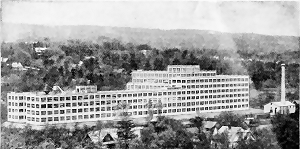
Storage-battery factory, West Orange
Newark is the first city in the state in
the variety of its manufactures and in the
value of its manufactured products. It is
eleventh among the cities of the United
States in the value of such products. Its
great progress in manufactures is due to an
early start, to the stimulus given by the
opening of the Morris Canal and by railroad
and water transportation. It has a
large number of important industries which
include smelting and refining, the making of
shoes, leather goods of all kinds, hats, jewelry,
iron, steel, and brass products of all kinds,
watch cases, paints and varnishes, clothing,
electrical machinery and appliances, automobile
supplies, tinware, advertising novelties,
celluloid products, trunks,
fertilizers, furs, brewery products,
and cigars.
Newark has an excellent
supply of water which is
drawn from the valley of the
Pequannock River in the
northern part of the Passaic
basin, twenty-six miles from
the city.
Surrounding Newark are many
important cities and towns which
reflect the social, commercial,
and industrial influences of that
city as well as those of New York. Among these
are Belleville, Nutley, Montclair, Glen Ridge,
Bloomfield, Orange, East Orange, West Orange,
South Orange, Irvington, and Summit. These are
all largely residential towns whose location and
abundance of eligible sites for homes are attractive.
They are all exceptionally active in providing
educational facilities. They are all
closely connected with Newark and the city of
New York by many railroad and trolley lines. In
most of them land is in such demand for residential
purposes, that it cannot be used profitably
for manufacturing purposes, so that this industry
is naturally discouraged. In some of them, however,
especially those nearest to Newark, large
industrial establishments have grown up. Belleville,
just north of Newark, has long been noted for
its industrial activity and is rapidly growing in
importance in this respect. Nutley, farther to
the north, is well known as a town of beautiful
homes. Montclair, located on the slope of the
Orange Mountains, is noted for its beautiful
scenery, its commanding view of many square miles
of surrounding country with many populous cities,
and its multitude of beautiful homes, and is the
home of one of the state normal schools. Glen
Ridge and Bloomfield, similarly situated, are also
characterized by their fine dwellings. Bloomfield
contains many extensive manufacturing establishments.
Among the products are electrical lamps
and appliances, woolen and worsted goods, colored
labels, cream separators, chemicals, rubber goods,
and iron and steel products. Besides being an
attractive center for residences. Orange is a very
productive industrial center. Its principal industry
is the manufacture of hats. East Orange has
long been famous because of its superior attractiveness
for dwelling purposes and is filled with beautiful
homes. While the high cost of land does not
invite manufactures, several large industries are
located here. Electrical motors and generators,
surgical appliances, electrical appliances, machinery,
lamps, and hats are manufactured in large
quantities. West Orange is noted for the manufacture
of phonographs, phonograph records,
moving picture instruments and films, and storage
batteries. Hats are also extensively manufactured.
South Orange and Summit are most
attractive residential places, and are developing
rapidly along this line rather than in the line of
manufactures. Summit has an important silk
industry. Irvington, while long known as a town
devoted to residences, is feeling the industrial
impulse of Newark, of which it is a suburb, and is
rapidly becoming a manufacturing center of great
importance. Its industries are varied and include
the production of castings, graphite products, tools,
cutlery, and gold, silver, and platinum products.
Across the Passaic River from Newark are
East Newark, Harrison, and Kearney, the last
including Arlington. These municipalities are
located in Hudson County and are, therefore,
officially connected with Jersey City as its county
seat. But they are much nearer Newark, with
which they are closely connected by industrial and
commercial ties. They are prosperous manufacturing
centers with industries of national importance.
In East Newark the most important manufactures
are sewing thread and shade rollers. In
Harrison the industries are varied and the products
include iron and steel, incandescent lamps, steam
pumps, roller bearings, elevators, steel and tin toys,
electric wire, trunks, brass products, tools, metal
novelties, castings, and machinery. In Kearney
the important manufactures are linoleums, yarns,
twine, glue, oils, fertilizers, ships, and castings.
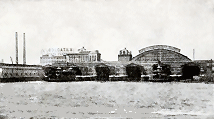
Jersey City as seen from the Hudson
Jersey City and its Environs.—A long
narrow peninsula lies between the Hudson
River and New York Bay on the east, and
the Hackensack River and Newark Bay on
the west. On this peninsula are located
many prosperous cities. On the southern
half, which is in Hudson County, is found
the most densely populated part of the state,
with many large cities of great industrial and
commercial importance.
Jersey City, the largest of this group, had,
in 1910, a population of 267,779, and in 1920,
according to the United States Census,
297,864. It is the second city of the state
in size, and twenty-first in the United States.
Parts of it were occupied by the Dutch soon
after New York was settled, but the first
permanent government was established in
1660 at Bergen, which is now a part of the
city. Here were also established the first
school and the first church in the state. It
is located on New York Bay and the Hudson
River and extends westward from these
waters to Newark Bay and the Hackensack
River. It has a frontage on tidal waters
of about twelve miles and has therefore
unexcelled facilities for transportation by
vessels of any size to all the seaports of the
world. Thirteen railroads have terminals
in the city. Besides these, there are eleven
other passenger and freight stations in the
city. Here the railroads bring the products
of all parts of the country directly to the
ships which sail to all parts of the world.
The city is connected directly with the city
of New York by railroads which pass through
tunnels under the Hudson. Numerous
trolley lines connect the different parts of
the city with each other and with other
parts of the state. There are nineteen
banks and trust companies. In manufacturing,
Jersey City ranks second in the state.
Its great commercial and industrial growth
is due to its nearness to New York, to its
connection with that city by ferries and
railroad tunnels, by which passengers and
freight are carried to the heart of the city
of New York in a few minutes, and to the
abundance of facilities for all kinds of transportation.
The most important products
are sugar, printers' type, soaps and perfumes,
meats, silks and embroideries, graphite
products, lead pencils, tobacco, cigars,
iron, steel and brass products, fire hose,
rubber goods, soups, watches, chemicals,
electrical supplies, heating and lighting apparatus,
rope, and paints and varnishes.
The water used by the city is of excellent
quality and is brought from the basin of the
Rockaway River in the northern part of
the state. The city has eight municipal
parks and one county park, containing nearly
two hundred fifty acres. The city maintains
a normal school for the training of its
teachers and has an excellent public library.
Besides being an active industrial center
it is a residential city. Many thousands whose
occupations are in the city of New York live
in Jersey City.
North of Jersey City and adjacent to it is
Hoboken. It is the most densely populated city
in the state. It has connections with several
railroads, and one of the great trunk lines has its
terminal station here. The steamships of several
of the most important transatlantic lines, including
Scandinavian and Dutch, dock in Hoboken.
Hoboken is connected with the city of New York
by the Hudson River tunnels and by ferries and
with other cities of the state by many trolley
lines. Its manufacturing industries include shipbuilding
and repairing and the making of lead
pencils, surveying and nautical instruments,
marine engines and boilers, silk goods, furniture,
and wall paper. Here is located the well-known
Stevens Institute of Technology.
North of Hoboken and Jersey City are several
cities and towns which are very important industrially
and are rapidly growing in population.
Their nearness to these cities and to each other
makes their industries and interests similar.
These are West Hoboken, Union, West New York,
North Bergen, Weehawken, Guttenberg, and Secaucus.
These are all populous and thriving communities.
There are many valuable industries,
among which the manufacture of silks and embroideries
is the most important. This section
leads the state in the manufacture of embroideries
and is second only to Paterson in that of silk
goods. Other industries are machine shops,
marine construction, and the manufacture of
pianos, lamps, lard, and rubber goods. In Secaucus
vegetable gardening is important.
South of Jersey City lies the city of Bayonne,
which is the third city of the state in the value
of manufactured products. Its frontage on New
York Bay on the east, Newark Bay on the west,
and Kill van Kull on the south, gives it exceptional
facilities for deep-water transportation. It
has, besides, ample railroad facilities. It is the
most important center for the refining of petroleum
in the world. The oil is brought in pipe lines from
the oil fields of Pennsylvania and Ohio to the
refineries, from which the many refined products
are carried to all parts of the world. There are
many other extensive industries, of which the
following may be mentioned: the manufacturing of
steam boilers, iron, steel, and bronze products,
cottonseed oil, nickel and copper
products, borax, insulated wire,
and silk goods.
The northern part of the peninsula,
which is in Bergen County,
contains many attractive towns
which are largely residential in
character. Among them are Englewood and Fort Lee. Edgewater
on the Hudson at the foot
of the Palisades has important
industries. The chief products are
sugar and sirups.
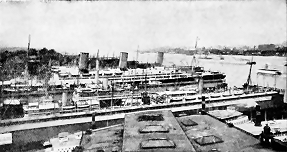
Docks at Hoboken. The principal port of embarkation and debarkation
of United States troops in the World War
Paterson and Neighboring
Cities and Towns.—Paterson,
located at the Falls of the
Passaic River, had a population
in 1920 of 135,866 and is the third city of
the state in size. The founding of the city
was suggested by Alexander Hamilton, who
foresaw the value of the power generated by
the falls and made plans to use it for manufacturing
purposes. Its great growth as a
manufacturing center is largely due to this
power. In the value of its manufactures, it
is the fifth among the cities of the state. Its
most important industry is the manufacture
of silk products of all kinds. In this industry
it stands first among the cities of the country.
It has many other extensive industrial plants,
which include machine shops, foundries, rolling
mills, locomotive works, dyeing establishments,
and thread and cordage mills.
Passaic, located on the Passaic River a few miles
southeast of Paterson, is specially noted for its
manufacture of woolen and worsted goods, in
which it is the first city of the state. It has other
extensive industries, including the manufacture
of handkerchiefs and other cotton goods, rubber
goods, belting and packing material, machinery,
metal, leather and silk goods, and print and
chemical works. Passaic is, besides, an attractive
residential city.
Northeast of Passaic is Hackensack on the
Hackensack River, which is a prosperous residential
town. Between Paterson and Passaic are
Clifton, a growing manufacturing town, Lodi, with
its extensive dyeing industry, and Garfield with
its large establishments for the manufacture of
woolen and worsted goods, waxed paper, embroideries,
and yarns. Southwest of Paterson is
Little Falls, whose principal manufactures are
carpets and rugs. Rutherford, Hasbrouck Heights,
Ridgewood, and Westwood are towns in this section
which are specially inviting to residents.
Elizabeth and Neighboring Towns.—Elizabeth is one of the oldest towns in the
state. It was settled in 1664 and was the
residence of Sir Philip Carteret, the first
Governor of New Jersey. It is most favorably
situated for both manufacturing and
residential purposes. Its location on Arthur
Kill and Newark Bay gives it deep water
connection through Kill van Kull with New
York Bay, and it has besides ample railroad
facilities. It has many industries, the largest
of which, and the largest of its kind in the
world, is the manufacture of sewing machines.
Other industries are the manufacture of iron
and steel products of all kinds, and of electrical
appliances, tanning, printing, and shipbuilding.
It has always been popular as a place
of residence with many whose business is in
New York.
Rahway, a few miles southwest of Elizabeth, is a
flourishing city whose chief industries are the manufacture
of felt, cereals, steel products, clothing,
music boxes, and printing and book binding.
Roselle, Roselle Park, Cranford, and Westfield
are attractive residential towns west of Elizabeth,
with excellent educational facilities. Garwood, in
this vicinity, is an important manufacturing town.
Perth Amboy and Neighboring Towns.—Perth
Amboy was settled in 1684 and alternated with Burlington as the meeting place
of the New Jersey assembly after the union
of the provinces in 1702. Its great industrial activity has increased its population by
more than 100 per cent in the last fifteen
years. Its rapid industrial growth is due to
its location at the mouth of the Raritan River
and on Raritan Bay and Arthur Kill, as well
as to its railroad facilities, and to the extensive
deposits of clay which are found here. The
development of these has led to the establishment
of large manufacturing plants whose
products are terra cotta, earthenware, and
tile of all kinds. Other important industries
are the refining of gold, silver, copper, and
lead, the preparation of vaseline, boat building,
the shipping of coal, and the manufacture
of cigars, insulated wire, chemicals, and steel
products. It is the fourth city in the state
in the value of manufactured products.
Near Perth Amboy are Metuchen, Woodbridge,
South Amboy, Sayreville, and South River, which
are populous towns and have extensive industries
similar to those of Perth Amboy. In Woodbridge
the output of fire brick is specially important.
In Sayreville and South River special attention is
given to the manufacture of building brick. In
all there is considerable shipping of clays to other
points. Many varied industries are found in
Carteret to the northeast of Woodbridge.
Places on the Outskirts of the Metropolitan
District of New York.—Lying just beyond the
New York City Metropolitan District, yet
feeling its influence more and more as the
facilities for communication are increased,
are a number of important towns.
Morristown, in Morris County, is famous because
of Its Revolutionary associations. It is
distinctively a residential town, which possesses
great municipal and educational advantages.
Madison is another residential town, whose peculiar
and most important industry is the cultivation of
roses. Boonton and Dover have picturesque locations
and are industrially active. Their chief
products are boilers, furnaces, hosiery, iron, hats,
and silk goods.
In Union County is Plainfield, which is well
known on account of its residential advantages, its
unexcelled schools, and its industrial importance.
Its principal manufactures are printing presses,
electrical appliances, garments, machine tools,
and machine shop products. North Plainfield is a
residential suburb.
Somerville is an attractive and prosperous town
with industries which manufacture clothing, laces,
and iron pipe. Bound Brook is at the junction of
three trunk line railroads and is located on the
Raritan Canal. It is therefore an active industrial
center. At Finderne, between Somerville and
Bound Brook, are large asbestos works.
New Brunswick, which was built up about the
ferry established here in 1697, is situated on the
Raritan River and at the eastern end of the Raritan
Canal, and enjoys superior facilities for water and
railroad transportation. Its most extensive industry
is the manufacture of surgical dressings. Other
manufactured products are machinery, woolen
goods, iron and steel products, automobiles,
cigars, and wall paper. Here is situated Rutgers
College, which includes the State Agricultural
College and Experiment Station. The State
Home for Boys is located at Jamesburg. Keyport, with its fisheries and growing manufacturing
industries, is situated on lower New York Bay
and has rail and water connections with that city.
Freehold is always associated with the battle of
Monmouth. It has important canning and rug-making
industries.
Trenton and the Towns of the Upper Delaware Valley.—Trenton, the capital of the
state since 1790, was settled about 1679.
Here occurred the Battle of Trenton, which is
commemorated by an imposing monument.
It is situated on the Delaware at the head
of navigation. The Delaware and Raritan
Canal passes through the city. It thus has
the advantage of transportation by water and
railway. The water power developed by
the Falls of the Delaware encouraged the
establishment and growth of the city's industries,
but these have grown so extensive
that they do not rely upon it. In the
neighborhood of Trenton are deposits of clay
which were the basis of the pottery industry.
It has forty-eight potteries and in this
industry it is rivaled by only one city in the
United States. The local clay is now used
very little. The better grades of pottery
require the finer clays which are obtained
from England, France, and some states of
this country. It manufactures more sanitary
earthenware than any other city in the country.
Other extensive industries are automobile
factories, iron and steel works, machine
shops, foundries, rubber works, woolen mills,
watch factories, and oilcloth and linoleum
factories.
The state and city acting together have
created a large public park which extends
along the Delaware River and includes the
grounds around the state capitol. The trade
of the surrounding country makes the city
a thriving business center.
Northeast of Trenton is Princeton, memorable
as the scene of the Battle of Princeton and rich
in historic associations. Here is located Princeton
University, founded in 1746.
Lambertville, on the Delaware northeast of
Trenton, is a prosperous town with considerable
water power, whose principal industries are rock
quarries, rubber works, and canning factories.
Pennington and Hopewell in the interior are industrious
canning centers. At Phillipsburg, on the
Delaware, opposite the mouth of the Lehigh, five
railroads meet. It is the western terminus of the
Morris Canal. These transportation facilities
make it a strongly industrial town. Its principal
products are air compressors and rock drills, horseshoes,
canisters, iron pipe, boilers, and silks. The
principal cement works of the state are located
near Phillipsburg. Belvidere, on the Delaware
above Phillipsburg; Washington, Hackettstown,
and Blairstown, in the interior, are popular residential
towns. In Washington pianos and organs, and
in Hackettstown saws and leather, are the chief
industrial products. In Hackettstown and Blairstown well-known educational institutions are
located. Newton is located in the picturesque
mountain region of Sussex County. Here dairy
farming is important. Its chief manufactures are
shoes, silks, and dyeing.
Flemington and High Bridge, in Hunterdon
County, though not located in the Delaware
Valley, are near it. They are important centers
of trade in agricultural sections with growing
industries. High Bridge is in the heart of the
peach-growing section and has large steel works.
So also Franklin Furnace, in Sussex County, is in
the Wallkill Valley and is the center of the zinc-mining
industry.
Camden and Neighboring Cities and Towns.—In this group are included the towns
which are located in the southwestern part
of the state and which are usually considered
as belonging to the Metropolitan District of
Philadelphia or are near it. All are vitally
affected by its stimulating commercial and
industrial impulse.
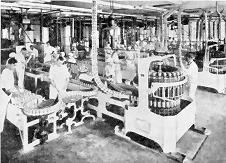
Canning factory, filling and capping cans, Camden
The largest city of this group is Camden,
on the Delaware opposite Philadelphia,
founded about 1680 and known in colonial
days as Cooper's
Ferry. It shares
with Philadelphia
the advantages of
the deep-water route
to the ocean through
the Delaware River
and Bay. It owes
Its first industrial
impulse to the opening
of the Camden
and Amboy Railroad.
From It many
railroads radiate to
all parts of the state
and one crosses the Delaware to Pennsylvania.
Direct communication with Philadelphia is
maintained by ferries. More rapid communication will soon
be obtained when
the proposed tunnels
under the Delaware
are completed. Its
industries, which are
of the most varied
character, have increased
with astonishing
rapidity. The
most extensive are
the manufacture of
talking machines and
shipbuilding. Here
the largest battleships
and merchant vessels can be built.
One of the shipbuilding plants is the largest
in the country. Other extensive industries
are foundries, machine shops,
woolen mills, chemical works,
factories for the manufacture
of cigars, paints, candies,
leather, licorice, linoleum,
writing pens, and the preparation of soups.
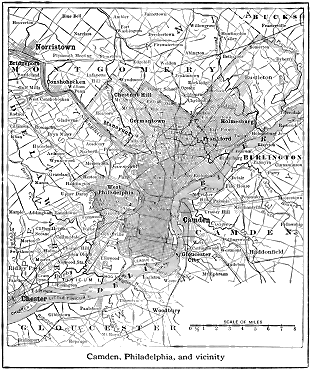
Camden, Philadelphia, and vicinity
Northeast of Camden, on the
Delaware, are Riverside and
Beverly, which are important
centers of manufacture and of
truck farming. Farther up is
Burlington, which was settled in
1677 and was the capital of West
Jersey. It has ample facilities for
transportation by rail and water.
Its interests are both agricultural
and manufacturing. Its principal
products are shoes, iron pipe,
and hardware. Bordentown, the
southwestern terminus of the
Delaware and Raritan Canal, also
has excellent transportation facilities.
Its most important industries
are the canning of vegetables
and the manufacture of yarns and
clay products. In the interior,
the old town. Mount Holly, is rich
in agricultural products and has
industries which produce hosiery,
shoes, and tapestry goods. East
and southeast of Camden are Merchantville,
Moorestown, Collingswood, and Haddonfield, which
are distinctively residential towns, but in which
vegetable raising is an important industry.
Gloucester, on the Delaware south of Camden,
is a growing industrial center. Its products are
yarns, paper, and gas mantles. It has communication
with Philadelphia by ferries, which transport
the produce of the rich truck and fruit farms of the
surrounding country to that city. Woodbury is a
prosperous residential town with industries which
make pianos and glass bottles. Next to the
southward are Swedesboro, Glassboro, and Clayton,
whose principal industrial activities are connected
with the making of glass and the raising and
canning of vegetables and fruits.
Towns near Delaware Bay.—Farther south on
the outskirts of the Philadelphia Metropolitan
District are the very active business and industrial
center, Salem, settled by the Quakers
in 1675, Bridgeton, Vineland, and Millville.
In these towns the glass factories are extensive
and make all kinds of glass articles. In Bridgeton
and Millville many persons are employed in the
mining and shipping of glass sand. Molding
sand is also a product. In and surrounding these
towns are large areas of farm land devoted to the
raising of all kinds of vegetables, berries, and tree
fruits for the markets. Great quantities of these
are preserved in the many large canning factories
which are located in them. Vineland produces
much bottled grape juice. These towns have also
diversified industries of other kinds.
In Cape May Court House the important industrial
activities are the making of glass bottles and
the raising of berries and other fruits.
Cities and Towns on the Atlantic Coast.—Along
the Atlantic coast are many cities and
towns which are popular health and pleasure
resorts. The many railroads which connect
them with the large cities have made them
convenient of access so that thousands of
people visit them in the summer time.
The largest of these is Atlantic City, which is the
largest seaside resort in the country and is devoted
entirely to the entertainment of visitors. It is
said to contain more than one thousand hotels.
Its permanent population numbers somewhat
more than 50,000, but in the summer time its
population is estimated at about 300,000. It has
a climate favorable to those who are convalescing
from illness or seek to recuperate their health.
On this account it is a popular resort during the
entire year. It has a superior school system
and all the other facilities and institutions which
mark the progressive city. Long Branch, farther
north, is the oldest resort on the coast. Another
resort of many years standing is Cape May City.
Other well-known resorts are Ocean City, Point
Pleasant, Sea Girt, Manasquan, Spring Lake,
Belmar, Ocean Grove, Asbury Park, Sea Bright,
and Atlantic Highlands. Red Bank, with its many
attractive country homes, is situated on the
Navesink and is classed as a seaside resort.
Lakewood, among the pines of Ocean County,
is a popular winter health resort.