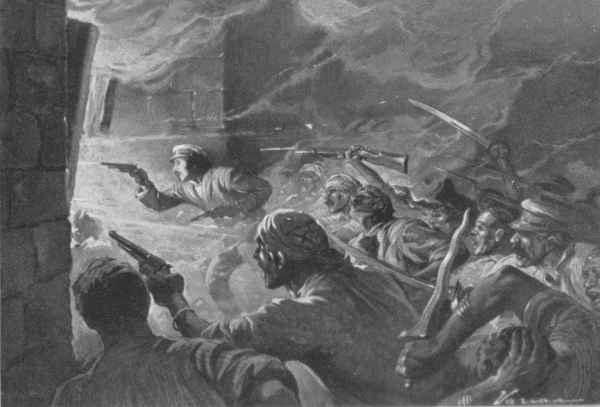
In one of the public squares of San José, which
is the capital of Costa Rica, there is a marble
statue of a stern-faced young woman, with her
foot planted firmly on a gentleman's neck. The
young woman is symbolic of the Republic of Costa
Rica, and the gentleman ground beneath her heel
is supposed to represent the American filibuster
and soldier of fortune, William Walker. Now,
before going any farther, justice requires me to
explain that Walker's downfall was not due to
Costa Rica, as the citizens of that little republic
would like the world to believe, and as the bombastic
statue in the plaza of its capital would lead
one to suppose, but to a far greater and richer
power, whose victories were won with dollars instead
of bayonets, whose capital was New York
City, and whose name was Cornelius Vanderbilt.
To the younger generation the name of William
Walker carries no significance, but to the gray-heads
whose recollections antedate the Civil War
the mention of it brings back a flood of thrilling
memories, while throughout the length and breadth
of that wild region lying between the Isthmus of
Tehuantepec and the Isthmus of Panama it is
still a synonym for unfaltering courage. His
weakness was ambition; his fault was failure.
Had he succeeded in realizing his ambitions—and
he failed only by the narrowest of margins—he
would have been lauded as another Cortez, and
would have received stars and crosses instead of
bullets. Had his life not been cut short by a
Honduran firing-party, it is possible, indeed
probable, that, instead of there being six states in
Central America there would be but one, and in
that one the institution of slavery might still
exist. Though I have scant sympathy with the
motives which animated Walker, and though I
believe that his death was for the best good of the
Central American peoples, he was the very antithesis
of the cutthroat and blackguard and outlaw
which he has been painted, being, on the contrary,
a very brave and honest gentleman, of whom
his countrymen have no reason to feel ashamed,
and that is why I am going to tell his story.
The eldest son of a Scotch banker, Walker was
born in 1824 in Nashville, Tennessee. His father,
a stiff-necked Presbyterian who held morning and
evening prayers, asked an interminable grace before
every meal, and took his family to church
three times on Sunday, had set his heart on his
son entering the ministry, and it was with a pulpit
and parish in view that young Walker was educated.
By the time that he was ready to enter the
theological school, however, he decided that he
preferred M.D. instead of D.D. after his name,
whereupon, much to his father's disappointment,
he insisted on taking the medical course at the
University of Tennessee, following it up by two
years at the University of Edinburgh. Thoroughly
equipped to practise his chosen profession,
he opened an office in Philadelphia, but in a few
months the routine of a doctor's life palled upon
him, so, taking down his brass door-plate, he went
to New Orleans, where, after two years of study, he
was admitted to the bar. But he soon found that
briefs and summonses were scarcely more to his
liking than prescriptions and pills, so, with the
prompt decision which was one of his most marked
characteristics, he closed his law-office and obtained
a position as editorial writer on a New
Orleans newspaper. Within a year the restlessness
which had led him to abandon the church,
medicine, and the bar caused him to give up
journalism in its turn. At this time, 1852, the
Californian gold fever was at its mad height, and
to the Pacific coast were pouring streams of fortune-seekers
and adventure-lovers from every
quarter of the globe. One of the latter was
Walker, and it was while editor of the San Francisco
Herald, when only twenty-eight years old,
that his amazing career really began.
Walker was not of the sort who could content
himself for any length of time within the stuffy
walls of an editorial sanctum. His fingers were
made to grasp something more virile than the
pen. Nor did he make any attempt to win a fortune
with pick and shovel in the gold fields. His
ambitions were neither intellectual nor mercenary,
but political, for from his boyhood days in Nashville
he had dreamed, as all boys worth their salt
do dream, of some day founding a state, with
himself as its ruler, in that wild and savage region
below the Rio Grande. Enlisting half a hundred
kindred souls from the hordes of the reckless, the
adventurous, and the needy which were pouring
into California by boat and wagon-train, Walker
chartered a small vessel and set sail from San
Francisco for the coast of Mexico. His avowed
object was a purely humanitarian one: to protect
the women and children living along the Mexican
frontier from massacre by the Indians, the state
of Sonora being at that time more under the
dominion of the Apaches than it was under that
of Mexico. But it was not the protection of the
women and children—though they needed protection
badly enough, goodness knows—which led
Walker to embark on this hare-brained expedition.
He was lured southward by a dream of empire,
an empire of which he should be the ruler, and
which should be founded on slavery. By this
time, remember, the slavery question in the
United States had become exceedingly acute, the
future of the institution on this continent largely
depending upon whether the next States admitted
to the Union should be slave or free. Walker was
a sincere, even fanatical, believer in slavery.
Born and reared in an atmosphere of slavery, to
Walker it was as sacred, as God-given an institution
as the Fast of Ramadan is to the Moslem or
the Feast of the Passover to the Jew. Convinced
that friction over this question would sooner or
later force the slave-holding States to secede from
the Union, he determined to extend the area of
slavery by conquering that portion of northern
Mexico immediately adjacent to the United States,
to establish an independent government there, and
eventually to annex his country to the South, thus
counteracting the growing movement for abolition,
which, with the admission of new Northern
territories, already hinted at the overthrow of
slavery.
Financed by Southern friends whose motives
were probably considerably less altruistic than his
own, Walker landed at Cape San Lucas, the extreme
southern point of the Mexican territory of
Southern California, in October, 1852, with an
"army of invasion" of forty-five men. Instead
of hastening to protect the women and children
of whom he had talked so feelingly, he sailed
up the coast to the territorial capital of La Paz,
which he seized, where he issued a proclamation
announcing the annexation of the neighboring
state of Sonora, in which he had not yet set
foot, giving to the two states the name of the
"Republic of Sonora," and proclaiming himself
its first president. As soon as the news of this
initial success reached San Francisco, Walker's
sympathizers there busied themselves in recruiting
reinforcements, three hundred desperadoes who
boasted that they were afraid of nothing "on two
feet or four" being shipped to him at La Paz a
few weeks later. These men were looked upon
as hard cases even in the San Francisco of the
early fifties, and, if they had not consented to
leave the country to assist Walker, many of them
would probably have left it sooner or later at the
end of a rope in the hands of the local vigilance
committee. When this force of scoundrels arrived
at La Paz and found themselves under the
command of a quiet, mild-mannered, beardless
youth of twenty-eight, instead of the brawny,
foul-mouthed, swashbuckling leader whom they
had expected, they promptly hatched a scheme to
blow up the magazine, seize the ship and the stores
of the expedition in the ensuing confusion, and
make their way back to the United States, leaving
Walker to shift for himself. Warning of the conspiracy
reaching him, however, Walker displayed
for the first time those traits which were later to
make his name a word of terror in the ears of men
who bragged that they feared neither God nor
man. Arresting the ringleaders, he had two of
them tried by court-martial and shot within an
hour; two of the others he ordered flogged and
drummed out of camp, to take their chances among
the hostile Mexicans and Indians. But, though
this act gained Walker the fear and respect of his
followers, the newcomers among them had no
stomach for a leader who could punish, so when
he called for volunteers to accompany him in the
conquest of Sonora less than a hundred men
offered to follow him.
From the very first the shadow of failure hung
over the enterprise. To begin with, there is no
more savage and desolate region on the American
continent than the peninsula of Lower California,
it being so barren and destitute that even the lizards
have to scramble for an existence. Mexicans
and Indians hung upon the flanks of the little column
night and day, as buzzards follow a dying
steer. There was neither medicine nor medical
instruments with the expedition, and the wounded
died from lack of the most elementary care.
Their shoes gave out and the men marched bare-foot
over sun-scorched rocks and needle cactus,
leaving a trail of crimson behind them in the sand.
Their provisions were soon exhausted, and their
only food was beef which they killed on the march.
For years afterward the route of that ill-fated
expedition could be traced from La Paz to the
Colorado River by the bleaching skeletons of the
men who fell by the way. By the time the head
of the Gulf of California was reached the expedition
had dwindled to barely twoscore men. It
was no longer a question of conquering Sonora;
it was a question of getting back to the States
alive.
With sinking heart, but imperturbable face,
Walker led his little band of starving, fever-racked,
exhausted men toward the Californian
line. Three miles of road led through a mountain
pass into the United States and safety. But
the pass was held by a force of Mexican soldiery
under Colonel Melendrez, and his Indian
allies were scattered over the plain below. And,
as though to give a final touch of irony to the
situation in which Walker and his men found
themselves, from their position on the Mexican
hillside they could look across into American territory,
could see the American flag, their flag,
fluttering over the military post south of San
Diego, could even see the sun glinting upon the
bits and sabres of the troop of American cavalry
drawn up along the border. Four Indians bearing
a flag of truce approached. They bore a message
from the Mexican commander to the filibusters.
If they would surrender their leader and give up
their arms, Melendrez sent word, they would be
permitted to leave the country unmolested. But
after you have fought and bled and marched and
starved with a man for a year, you are not likely
to abandon him, particularly when the end is in
sight, so they sent back word to Melendrez that
if he wanted their arms he would have to come
and take them. Meanwhile the American commander,
Major McKinstry, had drawn up his
troopers along the boundary-line and awaited the
result of the unequal struggle like an umpire at a
foot-ball game. Walker, who knew perfectly well
that he deserved no aid from the United States,
and that he would get none, appreciated that if
he was to get out of this predicament alive it
must be by his own wits. Concealing a dozen of
his men among the rocks and sage-brush which
lined the road on either side, with the remainder
of his force he pretended to beat a panic-stricken
retreat. Melendrez, confident that it was now
all over but the shouting, swept down the road in
pursuit. But as the Mexicans rode into the ambush
which Walker had prepared for them the
hidden filibusters emptied a dozen saddles at a
single volley, and the soldiers, terrified and demoralized,
wheeled and fled for their lives. Thirty
minutes later the President, the Cabinet, and all
that remained of the standing army of the late
Republic of Sonora stumbled across the American
boundary and surrendered to Major McKinstry.
It was May 8, 1854, and in such fashion Walker
celebrated his thirtieth birthday.
Sent to San Francisco as a political prisoner,
Walker was tried for violating the neutrality laws
of the United States, was acquitted—for the members
of a Californian jury could not but sympathize
with such a man—and once again found himself
writing editorials for the San Francisco Herald.
His narrow escape from death in Mexico had only
served to whet his appetite for adventure, however,
so when he was not doing his newspaper work he
was poring over an atlas in search of some other
land where a determined man might carve out a
career for himself with his sword. Staring at the
map of Middle America, his finger again and again
paused, as though by instinct, on Nicaragua.
Here was indeed a fertile field for the filibuster.
Not only was the country enormously rich in
every form of natural resources, but it had a
kindly and moderately healthy climate, and, what
was the most important of all, owing to its peculiar
geographical position, it commanded what was at
that time one of the great trade-routes of the
world. At this time there were three routes to
the Californian gold-fields: one, the long and weary
voyage around the Horn; another, by the dangerous
and costly Overland Trail; and the third,
which was the shortest, cheapest, and most popular,
across Nicaragua. If you will glance at the
map, you will see that, barring the Isthmus of
Panama, which is several hundred miles farther
south, Nicaragua is the narrowest neck of land
between the two great oceans, and that in the
middle of this neck is the great Lake Nicaragua,
which is upward of fifty miles in width. An American
corporation known as the Accessory Transit
Company, of which the first Cornelius Vanderbilt
was president, had obtained a concession from
the Nicaraguan Government to transport passengers
across Central America by this route. Passengers
en route from New York or New Orleans
to the gold-fields were landed by the company's
steamers at Greytown, on the Atlantic coast
of Nicaragua, and transported thence by light-draught
steamers up the San Juan River to Lake
Nicaragua. Here they were transferred to larger
steamers and taken across the lake to Virgin Bay,
the twelve-mile journey from there to the port of
San Juan del Sur, on the Pacific coast of Nicaragua,
being performed in carriages or on the backs of
mules. During a single year twenty-five thousand
passengers crossed Nicaragua by this route.
It did not take Walker long to appreciate, therefore,
that the man who succeeded in making himself
master of this, the shortest route to California,
would be in a position of considerable strength.
Not only this, but Nicaragua was torn by internal
dissensions; the army was divided into a dozen
factions; the peasantry were down-trodden and
poverty-stricken; the government was inconceivably
corrupt; and the usual revolution was, of
course, in progress, in which the sister republics
of Honduras and Costa Rica were preparing to
take a hand. Everything considered, Nicaragua's
only hope of salvation from anarchy lay in finding
for a ruler a man with an inflexible sense of
justice and an iron hand. Walker determined to
be that man.
In view of what I have already told of his exploits,
you have doubtless pictured Walker as a
tall, broad-shouldered man of commanding presence.
As a matter of fact, he was nothing of the
sort. In height he was but five feet five inches,
and correspondingly slender. A remarkably square
jaw and a long chin lent strength and determination
to features which were plain almost to the
point of coarseness. His eyes, which were of a
singularly light gray, are universally spoken of as
having been his most noticeable feature, for they
were so large and fixed that the eyelids scarcely
showed, and so penetrating that they seemed to
bore holes into the person at whom they were
looking. He was extremely taciturn, and when he
did speak it was briefly and to the point. He had
an unusual command of English, however, and
his words were always carefully chosen. A
stranger to fear, men who followed him on his
campaigns assert that even under the most trying
and perilous circumstances they had never seen
him change countenance or betray emotion by so
much as the contraction of a muscle. He was
wholly lacking in personal vanity, and when in
the field wore his trousers tucked into his boots, a
flannel shirt open at the neck, and a faded black
campaign hat. In a land where all three habits
were universal, he neither drank, smoked, nor
swore; he never looked at women; his word, once
given, was never broken; the justice he meted
out to disobedient followers, though stern to the
point of brutality, was absolutely impartial.
Highly ambitious, it is paying but the barest justice
to his memory to say that his aspirations,
however little we may sympathize with them,
were wholly political and never mercenary, his
whole career showing him to be utterly careless
of wealth. Taking everything into consideration,
we have good reason to be proud that William
Walker was an American.
In 1854, as I have already remarked, Nicaragua
was split asunder by civil war. The opposing
parties were the Legitimists and the Democrats.
What they were fighting about is of no consequence;
perhaps they did not know themselves.
In any event, in August of that year an American
named Byron Cole, acting as an agent for Walker,
arrived at the headquarters of the Democratic
forces with a novel offer. Briefly, he agreed to
contract to supply the Democratic party with
three hundred American "colonists liable to military
duty," these settlers to receive a grant of
fifty-two thousand acres of land, and to have the
privilege of becoming citizens of Nicaragua. This
contract was approved and signed by General
Castillon, the Democratic leader, and with it in
his pocket Cole hastened to San Francisco and
Walker. After taking the precaution of submitting
the contract to the civil and military authorities
in San Francisco, and receiving their assurances
that it did not violate the neutrality laws of
the United States, Walker immediately set about
recruiting his "colonists," and in May, 1855, just
a year after his escape from Mexico, he was ready
to sail. Although, as I have said, the Federal
authorities had passed upon the legality of the
contract, it was a noticeable fact that the peaceable
settlers took with them Winchester rifles instead
of spades, and Colt's revolvers instead of
hoes, and that the hold of the brig Vesta, on which
they sailed from San Francisco, was filled with
ammunition and machine guns instead of agricultural
implements and machinery.
After a long and stormy voyage down the
Pacific coast Walker and his men landed, on
June 16, at the port of Realejo, in Nicaragua,
where he was met by Castillon. Walker was at
once commissioned a colonel; Achilles Kewen, who
had just come from Cuba, where he had been
fighting under the patriot Lopez, a lieutenant-colonel;
and Timothy Crocker, a fighting Irishman,
who was a veteran of Walker's Sonora expedition,
a major; the corps being organized as an
independent command under the name of La
Falange Americana—the American Phalanx. At
this time the Transit route from the Atlantic to
the Pacific was held by the Legitimist forces, and
these Walker was ordered to dislodge, it being
essential to the success of the Democrats that
they gain possession of this interoceanic highway.
Accordingly, a week after setting foot in Nicaragua,
Walker, at the head of fifty-seven of his
Americans and one hundred and fifty native soldiers,
set out for Rivas, a town on the western
shore of Lake Nicaragua held by twelve hundred
of the enemy. The first battle of his Nicaraguan
campaign ended in the most complete disaster.
At the first volley his native allies bolted, leaving
the Americans surrounded by ten times their
number of Legitimists. The enemy instantly
perceived this defection, and pressed the Phalanx
so hard that its members were driven to take
shelter behind a row of adobe huts. No one knew
better than Walker that if the enemy charged he
and his men were done for, so he decided to do the
charging himself. Out from behind the huts
dashed the red-shirted filibusters, firing as they
came, and so ferocious was their onslaught that
they succeeded in cutting their way through the
encircling army and escaping into the jungle.
Though six of the Americans were killed, including
Walker's two lieutenants, Kewen and Crocker,
and twice as many wounded, the battle of Rivas
established the reputation of Americans in Central
America for years to come, for a hundred and
fifty of the enemy fell before their deadly fire.
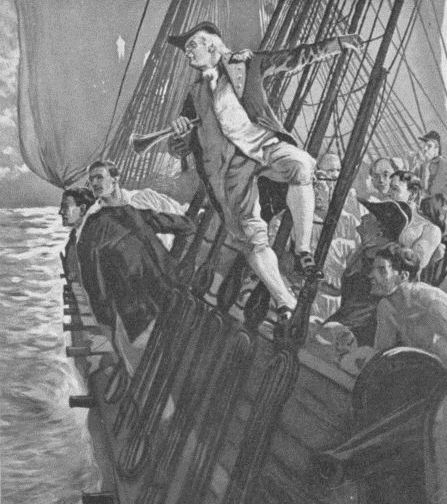
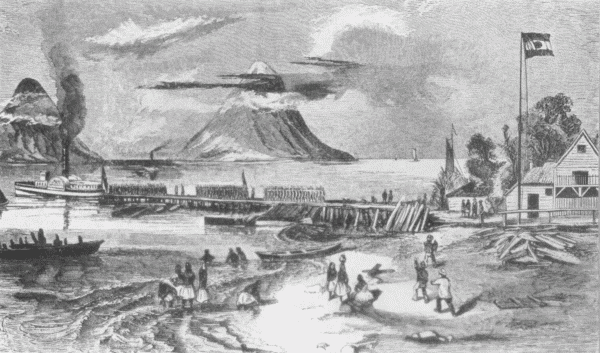 General William Walker and his men, after a long and stormy voyage, landing at Virgin Bay,
en route to Costa Rica.
General William Walker and his men, after a long and stormy voyage, landing at Virgin Bay,
en route to Costa Rica.
From a print in the New York Public Library.
Bleeding and exhausted from battle and travel,
Walker and his men, after an all-night march
through the jungle, limped into the port of San
Juan del Sur, and, finding a Costa Rican vessel in
the harbor, they seized it for their own use. Still
bearing in mind the necessity of getting control
of the Transit route, Walker gave his men only a
few days in which to recover from their wounds
and weariness, and then was off again, this time
for Virgin Bay, the halting-place for passengers
going east or west. Though in the fight which
ensued Walker was outnumbered five to one, his
losses were only three natives killed and a few
Americans wounded, while one hundred and fifty
of the enemy fell before the rifles of the filibusters.
This disparity of losses emphasizes, as does nothing
else, the deadliness of the American fire.
After the fight at Virgin Bay Walker received
from California fifty recruits, thus bringing the
force under his command up to some four hundred
men, about a third of whom were Americans.
The Legitimists, learning that he was planning to
again attack Rivas, hastened to reinforce the garrison
of that town by hurrying troops there from
their headquarters at Granada, which was farther
up the lake, planning to give Walker a warm and
unexpected reception. But it was Walker who did
the surprising, for, having his own channels of
secret information, he no sooner learned of the
weakened condition of Granada than he determined
to direct his efforts against that place,
instead of Rivas, and by capturing it to give the
Legitimist cause a solar-plexus blow. Embarking
his men on a small steamer with the announced
intention of attacking Rivas, as soon as night
fell he turned in the opposite direction and, with
lights out and fires banked, steamed silently up the
lake. Dawn found him off Granada, the garrison
and inhabitants of which were sleeping off a
drunken debauch with which they had celebrated
a recent victory. Even the sentries drowsed at
their posts. Unobserved, the Americans landed
in the semi-darkness of the early dawn, and it
was not until they had reached the very outskirts
of the town that a sentry suddenly awakened to
their presence and gave the alarm by letting off
his rifle, the shot being instantly answered by a
crackle of musketry as the Americans opened fire.
"Charge!" shouted Walker, "Get at 'em! Get at
'em!" and dashed forward at a run, a revolver in
each hand, with his followers, cheering like madmen,
close at his heels. "Los Filibusteros! Los Filibusteros!"
screamed the terror-stricken inhabitants,
catching sight of the red shirts and scarlet hat-bands
of the Americans. "Run for your lives!" The demoralized
garrison made a brief and ineffective
stand in the Plaza, and then threw down their arms.
Walker was master of Granada. He at once instituted
a military government, released over a
hundred political prisoners confined in the local
jail, policed the town as effectually as though it
were a New England village, and when he caught
one of his native soldiers in the act of looting, ran
him through with his sword.
Walker was now in a position to dictate his own
terms of peace, and, four months after he and his
fifty-seven followers landed in Nicaragua, an
armistice was arranged and the side to which the
Americans had lent their aid was in power. A
native named Rivas was made provisional president,
and Walker was appointed commander-in-chief
of the army, which at that time numbered
about twelve hundred men. Though insignificant
in numbers when judged by European standards,
this was really a remarkable force, and perhaps
the most effective for its size known to military
history. The officers had all seen service under
many flags and in many lands—in Cuba, Mexico,
Brazil, Spain, Algeria, Italy, Egypt, Russia, India,
China—and the men, nearly all of whom had been
recruited in San Francisco, boasted that "California
was the pick of the world, and they were
the pick of California." There was scarcely a
man among them who could not flick the ashes
from a cigar with his revolver at a hundred feet,
or with his rifle hit a dollar held between a man's
thumb and forefinger at a hundred yards. All
the strange, wild natures for whom even the mining-camps
of California had grown too tame
were drawn to Walker's flag as iron filings are
drawn to a magnet. Frederick Townsend Ward,
the New England youth who raised, trained, and
led the Ever-Victorious Army, who rose to be an
admiral-general of China, and who performed the
astounding exploits for which General Charles
Gordon received the credit, gained much of his
military training under Walker; Joaquin Miller,
"the poet of the Sierras," was another of his devoted
followers, while scores of the other men who
fought under the blue-and-white banner with the
scarlet star in later years achieved name and fame
in many different lands.
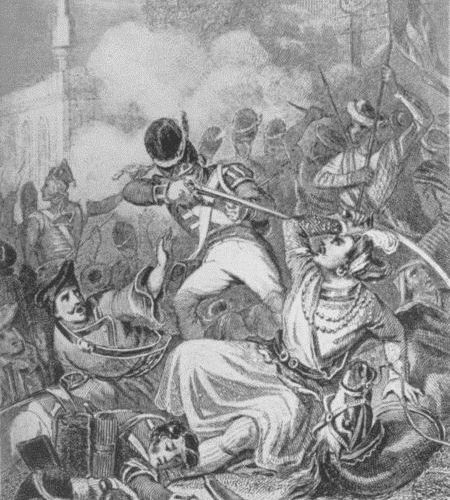
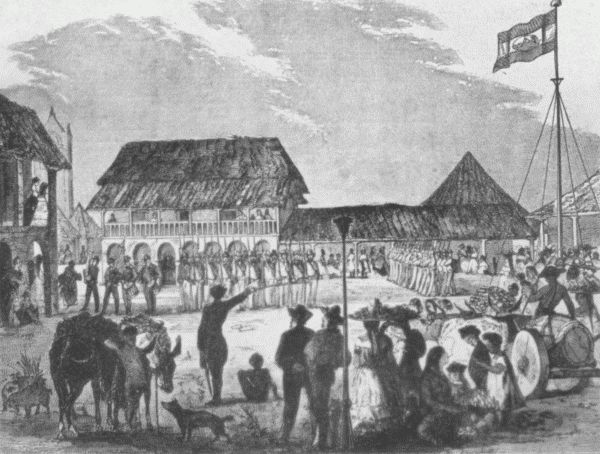 General Walker reviewing troops on the Grand Plaza, Granada.
From a print in the New York Public Library.
Says General Charles Frederic Henningsen,
the famous English soldier of fortune who was
Walker's second in command: "I have heard two
greasy privates disputing over the correct reading
and comparative merits of Æschylus and Euripides.
I have seen a soldier on guard incessantly scribbling
strips of paper, which turned out to be a
finely versified translation of his dog's-eared copy
of the Divina Commedia." The same officer, who
had fought with distinction under Don Carlos in
Spain, under Schamyl in the Caucasus, and
under Kossuth in Hungary, who had introduced
the Minié rifle into the American service, and
was a recognized authority on the use of artillery,
and therefore knew whereof he spoke, also
testifies to the heroism and astounding fortitude
of Walker's men. "I have often seen them marching
with a broken or a compound-fractured arm in
splints, and using the other to fire the rifle or revolver.
Those with a fractured thigh, or with
wounds which rendered them incapable of removal,
often (or rather, in early times, always)
shot themselves, sooner than fall into the hands
of the enemy. Such men do not turn up in the
average of every-day life, nor do I ever expect to
see their like again. I was on the Confederate
side in many of the bloodiest battles of the late
war, but I aver that if, at the end of that war I
had been allowed to pick five thousand of the
bravest Confederate or Federal soldiers I ever saw,
and could resurrect and pit against them one thousand
of such men as lie beneath the orange-trees
of Nicaragua, I feel certain that the thousand
would have scattered and utterly routed the five
thousand within an hour. All military science
failed, on a suddenly given field, before assailants
who came on at a run, to close with their revolvers,
and who thought little of charging a battery,
pistol in hand." As a matter of fact, at the first
battle of Rivas, ten Americans, all officers of the
Phalanx, armed only with bowie-knives and revolvers,
actually did charge and capture a battery
manned by more than a hundred Costa Ricans,
half of the little band being killed in that astounding
exploit. Some estimate of the deeds of these
unsung heroes, so many of whom lie in unmarked
graves beneath an alien sky, may be gathered
from the surgical reports, which showed that the
proportion of wounds treated was one hundred and
thirty-seven to every hundred men.
For several months after the taking of Granada
and the establishment of a provisional government,
the dove of peace hovered over Nicaragua
as though desirous of alighting, but in February,
1856, it was driven away, at least for a time, by
a fresh splutter of musketry along the southern
frontier, where Costa Rica, alarmed by Walker's
reputed ambition to make himself master of all
Middle America, had begun an invasion with the
expressed purpose of driving the gringos from
Central American soil. After a few months of
desperate fighting, in which the Americans fully
maintained their reputation for reckless bravery,
the Costa Ricans were driven across the border,
and for a brief time the harassed Nicaraguans
were able to exchange their rifles for their hoes.
The country now being for the moment at peace,
Rivas called a presidential election, announcing
himself as the candidate of the Democrats. The
Legitimists, recognizing in Walker the one strong
man of the country, had the political shrewdness
to choose him, their former enemy, to head their
ticket. Two other candidates, Ferrer and Salazar,
were also in the field. The election was regular
in every respect, the voting being entirely free
from the usual disturbances. According to the
Nicaraguan constitution, every male inhabitant
over eighteen years of age, criminals excepted, is
entitled to the suffrage. When the votes were
counted it was found that Rivas had received 867
votes; Salazar, 2,087; Ferrer, 4,447; and Walker,
15,835. By such an overwhelming majority, and
in an absolutely fair election, was William Walker
made President of Nicaragua—the first and only
time an American has ever been chosen ruler of a
foreign and independent state.
In all its troubled history Nicaragua has never
been governed so justly and so wisely as it was by
the American soldier of fortune. Had he been
free from foreign interference there is little doubt
that he would have made Nicaragua a progressive,
prosperous, and contented country, and that he
would in time have brought under one government
and one flag all the states lying between
Yucatan and Panama. But that was precisely
what the peoples of those states were fearful of,
so that, a few weeks after Walker was inaugurated,
Guatemala, Costa Rica, Honduras, and San
Salvador declared war. This time Walker took
the field with three thousand trained and seasoned
veterans, while opposed to him were twenty-one
thousand of the allies. To describe the campaign
that ensued would be as profitless as it would be
tedious. The programme was always the same:
the march by night through the silent, steaming
jungle, and the stealthy surrounding of the threatened
town in the early dawn; the warning crack
of a startled sentry's rifle; the sudden rush of the
filibusters with their high, shrill yell; the taking
of the barracks and the cathedral in the Plaza,
nearly always at the pistol's point; and the panic-stricken
retreat of the little brown men in their
uniforms of soiled white linen. Everywhere the
arms of Walker were triumphant, and had he not
at this time deliberately crossed the path of a
soldier of fortune of quite another kind, in a few
months more he would have realized his life-dream
and have made himself the ruler of a Central
American empire.
Upon investigating national affairs after his
election, Walker found that the Accessory Transit
Company had not lived up to the terms of its concession
from the government of Nicaragua. By
the terms of its charter it had agreed to pay to the
Nicaraguan Government ten thousand dollars annually,
and ten per cent of its net profits. The
company claimed, and the government as stoutly
denied, that the ten thousand dollars had been
regularly paid, though the concessionaires admitted
that the ten per cent on the profits had
not been paid, giving as their excuse that there
had been no profits. Upon an examination of the
books it was quickly discovered that the company
had so juggled with the accounts as to make it appear
that there were no profits, when, as a matter
of fact, the enterprise was an enormously profitable
one. Upon discovering the fraud which had been
perpetrated upon the government and people of
Nicaragua, Walker demanded back payments to
the amount of two hundred and fifty thousand
dollars, and upon the company insolently refusing
to pay them, he promptly revoked its charter,
and seized its steamboats, wharves, and warehouses
as security for the debt. Though this
action was perfectly justifiable under the circumstances,
it was, in view of the instability of Walker's
position, an unwise move, for it made an
implacable enemy of one of the most powerful
and perhaps the most unscrupulous of the financiers
of the time.
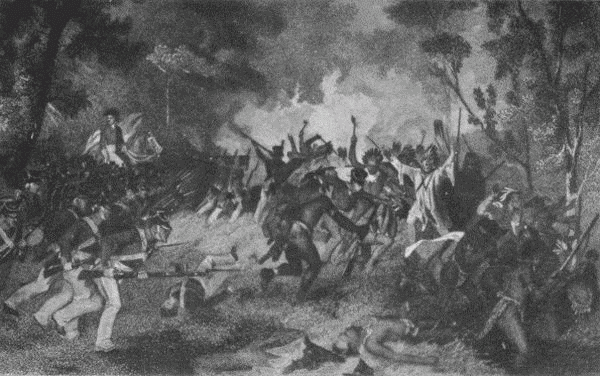
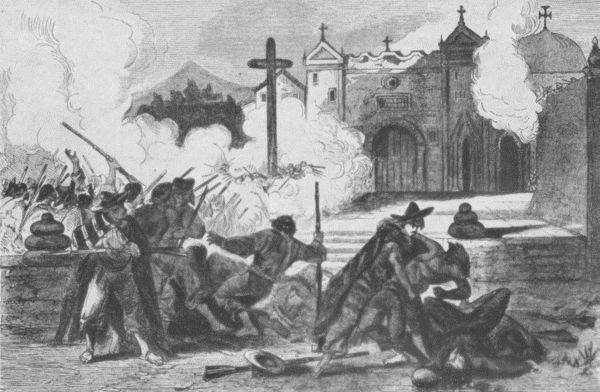 The programme was always the same: the sudden rush of the filibusters with their high,
shrill yell; the taking of the barracks and the cathedral in the Plaza.
The programme was always the same: the sudden rush of the filibusters with their high,
shrill yell; the taking of the barracks and the cathedral in the Plaza.
From a print in the New York Public Library.
Cornelius Vanderbilt was not a person who
could be bluffed or frightened. Infuriated at the
action of the filibuster President, he immediately
withdrew from service the ships of the Transit
Company in both oceans, thus cutting off communication
between Nicaragua and the United States,
and thereby Walker's source of supplies. But the
grim old financier was not content with that. Recruiting
a force of foreign adventurers on his own
account, he despatched them to Central America
with orders to assist the Costa Ricans, whom he
liberally supplied with money, arms, and ammunition,
in their war against Walker. Turning then
to Washington, he had little difficulty in inducing
Secretary of State Marcy, who was known to be
one of his creatures, to use the government forces
in driving Walker out of Nicaragua. To Commodore
Mervin, who was his personal friend,
Secretary Marcy communicated his wishes, or
rather Vanderbilt's wishes, and these Mervin in
turn transmitted to Captain Davis, commanding
the man-of-war St. Mary's, who was ordered to
proceed at full speed to San Juan del Sur, on the
Pacific coast of Nicaragua, and to force Walker
out of that country. Never has the government
of the United States lent itself to the designs of
predatory wealth so disgracefully and so flagrantly
as it did when, at the dictation of Cornelius Vanderbilt,
and without a shadow of right or excuse,
it used the American navy to oust William Walker
from the presidency to which he had been legally
elected by a sovereign people. Its unjustified
persecution of Walker to serve the spite of a
money-lord forms one of the darkest stains on
our national history.
When Davis arrived in Nicaragua he found
Walker, his forces terribly reduced by death, fever,
and desertion (for his means of supply had, as I
have said, been stopped), besieged by the allies in
the town of Rivas. Food was running short, the
hospital was filled with wounded, and many of
his men were helpless from fever. Captain Davis
demanded that Walker surrender to him upon the
ground of humanity, but the indomitable filibuster
replied that when he did not have enough men
left to man the guns he intended to take refuge
on board his little schooner, the Granada, which
lay in the harbor, and seek his fortune elsewhere.
"You will not do that," answered Davis, "for
I am going to seize your vessel." With his
only hope of escape thus cut off, there was
nothing for Walker to do but capitulate. Therefore,
on May 1, 1857, William Walker, President
of Nicaragua, whose title was as legally sound as
that of any ruler in the world, surrendered to the
forces his own country had sent against him, and
one more argument was given to those who claimed
that it was not liberty which we upheld and worshipped,
but the almighty dollar. When Walker
arrived in New York a few weeks later he found
the city bedecked with flags and bunting in his
honor. On but two other occasions has the
American metropolis given such a reception to a
visitor: once when Kossuth, the Hungarian patriot,
rode up Broadway, and years later, when
Dewey returned, fresh from his victory at Manila.
Walker's drive from the Battery to Madison Square
was like a triumphal progress, for his gallantry in
action and his successes against overwhelming
odds had aroused the admiration of his countrymen,
just as his outrageous treatment by the government
had excited their indignation. Though
legally he had serious grounds for complaint, he
received scant consideration when he placed his
demands for reparation before the Department
of State at Washington. But the cold shoulder
turned toward him by official Washington was
more than made up for by the welcome he received
in the South, where he was acclaimed as a
hero and a martyr. He was banqueted in every
town and city from Baltimore to New Orleans,
and when he entered a box in the opera-house of
the latter place, the audience, forgetting the play,
rose as one man to cheer him.
Within a month Walker had raised enough
money and recruits in the South to enable him to
try his fortunes once more in Nicaragua. Sailing
from New Orleans with one hundred and fifty
men, he landed at San Juan del Norte, on the Caribbean
side, marched upon and captured the
town of Castillo Viejo together with four of the
Transit Company's steamers, and was, indeed, in
a fair way to again make himself master of Nicaragua
when the United States once more interfered,
the frigate Wabash, under command of
Commodore Hiram Pawlding, dropping anchor in
a position where her guns commanded the filibusters'
camp, her commander demanding Walker's
immediate surrender. The flag-officer who
presented Walker with Pawlding's demand tactlessly
remarked: "General, I'm sorry to see you
here. A man like you deserves to command better
men." "If I had even a third of the force you
have brought against me," Walker responded
grimly, "I'd soon show you who commands the
better men." For the third time in his career
Walker was forced to surrender to his own countrymen,
and was sent north under parole as a
prisoner of war. But, although Pawlding had
acted precisely as Davis had done, President
Buchanan, instead of thanking him, not only publicly
reprimanded him, but retired him from
active service, and when Walker presented himself
at the White House as a prisoner, refused to
receive his surrender, or to recognize him as being
in the custody of the United States. All of which,
however, was scant consolation for Walker.
To regain the presidency of which he had been
unjustly deprived had now become an obsession
with Walker. In spite of a proclamation issued
by President Buchanan forbidding him to take
further part in Central American affairs, he
sailed from Mobile, on December 1, 1858, with a
hundred and fifty of his veterans. His voyage
was brought to a sudden and wholly unlooked-for
termination, however, for he was wrecked in a
gale off the coast of Honduras, whence he was
rescued by a British war-ship which happened to
be in the vicinity and brought back to the United
States. By this time Walker had become almost
as much of a nightmare to the governments of the
United States and Great Britain (for the latter,
both because of the proximity of her colony of
British Honduras and of her large financial interests
in the other Central American countries, had
no desire to see that region again plunged into
war) as Napoleon was to the Holy Alliance, and
as a result both the Atlantic and Pacific coasts
of Nicaragua were patrolled by the war-ships of
the two nations to prevent Walker's return. Appreciating
that, under the circumstances, it was
about as easy for him to land on Nicaraguan soil
as it was to land on the moon, Walker, with
a hundred of his devoted followers, slipped silently
out of Mobile harbor on an August night in 1860,
and landed, a few days later, on a little island off
the coast of Honduras known as Ruatan.
And so we come to the last chapter in this extraordinary
man's extraordinary career. Within
a day after his landing at Ruatan, Walker had
crossed to the mainland and captured the important
seaport of Trujillo. But the ill-fortune
which from the beginning had dogged him like
a shadow was not to desert him now, for scarcely
had the flag of Honduras which fluttered above the
barracks been replaced by the blue-and-white
banner of the filibusters when a British frigate
dropped anchor off the town. Twenty minutes
later a boat's crew of British bluejackets tossed
their oars as they ran alongside Trujillo wharf,
and a naval officer immaculate in white and
gold, stepping ashore, inquired for General Walker,
and presented him with a message. It was
from Captain Salmon, commanding the British
man-of-war Icarus, which lay outside, and demanded
the immediate evacuation of the city by
the filibusters, as the British Government held a
mortgage on the revenues of the port and intended
to protect them, by force if necessary. Walker
answered that as he had made Trujillo a free port,
the British claims were no longer valid. "Captain
Salmon instructs me to inform you, sir,"
replied the British officer, as he prepared to re-enter
his gig, "that he will give you until to-morrow
morning to make your decision. If you
do not then surrender he will be compelled to
bombard the town." As a strong force of Hondurans
had in the mean time appeared on the land
side of the city and were preparing to attack,
Walker realized that his position had become untenable,
so that night he and his men slipped
silently out of the sleeping city and started down
the coast with the intention of making their way
overland to Nicaragua. When the British landed
the next morning they were only just in time to
prevent the sick and wounded whom Walker had
been forced to leave behind him in his retreat from
falling into the hands of the ferocious Hondurans.
Learning of Walker's flight, Salmon immediately
started down the coast on the Icarus in pursuit.
They overtook Walker at a little fishing village
near the mouth of the Rio Negro, several boat-loads
of sailors and marines being sent up the
river to take him. But the coast of Honduras is
a good second to the Gold Coast in the deadliness
of its climate, so that when the landing party
reached the little cluster of wretched hovels where
Walker and his men had taken refuge, they found
the filibusters too far gone with fever to oppose
them. To Captain Salmon's demand for an unconditional
surrender, Walker, who was so weak that
he could scarcely stand, inquired if he was surrendering
to the English or to the Hondurans.
Captain Salmon twice assured him distinctly that
it was to the English, whereupon the filibusters,
at Walker's orders, laid down their arms and were
taken aboard the Icarus. No sooner had he arrived
back at Trujillo, however, than Captain
Salmon, breaking the word he had given as an
officer and a gentleman, and in defiance of every
law of humanity, turned his prisoners over to the
Honduran authorities. Salmon, who was young
and pompous and had a life-size opinion of himself
and his position, interceded for all of the
prisoners except Walker, and obtained their release,
but he informed the filibuster chieftain that
he would plead for him only on condition that
he would ask his intercession as an American
citizen. But Walker, imbittered by the treatment
he had received at the hands of his own
government and disdaining to turn to it for assistance
in his adversity, answered proudly: "The
President of Nicaragua is a citizen of Nicaragua,"
and turned his back upon the Englishman who
had betrayed him.
He was tried by court martial on September 11,
1860, and after the barest formalities was sentenced
to be shot at daybreak the next morning.
The place selected for his execution was a strip
of sandy beach, and to it the condemned man
walked as coolly as though taking a morning
stroll. Before him tramped a detachment of
slovenly Honduran infantry, who, with their
brown, wizened faces, their ill-fitting uniforms,
and their jaunty caps, looked more like monkeys
than men; behind him marched the firing-party,
with weapons at the charge; beside him was a
priest bearing a crucifix and murmuring the prayers
for the dying. As the little procession came to a
halt within the hollow square of soldiery, Walker
waved away the handkerchief with which they
would have blindfolded him, and, cool and straight
and soldierly as though in command of his
Phalanx, took his stand before the firing-party.
"I die a Roman Catholic," he said in Spanish
in a voice clear and unafraid. "The war which I
made upon you was wrong and I take this opportunity
of asking your pardon. I die with resignation,
though it would be a consolation for me to feel
that my death is for the good of society." As he
ceased speaking, the officer in command of the
troops dropped the point of his sword, the levelled
rifles of the firing-party spoke as one, and Walker
fell. But, though every bullet entered his body,
he still lived. So a sergeant stepped forward with
a cocked revolver and blew out his brains. With
that shot there passed the soul of a very brave
and gallant gentleman who deserved from his
country better treatment than he received.