Superciliousness is not safe after all, because
a person who forms the habit of wearing
it may some day find his lower lip grown
permanently projected beyond the upper, so that he
can't get it back, and must go through life looking
like the King of Spain. This was once foretold
as a probable culmination of Florence Atwater's
still plastic profile, if Florence didn't change her
way of thinking; and upon Florence's remarking
dreamily that the King of Spain was an awf'ly han'some
man, her mother retorted: "But not for a girl!"
She meant, of course, that a girl who looked too much
like the King of Spain would not be handsome, but
her daughter decided to misunderstand her.
"Why, mamma, he's my Very Ideal! I'd marry
him to-morrow!"
Mrs. Atwater paused in her darning, and let the
stocking collapse flaccidly into the work-basket in
her lap. "Not at barely thirteen, would you?" she
said. "It seems to me you're just a shade too
young to be marrying a man who's already got a wife
and several children. Where did you pick up that
'I'd-marry-him-to-morrow,' Florence?"
"Oh, I hear that everywhere!" returned the
damsel, lightly. "Everybody says things like that.
I heard Aunt Julia say it. I heard Kitty Silver
say it."
"About the King of Spain?" Mrs. Atwater inquired.
"I don't know who they were saying it about,"
said Florence, "but they were saying it. I don't
mean they were saying it together; I heard one say
it one time and the other say it some other time. I
think Kitty Silver was saying it about some coloured
man. She proba'ly wouldn't want to marry any
white man; at least I don't expect she would. She's
been married to a couple of coloured men, anyhow;
and she was married twice to one of 'em, and the
other one died in between. Anyhow, that's what she
told me. She weighed over two hunderd pounds
the first time she was married, and she weighed over
two hunderd-and-seventy the last time she was married
to the first one over again, but she says she don't
know how much she weighed when she was married
to the one in between. She says she never got
weighed all the time she was married to that one.
Did Kitty Silver ever tell you that, mamma?"
"Yes, often!" Mrs. Atwater replied. "I don't
think it's very entertaining; and it's not what we
were talking about. I was trying to tell you——"
"I know," Florence interrupted. "You said I'd
get my face so's my underlip wouldn't go back where
it ought to, if I didn't quit turning up my nose at
people I think are beneath contemp'. I guess the
best thing would be to just feel that way without
letting on by my face, and then there wouldn't be
any danger."
"No," said Mrs. Atwater. "That's not what I
meant. You mustn't let your feelings get their
nose turned up, or their underlip out, either, because
feelings can grow warped just as well as——"
But her remarks had already caused her daughter
to follow a trail of thought divergent from the main
road along which the mother feebly struggled to progress.
"Mamma," said Florence, "do you b'lieve
it's true if a person swallows an apple-seed or a
lemon-seed or a watermelon-seed, f'r instance, do
you think they'd have a tree grow up inside of 'em?
Henry Rooter said it would, yesterday."
Mrs. Atwater looked a little anxious. "Did you
swallow some sort of seed?" she asked.
"It was only some grape-seeds, mamma; and
you needn't think I got to take anything for it, because
I've swallowed a million, I guess, in my time!"
"In your time?" her mother repeated, seemingly
mystified.
"Yes, and so have you and papa," Florence went
on. "I've seen you when you ate grapes. Henry
said maybe not, about grapes, because I told him
all what I've just been telling you, mamma, how I
must have swallowed a million, in my time, and he
said grape-seeds weren't big enough to get a good
holt, but he said if I was to swallow an apple-seed a
tree would start up, and in a year or two, maybe,
it would grow up so't I couldn't get my mouth shut
on account the branches."
"Nonsense!"
"Henry said another boy told him, but he said you
could ask anybody and they'd tell you it was true.
Henry said this boy that told him's uncle died of it
when he was eleven years old, and this boy knew a
grown woman that was pretty sick from it right now.
I expect Henry wasn't telling such a falsehood about
it, mamma, but proba'ly this boy did, because I
didn't believe it for a minute! Henry Rooter says he
never told a lie yet, in his whole life, mamma, and he
wasn't going to begin now." She paused for a
moment, then added: "I don't believe a word he
says!"
She continued to meditate disapprovingly upon
Henry Rooter. "Old thing!" she murmured gloomily,
for she had indeed known moments of apprehension
concerning the grape-seeds. "Nothing but an
old thing—what he is!" she repeated inaudibly.
"Florence," said Mrs. Atwater, "don't you want to
slip over to grandpa's and ask Aunt Julia if she has
a very large darning needle? And don't forget not to
look supercilious when you meet people on the way.
Even your grandfather has been noticing it, and he
was the one that spoke of it to me. Don't forget!"
"Yes'm."
Florence went out of the house somewhat moodily,
but afternoon sunshine enlivened her; and, opening
the picket gate, she stepped forth with a fair renewal
of her chosen manner toward the public,
though just at that moment no public was in sight.
Miss Atwater's underlip resumed the position for
which her mother had predicted that regal Spanish
fixity, and her eyebrows and nose were all three perceptibly
elevated. At the same time, her eyelids
were half lowered, while the corners of her mouth
somewhat deepened, as by a veiled mirth, so that
this well-dressed child strolled down the shady
sidewalk wearing an expression not merely of high-bred
contempt but also of mysterious derision.
It was an expression that should have put any pedestrian
in his place, and it seems a pity that the long
street before her appeared to be empty of human life.
No one even so much as glanced from a window of
any of the comfortable houses, set back at the end
of their "front walks" and basking amid pleasant
lawns; for, naturally, this was the "best residence
street" in the town, since all the Atwaters and other
relatives of Florence dwelt there. Happily, an
old gentleman turned a corner before she had gone
a hundred yards, and, as he turned in her direction, it
became certain that they would meet. He was a
stranger—that is to say, he was unknown to Florence—and
he was well dressed; while his appearance of
age (proba'ly at least forty or sixty or something)
indicated that he might have sense enough to be
interested in other interesting persons.
An extraordinary change took place upon the
surface of Florence Atwater: all superciliousness and
derision of the world vanished; her eyes opened wide,
and into them came a look at once far-away and
intently fixed. Also, a frown of concentration appeared
upon her brow, and her lips moved silently,
but with rapidity, as if she repeated to herself
something of almost tragic import. Florence had
recently read a newspaper account of the earlier struggles
of a now successful actress: As a girl, this determined
genius went about the streets repeating the
lines of various roles to herself—constantly rehearsing,
in fact, upon the public thoroughfares, so carried
away was she by her intended profession and so set
upon becoming famous. This was what Florence
was doing now, except that she rehearsed no rôle in
particular, and the words formed by her lips were
neither sequential nor consequential, being, in fact,
the following: "Oh, the darkness ... never,
never, never! ... you couldn't ... he
wouldn't ... Ah, mother! ... Where the
river swings so slowly ... Ah, no!" Nevertheless,
she was doing all she could for the elderly
stranger, and as they came closer, encountered, and
passed on, she had the definite impression that he
did indeed take her to be a struggling young actress
who would some day be famous—and then he might
see her on a night of triumph and recognize her as the
girl he had passed on the street, that day, so long
ago! But by this time, the episode was concluded;
the footsteps of him for whom she was performing
had become inaudible behind her, and she began to
forget him; which was as well, since he went out of
her life then, and the two never met again. The
struggling young actress disappeared, and the previous
superiority was resumed. It became elaborately
emphasized as a boy of her own age emerged
from the "side yard" of a house at the next corner
and came into her view.
The boy caught sight of Florence in plenty of time
to observe this emphasis, which was all too obviously
produced by her sensations at sight of himself;
and, after staring at her for a moment, he allowed
his own expression to become one of painful fatigue.
Then he slowly swung about, as if to return into
that side-yard obscurity whence he had come;
making clear by this pantomime that he reciprocally
found the sight of her insufferable. In truth, he did;
for he was not only her neighbour but her first-cousin
as well, and a short month older, though taller
than she—tall beyond his years, taller than need be,
in fact, and still in knickerbockers. However, his
parents may not have been mistaken in the matter,
for it was plain that he looked as well in knickerbockers
as he could have looked in anything. He had
no visible beauty, though it was possible to hope for
him that by the time he reached manhood he would
be more tightly put together than he seemed at
present; and indeed he himself appeared to have
some consciousness of insecurity in the fastenings
of his members, for it was his habit (observable
even now as he turned to avoid Miss Atwater) to
haul at himself, to sag and hitch about inside his
clothes, and to corkscrew his neck against the swathing
of his collar. And yet there were times, as the
most affectionate of his aunts had remarked, when,
for a moment or so, he appeared to be almost knowing;
and, seeing him walking before her, she had
almost taken him for a young man; and sometimes
he said something in a settled kind of way that was almost
adult. This fondest aunt went on to add, however,
that of course, the next minute after one of
these fleeting spells, he was sure to be overtaken by
his more accustomed moods, when his eye would
again fix itself with fundamental aimlessness upon
nothing. In brief, he was at the age when he spent
most of his time changing his mind about things,
or, rather, when his mind spent most of its time
changing him about things; and this was what
happened now.
After turning his back on the hateful sight well
known to him as his cousin Florence at her freshest,
he turned again, came forth from his place of residence,
and joining her upon the pavement, walked
beside her, accompanying her without greeting or
inquiry. His expression of fatigue, indicating her
insufferableness, had not abated; neither had her
air of being a duchess looking at bugs.
"You are a pretty one!" he said; but his intention
was perceived to be far indeed from his words.
"Oh, am I, Mister Herbert Atwater?" Florence
responded. "I'm awf'ly glad you think so!"
"I mean about what Henry Rooter said," her
cousin explained. "Henry Rooter told me he made
you believe you were goin' to have a grapevine
climbin' up from inside of you because you ate some
grapes with the seeds in 'em. He says you thought
you'd haf to get a carpenter to build a little arbour
so you could swallow it for the grapevine to grow
on. He says——"
Florence had become an angry pink. "That little
Henry Rooter is the worst falsehooder in this town;
and I never believed a word he said in his life! Anyway,
what affairs is it of yours, I'd like you to please
be so kind and obliging for to tell me, Mister Herbert
Illingsworth Atwater, Exquire!"
"What affairs?" Herbert echoed in plaintive
satire. "What affairs is it of mine? That's just the
trouble! It's got to be my affairs because you're my
first-cousin. My goodness I didn't have anything
to do with you being my cousin, did I?"
"Well, I didn't!"
"That's neither here nor there," said Herbert.
"What I want to know is, how long you goin' to
keep this up?"
"Keep what up?"
"I mean, how do you think I like havin' somebody
like Henry Rooter comin' round me tellin' what they
made a cousin of mine believe, and more than thirteen
years old, goin' on fourteen ever since about a
month ago!"
Florence shouted: "Oh, for goodness' sakes!" then
moderated the volume but not the intensity of her
tone. "Kindly reply to this. Whoever asked you
to come and take a walk with me to-day?"
Herbert protested to heaven. "Why, I wouldn't
take a walk with you if every policeman in this town
tried to make me! I wouldn't take a walk with you
if they brought a million horses and—"
"I wouldn't take a walk with you," Florence interrupted,
"if they brought a million million horses
and cows and camels and—"
"No, you wouldn't," Herbert said. "Not if I
could help it!"
But by this time Florence had regained her derisive
superciliousness. "There's a few things you
could help," she said; and the incautious Herbert
challenged her with the inquiry she desired.
"What could I help?"
"I should think you could help bumpin' into me
every second when I'm takin' a walk on my own
affairs, and walk along on your own side of the sidewalk,
anyway, and not be so awkward a person has
to keep trippin' over you about every time I try to
take a step!"
Herbert withdrew temporarily to his own side
of the pavement. "Who?" he demanded hotly.
"Who says I'm awkward?"
"All the fam'ly," Miss Atwater returned, with a
light but infuriating laugh. "You bump into 'em
sideways and keep gettin' half in front of 'em whenever
they try to take a step, and then when it looks
as if they'd pretty near fall over you—"
"You look here!"
"And besides all that," Florence went on, undisturbed,
"why, you generally keep kind of snorting,
or somep'n, and then making all those noises in
your neck. You were doin' it at grandpa's last
Sunday dinner because every time there wasn't
anybody talking, why, everybody could hear you
plain as everything, and you ought to've seen grandpa
look at you! He looked as if you'd set him crazy
if you didn't quit that chuttering and cluckling!"
Herbert's expression partook of a furious astonishment.
"I don't any such thing!" he burst out.
"I guess I wouldn't talk much about last Sunday
dinner, if I was you neither. Who got caught eatin'
off the ice cream freezer spoon out on the back porch,
if you please? Yes, and I guess you better study a
little grammar, while you're about it. There's no
such words in the English language as 'cluckling' and
'chuttering.'"
"I don't care what language they're in," the stubborn
Florence insisted. "It's what you do, just
the same: cluckling and chuttering!"
Herbert's manners went to pieces. "Oh, dry
up!" he bellowed.
"That's a nice way to talk! So gentlemanly——"
"Well, you try be a lady, then!"
"'Try!'" Florence echoed. "Well, after that,
I'll just politely thank you to dry up, yourself,
Mister Herbert Atwater!"
At this Herbert became moody. "Oh, pfuff!"
he said; and for some moments walked in silence.
Then he asked: "Where you goin', Florence?"
The damsel paused at a gate opening upon a
broad lawn evenly divided by a brick walk that led
to the white-painted wooden veranda of an ample
and honest old brick house. "Righ' there to grandpa's,
since you haf to know!" she said. "And thank
you for your delightful comp'ny which I never asked
for, if you care to hear the truth for once in your
life!"
Herbert meditated. "Well, I got nothin' else to
do, as I know of," he said. "Let's go around to
the back door so's to see if Kitty Silver's got anything."
Then, not amiably, but at least inconsequently,
they passed inside the gate together. Their brows
were fairly unclouded; no special marks of conflict
remained; for they had met and conversed in a manner
customary rather than unusual.
They followed a branch of the brick walk and
passed round the south side of the house, where a
small orchard of apple-trees showed generous promise.
Hundreds of gay little round apples among the leaves
glanced the high lights to and fro on their polished
green cheeks as a breeze hopped through the yard,
while the shade beneath trembled with coquettishly
moving disks of sunshine like golden plates. A
pattern of orange light and blue shadow was laid like
a fanciful plaid over the lattice and the wide, slightly
sagging steps of the elderly "back porch"; and here,
taking her ease upon these steps, sat a middle-aged
coloured woman of continental proportions.
Beyond all contest, she was the largest coloured woman
in that town, though her height was not unusual,
and she had a rather small face. That is to say,
as Florence had once explained to her, her face was
small but the other parts of her head were terribly
wide. Beside her was a circular brown basket, of a
type suggesting arts-and-crafts; it was made with
a cover, and there was a bow of brown silk upon
the handle.
"What you been up to to-day, Kitty Silver?"
Herbert asked genially. "Any thing special?" For this
was the sequel to his "so's we can see if Kitty Silver's
got anything." But Mrs. Silver discouraged him.
"No, I ain't," she replied. "I ain't, an' I ain't
goin' to."
"I thought you pretty near always made cookies
on Tuesday," he said.
"Well, I ain't this Tuesday," said Kitty Silver.
"I ain't, and I ain't goin' to. You might dess well
g'on home ri' now. I ain't, an' I ain't goin' to."
Docility was no element of Mrs. Silver's present
mood, and Herbert's hopeful eyes became blank, as
his gaze wandered from her head to the brown basket
beside her. The basket did not interest him; the
ribbon gave it a quality almost at once excluding
it from his consciousness. On the contrary, the
ribbon had drawn Florence's attention, and she stared
at the basket eagerly.
"What you got there, Kitty Silver?" she asked.
"What I got where?"
"In that basket."
"Nemmine what I got 'n 'at basket," said Mrs.
Silver crossly, but added inconsistently: "I dess wish
somebody ast me what I got 'n 'at basket! I ain't no
cat-washwoman fer nobody!"
"Cats!" Florence cried. "Are there cats in that
basket, Kitty Silver? Let's look at 'em!"
The lid of the basket, lifted by the eager, slim
hand of Miss Atwater, rose to disclose two cats of
an age slightly beyond kittenhood. They were of
a breed unfamiliar to Florence, and she did not obey
the impulse that usually makes a girl seize upon any
young cat at sight and caress it. Instead, she
looked at them with some perplexity, and after a
moment inquired: "Are they really cats, Kitty Silver,
do you b'lieve?"
"Cats what she done tole me," the coloured
woman replied. "You betta shet lid down, you don'
wan' 'em run away, 'cause they ain't yoosta livin'
'n 'at basket yit; an' no matter whut kine o' cats
they is or they isn't, one thing true: they wile cats!"
"But what makes their hair so long?" Florence
asked. "I never saw cats with hair a couple inches
long like that."
"Miss Julia say they Berjum cats."
"What?"
"I ain't tellin' no mo'n she tole me. You' aunt
say they Berjum cats."
"Persian," said Herbert. "That's nothing. I've
seen plenty Persian cats. My goodness, I should
think you'd seen a Persian cat at yow age. Thirteen
goin' on fourteen!"
"Well, I have seen Persian cats plenty times, I
guess," Florence said. "I thought Persian cats
were white, and these are kind of gray."
At this Kitty Silver permitted herself to utter an
embittered laugh. "You wrong!" she said. "These
cats, they white; yes'm!"
"Why, they aren't either! They're gray as——"
"No'm," said Mrs. Silver. "They plum spang
white, else you' Aunt Julia gone out her mind; me or
her, one. I say: 'Miss Julia, them gray cats.'
'White,' she say. 'Them two cats is white cats,' she
say. 'Them cats been crated,' she say. 'They
been livin' in a crate on a dirty express train fer th'ee
fo' days,' she say. 'Them cats gone got all smoke'
up thataway,' she say. 'No'm, Miss Julia,' I say,
'No'm, Miss Julia, they ain't no train,' I say, 'they
ain't no train kin take an' smoke two white cats up like
these cats so's they hair is gray clean plum up to
they hide.' You betta put the lid down, I tell
you!"
Florence complied, just in time to prevent one
of the young cats from leaping out of the basket,
but she did not fasten the cover. Instead, she
knelt, and, allowing a space of half an inch to intervene
between the basket and the rim of the cover,
peered within at the occupants. "I believe the one
to this side's a he," she said. "It's got greenisher
eyes than the other one; that's the way you can always
tell. I b'lieve this one's a he and the other
one's a she."
"I ain't stedyin' about no he an' she!"
"What did Aunt Julia say?" Florence asked.
"Whut you' Aunt Julia say when?"
"When you told her these were gray cats and not
white cats?"
"She tole me take an' clean 'em," said Kitty Silver.
"She say, she say she want 'em clean' up
spick an' spang befo' Mista Sammerses git here
to call an' see 'em." And she added morosely:
"I ain't no cat-washwoman!"
"She wants you to bathe 'em?" Florence inquired,
but Kitty Silver did not reply immediately. She
breathed audibly, with a strange effect upon vasty
outward portions of her, and then gave an incomparably
dulcet imitation of her own voice, as she
interpreted her use of it during the recent interview.
'Miss Julia, ma'am,' I say—'Miss Julia, ma'am,
my bizniss cookin' vittles,' I say. 'Miss Julia,
ma'am,' I tole her, 'Miss Julia, ma'am, I cook fer
you' pa, an' cook fer you' fam'ly year in, year out, an'
I hope an' pursue, whiles some might make complaint,
I take whatever I find, an' I leave whatever
I find. No'm, Miss Julia, ma'am,' I say—'no'm,
Miss Julia, ma'am, I ain't no cat-washwoman!'"
"What did Aunt Julia say then?"
"She say, she say: 'Di'n I tell you take them cats
downstairs an' clean 'em?' she say. I ain't nobody's
cat-washwoman!"
Florence was becoming more and more interested.
"I should think that would be kind of fun," she said.
"To be a cat-washwoman. I wouldn't mind that
at all: I'd kind of like it. I expect if you was a cat-washwoman,
Kitty Silver, you'd be pretty near the
only one was in the world. I wonder if they do
have 'em any place, cat-washwomen."
"I don' know if they got 'em some place," said
Kitty Silver, "an' I don't know if they ain't got
'em no place; but I bet if they do got 'em any place,
it's some place else from here!"
Florence looked thoughtful. "Who was it you
said is going to call this evening and see 'em?"
"Mista Sammerses."
"She means Newland Sanders," Herbert explained.
"Aunt Julia says all her callers that
ever came to this house in their lives, Kitty Silver
never got the name right of a single one of 'em!"
"Newland Sanders is the one with the little moustache,"
Florence said. "Is that the one you mean
by 'Sammerses,' Kitty Silver?"
"Mista Sammerses who you' Aunt Julia tole me,"
Mrs. Silver responded stubbornly. "He ain't got
no moustache whut you kin look at—dess some blackish
whut don' reach out mo'n halfway todes the bofe
ends of his mouf."
"Well," said Florence, "was Mr. Sanders the one
gave her these Persian cats, Kitty Silver?"
"I reckon." Mrs. Silver breathed audibly again,
and her expression was strongly resentful. "When
she go fer a walk 'long with any them callers she
stop an' make a big fuss over any li'l ole dog or cat
an' I don't know whut all, an' after they done buy
her all the candy from all the candy sto's in the livin'
worl', an' all the flowers from all the greenhouses
they is, it's a wonder some of 'em ain't sen' her a mule
fer a present, 'cause seem like to me they done sen'
her mos' every kine of animal they is! Firs' come
Airydale dog you' grampaw tuck an' give away to
the milkman; 'n'en come two mo' pups; I don't
know whut they is, 'cause they bofe had dess sense
enough to run away after you' grampaw try learn
'em how much he ain't like no pups; an' nex' come
them two canaries hangin' in the dinin'-room now,
an' nex'—di'n' I holler so's they could a-hear me
all way down town? Di'n' I walk in my kitchen one
mawnin' right slam in the face of ole warty allagatuh
three foot long a-lookin' at me over the aidge o' my
kitchen sink?"
"It was Mr. Clairdyce gave her that," said Florence.
"He'd been to Florida; but she didn't care
for it very much, and she didn't make any fuss
at all when grandpa got the florist to take it. Grandpa
hates animals."
"He don' hate 'em no wuss'n whut I do," said
Kitty Silver. "An' he ain't got to ketch 'em lookin'
at him outen of his kitchen sink—an' he ain't fixin'
to be no cat-washwoman neither!"
"Are you fixing to?" Florence asked quickly.
"You don't need to do it, Kitty Silver. I'd be willing
to, and so'd Herbert. Wouldn't you, Herbert?"
Herbert deliberated within himself, then brightened.
"I'd just as soon," he said. "I'd kind of like
to see how a cat acts when it's getting bathed."
"I think it would be spesh'ly inter'sting to wash
Persian cats," Florence added, with increasing enthusiasm.
"I never washed a cat in my life."
"Neither have I," said Herbert. "I always
thought they did it themselves."
Kitty Silver sniffed. "Ain't I says so to you'
Aunt Julia? She done tole me, 'No,' she say. She
say, she say Berjum cats ain't wash they self; they
got to take an' git somebody else to wash 'em!"
"If we're goin' to bathe 'em," said Florence, "we
ought to know their names, so's we can tell 'em to
hold still and everything. You can't do much with
an animal unless you know their name. Did Aunt
Julia tell you these cats' names, Kitty Silver?"
"She say they name Feef an' Meemuh. Yes'm!
Feef an' Meemuh! Whut kine o' name is Feef an'
Meemuh fer cat name!"
"Oh, those are lovely names!" Florence assured her,
and, turning to Herbert, explained: "She means
Fifi and Mimi."
"Feef an' Meemuh," said Kitty Silver. "Them
name don' suit me, an' them long-hair cats don' suit
me neither." Here she lifted the cover of the basket
a little, and gazed nervously within. "Look at
there!" she said. "Look at the way they lookin' at me!
Don't you look at me thataway, you Feef an' Meemuh!"
She clapped the lid down and fastened it.
"Fixin' to jump out an' grab me, was you?"
"I guess, maybe," said Florence, "maybe I better
go ask Aunt Julia if I and Herbert can't wash 'em.
I guess I better go ask her anyhow." And she
ran up the steps and skipped into the house
by way of the kitchen. A moment later she appeared
in the open doorway of a room upstairs.
It was a pretty room, lightly scented with the
pink geraniums and blue lobelia and coral
fuchsias that poised, urgent with colour, in the
window-boxes at the open windows. Sunshine
paused delicately just inside, where forms of pale-blue
birds and lavender flowers curled up and
down the cretonne curtains; and a tempered, respectful
light fell upon a cushioned chaise longue;
for there fluffily reclined, in garments of tender fabric
and gentle colours, the prettiest twenty-year-old
girl in that creditably supplied town.
It must be said that no stranger would have taken
Florence at first glance to be her niece, though everybody
admitted that Florence's hair was pretty.
("I'll say that for her," was the family way of putting
it.). Florence did not care for her hair herself;
it was dark and thick and long, like her Aunt Julia's;
but Florence—even in the realistic presence of a
mirror—preferred to think of herself as an ashen
blonde, and also as about a foot taller than she was.
Persistence kept this picture habitually in her mind,
which, of course, helps to explain her feeling
that she was justified in wearing that manner of superciliousness
deplored by her mother. More middle-aged
gentlemen than are suspected believe that
they look like the waspen youths in the magazine advertisements
of clothes; and this impression of theirs
accounts (as with Florence) for much that is seemingly
inexplicable in their behaviour.
Florence's Aunt Julia was reading an exquisitely
made little book, which bore her initials stamped in
gold upon the cover; and it had evidently reached
her by a recent delivery of the mail, for wrappings
bearing cancelled stamps lay upon the floor beside
the chaise longue. It was a special sort of book,
since its interior was not printed, but all laboriously
written with pen and ink—poems, in truth, containing
more references to a lady named Julia than have
appeared in any other poems since Herrick's. So
warmly interested in the reading as to be rather
pink, though not always with entire approval, this
Julia nevertheless, at the sound of footsteps, closed
the book and placed it beneath one of the cushions
assisting the chaise longue to make her position a
comfortable one. Her greeting was not enthusiastic.
"What do you want, Florence?"
"I was going to ask you if Herbert and me—I
mean: Was it Noble Dill gave you Fifi and Mimi,
Aunt Julia?"
"Noble Dill? No."
"I wish it was," Florence said. "I'd like these
cats better if they were from Noble Dill."
"Why?" Julia inquired. "Why are you so partial
to Mr. Noble Dill?"
"I think he's so much the most inter'sting looking
of all that come to see you. Are you sure it
wasn't Noble Dill gave you these cats, Aunt Julia?"
A look of weariness became plainly visible upon
Miss Julia Atwater's charming face. "I do wish
you'd hurry and grow up, Florence," she said.
"I do, too! What for, Aunt Julia?"
"So there'd be somebody else in the family of an
eligible age. I really think it's an outrageous position
to be in," Julia continued, with languid vehemence—"to
be the only girl between thirteen and
forty-one in a large connection of near relatives, including
children, who all seem to think they haven't
anything to think of but Who comes to see her, and
Who came to see her yesterday, and Who was here
the day before, and Who's coming to-morrow, and
Who's she going to marry! You really ought to
grow up and help me out, because I'm getting tired
of it. No. It wasn't Noble Dill but Mr. Newland
Sanders that sent me Fifi and Mimi—and I want you
to keep away from 'em."
"Why?" asked Florence.
"Because they're very rare cats, and you aren't ordinarily
a very careful sort of person, Florence, if you
don't mind my saying so. Besides, if I let you go
near them, the next thing Herbert would be over here
mussing around, and he can't go near anything without
ruining it! It's just in him; he can't help it."
Florence looked thoughtful for a brief moment;
then she asked: "Did Newland Sanders send 'em
with the names already to them?"
"No," said Julia, emphasizing the patience of
her tone somewhat. "I named them after they
got here. Mr. Sanders hasn't seen them yet. He
had them shipped to me. He's coming this evening.
Anything more to-day, Florence?"
"Well, I was thinking," said Florence. "What
do you think grandpa'll think about these cats?"
"I don't believe there'll be any more outrages,"
Julia returned, and her dark eyes showed a moment's
animation. "I told him at breakfast that
the Reign of Terror was ended, and he and everybody
else had to keep away from Fifi and Mimi.
Is that about all, Florence?"
"You let Kitty Silver go near 'em, though. She
says she's fixing to wash 'em."
Julia smiled faintly. "I thought she would! I
had to go so far as to tell her that as long as I'm
housekeeper in my father's house she'd do what I
say or find some other place. She behaved outrageously
and pretended to believe the natural
colour of Fifi and Mimi is gray!"
"I expect," said Florence, after pondering seriously
for a little while—"I expect it would take quite
some time to dry them."
"No doubt. But I'd rather you didn't assist. I'd
rather you weren't even around looking on, Florence."
A shade fell upon her niece's face at this. "Why,
Aunt Julia, I couldn't do any harm to Fifi and Mimi
just lookin' at 'em, could I?"
Julia laughed. "That's the trouble; you never do
'just look' at anything you're interested in, and, if you
don't mind my saying so, you've got rather a record,
dear! Now, don't you care: you can find lots of other
pleasant things to do at home—or over at Herbert's,
or Aunt Fanny's. You run along now and——"
"Well——" Florence said, moving as if to depart.
"You might as well go out by the front door,
child," Julia suggested, with a little watchful urgency.
"You come over some day when Fifi and Mimi have
got used to the place, and you can look at them all
you want to."
"Well, I just——"
But as Florence seemed disposed still to linger,
her aunt's manner became more severe, and she
half rose from her reclining position.
"No, I really mean it! Fifi and Mimi are royal-bred
Persian cats with a wonderful pedigree, and I
don't know how much trouble and expense it cost
Mr. Sanders to get them for me. They're entirely
different from ordinary cats; they're very fine and
queer, and if anything happens to them, after all
the trouble papa's made over other presents I've had,
I'll go straight to a sanitarium! No, Florence, you
keep away from the kitchen to-day, and I'd like
to hear the front door as you go out."
"Well," said Florence; "I do wish if these cats are
as fine as all that, it was Noble Dill that gave 'em
to you. I'd like these cats lots better if he gave 'em
to you, wouldn't you?"
"No, I wouldn't."
"Well——" Florence said again, and departed.
Twenty is an unsuspicious age, except when it
fears that its dignity or grace may be threatened
from without; and it might have been a "bad sign"
in revelation of Julia Atwater's character if she had
failed to accept the muffled metallic clash of the
front door's closing as a token that her niece had
taken a complete departure for home. A supplemental
confirmation came a moment later, fainter
but no less conclusive: the distant slamming of the
front gate; and it made a clear picture of an
obedient
Florence on her homeward way. Peace came
upon Julia: she read in her book, while at times she
dropped a languid, graceful arm, and, with the pretty
hand at the slimmer end of it, groped in a dark
shelter beneath her couch to make a selection,
merely by her well-experienced sense of touch, from a
frilled white box that lay in concealment there.
Then, bringing forth a crystalline violet become
scented sugar, or a bit of fruit translucent in hardened
sirup, she would delicately set it on the way
to that attractive dissolution hoped for it by the
wistful donor—and all without removing her shadowy
eyes from the little volume and its patient struggle
for dignified rhymes with "Julia." Florence
was no longer in her beautiful relative's thoughts.
Florence was idly in the thoughts, however, of
Mrs. Balche, the next-door neighbour to the south.
Happening to glance from a bay-window, she negligently
marked how the child walked to the front
gate, opened it, paused for a moment's meditation,
then hurled the gate to a vigorous closure, herself
remaining within its protection. "Odd!" Mrs.
Balche murmured.
Having thus eloquently closed the gate, Florence
slowly turned and moved toward the rear of the
house, quickening her steps as she went, until at
a run she disappeared from the scope of Mrs. Balche's
gaze, cut off by the intervening foliage of Mr. Atwater's
small orchard. Mrs. Balche felt no great
interest; nevertheless, she paused at the sound of a
boy's voice, half husky, half shrill, in an early stage
of change. "What she say, Flor'nce? D'she say we
could?" But there came a warning "Hush up!" from
Florence, and then, in a lowered tone, the boy's voice
said: "Look here; these are mighty funny-actin'
cats. I think they're kind of crazy or somep'n.
Kitty Silver's fixed a washtub full o' suds for us."
Mrs. Balche was reminded of her own cat, and
went to give it a little cream. Mrs. Balche was a
retired widow, without children, and too timid to
like dogs; but after a suitable interval, following the
loss of her husband, she accepted from a friend the
gift of a white kitten, and named it Violet. It may
be said that Mrs. Balche, having few interests in
life, and being of a sequestering nature, lived for
Violet, and that so much devotion was not good for
the latter's health. In his youth, after having
shown sufficient spirit to lose an eye during a sporting
absence of three nights and days, Violet was not
again permitted enough freedom of action to repeat
this disloyalty; though, now, in his advanced middle-age,
he had been fed to such a state that he seldom
cared to move, other than by a slow, sneering wavement
of the tail when friendly words were addressed
to him; and consequently, as he seemed beyond
all capacity or desire to run away, or to run at all,
Mrs. Balche allowed him complete liberty of action.
She found him asleep upon her "back porch," and
placed beside him a saucer of cream, the second
since his luncheon. Then she watched him affectionately
as he opened his eye, turned toward the
saucer his noble Henry-the-Eighth head with its
great furred jowls, and began the process of rising
for more food, which was all that ever seemed even
feebly to rouse his mind. When he had risen, there
was little space between him anywhere and the floor.
Violet took his cream without enthusiasm, pausing
at times and turning his head away. In fact, he
persisted only out of an incorrigible sensuality, and
finally withdrew a pace or two, leaving creamy traces
still upon the saucer. With a multitude of fond
words his kind mistress drew his attention to these,
whereupon, making a visible effort, he returned and
disposed of them.
"Dat's de 'itty darlin'," she said, stooping to
stroke him. "Eat um all up nice clean. Dood for
ole sweet sin!" She continued to stroke him, and
Violet half closed his eye, but not with love or serenity,
for he simultaneously gestured with his tail,
meaning to say: "Oh, do take your hands off o'
me!" Then he opened the eye and paid a little
attention to sounds from the neighbouring yard. A
high fence, shrubberies, and foliage concealed that
yard from the view of Violet, but the sounds were
eloquent to him, since they were those made by
members of his own general species when threatening
atrocities. The accent may have been foreign, but
Violet caught perfectly the sense of what was being
said, and instinctively he muttered reciprocal curses
within himself.
"What a matta, honey?" his companion inquired
sympathetically. "Ess, bad people f'ighten poor
Violet!"
From beyond the fence came the murmurings of a
boy and a girl in hushed but urgent conversation; and
with these sounds there mingled watery agitations,
splashings and the like, as well as those low vocalizings
that Violet had recognized; but suddenly there
were muffled explosions, like fireworks choked in feather
beds; and the human voices grew uncontrollably
somewhat louder, so that their import was distinguishable.
"Ow!" "Hush up, can't you? You want to
bring the whole town to—ow!" "Hush up yourself!"
"Oh, goodness!" "Look out! Don't let her——"
"Well, look what she's doin' to me, can't you?"
"For Heavenses' sakes, catch holt and——Ow!"
Then came a husky voice, inevitably that of a
horrified coloured person hastening from a distance:
"Oh, my soul!" There was a scurrying, and the
girl was heard in furious yet hoarsely guarded vehemence:
"Bring the clo'es prop! Bring the clo'es
prop! We can poke that one down from the garage,
anyway. Oh, my goodness, look at 'er go!"
Mrs. Balche shook her head. "Naughty children!"
she said, as she picked up the saucer and went
to the kitchen door, which she held open for Violet
to enter. "Want to come with mamma?"
But Violet had lost even the faint interest in life
he had shown a few moments earlier. He settled
himself to another stupor in the sun.
"Well, well," Mrs. Balche said indulgently.
"Afterwhile shall have some more nice keem."
Sunset was beginning to be hinted, two hours later,
when, in another quarter of the town, a little girl of
seven or eight, at play on the domestic side of an
alley gate, became aware of an older girl regarding
her fixedly over the top of the gate. The little girl
felt embarrassed and paused in her gayeties, enfolding
in her arms her pet and playmate. "Howdy' do,"
said the stranger, in a serious tone. "What'll you
take for that cat?"
The little girl made no reply, and the stranger,
opening the gate, came into the yard. She looked
weary, rather bedraggled, yet hurried: her air was
predominantly one of anxiety. "I'll give you a
quarter for that cat," she said. "I want an all-white
cat, but this one's only got that one gray spot over
its eye, and I don't believe there's an all-white cat
left in town, leastways that anybody's willing to
part with. I'll give you twenty-five cents for it. I
haven't got it with me, but I'll promise to give it to
you day after to-morrow."
The little girl still made no reply, but continued to
stare, her eyes widening, and the caller spoke with
desperation.
"See here," she said, "I got to have a whitish cat!
That'n isn't worth more'n a quarter, but I'll give
you thirty-five cents for her, money down, day after
to-morrow."
At this, the frightened child set the cat upon the
ground and fled into the house. Florence Atwater
was left alone; that is to say, she was the only human
being in the yard, or in sight. Nevertheless, a
human voice spoke, not far behind her. It came
through a knot-hole in the fence, and it was a voice
almost of passion.
"You grab it!"
Florence stood in silence, motionless; there was a
solemnity about her. The voice exhorted. "My
goodness!" it said. "She didn't say she wouldn't sell
it, did she? You can bring her the money like you
said you would, can't you? I got mine, didn't I, almost
without any trouble at all! My Heavens! Ain't
Kitty Silver pretty near crazy? Just think of the
position we've put her into! I tell you, you got to!"
But now Florence moved. She moved slowly
at first: then with more decision and rapidity.
That evening's dusk had deepened into blue night
when the two cousins, each with a scant, uneasy
dinner eaten, met by appointment in the alley behind
their mutual grandfather's place of residence,
and, having climbed the back fence, approached
the kitchen. Suddenly Florence lifted her right
hand, and took between thumb and forefinger a
lock of hair upon the back of Herbert's head.
"Well, for Heavenses' sakes!" he burst out, justifiably
protesting.
"Hush!" Florence warned him. "Kitty Silver's
talkin' to somebody in there. It might be
Aunt Julia! C'm'ere!"
She led him to a position beneath an open window
of the kitchen. Here they sat upon the ground,
with their backs against the stone foundation of
the house, and listened to voices and the clink of
dishes being washed.
"She's got another ole coloured darky woman in
there with her," said Florence. "It's a woman
belongs to her church and comes to see her 'most
every evening. Listen; she's telling her about it.
I bet we could get the real truth of it maybe better
this way than if we went in and asked her right out.
Anyway, it isn't eavesdropping if you listen when
people are talkin' about you, yourself. It's only wrong
when it isn't any of your own bus—"
"For Heavenses' sakes hush up!" her cousin
remonstrated. "Listen!"
"'No'm, Miss Julia, ma'am,' I say"—thus came
the voice of Mrs. Silver—"'no'm, Miss Julia, ma'am.
Them the same two cats you han' me, Miss Julia,
ma'am,' I say. 'Leas'wise,' I say, 'them the two
same cats whut was in nat closed-up brown basket
when I open it up an' take an' fix to wash 'em. Somebody
might 'a' took an' change 'em 'fo' they got to me,'
I say, 'Miss Julia, ma'am, but all the change happen
to 'em sence they been in charge of me, that's the gray
whut come off 'em whiles I washin' 'em an' dryin'
'em in corn meal and flannel. I dunno how much
washin' 'em change 'em, Miss Julia, ma'am,' I say,
''cause how much they change or ain't change,
that's fer you to say and me not to jedge,' I say."
"Lan' o' misery!" cried the visitor, chuckling
delightedly. "I wonder how you done kep' you
face, Miss Kitty. What Miss Julia say?"
A loud, irresponsible outburst of mirth on the
part of Mrs. Silver followed. When she could
again control herself, she replied more definitely.
"Miss Julia say, she say she ain't never hear no sech
outragelous sto'y in her life! She tuck on! Hallelujah!
An' all time, Miz Johnson, I give you my
word, I stannin' there holdin' nat basket, carryin'
on up hill an' down dale how them the same two
Berjum cats Mista Sammerses sen' her: an' trouble
enough dess ten'in' to that basket, lemme say to
you, Miz Johnson, as anybody kin tell you whutever
tried to take care o' two cats whut ain't yoosta each
other in the same basket. An' every blessed minute
I stannin' there, can't I hear that ole Miz Blatch nex'
do', out in her back yod an' her front yod, an' plum
out in the street, hollerin': 'Kitty? Kitty? Kitty?'
'Yes!' Miss Julia say, she say, 'Fine sto'y!' she
say. 'Them two cats you claim my Berjum cats,
they got short hair, an' they ain't the same age an'
they ain't even nowheres near the same size,' she say.
'One of 'em's as fat as bofe them Berjum cats,' she
say: 'an' it's on'y got one eye,' she say. 'Well,
Miss Julia, ma'am,' I say—'one thing; they come
out white, all 'cept dess around that there skinnier
one's eye,' I say: 'dess the same you tell me they
goin' to,' I say. 'You right about that much,
ma'am!' I say."
"Oh, me!" Mrs. Johnson moaned, worn with applausive
laughter. "What she respon' then?"
"I set that basket down," said Kitty Silver, "an'
I start fer the do', whiles she unfasten the lid fer to
take one mo' look at 'em, I reckon: but open window
mighty close by, an' nat skinny white cat make one
jump, an' after li'l while I lookin' out thishere window
an' see that ole fat Miz Blatch's tom, waddlin'
crost the yod todes home."
"What she doin' now?" Mrs. Johnson inquired.
"Who? Miss Julia? She settin' out on the front
po'che talkin' to Mista Sammerses."
"My name! How she goin' fix it with him, after
all thishere dishcumaraddle?"
"Who? Miss Julia? Leave her alone, honey!
She take an' begin talk so fas' an' talk so sweet, no
young man ain't goin' to ricklect he ever give her
no cats, not till he's gone an' halfway home! But I
ain't tole you the en' of it, Miz Johnson, an' the en'
of it's the bes' part whut happen."
"What's that, Miss Kitty?"
"Look!" said Mrs. Silver. "Mista Atwater
gone in yonder, after I come out, an' ast whut all
them goin's-on about. Well suh, an' di'n' he come
walkin' out in my kitchen an' slip me two bright
spang new silbuh dolluhs right in my han'?"
"My name!"
"Yessuh!" said Mrs. Silver triumphantly. And
in the darkness outside the window Florence drew a
deep breath. "I'd of felt just awful about this,"
she said, "if Noble Dill had given Aunt Julia those
Persian cats."
"Why?" Herbert inquired, puzzled by her way of
looking at things. "I don't see why it would
make it any worse who gave 'em to her."
"Well, it would," Florence said. "But anyway,
I think we did rather wrong. Did you notice what
Kitty Silver said about what grandpa did?"
"Well?"
"I think we ought to tell him our share of it,"
Florence returned thoughtfully. "I don't want to
go to bed to-night with all this on my mind, and
I'm going to find grandpa right now and confess
every bit of it to him."
Herbert hopefully decided to go with her.
Julia, like Herbert, had been a little puzzled by
Florence's expression of a partiality for the
young man, Noble Dill; it was not customary
for anybody to confess a weakness for him. However,
the aunt dismissed the subject from her mind,
as other matters pressed sharply upon her attention;
she had more worries than most people
guessed.
The responsibilities of a lady who is almost officially
the prettiest person in a town persistently
claiming sixty-five thousand inhabitants are often
heavier than the world suspects, and there were
moments when Julia found the position so trying
that she would have preferred to resign. She was
a warm-hearted, appreciative girl, naturally unable
to close her eyes to sterling merit wherever it appeared:
and it was not without warrant that she
complained of her relatives. The whole family, including
the children, she said, regaled themselves
with her private affairs as a substitute for theatre-going.
But one day, a week after the irretrievable
disappearance of Fifi and Mimi, she went so far as
to admit a note of unconscious confession into her
protest that she was getting pretty tired of being
mistaken for a three-ring circus! Such was her
despairing expression, and the confession lies in her
use of the word "three."
The misleading moderation of "three" was pointed
out to her by her niece, whose mind at once
violently seized upon the word and divested it
of context—a process both feminine and instinctive,
for this child was already beginning to be
feminine. "Three!" she said. "Why, Aunt Julia,
you must be crazy! There's Newland Sanders and
Noble Dill and that old widower, Ridgley, that
grandpa hates so, and Mister Clairdyce and George
Plum and the two new ones from out of town that
Aunt Fanny Patterson said you had at church Sunday
morning—Herbert said he didn't like one of
'em's looks much, Aunt Julia. And there's Parker
Kent Usher and that funny-lookin' one with the
little piece of whiskers under his underlip that Noble
Dill got so mad at when they were calling, and Uncle
Joe laughed about, and I don't know who all! Anyhow,
there's an awful lot more than three, Aunt
Julia."
Julia looked down with little favour upon the
talkative caller. Florence was seated upon the
shady steps of the veranda, and Julia, dressed for
a walk, occupied a wicker chair above her. "Julia,
dressed for a walk"—how scant the words! It was
a summer walk that Julia had dressed for: and she
was all too dashingly a picture of coolness on a hot
day: a brunette in murmurous white, though her
little hat was a film of blackest blue, and thus also
in belt and parasol she had almost matched the colour
of her eyes. Probably no human-made fabric
could have come nearer to matching them, though
she had once met a great traveller—at least he went
far enough in his search for comparisons—who told
her that the Czarina of Russia had owned a deep
sapphire of precisely the colour, but the Czarina's
was the only sapphire yet discovered that had it.
One of Newland Sanders's longest Poems-to-Julia
was entitled "Black Sapphires."
Julia's harmonies in black sapphire were uncalled
for. If she really had been as kind as she was
too often capable of looking, she would have fastened
patches over both eyes—one patch would have been
useless—and she would have worn flat shoes and
patronized a dressmaker with genius enough to
misrepresent her. But Julia was not great enough
for such generosities: she should have been locked
up till she passed sixty; her sufferings deserve no
pity.
And yet an attack of the mumps during the winter
had brought Julia more sympathy than the epidemic
of typhoid fever in the Old Ladies' Infirmary
brought all of the nine old ladies who were under
treatment there. Julia was confined to her room
for almost a month, during which a florist's wagon
seemed permanent before the house: and a confectioner's
frequently stood beside the florist's. Young
Florence, an immune who had known the mumps
in infancy, became an almost constant attendant
upon the patient, with the result that the niece
contracted an illness briefer than the aunt's, but
more than equalling it in poignancy, caused by the
poor child's economic struggle against waste. Florence's
convalescence took place in her own home
without any inquiries whatever from the outer
world, but Julia's was spent in great part at the telephone.
Even a poem was repeated to her by the
instrument:
How the world blooms anew
To think that you
Can speak again,
Can hear
The words of men
And the dear
Own voice of you.
This was Newland Sanders. He was just out of
college, a reviewer, a poet, and once, momentarily,
an atheist. It was Newland who was present and
said such a remarkable thing when Julia had the accident
to her thumb-nail in closing the double doors
between the living-room and the library, where her
peculiar old father sat reading. "To see you suffer,"
Newland said passionately as she nursed her injury:—"to
see you in pain, that is the one thing in the universe
which I feel beyond all my capacities. Do you
know, when you are made to suffer pain, then I feel
that there is no God!"
This strong declaration struck Herbert as one
of the most impressive things he had ever heard,
though he could not account for its being said to
any aunt of his. Herbert had just dropped in
without the formality of ringing the bell, and had
paused in the hall, outside the open door of the living-room.
He considered the matter, after Newland
had spoken, and concluded to return to his own place
of residence without disturbing anybody at his
grandfather's. At home he found his mother and
father entertaining one of his uncles, one of his
aunts, two of his great-uncles, one of his great-aunts,
and one of his grown-up cousins, at cards: and he
proved to be warranted in believing that they would
all like to know what he had heard. Newland's
statement became quite celebrated throughout the
family: and Julia, who had perceived almost a sacred
something in his original fervour, changed her mind
after hearing the words musingly repeated, over and
over, by her fat old Uncle Joe.
Florence thought proper to remind her of this to-day,
after Julia's protest containing the too moderately
confessional word "three."
"If you don't want to be such a circus," the niece
continued, reasoning perfectly, "I don't see what
you always keep leadin' all of 'em on all the time
just the same for."
"Who've you heard saying that, Florence?" her
aunt demanded.
"Aunt Fanny Patterson," Florence replied absently.
"F'r instance, Aunt Julia, I don't see what
you want to go walking with Newland Sanders for,
when you said yourself you wished he was dead, or
somep'n, after there got to be so muck talk in the
family and everywhere about his sayin' all that about
the Bible when you hurt your thumb. All the
family——"
Julia sighed profoundly. "I wish 'all the family'
would try to think about themselves for just a little
while! There's entirely too little self-centredness
among my relatives to suit me!"
"Why, it's only because you're related to me that
I pay the very slightest attention to what goes on
here," Florence protested. "It's my own grandfather's
house, isn't it? Well, if you didn't live
here, and if you wasn't my own grandfather's daughter,
Aunt Julia, I wouldn't ever pay the very slightest
attention to you! Anyway, I don't much criticize all
these people that keep calling on you—anyway not
half as much as Herbert does. Herbert thinks he always
hass to act so critical, now his voice is changing."
"At your age," said Julia, "my mind was on my
schoolbooks."
"Why, Aunt Julia!" Florence exclaimed in
frank surprise. "Grandpa says just the opposite
from that. I've heard him say, time and time and
time again, you always were this way, ever since
you were four years old."
"What way?" asked her aunt.
"Like you are now, Aunt Julia. Grandpa says by
the time you were fourteen it got so bad he had to
get a new front gate, the way they leaned on it.
He says he hoped when you grew up he'd get a little
peace in his own house, but he says it's worse, and
never for one minute the livelong day can he——"
"I know," Julia interrupted. "He talks like a
Christian Martyr and behaves like Nero. I might
warn you to keep away from him, by the way, Florence.
He says that either you or Herbert was over
here yesterday and used his spectacles to cut a
magazine with, and broke them. I wouldn't be
around here much if I were you until he's got over
it."
"It must have been Herbert broke 'em," said
Florence promptly.
"Papa thinks it was you. Kitty Silver told him
it was."
"Mean ole reptile!" said Florence, alluding to Mrs.
Silver; then she added serenely, "Well, grandpa don't
get home till five o'clock, and it's only about a quarter
of two now. Aunt Julia, what are you waitin'
around here for?"
"I told you; I'm going walking."
"I mean: Who with?"
Miss Atwater permitted herself a light moan.
"With Mr. Sanders and Mr. Ridgely, Florence."
Florence's eyes grew large and eager. "Why,
Aunt Julia, I thought those two didn't speak to each
other any more!"
"They don't," Julia assented in a lifeless voice.
"It just happened that Mr. Sanders and Mr. Ridgley
and Mr. Dill, all three, asked me to take a walk this
afternoon at two o'clock."
"But Noble Dill isn't going?"
"No," said Julia. "I was fortunate enough to
remember that I'd already promised someone else
when he asked me. That's what I didn't remember
when Mr. Ridgely asked me."
"I'd have gone with Noble Dill," Florence said
firmly. "Noble Dill is my Very Ideal! I'd marry
him to-morrow."
"It seems to me," her aunt remarked, "I heard
your mother telling somebody the other day that
you had said the same thing about the King of
Spain."
Florence laughed. "Oh, that was only a passing
fancy," she said lightly. "Aunt Julia, what's
Newland Sanders supposed to do?"
"I think he hasn't entered any business or profession
yet."
"I bet he couldn't," her niece declared. "What's
that old Ridgely supposed to be? Just a widower?"
"Never mind!"
"And that George Plum's supposed to do something
or other around Uncle Joe's ole bank, isn't he?"
Florence continued.
"'Supposed'!" Julia protested. "What is all
this 'supposed to be'? Where did you catch that
horrible habit? You know the whole family worries
over your superciliousness, Florence; but until
now I've always thought it was just the way your
face felt easiest. If it's going to break out in
your talk, too, it's time you began to cure yourself
of it."
"Oh, it doesn't hurt anything!" Florence made
careless response, and, as she saw the thin figure of
young Mr. Sanders approaching in the distance,
"Look!" she cried, pointing. "Why, he doesn't
even compare to Noble Dill!"
"Don't point at people!"
"Well, he's nothing much to point at!" She lowered
her finger. "It's no depredation to me, Aunt
Julia, to give up pointing at Newland Sanders.
Atch'ly, I wouldn't give Noble Dill's little finger
for a hunderd and fifty Newland Sanderses!"
Julia smiled faintly as she watched Mr. Sanders,
who seemed not yet to be aware of her, because he
thought it would be better to reach the gate and
lift his hat just there. "What has brought on all
this tenderness in favour of Mr. Dill, Florence?"
Her niece's eyes, concentrated in thought, then
became dreamy. "I like him because he's so uncouth,"
she said. "I think he's the uncouthest of
any person I ever saw."
"'Uncouth'?"
"Yes," said Florence. "Herbert said I was uncouth,
and I looked it up in the ditchanary. It
said, 'Rare, exquisite, elegant, unknown, obs, unfamiliar,
strange,' and a whole lot else. I never
did know a word that means so much, I guess. What's
'obs' mean, Aunt Julia?"
"Hush!" said Julia, rising, for Mr. Sanders had
made a little startled movement as he reached the
gate and caught sight of her; and now, straw hat in
hand, he was coming up the brick walk that led to the
veranda. His eyes were fixed upon Julia with an
intensity that seemed to affect his breathing; there
was a hushedness about him. And Florence, in
fascination, watched Julia's expression and posture
take on those little changes that always seemed demanded
of her by the approach of a young or youngish
man, or a nicely dressed old one. By almost
imperceptible processes the commonplace moment
became dramatic at once.
"You!" said Newland in a low voice.
And Julia, with an implication as flattering as the
gesture was graceful, did not wait till he was within
reach, but suddenly extended her welcoming hand at
arm's length. He sprang forward convulsively and
grasped it, as if forever.
"You see my little niece?" Julia said. "I think
you know her."
"Know her?" Mr. Sanders repeated; then roused
his faculties and gave Florence a few fingers dangling
coldly after their recent emotion. "Florence. Oh,
yes, Florence."
Florence had not risen, but remained seated upon
the steps, her look and air committed to that mood of
which so much complaint had been made. "How
do you do," she said. "There's Mr. Ridgely."
"Where?" Newland asked loudly.
"Comin' in at the gate," said Florence. "He's
goin' walkin' with you, too."
In this crisis, Mr. Sanders's feeling was obviously
one of startled anguish. He turned to Julia.
"Why, this is terrible!" he said. "You told
me——"
"Sh!" she warned him; and whispered hastily,
all in a breath: "Couldn't-be-helped-explain-next-time-I-see-you."
Then she advanced a gracious step to
meet the newcomer.
But the superciliousness of Florence visibly increased
with this advent: Mr. Ridgely was easily
old enough to be her grandfather, yet she seemed
to wish it evident that she would not have
cared for him even in that capacity. He was, in
truth, one of those widowers who feel younger than
ever, and behave as they feel. Since his loss he
had shown the greatest willingness to forego whatever
advantages age and experience had given him
over the descendants of his old friends and colleagues,
and his cheerfulness as well as his susceptibility
to all that was charming had begun to make
him so famous in the town that some of his contemporaries
seemed to know scarce another topic.
And Julia had a kinder heart, as her father bitterly
complained, than most girls.
The widower came, holding out to her a votive
cluster of violets, a pink rose among them, their
stems wrapped in purple; and upon the lapel of his
jovial flannel coat were other violets about a pink
rosebud.
"How pretty of you!" said Julia, taking the offering;
and as she pinned it at her waist, she added
rather nervously, "I believe you know Mr. Sanders;
he is going with us."
She was warranted in believing the gentlemen to be
acquainted, because no longer ago than the previous
week they both had stated, in her presence and simultaneously,
that any further communication between
them would be omitted for life. Julia realized,
of course, that Mr. Ridgely must find the present
meeting as trying as Newland did, and, to help him
bear it, she contrived to make him hear the hurried
whisper: "Couldn't-be-helped-explain-some-day."
Then with a laugh not altogether assured, she
took up her parasol. "Shall we be starting?" she
inquired.
"Here's Noble Dill," said Florence, "I guess he's
goin' to try to go walkin' with you, too, Aunt
Julia."
Julia turned, for in fact the gate at that moment
clicked behind the nervously advancing form of
Noble Dill. He came with, a bravado that was
merely pitiable and he tried to snap his Orduma
cigarette away with thumb and forefinger in a careless
fashion, only to see it publicly disappear through
an open cellar window of the house.
"I hope there's no excelsior down there," said
Newland Sanders. "A good many houses have
burned to the ground just that way."
"It fell on the cement floor," Florence reported,
peering into the window. "It'll go out pretty soon."
"Then I suppose we might as well do the same
thing," said Newland, addressing Julia first and Mr.
Dill second. "Miss Atwater and I are just starting
for a walk."
Mr. Ridgely also addressed the new arrival. "Miss
Atwater and I are just starting for a walk."
"You see, Noble," said the kind-hearted Julia,
"I did tell you I had another engagement."
"I came by here," Mr. Dill began in a tone
commingling timidity, love, and a fatal stubbornness;
"I came by here—I mean I just happened to be
passing—and I thought if it was a walking-party,
well, why not go along? That's the way it struck
me." He paused, coughing for courage and trying
to look easily genial, but not succeeding; then he
added, "Well, as I say, that's the way it struck me—as
it were. I suppose we might as well be starting."
"Yes, we might," Newland Sanders said quickly;
and he placed himself at Julia's left, seizing upon her
parasol and opening it with determination.
Mr. Ridgely had kept himself closely at the lady's
right. "You were mistaken, my boy," he said,
falsely benevolent. "It isn't a party—though
there's Miss Florence, Noble. Nobody's asked her
to go walking to-day!"
Now, Florence took this satire literally. She
jumped up and said brightly: "I just as soon!
Let's do have a walking-party. I just as soon
walk with Mr. Dill as anybody, and we can all
keep together, kind of." With that, she stepped
confidently to the side of her selected escort, who
appeared to be at a loss how to avert her kindness.
There was a moment of hesitation, during which
a malevolent pleasure slightly disfigured the countenances
of the two gentlemen with Julia; but when
Florence pointed to a house across the street and
remarked, "There's Great-Uncle Milford and Aunt
C'nelia; they been lookin' out of their second guestroom
window about half an hour," Julia uttered an
exclamation.
"Murder!" she said, and moved with decision
toward the gate. "Let's go!"
Thus the little procession started, Mr. Sanders
and the sprightly widower at Beauty's side, with
Florence and Mr. Dill so close behind that, before
they had gone a block, Newland found it necessary
to warn this rear rank that the heels of his new shoes
were not part of the pavement. After that the rear
rank, a little abashed, consented to fall back some
paces. Julia's heightened colour, meanwhile, was
little abated by some slight episodes attending the
progress of the walking-party. Her Aunt Fanny
Patterson, rocking upon a veranda, rose and evidently
called to someone within the house, whereupon
she was joined by her invalid sister, Aunt
Harriet, with a trained nurse and two elderly domestics,
a solemnly whispering audience. And in the
front yard of "the Henry Atwater house," at the
next corner, Herbert underwent a genuine bedazzlement,
but he affected more. His violent gaze dwelt
upon Florence, and he permitted his legs slowly to
crumple under him, until, just as the party came
nearest him, he lay prostrate upon his back in a
swoon. Afterward he rose and for a time followed
in a burlesque manner; then decided to return home.
"Old heathen!" said Florence, glancing back over
her shoulder as he disappeared from view.
Mr. Dill was startled from a reverie inspired by
the back of Julia's head. "'Heathen'?" he said, in
plaintive inquiry.
"I meant Herbert," Florence informed him.
"Cousin Herbert Atwater. He was following us,
walking Dutch."
"'Cousin Herbert Atwater'?" said Noble dreamily.
"'Dutch'?"
"He won't any more," said Florence. "He
always hass to show off, now his voice is changing."
She spoke, and she also walked, with dignity—a
rather dashing kind of dignity, which was what Herbert's
eccentricity of gait intended to point out injuriously.
In fact, never before had Florence been
so impressed with herself; never before, indeed, had
she been a member of a grown-up non-family party;
never before had she gone walking with an actual
adult young man for her escort; and she felt that
she owed it to her position to appear in as brilliant
an aspect as possible. She managed to give herself a
rhythmical, switching motion, causing her kneelength
skirt to swing from side to side—a pomp that
brought her a great deal of satisfaction as she now
and then caught the effect by twisting her neck
enough to see down behind, over her shoulder.
But her poise was temporarily threatened when
the walking-party passed her own house. Her
mother happened to be sitting near an open window
upstairs, and, after gazing forth with warm interest
at Julia and her two outwalkers, Mrs. Atwater's
astonished eyes fell upon Florence taking care of
the overflow. Florence bowed graciously.
"Florence!" her mother called down from the window:
whereupon both Florence and her Aunt Julia
were instantly apprehensive, for Mrs. George Atwater's
lack of tact was a legend in the family.
"Florence! Where on earth are you going?"
"Never mind!" Florence thought best to respond.
"Never mind!"
"You'd better come in," Mrs. Atwater called, her
voice necessarily louder as the party moved onward.
"Never mind!" Florence called back.
Mrs. Atwater leaned out of the window. "Where
are you going? Come back and get your hat. You'll
get a sunstroke!"
Florence was able to conceal her indignation, and
merely waved a hand in airy dismissal as they passed
from Mrs. Atwater's sight, leaving her still shouting.
The daughter smiled negligently and shrugged
her shoulders. "She'll get over it!" she said.
"Who?"
"My mother. She was the one makin' all that
noise," said Florence. "Sometimes I do what she
says: sometimes I don't. It's all accordings to the
way I feel." She looked up in her companion's
face, and her expression became politely fond as she
thought how uncouth he was, for in Florence's eye
Noble Dill was truly rare, exquisite, and unfamiliar;
and she believed that he was obs, too, whatever
that meant. She often thought about him, and no
longer ago than yesterday she had told Kitty Silver
that she couldn't see "how Aunt Julia could look at
anybody else!"
Florence's selection of Noble Dill for the bright
favourite of her dreams was one of her own mysteries.
Noble was not beautiful, neither did he present to the
ordinary eye of man anything especially rare, exquisite,
unfamiliar, or even so distinguished as to be
obsolete. He was about twenty-two, but not one of
those book-read sportsmen of that age, confident
in clothes and manner, easy travellers and debonair;
that is to say, Noble was not of the worldly type
twenty-two. True, he had graduated from the High-school
before entering his father's Real Estate and
Insurance office, but his geographical experiences (in
particular) had been limited to three or four railway
excursions, at special rates, to such points of interest
as Mammoth Cave and Petoskey, Michigan. His
other experiences were not more sparkling, and
except for the emotions within him, he was in all the
qualities of his mind as well as in his bodily contours
and the apparel sheltering the latter, the most
commonplace person in Florence's visible world. The
inner areas of the first and second fingers of his left
hand bore cigarette stains, seemingly indelible: the
first and second fingers of his right hand were
strongly ornamented in a like manner; tokens proving
him ambidextrous to but a limited extent, however.
Moreover, his garments and garnitures were not
comparable to those of either Newland Sanders or
that dapper antique, Mr. Ridgely. Noble's straw
hat might have brightened under the treatment of
lemon juice or other restorative; his scarf was
folded to hide a spot that worked steadily toward a
complete visibility, and some recent efforts upon his
trousers with a tepid iron, in his bedchamber at
home, counteracted but feebly that tendency of cloth
to sculpture itself in hummocks upon repeated
pressure of the human knee.
All in all, nothing except the expression of Noble's
face and the somewhat ill-chosen pansy in his buttonhole
hinted of the remarkable. Yet even here was a
thing for which he was not responsible himself; it
was altogether the work of Julia. What her work
was, in the case of Noble Dill, may be expressed
in a word—a word used not only by the whole Atwater
family connection, in completely expressing
Noble's condition, but by Noble's own family connection
as well. This complete word was "awful."
Florence was the one exception on the Atwater
side: she was far, far from thinking or speaking of
Noble Dill in that way, although, until she looked
up "uncouth" in Webster's Collegiate Dictionary,
she had not found suitable means to describe him.
And now, as she walked at his side, she found her
sensations to be nothing short of thrilling. For it
must be borne in mind that this was her first and
wholly unexpected outburst into society; the experience
was that of an obscure aerolite suddenly become
a noble meteor. She longed to say or do something
magnificent—something strange and exhilarating,
in keeping with her new station in life.
It was this longing, and by no means a confirmed
unveracity, that prompted her to amplify her comments
upon her own filial independence. "Oh, I
guess I pretty near never do anything I don't want
to," she said. "I kind of run the house to suit myself.
I guess if the truth had to be told, I just about run
the whole Atwater family, when it comes to that!"
The statement was so noticeable that it succeeded
in turning Noble's attention from the back of Julia's
head. "You do?" he said. "Well, that seems
queer," he added absently.
"Oh, I don't know!" she laughed. In her increasing
exaltation things appeared actually to be as she
wished them to be; an atmosphere both queenly and
adventurous seemed to invest her, and any remnants
of human caution in her were assuaged by the circumstance
that her Aunt Julia's attention was subject
to the strong demands necessarily imposed upon
anybody taking a walk between two gentlemen who
do not "speak" to each other. "Oh, I don't know,"
said Florence. "The family's used to it by this
time, I guess. The way I do things, they haf to be,
I guess. When they don't like it I don't say much for
a while, then I just——" She paused, waiting for
her imagination to supply a sequel to the drama just
sketched. "Well, I guess they kind of find out they
better step around pretty lively," she concluded
darkly. "They don't bother around too much!"
"I suppose not," said Noble, his vacancy and
credulity continuing to dovetail perfectly.
"You bet not!" the exuberant Florence thought
proper to suggest as a preferable expression. And
then she had an inspiration to enliven his dreamy interest
in her conversation. "Grandpa, he's the one
I kind of run most of all of 'em. He's about fifty
or sixty, and so he hasn't got too much sense. What
I mean, he hasn't got too much sense left, you know.
So I haf to sort of take holt every now and then."
She lowered her voice a little, some faint whisper of
discretion reaching her inward ear. "Aunt Julia
can't do a thing with him. I guess that's maybe the
reason she kind of depen's on me so much; or anyway
somep'n like that. You know, f'r instance, I had
to help talk grandpa into lettin' her send to New
York for her things. Aunt Julia gets all her things in
New York."
Undeniably, Mr. Dill's interest flickered up.
"Things?" he repeated inquiringly. "Her things?"
"Yes. Everything she wears, you know."
"Oh, yes."
"What I was goin' to tell you," Florence continued,
"you know grandpa just about hates everybody.
Anyhow, he'd like to have some peace and quiet once
in a while in his own house, he says, instead of all
this moil and turmoil, and because the doctor said
all the matter with her was she eats too much candy,
and they keep sendin' more all the time—and there's
somep'n the trouble with grandpa: it makes him sick
to smell violets: he had it ever since he was a little
boy, and he can't help it; and he hates animals, and
they keep sendin' her Airedales and Persian kittens,
and then there was that alligator came from
Florida and upset Kitty Silver terribly—and so,
you see, grandpa just hates the whole everlasting
business."
Mr. Dill nodded and spoke with conviction:
"He's absolutely right; absolutely!"
"Well, some ways he is," said Florence; and she
added confidentially: "The trouble is, he seems to
think you're about as bad as any of 'em."
"What?"
"Well!" Florence exclaimed, with upward gestures
both of eye and of hand, to signify what she left
untold of Mr. Atwater's orations upon his favourite
subject: Noble Dill. "It's torrable!" she added.
Noble breathed heavily, but a thought struggled
in him and a brightening appeared upon him. "You
mean——" he began. "Do you mean it's terrible
for your Aunt Julia? Do you mean his injustice
about me makes her feel terribly?"
"No," said Florence. "No: I mean the way he
goes on about everybody. But Aunt Julia's kind of
used to it. And anyhow you needn't worry about
him 'long as I'm on your side. He won't do anything
much to you if I say not to. Hardly anything
at all." And then, with almost a tenderness, as she
marked the visibly insufficient reassurance of her
companion, she said handsomely: "He won't say a
word. I'll tell him not to."
Noble was dazed; no novelty, for he had been dazed
almost continually during the past seven months,
since a night when dancing with Julia, whom he had
known all his life, he "noticed for the first time what
she looked like." (This was his mother's description.)
Somewhere, he vaguely recalled, he had
read of the extraordinary influence possessed by
certain angelic kinds of children; he knew, too, what
favourite grandchildren can do with grandfathers.
The effect upon him was altogether base; he immediately
sought by flattery to increase and retain
Florence's kindness. "I always thought you seemed
to know more than most girls of your age," he
began.
It was a great afternoon for Florence. From
time to time she glanced over her shoulder at the
switching skirt, and increased its radius of action,
though this probably required more exercise, compared
to the extent of ground covered, than any lady
member of a walking-party had ever before taken,
merely as a pedestrian. Meanwhile, she chattered
on, but found time to listen to the pleasant things
said to her by her companion; and though most
of these were, in truth, rather vague, she was won
to him more than he knew. Henceforth she was
to be his champion indeed, sometimes with greater
energy than he would need.
... The two were left alone together by Julia's
gate when the walk (as short as Julia dared to make
it) was over.
"Well," Florence said, "I've had quite a nice time.
I hope you enjoyed yourself nicely, too, Mr. Dill."
Then her eye rose to the overhanging branch of a
shade-tree near them. "Would you like to see me
chin myself?" she asked, stepping beneath the
branch. "I bet I could skin-the-cat on that limb!
Would you like to see me do it?"
"I would so!" the flatterer enthused.
She became thoughtful, remembering that she
was now a lady who took walks with grown gentlemen.
"I can, but I won't," she said. "I used to
do lots of things like that. I used to whenever I felt
like it. I could chin myself four times and Herbert
only three. I was lots better than Herbert when I
used to do all kinds of things like that."
"Were you?"
She laughed as in a musing retrospect of times
gone by. "I guess I used to be a pretty queer kind
of a girl in those days," she said. "Well—I s'pose
we ought to say good-bye for the present, so to speak,
Mr. Dill."
"I'm afraid so."
"Well——" She stood looking at him expectantly,
but he said nothing more. "Well, good-bye for
the present, Mr. Dill," she said again, and, turning,
walked away with dignity. But a moment later she
forgot all about her skirt and scampered.
Mrs. Dill, Noble's mother, talked of organizing
a Young Men's Mothers' Club
against Julia, nevertheless she acknowledged
that in one solitary way Noble was being improved
by the experience. His two previous attacks
of love (one at twelve, and the other at eighteen)
had been incomparably lighter, and the changes
in him, noted at home, merely a slight general
irritability and a lack of domestic punctuality due
to too much punctuality elsewhere. But, when his
Julia Atwater trouble came, the very first symptom
he manifested was a strange new effort to become
beautiful; his mother even discovered that he
sometimes worked with pumice stone upon the cigarette
stains on his fingers.
The most curious thing about his condition was
that for a long time he took it for granted that his
family did not know what was the matter with him;
and this shows as nothing else could the meekness
and tact of the Dills; for, excluding bad cooks and
the dangerously insane, the persons most disturbing
to the serenity of households are young lovers. But
the world has had to accommodate itself to them
because young lovers cannot possibly accommodate
themselves to the world. For the young lover there
is no general life of the species; for him the universe
is a delicate blush under a single bonnet. He has
but an irritated perception of every vital thing in
nature except the vital thing under this bonnet; all
else is trivial intrusion. But whatever does concern
the centrifugal bonnet, whatever concerns it in the
remotest—ah, then he springs to life! So Noble Dill
sat through a Sunday dinner at home, seemingly
drugged to a torpor, while the family talk went on
about him; but when his father, in the course of
some remarks upon politics, happened to mention
the name of the county-treasurer, Charles J. Patterson,
Noble's startled attention to the conversation
was so conspicuous as to be disconcerting. Mrs.
Dill signalled with her head that comment should be
omitted, and Mr. Dill became, for the moment, one
factor in a fairly clear example of telepathic communication,
for it is impossible to believe that his
wife's almost imperceptible gesture was what caused
him to remember that Charles J. Patterson was Julia
Atwater's uncle.
That name, Charles J. Patterson, coming thus
upon Noble's ear, was like an unexpected shrine on
the wayside where plods the fanatic pilgrim; and
yet Mr. Patterson was the most casual of Julia's
uncles-by-marriage: he neither had nor desired any
effect upon her destiny. To Noble he seemed a being
ineffably privileged and fateful, and something of the
same quality invested the wooden gateposts in front
of Julia's house; invested everything that had to do
with her. What he felt about her father, that
august old danger, himself, was not only the uncalled-for
affection inevitable toward Julia's next of
kin, but also a kind of horror due to the irresponsible
and awful power possessed by a sacred girl's
parent. Florence's offer of protection had not
entirely reassured the young lover, and, in sum,
Noble loved Mr. Atwater, but often, in his reveries,
when he had rescued him from drowning or being
burned to death, he preferred to picture the peculiar
old man's injuries as ultimately fatal.
For the other Atwaters his feeling held less of
apprehension, more of tenderness; and whenever he
saw one of them he became deferential and a little
short of breath. Thus, on a sunny afternoon, having
been home to lunch after his morning labour
downtown, he paused in passing young Herbert's
place of residence and timidly began a conversation
with this glamoured nephew. It happened that
during the course of the morning Herbert had chosen
a life career for himself; he had decided to become a
scientific specialist, an entomologist; and he was now
on his knees studying the manners and customs of the
bug inhabitants of the lawn before the house, employing
for his purpose a large magnifying lens, or
"reading glass." (His discovery of this implement
in the attic, coincidentally with his reading a recent
"Sunday Supplement" article on bugs, had led to
his sudden choice of a vocation.)
"Did somebody—ah, have any of the family lost
anything, Herbert?" Noble asked in a gentle voice,
speaking across the fence.
Herbert did not look up, nor did he relax the
scientific frown upon his brow. "No," he said.
"They always are losin' things, espesh'ly Aunt Julia,
when she comes over here, or anywheres else; but I
wouldn't waste my time lookin' for any old earrings
or such. I got more important things to do on
my hands."
"Has your Aunt Julia lost an earring, Herbert?"
"Her? Well, she nearly always has lost somep'n
or other, but that isn't bother'n' me any. I got
better things to do with my time." Herbert spoke
without interrupting his occupation or relaxing his
forehead. "Nacher'l history is a little more important
to the inhabitants of our universe than a lot
o' worthless jew'lry, I guess," he continued; and his
pride in discovering that he could say things like
this was so great that his frown gave way temporarily
to a look of pleased surprise, then came back
again to express an importance much increased. He
rose, approached the fence, and condescended to
lean upon it. "I don't guess there's one person in
a thousand," he said, "that knows what they ought
to know about our inseck friends."
"No," Mr. Dill agreed readily. "I guess that's
so. I guess you're right about that, Herbert. When
did your Aunt Julia lose the earring, Herbert?"
"I d' know," said Herbert. "Now, you take my
own father and mother: What do they know? Well,
mighty little. They may have had to learn a little
teeny bit about insecks when they were in school,
but whatever little it was they went and forgot it
proba'ly long before they were married. Well, that's
no way. F'r instance, you take a pinchin' bug: What
do you suppose my father and mother know about
its position in the inseck world?"
"Well——" said Noble uneasily. "Well——" He
coughed, and hastened to add: "But as I was saying,
if she lost her earring somewhere in your yard,
or——"
The scientific boy evidently did not follow this
line of thought, for he interrupted: "Why, they
wouldn't know a thing about it, and a pinchin' bug
isn't one of the highest insecks at all. Ants are way
up compared to most pinchin' bugs. Ants are
way up anyway. Now, you take an ant——" He
paused. "Well, everybody ought to know a lot
more'n they do about ants. It takes time, and you
got to study 'em the right way, and of course there's
lots of people wouldn't know how to do it. I'm goin'
to get a book I been readin' about. It's called
'The Ant.'"
For a moment Noble was confused; he followed his
young friend's discourse but hazily, and Herbert
pronounced the word "ant" precisely as he pronounced
the word "aunt." The result was that
Noble began to say something rather dreamy concerning
the book just mentioned, but, realizing that
he was being misunderstood, he changed his murmur
into a cough, and inquired:
"When was she over here, Herbert?"
"Who?"
"Your Aunt Julia."
"Yesterday evening," said Herbert. "Now, f'r
instance, you take a common lightning-bug——"
"Did she lose it, then?"
"Lose what?"
"Her earring."
"I d' know," said Herbert. "You take the
common lightning-bug or, as it's called in some
countries, the firefly——"
He continued, quoting and misquoting the entomological
authority of the recent "Sunday Supplement";
but his friend on the other side of the fence
was inattentive to the lecture. Noble's mind was
occupied with a wonder; he had realized, though
dimly, that here was he, trying to make starry Julia
the subject of a conversation with a person who had
the dear privilege of being closely related to her—and
preferred to talk about bugs.
Herbert talked at considerable length about
lightning-bugs, but as his voice happened rather
precociously to be already in a state of adolescent
change, the sound was not soothing; yet Noble
lingered. Nephews were queer, but this one was
Julia's, and he finally mentioned her again, as incidental
to lightning-bugs; whereupon the mere
hearer of sounds became instantly a listener to words.
"Well, and then I says," Herbert continued;—"I
says: 'It's phosphorus, Aunt Julia.' I guess
there's hardly anybody in the world doesn't know
more than Aunt Julia, except about dresses and
parasols and every other useless thing under the sun.
She says: 'My! I always thought it was sulphur!'
Said nobody ever told her it wasn't sulphur! I asked
her: I said: 'You mean to sit there and tell me you
don't know the difference?' And she says: 'I
don't care one way or the other,' she says. She
said she just as soon a lightning-bug made his light
with sulphur as with phosphorus; it didn't make any
difference to her, she says, and they could go ahead
and make their light any way they wanted, she
wouldn't interfere! I had a whole hatful of 'em, and
she told me not to take 'em into their house, because
grandpa hates insecks as much as he does animals
and violets, and she said they never owned a microscope
or a magnifying-glass in their lives, and
wouldn't let me hunt for one. All in the world she
knows is how to sit on the front porch and say: 'Oh
you don't mean that!' to somebody like Newland
Sanders or that ole widower!"
"When?" Noble asked impulsively. "When did
she say that?"
"Oh, I d' know," said Herbert. "I expect she
proba'ly says it to somebody or other about every
evening there is."
"She does?"
"Florence says so," Herbert informed him carelessly.
"Florence goes over to grandpa's after dark
and sits on the ground up against the porch and
listens."
Noble first looked startled then uneasily reminiscent.
"I don't believe Florence ought to do that,"
he said gravely.
"I wouldn't do it!" Herbert was emphatic.
"That's right, Herbert. I'm glad you wouldn't."
"No, sir," the manly boy declared. "You wouldn't
never catch me takin' my death o' cold sittin' on the
damp grass in the night air just to listen to a lot o'
tooty-tooty about 'I've named a star for you,' and
all such. You wouldn't catch me——"
Noble partly concealed a sudden anguish. "Who?"
he interrupted. "Who did she say that to?"
"She didn't. They say it to her, and she says?
'Oh, you don't mean that!' and of course then they
haf to go on and say some more. Florence says——"
He checked himself. "Oh, I forgot! I promised
Florence I wouldn't tell anything about all this."
"It's safe," Noble assured him quickly. "I'm
quite a friend of Florence's and it's absolutely safe
with me. I won't speak of it to anybody, Herbert.
Who was it told her he'd named a star for her?"
"It was the way some ole poem began. Newland
Sanders wrote it. Florence found it under Aunt
Julia's sofa-cushions and read it all through, but I
wouldn't wade through all that tooty-tooty for a
million dollars, and I told her to put it back before
Aunt Julia noticed. Well, about every day he
writes her a fresh one, and then in the evening he
stays later than the rest, and reads 'em to her—and
you ought to hear grandpa when he gets to talkin'
about it!"
"He's perfectly right," said Noble. "Perfectly!
What does he say when he talks about it, Herbert?"
"Oh, he says all this and that; and then he kind
of mutters around, and you can't tell just what all
the words are exactly, so't he can deny it if any o'
the family accuses him of swearing or anything."
And Herbert added casually: "He was kind of goin'
on like that about you, night before last."
"About me! Why, what could he say about me?"
"Oh, all this and that."
"But what did he find to say?"
"Well, he heard her tellin' you how you oughtn't
to smoke so many cigarettes and all about how it was
killin' you, and you sayin' you guessed it wouldn't
matter if you did die, and Aunt Julia sayin' 'Oh,
you don't mean that,' and all this and such and so on,
you know. He can hear anything on the porch
pretty good from the lib'ary; and Florence told me
about that, besides, because she was sittin' in the
grass and all. She told Great-Uncle Joe and Aunt
Hattie about it, too."
"My heavens!" Noble gasped, as for the first time
he realized to what trumpeting publicity that seemingly
hushed and moonlit bower, sacred to Julia,
had been given over. He gulped, flushed, repeated
"My heavens!" and then was able to add, with a
feeble suggestion of lightness: "I suppose your
grandfather understood it was just a sort of joke,
didn't he?"
"No," said Herbert, and continued in a friendly
way, for he was flattered by Noble's interest in his
remarks, and began to feel a liking for him. "No.
He said Aunt Julia only talked like that because she
couldn't think of anything else to say, and it was
wearin' him out. He said all the good it did was to
make you smoke more to make her think how reckless
you were; but the worst part of it was, he'd be
the only one to suffer, because it blows all through
the house and he's got to sit in it. He said he just
could stand the smell of some cigarettes, but if you
burned any more o' yours on his porch he was goin'
to ask your father to raise your salary for collectin'
real-estate rents, so't you'd feel able to buy some real
tobacco. He——"
But the flushed listener felt that he had heard as
much as he was called upon to bear; and he interrupted,
in a voice almost out of control, to say
that he must be "getting on downtown." His young
friend, diverted from bugs, showed the greatest willingness
to continue the narrative indefinitely, evidently
being in possession of copious material; but
Noble turned to depart. An afterthought detained
him. "Where was it she lost her earring?"
"Who?"
"Your Aunt Julia."
"Why, I didn't say she lost any earring," Herbert
returned. "I said she always was losin' 'em: I
didn't say she did."
"Then you didn't mean——"
"No," said Herbert, "I haven't heard of her losin'
anything at all, lately." Here he added: "Well,
grandpa kept goin' on about you, and he told her——Well,
so long!" And gazed after the departing Mr.
Dill in some surprise at the abruptness of the latter's
leave-taking. Then, wondering how the back of
Noble's neck could have got itself so fiery sunburnt,
Herbert returned to his researches in the grass.
The peaceful street, shady and fragrant with
summer, was so quiet that the footfalls of the striding
Noble were like an interruption of coughing in a silent
church. As he seethed adown the warm sidewalk the
soles of his shoes smote the pavement, for mentally he
was walking not upon cement but upon Mr. Atwater.
Unconsciously his pace presently became slower
for a more concentrated brooding upon this slanderous
old man who took advantage of his position to
poison his daughter's mind against the only one of
her suitors who cared in the highest way. And
upon this there came an infinitesimal consolation in
the midst of anguish, for he thought of what Herbert
had told him about Mr. Newland Sanders's poems
to Julia, and he had a strong conviction that one time
or another Mr. Atwater must have spoken even
more disparagingly of these poems and their author
than he had of Orduma cigarettes and their smoker.
Perhaps the old man was not altogether vile.
This charitable moment passed. He recalled the
little moonlit drama on the embowered veranda,
when Julia, in her voice of plucked harp strings, told
him that he smoked too much, and he had said it
didn't matter; nobody would care much if he died—and
Julia said gently that his mother would, and
other people, too; he mustn't talk so recklessly. Out
of this the old eavesdropper had viciously represented
him to be a poser, not really reckless at all;
had insulted his cigarettes and his salary. Well,
Noble would show him! He had doubts about
being able to show Mr. Atwater anything important
connected with the cigarettes or the salary, but he
could prove how reckless he was. With that, a
vision formed before him: he saw Julia and her father
standing spellbound at a crossing while a smiling
youth stood directly between the rails in the middle
of the street and let a charging trolley-car destroy
him—not instantly, for he would live long enough
to whisper, as the stricken pair bent over him: "Now,
Julia, which do you believe: your father, or me?"
And then with a slight, dying sneer: "Well, Mr.
Atwater, is this reckless enough to suit you?"
Town squirrels flitted along their high paths in
the shade-tree branches above the embittered young
lover, and he noticed them not at all, which was but
little less than he noticed the elderly human couple
who observed him from a side-yard as he passed by.
Mr. and Mrs. Burgess had been happily married for
fifty-three years and four months. Mr. Burgess lay
in a hammock between two maple trees, and was
soothingly swung by means of a string connecting
the hammock and the rocking-chair in which sat Mrs
Burgess, acting as a mild motor for both the chair
and the hammock. "That's Noble Dill walking
along the sidewalk," Mrs. Burgess said, interpreting
for her husband's failing eyes. "I bowed to him,
but he hardly seemed to see us and just barely lifted
his hat. He needn't be cross with us because some
other young man's probably taking Julia Atwater
out driving!"
"Yes, he need!" Mr. Burgess declared. "A boy in
his condition needs to be cross with everything.
Sometimes they get so cross they go and drink liquor.
Don't you remember?"
She laughed. "I remember once!" she assented,
and laughed again.
"Why, it's a terrible time of life," her husband
went on. "Poets and suchlike always take on about
young love as if it were a charming and romantic
experience, but really it's just a series of mortifications.
The young lover is always wanting to do
something dashing and romantic and Sir Walter
Raleigh-like, but in ordinary times about the wildest
thing he can do, if he can afford it, is to learn to run
a Ford. And he can't stand a word of criticism; he
can't stand being made the least little bit of fun of;
and yet all the while his state of mind lays him
particularly open to all the things he can't stand. He
can't stand anything, and he has to stand everything.
Why, it's a horrible time of life, mamma!"
"Yes, it is," she assented placidly. "I'm glad we
don't have to go through it again, Freddie; though
you're only eighty-two, and with a girl like Julia
Atwater around nobody ought to be sure."
Although Noble had saluted the old couple
so crossly, thus unconsciously making
them, as he made the sidewalk, proxy for
Mr. Atwater, so to speak, yet the sight of them
penetrated his outer layers of preoccupation and had
an effect upon him. In the midst of his suffering his
imagination paused for a shudder: What miserable
old gray shadows those two were! Thank Heaven
he and Julia could never be like that! And in the
haze that rose before his mind's eye he saw himself
leading Julia through years of adventure in far
parts of the world: there were glimpses of himself
fighting grotesque figures on the edge of Himalayan
precipices at dawn, while Julia knelt by the tent
on the glacier and prayed for him. He saw head-waiters
bowing him and Julia to tables in "strange,
foreign cafés," and when they were seated, and he
had ordered dishes that amazed her, he would say
in a low voice: "Don't look now, but do you see
that heavy-shouldered man with the insignia, sitting
with that adventuress and those eight officers who
are really his guards? Don't be alarmed, Julia, but I
am here to get that man! Perhaps you remember
what your father once said of me? Now, when
what I have to do here is done, perhaps you may wish
to write home and mention a few things to that old
man!" And then a boy's changing voice seemed to
sound again close by: "He said he just could stand
the smell of some cigarettes, but if you burned any
more o' yours on his porch——" And Noble
came back miserably to town again.
From an upper window of a new stucco house two
maidens of nineteen peered down at him. The shade
of a striped awning protected the window from the
strong sun and the maidens from the sight of man—the
latter protection being especially fortunate, since
they were preparing to take a conversational afternoon
nap, were robed with little substance, and their
heads appeared to be antlered; for they caught
sight of Noble just as they were preparing to
put silk-and-lace things they called "caps" on their
heads.
"Who's that?" the visiting one asked.
"It's Noble Dill; he's kind of one of the crowd."
"Is he nice?"
"Oh, sort of. Kind of shambles around."
"Looks like last year's straw hat to me," the
visiting one giggled.
"Oh, he tries to dress—lately, that is—but he
never did know how."
"Looks mad about something."
"Yes. He's one of the ones in love with that
Julia Atwater I told you about."
"Has he got any chance with her?"
"Noble Dill? Mercy!"
"Is he much in love with her?"
"'Much'? Murder!"
The visiting one turned from the window and
yawned. "Come on: let's lie down and talk about
some of the nice ones!"
The second house beyond this was—it was the
house of Julia!
And what a glamour of summer light lay upon
it because it was the house of Julia! The texture of
the sunshine came under a spell here; glowing flakes
of amber were afloat; a powder of opals and rubies
fell silently adrizzle through the trees. The very
air changed, beating faintly with a fairy music, for
breathing it was breathing sorcery: elfin symphonies
went tinkling through it. The grass in the next
yard to Julia's was just grass, but every blade of
grass in her yard was cut of jewels.
Julia's house was also the house of that person
who through some ungovernable horseplay of destiny
happened to be her father: and this gave the enchanted
spot a background of lurking cyclone—no
one could tell at what instant there might rise above
the roseate pleasance a funnel-shaped cloud. With
young Herbert's injurious narrative fresh in his
mind, Noble quickened his steps; but as he reached
the farther fence post, marking the southward limit
of Mr. Atwater's property, he halted short, startled
beautifully. Through the open front door, just
passed, a voice had called his name; a voice of such
arresting sweetness that his breath stopped, like his
feet.
"Oh, Noble!" it called again.
He turned back, and any one who might have
seen his face then would have known what was the
matter with him, and must have been only the more
sure of it because his mouth was open. The next
instant the adequate reason for his disorder came
lightly through the open door and down to the gate.
Julia was kind, much too kind! She had heard
that her Aunt Harriet and her Uncle Joe were frequently
describing Mr. Atwater's most recent explosion
to other members of the extensive Atwater
family league; and though she had not discovered
how Aunt Harriet and Uncle Joe had obtained their
material, yet, in Julia's way of wording her thoughts,
an account of the episode was "all over town,"
and she was almost certain that by this time Noble
Dill had heard it. And so, lest he should suffer,
the too-gentle creature seized the first opportunity to
cheer him up. That was the most harmful thing
about Julia; when anybody liked her—even Noble
Dill—she couldn't bear to have him worried. She
was the sympathetic princess who wouldn't have her
puppy's tail chopped off all at once, but only a little
at a time.
"I just happened to see you going by," she said,
and then, with an astounding perfection of seriousness,
she added the question: "Did you mind my
calling to you and stopping you, Noble?"
He leaned, drooping, upon the gatepost, seeming
to yearn toward it; his expression was such that this
gatepost need not have been surprised if Noble had
knelt to it.
"Why, no," he said hoarsely. "No, I don't have
to be back at the office any particular time. No."
"I just wanted to ask you——" She hesitated.
"Well, it really doesn't amount to anything—it's
nothing so important I couldn't have spoken to you
about it some other time."
"Well," said Noble, and then on the spur of the
moment he continued darkly: "There might not
be any other time."
"How do you mean, Noble?"
He smiled faintly. "I'm thinking of going away."
This was true; nevertheless, it was the first time he
had thought of it. "Going away," he repeated in
a murmur. "From this old town."
A shadowy, sweet reproach came upon Julia's
eyes. "You mean—for good, Noble?" she asked in
a low voice, although no one knew better than she
what trouble such performances often cost her, later.
"Noble, you don't mean——"
He made a vocal sound conveying recklessness,
something resembling a reckless laugh. "I might
go—any day! Just as it happens to strike me."
"But where to, Noble?"
"I don't——Well, maybe to China."
"China!" she cried in amazement. "Why, Noble
Dill!"
"There's lots of openings in China," he said. "A
white man can get a commission in the Chinese army
any day."
"And so," she said, "you mean you'd rather be
an officer in the Chinese army than stay—here?"
With that, she bit her lip and averted her face for an
instant, then turned to him again, quite calm. Julia
could not help doing these things; she was born
that way, and no punishment changed her.
"Julia——" the dazzled Noble began, but he stopped
with this beginning, his voice seeming to have
exhausted itself upon the name.
"When do you think you'll start?" she asked.
His voice returned. "I don't know just when,"
he said; and he began to feel a little too much committed
to this sudden plan of departure, and to
wonder how it had come about. "I—I haven't set
any day—exactly."
"Have you talked it over with your mother yet,
Noble?"
"Not yet—exactly," he said, and was conscious
of a distaste for China as something unpleasant
and imminent. "I thought I'd wait till—till it was
certain I would go."
"When will that be, Noble?" And in spite of
herself, Julia spoke in the tone of one who controls
herself to ask in calmness: "Is my name on the list
for the guillotine?"
"Well," he said, "it'll be as soon as I've made
up my mind to go. I probably won't go before then;
not till I've made up my mind to."
"But you might do that any day, mightn't you?"
Noble began to feel relieved; he seemed to have hit
upon a way out. "Yes; and then I'd be gone," he
said firmly. "But probably I wouldn't go at all
unless I decided to." This seemed to save him from
China, and he added recklessly: "I guess I wouldn't
be missed much around this old town if I did go."
"Yes, you would," Julia said quickly. "Your
family'd miss you—and so would everybody."
"Julia, you wouldn't——"
She laughed lightly. "Of course I should, and so
would papa."
Noble released the gatepost and appeared to slant
backward. "What?"
"Papa was talking about you this very morning at
breakfast," she said; and she spoke the truth. "He
said he dreamed about you last night."
"He did?"
Julia nodded sunnily. "He dreamed that you and
he were the very greatest friends!" This also was
true, so far as it went; she only omitted to state that
Mr. Atwater had gone on to classify his dream as a
nightmare. "There!" she cried. "Why, of course
he'd miss you—he'd miss you as much as he'd miss
any friend of mine that comes here."
Noble felt a sudden rush of tenderness toward
Mr. Atwater; it is always possible to misjudge a man
for a few hasty words. And Julia went on quickly:
"I never saw anybody like you, Noble Dill!" she
exclaimed. "I don't suppose there's anybody in
the United States except you that would be capable
of doing things like going off to be an officer in the
Chinese army—all just any minute like this. I've
always declared you were about the most reckless
man I know!"
Noble shook his head. "No," he said judicially.
"I'm not reckless; it's just that I don't care what
happens."
Julia became grave. "Don't you?"
"To me," he said hurriedly. "I mean I don't
care what happens to myself. I mean that's more
the way I am than just reckless."
She was content to let his analysis stand, though
she shook her head, as if knowing herself to be wiser
than he about his recklessness. A cheerfulness came
upon them; and the Chinese question seemed to
have been settled by these indirect processes;—in
fact, neither of them ever mentioned it again. "I
mustn't keep you," she said, "especially when you
ought to be getting on downtown to business, but——Oh!"
She gave the little cry of a forgetful person
reminded. "I almost forgot what I ran out to ask
you!"
"What was it, Julia?" Noble spoke huskily, in a
low voice. "What is it you want me to do, Julia?"
She gave a little fluttering laugh, half timid, half
confiding. "You know how funny papa is about
tobacco smoke?" (But she hurried on without
waiting for an answer.) "Well, he is. He's the
funniest old thing; he doesn't like any kind very
much except his own special cheroot things. He
growls about every other kind, but the cigars Mr.
Ridgely smokes when he comes here, papa really
does make a fuss over! And, you see, I don't like to
say 'No' when Mr. Ridgely asks if he can smoke, because
it always makes men so uncomfortable if
they can't when they're sitting on a veranda, so I
wondered if I could just tactfully get him to buy
something different from his cigars?—and I thought
the best thing would be to suggest those cigarettes
you always have, Noble. They're the ones papa
makes the least fuss about and seems to stand the
best—next to his own, he seems to like them the most,
I mean—but I'd forgotten the name of them. That's
what I ran out to ask you."
"Orduma," said Noble. "Orduma Egyptian Cigarettes."
"Would you mind giving me one—just to show
Mr. Ridgely?"
Noble gave her an Orduma cigarette.
"Oh, thank you!" she said gratefully. "I mustn't
keep you another minute, because I know your
father wouldn't know what to do at the office without
you! Thank you so much for this!" She turned
and walked quickly halfway up the path, then
paused, looking back over her shoulder. "I'll only
show it to him, Noble," she said. "I won't give it
to him!"
She bit her lip as if she had said more than she
should have; shook her head as in self-chiding;
then laughed, and in a flash touched the tiny white
cylinder to her lips, waved it to him;—then ran to
the veranda and up the steps and into the house.
She felt satisfied that she had set matters right, this
kind Julia!
Before she thus set matters right with
Noble he had been unhappy and his condition
had been bad; now he was happy, but
his condition was worse. In truth, he was much,
much too happy; nothing rational remained in his
mind. No elfin orchestra seemed to buzz in his ears
as he went down the street, but a loud, triumphing
brass band. His unathletic chest was inflated; he
heaved up with joy; and a little child, playing on the
next corner, turned and followed him for some distance,
trying to imitate his proud, singular walk.
Restored to too much pride, Noble became also
much too humane; he thought of Mr. Atwater's
dream, and felt almost a motherly need to cherish
and protect him, to be indeed his friend. There was
a warm spot in Noble's chest, produced in part by a
yearning toward that splendid old man. Noble
had a good home, sixty-six dollars in the bank and a
dollar and forty cents in his pockets; he would have
given all for a chance to show Mr. Atwater how well
he understood him now, at last, and how deeply he
appreciated his favour.
Students of alcoholic intoxication have observed
that in their cups commonplace people, and not
geniuses, do the most unusual things. So with
all other intoxications. Noble Dill was indeed no
genius, and some friend should have kept an
eye upon him to-day; he was not himself. All
afternoon in a mood of tropic sunrise he collected
rents, or with glad vagueness consented instantly
to their postponement. "I've come about the rent
again," he said beamingly to one delinquent tenant
of his father's best client; and turned and walked
away, humming a waltz-song, while the man was
still coughing as a preliminary to argument.
Late in the afternoon, as the entranced collector
sat musing alone near a window in his father's office,
his exalted mood was not affected by the falling
of a preternatural darkness over the town, nor
was he roused to action by any perception of the
fact that the other clerks and the members of the
firm had gone home an hour ago; that the clock
showed him his own duty to lock up the office and
not keep his mother "waiting dinner"; and that he
would be caught in a most outrageous thunderstorm if
he didn't hurry. No; he sat, smiling fondly, by the
open window, and at times made a fragmentary
gesture as of some heroic or benevolent impulse in
rehearsal.
Meanwhile, paunchy with wind and wetness, unmannerly
clouds came smoking out of the blackened
west. Rumbling, they drew on. Then from cloud
to cloud dizzy amazements of white fire staggered,
crackled and boomed on to the assault; the doors of
the winds were opened; the tanks of deluge were
unbottomed; and the storm took the town. So,
presently, Noble noticed that it was raining and decided
to go home.
With an idea that he was fulfilling his customary
duties, he locked the doors of the two inner rooms,
dropped the keys gently into a wastebasket, and
passing by an umbrella which stood in a corner,
went out to the corridor, and thence stepped into
the street of whooping rain.
Here he became so practical as to turn up his collar;
and, substantially aided by the wind at his
back, he was not long in leaving the purlieus of commerce
behind him for Julia's Street. Other people
lived on this street—he did, himself, for that matter;
and, in fact, it was the longest street in the town;
moreover, it had an official name with which the
word "Julia" was entirely unconnected; but for
Noble Dill (and probably for Newland Sanders and
for some others in age from nineteen to sixty) it was
"Julia's Street" and no other.
It was a tumultuous street as Noble splashed along
the sidewalk. Incredibly elastic, the shade-trees
were practising calisthenics, though now and then
one outdid itself and lost a branch; thunder and
lightning romped like loosed scandal; rain hissed
upon the pavement and capered ankle-high. It
was a storm that asked to be left to itself for a time,
after giving fair warning that the request would be
made; and Noble and the only other pedestrian in
sight had themselves to blame for getting caught.
This other pedestrian was some forty or fifty
yards in advance of Noble and moved in the same
direction at about the same gait. He wore an
old overcoat, running with water; the brim of his
straw hat sagged about his head, so that he appeared
to be wearing a bucket; he was a sodden and pathetic
figure. Noble himself was as sodden; his hands were
wet in his very pockets; his elbows seemed to spout;
yet he spared a generous pity for the desolate figure
struggling on before him.
All at once Noble's heart did something queer
within his wet bosom. He recognized that figure,
and he was not mistaken. Except the One figure,
and those of his own father and mother and three
sisters, this was the shape that Noble would most
infallibly recognize anywhere in the world and under
any conditions. In spite of the dusk and the riot
of the storm, Noble knew that none other than
Mr. Atwater splashed before him.
He dismissed a project for seizing upon a fallen
branch and running forward to walk beside Mr.
Atwater and hold the branch over his venerated
head. All the branches were too wet; and Noble
feared that Mr. Atwater might think the picture odd
and decline to be thus protected. Yet he felt
that something ought to be done to shelter Julia's
father and perhaps save him from pneumonia;
surely there was some simple, helpful, dashing thing
that ordinary people couldn't think of, but that
Noble could. He would do it and not stay to be
thanked. And then, to-morrow evening, not sooner,
he would go to Julia and smile and say; "Your
father didn't get too wet, I hope, after all?" And
Julia: "Oh, Noble, he's talked of you all day long
as his 'new Sir Walter Raleigh'!"
Suddenly will-o'-the-wisp opportunity flickered
before him, and in his high mood he paused not at all
to consider it, but insanely chased it. He had just
reached a crossing, and down the cross street, walking
away from Noble, was the dim figure of a man carrying
an umbrella. It was just perceptible that he was
a fat man, struggling with seeming feebleness in the
wind and making poor progress. Mr. Atwater,
moving up Julia's Street, was out of sight from the
cross street where struggled the fat man.
Noble ran swiftly down the cross street, jerked
the umbrella from the fat man's grasp; ran back,
with hoarse sounds dying out behind him in the riotous
dusk; turned the corner, sped after Mr. Atwater,
overtook him, and thrust the umbrella upon
him. Then, not pausing the shortest instant for
thanks or even recognition, the impulsive boy sped
onward, proud and joyous in the storm, leaving his
beneficiary far behind him.
In his young enthusiasm he had indeed done
something for Mr. Atwater. In fact, Noble's kindness
had done as much for Mr. Atwater as Julia's
gentleness had done for Noble, but how much both
Julia and Noble had done was not revealed in full
until the next evening.
That was a warm and moonshiny night of air
unusually dry, and yet Florence sneezed frequently
as she sat upon the "side porch" at the house of her
Great-Aunt Carrie and her Great-Uncle Joseph.
Florence had a cold in the head, though how it got to
her head was a process involved in the mysterious
ways of colds, since Florence's was easily to be
connected with Herbert's remark that he wouldn't
ever be caught takin' his death o' cold sittin' on the
damp grass in the night air just to listen to a lot o'
tooty-tooty. It appeared from Florence's narrative
to those interested listeners, Aunt Carrie and Uncle
Joseph, that she had been sitting on the grass in the
night air when both air and grass were extraordinarily
damp. In brief, she had been at her post soon after
the storm cleared on the preceding evening, but she
had heard no tooty-tooty; her overhearings were of
sterner stuff.
"Well, what did Julia say then?" Aunt Carrie
asked eagerly.
"She said she'd go up and lock herself in her room
and stuff cushions over her ears if grandpa didn't quit
makin' such a fuss."
"And what did he say?"
"He made more rumpus than ever," said Florence.
"He went on and on, and told the whole thing over
and over again; he seemed like he couldn't tell it
enough, and every time he told it his voice got higher
and higher till it was kind of squealy. He said he'd
had his raincoat on and he didn't want an umberella
anyhow, and hadn't ever carried one a single time in
fourteen years! And he took on about Noble Dill
and all this and that about how you bet he knew who
it was! He said he could tell Noble Dill in the dark
any time by his cigarette smell, and, anyway, it
wasn't too dark so's he couldn't see his skimpy little
shoulders, and anyway he saw his face. And he said
Noble didn't hand him the umberella; he stuck it all
down over him like he was somep'n on fire he wanted
to put out; and before he could get out of it and
throw it away this ole fat man that it belonged to
and was chasin' Noble, he ran up to grandpa from
behind and took hold of him, or somep'n, and they
slipped, and got to fussin' against each other; and
then after a while they got up and grandpa saw it
was somebody he knew and told him for Heaven's
sake why didn't he take his ole umberella and go on
home; and so he did, because it was raining, and I
guess he proba'ly had to give up; he couldn't out-talk
grandpa."
"No," said Uncle Joe. "He couldn't, whoever
he was. But what happened about Noble Dill?"
Florence paused to accumulate and explode a
sneeze, then responded pleasantly: "He said he was
goin' to kill him. He said he often and often wanted
to, and now he was. That's the reason I guess Aunt
Julia wrote that note this morning."
"What note?" Aunt Carrie inquired. "You
haven't told us of that."
"I was over there before noon," said Florence,
"and Aunt Julia gave me a quarter and said she'd
write a note for me to take to Noble Dill's house
when he came home for lunch, and give it to him.
She kind of slipped it to me, because grandpa came in
there, pokin' around, while she was just finishin' writin'
it. She didn't put any envelope on it even, and she
never said a single thing to me about its bein' private
or my not readin' it if I wanted to, or anything."
"Of course you didn't," said Aunt Carrie. "You
didn't, did you, Florence?"
"Why, she didn't say not to," Florence protested,
surprised. "It wasn't even in an envelope."
Mr. Joseph Atwater coughed. "I hardly think
we ought to ask what the note said, even if Florence
was—well, indiscreet enough to read it."
"No," said his wife. "I hardly think so either.
It didn't say anything important anyhow, probably."
"It began, 'Dear Noble,'" said Florence promptly.
"Dear Noble'; that's the way it began. It said how
grandpa was just all upset to think he'd accepted
an umberella from him when Noble didn't have
another one for himself like that, and grandpa was so
embarrassed to think he'd let Noble do so much for
him, and everything, he just didn't know what to do,
and proba'ly it would be tactful if he wouldn't come
to the house till grandpa got over being embarrassed
and everything. She said not to come till she let him
know."
"Did you notice Noble when he read it?" asked
Aunt Carrie.
"Yessir! And would you believe it; he just looked
too happy!" Florence made answer, not wholly comprehending
with what truth.
"I'll bet," said Uncle Joseph;—"I'll bet a thousand
dollars that if Julia told Noble Dill he was six feet
tall, Noble would go and order his next suit of clothes
to fit a six-foot man."
And his wife complemented this with a generalization,
simple, yet of a significance too little recognized.
"They don't see a thing!" she said. "The young
men that buzz around a girl's house don't see a thing
of what goes on there! Inside, I mean."
Yet at that very moment a young man was seeing
something inside a girl's house a little way down that
same street. That same street was Julia's Street
and the house was Julia's. Inside the house, in the
library, sat Mr. Atwater, trying to read a work by
Thomas Carlyle, while a rhythmic murmur came
annoyingly from the veranda. The young man,
watching him attentively, saw him lift his head and
sniff the air with suspicion, but the watcher took this
pantomime to be an expression of distaste for certain
versifyings, and sharing that distaste, approved.
Mr. Atwater sniffed again, threw down his book and
strode out to the veranda. There sat dark-haired
Julia in a silver dress, and near by, Newland Sanders
read a long young poem from the manuscript.
"Who is smoking out here?" Mr. Atwater inquired
in a dead voice.
"Nobody, sir," said Newland with eagerness. "I
don't smoke. I have never touched tobacco in any
form in my life."
Mr. Atwater sniffed once more, found purity; and
returned to the library. But here the air seemed
faintly impregnated with Orduma cigarettes. "Curious!"
he said as he composed himself once more to
read—and presently the odour seemed to wear away
and vanish. Mr. Atwater was relieved; the last thing
he could have wished was to be haunted by Noble
Dill.
Yet for that while he was. Too honourable to follow
such an example as Florence's, Noble, of course,
would not spy or eavesdrop near the veranda where
Julia sat, but he thought there could be no harm
in watching Mr. Atwater read. Looking at Mr.
Atwater was at least the next thing to looking at
Julia. And so, out in the night, Noble was seated
upon the top of the side fence, looking through the
library window at Mr. Atwater.
After a while Noble lit another Orduma cigarette
and puffed strongly to start it. The smoke was
almost invisible in the moonlight, but the night
breeze, stirring gently, wafted it toward the house,
where the open window made an inward draft and
carried it heartily about the library.
Noble was surprised to see Mr. Atwater rise suddenly
to his feet. He smote his brow, put out the
light, and stamped upstairs to his own room.
His purpose to retire was understood when the
watcher saw a light in the bedroom window overhead.
Noble thought of the good, peculiar old man
now disrobing there, and he smiled to himself at a
whimsical thought: What form would Mr. Atwater's
embarrassment take, what would be his feeling, and
what would he do, if he knew that Noble was there
now, beneath his window and thinking of him?
In the moonlight Noble sat upon the fence, and
smoked Orduma cigarettes, and looked up with
affection at the bright window of Mr. Atwater's
bedchamber. Abruptly the light in that window
went out.
"Saying his prayers now," said Noble. "I wonder
if——" But, not to be vain, he laughed at himself
and left the thought unfinished.
A week later, on a hot July afternoon, Miss
Florence Atwater, recovered from her cold,
stood in the shady back yard of her place of
residence and yawned more extensively than any one
would have believed possible, judging by her face in
repose. Three of her friends, congenial in age and
sex, were out of town for the summer; two had been
ascertained, by telephonic inquiries, to be taking
commanded siestas; and neither the other one nor
Florence had yet forgotten that yesterday, although
they were too religious to commit themselves to a
refusal to meet as sisters in the Great Beyond, they
had taken the expurgated oath that by Everything
they would never speak to each other again so long
as they both should live.
Florence was at the end of her resources. She
had sought distraction in experimental cookery; but,
having scorched a finger, and having been told by
the cook that a person's own kitchen wasn't worth
the price at eleven dollars a week if it had to git all
smelled up with broiled rubber when the femometer
stood at ninety-sevvum degrees in the shade, the
experimenter abusedly turned her back on the morose
woman and went out to the back yard for a little
peace.
After an interval of torpor, she decided to go and
see what Herbert was doing—a move not short of
desperation, on account of Herbert's new manner
toward her. For a week Herbert had steadily pursued
his scientific career, and he seemed to feel that
in it he had attained a distinction beyond the reach
of Florence. What made it ridiculous for her to hope
was, of course, the fact that she was a girl, and Herbert
had explained this to her in a cold, unpleasant
way; for it is true that what is called "feminism"
must be acquired by men, and is not a condition, or
taste, natural to them. At thirteen it has not been
acquired.
She found him at home. He was importantly
engaged in a room in the cellar, where were loosely
stored all manner of incapacitated household devices;
two broken clothes-wringers, a crippled and rusted
sewing-machine, an ice-cream freezer in like condition,
a cracked and discarded marble mantelpiece,
chipped porcelain and chinaware of all sorts, rusted
stove lids and flatirons, half a dozen dead mops and
brooms. This was the laboratory, and here, in congenial
solitude, Herbert conducted his investigations.
That is to say, until Florence arrived he was undisturbed
by human intrusion, but he was not alone—far
from it! There was, in fact, almost too much life
in the place.
Where the light fell clearest from the cobwebby
windows at the ground level overhead, he had placed
a long deal table, once a helpmate in the kitchen, but
now a colourless antique on three legs and two starch
boxes. Upon the table were seven or eight glass jars,
formerly used for preserves and pickles, and a dozen
jelly glasses (with only streaks and bits of jelly in
them now) and five or six small round pasteboard pill-boxes.
The jars were covered, some with their own
patent tops, others with shingles or bits of board,
and one with a brick. The jelly glasses stood inverted,
and were inhabited; so were the preserve
jars and pickle jars; and so were the pill-boxes, which
evidently contained star boarders, for they were
pierced with "breathing holes," and one of them,
standing upon its side like a little wheel, now and
then moved in a faint, ghostly manner as if about to
start rolling on its own account—whereupon Herbert
glanced up and addressed it sternly, though somewhat
inconsistently: "You shut up!"
In the display of so much experimental paraphernalia,
there may have been a hint that Herbert's
was a scientific nature craving rather quantity than
quality; his collection certainly possessed the virtue
of multitudinousness, if that be a virtue; and the birds
in the neighbourhood must have been undergoing
a great deal of disappointment. In brief, as many
bugs as Herbert now owned have seldom been seen
in the custody of any private individual. And
nearly all of them were alive, energetic and swearing,
though several of the preserve jars had been imperfectly
drained of their heavy syrups, and in one of
them a great many spiders seemed to be having,
of the whole collection, the poorest time; being pretty
well mired down and yet still subject to disagreements
among themselves. The habits of this group,
under such unusual surroundings, formed the subject
of Herbert's special study at the moment of Florence's
arrival. He was seated at the table and
frowning with science as he observed the unfortunates
through that magnifying-glass, his discovery
of which was responsible for their present condition
and his own choice of a career.
Florence paused in the doorway, but he gave no
sign of recognition, unless his intensified preoccupation
was a sign, and Florence, perceiving what
line of conduct he meant to adopt, instinctively
selected a reciprocal one for herself. "Herbert
Atwater, you ought to be punished! I'm goin' to
tell your father and mother."
"You g'way," Herbert returned, unmoved; and,
without condescending to give her a glance, he set
down the magnifying-glass, and with a pencil wrote
something profoundly entomological in a soiled
memorandum book upon the table. "Run away,
Flor'nce. Run away somewheres and play."
Florence approached. "'Play'!" she echoed tartly.
"I should think you wouldn't talk much about
'playin',' the way you're teasing those poor, poor
little bugs!"
"'Teasing'!" Herbert exclaimed: "That shows!
That shows!"
"Shows what?"
"How much you know!" He became despondent
about her. "See here, Florence; it does look to
me as though at your age a person ought to know
anyway enough not to disturb me when I'm expairamenting,
and everything. I should think——"
But she did not prove so meek as to await the conclusion
of his remonstrance. "I never saw anything
as wicked in my whole born days! What did
any of those poor, poor little bugs ever do to you,
I'd like to know, you got to go and confine 'em like
this! And look how dirty your hands are!"
This final charge, wandering so far from her previous
specifications of his guilt, was purely automatic
and conventional; Florence often interjected it during
the course of any cousinly discussion, whatever
the subject in dispute, and she had not even glanced
at Herbert's hands to assure herself that the accusation
was warranted. But, as usual, the facts supported
her; and they also supported Herbert in his
immediate mechanical retort: "So're yours!"
"Not either!" But here Florence, after instinctively
placing her hands behind her, brought forth
the right one to point, and simultaneously uttered a
loud cry: "Oh, look at your hands!" For now she
did look at Herbert's hands, and was amazed.
"Well, what of it?"
"They're all lumpy!" she cried, and, as her gaze
rose to his cheek, her finger followed her eyes and
pointed to strange appearances there. "Look at
your face!"
"Well, what of it?" he demanded, his tone not
entirely free from braggadocio. "A girl can't make
expairaments the way I do, because if one of these
good ole bumblebees or hornets of mine was to give
'em a little sting, once in a while, while they was
catchin' 'em and puttin' 'em in a jar, all they'd know
how to do'd be to holler and run home to their
mamma. Nobody with any gumption minds a few
little stings after you put mud on 'em."
"I guess it serves you right," Florence said, "for
persecutin' these poor, poor little bugs."
Herbert became plaintive. "Look here, Florence;
I do wish you'd go on back home where you belong."
But Florence did not reply; instead she picked
up the magnifying-glass, and, gazing through it at
a pickle jar of mixed beetles, caterpillars, angleworms,
and potato bugs, permitted herself to shudder.
"Vile things!" she said.
"They are not, either!" Herbert retorted hotly.
"They're about the finest insecks that you or anybody
else ever saw, and you ought to be ashamed——"
"I ought?" his cousin cried. "Well, I should
think you're the one ought to be ashamed, if anybody
ought! Down here in the cellar playin' with all
these vile bugs that ought to be given their liberty, or
thrown down the sewer, or somep'n!" Again, as she
peered through the lens, she shuddered. "Vile——"
"Florence," he said sternly, "you lay down that
magnifying-glass."
"Why?"
"Because you don't know how to handle it. A
magnifying-glass has got to be handled in just the
right way, and you couldn't learn if you tried a
thousand years. That's a mighty fine magnifying-glass,
and I don't intend to have it ruined."
"Why, just lookin' through it can't spoil it, can
it?" she inquired, surprised.
"You lay it down," said Herbert darkly. "Lookin'
through it the wrong way isn't going to do it any
good."
"Why, how could just lookin' through it——"
"Lookin' through it the wrong way isn't goin'
to help it any, I tell you!" he insisted. "You're
old enough to know that, and I'm not goin' to have
my magnifying-glass spoiled and all my insecks
wasted just because of a mere whin of yours!"
"A what?"
"A mere whin, I said!"
"What's a whin?"
"Never you mind," said Herbert ominously.
"You'll proba'ly find out some day when you aren't
expectin' to!"
Undeniably, Florence was somewhat impressed:
she replaced the magnifying-glass upon the table and
picked up the notebook.
"You lay that down, too," said Herbert instantly.
"Oh, maybe it's somep'n you're 'shamed to——"
"Go on and read it, then," he said, suddenly
changing his mind, for he was confident that she
would find matter here that might cause her to appreciate
at least a little of her own inferiority.
"'Nots'," Florence began. "'Nots'——"
"Notes!" he corrected her fiercely.
"'Notes'," she read. "'Notes on our inseck
friends. The spidder——'"
"Spider!"
"'The spider spends his time mostly in cobwebs
which he digilently spins between posts and catches
flies to eat them. They are different coloured and
sizes and have legs in pairs. Spiders also spin their
webs in corners or in weeds or on a fence and sometimes
in the grass. They are more able to get about
quicker than catapillars or fishing worms, but cannot
fly such as pinching bugs, lightning bugs, and birds
because having no wings, nor jump as far as the grass
hoper——'"
"Grasshopper!" Herbert shouted.
"I'm readin' it the way it's spelled," Florence explained.
"Anyway, it don't make much sense."
Herbert was at least enough of an author to be
furious. "Lay it down!" he said bitterly. "And go
on back home to your dolls."
"Dolls certainly would be cleaner than vile bugs,"
Florence retorted, tossing the book upon the table.
"But in regards to that, I haven't had any," she
went on, airily—"not for years and years and years
and——"
He interrupted her, his voice again plaintive.
"See here, Florence, how do you expect me to get
my work done, with you everlastin'ly talkin' and
goin' on around here like this? Can't you see I've
got somep'n pretty important on my hands?"
Florence became thoughtful. "I never did see
as many bugs before, all together this way," she said.
"What you goin' to do with 'em, Herbert?"
"I'm makin' my expairaments."
But her thoughtfulness increased. "It seems to
me," she said slowly:—"Herbert, it seems to me
there must be some awful inter'sting thing we
could do with so many bugs all together like
this."
"'We'!" he cried. "My goodness, whose insecks
do you think these insecks are?"
"I just know there's somep'n," she went on, following
her own line of thought, and indifferent to his
outburst. "There's somep'n we could do with 'em
that we'd never forget, if we could only think of it."
In spite of himself, Herbert was interested. "Well,
what?" he asked. "What could we do with 'em
we'd never forget?"
In her eyes there was a far-away light as of a seeress
groping. "I don't just know exackly, but I know
there's somep'n—if we could only think of it—if we
could just——" And her voice became inaudible,
as in dreamy concentration she seated herself upon
the discarded ice-cream freezer, and rested her elbows
upon her knees and her chin upon the palms
of her hands.
In silence then, she thought and thought. Herbert
also was silent, for he, too, was trying to think, not
knowing that already he had proved himself to be
wax in her hands, and that he was destined further
to show himself thus malleable. Like many and
many another of his sex, he never for an instant
suspected that he spent the greater part of his time
carrying out ideas implanted within him by a lady-friend.
Florence was ever the imaginative one of
those two, a maiden of unexpected fancies and inexplicable
conceptions, a mind of quicksilver and
mist. There was within her the seedling of a creative
artist, and as she sat there, on the ice-cream freezer
in Herbert's cellar, with the slowly growing roseate
glow of deep preoccupation upon her, she looked
strangely sweet and good, and even almost pretty.
"Do you s'pose," she said, at last, in a musing
voice: "Herbert, do you s'pose maybe
there's some poor family's children
somewheres that haven't got any playthings or
anything and we could take all these——"
But here Herbert proved unsympathetic. "I'm
not goin' to give my insecks to any poor people's
children," he said emphatically. "I don't care how
poor they are!"
"Well, I thought maybe just as a surprise——"
"I won't do it. I had mighty hard work to
catch this c'lection, and I'm not goin' to give it
away to anybody, I don't care how surprised they'd
be! Anyway, I'd never get any thanks for it; they
wouldn't know how to handle 'em, and they'd
get all stung up: and what'd be the use, anyhow?
I don't see how that's goin' to be somep'n so interesting
we'd never forget it."
"No," she said. "I guess it wouldn't. I just thought
it would be kind of a bellnevolent thing to do."
This word disturbed Herbert, but he did not feel
altogether secure in his own impression that "benovvalent"
was the proper rendition of what she
meant, and so refrained from criticism. Their
musing was resumed.
"There's one thing I do wish," Florence said suddenly,
after a time. "I wish we could find some way
to use the c'lection that would be useful for Noble
Dill."
Now, at this, her cousin's face showed simple
amazement. "What on earth you talkin' about?"
"Noble Dill," she said dreamily. "He's the only
one I like that comes to see Aunt Julia. Anyway, I
like him the most."
"I bet Aunt Julia don't!"
"I don't care: he's the one I wish she'd get married
to."
Herbert was astounded. "Noble Dill? Why,
I heard mamma and Aunt Hattie and Uncle Joe
talkin' about him yesterday."
"What'd they say?"
"Most of the time," said Herbert, "they just
laughed. They said Noble Dill was the very last
person in this town Aunt Julia'd ever dream o' marryin'.
They said he wasn't anything: they said he
wasn't handsome and he wasn't distingrished-looking——"
"I think he is," Florence interposed. "I think he's
very distingrished-looking."
"Well, they said he wasn't, and they know more'n
you do. Why, Noble Dill isn't hardly any taller'n
I am myself, and he hasn't got any muscle partickyourly.
Aunt Julia wouldn't look at him!"
"She does, too! My goodness, how could he
sit on the porch, right in front of her, for two or
three hours at a time, without her lookin' at him?"
"I don't care," Herbert insisted stubbornly.
"They said Aunt Julia wouldn't. They said she
was the worst flirt had ever been in the whole family
and Noble Dill had the worst case they ever saw,
but she wouldn't ever look at him, and if she did
she'd be crazy."
"Well, anyway," said Florence, "I think he's
the nicest of all that goes to see her, and I wish we
could use this c'lection some way that would be nice
for him."
Herbert renewed his protest. "How many times
I got to tell you I had a hard enough time catchin'
this c'lection, day in and day out, from before daylight
till after dark, and then fixin' 'em all up like
this and everything! I don't prapose to waste 'em
just to suit Noble Dill, and I'm not goin' to give 'em
away either. If anybody wanted to buy 'em and
offered a good fair price, money down, why, I——"
"That's it, Herbert!" his lady-cousin exclaimed
with sudden excitement. "Let's sell 'em!" She
jumped up, her eyes bright. "I bet we could get
maybe five dollars for 'em. We can pour the ones
that are in the jars that haven't got tops and the
ones in the jelly glasses and pill-boxes—we can pour
all those into the jars that have got tops, and put the
tops on again, and that'd just about fill those jars—and
then we could put 'em in a basket and take 'em
out and sell 'em!"
"Where could we sell 'em?" Herbert inquired,
not convinced.
"At the fish store!" she cried. "Everybody uses
bugs and worms for bait when they go fishing, don't
they? I bet the fish man'll buy all the worms we
got, even if he wouldn't buy anything else. I bet
he'll buy all the others, too! I bet he never saw as
much good bait as this all at one time in his whole
life! I bet he'll give us five dollars—maybe more!"
Herbert was dazzled; the thought of this market
was a revelation—nothing could have been more
plausible. Considered as bait, the c'lection at once
seemed to acquire a practical and financial value
which it lacked, purely as a c'lection. And with
that the amateur and scientist disappeared, giving
way to the person of affairs. "'Give us five dollars'?"
he said, in this capacity, and for deeper effect
he used a rhetorical expression: "Who do you think
is the owner of all this fish bait, may I ask you,
pray?"
"Yes, you may, pray!" was his cousin's instant
and supercilious retort. "Pray where would you
ever of got any five dollars from any fish man, if it
hadn't been for me, pray? Pray, didn't I first sajest
our doing somep'n with the bugs we'd never forget,
and if the fish man gives us five dollars for 'em
won't we remember it all our lives, pray? And,
pray, what part did you think up of all this, pray?
Not one single thing, and if you don't divide even
with me, I'll run ahead and tell the fish man the
whole c'lection has been in bottles that had old
medicine and poison in 'em—and then where'll you
be, pray?"
It is to be doubted that Florence possessed the
cold-blooded capacities with which this impromptu
in diplomacy seemed to invest her: probably she
would never have gone so far. But the words sufficed;
and Herbert was so perfectly intimidated that he was
even unresentful. "Well, you can have your ole two
dollars and a half, whether you got a right to it or
not," he said. "But you got to carry the basket."
"No," said Florence. "This has got to be done
right, Herbert. We're partners now and everything's
got to be divided just exackly even. I'll
carry the basket half the way and you carry it the
other half."
"Well——" he grumbled, consenting.
"That's the only right way," she said sunnily.
"You carry it till we get to the fish man's, and I'll
carry it all the way back."
But even Herbert could perceive the inequality
here. "It'll be empty then," he protested.
"Fair's fair and wrong's wrong," she returned
firmly. "I spoke first to carry it on the way home,
and the one that speaks first gets it!"
"Look here!"
"Herbert, we got to get all these bugs fixed up and
ready," she urged. "We don't want to waste the
whole afternoon just talkin' about it, do we? Besides,
Herbert, on the way home you'll have two
dollars and a half in your pocket, or anyway as much
as you have left, if you buy some soda and candy and
things, and you'll feel so fine then you won't mind
whether you're carrying the basket or not."
The picture she now suggested to Herbert's mind
was of himself carrying the basket both to the fish
man and from the fish man: and he found himself
anxious to protest, yet helpless in a maze of perplexity.
"But wait a minute," he began. "You
said——"
"Let's don't waste another minute," she interrupted
briskly. "I shouldn't wonder it was after
four o'clock by this time, and we both need money.
Hurry, Herbert!"
"But didn't you say——" He paused to rub his
head. "You said I'd feel so good I wouldn't mind
if I—if——"
"No. I said, 'Hurry'!"
"Well——" And though he felt that a subtle
injustice lurked somewhere, he was unable to think
the matter out clearly into its composing elements,
and gave up trying. Nevertheless, as he obeyed
her, and began to "hurry," there remained with him
an impression that by some foggy and underhand
process he had been committed to acquiescence in an
unfair division of labour.
In this he was not mistaken. An hour later he
and Florence were on their way home from the fish
man's place of business, and Herbert, having carried
the basket thither, was now carrying it thence.
Moreover, his burden was precisely as heavy on this
homeward leg of the course as it had been on that
terminating at the fish store, for, covered by a discreet
newspaper, the preserve and pickle jars still remained
within the basket, their crowding and indignant
contents intact. The fish man had explained in
terms derisive, but plain, the difference between a
fish man and a fisherman. He had maintained
his definitions of the two economic functions in
spite of persistent arguments on the part of the
bait-dealers, and in the face of reductions that finally
removed ninety per cent. of their asking price.
He wouldn't give fifty cents, or ten cents, or one cent,
he said: and he couldn't furnish the address of anybody
else that would. His fish came by express, he
declared, again and again: and the only people he
knew that did any fishing were mainly coloured, and
dug their own bait; and though these might possibly be
willing to accept the angle worms as a gift, they would
probably incline to resent a generosity including so
many spiders, not to speak of the dangerous winged
members of the c'lection. On account of these
latter, he jocosely professed himself to be anxious
lest the tops of some of the jars might work loose—and
altogether he was the most disheartening man
they had ever met.
Anticlimax was never the stimulant of amiability,
and, after an altercation on the pavement just outside
of the store, during which the derisive fish man
continually called to them to go on and take that
there basket out of the neighbourhood, the cousins
moved morbidly away, and walked for a time in
silence.
They brooded. Herbert was even more embittered
with Florence than he was with the fish man,
and Florence found life full of unexpectedness; it had
been so clear to her that the fish man would say:
"Why, certainly. Here's five dollars; two dollars
and a half for each of you. Would you care to have
the jars back?" The facts, so contrary, seemed to
wear the aspect of deliberate malice, and she felt ill-used,
especially as she had several physical grievances,
due to her assistance in pouring part of the
c'lection into the jars with tops. In spite of every
precaution three or four of the liveliest items had
made their escape, during this pouring, and had
behaved resentfully. Florence bore one result on
the back of her left hand, two others on the thumb
and second finger of her right hand, and another, naturally
the most conspicuous, on the point of her chin.
These had all been painful, in spite of mud poultices,
but, excited by the anticipation of a kindly smiling
fish man, and occupied with plans for getting Herbert
to spend part of his two dollars and a half for
mutual refreshment, she had borne up cheerfully.
Now, comprehending that she had suffered in vain,
she suffered anew, and hated bugs, all fish men,
and the world.
It was Herbert who broke the silence and renewed
the altercation. "How far you expeck me
to go on luggin' this ole basket?" he demanded
bitterly. "All the way home?"
"I don't care how far," she informed him. "You
can throw it away if you want to. It's certainly
no propaty of mine, thank you!"
"Look here, didn't you promise you'd carry it
home?"
"I said I spoke to. I didn't say I would carry it."
"Well, I'd like to know the dif——"
But Florence cut him off. "I'll tell you the difference,
since you're so anxious to know the truth,
Mister Herbert Atwater! The difference is just
this: you had no biznuss to meddle with those vile
ole bugs in the first place, and get me all stung up
so't I shouldn't wonder I'd haf to have the doctor,
time I get home, and if I do I'm goin' to tell mamma
all about it and make her send the bill to your father.
I want you to know I hurt!"
"My goodness!" Herbert burst out. "Don't
you s'pose I hurt any? I guess you don't hurt any
worse than——"
She stopped him: "Listen!"
From down the street there came a brazen clamouring
for the right of way; it grew imperiously louder,
and there were clatterings and whizzings of metallic
bodies at speed, while little blurs and glistenings
in the distance grew swiftly larger, taking shape as a
fire engine and a hose-cart. Then, round the near-by
corner, came perilously steering the long "hook-and-ladder
wagon"; it made the turn and went by, with
its firemen imperturbable on the running boards.
"Fire!" Florence cried joyfully. "Let's go!"
And, pausing no instant, she made off up the street,
shouting at the top of her voice: "Fire! Fire!
Fire! Fire!"
Herbert followed. He was not so swift a runner
as she, though this he never submitted to a test
admitted to be fair and conclusive; and he found her
demonstration of superiority particularly offensive
now, as she called back over her shoulder: "Why
don't you keep up with me? Can't you keep up?"
"I'd show you!" he panted. "If I didn't haf
to lug this ole basket, I'd leave you a mile behind
mighty quick."
"Well, why'n't you drop it, then?"
"You s'pose I'm goin' to throw my c'lection away
after all the trouble I been through with it?"
She slackened her gait, dropping back beside him.
"Well, then, if you think you could keep up with me
if you didn't have it, why'n't you leave it somewhere,
and come back and get it after the fire's over?"
"No place to leave it."
She laughed, and pointed. "Why'n't you leave
it at grandpa's?"
"Will you wait for me and start fair?"
"Come on!" They obliqued across the street,
still running forward, and at their grandfather's
gate Herbert turned in and sped toward the house.
"Take it around to the kitchen and give it to Kitty
Silver," Florence called. "Tell Kitty Silver to take
care of it for you."
But Herbert was in no mind to follow her advice;
a glance over his shoulder showed that Florence was
taking another unfair advantage of him. "You
wait!" he shouted. "You stand still till I get back
there! You got half a mile start a'ready! You
wait till we can start even!"
But Florence was skipping lightly away and she
caroled over her shoulder, waving her hand in mocking
farewell as she began to run:
"Ole Mister Slowpoke can't catch me!
Ole Mister Slowpoke couldn't catch a flea!"
"I'll show you!" he bellowed, and, not to lose
more time, he dashed up the steps of the deserted
veranda, thrust his basket deep underneath a
wicker settee, and ran violently after his elusive
cousin.
She kept a tantalizing distance between them,
but when they reached the fire it was such a
grand one they forgot all their differences—and also
all about the basket.
Noble Dill came from his father's house,
after dinner that evening, a youth in blossom,
like the shrubberies and garden beds
in the dim yards up and down Julia's Street. All
cooled and bathed and in new clothes of white, he
took his thrilled walk through the deep summer
twilight, on his way to that ineffable Front Porch
where sat Julia, misty in the dusk. The girlish
little new moon had perished naïvely out of the sky;
the final pinkness of the west was gone; blue evening
held the quiet world; and overhead, between the
branches of the maple trees, were powdered all those
bright pin points of light that were to twinkle on
generations of young lovers after Noble Dill, each
one, like Noble, walking the same fragrant path in
summer twilights to see the Prettiest Girl of All.
Now and then there came to the faintly throbbing
ears of the pedestrian a murmur of voices from lawns
where citizens sat cooling after the day's labour, or
a tinkle of laughter from where maidens dull (not
being Julia) sat on verandas vacant of beauty and
glamour. For these poor things, Noble felt a wondering
and disdainful pity; he pitied everything
in the world that was not on the way to starry
Julia.
Eight nights had passed since he, himself, had seen
her, but to-day she had replied (over the telephone)
that Mr. Atwater seemed to have settled down again,
and she believed it might be no breach of tact for
Noble to call that evening—especially as she would
be on the veranda, and he needn't ring the bell.
Would she be alone—for once? It was improbable,
yet it could be hoped.
But as he came hoping up the street, another already
sat beside Julia, sharing with her the wicker
settee on the dim porch, and this was the horn-rimmed
young poet. Newland had, as usual, a new
poem with him; and as others had proved of late
that they could sit on Julia's veranda as long as he
could, he had seized the first opportunity to familiarize
her with this latest work.
The veranda was dark, and to go indoors to the
light might have involved too close a juxtaposition
to peculiar old Mr. Atwater who was in the library;
but the resourceful Newland, foreseeing everything,
had brought with him a small pocket flashlight to
illumine his manuscript. "It's vers libre, of course,"
he said as he moved the flashlight over the sheets
of scribbled paper. "I think I told you I was beginning
to give all the old forms up. It's the one
new movement, and I felt I ought to master it."
"Of course," she said sympathetically, though
with a little nervousness. "Be just a wee bit careful
with the flashlight—about turning it toward
the window, I mean—and read in your nice low voice.
I always like poetry best when it's almost whispered.
I think it sounds more musical that way, I mean."
Newland obeyed. His voice was hushed and
profoundly appreciative of the music in itself and
in his poem, as he read:
"I—And Love!
Lush white lilies line the pool
Like laces limned on looking-glasses!
I tread the lilies underfoot,
Careless how they love me!
Still white maidens woo me,
Win me not!
But thou!
Thou art a cornflower
Sapphire-eyed!
I bend!
Cornflower, I ask a question.
O flower, speak——"
Julia spoke. "I'm afraid," she said, while Newland's
spirit filled with a bitterness extraordinary
even in an interrupted poet;—"I'm afraid it's Mr.
Dill coming up the walk. We'll have to postpone——"
She rose and went to the steps to greet
the approaching guest. "How nice of you to come!"
Noble, remaining on the lowest step, clung to her
hand in a fever. "Nice to come!" he said hoarsely.
"It's eight days—eight days—eight days since——"
"Mr. Sanders is here," she said. "It's so dark
on this big veranda people can hardly see each other.
Come up and sit with us. I don't have to introduce
you two men to each other."
She did not, indeed. They said "H'lo, Dill"
and "H'lo Sanders" in a manner of such slighting
superiority that only the utmost familiarity could
have bred a contempt so magnificent. Then, when
the three were seated, Mr. Sanders thought well
to add: "How's rent collecting these days, Dill?
Still hustling around among those darky shanties
over in Bucktown?"
In the dark Noble moved convulsively, but contrived
to affect a light laugh, or a sound meant for
one, as he replied, in a voice not entirely under control:
"How's the ole poetry, Sanders?"
"What?" Newland demanded sharply. "What
did you say?"
"I said: 'How's the ole poetry?' Do you read
it to all your relations the way you used to?"
"See here, Dill!"
"Well, what you want, Sanders?"
"You try to talk about things you understand,"
said Newland. "You better keep your mind on
collecting four dollars a week from some poor coloured
widow, and don't——"
"I'd rather keep my mind on that!" Noble was
inspired to retort. "Your Aunt Georgina told my
mother that ever since you began thinkin' you could
write poetry the life your family led was just——"
Newland interrupted. He knew the improper
thing his Aunt Georgina had said, and he was again,
and doubly, infuriated by the prospect of its repetition
here. He began fiercely:
"Dill, you see here——"
"Your Aunt Georgina said——"
Both voices had risen. Plainly it was time for
someone to say: "Gentlemen! Gentlemen!" Julia
glanced anxiously through the darkness of the room
beyond the open window beside her, to where the
light of the library lamp shone upon a door ajar;
and she was the more nervous because Noble, to
give the effect of coolness, had lit an Orduma cigarette.
She laughed amiably, as if the two young gentlemen
were as amiable as she. "I've thought of
something," she said. "Let's take the settee and
some chairs down on the lawn where we can sit and
see the moon."
"There isn't any," Noble remarked vacantly.
"Let's go, anyhow," she said cheerily. "Come on."
Her purpose was effected; the belligerents were
diverted, and Noble lifted the light wicker settee.
"I'll carry this," he said. "It's no trouble. Sanders
can carry a chair—I guess he'd be equal to that
much." He stumbled, dropped the settee, and lifted
a basket, its contents covered with a newspaper.
"Somebody must have——"
"What is it?"
"It's a basket," said Noble.
"How curious!"
Julia peered through the darkness. "I wonder
who could have left that market basket out here.
I suppose——" She paused. "Our cook does do
more idiotic things than—I'll go ask her if it's
ours."
She stepped quickly into the house, leaving two concentrations
of inimical silence behind her, but she returned
almost immediately, followed by Kitty Silver.
"It's no use to argue," Julia was saying as they came.
"You did your marketing and simply and plainly left
it out there because you were too shiftless to——"
"No'm," Mrs. Silver protested in a high voice of
defensive complaint. "No'm, Miss Julia, I ain' lef
no baskit on no front po'che! I got jus' th'ee markit
baskits in the livin' worl' an' they ev'y las' one
an' all sittin' right where I kin lay my han's on 'em
behime my back do'. No'm, Miss Julia, I take my
solemn oaf I ain' lef no——" But here she debouched
upon the porch, and in spite of the darkness
perceived herself to be in the presence of distinguished
callers. "Pahdon me," she said loftily, her tone
altering at once, "I beg leaf to insis' I better take
thishere baskit back to my kitchen an' see whut-all's
insiden of it."
With an elegant gesture she received the basket
from Noble Dill and took the handle over her ample
forearm. "Hum!" she said. "Thishere ole basket
kine o' heavy, too. I wunner whut-all she is got
in her!" And she groped within the basket, beneath
the newspaper.
Now, it was the breath of Kitty Silver's life to
linger, when she could, in a high atmosphere; and
she was a powerful gossip, exorbitantly interested
in her young mistress's affairs and all callers. Therefore
it was beyond her not to seize upon any excuse
that might detain her for any time whatever in her
present surroundings.
"Pusserve jugs," she said. "Pusserve or pickle.
Cain't tell which."
"You can in the kitchen," Julia said, with pointed
suggestion. "Of course you can't in the dark."
But still Mrs. Silver snatched at the fleeting moment
and did not go. "Tell by smellin' 'em," she
murmured, seemingly to herself.
With ease she unscrewed the top of one of the
jars; then held the open jar to her nose. "Don't
smell to me exackly like no pusserves," she said.
"Nor yit like no pickles. Don't smell to me——"
She hesitated, sniffed the jar again, and then inquired
in a voice quickly grown anxious: "Whut
is all thishere in thishere jug? Seem like to me——"
But here she interrupted herself to utter a muffled
exclamation, not coherent. Instantly she added
some words suitable to religious observances, but
in a voice of passion. At the same time, with a
fine gesture, she hurled the jar and the basket from
her, and both came in contact with the wall, not
far away, with a sound of breakage.
"Why, what——" Julia began. "Kitty Silver,
are you crazy?"
But Kitty Silver was moving hurriedly toward
the open front door, where appeared, at that moment,
Mr. Atwater in his most irascible state of peculiarity.
He began: "What was that heathenish——"
Shouting, Mrs. Silver jostled by him, and, though
she disappeared into the house, a trail of calamitous
uproar marked her passage to the kitchen.
"What thing has happened?" Mr. Atwater demanded.
"Is she——?"
His daughter interrupted him.
"Oh!" was all she said, and sped by him like a bit
of blown thistledown, into the house. He grasped
at her as she passed him; then suddenly he made
other gestures, and, like Kitty Silver, used Jacobean
phrases. But now there were no auditors, for
Noble Dill and Newland Sanders, after thoughtlessly
following a mutual and natural impulse to step over
and examine the fallen basket, had both gone out
to the street, where they lingered a while, then decided
to go home.
... Later, that evening, Florence and Herbert
remembered the c'lection; so they came for it,
a mistake. Discovering the fragments upon the
veranda, they made the much more important mistake
of entering the house to demand an explanation,
which they received immediately. It was
delivered with so much vigour, indeed, that Florence
was surprised and hurt. And yet, the most important
of her dreamy wishes of the afternoon had
been fulfilled: the c'lection had been useful to Noble
Dill, for Mr. Atwater had smelled the smell of an
Orduma cigarette and was just on the point of
coming out to say some harsh things, when the c'lection
interfered. And as Florence was really responsible
for its having been in a position to interfere, so
to say, she had actually in a manner protected her
protégé and also shown some of that power of which
she had boasted when she told him that sometimes
she made members of her family "step around
pretty lively."
Another of her wishes appeared to be on the way to
fulfilment, too. She had hoped that something
memorable might be done with the c'lection, and the
interview with her grandfather, her Aunt Julia, and
Kitty Silver seemed to leave this beyond doubt.
Now August came, that florid lazy month
when mid-summer dawdles along in trailing
greeneries, and the day is like some jocund
pagan, all flushed and asleep, with dripping beard
rosy in a wine bowl of fat vine leaves. Yet, in
this languorous time there may befall a brisker
night, cool and lively as an intrusive boy—a night
made for dancing. On such a night a hasty thought
might put it as desirable that all the world should
be twenty-two years old and in love, like Noble
Dill.
Upon the white bed in his room, as he dressed, lay
the flat black silhouettes of his short evening coat
and trousers, side by side, trim from new pressing;
and whenever he looked at them Noble felt rich, tall,
distinguished, and dramatic. It is a mistake, as most
literary legends are mistakes, to assume that girls
are the only people subject to before-the-party exhilaration.
At such times a girl is often in the
anxious yet determined mood of a runner before a
foot race, or she may be merely hopeful; some are
merry and some are grim, but arithmetical calculation
of some sort, whether glorious or uneasy,
is busy in their eyes as they pin and pat before their
mirrors. To behold romance gone light-headed,
turn to the humbler sort of man-creature under
twenty-three. Alone in his room, he may enact for
you scenes of flowery grace and most capricious
gallantry, rehearsals as unconscious as the curtsies
of field daisies in a breeze. He has neither doubt
nor certainty of his charm; he has no arithmetic at all,
and is often so free of calculation that he does not
even pull down the shades at his windows.
Unfortunately for the neighbours, and even for
passers-by, since Noble's room had a window visible
from the street, his prophetic mother had closed his
shutters before he began to dress. Thus she deprived
honest folk of what surely must have been to them
the innocent pleasure of seeing a very young man
in light but complete underwear, lifting from his head
a Panama hat, new that day, in a series of courteous
salutations. At times, during this same stage of his
toilet, they might have had even more entertainment:—before
putting on his socks Noble "one-stepped"
for several minutes, still retaining upon
his head the new hat. This was a hat of double
value to him; not only was it pleasant to behold in
his mirror, but it was engaged in solidifying for the
evening the arrangement of his hair.
It may be admitted that he was a little giddy, for
the dance was Julia's. Mr. Atwater had been summoned
to New York on a blessed business that would
keep him a fortnight, and his daughter, alert to the
first flash of opportunity, had almost instantly
summoned musicians, florists, a caterer, and set plans
before them. Coincidentally, Noble had chanced
to see Mr. Atwater driving down Julia's Street that
morning, a travelling bag beside him, and, immediately
putting aside for the day all business cares, hurried
to the traveller's house. Thus he forestalled, for the
time being, that competition which helped to make
caring for Julia so continuous a strain upon whatever
organ is the seat of the anxieties. Kind Julia, busy
as she was, agreed to dance the first dance with him,
and the last—those being considered of such significance
that he would be entitled to the perquisites
of a special cavalier; for instance, a seat beside her
during the serving of the customary light repast. In
such high fortune, no wonder he was a little giddy as
he dressed!
The process of clothing himself was disconnected,
being broken by various enacted fancies and interludes.
Having approached the length of one sock
toward the completion of his toilet, he absently
dropped the other upon the floor, and danced
again; his expression and attitude signifying that
he clasped a revered partner. Releasing her from
this respectful confinement, he offered the invisible
lady a gracious arm and walked up and down the
room with a stateliness tempered to rhythm, a cakewalk
of strange refinement. Phrases seemed to be
running in his head, impromptus symbolic of the
touching and romantic, for he spoke them half aloud
hi a wistful yet uplifted manner. "Oh, years!"
he said. "Oh, years so fair; oh, night so rare!"
Then he added, in a deeper voice:
"For life is but a golden dream so sweetly."
Other whimsies came forth from him as the dressing
slowly continued, though one might easily be
at fault in attempting to fathom what was his
thought when, during the passage of his right foot
through the corresponding leg of his trousers, he
exclaimed commandingly:
"Now, Jocko, for the stirrup cup!"
Jack boots and a faithful squire, probably.
During the long and dreamy session with his neck
gear he went back to the softer motif:
"Oh, years so fair; oh, night so rare!
For life is but a golden dream so sweetly."
Then, pausing abruptly to look at his coat, so
smoothly folded upon the bed, he addressed it: "O
noblest sample of the tailor's dext'rous art!"
This was too much courtesy, for the coat was
"ready-made," and looked nobler upon the bed
than upon its owner. In fact, it was by no means a
dext'rous sample; but evidently Noble believed in it
with a high and satisfying faith; and he repeated his
compliment to it as he put it on:
"Come, noblest sample of the tailor's art; I'll
don thee!"
During these processes he had been repeatedly
summoned to descend to the family dinner, and finally
his mother came lamenting and called up from
the front hall that "everything" was "all getting
cold!"
But by this time he was on his way, and though
he went back to leave his hat in his room, unwilling
to confide it to the hat-rack below, he presently made
his appearance in the dining-room and took his seat
at the table. This mere sitting, however, appeared
to be his whole conception of dining; he seemed as
unaware of his mother's urging food upon him as if
he had been a Noble Dill of waxwork. Several tunes
he lifted a fork and set it down without guiding it to
its accustomed destination. Food was far from his
thoughts or desires, and if he really perceived its
presence at all, it appeared to him as something
vaguely ignoble upon the horizon.
But he was able to partake of coffee; drank two
cups feverishly, his hand visibly unsteady; and when
his mother pointed out this confirmation of many
prophecies that cigarettes would ruin him, he asked
if anybody had noticed whether or not it was cloudy
outdoors. At that his father looked despondent,
for the open windows of the dining-room revealed
an evening of fragrant clarity.
"I see, I see," Noble returned pettishly when the
fine state of this closely adjacent weather was pointed
out to him by his old-maid sister. "It wouldn't
be raining, of course. Not on a night like this."
He jumped up. "It's time for me to go."
Mrs. Dill laughed. "It's only a little after seven.
Julia won't be through her own dinner yet. You
mustn't——"
But with a tremulous smile, Noble shook his head
and hurriedly left the room. He went upstairs for
his hat, and while there pinned a geranium blossom
upon his lapel, for it may be admitted that in boutonnières
his taste was as yet unformed.
Coming down again, he took a stick under his arm
and was about to set forth when he noticed a little
drift of talcum powder upon one of his patent leather
shoes. After carefully removing this accretion
and adding a brighter lustre to the shoe by means of
friction against the back of his ankle, he decided to
return to his room and brush the affected portion of
his trousers. Here a new reverie arrested him; he
stood with the brush in his hand for some time; then,
not having used it, he dropped it gently upon the
bed, lit an Orduma cigarette, descended, and went
forth to the quiet street.
As he walked along Julia's Street toward Julia's
Party, there was something in his mien and look
more dramatic than mere sprightliness; and when
he came within sight of the ineffable house and saw
its many lights shining before him, he breathed with
profundity, half halting. Again he murmured:
"Oh, years so fair; oh, night so rare!
For life is but a golden dream so sweetly."
At the gate he hesitated. Perhaps—perhaps he
was a little early. It might be better to walk round
the block.
He executed this parade, and again hesitated at the
gate. He could see into the brightly lighted hall,
beyond the open double doors; and it contained
nothing except its usual furniture. Once more he
walked round the block. The hall was again in
the same condition. Again he went on.
When he had been thrice round the block after
that, he discovered human beings in the hall; they
were Florence, in a gala costume, and Florence's
mother, evidently arrived to be assistants at the
party, for, with the helpful advice of a coloured
manservant, they were arranging some bunches of
flowers on two hall tables. Their leisurely manner
somewhat emphasized the air of earliness that hung
about the place, and Noble thought it better to
continue to walk round the block. The third time
after that, when he completed his circuit, the musicians
were just arriving, and their silhouettes, headed
by that of the burdened bass fiddler, staggered against
the light of the glowing doorway like a fantasia of
giant beetles. Noble felt that it would be better
to let them get settled, and therefore walked round
the block again.
Not far from the corner above Julia's, as he passed,
a hoarse and unctuous voice, issuing out of an undistinguishable
lawn, called his name: "Noble!
Noble Dill!" And when Noble paused, Julia's
Uncle Joseph came waddling forth from the dimness
and rested his monstrous arms upon the top of the
fence, where a street light revealed them as shirt-sleeved
and equipped with a palm-leaf fan.
"What is the matter, Noble?" Mr. Atwater inquired
earnestly.
"Matter?" Noble repeated. "Matter?"
"We're kind of upset," said Mr. Atwater. "My
wife and I been just sittin' out here in our front yard,
not doing any harm to anybody, and here it's nine
times we've counted you passing the place—always
going the same way!" He spoke as with complaint,
a man with a grievance. "It's kind of ghostlike,"
he added. "We'd give a good deal to know what
you make of it."
Noble was nonplussed. "Why——" he said.
"Why——"
"How do you get back? That's the mystery!"
said Mr. Atwater. "You're always walkin' down
street and never up. You know my wife's never been
too strong a woman, Noble, and all this isn't doing
her any good. Besides, we sort of figured out that
you ought really to be at Julia's dance this evening."
"I am," said Noble nervously. "I mean that's
where I'm going. I'm going there. I'm going
there."
"That's what's upsetting us so!" the fat man exclaimed.
"You keep on going there! Just when
we've decided you must be there, at last, here you
come, going there again. Well, don't let me detain
you. But if you do decide to go in, some time,
Noble, I'm afraid you aren't going to be able to do
much dancing."
Noble, who had begun to walk on, halted in sudden
panic. Did this sinister fear of Mr. Atwater's mean
that, as an uncle, he had heard Julia was suddenly
ill?
"Why won't I?" he asked quickly. "Is anything——"
"Your poor feet!" said Mr. Atwater, withdrawing.
"Good-night, Noble."
The youth went on, somewhat disturbed; it
seemed to him that this uncle, though Julia's, was
either going queer in the head or had chosen a poor
occasion to be facetious. Next time, probably, it
would be better to walk round the block below this.
But it was no longer advisable to walk round any
block. When he came to the happy gateway, the
tuning of instruments and a fanfare of voices
sounded from within the house; girls in light wraps
were fluttering through the hall with young men;
it was "time for the party!" And Noble went in.
Throughout the accomplishment of the entrance
he made, his outside and his inside were directly contradictory.
His inside was almost fluttering: there
might have been a nest of nervous young birds in
his chest; but as he went upstairs to the "gentlemen's
dressing-room," to leave his hat and stick,
this flopping and scrambling within him was never
to be guessed from his outside. His outside was
unsympathetic, even stately; he greeted his fellow
guests with negligent hauteur, while his glance
seemed to say: "Only peasantry here!"
The stairway was crowded as he descended;
and as he looked down upon the heads and
shoulders of the throng below, in Julia's hall,
the thought came to him that since he had the first
and last dances and supper engaged with Julia, the
hostess, this was almost the next thing to being the
host. It was a pleasing thought, and a slight
graciousness now flavoured his salutations.
At the foot of the stairs he became part of the file
of young people who were moving into one of the
large rooms where Julia stood to "receive." And
then, between two heads before him, he caught a
first glimpse of her;—and all the young birds fluttering
in his chest burst into song; his heart fainted,
his head ballooned, his feet seemed to dangle from
him at the ends of two strings.
There glowed sapphire-eyed Julia; never had she
been prettier.
The group closed, shutting out the vision, and he
found himself able to dry his brow and get back
his breath before moving forward in a cold and aristocratic
attitude. Then he became incapable of any
attitude—he was before her, and she greeted him.
A buzzing of the universe confused him: he would
have stood forever, but pressure from behind pushed
him on; and so, enveloped in a scented cloud, he
passed into a corner. He tried to remember what
he had said to her, but could not; perhaps it would
have discouraged him to know that all he had said
was, "Well!"
Now there rattled out a challenge of drums; loud
music struck upon the air. Starting instantly to
go to Julia, Noble's left leg first received the electric
impulse and crossed his laggard right; but he was no
pacer, and thus stumbled upon himself and plunged.
Still convulsive, he came headlong before her, and
was the only person near who remained unaware that
his dispersal of an intervening group had the appearance
of extreme unconventionality. Noble knew
nothing except that this was his dance with Her.
Then heaven played with him. She came close
and touched him exquisitely. She placed a lovely
hand upon his shoulder, her other lovely cool hand
in one of his. The air filled with bursting stars.
They danced.
Noble was conscious of her within his clasping
arm, but conscious of her as nothing human. The
fluffy white bodice pressed by his hand seemed to
be that of some angel doll; the charming shoulder that
sometimes touched his was made of a divine mist.
Only the pretty head, close to his, was actual; the
black-sapphire eyes gave him a little blue-black
glance, now and then, and seemed to laugh.
In truth, they did, though Julia's lips remained
demure. So far as Noble was able to comprehend
what he was doing, he was floating rhythmically
to a faint, far music; but he was almost unconscious,
especially from the knees down. But to the eye of
observers incapable of perceiving that Noble was
floating, it appeared that he was out of step most of
the time, and danced rather hoppingly. However,
these mannerisms were no novelty with him, and it
cannot be denied that girls at dances usually hurried
impulsively away to speak to somebody when they
saw him coming. One such creature even went so
far as to whisper to Julia now, during a collision:
"How'd you get caught?"
Julia was loyal; she gave no sign of comprehension,
but valiantly swung onward with Noble,
bumped and bumping everywhere, in spite of the
most extraordinary and graceful dexterity on her
part.
"That's one reason she's such a terrible belle," a
damsel whispered to another.
"What is?"
"The way she'll be just as nice to anybody like
Noble Dill as she is to anybody," said the first.
"Look at her now: she won't laugh at him a bit,
though everybody else is."
"Well, I wouldn't laugh either," said the other.
"Not in Julia's position. I'd be too busy being
afraid."
"What of?"
"Of getting a sprained ankle!"
It is well that telepathy remains, as a science,
lethargic. Speculation sets before us the prospect
of a Life Beyond in which every thought is communicated
without the intervention of speech: a state
wherein all neighbours and neighbourhoods would
promptly be dispersed and few friendships long
endure, one fears. If to Noble Dill's active
consciousness had penetrated merely the things
thought about him and his dancing, in this one
short period of time before the music for that dance
stopped, he might easily have been understood if
he had hurried forth, obtained explosives, and
blown up the place, himself indeed included. As
matters providentially were in reality, when the
music stopped he stood confounded: he thought
the dance had just begun.
His mouth remained open until the necessary
gestures of articulation intermittently closed it
as he said: "Oh! That was divine!"
Too-gentle Julia agreed.
"You said I could have part of some in between
the first and last," he reminded her. "Can I have
the first part of the next?"
She laughed. "I'm afraid not. The next is
Mr. Clairdyce's and I really promised him I wouldn't
give any of his away or let anybody cut in."
"Well, then," said Noble, frowning a little, "would
you be willing for me to cut in on the third?"
"I'm afraid not. That's Newland Sanders', and
I promised him the same thing."
"Well, the one after that?"
"No, that one's Mr. Clairdyce's, too."
"It is?" Noble was greatly disturbed.
"Yes."
"Two that quick with old Baldy Clairdyce!" he
exclaimed, raising his voice, but unaware of the
fervour with which he spoke. "Two with that
old——"
"Sh, Noble," she said, though she laughed. "He
isn't really old; he's just middle-aged, and only the
least bit bald, just enough to be distinguished-looking."
"Well, you know what I think of him!" he returned
with a vehemence not moderated. "I don't
think he's distinguished-looking; I think he's simply
and plainly a regular old——"
"Sh!" Julia warned him again. "He's standing
with some people just behind us," she added.
"Well, then," said Noble, "can I cut in on the
next one after that?"
She consulted a surreptitious little card. "I'm
afraid you'll have to wait till quite a little later on,
Noble. That one is poor Mr. Ridgely's. I promised
him I wouldn't——"
"Then can I cut in on the next one after that?"
"It's Mr. Clairdyce's," said Julia—and she blushed.
"My goodness!" said Noble. "Oh, my goodness!"
"Sh! I'm afraid people——"
"Let's go out on the porch," said Noble, whose manner
had suddenly become desperate. "Let's go out
and get some air where we can talk this thing over."
"I'm afraid I'd better not just now," she returned,
glancing over her shoulder. "You see, all the people
aren't here yet."
"You've got an aunt here," said Noble, "and a
sister-in-law and a little niece: I saw 'em. They
can——"
"I'm afraid I'd better stay indoors just now," she
said persuasively. "We can talk here just as well."
"We can't!" he insisted feverishly. "We can't,
Julia! I've got something to say, Julia. Julia,
you gave me the first dance and the last dance, and
of course sitting together at supper, or whatever there
is, and you know as well as I do that means it's just
the same as if you weren't giving this party but it
was somewhere else and I took you to it, and it's always
understood you never dance more with anybody
else than the one you went with, when you go with
that person to a place, because that's the rights of
it; and other towns it's just the same way; they do
that way there, just the same as here; they do that
way everywhere, because nobody else has got a right
to cut in and dance more with you than the one
you go with, when you goes to a place with that one.
Julia, don't you see that's the regular way it is, and
the only fair way it ought to be?"
"What?"
"Weren't you even listening?" he cried.
"Yes, indeed, but——"
"Julia," he said desperately, "let's go out on the
porch. I want to explain just the way I feel. Let's
go out on the porch, Julia. If we stay here, somebody's
just bound to interrupt us any minute before I
can explain the way I——"
But the prophecy was fulfilled even before it was
concluded. A group of loudly chattering girls and
their escorts of the moment bore down upon Julia,
and shattered the tête-à-tête. Dislodged from
Julia's side by a large and eager girl, whom he had
hated ever since she was six years old and he five,
Noble found himself staggering in a kind of suburb;
for the large girl's disregard of him, as she shouldered
in, was actually physical, and too powerful for him
to resist. She wished to put her coarse arm round
Julia's waist, it appeared, and the whole group burbled
and clamoured: the party was perfictly glorious;
so was the waxed floor; so was Julia, my dear, so was
the music, the weather, and the din they made!
Noble felt that his rights were being outraged.
Until the next dance began, every moment of her time
was legally his—yet all he could even see of her was
the top of her head. And the minutes were flying.
He stood on tiptoe, thrust his head forward
over the large girl's odious shoulder, and shouted:
"Julia! Let's go out on the porch!"
No one seemed to hear him.
"Julia——"
Boom! Rackety-Boom! The drummer walloped
his drums; a saxophone squawked, and fiddles
squealed. Hereupon appeared a tall authoritative
man, at least thirty-two years old, and all swelled
up with himself, as interpreted by Noble and several
other friends of Julia's—though this, according to
quite a number of people (all feminine) was only
another way of saying that he was a person of commanding
presence. He wore a fully developed
moustache, an easy smile, clothes offensively knowing;
and his hair began to show that scarcity which
Julia felt gave him distinction—a curious theory,
but natural to her age. What really did give this
Clairdyce some air of distinction, however, was the
calmness with which he walked through the group
that had dislodged Noble Dill, and the assurance
with which he put his arm about Julia and swept her
away in the dance.
Noble was left alone in the middle of the floor,
but not for long. Couples charged him, and he betook
himself to the wall. The party, for him, was
already ruined.
Sometimes, as he stood against the wall, there
would be swirled to him, out of all the comminglements
of other scents, a faint, faint hint of heliotrope
and then Julia would be borne masterfully by,
her flying skirts just touching him. And sometimes,
out of the medley of all other sounds, there would
reach his ear a little laugh like a run of lightly plucked
harp strings, and he would see her shining dark hair
above her partner's shoulder as they swept again
near him for an instant. And always, though she
herself might be concealed from him, he could only
too painfully mark where she danced: the overtopping
head of the tall Clairdyce was never lost to view.
The face on the front part of that disliked head wore
continuously a confident smile, which had a bad
effect on Noble. It seemed to him desecration that
a man with so gross a smile should be allowed to
dance with Julia. And that she should smile back at
her partner, and with such terrible kindness—as
Noble twice saw her smile—this was like a calamity
happening to her white soul without her knowing
it. If she should ever marry that man—well, it
would be the old story: May and December! Noble
shuddered, and the drums, the fiddles, the bass fiddle,
and the saxophone seemed to have an evil sound.
When the music stopped he caromed hastily
through the room toward Julia, but she was in a
thicket of her guests when he arrived, and for several
moments Mr. Clairdyce's broad back kept intervening—almost
intentionally, it seemed. When Noble
tried to place himself in a position to attract Julia's
attention, this back moved, too, and Noble's nose but
pressed black cloth. And the noise everybody made
was so baffling that, in order to be heard, Julia herself
was shouting. Finally Noble contrived to squirm
round the obtrusive back, and protruded his strained
face among all the flushed and laughing ones.
"Julia, I got to——" he began.
But this was just at the climax of a story that three
people were telling at the same time, Julia being one
of them, and he received little attention.
"Julia," he said hoarsely; "I got something I
want to tell you about——"
He raised his voice: "Julia, come on! Let's go
out on the porch!"
Nobody even knew that he was there. Nevertheless,
the tall and solid Clairdyce was conscious of him,
but only, it proved, as one is conscious of something
to rest upon. His elbow, a little elevated, was at
the height of Noble's shoulder, and this heavy elbow,
without its owner's direct or active cognizance, found
for itself a comfortable support. Then, as the
story reached its conclusion, this old Clairdyce
joined the general mirth so heartily as to find himself
quite overcome, and he allowed most of his weight
to depend upon the supported elbow. Noble sank
like feathers.
"Here! What you doin'?" he said hotly. "I'll
thank you to keep off o' me!"
Old Baldy recovered his balance without being
aware what had threatened it, while his elbow, apparently
of its own volition, groped for its former
pedestal. Noble evaded it, and pushed forward.
"Julia," he said. "I got to say some——"
But the accursed music began again, and horn-rimmed
Newland Sanders already had his arm about
her waist. They disappeared into the ruck of
dancers.
"Well, by George!" said Noble. "By George,
I'm goin' to do something!"
He went outdoors and smoked Orduma
cigarettes, one after the other. Dances
and intermissions succeeded each other
but Noble had "enough of that, for one while!" So he
muttered.
And remembering how Julia had told him that he
was killing himself with cigarettes, "All right," he
said now, as he bitterly lighted his fifth at the spark
of the fourth;—"I hope I will!"
"Lot o' difference it'd make!" he said, as he lighted
the eighth of a series that must, all told, have contained
nearly as much tobacco as a cigar. And,
leaning back against the trunk of one of the big old
walnut trees in the yard, he gazed toward the house,
where the open window nearest him splashed with
colour like a bright and crowded aquarium. "To
her, anyway!" he added, with a slight remorse,
remembering that his mother had frequently shown
him evidences of affection.
Yes, his mother would care, and his father and
sisters would be upset, but Julia—when the friends
of the family were asked to walk by for a last look,
would she be one? What optimism remained to him
presented a sketch of Julia, in black, borne from the
room in the arms of girl friends who tried in vain to
hush her; but he was unable to give this more hopeful
fragment an air of great reality. Much more
probably, when word came to her that he had smoked
himself to death, she would be a bride, dancing at
Niagara Falls with her bald old husband—and she
would only laugh and pause to toss a faded rose out
of the window, and then go right on dancing. But
perhaps, some day, when tears had taught her the
real meaning of life with such a man——
"You—wow!"
Noble jumped. From the darkness of the yard
beside the house there came a grievous howl, distressful
to the spinal marrow, a sound of animal pain.
It was repeated even more passionately, and another
voice was also heard, one both hoarsely bass and
falsetto in the articulation of a single syllable.
"Ouch!" There were sounds of violent scuffing,
and the bass-falsetto voice cried: "What's that you
stuck me with?" and another: "Drag her! Drag her
back by her feet!"
These alarms came from the almost impenetrable
shadows of the small orchard beside the house; and
from the same quarter was heard the repeated contact
of a heavy body, seemingly wooden or metallic,
with the ground; but high over this there rose a
shrieking: "Help! Help! Oh, hay-yulp!" This
voice was girlish. "Hay-yulp!"
Noble dashed into the orchard, and at once fell
prostrate upon what seemed a log, but proved to be
a large and solidly packed ice-cream freezer lying
on its side.
Dark forms scrambled over the fence and vanished,
but as Noble got to his feet he was joined by
a dim and smallish figure in white—though more
light would have disclosed a pink sash girdling its
middle. It was the figure of Miss Florence Atwater,
seething with furious agitations.
"Vile thieves!" she panted.
"Who?" Noble asked, brushing at his knees,
while Florence made some really necessary adjustments
of her own attire. "Who were they?"
"It was my own cousin, Herbert, and that nasty
little Henry Rooter and their gang. Herbert thinks
he hass to act perfectly horrable all the time, now
his voice is changing!" said Florence, her emotion
not abated. "Tried to steal this whole ice-cream
freezer off the back porch and sneak it over the fence
and eat it! I stuck a pretty long pin in Herbert and
two more of 'em, every bit as far as it would go."
And in the extremity of her indignation, she added:
"The dirty robbers!"
"Did they hurt you?"
"You bet your life they didn't!" the child responded.
"Tried to drag me back to the house!
By the feet! I guess I gave 'em enough o' that!"
Then, tugging the prostrate freezer into an upright
position, she exclaimed darkly: "I expect
I gave ole Mister Herbert and some of the others of
'em just a few kicks they won't be in such a hurry to
forget!" And in spite of his own gloomy condition,
Noble was able, upon thinking over matters, to
spare some commiseration for Herbert and his
friend, that nasty little Henry Rooter and their gang.
They seemed to have been at a disadvantage.
"I suppose I'd better carry the freezer back to
the kitchen porch," he said. "Somebody may
want it."
"'Somebody'!" Florence exclaimed. "Why,
there's only two of these big freezers, and if I hadn't
happened to suspeck somep'n and be layin' for those
vile thieves, half the party wouldn't get any!"
And as an afterthought, when Noble had pantingly
restored the heavy freezer to its place by the kitchen
door, she said: "Or else they'd had to have such
little saucers of it nobody would of been any way
like satisfied, and prob'ly all the fam'ly that's here
assisting would of had to go without any at all.
That'd 'a' been the worst of it!"
She opened the kitchen door, and to those within
explained loudly what dangers had been averted,
directing that both freezers be placed indoors under
guard; then she rejoined Noble, who was walking
slowly back to the front yard.
"I guess it's pretty lucky you happened to be
hangin' around out here," she said. "I guess that's
about the luckiest thing ever happened to me. The
way it looks to me, I guess you saved my life. If
you hadn't chased 'em away, I wouldn't been a bit
surprised if that gang would killed me!"
"Oh, no!" said Noble. "They wouldn't——"
"You don't know 'em like I do," the romantic
child assured him. "I know that gang pretty well,
and I wouldn't been a bit surprised. I wouldn't
been!"
"But——"
She tossed her head, signifying recklessness.
"Guess 'twouldn't make much difference to anybody
particular, whether they did or not," said this strange
Florence.
Noble regarded her with astonishment; they had
reached the front yard, and paused under the trees
where the darkness was mitigated by the light from
the shining windows. "Why, you oughtn't to
talk that way, Florence," he said. "Think of your
mamma and papa and your—and your Aunt Julia."
She tossed her head again. "Pooh! They'd
all of 'em just say: 'Good ribbons to bad rubbish,'
I guess!" However, she seemed far from despondent
about this; in fact, she was naturally pleased with
her position as a young girl saved from the power
of ruffians by a rescuer who was her Very Ideal.
"I bet if I died, they wouldn't even have a funeral,"
she said cheerfully. "They'd proba'ly just leave
me lay."
The curiosities of the human mind are found
not in high adventure: they are everywhere in the
commonplace. Never for a moment did it strike
Noble Dill that Florence's turn to the morbid bore
any resemblance to his recent visions of his own
funeral. He failed to perceive that the two phenomena
were produced out of the same laboratory
jar and were probably largely chemical, at
that.
"Why, Florence!" he exclaimed. "That's a
dreadful way to feel. I'm sure your—your Aunt
Julia loves you."
"Oh, well," Florence returned lightly;—"maybe
she does. I don't care whether she does or not."
And now she made a deduction, the profundity of
which his condition made him unable to perceive.
"It makes less difference to anybody whether their
aunts love 'em or not than whether pretty near anybody
else at all does."
"But not your Aunt Julia" he urged. "Your
Aunt Julia——"
"I don't care whether she does than any other
aunt I got," said Florence. "All of 'em's just
aunts, and that's all there is to it."
"But, Florence, your Aunt Julia——"
"She's nothin' in the world but my aunt," Florence
insisted, and her emphasis showed that she was trying
hard to make him understand. "She's just the
same as all of 'em. I don't get anything more from
her than I do from any the rest of 'em."
Her auditor was dumfounded, but not by Florence's
morals. The cold-blooded calculation upon
which her family affections seemed to be founded, this
aboriginal straightforwardness of hers, passed over
him. What shocked him was her appearing to see
Julia as all of a piece with a general lot of ordinary
aunts. Helplessly, he muttered again:
"But your Aunt Julia——"
"There she is now," said Florence, pointing to
the window nearest them. "They've stopped dancing
for a while so's that ole Mister Clairdyce can
get a chance to sing somep'n. Mamma told me he
was goin' to."
Dashing chords sounded from a piano invisible
to Noble and his companion; the windows exhibited
groups of deferentially expectant young people;
and then a powerful barytone began a love song.
From the yard the singer could not be seen, but
Julia could be: she stood in the demurest attitude;
and no one needed to behold the vocalist to know
that the scoundrel was looking pointedly and romantically
at her.
"Dee-urra-face that holds soswee tasmile for me,
Wairyew nah tmine how darrrk the worrrl dwooed be!"
To Noble, suffering at every pore, this was less
a song than a bellowing; and in truth the confident
Mr. Clairdyce did "let his voice out," for he was
seldom more exhilarated than when he shook
the ceiling. The volume of sound he released upon
his climaxes was impressive, and the way he
slid up to them had a great effect, not indoors
alone, but upon Florence, enraptured out under
the trees.
"Oh, isn't it be-you-tiful!" she murmured.
Her humid eyes were fixed upon Noble, who was
unconscious of the honour. Florence was susceptible
to anything purporting to be music, and
this song moved her. Throughout its delivery from
Mr. Clairdyce's unseen chest, her large eyes dwelt
upon Noble, and it is not at all impossible that
she was applying the tender words to him, just as
the vehement Clairdyce was patently addressing
them to Julia. On he sang, while Noble, staring
glassily at the demure lady, made a picture of himself
leaping unexpectedly through the window, striding
to the noisy barytone, striking him down, and
after stamping on him several times, explaining:
"There! That's for your insolence to our hostess!"
But he did not actually permit himself these solaces;
he only clenched and unclenched his fingers several
times, and continued to listen.
"Geev a-mee yewr ra-smile,
The luv va-ligh TIN yew rise,
Life cooed not hold a fairrerr paradise.
Geev a-mee the righ to luv va-yew all the wile,
My worrlda for AIV-vorr,
The sunshigh NUV vyewr-ra-smile!"
The conclusion was thunderous, and as a great
noise under such circumstances is an automatic
stimulant of enthusiasm, the applause was thunderous
too. Several girls were unable to subdue
their outcries of "Charming!" and "Won-derf'l!"—not
even after Mr. Clairdyce had begun to sing the
same song as an encore.
When this was concluded, a sigh, long and deep,
was heard under the trees. It came from Florence.
Her eyes, wanly gleaming, like young oysters in
the faint light, were still fixed on Noble; and there
can be little doubt that just now there was at least
one person in the world, besides his mother, who saw
him in a glamour as something rare, obs, exquisite,
and elegant. "I think that was the most be-you-tiful
thing I ever heard!" she said; and then, noting a
stir within the house, she became practical. "They're
starting refreshments," she said. "We better hurry
in, Mr. Dill, so's to get good places. Thanks to me,
there's plenty to go round."
She moved toward the house, but, observing that
he did not accompany her, paused and looked back.
"Aren't you goin' to come in, Mr. Dill?"
"I guess not. Don't tell any one I'm out here."
"I won't. But aren't you goin' to come in
for——"
He shook his head. "No, I'm going to wait out
here a while longer."
"But," she said, "it's refreshments!"
"I don't want any. I—I'm going to smoke some
more, instead."
She looked at him wistfully, then even more wistfully
toward the house. Evidently she was of a
divided mind: her feeling for Noble fought with her
feeling for "refreshments." Such a struggle could
not endure for long: a whiff of coffee conjured her
nose, and a sound of clinking china witched her ear.
"Well," she said, "I guess I ought to have some
nourishment," and betook herself hurriedly into the
house.
Noble lit another Orduma. He would follow the
line of conduct he had marked out for himself: he
would not take his place by Julia for the supper interval—perhaps
that breach of etiquette would
"show" her. He could see her no longer—she had
moved out of range—but he imagined her, asking
everywhere: "Hasn't any one seen Mr. Dill?"
And he thought of her as biting her lip nervously,
perhaps, and replying absently to sallies and quips—perhaps
even having to run upstairs to her own room
to dash something sparkling from her eyes, and,
maybe, to look angrily in her glass for an instant and
exclaim, "Fool!" For Julia was proud, and not
used to be treated in this way.
He felt the least bit soothed, and, lightly flicking
the ash from his Orduma with his little finger, an
act indicating some measure of restored composure,
he strolled to the other side of the house and
brought other fields of vision into view through
other windows. Abruptly his stroll came to an
end.
There sat Julia, flushed and joyous, finishing her
supper in company with old Baldy Clairdyce, Newland
Sanders, George Plum, seven or eight other
young gentlemen, and some inconsidered adhering
girls—the horrible barytone sitting closest of all to
Julia. Moreover, upon that very moment the orchestra,
in the hall beyond, thought fit to pay the recent
vocalist a sickening compliment, and began to
play "The Sunshine of Your Smile."
Thereupon, with Julia herself first taking up the air
in a dulcet soprano, all of the party, including the
people in the other rooms, sang the dreadful song
in chorus, the beaming Clairdyce exerting such demoniac
power as to be heard tremendously over all
other voices. He had risen for this effort, and to
Noble, below the window, everything in his mouth
was visible.
The lone listener had a bitter thought, though it
was a longing, rather than a thought. For the first
time in his life he wished that he had adopted the
profession of dentistry.
"Geev a-mee the righ to luv va-yew ALL the wile,
My worrrlda for AIV-vorr,
The sunshigh NUV vyewr-ra-smile!"
The musicians swung into dance music; old Baldy
closed the exhibition with an operatic gesture (for
which alone, if for nothing else, at least one watcher
thought the showy gentleman deserved hanging),
and this odious gesture concluded with a seizure of
Julia's hand. She sprang up eagerly; he whirled
her away, and the whole place fluctuated in the dance
once more.
"Well, now," said Noble, between his teeth—"now,
I am goin' to do something!"
He turned his back upon that painful house,
walked out to the front gate, opened it, passed
through, and looked southward. Not quite two
blocks away there shone the lights of a corner drug
store, still open to custom though the hour was
nearing midnight. He walked straight to the door
of this place, which stood ajar, but paused before
entering, and looked long and nervously at the
middle-aged proprietor who was unconscious of his
regard, and lounged in a chair, drowsily stroking
a cat upon his lap. Noble walked in.
"Good evening," said the proprietor, rising and
brushing himself languidly. "Cat hairs," he said
apologetically. "Sheddin', I reckon." Then, as
he went behind the counter, he inquired: "How's
the party goin' off?"
"It's—it's——" Noble hesitated. "I stepped in
to—to——"
The druggist opened a glass case. "Aw right,"
he said, blinking, and tossed upon the counter a
package of Orduma cigarettes. "Old Atwater'd
have convulsions, I reckon," he remarked, "if he
had to lay awake and listen to all that noise. Price
ain't changed," he added, referring humorously to
the purchase he mistakenly supposed Noble wished
to make. "F'teen cents, same as yesterday and
the day before."
Noble placed the sum upon the counter. "I—I
was thinking——" He gulped.
"Huh?" said the druggist placidly, for he was
too sleepy to perceive the strangeness of his customer's
manner.
Noble lighted an Orduma with an unsteady hand,
leaned upon the counter, and inquired in a voice that
he strove to make casual: "Is—is the soda fountain
still running this late?"
"Sure."
"I didn't know," said Noble. "I suppose you
have more calls for soda water than you do for—for—for
real liquor?"
The druggist laughed. "Funny thing: I reckon
we don't have more'n half the calls for real liquor
than what we used to before we went dry."
Noble breathed deeply. "I s'pose you probably
sell quite a good deal of it though, at that. By
the glass, I mean—such as a glass of something kind
of strong—like—like whiskey. That is, I sort of
supposed so. I mean I thought I'd ask you about
this."
"No," said the druggist, yawning. "It never
did pay well—not on this corner, anyhow. Once
there used to be a little money in it, but not much."
He roused himself somewhat. "Well, it's about
twelve. Anything you wanted 'cept them Ordumas
before I close up?"
Noble gulped again. He had grown pale. "I
want——" he said abruptly, then his heart seemed to
fail him. "I want a glass of——" Once more he
stopped and swallowed. His shoulders drooped, and
he walked across to the soda fountain. "Well,"
he said, "I'll take a chocolate sundae."
The thought of going back to Julia's party was
unendurable, yet a return was necessary on account
of his new hat, the abandonment of which he did not
for a moment consider. But about half way, as he
walked slowly along, he noticed an old horse-block
at the curbstone, and sat down there. He could
hear the music at Julia's, sometimes loud and close at
hand, sometimes seeming to be almost a mile away.
"All right!" he said, so bitter had he grown.
"Dance! Go on and dance!"
... When finally he reëntered Julia's gate,
he shuffled up the walk, his head drooping, and
ascended the steps and crossed the veranda and the
threshold of the front door in the same manner.
Julia stood before him.
"Noble Dill!" she exclaimed.
As for Noble, his dry throat refused its office; he
felt that he might never be able to speak to Julia
again, even if he tried.
"Where in the world have you been all evening?"
she cried.
"Why, Jew-Julia!" he quavered. "Did you notice
that I was gone?"
"Did I 'notice'!" she said. "You never came
near me all evening after the first dance! Not even
at supper!"
"You wouldn't—you didn't——" he faltered.
"You wouldn't do anything all evening except dance
with that old Clairdyce and listen to him trying
to sing."
But Julia would let no one suffer if she could help
it; and she could always help Noble. She made her
eyes mysterious and used a voice of honey and roses.
"You don't think I'd rather have danced with him,
do you, Noble?"
Immediately sparks seemed to crackle about his
head. He started.
"What?" he said.
The scent of heliotrope enveloped him; she laughed
her silver harp-strings laugh, and lifted her arms
toward the dazzled young man. "It's the last dance,"
she said. "Don't you want to dance it with me?"
Then to the spectators it seemed that Noble
Dill went hopping upon a waxed floor and upon
Julia's little slippers; he was bumped and bumping
everywhere; but in reality he floated in Elysian
ether, immeasurably distant from earth, his hand
just touching the bodice of an angelic doll.
Then, on his way home, a little later, with his new
hat on the back of his head, his stick swinging
from his hand, and a semi-fragrant Orduma between
his lips, his condition was precisely as sweet as the
condition in which he had walked to the party.
No echoes of "The Sunshine of Your Smile"
cursed his memory—that lover's little memory fresh
washed in heliotrope—and when his mother came
to his door, after he got home, and asked him if he'd
had "a nice time at the party," he said:
"Just glorious!" and believed it.
It was a pretty morning, two weeks after Julia's
Dance; and blue and lavender shadows, frayed
with mid-summer sunshine, waggled gayly across
the grass beneath the trees of the tiny orchard, but
trembled with timidity as they hurried over the
abnormal surfaces of Mrs. Silver as she sat upon the
steps of the "back porch." Her right hand held in
security one end of a leather leash; the other end of
the leash was fastened to a new collar about the neck
of an odd and fascinating dog. Seated upon the
brick walk at her feet, he was regarding her with a
gravity that seemed to discomfort her. She was
unable to meet his gaze, and constantly averted her
own whenever it furtively descended to his. In fact,
her expression and manner were singular, denoting
embarrassment, personal hatred, and a subtle bedazzlement.
She could not look at him, yet could
not keep herself from looking at him. There was
something here that arose out of the depths of
natural character; it was intrinsic in the two personalities,
that is to say; and was in addition to the
bitterness consequent upon a public experience, just
past, which had been brought upon Mrs. Silver
partly by the dog's appearance (in particular the style
and colour of his hair) and partly by his unprecedented
actions in her company upon the highway.
She addressed him angrily, yet with a profound
uneasiness.
"Dog!" she said. "You ain't feelin' as skittish as
whut you did, li'l while ago, is you? My glory! I
dess would like to lay my han' to you' hide once,
Mister! I take an' lam you this livin' minute if I
right sho' you wouldn't take an' bite me."
She jerked the leash vindictively, upon which the
dog at once "sat up" on his haunches, put his forepaws
together above his nose, in an attitude of prayer,
and looked at her inscrutably from under the great
bang of hair that fell like a black chrysanthemum
over his forehead. Beneath this woolly lambrequin
his eyes were visible as two garnet sparks of which
the coloured woman was only too nervously aware.
She gasped.
"Look-a-here, dog, who's went an' ast you to take
an' pray fer 'em?"
He remained motionless and devout.
"My goo'niss!" she said to him. "If you goin'
keep on thisaway whut you is been, I'm goin' to up
an' go way from here, ri' now!" Then she said a
remarkable thing. "Listen here, Mister! I ain'
never los' no gran' child, an' I ain' goin' 'dop' no
stranger fer one, neither!"
The explanation rests upon the looks and manners
of him whom she addressed. This dog was of a kind
at the top of dog kingdoms. His size was neither
insignificant nor great; probably his weight would
have been between a fourth and a third of a St.
Bernard's. He had the finest head for adroit thinking
that is known among dogs; and he had an athletic
body, the forepart muffled and lost in a mass of
corded black fleece, but the rest of him sharply
clipped from the chest aft; and his trim, slim legs
were clipped, though tufts were left at his ankles,
and at the tip of his short tail, with two upon his hips,
like fanciful buttons of an imaginary jacket; for thus
have such dogs been clipped to a fashion proper and
comfortable for them ever since (and no doubt long
before) an Imperial Roman sculptor so chiselled one
in bas-relief. In brief, this dog, who caused Kitty
Silver so much disquietude, as she sat upon the
back steps at Mr. Atwater's, belonged to that species
of which no Frenchman ever sees a specimen without
smiling and murmuring: "Caniche!" He was
that golden-hearted little clown of all the world, a
French Poodle.
To arrive at what underlay Mrs. Silver's declaration
that she had never lost a grandchild and had no
intention of adopting a stranger in the place of one,
it should be first understood that in many respects
she was a civilized person. The quality of savagery,
barbarism, or civilization in a tribe may be tested
by the relations it characteristically maintains with
domestic animals; and tribes that eat dogs are often
inferior to those inclined to ceremonial cannibalism.
Likewise, the civilization, barbarism, or savagery of
an individual may be estimated by the same test,
which sometimes gives us evidence of sporadic reversions
to mud. Such reversions are the stomach
priests: whatever does not minister to their own
bodily inwards is a "parasite." Dogs are "parasites";
they should not live, because to fat and eat
them somehow appears uncongenial. "Kill Dogs and
Feed Pigs," they write to the papers, and, with a
Velasquez available, would burn it rather than go
chilly. "Kill dogs, feed pigs, and let me eat the pigs!"
they cry, even under no great stress, these stern
economists who have not noticed how wasteful the
Creator is proved to be if He made themselves.
They take the strictly intestinal view of life. It is
not intelligent; parasite bacilli will get them in the
end.
Mrs. Silver was not of these. True, she sometimes
professed herself averse to all "animals," but this
meant nothing more than her unwillingness to have
her work increased by their introduction into the
Atwater household. No; the appearance of the dog
had stirred something queer and fundamental
within her. All coloured people look startled the
first time they see a French Poodle, but there is a
difference. Most coloured men do not really worry
much about being coloured, but many coloured
women do. In the expression of a coloured man, when
he looks at a black and woolly French Poodle, there is
something fonder and more indulgent than there is
in the expression of a coloured woman when she looks
at one. In fact, when some coloured women see a
French Poodle they have the air of being insulted.
Now, when Kitty Silver had first set eyes on this
poodle, an hour earlier, she looked, and plainly was,
dumfounded. Never in her life had she seen a
creature so black, so incredibly black, or with hair
so kinky, so incredibly kinky. Julia had not observed
Mrs. Silver closely nor paused to wonder what
thoughts were rousing in her mind, but bade her take
the poodle forth for exercise outdoors and keep him
strictly upon the leash. Without protest, though
wearing a unique expression, Kitty obeyed; she
walked round the block with this mystifying dog;
and during the promenade had taken place the episode
that so upset her nerves.
She had given a little jerk to the leash, speaking
sharply to the poodle in reproach for some lingering
near a wonderful sidewalk smell, imperceptible to
any one except himself. Instantly the creature rose
and walked beside her on his hind legs. He continued
to parade in this manner, rapidly, but nevertheless
as if casually, without any apparent inconvenience;
and Mrs. Silver, never having seen a dog
do such a thing before, for more than a yard or so,
and then only under the pressure of many inducements,
was unfavourably impressed. In fact, she had
definitely a symptom of M. Maeterlinck's awed
feeling when he found himself left alone with the
talking horses: "With whom was she?"
"Look-a-here, dog!" she said breathlessly. "Who
you tryin' to skeer? You ain't no person!"
And then a blow fell. It came from an elderly
but ever undignified woman of her own race, who
paused, across the street, and stood teetering from
side to side in joyful agitation, as she watched the
approach of Mrs. Silver with her woolly little companion
beside her. When this smaller silhouette in
ink suddenly walked upright, the observer's mouth
fell open, and there was reason to hope that it might
remain so, in silence, especially as several other
pedestrians had stopped to watch the poodle's uncalled-for
exhibition. But all at once the elderly
rowdy saw fit to become uproarious.
"Hoopsee!" she shouted. "Oooh, Gran'ma!"
And so, when the poodle "sat up," unbid, to pray,
while Kitty Silver rested upon the back steps, on her
return from the excursion, she fiercely informed him
that she had never lost a grandchild and that she
would not adopt a stranger in place of one; her implication
being that he, a stranger, had been suggested
for the position and considered himself eligible
for it.
He continued to pray, not relaxing a hair.
"Listen to me, dog," said Kitty Silver. "Is you
a dog, or isn't you a dog? Whut is you, anyway?"
But immediately she withdrew the question. "I
ain't astin' you!" she exclaimed superstitiously.
"If you isn't no dog, don't you take an' tell me whut
you is: you take an' keep it to you'se'f, 'cause I
don' want to listen to it!"
For the garnet eyes beneath the great black
chrysanthemum indeed seemed to hint that their
owner was about to use human language in a human
voice. Instead, however, he appeared to be content
with his little exhibition, allowed his forepaws to
return to the ground, and looked at her with his head
wistfully tilted to one side. This reassured her and
even somewhat won her. There stirred within her
that curious sense of relationship evoked from the
first by his suggestive appearance; fondness was being
born, and an admiration that was in a way a form of
Narcissism. She addressed him in a mollified voice:
"Whut you want now? Don' tell me you' hungry,
'cause you awready done et two dog biskit an' big
saucer milk. Whut you stick you' ole black face
crossways at me fer, honey?"
But just then the dog rose to look pointedly
toward the corner of the house. "Somebody's coming,"
he meant.
"Who you spectin', li'l dog?" Mrs. Silver inquired.
Florence and Herbert came round the house, Herbert
trifling with a tennis ball and carrying a racket
under his arm. Florence was peeling an orange.
"For Heavenses' sakes!" Florence cried. "Kitty
Silver, where on earth'd this dog come from?"
"B'long you' Aunt Julia."
"When'd she get him?"
"Dess to-day."
"Who gave him to her?"
"She ain't sayin'."
"You mean she won't tell?"
"She ain't sayin'," Kitty Silver repeated. "I
ast her. I say, I say: 'Miss Julia, ma'am,' I say,
'Miss Julia, ma'am, who ever sen' you sech a unlandish-lookin'
dog?' I say. All she say when I
ast her: 'Nemmine!' she say, dess thataway. 'Nemmine!'
she say. I reckon she ain't goin' tell nobody
who give her this dog."
"He's certainly a mighty queer-lookin' dog," said
Herbert. "I've seen a few like that, but I can't
remember where. What kind is he, Kitty Silver?"
"Miss Julia tell me he a poogle dog."
"A poodle," Florence corrected her, and then
turned to Herbert in supercilious astonishment. "A
French Poodle! My goodness! I should think you
were old enough to know that much, anyway—goin'
on fourteen years old!"
"Well, I did know it," he declared. "I kind
of knew it, anyhow; but I sort of forgot it for once.
Do you know if he bites, Kitty Silver?"
She was noncommittal. "He ain't bit nobody
yit."
"I don't believe he'll bite," said Florence. "I
bet he likes me. He looks like he was taking a fancy
to me, Kitty Silver. What's his name?"
"Gammire."
"What?"
"Gammire."
"What a funny name! Are you sure, Kitty Silver?"
"Gammire whut you' Aunt Julia tole me," Mrs.
Silver insisted. "You kin go on in the house an'
ast her; she'll tell you the same."
"Well, anyway, I'm not afraid of him," said
Florence; and she stepped closer to the poodle, extending
her hand to caress him. Then she shouted
as the dog, at her gesture, rose to his hind legs,
and, as far as the leash permitted, walked forward
to meet her. She flung her arms about him rapturously.
"Oh, the lovely thing!" she cried. "He walks on
his hind legs! Why, he's crazy about me!"
"Let him go," said Herbert. "I bet he don't
like you any more than he does anybody else. Leave
go of him, and I bet he shows he likes me better than
he does you."
But when Florence released him, Gammire caressed
them both impartially. He leaped upon one, then
upon the other, and then upon Kitty Silver with a
cordiality that almost unseated her.
"Let him off the leash," Florence cried. "He
won't run away, 'cause the gates are shut. Let him
loose and see what he'll do."
Mrs. Silver snapped the catch of the leash, and
Gammire departed in the likeness of a ragged black
streak. With his large and eccentric ears flapping
back in the wind and his afterpart hunched in, he
ran round and round the little orchard like a dog
gone wild. Altogether a comedian, when he heard
children shrieking with laughter, he circled the more
wildly; then all upon an unexpected instant came to
a dead halt, facing his audience, his nose on the
ground between his two forepaws, his hindquarters
high and unstooping. And, seeing they laughed at
this, too, he gave them enough of it, then came back
to Kitty Silver and sat by her feet, a spiral of pink
tongue hanging from a wide-open mouth roofed with
black.
Florence resumed the peeling of her orange.
"Who do you think gave Gammire to Aunt Julia?"
she asked.
"I ain't stedyin' about it."
"Yes, but who do you guess?"
"I ain't——"
"Well, but if you had to be burned to death or
guess somebody, who would you guess?"
"I haf to git burn' up," said Kitty Silver. "Ev'y
las' caller whut comes here is give her some doggone
animal awready. Mista Sammerses, he give her
them two Berjum cats, an' ole Mister Ridgways
whut los' his wife, he give you' Aunt Julia them two
canaries that tuck an' hopped out the cage an' then
out the window, las' week, one day, when you' grampaw
was alone in the room with 'em; an' Mista
George Plummers, he give her that Airydale dog
you' grampaw tuck an' give to the milkman; an'
Mista Ushers, he give her them two pups whut you'
grampaw tuck an' skeer off the place soon as he laid
eyes on 'em, an' thishere Mista Clairidge, he give her
that ole live allagatuh from Florida whut I foun'
lookin' at me over the aidge o' my kitchen sink—ugly
ole thing!—an' you' grampaw tuck an' give it to
the greenhouse man. Ain't none nem ge'lmun goin'
try an' give her no mo' animals, I bet! So how anybody
goin' guess who sen' her thishere Gammire?
Nobody lef' whut ain't awready sen' her one an' had
the gift spile."
"Yes, there is," said Florence.
"Who?"
"Noble Dill."
"That there li'l young Mista Dills?" Kitty Silver
cried. "Listen me! Thishere dog 'spensive dog."
"I don't care; I bet Noble Dill gave him to her."
Mrs. Silver hooted. "Go way! That there young
li'l Mista Dills, he ain' nev' did show no class, no way
nor no time. He be hunderd year ole b'fo' you see
him in autamobile whut b'long to him. Look at a
way some nem fine big rich men like Mista Clairidge
an' Mista Ridgways take an' th'ow they money
aroun'! New necktie ev'y time you see 'em; new
straw hat right spang the firs' warm day. Ring do'
bell. I say, I say: 'Walk right in, Mista Ridgways.'
Slip me dollah bill dess like that! Mista Sammerses
an' Mista Plummers, an' some nem others, they
all show class. Look Mista Sammerses' spectickles
made turtle back; fancy turtle, too. I ast Miss
Julia; she tell me they fancy turtle. Gol' rim
spectickles ain't in it; no ma'am! Mista Sammerses'
spectickles—jes' them rims on his spectickles alone—I
bet they cos' mo'n all whut thishere young li'l Mista
Dills got on him from his toes up an' his skin out. I
bet Mista Plummers th'ow mo' money aroun' dess
fer gittin' his pants press' than whut Mista Dills
afford to spen' to buy his'n in the firs' place! He lose
his struggle, 'cause you' Aunt Julia, she out fer the
big class. Thishere Gammire, he dog cos' money;
he show class same you' Aunt Julia. Ain't neither one
of 'em got to waste they time on nobody whut can't
show no mo' class than thishere li'l young dish-cumbobbery
Mista Dills!"
"I don't care," Florence said stubbornly. "He
could of saved up and saved up, and if he saved up
long enough he could of got enough money to buy a
dog like Gammire, because you can get money
enough for anything if you're willing to save up long
enough. Anyway, I bet he's the one gave him to
her."
Herbert joined Kitty Silver in laughter. "Florence
is always talkin' about Noble Dill," he said. "She's
sort of crazy, anyway, though."
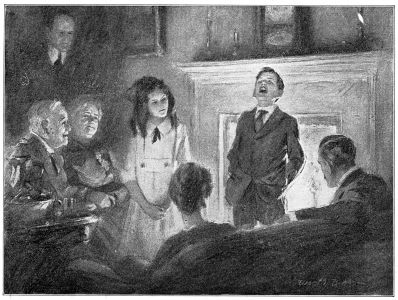 "Herbert attempted to continue the drowning out. He
bawled, 'She made it up! It's somep'n she made up herself! She——'"
"Herbert attempted to continue the drowning out. He
bawled, 'She made it up! It's somep'n she made up herself! She——'"
"It runs in the family," Florence retorted, automatically.
"I caught it from my cousins. Anyhow,
I don't think there's a single one of any that
wants to marry Aunt Julia that's got the slightest
co'parison to Noble Dill. I admire him because he's
so uncouth."
"He so who?" Kitty Silver inquired.
"Uncouth."
"Yes'm," said Mrs. Silver.
"It's in the ditchanary," Florence explained.
"It means rare, elegant, exquisite, obs, unknown, and
a whole lot else."
"It does not," Herbert interposed. "It means
kind of countrified."
"You go look in the ditchanary," his cousin said
severely. "Then, maybe, you'll know what you're
talkin' about just for once. Anyhow, I do like
Noble Dill, and I bet so does Aunt Julia."
Kitty Silver shook her head. "He lose his struggle,
honey! Miss Julia, she out fer the big class. She
ain't stedyin' about him 'cept maybe dess to let him
run her erran's. She treat 'em all mighty nice, 'cause
the mo' come shovin' an' pushin' each other aroun',
class or no class, why, the mo' harder that big class
got to work to git her—an' the mo' she got after her
the mo' keeps a-comin'. But thishere young li'l Mista
Dills, I kine o' got strong notion he liable not come
no mo' 'tall!" Her tone had become one of reminiscent
amusement, which culminated in a burst of
laughter. "Whee!" she concluded. "After las'
night, I reckon thishere Mista Dills better keep
away from the place—yes'm!"
Florence looked thoughtful, and for the time said
nothing. It was Herbert who asked: "Why'd Noble
Dill better stay away from here?"
"You' grampaw," Mrs. Silver said, shaking her
head. "You' grampaw!"
"What about grandpa?" said Herbert. "What'd
he do last night?"
"'Do'? Oh, me!" Then Mrs. Silver uttered
sounds like the lowing of kine, whereby she meant to
indicate her inability to describe Mr. Atwater's
performance. "Well, ma'am," she said, in the low
and husky voice of simulated exhaustion, "all I got to
say: you' grampaw beat hisse'f! He beat hisse'f!"
"How d'you mean? How could he——"
"He beat hisse'f! He dess out-talk hisse'f! No,
ma'am; I done hear him many an' many an' many's
the time, but las' night he beat hisse'f."
"What about?"
"Nothin' in the wide worl' but dess thishere young
li'l Noble Dills whut we talkin' about this livin'
minute."
"What started him?"
"Whut start him?" Mrs. Silver echoed with
sudden loudness. "My goo'niss! He b'en started ev'
since the very firs' time he ev' lay eyes on him prancin'
up the front walk to call on Miss Julia. You'
grampaw don' like none nem callers, but he everlas'n'ly
did up an' take a true spite on thishere li'l
Dills!"
"I mean," said Herbert, "what started him last
night?"
"Them cigareets," said Kitty Silver. "Them
cigareets whut thishere Noble Dills smoke whiles he
settin' out on the front po'che callin' on you' Aunt
Julia. You' grampaw mighty funny man about
smellin'! You know's well's I do he don't even
like the smell o' violet. Well, ma'am, if he can't
stan' violet, how in the name o' misery he goin' stan'
the smell nem cigareets thishere Dills smoke? I
can't hardly stan' 'em myse'f. When he light one
on the front po'che, she sif' all through the house, an'
come slidin' right the whole way out to my kitchen,
an' bim! she take me in the nose! You' grampaw
awready tole Miss Julia time an' time again if that
li'l Dills light dess one mo' on his front po'che he
goin' to walk out there an' do some harm! Co'se she
nev' tuck an' pay no 'tention, 'cause Miss Julia, she
nev' pay no 'tention to nobody; an' she like caller
have nice time—she ain' goin' tell 'em you' grampaw
make such a fuss. 'Yes, 'deed, kine frien','
she say, she say, when they ast her: 'Miss Julia,
ma'am,' they say, 'I like please strike a match fer to
light my cigareet if you please, ma'am.' She say:
'Light as many as you please, kine frien',' she say,
she say. She say: 'Smell o' cigareet dess deligh'ful
li'l smell,' she say. 'Go 'head an' smoke all you kin
stan',' she say, ''cause I want you injoy you'se'f
when you pay call on me,' she say. Well, so thishere
young li'l Dills settin' there puffin' an' blowin' his
ches' out and in, an' feelin' all nice 'cause it about
the firs' time this livin' summer he catch you' Aunt
Julia alone to hisse'f fer while—an' all time the
house dess fillin' up, an' draf' blowin' straight at you'
grampaw whur he settin' in his liberry. Ma'am,
he sen' me out an' tell her come in, he got message
mighty important fer to speak to her. So she tell
thishere Dills wait a minute, an' walk in the liberry.
Oh, ladies!"
"What'd he say?" Herbert asked eagerly.
"He di'n' say nothin'," Mrs. Silver replied eloquently.
"He hollered."
"What did he holler?"
"He want know di'n' he never tell her thishere
Dills can't smoke no mo' cigareets on his property,
an' di'n' he tell her he was'n' goin' allow him on the
place if he did? He say she got to go back on the
po'che an' run thishere li'l Dills off home. He say he
give her fair choice; she kin run him off, or else he
go on out and chase him away hisse'f. He claim li'l
Dills ain' got no biznuss roun' callin' nowhere 't all,
'cause he on'y make about eighteen dollars a week
an' ain't wuth it. He say——"
She was confirmed in this report by an indignant
interruption from Florence. "That's just what he
did say, the old thing! I heard him, myself, and
if you care to ask me, I'll be glad to inform you
that I think grandpa's conduck was simply insulting!"
"'Deed it were!" said Mrs. Silver. "An' dess
whut he claim hisse'f he mean it fer! But you tell
me, please, how you hear whut you' grampaw say?
He mighty noisy, but you nev' could a-hear him
plumb to whur you live."
"I wasn't home," said Florence. "I was over
here."
"Then you mus' 'a' made you'se'f mighty skimpish,
'cause I ain't seen you!"
"Nobody saw me. I wasn't in the house," said
Florence, "I was out in front."
"Whurbouts 'out in front'?"
"Well, I was sitting on the ground, up against the
latticework of the front porch."
"Whut fur?"
"Well, it was dark," said Florence. "I just kind of
wanted to see what might be going on."
"An' you hear all whut you' grampaw take on
about an' ev'ything?"
"I should say so! You could of heard him lots
farther than where I was."
"Lan' o' misery!" Kitty Silver cried. "If you
done hear him whur you was, thishere li'l Dills mus'
a-hear him mighty plain?"
"He did. How could he help it? He heard
every word, and pretty soon he came down off the
porch and stood a minute; then he went on out the
gate, and I don't know whether he went home or not,
because it was too dark to see. But he didn't come
back."
"Yo' right he didn'!" exclaimed Mrs. Silver. "I
reckon he got fo'thought 'nough fer that, anyhow!
I bet he ain't nev' goin' come back neither. You'
grampaw say he goin' be fix fer him, if he do."
"Yes, that was while he was standing there," said
Florence ruefully. "He heard all that, too."
"Miss Julia, she s'picion' he done hear somep'm
'nother, I guess," Kitty Silver went on. "She shet
the liberry do' right almos' on you' grampaw's nose,
whiles he still a-rampin', an' she slip out on the
po'che, an' take look 'roun'; then go on up to her
own room. I 'uz up there, while after that, turn'
down her bed; an' she injoyin' herse'f readin' book.
She feel kine o' put out, I reckon, but she ain't
stedyin' about no young li'l Dills. She want 'em all
to have nice time an' like her, but she goin' lose this
one, an' she got plenty to spare. She show too much
class fer to fret about no Dills."
"I don't care," said Florence. "I think she ought
to whether she does or not, because I bet he was
feeling just awful. And I think grandpa behaved
like an ole hoodlum."
"That'll do," Herbert admonished her sternly.
"You show some respect for your relations, if you
please."
But his loyalty to the Atwater family had a bad
effect on Florence. "Oh, will I?" she returned
promptly. "Well, then, if you care to inquire my
opinion, I just politely think grandpa ought to be
hanged."
"See here——"
But Florence and Kitty Silver interrupted him
simultaneously.
"Look at that!" Florence cried.
"My name!" exclaimed Kitty Silver.
It was the strange taste of Gammire that so excited
them. Florence had peeled her orange and
divided it rather fairly into three parts, but the
vehemence she exerted in speaking of her grandfather
had caused her to drop one of these upon the
ground. Gammire promptly ate it, "sat up" and
adjusted his paws in prayer for more.
"Now you listen me!" said Kitty Silver. "I ain't
see no dog eat orange in all my days, an' I ain't see
nobody else whut see dog eat orange! No, ma'am,
an' I ain't nev' hear o' nobody else whut ev' see nobody
whut see dog eat orange!"
Herbert decided to be less impressed. "Oh, I've
heard of dogs that'd eat apples," he said. "Yes,
and watermelon and nuts and things." As he spoke
he played with the tennis ball upon his racket, and
concluded by striking the ball high into the air.
Its course was not true; and it descended far over
toward the orchard, where Herbert ran to catch it—but
he was not quick enough. At the moment the
ball left the racket Gammire abandoned his prayers:
his eyes, like a careful fielder's, calculating and
estimating, followed the swerve of the ball in the
breeze, and when it fell he was on the correct spot.
He caught it.
Herbert shouted. "He caught it on the fly! It
must have been an accident. Here——" And he
struck the ball into the air again. It went high—twice
as high as the house—and again Gammire
"judged" it; continuously shifting his position, his
careful eyes never leaving the little white globe, until
just before the last instant of its descent he was motionless
beneath it. He caught it again, and Herbert
whooped.
Gammire brought the ball to him and invited
him to proceed with the game. That there might
be no mistaking his desire, Gammire "sat up"
and prayed; nor did he find Herbert anything
loth. Out of nine chances Gammire "muffed" the
ball only twice, both times excusably, and Florence
once more flung her arms about the willing performer.
"Who do you s'pose trained this wonderful, darling
doggie?" she cried.
Mrs. Silver shook her marvelling head. "He
mus' 'a' come thataway," she said. "I bet nobody
't all ain' train him; he do whut he want to hisse'f.
That Gammire don' ast nobody to train
him."
"Oh, goodness!" Florence said, with sudden
despondency. "It's awful!"
"Whut is?"
"To think of as lovely a dog as this having to face
grandpa!"
"'Face' him!" Kitty Silver echoed forebodingly.
"I reckon you' grampaw do mo'n dess 'face' him."
"That's what I mean," Florence explained. "I
expect he's just brute enough to drive him off."
"Yes'm," said Mrs. Silver. "He git madder ev'y
time somebody sen' her new pet. You' grampaw
mighty nervous man, an' everlas'n'ly do hate
animals."
"He hasn't seen Gammire, has he?"
"Don't look like it, do it?" said Kitty Silver.
"Dog here yit."
"Well, then I——" Florence paused, glancing
at Herbert, for she had just been visited by a pleasant
idea and had no wish to share it with him. "Is
Aunt Julia in the house?"
"She were, li'l while ago."
"I want to see her about somep'n I ought to see
her about," said Florence. "I'll be out in a minute."
She ran into the house, and found Julia seated
at a slim-legged desk, writing a note.
"Aunt Julia, it's about Gammire."
"Gamin."
"What?"
"His name is Gamin."
"Kitty Silver says his name's Gammire."
"Yes," said Julia. "She would. His name is
Gamin, though. He's a little Parisian rascal, and
his name is Gamin."
"Well, Aunt Julia, I'd rather call him Gammire.
How much did he cost?"
"I don't know; he was brought to me only this
morning, and I haven't asked yet."
"But I thought somebody gave him to you."
"Yes; somebody did."
"Well, I mean," said Florence, "how much did
the person that gave him to you pay for him?"
Julia sighed. "I just explained, I haven't had a
chance to ask."
Florence looked hurt. "I don't mean you would
ask 'em right out. I just meant: Wouldn't you be
liable to kind of hint around an' give 'em a chance
to tell you how much it was? You know perfeckly
well it's the way most the fam'ly do when they give
each other somep'n pretty expensive, Christmas or
birthdays, and I thought proba'ly you'd——"
"No. I shouldn't be surprised, Florence, if nobody
ever got to know how much Gamin cost."
"Well——" Florence said, and decided to approach
her purpose on a new tack. "Who was it
trained him?"
"I understand that the person who gave him to me
has played with him at times during the few days
he's been keeping him, but hasn't 'trained' him
particularly. French Poodles almost learn their
own tricks if you give them a chance. It's natural
to them; they love to be little clowns if you let them."
"But who was this person that gave him to you?"
Julia laughed. "It's a secret, Florence—like
Gamin's price."
At this Florence looked piqued. "Well, I guess I
got some manners!" she exclaimed. "I know as well
as you do, Aunt Julia, there's no etiquette in coming
right square out and asking how much it was when
somebody goes and makes you a present. I'm certainly
enough of a lady to keep my mouth shut when
it's more polite to! But I don't see what harm there
is in telling who it is that gives anybody a present."
"No harm at all," Julia murmured as she sealed
the note she had written. Then she turned smilingly
to face her niece. "Only I'm not going to."
"Well, then, Aunt Julia"—and now Florence
came to her point—"what I wanted to know is
just simply the plain and simple question: Will you
give this dog Gammire to me?"
Julia leaned forward, laughing, and suddenly
clapped her hands together, close to Florence's face.
"No, I won't!" she cried. "There!"
The niece frowned, lines of anxiety appearing upon
her forehead. "Well, why won't you?"
"I won't do it!"
"But, Aunt Julia, I think you ought to!"
"Why ought I to?"
"Because——" said Florence. "Well, it's necessary."
"Why?"
"Because you know as well as I do what's bound
to happen to him!"
"What is?"
"Grandpa'll chase him off," said Florence. "He'll
take after him the minute he lays eyes on him, and
scare him to death—and then he'll get lost, and he
won't be anybody's dog! I should think you'd just
as lief he'd be my dog as have him chased all over
town till a street car hits him or somep'n."
But Julia shook her head. "That hasn't happened
yet."
"It did happen with every other one you ever had,"
Florence urged plaintively. "He chased 'em every
last one off the place, and they never came back.
You know perfectly well, Aunt Julia, grandpa's
just bound to hate this dog, and you know just exactly
how he'll act about him."
"No, I don't," said Julia. "Not just exactly."
"Well, anyway, you know he'll behave awful."
"It's probable," the aunt admitted.
"He always does," Florence continued. "He
behaves awful about everything I ever heard about.
He——"
"I'll go pretty far with you, Florence," Julia interposed,
"but we'd better leave him a loophole.
You know he's a constant attendant at church and
contributes liberally to many good causes."
"Oh, you know what I mean! I mean he always
acts horrable about anything pleasant. Of course
I know he's a good man, and everything; I just mean
the way he behaves is perfeckly disgusting. So
what's the use your not givin' me this dog? You
won't have him yourself as soon as grandpa comes
home to lunch in an hour or so."
"Oh, yes, I will!"
"Grandpa hasn't already seen him, has he?"
"No."
"Then what makes you say——"
"He isn't coming home to lunch. He won't be
home till five o'clock this afternoon."
"Well, then, about six you won't have any dog,
and poor little Gammire'll get run over by an automobile
some time this very evening!" Florence's
voice became anguished in the stress of her appeal.
"Aunt Julia, won't you give me this dog?"
Julia shook her head.
"Won't you, please?"
"No, dear."
"Aunt Julia, if it was Noble Dill gave you this
dog——"
"Florence!" her aunt exclaimed. "What in the
world makes you imagine such absurd things?
Poor Mr. Dill!"
"Well, if it was, I think you ought to give Gammire
to me because I like Noble Dill, and I——"
But here her aunt laughed again and looked at her
with some curiosity. "You still do?" she asked.
"What for?"
"Well," said Florence, swallowing, "he may be
rather smallish for a man, but he's very uncouth and
distingrished-looking, and I think he doesn't get to
enjoy himself much. Grandpa talks about him so
torrably and—and——" Here, such was the unexpected
depth of her feeling that she choked, whereupon
her aunt, overcome with laughter, but nevertheless
somewhat touched, sprang up and threw two
pretty arms about her charmingly.
"You funny Florence!" she cried.
"Then will you give me Gammire?" Florence
asked instantly.
"No. We'll bring him in the house now, and you
can stay for lunch."
Florence was imperfectly consoled, but she had a
thought that brightened her a little.
"Well, there'll be an awful time when grandpa
comes home this afternoon—but it certainly will
be inter'sting!"
She proved a true prophet, at least to the extent
that when Mr. Atwater opened his front gate that
afternoon he was already in the presence of a deeply
interested audience whose observation was unknown
to him. Through the interstices of the lace curtains
at an open window, the gaze of Julia and Florence
was concentrated upon him in a manner that might
have disquieted even so opinionated and peculiar
a man as Mr. Atwater, had he been aware of it;
and Herbert likewise watched him fixedly from an
unseen outpost. Herbert had shown some recklessness,
declaring loudly that he intended to lounge
in full view; but when the well-known form of the
ancestor was actually identified, coming up the
street out of the distance, the descendant changed
his mind. The good green earth ceased to seem secure;
and Herbert climbed a tree. He surrounded
himself with the deepest foliage; and beneath him
some outlying foothills of Kitty Silver were visible,
where she endeavoured to lurk in the concealment
of a lilac bush.
Gammire was the only person in view. He sat
just in the middle of the top step of the veranda, and
his air was that of an endowed and settled institution.
What passing traffic there was interested him but
vaguely, not affecting the world to which he belonged—that
world being this house and yard, of which
he felt himself now, beyond all question, the official
dog.
It had been a rather hard-working afternoon, for
he had done everything suggested to him as well as a
great many other things that he thought of himself.
He had also made it clear that he had taken a fancy
to everybody, but recognized Julia to be the head of
the house and of his own universe; and though he was
at the disposal of all her family and friends, he was
at her disposal first. Whithersoever she went, there
would he go also, unless she otherwise commanded.
Just now she had withdrawn, closing the door, but
he understood that she intended no permanent exclusion.
Who was this newcomer at the gate?
The newcomer came to a halt, staring intolerantly.
Then he advanced, slamming the gate behind
him. "Get out o' here!" he said. "You get off the
place!"
Gammire regarded him seriously, not moving,
while Mr. Atwater cast an eye about the lawn,
seeming to search for something, and his gaze, thus
roving, was arrested by a slight movement of great
areas behind a lilac bush. It appeared that the
dome of some public building had covered itself with
antique textiles and was endeavouring to hide there—a
failure.
"Kitty Silver!" he said. "What are you doing?"
"Suh?"
Debouching sidewise she came into fuller view,
but retired a few steps. "Whut I doin' whur, Mista
Atwater?"
"How'd that dog get on my front steps?"
Her face became noncommittal entirely. "Thishere
dog? He just settin' there, suh."
"How'd he get in the yard?"
"Mus' somebody up an' brung him in."
"Who did it?"
"You mean: Who up an' brung him in, suh?"
"I mean: Who does he belong to?"
"Mus' be Miss Julia's. I reckon he is, so fur."
"What! She knows I don't allow dogs on the
place."
"Yessuh."
Mr. Atwater's expression became more outraged
and determined. "You mean to say that somebody's
trying to give her another dog after all I've
been through with——"
"It look that way, suh."
"Who did it?"
"Miss Julia ain't sayin'; an' me, I don' know who
done it no mo'n the lilies of the valley whut toil not
neither do they spins."
In response, Mr. Atwater was guilty of exclamations
lacking in courtesy; and turning again toward
Gammire, he waved his arm. "Didn't you hear me
tell you to get out of here?"
Gammire observed the gesture, and at once "sat
up," placing his forepaws over his nose in prayer,
but Mr. Atwater was the more incensed.
"Get out of here, you woolly black scoundrel!"
Mrs. Silver uttered a cry of injury before she
perceived that she had mistaken her employer's
intention. Gammire also appeared to mistake it,
for he came down upon the lawn, rose to his full
height, on his "hind legs," and in that humanlike
posture "walked" in a wide circle. He did this
with an affectation of conscientiousness thoroughly
hypocritical; for he really meant to be humorous.
"My heavens!" Mr. Atwater cried, lamenting.
"Somebody's given her one of those things at last!
I don't like any kind of dog, but if there's one dam
thing on earth I won't stand, it's a trick poodle!"
And while the tactless Gammire went on, "walking"
a circle round him, Mr. Atwater's eye furiously
searched the borders of the path, the lawn, and
otherwheres, for anything that might serve as missile.
He had never kicked a dog, or struck one with
his hand, in his life; he had a theory that it was
always better to throw something. "Idiot poodle!"
he said.
But Gammire's tricks were not idiocy in the eyes
of Mr. Atwater's daughter, as she watched them.
They had brought to her mind the tricks of the
Jongleur of Notre Dame, who had nothing to offer
heaven itself, to mollify heaven's rulers, except his
entertainment of juggling and nonsense; so that he
sang his thin jocosities and played his poor tricks
before the sacred figure of the Madonna; but when
the pious would have struck him down for it, she
miraculously came to life just long enough to
smile on him and show that he was right to offer
his absurd best. And thus, as Julia watched the
little Jongleur upon the lawn, she saw this was
what he was doing: offering all he knew, hoping that
someone might laugh at him, and like him. And,
not curiously, after all, if everything were known,
she found herself thinking of another foolish creature,
who had nothing in the world to offer anybody,
except what came out of the wistfulness of a foolish,
loving heart. Then, though her lips smiled faintly
as she thought of Noble Dill, all at once a brightness
trembled along the eyelids of the Prettiest Girl in
Town, and glimmered over, a moment later, to shine
upon her cheek.
"You get out!" Mr. Atwater shouted, "D'ye
hear me, you poodle?"
He found the missile, a stone of fair diameter. He
hurled it violently.
"There, darn you!"
The stone missed, and Gammire fled desperately
after it.
"You get over that fence!" Mr. Atwater cried.
"You wait till I find another rock and I'll——"
He began to search for another stone, but, before
he could find one, Gammire returned with the first.
He deposited it upon the ground at Mr. Atwater's
feet.
"There's your rock," he said.
Mr. Atwater looked down at him fiercely, and
through the black chrysanthemum two garnet sparks
glinted waggishly.
"Didn't you hear me tell you what I'd do if you
didn't get out o' here, you darn poodle?"
Gammire "sat up," placed his forepaws together
over his nose and prayed. "There's your rock,"
he said. And he added, as clearly as if he used a
spoken language, "Let's get on with the game!"
Mr. Atwater turned to Kitty Silver. "Does he—does
he know how to speak, or shake hands, or
anything like that?" he asked.
The next morning, as the peculiar old man sat
at breakfast, he said to the lady across the table:
"Look here. Who did give Gamin to us?"
Julia bit her lip; she even cast down her eyes.
"Well, who was it?"
Her demureness still increased. "It was—Noble
Dill."
Mr. Atwater was silent; he looked down and caught
a clownish garnet gleam out of a blackness neighbouring
his knee. "Well, see here," he said. "Why
can't you—why can't you——"
"Why can't I what?"
"Why can't you sit out in the yard the next time
he calls here, instead of on the porch where it blows
all through the house? It's just as pleasant to sit
under the trees, isn't it?"
"Pleasanter," said Julia.
By the end of October, with the dispersal of
foliage that has served all summer long as a
screen for whatever small privacy may exist
between American neighbours, we begin to perceive
the rise of our autumn high tides of gossip. At this
season of the year, in our towns of moderate size
and ambition, where apartment houses have not
yet condensed and at the same time sequestered
the population, one may look over back yard beyond
back yard, both up and down the street; especially
if one takes the trouble to sit for an hour or so
daily, upon the top of a high fence at about the middle
of a block.
Of course an adult who followed such a course
would be thought peculiar, no doubt he would be
subject to inimical comment; but boys are considered
so inexplicable that they have gathered for themselves
many privileges denied their parents and elders,
and a boy can do such a thing as this to his full content,
without anybody's thinking about it at all. So
it was that Herbert Illingsworth Atwater, Jr., sat
for a considerable time upon such a fence, after school
hours, every afternoon of the last week in October;
and only one person particularly observed him or was
stimulated to any mental activity by his procedure.
Even at that, this person was affected only because
she was Herbert's relative, of an age sympathetic to
his and of a sex antipathetic.
In spite of the fact that Herbert, thus seriously
disporting himself on his father's back fence, attracted
only an audience of one (and she hostile
at a rather distant window) his behaviour might well
have been thought piquant by anybody. After
climbing to the top of the fence he would produce
from interior pockets a small memorandum-book
and a pencil. His expression was gravely alert, his
manner more than businesslike; yet nobody could
have failed to comprehend that he was enjoying
himself, especially when his attitude became tenser,
as it frequently did. Then he would rise, balancing
himself at adroit ease, his feet one before the other
on the inner rail, below the top of the boards, and
with eyes dramatically shielded beneath a scoutish
palm, he would gaze sternly in the direction of some
object or movement that had attracted his attention
and then, having satisfied himself of something or
other, he would sit and decisively enter a note in
his memorandum-book.
He was not always alone; sometimes he was joined
by a friend, male, and, though shorter than Herbert,
about as old; and this companion was inspired, it
seemed, by motives precisely similar to those from
which sprang Herbert's own actions. Like Herbert
he would sit upon the top of the high fence; like
Herbert he would rise at intervals, for the better
study of something this side the horizon; then, also
like Herbert, he would sit again and write firmly
in a little notebook. And seldom in the history
of the world have any such sessions been invested by
the participants with so intentional an appearance
of importance.
That was what most irritated their lone observer
at the somewhat distant upstairs back window.
The important importance of Herbert and his friend
was so extreme as to be all too plainly visible across
four intervening broad back yards; in fact, there was
sometimes reason to suspect that the two performers
were aware of their audience and even of her goaded
condition; and that they deliberately increased the
outrageousness of their importance on her account.
And upon the Saturday of that week, when the notebook
writers were upon the fence the greater part of
the afternoon, Florence's fascinated indignation became
vocal.
"Vile Things!" she said.
Her mother, sewing beside another window of the
room, looked up inquiringly.
"What are, Florence?"
"Cousin Herbert and that nasty little Henry
Rooter."
"Are you watching them again?" her mother asked.
"Yes, I am," said Florence; and added tartly,
"Not because I care to, but merely to amuse myself
at their expense."
Mrs. Atwater murmured, "Couldn't you find
some other way to amuse yourself, Florence?"
"I don't call this amusement," the inconsistent
girl responded, not without chagrin. "Think I'd
spend all my days starin' at Herbert Illingsworth
Atwater, Junior, and that nasty little Henry Rooter,
and call it amusement?"
"Then why do you do it?"
"Why do I do what, mamma?" Florence inquired,
as in despair of Mrs. Atwater's ever learning
to put things clearly.
"Why do you 'spend all your days' watching
them? You don't seem able to keep away from the
window, and it appears to make you irritable. I
should think if they wouldn't let you play with them
you'd be too proud——"
"Oh, good heavens, mamma!"
"Don't use such expressions, Florence, please."
"Well," said Florence, "I got to use some expression
when you accuse me of wantin' to 'play' with
those two vile things! My goodness mercy, mamma,
I don't want to 'play' with 'em! I'm more than
four years old, I guess; though you don't ever seem
willing to give me credit for it. I don't haf to 'play'
all the time, mamma: and anyway, Herbert and
that nasty little Henry Rooter aren't playing, either."
"Aren't they?" Mrs. Atwater inquired. "I
thought the other day you said you wanted them to
let you play with them at being a newspaper reporter
or editor or something like that, and they were
rude and told you to go away. Wasn't that it?"
Florence sighed. "No, mamma, it cert'nly wasn't."
"They weren't rude to you?"
"Yes, they cert'nly were!"
"Well, then——"
"Mamma, can't you understand?" Florence
turned from the window to beseech Mrs. Atwater's
concentration upon the matter. "It isn't 'playing'!
I didn't want to 'play' being a reporter; they ain't
'playing'——"
"Aren't playing, Florence."
"Yes'm. They're not. Herbert's got a real
printing-press; Uncle Joseph gave it to him. It's a
real one, mamma, can't you understand?"
"I'll try," said Mrs. Atwater. "You mustn't
get so excited about it, Florence."
"I'm not!" Florence returned vehemently. "I
guess it'd take more than those two vile things and
their old printing-press to get me excited! I don't
care what they do; it's far less than nothing to me!
All I wish is they'd fall off the fence and break their
vile ole necks!"
With this manifestation of impersonal calmness,
she turned again to the window; but her mother
protested. "Do quit watching those foolish boys;
you mustn't let them upset you so by their playing."
Florence moaned. "They don't 'upset' me, mamma!
They have no effects on me by the slightest
degree! And I told you, mamma, they're not
'playing'."
"Then what are they doing?"
"Well, they're having a newspaper. They got
the printing-press and an office in Herbert's stable,
and everything. They got somebody to give 'em
some ole banisters and a railing from a house that
was torn down somewheres, and then they got it
stuck up in the stable loft, so it runs across with a
kind of a gate in the middle of these banisters, and
on one side is the printing-press and a desk from
that nasty little Henry Rooter's mother's attic; and
a table and some chairs, and a map on the wall;
and that's their newspaper office. They go out and
look for what's the news, and write it down in lead
pencil; and then they go up to their office and write
it in ink; and then they print it for their newspaper."
"But what do they do on the fence?"
"That's where they go to watch what the news is,"
Florence explained morosely. "They think they're
so grand, sittin' up there, pokin' around! They go
other places, too; and they ask people. That's
all they said I could be!" Here the lady's bitterness
became strongly intensified. "They said maybe
I could be one o' the ones they asked if I knew anything,
sometimes, if they happened to think of it!
I just respectf'ly told 'em I'd decline to wipe my
oldest shoes on 'em to save their lives!"
Mrs. Atwater sighed. "You mustn't use such expressions,
Florence."
"I don't see why not," the daughter promptly
objected. "They're a lot more refined than the
expressions they used on me!"
"Then I'm very glad you didn't play with them."
But at this, Florence once more gave way to filial
despair. "Mamma, you just can't see through anything!
I've said anyhow fifty times they ain't—aren't—playing!
They're getting up a real newspaper,
and have people buy it and everything. They
been all over this part of town and got every aunt
and uncle they have besides their own fathers and
mothers, and some people in the neighbourhood,
and Kitty Silver and two or three other coloured
people besides. They're going to charge twenty-five
cents a year, collect-in-advance because they
want the money first; and even papa gave 'em a
quarter last night; he told me so."
"How often do they intend to publish their paper,
Florence?" Mrs. Atwater inquired absently, having
resumed her sewing.
"Every week; and they're goin' to have the first
one a week from to-day."
"What do they call it?"
"The North End Daily Oriole. It's the silliest
name I ever heard for a newspaper; and I told 'em
so. I told 'em what I thought of it, I guess!"
"Was that the reason?" Mrs. Atwater asked.
"Was it what reason, mamma?"
"Was it the reason they wouldn't let you be a
reporter with them?"
"Poot!" Florence exclaimed airily. "I didn't
want anything to do with their ole paper. But anyway
I didn't make fun o' their callin' it 'The North
End Daily Oriole' till after they said I couldn't be
in it. Then I did, you bet!"
"Florence, don't say——"
"Mamma, I got to say somep'n! Well, I told
'em I wouldn't be in their ole paper if they begged me
on their bented knees; and I said if they begged me
a thousand years I wouldn't be in any paper with
such a crazy name and I wouldn't tell 'em any news
if I knew the President of the United States had the
scarlet fever! I just politely informed 'em they
could say what they liked, if they was dying I declined
so much as wipe the oldest shoes I got on 'em!"
"But why wouldn't they let you be on the paper?"
her mother insisted.
Upon this Florence became analytical. "Just
so's they could act so important." And she added,
as a consequence, "They ought to be arrested!"
Mrs. Atwater murmured absently, but forbore to
press her inquiry; and Florence was silent, in a
brooding mood. The journalists upon the fence
had disappeared from view, during her conversation
with her mother; and presently she sighed, and
quietly left the room. She went to her own apartment,
where, at a small and rather battered little
white desk, after a period of earnest reverie, she
took up a pen, wet the point in purple ink, and without
great effort or any critical delayings, produced
a poem.
It was in a sense an original poem, though like the
greater number of all literary projections, it was so
strongly inspirational that the source of its inspiration
might easily become manifest to a cold-blooded
reader. Nevertheless, to the poetess herself, as she
explained later in good faith, the words just seemed
to come to her;—doubtless with either genius or
some form of miracle implied; for sources of inspiration
are seldom recognized by inspired writers themselves.
She had not long ago been party to a musical
Sunday afternoon at her Great-Uncle Joseph's house,
where Mr. Clairdyce sang some of his songs again
and again, and her poem may have begun to coagulate
within her then.
THE ORGANEST
By FLORENCE ATWATER
The organest was seated at his organ in a church,
In some beautiful woods of maple and birch,
He was very weary while he played upon the keys,
But he was a great organest and always played with ease,
When the soul is weary,
And the wind is dreary,
I would like to be an organest seated all day at the organ,
Whether my name might be Fairchild or Morgan,
I would play music like a vast amen,
The way it sounds in a church of men.
Florence read her poem seven or eight times,
the deepening pleasure of her expression being evidence
that repetition failed to denature this work,
but on the contrary, enhanced an appreciative surprise
at its singular merit. Finally she folded the
sheet of paper with a delicate carefulness unusual to
her, and placed it in her skirt pocket; then she went
downstairs and out into the back yard. Her next action
was straightforward and anything but prudish;
she climbed the high wooden fences, one after the
other, until she came to a pause at the top of that
whereon the two journalists had lately made themselves
so odiously impressive.
Before her, if she had but taken note of them, were
a lesson in history and the markings of a profound
transition in human evolution. Beside the old frame
stable was a little brick garage, obviously put to the
daily use intended by its designer. Quite as obviously
the stable was obsolete; anybody would have
known from its outside that there was no horse
within it. There, visible, was the end of the pastoral
age.
All this was lost upon Florence. She sat upon the
fence, her gaze unfavourably though wistfully fixed
upon a sign of no special aesthetic merit above the
stable door.
THE NORTH END DAILY ORIOLE
ATWATER & ROOTER OWNERS &
PROPREITORS SUBSCRIBE NOW 25 CENTS
The inconsistency of the word "daily" did not
trouble Florence; moreover, she had found no fault
with "Oriole" until the Owners & Propreitors had
explained to her in the plainest terms known to their
vocabularies that she was excluded from the enterprise.
Then, indeed, she had been reciprocally explicit
in regard not only to them and certain personal
characteristics of theirs, which she pointed out as
fundamental, but in regard to any newspaper which
should deliberately call itself an "Oriole." The
partners remained superior in manner, though unable
to conceal a natural resentment; they had adopted
"Oriole" not out of a sentiment for the city of
Baltimore, nor, indeed, on account of any ornithologic
interest of theirs, but as a relic left over from an
abandoned club or secret society, which they had
previously contemplated forming, its members to be
called "The Orioles" for no reason whatever. The
two friends had talked of this plan at many meetings
throughout the summer, and when Mr. Joseph Atwater
made his great-nephew the unexpected present
of a printing-press, and a newspaper consequently
took the place of the club, Herbert and Henry still
entertained an affection for their former scheme and
decided to perpetuate the name. They were the
more sensitive to attack upon it by an ignorant
outsider and girl like Florence, and her chance of
ingratiating herself with them, if that could be now
her intention, was not a promising one.
She descended from the fence with pronounced
inelegance, and, approaching the old double doors of
the "carriage-house," which were open, paused to
listen. Sounds from above assured her that the
editors were editing—or at least that they could
be found at their place of business. Therefore, she
ascended the cobwebby stairway, emerged from it
into the former hay loft, and thus made her appearance
in the printing-room of The North End Daily
Oriole.
Herbert, frowning with the burden of composition,
sat at a table beyond the official railing, and his
partner was engaged at the press, earnestly setting
type. This latter person (whom Florence so
seldom named otherwise than as "that nasty
little Henry Rooter") was of a pure, smooth,
fair-haired appearance, and strangely clean for
his age and occupation. His profile was of a symmetry
he had not yet himself begun to appreciate;
his dress was scrupulous and modish; and though he
was short, nothing outward about him confirmed the
more sinister of Florence's two adjectives. Nevertheless,
her poor opinion of him was plain in her
expression as she made her present intrusion upon
his working hours. He seemed to reciprocate.
"Listen! Didn't I and Herbert tell you to keep
out o' here?" he said. "Look at her, Herbert!
She's back again!"
"You get out o' here, Florence," said Herbert,
abandoning his task with a look of pain. "How
often we got to tell you we don't want you around
here when we're in our office like this?"
"For Heaven's sake!" Henry Rooter thought fit
to add. "Can't you quit runnin' up and down our
office stairs once in a while, long enough for us to get
our newspaper work done? Can't you give us a little
peace?"
The pinkiness of Florence's altering complexion
was justified; she had not been within a thousand
miles of their old office for four days. With some
heat she stated this to be the fact, adding, "And I
only came then because I knew somebody ought to
see that this stable isn't ruined. It's my own uncle
and aunt's stable, I guess, isn't it? Answer me that,
if you'll kindly please to do so!"
"It's my father and mother's stable," Herbert
asserted. "Haven't I got a right to say who's
allowed in my own father and mother's stable?"
"You have not," the prompt Florence replied.
"It's my own uncle and aunt's stable, and I got as
much right here as anybody."
"You have not!" Henry Rooter protested hotly.
"This isn't either your ole aunt and uncle's stable."
"It isn't?"
"No, it is not! This isn't anybody's stable. It's
my and Herbert's Newspaper Building, and I guess
you haven't got the face to stand there and claim
you got a right to go in a Newspaper Building and
say you got a right there when everybody tells you
to stay outside of it, I guess!"
"Oh, haven't I?"
"No, you 'haven't—I'!" Mr. Rooter maintained
bitterly. "You just walk down town and go in any
Newspaper Buildings down there and tell 'em you
got a right to stay there all day long when they tell
you to get out o' there! Just try it! That's all I
ask!"
Florence uttered a cry of derision. "And pray,
whoever told you I was bound to do everything you
ask me to, Mister Henry Rooter?" And she concluded
by reverting to that hostile impulse, so ancient,
which, in despair of touching an antagonist
effectively, reflects upon his ancestors. "If you got
anything you want to ask, you go ask your grandmother!"
"Here!" Herbert sprang to his feet. "You try
and behave like a lady!"
"Who'll make me?" she inquired.
"You got to behave like a lady as long as you're in
our Newspaper Building, anyway," Herbert said
ominously. "If you expect to come up here after
you been told five dozen times to keep out——"
"For Heaven's sakes!" his partner interposed.
"When we goin' to get our newspaper work done?
She's your cousin; I should think you could get her
out!"
"Well, I'm goin' to, ain't I?" Herbert protested
plaintively. "I expect to get her out, don't I?"
"Oh, do you?" Miss Atwater inquired, with severe
mockery. "Pray, how would you expect to
accomplish it, pray?"
Herbert looked desperate, but was unable to form
a reply consistent with a few new rules of etiquette
and gallantry that he had begun to observe during
the past year or so. "Now, see here, Florence," he
said. "You're old enough to know when people tell
you to keep out of a place, why, it means they want
you to stay away from there."
Florence remained cold to this reasoning. "Oh,
Poot!" she said.
"Now, look here!" her cousin remonstrated, and
went on with his argument. "We got our newspaper
work to do, and you ought to have sense enough to
know newspaper work like this newspaper work we
got on our hands here isn't—well, it ain't any child's
play."
His partner appeared to approve of the expression,
for he nodded severely and then used it himself.
"No, you bet it isn't any child's play!" he said.
"No, sir," Herbert continued. "This newspaper
work we got on our hands here isn't any child's
play."
"No, sir," Henry Rooter again agreed. "Newspaper
work like this isn't any child's play at all!"
"It isn't any child's play, Florence," said Herbert.
"It ain't any child's play at all, Florence. If it was
just child's play or something like that, why, it
wouldn't matter so much your always pokin' up here,
and——"
"Well," his partner interrupted judicially;—"we
wouldn't want her around, even if it was child's
play."
"No, we wouldn't; that's so," Herbert agreed.
"We wouldn't want you around, anyhow, Florence."
Here his tone became more plaintive. "So, for
mercy's sakes can't you go on home and give us a
little rest? What you want, anyhow?"
"Well, I guess it's about time you was askin' me
that," she said, not unreasonably. "If you'd asked
me that in the first place, instead of actin' like you'd
never been taught anything, and was only fit to
associate with hoodlums, perhaps my time is of some
value, myself!"
Here the lack of rhetorical cohesion was largely
counteracted by the strong expressiveness of her tone
and manner, which made clear her position as a person
of worth, dealing with the lowest of her inferiors.
She went on, not pausing:
"I thought being as I was related to you, and all
the family and everybody else is goin' to haf to read
your ole newspaper, anyway it'd be a good thing if
what was printed in it wasn't all a disgrace to the
family, because the name of our family's got mixed up
with this newspaper;—so here!"
Thus speaking, she took the poem from her pocket
and with dignity held it forth to her cousin.
"What's that?" Herbert inquired, not moving a
hand. He was but an amateur, yet already enough
of an editor to be suspicious.
"It's a poem," Florence said. "I don't know
whether I exackly ought to have it in your ole newspaper
or not, but on account of the family's sake I
guess I better. Here, take it."
Herbert at once withdrew a few steps, placing his
hands behind him. "Listen here," he said;—"you
think we got time to read a lot o' nothin' in your ole
hand-writin' that nobody can read anyhow, and then
go and toil and moil to print it on our printin'-press?
I guess we got work enough printin' what we
write for our newspaper our own selves! My goodness,
Florence, I told you this isn't any child's play!"
For the moment, Florence appeared to be somewhat
baffled. "Well," she said. "Well, you better
put this poem in your ole newspaper if you want
to have anyhow one thing in it that won't make
everybody sick that reads it."
"I won't do it!" Herbert said decisively.
"What you take us for?" his partner added.
"All right, then," Florence responded. "I'll go
and tell Uncle Joseph and he'll take this printing-press
back."
"He will not take it back. I already did tell him
how you kept pokin' around, tryin' to run everything,
and how we just worried our lives out tryin' to keep
you away. He said he bet it was a hard job; that's
what Uncle Joseph said! So go on, tell him anything
you want to. You don't get your ole poem in our
newspaper!"
"Not if she lived to be two hunderd years old!"
Henry Rooter added. Then he had an afterthought.
"Not unless she pays for it."
"How do you mean?" Herbert asked, puzzled by
this codicil.
Now Henry's brow had become corrugated with
no little professional impressiveness. "You know
what we were talkin' about this morning?" he said.
"How the right way to run our newspaper, we ought
to have some advertisements in it and everything?
Well, we want money, don't we? We could put this
poem in our newspaper like an advertisement;—that
is, if Florence has got any money, we could."
Herbert frowned. "If her ole poem isn't too long
I guess we could. Here, let's see it, Florence."
And, taking the sheet of paper in his hand, he
studied the dimensions of the poem, without paining
himself to read it. "Well, I guess, maybe we can
do it," he said. "How much ought we to charge
her?"
This question sent Henry Rooter into a state
of calculation, while Florence observed him with
veiled anxiety; but after a time he looked up, his
brow showing continued strain. "Do you keep a
bank, Florence—for nickels and dimes and maybe
quarters, you know?" he inquired.
It was her cousin who impulsively replied for her.
"No, she don't," he said.
"Not since I was about seven years old!" And
Florence added sharply, though with dignity: "Do
you still make mud pies in your back yard, pray?"
"Now, see here!" Henry objected. "Try and be
a lady anyway for a few minutes, can't you? I got to
figure out how much we got to charge you for your ole
poem, don't I?"
"Well, then," Florence returned, "you better ask
me somep'n about that, hadn't you?"
"Well," said Henry Rooter, "have you got any
money at home?"
"No, I haven't."
"Have you got any money with you?"
"Yes, I have."
"How much is it?"
"I won't tell you."
Henry frowned. "I guess we ought to make
her pay about two dollars and a half," he said,
turning to his partner.
Herbert became deferential; it seemed to him that
he had formed a business association with a genius,
and for a moment he was dazzled; then he remembered
Florence's financial capacities, always well
known to him, and he looked depressed. Florence,
herself, looked indignant.
"Two dollars and a half!" she cried. "Why, I
could buy this whole place for two dollars and a half,
printing-press, railing, and all—yes, and you thrown
in, Mister Henry Rooter!"
"See here, Florence," Henry said earnestly.
"Haven't you got two dollars and a half?"
"Of course she hasn't!" his partner assured him.
"She never had two dollars and a half in her life!"
"Well, then," said Henry gloomily, "what we
goin' to do about it? How much you think we ought
to charge her?"
Herbert's expression became noncommittal. "Just
let me think a minute," he said, and with his hand
to his brow he stepped behind the unsuspicious Florence.
"I got to think," he murmured; then with the
straightforwardness of his age, he suddenly seized his
damsel cousin from the rear and held her in a tight
but far from affectionate embrace, pinioning her
arms. She shrieked, "Murder!" and "Let me go!"
and "Help! Hay-yulp!"
"Look in her pocket," Herbert shouted. "She
keeps her money in her skirt pocket when she's got
any. It's on the left side of her. Don't let her kick
you! Look out!"
"I got it!" said the dexterous Henry, retreating
and exhibiting coins. "It's one dime and two
nickels—twenty cents. Has she got any more
pockets?"
"No, I haven't!" Florence fiercely informed him,
as Herbert released her. "And I guess you better
hand that money back if you don't want to be
arrested for stealing!"
But Henry was unmoved. "Twenty cents," he
said calculatingly. "Well, all right; it isn't much,
but you can have your poem in our newspaper for
twenty cents, Florence. If you don't want to pay
that much, why, take your ole twenty cents and go
on away."
"Yes," said Herbert. "That's as cheap as we'll
do it, Florence. Take it or leave it."
"Take it or leave it," Henry Rooter agreed.
"That's the way to talk to her; take it or leave it,
Florence. If you don't take it you got to leave it."
Florence was indignant, but she decided to take it.
"All right," she said coldly. "I wouldn't pay another
cent if I died for it."
"Well, you haven't got another cent, so that's all
right," Mr. Rooter remarked; and he honourably
extended an open palm toward his partner. "Here,
Herbert; you can have the dime, or the two nickels,
whichever you rather. It makes no difference to
me; I'd as soon have one as the other."
Herbert took the two nickels, and turned to
Florence. "See here, Florence," he said, in a tone
of strong complaint. "This business is all done
and paid for now. What you want to hang around
here any more for?"
"Yes, Florence," his partner faithfully seconded
him, at once. "We haven't got any more time to
waste around here to-day, and so what you want to
stand around in the way and everything for? You
ought to know yourself we don't want you."
"I'm not in the way," said Florence hotly. "Whose
way am I in?"
"Well, anyhow, if you don't go," Herbert informed
her, "we'll carry you downstairs and lock you out."
"I'd just like to see you!" she returned, her eyes
flashing. "Just you dare to lay a finger on me
again!" And she added, "Anyway, if you did, those
ole doors haven't got any lock on 'em: I'll come
right back in and walk right straight up the stairs
again!"
Herbert advanced toward her. "Now you pay
attention, to me," he said. "You've paid for your
ole poem, and we got to have some peace around
here. I'm goin' straight over to your mother and
ask her to come and get you."
Florence gave up. "What difference would that
make, Mister Taddletale?" she inquired mockingly.
"I wouldn't be here when she came, would I? I'll
thank you to notice there's some value to my
time, myself; and I'll just politely ask you to excuse
me, pray!"
With a proud air she crushingly departed,
returning to her own home far from dissatisfied
with what she had accomplished.
Moreover, she began to expand with the realization of
a new importance; and she was gratified with the
effect upon her parents, at dinner that evening,
when she informed them that she had written a
poem, which was to be published in the prospective
first number of The North End Daily Oriole.
"Written a poem?" said her father. "Well, I
declare! Why, that's remarkable, Florence!"
"I'm glad the boys were nice about it," said her
mother. "I should have feared they couldn't appreciate
it, after being so cross to you about letting
you have anything to do with the printing-press.
They must have thought it was a very good poem."
"Where is the poem, Florence?" Mr. Atwater
asked. "Let's read it and see what our little girl
can do when she really tries."
Unfortunately Florence had not a copy, and when
she informed her father of this fact, he professed
himself greatly disappointed as well as eager for the
first appearance of The Oriole, that he might
felicitate himself upon the evidence of his daughter's
heretofore unsuspected talent. Florence was herself
anxious for the newspaper's début, and she made her
anxiety so clear to Atwater & Rooter, Owners &
Propreitors, every afternoon after school, during the
following week, that by Thursday further argument
and repartee on their part were felt to be indeed
futile; and in order to have a little peace around there,
they carried her downstairs. At least, they defined
their action as "carrying," and, having deposited
her in the yard, they were obliged to stand guard at
the doors, which they closed and contrived to hold
against her until her strength was worn out for that
day.
Florence consoled herself. During the week she
dropped in on all the members of "the family"—her
grandfather, uncles and aunts and cousins, her great-aunts
and great-uncles—and in each instance, after
no protracted formal preliminaries, lightly remarked
that she wrote poetry now; her first to appear in the
forthcoming Oriole. And when Great-Aunt Carrie
said, "Why, Florence, you're wonderful! I couldn't
write a poem to save my life. I never could see how
they do it," Florence laughed, made a deprecatory
little side motion with her head, and responded,
"Why, Aunt Carrie, that's nothing! It just kind
of comes to you."
This also served as her explanation when some
of her school friends expressed their admiration,
after being told the news in confidence; though to one
of the teachers she said, smiling ruefully, as in
remembrance of midnight oil, "It does take work, of
course!"
When opportunity offered, upon the street, she
joined people she knew (or even rather distant acquaintances)
to walk with them a little way and
lead the conversation to the subject of poetry, including
her own contribution to that art. Altogether,
if Florence was not in a fair way to become a poetic
celebrity it was not her own fault but entirely that of
The North End Daily Oriole, which was to make
its appearance on Saturday, but failed to do so on
account of too much enthusiasm on the part of Atwater
& Rooter in manipulating the printing-press.
It broke, had to be repaired; and Florence, her nerves
upset by the accident, demanded her money back.
This was impossible, and the postponement proved
to be but an episode; moreover, it gave her time to let
more people know of the treat that was coming.
Among these was Noble Dill. Until the Friday
following her disappointment she had found no opportunity
to acquaint her Very Ideal with the news;
and but for an encounter partly due to chance, he
might not have heard of it. A sentimental enrichment
of colour in her cheeks was the result of her
catching sight of him, as she was on the point of
opening and entering her own front door, that afternoon,
on her return from school. He was passing
the house, walking somewhat dreamily.
Florence stepped into the sheltering vestibule,
peeping round it with earnest eyes to watch him as
he went by; obviously he had taken no note of her.
Satisfied of this, she waited until he was at a little
distance, then ran lightly down to the gate, hurried
after him and joined him.
"Why, Mr. Dill!" she exclaimed, in her mother's
most polished manner. "How supprising to see
you! I presume as we both happen to be walking
the same direction we might just's well keep together."
"Surprising to see me?" Noble said vaguely. "I
haven't been away anywhere in particular, Florence."
Then, at a thought, he brightened. "I'm glad to see
you, Florence. Do you know if any of your family
or relatives have heard when your Aunt Julia is
coming home?"
"Aunt Julia? She's out of town," said Florence.
"She's visiting different people she used to know
when she was away at school."
"Yes, I know," Mr. Dill returned. "But she's
been gone six weeks."
"Oh, I don't believe it's that long," Florence said
casually; then with more earnestness: "Mr. Dill,
I was goin' to ask you somep'n—it's kind of a funny
question for me to ask, but——"
"Yes, she has," Noble interrupted, not aware that
his remark was an interruption. "Oh, yes, she has!"
he said. "It was six weeks day-before-yesterday
afternoon. I saw your father downtown this
morning, and he said he didn't know that any of the
family had heard just when she was coming home.
I thought maybe some of your relatives had a letter
from her by this afternoon's mail, perhaps."
"I guess not," said Florence. "Mr. Dill, there was
a question I thought I'd ask you. It's kind of a
funny question for me——"
"Are you sure nobody's heard from your Aunt
Julia to-day?" Noble insisted.
"I guess they haven't. Mr. Dill, I was goin' to
ask you——"
"It's strange," he murmured, "I don't see how
people can enjoy visits that long. I should think
they'd get anxious about what might happen at
home."
"Oh, grandpa's all right; he says he kind of likes
to have the house nice and quiet to himself; and
anyway Aunt Julia enjoys visiting," Florence assured
him. "Aunt Fanny saw a newspaper from
one the places where Aunt Julia's visiting her school
room-mate. It had her picture in it and called her
'the famous Northern Beauty'; it was down South
somewhere. Well, Mr. Dill, I was just sayin' I believe
I'd ask you——"
But a sectional rancour seemed all at once to affect
the young man. "Oh, yes. I heard about that,"
he said. "Your Aunt Fanny lent my mother the
newspaper. Those people in that part of the country—well——"
He paused, remembering that it
was only Florence he addressed; and he withheld
from utterance his opinion that the Civil War ought
to be fought all over again. "Your father said
your grandfather hadn't heard from her for several
days, and even then she hadn't said when she was
coming home."
"No, I expect she didn't," said Florence. "Mr.
Dill, I was goin' to ask you somep'n—it's kind of a
queer kind of question for me to ask, I guess——"
She paused. However, he did not interrupt her,
seeming preoccupied with gloom; whereupon Florence
permitted herself a deprecatory laugh, and continued,
"It might be you'd answer yes, or it might
be you'd answer no; but anyway I was goin' to ask
you—it's kind of a funny question for me to ask, I
expect—but do you like poetry?"
"What?"
"Well, as things have turned out lately I guess it's
kind of a funny question, Mr. Dill, but do you like
poetry?"
Noble's expression took on a coldness; for the word
brought to his mind a thought of Newland Sanders.
"Do I like poetry?" said Noble. "No, I don't."
Florence was momentarily discouraged; but at her
age people usually possess an invaluable faculty,
which they lose later in life; and it is a pity that they
do lose it. At thirteen—especially the earlier months
of thirteen—they are still able to set aside and dismiss
from their minds almost any facts, no matter
how audibly those facts have asked for recognition.
Children superbly allow themselves to become deaf,
so to speak, to undesirable circumstances; most
frequently, of course, to undesirable circumstances
in the way of parental direction; so that fathers,
mothers, nurses, or governesses, not comprehending
that this mental deafness is for the time being entirely
genuine, are liable to hoarseness both of throat
and temper. Thirteen is an age when the fading of
this gift or talent, one of the most beautiful of childhood,
begins to impair its helpfulness under the mistaken
stress of discipline; but Florence retained something
of it. In a moment or two Noble Dill's disaffection
toward poetry was altogether as if it did
not exist.
She coughed, inclined her head a little to one side,
in her mother's manner of politeness to callers, and,
repeating her deprecatory laugh, remarked: "Well,
of course it's kind of a funny question for me to ask,
of course."
"What is, Florence?" Noble inquired absently.
"Well—what I was saying was that 'course it's
sort of queer me askin' if you liked poetry, of course,
on account of my writing poetry the way I do now."
She looked up at him with a bright readiness to
respond modestly to whatever exclamation his wonder
should dictate; but Noble's attention had straggled
again.
"Has she written your mother lately?" he asked.
Florence's expression denoted a mental condition
slightly disturbed. "No," she said. "It's goin'
to be printed in The North End Daily Oriole."
"What?"
"My poem. It's about a vast amen—anyhow,
that's proba'ly the best thing in it, I guess—and
they're goin' to have it out to-morrow, or else they'll
have to settle with me; that's one thing certain!
I'll bring one over to your house and leave it at the
door for you, Mr. Dill."
Noble had but a confused notion of what she thus
generously promised. However, he said, "Thank
you," and nodded vaguely.
"Of course, I don't know as it's so awful good,"
Florence admitted insincerely. "The family all
seem to think it's something pretty much; but I don't
know if it is or not. Really, I don't!"
"No," said Noble, still confused. "I suppose
not."
"I'm half way through another one I think myself'll
be a good deal better. I'm not goin' as fast
with it as I did with the other one, and I expect it'll
be quite a ways ahead of this one." She again employed
the deprecatory little laugh. "I don't know
how I do it, myself. The family all think it's sort
of funny I don't know how I do it, myself; but that's
the way it is. They all say if they could do it
they're sure they'd know how they did it; but I guess
they're wrong. I presume if you can do it, why, it
just comes to you. Don't you presume that's the
way it is, Mr. Dill?"
"I—guess so." They had reached his gate, and
he stopped. "You're sure none of your family
have heard anything to-day?" he asked anxiously.
"From Aunt Julia? I don't think they have."
He sighed, and opened the gate. "Well, good
evening, Florence."
"Good evening." Her eyes followed him wistfully
as he passed within the enclosure; then she
turned and walked quickly toward her own home;
but at the corner of the next fence she called back
over her shoulder, "I'll leave it with your mother for
you, if you're not home when I bring it."
"What?" he shouted, from his front door.
"I'll leave it with your mother."
"Leave what?"
"The poem!"
"Oh!" said Noble. "Thanks!"
But when his mother handed him a copy of the
first issue of The North End Daily Oriole, the
next day, when he came home to lunch, he read it
without edification; there was nothing about Julia
in it.
THE NORTH END DAILY ORIOLE
Atwater & Rooter Owners & Propreitors
SUBSCRIBE NOW 25 Cents Per Year
Subscriptions shloud be brought to the East etrance of Atwater
& Rooter Newspaper Building every afternoon 4.30 to 6. 25 cents.
========================================
NEWS OF THE CITY
_______
The Candidates for mayor at the election are Mr P. N. Gordon
and John T Milo. The contest is very great between these candi-
dates.
Holcombs chickens get in MR. Joseph Atwater's yard a god deal
lately. He says chickens are out of place in a city of this size.
Minnie the cook of Mr. F. L. Smith's residisence goes downtown
every Thrusday afts about three her regular day for it.
A new ditch is being dug accross the MR. Henry D. Vance backyrad.
;Tis about dug but nobody is working there now. Patty
Fairchild received the highest mark in declamation of the 7A at
Sumner School last Friday.
Balf's grorcey wagon ran over a cat of the Mr. Rayfort family.
Geo. the driver of the wagom stated he had not but was willing to
take it away and burg it somewheres Geo. stated regret and claimed
nothing but an accident which could not be helped and not his team
that did the damage.
MissColfield teacher of the 7A atSumner School was reproted on
the sink list. We hope she will soon be well.
There were several deaths in the city this week.
Mr. Fairchild father of Patty Fairchild was on the sick list several
days and did not go to his office but is out now.
Been Kriso the cHauffeur of the Mr. R. G. Atwater family washes
their car on Monday. In using the hose he turned water over the
fence accidently and hit Lonnie the washWOman in back of MRS.
Bruffs who called him some low names. Ben told her if he had have
been a man he wrould strike her but soon the distrubance was at an
end. There is a good deal more of other news which will be printed
in our next NO.
Advertisements & Poems
20 Cents Each Up.
_______
JOSEPH K. ATWATER & CO.
127 South Iowa St,
Steam Pumps.
_______
THE Organstep
BY Florence Atwater
The Organstep was seated at his organ in a
In some beautifil words of vagle and brir
But he was a gReat organstep and always
When the soil is weary
And the mind is drearq
I would play music like a vast amen
The way it sounds in a church of new
Subscribe NOW 25 cents Adv & Poetry
20 cents up. Atwater & Rooter News
Paper Building 25 cents per YEAR
Such was the first issue, complete, of The North
End Daily Oriole. What had happened to the
poem was due partly to Atwater & Rooter's natural
lack of experience in a new and exacting trade;
partly to their enviable unconsciousness of any
necessity for proof-reading; and somewhat to their
haste in getting through the final and least interesting
stage of their undertaking; for of course so far as
the printers were concerned, the poem was mere hack
work anti-climax.
And as they later declared, under fire, anybody
that could make out more than three words in five
of Florence's ole handwriting was welcome to do it.
Besides, what did it matter if a little bit was left out
at the end of one or two of the lines? They couldn't
be expected to run the lines out over their margin,
could they? And they never knew anything crazier
than makin' all this fuss, because: Well, what if
some of it wasn't printed just exactly right, who in
the world was goin' to notice it, and what was the
difference of just a few words different in that ole
poem, anyhow?
For by the time these explanations (so to call
them) took place, Florence was indeed makin' a fuss.
Her emotion, at first, had been happily stimulated
at sight of "BY Florence Atwater." A singular
tenderness had risen in her—a tremulous sense as of
something almost sacred coming at last into its own;
and she hurried to distribute, gratis, among relatives
and friends, several copies of the Oriole, paying
for them, too (though not without injurious argument),
at the rate of two cents a copy. But upon returning
to her own home, she became calm enough (for a
moment or so) to look over the poem with attention
to details. She returned hastily to the Newspaper
Building, but would have been wiser to remain away,
since all subscribers had received their copies by
the time she got there; and under the circumstances
little reparation was practicable.
She ended her oration—or professed to end it—by
declaring that she would never have another
poem in their ole vile newspaper as long as she
lived.
"You're right about that!" Henry Rooter agreed
heartily. "We wouldn't let another one in it. Not
for fifty dollars! Just look at all the trouble we
took, moiling and toiling, to get your ole poem printed
as nice as we could, so it wouldn't ruin our newspaper,
and then you come over here and go on like this,
and all this and that, why, I wouldn't go through it
again for a hunderd dollars! We're makin' good
money anyhow, with our newspaper, Florence Atwater.
You needn't think we depend on you for
our living!"
"That's so," his partner declared. "We knew
you wouldn't be satisfied, anyway, Florence. Didn't
we, Henry?"
"I should say we did!"
"Yes, sir!" said Herbert. "Right when we were
havin' the worst time tryin' to print it and make out
some o' the words, I said right then we were just
throwing away our time. I said, 'What's the use?
That ole girl's bound to raise Cain anyhow, so what's
the use wastin' a whole lot of our good time and brains
like this, just to suit her? Whatever we do, she's
certain to come over and insult us.' Isn't that what
I said, Henry?"
"Yes, it is; and I said then you were right, and you
are right!"
"Cert'nly I am," said Herbert. "Didn't I tell
you she'd be just the way some the family say she
is? A good many of 'em say she'd find fault with
the undertaker at her own funeral. That's just
exactly what I said!"
"Oh, you did?" Florence burlesqued a polite
interest. "How virry considerate of you! Then,
perhaps you'll try to be a gentleman enough for one
simple moment to allow me to tell you my last
remarks on this subject. I've said enough——"
"Oh, have you?" Herbert interrupted with violent
sarcasm. "Oh, no! Say not so! Florence,
say not so!"
At this, Henry Rooter loudly shouted with applausive
hilarity; whereupon Herbert, rather surprised
at his own effectiveness, naturally repeated
his waggery.
"Say not so, Florence! Say not so! Say not
so!"
"I'll tell you one thing!" his lady cousin cried,
thoroughly infuriated. "I wish to make just one
last simple remark that I would care to soil myself
with in your respects, Mister Herbert Illingsworth
Atwater and Mister Henry Rooter!"
"Oh, say not so, Florence!" they both entreated.
"Say not so! Say not so!"
"I'll just simply state the simple truth," Florence
announced. "In the first place, you're goin' to live
to see the day when you'll come and beg me on your
bented knees to have me put poems or anything I
want to in your ole newspaper, but I'll just laugh
at you! 'Indeed?' I'll say! 'So you come beggin'
around me, do you? Ha, ha!' I'll say! 'I guess
it's a little too late for that! Why, I wouldn't——'"
"Oh, say not so, Florence! Say not so!"
"'Me to allow you to have one of my poems?'
I'll say, 'Much less than that!' I'll say, 'because
even if I was wearing the oldest shoes I got in the
world I wouldn't take the trouble to——'"
Her conclusion was drowned out. "Oh, Florence,
say not so! Say not so, Florence! Say not so!"
The hateful entreaty still murmured in her
resentful ears, that night, as she fell asleep;
and she passed into the beginnings of a dream
with her lips slightly dimpling the surface of her
pillow in belated repartee. And upon waking,
though it was Sunday, her first words, half slumbrous
in the silence of the morning, were, "Vile
Things!" Her faculties became more alert during
the preparation of a toilet that was to serve not only
for breakfast, but with the addition of gloves, a hat,
and a blue-velvet coat, for Church and Sunday-school
as well; and she planned a hundred vengeances.
That is to say, her mind did not occupy itself with
plots possible to make real; but rather it dabbled
among those fragmentary visions that love to overlap
and displace one another upon the changeful
retina of the mind's eye.
In all of these pictures, wherein prevailingly she
seemed to be some sort of deathly powerful Queen
of Poetry, the postures assumed by the figures of
Messrs. Atwater and Rooter (both in an extremity
of rags) were miserably suppliant. So she soothed
herself a little—but not long. Herbert, in the next
pew, in church, and Henry in the next beyond that,
were perfect compositions in smugness. They were
cold, contented, aristocratic; and had an imperturbable
understanding between themselves (even then
perceptible to the sensitive Florence) that she was a
nuisance now capably disposed of by their beautiful
discovery of "Say not so!" Florence's feelings were
unbecoming to the place and occasion.
But at four o'clock, that afternoon, she was assuaged
into a milder condition by the arrival, according
to an agreement made in Sunday-school, of
the popular Miss Patty Fairchild.
Patty was thirteen and a half; an exquisite person
with gold-dusted hair, eyes of singing blue, and an
alluring air of sweet self-consciousness. Henry
Rooter and Herbert Illingsworth Atwater, Jr., out
gathering news, saw her entering Florence's gate,
and immediately forgot that they were reporters.
They became silent, gradually moving toward the
house of their newspaper's sole poetess.
Florence and Patty occupied themselves indoors
for half an hour; then went out in the yard to study a
mole's tunnel that had interested Florence recently.
They followed it across the lawn at the south side
of the house, discussing the habits of moles and other
matters of zoölogy; and finally lost the track near the
fence, which was here the "side fence" and higher
than their heads. Patty looked through a knot-hole
to see if the tunnel was visible in the next yard, but,
without reporting upon her observations, she turned,
as if carelessly, and leaned back against the fence,
covering the knot-hole.
"Florence," she said, in a tone softer than she
had been using heretofore;—"Florence, do you know
what I think?"
"No. Could you see any more tracks over there?"
"Florence," said Patty;—"I was just going to
tell you something, only maybe I better not."
"Why not?" Florence inquired. "Go on and
tell me."
"No," said Patty gently. "You might think it
was silly."
"No, I won't."
"Yes, you might."
"I promise I won't."
"Well, then—oh, Florence I'm sure you'll think
it's silly!"
"I promised I wouldn't."
"Well—I don't think I better say it."
"Go on," Florence urged. "Patty, you got to."
"Well, then, if I got to," said Patty. "What I
was going to say, Florence: Don't you think your
cousin Herbert and Henry Rooter have got the nicest
eyes of any boy in town?"
"Who?" Florence was astounded.
"I do," Patty said in her charming voice. "I
think Herbert and Henry've got the nicest eyes of
any boy in town."
"You do?" Florence cried incredulously.
"Yes, I really do, Florence. I think Herbert
Atwater and Henry Rooter have got the nicest
eyes of any boy in town."
"Well, I never heard anything like this before!"
Florence declared.
"But don't you think they've got the nicest eyes
of any boy in town?" Patty insisted, appealingly.
"I think," said Florence, "their eyes are just
horrable!"
"What?"
"Herbert's eyes," continued Florence, ardently,
"are the very worst lookin' ole squinty eyes I ever
saw, and that nasty little Henry Rooter's eyes——"
But Patty had suddenly become fidgety; she hurried
away from the fence. "Come over here, Florence,"
she said. "Let's go over to the other side of the
yard and talk."
It was time for her to take some such action.
Messrs. Atwater and Rooter, seated quietly together
upon a box on the other side of the fence (though
with their backs to the knot-hole), were beginning
to show signs of inward disturbance. Already
flushed with the unexpected ineffabilities overheard,
their complexions had grown even pinker upon
Florence's open-hearted expressions of opinion.
Slowly they turned their heads to look at the fence,
upon the other side of which stood the maligner of
their eyes. Not that they cared what that ole
girl thought—but she oughtn't to be allowed to
go around talking like this and perhaps prejudicing
everybody that had a kind word to say for
them.
"Come on over here, Florence," called Patty
huskily, from the other side of the yard. "Let's
talk over here."
Florence was puzzled, but consented. "What you
want to talk over here for?" she asked as she came
near her friend.
"Oh, I don't know," said Patty. "Let's go out
in the front yard."
She led the way round the house, and a moment
later uttered a cry of surprise as the firm of Atwater
& Rooter, passing along the pavement, hesitated
at the gate. Their celebrated eyes showed doubt for
a moment, then a brazenness: Herbert and Henry
decided to come in.
"Isn't this the funniest thing?" cried Patty.
"After what I just said awhile ago—you know,
Florence. Don't you dare to tell 'em!"
"I cert'nly won't!" her hostess promised, and,
turning inhospitably to the two callers, "What on
earth you want around here?" she inquired.
Herbert chivalrously took upon himself the duty
of response. "Look here; this is my own aunt and
uncle's yard, isn't it? I guess if I want to come in
it I got a perfect right to."
"I should say so," his partner said warmly.
"Why, of course!" the cordial Patty agreed.
"We can play some nice Sunday games, or something.
Let's sit on the porch steps and think what
to do."
"I just as soon," said Henry Rooter. "I got
nothin' p'ticular to do."
"I haven't either," said Herbert.
Thereupon, Patty sat between them on the
steps.
"This is per-feckly grand!" she cried. "Come on,
Florence, aren't you going to sit down with all the
rest of us?"
"Well, pray kindly excuse me!" said Miss Atwater;
and she added that she would neither sit
on the same steps with Herbert Atwater and Henry
Rooter, nor, even if they entreated her with accompanying
genuflections, would she have anything
else whatever to do with them. She concluded with
a reference to the oldest pair of shoes she might ever
come to possess; and withdrew to the railing of the
veranda at a point farthest from the steps; and,
seated there, swinging one foot rhythmically, she
sang hymns in a tone at once plaintive and inimical.
It was not lost upon her, however, that her withdrawal
had little effect upon her guests. They
chattered gaily, and Patty devised, or remembered,
harmless little games that could be played by a few
people as well as by many; and the three participants
were so congenial and noisy and made so merry, that
before long Florence was unable to avoid the impression
that whether she liked it or not she was
giving quite a party.
At times the noted eyes of Atwater & Rooter
were gentled o'er with the soft cast of enchantment,
especially when Patty felt called upon to reprove
the two with little coquetries of slaps and pushes.
Noted for her sprightliness, she was never sprightlier;
her pretty laughter tooted continuously, and the gentlemen
accompanied it with doting sounds so repulsive
to Florence that without being actively conscious of
what she did, she embodied the phrase, "perfeckly
sickening," in the hymn she was crooning, and repeated
it over and over to the air of "Rock of Ages."
"Now I tell you what let's play," the versatile
Patty proposed, after exhausting the pleasures of
"Geography," "Ghosts" and other tests of intellect.
"Let's play 'Truth.' We'll each take a
piece o' paper and a pencil, and then each of us
asks the other one some question, and we haf to
write down the answer and sign your name and fold
it up so nobody can see it except the one that asked
the question, and we haf to keep it a secret and never
tell as long as we live."
"All right," said Henry Rooter. "I'll be the one
to ask you a question, Patty."
"No," Herbert said promptly. "I ought to be
the one to ask Patty."
"Why ought you?" Henry demanded. "Why
ought you?"
"Listen!" Patty cried, "I know the way we'll do.
I'll ask each of you a question—we haf to whisper it—and
each one of you'll ask me one, and then we'll
write it. That'll be simply grand!" She clapped
her hands; then checked herself. "Oh, I guess we
can't either. We haven't got any paper and pencils
unless——" Here she seemed to recall her hostess.
"Oh, Florrie, dear! Run in the house and get us
some paper and pencils."
Florence gave no sign other than to increase the
volume of her voice as she sang: "Perf'ly sick'ning,
clef' for me, let me perf'ly sick-kin-ning!"
"We got plenty," said Herbert; whereupon he
and Henry produced pencils and their professional
note-books, and supplied their fair friend and themselves
with material for "Truth." "Come on,
Patty, whisper me whatever you want to."
"No; I ought to have her whisper me, first,"
Henry Rooter objected. "I'll write the answer to
any question; I don't care what it's about."
"Well, it's got to be the truth, you know," Patty
warned them. "We all haf to write down just
exackly the truth on our word of honour and sign
our name. Promise?"
They promised earnestly.
"All right," said Patty. "Now I'll whisper Henry
a question first, and then you can whisper yours to
me first, Herbert."
This seemed to fill all needs happily, and the
whispering and writing began, and continued with
a coziness little to the taste of the piously singing
Florence. She altered all previous opinions of her
friend Patty, and when the latter finally closed the
session on the steps, and announced that she must
go home, the hostess declined to accompany her into
the house to help her find where she had left her hat
and wrap.
"I haven't the least idea where I took 'em off!"
Patty declared in the airiest manner. "If you won't
come with me, Florrie, s'pose you just call in the
front door and tell your mother to get 'em for me."
"Oh, they're somewhere in there," Florence said
coldly, not ceasing to swing her foot, and not turning
her head. "You can find 'em by yourself, I presume,
or if you can't I'll have our maid throw 'em
out in the yard or somep'n to-morrow."
"Well, thank you!" Miss Fairchild rejoined, as
she entered the house.
The two boys stood waiting, having in mind to
go with Patty as far as her own gate. "That's a
pretty way to speak to company!" Herbert addressed
his cousin with heavily marked severity.
"Next time you do anything like that I'll march
straight in the house and inform your mother of the
fact."
Florence still swung her foot and looked dreamily
away. She sang, to the air of "Rock of Ages":
"Henry Rooter, Herbert, too—they make me sick,
they make me sick, that's what they do."
However, they were only too well prepared with
their annihilating response.
"Oh, say not so! Florence, say not so! Florence!
Say not so!"
They even sent this same odious refrain back to
her from the street, as they departed with their
lovely companion; and, so tenuous is feminine
loyalty sometimes, under these stresses, Miss Fairchild
mingled her sweet, tantalizing young soprano
with their changing and cackling falsetto.
"Say not so, Florence! Oh, say not so! Say not
so!"
They went satirically down the street, their
chumminess with one another bountifully
increased by their common derision of the
outsider on the porch; and even at a distance they
still contrived to make themselves intolerable; looking
back over their shoulders, at intervals, with
say-not-so expressions on their faces. Even when
these faces were far enough away to be but yellowish
oval planes, their say-not-so expressions were still
bitingly eloquent.
Now a northern breeze chilled the air, as the hateful
three became indistinguishable in the haze of
autumn dusk, whereupon Florence stopped swinging
her foot, left the railing, and went morosely into
the house. And here it was her fortune to make
two discoveries vital to her present career; the first
arising out of a conversation between her father and
mother in the library, where a gossipy fire of soft
coal encouraged this proper Sunday afternoon entertainment
for man and wife.
"Sit down and rest, Florence," said her mother.
"I'm afraid you play too hard when Patty and the
boys are here. Do sit down quietly and rest yourself
a little while." And as Florence obeyed, Mrs. Atwater
turned to her husband, resuming: "Well,
that's what I said. I told Aunt Carrie I thought
the same way about it that you did. Of course nobody
ever knows what Julia's going to do next, and
nobody needs to be surprised at anything she does
do. Ever since she came home from school, about
four-fifths of all the young men in town have been
wild about her—and so's every old bachelor, for the
matter of that!"
"Yes," Mr. Atwater added. "And every old
widower, too."
His wife warmly accepted the amendment. "And
every old widower, too," she said, nodding. "Rather!
And of course Julia's just done exactly as she pleased
about everything, and naturally she's going to do as
she pleases about this."
"Well, of course it's her own affair, Mollie," Mr.
Atwater said mildly. "She couldn't be expected to
consult the whole Atwater family connection before
she——"
"Oh, no," she agreed. "I don't say she could.Still, it is rather upsetting, coming so suddenly like
this, when not one of the family has ever seen him—never
even heard his very name before."
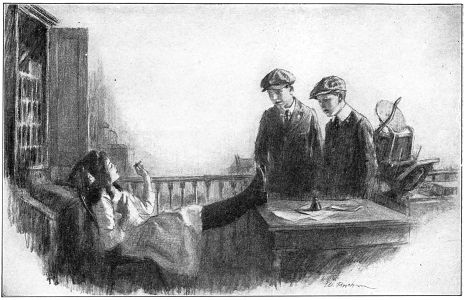 "'Well, men ... I don't want to see any loafin' around
here, men. I expect I'll have a pretty good newspaper this week.'"
"'Well, men ... I don't want to see any loafin' around
here, men. I expect I'll have a pretty good newspaper this week.'"
"Well, that part of it isn't especially strange,
Mollie. He was born and brought up in a town
three hundred miles from here. I don't see just how
we could have heard his name unless he visited here
or got into the papers in some way."
Mrs. Atwater seemed unwilling to yield a mysterious
point. She rocked decorously in her rocking-chair,
shook her head, and after setting her lips
rigidly, opened them to insist that she could never
change her mind: Julia had acted very abruptly.
"Why couldn't she have let her poor father know
at least a few days before she did?"
Mr. Atwater sighed. "Why, she explains in her
letter that she only knew it, herself, an hour before
she wrote."
"Her poor father!" his wife repeated commiseratingly.
"Why, Mollie, I don't see how father's especially
to be pitied."
"Don't you?" said Mrs. Atwater. "That old
man, to have to live in that big house all alone, except
a few negro servants?"
"Why, no! About half the houses in the neighbourhood,
up and down the street, are fully occupied by
close relatives of his: I doubt if he'll be really as
lonely as he'd like to be. And he's often said he'd
give a great deal if Julia had been a plain, unpopular
girl. I'm strongly of the opinion, myself, that he'll
be pleased about this. Of course it may upset him a
little at first."
"Yes; I think it will!" Mrs. Atwater shook her
head forebodingly. "And he isn't the only one it's
going to upset."
"No, he isn't," her husband admitted seriously.
"That's always been the trouble with Julia; she
never could bear to seem disappointing; and so, of
course, I suppose every one of 'em has a special idea
that he's really about the top of the list with her."
"Every last one of 'em is positive of it," said Mrs.
Atwater. "That was Julia's way with 'em!"
"Yes, Julia's always been much too kind-hearted
for other people's good." Thus Mr. Atwater summed
up Julia; and he was her brother. Additionally,
since he was the older, he had known her since
her birth.
"If you ask me," said his wife, "I'll really be surprised
if it all goes through without a suicide."
"Oh, not quite suicide, perhaps," Mr. Atwater
protested. "I'm glad it's a fairly dry town though."
She failed to fathom his simple meaning. "Why?"
"Well, some of 'em might feel that desperate at
least," he explained. "Prohibition's a safeguard for
the disappointed in love."
This phrase and a previous one stirred Florence,
who had been sitting quietly, according to request,
and "resting", but not resting her curiosity. "Who's
disappointed in love, papa?" she inquired with an
explosive eagerness that slightly startled her preoccupied
parents. "What is all this about Aunt
Julia, and grandpa goin' to live alone, and people
committing suicide and prohibition and everything?
What is all this, mamma?"
"Nothing, Florence."
"Nothing! That's what you always say about the
very most inter'sting things that happen in the whole
family! What is all this, papa?"
"It's nothing that would be interesting to little
girls, Florence. Merely some family matters."
"My goodness!" Florence exclaimed. "I'm not a
'little girl' any more, papa! You're always forgetting
my age! And if it's a family matter I belong to the
family, I guess, about as much as anybody else, don't
I? Grandpa himself isn't any more one of the family
than I am, I don't care how old he is!"
This was undeniable, and her father laughed.
"It's really nothing you'd care about one way or the
other," he said.
"Well, I'd care about it if it's a secret," Florence
insisted. "If it's a secret I'd want to know it, whatever
it's about."
"Oh, it isn't a secret, particularly, I suppose. At
least, it's not to be made public for a time; it's only
to be known in the family."
"Well, didn't I just prove I'm as much one o' the
family as——"
"Never mind," her father said soothingly. "I
don't suppose there's any harm in your knowing it—if
you won't go telling everybody. Your Aunt Julia
has just written us that she's engaged."
Mrs. Atwater uttered an exclamation, but she was
too late to check him.
"I'm afraid you oughtn't to have told Florence.
She isn't just the most discreet——"
"Pshaw!" he laughed. "She certainly is 'one of
the family', however, and Julia wrote that all of the
family might be told. You'll not speak of it outside
the family, will you, Florence?"
But Florence was not yet able to speak of it, even
inside the family; so surprising, sometimes, are
parents' theories of what will not interest their
children. She sat staring, her mouth open, and
in the uncertain illumination of the room these
symptoms of her emotional condition went unobserved.
"I say, you won't speak of Julia's engagement
outside the family, will you, Florence?"
"Papa!" she gasped. "Did Aunt Julia write
she was engaged?"
"Yes."
"To get married?"
"It would seem so."
"To who?"
"'To whom,' Florence," her mother suggested
primly.
"Mamma!" the daughter cried. "Who's Aunt
Julia engaged to get married to? Noble Dill?"
"Good gracious, no!" Mrs. Atwater exclaimed.
"What an absurd idea! It's to a young man in the
place she's visiting—a stranger to all of us. Julia
only met him a few weeks ago." Here she forgot
Florence, and turned again to her husband, wearing
her former expression of experienced foreboding.
"It's just as I said. It's exactly like Julia to do such
a reckless thing!"
"But as we don't know anything at all about the
young man," he remonstrated, "how do you know
it's reckless?"
"How do you know he's young?" Mrs. Atwater
retorted crisply. "All in the world she said about
him was that he's a lawyer. He may be a widower,
for all we know, or divorced, with seven or eight
children."
"Oh, no, Mollie!"
"Why, he might!" she insisted. "For all we know,
he may be a widower for the third or fourth time, or
divorced, with any number of children! If such a
person proposed to Julia, you know yourself she'd
hate to be disappointing!"
Her husband laughed. "I don't think she'd go
so far as to actually accept 'such a person' and write
home to announce her engagement to the family. I
suppose most of her swains here have been in the
habit of proposing to her just as frequently as she was
unable to prevent them from going that far; and while
I don't think she's been as discouraging with them
as she might have been, she's never really accepted
any of 'em. She's never been engaged before."
"No," Mrs. Atwater admitted. "Not to this
extent! She's never quite announced it to the family
before, that is."
"Yes; I'd hate to have Julia's job when she comes
back!" Julia's brother admitted ruefully.
"What job?"
"Breaking it to her admirers."
"Oh, she isn't going to do that!"
"She'll have to, now," he said. "She'll either
have to write the news to 'em, or else tell 'em, face
to face, when she comes home."
"She won't do either."
"Why, how could she get out of it?"
His wife smiled pityingly. "She hasn't set a time
for coming home, has she? Don't you know enough
of Julia's ways to see she'll never in the world stand
up to the music? She writes that all the family
can be told, because she knows the news will leak
out, here and there, in confidence, little by little,
so by the time she gets home they'll all have been
through their first spasms, and after that she hopes
they'll just send her some forgiving flowers and greet
her with manly hand-clasps—and get ready to usher
at the wedding!"
"Well," said Mr. Atwater, "I'm afraid you're
right. It does seem rather like Julia to stay away till
the first of the worst is over. I'm really sorry for
some of 'em. I suppose it will get whispered about,
and they'll hear it; and there are some of the poor
things that might take it pretty hard."
"'Take it pretty hard!'" his wife echoed loudly.
"There's one of 'em, at least, who'll just merely lose
his reason!"
"Which one?"
"Noble Dill."
At this, the slender form of Florence underwent a
spasmodic seizure in her chair, but as the fit was
short and also noiseless, it passed without being
noticed.
"Yes," said Mr. Atwater thoughtfully. "I suppose
he will."
"He certainly will!" Mrs. Atwater declared.
"Noble's mother told me last week that he'd got
so he was just as liable to drop a fountain-pen in his
coffee as a lump of sugar; and when any one speaks
to him he either doesn't know it, or else jumps.
When he says anything, himself, she says they can
scarcely ever make out what he's talking about. He
was trying enough before Julia went away; but
since she's been gone Mrs. Dill says he's like nothing
in her experience. She says he doesn't inherit it; Mr.
Dill wasn't anything like this about her."
Mr. Atwater smiled faintly. "Mrs. Dill wasn't
anything like Julia."
"No," said his wife. "She was quite a sensible
girl. I'd hate to be in her place now, though, when
she tells Noble about this."
"How can Mrs. Dill tell him, since she doesn't
know it herself?"
"Well—perhaps she ought to know it, so that she
could tell him. Somebody ought to tell him, and it
ought to be done with the greatest tact. It ought to
be broken to him with the most delicate care and
sympathy, or the consequences——"
"Nobody could foretell the consequences," her
husband interrupted:—"no matter how tactfully
it's broken to Noble."
"No," she said, "I suppose that's true. I think
the poor thing's likely to lose his reason unless it is
done tactfully, though."
"Do you think we really ought to tell Mrs. Dill,
Mollie? I mean, seriously: Do you?"
For some moments she considered his question,
then replied, "No. It's possible we'd be following a
Christian course in doing it; but still we're rather
bound not to speak of it outside the family, and when
it does get outside the family I think we'd better not
be the ones responsible—especially since it might
easily be traced to us. I think it's usually better to
keep out of things when there's any doubt."
"Yes," he said, meditating. "I never knew any
harm to come of people's sticking to their own
affairs."
But as he and his wife became silent for a time,
musing in the firelight, their daughter's special convictions
were far from coinciding with theirs, although
she, likewise, was silent—a singularity they
should have observed. So far were they from a true
comprehension of her, they were unaware that she
had more than a casual, young-cousinly interest in
Julia Atwater's engagement and in those possible
consequences to Noble Dill just sketched with
some intentional exaggeration. They did not even
notice her expression when Mr. Atwater snapped
on the light, in order to read; and she went quietly
out of the library and up the stairs to her own room.
On the floor, near her bed, where Patty Fairchild
had left her coat and hat, Florence made another
discovery. Two small, folded slips of paper lay
there, dropped by Miss Fairchild when she put on
her coat in the darkening room. They were the
replies to Patty's whispered questions in the game
on the steps—the pledged Truth, written by Henry
Rooter and Herbert Atwater on their sacred words
and honours. The infatuated pair had either overestimated
Patty's caution, or else each had thought
she would so prize his little missive that she would
treasure it in a tender safety, perhaps pinned upon
her blouse (at the first opportunity) over her heart.
It is positively safe to say that neither of the two
veracities would ever have been set upon paper had
Herbert and Henry any foreshadowing that Patty
might be careless; and the partners would have been
seized with the utmost horror could they have conceived
the possibility of their trustful messages ever
falling into the hands of the relentless creature who
now, without an instant's honourable hesitation, unfolded
and read them.
"Yes if I got to tell the truth I know I have got pretty
eyes," Herbert had unfortunately written. "I am
glad you think so too Patty because your eyes are
too Herbert Illingsworth Atwater, Jr."
And Mr. Henry Rooter had likewise ruined himself
in a coincidental manner:
"Well Patty my eyes are pretty but suppose I would
like to trade with yours because you have beautiful eyes
also, sure as my name is Henry Rooter."
Florence stood close to the pink-shaded electric
drop-light over her small white dressing-table, reading
again and again these pathetically honest little
confidences. Her eyelids were withdrawn to an unprecedented
retirement, so remarkably she stared;
while her mouth seemed to prepare itself for the
attempted reception of a bulk beyond its capacity.
And these plastic tokens, so immoderate as to be
ordinarily the consequence of nothing short of
horror, were overlaid by others, subtler and more
gleaming, which wrought the true significance of
the contortion—a joy that was dumfounding.
Her thoughts were first of Fortune's kindness in
selecting her for a favour so miraculously dovetailing
into the precise need of her life; then she considered
Henry and Herbert, each at this hour probably
brushing his hair in preparation for the Sunday
evening meal, and both touchingly unconscious of
the calamity now befalling them; but what eventually
engrossed her mind was a thought about
Wallie Torbin.
This Master Torbin, fourteen years of age, was in
all the town the boy most dreaded by his fellow-boys,
and also by girls, including many of both sexes who
knew him only by sight—and hearing. He had no
physical endowment or attainment worth mention;
but boys who could "whip him with one hand"
became sycophants in his presence; the terror he
inspired was moral. He had a special over-development
of a faculty exercised clumsily enough by most
human beings, especially in their youth; in other
words, he had a genius—not, however, a genius
having to do with anything generally recognized as
art or science. True, if he had been a violinist
prodigy or mathematical prodigy, he would have had
some respect from his fellows—about equal to that
he might have received if he were gifted with some
pleasant deformity, such as six toes on a foot—but
he would never have enjoyed such deadly prestige
as had actually come to be his. In brief, then,
Wallie Torbin had a genius for mockery.
Almost from his babyhood he had been a child of
one purpose: to increase by burlesques the sufferings
of unfortunate friends. If one of them wept, Wallie
incessantly pursued him, yelping in horrid mimicry;
if one were chastised he could not appear out-of-doors
for days except to encounter Wallie and a
complete rehearsal of the recent agony. "Quit,
Papa! Pah-puh, quee-yet! I'll never do it again,
Pah-puh! Oh, lemme alone, Pah-puh!"
As he grew older, his insatiate curiosity enabled
him to expose unnumbered weaknesses, indiscretions,
and social misfortunes on the part of acquaintances
and schoolmates; and to every exposure his noise
and energy gave a hideous publicity: the more his
victim sought privacy the more persistently he was
followed by Wallie, vociferous and attended by
hilarious spectators. But above all other things,
what most stimulated the demoniac boy to prodigies
of satire was a tender episode or any symptom connected
with the dawn of love. Florence herself had
suffered at intervals throughout her eleventh summer
because Wallie discovered that Georgie Beck
had sent her a valentine; and the humorist's many,
many squealings of that valentine's affectionate
quatrain finally left her unable to decide which she
hated the more, Wallie or Georgie. That was the
worst of Wallie: he never "let up"; and in Florence's
circle there was no more sobering threat than, "I'll
tell Wallie Torbin!" As for Henry Rooter and Herbert
Illingsworth Atwater, Jr., they would as soon
have had a Head-hunter on their trail as Wallie
Torbin in the possession of anything that could incriminate
them in an implication of love—or an
acknowledgment (in their own handwriting!) of their
own beauty.
The fabric of civilized life is interwoven with
blackmail: even some of the noblest people do favours
for other people who are depended upon not to tell
somebody something that the noblest people have
done. Blackmail is born into us all, and our nurses
teach us more blackmail by threatening to tell our
parents if we won't do this and that—and our parents
threaten to tell the doctor—and so we learn! Blackmail
is part of the daily life of a child. Displeased, his
first resort to get his way with other children is a threat
to "tell," but by-and-by his experience discovers
the mutual benefit of honour among blackmailers.
Therefore, at eight it is no longer the ticket to
threaten to tell the teacher; and, a little later, threatening
to tell any adult at all is considered something
of a breakdown in morals. Notoriously, the code is
more liable to infraction by people of the physically
weaker sex, for the very reason, of course, that their
inferiority of muscle so frequently compels such
a sin, if they are to have their way. But for Florence
there was now no such temptation. Looking to the
demolition of Atwater & Rooter, an exposure before
adults of the results of "Truth" would have been an
effect of the sickliest pallor compared to what might
be accomplished by a careful use of the catastrophic
Wallie Torbin.
On Sunday evening it was her privileged custom to
go to the house of fat old Great-Uncle Joseph and
remain until nine o'clock, in chatty companionship
with Uncle Joseph and Aunt Carrie, his wife, and a
few other relatives (including Herbert) who were in
the habit of dropping in there, on Sunday evenings.
In summer, lemonade and cake were frequently
provided; in the autumn, one still found cake, and
perhaps a pitcher of clear new cider: apples were a
certainty.
This evening was glorious: there were apples and
cider and cake, with walnuts, perfectly cracked, and
a large open-hearted box of candy; for Uncle Joseph
and Aunt Carrie had foreseen the coming of several
more Atwaters than usual, to talk over the new
affairs of their beautiful relative, Julia. Seldom
have any relative's new affairs been more thoroughly
talked over than were Julia's that evening; though
all the time by means of symbols, since it was
thought wiser that Herbert and Florence should not
yet be told of Julia's engagement; and Florence's
parents were not present to confess their indiscretion.
Julia was referred to as "the traveller"; other makeshifts
were employed with the most knowing caution,
and all the while Florence merely ate inscrutably.
The more sincere Herbert was placid; the foods absorbing
his attention.
"Well, all I say is, the traveller better enjoy herself
on her travels," said Aunt Fanny, finally, as the
subject appeared to be wearing toward exhaustion.
"She certainly is in for it when the voyaging is over
and she arrives in the port she sailed from, and has to
show her papers. I agree with the rest of you:
she'll have a great deal to answer for, and most of all
about the shortest one. My own opinion is that the
shortest one is going to burst like a balloon."
"The shortest one," as the demure Florence had
understood from the first, was none other than her
Very Ideal. Now she looked up from the stool
where she sat with her back against a pilaster of the
mantelpiece. "Uncle Joseph," she said;—"I was
just thinking. What is a person's reason?"
The fat gentleman, rosy with firelight and cider,
finished his fifth glass before responding. "Well,
there are persons I never could find any reason for at
all. 'A person's reason'? What do you mean, 'a
person's reason,' Florence?"
"I mean: like when somebody says, 'They'll lose
their reason,'" she explained. "Has everybody
got a reason, and if they have, what is it, and how do
they lose it, and what would they do then?"
"Oh! I see!" he said. "You needn't worry. I
suppose since you heard it you've been hunting all
over yourself for your reason and looking to see if
there was one hanging out of anybody else, somewhere.
No; it's something you can't see, ordinarily,
Florence. Losing your reason is just another way
of saying, 'going crazy'!"
"Oh!" she murmured, and appeared to be disturbed.
At this, Herbert thought proper to offer a witticism
for the pleasure of the company.
"You know, Florence," he said, "it only means acting
like you most always do." He applauded himself
with a burst of changing laughter ranging from a bullfrog
croak to a collapsing soprano; then he added:
"Espeshually when you come around my and Henry's
Newspaper Building! You cert'nly 'lose your
reason' every time you come around that ole place!"
"Well, course I haf to act like the people that's
already there," Florence retorted, not sharply, but
in a musing tone that should have warned him. It
was not her wont to use a quiet voice for repartee.
Thinking her humble, he laughed the more raucously.
"Oh, Florence!" he besought her. "Say not so!
Say not so!"
"Children, children!" Uncle Joseph remonstrated.
Herbert changed his tone; he became seriously
plaintive. "Well, she does act that way, Uncle
Joseph! When she comes around there you'd think
we were runnin' a lunatic asylum, the way she takes
on. She hollers and bellers and squalls and squawks.
The least little teeny thing she don't like about
the way we run our paper, she comes flappin' over
there and goes to screechin' around you could hear
her out at the Poor House Farm!"
"Now, now, Herbert," his Aunt Fanny interposed.
"Poor little Florence isn't saying anything impolite
to you—not right now, at any rate. Why don't
you be a little sweet to her just for once?"
Her unfortunate expression revolted all the manliness
in Herbert's bosom. "Be a little sweet to her?"
he echoed with poignant incredulity, and then in
candour made plain how poorly Aunt Fanny inspired
him. "I just exackly as soon be a little sweet to an
alligator," he said.
"Oh, oh!" said Aunt Carrie.
"I would!" Herbert insisted. "Or a mosquito.
I'd rather, to either of 'em, 'cause anyway they don't
make so much noise. Why, you just ought to hear
her," he went on, growing more and more severe.
"You ought to just come around our Newspaper
Building any afternoon you please, after school, when
Henry and I are tryin' to do our work in anyway
some peace. Why, she just squawks and squalls
and squ——"
"It must be terrible," Uncle Joseph interrupted.
"What do you do all that for, Florence, every afternoon?"
"Just for exercise," she answered dreamily; and her
placidity the more exasperated her journalist cousin.
"She does it because she thinks she ought to be
runnin' our own newspaper, my and Henry's; that's
why she does it! She thinks she knows more about
how to run newspapers than anybody alive; but
there's one thing she's goin' to find out; and that is,
she don't get anything more to do with my and
Henry's newspaper. We wouldn't have another single
one of her ole poems in it, no matter how much she
offered to pay us! Uncle Joseph, I think you ought
to tell her she's got no business around my and
Henry's Newspaper Building."
"But, Herbert," Aunt Fanny suggested;—"you
might let Florence have a little share in it of some
sort. Then everything would be all right."
"It would?" he said. "It woo-wud? Oh, my
goodness, Aunt Fanny, I guess you'd like to see our
newspaper just utterably ruined! Why, we wouldn't
let that girl have any more to do with it than we
would some horse!"
"Oh, oh!" both Aunt Fanny and Aunt Carrie
exclaimed, shocked.
"We wouldn't," Herbert insisted. "A horse
would know any amount more how to run a newspaper
than she does. Soon as we got our printing-press,
we said right then that we made up our minds
Florence Atwater wasn't ever goin' to have a single
thing to do with our newspaper. If you let her have
anything to do with anything she wants to run the
whole thing. But she might just as well learn to
stay away from our Newspaper Building, because
after we got her out yesterday we fixed a way so's
she'll never get in there again!"
Florence looked at him demurely. "Are you sure,
Herbert?" she inquired.
"Just you try it!" he advised her, and he laughed
tauntingly. "Just come around to-morrow and
try it; that's all I ask!"
"I cert'nly intend to," she responded with dignity.
"I may have a slight supprise for you."
"Oh, Florence, say not so! Say not so, Florence!
Say not so!"
At this, she looked full upon him, and already she
had something in the nature of a surprise for him;
for so powerful was the still balefulness of her glance
that he was slightly startled. "I might say not
so," she said. "I might, if I was speaking of what
pretty eyes you say yourself you know you have,
Herbert."
It staggered him. "What—what do you mean?"
"Oh, nothin'," she replied airily.
Herbert began to be mistrustful of the solid earth:
somewhere there was a fearful threat to his equipoise.
"What you talkin' about?" he said with an effort
to speak scornfully; but his sensitive voice almost
failed him.
"Oh, nothin'," said Florence. "Just about what
pretty eyes you know you have, and Patty's being
pretty, too, and so you're glad she thinks yours are
pretty, the way you do—and everything!"
Herbert visibly gulped. He believed that Patty
had betrayed him; had betrayed the sworn confidence
of "Truth!"
"That's all I was talkin' about," Florence added.
"Just about how you knew you had such pretty eyes.
Say not so, Herbert! Say not so!"
"Look here!" he said. "When'd you see Patty
again between this afternoon and when you came
over here?"
"What makes you think I saw her?"
"Did you telephone her?"
"What makes you think so?"
Once more Herbert gulped. "Well, I guess you're
ready to believe anything anybody tells you," he
said, with palsied bravado. "You don't believe
everything Patty Fairchild says, do you?"
"Why, Herbert! Doesn't she always tell the
truth?"
"Her? Why, half the time," poor Herbert
babbled, "you can't tell whether she's just makin'
up what she says or not. If you've gone and believed
everything that ole girl told you, you haven't
got even what little sense I used to think you had!"
So base we are under strain, sometimes—so base
when our good name is threatened with the truth
of us! "I wouldn't believe anything she said," he
added, in a sickish voice, "if she told me fifty times
and crossed her heart!"
"Wouldn't you if she said you wrote down how
pretty you knew your eyes were, Herbert? Wouldn't
you if it was on paper in your own handwriting?"
"What's this about Herbert having 'pretty eyes'?"
Uncle Joe inquired, again bringing general attention
to the young cousins; and Herbert shuddered.
This fat uncle had an unpleasant reputation as a
joker.
The nephew desperately fell back upon the hopeless
device of attempting to drown out his opponent's
voice as she began to reply. He became
vociferous with scornful laughter, badly cracked.
"Florence got mad!" he shouted, mingling the purported
information with hoots and cacklings. "She
got mad because I and Henry played some games
with Patty and wouldn't let her play! She's tryin'
to make up stories on us to get even. She made it
up! It's all made up! She——"
"No, no," Mr. Atwater interrupted. "Let Florence
tell us. Florence, what was it about Herbert's
knowing he had 'pretty eyes'?"
Herbert attempted to continue the drowning out.
He bawled. "She made it up! It's somep'n she
made up herself! She——"
"Herbert," said Uncle Joseph;—"if you don't
keep quiet, I'll take back the printing-press."
Herbert substituted a gulp for the continuation
of his noise.
"Now, Florence," said Uncle Joseph, "tell us what
you were saying about how Herbert knows he has
such 'pretty eyes'."
Then it seemed to Herbert that a miracle befell.
Florence looked up, smiling modestly. "Oh, it
wasn't anything, Uncle Joseph," she said. "I was
Just trying to tease Herbert any way I could think
of."
"Oh, was that all?" A hopeful light faded out of
Uncle Joseph's large and inexpressive face. "I
thought perhaps you'd detected him in some indiscretion."
Florence laughed, "I was just teasin' him. It
wasn't anything, Uncle Joseph."
Hereupon, Herbert resumed a confused breathing.
Dazed, he remained uneasy, profoundly so: and
gratitude was no part of his emotion. He well
understood that in conflicts such as these Florence
was never susceptible to impulses of compassion;
in fact, if there was warfare between them, experience
had taught him to be wariest when she seemed
kindest. He moved away from her, and went into
another room where his condition was one of increasing
mental discomfort, though he looked over the
pictures in his great-uncle's copy of "Paradise Lost."
These illustrations, by M. Gustave Doré, failed to
aid in reassuring his troubled mind.
When Florence left the house, he impulsively accompanied
her, maintaining a nervous silence as
they walked the short distance between Uncle
Joseph's front gate and her own. There, however, he
spoke.
"Look here! You don't haf to go and believe
everything that ole girl told you, do you?"
"No," said Florence heartily. "I don't haf to."
"Well, look here," he urged, helpless but to repeat.
"You don't haf to believe whatever it was she went
and told you, do you?"
"What was it you think she told me, Herbert?"
"All that guff—you know. Well, whatever it was
you said she told you."
"I didn't," said Florence. "I didn't say she told
me anything at all."
"Well, she did, didn't she?"
"Why, no," Florence replied, lightly. "She didn't
say anything to me. Only I'm glad to have your
opinion of her, how she's such a story-teller and all—if
I ever want to tell her, and everything!"
But Herbert had greater alarms than this, and the
greater obscured the lesser. "Look here," he said,
"if she didn't tell you, how'd you know it then?"
"How'd I know what?"
"That—that big story about my ever writin' I
knew I had"—he gulped again—"pretty eyes."
"Oh, about that!" Florence said, and swung the
gate shut between them. "Well, I guess it's too
late to tell you to-night, Herbert; but maybe if you
and that nasty little Henry Rooter do every single
thing I tell you to, and do it just exackly like I tell
you from this time on, why maybe—I only say 'maybe'—well,
maybe I'll tell you some day when I feel
like it."
She ran up the path and up the veranda steps,
but paused before opening the front door, and called
back to the waiting Herbert:
"The only person I'd ever think of tellin' about it
before I tell you would be a boy I know." She
coughed, and added as by an afterthought, "He'd
just love to know all about it; I know he would. So,
when I tell anybody about it I'll only tell just you
and this other boy."
"What other boy?" Herbert demanded.
And her reply, thrilling through the darkness, left
him demoralized with horror.
"Wallie Torbin!"
The next afternoon, about four o'clock, Herbert
stood gloomily at the main entrance
of Atwater & Rooter's Newspaper Building
awaiting his partner. The other entrances were not
only nailed fast but massively barricaded; and this
one (consisting of the ancient carriage-house doors,
opening upon a driveway through the yard) had recently
been made effective for exclusion. A long
and heavy plank leaned against the wall, near by,
ready to be set in hook-shaped iron supports fastened
to the inner sides of the doors; and when the doors
were closed, with this great plank in place, a person
inside the building might seem entitled to count
upon the enjoyment of privacy, except in case of
earthquake, tornado, or fire. In fact, the size of
the plank and the substantial quality of the iron
fastenings could be looked upon, from a certain
viewpoint, as a real compliment to the energy and
persistence of Florence Atwater.
Herbert had been in no complimentary frame of
mind, however, when he devised the obstructions,
nor was he now in such a frame of mind. He was
pessimistic in regard to his future, and also embarrassed
in anticipation of some explanations it would
be necessary to make to his partner. He strongly
hoped that Henry's regular after-school appearance
at the Newspaper Building would precede Florence's,
because these explanations required both deliberation
and tact, and he was convinced that it would be
almost impossible to make them at all if Florence
got there first.
He understood that he was unfortunately within
her power; and he saw that it would be dangerous
to place in operation for her exclusion from the Building
this new mechanism contrived with such hopeful
care, and at a cost of two dollars and twenty-five cents
taken from the Oriole's treasury. What he wished
Henry to believe was that for some good reason,
which Herbert had not yet been able to invent, it
would be better to show Florence a little politeness.
He had a desperate hope that he might find some
diplomatic way to prevail on Henry to be as subservient
to Florence as she had seemed to demand,
and he was determined to touch any extremity of
unveracity, rather than permit the details of his
answer in "Truth" to come to his partner's knowledge.
Henry Rooter was not Wallie Torbin; but
in possession of material such as this he could easily
make himself intolerable.
Therefore, it was in a flurried state of mind that
Herbert waited; and when his friend appeared, over the
fence, his perturbation was not decreased. He even
failed to notice the unusual gravity of Henry's manner.
"Hello, Henry! I thought I wouldn't start in
working till you got here. I didn't want to haf to
come all the way downstairs again to open the door
and hi'st our good ole plank up again."
"I see," said Henry, glancing nervously at their
good ole plank. "Well, I guess Florence'll never get
in this good ole door—that is, she won't if we don't
let her, or something."
This final clause would have astonished Herbert
if he had been less preoccupied with his troubles.
"You bet she won't!" he said mechanically. "She
couldn't ever get in here again—if the family didn't
go intafering around and give me the dickens and
everything, because they think—they say they do,
anyhow—they say they think—they think——"
He paused, disguising a little choke as a cough of
scorn for the family's thinking.
"What did you say your family think?" Henry
asked absently.
"Well, they say we ought to let her have a share
in our newspaper." Again he paused, afraid to
continue lest his hypocrisy appear so bare-faced as
to invite suspicion. "Well, maybe we ought,"
he said finally, his eyes guiltily upon his toe, which
slowly scuffed the ground. "I don't say we ought,
and I don't say we oughtn't."
He expected at the least a sharp protest from his
partner, who, on the contrary, surprised him.
"Well, that's the way I look at it," Henry said.
"I don't say we ought and I don't say we oughtn't."
And he, likewise, stared at the toe of a shoe that
scuffed the ground. Herbert felt a little better; this
particular subdivision of his difficulties seemed to be
working out with unexpected ease.
"I don't say we will and I don't say we won't,"
Henry added. "That's the way I look at it. My
father and mother are always talkin' to me: how
I got to be polite and everything, and I guess maybe
it's time I began to pay some 'tention to what they
say. You don't have your father and mother for
always, you know, Herbert."
Herbert's mood at once chimed with this unprecedented
filial melancholy. "No, you don't, Henry.
That's what I often think about, myself. No, sir,
a fellow doesn't have his father and mother to advise
him our whole life, and you ought to do a good deal
what they say while they're still alive."
"That's what I say," Henry agreed gloomily;
and then, without any alteration of his tone, or of
the dejected thoughtfulness of his attitude, he
changed the subject in a way that painfully startled
his companion. "Have you seen Wallie Torbin to-day,
Herbert?"
"What!"
"Have you seen Wallie Torbin to-day?"
Herbert swallowed. "Why, what makes—what
makes you ask me that, Henry?" he said.
"Oh, nothin'." Henry still kept his eyes upon
his gloomily scuffing toe. "I just wondered, because
I didn't happen to see him in school this afternoon
when I happened to look in the door of the
Eight-A when it was open. I didn't want to know
on account of anything particular. I just happened
to say that about him because I didn't have anything
else to think about just then, so I just happened
to think about him, the way you do when you haven't
got anything much on your mind and might get to
thinkin' about you can't tell what. That's all the
way it was; I just happened to kind of wonder if he
was around anywhere maybe."
Henry's tone was obviously, even elaborately,
sincere; and Herbert was reassured. "Well, I
didn't see him," he responded. "Maybe he's
sick."
"No, he isn't," his friend said. "Florence said
she saw him chasin' his dog down the street about
noon."
At this Herbert's uneasiness was uncomfortably
renewed. "Florence did? Where'd you see Florence?"
Mr. Rooter swallowed. "A little while ago,"
he said, and again swallowed. "On the way home
from school."
"Look—look here!" Herbert was flurried to the
point of panic. "Henry—did Florence—did she
go and tell you—did she tell you——?"
"I didn't hardly notice what she was talkin'
about," Henry said doggedly. "She didn't have
anything to say that I'd ever care two cents about.
She came up behind me and walked along with me a
ways, but I got too many things on my mind to
hardly pay the least attention to anything she ever
talks about. She's a girl what I think about her
the less people pay any 'tention to what she says the
better off they are."
"That's the way with me, Henry," his partner
assured him earnestly. "I never pay any notice
to what she says. The way I figure it out about
her, Henry, everybody'd be a good deal better off
if nobody ever paid the least notice to anything she
says. I never even notice what she says, myself."
"I don't either," said Henry. "All I think about
is what my father and mother say, because I'm not
goin' to have their advice all the rest o' my life,
after they're dead. If they want me to be polite,
why, I'll do it and that's all there is about it."
"It's the same way with me, Henry. If she comes
flappin' around here blattin' and blubbin' how she's
goin' to have somep'n to do with our newspaper,
why, the only reason I'd ever let her would be because
my family say I ought to show more politeness
to her than up to now. I wouldn't do it on any
other account, Henry."
"Neither would I. That's just the same way
I look at it, Herbert. If I ever begin to treat her
any better, she's got my father and mother to thank,
not me. That's the only reason I'd be willing to say
we better leave the plank down and let her in, if
she comes around here like she's liable to."
"Well," said Herbert. "I'm willing. I don't
want to get in trouble with the family."
And they mounted the stairs to their editorial,
reportorial, and printing rooms; and began to work
in a manner not only preoccupied but apprehensive.
At intervals they would give each other a furtive
glance, and then seem to reflect upon their fathers'
and mothers' wishes and the troublous state of the
times. Florence did not keep them waiting long,
however.
She might have been easier to bear had her manner
of arrival been less assured. She romped up the
stairs, came skipping across the old floor, swinging
her hat by a ribbon, flung open the gate in the sacred
railing, and, flouncing into the principal chair, immodestly
placed her feet on the table in front of
that chair. Additionally, such was her lively humour,
she affected to light and smoke the stub of
a lead pencil. "Well, men," she said heartily, "I
don't want to see any loafin' around here, men. I
expect I'll have a pretty good newspaper this week;
yes, sir, a pretty good newspaper, and I guess you
men got to jump around a good deal to do everything
I think of, or else maybe I guess I'll have to
turn you off. I don't want to haf to do that, men."
The blackmailed partners made no reply, on account
of an inability that was perfect for the moment.
They stared at her helplessly, though not
kindly; for in their expressions the conflict between
desire and policy was almost staringly vivid. And
such was their preoccupation, each with the bitterness
of his own case, that neither wondered at the
other's strange complaisance.
Florence made it clear to them that henceforth
she was the editor of The North End Daily Oriole.
(She said she had decided not to change the name.)
She informed them that they were to be her printers;
she did not care to get all inky and nasty herself,
she said. She would, however, do all the writing for
her newspaper, and had with her a new poem. Also,
she would furnish all the news and it would be
printed just as she wrote it, and printed nicely, too,
or else——She left the sentence unfinished.
Thus did this cool hand take possession of an
established industry, and in much the same fashion
did she continue to manage it. There were unsuppressible
protests; there was covert anguish;
there was even a strike—but it was a short one.
When the printers remained away from their late
Newspaper Building, on Wednesday afternoon,
Florence had an interview with Herbert after dinner
at his own door. He explained coldly that Henry
and he had grown tired of the printing-press and
had decided to put in all their spare time building
a theatre in Henry's attic; but Florence gave him to
understand that the theatre could not be; she preferred
the Oriole.
Henry and Herbert had both stopped "speaking"
to Patty Fairchild, for each believed her treacherous
to himself; but Florence now informed Herbert that
far from depending on mere hearsay, she had in her
own possession the confession of his knowledge that
he had ocular beauty; that she had discovered the
paper where Patty had lost it; and that it was now
in a secure place, and in an envelope, upon the
outside of which was already written, "For Wallie
Torbin. Kindness of Florence A."
Herbert surrendered.
So did Henry Rooter, a little later that evening,
after a telephoned conversation with the slave-driver.
Therefore, the two miserable printers were back
in their places the next afternoon. They told each
other that the theatre they had planned wasn't so
much after all; and anyhow your father and mother
didn't last all your life, and it was better to do what
they wanted, and be polite while they were alive.
And on Saturday the new Oriole, now in every
jot and item the inspired organ of feminism, made
its undeniably sensational appearance.
A copy, neatly folded, was placed in the hand of
Noble Dill, as he set forth for his place of business,
after lunching at home with his mother. Florence
was the person who placed it there; she came hurriedly
from somewhere in the neighbourhood, out
of what yard or alley he did not notice, and slipped
the little oblong sheet into his lax fingers.
"There!" she said breathlessly. "There's a
good deal about you in it this week, Mr. Dill, and
I guess—I guess——"
"What, Florence?"
"I guess maybe you'll——" She looked up at
him shyly; then, with no more to say, turned and ran
back in the direction whence she had come. Noble
walked on, not at once examining her little gift, but
carrying it absently in fingers still lax at the end of
a dangling arm. There was no life in him for anything.
Julia was away.
Away! And yet the dazzling creature looked at
him from sky, from earth, from air; looked at him
with the most poignant kindness, yet always shook
her head! She had answered his first letter by a
kind little note, his second by a kinder and littler
one, and his third, fourth, fifth, and sixth by no
note at all; but by the kindest message (through one
of her aunts) that she was thinking about him a great
deal. And even this was three weeks ago. Since then
from Julia—nothing at all!
But yesterday something a little stimulating had
happened. On the street, downtown, he had come
face to face, momentarily, with Julia's father; and for
the first time in Noble's life Mr. Atwater nodded to
him pleasantly. Noble went on his way, elated. Was
there not something almost fatherly in this strange
greeting?
An event so singular might be interpreted in the
happiest way: What had Julia written her father,
to change him so toward Noble? And Noble was
still dreamily interpreting as he walked down the
street with The North End Daily Oriole idle in
an idle hand.
He found a use for that hand presently, and, having
sighed, lifted it to press it upon his brow, but did
not complete the gesture. As his hand came within
the scope of his gaze, levelled on the unfathomable
distance, he observed that the fingers held a sheet
of printed paper; and he remembered Florence.
Instead of pressing his brow he unfolded the journal
she had thrust upon him. As he began to read,
his eye was lustreless, his gait slack and dreary; but
soon his whole demeanour changed, it cannot be
said for the better.
THE NORTH END DAILY ORIOLE
Atwater & Co., Owners & Propietors
Subscribe NOW 25 cents Per. Year. Sub-
scriptions should be brought to the East
Main Entrance of Atwater & Co., News-
paper Building every afternoon
430 to VI 25 Cents
POEMS
My Soul by Florence Atwater
When my heart is dreary
Then my soul is weary
As a bird with a broken wing
Who never again will sing
Like the sound of a vast amen
That comes from a church of men.
When my soul is dreary
It could never be cheery
But I think of my ideal
And everything seems real
Like the sound of the bright church bells peal.
Poems by Florence Atwater will be in
the paper each and every Sat.
Advertisements 45c. each Up
Joseph K. Atwater Co.
127 South Iowa St.
Steam Pumps
The News of the City
__________
Miss Florence Atwater of tHis City
received a mark of 94 in History Examination
at the concusion of the school Term last June.
Blue hair ribbons are in style again.
Miss Patty Fairchild of this City has not
been doing as well in Declamation lately
as formerly.
MR. Noble Dill of this City is seldom
seen on the streets of the City without
smoking a cigarette.
Miss Julia Atwater of this City is out
of the City.
The MR. Rayfort family of this City
have been presentde with the present
of a new Cat by Geo. the man employeD by
Balf & CO. This cat is perfectly
baeutiful and still quit young.
Miss Julia Atwater of this City is visiting
friends in the Soth. The family have had
many letters from her that are read by each
and all of the famild.
Mr. Noble Dill of this City is in business
with his Father.
There was quite a wind storm Thursday doing
damage to shade trees in many parts of our
beautiful City.
From Letters to the family Miss Julia
Atwater of this City is enjoying her visit
in the south a greadeal.
Miss Patty Fairchild of the 7 A of this
City, will probably not pass in ARithmetiC—unless
great improvement takes place before
Examination.
Miss Julia Atwater of this City wrote a
letter to the family stating while visiting
in the SOuth she has made an engagement
to be married to MR. Crum of that City.
The family do not know who this MR. Crum
is but It is said he is a widower though
he has been diVorced with a great many
children.
The new ditch of the MR. Henry D. Vance,
backyard of this City is about through
now as little remain to be done and it is
thought the beighborhood will son look
better. Subscribe NOW 25c. Per Year Adv.
45c. up. Atwater & Co. Newspaper Building
25 Cents Per Years.
It may be assumed that the last of the news items
was wasted upon Noble Dill and that he never knew
of the neighbourhood improvement believed to be
imminent as a result of the final touches to the
ditch of the Mr. Henry D. Vance backyard.
Throughout that afternoon adult members
of the Atwater family connection made
futile efforts to secure all the copies of the
week's edition of The North End Daily Oriole.
It could not be done.
It was a trying time for "the family." Great
Aunt Carrie said that she had the "worst afternoon of
any of 'em," because young Newland Sanders came
to her house at two and did not leave until five; all
the time counting over, one by one, the hours he'd
spent with Julia since she was seventeen and turned
out, unfortunately, to be a Beauty. Newland had
not restrained himself, Aunt Carrie said, and long
before he left she wished Julia had never been born—and
as for Herbert Illingsworth Atwater, Junior,
the only thing to do with him was to send him to some
strict Military School.
Florence's father telephoned to her mother from
downtown at three, and said that Mr. George Plum
and the ardent vocalist, Clairdyce, had just left his
office. They had not called in company, however,
but coincidentally; and each had a copy of The
North End Daily Oriole, already somewhat worn
with folding and unfolding. Mr. Clairdyce's condition
was one of desperate calm, Florence's father
said, but Mr. Plum's agitation left him rather unpresentable
for the street, though he had finally
gone forth with his hair just as he had rumpled it,
and with his hat in his hand. They wished the
truth, they said: Was it true or was it not true?
Mr. Atwater had told them that he feared Julia was
indeed engaged, though he knew nothing of her
fiancé's previous marriage or marriages, or of the
number of his children. They had responded that
they cared nothing about that. This man Crum's
record was a matter of indifference to them, they
said. All they wanted to know was whether Julia
was engaged or not—and she was!
"The odd thing to me," Mr. Atwater continued
to his wife, "is where on earth Herbert could have
got his story about this Crum's being a widower, and
divorced, and with all those children. Do you know
if Julia's written any of the family about these
things and they haven't told the rest of us?"
"No," said Mrs. Atwater. "I'm sure she hasn't.
Every letter she's written to any of us has passed all
through the family, and I know I've seen every one
of 'em. She's never said anything about him at all,
except that he was a lawyer. I'm sure I can't
imagine where Herbert got his awful information;
I never thought he was the kind of boy to just make
up such things out of whole cloth."
Florence, sitting quietly in a chair near by, with
a copy of "Sesame and Lilies" in her lap, listened to
her mother's side of this conversation with an expression
of impersonal interest; and if she could have
realized how completely her parents had forgotten
(naturally enough) the details of their first rambling
discussion of Julia's engagement, she might really
have felt as little alarm as she showed.
"Well," said Mr. Atwater, "I'm glad our branch
of the family isn't responsible. That's a comfort,
anyhow, especially as people are reading copies of
Herbert's dreadful paper all up and down the town,
my clerk says. He tells me that over at the Unity
Trust Company, where young Murdock Hawes is
cashier, they only got hold of one copy, but typewrote
it and multigraphed it, and some of 'em have
already learned it by heart to recite to poor young
Hawes. He's the one who sent Julia the three fivepound
boxes of chocolates from New York all at the
same time, you remember."
"Yes," Mrs. Atwater sighed. "Poor thing!"
"Florence is out among the family, I suppose?"
he inquired.
"No; she's right here. She's just started to read
Ruskin this afternoon. She says she's going to begin
and read all of him straight through. That's very
nice, don't you think?"
He seemed to muse before replying.
"I think that's very nice, at her age especially,"
Mrs. Atwater urged. "Don't you?"
"Ye-es! Oh, yes! At least I suppose so. Ah—you
don't think—of course she hasn't had anything
at all to do with this?"
"Well, I don't see how she could. You know
Aunt Fanny told us how Herbert declared before
them all, only last Sunday night, that Florence should
never have one thing to do with his printing-press,
and said they wouldn't even let her come near it."
"Yes, that's a fact. I'm glad Herbert made it
so clear that she can't be implicated. I suppose
the family are all pretty well down on Uncle Joseph?"
"Uncle Joseph is being greatly blamed," said
Mrs. Atwater primly. "He really ought to have
known better than to put such an instrument as
a printing-press into the hands of an irresponsible
boy of that age. Of course it simply encouraged him
to print all kinds of things. We none of us think
Uncle Joseph ever dreamed that Herbert would
publish, anything exactly like this, and of course
Uncle Joseph says himself he never dreamed such a
thing; he's said so time and time and time again, all
afternoon. But of course he's greatly blamed."
"I suppose there've been quite a good many of
'em over there blaming him?" her husband inquired.
"Yes—until he telephoned to a garage and hired
a car and went for a drive. He said he had plenty of
money with him and didn't know when he'd be
back."
"Serves him right," said Mr. Atwater. "Does
anybody know where Herbert is?"
"Not yet!"
"Well——" and he returned to a former theme.
"I am glad we aren't implicated. Florence is right
there with you, you say?"
"Yes," Mrs. Atwater replied. "She's right here,
reading. You aren't worried about her, are you?"
she added.
"Oh, no; I'm sure it's all right. I only
thought——"
"Only thought what?"
"Well, it did strike me as curious," said Mr.
Atwater; "especially after Aunt Fanny's telling us
how Herbert declared Florence could never have a
single thing to do with his paper again——"
"Well, what?"
"Well, here's her poem right at the top of it, and
a very friendly item about her history mark of last
June. It doesn't seem like Herbert to be so complimentary
to Florence, all of a sudden. Just
struck me as rather curious; that's all."
"Why, yes," said Mrs. Atwater, "it does seem a
little odd, when you think of it."
"Have you asked Florence if she had anything to
do with getting out this week's Oriole?"
"Why, no; it never occurred to me, especially
after what Aunt Fanny told us," said Mrs. Atwater.
"I'll ask her now."
But she was obliged to postpone putting the intended
question. "Sesame and Lilies" lay sweetly
upon the seat of the chair that Florence had occupied;
but Florence herself had gone somewhere else.
She had gone for a long, long ramble; and pedestrians
who encountered her, and happened to notice
her expression, were interested; and as they went
on their way several of them interrupted the course
of their meditations to say to themselves that she
was the most thoughtful looking young girl they
had ever seen. There was a touch of wistfulness
about her, too; as of one whose benevolence must
renounce all hope of comprehension and reward.
Now, among those who observed her unusual
expression was a gentleman of great dimensions disposed
in a closed automobile that went labouring
among mudholes in an unpaved outskirt of the town.
He rapped upon the glass before him, to get the
driver's attention, and a moment later the car drew
up beside Florence, as she stood in a deep reverie
at the intersection of two roads.
Uncle Joseph opened the door and took his cigar
from his mouth. "Get in, Florence," he said. "I'll
take you for a ride." She started violently; whereupon
he restored the cigar to his mouth, puffed upon
it, breathing heavily the while as was his wont,
and added, "I'm not going home. I'm out for a
nice long ride. Get in."
"I was takin' a walk," she said dubiously. "I haf
to take a whole lot of exercise, and I ought to walk
and walk and walk. I guess I ought to keep on
walkin'."
"Get in," he said. "I'm out riding. I don't
know when I'll get home!"
Florence stepped in, Uncle Joseph closed the door,
and the car slowly bumped onward.
"You know where Herbert is?" Uncle Joseph
inquired.
"No," said Florence, in a gentle voice.
"I do," he said. "Herbert and your friend
Henry Rooter came to our house with one of the last
copies of the Oriole they were distributing to subscribers;
and after I read it I kind of foresaw that
the feller responsible for their owning a printing-press
was going to be in some sort of family trouble
or other. I had quite a talk with 'em and they
hinted they hadn't had much to do with this number
of the paper, except the mechanical end of it; but they
wouldn't come out right full with what they meant.
They seemed to have some good reason for protecting
a third party, and said quite a good deal
about their fathers and mothers being but mortal
and so on; so Henry and Herbert thought they
oughtn't to expose this third party—whoever she may
happen to be. Well, I thought they better not stay
too long, because I was compromised enough already,
without being seen in their company; and I gave
'em something to help 'em out with at the movies.
You can stay at movies an awful long time, and if
you've got money enough to go to several of 'em,
why, you're fixed for pretty near as long as you please.
A body ought to be able to live a couple o' months
at the movies for nine or ten dollars, I should think."
He was silent for a time, then asked, "I don't
suppose your papa and mamma will be worrying
about you, will they, Florence?"
"Oh, no!" she said quickly. "Not in the least!
There was nothin' at all for me to do at our house
this afternoon."
"That's good," he said, "because before we go
back I was thinking some of driving around by way
of Texas."
Florence looked at him trustfully and said nothing.
It seemed to her that he suspected something; she
was not sure; but his conversation was a little peculiar,
though not in the least sinister. Indeed she was
able to make out that he had more the air of an accomplice
than of a prosecutor or a detective. Nevertheless,
she was convinced that far, far the best course
for her to pursue, during the next few days, would
be one of steadfast reserve. And such a course
was congenial to her mood, which was subdued, not
to say apprehensive; though she was sure her recent
conduct, if viewed sympathetically, would be found
at least Christian. The trouble was that probably it
would not be viewed sympathetically. No one would
understand how carefully and tactfully she had
prepared the items of the Oriole to lead suavely
up to the news of Aunt Julia's engagement and
break it to Noble Dill in a manner that would save
his reason.
Therefore, on account of this probable lack of
comprehension on the part of the family and public,
it seemed to her that the only wise and good course
to follow would be to claim nothing for herself, but to
allow Herbert and Henry to remain undisturbed
in full credit for publishing the Oriole. This involved
a disappointment, it is true; nevertheless, she
decided to bear it.
She had looked forward to surprising "the family"
delightfully. As they fluttered in exclamation about
her, she had expected to say, "Oh, the poem isn't so
much, I guess—I wrote it quite a few days ago and
I'm writing a couple new ones now—but I did
take quite a lot o' time and trouble with the rest of
the paper, because I had to write every single word
of it, or else let Henry and Herbert try to, and 'course
they'd just of ruined it. Oh, it isn't so much to
talk about, I guess; it just sort of comes to me to do
things that way."
Thirteen attempts to exercise a great philanthropy,
and every grown person in sight, with the possible
exception of Great-Uncle Joseph, goes into wholly
unanticipated fits of horror. Cause and effect
have no honest relation: Fate operates without justice
or even rational sequence; life and the universe
appear to be governed, not in order and with system,
but by Chance, becoming sinister at any moment
without reason.
And while Florence, thus a pessimist, sat beside
fat Uncle Joseph during their long, long drive, relatives
of hers were indeed going into fits; at least, so
Florence would have described their gestures and incoherences
of comment. Moreover, after the movies,
straight into such a fitful scene did the luckless Herbert
walk when urged homeward by thoughts of
food, at about six that evening. Henry Rooter had
strongly advised him against entering the house.
"You better not," he said earnestly. "Honest,
you better not, Herbert!"
"Well, we got apple dumplings for dinner," Herbert
said, his tone showing the strain of mental
uncertainty. "Eliza told me this morning we were
goin' to have 'em. I kind of hate to go in, but I
guess I better, Henry."
"You won't see any apple dumplings," Henry
predicted.
"Well, I believe I better try it, Henry."
"You better come home with me. My father and
mother'll be perfectly willing to have you."
"I know that," said Herbert. "But I guess I
better go in and try it, anyhow, Henry. I didn't
have anything to do with what's in the Oriole.
It's every last word ole Florence's doing. I haven't
got any more right to be picked on for that than a
child."
"Yes," Henry admitted. "But if you go and tell
'em so, I bet she'd get even with you some way that
would probably get me in trouble, too, before we get
through with the job. I wouldn't tell 'em if I was
you, Herbert!"
"Well, I wasn't intending to," Herbert responded
gloomily; and the thought of each, unknown to the
other, was the same, consisting of a symbolic likeness
of Wallie Torbin at his worst. "I ought to tell
on Florence; by rights I ought," said Herbert; "but
I've decided I won't. There's no tellin' what she
wouldn't do. Not that she could do anything to
me, particyourly——"
"Nor me, either," his friend interposed hurriedly.
"I don't worry about anything like that! Still, if I
was you I wouldn't tell. She's only a girl, we got to
remember."
"Yes," said Herbert. "That's the way I look at
it, Henry; and the way I look at it is just simply this:
long as she is a girl, why, simply let her go. You
can't tell what she'd do, and so what's the use to go
and tell on a girl?"
"That's the way I look at it," Henry agreed.
"What's the use? If I was in your place, I'd act just
the same way you do."
"Well," said Herbert, "I guess I better go on in
the house, Henry. It's a good while after dark."
"You're makin' a big mistake!" Henry Rooter
called after him. "You won't see any apple dumplings,
I bet a hunderd dollars! You better come on
home with me."
Herbert no more than half opened his front
door before he perceived that his friend's advice had
been excellent. So clearly Herbert perceived this,
that he impulsively decided not to open the door any
farther, but on the contrary to close it and retire;
and he would have done so, had his mother not
reached forth and detained him. She was, in fact,
just inside that door, standing in the hall with one
of his great-aunts, one of his aunts, two aunts-by-marriage,
and an elderly unmarried cousin, who were
all just on the point of leaving. However, they
changed their minds and decided to remain, now
that Herbert was among them.
The captive's father joined them, a few minutes
later, but it had already become clear to Herbert
that The North End Daily Oriole was in one sense a
thing of the past, though in another sense this former
owner and proprietor was certain that he would
never hear the last of it. However, on account of
the life of blackmail and slavery now led by the
members of the old régime, the Oriole's extinction
was far less painful to Herbert than his father supposed;
and the latter wasted a great deal of severity,
insisting that the printing-press should be returned
that very night to Uncle Joseph. Herbert's heartiest
retrospective wish was that the ole printing-press had
been returned to Uncle Joseph long ago.
"If you can find him to give it to!" Aunt Harriet
suggested. "Nobody knows where he goes when he
gets the way he did this afternoon when we were discussing
it with him! I only hope he'll be back to-night!"
"He can't stay away forever," Aunt Fanny remarked.
"That garage is charging him five dollars
an hour for the automobile he's in, and surely even
Joseph will decide there's a limit to wildness some
time!"
"I don't care when he comes back," Herbert's
father declared grimly. "Whenever he does he's got
to take that printing-press back—and Herbert will
be let out of the house long enough to carry it over.
His mother or I will go with him."
Herbert bore much more than this. He had
seated himself on the third step of the stairway, and
maintained as much dogged silence as he could.
Once, however, they got a yelp of anguish out of him.
It was when Cousin Virginia said: "Oh, Herbert,
Herbert! How could you make up that terrible
falsehood about Mr. Crum? And, think of it; right
on the same page with your cousin Florence's pure
little poem!"
Herbert uttered sounds incoherent but loud, and
expressive of a supreme physical revulsion. The
shocked audience readily understood that he liked
neither Cousin Virginia's chiding nor Cousin Florence's
pure little poem.
"Shame!" said his father.
Herbert controlled himself. It could be seen that
his spirit was broken, when Aunt Fanny mourned,
shaking her head at him, smiling ruefully:
"Oh, if boys could only be girls!"
Herbert just looked at her.
"The worst thing," said his father;—"that is, if
there's any part of it that's worse than another—the
worst thing about it all is this rumour about Noble
Dill."
"What about that poor thing?" Aunt Harriet
asked. "We haven't heard."
"Why, I walked up from downtown with old man
Dill," said Mr. Atwater, "and the Dill family are all
very much worried. It seems that Noble started
downtown after lunch, as usual, and pretty soon
he came back to the house and he had a copy of this
awful paper that little Florence had given him,
and——"
"Who gave it to him?" Aunt Fanny asked.
"Who?"
"Little Florence."
"Why, that's curious," Cousin Virginia murmured.
"I must telephone and ask her mother
about that."
The brooding Herbert looked up, and there was a
gleam in his dogged eye; but he said nothing.
"Go on," Aunt Harriet urged. "What did Noble
do?"
"Why, his mother said he just went up to his room
and changed his shoes and necktie——"
"I thought so," Aunt Fanny whispered. "Crazy!"
"And then," Mr. Atwater continued, "he left
the house and she supposed he'd gone down to the
office; but she was uneasy, and telephoned his father.
Noble hadn't come. He didn't come all afternoon,
and he didn't go back to the house; and they telephoned
around to every place he could go that they
know of, and they couldn't find him or hear anything
about him at all—not anywhere." Mr. Atwater
coughed, and paused.
"But what," Aunt Harriet cried;—"what do they
think's become of him?"
"Old man Dill said they were all pretty anxious,"
said Mr. Atwater. "They're afraid Noble has—they're
afraid he's disappeared."
Aunt Fanny screamed.
Then, in perfect accord, they all turned to look at
Herbert, who rose and would have retired upstairs
had he been permitted.
As that perturbing evening wore on, word gradually
reached the most outlying members of the
Atwater family connection that Noble Dill was missing.
Ordinarily, this bit of news would have caused
them no severe anxiety. Noble's person and intellect
were so commonplace—"insignificant" was
the term usually preferred in his own circle—that
he was considered to be as nearly negligible as it is
charitable to consider a fellow-being. True, there
was one thing that set him apart; he was found
worthy of a superlative when he fell in love with
Julia; and of course this distinction caused him to
become better known and more talked about than
he had been in his earlier youth.
However, the eccentricities of a person in such an
extremity of love are seldom valued except as comedy,
and even then with no warmth of heart for the
comedian, but rather with an incredulous disdain;
so it is safe to say that under other circumstances,
Noble might have been missing, indeed, and few
of the Atwaters would have missed him. But as
matters stood they worried a great deal about him,
fearing that a rash act on his part might reflect
notoriety upon themselves on account of their beautiful
relative—and The North End Daily Oriole.
And when nine o'clock came and Mrs. Dill reported
to Herbert's father, over the telephone, that nothing
had yet been heard of her son, the pressure of those
who were blaming the Oriole more than they
blamed Julia became so wearing that Herbert decided
he would rather spend the remaining days of his life
running away from Wallie Torbin than put in any
more of such a dog's evening as he was putting in.
Thus he defined it.
He made a confession; that is to say, it was a
proclamation. He proclaimed his innocence. He
began history with a description of events distinctly
subsequent to Sunday pastimes with Patty Fairchild,
and explained how he and Henry had felt that
their parents would not always be with them, and as
their parents wished them to be polite, they had
resolved to be polite to Florence. Proceeding, he
related in detail her whole journalistic exploit.
Of the matter in hand he told the perfect and absolute
truth—and was immediately refuted, confuted,
and demonstrated to be a false witness by Aunt
Fanny, Aunt Carrie, and Cousin Virginia, who had
all heard him vehemently declare, no longer ago
than the preceding Sunday evening, that he and his
partner had taken secure measures to prevent
Florence from ever again setting foot within the
Newspaper Building. In addition, he was quite
showered with definitions; and these, though so
various, all sought to phrase but the one subject:
his conduct in seeking to drag Florence into the mire,
when she was absent and could not defend herself.
Poor Florence would answer later in the evening, he
was told severely; and though her cause was thus
championed against the slander, it is true that some
of her defenders felt stirrings of curiosity in regard
to Florence. In fact, there was getting to be something
almost like a cloud upon her reputation.
There were several things for her to explain;—among
them, her taking it upon herself to see that
Noble received a copy of the Oriole, and also her
sudden departure from home and rather odd protraction
of absence therefrom. It was not thought
she was in good company. Uncle Joseph had telephoned
from a suburb that they were dining at a
farmhouse and would thence descend to the general
region of the movies.
"Nobody knows what that man'll do, when he
decides to!" Aunt Carrie said nervously. "Letting
the poor child stay up so late! She ought to be in
bed this minute, even if it is Saturday night! Or
else she ought to be here to listen to her own bad
little cousin trying to put his terrible responsibility
on her shoulders."
One item of this description of himself the badgered
Herbert could not bear in silence, although he had
just declared that since the truth was so ill-respected
among his persecutors he would open his mouth no
more until the day of his death. He passed over
"bad," but furiously stated his height in feet, inches,
and fractions of inches.
Aunt Fanny shook her head in mourning. "That
may be, Herbert," she said gently. "But you must
try to realize it can't bring poor young Mr. Dill back
to his family."
Again Herbert just looked at her. He had no
indifference more profound than that upon which
her strained conception of the relation between
cause and effect seemed to touch;—from his point of
view, to be missing should be the lightest of calamities.
It is true that he was concerned with the restoration
of Noble Dill to the rest of the Dills so
far as such an event might affect his own incomparable
misfortunes, but not otherwise. He regarded
Noble and Noble's disappearance merely as unfair
damage to himself, and he continued to look at
this sorrowing great-aunt of his until his thoughts
made his strange gaze appear to her so hardened
that she shook her head and looked away.
"Poor young Mr. Dill!" she said. "If someone
could only have been with him and kept talking to
him until he got used to the idea a little!"
Cousin Virginia nodded comprehendingly. "Yes,
it might have tided him over," she said. "He
wasn't handsome, nor impressive, of course, nor
anything like that, but he always spoke so nicely
to people on the street. I'm sure he never harmed
even a kitten, poor soul!"
"I'm sure he never did," Herbert's mother agreed
gently. "Not even a kitten. I do wonder where he
is now."
But Aunt Fanny uttered a little cry of protest.
"I'm afraid we may hear!" she said. "Any moment!"
These sympathetic women had unanimously
set their expectation in so romantically pessimistic
a groove that the most tragic news of
Noble would have surprised them little. But if
the truth of his whereabouts could have been made
known to them, as they sat thus together at what
was developing virtually into his wake, with Herbert
as a compulsory participant, they would have turned
the session into a riot of amazement. Noble was
in the very last place (they would have said, when
calmer) where anybody in the world could have
even madly dreamed of looking for him! They
would have been right about it. No one could have
expected to find Noble to-night inside the old,
four-square brick house of H. I. Atwater, Senior,
chief of the Atwaters and father of too gentle Julia.
Moreover, Mr. Atwater himself was not at present
in the house; he had closed and locked it the day before,
giving the servants a week's vacation and telling
them not to return till he sent for them; and he had
then gone out of town to look over a hominy-mill
he thought of buying. And yet, as the wake went
on, there was a light in the house, and under that
light sat Noble Dill.
Returning home, after Florence had placed the shattering
paper within his hand, Noble had changed
his shoes and his tie. He was but a mechanism;
he had no motive. The shoes he put on were no
better than those he took off; the fresh tie was no
lovelier than the one he had worn; nor had it even
the lucidity to be a purple one, as the banner of
grief. No; his action was, if so viewed, "crazy,"
as Aunt Fanny had called it. Agitation first took
this form; that was all. Love and change of dress
are so closely allied; and in happier days, when Noble
had come home from work and would see Julia in
the evening, he usually changed his clothes. No
doubt there is some faint tracery here, probably too
indistinct to repay contemplation.
When he left the house he walked rapidly downtown,
and toward the end of this one-mile journey
he ran; but as he was then approaching the railway
station, no one thought him eccentric. He was,
however, for when he entered the station he went
to a bench and sat looking upward for more than
ten minutes before he rose, went to a ticket window
and asked for a time-table.
"What road?" the clerk inquired.
"All points South," said Noble.
He placed the time-table, still folded, in his pocket,
rested an elbow on the brass apron of the window,
and would have given himself up to reflections,
though urged to move away. Several people, wishing
to buy tickets, had formed a line behind him;
they perceived that Noble had nothing more to say
to the clerk, and the latter encouraged their protests,
even going so far as to inquire: "For heaven's
sakes, can't you let these folk buy their tickets?"
And since Noble still did not move: "My gosh,
haven't you got no feet?"
"Feet? Oh, yes," said Noble gently. "I'm going
away." And went back to his seat.
Afterwhile, he sought to study his time-table.
Ordinarily, his mind was one of those able to decipher
and comprehend railway time-tables; he had few
gifts, but this was one of them. It failed him now;
so he wandered back to the ticket-window, and, after
urgent coaching, eventually took his place at the end
instead of at the head of the line that waited there.
In his turn he came again to the window, and departed
from it after a conversation with the clerk
that left the latter in accord with Aunt Fanny Atwater's
commiserating adjective, though the clerk's
own pity was expressed in argot. "The poor nut!"
he explained to his next client. "Wants to buy
a ticket on a train that don't pull out until ten thirty-five
to-night; and me fillin' it all out, stampin' it
and everything, what for? Turned out all his pockets
and couldn't come within eight dollars o' the
price! Where you want to go?"
Noble went back to his bench and sat there for
a long time, though there was no time, long or short,
for him. He was not yet consciously suffering;
nor was he thinking at all. True, he had a dim,
persistent impulse to action—or why should he be
at the station?—but for the clearest expression of
his condition it is necessary to borrow a culinary
symbol; he was jelling. But the state of shock was
slowly dispersing, while a perception of approaching
anguish as slowly increased. He was beginning to
swallow nothing at intervals and the intervals were
growing shorter.
Dusk was misting down, outdoors, when with
dragging steps he came out of the station. He
looked hazily up and down the street, where the
corner-lamps and shop-windows now were lighted;
and, after dreary hesitation, he went in search of a
pawn-shop, and found one. The old man who operated
it must have been a philanthropist, for Noble
was so fortunate as to secure a loan of nine dollars
upon his watch. Surprised at this, he returned to
the station, and went back to the same old bench.
It was fully occupied, and he stood for some time
looking with vague reproach at the large family of
coloured people who had taken it. He had a feeling
that he lived there and that these coloured people
were trespassers; but upon becoming aware that part
of an orange was being rubbed over his left shoe
by the youngest of the children, he groaned abruptly
and found another bench.
A little after six o'clock a clanging and commotion
in the train-shed outside, attending the arrival of a
"through express," stirred him from his torpor,
and he walked heavily across the room to the same
ticket-window he had twice blocked; but there was
no queue attached to it now. He rested his elbow
upon the apron and his chin upon his hand, while
the clerk waited until he should state his wishes.
This was a new clerk, who had just relieved the
other.
"Well! Well!" he said at last.
"I'll take it now," Noble responded.
"What'll you take now?"
"That ticket."
"What ticket?"
"The same one I wanted before," Noble sighed.
The clerk gave him a piercing look, glanced out
of the window and saw that there were no other
clients, then went to a desk at the farther end of his
compartment, and took up some clerical work he had
in hand.
Noble leaned upon the apron of the window, waiting;
and if he thought anything, he thought the man
was serving him.
The high, vaulted room became resonant with
voices and the blurred echoes of mingling footsteps
on the marble floor, as passengers from the express
hurried anxiously to the street, or more gaily straggled
through, shouting with friends who came to
greet them; and among these moving groups there
walked a youthful fine lady noticeably enlivening to
the dullest eye. She was preceded by a brisk porter
who carried two travelling-bags of a rich sort, as well
as a sack of implements for the game of golf; and she
was warm in dark furs, against which the vasty
clump of violets she wore showed dewy gleamings
of blue.
At sight of Noble Dill, more than pensive at the
ticket-window, she hesitated, then stopped and observed
him. That she should observe anybody was
in a way a coincidence, for, as it happened, she was
herself the most observed person in all the place.
She was veiled in two veils, but she had been seen
in the train without these, and some of her fellow-travellers,
though strangers to her, were walking near
her in a hypocritical way, hoping still not to lose
sight of her, even veiled. And although the shroudings
permitted the most meagre information of her
features, what they did reveal was harmfully piquant;
moreover, there was a sweetness of figure, a
disturbing grace; while nothing could disguise her
air of wearing that many violets casually as a daily
perquisite and matter of course.
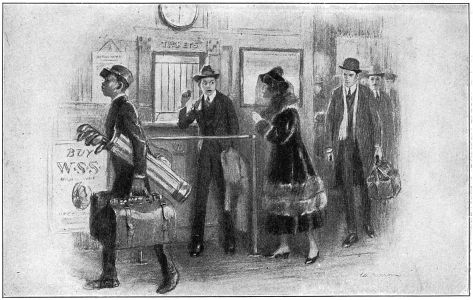 "He stared at her. His elbow sagged away from the
window; the whole person of Noble Dill seemed near collapse."
"He stared at her. His elbow sagged away from the
window; the whole person of Noble Dill seemed near collapse."
So this observed lady stopped and observed Noble,
who in return observed her not at all, being but
semi-conscious. Looked upon thoughtfully, it is a
coincidence that we breathe; certainly it is a mighty
coincidence that we speak to one another and comprehend;
for these are true marvels. But what petty
interlacings of human action so pique our sense of
the theatrical that we call them coincidences and
are astonished! That Julia should arrive during
Noble's long process of buying a ticket to go to her
was stranger than that she stopped to look at him,
though still not comparable in strangeness to the
fact that either of them, or any living creature,
stood upon the whirling earth;—yet when Noble
Dill comprehended what was happening he was
amazed.
She spoke to him.
"Noble!" she said.
He stared at her. His elbow sagged away from
the window; the whole person of Noble Dill seemed
near collapse. He shook; he had no voice.
"I just this minute got off the train," she said.
"Are you going away somewhere?"
"No," he whispered; then obtained command of
a huskiness somewhat greater in volume. "I'm
just standing here."
"I told the porter to get me a taxicab," she said.
"If you're going home for dinner I'll drop you at your
house."
"I—I'm—I——" His articulation encountered
unsurmountable difficulties, but Julia had been with
him through many such trials aforetime. She said
briskly, "I'm awfully hungry and I want to get
home. Come on—if you like?"
He walked waveringly at her side through the
station, and followed her into the dim interior of the
cab, which became fragrant of violets—an emanation
at once ineffable and poisonous.
"I'm so glad I happened to run across you,"
she said, as they began to vibrate tremulously in
unison with the fierce little engine that drew them.
"I want to hear all the news. Nobody knows I'm
home. I didn't write or telegraph to a soul; and
I'll be a complete surprise to father and everybody—I
don't know how pleasant a one! You
didn't seem so frightfully glad to see me, Noble!"
"Am I?" he whispered. "I mean—I mean—I
mean: Didn't I?"
"No!" she laughed. "You looked—you looked
shocked! It couldn't have been because I'm ill
or anything, because I'm not; and if I were you
couldn't have told it through these two veils.
Possibly I'd better take your expression as a compliment."
She paused, then asked hesitatingly,
"Shall I?"
This was the style for which the Atwaters held
Julia responsible; but they were mistaken: she was
never able to control it. Now she went cheerily
on: "Perhaps not, as you don't answer. I
shouldn't be so bold! Do you suppose anybody
at all will be glad to see me?"
"I—I——" He seemed to hope that words would
come in their own good time.
"Noble!" she cried. "Don't be so glum!" And
she touched his arm with her muff, a fluffy contact
causing within him a short convulsion, naturally
invisible. "Noble, aren't you going to tell me what's
all the news?"
"There's—some," he managed to inform her.
"Some—some news."
"What is it?"
"It's—it's——"
"Never mind," she said soothingly. "Get your
breath; I can wait. I hope nothing's wrong in your
family, Noble."
"No. Oh, no."
"It isn't just my turning up unexpectedly that's
upset you so, of course," she dared to say. "Naturally,
I know better than to think such a thing as
that."
"Oh, Julia!" he said. "Oh, Julia!"
"What is it, Noble?"
"Noth-ing," he murmured, disjointing the word.
"How odd you happened to be there at the station,"
she said, "just when my train came in! You're
sure you weren't going away anywhere?"
"No; oh, no."
She was thoughtful, then laughed confidentially.
"You're the only person in town that knows I'm
home, Noble."
"I'm glad," he said humbly.
She laughed again. "I came all of a sudden—on
an impulse. It's a little idiotic. I'll tell you all
about it, Noble. You see, ten or twelve days ago
I wrote the family a more or less indiscreet letter.
That is, I told them something I wanted them to be
discreet about, and, of course, when I got to thinking
it over, I knew they wouldn't. You see, I wrote
them something I wanted them to keep a secret, but
the more I thought about it, the more I saw I'd
better hurry back. Yesterday it got into my head
that I'd better jump on the next train for home!"
She paused, then added, "So I did! About ten
or twelve days is as long as anybody has a right to
expect the Atwater family connection to keep the
deadliest kind of a secret, isn't it?" And as he did
not respond, she explained, modestly, "Of course, it
wasn't a very deadly secret; it was really about
something of only the least importance."
The jar of this understatement restored Noble's
voice to a sudden and startling loudness. "'Only
the least importance'!" he shouted. "With a man
named Crum!"
"What!" she cried
"Crum!" Noble insisted. "That's exactly what
it said his name was!"
"What said his name was?"
"The North End Daily Oriole!"
"What in heaven's name is that?"
"It's the children's paper, Herbert's and Florence's:
your own niece and nephew, Julia! You don't
mean you deny it, do you, Julia?"
She was in great confusion: "Do I deny what?"
"That his name's Crum!" Noble said passionately.
"That his name's Crum and that he's a
widower and he's been divorced and's got nobody
knows how many children!"
Julia sought to collect herself. "I don't know
what you're talking about," she said. "If you mean
that I happened to meet a very charming man while
I was away, and that his name happened to be Crum,
I don't know why I should go to the trouble of
denying it. But if Mr. Crum has had the experiences
you say he has, it is certainly news to me!
I think someone told me he was only twenty-six
years old. He looked rather younger."
"You 'think someone told' you!" Noble groaned.
"Oh, Julia! And here it is, all down in black and
white, in my pocket!"
"I haven't the slightest idea what you're talking
about." Julia's tone was cold, and she drew herself
up haughtily, though the gesture was ineffective
in the darkness of that quivering interior. The
quivering stopped just then, however, as the taxicab
came to a rather abrupt halt before her house.
"Will you come in with me a moment, please?"
Julia said as she got out. "There are some things
I want to ask you—and I'm sure my father hasn't
come home from downtown yet. There's no light
in the front part of the house."
There was no light in any other part of the
house, they discovered, after abandoning
the front door bell for an excursion to the
rear. "That's disheartening to a hungry person,"
Julia remarked: and then remembered that she had
a key to the front door in her purse. She opened
the door, and lighted the hall chandelier while Noble
brought in her bags from the steps where the taxicab
driver had left them.
"There's nobody home at all," Julia said thoughtfully.
"Not even Gamin."
"No. Nobody," her sad companion agreed,
shaking his head. "Nobody at all, Julia. Nobody
at all." Rousing himself, he went back for the golf
tools, and with a lingering gentleness set them in a
corner. Then, dumbly, he turned to go.
"Wait, please," said Julia. "I want to ask you
a few things—especially about what you've got 'all
down in black and white' in your pocket. Will
you shut the front door, if you please, and go into
the library and turn on the lights and wait there while
I look over the house and see if I can find why it's
all closed up like this?"
Noble went into the library and found the control
of the lights. She came hurrying in after him.
"It's chilly. The furnace seems to be off," she
said. "I'll——" But instead of declaring her
intentions, she enacted them; taking a match from
a little white porcelain trough on the mantelpiece
and striking it on the heel of her glittering shoe.
Then she knelt before the grate and set the flame to
paper beneath the kindling-wood and coal. "You
mustn't freeze," she said, with a thoughtful kindness
that killed him; and as she went out of the room
he died again;—for she looked back over her shoulder.
She had pushed up her veils and this was his first
sight of that disastrous face in long empty weeks
and weeks. Now he realized that all his aching
reveries upon its contours had shown but pallid
likenesses; for here was the worst thing about Julia's
looks;—even her most extravagant suitor, in absence,
could not dream an image of her so charming
as he found herself when he saw her again. Thus,
seeing Julia again was always a discovery. And
this glance over her shoulder as she left a room—not
a honeyed glance but rather inscrutable, yet
implying that she thought of the occupant, and might
continue to think of him while gone from him—this
was one of those ways of hers that experience
could never drill out of her.
"I'm Robinson Crusoe, Noble," she said, when
she came back. "I suppose I might as well take
off my furs, though." But first she unfastened
the great bouquet she wore and tossed it upon a
table. Noble was standing close to the table, and
he moved away from it hurriedly—a revulsion that
she failed to notice. She went on to explain, as she
dropped her cloak and stole upon a chair: "Papa's
gone away for at least a week. He's taken his ulster.
It doesn't make any difference what the weather is,
but when he's going away for a week or longer, he
always takes it with him, except in summer. If he's
only going to be gone two or three days he takes
his short overcoat. And unless I'm here when he
leaves town he always gives the servants a holiday
till he gets back; so they've gone and even taken
Gamin with 'em, and I'm all alone in the house.
I can't get even Kitty Silver back until to-morrow,
and then I'll probably have to hunt from house to
house among her relatives. Papa left yesterday,
because the numbers on his desk calender are pulled
off up to to-day, and that's the first thing he does
when he comes down for breakfast. So here I am,
Robinson Crusoe for to-night at least."
"I suppose," said Noble huskily, "I suppose you'll
go to some of your aunts or brothers or cousins or
something."
"No," she said. "My trunk may come up from
the station almost any time, and if I close the house
they'll take it back."
"You needn't bother about that, Julia. I'll
look after it."
"How?"
"I could sit on the porch till it comes," he said.
"I'd tell 'em you wanted 'em to leave it." He
hesitated, painfully. "I—if you want to lock up
the house I—I could wait out on the porch with your
trunk, to see that it was safe, until you come back
to-morrow morning."
She looked full at him, and he plaintively endured
the examination.
"Noble!" Undoubtedly she had a moment's
shame that any creature should come to such a pass
for her sake. "What crazy nonsense!" she said;
and sat upon a stool before the crackling fire. "Do
sit down, Noble—unless your dinner will be waiting
for you at home?"
"No," he murmured. "They never wait for me.
Don't you want me to look after your trunk?"
"Not by sitting all night with it on the porch!"
she said. "I'm going to stay here myself. I'm
not going out; I don't want to see any of the family
to-night."
"I thought you said you were hungry?"
"I am; but there's enough in the pantry. I
looked."
"Well, if you don't want to see any of 'em,"
he suggested, "and they know your father's away
and think the house is empty, they're liable to notice
the lights and come in, and then you'd have to see
'em."
"No, you can't see the lights of this room from the
street, and I lit the lamp at the other end of the hall.
The light near the front door," Julia added, "I put
out."
"You did?"
"I can't see any of 'em to-night," she said resolutely.
"Besides, I want to find out what you meant
by what you said in the taxicab before I do anything
else."
"What I meant in the taxicab?" he echoed. "Oh,
Julia! Julia!"
She frowned, first at the fire, then, turning her
head, at Noble. "You seem to feel reproachful
about something," she observed.
"No, I don't. I don't feel reproachful, Julia. I
don't know what I feel, but I don't feel reproachful."
She smiled faintly. "Don't you? Well, there's
something perhaps you do feel, and that's hungry.
Will you stay to dinner with me—if I go and get it?"
"What?"
"You can have dinner with me—if you want to?
You can stay till ten o'clock—if you want to?
Wait!" she said, and jumped up and ran out of the
room.
Half an hour later she came back and called softly
to him from the doorway; and he followed her to the
dining-room.
"It isn't much of a dinner, Noble," she said, a
little tremulously, being for once (though strictly
as a cook) genuinely apologetic;—but the scrambled
eggs, cold lamb, salad, and coffee were quite as "much
of a dinner" as Noble wanted. To him everything
on that table was hallowed, yet excruciating.
"Let's eat first and talk afterward," Julia proposed;
but what she meant by "talk" evidently did
not exclude interchange of information regarding
weather and the health of acquaintances, for she
spoke freely upon these subjects, while Noble murmured
in response and swallowed a little of the
sacred food, but more often swallowed nothing.
Bitterest of all was his thought of what this unexampled
seclusion with Julia could have meant to
him, were those poisonous violets not at her waist—for
she had put them on again—and were there no
Crum in the South. Without these fatal obstructions,
the present moment would have been to him
a bit of what he often thought of as "dream life";
but all its sweetness was a hurt.
"Now we'll talk!" said Julia, when she had brought
him back to the library fire again, and they were
seated before it. "Don't you want to smoke?"
He shook his head dismally, having no heart for
what she proposed. "Well, then," she said briskly,
but a little ruefully, "let's get to the bottom of things.
Just what did you mean you had 'in black and white'
in your pocket?"
Slowly Noble drew forth the historic copy of
The North End Daily Oriole; and with face
averted, placed it in her extended hand.
"What in the world!" she exclaimed, unfolding
it; and then as its title and statement of ownership
came into view, "Oh, yes! I see. Aunt
Carrie wrote me that Uncle Joseph had given
Herbert a printing-press. I suppose Herbert's the
editor?"
"And that Rooter boy," Noble said sadly. "I
think maybe your little niece Florence has something
to do with it, too."
"'Something' to do with it? She usually has
all to do with anything she gets hold of! But what's
it got to do with me?"
"You'll see!" he prophesied accurately.
She began to read, laughing at some of the items
as she went along; then suddenly she became rigid,
holding the small journal before her in a transfixed
hand.
"Oh!" she cried. "Oh!"
"That's—that's what—I meant," Noble explained.
Julia's eyes grew dangerous. "The little fiends!"
she cried. "Oh, really, this is a long-suffering
family, but it's time these outrages were stopped!"
She jumped up. "Isn't it frightful?" she demanded
of Noble.
"Yes, it is," he said, with a dismal fervour. "Nobody
knows that better than I do, Julia!"
"I mean this!" she cried, extending the Oriole
toward him with a vigorous gesture. "I mean
this dreadful story about poor Mr. Crum!"
"But it's true," he said.
"Noble Dill!"
"Julia?"
"Do you dare to say you believed it?"
He sprang up. "It isn't true?"
"Not one word of it! I told you Mr. Crum is
only twenty-six. He hasn't been out of college
more than three or four years, and it's the most
terrible slander to say he's ever been married at
all!"
Noble dropped back into his chair of misery.
"I thought you meant it wasn't true."
"I've just told you there isn't one word of tr——"
"But you're—engaged," Noble gulped. "You're
engaged to him, Julia!"
She appeared not to hear this. "I suppose it can
be lived down," she said. "To think of Uncle
Joseph putting such a thing into the hands of those
awful children!"
"But, Julia, you're eng——"
"Noble!" she said sharply.
"Well, you are eng——"
Julia drew herself up. "Different people mean
different things by that word," she said with severity,
like an annoyed school-teacher. "There are
any number of shades of meaning to words; and if
I used the word you mention, in writing home to the
family, I may have used a certain shade and they may
have thought I intended another."
"But, Julia——"
"Mr. Crum is a charming young man," she continued
with the same primness. "I liked him very
much indeed. I liked him very, very much. I
liked him very, very——"
"I understand," he interrupted. "Don't say it
any more, Julia."
"No; you don't understand! At first I liked him
very much—in fact, I still do, of course—I'm sure
he's one of the best and most attractive young men
in the world. I think he's a man any girl ought to
be happy with, if he were only to be considered by
himself. I don't deny that. I liked him very much
indeed, and I don't deny that for several days after
he—after he proposed to me—I don't deny I thought
something serious might come of it. But at that
time, Noble, I hadn't—hadn't really thought of
what it meant to give up living here at home, with
all the family and everything—and friends—friends
like you, Noble. I hadn't thought what it would
mean to me to give all this up. And besides, there
was something very important. At the time I
wrote that letter mentioning poor Mr. Crum to
the family, Noble, I hadn't—I hadn't——" She
paused, visibly in some distress. "I hadn't——"
"You hadn't what?" he cried.
"I hadn't met his mother!"
Noble leaped to his feet. "Julia! You aren't—you
aren't engaged?"
"I am not," she answered decisively. "If I
ever was—in the slightest—I certainly am not
now."
Poor Noble was transfigured. He struggled; making
half-formed gestures, speaking half-made words.
A rapture glowed upon him.
"Julia—Julia——" He choked. "Julia, promise
me something. Will you promise me something?
Julia, promise to promise me something."
"I will," she said quickly. "What do you want
me to do?"
Then he saw that it was his time to speak; that
this was the moment for him to dare everything
and ask for the utmost he could hope from her.
"Give me your word!" he said, still radiantly
struggling. "Give me your word—your word—your
word and your sacred promise, Julia—that
you'll never be engaged to anybody at all!"
At six minutes after four o'clock on the second
afternoon following Julia's return, Noble
Dill closed his own gate behind him and
set forth upon the four-minute walk that would
bring him to Julia's. He wore a bit of scarlet
geranium in the buttonhole of his new light overcoat;
he flourished a new walking-stick and new grey gloves.
As for his expression, he might have been a bridegroom.
Passing the mouth of an alley, as he swung along
the street, he was aware of a commotion, of missiles
hurled and voices clashed. In this alley there was a
discord: passion and mockery were here inimically
intermingled.
Casting a glance that way, Noble could see but
one person; a boy of fourteen who looked through a
crack in a board fence, steadfastly keeping an eye
to this aperture and as continuously calling through
it, holding his head to a level for this purpose, but
at the same time dancing—and dancing tauntingly,
it was conveyed—with the other parts of his body.
His voice was now sweet, now piercing, and again
far too dulcet with the overkindness of burlesque;
and if, as it seemed, he was unburdening his spleen,
his spleen was a powerful one and gorged. He appeared
to be in a torment of tormenting; and his
success was proved by the pounding of bricks, parts
of bricks and rocks of size upon the other side of the
fence, as close to the crack as might be.
"Oh, dolling!" he wailed, his tone poisonously
amorous. "Oh, dolling Henery! Oo's dot de mos'
booful eyes in a dray bid nasty world. Henery!
Oh, has I dot booful eyes, dolling Pattywatty?
Yes, I has! I has dot pretty eyes!" His voice
rose unbearably. "Oh, what prettiest eyes I dot!
Me and Herbie Atwater! Oh, my booful eyes!
Oh, my booful——"
But even as he reached this apex, the head, shoulders,
and arms of Herbert Atwater rose momentarily
above the fence across the alley, behind the tormentor.
Herbert's expression was implacably resentful,
and so was the gesture with which he hurled
an object at the comedian preoccupied with the
opposite fence. This object, upon reaching its
goal, as it did more with a splash than a thud,
was revealed as a tomato, presumably in a useless
state. The taunter screamed in astonishment, and
after looking vainly for an assailant, began necessarily
to remove his coat.
Noble, passing on, thought he recognized the boy
as one of the Torbin family, but he was not sure,
and he had no idea that the episode was in any
possible manner to be connected with his own recent
history. How blindly we walk our ways! As
Noble flourished down the street, there appeared a
wan face at a prison window; and the large eyes
looked out upon him wistfully. But Noble went
on, as unwitting that he had to do with this prison
as that he had to do with Master Torbin's tomato.
The face at the window was not like Charlotte
Corday's, nor was the window barred, though the
prisoner knew a little solace in wondering if she did
not suggest that famous picture. For all purposes,
except during school hours, the room was certainly a
cell; and the term of imprisonment was set at three
days. Uncle Joseph had been unable to remain at
the movies forever: people do have to go home
eventually, especially when accompanied by thirteen-year-old
great-nieces. Florence had finally to
face the question awaiting her; and it would have
been better for her had she used less imagination in
her replies.
Yet she was not wholly despondent as her eyes
followed the disappearing figure of Noble Dill.
His wholesome sprightliness was visible at any distance;
and who would not take a little pride in having
been even the mistaken instrument of saving so gay
a young man from the loss of his reason? No;
Florence was not cast down. Day-after-to-morrow
she would taste Freedom again, and her profoundest
regret was that after all her Aunt Julia was not to
be married. Florence had made definite plans for
the wedding, especially for the principal figure at
the ceremony. This figure, as Florence saw things,
would have been that of the "Flower Girl," naturally
a niece of the bride; but she was able to
dismiss the bright dream with some philosophy.
And to console her for everything, had she not a
star in her soul? Had she not discovered that she
could write poetry whenever she felt like it?
Noble passed from her sight, but nevertheless
continued his radiant progress down Julia's Street.
Life stretched before him, serene, ineffably fragrant,
unending. He saw it as a flower-strewn sequence
of calls upon Julia, walks with Julia, talks with Julia
by the library fire. Old Mr. Atwater was to be
away four days longer, and Julia, that great-hearted
bride-not-to-be, had given him her promise.
Blushing, indeed divinely, she had promised him
upon her sacred word, never so long as she lived, to
be engaged to anybody at all.
THE END
|
|
ALICE ADAMS
BEASLEY'S CHRISTMAS PARTY
BEAUTY AND THE JACOBIN
CHERRY
CONQUEST OF CANAAN
GENTLE JULIA
HARLEQUIN AND COLUMBINE
HIS OWN PEOPLE
IN THE ARENA
MONSIEUR BEAUCAIRE
PENROD
PENROD AND SAM
RAMSEY MILHOLLAND
SEVENTEEN
THE BEAUTIFUL LADY
THE FLIRT
THE GENTLEMAN FROM INDIANA
THE GIBSON UPRIGHT
THE GUEST OF QUESNAY
THE MAGNIFICENT AMBERSONS
THE MAN FROM HOME
THE TURMOIL
THE TWO VANREVELS
|
1. Punctuation has been made regular and consistent with contemporary standards.
2. Advertisement "Books by Booth Tarkington" moved to end of text.
3. Corrections made are indicated by dotted lines under the corrections.
Scroll the mouse over the word and the original text
will appear.
 Julia
Julia