Our lady friends may like to know how and where
the “Singer” was made which has done such valued
service in their homes, and as it is a most natural
desire, we are glad to be able to gratify the same.
We, therefore, cordially invite all who feel disposed
to come along while we take a hurried, but, we hope,
interesting glance at the various parts of this mammoth
workshop.
39
40
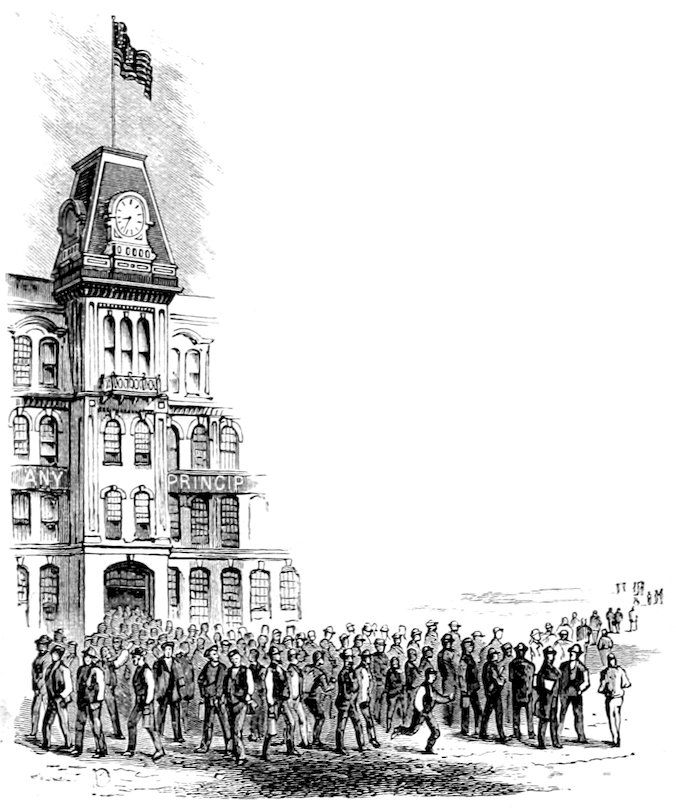
Leaving the City of New York by the New Jersey
Central Railroad, we dash through a dozen pretty Jersey
villages, cross Newark Bay upon a bridge which lacks
but a few feet of being two miles long, rush past the
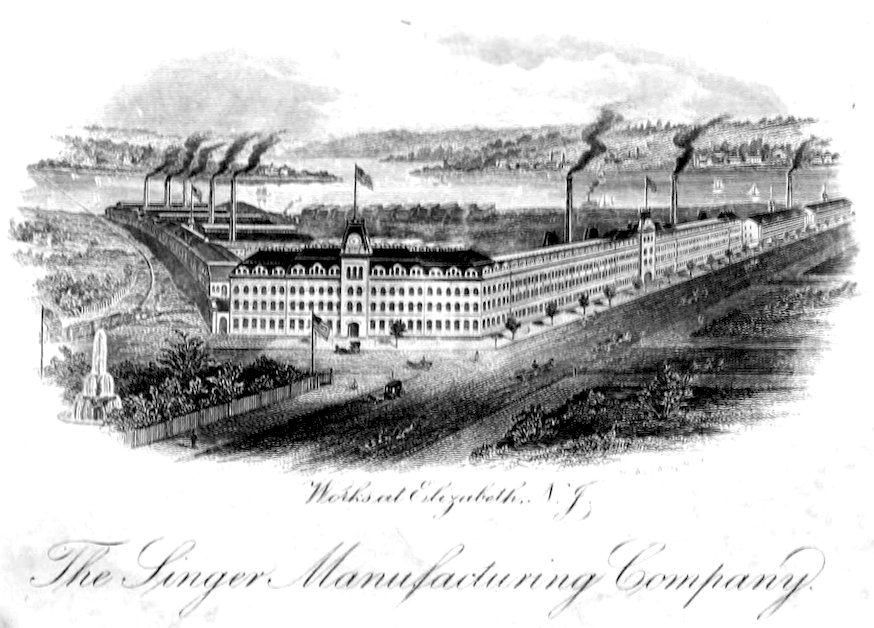
walls of the great Singer Factory, and alight at the Elizabethport
Station, just beyond. This is one of the seven
railroad depots of the beautiful
City of Elizabeth, New Jersey.
Looking back down the track,
we see a finely laid-out park, with
well-kept walks, handsome shrubbery
and trees, and a profusion
of flowers, in the centre of which
stands a large fountain. This is
the private park of the Factory,
and is by far the handsomest in
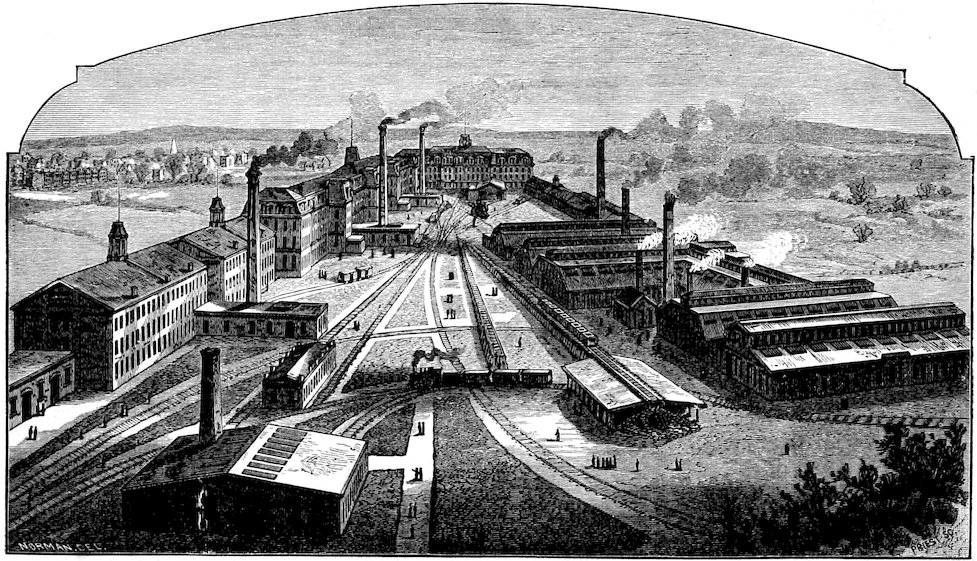
the city. The Singer Company
bought an entire block in front
of the Factory, and transformed
it into a park which they maintain
at their own expense. Beyond
“Singer Park” loom up
the massive proportions of the
Singer Factory, four floors high, the upper story having a
massive Mansard roof. The building is built of brick,
iron and slate, with iron beams and girders, and is proof
against those conflagrations which so often destroy human
life in large manufactories. The front is constructed of
41handsome pressed brick, and the structure is adorned with
a tower in which a large clock shows the “hours as they
fly” to all the neighborhood.
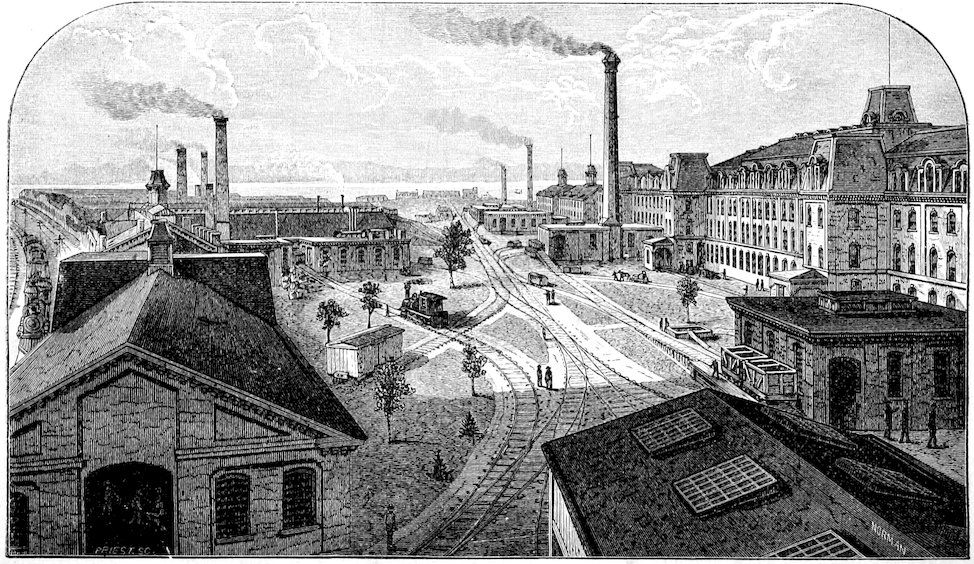
Passing through the light and handsome offices, we
find ourselves in what at first sight appears to be another
park, shut in on three sides by long lines of high buildings.
This is, however, not designed for a park, but is
nothing more than the superbly-kept Factory Yard, embracing
ten or twelve acres. Asphalt walks run down and
across, connecting the various buildings that skirt the
yard with each other, and with the dock at its foot.
Beside and between the walks, every square foot of ground
in this immense yard has been seeded with grass, whose
green and well-kept borders are here and there fringed
with shrubs and flowers. The walks are neatly kept, and
though over two thousand workmen tramp daily through
the yard, we will not see a bit of dirt as big as a filbert
42anywhere.[1] Up and down run railroad tracks from the
main gate to the dock, with branch tracks to each shop
door. These tracks aggregate over five miles in length,
and are in constant use in bringing coal, iron, and lumber
from the Central Railroad track outside, or the dock at
the foot of the yard, or carrying car loads of machines to
one or the other outlet. For this purpose the Company
owns a locomotive, the “I. M. Singer,” which puffs away
busily at its work from morning till night. Here are long
sheds, beneath which cars are being loaded with Singer
machines for Chicago, St. Louis, or San Francisco. There
are long trestles opposite the foundry doors, upon which
coal cars, direct from Pennsylvania mines, are pushed by
the “I. M. Singer,” and their contents deposited “where
they will do the most good.” Iron, sand, and lumber cars
are sent similarly to the exact spot where they are to be
worked up, and so an immense cost of handling is saved.
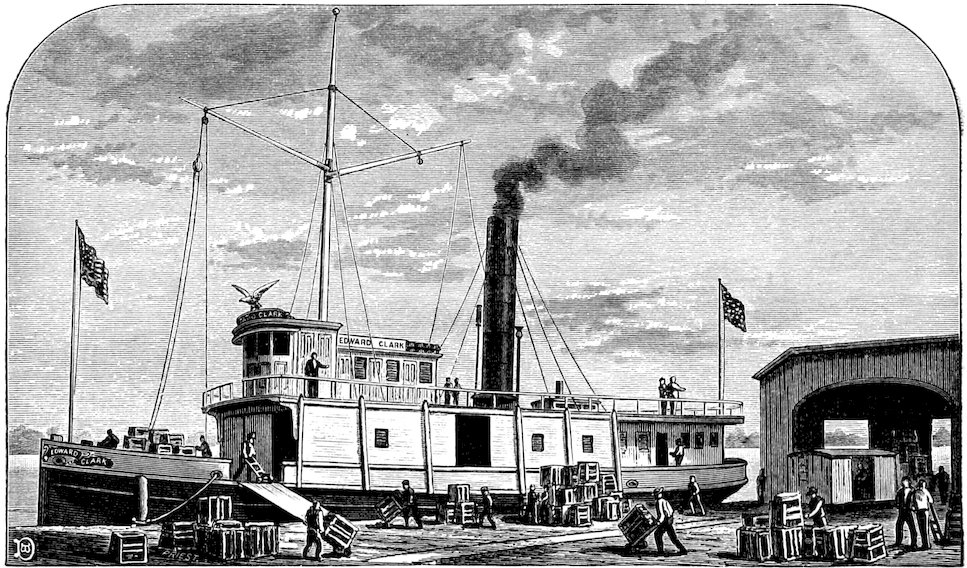
At the dock, which lies along Staten Island Sound nearly
a thousand feet, the Company’s steamer “Edward Clark,”
is taking on board a cargo of machines for New York
City, or perhaps for some European steamship lying in
New York Bay.
Taking it for granted that all women are methodical,
we must ask our fair visitors to go with us to the foot of
the yard, and begin studying the manufacture of sewing
machines just where the manufacturer is obliged to begin
making them—at the foundry.
43
44
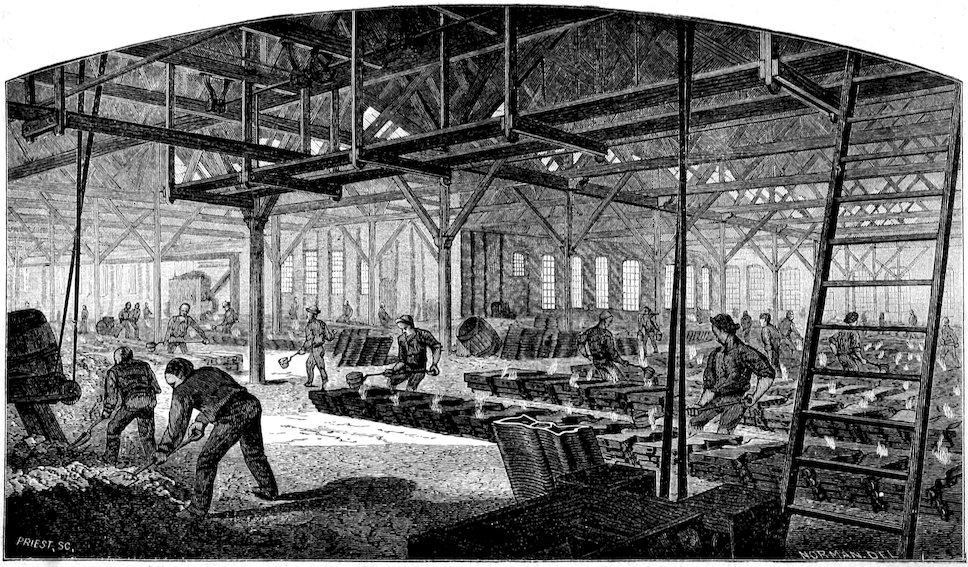
Passing the great piles of pig-iron and the greater heaps
of coal, we enter the foundries. Upon yonder high platform
two men are throwing
great lumps of coal into the
blazing, roaring mouth of a
fiery furnace; and presently
they stop throwing in coal,
and begin to pitch in heavy
bars of pig-iron, while the
furnace hisses aloud with its
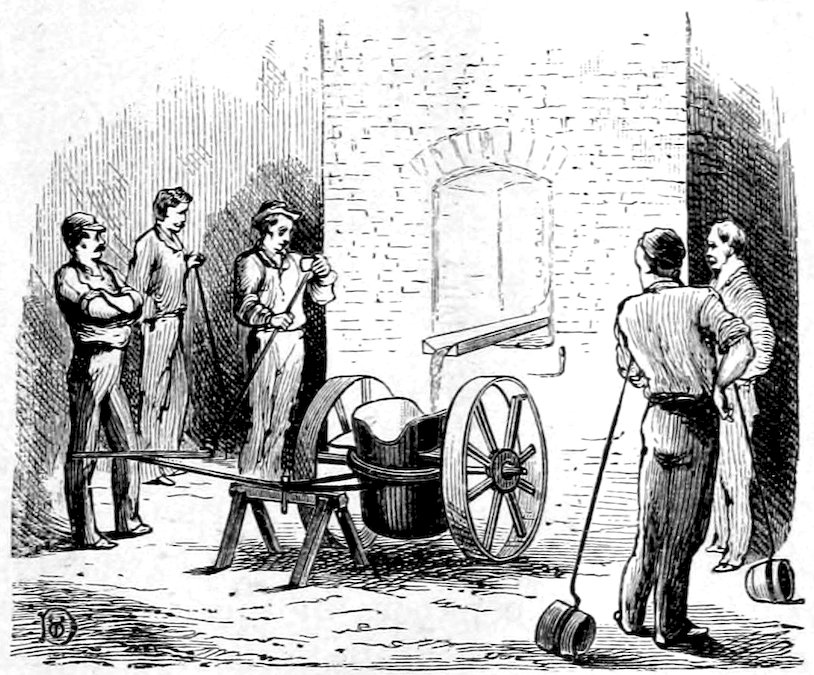
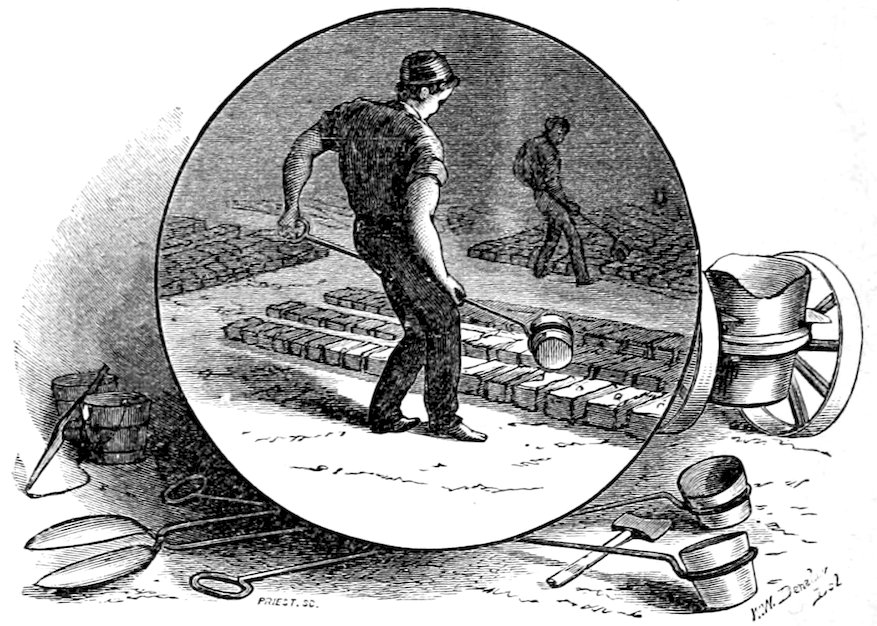
fervent heat till it reminds us of Nebuchadnezzar’s. At
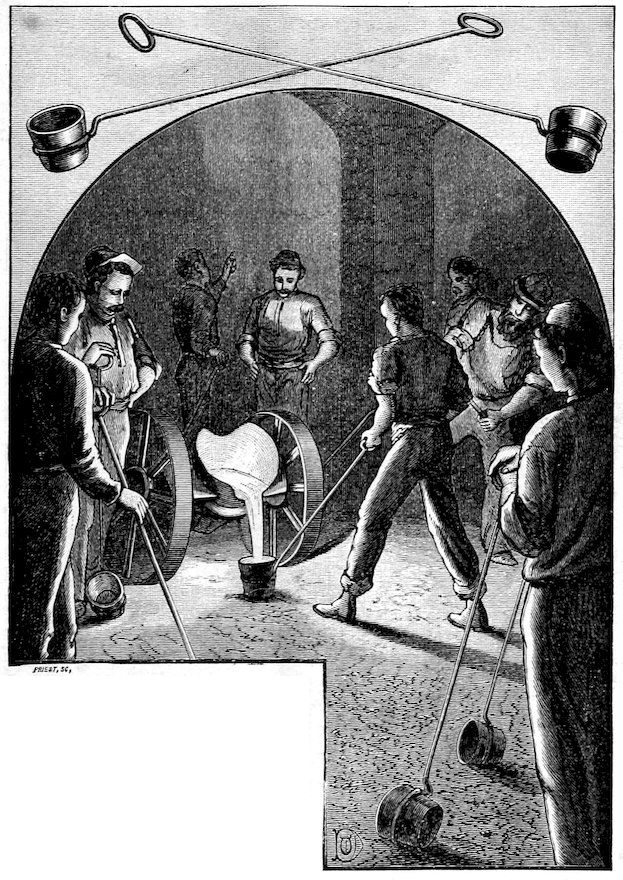
the foot of this furnace or “cupola” two or three men are
catching the molten iron in a huge pot on wheels which,
when full, is drawn to another part of the foundry, and
there another lot of men surround it, their hand ladles are
poured full, and away they hurry with their hot and heavy
burden to fill the long rows of moulds which cover the
floor. Four such cupolas are breathing out great blasts of
fire at their tops, and running streams of fiery liquid iron
at their bases. Three of them have a capacity for melting
eight tons of iron each per hour, and the other converts
six tons of pig-iron into liquid each hour. The morning
45hours are occupied by the moulders in making moulds in
sand of the various parts to be cast; and for about two
hours in the afternoon the cupolas send out their sparkling
streams, and the men fill the moulds with molten iron.
When sufficiently cooled, the moulds of sand are knocked
to pieces and the iron taken out and thrown into piles
about the floor, while the sand is shoveled up and moistened
for another day’s moulding. Four hundred men are employed
in this immense foundry, which melts up sixty-five
tons of iron every day in the week. The ground floor of
the foundry has an area of over two acres. Imagine a two-acre
field filled every day with iron castings of Singer
sewing machines!
And this is only a part of the iron work composing the
machine. Much of the machine is composed of steel and
wrought iron, which starts on its trip from the Forging
Shop, instead of the Foundry. The portions cast in the
foundry embrace the machine legs or “stands,” the “arm”
and “bed,” the balance-wheel, band-wheel and a few minor
parts. These parts, after cooling and being removed from
the moulds, are taken to the Rumbling Room, 50 feet wide
and 200 feet long, and put into revolving barrels filled with
small five-pointed cast iron stars, which tumble about the
barrels among the castings for hours together, and by
the constant friction wear off all the sand and roughness.
The machine legs or stands then go to the Drilling
Room, where the screw-holes are drilled out, and thence
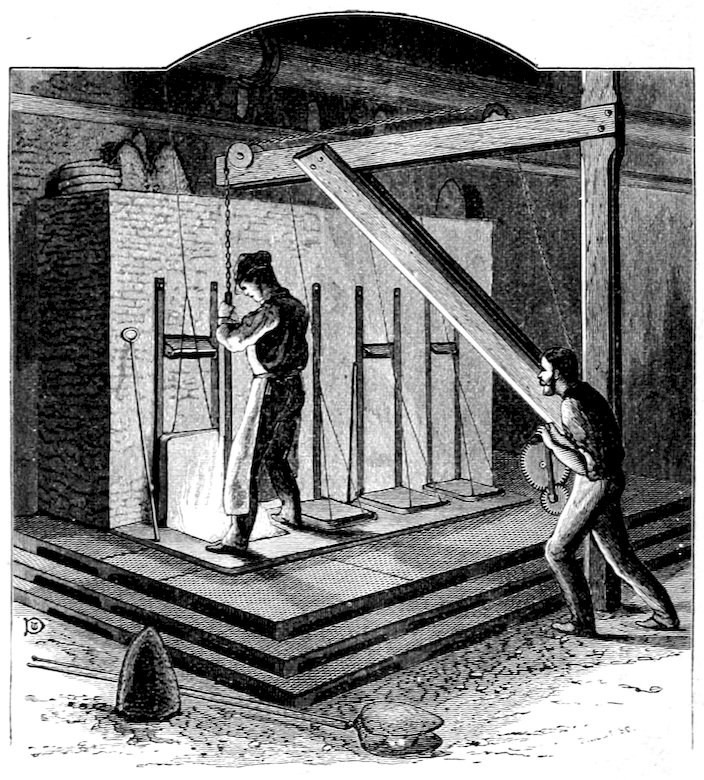
to the Japanning Room, where a set of grimy men, in half
undress costume, souse them into a vat of liquid japan,
after which they are put into great brick ovens, and left
for several days for the japan to thoroughly bake and
harden. This gives them a handsome, black, glossy finish
and prevents rust. The other cast iron parts are similarly
treated, except the “arm” and “bed;” these, after being
firmly secured together, are japanned and scoured down;
46then japanned again, and again scoured down. A third
japanning and scouring is then given and they go to the
Ornamenting Room, of which we shall see something
shortly. The wheels, and other parts which work against
other portions of the machine, go before japanning to the
Milling Department, an immense shop 1,250 feet long, upon
two floors, and 50 feet wide, where they are put upon a
lathe and shaved off with steel knives to the exactness of
a hair.
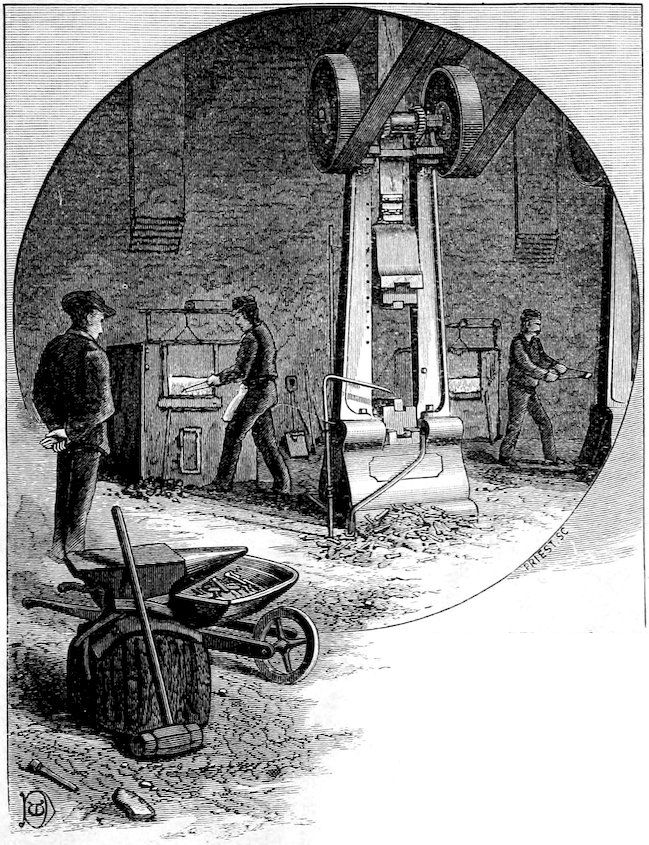
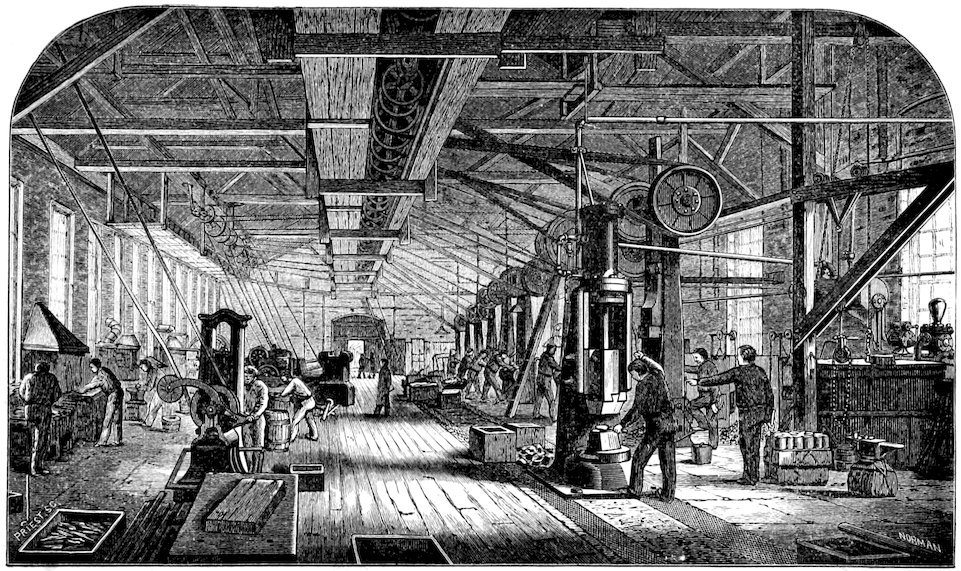
Next above the Rumbling Room we come to the Forging
Shop. Here numbers of great drop hammers are
stamping out, at a single blow, the steel and wrought iron
parts of the machines. These hammers weigh from three
hundred to fifteen hundred pounds each. They are made
with a “die” on their face, and the bed or anvil on which
they drop has a corresponding die, so that a bar of hot
iron held on the anvil is, by a single blow of the falling
hammer, converted into a shuttle, a feed driver or a completely
formed lever. Even the shuttle, which looks so
much like a little boat, is made with a single blow of a
huge drop hammer, which converts a square bar of iron
in an instant of time into a perfectly formed shuttle. It is
afterwards taken to another room, where another machine,
with just one vigorous push, forces the shuttle through a
sharp-edged aperture in a steel die, which trims off all
unevenness and every bit of steel that may have projected
beyond the edges of the die in the drop hammer. In
another room the shuttle is drilled with holes for the
thread; in another it is polished on an emery wheel, and
in yet another is fitted with the little check spring, and
then, after receiving the bobbin, it is ready for service in
your Singer machine. The Forging Shop is 423 feet long
and 50 feet wide.
47
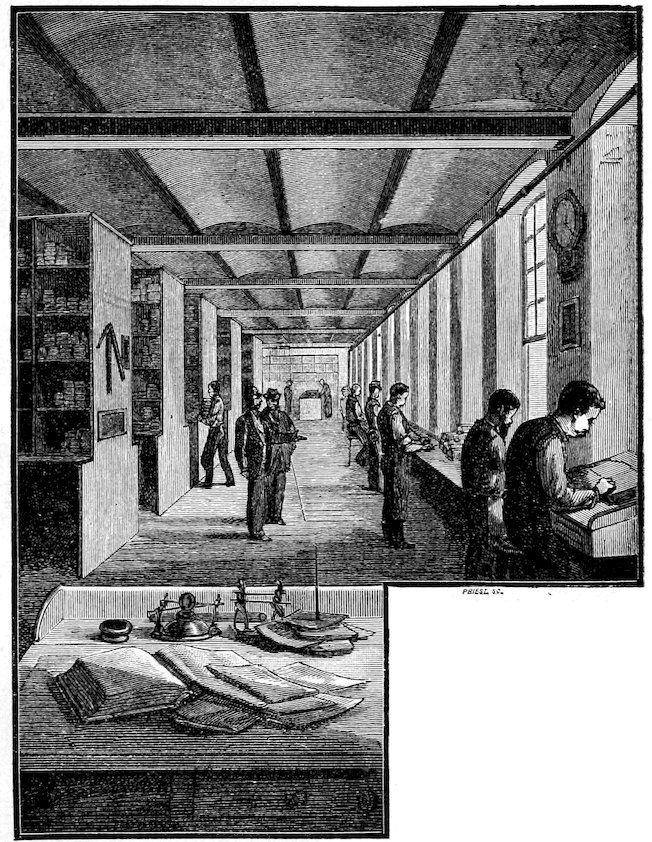
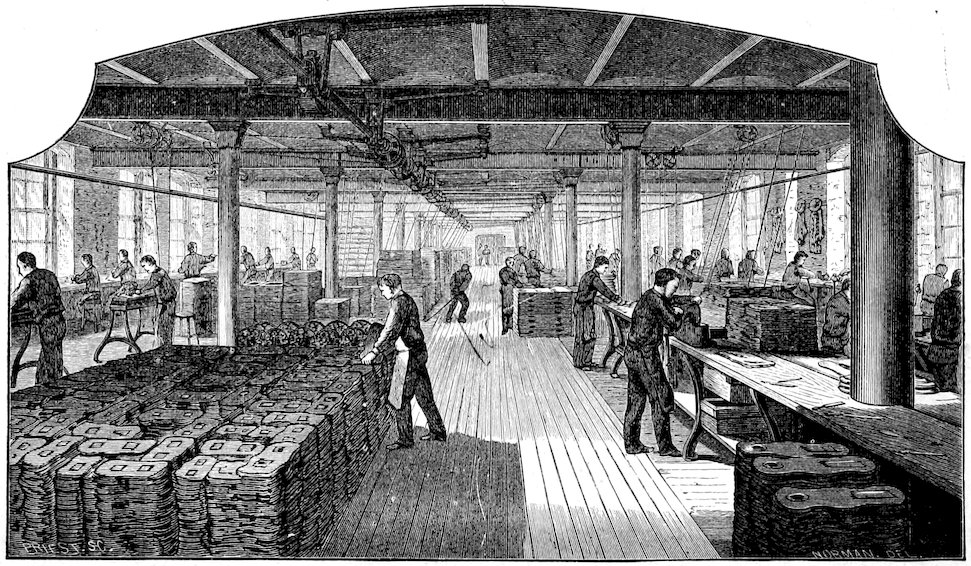
Leaving the Milling Department, each article is passed
to the Inspection Department for “Parts,” where every
piece or “part” is examined
and measured
with an accurately
made steel gauge, and
only such as are found
to be exact and true
to the thousandth part
of an inch, are permitted
to go on to the
Stock Room. The rejected parts (and such is the accuracy
of the machinery that these are comparatively few)
go again into the furnace to be made over from the beginning.
It is largely owing to the impartial rigidity of these
48inspections that the Singer machine has become so famous
for evenness of work and for immunity from the periodical
“fits” of misbehaving which so often afflict machines of
other makes.
And so the Singer Company makes no second grade
articles, and puts nothing but the very best material and
workmanship into any of its machines, finding, by practical
experience, that it pays to put just as good parts into its
cheapest as into the highest priced pearled and ornamented
cabinet machine. Indeed, the only difference between
the cheapest genuine Singer and the most costly machine
is in the finish, decorations and cabinet work. All the
working parts are exactly the same.
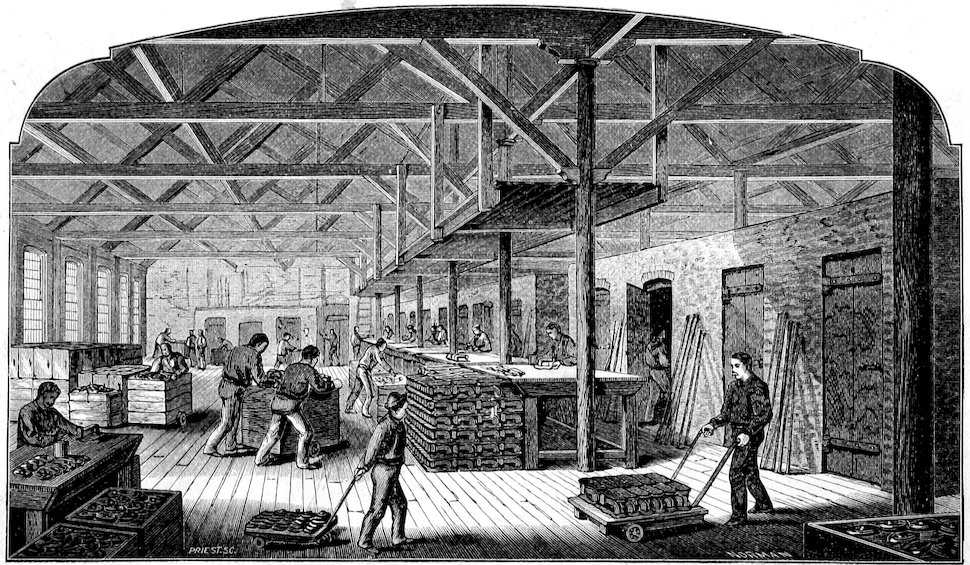
The carefully inspected parts, after passing muster, are
sent to the General Stock Room, where long rows of cases,
extending nearly to the high ceiling, receive each sort into
its appropriate box or shelf. Thence they are distributed
in due proportions to the Assembling Department when
called for. The Stock Room is 50 feet wide and 180 feet
long.
Our fair friends will remember that we left the machine
heads and bed plates in the Japanning Room, being scoured
down after japanning. We must go back to them in order
to keep up the connection. After being carefully scoured,
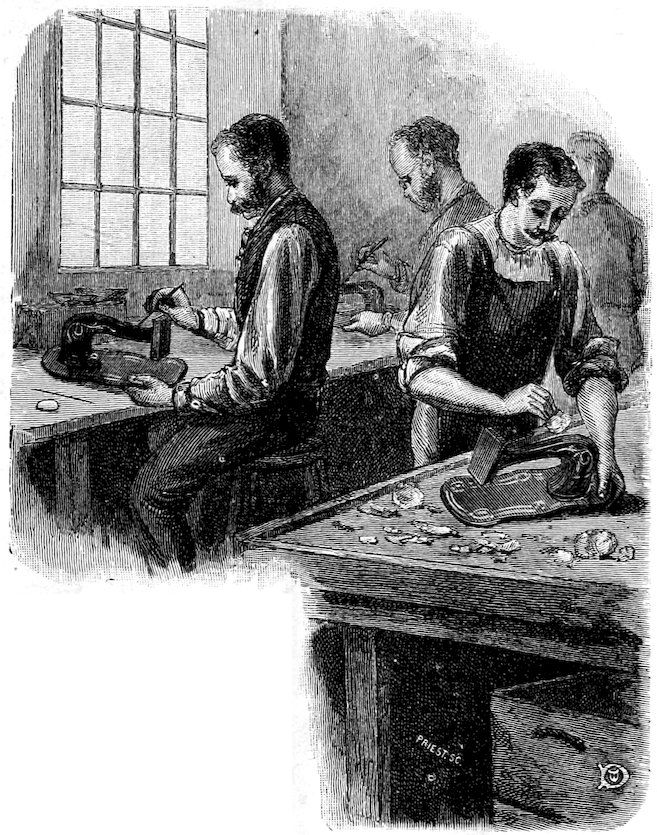
the heads are sent to the Ornamenting Department, where
skillful workmen pencil out, with a fine camel’s hair brush,
the designs of flowers and scroll work which ornament
that portion of the machine which rests upon the table.
The rapidity with which these pretty and often intricate
designs are traced is wonderful. Look at your machine at
home; observe all the gilded ornamentation and design,
and then fancy a man doing such a machine head “offhand,”
without the least guide for hand or brush, at the
rate of 100 machines a day! As quickly as the penciling is
done the machine is seized by another man, holding in his
49hand a book of gold leaf, which he deftly lays over every
pencil-line. The gold leaf firmly adheres to the “sizing”
laid on by the brush and
the rest is rubbed off by a
single touch of another
man who passes a piece
of soft cotton batting over
it. The whole is then
varnished with the best
quality of white varnish
and placed in a huge
oven, where it bakes till it has become perfectly dry, hard
and glossy. The Ornamenting Room is 125 feet long and
75 feet wide.
50The larger parts of the machine having now been
japanned and ornamented, are brought to the “Assembling
Room,” and at the same time the small working parts are
brought from the Stock Room, and here all these parts
are “assembled,” or brought together, and each placed in
its proper position within or upon the machine head. Each
of these parts has been so nicely fitted, and so accurately
worked by the machinery which made it, that when the
numerous and varying pieces come together in the assembling
process, it requires little and often no adjustment
whatever, and each fits in the place made for it, resulting
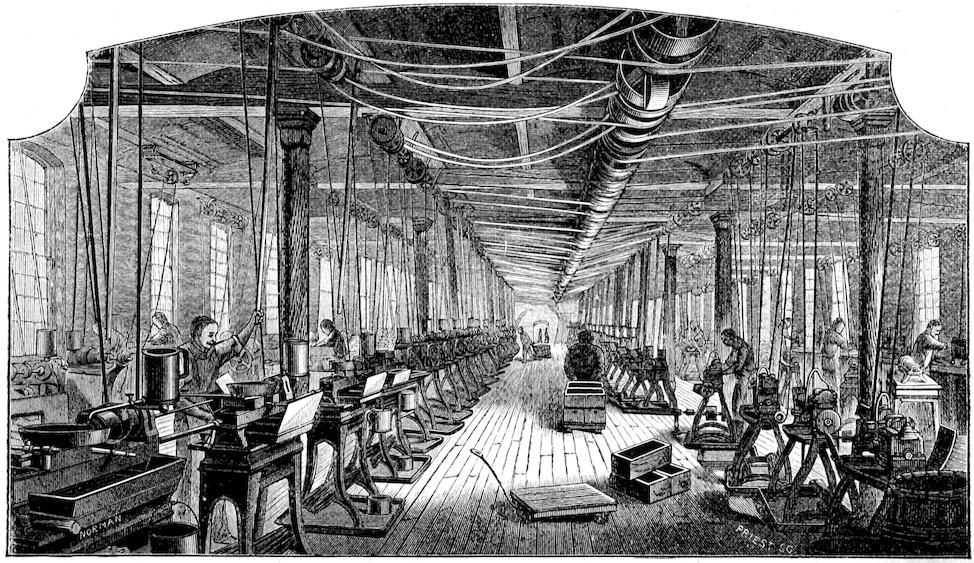
in a complete and harmonious whole. Connecting with
this Department is the Adjusting Department, where long
rows of machines on benches are being run by steam at a
very high rate of speed. This is yet another of the many
testing processes through which your family “Singer” has
gone in order to insure the absolute perfection of its working
parts. Up and down these long rows of humming
machines, skillful and patient mechanics are passing, narrowly
watching each machine to see if it runs smoothly and
properly. If a wheel revolves unevenly here, or a “bearing”
pinches or is too loose there, back goes the machine
to have the deficiency remedied, after which it must again
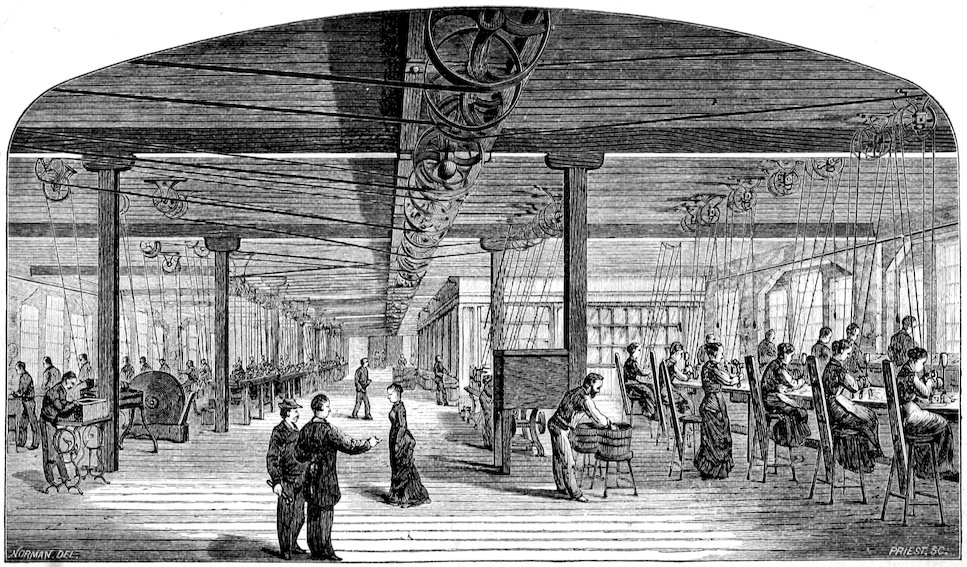
pass the same ordeal. The Assembling and Adjusting
Departments are 50 feet wide, and occupy a length of
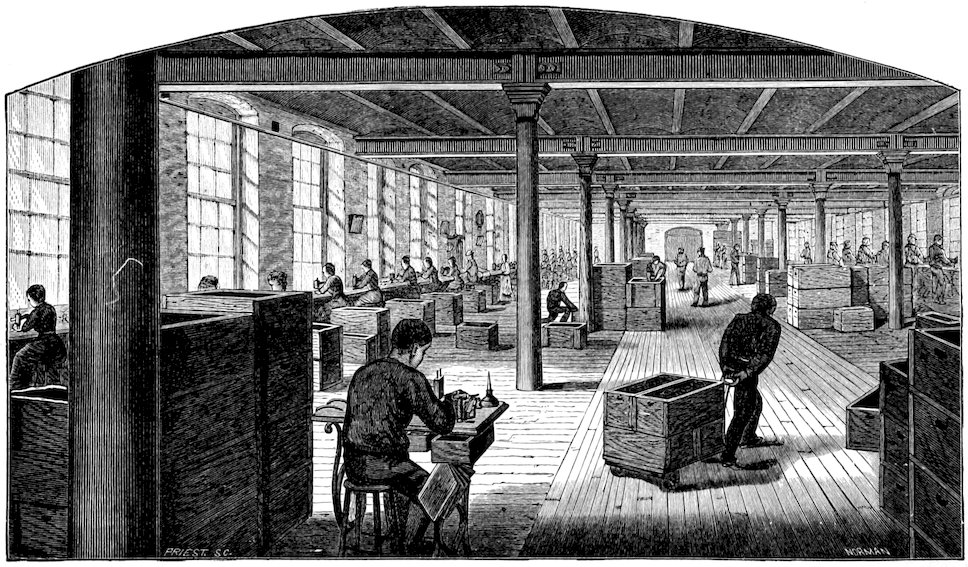
1,100 feet on two floors. The views in these rooms cannot
be adequately described, and we therefore give our readers
accurate full page representations of the same.
Next comes the Machine Inspection Department, 200
feet long and 50 feet wide. Here the machines are again
inspected by competent artisans, and if perfect in every
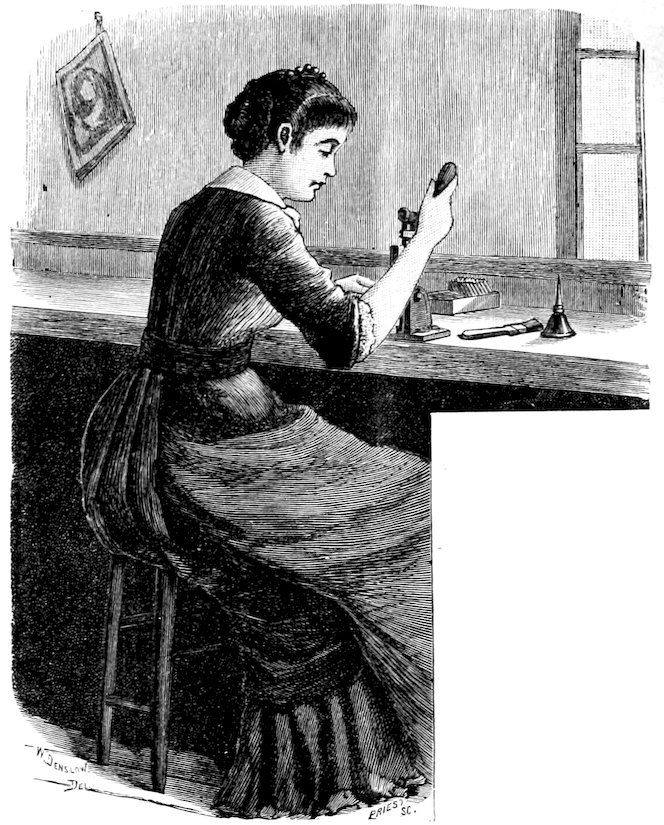
respect are passed over to long rows of girls, who put them
through the further test of stitching, and see that they are
capable of producing an absolutely perfect stitch. Over
fifty girls are constantly employed in this particular work.
51
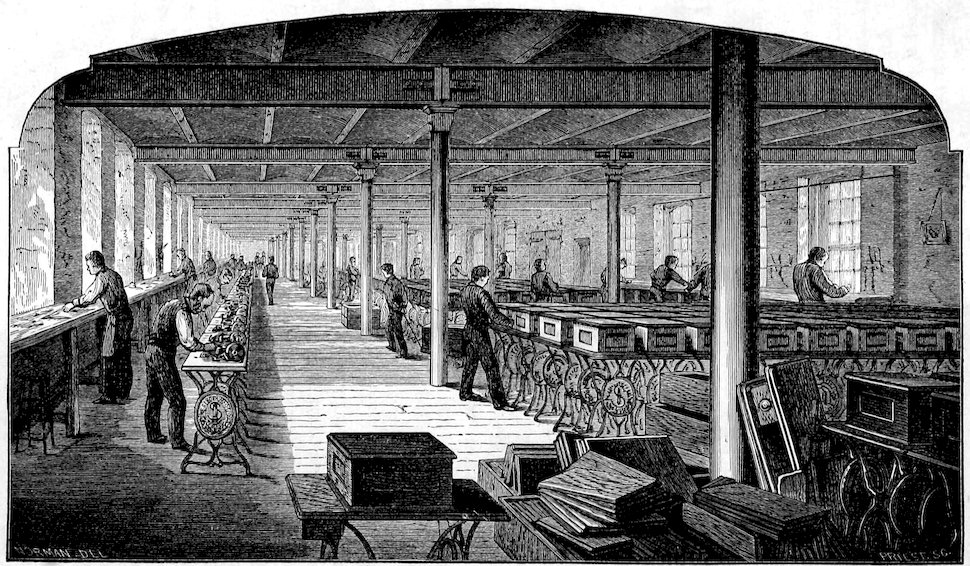
“SETTING UP” THE MACHINES.
52The next process is what is technically known as “setting
up.” The Setting Up Department is 460 feet long
and 60 feet wide, and here the stands and tables are put
together and placed in long rows; the complete machine
head is properly fastened in its place, the belts and treadle
are adjusted, and the machine stands on its table ready for
duty.
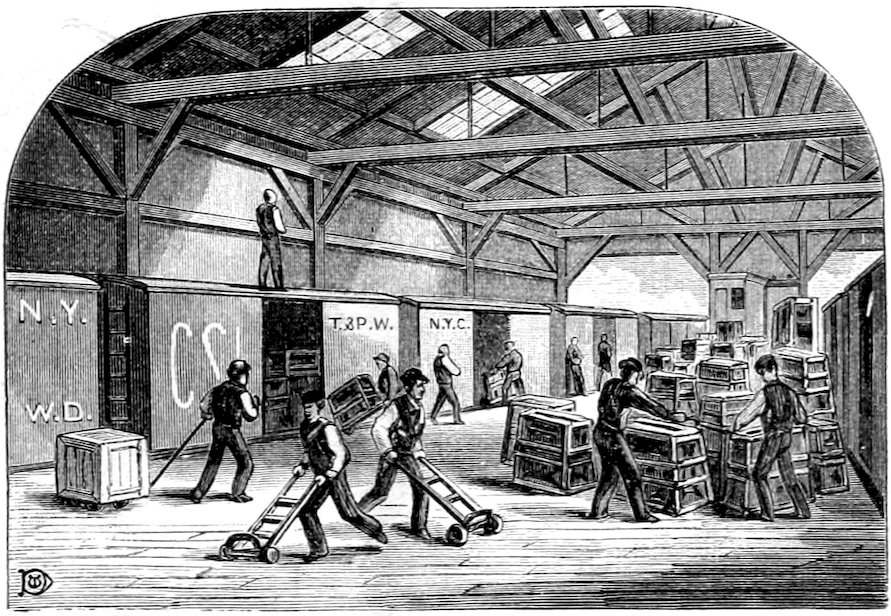
Only one more operation is necessary for transportation,
and that is packing or crating the machine. This is
all done in the Shipping Department, which is 230 feet long
by 60 feet wide. The boxes and crates have already been
completely made up in the Box Shop, and nothing remains
but to put the machine into the box or crate, as the case
may be, drive three or four nails, mark the package with a
stencil plate for its proper destination, on New England’s
shores, on the great prairies of the West, amid the savannas
of the South, or, perhaps, across the seas, lower it upon
the elevator to the great shed, where it is loaded upon
the cars. If its route lies via New York, it is placed upon
a platform car, which the Company’s own locomotive,
the “I. M. Singer,” draws to the dock to be shipped on
board the Company’s boat, the “Edward Clark.”
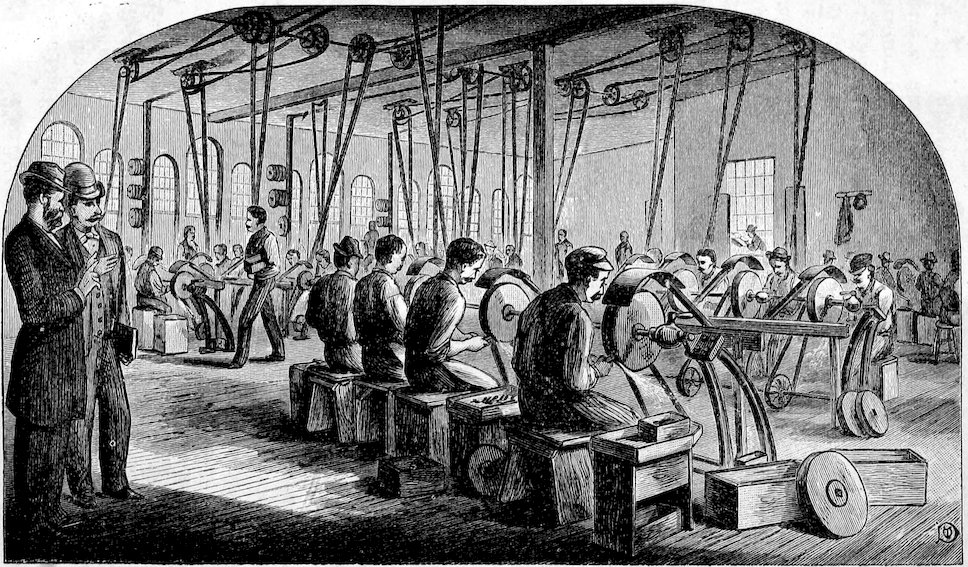
A few parts of the machine require to be smoothly
polished in order to secure the very best working capacity,
and these are sent to the Polishing Room, which is a study
of itself. Black wheels of all sizes are here revolving with
great speed; some are rolling around on a horizontal axis,
some are whizzing rapidly on a perpendicular axis, and
from all of them the streams of fiery sparks are flying in
unceasing currents, throwing the grimy room and the darkened
forms of the busy workmen into a still darker background.
This Department is 125 feet long and 50 feet wide.
53
54Another room is devoted to the manufacture of the
steel springs used in the machine. In another large department,
200 feet long, screws are being made by automatic
machinery. In another room, 100 feet long, the tools
are made and repaired, and here a large force of skilled
workmen is constantly employed. In still another room,
filled with electro baths, the silver plated attachments are
covered with their silver coats.
The Button Hole Department is 150 feet long and 50
feet wide, and here the new Singer Button Hole Machine
is put together. This is an intricate and wonderful piece
of mechanism, by which an expert operator can make
from 1,500 to 2,200 button holes a day, and sew the same
thoroughly. This machine has but recently been introduced
into general use, but has come rapidly into favor
with manufacturers, especially tailors and makers of shoe
uppers. It makes and works a complete button hole in
either cloth or leather, and has come so extensively into
favor that the Button Hole Department has outgrown its
original quarters, and must be considerably enlarged.
This, indeed, is true of almost every Department in the
entire factory. When this great establishment was built,
in 1873, it was thought a good week’s work to turn out
4,000 complete machines; but at this time its weekly
product is upwards of 8,000 complete machines. Besides
these, the Singer Company’s other factory at Glasgow,
Scotland, is turning out between 4,000 and 5,000 complete
machines each week, and yet the offices throughout the
United States and Canada are complaining of the injury
their business receives because they cannot get enough
machines. The factory at the time of writing is largely
behind its orders. Enlargements of various departments
have been made from time to time, but the demand is yet
far ahead of the capacity for production.
The Needle Department is one of the most interesting
features of the entire establishment. Here a coil of steel
wire of fine quality is put into a machine, which straightens,
then grooves it on both sides above and below the
55spot where the eye of the needle should be, and cuts it to
proper length. A girl then takes a handful of needles,
and, feeding them into a machine, punches the needle eye
at a single blow. Then they are ground down to a point;
after which they are tempered, and then the inside of the
needle eye is polished out to prevent its cutting the thread.
The whole needle is finally polished, and nothing more
then remains but counting the shining bits of steel and
packing them away in boxes for the trade. The Needle
Department gives employment to 100 men and 50 women.
Below the main building is a three-story brick building
200 feet long, in which the cabinet work is partly done.
The Company has a large factory at South Bend, Indiana,
where most of the black walnut tables, covers, and cabinet
cases are made. Portions of these are sent to Elizabethport
in a partly finished condition, and all such receive
their finishing in this shop.
Still below is another similar building, the “Box
Shop,” where some sixty men are employed in making the
packing boxes and crates in which the machines are
shipped from the factory. The Box Shop cuts up for this
purpose no less than 300,000 feet of pine and spruce lumber
every month.
To run this immense establishment, six stationary steam
engines are required, which have a combined strength of
one thousand horse power. It takes twenty-two boilers,
averaging seventy-five horse power each, to furnish the
steam for running these engines and heating the buildings.
The floors of the buildings have a combined area equal to
thirteen acres of ground; and every square foot of the entire
area is in constant use. The whole premises, including
the fine dockage, covers no less than thirty-two acres
of ground.
Such, in brief, is the factory where your Singer machine
was made, dear reader. It is believed to be the
56most complete, systematic, and best-equipped in the world.
It is believed to be the largest establishment in the world
devoted to the manufacture of a single article. It gives
employment to over 2,300 men and women, and when it
“shuts down” to take the annual account of stock, it
takes 200 men to do it; and this they call “shutting up
the factory!” The men are paid off every Monday, instead
of every Saturday, and thus in more than one family the
wife and children have had cause to bless the kind forethought
which removed temptation from the path of some
easily persuaded man, and saved him and his week’s earnings
to themselves.
The Singer operatives are among the most thrifty of
mechanics. In every case of injury to any of its employés,
the Company has dealt with great generosity, and
many are the households from which much of the black
shadow caused by sickness has been chased by the substantial
aid it has afforded. Nor do the hands leave this
work alone to their employers. Hardly a man is stricken
57by disease among their ranks but his comrades interest
themselves in his case; and if pecuniary aid is required,
the subscription list goes around till every want is supplied
at the sick man’s home.
These kindly offices are not confined even to these
ample limits. When the ghastly Yellow Fever Spectre
was carrying dismay and death throughout the Southern
States, the employés of this great factory made up, in less
than four days, the splendid sum of $4,100, and sent it out
on its errand of mercy to men whom they had never seen
nor known.
The factory hands have organized among themselves
several very creditable associations. One is a fine Rifle
Team, to which the Company contributed a handsome
badge for an annual prize; another is a Brass Band of
excellent reputation, besides several Ball Clubs having
very good records.