Horace Benedict de Saussure, who, like so many
eminent Genevans, was of French extraction, was
born in 1740. Nominally, his work in life, entered
upon at the age of twenty-two, was that of Professor
of Philosophy at the Geneva University;
but his real work, continued almost until his death,
was that of the explorer, student, and exponent of
the mountains. Some time before the end he was
able to boast that he had crossed the Alps by eight
different passes, made sixteen other excursions to
the centre of the range, and travelled in the Jura,
the Vosges, and the mountains of Dauphiné. His
marriage—he married young—by no means hindered
him from climbing. Madame de Saussure indeed
objected, quite failing to understand his readiness
to forsake the comforts of the hearth in order to
revolutionize the science of geology. But he put
his foot down in a letter which may perhaps be
read with profit by other ladies besides her to
whom it was addressed:
‘In this valley, which I had not previously
visited, I have made observations of the greatest
importance, surpassing my highest hopes; but that
is not what you care about. You would sooner—God
forgive me for saying so—see me growing
fat like a friar, and snoring every day in the
chimney-corner after a big dinner, than that I
should achieve immortal fame by the most
sublime discoveries, at the cost of reducing my
weight by a few ounces and spending a few weeks
away from you. If, then, I continue to undertake
these journeys in spite of the annoyance they cause
you, the reason is that I feel myself pledged in
honour to go on with them, and that I think it
necessary to extend my knowledge of this subject,
and make my works as nearly perfect as possible.
I say to myself: Just as an officer goes out to
assault the fortress when the order is given, and
just as a merchant goes to market on market-day,
so must I go to the mountain when there are
observations to be made.’
Nor was it only in the domestic circle that de
Saussure could put his foot down if required.
In one of the Genevan revolutions—that of 1782—he
also showed his mettle in an energetic fashion.
He was a magistrate at the time, and one day,
when he came down to the Hôtel de Ville, he
found that the popular party had risen in revolt,
and seized the building. The rioters requested
him to take his place, and exercise magisterial
functions on lines which they would dictate.
When he refused, they arrested him, but released
him on the following day. Then, hearing that they
proposed to search his house for arms, he decided
to resist. He, Trembley, the mathematician, his
family, his servants, and his dog, constituted the
tiny garrison. They barricaded the doors, stationed
themselves at the windows armed with muskets,
and successfully defied a gang of revolutionists who
came to blow them up with hand-grenades. His
assailants were reduced to threatening to murder
his friends if he did not surrender; and it was only
this final menace that brought about the capitulation
of the Genevan Fort Chabrol.
Our business here, however, is not with the
politician, but with the traveller and the man of
science. His widest celebrity is no doubt due to
his famous ascent of Mont Blanc. If he was not
the first man to climb that mountain, he was, at
any rate, the first to believe that it could be
climbed. Bourrit, as late as 1773, had written of
‘the absolute impossibility of attaining to its
summit.’ De Saussure, as early as 1760, had
offered a reward to anyone who could find a way
to the top, and undertaken to pay a day’s wages to
anyone who tried and failed. The reward was not
claimed until twenty-six years later, when Jacques
Balmat got it. When the way was found, de
Saussure, though now forty-seven years of age, at
once made haste to follow it. His ascent—the
third—was accomplished on August 3, 1787; he
published a short pamphlet, giving an account of
it, in the course of the same year.
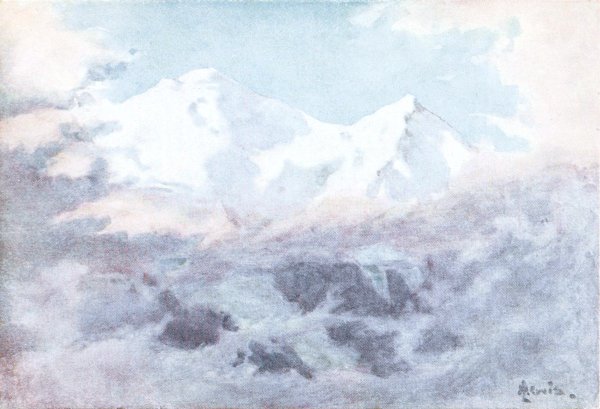
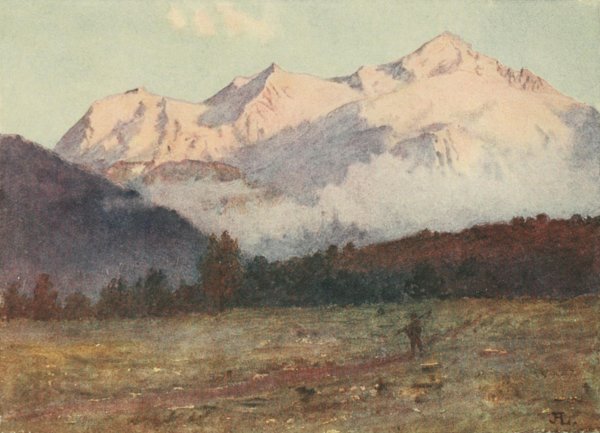
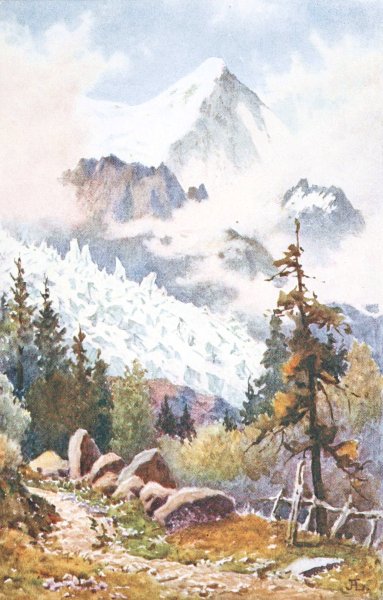
THE AIGUILLE AND DÔME DU GOÛTER, MONT BLANC
The climb was, beyond question, a great feat for
a philosopher of forty-seven, and it brought the
name of de Saussure under the notice of thousands
of people who would never otherwise have heard of
him. A still greater feat, accomplished a little
later, was the camping out, for something over a
fortnight, on the Col du Géant. But it is not
upon either of these feats that de Saussure’s real
fame reposes. He is reckoned among great men
partly because he was the first student of geology
who knew his business, and partly because he is
the only Alpine writer of his period whose works
have stood the test of time.
The geologists who preceded him fall into two
classes. There were the mere fossilizers, who had
about as much claim to be considered men of
science as have the stamp-collectors of the present
day; there were the theorists who geologized, so to
say, in the air, threw out hasty generalizations from
their studies, and thought it beneath their dignity
as philosophers to correct these hypotheses by the
further observation of phenomena. De Saussure
combined their methods. His life was one long,
patient study of geological phenomena. But he
collected in order to collate; his aim was always
to see the part in its relation to the whole, the
particular in its relation to the general; and he had
a fine contempt for the amateurs who collected
fossils in the same spirit in which they might have
collected pottery or bric-à-brac.
‘The one aim,’ he wrote, ‘of most of the travellers
who call themselves naturalists is the collection of
curiosities. They walk, or rather they creep about,
with their eyes fixed upon the earth, picking up a
specimen here and a specimen there, without any
eye to a generalization. They remind me of an
antiquary scratching the ground at Rome, in the
midst of the Pantheon or the Coliseum, looking for
fragments of coloured glass, without ever turning
to look at the architecture of these magnificent
edifices.’
The most remarkable thing, however, is that
de Saussure, being a geologist, should have been a
stylist. He certainly never meant to be one. He
would never have written a book merely to show
his skill in word-painting; his one purpose in
writing was to communicate discoveries of importance.
At the time when Bourrit was making
himself famous by his picturesque descriptions of
the Alps, the greater man wrote to him modestly:
‘I too have an idea of publishing something on the
natural history of these mountains. It is with that
end in view that I have been studying them for so
many years.’ And in the introduction of his great
work, he apologizes for what seems to him the
baldness of his style: ‘More practised in climbing
rocks than in polishing phrases, I have attempted
nothing more than to render clearly the objects
which I have seen, and the impressions which I
have felt.’
It was an apology offered without affectation
or false modesty. It announced a departure from
the literary fashion of the day, which was to write
of the mountains in the language of high-flown
sentiment. Rousseau had set the fashion; Ramond
de Carbonnière, the philosopher of the Pyrenees,
was ready to carry it on; de Luc and Bourrit were
doing what they could. De Saussure wished to
announce himself as the disciple of none of these,
but as the plain man who had made a careful study
of his subject, and wished to be heard because of
what he had to say and not because of his manner
of saying it. He hardly understood that he was,
in the full sense of the word, a man of letters—a
literary artist. That is a point which has since
been settled in his favour by his readers.
He might easily have written a treatise that
would have been invaluable to specialists and
intolerable to everyone else. Guided by a sure
instinct, he preferred to write the narrative of his
journeys, taking the reader, as it were, by the hand,
making him his confidant, showing him his discoveries
in the order in which he makes them, and
so luring him on to take an interest in a subject
generally accounted dull. And, though his first
care was always to observe, and to collate his
observations, with a view to the advancement of
learning, there always was in him something of the
poet, which must out from time to time, temporarily
giving the go-by to the man of science.
One finds this vein of poetry in the writings of
most men of science—naturally, seeing that they
used gifts of imagination differing from those of
the poet only in being disciplined and chastened,
and ready to submit to the thraldom of the
established fact. Sometimes, indeed, the vein of
poetry has interfered with business, as in the case
of the ingenious Scheuchzer, who laid himself out
to prove that there were dragons in the Alps, or,
in a less degree, in the case of Buffon. But,
whether it interferes with business or not, there
the vein of poetry almost always is. Such old men
of science as Conrad Gesner, and such modern men
of science as Huxley and Tyndall, have shown us
with what striking effect it can be worked. It is
because de Saussure worked it so well that his
writings still live, though, regarded merely as textbooks,
they have long since been superseded.
The humanity of the man is continually flashing
out at us in the reflections and anecdotes with
which he illustrates the manners of the strange
peoples in the strange places which he visited.
Sometimes it is a flash of humour, as when he
inquires the motives that impel men to be chamois-hunters,
a trade that never pays. ‘It is the
dangers,’ he concludes; ‘the constant alternation
of hopes and fears, the continual emotion thus
engendered, which excite the hunter, just as they
excite the gambler, the soldier, the navigator, and
even, to a certain extent, the naturalist of the
Alps.’
Sometimes it is a touch of pathos, as in the story
of the old woman of Argentière whose father,
husband, and brothers had all perished, within a
few days, from an epidemic:
‘After she had given me some milk, she asked
me where I came from, and what I was doing there
at that season of the year. When she knew that I
was from Geneva, she told me that she could not
believe that all the Protestants were to be damned;
that God was too good and too just to condemn us
all without distinction. Then, after reflecting for
a moment, she shook her head and added: “But
what is so strange to me is that of all those who
have been taken away from us, not one has ever
come back. I,” she went on, with a look of pain
“have wept so for my husband and my brothers,
and have never ceased to think of them, and every
night I implore them to tell me where they are, and
whether they are happy. Surely, if they existed
anywhere, they would not leave me in this doubt.
But perhaps,” she went on, “it is because I am not
worthy of this favour. Perhaps the pure and
innocent souls of those children there”—she pointed
to the cradle as she spoke—“are conscious of their
presence, and enjoy a happiness that is denied
to me.”’
Truly a wonderful passage to find embedded in a
valuable and solid treatise on geology. Ramond
never surpassed it though he laid himself out to do
so, and—in his earlier works, at all events—never
allowed geological considerations to stand in the
way of sentiment.
It is sad to relate that, after having made himself
known to all Europe as ‘the illustrious
de Saussure,’ the pioneer of geological discovery fell
upon evil days. But so it was. His health broke
down; in 1794 he began to have paralytic strokes.
His fortune—the greater part of it, at all events—was
lost through the collapse of securities during
the French Revolution. He was on the side that
suffered most in the political disturbances which the
Revolution engendered at Geneva.
In the midst of those disturbances, his father-in-law,
Charles Bonnet, died, and de Saussure, himself
almost to be reckoned a dying man, was called
upon to pronounce his public eulogium. But the
disturbances made it necessary for the ceremony to
be postponed. A letter in which Madame de
Saussure narrates the incident gives us a clear
impression not only of the day, but also of the
times of which the day was representative.
‘Yesterday,’ she writes, ‘I spent one of those
days of emotion which do not affect us the less
because we ought to be getting used to them.
The people took up arms by order of the Committees
of the Clubs. The gates were shut, the
cannon rumbled along the streets, screaming
women leant out of their windows to look. In the
evening the town had that military air which you
have sometimes seen in it—the streets full of armed
citizens with flaming torches, patrols challenging
the passers-by—and all this lasted till two or three
in the morning; whereas to-day, everyone is at his
shop, his café, or his office. And this tumultuous
day had been selected for the celebration of the
memory of the most peaceable of citizens—your
uncle, Charles Bonnet.’
And so, amid such sorry scenes, the end
approached. De Saussure sought relief and health
in travel. He took the waters at Plombières, but
without any good result, and died early in 1799,
the great Cuvier pronouncing his eulogy before the
Institut de France.