General Washington's Spies on Long Island and in New York
Whole book · 23 sections
Transcriber’s Notes
This book contains both Footnotes and Endnotes. The Footnote numbers
and their references are numbered 1-72 and are enclosed in [square
brackets]; the Endnote numbers and their references are numbered
101-142 and are enclosed in (parentheses).
Larger versions of most illustrations may be seen by right-clicking them
and selecting an option to view them separately, or by double-tapping and/or
stretching them.
Cover image created by Transcriber by brightening the
original cover and adding the title. The result
remains in the Public Domain.
GENERAL WASHINGTON’S SPIES On Long Island and In New York
LONG ISLAND HISTORICAL SOCIETY
OFFICERS
President
B. Herbert Smith
First Vice-President
Guy Du Val
Second Vice-President
William H. Cary
Corresponding Secretary
Norman Taylor
Recording Secretary
Richards M. Cahoone
Treasurer
John D. Talmage
Assistant Treasurer
Guy Du Val
Librarian
Miss Edna Huntington
DIRECTORS
Joseph Dana Allen, Litt.D.
Hon. George E. Brower
Richards M. Cahoone
William H. Cary
Francis D. Dodge, Ph.D.
Guy Du Val
Rev. Phillips Packer Elliott
Lewis W. Francis
George Hewlett
David H. Lanman
A. Augustus Low
Evelyn Pierrepont Luquer
D. Irving Mead
Walter M. Meserole
Hon. Howard Pervear Nash
Frederic C. Paffard, M.D.
William A. Robbins
Arnold W. Sherman
B. Herbert Smith
John D. Talmage
Norman Taylor
Edwin H. Thatcher
EXECUTIVE COMMITTEE
B. Herbert Smith, Chairman
Joseph Dana Allen
Richards M. Cahoone
William H. Cary
Guy Du Val
Lewis W. Francis
William A. Robbins
John D. Talmage
Norman Taylor
COUNCILORS
Kings County
Miss Jessie A. Addoms, J.D.
Mrs. Samuel K. Frost
Rev. John H. Lathrop, D.D.
Lester D. Mapes
Frank L. Van Cleef
Wheeler N. Voorhees
Nassau County
George D. A. Combes
Courtney R. Hall, Ph.D.
Henry Hicks
Jesse Merritt
Rt. Rev. Ernest M. Stires, D.D.
Suffolk County
Mrs. J. D. Cockcroft
Perry Duryea
Ralph G. Duvall
Morton Pennypacker
Wallace Reid
Mrs. Joseph H. Willets
Queens County
William G. Clossen
Arthur White
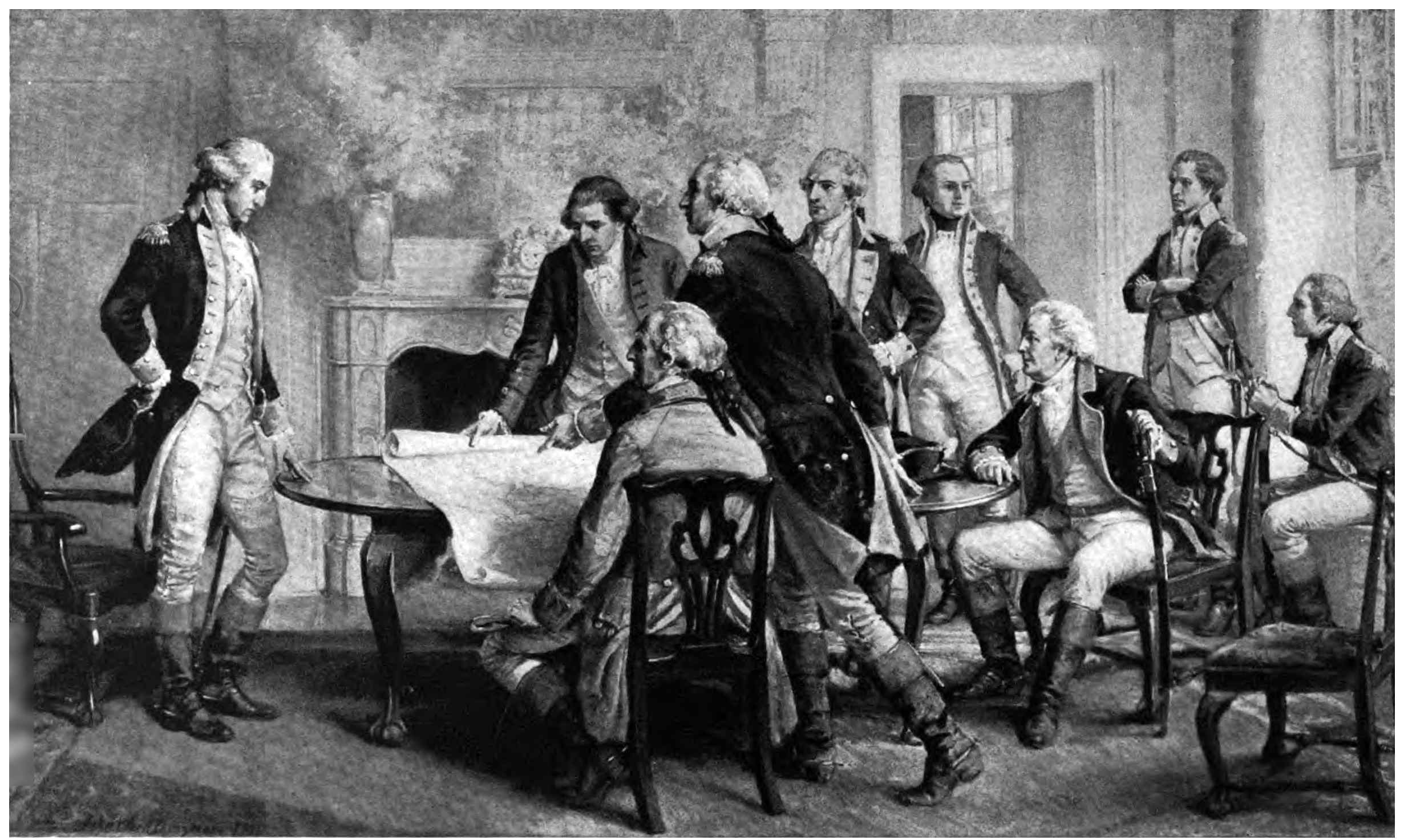
Painted by John Ward Dunsmore. (Used by permission of the Title Guarantee & Trust Co.)
GENERAL WASHINGTON’S COUNCIL OF WAR AFTER THE BATTLE OF LONG ISLAND
In the Philip Livingston house, later known as the Teunis Joralemon House, east side of Hicks St., Brooklyn.
In the picture are General Washington, Samuel Parsons, Joseph Spencer, Thomas Mifflin, John Morin Scott, Alexander
McDougall, Israel Putnam, Peleg Wadsworth and John Fellows.
GENERAL
WASHINGTON’S SPIES On Long Island and In New York
BY MORTON PENNYPACKER
BROOKLYN, NEW YORK Published by the Long Island Historical Society
PIERREPONT STREET CORNER CLINTON STREET 1939
COPYRIGHT, 1939, BY
MORTON PENNYPACKER
EAST HAMPTON, L. I.
PRINTED BY
COUNTRY LIFE PRESS CORPORATION
GARDEN CITY, N. Y.
PREFATORY NOTE TO “THE TWO SPIES, NATHAN HALE AND ROBERT TOWNSEND.”
It is nearly one hundred and ten years since America’s
first great novel was written, it being James Fenimore
Cooper’s second book. With “The Spy” for title, it was
hailed with unprecedented enthusiasm. There can be no question
but what Governor John Jay’s recital of the work of the
spies made a deep impression upon Cooper, but years passed
before he attempted to record it permanently. Meanwhile, he
had many opportunities to converse with others who were
more intimately connected with the Secret Service work than
he ever realized. Elizabeth Floyd was his mother-in-law, and
the visits to members of her family on Long Island were frequent.
Two years preceding the publication of “The Spy,” he
became temporarily a resident of Sag Harbor, although still
retaining his home in Westchester County. It is not, therefore,
surprising to discover that so much that he has placed in Westchester
County actually happened on Long Island.
To Cooper “The Spy” must have been a disappointment,
particularly after Enoch Crosby had been exploited. Crosby
did not conform to his ideal, but the spies of Washington did.
When Tallmadge wished to send Long Island assistance in
October, 1780, Townsend’s reply, as will be found in these
pages, was, “I do not choose that the person you mention, or
any other of his character, should call on me.” When Abraham
Woodhull discovered our country’s need for ready money, he
used his own for incidental expenses of the Secret Service, such
as repairs to their four whaleboats and feed for the horses, and
never complained, although more than seven years of peace
passed before our government reimbursed him. It is inspiring to
a greater patriotism to discover the type of men that these pages
reveal.
The story of Nathan Hale will commend itself for brevity.
No statements at the present day known to be incorrect are
even quoted therein. The hitherto unpublished statement regarding
his capture is on the authority of Robert Townsend,
whom General Washington says he found always reliable. This
might have been known seventy years ago had not Henry
Onderdonk added confusing details that discredited it.
An elaborate chapter was in preparation detailing the
scientifically planned investigation that made certain the
identity of Robert Townsend as the “Culper Junior” of the
American Revolution, when it was observed that the material
collected and here published evinced that beyond comment.
Therefore, no documents are here offered to prove what obviously
is a fact.
Many startling revelations will be discovered by the careful
reader of these pages. Some of them will be observed only
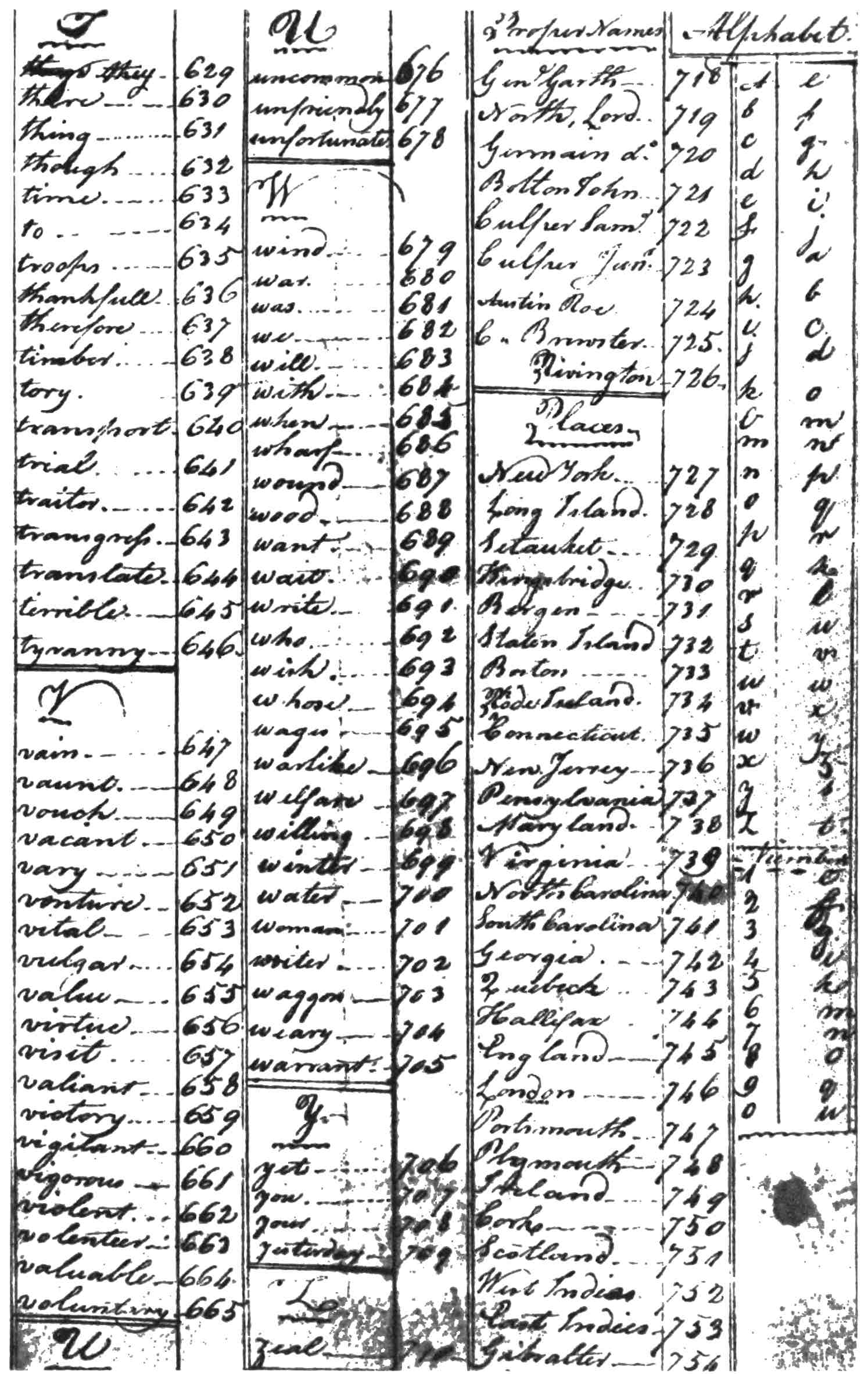
after referring to the secret code printed among the Notes.
The return of Major André after he had been started on his
way to freedom is timely as well as interesting, for we are this
fall celebrating the one hundred and fiftieth anniversary of his
execution. A strange hesitancy to-day, as during the life of
Major Tallmadge, may necessitate patient waiting for more
intimate details that will be merely stronger confirmation of
this interesting fact.
Where letters from either of the Culpers have been condensed
for the sake of brevity, a figure within parentheses has
been used to indicate that the same letter will be found among
the Notes beginning on page 232. A more perfect analysis is
thus assured to the student of history.
Acknowledgment is due for assistance to so many, particularly
among the heads of the larger public libraries and historical
societies, that it becomes impracticable to name them
individually. They have shown a uniform enthusiasm and untiring
effort that makes the present publication possible.
Showing Generals George Washington, Samuel Parsons, Joseph Spencer, Thomas Mifflin, John Morin Scott, Alexander McDougall, Israel Putnam, Peleg Wadsworth and John Fellows.
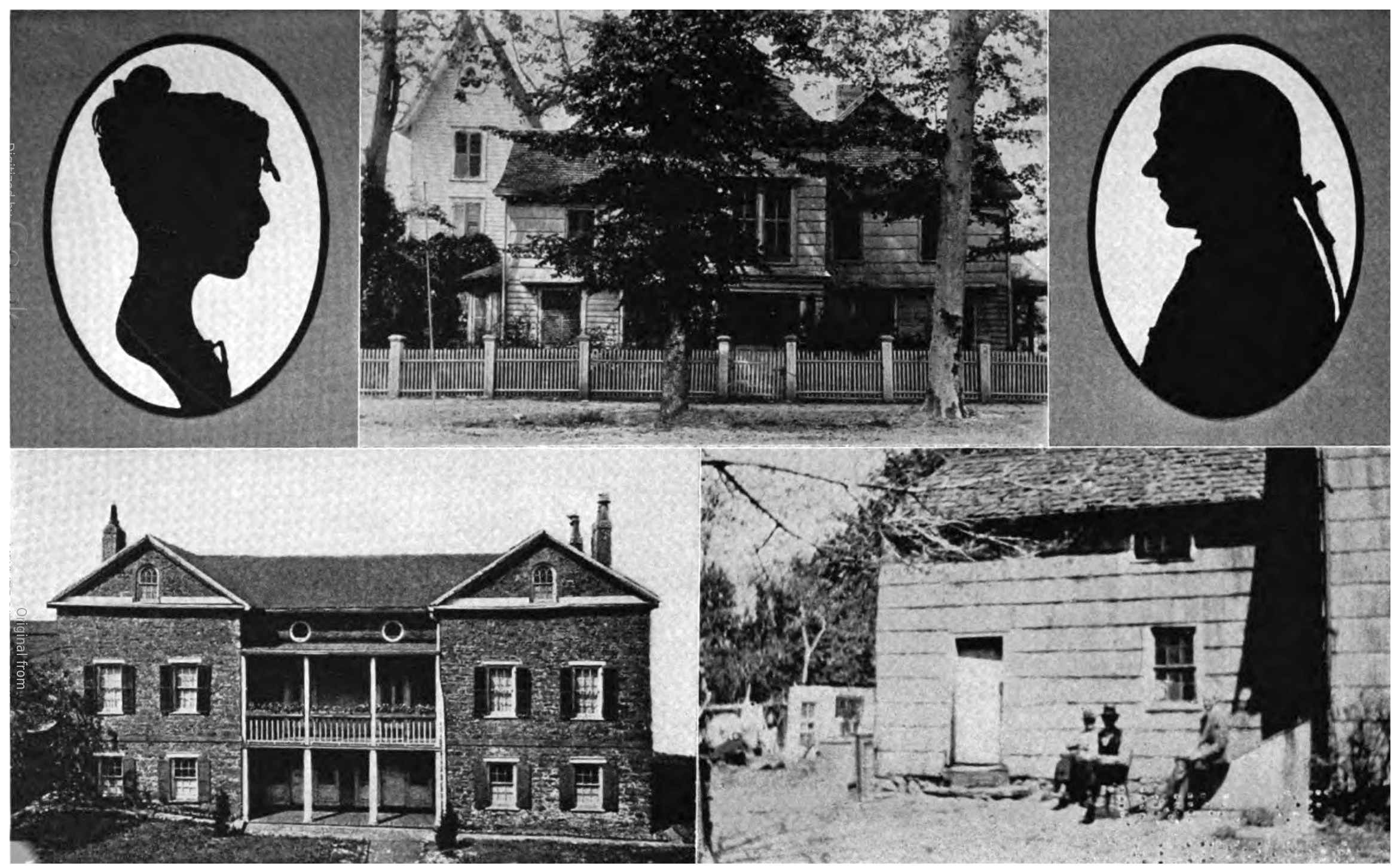
Raynham Hall, Oyster Bay, L. I. Home of Culper Junior and his sister Sarah Townsend. These contemporary silhouettes give their only known likenesses.
Lower left—Present-day home of the Colonial Dames of America. Built by one of Washington’s spies. (See p. 10 in this volume, and Iconography of Manhattan, vol. 6, p. 79.) Lower right—Culper Senior’s home at Setauket. His three great-great-grandchildren in the foreground.
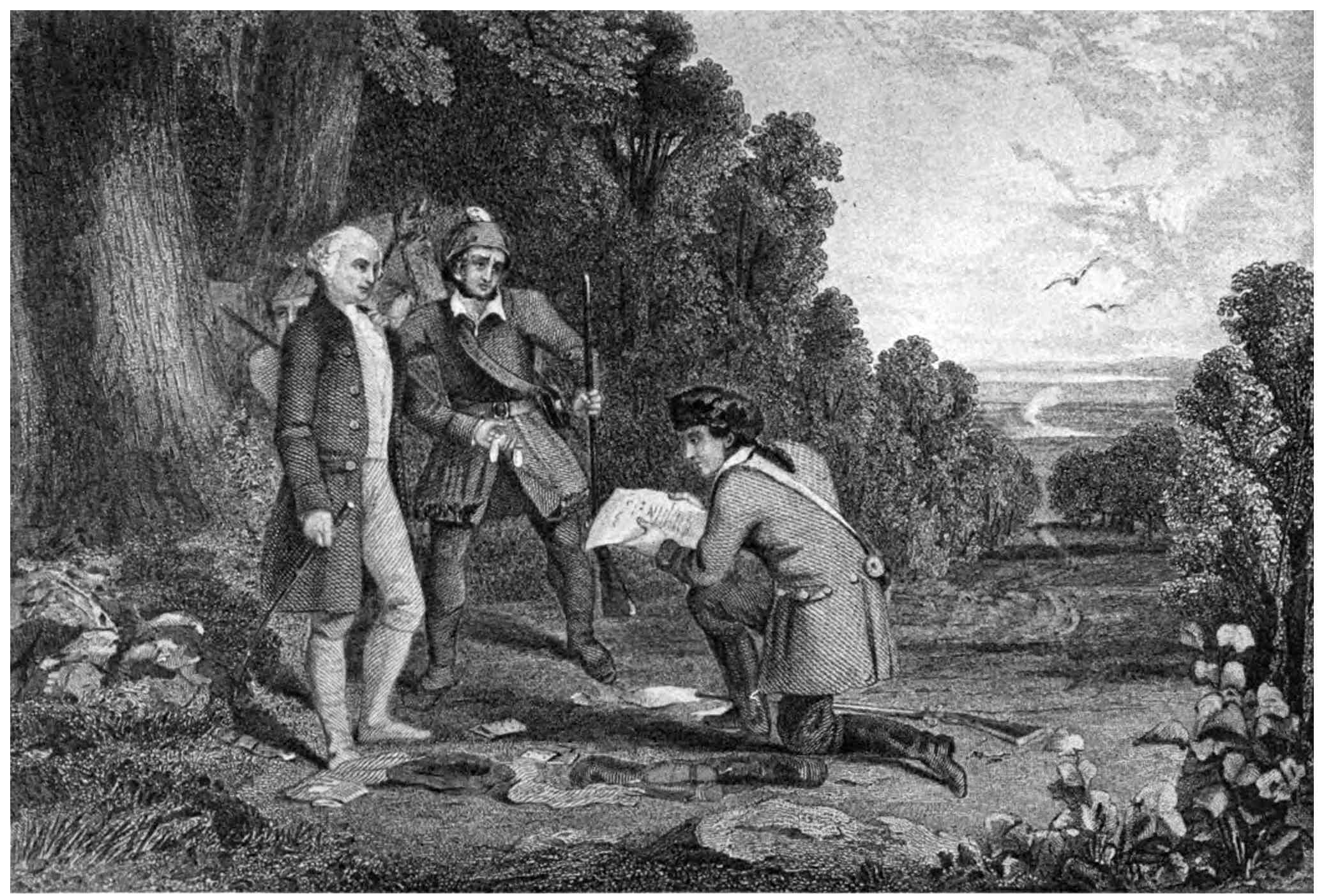
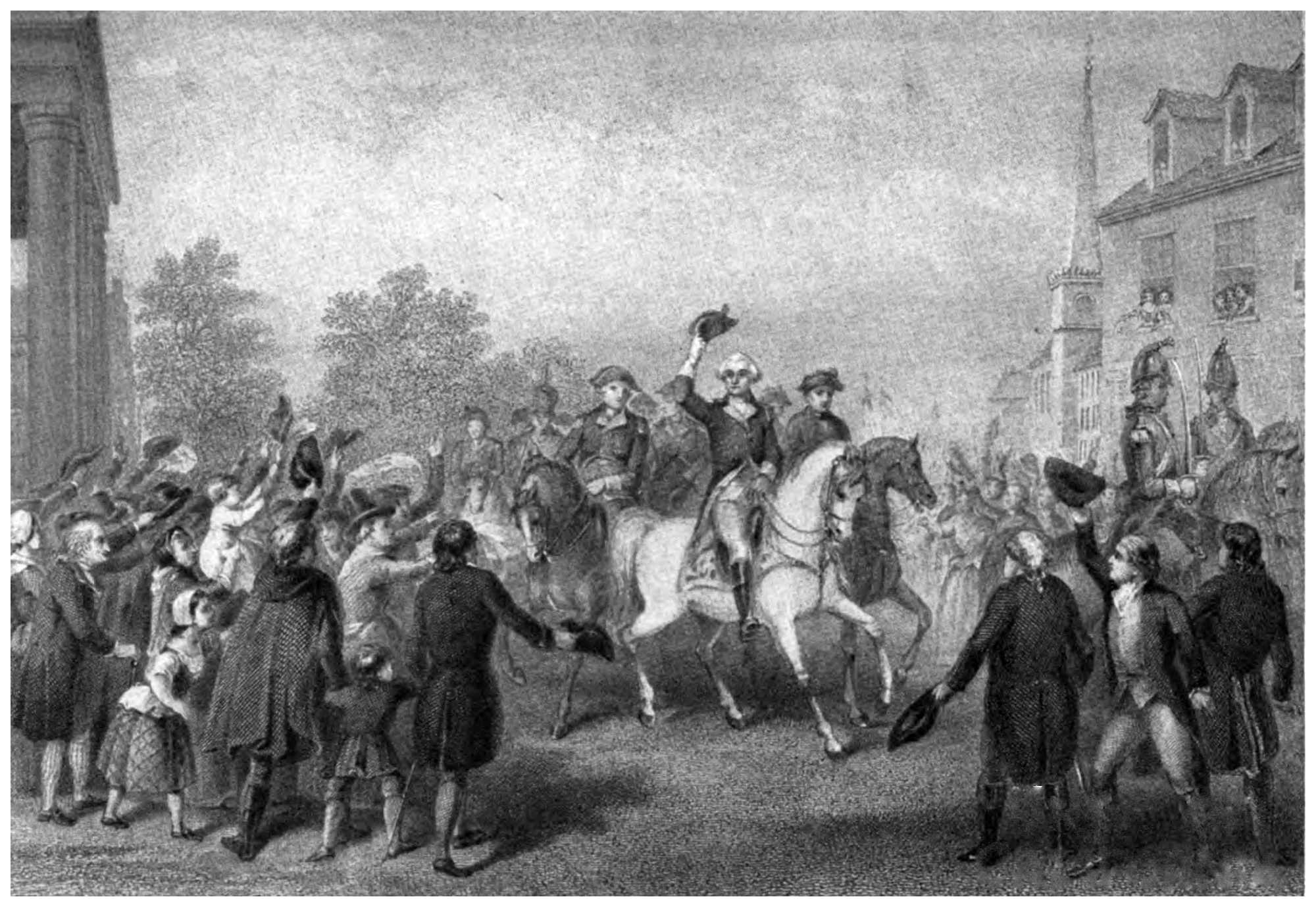
There is a story, perhaps true but lacking satisfactory proof, that one of the mounted figures at the right of the picture is there to represent Major Tallmadge and the other, one of his Dragoons; and that the man this way from him with hat in air is Robert Townsend, otherwise Culper Junior.
General Washington, Major Tallmadge, John Paulding, Nathan Hale, James Rivington, Sarah Townsend, Robert Townsend, alias Culper Junior. On backstrap of jacket, Washington in 1772.
FOREWORD — FOOTNOTES to “FOREWORD”:
Certainly there are but few Americans to
whom the name of Nathan Hale is not as familiar
as a household word. Everybody has heard of that
Martyr Spy and almost everybody knows his life story. A
graduate of Yale College in 1773 he became a school
teacher[1] and more, a patriot, in every sense the word implies.
He enjoyed his work as a pedagogue but his country’s
call was irresistible. Soon he was captain of a Company
and on Long Island he received from the British his
Baptism of fire. Then illness caused him to wonder if after
all to him would come the privilege of rendering worth
while service. Can it not be said he hoped, or better he
prayed that he might be useful, and then, sooner than he
expected, he was called to render an unusual service. There
was no reckless haste in his decision. He considered well the
hazard of the work he had been asked to do. It was more
than to report the position of the British Army. It was to
discover their intentions, and to report his findings to General
Washington.—A week later he was dead—and not a
line from him had reached the Commander in Chief. His
work was a magnificent failure but the spirit that prompted
him to undertake it entitled him to the everlasting glory
which is his.
Hale’s was an unnecessary sacrifice that more careful
planning might have prevented, but as yet there was no time
for organized effort, and for some months no better method
was devised than to entrust some officer to get what was
needed, either by the capture of prisoners or by sending a
trusted man into the enemy’s camp. Upon these latter
occasions individuals were met with who seemed anxious
to be of service. Among them were two men later to be
known as Culper Junior and Senior. Certain officers, particularly
General Chas. Scott, became popular with General
Washington because of their ability to locate these men and
to get from them intelligence that could be relied upon. It
will be seen that they later formed the Secret Service
Bureau that was so helpful to General Washington all
through the Revolutionary War.
This organized service differed from that of Hale’s time
in that it became a business with the men who conducted it,
and enabled them usually to have some one who could get
the information when they feared they were suspected or
for any other reason they believed it too hazardous to
undertake themselves. It is remarkable that although their
lives were every moment in danger so carefully were their
secrets guarded that not only to the end of the war but for
a hundred and fifty years thereafter, in spite of frequent
efforts to discover their identity the real men were never
suspected. Primarily this was due to the caution of the men
themselves, each declaring that if to any one other than
those of their own selection they should learn that their
names were known they would leave the service and never
return; but it was also due to the care of General Washington
in exacting from all who knew them the most solemn
pledge that not to any one at any time or under any circumstances
would they reveal their identity. It is interesting at
this day to observe the fear they had that their handwriting
might betray them, and to note that although they practiced
several styles of writing with the intention of concealing
their real hand nevertheless it was finally this that first enabled
positive identification. It will also be discovered that
although those in the Secret Service requested that the
letters they were sending for General Washington should be
destroyed the majority of them were preserved by him, and
that on the contrary with one exception the letters from
General Washington to the Culpers were promptly destroyed
by them in order that they should not be betrayed
thereby if searched. That the contents of so many of the
letters to the members of the Secret Service from General
Washington is known is due to his system of saving copies
of them and these as a rule are in the handwriting of the
General himself.
Long before the Culpers were requested to do their own
writing both furnished intelligence, and it is not possible to
say which was first so engaged. Culper Senior had made his
fourteenth written report when Culper Junior’s first was
sent, but most of Senior’s information was furnished by
Junior, and probably Scott had it from him before Senior
had attempted it. Their work did not end with the closing
days of 1783 but General Washington’s temporary retirement
occasioned them to look to others who may have been
less careful in preserving the records. After the war Culper
Senior was from 1799 to 1810 First Judge of Suffolk County
but Junior never accepted any important political position,
although Oliver Templeton, a leader among the business
men of the day, wrote to Culper’s brother when in 1789 it
was announced that his father had been made a member of
the Council of Appointment, saying: “I am informed your
father is one of the Council of Appointment. For God’s
sake if that is the case, write your father immediately not
to forget his sons. I am afraid for the opportunity he may
have too much modesty.... Your Brother Robert is fitted
for any office.” He wielded an influence however that was
almost uncanny. No one knew the real patriots in the City
of New York at the close of the war as he did and much
that seemed mysterious at the time can be traced to him, for
besides Washington and Tallmadge, Alexander Hamilton,
Richard Varick and several others were familiar with his
handwriting and gave weight to his suggestions and opinions.
Publication of “The Two Spies, Nathan Hale and Robert
Townsend”[2] by Houghton Mifflin Company in 1930 revealed
for the first time the names of those in the secret
service employed by General Washington. It was discovered
that Culper Senior was Abraham Woodhull[3] of Setauket,
Long Island, and that Culper Junior was Robert Townsend
of Oyster Bay. It was Robert Townsend who remained in
New York City from the beginning of the war until and
after its close. Culper Junior was the man whose identity
every historian from Judge William Smith to those at the
present day was trying to discover. Smith was a co-worker
with him and at times they would both hand communications
to James Rivington for his newspaper at the same moment,
but Smith never guessed that Townsend was General Washington’s
Culper Junior. Jared Sparks later went to the
greatest pains to try to identify him, begging those who he
knew could tell him if they would, but no one at any time
was willing to break the pledge by revealing his identity. To
prevent any misunderstanding as to Rivington’s part in the
Secret Service a brief sketch of him here seems necessary.
James Rivington was the son of Charles and Eleanor
Rivington. He was born in 1724. Was twice married, his
second wife being Elizabeth Van Horne of New York, by
whom he had two sons and a daughter. A brother was John,
with whom he was in partnership in the publishing business
in London until 1756, when he joined James Fletcher, son
of the bookseller of Oxford. Their most successful venture
was Smollett’s History of England, upon which they cleared
ten thousand pounds, the largest profit then known to have
been made on any single work. A growing love for horse-racing
and gambling possessed him until most of his money
was gone. He then came to America and settled as a bookseller
in Philadelphia in 1760. The following year he opened
a book store at the lower end of Wall Street in New York.
Then in 1762 he commenced bookselling in Boston, where
he failed. In 1764 he was in Bermuda, where he opened a
printing office for a short time. He soon returned to New
York where in April, 1773, he began “Rivington’s New
York Gazetteer.” By 1775 the matter he permitted to appear
in the Gazetteer was so offensive to the Sons of Liberty
that on May 10th his office and home were mobbed and he
with Miles Cooper was obliged to seek refuge on a British
man-of-war in the harbor. Although his plant was damaged
his assistants were able to continue the paper whilst he petitioned
the Continental Congress, saying:
“It is his wish and ambition to be an useful member of
society. Although an Englishman by birth, he is an American
by choice, and he is desirous of devoting his life in the business
of his profession, to the service of the Country he has
adopted for his own. He lately employed no less than sixteen
workmen, at near one thousand pounds annually: and
his consumption of printing paper, the manufacture of
Pennsylvania, New York, Connecticut and Massachusetts
Bay, has amounted nearly to that sum. His extensive foreign
correspondence, his large acquaintance in Europe and America,
and the manner of his education, are circumstances
which, he conceives, have not improperly qualified him for
the situation in which he wishes to continue, and in which he
will exert every endeavour to be useful.”
However, before the close of the year, on November 23d,
1775, his plant was again mobbed. This time under Colonel
Sears’s directions the presses were ruined and the type all
carried away to later be melted into bullets. Rivington then
went to England, but returned to New York in 1777, now
as the king’s printer with a Royal commission and a grant
of £100. per annum. He brought with him new machinery
and type and began republishing his paper on October 4th
of that year. He also had received commissions from several
publishers to supply them with the news of British
activities in this country. Several have stated that Rivington
was permitted to remain in New York after the close of the
Revolution; for example, in the news from Springfield,
Mass., published in the Salem (Mass.) Gazette, December
25th, 1783, it was reported as “an undoubted fact Mr.
Rivington, publisher, of New York was, as soon as our
troops entered the city, protected in person, and property,
by a guard and that he will be allowed to reside in the
country, for reasons best known to the great men at helm.”
But most have neglected to show that his treatment was
worse than exile. A rival publisher in his issue of January
1st, 1784, says: “Yesterday Rivington, who has had the
audacity to continue his obnoxious publications was waited
on by General John Lamb, Colonel Willett and Colonel
Sears, and forbid the prosecution of any further business in
this city, in consequence of which, he has discharged his
hands, and obeyed the order. To the joy of every one in the
United States, Jemmy Rivington’s political existence terminated
last Wednesday, the 31st ulto. [1783].”
Personal injury was soon to be added to insult, for on
the 11th of the same month Nicholas Cruger gave him a
violent beating, claiming he had suffered in prison during
the war because of statements made by Rivington’s paper.
Rivington had a caller in 1794 in the person of Henry
Wansey, who wrote in his Journal: “June 23d, I dined with
James Rivington, the bookseller, formerly of St. Pauls
Churchyard; he is still a cheerful old man, and enquired of
me for Mr. Collins, and Mr. Baston, and many of his
quandam acquaintances in England. During the time the
British kept possession of New York, he printed a newspaper
for them, and opened a kind of coffee-house for the officers;
his house was a great place of resort; he made a great deal
of money during that period, though many of the officers
quitted it considerably in arrears to him.”
A record exists in a letter written on May 8th, 1797,
showing that Rivington was then in jail for debts contracted
by others but which he was held responsible for. On the
fourth of July, 1802, he breathed his last, at the age of 78,
and was buried in the cemetery of the New Dutch Church.
After discovering that the chiefs of General Washington’s
spies were Robert Townsend and Abraham Woodhull
the problem was still to be solved how these two men could
so frequently meet without attracting suspicion. For many
months it seemed beyond solution. Townsend’s books
showed that he changed his boarding place usually after
a year’s stay but this could be attributed to no more than a
precautionary measure. However when the account books
of Woodhull were compared with those of Townsend it was
noticed that both men carried ledger accounts with these
landlords. The first for example was Amos Underhill.[4]
There seemed nothing significant in the name until the
family genealogies were searched. Then it was discovered
that on March 21, 1774, Amos Underhill had married
Mary Woodhull. Mary Woodhull was the sister of
Abraham Woodhull. The matter was solved! Townsend
was an incidental roomer at the Underhills’ and Woodhull
was a frequent caller on his sister and brother in law.
Culper Senior and Junior could therefore be with each
other whenever necessary without attracting the least suspicion.
Townsend next boarded with Jacob Seaman, who was
married to Margaret Birdsall. This Margaret was the
daughter of Col. Benjamin Birdsall who furnished our Gen.
George Clinton with much valuable information.
Townsend and Woodhull found it necessary to personally
scout for information at its source (see Woodhull’s letter
dated Oct. 31, 1778). Their system also included a score
of the most respectable citizens who were never seen anywhere
in situations the least suspicious, but each employed
trusted friends who regularly corresponded with them and
the items they secured were promptly communicated to
either Townsend or Woodhull. Much in these letters might
be called camouflage. They usually began with some expression
such as “We have no news” and then followed the
style suggested by General Washington in several of his
communications. Sometimes the information was promptly
forwarded, the following letter being an example:
My dear Friend:
We all arrived here yesterday at three o’clock after a
passage of 2 hours. The kindness of yourself and wife and
the pleasure I found at your house are strongly fixed on my
mind, and make me desirous of contributing any thing to
the information, amusement &c. of yourself and friends. I
enclose a paper which will give you all the news that is yet
published about Charles Town. Tomorrow a hand bill will
come out with the Capitulation. Yesterday most of the
troops here, Staten Island &c. were embarked in Sloops &c.
to the number, it is said, of 7 or 8 thousand, and proceeding
up the Kills, landed about sunset near Elizabeth Town, and
immediately began their march to attack Washington in his
camp at Morris Town. At five o’clock this morning the
troops had got to Springfield, 8 miles short of the place
without much opposition, but since, much firing has been
heard. Brigadier Genl. Sterling[5] was wounded in the thigh
by a random shot at Elizabeth Town last evening and is
brought back but the British met with no other loss there.
A vessel is just arrived from St. Kits but brings no news
except that the fleets were within sight of each other and
another action expected. The British had been reinforced
with three sail.
My Respects to C. Wistar and family. I am sorry katy’s
indisposition prevented her coming with us. I shall send the
nickanees by Tommy. I am affectionately &c.
William T. Robinson.
7 June, 1780.
Culper Senior had the contents of the above letter on its
way to Washington three days later; see his letter of June
10, 1780, on p. 79.
A shorter but no less important letter reads:
New York, 31st December, 1779.
My good Friend:
When I left you at D. Bowne’s, I galloped directly to
the Ferry the nearest way without stopping, and arrived
there in two hours and twenty five minutes, and had there
been a boat ready I might, if I chose it, have gone to meeting
here in the afternoon, but you will readily imagine that
I was more intent on procuring a good dinner, which I did
at Brooklyn and got over before sundown....
We have no news—besides what the enclosed papers
contain. The Southern Fleet, consisting of 150 sail, went
out of the Hook at two o’clock on Sunday and ’tis feared
that they have suffered in the dreadful storm that followed
soon after. The fleet for Europe sailed the thursday before.
This goes by Hick’s boat to Great Neck, to the care of
Richard Thorne. I also send a small paper bundle containing
a Book for Eliza and a pair of skates for my friend
Harry—of which I beg their acceptance. My respects and
best wishes attend Mrs. Lawrence and the family and our
two friends over the ICE. I am affectionately yours,
Wm. T. Robinson.
Another Robinson letter will be found in the notes (125).
It may interest some to know that this Wm. T. Robinson
once owned the property 421 E. 61st Street, New York, now
owned and occupied by the Colonial Dames of America. His
helpful intelligence reached the spies through Joseph
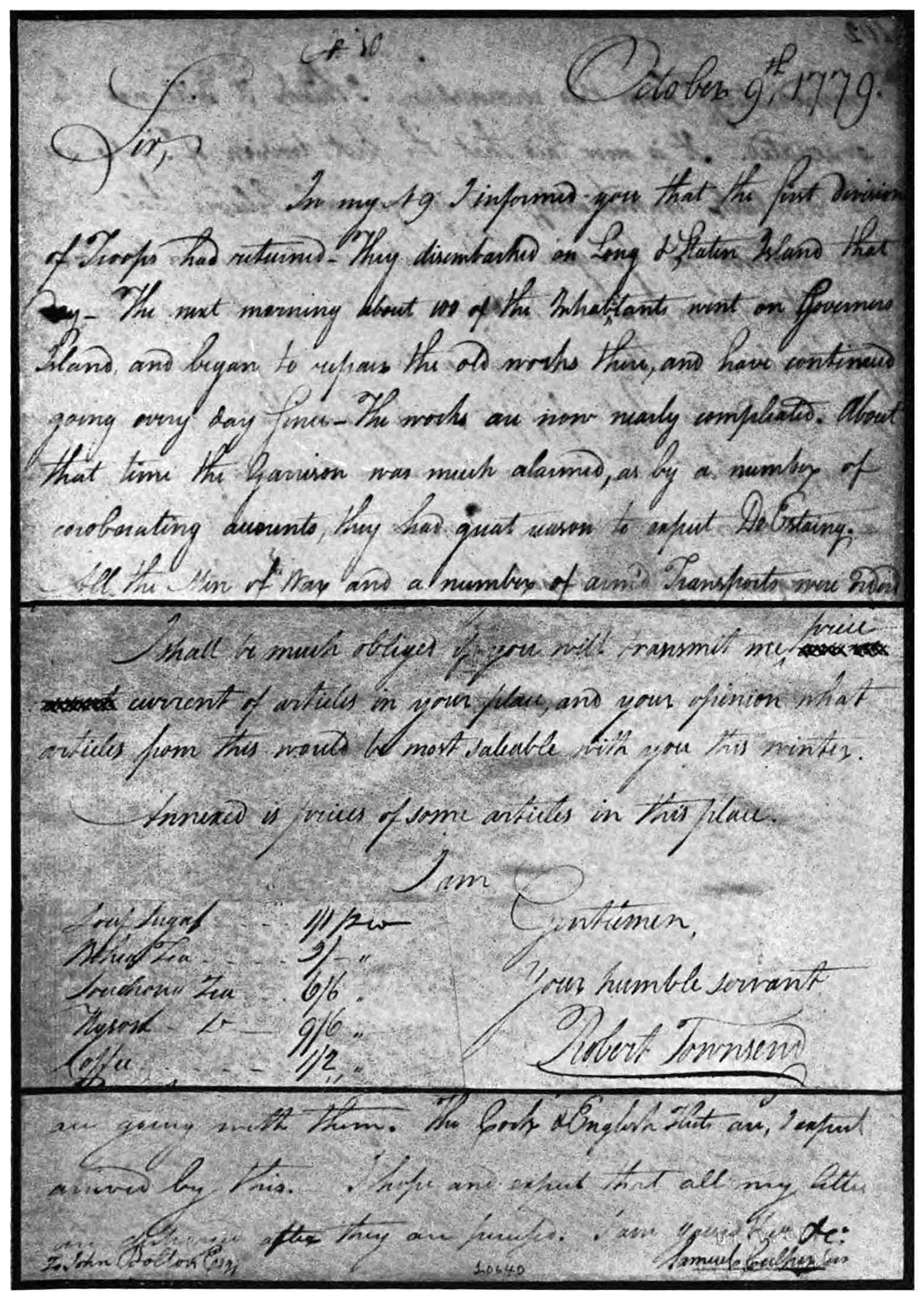
Lawrence of Bayside, L. I. The original documents were
preserved in a manner so similar to all the rest of the
Culper Jr. material as to be remarkable. The wife of Joseph
Lawrence was Phebe and there were not so many that knew
her maiden name, but it was Townsend and she was the
daughter of the Fourth Henry Townsend. They were married
in 1764 when he was 23. Their son Effingham married
Anne Townsend daughter of Solomon Townsend who was
Robert Townsend’s brother. A daughter of Anne and
Effingham twenty three years after her mother’s death had
occasion to go through the homestead and there under the
eaves in the garret at the stone house she found (in 1868)
this interesting correspondence that had evidently been
placed there by her grandparents and had remained unobserved
for nearly a century. It reached the Long Island
Collection in East Hampton a few months ago, having been
carefully preserved but without critical examination during
the past seventy years.
John Bolton was the assumed name of the man who stood
between the Culpers and General Washington. With the
occasional exception of a letter to General Washington all
from the Culpers were addressed to Mr. John Bolton, the
name assumed by Major Benjamin Tallmadge in the secret
service work. Major Tallmadge did not try to conceal his
identity after the war. Caleb Brewster always permitted
his own name to be used. With his trusty gun and sword
he defended it, although the British at one time offered a
large reward for his capture. Austin Roe, also of Setauket,
was the chief messenger. He was given no other name, but
was known by a number, which was 724. Jonas Hawkins
was another messenger, and there were several more that
could be depended upon if required, but Austin Roe became
so expert in the service as to eclipse the rest. One who can
realize what he had to contend with must view with amazement
the work of Austin Roe. Across the Sound General
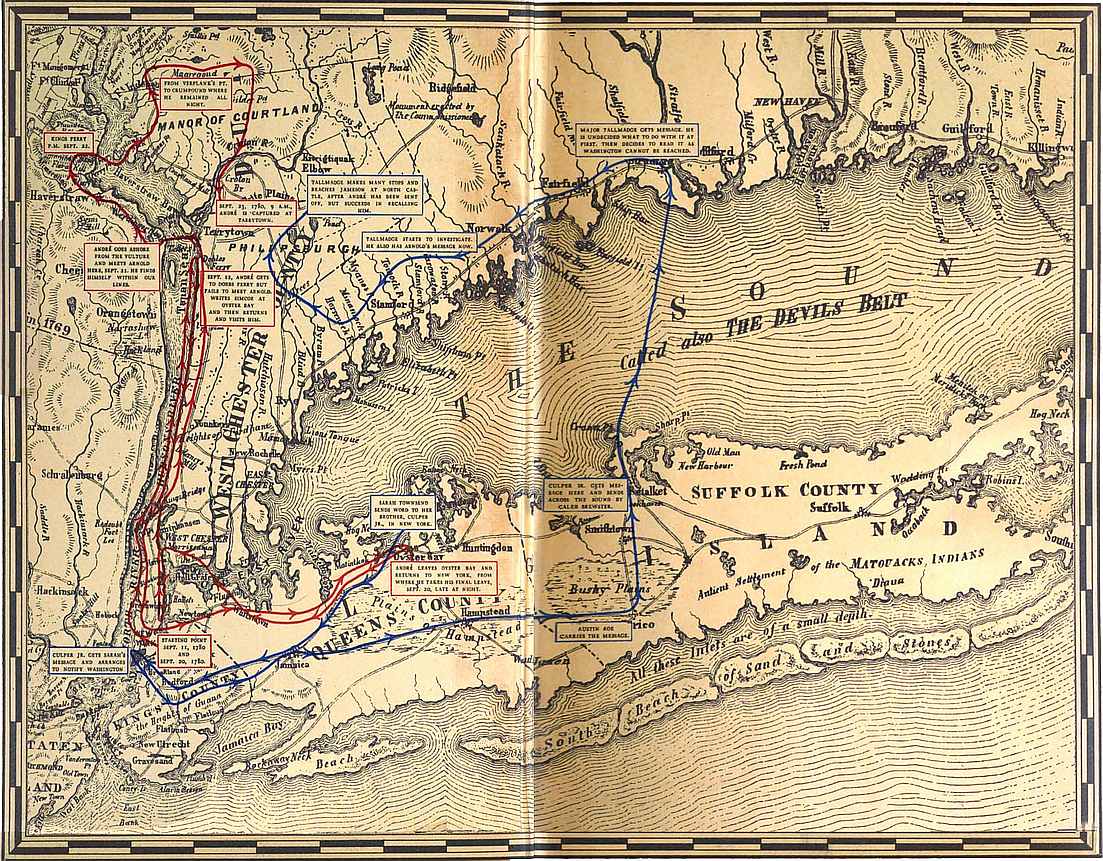
Washington had Dragoons posted, three every fifteen miles
apart, to carry the messages to him, whilst on the Long
Island side Austin Roe rode the fifty-five miles from Setauket
to New York and the same distance back, through the
enemy’s country, unattended. True, officers in British uniforms
had permitted him to arrange for relays of horses
which he could exchange along the way as required, but
nevertheless it was a remarkable feat and should yet be
recognised as such.
* * * * *
Had it been possible to follow a message from New York
to Headquarters in 1781 one might have seen Austin Roe
enter a coffee house in the vicinity of Wall Street. Visibly
tired, and probably hungry as well, for he had just finished
a long ride. Few were in the room at that hour but in the
far corner we will observe two British officers in conversation
with a gentleman dressed in the fashion of the day.
This is Mr. Townsend, and the officers are persuading him
to visit their encampment. They have been advised that he
is diffident but they have discovered that preferment comes
to those who receive favorable publicity in the English
Magazines as well as in the Royal Gazette. Mr. Rivington,
the king’s printer, had advised them to cultivate Mr. Townsend’s
acquaintance; to keep him posted as to all their activities
if they value publicity such as he may give them; and
they exact from Townsend the promise of an early visit.
They do not know that the Coffee Room was established for
that very purpose: that Townsend and Rivington although
silent partners were its financial backers; and that Rivington
wished to establish it in order to provide a place close
by his printing office where British officers would meet and
furnish him with copy for the English Magazines and his
own Royal Gazette. Townsend he found apt, and most willing
to run down news that made good copy; and the fact
that Townsend refused to be on his pay roll or to accept
money for his work did not lessen Rivington’s regard for
him. That James Rivington ever imagined Robert Townsend
to be in the service of General Washington there is no evidence
to show. In fact it is very unlikely. Rivington was
not the type of man that Townsend would trust with that
secret.
The sight of Roe was sufficient to apprise Townsend that
the General was expecting a message. When he could excuse
himself he left the Coffee Shop and returned to his own
rooms, which were nearby. He was soon followed by Austin
Roe, who handed him a letter from Mr. John Bolton. This
read: “I wish you to send by bearer ½ ream letter paper,
same as the last. Mr. Roe will pay for it.” Townsend paid
little attention to this message, but opening a secret closet
brought out a vial of liquid which he proceeded to brush over
the letter. Soon another message appeared on the same sheet
of paper. It was from General Washington requesting certain
important information. Meanwhile Roe had started
down the street for the printing office of James Rivington
at the corner of Queen Street facing the North Front of
the Coffee House. Here he purchased a half ream of paper—had
it carefully wrapped and labeled and then started
back with it to Townsend’s rooms. Very carefully it was
unwrapped, in order that it could be sealed again without
showing that it had been opened. Townsend then began
counting the sheets until he arrived at a number previously
agreed upon. That sheet was then extracted, and reaching
for a vial of a different liquid he proceeded to write. But
only momentarily could the words be seen. As soon as the
stain was dry it disappeared, leaving no hint that it was
there waiting to be developed by the other liquid.
The supper hour was now approaching when the Coffee
Room would be a scene of great gaiety. There would be
gathered new arrivals from abroad, anxious for an introduction,
and those expecting soon to leave would be tendered
an affectionate adieu. It was a huge success from the standpoint
of a news gatherer, and would have been worth while
even if it had not been returning the handsome revenue it
did at that time. So thought Rivington. Doubtless Townsend
from the standpoint of a Spy thought the same, but
unlike Rivington he kept his own counsel. It should not be
presumed that all could be gotten in this fashion. There
were reports from at least a dozen to be checked over, and
out of the way places to be visited. When all had been
summed up Townsend finished his letter and returned it to
its proper place in the package of letter paper. Austin Roe
packed his saddle bags with a variety of articles needed by
those at the east end of the Island, and carefully stowed
among the things was this half ream of paper for Mr. John
Bolton. In the late forenoon he set off, crossing the Brooklyn
ferry and from there heading either for Jamaica or
Flushing he soon was well on his way. There were times
when he met with trouble along the road but upon this occasion
we presume that he reached Setauket without incident,
and just in time to give attention to his cattle, which were
kept pastured in a field belonging to Abraham Woodhull. It
might have been a matter of suspicion had he always left
a package with Woodhull, therefore a box in the field was
resorted to on this as upon many occasions, and straightway
home Roe drove the cows. Later Woodhull, passing through
the field, transferred the contents of the box to a bag he
was carrying and soon the intelligence for General Washington
was in his private room. Other messages to accompany
those just arrived were now prepared by Woodhull,
who we will not forget always signed himself Culper Senior
in this correspondence.
Caleb Brewster was waiting with his boats to convey
these messages across the Sound. Woodhull knew he was
waiting but had not seen him. He had observed the black
petticoat which was the signal of his arrival hanging on the
line across the creek on Strong’s Neck. He knew where the
boats were hid, too, although there were six landing places,
but he had observed hanging with the clothes on the line
near half a mile away four handkerchiefs. Just as one, two,
three, five or six hanging there at one time indicated certain
landing places Woodhull knew that four indicated the Neck,
and there when the messages were ready he took them.[6] It
was long a question as to who it was that used this clothes
line signal to guide the delivery of the messages to Brewster
who was to carry them across the sound on their way to
Washington’s headquarters. Finally a clue was found among
the papers of the Floyd family and when this was compared
with the Woodhull account book it was discovered that the
signals were arranged by no less a personage than the wife
of Judge Selah Strong. Anna Smith was her maiden name.
She was born on April 14th, 1740, and married Judge Strong
on Nov. 9th, 1760.[7]
Brewster sometimes would capture an enemy crew on the
way across, and sometimes when not well protected they
would chase him. Occasionally he found it necessary to kill
some of them. Major Tallmadge was not always to be
found in the same place but kept Brewster sufficiently informed
to be able to steer in the right direction. When
to Major Tallmadge the messages were handed they were
again examined, in fact frequently the stain letters were
developed and then forwarded to the nearest Dragoons
posted along the road, from whence they were relayed to
Headquarters.
* * * * *
No one will challenge the emphasis put upon the importance
of the Secret Service. Only lack of details has deterred
its recognition. As early as April 1779, Major
Tallmadge began by saying: “Some pieces of useful intelligence
respecting the movements of the Enemy in this late
intended Expedition to New London, and which I have
reason to believe in a great measure defeated their intentions,
have been communicated by Culper.” “Of very great
importance” Washington considered it, and so wrote on
July 11, 1780 “I rely upon this intelligence,” he wrote at
another time. When G. W. P. Custis, adopted son of General
Washington, was told by friends, who probably over-estimated,
that the service had cost between one thousand
and fifteen hundred pounds, he wrote: “It was a cheap, a
dog cheap bargain; for, although gold was precious in the
days of the Continental currency, yet the gold paid for the
secret service was of inestimable value, when it is remembered
how much it contributed to the safety and success of
the army of Independence.”
Too much can not be said of the personnel of the service,
due largely to Robert Townsend, whom all the others speak
of in the highest terms. “Nothing could induce me to be
here but the earnest desire of Culper Jur.,” said Woodhull
in 1779. “He is the person in whom I have the greatest
confidence,” General Washington wrote of Culper Junior
in a letter to Congress. “This much I can assure you,” says
Major Tallmadge, “he is a Gentleman of business, of Education
and honor.” Of him on June 20th, 1779, Woodhull
wrote: “He is a person that hath the interest of our Country
at heart and of good reputation, character and family,
I have reason to think his advantages for serving you, and
abilities, are far superior to mine. As long as I am here shall
be an assistant and do all that I can.” Again on February
5th, 1780, General Washington wrote of Culper Junior:
“His accounts are intelligent, clear, and satisfactory ... I
rely upon his intelligence,” and Woodhull echoes “He’s
allowed to be a person of good sense and judgment, and his
firmness and friendship towards our Country I do assure,
you need not doubt. I have known him several years and
confident he is a sincere friend, and hath undertaken it
solely for to be some advantage to our distressed Country.”
Then in May, 1781, General Washington recorded:
“Of the Culpers fidelity and ability I entertain the highest
opinion.”
In this volume are now collected a majority of the letters
still in existence from spies in the American service during
the Revolutionary War. That General Washington was contented
with an occasional report from other scenes of action
evinces the importance he attached to the territory around
New York. That the Spies of Washington are worthy of
important recognition in the annals of the State becomes
evident as their work is examined.
G. M. Pierce, Registrar General of the National Society,
D. A. R. in 1918 summed up the Revolutionary Spy in these
words: “The man or woman who enters upon such a career
must possess strength of character and be endowed with all
the qualifications of a good soldier and a commanding officer
besides. A soldier must possess bravery and courage, but a
spy must be not only brave and courageous, but must also
have what is called ‘nerve,’ poise, self possession, absolute
control of facial expression, fearlessness, tact and discretion
unequalled. For his is the most hazardous of all undertakings.
Discovery means death, the penalty inflicted alike by
all nations.”
[1] In October, 1773, Nathan Hale began teaching in East Haddam,
Connecticut, but in May, 1774, he took charge of a school in New London,
called the “Union School.” Here he remained until the summer of 1775,
when he joined the third company of the 7th Connecticut Regiment, commanded
by Colonel Charles Webb.
[2] “The Two Spies, Nathan Hale and Robert Townsend,” might almost
be called a first edition of this volume, but there being more new material
in this than the entire contents of the first issue, it is given a new title.
[3] Until this publication the identity of Culper Senior was not positive.
Some said Nathaniel Ruggles was the man; others were correct in assuming
that it was Abraham Woodhull, but others confused matters by
declaring that it was Abraham C. Woodhull, an entirely different person,
although he lived in the same town at the same time.
[4] The above Amos Underhill had brothers, one being Benjamin, whose
wife was the daughter of Sylvanus Townsend. After his death she married
in 1789, John Franklin, son of Thomas. Benjamin’s only son he
called Townsend Underhill, born in 1765. His daughter was Elizabeth.
This Elizabeth Underhill married John Butler Coles. In 1780 he was a
clerk for Thos. Buchanan & Co., and later had his own business at 12
Dock Street, now Pearl. He was a director of the Bank of New York
from 1806 to 1820 and died January 2, 1827, leaving a large estate. His
father, Nathaniel Coles, happy over the return of peace, in 1783 roasted
an entire ox and invited the neighborhood to partake of it. Both Amos and
Benjamin Underhill had business dealings with Robert Townsend.
[6] A somewhat similar method was used on the New England side, at
least in the vicinity of Newport. It is described on page 48 of a Discourse
by Arthur A. Ross, who a hundred years ago was Pastor of the First
Baptist Church there. Mr. Ross says: “During the whole time the British
had possession of the Island, a correspondence was maintained between
certain individuals of the Island and the main at Little-Compton, so that
the American officers were constantly apprized of the general movements
of the enemy, while in possession of Rhode-Island. This correspondence
was maintained by signals given on the Island, indicating a clear coast,
and that a messenger could pass over in safety, after dark. The first signal
was the leaving down of a certain pair of bars, which, with a spy-glass,
could be distinctly seen from the main. Afterward, for fear of exciting the
suspicion of the enemy, the signal was changed, when an open window of
Mr. Peleg Peckham’s barn, answered the same purpose. A small vault in
the ground, near the shore, and at no great distance from Mr. Peckham’s,
covered with a flat stone, served as a depository of communication.—Here,
letters and papers were regularly deposited and removed, by the
respective individuals engaged in the correspondence.”
[7] Judge Strong was born on Dec. 25th, 1737, and died July 4, 1815. His
parents were Thomas Strong and Susannah Thompson, daughter of
Samuel Thompson and Hannah Brewster. His wife died August 2, 1812.
Anna Strong’s father was William Henry Smith, b. Mar. 13, 1689,
Brookhaven and d. Jan. 27, 1743. Her mother was Margaret Lloyd,
granddaughter of Grizzell Sylvester.
NATHAN HALE — FOOTNOTES to “NATHAN HALE”:
Late in the evening of September 22, 1776, Captain
John Montressor, of the British Engineers, who
was serving as aide-de-camp to Lord Howe, appeared
under flag of truce at the American outposts on
Harlem Plains, New York. He bore a letter to General
Washington respecting the exchange of prisoners. General
Putnam, Captain Alexander Hamilton, and Captain William
Hull were among those who met him. To them Montressor
verbally gave the information that an American
officer, one Captain Hale, had been executed that morning
as a spy. It was startling news, and to Hull it came like a
shock, for Nathan Hale had been his chum at college[8] and
confided to him details of the dangerous mission he had
undertaken. A week later, the sad news reached the home
of Hale, and one of his brothers, Enoch, started for the encampment
of Washington’s army. There Lieutenant-Colonel
Webb was induced to visit the British headquarters under
a flag, and he returned with information that enabled Enoch
to record that “Nathan, being suspected by his movements
that he wanted to get out of New York, was taken up and
examined by the general, and, some minutes being found
with him, orders were immediately given that he should be
hanged. When at the gallows, he spoke and told that he
was a captain in the Continental army, by name Nathan
Hale.”
Enoch carried this news home, and later his brother John
made entry in the town records of Coventry which reads as
follows: “Capt. Nathan Hale, the son of Deacon Richard
Hale, was taken in the City of New York by the Britons
and Executed as a spie some time in the month of September,
A.D. 1776.”
Tench Tilghman, in a letter to William Duer, written ten
days after the announcement of Hale’s execution, betrays
the feeling in the American army. “The General is determined,
if he can bring some in his hands under the denomination
of spies, to execute them,” he writes: “General
Howe hanged a Captain of ours belonging to Knowlton’s
Rangers who went into New York to make discoveries. I
don’t see why we should not make retaliation.”
Another letter, written by an American officer in camp
at Harlem, is dated September 26, 1776, and reads: “One
Hale, in N.Y. on suspicion of being a spy, was taken up
and dragged without ceremony to the Execution Post and
hung up.” “Yesterday we hanged an officer of the Provincials
who came as a spy,” writes a British officer to friends
at home; and James Drewett, on board the British frigate
Mercury at New York, writes: “On the 22d we hung a man
who was sent as spy by Gen. Washington.”
It was almost five months later when the newspapers
began publishing garbled accounts. The “Conquest of
Canaan,” an epic poem, by Timothy Dwight, probably the
first book to mention Hale, was not published until nearly
nine years after his execution, although, strangely enough,
its author had early in 1776 solicited Hale to get subscribers
to it for him.
Hannah Adams was in fact the first historian to record a
concise account of Hale, and her “History of New England,”
in which it appears, was not published until 1799,
nearly twenty-three years after the event. The story in her
book reads as follows:
“The retreat from Long Island left the British in full
possession. What would be their future operations remained
uncertain. To obtain information of their situation,
their strength and future movements, was of high importance.
For this purpose, general Washington applied to
Colonel Knowlton, who commanded a regiment of light
infantry, which formed the van of the American army,
and desired him to adopt some mode of gaining the necessary
information. Colonel Knowlton communicated this request
to Captain Nathan Hale, of Connecticut, who was
then a captain in his regiment.
“This young officer, animated by a sense of duty, and
considering that an opportunity presented itself, by which
he might be useful to his country, at once offered himself a
volunteer for this hazardous service. He passed in disguise
to Long Island, examined every part of the British army,
and obtained the best possible information respecting their
situation and future operations.
“In his attempt to return he was apprehended, carried
before Sir William Howe, and the proof of his object was so
clear, that he frankly acknowledged who he was, and what
were his views.
“Sir William Howe at once gave an order to the provost
marshal to execute him the next morning. This order was
accordingly executed, in a most unfeeling manner, and by
as great a savage as ever disgraced humanity. A clergyman,
whose attendance was desired, was refused him; a
bible for a few moments devotion was not procured, although
he requested it. Letters, which, on the morning of
his execution, he wrote to his mother[9] and other friends,
were destroyed; and this very extraordinary reason given
by the provost marshal, ‘that the rebels should not know
they had a man in their army who could die with so much
firmness.’
“Unknown to all around him, without a single friend to
offer him the least consolation, thus fell as amiable and as
worthy a young man as America could boast, with this as
his dying observation, ‘that he only lamented, that he had
but one life to lose for his country.’... To see such a
character, in the flower of youth, cheerfully treading in the
most hazardous paths, influenced by the purest intentions,
and only emulous to do good to his country, without the
imputation of a crime, fall a victim to policy, must have
been wounding to the feelings, even of his enemies. So far
[1799] Hale has remained unnoticed, and, it is scarcely
known such a character ever existed....”
Fifty years after Hale’s execution the “Long Island Star”
published (April 2, 1827) extracts from a letter of Stephen
Hempstead, Sen., aged sixty-nine, which Hempstead had
published in the “Missouri Republican.” Another ten years
went by before the first printed address appeared, and
thereafter memoirs and biographies followed at frequent
intervals to the present time. Attempts have been made to
trace every step in his career, but there is much that still
puzzles the historians. Nobody has been able to prove how
he got to New York, and no one can say positively where
he was captured. From all that has been gathered on the
subject, we have arrived at the following conclusions:
The retreat of the American army from Long Island had
been satisfactorily accomplished, but the officers found themselves
in a most perilous condition when on September 7,
1776, Washington called a council of war to consider the
important question: Should they defend or abandon New
York? At another council on the 12th, it was decided to
move to a position on Harlem Heights, leaving a guard
of four thousand men under General Putnam in the city,
with orders to follow if necessary. On the 14th, Washington
made his headquarters at the house of Robert Murray,
father of Lindley Murray the grammarian. From there he
wrote to General Heath, then stationed at Kingsbridge:
“As everything, in a manner, depends upon obtaining intelligence
of the enemy’s motions, I do most earnestly entreat
you and General Clinton to exert yourselves to accomplish
this most desirable end. Leave no stone unturned,
nor do not stick at expense, to bring this to pass, as I was
never more uneasy than on account of my want of knowledge
on this score....”
To quote a paragraph from Lossing: “The vital questions
pressing for an answer were, Will they make a direct attack
upon the city? Will they land upon the island, above the
city, or at Morrisania beyond the Harlem River? Will they
attempt to cut off our communications with the main, by
seizing the region along the Harlem River or at Kingsbridge,
by landing forces on the shores of the East and
Hudson Rivers, at Turtle Bay, or at Bloomingdale, and,
stretching a cordon of armed men from river to river, cut
off the four thousand troops left in the city?”
Washington, in his perplexity, called another council of
war at Murray’s. He told his officers that he could not procure
the least information concerning the intentions of the
enemy, and again asked, What shall be done? It was resolved
to send a competent person, in disguise, into the
British camps on Long Island to unveil the momentous
secret. It needed one skilled in military and scientific knowledge;
a man possessed of a quick eye, a cool head, unflinching
courage; tact, caution, and sagacity—a man on whose
judgment and fidelity implicit reliance might be placed.
Washington sent for Lieutenant-Colonel Knowlton and
asked him to find a man for the service. Knowlton summoned
a number of officers to a conference at his quarters
and after explaining the service required called for volunteers.
Late in the conference, when it seemed he would not
find a man competent and willing to undertake the perilous
mission, “a young officer appeared, pale from the effects of
recent severe sickness. Knowlton repeated the invitation,
when, almost immediately, the voice of the young soldier was
heard uttering the momentous words, ‘I will undertake it!’
It was the voice of Captain Nathan Hale.”
Everybody was astonished. The whole company knew
Hale. They loved and admired him. After the meeting his
friends tried to dissuade him from his decision, setting forth
the risk of sacrificing all his good prospects in life and the
fond hopes of his family and friends. Hull employed all the
force of friendship and the arts of persuasion to bend him
from his purpose, but in vain. With warmth and decision
Hale said:
“I think I owe to my country the accomplishment of an
object so important and so much desired by the commander
of her armies, and I know no mode of obtaining the information
but by assuming a disguise and passing into the enemy’s
camp. I am fully sensible of the consequences of discovery
and capture in such a situation. But for a year I have been
attached to the army, and have not rendered any material
service, while receiving a compensation for which I make no
return. Yet I am not influenced by any expectation of promotion
or pecuniary reward. I wish to be useful; and every
kind of service necessary for the public good becomes honorable
by being necessary. If the exigencies of my country
demand a peculiar service, its claims to the performance
of that service are imperious.”
Knowlton presently conducted Hale to Washington, who
delivered instructions concerning his mission. The commander
also furnished him with a general order to the owners
of all American vessels in Long Island Sound to convey
him to any point on Long Island which he might designate.
Asher Wright, his trusty servant, was told to have the
horses ready at the earliest moment, and, in company with
Stephen Hempstead, they set off that Saturday evening. No
hint has been given as to how they reached Norwalk, except
that because of the British cruisers in the vicinity they could
find no available boat until they got there, which may indicate
that they spent a part of Sunday, hunting perhaps at
Stamford and other points between there and Rye. Captain
Pond, whom Hale knew, happened to be at Norwalk, then
in command of the armed sloop Schuyler and arrangements
were made to take him across to Huntington on the Long
Island shore that night. Hempstead, who accompanied him
this far, writing fifty years later, says that he changed his
uniform for a plain suit of citizens’ brown clothes, with a
round broad-brimmed hat: He does not tell us whether he
brought the extra suit with him, but we must presume that
Captain Pond furnished it, although Hale charged Hempstead
with the care of his army clothes, his commission and
public and private papers, and also his silver shoe buckles,
saying they would not comport with his character as a
schoolmaster. He requested Hempstead to wait at Norwalk
until he returned or was heard from.
It was near daylight Monday morning when Hale was
landed on the beach at Huntington. No sound save the
plash of the waves disturbed the quiet of the approaching
day. No sign of human habitation was in sight: no guidepost
to indicate the direction to the town; but there were
hills not far away and from these a better view might be
had. A path was discovered and he rightly surmised it led
to the town. Who there entertained this martyr unawares
we may never know. Nobody there wanted a teacher just
at that time, but everybody was ready to tell him how the
Whigs were crossing from Huntington every day in order
to escape the British. Foraging parties had already been
to Oyster Bay and other towns. Two hundred wagons had
been demanded from the farmers of Suffolk County to remove
the baggage of the British from New Utrecht to
Hellgate, and already three hundred had been sent there.
Only the troops were allowed to cross the ferries from Long
Island to New York without passes;[10] but the market boats
were still in service and doing a good business supplying
the British troops with fresh country produce. Their difficulty
was to get men to assist in loading and unloading.
We cannot think that Hale would fail to take advantage
of this opportunity. Whilst the boats at Huntington were
transporting passengers to Connecticut with their household
effects, those from Oyster Bay were supplying the New
York markets and now were making deliveries directly to
the camp kitchens. Without loss of time, Hale must have
followed the road from Huntington to Oyster Bay. There
it was not necessary for him to diverge from the truth. He
found Huntington was already well supplied with teachers,
and being willing to work at anything was glad to assist on
the market boats. They stopped at Whitestone Landing, at
Flushing, and at Hellgate, and it was now his business to
inquire how many troops were at each place, how many
more were expected, and how long they would remain, and
perhaps even where they expected to be the following week.
Then, with what was left of the cargo, they crossed to New
York and there found ready market.
We know that Nathan Hale upon arrival in the city
found that many of the British had already crossed the
river, had engaged the men of his own company among
others, and were now fortifying their positions in various
sections of the city. And undoubtedly he mingled among
them until, early on the morning of the 21st of September,
the lower portion of the city was discovered to be in flames.
We may never know how his time was occupied that day,[11]
but it is possible that in spite of his disguise he discovered
he had been recognized as one of the officers attached to
Washington’s army. It may have startled him when he
realized that he was back at the place he started from almost
a week before. Back, but now not among friends.
Washington had withdrawn and the British were now in
possession of the ground between him and the American
army. A walk of less than three miles along the shore of
Harlem Creek would bring him within the American lines.
It may have seemed the easiest way to return, and in fact
might have been safely accomplished but for the unusual
events of that day. The great curtain of smoke that hung
over the city attracted attention for many miles around.
Among those who went out of their way to obtain details
of its cause was Captain Quarme and the crew of the Halifax.
They were off Whitestone Point at the time, but when
they had neared Manhattan in the vicinity of Ward’s
Island, Quarme, with a few men, went ashore near what is
now One Hundred and Eleventh Street. Hale was just
reaching the water-front at that point, and noticing the
small boat, and the Halifax not being in sight as the trees
on Ward’s Island hid the view, concluded it might be a
friendly party from Long Island. He had betrayed his
anxiety and attracted suspicion before he realized his mistake.
By Captain Quarme’s order he was left with the
sentinels at the British outposts, who later conducted him
to headquarters, and when the men returned they rowed for
the Halifax and sailed back to anchorage that night in the
vicinity of City Island. Later in the war the Halifax was
stationed at Huntington, which may account for the idea
that Hale was captured there.
The documents previously quoted show his treatment
after reaching the British lines.
[8] In the class of 1773 at Yale College among others were Nathan Hale
and his brother Enoch, Benjamin Tallmadge, and William Townsend.
William Hull was in the class of 1772. Of all the college mates of Nathan
Hale perhaps none had as deep an influence over his decisions as Benjamin
Tallmadge, and as may be observed, perhaps none was more responsible
for Tallmadge devoting the greater part of his military career to assisting
the spies of Washington than Hale. A carefully preserved letter of advice
to Hale, written at the time he was contemplating changing the garb
of a teacher for that of a soldier reads: “Was I in your condition, notwithstanding
the many, I had almost said insuperable, objections against
such a resolution, I think the more extensive service would be my choice.
Our holy Religion, the honour of our God, a glorious country, & a happy
constitution is what we have to defend. Some indeed may say there are
others who may supply your place. True there are men who would gladly
accept such a proposal but are we certain that they would be likely to
answer just as good an end? Could this be certainly known, though we all
should be ready to step forth in the common cause, I could think it highly
incumbent on you not to change your situation. These hints, thrown together
in great haste, proceed from a heart ever devoted to your welfare,
and from one who shall esteem it his happiness to promote yours. I hope
to hear from you soon & to know your determination; in the mean time I
remain your constant friend &c., &c.,
B. Tallmadge.
To Mr. Nathan Hale New London.
Wethersfield, July 4, 1775.
[9] Hale knew his mother was not living. It was an incorrect guess that
one of the letters was for her.
[10] In a letter from New York we hear that no person is suffered to go
out of the town without giving proper notices of their departure to Gen.
Howe; nor no person suffered to enter without their being first strictly
examined by the general officers commanding the several gates for admittance.—Middlesex
Journal, Sept 24, 1776.
[11] Although most of our large cities have had fires equalling that of New
York, yet because New York’s happened just at the time Nathan Hale
was there there are those who contend that he must have had a hand in
it. So insistent were some that an exhaustive study of the subject seemed
desirable. For this purpose contemporary charts of the tide and records
of the wind on the date of the fire were studied and the route of the men
from near Whitestone to 111th Street. The conclusion arrived at is that
Hale could have had no part in the fire aside from the possibility of his
being an interested eye witness. It must not be forgotten that he was sent
over to Long Island—the British had not yet entered New York, and
from the spot from which he started on his way to Long Island it was at
that time possible to send any man to any part of the city of New York
within an hour. It is not possible to believe that any sane man would
start on a week’s journey to reach a destination he could arrive at in
safety within an hour. Had Hale, discovering the opportunity favorable,
turned aside from the work he was given to do, he being sent as a spy to
discover and report the intentions of the enemy, he would have deserved
the treatment of a deserter at the hands of General Washington and if
he had given the British any proof that he had acted the part of an incendiary
he would have met death accordingly, and not as alleged “because
upon him they discovered notes and documents that proved him to be a
spy.” True many favored destroying the city at that time, and it is also
a fact that a large quantity of inflammable material was left in the city
when the troops under General Washington moved north, and to these
were added additional stores that the British brought with them. The
area of the fire may have been increased thereby but the contemporary
conclusion that its origin was accidental cannot be changed.
GENERAL WASHINGTON’S SPIES — FOOTNOTES to “GENERAL WASHINGTON’S SPIES”:
The capture and execution of Nathan Hale
made a failure of the attempt to get instant information
from within the British lines; but it formed a
determination in the General’s mind to establish a Secret
Service Bureau that would be more carefully planned and
consequently less liable to disappointing results. The man
selected to manage the spy system within the city of New
York was Robert Townsend, of Oyster Bay, Long Island.
Without discovery he furnished General Washington with
correct information throughout the war, and at its close,
lest harm should come to him, the General determined that
his identity should never be revealed. His books, which
remained sealed for over a century, now permit positive
identification.(101)
Before the war began, Robert Townsend acted as purchasing
agent for his father, in importing flax and sugar
and molasses, tea and coffee and iron and rum and similar
commodities,(102) and there is a suggestion that he may have
collected a secret fund for the “Sons of Liberty” in 1772,
’73, and ’74. His first war work commenced when the
Provincial Convention resolved unanimously on August 24,
1776, “That Robert Townsend be a commissary to supply
Brigadier-General Woodhull’s Brigade with provisions”;
but it may have been abruptly ended with the capture of
Woodhull and the scattering of his men.(103) Released from
other employment he had opportunity and with the gift of a
keen observation was able to assist General Scott and later
Abraham Woodhull in collecting intelligence. Lack of confidence
might have deterred him from making more than
verbal reports had they been required but at the moment
they were satisfactory, and either Woodhull or Scott embodied
his information in the reports to headquarters.
Every general was prepared to furnish spies, but the
arrangement now being made was of a more permanent
nature, General Washington proposing that they should
establish headquarters right in the heart of the British
camp. General Chas. Scott took particular interest in
arranging for this but was called to other service before it
was fully organized. Major Benjamin Tallmadge, of the
Second Regiment, Light Dragoons, was then selected to
carry on the work. Tallmadge was a native of Long Island,
born at Brookhaven in Suffolk County on February 25,
1754; and it was, therefore, natural for him to expect to
find there those in whom he could place the greatest confidence.
In this he was not disappointed. Men there were
already anxious to be serviceable to their country’s cause
in any capacity. Abraham Woodhull, Caleb Brewster, and
Austin Roe, were among the leaders. So important was
their work that without them little from New York City
could have reached the General.
The exact date when the service of systematically transmitting
intelligence commenced cannot be ascertained. In
his “Memoir,” Colonel Tallmadge merely records:
“This year [1778] I opened a private correspondence
with some persons in New York [for Gen. Washington]
which lasted through the war. How beneficial it was to the
Commander-in-Chief is evidenced by his continuing the same
to the close of the war. I kept one or more boats constantly
employed in crossing the Sound on this business.... My
station was in the county of Westchester, and occasionally
along the shores of the Sound.”
A letter from Major Tallmadge addressed to General
Scott, dated Bedford, October 29, 1778, reads:
“I have this moment received a letter from a gentleman
direct from Long Island, by the very gentleman whom I
made mention to you the other day to serve as a conveyance
for Samuel Culper’s letters. I doubt not it is authentic.”
Samuel Culper was the name assumed by those who furnished
the secret intelligence. At first without distinction,
but later Abraham Woodhull signed “Samuel Culper, Sr.,”
and Robert Townsend, “Samuel Culper, Jr.” Sometimes in
error they would write “Culper Samuel,” and Townsend
sometimes forgot to add the “Jr.”
Abraham Woodhull’s letter of October 31, 1778, indicates
the hazard of the work in New York City, and mentions
finding a faithful friend who will assist him. His letter
reads:
“Since my last have explored Long Island, City of New
York and island unto the ten mile stone to Tryons Quarters
where I received his threats for comeing their that made
me almost tremble knowing my situation and business but
blessed be God have been prosperd and particularly successful
in ingaging a faithful friend and one of the first characters
in the City to make it his business and keep his eyes
upon every movement and assist me in all respects and meet
and consult weekly in or near the city. I have the most
sanguine hopes of great advantage will acrue by his assistance....
If bad weather doth not prevent you will hear
from me weekly. I have to request that you will destroy
every letter instantly after reading for fear of some unforseen
accident that may befall you and the letters get into
the enemies hands and probably find me out and take me
before I have any warning. I desire you will be particularly
cairfull. Hopeing this may arrive safe and be able to serve
you better in my next is the earnest desire of your most
obedient Hbl. Servt.
“Samuel Culper.”
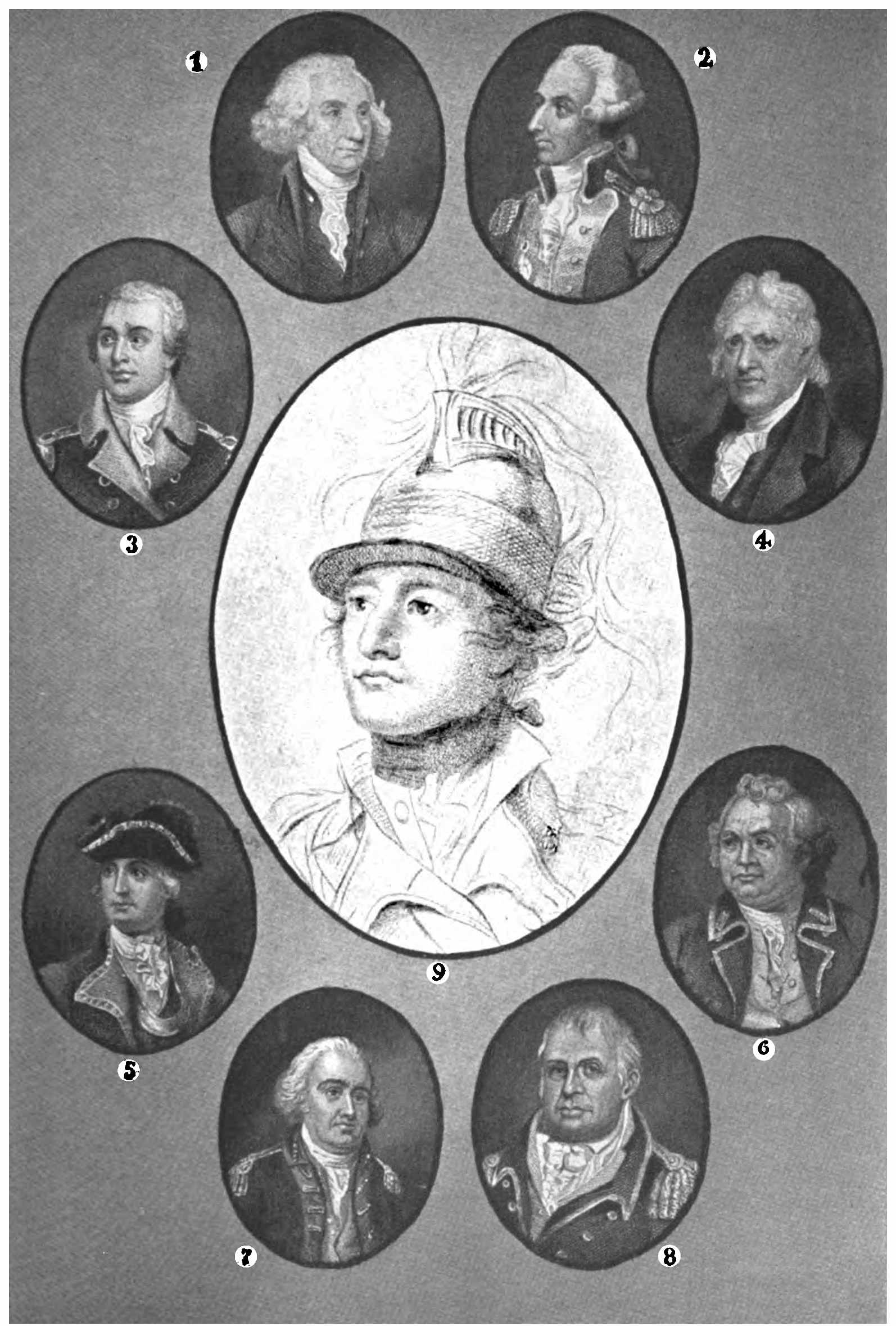
9. MAJOR BENJAMIN TALLMADGE ALIAS JOHN BOLTON
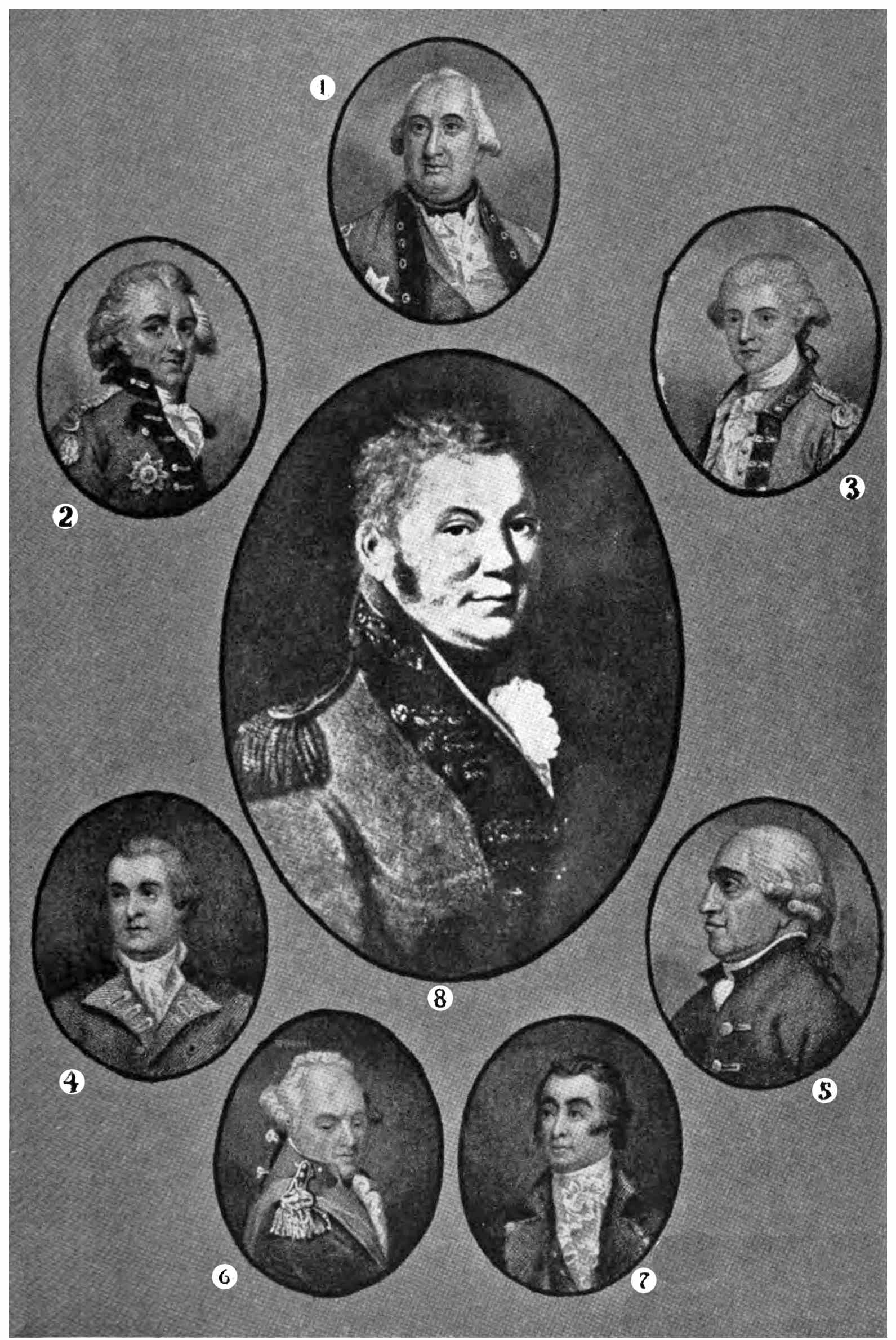
1. Generals Philip Schuyler, 2. Marquis de LaFayette, 3. Nathaniel Greene, 4. George Clinton,
5. Robert Howe, 6. Israel Putnam, 7. John Lamb, 8. William Heath.
Before the end of the next month Culper’s letters were
delayed, which caused Major Tallmadge to address the
General with the letter which follows:
Bedford, Novr. 19th, 1778.
Your Excellency’s favr. of yesterday has this moment
arrived—The queries therein contained shall be immediately
transmitted for solution.
I have been hourly waiting, for more than two days, for
a letter from Culper, and I am confident the failure must be
attributed to those employed in crossing the Sound for such
despatches, as his punctuality heretofore in fulfilling all appointments
with his Post, leaves no room to doubt in the
present case. I am further induced to impute it to this cause
inasmuch as I was lately informed that the men who had
been employed with Lt. Brewster on this business, had not
yet returned to their former duty. I could wish that no difficulties
of this nature might prevent his letters coming in
season, as it may be of the utmost importance that his letters
should be immediately forwarded to Headquarters. To the
end that your instructions may be duly transmitted and to
make some little inquiries into the causes of the aforementioned
delay, I determine to ride immediately to Fairfield,
where Brewster has made his Post for some time.
When Genl. Scott was about leaving this Post he proposed
a plan for the regular conveyance of Cr’s letters to
your Excellency, which he intended to lay before your Excellency
on his arrival at Head Quarters. I hope before the
General removes from Fredericksburgh his pleasure may be
known, that Cr. may not be at a loss how to convey his
letters with certainty and expedition. His extreme cautiousness
and even timidity, in his present undertaking, would
not admit of having his business made known to any Persons
who are not at present his confidants—so that, as
Genl. Scott observed before he left us, if it was communicated
to any other persons he would most probably leave
his present employment immediately—I mention this, not
fearing that his letters or business will be made public at
camp, but lest some persons in this quarter should be made
acquainted with his present situation, which, as I before
observed, would make him extremely unhappy, and as he
assured when he embarked in the business, he should leave
the Island immediately. I am with all due Respect, &c.
Benj. Tallmadge.
To this General Washington replied:
Headquarters, 20th. Nov. 1778.
Sir. I was favored with your letter of Yesterday. You will
be pleased to observe the strictest silence with respect to
C—— As you are to be the only person entrusted with the
knowledge or conveyance of his letters.
The 23d of November found another long letter of
Abraham Woodhull’s on its way to Headquarters, the first
page of which may be read among the Notes.(104) Continuing
he says:
“I am firmly of opinion that a sudden attack of ten-thousand
men would take the City and put an end to the
war, and save the stores and Long Island from devastation.
All the best of their troops are on Long Island. There is
about 300, most of them Hessians, at Brooklyn Ferry. 350
New Town, British; 1500 British Jamaica; 800 Yeagers,
Flushing; 200 Jerico, most of them Dragoons; 400 foot,
70 Dragoons Oyster Bay; 150 Lloyd’s Neck, N. Leveys;
400 Hempstead, Dragoons; Stripping Barns and out houses
for boards to build huts for Winter. 40 wagons 100 troops
this day at Smith Town collecting cattle, sheep, Boards, &c.
They make no distinction between Whig and Tory, abuse all
to a great degree, and no redress can be obtained. Count
d’Estaing’s dispatches for France are taken and brought to
town but are Cypher prepared so they cannot be found out.
I will note to you that much provision is brought to town
from the Jerseys privately; flour, beef, &c. I saw a gentleman
of my acquaintance, lately from England, where he
hath been three years; he saith Independence will certainly
be granted this session of Parliament. My business is expensive;
so dangerous traveling that I am obliged to give
my assistants high wages, but am as sparing as possible. I
have drawn on you for fifty Pounds in Specie, York Money,
which please accept. I should be glad to have given you a
better account but it cannot be obtained their movements are
so strange that causes every one to admire. Hoping this
may be of some service I remain Your most Obedt. Hbl.
Servt,
“Samuel Culper.”
In a letter enclosing the preceding to Headquarters
Major Tallmadge adds:
“It may not be amiss to observe, in addition to Culper’s
letter, that the gentleman mentioned by him to have lately
arrived from England, is one Doctr. Nicoll, a gentleman of
my acquaintance, on the varacity of whose report I have
been persuaded I might safely depend—Your Excellency
will perceive by the enclosed that C—— has drawn for 26
or 27 Guineas. In addition to this he has forwarded an
order for the payment of sd. money to his friend. If your
Excellency should see fit to transmit any money, it may be
safely entrusted to the Bearer, on whose integrity I could
depend in matters of much greater importance.”
As will later be observed, General Washington was now
in receipt of a secret formula for their correspondence,
which he wished to put to use. Therefore he answered
Major Tallmadge saying: “I should be glad to have an
interview with Culper myself, in which I would put the mode
of corresponding upon such a footing that even if his letters
were to fall into the enemy’s hands, he would have nothing
to fear, on that account.” However in his letter following
the above he says: “When I desired an interview with
him I did not know his peculiar situation. I now see the
danger that so long an absence would incur and I must leave
it entirely to you to manage the correspondence in such a
manner as will most probably insure safety to him and answer
the desired end.”
* * * * *
Major Tallmadge answered this on December 23d, saying:
“Since your Excellency judges it improper to have an
interview with C——, any private instructions which you
may wish to transmit him, not so proper for me to transcribe,
may be very safely conveyed to him, as from the
regularity of his dispatches and the characters of the persons
who I know are entrusted with their conveyance from
N. Y. to Brook Haven, I dare venture to say there is not
the least probability, and I had almost said hardly a possibility
of a discovery.”
* * * * *
From Philadelphia on January 2d, 1779, came instructions
for Major Tallmadge to forward his letters through
General Putnam. “There are regular Expresses established
between Danbury and the Head Quarters of the Army,” it
reads. “And you therefore need not in future send a special
messenger the whole way. Send your letters to General Putnam
at or near Danbury, letting him know that they are to
be forwarded with dispatch. I shall get them sooner than
by a single express.”
* * * * *
Culper’s next letter, dated Feb. 26, is one of great
length,(105) detailing the strength and position of all the
troops of the enemy. In the closing paragraph he says:
“Coll. Floyd returned on his Parole the 16. I earnestly
wrote you for his discharge. I repeat it again, I anxiously
desire you would not forget. I am very likely to stand in
need of his services. I desire you will send me one hundred
pounds, by the next appointment without fail, as I have spent
already forty pounds more than I have received from you.
Board is £3 per week in New York besides other necessary
expenses postage and etcetra.”
“Samuel Culper.”
* * * * *
An enclosure from Brewster accompanied the above
letter. His in full is as follows:
Fairfield, Feb. 26th, 1779.
Dear Sir. I have returned from the Island this day. Genl.
Erskine remains yet at Southampton. He has been reinforced
to the number of 2500. They have three redoubts at
South and East Hampton and are heaving up works at
Canoe Place at a narrow pass before you get into South
Hampton. They are building a number of flat bottom boats.
There went a number of carpenters down last week to South
Hampton. It is thought by the inhabitants that they will
cross over to New London after the Continental Frigates.
Col. Hewlet remains yet on Lloyd’s Neck with 350, wood
cutters included. Col. Simcoe remains at Oyster bay with
300 Foot and Light Horse. There is no troops from Oyster
Bay till you come to Jamaica. There is one Regt. of Highlanders
and some at Flushing and Newtown, the numbers
I cannot tell, but not a regiment at both places. The most
of the shipping of force has left New York. There is one
50, one old East India man, one 20 that is repairing at the
ship yard, the Scorpion at N. City Island, one old India
man at Huntington, 40 guns, the Halifax Brig at Oyster
Bay, one sloop of ten guns they are repairing all their flat
bottom boats in New York and building a number at the
ship yard. This intelligence is as late out of New York as the
20th of the month. The inhabitants is fitting a number of
Privateers out in the City. There was one French ship
brought in with 500 hogsheads of Sugar last week. I am
with respect, Yours, &c.
Caleb Brewster.
From General Washington at Middlebrook dated March
21st, 1779, came a long letter of instructions, most of which
will be found in another chapter. To Tallmadge he says:
“With this letter you will receive fifty guineas for S. C.
which you will cause to be delivered as soon as possible,
with an earnest exhortation to use them with all possible
econemy, as I find it very difficult to obtain hard money....
As all great movements and the fountain of all intelligence
must originate at, and proceed from the Head Quarters
of the enemy’s army, C. had better reside at New York—mix
with and put on the airs of a tory, to cover his real
character and avoid suspicion.... The temper and expectation
of the tories and refugees, is worthy of consideration;
as much may be gathered from their expectations and
prospects. For this end an intimacy with some well informed
refugee may be political and advantageous—Highly so will
it be to contract an acquaintance with a person in the Naval
Department, who may either be engaged in the business of
procuring transports for the embarkation of the troops, or
in victualling them.”
* * * * *
An unusual line heads Samuel Culper’s next letter. It
reads:
“Sir. No. 10 10 April 10 1779.
It is the forerunner of their use of a code. Without alteration
his letter follows just as it was originally written.
“Whenever I sit down I always feel and know my Inability
to write a good Letter. As my calling in life never
required it—Nor led to consider how necessary a qualification
it was for a man—and much less did I think it would
ever fall to my lot to serve in such publick and important
business as this, and my letters perused by one of the
worthiest men on earth. But I trust he will overlook any
imperfections he may discover in the dress of my words,
and rest assured that I indevour to collect and convey the
most accurate and explicit intelligence that I possibly can;
and hope it may be of some service toward alleviating the
misery of our distressed Country, nothing but that could
have induced me to undertake it, for you must readily think
it is a life of anxiety to be within (on such business) the
lines of a cruel and mistrustful Enemy and that I most
ardently wish and impatiently wait for their departure. I
sincerely congratulate you on the miscarriage of the Enemies
intended expedition up the Sound. I can discover no movement
on foot at present. Their excursions are always very
sudden and seldom begin to move before dark, and it will
be ten to one if ever it will be in my power to give you early
intelligence of their sudden excursions, as I can only write at
times. All I can say you must be every where upon your
guard, and be more assiduous than ever in order to defeat
the designs of our Enemies. Within and without their lines
I am confident that they are using every art to distract your
army and to divide the Country. It is a matter of surprise
to me to see such numbers of deserters come in since the
General’s pardon, published in the News Paper. But it is
some releaf to find that they are mostly those that deserted
from them heretofore. On the 25 Last Month 7 Sail Transports
with about one hundred and seventy Scotch Troops
of the Duke of Athol’s Regiment arrived from Halifax
under convoy of the Rainbow of 44 Guns, Sir George Collier,
who is come to succeed Admiral Gambier. On the 26th,
23 Sail arrived from England (which place they left the
2th Jany.) under convoy of the Romulus of 44 guns. They
were chiefly loaded with stores and provisions for the Army.
Very few goods came in the fleet. They say they have a large
supply of money come in the Romulus. I have conversed
with several gentlemen of different sentiments that came in
the fleet and those that have a desire in favor of the Crown
cannot give me a sufficient reason to think that any troops
will come out this Spring, or that Great Britain will certainly
continue to act against America. And those on the
contrary say they will withdraw their force and give us
Peace. On the 4th April arrived 7 Sail of Transports from
Cork with provisions. The enemy now have a very large
supply of Provisions and Stores indeed I think enough for
three months without any addition. On the 6th Admiral
Gambir sailed for England in the Ardent of 64 guns together
with a number of transports, how many I am not
able to ascertain nor think it very material—and this day
sails another small fleet under convoy of the Rose, of 20
guns. All transports laying in the East or North River are
completely victualed and waterd for sixty five days for their
compliment of troops that they were accustomed to transport.
The number of Ships, Brigs and Snows in the Harbour
differeth not much from two hundred, out of which thers
two sloops of war, four Frigets and two forty four guns
ships and an old Indiaman with their usual number of guns
for their defense, and an old 74 Store Ship, with only her
upper teer of guns in. It is currently reported that Admiral
Gambier met an express soon after he sailed from the
Hook, from the West Indies and turned him back and now
lays at the Hook. We expect every day to hear important
news from England. The Enemy seem to be in high spirits,
and say now Great Britain is Roused and will support them
and carry on the war at all events and appear to be more
sanguine than ever. But I dont wonder at it for they are
kept as ignorant as possible and believe every report that is
in their favour. The Torys say they have not the least doubt
but that they shall succeed and enjoy their possessions yet.
“N. B.— No. 10 represents N. York 20 Setauket
30 and 40 2 Post Riders.”
Another letter also marked No. 10 and dated April 12,
addressed to John Bolton is signed only with the initials
S. C. It begins: “Your No. 6 came to hand, together with
a Vial for a purpose that gives me great satisfaction, and
twenty guineas. It is a great satisfaction to me to hear that
his —— is well pleased with my letters.” The rest of the
two sheets is a repetition of his letter of the 10th and may
be a rough draft of it. It at least puzzled Major Tallmadge
and he promptly started across the Sound for Setauket.
There he found Abraham Woodhull suffering from the
greatest fright of his life. It was only one of a series soon
to follow, and was perhaps the least serious of them all. It
would be hard to imagine that when Alexander Hamilton
read this from Tallmadge to General Washington his usual
calm countenance was not convulsed in smiles. The full letter
will be found among the notes.(106) Here is the extract:
“I must now relate an anecdote respecting the Vial which
I forwarded Culper. Much pleased with the curious ink or
stain, and after making some experiments with the same, he
was set down to answer my letter which accompanied it. He
had finished the enclosed when very suddenly two persons
broke into the room (his private apartment). The consideration
of having several officers quartered in the next
Chamber, added to his constant fear of detection and its
certain consequences made him rationally conclude that he
was suspected and that those steps were taken by said officers
for discovery. Startled by so sudden and violent an obtrusion
he sprang from his seat, snatched up his papers, overset his
table and broke his Vial. This step so totally discomposed
him that he knew not who they were or even to which sex
they belonged—for in fact they were two ladies who, living
in the house with him, entered his chamber in this way on
purpose to surprise him. Such an excessive fright and so
great a turbulence of passions so wrought on poor Culper
that he has hardly been in tolerable health since. The above
relation I had from his own mouth. He is much pleased
with the Ink and wishes if any more can be spared to have a
little sent him. By this he thinks he could frequently communicate
intelligence by persons permitted to pass the lines.
Some pieces of useful intelligence respecting the movement
of the Enemy in this late intended Expedition to New London;
and which I have reason to believe in a great measure
defeated their intentions, have been communicated by
Culper.”
In the same letter Major Tallmadge incidentally states:
“Culper was the other day robbed of all his money near
Huntington, and was glad to escape with his life.”
Culper’s next letter was dated from New York, April
29th. It was a “Stain” letter and only a poor copy of it has
survived. Letters of importance were already on their way
to Headquarters when from Smith’s tavern in the Clove, on
June 13th, 1779, General Washington addressed Major
Tallmadge as follows:
“Your letter of yesterday with the enclosures from Culper
came duly to hand. Should suspicions of him rise so high as
to render it unsafe to continue in New York I should wish
him by all means to employ some person of whose attachment
and abilities he entertains the best opinion, to act in
his place, with a request to be critical in his observations
rather than a mere retailer of vulgar reports—To combine
the best information he can get with attentive observation
will prove the most likely means to obtain useful knowledge—a
mode of conveying it quickly is of the utmost importance
and claims much attention. When I can procure more of the
liquid Culper writes for, it shall be sent, at present I can
not say when this may happen—I thank you for the information
respecting Long Island—The letter to Mr. Deane
shall be sent.”
Two letters, both dated June 5th, and numbered 13, were
the next received from Abraham Woodhull. In them he relates
his narrowest escape from capture.(107)(108) Colonel Simcoe
and his Rangers hastened to Setauket in April, 1779,
upon information furnished by John Wolsey against him.
Fortunately, he was with Robert Townsend in New York
at the time; but they fell upon his father and plundered him
in a most shocking manner.[12] Hardly was it thought possible
that Woodhull would be able to pay the price of satisfaction,
but through a friend he accomplished it.
Woodhull’s next letter is worthy of study. Two features
of it are here emphasized. In full it will be found among the
notes.
“No. 14. 20 June 20, 1779.
“Your No. 8, on the 16th, found me at 20, anxiously concerned
for our interest, and unwilling it should be neglected,
and some reason to fear that by delay the door might be
shut and out of my power to performe what I proposed in
my No. 13, which I have concluded would be your desire. I
thought proper to detain 40 until I went to 10 to endeavour
to gain the best intelligence I could, and settle the plan proposed.
I returned on the 19, and my success hath exceeded
my most sanguine expectations.(109) I have communicated my
business to an intimate friend, and disclosed every secret,
and laid before him every instruction that hath been handed
to me. It was with great difficulty I gained his complyance,
checked by fear. He is a person that hath the interest of our
Country at heart and of good reputation, character and
family as any of my acquaintance. I am under the most
solomn obligations never to disclose his name to any but the
Post, who unavoidably must know it. I have reason to think
his advantages for serving you and abilities are far superior
to mine. I must call on you for ten guineas which will about
defray my charges with what I have received. If what I have
done is disapproved of it can be dropped, but if mine was
worth attention this will not certainly be of less value. You
will receive a letter from him in a short time beginning at
No. 1. He will expect an ample support at the same time he
will be frugal; as long as I am here shall be an assistant and
do all that I can. In the Interim I remain
“Your most Obt. Huml. Servt.,
“Samuel Culper.”
General Washington received through Major Tallmadge
on June 26th, the news of Simcoe’s raid, and the next day
answered in a long letter with which he sent ten guineas for
Culper and mentioned one George Higday, who had attempted
to get him information from New York.(110)
Entire direction of the Secret Service within the City of
New York having now been placed in the care of Robert
Townsend, his first letter(111) must have been looked forward
to with anxiety by Abraham Woodhull, who announced its
receipt in his No. 15, which is incorrectly dated June 31,
1779:
“Enclosed you have Mr. Saml. Culper Junr’s letter,
which is but short but hope it may be of some service. He
hath wrote in the stile of Loyalty, I think through fear like
me at first unaccustomed to the business and filled with fear
but the longer one continues in the business if unsuspected
of more real service can he be. I have appointed to see him
on the 8th inst. and shall repeat again to him those instructions
that I have received from time to time from you, and
use my utmost endeavor to acquaint him with the steps I
used to take and circumstances necessary to judge from, that
a person unaccustomed would not readily conceive of. My
greatest desire is that he may be useful and answer your
most sanguine expectations. He wishes that the ink or stain
might be forwarded. He hath hinted to you the prospect of
their making excursions in to Connecticut very soon. Very
probably the war will be carried on in that manner, as free
liberty is granted to the Refugees to plunder as much as they
can. You must keep a very good look out or your shores will
be destroyed. It is a pity that company could not be destroyed
at Lloyd’s Neck. Their refugee boats are continually
coasting along and much endanger 40. They entirely
disown the defeat of their troops in Carolina, and I confess
I am not fully satisfied about it. Have not yet seen nor
heard of its being published by authority. Just received the
enclosed and the boat awaiting have not had time to write
as I would. Please excuse hast and any imperfections you
may discover, and am your humble servant,
“Samuel Culper.”
These letters, with those significant words, “You must
keep a very good look out,” were on their way, but had not
had time to reach Major Tallmadge when he was surprised
by a night attack. Lord Rawdon, with nearly all of the
British light horse, accompanied by a body of light infantry,
had come upon them under cover of the darkness and compelled
them to fight, principally with the broadsword, until
Colonel Sheldon found it necessary to order their retreat.
Tallmadge lost in the affray a fine horse, most of his field
baggage, and the money and letters that General Washington
had sent him for the Culpers. Upon receipt of this
information at Headquarters, General Washington replied
to Major Tallmadge on July 5th, as follows:
“Sir: I have just received your letter of the 3d. The loss
of your papers was certainly a most unlucky accident and
shows how dangerous it is to keep papers of any consequence
at an advanced post. I beg you will take care to
guard against the like in future. If you will send me a trusty
person I will replace the guineas.
“I observe yourself and other officers have lost some
cloathing. Though I have not given an order of the kind
before, yet in this particular exigence I am ready to give one
on the Clothier to those officers who have been the sufferers
for such articles as are absolutely necessary. You will be
pleased to communicate this to Col. Sheldon and request
him to send the Pay Master with a proper return to Head
Quarters.
“The person who is most indangered by the acquisition
of your letter is one Higday, who lives not far from the
Bowery, on the Island of New York. I wish you could endeavour
to give him the speediest notice of what has happened.
My anxiety on his account is great. If he is really
the man he has been represented to be, he will in all probability
fall a sacrifice. I am, etc.”
Nine days later, Samuel Culper’s seventeenth letter, dated
July 9th, was forwarded to Major Tallmadge. He begins by
saying it is a long time since he has heard from him and
cannot tell if he wants him to continue the correspondence,
and continues, saying: “I yesterday had an opportunity of
seeing Mr. Culper, Junr. and repeated again all my instructions
ever received from you. I have kept no secret from him
and have consulted every thing and he’s determined to
pursue every step that he may judge for advantage and is
determined as soon as I can communicate to him your
authority for my engaging him he will disengage himself
from every other business which at present affords him a
handsome living—He’s allowed to be a person of good sense
and judgment and his firmness and friendship towards our
Country I do assure you need not doubt. I have known him
several years and confident he is a sincere friend, and will
be frugal of all moneys he may receive, and hath undertaken
it solely for to be some advantage to our distressed Country,
and have determined to forward you for the future
weekly intelligence if possible, as I have concluded to remain
here as long as I possibly can (although I look upon myself
all the time in danger) for the sole purpose of advantage to
our correspondence.
“Below is what intelligence I could gain from C. Junr.
It is but trifling but he assured theres nothing more worthy
of notice. On the 4th, 10 sail arrived from Halifax under
Convoy of the Romulus of 44 guns with about one hundred
of the new raised Scotch, believe the Duke of Athol’s. Same
day 10 Sail sailed for Cork. On the 6th, 10 sail of Merchantmen
from the West Indies, but brought nothing new,
only that Admiral Byron was cruising for a reinforcement
that was expected to join Count d’Estaing. On the 4th, a
Packet from Georgia with an account of Genl. Provost
being with his army 16 miles south of C. Town, on St. John’s
Island. Hardly any thing is said about the enemy in that
quarter. He tells me the spirits of the enemy in general are
much lower than heretofore and that he heard a very noted
refugee say there would certainly be a peace or a Spanish
war in four weeks. The times grows worse within the
Enemy’s lines and Protection for those called rebels is almost
banished, in fact Refugees are let loose to plunder
within and without their lines. Parties of them are hiding in
the woods and laying wait for the unwary and ignorant to
deceive them, putting on the character of people from your
shore, and have succeeded in their design too well. Carried
off 10 or 12 men and stripped their houses lately from about
20. The roads from here to 10 is infested by them, and likewise
the shores. It makes our correspondence very dangerous
and requires great care and a strict observance of the
before mentioned characters and circumstances. Sincerely,
“Samuel Culper.
“N.B.: Culper Junr. should now be furnished with some
money. I gave him 4 half Joes on the 8th. instant.”
Meanwhile, General Washington had prepared instructions
for the Culpers, a copy of which is still preserved
among the papers of Colonel Tallmadge, as follows:
“INSTRUCTIONS
“C—— Junr, to remain in the City, to collect all the useful information
he can—to do this he should mix as much as possible among
the officers and Refugees, visit the Coffee Houses, and all public places.
He is to pay particular attention to the movements by land and water
in and about the city especially.
“How their transports are secured against attempt to destroy them—whether
by armed vessels upon the flanks, or by chains, Booms, or
any contrivances to keep off fire Rafts.
“The number of men destined for the defence of the City and
Environs, endeavoring to designate the particular corps, and where
each is posted.
“To be particular in describing the place where the works cross the
Island in the Rear of the City—how many Redoubts are upon the line
from River to River, how many Cannon in each, and of what weight
and whether the Redoubts are closed or open next the city.
“Whether there are any Works upon the Island of New York between
those near the City and the works at Fort Knyphausen or
Washington, and if any, whereabouts and of what kind.
“To be very particular to find out whether any works are thrown
up on Harlem River, near Harlem Town, and whether Horn’s Hook
is fortifyed. If so, how many men are kept at each place, and what
number and what sized Cannon are in those works.
“To enquire whether they have dug Pits within and in front of the
lines and Works in general, three or four feet deep, in which sharp
pointed stakes are fixed. These are intended to receive and wound
men who attempt a surprise at night.
“The state of the provisions, Forage and Fuel to be attended to, as
also the Health and Spirits of the Army, Navy and City.
“These are the principal matters to be observed within the Island
and about the City of New York. Many more may occur to a person
of C. Junr’s penetration which he will note and communicate.
“C—— Senior’s station to be upon Long Island to receive and
transmit the intelligence of C—— Junior.
“As it is imagined that the only post of consequence which the
enemy will attempt to hold upon Long Island in case of attack will
be at Brooklyn, I would recommend that some inhabitant in the
neighborhood of that place, and seemingly in the interest of the enemy,
should be procured, who might probably gain daily admission into the
Garrison by carrying on marketing, and from him intelligence might
be gained every day or two of what was passing within, as the strength
of the Garrison, the number and size of the Cannon, &c.
“Proper persons to be procured at convenient distances along the
Sound from Brooklyn to Newton whose business it shall be to observe
and report what is passing upon the water, as whether any Vessels
or Boats with troops are moving, their number and which way they
seem bound.
“There can be scarcely any need of recommending the greatest
Caution and secrecy in a Business so critical and dangerous. The following
seem to be the best general rules:
“To intrust none but the persons fixed upon to transmit the Business.
“To deliver the dispatches to none upon our side but those who
shall be pitched upon for the purpose of receiving them and to transmit
them and any intelligence that may be obtained to no one but the
Commander-in-Chief.”
Robert Townsend acknowledges receipt of the above instructions
in his second letter, dated July 15th,(112) and in
transmitting it Samuel Culper added the following:
“Mr. C. Junr. informed me at our interview that
Christopher Duychenik, Sail Maker of 10, formerly Chairman
of the Committee of Mechanics, is amongst you and
is positively an agent for David Mathews, Mayor of 10,
under the direction of Tryon he assisted Mathews, John
Rome and others in affecting their escape. Mr. C. Jr. wishes
for some of that Ink or Stain that he may paint out his
character to you. Don’t fail to forward it immediately, and
when you receive the History of his conduct be very caucious
how you handle it for if it should get to the above mentioned
persons ears C. Jr. tells me they would immediately suspect
him. In the mean time I would advise and is approved
on by Culper, Junr. Obtain the Mayor’s signature and let
a letter be wrote suitable for deception, and let it be handed
him by some person of good address, praying his assistance
to escape from the tyranny of Congress, which is the term
used by the Mayor—or something like this plan I do not
doubt will have the desired effect. John Rome is Secretary
to M. Genl. Jones. It is not in my power to favour you with
the Mayor’s signature at present. I am your &c.
“Samuel Culper.”
General Washington forwarded the ink as requested, together
with the following letter, dated West Point, July 25,
1779.
“Sir: All the white Ink I now have (indeed all that there
is any prospect of getting soon)[13] is sent in phial No. 1 by
Col. Webb. The liquid in No. 2 is the counterpart which
renders the other visible by wetting the paper with a fine
brush after the first has been used and is dry. You will
send these to C——r, Junr., as soon as possible, and I beg
that no mention may ever be made of your having received
such liquids from me or any one else. In all cases and at all
times this procedure and circumspection is necessary, but it
is indispensably so now as I am informed that Govr. Tryon
has a preparation of the same acid or something similar to
it, which may lead to a detection if it is ever known that a
matter of this sort has passed from me.”
John Jay’s letter to General Washington introducing through his brother James Jay,
the invisible ink that was used so successfully by the Culpers. The secret of its manufacture
still remains a mystery.
It is not surprising that General Washington so frequently
expressed satisfaction with the intelligence that Robert
Townsend was now furnishing. His third letter as well as
those that follow is a good example. No. 3 is dated 10 July
29, 1779:
“Sir, Since my last the number of the Enemy within these
lines have not been augmented by any arrivals. The Romelus,
Daphne and Delaware did not sail as I advised you, owing, I
believe, to the unexpected account of your taking the Garrison
at Stony Point. The account was truly alarming to the
Torys—However, like true Philosophers, they soon reconciled
themselves to it by saying that it would tend to their
advantage in the end, as it would tend to rouse the British
Troops, which in their opinion is all thats wanted to put a
final end to the war. General Clinton, I am told, was much
alarmed. He left New York the next evening attended with
all the Horse (himself mounted on the lowest and meanest
amongst them) which was then in Town, and it is said, declared
that he wou’d make W. pay for it.—
“The Greyhound Frigate, with Lord Cornwallis, General
Patterson, late Adjt. of the Army, & Col. Stewart, son
of Lord Bute, arrived the 21st Inst. Nothing can be collected
more than from news papers, as no private letters
came by her. It is generally believed by the Torys that the
Fleet said to have on board 5000 Troops for N. Y. and
2000 for Carolina, sailed before the Greyhound. The most
intelligent of the Torys expect a Spanish War, and affect
to wish it, as they suppose that England has at this time a
Fleet much superior to the united Fleets of France and
Spain.
“The LeBlond Frigate arrived on Monday last from
Penobscot with Dispatches, in consequence of which (it is
said) Sir Geo. Collier with the Raisonable sails tomorrow.
I cannot learn whether any other Ships goes with him. The
movement of the Troops in consequence of the taking of
Stony point, has prevented my obtaining an account of their
situation. The 54th Regiment marched in town from the
Bridge on Monday last. A number of Transports are
ordered to be ready to take on Troops, said to be the 54th
Regt., Queens Rangers and Lord Rawdon’s Corps, and to
be commanded by Lord Cornwallis—it is said by some of
the officers that they are intended for Carolina. This is
also the general opinion. I believe they are bound to the
Southward, as I heard a Pilot belonging to Cape Fear,
North Carolina, say that he expected to go with them. General
Vaughan is positively going home, and some say General
Clinton. It is positively said that preperations are
making to Fortify Governor’s Island, the Narrows at Staten
Island, the Gorge at Fort Knyphausen, repair the Fortifications
at Paulus Hook & the Battery at New York; all of
which places are to be put in the best state of defense.
“The times now are extreamly difficult—guard boats are
kept out every night in the North and East Rivers to prevent
any boats from passing, & I am informed that some persons
have been searched on Long Island; therefore whenever
you think that my intelligence is of no service, beg you will
notify me, ’till which time I will continue as usual. Privateering
flags very much. I have recd. your Dictionary,[14] and
will be glad to have the Stain as soon as possible, when shall
endeavour to find some shorter route to forward my letters.
I am, Sir, Your Hbl. Servant,
“Samuel Culper, Junr.”
August 6th is the date of Townsend’s 4th letter. It was
written altogether in the stain and required the services of
two of the General’s secretaries to copy it. The first half
of the first page is in the handwriting of Alexander Hamilton
but the rest of the three pages was written by McHenry.(113)
Meanwhile, Samuel Culper continued to advise Robert
Townsend that he should give up his business in New
York.[15] In a letter to Tallmadge, dated August 12th, he
writes:(114)
“I do assure you he is a sincere friend and capable of
rendering service to our country. And as such a one I have
again most earnestly endeavoured, and begged him to disengage
himself from all concerns that may interfere with
the Public business he hath undertaken.”
Jonas Hawkins called for Townsend’s fifth letter, but
fearing capture destroyed it before reaching Woodhull. He
advised Tallmadge of this in a letter, mostly in cipher,
dated August 15th.(115) The sixth shared the same fate.
Woodhull called for the next, which follows:
No. 7.
Long Island, Sept. 11th, 1779.
“Sir, Your No. 11 & 12 have come to hand, the contents
I duly note. I am very sorry that No. 5 was destroyed, tho’
I can’t say that it contained any intelligence that wou’d
have been of material consequence—The bearer thought
himself in danger. I believe it was merely imaginary. From
timidity and the situation of affairs at that time, he did not
choose to come to N.Yk; I therefore met him at a place
quite out of danger on Long-Island. I then made an appointment
for No. 6, at wch. time he came, I wrote it, and
took it over the Ferry that he might run no hazard from the
Inspector of Letters there. However he was so much intimidated
that it shared the same fate as No. 5.
“I have now the pleasure of seeing our mutual friend
Saml. Culper, Sen. who will run every hazard to forward
this.
“I had informed you in No. 6, of the arrival of the
British Fleet consisting of about 70 sail, under convoy of
Adml. Arbuthnot in the Europa of 64 Guns & Russel of
74 Guns—The number of the Troops from the best information
I can collect does not exceed 3000. They are
all new troops, and in bad health, and are now encamped
in and about Bedford; three miles from Brooklyn Ferry.
The 44th. and 3 Hessian Regts. embarked a few days ago,
and are to sail this day—Their destination said to be for
Quebec—This is generally believed—Sir James Wallace
in the Experiment sails sometime for Georgia, with one
Store Ship and two or three other vessels, but no Troops.
No prospect of any other movement further than some
vessels are fitting for Horses. The general opinion is that
there will be no Campaign opened from N.York. The most
knowing and judicious of the Torys think that some troops
must be sent to the West Indies. They have now given
up all hope of the second division so much talked of, as
they think they will be wanted at home. Their spirits in
general was much dejected with the accounts of a Spanish
war, and Lord North’s declaration that he had formed no
alliances nor had any prospect of forming any. Their spirits
are now in some measure elevated with the accounts of the
destruction of the American Fleet at Penobscot.—I hope
it will be but a temporary elevation. It certainly is a bad
stroke, and I think it cou’d not be owing to want of inteligence
of Sir Geo. Collier’s sailing. A vessel arrived a few
days ago from St. Kitts, but nothing transpires further than
that the French had embarked 6000 Troops, with an intent,
as is supposed, to take Antegua. The most judicious of the
Tory’s think that the Spaniards have by this invaded
Jamaica, and make no doubt but that they will succeed. A
fleet of 12 sail of victualers arrived yesterday from Cork—Another
fleet was to sail in about four weeks after them,
but they are not expected soon as its thought that the Spanish
War will occasion a general embargo for some time, for
the purpose of manning their fleet. The Guards, 54th, and
two Hessian Regts. do duty in and about N.York. The
guards are in the City, 54th encamped at Greenwich, one
Hessian Regt. Near Jones’s on DeLancey’s land, and the
other near the water works. The number on Staten Island
I do not know—On Long Island the new troops as mentioned,
a Regt. of Horse about Flushing, a guard of about
30 men of the 3d. Battalian of DeLancey’s Brigade, with a
party of the Militia Horse are at Jamaica, as a guard for
the General. He might have been taken off with much ease
sometime ago, but it would now be very difficult, and the
Queens Rangers are at Oyster Bay. Their number is about
450, near 100 of which are mounted. The 3d. Batallian of
DeLancey’s brigade are at Lloyd’s Neck. From the vicinity
of the Queens Rangers, who can be there by means of an
alarm gun in two hours, I think it would by no means be
advisable to attack them. They were alarmed on Thursday
night last, and was there in one and a half hours after the
alarm.
“My being unwell for a week past, and my engagement
in business has prevented my obtaining a more particular
account of the situation of the enemy. I intended to have
disingaged myself from business agreeable to the solicitations
of my friend Samuel Culper, Sen; but find it will be
attended with more difficulty than I expected, owing to
my having a partner, as I can make no excuse to do it. Untill
I can, will continue to write as usual, and shall be less
expensive.
“The Europa, Russel, Renown and four or five Frigates
are now in port. It is thought by many that all the large
ships on this station will be ordered to the West Indies to
re-inforce Byron.
“The works at the Battery goes on very slow. The Hessians
are repairing the Fort on Bunker hill, with some
alterations. A very large Fort is building at Brooklyn on
the west side of the road, and abt 80 rods due north from
Cobble Hill. A large number of the Militia of Kings and
Queens County are at work on it. The Militia of Suffolk
have not as yet complyed. The orders, a copy of which
you will have forwarded. I fear if they do not comply that
devastation will attend that Loyal County. No late accounts
from Georgia, the last were that their lines was more contracted.
It is the general opinion that nothing more can be
done there till they have re-inforcement which it is thought
will be sent about the beginning of October. You may rest
assured that I will use every endeavour to comply with your
requests. I have made some overtures to a person to convey
letters by a shorter route, and flatter myself that I shall
succeed.
“I am, Sir, Your most obedt. Servt,
“Culper Jun.”
The General thought it was not necessary for Townsend
to give up his business, and so replied from Headquarters
at West Point, September 24, 1779:
“Sir, It is not my opinion that Culper Junior should be
advised to give up his present employment. I would imagine
that with a little industry he will be able to carry on his
intelligence with greater security to himself and greater
advantages to us, under cover of his usual business, than if
he were to dedicate himself wholly to the giving of information.
It may afford him opportunities of collecting intelligence
that he could not obtain so well in any other manner.
It prevents also those suspicions which would become natural
should he throw himself out of the line of his present employment.
He may rest assured of every proper attention
being paid to his services. One thing appears to me deserving
of his particular consideration, as it will not only render
his communications less exposed to detection, but relieve the
fears of such persons as may be entrusted with its conveyance
to the second link in the chain, and of course very
much facilitate the object we have in view; I mean, that
he should occasionally write his information on the blank
leaves of a pamphlet, on the first, second, and other pages
of a common pocket book, or on the blank leaves at each
end of registers, almanacks, or any new publication or book
of small value. He should be determined in the choice of
these books principally by the goodness of the blank paper,
as the ink is not easily legible unless it is on paper of a good
quality. Having settled a plan of this kind with his friend,
he may forward them without risk of search or the scrutiny
of the enemy, as this is chiefly directed against paper made
up in the form of letters.
“I would add a further hint on this subject. Even letters
may be made more subservient to this communication, than
they have yet been. He may write a familiar letter on
domestic affairs, or on some little matters of business, to his
friend at Setauket or elsewhere, interlining with the stain
his secret intelligence, or writing it on the opposite blank
side of the letter. But that his friend may know how to distinguish
these from letters addressed solely to himself, he
may always leave such as contain secret information without
date or place (dating it with the stain), or fold them up
in a particular manner, which may be concerted between the
parties. This last appears to be the best mark of the two,
and may be the signal of their being designated for me.
The first mentioned mode, however, or that of the books,
appears to me the one least liable to detection. I am, &c.
“Go. Washington.”
[12] This, as related by John Jay and Robert Townsend to James Fenimore
Cooper, has been woven into fiction as the basis of the tenth chapter
of The Spy.
[13] James Jay, brother of John Jay, claims the credit of this invention.
In a letter to Thomas Jefferson he says: “The curious experiments in
Sympathetic Inks, fluids with which if one writes on the whitest paper the
letters immediately become invisible, are generally known; and so is likewise
the facility with which the writing with any one of them may be
rendered visible. For this reason I presume the subject has been considered
as a matter of mere curiosity and entertainment, and has never been applied
to any use in Politics or War. When the affairs of America, previous to
the commencement of hostilities, began to wear a serious aspect, and
threatened to issue in civil war, it occurred to me that a fluid might possibly
be discovered for invisible writing, which would elude the generally
known means of detection, and yet could be rendered visible by a suitable
counterpart. Sensible of the great advantages, both in a political and military
line, which we might derive from such a mode of procuring and
transmitting intelligence, I set about the work. After innumerable experiments,
I succeeded to my wish. From England I sent to my brother John
in New York, considerable quantities of these preparations. He furnished
Silas Deane with them when that gentleman first went to France. When
Mr. Deane was in Paris, he writ to me in London, requesting further
supplies of them, which I accordingly sent him. In the course of the war,
General Washington was also furnished with them, and I have letters
from him acknowledging their great utility, and requesting further supplies.
Gordon in his history of the Revolution relates the fact, but without
mentioning the author of the contrivance.
“By means of this mode of conveying intelligence, I transmitted to
America the first authentic account which Congress received, of the
determination of the British Ministry to reduce the Colonies to unconditional
submission; the ministry at the time concealing this design, and
holding out conciliatory measures. My method of communication was
this: To prevent the suspicion which might arise were I to write to my
brother John only, who was a member of Congress, I writ with black ink
a short letter to him, and likewise to 1 or 2 other persons of the family,
none exceeding 3 or 4 lines in black ink. The residue of the blank paper I
filled up, invisibly, with such intelligence and matters as I thought would
be useful to the American Cause. All these letters were left open, and
sent in that condition to the Director or Secretary of the General Post
Office, with a letter insinuating that I thought it could not be the intentions
of Government, in their restraining laws, to put a stop to family
intercourse; and therefore requesting the party to read over the letters,
and if nothing improper appeared in them, that he would permit them to
pass in the mail to New York. They passed accordingly, and on their
arrival in New York were sent into the American Lines. In this invisible
writing I sent to Franklin and Deane, by the mail from London to Paris,
a plan of the intended Expedition under Burgoyne from Canada.”
[15] Oakman & Townsend was the firm name, Henry Oakman being the
partner at this time, supplying ships and the public with dry-goods and
groceries.
SECRET SERVICE SECRETS — FOOTNOTES to “SECRET SERVICE SECRETS”:
The hazard of transmitting letters in the
ordinary way between Headquarters and the Culpers
continued to increase. It taxed the ingenuity of General
Washington, as his preceding letter indicates; and
Major Tallmadge carefully studied the subject. The first
crude use of a few ciphers (ten for New York and twenty
for Setauket) was no longer deemed sufficient. Early in
July, 1779, Major Tallmadge prepared a “pocket dictionary”
in which a new code was arranged. Copies were furnished
the Culpers as well as Headquarters. Reference to
it is in a letter from Washington dated July 27, 1779,[16] and
a copy of the code is now among the letters of General
Washington in the Library of Congress.
In letters Major Tallmadge’s name was never used on
Long Island. He was always addressed as John Bolton.
He had also a number, which was 721. Abraham Woodhull
was always addressed as Samuel Culper or Culper
Senior, and was known by the number 722. Robert Townsend
was Culper Junior, and his number was 723. Austin
Roe[17] 724, Caleb Brewster 725, George Washington 711,
New York 727, Long Island 728, Setauket 729, etc.
The stain letters were doubtless the most clever, but
only fragments of them have survived. However, copies
of those that reached Headquarters were made by Alexander
Hamilton and other trusted members of the General’s
official family, and these are still preserved among the
Washington Papers. Sometimes they reached the General
in a manner that alarmed him, as the following extract
shows:
“C——r, Jr. should avoid making use of the Stain upon
a Blank sheet of paper (which is the usual way of its coming
to me). This circumstance alone is sufficient to raise
suspicions. A much better way is to write a letter in the
Tory stile with some mixture of family matters and between
the lines and on the remaining part of the sheet
communicate with the stain the intended intelligence. Such
a letter would pass through the hands of the enemy unsuspected
and even if the agents should be unfaithful or negligent,
no discovery would be made to his prejudice, as these
people are not to know that there is concealed writing in
the letter and the intelligent part of it would be an evidence
in its favor.”
Probably Major Tallmadge had not explained that
Townsend’s method was to conceal the sheet by forwarding
with it to him an entire package of the same folded
letter-paper, in which there was no way of discovering this
particular sheet except by knowing its position.
It was such a letter from Townsend that Culper Senior
mentions in his of September 19th.(116) He also relates how
it became necessary for him to expose himself in order to
protect Brewster, who with his boat was waiting for it.
Culper Junior’s tenth letter is dated October 9th.(117) In it
he says:
“A considerable number of Troops are on the West end
of Long Island. The 17th Dragoons at Hemstead, the
mounted Legion and Queens Rangers at Jericho, and the
Foot belonging to the Legion are at Oyster Bay. No arrivals
of any consequence since my last, except those mentioned.
The spirits of the troops flag much, but still some flatter
themselves that there is yet a probability of England rising
superior to all her enemies. There does not appear the
least prospect of this place being vacated this fall, tho I
believe they would be glad to have them at home.”
With this Samuel Culper encloses his twenty-fifth letter,
in which he relates how he was captured and escaped, as
follows:
“Inclosed you have S. C. Junrs. letter, which wish safe to
hand. He desired me to send for some more of that Stain.
It is too great a risque to write with ink in this country of
robbers. I this day just saved my life. Soon after I left
Hempstead Plains and got into the woods I was attacked
by four armed men, one of them I had frequently seen in
N.York. They searched every pocket and lining of my
clothes, shoes, and also my saddle, which the enclosed was in,
but thank kind Providence they did not find it. I had but
one dollar in money about me. It was so little they did not
take it, and so came off clear. Don’t mention this for I keep
it a secret for fear it should intimidate all concerned here—and
am Yours Sincerely,
“Saml. Culper.”
Meanwhile General Washington was dictating a letter
to Major Tallmadge, which reads:
“Head QuartersWest Point, 9th October, 1779.
Dear Sir, I have your favr of the 8th inclosing a letter for
Major Jameson who is in South Carolina. It shall be forwarded
by the first opportunity. Should a certain operation
take place, it will be necessary to establish a very regular
communication with Long Island. These things are better
settled personally than by letter, I shall therefore be glad
to see you at Head Quarters. After leaving some person
who can be intrusted with the receipt of C— letters, and
who can forward them and any observations upon the
Sound, be pleased to ride over.”
Townsend’s next letter, dated October 21, and written
entirely with the stain, was copied at Headquarters, and
reads:
“I am this day favord with yours of the 12th Inst. and
note the contents. The fleet from Newport, contrary to my
information, sailed the day I wrote to you. I was led into
this error by persons whom I thought could give me the best
information, as they belonged to Newport and intended going
in the fleet. They have been deceived for from that belief
they were left behind. I informed you that a number of vessels
had been prepared to sink at Sandy Hook, four of
which were sunk two days after I wrote you. The Russel,
Europa, Raisonable, Defiance, Roebuck and several Frigates
and a number of armed transports still continue at the
Hook. The Renown (dismasted) Solebay and Towey Frigates
are still in the Harbour.
“The Captain of a Privateer which arrived on Friday
last, says that he saw 12 sail of the French fleet the 25th
Septr. off Georgia, not dismasted as the paper mentions but
all well; and that the noted Sir James Wallace was taken.
“The 7th, 23d, and Lord Rowdon’s Corps embarked
some days ago. The 7th and 23d. have disembarked and
the 57th with some of the artillery have embarked in their
place, and it’s said will sail in a few days. Some of the
officers say they are going to Halifax, and it’s generally
believed they are.
“The enemy have large magazines of wood and forage
and are daily collecting more, particularly Hay. Some of
the Comrs. of provision say they have enough of all kinds to
last 9 months. I believe they have plenty for six months.
There is considerable on board victuallers of this, and the
quantity, I will inform you more particularly in my next.
No arrivals of any consequence since my last, except the
Robuste from Halifax which arrived yesterday. A number
of transports have been taking water and ballast some days
past and from which and some other circumstances it is
concluded that another embarkation will take place. Some
transports with some private vessels sailed yesterday for
Newport under convey of the Hunter Sloop of War. No
new forts erecting. That on Bayards Hill is completed,
and also the one back of Jones’ house. The Battery and the
fort on Governors Island is nearly completed. I entirely
approve of your conveying letters, and shall in future follow
it. But shall want some more stain immediately, as I have
scarcely enough for another letter. S. Culper Senior will
forward you a Receipt for the Guineas.
“Saml. Culper, Junr.”
Culper Senior’s next letter,(118) dated October 26th, he
also, incorrectly numbers 25. Townsend’s next letter,(119)
written with the stain, is dated October 29th, as is also
the following from Culper Senior:
“Your No. 19 with the inclosed came to hand on the
26th, and have noted the contents and shall follow your
directions as far as in me lay, and to compleat the same have
desired an interview with Culper Jnr. which if by the movement
of your army it should become necessary that the present
rout of dispatches should be shortened must principally
depend on his acquaintance. If any secrets are with you, and
may tend to the common good by communicating them to us,
and enable us to better judge and assist your measures, don’t
fail to do it. I sincerely declare to you by all that is valuable
and sacred that no person but him and me shall know
it—depend nothing shall be wanting on my part to forward
intelligence to you as frequent as possible. And forget not to
urge 725 to his duty, which I must say he hath lately neglected.
Mr. Jackson perfectly knows it. And he frequently
objects to coming so often.
“I most impatiently wait the arrival of the Count De-Estaing,
and your operations, and as the season is so far
advanced, I greatly fear nothing will be done, but am not
altogether without hopes.
“Since my last the sum of about £400. was subscribed in
this town to be presented to General Clinton in order to
obtain his favour and evade the threatening storme—but
before it could be possibly forwarded, a general demand for
all our Oxen, or cattle of equal value, was sent. None
escaped except some of our Tory gentry, and we have concluded
since to keep our money and let them take and be
damned. It is truely cutting to see the most notorious escape
this demand, and the virtuous distressed. I conceive in my
own mind, that their views in taking the oxen and breaking
up teams in general is through fear they may fall into your
hands and be of service to your army. The enemy still continue
to collect hay to the westward, without estimating it
or giving receipts as heretofore, and are carrying it to
Brooklyn Ferry and to Lloyd’s Neck. Unless prevented they
will soon be at this place.
“Night before last a most horrid robbery was committed
on the houses of Coll. Benj. Floyd and Mr. Seton, by three
whale boats from your shore, commanded by Joseph Hulce
and Fade Danolson, and one other master of boat, name
unknown to me. 725 can well inform you of their names.
From the best judgment I can form they took to the value
in money, household goods, Bonds and Notes, of Three
Thousand Pounds. They left nothing in the houses that was
portable. They even took their clock and all their looking
glasses, and all Seal Gold Cloths, perhaps none before theirs
in America.
“I cannot put up with such a wanton waste of property,
I know they are enemy’s to our cause, but yet their property
should not go amongst such villians. I beg you would exert
yourself and bring them to justice.”
Major Tallmadge supplements the above in a letter to
the General dated Bedford, Novr. 1, 1779, in which he says:
“I have just recd. the enclosed despatches from the
C——rs. I was obliged to touch the Counterpart on the
enclosed letter written with the Stain to discover whether it
was the right sheet or not as it was in a Quire.
“With respect to the robbery lately committed at Setauket,
as related by C. Senior, I have additional accounts
of the same from others. In addition to the crime of plundering
the distressed inhabitants of Long Island the perpetrators
of such villany never bring their goods before any
court for tryal and condemnation, but proceed to vend them
at option. This species of Privateering (for it goes by this
name) is attended with such numberless bad consequences,
that to a gentleman of your Excellency’s feelings, I am confident
I need not state them. If being so plundered by the
enemy that the inhabitants have hardly a subsistance left,
be not sufficient (for the marauders from our shore make
no distinction between Whig and Tory further than what
interest may point out) it surely cannot be reputable to leave
it in the power of individuals to punish at pleasure, and enrich
themselves by the plunder they take. Perhaps your Excellency
may have seen the Proclamation lately issued by
Governor Clinton prohibiting such practices. I would further
observe that the boat that crosses for dispatches from
C—— has been chased quite across the Sound by those
plunderers, perhaps for the sake of being the more secret
in their Villany, while our crew has suspected them to be
the Enemy. Indeed if some stop cannot be put to such nefarious
practices C—— will not risque, nor 725 go over
for dispatches. I should be happy to have permission to
take the men who have been concerned in this Robbery, and
have them delivered over to the authority appointed by
Governor Clinton (as mentioned in his proclamation) to
take notice of such offenders, or other ways punish them.
What would give a peculiar sanction to such a proceeding is
that some of the Perpetrators of this villany belonged to
Long island and of course to the State of New York.
“One of the gentlemen who was plundered was Col.
Floyd, who not long since was brot. over a Prisoner, and is
now on Parole. From a long and intimate acquaintance with
this gentleman I believe him to be of more service to the
Whig interest in Setauket than every other man in it, tho
from his family connection I believe he has been in favor of
Royal Government. The other gentleman, Mr. Seaton, is
from England, and purchased a plantation at Setauket before
the War began. This family is of the first fashion of
any on the Island. The whole of their furniture, Jewels,
Clothing, Money, Bonds, and papers of all kinds were
brought off. I hope some steps may be taken to prevent such
conduct in future ...
“Benj. Tallmadge.”
Townsend’s next letter, November 3d, announces that
General Clinton and the Admiral were at Oyster Bay on
Monday, observing the Harbour. In detail it reads:
“Being more hurried than usual these three days past
and the Bearer coming unexpectedly, prevents my writing
so particularly as I would wish. I have this day received
yours of the 19th ulto. and I will endeavour to follow your
instructions. No arrivals of any consequence since my last.
The information I gave you, concerning the sailing of the
fleet for Halifax, I thought so good that I might have given
it for certain. I could not have wished for better unless from
the Admiral or General. They did not sail, and I am since
informed have disembarked. Eight or nine private vessels
were to sail from the Hook for New Foundland a few days
ago. They are in Ballast and are to take in Fish for the
West Indies. I have not heard from the Hook these three
days past, I therefore cannot say whether they have sailed.
It was positively said the latter end of last week that several
Regiments were to go into Suffolk County. But I believe it is
now given over at least for the present. A considerable number
of transports, (say 10000 tons) are under orders to take
in troops but it is not said where they are going. Lord Cornwallis
is said to be going with them. No forts or redoubts
near this City but those I have mentioned. The people in
general now think that the French Fleet will not be here
this fall. We have no certain accounts from Georgia. General
Clinton and the Admiral were at Oyster Bay on Monday
observing the Harbour. It is positively said a number
of Transports are to be sent there to winter. I believe it is
to be depended upon that the heavy ships of war are to
winter at Halifax. I will write you more particularly in my
next. I am Yrs. &c.
“Saml. Culper, Junr.”
Woodhull’s No. 27, dated Nov. 5th, is only short, but
written under excitement. He says: “I have just received the
Dispatches, and verbal accounts, that Coll. Fanning’s Regt.
is at Lloyd’s Neck, and the Prince of Wales American Regt.
formerly commanded by Monfort Brown tarried last night
at Jamaica on their way to Huntington. One regiment is
ordered to Jerusalem South side Hempstead Planes. Much
talk about their coming to this place soon, and we are
greatly alarmed about it. Should they come here I shall most
certainly retreat to your side as I think it will be impossible
for me to be safe. Shall see Culper, Junr. on the 10th, inst.
at which time shall hope to compleat your directions, and
order affairs so that the damage I hope will not be great if
it should become necessary to quit the Island. Depend I shall
not do it without absolute necessity. If you have anything
material to communicate to Culper Junr. let 725 come one
night before (say on the 9th.) I give over entirely the
arrival of the French fleet. Nothing is said about them in
New York, and the movement of the enemy looks like their
going into winter quarters. Friends are all well. I am, &c.
Your most Obedt.
“Saml. Culper.”
Abraham Woodhull’s next letter on November 13th
covers six sheets(120) in which he says:
“On the 10th I was to see Culper Junior, at a house he
appointed twelve miles west from here, and set out with
all my letters to meet him, and just before I arrived at the
appointed place I suddenly met a foraging party of 40
horse and 200 foot and about 100 wagons. Was much surprised
but after answering a few questions passed them unmolested.
“But to my great mortification Culper Junior did not
come that day. I waited all the next, and sent a person westward
to several houses where I thought likely to find him,
but could hear nothing of him. I am much concerned. Fear
some accident hath befallen him, but yet wish to entertain
a favorable thought that he may be sick. The wagons went
from Smith Town yesterday loaded but am informed the
troops all stayed behind waiting their return. We have 20
horse and 4 foot bilited about in houses, but no wagons
have loaded here yet. They are exceedingly afraid and keep
a very strict guard at the foot of Seaton’s Neck. Coll. Floyd,
E. Jones above the Mill. J. Thompson, P. Lions. John
Bayles is Head Quarters. Main guard in Kelly’s House.
They are not expected to stay here more than 10 days, some
say not longer than a week. The inhabitants of this Island
at present live a miserable life, which you may readily judge
when having the refuge of three kingdoms and thirteen
States amongst them, plundering and repine increaseth at no
small rate. I am tired of this business, it gives me a deal
of trouble, expecially when disappointment happens. Could
not consent to be any longer an assistant if I was not almost
an enthusiast for our success. I am perfectly acquainted with
a full year’s anxiety, which no one can scarcely have an idea
of, but those that experience. Not long since, there was not
the breadth of your finger betwixt me and death. But so
long as I reside here my faithful endeavours shall never be
wanting.”
In his next letter,(121) written with the stain and dated
November 27, 1779, Townsend mentions that the British
have procured from Philadelphia “several Reams of the
paper made for the last emission struck by Congress.” “I
have taken much pains to find out some of those concerned,
but could not accomplish it,” he adds.
* * * * *
Woodhull, his hand still trembling from fear, sends off
his 29th letter, dated November 29th. It reads:
“Your No. 22 with the enclosed for C. Junr. came to
hand and observed the contents. Your No. 23, with the
Blank I received this morning. It is now late in the evening
and just received the dispaches have hardly time to write
any thing as I would, as I greatly desire to send 725 off from
this place of danger. I cannot tell the sheets that are written
with the stain and agreeable to your desire have requested
the same from C. Junr. This place is very distressed....
Their coming was like death to me at first but have no
fears about me at present and soon intend to visit N. Y.
There’s about 400 in the town and following the wagons.
They take all the forage and oats. I forbear to write any
particulars for want of time and to avoid danger. I expect
the enemy will leave us about next Monday and have the
pleasing hope they will not visit us any more this winter.
I have directed 725 to come on the 12th December, say the
11th. Hope the way will then be clear and safe. I expected
the express on Saturday last. Excuse me at this time I cannot
serve you better. I am, &c.
“Samuel Culper.”
In his letter of December 12th,(122) Woodhull encloses a
blank from Culper Junior. They are to be together on the
25th (Christmas Day):
“Hope if the weather is favorable you will incline to
come over, as we greatly desire to see you. We would gladly
if possible meet you half way. I have the pleasure to inform
you my fears are much abated since the troops have been
with us. Their approach was like death to me. Did not know
wheather to stand or fall. Had they been the Queens
Rangers or Legion should have been with you before now.
Were I now in the State of New Jersey[18] without fear of
Law or Gospel, would certainly kill Col. Simcoe, for his
usage to me.
“Saml. Culper.”
From Setauket, before he returned from his Christmas
meeting, Townsend wrote a long letter(123) to “Mr. John
Bolton” entirely undisguised. And soon one came from General
Washington, in which he says:
Morristown, 5th Feby. 1780.
“Dr. Sir, I have received two letters of yours from
Wethersfield—one dated the 15th of Jan., the other without
a date—By Colo. Blaine, who I expect will be the bearer
of this, I send twenty guineas and a phial containing the
stain and counterpart of the stain for C, Junr., which I wish
may be got to him with as much safety and dispatch as the
case will conveniently admit of. It is my further most
earnest wish, that you would press him to open, if possible,
a communication with me by a more direct route than the
present.—His accounts are intelligent, clear, and satisfactory,
consequently would be valuable, but owing to the
circuitous route through which they are transmitted I can derive
no immediate or important advantage from them, and
(as I rely upon his intelligence) the only satisfaction I derive
from it, is, that other accts. are either confirmed or corrected
by his, after they have been some time received.
“I am sensible of the delicacy of his situation, and the
necessity of caution—for these reasons it is I have hitherto
forborn and am yet unwilling to mention, persons to him as
the vehicles of conveyance lest they should not prove so
trustworthy and prudent as we could wish, but if he cannot
form the first link of the chain of communication himself
and will let me know it, I think I can name one or two
men to him who will receive and convey to me through
others such intelligence as he may think important.”
Woodhull visited Townsend in New York toward the end
of February. He was then probably trying to send his intelligence
by the shorter route, as the next letter would indicate:
“32 729-215-fn-1780
“Sir, Late last night I returned from 727, where I had
the pleasure of seeing C. Junr. and many other good friends—I
have nothing to enclose you from C. Junr. He assuring
me that Coll. Ramsay and some other gentlemen that
left 727 on Wednesday last on their way to Head Quarters,
was furnished with all the intelligence that he could informe.
Yet requested I would write to accompany the newspapers.
On Saturday last a packet arrived with the Decr. Mail, and
by private letters and all that we can understand, indicates
a continuance of the war. The spirits of the enemy on the
same account are very high. The Loyalist, formerly the
Oliver Cromwell, is about to sail in search of Genl. Clinton.
Hope they are all safely landed in the Eternal Regions. A
few days agone, a ship arrived from Jamaica, but nothing
can be learnt more than what is published. There’s a large
fleet with dry goods &c. daily expected from Europe, and
a great number of Merchantmen from other quarters. Our
prisoners on board of ships hath suffered much this winter,
and to complete the total destruction of the sick, the hospital
ship on Thursday last about 4 o’clock took fire in the
Stern, said by means of a stove, and was immediately consumed.
How many perished I cannot say. Reports are from
3 to 50. There’s a very great mortality amongst the enemies
horses. There was no appearance of any movement that
I could learn. I shall now mention the situation of several
corps on Long Island and conclude. At Lloyd’s Neck Coll.
Ludlow’s Regt. At Oyster Bay about 40 of German Huzzars.
At Jericho the second Battallion of Skinner’s Brigade.
The 17th Dragoons at Hempstead. Coll. Fannings Regt. at
Jamaica. Gover Browns at the head of the Fly near Flushing.
54th Regt, at Newtown. One Regt of Hessians at Bushwick.
725 handed me two phials and 20 guineas which shall
be immediately transmitted to C. Junr. I could wish to serve
you better but it not being in my power at this time. Am in
great haste, Yours Sincerely,
“Saml. Culper.”
Another letter from Samuel Culper is dated March
13.(124) In a postscript to it he adds:
“I have just heard that the enemy hath made a demand
from Smith Town of a thousand cords of wood and that
all the wood lying near our harbor is to be cut for them—and
two regts. is to be stationed in this Town. If it should
take place it will I fear entirely ruin our correspondence. To
prevent which I shall give you early intelligence of their
motions from time to time, that you may be prepared to give
them a fatal blow at the beginning, or we shall be totally
ruined. 725 must come on the 25th instant. I am yours Sincerely,
“S. Culper.”
The difficulty in finding the stain letter hid among many
similar looking blank sheets of the same paper is mentioned
in the next, which reads:
No. 3. 729-22-eo-1780.
Sir. Inclosed you have a blank—Something fearful not sending
the right and have inclosed three—We seem to be very
unfortunate in forwarding dispaches. Almost every appointment
the weather is rough. I have no verbal accounts worthy
of notice. I am a going to 727 tomorrow and shall return on
fg, when shall hope to 691 you fully. In the Interum I am
yours Sincerely to Serve,
Saml. Culper.
A missing letter evidently unjustly complained of Townsend,
for one, dated from Setauket April 23d, reads:
“In my No. 2, informed you of the neglect of 723. (Then
entirely ignorant of his informing of you previous to that
he should continue no longer) and resolved to visit him on
the 19th past, and returned this day after making every
effort possible with his utter denial—and found yours of
the 10th instant waiting, mentioning an interview of us three
on the 1st of May, which if possible shall be compleat. As
I shall see you soon I forbear stating his reasons and the
probability of its being no great damage, and the hope that
I have you shall not be neglected. I shall now give you what
intelligence can be obtained at this time. A person formerly
an inhabitant of Cavarick, came through you about 20 days
ago from Canada, since which an embarcation of four thousand
men reports say will most certainly take place for that
quarter unless your movements prevent. The Troops that
sailed from 727 some time gone and destined for the southward,
have left all their heavy baggage behind and are directed
to return as soon as the subjection of South Carolina
is completed. A vessel arrived a few days ago from
Jamaica, the captain is an acquaintance of Culper, Jr. and
told him that upwards of twenty sail of ships had been drove
up on that Island and lost—that a Packet had arrived there
left London the 12th of February, declaring that 25 sail of
the Line, 150 Transports with 20 thousand on board had
left Brest, their destination unknown. It is said with us that
Washington hath pledged his honor to the army that a
Naval force will be to their assistance by the 10th of June.
Best judges say that their regular troops amount to no more
than six thousand, and Militia and other vagabonds about
4 thousand, and only two or three small frigates. I am in
past and at present much indisposed. Nothing more material
to say. Hope to see you soon. I am &c.
“Saml. Culper.”
It was necessary to search other letters to discover Townsend’s
reason for withdrawing at this particular time. It will
be recalled he had promised General Washington that he
would endeavor to shorten the line of communication and
for this purpose he had selected his cousin, James Townsend.
When the messages were ready Townsend set off, and
managed to get safely across the river. However, he did not
return at the appointed time and for some days Culper’s
iron nerves were shattered, fearing that the British had their
secret and that his fate was sealed. But what had actually
happened had a less serious termination. James Townsend,
realizing the importance of the messages he was carrying
and perhaps because it was a new experience for him, became
bewildered and although uncertain of the house at which he
was to stop called at one Deansonbury, where were two
young people fond of questioning strangers. They at once
permitted him to believe that they were Tories. His first
idea was to assume intoxication but when he found them
determined to make him talk he recalled Washington’s
instructions to put on the airs of a Tory and before long he
was able to convince them that he was one of the king’s most
loyal subjects. John, the elder brother of the household in
his affidavit declares he was hiding where he could hear without
being seen, but that “he heard no more, his spirits rose,
he flew into the room and took him prisoner.”[19] He was of
course detained, but was fortunately a prisoner in the
American Army. His pockets were searched and their contents
forwarded to headquarters. There seemed to be nothing
very remarkable among them. A poem of 20 lines spread
over two sheets of paper and folded into sixteen must have
seemed insignificant. The title “The Lady’s Dress” and the
initials S. T. which had been altered to appear like S. B.
were alike uninteresting. But to Washington it was different.
These were the stain letters and upon applying the counterpart
the message showed up between the widely spaced
lines. Washington kept the original and it is now among the
treasures in Washington. The release of James Townsend
was difficult, even after the papers in the case had reached
Headquarters, lest knowledge of his errand might betray
the Culpers to the British spies in the American camp.
* * * * *
Woodhull’s No. 4, dated Setauket May 4, 1780, would
indicate that they did not get together on May 1st. He says:
“I have had an interview with C. Junr. and am sorry to
find he declines serving any longer, as hinted in my last. If
any person can be pointed out by 711 at N. Y. who can be
safely relyed on to supply C. Junr’s place, I will make myself
known to him, and settle a plan for the purpose. C. Junr.
will nevertheless afford every assistance in his power, and
give verbal information as he can collect. I have recd 20
guines sometime ago, which you sent me and with them have
been paying off the expenses already accrued, and find a ballance
still due me. As soon as convenient could wish you to
forward me an additional sum. I have for some time suspected
that Daniel Diehel living with Hugh Wallace has
been employed by 711—If this be the case would wish to
be informed of it. I shall probably see Jno. Bolton this evening
and therefore forbear, and shall refer you to him, and
am yours, &c.
“Saml. Culper.”
Following this came an order from Headquarters practically
discharging the Culpers. It reads:
“Head Quarters, Morris Town, 19th May, 1780.
“Dear Sir: Your favr. of the 8th reached me a few days
ago. As C. junior has totally declined and C. Senior seems
to wish to do it, I think the intercourse may be dropped,
more especially as from our present position the intelligence
is so long getting to hand that it is of no use by the time it
reaches me. I would however have you take an opportunity
of informing the elder C. that we may have occasion for
his services again in the course of the Summer, and that I
shall be glad to employ him if it should become necessary
and he is willing.
“I am endeavoring to open a communication with New
York across Staten Island, but who are the agents in the
City, I do not know. I am &c.
“Go. Washington.”
Woodhull was not pleased with General Washington’s
letter, as his next to Major Tallmadge indicates:
“June 10, 1780.
“Sir. Yours of the 5th inst, together with 711, was handed
me yesterday, and have observed the contents.—The letter,
agreeable to your directions, returned to the bearer. I am
happy to find that 711 is about to establish a more advantageous
channel of intelligence than heretofore. I perceive
that the former he intimates hath been but of little service.
Sorry we have been at so much cost and trouble for little
or no purpose. He also mentions of my backwardness to
serve. He certainly hath been misinformed. You are sensible
I have been indefaticable, and have done it from a principal
of duty rather than from any mercenary end—and as hinted
heretofore, if at any time theres need you may rely on my
faithful endeavours. I perceive there’s no mention made of
any money to discharge the remaining debts, which hath
increased since I saw you, owing to your direction to continue
the correspondence regular until I received your answer
from 711. You speak with some assurance that the
French is hourly expected to our assistance—hope they may
not fail us—and that we may soon retrieve the sad misfortune
of our Southern Garrison, which doleful fate the
papers enclosed doth too fully relate, to which I must you
refer. The enemy last Tuesday night, with all the force they
could muster, landed in the Jerseys, in order to surprise
G. W. and had not returned on Friday night. It is thought
much blood hath been spilt. A great number of wounded
men hath been sent in together with General Sterling who
had his thigh broke. No particulars had transpired on Friday
night, but our friends are in hopes they will be defeated.
Ther’s a grand movement on foot in N.York. The troops
are called from Lloyd’s Neck and is said from every other
distant post, and an embargo laid on all ships and small
Sloops. It is suspected they are a going to quit N.York, or
are going to make some diversion up the river, or are afraid
of the French. But I cannot but think the former is likely
to take place. For I believe their whole design is to the
Southward. Thus sir, what I have written is from such
authority as you have heretofore depended on, and from
such as I call the best—and is all worthy of notice at this
time. Hoping it may duly come to hand, and find you in
health and prosperity is the earnest desire of your ever
affectionate Friend and Huml. Servt.
“Samuel Culper.”
A few weeks’ suspension was sufficient to convince Headquarters
that the services of the Culpers were indispensable.
Messengers were rushed to Major Tallmadge to re-engage
them, as the next communication shows:
“Head Quarters, Bergen County, 11th July, 1780.
“Dear Sir. As we may every moment expect the arrival
of the French Fleet a revival of the correspondence with
the Culpers will be of very great importance. If the younger
cannot be engaged again, you will endeavor to prevail upon
the older to give you information of the movements and
position of the enemy upon Long Island—as whether they
are all confined to the port at Brooklyn or whether they
have any detached posts and where, and what is their
strength at those posts—in short desire him to inform you
of whatever comes under his notice and what seems worthy
of communication. You will transmit your letters to Genl.
Howe, who will forward them to me. I am, &c.
“Go. Washington.
“P.S. Desire him to attend particularly to the provision
which they are making of wood and forage—and whether
they drive in any stock.”
It is regrettable that at this critical period several of the
most important letters were not preserved or have been lost.
But it is fortunate that enough remains to clearly indicate
the purport of the missing documents. It was three days before
the above letter from Headquarters in Bergen County
reached Major Tallmadge at Cortlandt’s Manor. Then
promptly on July 14th, 1780, he addressed General Washington,
saying:
“Your Excellency’s favour of the 11th inst. has just come
to hand; That the instructions therein contained may be
faithfully executed, I shall set out tomorrow morning for
Fairfield, where I will endeavour to put matters on such a
footing, (which by omission have in some measure got deranged)
as may answer your Excellency’s expectations. I
would at the same time hint that by Cr’s last letter, we are
something in arrears to him, and in order to enable him to
prosecute the business, it may be necessary to afford him a
small supply of money.”
Tallmadge succeeded in finding Caleb Brewster, who
promptly started across the Sound with messages for Abraham
Woodhull and Robert Townsend. None of them yet
knew that the British reinforcements under Admiral Graves
were at that moment arriving in New York. Brewster found
Woodhull ill, but Austin Roe was located and hastened off
on the best obtainable steed to New York City. Had he gone
slower he might have been overtaken by a British spy who
on that day traveled the same road, carrying from East
Hampton the news that a French fleet was off Rhode Island.
In New York Roe was kept waiting whilst Townsend
collected the news. To him it seemed the most important
yet transmitted. He was never more fearful of discovery.
Efforts were being made to detain everyone who might
carry any information. Fortunately he still had a limited
supply of the stain but to conceal these apparently blank
sheets in a package of heavy goods as was the usual method
would delay by perhaps a day the delivery of the message to
headquarters. A happy thought suggested itself to Townsend.
Colonel Benjamin Floyd, a British subject, had recently
been robbed of many articles and was now obliged to
make new purchases. A letter directed to him would attract
no suspicion and its contents would account for the messenger
returning apparently empty handed. Here is his
note, which of course was to be delivered to Woodhull and
not to Floyd:
“New York, July 20th, 1780.
Sir, I recd your favor by [Mr. Roe, crossed out but still
readable] and note the contents. The articles you want cannot
be procured, as soon as they can will send them. I am,
Your humble Servant,
As soon as the letters were ready Roe started back[20] and
reached Woodhull in time to get the messages across the
Sound that same evening. With them Woodhull sent what is
probably the shortest and most exciting message he ever
wrote. It reads:
“Sir. The enclosed requires your immediate departure
this day by all means let not an hour pass: for this day must
not be lost. You have news of the greatest consequence perhaps
that ever happened to your country. John Bolton must
order your returne when he thinks proper.
“S. C.”
Besides the stain letter Woodhull enclosed with the above
one of his own, from information that Roe was able to communicate.
It reads:
“Your letter came to hand and found me very ill with a
fever, and still continues. All that I could do was to send
Austin Roe with directions, who returned this day in great
haste with the enclosed dispatches from Culper Junior. Also
assures of the arrival of Admiral Graves with six ships of
the line and is joined by three more out of New York, also
one of 50 and two of 40 guns and has sailed for Rhode
Island and is supposed they will be there before this can
possibly reach you. Also 8000 Troops are this day embarking
at Whitestone for the before mentioned port. I am told
for certain that the French have only seven sail of the line.
I greatly fear their destination. We hourly expect a number
of the enemy in this quarter, for what end I know not.
You must excuse all imperfections at this time on the account
of my before mentioned fever. Nevertheless you have perhaps
all the needful—and pray for your success and exercions.
And am yours sincerely,
“Saml. Culper.”
Alexander Hamilton, without waiting for the return of Washington, forwards Culper’s
message to Lafayette.
There being some question about finding Tallmadge at
that moment Woodhull crossed John Bolton’s name from
one of the letters and probably Brewster found a man to
carry it directly to Headquarters, where it was received by
Alexander Hamilton before 4 p. m. July 21st. As General
Washington was not there Hamilton sent the news by a
special messenger to General Lafayette, then on his way to
Newport.[21] Likewise Major Tallmadge, as soon as the news
reached him sent the information to General Washington
and also to Generals Robert Howe and William Heath.
General Washington later, upon studying the details, figuratively
sharpened his quill pens and with them accomplished
more than might have been possible at that moment with
the sword. Hours went by, in fact several days, for the
British transports were slow in arriving at Frog’s Neck, but
they were fairly on their way to Newport when a man whom
none could suspect, left at the British outpost a package that
he claimed he had picked up along the road. It was found
to be the details of General Washington’s plan of attack
on New York. Already it was time for the American forces
to strike the blow—they might be expected at any moment.
The British signal fires were lighted,[22] and promptly came
sailing back the fleet. A few days later as an excuse for the
affair, in a letter to Lord George Germain Sir Henry Clinton
said: “Washington must have learned that my armament
had not proceeded to Rhode Island. He (I apprehend
in consequence of this) re-crossed the river, and is now near
Orange-town”. But in fact General Washington was not
prepared to attack New York at that time and had no intention
of doing so. In Sir Henry Clinton’s letter he says:
“On the 18th, by a courier from the east end of Long
Island, the first intelligence was received of the arrival, on
the 10th, of the French off Rhode-Island, which I transmitted
immediately to Admiral Arbuthnot.
“In the hope that I might yet be in time to undertake
something offensive against the enemy, either by a land
attack solely, or, if the Admiral should have found it advisable,
a joint attempt with the fleet, I determined as speedily
as possible to put a body of troops afloat in the Sound, ready
for operation to the eastward, if further information should
warrant it, and not too distant to return rapidly, and act
against the rebel army, should they, in my absence, form an
enterprize against these posts.
“Many causes conspired to retard the arrival of transports
at Frog’s-neck, from which place my embarkation was
only effected the 27th. During this time all hopes of success
from a coup de main were of course wafted away.
“The Camilla and Amphitrite, which were appointed to
convey us, joining the same day, I proceeded with the transports
to Huntington-bay, where I was honoured with such
accounts from the Admiral of the attention the enemy had
given to fortify themselves, that I no longer entertained an
idea of making any attempt solely with the troops. I cannot
judge what might have been expected from a joint operation;
but I presume that, in the aspect affairs bore at that
time, it was not to be undertaken with propriety.
“On the 31st therefore I returned to White-stone, where
I disembarked the troops, keeping the transports in readiness
to receive them again, if necessary; and the army encamped
near the shore.
“During this time, Washington, by a rapid movement,
had, with an army increased to 12,000 men, passed the
North-river, and was moving towards King’s-bridge, when
he must have learned that my armament had not proceeded
to Rhode-Island. He (I apprehend in consequence of this)
re-crossed the river, and is now near Orange Town.
“The Admiral is near Gardiner’s-Island, to which place
I shall, if possible, proceed to confer with him and his
Officers.”[23]
General Washington now ordered a chain of Dragoons
to be posted between New London and Headquarters.
There were to be 3 every 15 miles apart, to convey messages
from the Culpers and the French Fleet. Colonel Sheldon
complied under protest, as his letter following shows:
... “I have this morning early sent off an officer with
a sufficient number of my most trusty Dragoons to post them
at every fifteen miles distance, or as near that as the necessity
of forage would admit. The officer is instructed to move
on the Dragoons to Tower Hill, if Mr. Shaw cannot furnish
the expresses beyond New London. The stages at
which the officer is ordered to post the Dragoons, are as
follows: Beginning at the Eastward, namely New London,
Lyme, Guilford, New Haven, Stratford, Green Farms, and
Stamford. I do not post another party between Stamford
and Head Quarters lest the plunderers from below, which
infest the intermediate country should take off the men or
seize on the Dispatches when they should arrive.
“While I with the utmost cheerfulness and alacrity obey
your Excellency’s orders I cannot but regret the necessity of
detaching so many of my Dragoons from the field. I do not
mention this as if your Excellency had not considered the
expense of furniture and equipment of Dragoons, but to beg
for the Honour of the Regiment and the good of the service,
your Excellency would be pleased to excuse them from
this duty as soon as possible.
“Elisha Sheldon.”
Samuel Culper’s next letter is dated the 6th of August,
and reads:
“Sir, Your several dates of the 23d and 26th of July came
to hand on the 4th inst, and observe the contents. Being
still in a feble state (but mending) was obliged again to
have recourse to Austin Roe, and dispatched him the same
evening with such directions as thought proper. He this
instant returned with the enclosed from Culper, Junior. I
hope it contains all the needful. Roe hath no verbal account
worthy of notice. Also you have enclosed the state of the
Garrison at Lloyd’s Neck, but it is not satisfactory to me,
but is the best that could be procured this time. Coll. Simcoe
with his regiment of Rangers, and three companies of
Queens County Militia Foot, and about thirty of Coll. Ludlow’s
Regiment, have been for some time past in the County,
the main body at Southampton, some at the River Head,
some at South Mills, about 30 at Coram. What they have
come down here for is unknown.
“I purpose to go to 727 for the benefit of our 115, and
have 130 ready for you, em. Also have the promise of the
exact state of Lloyd’s Neck, which shall then transmit. Am
in great haste and in the interium am Your Sincerely,
“Saml. Culper.”
General Washington answered from Headquarters
August 11, saying:
Dear Sir: I have received your letter from North Castle
with its enclosures. I am very much pleased that the Correspondence
with C—— is again opened. I have the greatest
dependence in his good intentions and I am persuaded when
he pleases to exert himself he can give the most useful
intelligence. The shorter the line of communication so much
the better. With respect to the proposed incursion I do not
think it advisable under present circumstances. Although
the Enemy appear to be small, dispersed parties, yet the
risque in an attempt more than counterbalances the advantage
which might be obtained.
G. W.
An interesting letter followed Woodhull’s visit to New
York, which is dated August 16, 1780, and reads as follows:
“Sir, I have this day returned from New York and am
happy to inform you that Culper Junior hath engaged to
serve as heretofore. I have nothing to enclose from him to
you, as there’s not a word of intelligence worthy of notice in
New York. I have the satisfaction to assure you that the
judicious Torys in New York are more dejected now than
ever I knew before, on account of the neutrality entered into
by the Powers of Europe. A few victualling ships were to sail
yesterday to the fleet now laying in Gardiner’s Bay. Clinton,
with about 7000 men are cantoned from Whitestone to
Jamaica for this ten days past have been ordered to hold
themselves in readiness together with the fleet that still lays
at Whitestone. Common reports say they are about to proceed
to Rhode Island, but it is very uncertain. No person
can tell, but, by all means be upon your guard. There is in
this county the Queens Rangers, three companies of Queens
County Militia Troop, Coll. Fanning’s Regiment, the 17th
Dragoons, German Huzzars, all marching to the Eastward,
also three Regiments more were ordered to march
recently. Say they are to embark at the east end of this
Island. We have a report that the second division of French
hath arrived. Hope it may be true. Tryon, Patterson and
Mathews are about to sail immediately in the packet for
Europe. The person I depended upon to procure a very
accurate account of Lloyd’s Neck, is taken very ill and hath
put it out of my power to forward it now. I have ordered
725 to return here again on the f i instant, and intend to
send you as frequent dispatches as possible as long as things
are in such motion. In the interim wishing you health and
prosperity I am &c.
“S. Culper.
“N.B. Next opportunity you’ll have the papers regular
as heretofore. Should have sent them now but lost them out
of my pocket on the road.
“I forgot to mention that General Clinton in person was
escourted through this Town yesterday by the mounted
Rangers, 17th Dragoons, and German Huzzars, in all about
two hundred and forty horse.”
The hazard of their employment is calmly illustrated in
the next letter addressed to Major Tallmadge: It was necessary
for them to kill a man whilst waiting for Culper’s messages.
Brewster writes:
Fairfield, Aug. 18th, 1780.
Sir. I came from Long Island this after noon but have
got no Dispaches. Culper has been down to New York. I
waited till this morning and he was to send them by two
oclock, but before he sent them I was attacked by Glover
and Hoyght. I left one man taken and one wounded. We
killed one on the spot. The man that was taken went after
water. I shall want two men before I come across again.
I have got two boats in fine order. I wish you send me seven
men and I engage to take some of their boats. Mister Muirson
will give you a particular account of our cruse. Austin
told me that Sir Henry Clinton went down to the east end
of the Island on the sixteenth. Don’t fail to let me have two
crews if you can of Continental soldiers. With respect, your
friend and humble servant,
Caleb Brewster.
Through Major Tallmadge General Washington answered
the above from Headquarters at Orange Town,
August 21, 1780, as follows:
Dear Sir. I recd. yours of yesterday morning last evening.
It is unfortunate that Lt. B—— could not bring off C——
Junr’s dispatches, as I imagine they were of consequence.
You will therefore endeavour to procure them as soon as
possible.
I have information from another quarter, that Sir Henry
Clinton had gone towards the East end of Long Island, and
that the troops at Whitestone are again embarking. Should
the last piece of intelligence reach you, well authenticated,
you will be pleased to transmit it immediately to Genl.
Heath at Newport, as well as to me, as you will always do
anything which seems to interest the French Army and
Navy.
If there are any other Continental Crews upon the Sound
besides those under Lt. Brewster’s directions, they are there
without my knowledge. You will therefore desire him in my
name to take what hands he wants from them, and to report
who the others are and what business they are upon. I am
Dear Sir, yr. most obt. Sert.
Go: Washington.
Brewster was roused to action. Therefore without waiting
to hear from the General or Major he again crossed to
Long Island, as his letter following shows:
Fairfield, Aug. 21, 1780.
Dear Sir. I this morning came from the Island. I got three
boats last Saturday night and went over in search of Glover
and Hoyght, but could hear nothing of them. They never
stayed to bury their dead man. They carried another away
with them mortally wounded. Setauket is full of troops. It
is thought they are going eastward. Austin came to me yesterday
and told me I had best not come on till the middle
of next week as the troops is so thick in Town and marching
eastward. I wrote to you the eighteenth instant which I expect
has come to hand. Skinner is so he will be able to do
duty soon as he will be wanted. I heard nothing from Culper
this time. I should been back the next time had not the
wind been so high. There was a small fleet of large ships
went to the Westward this morning. Capt. Jarvis supplied
me with men this time to cross. I shall want one man to
make up my crew for one boat and should be exceeding
glad of five more to man the other boat for the cussed
refugees are so thick I cant go amiss of them....
C. Brewster.
As soon as Brewster had delivered the above message he
crossed to the Island again. His next letter follows:
Fairfield, August 27th, 1780.
Dear Sir: I returned this morning from the Island. I crossed
on 22d. inst. and was detained by Culper until last night. I
did not see Culper, he is sick. He did not appoint any time
for me that I know of. It was with great difficulty that I got
the dispatches. The troops are very thick. They are at
Miller’s Place, and Coram, Setauket and the Branch, and
are like to stay some time, and the Refugee boats are with
them. Glover and Hoyt has been to Drowned Meadow and
disarmed them all, on Friday last, and I was obliged to lie
still for the want of another boats crew. There is a fine boat
at Stanford that rows with eight oars that belongs to the
public, under Capt. John Suttin, with a crew of Continental
Soldiers that was ordered by General Howe, and I believe
that Jubis Fish has one or two boats at Horse Neck, but I
am not certain what public property and Continental
Soldiers. This is a fine time to take some of the Officers.
They are out with their hounds every day. I lay up back of
Esqr. Strongs yesterday and there came a Lieutenant of
17th Regiment within gun shot of us, looking for Esqr.
Strong’s hounds afoot, but he begged so hard I thought it
not best to take him as it was so near his house. They are
riding continually from one staghorn to the other. The
troops are all come from the Eastward, as far as Miller’s
Place. Sir Henry Clinton gone to New York and the British
fleet has sailed from Gardiner’s Bay....
C. Brewster.
A letter from George Washington to Colonel Sheldon,
dated as above, informs him that one of his Dragoon Express
had been captured by the British at Pines Bridge and
carried into New York. Fortunately he had none of the
above messages at the time. But Colonel Sheldon had work
for Major Tallmadge aside from the messages, which may
account for the following dated Sept. 1st and 5th not reaching
Major Tallmadge until the 9th.
Setauket, September 1st, 1780.
Sir. When Culper Junior’s last dispatch came to hand he
directed me to wait on him at Jericho yesterday, but my
present state would not admit—therefore sent the express
which handed him your enclosed—But he hath returned
without any answer. The reason is he had not the counterpart.
And in regard of the state of affairs in general he
assured the express they remained as heretofore or as when
wrote you last, nothing new, everything appeared to be at
a stand, and the enemy much embarissed expecting an attack.
I am sorry you have to wait so long for an answer but
it must still unavoidably be lengthened until the 10th, as
Culper Junior said he could not be in New York before the
8th.
Since my last the infantry have marched to Huntington
and encamped there; Fanning’s Regt., to Lloyd’s Neck,
Simcoe’s Rangers to Oyster Bay, and there’s in Setauket the
17th Regiment Dragoons, Some Huzzars, Some Rangers,
about 20 wagons, 300 horses, 250 men, 220 mounted. They
are encamped round about Capt. Nathan Woodhull’s House
and Persons Lyons’. The former is the Coll. Quarters. The
officers mostly lodge in Camp at night. There’s every appearance
of their continuing here some time as they appear
quite easy and off their guard. Am fully of an opinion that
500 good men would make prisoners of them all, if secretly
conducted on your shore as well as here. If you intend to
attack direct Brewster to cross the night before, and will
meet him and further advise at all haphazard. Aiqlai
Bqyim of Southampton is now on your shore, and positively
an agent for the enemy. He hath been a long time servicable
in that way, and this is his second embassy. I know it to be
true and have lately had a perfect knowledge of his conduct
for this three years past, and have been solicited by
his friend as an assistant.
A little time past a boat from New Haven, loaded with
provisions met a number of Refugees here; one of the mens
names was Trowbridge, an intimate acquaintance of John
Clarke; and you may depend the refugees land on your
shore and hide their boats. The other day I saw a man that
had the appearance of a gentleman, told me he had been
three weeks concealed in Middletown and Hartford—the
former being his native place; but could not find out his
name. He told me he had left 20 odd Thousand Pounds
of Counterfeit money of your late emissions in the hands of
the Toreys—to pay their taxes with. You’ll doubtless take
some notice of this information—and anxiously wait for
the arrival of our deliverance, and am Sincerely your
Saml. Culper.
* * * * *
Setauket, September 5th, 1780.
My letter not being forwarded as could have desired on
account of bad weather I have to inform you of the arrival
of the Packet, but cannot learn any news. Coll. Birch is at
Setauket and likely to continue there very probably until
winter he having now just sent for field pieces, but the number
before mentioned is lessened by the departure of the
Rangers yesterday, in number 34, which may be deducted.
For God’s sake attack them, you’ll certainly be successful,
if you are secret about it. Trust not to small boats at this
season, you have three strong vessels on your shore that
will be sufficient to bring live hundred men. Setauket is exceedingly
distressed. Pray offer some relief....
S. C.
* * * * *
North Castle, September 9th, 1780.
Sir. The enclosed Dispatches from Culper have this moment
come to hand, which are forwarded per line of expresses.
C. writes with great sollicitude for troops to be sent
from this side to attack those lying at Setauket. I need not
repeat to your Excellency how exceedingly happy I should
be to assist in such an Expedition, should it be thot. advisable.
I expect Genl. Parsons will be here this afternoon to
take the command of the Troops at this post....
Benj. Tallmadge.
Woodhull’s next letter, dated Sept. 12th, reads:
Sir. Yours of the 29th of August came to hand and observe
the contents. Since my last the 17th Dragoons removed
to Smith Town, and encamped in widow Blidenburg’s
orchard. It is said they will stay there 12 days but very
uncertain. No one expected they would move from Setauket
so soon. Coll. Birch hath left the Regiment and is appointed
Commandant of New York, Capt. Archdale commands the
Regiment. I must call on you for more cash having advanced
considerable to carry it on. Enclosed you have Culper Jrs.
Dispatch. In great haste am yours &c.
Saml. Culper.
Major Tallmadge’s letter from Lower Salem, Sept. 13th,
and General Washington’s of the 16th, throw further light
upon the service. It may be noticed that practically all of
Culper Junior’s stain letters were now being deciphered by
Major Tallmadge, each time with an apology for so doing.
He was not aware at that time that had he failed to decipher
them Major André would have been able to join
Arnold and the treason plot might not have been discovered
until it was too late.
Lower Salem, Sept. 13th, 1780.
Sir. I have the honor to enclose dispatches from the Culpers
which have this moment come to hand. As C. Junrs. was an
answer in part to my last on the plan of our future correspondence,
it was necessary for me to decipher it. Your Excellency
will observe what he writes respecting his services
and as he informs he can shorten the route on certain conditions,
Your Excellency’s assurance will regulate his future
services. This much I can observe respecting the man, he is
a Gentleman of business, of Education and honor—Culper
Senior’s frequent Expresses to N. Y. for the papers which
are forwarded to your Excellency, and to resolve questions
proposed by other Genl. Officers at other periods, has expended
the money which has been furnished him, as we were
considerably in arrears when the last money was handed
him. I have just engaged a man to bring letters from N. Y.
via Kingsbridge if necessary; but cannot as yet tell whether
C. Junr. will deliver him dispatches—His name and services
I believe are well known to your Excellency.
I received Major Humphrey’s letter of the 11th last
evening, and immediately wrote to have the boat cross,
which I am confident will not be delayed only by the present
heavy wind and rain. Your Excellency may depend on my
Exertions in the matter. I shall fold this letter very small to
prevent being discovered if the Express should chance to be
taken. [It was folded to size 2¾ × 4]....
Benja. Tallmadge.
* * * * *
Head Quarters, Bergin County, 16th Sept. 1780.
Dr: Sir. I have recd yours of the 13th as I have your several
late favors with their enclosures—It is impossible for
me, circumstanced as matters are, to give a positive answer
to C. Junior’s request, as I cannot, without knowing his
views, tell what are his expectations—Of this, both you and
he may rest assured, that should he continue servicable
and faithful, and should the issue of our affairs prove as
favorable as we hope, I shall be ready to recommend him to
the public, if public employ shall be his aim, and if not that
I shall think myself bound to represent his conduct in the
light it deserves[24] and procure him a compensation of another
kind. I shall take the first good opportunity of sending
you a further sum of money for contingencies. I am Dear
Sir, Yours, &c.
Go: Washington.
It certainly was not possible at the moment to realize the
importance of the messages that were now arriving. Woodhull’s
inference that they contain much good intelligence is
prophetic. The first is dated
Setauket, September 18th, 1780.
Sir. Your favour of the 12th inst, together with the enclosed
came to hand on the 15, at 12 o’clock. I immediately
set off and have done all that in me lay, and is communicated
in the blank inclosed, and it contains much good intelligence,
I hope all that’s needful. Our spirits are extremely low here.
We Pray for your best endeavours. The times requires you
to be vigilent and active. Sir George Rodney’s Fleet hath
arrived. See the Paper. I have induced C. Junr. to shorten
the present rout the letters take, as mentioned in the blank.
It will be done in the course of ten days I hope similar to
your plan proposed. I have made several discoveries of
villany but have not time to write now. Forbid the boat man
on with 725 to come any more, and desire Governor Trumbull
immediately to grant him no favours, or else it will be
too late. In my next will state the matter to you. In the
greatest haste am yours sincerely
I have been impatiently waiting at this place for some
time for the arrival of C’s Dispatches, which have this instant
come to hand. A very heavy gale of wind prevented
the boat from crossing at the time appointed. I hope the
enclosed may be satisfactory. I shall inform Genl. Heath of
what respects the French Army at New Port, agreeably to
your Excellency’s orders. Enclosed is an account of expenses
from C. A man is obliged always to ride to New York from
the place where the boat lands and wait Culper’s answer; his
expenses on the road and in the city for himself and horse
must be very considerable. Your excellency will furnish such
supplies, in answer to the enclosed, as may be judged necessary.
I had the honor last night to receive your Excellency’s
favor of the 16th inst. the contents of which shall be duly
forwarded to C. Junr. I have the honor to be, with great
Regard, Sir, Your Excellency’s most Obedt. Servt.
Benja. Tallmadge.
At this period the Culpers were using more care to conceal
the intelligence in their letters, as will be observed upon
examining Woodhull’s, dated August 27th.(126) Townsend’s
were now all written with the stain. Tallmadge’s efforts to
shorten the line of communication have been preserved in a
series of three of his letters to Headquarters written during
the month of August.
Incidentally, in his zeal he almost betrayed the identity
of Culper Junior. The first letter, dated August 10, 1780,
reads:
“Since I last saw your Excellency I have been endeavoring
to open communications with New York by crossing over
to Cow Neck to the westward of Oyster Bay. If this can
be effected, Dispatches may be bro’t from New York to the
White Plains in 12 hours on contingencies, as the whole
land course on both sides would not exceed 34 miles, & the
Sound not more than 10 miles over, I am the more induced
to this step, as C—— Junr. has a near Relation living near
Cow Neck, whom if I can also engage, I am sure of C—— Junr’s
services.”
Tallmadge’s next letter in this series is dated from North
Castle, August 20, 1780: and reads:
“Sir. Since my last I have made several attempts to open
a communication with Culper, Junior, by the way of Oyster
Bay or Cow Neck. The person whom I mentioned to Your
Excellency as the properest man to engage and secure
Culper’s services, was away from home, at New York, and
last Monday night I sent over an Officer who formerly
resided at Oyster Bay, but the person in question was then
too ill to be seen. I shall still pay attention to this matter,
tho the Refugee boats which frequently pass up and down
the Sound makes crossing very dangerous.
“Enclosed is a letter from the person who has for a long
time bro’t dispatches from the Culpers. Your Excellency
will perceive he has been attacked by some of the Refugee
Boats. He requests more men, as may be seen by the enclosed.
Your Excellency will please to direct me in the matter.
There are several Continental Crews at Stamford and
Horseneck, whose duty I am unacquainted with. Perhaps
one of those can be spared.
“I am sorry Lt. B.——r was drove from L.I. so suddenly
as dispatches from Culper Junior were then waiting for him.
I have the Honor to be Your Excellency’s most Obedt.
Servt.
“Benj. Tallmadge.”
In the next letter, dated from Bedford, August 28,
1780,(127) he says:
“After sending several times across the Sound to open a
new communication with Culper Junior, without success,
I have finally referred the whole matter to him, who I expect
will appoint such place and pick on such persons for his
confidential friends, as will best answer our purpose, and
inform me thereof.”
[16] See Memoir of Colonel Benjamin Tallmadge, p. 130.
[17] It was this Austin Roe who fell from his horse and broke his leg while
hurrying to keep an engagement with George Washington in 1790. The
President was then touring Long Island and, probably without disclosing
his reason to any one, requested the presence of those who had faithfully
served him during the Revolution. Austin Roe had long occupied the
Setauket homestead, later known as the Dering property, and still later
owned by the Irwins who in 1936 moved the house to a new location.
Roe’s brother, Captain Daniel Roe, was at the time occupying the Roe
homestead at Port Jefferson, then called the Townsend house. Captain
Nathaniel Roe was a cousin, not in the neighborhood at the time. Austin
“bore the title of Captain,” his biographer says, but few knew what he
commanded.
[18] Colonel Simcoe had been captured and was at the time a prisoner in
New Jersey.
[19] Washington Papers, March 23d, 1780, No. 17458.
[20] Austin Roe might justly be called the Paul Revere of New York, with
this difference, that instead of taking one wonderful ride Roe took a hundred.
Paul Revere at his fastest speed did not equal this ride of Austin
Roe that saved Newport from the British. Fifty-five miles he rode to
reach Abraham Woodhull while Brewster waited to carry the message
from Robert Townsend across the Sound. It gave General Washington
the information that 8000 British troops were embarking at Whitestone
destined for Newport, and that Admiral Graves with eleven ships was
already on the way to Rhode Island to meet the French Fleet which they
were assured consisted of only seven sail. The message reached Washington
in time to get the information to British headquarters that an immediate
attack upon New York was contemplated and therefore the forces
were withdrawn from Newport before they had an opportunity to accomplish
the work of destruction.
[21] On the tenth of July, 1780, a powerful fleet under Admiral Tarnay
arrived in Newport Harbor, having on board some six thousand troops
under the command of Count de Rochambeau. The expedition had been
secretly fitted out at the instance of Lafayette, and nothing was known of
it by the Americans until his return in May. On the 17th Lafayette left
headquarters with full authority to arrange plans with the French commanders
for future operations. Hall’s “Life of Parsons,” p. 296.
[22] As early as 1778 the British on Long Island had a method of transmitting
important news that was as rapid almost as the telegraph is
today. For this purpose beacons were established and a system of signals
arranged. Among the papers of Major John Kissam have been preserved
some of the instructions which so clearly state the eminences upon which
these beacons were erected that there would be little trouble in locating
them at the present day. Following are unabridged copies of these instructions:
Signals: Col. Hamilton will be so good as to place a man at the most convenient
heights, to see Laurel Hill and Morris’s house. He will observe
what signals are made from there—if there are 3 guns from Laurel hill
and 3 fires from there or Morris’s house,
2 guns and 2 fires ditto, or
1 gun and 1 fire from ditto, and report the same to the commander in
chief on board the Grand Duke at Whitestone. Ol. DeLancey, Aid de
Camp.
Signals by day and night for Long Island and Kingsbridge. To be made
from Norwich hill, Sutton’s hill and Flushing Heights in Queens County,
L. I. viz.
1st. On the Enemy’s landing in force eastward of Norwich: by night, 1
beacon fired at each, by day 1 large smoke at each.
2d. On Enemy landing in force westward of Norwich hill; by night 2
beacons fired at each; by day, 2 large smokes at each.
Signals acknowledged from Morris’s house. By night; 1st signal, 1
rocket, 2d. signal, 2 rockets. By day none none
N.B. The fires and smoke to be kept up while the Enemy remain on the
Island, or until otherwise observed. After every signal a Light Dragoon
to be sent from Morris’s house to Head Quarters with the intelligence.
Mem. Norwich hill is 2 miles south of Oyster Bay, Sutton’s Hill [now
Beacon hill] is 3 miles from Cowneck Point; Flushing Heights are near
Ustic’s house.
Appointed by the Commander in Chief, Wm. Tryon M. G.
Scorpion
A copy P. Brown.
* * * * *
Hempstead Plains, July 30, 1778.
To Major Kissam. Sir, In the absence of Col. Hamilton you will take
command of the Queens County Militia, & execute such measures as you
shall think necessary for the benefit and protection of the County. In particular
you will observe the following directions respecting the Beacons
on Cow Neck and near Norwich, and take steps requisite for their being
carried into execution.
Whenever any Beacons to the Eastward are seen on fire, you will immediately
set fire to those under your care, making one fire or more, as
you observe those to the Eastward have done, in every instance following
their example: and whenever you have so done, you will send an express
to the commanding officer of the King’s forces at Jamaica, informing him
that 1, 2, or 3 beacons (as the fact shall be) are fired to the Eastward.
In all cases when you have certain intelligence of the Enemy being
landed on this Island in force, you will fire all the 3 beacons, and dispatch
an express as above with the information, always keeping up the fires
until the intelligence shall have reached New York. You will of course
have a distinct beacon at each place in readiness to be fired, and if it should
happen in the day time, encourage the smoke as much as possible.
A corporal and 4 men are to mount guard at each place on them, night
and day, always keeping a centinel looking out for signals. These men you
will change weekly, or at your discretion and excuse them from all military
duty. A compensation will moreover be made them in proportion to their
diligence and service.
These directions are to be strictly observed by the Guard at each of the
2 places fixed on by Brigr. Genl. DeLancey for the erection of the beacons,
and the guard stationed on the hill near Norwich will also observe
to send an express to Cow neck whenever the beacons under their care
are fired. Wm. Tryon. M: G:
* * * * *
Scorpion off New City Island, Jan. 30, 79
Signals.—If the Rebels are attacking any vessels; or landing or landed
between this station and Hempstead Bay; the Signals by night are 2 fires
on Lawrence Hewlett’s Point; by day, 2 smokes on the same.—If the
attack is made in Cow Bay the signal by night is 1 fire on Lawrence
Hewlett’s Point: if by day 1 smoke on the same.—The above signals will
be answered from the Scorpion; by day by hoisting the colors, or hauling
them down, if hoisted previously; by night with lights, false-fires or
musquets. Philip Brown.
[23] The Spies of Washington did not record the names of the British
vessels in Gardiner’s Bay but the heir to the island, John Lyon Gardiner,
who was a boy ten years old when the fleet arrived, made record on
February 9, 1796, in which he says: “There were eleven ships of the line
and perhaps some frigates. They came in August, 1780, and went out in
March, 1781. There was the ‘Royal Oak,’ 74 guns, Vice Admiral Arbuthnot,
‘London,’ 90 guns, Rear Admiral Graves, ‘Colloden,’ 74 guns, Capt
Sweeny, ‘Bedford,’ 74 guns, Capt Affleck, ‘Prudent,’ 74 guns, Capt.
Charles Ogle, ‘Robuste,’ ‘America,’ ‘Shrewsbury,’ ‘Europe,’ ‘Rising Sun’
and ‘Swan.’”
[24] Note. Before these accounts are finally closed, justice and propriety
call upon me to signify that there are Persons within the British Lines—if
they are not dead or removed, who have a claim upon the Public under
the strongest assurances of compensation from me for their services in
conveying me private intelligence; and which when exhibited I shall think
myself in honor bound to pay. Why these claims have not made their
appearance ere this, unless from either of the causes above mentioned—or
from a disinclination in them to come forth till the B. force is entirely
removed from the United States, I know not—But I have thought it an
incumbent duty on me to bring the matter to view that it may be held in
remembrance in case such claims should hereafter appear. Go: Washington.
[The private account book of Culper Senior, in the Library at East
Hampton, L. I., shows that he received the balance due him on August 2,
1790. There is nothing to show that Robert Townsend ever asked for or
received his. Before the capture of Major André he was anxious for
assurances that if he used his own money to promote the service he would
be compensated at the close of the war. Later it is probable that he preferred
not to risk discovery by preparing an itemized bill, as Woodhull
was obliged to do.]
TOWNSEND’S PERSONALITY — FOOTNOTES to “TOWNSEND’S PERSONALITY”:
There is no good reason to question those who
say in the veins of Robert Townsend flowed the
blood of Norman Conquerors. Upon his own immediate
ancestors he could look with pardonable pride. The
first on Long Island was John Townsend, one of the
patentees of Flushing in 1645 and of Rustdorp as Jamaica,
Long Island, was then called, in 1656.
Among John’s children was John, usually called John 2d.
He had, among others, a son James, whose son Jacob, born
in 1692, was the father of Samuel Townsend and grandfather
of Robert Townsend, whose alias was Culper Junior.
Robert’s father, Samuel, was born in 1717. He married
Sarah, the daughter of William and Mary (Hicks) Stoddard.
Mary’s parents were John and Deborah (Almy)
Hicks.
When Robert’s father, Samuel Townsend, was in his
twenty-fourth year, he was appointed by George Clarke,
then Lieutenant-Governor and Commander-in-Chief of the
Province of New York, Ensign in the Company of Militia
Foot in Queens County, Joseph Weeks then being Captain.
His commission is dated December 15, 1741, and bears the
signature of George Clarke, and also of the Deputy Secretary,
George Moore.
Samuel Townsend is described in family documents as a
fine old gentleman, of regular features, straight nose, a
large blue eye, high forehead. A snuff-colored or gray suit,
with silver knee- and shoe-buckles, a white stock of cambric
lawn gathered in five plaits, fastened behind with a paste
buckle, showing no collar, narrow ruffles at the shirt-bosom,
gold-headed cane, and cocked hat. An uncle used to say he
hated to see Sam and Sarah come into meeting, they looked
so tall and proud. He was said to be a member of Meeting
by birthright, his parents being strict Friends, and his wife,
although baptized in the Episcopal Church, preferred the
Friends. They had sons, Solomon, Samuel, Robert, William,
and David, and daughters, Audrey Sarah and Phebe.
Solomon was seven years older than his brother Robert.
Much has already been published about him. He married
Anne daughter of Peter Townsend of Orange County,
New York, and they had eight children:(128) Hannah, Anne,
Mary, Phebe, Samuel, Jacob, Peter, and Solomon.
Robert Townsend, alias Culper Junior, was born November
25, 1753, and died at Oyster Bay, Long Island,
March 7, 1838, aged eighty-four years, three months, and
ten days.
Robert Townsend’s father, Samuel, was always a successful
merchant. He conducted his business at Jericho,
Long Island, until 1743, after which he moved to the
property now known as “Raynham Hall” at Oyster Bay,
which he had purchased in 1740. Himself a learned man,
he was always careful to see that the education of his children
was not neglected. Pride radiates in the handwriting
still preserved on a page of his ledger, where he records:
“Sarah Townsend went to school to Rebeccah Coles ye
27th of October, 1766. Rebecca Coles School ceased ye last
of February, 1767. Sarah and Phebe Townsend bagan
school with John Townsend’s wife ye 16th March, 1767.”
The ages of the girls at that time were five and seven
years. Ten years earlier the tuition of Robert who became
Culper Junior began under the same teacher. Notes preserved
by a nephew read: “My uncle Robert Townsend went
to her school when only three years old, so young that
Madam Townsend used to permit him and her little son
Ephraim of about the same age to play at the pond with
the young ducks instead of obliging them at their tender age
to pour over to them unintelligable school books.”
A sister-in-law of Madam Townsend was Zerviah Townsend
who married Dr. Matthew Parish, here mentioned because
of her influence over the destiny of Robert. It is
recorded by a contemporary that “while the British lay at
Boston on the eve of the Revolution, she said to Solomon
Wooden, ‘The Lord has assured me and spoken to me and
advised’ that the Troops by Boston shall withdraw; likewise
all the Men of War; and that America shall be the
Mother of Nations and feed them with bread.”
At the commencement of hostilities, Samuel Townsend
was slow in renouncing his allegiance to the King. A former
experience was probably responsible for this caution. When
in 1758 he had attempted to get justice for the neutral
French and prisoners of war that had been brought into
Kings County in 1756, he was held in the custody of the
Sergeant-at-Arms of the General Assembly of New York
for several days and was then not released until they had
passed a Resolve, that “the said Samuel Townsend, for
writing and sending the said Letter, is guilty of a high misdemeanor
and most daring Insult on the Honour, Justice
and Authority of this House,” and he was further required
to pay a heavy fine and promise that for the future he would
be more cautious to avoid every occasion of exposing himself
to their censure or reproof.
There was another Samuel Townsend in Oyster Bay
active for the Crown as early as December, 1774, “who
proposed to convince the world that his Majesty is not without
friends here who will support his government.” Later
he joined the American army and if British Headquarters
confused the two men, they did no more than some of the
biographers have done. Upon capture he was severely punished
by the British in the Provost, New York, while for
Samuel of Raynham Hall most of them had great respect.[25]
Samuel Townsend began active service in the Provincial
Congress on May 24, 1775, and usually was present in the
sessions to July 1st. Toward the end of July, he again took
his seat and toward the close of May, 1776, he became
active. He was with them at White Plains from July 9th
to August, and during August attended the Provincial Convention
and was also one of the Committee of Safety. But
he did not follow them to Fishkill, where they began meeting
on September 5, 1776. He, therefore, although elected
a member of the committee to draft the first State Constitution,
was not able actively to participate in their deliberations,
and choosing to remain at home was obliged to
subscribe to the Oath of Allegiance to the King.[26]
His appointment on committees to advise with and assist
Brigadier-General Woodhull in protecting the stock was an
important service, as the letters still preserved show. One,
dated July 12, 1776, emphasizes this:[27]
The Provincial Convention on August 24th unanimously
resolved, that Robert Townsend be a commissary to supply
General Woodhull’s Brigade with provisions till such time
as General Washington shall give further orders for that
purpose, and that Mr. William Smith and Mr. Samuel
Townsend be a committee to wait on General Washington
with a copy of these resolutions and submit the expediency
and necessity of the same to his consideration and advice;
also that they submit to His Excellency’s consideration the
propriety of ordering Colonel Smith’s and Colonel Remsen’s
regiments of militia to join the said brigade.
On the 26th of August, Samuel Townsend and William
Smith reported in the following words:
“Your committee, ordered to wait on General Washington
with a request from this Convention that he would be
pleased to order Col. Smith and Remsen’s regiments, that
are now in General Greene’s lines at Brookland, into the
western part of Queens county, to join General Woodhull,
with that part of his brigade that has been lately ordered
out from the western part of Suffolk and Queens counties
by this Convention.... That according to order they
waited on His Excellency, and conferred with him on the
subject above mentioned, and that he seemed well pleased,
but he said he was afraid it was too late.... General
Washington appeared well satisfied with the proceedings of
the Convention, and said that he should at all times, when
he had it in his power, be ready to give them any assistance
consistent with the public good; and that he would immediately
give orders that Col. Smith’s and Remsen’s regiments
should march into Queens county to join General Woodhull....”
The Convention, upon receipt of the above report, addressed
General Woodhull as follows:
“Sir—Yours of yesterday is just come to hand in answer
to which we would inform you that Robert Townsend, the
son of Samuel Townsend, Esqr. is appointed commissary
for the troops under your command, of which we beg you
will give him the earliest notice, and that we have made
application to Genl. Washington for the regiments under
the command of Cols. Smith and Remsen to join you; he
assured our committee that he would issue out orders immediately
for that purpose, and we expect that they are upon
the spot by this time....”
General Woodhull replied to this in a letter addressed
to the Honourable the Convention of the State of New
York, at Harlem, which is as follows:
“Jamaica, August, 27, 1776.
“Gentlemen, I am now at Jamaica with less than one
hundred men; having brought all the cattle from the westward
southward of the hills, and have sent them off with
the troops of horse, with orders to take all the rest eastward
of this place to and eastward of Hempstead plains, and to
put them into the fields, and set a guard over them. The
enemy I am informed are intrenching from the heights near
Howard’s, southward. I have now received yours, with several
resolutions, which I wish was in my power to put in
execution; but, unless Cols. Smith and Remsen, mentioned
in yours, join me with their regiments, or some other assistance,
immediately, I shall not be able; for the people are all
moving east, and I cannot get any assistance from them. I
shall continue here as long as I can, in hopes of a reinforcement;
but if none comes soon, I shall retreat, and drive the
stock before me, into the woods. Cols. Smith and Remsen
I think can not join me. Unless you can send me some other
assistance, I fear I shall soon be obliged to quit this place.
I hope soon to hear from you. I am, gentlemen, Your most
obedient humble servt.
“Nathl. Woodhull.”
The next mention of Samuel Townsend will be found in
the minutes of the Committee of Safety, dated
Harlem, Augt. 29, 1776.
The Committee of Safety met.
Colo. Phenehas Fanning waited on the Committee with a
letter from Colo. Josiah Smith, colonel of the drafts of the
militia of Suffolk, Queens and Kings counties, stationed at
Brookland, in Kings county, informing the Committee that
his regiment is ordered by Genl. Washington to withdraw
from Long Island, and wait the further orders of the
Convention of this State. Thereupon it was
Ordered, That Colo. Josiah Smith do, with all possible
despatch, march his regiment to Horn’s Hook, there to
receive further orders from Mr. Samuel Townsend and
Major Lawrence and that he apply to the Commissary-General
for five day’s provisions, and to the Quarter-Master-General
for baggage wagons, it being of the utmost consequence
that his regiment should march without delay. And
Resolved, That Mr. Samuel Townsend and Major
Lawrence be requested and authorized to attend the regiment
commanded by Colo. Smith, in order to supply the
said regiment with provisions, and to devise the most safe
and expeditious means of transporting the said regiment
from Long island; and that they be authorized and impowered
to impress horses, wagons, boats, vessels, &c. for
that purpose, for the payment of which, and every other
necessary expense, this Committee pledge the public faith.
Ordered, That the Treasurer of this State pay to Mr.
Samuel Townsend and Major Lawrence the sum of one
hundred pounds, to be by them accounted for to the Convention
of this State. [p. 601]
James Townsend, uncle of Robert Townsend, who with
John Sloss Hobart attempted to make a stand at Huntington,
addressed a letter from there to the Provincial
Congress on August 30th, which in part reads:
“Gentlemen—To our unspeakable mortification, we found
when we arrived in Queens county, that the militia had
dispersed, and General Woodhull had fallen into the hands
of the enemy. We then proceeded with all despatch to this
town as the only place where we could have any prospect of
making an effectual stand, as the enemy were in full possession
of the western parts of that county as far as Jamaica,
and the disaffected from the east were gone in to them.
Though we were not authorized for the purpose by Convention,
we have taken upon ourselves to order out the
militia of the county to rendezvous here, and have wrote
to Col. Mulford at East Hampton, to come up and take
the command, as he is now the senior officer in the brigade....
We shall direct the commissary to furnish the militia
with provisions....”
Only a few more days on Long Island remained for the
faithful followers of Washington and the army. On September
16th, a lone individual passed the spot where Townsend
and Hobart had attempted to make a stand only
seventeen days before. It was Nathan Hale on his way to a
glorified martyrdom.
[25] There is but a single recorded instance when Samuel was treated
roughly by the British. It was written for posterity in 1876 by Solomon
Townsend, his grandson, who was a nephew of Robert Townsend, and is
as follows:
“I am induced to pen these lines that the record of the arrest of Saml.
Townsend may be transmitted to another centennial as faithfully as is
possible under the light of the testimony of those who were eye witnesses
of the scene—and from whose lips the narrator heard it.
“On a bright September afternoon in the year 1776, a troop of horse
whose helmets were just before seen reflected in the sun’s rays as they
galloped down South Street wheeled up in front of the house of Jacob
Townsend—whose daughter Thomas Buchanan had wedded—and enquired
for Saml. Townsend. They were directed to the next house, upon
the piazza of which that gentleman was seated.
“He had been 30 years a Magistrate, and then a Member of the
Colonial Assembly and was then one of the Provincial Congress, Committee
of Safety, and of the Convention that was deliberating upon the
first Constitution of this State—that of 1777—wherein the mind of John
Jay, and other distinguished Statesmen, was said to have outlined the
Constitution of the United States as inaugurated at Philadelphia a dozen
years later.
“The subaltern in command—asked whether ‘Sam’ Townsend was
home and the reply being ‘I am the man,’ with great discourtesy—accompanied
with an oath, directed him to get himself ready to accompany them
to the Provost (the Prison Ships, &c.) at New York. Mr. T. hoped they
would wait till he had time to send a servant to an outlot for a saddle
horse, a request that was rudely yielded with another blasphemous expression.
“During this brief delay—the young upstart strutted over the Hall,
taking from one of the mantels a fowling piece and shattering it, denying
the right of a rebel to have in possession even such a weapon. In the
parlor the Portrait of Capt. Solomon Townsend—taken in Portugal in
1772—when in command of one of Mr. Buchanan’s ships—the Glasgow—attracted
the young martinet’s attention, and he expressed his regret that
it was not in his power to wreak the vengeance of his superiors upon
him also.
“Whilst these scenes were enacting within doors, and Mr. Townsend’s
wife and his young daughters—Sarah and Phebe, were almost frantic at
the rudeness exhibited towards the venerated husband and parent—the
neighbors collected in front and when the agony of the family was witnessed,
their sympathy even to tears was excited, Tories as most of them
were in their political affiliations. My authority—outside the family for
this incident (Miss Elizabeth Wooden, deceased some 20 years), and
whose family took the Tory side—said that altho’ among the crowd of
neighbors were some of the instigators of the arrest—they claimed that
Mr. Townsend was not regarding his pledged word to remain neutral—when
they witnessed their really loved and respected neighbor torn from
his family under such painful circumstances, openly regretted that their
political animosity had contributed to produce so sad a scene.
“Provided with only a change of clothing, Mr. T. was soon taken by the
Troop on their way to the superior officer whose quarters were then in the
vicinity of Jericho. On ascending the hill at the southern terminus of ‘Pine-hollow’—then
and long afterwards known as the ‘Great Hill,’ Mr. and
Mrs. Buchanan in their Phaeton and Miss Audrey, Mr. Townsend’s
eldest daughter met them—Mr. Buchanan at once enquired into the surprising
circumstances, and taking the saddle horse of Miss Townsend—sent
the ladies home, whilst he accompanied the cavalcade on the route.
Arrived at the quarters of the superior officer he became responsible to
the extent of several thousand pounds, that the prisoners should be produced
upon a notice of six hours.
“The two gentlemen then returned to their homes reaching the village
at a late hour of the evening and thus allaying the alarm and distress of
their families.
“To illustrate how even the gentler members of the family were made
to feel the rudeness, or as Colonel Simcoe afterwards wrote in his Valentine
to one of them, ‘the Iron Spear of War,’ when the Troopers noticed
that Miss Townsend rode a fine animal—they insultingly enquired of her
how she dared to appear thus, without the Tory badge or escutcheon upon
its ear—she replied, she preferred riding her own petted filly as it was.
“The kindness of Mr. Buchanan was returned to him by the continuance
of business prosperity, and finally when a boat lay at the foot of
Wall St. with all his moveable worldly goods ready to take his family to
Nova Scotia—and the property of those of his own political associates was
being daily confiscated or attached by the New York Legislature, then in
session at the head of Wall St., none rose to move the seizure of that of
the noble hearted merchant, Thomas Buchanan, Tory, as he might be
called.”
[26] After the date below Samuel Townsend carried an Oath of Allegiance,
in form as follows:
Certificate from Judge Hicks
This is to certify that Samuel Townsend hath submitted to government
and taken the oath of allegiance to his Majesty King George this 10th
Sept. 1776 before me.
Whitehead Hicks,
One of the Judges of the Supr. Court.
Gentlemen:—We have conferred with the General concerning the removal
of stock back again to the pastures from whence they were driven;
he was much chagrinned at the proposal and absolutely refused to consent,
mentioning the unhappy consequences of not seasonably removing the
stock from Staten Island. He is of opinion that all means should be used
with the utmost expedition to remove the stock from Long Island, for
which he promises to give all necessary assistance. We are of the same
opinion, and hope your House will not lose a moment in giving peremptory
orders concerning a matter of such vast importance. We are just informed
by General Putnam, that one of Lord Howe’s fleet arrived yesterday: the
utmost dispatch is necessary. We need use no arguments: the affairs at
Staten Island being fresh in your minds. We are gentlemen, your humble
servants,
Abrm. Ketaltas, Saml. Townsend, John Broom.
SPIES AND SPIES — FOOTNOTES to “SPIES AND SPIES”:
As Culper Junior, the spy, the most trying period
in the career of Robert Townsend was now approaching.
British officers had been quartered at
his parents’ home at Oyster Bay for the past four years. His
sisters made life agreeable for all,[28] and saved their none too
complacent parent from the wrath of many a would-be
enemy. Hannah, his first cousin and neighbor, had already
married Major Joseph Green, of the British Army. His
sister Sarah had received from Colonel Simcoe a Valentine
and other tokens of esteem.[29] Sir William Erskine had been
entertained at Simcoe’s headquarters in their home, and
Major André had upon several occasions visited Colonel
Simcoe there and was treated almost as one of the family.
Sarah had frequently furnished her brother with important
information, but now she must have sensed that something
unusual was about to happen. Inquiries were being made
about the shores of the Hudson in the vicinity of West
Point, and, thinking himself unobserved, a supposed Whig
from that section had entered the house and concealed in a
little-used cupboard a letter. Sarah examined it as soon as he
had slipped out. It seemed to be only a business letter addressed
to James Anderson, but she determined to watch its
fate. Later Major André entered the room. He searched
through the closets and when he came to the letter hastily
concealed it upon his person without examining it, and,
taking a dish of doughnuts that were still hot from the fire,
he hid them as an excuse for entering the forbidden precincts
of the kitchen. Later, Sarah, by listening to a whispered
conversation in Colonel Simcoe’s room,[30] could
distinguish the words West Point, repeated several times.
A note to her brother Robert was hastily written. Captain
Daniel Youngs, of the British Army, a lifelong friend,
was sent for. He was told they were out of a certain kind
of tea she would need for her party the following evening.
It was to be had at her brother’s store in New York and
a messenger must be sent for it at once. Always accommodating,
even though he had to wait nearly three years before
he received on April 1, 1783, £200, and July 16, £200,
in all over $1000 in hard money for his services, a horse
and rider was furnished and before night closed, Robert
Townsend was in possession of his sister’s information. It
was on its way to Setauket the next morning,[31] crossed the
Sound between midnight and daylight, and soon Benjamin
Tallmadge had the puzzling message. He had been impatiently
waiting for it, having returned from special service
for the purpose of keeping an engagement with Brewster.
In the absence of Major Tallmadge others had opened
a letter addressed to him from Benedict Arnold. It accompanied
supplies they were sadly in need of, the receipt of
which made them feel under particular obligation to him.
Tallmadge’s anxiety for the messengers who were crossing
the Sound gave him little opportunity to examine Arnold’s
letter and he had almost forgotten about it when Brewster
and his companions arrived. It seemed so probable that the
stain letters contained vital information that Tallmadge
fortunately decided to translate them as he had the preceding
ones. In them he read that British officers at Oyster
Bay were talking about West Point, and had received under
suspicious circumstances a letter from there addressed to
Mr. John Anderson.
Major Tallmadge was still working on a mysterious
series of letters that was passing between Rhode Island and
DeLancey in New York. General Washington had written
saying “I applaud your zeal and attention” and added “I
am sufficiently apprized of the circumstances to prevent his
doing any injury.... Keep the matter to yourself as far as
practicable.”
* * * * *
Until Major Tallmadge found an opportunity to read
General Arnold’s letter there was little significance in the
intelligence from Culper Junior that British officers were
talking about West Point and receiving letters addressed
to a Mr. Anderson, but when he read the paragraph in the
letter from our General at West Point
“If Mr. James Anderson,[32] a person I expect from New
York should come to your quarters, I have to request that
you will give him an escort of two Horse to bring him on his
way to this place, and send an express to me that I may
meet him. If your business will permit I wish you to come
with him. B. Arnold.”[33]
the suspicious circumstances at once impressed him. However,
perhaps because of General Washington’s advice he
betrayed no hint of this in his reply to Arnold. In fact he
agreed to conduct Mr. Anderson to West Point. Had he
later insisted upon Jameson permitting him to do so Arnold
might have been captured as well as André. Extracts from
Major Tallmadge’s letter to Arnold read:
Lower Salem, Septr. 21, 1780.
Sir. I had the Honor last evening to receive your favor of
the 13th inst. It arrived here in due season, and as I was
absent on Command by special Directions of His Excellency
Genl. Washington, the letter was opened and the instructions
therein contained I trust have been duly attended to....
I expect to join Col. Jameson immediately, and should
Mr. Anderson come to my Qrs. I will do the needful, and
shall be very happy to wait on him to Hd.Qrs.... I have
also just received an accurate return of the Enemy, so far as
respects their Corps and the Posts they occupy. If you have
not the present distribution of the Enemies forces, I can
give it to you from the best authority, and taken on the
spot. The Express is now waiting. I have no time to add,
save that I am, with Every Sentiment of Esteem, Sir, your
most Obedt. Servt.
Benj. Tallmadge.
Major Tallmadge was on tour, endeavoring to discover
the intentions of the enemy when Paulding and his companions
brought a man to Headquarters they declared to be
a spy. John Jameson, of the Second Regiment, Light
Dragoons, was commanding officer at that time, and
promptly dispatched the prisoner under guard to Benedict
Arnold at West Point. He was well on his way when Major
Tallmadge returned that evening, but, learning that the
prisoner’s name was Anderson and that he had information
from West Point, he insisted upon Jameson ordering his
return. Reluctantly he consented, but would not recall the
messenger that was carrying the information to Arnold.[34]
That “John Anderson” acknowledged his real name to be
Major André, Adjutant-General to the British Army, and
that on the 2d of October, 1780, he was hanged as a spy,
are facts well known to all. Major Tallmadge’s comment
in his “Memoirs” is:
“I might enlarge greatly in anecdotes relating to this
momentous event in our revolutionary war. Some things
relating to the detention of André, after he had been sent
to General Arnold, are purposely omitted.... I have deliberately
concluded never to disclose the circumstances
which relate to that interesting event.”
General Greene, in announcing the discovery of Arnold’s
treason[35] on September 24, 1780, stated:
“The Providential Train of Circumstances which led to
it affords the most convincing Proofs that the Liberties of
America are the Object of Divine Protection.”
[28] About ninety years ago a remarkable letter was written by a prominent
member of the Townsend family, then residing in Albany. It was
addressed to another member of the family and was not to be made public.
The writer had journeyed to Oyster Bay to interview Mrs. Elizabeth
Titus, who had seen Washington three times and knew every member of
the Townsend family. There had been two attempts made to destroy this
letter, before it reached the Long Island Collection, by parties who did
not know its value. Once it had actually been thrown into the fire, but
other letters surrounded it so compactly that it would not burn. A rag-picker
put the package in his bag and later disposed of those letters that
were not scorched. It overthrows some family traditions, but helps to
confirm the Culper documents. Extracts from it follow:
“Our conversation opened by reference to your resemblance to our
ancestor Samuel, and by an easy transition fell upon the loves of our
excellent aunts of Oyster Bay. Sarah Thorne has stated that Aunt Sarah
was the magnet which attracted Winzingeroda. Mrs. Titus thinks this
cannot be. Aunt Sarah she says, was beloved by every one, a polite way,
you know, of insinuating that no one took her in the full meaning of the
word. She thinks too that not Winzingeroda but a brother lieutenant,
Ocksie, was the great admirer of Aunt Phebe; he wrote a piece of verse,
it appears, on the loss of a bow of ribbon from her shoe.
“These gentlemen belonged to the corps of Yagers, which esteemed
itself above the Hessians. Lewis deWurmb was the Colonel and commanded
the Island. Mrs. Titus remembers seeing him frequently at her
father-in-law’s at Westbury—She recollects a couple of officers besides
lieutenants like the pair above—one of the name of Schoeffer, the other’s
name was pronounced like our Shaker. Wurmb and all his officers were
men popular with the islanders for their unassuming and courteous
demeanour towards them. On the contrary, Simcoe and his Rangers, a
corps composed of recreant Americans, were universally detested, especially
the chief. The British troops were of course in great part withdrawn
from the Island in summer to enter into active field operations. In winter
Flushing used to overflow with troops—It was customary to detail daily a
number to Bayside and the neighborhood, generally rejoining their respective
corps at night in the village from fear of the whalers. Mrs. Titus
remembers the 17th Light Horse, thirty or forty of whom would often
come down to her father’s, turn their horses into his meadows, and invade
and occupy the kitchen without saying a word. Once Joseph Lawrence
presumed to remonstrate against their digging potatoes, and was peremptorily
arrested and sent to learn better manners towards British
Troops in Judge Hicks bars. Commonly the officers were polite, and it
was by no means unusual for them to be invited to partake of the family
dinner.
“The ‘Friends to the country’ were few—Joseph Lawrence and others
of his name and family on the neck—the Townsends of Oyster Bay—Samuel
and Dr. James particularly—and the Onderdonks at Hempstead
or the Harbour. Whenever they used to hear of the escapes of their
country men on the main they contrived to gather in each other’s houses,
and find in their joy and mutual congratulations at such auspicious news
some consolation for the hardships and the suspense they had to endure
on account of their insulated position.
“Mrs. Titus remembers seeing Washington at three distinct periods.
When he came through New York on his way to take command of the
army. He landed at the Battery, and stepping into a sulky drove through
‘the fields,’ escorted by a few horse. Mrs. T. went with her father to the
top of Beekman street to see him. He was dressed in a plain suit of drab.
Her next sight of him was obtained in the same city a few days after the
British troops evacuated the place. Her third and last she enjoyed at the
time of the inauguration.”
[29] Before the first local history was printed J. Fenimore Cooper helped
to immortalize in fiction, Sarah and her Valentine, in the closing chapter
of The Spy.(142)
[30] This was not Major André’s first whispered conversation during
which West Point was mentioned. Before he left “the Brown House” in
East Hampton in August, where General Clinton had summoned him for
a conference with Colonel Simcoe, during an animated conversation the
fort was frequently mentioned. Servants in the house were listening and
heard André say that “if he must go he would, but he did not expect ever
to return.” A record of this conversation has been preserved in an unusual
manner. Dr. Samuel Buell who was minister in East Hampton during the
Revolutionary War obtained a pamphlet “Proceedings of a Board of
General Officers ... respecting Major John André,” printed in 1780.
At Buell’s death it was given to his grandson, John Lyon Gardiner, who
perused it with great interest, for his recollections of André were vivid,
having frequently seen him in Colonel Abraham Gardiner’s home. On
bits of paper he began recording anecdotes and on the reverse of title of
this pamphlet of “Proceedings” which was a blank page, in his own unmistakable
handwriting he has left this remarkable statement. See
page 115. A few whispered words to Major Davis and Mary Gardiner,
wife of Colonel Abraham Gardiner, might have shared with Sarah Townsend
in rescuing West Point and saving the American army.
[31] One of General Washington’s horses was kept in New York City at
this time, for the purpose of speeding these messages. The General paid
for its feed out of a secret fund, but kept receipts, which are still preserved.
This is probably the first mention of the fact.
[32] Mr. James Anderson. James for John is not a typographical error.
Although perhaps until now it has never been noticed, nevertheless it is so
in the original in the Library of Congress.
[33] Washington Papers, Library of Congress, No. 20155, September 13,
1780.
[34] There would have been no harm in the messages reaching Arnold had
he not been implicated. Recall of the messenger would clearly indicate
that Arnold was suspected. Major Tallmadge had sufficient intelligence
to convict him, but he did not choose to betray the confidence of the
Culpers by producing it.
[35] Orderly Book, September 24, 1780. Original in the Adjutant-General’s
Office, War Department, Washington, D.C.
JOHN ANDRÉ AND ARNOLD’S TREASON PLOT — Simcoe Wished to Capture Washington — FOOTNOTES to “JOHN ANDRÉ AND ARNOLD’S TREASON PLOT”:
Had the treason of Benedict Arnold been less
carefully planned there might be more excuse for
his conduct. Certainly at the moment many conspired
to convince him that the time was approaching when
it would become necessary to make peace with the mother
country. The best spies of the enemy were falling into the
hands of our Colonel Sheldon’s men or visiting General
Parsons, and all were forwarded to Arnold, where they
were able to accomplish the work they were employed to
do, which was to prejudice him against his country. Letters
such as Parsons’ of September 5th, in which he says “the
wretches who have crept into Congress are almost below
contempt: our country will never prosper in their hands and
they will starve us in the midst of plenty: to deny the very
obvious justice and to insult us when we require it, is left
only for Politicians of the New World.” Such, and there
were others reached him besides Parsons’, must have induced
him to believe that self government would not succeed. But
while these may have encouraged his treason they are not
sufficient to excuse it. Every detail of his plot was planned
with cunning. His attempt to locate all the spies is an example.
The historian Marshall says he received from
Lafayette the information that Arnold endeavored to procure
from General Washington the names of his secret
emissaries in New York, otherwise known as the Culpers.
Dunlap[36] says: “An incident which the gallant and honest
Lafayette tells us, marks the character of Arnold more distinctly
than ever the dénouement of his diabolical plot. Before
leaving the army for West Point, he went to the
marquis, and mentioning his knowledge that the noble
Frenchman had spies in New York, employed at his own
expense, he asked their names and addresses; suggesting
that their intelligence might reach him more certainly and
expeditiously by the way of West Point, and suggesting that
if he was in possession of their names, he might facilitate
the intercourse. The gallant and ever honorable Lafayette
escaped the snare laid by the arch traitor, merely through
his honest and upright sense of duty—replying that those
individuals had confided in him, and he could not divulge
their secret to any person whatever.”
* * * * *
With our General Howe he had better success. In his
letter from Robinson’s House, August 5th, he says:
“As the safety of this Post and garrison in a great
measure depends on having good intelligence of the movements
and designs of the enemy, and as you have been
fortunate in the agents you have employed for that purpose,
I must request, with their permission, to be informed
who they are, as I wish to employ them, for the same purpose.
I will engage upon them to make no discovery of them
to any person breathing. Your complyance will oblige Dear
Sir, Your affectionate and obed. Hbl. Servt.
“B. Arnold.”
The reply of Robert Howe on August 14th, was:
“The two most intelligent and confidential I got to undertake
with difficulty, and they did it with the greatest reluctance
and not without my pledging in the most solemn
manner my honor not to inform any person upon earth of
their names, or of their acting in the capacity of emisarys,
they are persons of character and property, who cannot
without utter ruin get out of the enemy’s power, and yet
devoted to America, have agreed to serve in a way they do
not like, but which is the only way they can at present serve
her in. I have written to them and urged them to let me
give their address to you, but having suggested to them
long since how it would benefit service if I should be removed
to South Carolina if they would suffer me to inform
some general officers of them, they in the most positive
terms refused; and it is not without great persuasion and
difficulty that they are prevailed upon to continue their acting
even for me; this makes me fear they will not consent
to it tho I sincerely wish they may. I cannot indeed blame
this caution, as their life and the ruin of their families must
be the certain consequence should any accident happen to
them. I have a tolerable agent who acts by way of Long
Island and has been very faithful, intelligent and useful to
me; he too has property. I have written to him also pressing
him to disclose himself to you and have his answer: he
says that he will give you information of every circumstance
which relates to your post or to any part under your command,
that he will task himself to give every information
of the enemy’s intentions, and will faithfully report to you
every movement which relates to you; he will correspond
with you under the name of John Williams, and has made
me pledge my honor that you will not endeavour by any
means to learn his real name and if by accident you find it
out that you never disclose it; this sir I have pledged myself
for your assurance of. He will mark the letters Private, and
you must injoin your family not to open any letters so
marked.
“Robert Howe.”
In Arnold’s reply on the 16th he says:
“You lay me under infinite obligations to you, by interesting
yourself so greatly in matters of such important concern
to myself and my command.... You have my honor
that I will not be solicitous about the real name of Mr.
Williams and you may pledge my faith to him that if accident
should disclose his real name to me, I will not discover
it. I will take proper precautions that no gentlemen of my
family open any letters addressed to me as Private.”
The most notorious spy during the War of the Revolution
was unquestionably Major John André, of the British
Army. So much depended upon the success or failure of his
undertaking that every move he made is interesting. The
part the spies of Washington played in holding him when
he had almost succeeded in following the traitor Arnold to
freedom, is excuse for the detail that follows:
When André’s fate was known he had a host of sympathizers
but there were never many in this country whom
he could call his friends. There was one notable exception.
In John Graves Simcoe at Oyster Bay, Long Island, he had
a faithful friend as well as an admirer. Simcoe, born in England
in 1752, was sent to Eton at the age of fourteen.
Thence he removed to Merton College, Oxford, where his
classical education was completed. At the age of 19 he obtained
a commission as ensign in the 35th Regiment, and
after three years service he came to America. He landed in
Boston on June 17th, 1775, the day of the Battle of Bunker
Hill; soon purchased command of a company in the 40th
Regiment and for distinguished service was made second in
command of the Queen’s Rangers. This regiment originated
in Connecticut with Colonel Rogers at its head (the same
Rogers who made the Rock or Slide in Lake George
famous) and was then known as Rogers’ Rangers. Under
Colonel Simcoe it was composed of American Loyalists
including a number of gentlemen of Virginia. To these he
added a company of Highlanders and a company of Irish
until it numbered 550. It was one of the most efficient and
active corps in the service. Whenever possible their headquarters
were at Oyster Bay. After the war he became a
member of Parliament and on the division of the Canadas
in 1791, he was appointed the first Lieutenant-Governor of
Upper Canada, where he served with great distinction.[37]
During the war, when his headquarters were in the Townsend
House at Oyster Bay the New York papers and London
magazines contained much favorable publicity for him
and his Rangers. There is reason to believe that many of
these articles were either handed to or written by Culper
Junior.
Colonel Simcoe was the first, aside from General Clinton,
to know of Major André’s plotting. The twenty-third of
August, 1780, found him back in his old quarters at Oyster
Bay, after more than a month’s absence, on the east end of
Long Island. He had seen much of Major André during
that month and they had become warm friends, trusting
each other with their confidences. Simcoe through him was
able to “communicate his wishes and hopes to the commander
in chief,” and André never failed to advise Simcoe
of the progress of his coveted honors. “I am Deputy Adjutant
General still and without confirmation of rank. I do
not, however, despair of its being granted me” he writes on
July 5th. The next day, from Flushing, L. I., he found another
occasion to address Colonel Simcoe. Simcoe upon his
return to Oyster Bay outlined a plan he wished André to
submit to General Clinton and under date of August 29th,
André reported as follows:
“Dear Simcoe—I laid before the General your proposed
arrangement for giving officers to the troops & which he
entirely approves of.... You are to draw a pay of Lt.
Colonel of Cavalry.... I will speak today about your
Cavalry joining you which I forgot to mention yesterday....
John André, Adjt. Gen.”
In this way, Simcoe says, “Sir Henry Clinton had been
pleased to intrust him with knowledge of the important
negotiation which terminated so unfortunately in the death
of Major André, and at the same time he informed him on
what service he should eventually employ him if it took
effect, and directed him to obtain as minute a knowledge as
he could of the country, where future operations were likely
to be carried on.”
It appears that Benedict Arnold’s negotiations began
about the time of his marriage to Margaret Shippen,[38]
which occurred in April, 1779. He confided in Beverly Robinson
that he was ready to return to the king’s service if a
sufficiently interesting arrangement could be made. This information
was conveyed to Sir Henry Clinton who saw in it
great possibilities. Arnold was encouraged to open negotiations
and André was to carry them to a successful conclusion.
Matters were progressing slowly when, less than a week
after André had written from Flushing, there came to him
a letter entirely in the secret cipher used by Sir Henry Clinton.
To André at that time the use of their code by an
American General may have been a mystery, but it is now
easily explained. Moody, a clever British spy, managed to
fall into the hands of Arnold and helped him prepare the
letter. He was in duress at West Point when Arnold took
command and it is recorded that his condition excited the
general’s attention. This letter is addressed to John Anderson
(Major André) and advises the British commander
that John Moore (Benedict Arnold) has accepted the command
at West Point and will betray it. In full the letter
follows:
(Original in the William L. Clements Library, by whose permission it is used.)
“John Moore” [Benedict Arnold] writes to “John Anderson” [Major André] advising the British Commander that
he [Arnold] has accepted the command at West Point and will betray it.
“I wrote to Capt. B—— on the 7th of June, that a F——
fleet and army were expected to act in conjunction with the
A—— army. At the same time I gave Mr. S—— a manifesto
intended to be pubished in C——a, and have from
time to time communicated to him such intelligence as I
thought interesting, which he assures me he has transmitted
to you. I have received no answer to my letter, or any verbal
message—I expect soon to command at W. Pt. and most
seriously wish an interview with some intelligent officers in
whom a mutual confidence could be placed. The necessity is
evident to arrange and to cooperate.—An officer might be
taken prisoner near that Post and permitted to return on
parole, or some officer on Parole sent out to effect an exchange.
“General W—— expects on the arrival of the F——
Troops to collect 30,000 Troops to act in conjunction; if not
disappointed, N. York is fixed on as the first object; if his
numbers are not sufficient for that object, Can-a- is the
second; of which I can inform you in time, as well as of every
other design. I have accepted the command at W. P. as a
Post in which I can render the most essential services, and
which will be in my disposal. The mass of the people are
heartily tired of the war, and wish to be on their former
footing. They are promised great events from this year’s
exertion. If—disappointed—you have only to persevere and
the contest will soon be at an end. The present struggles are
like the pangs of a dying man, violent but of a short duration.
“As life and fortune are risked by serving His Majesty,
it is necessary that the latter shall be secured as well as the
emoluments I give up, and a compensation for services
agreed on, and a sum advanced for that purpose—which I
have mentioned in a letter which accompanies this, which Sir
Henry will not, I believe, think unreasonable. I am, Sir,
“Your hble Servt. J Moore.”
“July 12th, 1780
“Mr. Jn. Anderson
“P.S. I have great confidence in the Bearer, but beg Sir
Henry will threaten him with his resentment in case he
abuses the confidence placed in him, which will bring certain
ruin on me. The Bearer will bring me 200 guineas, and pay
the remainder to Capt. A—— who is requested to receive
the deposit for Mr. Moore.”
Moody was still at West Point when another now famous
British spy arrived. He came with a letter of introduction
from General Samuel H. Parsons, which enabled him to
dine at Arnold’s table and sleep in his Headquarters. General
Parsons foolishly wrote from Reading, August 28th,
1780, saying: “Mr. Heron is a neighbor of mine for whose
integrity and firm attachment to the cause of the Country
I will hold myself answerable.... I am certain he will conduct
with strict honor every matter he undertakes.” To the
Secret Service of General Washington William Heron was
known as Hiram the British Spy.
From Arnold’s correspondence it would seem that at this
particular time he was looking for some one besides his wife
in whom he could confide his treasonable designs. His letters
to Parsons became frequent. Elisha Sheldon’s letter in which
he complains of the assignment General Washington had
given him[39] may have given Arnold a reason to believe he
could depend upon him, for Sheldon closed by saying: “The
friendly acquaintance which I have been honoured with
General Arnold, and his well known military character, will
make me peculiarly happy in receiving any orders from him,
which shall be implicitly obeyed.” Arnold the next day replied
saying: “I am happy to have an officer on the lines in
which I can place the greatest confidence.”
From Sheldon two spies from New York were sent to
Arnold on August 14th, and another on the 19th.
Early in September he received a barrel of rum with
Arnold’s compliments, which may have been responsible
for his being off duty when so badly needed on September
23d. The order for the rum still exists among the Washington
Papers, No. 19796, and shows that Arnold had no intentions
of paying for it. In full it reads:
Head Quarters, August 28, 1780.
“Sir. In your return of Rum you will omit the puncheon
of Spirits which I have ordered to be reserved for my own
use. You will please to let me know how long the quantity
on hand will serve the Troops and what State stores are
in the Magazine. I have this day given an order for one
Barrel Rum for Colonel Sheldon, that also to be left out.
“B. Arnold.”
Another now famous letter passed from Arnold to André
dated August 30th, 1780. It reads:
“Sir: On the 24th instant I received a note from you
without date, in answer to mine of the 7th of July, also a
letter from your house of the 24th July, in answer to mine
of the 15th, with a note from Mr. B——, of the 30th July;
with an extract of a letter from Mr. J. Osborne of the
24th. I have paid particular attention to the contents of
the several letters; had they arrived earlier, you should
have had my answer sooner. A variety of circumstances has
prevented my writing you before. I expect to do it very fully
in a few days, and to procure you an interview with Mr.
M——e, when you will be able to settle your commercial
plan, I hope, agreeable to all parties. Mr. M——e assures
me that he is still of opinion that his first proposal is by no
means unreasonable, and makes no doubt, when he has had
a conference with you, that you will close with it. He expects,
when you meet, that you will be fully authorized from your
House; that the risks and profits of the copartnership may
be fully and clearly understood.
“A speculation might at this time be easily made to some
advantage with ready money; but there is not the quantity
of goods at market which your partner seems to suppose,
and the number of speculators below, I think, will be against
your making an immediate purchase. I apprehand goods
will be in greater plenty, and much cheaper, in the course of
the season; both dry and wet are much wanted and in demand
at this juncture; some quantities are expected in this
part of the country soon. Mr. M——e flatters himself that
in the course of ten days he will have the pleasure of seeing
you; he requests me to advise you, that he has ordered a
draft on you in favor of our mutual friend S——y for
£300, which you will charge on account of the tobacco. I
am, in behalf of Mr. M——e & Co., Sir, your obedient
humble servant,
“Gustavus.
“Mr John Anderson, Merchant,
“To the care of James Osborne, to be left at the Reverend
Mr. Odell’s, New York.”
Next from Lower Salem, dated Sept. 6th, came a letter
from Sheldon to Arnold.[40] He reports having placed the
messages as Arnold directed. His letter closes with the following
paragraph:
“The person mentioned is not returned from his Excursion.
I have forwarded Mrs. Arnold’s letter for Major
Gibs to Col. DeLancey and wrote him on the subject; in
answer he writes me that if any articles are sent to him for
Mrs. Arnold he will take particular care of them and inform
me immediately. I fear the matter may be attended with
some difficulty, as I am informed Gen. Parsons will take
command on the lines tomorrow, however will do the best I
can to secreet the articles should they come within my power.
I have the Honor to be Dear Sir, with great Esteem & Regard
Your most obt. Humbl. Sert.
“Elisha Sheldon.”
With the intention of reaching Arnold, but not caring to
address him directly, Major André’s next letter was directed
to Sheldon, as follows:
“New York, 7 Sept. 1780. Sir: I am told my name is
made known to you, and that I may hope your indulgence
in permitting me to meet a friend near Your outposts. I will
endeavour to obtain permission to go out with a flag which
will be sent to Dobbs’ Ferry on Sunday next the 11th at
12 o’clock, when I shall be happy to meet Mr. G. Should I
not be allowed to go, the officer who is to command the
escort, between whom and myself no distinction need be
made, can speak on the affair. Let me entreat you, Sir, to
favor a matter so interesting to the parties concerned, and
which is of so private a nature that the public on neither
side can be injured by it.
“I shall be happy on my part of doing any act of kindness
to you in a family or property concern, of a similar nature.
“I trust I shall not be detained but should any old grudge
be a cause for it, I should rather risk that than neglect the
business in question or assume a mysterious character to
carry on an innocent affair and as friends have advised get
to your lines by stealth. I am with all regard Yr most
humble sert.
“John Anderson.”
Shortly before the arrival of the above letter Colonel
Sheldon received a note from Arnold reading:
“Robinson’s House, 7 September, 1780.—Since I saw
you, I have had an opportunity of transmitting a letter to
the person in New York, of whom I made mention, and am
in expectation of procuring a meeting at your quarters. If I
can bring this matter about, as I hope, I shall open a channel
of intelligence, that will be regular and to be depended upon.
I am, &c.
“B. Arnold.”
Sheldon was evidently mystified by these letters, and so
from Lower Salem on September 9th, 1780, addressed
Arnold:
“Dear Sir; Enclosed I send you a letter, which I received
last evening from New York, signed John Anderson, who
mentions his being made known to me. If this is the person
you mentioned in your favor of yesterday, he must have
had his information by your letter, as I never heard his name
mentioned before I received the letter. I hope you will not
fail meeting him at Dobbs’s Ferry; if you cannot meet him
yourself, pray send some person that you can confide in. I
am so much out of health, that I shall not be able to ride
that distance in one day. I am, &c.
“Elisha Sheldon.”
Arnold showed alarm upon receiving this letter. Probably
because André had spoken in such a manner as he
feared would excite suspicion. In his reply to Sheldon he
says:
“Robinson’s House, 10 September, 1780.
“Dear Sir; I received last night your favor of yesterday.
You judge right. I wrote to Mr. Anderson on the 3d instant,
requesting him to meet me at your quarters, and informed
him that I had hinted the matter to you, and that you would
send any letter to me, or inform me of his arrival. I did not
mention his name in my letter to you, as I thought it unnecessary.
I was obliged to write with great caution to him. My
letter was signed Gustavus, to prevent any discovery in case
it fell into the hands of the enemy.
“From the tenor of Mr. Anderson’s letter, (in particular
that part where he says, ‘The officer, who commands the
escort, between whom and myself no distinction need be
made, can speak on the affair,’) I am led to conjecture my
letter has been intercepted. There are several things in the
letter, which appear mysterious. As you are unwell, and I
want to go to Verplanck’s Point to give directions in some
matters there, I am determined to go as far as Dobbs’s
Ferry and meet the flag. If Mr. Anderson should not be permitted
to come out with the flag and should find means to
come to your quarters, I wish you to send an express to let
me know; and send two or three horsemen to conduct him
on the way to meet me, as it is difficult for me to ride so far.
If your health will permit, I wish you to come with him. I
have promised him your protection, and that he shall return
in safety. I am convinced of his inclination to serve the public;
and if he has received my letter, and in consequence
thereof should come to your quarters, I make no doubt to fix
a mode of intelligence, that will answer my wishes.
“If General Parsons has arrived, I wish you to show him
my letter, and tell him that my request is to have Mr. Anderson
escorted to meet me. Please to write me by return of
the express through what channel you received Mr. Anderson’s
letter, and if your emissary has returned. I am, with
great regard, &c.
“B. Arnold.”
Sheldon’s reply to Arnold’s above was prompt. It is dated
Lower Salem, 12 September, 1780.
“Dear General, In your favor of the 10th instant, you desired
to know, through what channel I received Mr. Anderson’s
letter. It was by a flag that came to our lines, and forwarded
to me by Lieutenant-Colonel Jameson. It came to
me sealed. The person, so often mentioned, has returned
from New York, where he was detained ten days before he
could obtain permission to return. He was not suffered to
leave his quarters, unless escorted by some person appointed
by the Commanding Officer for that purpose; by which
means he had no opportunity of gaining any intelligence of
consequence. He will be at your quarters within a few days.
His name is Elijah Hunter. General Parsons had not arrived
at North Castle yesterday at twelve o’clock. I am to inform
you that I have been in arrest two or three days, on a complaint
exhibited to head-quarters by a villain by the name of
Darius Stoddard, for defrauding the public, together with
sundry other charges. I have the honor to be, &c.
“E. Sheldon.”
General Washington momentarily expected the British
boats to ascend the Hudson, as is evident by his letter to
Arnold preparing for that emergency. Answering it from
Headquarters at Robinson’s House on September 12, 1780,
Arnold in a paragraph saves the barge crew for himself
and enables us to record the regiment to which they belonged.
He says:
“... The order, contained in the postscript of your Excellency’s
letter of the 7th, to send the eight bargemen of
Colonel Putnam’s regiment to join their regiment, I conceive
to be on a supposition of their being idle at West Point.
I beg leave to observe, that they are now employed as my
bargemen; that all the militia oarsmen had, previous to the
receipt of the order, been drafted, and sent to different commands,
at King’s Ferry and elsewhere, so that it is out of
my power to procure a proper crew for my barge; for which
reason I have thought proper to detain them until I receive
your Excellency’s further orders on the subject.[41]
“Benedict Arnold.”
Arnold now started to meet John Anderson, as appointed
in his letter of September 7th. For this purpose he set out in
his barge on Sunday afternoon; passed the night at Joshua
Smith’s house, and on the morning of the 11th of September
descended nineteen miles to Dobbs’ Ferry. There is
every reason to believe that André was nearby, expecting
him, but as Arnold’s barge drew near some British gun
boats opened such a fire that Arnold was put in peril of his
life and obliged to fall back. In the hope of being followed
he retired to an American post on the west shore, above the
ferry, where he remained until sundown, but no flag came.
That night he returned to West Point and André went back
to New York.
During the first week in September Major André had
arranged that Colonel Simcoe and the Rangers were to take
an active part in the surrender of West Point. Word now
reached the Colonel that he was to be ready to embark upon
the arrival of Sir George Rodney’s fleet, and it was rumored
for an intended expedition into the Chesapeake. This so upset
Colonel Simcoe that he hastily and in great distress appealed
by letter to Major André. Immediately upon his
return from Dobbs’ Ferry the Major answered him, as
follows:
“September 12, 1780. Dear Simcoe: Rely upon it your
alarms are vain. Colonel Watson or you, one or the other,
will not embark. I should have been happy to have seen you
and have hinted that apparent arrangements are not always
real ones, but I beg you to seek no explanation. I should not
say what I do but I cannot, without concern, see you in any
uneasiness I can relieve.
“John André.”
André followed this letter to Oyster Bay and with Simcoe
planned for the capture of General Washington,[42] which
plan was not approved of by Sir Henry Clinton when it was
presented to him a few days later. Simcoe nevertheless prepared
for any emergency. An order among the papers of
Captain Daniel Youngs reads:
“Oyster Bay 14th September, 1780. Sir: By order of
Colo. Simcoe am directed to desire you to furnish seven
waggons or oxteams upon the next advice sent of the Regt.
moving. These waggons will be discharged the first Post the
Regt. halts at. This is only to intimate to you to have the
teams in readiness upon the first notice that the baggage,
stores &c. of the Regt, may not suffer by delay when the
march is ordered. Robert Gardner, Sergt. (endorsed) Complied
with, Quart. Master, Q. R.”
8. Colonel John Graves Simcoe and prominent British Officers. 1. Lord Cornwallis, 2. Sir Henry
Clinton, 3. Major John André, 4. Admiral Arbuthnot, 5. Gen. John Burgoyne,
6. General Riedesel, 7. Lord Rowdon.
Meanwhile Benedict Arnold was uneasy. From James
Livingston at Verplanck’s Point came a letter dated Septr.
13th, reading:
“Dear General: I am just now informed by the inhabitants
of Tarry Town, that Colo. Robinson came there in a
Barge under pretence of a Flagg, but think its more probable
to reconnoitre the country. I have not the least doubt
they will shortly send out a Foraging Party as the country
between this and New York lies entirely exposed.
“If you think it advisable I will send a party to endeavour
to give them a check in case they should come as high as
Tarry Town. I have ordered the inhabitants to drive off
their cattle should the enemy appear in force.
“James Livingston.”
Arnold on the same day directed a long letter to Major
Tallmadge, similar as it concerned Anderson to his letter
to Sheldon of the 10th. A postscript reads:
“If Mr. James Anderson, a person I expect from New
York should come to your quarters, I have to request that
you will give him an escort of two Horse to bring him on his
way to this place, and send an express to me that I may meet
him.
“B. Arnold.”
Then he again addressed Mr. John Anderson, as follows:
“September 15th.—Sir: On the nth at noon, agreeable
to your request, I attempted to go to Dobb’s Ferry, but
was prevented by the armed boats of the enemy, which
fired upon us; and I continued opposite the Ferry till sunset.
“The foregoing letter was written to caution you not to
mention your business to Colonel Sheldon, or any other
person. I have no confidant. I have made one too many already,
who has prevented some profitable speculation. I
will send a person in whom you can confide by water to meet
you at Dobb’s Ferry at the landing on the east side, on
Wednesday the 20th instant, who will conduct you to a
place of safety, where I will meet you. It will be necessary
for you to be disguised, and, if the enemy’s boats are there,
it will favor my plan, as the person is not suspected by them.
If I do not hear from you before, you may depend on the
person’s being punctual at the place above mentioned. My
partner, of whom I hinted in a former letter, has about ten
thousand pounds cash in hand ready for a speculation if any
should offer, which appears probable. I have already one
thousand pounds on hand and can collect fifteen hundred
more in two or three days. Add to this I have some credit.
From these hints you may judge of the purchase that can
be made. I cannot be more explicit at present. Meet me if
possible. You may rest assured, that, if there is no danger
in passing your lines, you will be perfectly safe where I propose
a meeting, of which you shall be informed on Wednesday
evening, if you think proper to be at Dobb’s Ferry.
Adieu, and be assured of the friendship of
“Gustavus.”
This letter, although promptly received by Major André,
never reached Clinton’s headquarters. A copy of it was left
by one of the crew of a Connecticut privateer in the pay
of Sir Henry Clinton, at the Townsend House, Oyster Bay,
and another copy was forwarded several days later with
the following note added:
“September 18th, The foregoing I found means to send
by a very honest fellow, who went to Kingsbridge on the
16th, and I have no doubt you received it. But as there is a
possibility of its miscarriage, I send a copy, and am fully
persuaded that the method I have pointed out to meet you
is the best and safest, provided you can obtain leave to
come out.”
On the 16th the Vulture again conveyed Beverly Robinson
up the river. Pretending to believe that General Putnam
still commanded in the Highlands, Robinson addressed a
note to him requesting an interview on the subject of his confiscated
property, and sent this letter by a flag, enclosed
in one addressed to General Arnold; soliciting of him the
same boon should General Putnam be absent. This letter
was received at Verplanck’s by Livingston and forwarded
to headquarters as Robinson wished it to be.
On the 18th September, Washington with his suite crossed
the Hudson to Verplanck’s Point, in Arnold’s barge, on his
way to Hartford. Arnold accompanied him as far as Peekskill,
and on the way laid before him with affected frankness
the letter of Colonel Robinson, and asked his advice.
Washington disapproved of any such interview, observing
that the civil authorities alone had cognizance of these questions
of confiscated property.
Arnold now openly sent a flag on board of the Vulture,
as if bearing a reply to the letter he had communicated to
the commander-in-chief. His message, addressed to Colonel
Beverly Robinson, reads:
“September 18th, 1780.—Sir: I parted with his Excellency
General Washington this morning, who advises me to
avoid seeing you, as it would occasion suspicions in the
minds of some people, which might operate to my injury.
His reason appears to me to be well founded; but, if I were
of a different opinion, I could not with propriety see you
at present. I shall send a person to Dobb’s Ferry, or on
board the Vulture, Wednesday night the 20th instant, and
furnish him with a boat and a flag of truce. You may depend
on his secrecy and honor, and that your business of whatever
nature shall be kept a profound secret; and, if it is
matter in which I can officially act, I will do everything in
my power to oblige you consistantly with my duty. To avoid
censure, this matter must be conducted with the greatest
secrecy. I think it will be advisable for the Vulture to remain
where she is until the time appointed. I have enclosed a
letter for a gentleman in New York from one in the country
on private business, which I beg the favor of you to forward,
and make no doubt he will be particular to come at the
time appointed. I am, &c.
“P. S. I expect General Washington to lodge here on
Saturday night next, and will lay before him any matter you
may wish to communicate.”
A further note on the opposite side of the sheet reads:
“As no person except His Excellency Genl. Washington shall
be made acquainted with them. The bearer, Capt. D. Archibald
will take particular care of your letters and deliver
them to me with his own hand. B. A.”
On the same day Major André left Oyster Bay, crossed
the Sound at Flushing, and on the New York side met by
appointment Sir Henry Clinton, and together they rode to
Mme Riedesel’s for a private interview. A paragraph in her
memoirs records this visit; she says:
“The country residence of General Clinton was an hour’s
ride from the city ... he invited us to spend the summer
there. It was a most beautiful situation, the Hudson River
running directly in front of the house.... Not far from us
were the Hell-gates.... We often saw ships in danger,
but only one was wrecked and went to pieces during our
stay. General Clinton came often to visit us, but in hunter’s
dress, accompanied by only one aid-de-camp.... The last
time he came to see us he had with him the unfortunate—as
he afterwards became—Major André, who, the day
afterwards, set out upon the fatal expedition, in which he
was captured by the Americans, and afterwards hung as a
spy.”
This visit was followed by a dinner at Kip’s house in the
vicinity of Kip’s Bay, which was about where 2nd Avenue
and 34th Street now is. Ostensibly it was given to Clinton
and his staff but in reality it was as a parting compliment to
André. The next day (Tuesday) he went by way of King’s
Bridge to Dobb’s Ferry and thence to the sloop of war,
Vulture, then probably at Teller’s Point. Reaching her about
seven p. m. he waited all the next day without message or
news from Arnold. His messages to Clinton explain the situation.
On Board the Vulture, 21 September.
“Sir; As the tide was favorable on my arrival at the sloop
yesterday, I determined to be myself the bearer of your
Excellency’s letters as far as the Vulture. I have suffered
for it, having caught a very bad cold, and had so violent a
return of a disorder in my stomach which had attacked me
a few days ago, that Captain Sutherland and Colonel Robinson
insist on my remaining on board till I am better. I hope
tomorrow to get down again.”
In this letter he enclosed one meant for Clinton only,
which read:
“Sir: I got on board the Vulture at about seven o’clock
last evening; and after considering upon the letters and the
answer given by Col. Robinson ‘that he would remain on
board, and hoped I should be up,’ we thought it most
natural to expect the man I sent into the Country here, and
therefore did not think of going to the Ferry. Nobody has
appeared. This is the second expedition I have made without
an ostensible reason, and Col. Robinson both times
of the party. A third would infallibly fire suspicions. I have
therefore thought it best to remain here on plea of sickness,
as my enclosed letter will feign, and try further expedients.
Yesterday the pretence of a flag of truce was made
to draw people from the Vulture on shore. The boat was
fired upon in violation of the customs of war. Capt. Sutherland
with great propriety means to send a flag to complain
of this to General Arnold. A boat from the Vulture had
very nearly taken him on the 11th. He was pursued close to
the float. I shall favor him with a newspaper containing the
Carolina news, which I brought with me from New York
for Anderson, to whom it is addressed, on board the Vulture.
I have the honor, &c.”
The ingenious artifice by which he contrived to let Arnold
know that he was waiting for him was written as follows:
“Vulture, off Teller’s Point, 21 September.—Sir: I
consider it a duty to complain of any violation of the laws of
arms, and I am satisfied that I now do it where I cannot
fail to meet redress. It is therefore with reluctance I give
you the concern to know, that a flag of truce having been
yesterday shown on Teller’s Point, I sent a boat towards the
shore, presuming some communication was thereby solicited.
The boat’s crew on approaching received a fire from several
armed men, who till then had been concealed.[44] Fortunately
none of my people were hurt, but the treacherous intentions
of those who fired are not vindicated from that circumstance.
I have the honor to be, &c.”
(This was signed by Sutherland and countersigned by
John Anderson, Secretary, and in André’s handwriting.)
[37] The Duke de la Rochefoucault Liancourt in his Travels in North
America in 1795, says: “But for this inveterate hatred against the
United States, which he too loudly professes, and which carries him too
far, General Simcoe appears in the most advantageous light. He is just,
active, enlightened, brave, frank, and possesses the confidence of the
country, of the troops, and of all those who join him in administration of
public affairs.”
[38] Alexander Hamilton, in a letter to John Laurens, says: “The project
seems to have originated with Arnold himself, and to have been long
premeditated. The first overture is traced back to some time in January
last. It was conveyed in a letter to Colonel Robinson, the substance of
which was, that the ingratitude he had experienced from his country, concurring
with other causes, had entirely changed his principles; that he now
only sought to restore himself in the favour of his king by some signal of
his repentance and would be happy to open a correspondence with Sir
Henry Clinton for that purpose.”
[39] Sheldon says, in his letter of August 10th, 1780: “It mortifies me not
a little, that I am obliged to tell you that more than twenty of the best of
my horses, completely accoutred, are employed as common Express Riders
between this place and Newport exclusive of those which I am obliged to
employ on the same business in conveying despatches as an intermediate
post between Head Quarters and the first stage of expresses. I hope as
horses are much wanted on this advance post those Dragoons who are
employed on such extra service may soon be called to more honorable
duty.”
[41] General Washington’s reply from Headquarters, Sept. 14th, 1780,
was: “... Under the circumstances you mention you may detain the men
of Colonel Putnam’s regiment, who are serving as bargemen to you;.... I
shall be at Peekskill on Sunday evening, on my way to Hartford, to meet
the French admiral and general. You will be pleased to send down a guard
of a captain and fifty men at that time, and direct the quartermaster to
endeavour to have a night’s forage for about forty horses. You will keep
this to yourself, as I wish to make my journey a secret. I am, &c. Go.
Washington. (He was delayed in setting out. It was Monday the 18th.)
[42] Hamilton says: “There was some colour for imagining it was a part
of the plan to betray the General into the hands of the enemy. Arnold was
very anxious to ascertain from him the precise day of his return, and the
enemy’s movements seem to have corresponded to this point. But if it was
really the case it was very injudicious. The success must have depended
on surprise, and as the officers at the advanced posts were not in the secret,
their measures might have given the alarm, and General Washington,
taking the command of the post, might have rendered the whole scheme
abortive. Arnold it is true, had so dispersed the garrison as to have made
the defence difficult, but not impracticable; and the acquisition of West
Point was of such magnitude to the enemy, that it would have been unwise
to connect it with any other object, however great, which might make the
obtaining of it precarious.”
[43] There is preserved in the Library of Congress among the Washington
Papers, No. 20268, an interesting answer to this letter. It is in the handwriting
of Beverly Robinson, and reads: ‘Vulture off Tellers point, Septr.
19, 1780. Sir. I am favoured with yours by Capt. Archibald and am sorry
I have missed the opportunity of seeing General Putnam, and that it
is not thought proper to allow me to see you, my business being entirely
of a private nature, only concerning my self & no ways affecting publick
matters of either side; I was induced to make the application to you in
hopes of meeting with a favorable reception from a gentleman of your
character. But I have not the least reason to expect any civility from the
Civil Authority of this State, neither am I at all disposed to ask any
favour from them. Had I known Genl. Washington was with you I
should certainly have made my application to him as I flatter myself I
should be allowed very reasonable indulgence from him, I beg my best
respects may be presented to him; I can have nothing further to say
to you at present, but must wait a more favorable opportunity of doing
something for my family. I return you my thanks for your polite letter
and Civil Expressions to me and am Your verry Humble Servt. Bev:
Robinson.”
[44] The excuse for this story was two intoxicated men with one gun. They
hung a shirt on the bushes which was mistaken for a flag; as the boat
approached they fired the gun as a warning to keep away.
ARNOLD AND ANDRÉ MEET — FOOTNOTES to “ARNOLD AND ANDRÉ MEET”:
We now come to the evening of the 20th of
September, 1780. Joshua Hett Smith, returning
from Fishkill, met Samuel Colquhoun[45] after crossing
the river near Stony Point, and asked him to accompany
him to his house. When they had ascended the stairs and
were in Smith’s private room he asked Colquhoun to go
with him that night a piece down the river. Colquhoun told
Smith he had no mind to go, and did not want to go, and
Smith did not urge him. Then Smith told Colquhoun he
must send him up express to General Arnold, and they
should go over to the other house; but upon Colquhoun telling
him again that he had no mind to go Smith seemed to
urge his going and said it was great business. Colquhoun
then agreed to go. They went over to the house of Smith’s
brother and there Colquhoun was furnished with a horse,
and a paper to Major Keirs[46] and started off to General
Arnold.
The sun was rising when Colquhoun reached the headquarters
of Arnold, on the east bank of the Hudson River,
below West Point. The General was not up but he delivered
the letter from Smith to a gentleman there[47] and in a few
minutes he was informed there was no occasion for an
answer. He was requested however to return as quickly as
he could. That afternoon Arnold passed him and rode to
Smith’s house.
When Smith again hailed Colquhoun it was near sun
down as he was going for the cows. He told him to come up
to his house as the General wanted to speak with him. He
found Arnold there and was asked by him to go a piece
that night. Colquhoun told him he could not go as he had
been up the night before, and he also told him he was afraid
to go, but General Arnold urged, and told him if he was a
friend to his country he should do his best. Colquhoun then
asked Arnold where he wanted him to go and was told
on board the ship in the river. Smith told him there was a
man there the General wanted to see very much. Colquhoun
then asked what was the reason he could not stay till the
morning and Arnold replied that it must be done that night.
Colquhoun’s next excuse was that he could not go alone, and
then Smith told him to go fetch his brother. In a short time
Colquhoun returned and reported that his wife objected to
his going and that the guard boats were out. Arnold told
him there was no danger from the guard boats and also that
if he did not go he would look upon him as a disaffected
man. He then went for his brother and when they returned
they argued awhile before consenting to go. This brother
was Joseph Colquhoun, and he has left such a concise narrative
that much of it is here quoted.
“Mr. Smith, last Thursday night week, sent word to me
to come over to his house, and he wanted to speak to me. I
went. When I came there he met me at the door, and sat
down on the bench with me, and on asking him what was his
desire, he said he wanted me to go with him that night. On
asking Mr. Smith where he wanted to go, he said, ‘A little
way down the river.’ On asking him how far and where, he
said ‘On board the man-of-war as a flag, on business of General
Arnold.’ I told him I was sorry I was wanted for that
purpose, and said, upon any other thing I was willing to
serve him or the General. Mr. Smith asked me why, and
said there was no hurt in going, as it was general business.
On asking him whether he did not think we should be taken
up by the water-guard, (meaning the Continental water
guard,) he said, No, for he had a Pass from the General
to go, and the countersign he said was ‘Congress,’ which,
when he came up he must give, and so pass. Mr. Smith made
answer to me and said, ‘Have you not always heard that I
was a friend to the country, and did that which was always
best for the country?’ I told him, Yes, and always thought
he was, upon which I asked him why the flag was not sent
down in the day time, as it ought to be done? He said because
it was to be kept private from the inhabitants and
common men. The officers, he said, knew it, and said there
was a man on board, that the General wanted to speak to;
and that he must be brought on shore and carried on board
again. I then told him I did not chuse to go. He said there
was no hurt in going, at all; and said if anything should
come against me he would defend me, and clear me from
all. I told him he could not clear me if there was any bad in
it; and Mr. Smith afterwards got up and went into the
house to General Arnold. General Arnold came out soon
after Mr. Smith went in, and said, upon his coming out, I
need not be afraid to go with Mr. Smith, and said it must be
done for the good of the country; and said it was not done
in private, for the officers at the Ferry knew it, the Captain
of the water guards also, and had the countersign; and that
it was not a secret to any persons but the inhabitants and
common men. I thought at first it was not good, but thought
otherwise upon the General’s mentioning that it was known.
The General also said Major Kierce had agreed to send
him up a boat to the creek at Colonel Hay’s landing place,
but had not done it, and he did not know the reason; upon
which Mr. Smith asked me if I would take his horse and
ride down to the ferry, to see whether the boat was come.
I said No, he ought send his negro: he ordered the negro to
get the horse, and the negro went off. While the negro was
gone myself and my brother concluded not to go; but both
were afraid to tell the General of it, and afraid not to go
for him, and the time passed away until the negro came.
When he came I asked him what news concerning the boat;
and he said he did not know, and he brought a letter from
Major Kierce to the General, upon which I told my brother
I would go up and tell the General. I had no mind to go
and as I was going up, I met Mr. Smith in the entry, and he
told me the General wanted to speak with me; and he
passed out to the stoop, and I went into the room to the
General, who was sitting by a table, with paper, and his
speaking to me, I acquainted him I had no mind to go, as it
was late; and said I would rather go in the morning. General
Arnold said he must go to headquarters by ten o’clock
in the morning; and if I would not assist when I was required
for the good of my country and Congress, he would
put me under guard immediately. Upon which Mr. Smith
came in and I went out; and just after this Mr. Smith came
out to the stoop; asked my brother and myself if we would
have a dram, and gave us each one, and afterwards the General
came out, and Mr. Smith and myself and brother were
together. The General and Mr. Smith talked together, but
what they said I do not know. My brother, Mr. Smith and
myself went down to the landing, about a half mile below
King’s Ferry, and passed off in the boat; and I think it was
pretty well near midnight when we got off. Mr. Smith had
on a whitish coat, a pretty large one, which I have seen him
wear before.”
The boatman’s story is here interrupted to insert paragraphs
in the words of Joshua H. Smith, more complete
in detail than Colquhoun’s.
“After General Arnold had given the order for muffling
the oars, that we might not be impeded by the boats that
guarded the shores, a precaution necessary, as there was a
regular water patrole, to prevent those disaffected to the
American interest, or Tories, as the friends to the royal
cause were called, from carrying provisions or intelligence
to the British ships occasionally lying in the river. This precaution,
however, staggered the confidence of the eldest of
the watermen, who bluntly told General Arnold that if the
business was of a fair and upright nature, as he assured them
it was, he saw no necessity for any disguise, or to seize the
veil of night to execute that which might be as well transacted
in broad daylight. The watermen were simple, honest
men, had been accustomed to their occupation, and were my
tenants, in whom I could place the utmost confidence. General
Arnold insisted on their pursuing the business, and
assured them he had the command of the militia of the
county for 60 miles round West Point by order of Congress....
“The Vulture was then lying at the extremity of Haverstraw
Bay. The night was serene, the tide favorable, and the
silent manner in which we passed the fort at Stony Point,
at the mouth of Haverstraw Creek, precluded any obstructions;
in short, although the distance was nearly 12 miles,
we soon reached the ship. On our approach we were hailed
by the Sentinel on deck, ordered to bring to, and questioned
whither bound? I answered, with a flag of truce to the Vulture
sloop of war, upon which I was heartily assailed with
a volley of oaths, all in the peculiarity of sea language, by
the officer commanding the watch on the quarter deck, and
commanded instantly to haul alongside, or he would blow us
out of the water. Upon coming alongside, I was saluted
with another discharge of the same nautical eloquence; and
orders were given to hoist the rebel rascal on board, which
was prevented by my climbing up a rope fastened to the
main chains, and so reaching the main deck. I was questioned
as to my business, and how I could presume to come on
board his Majesty’s ship under colour of a flag of truce at
night? To which I answered, I was so authorized by my
papers, which I requested he would give to captain Sutherland,
the commander of the ship, and Colonel Robinson, as
I knew they were on board; this request, however, seemed
to have no effect; but he poured on me torrents of abuse,
threatening to hang me at the yard-arm, as he said another
rebel had been a few days before; being nevertheless unintimidated,
and seeing Colonel Robinson and the Captain,
for whom I had letters, I raised my voice and said, he must
be answerable for my being delayed: whether I was heard
in the cabin or not I cannot say, but soon afterwards a boy
came on deck and said, ‘the captain orders the man below.’
He conducted me into the cabin, where on my entrance I
saw a venerable looking gentleman, whom I recognised to
be Colonel Beverly Robinson, dressed in a regimental uniform.
He received me politely, desired me to be seated, and
shortly introduced me to Captain Sutherland, who lay ill
in his birth. Colonel Beverly Robinson having perused the
letter from General Arnold, apologized for retiring a few
minutes, ordering some refreshments, and left me to converse
with Captain Sutherland, to whom I related my
uncourtly reception on deck; and his amiable urbanity compensated
me for the incivility of his officer on deck. Having
conversed with Captain Sutherland for twenty minutes on
indifferent subjects, Colonel Robinson returned, and introduced
Mr. Anderson to me, saying he was mentioned in General
Arnold’s letter, for whom he had sent a pass to come
on shore, in case he Colonel Robinson should be unable to
accompany me. Colonel Robinson pleaded indisposition,
and said Mr. Anderson could as effectually answer all the
purposes by going on shore as himself; there seemed no
reluctance on the part of Anderson to supply Colonel Robinson’s
place, and he appeared in a dress equipped for the purpose,
wearing boots and a large blue great-coat. For my own
part it made no difference to me who bore me company, so
that the object of my mission was fully answered, and the
great national ends obtained, which Arnold assured me
would be the result of the affair.
“Mr. Anderson being ready, we left the ship, and were
rowed in a short time to the western shore, to the place
which General Arnold had appointed for the interview; this
was at the foot of a mountain called the Long Clove, near
the low water mark, whither my servant had conducted
General Arnold, on horseback, he being still lame from his
wounds.
“Very little conversation passed between Mr. Anderson
and myself, excepting trivial remarks about the tide, the
weather, and matters of no concern. Mr. Anderson, from
his youthful appearance and the softness of his manners,
did not seem to me to be qualified for a business of such
moment....
“On my approach to the place of appointment, I found
General Arnold ready to receive me; he was hid among firs.
I mentioned to him Colonel Beverly Robinson’s reason for
not accompanying me, and the delegation of a young gentleman,
a Mr. Anderson, whom I had brought with me, and
who was then with the watermen on the strand. He appeared
much agitated and expressed chagrin at the disappointment
of not seeing Colonel Robinson. He desired me, however,
to conduct Mr. Anderson to him, which being done, he requested
me to remain with the hands at the boat. I went as
directed, but felt greatly mortified at not being present at
the interview, to which I conceived myself entitled from my
rank in life, and the trouble I had taken to effect the meeting.
At length they continued such a time in conference, that
I deemed it expedient to inform them of the approaching
dawn of day. Shortly afterwards both came down to the
boat, and General Arnold, with much earnestness, solicited
me to return with Mr. Anderson to the Vulture: But I
pointed out the impracticability of effecting his wish, from
the great distance, and the fatigue of the hands. He then
applied to the men, who declared themselves unable to
gratify his wish, through want of strength to accomplish it,
and the ebb tide being against them. Convinced of the apparent
impracticability of the attempt to reach the ship
and return before day without being discovered from either
shore by the inhabitants, whose eyes were constantly watching
the movements on the river, not only from the forts,
but the surrounding shores, he relinquished his solicitations,
and desired I would endeavour to return the boat to the
place from whence we first embarked: this with much labour,
and taking the circuit of the eddies, was nearly effected, (as
we left the boat at Crane’s Island) when our attention was
called to the cannonade from Gallows Point against the
Vulture, which was compelled to fall down the river and
appeared to be set on fire.”
Joseph Colquhoun continues the narrative by saying:
“When we landed at Crom’s Island, I stepped out and got
down under a bush, and was drowsy, and had no conversation
with Mr. Smith and I declare I have not seen Mr. Smith
from that time until this day. General Arnold promised me
fifty weight of flour for going on board the vessel; but I
never saw it.... When we came to Mr. Smith’s house it was
after day-light. I saw Mr. Arnold there. He walked lame
and had on a blue coat and white breeches.”
Smith says that on his return he found General Arnold
and Mr. Anderson had arrived long before him. Mr. Anderson
having mounted the horse his servant rode when he
followed Arnold to the Long Clove. Anderson appeared
vexed that the ship had been compelled to leave her position.
Breakfast was soon served and during the meal one of the
topics of conversation was the arrival of the fleet at New
York under Arbuthnot. A recurrence of his chronic complaint,
together with loss of sleep obliged Smith to retire
as soon as they had finished the meal. Arnold and André
were left alone the greater part of the day.
There is no reliable statement as to where they went but
it is probable that Arnold improved this opportunity to
show Major André the West Point approaches. Major Tallmadge
found André thoroughly familiar with them, and
outlined his intentions when six days later he was escorted
down the river in a barge. On that trip with Tallmadge
André could point to a table of land on the west shore,
which he said was the spot where he should have landed
at the head of a select corps, and he was able to traverse the
course up the mountain in the rear of Fort Putnam, which
overlooked the whole Parade of West Point, with great
exactness. Later in the day they returned to Smith’s house,
and there was some talk of going to the “Vulture,” which
it was noticed had nearly regained her former station; but
probably the cannon that could hit the mark with one shot
deterred them; General Arnold returned to West Point
after suggesting that it would be necessary for Anderson to
discard his military coat in exchange for a plain one, which
Smith furnished. Smith says he showed André the prospect
from the upper part of his house, from whence there was an
extensive view over the capacious bay of Haverstraw, to
the opposite shore and adds: “He cast an anxious look
towards the Vulture and with a heavy sigh wished he was
on board.” Smith having promised to accompany André at
least part way to the White Plains by land was now urged
to prepare for their departure, and his servant having been
ordered to get the horses ready they started for the ferry
about sun down.
Major Burroughs was the first to notice the party on their
way to King’s Ferry on that 22d of September, 1780. His
testimony follows:
“Between sundown and dark I was overtaken on the road,
about three quarters of a mile from Stoney Point, by Mr.
Smith and another gentleman; Mr. Smith’s servant, a negro
boy, was with him: Mr. Smith as he passed by, spoke, and
said ‘How do you do, Captain Livingston?’ I told him he
was mistaken; on that he stopped, and said: ‘How do you
do, Major Burroughs?’ and turned about his horse, and
talked to me for about a minute, in which time, I rode up
between the gentleman who was with Mr. Smith. Mr. Smith
while he stopped told me he was going for Mrs. Smith and
the ladies, to West Point and should be happy to see me at
tea the next afternoon; Mr. Smith then turned about his
horse, and rode off pretty fast; I told him I thought it rather
late, and he said he had business. André had a round hat
on and a blue coat or cloak, the cape of which was buttoned
up tight around the neck, and the other part was also buttoned.”
Another half mile and they are before the tent of William
Jameson, who records that on Friday evening, just as it was
getting dusk, the twenty-second day of September, 1780,
Mr. Smith came to his tent at King’s Ferry, on Stoney Point
side, after sun down, with a gentleman who was in company
and a waiter; the gentleman who was in company with Mr.
Smith rode a little past the tent, and Mr. Smith made a halt;
there were some gentlemen sitting in the tent, who handed
him a bowl of liquor they had been drinking out of, upon
which Mr. Smith dismounted his horse and handed the bowl
to him and desired he would fill it, which he did; as he
handed him the liquor again Mr. Smith spoke to Mr.
Cooley, and said, “in three weeks’ time we shall all be in
New York;” Mr. Cooley made answer, “Sir, I don’t know,”
upon which Mr. Smith said, “Let it be three months;” Mr.
Smith upon this, took his horse and went off, down to the
ferry-stairs; the person with Mr. Smith had on a flopped hat
and a great coat, the color I cannot recollect; the person
rode a little past when Mr. Smith halted, made a little
halt and he was on the ferry-stairs when Mr. Smith got
down; Mr. Smith at his tent, took one drink out of the bowl,
handed it about, and then went down to the Ferry-stairs.”
William Jameson’s statement above was confirmed by William
Cooley.
* * * * *
Cornelius and Lambert Lambert, with their brother
Henry Lambert, were the ferrymen. Smith urged them to
greater speed and when they reached the shore he gave
Henry, who steered the boat, an eight dollar bill. Benjamin
Acker was also an observer.
The party, still consisting of André, Smith and the colored
boy, all mounted, are now on the east bank of the Hudson
river near Verplanck’s Point. Here James Livingston, who
fired the cannon that morning at daylight, landing the first
shot on the deck of the Vulture, has a word to say: “Just
after dark Smith stopped at my marquee for a few minutes.
I asked him where he was going. He said up toward General
Arnold’s, or that route, and I gave him one letter to be delivered
to General Arnold and another to General Clinton
as he had informed me it was likely he would go that route.
I then urged him to stay awhile and take supper or a drink
of grog. He then informed me that there was a gentleman
waiting for him that had just rode on, and was in a hurry
to get off, and informed me his business was very urgent,
and I did not insist on his staying any longer. He then rode
off and I did not see the person who was with him, it being
dark and he having rode forward. I desired him to request
the person to walk in, and he informed me the gentleman
had rode on slowly, and he was in a hurry to go after him.”
* * * * *
It was four miles to Peekskill and about eight miles to
Crompond, and it is at Crompond where they are next discovered.
“Last Friday a week ago, the 22d of September last,”
says Ebenezer Boyd in relating the event, “between eight
and nine o’clock, as near as I can recollect, at night, the
sentry stopped Mr. Smith, another person, and a negro with
him. When the sentry hailed them, they answered,
‘Friends.’ The sentry ordered one to dismount; Mr. Smith
readily dismounted, and spoke to the person who was with
him to hold his horse, and Mr. Smith advanced till he came
near the sentry; Mr. Smith asked who commanded the
party; the sentry said Captain Boyd; upon that I was called
for; what passed between Mr. Smith and the sentry I heard,
as I have related, being close by the sentry; Mr. Smith came
to me, upon my calling for him; I asked him who he was;
he told me his name was Joshua Smith, and that he had a
pass from General Arnold to pass all guards; I asked him
where he lived, or where he belonged; he told me he lived
in the white house on the other side of King’s Ferry; I asked
him what time he crossed the ferry; he said about dusk; I
asked him how far he was bound for, and where to? He told
me he intended to go that night as far as Major Strang’s;
I told him Major Strang was not at home, and he spoke
something of going to old Colonel Gil Drake’s, as he was
an old acquaintance of his; I told him he did not live where
he used to, but had moved to Salem; I told him about his
saying he was going to Major Strang’s, that his lady might
be in bed, and it would incommode her much, likewise I desired
to see Mr. Smith’s pass; and went into a little house
close by there, and got a light; and I found that he had a
pass from General Arnold, to pass all guards to the White
Plains, and return, being on business of importance, I think
were the words of the pass. After I had read the pass we
came out, and Mr. Smith and myself talked alone privately;
then I desired him to let me know something of his business;
he made answer that he had no objection to my knowing it;
he told me that he was a brother of William Smith, in New
York, though very different in principle, and that he was
employed by General Arnold to go with the person who was
with him to get intelligence from the enemy; and they expected
to meet a gentleman at or near White Plains, for the
same purpose. I asked Mr. Smith what gentlemen he was
who was with him. Mr. Smith said he was a gentleman that
General Arnold had in his employ; and told me his name
was John Anderson. I think Mr. Smith told me he was not
so positive as that he should go himself, as far as the White
Plains, or not; on this I advised Mr. Smith to put up there,
at one Andraes Miller’s, close by where we were, and so
start as soon as it was light; the reasons I gave Mr. Smith
were, that the riding in the night would be dangerous when
they got below Croton River, from the Cow Boys; Mr.
Smith made answer that he would speak to his partner;
whereupon Mr. Smith went to him; I was pretty close to
them; and when they conversed together they spoke low;
Mr. Smith told him he thought it would be best to put up,
and said he thought they might be interrupted; upon that
they concluded to turn back to this house, to put up; I concluded
in my mind their speaking low was occasioned by
what Mr. Smith had said to me before, which was, he did
not want everyone to know what business they were on; Mr.
Smith then asked my opinion about the roads, which would
be the safest to the White Plains, and not fall into the hands
of those ‘Cow Boys’ or Refugees; putting confidence in
what they were upon, I gave him my opinion as to the safest
road, that the safest road would be to go by North-Castle
Church, and by Wright’s Mills, by reason if they went the
Tarry-Town road, they would fall into the lower party’s
hands—these ‘Cow Boys.’ I likewise advised him to call
upon Captain Delavan, next morning, pretty early. Mr.
Smith asked me if I thought that Captain Delavan would
assist them with an escort or two or three horse. I told him
I did not doubt but that he might when he came to understand
what his business was. They then went back towards
Andraes Miller’s, which was the last I saw of them that
night. I was a little at a stand about Mr. Smith’s name being
Joshua, as he was called by the name of Jo Smith, but his
pass was in the name of Joshua. What made me put more
confidence in what Mr. Smith told me, was, I had heard it
frequently mentioned that General Howe used to employ
Mr. Smith in getting intelligence.”
* * * * *
Here Smith again takes up the narrative, saying: “With
no small difficulty we returned and gained admittance into a
house for the night; while such was the caution and danger
of admitting nocturnal inmates, that we were obliged to
take to bed or keep the family up, who would not retire
until they saw us safely lodged. We slept in the same bed;
and I was often disturbed with the restless motions, and
uneasiness of mind exhibited by my bed-fellow, who on observing
the first approach of day, summoned my servant to
prepare the horses for our departure. He appeared in the
morning as if he had not slept an hour during the night;
he at first was much dejected, but a pleasing change took
place in his countenance when summoned to mount his horse.
The landlord, who was a very kind and civil man refused
to take any compensation for the trouble which we had
given him.... We rode very cheerfully towards Pine’s
bridge without interruption, or any event that excited apprehension;
here I proposed to leave my companion; but I observed
that the nearer we approached the bridge, the more
his countenance brightened into a cheerful serenity, and he
became very affable; in short, I now found him highly entertaining....
He descanted on the richness of the scenery
around us, and particularly admired, from every eminence,
the grandeur of the Highland mountains, bathing their summits
in the clouds from their seeming watery base at the
north extremity of Haverstraw Bay. The pleasantry of converse,
and mildness of the weather, so insensiably beguiled
the time that we at length found ourselves at the bridge
before I thought we had got half way; and I now had reason
to think my fellow-traveller a different person from the
character I had at first formed of him.
“This bridge crosses the Croton river, a branch of the
Hudson; here we halted, and at a house on the right endeavored
to obtain some breakfast, from an old matronly
Dutch woman, and provender for the horses; in this expectation,
however, we were disappointed; the Cow Boys or
Skinners had been there the night before, and taken all the
supplies of her cupboard, except some Indian meal, which
she had mixed up with water, and boiled into a consistency,
by the Dutch called suppon. This with the addition of some
milk from a single cow they had left her, was the only fare
we could procure, and of this we made a good meal, our
appetites being keen from having been supperless the preceding
night. While at breakfast I mentioned my determination
to proceed no farther. Having discharged the bill to
the woman, in the local money of the county, my companion
(Major André) requested me to lend him some, and I
cheerfully supplied him with the half of my pocket amount,
although I was afraid it was not current below that place;
the bridge being accounted the south boundary of the American
lines. He was affected at parting, and offered me a
valuable gold watch in remembrance of him, as a keep sake,
which I refused. The horse was furnished by General Arnold;
the saddle and bridle were borrowed of me, with the
promise that they should be returned, or the value of them
paid to me.
“Having given him directions about the road he was to
take upon crossing the bridge, with a message to my brother,
the chief justice, whom he knew, we parted, and I proceded
on my way to Fish Kill.”
EYEWITNESSES EXPLAIN ANDRÉ’S CAPTURE — Benedict Arnold — FOOTNOTES to “EYEWITNESSES EXPLAIN ANDRÉ’S CAPTURE”:
Perhaps as they parted no two men held more
opposite ideas of danger than Smith and Major
André. The very name “Cow Boy” struck terror in
the heart of Smith, for they would have robbed him of all
he possessed and then discovering that he was a nephew of
William Livingston would probably have held him for ransom;
but for André the Cow Boys had no terror. They were
under control of James DeLancey and it would only be
necessary to convince them that he was a British officer and
offer to reward them for their assistance and they would
conduct him with speed and in safety to headquarters. It
was not surprising therefore that as soon as Smith was out
of sight he turned from the White Plains road and started
down the other road towards Tarrytown and the Cow Boys
that Smith and Captain Boyd had impressed him made that
road impassable as it was almost certain they would be
encountered there.
THE CAPTURE OF MAJOR ANDRÉ
Few persons realize how closely identified this event is with the history of our country.
Col. Trumbull is recorded as saying: “But for that event the Declaration of Independence
might have proved abortive, and the blood of so many of our
countrymen shed in vain.”
* * * * *
John Paulding will now take up the narrative, in the
words he used the day after the execution of Major André
in explaining the matter to a board of officers at the request
of General Washington. Paulding says:
“Myself, Isaac Van Weart and David Williams, were
lying by the side of the road, about a half a mile above
Tarry Town, and about fifteen miles from King’s-bridge,
on Saturday morning, between nine and ten o’clock, the
twenty third of September last (1780). We had lain there
about an hour and a half, as near as I can recollect, and
saw several persons we were acquainted with, whom we let
pass. Presently, one of the young men who was with me
said, ‘There comes a gentleman-like looking man, who appears
to be well dressed, and has boots on, who you had
better step out and stop if you don’t know him.’ On that I
got up and presented my firelock at the breast of the person,
and I told him to stand; and then I asked him which way
he was going. Says he, ‘Gentlemen, I hope you belong to
our party.’ I asked him ‘What Party?’ He said, ‘The
lower party.’ Upon that I told him I did. Then he said, ‘I
am a British officer out of the country, on particular business,
and I hope you won’t detain me a minute!’ and to
show that he was a British officer, he pulled out his watch;
upon which I told him to dismount. Upon that, he said, ‘My
God, I must do anything to get “along”;’ seemed to make
a kind of a laugh of it, and pulled out General Arnold’s
pass, which was to John Anderson, to pass all guards to the
White Plains, and further. Upon that he dismounted, and
says he, ‘Gentlemen you had best let me go, or you will
bring yourselves in trouble, for, by your stopping of me you
will detain the General’s business;’ and he said he was to
go to Dobb’s Ferry, to meet a person there, on the General’s
business. Upon that I told him I hoped he would not be
offended, and I told him we did not mean to take anything
from him; and told him there were many bad people going
along the road, and I did not know but perhaps he might
be one; and I asked him if he had any letters about him. He
made answer, ‘No.’ Upon that, myself, or one of my comrades,
though I think myself, told him to pull off his clothes,
which he did. We searched his clothes, but could find nothing;
and I told him to pull off his boots; he rather seemed
backward of pulling them off; however, he pulled off one
of them, and I felt at his foot, where I felt the papers in
his stocking under his foot; then I told him to pull off the
other boot, and when the other boot was off, I found other
papers in his stocking, under his foot. Then I looked on the
back of the papers, and I said to the young fellows who
were with me, ‘This is a spy.’ One of the young fellows
who were with me asked him if he would give up his horse,
saddle, and bridle, and watch, and a hundred guineas, if he
would let him go. He made answer, ‘Yes, and whatever
sum of money you will mention, or quantity of dry goods.’
And then I made answer, ‘No, by God, if you would give
us ten thousand guineas, you should not stir a step.’ One
of the young fellows winked at me, who had a mind to find
out a little more, and I made answer to the lads who were
with me to come along, for I would have nothing more to
say to him, and we asked him some questions as we were
going along the road, and he begged we would ask him none
till he came to some officers, and then he would reveal the
whole. We carried him to Colonel Jameson and there he
took him into his custody,[48] and I have not seen him from
that time until I saw him the other day.” Paulding added
that had he pulled out General Arnold’s pass before he
said he was a British officer he would have let him go.
David Williams’ story, as recorded on October 4th, 1780,
confirmed Paulding’s, and it would be a repetition to print
it; but one statement in it needs emphasizing. Williams said:
“Mr. Paulding looked at the contents and said he was a
spy; upon which we made him pull off his other boot, and
there we found three more papers at the bottom of his
foot, within his stocking; upon which we made him dress
himself, and I asked him what he would give us to let him
go; he said he would give us any sum of money. I asked him
whether he would give us his horse, saddle, bridle, watch,
and one hundred guineas, upon which he said, ‘Yes;’ and
he told us he would direct it to any place even if it was to
that very spot, so that we could get it. I asked him whether
he would not give us more; he said he would give us any
quantity of dry goods or any sum of money, and bring it to
any place that we might pitch upon, so that we might get
it; upon which Mr. Paulding answered ‘No, by God, if you
would give us ten thousand guineas you shall not stir one
step.’”[49]
There was a sequel to the capture of Major André by
Paulding and his friends that prejudiced Major Tallmadge
to such an extent that when a petition was presented
to Congress in 1817 to increase their reward he created a
sensation by opposing it. It appears either the taste of the
world’s applause or the earnest entreaties of the much
abused inhabitants of the neutral ground induced Paulding
and others to undertake another expedition against the
“Cow Boys,” this time aimed at their chief. Without consulting
Major Tallmadge these young men took it upon
themselves to attempt the capture of James DeLancey,
whose home was in Westchester County. Here lived his
mother and her family. In an earlier raid they had met with
such cruel treatment at the hands of a band of outlaws that
both sides had been appealed to and in all probability the
property was under the protection of Major Tallmadge as
well as Oliver DeLancey at the time. Nevertheless Paulding
and his friends were so anxious to punish James DeLancey,
who had command of the “Cow Boys,” that with all the
force they could get together they secretly marched to his
home on January 25th, 1783, hoping to capture him there.
Being disappointed in this they ransacked the house and
took therefrom all they could carry away that was of any
value. The alarm was given and the next day they were
overtaken and seven of them captured. One was killed and
John Paulding was among the prisoners taken to the
provost in New York and consigned to the care of the
notorious William Cunningham. A sister of James DeLancey
was Nancy, who with her mother Mrs. Elizabeth
DeLancey, a daughter of Cadwalader Colden, occupied the
Westchester County estate at that time. Among the friends
and frequent visitors were the Floyds, in particular Elizabeth
Floyd who married John Peter DeLancey and became
the mother of Mrs. James Fenimore Cooper, and her
cousin Mary Floyd, daughter of William Floyd, signer of
the Declaration of Independence, who a few months later
became the wife of Major Tallmadge.
* * * * *
Rivington’s paper, the Royal Gazette, No. 662, published
on January 29th, 1783, the following account:
“On Saturday last (Jan. 25,) a party of militia, thirty-three
in number, commanded by a Captain Williams, generally
known by the name of Skinner’s Party, made an
attempt to carry off, from his house at West-chester, Colonel
DeLancey, of the Royal Refugees, but missing their aim,
they plundered the house of wearing apparel. &c. and retreated
with precipitation to Croton Hill, near Croton
Bridge, where, thinking themselves safe, they exposed their
plunder for sale; but a party of Loyal Refugees soon surprized
them, killed one man on the spot, wounded several,
and took seven prisoners. The prisoners were brought to
town on Sunday; one badly wounded was sent to the General
Hospital to be taken care of, and the rest safely lodged
in the provost. John Paulding, one of the persons who took
Major André prisoner, is among the number, and slightly
wounded. This design on the person of Colonel DeLancey
is said to have been planned by Colonel Drake and Mr.
Vantassel, who were sure of success, as they kept it a secret
from all but Captain Williams, and he only informed the
party of it when they came near to the Colonel’s house.”
A few days later from headquarters of General Washington
came instructions to Colonel W. S. Smith to secure
their exchange. In full this document reads:
Head Quarters 6th Feby, 1783.
Sir. In a late excursion of the militia on the other side under
a captain Williams, John Paulding, one of the persons who
took Major André, was made prisoner with some others.
His friends, apprehensive for his safety have made intercession
with the Commander in Chief on his behalf, and,
tho His Excellency does not approve the excursions of these
people, yet, in consideration of the former services of Mr.
Paulding and as we have in the Provost Guard four Prisoners
taken by them some time since, he has been pleased
to consent that those four Prisoners be sent in on Parol with
a request to send out Paulding and the others mentioned
hereon. The prisoners to be sent in will go from hence tomorrow
morning.
I have the honor to be Sir, Your very obedt. Servant,
Ben Walker, Aid DeCamp.
Addressed to Lieut. Coll. W. S. Smith, commanding at Dobbs Ferry.
John Paulding
Pero Faller
Richd. Dusenberry
James Mandeville
On the 24th of the same month Colonel Smith advised
Headquarters saying: “I have brought with me the paroles
of Paulding, and those taken with him at Croton.”
* * * * *
Under ordinary circumstances Colonel Jameson would
have held Mr. Anderson when John Paulding and his companions
pronounced him a spy, but General Arnold had
anticipated this possibility and thus saved his own life. He
had written to several, Jameson being one, saying: “If Mr.
John Anderson, a person I expect from New York should
come to your quarters, I have to request that you will give
him an escort of two Horse to bring him on his way to this
place, and send an express to me that I may meet him.”
Here was the very man that Arnold was expecting being
detained as a spy! Were the letters decoys? It was beyond
him to know; but the instructions of his General were plain,
and off to Headquarters he promptly sent him.
* * * * *
Major Benjamin Tallmadge, in two letters addressed to
Jared Sparks, carries the narrative through the 23d of
September and into the 24th. He says: “No circumstances
during that eventful period made a deeper impression on
my mind than those which related to Arnold, the Traitor,
and Major André, the sufferer. I proceed then to remark
that the 2d Regt. of Light Dragoons, Commanded by Col.
Sheldon, was stationed in advance of the Army, near North
Castle, and Col. Sheldon being absent, I think at Salem,
Lt. Col. Jameson was the commanding officer, and I was
the Major. Early in the morning of the 23d of September,
1780, I marched with a large Detachment of Dragoons to
reconnoitre the Country below the white plains, down to
East Chester, which was a sort of neutral ground, from
which Tour I did not return until late in the evening of the
same day. Soon after I halted and had disposed of my Detachment,
I was informed that a prisoner had been bro’t in
that day, who called himself John Anderson. On enquiry, I
found that three men, by the names of John Paulding, David
Williams and Isaac Van Wart, who had passed below our
ordinary military Patrols on the road from Tarry Town
to Kingsbridge, had fallen in with this John Anderson on his
way to New York. They took him aside for examination,
and discovering sundry papers upon him, which he had concealed
in his boots, they determined to detain him a prisoner.
Notwithstanding Anderson’s offers to pecuniary satisfaction
if they would permit him to proceed on his course, they
determined to bring him up to the headquarters of our
Regiment, then on the advance Post of our Army, and near
to North Castle. This they effected in the afternoon of the
23d of September, 1780, by delivering said Anderson to
Lt. Col Jameson of the 2nd Regt Lt Dragoons, who was
then the Commanding Officer at said Post, Col Sheldon
being then at old Salem, I believe under Arrest.
“His Excellency Gen. Washington had made an appointment
to meet the Count Rochambeau (who commanded the
French Army then at Newport, R. I.) at Hartford, in
Conn. about the 18th or 20th of September, and was on his
return to the Army at the time of Anderson’s capture. When
I reached Lt. Col. Jameson’s Quarters late in the evening
of the 23d of Sept., and had learned the circumstances relating
to the capture of the said Anderson, I was much surprised
to learn that he was sent on by Lt. Col. Jameson to
Arnold’s Head Quarters at West Point, accompanied by
a letter of information respecting his capture. At the same
time he despatched an Express with the papers found on
John Anderson to meet General Washington, then on his
return to West Point.
“I felt very much surprised at the course which had been
taken in this business, and did not fail to state the glaring
inconsistency of their conduct to Lt. Col. Jameson in a
private and most friendly manner. He appeared greatly
agitated, more especially when I suggested to him a plan
which I wished to pursue, offering to take the entire responsibility
on myself, and which, as he deemed it too
perilous to permit, I will not further disclose. Failing in this
purpose, I instantly set about a plan to remand the Prisoner
to our Quarters again, which I finally effected, although with
reluctance on the part of Lt. Col. Jameson. When the
order was about to be despatched to the Officer to bring back
the Prisoner, strange as it may seem, Lt. Col. J. would persist
in his purpose of sending his letter to Gen. Arnold—The
letter did go on, and was the first information that
Arch Traitor received that his plot was blown up. The
Officer returned with his prisoner early the next morning....
We soon concluded that the safest course was to take
the prisoner to Salem to Col. Sheldon’s Quarters, and I was
appointed to take charge of him. After we reached Salem,
it was manifest that his agitation and anxiety increased, and
in the afternoon he asked to be furnished with pen, ink and
paper, which were readily furnished, when he penned the
letter to Gen’l. Washington, dated ‘Salem, 24th September,
1780.’ In this letter he disclosed his Character to be Major
John André, Adjutant Genl. to the British Army. When I
had perused the letter, which he handed to me to read, my
agitation was extreme, and my emotions wholly indescribable....”
In another letter Major Tallmadge, although in a measure
repeating himself, throws more light upon the subject. In this
he says: “I have already informed you, that on the day when
the Captors of Major André bro’t him up to our Regt. at
North Castle (Sept. 23d, 1780) I was out on duty in advance
of the Regt. below the white plains and did not return
with my detachment until the evening of that day. After I
had disposed of my Troops and had spoken with Lt. Col.
Jameson, he informed me of the capture of John Anderson
and that he had been brought up and delivered over to him
by his captors. When I enquired where the prisoner was, he
informed me that he had sent him on, under Guard to Gen’l
Arnold at West Point. I expressed my astonishment at such
a course and immediately entered on a course of measures to
frustrate what I considered so unjudicious a procedure. My
first proposal was to give me leave of absence for official
object which I fully explained to Col. Jameson, and which
for special reasons I have not disclosed, as no public benefit
could result from it. Failing in this request my next plan
was to remand the prisoner, then probably 8 or 10 miles
on his way to West Point, which I did not accomplish until
late in the evening. After the order was despatched for the
officers and Guard to return with the prisoner, I waited impatiently
for the coming morning, when for the first time I
saw the face of John Anderson.
“What influenced Col. Jameson[50] to send on Major André
to Arnold, I cannot tell, not being present with him when
he sent him off; but I well remember that he expressed great
confidence in him as I believe was the case thro’ the army.
Until the papers were found on Anderson, I had no suspicion
of his lack of patriotism or political integrity....
“With Arnold’s character I became acquainted while I was
a member of Yale College and he residing at New Haven,
and I well remember that I was impressed with the belief
that he was not a man of integrity. The revolutionary war
was coming on soon after I left college, and Arnold engaged
in it with so much zeal, and behaving so gallantly in the
capture of Burgoyne, we all seemed, as if by common consent,
to forget his knavish tricks. When he was put in command
of West Point, I had official communications with him,
particularly as it related to my private Correspondence with
persons in New York, of which you must have seen much in
my Letters to Genl. Washington. When he turned traitor
and went off, I felt for a time extremely anxious for some
trusty friends in New York, but as I never gave their names
to him, he was not able to discover them, although I believe
he tried hard to find them out.”
* * * * *
What follows discloses the life of Benedict Arnold as
observed by members of his military family during the
months of July, August and September, 1780, when he was
in command of the fortifications at West Point. Upon assuming
command he invited Colonel Richard Varick[51] to join
his military family as aid and secretary, naming, among
other inducements for his acceptance, the fact that Mrs.
Arnold was about to join him at his headquarters. Varick
had acted as private secretary to General Schuyler, and
then mustering officer in the Northern Department, with
the rank of lieutenant-colonel. In this way they had become
acquainted and he readily accepted the invitation, reporting
for duty on August 13th.
As his private headquarters Arnold had selected the
Robinson House, on the opposite side of the river a little
below West Point. Upon the arrival of Mrs. Arnold on
September 15th, his military family or the party which
messed at his own table, consisted of himself, Mrs. Arnold,
Colonel Varick, and Major David S. Franks, who had been
an aid to the general for some time, having left Canada
to join the American Army. As might be expected with an
excellent cook and charming hostess dinner guests were
frequent. Officers vied with each other in their attentions and
witty entertainment. But one visitor particularly ruffled the
temper of the “Family” at the Robinson House. This was
Joshua Hett Smith, for whom Colonel Varick could not
conceal his dislike. Opposition began upon receipt of a letter
from him dated August 13. Varick told Arnold in the
presence of Franks that he considered him a liar and a
rascal, and Franks thereafter entertained that opinion of
him.
On the 14th of September Arnold went down the river in
his barge, to meet Mrs. Arnold, who was being escorted
by Franks from Philadelphia. They returned on the 15th.
Meanwhile Varick discovered that Arnold had sent for
Capt. Robinson, a skipper, and asked him to sell some rum
for him. Finding that he was a Tory his employ was prevented.
Smith brought his wife with him to call upon Mrs. Arnold
the day after her arrival, and remained two days. At table he
asserted that America might have made an honorable peace
with Great Britain when the commissioners came out in
1778. Varick’s answer occasioned Mrs. Arnold to tell Franks
that Colonel Varick was in her opinion a very warm and
staunch whig.
It was whilst Smith was dining at Arnold’s Quarters on
the 23d of September that Varick’s indignation reached a
crisis. “My unfavorable opinion of his moral and political
character, and his unusual and unparalleled impertinence
and forwardness, and General Arnold’s countenancing him
(notwithstanding my advice and frequent solicitations to
the contrary) fixed a resolution in me to affront him before
Arnold the first opportunity. A trifling one offered at table.
I embraced it with warmth,” says Varick.
As much as has been preserved of it follows:
Mrs. Arnold (to servant). A little more butter please.
Servant. There is no more, Madam.
Arnold. Bless me, I had forgotten the oil I bought in
Philadelphia; it will do very well with this salt fish.
Servant produces the oil.
Arnold. That oil cost eighty dollars.
Smith. Eighty pence, a dollar is no more than a penny.
Varick (in a voice meant as an affront). That is not true,
Mr. Smith.
Franks, Arnold, Smith, Varick, all join in a hot dispute,
until Mrs. Arnold, observing her husband in a passion,
begged them to drop the matter. Varick soon quitted the
table and went to his room which was then in the office.
Smith went off soon after dinner and Arnold went to the
office and took Franks to task in very illiberal language for
affronting him.
Arnold. If I asked the Devil to dine with me the gentlemen
of my family should be civil to him.
Franks. Let me tell you that if Smith had not been at
your table I would have sent the bottle at his head. Hereafter
I will treat him as a rascal.
Varick. It was I who affronted Smith, not Franks.
Franks (to Arnold). I have of late observed that you view
every part of my conduct with an eye of prejudice. I beg
you to discharge me from your family. [Leaves room in
passion and goes to Newburgh, where he remains over
night.]
The dispute continues between Arnold and Varick.
Varick (to Arnold). Smith is a —— —— rascal, a scoundrel
and a Spy. My reason for affronting him is that I think
him so. My advice to you has proceeded from a regard to
your reputation which you wished should stand well in this
State and which I have very often told you will suffer by an
improper intimacy with Smith. Smith’s insolence to Franks
and his ungentlemanlike conduct to Mrs. Arnold, in speaking
impertinently to Franks before her in a language she
did not understand, justifies Franks’ treating him as he did
and worse, and also merited your resentment instead of
countenance.
Arnold. I am always willing to be advised by the gentlemen
of my family, but by —— I will not be dictated to by
them. I think I possess as much prudence as the gentlemen
of my family.
That evening Varick received a letter from Lieutenant
Colonel Benson, of Governor Clinton’s family, in answer to
one of his of the 24th of August inquiring of Smith’s real
political character and the truth of some information he had
given Arnold. The answer contained an opinion by no means
favorable. Varick showed it to Arnold and then told him
that he considered his past conduct and language to him as
unwarrantable and that he thought he did not place the confidence
in his repeated friendly assurance and advice which
he had a right to expect and which was necessary to be put
in a person acting in his capacity, and that he could not act
longer with propriety. Arnold gave him assurances of his
full confidence in him, of a conviction of the rectitude of his
conduct, of Smith’s being a rascal, and of his error in treating
him with such cavalier language, and that he would
never go to Smith’s house again, or be seen with him but in
company.
We now come to the day of Arnold’s flight [Sept. 25,
1780]. Varick is not well, he remained in bed most of the
morning. Before breakfast Arnold entered his room and
inquired:
Arnold. Have you answered the letters received from
Lt. Colonel Jameson? Has Major Tallmadge’s letter been
answered? Have you written to Gov. Clinton inclosing
copies of the letters of Colonel Beverly Robinson?
Varick. No sir, I am sick and am not able to.
Arnold. [Taking Colonel Tallmadge’s letter out of the
office with him.] I will write to Tallmadge myself.
Some minutes later the messenger from Lieutenant
Colonel Jameson hands Arnold two letters. After reading
them he ascends the stairs to Mrs. Arnold’s room.
Two minutes later His Excellency General Washington’s
servant comes to the door and informs Major Franks that
His Excellency is nigh at hand. Franks goes immediately up
stairs and informs Arnold of it. Arnold comes down in great
confusion, orders a horse to be saddled, mounts him, and
tells Franks to inform His Excellency that he is going to
West Point and will return in about an hour.
Half an hour later General Washington arrives and after
taking a hasty breakfast starts for West Point. Franks in
the interval had stopped at Varick’s room and told him
that Arnold had gone to West Point. Lieutenant Hubbell
also entered Varick’s room and incidentally told him he saw
Arnold’s barge going down the river. It should have been
going up to reach West Point, but at the moment this made
no impression.
Colonel Varick’s room was on the ground floor. There
was a window near the bed that could be opened from the
outside. Presently this was raised by Franks and with suppressed
emotion he informed Varick that he believed Arnold
was a villain: that he had heard a report that one Anderson
was taken as a spy on the lines and that a Militia officer had
brought a letter to Arnold and that he was enjoined secrecy
by Arnold. Varick concurred and with indescribable agitation
they discussed the subject, but finally concluded that it
was uncharitable and unwarrantable even to suppose it.
Franks had only time to lower the window when Mrs.
Arnold called for Varick. As soon as he conveniently could
he waited on her. She was in great distress and had apparently
lost her reason. Dr. Eustice was summoned. After an
examination he addressed Varick: “Where has General
Arnold gone? I beg you for God’s sake to send for him, or
the woman will die.” Franks was with them by this time and
taking Dr. Eustice into an adjoining room, after enjoining
the most sacred secrecy, they informed him of their suspicions
that Arnold had gone to the enemy. They made him
understand that it was a bare suspicion, and that they were
afraid to lisp it to any creature living, lest proving untrue
it should ruin their reputations. Their suspicions were soon
confirmed and communicated to Dr. Eustice, when upon
Varick’s remarking to Mrs. Arnold that she would soon
have the General with her again, she exclaimed, “Oh no,
no! he is gone, gone forever!”[52]
General Washington has arrived at the Robinson House,
the Headquarters of Arnold. And now in his own words
will be told what next happened. One day in 1796 he related
this at the close of an enjoyable meal at his own table. His
secretary, Tobias Lear, carefully recorded it and begged
permission to preserve it for permanent record. General
Washington says:
“On my return from Hartford I met Chevalier Luzerne
towards evening within about 15 miles of West Point, which
I intended to reach that night, but he insisted upon turning
back with me to the next public house; where, in politeness
to him, I could not but stay all night, determining, however,
to get to West Point to breakfast very early. I sent off my
baggage and desired Colonel Hamilton to go forward and
inform General Arnold that I would breakfast with him.
Soon after he arrived at Arnold’s quarters, a letter was
delivered to Arnold which threw him into the greatest confusion.
He told Colonel Hamilton that something required
his immediate attendance at the garrison which was on the
opposite side of the river to his quarters; and immediately
ordered a horse, to take him to the river; and the barge
which he kept to cross, to be ready; and desired Major
Franks, his Aid, to inform me when I should arrive that he
was gone over the river and would return immediately.
When I got to his quarters and did not find him there,
I desired Major Franks to order me some breakfast; and
as I intended to visit the fortifications I would see General
Arnold there. After I had breakfasted I went over the river,
and inquiring for Arnold, the commanding officer told me
that he had not been there. I likewise inquired at the several
redoubts, but no one could give me any information where
he was. The impropriety of his conduct when he knew I was
to be there, struck me very forcibly, and my mind misgave
me; but I had not the least idea of the real cause. When I
returned to Arnold’s quarters about two hours after, and
told Colonel Hamilton that I had not seen him, he gave me
a packet which had just arrived for me from Colonel
Jameson, which immediately brought the matter to light. I
ordered Colonel Hamilton to mount his horse and proceed
with the greatest dispatch to a post on the river about eight
miles below, in order to stop the barge if she had not
passed; but it was too late. It seems that the letter which
Arnold received which threw him in such confusion was from
Colonel Jameson, informing him that André was taken and
that the papers found upon him were in his possession.
Colonel Jameson when André was taken with the papers,
could not believe that Arnold was a traitor, but rather that
it was an imposition of the British in order to destroy our
confidence in Arnold. He, however, immediately on their
being taken, dispatched an express after me, ordering him
to ride night and day till he came up with me. The express
went the lower road, which was the road by which I had
gone to Connecticut, expecting that I would return by the
same route, and that he would meet me; but before he had
proceeded far, he was informed that I was returning by the
upper road. He then cut across the country and followed
my track till I arrived at West Point. He arrived about two
hours after and brought the above packet. When Arnold
got down to the barge he ordered his men, who were very
clever fellows and some of the better sort of soldiery, to
proceed immediately on board the Vulture sloop of war,
as a flag, which was lying down the river; saying that they
must be very expeditious, as he must return in a short time
to meet me, and promised them two gallons of rum if they
would exert themselves. They did, accordingly; but when
they got on board the Vulture, instead of their two gallons
of rum, he ordered the cockswain to be called down into the
cabin and informed him that he and the men must consider
themselves as prisoners.
“The cockswain was very much astonished, and told him
that they came on board under the sanction of a flag. He
answered that that was nothing to the purpose; they were
prisoners. But the Captain of the Vulture had more generosity
than this pitiful scoundrel, and told the cockswain
that he would take his parole for going on shore and getting
his clothes, and whatever else was wanted for himself
and his companions. He accordingly came, got his clothes
and returned on board. When they got to New York General
Clinton, ashamed of such low and mean action, set
them at liberty.”
“WE ARE TOO LATE.” HAMILTON’S NOTE TO GENERAL WASHINGTON. Reproduced directly from the
original.
On p. 100 in the Diary of Hugh Gaine is this entry: “Sept. 26. This day Gen. Arnold came
in from West Point, to the great surprise of every person who was not in the secret.”
* * * * *
It is not proposed to even mention here the prompt
measures that were taken to protect West Point. General
Washington’s letter to General Heath follows as a continuation
of the narrative of Arnold’s escape and extracts from a
letter of General Green to show in what contempt he was
held.
* * * * *
The letter to William Heath is dated
Robinson House, Sept. 26, 1780.
Dear Sir: In the present situation of things, I think it
necessary that you should join the army; and request that
you will do it. You will come to headquarters yourself. The
route through Litchfield will be the most eligible for you, on
account of security, and you may direct your baggage to
halt at Fishkill, for your further orders. I write to the
Count de Rochambeau by this conveyance; and I trust that
your coming away now will not be attended with any material
inconvenience to him.
I cannot conclude without informing you of an event
which has happened here, which will strike you with astonishment
and indignation:—Major General Arnold has gone
to the enemy. He had had an interview with Major André,
Adjutant General of the British Army, and had put into his
possession a state of the army of the garrison at this post,
of the number of men considered as necessary for the defense
of it, a return of the ordinance, and the disposition of
the artillery corps, in case of an alarm. By a most providential
interposition, Major André was taken in returning
to New York, with all the papers in General Arnold’s hand
writing; who, hearing of the matter, kept it to himself, left
his quarters immediately, under pretext of going over to
West Point, on Monday forenoon, about an hour before
my arrival; then pushed down the river in the barge, which
was not discovered until I had returned from West Point
in the afternoon, and when I received the first information
of Mr. André’s capture. Measures were instantly taken to
apprehend him, but, before the officer sent for the purpose
could reach Verplanck’s Point he had passed it with a flag,
and got on board the Vulture ship of war, which lay a few
miles below. He knew of my approach, and that I was visiting,
with the Marquis, the north and middle redoubts; and
from the circumstances was so straightened in point of time,
that I believe he carried with him but very few, if any,
material papers; tho he has very precise knowledge of the
affairs of the post. The gentlemen of General Arnold’s
family I have the greatest reason to believe, were not privy
in the least degree to the measures he was carrying on, or
to his excape.
Go. Washington.
Nathaniel Green’s letter is addressed to Colonel Jeremiah
Wadsworth at Hartford, and reads: “I think I have not
written you since the late desertion of Arnold. Was you
ever more astonished in your life? A man high in reputation,
and with the fairest prospects of domestic happiness.
The love of parade and the thirst for gold has proved his
ruin. How black, how despised, loved by none, and hated by
all. Once his Country’s Idol now her horror. Curse on his
folly nay his villainy and most of all his meanness. The
latter has been displayed in such dirty colours in his transactions
at this post, as has not been equaled in the history
of man. All kind of private and public robery has he pursued,
and accompanied it, with such circumstances of littleness as
shows him to be the basest of mortals. I freely confess I
had no conception notwithstanding the converse I have had
with mankind, that it was possible for human nature to
arrive at such a degree of corruption. The discovery has
been very providential. Had these Posts fallen into the
Enemies’ hand God knows what might have been the consequence.
But I think little short of the entire subjection of
America. What a triumph to British pride; and what a
downfall to American glory. Poor Congress what would
have become of you?”
We know that his mother’s maiden name was Hannah
Waterman, and that she married first Absalom King, of
Long Island, and then, after his death, on November 8th,
1733, she married Benedict Arnold and that Benedict, the
traitor, was born on January 3d, 1740, new style Jan. 14,
1741; and that he had a sister Hannah, born Dec. 9th,
1742. We also know that while yet a lad he was apprenticed
to a druggist in Norwich and that another lad likewise
apprenticed was Hopkins. Arnold when only sixteen enlisted
in a regiment and went off to Hartford but at his mother’s
earnest solicitation he was sent back; only to run away again
and enlist in a regiment stationed in the vicinity of Ticonderoga.
He soon deserted and returned to his home and
business and after serving his apprenticeship started in the
drug business for himself in New Haven. This for awhile
prospered and later failed. We know that before the war, in
1767, he was married at New Haven to a lady by the name
of Margaret Mansfield. They had three sons, Benedict,
Richard and Henry. This lady probably died in 1775. We
know that during the war, in April, 1779, he was married
to the youngest daughter of Edward Shippen of Philadelphia,
Pa. Margaret, or as she was more frequently
called, Peggy Shippen, a girl under nineteen in 1779. We
know they went to England before the close of the war and
Benedict Arnold was in England in 1786 and part of 1787.
We do not know if he was married again after the war, but
we know that a lady calling herself Mrs. Arnold arrived in
Massachusetts on January 3, 1796. She came in the ship
Outram from London 56 days out. With her was her
daughter Elizabeth Arnold, then nine years old. A man
showed them marked attention during the voyage and after
they had been some time settled in Boston Mrs. Arnold
announced that she had married this individual, who was
Charles Tubbs, before leaving England. Mrs. Tubbs and
her daughter Betty or Elizabeth Arnold became stage favorites
and in 1802 the daughter Elizabeth Arnold, then
fifteen years old, married C. D. Hopkins, and they continued
to take prominent parts on the stage until his death,
which occurred on October 26th, 1805. Meanwhile David
Poe, the son of David Poe of Baltimore, Maryland, had
fallen desperately in love with Betty Arnold Hopkins. Her
husband’s sudden death enabled them to marry and in July
1806 Mr. and Mrs. Poe appeared together at the Vauxhall
Garden Theatre in New York. In January, 1809, they were
together, filling an engagement on the Boston stage, assisted
by John Howard Payne, the immortal author of Home,
Sweet Home, when on the 19th of the month Edgar Poe was
born. What became of his Arnold grandmother may always
remain a mystery. She may have died in Philadelphia in
1798 after which date she was never heard of, but wherever
she reposes, with her is probably buried for all time that
question one might like to solve. Was her child, as some
affirm, the daughter of Benedict Arnold? If this Betty
Arnold was his daughter then our immortal poet Edgar
Allan Poe was a grandson of the arch traitor, Benedict
Arnold.
[48] Bancroft, vol. 10, p. 388 says: When they had delivered André to
Col. Jameson they “went their way not asking a reward for their services
or leaving their names.” John Jameson practically confirms this in the
letter he wrote to General Washington at the time. In full it reads:
North Castle, Sept. 27th, 1780.
This will be delivered you by John Paulding, one of the young men that
took Major André and who nobly refused any sum of money that he
should demand. The other two young men that were in company with him
are not yet found; as soon as they arrive they shall be sent on. I have just
seen L. Kennecut. He thinks it will be impossible for him to go below
again; he begs your instruction and assistance; almost all his furniture,
clothes and money are below. Some of the slanderers from above have
stole his horses which makes him very poor; he has gone down between
the lines to try to get out some of his things and to give notice to some
people that have assisted him in his business.
I should take it as a particular favour if you would use your influence
with Governor Clinton to have some board appointed to enquire into and
determine the horrid practice of plundering that is carried on in this part
of the country. I have no doubt but that the plunderers above and below
are connected. If some proper board could be appointed or the commanding
officer on the lines vested with proper authority from Governor
Clinton many petty villains near the lines may be detected I make no
doubt who hold a correspondence with DeLancey’s Cow Boys. I am very
sorry that I wrote to G— Arnold. I did not think of a British Ship being
up the River and expected that if he was the man he has since turned out
to be that he would come down to the troops in this quarter in which
case I should have secured him. (I mentioned my intention to Major
Tallmadge and some other of the field officers all of which were clearly
of opinion that it would be right) until I could hear from your Excellency.
The Queens Rangers I am informed marched from Oyster Bay last
Saturday for Kingsbridge, the 17th on Sunday and some others ordered
to hold themselves in readiness. Two British Officers went on board the
Vulture just above Tarrytown they were out in the country cloathed in
mean ragged country cloaths and at the river side changed them for fine
laced regimentals. Some gentleman came out from Kingsbridge about a
fortnight ago with a handkerchief full of gold; changed his clothes for an
old sack coat and pushed up the North River. I am with regard and
esteem Your Excellency’s most Obedient and very humble servant
John Jameson.
[49] Paulding died in 1818, and in 1827 the Corporation of the City of New
York placed a monument over his grave in the old cemetery just north of
Peekskill, reciting, “The Corporation of the City of New York erected
this tomb as a Memorial Sacred to Public Gratitude.” Van Wart died
in 1828, and in the Greenburgh church-yard the citizens of this county
erected a memorial in “Testimony of his virtuous and patriotic conduct.”
Williams died in Livingstonville, in Schoharie County, in 1831, and was
buried with military honors. In 1876 the State erected a monument, and
his remains were re-interred in the old stone fort at Schoharie Court
House. On the spot where André was captured the young men of Westchester
County, in 1853, built a cenotaph in honor of his captors.
[50] Jameson addressed another letter to headquarters on the very day of
André’s execution. It is dated from Northcastle, New Purchase, Oct. 2nd,
1780, and reads:
“Sir, I have just received information that about six thousand men are
embarked and embarking, some say they are destined for Rhode-Island,
some for Pennsylvania, and others that they are going to Philadelphia. It
is said that all the Pennsylvania refugees are to go on board the fleet.
It is also said that part of their Cavalry are to go. The man I wrote to
you about in my last letter, is up in this neighborhood. He tells me that
he has been informed that most of the people that were friends to America
in New York are confined. He is very desirous to move his family from
the lines, but says that he is not able. A party of the inhabitants and some
of my men have killed two of DeLancey’s men and three prisoners. One
of the prisoners was so badly wounded that he was left on Parole. The
inhabitants are very desirous to have the prisoners exchanged for some
men of their own company that are prisoners now in the sugar-house. I am
with esteem, Your Excellency’s most obedient, and very humble servant.
“John Jameson.”
[51] Colonel Richard Varick was born in New Jersey, on March 25, 1753.
Making law his profession, he entered the office of John Morin Scott, in
New York City, with whom he served his law apprenticeship in 1772,
1773 and 1774, and who from friendship and personal confidence embarked
him in professional business as soon as he attained the years of
maturity and responsibility. The Revolutionary troubles coming on, he
took up his sword, being appointed sixth Captain of McDougall’s regiment
on June 28, 1775. A day or two later, July 1, Schuyler made him his
Private Secretary, and when the General resigned in 1776, Congress appointed
Varick, September 26, Deputy Muster Master General of the
Northern Department, giving him the rank, November 7, of Lieutenant-Colonel.
This office he held until January 12, 1780, when all the mustering
officers of the department were discharged. Varick was then on the
point of retiring to civil life, when he received Arnold’s invitation to become
his Secretary. Nor was he long off duty after the traitor’s family
was broken up, as he favorably impressed the Commander-in-Chief, who
appointed him Recording Secretary under resolution of Congress in the
spring of 1781, for the purpose of arranging his military correspondence
for preservation; and this office he retained to the close of the war.
Resuming his law practice in 1784, Varick rose to influence, became
Recorder of the city, Attorney-General of the State, and finally Mayor,
which office he held for twelve years, from 1789 to 1800. His death
occurred July 30, 1831. He left a widow, formerly Miss Maria Roosevelt,
of New York, who survived him a number of years. They had no children.
The above, written by H. P. Johnston, will be found on p. 733 of the
Magazine of American History, November 1882, copied from the original
papers, then in possession of the Mercantile Library, New York City.
[52] The name of Mrs. Arnold’s baby, born that fall, was Edward Shippen
Arnold. He died Dec. 15, 1813.
AFTERMATH — FOOTNOTES to “AFTERMATH”:
None were more shocked at the news of André’s
execution than the Townsend family. Robert in
particular feared that his friends among the British
officers might betray him in retaliation. He considered it
necessary to visit personally every one in his employ. Meanwhile,
his store in New York was closed for nearly three
weeks and upon the day of his return entries were made of
over £500 in cash that had been given to sundry persons. In
a letter dated from Bedford, October 11, 1778,[53] Major
Tallmadge writes:
“The conduct of Arnold, since his arrival at N. Y. has
been such, that though he knows not a single link in the
chain of my correspondence, still those who have assisted
us in this way, are at present too apprehensive of Danger to
give their immediate usual intelligence. I hope as the tumult
subsides matters will go on in their old channels.
“Culper, Junr. has requested an interview with me on
Long Island on the 13th inst, but in the present situation of
affairs I believe it would be rather imprudent. What makes
it peculiarly so at this time is the swarm of Refugee Boats
which cruise along the shore of Long Island. I have wrote
Culper, Junr. assuring him that his name or character are
not even known by any officer but myself in the army, tho
should your Excellency wish to have me meet Culper, Junr.
I will appoint an interview at any time, with great Regard
Regard[54]
Sir, Your Excellency’s most obedient sert.
“Benj. Tallmadge.”
In reply to this General Washington wrote:
“Dear Sir, I recd. your favr. of the 11th, with C. Senior’s
enclosed. I think you were right in declining an interview at
this time, as the enemy would act with more than common
rigor just now should an officer be taken under circumstances
the least suspicious—I should be exceedingly glad to hear
from C. Junior, because all my accounts from other quarters
are very defective as to the number of troops to be embarked,
or, indeed, whether an embarkation is seriously in
contemplation. The last account was of the 13th, and it was
then said the expedition was delayed for some purpose or
other.”
General Washington supplements this justifiable praise
with the following paragraph which will be found in a letter
to the Congress (No. 20645):
“Unluckily, the person in whom I have the greatest confidence
is afraid to take any measures for communicating
with me just at this time, as he is apprehensive that Arnold
may possibly have some knowledge of the connection and
may have him watched.”
Townsend, meanwhile, in a letter addressed to John
Bolton, Esq., replied to two he had received from Major
Tallmadge, as follows:
“729. 462. 20th, 1780
“Sir, Yours of the 30th of Sept. & 6th of October are
now before me. In answer to the first, W-s assurances are
as much as I could expect. When I conclude to open another
route you shall be informed of it. I do not choose that the
person you mention, or any other of his character, should
call on me.
“I am happy to think that Arnold does not know my
name. However, no person has been taken up on his information.
I was not much surprised at his conduct, for it
was no more than I expected of him. Genl. Clinton has
introduced him to the General officers on parade as General
Arnold in the British service, and he is much caressed by
General Robinson. This will tend to gloss his character with
the venal part of the enemy, but the independent part must
hold him in contempt; and his name will stink to eternity
with the generous of all parties.
“I never felt more sensibly for the death of a person
whom I knew only by sight, and had heard converse, than
I did for Major André. He was a most amiable character.
General Clinton was inconsolable for some days; and the
army in general and inhabitants were much exasperated,
and think that General Washington must have been destitute
of feeling, or he would have saved him. I believe General
Washington felt sincerely for him, and would have saved
him if it could have been done with propriety.
“The long time I have been out of town prevents my
giving you any information of consequence. The army which
embarked last week are generally supposed intended to make
a diversion in Virginia or Cape Fear in North Carolina, to
favour Lord Cornwallis—They take but few horses, but a
number of saddles with an intention to mount a number of
dismounted dragoons who are going with them. The Cork
and English fleets are, I expect, arrived by this. I hope and
expect that all my letters are destroyed after they are perused.
I am yours &c.
“Samuel Culper Junior.”
Culper Senior enclosed one of his in the above,(129) in
which he says: “C. Junr. is now with me.... I was in
hopes you might have come and seen him.” Major Tallmadge
forwarded these to General Washington on October
17th, and in a note of his own(130) says: “As circumstances
have since turned out I wish I had met C. Junr. as mentioned
in my last to Your Excellency.”
* * * * *
Again on October 23d, Major Tallmadge wrote to General
Washington, saying that he was obliged to attend
Colonel Sheldon’s trial that day at West Point, and expected
to be detained some time. Nevertheless he would give
attention to the Culper messages.
* * * * *
The momentary retirement of Townsend, Woodhull’s
fear to remain in the city, and request that Tallmadge
undertake the expedition that terminated in the capture of
Fort St. George, are features of the next letter from Culper
Senior, dated October 26, 1780. In full, as translated, it
reads:
“Dear Sir. Your favour of the ee instant came to hand,
and observe the contents. Your desire to have a shorter conveyance
opened hath been repeatedly urged from time to
time. I have this day returned from New York, and am
sorry to informe you that the present commotions and
watchfullness of the Enemy at New York hath resolved
C. Jur. for the present to quit writing and retire into the
country for a time.—Most certainly the enemy are very
severe, and the spirits of our friends very low. I did not
think myself safe there a moment, and as nothing is like to
be done about New York, perhaps it may not be much disadvantage
to drop it for a time, and if need requires C.
Junr. will undertake again, and in the interum if anything
in particular is wanted to be known, shall be ready to serve
and faithfully transmit what I may know. The enemy’s Fleet
left the Hook on the 17—and very probable this moment
are landed in Virginia. They were in case of a separation
to rendezvous in Hampton Roads. Another embarcation is
thought will take place soon, accompanied by Sir Henry
Clinton, and is thought will proceed to reinforce Lord
Cornwallis. The sum of their intention is you may depend,
to exert their whole force against the Southern Provinces.
The Militia together with their ships and about four thousand
regular Troops are to defend New York this winter.
The English fleet consisted of about fifty sail the better half
merchantmen. The best information that can be collected
says the recruits do not exceed twenty five hundred men with
one general officer. They have had a short passage and are
not very sickly. A Cork fleet is daily expected, and the enemy
are in fears about them. Should they not arrive it would ruin
them and the inhabitants of Long Island. The French have
taken twenty six sail of outward bound East and West
Indiamen, five of them were bound to the East Indies. The
17th Dragoons in about five days will be at Musqueto Cove,
handy to take some of the gentlemen. They are now at
Cedar Swamp—The enemy are foraging in these parts, with
a very small guard of Militia Troops. I yesterday saw a
guard of 17 men following one hundred and five Brigade
Wagons. Most certainly they will be this way in three or
four days, and expect they will go to South Hampton. Yourself
with fifty men might do as you would with them. They
are much off their guard. I think if you undertake and call
on me you will do something handsome. Arnold is about to
publish an address to his County Men, which am fearful may
do you much harm, assuring all officers and men countenance
and protection, that may come in, and have the same rank
in the British service as they have now in your army. Thus
sir, have communicated as much as possibly could—and in
the mean time Remain your most obed. Humbl. Servt.
“Saml. Culper.”
The saddest letter in the correspondence comes next.
Some of those friends of their country were captured by
the British in New York. Culper transmits the information
to John Bolton in the following letter:
“Setauket, November 12th, 1780
“Dear Sir.—Your favour of the k instant is received—and
observe the contents—In answer to your first question
I again inform you, that I was at New York about the 20th
of last month. I then, with the advice of C. Junr. and others,
transmitted you the most accurate account of the embarkation
under Genl. Mathews that could possibly obtain, and
assured you of their going to Virginia, as also of another
embarkation bound to the Southward, then just in embryo—which
were positively to sail three days ago. said to amount
to 1300 men. I then informed you of the severity and watchfulness
of the Enemy. Several of our dear friends were imprisoned,
in particular one that hath been ever serviceable
to this correspondence. This step so dejected the spirits of
C. Junr. that he resolved to leave New York for a time. I
earnestly endeavoured to prevent it but could not, so that I
have no person there now that I can send the Express to
that can rely upon.—In respect to the different corps and
numbers that have embarked and those within these lines, I
cannot ascertain, neither do I think it can possibly be done
properly, for this reason. The Enemy make it a rule to supply
every embarcation almost with draughts from every
Regt in their army. The beforementioned reason, together
with some other difficulties that attend me at this time, prevents
me from making the attempt to give you a return of
the enemy, and hope you’ll excuse my non complyance.
Austin Roe returned from New York two days ago. The
Cork Fleet was not then arrived. The Enemy in great fears
about them. I think they must fall into your hands for the
want of provision if the fleet should miscarry. The last accounts
from England say that 23 line of Battle Ships belonging
to the Russians and Danes were at Spithead—What
can this mean. The 17th Dragoons is at Hempstead. The
Hessian Yeagers at Jericho and Oyster Bay. There’s troops
at Jamaica and Flushing, which is all I can say. Last Thursday
there was a hot press in New York to man Admiral
Rodney’s Fleet which is about to sail, said for the West
Indies. There’s now 13 sail of the line besides Frigates
Laying in Gardiner’s Bay at the eastward. There’s a very
intelligent person gone to New York now, on the same
account. Have taken the liberty to direct Brewster to cross
again on the 19th instant when shall hope to hear from you.
After that shall make one more appointment, as I intend
to visit every quarter of the enemy if possible, and write
you fully as I expect the winter will soon prevent the communication
and in the Spring if need requires by some means
or other will if possible open it again on a better footing.
Depend my endeavours shall continue, as I hope never to
lose sight of our cause, truly sensible our all is at stake. I
greatly desire to see you but little hope of it at present, and
conclude your affectionate Friend and Humble Servt.
“Saml. Culper.”
In homely words Brewster modestly records one of his
brave exploits on a sheet accompanying the above letter,
which reads as follows:
“Fairfield, November 13th, 1780.
“Dear Sir. Returned this evening from the Island. I left on
Saturday. Culper was not at home and had to weight till
this morning for him.
“Forrage is at Corum yet in stack where tavern is kept.
Their remains about forty Ruffigeus yet at Mastick on
Mr. Smith’s place. They have no connon, nothing but
muskets.
“I took a prize a coming across today. A fine large boat
from New Haven, which had been to carry passengers over.
We run up long side of them and made them believe we
came from Lloyd’s Neck. They enformed me who secreted
the persons in New Haven four weeks and their connections,
and I wrote it all down before they found out their mistake.
We up sail and came off together and they engaged to pilot
us to a gard on the west side of New Haven harbour to take
them. We got two thirds across the Sound before they
found out their mistake and I got them safe under guard.
I am Dear Sir, your most obedient humbil servant,
“C. Brewster.”
Major Tallmadge quickly responded to the advice of
Culper and Brewster. Indeed, so quickly that Fort St.
George was captured sooner than Woodhull expected it
would be.(131)
Years afterwards, Major Tallmadge’s account of this
expedition was written for his “Memoirs.” Another officer,
one of the party, who had accompanied Brewster on several
occasions, fresh from the smoke of the battle, wrote in detail
to a friend an account of the expedition. As until now
his account has never been published, it is here carefully
copied:
“My dear Friend—I am at a loss how the account stands
between us respecting letters, but as it is immaterial at present
if I am in debt to you, I now propose to myself the
pleasure of paying it, and if it brings you in debt I am sure
you will take pleasure in discharging it, however as this is a
mere subject of ceremony, will quit it, and tell you a small
story of a tour we have had to St. George’s Manor, on
Long Island. We arrived in this town from North Castle
ye 16th Instant. Major Tallmadge, Captain Edgar, myself,
and 40 dismounted Dragoons. The weather and want of
provisions detained us here until 21st, when we embarked
on board 8 whale boats, and in a few hours landed at the
Old Mans on the Island. A severe storm prevented our
doing any thing until the evening of the 22d, when we began
our march with the addition of about 20 men, boatmen,
and at 4 o’clock in the morning of the 23d, attacked and
carried Fort St. George, (on Major Wm. Smith’s Farm)
in a few minutes without the loss of one man.
“It is a very pretty built strong place. The works was
completed a few days before. They were completely surprised.
We tarried there until about 7 o’clock, when we
began the march back and on the return burned about 300
tons of forage at Coram, collected for the British Army.
We arrived at our boats about 6 o’clock, and at eleven
landed safe at this place, more fatigued and more pleased
than I ever was in my life. In little more than twenty-four
hours we marched 40 miles and crossed the sound 20 miles
wide.
“The Fort is built right west from Mr. Smith’s new
house, about the same distance that the old house is from
the new. It is four square, about ninety feet square. The
parapet from the bottom of the ditch is about 10 feet high,
the ditch about 4 feet wide and 3 deep. Besides this is a
strong row of Abbatis entirely around the Fort. From the
N. E. corner of the Fort to ye N. W. corner of the old
house to ye N. E. of the new house and from the S. W.
( ) the new house to the S. E. corner of the Fort ( )
of the fort is on the east side, and opens under cover of
this strong stockade. Having fully described to you this
post will just mention the mode of attack.
“When we arrived within about three quarters of a mile
of the place, I was ordered to the command of 15 men to
gain the front of the Fort and there lay concealed until the
alarm was given from the other way, by the main body
under Major Tallmadge, Captain Edgar, and Lieut. Brewster.
I came very close to the Abbatis undiscovered and as
soon as the alarm was given, pushed over the Abbatis ditch
and parapet, with little opposition, without the loss of one
man and without discharging one musket on my part, and
met Lieut. Brewster just entering the gates. He came
through the entry of the house, followed by the main body,
except a small party which filed off and attacked at the
same time the old house. The poor dogs had not time to
rub their eyes, or gasp before they were obliged to cry
Quarters. A musical sound. Here was a scene my friend,
of war my eyes never beheld nor description cannot equal.
The cries of the wounded in the agonies of death. The
screeching of the women and children while the parent and
friend were entreating pity and compassion, called forth
every tender feeling, yet add to these the shouts of the
veterans it gives a pleasing lustre to the triumphs of a
soldier.
“We had one man wounded. The enemy about 7 killed
and wounded. Prisoners: 1 Lt. Coln. and 1 Capt. half pay.
One lieutenant and 50 rank and file. Some were paroled
and we have about forty, which I move off to West Point
with tomorrow. This tour will take me 7 or 8 days, soon
after which I hope to see you, as it grows time for winter
quarters and very probably we shall come some where in
Connecticut.... You must excuse inaccuracies as I write in
haste. Adieu.
“Thos. Tredwell Jackson.”
There was too much transpiring in the fall of 1780 to
permit using all the intelligence in its chronological order.
It is therefore necessary to return to the closing days of
September to examine the rest of the correspondence. On
September 27th Woodhull wrote, saying:
“Inclosed you have C. Junr’s Blank, which I trust contains
all that may be known in and about 727. And have only to
mention the departure of the en Dragoons from Smith
Town and are now at Jericho. None but Coll. Ludloe’s Regt,
is at Lloyd’s Neck, nor none except the en Dragoons eastward
of Jamaica. A number of Refugees have built a Block
House on Jesse Arthur’s Farm for the purpose of cutting
wood on the lands of Mr. Treddle and Platt. Queens Rangers
is at Jamaica. Let 725 come again 462 the 5. In the
interim am yours,
“Saml. Culper.”
Again on the 8th of October he wrote:
729—462—0th, 1780.
Sir. 708—356 of the fi of 616 came to hand, together with
the enclosed blank, the lines of which were easily discovered
and some sentences could be read. The paper being so bad
I judge is the reason. To prevent the like for the future
have forwarded you some good paper which please make
use of for that purpose alone. The 174 return’d last night
from 727 but without a blank from C. Jur. The present
commotion that hath risen on account of that infamous
Arnold, together with little or no intelligence at this time
was the reason that he did not write. That have only to
say the Enemies embarcation goes on but slow. They don’t
seem to act with spirit about it. Culper Junr. is to be with me
on the ef instant, if no unforeseen accident doth prevent.
If possible, and think proper, come and see him. It may be
of mutual advantage. There appears nothing in the way but
the dangers of the Seas, and hope this invitation will come
to hand timely for the purpose. Have just heard that Capt.
Cornelius Conklin with a boat’s Crew hath fell into the
hands of the refugees near Treadells Banks with the loss of
Lieut. Ketchak Killd Dead. Their misfortune is owing to
Abijah Tooker of Seatauket. Have nothing further to ad,
and am yours Sincerely,
Saml. Culper.
Comparatively few letters from this period to the end of
the war have survived. The next is Woodhull’s, as follows:
“New York, December 24, 1780.
“Sir. I yesterday returned from New York and shall now
communicate all that have been able to collect. General
Arnold saild on the 20th instant, from Sandy Hook, with a
detachment not exceeding sixteen hundred men, consisting
of British, Germans and volunteers. Arnold is intrusted with
the command of a Military Chest where he may give and
take thousands. Coll. Simcoe with part of his regiment is
gone with him. Various are the conjectures concerning their
destination. Some say to the West Indies, some to the Carolinas,
some to the Floridas, others to Virginia. The latter
the most probable, as a very noted Refugee, (I think by the
name of Charles Williams) formerly an inhabitant of the
beforementioned place, is gone with a large quantity of
goods suitable for cloathing negroes. I am told Arnold’s
having the command is displeased many of the independent
gentlemen of the Army, and is called by some the Rebel
Fleet. The enemy have certain accounts of a large fleet sailing
from France, and in consequence thereof, four thousand
Troops may be expected to arrive shortly at New York or
to the Southward.... Admiral Rodney hath sent a considerable
number of prisoners, both masters and seamen,
to England, a step unheard of heretofore, which drew tears
from our unfortunate countrymen. I hope you’ll endeavour
to exchange as many as possible, for the prisoners will suffer
more this winter than ever, as the tender and well disposed
inhabitants are debarred from sending them any assistance
without endangering themselves....
“Samuel Culper.”
A mystery concerning the next letter remains unsolved. It
appears to have taken three months to get to Tallmadge. It
is an invitation from Arnold, inviting him to become a
traitor, like himself. In forwarding a copy of it to General
Washington Major Tallmadge says:
Wethersfield, Jan. 28th, 1781.
Dr. Genl. Enclosed your Excellency will receive a copy of a
letter from B. Arnold[56] which has this day come to hand. I
am equally a stranger to the channel through which it was
conveyed, the reason why it was so long on its way, or the
motives which induced the Traitor to address himself thus
particularly to me. I have determined to treat the Author
with the contempt his conduct merits, by not answering his
letter, unless Your Excellency should advise a different
Measure....
Benj. Tallmadge.
Woodhull’s letter of February 8th, 1781(132), predicts
success. He thinks it is not far distant, but nevertheless he
urges vigilance and activity. He pleads in behalf of Samuel
Townsend[57] who as a British prisoner is suffering severely.
He calls to mind that all the money General Washington
has been able to send him in the last twelve months is 29
Guineas.
Brewster had a letter to accompany this on its way to
General Washington.(133) He captured a boat and with it
eight persons, whose names he forwarded. They reached
Fishkill and from there General Parsons also reported to
Headquarters, but mentions only six men instead of eight.
He suggests the exchange of two of the leaders of the British
crew for Major Brush and Captain Conklin. General
Washington from New Windsor, on Feb. 23d, questions
Brewster as follows:
“Sir. I have recd. yours of the 14th. Your return mentions
the names of eight persons sent to the provost Guard—General
Parsons says(134) only six were committed. You
should enquire of the corporal who had them in charge,
how this happened. You will dispose of the Boat and what
you took in her for the benefit of the captors.”
Culper Senior’s next letter, dated March 18th, 1781,(135)
mentions that “C. Junr. is again in New York and entering
into business again as heretofore, and you may soon I hope
receive his dispatches,” but his letter following(136) on April
23d, states that they have found it necessary to employ another
man to collect information. He says that Culper
Junior has recently visited him, but that he will not send
a letter out of New York on any account. It might have discovered
them to put in a letter the reason for this. In fact
Robert Townsend preferred the risk of the long trip to
putting on paper the information for Woodhull. At that
moment the British had information that might lead to their
identity. William Heron, otherwise known as “Hiram, the
Spy,” clever agent for Sir Henry Clinton, and good friend
of our General Parsons, had reported to British Headquarters
in a communication dated February 4th, 1781, that
“Private dispatches are frequently sent from New York to
the Chieftain here (George Washington) by some traitors.
They come by the way of Setalket, where a certain Brewster
receives them at, or near, a certain womans.” Townsend
must have trembled when he discovered that Clinton had
this information and perhaps his trip to caution Woodhull
was made none too soon.
If the secret service was to be continued money was now
badly needed. In another chapter will be explained the
efforts General Washington was making to procure it.
Doubtless Major Tallmadge explained this to Culper Senior,
who thereupon agreed to finance the work. From Newport,
Rhode Island, on April 25th, 1781, Major Tallmadge sent
this information to General Washington in the following
note:
Sir. In my late interview with Cr. the matter of a future
Correspondence, to be rendered more regular and advantageous,
was fully discussed. The plan which he has consented
to adopt, on certain conditions, is for him to remain
for the most part on Long Island and C. Junr. whom he
thinks might be engaged again, to reside constantly at New
York. That some confidential person must of course be employed
to carry dispatches as it would cause suspicions which
might lead to detection if either of the Culpers should be
frequently passing from New York to Setauket, &c. they
being men of some considerable note. What he will of course
want will be a sufficient sum of money to defray the contingent
expenses which as living at New York and traveling
an Long Island is very dear, the expenses accruing must be
considerable. C. Senior observes that he is already considerably
in advance for the business, which from its situation
and other circumstances he is sorry to believe has been of
but little service to your Excellency the last campaign. He
further observes that if in the present state of our public
affairs it should be found difficult to furnish money for the
purpose, he will advance 100 guineas or more if needed,
receiving your excellency’s assurance that it shall be refunded
by the Public, with reasonable interest, after the War. This
money to be expended and properly accounted for whenever
demanded. These are the outlines of the plan which Culper
proposed, and which I promised him to communicate to your
Excellency. If the whole or any part of it should be satisfactory,
I shall immediately communicate the necessary instructions....
Benj. Tallmadge.
Promptly before the end of the month came orders to
Major Tallmadge to re-engage the Culpers. From Headquarters
at New Windsor General Washington wrote:
Your two favors of the 24th and 25th have been duly
received. Fully impressed with the idea of the utility of
early, regular and accurate communications of the kind in
contemplation, I shall make no difficulty in acceding to the
proposal contained in your private letter from New Port of
the 25th. But at the same time I am engaging in behalf of
the United States a liberal reward for the services of the
C——s, (of whose fidelity and ability I entertain a high
opinion) it is certainly but reasonable, from patriotism and
every other principle, that their exertions should be proportionately
great, to subserve essentially the interest of
the Public. All the interior and minute arrangements of the
Correspondence, I request you will settle with them as expeditiously
and as advantageously as may be: and especially
that you will urge, in very forcible terms, the necessity of
having the communications as circumstantial, frequent and
expeditious, as possible. The great object of information
you are very well acquainted with—such as, Arrivals, Embarkations,
Preparations for Movements, alterations of
Positions, situation of Posts, Fortifications, Garrisons,
strength or weakness of each, distribution and strength of
Corps, and in general every thing which can be interesting
and important for us to know. Besides these, you are also
sensible there are many things, upon a smaller scale, which
are necessary to be reported: and that whatever intelligence
is communicated ought to be not in general terms, but in detail,
and with the greatest precision.
At present I am anxious to know (for the reports have
been very numerous vague and uncertain) whether another
embarkation is preparing, and if so to what amount, and
where destined. What the present force of the Enemy is;
particularly on Long Island, in New York and at King’s
Bridge. What Corps are at the latter place, how strong,
and where posted exactly—and indeed what the situation,
prospect, and designs of the enemy are, so far as they can
be penetrated into.
The need of this information was anticipated both by
Major Tallmadge and by the Culpers. Therefore much of it
was in the intelligence forwarded by Culper Senior on May
8th.(137) That trip was quickly followed by another, from
which he returned on May 19th, and wrote:
Sir. Your very pressing letter of the 3d inst. came to
hand. And it is a matter of grief to me that I cannot completely
execute your request. When at New York myself,
together with Culper Junior almost racked our invention to
point out a proper person and made several attempts but
failed—no person will write. The enemy have got some hint
of me for when passing at Brooklyn Ferry was strictly examined
and told some vilian supported a correspondence
from this place. I do assure you am greatly alarmed—and
wished to be relieved from my present anxiety. I shall not
think it safe for me to go to New York very soon—and can
only supply you with verbal accounts as hath been the case
for some time. If that will answer let me know as shall continue
as heretofore until I hear from you. Austin Roe came
from New York yesterday, who saith, Culper Junior informed
as is the following.—Admiral Arbuthnot together
with the troops mentioned in my last, sailed on Sunday last
supposed to stop up the Delaware. And is something expected
that Admiral Arbuthnot will soon appear at Block
Island. The enemy have impressed 300 of your prisoners
and put them on board of the ships of war—this is fact—Nothing
material from any other quarter except a late arrival
from Europe, and brings a prospect of peace. See the
paper, and private accounts declare that the Russian Ambassador
hath left the Court of Britain. I believe this is fact.
I intended to have wrote you a very long letter but have not
time now, but have neglected nothing that is of importance.
Capt. Hazard with a party of refugees are about to take
up their quarters again at Fort St. George. In haste am
Yours Sincerely,
Saml. Culper.
The above was followed by his letters of May 27th(138)
and June 4th(139) and then on the 27th of June he wrote,
saying:
Your letter of the 23d instant was handed me yesterday
by Mr. S. and observe the contents. Sorry it had not arrived
one day earlier, that might have directed Austin Roe, agreeable
thereto. I cannot think I would be safe in going to New
York for reasons mentioned heretofore and the most can do
in complyance with your very urgent request, is, have engaged
a faithful and capable friend to report to me agreeable
to your queries, on the 4th of July. Sooner could not
obtain it.
Below is the report of Austin Roe this moment returned
from New York and communicated to him by our late correspondents.
A Cork Fleet just arrived at the Hook, numbers
and particulars unknown—Arbuthnot’s Fleet cruising off
the Hook. Accounts from the South favorable. Coll. Ludlow’s
and the Jersey volunteers have left Lloyd’s Neck and
are now at Jamaica. The Yeagers and Anspach Regiment
amounting to about 800 men crossed Hell Gate yesterday
on to York Island. The 17th Dragoons and mounted
Yeagers are about Islip South. The enemy expect an attack
and are contracting their lines, and collecting in force at the
Bridge. There appears a greater number of Transports in
full view about New York now than some time past but no
Ships of force. Inclosed you have the papers, and believe me
to be yours Sincerely,
Saml. Culper.
N.B. The Enemy have no more than six sail of the line.
It would be possible to name several who were at this
time trying to commit to paper the intelligence the Culpers
found it too dangerous to attempt. Probably not more than
three or four letters from any one of these individuals was
written, and that mostly from information furnished verbally
by the Culpers. Little appears to have survived of that
which must have reached Headquarters during the Yorktown
Campaign. Among the shortest and most welcome intelligence
was a note inspired by verbal information furnished
by Robert Townsend with the preliminary announcement
of peace. This reads:
May 5th, 1782.
Sir. Your correspondent being absent which occasions my
writing you the news here, which is as follows, just come to
hand through the first channel. A cessation of arms is
ordered, to take place within these lines both by Land and
Sea—and terms of peace are given to Congress, but the
conditions is here unknown, but generally supposed Independence
is offered. The Enemy still continue to fortify,
nevertheless, both on York and on Long Island. I have nothing
further to inform you of but hope soon to have peace
in our land—And am yours, &c.
Samuel Culper.
Written on the same day of the month two months later
a long letter of Abraham Woodhull’s clears what has been
a mystery to some members of the Townsend family.(140)
With all his ingenuity Dr. Peter Townsend, the nephew of
Robert, never succeeded in getting from him a syllable as
to the part he played in the struggle for American Independence.
It was common for him to relate experiences of
others but his own were never mentioned. One day during
his lifetime the young folks discovered among his effects a
uniform looking suspiciously British. They knew him to be
in sentiment a Whig and an uncompromising Federalist, and
in amazement they questioned him as to the uniform. He
admitted that at one period during the war he was obliged
to stand on duty in the front doorway of British officers
headquarters. Frequently thereafter the family would tease
him by referring to this but although it appeared to greatly
embarrass him he never gave them further enlightenment
on the subject. Woodhull in this letter says: “Carlton’s
called a Tyrant at New York by the inhabitants in general
and makes them do Soldiers duty in the city without distinction.
The first Gentlemen in the City stand at Officer’s
doors Soldier like.”
* * * * *
From Newburgh on August 10, 1782, General Washington
addressed Major Tallmadge as follows:
“I wish you without delay to open again, or at least to
renew effectually, the channel of intelligence through the
C..s. I know your correspondents have heretofore, in general,
been well informed and that the only great difficulty
has been in the circuitous route of communication.”
The answer to this is dated Newtown, August 18, 1782.
“Sir: I have had the honor to receive your Excellency’s
letter of the 10th inst. in consequence of which I immediately
repaired to Fairfield, and effected an interview with
S. G. to whom I communicated the purport of Your Excellency’s
letter. At the same time I forwarded, by him, similar
instructions to S. C. Senior and Junr. The absence of Capt.
Brewster on a short cruise to the eastward, may perhaps
occasion some delay, but I cannot but believe my correspondents
will exert themselves on this occasion, as I have wrote
pressingly on the subject.
“From some intimations I have reason to believe that
a certain Character, in great repute among the Refugees
and very particularly intimate with Col. Upham A.D.C. to
Genl. Clinton, would be happy in an opportunity to render
important services to the State and army. His character is
by no means notorious, but very sagatious. I have ventured
to write him on the subject of intelligence, and have great
hopes from his services.
“I must again repeat to Your Excellency the necessity of
having a sum of money, as well as a little stain, forwarded
for the use of this Communication—to the want of both
these articles I presume may be attributed in some measure,
the declination of this correspondence.
“I have the Honor to be, With the highest esteem and
regard, Sir, Your Excellency’s most obedient servant,
“Benj. Tallmadge.”
Repeated requests that his letters be destroyed was now
probably complied with, for with one exception only stain
letters can be found and they cannot now be deciphered.
This last of the Culper Junior letters to survive contained
welcome news for weary soldiers: It was carried by
Robert Townsend into Westchester County, where he met
Major Tallmadge, who forwarded it to Washington.
Dated September 19, 1782, it reads as follows:
“The last packet, so far from bringing better news to the
loyalists, has indeed brought the clearest and unequivocal
Proofs that the independence of America is unconditionally
to be acknowledged, nor will there be any conditions
insisted on for those who have joined the King’s Standard.
“It is said that an Expedition is now forming at N.Y.
and by many conjectured to be against the French Fleet &c.
at Boston; a number of British Troops were embarking
when I left the city on the 14th and 15th inst. But I conversed
fully with one of Carleton’s Aides on this subject,
who told me that I might depend they were bound to the
W. Indies or Halifax. For my own part I have no expectation
that they think of any offensive movements. The above
gentleman, with whom I am most intimately connected, informed
me that it is now under consideration to send all the
B. Troops to the West Indies and to garrison the City with
the jagers and new raised corps for the present.
“A fleet is now taking in water at Staten Island and another
at White Stone—various conjectures about their destination.
It is a fact that a fleet is going to Charlestown
to bring off that Garrison.
“A packet is just about sailing for England and another
will follow very shortly, and Sir Guy himself says that he
thinks it not improbable that the next Packet may bring
orders for an evacuation of N. York.
“A fleet is getting ready to sail for the Bay of Fundy
about the first of October to transport a large number of
Refugees to that Quarter. The Aide above referred to informs
us that he thinks it probable he shall go there himself.
Indeed, I never saw such general distress and dissatisfaction
in my life as is painted in the countenance of every
Tory at N.Y.
“The Beef Contractors had orders a few days past to
cease purchasing any more for the Navy and from the appearance
of things the whole fleet are getting ready for a
movement.
“I am myself uncertain when the Troops will leave N.Y.
but I must confess I rather believe if the King’s Magazines
can be removed, that they will leave us this fall.
“The King’s wood yards are tolerably supply’d but they
have no Magazines of forage.”
ENTRANCE OF GENERAL WASHINGTON INTO NEW YORK, NOV. 25TH, 1783
Major Tallmadge confirmed Townsend’s statement in
his letter of March 31, 1783, and asked to be permitted to
be one of the first to enter New York.(141)
At the request of the General, he sent from Litchfield on
August 16, 1783, an account of the incidental expenses that
had been incurred in the Secret Service work, which account
is missing. One that Culper Senior submitted on July 5th,
and which formed a part of it, is still preserved.
* * * * *
Accompanying this was the following letter, dated:
Brookhaven, July 5th, 1783.
Dr. Sir. Your favour of the 14th June was handed me this
day—and agreeable to your request have enclosed my account
for your inspection. I am unable to particularize dates
for I only kept the most simple account that I possibly
could,[58] for fear it should betray me, but I trust it is a just
one—and I do assure you I have been as frugal as possibly
could. I desire you would explain to the Genl. the circumstances
that attended this lengthy correspondence that he
may be satisfied that we have not been extravagant....
Saml. Culper.
It is worthy of note that both the Culpers lived for over
fifty years after the war began. Some day someone may
wish to put in type the story of those interesting years.
(Original in the William L. Clements Library, by whose permission it is used.)
Masked letter sent by Sir Henry Clinton inform Burgoyne that there would be no British army
to meet him at Albany.
[53] 1778 it is written, but undoubtedly in error. Major Tallmadge must
have had something else on his mind. He plainly meant to write 1780.
[54] Regard is repeated in the original, as above.
[55] This letter is in the Long Island Collection at East Hampton.
[56] Major Tallmadge, Dear Sir: As I know you to be a man of sense, I
am convinced you are by this time fully of opinion that the real interest
and happiness of America consists in a reunion with Great Britain. To
effect which happy purpose I have taken a commission in the British Army,
and invite you to join me with as many men as you can bring over with
you. If you think proper to embrace my offer, you shall have the same
rank you now hold, in the Cavalry I am about to raise. I shall make use
of no arguments to convince you, or to induce you to take a step which I
think right. Your own good sense will suggest everything I can say on the
subject. I will only add that the English Fleet has just arrived with a
very large reinforcement of Troops. I am, Sir, Your Hmbl. Servt.
B. Arnold.
N. York, Oct. 25th, 1780.
[57] This is the other Samuel Townsend. Not Culper Junior’s father, although
both lived in the same community. Both had John Townsend 1st.
for common ancestor, but Culper Junior’s ancestors were John, James,
Jacob, and Samuel, as will be found on another page; while this man’s
ancestors were George who married Mary Hawxhurst, then George who
married Rosanah Coles, then Squire George who married Rosanah
Youngs, the last named being his parents. He was 36 years of age at the
time and was married since 1773 to Sarah Horton.
[58] This book is now in the collection at East Hampton, Long Island,
where it may be examined by historians.
CODES AND CAMOUFLAGE — FOOTNOTES to “CODES AND CAMOUFLAGE”:
The necessity of transmitting information in a
private manner taxed the ingenuity of many during
the Revolutionary War. Clever ideas were experimented
with, but none were more practical than those used
by General Washington’s spies. True, when they first realized
the necessity of secrecy a very crude method was
adopted, originating with Abraham Woodhull and used first
in his letter of April 10th, 1779. This was the use of the
figures 10 for New York, 30 and 40 for Post Riders and 20
for Setauket. By July of that year Major Tallmadge had
prepared pocket dictionaries for the General, the Culpers,
and himself. These consisted of closely written columns of
figures and words, arranged on a double sheet of foolscap
paper. The words were those they would be most apt to
need, extracted from a copy of Entick’s Dictionary and
written in columns in alphabetical order. Then opposite each
word was placed a number and this number was thereafter
used to designate the word. Then there were proper names,
beginning with General Washington 711, General Clinton
712, Tryon 713, Erskine 714, Vaughan 715, Robinson 716,
Brown 717, General Garth 718, Lord North 719, Germain
720, John Bolton 721, Sami. Culper 722, Culper Junr. 723,
Austin Roe 724, C. Brewster 725, Rivington 726. Then 37
places have numbers assigned them, and there is an alphabet
for words not listed and letters for numerals. These tables
were used to the close of the war.
Much more important to the Secret Service of General
Washington was the use of an invisible stain which required
developing with another chemical before the writing became
visible. It reached the Culpers about the time the above
dictionary was prepared but was first proposed to General
Washington in a letter from John Jay, a facsimile of which
is opposite page 52. In another chapter his brother, James
Jay, tells how he invented this stain, and its practical
use. It was an important factor in the success of the service
and it is regrettable that no one ever sufficiently thanked the
Jays for it. The Culpers were frequently asking for more
of it, and General Washington, low in funds, had to depend
upon James Jay to furnish it. Becoming a tax upon his resources
he found it necessary to explain the situation to General
Washington in the following letter:
Fishkill, Septr. 19, 1780.
Dear Sir: I am extremely sorry it has not been in my power
to supply you sooner with the medicine. The disagreeable
situation which I have hithertoo been in, owing to a very
considerable loss I am likely to sustain by the new System of
Finance, deprived me of that pleasure; for I am always
happy to have an opportunity of showing that I am, with
great esteem and respect, Dear Sir, Your most Obt. &
hemble Servt.
James Jay.
At times, because of lack of funds to purchase it the Culpers
were without the Counterpart to develop the letters
from Headquarters, and sometimes they had no stain with
which to write their intelligence. They guarded well its discovery,
in fact so well that the matter was never mentioned
historically until now although several incorrect guesses
were made as to the method they used to convey their messages.
More clever than those written between the lines were
their letters addressed to prominent Tories. These could be
sent with fair assurance of safety. The messenger knew of
course that they were not to be delivered to the party addressed
and discovery of them in his possession would only
have disarmed suspicion. Their only rival in cleverness was
the British Headquarters, where André and DeLancey exerted
themselves. Like the early attempts on the American
side those used by the British were sometimes more ingenious
than efficient, as exemplified in the silver bullets which
were used to convey messages between Generals Burgoyne,[59]
Clinton, and Howe. Experiences of several of these messengers
are historically recorded. One courier being cautioned
that upon no account was the message to be delivered
to anyone besides General Burgoyne unless it was General
Clinton himself, suspecting that he was in territory occupied
by the British, was surprised when challenged, but declared
himself to be a friend of General Clinton’s and asked
to be taken to him. He had no knowledge that there was a
Clinton on both sides and not until he found himself in the
presence of General George Clinton did he discover his mistake.
Then he swallowed the silver bullet, but it was too
late. His action had been observed and he was immediately
taken into custody, when being interrogated as to what business
he had with General Clinton, and discovering some embarrassment
in his answer, it was proposed to administer an
emetic, to ascertain what he had swallowed with such precipitation.
The idea was adopted, and the consequence was
that he threw up the silver ball; which being unscrewed was
found to contain important intelligence. The courier was of
course hung as a spy.
General Washington believed more could be accomplished
by strategy than by bullets. He was careful to conceal his
plans during the war but when peace came he permitted to
be published in the “Columbian Centinal” a letter which he
wrote from Mount Vernon, dated July 31, 1788.[60] The
following extracts from this letter give an interesting angle
to the campaign around New York:
“It was determined by me, nearly twelve months before
hand, at all hazards, to give out, and cause it to be believed
by the highest military as well as civil officers, that New
York was the destined place of attack, for the important
purpose of inducing the eastern and middle States to make
greater exertions in furnishing specific supplies, than they
otherwise would have done, as well as for the interesting
purpose of rendering the enemy less prepared elsewhere.
It never was in contemplation to attack New York, unless
the Garrison should first have been so far degarnished to
carry on the southern operations as to render our success in
the siege of that place, as infallible as any future military
event can ever be made.... That much trouble was taken and
finesse used to misguide and bewilder Sir Henry Clinton, in
regard to the real object, by fictitious communications, as
well as by making a deceptive provision of ovens, forage,
and boats, in the neighborhood, is certain: Nor were less
pains taken to deceive our own army; for I had always
conceived, where the imposition does not completely take
place at home, it would never sufficiently succeed abroad....
Your desire of obtaining truth, is very laudable; I wish I
had more leisure to gratify it as I am equally solicitious the
undisguised verity should be known. Many circumstances
will unavoidably be misconceived, and misrepresented. Notwithstanding
most of the papers, which may properly be
deemed official, are preserved; yet the knowledge of innumerable
things, of a more delicate and secret nature is
confined to the perishable remembrance of some few of the
present generation. With esteem, I am, Sir, your most obedient
humble servant.
“Go. Washington.”
Many deceptive letters were forwarded by General
Washington, and of extreme interest were the experiences
of those who carried them. The almost instantaneous success
of those he prepared in July 1780 is mentioned in the
chapter on Secret Service Secrets. Another that was equally
successful Mrs. Elizabeth Oakes Smith, one time of Patchogue,
Long Island, recalls in her book “Hugo.” This little
work was written after a visit to the Iron Furnaces in
northern New Jersey and New York, owned and operated
by Peter Townsend whose daughter married the brother of
Culper Junior. Mrs. Smith says:
“It was here, adown these glens, that the intercepted messenger
of Washington passed with dispatches meant to delude
Sir Henry Clinton into the belief that New York was
the point of attack designed by the combined French and
American forces. At the moment these intercepted documents
were published in New York and the city put into
careful state of defence, the whole forces of Washington
were rapidly and silently on their route to Yorktown. This
politic stroke of Washington’s is told with much spirit by
many of the older inhabitants of the valley. The author
heard it from the lips of Mr. Pierson, a gentleman of eighty-seven,
with a mind still clear and vigorous, who had the
incident from Montaigne, himself the intercepted messenger.
When Washington gave him the package he carefully
pointed out the route designed for him to take, and
then resumed his writing, for the great man was busily employed
at a small table. Montaigne saw at once the way
would lead him directly under a battery of the enemy, who
at that time held what is called the Clove or Ramapo Pass.
He remained at the door, hesitating to obey, and fearful to
explain the difficulty. Washington lifted up his head—‘What,
not gone, sir!’ he cried. Montaigne then said: ‘Why,
General, I shall be taken, if I go through the Clove!’ Washington
bent his eyes sternly upon him, and brought his foot
down heavily upon the floor—‘Your duty, sir, is not to talk,
but to obey.’”
The Political Magazine in London printed the sequel to
the above on page 343 of their June, 1781, issue. It is copied
from the New York Gazette of April 4, and reads: “On
Saturday another rebel mail was brought to this city taken
last Thursday with Montaigne the post rider, who was in
person brought to town by the captors. It contains a great
number of letters.”[61] Several are published in full, including
Washington’s, in which it is hinted that he is preparing to
attack New York.
* * * * *
Masks were also used by British Headquarters to disguise
the contents of important intelligence. These required
two sheets of blank paper through each of which an oblong
opening was cut. One of these sheets was deposited with the
recipient and the other kept by the sender. A letter was then
so written that the message to be conveyed could be read
through the opening when the mask or cut out sheet of
paper was laid over the letter. Without the mask the letter
was so worded as to convey an altogether different meaning.
On another page is illustrated the masked letter sent
by General Clinton to inform Burgoyne that there would
be no British army to meet him at Albany. Another illustration
shows a code letter that Moody, the British spy,
assisted Benedict Arnold in preparing. It is addressed to
John Anderson (Major André), advising the British commander
that he (Arnold) has accepted the command at
West Point and will betray it. The full text of this letter
will be found on page 127.
* * * * *
Besides the Stain, John Jay had a code that General
Washington was familiar with, but it appears not to have
been used by the Culpers. In a letter to a friend he explains
its use briefly, as follows:
“I cannot omit this opportunity of giving you a cypher,
Viz. Entick’s New Spelling Dictionary, printed at London
in 1775, which you will easily find at Philadelphia. I bought
mine at Bell’s book-store. Add twenty to the number of the
page, and ten to that of the word you use. Distinguish the
first column by a dot over the first figure, and the second
column by a dot over the second figure. For instance, the
word duration is the first word in the first column of the
139th page, and must be thus written, 159 11. Again, the
word beauty is the tenth word in the second column of the
60th page, and must be thus written, 80 20. But as it may
often happen that you may want to write names or words
which you will not find in the dictionary, use the following
alphabet in such cases:
“a b c d e f g h i j k l m n o p q r s t u v w x y z
n m l k i h f i e d c b a l y v x t u r p w s z o y
“The design of this alphabet is obvious; use n for a, m
for b, &c.”
A CODE LETTER FROM ROBERT MORRIS TO GENERAL WASHINGTON
The code letter that may have given General Washington
the greatest thrill required still another dictionary to
translate it. It was that used by Robert Morris, the financier
of the Revolution. On another page the closing half of one
of his letters is illustrated. Historians tell us how Washington
had appealed to Morris for funds to conduct the
war. Sometimes he was fortunate in raising a sufficiency but
at a critical period it seemed to Robert Morris that his only
prospect was to obtain the needed sums from a wealthy
Quaker. “How can I, friend Robert, who am a man of
peace, lend thee money for the purpose of war? Friend
George is, I believe, a good man and fighting in a good
cause; but I am opposed to fighting of any sort.” This was
the Quaker’s plea, but Morris recalled that Washington
had also mentioned the urgency of funds for the secret service.
That appealed to the Quaker. “The gold was dug up
from his garden and handed over to Morris to forward to
General Washington. His adopted son Custis says: ‘Its
application to the secret service produced the happiest effects
upon the cause of the Revolution in that critical period of
our destiny.’”[62]
The code used by the Culpers covers too much space for
reproduction here. However some of the words most frequently
used have been collected and will be found on the
page following, and a section of the original code prepared
by Major Tallmadge for General Washington is reproduced
on page 218.
This is part of the secret code used by General Washington, Benjamin
Tallmadge, Robert Townsend, and Abraham Woodhull, during
the Revolutionary War.
USE OF
MEANS
USE OF
MEANS
USE OF
MEANS
e
a
711
General Washington
15
advice
f
b
28
appointment
g
c
712
Clinton
60
better
h
d
121
day
i
e
713
Tryon
156
deliver
j
f
151
disorder
a
g
721
Major Tallmadge
178
enemy
b
h
alias John Bolton
174
express
c
i
722
Abraham Woodhull
230
guineas
d
j
alias Samuel Culper
286
ink
o
k
723
Robert Townsend
309
infantry
m
l
alias Samuel Culper, Jr.
317
importance
n
m
724
Austin Roe
322
inquiry
p
n
345
knowledge
q
o
725
Caleb Brewster
347
land
r
p
349
low
k
q
726
Rivington
355
lady
l
r
356
letter
u
s
727
New York
371
man
v
t
476
parts
w
u
728
Long Island
585
refugees
x
v
592
ships
y
w
729
Setauket
660
vigilant
z
x
680
war
s
y
745
England
691
written
t
z
708
your
341
January
e
1
73
camp
215
February
f
2
374
March
g
3
22
April
i
4
373
May
k
5
336
June
m
6
337
July
n
7
29
August
o
8
616
September
q
9
462
October
u
0
427
November
154
December
A SECTION OF THE CODE PREPARED BY MAJOR TALLMADGE FOR GENERAL WASHINGTON’S SPIES
[59] Of ten messengers sent out by different routes to Howe, not one
returned to Burgoyne.—Winsor’s Narrative and Critical History of
America, Vol. VI, p. 312.
[60] In full a copy of the letter from which the above extracts are taken
may be examined in the collection at East Hampton, L. I.
[61] The boldness with which some of the English magazines mentioned
affairs in America during the Revolution is surprising. How many of
these were inspired by Robert Townsend it would be interesting to know.
In fact even Rivington might have been surprised had he discovered how
often among the news items he had troubled Townsend to prepare and
mail for him to the English magazines there were extra items written by
Townsend that he had never seen. One that was published after the surrender
of Cornwallis, calculated to destroy the morale of the troops, appears
on page 676 in the December, 1781, issue of the same London
magazine. It reads: “By only showing themselves one morning for a few
hours near Kingsbridge, and sending the French baker boys round, to
make a rattling among the broken bricks and rubbish, at the mouth of the
Rariton. This was enough for him (Clinton). He instantly sent off express
upon express, demanding assistance ... from Lord Cornwallis,
who, at that very instant was besieged, at the distance of nearly 500 miles
from New York, by that very army which still kept him in such alarm.”
[62] See Recollections of Washington by G. W. P. Custis, p. 294.
A CREW THAT DOUBLE CROSSED — FOOTNOTES to “A CREW THAT DOUBLE CROSSED”:
The spies were never safe; to them sometimes
friends were as dangerous as foes. The British and
Americans upon several occasions captured their
own men, but perhaps only once was the same whale boat
captured by both sides. The discovery that they were detaining
their own men certainly embarrassed the British
officers in this particular instance. It was no less than William
Heron who by capture they were not only detaining
but from him their own men had taken the boat and outfit
and it was necessary for them to get his things together
again. William Heron’s home was in Reading, Connecticut,
and he was at the time a member of the state legislature.
Hiram he called himself in correspondence with British
Headquarters, and as Hiram he was known to Washington’s
secret service. Perhaps none, aside from General Parsons,
knew that Heron was their most active spy, even Governor
Trumbull being deceived into giving him a commission as
a privateersman. His trips across the Sound with messages
for British Headquarters were frequent and he was most
active particularly during the weeks of Arnold’s treason.
When he visited West Point he was entertained by Arnold
and slept under his roof. Parsons gave him a letter of introduction
in which he vouches for him and Arnold trusted
him with letters he wished to reach British Headquarters.
At the time of his capture which was in April, 1781, he
was negotiating to make a second Arnold of Parsons.[63] Matters
were progressing nicely when he crossed the Sound and
landed near Oyster Bay with messages for Headquarters.
Soon he was surrounded by British troops and found himself
and crew prisoners. His actions must have appeared
suspicious for that they claimed to be bearers of a flag did
not deter their captors from making away with the boat and
all that was in it. The available correspondence on the subject
is interesting. First is a letter dated Westbury 21st
April, 1781.
To Major Kissam. Sir, I had the honor to receive yours
this evening and have forwarded the letter to Major DeLancey
immediately. The bearers of flags of truces agreeable
to General Orders are to be sent back as soon as they
have delivered their dispatches, but if Wm. Heron has to
transact business in his private affairs on this Island, he must
first obtain his Ex. Gov. Robertson’s particular leave for
that purpose; and shall therefore have the honor to wait
upon you, Sir, tomorrow morning at 10 o’clock, in order to
see whether Heron’s request is likely to be granted, and till
that time I beg to detain him at your house or any other
proper place. I am with great regard, Sir, Your most obedt.
humble servant,
DeWurmb, Lt. C.
Another dated Westbury 23d Apl. 1781 reads:
To Major Kissam, Cowbay. Sir, I enclose a passport for
Mr. Heron, and should wish for his return to Stamford
whenever the wind will permit of it. I have not yet received
an answer from New York but as soon as those things
wanted by Gen. Parsons shall arrive I will not fail to forward
them to the General by another flag.—I have the
honor to be with great regard, Sir, Your most Obedt. humble
servt.
DeWurmb, Lt. C.
Probably Heron feared he would not be able to reach
Headquarters. He therefore from his place of confinement
addressed a long letter to Major DeLancy which unfortunately
for General Parsons has been preserved. This letter
explains the progress he had made since his last visit. It is
dated April 24th, and reads:
“The business I had to negotiate with Genl. P——s after
my return home, I paid the utmost attention to, and in order
to break the ice (as says the vulgar adage) I found myself
under the necessity of summoning what little address I was
master of, in order to secure myself a retreat should the
matter I had to propose prove disagreeable to P——s.
Therefore after giving him a satisfactory account of my
commercial negotiation (which I knew would be alluring
to him) I introduced the other branch of the business in the
following manner. I told him that in justice to the confidence
he reposed in me, I conceived myself in duty bound to conceal
no material circumstance from him. Impressed with this
sense I begged leave to communicate the substance of a conversation
I had with a gentleman at New York, whom I
knew to be in the highest confidence with the Commander in
chief.... ‘The terms offered by the parent state’ continued
the gentleman, ‘are so liberal and generous, that I
wonder at any gentleman of an enlarged and liberal mind,
giving his assistance in prolonging the calamities of his country,
and as General P——s is well known to possess these
talents as well as great influence in the army and country,
Government would wish to make use of him for the laudable
and honorable purpose of lending his aid in terminating
this unhappy war in an amicable Re-union with the parent
State: should he undertake it, Government will amply
reward him, both in a lucrative and honorary way and manner,
besides, I super-added, making a provision for his son.’
“... During this conversation I observed that he listened
with uncommon attention, and as it grew very late, he
said it was a matter which required deliberation, he therefore
postponed it to another opportunity,
“Next morning he sent for me and resumed the subject
of our last or preceding nights discourse. He said he had
weighed the matter and found himself, upon the strictest
examination, disposed to a reconciliation and to effect which
he would use his influence and lend his aid to promote it,
but that he saw the embarrassments in his way in regard to
inculcating such principles in the army, though he did not
doubt, but in time, he could bring the officers of the Connecticut
line over to his opinion. That in order to effect it
he thought he could do it more to the purpose by resigning
his commission, which would save every appearance of those
honorary ideas, inseperable from the military profession;
that he would draw after him the officers above referred to,
who look up to him as a father, and that their joint influence
would be exerted among the citizens, which would turn the
tables in favor of Government in our State: but in consideration
of those services, he must have a reasonable and meet
compensation for his Commission, it being all he had to
depend upon.”
Filed with the above are other papers which show that
he was permitted to reach Headquarters. They are dated
25th April, 1781, and read:
“Memorandums taken of a conversation with Hiram.
“He promises to get from Genl Pa——s the following
information.
“The exact state of West Point.
“What troops.
“What Magazines.
“What new works and how many Guns.
“Who commands.
“If there is a boom below Fort Clinton.
“He is to let me know what P——s wish is, how we can
serve him and the method he means to point out himself.
He is to tell him he can no way serve us so well as continuing
in the army; that the higher his command, the more
material service he can render—he is to promise him great
rewards for any services he may do us. He is to hold up the
idea of Monk to him, and that we expect from his services
an end to the war. That during the time he continues in
their army, he shall have a handsome support and should he
be obliged to fly, to remind him of the Example & situation
of Arnold.”... Twelve additional questions by Major
DeLancy were filed on the 20th of June. The first reads: “Is
it your opinion that Genl. P——s will enter so heartily as
to make us hope he will take an open determined step in our
favor? Should that be the case you can hold up the situation
of General Arnold and say it is in his power to place himself
in one equally conspicuous; and as he must loose his
present property for a time the Commander in Chief will,
for every man he puts in our possession pay three guineas;
or should he choose it, he will specify the sum that shall be
paid on such event as we shall wish taking place. In the
meantime should he exert himself to give us intelligence, he
need only name the recompense, and most punctual attention
shall be paid to it.”
The correspondence continues:
Brooklyn, Ap. 26, 1781.
To Captain Poers, Commander of His Majesty’s Brig
Argo, &c.
Sir, Major Gen. De Riedesel begs you will in compliance
with the directions from Head Quarters, as you will see by
the enclosed extract of a letter from the Deputy Adjt. General,
order Mr. Wm. Heron’s boat which you took possession
of a few days ago, back in all haste to the place where
you first found her; and the men who navigated her will
be sent without any delay to that place to receive their
boat; and it is requested, Sir, that you will please to give
such particular directions to your people, that she and
everything belonging to her, may be restored to them as
complete as she was found, without any further detention
whatever. I have the honor to be with all respect, sir, Your
very obedient humble servant.
—— ——.
Then from Westbury, under date of April 27th, 1781,
the following note was forwarded by the detained men, who
found upon their arrival Heron and the boat waiting for
them:
“To Major Kissam. Sir, The enclosed papers will inform
you that the people belonging to the Flag of Mr. Heron
are to be sent to the other side as soon as Mr. Heron returns.
The prisoners I hereby send, and beg you will be kind
enough to guard them until they leave the Island; and in
case of necessity to furnish them with provisions which shall
be paid for whenever you will let me know the price thereof.
The boat which was taken by the Argo brig will perhaps
arrive at Hempstead Harbor to-day. I have the honor to be
with great regard, Sir, Your most obedient humble servant,
“DeWurmb, Lt.C.”
Without delay they set out for Stamford and reached
there just in time to fall into the hands of our General
Waterbury, who treated them just as the British had on the
other side of the Sound. We know now what they never
suspected, that one of them, namely Heron, had recently
furnished British Headquarters with information intended
to enable Sir Henry Clinton to capture the spies of General
Washington. Perhaps he had not quite sufficient detail. More
likely the Culpers saved themselves by refusing to work as
soon as the discovery was made that they were about to be
betrayed. Employed with this crew of Heron’s were two
whaleboat men who were also in Washington’s service.
One was able to persuade General Waterbury to send him
express to Headquarters. Promptly came word to release
the crew and return their boat, just as the British had done
on the other side. The letter was addressed to General
Waterbury, Stamford, and reads as follows:
Head Quarters, New Windsor, 29, April, 1781.
Sir. Captains Scudder and Dean inform me that you had,
from not being acquainted with circumstances, detained a
Boat in which they had been over to Long Island. These
Gentlemen were employed under my order at that time and
will have occasion to cross the Sound every now and then as
the business upon which they are engaged may require.—You
will therefore be pleased to give them up the boat, and
as I have now, in a confidential manner, intrusted you with
their business, I shall hope that you will not only keep it a
secret, but endeavour to assist them in the prosecution of a
plan in which the public goods much interested. I do not
mean to protect or countenance them in any manner of trade
should they attempt to carry it on. I am, &c.
P.S. It may very probably lay in your way to obtain intelligence
from New York. Should any thing material occur, you
will oblige me by communicating it to me.
It was the William Heron above who made a farce of
the engagement at the Setauket Church in August 1777.
Putnam’s orders to Parsons were to destroy the enemy at
Huntington and Setauket, bring off all the officers and
soldiers of the Continental Army on Long Island, and destroy
all the stores; and what he did was to capture a number
of horse blankets and a dozen mounts. On page 108 of
the life of Parsons will be found a part of what follows,
including the original orders:
* * * * *
In August, 1777, Colonel Richard Hewlett, with two
hundred and sixty Queens County Loyalists, had fortified
himself in the Presbyterian Meeting House at Setauket, on
the Long Island shore nearly opposite Fairfield and at the
head of the little bay of that name. About the middle of the
month, General Parsons prepared an expedition to surprise
and capture this force. The following are the orders issued
to him by General Putnam, the commander of the Connecticut
Division:—
Headquarters, August 16, 1777.
You are hereby required to take under your command a
detachment from the Continental Army and proceed to the
sea coast near Fairfield and procure a number of boats to
transport four or five hundred men, and small armed or
other vessels as you find necessary and proper.
You are to make a descent on Long Island and deplete
and destroy such parties of the enemy as are found at Huntington
and Setauket or other place on the Island, and, if
you find it practical without too great hazard, you are to
retake and bring off all the officers and soldiers of the
Continental Army now on Long Island.
If any military stores, magazines, provisions, forage or
naval stores are found on the Island, you are to bring off
and destroy them. You are to procure such information before
you attempt to go on as will render the descent possible
and the design practicable. If you find the position of the
enemy on the Island or the ships in the Sound such as you
judge will not facilitate the carrying the design into execution,
you will not attempt it. This is left to your judgment.
If that should be the case you will return by way of White
Plains and receive further orders. You will take such men
from the militia or the troops necessary for the defense of
the State of Connecticut, in addition to the Continental
troops, found necessary, and also a field piece. From the
sea coast you will be careful to secure the return of your
men to the Main in such manner and from such place as you
judge most effectual after having affected the business you
were sent to perform.
Wishing you success, I am, Sir, your obedient servant,
Israel Putnam.
Parsons’ order of August 16, to Colonel Samuel B. Webb
of his brigade, was as follows:—
Sir.—You will have your command parade in the street
in front of Colonel Wyllys’ regiment at 12 o’clock, provided
with arms, thirty rounds of ammunition and three days’
provisions, and march them to Crompound where you will
open the enclosed, which will give you further directions.
This you will communicate to no one until you march forward.
* * * * *
Fairfield, August 21, 1777.
Order of Brigadier General Parsons:
On the present expedition, ’tis of the first importance to
the success of the enterprise and the credit, honor and safety
of the troops, that the most exact order and discipline be
observed, and the honor of our arms and the righteousness
of our contest will be made manifest to the world and our
enemies by the regular and orderly behaviour of the officers
and soldiers. ’Tis not from base and mercinary motives, ’tis
not to distress the helpless women and honest citizen we
draw our swords, but from the noble and generous principle
of maintaining the right of humanity and vindicating the
liberties of freemen. The officers and soldiers are therefore
most earnestly exhorted and strictly commanded to forbear
all violation of personal property; not the least article is to
be taken but by orders; we are to convince our enemies we
despise their practices and scorn to follow their example.
But should any person be so lost to all virtue and honor as
to infringe this order, he or they may depend on the most
exemplary punishment.
No officer is to suffer a soldier to leave his ranks on any
pretense whatever and the greatest silence on the march is
to be observed.
Saml. L. Parsons.
These orders effectually tied the hands of the men who
accompanied him.
“Landing at Crane’s Neck very early in the morning,
General Parsons demanded the surrender of the Post; but
‘by means of some infernal Tory’[64] says the Boston Gazette,
‘which shows how much we suffer from internal foes who
get knowledge of our most secret movements and find means
to convey it to the enemy’ Hewlett had obtained intelligence
of the intended surprise, and protected the church so effectively
by breastworks six feet high, thrown up thirty feet
from the building, in which were mounted four swivel guns,
that, with the means at hand, the Post was practically impregnable.
The enemy refused to surrender, Parsons opened
on them with his guns, but failing to make any considerable
impression, and fearing that the British fleet on the Sound
might be attracted by the firing, he withdrew, not, however,
without capturing a quantity of blankets and twelve or
thirteen horses belonging to the British, and returned to
Connecticut the next day in safety.”
This expedition had long been contemplated; at least as
early as March, at which time the Connecticut Legislators
were in session. Parsons had received instructions from
General Washington which he took with him and read in
the presence of William Heron. The British, therefore, had
ample time to prepare themselves.[65]
* * * * *
Henry Onderdonk in his Revolutionary Incidents of Suffolk
County publishes on p. 66 the letters that passed between
Parsons and Hewlett, as follows:
August 22d, 1777. Brig. Gen. Parsons, the Commanding
officer of the troops of the United American Army, now
investing the enemy’s Post at Setauket, to prevent the
effusion of human blood, requires the immediate surrender
of the Post; the officers and soldiers, and those who are
under their protection, shall be entitled to their baggage,
and treated with that humanity which prisoners are entitled
to. Your answer is desired in 10 minutes. I am fully sensible
of your condition, and as my whole strength and artillery
will soon be here, if your refusal should oblige to the
effusion of blood you must charge it to your own obstinacy.
The flag brought this reply: “Col. Hewlett’s compliments
to Gen. Parsons, and requests half an hour to consult his
officers on the subject of his summons.”
Then Parsons sent another flag: “Gen. Parsons’ compliments
to Col. Hewlett, and grants 10 minutes only for consideration—longer
time will not be granted.”
And back came this: “Col. Hewitt presents his compliments
to Gen. Parsons, and is determined to defend the fort
while he has a man left.”
The final message in this battle of words reads: “Gen.
Parsons’ compliments to Col. Hewlett, and should have
been happy to have done himself the pleasure of paying him
a longer visit, but the extreme heat of the weather prevents
him.”
In Vol. I, page 182 of Thomas Jones’ “History of New
York during the Revolutionary War,” a paragraph will be
found covering this exploit. It reads:
“In July (should read about August 22d) 1777, General
Parsons, with 1000 men (should read about 500) and several
pieces of cannon, passed from Fairfield in Connecticut
to Long Island, and laid siege to a small fort at Brookhaven,
in Suffolk County, garrisoned by about 300 men of
DeLancey’s brigade, under the command of Richard Hewlett,
Esq., of Hempstead in Queens County, Lieutenant
Colonel of the 3d Battalion of that Brigade; a bold, spirited,
resolute, intrepid man. He had served as an officer in the
New York provincials to the preceding war, with honour,
credit, and applause. Parsons took possession of some high
ground at no great distance from the fort, and having
mounted his cannon, he sent a summons to the garrison requiring
its immediate surrender, in which case he promised
honourable terms, but in case of refusal a storm should be
the consequence, in which if attended with success, no
quarter was to be expected. To this summons Hewlett replied,
that though his garrison was not large, he had men
enough to man all his works; that he had provisions and
stores enough to stand a longer siege than the enemy could
possibly carry on by regular approaches, with any possibility
of success, before relief could be had; as to the threats
of a storm, he minded them not, his garrison consisted of
loyal subjects who were determined to spend the last drop
of their blood in the cause of their Sovereign rather than
submit to a rebel banditti commanded by a shoemaker. This
answer irritated the General. He began his cannonade. It
was as warmly returned by the fort ... the rebel General,
after sustaining a considerable loss, drew off, embarked, and
returned to Connecticut. Hewlett’s garrison was so small,
and the rebels so numerous, that a pursuit would have been
a piece of madness. It was therefore declined. In this expedition
the rebels lost about thirty men, the garrison one.”
[63] In folio 212 of the William Smith papers in the New York Public
Library a memorandum in Smith’s Diary dated August 23d, 1781, reads:
“In an interview with Sir Henry Clinton this day ... he said a late letter
of General Parson’s said the Rebels dealt out 10,000 Rations—He allowed
for 3000 less—but I recollect that Parsons made both armies but 8000 as
Henry Van Schack had it from Colo. James DeLancey who saw and
delivered the Letters.”
[64] This “infernal Tory” was William Heron, a good friend and close
associate of Parsons.
[65] See R. R. Hinman, Connecticut during War of the Revolution, page
419.
NOTES AND AMPLIFICATION — CALEB BREWSTER — FOOTNOTES to “NOTES AND AMPLIFICATION”:
(101) For ten years an endeavor to discover a handwriting that corresponded
with the existing documents written by Samuel Culper
Junior, was continued without success, until, upon examining a chest
of old documents, once the property of Robert Townsend of Oyster
Bay, Long Island, a startling resemblance was discovered. This led
to a critical examination of the letters written under the alias of
Samuel Culper Junior, still preserved among the papers of General
Washington, and it was found that the paper upon which they were
written was identical. The same watermark, the same shade, the same
weight, the same laid marks minutely varying one from the other on
the same sheet, but corresponding exactly with all the little variations
and flaws with other sheets among the Townsend Papers. The handwriting,
looking so similar, was not declared identical until the world’s
greatest expert, Albert S. Osborn, had examined it. The books showed
accounts with Abraham Woodhull, who had already been identified as
Culper Senior, and with several others known to be engaged in the
secret service work. The movements of Culper Junior corresponded
with those of Robert Townsend as revealed in his documents, and the
stain invented by James Jay had been twice tested on documents still
carefully preserved among Townsend’s effects. Long before all the
evidence was discovered, it was certain that the identity of Culper
Junior, that most active spy of the Revolution, had been revealed.
Everything since gathered adds to the confirmation of that identity.
Handwriting that discovered Robert Townsend to be General Washington’s Culper Junior.
(102) Robert, although not yet of age, like his brother, Solomon,
traveled extensively before the Revolution. From Wilmington, North
Carolina, on November 22, 1774, he addressed his father as follows:
“Honored Father: I wrote you a few days since from Brunswick.
Have now to advise you of my arrival here the 18th. Instant.—I am
much afraid whether I shall be able to purchase any Flaxseed being
very little yet come to markett.—There is considerable to come from
the country, which they cant yet bring owing to the waters being so
very low in river.—I am with Duty to Mother, love to Brothers &
Sisters,
“Your Dutyfull Son,
“Robt. Townsend.
“P.S. Expect we shall sail about the 1st. of Decr.”
(103) Besides what will be found in these pages regarding Nathaniel
Woodhull, there is much of interest that appears to have escaped the
historians in the Journals of the Provincial Congress of the State of
New York. There are still preserved many letters written by cousins
of Abraham Woodhull, among the most interesting of them being
those from the Reverend John Woodhull, son of Culper Senior’s
uncle John, and therefore one of his first cousins. In writing to his
wife, he describes the Battle of Long Island as he witnessed it from a
distance as follows:
“Near Midnight, Aug. 27, 1776.
“My Dear Sally:—The solemn Day is come at last,—Long Island
is made a field of Blood—now the cannon & small arms make a continued
roar, even at this time of Night: Day before yesterday the battle
began, and with some intermission has continued till now, yea now
is roaring in my ears and God only knows when it will end.
“Yesterday morning it was very hot, as yet we have no account
which may be fully depended on, only that in general that Howe has
landed with most of his men upon Long Island. Small parties engaged
till yesterday morning, when they made an attack upon us, they were
beat back three times, the last time our People pursued them too far,
when a strong reinforcement of the Enemy endeavored to cut off our
retreat and did us a good deal of damage, tis reported that General
Sullivan and Stirling are missing. Tis also said we have made great
havoc amongst them—but I can tell but very little for certainty as
yet, except that there is a mighty Battle which is continuing—May a
good God grant that it end in our favor and for the glory of his Name!
Goodnight!”
* * * * *
“Aug. 30th, 1776.
“My Dear Sally:—Thro’ divine goodness I am very well as are our
congregation in general that are here. Adam Woods has the ague.
General Washington has thought proper to draw his men from Long
Island, this was done last night.
“The enemy are now firing upon New York, from Long Island; our
men here are drawing up to be in readiness, in case we are needed.
“How many were lost upon the Island is yet uncertain, some say
we have 700 missing and that we have killed twice as many of the
enemy, tho I believe it is but guess work as yet.
“Generals Sullivan and Stirling who are missing are said to be
prisoners, it is also said general Grant on the other side is killed, they
talk of another General of theirs Killed.
“It is reported that Col. Atly is wounded and a prisoner. Think it
likely that our people will burn New York, and retreat into the chain
of Forts which are above it—when that is done am in hopes our
Enemies will get no farther. Poor Long Island! I know not what will
become of my Relations there. May God help them. They are left to
the mercy of our Cruel Enemy.
“Our men are in high spirits and I trust we shall, thro’ ye help of
God soon break the power of our Foes.
“My Love to the Girls, my little son, and the Neighbors. Remember
me to Elsy and the boys—and accept yourself the best affections
of your....
Sir. The enclosed will explain to you a meeting of the inhabitants,
at which I was present, and with satisfaction beheld their dijected
countenances. The Commissioners sales this day in the Roebuck, it is
sd. Lord Cornwallace is a going with them. The second division under
Brig. Genl. Cambell that have laid some time at Sandy Hook, on the
account D’Estaing sailing consisting of about three thousand troops,
are to sail this day. Two ships with Troops drove to sea in a violent
gale of wind from the northward about the 10th inst. and have not
been heard of since. A friget sent yesterday with all expedition to
Rhode Island said for transports, The Bedford in the Harbour lost
her fore and Missen Mast, is to go home under Jurey Masts with
expedition. She was one of four in A. Byron’s fleet that was missing
after the gale of wind the beginning of the month. With her came in
the Richmond Friget dismasted. The cannon and field pieces are removed
from the common to Fort George. Some of the cannon on that
Fort and the Battery near it are put as ballace on board several transports,
on the 19th Inst. Some Capital Merchants were very buisy the
day and night following in packing and putting their goods on board
ships. The whole of the Kings Troops on York Island includeing out
posts, doth not exceed three thousand five hundred men, and not much
to be feared from the inhabitants. The whole City seaged with a
Panike and a general dissatisfaction taken place.
Your No. 4 and 5 came to hand. The former forgot to acknowledge
the receipt of in my No. 7. The latter have carefully observed and
will follow your directions. I shall now endeavour to give you as an
authentic of affairs and transactions that hath past since my No. 7
(together with the state of the enemy) as I possibly can. The troops
within these lines have not been augmented by any arrivals from
Europe. The number consequently remaining the same, save two companies
of Light Infantry from Rhode Island landed on Long Island
and marched immediately for Southampton, about fifty came down to
New York, said to be deserters from General Burgoin’s Army. The
force of the enemy on this, Staten, Powles Hook and York Island are
as follows: and think you may very safely rely upon it as I have been
for some time engaged to find out the true state of the Enemy, and to
correct my former accounts. The 44, 57, 63, Colls. Robinson’s and
Emmerick with three German Regiments all commanded by Governor
Tryon, are cantoned from King’s Bridge to and within four miles of
the city. From these posts to and within the City are two Battallions
of Guards, 28 Regm. Welch Fusileers, The Volunteers of Ireland,
called Lord Rhoden’s Regm. and four German Regm. Also in the
City are Genls. Clinton, Jones, Mathews, DeLancey, Knyphousen,
with one other German Genl. think his name is Smyth—64th Regm.
Powles Hook, 26, 37, one German, Colls. Buskearks and Barton’s,
with Genls. Leslie and Skinner on Staten Island, Long Island and
Brooklyn ferry one German Regt. 33 at Bedford, a small part of the
42 and 71 with three companies of Germans commanded by Genl.
Vaughn are at New Town. One German Regm. Yaigers at Flushing,
Queen’s Rangers Coll. Simcoe at Oyster Bay, Coll. Ludlow’s Regiment
under Genl. DeLancey New Levies at Lloyd’s Neck. The 17th
Regm. Dragoons, Coll. Burch and Lord Cathcart Legion are at
South Hampton together with all the Grenadeers and Light Infantry
belonging to the enemy within these lines, except about two hundred
left at Jamaica. Their several movements to South Hampton make
that body about two thousand men. They have lived upon the
miserable inhabitants of Suffolk County ever since they have been in
it and there is a great probability of the inhabitants wanting the
necessities of life. They give receipts for cattle, hay and etc. but are
not paid. They have been out of money nearly two months. I compute
the whole force of the enemy to be thirty four Battallions, equal to
two hundred and fifty in a battallion, and believe it to be a very just
computation. I saw a private letter from London brought in the
Packet that left Falmouth the 20th of November and arrived here the
24th January, which I think you may rely on, that Spain and the two
Sicily’s have followed the steps of France in favour of America which
compleets the whole family of the House of Bourbone. The Dutch
have demanded satisfaction of his Brittannick Majesty of all damages
sustained on their shipping by seasure ever since the year 1734, and
His Majesty hath complyed with their request. Bergoin a discarded
Lord and General Howe are both to undergo parliamentary examinations.
15 Privateers and 300 sail of Merchantmen and 2 ships of War
have been lately taken by the French. No prospect of any troops being
sent to America but a great probability of the King giving up the contest.
This sir agrees in substance with the English papers, which I have
seen up to the 3d of November. Other accounts say his Majesty will
continue the war and that a large body of troops will be sent to
America in the Spring, but I doubt if any troops comes, but begin to
be fearful that these troops here will stay longer than some time ago
I expected. I can positively inform you that Genl. Clinton had liberty
from his Majesty to leave New York the first of November last on
which a council of war was held and concluded it was not for the
interest of the Crown to do it. I think if it had not been for the sake
of the Tory’s they would have quit America then. The cannon that
was taken from the Battery near Fort George and put on board the
Lord Townsend transport was some time ago relanded. On the first
instant a Cork Fleet, consisting of eleven sail arrived with provisions
but brought no news. On the 8th six transports arrived from Hallifax
under convoy of the Delaware Frigate. Same day some ships from
Rhode Island with the troops before mentioned. On the 14th Instant
his Majesty’s Speech was handed us from Jersy, it appears very mild
and not very pleasing to the enemy; it is all we have had from England
since the November Packet. It is said the December Packet is
taken. There is a fleet of Victiallers and private adventurers preparing
for Georgia. It is said some Troops will go in the Fleet. I think it
very likely. Their convoy will certainly be weak. I do not know to be
but three or four ships of war in and about the city, their ships of
war are all gone to the West Indies. Six ships of the Line could now
very easily block up the Port and reduce New York. It is reported
fifteen hundred troops have sailed from Rhode Island for Georgia
but it wants confirmation. On the 15th Inst. a fleet sailed for Ireland
consisting of about ten or fifteen sail. The enemy will shortly be in
great want of forage, which they will endeavour to get a supply from
the Jersey’s before long, their flat boats in the King’s yard have lately
been put in good repair. I frequently see General Clinton amongst
the Carpenters, in particular viewing the boats. Ther’s upwards of
Seventy Privateers and Letters of Marque from this port and have
been very successful. A large French ship arrived here on the 15th
with upwards of 500 hhd. of Sugar and 5 tons of Indigo, with some
specie and other articles. Sir William Erskin is a fortifieing at and
about Southampton and building flat boats, probably they intend to
cross and do you some damage. On the 17th it was said a fleet was at
the Hook from England but being obliged to leave the city that
afternoon I can give no further account about it. Their movements
puzzles the greatest politicians and I am at a loss to judge whether
we shall have peace or war this Spring. I think upon the whole there
is a greater prospect of war than peace. I believe now that the King
will endeavour to see if his fleet can get the better of the French
Fleet. If they should not he will then make peace with France and
quit America. I don’t doubt but by the next appointment we shall
know the determination of Parliament and give a better guess. Their
success in Georgia under Campbell and as they say Adml. Byron
blocking up Count D’Estaing in Martineco and Genl. Grant defeating
the French with great loss at St. Lucea, hath given the Enemy fresh
spirits. I cannot bear the thoughts of the war continuing another year,
as could wish to see an end of this great distress. Were I to undertake
to give an account of the sad destruction that the enemy makes within
these lines I should fail. They have no regard to age, sex, whig or
tory. I lament to hear the depreciation of your money and in particular
the civil dissentions among you at Philadelphia. I think them very
alarming. It sinks the spirits of our suffering friends here and pleases
the enemy. Cannot the disturbers see that they are working their own
ruin. Is there no remedy to apply. Better had they be cut off from
the land of the living than to be suffered to go on. There’s nothing
will give the enemy greater courage than Civil dissentions, and as
long as there’s any hope they will endeavour. Thus sir, I have wrote
you as fully and clearly as is in my power at this time, and please
excuse any imperfections that you may discover. Coll. Floyd returned
on his Parole the 16th. I earnestly wrote you for his discharge. I
repeat it again, I anxiously desire you would not forget it. I am very
likely to stand in need of his services. I desire you will send me one
hundred Pounds by the next appointment without fail, as I have
spent already forty pounds more than I have received from you. Board
is £3 pr. week in New York besides other necessary expenses, postage,
&c. I now conclude with my sincere regard and desire for your health
and safety.
Agreeable to your Excellency’s instructions I have forwarded the
Vial delivered me and the directions for C——s future conduct. In
answer to which he wrote, but as I wished to see him to communicate
many things, I appointed an interview at Brook Haven, Long Island,
where I met C. on the 16th instant, and was detained on the Island
till this morning by a violent storm and contrary winds.
In addition to what C. informs by the enclosed, he has given me
some memorandums. You may perceive in the close of his second letter
No. 10 he mentions something respecting the transport lately arrived
at New York from Rhode Island. He assures me that the business of
their mission is a proposed feint, and that by diligent attention and
enquiry he finds they are taking on board the remaining baggage of
the troops now at Rhode Island. The conjecture among them is that
they intend to evacuate that post, and by their taking their baggage
from New York they cannot be returning there.
He thinks there never has been such a prospect of peace as at
present. Bets are now laying 2 to 1 that there will be a peace in less
than 2 months from this. Many of those who have been particularly
active against us are selling off their estates. General DeLancey and
Mr. McAdams in particular have proposed their estates for sale,
neither of them in want of money. In England Government takes up
money at most enormous interests, from 10 to 14 per cent.
The Troops at the East End of Long Island are ordered to supply
themselves with forage for 14 days, and by the beginning of next
month it is thought they will move westward. Most of the flat boats
have moved thro’ South bay for New York.
In addition to the 20 Guineas acknowledged to have been received
by Culper in the enclosed, I have handed him 30 more. He informs
that his expenses are necessarily great, but whenever your Excellency
may wish him to discontinue his present correspondence he will most
cheerfully quit the employment, as he proposes no advantage to himself
from the undertaking. I have urged by letter and verbally the
plan of forwarding letters by some shorter route to Headquarters.
C. wishes as much as your Excellency to hit on some more speedy
mode of conveyance, but finds such a step difficult and dangerous.
That same Brown at Bergen, whom your Excellency mentioned to
me, C. informs is now in provost on suspicion of having given information
of the late movement of the enemy to Elizabeth Town. If he
should soon get released C. thinks he would be a very proper man
for the business. He will in the mean time pay the greatest attention
to the proposal. He says a man may be engaged to reside on Staten
Island (if he can be supported) who will receive his dispatches and
forward them at all times. In this case some person must be appointed
to go across with a boat to an appointed place.
I must now relate an anecdote respecting the Vial which I forwarded
Cr. Much pleased with the curious Ink or Stain and after
making some experiments with the same, he was set down to answer
my letter which accompanied it. He had finished the enclosed when
suddenly two persons broke into the room (his private apartment).
The consideration of having several officers quartered in the next
Chamber, added to his constant fear of detection and its certain consequences
made him rationally conclude that he was suspected, and
that those steps were taken by said officers for discovery. Startled by
so sudden and violent an obtrusion he sprang from his seat, snatched
up his papers, overset his table and broke his Vial. This step so totally
discomposed him that he knew not who they were, or even to which
sex they belonged—for in fact they were two ladies who, living in the
house with him, entered his chamber in this way on purpose to surprise
him. Such an excessive fright and so great a turbulence of passions so
wrought on poor C. that he has hardly been in tolerable health since.
The above relation I had from his own mouth. He is much pleased
with the Ink, and wishes if any more can be spared, to have a little
sent him. By this he thinks he could frequently communicate intelligence
by persons permitted to pass the lines.
Some pieces of useful intelligence respecting the movement of the
Enemy in this late intended Expedition to New London, and which
I have reason to believe in a great measure defeated their intentions,
have been communicated by Culper.
There are some men on this side the Sound who conduct most
villionously towards the inhabitants of Long Island by lying on the
road and robbing the inhabitants as they pass. Cr. was the other day
robbed of all his money near Huntington, and was glad to escape
with his life. I know the names of several, some of whom under
sanction of Commissions for cruising in the Sound land on Long
Island and plunder the inhabitants promiscously.
I have now put the Correspondence with Cr. on such a footing that
any letter he may forward by the old conveyance will be sent to Capt.
Grinell of this place, on whom I can most implicitly depend. He will
forward them to Genl. Putnam agreeable to instructions. Any instructions
which your Excellency may wish to communicate to Cr.
you will please to forward to me as usual, no other person being
appointed in this quarter with whom he would be willing to correspond.
The bearer having some business to transact and wishing to see his
friends, will return in 4 or 5 days, when your Excellency’s commands
and in particular the above mentioned Ink, may be forwarded with
safety. I am, with profound Respect, Your Excellency’s most Obedt.
Hbl. Servt.
Benj. Tallmadge.
(107)Culper Senior near capture by Colonel Simcoe.
“No. 13 20 June 5, 1779.
“Dear Sir, Your No 7 came to hand and have observed its contents.
I Purpose this only to informe you of my Misfortune. On the 24 of
April. John Wolsey returned from Connecticut being Paroled by the
Company of Prisoners (although taken in a Privateer). And Lodged
information against me before Coll. Simcoe of the Queens Rangers
who thinking of finding me at Setauket came down but happily I set
out for N. York the day before his arrival, and to make some compensation
for his voige he fell upon my father and plundered him in
a most shocking manner. I hearing of it and his intentions, used every
endeavour to defeat his designs which I happily did in a measure by
a friend of mine makeing interest with the Genl Aid and only that
saved me. But I am very obnoxious to them and think I am in continual
danger you will see the contents of the other letter and the
proposals there made and at once see the necessity of destroying these
letters after perusull.
“I was in town that night you was. I wish I had a known it. I am
with esteem Yours &c.
“Sir, Your No 7 came to hand and have duely observed the contents.
It is now a long time since I have wrote you, And do assure you
not through neglect but owing to the difficulty I have laboured under
ever since I saw you—In my other letter I have stated the particulars.
And I dre say you will be filled with wonder and surprise, that I have
had the good fortune to escape confinement. And am sorry to inform
you that it hath rendered me almost unservicable to you. I purpose
quitting 10 and residing at 20. As I am now a suspected person I cannot
frequent their camp as heretofore. And think only just residing at
10 and be obliged to take up with common reports will not answer
your purpose, or make by any means compensation for the expense—I
have truely the interest of our Country at heart[66] and could not wish
to spend one shilling useless—I shall visit 10 as often as I can with
any degree of safety—and have not as yet stoped the channel of intelligence
and shall anxiously wait your directions—Weather I shall
endeavour to establish a confidential friend to step into my place if
agreeable direct in your next and forward the ink—When I have effected
this most probable I shall come to you. And shall wish to joyne
in the common defence—I shall now endeavour to give you an
authentick account of the principle arrivals and departures of all fleets—foreign
intelligence, and the temper and expectations of the enemy
and movements since the 14th of May, all before hath been forwarded.
The latter of which I am sensible can be of little or no service now but
may be some satisfaction. About the 15th May sailed a Cork fleet and
on the 18 arrived 12 sail from Cork with provisions and serveral private
ships have arrived at different times from Europe one bringing the
news of the surrender of Pondicherry in India, but I do not believe it
yet. you may depend that the Cutter that said to bring the news saild
some time from Ireland and of course before the last Cork fleet and
they brought no such account. Provisions are very plenty at 10 and
a Cork fleet is expected also a large fleet from England with ten thousand
troops is said to be expected in, in about ten days. The troops
that went from hence last fall for West India and Georgia it is said
are about returning. I think it probable for they are very sickly in
those quarters. I hear some tell us of Peace amongst you. God grant
it may take place on honourable terms. But I must tell you thers less
appearance of Peace here now than some time agone—And thers
nothing we can hear from Europe that demonstrates it. The spirits
of their troops is high, and the expectation of the Tory’s is great to
admiration. I hope you will not trust to an uncertainty, but prepare
for the worst. I have a long time expected to hear of your appearing in
force near the Bridge and keeping them in their strongholds and hope
that their present expedition may serve to further convince them of
the impracticability of subduing this country. And call your army together
and be upon your guard and be very industrious to find out the
schemes of the Torys amongst you. Almost every action is handed
down by them and men is said to pass (and I believe they do) from
hence to the enemy on the frontiers. The enemy have almost intirely
quit Long Island and the whole of the force on Long Island does
not exceed three hundred only a few individuals left at their different
stations they have likewise taken all their baggage from Long Island
and on the 29 arrived their Virginia fleet with about 30 prizes mostly
small schooners and a number of negroes and some white females, upon
the whole that expedition is thought but little of and as the 30 sailed
immediately up the river about 20 transports the Raisonable of 64
guns and 2 frigats on the 28th the army and troops in general left 10
together with all their train of artillery that stood on the common.
There was not on the 3 instant one thousand troops in and about the
city only one Batallion of guards and two small German Regt. to do
duty in and about 10 There orders for to raise a number of men for the
terme of six months out of the Militia of Kings and Queens Countys
to do duty as occasion may require. This is very disagreeable to the
inhabitants. On the 3 instant there was only 3 frigates in the river except
those before mentioned—Thus sir I shall conclude with this request
that you would upon sufficient Perusual consume it for if by any
accident this or any other of my letters should fall into the enemy’s
hands very probable my handwriting or some circumstance mentioned
might be the cause of detection. And conclude with my great desire
for your success and welfair. I remain your most obet. H. Servt.
Samuel Culper. Just as I was about to seal this I saw a gentleman
from 10 that said every sixth man in 10 and the before mentioned
places were immediately to be Draughfet I purpose waiting at 20
until I receive an answer from you.
Your No. 8 on the 16 found me at 20 anxiously concerned for our
interest, and unwilling it should be neglected, and some reason to
fear that by delay the door might be shut and out of my power to
perform what I proposed in my No. 13, which I have concluded
would be your desire. I thought proper to detain 40 until I went to 10
to endeavour to gain the best intelligence I could, and settle the plan
proposed. I returned on the 19th, and my success hath exceeded my
most sanguine expectations.—There hath been no arrival of any fleet
from any quarter since my last—and the enemy hath not been strengthened.
On the 18 Gen. Clinton went out of 10 in person to go to his
camp. You may depend their whole force is up the river, and that
can’t exceed 8000 men. I expect they are evacuating Rhode Island, if
not all part of their troops are coming to 10, it is said four Regiments,
this I have from good authority, likewise that it is certainly Gen.
Clinton’s positive order and determination to burn all the fields of
wheat as soon as they are dry, and intends to exert himself in that to
the utmost. They have brought in many cattle. If you don’t exert
yourself the country will greatly suffer. A considerable force to
march towards the Bridge would make them quit the River and
country, for they are very fearful of your getting New York and
have frequently said they have in all but just a garrison, it is the
admiration of all friends that they can hold their ground up the river.
Their strength by sea is trifling. Much the same as mentioned in my
last only it is said you have taken the Delaware of 28 guns. It is currently
reported in New York that the enemy are entirely defeated
near Charles Town, and is believed by some, and the enemy in general
trembles for fear if it should be true they acknowledge that it will
ruin them. In answer to yours concerning the strength of the enemy
at Lloyd’s Neck and what saw mills were sawing for the use of the
enemy I cannot give so satisfactory an account about the above questions
as I could wish. The former shall endeavour to refer you to
Capt. Cornelius Conklin, Major Brush, Capt. Rojers and some others
mostly residing at Norwalk that frequently cross near there, the latter
shall advise—Coll. Ludlow’s Regiment is very small, don’t exceed
150 men. The Refugees that are there are all armed and take their
turn as guards with the regiment, how many I cannot tell but readily
conclude they exceed the number in the regiment. I cannot tell whether
there’s any cannon in the fort nor how it is situated. Coll. Hulet that
commands is a brave officer. Many deserters and refugees that know
they will be hanged and think they will make a desperate resistance,
and think if it is done at all it must be by surprise.
Tillotson hath a Saw mill at the County House, Havens one at
Moriches, Seth Worth one at Fire Place, Humphry Avery one at
West Neck, Nichols and one Willets each one at Islip, Edmond
Smith at Stony Brook, Samuel Phillips, Caleb Smith, Botts at Smith
Town. All alike in serving the King and all professed friends to the
country except Havens and Nicols. And it is the nature of the people
here, they will do any thing to get money. The navigation of South
Bay is now entirely stopped by Whale Boats. I am entirely against
destroying property if can be avoided. Saw mills are built with little
expense and if torn down no great loss to build again. If people are
a mind to be obstinate the following I do not doubt will answer the
desired effect. Print in hand bills, let them be conveyed over in all
quarters if possible and be posted up, entirely forbidding every saw
mill on the Island from stricking a stroke under penalty of destruction
of their property, it will most certainly be adhered to, they never
will saw no more.
They are determined to raise 400 men out out of the Militia of
Long Island. The people in general much against it, and certainly will
quit their homes before they will comply.
I have communicated my business to an intimate friend and disclosed
every secret and laid before him every instruction that hath
been handed to me; it was with great difficulty I gained his complyance,
checked by fear. He is a person that hath the interest of our
country at heart and of good reputation, character and family as any
of my acquaintance. I am under the most solemn obligation never to
disclose his name to any but the Post who unavoidably must know it.
I have reason to think his advantages for serving you and abilities are
far superior to mine.
I must call on you for ten Guineas which will about defray my
charges with what I have received. If what I have done is disaproved
of it can be dropped, but if mine was worth attention this will not
certainly be of less value. You will receive a letter from him in a
short time beginning at No. 1. He will expect an ample support, at
the same time he will be frugal. As long as I am here shall be an
assistant and do all that I can. In the interim I remain Your Most
Obt. Huml. Servt. Samuel Culper.
“Sir, Your letter of yesterday came safe to my hand, and by the
Dragoon who was the bearer of it I send you Ten guineas for C——r.—His
successor (whose name I have no desire to be informed of provided
his intelligence is good, and seasonably transmitted) should endeavour
to hit upon some certain mode of conveying his information
quickly, for it is of little avail to be told of things after they have become
matter of public notoriety, and known to every body.—This
new agent should communicate his signature and the private marks by
which genuine papers are to be distinguished from counterfeits.—There
is a man on York Island living on or near the North River, of
the name of George Higday who I am told hath given signal proofs of
his attachment to us, and at the same time stands well with the enemy.
If upon enquiry this is found to be the case (and much caution should
be used in investigating the matter, as well on his own account as on
that of Higday) he will be a fit instrument to convey intelligence to
me while I am on the west side of the North River, as he is enterprizing
& connected with people in Bergen County who will assist in
forming a chain to me in any manner they shall agree on.
“I do not know who H—— employs, but from H—— I obtain
intelligence, and his name and business should be kept profoundly
secret, otherwise we not only lose the benefits desired from it, but
may subject him to some unhappy fate....
“I wish you to use every method in your power through H—— and
others, to obtain information of the enemy’s situation—and as far as
it is to be come at, designs. C——r speaks of the Enemy’s force up
the River as now exceeding 8000 men, but as I know he is mistaken if
he comprehends their whole force I should be glad if his successor was
cautioned against giving positive numbers by guess.—this is deceptions—let
him ascertain the particular Corps which can be no difficult
matter to do, & he will soon by taking a little pains, indirectly
come at the strength of them and where they lie.
“I am Sir with esteem and regard, Yr. very H. Servt.
“Sir, The present offers nothing material, save that of the arrival of
Capt. Mernaid, who left Plimouth the first of May, at which time the
Grand fleet for this place had not sailed, and was quite uncertain when
they would, and likewise that some Troops now coming out—say not
more than three thousand. However as he is a Rebel we do not entirely
believe it, but are much afraid that its too true.
“I was this day informed that 2 British Regts. 1 Regt, of Amsuch,
Col. Fanning’s Corps & the associated loyalists, is now at white Stone,
where they arrived yesterday from Rhode-Island—This I have no
doubt of, as it was told me by a person who came passenger with them—He
thinks they are to make excursions into Connecticut—and from
what I can collect I believe they are, and very soon.
“Most of the Troops are come from Verplanks Point, and are now
near and about the Boats. Several Transports are ordered to be in
readiness, but no troops embarked.
“We are much alarmed with the prospect of a Spanish war—Should
that be the case, I fear poor old England will not be able to oppose
the whole but will be obliged to sue for a peace.
“Wou’d wish to write you more particularly, but the person going
sooner than I expected prevents.
“Sir, I did not mean that No. 1 shou’d be sent as it was wrote, I intended
it as hints for my friend S. C. Senr., and expected that he would
have wrote you more particularly—the shortness of the notice, and
not at that time being sufficiently acquainted with the Character of 30,
prevented my writing so particular as I wou’d have wished—However
I flatter myself that it was of some service. I saw S. C. Senr. a
few days ago, and informed him of the arrival of 10 sail of vessels
from the West Indies, with Rum, &c. and a small fleet from Halifax,
but no Troops. 12 sail of Cork Victuallers arrived on Sunday last—2
which were then missing are since arrived. Also a ship from Theneruffe
loaden with wines—A Fleet, say about six sail, from Jamaica
laden with Rum &c. is daily expected; they are to take the advantage
of the June Convoy for England. The Romulus of 44 guns fell down
to the Hook this day. The Daphni and Delaware Frigates are to fall
down tomorrow, with some eight Transports which are said to be
bound for Halifax. The Romulus, Daphni, & Delaware are to cruise
in Boston Bay for the purpose of annoying their trade, and to intercept
a number of Privateers and armed vessels which it is said are now
fitting out of Boston. I have conversed with some of the most intelligent
of the Masters of the Cork Victuallers, and from what I can
collect from them, there will be but few Troops from England this
season. Some say, who I am certain do not wish it, that there will not
be more than 4 Regiments to this place. Ireland is almost to a man
against the present administration, and that most loyal of all Countrys,
Scotland, has been for some time past in the greatest confusion,
said to be occasioned by a motion made by Lord North for to pass
some Laws in favor of the Scotch Roman Catholicks—they have gone
so far as to burn that Ministry in Effigie—This is fact.
“I have recd yours of the 10th Inst, and note the contents—The
instructions shall be followed as far as in my power. 30 came unexpectedly
this evening, and says he must go out tomorrow morning,
which prevents my being so particular as I could wish. I did not expect
him till saturday. The situation of the army I cannot give you
with any exactness; but will endeavour to send it by next opportunity.
You may rest assured that I will not give you any intelligence as fact,
but such as I am certain is so. I will not intentionally deceive you, as
I know that it may be attended with the most fatal consequences.
I gave S. C. Senr. some hints concerning a Christopher Duyckenik,
formerly Chairman of the Committee of Mechanicks of this place, and
hope he has transmitted. This much I will inform you, that he has
acted as agent for David Mathews from the commencement of the
war. The particulars must be kept a profound secret, as few persons
but myself know them, and it is known that I do. Note a paragraph in
Rivington’s paper of the 10th Inst. under the N.Yk. head, and you’ll
observe that something has either leaked out or they have conjectured
very right.
Since my last the number of the enemy within these lines have not
been augmented by arrivals. I have received your favour of the 30th
of July with the vials 1 and 2—The contents shall be duly observed.
The Raisonable with four frigates sailed from this the day I mentioned—but
did not sail from the Hook till a few days ago. The Rainbow
with two sloops of war are said to be cruising off the Delaware Bay.
The Romulus with two frigates are supposed to be cruising in Boston-bay—and
the Greyhound is cruising alone. I am sorry that I cannot
give you an exact account of the situation of the troops. You may
think that I have not taken sufficient pains to obtain it. I assure you
that I have, and find it more difficult than I expected. It is in some
measure owing to my not having got into a regular line of getting
intelligence. To depend upon common reports would not do. I saw and
conversed with two officers of different corps from Kings-bridge from
neither of whom I could obtain an account of the situation of the army
there. I was afraid of being too particular. I saw a person who had
been throughout all West Chester and came in yesterday, who told
me that there were 2000 troops out from Kingsbridge. This I by no
means give as certain. The number on Staten Island does not exceed
1000. The whole of the guards, two Hessian Regiments. The 54th
and some of the 46th in town. A detachment of 100 from the Hessians
are at Brookline, and the 3d Battalion of G. DeLancey’s brigade consisting
of about 200 are at Lloyd’s Neck, Long Island, near half of
which are acting as marines on board armed vessels, and a guard of
about 20 men are at Jamaica, where G. D. resides. These are all on
Long Island. They have begun to fortify at the narrows on the Staten
Island side and to refit the fortifications at the battery in this city.
They have done nothing more than lay the platforms and not but one
gun mounted, which has been there for a long time past. The cannon
for the forts are expected in the fleet. We have positive accounts of
the French having taken the Island of St. Vincent and Grenada, and
that there has been an engagement between Byron and D’Estaing in
which according to public reports Byron came off victorious. But from
many circumstances we have reason to believe he had the worst of it:
and indeed all the most intelligent of the tories think so. This with
Stoney-point and the uncertainty when the fleet from England will
arrive, discourages them very much. Admiral Arbuthnot certainly did
sail for this port, but hearing that the French had landed on the
Island of Jersey, went there, where he may meet with such diversion
as may detain him for some time. There appears no prospect of a
speedy movement from this. But it is generaly reported and believed
by the most knowing ones that there will be a detachment sent from
this to the southward as soon as the works are put in a proper state of
defence. However some think that no troops can be spared at any rate
till a reinforcement arrives.
Arrivals: A small fleet from Rhode Island a few days ago. The Renown
from same place on Wednesday evening, and last evening a
privateer brig of 14 guns belonging to New London taken by the
Greyhound off the east end of Long Island. A fleet of four or five
armed ships will sail in about a week for the West Indies. The guard
boats are still kept out which makes it impossible to send any letters
by a shorter route. As soon as I can find an opportunity you may depend
that I will embrace it. The Renown and Daphne are the only
ships of war in port. In my next will if possible give you a particular
account of the situation of the troops. Yours,
“Sir, Your several Nos. 13, 14, & 15, are before me. The contents
have duly observed and communicated them to Culper Jur. and he
hath in general replyed, that have only to add, That your fears of the
Queens Rangers crossing the Sound, I think must be groundless. I
think the main reason of their being stationed ther’s to Succor Coll.
Ludloe’s Regt, on Lloyd’s Neck if need should require, and to recruit
their Horses and men, that are much worne down with service. Agreeable
to your request, shall endeavour to gain every intelligence from
that and every other quarter and communicate. Your observations concerning
the bad tendency that might follow the Capture of certain
Persons mentioned heretofore, is worthy of due consideration. And
perhaps it will be best to let them fill up the measure of their Sins, and
ripen for greater ruin. If it had been done instantly after the capture
of some persons here I should have feared no danger that might have
risen from such a step. You could have stoped plundering here nevertheless—To
have taken two for one then, matter not wheather Whig
or Tory, would have been pollitick in you, and a glorious barrier in
favour of our Country, and Nutrallity, for as they are continually
pressing us to be active, and daily cursing of us for not complying, and
laying at your mercy and unprotected by them; and suffering for so
small an affair, perhaps would induce them to think more favorable of
us, and consider our situation, and treat us with more compassion.—I
say if ever such an opportunity should present again, I shall beg that
it may be embraced, and would be highly favorable to this unhappy
country, now universally throughout attended with the greatest sickness
and frequent deaths that ever was remembered by the oldest man
now living. And dayly threaten’d by that Judas Tryon. Devastation
or banishment for not complying with their exorbitant demand enclosed
when striped of Items, and out of our Power to fulfill—don’t
let the inclosed be published in News Paper.
“Your desire that no time may be lost after dispatches arrive hath
ever been complyed with, at appointed times, I always attended.
When he comes unexpectedly it hath been unavoidably attended with
some loss of time, once in particular, owing to a certain persons family
being sick, and attendance there which debared him from making himself
known. A step on purpose to acquaint me. I received a message
from a person that I intimated in my last was an acquaintance of
Hamiltons, three days ago, that 4 or 5 Regts. were embarking, generally
said for Quebeck had taken altogether thick clothing, yet nevertheless
he thought most likely for Georgia, and believed they all had
but a short time to stay here.
“I have had much discourse with Culper, Jur. Contrary to his
intimation and my expectation, he continues in business, that engroseth
some part of his time, and interfereth with the important business he
hath undertaken. I do assure you he is a sincere friend and capable of
rendering service to our country. And as such a one I have again most
earnestly endeavored and beged him to disengage himself from all concerns
that may intefere with the Public business he hath undertaken.
His reply in substance was this, that he feared his inability. He was
willing to do all he could to serve his Country, and not leave himself
entirely out of the line of business, and be destitute of a support.”
“Sir, Dqpeu Beyocpu agreeable to 28 met 723 not far from 727
& received a 356, but on his return was under the necessity to destroy
the same, or be detected, but have the satisfaction to informe you
that theres nothing of 317 to 15 you of. Thers been no augmentation
by 592 of 680 or 347 forces, and everything very quiet. Every 356 is
opened at the entrance of 727 and every 371 is searched, that for the
future every 356 must be 691 with the 286 received. They have some
345 of the route our 356 takes. I judge it was mentioned in the 356
taken or they would not be so 660. I do not think it will continue long
so. I intend to visit 727 before long and think by the assistance of
a 355 of my acquaintance, shall be able to out wit them all. The next
28 for 725 to be here is the 1 of 616 that it is so prolonged. It may be
better times before then. I hope ther will be means found out for our
deliverance. Nothing could induce me to be here but the ernest desire
of 723. Friends are all well, and am your very Humble Servant, 722.”
“Dear Sir. Agreeable to the few lines in the inclosure of the several
dates of the 11 & 12, I parted with 725 and expected his immediate
returne to you, But next day understood he was waiting for the enclosed
dispatch, replying his boat must have a repair before he could
come again—Perhaps it is best, as the former dispaches hath been so
long detained I judge they have nearly lost their value, if any. The
inclosed written with the stain, I am ready to believe contains something
of importance. By the report of Pevbep Yqqhbwmm, who hath
just returned from 727 he tells me there’s a council of war holding of
all the General Officers and every thing appears to be much confused
on account of an Express from Genl. Prescot that a Sloop arrived at
Rhode Island sailed two days in sight of a large French fleet stearing
North West course in latitude 25 or 35 he cannot remember certain
which. That a large number of troops were embarking, Transports
prepared to receive one thousand and those on board. He was one of
the Petitioners but got nothing but hard words, that infernal Tryon
saying we would never raise any men for government, and now the
Spanish and French had combined against them and in difficulty
would grant them no assistance. It would be no matter he said if we
were all laid waist and those that were sick he would put in their
hospitals. I hope a foreign fleet is at hand and that some thing may
intefere to our advantage—I have just heard from Oyster Bay that
Coll. Simcoe is a going to leave that place. They are selling their horses
that is their own private property and are loading all their baggage,
his destination unknown but believed they will all leave us soon.
“I yesterday was waiting for the Express with the enclosed dispatch
at Stony Brook, when about one o’clock warning was given out from
Capt. Woodhull for his Company to meet persuant to an order from
Coll. Floyd to the several Capts. of this Township, to pursue and lay
wait for Ebenezar Dayton and his companions, that last night plundered
two houses at South. I immediately took a confidential friend
and went in search of 725, and after passing by one boat hid in the
woods, found his, and him, and advised him the necessary steps for his
safety. I then repair’d to the place of rendezvous, and found the Militia
just in motion to drive mount misery, to prevent which I was
obliged to open myself to the several Capts. and had the good fortune
to order matters to my mind. These things you will readily conceive
lays me open, and I desire you to take such measures to prevent the
like again. Plundering makes as much difficulty with us as perhaps
taking of some persons. Dayton’s[67] excursion heretofore, was the sole
cause of the loss of C. Jur. No. 5. The Refugees and some Troops
were filling the road that the express was to pass.
“Culper Junior hath appointed no time. I therefore appoint the
30th Instant for 725 to cross, and am yours &c. 722. N.B. If you
think well of it send several phials of that stain and I will place it in
two or three confidential persons hands in New York that will do
their endeavour.”
A Townsend stain letter translated.
New York, Sept. 29th, 1779.
Sir, In my last I informed you that a number of the enemy were
under orders for embarkation part of which consisting of about 3000
embarked in the fore part of last week, and sailed from the Hook on
Friday last but returned the next day. It is said and generally believed
that it was in consequence of some intelligence they got from some
vessel at sea, some say from a Spanish prize, the master of which
reports that he left the French Fleet on the Bahama Banks and that
they were steering for the Continent. This is certain that a number of
transports were immediately ordered for Rhode Island, part of which
sailed on Monday, 27, and the rest sailed this day. It is positively
asserted that it will be evacuated immediately. The troops returned
not yet disembarked. The works at the Battery are nearly completed
and a number of guns mounted. The forts on Bayard’s Hill and back
of Jones’ House nearly completed. The Gorge of Fort Kniphhousen
(or Washington) very strongly fortified. The Militia of Kings
and Queens County are still at work on the fort at Brooklyn. All
the operations of the Enemy indicate their fears of a speedy attack—The
fleet under convoy of Sir Andrew Hammond arrived the 22d
inst. The number of troops does not exceed six hundred, mostly
Hessian Recruits. I am Sir, Yours &c.
“Sir, In my No 9 I informed you that the first division of Troops
had returned—They disembarked on Long-Island & Staten Island
that day. The next morning about 100 of the inhabitants went on
Governor’s Island, and began to repair the works there, and have continued
going every day since.—The works are now nearly completed.
About that time the Garrison was much alarmed, as by a number of
coroborating documents they had great reason to expect D’Estaing.
All the Men of War and a number of arm’d Transports were ordered
down to the Hook, with several old hulks to sink in the Channel in
case D’Estaing should appear. They had also two or three fire ships
prepairing, and are building a very strong Fort at the Light House.
The ships do still continue there, tho their fears are now in some
measure abated. The transports destin’d for New York are still at
White Stone, and it’s now thought quite uncertain whether it will be
evacuated this Fall. The vessels belonging to private people sailed this
day, and are to stop at Huntington to join the wood Fleet, and proceed
from there immediately. From this circumstance I think it will not be
evacuated. It is now said that the first division of Troops are to re-embark
immediately, and it’s generally believed that they are destined
for Georgia. The last accounts from the West Indies say that Byron
was at Barbadoes about a month ago. There positively is a letter
from his Secretary to a gentleman in this place dated the first of Sept:
which says that Byron was going home and that the Fleet was taking
in water, and preparing with all expedition to go down to Jamaica, expecting
that D’Estaing had gone against it. A vessel from Tortula
which left it the 10th. Septr, the Capt of which says that it was reported
there, and generally believed that D’Estaing had come to this
Continent.—He likewise says that the English trade in the West
Indies, is almost ruined by the number of French & Spanish Cruisers.
Tortula has already been plundered, and it’s expected that all the rest
of the English Islands will share the same fate in the course of the
winter. The Spaniards, he says, are even fitting out privateers at St.
Thomas’ & St. Croix.—Some say that Pensicola is invaded by the
Spaniards. Accounts from England, via Rhode Island, as late as the
10th of August, say that there has been no engagement between the
French and English Fleets.—No late accounts from Georgia; Some
begin to fear that all is not well there.—A considerable number of
Troops are on the West end of Long-Island—The 17th Dragoons at
Hempstead—The mounted Legion of Queens Rangers at Jericho,
and the Foot belonging to the Legion are at Oyster Bay. No arrivals
of any consequence since my last, except those mentioned. The Spirits
of the Tory’s Flags much, but still some flatter themselves that there
is yet a probability of England’s rising superior to all her enemies.
There does not appear the least prospect of this place being evacuated
this fall. Tho’ I believe thay would be glad to have them at home, as
from the best accounts they are in a very critical situation—if we
were only to judge from Sir Joseph York’s memorial presented to
their High Mightinesses, they are low enough.
“Large Magazines of Hay is already collected, and more collecting.
The expense of transporting letters has already amounted to the
money sent;[68] I am therefore under the necessity of requesting that
you will send me 20 Guineas by next conveyance.
“Sir: Your No. 18 with the enclosed came to hand, and was immediately
forwarded to 723. And the inclosed blanks are his returns,
which hope may be satisfactory at this conjuncture. I have again
heard Count D’Estaing with his whole fleet are in Delaware Bay.
This Glorious assistance together with the dejection of our Enemies,
bids fair for our delivery, the pleasing hopes of which hath almost
transported all our friends. But here much may be done toward our
destruction within the space of a week, and to the great advantage
of the enemy, to prevent which requires your immediate operations.
From the effect of that Infernal Tryon’s expedition into this county
last year and branding a number of cattle that he left behind, last
week a demand for 198 was made, not one quarter of that number was
ever marked; and about 30 head was drove up but are not satisfied,
and insist upon the whole number, and are now at Smith Town with
carts from Lloyd’s Neck and a number of wagons are hourly expected
with a number of Troops at that place, for hay. They have nearly collected
all the forage in Queens County and carrying it to Brooklyn; in
one word, every preparation is a making for their defence—I hope
you will not forget to grant us assistance as soon as possible. Your
letter to Mr. C——r, Junr. was instantly forwarded, forgot to mention
it in my last, then being in such haste, as I had not time before
dark and 725 I expected was a waiting. I received 20 Guineas from
725 which I sent to 723. I have nothing more to say—and may God
grant us Success. And am
“Sir. I have made inquiry concerning the quantity of provisions on
this Island, and am well convinced there is sufficient to last this Garrison
6 months. Several vessels have not discharged. The packet arrived
the 23d Inst. The accounts by her are very alarming to the Tories.
They are now convinced that the English fleet dare not engage the
united fleets of France and Spain. The Ardent is taken, and some
say that they chased the English fleet into Portsmouth—This is certain
that they lay off there several days, which caused the greatest
consternation, as they expected to be invaded. The troops from Stoney
and Verplanks points got down on Sunday evening. The troops which
I mentioned to have embarked sails for Halifax this day with all the
heavy ships of war except the Europa. The Daphne Frigate with Sir
George Collin and Col. Stewart sails at the same time for England.
Another Fort is erecting near Harrison’s Brewery on the banks of the
North River. That on Long Island will not be completed in some
time. The Battery will be completed in a few days. Eighteen 24
pounders are now mounted. We have no late accounts from Georgia
but it is generally believed that the Garrison there is taken. The fleet
with the garrison from Rhode Island arrived the 27th, Inst. The Rainbow
arrived at Sandy Hook from Halifax the same day. The enemy
are daily collecting forage and have lately been about Oyster Bay and
took all the hay in that quarter, notwithstanding the Legion quartered
there. From this they mean to contract their lines very soon. No
prospect of any speedy movement. The transports which I intimated
are taking in Water and Ballast was for the use of the ships at Sandy
Hook. The pilots say that it is now very difficult to bring a vessel in,
owing to the hulks which were lately sunk there. A fleet of Victuallers
were to sail from Cork the latter part of September. A fleet of Store
ships and Merchantmen were to sail from Spithead at the same time.
I shall want some more of the Stain immediately as I am now quite
out.
“Sir. Your No. 20 & 21 came to hand pressing an immediate answer
to sundry questions. It not being then in my power to send a person,
to make the necessary inquiry, and the next appointment very short,
and dispatches waiting, thought it best to order his return. Accordingly
on the 7th sent a person, who visited every quarter between this
and Hempstead Harbour, and on the 9th returned to me, and reported:
No piles of wood on any Necks or Shores. As soon as it is cut
it is put on board and carried to New York. Lord Cathcart Legion
are stationed at Jericho and Oyster Bay. In Huntington and Lloyd’s
Neck are Coll. Ludlow’s, Gov. Brown’s, Coll. Fanning’s Regiments.
New Levies, 43 of foot 17 Dragoons, one Regt, of Hessians, all commanded
by Genl. Leland if I do not mistake his name. However I am
sure it is similar to such a name, and are collecting large magazines of
wood and Forage near the house of Nathl. Williams—The whole
number is computed to be sixteen hundred men.—On the 10 was
to see C. Jur. at a house he appointed twelve miles west from here,
and set out with all my letters to meet him, and just before I arrived
at the appointed place I suddenly met a foraging party of 40 Horse
and 200 foot and about a hundred wagons. Was much surprised but
after answering a few questions passed them unmolested. This party
were draughts from the 17, 43, & Coll. Burch of the 17th. But to my
great mortification Culper Jur. did not come that day. I waited all the
next, and sent a person westward to several houses where I thought
likely to find him, but could hear nothing of him. I am much concerned,
fear some accident hath befallen him, but yet wish to entertain
a favorable thought that he may be sick.
“The wagons went from Smith Town yesterday, loaded, but am informed
the Troops all stayed behind waiting their return. We have
20 Horse and 4 foot bilited about in houses, but no wagons have
loaded here yet, they are exceedingly afraid and keep a very strict
guard at the foot of Seaton’s Neck. Coll. Floyd, E. Jones, above the
Mill, J. Thompson’s, P. Lions, John Bayles is Head Quarters Main
guard in Kelly’s House. They are not expected to stay here more than
10 days, some say not longer than a week. It will be precarious to
attack them, they may be reinforced in one day’s time. They are
continually reconnoitering the shores and the weather is very uncertain.
I am told the New York Paper saith Admrl. Parker hath taken
5 ships of the line from the French. I think something is the matter or
they must have been here before now. I give over all hope of their
coming to our relief this winter, and it is a killing thought to me. We
shall see more distress this winter than ever since the war began. The
inhabitants of this Island at present live a miserable life, which you
may readily judge when having the refuse of three kingdoms and thirteen
States amongst them. Plundering and rapine increaseth at no
small rate. I am tired of this business, it gives me a deal of trouble,
especially when disappointments happen. Could not consent to be any
longer an assistant if I was not almost an Enthusiast for our success.—I
am perfectly acquainted with a full year’s anxiety, which no one
can scarcely have an idea of but those that experience, and not long
since there was not the breadth of your finger betwixt me and death—but
so long as I reside here my faithful endeavours shall never be
wanting. 725 loudly complains of his fatigue and declares he will not
come so often. Should the enemy be stationed here this winter it will
be very dangerous for him to come. You say you will take all the pains
possible to secure Coll. Floyd and Mr. Seaton’s goods. I hope they
may be saved and the public get the benefit. I have no love for Coll.
Floyd nor for no Tory under Heaven, but in my present situation am
obliged to cultivate his friendship, and for that reason dare not mention
to him what you purposed. I do not doubt he would be glad to
hear it and perhaps keep it entirely secret for his own interest, but yet
he would view me with an Evil Eye. I have not as yet heard of 725
arrival but as the weather is now favorable expect him this night, and
shall expect his return on the 20th Instant, when shall hope to be
ready for him, and shall if no accident hath befallen C. Jur. hope
to see him soon. And in the interim remain your most obt. H. Servt.
“Sir. It is now said by the most knowing ones that a considerable
part of the Army is to go to Georgia as soon as it is known that
D’Estaing has left the Coast, and some think that several Regiments
will be sent to the West Indies. Charlestown is fixed on as the grand
object this campaign and winter.
“The spirits of the Tory’s is amazingly elated with the reports of
the Army in Georgia. It has been repeated some time past that Parker
has taken seven sail of French Men of War in the West Indies, and
on Friday an account was brought by a Cartel from Boston that there
had been an engagement between the grand Fleets in the Channel, in
which the combined fleets of France and Spain were defeated with the
loss of .. ships sunk and taken. The former account is now thought
premature, and the latter improbable, as it is said to have happened on
the 2d. of September and the packet left Falmouth the 7th, and
brings no such account.
“The Tories are extremely anxious for the fate of the British Fleet.
They think that the success of the contest depends entirely on it.
They have hopes that England will be able to form some alliance this
winter, which will enable them to carry on the War here another
campaign, which they flatter themselves will end in their favour, as
they think America will not be able to keep an Army together another
campaign. Truth reasons that their currency will be entirely depreciated,
and that there will not be provision in the country to supply
an Army another campaign. That of the currency I am afraid will
prove true, as they are indefatigable in increasing the quantity of it.
Several reams of the paper made for the last emission struck by Congress
have been procured from Philadelphia. I have taken much pains
to find out some of those concerned, but could not accomplish it. But
that there is such paper brought in you may depend on as a fact. A
large ship was sent into the Hook yesterday but it is not known
where she is from. The Men of War at the Hook have taken in
water for several months and on Friday the Admiral went down with
all his baggage. A Fleet for Cork and a number of vessels for England
will sail in a few days, some of which are loaded with valuable
cargoes. However, some think that they will not sail till D’Estaing
has left the Coast, or till there is some arrival from England.
Privateering is now almost over, not more than six now out and few
fitting. There has not any prizes of value arrived for some time past.
“Sir: Inclosed you have a blank just come to hand from C. Junr.,
which I conclude contains some important intelligence, and as this is
the appointed night, and very good hope it will soon reach your hands.
On Monday last the Foraging Party left us, after collecting the
Forage in general as far Eastward as this township extends, some
from South Hold and South Hampton. The Forage collected in this
county is all carried to Huntington; and are as fast as possible sending
it to N. York. As soon as they get it all from that place the enemy
will most certainly leave there, except the Garrison on Lloyd’s Neck.
We are not a little comforted after our distress, with the pleasing
hope that the Enemy will not trouble us any farther this winter, and
glad our correspondence will not be interrepted or subject to greater
danger than usual. The said misfortune attending our endeavours to
the Southward hath greatly lifted up our Enemies and dejected our
friends, and deeply affected me and allmost ready to conclude that the
day of our deliverance is farther distant than we ever glanced a
thought, and that all the Carolinas will fall into their hands, as is most
certain a large embarcation destined for Charles Town is about to take
place, and believe Clinton will go himself. But yet hope such measures
will be adopted that they may be spaird and protected. Culper Junior
is entirely out of the Counterpart, and unable to read any future
blanks that may come. Don’t fail to forward it next opportunity, and
we cannot get any person to run the risk written with common ink.
C. Jur. is to be with me on the 25th, hope if the weather is favorable
you will incline to come as we greatly desire to see you. We would
gladly if possible meet you half way. I have the pleasure to inform
you my fears are much abated since the troops have been with us.
Their approach was like death to me. Did not know wether to stand
or fall. Had they been the Queens Rangers or legion should have been
with you before now. Were I now in the State of New Jersey without
fear of Law or Gospel would certainly 344 Gqm. Ucngqi for his
usage to me. I have nothing further to say at present, and am
“Sir, In my last I informed you that a considerable number of the
enemy were under orders for Embarkation. The number does not
exceed seven thousand. I have now to inform you that they have all
Embarked, and part of the Transports fell down to the Hook a few
days ago. They were to sail the 26th Inst. under Convoy of the Russel,
Robust, Europa, Defiance, Raisonable, Roebuck, Renown, Romulus
& Perseus. Genl. Clinton goes in the Romulus. The time that it will
necessarily take for this to get to hand makes it almost useless to inform
you that they are positively going to Charlestown. Governor
Martin with a considerable number of North Carolina Refugees, and
all the Officers who have been on furloe from Georgia, goes with the
expedition. Five vessels are loaded with ordnance stores, and they
have taken fifty chests of Arms for the purpose of arming the Tory’s
and Negroes. It is said that they are to act on a very different plan
from what they formerly have, i.e. to settle the Country as they Conquer
it, by securing all those whom they may suppose dangerous; and
to give the most noted Tory’s a considerable command. It is said that
Clinton will go home immediately after taking possession of Charlestown,
and leave the command to Lord Cornwallis. The most sanguine
of the Tory’s flatter themselves that the British army will be in possession
of both the Carolinas May next. I sincerely hope that such
measures will be taken as may disappoint their expectations, even to
the taking of Charlestown. If the Garrison destin’d to defend it will
have a Retrospect to Georgia, and immitate them I think they may
hold it. Clinton will make a vigorous push for it, for I believe he thinks
that it is necessary to do something to distinguish himself before he
returns to England.
“The Garrison at New-York is left under the command of Tryon
& Knyphausen. It is now entirely out of wood, and can get none but
what they bring from a considerable distance by land. A considerable
number of teams are ordered from Queens County to Brooklyn Ferry,
each to carry a load of wood, and to continue there for six days to cart
wood from the nearest wood land for the use of the Army. If the
creeks continue shut any time, the inhabitants will be greatly distressed
for the want of fuel. The Markets are well supply’d with
fresh provisions of every kind, and will continue so while there is
any cattle in Connecticut & New Jersey. A considerable number of
cattle and other provisions is daily brought over from Connecticut to
the East end of Long Island, and from thence conveyed to New
York; and there has ever been regular supplies from Shrewsbury,
Middletown, and every other part of East Jersey. It is almost needless
to mention Kings Bridge, for it has been, and ever will be a practice
to get supplies in that way.
“No arrivals since my last, and none from Europe since the September
Packet. The Fleet for Europe, consisting of near one hundred sail,
sailed from Sandy Hook the 23d Inst. under convoy of the Solebay
& Lioness, Frigates.
“The expense of conveying letters obliges me to request that you
will send me Twenty Guineas pr. next conveyance. I am now entirely
out of the Counterpart of the Stain.
“724 returned from 727 last night with a blank for 711 which I
have inclosed and forwarded, together with the Newspapers. The
papers declare the willful burning of the Prison Ship by one Woodberry
of Connecticut, on the 5th inst. No account of Sir H. Clinton
yet. Verbal accounts sent me from a person thats had the perusal of
the English papers say the debates run much higher than ever, some
having fought duels. Lord Charles Gorden declared in the Parliament
he had in Scotland 150 thousand men ready to take vengeance
on the present ministry. Hope it may be true.
I enclose for the amusement of yourself, our friend Wistar &c
three New York Papers—Yesterday about Forty transports full of
Troops, sailed up the North River, and at three in the morning the
troops at Elizabeth Town moved out, when there was an abundance
of firing, which continued till ten. It is supposed that those in transports
are designed to take possession of the strong country above, and
that the movement from Elizabeth was intended to draw off the
attention of the Rebels—I was just now informed by Rivington that
the troops returned to Elizabeth Town last evening—but there is
yet no account from them.
The Rebels affect to console themselves for the loss of Charlestown,
by attributing it to the want of Provisions—this indeed gives
the affair a better appearance than if it had been timidly surrendered
amidst a plentiful supply of every thing necessary for its defence, and
I find their well wishers here are somewhat comforted by this circumstance,
and say that had the garrison been properly supplied they
would have laughed at all the efforts that Clinton could have made
against them—so strong by nature and well fortified by art, was that
Capital—and people who were there say that no deficiency of skill
or courage appeared in the besieged. Its fall they say must be
attributed to some fatality which prevented their being properly furnished
with Provisions. Ten days before the Capitulation the Garrison
and Inhabitants had nothing but Rice, and on the 12th of May
there was only two days allowance of that left. The Rebel officers
are outrageous against their Commisary, and say he will be hanged.
When they reckoned upon three months provisions there was only
twenty days in store.
The malcontents build great hopes upon a French Fleet and Troops
that is expected—and indeed we are not clear of apprehension on that
account. They are expected at the eastward—and as several Flags
which have been due for some time, do not come, we fear they are
detained on that account. My Respects to both families. I am with
Esteem,
“Sir. I have now to acknowledge the receipt of yours of the ff
Instant—and one of an earlier date, as also eu 230. The 121 I 691
my last before had time to 156 it. Was taken very cmm with the 73
151, but am now 60, though very 349. My 151 hath put it out of my
power to make any 322 about the 178 in these 476. Genl. 712 hath
returned to 727 some 121 ago. The en Regt. D. is in 729. ei Companies
of 309 are at Smith Town. Queens Rangers and Fannings
Regts. are yet East of here, where know not. The whole number
is about 1500. It appears probable they will continue in these parts
some time. Their wanton waste of the necessities of life (which will
occasion people to perish for want of subsistance unless can be procured
elsewhere) hath given rise to a prevailing opinion that this
is the last visit we shall ever have from them, and that they will
leave 727 soon. I was told so when at 727, but could see nothing that
looked like it. There’s the same accounts in 727 from 745 as mentioned
in your 356. Hope the flame begun may increase, and fill with
horror all those cursed destroyers of mankind. The 585 keep up a constant
communication with your courts, and carries large sums of
counterfeit paper currency of every emission and puts it into the hands
of Tory’s for to pay their taxes with. This I do assure from undoubted
authority is their practice. I shall at a more convenient time write
you further on the subject of treachery, and some discoveries that I
hope soon to make. Inclosed you have a blank from C. Jur. just come
to hand, and yours enclosed to him shall be delivered into his hands
on Wednesday next. On the f 616 let 725 cross again. In the interim
am yours sincerl.
“Sir. I have the Honor to enclose a letter from C. Junr., & one
from Lt. B...r which have just come to hand. I have also recd. a letter
from C... Junr. of which the following is an extract:
N. Y. Aug. 23d, 1780.
“C. Senr. was in Town & wrote you by the last conveyance. The
present offers nothing material. Clinton seems now preparing to act
on the defensive. He is fortifying on L. I. opposite Frog’s Point, the
Heights of Harlem, & the Island eastward of Hellgate. However
some of our most knowing politicians say that Rhode Island is still the
object, & that he is only waiting the arrival of three Regts that are
expected from Carolina, and some Hanoverian Troops that are expected
some time in September, and that Arbuthnot is to keep off
N. Port till that time. Others think that this garrison will be put in
the best state of defence & that Arbuthnot will go to the West Indies.
“A fleet of Transports, Victuallers, & some private vessels under
convoy of the Renown, will sail for England in a few days. The 22d,
76th, Robinsons, and two Hessian Regts, do duty in Town. Forty
two pieces of Cannon are mounted on the Battery.
“C. Senr. will furnish you with the situation of the troops on Long
Island.
“I was obliged to decypher C... Junr. letter, as I was convinced it
referred to the future mode of our correspondence. After his next
arrives, I hope to have no further occasion to decypher his letters, as
I hope by that time our plans will be finished. After sending several
times across the Sound to open a new communication with Culper
Junior, without success, I have finally referred the whole matter to
him, who I expect will appoint such place and pick on such persons
for his confidential friends, as will best answer our purpose, and inform
me thereof.
“Lt. B...r informs of several boats with Continental Crews, being
along the Sound, which were appointed by Genl. Officers. Possibly
Major Humpreys knows more about this matter. If they are not
wanted on their present duty, one of them would be of very great
service to Lt. B...r. I have the Honor to be, with great regard, Your
Excellency’s most Obedt. Hbl. Sert.
Samuel Townsend and his wife Sarah, parents of Robert Townsend,
alias Culper Junior, had eight children; Solomon, Samuel, Robert,
William, David, Audrey, Sarah, and Phebe. Only the descendants
of his son Solomon have survived to the present day.
* * * * *
Solomon,[70] son of Samuel and brother of Robert Townsend, also
had eight children, namely, Hannah, Anne, Mary, Phebe, Samuel,
Jacob, Peter, and Solomon.
* * * * *
Hannah, niece of Robert Townsend and daughter of Solomon,
married Isaiah Townsend, of Albany. When he died, February 17,
1838, the merchants met and resolved to close all the stores and to
attend his funeral. She died November 1, 1854. Her children were
Isaiah, Anna, Robert, Franklin, who was Mayor of Albany in
1850–51, Howard, Frederick, and Mary. Isaiah married Harriet
Townsend, Anna married Henry H. Martin, Robert married Harriet
Monroe, Franklin married Anna King, Howard married Justina Van
Rensselaer, Frederick married Sarah Rathbone, Mary married General
William H. Walker.
* * * * *
Anna, niece of Robert Townsend and daughter of Solomon, married
Effingham Lawrence, one-time first judge of the County of
Queens. He was a son of Phebe Townsend, of Orange County, who
in 1764 married Joseph Lawrence. His grandfather, Richard Lawrence,
born in 1691, married Hannah Bowne, daughter of Samuel
Bowne, and granddaughter of John Bowne, of Flushing, and his
great-grandfather was Joseph Lawrence, who in 1690 married Mary
Townley and inherited from his mother a large estate at Flushing
and Little Neck. His great-great-grandfather was William Lawrence,
who married Elizabeth, daughter of Richard “Bull” Smith, patentee
of Smithtown. The town of Elizabeth, New Jersey, was so named
in honor of this lady. Anna (Townsend) Lawrence had eight children:
Townsend, Lydia, Henry, William, Effingham, Robert, Mary,
and Edward. She died October 11, 1845.
* * * * *
Mary, niece of Robert Townsend and daughter of Solomon, married
Edward Holland Nicoll, son of Henry and Elizabeth (Woodhull)
Nicoll, and grandson of General Nathaniel Woodhull. She was
born in 1789 and died in 1849. Her children were: Henry, born
October 23, 1812, and died November 28, 1879; he married Anna
Townsend Thorne, daughter of James and Phebe (Townsend)
Thorne; Solomon Townsend Nicoll, born November 13, 1813, and
died December 23, 1865; Edward Holland Nicoll, born December
25, 1815, died January 26, 1820. Solomon Townsend Nicoll, above,
married Charlotte, daughter of Samuel Benjamin Nicoll, of Shelter
Island. Their children were Annie, DeLancey, Benjamin, Mary
Townsend, Edward Holland, and Charlotte. DeLancey Nicoll above,
the well-known lawyer of New York City, is therefore a grandson of
Robert Townsend’s niece.
* * * * *
Phebe, niece of Robert Townsend and daughter of Solomon, married
James Thorne, of Albany. They had children: Sarah, Anna,
Robert, Mary, Edward, John, James, and Martha.
* * * * *
Samuel and Jacob died unmarried.
* * * * *
Peter S. Townsend, nephew of Robert Townsend and son of Solomon,
died March 26, 1849. His activities would fill a volume and are
worthy of careful preservation.
* * * * *
Solomon, nephew of Robert Townsend and son of Solomon, was
born October 8, 1805, and died April 2, 1880. He resided at “Raynham
Hall,” Oyster Bay, married Helene, daughter of Dr. Charles
Townsend, of Albany, and had six children: Solomon, Charles, Robert,
Maurice, Edward, and Maria.
“Sir. Your favour of the k Instant hath been duly received, and
observe the contents. I am pleased with your intention of apprehending
Aiqlai Bqyim. Pray be active and vigilent to secure our Country.
No man’s character stands in better light with the Enemy and hath
been a particular friend of Tryon’s. And whilst resided at his native
town held a constant correspondence with Tryon & Coll. Burch. He
never faild in his request for favors when asked for. Could obtain permission
for five hundred pounds worth of goods at one time, when
others could not for fifty. You may rest assured that B. & J. Nwcluqp
are his bosom friends and know his heart. Not long since, B. Nwcluqp
told me he was very uneasy about him. Said he had been expected
back for some time, asked me if I had not heard nothing about him
and desired if possible to enquire after him. Said this was the second
time he had been out in the service of Government and was afraid he
would be found out. He is largely in debt at 727 and his departure
appeared like one fleeing for refuge but it was all to cloak his villany.
Arnolds affair hath now become an old story, I am sorry for the death
of Major André but better so than to lose the post. He was seeking
your ruin. C. Junr. is now with me and shall refer you to his letter
for intelligence. I was in hopes you might have come and seen him.
I have enclosed you receipt for fifteen Guineas. The other five pieces
were too light and could not be of any service to me, two of which
were Quarter Joes, and have sent them back again.
“Sir. I have this moment recd. the enclosed from the C. .s. As circumstances
have since turned out I wish I had met C. Junr. as mentioned
in my last to Your Excellency.
“C. has returned me five of the Guineas which I recd. of your Excellency
at Tappan, for reasons which are mentioned in his enclosed
letter. I will forward them to Hd. Qrs. or otherwise dispose of them
as I may be directed.
“With respect to the person mentioned in C. Senior’s letter, I really
believe he is a very dangerous man among us, and from the charges
adduced against him by C. should suppose he ought to be apprehended.
I am informed he has lately been to Rhode Island; his business
may be guessed at. The person mentioned in C. Senior’s letter as
friends to Aiqlai Bqyim are the brothers of the person who had a permit
from Genl. Parsons to cross with Lt. Brewster, but has since been
prohibited agreeable to your Excellency’s order through me. I am
very confident Genl. Parsons was much deceived in the man....
“Dear Sir. I congratulate you on your success within the bounds of
729. The burning the forage is agreeable to me and must hurt the
enemy much. It cannot be replaced and was what I advised 725 to do
some time ago but was opposed by a person of some consequence in
this place and so gave up the matter. In order to continue your success
and endeavours I rode yesterday above sixty miles, and now can inform
you that the 17th Dragoons at Hemstead, about 200 grenadiers
at Newtown, 1000 Hessians at Flushing. Some few at Jamaica, 900
Yeagers and Anspach Germans cantoned from Herrick along the
north side of Hempstead Plains and some to Oyster Bay. About sixty
occupies the fort at the last mentioned place, about 200 consisting of
Ludloes. A Major Coldens Volunteers at Lloyd’s Neck. There about
50 Refugees at and about Tredles farme near Smiths Town possess
a small fort, two field pieces, but are under no command each man
thinks himself equal to their Capt. Luke, and are disagreeing continually.
Good judges say they can be taken at any time with ease
and is thought they will leave that quarter soon, if they should not be
attacked. The woods afford a cover almost to their works. Last week
the enemy lost a Frigate going through Helgate bound to the fleet at
this east end, and sunk immediately. To serve you I purpose if possible
to ride the circuit of these lines and return on the 20th day of
December, at which time let 725 cross again. Perhaps you may think
the time long but cannot well be sooner. If you should think proper to
send him about the 10th it will be agreeable and will write you all I
can. Perhaps may hear something of importance, or you may wish to
give me some instructions which is ever agreeable. I have had but a
few minutes to write and please excuse the imperfections you may
discover. The intelligence is the best concerning the enemy and am
Sir, I returned from New York yesterday but have nothing of much
importance to communicate—The English Fleet of Transports and
Merchantmen of about seventy sail left Sandy Hook about the middle
of last week—A private ship arrived from England on Friday
last, with the king’s speech (see the papers enclosed) and an account
of Admiral Darby with thirty four sail of the line being in sight of
the combined fleets consisting of fifty sail—The Enemies papers gives
a large account of Arnold’s success in Virginia but is not fully believed.
Genl. Clinton is said to be dissatisfied with Arnolds conduct—we
have nothing from the Carolinas or any other quarter worthy of
notice. The prisoners are used very hard, numbers are confined in the
Dungeons, and condemned rooms supported only on bread and water.
In particular one Mr. Saml. Townsend, said to be one of your Commissary’s,
who suffers beyond expression. I can say but little about
the situation of the army. The 17th Dragoons is at Hempstead, Coll.
Ludlow’s Regt. of DeLancey’s Brigade and the Jersey Volunteers is
at Lloyd’s Neck. A very considerable part of the Yaugers and Anspack
Regiments are cantoned from Oyster Bay to Herricks—Three
Battallions of Hessian Grenadeers are cantoned from Jamaica to
Flushing, and think the 37th Regiment is also at Flushing. All the
grenadeers and infantry are cantoned at Bedford and Newtown—the
17th of Foot is at Flatbush. There’s one Battallion of Hessian
Grenadeers on York Island near Kings Bridge which is all I can say
with any certainty. To conclude, the Enemy expect a large French
Fleet in the Spring—and their spirits are very low—The principal
inhabitants that are most obnoxious to you still continue to offer their
property to sale. It appears to me that we need not doubt of success,
and that it is not far distant—But, nevertheless must urge you to be
vigilent and active. In particular be watchful of the Enemies among
you who are daily forwarding supplies to the Enemy. I could mention
numbers that I know are guilty and many circumstances that
might detect others but am fearful it would lead to a discovery. At
all hazards, I will mention one Robert Bown, of Shrewsbury in Jersey
that I assure you keeps up a connection with the Refugees and
hath frequently had them at his house. I have given you such information
as this repeatedly but could never hear you made any use of
it. It was not long ago that I declared to you of a certain person being
in your lines and in the Enemy’s service, and but a few days ago he
found his way into New York and waited on the Commander in
Chief. It is now a full year that I have supported this correspondence
and have forwarded frequent dispatches—and the expenses incurred
amounts to one hundred and seven pounds eighteen shillings, and all
I have received is 29 Guineas. The balance is due me and in want
thereof, wish it could be forwarded soon. Agreeable to your request
hope shall soon be able to place a person at 727 as heretofore, and am
yours sincerely,
Sir. My appointment on the 6th Inst. was frustrated until the 9th by
bad weather, when I crossed and from information found I would
not accomplish my business without endangering particular persons,
as there were numerous crews of Reffugees scattered in the town,
which made it impossible for me to see the person I wished. I thought
it most prudent to return immediately, and take with me an additional
boat when I crossed again, both for my own safety, and to
annoy them if they fell in my way. On the 12th, at night I crossed
again with three boats, and affected my purpose, and on the morning
following just as we were embarking to return I discovered a boat
rowing from the eastward. I lay concealed till she came opposite to
me when I detached one of my boats in pursuit; she discovering our
strength immediately came on shore and proved to be a cruising
refugee boat carrying eight men, a list of their names and character
I have the honor to enclose to your Excellency. The interest of my
country induces me to inform your Excellency that there is a constant
communication kept up for trade and intelligence by the enemy boats,
bringing over goods and taking provisions in return, and in such force
that renders it impossible and many times makes it dangerous to
transact my business with my present command. An addition of one
or two boats will make my appointments certain, and when not on
command should be able to keep the coast clear from any enterprise
they would form. I am with Respect your Excellency’s most Humble
Servant,
Caleb Brewster.
Joseph Easton Trowbridge, Capt. of the Boat. Henry Gibbs, Benjamin
Prescott: These three are from New Haven and have been
condemned to the mines for illicit trade but broke goal. James Smith,
Capt. of the Kings Militia Volunteers. From the Block House on
Tredwells Banks are Thomas Davis, Thomas Wilson, Christopher
Young, Job Mosier. The above prisoners I have sent to your Excellency
under a Couporal and six men and would wish your Excellencys
directions with the boat, apparel and arms.
Caleb Brewster.
(134)Gen. Parsons wants Brush and Conklin released.
Camp Highland, 17 Feb. 1781.
Dear General. Last night six prisoners were brought to the Provost
Guard in Fishkill, who belonged to the State of Connecticut. Three
of them viz. Jos Easton Trowbridge, Henry Gibbs and Benjamin
Prescott were sentenced last October to be confined in Symsbury
Mines Eighteen Months. The two former escaped on their way and
joined the enemy. Prescott, a brother in law to Roger Sherman Esq.
made interest through his brother for a pardon, which he obtained
and immediately fled to New York. One Willson, one of the number,
has been guilty of putting of very large sums of Counterfeit money
which I am able to prove against him but he has had no trial.
Major Brush and Capt. Conklin have been long confined in the
Provost in New York and there appears very little prospect of their
consenting to exchange them unless some characters of repute with
them are given for them—these gentlemen are persons who deserve the
attention of every Friend to his Country, and I am enclined to believe
Smith, who is a Captain of their Militia and Trowbridge who has a
commission for one of their Whale boats would be acceptable to
them: If they may be offered for these two men, who are confined
in a most vigorous manner and have long suffered in confinement,
your Excellency will relieve the Distress of two numerous families
suffering greatly by the absence of these gentlemen. I am sir, Yr.
most Obedt. Servt.
“Sir. Your several favours of the fo of 215 and of the ee instant
have been received and observe the contents. I have but little to communicate
at this time. Genl. Phillips hath embarked some days ago
with all the infantry, the Seventy-Six Regiment and two German
Regiments. The whole said to amount to sixteen hundred men, generally
believed are bound to the assistance of Arnold. They had not
sailed last Thursday and am of opinion they will not go. They certainly
have not a sufficient convoy. A few days past a small boat
arrived from Arnold in forty eight hours but nothing could be
learned from her. There’s nothing from any other quarter, save Britain
declaring war against the United States of Holland and their
taking St. Estutias and one hundred and sixty sail of ships. See the
papers inclosed. The enemy are very low on the same account. I think
they must make peace shortly. The Memorial of Prussia mentioned
in the News Paper is not thought to be genuine here. C. Jur. is again
in 727 and entering into business as heretofore and you may soon I
hope receive his dispatches. And remain your very Humbl. Servt.
Sir. Inclosed I send you the report of a faithful person that I employed
a few days past to visit the several places therein mentioned,
and think you may place much confidence therein. I do assure you it’s
more than I could possibly do. The number of men at Lloyd’s Neck
is certainly not more than 500 nor less than 400 fighting men. There’s
of the Yagers and Anspach Regt. about 800 cantoned from Oysterbay
to Herrick’s. Sometimes a picket is at Dosons. I think some of them
might be taken. I have made further enquire about the embarcation
under General Phillips and am assured that better information respecting
him cannot be procured than what have transmitted. The
enemy on the Island to all appearance rest as easy as if they had no
enemies to fear. Hope you may disturb them ere long.
A few days past I had a visit from C. Junr. and am sorry to inform
you that he will not write any more on any account whatever. And
as yet neither of us can think of a suitable person to establish. Yet
nevertheless shall when receive your determination as proposed further
endeavour. If should fail shall be exceedingly sorry. I can always procure
verbal accounts from C. Junr. and other persons of good observation
similar to the present, but it cannot be done without expense. A
few days past a Spy left Rhode Island and went to New York in as
much haste as perhaps ever any person traveled. Having nothing
further to say at present I remain yours Sincerely,
Samuel Culper.
The person that procured the enclosed knows not the smallest link
in our chain if need should require I mean to employ him at times
knowing him to be capable, and much used to armies and fortifications.
(137)Woodhull finds no one will write from New York.
May 8.
Sir. Your favor of the 28th of April is before me and observe the contents.
Agreeable to your request I immediately repaired to New York
and have done all that in me lay to engage a proper person, but have
failed as no one will write on any account. I can only obtain verbal
accounts for you and that but seldom, as the enemy have lately been
made to believe that a line of intelligence is supported here. They are
jealous of every person that they may see from this part. I have received
from you three English and seven French Guineas, the former
have placed to your credit, the latter have returned, they being not
permitted to pass and consequently are of no use to me.
You may now see the following intelligence. The latest accounts
from Europe says that the Dutch have not declared war against Great
Britain, but as one of the neutral powers have referred their situation
to the Congress, sitting at Petersburgh, which is looked upon here as
great wisdom and will soon be productive of peace. The British when
I left New York consisted of 7 ships of the line, 2 of 50 and 4 of 44
Guns, and two or three smaller Ships, which on their arrival landed
7 or 800 sick and wounded, and have replaced them again with
negroes, boys, carmen, fishermen—never was so warm a press in
America before. Gentlemen’s servants going to market did not escape.
The fleet have laid down Staten Island, and were to sail yesterday,
supposed to cruise of the Capes of Virginia. The following regiments
have embarked and are under orders for embarcation and said to be
bound to Virginia. Regiment of Anspach, the 43d and 17th Dragoons
and Infantry of the same; the remainder of the 76th and 80th. The
whole Culper Junior says will amount to 2000 men and not more
than 4000 will be left in Garrison. It is a matter of surprise that
they will leave the Garrison so weak and gives reason to believe that
some troops are expected from Europe, or that they are going to make
some attack near at hand. It is reported the French Army are about
marching westward, if they should the enemy will not leave New
York on their expedition. I have directed 725 to cross again on the
tenth inst. I am yours, &c.
Saml. Culper.
P. S. All hands agree that the Capt. of the Confederacy gave his ship
away. The Crew have all been taken on board the British Fleet against
their will. It is the opinion of some that ⅓ of the men on board the
fleet had rather fight against them.
(138)British march troops towards N. Y. then back again.
Setauket, May 27th, 1781.
Sir. Your favour of the 13th instant hath come to hand, and note
the contents—I have proposed the affair to the person mentioned in
your last but can only send him down at times, he cannot reside there
at present, and cannot procure any person as yet to do it. Austin Roe
hath just returned from New York but brings nothing material.
Pensacola is taken by the Spaniards and there’s a fleet preparing to
sail for Europe, probably will be ready in about ten days, their said
to be conveyed by five ships of war. The troops were all ordered to
leave Long Island a few days past but before they got to Brooklyn
were ordered to return to their quarters again. What this maneuver
was for cannot say. It is reported that the second division of French
have arrived at Boston. You desired to know the state of the enemy
at Kingsbridge. I have directed an enquirie. They’re most certainly
very weak there. But I think you cannot surprise them and were you
to make any movement there you may depend they could move their
whole force there in twelve hours. Their regular troops certainly
doth not much exceed four thousand. And I am assured that the
Militia and others that they could muster on an emergency would
amount to five thousand more, some say six.
I have forwarded the papers regular and have expended the ten
guineas. A few days past several men from New Haven were at
Setauket. Two of them were named Thompson and Brother. Further
cannot describe. They brought on Shoes and Flour and other necessaries
of life. There’s a person been to New York this week, I suppose
you are not unacquainted with his errand. Hope he hath rendered a
good account. I am in haste. And remain your very humble servant,
Saml. Culper.
General Phillips is dead and General Robinson, commonly called
Jimmy, goes to take the command in Virginia.
Dear Sir. Your favour of the 23d of May is just come to hand—together
with five Guineas. Austin Roe hath just returned from New
York but brings very little intelligence. He says all is silence and no
kind of movement about to take place. Admiral Arbuthnot is off
Sandy Hook. And the Fleet for Europe mentioned in my last are in
number near one hundred and are about to sail. The Confederacy is
one of their Convoys. Further cannot say. The Enemy are much
alarmed at so large a French Fleet arriving in the West Indies. See
the papers forwarded with the Magazine. We think here that a peace
must shortly take place.
A few days past a number of men commanded by one Stephen Smith
a Deserter from Coll. Ludloe’s Regiment, much abused and plundered
several houses at a place caled Drowned Meadow; broke their windows,
fired into their houses, whipped and threatened both old and
young. The like hath happened on the South Side of Long Island and
eighteen out of forty two, by thirty men under the command of one
Henry Nicol, were made prisoners. We live in daily fear of death
and destruction. This added to my usual anxiety hath almost unmanned
me. I must now (as painful as it is to me) disappoint your
expectations, and out of my power to avoid if matters were ever so
secure on my part which is the reverse. I dare not visit New York
myself and those that have been employed will serve no longer,
through fear. I am fully persuaded by various circumstances and
observation that have made from time to time, that if it were in my
power to continue it regular without any interval, should shortly be
devoted to ruin, and it appears clear to me that it would be presumption
to take one step further at present—And could not expect that
protection from Heaven that have hitherto enjoyed. You must acknowledge
and readily conclude that have done all that I could, and
stood by you when others have failed, and have not left you in the
darkest hour but when our affairs appear as clear as the Sun in the
Heavens, and promiseth a speedy and I hope a happy conclusion. Inclosed
you have an account of transports as requested and should be
exceedingly happy to see you. And in the Interum wishing you health
and prosperity I remain your ever mindful and Humble Servant,
Samuel Culper.
(140)Woodhull explains how Robert Townsend used British
uniform.
Sir. Your favour was handed me some days past requesting some information
relative to the Enemy. My circumstances would not admit
me to undertake to visit the several quarters of the Enemy. I therefore
dispached one of the usual carriers with the contents of your letter
to our esteemed friends at —— and their return is as follows: Lloyd’s
Neck is supposed to be in a weak condition, is commanded by Major
Hubbel, their number doth not exceed two hundred men, without
discipline and off their guard and daily decreasing. They subsist entirely
by trading to your shore. Their protection by water is a Brig,
Sloop and Gaily. At Success one mile or two from Herricks north side
of Hempstead Plains Coll. Murray’s Horse, two Regiments of
Yagers and Anspach in the whole about one thousand men. Encamped
near Brooklyn Church Coll. Ludloe’s Regt. at Flatbush. That’s all
can say with any precision with respect to Long Island. At York
Island they are encamped from the City to the Bridge, and fortifying
on the banks of the River near the City, and it is expected they will
contract their lines and only attempt to defend a part of York Island
near the town if they should be attacked. They have a number of
ships ready to sink in the River if an Enemy should appear. There’s
only two ships of any consequence in the Harbor, the Lion and Centurion.
Their design appears only to act on the defensive and be as
little expense to the Crown as possible. God grant their time may be
short for we have much reason to fear within their lines that Carleton’s
finger will be heavier than Clinton’s Thigh. He’s called a Tyrant
at New York by the inhabitants in general and makes them do soldiers
duty in the City without distinction. The first gentlemen in the City
stand at Officers doors Soldier like. I believe the overturne and regulations
that he hath made here was only to promote his favorites, and
burden the inhabitants. I cannot be assured that they have sold any
horses belonging to the Crown as yet, although it hath been reported
so here fifty times. We have no accounts from Europe or West Indies
lately. Many say the troops from Charlestown are expected at New
York and that they have actually left St Augustine and Georgia. I
am sorry to see trade flourish as it doth, Never was such an intercourse
with your shore before. I believe not one day or scarcely an
hour but live stock and produce of all kinds are landed on Long
Island on vessels pushing into the Enemy’s posts. Capt. William
Davidson of Milford is now selling a cargo at New York. Could
mention numbers but forbear. Many that are called first characters
with you are concerned in it. Most of our friends are encouraging it
here and supplying them with goods. To prevent which I could
earnestly advise the State of New York to issue a proclamation, declaring
all within these lines Enemies to their country who shall procure
any merchandise whatever from New York more than for their
families use. I have not a doubt but something of this kind would do
much service. I am convinced that if some measures are not taken to
prevent it will be of bad consequence and occasion bloodshed on your
shore, which hope may be prevented by some speedy measures. Wishing
you Health and Success I remain your Humble Servt.
Samuel Culper.
(141)Tallmadge’s request to be first to officially enter New York.
“Greenfield, March 31st, 1783.
“Sir. I had the honor to write Your Excellency on the 29th inst.
on which day I crossed to Long Island as then proposed, from whence
I have just returned. From every enquiry & a variety of information,
it appears to be reduced to a certainty that a general peace has been
concluded on in Europe, an authenticated account of which great
event I hope Your Excellency has received before this time.
“I saw several of my old correspondents from New York, who inform
that although official information respecting a Peace had not yet
reached N. Y. yet preparations were making for the Garrison to be
ready to leave that place. They inform that a considerable number of
the Loyalists are about setting off for Nova Scotia; that the foreign
troops are preparing to embark as they are to sail first if there should
not be transports enough to remove the whole & in that case the British
Troops will remove on to Staten Island. They are in expectation of
Transports from Europe, as they have only about eighty for that
service at New York.
“From the present auspicious appearance of our public affairs and
from a persuasion that the American Troops will soon be in possession
of New York, I have to request that Your Excellency would be
pleased to suffer me, with my detachment, to be among the first who
may go into the City. I have many reasons for making this early request
but the principal argument which I would offer, and which I
am conscious will have due weight in Your Excellency’s breast, is that
particular attention may be paid to certain Characters in New York,
who have served us very essentially, and who may other ways be
treated amiss. It is a favor which they will by all means expect, and
some of them will not wish to have the nature of their services
divulged....
“Benj. Tallmadge.”
(142)VALENTINE From Lieutenant-Colonel J. G. Simcoe to
Miss Sarah Townsend; written and delivered at Oyster Bay, L. I.
St. Valentine’s day 1779:—
Fairest Maid where all are fair,
Beauty’s pride and Nature’s care;
To you my heart I must resign;
O choose me for your Valentine!
Love, Mighty God! thou know’st full well,
Where all thy Mother’s graces dwell,
Where they inhabit and combine
To fix thy power with spells divine;
Thou know’st what powerful magick lies
Within the round of Sarah’s eyes,
Or darted thence like lightning fires,
And Heaven’s own joys around inspires;
Thou know’st my heart will always prove
The shrine of pure unchanging love!
Say; awful God! since to thy throne
Two ways that lead are only known—
Here gay Variety presides,
And many a youthful circle guides
Through paths where lilies, roses sweet,
Bloom and decay beneath their feet;
Here constancy with sober mien
Regardless of the flowery Scene
With Myrtle crowned that never fades,
In silence seeks the Cypress Shades,
Or fixed near Contemplation’s cell,
Chief with the Muses loves to dwell,
Leads those who inward feel and burn
And often clasp the abandon’d urn,—
Say, awful God! did’st thou not prove
My heart was formed for Constant love?
Thou saw’st me once on every plain
To Delia pour the artless strain—
Thou wept’sd her death and bad’st me change
My happier days no more to range
O’er hill, o’er dale, in sweet Employ,
Of singing Delia, Nature’s joy;
Thou bad’st me change the pastoral scene
Forget my Crook; with haughty mien
To raise the iron Spear of War,
Victim of Grief and deep Despair:
Say, must I all my joys forego
And still maintain this outward show?
Say, shall this breast that’s pained to feel
Be ever clad in horrid steel?
Nor swell with other joys than those
Of conquest o’er unworthy foes?
Shall no fair maid with equal fire
Awake the flames of soft desire;
My bosom born, for transport, burn
And raise my thoughts from Delia’s urn?
“Fond Youth,” the God of Love replies,
“Your answer take from Sarah’s eyes.”
An incident in the lives of the secret service men is detailed in Major
Tallmadge’s letter, dated Greenfield, Feb. 21, 1783, and addressed
to General Washington. Major Tallmadge says:
I am happy in having occasion to congratulate your Excellency on
the success which attended a part of my detachment yesterday in capturing
one of the Enemy’s armed Vessels on the Sound. In my letter of
the 20th ulto. I had the honor to inform your Excellency that an
attempt had been made to board one of the Enemy’s Gallies; since
which, for some reason, she has been hauled up at Huntington and
her Crew has left her. The detection of many boats belonging to this
shore, has induced the enemy to employ their armed vessels in the
Trade. Several loads of fat Beaves have been taken from this shore
under cover of their guns.
About ten days ago I was informed that one of the Enemies Privateers
had landed a large quantity of English Goods near Stratford,
and that she was soon to return and receive a cargo of Beef. As this
vessel was one of the principal cruizers in the Sound, and had been
largely used in trade, I tho’t it my duty if possible to prevent her doing
further mischief, accordingly a detachment of forty five men from the
Light Infantry of the Legion, under the orders of Lieuts. Rhea and
Hanly, together with Capt. Brewster’s Boat Crew of Continental
Troops, were held ready for service. Yesterday the enemies vessel
was discovered near Stratford Point, where at 2 o’clock p. m. the
troops were embarked in a fast sailing vessel prepared for that purpose,
which was cammanded by Capt. Hubbel, and at 4 p. m. they
came up with her, when she gave a discharge of her Cannon followed
by her Swivles and Musquetry, (our troops being concealed)
till both vessels met, when the troops rose, gave the Enemy one discharge
of Musquetry, and boarded them with fixed bayonets. The
Captain of the Privateer was killed and only three or four of his men
were wounded, two of them supposed mortally wounded.[72] Tho Capt.
Hubbel’s Vessel was much damaged in her hull, spars and Rigging,
yet not a man on board was killed or wounded. Capt Brewster who
Commanded the Troops, as well as the other officers and soldiers on
board deserve commendation for the spirit and zeal with which their
service has been performed. The Privateer is called the Three
Brothers, was commanded by Capt. Johnstone, mounting eleven Carriage
Guns, four swivels, twenty five stand of small arms and navigated
by twenty one men. The Prize now lies at Black Rock under a
Guard, and we shall be glad of your Excellency’s order of Condemnation
upon her. As there has been a particular agreement between Captain
Hubbell and myself respecting the proportion of the Prize to be
drawn by the Vessel and the Troops, I shall thank your Excellency
to leave the division to us. The Prisoners who are able to march
(except two negroes left with Capt. Hubbel) are on their way to
camp.
I cannot but hope these successful attempts will have good effects
and in some measure answer your Excellency’s wishes to prevent the
Illicit Trade. I have enclosed a Protection from Admiral Digby taken
on board the Prize, which proves that the same vessel was not long
since loaded with Stock in Connecticut River. I have the Honor to be,
With great Regard, Sir, your Excellency’s most Obedt. Servt.
Benj. Tallmadge.
P.S. Previous to the taking of Captain Johnstone, he had captured
one of our boats with a crew of Continental Troops, who found a
happy release. Last friday Col. Thompson’s Corps left Huntington,
and marched Westward. They halted at Jamaica, but it is conjectured
that they are soon to embark for the West Indies.
B. T.
Caleb Brewster at the time of his birth had for near neighbor
Samuel Thompson of Setauket, whose son the historian, Benjamin F.
Thompson, left a carefully prepared sketch of his life in 1843. In full
Thompson says:
“Among those who engaged in defence of their country, against
the oppression of a foreign power, few have had as good fortune to
be remembered by posterity, or to receive their due share of respect
and gratitude. It therefore devolves upon the historian, when opportunity
offers, to rescue from oblivion the memory of the virtue and
services of those, to whose exertions and sufferings we are indebted
for the many privileges we enjoy. Great were the sacrifices of those
who aided in the achievement of independence, and the establishment
of the happy form of government under which we live. In this array
of zeal and suffering, the subject of this notice stands pre-eminent.
“Mr. Brewster was the son of Benjamin, grandson of Daniel,
and great grandson of the Rev. Nathaniel Brewster of Setauket, who
was the son of Jonathan, and grandson of elder William Brewster
of Plymouth, one of those worthies who arrived in the May Flower
in December 1620.
“The father of Mr. Brewster was a farmer, and, as was too often
the custom of the day, gave his only son a limited education. He was
born at Setauket, in 1747, and learned such branches as were taught
in the country schools of that period, comprehending little else than
reading, writing, and arithmetic. Being naturally of an ardent and
enterprising disposition, and anxious to explore beyond the confines
of his native town, he chose the life of a sailor; and at the age of nineteen,
engaged himself on board a whaling vessel, commanded by Captain
Jonathan Worth, bound to the coast of Greenland. His next
voyage was to London in a merchant ship, and upon his return, he
found his country involved in the Revolutionary contest. His enthusiasm
in the cause of liberty did not allow him to hesitate, for a
moment, the course which his duty called him to pursue, and he immediately
volunteered his services in securing American Independence.
He was honored, in a short time, with the commission of lieutenant of
artillery, and from that time forward was eminently distinguished for
zeal and intrepidity, possessing to the fullest extent the confidence of
the officers of the army and that of the commander-in-chief. In short,
such was the exalted opinion entertained of his integrity, courage,
patriotism, and prudence, that in 1778 he was employed as a confidential
and secret agent of Congress; and he devoted himself, through
the remainder of the struggle, in procuring and transmitting the
most minute, accurate, and important intelligence relative to the
movements and intentions of the enemy at different points, and particularly
in New York and on Long Island; for which he was uncommonly
well qualified, as well by his intimate topographical
knowledge of the country, as his acquaintance with the people on both
sides the political question, and therefore knew in whom, of either
party, he could venture to confide. He was among those who, under
Col. Parsons, crossed the Sound to Long Island in 1777, for the purpose
of capturing a body of British and tories, which, under Col.
Hewlett, had taken possession and garrisoned the Presbyterian church
at Setauket. On the 23d of June, 1780, he was appointed captain of
artillery, and was frequently engaged with separate gangs of
marauders, who sometimes extended their predatory excursions upon
the main.
“In November 1780, he was a volunteer with Benajah Strong and
Heathcote Muirson, in the expedition under Maj. Tallmadge, to the
South side of Long Island, where they surprised and took prisoners
a party of British troops encamped upon Smith’s Point at Mastic, and
on their return destroyed a large quantity of hay and military stores
at Corum. In 1781 he engaged with, and captured an armed boat
with her whole crew, in the Sound, which he carried safely into
Black Rock Harbor.
“On the 7th of December, 1782, Captain Brewster, with the whaleboats
under his command, gave chase to several armed boats of the
enemy in the Sound, and after a desperate encounter, in which most
of the men on both sides were either killed or wounded, he succeeded
in capturing two of the enemy’s boats. This action has generally been
denominated, by way of distinction, the boat fight; and at the time was
justly considered, in connection with its attendant circumstances, one
of the most valorous and extraordinary engagements of that portentious
period. It was indeed a truly perilous adventure; yet the
contest lasted only twenty minutes, and some of his boats refusing
to come up, he was compelled, from his peculiar situation, to engage
with the enemy almost single handed. During the short but terriable
conflict his shoulder was pierced by a rifle ball, which passed out at
his back. His prudence and resolution enabled him to keep this occurrence
a profound secret till the enemy surrendered, when he found
himself exhausted from the effusion of blood. After reaching the shore,
he was confined, under the hands of a surgeon, for some time; for
the injury thus received, he was placed upon the pension roll of the
army, and continued to receive a gratuity from his country for the
remainder of his life. He participated in several other important and
hazardous engagements, while attached to the line of the army, the
interesting particulars of which it is impossible to ascertain, as none
of his compatriots on those occasions are now living. On the 9th of
March, 1783, he took command of a sloop at Fairfield, for the purpose
of attacking the Fox, a British armed vessel in the Sound; and
as soon as he came near, he ordered his men to board her with fixed
bayonets, himself leading the way. In less than two minutes, she
became their prize. Captain Johnson, of the Fox, and two men, were
killed, and several others wounded; while Captain Brewster had not
a person injured. This extraordinary exertion on his part was more
than his then state of health could endure, and in consequence of
which he was confined to his bed for several months. When he recovered,
the preliminaries of peace had been exchanged, and his beloved
country had assumed her appropriate station among the free
nations of the earth. In 1784 he married Anne, daughter of Jonathan
Lewis of Fairfield, Connecticut; where he continued afterwards to
reside, when not in public service, to the close of life. In 1793 he was
commissioned a lieutenant of the revenue cutter for the district of
New York; and such was his well known skill and prudence, that on
the death of Captain Dennis, soon after, he was appointed her commander,
which he retained till 1816, with the exception of three years
of Mr. Adam’s administration, to which he was opposed. In that year
he retired to his farm at Black Rock, where he departed this life at
the age of seventy-nine years, February 13th, 1827. In stature, Captain
Brewster was above common size, of fine proportions, a commanding
countenance, a constitution athletic and vigorous, and of
extraordinary activity. His talent for wit and humor was almost
unrivalled, and for relating anecdotes few men could be found more
entertaining.
“His excellency Governor Tompkins, Dr. Mitchill, James Fairlie,
Esq., and several other gentlemen, accompanied Captain Brewster in
a voyage around Long Island, in September, 1809; and so highly
gratified were they all with his polite attention to their comfort,
that it was resolved to present him a silver cup as a token of their
obligation and regard. The fort at Staten Island, where most of the
gentlemen were present, was the spot chosen for delivering the cup,
on which occasion Dr. Mitchill made an address in his usual able
manner, and was happily responded to by Captain Brewster. On the
subject of his military services, Mr. Knox, former secretary of war,
on the petition of Captain Brewster, reported to the House of Representatives,
the 21st of June, 1790, that ‘he was a lieutenant of
artillery during the war, and was confidentially employed in an armed
boat by the commander-in-chief, to keep open the communication between
Connecticut and Long Island, for the purpose of obtaining
intelligence. That he performed this ardous and hazardous service
with fidelity, judgment and bravery, and to the entire approbation of
General Washington, appears by his letters written to Captain
Brewster, as well as his certificate, bearing date June 10, 1784.’
“By the zeal and activity which he manifested in this employment,
he became, as a matter of course, a peculiar object of the enemy’s
hate, who made many attempts, and in various ways, to take or
destroy him. He, and those under his command, in the month of
Dec., 1782, behaved with the highest gallantry, in an engagement
with the enemy’s armed boats, the largest of which he captured, after
an obstinate resistance, in which perilous action he was dangerously
wounded, and was carried to Connecticut, at a distance from any
hospital, where he languished for a long time under the pain of his
wounds, from which he finally recovered.
“His widow survived her husband several years, and died in 1835,
leaving a number of children, one of whom, Sturges Brewster, Esq.,
has been for many years attached to the New York Custom House.”
[66] Abraham Woodhull loaned money to the State, upon their request.
See New York in the Revolution, vol. 2, p. 196.
[67] The east end of Long Island will always remember Ebenezer Dayton
as the man who gave them the measles. He became known as a daring
privateer during the early days of the Revolution, but, not satisfied to
obey the rules of war, he made excursions on land that amounted to
robbery. In retaliation the Tories crossed to his store in Connecticut and
robbed him of £450 in gold and destroyed most of his effects. After the
Revolution he became a peddler, and upon this particular occasion visited
East Hampton with fancy goods for sale, arriving Saturday evening. On
Sunday, although having symptoms of the measles, and against the advice
of the hostess who had entertained him, he persisted in attending Church
service, thereby notifying the public of his presence. News of his indiscretion
was spread over the town and the indignation of the people was so
obvious that he left in the early morning following. He was pursued by a
few young men, overtaken, brought back to the village, ridden on a rail
through the streets, ducked in the town pond, and submitted to other
indignities. Nearly one hundred took the measles, and several died. Colonel
Aaron Burr, then a young aspiring lawyer, advocated the suit of the
peddler, and under his powerful presentation the jury rendered a verdict
of one thousand dollars damages against the young men. Before the close
of the war the men who robbed him in Connecticut were captured in
Brookhaven, Long Island, and some of his effects recovered. One of the
party was hanged and the others were severely punished.
[68] “The expenses already amount to the money sent.” All are familiar
with the difficulties Washington had in obtaining money. However, he
realized the importance of the Secret Service work and when they asked
for it usually supplied small amounts. Woodhull seems to have feared
Townsend would attribute this to lack of appreciation, and when sums
came, forwarded all to Townsend, retaining nothing for himself. Townsend
correctly considered himself an agent of General Washington, and
expected him to meet the obligations it became necessary to incur, just as
the General insisted upon being furnished promptly with sufficient to meet
his own expenses. Like Washington, also, neither of the Culpers received
money as a reward or hire for their personal services, and like him they
were obliged to draw upon their personal funds. It may be roughly estimated
that both men spent as much again as Washington sent them.
[69]Cullper instead of Culper it is written in Woodhull’s handwriting.
[70] A stone at the grave of Solomon Townsend, brother of Robert, is inscribed:
“In Memory of Solomon Townsend, Member of the State
Legislature from the City of New York, who departed this life on the
27th March, 1811, during the Session, aged 64 years 5 months and 2 days.
The remains were transferred from Albany to this place Dec. 9th 1848.”
[71] Drowned Meadow is now called Port Jefferson, L. I.
[72] This letter says the captain was killed and only three or four of his
21 men wounded, while Coll. Tallmadge’s Memoirs, p. 75 says: “Nearly
every man on board was either killed or wounded.” The fact that his
memoirs were written fifty years after the event may account for this.
(Map of area surrounding western Long Island Sound) (Larger)
Transcriber’s Notes
Punctuation, hyphenation, and spelling inconsistencies
have not been changed in this eBook, as many of them
likely were intentional parts of the codes being used,
and different people wrote the various letters.
Illustrations in this eBook have been positioned
between paragraphs and outside quotations. In versions
of this eBook that support hyperlinks, the page
references in the List of Illustrations lead to the
corresponding illustrations.
Transcriber highlighted the portrait numbers in the
images facing pages 32 and 136.
The available copies of some high-resolution images
were of poor quality, and Transcriber could not
remove the blocky moire pattern in the one facing
page 208.
A decorative headpiece on the first page of every
chapter appears in the HTML version, but is not
indicated in the Plain Text version.
Available electronic copies of the original book did
not include images of the jacket as referenced in
the List of Illustrations.
The index was not checked for proper alphabetization
or correct page references.
The original book contains Footnotes at the bottoms of pages, and
Endnotes in the “Notes and Amplification” chapter. In this ebook, the
Footnotes have been assigned an ascending numeric sequence of 1-72 in
the order in which they appear, and the Endnotes have been assigned an
ascending numeric sequence of 101-142. The Footnote numbers and their
references are shown in [square brackets]; the Endnotes and their
references are shown in (parentheses), as they were in the original
book. Then, the Footnotes have been collected and placed at the ends of
the chapters that reference them. In the HTML version of this eBook,
links to the Footnotes and Endnotes lead to the appropriate ones.
Footnote 62, originally on page 216, was not
referenced in the text. Transcriber added the
missing reference by examining the citation.
Page 193: Two pairs of empty parentheses were
printed that way in the original book.