General Thomas sat in his headquarters at Lebanon looking over some
dispatches which Fred had just brought from General Schoepf at Somerset.
His face wore a look of anxiety as he read, for the dispatches told him
that General Zollicoffer had crossed to the north side of the Cumberland
river and was fortifying his camp at Beech Grove.
"I may be attacked at any moment," wrote General Schoepf, "and you know
how small my force is. For the love of heaven, send me reinforcements."
The general sat with his head bowed in his hands thinking of what could
be done, when an orderly entered with dispatches from Louisville. Thomas
opened them languidly, for he expected nothing but the old story of
keeping still and doing nothing. Suddenly his face lighted up; his whole
countenance beamed with satisfaction, and turning to Fred he said:
"My boy, here is news for us, indeed. General Buell has at last
consented to advance. He has given orders for me to concentrate my army
and attack Zollicoffer at the earliest possible moment."
Fred could not suppress a hurrah.
"General," he exclaimed, "I already see Zollicoffer defeated, and hurled
back across the Cumberland."
General Thomas smiled. "Don't be too sanguine, Fred," he said; "none of
us know what the fortune of war may be; we can only hope for the best.
But this means more work for you, my boy. You will at once have to
return with dispatches to General Schoepf. Everything depends on his
holding his position. Somerset must be held at all hazards."
"I am ready to start this minute with such tidings," gayly responded
Fred. "Prince, poor fellow, will have it the hardest, for the roads are
awful."
"That is what I am afraid of," replied the general. "I hope to be with
Schoepf within a week, but, owing to the condition of the roads, it may
take me much longer."
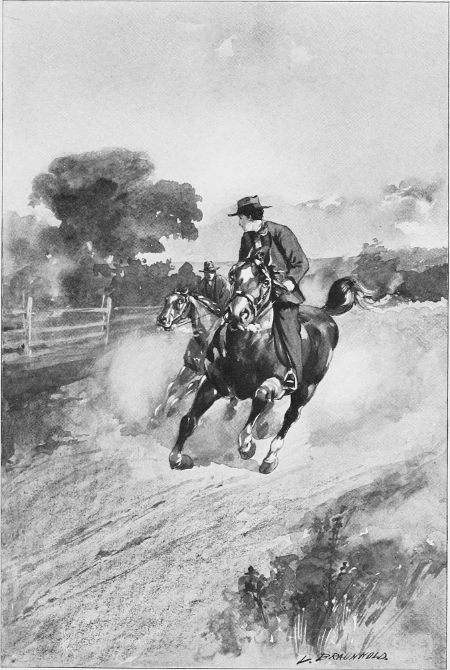
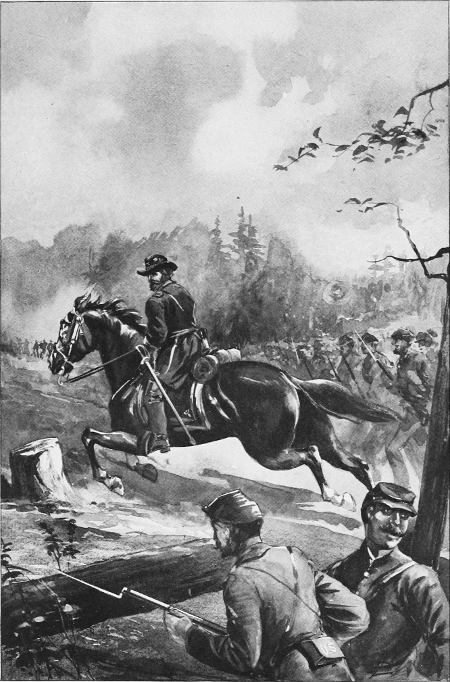
Within an hour Fred was on his way back to Somerset. It was a terrible
journey over almost impassable roads; streams, icy cold, had to be
forded; but boy and horse were equal to the occasion, and in three days
reached Somerset.
How was it with General Thomas? His week lengthened into three. He
commenced his march from Lebanon on December 31st; it was January 18th
before he reached his destination. The roads seemed bottomless. The
rain poured in torrents, and small streams were turned into raging
rivers. Bridges were swept away, and had to be rebuilt. The soldiers,
benumbed with chilling rain, toiled on over the sodden roads, cheerful
in the thought that they were soon to meet the enemies of their country.
General Schoepf received the news of General Thomas' advance with great
satisfaction.
"If I can only hold on," he said, "until Thomas comes, everything will
be all right."
"We must show a bold front, General," replied Fred, "and make the enemy
believe we have a large force."
"It's the enemy that is showing a bold front nowadays," replied General
Schoepf, with a faint smile. "They have been particularly saucy lately.
They have in the last few days, cut off two or three small scouting
parties. But what worries me the most is that there is hardly a night
but that every man on some one of our picket posts is missing. There is
no firing, not the least alarm of any kind, but the men in the morning
are gone. It is a mystery we have tried to solve in vain. At first we
thought the men had deserted, but we have given that idea up. The men
are getting superstitious over the disappearance of so many of their
comrades, and are actually becoming demoralized."
"General, will you turn this picket business over to me?" asked Fred,
quietly.
"Gladly," replied the general. "I have heard much of your ability in
ferreting out secret matters. Your success as a scout I am well
acquainted with, as you know. I hope you will serve me as well in this
matter of the pickets, for I am at my wits' end."
"Well, General, to-morrow I will be at your service, and I trust you
will lose no more pickets before that time," and so saying Fred took his
leave, for he needed rest badly.
The next morning, when Fred went to pay his respects to the general, he
found him with a very long face. "Another post of four men disappeared
last night," he said.
Fred gave a low whistle. "Well, General, if possible, I will try and
solve the problem, but it may be too hard for me."
"Have you any idea yet how they are captured?" asked the general.
"None at all. I must first look over the ground carefully, see how the
men are posted, talk with them, and then I may be able to form an idea."
Fred's first business was to ride out to where the post had been
captured during the night. This he did, noting the lay of the ground,
carefully looking for footprints not only in front, but in the rear of
where the men had been stationed. He then visited all the picket posts,
talked with the men, learned their habits on picket, whether they were
as watchful as they should be—in fact, not the slightest thing of
importance escaped his notice.
On his return from his tour of inspection, Fred said to General
Schoepf, "Well, General, I have my idea."
"What is it?" asked the general, greatly interested.
"Your pickets have been captured from the rear, not the front."
"What do you mean?" excitedly asked the general.
"I mean that some of the pickets are so placed that a wary foe could
creep in between the posts and come up in the rear, completely
surprising the men. I think I found evidence that the men captured last
night were taken in that way. I found, at least, six posts of which I
believe an enemy could get in the rear without detection, especially if
the land had been spied out."
"You astonish me," said the general. "But even if this is so, why does
not the sentinel give the alarm?"
"He may be in such a position that he dare not," answered Fred.
"What do you propose?"
"That a double force be put on the posts, half to watch the rear. It
will be my business to-night to see to that."
"Very well," replied General Schoepf. "I shall be very curious to see
how the plan works, and whether your idea is the correct one or not."
"I will not warrant it, General," replied Fred, "but there will be no
harm in trying."
Just before night Fred made a second round of the picket posts, and
made careful inquiry whether any one of the posts had been visited
during the day by any one from the outside.
All of the posts answered in the negative save one. The corporal of that
post said: "Why, a country boy was here to sell us some vegetables and
eggs."
"Ah!" replied Fred. "Was he a bright boy, and did he seem to notice
things closely?"
"On the contrary," said the corporal, "he appeared to be remarkably dull
and ignorant."
"Has the same boy been in the habit of selling vegetables to the
pickets?" asked Fred.
Come to think about it, the corporal believed he had heard such a boy
spoken of.
Then one of the men spoke up and said:
"You know Rankin was on the post that was taken in last night. He had a
letter come yesterday, and I took it out to him, and he told me of what
a fine supper they were going to have, saying they had bought some eggs
and a chicken of a boy."
"Jerusalem!" suddenly exclaimed the corporal, "that boy to-day walked to
the rear some little distance—made an excuse for going; he might not
have been such a fool as he looked."
"Thank you," replied Fred. "Corporal, I will be here a little after dark
with a squad of men to help you keep watch. In the mean time keep a
sharp lookout."
"That I will," answered the corporal. "Do you think that boy was a
spy?" he then asked, with much concern.
"I don't know," answered Fred. "But such a thing is possible. But if any
trouble occurs on the picket line to-night, it will be at this post."
That night Fred doubled the pickets on six posts which he considered the
most exposed. But the extra men were to guard the rear instead of the
front. The most explicit instructions were given, and they were
cautioned that they were to let no alarm at the front make them relax
their vigilance in the rear. Thirty yards in the rear of the post where
he was to watch Fred had noticed a small ravine which led down into a
wood. It was through this ravine that he concluded the enemy would creep
if they should try to gain the rear of the post. Fred posted his men so
as to watch this ravine. To the corporal who had charge of the post, he
said:
"My theory is, that some one comes up to your sentinel, and attracts his
attention by pretending to be a friend, or perhaps a deserter. This, of
course, will necessitate the sentinel's calling for you, and naturally
attract the attention of every man awake. While this is going on, a
party that has gained the rear unobserved will rush on you and be in
your midst before you know it, and you will be taken without a single
gun being fired."
The corporal and his men looked astonished.
"Zounds!" said one, "I believe it could be done."
"Now," continued Fred, "if you are hailed from the front to-night act
just as if you had not heard of this. I will take care of the rear."
When everything was prepared the soldiers, wrapped in their blankets,
sat down to wait for what might come. So intently did they listen that
the falling of a leaf would startle them. The hours passed slowly away.
There was a half-moon, but dark clouds swept across the sky, and only
now and then she looked forth, hiding her face again in a moment. Once
in a while a dash of cold rain would cause the sentinels to shiver and
sink their chins deeper into the collars of their great coats.
Midnight came, and still all was quiet. The soldiers not on guard lay
wrapped in their blankets, some of them in the land of dreams.
Off in the woods the hoot of an owl was heard. Instantly Fred was all
attention. A few minutes passed, and again the dismal "Whoo! whoo!" this
time much nearer. Fred aroused his men. Instantly they were all
attention, and every sense alert.
"Have you heard anything?" whispered the sergeant, next to him.
"Nothing but the suspicious hooting of an owl," whispered back Fred.
Then to the soldiers, "Perfectly still, men; not a sound."
So still were they that the beatings of their hearts could be heard.
Again the dismal hoot was heard, this time so near that it startled
them.
Then from the sentinel out in front came the short, sharp challenge,
"Who comes there?"
He was answered immediately. "A deserter who wishes to come into the
lines and give himself up."
"Stand! Corporal of the guard!"
The corporal went forward to receive the deserter. Now there came the
sound of swiftly advancing footsteps in front of the rear post, and dim
figures were seen through the darkness.
"Fire!" shouted Fred.
Seven rifles belched forth their contents, and for a moment the flashes
of the guns lighted up the scene, and then all was dark.
There were cries of pain, hoarse yells of surprise and anger, and then a
scattering volley returned.
"Use your revolvers," shouted Fred, and a rapid fire was opened.
"Fall back!" shouted a voice from the darkness. There were a few more
scattering shots, and all was still.
The deserter, who was so anxious to give himself up, the moment the
alarm was given fired at the sentinel and vanished in the darkness.
The sound of the firing created the wildest commotion in camp. The long
roll was beaten; the half-dressed, frightened soldiers came rolling out
of their tents, some without their guns, others without their cartridge
boxes; excited officers in their night clothes ran through the camp,
waving their bare swords and shouting: "Fall in, men, for God's sake,
fall in."
It was some minutes before the excitement abated, and every one was
asking, "What is it? what is it?"
The officer of the day, with a strong escort, came riding out to where
the firing was heard. Being challenged, he gave the countersign, and
then hurriedly asked what occasioned the firing.
"Oh," cheerfully responded Fred, "they tried to take us in, and got
taken in themselves."
An examination of the ground in front of where Fred's squad was
stationed revealed two Confederates still in death, and trails of blood
showed that others had been wounded.
"You can go to your quarters," said Fred to his men. "You will not be
needed again to-night; and, Lieutenant," said he, turning to the officer
of the day, "each and every one of these men deserves thanks for his
steadiness and bravery."
"I hardly think, General," said Fred, the next morning, as he made his
report, "that your pickets will be disturbed any more."
As for General Schoepf, he was delighted, and could not thank Fred
enough.
For three or four days things were comparatively quiet. Then a small
scouting party was attacked and two men captured. The next day a larger
party was attacked and driven in, with a loss of one killed and three
wounded. The stories were the same; the leader of the Confederates was a
young lieutenant, who showed the utmost bravery and handled his men with
consummate skill.
"I wish," said General Schoepf to Fred, "that you would teach this
young lieutenant the same kind of a lesson that you taught those fellows
who were capturing our pickets."
"I can try, General, but I am afraid the job will not only be harder,
but much more dangerous than that one," answered Fred.
"This same young lieutenant," continued the general, "may have had a
hand in that picket business, and since he received his lesson there has
turned his attention to scouting parties."
"In that case," replied Fred, "it will take the second lesson to teach
him good manners. Well, General, I will give it to him, if I can."
The next morning, with eight picked men from Wolford's cavalry, Fred
started out in search of adventure.
"Don't be alarmed, General," said Fred, as he rode away, "if we do not
come back to-night. We may take a notion to camp out."
Many of their comrades, with longing eyes, looked after them, and wished
they were of the number; yet they did not know but that every one was
riding to death or captivity. Yet such is the love of adventure in the
human breast that the most dangerous undertakings will be gladly risked.
After riding west about three miles Fred turned south and went about the
same distance. He then halted, and after a careful survey of the country
ahead, said: "I think, boys, it will be as well for us to leave the road
and take to the woods; we must be getting dangerously near the enemy's
country."
The party turned from the road and entered a wood. Working their way
through this, skirting around fields, and dashing across open places,
after making a careful observation of the front, they managed to proceed
about two miles further, when they came near the crossing of two main
roads. Here they stopped and fed their horses, while the men ate their
scanty fare of hard bread and bacon.
They had not been there long before a squadron of at least 200
Confederate cavalry came from the south, and turning west were soon out
of sight.
"I hardly think, boys," said Fred, "it would have paid us to try to take
those fellows into camp; we will let them go this time," and there was a
twinkle in his eye, although he kept his face straight.
"Just as you say, capt'in," replied one of the troopers, as he took a
chew of tobacco. "We would have gobbled them in if you had said the
word."
A little while after this a troop of ten horsemen came up the same road,
but instead of turning west they kept on north. At the head of the troop
rode a youthful officer.
One of the soldiers with Fred was one of the number that had been
attacked and defeated two days before by the squad of which they were in
search.
"That's he, that's the fellow!" exclaimed the soldier, excitedly.
Fred's breath came thick and fast. What he had come for, fate had thrown
in his way.
"They are only one more than we!" he exclaimed.
"If they were double, we would fight them," cried the men all together.
"Let them pass out of sight before we pursue," said Fred. "The farther
we get them from their lines the better."
"Now," said Fred, after they had waited about five minutes. A ride of a
few minutes more brought them into the road. Halting a moment, Fred
turned to his men and said:
"Men, I know every one of you will do your duty. All I have to say is
obey orders, keep cool, and make every shot count. Forward!"
With a cheer they followed their gallant young leader. After riding
about two miles, Fred reined up and said: "They have not dodged us, have
they, boys? We ought to have sighted them before this. Here is where we
turned off of the road. By heavens! I believe they noticed that a squad
of horsemen had turned off into the woods, and are following the tracks.
Let's see," and Fred jumped from his horse, and examined the tracks
leading into the woods.
"That's what they did, boys," said he, looking up. "I will give that
lieutenant credit for having sharp eyes. Now, boys, we will give him a
surprise by following."
They did not go more than half a mile before they caught sight of the
Confederates. Evidently they had concluded not to follow the tracks any
farther, for they had turned and were coming back, and the two parties
must have sighted each other at nearly the same moment.
There was the sharp crack of a carbine, and a ball whistled over the
Federals' heads.
"Steady, men," said Fred. "They are coming."
But he was mistaken. The young lieutenant who led the Confederates was
far too careful a leader to charge an unknown number of men. Instead of
charging the Confederates dismounted, and leaving their horses in charge
of two of their number the rest deployed and advanced, dodging from tree
to tree, and the bullets began to whistle uncomfortably close, one horse
being hit.
"Dismount, and take the horses back," was Fred's order. "We must meet
them with their own game." The two men who were detailed to take the
horses back went away grumbling because they were not allowed to stay in
the fight.
Telling them to keep well covered, Fred advanced his men slightly, and
soon the carbines were cracking at a lively rate.
But the fight was more noisy than dangerous, every man being careful to
keep a tree between himself and his foe.
"This can be kept up all day," muttered Fred, "and only trees and
ammunition will suffer. I must try something else."
Orders were given to fall back to the horses, and the men obeyed
sullenly. A word from Fred, and their faces brightened. Mounting their
horses, they rode back as if in disorderly retreat.
As soon as the Confederates discovered the movement, they rushed back
for their horses, mounted, and with wild hurrahs started in swift
pursuit of what they thought was a demoralized and retreating foe.
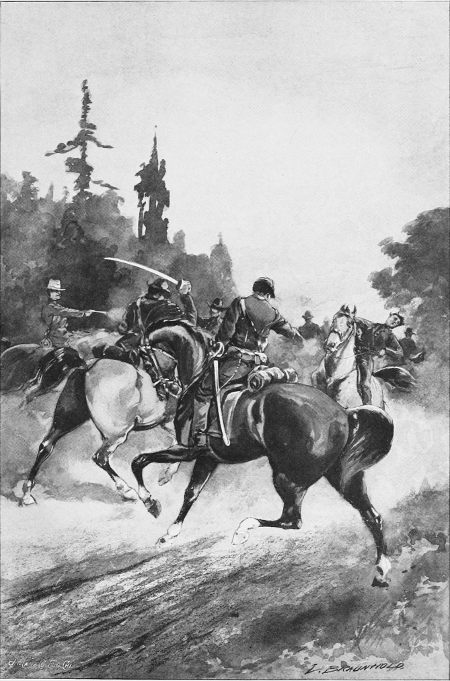
Coming to favorable ground, Fred ordered his men to wheel and charge. So
sudden was the movement that the Confederates faltered, then halted.
"Forward!" cried their young leader, spurring his horse on, but at that
moment a chance shot cut one of his bridle reins. The horse became
unmanageable, and running under the overhanging branches of a tree, the
gallant lieutenant was hurled to the ground. His men, dismayed by his
fall, and unable to withstand the impetuous onslaught of the Federals,
beat a precipitate retreat, leaving their commander and two of their
number prisoners in the hands of their foes. Two more of their men were
grievously wounded. Three of the Federals had been wounded in the mêlée.
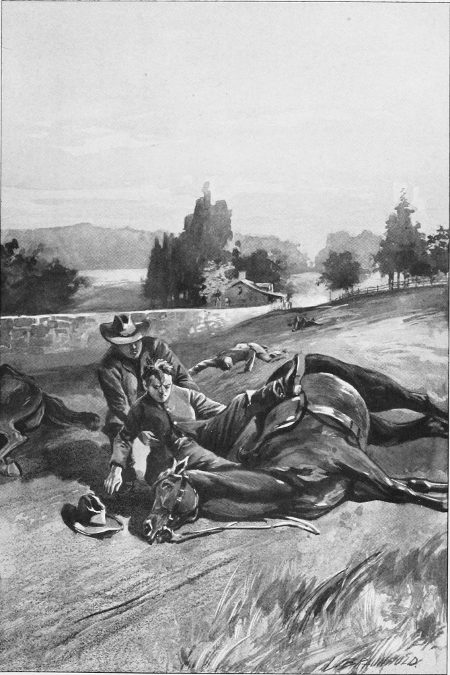
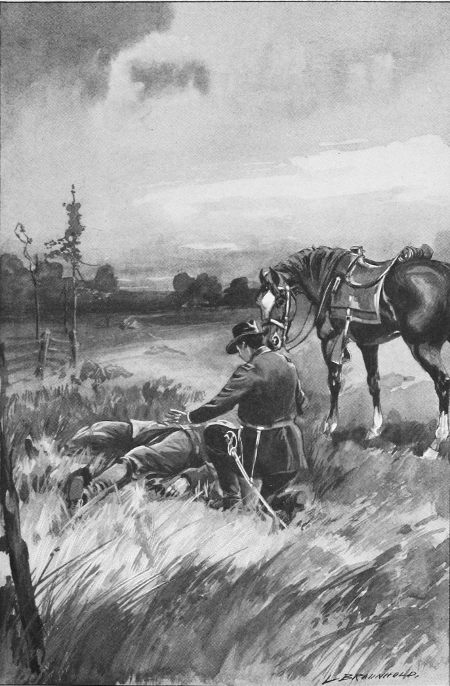
Fred dismounted and bent over the young lieutenant, and then started
back uttering an exclamation of surprise and grief. He had looked into
the face of his cousin, Calhoun Pennington. Hurriedly Fred placed his
hand on the fallen boy's heart. It was beating. There was no sign of a
wound on his body.
"Thank God! He has only been stunned by the fall," exclaimed Fred.
In the mean time the five remaining Confederates had halted about a
quarter of a mile away, and were listening to what a sergeant, now in
command, was saying.
"Boys," he exclaimed, "it will be to our everlasting shame and disgrace
if we run away and leave the lieutenant in the hands of those cursed
Yankees. Some of them must be disabled, as well as some of us. Let us
charge and retake the lieutenant, or die to a man in the attempt."
"Here is our hand on that, Sergeant," said each one of the four, and one
after the other placed his hand in that of the grim old sergeant.
But just as they were about to start on their desperate attempt, they
were surprised to see Fred riding towards them, waving a white
handkerchief. When he came in hailing distance, he cried:
"Men, your gallant young leader lies over here grievously hurt. We are
going to withdraw," and wheeling his horse, he rode swiftly back.
Fred hastily made preparations to withdraw. One of his men was so badly
wounded that he had to be supported on his horse; therefore their
progress was slow, and it was night before they reached camp. Fred made
his report to General Schoepf and turned over his two prisoners. The
general was well pleased, and extended to Fred and the soldiers with him
his warmest congratulations.
"If you had only brought in that daring young lieutenant with you your
victory would have been complete," said the general.
"I hardly think, General," said Fred, "that you will be troubled with
him any more. He was still insensible when we left, and with my three
wounded men and the two prisoners it was well-nigh an impossibility for
us to bring him in."
"I know," replied the General, "and as you say, I think we have had the
last of him."
"I sincerely hope so," was Fred's answer as he turned away, and it meant
more than the general thought. Fred had a horror of meeting his cousin
in conflict, and devoutly prayed he might never do so again. He slept
little that night. Every time he closed his eyes he could see the pale
face of his cousin lying there in the wood, and the thought that he
might be dangerously hurt, perhaps dead, filled him with terror. "Why,"
he asked himself over and over again, "did the fortune of war bring us
together?"
Let us return to the scene of the conflict, and see how Calhoun is
getting along. The Confederates received Fred's message with surprise.
"That lets us out of a mighty tough scrape," remarked the sergeant. "We
must have hurt them worse than we thought."
"Don't know about that," answered one of his men who was watching the
Federals as they retired. "There is only one of them who appears to be
badly hurt; and they have poor Moon and Hunt in limbo, sure."
"Better be prisoners than dead," answered the sergeant. "But, boys, let
us to the lieutenant. It's strange the Yanks didn't try to take him
back."
When they reached Calhoun, he was already showing signs of returning
consciousness, and in a few minutes he was able to sit up and converse.
"Where are the Yankees?" was his first question.
"Gone."
"Then we whipped them after all," and his face lighted up with joy.
"Can't say that we did, Lieutenant," answered the sergeant; "but they
left mighty sudden for some reason."
Calhoun looked around on his men with a troubled countenance. "I see
only five of you," he said; "where are the rest?"
"Two are back nursing wounds," answered the sergeant. "Sheldon is hit,
so hard hit I am afraid he is done for. As for Moon and Hunt, they have
gone off with the Yanks."
"Prisoners?"
The sergeant nodded.
The tears rolled down the cheeks of the young officer. "Boys," he said,
chokingly, "I believe I have lost my grip. There was that last picket
affair that went against us, and now we are all broken up in a fair
combat."
"Don't take on, Lieutenant," said the sergeant, soothingly. "It was that
chance bullet that cut your bridle rein that did the business. If it
hadn't been for that we would have wiped them out, sure. As it is, we
are thankful they didn't take a notion to lug you off."
"Perhaps they thought I was dead."
"No, they didn't," replied the sergeant, and then he told Calhoun what
had happened.
"What kind of a looking man was the leader of the Yanks?" asked Calhoun.
"He was a boy, no older than yourself. He was mounted on a magnificent
bay horse with a star in the forehead.
"I see it all," sighed Calhoun. "The leader of that party was my cousin,
Fred Shackelford. He knew me, and he spared me. Boys, help me on my
horse. I am badly shaken up, but not seriously hurt. We will square
accounts with those fellows one of these days."
And the little party, bearing their wounded, sadly wended their way back
to the Confederate camp.
For the next few days the weather was so bad and the roads in such a
terrible condition that both armies were comparatively quiet. Nothing as
yet had been heard from the advance of General Thomas, and General
Schoepf began to be very uneasy. At last Fred offered to ride toward
Columbia, and see if he could not get some tidings of the missing
column. The offer was gladly accepted, and Fred set out. He met with no
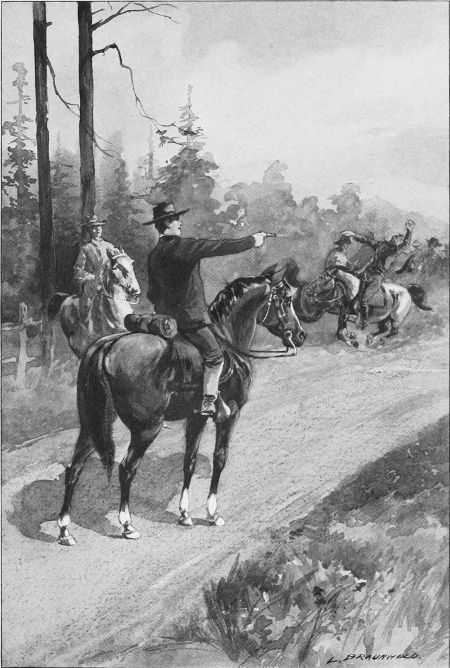
adventure until about fifteen miles from Somerset, when he suddenly came
face to face with a young soldier, and he supposed a Federal, as he wore
a blue great coat. But a second look caused a cry of surprise to burst
from Fred's lips, and at the same time the supposed Federal soldier
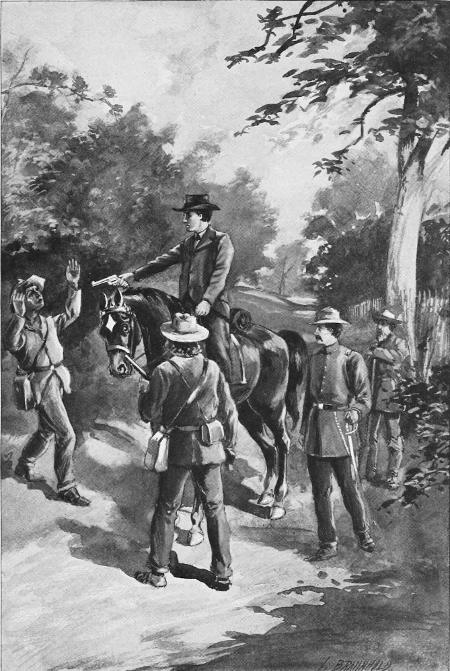
snatched a revolver from the holster. The cousins were once more face to
face.
"Put up your revolver, Calhoun," cried Fred. "Is that the way you greet
your cousin?"
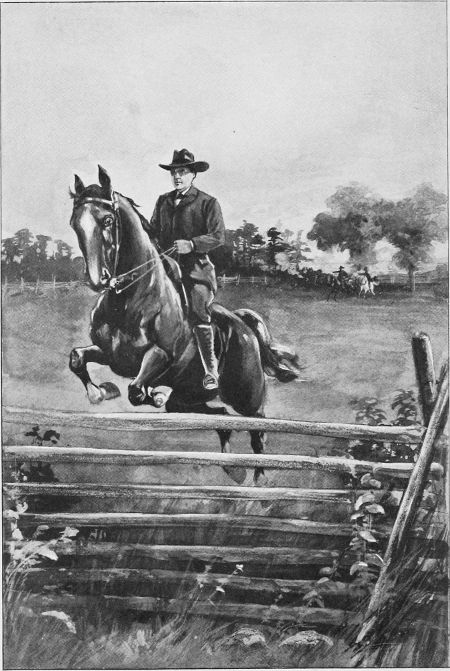
For a moment Calhoun gazed on Fred in silence, then raising his hand in
courtly salute, he suddenly turned his horse, and jumping him over a low
fence, disappeared in a copse of wood.
Fred was on the point of raising his voice to call him back, when it
flashed upon him that Calhoun had been playing the spy, and that he dare
not stop, even for a moment.
"He was only stunned after all, when he was hurled from his horse,"
thought Fred. "I am so glad; a heavy load has been lifted from my mind.
I am also glad he has gone now. It would have been extremely awkward for
me to have found out he was a spy, and then let him go."
It was with a lighter heart that he pursued his journey, but he had gone
but a short distance when he met a courier from General Thomas with
dispatches for General Schoepf. He was informed that the advance of
General Thomas was but a short distance in the rear. A few moments more
and Fred was in the presence of his general.
"Ah, Shackelford!" said Thomas, "I am glad to see you. How is everything
at Somerset?"
"All right, General, only General Schoepf has been sorely worried over
your non-appearance."
"I do not wonder. The march has been an awful one, and has taken three
times as long as I expected. But we will be at Logan's Cross Roads
to-night, where I shall halt to concentrate my army. If the enemy does
not retreat, we may look for a lively time in about three days."
"The lively time, General, may come before three days," answered Fred,
significantly.
"How is that?" asked Thomas, looking surprised.
"The Rebels may conclude," answered Fred, "to attack you before you can
bring up the rest of your force, or get aid from Somerset. Fishing Creek
is very high; I had to swim it. It will be almost impossible to get
infantry or artillery over."
"I have thought of that," replied the general, smiling. "I shall try and
be ready for them if they come."