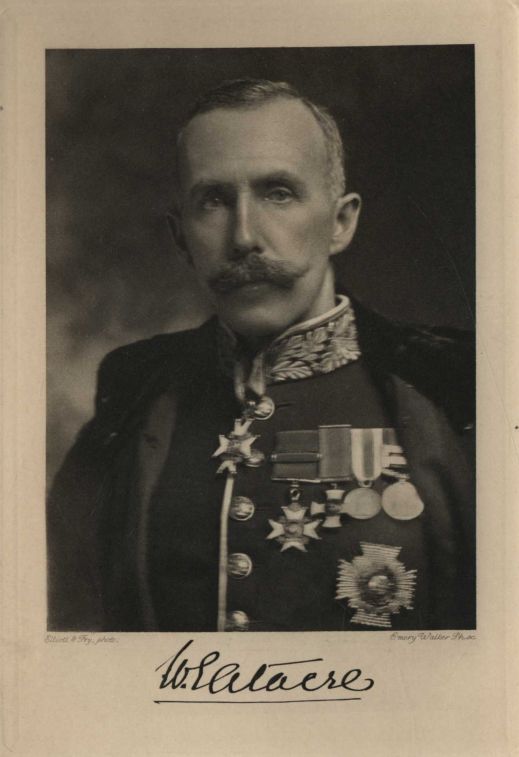
1843-1906
GATACRE
According to a venerable Shropshire
antiquarian, that county "has ever been inhabited
by a race of men characteristic for uniformity
of principle and energy of action."[1] Mr. Eyton
goes on to tell of various places mentioned in
the Domesday Book, and among these of the
Manor of Claverley, which included a very
large tract of country, and is described as an
"ancient demesne of the Crown." The Manor
of Claverley was broken up into various
townships, to three of which he accords special
notice, "in regard that the King's Tenants
thereof were of a rank superior to that of the
average class of Freeholders in Royal Manors.
These Townships were Broughton, Beobridge,
and Gatacre."[2]
Ancestors
There is a well-authenticated tradition that
the family established at Gatacre at the time
of the Conquest held their lands by tenure of
military service, under a grant from Edward
the Confessor. Eyton speaks of them as "a
family of knightly rank, which, having early
feoffment in Gatacre, took its name from the
place. The period of such feoffment it is vain
to conjecture, as being beyond all record of
such matters."[3]
In the reign of Henry II., Sir William de
Gatacre had a suit with one Walter, about half
a hide of land in Great Lye: this was subject
to a Wager of Battle, and apparently Gatacre
proved himself the better man, for Great Lye
is even now held by his descendant. This same
William appears in another record as one of
the four "Visors," who in July 1194 had to
report to the Courts of Westminster on the
validity of the "essoign of Cecilia de Cantreyn,
a litigant. Gatacre's associates in this duty—to
which knights only were usually appointed—were
Henry Christian, Philip Fitz Holegod, and
William de Rudge, all his neighbours and of
equal rank with himself."[4]
He was succeeded by Sir Robert, his son;
who sat on a Jury of Grand Assizes in April 1200,
to try a question of right in relation to lands at
Nordley Regis, at the "Iter of the King's
Justices."[5]
The tenure of the estates was in great jeopardy
in the life of Thomas de Gatacre; for it is told
how a certain Philip de Lutley, the King's
Escheator, did "seize the estates of Gatacre,
Sutton, and Great Lye into the King's hand,
on the ground that Thomas de Gatacre had
entered upon these estates without doing homage
and fealty to the Crown, and without paying
his relief, so that he had occupied the same
unjustly for twenty-two years and more."[6] At
this unfortunate moment Thomas died, leaving
Alice, his widow, to fight for herself and their
son Thomas. She appealed to the King
(Edward III.) in Chancery, in the Michaelmas
Term 1368. There was a trial by twenty-four
jurors, being knights and others in the visnage
of Sutton not being kin to Alice. She herself
appeared in person at Westminster, and won
her cause, for a "King's writ of the same
year commits to the same Alice, widow of
Thomas de Gatacre, custody of the Manor of
Gatacre and the hamlet of Sutton with their
appurtenances."
The grandson of the younger Thomas was
called John; he flourished in the reigns of
Henry IV., Henry V., and Henry VI., and was
High Sheriff of Shropshire in 1409. In a
contemporary stained-glass window now in the
hall at Gatacre there is a portrait of the same
John, who is described as "Groom of the body
to Henry VIth." He was succeeded by his
son John, who was Member of Parliament for
Bridgnorth in the twelfth year of Edward IV.
The ancient house
The house at Gatacre stands in the parish of
Claverley, and is about two miles distant from
this village. Inside the church—a red sandstone
building full of interest to the archæologist—are
many monuments, of which the most ancient are
two incised marble slabs inlaid in the eastern wall;
these are about six feet high. On one is shown
a man in armour, elaborate and perfect in all its
detail, commemorating William Gatacre, who
died in 1577, and his wife and eleven children;
and on the other his successor Francis, 1599, is
depicted in civilian dress with his wife at his side.
Close by is a very fine alabaster tomb on
which lie three full-length recumbent figures,
being the effigies of Robert Brooke of Madeley
Court, who is described as "Recorder of London,
Speaker of P'lyament, and Chiefe Justice of
Com'on Pleace," and his two wives, one of
whom was a daughter of Gatacre.[7]
Thomas, brother to Francis named above,
was destined by his parents for the law; but
he "diverted his mind from the most profitable
to the most necessary study, from law to
divinity," and, much to the grief of his parents,
who were of the old persuasion, embraced the
Reformed Faith, and became Rector of
St. Edmond's, Lombard Street. He died in 1593;
but his son and grandson followed the same
profession. The former, Thomas (1574-1654),
was a friend of Archbishop Ussher, and a
member of the Westminster Assembly of Divines.
He took part in preparing the annotations to
the English Bible, and published a work on
Marcus Aurelius; in 1648 he subscribed the
Remonstrance against the trial of Charles I.
His son, Charles, was Chaplain to Lucius Gary,
Viscount Falkland, and was also the author of
many books.[8] This younger branch of the
family settled at Mildenhall, in Suffolk, and
has always spelt the name Gataker. Though
there has never failed a male heir to the senior
line, this is the only cadet branch that has
survived.
The house inhabited by this ancient family
was a unique survival of very early times.[9]
Where we should now use iron girders our
ancestors used oak-trees; they erected them
upside-down, so that the roots made arches on
which to lay the roof. Large stones were hewn
to fill in the walls, and in this particular building
the outer surface of the stones was incrusted
with a transparent green glaze, very similar to
what is now seen on rough pottery. This curious
specimen of domestic architecture survived in a
habitable condition till the early part of the
eighteenth century, when it was wantonly
destroyed, and replaced by a brick mansion of the
dark and uninteresting type of the early Georges.
Portions of the glazed stones are still preserved
in the house amongst many other relics of more
obvious value.
Colonel Edward Gatacre and his only son,
born in 1806 (who figures as the Squire in this
narrative), were specimens of the best type of
country gentleman of their day. The former
was twentieth in direct descent from Sir William
de Gatacre of the twelfth century, and was
grandfather to Sir William, the hero of this story.
The pedigree shows that through the centuries
the family had maintained their status as
gentle-folk, and had allied themselves with other
families of the same standing in the neighbouring
counties. Both were men of remarkable
activity and considerable cultivation. With the
advent of railways came the facility for travel,
of which the younger man was quick to avail
himself. He visited London every year, and
among other men of renown knew Sir Francis
Grant, P.R.A., and persuaded him to come and
paint the portrait of his father that still hangs
at Gatacre—a beautiful picture. He also went
abroad, and made a pilgrimage to Rome in the
old days when people travelled in their own
carriages, making a long stay at many places
of interest in Switzerland and Italy.
Forbes
At the age of eighty-one the Colonel died,
sincerely mourned throughout the county; and
thus in 1849 the young Squire came into his
inheritance. About ten years earlier he had
married Jessie, second daughter of William
Forbes of Callendar, in the county of Stirling.
Mr. Forbes, who sprang from a cadet branch of
the family of that name, started his career in a
shipping office; by his enterprise and inventions
he built up a considerable fortune, with which
he bought the Callendar estate. His elder son,
William Forbes, who succeeded him,
represented Stirlingshire in Parliament for many
years; and his younger son became Colonel
John Forbes of the Coldstream Guards. Their
sister Jessie must always have been a beautiful
woman, rather Scottish, perhaps, in the vigorous
outline of her face, with a depth about her blue
eyes and a symmetry of feature that reappeared
in her third son; a look of "all-comprehensive
tenderness" is the dominant note of the portrait.
Indeed, we are told that while Mrs. Gatacre
was a very able woman, she had a singular
gentleness of manner.
The family already numbered two sons and
a daughter when in 1843 Mrs. Gatacre went
on a visit to her widowed mother, who was
then living at Herbertshire Castle, near Stirling:
and so it came about that when a little boy
was born on December 3, he was given the names
of his uncle and godfather, William Forbes.
Perhaps it is to his Scottish descent that we
may trace some of the qualities that became
most marked when the child, grown to perfect
manhood, had evolved that balance of
innumerable strains that go to make the
individual—had, as it were, tuned the manifold
strings of his lineage to a chord of his own
finding. Did he draw his habit of concentration
on the matter in hand, his painstaking attention
to detail, from the inventor-engineer of
Aberdeen? Did he draw his fervent notions of duty
and his stern disregard of personal considerations
from the blood of the Covenanters that ran in
his veins? My own father was heard to say that
this son-in-law of his was born out of due time,
that his right place would have been at the head
of Cromwell's Ironsides.
In course of time another son, Stephen,
completed the family. The children were a great
source of pride and pleasure to their parents,
and had the benefit of all that loving early
training could do for them. In this wholesome
atmosphere of parental affection and brotherly
competition the four boys grew up straight and
strong. They vied with one another in childish
feats and manly sports, but in all these Willie
was the keenest and the most daring.
Even in these latter days the house at Gatacre
seems difficult of access, for the nearest railway
station (unless you cross the Severn in a ferry)
is at Bridgnorth, six miles away; but sixty
years ago there was no railway nearer than
Wolverhampton, a good ten miles' drive. The
eldest son well remembers his father driving his
coach-and-four to and fro. The Squire was a
famous whip, and maintained this practice far
into the sixties. But as the boys grew older
they thought nothing of doing this journey on
foot at any hour of the day or night; perhaps
it was the remoteness of the country in which
they were nurtured that had endowed this
family for generations back with powers of
physical endurance and enterprise beyond the
common.
At school
The elder brothers Edward and John[10] were
sent to Mr. Hopkirk's school at Eltham, in
Kent; and both were still there when Willie
joined them a year or two later. Some of
Willie's letters from school are still to be seen; and
if handwriting is any sign of character, he must
have been an exemplary boy at his lessons, for
his letters are so exquisitely written that were
it not for the dates duly recorded one could
scarcely believe them to be the work of a
high-spirited boy of thirteen. Writing to his mother
in March 1857, he says: "Did you see in the
papers that peace had been made with Persia?"
The interest in Persia had been aroused by
the approaching departure of his brother John
to India, where he was to join a regiment
that was at that moment fighting in Persia.
Though loth to part from one who was said to
be his father's favourite son, the Squire had
thought the offer of a commission in the East
India Company's army too good an opening to
refuse. In May 1857 he accompanied the boy,
who was then only sixteen and a half, as far as
Marseilles, and did not see him again for nearly
twelve years.
At Gatacre there was a famous kennel of
setters, and also some good retrievers. A puppy
of the latter breed was given to Willie for his
own, and he broke and trained it so skilfully,
when only fifteen, that the dog was sold for
fifteen guineas, and eventually became celebrated
in the canine world.
In the holidays
There are many excellent fox-holding coverts
in that part of the country; the Albrighton
Hounds still draw them regularly. Such visits
were great events to the boys; and we can
well believe that Willie would always be out,
mounted on whatever he could get, big or small,
old or young. One day he was riding a mare
who was known to be twenty-two years old,
and had all her life been used for harness work;
but nothing stopped Willie. When a fox was
found close to the house, away he went, and it
is still told how Rushlight led the field for miles.
Willie seems to have shared more intimately
than any of his brothers the Squire's love for
horses. He had a vivid recollection of journeys
to Birmingham with his father, when he visited
the big stables there to search for horses, either
for himself or a friend; the elder man taught
his son what points to look for and what to
avoid. Willie thus acquired a certain confident
genius for judging a horse, and all his life took
a pleasure in exercising this quality; like his
father before him, he was never afraid to buy
horses at their request for friends who had
more confidence in his judgment than in their own.
One summer holiday the boy found for
himself a new recreation. In a letter to Stephen,
dated from Gatacre, July 20, 1860, we find the
following passage:
"Did you know that there was an Alderney
bull come? I have begun to work him every
day, but he does not like it, and he fights with
me a great deal. But I find a good stick the best
remedy; sometimes I have to bate him a good deal."
The brothers and sister clearly recall seeing
Willie ride this animal day after day in the park.
It is evident that Number Three must often
have been a source of anxiety to his parents.
One evening in February he gave his mother a
most horrible fright. The boys had arranged
to go out after wood-pigeons in the spinneys
round the house; as there was snow on the
ground they slipped a night-shirt over their
clothes to make themselves less visible. The
three guns posted themselves in three coverts
some distance apart, and then lay in wait for
the birds as they came in to roost. Willie, who
was then sixteen or seventeen, was in a lucky
corner: he shot so many that he was at a loss
how to bring the birds in. Slipping off his white
covering, he made a bag of it and gathered up
his spoils. By the time he reached the house
he presented such an alarming appearance that
his mother naturally imagined him the victim
of some terrible accident. With great pride
the boy counted out forty-two birds.
In 1856 the Squire was pricked for High
Sheriff. There is an ancient custom by which
all the sons of Gatacre are enrolled as Freemen
of the Borough of Bridgnorth; and on June 25,
1860, William Forbes was duly sworn and
inscribed on the rolls.
In the same year, on August 1, he was
admitted to the Royal Military College; he was
then only sixteen and a half, and measured five
feet seven and a quarter inches in height.
Ultimately he reached five feet eleven inches in his
socks.
Except in the riding-school he does not seem
to have made much mark at Sandhurst, but
when he left in December 1861 he had earned
the college "Recommendation," and on
February 18 following was gazetted an ensign in
the 77th Foot, now the 2nd Battalion (Duke of
Cambridge's Own) Middlesex Regiment.
TO INDIA AND BACK
1862
The 77th Regiment was raised in 1787, and
for twenty years served in India, taking part
in the fierce campaigns against Tippoo Sahib in
1790-91, in the storming of Seringapatam in
1799, and in many minor operations. On their
colours are also recorded the suggestive names,
Albuhera, Ciudad Rodrigo, Badajoz, Vittoria,
Pyrenees, Nivelle, Nive, Peninsula. In the
Crimea they had charged at the Alma and at
Inkerman; they had shivered in the trenches
before Sebastopol, and had taken part in the
final assault of the Redan. There were many
officers and men still with the colours in 1862
who had three clasps to their medals, and also
wore the French medal, and in the ranks there
was an exceptional number of Gallant Conduct
medals.
Without doubt the fine record of the regiment
and the fact that all the senior officers had been
proved in actual warfare, as their medals so
brilliantly testified, had a stimulating effect on
the juniors.
Unfortunately the 77th sailed for Sydney,
New South Wales, just before the news of the
Indian Mutiny reached England; and being
detained there, they did not reach India till June
1858, too late to take a share in any but the
minor operations incident to the disturbed state
of the country.
As subaltern
The regiment was at Hazaribagh, in Bengal,
when Ensign William Gatacre joined on June 5,
1862, but was shortly afterwards moved to
Allahabad. It was while Gatacre was doing
duty with a detachment in the Fort that Major
Henry Kent (now Colonel-in-Chief of the
Middlesex Regiment) first saw the new subaltern; he
describes him as good-looking, thin, smart, and
gentlemanly, adding that he took an immediate
fancy to him.
It is to General Kent, who still speaks of
Gatacre with great affection, that I am indebted
for the following story.
Sir Robert Napier, who at that time was
Military Member of Council, was passing through
Allahabad on tour that winter, and took a walk
round the Fort one evening. Seeing a smart
young officer with the famous 77th on his cap,
he accosted him.
"Ah," he said, "I see you belong to the
77th, which Lord Gough commanded at the
battle of Barrosa."
"Yes, sir."
"And you captured a French Eagle there?"
"Yes, sir, we did."
"Well," said Napier, "what have you done
with the French Eagle? Have you got it out
here?"
"Not at present, sir," came the audacious
reply: "we are putting up a memorial in
St. Paul's Cathedral to all our poor fellows who
fell in the Crimea, and we have sent the Eagle
home to have a model taken of it."
Now all this was an imaginary story invented
to ease the situation, for Napier was wrong in
his facts. It was the 87th that Lord Gough
had commanded, and the 87th who had
captured the French Standard; but Gatacre's
intuitive sense of discipline, even at nineteen, led
him to try any way of escape before putting
his senior in the wrong.
Major-General Sir Harcourt Bengough, who
was a few years senior to Gatacre in the regiment,
writes thus:
"The impression I retain of him as a young
soldier is that of a strong will and a quick
determination to succeed, combined with a very
kindly disposition and a great charm of manner."
Another officer tells us that in the hottest
weather Gatacre was always cool, smiling, and
good-tempered. He was noticeably abstemious
and frugal, and very careful of his appearance.
At one time he used to clean his own boots
because he was too hard up to pay for this
service. When he related this in after-life he
added, with the pride of efficiency, "And they
did shine!"
An officer's wife who knew Gatacre in these
early days, and saw him at intervals throughout
his career, tells us that there hung about him
when he first joined a certain countrified
simplicity of mind and manner, as opposed to the
conventionality of a town-bred man. Though
he enjoyed society, social distractions got little
hold on his self-contained nature, and it was
rarely that any of his friendships developed into
intimacy. He had, however, a ready sympathy,
was easily interested in whatever went on around
him, and, being very unselfish, was always
prepared to do any one a service.
1865
Young Gatacre's letters to his mother from
Allahabad disclose a reasoned industry inspired
by ambition. The reiteration of the recurring
features of his life, cholera, rain, and work, is
suggestive of the monotony of existence in the
summer months. But his experiences and his
surroundings differ in nothing from that of
every other subaltern in the Plains. That he
worked with assiduity at acquiring the language
is shown by his having been placed first out
of twenty-two in the Higher Standard, after
only two years' study. When the 77th moved
to Bareilly, Gatacre was made secretary to the
Mutton and Poultry Club, and kept a quailery,
which was a venture of his own. The following
letter shows the real interest that he took in
his charges:
July 31, 1865.
"When the musketry instructor comes down
from leave on September 30, I shall try for
fifteen days' leave. I cannot get more, as the
course begins on October 15, with all its hard
work. It is raining very hard here, and I am
sitting in the verandah watching all my ducks
and geese enjoying themselves. I have both
my horses in the field round the house: one
of them has a peculiarly unpleasant temper
with strangers. The other day the doctor was
breakfasting with us; when he went away and
had got a short distance, he saw this animal
coming at him open-mouthed, but he turned
and ran for my room, and both the doctor and
horse came into the room together. He does
not run at me, as he knows me so well, but I
never trust him much; they are very uncertain
in India."
On leave
In November 1866 the 77th was sent to
Peshawur, and in the following May young Gatacre
took six months' leave to Kashmir. But he
did not confine himself to shooting in the Happy
Valley; he was filled with an adventurous
curiosity to see the temples and wild scenery
of the mountains beyond. He felt that his
pleasure in the trip would lie in his freedom
to go where he chose, and when he chose, and
as fast as he chose. He knew that his mobility
would outstrip that of any companion, and so
decided to go alone. In this decision, in which
we see the first indication of originality, Gatacre
showed a fearlessness, a confidence in his own
resources, and a willingness to sever
communications with all external support that are
remarkable in a lad of only twenty-three.
These characteristics never faded; they may
be traced throughout the record of his life
whenever occasion arose for his individuality
to take action. What other man would have
attempted to explore the forests of Abyssinia
unaccompanied at the age of sixty-one! His
fearlessness and his confidence were with him
to the end, and to the end he preserved a
mobility that preferred to be unhampered.
1867
Young Gatacre's first objective was Leh. He
left Srinagar on May 2, and halting at Manasbal
Lake one night, reached Kangan. Here he
learnt that the road over the Zoji-La between
Sonamarg and Dras was still blocked with snow,
and so made up his mind to halt for a time.
His diary during this fortnight's halt shows
that he was more interested in what he saw than
in what he shot. This is the feature of his trip;
he writes much more of the temples that he has
sketched than of the game that he has killed.
One day when he had run across some friends
he writes: "Saw a gerau deer that Troop had
killed; would like to get one to make a sketch of." He
subsequently collected many of his sketches in
a book; and these early water-colours are quite
surprising in their freshness and finish. They
are not pictures, but most painstaking studies
of what he saw—picturesque men and women,
animals, temples, idols, and occasionally the
detail of some designs from the temples. He
records with the greatest interest the flowers and
birds that he sees, and speaks of its physical
features if the country he was passing through
was of special interest. It is clear that he had
at some time studied the elements of geology,
for he writes of the Zoji-La: "Rocks very
barren, and look very old—no sharp points."
Goes after bear
After ten days he moved one march up the
road to Reval, and spent ten days there shooting,
whenever the rain and the snow allowed. On
May 16 he writes:
"Fine morning at last; put everything in the
sun to dry. Went out shooting after breakfast,
and had a good day; killed a black bear about
200 yards from camp. Had a shot at an ibex;
saw nine, but did not hit one. Slept under a tree
for about an hour; on my way back killed a
brown bear with a beautiful silvery skin, and hit
a barrasingh buck in the chest; tracked him a
long way, found some blood. Night was coming
on and it began to rain, so had to give up the
search or should probably have got him—a
magnificent beast, horns about a foot high, just
beginning to grow. In jumping across the
stream I fell in and got wet through; water very
strong, was carried down like an arrow; caught
hold of a stone and came ashore, took off my
things and stood in the sun to dry: sketch
reserved."
There is a pleasant vein of boyish humour in
some of the entries.
"Went after a huge black bear that we saw
on the hill-side, but could not find him. Climbed
one of the stiffest and most slippery hills that
I ever was on after the aforesaid bear, and found
his cave. Thought him a fool for selecting such
a spot; going up there once was bad enough,
but to have such an ascent to one's residence
was absurd. Found some one of the name of
Thorpe had arrived at the camping-ground,
asked him to dinner, but he refused as he was
so tired; could not understand his reason—the
very one why I should have accepted, as he
could have gone to bed directly afterwards, my
dinner being ready and his not.
It was not till May 23 that he got really
started, and even then the road was still deep in
snow, or the melting snow was flooding over the
road in many places. Under date May 25 we
read:
"Passed some dead men in the pass; they were
men going to Yarkand (eight men and a woman)
several days ago, when they were overtaken with
snow and smothered, all their bedding, clothes,
etc., lying about."
Next day, writing from Dras, he notices the
great change that has come over the country;
and here he spent three days, partly because his
servant had fever, and partly because he finds
so much to sketch that he cannot tear himself
away. The same motive kept him at Lama
Guru, of which he gives an excellent description.
He reached Leh on June 9, having accomplished
the 250 miles from Reval in seventeen days,
or deducting four halts, thirteen days; which
works out at an average of over nineteen miles
every marching day.
At Hemis
The following day he started off for Hemis,
where there was a great gathering for the visit
of the Burra Lama: this involved a stony and
arduous march of twenty-four miles, but he was
up early next morning and was very much
interested in what was going on.
June 11, 1867.
"Went all over the Monastery and gained a
little information—not much, as the monks keep
no records, only from year to year. The place
is about 1,300 years old, well built of stone
with a whitening on it, on the side of a rock.
There are several halls of worship (Gompas)
hung round with splendid silk flags and banners,
all Chinese silk. There are a few idols, but very
small ones, magnificently woven pictures of
gods on silk being the chief things. About 10
o'clock the tamasha began, monks dressed in
the most magnificent silk garments and quaint
tall hats and masks dancing; the costumes were
varied about every quarter of an hour and
every one equally grand as the former. They
each held in their hands a drum like a warming-pan
and either a bell or a rattle. They danced
a sort of war-dance in a circle, occasionally
singing and drumming. Under the verandah of
the Quadrangle were seated about thirty monks
dressed in red and yellow silk gowns, with
fan-shaped hats on their heads; some with drums,
some with cymbals, and some with long trumpets,
silver and copper, formed the band; they
played from music and it went very well with
the wild dance. One dance was performed
with bears, another was supposed to be a wild
man's dance: about ten monks—dressed in
hideous masks, yellow embroidered silk jackets,
on the shoulders of which tigers' heads were
embroidered, and round whose waists were
strings of bells, from which were suspended
strips of tiger skins—danced in a circle, beating
drums and ringing bells. The figure of a man
bound hand and foot was placed in the centre.
After they had danced round the figure some
time, one of them cut off his head with a
sword. One of the side walls of the
Quadrangle, about 30 ft. high and 12 ft. broad, was
covered with a single cloth or flag on which
was most beautifully woven the figure of one of
their gods and other subjects—worth about 5,000
or 6,000 rupees. This was at first covered with
long silk streamers, which were removed; and
when the large banner had been duly worshipped
and admired, it was rolled up and replaced by
another equally splendid, but not so large, by
a third and by a fourth. Each dress could not
have cost less than £80 or £100—I never saw
anything so magnificent; the whole Quadrangle
was hung round with silk streamers too. Round
the Quadrangle, the prayer-books—viz. rollers
of wood with the prayers written on them—are
placed, one turn of which is equal to saying a
prayer. All the villagers have them at their
doors; at one corner of the Quadrangle there
is a room in which there is a huge prayer roller.
They are called Marni-prayer."
Gatacre was determined to make the most of
his opportunities, and insisted on seeing the
Burra Lama, whom he thus describes:
"He is a short, stout, middle-aged man,
clothed in fine scarlet cloth, sitting on a throne on
which incense was burning; he is never seen
by any one except on the occasion of the festival,
when he comes and sits on a platform in the
Quadrangle for about half an hour. I could not
wait till evening to see him, so as a special
favour was allowed to see the mortal whom no
vulgar European eye had seen before. He
received me graciously, and asked me to be seated
and how I was; asked me if I had anything to
give him. I had brought nothing from Ladak
with me, but had some matches with me, which
I gave him. He comes from Lhassa; it is three
months' journey from here, and he comes once
in every five or six years. It was great luck
my seeing this festival, as occurring so early in
the year it is seldom or never seen."
The Salt Lakes
On his return to Leh, Gatacre was horrified
at getting letters telling him to hurry back to
Peshawur, as cholera had broken out. But he
was too cunning to take this very literally, and
at once got his friend the Wazeer to lend him
ponies to ride to the Salt Lakes; he adds most
sapiently: "If I don't see them now, probably
never shall."
It was, however, a very long way (ninety-eight
miles) to the Salt Lakes at Rupshu; he
did this journey in two days, and on the second
day writes:
"The distance I came to-day was fifty-eight
miles; I was nearly dead with fever, and sun
and cold, and walking, and riding in a wooden
saddle all day."
He spent one day in his tent with fever on
the snow-covered plain, but was better next
morning and able to get about, and on the following
day he started on the return journey, which
he accomplished in two marches as before.
After four days spent at Leh with some friends
who had turned up, he marched back by the same
route, covering 265 miles from Leh to Kangan
in twelve days, one of which was a halt at Lama
Yuru, where he "slept nearly all day."
Off again
Writing from Baltal on July 1, he comments
on the change that has taken place in the
Zoji-La in his absence:
"The Pir is a very different-looking place
from what it was when I came through it before.
Then it was a wilderness of snow, ice, and rocks;
now it is the most beautiful pass, hills covered
with grass and flowers and shrubs and trees that
were before buried in the snow. The snow
rivers are very full and furious; nearly lost a
pony in one of them; drove him through it and
carried saddles, etc., over the snow some way
higher up; the pony was rolled over and over
and with difficulty came to land. Now that the
snow has disappeared, one sees what a quantity
there must have been in the pass when I went
through, at least 70 or 80 ft. in some places.
The Pir is covered with sweet peas and flowers
of all colours and shapes, excessively pretty.
"The hills wear a quite different aspect to
what they did when I came up. The snow has
melted except on a few of the highest peaks, and
the grass has grown, likewise the shrubs. The
barley and all the corn is in the ear; it was
hardly sown when I came, just a month ago.
There are waterfalls from nearly every rock,
which looks very pretty and the water is such
as 'only teetotallers desire or deserve.' The
wild roses, white, red, and yellow, are covered
with blossoms, and their smell is delicious."
But before he reached Srinagar the orders
for his return were cancelled, and we find him
shooting in his old haunts round Kangan.
It is clear that he was enjoying himself
thoroughly, that he felt no impatience to return
to civilisation, and that he considered his march
to Leh and back very much worth doing, for at
the end of July he started on another extended
tour. It is about 120 miles from Kangan to
Skardo, about 200 thence to Leh, and about 250
from Leh to Srinagar, so that he added another
570 miles to his score in the fifty days between
July 28 and September 15. Leaving the Sind
River by the tributary valley to the north called
Wangat, he crossed into the valley of Tylel
by a little-known route "said to have been a
track made by a gang of horse dealers who
came from Tylel into Kashmir years ago." There
were two very steep hills, of which the
coolies only managed to accomplish the first.
Turning north-east, he made his way across
the plains of Deosai, but there was a difficult
pass to negotiate before he descended into the
valley of the Indus. On August 7 he writes:
"Got up early and started for Skardo. Got
to the top of the ridge in about an hour, all snow
and ice, great trouble to get the ponies over the
glacier, as it was a nearly perpendicular sheet
of ice—they slid down most of the way. From
the bottom of the glacier there is a descent of
about eight miles down the valley, which opens
out into the plain of Skardo. Skardo consists
of a number of villages scattered over a stony
plain covered with apricot-trees which yield
great quantities of fruit. The plain is
surrounded with high rocky hills, no grass or trees
on them. The Wazeer is an old man with long
grey beard, uncle to the present Wazeer Labjar
of Ladak, who was formerly Wazeer here. His
name is Myraram, he came to see me on my
arrival, bringing a large basket of apricots as a
present."
A snow pass
The last sentence is a sample of many entries,
for wherever he went he made friends with the
headmen of the village, and he seems nowhere
to have been in difficulties about supplies. As
it is unlikely that the Hindustani of the plains
of India would be understood in Thibet, he must
either have mastered working fragments of the
dialect, or he must have talked Persian with
the more educated natives. Later on he says:
"Met some Tartars who had been to Simla,
and had a long talk with them." And in
another place: "Had a long talk with a Sepoy
who was in one of the four regiments sent by
the Maharajah to assist in the capture of Delhi,
and saw General Nicholson fall."
Three officers of the 11th Hussars came in to
Skardo the day after Gatacre's arrival, and fired
him with the desire to see Shigar, a town a few
miles higher up the Indus, where they had seen
the original game of polo.
After five days' halt at Skardo, Gatacre started
on his return journey, via Leh. Both Skardo
and Leh are on the Indus: he did not, however,
follow the course of this river, but chose to
make his way up the valley of the Shyok. This
necessitated a passage over the Indus at the
junction of the two streams on the second day's
march, which he thus describes:
"Started at daybreak, and reached this at
6 o'clock. Crossed the river at Kiris on twelve
mussocks fastened together by eight bamboos
or thin sticks—the luggage in the centre, I on
one side, Collassie on the other, and two steerers
at one end, who steered with long sticks. When
they got into the middle of the stream they
began their tarnasha, namely, turning the raft
round and round like a top by digging their
sticks deeply into the water."
Two days later he crossed the Shyok in the
same manner, and found the stream "very fast
and furious," although it was half a mile across.
It is difficult to picture these watercourses,
which, with the manners and appearance of
mountain-torrents, have the volume and
grandeur of mighty rivers. After following the
Shyok for about fifty miles, he left it at Paxfain,
and turned southwards along the side-stream
which leads up to the Chorbat-La, a pass
16,696 ft. above the sea. Writing that evening,
he says:
"Marched at break of day and walked on
steadily till the sun went down—a very long
march; the first four or five hours were occupied
in getting to the top of the pass—a terrible
climb—after that it is all down-hill. The Pir
was covered with snow, with an immense glacier
reaching right across it for about 200 yards."
The next day he struck into the valley of the
Indus once more, and reached Leh in six marches
on August 26. On the way "a very civil
Sepoy turned up," who was also on his way to
Ladak. While in his company Gatacre found
that he met with unusual politeness and
attention, which was accounted for later when "the
Sepoy turned out to be the new Thanadar of
these parts."
On September 1 he started back on the direct
route to Srinagar, which must have seemed
quite familiar to him on this, his third journey.
On the Zoji-La he notes that "all the grass that
was so beautifully green is now withered up." At
Sonamarg he found it "very cold," and
writes of his blankets being frozen hard in the
morning, and quite white. On September 15
he reached Srinagar, having marched the 285
miles from Leh in sixteen days, making an
average of eighteen miles a day. He seems to
have done most of his travelling on foot, though
it is clear that he sometimes had ponies for his
baggage, and that he sometimes rode them.
When he was making long marches he had great
sympathy for his beasts, and often notices that
the ponies were very tired. The rate at which
he travelled would, of course, be nothing
exceptional on made roads, but it must be
remembered that in no case was there any road at all,
as we understand the word, and that he
habitually moved by double marches.
He found several friends at Srinagar whom
he had come across in his travels, and enjoyed
an easy fortnight with them there before
rejoining at Peshawur.
On sick leave
This season had proved itself a very trying
and unhealthy one for the 77th; the regiment
had been attacked with cholera and Peshawur
fever, and had lost five officers and forty-nine
men. Colonel Kent tells us that on his return
Gatacre had a sharp attack of fever, and that he
and another subaltern had been so very ill when
they were sent off home that it was feared they
would never again be able to serve in India.
Even after his arrival in England Gatacre had
severe recurrences of fever, but home nursing
triumphed; and before long he was posted to
a depot battalion then commanded by Colonel
Browne of the 77th, and stationed at Pembroke
Dock. Writing on August 13, 1909, Colonel
Browne says:
"Gatacre's relations with his brother officers
were always very smooth, and I cannot recall
to mind his ever exchanging an angry word with
any one of them, but as a rule he did not
encourage intimacy.
"Whatever Gatacre was asked or had to do
he did well and thoroughly. Whilst he joined
heartily in whatever socially was going on, he
never in the days I speak of put himself
prominently forward; but there was something
about him which I at least recognised as
showing a dormant power which only awaited
opportunity to exert itself, and this view of him has
been fully borne out by his later career."
When Colonel Kent brought the battalion
home in March 1870, Lieutenant Gatacre was
on the quay to greet his regiment on its arrival
at Portsmouth.
The Clarence Barracks in which the regiment
was first quartered were at that time old and
dilapidated, and have since vanished. In those
days every officer who took part in a
route-march had to send in a report to the General
Officer Commanding. The opening sentence of
one of Gatacre's reports amused his
wing-commander so much that it survives: "Starting
from the Clarence Barracks, long since
condemned as unfit for habitation by the Royal
Marines, etc."
1870
The events of 1870 on the continent were of
course followed with breathless interest by all
intelligent Englishmen, and many soldiers must
have longed to go and see the ground on which
these sanguinary contests had been fought out.
This desire was anticipated by the War Office,
and special regulations were issued forbidding
such an attempt. But to Gatacre the call was
irresistible. Having taken first leave that autumn
in order to see something of his brother John
before his return to India, he slipped away
via Harwich and Antwerp to Brussels, which
he reached on November 6. He seems
afterwards to have followed the route taken by the
First German Army under Steinmetz in early
August—in fact, Saarbrucken was the scene of
the first encounter. Gravelotte had been fought
on August 18, but doubtless to a soldier's
eye the ground occupied by the combatants
could still be identified. Metz had capitulated
on October 27, so that the state of a city
in which 150,000 men had been blockaded
for three months was exhibited in all its
horrors.
Continental battlefields
Writing from Luxembourg on Sunday, November
6, 1870, he says:
"I started again at 6.30 this morning, and
got here, without stopping, at 1 o'clock; nothing
but soldiers, horses, and baggage, besides sick
men by the hundreds, hospitals filled. I never
saw such a sight. To-night I am going to Treves,
and then on to Metz, via Saarlouis and Saarbruck,
as the road via Vionville is not open on account
of the French holding it. I will write from Metz
and let you know my movements. I mean to
attach myself to the English Ambulance, if
possible, for a while, if I can see anything more by
doing so."
And again on November 13, from Brussels:
"From Luxembourg I went on to Treves,
Saarbruck, Metz, and then round by Ottange,
through Belgium to Brussels again. I went to
Gravelotte and several battlefields, and picked
up heaps of things, most of which I have got
with me; but as nothing is allowed to go over
the French frontier, there was a difficulty about
passing. I met a man named Caldecott in the
service, and he and I travelled together all the
way; we drove across the frontier with our
things, and so got them through. Metz is in
a terrible state; nothing to eat or drink, or
place to sleep. I could not write, as all postal
communication is stopped, and most of the
country round Metz a desert.
"I shall come by the coach Thursday night,
so if you could send the cart to Shipley to
fetch my things, I will just walk over."
1871-3
Writing on the day following his return, his sister
gives Stephen a rchauffé of the traveller's tales:
"Metz is not injured in the least, but is full of
soldiers, and that is why there was no place to
sleep in there. When Willie left, the shops were
open and provisions coming in. Willie travelled
with another Englishman in a waggon with a poor
starved horse, and was going about in this way
for four or five days. The cold intense; deep snow.
He saw 25,000 prisoners going into Germany,
packed in trucks, forty officers and men in a truck
like cattle, and snow among them. He slept in
a hospital three nights, 1,700 men in it.
"I do not think, from what he says, that
travelling is over safe—that is, on the French
side. The sentries are very sharp; an Englishman
who was foolishly travelling by himself,
and at night, and could speak no language well,
was shot a month ago.
"Willie is glad he went; he met an old
gentleman who knew grandpapa at Saarbruck."
It is much to be regretted that the daily
impressions of this tour were not recorded with the
accuracy of the Kashmir trip, but 1867 seems
to have been the only year in which he kept
a journal. We hear nothing of how he contrived
to get anything to eat, or to get about at all,
in a region stripped of supplies by the armies
that had passed through; but the interesting
fact remains that he did visit this ground, and
reappeared at home on Thursday, November 17.
Colonel Henry Kent was very popular in the
77th regiment, which he had first joined in 1845.
He held the command for twelve years, and
had brought the battalion into a very high
state of efficiency when he resigned in 1880.
It is notified in General Orders of that year
that for the third time in succession the 77th
was the best shooting regiment, and that Private
H. Morgan, of this corps, was the best shot in
the army.
Staff College
In February 1873 Captain Gatacre was
admitted to the Staff College. He had worked
hard to prepare himself for the entrance
examination, had taken private lessons to rub up his
mathematics, and had been abroad to polish his
French; for not only had he to secure a vacancy
in open competition, but he had to dispute the
place with another officer in the same corps.
It is clear that even in these early days
Gatacre had acquired the art of making himself
valued among his fellows. Colonel Kent was
dining with the Rifle Brigade at Aldershot one
evening when he had the gratification of hearing
the laments of some of his contemporaries at the
Staff College at the prospect of losing Gatacre.
But the Colonel, highly delighted at the success
and popularity of his young friend, reassured
them, saying:
"Never mind, I have another quite as good
to send in his place. I am sending Bengough
next term."
"Ah, yes," they said, "but we shall never have
another like Gatacre; we shall miss him
dreadfully. Why, what can the 77th be made of!"
"Gatacres and Bengoughs," was the proud
reply. General Kent affirms, moreover, that
His Royal Highness the Duke of Connaught
was present on this occasion.
1873-4
During these two years Captain Leir[1] was
Master of the Staff College Drag-hounds. He
speaks of Gatacre, who acted as his Whip, as
"the best who ever turned them for me"; and
tells us that he was quite the most accomplished
horseman of his day—that he used to ride all
sorts of horses, made and unmade, that he had
wonderful patience and nerve, and was always
in the front.
Captain Leir writes that the only fuss he ever
had with his colleague was over a hound, called
Bellman, who had been given to him by the late
Lord Cork when master of the Queen's
Buckhounds. Bellman was a great favourite, being
very companionable, which is unusual with
fox-hounds. Gatacre begged leave to take him home
and summer him in Shropshire, but having
got him there the Squire took such a fancy to
Bellman that his return was delayed till the
following January. On another occasion,
however, the Master had every reason to be grateful
to his friend, as he tells us in the following
story.
Indefatigable
For drag-hounds the scent is laid by a man
who runs with aniseed half an hour before the
hounds start; but as it is imperative that he
should thoroughly know his line, he must walk it
first, carefully selecting a track which avoids risk
of damage to growing crops and affords suitable
fences for the field. On one occasion when
Captain Leir's runner (or fox as he was familiarly
termed) was hors de combat from a fall, he sent
for a noted runner from Reading to take his
place. But when the Master had shown this
man half the course, he suddenly threw up the
job, and after that no bribe would induce him
to go a yard farther. The meet was advertised
for the following day, but there was no fox,
and Leir, vexed and despairing, now turned to
his Whip, who was noted for his resource in
all difficulties.
At 6 a.m. the next morning Gatacre started
to walk the line by the aid of a map, drove
back, did his morning's work on the heath with
his class, and ran the line again in the afternoon.
The runs varied from four to six miles, according
to the season and the condition of hounds
and horses, with a ten minutes' check in the
middle. The fox on this occasion, however, was
a long-winded one; he ran a bit farther than
his instructions warranted, in order to enjoy
the sight of half the field struggling on the
banks of a big brook.
At the final examination in December 1874
Gatacre passed out of the Staff College with
special honours in military drawing and
surveying, and was at once offered the post of
Professor in these subjects at the Royal Military
College; he took up this appointment early in 1875.
In the following year, being then thirty-two,
he was married to a charming and beautiful girl
of Irish descent. Early in the year 1878 their
eldest son, William Edward, who is now a
Captain in the Yorkshire Light Infantry, was
born at Yorktown.
1875-9
A few months later Gatacre was to know the
first great grief of his life in the loss of his
mother. Willie had always proved intensely
lovable, and had also his own graceful and
attentive ways of returning the love which he
received from his parents. There was,
moreover, a strong vein of sentiment in him which
led him throughout his life to cling to souvenirs
and relics of the past.
As professor
It is evidence of the strength and the simplicity
of Gatacre's character that his charm of manner
was felt equally by men older and younger than
himself. "Manners impress as they indicate
real power. And you cannot rightly train one
to an air and manner except by making
him the kind of man of whom that manner
is the natural expression. Nature ever puts
a premium on reality."
The cadets in his class were fascinated by
this singular and brilliant personality, and
loved him with a "schoolboy heat." One
of them tells how he seemed more one of
themselves than the other professors; another
remembers how he treated them as gentlemen,
instead of regarding them as schoolboys;
another that he was full of sympathy when
anything needed explanation; another that if
he found out and fell upon some little meanness
with the weight of his own uprightness, he would
gave the culprit from official correction
thus win him as a disciple; another, writing
at the time of his death, speaks of Gatacre's
influence for good throughout his career.
Another, who has afforded me very real assistance
in this narrative, tells us that he felt such a
genuine hero-worship for Captain Gatacre that
he applied for the 77th Regiment in order to
serve under him. This cadet not only passed
well, but, being a protégé of General William
Napier, who was then Governor of the College,
might have got himself gazetted into any
regiment that he liked to name.
After serving four years as a military instructor,
Gatacre was appointed temporarily to the post of
Deputy Assistant Quarter-Master-General on the
Headquarters Staff at Aldershot. This was his
first experience of staff work. The following
winter a new field-service equipment was
engaging much attention; this was, of course, worked
out in the office in which Gatacre was employed.
He writes with some satisfaction of the
"mess-tin invented by me" being approved and
adopted.
RANGOON
1880
At the expiration of his term of office at
Aldershot, in May 1880, Captain Gatacre took short
leave home, and then rejoined the 77th at
Dover. The regiment had been already warned
for India in the next trooping season, but the
news of our misfortune at Maiwand hastened
their departure, and in August 1880 they
were hurriedly embarked at only a fortnight's
notice. To Gatacre the hope of seeing active
service must have more than compensated for
a disappointment he had expressed at not
getting another staff billet. This hope,
however, vanished on their arrival at Bombay, where
the regiment learnt that the defeat of Ayub
Khan outside Khandahar on September 2
had brought the campaign to a conclusion.
The battalion was landed at Bombay on
September 10, and made its way by road to
Madras.
On the staff
It is evident that Gatacre's reputation as a
zealous and efficient officer had preceded him,
for within one month of his arrival in India he
was seconded for service on the staff of the
Hyderabad Subsidiary Force, which had its
headquarters at Secunderabad. All keen soldiers
are pleased to be in India, for there is more
chance of active service there than at home,
and it was in the hope of getting this opportunity
that Gatacre lived and worked. In the
meantime his selection for staff work, although the
post was only "temporary," was sufficiently
complimentary to satisfy all his aspirations.
His qualities and temperament had greater scope
to expand in such a post than in the more rigid
routine of a regiment; his previous experience
of India added discernment to his enthusiasm
in dealing with all the manifold interests with
which he came in contact.
But there was a cloud on the horizon which
rapidly grew until the whole sky was for the
moment overcast. Early in the New Year
his little son, born at Aldershot and aged only
fifteen months, fell sick with cholera, and died
on January 18. Both parents felt the blow
terribly: the mother took fright for the elder
boy, and decided to carry him off home. Several
touching relics, in the way of a lock of hair, etc.,
that Gatacre, in spite of his many changes of
residence, never afterwards cared to destroy,
show how deeply he was moved by this loss.
He had a spontaneous fondness for children
that led him all his life to accost them; and his
attentions to them invariably met with that
quick response which is in itself a sign of grace
in the recipient.
A manhood fused with female grace,
In such a sort, a child would twine
A trustful hand, unasked, in thine,
And find his comfort in thy face.
He looked forward with pleasure to getting
a change when he should be relieved in June
by the officer whose post he was holding, and
soon had the satisfaction of accepting an offer
from General the Honourable Arthur Hardinge,
Commander-in-Chief of the Bombay Army, to
take the place of his Military Secretary, who
was for the moment employed elsewhere.
1881
This appointment was even more congenial
than the last: for to be on the personal staff
of the Commander-in-Chief of a province meant
accompanying him on all his tours of inspection.
Like the former, this appointment was an
eight months' business, for staff officers in
India get sixty days' short leave every year,
and eight months' long leave occasionally; for
the latter period it was usual to appoint some
officer to carry on, and it was Gatacre's good
fortune throughout his career to be constantly
selected for such temporary tenure of office.
In this way he gained an acquaintance with
all the provinces of India, and with all arms,
British and Native, such as rarely falls to the
lot of one man. When he left India, seventeen
years later, there was hardly a station in all
the four provinces which he had not visited.
Military Secretary
In the course of the winter, 1881-2, General
Hardinge paid an official visit to Sir Robert
Phayre, at Mhow. One of his daughters well
remembers Major Gatacre on this occasion.
His handsome bronzed face, his slight athletic
figure, and keen but kindly blue eyes arrested
the attention; and then on further
acquaintance, his indefinable charm of manner, his
courtly way of devoting himself to his
companion for the moment, his curious mixture of
modesty and power left an impression which
later years exaggerated as his name became
identified with all the soldierly qualities and
achievements which built up his fame.
Every moment of these inspection tours was
full of interest for Gatacre; who, being a good
son, writes fully and simply about everything
to the Squire at home.
CAMP HAMURGHURI,
December 18, 1881.
"We are having a very pleasant march from
Nusserabad to Neemuch; good shooting all the
way—duck, snipe, and deer; also some capital
pig-sticking. The wild boars here are very
difficult to get out of the jungle and grass, but
when one does get them out across the open
ground they run like greyhounds. I have two
ponies a little under fourteen hands, both fast,
and I have sometimes galloped a mile and a half
before I could catch one; this was allowing him
about a quarter of a mile start, otherwise if
pressed they turn into the jungle. When you
get up to them on the open ground, they turn
round and run back a pace or two, and then
come straight at you, rising on their hind legs
to cut your horse if they get the chance, but
this of course they can't do if you use your
spear properly. I have got some capital tushes.
The best run we have had as yet was at a place
called Roopauli, two marches back; two boars
broke covert together and went away over
capital ground to another place two miles off.
The Commander-in-Chief and I took one and
had a capital run after him. I had the luck
to get the first spear. I was pleased, because
I was riding a horse of the Chief's that could
never be got up to a pig before. To-morrow
we are coming to a place celebrated for cheetul,
a kind of spotted deer, antlers like a stag and
skin like a fallow deer. I am in hopes of
getting one or two. This is a beautiful country
to march through, very long grass and jungle
all round; nearly all the hills are of white marble;
and spotted marbles of sorts, and an enormous
number of old forts and temples beautifully
ornamented with carvings in marble and stone.
Some of them are extraordinarily beautiful in
form and design of carving, far superior to
anything we see now—and these are thousands,
not hundreds, of years old."
1882
It is difficult to say when Gatacre "found"
himself—to use an expression that Mr. Rudyard
Kipling has for ever endowed with psychological
meaning; but there can be no doubt that the
shifting scenes in which he played his part
from the time he landed in India, in August 1880,
till he commanded his regiment in June 1884,
must have widened his outlook on life, must
have quickened his sense of the opportunities
before him, and have enabled him to gauge his
own powers. India encourages individuality to
a very high degree; men live in small groups
in stations that are hundreds of miles apart;
in any one place there is (in a sense) only one
man of any one grade, so that the labourers
do not jostle one another, but each has enough
elbow-room to play freely with his tools.
To Burma
At the conclusion of his time with General
Hardinge in February 1882, Gatacre was sent
to act as Assistant Quarter-Master-General to
the Burmese Division, with headquarters at
Rangoon, then under the command of General
H. Prendergast. The British connection with
this picturesque river-port dates from 1824,
when Sir Archibald Campbell captured it after
a feeble resistance. In the following year,
owing to continued outrages on British subjects
and the refusal of the King of Ava to enter into
any treaty obligations with us, a British force
advanced up the Irrawaddy to Prome, and
stayed there throughout the rainy season. In
October the Burmese Army made an organised
attempt to recover the place; but the British
forces repulsed the attack, and followed up the
enemy to within four days' march of their
capital at Ava. At this point the Burmese sued
for peace: their apologies were accepted, and
the country was evacuated, except for the
sea-board provinces of Arakan and Tenasserim.
The Province of Pegu was restored to the
Burmese and remained in their hands till 1852,
when fresh outrages and insolence on the part
of another Burmese sovereign again gave rise
to hostilities. At the conclusion of peace Pegu
was formally annexed by Proclamation, while
Lord Dalhousie was Viceroy, under the name of
Lower Burma, and Rangoon was made the seat
of government.
Upper Burma was at that time in a deplorable
condition; the excesses of the ruler, who was
called Pagan-min, are described as recalling the
worst years of the later Roman Empire. With
a change of dynasty in the person of
Mindon-min, matters improved somewhat. The new
ruler realised the value of European enterprise
and capital; he allowed strangers of all nations
to settle in the country, and protected travellers
and explorers. A few years later a commercial
treaty was negotiated with Great Britain, a
Resident was received, and for his protection
he was allowed a small guard and an armoured
boat on the river. To commemorate his
flourishing reign Mindon founded a new capital at
Mandalay, and in 1874 had himself crowned
there to fulfil a prophecy.
King Theebaw
On his death, in September 1878, a terrible
tragedy was enacted. Mindon, being an Oriental,
had many wives and many sons; these latter
he had dispersed as rulers of provinces with
very good effect. When the old king lay dying,
one of his wives devised a scheme by which to
secure the succession to Prince Theebaw, for
the reason that he was her son-in-law by his
marriage with Supya-lat, her daughter. With
the most fiendish designs Theebaw and the
queen, in the king's name, summoned all the
princes to Mandalay. They arrived each with
his Oriental retinue of women of all ages. The
royal ladies were lodged in the prison, which
had been cleared for their reception; the princes
were received into the palace. "Under
instructions from the King," a massacre was
perpetrated on the nights of February 15, 16,
and 17, 1879. The queens and princesses and
even royal children were done to death by the
"ruffians released for the purpose from the jail
which was now the scene of their cruelties, and
their bodies were flung into a hole already dug
in the jail."[1] The princes were compelled to pass
through a certain doorway in the palace, where
each one was in turn cut down; it is even
said that the queen-mother and Supya-lat with
their own hands did the deed. "Eight
cartloads of the bodies of the Princes of the Blood
were conveyed out of the city by the western
or 'Funeral Gate,' and thrown into the river
according to custom."
It was calculated that some eighty souls thus
perished. Even the people were horrified. Our
Resident, Mr. Shaw, could do no more than
express with vigour the light in which his
Government would regard these atrocities; but King
Theebaw was inaccessible to argument, and
reasserted his right to take "such measures to
prevent disturbance as might be desirable,"
stating that such acts were in accordance with
the custom of the State, and that he would
go his own way without regard to "censure or
blame."[2]
1883
Owing to further gross outrages, the Resident
was driven to fulfil his threat of breaking off
friendly relations with such a ruler; the British
flag was hauled down in August 1879, and the
Residency evacuated.
There were now no governors to keep order
in the provinces: dacoits sprang up, traders were
robbed and killed, the people were oppressed,
and the land neglected. English merchants,
however, continued to carry on their business at
their own risk; their boats plied up and down
the broad stream, and it was in their hospitable
company that Gatacre spent Christmas 1882 at
Mandalay.
RANGOON, January 11, 1883.
"MY DEAR FATHER,
"I send you a line to tell you my doings
up-country at Christmas time. I was sorry to
leave Alice just then, but the opportunity of seeing
Mandalay for nothing was a great temptation.
"We went, a party of six, including myself,
most of them merchants. We had a steamer
to ourselves, and the head of the Irrawaddy
Flotilla Company, a Mr. Swan, who took us,
did everything in first-rate style. The River
Irrawaddy is a very difficult one to navigate
at this dry season of the year, owing to the
constantly shifting sands. We did not get
aground, luckily, but we passed several steamers
fast on the sands; they sometimes remain there
six months till the river fills and floats them
off. The steamers only drew 4 ft. 6 in. of water.
"We took four and a half days altogether to
go up to Mandalay, but I did not join them till
the steamer reached Prome, so I had only three
days on board going up. The country, as far
as we could see from the banks, consists of large
rich plains, covered with grass and scrub jungle;
very little cultivation, owing to the poverty of
the people, but if capital was forthcoming the
soil would grow anything. Where the crops
were sown the yield was very large. There are
low ranges of hills on the right bank, and a
highish range, called the Shan Mountains, on
the left bank.
"We were told there was but little game
inland; we saw plenty of wild-fowl, geese, etc.
The poverty of the people is chiefly owing to
the King having started lotteries, which bring
him in 10,000 Rs., about £800, a day. The
people have gone gambling mad, and barter
everything they have for tickets—property,
children, everything. The King ruins the
country by his recklessness in squandering money;
he presses the people to such an extent that
an up-country Burman will hardly take the
trouble to make money.
"Mandalay is nothing but a collection of mud
huts and a few masonry buildings, laid out in
a beautiful style, all the houses in rows, with
large streets running between each at right
angles. It was laid out by Italians. None of
the roads are made, so the bullock-carts passing
along them in the rains have cut them up to a
frightful extent; and in the rains they are
impassable except quite at the edges, and then
only to pedestrians. Mandalay was only built
twenty-five years ago; formerly the capital was
Ameerapoora, about six miles off, but was
changed to Mandalay by order of the King.
Ameerapoora is a beautiful site—large trees,
grass, and water everywhere. Some of the
carved pagodas are very beautiful, but going
very much to decay. The custom is, in Burma,
that when a man builds a house or pagoda he
only can repair it, or his relations; the
consequence is that in course of time the building is
forgotten and goes to pieces.
"We saw the war-boats on the river; they
are long dug-out canoes, a beautiful shape
somewhat like this,[3] generally with a figure-head of
a peacock (their sacred bird). The canoes are
gilt all over, and manned with eighty to one
hundred men; each has a short paddle, and
is armed with a 'dah,' the Burmese knife, a
2 ft. 6 in. blade, with handle of 8 in. or 12 in.
The canoes go like lightning, driven by the
rowers, who shout all the time. The Burmese
are great boatmen, and their races on the water
are well worth seeing. They bet tremendously
high on them.
"The second largest bell in the world is at
Mendoon, near Mandalay; this we went to see.
It is 14 ft. high, and of a most enormous
thickness—about 1 ft. 6 in. I should say. It was
originally suspended on three enormous teak
trees laid on masonry supports, but these have
given way, and now it rests in the ground.
There is also near the bell the commencement
of a very large pagoda. Some one (I forget
who) made up his mind to build the largest
pagoda in the world, so started upon one. He
got together an extraordinary amount of
brick-work, but an earthquake unfortunately stopped
the work by splitting it up in several places.
It is about 100 yards square and high, so you
can imagine the size of it. It is built with
large red bricks, 2 ft. long by 1 ft. wide by
4 in. thick.
"We stopped in Mandalay two and a half
days. I rode about all over the place, and
found the people very civil, though they are
very suspicious of Englishmen.
"We came down in one and a half days to
Prome, where I caught the night train down, as
I had to be back on New Year's Day, my leave
being up. The trip was a most enjoyable one."
Second-in-command
The temporary staff billet having run out at
the end of 1882, Gatacre went home on three
months' leave early in the following year, and
when he returned in May took up the post of
second-in-command of his regiment, which in
those days meant taking command of one wing
of the battalion. This brought no change of
residence, as the 77th were then quartered in
Rangoon.
He joined heartily in everything that was
going on, and had, moreover, interests of
his own which lay beyond the field of duty.
The spring and autumn race-meetings were a
great event. Though he does not seem to
have owned any racing ponies, he was always
in request as a jockey. Every morning he
would hack down to the racecourse, and being
a light weight was often asked to give a gallop
to the ponies that were in training. In a letter
of June 1883 he says: "I rode in five races,
and won two, the hurdle race and an open
race—the best race of the meeting—which
pleased me."
There was a steeplechase pony named Free
Lance that he rode to victory many times. The
owner of Free Lance appeared as Mr. Darwood,
a gentleman of Rangoon, of mixed nationality;
but I am inclined to think that Free Lance was
in reality the property of King Theebaw, for
the General told me that at one time he had
half shares with King Theebaw in a racing pony,
which he rode, and there is no other period to
which this incident could be attached. I have
now in my possession a gold scarf-pin that
King Theebaw sent as a recognition of Gatacre's
services in the matter of this pony. Although
this secret was kept so close that none of the
regimental officers got wind of it, it is not
considered improbable.[4] It was well known that
Gatacre had friends amongst the leading men
of Rangoon, and it is entirely in accordance
with his character that he should have been
personally acquainted with his native
neighbours. Indeed it is not altogether impossible
that he was engaged in some sort of secret
intelligence duties for Government, for he told
me that at one time he used to disguise himself
and go and talk in the Native Bazaar, and it
is certain that he acquired the Burmese language,
and could even write it to some extent.
Iolanthe
In the summer of 1882 the regimental
officers and others in the station got up a
performance of Patience, in which Gatacre
figured as one of the Dragoon Chorus. In the
following year Iolanthe was produced. Gatacre
was anxious that the audience should include
persons of all nationalities; and in order that
those who could not understand the English
words should have some key to the action, he
made a précis of the play, and, having written
it in Hindustani characters, had it lithographed,
and distributed with the programmes. A copy
of this curious document, which covers three
sides of foolscap, and is signed in full, is still
to be seen in the scrap-book of the officer who
joined the 77th Regiment for love of his tutor
at Sandhurst.
At the end of September Gatacre heard of
the birth of his third son, John Kirwan, now
in the 11th Bengal Lancers.
In December 1883 the regiment left Rangoon
for Secunderabad.
SECUNDERABAD
1884
I have read in a recent biography of Alexander
Hamilton that "the power of his intellect was
hardly suspected under the ambush of his
extraordinary charm."[1] This was equally true
of Gatacre. Moreover, the high standard of his
physical endowments was in itself a mask to
his mental abilities; in reality, his physical
force was but the evidence and the result of
his intellectual energy.
Camp of exercise
He turned the whole of his power on to the
work in hand; even when partly disabled, he
would not allow himself to be cheated of the
pleasure and opportunity that his work afforded.
Of course the opportunity that his soul yearned
for was active service; he was daily discovering
his own value, and longed to prove himself in
the fierce furnace of war.
The year 1884 opened with the nearest
approach to these conditions that can be
contrived without an enemy. A camp of exercise
on a very large scale was held near Bangalore,
at which 10,000 troops were assembled. Sir
Charles Keyes commanded the First Division,
in which the 77th were included, and General
H. Prendergast had command of the Second
Division, with Colonel W. F. Gatacre as
Assistant-Quarter-Master-General.
In spite of the misfortune recorded in Gatacre's
own letter given below, he more than satisfied
his General, who writes on June 11, 1909:
"I found him a remarkably clever, zealous,
and efficient officer. During the operations his
horse fell, and injured his ankle so that he could
neither ride nor walk, but that did not prevent
him from thinking out and arranging all our
plans; though disabled and in great pain, he
would write till two in the morning, and all
went well with the Division, which he
accompanied carried on a stretcher, owing to his
devotion."
Below is Gatacre's own account of it all:
HEADQUARTERS 2ND DIVISION,
CAMP KRISTNARAJAHPUR,
January 27, 1884.
"MY DEAR FATHER,
"I send you a short letter by this mail,
but will write at length by next one, and tell
you all about the manoeuvres. They are over
now and have been most successful. I have
enjoyed them thoroughly, though I have been
most unfortunate. I told you one of my
horses or charger ponies died of anthrax a few
days before leaving Burma (I had just sold
the brute for 600 rupees); and the other
charger, which I had had for two years, and who
was a first-rate animal, died of colic the day
after I arrived here. Fortunately for me a
friend of mine was kicked off his horse a few
days after coming here, and hurt a good deal,
so he asked me to ride him, which I have done
all through the fortnight's work. Though a
very fine horse, he, like many walers, was very
nervous and shy, and the last day of the
manoeuvring he got nervous in jumping a nullah,
and instead of jumping it he jumped into it,
and rolled over me, giving me a regular
flattening out; he has damaged my ankle and both
my knees slightly, and I think it will be at
least a month before I can do anything at all,
though I am perfectly well in every way. The
doctor says that the small bones of the foot
are crushed, but that in a month I shall be all
right. It was very annoying, just at the finish,
wasn't it? Sir Frederick Roberts came to see
me, and said he was very sorry about it; so did
General Hardinge, the C.-in-C. in Bombay; he
came and had a long talk in my tent, and told
me all about John and his regiment. He thinks
a great deal of John, and says his regiment is
one of his best. Your luminous match-box has
furnished lights for all these big people; it is
always on my table; I shall scratch their names
on the back of it. I wanted to see Sir Frederick
Roberts about the command of the regiment;
so I asked to see him in the usual way, and he
sent word to say he would be glad to see me;
so I got a litter and went across. He was most
kind, said he knew all about it, that he would
give his support, and that I need have no
doubts on the matter. He asked me if I would
like a staff appointment; I said I would, but
that I wanted to command the regiment.
"At present the camp has all broken up;
my regiment goes to-morrow, and I go with it.
I have not seen my own regiment since I came
here scarcely; as they were in the 1st Division
and I was A.Q.M.G. of the 2nd Division."
In command
On June 24, 1884, Gatacre realised his
immediate desire, and succeeded to the command of
the 2nd Battalion Middlesex Regiment, as the
old 77th had been renamed.
Although nothing occurred during his period
of command to distinguish him from many
another equally efficient officer, still a
recapitulation of the qualities which remain in the
minds of those who served under him will give
us some idea of what he then was. I am
mainly indebted for the material for the
following sketch of Gatacre as a Commanding Officer
to the kindness of Colonel N. W. Barnardiston,
M.V.O., who writes in July 1909:
"I was adjutant at the time, and never before
or since have I served under a better or more
efficient battalion commander, nor have I come
across one during my experience on the staff."
Gatacre was forty years old when he
succeeded Colonel Colquhoun; he had served very
little with the regiment, but the time spent on
the staff had added to his professional value.
While his acute perceptions and easy receptiveness
had ripened his judgment on many points,
his simplicity of character and natural
integrity remained unimpaired. He had downright
notions about right and wrong, but was influenced
more by the spirit than by the letter of the
bond: he was very just, but never hard, always
showing a lofty sympathy for those in trouble
of any sort, and a tender consideration for
their feelings. There was about him a curious
balance of moral austerity and physical
tenderheartedness; these apparently contradictory
qualities both came into fuller play when in the
field. He taught the regiment to work with
the disinterested spirit that animated himself;
to work for the work's sake: he insisted on
every duty being done correctly and
conscientiously and strictly according to
regulations. He never shrank from the disagreeable
duty of rebuke, where the interests of the
service were at stake; but at the same time
he never unduly worried his subordinates, or
interfered with their province, and in no way
passed the frontier of his own department.
If he wanted more work, he looked beyond and
not below his own sphere of influence.
Even at this time Gatacre's willingness to
accept responsibility and to undertake
troublesome and unexpected tasks was remarkable.
Where some men might raise objections and fear
obstructions when asked, or even ordered, to
get something done that was new or out of
the common, he would welcome the call on his
resources, and do his utmost, by enlisting the
goodwill and co-operation of those about him,
to carry the business through. Later on, one
of his colleagues in Poona looked upon his
trick of saying, "No difficulty about that,"
as evidence of a very valuable quality; and in
the Office in Bombay there was a joke that the
word "impossible" was not allowed.
It was a sign of the lack of vanity in his
composition that Gatacre took so long to find
out that there was anything exceptional about
himself, but it is now admitted on all sides
that his capacity for work was far in excess of
the average. According to Mr. G. W. Steevens
in 1898, "his body was all steel wire." He
was certainly lean and light; at sixty he
discovered to his great satisfaction that his weight
was the same, ten stone two, as it had been
as a subaltern in Peshawur. In appearance
also he changed very little, looking always
about ten years younger than his age. His
back was short in proportion to the length
of his limbs, which gave the impression of
a shorter man than he measured, but at the
same time this was the secret of his graceful
seat on a horse, and of his extraordinary walking
powers. Like the good horses that he loved to
bestride, Gatacre was fast and free, and had the
staying powers of the thorough-bred animal;
it was inevitable that such a one should be
sometimes difficult to "follow," and that other
men should occasionally feel that he called
upon them for exertions that were beyond
their powers.
His whole heart was in his profession; and with
the material that was now under his hand he
developed an aptitude for the practical
training of both officers and men. Acting on ideas
suggested by the recent camp at Bangalore,
he initiated small field-days at Secunderabad,
in which one major with one half-battalion was
pitted against another with the remainder.
This was before the days of staff-rides and
annual camps of exercise, and was so much of
a novelty that his adjutant writes that many
of his officers "learnt more of the art of
organising manoeuvres, drawing up schemes, and issuing
orders than it was then possible to do at the
Staff College." Moreover, to accompany Gatacre
on a field-day was a lesson in horsemanship. He
had two capital Arab ponies, and would often
lend the spare one to his adjutant or galloper.
No obstacle stopped him, though sometimes these
clever little animals were expected to move over
the most impossible-looking country—craggy
hills, big rocks and boulders, and the steep sides
of deep nullahs. If really pounded, he would
slip off and lead or drive his pony, until at the
earliest moment he would be on its back again.
1885
His gift for administration was further
exercised in perfecting the regulations for the rapid
turn-out of the Movable Column which had its
base at Secunderabad: every little detail was
most carefully thought out on the lines of a far
larger mobilisation, and every man knew exactly
where he had to go, and what he had to do,
whenever he should hear the "Alarm."
If he was impatient of laziness or shirking, he
was, on the other hand, generous in his appreciation
of honest work. He made it a practice to
help good men to get forward. There were at
that time in India a large number of
extra-regimental appointments open to non-commissioned
officers. The natural training-ground for
such aspirants was in the orderly room, but
few commanding officers cared to part with a
man who had just become really competent
in his particular job and valuable to themselves;
with the result that the more promising and
ambitious young fellows were unwilling to serve.
But during Gatacre's reign the plan was
reversed: if a good man, no matter what his
duties were, or how difficult he would be to
replace, applied for a suitable and desirable
position outside the regiment, Gatacre would
heartily support the application. Very soon
there were plenty of keen young soldiers eager to
qualify for billets which were the sure road to
advancement. When as a General Officer he had
the opportunity of pushing forward promising
young officers, he acted on the same principle;
he was always ready to train, but never hesitated
to let others reap the harvest that he had sown.
Thus in a hundred ways the Colonel built up
a reputation for kindness, efficiency, originality,
and power: and we are not surprised to read
that "his period of command was a very happy
one for the 77th."
In April 1885 the far-reaching consequences
of the Russian scare made themselves felt at
Secunderabad, where the following telegram
was received:
"Warn for service the 2nd Middlesex Regiment
and 24th Madras Native Infantry. Detail
hereafter."
The excitement was intense. No officer was
allowed to leave his bungalow for a walk without
saying in which direction he was going. To
Gatacre the idea of leading his regiment into
action must have presented visions of endless
opportunities, and those who knew him must
always regret that he had no chance to display
as a regimental officer that personal valour and
forwardness under fire for which, as a General
Officer, he has been subjected to so much
criticism.
This state of expectant commotion lasted
for six weeks, and then all hopes were quenched,
for on May 26 official intimation reached the
Commanding Officer that:
"War with Russia having been averted, the
regiment need no longer hold itself in readiness
for active service."
This was the second time that he had had to
bury his disappointment, and again a third time
was it to happen.
D.Q.M.G.
It was clear to all that before long there would
be another Burmese War. The grievances of
Europeans against King Theebaw had gone on
accumulating: diplomatic efforts had entirely
failed to secure attention or redress, the patience
of the Foreign Office was at an end, and the
Government of India was directed to prepare an
expeditionary force to march on Mandalay, and
thereby to teach King Theebaw that he could
not afford to flout the British Government. This
mission was entrusted to General Prendergast.
Gatacre volunteered to come down and help his
former Chief in the embarkation of the troops at
Madras for Rangoon. Having proved his value
as a staff officer, and having heard of his previous
journey to Mandalay, Prendergast was most
anxious to take Gatacre with him; but all the
posts had been filled, and to the General's
"grievous disappointment and much to the
disadvantage of the Government," the application to
take him as Military Secretary or Special
Transport Officer was refused, and Gatacre had to
be content with the thanks of the Government of
India for his services in the embarkation of troops
which he was not permitted to accompany.[2]
Secunderabad
In a later chapter we shall follow the fortunes
of the Expedition, but for the moment all thought
of Burma was swept out of Gatacre's mind by
the prospect of serving on the Headquarters Staff
of the army. On November 24, 1885, the
following telegrams were exchanged:
"If agreeable to you, Sir Frederick proposes
to recommend you to Government as Deputy
Quarter-Master-General; you will have to join
at once if Government approve."
To which this reply was sent:
"I gratefully accept His Excellency's offer;
am ready to go anywhere."
On December 11 the following Farewell Order
was issued:
"Lieutenant-Colonel Gatacre wishes the
Battalion farewell.
"He thanks the officers, non-commissioned
officers, and men for the way in which they
have zealously and loyally carried out his orders
during the short eighteen months he has had the
honour of commanding them, and will always
take the deepest interest in their welfare.
"He especially thanks his regimental staff,
viz. Lieutenant and Adjutant N. W. Barnardiston,
and Captain and Quarter-Master Hunt, for
their good service as Adjutant and Quarter-Master
respectively, and Lieutenant Savile and
Lieutenant Burton, who have on many occasions
officiated in their capacities.
"He wishes the 2nd Battalion Middlesex
Regiment many happy New Years, and success
wherever they go."
BLACK MOUNTAIN EXPEDITION
Sir Frederick Roberts succeeded Sir Donald
Stewart as Commander-in-Chief in India in 1885.
After short leave home the new Chief returned
just in time to preside over a great concentration
of troops near Delhi in December of that year.
It was the biggest thing of the sort that had yet
been attempted; the manoeuvres occupied about
three weeks, and concluded on January 8, 1886,
with a Grand Review in which about 35,000 men
took part. It would have been a splendid sight,
had it not been spoilt by a deluge of rain. The
Viceroy, Lord Dufferin, was on parade, and it was
afterwards suggested that it was the firing of his
salute that had brought down the rain. Anyhow,
just as his flag was run up, the storm burst and
the rain pitilessly poured down on the columns of
men as they carried out the unaltered programme
of the day. The march-past occupied six hours.
According to an eye-witness, the "trot-past
of cavalry and artillery in spite of everything
was magnificent, and could have been performed
by no other troops.... The Viceroy sat on
his horse through the rain with exemplary
patience, and we only hope that he will be none
the worse."
General Chapman[1] had just taken up the
post of Quarter-Master-General, and first saw
his Deputy at this camp. Gatacre seems from
the outset to have made a good impression on
his Chief, who describes him in a letter from
Delhi as "a man of active intelligence, quick
and ready to do anything, a good rider, and a
popular man."
At Headquarters
It is the province of the Deputy to take charge
of the office in which he is working—that is,
to acquaint himself with all that is going on in
the department and to know all the staff and
the clerks personally. On his arrival at
Headquarters Gatacre rapidly gathered up all the
threads of his new work, and made himself
more and more valuable to his Chief; while
from his own point of view he used to say that
it was at this time that he learnt how to put a
finish to his work in the office, and to appreciate
the scope and importance to the army at large
of the individual work done at Headquarters.
As is often the case after a campaign, there
was much important reorganisation worked out
during the next few years; new schemes of
training, housing and surveying, were initiated
and carried out. From the inside of the
Quarter-Master-General's office Gatacre could in a short
time get a comprehension of many points of
army administration such as a lifetime in the
field would fail to give.
1886
During the winter months the Commander-in-Chief
goes on tour, accompanied by a few
staff officers: sometimes the Quarter-Master-General
would go himself and leave Gatacre in
charge, sometimes it was the other way round.
One year when the Q.M.G. was making an
extended tour, Mrs. Chapman was much pleased
at getting a visit from Colonel Gatacre every
morning as he went down to office. In response
to her appreciation of these attentions he averred
that he looked upon her as part of the office,
and must see that all was well.
The two men were associated in this department
for more than three years, and by the time
that General Chapman had to resign (owing to
bad health) a fast friendship had sprung up
between them, one from which "the all-assuming
months and years" have taken no part. On
hearing of his friend's death in 1906 General
Chapman wrote:
"A more loyally devoted assistant I could
not have found, active, untiring, and
self-sacrificing; the public service and the interests
of others were always before him. His gallantry
and forwardness on service were acknowledged
by all, but it was late in life that he so
distinguished himself. I recall chiefly the
straight-forwardness and honesty of his help and advice,
and remember his never-failing and cheery
support whenever we had a difficulty to face."
Owing to the illness of the Quarter-Master-General,
Gatacre accompanied the Commander-in-Chief
on two long tours in the spring of 1886.
On the first he saw many places of great historical
interest, such as Cawnpore, Futtehghur, Lucknow;
and in the second he was taken to Peshawur
and Lundi Kotal, where many interesting
problems of frontier defence were discussed on the
ground. For two months in 1886 he officiated
as Quarter-Master-General, pending the arrival
of Sir William Lockhart, who was to act for
General Chapman while away on long leave.
1887
Christmas was spent at Calcutta, and early
in 1887 Gatacre was again on the move. During
this year he was twice entrusted with an
independent mission; in March he accompanied
the Chief on his official visit to Peshawur, Kohat,
Rawulpindi, and Quetta, and was afterwards
sent to survey and report upon the proposed line
for a military road from Loralai in Beluchistan to
Dera Ghazi Khan on the Indus. His abstract
of daily work shows that he was out all day
exploring and surveying. His report shows
that he thoroughly investigated all questions
relating to the water supply and the area of the
camping-grounds on the road, and deals with
many questions as to the safety and comfort of
the working parties and their guards. Although
the country to be explored covered 183 miles,
he worked with such celerity that the work was
completed in thirteen days.
On tour
Writing from Bannu a week or two later he
finds time to send a comprehensive account of
his doings:
"I think I wrote you last from Loralai, beyond
Quetta to the east: well, from there I explored
a new road which is to run through Mekhtar,
Kingri, Rukni, to Dera Ghazi Khan on the
Indus. It has been approved, and is to be
carried out at once; as in the event of troops
moving up towards Kandahar, it would be the
route along which all our regiments and stores
from the Punjab would move. The country is
a wild one at present, savage, with no
cultivation or inhabitants, except a few robbers: but
the lie of the road is good, and the gradients
are easy. Of course a made road will draw the
large Kafilas of camels with merchandise from
one end to the other, and as the roads will be
under our protection the native merchants will
gladly use it, and this will gradually people
the various halting-places, and so settle the
country by degrees. There was much game
along the route; markhor, a large goat with
splendid horns; gud, a large sheep with very
large curly horns, wolves and small game, hares,
partridges, wood-pigeons, etc. I had very little
time for shooting, but shot one markhor and
much small game here and there as I came
across it; but as I had a lot of surveying to do
all day, I had no time to make excursions after
game alone, though I should much have liked
to have had a turn with Stephen in some of
the hills through which I passed. You would
have been delighted with the country in some
places, something like Scotland with fewer trees
and more sun, but comparatively cool for India.
The only disagreeable thing about it is the
general want of water and the number of
poisonous snakes. Water is found only in certain
streams and in single springs, and is very
valuable. Of course, any good road which is
required has to follow the line of water, but the
rivers commence to flow at any point in the
river-bed, and after becoming a rushing torrent,
disappear as suddenly as they arose, into the
ground and are seen no more; where they go
to no one knows, but you may seek in vain
further down the bed of the river and not find
water. In some cases the water reappears
in the stream ten miles lower down, and
disappears again as before. The snakes are
everywhere, and it was a few days before I left Khur
that a young engineer named Hackman was
bitten. I saw his death in yesterday's paper.
I killed several cobras while marching, I am glad
to say."
In November of the same year he was sent on
a similar mission to Sikkim. It was discovered
that a private treaty had been signed by which
the Rajah had declared that Sikkim was subject
only to China and Tibet, thus repudiating the
British suzerainty. By way of preparation for
an expedition to settle this question Gatacre
was sent up to report upon the road over the
Jelap-La along which troops would move on to
Lingtu, the capital of Sikkim. Though it was
at that time held by a hostile force of Tibetans,
he approached near enough to sketch the fort
at Lingtu. His report and his sketches were
afterwards incorporated with other matter in
a blue-book dealing with the affairs of Sikkim.
Sir Thomas Graham asserts that the information
set down was of great value to him when in the
following spring he led a force into Lingtu and
brought the incident to a satisfactory conclusion.
At Simla
In a letter to his father from Simla of September
1887 Gatacre relates the following story:
"Did I tell you I was nearly polished off by
a madman with a revolver? He shot two men
he came across, then got on to a rock and defied
the crowd, but I got a stick and went for him,
to prevent his doing more mischief. He warned
me not to come near him, but I spoke to him
in his own language, and never took my eyes
off him, and when he was going to have a shot
at me he suddenly changed his mind and blew
a hole in his breast about three or four inches
in diameter. The fact was he was not quite
sure whether he had a spare round for himself,
and these fanatical fellows always destroy
themselves after doing as much mischief as they are
able; when he shot himself I was just within
reach of him, but too late to knock the pistol
out of his hands."
This incident attracted a good deal of attention
at the time, as the murderer was the personal
servant of a resident member of the United
Service Club. He had begun by shooting at
another servant, and inflicted a mortal wound;
the next shot struck the chowkidar, or
caretaker, in the arm. Gatacre then appeared on
the scene and played the part he describes.
There is another story told of him that belongs
to this same year.
On September 27 Lady Dufferin gave a ball
at Government House; all the world was there
and Gatacre among them. As was his invariable
habit, he stayed to the end, and early in the
morning told a friend that he was just starting
for a ride to Umballa, but would be back in
office the next day. To accomplish this design
he had arranged for ponies to be in readiness at
the various stages along the Old Road from
Simla to Umballa, which is a distance of
ninety-seven miles, descending about 6,000 ft. from
the mountains to the plains. As far as Kalka
they were hired ponies, from there to Umballa he
had borrowed mounts from a friend, using nine
ponies each way. Leaving Simla at 5.15 a.m.,
he reached Umballa at 2.30 that afternoon.
At 4 o'clock he started back and dismounted at
Simla again at 3.5 a.m. That is to say, after
dancing till daybreak, he covered little short
of two hundred miles in twenty-two hours, and
turned up again at 10 o'clock ready and fit for
his office work as usual.
It is unnecessary to seek for any pretext for
such exertion; the fun of the rapid ride, the
desire to excel, were quite sufficient stimulus for
him. He told the newspapers at the time that
he wanted to show what office men could do.
But before very long he was to have an
opportunity of putting these powers to more
practical uses. In September 1888 Gatacre and
two of his colleagues on the Headquarter Staff
were given posts on the Hazara Field Force,
then concentrating near Abbottabad.
Hazara border
After the Mutiny the Hazara and Peshawur
borders became "a rallying-point for mutinous
Sepoys and traitors in arms who had to flee
from British justice." There was in particular
a sect known as the Sittana Fanatics, who
continued to stir up coalitions against our power,
as they had previously done against our Sikh
predecessors in the Punjab. An expedition
under Sir Sydney Cotton in 1858 advanced into
the mountains, drove the Hindustani fanatics
from Sittana, destroyed their forts, razed their
dwellings to the ground, and extorted an
undertaking from the neighbouring tribes that the
rebels should not be allowed a passage through
their territory.
1888
Although the centre of disturbance was thus
forced back at the point of the sword to
Malka, it was not long before numerous raids
on unarmed traders, and other outrages, brought
the peace of the frontier again into question.
Our allies were either unable or unwilling to
carry out their pledges, and in 1863 Sir Neville
Chamberlain led a force through the Ambeyla
Defile. This expedition differed from the
others in that all the contiguous tribes were
in a state of disaffection, and on this account
there was more fighting than in the previous
punitive expeditions. The story of the repeated
capture and loss of the Eagle's Nest and Crag
Picquet still makes brave reading, and afforded
moreover most satisfactory proof of the loyalty
of our reorganised Native Army. It was noted
with satisfaction in 1888 that very few of the
Hindustani fanatics were to be found in the
ranks of the enemy, showing that the lesson of
1863 was more lasting in its effect than the
others had been. The policy of the Government
had never altered; in every case the tribe was
informed—
"That the British Government did not covet
their possessions, nor those of other neighbouring
tribes, with whom it desired to be at peace;
but that it expected tribes would restrain
individual members from committing unprovoked
outrages on British subjects, and afford redress
when they are committed; that when a whole
tribe, instead of affording redress, seeks to
screen the individual offenders, the British
Government has no alternative but to hold the
whole tribe responsible."[2]
The enforcing of this principle has led to the
numerous little wars that have afforded the
opportunities for distinction to all ranks of which
the personnel of an army is so quick to avail
itself. Each expedition has usually been of a
few weeks' duration only; sometimes there was
very little actual fighting; sometimes there
was very little political gain; but always there
has been a story of hardship and valour.
The Hazara Field Force of 1888 was mobilised
for the punishment of certain tribes inhabiting
the slopes of the Black Mountain, a region lying
on the left bank of the Indus, north of
Abbottabad. It was some years since we had had a
reckoning with Hassanzais and Akazais in
particular, and they had been showing increased
insolence in their attitude and daring in their
raids.
Battye killed
A sufficient occasion was all that was needed
to bring about open hostility, and this was
afforded by the tribesmen themselves on June
18, 1888. On that day Colonel Battye and
Captain Urmston conducted a route-march with
some three score Goorkhas from the frontier
post at Oghi; they had gone perhaps a little
nearer to the frontier than was quite expedient,
but it was afterwards shown that they had never
actually left British territory. When about ten
miles from Oghi, they were fired at from two
points simultaneously. Colonel Battye ordered
the Goorkhas to rush a ridge just ahead on
which they could make a stand. The ridge was
secured, but, unfortunately, the two British
officers turned back to help a wounded man,
and, while they were thus separated from the
troops, both were cut down with swords. The
Subadar (native officer) at once took command,
though one arm had been disabled by a blow
from a stone, and a bullet had gone through
his thigh, and his head was streaming with blood.
He collected the party, and marched back to
the spot where the two officers had fallen.
Keeping up a spirited fire to drive back the
tribesmen, he succeeded in recovering both bodies,
and brought the whole party back into camp at
8.30 that night. This man, Subadar Kishnbir
Nagar Koti, had already gained the Order of
Merit three times in the Kabul Campaign.[3]
As the Headman of the tribe refused to hand
over the offenders, the Government was driven
to avenge this outrage by sending an armed
force into the country of the Hassenzais and
Akazais, who were held responsible.
Hazara Field Force
This force, which numbered about 8,000 men,
was organised in four columns, each formed
of one British and two native regiments.
A peculiar feature of this force was that no
regiment was allowed to send more than six
hundred men, which was a device to ensure the
selection of a picked body of men. The late Sir
John McQueen, who was then commanding the
Punjab Frontier Force, was given command of
the expedition, and Colonel W. F. Gatacre was
appointed his Chief Staff Officer. This was
naturally a moment of the liveliest satisfaction
and anticipation for him. At last he found
himself on active service; at last he was to
face the ordeal for which he had been training
for twenty-six years.
Three of the columns marched out of Oghi
on October 2, twenty-four hours' grace having
been allowed beyond the time named in the
ultimatum sent to the Maliks of the tribes.
No. 4 Column, under Brigadier-General
Galbraith,[4] had assembled at Derband on the River
Indus, and was known throughout the campaign
as the River Column; its function was to prevent
any trans-Indus tribes moving eastwards across
the river to join their neighbours, and it was
hoped that the area of hostilities could thus be
confined to those spurs of the Black Mountain
where lay the heart of the disaffection.
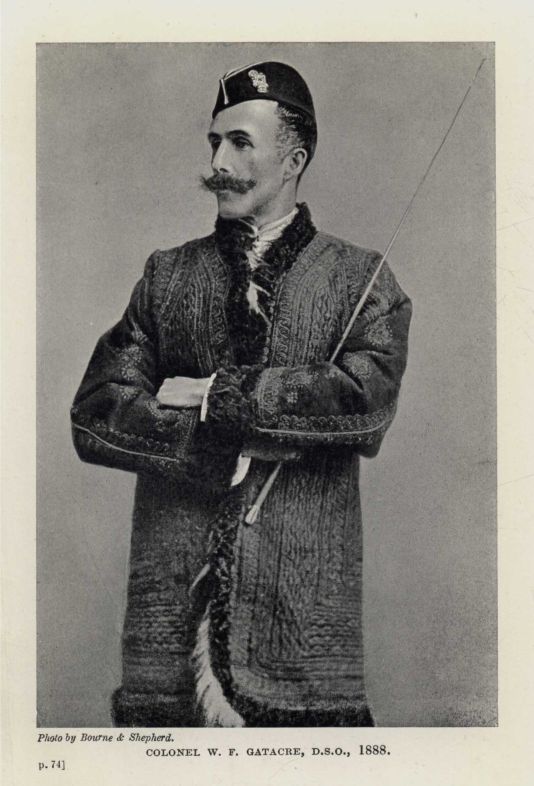
COLONEL W. F. GATACRE, D.S.O., 1888.
The main mass of the Black Mountain lies in
a curve of the River Indus between Thakot and
Arab. To the north and west its slopes are cut
into ridges which descend precipitously into the
deep gorge of the river; to the east the eye
rests on a bewildering succession of pine-clad
mountain ranges, till, stretching over the
vale of Kashmir, it reaches the line of eternal
snows.
The three mountain columns met with little
opposition as they made their way up the spurs
overlooking the Agror Valley. The Headquarter
Camp was established at Khaim Gali, near the
summit of the range, and from that point General
McQueen directed the movements against the
various villages. After about a fortnight General
Channer, commanding No. 1 Column, was able
to open up communication with General
Galbraith in the valley below, at Kunhar. The
latter at the outset had met with some slight
opposition at Kotkai, resulting in the loss of
two officers and five men, but had since made
considerable progress up the river, and had
moreover come to an understanding with the
tribes in his immediate neighbourhood. The
mountainous nature of the country made it
extremely difficult to secure unity of action in
the two regions. It became imperative that
General McQueen should know what General
Galbraith had done and had promised. To effect
this purpose Gatacre offered to make his way
down on foot to Kunhar, where the River Column
had its headquarters.
Visits Galbraith
By this time he was fairly well acquainted
with the lie of the country, for he had been
out daily with the columns, and, according
to his colleague, Major Elles,[5] "had worked
harder than any man in the force." He must
have known that the direct descent from the
ridge on which the Headquarter Camp at Khaim
Gali was situated was a series of precipices.
Taking the figures given on a map compiled for
the expedition of 1891, the elevation of Khaim
Gali is 8,680 ft., while the camp at Kunhar in
the Indus valley is 1,560 ft., which means a clear
descent of 7,120 ft. in a horizontal distance of
less than five miles, though the distance actually
marched worked out at fourteen miles. Major
Elles accompanied Colonel Gatacre, and they
took an escort of fifty Khybari Rifles. The
party left camp at 6 a.m., and reached Kunhar
at noon. Although it was then October, the sun
had great power in the middle of the day; the
narrow valleys down which they crept were very
stuffy, and as they approached the end of the
journey the air became very close and oppressive.
Major Elles confesses that he felt the sun
very much, was tired out, and "could not have
attempted the climb back again that day. But
nothing," he says, "seemed to tire Gatacre, who
was the hardest man I ever met. He neither
drank nor smoked, and ate very little."
After settling the business that was the motif
of the journey, and partaking of the hospitality
of the River Column headquarter mess, Gatacre
announced his intention of starting back at
2 o'clock. The men who acted as escort were
dismayed at the Colonel Sahib's startling decision;
indeed, only half of them were capable of setting
off at once, but these insisted on being allowed
to do so. Half-way up the mountain they were
dead-beat; and as a small party able to take
their place had been accidentally met with, the
services of the newcomers were impressed, and
Gatacre proceeded. It is a question for
mountaineers whether the descent or the ascent was
the more trying to a man's muscular system,
and a question for Anglo-Indians whether the
sun is hotter in the forenoon or the afternoon;
anyhow, it must have been fairly fierce at 2
p.m. in the deep gorge of the Indus, and to have
reached Khaim Gali again the same evening was
an achievement worthy of mention in despatches.
We are told that the first part of the ascent was
very precipitous for about 2,500 ft., and
impracticable even for mule carriage; the next
1,500 ft. was nothing but a succession of steps.
Farther on, the line lay across terraced
cultivation, which involved climbing up the walls
supporting the fields, and walking across the
soft plough which they enclosed, while throughout
the march there were "passages which were
impossible for anything but a goat."
At 11 p.m. that same night Gatacre marched
into the Headquarter Camp at Khaim Gali, the
only man who had completed the double journey.
The two marches had occupied six hours and
nine hours respectively, and two hours only had
been spent in the triple business of negotiation,
refreshment, and repose.
This feat did not pass unnoticed at the time.
The editor of the Broad Arrow of October 20,
1888, says:
"The story is suggestive of physical
endurance and courage, and may be read with profit
by fireside warriors and cynical philosophers
upon the decline of the British officer."
Active service
Such an exchange of views between a
confidential messenger from Headquarters and the
officer commanding a column operating independently
must always have great military value to
the commander of an expedition, and it is evident
that the consultation in this case was not
without result, for in despatches we read that the
first phase of the operations reached its conclusion
on October 20. The Akazais and Hassanzais
made complete submission, and by the end of the
month had paid their fines in full. The object
of the second phase was the coercion on similar
lines of the Parari Saiads and Tikariwals. In
the same way this involved much marching and
counter-marching over the same "exigeant"
class of country. Although there was scarcely
any fighting, doubtless all those who took part
in these operations learned many of the
supplementary lessons of war which no manoeuvres
can ever teach. A British officer in a Goorkha
regiment tells us how he learned one of these
lessons from Gatacre himself.
The Brigade had just reached its
camping-ground: there had been a very arduous and hot
march, finishing with a stiff climb up-hill. The
Goorkha officer had flung himself on the ground,
feeling dead-beat, when Gatacre rode up, and
began making inquiry as to the water supply
of the camp.
"Who is the Quarter-Master of this
regiment?" he asked.
"I am, sir," said the officer, struggling to
his feet.
"What has been done to secure the water
supply from contamination?"
"Nothing, sir."
"I must have a guard put over it at once.
Where is the spring?"
The spring was a thousand feet below. The
commanding officer of the regiment, coming
upon the scene, protested that his officer had
only just come up.
"Never mind," said Gatacre. "It is of the
utmost importance. I order you as Quarter-Master
to go down and see that a sufficient guard
is put round the spring, and that the animals
are kept at a proper distance."
Much against his inclination the officer set
about carrying out this injunction. On his
arrival at the spring he saw the urgency of the
order he was sent down to execute, and confessed
the justice of the call upon his further exertions.
Soldiers, bheesties, and animals were crowding
round the pool, which, fed by a small spring,
was the only water supply for the Brigade. He
quickly restored order, made arrangements for
the watering of the different units, and, by thus
securing the purity of the head-water, eliminated
the chance of fever to thousands of men.
1888-9
On October 28 General Channer occupied
Thakot without resistance; on November 7 a
deputation from the Parari Saiads came in and
made full submission, as the Tikariwals had
done already. On November 12 the Hazara
Field Force began to disperse, having been under
arms for six weeks. The casualties to the whole
force amounted to twenty-seven men killed,
fifty-nine wounded, and eight who had died of
disease, showing that, from a military point of
view, it was essentially a minor campaign.
Moreover, politically, the results were
inconclusive, but to Gatacre it was the field on which
he had won his spurs: "the loyal support and
valuable aid" that he had afforded his Chief
were now for ever recorded; his initiative,
energy, and physical powers had been proved
in the field; his possession of military ability
and soldierly qualities in a marked degree was
now established.
It is difficult to understand why he was
awarded the Distinguished Service Order, which
had been newly created as a recognition of
the services of junior officers in the field, while
his rank as substantive colonel in the army
fully qualified him for a Companionship of the
Bath; but so it was. Seven years had yet to
run before the latter decoration was awarded,
after the Chitral Campaign.
Safe home
Colonel Gatacre and Major Elles did not return
direct to Headquarters on the disbanding of the
force, but made an extended march down the
Indus, and reached Calcutta early in December.
When writing his Christmas greeting to his
father, Gatacre says:
"We are all returned safely from the Black
Mountain, and I must say I for one thoroughly
enjoyed myself; it was rough going, of course,
but the climate was good, and there was plenty
of outdoor exercise—such a pleasant change
after the office life."
After another summer spent at Simla, Gatacre
was sent in October 1889 to act for Sir George
Wolseley, who was then commanding the
Mandalay Brigade. Throughout the three and a half
years that he had served with the Headquarter
Staff, much of the work in the Quarter-Master-General's
office had had reference to the welfare
of the troops which since November 1885 had
been operating in Upper Burma. Gatacre had
taken moreover a personal interest in the success
and well-being of the Army of Occupation, for his
brother John had been serving there in command
of his regiment, the 23rd Bombay Infantry.
The events which had occurred since Gatacre
first visited Mandalay in 1883 will be dealt with
in the next chapter.
MANDALAY
It was with difficulty that the British
Government had lived so long at peace with Theebaw,
King of Burma. In 1883 he sent a mission to
Europe, ostensibly to study western civilisation,
but it was recognised that in reality he was
making advances to the French Government,
who were of course our neighbours on the east,
in Siam. There was also friction over the
demarcation of the Manipur frontier on the west,
but the actual ground for the outbreak of
hostilities arose over a commercial question.
An English trading company found that King
Theebaw had sold over again to the French the
rights over some forest lands for which the
company had paid seven years' tolls in advance.
The High Court of Mandalay upheld their
sovereign's proceedings, so that the corporation
were driven to appeal to the British Government
to vindicate their claims. King Theebaw,
however, flatly refused to discuss the matter with
the Chief Commissioner of Lower Burma. The
British Government welcomed the occasion to
send an ultimatum to King Theebaw "which
aimed at a settlement of all the main matters
in dispute between the two Governments,"[1] and
simultaneously instructed Sir Harry Prendergast
to prepare a force to march on Mandalay.
A defiant answer having been returned by the
King, orders for the advance were issued. A
fleet of transports was escorted by a few vessels
from the Royal Navy up the Irrawaddy. On
November 14, 1885, at a point about twenty-eight
miles beyond our frontier post at Thayetmyo,
the forts at Minhla barred the passage of
the river. Our naval guns then opened fire with
good effect, and when the troops landed there
was no resistance.
Theebaw surrenders
The advance continued, and ten days later a
similar engagement took place about seven miles
from Ava. After the naval guns had silenced
the enemy's artillery, the Hampshire Regiment
was landed, and drove the defenders from their
entrenchments. At 4 p.m. on November 24 a
royal state barge appeared bearing a flag of
truce, and a message that the King "was well
disposed in mind and heart."[2] To this a reply
was sent that nothing less than the unconditional
surrender of the King and his capital would
satisfy the British Government, and that the
response must be received within twelve hours.
The picturesqueness of the scene was so
irresistible that even the official despatch breaks
into description of the "far-famed city of Ava,
with its mouldering monasteries and decaying
walls. On the banks are batteries bristling
with guns, and parapets alive with scarlet-clad
soldiers," etc., etc.
King Theebaw's reply was received by the
time specified, and when translated was found
to express a frame of mind that was acceptable
to the invaders. The subsequent advance from
Ava was therefore unopposed, and on November
28 British troops made their way peacefully
through the streets of Mandalay. In the
afternoon of the next day the King and his Queens
and a suitable retinue were conveyed on board
a steamer and transported to Rangoon, en route
to India. As a compliment to their former
estate, the escort was detailed from the Royal
Navy. It is said that Supya-lat offered violent
resistance to this deportation, saying that she
would prefer death or any fate at the hands of
the Englishmen to life as a state prisoner with
her husband. But she had to conform.
By Proclamation on January 1, 1886, Upper
Burma was declared a part of the British
Empire, and the Chief Commissioner, Sir Charles
Bernard, transferred his headquarters from
Rangoon to Mandalay.
Dacoity
Sir Harry Prendergast had completed his task
in the occupation of the capital, but the
subjugation of the vast province of Upper Burma,
covering about 100,000 square miles, was a very
different matter. The collapse of the Civil
Government and the disbanding of the native
army led to a state of anarchy. Pretenders sprang
up who were exploited by enterprising ex-officers,
and became leaders of the various bands of
dacoits that infested the land. These armed
bands were a terror to the people, for they
lived on the country and robbed and looted freely
but it was not till we had won the confidence
of the peaceable peasants that they would
venture to give us information as to the
whereabouts of their enemies. The fact that there
was no cohesion or community of interest
between these marauders made them the more
troublesome to suppress, as each one had to
be dealt with separately. The pacification of
the country was entrusted to Sir George White
with a force of three infantry brigades. But
as there was no national party in arms against
him, so there was no organised resistance; the
enemy were not soldiers, but a lawless rabble
led by brigands.
In his report of this work in a country which
he describes as "one vast military obstacle," he
says:
"The actual resistance offered to our troops
was not very trying to disciplined well-armed
soldiers, but small bodies of these soldiers have
often had to stand up against bands whose
numbers were estimated in thousands. Between
April 1 and July 31 over one hundred affairs
took place, and few days elapsed without the
occurrence of fighting in some part of the newly
acquired province."[3]
After a time it was found possible partially
to replace the soldiers by specially recruited
armed military police, who were thickly
distributed in all the disturbed districts; and
gradually the more peaceable inhabitants realised that
every time a military raid was organised there
would be a smaller number of thieves and robbers
left in the land.
When the bulk of Sir George White's
expeditionary force was withdrawn, Brigadier-General
George Wolseley, who had been commanding the
Mandalay Brigade, assumed the command of the
permanent garrison. It was as his substitute
that Gatacre held the post from October 1889
to October 1890, with a few weeks' interval in
the spring. Gatacre had been nearly four years
in the same office on the Headquarter Staff, and
his letters show that after the departure of
General Chapman in April 1889 he was anxiously
watching for some new opening for himself.
The change to an independent command was
very welcome, and not less so was the change
from the social life of Headquarters to the wild
simplicity of Upper Burma. The military
direction of such a vast and unsettled province would
provide scope for administration and opportunity
for personal exertion—would, in short, afford all
the arduous duties in which Gatacre found his
delight.
Fort Dufferin
The ancient citadel of Mandalay is now called
Fort Dufferin. It consists of a vast
quadrilateral enclosure, in the centre of which stands
the palace, surrounded by gardens and a high
teak-wood stockade. The walls are 10 ft. thick
and 29 ft. high; each side of the square is a mile
and a quarter in length; at regular intervals
there are gates leading to bridges over a moat
that is more than 200 ft. wide. Along the
walls are numerous picturesque watch-houses
with little seven-roofed pagodas over each gate.
These buildings provided quarters and offices for
both the civil and military departments.
Sir Charles Crosthwaite, who was Chief
Commissioner of Burma when Gatacre took up the
command, writes:
"I lived in one of the pagoda erections over
a gate in the Mandalay wall, and there was a
long flight of steps leading up to my rooms.
I can see Sir William now flying up the steps
and rushing down them, after he had seen me,
and vaulting on to his horse. He was
indefatigable."[4]
The reception rooms in the palace itself were
fitted up as a club for the officers of the garrison.
Some men were playing whist there one evening
in November 1889, when Gatacre came in, and
going up to one of the players asked him if
he knew anything about transport. The officer,
busy with his cards, replied "Not a damn!"
which elicited the unexpected response:
"Will you be my transport officer?"
When the hand was finished the subaltern
turned round, and for the first time perceived
who was speaking to him.
"I am afraid you are chaffing me, sir."
"Not at all. The last two transport officers I
have had knew everything—one could not teach
them anything. Are you willing to learn?"
That officer did his best to learn, and remained
Gatacre's transport officer till his regiment left
the station. He remembers especially his
General's friendly manner, tells us how the dignity
and power of his personality enabled him to
dispense with the formalities of his position, and
to do things which in other men might have
resulted in undue familiarity. There was an
arrangement by which the other staff officer
carried on the work in the office, while the
transport officer accompanied the General on
all his tours. It is to this officer that we are
indebted for the following story.
Maymyo
About forty miles from Mandalay there is a
little hill-station called Maymyo, at an elevation
of 3,500 ft. It is now full of red-brick buildings,
and is the headquarters of the Lieutenant-General
commanding the Burma Division, and there is
a railway up from Mandalay which runs on to
Lashio. But in 1889 Maymyo was but a
collection of huts and tents, and the road that led
thither was not only execrable to travel on, but
infested with robbers. However, it served as a
sanatorium, and the sick folk from Mandalay
had to brave the dangers of the road. The
transport officer had been spending a month at
Maymyo with his wife, and, having met with
exceptional difficulties in making his journey
down, was very much alive to its discomforts.
Only two days before another party had been
attacked, their native driver killed, and their
kit dacoited.
When they met next morning the General told
the officer to lay a dak to Maymyo, as he intended
going there next day. The thought of doing
that journey again so soon was most distasteful,
but the officer only asked:
"What time do we start?"
"There is no 'we' in it. You don't go. I
am going alone."
"That's ridiculous!" followed on, with such
simplicity and directness that both broke into
laughter.
The idea was ridiculous, but it was carried out.
The subaltern's pride of office was wounded by
his being thus set on one side, but when he
realised that it was done out of consideration
to himself, and that no one else was taken, he
could not but be satisfied. Risk and exertion
were like magnets to draw Gatacre; he went
alone, dispensing even with an orderly. The
fastest and most active ponies were always sent
out for the General's use, and it would have
been difficult to find man and beast to keep up
with him when on such an excursion. He must
have made a very early start, for he rode forty
miles up into the mountains, inspected the
detachment of the Madras Native Infantry
quartered there, and returned in time to dine with
the Chief Commissioner. There he met Sir
Frederick Fryer, to whom he related his day's
work. It afterwards transpired that two of the
ponies were broken down by the journey, but
even for such a mishap the General found a
cheerful use. When rallied by one of his
commanding officers on this point, he replied:
"Hard on the ponies! Not at all. Why,
my dear fellow, it is really a good thing, for
the useless ones get weeded out."
In 1886 Sir George White wrote that it
would be a "long time before dacoity died of
inanition."[5] But British methods, worked
with British perseverance, had triumphed over
Burmese institutions. In 1889 Sir Charles
Crosthwaite could write that "disorder and
lawlessness had been put down, and the power
of the Government firmly established and fully
acknowledged."[6] It was, however, reserved for
Gatacre to equip a little expedition which was
to penetrate into the Kachin Hills, where a
leader known as Kan Hlaing was harassing the
country. The General sent the following
telegram to Calcutta on November 25, 1889:
"Chief Commissioner has applied for services
of troops to operate from Bhamo against Lwe
Saing Tonhon Kachins, in Meteilaing, to effect
capture or surrender of Kan Hlaing and
reduction of Tonhon, the chief town. After effecting
this, to march southwards in Binhong and attack
pretender Sairyawuiniz. A column to co-operate
from Ruby Mines district, marching on Momeit.
Bhamo Column to consist of 75 rifles Hants,
two guns No. 2 Bombay, 100 rifles 17th Bengal
Infantry, and 250 rifles Mogoung Levy. Momeit
Column to consist of 50 rifles Hants, 150 Bengal
Native Infantry from Mandalay. Have
complied with his wishes, made all necessary
arrangements. Column will start from Bhamo Dec. 1.
The Momeit Column will reach Momeit about
Dec. 10. Solicits Army's approval."
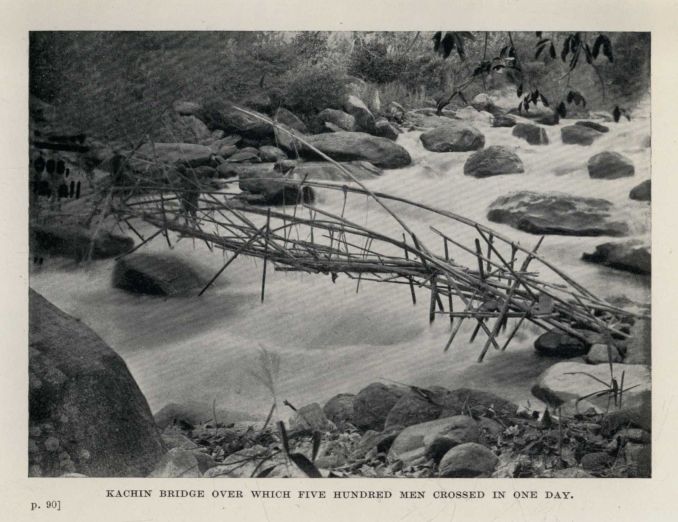
Kachin Bridge over which five hundred men crossed in one day
The Bhamo Column was under Major Blundell's
command, and the Momeit Column under
Major Greenway. Lwe Saing was captured on
December 23, and Tonhon on the 24th, after
sharp fighting. Early in January the force
crossed the Shweli River, which was a fierce
mountain torrent, so strong that the rafts were
swept away, and a man drowned. The passage
over the various rocky streams was a great
difficulty; in one place a swinging bridge was
rigged up with transport ropes and timber; on
another occasion the whole column of five to
six hundred men with their stores were passed
over the Kachin Bridge shown in the picture.
A report arrived that the rebel Prince Sawanai
and the dacoit leader, Kan Hlaing, were strongly
stockaded at Manton, three marches farther on,
and that he had a following of 2,000 men.
The two columns met as arranged, and captured
the village, though it was fiercely defended.
Before the force left Manton, Brigadier-General
Gatacre and Colonel Strover, the Commissioner,
joined the column.
The following letters give the General's own
impressions of the country.
1890
IN THE DEFILE JUST BELOW BHAMO,
February 8, 1890.
"We expect a first-class trip, and should be
away about six weeks. We take a month's
provisions with us, and a fortnight's follow us.
There is a great charm to me in going into quite
an unknown country, full of wild beasts and
savages; there is nearly every animal under the
sun said to be in these jungles, and the place
has every appearance of it: tracks of all sorts
along the river-banks. But we shall soon see
for ourselves. I fancy the scenery will be grand,
and we shall probably get many beautiful
orchids."
BERNARDMYO, March 20, 1890.
"I have only a moment for a line to say
I've 'come out alive' at this end of the country,
which is fortunate. It is one of the roughest
journeys I have ever done, and we have been
wet through for days, with no change possible;
great mountains, with only goat tracks to move
by, had to be climbed two or three times in
the day, which made going most tedious. By
marching from 5 a.m. to 6 and sometimes 7 p.m. we
could only do thirty miles a day; this was
for a ten days' movement, so you may imagine
the country is rough. It's a magnificent land,
however—wild elephants, lots of tigers, and
beasts of every description everywhere, and the
inhabitants perfect savages, but clever beyond
measure at agriculture in their valleys, and on
the hill-sides at weaving, knitting, basket-work,
etc., of all kinds. I went to find the column I
sent out some three months ago, and found it
about 150 miles off; they had had a good deal
of fighting, and lost a matter of thirty men,
which was unfortunate, but it might have been
more. I have ordered them all back, except
100 men to hold a post at Mantone, for if
the rains commence I should never get them
back at all, owing to the impossibility of the
roads. I never saw such a desperate country
for roads, as they call them; a goat would be
puzzled with some of them.
"I hope the Squire and all of you are well.
How I should like to see you all, and have a
dinner at Gatacre! I have not had any real
good food for about two months, but, though
rough, we enjoy what we do get."
A rough journey
Though the leader Kan Hlaing succeeded in
effecting his escape, the expedition had good
effect, for his following was dispersed and his
prestige broken. To all those who had taken
part in this "rough journey" it brought another
clasp to their medal.
On March 27 Brigadier-General Wolseley
reached Mandalay on his return from leave, and
took over the command next day. But before
two months were out, he was wanted to officiate
elsewhere, and Gatacre was sent back to
Mandalay. He had been very sorry to "give up
charge," and was proportionately pleased to
resume the command. In his letters he speaks
of having initiated many experiments which
interested him very much. Writing to his sister
in July 1890, he says:
"I have commenced a Government farm here
on a large scale, about eight hundred acres at
present, but will run up to four or five thousand
acres. I have started elephant ploughs, as the
ground is so hard owing to want of rain that the
ordinary bullock plough is not strong enough,
and if we do not plough now the season will be
too far gone to enable us to get a crop off the
ground this year. The elephant plough has to
be specially made, or the brute will pull it to
pieces; sometimes they get frightened, and then
it is best to clear out, for though the plough
weighs half a ton, it is nothing to a frightened
elephant, who goes straight home with it through
everything. I hope to send you a report on the
working of the farm just now; the Squire would
like to read it. I wish I had that big plough
here that we used to have at Coton; it would
be just the thing for this land. I forget how
many horses it took, but I should put a couple
of elephants in."
Down with fever
During these summer months he suffered
repeatedly from fever.
THE PALACE, MANDALAY,
July 22, 1890.
"I have got influenza, which is a great
nuisance, as it keeps me from my work, and the
doctor warns me solemnly not to go in draughts
and to keep out of the sun; but as my present
abode is merely a large gilt shed, about thirty
yards square, with looking-glass panels open to
the four winds of heaven, it is rather difficult
to follow his advice. Fortunately the open air
always agreed with me, and I feel better to-day,
so I hope I may soon be all right again. The
rain keeps off, and I am afraid we shall have a
famine if we do not get heavy rain soon, for
the rice will fail. I wish I could hear somewhat
of my future; it is a nuisance being left in
doubt as to what I am going to do.
"I wish I had the services of Payne for a bit
in the palace gardens; I would make them so
pretty. We have rocks, grass, water, everything
that one could wish to work upon, but have no
artistic people who understand gardening. I am
working at it, and getting seeds, and hope to
make it a pretty place by-and-by."
MYINGYAN, IRRAWADDY,
August 30, 1890.
"When I last wrote I was in full steam down
the Irrawaddy with the Chief Commissioner, but
I got a bad go of fever, and the doctor put me
ashore, as he thought I would have a better
chance. I was rather bad, but the cool breeze
on the bank has made a wonderful change, and
has quite pulled me round. I've had no fever
since I came, and am beginning to feel all right
again. Of course, I haven't much walk in me,
but that soon comes back with food—that's of
course the difficulty in a place like this, but I've
managed to get hold of a few chickens and cook
them with my servant. Some of them have
turned out a success, others smell of kerosine
oil, but they all have to be eaten, so it doesn't
much matter. I mean to go back to Mandalay
in three or four days, and shall be glad to get
on my horse again, for it doesn't suit me to be
on my back. I have lots to do, and have a
man to write from dictation, which saves me
writing out long official letters, but still I'm
anxious about many things which are being
carried out at Mandalay. This place is just
opposite Pakoko, where John commanded for
a long time, and is very pretty, especially now
the river is in full flood, miles across (five or six
at least)."
S.S. "GEORGE,"
ON THE IRRAWADDY ABOVE MANDALAY,
September 22, 1890.
"I'm off on my travels again, you see. We
started this morning on inspection duty at
Bhamo and Shwebo. We should arrive at the
former place on 26th. We stay there two
days, and then come down to Shwebo on right
bank of river; the trip will do me good, I
think, and will give me some relaxation while
on board. I'm better, but not up to much yet.
"I heard from the C.-in-C. Bombay, Sir
George Greaves, to the effect that he was
applying for my services as A.G. of Bombay Army.
If I get this it will be nice, and I should see a
good deal of John. It's a long time since I've
seen him now.
"The quail here have been abundant, and
the snipe are coming in, but no bags have been
made yet. I only speak from hearsay, as I
have been unable to go out myself, as you will
understand.
"I wish you could all run up the river with
me on this steamer; you would enjoy the
voyage—such beautiful scenery, and such a
river."
A new post
In October the "rightful owner" returned
to the command at Mandalay, and Gatacre
handed over finally. He brought away many
specimens of Burmese art and handicraft. His
own artistic faculties enabled him to appreciate
all that was quaint or interesting in every locality
that he visited. In later life he took great
pleasure in showing his friends the objects of
value or beauty that he had collected, and
evidently looked back on these years of
strenuous service with real delight.
From Mandalay he brought away a teak-wood
drum that had belonged to King Theebaw. It
is cut out of a solid trunk, and stands about
three feet from the ground, weighs about a ton,
and is covered with the most exquisite carving.
He took special pleasure in this piece of furniture,
and in a beautiful silver plate from the Shan
States.
In November 1890 Gatacre relinquished his
substantive post at Headquarters, on his
appointment as Adjutant-General to the Bombay
Army, with the temporary and local rank of
Brigadier-General.
POONA
Brigadier-General Gatacre took over the
duties of Adjutant-General to the Bombay Army
on November 25, 1890, under Sir George Greaves
as Commander-in-Chief.
His deputy in the office was surprised to find
that Gatacre was not so regular in his attendance
as might have been expected, and noticed other
signs that suggested that he was unhappy and
had something on his mind. His colleague was
quite right. Gatacre was indeed passing through
a severe and prolonged trial, one about which he
could take no one into his confidence. To his
highly strung nature, in which the loftiest
integrity was allied to the tenderest human feelings,
a blow such as had fallen upon him must have
wrung every fibre, and there is no doubt that
he writhed under it.
In adversity
It was about this time that the General was
bitten in the hand by a jackal that was said
to be mad. His nerves being already unduly
strained, the poison (or the thought of it) got
such a hold on him that the howling of the
jackals kept him awake at night, and a terror
even possessed him of their coming in through
the open windows. So real was this obsession
that he ordered iron railings to be fixed outside,
and by thus convincing himself of the impossibility
of such a thing, he gradually conquered
the fantasies of his sick brain, triumphed over
his sleeplessness, and reaped the benefit to his
general health.
What was really preying on his mind was not
generally known till his friends read of the
dissolution of his marriage. Gatacre was the
petitioner, and there was no defence. This news
gave rise to a strong feeling of sympathy with
a man whose probity was unquestioned, and
whose attractive appearance and genial manners
had already made him a favourite in Poona.
There was in Gatacre a depth of faithful affection
which nothing could kill; the generosity and
kindliness of his judgment forbad his harbouring
any thought of blame, and he clung with
unaltered loyalty to memories of the past.
Love is not love
Which alters when it alteration finds,
Or bends with the remover to remove.
It is from this time that we find him working
with an acharnement, with a restless and
passionate self-obliteration that became an
unconquerable habit. Ambition stepped in to
revive his interest in his profession, and the
service of his neighbour provided occupation for
his leisure hours.
1890-4
Poona is not only the Headquarters of the
Bombay Army, but for a good part of the year
it is the residence of the Governor of the Bombay
Presidency. In the hot weather both civil and
military officials retire to the country life of
Mahabuleshwar, and in the cold weather spend
a few weeks in Bombay City. Thus all the year
round there was a succession of official and social
engagements; every one had rather more to do
than there was time for in office hours, and
every one wanted to put in an appearance at
such social functions as appealed to his particular
tastes. Gatacre not only took part in all these
events, but was the prime mover and organiser
of everything that went on—no committee of
management, no horse-show, gymkhana, or
display was complete without his name. Amongst
other details the programmes engaged his
particular attention. He had a special chalk
which, when used on prepared paper, could be
reproduced as a lithograph by a very simple
process. He rapidly gained great facility in the
use of this medium, and there is now quite a
remarkable series of exquisite drawings that
were thus reproduced. A lively sense of humour
animates some of these efforts, more especially
those that did duty as hunt-cards. The card
was the size of foolscap paper; each season had
a new drawing, but all were variations of the
study of foxes, while words were put into their
mouths expressing the sentiments of the quarry
towards Doctor Bull's hounds.
A.G.
The position of Adjutant-General is one of great
influence, and this influence Gatacre invariably
used to promote the cause of uprightness and
true benevolence. There was no red-tape about
him; he was always accessible to all ranks, and
instantly ready to deal with any emergency.
On one occasion the friends of a young officer
wanted to get him out of the way of temptation—the
Adjutant-General detailed him to some
outlying station. On the other hand, a young
cavalry officer from Mhow, who was engaged to
a lady in Poona, found himself unexpectedly
detained at Headquarters by the A.G. If
an officer and his family on their arrival were
unable to find quarters, the A.G. would take
the whole party in, regardless of any previous
acquaintance. In the club one day Gatacre
noticed the name of a young officer on the
Headquarter Staff posted up as having failed
to pay his club account. He sent for the
officer and paid his bill, choosing to come himself
to the rescue rather than that a young fellow
in an honourable post should suffer disgrace.
Thus many an unrecorded kindness, many a
deed of silent sacrifice, showed the natural
generosity of his heart, showed his freedom from
any taint of bitterness. Instinctively and
deliberately he endeavoured to obliterate his own
sorrow by adding to the happiness of others,
and in this way surrounded himself with an
atmosphere of esteem and gratitude which
reacted powerfully for his own benefit. The
officer who succeeded him as Adjutant-General
had worked in his office for some time, and he
now writes that the thought of him revives the
"deep impression of what a dear, good fellow
he was, and how hospitable and kind."
1891
Gatacre's efforts at hospitality once gave rise
to much amusement on the one part and dismay
on the other. He usually kept but a small staff
of servants, and dined at the club of Western
India; but when there was some special gaiety
going on, he would fill his house with guests
from the outlying stations, and instruct his
bearer to engage a good cook and other servants
for the necessary period. At the Poona Race
Week one year Gatacre's friends were
complimenting him on the excellence of his
arrangements, and stories were related as to the
enormities of which native cooks are sometimes guilty
in the preparation of the Sahib's food, and of
their troublesome ways in general. One lady
was particularly eloquent on the annoyance of
having had to part with her khansama only a
few days before in order that he might go and
nurse his wife, who was dying. Some one
suggested a tour of inspection round Gatacre's house,
which he had held up as a model establishment.
When the party reached the cook-house, I leave
you to imagine the lady's surprise and
amusement at finding her own truant cook installed
for the nonce in her host's kitchen!
His easy camaraderie of manner was so
remarkable that a friend once asked Gatacre
whether he had ever found that people took
advantage of it, and treated him with undue
familiarity, to which he replied that he had
never known them try. He defended himself
with a dry and subtle humour. Assuming an
impenetrable blandness of manner, he would on
occasion utter sarcasms so veiled that some men
could scarcely tell whether he was in earnest or
not. He was never angry, but he had a
command of quiet language that made his remarks
as stinging as they were humorous. The man
on the pillory would feel the sting, and the
onlooker would see the humour.
When another friend asked him why he was
taking so much trouble over a matter that
appeared outside the sphere of his interests,
and scarcely worthy of the attention that he
was lavishing on it, his reply seemed weighted
with reproof as he said: "I don't think I ever
knew what the meaning of the word trouble was."
Goes on tour
In the province of Bombay the inspections
take place in the cold weather between November
and March; a spell of hot weather then precedes
the break of the monsoon early in June. The
rains last till September, and are followed by
another spell of hot weather, till the air cools
down again to quite a pleasant temperature in
November. The first inspection tour arranged
for the end of 1891 included a visit to the
regiments quartered at Kamptee in the Central
Provinces. Kamptee was the Headquarters of
the Nagpur District, to the command of which
Brigadier-General John Gatacre, C.B., had been
recently gazetted. To those who have heard of
"inspection fever" (and even the best officers
are not always immune), it will be obvious that
the station must have been in rather a
commotion at the idea of a visit from the
Commander-in-chief only four days after the arrival of a
new General Officer Commanding. But the new
General was well known and trusted in Kamptee,
for he had already been in the station for three
years while in command of his regiment.
A railway accident
Between 6 and 7 a.m. on November 5 the
General was on the platform of Nagpur Station
awaiting the arrival of the train, when a
telegraphic message came in, saying that there had
been a serious railway accident to the Chief's
train about nine miles away. A message was
sent back for medical assistance, and as soon
as possible a break-down gang was got together,
but it was nearly 11 o'clock before the relief
train reached the spot. General John tells us
that the sight that greeted him was more
shocking than any battlefield. Eight men of the
North Lancashire Regiment were killed outright,
twenty-four were severely injured; a European
guard, both drivers and both firemen were killed;
five native passengers were also killed and eight
wounded. Beyond this total of eighteen deaths,
four soldiers died within the next few days in
hospital. The framework of the carriages, the
iron rails, and the men's rifles—everything was
amazingly crumpled up and distorted.
The permanent way at this spot runs along a
thirty-foot embankment. The whole train was
derailed, both engines with their tenders, a
horse-box, and five or six coaches had rolled
to the bottom of the slope; the next carriage,
in which Sir George Greaves had been travelling,
was suspended half-way down the bank at an
angle of 45°, the body having been completely
wrenched away from the platform; and the last
coach, which had been occupied by the staff
officers—Gatacre, Hogg, and Leach—was hanging
in the most precarious position over the edge.
It turned out that the train was unusually
long and heavy that day, as it was bringing
some fifty men of the North Lancashire Regiment
back from Chi-Kulda, a civil hill-station in the
Berars, where a few sickly men had been sent
as an experiment. When the railway officials
at Budnari Junction found that the three coaches
set aside for the use of the Headquarter Staff
had also to be attached, they feared that the
engine would not be powerful enough to pull
the train up a certain incline, and gave directions
that a spare engine (which was meant only for
local shunting work) should be put on in front.
This supplementary engine was the cause of the
misfortune, for the tyres of its wheels, having
been mended, gave way under the unusual strain
of a long journey. The front engine left the
metals, and, rolling over, pulled the whole train
along with it.
The great majority of the fatal cases were
of course in the first two coaches, in which the
soldiers were unfortunately travelling. Some (of
the poor fellows suffered fearfully from scalding,
over and above terrible fractures and injuries;
some were so inextricably wedged in amongst
the wreckage that it was not till the relief train
came up with jacks and crowbars that anything
could be done to relieve their excruciating
sufferings. None of the staff officers were hurt,
but Colonel Hogg had a narrow escape, for the
end compartment, in which he had been shaving
a few minutes earlier, was completely staved in
by impact with the Chief's coach in front.
In the official report forwarded by Sir George
Greaves we read:
"I desire to record with pleasure that the
officers of the Headquarter Staff were conspicuous
in their efforts to release the injured from
the wreck of the train, especially Brigadier-General
Gatacre, A.G., Lieutenant-Colonel
Leach, Military Secretary, and Captain Peyton,
A.D.C., all of whom, at considerable personal
risk, worked in under the overturned engines
and carriages to get at the wounded."
There were also miraculous escapes. A
gymnastic sergeant was travelling in the first coach
with two small dogs on his knees. Owing
apparently to his trained activity, he was able to
leap through the window, and thus escaped
without injury from a compartment where all
his companions were killed.
As soon as possible the wounded were sent
on into Kamptee under the charge of their
companions, and it was three o'clock before the
train got back again to pick up the staff officers.
"Such good sons"
On his arrival in Kamptee a telegram was
handed to Gatacre, informing him of his father's
death. This was not unexpected, but for both
brothers it must have added a more profound
and personal sadness to the horrors with which
the day had begun; and as next day they
listened to the Service read over the poor young
fellows who had been so suddenly struck down,
their hearts must have been at Gatacre, where
the same words would soon be read over the
old man of eighty-six whom they had so sincerely
loved and reverenced. Only a few days earlier
they had sent a telegram of farewell in their
joint names; and in due course had the
satisfaction of hearing that it had arrived just in
time to please the dying man, who murmured
in response, "I thank God for such good sons."
On April 1, 1893, Lieutenant-General Sir John
Hudson took over command of the Bombay
Army; only two months later he was killed
by a fall from his horse. The Commander-in-Chief
was taking his usual ride with Colonel
Leach, his Military Secretary, before breakfast
on the morning of June 9, when his horse
stumbled heavily, throwing Sir John forward on his
head. Six weeks earlier Sir James Dormer,
Commander-in-Chief in Madras, had met with
his death while out tiger-shooting, so that this
further catastrophe came with added force to
the sister Presidency.
Gatacre had written home a few days before,
saying how genial and kindly he found his new
chief, with whom he was already on intimate
terms. It was always a great satisfaction to
him to think that the horse which had made
the blunder was not one of his choosing, for Sir
John had already sought his advice in the matter
of getting himself provided with chargers. As
chief staff officer it fell to him to make all the
arrangements for the imposing ceremony that
took place at 8.30 a.m. on the day following the
tragedy. Lord Harris, the Governor, came down
from Panchguni for the occasion. By special
instructions he placed a wreath on the coffin in
the name of Her Majesty the Queen, and
numberless similar tributes showed the respectful
sympathy of the whole army. The Guard of
Honour was furnished by the 2nd Battalion
Lancashire Fusiliers; all the troops in garrison,
both in Poona and Kirkee, accompanied by
massed bands, took part in the solemn
procession. It is said that five thousand men
attended the funeral, and that the whole was
so admirably thought out and arranged in the
short space of time that no confusion or difficulty
arose at any point.
Hands over
In due course Sir Charles Nairne, R.A.,
became Commander-in-Chief of the Bombay Army.
He was the last of the race, for during his tenure
of the office its name was changed, and he
handed over as Lieutenant-General Commanding
the Bombay Army Corps. The office of
Adjutant-General was also renamed, but that
was not until after Gatacre had been succeeded
by General Reginald Curteis. Sir Charles was
the third Chief under whom Gatacre had served
in this capacity in less than three years. But
as these changes made no difference to Gatacre's
loyal service, so there seems to have been no
difference in the high esteem in which his
seniors held him. When he relinquished his
post, some eighteen months later, the same
cordial regard had grown up which he always
contrived to win from all those with whom
he was associated either officially or socially.
When I came to live in the command, about two
years later, there was no household from whom
I received a more genuine welcome than from
Sir Charles and Lady Nairne and their personal
staff.
Early in 1894 the Adjutant-General was
appointed to the command of the military district
that had its headquarters at Bombay.
BOMBAY
Colara
Although the climate of Bombay, which is
situated on the nineteenth parallel, did not offer
the attractions of Poona, and although the
appointment brought no promotion in army rank,
still Gatacre welcomed the change of work, and
the accession of dignity and opportunity afforded
by an independent command. On January 30,
1894, his selection for the command of the
Bombay District was gazetted, and shortly
afterwards he moved into the bungalow in the
Marine Lines, which then formed the official
residence. Of this quaint building he was the
last tenant, for three years later this relic of
Old Bombay and its naval neighbour
disappeared under the consuming flame of the Plague
Commission.
This house and the adjacent one which
sheltered the Admiral were historic erections, being
survivals of the days when the Englishman first
pitched his moving tent in these regions. For
the original canvas covering of the tent,
"jaffray-work," or plaited palm-leaves, had
been substituted, which had to be renewed each
year just before the monsoon broke; this roof
was supported on wooden columns that were
the successors of the original tent-poles, and
made a quaint feature in all the rooms. The
canvas walls of the tent had been replaced by
Venetian shutters; the doors were made of
cotton stuff stretched on a frame, which left a
large space above and below the eye-line. The
deep verandah, on which greenhouse creepers
sprawled luxuriantly, covered a space wide
enough to allow of dining and sleeping out-of-doors.
The weather is warm all the year round, and
becomes exceedingly damp and oppressive in
the spring and autumn, while in the summer
the monsoon winds bring a rainfall of nearly
300 inches in three months. White uniform is
worn throughout the year, even on full-dress
occasions. At the extreme point of the island,
in the breeziest and healthiest situation, there
are barracks for one British regiment, and hard
by is the beautiful chapel raised as a memorial
to those who fell in the Afghan Campaign of
1849. It was an exceedingly pretty sight to
see a regiment of men all clad in spotless white
file into their places on a Sunday morning. The
rifle regiments wear their black buttons and
ornaments, and one would say that nothing
could be smarter, until the reliefs bring another
corps, who with their gold buttons and belts
produce a more brilliant effect.
According to the military classification,
Bombay is a Second-class District, held by a
Brigadier-General, who is not really a General Officer,
but a full colonel with temporary rank. A
First-class District is held by a Major-General,
whose importance is further marked by the
presence of an A.D.C. There is, however, so
much ceremonial work peculiar to Bombay that
the General often wished that he had been
granted the services of such a young officer,
as a way of saving his regular staff.
Transports
Gatacre held this command for more than
three years—from January 1894 to July 1897—but
for eight months in the summer of the
second year, 1895, he was on active service in
Chitral, and for the same period in 1896 he was
officiating at Quetta. Owing to the difference
in climate he thus served for five drill seasons
in succession. Although these two short
episodes will be dealt with separately, the fact that
he did duty through the cold weather for three
seasons in Bombay seems to justify also a study
of the conditions peculiar to that command.
So far as the passenger traffic is concerned,
Bombay is the port of India. It is the quickest
route to all the provinces, even as far east as
Calcutta. All the transports between England
and India call at Bombay, and the vast majority
of troops are there embarked and disembarked.
In consideration of the work entailed in
arranging the transport service, an extra Deputy
Assistant Adjutant-General was allowed on the
staff; practically this department of the staff
office was the shipping agency for all the reliefs
throughout India. Not only had the transhipping
and railway arrangements to be made for
every regiment on its arrival and departure, and
for drafts of men from every branch of the
service, but privilege passages had to be allotted
to the innumerable officers and their families
who, when going home on leave, hoped to avail
themselves of the chance of a vacancy on a
transport. The rule in allotting these passages
was that the junior officer should take
precedence, Government having apparently in mind
that their scale of pay gave them the first title to
consideration. At the same time, senior officers
were often needed to take command of a ship full
of details, and sometimes had to be searched for,
Army nursing sisters, too, had special claims.
All these conflicting interests gave rise to
almost as many private letters as there were
official applications. Ladies and children would
come and live in Bombay in the hope of
securing a vacancy at the eleventh hour—a
device which was often successful. There were
numberless hard cases and jealousies over
these passages, and many funny stories were
told. It was whispered that if an applicant
called in person on the General, her chances
would be in direct proportion to her personal
attractions. The amount of baggage allowed
was also a source of infinite vexation. Once a
nursing sister, who had recently married an
army surgeon, asked to be allowed to send her
effects under her maiden name, as the scale of
baggage allowed in her professional capacity
was slightly higher than that considered sufficient
for a captain's wife.
During the loading and unloading of these
transports an officer of the General's staff had
to be continuously on duty to attend to any
matter that might arise, and to check the
freight, live and dead. This was a tedious and
very irksome duty, and, considering the amount
of work going on in the office during the winter
months, the time thus spent could be ill spared.
The General made a practice of calling in person
on all transports immediately before their
departure, at whatever hour it might be, and soon
after their arrival. If a homeward-bound vessel
was starting on a midnight tide, he would dine
in his picturesque white mess-dress, and thus
be ready to go and pay his official visit of
farewell. The house was a long way from the
Bunder, so that this duty involved a drive of
more than a mile, and a run across the harbour
in the Government launch, which was always at
his disposal. In that intensely Oriental setting
the thrill of living (as it were) in the exchange,
and seeing the great ships that go down to the
sea carrying their load of joyful anticipations,
was irresistibly moving. Gatacre was thus on
terms of personal friendship with all the captains,
and used to ask them to his own house. As
a Christmas recognition of such attentions, the
captain of the Victoria sent up a specially selected
sirloin of English beef one year on the morning of
December 25. All who have tasted Indian beef
will know that this was a rare delicacy.
The Navy
But transports were not the only vessels in
Bombay Harbour. There were ships from the
Royal Navy, ships from the foreign navies, and
Peninsular and Oriental weekly mails, outward
and homeward bound.
Between the navy and the army there was a
strict etiquette regarding the exchange of visits.
Writing from Bombay on November 3, 1909,
General Swann tells us that—
"The procedure in the matter of ceremonial
calling was for a staff officer to go on board
within twenty-four hours of a ship's arrival and
arrange for the exchange of visits between the
captain and the general; the first visit was
made by whichever was the junior of the two,
and both visits were supposed to be over within
the twenty-four hours."
Such official visiting had also to be attended
to with great punctuality in the case of foreign
warships, and on these occasions a bottle of
champagne would be produced at any hour, and
the health of the respective sovereigns
ceremoniously toasted. The General particularly
exerted himself to entertain these foreign guests.
When a Russian vessel was in the harbour he
asked the captain and three or four officers to
breakfast at his house, inviting some ladies who
could talk French to come and entertain them.
On another occasion, when an Italian vessel lay
at anchor, the General writes:
"I got up in the middle of the night last night
to take the Duke of Savoy and his staff out
hunting to-day. He thoroughly enjoyed
himself, galloped to his heart's content, made himself
very sore at the knees, and came home perfectly
happy. I got back just in time to dress for
parade service, but could not get time for
breakfast. Went to church, and got back to
luncheon at 2.30."
1894-7
The hunting days in Bombay were Thursday
and Sunday mornings; horses were sent on
overnight. The meet was at daybreak at a place
reached after about forty minutes in a train
that left the station at 4.30 a.m. Hounds moved
off as soon as the light allowed. It was a
sporting country, for there were plenty of jackals,
and the ground varied from soft ricefields,
enclosed by Irish banks, to hard rock and heavy
sand in which prickly-pear hedges were
disagreeably abundant. The hunt usually returned
to the Jackal Club Camp in time for the 8.30
train, and all the men got back in time to be
at their offices by 10 o'clock. Every one in
Bombay has an office of some sort, for no one
would live there unless forced thereto by the
necessity of fulfilling their vocation.
Another feature of the Bombay command was
the constant semi-official attendances at the
railway station and elsewhere. Whenever His
Excellency the Governor, or His Excellency the
Commander-in-Chief, or His Excellency the
Admiral Commanding the East Indian Squadron
passed through the station, the General Officer
Commanding was there to receive him, or to see
him off as the occasion demanded.
Guests
It was also his pleasure to meet any friends,
official or private, who might be arriving or
departing by the mail. There was hardly a
week when his launch was not in attendance
on the mail-boats. These usually arrived at
daybreak, but for Gatacre no hour was too early.
One morning the mail was to bring a general
officer who was on his way to take over a
command up-country. His son, already
appointed as A.D.C., had come down to Bombay
to meet his father, and had called at the Staff
Office on the previous day. The General offered
to take him on board in his launch, as he was
himself going to fetch his guest home to
breakfast, and named the hour. But when the General
stepped into the launch next morning the A.D.C. was
nowhere visible on the Bunder. Afterwards
the young man turned up, and his father said
with a carelessnesss of speech which Gatacre was
quick to detect: "May I introduce you to my
son?" To which Gatacre replied: "You may
bring him up to me if you like."
It was one of the paradoxes of Gatacre's
character that he was sometimes as punctilious
about fine shades of etiquette as he was on other
occasions kindly when such subtleties interfered
with his mood or his purpose.
All through the cold weather the General's
house was full. There were the friends going
by the mail to whom an invitation would be of
the greatest convenience; there were the friends
arriving by the mail who must stay one night
to clear their baggage before starting up-country;
there were the friends who had entertained him
when inspecting at their station, and whose
daughters would enjoy the gaiety of the city.
He was very fond of ladies, and minutely
thoughtful for every detail which might
contribute to their comfort or pleasure while in his
house.
Over and above all these calls on his time
there was still the soldiering. The district
covered a considerable area, extending northward
as far as Cutch-Bhuj in Kathywarj and
including many inland stations such as Ahmedabad,
Baroda, Surat, and Khandalla. There was also
a detachment of the Marine Battalion in the
Persian Gulf. All the arrangements had been
made for an official visit to Bushire in the spring
of 1896, and it was with great reluctance that
the General gave up this trip when he found
himself under orders for Quetta.
It was the soldiering that he loved, and it
was for this love of the soldiering that he
deliberately overworked himself. No personal
considerations had any weight. Having no one
at home to watch over him, he became recklessly
irregular at his meals, and would sit up to all
hours of the night writing—endlessly writing.
What kept him going were the trips up-country
to inspect the outlying regiments and
detachments; for in the train he would make up his
arrears of sleep, and the rules of politeness
secured his punctual attendance at meal-time.
The uncertainty of his hours was a matter of
some comment at the office, where no doubt it
gave rise to considerable inconvenience, and
probably not less troublesome was his habit of
utterly disregarding the usual luncheon interval.
The General was playfully conscious of all these
misdemeanours, for on bidding good-bye to his
chief staff officer on his departure for Quetta,
he said:
Office hours
"Now you will be all right—with a brand-new
General whom you can educate to attend the
office regularly at eleven, and go home to tiffin
at two."
This officer, however, bore him no grudge for
his vagaries, and now writes with great affection
of his old Chief.
POONA, September 17, 1909.
"As his staff officer there were two points he
used to impress on me—'No difficulty' and
'No finality.' Difficulties, like hills, were
useful for the exercise they give in surmounting
them. There is no difficulty that cannot be
overcome somehow. No finality is the
watch-word of progress. What may seem best to-day
can be improved upon to-morrow, but that is
no reason for deferring action indefinitely: 'The
best is the enemy of the good.' Act on what
seems good at the moment, and trust to time
and opportunity to find something better to act
on later. But act, and act promptly. This, I
think, sums up the principles he tried to instil
into me, and his example illustrates his teaching.
"I never served under a chief who thought
more quickly, decided more readily, or acted
more promptly."
During the last week of November 1894 the
Viceroy, Lord Elgin, arranged to hold a Durbar
at Lahore. There was to be a great gathering
of the native princes of the Punjab, and a
concentration of British, Native, and Imperial
Service troops. The Viceroy and the
Commander-in-Chief both had large camps, to which
they invited guests from all parts of India.
Having received the offer of a tent and the
hospitality of his camp from Sir George White,
Gatacre selected the two best-looking chargers
in his stable and repaired to Lahore in the
highest spirits.
1894
In a letter written a little later, however, he
confesses that it was not the attractions of the
Durbar that took him so far out of his command
at such a busy time of the year, but the
expectation of seeing some one again whom he had
recently met as she passed through Bombay.
For the guests a Durbar week is a holiday; the
General was a free man—he had only to look on
and enjoy himself. There were many official
functions where every one was gloriously
apparelled, but he looked as splendid as any in
that brilliant company; and there were many
social festivities which afforded opportunity for
daily intercourse. It was during the picturesque
pageants of the Lahore Week that I came under
the spell of the General's charm. To know him
was to love him, as many another has since said
to me. During that week we learnt to know
one another, and at the end of it he wrote a
frank manly letter to my father, Lord Davey,
begging him to sanction the idea of our marriage.
I regret that the kindly reply to his honest
exposition of the whole matter has not been
preserved; its purport being in accordance with
our hopes, the engagement was made known,
and I had the gratification of hearing my
General's praises on all sides.
In some letters of December 1894 he
intentionally writes about himself, and supplies us
with the incentives which inspired him.
"I am always thinking of how I can get on,
not for the sake of the money it brings, but for
soldiering itself."
And again:
Soldiering first
"I hope you will not mind my love of soldiering
and work; it has such a fascination for me,
I am inclined to put it first always. But my
love for you will stand out first, and your love
for me will enable me to carry out my work at
personal inconvenience to ourselves, won't it?
You see I am cunningly trying to get you to
overlook my endeavours to think of soldiering
as the first thing, but, dear, you will always be
in my heart all the time."
Perhaps it was by contrast with the slackness
natural to the soft climate of Bombay that
Gatacre's indomitable spirit attracted so much
attention. Colonel James Arnott writes:
"Working, as I did, in the Civil Department,
I had no official association with your husband,
and it was only when he commanded the Bombay
District that I got to know him at all well. I
was much impressed by his keen interest in his
profession, his strong esprit de corps, his
enthusiasm for work, and the activity and strength
which enabled him to carry it on in a way to
stimulate others. I have a clear recollection of
his active figure and his first-rate horsemanship,
riding, as he often used to do, bare-backed, an
indication of character and of those qualities so
necessary in a soldier.
"General Gatacre took his share in everything
of public interest in Bombay, but I shall only
refer to the very successful Assault-at-Arms
which he organised—the first and best thing of
the kind that I saw in my long residence in
Bombay."[1]
[1] September 13, 1909.
The first tournament
This tournament was a great event. The
large grass-covered enclosure known as the Oval
was borrowed from the Municipality for the
purpose of a Grand Naval and Military Display
and Assault-at-Arms. This space, flanked on
one side by the Town Hall, and on the other
open to the sea, offered every facility for such
an undertaking. Admiral Kennedy, who was in
residence for Christmas, willingly co-operated;
his handy men rendered most valuable assistance,
the naval element lending a distinction
of which only a Bombay Assault-at-Arms could
boast. An attractive programme was made out
and entries were invited from all the stations in
India.
It was of course necessary to get subscriptions
and guarantees; but the General was
already personally acquainted with all the
leading men in Bombay, and had no difficulty in
getting what he wanted. The Governor and
the resident native princes gave their support
and patronage, and many wealthy merchants,
realising the great local expenditure that such a
tamasha must involve, contributed generously.
In the friendly relations established with the
citizens of Bombay over the multifarious
business of this tournament lay the secret of the
facility with which Gatacre two years later won
them to accept his views about segregation.
Every detail of the entertainment had the
General's personal attention; his fertile brain
organised and perfected the whole and every
part, his hands painted the scenery of the Soudan
Village, his horse carried the officer's daughter
who, in the gay uniform of the Royal Horse
Artillery, opened the proceedings by presenting
His Excellency the Governor with a programme
in a silver case. The incessant labour entailed
by this vast undertaking, and the strain necessary
to honour all its calls upon him while carrying
on simultaneously the routine of his official life,
can be best expressed in his own words.
Writing on the Thursday before the tournament,
which was to open on Monday, December
17, he says:
"Before I met you I thought there was only
one thing in the world, and that was soldiering;
now I think there are two, but the soldiering is
at present the only one I have got. I have been
busy to-day, and in a fever about the whole
thing. I have been calling on the Italian ship,
drinking 'The King and Italy,' again very bad
when one has fever, I should say; but no matter,
the champagne was very good. The levee is just
over, the whole world pouring before Lord
Harris, and now I am going to paint till about
3 a.m. to-morrow. I have half a town to do,
and no one seems able to originate anything."
On the 18th, after the first day's performance,
he writes:
"What will you say to me, not writing to
you yesterday? But if you only knew the sort
of day I have had! First I was busy in the
office, could not move from my chair till 4 o'clock
p.m.; then I had to dress and meet H.E. the
C.-in-C. at the station at 4.45, then to meet the
Admiral at the Apollo Bunder a mile away at
5 o'clock—all official receptions; then to go to
the Tournament to see all was right, finish painting
scenery, entertain the Governor's party at dinner,
go to the Tournament, watch it till 1 a.m., then
drink 'the King and Italy' with the Italian officers,
who remained till the last. Finally, at 2 a.m.,
commence to count with an enormous staff of
clerks 10,000 tickets, to see if the money was
right. You see, I am responsible, and I like
to be sure what we are doing. Well, dearest,
the thing was a tremendous success. We sold
10,000 Rs. worth of tickets last night, shall sell
probably 11,000 Rs. to-night, and so on.
Tent-pegging
"Everything went well. The light was not
as good as I should wish, but it was fair. We
had no accident in the ring, but got a horse
killed afterwards, his leg being broken by a
kick.... Well, I finished these beastly tickets
at 4 a.m., and at 7 had to go tent-pegging for
an hour, and since then have never sat down,
so you see why I did not write. Now it is 5.30
p.m., and I am so tired—or at least my eyes are;
and I shall not have a chance to rest till 5
a.m. to-morrow; it will take us all that time to check
the takings."
On the 21st, when it was all over except for
the prize-giving and the congratulations, he
writes:
"I have fever this morning; have not had
any sleep for days, and had to run in the Open
Competition for Officers' Tent-pegging, which I
won easily, taking both pegs and then touching
two more turned on edge. I was rather pleased,
as no one else touched one sideways at all, and
all were about twenty years younger than I!
My team ran fourth for the Duke of Savoy's
Cup; my men could not ride well enough; I
got both mine.
"To-day is the final ceremony. You have never
seen such an extraordinary multitude; tens of
thousands of children, who pay one anna each,
crowding round the place endeavouring to get
an entrance. I do wish you were here to see
the unusual activity reigning in the town and
the excitement we have caused."
It was the novelty of the thing that gave
importance to this tournament; the idea has
since been carried out in many stations with
marked success. It is interesting to note that
such a gathering has also an indirect value; it
promotes camaraderie between different branches
of the service, and shows how much pleasure
may be provided to both competitors and
on-lookers by what was essentially "soldiering"
in its inception.
In The Times of India we read:
"At the close of the Commander-in-Chief's
speech three ringing cheers were given for His
Excellency and a similar number for Brigadier-General
Gatacre. The Commander-in-Chief
having then left the arena, the troops left the
ground with bands playing, the men-of-war's
men as a special and well-deserved honour being
escorted to the Apollo Bunder by a regimental
band, and followed by a large crowd of civilians.
Several of the troops in camp on the Oval visited
the flagship H.M.S. Bonaventure, and the
turret-ship Magdala yesterday morning, while others
were taken for a cruise in the harbour, a number
of the up-country native troops being taken on
a visit to inspect the local cotton mills.
"The work of demolishing the enclosure and
removing the plant has already begun, and
to-day the majority of the troops will be en
route for their up-country stations, many of
them taking back prizes and other mementoes
of the well-organised, well-managed, and finest
military display and gathering of its kind ever
held in the East."
As soon as it was all over Gatacre took ten
days' leave to Calcutta, where he was welcomed
with surprise and pleasure by his friends of the
other side.
CHITRAL
The annual inspections in the Bombay District
for the season 1894-5 had all been carried out,
confidential reports were rapidly being filled
in, and got ready to forward to Headquarters,
the arrangements for the sailing of the last
transport were all settled, and all work was
beginning to slacken in Bombay with the
approach of the hot weather. Gatacre was
making a push to conclude the season's work
with a view to taking eight months' leave to
England. In theory this long leave can be
secured once in every five-year command; but
Gatacre had now completed two such appointments
without availing himself of this privilege,
having been content with the sixty days' leave
allowed each year.
But whatever might be the special reasons
which drew him homewards in 1895, a better
thing still was in prospect for him: in
whole-hearted joy he writes on March 15:
"I am so pleased: have got a telegram from
Sir George White saying, 'Have nominated
you to command Third Brigade in Division to
be mobilised for possible service Chitral.' This
is a first-class business, for though it will
prevent my coming home so soon, still it is a step
onwards, and that is what we want, isn't it,
dear? I am so pleased at getting this chance,
and will do my best for your sake and my own."
The Third Brigade
The Chitral Relief Force was under the
command of Sir Robert Low; the expedition was
organised to effect the relief of Surgeon-Major
Robertson, I.C.S., and some half-dozen officers
who were shut up with a small garrison in the
fort at Chitral. We are not concerned here
with the internal events which had culminated
in the siege of the fort by a hostile faction;
suffice it to say that the Government of India
regarded the matter as very urgent, and were
sending a strong division of both British and
Native troops to their assistance.
Sir Robert Low's force was to approach from
the south over the Malakand Pass, and to
make its way up the valley of the Chitral River.
This was a route which had not hitherto been
used by the Indian Government, and covered
about 185 miles. Communications with Chitral
had previously been maintained from the
north-east, via Gilgit. During the winter months
this latter route was closed, as the road lay
over snow-covered passes; the distance was
about 160 miles from Gilgit, and this was the
recognised access and the base of supplies for
the little garrison. And so it came about that,
in response to messages from Major Robertson,
Colonel Kelly was endeavouring to reach him
from Gilgit, undismayed by almost impassable
winter snows, at the same time that the Indian
Relief Force was advancing with similar
intention from Peshawur.
In a letter from Mian Mir, March 24, 1895,
Gatacre writes:
"I leave to-morrow to take command of my
Brigade at Hoti Mardan, about twenty-five miles
north-east of Peshawur, and we shall march
from there on April 1, right away for Chitral;
but without doubt we shall have some rough
work and some fighting. Umra Khan knows
he will have no mercy after destroying Captain
Ross's detachment, and will do his best to raise
the whole border against us.
"I have four first-class regiments—the
Seaforth Highlanders, the Buffs, the 25th Punjab
Infantry, the Second 4th Ghoorkas, and we are
all sound and prepared to go anywhere, so I
hope we shall all come well out of it.
*****
"I think myself we shall have to drop our
tents, small as they are, and march without
them. Our difficulty will be crossing deep
rivers; we shall have no boats, and must trust
to making rafts of skins and floating the men
across; but it is always a shaky business when
there are bullets flying about."
On March 30, in drenching rain, the first
troops marched out of Hoti Mardan; on April 2
they met the enemy, who were lying in wait for
them on the slopes of the Malakand Pass. But
in this and the subsequent engagements on the
banks of the Swat and the Panjkora Rivers, the
Third Brigade took no part, being held in reserve.
A stirring account of the fighting is given by
Colonel Younghusband in his Story of the Guides.
A bridge of rafts was thrown across the
Panjkora River; the Guides Cavalry and
Infantry were passed over on the afternoon of
April 15, with orders to reconnoitre certain
villages early the next morning. But in the
night a flood arose, huge trees crashed down on
the swollen stream, completely wrecking the
bridge. Two miles below this point, the Sappers
were rigging up a suspension bridge; and in the
meantime an attempt was made to float the
men across on rafts supported by mussocks,
or inflated goat-skins, and navigated by native
boatmen.
A rescue
Gatacre, whose brigade was still in the rear,
had pushed forward to see what was going on,
and stood by the river's edge watching this
"shaky business." Suddenly a raft on which
four men were seated got out of control, broke
away from the guiding rope, and was
immediately caught by the current, and swirled down
the turbulent stream. In an instant Gatacre
jumped on his pony, and dashed at full gallop
over the rocky ground in the wild hope of
reaching the spot where the bridge was being made
in time to warn the Sappers, and attempt a
rescue. The bend of the river gave him time;
with equal promptitude Major Aylmer got into
a sling-cradle, and was lowered in mid-stream
just as the raft came in sight. Two men only
were still on it, one of whom saw his chance and
grasped the extended hand. As the river had
narrowed from 200 yards to ninety feet, the
raft was travelling at a tremendous pace. There
was a moment of thrilling strain on the ropes;
the cradle was submerged by the sudden pull;
but all held on heroically, and Aylmer had the
satisfaction of bringing Private Hall safely to
land. The other man, together with the two
comrades who had been thrown off in the wild
descent, were hopelessly lost.[1]
Early on April 17, the bridge being completed,
the advance was resumed. It was here that the
Third Brigade got its chance. An officer writes:
"I can well recall our intense joy when we
found ourselves going over the Panjkora Bridge
in front of the Second Brigade, which had been
leading since we left the Malakand. With
feverish haste we packed our mules, having moved
our camp the night before, so as to be as close
as possible to the bridge."
By 10.45 the Third Brigade, accompanied by
the Guides Cavalry and the 11th Bengal Lancers,
were all across, and orders were received for a
general advance on Miankalai, which was being
held against us. Sir Robert Low's despatch runs:
"I pushed on to Ghobani with the Third
Brigade, arriving there soon after noon. The
enemy had then collected on a bluff in two villages
west of Mamugai. The battery came into action
about 12.30 p.m., and the enemy soon fell back
under cover. The Seaforth Highlanders and
4th Goorkhas moved up to the south side of the
valley, and then advanced against the enemy in
a westerly direction, driving them back from
spur to spur, and eventually arrived at the
bluff mentioned about 4 p.m., which they
occupied for the night.
"The enemy on this occasion did not show
the bold front of previous days, but retired as
the infantry advanced; and though the guns
were sent forward about 1,000 yards to hasten
their retreat, the loss of the enemy was not great.
Throughout the action the troops were well
handled by Brigadier-General Gatacre, D.S.O.
*****
"The same afternoon Brigadier-General Gatacre
with the Buffs, the 4th Goorkhas, half of No. 4
Company Bengal Sappers and Miners, No. 2
Derajat Mountain Battery, and the Maxim guns of
the Devonshire Regiment pushed on to Barwa,
en route for Dir and Chitral, with twenty days'
supplies.
*****
"On the afternoon of April 20 Brigadier-General
Gatacre sent a message back to me that
Major Deane, chief political officer, had received
news that the garrison of Chitral was reduced
to great straits, and that the mines of the enemy
had reached to within ten yards of the fort,
and he suggested that he should advance rapidly
with a small body of five hundred men.
"To this I consented, as being the only way
of passing quickly through the intricate country
we were now traversing, and the only chance
of rescuing the garrison."[2]
The Flying Column
The excitement and joyful anticipation amongst
those who were to compose the Flying Column
were intense. One of them writes:
"We had intended pushing on over the
Lowari Pass without baggage animals, the paths
being unfit for even mules without much tedious
and lengthy preparation. Every officer and
man was to have carried ten days' supplies on
his back, and I had already broken up the
General's mess stores into suitable 40-lb. loads
for hillmen to carry for us. In order to do this
I only got to bed at our Janbatai camp at 1 a.m. and
had to be up at 3 a.m.; so you can imagine
it was impressed on my mind.
"The dear General was, I fancy, awake all
night, partly on account of the painful abscess
that had been lanced that evening; but in spite
of this he marched with us all next day, standing
in his stirrups, because of the pain of sitting;
and indefatigably urged on our bridging and
road-making parties. After our arrival at Dir,
having marched twenty miles and made the
road and bridged the streams en route, the
General would not rest or dine till the last of
the transport mules had been piloted with lamps
over a very difficult and rocky part of the path,
just outside Dir. I fancy we dined at about
9.30 p.m.; but this was no unusual thing, for
the General always insisted on seeing to the
comfort of his brigade before his own, and I
hardly ever managed to induce him to sit down
to dinner till some time between 9 and 10 p.m."
But much to the chagrin of the five hundred
they were a flying column for twenty-four hours
only, for on the 22nd news was received that
the siege, which had lasted forty-six days, had
been raised. It was afterwards ascertained that
Colonel Kelly had reached the fort at 2 p.m. on
the 20th, and that Sher Afzul and his supporters
had fled the previous day. The General says
nothing of his personal disappointment in the
letters of this date, but when he was in the
fort a month later, he writes:
"I wish they had let me loose as I wished,
when we reached the Swat River. I should have
been in Chitral before Kelly, though he had only
half the distance to go that I had. But
G.O.C. wanted to move with a united force. Of course
we all hold different views regarding the best
way of doing these things, but had I had the
doing of it, I would have moved by separate
lines, one brigade in advance; one would have
got on quicker, and more effectively. But this
is only between you and me."
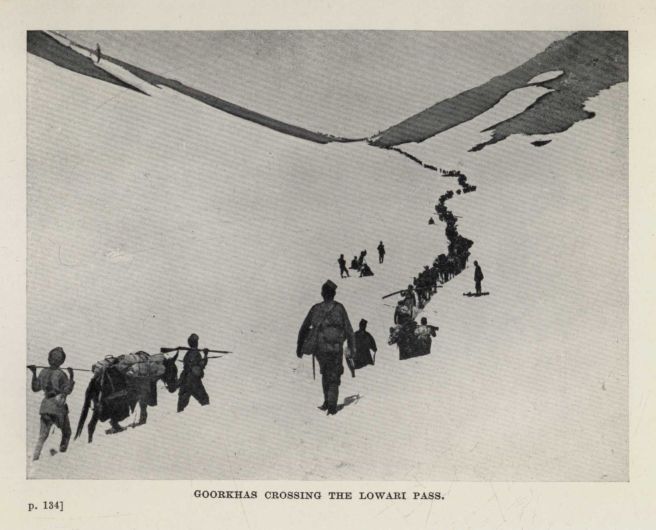
Goorkhas crossing the Lowari Pass
The campaign now entered into the second
phase; the fighting was over, but not so the
work. The Government decided that the Third
Brigade should proceed to Chitral. Having
already reached Dir, they had covered nearly
two-thirds of the distance according to the map,
but the most difficult part of the journey was
ahead of them. The Lowari Pass, 10,450 ft. high,
was covered with deep snow, and the valleys
leading up to it on both sides were known to
present almost insurmountable obstacles to the
passage of a large body of men and animals.
The following extract from Trans-frontier
Wars (vol. i. p. 544) gives a good idea of the
physical features of the country to be traversed.
"Throughout its entire length from Dir to
Ashreth, the road was a mere goat-track, offering
extraordinary difficulties to the passage of troops,
and requiring extensive improvements before
laden animals could follow it.
"The route to Gujar, at the foot of the pass,
lay for eleven miles up the Dir Valley beside
the tumbling snow-fed torrent that streams
from the south side of the pass. The track was
in general extremely difficult, frequently losing
itself among the boulders that choked the bed
of the stream, and rising steeply to traverse the
face of a rocky bluff, only to fall again with
equal abruptness on the other side. This portion
of the road had to be realigned and reconstructed
throughout, the river had to be bridged in three
or four places, and stone staircase ramps had
to be built in the water at more than one point,
to enable laden animals to pass where the stream
washed the foot of a precipitous cliff. From
Gujar, 8,450 ft., to the summit of the pass, a
distance of three miles, the track lay over
frozen and often treacherous snow, at first at a
fairly easy gradient, but growing steeper and
more slippery as the pass was approached.
Beyond the crest a great snow cornice, 15 ft. in
height, overhung the head of the glen, down
which the track descended for about 1,000
yards at a gradient of one in three or four,
over vast drifts of avalanche snow, in which
great rocks and the uprooted trunks of gigantic
trees lay deeply embedded. From the foot of
this descent the route lay down a steep and
rocky gorge, now following the tangled bed of
the torrent, now winding through fine forests
of pine and cedar, or traversing open grassy
glades clogged with the drainage of melting snows."
The advance
In such a struggle with the forces of nature
Gatacre was at his best. No difficulty dismayed
him; his own passionate belief in the power
of goodwill and hard work to overcome every
obstacle inspired the whole force. The men
learnt to work hard because he expected it of
them and seemed always present to appreciate
their efforts. They learnt to endure every
hardship because he endured physical
discomforts as great as theirs. Some few men were
attacked with frost-bite, and the General was
amongst the number; it caught him across the
knuckles, and put him to great inconvenience.
They saw him daily riding up and down the
road, ministering to their comfort and their
safety; and they realised that as a master he
was one whom all good workmen delight to
serve, because he made himself their servant.
An officer who is now a Brevet-Colonel and
has since served in Egypt, in East Africa, and in
Natal, writes thus:
"I have seen a good deal of active service,
but nowhere have I met any officer, either of
high or low rank, who more completely gave
himself up to ensure the comfort of the troops
under his command than the dear General.
Nothing escaped his eagle eye: at one moment
we were arranging that some picket should
protect itself better against the wind and rain;
at the next the General was showing how a
shelter should be run up over the tent of some
sick officer, to protect him from the heat of the
or describing how better troughs could be
for watering horses or mules.
"As to road-making, the General was
unsurpassed. From the very commencement of the
expedition he realised that good communications
must be ensured; and made our brigade work
as I have never seen any troops work, except
Egyptian troops on the railway in the Soudan.
Morning, noon, and night did every available
man slave away at bettering the wild
mountain paths which were our only link with our
supplies and civilisation. The country
supplied absolutely nothing but a little hill grass
obtainable in some districts, which meant
that every grain of food had to be laboriously
carried up."
It is evident that the care of 3,000 men
in such a country was no light work; and
Gatacre, who never took his work lightly even at
home, certainly did not spare himself on service.
His own letters give such a good idea of the
routine of camp life, and of the spirit of genuine
pleasure in it all that was so characteristic of
him, that they shall tell their own tale.
"We are marching all day over the most
impossible ground. Our food comes up at about
10 o'clock at night. Last night, owing to the
badness of the track, it never came in at all,
and this morning I hear it is still four miles
off, the other side of the pass: this means another
eight hours! Talk about roads, you never saw
such a country! You approach a range of hills
10,000 ft. high, you have to cut a road for the
animals before you attempt to bring them up,
and this means time. Every now and then they
have to stop and clear away these creatures who
stalk us and shoot from behind rocks. We have
been very fortunate in losing no men, though we
have knocked over a good many of them."
*****
"Yesterday we were soaked with rain twice,
had difficulty about wood for cooking, all green
and soaked with wet; but everybody got in by
10 p.m. except about fifty mules and a company
of Goorkhas who were stopped by the road falling
away and some mules falling through about 300
yards down the khud. This of course stopped the
remainder there for the night, but we got them
some food, and they had to bivouac the night
there without fire or blankets. We got them on
this morning.
"Is it not marvellous? Out of my whole force
of four regiments, a battery, and a company of
Sappers, I have no sick men; they march all day,
making roads, constantly get wet through, often
have to sleep at great elevations. We were 8,700
ft. the night before last, without blankets, and yet
they are all quite fit: no sick officer or man.
Of course we take all the care we can of them.
"Yesterday after passing over the pass we
found on the hills along which the road ran all
English flowers—narcissus, iris, lilies (they plant
them on their graves), may, hawthorn, hyacinths,
tulips, in great profusion. The country is
magnificent, soil very rich, would grow anything; we
must take the country and improve it. It is
another Kashmir."
*****
"We had a thunderstorm with lightning last
night, a grand sight. I was coming back from
Ashreth after nightfall, and stopped several
times to watch the lightning light the snow
peaks—quite beautiful!
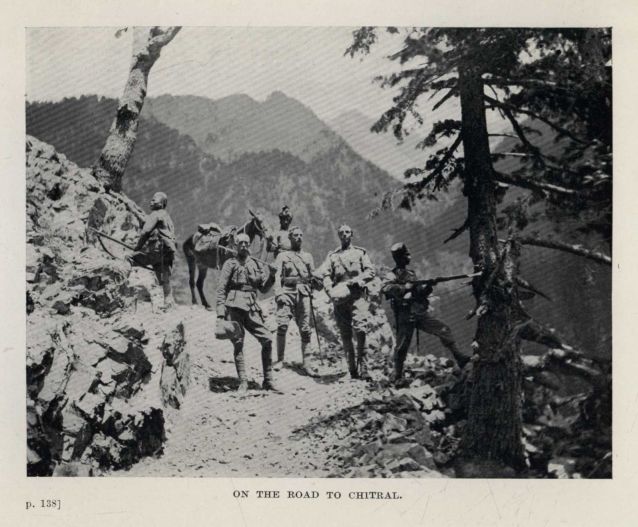
On the road to Chitral.
"I had a hard day the day before yesterday.
My orderly officer and I had to go from Dir to
Janbatai and back, about fifty-six miles over a
difficult road; we started at 5 a.m. and did not
get back till 1 a.m. yesterday. For we were
delayed on the road so long inspecting that night
overtook us, and we had to walk along a most
impossible track leading our ponies; we literally
had to feel our way with our feet. We all got
falls over rocks and stones, but beyond breaking
our skin and clothes we were none the worse.
The river was running under us nearly all the
way about 300 ft. straight down, so you may
imagine we had to be careful. I lost my helmet,
but fortunately it rolled down the track instead
of over the khudside."
*****
"Though I get up at daybreak and go to bed
at 11 p.m. daily, I assure you that I never have
a moment; it seems strange, but if you saw the
country you would understand it. I have a long
line of troops scattered over some forty miles of
country connected by a single road along which
only one man and one animal can pass at a
time; sixteen bridges which may be washed
away at any moment, causing many hours'
delay in replacement; a snow pass, in the centre
exactly, over which every ounce of food has to
come; a terrific road along river-beds at one
moment, running nearly up to the sky the next;
4,000 mules and donkeys working in stages from
place to place, with supplies, guards, escorts,
regiments, all of which have to be carefully
watched to see that they have food and that
nothing goes wrong. All this takes time, for
it is a country one cannot gallop in, hardly go
off a walk, but we are improving the roads and
cutting new ones."
*****
"Then the snow pass stops us; we have to
carry all our loads and supplies over the pass by
hand. This makes us slow, but it is very sure;
now the snow is melting and avalanches falling
in every direction. Such an interesting country,
and so beautiful! I have never seen such
scenery, such mountains, trees, and rivers—simply
magnificent! The spot I am now encamped in
is about 2,000 ft. below the top of the pass,
covered with gigantic cedars and pine-trees,
eight and nine feet in diameter; I have never
seen such trees. It is impossible to imagine
anything more beautiful. There are high snow
mountains all around us, a snow torrent from the
avalanches rushing some hundreds of feet below
us, carrying trees, rocks, etc., along with it; one
can hardly hear oneself speak. Below in the
valley one finds every English flower almost,
chiefly in blossom, white peonies, honeysuckle—all sorts.
"Well, we are getting on all right. I have
been halted here for seven days owing to want
of supplies; one of our bridges broke and
stopped them. But we are moving on to-day;
this refers to the troops only—of course I move
up and down the line every day.
"One of my officers was shot at yesterday, but
up to date I have been unable to discover the
man. I always have a duffedar (Native Cavalry
N.C.O.) with a carbine behind me whenever I
ride, and two Goorkhas whenever I walk; but
I am out all day and most of the night, and I
wonder they have not had a shot at me yet, for
it is a wild country, full of trees, stones, and
jungle.
"Yesterday I caught thirty drivers stealing
stores from their loads. There has been a great
deal of this all along the road, causing us much
loss; so I had them all thrashed. There was
much howling, but I do not think there will be
any more thieving; we have to be summary
here."
The fort
On May 15 the Third Brigade marched into
Chitral. Sir Robert Low and the Headquarter
Staff followed a few days later; their arrival
was made the occasion for a political durbar,
and a grand review of all the troops, including
the garrison of the fort, and Colonel Kelly's
triumphant little band. Sir Robert Low made
a speech in which he complimented all ranks
on the good work that each contingent had
performed, and more particularly thanked the
Third Brigade and their Brigadier for their
share in the success of his expedition.
At the first opportunity Gatacre himself read
the Funeral Service over the grave where
Captain Baird, who fell in the sortie of March 3,
had been hastily buried during the siege. He
gave orders for the erection of a wooden cross,
and had photographs taken of this and the
country round, which he sent with a sympathetic
letter to the young officer's mother. On his
arrival in England in the autumn he regarded it
as one of his first duties to fulfil his promise to
call on Mrs. Baird, a widow lamenting her only son.
On the approach of the hot weather, the
troops were withdrawn from the fort, and
disposed in suitable camps along the road, pending
the decision of Government on the question of
occupation. The long line of communications
was divided into sections, the most advanced,
from Dir northwards to Chitral, being held by
the Third Brigade, the section from Dir
southwards to Janbatai by the Second, and the Swat
Valley by the First. Road-making and mending
was still the principal occupation, for the General
was never satisfied with his roads; and all through
the summer months the men were kept, happy,
and well by improving the roadway which is
still used by the column of troops which every
two years relieves the garrison of Chitral.
It was probably at this time that the following
incident took place. The General one day passed
a supply convoy on the road, in charge of a
transport officer with whose appearance he was
dissatisfied, though he said nothing at the time.
Next day he sent for the senior officer, and after
a short talk with him told him to smarten up
his subaltern.
"Certainly, sir, certainly," said the officer,
and a look of pride and relief stole over his face
that he had himself escaped unfriendly criticism.
The General, reading the man's expression,
added, "And smarten yourself up, too."
The officer who supplies this tale concludes:
"I can see and hear the General's chuckle after
administering this little pill."
Snipers
Colonel Ronald Brooke,[3] who proved himself
an orderly officer after his General's own heart,
tells us how the Ashreth Valley became infested
by a band of hillmen who cut up stragglers from
the convoys, and finally one night attacked a
band of Chitrali traders (under the impression
that they were our transport followers) who
had incautiously spent the night at the foot of
the pass. Twelve out of thirteen were killed;
one only escaped, badly wounded, to carry the
news to the nearest military post. The story
goes on:
"The General and I at once hurried to the
spot, which looked just like a shambles, and he
immediately ordered a beat on a huge scale.
Troops silently surrounded the Ashreth Valley
from every side; and on August 12, instead of a
grouse drive, we indulged in the far more exciting
experience of a Kafristan robber drive. A band
of fifteen were flushed on the hillside, of whom
five were captured, the others escaping, never
to return to so dangerous a spot. Of the five
prisoners, three were sentenced to death, and
the other two were set free on account of their
youth."
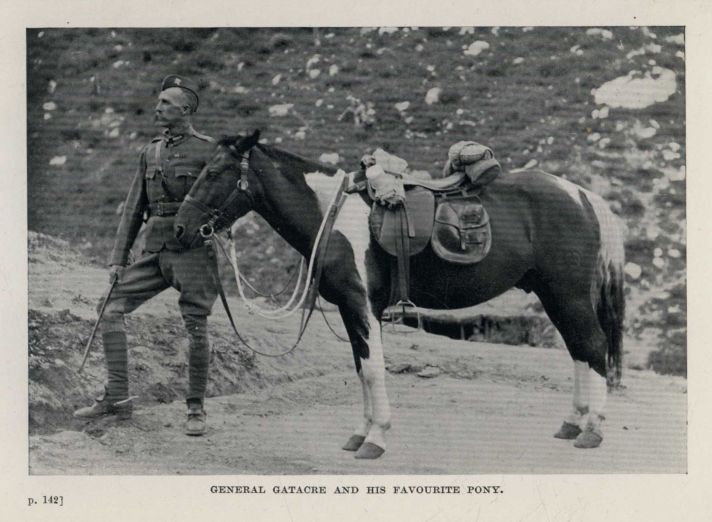
General Gatacre and his favourite pony.
Having thus cleared his own valley of snipers,
Gatacre longed to do the same on the
Dir-Janbatai section, where the troops on
escort-duty had been constantly fired on, several
soldiers having been mortally wounded. At
last he secured from the Major-General
Commanding permission to take over this dangerous
section as well as his own. A picked lot of
Pathan Sepoys were sent down under an excellent
native non-commissioned officer, with instructions
to patrol the hillsides far above the position
that snipers might take up, just when convoys
were on the move, and thus literally to stalk the
stalkers. This idea was crowned with success.
In a few days' time the Pathans spotted a party
of three hillmen lying up for the convoy. With
extraordinary skill they succeeded in
capturing two of the party; the third man escaped,
although so severely wounded that he was
tracked by his blood-marks for nine miles. The
two prisoners turned out to be Afghans who had
come over the frontier bent on doing as much
harm as possible. Both were hanged, and
thenceforward there was no more sniping on
that section.
The General's interest in the scenery and
flowers was very genuine. During the three
months that the troops were scattered in various
camps in these beautiful valleys, he found time
to make a large collection of flowers and ferns,
and himself attended to the drying and packing
of the specimens. When these were eventually
handed over to the Forest Department at
Calcutta, the botanists found one fern which was
pronounced a new variety, and named it after
the General in the records of the Department.
In due course orders arrived for the
withdrawal of the Relief Force. Early in September
Gatacre conducted his Brigade over the frontier,
and bade them farewell amidst the heartiest
expressions of affection and goodwill on the part
of all ranks, British and Native.
QUETTA
On November 10, 1895, a few familiar words
were read once more in a village church in
Sussex, the old-world troth was given and
plighted, and the face of the earth was changed
thereby for the two persons most concerned.
The General had been unable to take more
than ninety days' privilege leave, and therefore
had to be back in Bombay early in January.
The drill season was already far advanced, the
programme for the inspection of the various
regiments in the outlying stations included in
the Bombay Command was already laid out, and
trips to Baroda, Ahmedabad, Surat, and
Cutch-Bhuj followed one another in close succession.
These trips, which made a welcome respite
from the heavy office-work and town-life at
Headquarters, sometimes included a day's sport
and recreation.
On Friday, February 21, the General, his staff
officer, and the writer disembarked from the
S.S. Kola at Mandvi, in the Gulf of Cutch. This
coast is so shallow that the steamers have to
lie a long way out, and the process of
disembarkation includes transfer from the mail-boat
to a steam-launch, thence to a rowing-boat,
which runs aground alongside some bullock-drawn
waggons. Across the highest timbers of
these carts nets are stretched, on which the
passengers seat themselves, while the final stage
is a chair borne by four natives who are
waist-deep in water as they cross the pools in the
interminable stretch of sea and sand. A
forty-mile drive in a carriage provided by the Rao
Saheb of Cutch brought us to the capital where
the 17th Bombay Infantry were then quartered.
The Resident, whose guests we were, the
Commandant of the regiment, four other officers,
the doctor, and four ladies made up the whole
British contingent.
The inspection went off without memorable
incident. The real interest of the trip lay in the
native races and the pig-sticking camp, which
the Rao Saheb had arranged to fill in the blank
days while waiting for the weekly mail-boat.
The Rao Saheb was a man of about thirty,
who, together with his younger brother, Karloba,
had taken kindly to English ways; they played
lawn-tennis on even terms with the officers and
their wives, and when on horseback their costume
was entirely English except for the brilliant
puggri. The camp and all its accessories were
furnished by the hospitality of the Rao Saheb;
he was our companion throughout the day,
dinner alone excepted, and nothing was omitted
for the comfort of his guests.
Pig-sticking
We reached Wanoti Camp early in the
morning, and the seven men who were carrying spears
were soon on horseback. The country was flat
and sandy, and bare except where patches of
low scrub provided excellent cover. A few
beaters were sent forward to drive out the game,
and before long you could see some very
solid-looking bodies, very low on the ground, moving
amongst the bushes at a surprising pace: these
were a "sounder" of pigs. The Rao Saheb
selected one, the General another, and, being
mounted on a capital white pony, I was close
at his heels. This boar, which was scored to
the General's spear, turned out to be the biggest
of the seven which was the total for the day.
But he was no sooner dispatched than we were
off after another. Again the same spear was the
first to touch him; then we lost sight of him
as he crashed through a thick hedge. When we
emerged through the nearest gap we found that
the Resident had picked up his line, but while
taking a thrust at him the pig jinked and tripped
up the horse, so that both he and his rider rolled in
the sand, while the pig went off with the eight-foot
spear stuck in his body like a pin in a pin-cushion.
If we had not been close at hand the savage
creature would have turned and rent the fallen man,
who, though unhurt, would have been defenceless.
In the afternoon the beaters started on the
other side of the camp, and a most thrilling
incident occurred. After a chase of about two
miles our pig disappeared over the edge of a
forty-foot precipice, which was the cliff-like side
of a dry nullah; we had to look for a chine, and
after a scrambling descent found him again,
rather winded, hiding in a ditch about five feet
deep and six to eight feet wide. The General had
broken his spear in a previous conflict, and was
therefore unarmed. There were two officers only
with us, one of whom cried out, "If you do not
know how to tackle him yourself, give your spear
to the General, and let him try."
He took the proffered spear, and, handing
over his pony, stepped down into the nullah,
just opposite the boar, and with the lance under
his elbow stood facing the fierce creature for
some four or five minutes, till the latter suddenly
rose up and plunged forward; but the spear
was in readiness, the charge was stayed, and the
animal fell back, run right through the throat.
While at Bhuj the following telegram reached
the General:
"From Military Secretary, Chief, Calcutta:
Chief proposes to select you to officiate in
command Quetta District during absence of General
Galbraith proceeding on leave to England. Please
wire if agreeable to you."
It was followed two days later by another,
from Sir Charles Nairne, Commander-in-Chief
Bombay Army:
"I congratulate you both on going to Quetta.
You will have a wide enough field there."
Throughout the month of March the General
was kept busy with the preparation and
execution of some extensive manoeuvres which took
place on the hills near Khandalla. There was
also a Horse Show in Bombay to attend to; this
was on a bigger scale than had hitherto been
attempted. The General rode in several classes,
and won the first prize for Arab chargers, and
also for the best turn-out in the driving classes.
The cheers that greeted him as he appeared in
the prize-winners' parade were significant of the
public appreciation of the energy that, as
chairman of the committee, he had thrown into the
undertaking.
Leaves Bombay
On the evening of April 7, as the General
Officer Commanding sailed in the transport
Warren Hastings for Karachi, en route for
Quetta, the nine-gun salute boomed out its
farewell greeting in the summer night.
This First-class District, with its headquarters
on the lofty plateau known as Quetta, about
6,000 ft. high, was a command wholly congenial
to Gatacre's temperament. The office-work was
very light; there was a garrison of two battalions
of British infantry, one regiment of Native
cavalry, and two of Native infantry, besides a
complement of artillery, equipped both with oxen
and mules, a splendid transport train, and other
details. The outposts are on the actual frontier
of the British Empire; their very distance and
inaccessibility exercised a great attraction for
him, so that the official visit to each station
became a picnic pleasure-party in a very literal
sense. Nothing was wanting, not even battle,
murder, and sudden death, to create that sense
of danger and adventure that casts its fascinating
shadow over this wild frontier land.
As the season in which marching could be
accomplished in comfort was already advanced,
and the days were fast growing hot and long,
it was decided to start very soon after our
arrival on a tour of inspection to Fort Sandeman,
Lorelai, and other outlying posts. Fort
Sandeman lies to the north-east of Quetta, and is in
the Lower Zhob Valley; it is 180 miles from
Khanai station on the Quetta Railway. A
squadron of the 5th Sind Horse, under Captain
Sherard, furnished the escort. No supplies could
be reckoned on by the way, so that transport
had to be drawn to carry six weeks' food for five
mounted officers, their servants and horses, and
also for the hundred Sowars and their horses, and
for the transport animals themselves. This made
quite a long line of horses, camels, and mules on
the march, and one of the duties of our daily routine
was a walk down the transport lines at sunset.
There is not space here to do justice to this
delightful ride. We covered between six and
seven hundred miles in the six weeks we were out.
The early starts while the moon shone brilliantly,
the long leisurely days in camp, the evening
scramble over the nearest hills, and the nights
passed under the clear stars, with no sound but
the steady tramp of the sentries; the puzzling
alternation of sandy desert and rocky rift, dry
nullahs and roaring torrents,—all make up
memories of strange and delightful doings never to
be spoilt, even by the counter recollections of
sun and dust.
In the autumn of the same year Fort Sandeman
was the scene of a shocking tragedy. A
Sepoy of the 40th Pathans ran amok while on
sentry duty one evening outside the officers'
mess. According to his deposition later, he had
been waiting to get all the five officers into line
as they wandered round the billiard-table, so
that he might strike them all with one bullet.
But the finesse of his idea was defeated by his
own impatience; he fired his shot when only
three men were covered. Two young officers
were so seriously wounded that they fell
immediately, and died a few hours later. With great
presence of mind and courage, and undismayed
by a severe wound in the arm, Mr. Maclachlan
gave chase to the murderer, and by raising the
alarm and calling out the guard contributed to
his capture, though unfortunately this was not
effected till the tehsildar and two native clerks
had been shot dead.
It was the custom to make the last afternoon
of an inspection visit the occasion for a social
gathering; sports and trials of skill would be
arranged, the native regiments would perform
feats of horsemanship, and organize a display of
national dancing and wrestling. One peculiarly
striking effect was worked out by an officer in
the 15th Bengal Lancers at Lorelai. Thirty-two
Sowars in their white undress uniform, mounted on
white or grey horses, cantered past doing
sword-practice, their curved blades flashing in the sun;
but the ghostly effect of these white horsemen
was enhanced when they were followed by another
group mounted entirely on chestnuts, doing
lance-practice, the red and white pennons and scarlet
cummerbunds adding to the colour scheme.
Lorelai also contributed its note of tragedy,
for very shortly after our departure from
Beluchistan, Colonel Gaisford (soldier and civilian)
was treacherously assassinated in the very
dak-bungalow in which we had resided.
The object of a short tour planned for
September was formally to take over a strip of land
known as the Toba Plateau, which had been
recently ceded to the Government of India under
an arrangement effected by a Frontier
Delimitation Commission. As this was a desolate land
with few inhabitants, the General planned to
combine this political object with military
training in the way of practice in field-firing. He
arranged that detachments of the 1st Bombay
Grenadiers and of the 26th Beluchis should
take part in the manoeuvres, and that the 25th
Bombay Rifles should meet him at the camping-ground.
It was the first time a white man had
been seen in the country. The march abounded
with picturesque and amusing incidents. For
instance, there was the day when the camel
transport lost their way. Their pace being a little
slower than that of the mules, and the country
that day with its low round sandhills being
peculiarly puzzling, they lost touch with the tail
of the column. A transport duffedar was sent
back to look for the string of camels, but came not
again; a corporal was sent on a mule to look for
the duffedar, and he came not again. It was now
getting late, and darkness would soon fall, so the
General himself started on a pony to look for the
corporal. It was six o'clock before the camels,
who were carrying our tents, mess kit, and clothing,
reached the camp, from a point exactly opposite
to the direction whence they were expected.
Field-firing
When the rendezvous on Toba Plateau was
reached, after about three days' march from
Chaman, we settled down for a week, and field-firing
in the miniature valleys took place daily.
The day before the proposed attack newspapers
are spread out with the help of stones in the
positions where tribesmen defending their homes
would be likely to erect sangars and make a
stand. The attacking column, being supplied
with ball cartridges, shoot at these targets till
they disappear, and then advance till a bend
of the valley discloses another imaginary
concentration of the enemy. This device presents
a very realistic counterfeit of hill warfare.
It seems to me now that all our time at Quetta
was spent in such mimic fighting. The wild and
desolate country, in which the cantonments lay
like an oasis, lent itself admirably to military
training; the garrison, complete in all its units,
provided the necessary troops of all arms, so
that a succession of field-officers were sent up
for tactical examination, the practical side of
which meant a series of field-days. The General's
A.D.C., when called upon for reminiscences, sends
the following anecdote:
"His good temper and quiet way of rebuking
people was, I have always thought, remarkable.
I remember a field-day when an officer had got
a company in a very badly chosen spot. The
General, in his usual innocent sort of way, went
up to him to gather, as it were, information.
He always did that: he looked as if he was
dying to learn, while really he was leading on
the man to talk and show what he knew, or else
to convict him out of his own mouth. The
Major had no good reason for his dispositions,
and when cornered began to quote the drill-book.
The General quietly said: 'It's not very good
form to throw the drill-book at your General.'"
On a similar occasion, at an outpost parade,
the captain in charge of the picquet was
unaccountably nervous, and had great difficulty
in explaining the "idea." With two words the
General put him out of his pain and signalised
his incompetence: "You're shot," he said.
"Who is next in command?"
On the Sind-Pishin Railway, as the branch
line is called that runs from Ruk Junction on
the Indus through Quetta and on to Chaman,
there is only one train in each direction in the
twenty-four hours. The railroad runs for miles
over the wildest and most desolate tracts. It
is 150 miles from Quetta to Sibi, and Sibi is
100 miles north of Jacobabad. The roadside
stations consist merely of a few planks as
platform, a hut for the station-master, who is
commonly an Eurasian, and a standpipe; sometimes
there is a second hut, in which a bunnia does
business in food-stuffs and other simple trading.
A massacre
Sunari Station, lying about 100 miles east of
Quetta, must have been a place of slightly more
importance, for when the Marris fell upon it
they found fifteen persons to murder.
Unfortunately for him, a European youth, named
Canning, a sub-inspector of the line, and son
of the station-master at Sibi, happened to be
there that fatal morning. As the daily train
approached the station between 9 and 10 a.m.,
the engine-driver was puzzled at not receiving
the customary greeting on the signals, but
decided to crawl on carefully into the station. It
was only too clear that a wholesale slaughter
with swords had been perpetrated; the place
was strewn with dead bodies, terribly slashed
about, and the bunnia's shop had been set on
fire. The terrified driver and guard found the
station-master with his arm cut off, but still
breathing, and carefully laid him on the train,
but even this sole survivor of this unparalleled
outrage died before the next station was reached.
In the meantime the pointsman had fled on
foot to the next station, and telegraphed the
startling news from there to Quetta.
Very shortly after the arrival of the news the
telegraph wires were found to be cut; to
imaginative minds a rising of the whole powerful tribe
of Marris was imminent. The railroad, which
ran for miles through the Marris' country, might
be destroyed, the telegraph lines were already
severed, all communication with India would
thus be cut off, and Quetta isolated might have
added another picturesque story to the romantic
series of frontier annals.
Very naturally a panic took place at the
adjoining railway-stations, some of the
station-masters actually constructing amateur wire
entanglements with the telegraph stores. A new
staff was established at Sunari with a strong
guard, and detachments of the 25th Bombay
Rifles were posted all along the line. The
Political Department offered the very handsome
reward of 2,500 rupees for the capture of the
three ringleaders, and Gatacre, who had been on
short leave at Simla, hurried back to take a hand
in the search.
Early in the morning of October 23 the
following letter was sent back to Quetta:
"To-day I am going out with some of the
Pathans to look over the ground where we hear
some of these men have been, possibly are now.
I do not think we shall get back to-night, as the
ground is said to be very bad, but we have taken
our blankets and some food. I should much
like to catch these Ghazis; it would be highly
satisfactory. The Marris promise Gaisford much,
but I think they are humbugging him."
The party left Dalujal Station at 5.30 a.m.
The troops were drawn from the 24th Beluchistan
Regiment. At nightfall they bivouacked near
Dirgi Springs; and next morning, with a view
to scouring the hills, the party was divided into
four groups. Besides the General there were
two British officers, two Native officers, and
forty-four Pathans. One British officer was
allotted to each party, and a subadar took
charge of the fourth; the rendezvous was to be
a well-marked peak in the range in front of them.
The General, with five Sepoys and a Marri whom
he had impressed as guide, took a middle line and
made straight for the summit, instructing the
other parties to take a wider sweep. He had
regarded this peak as a likely place, because he
had heard that there was a musjid or small
shrine built there, to which the murderers might
have resorted for purification after contact
with the Feringhi.
As the handful of men crept up the rocky
slope a sangar came into view, which was
suggestive. The leading Pathan signalled with his
hand that all should go silently, and crouch; a
few more yards were covered in this way, and
then the sangar was rushed. The Sepoys flung
themselves upon the two men who were found
sleeping behind the rocks with such splendid dash
that they all rolled together as the enemy made
frantic efforts to get at their knives. But no
one was hurt, and in an instant the prisoners
were securely bound with the puggris of their
captors.
The other search-parties now appeared on the
scene, and very soon discovered the third Ghazi,
who, being also asleep in fancied security, had no
chance to get away. Three others, who had been
sent away to draw water, were now seen approaching,
but they turned and fled. The nature of
the ground made it impossible to follow them on
their own mountains with any chance of success.
At noon the little force started back. On
this return journey the General shifted his
position from leading to bringing up the rear;
for he anticipated that a stampede might be
made on the part of the prisoners with the
intention of knocking him down the khud, while
in the scuffle and panic they would hope to effect
their escape. This reasoned caution in
protecting his life against obvious and purposeless
dangers was as habitual and spontaneous with
the General as was his forwardness in disregarding
the risks when occasion demanded. He was
punctilious in protecting himself against
sunstroke, and wore a pad down his spine as well as
the universal topee, and by such personal
heedfulness safeguarded his life and general health.
However, on this particular occasion his
precaution nearly proved disastrous. As the string
of men crept down the mountain-side a jemadar
noticed that one of the Sepoys had failed to
uncock his rifle, and gave the necessary order.
A shot rang out. The General's helmet was
blown off his head, and was picked up blackened
with the smoke of the charge. He is said to
have smiled, as he rescued the Sepoy from the
jemadar's wrath and secured the empty
cartridge as a memento.
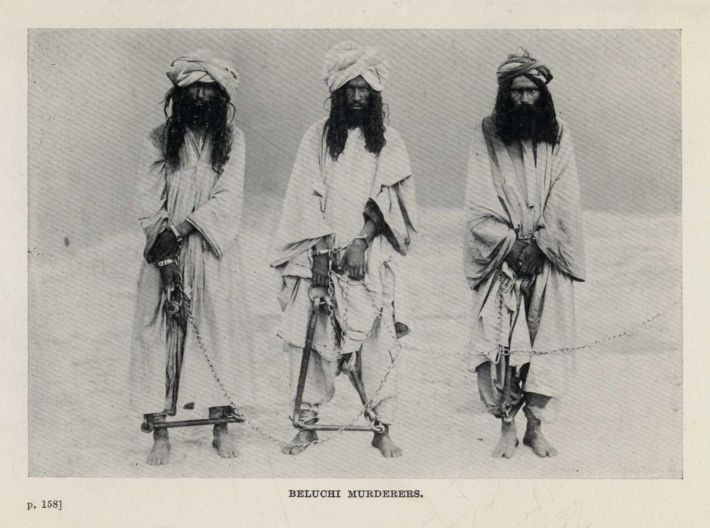
Beluchi murderers.
When the party reached Sunari Station, after
a march of seventeen miles, the General
discovered that there was no political officer there
to whom he could hand over the prisoners, so
that there was no choice but to march another
six miles to Dalujal. Here the murderers were
taken over by the Civil Department. The
irons with which they were immediately loaded
seemed fantastically medieval in their weight
and simplicity. But on the other hand, nothing
could have been more fantastic than the
proceedings of the Englishman who had effected their
capture. This was the view taken by Sir George
White, the Commander-in-Chief, though he little
guessed when he wrote how very nearly his
words had come true.
"I congratulate you on the way in which you
managed and executed the capture. I am also
very glad to know we have General Officers
commanding first-class districts who take to the
hills for amusement, but I must also say that I
don't think the job was quite one for the G.O.C. to
conduct personally. If they had managed to
get a bullet into you it would have made the
affair one of very sinister importance. However,
from that point of view, 'all is well that
ends well.'"
A death sentence
A few days later the headmen of the Marri
tribe handed over the other three men implicated,
and at Sibi, on November 2, the three Ghazis,
Fakir Kala Khan, Jalamb, and Rahim Ali,
atoned for their misdeeds. The sentence was
death by hanging followed by public cremation.[1]
On the return of the troops to Quetta great
excitement prevailed when, through the presence
of a strong guard at the station, it became
known that the promised treasure was on the
same train. Of course this was divided amongst
the Sepoys only; all those who went to the
mountain had a share, with extra money to those
who actually took a hand in the fray. It was
evening when the train came in, so that it was
not till we reached the house that I noticed the
blackened helmet, and saw the rent cut by the
bullet. When called upon for an explanation,
the emotion of that moment took possession
of him again: it was the only time that I
heard his voice break.
Throughout that summer Mr. Curry and the
railway engineers had been busy over the new
railroad that was to connect Sibi and Quetta via
the Bolan Pass. This line is shorter than the
Hurnai route by fifty miles, but it had hitherto
presented insuperable difficulties to the engineer.
Two previous attempts had been made; but the
floods rise so high in the gorges and had twice so
completely wrecked the permanent way, that
this route had been discarded by Sir James
Browne, who preferred to tackle the Chupper
Rift with his magnificent suspension bridge.
But owing to the unreliability of the shifting
sands at Mud Gorge it was imperative for
military purposes to have an alternative line. The
new Bolan-Mushkaf railroad was completed in
November 1896. To give the General an
opportunity of seeing this triumph of construction,
Mr. Curry decided to initiate the new service
on the day of our departure from Quetta. The
eight months' acting appointment reached its
conclusion on November 30, 1896, and the first
mail train left Quetta for Sibi on that day at
10 a.m., carrying Gatacre back to resume his
substantive appointment at Bombay.
THE PLAGUE
In the Report issued by the Bombay Plague
Committee of 1897 it is shown that 27,597
persons died of that disease between August 8,
1896, and June 30, 1897; while the total
mortality from all causes for the same period was
45,886. This is more than one-twentieth of the
normal average population given as 850,000.[1]
When the disease first declared itself, the
Press and its volunteer correspondents showed
extraordinary ingenuity in denying its existence,
in attempting to discount the seriousness of the
situation and inventing euphemisms by which
to describe the "glandular fever." But the
authorities responsible for the health of the city
appreciated the gravity of the prospect. The
Municipality appointed a special sub-committee
to investigate the causes of the epidemic and to
carry out measures for its suppression; and
Mr. Haffkine, the bacteriologist, was requisitioned
from Calcutta to identify the bacillus. By the
end of October the accommodation available in
the Municipal Hospital for infectious diseases
was lamentably inadequate. Customs officers in
foreign ports took alarm and imposed quarantine
on all vessels from Bombay Port. Natives of all
classes were terror-stricken, and many families
fled up-country. Thousands daily streamed over
the two causeways that connect the Island of
Bombay with the mainland; vast crowds
assembled at the Bunders and the railway-stations
in their haste to get away by sea and rail.
Before January was out, half the inhabitants
had escaped, for it has been shown that the
population fell from 797,000 on December 8
to 437,000 on February 8. At the same time
the mortality reached alarming figures,
showing 4,559 in December and 6,189 in January in
excess of the normal death-rate duly corrected.
Although January is the coolest and pleasantest
month of the year, it proved the most disastrous;
the outbreak reached its climax on the 15th and
16th, on which days 344 and 345 fatal attacks
were recorded.
The fires that burn inside the high walls that
bound the Charni Road sent up a thicker smoke
and a more suggestive stench than ever before.
The price of wood for funeral pyres went up;
in some cases Hindus consented to bury their
dead, because they could not afford to buy the
necessary timber. On January 18, 1897, an
article appeared in The Times of India seriously
discussing the supply of vultures then inhabiting
the Towers of Silence. The writer concludes
with the quaint phrase: "There are now nearly
400, the number being ample, even with the high
death-rate now existing in the Parsee Community."
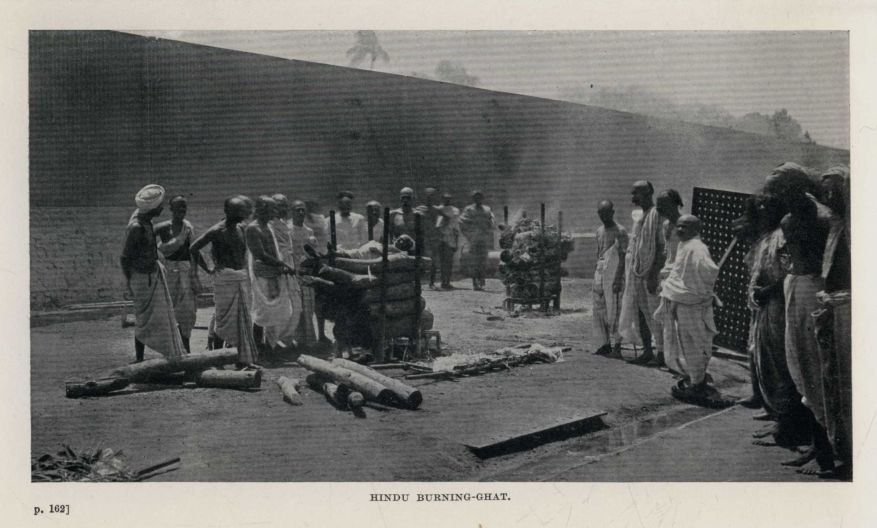
Hindu burning-ghat
The General Officer Commanding was fully
alive to the dangerous and insanitary condition
of some of the older parts of the town. For
the greater security of his household he took an
airy house on Malabar Hill, instead of inhabiting
the official residence in the Marine Lines. He
further arranged for the Marine Battalion, which
forms the permanent garrison of Bombay, to
leave their antiquated huts in the same road
and go out under canvas. Two English ladies
living in the Marine Lines caught the plague,
but fortunately both recovered.
A white man dies
The European colony were profoundly
distressed on hearing of the death of Surgeon-Major
Robert Manser on January 6, 1897. He was
First Physician of the Jamsetjee Jeejeebhoy
Hospital, and Professor at the Grant Medical
College. It was said at first that pneumonia
was the cause; but when Nurse Joyce, who had
been attending him, died on the following day,
suspicions were aroused, and the bacteriological
examination established the connection between
plague and pneumonia.
Early in February, under a pseudonym, the
General published two carefully reasoned and
suggestive articles in The Times of India. In
the first he pointed put that the existence of
the plague and the consequent exodus of the
population afforded an excellent opportunity of
carrying out extensive improvements in the
housing and sanitation of the worst parts of
the city, and in acquiring official control over
the disposal of the dead. In the second he
called attention to the inadequacy of the hospital
accommodation to meet even the present demand,
and boldly handles the question of finance, saying:
"What is a lakh or ten lakhs of rupees where
the prosperity of Bombay is concerned? The
question is not one for Bombay to haggle over.
The plague has become a thing of Imperial
importance, Her Majesty takes a deep interest in
it, and the necessary funds must be found. But
the Government of India will want to see some
exhaustive efforts on our part; they will expect
an amount of thoroughness in combating the
disease which up to the present we have not
shown."
After this appeal the writer goes on to suggest
that a hospital should be established in
Government House, Parel, a large mansion which had
been the Governor's residence in the time of Sir
James Fergusson, and had since been discarded
in favour of a more breezy site on Malabar Point.
Official thanks
The municipality took the hint and voted
funds. Lord Sandhurst responded readily and
offered his "country seat" for the purposes of
a Special Plague Hospital, and the General came
forward officially, and promised to see to the
equipment of the wards, and to provide doctors,
orderlies, attendants, etc., from the troops under
his command. His call for volunteers met with
the same ready response; for nurses he applied
to the various Roman Catholic Convents in the
neighbourhood; and expended a special
donation from Lady Sandhurst in making the Sisters'
quarters as comfortable as possible, and in fitting
up a little Oratory for them. In ten days 150
beds were ready, and by the erection of matting
huts in the large compound accommodation could
be quickly provided for several hundred more.
The following paragraphs, taken from a letter
from the Government of Bombay to the
Government of India, dated February 23, 1897,
foreshadow the policy which was adopted a few days
later:
"3. To General Gatacre the thanks of His
Excellency the Governor in Council are in a
special degree due, both for the offer of assistance
and for the energy he has thrown into the
undertaking. He has spared himself no trouble,
and the result will be an unquestionable benefit
to the city.
"5. I may add that His Excellency the
Governor in Council anticipates great indirect
benefit from a measure which brings the Military
in touch with the Civil authorities in organising
measures for preventing the spread of the plague,
for it is not improbable that the Civil authorities
may before long be driven to seek considerable
assistance at the hands of the Military."[2]
It was evident that the Governor regarded
the situation as one which called for combined
effort and extraordinary measures. He also
realised that if such an undertaking as stamping
out the plague before the monsoon broke was
to have any chance of success, there must be
central control and central responsibility. He
wanted a man endowed equally with the
administrative capacity to conceive a comprehensive
plan of action, and the executive sagacity
to carry it out with success.
The Gatacre Committee
Lord Sandhurst, having decided to execute
what amounted to a "coup" in its startling
supersession of all the traditions of the civil,
municipal, and military services, sent for Gatacre
as the strongest man whose services he could
command, asked him to name his own committee,
and to frame in his own words the instructions
under which he was to act, and the powers with
which he was to be invested. There can be no
doubt that the Governor himself contributed
enormously to the good results achieved by the
Plague Committee by the splendid freedom from
control which he allowed its Chairman, and the
manner in which he put every department of
Government—civil and municipal—at his
disposal, and then let him work out his own system
unhampered by any question of custom or
finance.
Gatacre realised to the full that he was
making himself personally responsible for the
success of the undertaking. In a confidential
letter he writes:
"The Government of Bombay has given me
its thanks, and I have been appointed chairman
of the committee to stamp out the plague. Lord
Sandhurst sent for me, and asked me whom I
would like to assist me, and I took Snow,
Municipal Commissioner—he is the head of an
enormous department and controls the municipality,
which thus falls under me—James, an executive
engineer of the municipality, an energetic man
with an enormous staff of engineers and
workmen—Dr. Dimmock, who is a sound man and
has energy. I have made Cahusac secretary.
I have been told that money is no object, but
that I am to stamp out the plague. They have
passed an Act directing all to carry out any order
I like to issue, so if I fail it will be my own fault;
but I do not intend to fail. We shall have much
opposition, as this gives me powers over all
except the Governor and his Councillors.
*****
"I wish they had handed me over this business
in December, when I first came down; it would
never have got out of Bombay. It has now
become a most serious question, and has
extended to the whole of India."
We have to thank Dr. Dimmock[3] for an account
of the first meeting of the Committee.
"We began at once to decide on sites for
plague hospitals. One question that was asked
was, What sort of disease was plague? In those
days one knew very little about it, for the bacillus
had not been discovered. I tried to explain as
much as was known, and finished my remarks
with words to the effect that whatever the special
infection might be, it seemed to be deadly and
certainly contagious, and that we need none of
us expect 'to come out alive.' 'Well,' said the
General, with a smile, 'we can't think about that;
we've only got to stop it, so let's get to work.'
"One must consider that at the time plague
was such an appalling and mysterious disease
that even the doctors feared for their lives each
day, though it was their business to face it.
How much more awful the invisible foe must
have seemed to a layman, and still more to one
who had to lead the attack on it as he did most
cheerfully and energetically without experience
of the ways of infectious diseases!"
The first step was to surround the city with
a cordon to put a stop to the spread of the
infection up-country. This could be the more
easily and effectually carried out because
Bombay City is built on an island. A police
guard was posted on the Sion and the Mahim
Causeways, where the road is carried over the
water by long bridges, and at a ford available at
low water; a foot-track along the main water-supply
was boarded up; and the two railway-stations
and all the Bunders were watched by
inspection parties.
Special hospitals
Within the city the principle was laid down
that all persons suffering from the plague must
be brought into hospital. This involved two
departments of labour; the first was to provide
hospital accommodation, the second to enforce
the handing over of the patients.
To meet one of the manifold objections put
forward by the population to the use of hospitals,
a system was started by which each community
should have its own building or camp. This
disposed of many insuperable difficulties as to
the attendance on the sick, the preparation of
food, etc.; and so much did this concession to
their peculiar prejudices please the more
enlightened communities, that their leaders came
in person to the General and offered to run
hospitals for their respective brotherhoods at
their own expense. Such offers were willingly
accepted, but control over these locations was
rigidly maintained in the hands of the
Committee. Indeed, so rapid was this demand for
special accommodation for each sect, that—
"A scheme of hospital organisation was
designed, a special equipment of staff, stores,
furniture, and appliances being drawn on a ready
basis, suitable to any pressing demands.... So
that on an order being issued by the Committee
for the institution of a hospital of any
proportion, the District Medical Officer had merely to
follow the orders laid down for a hospital of the
size indicated.... Copies of the plan and
equipment of a one-section hospital (twenty
beds) was accordingly issued to the various
executive departments of the Committee, and
to all contractors, with directions to regulate
the constructions of buildings and the supply of
stores, medicines, and furniture accordingly."[4]
Within one month of its creation the
Committee were running forty-three hospitals, of
which fifteen were Government and twenty-eight
were special private institutions such as
have been described. In every detail of the
internal management of these private
institutions the will of the Dictator prevailed. He was
always a welcome visitor; he took the keenest
interest in the symptoms as they developed in
any exceptional cases, and he made sure that
those peculiarly Christian principles should be
upheld which decree that there should be no
distinction of caste in any one "jamat," no
difference made between high and low, rich and
poor, and that all the sick should receive equal
attention.
But it was one thing to provide model buildings
and the best of attendance, and another to
persuade the relatives of the sick to bring in the
patients. At the same time the segregation of
the sick was the basis of the whole policy, and
it was to secure this end that the house-to-house
visitation was instituted.
While the mere idea of such a thing inflamed
the minds of the writers in the Native Press,
in practice the people soon found out that every
consideration was shown. An appeal was made
to the native gentlemen who were Justices of
the Peace to attend at such visitations, and this
had an excellent effect. White men did not
enter the houses unless opposition was made;
in the street a small body of troops was
employed as a show of authority, but these were
mostly drawn from the Native regiments. In
no case was violence needed; the only pressure
used was the personal presence of the General,
the force of his will and character, the persuasion
of his words uttered in their own tongue; the
people grew to have faith in his promises, to
appreciate his devotion to their interests, and
to respect his methods.
Drives the brake
The Fire Brigade brake was commandeered
to carry the search-parties. The rendezvous was
at daybreak; every one had to be punctual, for
the General waited for no one. The Committee
was accompanied by officials with special
knowledge of the quarter to be visited, and there were
always a few lady-doctors present.
Supplies were taken in tiffin-baskets, but,
says Dr. Dimmock, "the General's spare diet
was a subject of wondering comment; some bread
and dried fruit and a bottle of soda water was
his usual breakfast, and his untiring energy on
such diet was marvellous."
The General himself drove the brake, and one
or other of the Plague Committee staff would
sit on the box in order to give him an
opportunity of discussing urgent matters.
On one occasion in April such a search-party
was organised for an essentially Mahommedan
quarter, where some opposition might be
expected. The locality was occupied by Memons,
Sunni Mahommedans, and opulent merchants
hailing from Cutch. The usual military
precautions were taken, and house-to-house
visitation was in full swing. In a five-storied
building in Kambekar Street occupied by rich
Memons a plague case was discovered on the
third floor. The patient was a Memon boy aged
twenty, belonging to the rich family of Noorani,
who were also the "Patels of the Moholla,"
i.e. leaders of the neighbourhood. The usual
certificate was made out, in the name of the
patient, Haji Ayub Haji Abdul Rahim Noorani,
by the sub-divisional medical officer, and the
family were informed that the young man would
be removed to the hospital. To this they
objected, and already a sullen crowd had
assembled outside. In Mahommedan quarters
the crowd is essentially male, with an
admixture of children; the women, being "Purdah
Nashins," do not show themselves.
On being informed of the trouble, the General,
who was a little farther up the street, immediately
repaired to the spot, speaking conciliatory
words to the crowd as he made his way to the
third floor and entered the room. Here he
selected the oldest member of the family and
"very courteously" discussed with him the
necessity for the removal of the youth to hospital. In
the meantime the new hand ambulance (which
was a litter on a pair of bicycle wheels, worked
out on an idea of the General's) reached the
door; but the sight of it upset the parents so
much that they withdrew their reluctant consent
to Haji's removal. Recollecting that he was
dealing with a wealthy family, the General
suggested that they should send for one of their
own carriages. Impervious to any notions of
infection, but highly conscious of their local
standing, the family readily consented to this
compromise. Having won his point, the General
made his way down to the street, where the
crowd was now very dense: he whispered to a
native inspector, slipping a few rupees into his
hand. In a few minutes there was a vast
scramble for sweets which were flying in every
direction; under cover of this bombardment
the patient was successfully carried off in an
English brougham drawn by richly caparisoned
white horses.[5]
The Seedee king
On another occasion the quarter known as
Kazipura was selected for the morning's search
work. Kazipura is inhabited by all classes of
Mahommedans, including the African Negroes
or Seedees. On the arrival of the brake the
party broke up and entered various dwellings.
One party, consisting of two members of the
Committee and Dr. Sorab Hormusjee (to whom
I am indebted for this story, and who held the
appointment of Lady Assistant to the Health
Officer), came across a Seedee boy aged eighteen
years, whom they declared to be suffering from
the plague. The mother denied this, saying her
son was only tired, having been dancing all
night, and, supported by some male relatives,
angrily asserted that she would not allow his
removal.
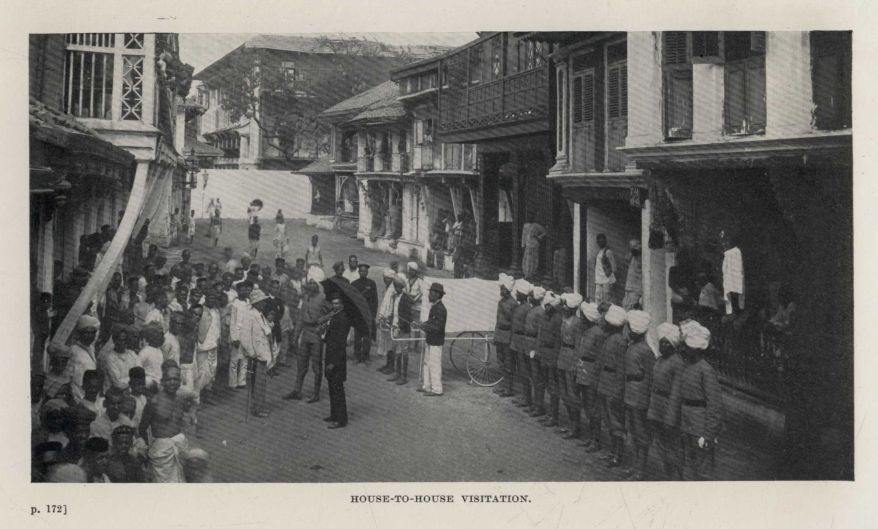
House-to=house visitation.
Within a few minutes the streets and alleys
were swarming with Seedees armed with sticks,
and a serious riot seemed inevitable. But
fortunately the Chairman was on the spot; he
instructed Mr. Vincent, the Police Commissioner,
to send for the Seedee King Makanda. The
arrival of the Great Man and his Queen Sophie
had a magic effect; a few words of explanation
from the Chairman, a few words from the King
to the sick man's mother, won the day for the
cause of law and order.
The third story that I have selected is told
by Miss Remy, a nursing sister of the Order of
St. John of Jerusalem. As her contribution
describes the horrible dens that were daily visited
I give her recollections in her own words:
"When plague broke out in Bombay I gave
up my post for a time (as Matron of a Maternity
Hospital attached to a College School) and was
selected by the Plague Committee to organise
and take charge of the Grant Road Hospital till
such time as the Roman Catholic Sisters of the
Order of Jesus and Mary were able to take up
the work as they had promised. From this
hospital—the Police Hospital, where I afterwards
worked—I was taken out on several occasions by
the Plague Committee in their house-to-house
visitation. The people have strong prejudices
against natives of another caste, and especially
Europeans, approaching too near their places,
so that in examining the houses it was necessary
to respect the feelings of the owners in this
regard. The rooms are usually 10 ft. by 10 ft.;
the floor sometimes is of clay beaten down till
it is firm and smooth and covered with a layer
of liquid cow-dung, which quickly dries, forming
a clean and neat surface; this is renewed at short
intervals of a week or so. The internal
arrangements are very simple; the cooking-place, usually
surrounded by shining brass and copper pots,
occupies a corner of the room, a low charpoy or
cot in another, bundles of firewood, cow-dung
cakes used as fuel, are stocked in odd recesses
with a collection of dried fish and grain. General
Gatacre, always courteous and tactful, was most
careful in observing their prejudices. He always
asked me to go in first and report if any of the
occupants were suffering from plague or other
causes, and also as to the condition of their room.
The General would follow closely, and as the
door opened to admit me he would look into the
room. If it was particularly clean and
cared-for, he invariably rewarded the occupants with
a rupee or so as encouragement. He was
quick to see things, patient with details, and
possessed of a tact and eloquence which smoothed
over many difficulties that came in the way of
our work. He was particularly fond of little
children, and I have often seen him pat their
heads and slip some coppers into their hands
as we went along visiting the different tenements.
One incident I remember very well. On leaving
the neighbourhood of Ripon Road, after visiting
a long row of chawls, we were followed by a
crowd of children, about fifty or more. Suddenly
on turning a corner we came upon a sweet shop.
The General went up to the stall and, to the
utter amazement and indignation of the owner,
seized several trays of the sweets and scattered
them on the pavement, when there was a general
scramble and loud hurrahs. Before the man
could remonstrate Sir William took a handful
of loose silver from his pocket and placed it on
the counter. This more than compensated the
man for the sweets, and he smiled and salaamed."
During this systematic visitation hovels were
discovered where white men had never before
penetrated; scores of houses were boarded up
and labelled "U.H.H.," which stood for "Unfit
for human habitation."
In The Times of India of March 31, 1897, we
have a graphic but, alas! lengthy account of
the visit of the Committee to a Mahommedan
quarter to sanction buildings selected for use
as hospitals. We read: "When the General's
brake was sighted they lustily cheered him." On
this occasion a feast and a vote of thanks
was part of the programme.
"Tea and coffee were provided by the
members of the party. When all were seated,
Khan Bahadur Cassum Mitha rose and said in
Hindustani:
"'General Gatacre,—We have been much
honoured by your visit to this place to-day.
Since you have assumed the command of affairs
relating to this dire pestilence, we have learnt
to assure ourselves of our safety. We are
convinced that you honour our religious feelings,
and we believe that what you do is for our own
good. You have perhaps no idea of the esteem
and respect you command among us. You have
won over our hearts by your noble demeanour,
and on the altar of your popularity we are
ready to sacrifice everything.... In you,
General, we find a saviour, and we thank Lord
Sandhurst for sending you among us. You
may count on our assistance at any and every
moment. Our lives and our money will be
always at your command.'"[6]
Opposition
As if in protest against the compliance of the
great majority to the wishes of Government, one
sect of Mahommedans, the Sunnis, showed
themselves very refractory. After much elaborate
letter-writing the Headmen sent a Mr. Raikes to
lay before the Plague Committee the objections
to their proceedings. At the conference that
was arranged the delegate was heckled into
expressing himself clearly: "'It really comes
to this,' he said; 'they ask you to minimise
as far as you possibly can the great objections
they have to the removal of the sick by not
doing it at all.'"[7] To which the Chairman seems
to have rapped out: "That is absolute
nonsense!"—to the great amusement of his
supporters. But though his words were pointed,
his conduct was deliberate, and his patience
faultless, for in a leading article we read:
"The correspondence between General Gatacre
and the representatives of the Sunni Mahommedans
will satisfy every one that the community
has been treated with extraordinary patience.
The Chairman of the Committee has given two
long interviews to the Sunni leaders, who have
had professional assistance in placing their
views before him. He has listened patiently
and respectfully to every argument and
objection that has been put before him; they have
gone to the Governor with a letter which put
their case at its strongest; and once again they
have gone back to General Gatacre, who once
more, in replying to their solicitors, treats them
with a kindness and a consideration which
sheer stubbornness seldom meets with in this
world."[8]
The show of troops was slightly increased
when the recalcitrant quarter was visited, but
this precaution had due effect, and no violence
took place.
After about six weeks of unsparing toil and
incredible devotion, it was becoming clear that
the labours of all those concerned were not in
vain: the returns were showing a steady and
unmistakable decline. But this had not been
accomplished without very great persistence on
every side. The General writes:
"I hope I shall hold out all right, but the
strain is pretty severe; some of my Committee
are feeling it, but have not broken down yet. We
are working from fourteen to eighteen hours in
the day, which does not give me much time for
writing."
That he won the loyal support of all his
colleagues is clear from the following letter:
"... The General is keeping very well; the
amount of work he gets through is tremendous.
There is one thing about him that has struck
me very much, and that is the extraordinary
personal influence he quite unconsciously exerts
over the men working under him. A Surgeon-Colonel
H—— has been sent down from Chitral
for plague duty here, and he dislikes the whole
thing. He had congenial work up there, a
lovely climate, snow and frost, a nice house
with a lovely garden; and he has come down
to work in the slums of Bombay at the hottest
time of the year, with no friends in the place,
and a most enervating climate. He says that
if any one else but General Gatacre was at the
head of affairs, he would resign to-morrow.
Major B—— is the same. His staff appointment
will be up in October; he has eight months'
leave due to him, and would have taken it if
there had been any other General here. But he
knows how busy General Gatacre is with the
plague, and feels that it would be hard on him
to get a new A.A.G. just now. And Major
B—— is a hard-headed man, with, one would
think, little sentiment about him. But I could
give you many instances. Captain C—— of
the Bombay Infantry, who is working as a
secretary in the office, is only staying because
General Gatacre is the Chief.... The General
had a great dinner last month for all the medical
men in Bombay, and as they refrained from
discussing the plague, or their methods of
treating it, it went off very well. Last week we had
another dinner of twenty-four, to which all the
Russian, German, and Austrian scientists and all
the foreign consuls were invited; it was a
decidedly interesting evening."
On April 30 the General writes:
"... We are still struggling with the plague,
and though it is milder in Bombay it is still
dreadfully severe in the provinces all around.
We have now been put on to take up the
provinces, and it is like paying the labourers of an
enormous town when our pay-day comes on....
The work and worry here is unceasing, and
I really don't know when we shall be out of
the wood."
And again a fortnight later:
"The climate, though good for Bombay, is
beastly, and there is still much sickness about.
We lost a nurse, Miss Horne, ten days ago, of
plague. In Bombay the mortality has come
down to nearly normal, but in Cutch-Mandvi
it is still very bad; at the latter place, with a
population of 10,000 actually present, they have
lost 2,000 in the last fortnight! I am just
beginning to write the Report; it will take about
two months, I think. We trust the disease will
not break out again during the rains, but people
know so little about it that it is impossible to
say."
Writing on May 21, 1897, he says:
"... Our work has not lightened much
here yet, although the disease is under control.
You see the same organisation must exist to
prevent the plague breaking out again as up to
date has existed for controlling it. There is
much plague in the districts, and people are
trying to get back to Bombay. Many come in
with the disease on them, but we catch them all
at the stations and Bunders, and put them in
hospital. Now we are stopping every one coming
in and detaining them eight days, to make sure
they have not got the disease."
In India that year the Queen's birthday was
to be celebrated on June 22. Lord Sandhurst
invited the General to his official dinner on the
occasion, and urged him to come to Poona for
a few days' change; but the latter declined the
kind invitation, being fearful lest disturbances
should occur in Bombay owing to the general
holiday.
A murderous assault
That very night, at Poona, as the guests were
returning after the dinner, a horrible outrage was
perpetrated. In the darkness armed men climbed
on to the back of two open carriages and shot
the officers riding in them. Mr. Ayerst, who
with his wife was in the first carriage attacked,
died on the spot, being shot through the head.
It was afterwards shown that there was no
ill-feeling against this young officer, and that he
was the victim of a mistake. In the carriage
immediately following, Mr. Rand, a political
officer who had been acting as Chairman of the
Poona Plague Committee, was driving alone;
he was shot through the lungs, and though at
one time there seemed some hope of his recovery,
he succumbed about ten days later.
It was well known that Gatacre had been
receiving threatening letters[9]; violent language
of this sort had even appeared in the papers.
It was therefore natural that a very strong wave
of sympathy and resentment at such an outrage
should have been felt in Bombay, where the
measures likely to provoke such personal
retribution had necessarily been more drastic.
The General writes on June 25:
"... Our dinner was a success, but the
affair at Poona has rather upset people; it
appears that the people there have been
determined to have the blood of the Plague Committee,
and accordingly arranged to assassinate them.
Rand I fear must die; Ayerst, who was shot
by mistake, was killed at once; L——, who
was on the Committee as segregation officer, was
wanted, but the assassin mistook Ayerst for
him. I trust the man will be discovered; we
know who the instigator is, but it will be difficult
to prove it. I wish I was on the job. I went
to Poona yesterday, and saw the place, and had
a long talk with Brewin, head detective; he
seems fairly confident he will trace the murderers
and bring the crime home to the suspected
instigators."
Farewell
Though telegrams conveying the welcome
news had reached him a fortnight earlier, it was
not till the end of June that Bombay learnt
that its General Officer Commanding had been
appointed to the command of a Brigade at
Aldershot, and would shortly be leaving the
scene of his labours. The city had now been
pronounced free from plague, hospitals were
being closed on all sides, and employés of all
ranks were daily dismissed. The Gatacre
Committee had succeeded in stamping out the
plague, and a chorus of gratitude arose towards
the man to whose courage and determination
the success of the attempt was mainly attributed.
Every community wished to present him with
a token of its recognition, while all combined to
entertain him "on a very grand scale."[10] Leave
was obtained from the Government of India to
accept five testimonials, which, being cased in
the silver cylinders familiar to the Anglo-Indian,
are as beautiful as their contents are unique.
Two of these offerings were a source of special
pride and pleasure to their recipient. The casket
presented by "The Citizens of Bombay"
contains a scroll of parchment on which sixty
signatures testify that all the representative
men in the city, Christian, Mussulman, and
Hindu, all merged their differences in their
unanimous appreciation of the brilliant qualities
and self-sacrificing devotion of the Chairman of
the Bombay Plague Committee. A silver box
presented by the seven officers who had so
loyally served on the Committee throughout
those four arduous months was also specially
prized. But I am very sure that he would wish
me not to omit a record of the offering of the
Plague Staff, native clerks, engineers, and
workmen of all classes; or of the touching farewell
accorded him by the Sisters of the Cross at the
Bandora Convent.
On July 2, one week before he sailed for home,
he writes:
"I am looking forward to getting back to life
again; I have been buried in a plague-pit for
the last few months."
FROM ALDERSHOT TO BERBER
1897
When Gatacre reached Aldershot on Sunday,
August 11, 1897, he found that his Brigade was
already engaged in manoeuvres. The training
was so arranged that year that though a
continuous scheme was carried on from day to day,
the troops returned each evening to their
barracks. His Royal Highness the Duke of
Connaught, who commanded the Aldershot District,
sent a kind message of welcome to the new
Brigadier, saying that he would not expect to
see him out for the first few days, but hoped
that he would soon be able to take up the
command of his troops in the field.
Route-marching
As the field-days all took place within easy
reach of Aldershot, many ladies used at first
to ride out on their bicycles to see what was
going on. This practice was, however, suddenly
dropped after we learnt that two of our friends
had been taken prisoners one day. They were
detained, and entertained, at the Headquarter
Camp during the day's operations, and were not
liberated until the troops were on the march
homewards. It was thought that ladies thus
prowling round until they got in touch with
their husbands' corps would quite innocently
carry information that would materially affect
the execution of the military scheme.
It was a great pleasure to Gatacre to find
himself in England again. His sociable and
friendly instincts all came into play. I remember
his getting hold of a list of the cadets at
Sandhurst, and seeking out the sons of his friends,
and asking them over to such events as would
interest them. He set about getting horses,
and looked forward to a hunting season at home.
The Brigade route-marching was positively an
enjoyment to him; he took so much interest in
his new regiments that he would get up early
on the route-marching days and be on the
barrack square to see the first battalion march
out, and sit there on his horse until the last
man of the last battalion had passed him. Then
cantering on, he would work his way up to the
head of the column and see the first and the
last company march in. He found the most
genuine and unaffected pleasure in every phase
of his work. The conditions under which it was
carried out were much easier and less exacting
than they had been in India. Indeed, the light
work that goes on after October 1 was so much
of a holiday to him that all thought of long
leave was postponed till later in the season.
At Christmas he took ten days' leave, which
we spent at my father's house in Sussex. The
distance being only twenty-four miles, and the
weather being open, we did the journey on
horseback, and had a few days' hunting with
Lord Leconfield's hounds during our visit. On
Monday, January 3, we rode back, and, arriving
late, had just sat down to luncheon when the
A.D.C. suddenly turned up, bringing a telegram
in his hand.
1898
"This seemed so important, sir," he said,
"that I thought I ought to bring it myself."
The telegram was from the War Office in
London to the Aldershot Divisional Office, and
ran:
"Please send General Gatacre and Major
Snow, Brigade-Major, here as soon as possible;
may be wanted for foreign service."
There had been a paragraph in the morning
papers announcing the movement of troops
from Cairo up the Nile, and this news supplied
us with the true interpretation. The General
got away by the next train, and in the afternoon
sent back this telegram:
"Arrive 9.15; sail Wednesday next."
Having returned so recently from India, the
General had all that he wanted in the way of
field-service uniform and camp kit. Though
twenty-four hours seemed a short time in which
to make preparations for such a momentous
journey, still he got away more comfortably
than the other men who had received the
same short summons. On Tuesday morning he
cleared up work in the office, and handed over
his Brigade; he left Aldershot in the evening,
and started from Charing Cross at 8.30 a.m. on
Wednesday, January 5, 1898, for Egypt, via
Marseilles.
There is no need to tell over again the long
story of the gradual loss of the Soudan to Egypt,
with the encroachment of the Dervish Empire,
nor of the fall of Khartoum with the death of
General Gordon ("my brother dreamer in an
iron race") on January 26, 1885, nor of the
patient preparation that had been going on in
the thirteen years that had passed. This book
is concerned only with the final act of the
drama, the defeat of the forces of the Khalifa
Abdullahi, and the recovery of the capital.
In 1898 Sir Herbert Kitchener was Sirdar of
the Egyptian Army. He had organised his force
for the purpose it was to fulfil, and had gradually
crept onwards up the Nile, until, on September
3, 1897, he reached and occupied Berber. At
that point he was, as it were, within striking
distance of Khartoum. This view seems also to
have been held by the enemy, for in December
the Intelligence Department heard of warlike
preparations on his part. This report
precipitated the massing of the forces on our side.
The Sirdar knew that he could call for the
assistance of British troops when the real
struggle was to take place, and he made his call
in December.
Orders were immediately issued for the
concentration of three battalions at Wady Halfa.
The 1st Lincolnshire and the 1st Cameron
Highlanders were already at Cairo, the 1st
Warwickshire were moved from Alexandria, while the
1st Seaforth Highlanders at Malta were warned
and shipped to Cairo in a very short space of
time. This regiment was also pushed forward,
as soon as others had been brought from Crete
and Gibraltar and Burma, to maintain the usual
garrison in Lower Egypt. The command of this
service Brigade was given to Major-General
W. F. Gatacre, C.B., D.S.O. Major d'Oyly Snow
accompanied him as Brigade-Major, and Captain
R. G. Brooke as A.D.C.
The General proceeded by train to Assouan,
and by boat to Wady Halfa, which he reached
on Thursday, January 25. It was here that he
first met the Sirdar. But the troops had already
passed on in front to Railhead, which was then
the other side of Abu Hamed. From Wady
Halfa the new Desert Railway, which was still
under construction, leaves the Nile and strikes
out to the south-east across the open country
towards Abu Hamed, a journey of about 250
miles.
Writing from Camp Guheish, about seventeen
miles south of Abu Hamed, on February 2, the
General says:
"We arrived here last night about eight
o'clock, after a long journey across the desert
from Halfa. Such a desert—not a thing to be
seen but sand and a few low black rocks jutting
out of the plain. A few straw-coloured birds,
like stonechats, and a wagtail I saw at one
place; goodness knows what they live on. At
one o'clock we were within one mile of Abu
Hamed, and were steaming steadily along, when,
in ploughing through a sand-drift, we went off
the line, and had to turn to and clear the line
with the few shovels on the train and our hands.
Fortunately we were only a mile from Abu
Hamed, so I sent on a messenger, and in fifty
minutes a relief train came up, and, with the
help of jacks, the engine was got on to the line
again in four hours. It was fortunate we did
not run off the line in the middle of the Desert,
or we should have been delayed at least a day,
and would have been put to inconvenience for
food, though of course we had some. Well, I
found Snow waiting for us, and we detrained
our horses safely, and then, after going on
another mile, we came to our camp, placed
between the Nile and the railway—a howling
desert, with a tremendous wind blowing night
and day. The dust fills everything, but the
climate up to date is magnificent, and I hope
will continue so for a long time; quite cold at
night and in the morning, sufficient to make me
put on my great-coat, and at night, though of
course I sleep in my clothes, I am glad of all
the blankets I can put on.... The Maxim guns
I left at Halfa temporarily, as we haven't got
sufficient food for the mules yet, but as soon as the
train is running through we shall have them up."
A fortnight later the railway had grown
longer, and as Railhead advanced, so the British
Brigade moved southwards and finally camped
at Abu Dis.
Gatacre used the three weeks that the troops
were encamped by the railway to get in touch
with his Brigade—to feel and to improve their
marching powers. His methods excited some
comment at the time, but afterwards, when there
was a real call for exceptional exertions, it was
frankly admitted that the previous training had
been of great value. "It is impossible to deny
that, while discipline and health were successfully
maintained, the general efficiency was greatly
increased."[1]
There were, however, two directions in which
efficiency was seriously hampered—boots and
bullets. The General writes on February 2:
"The present-shaped bullet .303 Lee-Metford
rifle has little stopping power. Well, we have
only this class of ammunition, so I am altering
the shape of the bullet to that of the Dum-Dum
bullet, which has a rounded point. I do this
by filing the point off. Before I left Cairo I
provided four hundred files and small gauges to
test the length of the altered bullet, and daily
here we have 2,800 men engaged on this work.
I borrowed fifty railway rails and mounted them
flat side uppermost, to form anvils on which to
file. We have a portion of men unpacking, and
another portion packing, so that the same men
are always at the same work. The men are
getting very sharp at it; it would make a capital
picture. This is a terrible place for boots, and
many of the men whose boots were not new at
starting have mere apologies for boots on their
feet. Fortunately, we have time to rectify this,
and I have taken the necessary steps."
And again a week later:
"The men are working very well; we have
no drink, and therefore no crime or sickness. I
am getting on well with altering our ammunition.
We have 3,000,000 rounds to alter, but are
making good progress, altering about 80,000
rounds per day."
In the same letter we read:
"There are crocodiles in the river here, but
not many. A fisherman caught one about three
feet long, a most vicious little brute, who snaps
at everyone and everything; he is tied by the
middle with a piece of string, and swims about
in a bath; he will probably be eaten when his
master gets hungry. Three days ago a gazelle
was trapped and sent in to us by a native. He
was uninjured, and a beautiful little brute, with
large eyes like Lorna's. We all decided to keep
him as a pet, and he got quite tame in a few
hours. But alas! we got hungry, and some one
suggested that he might escape—so we ate him.
Perhaps it was the wisest course."
In a letter dated Abu Dis, February 24, we
get the first word of the forced march that was
ordered on the following day:
"I am so frightfully busy that I cannot find
time for anything, so I think I may as well sit
down and write to you for relaxation. Yesterday
we had a seventy-mile ride to a place called
Bastinab and back, looking out for future
camping-grounds, for I have got a hint to be
ready to move on at once, as Mahmoud at
Metemma has crossed over to the east side of
the Nile, and threatens to attack Atbara and
Berber.... We may have to move and stack
our camp baggage, etc., by the side of the line
in the desert, and march on in light order, the
same sort of thing as in Chitral—a most exciting
business this would be, wouldn't it?
"My Maxim Battery came in to-day; I am
quite pleased to get it. The men are looking
splendid, and we have only thirty or so sick out
of a total strength of nearly 3,000. I have now
got my camel transport, something like 800
animals; this makes me more independent, and
if I am required to move I can do so."
Between February 22 and 25 a series of
telegrams had been flying between the Sirdar
at Berber and the Brigadier at Abu Dis. All
the details of the march which would be necessary
to bring the British troops forward were proposed
on the one side and sanctioned on the other,
so that when on Friday, February 25, the
following telegram was received at midday,
orders were immediately issued and the start was
made that evening.
"News has come in that enemy in ten rubs
advancing. You can therefore move Brigade as
arranged.—SIRDAR."
(A rub means any number between 500 and
1,500 men.)
To which this message was sent in reply:
"I shall arrive at Atbara Camp nine or ten
o'clock on Wednesday second with Maxims and
2,000 men; guns and cavalry will arrive on
first.—GATACRE."
I have found a rough draft of the official
report of the forced march made by the British
Brigade on Berber in accordance with the order
received, and have decided to print this narrative
almost as it stands.
"The 1st Lincolnshire and detachment 1st
Royal Warwickshire Regiment, with the six guns
Maxim Battery, Royal Engineer detachment,
Army Hospital Corps, and Army Service Corps,
moved to Railhead, sixteen miles, by an empty
ballast train, thence by route march seven and
a half miles to camp at El Sherreik, which they
reached at daylight on the morning of Saturday,
February 26, all well. Remainder of Warwicks
moved at midnight, arriving at Sherreik 7.30 a.m.
The 1st Cameron Highlanders bivouacked by
the side of the railway, and on the arrival of a
train at 5 a.m. were railed to Railhead. They
reached camp at 9.30 a.m. all well.
"At El Sherreik the Brigade halted for the
day, and at 10 p.m. started on their march for
Diveryah. Tea was made at Nedi, and the
troops left again, after resting, at 2.30 a.m. on
Sunday. Bastinab was reached shortly after
daybreak. Captain Bainbridge, Egyptian Army,
supplied firewood, and fires were lit, it being
very cold. Here sixty pairs of fantasses were
taken, as no water was available en route. The
road onward proved rocky and sandy in places,
and was very heavy going for tired men, but
Diveryah was reached at 3 p.m. The stony
nature of the country completely wore out many
of the boots. The last three miles were very
trying, as the sun was hot; there was no shade,
and the men felt the weight of their equipment.
The bivouac was laid in a small nullah, running
at right angles to the Nile, and the men made
themselves very comfortable. Finding that a
great number of men had worn through the
soles of their boots, I arranged with Captain
Strickland, Egyptian Army, to convey about
400 men, under the command of Major Napier,
Cameron Highlanders, by an Egyptian steamer
to Berber. They left Diveryah on Monday
morning, February 28, and reached Berber the
same day, where they were refitted from the
boot store of the Egyptian Army, and rejoined
the Brigade on arrival.
"At 2.30 a.m. on Monday, February 28, the
Brigade moved from its bivouac en route to
Um Hosheyo by the desert track, which, almost
immediately after leaving the bivouac, lay
through brushwood and broken ground. Owing
to touch being lost by the rear battalion, a delay
of three-quarters of an hour ensued, when the
march was resumed over a rough and stony
piece of country. After about five miles the
track improved, and at 6.15 a.m. the first man
of the Brigade marched into Um Hosheyo.
Continuing its march the advanced guard reached
a grove of Dom palms at Wady Hamar at 8.30
a.m., where a halt was made till 4.30 p.m. to
enable the troops to cook and sleep. At 4.30
p.m. the troops again moved forward over a
good level track, and continued marching until
10.45 p.m., at which hour Genenetti was reached.
Total distance from El Sherreik to Genenetti
forty-five miles. Here we dropped another 122
men whose boots had completely gone.
"At 3 a.m. on Tuesday, March 1, the Brigade
paraded and moved off along a fairly good track,
heavy in places, for Aboudyeh, twelve miles.
After a trying hot march the Brigade reached
a point two miles north of Aboudyeh at 9 a.m.,
where they rested till 4.30 p.m. Three men
were reported missing, but it was subsequently
ascertained that they had proceeded with other
men who had worn out their boots from Genenetti,
under command of Major Snow, Brigade-Major,
with spare ammunition and commissariat
supplies. At 4.30 p.m. the troops left Aboudyeh
for El Hassa, thirteen miles, a very hot evening,
over (at first) a good hard plain, crossed here
and there by heavy sandy khors; there was
little wind, and the column marched till 11
p.m. through dense clouds of dust. After marching
about two miles the Brigade halted to give the
men water at Aboudyeh, where a certain number
of wells containing brackish water were found.
The inhabitants turned out and provided dilus
(buckets) and ropes, willingly giving the men
water. Company after company filed past, each
man getting half a canteen full of water. After
this halt no more water was obtainable, as the
route lay inland, and the men had to rely on
their water-bottles.
"At 11 p.m. on Tuesday the Brigade filed on
to the El Hassa camping-ground, about three
miles north of Berber, and bivouacked by the
side of the Nile. Two miles before reaching El
Hassa, the General Officer Commanding received
a letter by camel messenger from His Excellency
the Sirdar, directing that the column should halt
for twenty-four hours, and pass through Berber
at 5.30 a.m. on the morning of March 3. The
Brigade, therefore, remained halted till 3.30
a.m. on the morning of Thursday the 3rd, when it
marched for Berber.
"On arriving at the north end of the town
of Berber, the column was reinforced by the
400 men who had been refitted with boots from
the Egyptian Army stores. The Sirdar met the
column at about 5.30 a.m. on the outskirts of
the town, and was heartily cheered by the troops
as they passed him. The bands of the Soudanese
battalions played in the three regiments, and
the men met with a great reception from all
ranks of the battalions in garrison, who turned
out to a man, and afterwards provided tea and
cigarettes for the men, and breakfasts for the
officers, at the camping-ground. The officers
likewise received much hospitality at the hands
of the Sirdar and the various messes in garrison.
At 4.30 p.m. the troops moved on again to Camp
Dabeika, eleven miles from Berber, along an
excellent desert track, about a mile from, and
parallel to, the Nile. The Brigade arrived with
no sick man. The conduct of the troops during
the whole march was excellent; there were no
cases of difficulty between them and the natives
of the country, and there was no crime, which
may be considered as highly satisfactory and
showing the state of discipline in which the
commanding officers hold their regiments."
The General marched the greater part of the
way on foot, and made use of his spare horses
to mount footsore men. When questioned on
this point, he gave the following reply in a
letter:
"With regard to my doing our long march
on foot, it was nothing to me; troops necessarily
march slowly, and it is pleasanter and less
fatiguing (not to speak of its being a better
example) for me to walk all the way. I always
had my horse with me, and I constantly had to
get on to go to the head of the column, or the
tail, to see if all was going right, and this made
a nice change."
The distance from Railhead to El Hassa, just
short of Berber, was sixty-five to seventy miles,
and this journey was accomplished between 10
p.m. on Saturday and 11 p.m. on Tuesday—seventy-three
hours. Another fifteen miles on
Thursday completed the march to Dabeika.
This concentration had its effect on the enemy,
who gave up any idea of attacking the Sirdar
on the Nile, and the camp was unmolested for
the next three weeks. Some critics have on this
account made out that Gatacre overtaxed his
troops in bringing them along at an unnecessary
pace in such a climate; but surely the measure
of the necessity for rapidity lies in the danger
which this junction averted rather than in the
security which it brought about. Moreover, it
was the Sirdar on the spot who decided and gave
orders: the General carried them out. At the
time he wrote of it as a race between himself
and Mahmoud.
ATBARA AND OMDURMAN
Combined force
All through the winter every movement on the
part of the Dervish leaders was carefully watched
by the gun-boats on the Nile and the Egyptian
cavalry on its banks. The Intelligence
Department had a system of espionage by which the
feeling inside Omdurman was made known to
them. The Sirdar knew that the Khalifa was
unwilling to turn out his main army, but that a
large force was preparing to move out of Metemma
under the combined command of the Emir
Mahmoud and the cavalry leader Osman Digna.
Before long the Sirdar knew that this force had
crossed to Shendy on the right bank of the
Nile on February 28, and that on March 13
they had reached Aliab, which is only twenty
miles south of Dakila, the Egyptian outpost.
But their subsequent designs were not known.
It was doubtful whether their scheme was to
attack the Sirdar at Dakila, a fort which had
recently been built on the right bank of the Nile,
where the large tributary stream of the Atbara
flows in from the south-east, or to make a dash
on Berber and sever the railway communication
lower down. Eventually the Dervish leader
found himself unable to carry out either of these
schemes, the fortress appearing too formidable
after the arrival of the British contingent, and
Berber proving too remote. He decided
therefore to threaten both points, and took up a
strong position on the banks of the Atbara, about
thirty miles above Dakila, which he fortified
and entrenched elaborately, and waited for his
foes to take the initiative.
The force with which the Sirdar could meet
the enemy was composed of the British Brigade,
which had now been completed to four battalions
by the arrival of the Seaforth Highlanders, and
three Brigades of the Egyptian Army,
commanded respectively by Colonel Maxwell, Colonel
Macdonald, and Colonel Lewis. There were also
eight squadrons of cavalry, and two Maxim
guns under Colonel Broadwood, six companies
of the Camel Corps under Major Tudway, and
some artillery, both heavy and light, under
Colonel Long. The total ran up to nearly
14,000 men of all arms. This force was
concentrated at Kenur on the Nile, and all the
officers seem genuinely to have held the opinion
that contact with the enemy might occur at
any moment. But as it turned out, it was not
till seventeen days after the Sirdar's force started
on their march to meet the enemy that the two
armies met.
On Sunday, March 20, the whole force
marched across the angle of the desert to Da
Hudi, a camp on the Atbara River about
twelve miles south-east of Kenur. They started
as if only for a reconnaissance in force, for we
read: "We are taking only one day's supplies
and what we stand up in, one blanket being
carried for us on camels." The hospital staff
and transport was cut down to such narrow
dimensions that it was hardly adequate for the
work when the big fight really took place.
Through all the next seventeen days the force
lived on tinned beef and biscuits, in daily
anticipation of closing with the enemy. But
what was privation, discomfort, and hardship to
every man in the force was vexation of spirit
also to Gatacre. Writing on March 30, he says:
"We may move to-morrow against Mahmoud,
who is still in his entrenched jungle position at
Hilgi on the east bank of the Atbara, eighteen
miles south of this. I have been urging the
Sirdar to move forward and attack him, as we
have been inactive for some days, while Mahmoud
is merely sitting and waiting for us. The
inaction has a bad effect, both on our men and
on the enemy."
And again on April 3:
"We are leaving the camp to-morrow, and
going on to one three and a half to four miles
south of Abadar. I was in great hopes that
the Sirdar would attack Mahmoud at once. I
thought I had persuaded him, but he wired my
recommendation to Lord Cromer, and gave his
own opinion and that of General Hunter, which
were for waiting. To-day he got a wire from
Lord Cromer, deciding not to attack—a great
pity, I think. At present the situation is as
under: Mahmoud is in a zariba about ten miles
from here, with about 20,000 men, very much
crushed up for space, exceedingly hard up for
food, and so placed that they cannot, in the
event of a reverse, get away at all as an organised
force. There never was such a chance, and we
are missing it."
Continuing his letter on the following day, he
says:
"Yesterday, after writing so far, I got a bad
go of colic, or malaria, or something, which
made me feel very bad; but I am better to-day,
and hope to be all right to-morrow. I hear
that another telegram has come from Lord
Cromer, saying, on consideration he leaves the
matter to the Sirdar, so I presume he will now
attack as soon as possible. I hope so. We have
moved to-day to Abadar, and are encamped in
a shady belt of trees, near the river, but it is
getting very hot."
A forward policy
During this time there had been frequent
reconnaissances in the direction of the enemy's
camp by the cavalry and Camel Corps and
artillery. Three small actions had been fought;
and with the help of the information thus
obtained, and from the tales of deserters, the
position, size, and strength of Mahmoud's camp
were known with considerable accuracy.
It was the responsibility which Gatacre had
incurred by advocating an early attack on this
fortified position, against the advice of others
better acquainted with Soudan warfare, that
coloured all his dispositions when the day arrived.
He did not, however, let his natural forwardness
of character deceive him as to the resistance to
be overcome. The author of The River War has
already made this point, although he did not
know the true interpretation of the situation.
"It is impossible not to sympathise with
General Gatacre's obvious determination that,
whatever happened to the other parts of the
assault, the British Brigade should burst into the
enclosure at all costs.[1]
This feeling of exaggerated personal responsibility
led the General to take up his position at
the head of his Brigade. In his letter written
four days later he anticipates the criticism that
would be levelled against him on this account,
and shows that he had weighed the point, and
had deliberately forsaken the traditional place.
Scientific soldiers may criticise his action, but,
according to Mr. Churchill, there was to a
civilian a certain grim splendour in the spectacle.[2]
In the General's last letter before the fight
we find the following words:
"My men are ready. I have taught them all
I know. We shall do our best, and I think my
regiments will do all I expect of them; God
bless you."
The assault
The battle of the Atbara was fought on Good
Friday, April 8, 1898. It was a brilliant victory,
and resulted in the capture of Mahmoud and the
total defeat of his army. The enemy's losses
were estimated at 40 Emirs and 3,000 Dervishes
killed. On our side the losses were 24 killed
and 101 wounded in the British Brigade, and
56 killed and 371 wounded in the Egyptian
Army. It is interesting to note that the
casualties in the two Egyptian Brigades, which took
part in the assault on the zariba simultaneously
with the British regiments, amount to 381,
which gives a higher ratio per Brigade than the
figure for the British troops, which is 125. So
that it is scarcely possible to maintain that the
formation adopted in Gatacre's brigade was
peculiarly destructive.
The General's own letter of April 14 from
Darmali furnishes a very graphic account of the
engagement and the return march:
"They all did very well, but I had to get a bit
forward to watch that all went well. Between
you and me, a General Officer should not get
up into the firing line of his Brigade without
good reason; this I know, but I had good
reasons for going there. When your whole
Brigade only covers a space of 200 yards by
200 yards, it is immaterial where you are, so far
as the penetration of bullets is concerned, but
what is important is that the G.O.C. should be
where he can watch any important point....
Well, our men started the ball, and we pushed
straight on over the stockade. It was pretty hot
when we were pulling away the zariba fence;
the ground was flying up as if it was being
harrowed all round me, with the fire of the
riflemen, and I lost a terrible bunch of men at that
spot. Of course I saw the sooner we got to the
stockade the sooner we should stop the rifle
fire, so we rushed it, and as soon as we were in
we soon killed all the riflemen and the spearmen
there, but we had a real good fight. The
general operations of the day, however, were as
follows: On evening of the 7th (Thursday) the
British Brigade and three Egyptian Brigades
moved out from Abadar at 6 p.m., my Brigade
leading; we moved in square about three miles,
sat down in the Desert, had some food and water,
and slept in square till 1 o'clock a.m. Of course
we took no blankets or anything with us, merely
one day's food, ammunition, and water. At one
o'clock we moved on in square, the other brigades
following; it was moonlight, and a curious sight
to see these three enormous hollow squares
moving solemnly on with not a note or a whisper
even—no smoking. We went on till just before
dawn, then halted and deployed into line; a fine
line it was—the Camerons, Seaforths, and
Lincolnshires, with the Warwicks in column on the left
flank at right angles.
"We then advanced a bit, till we could see
the Dem (zariba), pulled up, and commenced
firing with our artillery, in hopes of drawing
Mahmoud out to fight, and secondly of pounding
his army well before we assaulted the position.
Our cavalry was on my left, watching the left
flank; the Dervishes made several attempts to
get their cavalry out, but failed. Well, after
hammering away for an hour, the order for
assault was given, and away we went, the,
Camerons covering the front of the assaulting
column, and firing as they went; directly we
got on to the crest of the hill men began to
tumble about, and I gave the order to rush the
zariba and stockade.
The return march
"We lost some very good officers and men
killed, but that must always be; we lost fewer
than I expected. Captain Findlay, Camerons, a
nice fellow, was killed getting over the zariba.
Captain Urquhart, of the Camerons, too, was
killed. He had just come back from the Staff
College on purpose to take part in the expedition.
Gore was quite a boy. I was with Captain
Findlay most of the march to the zariba, as his
was the company of direction, and as we were
marching principally by the stars, I had to be
there or thereabouts. After they were dead I
cut off a bit of hair from Findlay and Urquhart
to send home; Gore had had his hair cut so
short that none was procurable. We buried
them all in one grave, immediately after the
fight. A curious sight: the Pipers and Buglers
of a Soudanese battalion played the Dead March
in Saul, then the Pipers of the Camerons and
Seaforths played a Lament, then we filled in
the grave. We had amongst the four Brigades
about 600 killed and wounded, and we had,
immediately we had buried the dead and dressed
the wounded, to carry all these men back about
eight miles across the desert. We told off eight
men to each stretcher, and moved slowly
homewards, leaving at 6 p.m. The fight was over
about 8.45 a.m. I think, but it took us all day
to dress the wounded and build sheds for them
(of bushes). The sun, of course, is very hot,
and we had all to sit in the desert, as the bush
and the river-bank was so full of dead and dying
Dervishes as to make it inadvisable for our men
to lie there.
*****
"Now I suppose we shall be here for three
months, to refit and prepare for the next go-in
at Khartoum, which will require careful doing."
The Sirdar was naturally very much gratified
at the decisive nature of his victory, and was
overwhelmed with telegrams of congratulation.
The following quotation from an article in
Blackwood's Magazine of December 1902 tells us how
the Sirdar expressed himself to his colleague:
"Kitchener was dictating his dispatch to the
Queen when there passed in front of us a pony
led by a syce, and laden with spoils selected
from that field of plenty with the praiseworthy
discrimination of an art connoisseur. Kitchener
hailed the man, and selecting the finest coat of
mail and the most beautifully finished spear, bade
me take them to General Gatacre with his
warmest thanks for the splendid gallantry and good
judgment with which he had led his fine Brigade.
I seem now to see the pleasant light that shone
in that brave soldier's eyes as I gave him the
message word for word. What a splendid fellow,
and how willingly any of us would have given
our right hands to save him from the fate that
befell him—at the hands of his own chiefs—in
South Africa."[3]
In the official dispatch the Sirdar wrote:
"The high state of efficiency to which the
British Brigade was brought is, I consider, in
a large measure due to the untiring energy and
devotion to duty of Major-General Gatacre and
the loyal support rendered him by the
commanding officers of his battalions, all of whom
he has brought to favourable notice. During
the engagement on the 8th inst. General Gatacre
showed a fine example of gallant leading. The
cordiality and good feeling existing between the
British and Egyptian troops, who have fought
shoulder to shoulder, is to a great extent due to
the hearty co-operation of General Gatacre, and
I cannot speak too highly of the services rendered
by him and the troops under his command in
the recent operations."[4]
All through May, June, and July the time
hung heavily for the British Brigade. They were
quartered in the villages of Darmali and El
Sillem, the General's headquarters being at the
former. The temperature ran up to 106° and
108° in the shade, but he makes light of the
heat and says, "One does not feel it as one
does in India."
One little incident of these weary days has
survived, and is recorded by an officer in his
recollections.
"When the General was inspecting the
Ordnance workshops at our camp on the Nile, a
non-commissioned officer was brought to his
notice as having done very good work. Gatacre
complimented him highly, and said:
"'Now, what can I do for you? I'll tell you
what, you shall carry my flag when we advance
to Omdurman.'
"I believe the man's face was a picture, and
he did not see it at all in the same light."[5]
For, as all the Brigade knew, the General's
flag had been carried at the battle of the Atbara
by Staff-Sergeant Wyeth, who had been shot
through the knee and had subsequently died of his
wound, so that the non-commissioned officer had
good cause to look on it as an undesirable honour.
This matter of carrying a flag into action has
also aroused comment, but it is recorded that
the Sirdar was always accompanied by the red
Egyptian Flag, and it is probable that, in flying
a little Union Jack behind him, the General had
merely adopted this practice to flatter the
nationality of his troops.
At the end of May he made a trip in a
gunboat to Shendy and Metemma, which he much
enjoyed. In June he took a fortnight's leave to
Alexandria and Cairo. It was while staying there
that he received official intimation of his having
been advanced to Major-General's rank, for
hitherto his name had appeared in the Army
List as a Colonel with the temporary and local
rank of Major-General. According to
regulations, a medical examination was necessary
before this promotion could be confirmed. The
idea that there could be any question about his
health amused Gatacre greatly, and he offered,
as a test, to run a hundred yards' race with the
Principal Medical Officer. The challenge was
politely declined, and an appointment made for
the formal examination.
Promotion
In August Gatacre had the great satisfaction
of finding himself in command of a Division in
the field. A second Brigade of British troops
was being sent up, and Colonel Wauchope[6] and
Colonel Lyttelton[7] arrived from England to take
over the First and Second Brigades respectively.
But however gratifying this promotion might
be, it lifted him farther from the soldiers and
the fighting, and it is owing to this circumstance
that his name was so little mentioned in the story
of the fight before Omdurman. This elevation,
however, made no difference to his work or his
activity. On August 17 he writes from Dakila:
"We are very busy now with embarkations
and detrainments of troops arriving from the
north; we are up nearly every night, as trains
arrive at most unearthly hours; this of course
is unavoidable. My first Brigade has gone on,
and the embarkation of the second commences
at daybreak to-morrow morning.... We move
by steamers towing barges to Wad Bishara,
about 145 miles, and thence by route march."
Wad Bishara is just below the Sixth Cataract,
and lies on the western bank about fifty-five
miles north of Omdurman.
The defeat of the Dervish army at the battle
of Omdurman took place on Sunday, September
2, 1898. The story was told with much detail
in the newspapers at the time, and has since
been elaborately set out in The River War, but,
notwithstanding the existence of many records,
this book would not be complete without some
account of such an important event. Though
far from being a comprehensive narrative, the
General's letter is interesting in itself:
"September 7, 1898.
"On the morning of September 1 we marched
twelve miles through jungle, finding everywhere
traces of the flight of the Dervish outposts—dead
animals, men, etc., who had been killed
by them, probably people attempting to desert.
"We arrived at Kerreri about 12 noon, and
found a village on the river with much open
ground to our front and south-west, with a
conical hill standing up in the plain about two
miles to the south. We settled down to eat in
the village, and in about an hour our cavalry
sent in to say that the Khalifa's army was on
the march from Omdurman towards us in three
bodies, a centre and two wings. As soon as we
had had our food, we set to work to get our
troops into position in a kind of semicircle
round the village, and strengthened ourselves
with a zariba and trench, where zariba thorns
were unprocurable; this we finished by dark,
and then sat down to eat and sleep. The night
passed quietly. The Khalifa missed a chance
of doing us much damage by not attacking at
night, but luckily he did not disturb us.
"At 3.30 a.m. we stood to our arms, ready
for an attack at dawn. It was a beautiful
moonlight night, and I had been up most of the time,
watching my line and inspecting the patrols, etc.
About six in the morning of the 2nd we got
intelligence that the Khalifa's army was coming
on, and presently they began to pour across the
open ground about two miles off, yelling like
demons, apparently an endless stream of men
and horses. I have never seen anything like
it—banners flying all along the line, guns firing,
etc. For an hour they kept pouring along in
thousands, and suddenly the centre of the mass
turned, and came straight for us. I made all
my men lie down, so that nothing could be seen
of us except our zariba fence. As soon as they
got within range, about 2,300 yds., we opened
fire with all our guns, rifles, and Maxims, and a
hail of lead fell on the army; but they were
impervious to any influences of this kind, and
kept pressing on and on till we literally mowed
them down by hundreds. After about three-quarters
of an hour, the ground was strewn with
dead and dying, and then, as our fire did not
slacken, they began to turn and go, but only
at a walk, no running about it.
The great fight
"Then we advanced, and after we had moved
on about one mile the centre of the Dervish
force returned to the charge and fell upon a
Soudanese Brigade, to whose assistance I sent
a British Brigade (General Wauchope's); this
stayed the Dervish attack, which was driven
back and followed up. The whole force advanced
and poured a heavy fire into the retreating
Dervishes, who slowly withdrew, fighting. We
had now been at work fighting and moving from
3.30 a.m. under a heavy sun without water, and
had still four miles to march over a very sandy
country, so we started in fighting formation,
keeping ourselves ready at any moment to face
west again. Well, they finally drew off to the
hills, and we moved slowly on-towards the
water, which one Brigade reached at 2 p.m. and
the other at 3.30 p.m.; halted there till
4.30 p.m., and then marched on again into
Omdurman, about three and a half miles; this
we did not reach till dark, as we had to go
carefully. There were still a lot of Dervishes
in the town, and our gun-boats were shelling
them, up the river and in the town. We had
to bivouac out in the desert, as we could not
find a suitable place. We could get no water
that night, as the river was too far to send to,
and it was not safe to allow small parties to
go out.
"Next morning we marched down to the river
and bivouacked on the water's edge, and there
we are now.
"The total dead counted were 10,324 as near
as could be; the wounded it would be impossible
to count, as they all crowded away on to the
river-bank and into the town, but there were
thousands of them, possibly another 10,000
or more, some with the most fearful wounds.
I went out the next afternoon and also the day
following with water for the wounded. I sent
out many mules laden entirely with water, and
we relieved many of these unfortunates, but no
doubt many died from want of water.
"Now the whole thing is over, except an
excursion to Fashoda, which the Sirdar is
arranging; I think he goes up to-morrow with
100 men of the Northumberland Fusiliers in
a steamer.
"We had a nice day at Khartoum; we (800
men from various battalions), two or three
bands, nearly all the officers, and an equal
number of Egyptians steamed up on gun-boats
to Khartoum, landed opposite Gordon's Palace,
hoisted the Union Jack and Egyptian flag
simultaneously, saluted them, and then held a
Memorial Service for Gordon. All our
clergymen were present; the Sirdar made me stand
on his right hand, thus paying a compliment to
the British troops. Afterwards we wandered
about and hunted among the ruins to find traces
of Gordon."
Friendly words
There is no doubt that the General enhanced
his reputation enormously in this campaign.
Not only was his work done in the sight of
Europe, but it was done under the eyes of a very
exacting master. The World wrote at the time:
"Perhaps the highest compliment that can be
paid him is that he has satisfied the
Sirdar." Another paper said: "General Gatacre is a
keen soldier—a workman 's'il y en a.' His
idea of practising troops in the field during a
campaign was an inspiration. The conventional
idea has been that in the field the only
alternatives were fighting and taking it easy. Result
when campaigning in a bad climate, laziness in
camp, rum, fever, and loss of condition generally."
In a letter of congratulation from a Civil
Service friend in India, we find the following
generous appreciation:
"You yourself are becoming more famous
every day, to the great delight of your friends
and well-wishers; and I was proud to see that
at the Atbara you gave them a touch of the
same bravery and indifference to danger that
you delighted us with at the old club at Simla,
when you rushed across the open and disarmed
that Pathan servant who, after murdering the
cook's mate, was firing 'promiscuous,' while we
all huddled in the next block. Do you remember?"
One of his former Chiefs on the Bombay side
wrote:
You ought to have been a K.C.B. long ago,
but you are all right now, and nothing can keep
you back."
COLCHESTER
Festivities
On November 15, 1898, the Honours Gazette for
the recent campaign was published, and Gatacre
found himself a Knight Commander of the Bath.
Having also been awarded the Second Class of
the Imperial Order of the Medjidieh by His
Highness the Khedive, he was now in possession
of two stars as well as two additional war medals.
He had the honour of receiving his knighthood
at the hands of Her Majesty Queen Victoria at
Windsor on December 10, 1898. Not long
afterwards he received an invitation to stay at
Windsor Castle, and had the honour of dining
with Her Majesty.
1899
In the following February it was notified that
Her Majesty the Queen had been graciously
pleased to nominate Sir William as one of the
officers to receive a Reward for Distinguished
and Meritorious Service.
The whole nation was delighted with the
success of its representatives in Egypt, and as all
hearts had been wrung by the tragedy of 1885,
so now all rejoiced with the victors of 1898. A
unanimous vote of thanks was passed in both
Houses of Parliament. A large copy of these
gratifying words printed on vellum and bound
in red and green covers respectively was
presented to each of the senior officers named
therein. These were forwarded through Lord
Kitchener, who added a few words endorsing the
appreciation of Sir William's good work.
The Lord Mayor of London gave a dinner at
the Guildhall in the Sirdar's honour. The
Lord Provost of Edinburgh invited Lord Dufferin
and Lord Kitchener to accept the Freedom of
that ancient city. Edinburgh had reason to
feel a special interest in the campaign, for one
of the brigadiers was a Midlothian man and
there had been two Highland regiments in his
command. Lord Dufferin was especially pleased
to see Gatacre again, for as Viceroy of India he
remembered him well while serving on the
Headquarters Staff.
There were also two gala days when the
General was the central figure; for his native
county of Shropshire was very proud of her
son. On December 15 Sir William was enrolled
a Freeman of the City of Shrewsbury with much
acclamation and many kindly speeches. The
county town of Bridgnorth also entertained
him handsomely, and reminded him that he had
signed their roll in the year 1860. Sir William
was not a pretentious speaker, but when called
upon for a speech on such occasions his ideas
were simple and his words fluent and appropriate.
The appointment he had held at Aldershot
having been cancelled on his departure for
Egypt, the General found himself unemployed
for a time after his return, but at the end of
October he was informally invited to say whether
the Poona First-class District in India or the
command of the Eastern District with
Headquarters at Colchester would be the more
agreeable to him. It was without hesitation that
he chose the latter. From August 1880, when
he left Dover with his regiment, to August 1897,
when he had returned to take over his brigade
at Aldershot, he had served continuously in India,
while (with a short interval of five months) he
had been working in the tropics for a further
ten months. He had now nearly completed
thirty-seven years' service, of which
twenty-three had been spent in India. There was
therefore to him a most attractive novelty
about serving at home, and the independent
provincial command that was offered to him
would, he knew, in many ways prove most
congenial. He took over the command from General
Burnett on December 8, 1898, and went into
residence at Colchester the next day.
The Eastern District at that time included
the nine counties which lie between Norfolk and
London, and between Nottingham and the sea.
The General Officer Commanding was directly
responsible to the War Office for the troops of
all arms, regular, militia, and volunteers, within
this area. During the training season the work
was very heavy and necessitated a great deal of
touring. His previous experience in Bombay
had given the General a special interest in coast
defence, and it was therefore with pleasure that
he again found himself in command of a long
sea-board.
In the last year of his command, 1903, the
Army Reorganisation scheme slightly changed
his official position, but this was purely technical,
and only affected his last six months there.
In Sussex
Occasionally Sir William was called upon to
take part in the training outside his own district.
Early in the year 1899 he was detailed to conduct
one side of a staff-ride that took place in Sussex.
An imaginary Blue Force was supposed to be
concentrated at Eastbourne, while the Defence
held the heights to the north of Ashdown Forest.
The wild and picturesque district over which the
operations were conducted added immensely to
Gatacre's pleasure in the trip; he wrote with
enthusiasm of the miles of heather-land, and had
in the end the further satisfaction of finding
that, as the Blue Invader, he had defeated his
Red Opponent by a night-march on Dorking.
Among other events of the London season Sir
William was present at the Royal Academy
Dinner. Invitations to all sorts of public
functions and city dinners followed throughout the
summer. As the journey from Colchester only
occupies one hour, it was possible for him to
enjoy all such London diversions without in any
way neglecting his professional duties.
Further evidence of his enhanced reputation
was afforded by his selection to command a
Division on Salisbury Plain in the forthcoming
manoeuvres. Two Divisions were organised,
under the general direction of Sir Charles Mansfield
Clarke. One had its headquarters at Perham
Down and was commanded by Sir Leslie Rundle,
the other by Gatacre with headquarters on the
Downs above Bulford. This latter Division
consisted of two brigades under Colonel Ian
Hamilton and Colonel Clements; the staff
remained in camp throughout the ten weeks'
training, but the troops (which included units
from the militia and volunteers as well as the
regular army) took part in the training for two
or three weeks only. This was the first occasion
on which khaki uniform was worn in England; a
certain battalion having recently returned from
abroad, came into camp as it was, before refitting
with home clothing. The camp lasted from
June 25 to September 3; at the end Sir William
wrote that his stay had been most instructive, and
that Sir Charles Mansfield Clarke had expressed
himself as much pleased with all that had been done.
Throughout this summer the situation in
South Africa, so far as it could be known through
the daily papers, was giving rise to great anxiety,
and the probability of an outbreak of hostilities
before very long became more and more
apparent. Early in October Gatacre was warned that
in the event of an Army Corps proceeding to
South Africa he had been selected for the post
of Lieutenant-General commanding the Third
Division. Sir George White had only a week
before started to take command of the forces in
Natal, and had borrowed Gatacre's A.D.C.;
and at the same time the 6th Company Army
Service Corps had been sent off from Colchester
to the Cape.
Before the middle of the month Sir William's
appointment and the details of his command
were gazetted, and he received orders to sail
on the Union-Castle Line mail steamer Moor
on Saturday, October 21, from Southampton.
His departure from Colchester was fixed for
Friday the 20th. Although it was scarcely ten
months since he had been resident in the district,
the General had, as usual, become very popular
with all classes. The Mayor and Corporation
insisted on being given an opportunity of
expressing their congratulations and good wishes.
"The Council," they said, "felt that they
were parting not only with a distinguished
officer and an ornament to Her Majesty's service,
but with a brother citizen."
Off to the Cape
Crowds of friends were assembled on the
platform that Friday afternoon, every officer
of the garrison was there in uniform, and there
were many persons who had come in by train
to cry "God-speed," for not a few had husbands,
sons, and brothers already at the front. Many
people at that time thought that the war would
be a very short affair after the arrival of the
reinforcements, and it was in this spirit that a
lady in her farewell greeting said: "Good-bye,
General—good luck to you; but I fear it will
all be over before you get out." To which the
General replied so gravely that she felt reproved:
"Make no mistake. We have a long tough
job before us."
In the evening papers that same day the news
of the battle of Talana Hill was published.
This was the first conflict of the three years' war,
and very naturally the account of it added
fervour to the public interest in the official
departures. Two troopships were leaving
Southampton that Saturday as well as the
Union-Castle liner which was to carry Sir Redvers
Buller and his three divisional commanders.
The public knew by what train the officers would
travel, and both at Waterloo and at Southampton
the popular enthusiasm was expressed
with extraordinary vehemence.
CAPE COLONY
It was with great reluctance that Sir Redvers
Buller had been persuaded to give any forecast
to the War Office in London of the disposition of
troops he intended to make on reaching Capetown.
But whatever these may have been, he found
on his arrival that the situation had so materially
changed that he had to rearrange his plans to
suit the emergency.
The Boers were bringing so much pressure to
bear on Ladysmith, where Sir George White had
established his headquarters, and on Kimberley,
that he decided to send the First Division under
Lord Methuen to the relief of the latter place,
and to employ in Natal the Second Division
and the two brigades of which the Third Division
had been originally composed. It seemed at
the same time so important to reassure the
loyal colonists in Eastern Cape Colony that he
sent Gatacre there with one battalion of
infantry and a promise of speedy reinforcements.
Writing on board ship between Capetown and
East London, on November 16, Sir William
says:
"I am ordered to go to East London, and
take command of the district up to Bethulie
Bridge. Now, what does this mean? Why,
that with the Royal Irish Rifles, which has
never been on service before, together with
half-battalion Berkshire Regiment, and a few
Volunteers, I become responsible for the railway line
and adjacent country up to the Orange River,
about 200 miles long—but the last 100 miles
are much disaffected. I have no definite orders,
except that I am to hold Queenstown if possible,
but East London at any rate, and am to raise
as many Volunteers as possible."
When the General reached East London he
found that it could be left under the care of a
local Volunteer Corps, and so he proceeded by
train to Queenstown the same day. Here he
found the half-battalion named above, a small
detachment of Royal Garrison Artillery, and
half a company of Royal Engineers. Besides
these regular troops there were 229 men of the
Frontier Mounted Rifles, and 285 of the Queenstown
Rifle Volunteers.
Sir Redvers Buller, who was the General
Commanding-in-Chief, chose Natal for his
headquarters. Sir F. Forestier-Walker was in
command of the Lines of Communication, with
headquarters at Capetown. Sometimes Sir
Redvers sent his messages direct to Gatacre,
and sometimes they came through Capetown.
There was no friction and no contradiction,
but it may well have been that this duplication
of important telegrams created an atmosphere
of unrest and added poignancy to Gatacre's
feeling of helplessness.
On November 18 a telegram was received
from Sir Redvers Buller, pointing out that
"the great thing in this sort of warfare is to be
pretty certain that one position is safe before
you advance to another, and that we are not
yet strong enough to play tricks."[1]
Conflicting messages
Three days, later, however, the General
Commanding-in-Chief strikes a different note:
"I calculate it will be at least five days
and probably a week before I have a second
battalion to send you, or a battery of field
artillery, but I am anxious to get into a position
to protect the Indwe mines better than we do.
Do you think it would be safe for you to advance
your force or part of it to Stormberg, and hold
that instead of Queenstown? I am told it is
a good position for a force the size of yours. Of
course you will have no support."[2]
To this Sir William replied that he had not
sufficient men as yet to advance on Stormberg,
but as soon as more troops arrived he intended
to occupy that junction and clear the country
round it.
At the time this message was sent the
Boers had not yet crossed the Orange River
in strength, but by November 5 they had
occupied Aliwal North and Stormberg, and were
advancing on Dordrecht. The first is an
important town on the Orange River, near which
there are good bridges, both for the road and
the railway; the second is a railway junction
fifty-five miles north-west of Queenstown, and
Dordrecht is a small town only thirty-five miles
from Queenstown to the north-east.
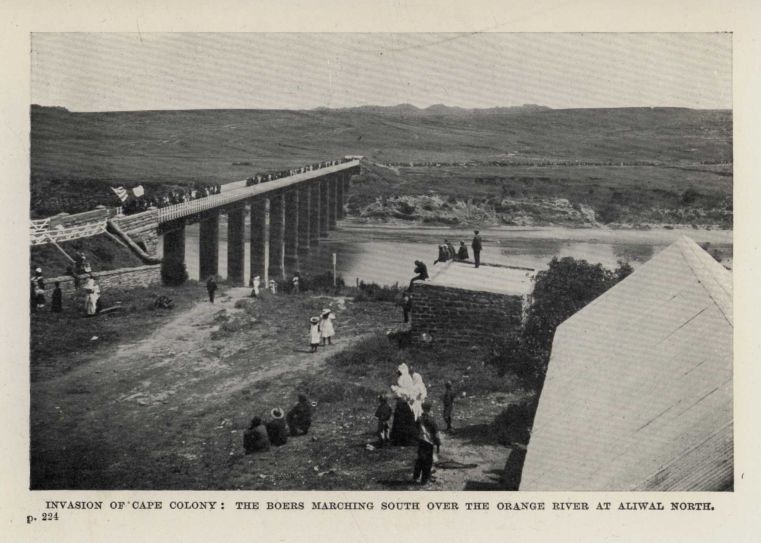
Invasion of Cape Colony: the Boers marching south over the Orange River at Aliwal North.
On hearing of the occupation of Dordrecht,
Sir Redvers grew anxious lest his former
suggestion should be taken too seriously, and
telegraphed to Sir F. Forestier-Walker:
"Caution Gatacre to be careful. I think
he is hardly strong enough to advance beyond
Putters Kraal before Methuen's return."[3]
And on the following day he added instructions
to reinforce Gatacre by one, or if possible
two battalions, and "any mounted men that can
be spared."[4]
Writing on November 24, Sir William says:
"I have not yet got any more troops, but am
hoping for some directly. Fancy what a
predicament for a General Officer to be in—no
troops, no transport, no horses for his Mounted
Infantry; but I trust all are coming. The only
unfortunate thing is that our people in front,
police, civilian officers, etc., are obliged to fall
back for want of support. I have been over
a good deal of country the last few days, round
our outposts, and am delighted with it. It is
fine and open, and the farmers are a nice set of
people. The sun is hot, but nothing like India:
one can ride in it all day without inconvenience,
and it hardly ever gives you sunstroke."
An anxious time
And again on the 28th:
"I have had a terribly anxious time the
last two days, the Boers wrecking everything
in my front, and no troops to drive them out.
I am thankful to say that I hear to-day that a
regiment, the 2nd Northumberland Fusiliers, is
arriving here to-morrow, ... and so I shall be
able to make some kind of show—but I am still
badly off for everything. I am still praying
for artillery, hospitals, etc. The whole country
is seething with rebellion, and to put it down we
require a lot of men."
Immediately after the arrival of this
reinforcement, Gatacre advanced his Headquarters
to Putters Kraal, twenty-five miles up the
railway, and placed outposts at Sterkstroom,
Bushman's Hoek, and Penhoek. The cross railway
line running from Stormberg westwards through
Rosmead to Naauwpoort was soon afterwards
destroyed by the enemy, thus putting a stop to
any combined action between Sir William and
Sir John French, who was defending a parallel
railway which runs up from Port Elizabeth
through Naauwpoort and Colesberg to Bloemfontein.
On November 30 Sir William writes:
"I fear this is a grumbling letter, but I am
in a miserable state of inefficiency. I have
only two regiments (one joined yesterday).
We have waggons but no harness, and only
half the mules to draw them—and are within a
few miles of the enemy. I have orders to raise
Mounted Volunteers, but have no saddlery, no
equipment, no clothing to supply them with:
it would be laughable if it were not lamentable
and serious....
"The worst point about the whole thing is that
I can hear nothing of any more troops coming
to me, that the Boers are eating up the country
in our front, and forcing the farmers to join
them, because I cannot move: and consequently
they are getting stronger every day. I assure
you that I am perfectly sick at such a display
of inefficiency, unpreparedness, and apathy.
"Yesterday I made a dash out to Molteno, some
sixteen miles ahead of my present position, and
seized some 7,000 bags of food, meal, etc., and
brought it in on some trains which I took out."
On Saturday, December 2, Sir William sent
the following message to Sir Redvers Buller:
"Military situation here requires dealing with
extreme carefulness. Boers have occupied
Dordrecht, and enemy is advancing in a southerly
direction, evidently pointing for Queenstown. I
have two British regiments only, and I am
thirty-three miles to the north of Queenstown.
I am holding Bushman's Hoek range, to
endeavour to prevent descent into Queenstown
district, which would mean general state of
rebellion of Dutch. Force will be strengthened
at Queenstown by next British regiment, which
should arrive at Queenstown December 5, but
Queenstown is indefensible position. Are there
any orders, especially as regards my movements?"[5]
To which this reply was returned:
"We have to make the best of the situation,
and if the enemy is advancing by Dordrecht,
the importance of Bushman's Hoek is
diminished. You have a force which altogether is
considerably stronger than the enemy can now
bring against you. Cannot you close with him,
or else occupy a defensible position which will
obstruct his advance? You have an absolutely
free hand to do what you think best."[6]
Night attack suggested
On the following day the message given below
reached Gatacre through Sir F. Forestier-Walker:
"General Buller inquires whether you can
safely leave your present position and advance
to Henning's Station, or somewhere near where
you can get a safe position, and also institute
a policy of worry. He thinks if you could
occupy Henning's Station Boers would fall back
on Burghersdorp, or if you could get near enough
to Burghersdorp to make night attack, it would be
the thing to stop anxiety (sic). He adds Hildyard
with a battalion and half sent a column of seven
thousand Boers under Joubert himself flying.
The above was probably wired before Buller read
notification of the enemy's occupation of
Dordrecht. He wired last night as follows: tell
Gatacre he will have to take care of himself till
5th Division arrives. A telegram just received
says he has given you a free hand."[7]
Burghersdorp is about twenty-three miles
north of Stormberg, and Henning is a station
about ten miles west of Stormberg on the cross
line. This telegram, therefore, sketched a far
more arduous and hazardous enterprise than that
which Gatacre afterwards attempted.
Within the next few days the Third Division
was strengthened by the arrival of the 74th and
77th Batteries Royal Field Artillery, the First
Battalion Royal Scots, the 33rd Company Army
Service Corps, and the 16th Field Hospital. All
these units were only just arrived from England,
so that, although the additional battalion of
infantry was very valuable, Gatacre was unable
to employ the men on the raid that he had been
planning for some time past. They would serve,
however, to protect the camp, and would thus
set the other two battalions free for use as a
striking force. Even these had only been two
and three weeks in the country respectively, and
the General had had no opportunity of getting
them into the hard condition and fighting form
that was reached by his Brigade on the Nile.
On December 8 he writes:
"I am frightfully busy and worried. The
whole of this country is seething with rebels,
and as they are all mounted, and I have only a
few mounted infantry on half-fed ponies, it is
very difficult to cope with them.
"I have now three regiments of infantry, but
have a long railway line to guard, and every
culvert has a couple of armed men in it. Fancy
what an anxiety this is—their safety, their food,
their overworked condition. If I had my
Division I could really strike somewhere....
"I am hoping to move on a bit to-morrow or
next day to recover some of the country given
up prior to my arrival, as I think occupation of
a position in advance of this may tend to awe
the Dutch behind me."
In the Official History we read that—
"The General Officer Commanding considered
that, in the existing strategic situation, any
further prolongation of the defensive attitude
he had hitherto been obliged to maintain would
be injurious. He determined, therefore, to take
advantage of the free hand left to him by Sir
Redvers Buller, and to follow the further
suggestion that he should close with the enemy."[8]
The first week in December was spent in
reconnoitring the Stormberg position so far as
wandering parties of Boers would permit. The
general himself prepared a sketch of the hills
surrounding it and the roads leading thereto,
which he carried with him on the march. The
only map available was on too small a scale
(twelve and a half miles to the inch) to be useful
for tactical purposes, but all possible information
was extracted from every man acquainted with
the locality. Their accounts of the features and
the distances were often inexact, and did not
always agree, but eventually five local men,
belonging to the Cape Mounted Police, under
Sergeant Morgan of the same corps, were selected
as guides.
The General's scheme was to attack the Boer
laager on the Stormberg Nek; by a night march
of nine miles from Molteno he hoped to reach a
position from which the enemy's camp could be
assaulted at daybreak.
The concentration was made at Molteno, on
the afternoon of December 9, the troops being
brought from Putters Kraal by train, about
sixteen miles, and some from Bushman's Hoet,
which was half the distance. The force consisted
of the two field batteries, with an escort of
Mounted Infantry and two Infantry Battalions.
It should have been further augmented by the
detachment from Penhoek of 235 Cape Mounted
Rifles, but, owing to the miscarriage of a
telegram, these men failed to appear.
Another circumstance that modified the
original plan was a report that was brought in
at the last minute that the enemy had fortified
and entrenched the pass between the Kissieberg
and Rooi Kop, over which runs the main road
and the railway to the junction. The informant
affirmed that the Boer main laager was placed
on the heights of the Kissieberg, which could be
easily ascended from the western side, where
there were no artificial defences. The General
was assured by all those who should have known
that to reach this hill on its western flank would
only add two miles to the projected march, and
that they could lead him to a favourable spot
for such an attempt.
The start
A council was held in the station-master's
room at Molteno, and all the commanding
officers were consulted as to their men's condition
and fitness for the expedition. Although the
train service had been most carefully timed, a
delay of two hours had somehow crept in; the
railway was but a single line and the siding
accommodation very limited. However, no one
foresaw any difficulty, and so the start was made
at nine o'clock that evening by moonlight.
Indeed, so eager were the men that they set
out at an unusually brisk pace.
In the General's official report we read:
"The force marched, with the usual halts,
for about eight miles by moonlight, and halted
near Roberts's farm at 12.30. The chief guide
now reported that we were within one and a
half miles of the enemy's position, and, after a
rest of about three-quarters of an hour, we
marched off again in the dark."[9]
It was soon after this halt that the General
realised that the guides had not brought him
along the road that he had indicated, but, as
he wrote, to turn back in consequence of this
discovery did not commend itself to him. So
the men tramped on, and at 4.20 a.m. found
themselves under a face of the Kissieberg. A
single shot from a Boer picket precipitated the
attack, and before long the enemy had located
the British column.
"Three companies of the Royal Irish Rifles
formed to the left, and occupied a kopje; the
remainder of this battalion and the Northumberland
Fusiliers advanced up a steep hill against
the enemy's position."[10]
"There was no good position for the British
guns, except the ridge 2,000 yards to the west
of the Kissieberg. But the infantry's need of
immediate support was too pressing to allow
time for that ridge's occupation. Lieutenant-Colonel
Jeffreys, by direction of General Gatacre,
caused the 77th Battery to come into action
near the kopje, the 74th unlimbering in the open
veldt to the westward. The Mounted Infantry
continued to escort the batteries....
A fatal mischance
"The Boers from the main laager had now
manned the hill, but the British artillery was
bursting shells on the threatened crest, and a
Boer gun, which had come into action, was for
a time silenced.
"The attack had lasted half an hour, and
progress up the hill was being slowly made by
the British infantry, when five companies of
the Northumberlands, on the right of the line,
were ordered to retire by their commanding
officer. He considered that his battalion must
leave the hill. The three foremost companies,
who were nearly on the summit, did not hear
this order, and, under the command of Captain
Wilmott, remained with the Irish Rifles, clinging
on as they were. The fire of the enemy appeared
to be slackening, and for the moment the groups
of British officers were convinced that, if they
were supported, they could gain the crest. But
the withdrawal of a portion of the attacking line
had made further success impossible. Nor was
that all. Seeing the five companies of the
Northumberland Fusiliers falling back to the
west, the batteries conceived that all the
assailants were retreating, and exerted themselves to
the utmost to cover the movement by their
fire. The sun was now rising behind the western
face of the Kissieberg, so that all the upper part
presented to the British guns a black target, on
which neither friend nor foe could be
distinguished. Thus a fatal mischance came about.
A shell fused for explosion just short of the
Boer defensive line burst over the foremost
group of the Irish Rifles, and struck down
Lieutenant-Colonel Eager, Major H. J. Seton,
the second-in-command, Major Welman,
Captain Bell, and three men. A conference had a
few moments before been held between Colonel
Eager and Captain Wilmott, as to the steps
which should be taken to protect the men from
the shells of their own gunners. The former
officer had stated that as the situation of the
infantry was evidently unknown to the batteries,
and was masking their fire, it was necessary to
fall back. Captain Wilmott, on the other hand,
urged that if the men were once ordered to
withdraw, it would be very difficult to get them up
the hill again. Colonel Eager replied that there
was no help for it. Therefore a general
retirement now began."[11]
An officer of the Royal Irish Rifles writes in
his official report:
"At this time I did not think there was more
than a piquet in front, and a rush at the end of
the kopje would have taken that part of the
position and the Boer gun. Colonel Eager,
Major Seton, Major Welman, and Captain Bell
were knocked over at this point by one of our
shells, otherwise I think they would have taken
this portion of the Boer position. From
subsequent conversation with one Voss, Secretary
to Swanepoel, Commandant Smithfield Laager
there is no doubt that many of the Boers were
leaving the position."
It seems, therefore, clear that the day was
almost won, for had our shells fallen a little
farther forward, so that the infantry could have
held on a quarter of an hour longer, they would
doubtless have found the defences evacuated.
If our victorious troops had been able to eat
the enemy's breakfast, we should have heard
nothing of the fatigues of the night march, nor
of the missing telegram.
But, unfortunately, the morning ended
differently. We will close the account with a
quotation from a letter written by one of the
aides-de-camp:
"The General, as soon as he realised the state
of things, arranged for the retirement, quite cool
under the hottest fire, encouraging the men and
moving over the position in every direction, not
recklessly, but with a fine courage, which did us
all good to watch. The retirement was carried
out in wonderful order, and, weary though the
men were, they hastened to join their units, and
marched home in fair order.... Throughout
the retirement he was the last man of the column,
beating up tired stragglers, and bringing in
abandoned transport."
In all the accounts something is said about a
secondary force of Boers that came on to the
scene soon after the general retirement had begun,
but according to the following extract from
another officer's report, they refrained from doing
us as much damage as might have been effected
by a more experienced enemy.
"Just as we were moving off about 400
Boers appeared on the high plateau on our right
flank from the Steynsburg direction, but were
at once checked by the fire of our guns, and gave
the infantry no further trouble."
The advanced troops got back to Molteno at
11 a.m., and all were in by 12.30. The casualties
were officially returned as eight officers wounded
(one died of wounds) and thirteen missing; in
other ranks there were 25 killed, 102 wounded,
and 548 missing. The whole force employed
amounted to 3,035 of all ranks.
The main facts of this account are taken from
the History of the War in South Africa recently
published. So little is said in the General's
despatch of the part played by the infantry
that this omission is a subject of comment in
Lord Roberts's covering letter of February
1900.[12] It may therefore be concluded that the
Field-Marshal (who was commanding the forces in
Ireland at the time that the engagement was
fought) was at the time of writing ignorant of
many incidents that have since been brought to
light.
With an ace
In Sir William's letter three days later he
speaks of the action as "a most lamentable
failure, and yet within an ace of being the
success I anticipated," and goes on:
"The fault was mine, as I was responsible of
course. I went rather against my better
judgment in not resting the night at Molteno, but I
was tempted by the shortness of the distance and
the certainty of success. It was so near being
a brilliant success."
Both in the articles published at the time,
and in the Official History referred to above, the
circumstances in which Sir William was placed
are held to have made some demonstration
imperative.
"Sir William Gatacre's decision to advance on
Stormberg was fully justified by the strategical
situation. General Buller's telegram, although it
left him a free hand as to time and opportunity,
had suggested that operation. The plan, though
bold, was sound in its design, and would have
succeeded had not exceptional misfortune
attended its execution."[13]
On the following day, Monday, the battle of
Magersfontein was fought on the north-west,
and on Friday of the same week Sir Redvers
Buller delivered his unsuccessful attack on
Colenso. Owing to the proximity of dates, the
attempt to retake Stormberg is associated in the
public mind with the other engagements of that
week; but in the numbers employed, in the
losses suffered, and in political importance it
shrinks into insignificance compared with them.
At Magersfontein, on December 11, 14,964 troops
of all ranks were engaged, the total killed and
wounded was returned as 885, with 63 missing;
at Colenso, out of 19,378 men, the losses were
899, with 240 missing; while at Stormberg, out
of 3,035 engaged, 135 were killed and wounded,
and 571 taken prisoners.[14] From a political point
of view, though no ground was gained, still
none was lost, and Sir William was actually
able, the day after, to establish his
headquarters at Sterkstroom, which was five miles
farther up the railway than he had been at
Putters Kraal.
From the General Commanding-in-Chief Sir
William received the following telegram:
"Your telegram respecting your action and
dispositions, I think you were quite right to try
the night attack and hope better luck next time.
I don't think you will find them attack you when
in position, but it would be better to retire than
run the risk of being surrounded; as to this you
must judge for yourself, but military considerations
should be held paramount.—BULLER."[15]
Writing on December 18, Sir William says:
"I have now three regiments—the Derbyshire,
Royal Scots, and Royal Irish Rifles. I have
been obliged to send the Northumberland
Fusiliers to East London to look after the base,
as Sir Redvers Buller wished this done. My
Howitzer Battery he has been obliged to send to
Natal to assist Clery.
"I have up here (Sterkstroom) a large camp
with supplies, stores, etc., and have been ordered
by Buller to entrench and endeavour with my
mounted troops to harry the district round me,
but I have so few trained troops, and these Boers
are so mobile (all mounted) that it is a very
difficult matter to catch them.
*****
"You must not expect to see much movement
from my force: I have no strength—cannot
leave my line of communications, which are
long. All the districts behind me are ready to
rise, and I cannot separate my regiments. I
have received orders to entrench my camp, and
this I am about to do. This will, of course, free
my mounted men a bit, as the post, with
provisions, will be safe for them to come back to.
As I am writing I hear of a threatened rising in
Alice and Seymour, two districts south-west of
Stutterheim, right away behind me, which makes
it difficult for me to retain my communications
with the coast. These may be exaggerated
reports, but I have had so many warnings that
one cannot afford to disregard them. You may
rest assured we shall fight to the end anyhow,
and my thoughts will be with you."
ORANGE FREE STATE
The anxiety felt by the commanders of the
three detached forces in South Africa was shared
by the nation at home. The telegrams sent
to England by Sir Redvers Buller showed that
the state of affairs in Natal after the battle of
Colenso was very critical, and that only prompt
and ample reinforcements would be of any
avail. Troops of all arms were despatched to
Capetown as fast as ships could be got ready
to carry them, and Field-Marshal Lord Roberts
was appointed Commander-in-Chief, with Lord
Kitchener as his chief staff officer.
The Field-Marshal reached Capetown on
January 10. Four weeks were necessary for
the organisation of his new army, which
amounted to 35,000 men when concentrated at
Modder River on February 8. A week later
General French at the head of a Cavalry Division
rode into Kimberley, and on the same day the
Sixth Division got in touch with General Cronje,
and commenced the series of operations which
led to his surrender with all his army. There
were yet, however, two serious engagements to
be fought, at Poplar Grove and Driefontein,
before the Commander-in-Chief entered
Bloemfontein on Thursday, March 15, 1900. By that
time this advance in force into the enemy's
country had had its effect in the east and south.
The pressure in Natal was relaxed, and on
March 1 Sir Redvers Buller rode into
Ladysmith and greeted Sir George White and his
gallant garrison. In the meantime Gatacre
and Clements had been holding on to the
railways, impatient to move forward as soon as it
was safe to do so. Both these columns, which
had been marking time in the face of the enemy,
had had occasional conflicts, but these were,
for the most part, outpost affairs, or the result of
reconnaissance.
Writing from Sterkstroom on February 24,
Sir William says:
"Yesterday we had a fight just north of
Molteno, and unfortunately lost about seventy
men, but we gained the information we required.
Montmorency is missing, and I fear he has been
wounded or shot. His party got too far ahead
of us, and it was with difficulty I extricated
them. I was very nearly shot twice, once by
a rifleman (Boer), once by a shell—very near.
I have had marvellous luck on more than one
occasion. The men all behaved very well. I do
not think that people realise quite the extent
of the country I am covering. From Karn Nek
to Bird's River is thirty-five miles, and I have
three and a half regiments only to do it with.
I think I told you that Brabant, a Colonial,
had been given a command under me of mounted
troops. He has a very mixed lot, and their
procedure is sketchy, but Lord Roberts wishes
him to have a free hand. He is to start to-day
towards Dordrecht, and I have told him what
I want him to do, i.e. to cut in between
Dordrecht and Jamestown, which I think should
have the effect of making them fall back from
Stormberg, in which case I could occupy it, but,
as you see, I cannot occupy it without evacuating
some place behind me."
Across the river
On March 5 the Third Division reoccupied
Stormberg; on the 6th they reached Burghersdorp;
on the 9th the scouts chased the Boers
to the bridge over the Orange River at Bethulie,
and entrenched themselves on the southern bank.
The little band arrived just in time to see the
railway bridge blown up, but their advance
saved the roadway. Lieutenant Popham, of
the Derbyshire Regiment, promptly cut the
electric wire that would have fused the
dynamite, and at night Sir William, accompanied by
Lieutenant Grant, R.E., crept along the parapet,
and dropped the parcels of explosives into the
river. The scouts of the Third Division were
rather proud of having saved this bridge, as at
Norvals Pont both were destroyed. The next
day the column occupied Bethulie in the enemy's
country, and on the 15th took possession of
the railway junction at Springfontein. Colonel
Clements had also crossed the Orange River, and
made his way on to the junction shortly after
the Third Division had captured the place.
"The deliberation of Gatacre's movements
surprised his younger officers, who did not know
that the Divisional General had received orders
from the Commander-in-Chief not to commit
himself seriously until reinforcements had
reached him, and, if possible, to repair the
railway which connects Stormberg with Naauwpoort
Junction."[1]
Colonel Clements had received orders in the
same strain:
"Do not attempt to force passage of river
until you hear from me, or are certain that the
enemy have considerably loosened their hold
over the heights on the north bank. This they
are sure to do when we reach Bloemfontein, and
it is better that the repair of the bridge be delayed
a few days than that lives be lost unnecessarily."[2]
On March 16 General Pole-Carew was sent
down the line from Bloemfontein to meet
Gatacre and Clements.
"He found at Edenburg that he had just
missed Grobler's contingent proceeding
north-east. This was only the first of two parties
escaping from Colesberg, the second being under
Lemmer, while Du Plessis and Olivier were
leading a third party in the same direction
from Bethulie and Aliwal North. When the
three parties united in the neighbourhood of
Ladybrand, they formed the imposing total of
5,500 Boers, 1,000 Kaffirs, 10,000 oxen and 800
waggons, covering a total extent of twenty-four
miles on the march.
"As soon as Pole-Carew heard of Grobler's
movements on the 16th, he urged upon the
Commander-in-Chief the advisability of sending
out a strong force east of Bloemfontein, to
intercept the Boer commandoes as they came up
from the south, and of bringing Brabant from
Aliwal North and Gatacre from Springfontein
to close in upon their rear."[3]
A pacific policy
The Field-Marshal was not, however, ready to
undertake such an extensive movement; his force
had only reached its goal the day before, and
neither his men nor his horses would have been
equal to such a chase. Moreover the situation
presented itself to him in quite a different light.
The ready submission of the Boer farmers in
the vicinity of the main army led him to
exaggerate the effect on the nation at large of the
capture of General Cronje and his four thousand
fighting men. He was led to believe by reports
from various outlying districts that there was
no fight left in the Boers, and in his desire to
win them without unnecessary blood-shed he
decided to try a policy of pacification.
On his arrival at Bloemfontein Lord Roberts
issued a Proclamation by which, in the name
of Her Majesty the Queen, he offered pardon
and protection to all such burghers as would
lay down their arms and swear an oath of
allegiance.[4] A week later he telegraphed to the
War Office:
"So many burghers have expressed their
desire to surrender under the terms of the last
proclamation that I have sent small columns in
various directions to register the names and to
take over arms."[5]
In pursuance of this policy the Field-Marshal
on March 19 telegraphed the following order to
Sir William Gatacre, whose headquarters were
at Springfontein:
"Could you manage to take a small force,
say two battalions, one battery, and some
mounted infantry, as far as Smithfield? It
is very desirable British troops should be seen
all over the country and opportunity given to
burghers to surrender and deliver up their arms
under the conditions of the Proclamation of
March 15."[6]
Gatacre's command at this time had increased
to four battalions of infantry, with such mounted
infantry as he had been able to raise from their
ranks, and this Brigade was now employed as
line-of-communication troops. Two battalions
were needed at Bethulie Bridge, where the men's
assistance was required in passing stores, etc.,
over the road-bridge until the railway should be
repaired; from the other two he had to supply
guards for 115 miles of railway from Bethulie
to Bloemfontein. The Colonial section of his
force was acting more or less independently
under General Brabant, who had established his
headquarters at Aliwal North.
To the telegram given above Gatacre replied
that he could not spare more than one battalion
(the 2nd Royal Irish Rifles), a field battery, a
company of the mounted infantry of the Royal
Scots and a section of that of the Royal Irish
Rifles. His suggested reduction was approved,
and the column started on its fifty-mile march
to Smithfield on the 20th.
On the 21st Sir William rode about twenty
miles west of the railway to Philipolis, where
he took over the keys from the Landrost without
opposition, returning the same evening to Springfontein.
In order to understand Sir William's part in the
affairs of the next ten days, it will be necessary
to follow in detail the messages that passed
daily between the Field-Marshal Commanding-in-Chief
and the Divisional General.
Troops sent to Wepener
On Monday, March 26, instructions were
received directing that two squadrons of Brabant's
Mounted Colonials from Aliwal North, together
with the mounted infantry company of the
Royal Scots already at Smithfield, should push
on to Wepener, which lies fifty miles to the
north-east of Smithfield.
On Tuesday, the 27th, the 1st Derbyshire
Regiment and the 11th Brigade Division of the
Royal Field Artillery were called up to complete
a Division at headquarters, thus reducing
Gatacre's small force by about 1,000 men.
On the same day Sir William telegraphed to
Headquarters reporting a rumoured concentration
of the enemy at Modder Poort, expressing
his anxiety for the detachment that was
marching on Wepener, and suggesting that he should
reinforce the column. In reply he was informed
that the Field-Marshal did not anticipate danger
at Wepener, but that he concurred in the
strengthening of the party there.
On March 28 the following telegram was
received from Headquarters:
"If you have enough troops at your disposal,
I should wish you to occupy Dewetsdorp will
make road from here to Maseru safe preventing
enemy's forces from using telegraph lines to the
south let me know what you can do to this
ends."[7]
Now there are two versions of this telegram.
The above is the version as it was received by
General Gatacre at 9.40 a.m. on March 28.
Between the words "Dewetsdorp" and "will"
he mentally supplied the word "I" to fill in
the sense. When, however, this important
telegram was quoted by Lord Roberts in a despatch
to the War Office (dated April 16, 1900), the
following verbal variations occur. We find "I
should like" for "I should wish"; the words
"it would" take the place of "will"; "and
prevent enemy" stands for "preventing enemy's
forces"; and the last word "ends" appears in
the singular, thus bringing it into the body
of the message.[8] These differences will seem
trifling to the reader, but the meaning of this
telegram has since been questioned. Gatacre
read it as an order to send a detachment to
Dewetsdorp similar to the one already ordered
to Wepener, and the writer of the Official History
so reads it, even in the secondary form.[9]
Detachments
Dewetsdorp lies on the main road that runs
from Bloemfontein south-east through Wepener
into Basutoland; the distance from the capital
to Dewetsdorp is forty miles, and it is
twenty-five miles on to Wepener. A detachment
sent there was therefore in far less danger than
the post at Wepener, and was a source of
strength to the latter. It was also known to
Gatacre that General French was operating with
a mounted force at Thaba'Nchu, so that he
naturally concluded that the road
Bloemfontein—Thaba'Nchu—Ladybrand, or Maseru, was
strongly held. As he himself said in evidence
before the Royal Commission, he "never sent
them [the troops] there as an outpost, nor
expected them to act as such, but merely to
hold a post on an interior road."[10]
On the same day, March 28, Gatacre sent this
reply to the disputed telegram:
"Following moves are in progress, in view
to covering whole country east of railway.
"Three squadrons Brabant's Horse moving
Rouxville to Wepener; two will reach Wepener
Sunday next (April 1), the third on Tuesday.
"One squadron Brabant's is moving to Bushman's
Kop half-way between Rouxville and Wepener.
"One company Royal Scots Mounted Infantry
reaches Wepener Sunday.
"Two companies 2nd Royal Irish, Rifles reach
Dewetsdorp Sunday.
"One company Royal Irish Rifles and one
section Mounted Infantry Royal Irish Rifles
reach Helvetia to-morrow.
"Three companies Royal Irish Rifles at
Smithfield with squadron Brabant's Horse."[11]
As Gatacre received no reply to the above
message he assumed that his dispositions were
approved. In furtherance of Lord Roberts's
wishes he slightly strengthened the post at
Dewetsdorp next day by sending there some mounted
infantry of the Northumberland Fusiliers. These
changes were also telegraphed to Headquarters.
Although such detachment duty naturally fell
to the Third Division as line-of-communication
troops, still it would seem that the Headquarters
Staff, in calling upon Gatacre to furnish these
remote garrisons, had overlooked the fact that
his Division had never numbered more than four
infantry battalions, and had not at any time ever
possessed any cavalry. By thus scattering the
few men at Gatacre's disposal, the Commander-in-Chief
reduced the numbers available for
guarding the hundred miles of railway.
"The railway was necessarily the first care;
if that was seriously broken, the army at
Bloemfontein, if it did not actually starve, must be
injuriously affected."[12]
That this question of the adequate protection
of the railway line became a week later a great
anxiety to Lord Roberts we know from his urgent
telegram of April 5, in which he tells Gatacre
to satisfy himself that the guards are properly
placed, sufficiently entrenched, and on the alert.
Great distances
There were at Headquarters in March 1900
three brigades of Cavalry, and three divisions
of Infantry, with their complement of Horse and
Field Artillery, which with other units made up
a fighting force of 34,000 men. As has been
said, Dewetsdorp and Wepener were both nearer
to Bloemfontein than to Springfontein, the
headquarters of the Third Division. From this
place Gatacre had to arrange for the supplies
for posts which were eighty and ninety miles
away, and that this could not be done without
difficulty we see in his letter to me, dated
March 31, 1900:
"After reaching this we have been occupied
in covering the whole country from Wepener
to Philipolis, and all the country between them
and the Orange River, with patrols and small
parties, and it is such a business getting supplies
to all these scattered detachments. We find we
can make them somewhat self-supporting by
making the farmers supply sheep, and they can
get the farmers' wives to bake bread on payment.
The roads generally speaking are good, not
metalled, of course, but hard clay, which in dry
weather are perfect to move upon; in wet
weather they become slippery."
[Illustration: Map of India and Burma]
(Transcriber's note: map omitted from
this etext because too large to scan)
The same day the following telegram reached
Gatacre from Bloemfontein:
"(With) Reference (to) telegram from Brabant
to your Assistant Adjutant-General Springfontein
repeated to Intelligence here, what reinforcement
do you propose to send him? Boers are active
on that side and have strong force between
Ladybrand and Thabanchu. Brabant should be
reinforced and supported."[13]
In response to this Gatacre ordered up troops
from the Colonial Corps at Aliwal North, and
pushed forward the support at Bushman's Kop.
On that same Saturday, March 31, he was
directed to arrange for a battalion of infantry
and a battery to be at Leeuwberg Kopje, eight
miles from Bloemfontein, at daybreak of April 1.
Three companies of the Northumberland
Fusiliers and five companies of the Royal Scots
were accordingly sent. When replying to this
order he adds that he has no infantry left, and
only one battalion from which to find guards
for the railway line.
A third message from Headquarters reached
Gatacre at 10.47 that night (the 31st), which
informed him of the engagement near the
Waterworks, told him to exercise special caution on
the railway, and to draw in all outlying forces,
adding that "it would appear that Dewetsdorp
is too far advanced for security."[14]
In response, Gatacre immediately sent off
various telegrams by which he hoped to get in
touch with his detachments, and also started off
a despatch-rider; but the distance was eighty
miles, as has been said.
At Dewetsdorp
It will be remembered that the troops from
Smithfield and Helvetia that were assembling
at Dewetsdorp were due to reach their
destination on Sunday, April 1. On his arrival the
Officer Commanding the three companies Royal
Irish Fusiliers—
"was greeted with information from local
sources that a Boer commando was expected
soon to appear before the village, and, selecting
ground which commanded the place, he began
to strengthen his position, which he covered by
outposts. In the evening a patrol to the north
of Dewetsdorp was fired upon. He informed the
Headquarters Third Division of this by telegram,
and also of the rumoured approach of the
commando, which, however, was not credited
by the Intelligence Officer who accompanied his
detachment."[15]
At midnight Gatacre's telegram arrived
directing him "that he should immediately move his
troops to Reddersburg," and closing with the
words "matter urgent." At 3.30 a.m. next
morning (April 2) the despatch-rider appeared
with the same instructions.
In the meantime the engagement known as
Sannah's Post had taken place on Saturday,
March 31, only thirty miles away. As this
unfortunate affair directly affected the
Proclamation detachments, I hope it will not seem out
of place if I give a brief sketch of what had been
taking place a little farther north.
The main water-supply for the city of
Bloemfontein was drawn from a point on the Modder
River, where it is crossed by the high road
running due east to Thaba'Nchu. This point,
which is about twenty-one miles from the capital,
is known as Sannah's Post. On March 15 the
"somewhat inadequate force of 300 mounted
infantry" was sent out to hold the Waterworks,
and two days later a mounted column, 1,500
strong, under General French, was pushed on
to Thaba'Nchu, twenty-one miles farther east.
From this force Colonel Pilcher was detached, and
through his operations definite news of the enemy's
whereabouts was obtained and duly forwarded
to Bloemfontein. General French was soon after
called back to Headquarters, and left Colonel
Broadwood in command of the column. It is
clear that—
"Broadwood, with his 1,500 men, had never
been intended to fight battles where he was,
forty miles from any supporting force, but only
to publish Lord Roberts's proclamations, and
to collect arms from any Boers that might
surrender."[16]
So that when he discovered that General
Olivier was behind him with 5,000 men, he
had no choice but to retire on the Waterworks.
After the death of Joubert the control of
the Boer forces fell into the hands of younger
men, the most conspicuous amongst whom was
Christian de Wet. Having conceived a plan
for capturing the Waterworks guard, he placed
his forces astride of the road, and hid them
in the bed of a stream about five miles west
of the Modder River. When the day arrived for
the execution of his plan, he found that the
mounted column was also delivered into his hand.
Sannah's Post
A messenger got through who carried news of
Broadwood's plight between Olivier and De Wet
to Lord Roberts, and he sent out an infantry
division under General Colvile. But the two
forces failed to work together, and the enemy
triumphed. This was on Saturday, March 31.
"The material result of De Wet's achievements
at Sannah's Post was the acquisition of
seven guns, much ammunition, many horses and
waggons, and a large number of prisoners. By
occupying the Waterworks, which did not again
pass into Lord Roberts's hands until April 23, he
inflicted great injury on the health of the troops
in Bloemfontein. The moral effect of his success
was enormous. It confirmed the resolution of
those of the Free State burghers who still
remained in arms; it encouraged the waverers;
it afforded De Wet the occasion for putting
strong pressure upon the considerable numbers
of his fellow countrymen who, declaring themselves
tired of the war, had given in their rifles
to the British troops, and had been allowed to
return to their farms as peaceful non-combatants;
and it gave those who followed him
good heart for his next stroke."[17]
On the Sunday following Gatacre was
summoned to Headquarters, and had interviews
with the Commander-in-Chief, of which he has
left the following memorandum:
"On Sunday, April 1, I proceeded to
Bloemfontein by order to see Lord Roberts, arriving
late at night. Early next morning (April 2) I
saw the Field-Marshal, and he told me he was
placing me in command of the Orange Free
State territory held by us, and was giving me
ten other battalions, which were to be used
as under, i.e. six Militia battalions to be
distributed along the railway south of
Bloemfontein, and in the country east and west of it;
the four battalions were, with the four I had
already (the 2nd wing of the Berkshire was to
be called up from Cape Colony), to make up a
Division with which I was to proceed at once
to Dewetsdorp and operate along the Basuto
border through Ladybrand, Clocolan, Ficksburg
country, to clear Lord Roberts's right flank, to
enable him to advance northwards. He directed
me to draw up for his approval a scheme of
distribution for the six Militia battalions through
the country. This I did, and submitted it on
the spot. The Field-Marshal was anxious to
know by what date I considered I could
concentrate my troops at Reddersburg, ready to
move, after relief by the Militia battalions. I
replied that, on the assumption that I received
the Militia battalions on the 6th, I could move
on April 17 (reliefs had to be effected, transport
collected, supplies, etc., etc.). This date was
considered satisfactory by Lord Roberts. The
same evening (April 2) about 9.30 p.m. Lord
Roberts again explained to me carefully what
he wished, that he was anxious for me to move
as soon as possible, and that I was to proceed to
Springfontein immediately, and commence
preparations. This I did, morning of April 3, by
first train."
It would appear that nothing was said during
the Monday spent at Bloemfontein about the
detachment that was moving that very day
from Dewetsdorp through Reddersburg back
to the railway at Bethanie. No anxiety seems
to have been felt at Headquarters as to what
De Wet would do next.
A relief column
At about 7 o'clock on Tuesday evening,
April 3, information was brought into
Edenburg that the Dewetsdorp detachment was
surrounded at Mostert's Hoek, a ridge three or
four miles east of Reddersburg. This disquieting
news was telegraphed to Lord Roberts, who
sent an urgent message to Gatacre directing
him to prepare to move on Reddersburg, and
asking what troops he had available. The
reply stated that there were forty scouts and
about twenty-five mounted infantry at
Springfontein, a Brigade Division Field Artillery at
Bethanie, and about two companies mounted
infantry at or near Edenburg. A return message
informed Gatacre that the Field-Marshal was
sending five companies of the Cameron
Highlanders by train to Bethanie, and told the
General that he was on no account to go without them.
The order to turn out reached the regiment
just before midnight; they had three miles to
march to the station, and were entrained at
3.30 a.m.
That same morning, April 4, at about 6 o'clock,
the scouts and some mounted infantry started
from Bethanie to reconnoitre towards
Reddersburg, which was about twelve miles distant,
and an hour later they sent in a message that
they could hear the firing.
When the five companies of the Camerons
and the mounted infantry from Edenburg had
joined him at Bethanie, Gatacre started at the
head of the column. At 9.30 a.m. another
message was sent back by the Officer Commanding
the scouts to say that firing had ceased for
half an hour. Gatacre pushed on till he reached
a ridge west of the village, but he was still five
or six miles from the scene of the fight when he
learnt through a loyal colonial that two hours
earlier the British had surrendered to a force of
Boers between two and three thousand strong.
Too late
It was then 11 o'clock, and the relief column
was at least five miles from the scene of the
misfortune.
The General called a halt, and eventually
decided that his troops, being mainly infantry,
could do nothing in the way of pursuit of a
mounted enemy. After resting for an hour or
so, Gatacre came to the conclusion that the
safer course would be to retire on the railway,
for it must be remembered that he had received
the most precise orders "not to move against the
Boers until he had satisfied himself that their
strength and position warranted his doing so
with success."[18]
About four miles had been accomplished on
the return journey, when a messenger arrived
from the Chief Staff Officer ordering the column
to return and occupy Reddersburg. Accordingly
the men retraced their steps and settled down
for the night as best they could; but at
midnight a telegram reached the General containing
very urgent counter-orders:
"The C.-in-C. directs that you retire to
Bethanie during this night so as to reach Bethanie
to-morrow morning, as our information leads us
to believe that the enemy are moving down in
the Reddersburg direction and you are not
strong enough to oppose a large force."[19]
The column started off again at 2 a.m. April 5.[20]
We are not concerned here with the fatigues
of the march from Dewetsdorp, nor with the
particular stress which led to capitulation. It
is enough to know that although a messenger
had succeeded in getting through the enemy's
lines, and although the casualties numbered only
ten killed and thirty-five wounded out of 591
men of the regular army, some one betrayed his
comrades' honour, and the whole party was
captured.[21] If this column had been able to hold
on an hour or so longer, there would have been
no Reddersburg incident. In the same way,
if more prompt and more energetic measures
had been taken from Headquarters to rescue
the column from the perilous situation created
by the defeat at Sannah's Post, the little force
could easily have been brought into Bloemfontein
with the help of cavalry. As a matter of fact
there were on April 2 three cavalry brigades
camped at Springfield, Rustfontein, and Bloemspruit
respectively, all of which lie just outside
the capital to the south and east.
In the meantime, what had become of the
other detachments? At Wepener, four days
later, a force of 1,898 men, composed almost
entirely of Colonial Corps, under the command
of Colonel Dalgety of the Cape Mounted Rifles,
was attacked by De Wet and blockaded for
fourteen days; but so skilfully, under the
guidance of Major Ronald Maxwell, R.E., did
the men entrench themselves, that the total
casualties at the end of the siege were only 169.
The other columns, at Smithfield, Helvetia,
and Rouxville, were only saved by the skilful
handling of Major Allen of the Royal Irish
Rifles, who collected them all and withdrew on
Aliwal North, and by the heroic spirit of the
men themselves. The detachment from Helvetia
marched seventy-three miles in fifty-two hours,
and that from Smithfield forty-five miles in
thirty-six hours. General Brabant sent out some empty
waggons to meet the exhausted infantry, but,
though almost barefoot and reeling with fatigue,
they refused to accept the lift, saying that if they
did so the good name of the regiment would suffer.
The story of all these detachments must be
looked at as a whole, as a policy. It was the
defeat at Sannah's Post which, coming "like a
bolt from the blue," changed the whole
situation; "the dispositions of the troops, designed
to restore peace, were (now) not merely inadequate,
they were wholly inappropriate."[22] It is
difficult to see how the position of the
Dewetsdorp detachment differs from that of the others,
all of which were but the execution of the policy
sketched in the telegram from the Field-Marshal
to the War Office of March 21, given on page 243.
On April 9 Sir Herbert Chermside arrived at
Springfontein to take over the command of the
Third Division, and the next day the following
letter reached Sir William Gatacre:
"From Chief of the Staff, S.A.F.F.
"SIR,
"I am directed by the Field-Marshal
Commanding-in-Chief in South Africa to inform you
that his lordship has decided, though with
much regret, to relieve you of your present
command. You will therefore be good enough
to make over the command of the 3rd Division
to Major-General Sir Herbert Chermside,
G.C.M.G., C.B., and proceed to England at an
early date.
"I have the honour to be, Sir,
"Your obedient servant,
"B. DUFF, Colonel, for Major-General,
"Chief of the Staff, S.A.F. Force."
When the camp woke up on the morning of
the 11th their ex-commander was gone. The
following letter reflects the spirit in which his
staff officers looked at the matter.
"REDDERSBURG, April 12, 1900.
"It is with a heavy heart indeed that I
write this. Why, oh why did they treat our
General so hardly, so unfairly? We know
nothing except the bare facts. All are sorry and
grieved, and many question the fairness, the
justice of the action taken. No one worked
harder than he did. I may say it would have
been impossible to do so. He never spared
himself. Luck, cursed luck, has been all against
him. I heard two days ago from England that
they believed that he had attacked at Stormberg
with two battalions when he had eight at his
command,—such a gross mistake! Now the
luck having turned, as it appeared, the
unfortunate Royal Irish Rifles get caught again,
although no possible blame could be attached
to him by reasonable men. I worked out the
orders and telegrams he had given and received
myself, and I know what was done. They seem
to have attributed the blame of it to him—most
unfairly. He was so good about it and so plucky,
blaming no one and taking the blow so
courageously,—man could not be braver under any
circumstances. All the interest of the campaign has
gone for me, and —— feels for him as much as I do.
"We shall never have a chief whom we can
serve more loyally, who was always considerate
and even-tempered, and spared himself so little.
His faults, if I may use the expression, are his
virtues, devotion and loyalty and energy—to
use all in the service of his country. It has
been a great blow to us all.
"Believe me, we feel it as the loss of a personal
and dear friend."
BACK TO COLCHESTER
Since the Book of Job was written steadfastness
in adversity has ever been considered as a virtue
of high order. Indeed, what need is there in a
Christian country to insist that want of success
in the affairs of this world is not incompatible
with an unsullied conscience and a stainless shield?
From Capetown Gatacre sent a telegram
begging Lord Roberts to give some reason for
his action, and in reply received a letter which
(while declining to discuss the main issue) closes
with the following sentence:
"This action, which Lord Roberts has felt it
his duty to take, casts no slur whatever upon
your honour, your personal courage, your energy
and zeal, which are beyond all question."[1]
This was the spirit that welcomed Sir William
on his arrival in England; for he came straight
home and calmly awaited the verdict of the
War Office in London.
The first to pour balm on her servant's
wounded spirit was Her Gracious Majesty Queen
Victoria. Gatacre reached London on May 12,
and on the 24th, in the Birthday Gazette, his
name appeared as a recipient of the Gold Medal
of a new Order, the Kaiser-i-Hind, which the
Queen had just created for the recognition of
Public Service in India. This first distribution
of the decoration had regard more especially to
services rendered in dealing with the plague and
the famine of 1897 and the following years.
Only five days after Gatacre's arrival the relief
of Mafeking, after 217 days' siege, was celebrated
in London with much popular rejoicing. This
uproarious joy jarred mercilessly on Sir William's
mood, but the whole country exulted, and there
was no way of escape. The daily papers too
were full of South African news, so that even
this source of idle distraction carried its sting.
And so it happened that when an old friend
came to call on the morning of May 24, and to
inquire after the General's health (which to
most men seemed to provide an obvious
explanation of his return), he had the pleasure
of informing us of the new decoration.
On the following day Gatacre received
instructions to resume command of the Eastern
District.
A welcome home
British hearts, ever loyal to brave men in
distress, did not stop to quibble over
professional responsibilities; they remembered the
years of devoted service, they knew of his
personal gallantry, and they trusted time to
prove their faith. Colchester struck the first
note: the townspeople turned out in their
thousands to cheer one whom they knew and
loved. During the drive from the station to
the camp the crowd massed in the streets was
so great and so vociferous that the wave of
feeling was overwhelming, and it was with a
sense of relief that we reached our destination.
In the following June the Prince and Princess
of Wales (as we then spoke of Their present
Majesties) honoured Norwich with a visit to
open the new buildings of the Jenny Lind
Hospital. The whole population of the royal
borough was in the streets that lovely summer
day, and made their loyalty known in the usual
way; but they did not forget to keep a sharp
lookout for the man who had come from the war,
for the man who had so lately fought in their
battles; and as the cheers died away after the
royal carriage had passed out of sight, they
were renewed with deafening insistence as each
voice strained to make its message of love and
esteem reach the ears of one who with his own
eyes had seen the enemy. For I believe that
in those days of popular excitement over the
occupation of Pretoria, Gatacre was, to the man
in the street, the personification of a successful
war that had just reached its conclusion.
This burst of feeling, howsoever prompted,
was very touching, but what did more to
encourage Sir William than any other single event
was the gracious and cordial greeting accorded
to him by His Royal Highness when, as in duty
bound, the General had the honour of receiving
him at Norwich Station. Her Royal Highness
the Princess of Wales also sent for me in the
course of the afternoon and was pleased to use
very kindly and appreciative words about my
husband's services to his country, and her
sympathy with his immediate trouble.
When in the round of annual inspections the
General visited the Cadet Corps of Bedford
Grammar School, he had further evidence of
his personal popularity in the attentions showered
upon him by all the boys in the school, who
insisted on dispensing with the usual mode of
traction and harnessing themselves to his
carriage. It was the same thing at Clacton,
when the Lord Mayor of London opened the
Essex Agricultural Show. Sir William had been
detained in his office, and only reached the
show-ground just before the luncheon assembly
broke up; the speaker within the tent was at a
loss to account for an untimely uproar. It was
the crowd outside who had recognised "General
Gatacre," and, as he entered, those inside the
tent took up the strain.
However gratifying such popular outbursts
may be in their spontaneity, it is the reasoned
judgment of his peers that a man ultimately
values. The following telegram was received
by the senior officer in the station on the day
after our return to Colchester.
"The members of the Aldershot Conservative
Club are delighted to read of the deservedly
enthusiastic welcome accorded to General
Gatacre yesterday, and wish to convey through you
to the General their hearty greetings upon his
safe return from the seat of war. We do not
forget his services to the Empire, and we loyally
reciprocate Colchester's sentiment."
Sympathy
It was in the summer of 1900 that the call
arose for more troops for South Africa, which
brought several new county Yeomanry Corps and
the Volunteer Service Companies into existence;
it was Sir William's business to promote the
formation of all such corps within the nine
counties that made up the Eastern District,
and to contribute in every way to their efficiency.
This brought him into personal contact with
the leading men of all parts of his command,
for it will be remembered how much public
spirit was shown in the revival of interest in
the Auxiliary Forces that marked the years
1900 and 1901. I should like here to record
how helpful were the loyalty, the confidence,
and I may say the sympathy (if that word can
stand for an unexpressed sentiment where silence
alone befitted the dignity of the personnel on
both sides) that he received on all sides; and
how the cordial relations established between
the General and the county society of his
district encouraged him to tread patiently and
hopefully the path he had traced for himself.
In many cases the official visit to some great
man's house to inspect the corps encamped in
his park led to shooting visits in the following
autumn—a delightful testimony to the
undiminished power of his personal charm.
On the other hand, those in daily converse
with Sir William, both in his office and outside,
were not blind to the sustained effort on his
part that was necessary to carry him through
those trying days of eclipse. One under whom
he had served in India wrote, with the insight
of true affection, for the guidance and
inspiration of another:
"I feel that it is very difficult for Gatacre
to face all that he has to bear; but I feel
certain that through it all he has exhibited
soldierly qualities of a high order, that must be
appreciated; but his return home will be very
difficult for him to accept, and I fear he will
have no opportunity of justifying himself. You
must, you know, be in very good heart, and feel
very brave for his coming."
It was very difficult for Gatacre to bear, and
he never forgot
The hopes by weakness foiled, or evil fate,
The slander, the dumb heart-break, and the pain.
It was incontrovertibly the fiercest trial to
which he could have been subjected.
Those who have only known suffering when it
comes shrouded in the simple majesty of death
can have no measure of the additional bitterness
of blows dealt by the hand of man, nor the
torture endured by a righteous man when his
honour is affected.
Gatacre had known what it was to suffer in
his private life, but then his profession had come
to his assistance, and by flinging himself with
all his natural vigour into its arms for shelter
and comfort he had triumphed over his pain.
In this case he had been given a second chance,
he had been allowed to be happy again. The
laurels that he had reaped doubled their value
in his eyes in that there was another to share
them. But his profession at all times had a far
larger share of his heart than anything that
contributed to his pleasure. That was the way he
was made; his profession was identified with his
duty, and for him there was nothing so
enjoyable as those duties which taxed his endurance
and his energy. His soldiering was all in all to
him; it was his record; all he had to show; the
building that he had built with the bricks that had
been served out to him. In his own estimation
he was nothing if not a soldier.
Now, recalled, rejected, the worldly hope on
which he had set his heart had turned to ashes
in his hand: the ambition which had been his
saving grace in the days of tribulation was lost
to him now. Was this the guerdon for all the
years of loving toil? Was this "the reward of
it all"?
Who shall say whence a man draws his
reserves of strength? It seemed to some of us
that in his own dauntless character Gatacre
found unquenchable inspiration: his independence
of the opinion of men, his own intimate
knowledge of the facts of the case, his
untarnished record of loyal service, and his own
"triumphant endurance and conquering moral
energy"—these were things of which no one
could deprive him.
I will be patient and proud, and soberly acquiesce.
Hopes
With a supreme effort of steadfastness and a
resolute courage he forced his faith in
disinterested work to come to his rescue, but henceforth
he was working not to deaden the pain of
outraged sensibilities, not for his own
advancement, but for the work's own sake—to forward
the cause of the army in South Africa, for the
simple service of the country. Nothing but his
accumulated powers of silent endurance, his
proud indifference to his own feelings, aided by
the response that his speechless loyalty won
from his daily companions, could have sustained
him through those three and a half long years
while he silently and quietly did his duty.
Borrowing the words of another we may say
that "his military experience had intensified his
natural horror of schism and lukewarm
co-operation, and magnanimity was a stronger force
than any personal consideration."
Now I contend that in achieving this triumph
of discipline Gatacre reached a loftier level in
the sight of God and man than any to which
high appointments could have raised him; and
I believe that his example and his memory in
this respect alone will outlive the story of many
battlefields, and that he will thus have
transformed a story of momentary defeat into an
everlasting victory.
This attitude implied a rare simplicity and a
profound knowledge of the world. He preferred
to accept misconstruction and misrepresentation
rather than betray the lofty promptings of his
own soul; and he was at the same time perfectly
conscious that any attempt (even though successful
in the main) to set himself right in the eyes
of the world would alienate his friends and make
enemies. These words are something more than
a speculative analysis of what might have been
his frame of mind; for the latter argument was the
ground of his refusal to accept any of the several
offers he received from writers who asked his
sanction for the preparation of articles throwing
light on the events in which he had taken part.
As the General recovered his balance and
settled down to the routine of his work, his
natural buoyancy returned, and he once more
took a pleasure in all that went on around him.
Hopes that things might work out all right in
the end arose to cheer him, and there was much
to foster such an idea.
When the South African War Commission was
initiated, he hoped that this would give him a
chance to explain matters, imagined that it would
be a confidential court of inquiry, a sort of hearing
in camera, where, without insubordination or
disloyalty, he would be encouraged to speak. In May
1903 he was summoned to give evidence. On their
arrival all the witnesses are taken aside by one of
the Commissioners and formally cautioned not to
say anything that might be used against them.
To Gatacre these words carried a personal
meaning, though the phraseology completely puzzled
him. He failed to see how anything that was
true could be so used, and could find no purpose
in the warning. The Commissioners, however,
confined their attention to questions of efficiency
and other generalities, and no interest was shown
in his personal affairs. And thus this hope of
salvation vanished. One touch of character
showed itself: he tells the Commissioners how
he raised companies of mounted infantry from
the battalions in his command, and goes on to
say that as soon as the men had learnt to ride
and to perform their special duties, he was
ordered to send them forward to Army
Headquarters, so that his own force was constantly
denuded of mounted troops. In the proof
submitted for correction his reply to an obvious
question appeared as "I never complained." He
struck out the past tense, and it stands as
his motto: "I never complain."[2]
Departure
Another circumstance in the last year of his
command revived his hopes of re-employment.
This was a visit by the Commander-in-Chief to
Colchester and other places in the Eastern
District. Everything had gone very well, the
Commander-in-Chief had expressed himself highly
satisfied with all that he had seen, and on the
last day, at a garden party at Chelmsford, the
Chief Staff Officer handed on the encouraging
message that Lord Roberts had been much
pleased with his visit, and that he had remarked
a higher tone amongst officers and men at
Colchester than at any other camp. This was, of
course, said in private conversation, but it was
taken as "inspired."
In August of the same year, 1903, when
preparations were being made for extensive
manoeuvres to be held on Salisbury Plain, Gatacre
was appointed as Umpire-in-Chief of the Blue
Army. This was a good omen, for it seemed
incredible that a post of such importance in the
training of the troops engaged should be given
to an officer who was likely soon to be struck
off the active list, who was, so to speak, already
cast.
That he had a genuine belief that his services
might yet be utilised by the State in some
capacity is shown by his decision to go on half
pay. In the summer of 1903 he called on the
Secretary of State for the Colonies and asked
him to consider his name for any suitable post
in that Department. I believe that he would
have taken the Governorship of any island,
regardless of its size or climate, just for the love
of the service of the State—just for the pleasure
of using powers that he knew himself still to
possess unimpaired.
The term of the command ran out on
December 8, 1903. That he should vacate the post
without immediate prospect of re-employment
was in itself a bitterness to him, and chilled the
expectations that had contributed to the harmony
of his days.
His memory hung about Colchester for many
years. It was not merely that his portrait hung
in the Soldiers' Institute that he had opened,
nor that he had won many extra comforts for
both officers and men in the new barracks that
were built under his direction. It was more
than this; it was the weight of his name, the
tradition of love and esteem that the name
revived. When the men were decorating their
rooms for Christmas 1906 they made a banner
which carried these words: "To the memory of
Major-General Sir William Forbes Gatacre—one
of the best." This spontaneous tribute was set
up nearly a year after his death, and four years
after he had left Colchester, a time long enough
for the reliefs to have removed all the battalions
that had known him there; but there was
scarcely a regiment in the service that had not
known him somewhere in his thirteen years'
service as General Officer.
ABYSSINIA
Although Gatacre undoubtedly indulged hopes
of further employment, he had not much
confidence in such expectations. While prepared
to move onwards should his desires be fulfilled,
he was simultaneously safeguarding his retreat.
During the manoeuvres he had made inquiries
about the working of the Remount Department
in the counties, and had discovered that there
was a post open to him which would provide
both congenial occupation and reasonable
remuneration, namely £500 a year in addition to
pension.
He bought a little house in the Cotswold Hills,
and for the first few weeks enjoyed the leisure,
as he had always enjoyed the leisure of his sixty
days' leave.
Although the post he coveted was vacant,
and although similar posts were being worked
by retired officers of his rank, unaccountable
difficulties arose in securing it. In the hope
of wearing down these obstacles, whatever
might be their origin, Gatacre got permission
to hold the post for eight months, but the
pay attached was withheld, the arrangement
being that he was to draw allowances only,
on the scale fixed by Government for all such
duty, which is calculated to cover actual
travelling expenses. The work consisted mainly of
overhauling and replenishing the list of
registered horses, over an area of twenty-two
counties. These included Wales and Cornwall
to the west, while on the east a line drawn from
Cheshire to Hampshire inclusive of these two
counties would form a rough boundary. He
very soon got profoundly interested in his task.
He invented a new system of tabulating all
sorts of information useful to the Department.
He found that to complete what was properly a
year's work in eight months involved working
under more pressure than could justly be
expected, more especially as his services were
voluntary; but the old incentive of reaching his
own self-imposed standard would not let him
leave his work unfinished. The facts he had
collected were useless, his labour would be in
vain, unless he could record them in a form that
would be handy for reference. His reports
were to be the vade mecum of the Remount
and Yeomanry Officer in each county; there
was one little volume for each county, and a
General Directory for use at Headquarters.
Permission was obtained from Sir Evelyn Wood,
commanding the Second Army Corps, to employ
an army clerk and two typewriting clerks (women)
in an office in Salisbury, and there Gatacre
worked for six weeks in July and August 1904.
In order to complete his task in the allotted time,
he had to stick so closely to his desk that he
grudged the loss of working hours which would
be the consequence of a Sunday at home. But
it occurred to him that as the nights were short
and cool he could save the time that would be
wasted in the train by doing the journey by
night on his bicycle. The distance was
sixty-four miles; the first time it worked very well
and he met with no mishap, but on the return
journey he punctured at 2 a.m., and as it was
too dark to do his own repairs, he had to
complete the last twenty-four miles on foot.
On the road
A fortnight later he was on the road again,
but decided to come by day. He telegraphed
to me that he was leaving Salisbury at noon on
Saturday. Having remonstrated with him about
making this journey in one stretch, as he had
done previously, I wired that I would meet him
at Malmesbury at 5 p.m., reckoning that he could
not complete his forty-eight miles in less than
five hours, and that my presence would ensure a
break in the long spin. He arrived five minutes
before time, but we did not start off again till
six. On another occasion he started at
daybreak, and we met at nine o'clock for breakfast
at Malmesbury. His age was then sixty; the story
is told in order to show not only that he still
possessed staying powers above the average, but
that he still found the highest delight in using
such powers.
In September he was informed that the
Remount Department had no longer any use for
his services. Across the letter to this effect I
find written in his own hand "Disappointing,
very!" Once more it seemed to him that his
devotion and exertion counted for naught; he
had done good work, but he had mysteriously
failed to make it of any account.
1905
There was, however, an interpretation of the
situation which, though hidden from his eyes,
can be read between the lines of the file of
correspondence. He could see and could gauge the
usefulness of his services and ideas, but his
humble-mindedness hid from him the fact that it was
his own value that stood in his way. His highly
trained administrative faculties immediately
grasped all the bearings and possibilities of the
problem before him, and he could not resist the
desire to improve upon existing methods. This
was not what the Department wanted. Although
willing to admit the intrinsic merits of his scheme,
the authorities were not prepared to put in
force such a comprehensive measure of
reorganisation; so that while they could honestly
say that his "work would serve as a model,"
they had no option but to discontinue using a
tool that was too powerful, too keen, for their
purpose. His military rank and his administrative
ability made it impossible to employ
him in the subordinate position that he coveted.
Retired
Yet another blow was hanging over him. On
March 22,1905, he went to London to attend the
Memorial Service to His Royal Highness the
Duke of Cambridge in Westminster Abbey. At
such a gathering he naturally found many
friends (more especially as the Duke had been
Colonel-in-Chief of the Middlesex Regiment),
and, according to one who was amongst the
number, it was a pleasure to see how many
distinguished men came to greet him, civilians
as well as soldiers, and among them men of
political standing who knew him more by reputation
than in person. This was the last flicker of
his public life, for when he returned to the
country that evening the intimation of his
immediate retirement lay among his
correspondence. By contrast to his mood when a few
hours earlier he had stood honoured among his
peers, this letter seemed a stinging blow, and I
can confidently say that he did not expect it.
There were still eight months to run before he
reached the age of sixty-two, at which point he
would (in the event of his not having been
promoted to the rank of Lieutenant-General)
have had to "retire" under the regulations.
The one thing that we had vaguely dreaded
had come to pass. The thing was unthinkable,
but it was true—the words in his friend's letter
had become prophecy: he was to "have no
opportunity of justifying himself," no chance
of obliterating the slur that had been cast on his
name. His career was at an end, and it had
closed a dishonoured career, when to have held
one more appointment, however insignificant,
would have implied recognition of the facts of
the case and compensation for the hasty judgment.
It was some time in the summer of 1905 that
the late Sir Lepel Griffin invited Gatacre to sit
on the board of the Kordofan Trading Company.
We welcomed the new interest. I thought that
the pretext for regular visits to London was a
desirable thing; I liked to think of his moving
amongst busy men, and having something to
occupy his mind. There was no idea of making
a fortune; we had very little spare capital, and
he only invested the small amount necessary
to qualify as a Director.
From the first he foresaw the opportunity that
might arise of visiting the territory specified in the
concession. The prospect attracted him wildly.
As the season approached when such a proposition
could be seriously entertained, his spirits rose,
and he revelled in the idea of starting off for
the desert; he took the keenest pleasure in
preparing every contrivance for his comfort that
his experience of camp-life could suggest; he
set about getting books and pamphlets in which
he could learn the history of the trade in rubber
and the chemical processes of its manufacture.
A telegram which reached us on November 10,
asking whether he could be ready to start by
the Peninsular and Oriental night mail of the
17th, lifted him into the highest spirits: from
that moment he talked of nothing but tents,
rifles, and such-like necessities, and thought of
nothing but the valuable report that he would
prepare for his co-Directors.
To those who have been inclined to blame me
for letting him go, I would reply that it still
appears to me that any attempt to stop him
would have been dictated by selfish motives.
He was offered a delightful trip, one that would
afford him all those arduous pleasures that his
soul loved. Why should I stand in his way?
I did desire greatly to accompany him, but in
such a short space it would have been impossible
to wind up his affairs and so set me free to go.
Up the Nile
The rubber forests that were the objective
of the trip lay in Abyssinia, east and south
of Addis Abeba. The party consisted of the
General, in command; an experienced Syrian
trader named Idlibi, who had acted as his
interpreter during the Egyptian Campaign of 1898;
one or two men of a similar class, and a suitable
number of servants and porters. Amongst Sir
William's three personal servants, one was a
Mahommedan bearer from India, with whom he
could talk freely in Hindustani, and who could
therefore act as interpreter to the Arab servants.
The route selected involved a trip in steamers
of about 500 miles up the White Nile to Taufikia,
and then, turning eastward, a further 250 miles
up the tributary river Sobat, which in its upper
reaches is called the Baro, to Gambela, from
which it is 300 miles by a good caravan track
to Addis Abeba.
At Fashoda, which is now officially called
Kodok, the party came across an English
missionary boat. Gatacre went on board and had
tea with the five missionaries a few days before
Christmas.
It was hoped that there would have been
enough water in the river to float the shallow
craft right on to Gambela, but first one boat
and then the two smaller craft ran aground.
It was therefore necessary to open communications
from Keg, where the last barge stranded,
to Gambela by road, a distance of about
thirty-eight miles. Leaving Idlibi in charge of the
caravan, Sir William accomplished this march
on foot in three days, accompanied by his
servants and a few porters.
1906
Gambela is an important trading centre, and
was the first objective of the journey.
Politically it is known as an Enclave—that is, a tract
of country leased by the King of Abyssinia to
the Soudan Government. It thus becomes a
frontier post of the Soudan, and has a small
Soudanese garrison, which in January 1906 was
under the command of the Memour Mehined
Riad Effendi.
The Memour was exceedingly hospitable to
Sir William, receiving him as a guest in his
house, and doing everything in his power to
facilitate his journey. Gatacre's letters speak
most gratefully of the kindness he received at
this officer's hands. At Gambela he discovered
the Company's agent, and arranged with him
to procure three hundred coolies, who should
march to Keg, and then carry the merchandise
from the boats along the track by which Sir
William himself had just travelled.
His death in the desert
Having completed his business, Gatacre started
back to join Idlibi, and report progress. On
this return journey he was unfortunate in his
camping-grounds. Tents being superfluous in
such a climate, the party just bivouacked
where they halted when the sudden darkness of
the tropics fell upon them. In a small
notebook of daily jottings, which at his leisure
Gatacre worked up into a more formal journal,
I find the following entry on January 11, 1906:
"Camped in a swamp—horrible water." He
reached Keg next day, and was pleased to find
that Idlibi had disembarked all the stuff and
divided it into suitable loads for the men to
carry. A few days later, being impatient at the
non-arrival of the coolies, Gatacre decided again
to make his way to Gambela, but was attacked
with fever on the road, and died at a place
known as Iddeni.
His body was conveyed in a canoe to Gambela,
where Mehined Riad Effendi saw to its burial
in the Abyssinian Christian Cemetery, with due
formality.
On Idlibi's arrival with the merchandise a
court of inquiry was held, at which the Memour
presided. The depositions of all the servants
were formally taken, and a translation of their
words was forwarded through the British Consul
at Addis Abeba to the Foreign Office in London.
It appears therein that there was another
Englishman moving to and fro during that week,
and that he passed the General on the Tuesday
previous to his death, which took place on
Thursday, January 18, 1906. I mention this
to show that the locality was not unknown to
civilisation, and that Gatacre was not the only
one to brave the climate.
It is clear that darkness overtook him on the
11th while on swampy ground, so that he was
compelled to pass the night exposed to dangerous
miasmas. I am convinced that had it not been
for this misfortune, or some similar accidental
misadventure, he would have returned with the
rest of the mission on June 10 as young and
high-spirited as he was on his departure.
*****
Lofty designs must close in like effects:
Loftily lying,
Leave him—still loftier than the world suspects,
Living and dying.
*****
The key-note to Gatacre's character may be
said to be willingness—an eager and fearless
willingness to follow the right, the best, an
unconditional spending of himself in carrying
out the lofty conceptions of duty and service
with which he was gifted. Everything he
undertook, everything he accomplished, was done with
an eager gallantry and a joyful zeal. The effect
of these qualities was enhanced by a proud
indifference to the cost to himself.
His soldierly heedlessness in risking his life had
its moral counterpart in his willingness to accept
to the full all responsibility for his actions. How
should one who feared not the Hand of God—"the
arrow that flieth by day, nor the pestilence
that walketh in darkness"—how should such a
one fear the judgment of man?
It is to the remarkable association of an exalted
sense of duty with exceptional physical powers
that Gatacre owes much of his distinction. His
standard of efficiency and discipline was as far
above the average as were his powers of bodily
endurance. His lowliness of mind, however, hid
from him the true measure of his endowments,
and led him to try to inspire all men with his
own lofty ideals. During his long services as
staff officer he was always ready to show to his
Chief the enthusiastic co-operation that he
expected from those who were serving under him.
Though some officers may have smarted under
his sarcasms, though they may have thought that
he overtaxed his troops, it is admitted on all
sides that his exactions were prompted solely by
the interests of the service, and that his life was
the expression of the precepts that he instilled.
In the final act of his military career Gatacre
proved that he was ready to do as he would be
done by—to submit himself without question to
the word of authority. Many a time had he been
face to face with death; when something more
precious than life itself was demanded he laid
aside his reputation without a murmur.
The broken arcs
*****
Therefore to whom do I turn but to Thee, the ineffable Name?
Builder and Maker, Thou, of houses not made with hands!
What, have fear of change from Thee who art ever the same?
Doubt that Thy power can fill the heart that Thy power expands?
There shall never be one lost good! What was, shall live as before;
The evil is null, is nought, is silence implying sound;
What was good, shall be good, with, for evil, so much good more;
On the earth the broken arcs; in the heaven a perfect round.
*****
Finis
In a sense Gatacre was but the fulfilment of
an everlasting type. It is this quality in him,
this spark of the eternal Quixotic, of the eternal
Heroic, of the eternal Tragic, that redeems his
life from the commonplace, that has made him
an example to some of his own generation, and
may yet make him an example to some that are
to come. Death has put an end to controversy.
His fair fame remains; he is crowned with
the halo of the departed, and his name is written
on the long roll of true knights, sans peur et
sans reproche.
On Saturday, May 26, 1906, an alabaster
tablet bearing the inscription given below was
dedicated by the Rev. H. Hensley Henson,
Canon of Westminster, in Claverley Church,
Shropshire.
IN LOVING MEMORY OF
SIR WILLIAM FORBES GATACRE
MAJOR-GENERAL
KNIGHT COMMANDER OF THE BATH
A MEMBER OF THE DISTINGUISHED SERVICE ORDER
HOLDING THE KAISER-I-HIND GOLD MEDAL
AND OF THE ORDER OF THE MEDJIDIEH
AND KNIGHT OF GRACE OF THE ORDER OF SAINT JOHN
OF JERUSALEM
THIRD SON OF
EDWARD LLOYD GATACRE ESQ
OF GATACRE IN THIS PARISH
BORN AT HERBERTSHIRE CASTLE 3 DECEMBER 1843
DIED NEAR GAMBELLA ABYSSINIA 18 JANUARY 1906
HE SERVED WITH DISTINCTION IN THE HAZARA
CAMPAIGN 1888 IN THE TON-HON EXPEDITION 1889-90
IN THE CHITRAL RELIEF FORCE 1895 HE COMMANDED
THE BRITISH DIVISION IN THE ADVANCE ON
KHARTOUM 1898 AND THE THIRD DIVISION OF THE SOUTH
AFRICAN FIELD FORCE 1899-1900 NOT LESS
MEMORABLE WAS HIS SERVICE AS PRESIDENT OF THE
BOMBAY PLAGUE COMMITTEE 1897
STRENUOUS IN ACTION AND GIFTED WITH AN
EXALTED SENSE OF EFFICIENCY AND DISCIPLINE HE
TROD HIS PATH IN LIFE WITH AN UNSWERVING
DEVOTION TO DUTY HIS SIMPLICITY OF CHARACTER
HIS GREAT COURAGE AND POWERS OF ENDURANCE
HIS MANLY TENDERNESS OF HEART WON HIM THE
ADMIRATION AND AFFECTION OF ALL WHO KNEW
HIM
"WHOM GOD LOVETH HE CHASTENETH"
[1] See Official History, vol. ii. p. 614.
In a memorandum to the Secretary of State
for War, dated April 16, 1900, Lord Roberts
set forth his reasons for the step he had taken
in removing Lieut.-General Sir William Gatacre
from the command of the 3rd Division.
With reference to the defeat at Stormberg,
Lord Roberts explained the view he had taken
as follows:
"In my opinion, Lieut.-General Gatacre on
this occasion showed a want of care, judgment,
and even of ordinary military precautions,
which rendered it impossible for me, in justice
to those who might be called on to serve under
him, to employ him in any position where
serious fighting might be looked for. I was,
however, most anxious to avoid, if it were
possible, the infliction on him of the slur which
necessarily attaches itself to a General who is
removed from his command while on active
service. I, therefore, refused to supersede him
at the time when I assumed the chief command
in South Africa, believing that I might safely
employ him on the lines of communication or
in any position not actually in the front.
"On March 28 I telegraphed to Lieut.-General
Gatacre as follows:
"'No. C. 696. If you have enough
troops at your disposal I should like you to
occupy Dewetsdorp. It would make the
road to Maseru safe, and prevent the enemy
from using the telegraph line to the south.
Let me know what you can do to this end.'
"To the question italicised above, Lieut.-General
Gatacre gave me no reply. In answer
to my telegram he sent a list of movements then
in progress in the southern part of the Orange
Free State, east of the railway, which included
a movement of two companies Royal Irish
Rifles towards Dewetsdorp, where they were
due to arrive on Sunday (April 1).
"On March 30 he wired that two companies
mounted infantry and three companies Royal
Irish Rifles were moving on Dewetsdorp.
"On March 31 I wired to Lieut.-General
Gatacre that I considered Dewetsdorp too far
advanced for security, and on April 1 he
informed me that he had sent a despatch rider
to Dewetsdorp with orders for the troops there
to fall back on Reddersburg.
"The result of these movements was that in
falling back these companies were surrounded
east of Reddersburg and, being without food or
water, were eventually compelled to surrender.
For this result I must hold Lieut.-General
Gatacre responsible. Dewetsdorp is some
forty-five miles by road east of the railway on which
the mass of the troops were stationed, and is
therefore a position in which a small force is
much isolated and might be in great danger if
attacked. It appears, however, that
Lieut.-General Gatacre ordered two companies mounted
infantry and three companies Royal Irish Rifles
to Dewetsdorp on his own responsibility, and
failed to give me the information I asked for as
to what he could do with the troops at his
disposal as regards holding the place, which, if
supplied, would have enabled me to judge of
its adequacy or otherwise, and therefore whether
Dewetsdorp should or should not be occupied.
The small force he actually sent was entirely
incapable of holding its own so far from sufficient
force, and being partly composed of infantry
was unable to move rapidly when a retirement
became necessary. I consider that in thus
isolating a small detachment, Lieut.-General Gatacre
has shown a grave want of judgment which must
necessarily shake the confidence of those under
his orders and have a bad effect on the moral
of his troops. I am therefore unable to retain
him in command of his division and have given
orders for his relief and return to England.
"ROBERTS, Field-Marshal"
"BLOEMFONTEIN,
"April 16, 1900."
Addis Abeba, Abyssinia: W. F. G. starts for, Nov. 1905, 278

Adjutant-General Bombay Army. See Staff Services.

Aldershot: W. F. G. serves there as D.A.Q.M.G. in 1879, 37
  serves as G.O.C. Third Infantry Brigade, 1897, 184

Aldershot Conservative Club: telegram of welcome from, 1900, 264

Allahabad: W. F. G. quartered there, 1862, 14

Allen, Colonel E., R.I.R., withdraws detachments to Aliwal North, 258

Aliwal North, O.F.S.: headquarters of Colonial Corps, 1900, 244

Appointments held by W. F. G. See Staff Services and War Services.

Arnott, Colonel James: recollections of 1894, 121

Assault-at-Arms, Bombay, 1894, 122-5

Atbara: events leading to engagement on banks of, 1898, 199-202
  battle of, April 8, 1898, 203-6

Aylmer, Maj.-Gen. F. J., V.C., C.B.: served with Royal
    Engineers on Chitral Relief Force, 1895, 131


Baird, Captain A. McD.: killed during siege of Chitral, 1895, 141

Bannu: letter written from, by W.F.G. while on tour, 1887, 67

Barnardiston, Col. N. W., M.V.O., adjutant to 77th Regt.:
      recollections of, 55-9

Battye, Col. L. R., 5th Goorkhas, killed near Oghi, 1888, 73

Beluohistan. See Quetta, Fort Sandeman, etc.

Bengough, Maj.-Gen. Sir Harcourt, K.C.B., late Middlesex Regt.:
      recollections of, 15

Bethulie Bridge: saved by scouts of Third Division, 241
  removal of explosives by W. F. G. and Lieut. Grant, R. E., March,
    1900, 241

Black Mountain Expedition, or Hazara Field Force, 1888, 72-81
  Tribes: historical sketch of, 71-2

Bloemfontein, O.F.S.: occupied by F.-M. Lord Roberts, March, 1900, 240
  garrison of, April 1900, 249
  W. F. G. proceeds to, for interview of, April 2, 1900, 254

Bolan-Mushkaf Railroad: first mail train Nov. 30, 1896, 160

Bombay: W. F. G. commands mil. district, 1894, 110-26
  testimonials by citizens of, 182

Boots: unsatisfactory nature of, Egypt, 1898, 190

Brabant, Maj.-Gen. Sir E. Y., K.C.B., commanding Colonial Corps,
      South Africa, 1899, 240
  headquarters of, at Aliwal North, 244
  his detachment at Wepener to be reinforced, March 1900, 250
  sends waggons to meet infantry detachments, 258

Broadwood, Maj.-Gen. R. G., C.B., A.D.C.: operations near
      Thaba' Nchu, 252
  at Sannah's Post, 253

Brooke, Bt.-Lieut.-Col. R. G., D.S.O.: Orderly Officer
      Third Brigade, Chitral Relief Force, 1895, 142
  A.D.C. to W. F. G. in Egypt, 1898, 188

Brooke, Robert, of Madeley Court: effigy of, in Claverley Church, 4

Browne, Col. H. L., late 77th Regt, : recollections of, 29

Buffs, the, 1st Batt. East Kent Regt.: form part of Third
      Brigade Chitral Relief Force, 1895, 129

Buller, Gen. Sir Redvers, V.C., G.C.B., etc: sent to the Cape
      in command of Army Corps, Oct. 1899, 220
  dispositions made on arrival, 221
  telegrams sent for W. F. G.'s guidance, 223
    suggests night attack, 227
    approves unsuccessful attempt on Stormberg, 237
  anxious position of, Dec. 1899, 239
  relieves Ladysmith, March 1900, 240

Bullets: unsatisfactory nature of, Egypt 1898, 191

Burma, Lower: historical sketch of, 43-4
  Upper: under Mindon-min and King Theebaw, 44
  annexed by Proclamation, Jan. 1, 1886, 84


Cambridge, H.R.H. the Duke of, K.G., G.C.B., etc.: Memorial
      Service to, March 22, 1905, 276

Cameron Highlanders: 1st batt. in Egypt, 1898, 187
  march on Reddersburg, April 1900, 255

Camp of Exercise, at Bangalore, 1884, 53
  at Delhi, 1885, 63-4

Cape Colony: W. F. G. sent to reassure eastern portion of, Oct. 1899, 221
  invasion by Boers, Nov. 1899, 224

Channer, Lt.-Gen., V.C., C.B.; commanding No. 1 Column, Hazara Field
      Force, 1888, 75
  occupies Thakot, 80

Chapman, Gen. Sir Edward, K.C.B.: Q.M.G. India, 1885, 64

Chermside, Hon. Lt.-Gen. Sir H. C., G.C.M.G., K.C.B., takes over
      command, of Third Division, South Africa Field Force, 1900, 259

Chitral Relief Force: See Chapter IX., 127-44
  W. F. G. to command Third Brigade, March 1895, 128
  advance over the Lowari Pass, 134-40
  reaches Chitral Fort, 141

Churchill, the Right Hon. Winston Spencer, author of The
      River War, cited, 202, 209

Clarke, Gen. Sir Charles Mansfield, G.C.B., G.C.V.O.: Director
      of manoeuvres on Salisbury Plain, 1899, 218

Claverley: church of, ancient tombs therein, 4
  Manor of, mentioned in Domesday Book, 1

Clements, Maj.-Gen. R. A. P., C.B., D.S.O.: commanding brigade
      on Salisbury Plain, 1899, 218
  orders given to, re Norval's Pont Bridge, 242

Colchester: headquarters of Eastern District; W. F. G. takes up
      command, Dec. 1898, 216
  departs for South Africa, Oct. 1899, 219
  resumes command, May 1900, 262
  hands over, Dec. 1903, 271

Colenso: battle of, Dec. 1899, compared with attempt on Stormberg, 236

Colville, Maj.-Gen. Sir Henry, K.C.B., 253

Connaught, H.R.H. the Duke of, K.G., G.C.B., etc.; at Aldershot, 1874, 34

Crosthwaite, Sir Charles, K.C.S.I.: Chief Commissioner,
      Burma, 1887, 87
  report on administration by, cited, 90


Dacoity: difficulties of suppression, 85

Decorations worn by W. F. G.:
  D.S.O., 1889
  C.B., 1895
  Jubilee, 1897
  K.C.B., 1898
  Order of the Medjidieh, 2nd class, 1898
  Kaiser-i-Hind Gold Medal, 1900
  Coronation Medal, 1902
  War Medals:
    Indian Frontier, 2 clasps.
    Chitral 1895, 1 clasp.
    British Soudan.
    South Africa, Queen's medal, 2 clasps.
    Egyptian Soudan, 2 clasps.

Delhi: Camp of Exercise at, 1884, 63-4

Deputy Assistant Quartermaster-General, Aldershot, 1879. See
      Staff Services.

Deputy Quartermaster-General, India, 1885. See Staff Services

Derbyshire Regt.: with Third Division in South Africa, 1900, 237
  called up to headquarters, 245

Dewetsdorp: telegram regarding occupation of, March 1900, 246
  geographical position of, 247
  party of occupation strengthened, 248
  arrival of detachment, 251
  anxiety about safety of detachment, 255

Dimmock, Col. H. P., M.D., I.M.S.: recollections of, 1897, 167

Dufferin and Ava, First Marquess of, Viceroy of India, 1885, 63
  receives Freedom of the City of Edinburgh, 1898, 215


Eager, Lieut.-Col., R.I.R.; mortally wounded at Stormberg, 1899, 233

East London, C.C.: W. F. G. disembarks at, Nov. 1899, 222

Elles, Lieut.-Gen. Sir Edmond, G.C.I.E., K.C.B.: serves with Hazara
      Field Force, 1888, 76

Egypt: campaign of 1898. See Chapters XII., XIII., 186-213

Eyton, R. W.: author of Antiquities of Shropshire, cited, 1-3


Forbes, William, Esq., of Callendar: maternal grandfather to W. F. G., 7
  William, son of above, M.P. for Stirlingshire, 7
  Jessie, sister to above: married Edward Lloyd Gatacre, Esq.;
      mother of W. F. G., 7

Forced march on Berber, Feb. 1898, 191-7

Forestier-Walker, Gen. Sir Frederick, G.C.M.G., K.C.B.: commanded
      Lines of Communication, South Africa, 1899, 222

Fort Sandeman: official visit to, 1896, 150
  murderous outrage at, 1896, 151

Franco-Prussian War: W. F. G. visits battlefields, 1870, 30

Free Lance, steeplechase pony, Rangoon, 1882, 50

French, Gen. Sir John, G.C.V.O., K.C.B., etc.: operations
      round Colesberg, C.C., 1899, 225
  operations round Thaba 'Nchu, O.F.S., 1900, 252

Fryer, Sir Frederick, K.C.S.I.; Financial Commissioner,
      Burma, 1888, 89


Galbraith, Maj.-Gen. Sir William, K.C.B.: commanding the River
      Column, Hazara Field Force, 1888, 74
  hands over Quetta District to W. F. G., while on leave for
      eight months, 1896, 148

Gambela, Abyssinia: visited by W. F. G., 1906, 280
  W. F. G. buried at, 1906, 281

Gatacre, feoffment held by royal grant, 2
  house at, curious specimen of domestic architecture, 5
  township of, 1

Gatacre, ancestors and others, as named in text, in chronological order:
  Sir William de, suit subject to Wager of Battle, 2
  Sir Robert de, sat on jury, Grand Assizes, 1200, 2
  Sir Thomas de, estate escheated unjustly, 1368, 3
  Alice, his wife, appeals to King in Chancery, 3
  John, Groom of the Body to Henry VI.: High Sheriff
      of Shropshire, 1409, 3
  John, son of above, M.P. for Bridgnorth, 12th year of Edward IV., 3
  William, died 1577, interesting monument in Claverley Church, 4
  Francis, died 1599, his son, similar tablet, 4
  Thomas, brother to above, died 1593, distinguished divine, 4
  Thomas, his son (1574-1654), member of Westminster Assembly, 4
  Colonel Edward (1768-1849), grandfather to W. F. G., 6
  Edward Lloyd, Esq., the Squire (1806-1891), father of W. F. G., 6
  he died, Nov. 1891, 107

Gatacre, Maj.-Gen. Sir John, K.C.B., late Indian Army: leaves home for
      India, 1867, 9
  serves in Burma, 1885, 81
  G.O.C. Nagpur District, 1891, 103

Gatacre, William Forbes: For career of, see Promotions, Staff Services,
      War Services, and Decorations

Ghazis: Marri outrage at Sunari Station, Beluchistan, 1896, 155
  W. F. G. conducts search-party, 156

Goorkhas, 2nd batt. 4th Goorkha Rifles, part of Third Brigade Chitral
      Relief Force, 1895, 129

Gordon, Gen. Charles, C.B.: fall of Khartoum, 1885, 187
  Memorial Service to, Sept. 1898, 212

Graham, Maj.-Gen. Sir Thomas, K.C.B.: re Sikkim, 1888, 68

Grant, Major P. G., R.E.: removes explosives from Bethulie Bridge,
      1900, 241

Grant, Sir Francis, P.R.A., portrait by, 6

Greaves, Gen. Sir George, G.C.B., K.C.M.G.: C.-in-C. Bombay Army,
      1890, 96
  in railway accident, 1891, 105


Hamilton, Gen Sir Ian, K.C.B., D.S.O.: commanding a Brigade on
      Salisbury Plain, 1899, 218

Hardinge, Gen. the Hon. Sir Arthur, K.C.B.: C.-in-C. Bombay
      Army, 1881, 40
  visits W. F. G. in camp, 1884, 54

Harris, Lord, G.C.S.I., etc.; Governor of Bombay, 1890, 108

Hazara Field Force, 1888: W. F. G. as A.A. and Q.M.G., 70-81

Hazaribagh, Bengal: W. F. G. joins 77th Regt. at, 1862, 14

Hemis, monastery at. See Kashmir

Herbertshire Castle, Stirlingshire: W. F. G. born at, Dec. 3, 1843, 7

Hudson, Gen. Sir John D., K.C.B.: his death while C.-in-C. Bombay
      Army, 107


Idlibi, Syrian trader and interpreter, with W. F. G. in Abyssinia,
      1905, 279
  gives evidence, 1906, 281
  returns to England, June 1906, 282

Iolanthe: performed by officers, 77th Regt., 1883, 51


Kamptee, headquarters of Nagpur District: railway accident
      near, 1891, 103

Kashmir: W. F. G. takes trip to, 1867, 17
  crosses the Zoji-La to Leh, 19
  visits Hemis, 20
  sees Burra Lama, 22
  visits Skardo, 25

Kelly, Col. J. G., C.B.: advances from Gilgit, 1895, 129
  raises the siege of Chitral, 1895, 134
  on parade at Chitral, 141

Kent, Gen. Henry, C.B., late 77th Regt.: at Allahabad, 1862, 14
  at Aldershot, 1874, 34

Keyes, Gen. Sir Charles, K.C.B.: commanding First Division,
      Bangalore Camp of Exercise, 1884, 53

Khaim Gali: headquarter camp on Black Mountain, 1888: W. F. G. marched
      from Khaim Gali to Indus and back, 75-8

Kitchener, Gen. Viscount, G.C.B., etc.: Sirdar of Egyptian
      Army, 1898, 187
  orders advance of British Brigade, 192
  sends trophies to W. F. G., 206
  receives Freedom of City of Edinburgh, 1898, 215
  appointed C.S.O. to F.-M. Lord Roberts, 1899, 239

Kunhar: headquarters of River Column, Hazara Field Force, 1888, 75


Ladak, Leh. See Kashmir.

Lahore: Durbar at, 1894, 120

Leach, Col. H. P., C.B., D.S.O.: Mil. Sec. to C.-in-C., Bombay;
      in railway accident, 1891, 106
  with Sir John Hudson, 1893, 107

Leeuwberg Kopje, O.F.S.: batt. of infantry called up to, 1900, 250

Leir-Carleton, Maj.-Gen. R. L.: Master of Staff College Draghounds,
      1873, 35

Lincolnshire Regt., 1st Batt.: in Egypt, 1898, 193

Lorelai, Beluchistan: official visit to, 150
  display by 15th Bengal Lancers, 1896, 151
  assassination of Col. Gaisford, 152

Low, Gen. Sir Robert, G.C.B.: commanding Chitral Relief Force, 1895, 128
  dispatches quoted, 131-2
  parade at Chitral, 141

Lowari Pass: description of, 135

Lyttelton, Gen. Sir Neville, G.C.B., in Egypt, 1898, 208


Magersfontein, battle of: compared with attack on Stormberg, 1899, 236

Mahmoud, Dervish Emir: advance of, 1898, 197
  defeat and capture of, 202

Malakand Pass: action during advance on Chitral, 1895, 128

Mamugai: action during advance on Chitral, 1896, 131

Mandalay: visited by W. F. G. in 1882, 46
  W. F. G. officiates in command of brigade, 1889, 86-97

Manser, Surgeon-Major Robert: died of plague, 1897, 163

Marris: outrage at Sunari Station, 1896, 155

Maymyo, Upper Burma: W. F. G. makes flying visit to, 1890, 89-90

McQueen, Lieut.-Gen. Sir John, G.C.B.: commanding Hazara Field Force,
      1888, 74

Memour Mehined Riad Effendi: Egyptian officer at Gambela, 1906, 280
  holds court of inquiry there, 281

Methuen, Gen. Lord, G.C.B., etc.: marches to the relief of
      Kimberley, 221

Middlesex Regt. See Seventy-seventh.

Military Secretary: W.F.G. as. See Staff Services


Nairne, Gen. Sir Charles, G.C.B.: C.-in-C. Bombay Army, 1893, 109
  telegram of congratulation from, 1896, 148

Napier, Gen. Sir Robert, G.C.B., etc.: Mil. Member of Council, 1862:
      story of French Eagle, 14

Northumberland Fusiliers: at Stormberg, 1899, 232
  M.I. Company sent to Dewetsdorp, 1900, 248

Norval's Pont Bridge: telegram regarding tenure of, 1900, 242

Norwich: Royal visit to, 1900, 265


Official History of the War in South Africa, 1899
      quoted as under:
  account of attack on Stormberg, Dec. 1899, 231-3
  justification for ditto, 236
  re deliberation of Gatacre's movements, 242
  telegram ordering occupation of Smithfield, 244
  telegram regarding occupation of Dewetsdorp, 246
  marginal note re above cited, 247
  telegram re movements of units of the Third Division, 248
  arrival of detachment at Dewetsdorp, 251
  results of action at Sannah's Post, March 31, 1900, 253
  cautionary telegram to W. F. G., 256
  situation subsequent to Sannah's Post, 259

Omdurman: capture of, Sept. 2, 1898, 209
  letter describing same, 209-12


Panjkora River: rescue of Private Hall, 1895, 131

Pembroke Dock: W. F. G. with Depot Batt. there, 1868, 29

Pig-sticking: while Mil. Sec., 1881, 41-2
  near Cutch-Bhuj, 1896, 146-8

Pilcher, Maj.-Gen. T. D., C.B.: operations round Ladybrand, 1900, 252

Plague, bubonic, at Bombay, 1897: See Chapter XI., 161-83
  total mortality from, 161
  cause of Surgeon-Major Manser's death, 163
  subject of two anonymous articles by W. F. G., 164
  appointment of Plague Committee, 166
  policy instituted by above, 168
  incidents of house-to-house visitation, 171-5
  opposition of Sunni Mahommedans, 177
  President of Poona Committee shot, 181

Pole-Carew, Lt.-Gen. Sir Reginald, K.C.B., C.V.O.: movements and
      recommendations of, March 1900, 242

Poona: W. F. G. as Adjutant-General there, 1890. See
      Chapter VII., 98-109
  outrage after Queen's birthday dinner, 1897, 181-3

Prendergast, Gen. Sir H. N. D., V.C., G.C.B.: commanding Burmese
      Division, 1882, 43
  commanding Second Division Bangalore Camp of Exercise, 1884, 53
  asks for W. F. G. as Special Service Officer, 1885, 61
  account of his expedition to Mandalay, 1885, 82-4

Promotions: William Forbes Gatacre:
  gazetted Ensign 77th Foot, Feb. 18, 1862
  Lieutenant 77th Foot, Dec. 23, 1864
  Captain 77th Foot, Dec. 7, 1870
  Major Middlesex Regt., March 23, 1881
  Lieut.-Col. Middlesex Regt., April 23, 1884
  Colonel, April 29, 1886
  Colonel substantive, Nov. 25, 1890
  Major-General, June 25, 1898
  retired March, 1904

Punjab Infantry, 25th Regt.: part of Third Brigade Chitral
      Relief Force, 1895, 129

Putter's Kraal, C.C.: W. F. G. advances to, Nov. 1899, 225


Quetta: visits while on tour as D.Q.M.G., 1887, 66
  W. F. G. officiates in command of District, 1896, 145-60


Rangoon: history of occupation of, 43-4
  W. F. G. quartered there as A.Q.M.G., 1882, 43

Reddersburg, O.F.S.: surrender near, April 1900, 257

Remount Department: W. F. G. temporarily works for, 1903, 273-6

River War, The: by the Right Hon. W. S. Churchill, quoted as under:
  re efficiency of British Brigade Egypt, 1898, 190
  re assault of zariba by above, 202
  re position of G. O. C., cited, 202

Roberts, Field-Marshal Earl, V.C., K.P., G.C.B., etc.;
  visits W. F. G. in camp at Bangalore, 54
  becomes C.-in-C. India, 1885, 63
  his covering letter to Dispatches (pubd. March 1900), cited, 235
  reaches Capetown as C.-in-C. South African Field Force, 239
  telegram to W.O. re Proclamation, 243
  orders occupation of Smithfield, 244
  orders occupation of Wepener, 245
  telegram re occupation of Dewetsdorp, 246
  summons W. F. G. to Bloemfontein, and forecasts his plans for
      the advance, 254
  expresses anxiety about the detachment at Dewetsdorp, 255
  sends 5 cos. Cameron Highlanders to Bethanie, 255
  orders the return of the Relief Column from Reddersburg, 257
  sends official letter instructing W. F. G. to proceed to
      England, April 1900, 259
  quotation from private letter re recall, 263
  his official visit to the Eastern District, 1903, 270

Robertson, Sir George Scott, K.C.S.I., M.P.: defended the Fort at
      Chitral, 129

Royal Irish Rifles, 2nd Batt.: reaches Queenstown, C.C., 222
  quotation from officers' reports re Stormberg, 233, 235
  sent to Smithfield, O.F.S., 245
  2 cos. pushed on to Dewetsdorp, 248
  the O.C. directed to retire on Reddersburg, 251
  column surrenders at Mostert's Hoek, 257
  splendid marching by detachments from Smithfield, Helvetia, and
      Rouxville, 258

Royal Military College, Sandhurst: W. F. G. there as cadet, 1860, 12
  W. F. G. there as professor, 1875, 36-7

"Run amok": W. F. G. attempts to disarm man with pistol at Simla,
      1887, 69
  letter re above, 213

Rundle, Lieut.-Gen. Sir Leslie, K.C.B., K.C.M.G.: commanding a Division
      on Salisbury Plain, 1899, 218


Salisbury: W. F. G. works there on remount duty, 1904, 275
  bicycles to and fro, 275

Salisbury Plain: W. F. G. commands a Division, 1899, 217-18
  Chief Umpire, Blue Army, 1903, 271

Salt Lakes, Bupshu. See Kashmir

Sandhurst. See Royal Military College

Sandhurst, Lord, G.C.I.E. etc.: Governor of Bombay, 1895, 164, 166, 180

Sannah's Post, O.F.S.; engagement at, 1900, 251
  material results of engagement at, 253
  change brought about by engagement at, 259

Seaforth Highlanders: 1st Batt. in Egypt, 1898, 188
  2nd Batt. in Chitral, 1895, 129

Seton, Col. H. J.: wounded at Stormberg, 1899, 233

Seventy-seventh Regt., afterwards 2nd Batt. (D.C.O.) Middlesex Regt.:
  raised 1787, 13
  services and movements of, 14
  at Hazaribagh, Allahabad, Barreilly, and Peshawur, 14-17
  reaches Portsmouth, 1870, 29
  leaves Dover for Rangoon, 1880, 38
  moves to Secunderabad, 1883, 51
  W. F. G. in command, June 1884 to Dec. 1885, 55-61

Shaw, F. B., Esq.: Resident at Mandalay, 1879, 46

Sikkim: W. F. G. sketches Fort at Lingtu, 1887, 68

Simla: W. F. G. and the servant "run amok, " 1887, 69
  rapid ride to Umballa and back, 1887, 70

Sirdar, the: See Kitchener

Sniping: during advance on Chitral, 1895, 143-4

Snow, Brig.-Gen. T. D'O., C.B.: Brigade-Major, Egypt, 1898, 186

South African War Commission, Report of, quoted, 247
  and again, 270

Springfontein, O.F.S.: occupied by Third Division troops, 241
  troops at, April 3, 1900, 40
    scouts and 25 M.I., 255

Staff College, Camberley: W. F. G. admitted, 1873, 33
  Drag-hounds, W. F. G. as First Whip, 34

Staff Services, W. F. G.: Instructor in Surveying, B.M.C., 1875, 36
  D.A.A. and Q.M.G. Aldershot, 1879, 37
  A.A.G. (officiating) Secunderabad, 1880, 39
  Mil. Sec. (officiating) to C.-in-C. Bombay, 1881, 40
  A.Q.M.G. (officiating) Rangoon, 1882, 43
  D.Q.M.G., Bengal, 1885, 61-97
  G.O.C. (officiating), Mandalay, 81-96
  A.-G. Bombay, 1890, 98-109
  G.O.C. Bombay, 1894, 110-82
  G.O.C. (officiating), Quetta, 1896, 148-60
  G.O.C. Third Infantry Brigade, Aldershot, 1897, 184-6
  G.O.C. Eastern District, 1898, 216-71

Stormberg, C.C.: Sir R. Buller suggests advance to, 223
  occupied by Boers, Nov. 1899, 224
  W. F. G. makes arrangements for the attack, 229
  description of the advance and assault, Dec. 10, 1899, 231-5
  casualties, 235
  compared with Magersfontein and Colenso, 236

Sunari Station, Beluchistan: outrage at, 1896, 155

Supya-lat, wife to King Theebaw, 45
  deported, 1885, 84

Swann, Brig.-Gen. J. C., C.B.: A.A.G. to W. F. G. while commanding
      Bombay district; letter re procedure quoted, 115
  recollections of, 119


Thaba 'Nchu, O.F.S.: Sir John French's operations near, 247
  movements of troops preceding Sannah's Post, 251

Theebaw, King of Burma: succeeds Mindon-Min, 1879, 44
  as owner of "Free Lance" (?), 50
  surrender of Mandalay, 1885, 83

"Times" History of the War, quoted, as under:
  re Col. Pole-Carew's movements, 1900, 243
  re telegram about spreading proclamations, 244
  re Col. Broadwood's position at Thaba 'Nchu, 252

Transport officer, the: at Mandalay, 88-89

Transport Service, the: P. and O. vessels, 122-5

Toba Plateau, Beluchistan: Camp of Exercise at, 1896, 153

Ton-Hon Expedition, 1889, 90-92

Tournament at Bombay, 1894, 122-5


Umballa: rapid ride from Simla, and back, 1887, 70


War Services, W. F. G.: Hazara Field Force, 1888, as A.A. and
      Q.M.G., 70-81
  Ton-Hon Expedition, 1889 as Brig.-Gen., 90-92
  Chitral Relief Force, 1895, G.O.C. Third Brigade, 128-44
  Egypt, advance on Khartoum, 1898, G.O.C. commanding British
      Brigade and (subsequently) Division, 186-213!
  South African Field Force 1899, G.O.C. Third Division, 219-60

Warwickshire Regt. (Royal): 1st Batt. in Egypt, 1898

Wauchope, Maj.-Gen. Andrew. C.B., C.M.G.; commanding First Brigade,
      Egypt, 1898, 208
  his brigade sent forward, 211

Wepener, O.F.S.: telegram ordering occupation of, March 1900, 245
  W. F. G.'s anxiety as to safety of detachment, 246
  besieged by Boers, 258

de Wet, Christian, Boer General; lays his plans for capture of
      Waterworks guard, March 1900, 252
  value of his victory at Sannah's Post, 253

White, F.-M. Sir George, V.C., G.C.B., etc.: in Burma, 1885, 85
  entertains W. F. G. at Lahore, 1894, 120
  appoints W. F. G. to command Third Brigade, Chitral Relief Force,
      1894, 128
  letter from, re Marri Raid, 1896, 159
  starts for Natal, Sept. 1899, 219
  at Ladysmith, 221
  relief of Ladysmith, 240

Wolseley, Gen. Sir George, G.C.B.: commanding Mandalay Brigade, 86
  returns to his command, 96
Printed by Hazell, Watson & Viney, Ld., London and Aylesbury.
********
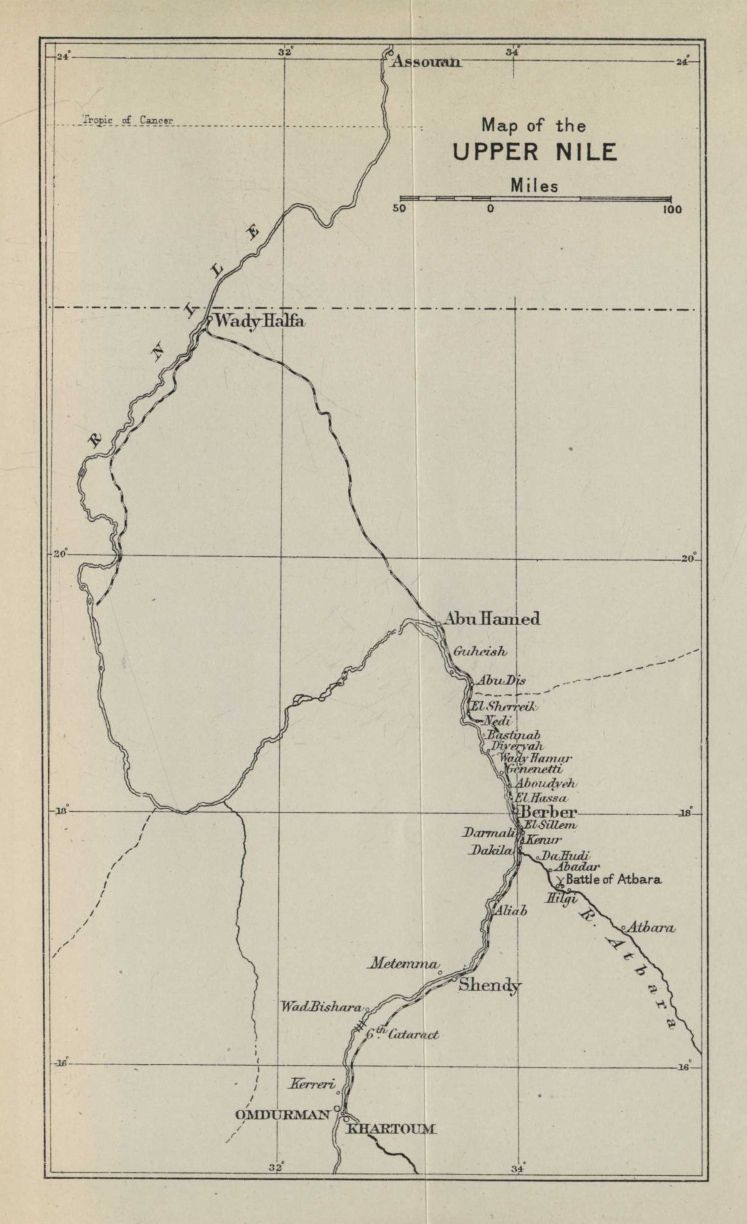
Map of the UPPER NILE
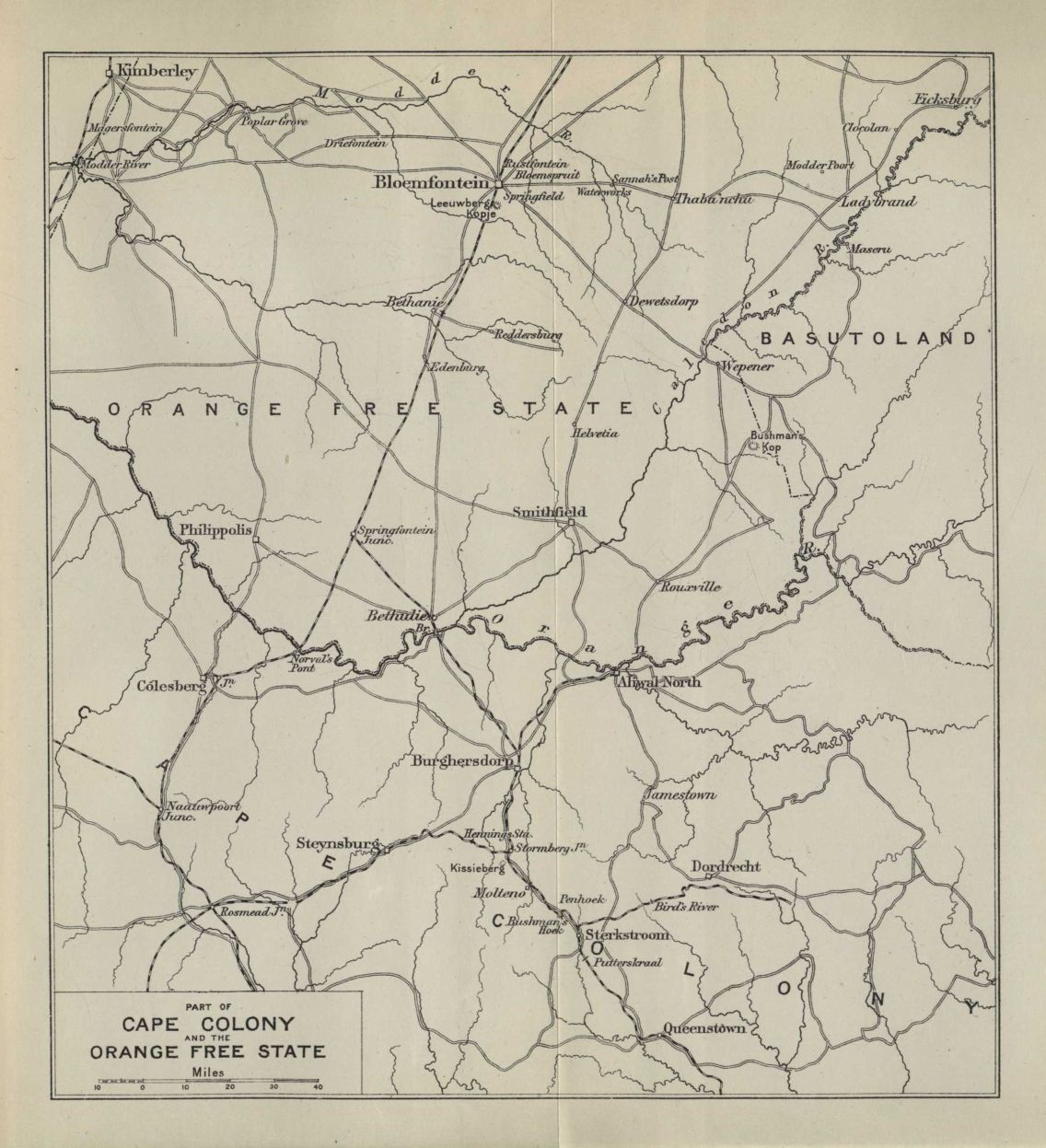
Part of CAPE COLONY and the ORANGE FREE STATE
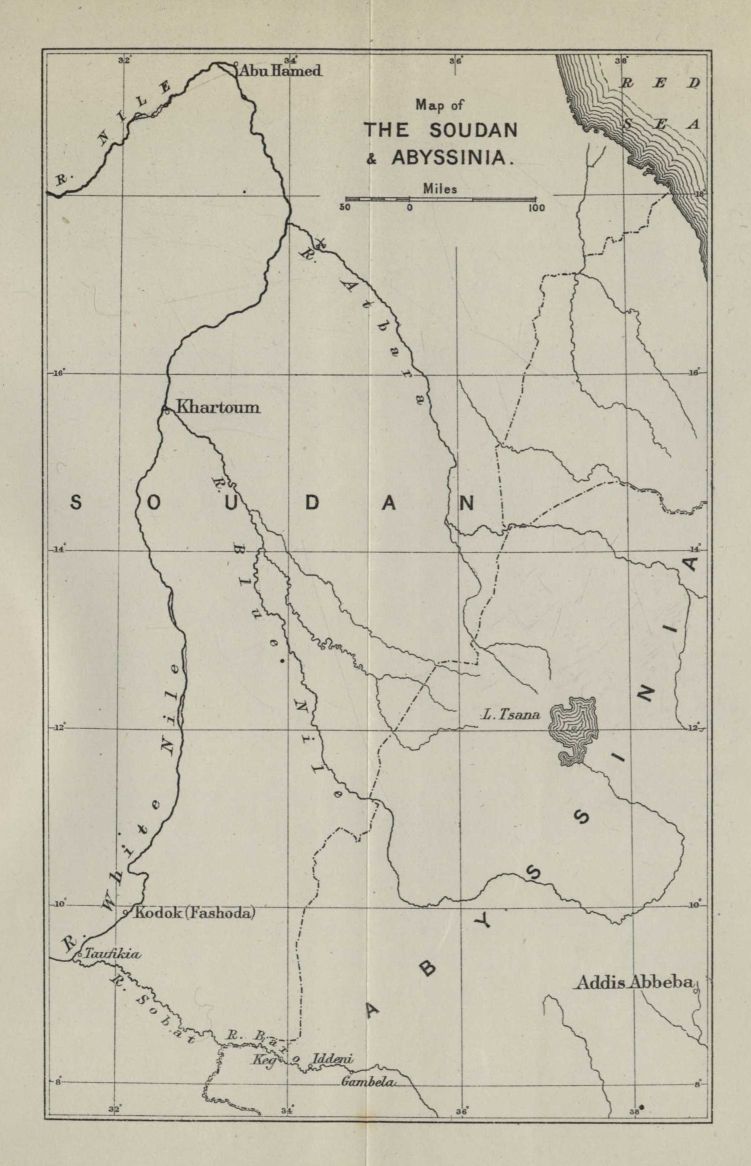
Map of THE SOUDAN & ABYSSINIA
THE MILITARY MEMOIRS OF LIEUT.-GEN.
SIR JOSEPH THACKWELL, G.C.B., K.H., Colonel 16th Lancers.
Arranged from Diaries and Correspondence by Colonel
H. C. Wylly, C.B. With Portraits, Maps, and other Illustrations.
Demy 8vo. 15s. net.
"The Memoirs of this fine old soldier, whose lot it was to see a vast amount of
very hard fighting in many notable campaigns, are of quite exceptional interest....
Not only well worth reading on account of its general interest, but from which there
is a very great deal to be learned."—United Service Magazine.
A MARINER OF ENGLAND. An Account of the
Career of William Richardson from Cabin-Boy in the Merchant Service
to Warrant Officer in the Royal Navy (1780 to 1817), told in his own
words. Edited by Colonel Spencer Childers, R.B., C.B.
Demy 8vo. 10s. 6d. net.
"Worth a dozen of the ordinary memoirs with which the market is flooded. For
it is a genuine human document, a revelation of the thoughts and doings of a typical
English sailorman during the most stirring years in our naval history.... We have
found the book delightful reading."—Spectator.
"... Such excellent stuff, and in such racy, straightforward English
... uncommonly good reading. It makes us think of some
of Captain Marryat's pictures
of what they did at sea in the brave days of old."—Standard.
TWO ADMIRALS: SIR FAIRFAX MORESBY, G.C.B.
(1786 to 1877), and his son, JOHN MORESBY. A Record of Life
and Service in the British Navy for a hundred years. By Admiral
John Moresby. Illustrated. Demy 8vo. 14s. net.
"This deeply interesting and delightfully entertaining volume."—Daily Telegraph.
"One of the most entertaining and instructive books in modern naval literature....
In every line the book smacks of the sea and of the breezy nature of the British
sailor."—The Globe.
THE LIFE OF ADMIRAL SIR LEOPOLD
MCCLINTOCK. By Sir Clements Markham, K.C.B., F.R.S
With Maps and Illustrations. Demy 8vo. 15s. net.
"No living sailor was so worthy to be the biographer of Sir Leopold McClintock as
Sir Clements Markham.... Sir Clements Markham has written with much of the
simplicity and reserve of the great explorer himself. Never for a moment does he
diverge from quiet narrative ... it is an inspiring record of one who did his duty
as he saw it, and found the path to fame by his own fine qualities of
character."—Westminster Gazette.
THE LIFE OF MAJOR-GENERAL SIR
CHARLES W. WILSON, Royal Engineers. By Colonel Sir
Charles M. Watson, K.C.M.G., C.B., R.E., M.A. With
Illustrations. Demy 8vo. 15s. net.
"There is a most interesting account of the circumstances of the time in this
admirable biography, and those who would know the true story of the failure to
relieve Gordon should by all means read it. He was a good soldier and a good
man, and we are glad to commend this biography to soldiers who know how to
appreciate the service that men like Sir Charles Wilson render to their
country."—Army and Navy Gasette.
THE LIFE OF MAJOR-GENERAL SIR JOHN
ARDAGH. By His Wife, Susan, Countess of Malmesbury
(Lady Ardagh). With Illustrations. Demy 8vo. 15s. net.
"... Lady Malmesbury has written her husband's life with rare discrimination
and reticence ... exhilarating record of a splendidly strenuous life ... an
admirable record of the work of a great servant
of the State and it should be in the hands
of every young soldier."—Athenaum.
THE LIFE AND LETTERS OF SIR
JAMES GRAHAM, 1792-1861. First Lord of the Admiralty
in the Ministries of Lord Grey and Lord Aberdeen, and Home
Secretary in the Administration of Sir Robert Peel. By
Charles Stuart Parker, Editor of "Life of Sir Robert Peel."
With Portraits and other Illustrations. Two Vols. Demy 8vo.
24s. net.
LORD DUNRAVEN'S THE OUTLOOK IN
IRELAND. The Case for Devolution and Conciliation.
Demy 8vo. 7s. 6d. net.
LORD MILNER'S WORK IN SOUTH
AFRICA. From its Commencement in 1897 to the Peace of
Vereeniging in 1902. Containing hitherto Unpublished
Information. By W. Basil Worsfold. With Portraits and a
Map. Demy 8vo. 15s. net.
FURTHER MEMOIRS OF THE WHIG
PARTY, 1807-21. By Henry Richard Vassall, 3rd
Lord Holland (1773-1840). With which is Incorporated a
Chapter termed "Miscellaneous Reminiscences." Edited by
Lord Stavordale, Editor of "The Letters of Lady Sarah
Lennox." With Portraits. Demy 8vo. 18s. net.
LENNOX, LADY SARAH, THE CORRESPONDENCE
OF. 1745-1826. Edited by the Countess
of Ilchester and Lord Stavordale. With Photogravure
Frontispiece and other Illustrations. One Vol. 10s. 6d. net.
THE HATZFELDT LETTERS. Letters of
Count Paul Hatzfeldt to his Wife, written from the
Headquarters of the King of Prussia, 1870-71. Translated
from the French by J. L. Bashford, M.A. With
Illustrations. Demy 8vo. 15s. net.
CHARLES JAMES FOX. A Commentary on his
Life and Character. By Walter Savage Landor. Edited
by Stephen Wheeler. With Photogravure Portrait. Demy
8vo. 9s. net.
THE FIRST BRITISH AMBASSADOR TO CHINA.
THE LIFE AND CORRESPONDENCE OF
GEORGE FIRST EARL MACARTNEY, 1737-1806.
From hitherto Unpublished Correspondence and Documents.
By Mrs. A. G. Robbins. With Portraits and other
Illutrations. Demy 8vo. 16s. net.
MOLTKE IN HIS HOME. By Friedrich
August Dressier. Authorised Translation by
Mrs. C. E. Barrett-Lennard. With an Introduction by
Lieut.-General Lord Methuen. With Illustrations. Demy 8vo.
6s. net.
This does not attempt to give a biography of the great Field-Marshal, but
contains a series of sketches and incidents of his life, and of the characteristics
and surroundings of one of the greatest soldiers of the nineteenth century.
NELSON'S HARDY. His Life, Letters, and
Friends. By A. M. Broadley and the Rev. R. G. Bartelot.
Many Illustrations and Portraits, 10s. 6d. net.
"A record of the beautiful human friendship which existed between the
two men, and should be read by everybody interested in one of England's
greatest heroes and in the historical incidents of his time."—The Tatler.
"The importance of this Life and Letters of Hardy is undeniable....
That Hardy is worthy of a complete biography is undoubted, and this book
is a desirable possession to all who care for England's naval glories."—Daily
Chronicle.
LETTERS FROM THE PENINSULA
(1808-1812). Written by Lieut.-General Sir William
Warre, C.B., K.T.S. Edited by the Rev. Edmond
Warre, D.D., C.B. With Portrait and Map. Demy 8vo.
10s. 6d. net.
"If we wanted to choose the sort of testimony that would make the
circumstances of a well-known campaign more real to us than ever before, we
should undoubtedly choose the private letters of an officer to his friends....
We advise the general reader to try William Warre's letters. They will find
revealed in them a stout and loyal heart, and a careful and intelligent mind
which had a singular ability for discerning the drift and significance of
things."—Spectator.
A WEEK AT WATERLOO IN 1815.
Lady De Lancey's Narrative. Being an account of
how she nursed her husband, Colonel Sir William
H. De Lancey, mortally wounded in the great battle.
With Photogravure Portraits and other Illustrations. Square
crown 8vo. 6s. net.
"A vastly interesting human document.... We need not trouble to
praise where Sir Walter Scott and Charles Dickens have so fervently
belauded."—Daily Telegraph.
"Pages of writing of terrible beauty, subtlety, delicacy, and power describe
her nursing of him and his death. It is not a jagged series of poignant notes....
There is no heroine in English history or literature more worshipful than
Lady De Lancey."—World.
THE BOOK OF WAR. Translated into
English by Captain E. F. Calthrop, R.A. Crown 8vo.
2s. 6d. net.
This work, the writings of Suntzu and Wutzu, Chinese Strategists of about
the 5th century B.C., is the most famous work on the art of war in the Far
East. It deals with operations of war, statecraft, moral and training of troops,
stratagem, the use of spies, etc., and for 25 centuries it has been the Bible of
the Chinese or Japanese ruler. The book is distinguished alike by the poetry
and grandeur of its language and the modernity of its spirit.
THE LETTERS OF QUEEN VICTORIA.
A Selection from Her Majesty's Correspondence between the
Years 1837 and 1861. Published by Authority of
His Majesty the King. Edited by Arthur Christopher
Benson, MLA., C.V.O., and Viscount Esher, G.C.V.O.,
K.C.B. With numerous Photogravures. Medium 8vo. Three
Vols. £3 3s. net. Also Crown 8vo. Three Vols. 6s. net.
FOURTEEN YEARS IN PARLIAMENT,
1892 TO 1906. By A. S. T. Griffith-Boscawen, formerly
M.P. for the Tonbridge Division of Kent. Demy 8vo.
10s. 6d. net.
LIFE OF THE MARQUIS OF DUFFERIN
AND AVA. By Sir Alfred Lyall, P.C. Third Impression.
With Portraits, etc. Demy 8vo. Two Vols. 36s. net.
THE DUKE OF ARGYLL, 1823-1900.
Comprising his Autobiography down to 1857, and his Life from
that Date onwards, based on his Correspondence and Diaries.
Edited by the Dowager Duchess of Argyll. With
Portraits and other Illustrations. Two Vols. Medium 8vo.
36s. net.
LIFE OF SIR ROBERT PEEL. Based on his
Correspondence and Private Documents. Edited by Charles
Stuart Parker. With a Summary of Peel's Life by
his Grandson, the Hon. George Peel. With Portraits.
Three Vols. Demy 8vo.
VOL. I. FROM HIS BIRTH TO 1827. 16s.
VOLS. II. AND III. FROM 1827 TO HIS DEATH IN 1852. 32s.
THE CREEVEY PAPERS. A Selection from the
Diaries and Correspondence of Thomas Creevey (1768-1838)
from Family Papers hitherto unpublished. Edited by the
Rt. Hon. Sir Herbert Maxwell, Bart., M.P. With
Portraits. One Vol. Demy 8vo. 10s. 6d. net.
SIDNEY HERBERT (LORD HERBERT OF LEA).
A Memoir. By Lord Stanmore. With Portraits and other
Illustrations. Two Vols. Demy 8vo. 24s. net. No Life of
Sidney Herbert has hitherto been published.
THE LIFE AND LETTERS OF GEORG
JOACHIM GOSCHEN, 1752-1829. By Viscount
Goschen. With Portraits and Illustrations. Demy 8vo. 36s. net.
NELSON AND OTHER NAVAL STUDIES.
By James R. Thursfield. With Illustrations. Demy 8vo. 12s. net.
"Few other writers except Mahan possess Mr. Thursfield's faculty of combining
the romance of the sea with the science of naval warfare, and in both alike the cult of
Nelson gives life and warmth to their studies.... The merit of Mr. Thursfield's
writing is the firm hold which he has of the central principles of a maritime defensive
policy. His writing is effective, and at times even brilliant; but this it is which
gives it force and lucidity."—Westminster Gazette.
A SHORT HISTORY OF THE CHIEF CAMPAIGNS
IN EUROPE SINCE 1792. By General A. von
Horsetzky, G.O.C. the 1st Austro-Hungarian Army Corps and the
Troops in Cracow. Translated by Lieutenant K. B. Ferguson,
R.G.A. With numerous Maps and Plans. Demy Svo. 18s. net.
"We have nothing but praise for Gen. von Horsetzky's book. It is a valuable
addition to military literature, for we do not know where else, in such form, records
of so many campaigns can be studied. The work of translation and condensation
has been admirably done. The merit of the book is its extreme clearness and known
accuracy ... those who desire to gain a correct idea of modern military history will
find the book invaluable."—Army and Navy Gazette.
RASPLATA (The Reckoning). By Commander
Wladimir Semenoff. His Diary during the Blockade of Port Arthur
and the Voyage of the Fleets under Admiral Rojdestvensky. With
Maps. Demy Svo. 10s. 6d. net.
"Commander Semenoff writes only of what he knows and has seen. His simple
candour and cool intrepidity enable him to record his experiences at the moment in
the most appalling scenes of naval conflict that modern times have known."—Times.
"An authentic record of the highest value, which is likely to become a classic among
naval annals."—Westminster Gazette.
THE RUSSIAN ARMY AND THE JAPANESE
WAR. Being Historical and Critical Comments on the Military Policy
and Power of Russia and on the Campaign in the Far East. By General
Kuropatkin. Translated by Captain A. B. Lindsay. Edited by
Major E. D. Swinton, D.S.O., R.E. With Maps and Illustrations.
2 Vols. Demy 8vo. 28s. net.
"... We doubt if a more virile or sincere document was ever put before the public,
and it says little for the official wisdom of General Kuropatkin's fellow-countrymen
that such a record should have been suppressed in the land of its origin. In England,
at any rate, the patent honesty and abundant good feeling of these measured criticisms
will be valued at their proper worth."—Daily Telegraph.
THE TRUTH ABOUT PORT ARTHUR. By
Monsieur E. K. Nojine, accredited Russian War Correspondent
during the Siege. Translated and Abridged by Captain A. B. Lindsay.
Edited by Major E. D. Swinton, D.S.O. With Map
and Illustrations. Demy 8vo. 15s. net.
"M. Nojine is unusually well qualified to offer testimony on the long beleaguerment.
He writes with vivacity and force, and the translation is competent and spirited, both
on account of its vivid narrative and by reason of the extraordinary revelations it
contains.... It is the most remarkable book about the war yet issued."—Times.
OFFICIAL ACCOUNT OF THE SECOND
AFGHAN WAR, 1878-1880. Produced in the Intelligence Branch,
Army Headquarters, India. Abridged Official Account. With numerous
Maps and Illustrations. Medium 8vo. 21s. net.
"An excellent compendium of the whole war, clearly written and amply illustrated
by photographs, maps, and diagrams.... It is a narrative that will fascinate the many
who love to read about war-like movements.... It is a story of wise and patient
preparation, carefully arranged generalship, supreme daring, amazing tenacity.
Undoubtedly the right thing has been done in giving to the world a stiring story,
which has remained too long, many will think, a secret record."—The Sheffield
Independent.
CAVALRY IN FUTURE WARS. By His Excellency
Lt.-General Frederick von Bernhardi, Commander
of the 7th Division of the German Army. Translated by Charles
Sydney Goldman, Editor of "The Empire and the Century."
With an Introduction by General Sir John French,
K.C.M.G., K.C.B., G.C.V.O. Demy 8vo. 10s. 6d. net.
"Here at last, in the English language, we have a really important work on the
German cavalry at first hand."—Broad Arrow.
"General Von Bernhardi most certainly knows what he is talking about, and is
equally at home when discussing matters of the highest import or others of
comparatively trifling details; he displays a sound knowledge and judgment concerning
all things of organization, strategy, tactics, and training; and moreover, he
thoroughly understands horses, so that he is enabled to offer very valuable service
on every subject connected with them, from training of the remount to the economical
use of horseflesh in war."—Westminster Gazette.
THE GERMAN OFFICIAL ACCOUNT OF
THE WAR IN SOUTH AFRICA. Prepared in the Historical
Section of the Great General Staff, Berlin. Translated by
Colonel W. H. H. Waters, R.A., C.V.O., and Colonel
Hubert Du Cane, R.A., M.V.O. 2 Vols. With Maps and
Plans. Demy 8vo. 15s. net each.
"The most valuable work in which, since its close, the war has been discussed.
It stands alone, because it is the only work in which the war has been surveyed by
trained and competent students of war, the only one of which the judgments are
based on a familiarity with the modern theory of war. The best book that has yet
appeared on the South African War."—The Morning Post.
FROM LIBAU TO TSU-SHIMA. A Narrative of the
Voyage of Admiral Rojdestvensky's Squadron to the East, including
a detailed Account of the Dogger Bank Incident. By the late
Eugene Politovsky, Chief Engineer of the Squadron.
Translated by Major F. R. Godfrey, R.M.L.I. Crown 8vo. 6s.
"A painful book, but a deeply interesting and a really valuable one, which will
have a place of permanent value among the documents of the Russo-Japanese
war."—Daily Telegraph.
BEFORE PORT ARTHUR IN A DESTROYER.
The Personal Diary of a Japanese Naval Officer. Translated
from the Spanish Edition by Captain R. Grant, D.S.O.,
Rifle Brigade. With Maps and Illustrations. Cheap Edition.
Square 8vo. 3s. 6d. net.
"It is pre-eminently a book to be read for enjoyment as well as instruction;
but it will fall short of its more immediate value if measures are not devised for
bringing it before the attention of those responsible for the education of
'youngsters' in training for a sea life."—Pall Mall Gazette.
THE BATTLE OF TSU-SHIMA. Between the
Japanese and Russian Fleets, fought on the 27th May, 1905. By
Captain Vladimir Semenoff (one of the survivors).
Translated by Captain A. B. Lindsay. With a Preface by
Sir George Sydenham Clarke. Crown 8vo. 3s. 6d. net.
"It is one of the most thrilling and touching records of naval warfare that we
have ever read."—The Westminster Gazette.
FORTIFICATION: Its Past Achievements, Recent Developments,
Future Progress. By Colonel Sir George S. Clarke,
R.E., K.C.M.G., F.R.S. New Edition Enlarged. With
numerous Illustrations. Medium 8vo. 18s. net.
ARTILLERY AND EXPLOSIVES. Essays and
Lectures written and delivered at various times. By Sir Andrew
Noble, K.C.B., D.C.L., F.R.S. With numerous diagrams
and Illustrations. Medium 8vo. 21s. net.
"No one can speak on the subject of modern artillery and explosives with greater
authority than Sir Andrew Noble."—Engineering.
THE ARMY IN 1906. A Policy and a Vindication. By
the Rt. Hon. H. O. Arnold-Forster, M.P. Demy 8vo. 15s. net.
"Mr. Arnold-Forster's remarkable work will be read with the deepest attention and
respect by all who have the interest of the Army at heart; and though many may
differ from him, now as formerly, in reference to matters of detail, few will be found
to deny that the principles he enunciates are in themselves absolutely sound....
However much any may disagree with Mr. Arnold-Forster's proposals, few will deny
that he has given very strong reasons in support of them all."—Westminster Gazette.
IMPERIAL OUTPOSTS. From a Strategical and Commercial
Aspect. With Special Reference to the Japanese Alliance.
By Colonel A. M. Murray. With a Preface by
Field-Marshal The Earl Roberts, V.C., K.G. With Maps and
Illustrations. Demy 8vo. 12s. net.
"We should like to see every officer in the British Army with the wide vision and
interest in the strategical and commercial organization of the Empire which Colonel
Murray displays."—Spectator.
"Colonel Murray deals with subjects of the highest interest. If we note those
opinions from which we differ, it must be with the preliminary remarks that there
is still more in the book with which we thoroughly agree, and that the whole of it is
suggestive and worthy of the most careful consideration."—Athenaum.
THE ART OF RECONNAISSANCE. By Colonel
David Henderson, D.S.O. With Diagrams. Small crown
8vo. 5s. net.
PRINCIPLES AND METHODS—PROTECTION AND SECURITY—CONTACT—INDEPENDENT
RECONNAISSANCE—THE SCOUT—THE PATROL—RECONNAISSANCE OF
GROUND—TRANSMISSION OF INFORMATION.
This work is a guide to the study of reconnaissance in the field under modern
conditions of war, and deals with the practical details as well as with the theoretical
principles of the subject. It has been printed in clear type on special paper and so
bound that it can be conveniently carried in the pocket by military students.
IMPERIAL STRATEGY. By the Military Correspondent
of "The Times." With Maps. Medium 8vo. 21s. net.
"The book is a most valuable and timely aid to the cause of national security, and
should be read by all those who are in a position to influence the destinies of the
Empire."—Morning Post.
A NATION IN ARMS. Speeches on the Maintenance
of the British Army. Delivered by Field-Marshal The
Earl Roberts, V.C., K.G. Crown 8vo. Cloth, 2s. 6d. net;
paper, 1s. net.
The Spectator says:—"It is with no small satisfaction that we note the
republication, under the title of 'A Nation in Arms,' of the speeches on the question of
National Service delivered by Lord Roberts.... It is not the creation of a military
caste for which he pleads, but the building up of the highest type of citizen—the
citizen who is able to protect his native land and his rights and liberties himself and
without external aid, and who believes that national safety is not to be hired, but to
be achieved by self-sacrifice.... It is hardly necessary to say that Lord Roberts
and those who agree with him ask for national training such as is willingly and
cheerfully undergone by the citizens of Switzerland, not for that which is imposed on
the German population. We have one more word to say—that is, to ask our readers
to study carefully Lord Roberts' book. We would specially ask this of those who
dread, and, as we hold, are right in dreading, militarism, and who look forward to
universal peace as the ultimate goal for mankind. They will find that Lord Roberts
has not a word to say in praise of war.... What he does desire is that as long as
war continues—and no sane man can, unfortunately, doubt its continuance in our
generation—the British people shall, when it comes, be prepared to meet it."
THE RISE AND EXPANSION OF THE
BRITISH DOMINION IN INDIA. By Sir Alfred Lyall.
Fourth Edition, with a new Chapter bringing the History down to
1907. With Maps. Demy 8vo. 5s. net.
OVER-SEA BRITAIN. A Descriptive Record of the
Geography, the Historical, Ethnological, and Political Development,
and the Economic Resources of the Empire.
THE NEARER EMPIRE.—The Mediterranean, British Africa, and British
America. By E. F. Knight. Author of "Where Three
Empires Meet," "Small Boat Sailing," etc. With 9 Coloured
Maps. Crown 8vo. 6s.
Mr. E. F. Knight, the well-known traveller and war correspondent, in this
volume gives a description of what he calls the Nearer Empire—i.e., the British
possessions in the Mediterranean, Africa, and America. The book is no mere
collection of geographical facts. It seeks to show what the Empire is, how it came
to be, and what is the history of its growth. It deals also with the political
development and the economic resources of the Colonies. The descriptive parts have an
additional charm through being to a large extent a record of personal observation.
To quote from the Preface:—"The author has travelled in most of the countries
over which the British flag flies. He has witnessed, and on some occasions taken
part in the making of several portions of that Empire in times both of peace and war,
and has therefore been able to draw on his own personal experiences and observations
when writing this short account of Britain beyond the seas."