An excursion into the literature of gems would reveal that
there is much to be discovered about them other than the
cold facts of gemology, techniques of gem cutting, and
tales of gem lore. When all the information about an individual
species is assembled, it provides a sketch of a fascinating gemstone
personality. Whole books have been written about
diamond—books filled with essays on its mining history,
natural occurrences, scientific significance, and best known
cut stones.
In the following sections of this book, some of the facts about
several of the better known gem species have been gathered.
The treatment is not meant to be complete, but enough information
is given so that the Museum visitor may better understand
and remember what he has seen.
For each species described there are color illustrations of
certain gemstones displayed in the collection. Several photographic
and artistic techniques have been used to emphasize
the various aspects of the beauty of these stones, many of which
are the largest and finest of their kinds known; however, not all
of the finest gems are pictured here.
At the end of this descriptive section is a list of the significant
faceted gemstones in the collection. Obviously, this list
will change, because new gemstones constantly are being
acquired.
28
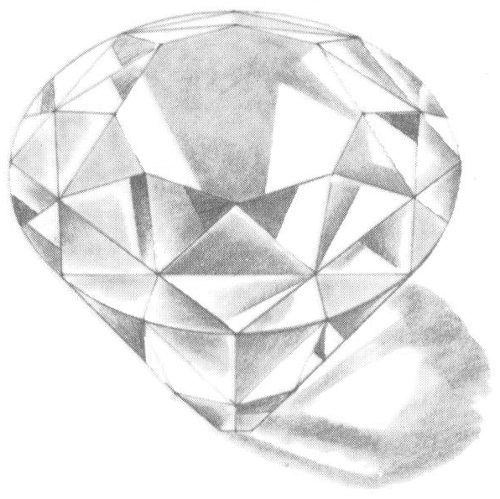
Diamond is the king of gems. It is a form of pure carbon,
and it is the hardest substance known; only diamond will
cut diamond. It is interesting that the humble graphite,
its close relative, is also pure carbon, but graphite is so soft
that it is used as a lubricant and for making the “lead” in
pencils.
The ancients believed diamond to be indestructible, and
even today many people believe that diamond cannot be broken.
Despite its great hardness, however, diamond is not exceptionally
tough, and it can be split along what diamond cutters
call its grain.
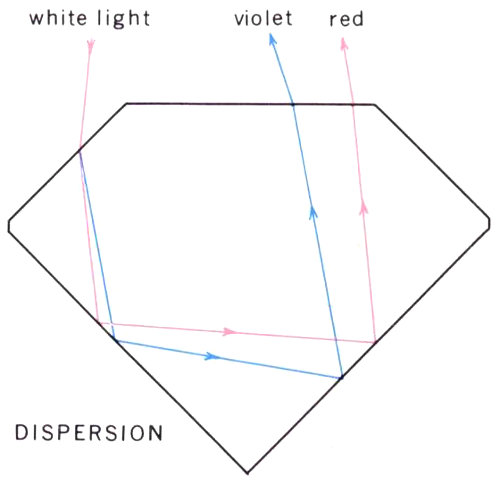
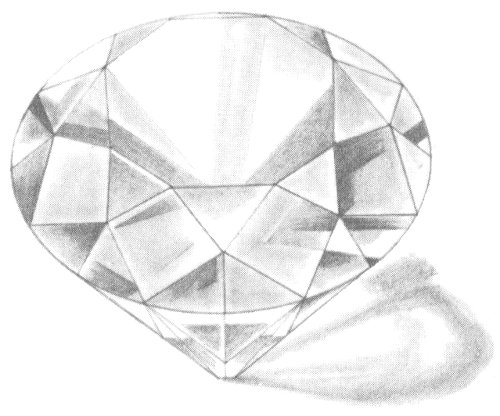
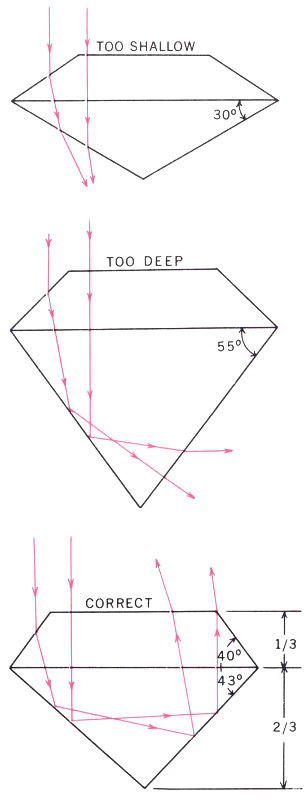
The diamond’s high brilliance results from its very high
refraction, or ability to bend light, and its fire is caused by its
high dispersion, or ability to divide light into its rainbow
colors. However, only in properly cut stones are diamond’s
brilliance and fire developed to their maximum.
At great depths in the crust of the earth and under conditions
of very high pressure and temperature, diamonds form in pipe-like
bodies of kimberlite, a heavy dark rock consisting primarily
of two minerals, pyroxene and olivine. In South Africa
diamonds are mined from the kimberlite, but they also are
recovered there and elsewhere from beds of sand and gravel
where they have accumulated after being released from their
mother rock by erosion.
The world’s largest diamond deposits are in Africa, and
names such as Congo, Sierra Leone, and the Union of South
Africa bring to mind colorful legends of fabulous discoveries of
diamond. Smaller deposits are found in South America—in
Brazil, British Guiana, and Venezuela—and in Asia. Even in
the United States some diamonds have been found.
India was the most important source of diamond until 1728,
when discoveries were made in Brazil. Among the important
large diamonds found in India were the Koh-i-noor, the Great
29
Mogul, and, very likely, the Hope Diamond. Like India, Brazil
in turn declined as a major source of diamond with the discovery
and efficient recovery of large quantities in South Africa.
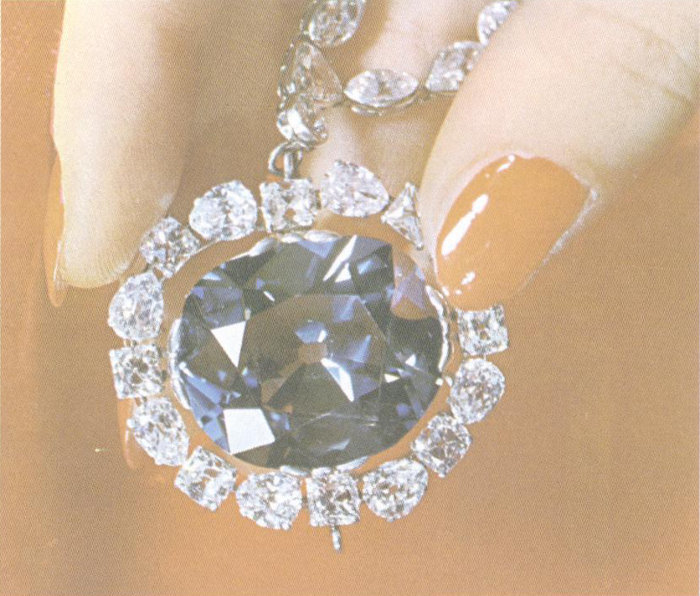
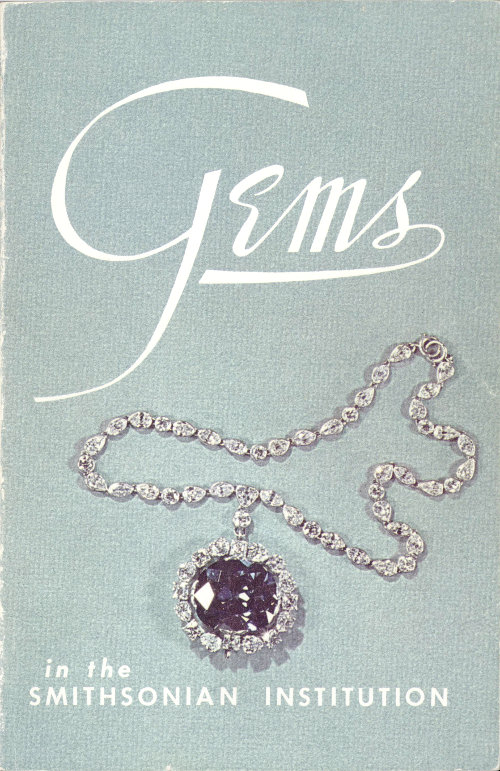
The Hope Diamond, because of its long and dramatic history and its
rare deep-blue color, is probably the best known diamond in the
world. By speculation, the Hope is linked to the famous “French
Blue,” which was brought to France from India in 1668 to become
part of the crown jewels of Louis XIV. The French Blue was stolen
in 1792 and never recovered, but in 1830 an extraordinary 44.5-carat
blue diamond—presumably cut from the missing gem—came on the
market. It was purchased by Henry Thomas Hope of England and
became known by its present name. In 1949 the gem was acquired
from the estate of Mrs. Evalyn Walsh McLean by Harry Winston
Inc., of New York. Ten years later, Harry Winston, Inc., presented
the gem (shown here in actual size) to the Smithsonian Institution.
Diamonds are extremely rare even in diamond mines. For
example, the famous South African mines contain only one part
of diamond in more than 14 million parts of worthless rock.
In spite of this, more than three tons of gem- and industrial-quality
diamond were mined in 1963.
Among the British crown jewels is a cut diamond weighing
530.20 carats (more than 3¾ ounces), one of several stones
that were cut from the largest gem diamond ever discovered.
30
The rough stone, known as the Cullinan Diamond,
weighed 3106 carats (almost 1¾ pounds) when it was found
at the Premier Mine in South Africa in 1905.
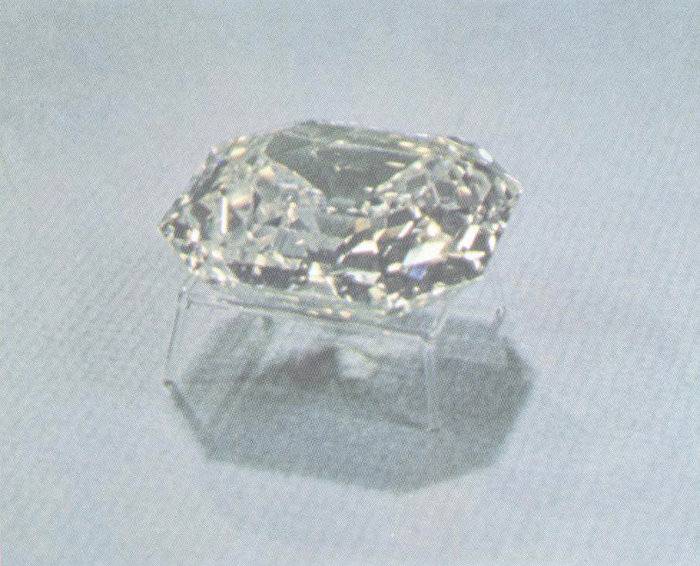
The Portuguese Diamond, weighing 127 carats, is the 13th largest cut
diamond on record. More unusual, it is from Brazil, and is thought to have
been part of the Portuguese crown jewels. In addition to its brilliant color
flashes, it has a slight milky fluorescence that causes it to “glow” even in
artificial light. (Actual size.)
Diamonds vary from colorless to black and from transparent
to opaque. As they come from the mines, they are
graded into two groups, gem and industrial. Those whose
color, imperfection, or shape make them useless as gems—more
than 8 out of every 10 carats mined—are used in industry.
Diamonds of industrial quality also are produced synthetically,
and these are used primarily in the manufacture of grinding
wheels.
The best gem diamonds are flawless and are colorless or
slightly blue. Their value depends on their color, clarity, cut,
and carat weight. Most costly are those called fancies, which
have a distinct color such as blue, pink, green, or deep yellow.
31
Pearl is included among gemstones only because it is a
beautiful object used as jewelry. As has been noted, pearl
is not mineral because it is formed by the action of a living
organism. However, the pearl has long occupied an important
position among jewels, and it is unique in requiring no lapidary
art to enhance its beauty. Nature has perfected pearls.
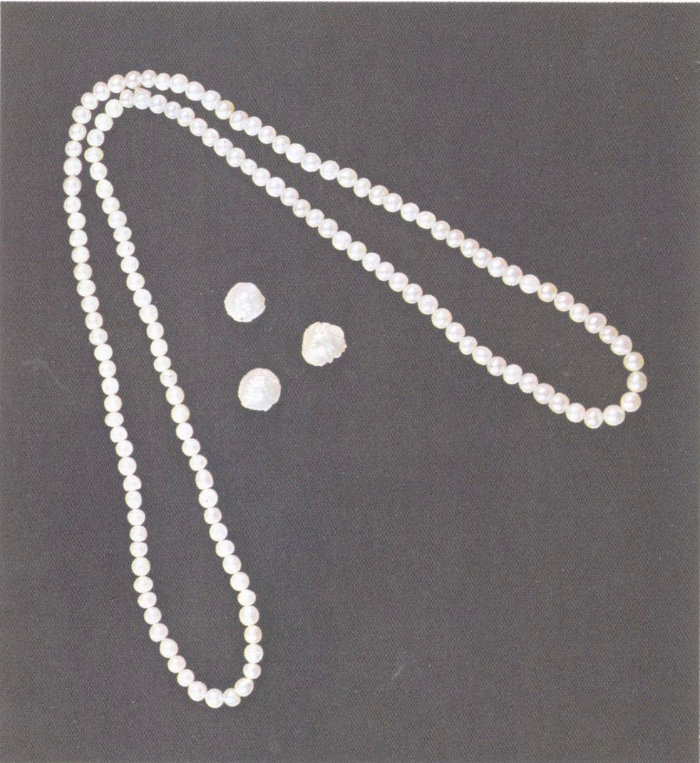
The strand of matched pearls was
presented to President Van Buren
by the Imam of Muscat. The three
baroque (irregularly shaped)
pearls are freshwater pearls from
the Wabash River in Indiana.
The ancient Chinese believed that pearls originated in the
brain of a dragon. We now know, of course, that pearl is
created by a secretion of a mollusk. Very few mollusks have the
ability to produce the fine mother-of-pearl used in the jewelry
trade, and even among those that can, very few produce pearls
with iridescence, or orient, as it is known in the trade. Only
two genera, the pearl oyster (Margaritifera) and the pearl
mussel (Unio) are important sources of the gem. Edible
32
oysters rarely produce pearls, and when they do, the pearls are
of poor quality.
The shells of pearl-producing mollusks are composed of
layers of calcium carbonate in the form of either calcite or
aragonite. These layers, cemented together with an organic
substance known as conchiolin, are known as nacre. The layer
closest to the animal is deposited in tiny overlapping patches,
producing an iridescent effect caused by the interference of
light rays reflected from the plates making up the nacre. The
same material coats the surface of a gem pearl.
Seldom does a mollusk live out its time without attack by
creatures boring through its shell, or without intrusion through
the normal shell opening of tiny parasitic worms, sand, or
other irritants. Usually inert particles are forced against the
inside of the shell, where they are covered with layers of pearl
that fasten them to the shell. This is the source of most blister
pearls. When the irritant remains in its fleshy part, the mollusk
deposits a protective shell of pearl to cover it completely, and a
spherical pearl may result. Pearls of less-symmetrical shape,
called baroques, are more common.
The value of a pearl depends on its shape, color, orient, and
size. Pearls of highest value are white with a faint tinge of
pink or yellow, possess fine orient, are round, and are free of
surface blemishes. The grading of pearls for color requires considerable
experience to detect delicate differences. Various
classification names, such as “rosée” for delicate pink shades,
are used. Fancy colored pearls are those with a strong yellow,
bronze, pink, green, blue, or black color. Grading for shapes,
which differ markedly, is easier. Spherical pearls are usually
drilled for beads; pear-shaped or drop pearls are used in earrings
and pendants; and “boutons” or button-shaped pearls, with
one flat side, are used for ear ornaments, cuff links, and rings.
Irregular, baroque pearls and tiny seed pearls are used in
jewelry designs with noble metals and perhaps other gemstones.
The world’s finest pearls, called oriental pearls, come from the
fisheries of the Persian Gulf. Fine pearls also are found off the
coasts of Burma, Tahiti, New Guinea, Borneo, Venezuela and
western South America, and in the Gulf of California. Fresh-water
33
pearls of high quality, formed in pearl mussels, are found
in various rivers in Europe and the United States, especially in
rivers in the Mississippi Valley.
A method of growing cultured pearls has been well developed.
A mother-of-pearl bead is inserted in the oyster as an irritant,
and the animal is replaced in the sea in a cage. When oysters
so treated are recovered after a period of three to seven years,
the beads in the harvested crop usually are found to be coated
with a layer of nacre up to almost a sixteenth of an inch thick.
The cultured pearl can be identified only by the observance—through
a drill-hole or by X-ray—of the mother-of-pearl core,
which had been inserted in the oyster. An instrument called
an endoscope, devised for rapid testing of drilled pearls,
relies on a beam of strong light carried by a hollow needle.
The needle is inserted into the drill hole, and as it passes
through the center portion of a natural pearl a flash of light,
reflected through a mirror system in the needle, is observed.
Both ruby and sapphire, which are second only to diamond in
hardness, are of the mineral species corundum, an oxide of
aluminum. They are identical in all characteristics except
color. Most corundum is opaque, and it is mined in large
quantities for use as an abrasive. In a few places, such as
Moguk in Upper Burma and in Ceylon, clear corundum is
found that is suitable for use as a gem.
Red corundum is known as ruby. Its color, caused by traces
of chromium, ranges from rose through carmine to a dark
purplish red referred to as pigeon’s blood red. Rubies of this
very desirable latter color often are called Burma rubies, and
they are the most costly of all the corundum gems.
All gem corundum having a color other than red is sapphire.
The name sapphire means blue, and this is the color most frequently
associated with this gemstone. The finest sapphires are
a velvety cornflower blue, and they come from Kashmir. Blue,
34
white, yellow, gold, pink, and all the other colors of corundum
are caused by the presence of slight traces of iron, chromium,
titanium, and other metals present as dissolved impurities in
the aluminum oxide. Frequently sapphires are found that show
patches of blue and yellow, or that have alternating zones of
red and blue. Pure corundum is colorless.
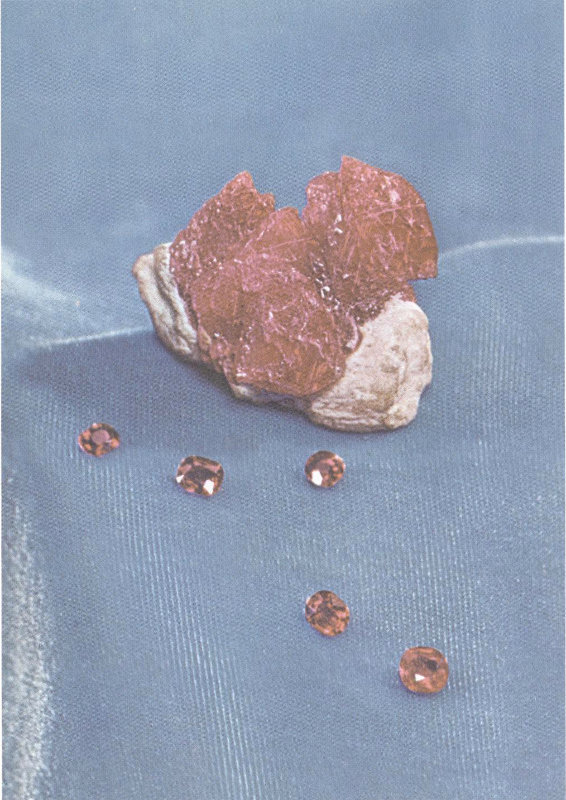
A piece of uncut ruby,
from Burma, and five
small rubies of about
half a carat each, from
Ceylon. All have the
classic “pigeon’s blood”
color. (Actual size.)
Most gem corundum comes from the Orient, at localities such
as Moguk in Upper Burma, near Bangkok in Thailand, Kashmir
in India, and Ceylon. Because of this primarily Asian origin, the
word oriental often is used with the names of other gems to
denote a sapphire of a particular color. For example, green
sapphire sometimes is called oriental emerald, and the yellow
sapphire sometimes is called oriental topaz.
35
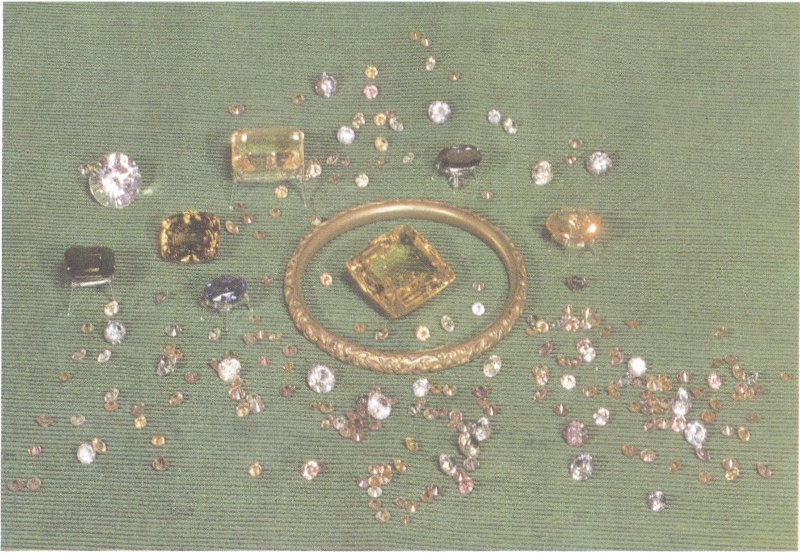
The sapphires in this group vary in color from deep blue to gold,
and they come from widely separated localities. The scatter of small
multicolored stones came from Montana, and the magnificent 93-carat
golden sapphire, encircled by the gold bracelet, came from Burma.
(Slightly less than half actual size.)
There are some notable exceptions to the generally oriental
occurrence of corundum. Some good-quality ruby has been
found in North Carolina, and sapphire of many colors has come
from Montana.
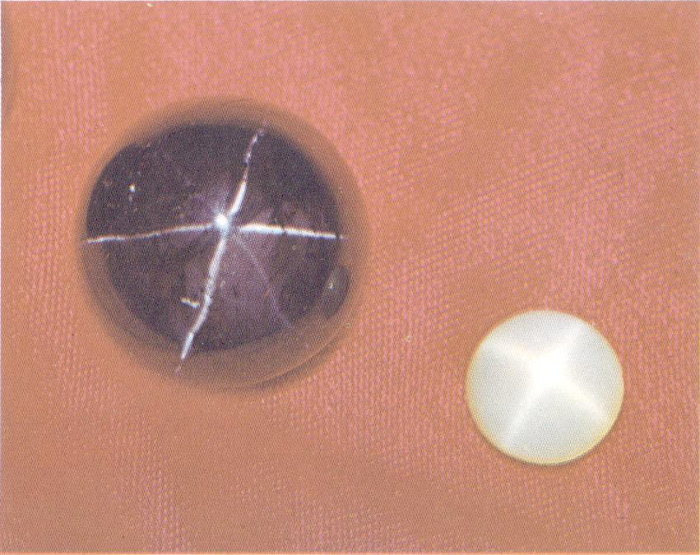
During the formation of a corundum crystal, extremely
small needle-like inclusions of rutile sometimes occur in the
hexagonal pattern of the host crystal. When such inclusions
are arranged in this way by nature, they cause, in properly
cut stones, internal reflections that produce the optical phenomenon
known as asterism. The effect is that of a 6-rayed
star, and the gems in which asterism occurs are known as star
sapphires and star rubies. Asterism is rarer in ruby.
36
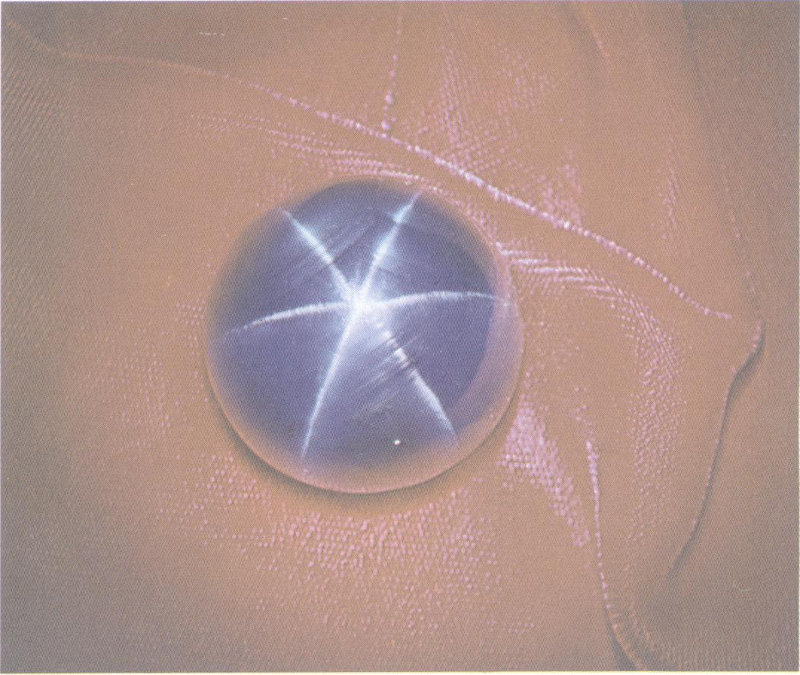
The Star of Asia, weighing
330 carats, is one of the
finest star sapphires in the
world. It is of a clear, deep
blue color and has a strong,
sharply defined, 6-rayed
star. (Actual size.)
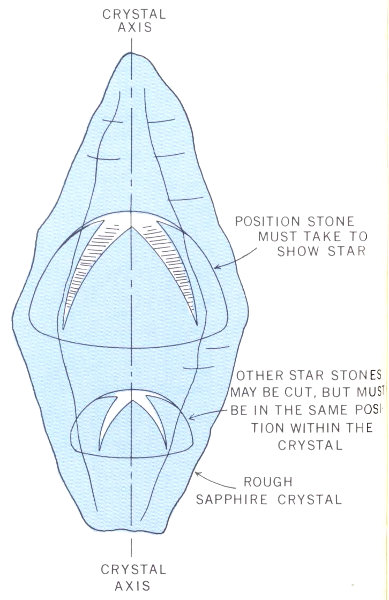
Cutting a star stone requires
careful attention to
the directions in which the
cuts are to be made. Failure
to align the stone properly
with the axis of the crystal
will produce a stone with
an off-center, crooked, or
dim star, or may even
eliminate the star completely.
- CRYSTAL AXIS
- POSITION STONE MUST TAKE TO SHOW STAR
- OTHER STAR STONES MAY BE CUT, BUT MUST BE IN THE SAME POSITION WITHIN THE CRYSTAL
- ROUGH SAPPHIRE CRYSTAL
- CRYSTAL AXIS
Since corundum is easily
manufactured, synthetic ruby
and sapphire are used extensively
in jewelry. The synthetic
stones can be distinguished from
natural stones by microscopic
examination of the kinds of inclusions
and internal defects.
- VARIETIES
- Ruby: Red.
- Sapphire: Blue, yellow, pink, green, colorless, and any color except red.
- Star sapphire: Colored as sapphire and showing asterism.
- Star ruby: Red and showing asterism.
37
Beryl is probably the most widely used colored gemstone,
and under its several names in the gem world it is probably
the best known. When it is a rich green it is known as
emerald, and when it is the blue-green of sea water it is called
aquamarine. Varieties such as the rose-pink morganite, golden-yellow
heliodor, and colorless goshenite are less well known than
emerald and aquamarine but are equally attractive and satisfactory
gemstones.
Beryl is beryllium aluminum silicate. It frequently occurs in
well-formed hexagonal crystals, and its many colors result
from the presence of very small percentages of several different
elements. Emerald owes its rich green color to traces of
chromium, and the detection of this element is one of the means
of identifying true emerald. Aquamarine, comprising the green
and blue-green beryls, gets its color mainly from traces of
iron. Practically all of the deep blue aquamarine available in
jewelry stores results from the heat treating of greenish beryl
or certain yellow-brown beryls. The stones are heated carefully
to about 800° F., and the color change is permanent. The
element lithium accounts for the color of pink beryl. As with
aquamarine, the color of yellow beryl is now considered to
be the result of traces of iron rather than uranium, as previously
thought. Pure beryl is colorless.
Beryl usually is found in pegmatites, which are very coarse-grained
granite rocks formed by the cooling of molten material
far beneath the earth’s surface. As the rock cools and beryl and
other crystals are formed, the stresses introduced are so great
that the crystals frequently shatter so badly they are useless as
gem material. Frequently, too, impurities are introduced during
crystal formation, and consequently the gem materials are found
only where the crystals were able to form without interference—such
as in openings or cavities in the rock.
Tremendous beryl crystals weighing as much as several tons,
but not of gem quality, have been discovered in a few localities.
38
Large crystals of gem quality also occur in nature, and large
cut stones of aquamarine and other colors of beryl are relatively
common. Among the fine examples of beryl in the National
Gem Collection is a remarkably large (2054-carat), flawless
cut stone of rich yellow-green. This gem and others in the
collection weighing 1363 carats, 1000 carats, 914 carats, and
578 carats accentuate the occurrence of large gem crystals of
beryl in Brazil.
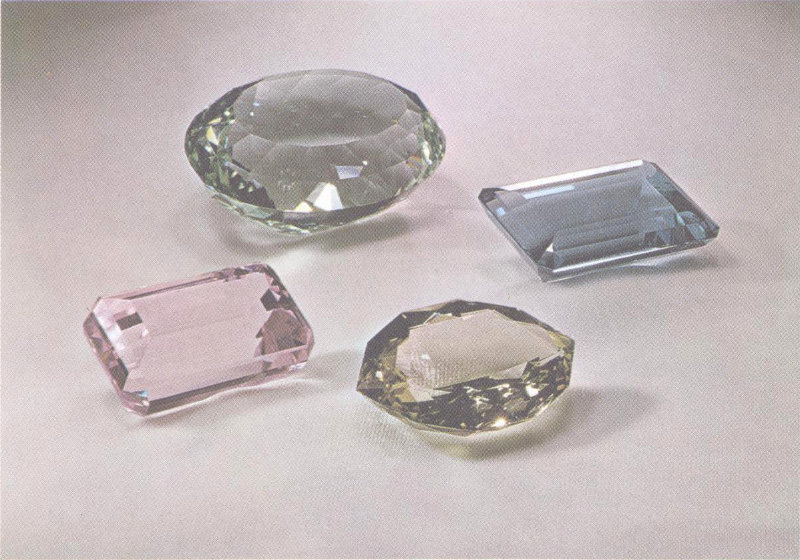
Four large cut stones, all from Brazil, illustrate the color range of
beryl. Top, a 578-carat green beryl; left, a 235-carat morganite,
gift of Mr. and Mrs. Frank Ix, Jr.; bottom, a 133-carat gold beryl;
and, right, a 187-carat aquamarine. (Half actual size.)
The finest emeralds are not found in pegmatites. At Muzo
in Colombia, the most prolific source of the finest emeralds,
they occur in veins with calcite, quartz, dolomite, and pyrite.
The veins cut through dark-colored, carbonaceous limestone
and shale. Mining at Muzo began 350 years ago and still
continues sporadically to meet market requirements. Russian
emeralds occur as good-sized crystals in mica schist, a
metamorphic rock. They occur there with chrysoberyl, phenakite,
and common beryl. Some of the smaller stones have good
color and have been cut into valuable gems. Brazil, which
39
produces many extraordinary aquamarines and other beryls,
has not produced quality emeralds. Periodically, over the
centuries, there have been reports of new discoveries of
emerald, but so far none of these has begun to rival the Muzo
source in either quantity or quality of the gems produced.
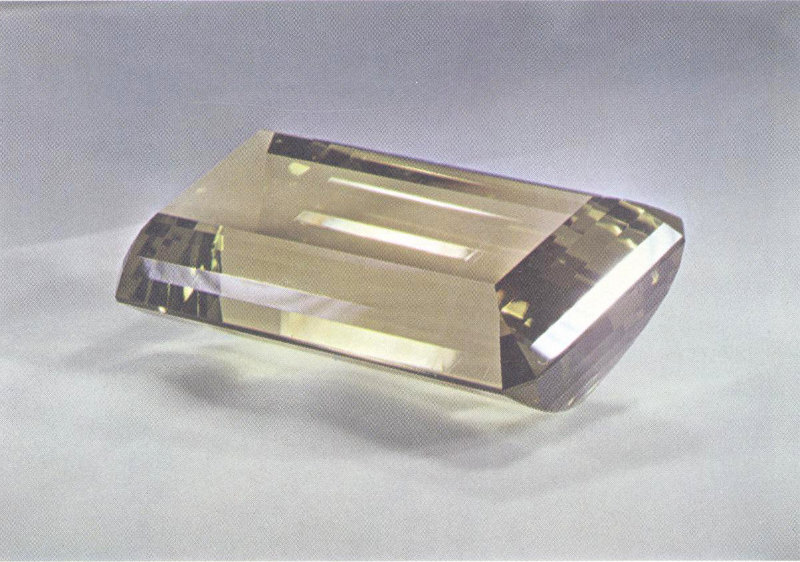
This tremendous golden beryl from Brazil, weighing 2054 carats, is
the largest cut beryl known of this color. Cut stones of this size that
contain no visible flaws or inclusions are most unusual. (Three-fifths
actual size.)
Although Brazil supplies the finest aquamarine and Colombia
the finest emerald, several localities in the United States are
sources of good-quality beryl of these colors. Foremost among
these localities are Maine, California, and Connecticut for
aquamarine and North Carolina for emerald. Morganite of pale
pink to deep peach color, from California, is also notable.
Various New England mines in Maine, New Hampshire, and
Connecticut and the gem mines of the Pala and Mesa Grande
districts of California have produced other colors of gem
beryl. However, most of the beryl mined in the United States
is used as an ore for beryllium, as little of it is of gem quality.
Because of its hardness (about 8), vitreous luster, beautiful
color, and rarity, emerald always has been highly prized as a
40
gem. Fine-quality emeralds may be more costly than fine
diamonds. Other kinds of beryl have the same physical
properties as emerald, but since they are less rare their
relative value is lower.
Synthetic emerald of high gem quality has been marketed
successfully. A synthetic substitute for aquamarine is also
available; it is really a synthetic blue spinel.
- VARIETIES
- Emerald: Grass green
- Aquamarine: Blue green
- Morganite: Pink
- Heliodor: Yellow
- Goshenite: Colorless
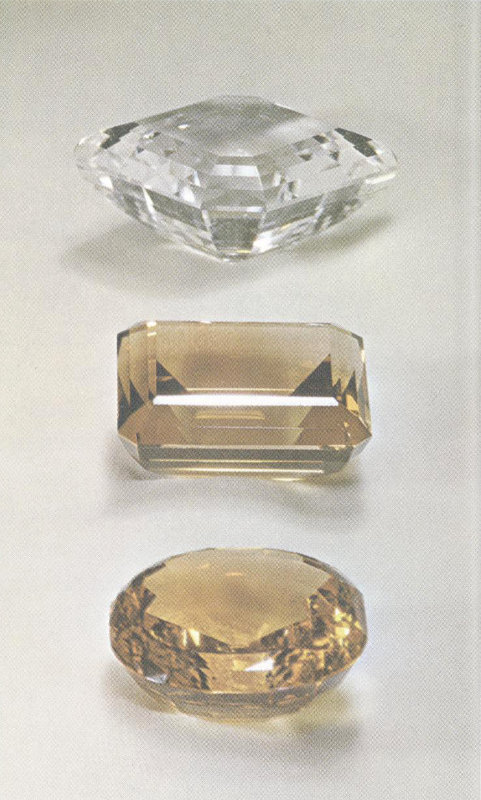
Three different cutting
styles and colors of topaz.
From top, a 235-carat colorless
stone from Colorado,
a 171-carat dark champagne-colored
stone from
Madagascar, and a 129-carat
sherry-colored stone
from Brazil. (Slightly less
than actual size.)
Because yellow is the most popular color of topaz it has
become customary to believe that all topaz is yellow.
Also, there is a tendency to believe that all yellow gemstones
are topaz. Neither
belief is correct. Stones of
yellow, sherry, blue, pink,
and colorless topaz all make
beautiful gems, and their
characteristics are identical
except for color. On the
other hand, citrine (a yellow
quartz), although entirely unrelated
to topaz, often is
disguised in the trade under
the names Brazilian topaz,
topaz quartz, or just topaz.
Great numbers of stones described and sold as yellow topaz really are the much commoner
citrine, which has few of the characteristics of fine topaz.
41
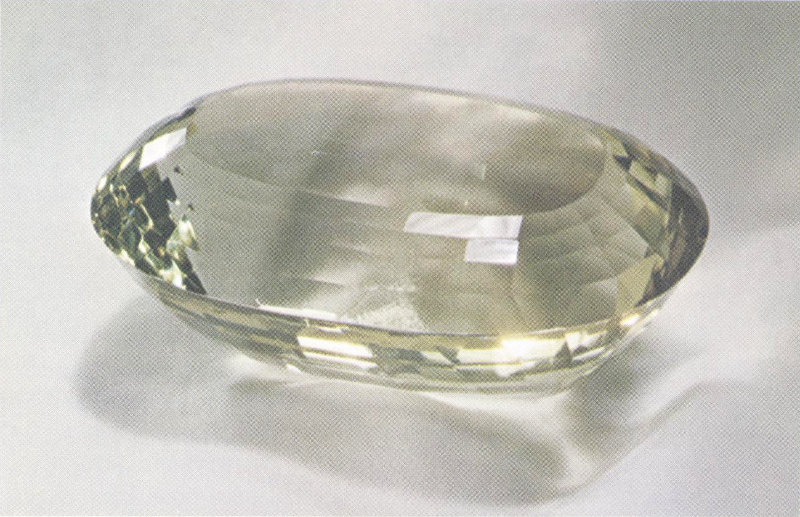
A cushion-cut topaz from Brazil that weighs 1469 carats. It
is an odd shade of yellow-green.
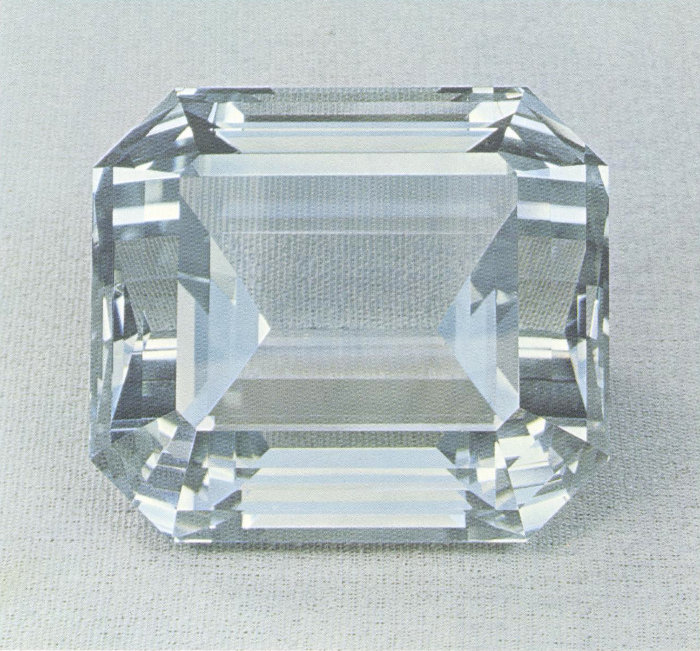
A 3273-carat topaz of soft
blue that came from Brazil. The Smithsonian Institution had this
unique gem cut by Capt. John Sinkankas of California. For several
years it was the largest topaz in the collection. (Both gems are shown
in actual size.)
42
Topaz, an aluminum fluosilicate, has a hardness of 8, a
vitreous luster, and a relatively high refractive index. It is
found in near-perfect crystals that range in size from very small
to very large, with some giants weighing as much as several
hundred pounds. Most of these crystals, especially the largest
ones, are colorless, a characteristic that indicates relatively
high purity of composition. Although topaz gems have little
fire, they take a high polish and can be very brilliant. Great
care must be taken in cutting and polishing topaz because of
its ready cleavage. The desired cut and high polish can be
secured by avoiding excessive heat or pressure during the
operation and by planning facets so that none lies exactly
parallel to the cleavage direction.
Although crystals of gem-quality topaz are found in many
localities, perhaps the splendid blue ones from Russia and
the yellow, wine, blue, and colorless ones from Brazil are best
known. Some fine topaz has been found in the United States
in such widely separated areas as New Hampshire, Texas,
Colorado, and California. The light, golden brown topaz from
Colorado has an unfortunate tendency to fade in strong sunlight.
It remains to be seen whether similar topaz coming
recently from comparable occurrences in Mexico also will
fade. By a system of heating and cooling, certain of the red-brown
topaz crystals from Ouro Preto, Brazil, can be converted
to colors ranging from salmon pink to purple red. Quick
heating to high temperatures can completely remove color,
and sudden or uneven cooling may cloud or crack the stone.
Opal has been admired for its great beauty since ancient
times, but this gemstone lacked commercial appeal until
the discovery of the Australian black opal late in the
19th century.
43
Opal is somewhat brittle, is sensitive to heat, and, in some
cases, tends to deteriorate despite the best of care. Therefore,
this stone lacks many of the physical characteristics required
for an ideal gem. These deficiencies would eliminate other
species from the list of gemstones, but the great beauty of its
flashing and shifting color patterns has made opal increasingly
popular. Even its name, coming from the ancient Sanskrit
“upala,” means precious stone.
With a hardness between 5½ and 6½, opal is the softest of
the more popular gems. It is sufficiently hard, however, to be
used in jewelry, where its setting usually helps to protect it
from shock and abrasion.
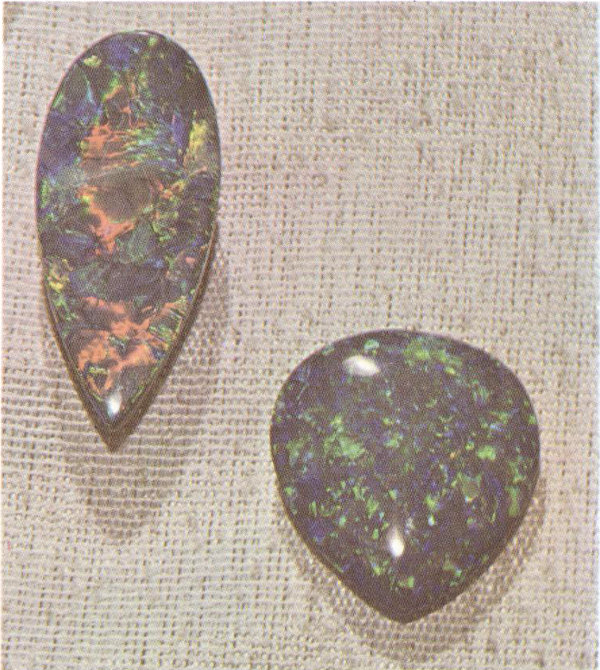
Black opal, so called because the
color flashes appear against a dark
background, is found in Australia.
It is quite rare, and large pieces
such as the ones shown here
have become extremely valuable.
(Almost actual size.)
Opal is unlike most
gemstones in that its flashing
color is not due to the
color of the stone itself, or
even to the color of its included
impurities. Rather,
it is due to the way in
which tiny opal particles
are grouped during its formation. Detailed photographs taken
through an electron microscope show clearly how precious
opal is deposited as spheres that are so small they are indistinguishable
under powerful optical microscopes. These spheres
are packed together in very orderly networks, row upon row
and layer upon layer, with tiny open spaces, also in rows,
between them. Masses of common opal lack this orderly internal
arrangement of spheres. White light striking the precious
opal is reflected independently by each row of spheres, much
like the reflections from a series of slats in a venetian blind.
44
Since these rows of spheres are spaced at
distances approximately the same as the
wavelength of light, a phenomenon known
as diffraction occurs. The separate reflections
interfere with each other in an
organized manner, cancelling out some
of the light wavelengths and reinforcing
others, producing color. The brilliant
color flashes are of different hues depending
on the sizes of the spheres of opal
and, therefore, the distances between rows. To provide the
best display of this optical effect, opal is almost always cut in
cabochon form rather than as faceted stones.

Fire opals have rich fire; some have background
colors that vary from bright yellow through
orange and red; and some are colorless. Stones
such as the ones shown here, which weigh 7,
11, and 22 carats, have made Querétaro, Mexico,
famous as their source. (Actual size.)
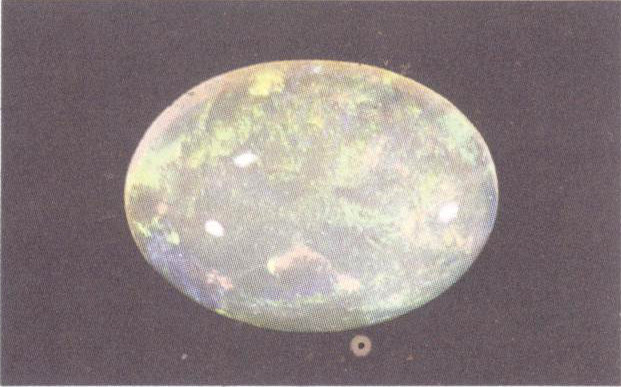
This rare 34-carat opal from Brazil
resembles closely the opals found
in Australia. (Actual size.)
Common opal, which shows milky opalescence, does not
exhibit color flashes, and it is not used as a gemstone. Each of
the common varieties—such as hyalite, cacholong, and hydrophane—has
its own slightly different set of characteristics,
but only precious opal, with its dazzling color display, is
important for gem purposes. To take full advantage of the
small amounts of gem material available, or to bring out its
color better, precious opal is often cut as thin pieces and mounted
as doublets on some other backing. Also, the seams in rock
sometimes are cut so that the thin layer is exposed on a
45
thicker backing of the adjoining rock. Precious opal, or gem
opal, is classified as white opal when the color flashes are in a
whitish or light background, black opal when the background
material is gray, blue-gray, or black, and fire opal when the
background is more translucent and red, reddish orange, or
reddish yellow.
Precious opal has been found in several areas of the world—in
nodules, in seams in rock, or as replacements of other
minerals or even of wood and shell. Hungarian deposits were
well known in Roman times, but these and other deposits
became insignificant with the discovery of opal in Australia
in the late 19th century. Opal deposits were discovered in
1889 at White Cliffs in New South Wales, and other important
discoveries in Australia followed, including deposits
at Lightning Ridge in New South Wales that produce very
dark stones and the rich fields of white opal at Coober Pedy
in South Australia. Mexico has remained for a long time the
principal source of richly colored fire opals, with the most important
deposits located in the state of Querétaro, where
mines have been worked intermittently since 1835. This has
made the town of Querétaro today the center for the trade
and cutting of Mexican opal.
- VARIETIES
- White opal: Color flashes in light-colored background material
- Black opal: Color flashes in dark gray or bluish background material
- Fire opal: Orange or reddish background material
Two of the more famous stones in the British crown jewels
are the Black Prince’s Ruby and the Timur Ruby, but
neither of these stones is really ruby. Like the great red
gem in the crown that belonged to the Russian Empress
Catherine II, these two British stones are spinel. Although
spinel occurs in many colors, such as yellow, green, violet,
brown, and black, it is the red spinel that usually is seen in the
46
gem trade. There are several varieties of red spinel, such as
ruby spinel, balas ruby, rubicelle, and almandine spinel—all of which
refer to the color resemblance to ruby.
The hues and tints of spinel show subtle variations that are matched
only by those of tourmaline. Unlike tourmaline, however, spinel
may be bright ruby red. The cut stones curving around two pieces
of rough from Burma weigh (left to right) 30 carats (Ceylon), 34
carats (Burma), 36 carats (Burma), 30 carats (Ceylon), and 22 carats
(Ceylon). (Three-fourths actual size.)
Spinel is an oxide of magnesium and aluminum, and it is not
related to ruby. However, because its hardness (8) is only
slightly less than that of ruby and its brilliance is about equal
to that of ruby, spinel makes an excellent substitute for that
gem. Also, because it is more plentiful, spinel costs much less.
It is interesting that red spinel, like ruby, gets its color from
the presence of traces of chromium.
Synthetic blue spinel is widely used as a substitute for
aquamarine, and synthetic spinels of other colors are used as
substitutes for many gems. However, the synthetic stones are
not ordinarily made in the subtle shades so characteristic of
natural spinel. Completely colorless spinel apparently exists
only as a synthetic material. Actually, because of its hardness,
durability, and many attractive colors, spinel makes a fine
gemstone in its own right.
47
Like ruby and several other gemstones, spinel is found
chiefly in the gem gravels of Ceylon, Burma, and Thailand.
Appreciable amounts of spinel occur in the Ceylon gem gravels
as worn, rounded pebbles of many colors. In the Burmese
gravel deposits the spinel is often found as well-formed
octahedral crystals. Near Moguk, in Burma, spinel has been
found in its original position in the limestone rocks as well as
in the eroded stream deposits.
- VARIETIES
- Almandine spinel: Purplish red
- Rubicelle: Orange-red
- Balas ruby: Rose red
- Ruby spinel: Deep red
- Chlorospinel: Translucent grass green
- Ceylonite or pleonaste: Opaque dark green, brown, or black
- Picotite or chrome spinel: Translucent dark yellow-brown or green-brown
Few gemstones can compete with quartz for variety of color.
Having a hardness of 7 and occurring in many beautiful
varieties, only the relative abundance of quartz prevents
the species from attaining top rank among gemstones.
The two kinds of quartz, crystalline and cryptocrystalline
(fine-grained) quartz, occur in all kinds of mineral deposits
throughout the world. Much of this material is suitable for
cutting gems.
Colorless crystalline quartz, or rock crystal, makes attractive
faceted gems, and it is used as a suitable substitute for diamond
and zircon even though it lacks the fire and brilliance of those
gemstones. Some very large, flawless crystals of colorless
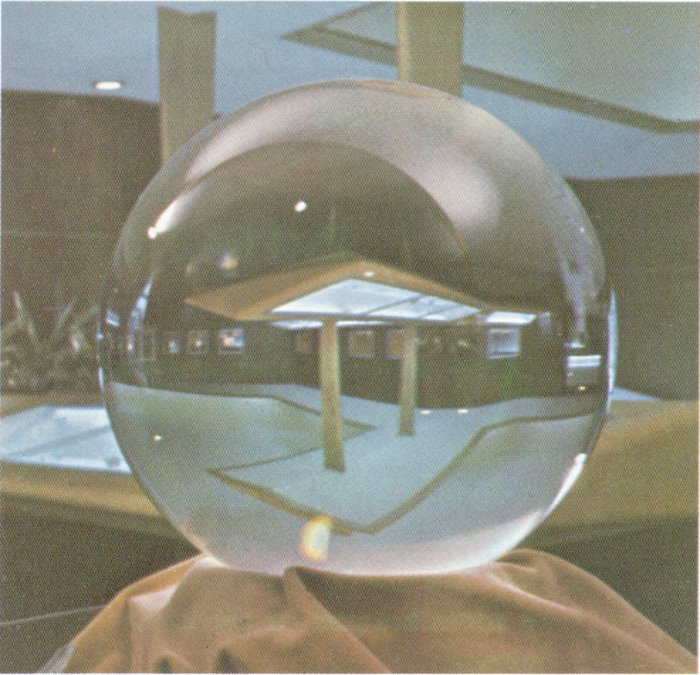
crystalline quartz have been found. The great Warner Crystal
Ball, with a diameter of 12⅞ inches and weighing 106¾
pounds, was cut from such a crystal. In addition to the name
rock crystal, colorless crystalline quartz appears in the
jewelry trade under such names as rhinestone (not to be
confused with the glass substitute), Herkimer diamond (from
48
Herkimer County, N. Y.), and Cape May diamond (from
Cape May, N. J.).
The most popular variety of quartz is amethyst, a transparent
form whose color ranges from pale violet to deep purple. In
many cut stones of amethyst the color intensity changes
sharply from section to section. This is due to irregular color
zoning common to amethyst crystals. The actual cause of the
purple color in amethyst is not very well understood. There are
fewer cut stones of amethyst in very large sizes because of the
rarity of large, flawless, well-colored crystals.
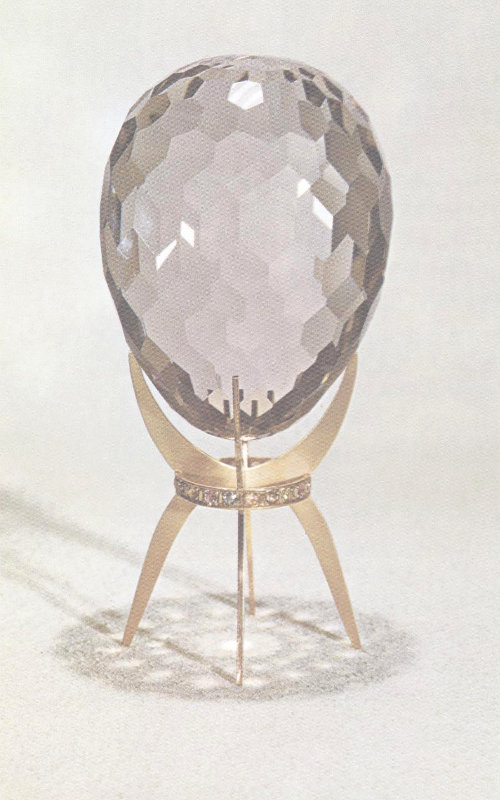
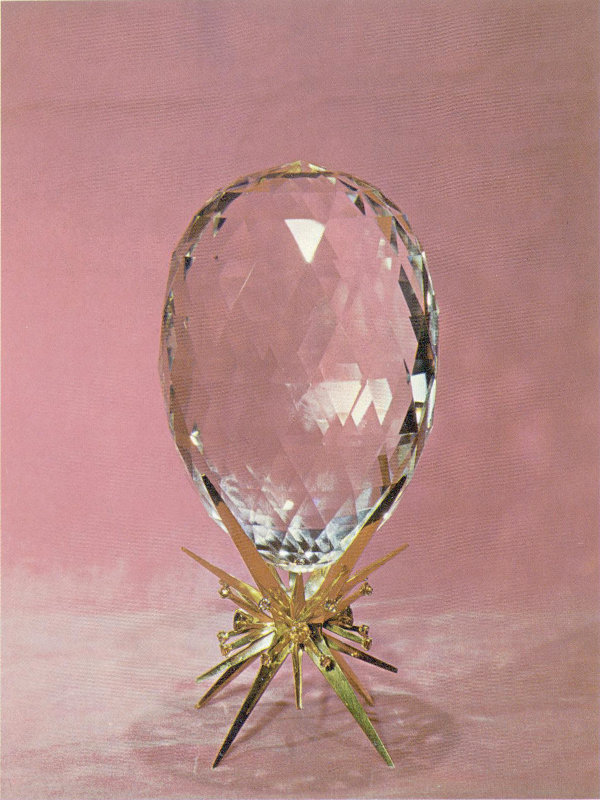
This 4500-carat pale smoky quartz
egg from California rests on a gold
stand set with Montana sapphires.
The unique gem was cut and its
stand was designed and made by
Capt. John Sinkankas as a difficult
exercise in the lapidary art.
The quartz egg is 4 inches long
and almost 3 inches in diameter.
The name citrine (from the French word for lemon) attempts
to describe the yellow color of another variety of quartz.
Actually, the normal coloring of citrine varies from yellow to
red-orange and red-brown,
but the yellow
sometimes rivals the
yellow of topaz. In
addition to the normal
color range, the colors
of citrine may grade
through a grayish yellow
variety known as
cairngorm and a grayish
variety called smoky
quartz to a black variety
called morion.
Other varieties that
add color dimensions
to the group of quartz
49
gemstones are rose quartz and milky quartz. Like amethyst, the
reason for the color in rose quartz has not been definitely
established. Milky quartz owes its color to myriads of tiny
cavities containing water or liquid carbon dioxide.

A 783-carat step-cut citrine of deep, rich color dwarfs a 278-carat
brilliant-cut citrine (at left), a 90-carat smoky quartz, and a 91-carat
briolette of citrine. The smoky quartz, from Switzerland, is
so dark that it appears to be opaque. The other three stones came
from Brazil. The briolette and brilliant-cut citrines were cut and
donated to the Smithsonian Institution by Albert R. Cutter. (Slightly
less than half actual size.)
The range of color in quartz is somewhat surprising, considering
that the mineral is a simple silicon dioxide. Some of
the colors, as with corundum and some other gemstones, are
due to traces of impurities. In quartz, these consist mainly of
oxides of iron, manganese, and titanium. However, all the
reasons for quartz coloration in its many varieties are not
known.
50
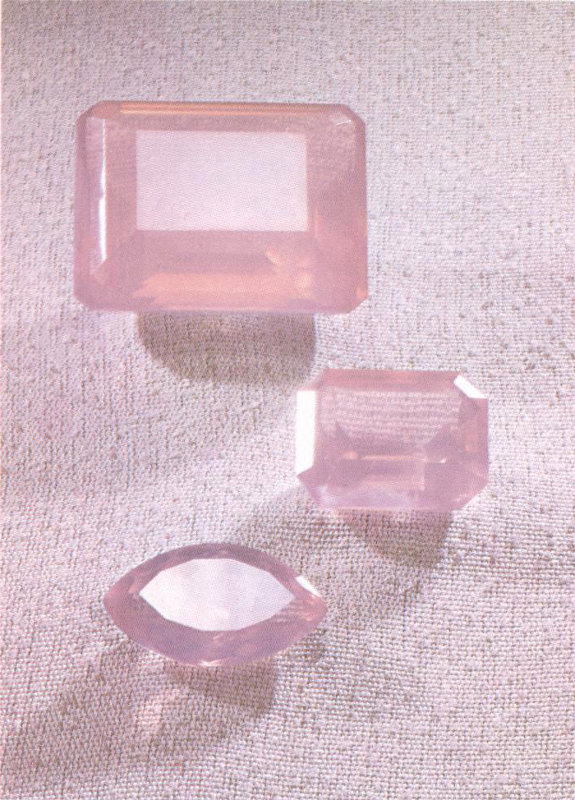
Pastel rose quartz has a delicate
beauty in any cut. The 375-carat
step cut (top), the 84-carat step
cut, and the 46-carat marquise
came from Brazil. (Two-thirds
actual size.)
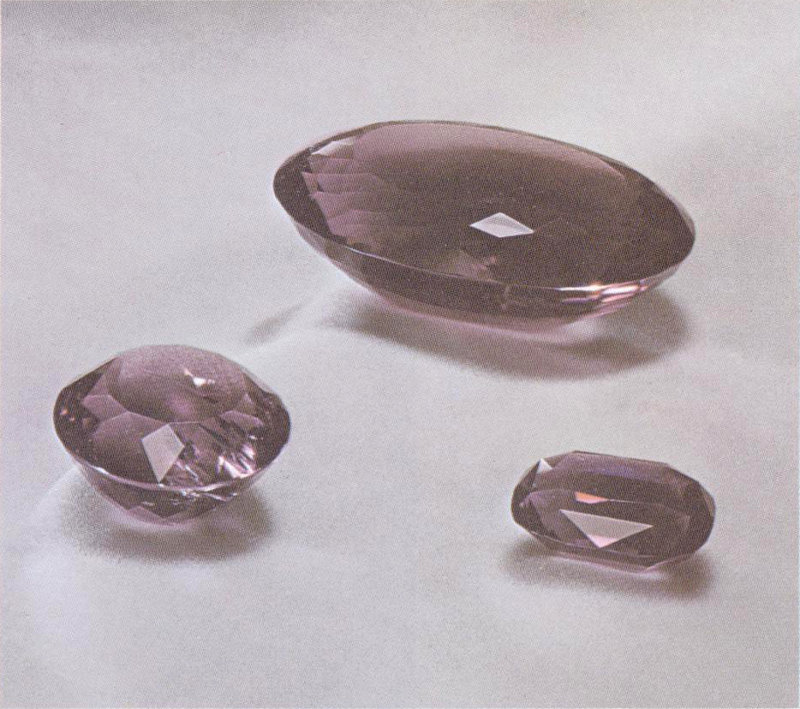
Amethyst, a purplish quartz, is
the birthstone for February. Here
it is represented by a 1362-carat
stone from Brazil (top), a 54-carat
stone from Pennsylvania (left),
and a 21-carat stone from North
Carolina. (Almost actual size.)
In addition to possessing wide variation of color, quartz, like
sapphire and certain other gemstones, can exhibit asterism or
chatoyancy. The well-known tiger’s-eye from West Griqualand,
South Africa, owes its eye effect to the fact that its material
is a replacement of fibrous asbestos by cryptocrystalline quartz.
The color of tiger’s-eye arises from the partial alteration of the
asbestos to yellow-brown iron oxides before it is replaced by
quartz. Inclusions of rutile, tourmaline, or actinolite needles
may produce attractive patterns in quartz, but they do not
always cause chatoyancy. The material containing such inclusions
51
is called sagenitic quartz, or it may be descriptively
named, such as rutilated quartz, tourmalinated quartz, and so
forth. Sagenitic quartz is usually cut as cabochons rather than
as faceted stones since the inclusions are of greater interest
than the quartz itself.
If the foreign inclusions consist of tiny flakes of hematite or
mica, the quartz assumes a spangled appearance and is called
aventurine.
Crystals of quartz varieties that are opaque or that contain
visible inclusions normally are cut as cabochons to take advantage
of the body color or to make the inclusions more visible.
Crystals of the transparent varieties are fashioned in any of
several cutting styles, depending on whether it is desired to
take maximum advantage of color or of brilliance. Because of
its availability in fairly large, flawless pieces in various colors,
quartz has been used extensively in carving. The Chinese
have excelled in carving large, ornate objects of rock crystal.
Although quartz occurs in many varieties and its crystals are
cut in many styles, it is easily identified by its refractive index
of 1.55, specific gravity of 2.65, and hardness of 7.
- CRYSTALLINE VARIETIES
- Amethyst: Purple to violet
- Cairngorm: Smoky yellow
- Citrine: Yellow to red-orange and red-brown
- Milky quartz: White
- Morion: Black
- Rock crystal: Colorless
- Rose quartz: Rose to pink
- Smoky quartz: Gray to black
- CRYPTOCRYSTALLINE VARIETIES (CHALCEDONY)
- Agate: Pronounced color banding
- Aventurine: Inclusions of sparkling flakes
- Bloodstone: Dark green dotted with red
- Carnelian: Red to yellow-red
- Cat’s-eye: Chatoyant
- Chrysoprase: Green
- Jasper: Opaque brown to red-brown, green, yellow, etc.
- Onyx: Color banding in straight layers of contrasting color
- Sard: Light to dark brown
- Sardonyx: Sard or carnelian bands alternating with white bands
- Tiger’s-eye: Bright brownish yellow, sometimes blue: chatoyant
52
With color ranging from shades of yellow and brown
through blue-green to olive, and with a hardness of
8½, chrysoberyl has most of the characteristics necessary for a
fine gem. Rare stones of high-quality chrysoberyl demand
fairly high prices, and they are sought eagerly by the connoisseur
of gemstones.
Chrysoberyl is beryllium aluminate,
and thus is closely related to the gemstone
spinel, which is magnesium aluminate.
When pure, chrysoberyl is colorless and
relatively uninteresting as a gemstone
because of its lack of color dispersion and
its moderate refractive index of 1.75.
However, few pure samples are known, as
chrysoberyl normally contains some iron
or chromium in place of aluminum and
some iron in place of beryllium. As a
result of such impurities, the color of
chrysoberyl my be yellowish, greenish,
or brownish.
Chrysoberyl and beryl are the only important
gemstones containing the element
beryllium. The minerals beryllonite,
euclase, hambergite, and phenakite also
contain this element, but they are rare and
seldom are seen as cut gems.
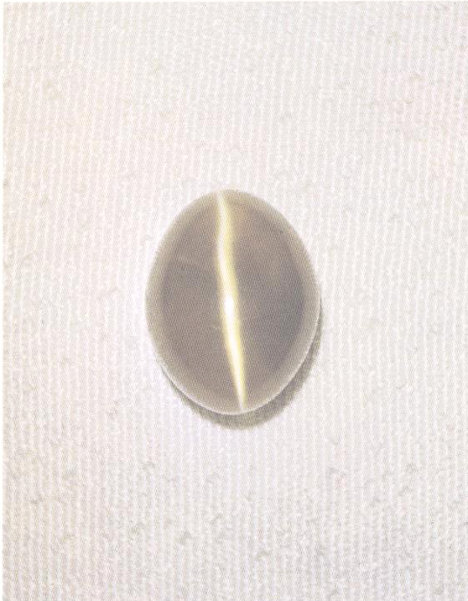
One of the finest chrysoberyl cat’s-eyes
in existence is the 58-carat
Maharani from Ceylon. (Actual
size.)
The alexandrite variety of chrysoberyl has two colors in delicate
balance, and it changes from a columbine red to an
emerald green when viewed under different light. When
viewed in daylight, which is richer in green, the color balance
shifts toward green, and that hue is seen by the observer. Under
artificial light, normally richer in red, the color balance shifts
toward red, and the stone seems to have changed to that color.
53
This extremely rare stone, named after Czar Alexander II of
Russia, is found only occasionally, in Russia and Ceylon. The
Russian stones, found with emerald in mica schist, tend to be
smaller than the Ceylon stones and have a color change going
from emerald green to violet-red. The Ceylon stones, found as
pebbles in gem gravels, have a color change going from a less-emerald
green to a browner red. The 66-carat, record-size
alexandrite in the National Collection shows the color change
typical of Ceylon stones. A synthetic stone is commonly
marketed as synthetic alexandrite, but this substitute not only
is man-made but is actually synthetic corundum instead of
synthetic chrysoberyl.
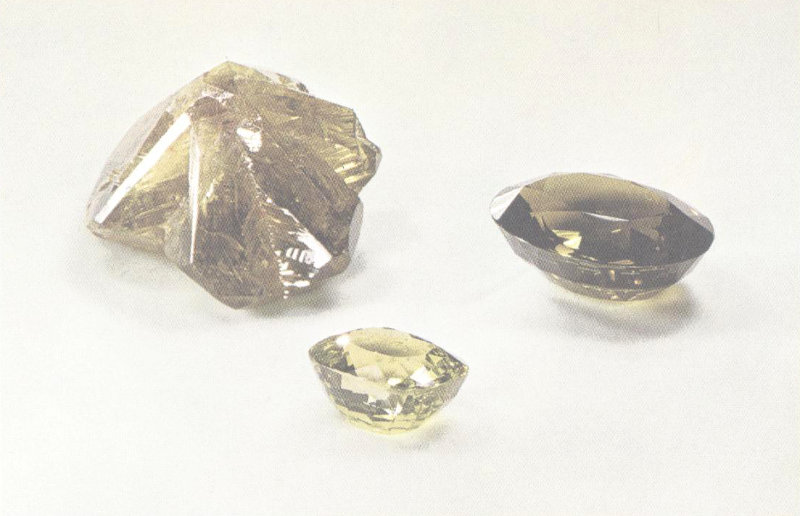
In addition to its fine cat’s-eyes and its color-changing alexandrite
varieties, chrysoberyl occurs in handsome stones that vary in depth
of color. Shown here with an uncut twinned crystal of gem quality
from Brazil are a 46-carat stone from Brazil (left) and a 121-carat
stone from Ceylon. The uncut crystal is a gift of Bernard T. Rocca, Sr.
(Two-thirds actual size.)
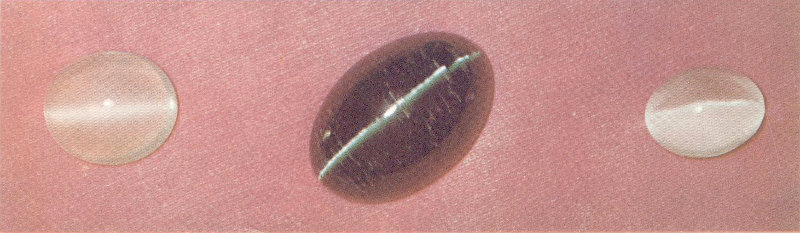
Cat’s-eye chrysoberyl contains myriads of tiny fiberlike channels
arranged in parallel position. When the stone is cut as a
cabochon, a band of light is reflected from the curved top of
the stone, producing an effect that resembles the slit pupil of a
cat’s eye.
- VARIETIES
- Alexandrite: Green in daylight, changing to red in artificial light
- Cat’s-eye: Chatoyant
54
Because of its great color range, which includes pink, green,
blue, yellow, brown, and black in many different shades
and combinations of shades, tourmaline is one of the most popular
of the colored gemstones. Tourmaline with a color near
emerald green is particularly popular.
Chemically, tourmaline is a very complex borosilicate, and
its color is determined by the various elements present in it.
Tourmaline crystals having sodium, lithium, or potassium are
either colorless, red, or green; those having iron are blue, blue-green,
or black; and those having magnesium are colorless,
yellow-brown, or blackish brown.
Some crystals of tourmaline are of two colors, and stones
of mixed colors, such as pink and green, can be cut from these.
The color mixing may show as zoning with the core color of
the crystal overlaid by another color and perhaps even additional
layers of other colors. Zoned crystals with a core of
deep pink covered by a layer of green have been called “watermelon
tourmaline.” Because its refractive index of about 1.6 is
too low to give it marked brilliance, and its color dispersion
is too low to give it fire, the tourmaline relies almost solely
on the beauty of its color for its rank in popularity.
Although tourmaline has a low refractive index and low dispersion,
it exhibits remarkable dichroism. In other words, it
can present different tints to the viewer depending on the
direction that the light is traveling through the crystal. When
viewed down the long, or vertical, axis of the crystal, the color
of tourmaline is much stronger than when viewed from the side.
This means that if the crystal is dark the cutter will have to cut
the stone with the flat part, or table, parallel to the long axis
of the crystal. The color of the gemstone then will be lightened
when viewed from its table, since this is the direction of
lighter color. Similarly, the table of a lighter colored crystal
can be cut perpendicular to the long axis in order to produce
a deeper colored gem.
55
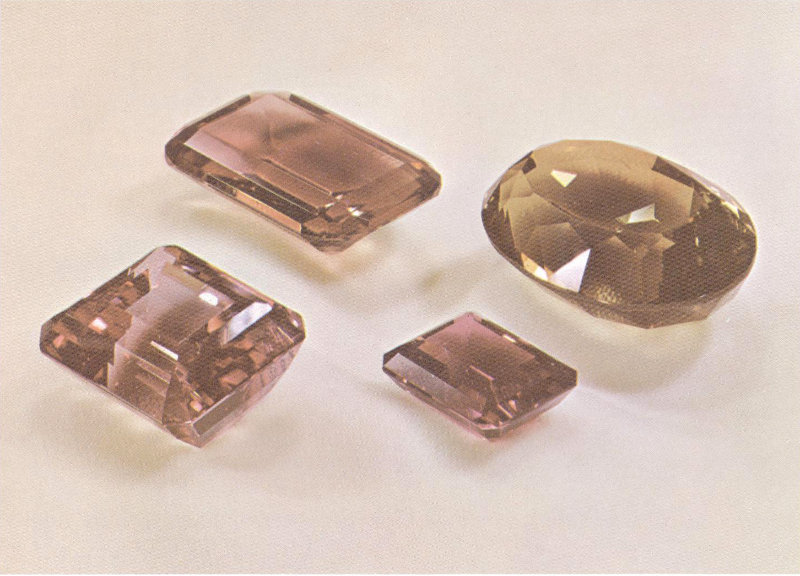
Green seems to be the best known commercial color of tourmaline,
but this extremely variable gem species exhibits many subtle shades
of color, as shown here. At upper left, a 104-carat stone from Mozambique;
at upper right, a 173-carat stone from Mozambique; at lower
left, a 111-carat stone from Manchuria; and a 35-carat stone from
Brazil. (Actual size.)
Some tourmaline crystals contain threadlike tubes or inclusions
of microscopic size running parallel to its length. When
cut as cabochons, such crystals give a good “cat’s-eye” effect.
Tourmaline has no distinct cleavage and has a hardness
somewhat above 7, and these characteristics make the stone
sufficiently resistant to normal shock and wear so that it is
highly satisfactory for use in jewelry.
Noted deposits of tourmaline are located in the Ural
Mountains of Russia, Ceylon, Burma, South-West Africa,
Madagascar, Brazil, Maine, and California. Crystals from each
of these localities seem to have their own color specialties. The
deposits in San Diego County, Calif., are unique in that all
colors except brown are found there. In the early 1900’s
56
pink and red tourmaline was shipped from there to China for
carving, but this thriving trade stopped with the end of
Chinese imperial reign. The tourmaline deposits at Paris,
Auburn, and Hebron, Maine, have furnished a number of
excellent gems, especially of blue and green colors.
- VARIETIES
- Achroite: Colorless
- Indicolite: Blue
- Dravite: Brown
- Schorl: Black
- Rubellite: Pink
Zircon, because of its high refractive index and high dispersion,
approaches diamond in degree of brilliance and
fire. On only casual examination it is quite possible to mistake
a well-cut, colorless zircon for a diamond. However, a
careful examination of the back facets of such a stone, when
viewed through the table, would show strong double refraction,
a characteristic of zircon but not of diamond. Zircon’s double
refraction makes the back facet edges appear doubled. Since
diamond is “singly refracting,” it cannot produce this double
appearance of the back facets.
Zircon is brittle and has a hardness of just over 7, while
diamond’s hardness, as we have seen, is rated at 10. After
being worn in jewelry for a long period of time, zircon will
show signs of chipping on the facet edges. Under the same
conditions, diamond would remain unchanged. Because of this
tendency for facet edges to chip, it is the practice in the gem
trade to pack cut zircons separately. If a number of zircons
were placed in the same paper packet there would be a risk
of “paper wear.”
In the gem trade, the most important zircons are those that
are colorless, golden brown, or sky blue. Such stones originally
were reddish brown zircon pebbles from Indochina, but they
have been converted by being subjected to temperatures
57
approaching 1800° F. for periods of up to two hours. When
the original zircons are heated in a closed container, the stones
become blue or colorless; when a flow of air is allowed through
the container, the stones become golden yellow, red, or
colorless. In most of these converted stones the color remains
quite stable, but in some it may revert to an unattractive
greenish or brownish blue after a period of time.
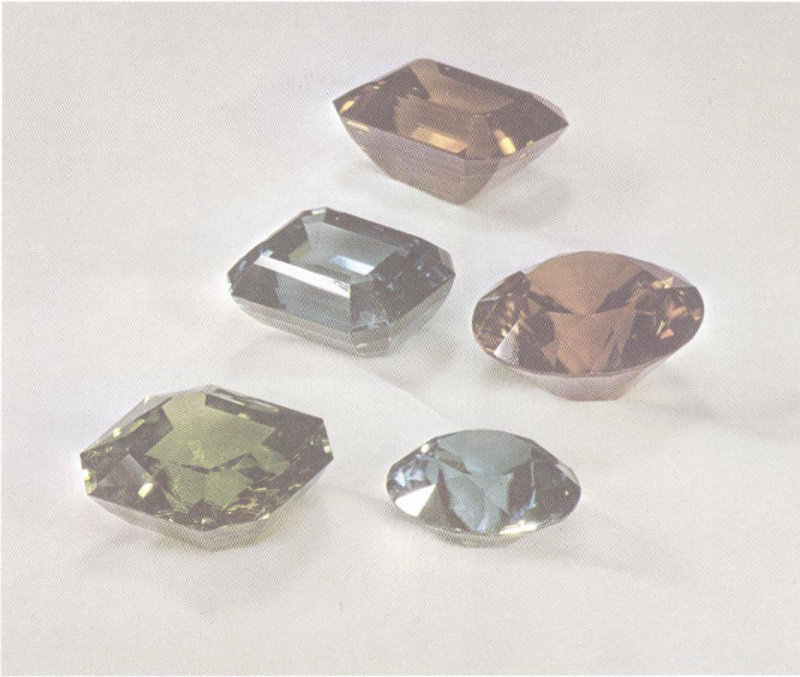
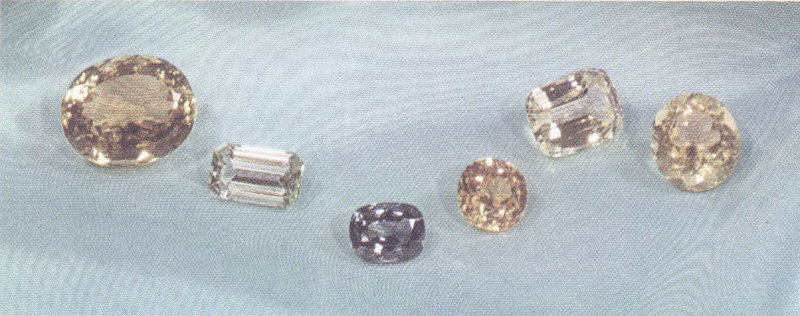
The beautiful colors of these brilliant zircons are the result of heat
treatment given to natural, reddish brown stream pebbles. The three
stones at the left (from top) weigh 118, 103, and 98 carats, and the
ones on the right weigh 106 and 29 carats. The 106-carat stone came
from Thailand, the others from Indochina. (Four-fifths actual size.)
In addition to being reddish brown, natural zircon may vary
from almost colorless to yellow, red, orange, and brown or
from yellow-green to dark green and, occasionally, blue.
The most important producing areas of gem zircon are in a
region of Indochina that comprises parts of Thailand, Viet Nam,
and Laos. Additional gem zircon, like so many of the other
gem species, is recovered from near Moguk in Upper Burma and
from the gem gravels of Ceylon.
There is no synthetic zircon on the market, but a bright
blue synthetic spinel is sometimes used to simulate zircon
successfully.
58
The relative rarity of peridot and the ease with which it
can be simulated in glass, whose luster it approximates,
probably account for the low popular demand for this gemstone.
Although peridot has little brilliance and no fire, its
unusual color and glassy luster produce a unique effect that
serves to make it attractive.
The color of peridot is an unusual bottle green that shades,
in some stones, toward yellow-green and, more rarely, toward
brown. In 1952 it was discovered
that almost all of the brown
gems believed to have been
peridot in various gem collections
were actually of an
entirely unrelated species, which
since has been named sinhalite.
Brown peridot still remains rare
and is somewhat of a collector’s
item.
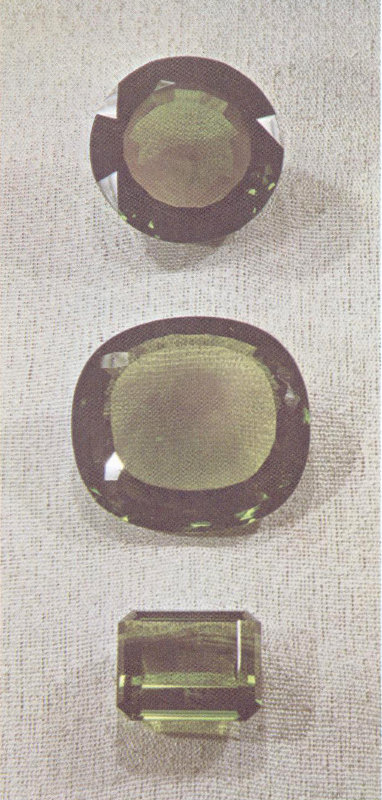
To exhibit its unique color to best
advantage, peridot usually is cut
so as to have a relatively large
table, as shown in these examples.
The largest gem, weighing 310
carats, is from the Egyptian island
of Zebirget in the Red Sea and is
the largest cut peridot known. The
other two, weighing 287 carats
and 109 carats, are from Burma.
(Three-fifths actual size.)
The green of peridot, which
is quite different from the green
of other gemstones, is due to
some iron included in its composition.
It is suspected that a
59
trace of nickel contributes to the liveliness of the color.
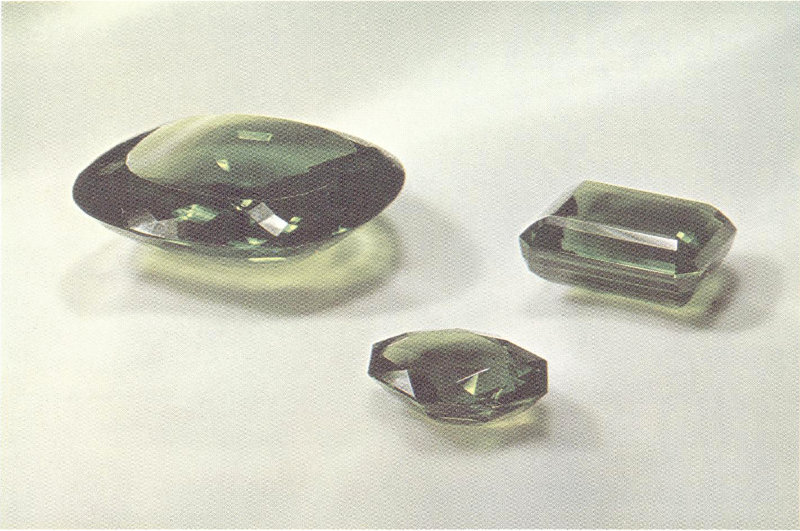
This photo shows the color of peridot projected onto the background.
The larger gem is the 310-carat stone shown in the prior illustration.
The stone on the right weighs 109 carats and is
from Burma; the other peridot weighs 46 carats and is from Egypt.
(Almost actual size.)
Peridot has a hardness of only 6½ and a rather strong
tendency to cleave, and these characteristics reduce its value
for use in jewelry exposed to rough wear. It is better used in
pins, earrings, and pendants than in rings.
Peridot is a gem name for the common mineral olivine, a
magnesium silicate. Olivine is fund in numerous places, and
small gemmy pieces are found in many localities. Many of the
largest and best gems of peridot have come from mines on the
Egyptian island of Zebirget (Island of St. John) in the Red
Sea, but most gem peridot now comes from Burma. Great numbers
of small stones have been cut from olivine found in Arizona
gravels.
Centuries ago, peridot was known by the name topaz, since
the stones came from Topazos, the island now known as
Zebirget. The name topaz, as we have seen, is used today for an
entirely different mineral species.
60
Spodumene, a lithium aluminum silicate, is one of the very
few gemstones containing lithium. It has had more importance
as a gemstone in the United States than elsewhere, a
situation due to early discoveries of unique occurrences of a
lavender-pink variety at Branchville, Conn., in 1879 and in
San Diego County, Calif, about 20 years later. At the time of
the discovery of the California material, the variety was
named kunzite in honor of G. F. Kunz, a noted American
gemologist of the times.
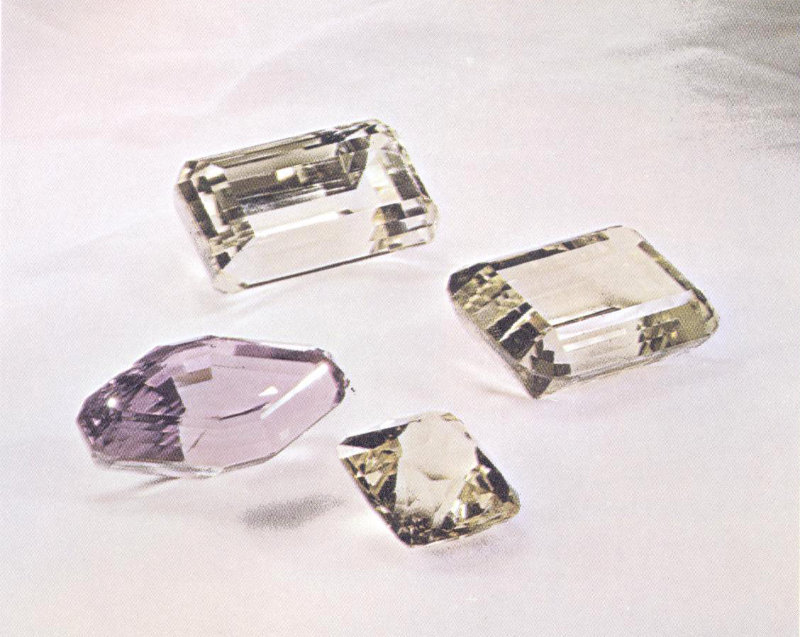
The 177-carat kunzite (at lower left) is a large flawless stone cut
from California material of this variety of spodumene. It was given
to the Smithsonian Institution by the American Gem Society. The
other stones, all from Brazil, represent the more usual shades of
spodumene. They weigh 327 carats (top left), 256 carats (top right),
and 69 carats. (About half actual size.)
The finding of a bright green variety, hiddenite, in North
Carolina about 1880 greatly stimulated the interest of American
gem collectors. Some of the bright green spodumene
61
coming from Brazil in recent years compares very favorably in
color with North Carolina hiddenite. Other than in a scattered
few of these unusual occurrences of kunzite and hiddenite,
spodumene usually is found in yellow and yellow-green
shades, with Brazil and Madagascar being the chief sources.
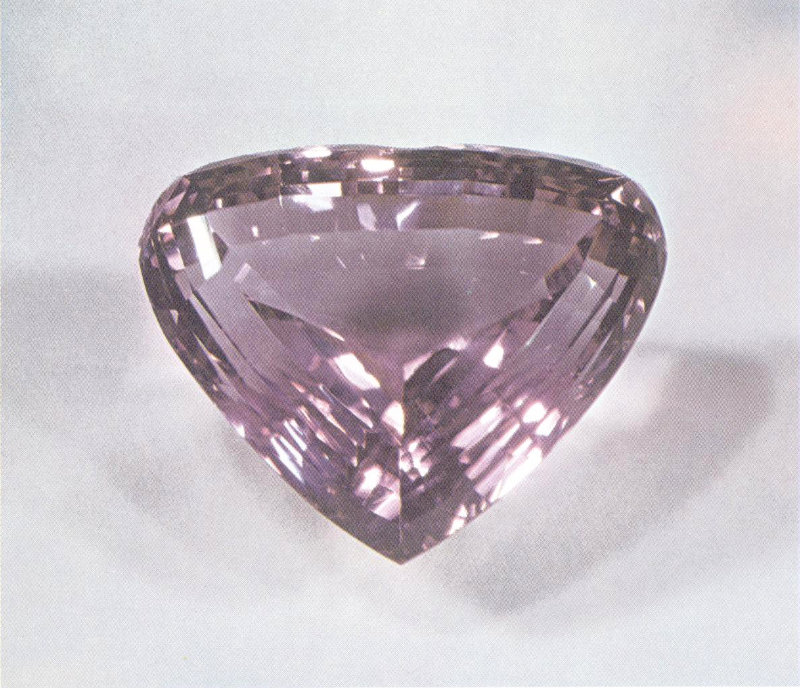
This 880-carat kunzite from Brazil is one of the largest stones of its
kind. (About actual size.)
Spodumene has a hardness of about 7, but with a refractive
index of about 1.66 and a low dispersion there seems to be
relatively little to recommend it as a gemstone. The fact that it
exhibits a very strong tendency to cleave in two different
directions would seem to rule it out completely as being too
difficult to cut. Nevertheless, the production and purchase of
cut stones of spodumene persist because of the beauty of
the gem.
The kunzite and hiddenite varieties of spodumene show
strong pleochroism, or the ability to show three different colors
when viewed in the direction of different axes. Some of the
large Brazilian kunzite crystals mined in the early 1960’s have
62
an intense rose-violet color when viewed along the long axis
of the crystal but have pale blue-violet and pale tan colors
when viewed from the other two directions. When heat
treated, or exposed to strong light, this Brazilian kunzite
loses its tan and bluish colors but retains the intense rose-violet.
Because of spodumene’s pleochroism, the direction of
cutting in the stones becomes extremely important, as it
must be done in a manner that will take advantage of the
violet color in kunzite and the green color in hiddenite.
- VARIETIES
- Kunzite: Lavender violet to rose violet
- Hiddenite: Deep green
The name garnet is applied to a group of six closely related
silicate minerals that are alike in crystal structure but
that differ mainly in the substitution of certain metallic
elements in their composition. These minerals are:
- Pyrope, magnesium aluminum garnet
- Almandine, iron aluminum garnet
- Spessartine, manganese aluminum garnet
- Uvarovite, calcium chromium garnet
- Grossular, calcium aluminum garnet
- Andradite, calcium iron garnet
Most natural garnets have compositions intermediate between
members of the basic group of six. For example, there are
garnets having compositions anywhere between pyrope and
almandine, depending on the amount of difference in the
magnesium or iron content. These same garnets may even have
varying amounts of manganese, and thus be partially
spessartine.
The six garnets in the basic group are found in considerable
quantity in many areas, but seldom are they of sufficiently high
quality to be considered gemstone material. Even when stones
of gem quality are found, their colors—particularly the reds—tend
to be so intense that they seem to be opaque.
63
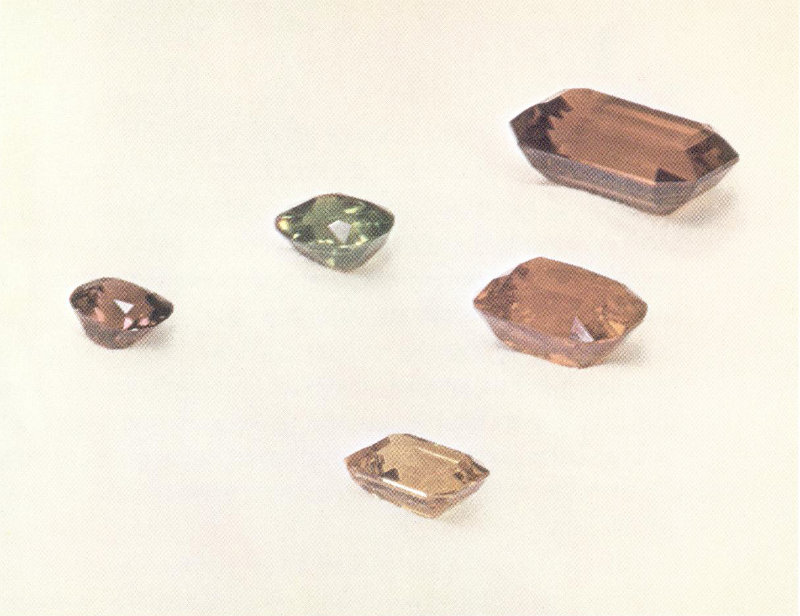
Garnets occur in several colors, although most people think of them
as red. Shown here are a 54-carat spessartine from Brazil (top
right), a 6-carat rhodolite from North Carolina (at left), a magnificent
10-carat green demantoid from Russia, a 9-carat grossular from
Ceylon (bottom), and a 26-carat spessartine from Virginia. (Seven-eighths
actual size.)
Garnet has a hardness (about 7) suitable for gemstone
material and a fairly high refractive index (1.74 and above).
Ruby red pyrope is the most popular variety of garnet. It is
found in Bohemia, in Czechoslovakia, where it occurs as small,
poorly shaped crystals. Red pyrope also is found in Africa,
where it is called Cape ruby, and in Arizona, where it is sold
as Arizona ruby. Another kind of pyrope called rhodolite is noted
for its soft, rosy purple color. Actually, rhodolite is one of the
intermixed garnets with a composition somewhere between
pyrope and almandine. Most of the fine rhodolite gems have
come from North Carolina.
Almandine is popular in its deep red, transparent form, but
since the red is so dark and intense that it appears black, the
stones usually are cut as cabochons with the back hollowed
out. This makes them thinner, and thus lightens their color.
Garnets cut in this manner are all known as carbuncles.
64
Brazil, India, Ceylon, Australia, and parts of the United
States are important sources of almandine.
Although spessartine has a rich orange color, it is not often
used as a gemstone because of the relative rarity of gem-quality
cutting material. This mineral gets its name from the
town of Spessart, Germany, where it was first found. Excellent
spessartine with colors ranging from orange to brown has
been found at Amelia Court House, Va., and quality gems
have been cut from such material. Ceylon, Burma, Madagascar,
and Brazil also have furnished some gem spessartine.
The chromium garnet, uvarovite, generally is too poor in
quality for cutting. Uvarovite crystals, which are emerald
green in color, occur in only small sizes. They are found
mostly in Russia, Finland, and California.
Grossular varies in color. It occurs chiefly in some shade of
red, green, yellow, or brown, depending on the impurities
present. When pure, grossular is colorless. A kind of grossular
called hessonite has an attractive cinnamon color, and it is found
mainly in Ceylon. Because of its color it can easily be confused
with spessartine, which it closely resembles.
Andradite, a very common garnet, usually is found in
shades of red, black, brown, yellow, or green. Some types of
gem andradite have special names for different colors: topazolite,
yellow; demantoid, green; and melanite, sparkling black. The
very valuable demantoid is found in Russia and Italy.
- VARIETIES:
- Grossular: Colorless, green, amber, brownish yellow, rose
- Hessonite: Cinnamon colored
- Pyrope: Deep red
- Rhodolite: Rose red and purple
- Almandine: Deep red
- Spessartine: Brownish red to orange
- Andradite: Yellow, greenish yellow, emerald green, brownish red, brownish yellow, brown, black
- Topazolite: Yellow to greenish
- Demantoid: Grass green to emerald green
- Melanite: Black
- Uvarovite: Green
65
The name jade is applied to two unrelated minerals—nephrite
and jadeite—that have somewhat similar characteristics.
Jadeite, the rarer of the two, is a sodium aluminum silicate
that belongs to a group of rock-forming minerals known as
pyroxenes. Its color varies from white to emerald green and
many other colors. Jadeite is highly prized, and when it occurs
as emerald green it is considered one of the most valuable
gemstones. This
kind of jade is
found in many
places, but the most
important occurrence
is in Upper
Burma. Nephrite, a
more common species,
is a calcium
magnesium iron silicate
belonging to a
group of rock-forming
minerals known
as amphiboles. The
color varies from white to a dark spinach green and black.
Among the places where nephrite occurs are New Zealand,
Turkestan, Siberia, Alaska, China, Silesia, and certain parts
of the western United States, notably in Wyoming and
California.
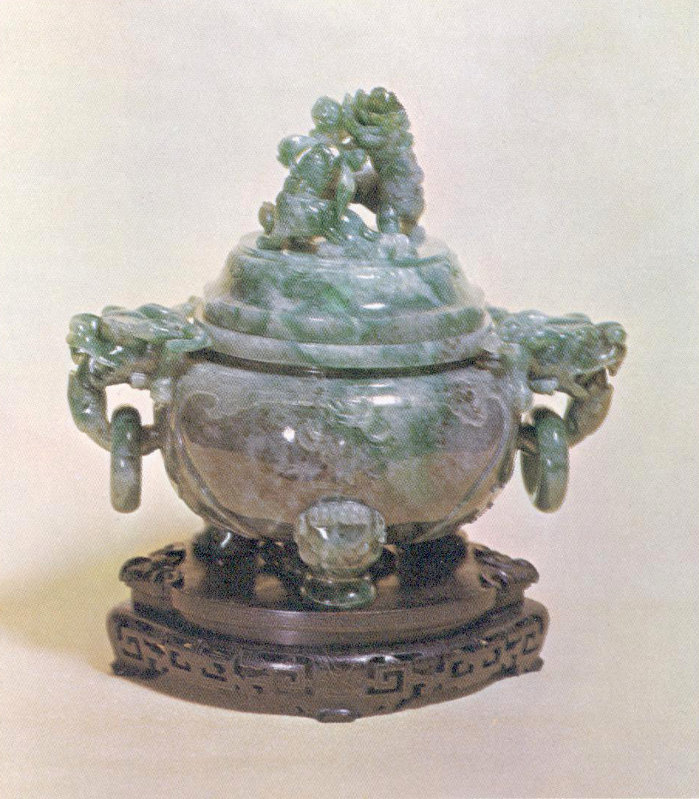
This emerald green jadeite carving,
dating from the Ch’ien-lung
period (1736-1795), stands
6½ inches without the base.
It was given to the Smithsonian
as part of the Maude
Monell Vetlesen collection.
66
Jade is not particularly hard (6½), but it is very tough, and
this characteristic makes it an excellent material for carving.
Even when subjected to punishing usage, jade resists chipping
and wear. It was used for making tools and weapons by
primitive peoples who lived in what is now Mexico, Switzerland,
France, Greece, Egypt, Asia Minor, and in other places.
The jade implements fashioned by these peoples have survived
well the ravages of time.
The Chinese and Japanese prize jade highly. In their
countries, tradition has assigned to jade medicinal and spiritual
values, and has associated with it the cardinal virtues of
charity, modesty, courage, justice, and wisdom. As a consequence,
these peoples long ago developed the carving of jade
as a high art. Among the
magnificent Chinese jade
carvings in the National Gem
Collection are 130 pieces
produced mostly during the
Ching Dynasty (1644-1912),
when the art of jade carving
was at its peak. Many of these
jades were carved in imitation
of the revered bronze
ceremonial vessels of ancient
times. This collection was
presented to the Smithsonian
Institution in 1959 by Mr.
Edmund C. Monell in behalf
of the estate of his mother,
Mrs. Maude Monell Vetlesen
of New York.
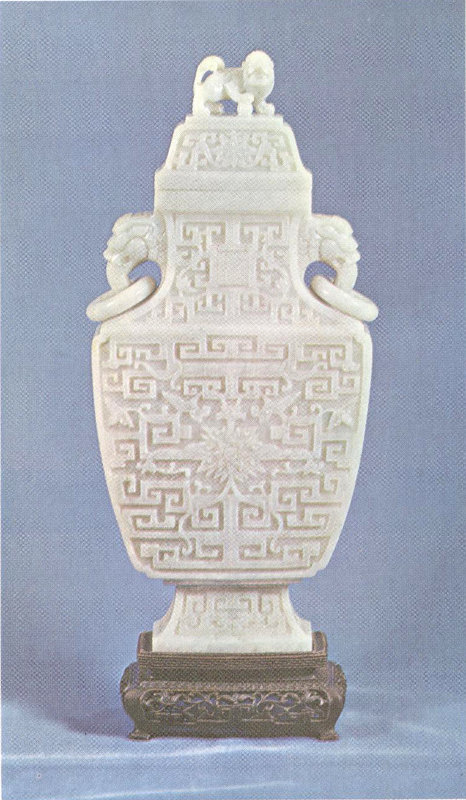
This pale green jade vase of the
Ch’ien-lung period is 14½ inches high
without the base. It is one of a matched
pair presented as part of the Maude
Monell Vetlesen collection of carved
jade.
67
| | Approximate average of |
|---|
| | (1) hardness |
|---|
| | (2) specific gravity | (4) Dispersion |
|---|
| | (3) refractive index | (5) Durability |
|---|
| Species | (1) | (2) | (3) | (4) | (5) | Usual color range |
|---|
| Beryl | 7¾ | 2.70 | 1.58 | Low | High | Green (emerald), blue-green (aquamarine), pink (morganite), colorless (goshenite) |
| Chrysoberyl | 8½ | 3.71 | 1.75 | Low | High | Yellow, green, brown |
| Corundum | 9 | 4.00 | 1.77 | Low | High | Red (ruby), various (sapphire) |
| Diamond | 10 | 3.52 | 2.42 | High | High | Colorless |
| Garnet group | 7½ | 3.70-4.16 | 1.74-1.89 | Medium
to high | High | Yellow, red, green, brown |
| Jade (nephrite) | 6½ | 2.96 | 1.62 | None | High | Green, white |
| Jade (jadeite) | 7 | 3.33 | 1.66 | None | High | Green, white |
| Opal | 6 | 2.10 | 1.45 | None | Low | Red, dark gray, orange, white, with or without varicolored fire |
| Pearl | 3½ | 2.71 | None | None | Low | White |
| Peridot | 6½ | 3.34 | 1.68 | Low | Medium | Yellow-green, brownish green |
| Quartz | 7 | 2.65 | 1.55 | Low | High | Purple (amethyst), yellow (citrine), colorless (rock crystal) |
| Spinel | 8 | 3.60 | 1.72 | Low | High | Shades of red, green, blue, violet |
| Spodumene | 7 | 3.18 | 1.66 | Low | Low | Colorless, pink, yellow, green |
| Topaz | 8 | 3.54 | 1.63 | Low | Medium | Colorless, sherry, pink, blue |
| Tourmaline | 7 | 3.06 | 1.63 | Low | High | Wide range, except bright red |
| Zircon | 7 | 4.02 | 1.81 | High | High | Almost colorless, blue, brown, green, yellow |
68
A number of mineral species have produced cut gemstones
that fulfill every necessary requirement of beauty,
durability, and rarity, but their popularity and commercial
success have been sharply limited because of insufficient supply.
In some cases of even adequate supply such gemstones do not
compete with other, more plentiful kinds that exhibit the same
characteristics. The scarcity of these minerals does not diminish
their standing as potential gem material—it merely points up
the effect of accidental natural distribution of these species.
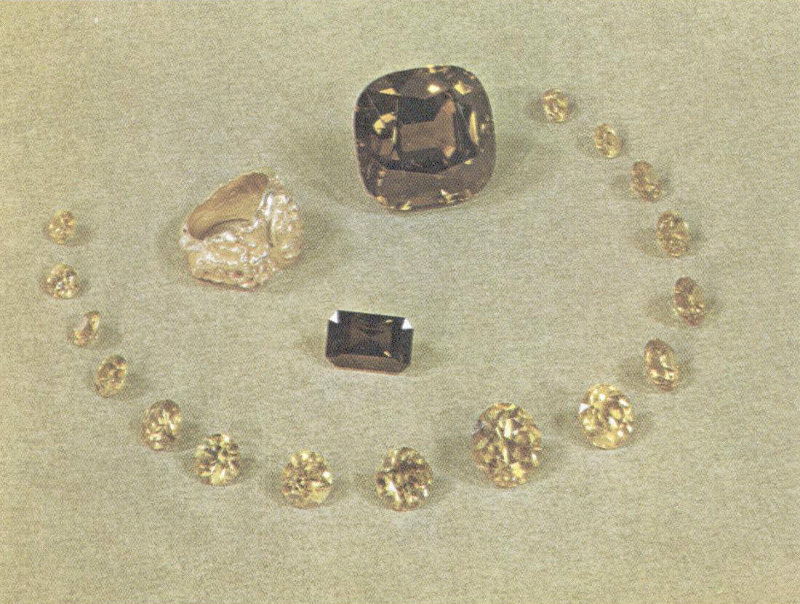
A magnificent set of 16
matched sphenes from
Switzerland, gift of Nina
Lea, almost encircles a
110-carat sinhalite (a rare
magnesium borate) and
a 22-carat kornerupine,
both from Ceylon. The
man’s gold ring indicates
the sizes of these unusual
stones.
Among the rarer minerals that produce good gemstones are
cordierite, benitoite, euclase, phenakite, beryllonite, willemite,
wernerite, danburite, datolite, axinite, brazilianite, andalusite,
sillimanite, kyanite, kornerupine, enstatite, diopside, epidote,
sphene, sinhalite, and orthoclase. Willemite, a rare zinc silicate
found in only a few localities, is typical of these rarer minerals.
The famous zinc mines at Franklin, N. J., produced a few large
gemmy crystals of willemite, and some fine gemstones were cut
69
from some of these. Willemite’s borderline hardness of 5 to 5½
and its extreme rarity effectively eliminate it from the gem
market, but the collector who is able to obtain a good stone of
this material is indeed fortunate.
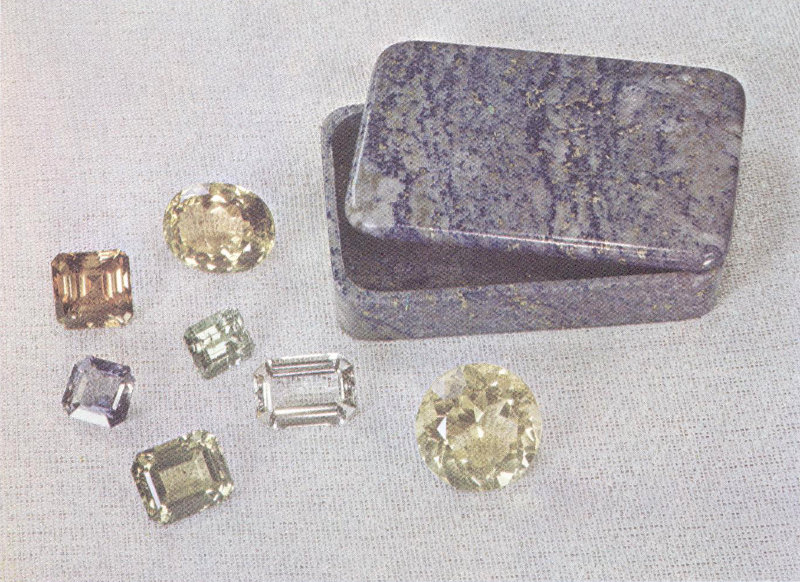
Exotic gems that represent collectors’ items lie beside a 3¼-inch-long
box of Russian lapis lazuli. The stones are (left row, from top)
a 28-carat andalusite from Brazil, gift of Fred C. Kennedy, a 10-carat
cordierite from Ceylon, a 29-carat apatite from Burma, and (right
row) a 42-carat brazilianite from Brazil, a 13-carat euclase from
Brazil, a 29-carat wernerite from Brazil, and a 61-carat orthoclase
from Madagascar.
Some mineral species, although beautiful when cut, and
prized by collectors, are entirely too soft, are too easily
cleaved, or have some other physical weakness that renders them
useless as commercial gemstones. Sphalerite, apatite, fluorite,
calcite, cerussite, zincite, and hematite are included in this
group. Sphalerite is typical; it produces brilliant and colorful
gemstones that hold their own among other stones of great
beauty. Unfortunately, this zinc sulfide, with a hardness of
3½ to 4, is so soft and cleaves so readily that it is very
difficult to cut properly, and it cannot be used in jewelry.
70