A tremendous crowd was present, one larger than had attended any of
the league games that season. It looked as if all Wimbledon had come
over to cheer on its team. And the Lenox stands were crowded with
enthusiastic students and people of the town, the bright dresses of the
girls adding a pretty splash of color.
Before the stands the rival cheer leaders danced up and down like so
many acrobats. A brass band played sprightly airs, that were, however,
often drowned by the discord of cowbells, with which both sides were
liberally equipped. The crowd was out for fun and excitement, and it
got it within the first ten seconds of play.
Wimbledon won the toss and elected to kick off. Sykes sent the ball
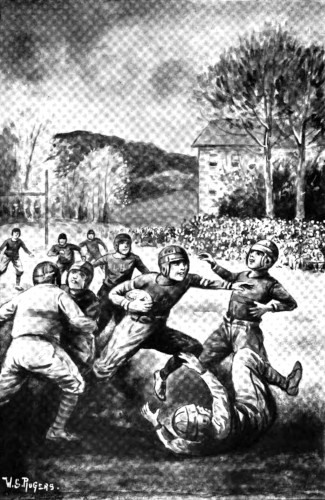
whirling down the field. Garry leaped high into the air and collared
the ball. Then, like a streak of lightning, he tore down the field,
squirming, dodging and twisting, and before the astounded spectators
could guess what had happened he had landed the ball behind the line
for a touchdown.
It was the most scintillating play that had occurred on the league
grounds that season. The crowd gaped in astonishment. Then Lenox woke
up and promptly went insane. Cowbells jangled, caps were tossed into
the air, and the air was rent with shouts, in which the girls mingled
their shrill treble.
"Grayson! Grayson! Grayson!"
"Did you ever see such running?"
"No jack-rabbit has anything on him!"
"And that's my brother," murmured Ella happily to Jane Danter.
Half the beauty of the play lay in its unexpectedness. The ordinary
thing would have been to run the ball back as many yards as possible
before being downed. But Garry had glimpsed an opening, and, with him,
to see was to act.
Nick kicked the goal, and seven points were chalked up to the credit of
Lenox.
But Wimbledon, though flustered for a moment, soon got back its nerve.
"Let 'em crow!" growled Sykes to Farnum, the right half, and Chambers,
the left half, who were in with him on the secret of the stolen
signals. "It won't be long before we have them standing on their heads."
Wimbledon got the ball on the kick-off and lined up for the scrimmage.
Farnum tore through right end and tackle for three yards. A plunge by
Sykes netted two more on the left. Chambers made two more between guard
and center, but when he tried to repeat was thrown back by Walker for a
loss, and the ball went to Lenox on downs.
Big Bill Sherwood lowered his head and plunged through for five yards.
Nick took the ball next and made three. On the next play Garry himself
tore through for four, making their distance with a down to spare.
If Wimbledon was especially strong anywhere, it was in the line, where
they had more beef than Lenox. The ease with which the distance had
been made was a surprise to the Wimbledon rooters, who shouted hoarse
demands for their line to brace. It was a surprise too to Sykes and his
confederates.
But it was no surprise to Garry Grayson, who chuckled in his sleeve.
The signals he had called had been misinterpreted by the fellows who
were in the secret on the other side. Where they had looked for an
attack through the left, it had been made on the right, and vice versa.
Consequently, the Wimbledon players massed where it would do no good,
and left their line thin at the real point of attack.
But the visitors braced savagely on the next play, and for a time held
their own. Nick and Rooster pierced the line for small gains only,
and Knapp was forced to punt. He boomed the ball away to Ford, the
Wimbledon quarterback. He caught the ball on his ten-yard line, but
succeeded in running it back only three yards before he was downed hard
by Bill Sherwood.
On Wimbledon's first play there was a fumble, and Chambers fell on the
ball on his own three-yard line. From behind his goal line he tried
to throw a forward pass to Chambers, but it was intercepted by Tom
Allison, who was forced out of bounds on Wimbledon's twenty-five-yard
line.
Sherwood jammed his way through the line for three yards. Nick tried to
bore through between right end and tackle, but was thrown for the loss
of a yard. Knapp made but two on the left of the line.
With fourth down and six yards to go, Garry signaled that he himself
would carry the next ball. On the new system that Wimbledon was relying
on, that signal stood for a forward pass. The Wimbledon backs fell
back in consequence to kill the play. But Garry snatched the ball the
instant it was passed back to him, tucked it under his arm, and was off
like a rocket around right end. He straight-armed two tacklers and sped
to the Wimbledon three-yard line before he was downed while the stands
shook with the cheers of the Lenox rooters.
With their goal line threatened, the visitors' line stiffened and held
Knapp in his tracks on the first down. Rooster, however, made two. And
then, with one mad plunge, Bill Sherwood bored through for the second
touchdown of the game. Nick missed the point for goal and the score
stood 13 to 0 in favor of Lenox.
From the stands went up a booming chant:
"Lenox! Lenox! Len, Len, Len!
Put the skids under Wimbledon.
Show those ginks that you weigh a ton.
Lenox! Lenox! Len, Len, Len!"
In the two minutes of play that remained no more scoring was done by
either side, and the ball was in midfield when the period ended.
"I guess we're bad, eh!" grinned Rooster to Garry, as the warriors
of both sides lay sprawled on the ground for the brief rest between
periods.
"Their fellows seem to be badly rattled," remarked Nick, in a puzzled
way.
"Haven't you fellows tumbled yet?" chuckled Garry.
"Tumbled to what!" asked Bill.
"I guess I'll leave that to Mr. Phillips to tell you," grinned Garry.
"All I'm saying now is that we're having a nice little demonstration
that honesty is the best policy. But come along, fellows. Time's up!"
Wimbledon had the ball, but when it failed to gain after two line
smashes Chambers punted to the Lenox thirty-five-yard line.
Nick cut loose on a run of fifteen yards around Wimbledon's left wing.
Here again the signals in Wimbledon's possession wrought confusion, for
they called for a run to the right and the Wimbledon line had swung
round to head him off. Knapp was thrown for a loss on the next play,
and then on a deceptive right end rush, Garry squirmed through the line
for ten yards. Rooster punted over the Wimbledon goal line and the ball
was brought back. Wimbledon failed to penetrate the Lenox line and
Sykes resorted again to the kicking game.
It was Lenox's ball on Wimbledon's thirty-eight-yard line, and twice
Garry, who was fighting like a tiger, jammed his way through for two
first downs. The Lenox backs kept up a persistent attack until Nick
planted the ball on the visitors' ten-yard line.
After Tom Allison had made a brilliant attempt to skirt the enemy's
right end, he was forced out of bounds on Wimbledon's three-yard line.
On the next play Rooster, on a fake to jump the left end, suddenly
whirled and threw himself between guard and tackle for a touchdown.
Nick kicked the goal and the score was 20 to 0 in favor of the home
team!
Amid the playing of the band, the jangle of cowbells and the frenzied
shoutings of the Lenox rooters, four very pale and dispirited
conspirators looked at each other with panic in their eyes.
Sandy, his complexion a yellowish-green, hid his head in his hands and
groaned miserably.
"Nice thing you've let us in for!" gritted Lent Stewart savagely.
"We're done, and done brown!" growled Aleck Anderson.
"And I've put every cent I had on Wimbledon," snarled the glowering
Bixby.
"Aw, shut up!" Sandy came back at his baiters. "I'll lose more money
than all the rest of you put together, if Wimbledon loses. I'll be
stony broke and in debt too, for I've borrowed from everybody. Can I
help it if Sykes isn't taking advantage of the signals I gave him?
What's the matter with the fellow, anyway? He's had a dead cinch, if he
only had played it right."
"It's Lenox that had the cinch," snarled Aleck Anderson. "I've been
watching the play, and I know. Lenox has got next to your scheme and
has gone back to its old signals. You've been double-crossed, you big
boob! Wimbledon's up in the air. You and your smart schemes! Why,
Garry Grayson's got more brains in his little finger than you have in
your head, you false alarm!"
After Wimbledon had kicked off and Lenox had failed to make its
distance in the first three downs, Rooster was forced to kick and the
ball was Wimbledon's in midfield. Ford and Chambers got away a pretty
forward pass, and it looked as though the visitors might accomplish
something with their overhead attack. But the Lenox defense was too
agile and smart. After Garry had dashed around the right end of the
visitors for a twenty-yard gain, Nick hurled a ten-yard forward pass to
Knapp, who shot headlong through the Wimbledon line for an eight-yard
gain and brought the ball to the enemy's ten-yard line. Sherwood gained
three yards. Nick made a bold attempt to get round the end for a score,
but was forced out of bounds. Then Lenox made a bluff line play, and
Tom Allison tossed a pretty forward pass to Garry, who was behind
the line waiting for the ball, and Garry shot through for another
touchdown. Bill kicked the goal while the Lenox stands went crazy.
Stung to desperation, Wimbledon made a stiff defense after that, and
the period ended with the score 27 to 0 in favor of the home team!
While his team had been piling up points Mr. Phillips had been coming
to a decision. He had watched every play with the eyes of a hawk.
He had hoped that on reconsideration Wimbledon, or those of the team
who had been let into the secret of the Lenox signals, would finally
decide to throw them into the discard and play straight, honest
football. But as the game progressed he noted that they were depending
upon their illegitimate knowledge, or supposed knowledge. He could tell
by the way the Wimbledon men swayed to the right or the left at given
signals and by the confusion that resulted when the expected play had
not come off that they were using the code that Sandy had slipped to
them.
That they should suffer from their unsportsmanlike conduct was
perfectly proper. Lenox was playing straight football. If Wimbledon
tried crooked work and slipped up in the attempt, she was only getting
what was coming to her.
But Wimbledon! Ah, there was the rub! The school was not crooked. The
coach was not crooked. Probably only two or three of the team had been
taken into the secret. The rest of the boys were probably playing
honest ball. It seemed too bad that they should all suffer from the
dishonest scheme of a few.
So at the first opportunity he had—the fifteen minutes' rest between
halves—Mr. Phillips decided on an unusual but a generous thing.
He sought out Adams, the Wimbledon coach, an old acquaintance with whom
he was on the friendliest terms.
"Hello, Phillips!" Adams greeted him, summoning up a wry smile. "Your
boys are certainly putting it all over us to-day. Have you come to
gloat over me?"
"Nothing like that, Adams," said Mr. Phillips, with an answering smile
as he grasped the other's extended hand. "Simply to give you a tip.
You're a mighty good football man. Haven't you noticed something queer
about the playing of some of your boys?"
"Yes, I have," replied Adams soberly. "I've been trying to figure
it out. The linesmen have been all right, but the backs have played
like simpletons. I can't understand it. Usually, they've been my most
dependable men."
"And probably would have been to-day," replied Mr. Phillips, "if they'd
been playing straight football."
"What do you mean by that?" asked Coach Adams quickly, a frown
beginning to gather.
"Now don't go up in the air, Adams," Mr. Phillips adjured him. "I'm
risking a sure victory in telling you this. If I kept still, we'd
probably beat you by fifty to none. But I want to keep the game clean.
Now here's the story," and in a few brief sentences he told the tale
of the stealing of the signals by Sandy Podder's gang. As Mr. Adams
listened the frown upon his brow became a thunder cloud.
"It's certainly kind of you to tell me this," he said warmly, when Mr.
Phillips had finished. "And you can bet there's going to be a shakeup
in my team!" he added.
He hurried off, and when, a few minutes later, the teams lined up
again, Sykes, Chambers, and Farnum were missing.
Now the Lenox boys found that they had their hands full. Whether the
Wimbledon coach had told his players of the dereliction of their mates
or had simply left them to their own suspicions, was not known by Mr.
Phillips; but in any event the Wimbledons had been roused to a pitch of
ferocity that for a few minutes took the players on the home team off
their feet.
Wimbledon's first play when they got the ball resulted in a
twenty-five-yard gain by Reulbach around the Lenox left end. One
forward pass failed, but another, Gray to Weston, gave Wimbledon a net
gain of forty yards, bringing the ball to the Lenox eight-yard line.
Booth smashed through for five yards. Briggs was halted in his tracks.
But on the next try, Weston plunged through for Wimbledon's first
touchdown of the game. Reulbach kicked the goal, and Wimbledon had
escaped a whitewash.
But it was soon evident that they were not going to be satisfied with
that. Encouraged by the howls of their rooters—the first there had
been any occasion for so far—the Wimbledons played like wild men.
Three times in succession they made their distance by line smashing.
Then Acland snatched a forward pass out of the air and by a magnificent
run around right end crossed the line for another touchdown. The try
for point succeeded, and Wimbledon now had fourteen points.
Lenox had been resting too securely on its laurels. Its easy time in
the first half had inspired it with over-confidence. Now it began to
wake up and play the ball of which it was capable. The Lenox line,
stung by Garry's furious charge that it was as full of holes as Swiss
cheese, became a stone wall against which the Wimbledon cohorts broke
in vain.
But misfortunes—as viewed by Lenox—never come singly, for just as
the Wimbledon flood had seemed to be stayed a break of the game came
to their aid. Lenox had begun a march down the field that threatened
to bring them within striking distance of the hostile goal. They had
reached the twenty-yard line when McCarty fumbled, and Reulbach,
pouncing on the ball like a hawk, sped like a meteor down the field
with all the Lenox team pounding at his heels and went over the line
for another touchdown, the third for Wimbledon in that period.
The scoring for the quarter ended then and there, and until the
referee's whistle blew the lines swayed back and forth nearly in
midfield.
It had been a notable comeback for Wimbledon, which was now only six
points behind. It was their rooters' turn to howl, and they made the
most of it:
"Wimbledon! Wimbledon!
You've got Lenox on the run.
Keep it up, it's lots of fun.
Wimbledon! Wimbledon!"
Sweet music for the visiting team, but rank discord to Garry Grayson
and his mates.
"They'll be singing to a different tune before the game's over,"
predicted Garry. "Wake up, fellows! Tear into 'em! Rip 'em up the back!"
Wimbledon made frantic efforts to get an overhead attack going through
the fourth period. Ford and Weston formed one combination which tried
in vain, and Acland and Reulbach made another. But the alert Lenox ends
and secondary defense were usually out-guessing the Wimbledons in the
efforts to execute their forward passes.
Finding themselves thwarted, the Wimbledon boys resorted to line
smashing tactics. But there was no Swiss cheese element now in the
Lenox line. Holes were few and far between, and the contest grew so
hard and furious that both sides were penalized for roughing. It was a
ding-dong fight that set the crowd delirious.
Five minutes had passed with the elevens pushing each other back and
forth, each resorting to the punt when rushes and forward passes
were smeared, when suddenly a Lenox pass was intercepted by Booth,
the big left tackle of the Wimbledons, who leaped high into the air,
gathered the ball under his arm, and with a clear field before him ran
thirty-two yards to a touchdown. Reulbach kicked the goal, and for the
first time in the game Wimbledon was ahead. She had twenty-eight points
to Lenox's twenty-seven. Only one point, but with the last quarter
nearing its close that one point loomed up like the Rock of Gibraltar.
The noise now was deafening. All semblance of sanity had disappeared
from the Wimbledon section. The Lenox stands were wrapped in a pall of
gloom. All sat glum and silent.
But if Garry was whipped, the news had not yet reached him. His blood
was at fighting pitch. He was like a wildcat. He tore through the
enemy's line like a battering ram. Most of the time he carried the ball
himself. Once he plunged through for eleven yards, pulling most of the
Wimbledon team along with him till he was down. Another time he netted
thirteen. Lenox had got within eighteen yards of Wimbledon's goal line
when a fumble by Knapp gave the ball to Wimbledon. Reulbach punted out
of danger and the work was all to be done over again.
And now only four minutes of time was left! Each passing second seemed
to tick the doom of Lenox. It was Wimbledon's ball in midfield. Twice
Wimbledon tried to gain through the line and was thrown back for losses.
Then Reulbach punted. Bill Sherwood broke through and blocked the kick.
Garry, who was at his side, clutched the rolling pigskin as it bounded
slightly upward and was off down the field.
On he raced, with Rooster and Nick at his side to block off would-be
tacklers. On and on with the goal beckoning him. Booth plunged toward
him, but Garry straight-armed him, while Rooster by a superb rolling
block disposed of Reulbach and Nick went into Weston like a load of
brick. On and on, slipping like a ghost through all who tried to stop
him, raced Garry Grayson, and, summoning his strength in one last
effort, threw himself over the Wimbledon line for a touchdown!
Pandemonium broke loose in the Lenox stands. Yells went up in
thunderous volume. People hugged each other and babbled incoherently.
Ella threw herself into Jane's arms and sobbed happily. Jane herself
was sniveling.
And four rascals sat silent with pallor on their faces and rage in
their hearts as the chant arose:
"Lenox! Lenox! Len, Len, Len!
Look at her most noble son!
See Garry Grayson run!
Lenox! Lenox! Len, Len, Len!"
Rooster kicked the goal and Lenox had 34 points to Wimbledon's 28, and
a moment later the referee's whistle ended the game.
Once more Lenox had won the championship of the High School League.
Garry was deliriously happy. He had upheld the honor of Lenox High.
That was the most important thing. Secondary was the thought that he
had thwarted the enemies who sought to overthrow him. They were down
and out—for the present, at least.
Would they stay down? That question is answered in the next book of
this series, entitled: "Garry Grayson Showing His Speed; or, A Daring
Run on the Gridiron."
There was a great celebration of the victory in Lenox that night,
bonfires, speeches, snake dancing, with Garry Grayson as the central
figure. Cal Yates was there, as snappy and debonair as ever, and with
him was his father, who had now almost completely recovered. Both
were warm in their congratulations. Sandy Podder, Lent Stewart, Aleck
Anderson, and Bixby were conspicuous by their absence.
The next day Garry called on Joe Brench at the hospital and was glad to
learn that his leg was mending nicely and that he would soon be about
again.
"It was a great thing you did for me that day, Garry," said Joe
gratefully.
"It was a great thing you did for Lenox High that day," replied Garry,
grinning happily.
THE END
"The Books you like to read at the price you like to pay."
This Isn't All!
Look on the following pages and you will find listed a few of the
outstanding boys' and girls' books published by Grosset and Dunlap.
All are written by well known authors and cover a wide variety of
subjects—aviation, stories of sport and adventure, tales of humor and
mystery—books for every mood and every taste and every pocketbook.
There is a Grosset & Dunlap book for every member of your family.
GARRY GRAYSON FOOTBALL STORIES
By ELMER A. DAWSON
Illustrated. Each Volume Complete in Itself.
Garry Grayson is a football fan, first, last, and all the time. But
more than that, he is a wideawake American boy with a "gang" of chums
almost as wideawake as himself.
How Garry organized the first football eleven his grammar school had,
how he later played on the High School team, and what he did on the
Prep School gridiron and elsewhere, is told in a manner to please all
readers and especially those interested in watching a rapid forward
pass, a plucky tackle, or a hot run for a touchdown.
Good, clean football at its best—and in addition, rattling stories of
mystery and schoolboy rivalries.
GARRY GRAYSON'S HILL STREET ELEVEN; or, The Football Boys of Lenox.
GARRY GRAYSON AT LENOX HIGH; or, The Champions of the Football League.
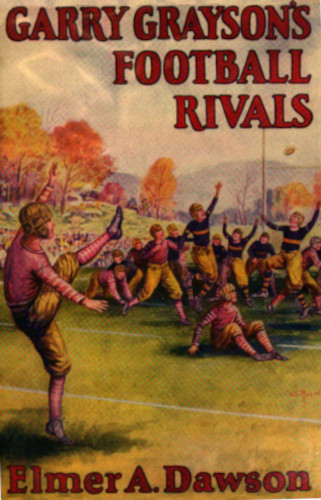
GARRY GRAYSON'S FOOTBALL RIVALS; or, The Secret of the Stolen Signals.
GARRY GRAYSON SHOWING HIS SPEED; or, A Daring Run on the Gridiron.
GARRY GRAYSON AT STANLEY PREP; or, The Football Rivals of Riverview.
GARRY GRAYSON'S WINNING KICK; or, Battling for Honor.
GARRY GRAYSON HITTING THE LINE; or, Stanley Prep on a New Gridiron.
GARRY GRAYSON'S WINNING TOUCHDOWN; or, Putting Passmore Tech on the
Map.
GARRY GRAYSON'S DOUBLE SIGNALS; or, Vanquishing the Football Plotters.
GARRY GRAYSON'S FORWARD PASS; or, Winning in the Final Quarter.
GROSSET & DUNLAP, Publishers, NEW YORK