STEAMING out of the Gulf of Paria the day before, away from the muddy
water of the Orinoco, we had come again through the Dragon’s Mouth,
close to that long, eastward-pointing finger of South America that forms
one side of this famous gateway, back into the welcome Caribbean Sea.
Thence through the night we skirted the South American coast, passing
the celebrated pearl-fishing island of Margarita—“The Pearl”—where it
was said that a German gunboat with covetous eye had these many months
been making careful surveys and taking elaborate soundings—so
forehanded, you know! And now we were at anchor in the roadstead of La
Guayra, the seaport of Caracas.

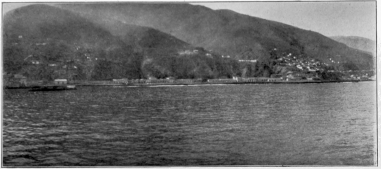
Where the Mountains Meet the Sea
La Guayra, Venezuela
Leaning over the rail of the white ship, early in the dawning of that
day, it came to me over and over again that we were at last in the
presence of the great West Indian Mother, and that her face was in truth
an exact realisation of our imaginings.
A strong breeze blew the waves fast and loose, one upon another, to the
near-lying shore, where a white line of surf circled about a rounding
promontory, and lost itself on the other side of the cliff. Up and
beyond, rose the mountains, and some one said: “The Andes!” and we
looked again, and longer, and said to ourselves—“The Andes,—South
America, we are looking upon them with actual eyes!”
Up, and still up, rose the mountains; great, tender lines of undulating
softness, all green and blue and gentle and grand, one sweep upon
another of matchless warm tints; one sweep upon another of voluptuous
curves in billowy green, and dropping in and about the contour of the
great continent’s majestic form, far disappearing valleys swept into the
dimness of soft, shadowy depths.
Like a great mother, asleep, spread with a coverlet of the changing
tints of malachite and beryl, South America lay before us.
Clambering up her skirts were the little white roofs of La Guayra, spots
on her verdant garment,—irregular spots here, there, and everywhere;
now in patches, comfortably huddling together at her feet; now stray
offshoots away beyond. All very square and very Spanish were these
houses, very quaint to look upon; and if this is La Guayra, where is
Caracas? Must we, too, clamber and climb away into those mountain
heights, and, perchance, awaken the Great Mother, who sleeps so gently
under the drowsy lullings of the deep sea?
Things are moving on the shore, and in the distance dots like men and
women stir about the tiny houses, and a toy train toots, and toy engines
rattle, and toy cars seem filling with toy people; and we think it time
to go ashore and see if we can find a seat in one of those cars; so we
run up forward, where our impatient fellow voyagers have been hurrying
into the launch this long time. It has just puffed away, and we are
really glad.
There is something very like the “stray sheep” in our make-up. It is
Americanism boiled down,—this love of going alone, and being
self-reliant.
A beamy shore-boat is engaged at one bolivar apiece (negotiations
having been started on a basis of five bolivars apiece, charged by the
boatmen), and we have plenty of room for all, even the Doctor, who is
going with us (for he was just too late for the launch—perhaps, with
malice aforethought); and so we row to the stone steps of the quay of La
Guayra, the port of Caracas, our first landing on the “Spanish Main.”
We have left the land of what we supposed to be our mother tongue, and
are come to a country where we can really be understood, or
misunderstood, according to our abilities to express ourselves, in a
language more constant than English. I take a mental stock, and find
four Spanish phrases which did not fail me in Santo Domingo, and shall
not fail me here. Besides I have been practising them since then! With
these I can fare sumptuously:
¿Cuanto cuesta? (How much does it cost?)
¿Qué hora es? (What o’clock is it?)
¡Mucho bonito! (Very beautiful!)
Yo no entiendo. (I do not understand.)
This, with a few nouns sprinkled in, was my vocabulary; but I had no
fears,—had we not our own interpreter?
And the big, strong oars brought us to the landing. Then we girls, in
charge of the Doctor, were stood up in the shade of a warehouse, where
we watched the white uniformed South Americans, struggling with our
obdurate men for their landing charges—for here they charge for the
right to land. Then the men disappeared with the bags, and we waited
what seemed to us a very long time, until, with one consent, we just
thought we wouldn’t stay put another minute; so the Doctor takes the
lead with his big white Indian helmet jammed over his eyes, and Little
Blue Ribbons and Sister raise a fine cloud of dust, running on ahead.
But we older ones know what it means to be in La Guayra, so we follow on
very leisurely. On the way, we meet an excited messenger already sent to
hurry us to the train.
La Guayra is said to be the hottest place about the West Indies, and I
could well imagine how the Great Mother would have to fan her little
white children, when they once really felt the breath of the
unconscionable sun; but, as we walked along, even though the sun had
climbed a few steady hours, we found it far from uncomfortable, even
carrying our heavy satchels, and the white umbrella, besides.
Along a dusty and sun-stricken water-front, disfigured with railroad
tracks, and low warehouses, we came to the station, where the men,
triumphant, were impatiently waiting, after sending out their belated
relief expedition. Tickets had been bought, gold pieces divided up into
fascinating silver pieces, called bolivars (in honour of the great
South American liberator—accent on the second syllable, if you please),
and all in our lord and master’s own Spanish, of which we were justly
proud; and then we find places in the train, and in a few moments after
our arrival we jerk out among the white houses.
It was a clever bit of forethought—that move of ours to hunt up the
men. Had we not done so, we could never have caught the early morning
train, for the messenger was slow, and we would have become merely a
part of the hot and dependent crowd on the later “special.” It’s better
sometimes not to stay where you’re put.
We move along at a good pace among the gardens of La Guayra,—rather
sparse gardens they are,—and then we climb to the balconies, and then a
turn and we are hiding about the Great Mother’s green petticoats; and
anon we pass up to the roofs of La Guayra,—which reach out like a white
sombrero over the little people below.
Then the pull begins. Two powerful, stocky, low-built, narrow-gauge
mountain engines haul us along with apparently no effort, up into the
mountains, up a grade which seems to grow steeper every minute. Our men
say that the average grade is over four per cent. I can’t see how it is
that men know all these things about grades and percentages. It seems
like such a lot of plunder to lie around in the brain. But—about such
trifles—men must know and women must ask, and that’s all there is to
it.
It is a continuous twisting and turning and winding, seldom on a level
stretch; it’s up, up away from the sea from the very start. Now, we are
far above the tree-tops of the town, and our white ship out in the
harbour lies motionless, and seems far away. We wonder at the courage
of the people who would dare so great a feat of road-building, and grow
doubly curious to see the city, hidden beyond in the clouds of the
mountain.
La Guayra lies just above sea-level. In two hours, we must climb over
the Great Mother’s back, going thirty odd miles to reach Caracas, which
lies at an elevation over three thousand feet in a valley, only six
miles in an air line from La Guayra.
Up, up into the thin vapours, into regions of other trees still higher,
whose tops again we pass amongst. The sun is hazy through a translucent
veil of mist, and far away, the white horses of the sea dance up against
the shore and out of sight, and the white sombrero drops beneath an
emerald cloak, and everything but the sky is shut out.
We jump first to one side of the car and then to the other, for the
sea-view and for the mountains. We are whirled around quick curves, and
all but lose our feet; and some of us—even men—get dizzy looking at
the drop below us; and then we cut through the mountain and hurry on up
the steep climb until the plucky little engine decides to stop, and we
are told that we have reached the summit; and we hurry from the cars and
feel the sweet coolness of the mountains, and the actual presence of the
Great Mother.
We stand close together on the brink of a chasm and look tremulously
into the depths of her great heart; down, down, a thousand feet and more
of living, breathing green, into every hue of purple and blue, deepening
into black near the far-off valley, and disappearing into azure among
the clouds,—silence, shadow, tenderness, sublimity, overspread by the
ineffable loveliness of morning.
We are moving again, and now it is down, gradually, for Caracas lies a
thousand feet below the summit. We follow along a white highroad, the
mountain trail from Caracas to the sea. Now we are on its level; now we
leave it. Long trains of pack-mules make a cloud of gray dust against
the green, and here and there a red blanket thrown across a burro’s back
brings a delicious bit of life and colour into the passing scene.
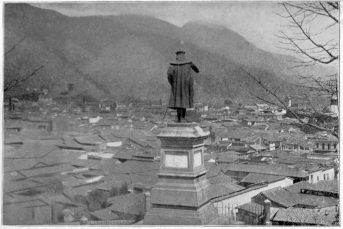
Caracas and the Mountains
Venezuela
Now we seem to be on the level, and scurry along at a great rate; and
soon there spring up out of the brown earth adobe houses (the first we
have seen since we were in Mexico), and here are more and yet more, and
there, ah! that must be Caracas, the great Venezuelan capital, the
habitation of over one hundred and fifty thousand people!
But, shall we say it? Must we be honest at the expense of all else? The
approach to Caracas is a disappointment. There is scarcely any kind of a
habitation which gives a landscape quite such a distressful look as the
adobe hut. Built of sun-dried mud blocks, it gives off an atmosphere
of dust with every whiff of wind. It comes to our mind always with the
thought of dry barrenness, heat, sun, dust, shadeless fields of maguey,
prickly nopals, broad sombreros, and leather-clothed rancheros. And
to see the suburbs of a great city, the outlying habitations, in gray,
crumbling adobe, makes an unpleasant impression, in spite of the fact
that, from the distance, we catch a quick glimpse of a peaceful
campanile and high, imposing roofs a bit beyond. There’s only time for a
suggestion, but that suggestion biassed all our later impressions. We
steam into the station and begin to pick up our traps and make for the
carriages.
As we said before, the spirit of independence gained supremacy, when we
were once fairly upon the Spanish Main. Out of many, a few of us escaped
the tourist agent. A courier had been sent from New York, and at every
port we had the privilege of availing ourselves of his guides,
carriages, meal tickets, et cetera, if we wished to do so; and for
some it was certainly a great advantage, for, unless one knows some
French and Spanish, one is at the mercy of every shark that swims, and
these waters are full of them, as are all others for that matter.
We found the prices very high everywhere, with few exceptions; equally
high for poor accommodations as for the better, the reasons whereof, for
the present, must be left unexplained. Suffice it to say, that the
American is his own worst enemy. Nine-tenths of our party thought it
would be unwise to go through South America from La Guayra to Puerto
Cabello on their own responsibility; so our little group were the only
ones to experience the joy and excitement of an independent tour through
a strange country, where English—good, honest, live English—is a rare
commodity.
The Doctor, and Mr. and Mrs. M—— from Boston, and Daddy were keen for
the experience. I was afraid we might be left away down in South
America, with no train to carry us on from Caracas, for “the personally
conducted” were to have a “special,” but my fears were finally allayed
by constant assurances of safety; so independence carried the day.
Once inside the Caracas station, Daddy disappears, and, after a bit, we
see him beckoning to us from in among a crowd of vehicles, all very
comfortable and well-appointed, and we sidle along among the noisy South
American cabbies, and jump into the selected carriage.
Now, what was said to the cabby, I’ll never know; but we were no sooner
in that carriage than the horses started on a dead run, rattlety-bang,
whackety-whack, jigglety-jagglety, over stones and ruts, through the
city of Caracas. Up the hill we tore, and all I could see from under
the low, buggy-like canopy was the bottom of things sailing by in a
cloud of dust. Every now and then we struck a street-car track on the
wrong angle, and off we would slew, still on the run, with one wheel in
the track and the other anywhere but in the right place, for half a
block or so, and then no sooner well under way again, than we would all
but smash to pieces some peaceful cab, jogging toward us from the
opposite direction. A train of donkeys, coming from the market, on the
way home to the mountains with empty baskets, narrowly escapes sudden
death at our furious onslaught; and I can yet hear their little feet
pattering off and the tinkle of the leader’s bell, as his picturesque
little nose just misses our big clumsy wheel. In a jumble we see the
small feet of the passers-by, and so we jerk along until all at once we
stop with a bump at the Gran Hotel de Caracas.
There we wait in the garden while our recklessly independent men seek
lodgings. None to be had! Off we gallop toward another inn, catch
glimpses of a square, stop again, wait in the carriage, and find the
standing still very delightful. In a few minutes, our bold leaders
return with the look we know so well,—jubilant and hopeful. Beautiful
rooms, fine air, clean beds, sumptuous parlours, and all that,—you know
how it reads.
We enter the Gran Hotel de Venezuela.
May I be forgiven if I leave the path of calm discretion for once, or
how would it do to leave out the Gran Hotel de Venezuela altogether,
and turn the page to where the mountains begin? But, you see, if we
leave out the Gran Hotel de Venezuela, we should have to leave out
Caracas, and that would never do at all.
There was one member of our party who never sat down to a meal that he
did not declare it was the finest he had ever eaten in his life. This
faculty of taking things as they come, conforming gracefully to the
customs of a country, is, perhaps,—next to unselfishness,—the most
enviable trait in the traveller. Well might it be applied, as we begin
the search for our rooms in the Gran Hotel de Venezuela. We climb a
wide, winding, dirty stairway, pass through the sumptuously dusty
parlour, up another flight of the same kind, only narrower and dustier
and darker. An English housekeeper leads the way, and some one exclaims
(Oh, the blessed charity of that soul!): “How pleasant to find a neat
English woman in charge of the Gran Hotel de Venezuela!”
It has never been clear to me just what state of mind could have
inspired that remark; whether it was a momentary blindness, occasioned
by the mad drive, or a kind of temporary delirium, from the sudden
consciousness of power over perplexing foreign relations; or whether it
was merely the natural outburst of an angelic disposition, I could never
quite make out. But those are the identical words he used: “How pleasant
to find a neat English woman at the head of affairs in the Gran Hotel
de Venezuela.”
The “neat English woman” had dull, reddish, grayish hair, stringing in
thin, stray locks from a lopsided, dusty knot on the top of her head.
She had freckles, and teeth that clicked when she smiled. A
time-bedraggled calico gown swung around her lean bones, and at her side
she carried a bunch of keys, one of which she slipped up to the top into
a wobblety door, and ushered us into our “apartments.”
The “neat English housekeeper” fitted into that room to a dot. It was
gray, and red, and wobblety, and she was gray, and red, and wobblety.
If it hadn’t been for the everything outside, away beyond the balcony
(for, thank Heaven, no Spanish house is complete without one!), no
amount of philosophy could have atoned for that room. It was simply
white with the accumulated dust of no one knew how long. Our shoes made
tracks on the floor, and our satchels made clean spots on the bureau.
Two slab-sided, lumpy beds suggested troubled dreams. Two thin,
threadbare little towels lay on the rickety, dusty wash-stand, and an
old cracked pitcher held the stuff we must call water. A thin partition
of matched boards dividing ours from the next “apartments,” rattled as
we deposited our things in various places which looked a little cleaner
than the places which were not so clean.
Had it not been for the balcony, we could never have endured it; though
we had put up in queer places before. We had not even the satisfaction
of leaning on the balcony rail; it was too dusty. But we could stand,
and we did stand, looking out over and beyond the picturesque buildings,
to the everlasting hills, to the Andes, their lofty summits encircling
us like an emerald girdle, with calm La Silla thousands of feet above
all.
Below us lay the city and the Square of Bolivar, with the bronze statue
of the great Liberator in the centre, in the midst of a phalanx of
palms, rising above the dust and the glaring white walk.
To the left, the Cathedral, one compensation at least for all the rest.
What combination of characteristics is it that makes the Spaniard such a
marvellous builder, and, at the same time, such a wretched maintainer?
He builds a Cathedral to be a joy for all time; its lines fall into
beauty as naturally as the bird’s flight toward its nest. Whatever he
builds, he builds for posterity; simply, beautifully, gracefully. Even
his straight rows of hemmed-in city houses have a touch of beauty about
them somewhere; and in the Cathedral, his true artistic sense finds
full expression. Close at hand the noble Campanile, swung with ancient
bells, watches in serene dignity and beauty the moving, streaming life
below. Sweet lines, harmonious to the eye, lift the Cathedral from the
hideous dirt and unkempt streets; from the whirling dust and circling
buzzards, to a sphere of forgetfulness, where beauty struggles for the
supremacy she holds with royal hand so long as we continue to gaze
upward.
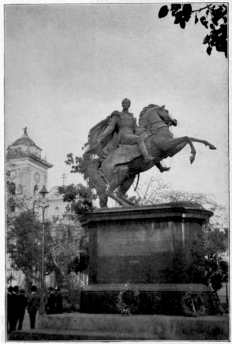
Equestrian Statue of Bolivar, the Liberator
Caracas, Venezuela
But once let our eyes leave the mountains and the Tower, and it all
changes into that other picture, the other side of the life of that
curious compound of traits, the Spaniard. For here, South American as he
calls himself, down deep in his heart he is ever the Spaniard, and
although he has claimed his independence of the mother country these
many years, through the heroic victories of Bolivar and his brave
associates, his characteristics are Spanish, his arts are Spanish, his
life is Spanish; his glorious Cathedral is Spanish, and his horrible
streets are Spanish; his magnificent statue of Bolivar is Spanish, and
the dowdy, dusty garden about it is Spanish. Was he ever intended to be
a householder? Should not his portion be to beautify the earth by his
artistic intuition, and let the rest of us, who do not comprehend the A
B C of his art, be the cleaners and the menders? Is not this a people
left like children to build up the semblance of a government from the
wrong stuff? Will not the world in time come to see that one race cannot
be all things; that some must be artists, and some mechanics; that some
must be leaders, and others followers; that some will be the builders of
beauty, to last for all time, and others must be the guardians of
health, the makers of strong, clean men?
Why is it that the President’s house,—the great yellow house across the
square, shown us by the Minister of War himself to-day,—one of the
homes of Cipriano Castro, the present Dictator, is nothing more or less
than an arsenal, packed to the full with cartridges, muskets, and
rapid-firing guns, and alive with armed troops? How is it that Castro is
said to have laid by a million dollars out of a twelve thousand dollars
a year salary? Why is it that our going into Venezuela was considered by
some unsafe? Why did we shake every bone in our bodies over the upturned
streets and boulders of Caracas? Because the Venezuelan is trying to do
that for which he is not fitted; in which, during all these long years
of constant revolution, he has failed. He, past-master in certain of his
arts, has taught the world his colours and his lights and shades; he has
given to earth notable tokens of his skill in building; but in
house-cleaning—municipal or national—he is out of his element, and
should no more be expected to excel in that line than a babe in arms
should be expected to know the Greek grammar.
Like all Spaniards he is mediæval in his instincts; he cannot really
govern himself as part of a republic.
The city of Caracas exemplifies this statement. It is in a horrible
state of dirt and disproportion. Its people are kind and courteous, but
its streets are a nightmare; and over all hovers the strong hand of
military despotism.
After dinner our first expedition was to call upon the United States
Minister L—— and his wife, who were occupying the former residence of
Count De Toro, some miles out of the city. And what a drive!
To move comfortably in Caracas, you must either take the donkey
tramway—which never goes where you want to go—or you must walk. But to
walk a half-dozen miles in the hot sun, on a dusty, stony road, is not
particularly inviting, so, with our respects to the sun, we decide to
drive, and all the way out we wonder why we ever did. And yet, had we
walked, I suppose we would have wondered why we hadn’t taken a cab.
As it was, the dust blew about us from the rolling, bumping wheels in
great clouds, and the big stones in the road sent us careening about
from one side of the carriage to the other. Again we think of Mexico—of
the dust, the parched earth, the arroyos, and the saving mountains
beyond. We pass a dried-up river-bed, where women are washing in a faint
trickle of water, and then we wind about the hill and climb up the rocky
way, enter a sort of wood, and come suddenly to the minister’s house.
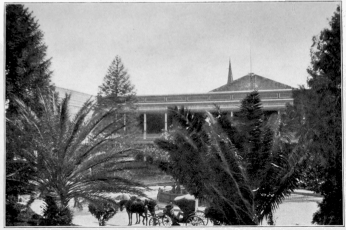
An Interior Court
Caracas, Venezuela
Our nation’s arms on the gateway make us feel at home, and we jingle the
bell and send in our cards and wait in the shady court. In a few
moments, Minister L—— appears, and with him Mrs. L——, who bids us
enter her cool, delicious drawing-room, very clean and sweet and
old-fashioned and quiet, though the house is truly Spanish, with wide,
airy rooms and curious pictured walls. The men went off up a flight of
stone steps through the garden to the office, to talk politics and the
“Venezuelan situation,” I suppose; while we sat there with the
minister’s wife, who told us much of her life and the customs of the
country, and, among other things, how difficult it is for a
foreigner—even a diplomat—to gain access to the real home-life of the
Spaniard; how the women live shut in, and see but little of the world,
only glimpses now and then, never knowing anything of our Northern
freedom.
The drive back to the city was one continuous round of jolt and bump and
dust. We rattled down and up the streets which, despite their
narrowness and general dilapidation, could not be utterly devoid of
interest, if viewed from the eyes of the lover of wrought-iron handiwork
and graceful handlings of simple and strong elements in building.
We were told that it was our duty to view the Municipal Palace, and dear
Sister, although I knew she was tired, did not want anything seeable
omitted; so we most willingly left the cabs at the palace door, with the
hope of never having the agony of that ride repeated.
As the Spaniard builds his cathedral, so does he impart to each
important structure a fitting grace and dignity of style commensurate
with its office. The Municipal Palace is built about a great hollow
square or plaza, which is filled with palms and other similarly
beautiful vegetation. But, oh, dear! oh, dear! the dust! The great
reception-hall, or audience-chamber,—or whatever one might call
it,—was lined with stately gilt chairs and sofas, done up in linen
dusters. The effort of driving and seeing and jolting and being
agreeable had been such a strain that I just thumped down on one of the
wide sofas and spent my time looking about me, while the others
conscientiously made the grande tour from one end of the great room to
the other.
It is a large oval hall ornamented with some very fine historical
paintings. The Spanish Student had found an obliging officer—for
soldiers are everywhere—and I quietly left the two alone. I thought it
too cruel, after our long drive, to expect him to retranslate for my
benefit, but then there came a faint suspicion in my mind, from a
troubled expression on his face, when the guide launched into the deep
waters of Venezuelan history, with Bolivar rampant and the Spaniards
fleeing, that, possibly, it was not all clear sailing; that, possibly,
this was just the occasion for the last of my phrases. No, I watch the
face; it resumes once more its usual expression of serenity, and I sit
there and think how beautiful it might all be if it were only clean; if
Bolivar could only come back again and teach his children their
unlearned lesson of disinterested self-love of country and home.
Bolivar appears to have been the only liberator (and each new
“President” who throws out the defeated party and instates himself is
called “liberator”) who ever died poor, having spent not only public
funds for the betterment of arts and science and education, but
nine-tenths of his own personal patrimony as well.
The guide closes the blinds, and our party comes together at the door,
leaving nice little clean spots where they have stood in groups on the
dusty, once highly polished floor, and we turn down the long, wide
balcony to an open door at the end. A brilliantly uniformed, handsome
lad bars admission, for Castro the Great is holding a cabinet meeting
there, and we can see the collar of a black alpaca coat and the back of
a very solemn-looking chair, and hear a low voice speaking,—and that
was all we saw of Castro.
Some one proposes a drive; some one else suggests the shops, but we
decide to go home. That dear old word sounds lonesome away down here in
South America. Does it mean the Gran Hotel de Venezuela? Was this the
home; or was it the wide, out-reaching mountains, fading into the deeps
of night; or the Cathedral, rising from the dread below in her sweet
chastity?
Tired bells jangle out the slowly passing time. An ancient carillon
sounds the quarter, an added clang the half, one note more for three
quarters. The long black arms reach to the hour, then another and
another passes, and night brings rest to the Great Mother. But the soft
gentle eyes are no sooner closed than all the children, the white
children at her feet, begin to stir and move, just as yours and mine do
when mother sleeps.
The old church towers, with sweet grace, wrap about her stately form a
mantle of whitest silver, bordered with great lines of black, and away
above her head, up in God’s garden, forget-me-nots and heartsease
blossom out into twinkling spots of starlit beauty.
The moon rolls languidly on in the gentlest heaven that earth e’er
looked upon.
Below, beneath God’s garden, the white children brighten and awaken from
the drowsy languor of the long day. Lights flare out, doors open, and
streets fill with happy voices, and a white-frocked humanity empties
itself into the Plaza to hear yet again the great Military Band of
Caracas.
There comes a hush, and then—it must be from the garden away off so
far—there drops a veil,—the veil of forgetfulness, in sounds of music
so inexpressibly tender and alluring as to catch the soul from earth
away up to where white angels gather the forget-me-nots and heartsease.
The crumbling city and its disordered sights, the dust and all
unpleasantness pass away beyond the veil, and all that remains is
covered with the witchery of music.
To make it real, we, too, join the children and press in close, just as
our little ones do who fear not the expression of their emotions. We,
too, press in where the makers of this wonderful music, sixty of them,
stand in a great semicircle at the head of a flight of stone steps, and
then we listen to the old, eternally old stories of life and love and
joy and tragedy; listen, until our souls are filled to the utmost with
the deeps of life!
An intermission comes; we take a deep breath; meanwhile he of the
Spanish vocabulary, made bold by enthusiasm, threaded his way to where
the leader of the band was nonchalantly smoking a cigarette, wishing to
congratulate him on the masterful work done by his musicians, and also
to thank him for having just played “The Star Spangled Banner,” in
honour of the Americans present.
Shrugging his shoulders, the bandmaster remarked that his men had almost
forgotten that American thing, as it was twelve years since last they
played it! Thus does the Venezuelan show his love for these United
States. But we forget that in the charm of the reawakened melody, for it
is the kind of music that speaks real things; that brings the great
forgetting of things visible; that brings the great remembering of
things eternal. Mellow notes, as from the throat of a blackbird, slip
through the liquid night as softly as the splash of feathered warblers
in the cool water brooks, and when the strong word is uttered, it comes
forth like the voice of a seer, unjarring, made strong through great
tenderness.
Closer and closer we press to lose not the slightest note, and we
realise that it is the music which comes to our cold Northern senses but
once in a lifetime, and our ears plead for more and yet more. No strings
could ever have so mellowed themselves into the loveliness of that night
as did those liquid oboes, whose sylvan tones filtered through our
senses with ineffable sweetness. The wood and brass seemed to have been
tempered by long nights of tears and days of smiles, so ripened were
they into an expression of the soul of humanity.
At last the Great Mother sleeps, her children are tired and go to rest,
and God’s garden blossoms away, away off beyond in the far country.


