THERE are so many different ways of seeing things—I suppose as many
ways as there are souls to see; and yet, in a measure, one can
generalise these many ways under two great heads. Just as we call the
infinite variations of light, from the first bird-note of breaking day,
through all the changing fancies of brilliant sun and wandering
clouds—as we call it all day; and the wonders of darkness, night; so
can our ways of seeing things be generalised under two great heads.
There is the orthodox, scholarly, scientific way, and there is the
heterodox, unscholarly, and unscientific way. Following the law of
compensation, there is much to be said on both sides. If the mind is
fully prepared, through study and research into the nature of the
object to be seen, one has the satisfaction of viewing it as one would
the face of an old and familiar friend. On the other hand, when the mind
greets the object to be seen, unprepared, in an absolutely unprejudiced,
plastic state, it has all the delight of surprise, enthusiasm, and
novelty, over a newly acquired possession. And none will deny that this
unscholarly, unprepared way of seeing things has its merits. In
travelling where the countries visited are interesting mainly from an
historical standpoint, no doubt much would be lost to the traveller
whose knowledge of the background for his picture is indistinct; in that
case, truly, the scholar is the one whose enjoyment should be keenest.
On the other hand, where the charm of a place lies largely in its
picturesque beauty, in its possibilities of surprise, through novel and
curious phases of life, I believe that the traveller who is wholly
unprepared has pleasures in store for him equalled only by the exquisite
and spontaneous enthusiasms of childhood.
This long preamble is not so much to explain the two ways of seeing
things, as it is to console myself for having known so little of the
West Indies before starting on this cruise. There is no use in trying to
appear wiser than one is, because, before one knows it, along comes some
one who does really know; out flashes the critical knife, and off
vanishes that beautifully flimsy wind-bag into thin air. For instance, I
might have stood complacently unmoved when the great mountain peaks and
the sleeping volcanic craters of Martinique rose in green majesty from
the Caribbean Sea, and I might have said: “Why, certainly, that is just
as I expected!” But I did not say so, because I had not expected such
mountain peaks in the West Indies, though somewhat prepared by the
islands we had thus far seen.
Once on a time I had a very charming picture in my mind of the West
Indies, but, charming as it was, it was not the real islands as I have
found them; and ever since having known the reality I have been trying
to revitalise that former picture and compare it with the genuine
impressions; but I find it of so ephemeral a nature that I can scarcely
recall it. All I remember is, that I expected to find the islands low
and flat, and mostly of a coral formation. Some of the islands are
indeed of this nature, but comparatively few. As we sailed under sunny,
cloudless skies, over a brilliantly blue sea, the monarchs of the
Caribbees arose one by one in glorious majesty; and especially these
Windward Islands, a great windbreak to keep out the big Atlantic, with
Martinique the crowning summit. At times, single gigantic rocks, the
homes of sea-birds, lonely and desolate, stood out from the deep; and
then great ranges of mountains, covered to the summit with densest
foliage, lifted themselves to the sky many thousands of feet. It is said
with authority that, on these islands—particularly on St.
Vincent—there still survive some of the ancient Caribs, the aboriginal
West Indian race, no doubt descendants of those brave Indians so harried
and murdered by the early Spanish explorers. In Martinique, the mixture
of Carib blood is still apparent, showing, even through generations of
negro pollution, in many a coppery skin, wild fierce eye, and proud head
with straight black locks.
To me it seemed that Martinique is an epitome of the whole West Indies.
In appearance, in products, in people, in history, it might taken as
the highest type of these garden isles, once enjoyed by vast tribes of
pure-blooded and self-respecting savages, but now held by the
conglomerate descendants of all colours and all nations.
Now had I been more familiar with the rare though limited treasures of
West Indian literature, I would not have marvelled at the glorious
mountain summits of Martinique that day we came to picturesque St.
Pierre; I might have said to my companion: “Ah! here they are, quite as
I expected; old, old friends; little white city, square cathedral tower,
narrow, hilly streets; above and beyond little irregular fields—all
hanging to the mountainside as they should!” But, instead, I stood
fairly on tiptoe in the bow of our great ship, as she cut through
high-running waves, with my hair blowing in a thousand directions,
grasping for an impish pin to gather up as much as was amenable to
reason, marvelling with all my senses at the approach to Martinique, as
the dim mountains, coming nearer and nearer, were humanised by the
habitations of men.
We four were there together. Sister’s curls were a flutter of gold in
the low afternoon sun, and her sweet gray eyes were straining far ahead
at the slopes of Martinique; Little Blue Ribbons clung to Daddy’s strong
hand, while she leaned over the bow to watch the laughing foam dance up
to kiss her pretty lips. How good it was to have them with us!—the two
little girls—so keenly joyous in all the new marvels of sea and land.
If Laddie had only been there, too—But for the other three boys, far
off in our warm Northern nest, I had no longings. With them aboard, life
on the ship would have been one vanishing streak of six black-stockinged
legs, with an avenging Mother in pursuit from dawn till evening.

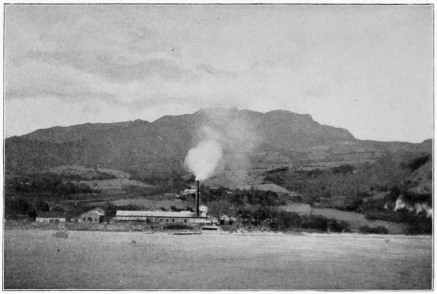
The Sugar Mill Near St. Pierre
Martinique
Now, whether it happened while I was trying to pin my hair together and
could see nothing, or whether I was so absorbed with the great wonders
that lesser ones failed to attract me, or whether it came by magic, I’ll
not say; but at all events, in less than no time after we had taken our
pilot aboard, the sea seemed to be alive with innumerable small sailing
craft. I would look out toward Martinique on the port bow, and see
what appeared to be the crest of a combing wave,—for the “Northeast
Trades” were blowing fresh, and we were not yet under the lee of the
island—a second more and this same white crest would change into a
sail, darting off, close-hauled, into the wind, as swiftly as a pelican
plunging at his prey. These materialised wave-crests continued to appear
until I counted over thirty of them on all sides of us, on the same
tack, making for land; low, narrow fishing-boats, coming in with the
day’s catch. These were replaced, as we finally made port and dropped
anchor, about three-fourths of a mile from shore in an open bay or
roadstead, by a horde of little canoes, filled with chattering,
copper-coloured natives, who came swarming out to us, each in a single
boat, except a few who shared some larger canoes, and each arrayed in a
bit of loin-cloth. These remarkable natives were so interesting to us
all that I cannot resist giving you a description of their
peculiarities.
As I told you, I came to the islands sadly lacking in information
regarding the island of Martinique or the city of St. Pierre. I knew a
little about it, to be sure; I knew that the Empress Josephine—the
beautiful and unfortunate wife of the great Napoleon—was a creole from
the shores of this island; I read in our West Indian guide-book
(fortunately a very tiny affair) that Martinique is 43 miles long and 19
miles wide; that it has a population of 175,000; that its mountains rise
to the height of some 4,500 feet; that the annual rainfall is
great—some 87 inches; that the mean temperature is high, about 81
degrees; that the soil is rich and readily responds to cultivation; that
the island was discovered by Columbus in 1502 (or in 1493, as some say),
and settled by the French in 1635; that the belligerent English had, at
different times, interfered in its peaceful life, capturing it first at
the end of the Seven Years’ War, and subsequently holding it for two
periods covering a considerable part of the Napoleonic wars; that it had
been occasionally frightened by volcanic eruptions from Mont Pelée, and
more often shaken by earthquakes; all of which sounds very much like an
encyclopedia, in fact all of these historical data were copied word for
word from our guide-book, which I took down at Daddy’s dictation. It
is really all his fault. He said I was not definite enough; that people
wanted facts, not tinselled trivialities, so I acquiesced: “Very well,
read it off,” and there it is. You see how it sounds. I don’t like it
myself, but some people may.
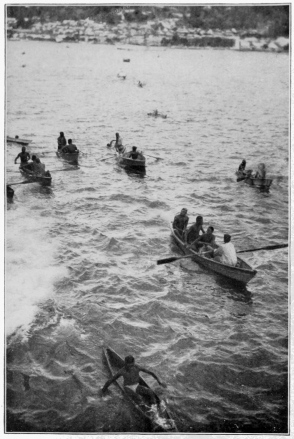
Coming to Welcome Us
St. Pierre, Martinique
There was one fact about Martinique which was worth more to me than all
the data put together. I had a servant—a French woman—who for years
took care of the children.
Once upon a time she had lived in the household of the Governor of
Martinique, after he had returned to Paris; and she had darned his
stockings; think of it! My good Elise had darned the stockings of the
Governor of Martinique, and many a time she had darned mine! Wasn’t that
enough to establish a lasting bond of interest between Martinique and
the wanderer from the North?
But these dark things in the water—where do they belong? Elise and the
Governor of Martinique’s stocking could never help us settle that
question. As I said, they swarmed about the ship like so many insects.
They were an entirely different type of people from the black imps of
St. Thomas.
At St. Thomas the native was quite as ready with his guffaw as he was
with his oaths. He was a big African animal, black as coal, with the
flat nose and heavy lips, with all the idiosyncrasies we know so well; a
somewhat exaggerated, wilder, freer type than the Ethiopian we meet in
our Southern States. But these natives of Martinique were altogether
different from the blacks of St. Thomas. Their bodies were often of the
most beautiful copper colour, verging on red; their features were
regular, and in some cases rather attractive,—rare cases these,
however; their expressions were fierce and saturnine, even in the
youngest children of eight or ten years. They had to a marked degree
that animal trait of fixing their eyes upon an object and never leaving
it until what they wished had been granted them.
These swarms of men and boys had come out to dive for coins—silver
preferred—and how had they come? Mostly in slender canoes, some seven
to ten feet in length, varying in dimensions according to the size of
the occupant, one boy in each canoe. These flimsy shells were about a
foot to fifteen inches wide, and six or eight inches deep, made of thin
boards or even the rough sides of light packing-cases skilfully joined
together and payed up with pitch. They were flat-bottomed, sharp at both
ends and barely wide enough for the single occupant to sit in, and
without seats, oars, or paddles. In what one might call the bow—if bow
there is to such a craft—the low sides were bridged over and boxed in
underneath, with a narrow slit in the top of this tiny locker into which
to drop the captured pennies. This was the diver’s bank, where he
deposited his capital after his mouth was too full to hold more. In lieu
of paddles, he had a bit of thin board about the size of a cigar-box
cover in each hand; sometimes this artificial fin had a loop to fit back
of the hand, and sometimes the little fellows would use only their hands
to paddle themselves about, sitting well down, leaning forward, darting
rapidly through the water. Meanwhile some bigger boys and men appeared,
two or three together, in larger skiffs propelled by oars or paddles.
The divers whisk in and out among the host (for there were also other
larger boats now come from shore to see us) with marvellous skill, and
when we toss a coin into the clear sea, away go the paddles and boats,
and down go a half-dozen copper-coloured bodies, each making for the
same shining point, and all we can see for awhile is several pairs of
whitish soles gleaming under the water, and sometimes the short turmoil
of a fight below the surface; then up comes a sputtering heathen with
the coin in his hand, to show he has found it. Into his mouth it goes
and then off he chases for the abandoned canoe, which by this time is
full of water and looks a hopeless derelict. But that is nothing to this
semi-aquatic creature, for he grasps the two sides of the boat, gives it
a dexterous roll and lift combined, emptying most of the water, bails
out the rest with a rapid movement of his hands, throws his body across
the canoe and is inside before it has time to capsize.
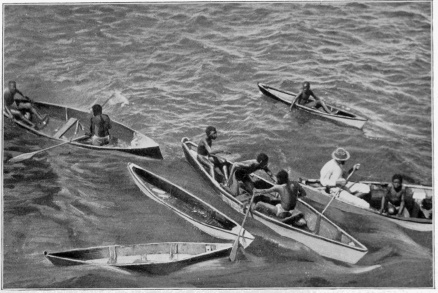
Looking from the Deck of Our Ship
St. Pierre, Martinique
These boys and men gave us a most remarkable exhibition of swimming. For
the consideration of a little silver, they even dove under our steamer
amidships, coming up on the other side in about the same time that it
took us to walk across the deck. It must be remembered, however, that
these divers do not go to the bottom for the coins, as we are often
led to believe by traveller’s accounts; they dive underneath the coins
and catch them as they go zigzagging toward the bottom. It would be
well-nigh impossible, so I am told, to recover a coin in thirty-five to
fifty feet of water, even were it not very difficult and dangerous for a
swimmer to reach the bottom, on account of the pressure of the water at
that depth.
During the entire performance, the shouting was continuous, at times
almost deafening, and yet not a sign of laughter or merriment with it
all. They were fearsome creatures, these divers. With no very great
stretch of the imagination, I could picture a cannibal feast with these
very men the chief actors. Their fierce looks were unlike those of any
human being I had ever seen. They suggested at once the ancient
inhabitants from whom the Caribbean Sea has taken its name.
After our ship’s papers had been duly passed upon, the process of
disembarkation began, and although late in the afternoon, we were all
most eager to land and see the charms of Martinique at closer range,
and, incidentally, to post our letters. We anchored as I said, quite a
distance out, which was rather a surprise, for as we approached the
shore we saw that sailing craft of all sizes and descriptions, from
sloops to full-rigged ships, were moored within a hundred yards or so of
the levee, with anchors ahead from each bow, and stern-lines out to
shore. This was a most unusual sight in an open roadstead. It was partly
accounted for by the fact of there being deep water close up to the
shore, but principally because St. Pierre is in the latitude of the true
northeast trade-winds, which at this season are as sure as the rising of
the sun, and this harbour is on the leeward side of the island, and thus
smooth and protected.
We had been sailing under the beneficent care of the trade-wind for many
days now, without fully appreciating it, and it was only when the daring
of these trading vessels was explained, that we realised why it was that
they had nothing to fear from contrary winds, or from the danger of
being blown on the rock-paved beach.
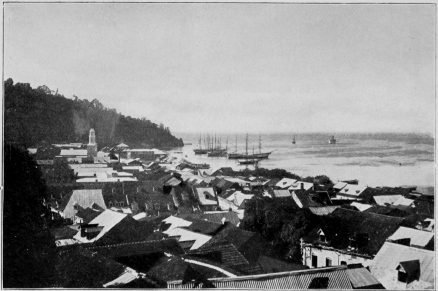
The Harbour and Shipping
St. Pierre, Martinique
Copyright, 1901, by Detroit Photographic Co.
Some years ago, at home, I was quarantined with a case of fever, and
I recall most vividly my demand for suitable literature, paper bound,
something that could be burned up if necessary; and I can yet see the
amused expression on my nautical husband’s face as he handed me volume
after volume of sea stories. I had no choice in the matter; I read my
books and ate my food as it was handed me, and asked no questions. Now,
long years after, in the harbour of St. Pierre, with brig and
brigantine, and bark and barkentine safely moored to the levee, the
charm and fascination of those delightful sea yarns comes stealing over
me once again, and I can appreciate how surely the mariners must have
counted upon the time when the trade-wind would rise and carry them on
their course. Steady and hearty it blows. At ten or eleven o’clock of
the morning, the heat of the tropics lifts its hat to the “Doctor” as
the natives call the trade-wind. At six o’clock it bids him good night.
At eight o’clock, he calls again for the few hours of darkness, so that
both day and night are tempered by his salubrious presence.
Our joy would now be complete if we could but see the Southern Cross,
for we had felt the rushing hurry and the firm caresses of the
Northeast Trades, and despite all our former indifference to the sea,
the mariner’s spirit was surely asserting itself.
It was at the close of a long, delicious tropical day that we four
stepped from the shore boat to the paved beach of St. Pierre, to the
beach where empty the clear streams of mountain water flowing down
through the streets of the town above. Had our coming been that of royal
guests, our hostess could not have been trimmer or neater. Sister left
us at the pretty white lighthouse right on the beach, and ran on ahead
to pick up an especially beautiful shell which she could not resist, and
we walked on along the street that follows the shore, under the shade of
the mangoes, until, when we turned to wait for her, she seemed to have
been caught into the very arms of the tower and held there for hostage.
To be sure, she was only arranging her shells in the basket, but she was
so quiet and the tower beyond was so old, old—so white and so
still—that I called to her in a kind of dumb terror at some impending
evil: “Sister, come, you must not loiter behind, keep with us!”
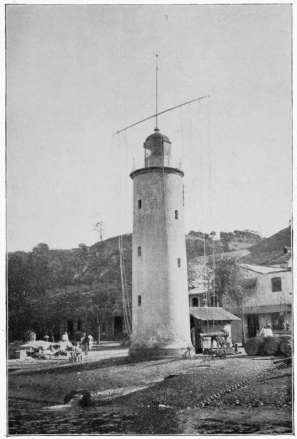
The Lighthouse on the Beach
St. Pierre, Martinique
It is possible that had our landing in St. Pierre been at noonday it
would not have been so ever-memorable. We might have felt industrious,
we might have thought we ought to see things and do things. But, ah! we
were spared that! It was at the drop of day when men do not work nor
women weep; and so we had nothing to do but follow where the people were
going, on beyond the little lighthouse tower dozing by the sea.
The bells in the white church under the hill had been ringing as we
rowed toward shore, and it was not long before the church emptied itself
into the street, nor long before we were part of the happy worshippers
who scattered in every direction. St. Pierre arose from the very water’s
edge. A row of substantial stone buildings shaded by wide-spreading
glossy mangoes stretched as far as I could see in the twilight. The
street made a turn away from the beach and the buildings followed after.
In the other direction it led to the church and then came to an end.
But St. Pierre couldn’t have built on a straight line had she wished to
do so. She has chosen a mountain for her home and she had to plan
accordingly. So she builds until her streets become a series of stone
steps, up—up—up; and then, when they finally run against a sheer wall
of rock, they stop going up and go round, for they seem to go on
indefinitely.
But we were not to be baffled by stone steps, we only pushed on a little
more vigorously, and started the climb into St. Pierre to post the
precious letters which had been written under such stress of
circumstances. We went up and about, and found the post-office, just too
late to satisfy the demands of Martinique red tape; for the black
officials were still redolent of sealing wax as the last sack of
outgoing mail was closed; and what were we to do next? We were advised
to hunt up the American consul, and possibly he could, by special
suasion, find some way of caring for our letters. So we went on through
the clean, narrow stone streets, passing many a home which shone out in
the early twilight very enticingly, through the high gateways, down to
the consul’s house, which we found barred and bolted for the night.
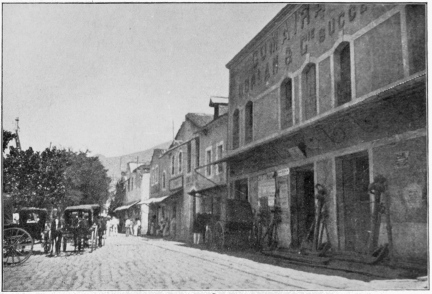
The Street Along the Water-front
St. Pierre, Martinique
Oh, these comfortable American consuls of the tropics! They live among
flowers and palms, arise late and go to their town offices by noon;
then “business” grows dull and they bolt the office at three or four
o’clock and take flight to a gardened home, in some cool mountain
suburb, to rest from the wearisome grind of diplomacy. Would that we all
might rise to the dolce far niente of an American consulate! But after
all we need them; for if our flag is now seldom seen in out-of-the-way
ports, who but the American consul will protect the wandering American?
Two gentlemen, standing in a notary’s office hard by the consulate,
explained that the ship Fontabella, which was to carry the mail, had
not yet arrived, and that perhaps our letters must go to New York by way
of Southampton. Then it was not too late after all. Why not leave them
in the box at the consulate? “Would they be sent?” we ask. An
affirmative reply decides us. What mattered a short delay? Those letters
couldn’t be hurried however urgent their contents. They must wait for
the Fontabella until she was ready, and when that time would be none
could say. What could be more romantic than to send our letters by this
fancifully named ship, however long her voyage, however indolently she
loitered in these fair seas; wherever she strayed she was still the
Fontabella. Who knows but some of her charms might miraculously sift
in through a rent in my package and breathe a spell upon my words? Ah,
Fontabella! Heaven bless you; and I stand sighing over the mysterious
music of a name!
Do you remember a game we children used to play, which had this little
refrain?
“Look to the East,
Look to the West,
And choose the one
That you love best!”
We, too, were uncertain which way to choose, so we looked to the East,
and we looked to the West, and we chose the one that we loved the best;
it happened to be a side street up a very steep hill, beguiling us to a
broad avenue, evidently one of the approaches to the famous Jardin des
Plantes, of which our felicitous little pamphlet guide had made
particular mention. For fear lest, in our delight over the novel
experiences of the evening, I should forget to mention one feature of
St. Pierre peculiarly and distinctly unique, we’ll stop for a moment to
look down the funny little street, up which we have just laboured. You
see on each side of the narrow pavement a deep stone gutter, two feet
deep and nearly as wide, down which plunges a constant torrent of light
bluish water, with the colour peculiar to all mountain streams; this
rush and tumble of water you will see not only in this street, but in
all the streets of St. Pierre. It gives one a generous sense of
well-being. You feel as if you might take a bath on Monday and Tuesday,
and all through the week, and the town would not be threatened with the
water famine that is ever hanging over one in some of these tropical
towns. How delightful for the children, too!
It is a positive relief to my mind to have finished telling you about
those wayside streams, for, ever since our arrival in St. Pierre I have
been followed by the thought of them, until almost in a state of
distraction. Something was continually hammering into my ears: “Why
don’t you tell about the aqueducts? Don’t you know they carry down the
mountainside and into the city the finest water of the West Indies? Why
don’t you give more information?”
But now we may go on, and would you mind if we didn’t try to learn one
bit of anything more for the rest of this beautiful evening? Is it not
enough to stroll idly on under the shadow of the mountainside, wild with
tangled vines and interweaving foliage, black as night and deep as the
sea? Would it cause you, in the rush of Western civilisation, a pang to
lean with us over this high wall above the city, and watch yon bark lift
her sails athwart the blood-red sun, merging his grandeur into the peace
of the ocean? Let us call her the Fontabella; to be sure the
Fontabella is probably a matter-of-fact, puffy, old mail-steamer and
is not to arrive for days, but that’s no matter. Yonder ship is our
Fontabella. We shall name her such, truly she is worthy the honour;
she is getting ready for sea; her sails rise slowly with the sleepy
yards and stand out in black relief against the iridescent sea of glory
about her; from afar comes the faint creak of her incoming
anchor-chains, and, as she rests there motionless, down drops the
sun, and a ship we shall see no more fades into the night.
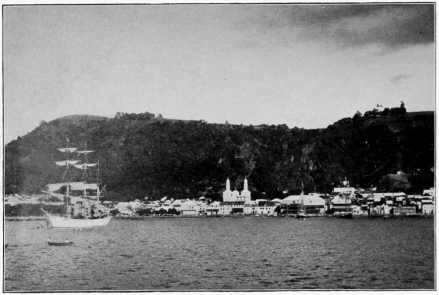
The Cathedral and Water-Front
St. Pierre, Martinique
Copyright, 1901, by Detroit Photographic Co.
Stopping to inquire of a small boy if we are on the main highway, and
not on some path which may lead us either to destruction or to nothing
at all,—either of which events would be undesirable,—a well-dressed
man, of more than middle age, offers to give us the needed information.
We are so continually beset by volunteer “guides” of all classes and
colours, that we have of late grown most short in our rejection of
unasked-for advice; who knows how many angels we may have thus turned
away unawares? This evening, our new acquaintance not only tells us
where we are going, but calmly joins the party, and, taking the lead,
pilots us in spite of our protestations. He speaks the French of a
cultivated gentleman, and goes on leading the way and the conversation
most agreeably. And so we start along the Boulevard toward the public
gardens, which lie back of the town in a gorge of the mountain.
We are followed by a half dozen or so children, who, for the most part,
stare at us very curiously, and then chatter among themselves in low
voices; I noticed that, as our self-appointed guide walked along, he was
continually knocking and poking with his long cane at stray bunches of
leaves which had fallen upon the road, and now and then he would let
fall a remark about “les serpents,” which he said were often on the
road after nightfall.
If there is one thing above all others upon this beautiful earth which
my feminine soul abhors, it is a snake; the very thought is chilling to
my blood! I had no intention of running any risk of an encounter with
serpents,—poisonous or otherwise,—if it could be avoided. Still we all
felt that this might be something similar to the rattlesnake stories
told to trusting travellers in our country, and fancied that our leader
shared the popular theory that we were gullible American travellers, who
supposed that all tropical forests were alive with venomous reptiles.
By this time it was night, heavily black with the deepening curtain of
the mountain, hanging over us on one side, and the sombre shade of the
trees on the other. Curious sounds came from the undergrowth, and long,
low, melancholy whistles dropped from among the trees; heavy odours
hung their narcotic spells about us, and our leader, in his long frock
coat, was just visible as he strode ahead of us, sweeping the path for
serpents.
Little Blue Ribbons was clinging to my hand, and her persistent whisper
begged me every minute to please not go any further. I called to Daddy:
“What’s the use going any further? I want to go back. I don’t see why we
have to follow this man if we don’t want to.” But Daddy’s and Sister’s
steps rustled among the leaves ahead, and Little Blue Ribbons went on,
whispering, and we all kept following.
Taking courage, I skipped ahead of Sister, and caught up with our new
friend, and very gently expressed to him our wish that he reconduct us
to some place a little lighter and less deadly; but it didn’t make the
least impression upon him; he simply went on and kept up a string of
talk about the wonderful Botanical Garden, whither he was leading us,
part of which I understood and part of which I didn’t. “But,” I
exclaimed, “we do not wish, desire, expect, or hope to see the Botanical
Garden in the night; we have not survived the perils of the deep to be
devoured by wild animals, or poisoned by reptiles, or slain by
man-eating Caribs, at this late day. All we want is to be peacefully
allowed to go home in our own way.” But you might as well have talked to
yonder bark asleep on the breast of the ocean as to the grim back of our
black-coated companion. It was another case of the “Pied Piper of
Hamelin,” and it would not have surprised me, such was the mood of the
night, and the mystery of the place, had he marched us up into the side
of Mount Pelée, hanging far above, and slammed the door in thunder
behind us.
Lights—grateful, beautiful, heartening, most entrancing lights—finally
glimmered at the end of our long détour, and we were brought to the gate
of the Botanical Garden, which of course we did not enter, but, turning
into another way, followed the people who were coming down this road
from Morne Rouge into the city. It was remarkable to observe how the
conversation revived. We talked about the island and its people, of
their various occupations, their exports, their schools; we stopped to
lean over the walled-in river, to see through the dark the white
clothes drying on the rocks, like much-discouraged ghosts, and then we
became hilarious, and as we neared the possibility of food, passed jokes
and had a very jolly time. Then our friend—let us now call him
“friend”—said that he must leave, that we needed but to follow the road
ahead of us and we would reach the Grand Hotel; and he turned his way,
and disappeared,—a very tall attenuated figure in a long, black coat.
We hurried on, still in a state of suppressed excitement, I, for one,
wondering if we should ever find the Grand Hotel. But we did find it, to
my relief. Why, I was so hysterically glad to see the familiar faces of
our friends again that it was all I could do to refrain from embracing
Herr Baron von Donnerwetter, who stood with others, sad-faced and
dejected, waiting in the hope of a meal.
The usual state of things prevailed: hungry Americans were clamouring
for impossible foods; helpless waiters were doing their best to pacify
the ravenous demands; a feeble, unhappy host was beating the air with
oratorical violence, and the Americans—always good-humoured, in spite
of their clamourings—waited and waited, only to be satisfied with poor
stuff at last; and finding it thus we fled.
The man of the family had, it seems, been quietly reading the signs as
we first wandered up into St. Pierre, and the name of a modest little
inn had stuck well in his memory; but, manlike, he kept still about it.
So with his bump of locality well in evidence, we followed his sturdy
steps; in short, found the place in question, and entered a dark,
covered, arched passageway, which opened into a number of dimly lighted
apartments.
The room we first entered was a kind of salle à manger and salon
combined, for it had a sofa—a very hard, rock-like affair—a number of
chairs, a quaint old sideboard, a table in the centre, and a lamp on the
wall which gave a feeble, flickering light.
Do you remember about the children who followed us so silently on our
long walk? Well, when our tall friend left us, the children kept right
along, and, as soon as it was discovered that we were trying to find a
place all on our own responsibility, their number was augmented by
others—big grown men, black men—whose services being rejected, quietly
but firmly joined the procession.
The keeper of the inn was a magnificent, great creole woman, well on in
years, with a pleasant, winning smile, and an air of hospitality more
for the guest than the purse. She said, if we could wait for awhile
until the noisy students in the adjoining rooms were pacified, she would
do her best for us, but she feared she had nothing suitable.
Ah, friends, how humble doth an empty stomach make the human animal! We
told her that we adored fried eggs. In fact we could not picture to
ourselves anything more delectable. (We hadn’t had fried eggs at every
turn in the West Indies for nothing, our stomachs were becoming
acclimated.) Whereupon she bowed her gracefully turbaned head and
leisurely left the room. Then the process began, and we may as well keep
you right in the room, for to adequately appreciate the repast that
followed, good appetite must be seasoned by hilarity and waited upon by
patience.
We had on the table a red oilcloth cover, various well-used
salt-cellars, and a motley array of knives and forks. Two long-limbed
negresses began to arrange our feast, speaking as usual one of their
home-made languages, impossible to comprehend as a whole and difficult
even in part. These two black cupbearers began, as I said, to arrange
the feast, and we sat by, looking on, hungrier every moment, as the
prospect grew less promising. After a while some bread, several big
chunks,—or loaves, I suppose I ought to say,—were laid on the table.
They were shaped like small turtles with heads pulled out at both ends.
Next came a bottle of red wine (from the old country!) and the glasses.
Then we sat there and sat there fully three-quarters of an hour.
The dusky nymphs had flippety-flapped off; the hostess with the smile
had also disappeared, and there was silence. I began to think that,
perhaps, the bread and wine was the first course, that so things were
served in St. Pierre; and besides there wasn’t even a whiff of garlic
anywhere. I was confident that no creole cooking was going on; and, the
more I thought, the more I became convinced that we ought to begin. But
Daddy thought we ought to wait, and Sister and Blue Ribbons thought so,
too, they are such proper lassies. Why did they ever have a mother who
would be so unconventional? But I was famished and that bread turtle was
put there to eat. I knew it. So in awful silence, with the family
holding its bated breath, I began to pull at the bread. I got one of the
heads off the turtle, and poured forth the ruddy nectar into the
pressed-glass goblet, and took my first delightsome taste of French wine
in Martinique. I was just about to continue, when into the room
sauntered the black waitress with a steaming dish of soup, and as she
discovered my glass of wine well begun, she set her bowl down on the
table, fastened a reproving look on me, and putting her arms akimbo,
exclaimed:
“Oh, lá, la!”
Then the other black heathen came in, and with her eye upon me, added
her astonished:
“Oh, lá, la!”
And then the head of the family said, in a “told you so” tone:
“Oh, lá, la!”
And then the youngsters joined with a choice duet of:
“Oh, lá, la!”
And I said, “Why, certainly, ‘Oh, lá, la,’” and took another swallow
of wine.
I felt perfectly justified in my conduct under the circumstances, but no
amount of explanation, I am convinced, could have ever placed me in the
proper light in the minds of those two black women. I had even some
difficulty in explaining the matter satisfactorily to my own family.
I do not think there are in all the French language three small words
which can express quite the scorn and derision of “Oh, lá, la!” From
the high courts of justice to the dim little dining-room of a Martinique
inn, “Oh, lá, la!” withers and humiliates. So I took my bowl of soup
very meekly, and said: “Merci, mille fois,” and went to work. After
the soup, we waited again long, and, with appetite appeased, more
patiently.
A noise in the dark passageway caused me to look in that direction, and
I saw, leaning one at each side of the doorway, two big, black
negroes—two of the crowd of an hour before. They stood there silent
and motionless; they had “standing-room only,” but they were there to
see the finish.
“What are these?” I exclaimed.
“Cherubs,” replied his lordship.
“Go ’way!” I say. “We don’t want you!”
Then comes a humble voice from the dark: “Gif me dol’ an’ half. Gif me
dol’ an’ half!”
“Go ’way, go ’way, Cherub! We don’t want you!” again we cry out.
“Gif me two cents! Gif me two cents!” comes from the cherub.
What a fall, my countrymen! At that juncture, her Royal Highness, the
big landlady, swept through, her very presence clearing the premises,
and peace was restored.
Then the dinner progressed through the invariable course of eggs and the
delicious sidedish of fried bananas, until we came to the salad, which,
I confess, has been my inspiration for many pages.
Now, here was a case where the wholly unexpected created a sensation
which no amount of information, regarding the relative merits of the
dish in question could produce. In a way, I rather expected to find in
the West Indies all manner of curious fruits and vegetables, but I did
not expect to eat immature palm-leaf fans with French dressing.
We had finished with our bananas, and were waiting with that good humour
which characterises the third course of dinner, when the black heathen
appeared, flanked by the entire retinue of kitchen retainers, the big
creole hostess bringing up the rear, bearing in her hand a deep dish, in
which she had prepared our salad. It was none less than the famous palm
salad, about which so many travellers have told. We, too, must add our
encomiums. It is taken from the centre of the palm head when the inner
leaves are very young. It looked very much like fine cabbage as our
hostess sliced it in long strips for salad; in colour it was
creamy-white, and in flavour as delicate as a rose. It was so tender
that it seemed to melt in the month, having none of the tough qualities
of either lettuce or watercress or cabbage. The taste is something I
could never describe, for it was a combination of such sweet flavours
that even those who partook thereof were at a loss afterward to recall
its peculiar delicacy.
The following day, we tried to buy some palm in the market and went from
one group to another, asking for palm salad; but it had all been sold
early in the morning, and, as I recall the experience, I am quite
content that we were not successful in our morning’s marketing, for who
knows but the dressing had something to do with the irresistible palm
salad—or perchance even the surroundings—and who but those replete
with the blood of many sunny races could give that touch?
Guava jelly made by the madame herself, black coffee from berries
roasted freshly for us; ripe, mellow, richly flavoured mangoes, sweet
honey oranges, and star-apples finished the dinner.
Do you think we noticed the red oilcloth table cover, the dingy lamp,
and the rock-bottom sofa?
There are so many different ways of seeing things!


