That Queen—The Rose
Gather ye rosebuds while ye may,
Old Time is still a-flying,
And this same flower that smiles today
Tomorrow will be dying.
—Herrick.
Every one longs for roses, the most highly prized
of all the flowers; and roses today can be grown
almost anywhere.
Rose growers have finally succeeded in budding
the tender tea rose on to the hardy briar and also
on to the more recent Manetti stock, and in crossing
the teas with the hybrid perpetuals,—developed
from the old June favorites. The result is ideal
roses, that are hardy and bloom all season, with the
desired lovely coloring and fragrance.
Many of the so-called June roses also have been
coaxed to bloom all season, while all those that I
draw to your attention are among the loveliest and
most easily grown. With even three or four, well
taken care of, you should be able,—as far north as
New York,—to cut a bud any time you wish from
May to November.
These hybrid teas and hybrid perpetuals are the
most satisfactory for growing in this climate.
Field-grown stock, in dormant condition, is brought
here from Holland every spring early in March,
and good plants can be bought as low as fifteen or
twenty cents apiece. The weather is usually fit for
them to be set out by the 25th of March, and they
will produce more and better roses than the costlier
potted plants procurable later. The American
grown roses, however, are really the best, as they
are adapted to our soil and climatic conditions, and
produce both more and better flowers.
Of these potted plants, though, just a word. The
Richmond, a deep, rich red, and the single white
Killarney, I have found exceptionally good, free
bloomers; and with little winter covering they
should, on account of a season's rest, be better the
second year. The 6-inch or "bench plants," as they
are termed, sell for only 25 cents each. These can
be set out from April on all summer.
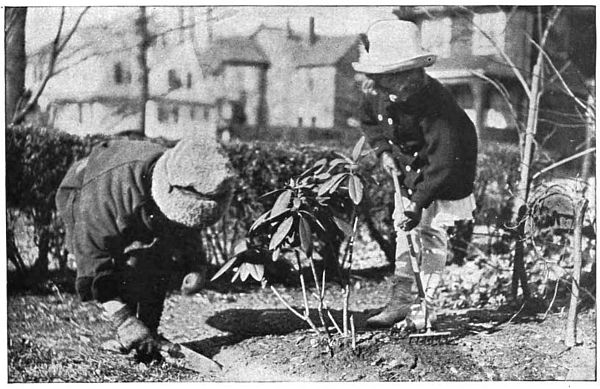
As soon as a rose bush comes into your hand,
whether from a dealer or a friend, get it into the
ground as quickly as possible. If its permanent
home is not ready, dig a little trench and cover it
entirely with the moist earth for a few days. But
never, oh, never! allow the roots to dry out.
While a few specimen roses may be set out anywhere
(as long as they do not cut up the lawn and
so violate the landscape rule, "Preserve open lawn
centers"), a number of rose bushes are usually preferred
set together in a bed, from 3 to 4 ft. wide.
Have your rose bed with a south or east exposure
if possible, as many roses so planted will
not "winter kill," and others need but little protection.
Dig a trench about 2½ ft. deep, and put
in the bottom a layer of cow manure, as this will
be lasting. Over this put a layer of good top soil
for the plants to rest on, so that they do not directly
touch the fertilizer. Then hold your rose
with your left hand while you straighten out the
roots, and sprinkle enough fine soil to hold it in
position while you set the next bush. Be sure that
your budding point is 3 inches below the level
of the ground,—and Baily says even 4! When all
are in place, fill the trench half full of soil, and then
nearly to the top with water. After this has sunk
in, add the rest of your rich top soil, and pack
down hard with your foot, so as to shut out the air
from the roots, leaving the packed earth at least
an inch below the surrounding surface to catch
and hold the moisture.
Potted roses, however, should be sunk with as little
disturbance to the roots as possible.
Then over the smoothly raked surface of the
bed spread leaves, litter or grass clippings, to
keep the sun from drying out the earth. Some
gardeners for this purpose cover the bed with pansies,
English daisies, and similar low flowers, though
many like better to see nicely cultivated soil.
To have splendid roses, however, you must supply
plenty of food and drink! When the buds
start, dig in around the roots every two weeks, two
tablespoonfuls of bonemeal, and wet thoroughly.
Manure from the chicken house is especially good
as the chickens are meat eaters, and it is, therefore,
better adapted to the needs of the roses and
easily absorbed by the rootlets. But use carefully—not
more than a small trowelful at a time, and that
well mixed with the soil. One of the very best foods
is cheaply made as follows:
| 10 lbs. sheep manure, |
| 5 lbs. bonemeal, |
| 1 lb. Scotch soot. |
Mix well. Give a level
trowelful to roots of
each rosebush every two
weeks, after buds start,
and wet down thoroughly.
Being hearty feeders, roses need a rich, light
soil, and they do best in an open, sunny spot, away
from the roots of trees and shrubs that would steal
their food.
And while they do not thrive in low, damp
ground, neither do they stand being set "high and
dry." Too damp beds should be drained with a
first layer of small stones or gravel.
Cultivate your roses every week or ten days, and
keep the ground covered with grass clippings unless
it is protected from the sun by the shade of other
plants. Cut off close to the parent stem any wild
shoots or "suckers,"—generally recognizable by
their briary stems,—as they will cause the budded
part to die.
Late in the fall mound up the earth well around
the roots of all your roses, and give them a good
covering of coarse manure or leaves. The more
tender kinds can be laid over and protected with
litter or boughs.
Then early in the spring, before the first of
April, cut back the hardy roses, keeping only the
strong canes, which, however, should be shortened
to about 10 inches. The middle of April prune the
more tender varieties. But remove from both all
shoots growing in toward the center, and cut all
weak plants back to the third or fourth eye, to
promote stronger growth and larger flowers.
Climbing roses need only the weak branches and
tips removed.
Date new climbing canes with wired wooden tags
each spring, and cut out all over three years old.
This renews the stock, restrains ambitious climbing,
and produces better flowers.
About this time a spraying first of Bordeaux
mixture to prevent disease, and a little later a
spraying of whale-oil soapsuds as warning to the
great army of bugs, slugs, etc., will give your roses
a good start toward a successful season of bloom.
Watch for that robber, the rose bug! Talk
about salt on a bird's tail! The surest way to
end His Majesty is to take a stick and knock
him into a cup of kerosene. Slow process?
Yes, but sure. The leaf-roller, too, is most
effectively disposed of by physical force,—pressure
of thumb and forefinger. Clear, cold water, twice
a day through a hose, comes with force enough to
wash off many of the rose's foes; but if they get
a start, fall back on strong soapsuds, pulverized
tobacco, or some other popular remedy.
The Garden Club of Philadelphia is said to recommend
the following:
| 3 pts. sweet milk. |
| 3 pts. kerosene. |
| 1 qt. water. |
Shake well in a jug, then put one-half pint of
the fluid to one gallon of water. Stir well and both
spray the bushes thoroughly and wet the ground
around the roots. Repeat every ten days from May
1st to June 15th, by which time the pests seem to
get discouraged and give up the fight!
And the reward for all this care and attention?
"A devoted cottager," says Neltje Blanchan, "may
easily have more beautiful roses than the indifferent
millionaire."
The following lists comprise a few of the best of
the different classes mentioned. I wish you success
in your choice.
A FEW OF THE BEST OF EACH KIND
Teas. (Tenderest of roses, needing winter protection.
Noted for delicate shades and fragrance.)
Maman Cochet, free bloomer, hardiest of the teas;
rose-pink.
Marie Van Houtte, also a free bloomer and quite
hardy; canary yellow.
Souvenir de Catherine Guillot, a rose of excellence;
copper-carmine.
White Maman Cochet, a strong grower, like the
pink; white.
Hybrid Teas. (Best for the garden, as they combine
the best qualities of the teas and the hybrid
perpetuals,—color, hardiness, and steady
bloom.)
Caroline Testout, one of the most popular,
slightly fragrant; rose pink.
Etoile de France, continuous bloomer and fragrant;
crimson.
Gruss an Teplitz, the best dark rose, and fragrant;
velvety crimson.
Kaiserin Augusta Victoria, blooms of lovely
shape, on long stems; pearly white.
Killarney, very popular and one of the best of
its color; lovely pink.
Killarney, a "sport," same as the pink; white.
La France, especially good form, fragrant;
bluish-pink.
Mrs. Aaron Ward, a vigorous plant, of compact
growth, very popular; pinkish-yellow.
Richmond, a steady bloomer all summer, with a
beautiful bud; rich deep red.
Hybrid Perpetuals. (Commonly known as June
roses, and hardy. The following will bloom
most of the summer.)
Anna de Diesbach (Gloire de Paris), splendid
in the garden and fragrant; rich carmine.
American Beauty, successful in most localities;
rose-carmine.
Frau Karl Druschki, very large and fragrant;
snowy white.
General Jacqueminot, a favorite that does well
everywhere; crimson.
Louis van Houtte, very desirable and fragrant;
deep red.
Mrs. John Laing, late blooming and hardy, fragrant;
lovely pink.
Mrs. R. G. Sharman-Crawford, a splendid
bloomer; rose-pink.
Ulrich Brunner, large, fragrant, with well-formed
flowers; cherry red.
Moss. (Loved for the beautiful fragrant buds with
their mossy covering.)
Blanche Moreau, flowers in clusters; white.
Countess de Murinais, one of the best; white.
Crested Moss, finely crested; rose pink.
Henry Martin, very vigorous; crimson.
Luxembourg, exceptionally good; crimson.
Climbing and Rambler. (Used over walls, fences,
pillars, arbors and trellises.)
Baby ramblers, 18 in. to 24 in. high, are good for
hedges, beds, or carpeting, and can be bought
in white, pink, salmon pink, red and yellow.
Climbing American Beauty, well worth growing;
rose-pink.
Dorothy Perkins, a profuse bloomer and rapid
grower; shell-pink.
Crimson Rambler, first of the ramblers, but disliked
by many gardeners today; crimson.
Dr. Van Fleet, one of the best, resisting mildew
and insects,—a gem; flesh-pink.
Excelsa, an improvement on the formerly popular
crimson rambler; crimson.
Hiawatha, most brilliant of all, between 40 and
50 roses to the spray; carmine.
Tausendschœn, roses 3 in. across, graceful in
form, and 10 or 15 to the truss; pink.
White Dorothy, like satisfactory Dorothy Perkins,
except for color; white.
Yellow Rambler, new variety called "Aviator
Bleriot," the first hardy yellow; yellow.
Briar, Austrian and Hybrids. (Loved by our
grandmothers, and some known here in this
country as far back as 1596. They must not
be crowded.)
Austrian Copper, beautiful single reddish-copper
and one of the oldest; copper.
Austrian Yellow, lovely single flowers (introduced
late in 1500); deep yellow.
English Sweet Briar, or Eglantine, loved for
its fragrance, also single; pink.
Anne of Gerstein, very graceful; dark crimson.
Brenda, very dainty; peach.
Refulgence, fragrant foliage,—deepens in color
on developing; scarlet to crimson.
The American grown rose, however, I find is considered
by many people to be by far the best.
While its slender brown stems are not as attractive
to the ignorant gardener as the thick, green
of the imported, it is much more adapted to our
soil and climatic conditions. It is cheaper, too, and
splendid varieties, in 2½-in. and 3-in. pots, can be
bought as low as $5.00 or $6.00 a hundred from expert
growers, by the person willing to start a rose
garden and then wait a year for really fine results.
In lots of fifteen, however, many of these fine
varieties of one-year-old plants can be bought for
$1.00, with the growers' guarantee that "they will
bloom the first and each succeeding year, from early
spring until severe frost." The plants are small, of
course, but who could ask for more at that price!
The (probably) best informed man in the Eastern
United States recommends the following list of
Teas and Hybrid Teas,—and it has been adopted
by a number of firms as suggestions for planting.
Don't go looking for these plants at the 5- and 10-cent
stores, for they never carry such specialties.
They are cheap, though, and well known throughout
this section, but they should be procured from
people WHO MAKE A BUSINESS OF GROWING
ROSES!
| White |
| Grossherzogin Alexandra |
| Kaiserin Augusta Victoria |
| Marie Guillot |
| White Bougere |
Yellow |
| Blumenschmidt |
| Etoile de Lyon |
| Lady Hillingdon |
| Sunburst |
Light Pink |
| Col. R. S. Williamson |
| Helen Good |
| Mrs. Foley Hobbs |
| Souvenir du President Carnot |
| Wm. R. Smith |
| Yvonne Vacherot |
Dark Pink |
| Aurora |
| F. R. Patger |
| Jonkheer J. L. Mock |
| Lady Alice Stanley |
| Maman Cochet |
| Mme. Jules Grolez |
| Mrs. George Shawyer |
| Radiance |
Red |
| Crimson Queen |
| Etoile de France |
| Mme. Eugene Marlitt |
| General McArthur |
| Helen Gould |
| Laurent Carle |
| Rhea Reid |