The term “sucking insect” is applied to all insects that have the
mouth parts modified as delicate stylets, by means of which the
plant tissues are punctured and the nutrient sap sucked up. Not only
may such insects weaken the infested plants, but they also cause the
destruction of chlorophyll, interfere with the normal functioning of the
stomata, and have a toxic effect upon the tissues; further, many serious
plant diseases are carried and spread by sucking insects, whilst the
punctures made when feeding may allow the entry of disease spores.
Among sap-sucking insects are scale insects, mealy-bugs, aphids,
leaf-hoppers, white-flies, thrips, etc. Infestation by most of these
insects (especially in the case of scale insects, mealy-bugs, and aphids)
is very often detected by the sticky nature and blackened appearance
of the plants; this is due to the fact that the insects excrete a sweet,
sticky substance known as “honey-dew,” which collects on the foliage
and branches, whilst upon it grows a black, sooty mould.
Scale insects and mealy-bugs, collectively known as coccids, are of
very great economic importance on account, not only of their widespread
depredations upon plants, few being free from infestation, but also of
the commercial value of some species—e.g., in the production of lac,
cochineal, Chinese wax, etc.; it is with the injurious forms that the New
Zealand horticulturist is concerned. The term “scale insects” is derived
from the appearance of many of the species that are protected by a
scale-like covering, which forms a conspicuous scaly incrustation when
a plant is heavily infested.
Of the several kinds of insects injurious to vegetation, the coccids
as a family are undoubtedly of major importance, because they infest
not one group, or allied group, of plants, as do so many other injurious
insects, but an extensive range of widely different plants. Some coccids
are much more injurious than others, the San José Scale, for example,
having a very virulent toxic influence, while the Greedy Scale may
cause but little damage, even when the plant is completely encrusted by
it; further, some plants may be more susceptible to injury than others
by the same species of coccid.
Coccids, as a whole, are highly specialised insects, and among
themselves exhibit a great variety of forms. Throughout the group the
sexes differ to a marked degree. The adult males, which vary but little
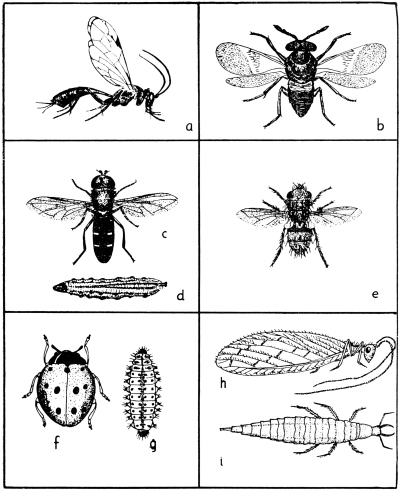
in all the coccids, are usually minute, and, with few exceptions, two-winged
(Fig. 5); none has mouth parts, these appendages having become
atrophied during metamorphosis, which is complete, while many have
one or more hair-like tail appendages. On the other hand, females are
never winged; some are comparatively large; all have well-developed
mouth parts throughout life, and undergo incomplete metamorphosis,
while in many forms the legs and antennæ are lost before maturity.
In all cases coccids secrete a protective covering, which assumes
different forms; this fact, together with the chief methods of female
development, is utilised for the purpose of this work to arrange the
coccids under three main types as follows:—
1. Less Specialised Forms.—Examples are the mealy-bugs and
cottony-cushion scale, which belong to the more generalised or least
specialised representatives. The protective body covering is in the form
of a powdery or mealy secretion; the legs and antennæ are retained
throughout life, and the insect remains freely mobile.
A typical-form life-cycle may be studied in that of the cottony-cushion
scale (Figs. 5 and 6a). During development the female insect
passes through three larval stages; each of these stages is, on the whole,
similar, except for size and minor structural changes, and the white
powdery secretion that covers the reddish body of the adult.
2. Intermediate Forms.—An example is the olive scale (Fig. 5).
In such forms there is a tendency to specialisation, owing to more or
less sedentary habits in later life, and protection is afforded by a thickening
and toughening of the cuticle on the upper surface of the body.
Unlike the cottony-cushion scale, the female olive scale passes through
two larval stages; the minute first stage larva is active and very flat; it
soon settles upon a leaf and commences to feed, when it becomes much
flatter and a little larger; the second stage differs from the first in size
and in the development of a dorsal longitudinal ridge, which eventually
forms the cross-bar of the two transverse ridges that are characteristic
of the third or adult stage, when the insect swells and assumes the shape
of the mature form. After settling in the first larval stage, the insect
becomes very sluggish, and does not move, except to migrate, as most
do, from the leaves to the twigs, there to take up a permanent position.
The legs and antennæ are retained throughout life, but in the adult are
functionless, being folded against the body; in some species of intermediate
forms the appendages become atrophied during development.
In the olive scale, and related forms, the toughened cuticle not only
serves as a protection to the insect, but also as a receptacle for the eggs
(Fig. 5); as these are laid and increase in numbers, the body of the
parent diminishes and is crowded against the dome-shaped cuticle.
3. Specialised Forms.—The apple mussel-scale (Figs. 5 and 7,
Nos. 2 and 6) is a representative of this group, the members of which
are markedly specialised, the legs and antennæ of the adult female
becoming completely atrophied during development, and the shape of
the body profoundly altered; protection is afforded by a scale-like
covering not attached to the body. In the mussel-scale development
there are two larval stages: the first, like all coccids, has the legs and
antennæ well developed and is active.
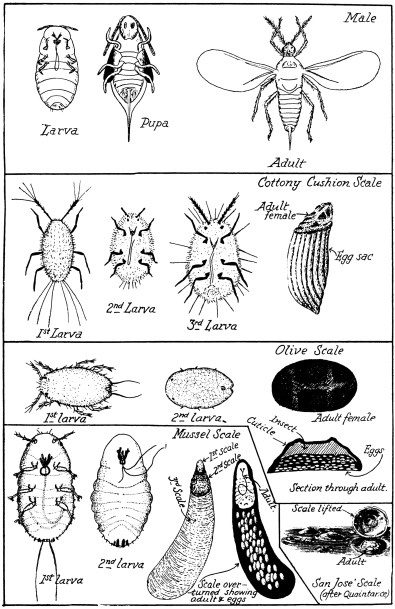
FIG. 5.—ILLUSTRATIONS OF DIFFERENT TYPES OF
SCALE-INSECT LIFE-HISTORIES.
On settling to feed, this first larva commences to produce a covering
of white threads that mat together to form the first scale; the second
stage larva presents profound changes in the absence of legs and
antennæ, while the body has become pear-shaped, the head, thorax and
abdomen seeming as one; a second more waxy scale is now formed.
After a second moult, the adult appears, and resembles the second stage
larva in form; the adult constructs a third scale, very much larger than
the earlier ones, to which it remains attached by its anterior end.
Though many of the specialised coccids form elongate scales, as in
the case of the mussel-scale, numerous others construct circular scales,
as does the San José (Fig. 5); in the latter, the second and third scales
are constructed round the first, so that the first and second appear as
pimple-like structures in the centre, or slightly to one side of the completed
covering. As with the olive scale, the covering of the specialised
forms serves as a receptacle for the eggs (Fig. 5).
Some of the more important coccids occurring in New Zealand will
now be discussed.
Cottony Cushion Scale (Icerya purchasi).—This insect (Fig. 6a)
is a native of Australia, but has now become established in many
other countries, including New Zealand. For a time it was a serious
pest of citrus, until the introduction and establishment of its natural
enemy, the ladybird beetle (Novius cardinalis).
The adult female is more or less oval, and covered with a yellowish
powder, partly concealing the reddish-brown ground colour and dark
spots along the sides of the body; the legs are black. A characteristic
feature is the white corrugated egg-sac attached to the end of the body
(Fig. 5). As the eggs are laid, this sac increases in size, until it may
measure fully 2 ½ times the length of the parent, which becomes tilted
up. The eggs are orange-yellow, and as many as 800 may be produced
by a single female. The eggs hatch in about a fortnight during summer,
and the period of development to the adult ranges from three to five
months. The larvæ most frequently congregate along the mid-ribs of
leaves, and as development advances they usually migrate to the twigs
and branches. There are two generations each year. A considerable
variety of plants is attacked by this insect, chief among which are citrus,
acacia, gorse, wattle, and Douglas fir.
Control is effected by the agency of the ladybird, but epidemics
sometimes occur with which the beetle cannot immediately cope; in such
a case fumigation in the glass-house, or spraying with red oil in the open,
should be resorted to.
Mealy Bugs.—Mealy bugs are characterised in the female by the
nature of the waxy protective secretion which forms a powdery meal-like
covering over the body, but is developed as a fringe of leg-like
processes at the side (Fig. 6b); these processes at the posterior end of
the insect may be prolonged as longer or shorter tail-like appendages in
some species, or they may be no longer than those fringing the body
margins in others. Immediately after each moult the larvæ are devoid
of mealy covering and lateral processes, which are secreted anew each
time the cuticle is shed. In a mealy bug colony are numerous small,
narrow cocoons, in each of which a developing male insect lies.
Most mealy bugs produce eggs, which are laid in a spacious, cottony
sac secreted at the posterior end of the female; the female insects, egg
sacs, and male cocoons together form characteristic woolly masses on
infested plants.
The injury caused by mealy bugs may be considerable, not only
through the drainage of plant sap, but also owing to the production of
honey-dew and its consequent sooty mould. All parts of plants are
subject to mealy bug attack, and the insects are frequently attended
by ants.
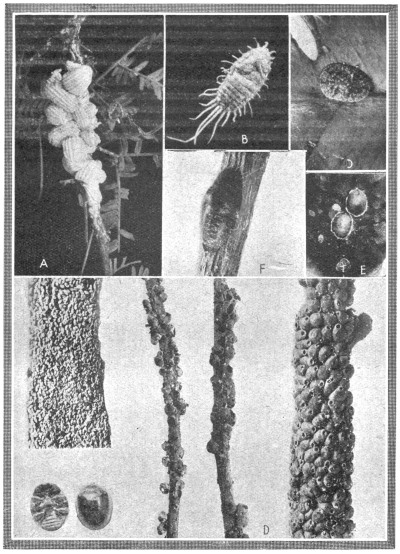
FIG. 6.
(a) Cottony cushion scale. (b) Mealy bug. (c) The black olive scale. (d) Gum tree
scale: On right, females on twig; upper left, male scales; lower left, the ladybird
beetle; centre, scales destroyed by beetle. (e) Hemispherical scale.
(f) Fruit lecanium scale.
Photographs by W. C. Davies, Cawthron Institute.
Mealy bugs are controlled to a great extent by natural enemies,
among which are the Tasmanian lace wing (Micromus tasmaniæ) and
the Cryptolæmus ladybird (Cryptolæmus montrouzieri), but the
influence of these is insufficient for commercial purposes. Attempts are
now being made at the Cawthron Institute, Nelson, to establish other
parasites recently imported from California.
Control under glass is effective by means of fumigation, but in the
open is a more difficult matter, though red oil and lime-sulphur give
some satisfactory results, together with the practice of removing rough
bark on trees where the insects hibernate. In New Zealand are several
species of mealy bugs, of which the following are of interest to the
horticulturist:—
Long-tailed Mealy Bug (Pseudococcus adonidum).—This species
is readily recognised by the long tail-like appendages of the female. It
is widely distributed and commonly met with under glass, where it
infests almost any plant; in the warmer and moister districts of the
Dominion it occurs out of doors. Its list of host plants is a lengthy one,
and includes grape vine, passion vine, wistaria, fig, oleander, Phormium,
cineraria, begonia, apple, plum, palms, ferns, etc. Considerable injury
may be caused by the insect when it occurs in dense masses on the under
side of foliage and upon young, succulent growth.
No eggs are produced by this insect, the young being born alive;
the production of young lasts for a period of from two to three weeks
at the rate of about twelve each day; the time taken to reach maturity
varies considerably, according to climatic conditions, the range being
from one to three months. There are comparatively few generations
each year out of doors, but under glass there may be several.
Citrophilus Mealy Bug (Pseudococcus gahani).—In New
Zealand this species is met with on grape vines and begonia in glass-houses,
where it becomes epidemic if left uncontrolled; out of doors it
infests apple and potato, and no doubt other plants are attacked. It is
characterised by the mealy covering being coarse and distributed
unevenly over the body, while the marginal fringe is short, the processes
being comparatively thick, particularly the tail-like ones, which are much
shorter than the body, though conspicuous.
Egg-laying covers a period of about two weeks, from 394 to 679 eggs
being deposited by each female; development to the adult is completed
in about six weeks, though this will vary according to the conditions.
In California four generations in the year have been noted.
Apple Mealy Bugs (Pseudococcus maritimus and P. comstocki).—Both
these species occur upon apple, pear and potato in New Zealand, the
former species originating in America, and the latter in Japan; the
injury to the host itself is not severe, but the presence of these insects
on the fruit is responsible for apples and pears being rejected for export.
Both species are very similar in appearance, and are of the short-tailed
type; they differ from the citrophilus mealy bug in having the
mealy covering evenly distributed over the body, while the marginal
fringe is delicate and thread-like. The eggs hatch in from one to three
weeks, and the larvæ migrate freely, the insects reaching maturity one
or two months later, according to climatic conditions. In the open the
winter is passed in the egg stage, but under glass or in mild climates
activity among the different stages occurs throughout the year.
Apart from apple and pear, these insects have been recorded from
many plants: Baker’s mealy bug (maritimus) on lemon, orange, walnut,
willow, elder, ivy, iris; and Comstock’s mealy bug on citrus, elder,
euonymus, gooseberry, grape, horse chestnut, hydrangea, mulberry,
peach, persimmon, plum, poplar, wistaria.
The Gum Scale (Eriococcus coriaceus).—This is one of the most
spectacularly destructive scale insects now established in the Dominion.
It is a native of Australia, and its normal hosts are the several species
of eucalyptus, though it is sometimes found on apricot and willow. A
characteristic feature of infected eucalyptus is their blackened appearance,
due to sooty mould growing on the copious honey-dew secreted
by the scale.
On an infested twig or branch, the insects may be so closely packed
as to conceal the bark (Fig. 6, d); each female lies in a pear-shaped sac
of felted secretion, reddish-brown, tawny, or sometimes white in colour,
measuring about three-twenty-fifths of an inch long, and having a
circular aperture at one end. The enclosed insect is somewhat flattened,
oval, and blood-red in colour; when crushed, it leaves a reddish and
sticky smear. The developing males are to be found forming white
patches of innumerable individuals on the tree trunks under the loose
bark (Fig. 6, d).
The female is viviparous; during spring, mid-summer and autumn
immense numbers of young are produced, which escape through the
opening at one end of the female sac, and are carried long distances by
the wind. These young insects first settle on the eucalypt leaves,
whence they migrate, the females to take up their final position on the
twigs and smaller branches, and the males to continue their development
on the trunk of the tree.
The gum tree scale occurs throughout the districts east of the
Southern Alps and in the vicinity of Nelson, in the South Island, and
over the southern half of the North Island; it is, however, spreading
rapidly northward.
This pest is held in control by means of the black-ladybird beetle
(Rhizobius ventralis)—Fig. 6, d—which was imported for the purpose
from Australia; birds such as the tui, wax-eye, fantail, blackbird and
thrush congregate on infested trees and eat the insect.
Olive Scale (Saissetia oleæ).—This insect has a world-wide
distribution, and is one of the most important pests of citrus in New
Zealand, although it occurs on a wide range of plants; in all cases it
infests the fruit, bark, and the under side of leaves. The host plants
include citrus, apple, pear, apricot, plum, almond, fig, grape-vine,
wistaria, pepper tree, oleander, holly, laurel, palms, camellia, rose.
The injury caused by the insect is not so much on account of its
weakening influence upon the infested plants as of the fact that it
copiously secretes honey-dew, so that black mould develops to a marked
degree, necessitating the washing of herbaceous plants and fruit.
The adult female (Fig. 6, c) is hemispherical, and measures about
one-fifth of an inch in diameter, a characteristic distinguishing feature
being the three ridges forming the letter H on its upper surface (Fig. 5).
According to age, the colour varies from brownish or greyish to jet
black, the insect being conspicuous against the lighter background of
bark or leaf; the small, immature individuals are light brown or
yellowish, and almost flat.
In New Zealand the winter is passed in both egg and larval stages,
though a few adults may be found at that time; on turning over what
appears to be an adult, it will usually be found that the female has died
and her place taken by numerous eggs (Fig. 5). The average number
of eggs produced has been estimated at from 1,500 to 2,000 per female;
at first the eggs are white, but prior to hatching they turn a deep orange-red.
Development is slow, the adult state being reached about three
months after time of hatching; egg laying commences about five weeks
after maturity, and continues for a period of about six weeks. There is
only one generation each year, and all stages may be met with on the
one plant; the greatest activity occurs during the summer months. An
important natural enemy of this scale is the steel-blue ladybird beetle
(Orcus chalybæus), introduced from Australia.
Hemispherical Scale (Saissetia hemispherica).—This world-wide
species is commonly met with in New Zealand, and, though not a serious
pest, has a wide range of host plants, both in the open and under glass;
some of the commoner hosts are citrus, fig, oleander, palms, japonica,
camellia, asparagus, and orchids.
Both leaves and stems are infested by the insect, which resembles
the olive scale (Fig. 6, e); from the latter it may be distinguished by its
light brown colour and smooth surface, there being no ridges; the longest
diameter of the adult female is one-seventh of an inch. Between 500
and 1,000 eggs are laid by each female, and the life-cycle is completed
in about six months; the young insects settle along the main leaf-veins.
Turtle Scale (Coccus hesperidum).—This widely-distributed
insect, though common in hot-houses and out of doors in the warmer
parts of the Dominion, is not especially injurious, except for the copious
honey-dew secreted and the consequent sooty mould; it occurs on holly,
ivy, camellia, citrus, laurel, myrtle, oleander, and japonica.
The insect infests leaves and stems, and is especially abundant on
succulent growth. The adult female is rather reddish-brown in colour,
dome-shaped, but with the margins flattened on the host plant; on each
side the margin is notched by a shallow depression, and there is a deeper
one at one end; over the surface is a reticulation of ridges, resembling
the pattern on the back of a turtle; fully-developed individuals measure
from one-sixth to one-eighth inch in diameter. This species is viviparous,
and development to the adult occupies about nine weeks; there
may be three or four generations each year.
Fruit Lecanium Scale (Eulecanium corni).—This European
insect is common throughout the Dominion, where occasionally it
becomes epidemic and causes some temporary damage; with it are
associated honey-dew and sooty mould. Among the plants infested are
apricot, peach, nectarine, plum, pear, grape-vine, wistaria, raspberry,
mulberry, blackberry, gooseberry, black currant, ferns.
Leaves and bark are infested, and a narrow twig may be partly
encircled by the margins of the scale. The adult female (Fig. 6f) is
oval and dome-shaped, some individuals measuring one-sixth of an inch
in length; the surface is smooth, except toward the margins, parallel to
which are some wrinkles. The general colour is dark brown, but just
prior to egg-laying there are numerous transverse and longitudinal
markings of a lighter colour over the surface. The winter is passed in
the egg stage or as partly-grown young.
Another, but larger, species, closely resembling the preceding, and
found on grape-vines, wistaria, eleagnus, etc., is Eulecanium berberidis.
It is reddish-brown in colour, and measures up to one-third of an inch
in length.
Golden Oak Scale (Asterolecanium variolosum).—This insect is
very common upon English oak trees in parts of New Zealand. In many
cases so badly are the trees infested, that they become sickly in appearance,
and at times the greater part, or even the whole, of the tree is killed
through the agency of the pest.
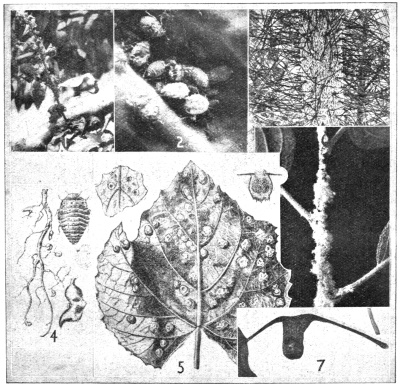
The individual scale (Fig. 7, 1) is more or less circular, and about
one-sixteenth of an inch in diameter; it is of a greenish-yellow colour,
with a narrow paler circumference, though some, with the exception of
the rim, are partly or wholly brownish. Each scale forms and lies in a
depression of the bark. The insect is viviparous. A minute parasite,
Habrolepis dalmanni (note the exit holes made by the parasite during
emergence from some of the scales shown in the photograph) has recently
been established as a means of control and is proving effective.
Camellia Scale (Pulvinaria camelicola).—This European scale
sometimes heavily infests camellias and euonymus in New Zealand, but
is not a very serious pest, though more so in glass-houses than out of
doors. After the female has produced her eggs, she drops off the plant,
so that, though the latter shows evidence of injury, there may be no sign
of the insect.
The adult female is oval and about one-third of an inch at its
longest length; in shape it resembles a rather flattened turtle scale, but
when laying eggs the body shrivels and numerous transverse wrinkles
develop, although the margins of the scale remain smooth. There is at
least one generation each year, and in warmer parts probably a second,
which may reach maturity before winter or not till the following spring.
The eggs are laid in an elongate, white, cottony sac secreted at one end
of the female; this sac is sometimes as much as four to five times the
length of the insect. The eggs continue to hatch over a period of from
four to six weeks, and the larvæ rapidly spread; the latter settle along
the leaf mid-rib, margin, or lower surface.
Apple Mussel Scale (Lepidosaphes ulmi).—The apple mussel
scale is now established throughout the temperate regions of the world.
It is commonly met with on apple, but has a long list of host plants,
among which are pear, hawthorn, willow, poplar, gooseberry, and currant.
The insect (Fig. 7, Nos. 2 and 6) forms incrustations on bark
and fruit, and is commonly met with at the stalk end of the apple; the
individual scale is chocolate-brown in colour, is shaped like the shell of
the salt water mussel—hence the name “mussel scale”—and when full
grown measures one-eighth of an inch long.
A single female is capable of laying up to 700 eggs, in which stage
the winter is passed. The eggs hatch in the spring, and the young insects
swarm over the host plant in search of a suitable place to settle. A
continuous warm spell of weather in the spring will allow all the eggs
to hatch almost at one time, but alternating cold spells will retard
development, so that emergences take place over a longer period. After
emerging from the egg until maturity, when egg-laying again takes
place, a period of three months elapses; the insect is a slow breeder, and
produces only one brood a year in colder climates, but is two-brooded
in warm districts, such as Auckland.
A small hymenopterous parasite (Aphelinus mytilaspidis), less
than one-twenty-fifth of an inch long, attacks this scale, but does not
serve as an efficient control; individual scales that have been killed by
the parasite show a small hole through which the adult parasite has
emerged. The most effective control is secured by treating infested
trees with red oil or lime-sulphur during winter.
Cabbage Tree Scales (Leucaspis cordylinidis and Leucaspis
stricta).—Cabbage trees and also New Zealand flax often have the leaves
encrusted by the white masses of these two native scales. The adult
female of one species (L. cordylinidis) measures one-eighth of an inch
long, is very narrow and straight as a rule, and white in colour, except
for the yellow anterior end (Fig. 7, 4). The other species (L. stricta)
resembles the former, except that the adult is one-eleventh of an inch
long, and has the anterior half blackish. In the case of ornamental
cabbage trees and flax, control can be effected by removing all dead and
scale-infested leaves, thus allowing access to sunlight.
San José Scale (Aspidiotus perniciosus).—Of all scale insects of
major importance, the San José (Fig. 7, 5) is outstanding, in that it is
one of the insects most destructive to deciduous trees and shrubs, a considerable
number of which are liable to attack. It is of Chinese origin,
and first came into prominence when it became established at San José,
in California, hence its name. Owing to its small size, it is easily
overlooked, except when epidemic, and is readily transported upon plants
from one country to another.
The list of plants attacked is a long one, but the following may be
mentioned:—Acacia, hawthorn, quince, privet, poplar, almond, apricot,
cherry, plum, peach, pear, apple, gooseberry, currant, roses, willow,
ash, elm.
The female San José scale is circular in outline, having a diameter
of about one-twenty-fifth of an inch; in profile it has the form of a flat
cone with a crater-like depression at the apex, in the centre of which
lies a minute pimple-like prominence; the immature scales are smaller
and whitish in colour, while the male scale is elongate-oval in outline,
with the crater-like depression toward one end. The individual scales
are greyish and are readily overlooked, but when well established upon
a tree they form an incrustation giving a characteristic dull silver-grey
appearance to the tree; bark, fruit and leaves are infested. A characteristic
feature of San José scale infection is the discolouration of the
plant tissues immediately surrounding each insect, which turn a distinct
red or purple, giving at once an indication that this scale is present.
The winter is passed by the insect in almost a mature state; on the
advent of spring, development to maturity continues, when, after mating,
the females give birth to living young over a period of several weeks.
The young reach maturity and commence to reproduce five to six weeks
from birth, there being several generations in the course of a season.
The average number of young produced by each female has been found
to be about 400.
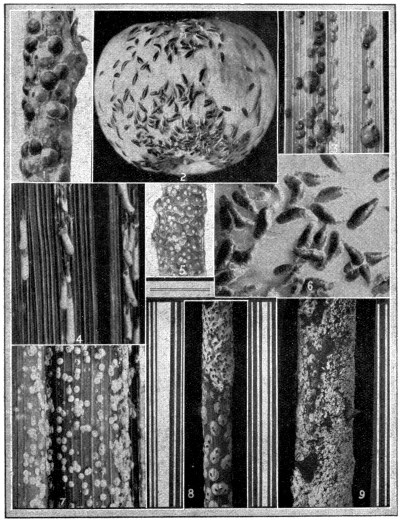
FIG. 7.
(1) Golden Oak Scale; (2) Apple Mussel Scale; (3) Black Scale; (4) Cabbage Tree
Scale; (5) San José Scale; (6) Apple Mussel Scale; (7) Oleander Scale;
(8) and (9) Rose Scale.
Photographs by W. C. Davies, Cawthron Institute.
Natural enemies in New Zealand are two species of hymenopterous
parasites, Aphelinus fuscipennis and A. mytilaspidis, the latter also
attacking the apple mussel scale. Ladybird beetles also feed upon the
insect.
Control requires close attention, and can be effected by the application
of lime-sulphur in the dormant season, when it is essential to apply
a strong wash to kill off as many scales as possible before reproduction
commences in the spring. At bud movement further applications are
necessary to destroy the young insects.
Red Orange Scale (Chrysomphalus aurantii).—The red orange
scale is distributed throughout the world, and is especially abundant in
tropical and sub-tropical regions, the most southern limit being New
Zealand. As a major pest it is peculiar to citrus, but infests to a minor
extent other plants—e.g., plum, apple, pear, quince, grape, fig,
euonymus and rose. So far it has been found only on citrus in New
Zealand, it being well established in the Auckland province, and also in
the South Island on Banks Peninsula. It is very often found on
imported oranges and lemons.
This scale is a circular one, with a central pimple-like prominence,
as in the case of the San José, but is flatter, about half as large again,
and is of a characteristic reddish colour. The damage done to citrus
trees by this insect is of a serious nature, as the entire tree or part of
it may be killed in severe infestations. A characteristic feature of this
species is that no honey-dew is secreted, and hence there is a total absence
of sooty mould on infested trees.
Like the San José scale, the red scale is viviparous, and over-winters
as partially mature adults, completing development in early
spring, when the young insects make their appearance. An average of
about 55 young is produced by each female, and development to maturity
takes from two or two and a-half months; about one month later young
are produced, and their production continues over a period of one or two
months; climatic conditions, however, have a direct influence on
development.
An important natural enemy is the steel blue ladybird (Orcus
chalybæus), imported from Australia; but the most efficient control is
cyanide fumigation, or spraying with red oil or lime-sulphur.
The Black Scale (Chrysomphalus rossi).—Foliage of palms,
oleander and citrus is often infested by this reddish-black to black
circular scale (Fig. 7, 3); it is almost flat, with a central whitish spot,
and measures up to one-tenth of an inch in diameter; when many individuals
are crowded together, their outline becomes irregular. This
species is not especially injurious, though common.
Oleander Scale (Aspidiotus hederæ).—This cosmopolitan insect
occurs on orchids, oleander, ivy, camellia, palms, citrus, coprosma, and
karaka, infesting stems, leaves and fruit. In the case of citrus, this
insect delays colouring of the fruit, which becomes blotched with yellow
or green. The insect may be so numerous, that it completely covers the
whole plant, giving to the latter a white appearance; this is due to the
preponderance of white male scales, the female being slightly yellow,
with a purplish tint.
The female scale is almost circular (Fig. 7, 7), having a diameter
of from one-twenty-fifth of an inch to two-twenty-fifths of an inch, and
is rather flat; the male is more oval and of the same size, and in both
cases there is a central orange-yellow spot. The eggs are comparatively
large, and hatch soon after being deposited. The insect reaches maturity
in from four to six weeks.
Greedy Scale (Aspidiotus rapax).—This European insect is now
widespread, and in New Zealand is common on apple, pear, quince, and
wattle; it has a wide range of hosts. The adult female scale is convex
and of a general grey colour, though sometimes yellowish. The winter
is passed in all stages of development.
Rose Scale (Aulacaspis rosæ).—This is a very common insect,
forming white incrustations on the bark of roses, briar, raspberry, loganberry,
blackberry, and sometimes pear. The adult female (Fig. 7, 8),
which is from one-twelfth of an inch to one-eighth of an inch in
diameter, is rather thin and flat, circular or oval in outline, but irregular
when crowded; the general colour is white or slightly yellowish. The
male (Fig. 7, 9) differs, in being elongated and narrow. This insect
can withstand severe winters, and is to be controlled by the use of
red oil.